Vegetables · Vegetable
Parsnips
Pastinaca sativa · also called Garden parsnip, chirivía (Spanish)
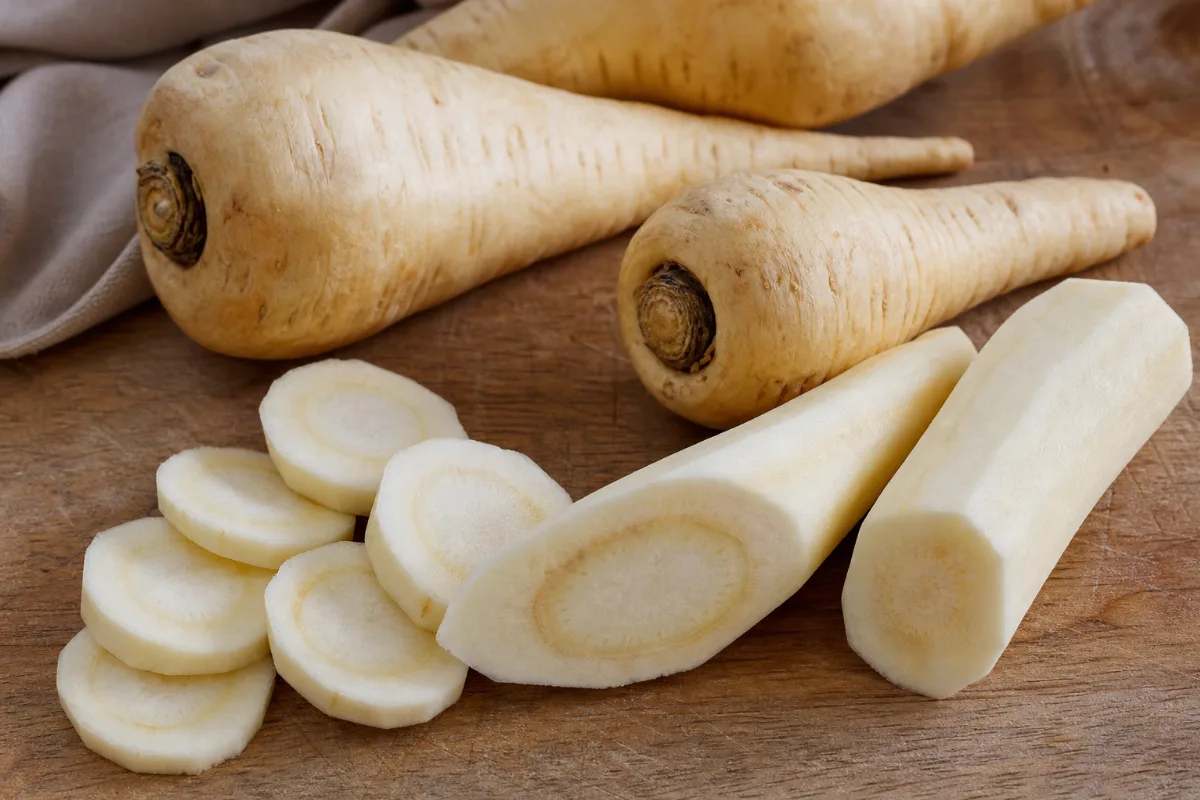
The parsnip is a pale, sweet root vegetable in the carrot family, eaten roasted, boiled or mashed. It contains fibre, potassium, folate and vitamin C, and the NHS counts it toward 5 A DAY. Studies of eating parsnips themselves are almost absent: most health findings are for fibre or vegetables in general, or come from lab and animal work. The main cautions are the sap of wild parsnip plus sunlight, which can blister skin, and potassium for people with kidney disease.
General information, not medical advice. Last substantive update · Not medically reviewed. A named clinician has not signed off on this page. How this page is made
About Parsnips
The parsnip is an ordinary root vegetable that contains fibre, potassium, folate and vitamin C. It is a food, not a proven remedy: most health claims come from studies of fibre or vegetables in general, or from lab work on extracts.
What it is
The parsnip (Pastinaca sativa) is a pale, carrot-like root vegetable in the Apiaceae family, the same family as carrot and celery. The root is the part eaten, roasted, boiled, mashed or in soups.
USDA data for raw parsnip: 75 kcal per 100 g. A cup of slices (133 g) has about 100 kcal, 6.5 g fibre, 1.6 g protein, 22.6 mg vitamin C, 89 micrograms folate (DFE), 29.9 micrograms vitamin K, 499 mg potassium, 48 mg calcium and 39 mg magnesium. USDA lists no vitamin A or carotenes for raw parsnip, so it is not an orange vegetable. Cooked, frozen and canned values were not read.
What the research shows
The firmest facts are about official advice and nutrients: the NHS counts parsnips as a vegetable portion, and fibre, potassium and folate are nutrients parsnips contain. These are not trials of parsnips.
Observational studies link more fruit and vegetables to less heart disease and fewer early deaths. Parsnips were not singled out, and these studies cannot show cause.
Two reviews of parsnip research say there are few clinical studies. The antioxidant and anti-diabetic findings they list come from extracts, cells and animals, and the reviews call for clinical studies.
Food versus extracts
The lab and mouse findings used heat-aged parsnip extracts and isolated compounds. A result for an extract does not carry over to eating roasted or boiled parsnips. No parsnip supplement evidence in people was found.
Amounts
This page gives no amounts to eat. Ask a doctor, pharmacist or dietitian what is right for you, especially if you take warfarin or have kidney problems.
At a glance
Traditional uses history, not proof
- Eaten as a root vegetable: roasted, boiled, mashed, in soups and baked goods
- In traditional Persian medicine used as a laxative, diuretic and for other purposes, which is not proof it works
Studied for research
- Fibre for digestion, low certainty (fibre in general, no parsnip trial)
- Counts toward 5 A DAY, high certainty that this is the NHS rule
- Heart disease and early death (fruit and vegetables as a group), low certainty, observational
- Folate from vegetables, high certainty for the nutrient
- Blood pressure and potassium, insufficient evidence
- Antioxidant and anti-diabetic findings, very low certainty (lab and animal work)
Main compounds
- Fibre
- Potassium
- Folate
- Vitamin C
- Vitamin K
- Furanocoumarins
- Polyacetylenes
Common forms
- Fresh root, roasted, boiled or mashed
- Frozen or canned parsnips
- Heat-aged laboratory extracts (used only in lab and mouse studies, not the vegetable)
Research links: NHS: 5 A DAY, what counts · 2017 review: fruit and vegetables and long-term health · 2024 review: plant-caused sunlight skin reactions · Research Library · Genes & Biomarkers Library
What it is and its history
- Accepted scientific name
- Pastinaca sativa
- Naming authority
- L. (GBIF accepted)
- Common names
- Parsnip (English); Garden parsnip (English); Wild parsnip (the wild form) (English); Chirivía (Spanish)
- Family or group
- Apiaceae (the carrot and celery family), as given by GBIF and by the 2026 review.
- Classification
- Plantae > Tracheophyta > Magnoliopsida > Apiales > Apiaceae > Pastinaca > Pastinaca sativa
- Native range
- The 2026 review says the plant originates in Eurasia (abstract). Not checked further.
- Habitat
- Not verified from a source read, apart from the 2018 case report saying wild parsnip is increasingly found in prairies and roadsides in North America.
- What it looks like
- Roots: A pale, carrot-like root vegetable (2026 review abstract). USDA gives a household portion of 1 cup of slices as 133 g.; Stems: Wild parsnip stems and leaves contain furocoumarins (2018 case report). Other detail not verified.; Leaves: Not verified.; Flowers: Not verified.; Fruit: Not verified. A 2019 paper title mentions furanocoumarins from wild parsnip seeds; it was not read.
- Cultivation
- The 2026 review calls it a biennial. Not otherwise verified.
- Harvest and processing
- Eaten roasted, boiled, mashed or raw, in soups, cakes, muffins and puddings, and used in animal feed and winemaking (2026 review abstract). Frozen and canned vegetables count toward 5 A DAY (NHS). Cooking effects on nutrients were not read from a source.
- Look-alikes and adulterants
- Name: Wild parsnip; Note: The wild form contains furanocoumarins in its stems and leaves and can cause sunlight skin reactions on contact. It is not the vegetable bought in shops.; Name: Carrot and other Apiaceae roots; Note: Parsnips are pale, carrots are orange. USDA lists no carotenes or vitamin A for raw parsnip. The 2021 review notes that some properties and compounds of parsnip and carrot are similar.; Name: Giant hogweed and other tall wild plants of the same family; Note: Not researched, so no claim is made.
- Sustainability and conservation
- Not assessed.
Photographs
Traditional use and history history, not clinical proof
| Tradition or era | Documented use | Source |
|---|---|---|
| Khatua 2026 review abstract | ||
| Kenari 2021 review abstract | ||
| Walling 2018 case report abstract |
Traditional use shows how it was used. It does not show that it works or is safe today.
What is inside, and how it may work
What it contains and how those compounds act in cells and animals. Laboratory and animal mechanisms are not proven effects in people.
Main compounds
| Compound | Family | Where it is concentrated | Activity studied | Level of evidence |
|---|---|---|---|---|
| Fibre (total dietary) | carbohydrate | Root USDA: 4.9 g per 100 g raw | Adds bulk; the NHS links fibre to digestion and constipation prevention. 21 19 | Human data |
| Potassium PubChem 813 | mineral | Root USDA: 375 mg per 100 g raw | Helps offset some of sodium's effects on blood pressure (MedlinePlus). A caution in kidney disease. 21 16 17 | Human data |
| Vitamin C (ascorbic acid) PubChem 54670067 | vitamin | Root USDA: 17 mg per 100 g raw | Listed by USDA. The role of vitamin C was not read in a source for this page. 21 | Human data |
| Folate (vitamin B9) PubChem 135398658 | vitamin | Root USDA: 67 micrograms DFE per 100 g raw | B vitamin; MedlinePlus ties enough folic acid before and during pregnancy to preventing major birth defects of the brain or spine. 21 14 15 | Human data |
| Vitamin K (phylloquinone) PubChem 5284607 | vitamin | Root USDA: 22.5 micrograms per 100 g raw | Needed for blood clotting; affects warfarin (NHS). 21 20 | Human data |
| Furanocoumarins (xanthotoxin, bergapten, isopimpinellin, imperatorin) PubChem 4114 (xanthotoxin) | furanocoumarin | Wild plant stems and leaves; amounts in the cultivated root not found Not given in the sources read | React with UV light to damage skin (phytophotodermatitis). Five were identified in wild parsnip by the Toxicon study. 9 8 2 | Human (skin contact, case report) and animal |
| Polyacetylenes (for example falcarindiol) PubChem 5281148 (falcarindiol) | polyacetylene | Root (heat-aged extract) Rose in a heat-aged laboratory extract (2024 study); amounts in raw root not given | Anti-inflammatory signals in cells and mice only. 7 4 | Lab and animal |
Mechanisms, receptors and pathways
| Target or pathway | Gene or receptor | What was found | Level |
|---|---|---|---|
| Furanocoumarins and UV light | Not applicable | Furanocoumarins on the skin are activated by UV light, make reactive oxygen species and damage tissue, causing blisters and later darker skin. In animals the reaction followed skin contact and not eating the plant. 9 2 8 | Human case report and animal |
| Potassium and sodium effects on blood pressure | Not specified | MedlinePlus says a diet rich in potassium helps offset some of sodium's harmful effects on blood pressure. 17 | Human (general potassium finding) |
| Antioxidant and inflammation signals | TNF-alpha and IL-1 beta expression (named in the abstract) | Heat-aged parsnip extract reduced these signals in lung cells and mice exposed to acrolein. 7 | Lab and animal |
Absorption, metabolism and elimination
- Absorption
- Not found for parsnip nutrients in the sources read. In goats, xanthotoxin was not detected in blood after being fed wild parsnip.
- Distribution
- Not found.
- Metabolism
- Not found.
- Elimination
- Not found.
- Bioavailability
- Not established.
Isolated compounds versus whole extracts
The lab and mouse findings used heat-aged extracts and isolated compounds, not parsnips as eaten. The skin reactions come from sap of the wild plant on skin. The human findings on fibre, folate and potassium are about those nutrients in general, not about parsnip supplements. No parsnip supplement evidence in people was found.
Nutritional composition
Nutrition from USDA FoodData Central (Parsnips, raw, FDC 170417, SR Legacy, last updated 4/1/2019, read 2026-10-26). Per 100 g: 75 kcal, 1.2 g protein, 0.3 g fat, 18.0 g carbohydrate, 4.9 g fibre, 4.8 g sugars, about 79.5 g water, 36 mg calcium, 0.59 mg iron, 29 mg magnesium, 375 mg potassium, 10 mg sodium, 17 mg vitamin C, 67 micrograms folate (DFE), 22.5 micrograms vitamin K, 1.49 mg vitamin E, 0.56 mg manganese, 0.12 mg copper, 0.09 mg vitamin B6. USDA lists no vitamin A, beta carotene or lutein for raw parsnip. One cup of slices (133 g), our arithmetic from the per-100 g values: about 100 kcal, 1.6 g protein, 0.4 g fat, 23.9 g carbohydrate, 6.5 g fibre, 6.4 g sugars, 48 mg calcium, 0.78 mg iron, 39 mg magnesium, 499 mg potassium, 13 mg sodium, 22.6 mg vitamin C, 89 micrograms folate, 29.9 micrograms vitamin K, 0.74 mg manganese. An 80 g portion (the NHS portion size) is about 3.9 g fibre and 300 mg potassium by the same arithmetic. Figures vary with variety, ripeness and storage. Cooked, frozen and canned values were not read.
2 high certainty2 low certainty1 very low certainty2 not enough evidence
What was looked at
The 7 benefits and uses checked for Parsnips, each with how strong the evidence is. Tap one to open it.
- Fibre for digestion and regularityLow certainty
- Counts toward the 5 A DAY vegetable targetHigh certainty
- Heart disease, cancer and early death (fruit and vegetables as a group)Low certainty
- Folate (vitamin B9) from vegetablesHigh certainty
- Potassium and blood pressureNot enough evidence
- Blood sugarNot enough evidence
- Antioxidant and other lab findings (extracts, cells, animals)Very low certainty
Lab markers tracked in the studies
Cardiovascular disease events and deathsDeath from any cause
What is Parsnips good for?
The main studied uses and how strong the human evidence is for each. Most results are for fibre, nutrients or vegetables in general, or for lab extracts, not for eating parsnips.
Benefits, one by one
Each card is a research question, not a promise. Tap a goal to filter. Open a card to see the studies, doses and limits.
Fibre for digestion and regularity
Low certaintyParsnips contain dietary fibre: about 4.9 g per 100 g of raw root, or about 6.5 g in a cup of slices (USDA). The NHS says choosing foods with fibre can help digestion and prevent constipation. This is a general fibre finding, not a trial of parsnips.
2 studiesRaw root as food. Fibre in cooked, frozen or canned parsnip was not r…
Studies, doses and limits
What the trials found
The NHS says there is evidence that eating plenty of fibre is associated with a lower risk of heart disease, stroke, type 2 diabetes and bowel cancer, and that choosing foods with fibre can help with digestion and prevent constipation. It says high-fibre foods have 6 g or more of fibre per 100 g; raw parsnip has 4.9 g per 100 g (USDA), so it is a fibre-containing food but below that line. The NHS gives 30 g a day as the adult fibre target.
Results
Parsnips supply fibre, but no trial of eating parsnips for constipation or digestion was read.
Effect sizes as reported
USDA: 4.9 g fibre per 100 g raw; about 6.5 g per cup of slices (133 g). Our arithmetic: about 3.9 g in an 80 g portion.
Why this rating
Low for parsnips: the NHS statement is about fibre in general and about the mix of foods people eat. The fibre content is USDA data. There is no parsnip-specific trial.
Form and dose studied
Raw root as food. Fibre in cooked, frozen or canned parsnip was not read from a source.
Who was studied
Adults and children eating a mixed diet; the NHS gives lower fibre targets for children.
Limits
General fibre advice, not a test of parsnips. Cooking effects on fibre were not read.
Why researchers looked
Parsnips are a fibre-containing root vegetable, so people ask if they help digestion.
Traditional use
Parsnips are eaten as a root vegetable, roasted, boiled, mashed or in soups. Long use as food is not proof that it treats any condition.
Proposed mechanism Authoritative guidance
Fibre adds bulk to food as it passes through the gut. The NHS page read gives no mechanism detail beyond saying fibre helps digestion and prevents constipation.
A proposed mechanism does not show that the effect happens in people.
Fibre advice and side effects are covered on our fibre page; ask a clinician if you have a bowel condition.
Counts toward the 5 A DAY vegetable target
High certaintyThe NHS says parsnips count toward your 5 A DAY, unlike ordinary potatoes. Frozen and canned vegetables count too. This is official portion advice, not a finding that parsnips treat anything.
1 studiesFresh, canned or frozen. For canned vegetables the NHS suggests choos…
Studies, doses and limits
What the trials found
The NHS says sweet potatoes, parsnips, swedes and turnips do count towards 5 A DAY because they are usually eaten in addition to the starchy food part of a meal, while potatoes, yams, cassava and plantain do not. It says 80 g of fresh, canned or frozen vegetables counts as one portion, and that vegetables cooked in dishes such as soups and stews also count.
Results
Parsnips count as a vegetable portion in NHS advice.
Effect sizes as reported
NHS: 80 g of fresh, canned or frozen vegetables is 1 portion (official figure, not a recommendation from us).
Why this rating
High that this is the NHS position (page read in full). It is a counting rule, not evidence of a health effect from parsnips.
Form and dose studied
Fresh, canned or frozen. For canned vegetables the NHS suggests choosing ones in water with no added salt.
Who was studied
General public in the UK; other countries use different portion rules.
Limits
UK advice. The US and other countries have their own guidance, which was not compared here.
Why researchers looked
People ask whether a starchy root vegetable counts as one of their vegetable portions.
Traditional use
Parsnips are eaten as a root vegetable, roasted, boiled, mashed or in soups. Long use as food is not proof that it treats any condition.
Proposed mechanism Authoritative guidance
Not applicable: this is a classification in official advice.
A proposed mechanism does not show that the effect happens in people.
None specific.
Heart disease, cancer and early death (fruit and vegetables as a group)
Low certaintyIn large observational studies, people who eat more fruit and vegetables have less heart disease and live longer. These studies did not single out parsnips, and they cannot show that vegetables are the cause.
1 studiesVegetables as food. The 200 g/day figure is the unit used in the anal…
Studies, doses and limits
What the trials found
A 2017 systematic review and meta-analysis of 95 prospective studies (142 publications) found that fruit and vegetables combined, per 200 g a day, were linked to lower risk of coronary heart disease, stroke, cardiovascular disease, total cancer and death from any cause. Parsnips were not named in the abstract.
Results
For fruit and vegetables combined, each 200 g a day was linked to lower risk of cardiovascular disease (RR 0.92) and death from any cause (RR 0.90). Parsnip-specific results were not in the abstract.
Effect sizes as reported
Combined fruit and vegetables per 200 g/day: CVD RR 0.92 (95% CI 0.90-0.95); all-cause mortality RR 0.90 (0.87-0.93); total cancer RR 0.97 (0.95-0.99).
Why this rating
Low: prospective observational studies cannot show cause, people who eat more vegetables differ in other ways, and heterogeneity was high for mortality (I2 83%). The figures are for fruit and vegetables combined, not parsnips.
Form and dose studied
Vegetables as food. The 200 g/day figure is the unit used in the analysis, not advice.
Who was studied
Adults in prospective cohorts in many countries.
Limits
Observational. Not specific to parsnips. Funding was not stated in the abstract.
Why researchers looked
Parsnips are a vegetable, and vegetable intake is widely studied.
Traditional use
Parsnips are eaten as a root vegetable, roasted, boiled, mashed or in soups. Long use as food is not proof that it treats any condition.
Proposed mechanism Authoritative guidance
Not established. The abstract does not describe a mechanism.
A proposed mechanism does not show that the effect happens in people.
None specific.
Folate (vitamin B9) from vegetables
High certaintyFolate is a B vitamin. Raw parsnip has 67 micrograms of folate (DFE) per 100 g, about 89 micrograms in a cup of slices (USDA). MedlinePlus lists dark green leafy vegetables, beans and citrus as natural folate foods and does not name parsnips.
3 studiesRaw root as food. Folate lost in cooking was not read from a source.
Studies, doses and limits
What the trials found
MedlinePlus says folic acid is a B vitamin that helps the body make healthy new cells, and that getting enough before and during pregnancy can prevent major birth defects of the baby's brain or spine. It says that because it may be hard to get enough folate through foods, women thinking about becoming pregnant should take folic acid supplements. USDA lists 67 micrograms of folate (DFE) per 100 g of raw parsnip.
Results
Parsnips contain folate. No trial of parsnips and folate status was read.
Effect sizes as reported
USDA: 67 micrograms folate (DFE) per 100 g raw parsnip; about 89 micrograms per cup of slices (133 g).
Why this rating
High for the vitamin's role (MedlinePlus) and for parsnips containing folate (USDA). Parsnips are not a food MedlinePlus names as a folate source, and no parsnip trial was read. Natural folate in food is not the same as folic acid in a pill.
Form and dose studied
Raw root as food. Folate lost in cooking was not read from a source.
Who was studied
Everyone; women planning pregnancy are given special advice by MedlinePlus.
Limits
Nutrient information, not a trial of parsnips.
Why researchers looked
Parsnips contain folate, and folate matters before and during pregnancy.
Traditional use
Parsnips are eaten as a root vegetable, roasted, boiled, mashed or in soups. Long use as food is not proof that it treats any condition.
Proposed mechanism Authoritative guidance
Folate helps the body make healthy new cells and DNA and helps form red blood cells (MedlinePlus).
A proposed mechanism does not show that the effect happens in people.
Folic acid pills have their own upper limit and can mask a vitamin B12 shortage (MedlinePlus); ask a clinician.
Potassium and blood pressure
Not enough evidenceParsnips contain potassium: 375 mg per 100 g of raw root, about 499 mg in a cup of slices (USDA). MedlinePlus says a diet rich in potassium helps offset some of sodium's harmful effects on blood pressure. This is a general potassium finding, not a trial of parsnips.
2 studiesRaw root as food.
Studies, doses and limits
What the trials found
The MedlinePlus potassium topic page says a diet rich in potassium helps to offset some of sodium's harmful effects on blood pressure, and that many people get all the potassium they need from what they eat and drink. It lists root vegetables such as carrots and potatoes among sources and does not name parsnips. The potassium figure for parsnips comes from USDA.
Results
Parsnips supply potassium. No trial of parsnips and blood pressure was read.
Effect sizes as reported
USDA: 375 mg potassium per 100 g raw parsnip; about 499 mg per cup of slices (133 g).
Why this rating
Insufficient for parsnips: there is no parsnip trial. The agency statement supports the potassium role only.
Form and dose studied
Raw root as food.
Who was studied
General adult diet.
Limits
A food containing a mineral is not proof that eating it changes blood pressure.
Why researchers looked
Root vegetables are potassium foods, and potassium is linked to blood pressure.
Traditional use
Parsnips are eaten as a root vegetable, roasted, boiled, mashed or in soups. Long use as food is not proof that it treats any condition.
Proposed mechanism Authoritative guidance
Potassium works against some of the effects of sodium on blood pressure (MedlinePlus). The page gives no further detail.
A proposed mechanism does not show that the effect happens in people.
Potassium is a caution, not a benefit, for people with kidney disease or on some blood pressure medicines: see the Safety tab.
Blood sugar
Not enough evidenceNo trial of eating parsnips and blood sugar was read. Parsnip reviews list 'anti-diabetic' activity, but that comes from lab and animal work. USDA lists 4.8 g of sugars and 18 g of carbohydrate per 100 g of raw root.
3 studiesRaw root as food. Extracts in the lab studies are not the vegetable.
Studies, doses and limits
What the trials found
The 2026 review of Pastinaca sativa lists anti-diabetic effects among reported bioactivities and says further clinical validation remains essential. The 2021 review, which covered clinical and review articles up to 2018, says there are few clinical studies of parsnip. No human study of eating parsnips and blood sugar was found in the sources read.
Results
No human trial found. Reported anti-diabetic activity is from lab and animal work as summarised in reviews (individual studies not read).
Effect sizes as reported
No effect size available. USDA: 4.8 g sugars and 18.0 g carbohydrate per 100 g raw.
Why this rating
Insufficient: the only claims are lab or animal findings summarised in reviews whose underlying studies were not read, and reviews call for clinical studies.
Form and dose studied
Raw root as food. Extracts in the lab studies are not the vegetable.
Limits
Review abstracts only. Nothing here shows parsnips lower blood sugar.
Why researchers looked
Parsnips taste sweet and are a starchy root, so people ask how they affect blood sugar.
Traditional use
Parsnips are eaten as a root vegetable, roasted, boiled, mashed or in soups. Long use as food is not proof that it treats any condition.
Proposed mechanism Preclinical
Not established in people. The reviews describe lab and animal findings only.
A proposed mechanism does not show that the effect happens in people.
People with diabetes should ask their care team how starchy vegetables fit their plan.
Antioxidant and other lab findings (extracts, cells, animals)
Very low certaintyReviews list many activities for parsnip compounds, such as antioxidant and anti-inflammatory effects. These come from extracts, cells and animals. They do not show what eating parsnips does in people.
3 studiesLab extracts, heat-aged extract and isolated compounds. Not the veget…
Studies, doses and limits
What the trials found
The 2021 review (46 articles) lists coumarins, furanocoumarins, polyacetylenes, essential oils and flavonoids and reports pharmacological effects in several body systems, then says few clinical studies exist. The 2026 review lists antioxidant, antibacterial, antifungal, cytotoxic, anti-diabetic and cardio-protective effects and says clinical validation remains essential. A 2024 study aged parsnips at 60 degrees C for up to 30 days, tested the extract in lung cells and in mice, and reported more antioxidant capacity and less inflammation signal than controls.
Results
Lab and animal activity only; no human trial of parsnips was found for any of these uses.
Effect sizes as reported
From the 2024 study: aged extract had a 9.96-fold higher total phenolic content and a 4.25-fold higher antioxidant capacity after 30 days (lab measures).
Why this rating
Very low for any benefit to people: the findings are from extracts, cells and mice, and the reviews say clinical studies are needed. The 2024 study declares company ties (see studies).
Form and dose studied
Lab extracts, heat-aged extract and isolated compounds. Not the vegetable as eaten.
Who was studied
Cells and mice, not people.
Limits
A result in a mouse for an extract does not tell us what a plate of roasted parsnips does. Aged extract in the 2024 study is a processed laboratory product.
Why researchers looked
Parsnips contain plant compounds such as furanocoumarins, polyacetylenes and flavonoids, which scientists study in the lab.
Traditional use
Parsnips are eaten as a root vegetable, roasted, boiled, mashed or in soups. Long use as food is not proof that it treats any condition.
Proposed mechanism Preclinical
The reviews describe lab effects of extracts and isolated compounds. A 2024 study of heat-aged parsnip extract reported lower inflammation signals in cells and in mice exposed to acrolein.
A proposed mechanism does not show that the effect happens in people.
Furanocoumarins named in these reviews are the same family of compounds linked to sunlight skin reactions with the wild plant: see the Safety tab.
Connections to the rest of health
How Parsnips connects to the rest of our health knowledge graph. Every link says what kind of connection it is. A safety link (for example to the liver) is a warning, not a benefit. A study that merely mentions a topic never creates a benefit link.
Explore every connection: goals, body systems, organs, symptoms, genes
B. Body systems
| Connected to | Kind of connection | Evidence status | Context | Studies |
|---|---|---|---|---|
| Digestive System | Biological association | Low certainty | Studied for: Fibre for digestion and regularity Studied for: Counts toward the 5 A DAY vegetable target | 21 19 18 |
| Cardiovascular System | Biological association | Low certainty | Studied for: Heart disease, cancer and early death (fruit and vegetables as a group) Studied for: Potassium and blood pressure | 1 21 17 |
| Blood And Immune | Biological association | High certainty | Studied for: Folate (vitamin B9) from vegetables | 21 14 15 |
| Reproductive System | Biological association | High certainty | Studied for: Folate (vitamin B9) from vegetables | 21 14 15 |
| Endocrine System | Biological association | Not enough evidence | Studied for: Blood sugar | 21 5 4 |
| Integumentary System | Biological association | Very low certainty | Studied for: Antioxidant and other lab findings (extracts, cells, animals) | 4 5 7 |
C. Body parts and organs
| Connected to | Kind of connection | Evidence status | Context | Studies |
|---|---|---|---|---|
| Skin | Adverse effect or risk | Documented risk | Sap of wild parsnip plus sunlight can blister skin; case reports and reviews describe skin contact. Sap of the wild plant plus sunlight can blister skin; sources describe skin contact. Preparation or compound: Furanocoumarins in the wild plant's sap |
9 2 |
| Kidneys | Adverse effect or risk | Documented risk | Potassium-limited diets can matter in chronic kidney disease. Contains potassium; a caution for chronic kidney disease. Preparation or compound: Potassium in parsnips |
16 21 |
I. Biomarkers
| Connected to | Kind of connection | Evidence status | Context | Studies |
|---|---|---|---|---|
| Cardiovascular disease events and deaths | Biological association | Low certainty | Measured in trials: lowered. A lab change is not the same as a health benefit. | 1 |
| Death from any cause | Biological association | Low certainty | Measured in trials: lowered. A lab change is not the same as a health benefit. | 1 |
K. Biological pathways
| Connected to | Kind of connection | Evidence status | Context | Studies |
|---|---|---|---|---|
| Fibre | Preliminary mechanism | Human | Parsnips are a fibre-containing vegetable; fibre is linked by the NHS to digestion. | 19 21 |
| Folate | Preliminary mechanism | Human | Parsnips contain folate; enough folic acid before pregnancy matters. | 14 21 |
| Potassium | Preliminary mechanism | Human | Parsnips contain potassium; relevant for kidney disease and some blood pressure medicines. | 16 21 |
L. Active compounds
| Connected to | Kind of connection | Evidence status | Context | Studies |
|---|---|---|---|---|
| Fibre (total dietary) | Biological association | Human | Adds bulk; the NHS links fibre to digestion and constipation prevention. Preparation or compound: Root |
21 19 |
| Potassium | Biological association | Human | Helps offset some of sodium's effects on blood pressure (MedlinePlus). A caution in kidney disease. Preparation or compound: Root |
21 16 17 |
| Vitamin C (ascorbic acid) | Biological association | Human | Listed by USDA. The role of vitamin C was not read in a source for this page. Preparation or compound: Root |
21 |
| Folate (vitamin B9) | Biological association | Human | B vitamin; MedlinePlus ties enough folic acid before and during pregnancy to preventing major birth defects of the brain or spine. Preparation or compound: Root |
21 14 15 |
| Vitamin K (phylloquinone) | Biological association | Human | Needed for blood clotting; affects warfarin (NHS). Preparation or compound: Root |
21 20 |
| Furanocoumarins (xanthotoxin, bergapten, isopimpinellin, imperatorin) | Biological association | Human (skin contact, case report) and animal | React with UV light to damage skin (phytophotodermatitis). Five were identified in wild parsnip by the Toxicon study. Preparation or compound: Wild plant stems and leaves; amounts in the cultivated root not found |
9 8 2 |
| Polyacetylenes (for example falcarindiol) | Biological association | Lab and animal | Anti-inflammatory signals in cells and mice only. Preparation or compound: Root (heat-aged extract) |
7 4 |
Each connection is stored with the ingredient, the connected record, the kind of connection, the evidence status, the supporting studies, the preparation or compound involved, and a review date (last reviewed October 26, 2026).
Evidence at a glance: what changed in 2 lab markers
Tap a number to show only those markers. Counts are markers, not people.
The evidence
The research centre for Parsnips. Every record here was checked against PubMed or the publisher's page; we never list a study we have not verified.
Evidence by outcome
Bars show how many studies we found for each outcome, not how well it works. People are added up across trials only (reviews are not added, to avoid double counting).
How we rate evidence
High certainty
Several well-run trials or reviews agree; further research is unlikely to change the picture much.
Moderate certainty
Good trials point the same way, but some doubt remains.
Low certainty
Small, short or inconsistent trials. The finding could change with better research.
Very low certainty
Very little or very weak human data. Treat as a possibility only.
Mixed findings
Trials or reviews disagree with each other.
Not enough evidence
Not enough human research to say either way.
Evidence against
Good research found no benefit, or found harm.
We take the reviewers' own risk-of-bias and GRADE statements where they exist, and otherwise judge from study size, design, consistency, directness and whether a product matches what is sold. Many publications do not make evidence high. Method note: We started from our existing parsnip summary, re-checked nutrition at USDA FoodData Central, read the health agency pages (NHS, MedlinePlus, FDA) and searched PubMed for reviews and case reports. Only abstracts were read for studies, and three skin-reaction case reports had no abstract, so we read titles only. Items we could not verify are flagged in the research gaps.
Study library: every study we checked 21
| Study | Design | People | Product, dose, length | Result |
|---|---|---|---|---|
| Aune 2017 Fruit and vegetable intake and the risk of cardiovascular disease, total cancer and all-cause mortality-a systematic review and dose-response meta-analysis of prospective studies. Int J Epidemiol · PMID 28338764 · DOI |
Systematic review meta analysis |
Adults in 95 prospective studies (142 publications) | Fruit and vegetable intake as food Fruit and vegetables Per 200 g/day (analysis unit, not advice) Prospective follow-up · vs Lower intake |
For fruit and vegetables combined, each 200 g/day was linked to lower risk of coronary heart disease, stroke, cardiovascular disease, total cancer and death from any cause. Reductions in risk were seen up to 800 g/day for all outcomes except cancer (600 g/day). Parsnips are not named in the abstract. Combined per 200 g/day: CHD RR 0.92; stroke RR 0.84; CVD RR 0.92; total cancer RR 0.97; all-cause mortality RR 0.90 (CHD 0.92 (0.90-0.94), I2 0%; stroke 0.84 (0.76-0.92), I2 73%; CVD 0.92 (0.90-0.95), I2 31%; cancer 0.97 (0.95-0.99), I2 49%; mortality 0.90 (0.87-0.93), I2 83%) Methods, limits and fundingOutcomes: Coronary heart disease, stroke, cardiovascular disease, total cancer, all-cause mortality Limitations: Prospective observational studies cannot show cause; people who eat more vegetables differ in other ways. Combined fruit and vegetables, not parsnips. Funding and conflicts: Not stated in the abstract. Read: abstract |
| Grosu Dumitrescu 2024 New Insights Concerning Phytophotodermatitis Induced by Phototoxic Plants. Life (Basel) · PMID 39202761 · DOI |
Narrative review |
Review of phytophotodermatitis and the plants that cause it | Phototoxic plants including Pastinaca sativa |
A non-immune skin reaction triggered by certain plants followed by sunlight (UV) exposure. Plant compounds such as furanocoumarins and psoralens interact with UV light and damage skin. The review names Apiaceae, Rutaceae and Moraceae as common phototoxic plant families and Pastinaca sativa among the species. It describes diagnosis (patch testing, Wood's lamp, skin biopsy) and says prevention includes adequate clothing such as long sleeves and gloves. Not applicable (Not applicable) Methods, limits and fundingOutcomes: Skin reaction (redness, fluid blisters, swelling, darker skin) Limitations: Review abstract read only. An erratum was later published (Life 2025;15(3):337); its content was not read. About skin contact, not eating the root. Funding and conflicts: Not stated in the abstract. Read: abstract |
| Holt 2025 Parsnip Phytophotodermatitis. Dermatitis · PMID 39453618 · DOI |
Case report |
Case report: number of patients not available from the record | Parsnip Root (cooked or handled), as the title implies |
Only the title and publication type were read (the PubMed record has no abstract). The title reports parsnip phytophotodermatitis. Not available (Not available) Methods, limits and fundingOutcomes: Skin reaction Limitations: No abstract to read. A case report shows it can happen, not how often. The title does not say how the parsnip was prepared or what role sunlight played. Funding and conflicts: Not stated. Read: abstract |
| Kenari 2021 Review of Pharmacological Properties and Chemical Constituents of Pastinaca sativa. J Pharmacopuncture · PMID 33833896 · DOI |
Narrative review mixed |
Review of 46 articles on Pastinaca sativa (parsnip); searches up to 2018 | Pastinaca sativa (parsnip) and its compounds Mostly not stated in the abstract |
Lists coumarins, furanocoumarins, polyacetylenes, essential oils and flavonoids as main constituents and reports effects in several body systems. Says a main side effect is phototoxicity, usually from direct skin contact, and that there are few clinical studies of parsnip. Notes traditional Persian medicine uses (laxative, libido, kidney stone and diuretic). Not applicable (Not applicable) Methods, limits and fundingOutcomes: Constituents, pharmacological effects, side effects Limitations: Abstract read only. Underlying studies mostly lab or animal. Most clinical content is traditional use. Authors state no conflict of interest and no financial support. Funding and conflicts: No conflict of interest; no financial support (as stated). Read: abstract |
| Khatua 2026 Pastinaca sativa L.: Nutritional Composition, Phytochemistry, and Pharmacological Properties Supporting Its Potential as a Functional Food and Therapeutic Agent. Food Sci Nutr · PMID 42110206 · DOI |
Narrative review mixed |
Narrative review of Pastinaca sativa (parsnip) | Pastinaca sativa and its compounds Mostly root |
Describes the plant as a biennial root vegetable in the Apiaceae family, originally from Eurasia, rich in starch, dietary fibre, vitamin C and minerals and low in sodium and calories. Lists antioxidant, antibacterial, antifungal, cytotoxic, anti-diabetic and cardio-protective effects reported in research and says further in-depth studies and clinical validations remain essential. Not applicable (Not applicable) Methods, limits and fundingOutcomes: Nutrition, phytochemistry, reported bioactivities Limitations: Abstract read only. The reported bioactivities are not shown to apply to people eating parsnips. The review's title and abstract use promotional wording ('therapeutic agent'). Funding and conflicts: No conflicts of interest declared. Read: abstract |
| Lafon 2020 Perioral phytophotodermatitis induced by parsnip mash. Contact Dermatitis · PMID 32383195 · DOI |
Case report |
Case report: number of patients not available from the record | Parsnip mash Root (cooked or handled), as the title implies |
Only the title and publication type were read (the PubMed record has no abstract). The title reports a skin reaction around the mouth caused by parsnip mash (phytophotodermatitis). Not available (Not available) Methods, limits and fundingOutcomes: Skin reaction Limitations: No abstract to read. A case report shows it can happen, not how often. The title does not say how the parsnip was prepared or what role sunlight played. Funding and conflicts: Not stated. Read: abstract |
| Lee 2024 Post-harvest processed parsnip showed improved anti-oxidative capacity and protective potential against acrolein-induced inflammation in vitro and in vivo. Front Nutr · PMID 39634555 · DOI |
Lab and animal study mouse and cell line |
Human lung cell line (BEAS-2B) and mice | Parsnip aged at 60 degrees C for up to 30 days, extracted Root (parsnips; part not stated in the abstract) Up to 30 days of aging · vs Unaged parsnip and controls |
Aged parsnip extract had 9.96-fold higher total phenolic content and 4.25-fold higher antioxidant capacity after 30 days. In cells it reduced acrolein-induced TNF-alpha and IL-1 beta expression. In mice it reduced bronchial inflammation, goblet cell hyperplasia and cytokine expression. TPC 9.96-fold; antioxidant capacity 4.25-fold (lab) (Not available in the abstract) Methods, limits and fundingOutcomes: Phenolic content, antioxidant capacity, inflammation signals after acrolein Limitations: Cells and mice, not people. A heat-aged laboratory extract, not parsnip as eaten. Funding and conflicts: Industry-linked: two authors are founders and shareholders of EFIL BioScience Inc., others are its employees, and three are inventors on a patent application for respiratory compositions. Read: abstract |
| Stegelmeier 2019 Wild parsnip (Pastinaca sativa)-induced photosensitization. Toxicon · PMID 31173794 · DOI |
Animal study goat and horse |
Grazing horses (natural occurrence) and goats and one horse (experiments) | Wild parsnip and purified xanthotoxin Wild plant material · vs Goats fed wild parsnip, dosed with xanthotoxin, or treated on the skin |
Five furanocoumarins were found in the wild plant. Goats fed wild parsnip were largely unaffected, and xanthotoxin was not detected in their blood after feeding or after oral or intravenous dosing. Putting the compound on the skin produced severe photodermatitis in goats and a horse, which the authors say points to skin contact as the likely route. Not applicable (Not applicable) Methods, limits and fundingOutcomes: Photosensitisation and skin damage Limitations: Animal study of the wild plant. Not about people eating the cultivated root. Funding and conflicts: Not stated in the abstract (US Department of Agriculture laboratory). Read: abstract |
| Walling 2018 Phytophotodermatitis induced by wild parsnip. Dermatol Online J · PMID 29630166 |
Case report |
1 One woman who met wild parsnip on a midwestern US prairie |
Wild parsnip (Pastinaca sativa), contact with the plant Stems and leaves |
Phytophotodermatitis is a skin reaction when skin is exposed to ultraviolet light after contact with a phototoxic compound. The stems and leaves of wild parsnip contain furocoumarins, which when activated by UV light produce reactive oxygen species that damage tissue, causing blistering first and darker skin later. The authors report a woman who developed it after meeting wild parsnip on a prairie. Not applicable (Not applicable) Methods, limits and fundingOutcomes: Skin blistering and later darkening (hyperpigmentation) Limitations: A single case. About skin contact with the wild plant, not eating the cultivated root. The abstract spells the plant 'Pastinia sativa'. Funding and conflicts: Not stated in the abstract. Read: abstract |
| White 2020 English Sunday lunch dermatitis: Allergic contact dermatitis to parsnip, carrot, fennel (and ivy). Contact Dermatitis · PMID 32383193 · DOI |
Case report |
Case report: number of patients not available from the record | Parsnip, carrot and fennel Root (cooked or handled), as the title implies |
Only the title and publication type were read (the PubMed record has no abstract). The title reports allergic contact dermatitis to parsnip, carrot and fennel (and ivy). Not available (Not available) Methods, limits and fundingOutcomes: Skin reaction Limitations: No abstract to read. A case report shows it can happen, not how often. The title does not say how the parsnip was prepared or what role sunlight played. Funding and conflicts: Not stated. Read: abstract |
| Winter 2022 Photodermatitis and ocular changes in nine horses after ingestion of wild parsnip (pastinaca sativa). BMC Vet Res · PMID 35219345 · DOI |
Case series animal horse |
9 Nine horses from three stables in Germany |
Hay containing wild parsnip (plants, seeds, roots) Whole wild plant in hay |
Horses had redness, scaling, crusting and necrosis of unpigmented skin on the head and prepuce, and eye changes such as conjunctivitis (7 of 9) and photophobia (4 of 9). Hay samples showed high contents of wild parsnip. The authors conclude that eating wild parsnip can cause primary photosensitisation with skin and eye injury in horses. Not applicable (Not applicable) Methods, limits and fundingOutcomes: Skin and eye changes Limitations: Horses, not people; wild plant in hay, not the cultivated root. Funding and conflicts: Not stated in the abstract. Read: abstract |
| s-fda-produce FDA: Selecting and Serving Produce Safely · Source |
Health agency n/a |
Methods, limits and fundingRead: full-text | ||
| s-gbif-pastinaca-sativa GBIF Backbone: Pastinaca sativa L. (usageKey 8262702) · Source |
Reference database n/a |
Methods, limits and fundingRead: full-text | ||
| s-medlineplus-folic-diet MedlinePlus: Folic acid in the diet · Source |
Health agency n/a |
Methods, limits and fundingRead: full-text | ||
| s-medlineplus-folic-topic MedlinePlus: Folic acid (health topic) · Source |
Health agency n/a |
Methods, limits and fundingRead: full-text | ||
| s-medlineplus-potassium MedlinePlus: Potassium in diet · Source |
Health agency n/a |
Methods, limits and fundingRead: full-text | ||
| s-medlineplus-potassium-topic MedlinePlus: Potassium (health topic) · Source |
Health agency n/a |
Methods, limits and fundingRead: full-text | ||
| s-nhs-5aday NHS: 5 A DAY: what counts · Source |
Health agency n/a |
Methods, limits and fundingRead: full-text | ||
| s-nhs-fibre NHS: How to get more fibre into your diet · Source |
Health agency n/a |
Methods, limits and fundingRead: full-text | ||
| s-nhs-warfarin NHS: Warfarin · Source |
Health agency n/a |
Methods, limits and fundingRead: full-text | ||
| s-usda-fdc-170417 USDA FoodData Central: Parsnips, raw (FDC 170417) · Source |
Reference database n/a |
Methods, limits and fundingRead: full-text |
What we do not know yet
- No trial of eating parsnips was found for digestion, heart disease, blood pressure or blood sugar.
- Fruit and vegetable studies pool many foods, and a parsnip-only result was not in the abstract.
- Antioxidant and anti-diabetic findings are from extracts, cells and animals, and the individual lab studies behind the reviews were not read.
- Skin reactions to cultivated parsnip were found only as three case reports with no abstract; how common they are, and the furanocoumarin content of the cultivated root, were not found.
- Pregnancy, breastfeeding, choking risk in young children, pesticide residues, nitrate, oxalate and the effect of cooking were not researched.
How new research is added
New studies are found by a saved PubMed search and placed in a review queue before the page changes.
Lab markers
What changed in blood or saliva tests during trials. A changed number is not the same as feeling or being healthier, and we give no "normal ranges".
Other 2
Cardiovascular disease events and deaths
Lowered in trials
How many people in a study develop heart disease or stroke, or die of it.
Low certaintyResults and what it means
Why it was measured
These are the outcomes that matter most to health, so population studies count them.
Statistical vs. clinical meaning
An association in observational studies, not proof that vegetables prevent disease. Parsnips were not singled out.
Safety implication
None specific.
| Study | Result | People | Product |
|---|---|---|---|
| 1 | Per 200 g/day of fruit and vegetables combined: cardiovascular disease RR 0.92 (95% CI 0.90-0.95); coronary heart disease RR 0.92 (0.90-0.94); stroke RR 0.84 (0.76-0.92) | Adults in prospective studies (95 studies, 142 publications) | Fruit and vegetables as food (not parsnips alone) |
Death from any cause
Lowered in trials
How many people in a study die during follow-up, whatever the reason.
Low certaintyResults and what it means
Why it was measured
A simple, hard outcome used in large population studies.
Statistical vs. clinical meaning
Association only. The result varied a lot between studies (I2 83%).
Safety implication
None specific.
| Study | Result | People | Product |
|---|---|---|---|
| 1 | Per 200 g/day of fruit and vegetables combined: all-cause mortality RR 0.90 (95% CI 0.87-0.93), I2 83% | Adults in prospective studies | Fruit and vegetables as food (not parsnips alone) |
Safety
What studies and official sources say about side effects, medicines and who should check first. Each point shows what kind of evidence it comes from.
Main points to know 5
- Wild parsnip is not the vegetable: its sap plus sunlight can blister skin. The stems and leaves of wild parsnip contain furanocoumarins. When these touch the skin and the skin is then exposed to sunlight, they can cause redness, blisters and later dark patches (phytophotodermatitis). A case report describes it after contact with wild parsnip on a prairie. A 2024 review recommends covering up with long sleeves and gloves. In animal tests the reaction came from skin contact, not from eating the plant. Only eat parsnips you bought or grew yourself, and do not pick wild plants for food unless an expert has identified them. Case report 9 2 8
- Skin reactions have also been reported with cooked or handled parsnip. Three case reports have titles linking parsnip to skin reactions: a reaction around the mouth after parsnip mash (2020), allergic contact dermatitis to parsnip, carrot and fennel (2020) and a 2025 report titled Parsnip Phytophotodermatitis. None of the three has an abstract, so we read titles only and cannot say how common this is. The 2021 review calls phototoxicity the main side effect of parsnip, usually from direct skin contact. Case report 6 10 3 4
- Kidney disease and some blood pressure medicines: parsnips contain potassium. USDA lists 375 mg of potassium per 100 g of raw parsnip, about 499 mg in a cup of slices. MedlinePlus says people with kidney problems, particularly those on dialysis, should not eat too many potassium-rich foods. It names ACE inhibitors, ARBs and potassium-sparing diuretics (spironolactone, triamterene, amiloride) among causes of high blood potassium. MedlinePlus does not name parsnips. Ask a clinician about potassium-rich foods. Authoritative guidance 16 21
- Warfarin: parsnips have some vitamin K, but no source names them. The NHS says foods high in vitamin K, such as broccoli, spinach and other green leafy vegetables, can affect how warfarin works, and that you can still eat them but should talk to your warfarin clinic. USDA lists 22.5 micrograms of vitamin K per 100 g of raw parsnip. The NHS does not name parsnips and no source read says they matter. If you take warfarin, keep your diet steady and ask your clinic. Authoritative guidance 20 21
- Food safety: wash and scrub root vegetables, and keep them cold when cut. The FDA says to wash all produce under running water, even if you will peel it, without soap or produce wash, and to scrub firm produce with a clean brush. Washing reduces bacteria but does not eliminate them, and cooking produce thoroughly kills harmful bacteria. Cut or packaged produce should be kept in a refrigerator at 40 F (4 C) or below. Authoritative guidance 12
Side effects 3
| Effect | How often | Severity and recovery | Evidence |
|---|---|---|---|
| Blistering and later darkening of skin after contact with wild parsnip and sunlight (phytophotodermatitis) Contact with the wild plant's stems and leaves. Not eating the root. | Not established | not stated Darker patches can last after the blisters (case report); the abstract gives no timing | Case report 9 2 |
| Skin reactions linked in titles to parsnip mash, to parsnip with carrot and fennel (allergic contact dermatitis), and to parsnip generally Only titles were read; the records have no abstract. No source read says how common this is. | Not established | not stated Not stated | Case report 6 10 3 |
| High blood potassium in people with kidney disease or on some medicines MedlinePlus: too much potassium may cause abnormal and dangerous heart rhythms. It does not link this to parsnips or any amount of them. | Not established | serious Not stated | Authoritative guidance 16 |
Liver
No liver injury from eating parsnips was found. A liver-safety source such as LiverTox was not searched for this food page. A 2025 study on parsnip and the liver was seen by title only and is not used.
How often. No frequency was found.
Monitoring. No agency monitoring advice was found.
This is a safety connection. It is not evidence that Parsnips supports liver health.
Medicines and supplements 3
| With | Why it matters | Importance | Evidence | What to do |
|---|---|---|---|---|
| Medicines that raise blood potassium (ACE inhibitors, ARBs, potassium-sparing diuretics) prescription | These medicines can raise potassium in the blood (MedlinePlus). Parsnips contain potassium (USDA: 375 mg per 100 g raw). | MedlinePlus does not name parsnips; the link is our reading of two separate facts. Normal food amounts have not been tested in a trial. | Authoritative guidance Low certainty 16 21 | If you take one of these medicines or have kidney disease, ask a clinician or pharmacist about potassium-rich foods. |
| Warfarin (blood thinner) prescription | Vitamin K helps blood clot and warfarin works against it. Parsnips contain vitamin K (USDA: 22.5 micrograms per 100 g raw). | The NHS names broccoli, spinach and other green leafy vegetables, not parsnips. No source read links parsnips to a change in warfarin's effect. | Authoritative guidance Not enough evidence 20 21 | Ask your warfarin clinic about your diet as a whole. Do not change a prescribed medicine on your own. The NHS says do not take vitamin K supplements while taking warfarin. |
| Sunlight and sunbeds (UV light) after skin contact with wild parsnip sap environmental | Furanocoumarins in the wild plant react with UV light and produce reactive oxygen species that damage skin (case report abstract). | Well described for skin contact with the wild plant. Not shown for eating the cultivated root. | Case report Low certainty 9 2 | Cover skin and wear gloves around wild plants; see a clinician or pharmacist if blisters appear. |
Who should check first 5
| Situation | Advice | Evidence |
|---|---|---|
| Chronic kidney disease, especially on dialysis, or taking ACE inhibitors, ARBs or potassium-sparing diuretics | Ask a clinician about potassium-rich foods, including root vegetables such as parsnips. | Authoritative guidance 16 |
| Taking warfarin | Keep your diet steady and follow your warfarin clinic's advice. Do not stop or change medicine on your own. | Authoritative guidance 20 |
| Picking or handling wild parsnip plants | Do not pick wild plants for food. Cover skin and wear gloves; the sap plus sunlight can blister skin. | Case report 9 2 |
| Known allergy or skin reaction to parsnip, carrot or fennel | Avoid it and ask a doctor or allergist. Call emergency services for trouble breathing or swelling of the face or throat. | Case report 10 |
| Pregnancy, young children, older age or weakened immunity (foodborne illness) | The FDA says these groups can be especially vulnerable to foodborne illness. Follow official food-safety advice for produce. | Authoritative guidance 12 |
Overdose, product quality and regulators
Summary. No toxicity from parsnips as ordinary food was found in the sources read. The cautions are for the wild plant's sap on skin, and for people with kidney disease or certain medicines.
Animal. Wild parsnip fed to goats largely did not affect them, and horses that ate hay with a lot of wild parsnip developed skin and eye problems in a German case series of nine horses fed hay containing wild parsnip. The Toxicon study found skin contact produced severe photodermatitis in goats and a horse.
Human doses studied. No trial of eating parsnips for safety was found.
Overdose response. Not found.
Genotoxicity. Not researched.
Toxic or hazardous parts. Stems and leaves of the wild plant contain furanocoumarins that can cause sunlight skin reactions on contact (case report). Whether the cultivated root contains enough to matter was not found.
Raw root vegetables carry soil and can carry germs; pesticide residues, heavy metals and nitrate in parsnips were not researched.
Food safety handling. The FDA says to choose produce that is not bruised or damaged, cut away damaged areas, wash all produce under running water (no soap or produce wash), scrub firm produce with a clean brush, and keep cut or packaged produce at 40 F (4 C) or below. Washing reduces bacteria but does not eliminate them; cooking thoroughly kills harmful bacteria. 12
| Body | Action | Date |
|---|---|---|
| NHS (UK) (United Kingdom) | Warfarin page: foods high in vitamin K such as broccoli, spinach and other green leafy vegetables can affect how warfarin works; ask your warfarin clinic; do not take vitamin K supplements. Parsnips are not named. source | 2026-02-24 |
| MedlinePlus (US National Library of Medicine) (United States) | Potassium page: people with kidney problems should not eat too many potassium-rich foods; ACE inhibitors, ARBs and potassium-sparing diuretics are listed among causes of high potassium source | 2026-04-30 |
| FDA (US Food and Drug Administration) (United States) | Produce safety page: wash produce under running water, scrub firm produce, do not use soap or produce wash, refrigerate cut or packaged produce at 40 F or below; some groups are especially vulnerable to foodborne illness source | 2024-03-05 |
When to get medical help
- Trouble breathing, swelling of the lips, face or throat, or widespread hives after eating parsnip
- Large or painful blisters, or skin burning, after touching wild plants and then being in sunlight, especially on the face or near the eyes (see a clinician)
- Signs of serious bleeding while taking warfarin, such as blood in urine or stool, unexplained bruising or nosebleeds (NHS)
- Severe stomach illness after eating raw produce (the FDA says foodborne illness usually starts within 1 to 3 days)
Stop using the product and contact a clinician or emergency service. In the US, Poison Control is 1-800-222-1222.
General information only, not medical advice. Ask a clinician or pharmacist before use, especially with medicines, in pregnancy or with a health condition. See the Natural Remedy Safety guide.
Frequently asked questions
What are parsnips good for?
Do parsnips count as one of your 5 A DAY?
Yes. The NHS says parsnips count because they are usually eaten in addition to the starchy food part of a meal, unlike ordinary potatoes. Frozen and canned vegetables count too.
Are parsnips a good source of fibre?
Are parsnips good for the heart?
Observational studies link more fruit and vegetables to less heart disease (RR 0.92 per 200 g a day), but they did not single out parsnips and cannot show cause. No trial of parsnips and heart health was read.
Can parsnips burn your skin?
Can handling or eating cultivated parsnip cause a skin reaction?
Are parsnips safe with kidney disease?
Are parsnips safe with warfarin?
Are parsnips good for blood sugar or diabetes?
Are parsnips safe in pregnancy?
Do parsnips have vitamin A like carrots?
No. USDA lists no vitamin A or carotenes for raw parsnip, which fits its pale colour. Carrots are a different vegetable with their own page.
Explore by health goal
Editorial transparency
- Written by
- AlternativeMed editorial team. Research compiled with AI assistance, then checked against the sources listed.
- Medical review
- None. This page has not been reviewed by a physician or pharmacist.
- First published
- 2026-10-26
- Last substantive update
- 2026-10-26
- How we research
- We started from our existing parsnip summary, re-checked nutrition at USDA FoodData Central, read the health agency pages (NHS, MedlinePlus, FDA) and searched PubMed for reviews and case reports. Only abstracts were read for studies, and three skin-reaction case reports had no abstract, so we read titles only. Items we could not verify are flagged in the research gaps.
- How we rate evidence
- See "How we rate evidence" in the Evidence tab.
- Independence
- No product is promoted on this page. No affiliate links are shown.
Sources 21
Each source was opened and checked. Where we read only the abstract, it says so. The small numbers in the text point here.
- Aune D, Giovannucci E, Boffetta P, et al.. Fruit and vegetable intake and the risk of cardiovascular disease, total cancer and all-cause mortality-a systematic review and dose-response meta-analysis of prospective studies.. Int J Epidemiol. 2017. PMID 28338764. DOI 10.1093/ije/dyw319. (abstract)
- Grosu Dumitrescu C, Jijie AR, Manea HC, et al.. New Insights Concerning Phytophotodermatitis Induced by Phototoxic Plants.. Life (Basel). 2024. PMID 39202761. DOI 10.3390/life14081019. (abstract)
- Holt A, Gabel C, Flanagan K, et al.. Parsnip Phytophotodermatitis.. Dermatitis. 2025. PMID 39453618. DOI 10.1089/derm.2024.0358. (abstract)
- Kenari HM, Kordafshari G, Moghimi M, et al.. Review of Pharmacological Properties and Chemical Constituents of Pastinaca sativa.. J Pharmacopuncture. 2021. PMID 33833896. DOI 10.3831/KPI.2021.24.1.14. (abstract)
- Khatua S, Nag A, Sen S, et al.. Pastinaca sativa L.: Nutritional Composition, Phytochemistry, and Pharmacological Properties Supporting Its Potential as a Functional Food and Therapeutic Agent.. Food Sci Nutr. 2026. PMID 42110206. DOI 10.1002/fsn3.71860. (abstract)
- Lafon A, Boulard C. Perioral phytophotodermatitis induced by parsnip mash.. Contact Dermatitis. 2020. PMID 32383195. DOI 10.1111/cod.13594. (abstract)
- Lee K, Pan JH, Choi Y, et al.. Post-harvest processed parsnip showed improved anti-oxidative capacity and protective potential against acrolein-induced inflammation in vitro and in vivo.. Front Nutr. 2024. PMID 39634555. DOI 10.3389/fnut.2024.1507886. (abstract)
- Stegelmeier BL, Colegate SM, Knoppel EL, et al.. Wild parsnip (Pastinaca sativa)-induced photosensitization.. Toxicon. 2019. PMID 31173794. DOI 10.1016/j.toxicon.2019.06.007. (abstract)
- Walling AL, Walling HW. Phytophotodermatitis induced by wild parsnip.. Dermatol Online J. 2018. PMID 29630166. (abstract)
- White JML, Pink AE. English Sunday lunch dermatitis: Allergic contact dermatitis to parsnip, carrot, fennel (and ivy).. Contact Dermatitis. 2020. PMID 32383193. DOI 10.1111/cod.13593. (abstract)
- Winter JC, Thieme K, Eule JC, et al.. Photodermatitis and ocular changes in nine horses after ingestion of wild parsnip (pastinaca sativa).. BMC Vet Res. 2022. PMID 35219345. DOI 10.1186/s12917-022-03162-2. (abstract)
- . FDA: Selecting and Serving Produce Safely. . . (full-text)
- . GBIF Backbone: Pastinaca sativa L. (usageKey 8262702). . . (full-text)
- . MedlinePlus: Folic acid in the diet. . . (full-text)
- . MedlinePlus: Folic acid (health topic). . . (full-text)
- . MedlinePlus: Potassium in diet. . . (full-text)
- . MedlinePlus: Potassium (health topic). . . (full-text)
- . NHS: 5 A DAY: what counts. . . (full-text)
- . NHS: How to get more fibre into your diet. . . (full-text)
- . NHS: Warfarin. . . (full-text)
- . USDA FoodData Central: Parsnips, raw (FDC 170417). . . (full-text)


