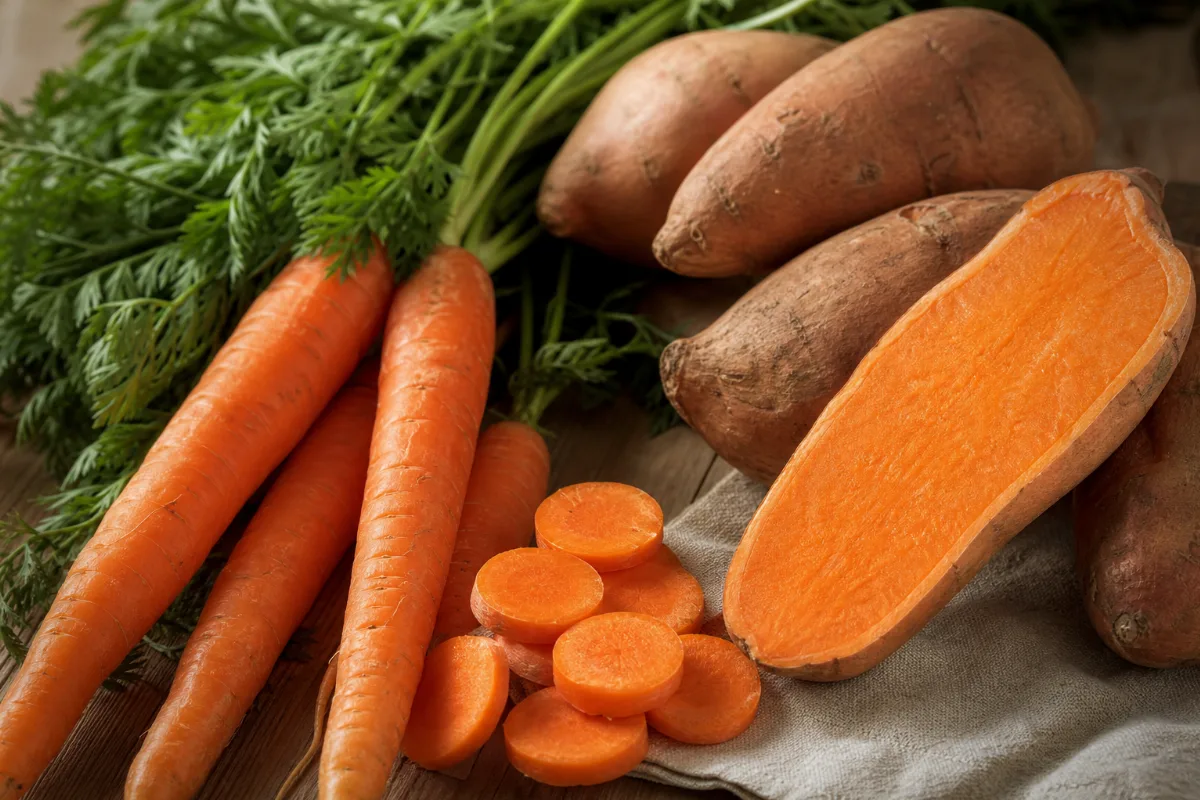
Functional Foods · Vegetable
Sweet Potatoes, Carrots and Orange Vegetables
Ipomoea batatas (sweet potato), Daucus carota (carrot) · also called Orange-fleshed sweet potato, orange vegetables
Carrots and orange-fleshed sweet potatoes are among the richest everyday food sources of beta-carotene, which the body can turn into vitamin A. In trials in places where vitamin A is short, orange sweet potato improved vitamin A status. Eating more carrots is linked to less cancer in follow-up studies, which cannot prove cause. The main caution is about pills: beta-carotene supplements raised lung cancer in smokers, and that is not the same as eating the vegetables.
General information, not medical advice. Last substantive update · Not medically reviewed. A named clinician has not signed off on this page. How this page is made
About Sweet Potatoes, Carrots and Orange Vegetables
Carrots and orange-fleshed sweet potatoes are everyday vegetables that give a lot of beta-carotene, the orange pigment the body can turn into vitamin A. They are foods, not proven remedies. The vitamin A trials come from places where shortage is common, and the cancer finding for carrots is observational.
What they are
Sweet potato (Ipomoea batatas) is the storage root of its plant. Carrot (Daucus carota) is the root of the cultivated plant. They are not related to each other. White-fleshed sweet potato has almost no beta-carotene, so the orange colour matters.
USDA data for raw vegetables, per 100 g. Sweet potato: 86 kcal, 1.57 g protein, 20.12 g carbohydrate (4.18 g sugars), 3.0 g fibre, 337 mg potassium. Carrot: 41 kcal, 0.93 g protein, 9.58 g carbohydrate (4.74 g sugars), 2.8 g fibre, 320 mg potassium. One 130 g sweet potato has about 112 kcal and 3.9 g fibre. One medium 61 g carrot has about 25 kcal and 1.7 g fibre. Cooking, canning and juicing change these numbers and were not read.
What the research shows
Orange-fleshed sweet potato improved vitamin A status in a randomised trial of 180 children, and a review of 20 studies in Mozambique describes a positive effect. A Kenyan programme trial in women raised vitamin A intake and lowered the odds of low retinol-binding protein by 45%. These were done where vitamin A shortage is a concern.
Carrots: in 50 follow-up studies, higher intake went with 10% lower cancer risk. Observational studies cannot show that carrots are the cause. No trial of carrots on cancer was read.
Blood sugar: a Cochrane review found only three small trials of a sweet potato preparation and judged the evidence insufficient. No good trial of eating whole sweet potato was found in the searches done.
Food versus supplements
Eating carrots and sweet potatoes is not the same as taking beta-carotene or vitamin A pills. In a Finnish trial of 29,133 male smokers, beta carotene pills (20 mg a day) for 5 to 8 years went with 18% more lung cancer. A Cochrane review found that vitamin A supplements raised lung cancer and death in smokers and asbestos workers. These results are about pills. Smokers and former smokers should ask a doctor or pharmacist before using them.
At a glance
Traditional uses history, not proof
- Eaten as everyday foods in many cuisines
- Sweet potato is used in traditional practice for diabetes in some places
- Long use as food is not proof that it treats any condition
Studied for research
- Vitamin A content, high certainty for the nutrient content
- Vitamin A status in children, moderate certainty (orange-fleshed sweet potato)
- Vitamin A status in pregnant and breastfeeding women, low certainty (a programme trial)
- Cancer risk and carrots, low certainty (observational)
- Blood sugar and sweet potato, insufficient evidence
Main compounds
- Beta-carotene
- Alpha-carotene (carrot)
- Potassium
- Vitamin C
- Fibre
Common forms
- Raw sweet potato and raw carrot (USDA values read)
- Boiled, mashed orange-fleshed sweet potato (children's trial)
- Cooked, canned, frozen and juice values were not read
- Beta-carotene and vitamin A pills are different products and are not covered
Research links: 1994 trial: beta carotene pills in male smokers · 2025 review: carrot intake and cancer · 2005 trial: orange-fleshed sweet potato and vitamin A status · Research Library · Genes & Biomarkers Library
What it is and its history
- Accepted scientific name
- Ipomoea batatas (sweet potato); Daucus carota (carrot)
- Naming authority
- Names taken from the existing nutrient summary; not re-checked against GBIF for this page.
- Common names
- Sweet potato (English); Carrot (English); Orange-fleshed sweet potato (English); Orange vegetables (English)
- Family or group
- Two unrelated plants. Sweet potato is not a potato and not a yam. Family names were not verified from a source read.
- Classification
- Plantae > Convolvulaceae (sweet potato) and Apiaceae (carrot): general knowledge, NOT verified from a source read
- Native range
- Not verified from a source read.
- Habitat
- Not verified from a source read.
- What it looks like
- Roots: Sweet potato is the storage root; carrot is the root of the cultivated plant (existing page; not re-verified).; Stems: Not verified.; Leaves: Not verified.; Flowers: Not verified.
- Cultivation
- Not verified from a source read.
- Harvest and processing
- Not researched. Vine cuttings are used to grow sweet potato in the Kenyan programme.
- Look-alikes and adulterants
- Name: White-fleshed sweet potato; Note: Has almost no beta-carotene, so it is used as the comparison in the children's trial.; Name: Pumpkin, butternut squash, orange peppers; Note: Other orange vegetables with their own pages.
- Sustainability and conservation
- Not assessed.
Photographs
What is inside, and how it may work
What it contains and how those compounds act in cells and animals. Laboratory and animal mechanisms are not proven effects in people.
Main compounds
| Compound | Family | Where it is concentrated | Activity studied | Level of evidence |
|---|---|---|---|---|
| Beta-carotene | carotenoid | Root USDA per 100 g raw: sweet potato 8,509 micrograms; carrot 8,285 micrograms | Provitamin A. The body can convert it to vitamin A. As a supplement it raised lung cancer in smokers in trials. 11 12 1 | Human data |
| Alpha-carotene | carotenoid | Root USDA per 100 g raw: carrot 3,477 micrograms; sweet potato 7 micrograms | Used in the carrot review as a blood marker of carrot eating. 12 6 | Human data |
| Potassium | mineral | Root USDA per 100 g raw: sweet potato 337 mg; carrot 320 mg | A nutrient; matters for people on potassium-limited diets. 11 12 | Nutrient database |
| Polyacetylenes | polyacetylene | Carrot root Not read | Named by the carrot review authors as possible anti-cancer compounds. Not tested in people in the abstract. 6 | Hypothesis |
Mechanisms, receptors and pathways
| Target or pathway | Gene or receptor | What was found | Level |
|---|---|---|---|
| Conversion of beta-carotene to vitamin A | Not specified in the sources read | The NHS says the body can convert beta-carotene into vitamin A. The review of yellow skin says rare genetic differences in the converting enzyme can lead to high blood carotenoids. 10 8 | Human data |
Absorption, metabolism and elimination
- Absorption
- Not found.
- Distribution
- Not found.
- Metabolism
- Beta-carotene is converted to vitamin A as needed (NHS).
- Elimination
- Not found.
- Bioavailability
- Not established in the sources read; the trials measured vitamin A status, not absorption.
Isolated compounds versus whole extracts
Carrots and sweet potatoes eaten as food are not the same as beta-carotene or vitamin A pills. The vitamin A status trials used orange-fleshed sweet potato as food. The carrot cancer link is observational. The lung cancer harm in smokers was found with supplements.
Nutritional composition
Nutrition from USDA FoodData Central (SR Legacy, April 2018 release; values read 2026-10-26 from the saved copy in the repository). Per 100 g raw. Sweet potato (FDC 168482): 86 kcal, 1.57 g protein, 0.05 g fat, 20.12 g carbohydrate (4.18 g sugars), 3.0 g fibre, 337 mg potassium, 55 mg sodium, 30 mg calcium, 2.4 mg vitamin C, 709 micrograms vitamin A (RAE), 8,509 micrograms beta-carotene. Carrot (FDC 170393): 41 kcal, 0.93 g protein, 0.24 g fat, 9.58 g carbohydrate (4.74 g sugars), 2.8 g fibre, 320 mg potassium, 69 mg sodium, 33 mg calcium, 5.9 mg vitamin C, 835 micrograms vitamin A (RAE), 8,285 micrograms beta-carotene, 3,477 micrograms alpha-carotene. One typical USDA portion: 1 sweet potato of 130 g (the 100 g values x 1.3) is about 112 kcal, 2.0 g protein, 26.2 g carbohydrate, 3.9 g fibre, 438 mg potassium and 922 micrograms vitamin A (RAE). 1 medium carrot of 61 g (x 0.61) is about 25 kcal, 0.6 g protein, 5.8 g carbohydrate, 1.7 g fibre, 195 mg potassium and 509 micrograms vitamin A (RAE). Cooked, canned, frozen and juice values were not read; cooking changes these numbers.
1 high certainty1 moderate certainty2 low certainty1 not enough evidence
What was looked at
The 5 benefits and uses checked for Sweet Potatoes, Carrots and Orange Vegetables, each with how strong the evidence is. Tap one to open it.
- Source of provitamin A (beta-carotene) in the dietHigh certainty
- Vitamin A status in children (orange-fleshed sweet potato)Moderate certainty
- Vitamin A intake and status in pregnant and breastfeeding women (orange-fleshed sweet potato programme)Low certainty
- Cancer risk and carrot intake (observational)Low certainty
- Blood sugar in type 2 diabetes (sweet potato)Not enough evidence
Lab markers tracked in the studies
Retinol-binding protein (RBP)Vitamin A liver store marker (DR:R ratio)HbA1c (average blood sugar over about 3 months)
What is Sweet Potatoes, Carrots and Orange Vegetables good for?
The main studied uses and how strong the human evidence is for each. The vitamin A trials were done in places where vitamin A shortage is a concern, so they say little about people who already get enough.
Benefits, one by one
Each card is a research question, not a promise. Tap a goal to filter. Open a card to see the studies, doses and limits.
Source of provitamin A (beta-carotene) in the diet
High certaintyCarrots and sweet potatoes are among the main food sources of beta-carotene, which the body can turn into vitamin A. By USDA data, 100 g of raw sweet potato has 709 micrograms of vitamin A (RAE) and 8,509 micrograms of beta-carotene; 100 g of raw carrot has 835 and 8,285.
3 studiesRaw vegetables in USDA tables. Cooked, canned, frozen and juice value…
Studies, doses and limits
What the trials found
The NHS names carrots and sweet potatoes among beta-carotene food sources. USDA gives the amounts per 100 g of the raw vegetables.
Results
Both are rich sources of provitamin A on paper. How much each person absorbs and converts varies and was not measured in the sources read here.
Effect sizes as reported
USDA per 100 g raw: sweet potato 709 micrograms RAE, 8,509 beta-carotene; carrot 835 micrograms RAE, 8,285 beta-carotene.
Why this rating
High that the foods contain these amounts (USDA tables). Not a trial of any health outcome.
Form and dose studied
Raw vegetables in USDA tables. Cooked, canned, frozen and juice values were not read.
Who was studied
General diet.
Limits
Nutrient facts, not trials. Amounts differ by variety, season and cooking.
Why researchers looked
Vitamin A shortage is a big public health problem in some countries, so orange vegetables are studied as a food-based answer.
Traditional use
Both vegetables are everyday foods. Long use as food is not proof that they treat any condition.
Proposed mechanism Nutrient database
Beta-carotene is the orange pigment. The body converts some of it to vitamin A as needed.
A proposed mechanism does not show that the effect happens in people.
See the Safety tab for what is different about beta-carotene supplements.
Vitamin A status in children (orange-fleshed sweet potato)
Moderate certaintyIn one randomised trial, school children who ate boiled, mashed orange-fleshed sweet potato improved their vitamin A status more than children who ate white-fleshed sweet potato.
2 studiesBoiled, mashed orange-fleshed sweet potato (the trial). White-fleshed…
Studies, doses and limits
What the trials found
Children aged 5 to 10 (90 per group) ate 125 g a day for 53 school days. The modified-relative-dose-response ratio improved more with orange sweet potato (effect -0.008, 95% CI -0.015 to -0.001). The rise in children with normal status (78% to 87%) was not significant.
Results
Better vitamin A liver stores than with white sweet potato. A Mozambique review of 20 studies also describes a positive effect on vitamin A status.
Effect sizes as reported
DR:R effect -0.008 (95% CI -0.015 to -0.001, P = 0.0203). Share with normal status 78% to 87% (P = 0.096).
Why this rating
One randomised trial of 180 children plus a descriptive review. Both are in places where vitamin A shortage matters, and the trial used a lab marker, not illness.
Form and dose studied
Boiled, mashed orange-fleshed sweet potato (the trial). White-fleshed sweet potato has almost no beta-carotene.
Who was studied
Children aged 5 to 10 in South Africa; Mozambique review.
Limits
Does not apply to people who already get enough vitamin A. Marker result, not illness outcomes. Funding not stated in the abstract.
Why researchers looked
In many countries sweet potato is a staple food and a possible way to prevent vitamin A deficiency.
Traditional use
Sweet potato is a staple food in many regions.
Proposed mechanism Human trial
The orange flesh carries beta-carotene, which the body turns into vitamin A.
A proposed mechanism does not show that the effect happens in people.
None specific for the food.
Vitamin A intake and status in pregnant and breastfeeding women (orange-fleshed sweet potato programme)
Low certaintyIn Western Kenya, a programme that gave nutrition advice and sweet potato vine cuttings raised women's vitamin A intake and cut their odds of low retinol-binding protein by 45%.
1 studiesOrange-fleshed sweet potato grown from vouchers for vine cuttings.
Studies, doses and limits
What the trials found
505 women at 8 clinics; clinics, not women, were allocated. At 9 months after birth, intake was 297 RAE units higher (95% CI 82 to 513) and the odds of low RBP were 45% lower (OR 0.55, 95% CI 0.33 to 0.92).
Results
A feasible way to raise intake and improve one blood marker in this setting.
Effect sizes as reported
OR 0.55 (0.33 to 0.92) for low RBP; intake +297 RAE (82 to 513).
Why this rating
A programme trial with clinics as the unit, many parts at once (advice, groups, vouchers) and a place where shortage is common. It is not a test of the vegetable alone.
Form and dose studied
Orange-fleshed sweet potato grown from vouchers for vine cuttings.
Who was studied
Women in Western Kenya.
Limits
Not a food-only test. Cannot be applied to people who already get enough vitamin A.
Why researchers looked
Pregnant and breastfeeding women need more vitamin A, and shortage is common in some places.
Traditional use
Sweet potato is a staple food in many regions.
Proposed mechanism Human trial
Higher intake of provitamin A foods raises vitamin A supply.
A proposed mechanism does not show that the effect happens in people.
None specific for the food.
Cancer risk and carrot intake (observational)
Low certaintyA review of 50 follow-up studies linked higher carrot intake to a lower risk of cancer. This is a link, not proof that carrots prevent cancer.
2 studiesCarrots as food. Supplements are a different thing.
Studies, doses and limits
What the trials found
Across 50 prospective studies (52,000 cancer cases), the highest carrot intake went with a 10% lower cancer risk. Across 30 studies using blood alpha-carotene as a marker of carrot eating, the figure was 20% lower.
Results
A steady link in observational studies. The authors note that beta-carotene supplements did not help in controlled cancer trials, and in smokers they did harm (see Safety).
Effect sizes as reported
Carrot intake RR 0.90 (95% CI 0.87 to 0.94); blood alpha-carotene RR 0.80 (0.72 to 0.89).
Why this rating
Observational studies only. People who eat more carrots may differ in many other ways.
Form and dose studied
Carrots as food. Supplements are a different thing.
Who was studied
Adults in prospective studies.
Limits
Cannot show cause. Funding not stated in the abstract.
Why researchers looked
Carrots carry carotenoids and other plant compounds, and researchers asked whether people who eat more carrots get less cancer.
Traditional use
Carrots are an everyday vegetable. Long use as food is not proof that it prevents any condition.
Proposed mechanism Hypothesis
The authors point to compounds in carrots such as polyacetylenes. This was not tested in people in the abstract.
A proposed mechanism does not show that the effect happens in people.
Beta-carotene supplements are not the same as carrots; see Safety.
Blood sugar in type 2 diabetes (sweet potato)
Not enough evidenceA Cochrane review of three small trials found a slightly lower HbA1c with a sweet potato preparation, but the authors say there is not enough evidence.
1 studiesSweet potato preparation (not described further in the abstract).
Studies, doses and limits
What the trials found
Three trials, 140 people, 6 weeks to 5 months, all by one trialist, unclear or high risk of bias. Two trials (122 people) showed HbA1c 0.3 points lower at 3 to 5 months with 4 g a day of a sweet potato preparation.
Results
Insufficient evidence. The product tested is described as a preparation, not the vegetable as eaten, as far as the abstract shows.
Effect sizes as reported
HbA1c mean difference -0.3% (95% CI -0.6 to -0.04).
Why this rating
Three small trials from one trialist at unclear or high risk of bias, with a preparation rather than the food.
Form and dose studied
Sweet potato preparation (not described further in the abstract).
Who was studied
Adults with type 2 diabetes.
Limits
Old review (2013). A newer trial used white sweet potato in tube-feeding formula, which is not eating the vegetable. No trial of carrots and blood sugar was read.
Why researchers looked
Sweet potato is used in traditional practice for type 2 diabetes and has been tested for blood sugar.
Traditional use
Sweet potato is used in traditional medicine for diabetes in some places. Long use is not proof.
Proposed mechanism Unknown
Not described in the abstract.
A proposed mechanism does not show that the effect happens in people.
Anyone managing blood sugar can ask a clinician or dietitian. No serious side effects were reported in the trials.
Connections to the rest of health
How Sweet Potatoes, Carrots and Orange Vegetables connects to the rest of our health knowledge graph. Every link says what kind of connection it is. A safety link (for example to the liver) is a warning, not a benefit. A study that merely mentions a topic never creates a benefit link.
Explore every connection: goals, body systems, organs, symptoms, genes
A. Wellness goals
| Connected to | Kind of connection | Evidence status | Context | Studies |
|---|---|---|---|---|
| Preventive Wellness | High certainty | Source of provitamin A (beta-carotene) in the diet: Carrots and sweet potatoes are among the main food sources of beta-carotene, which the body can turn into vitamin A. By USDA data, 100 g of raw sweet potato has 709 micrograms of vitamin A (RAE) and 8,509 micrograms of beta-carotene; 100 g of raw carrot has 835 and 8,285. | 11 12 10 | |
| Immune Support | Moderate certainty | Vitamin A status in children (orange-fleshed sweet potato): In one randomised trial, school children who ate boiled, mashed orange-fleshed sweet potato improved their vitamin A status more than children who ate white-fleshed sweet potato. | 13 5 | |
| Womens Wellness | Low certainty | Vitamin A intake and status in pregnant and breastfeeding women (orange-fleshed sweet potato programme): In Western Kenya, a programme that gave nutrition advice and sweet potato vine cuttings raised women's vitamin A intake and cut their odds of low retinol-binding protein by 45%. | 4 | |
| Cancer Prevention Support | Low certainty | Cancer risk and carrot intake (observational): A review of 50 follow-up studies linked higher carrot intake to a lower risk of cancer. This is a link, not proof that carrots prevent cancer. | 6 1 | |
| Blood Sugar Support | Not enough evidence | Blood sugar in type 2 diabetes (sweet potato): A Cochrane review of three small trials found a slightly lower HbA1c with a sweet potato preparation, but the authors say there is not enough evidence. | 7 |
B. Body systems
| Connected to | Kind of connection | Evidence status | Context | Studies |
|---|---|---|---|---|
| Immune System | Biological association | High certainty | Studied for: Source of provitamin A (beta-carotene) in the diet Studied for: Vitamin A status in children (orange-fleshed sweet potato) | 11 12 10 13 5 6 1 |
| Reproductive System | Biological association | Low certainty | Studied for: Vitamin A intake and status in pregnant and breastfeeding women (orange-fleshed sweet potato programme) | 4 |
| Endocrine System | Biological association | Not enough evidence | Studied for: Blood sugar in type 2 diabetes (sweet potato) | 7 |
C. Body parts and organs
| Connected to | Kind of connection | Evidence status | Context | Studies |
|---|---|---|---|---|
| Lungs | Adverse effect or risk | Documented risk | Beta-carotene supplements raised lung cancer in smokers in the ATBC trial and a Cochrane review. Beta-carotene pills raised lung cancer in smokers in trials. This is about supplements, not the vegetables. Preparation or compound: Beta-carotene supplements (not the vegetables) |
1 2 |
E. Health conditions
| Connected to | Kind of connection | Evidence status | Context | Studies |
|---|---|---|---|---|
| Food allergy | Adverse effect or risk | Case report | One child with birch pollen allergy had anaphylaxis after raw carrot. Preparation or compound: Raw carrot |
3 |
| Vitamin A deficiency | Preliminary | Orange-fleshed sweet potato improved vitamin A status in trials where shortage is a concern. Preparation or compound: Orange-fleshed sweet potato as food |
13 4 |
I. Biomarkers
| Connected to | Kind of connection | Evidence status | Context | Studies |
|---|---|---|---|---|
| Retinol-binding protein (RBP) | Biological association | Low certainty | Measured in trials: raised (fewer women with low levels). A lab change is not the same as a health benefit. | 4 |
| Vitamin A liver store marker (DR:R ratio) | Biological association | Moderate certainty | Measured in trials: lowered (better stores). A lab change is not the same as a health benefit. | 13 |
| HbA1c (average blood sugar over about 3 months) | Biological association | Not enough evidence | Measured in trials: lowered slightly. A lab change is not the same as a health benefit. | 7 |
K. Biological pathways
L. Active compounds
| Connected to | Kind of connection | Evidence status | Context | Studies |
|---|---|---|---|---|
| Beta-carotene | Biological association | Human | Provitamin A. The body can convert it to vitamin A. As a supplement it raised lung cancer in smokers in trials. Preparation or compound: Root |
11 12 1 |
| Alpha-carotene | Biological association | Human | Used in the carrot review as a blood marker of carrot eating. Preparation or compound: Root |
12 6 |
| Potassium | Biological association | Nutrient database | A nutrient; matters for people on potassium-limited diets. Preparation or compound: Root |
11 12 |
| Polyacetylenes | Biological association | Hypothesis | Named by the carrot review authors as possible anti-cancer compounds. Not tested in people in the abstract. Preparation or compound: Carrot root |
6 |
Each connection is stored with the ingredient, the connected record, the kind of connection, the evidence status, the supporting studies, the preparation or compound involved, and a review date (last reviewed October 26, 2026).
Evidence at a glance: what the research found for 5 outcomes
Each outcome below is one thing researchers measured. Certainty is how far the evidence can be trusted, not how well it works. The full studies are on the next tab.
The evidence
The research centre for Sweet Potatoes, Carrots and Orange Vegetables. Every record here was checked against PubMed or the publisher's page; we never list a study we have not verified.
Evidence by outcome
Bars show how many studies we found for each outcome, not how well it works. People are added up across trials only (reviews are not added, to avoid double counting).
How we rate evidence
High certainty
Several well-run trials or reviews agree; further research is unlikely to change the picture much.
Moderate certainty
Good trials point the same way, but some doubt remains.
Low certainty
Small, short or inconsistent trials. The finding could change with better research.
Very low certainty
Very little or very weak human data. Treat as a possibility only.
Mixed findings
Trials or reviews disagree with each other.
Not enough evidence
Not enough human research to say either way.
Evidence against
Good research found no benefit, or found harm.
We take the reviewers' own risk-of-bias and GRADE statements where they exist, and otherwise judge from study size, design, consistency, directness and whether a product matches what is sold. Many publications do not make evidence high. Method note: We started from our existing summary, re-checked nutrition against saved USDA FoodData Central data, read the NHS vitamin A page and re-read PubMed abstracts. Only abstracts were read for studies. Items we could not verify are flagged in the research gaps.
Study library: every study we checked 13
| Study | Design | People | Product, dose, length | Result |
|---|---|---|---|---|
| Alpha-Tocopherol 1994 The effect of vitamin E and beta carotene on the incidence of lung cancer and other cancers in male smokers. N Engl J Med · PMID 8127329 · DOI |
Randomised controlled trial |
29133 Male smokers aged 50 to 69 in southwestern Finland |
Beta carotene supplement (and alpha-tocopherol) Supplement, not a food Beta carotene 20 mg a day 5 to 8 years · vs Placebo |
Beta carotene supplements did not reduce lung cancer. Lung cancer was more common in the men given beta carotene than in those not given it, and total deaths were higher. Lung cancer incidence +18% with beta carotene; total mortality +8% (Lung cancer 3 to 36%; mortality 1 to 16%) Methods, limits and fundingOutcomes: Lung cancer incidence, other cancers, deaths Limitations: A supplement trial in male smokers. It says nothing direct about carrots or sweet potatoes eaten as food. Funding and conflicts: Funding is not stated in the abstract. Read: abstract |
| Cortes-Jofre 2020 Drugs for preventing lung cancer in healthy people. Cochrane Database Syst Rev · PMID 32130738 · DOI |
Systematic review meta analysis |
12 randomised trials of vitamin and mineral supplements in healthy people (6 analysed vitamin A) | Vitamin A supplements (as grouped by the review) Supplement, not a food Not given in the abstract Not given in the abstract · vs Placebo |
In smokers or asbestos workers, vitamin A increased lung cancer incidence, lung cancer mortality and all-cause mortality (high-certainty evidence). It also caused minor side effects such as yellowing of the skin. Smokers or asbestos workers: lung cancer incidence RR 1.10; lung cancer mortality RR 1.18; all-cause mortality RR 1.09 (Incidence 1.01 to 1.20; lung cancer mortality 1.01 to 1.38; all-cause 1.05 to 1.13) Methods, limits and fundingOutcomes: Lung cancer incidence and mortality, all-cause mortality, side effects Limitations: Supplement trials only. The abstract does not say how much of the result comes from beta carotene versus retinol. Funding and conflicts: Funding is not stated in the abstract. Read: abstract |
| Ferrigno 2025 A Rare Case of Systemic Reaction to Carrot Due to PR-10 in a Young Child. Pediatr Allergy Immunol Pulmonol · PMID 40548869 · DOI |
Case report |
1 One 12-year-old boy with birch pollen allergy |
Raw carrot Root (food) One episode · vs Cooked carrot (tolerated) |
He had anaphylaxis after eating raw carrot during birch pollen season. He had only mouth itching with raw carrot and fennel before, and he tolerated cooked carrot. Tests showed sensitisation to the birch-related protein PR-10. Not applicable (Not applicable) Methods, limits and fundingOutcomes: Allergic reaction Limitations: A single case. It shows this can happen, not how often. Funding and conflicts: Funding is not stated in the abstract. Read: abstract |
| Girard 2017 Promotion of Orange-Fleshed Sweet Potato Increased Vitamin A Intakes and Reduced the Odds of Low Retinol-Binding Protein among Postpartum Kenyan Women. J Nutr · PMID 28404834 · DOI |
Cluster controlled trial |
505 505 pregnant women in Western Kenya, 8 health facilities (206 in the diet subsample) |
Orange-fleshed sweet potato promotion programme Storage root (food) plus counselling, support groups and vine-cutting vouchers Through pregnancy to 9 months after birth · vs Clinic nutrition counselling only |
Women in the programme had higher vitamin A intakes (adjusted difference 297 RAE units) and 45% lower odds of low RBP (OR 0.55). Low RBP odds ratio 0.55; vitamin A intake +297 RAE (OR 0.33 to 0.92; intake 82 to 513 RAE) Methods, limits and fundingOutcomes: Vitamin A intake and serum retinol-binding protein (RBP) Limitations: Clinics (not people) were allocated, and the abstract does not say how to the groups. It tests a whole programme, not the vegetable alone. Results are from a place where vitamin A shortage is common. Funding and conflicts: The authors state no conflicts of interest. Read: abstract |
| Jenkins 2015 Orange-Fleshed Sweet Potato: Successes and Remaining Challenges of the Introduction of a Nutritionally Superior Staple Crop in Mozambique. Food Nutr Bull · PMID 26314732 · DOI |
Systematic review |
20 studies on orange-fleshed sweet potato in Mozambique | Orange-fleshed sweet potato introduction Storage root (food) Various |
The authors say various studies show a positive effect on vitamin A status and that farmers and consumers accepted the crop. They list challenges such as vine preservation and storage. No numbers in the abstract (Not applicable) Methods, limits and fundingOutcomes: Acceptance and vitamin A status Limitations: A descriptive review in one country. It gives no pooled numbers in the abstract. Funding and conflicts: Funding is not stated in the abstract. Read: abstract |
| Ojobor 2025 Carrot intake is consistently negatively associated with cancer incidence: A systematic review and meta-analysis of prospective observational studies. Crit Rev Food Sci Nutr · PMID 38104588 · DOI |
Systematic review meta analysis |
50 prospective studies (52,000 cancer cases) recording carrot intake; 30 prospective studies using blood alpha-carotene | Carrot intake (food) Root (food) Highest versus lowest reported intake Observational · vs Lowest intake |
Higher carrot intake went with lower cancer risk, and so did higher blood alpha-carotene (a marker of carrot eating). The authors say the beta-carotene supplement trials showed no benefit. Carrot intake RR 0.90; blood alpha-carotene RR 0.80 (Carrot 0.87 to 0.94; alpha-carotene 0.72 to 0.89) Methods, limits and fundingOutcomes: Cancer incidence Limitations: Observational. People who eat more carrots differ in many other ways, and the review cannot prove cause. The abstract does not say who funded it. Funding and conflicts: Funding is not stated in the abstract. Read: abstract |
| Ooi 2013 Sweet potato for type 2 diabetes mellitus. Cochrane Database Syst Rev · PMID 24000051 · DOI |
Systematic review meta analysis |
140 3 randomised trials (140 people with type 2 diabetes, 6 weeks to 5 months), all by the same trialist |
Sweet potato preparations (not described further in the abstract) Not described 4 g a day in the pooled trials 6 weeks to 5 months · vs Placebo |
HbA1c was 0.3 percentage points lower at three to five months in two trials (122 people). The authors conclude there is insufficient evidence. Risk of bias was unclear or high. HbA1c mean difference -0.3% (-0.6 to -0.04) Methods, limits and fundingOutcomes: HbA1c and other diabetes outcomes Limitations: Small, old trials from one trialist. The 'preparation' used is not the vegetable as eaten, as far as the abstract shows. Funding and conflicts: Funding is not stated in the abstract. Read: abstract |
| Priyadarshani 2018 Insights of hypercarotenaemia: A brief review. Clin Nutr ESPEN · PMID 29460797 · DOI |
Narrative review |
Review of reports of high blood carotenoids and yellow skin | Carotenoid-rich foods or beta-carotene supplements Foods and supplements Beta-carotene above 30 mg a day (supplements) Months |
High intake of carotenoid-rich foods or beta-carotene supplements over months can turn the skin, especially palms and soles, yellow. Some people seem prone to it through their genes, and it is reported more in hypothyroidism and diabetes. No numbers (Not applicable) Methods, limits and fundingOutcomes: Yellowing of the skin (carotenodermia) Limitations: A brief narrative review, not a trial. Funding and conflicts: Funding is not stated in the abstract. Read: abstract |
| s-gbif-ipomoea Ipomoea batatas and Daucus carota names · Source |
Reference database n/a |
Methods, limits and fundingRead: summary-only | ||
| s-nhs-vitamin-a NHS: Vitamin A · Source |
Authoritative guidance n/a |
Methods, limits and fundingRead: full-text | ||
| s-usda-fdc-168482 USDA FoodData Central: Sweet potato, raw, unprepared (FDC 168482) · Source |
Reference database n/a |
Methods, limits and fundingRead: full-text | ||
| s-usda-fdc-170393 USDA FoodData Central: Carrots, raw (FDC 170393) · Source |
Reference database n/a |
Methods, limits and fundingRead: full-text | ||
| van Jaarsveld 2005 Beta-carotene-rich orange-fleshed sweet potato improves the vitamin A status of primary school children assessed with the modified-relative-dose-response test. Am J Clin Nutr · PMID 15883432 · DOI |
Randomised controlled trial |
180 Primary school children aged 5 to 10 in South Africa (90 per group), dewormed |
Orange-fleshed sweet potato, boiled and mashed Storage root (food) 125 g a day (about 1031 retinol activity equivalents) 53 school days · vs White-fleshed sweet potato with no beta-carotene |
Vitamin A liver stores improved more in the orange sweet potato group than in the white sweet potato group. The share of children with normal status rose from 78% to 87% (not significant, P = 0.096) and did not change significantly in the control group. DR:R intervention effect -0.008 (P = 0.0203) (-0.015 to -0.001) Methods, limits and fundingOutcomes: Vitamin A status by the modified-relative-dose-response test (DR:R ratio) Limitations: Children in a setting where vitamin A shortage matters. It cannot be applied to people who already get enough vitamin A. Funding and conflicts: Funding is not stated in the abstract. Read: abstract |
What we do not know yet
- No trial of carrots on vitamin A status or cancer was read; the cancer finding is observational.
- The vitamin A trials are from places where shortage is common and say little about people who get enough.
- No good trial of eating whole sweet potato on blood sugar was found.
- Cooked, canned, frozen and juice values, pesticide and heavy metal levels, sweet potato allergy, warfarin, kidney disease and choking risk in children were not researched.
- The NIH vitamin A fact sheet could not be read.
How new research is added
New studies are found by a saved PubMed search and placed in a review queue before the page changes.
Lab markers
What changed in blood or saliva tests during trials. A changed number is not the same as feeling or being healthier, and we give no "normal ranges".
Metabolic 1
HbA1c (average blood sugar over about 3 months)
Lowered slightly in trials
A blood test showing average blood sugar over the last 2 to 3 months.
Not enough evidenceResults and what it means
Why it was measured
The usual marker of long-term blood sugar control in diabetes.
Statistical vs. clinical meaning
Small and unclear; the review says the evidence is insufficient.
Safety implication
None specific.
| Study | Result | People | Product |
|---|---|---|---|
| 7 | Mean difference -0.3% (95% CI -0.6 to -0.04) at 3 to 5 months | 122 people with type 2 diabetes in 2 trials | 4 g a day of a sweet potato preparation versus placebo |
Other 2
Retinol-binding protein (RBP)
Raised (fewer women with low levels) in trials
A blood protein that carries vitamin A. Low levels are used as a sign of low vitamin A status.
Low certaintyResults and what it means
Why it was measured
To see whether eating more provitamin A foods improves vitamin A status.
Statistical vs. clinical meaning
Better vitamin A status in a programme setting.
Safety implication
None specific.
| Study | Result | People | Product |
|---|---|---|---|
| 4 | 45% lower odds of RBP below 1.17 micromol/L (OR 0.55, 95% CI 0.33 to 0.92) | Postpartum women in Western Kenya (22.9% had low RBP at the start) | Orange-fleshed sweet potato promotion programme |
Vitamin A liver store marker (DR:R ratio)
Lowered (better stores) in trials
A blood test ratio (3,4-didehydroretinol to retinol) that shows how full the body's vitamin A stores are. A lower ratio means better stores.
Moderate certaintyResults and what it means
Why it was measured
To see whether eating orange sweet potato improves vitamin A stores.
Statistical vs. clinical meaning
Better vitamin A stores than with white sweet potato.
Safety implication
None specific.
| Study | Result | People | Product |
|---|---|---|---|
| 13 | Effect -0.008 (95% CI -0.015 to -0.001) versus white sweet potato | 180 children aged 5 to 10 | 125 g boiled, mashed orange-fleshed sweet potato for 53 school days |
Safety
What studies and official sources say about side effects, medicines and who should check first. Each point shows what kind of evidence it comes from.
Main points to know 3
- Food is not a supplement: beta-carotene pills raised lung cancer in smokers. In a Finnish trial of 29,133 male smokers, those given beta carotene pills (20 mg a day) for 5 to 8 years had 18% more lung cancer, and 8% more deaths overall. A Cochrane review found vitamin A supplements raised lung cancer and death in smokers and asbestos workers. These were supplements. They do not show that carrots or sweet potatoes harm smokers. Smokers and former smokers should ask a doctor or pharmacist before taking any beta-carotene or vitamin A supplement. Randomised trial 1 2
- Yellow skin from a lot of orange food. A review says eating a lot of carotenoid-rich food, or taking beta-carotene supplements, for months can turn the skin yellow, mostly on palms and soles. It is called carotenodermia. Some people seem more prone to it. The review says it is reported more often in people with hypothyroidism or diabetes. See a doctor if yellow skin comes with yellow eyes, dark urine or illness. Narrative review 8
- Carrot allergy can happen with birch pollen allergy. A case report describes a 12-year-old with birch pollen allergy who had anaphylaxis after raw carrot but tolerated cooked carrot. This is one case, not a rate. The report says pollen-related food allergy usually causes only mild mouth symptoms. Case report 3
Side effects 2
| Effect | How often | Severity and recovery | Evidence |
|---|---|---|---|
| Yellowing of the skin (carotenodermia) from high intake of carotenoid-rich food or beta-carotene supplements The Cochrane review also lists yellowing of the skin as a minor side effect of vitamin A supplements. | Not given in the abstract | mild; cosmetic Not described in the abstract. | Narrative review 8 |
| Allergic reaction to raw carrot (mouth itching to, rarely, anaphylaxis), linked to birch pollen allergy The case tolerated cooked carrot. Sweet potato allergy was not researched. | Not found | usually mild; rarely severe Not described. | Case report 3 |
Liver
No liver injury from eating carrots or sweet potatoes was found in the sources read. A liver-safety source (such as LiverTox) was not searched.
How often. No frequency was found.
Monitoring. No agency monitoring advice was found.
This is a safety connection. It is not evidence that Sweet Potatoes, Carrots and Orange Vegetables supports liver health.
Medicines and supplements 3
| With | Why it matters | Importance | Evidence | What to do |
|---|---|---|---|---|
| Beta-carotene or vitamin A supplements in smokers and asbestos workers supplement | Not explained in the abstracts. | Higher lung cancer and death rates in trials of the supplements. The trials did not test carrots or sweet potatoes. | Randomised trial High certainty 1 2 | Smokers and former smokers should ask a doctor or pharmacist before taking beta-carotene or vitamin A supplements. |
| Warfarin and other blood thinners (vitamin K) prescription | Not researched. USDA lists vitamin K in raw carrot (13.2 micrograms per 100 g) and sweet potato (1.8 micrograms per 100 g). | No source on carrots or sweet potatoes and warfarin was read. Do not take this as a finding of no interaction. | Not researched Not enough evidence 11 12 | If you take warfarin, ask your prescriber or pharmacist about changes in how much of any food you eat. |
| Potassium-restricting medicines or diets (kidney disease) condition | Not researched. USDA lists about 337 mg potassium per 100 g raw sweet potato and 320 mg per 100 g raw carrot. | No source read gave advice for these vegetables. | Not researched Not enough evidence 11 12 | People on a potassium-limited diet can ask their kidney care team. |
Who should check first 2
| Situation | Advice | Evidence |
|---|---|---|
| Smoker or former smoker considering beta-carotene or vitamin A supplements | Ask a doctor or pharmacist first. This is about the pills, not the vegetables. | Randomised trial 1 2 |
| Birch pollen allergy with reactions to raw carrot | Ask an allergist. Trouble breathing or swelling of the face, lips or throat needs emergency help. | Case report 3 |
Overdose, product quality and regulators
Summary. No toxicity from carrots or sweet potatoes as ordinary food was found in the sources read. NHS names liver and supplements, not vegetables, as the main sources of too much vitamin A.
Animal. Not reviewed.
High dose or long term signals. NHS says long-term vitamin A intake averaging over 1.5 mg a day may make bones more prone to fracture in later life, and advises keeping the total from food and supplements at or below that. It does not say how this applies to beta-carotene in vegetables.
Overdose response. Not found.
Genotoxicity. Not researched.
Toxic or hazardous parts. Not researched for these vegetables.
Pesticides, heavy metals, nitrate and mould in these vegetables were not researched.
| Body | Action | Date |
|---|---|---|
| NHS (UK) (United Kingdom) | Vitamin A page: lists carrots and sweet potatoes among beta-carotene sources; advises keeping vitamin A from food and supplements at or below 1.5 mg a day, limiting liver and avoiding it in pregnancy. source | 2020-08-03 |
When to get medical help
- Trouble breathing, wheezing, swelling of the lips, face, tongue or throat, widespread hives or collapse after eating carrot or another food (possible anaphylaxis): use epinephrine if prescribed, then call 911 or your local emergency number
- Yellow skin together with yellow eyes, dark urine or feeling ill: see a doctor, because this is not carotenodermia
Stop using the product and contact a clinician or emergency service. In the US, Poison Control is 1-800-222-1222.
General information only, not medical advice. Ask a clinician or pharmacist before use, especially with medicines, in pregnancy or with a health condition. See the Natural Remedy Safety guide.
Frequently asked questions
What are carrots and sweet potatoes good for?
Are sweet potatoes and carrots good sources of vitamin A?
Does orange sweet potato improve vitamin A status?
Is orange sweet potato helpful in pregnancy or breastfeeding?
A Kenyan programme raised women's vitamin A intake and lowered the odds of low retinol-binding protein by 45%. It tested advice, groups and vine cuttings together, not the vegetable alone. Ask your midwife or doctor about your own diet.
Do carrots prevent cancer?
Not shown. A review of 50 follow-up studies linked higher carrot intake to 10% lower cancer risk, but such studies cannot prove cause and no trial of carrots on cancer was read.
Is beta-carotene from food the same as a beta-carotene supplement?
Do sweet potatoes help with blood sugar?
Not proven. A Cochrane review of three small trials found a small HbA1c drop with a sweet potato preparation and called the evidence insufficient. Anyone managing blood sugar can ask a clinician or dietitian.
Can eating a lot of carrots turn your skin yellow?
Yes, it can. A review says high intake of carotenoid-rich food, or beta-carotene pills, over months can turn the skin yellow, mostly palms and soles. See a doctor if yellow skin comes with yellow eyes, dark urine or illness.
Can you get too much vitamin A from orange vegetables?
Can carrots cause allergy?
Rarely. A case report describes anaphylaxis after raw carrot in a child with birch pollen allergy, who tolerated cooked carrot. Ask an allergist if raw carrot causes reactions.
Are they safe in pregnancy?
The NHS warns pregnant women about liver and liver products, not about carrots or sweet potatoes. Vitamin A supplements are a separate question for your midwife or doctor.
Explore by health goal
Preventive WellnessImmune SupportWomens WellnessCancer Prevention SupportBlood Sugar Support
Editorial transparency
- Written by
- AlternativeMed editorial team. Research compiled with AI assistance, then checked against the sources listed.
- Medical review
- None. This page has not been reviewed by a physician or pharmacist.
- First published
- 2026-10-26
- Last substantive update
- 2026-10-26
- How we research
- We started from our existing summary, re-checked nutrition against saved USDA FoodData Central data, read the NHS vitamin A page and re-read PubMed abstracts. Only abstracts were read for studies. Items we could not verify are flagged in the research gaps.
- How we rate evidence
- See "How we rate evidence" in the Evidence tab.
- Independence
- No product is promoted on this page. No affiliate links are shown. Funding is not stated in most abstracts read.
Sources 13
Each source was opened and checked. Where we read only the abstract, it says so. The small numbers in the text point here.
- Alpha-Tocopherol, Beta Carotene Cancer Prevention Study Group. The effect of vitamin E and beta carotene on the incidence of lung cancer and other cancers in male smokers.. N Engl J Med. 1994. PMID 8127329. DOI 10.1056/NEJM199404143301501. (abstract)
- Cortes-Jofre M, Rueda JR, Asenjo-Lobos C, Madrid E, et al.. Drugs for preventing lung cancer in healthy people.. Cochrane Database Syst Rev. 2020. PMID 32130738. DOI 10.1002/14651858.CD002141.pub3. (abstract)
- Ferrigno C, Ratti CP, Scavone I, Ortolani V, et al.. A Rare Case of Systemic Reaction to Carrot Due to PR-10 in a Young Child.. Pediatr Allergy Immunol Pulmonol. 2025. PMID 40548869. DOI 10.1089/ped.2025.0038. (abstract)
- Girard AW, Grant F, Watkinson M, Okuku HS, et al.. Promotion of Orange-Fleshed Sweet Potato Increased Vitamin A Intakes and Reduced the Odds of Low Retinol-Binding Protein among Postpartum Kenyan Women.. J Nutr. 2017. PMID 28404834. DOI 10.3945/jn.116.236406. (abstract)
- Jenkins M, Byker Shanks C, Houghtaling B. Orange-Fleshed Sweet Potato: Successes and Remaining Challenges of the Introduction of a Nutritionally Superior Staple Crop in Mozambique.. Food Nutr Bull. 2015. PMID 26314732. DOI 10.1177/0379572115597397. (abstract)
- Ojobor CC, O'Brien GM, Siervo M, Ogbonnaya C, et al.. Carrot intake is consistently negatively associated with cancer incidence: A systematic review and meta-analysis of prospective observational studies.. Crit Rev Food Sci Nutr. 2025. PMID 38104588. DOI 10.1080/10408398.2023.2287176. (abstract)
- Ooi CP, Loke SC. Sweet potato for type 2 diabetes mellitus.. Cochrane Database Syst Rev. 2013. PMID 24000051. DOI 10.1002/14651858.CD009128.pub3. (abstract)
- Priyadarshani AMB. Insights of hypercarotenaemia: A brief review.. Clin Nutr ESPEN. 2018. PMID 29460797. DOI 10.1016/j.clnesp.2017.12.002. (abstract)
- . Ipomoea batatas and Daucus carota names. . . (summary-only)
- . NHS: Vitamin A. . . (full-text)
- . USDA FoodData Central: Sweet potato, raw, unprepared (FDC 168482). . . (full-text)
- . USDA FoodData Central: Carrots, raw (FDC 170393). . . (full-text)
- van Jaarsveld PJ, Faber M, Tanumihardjo SA, Nestel P, et al.. Beta-carotene-rich orange-fleshed sweet potato improves the vitamin A status of primary school children assessed with the modified-relative-dose-response test.. Am J Clin Nutr. 2005. PMID 15883432. DOI 10.1093/ajcn/81.5.1080. (abstract)


