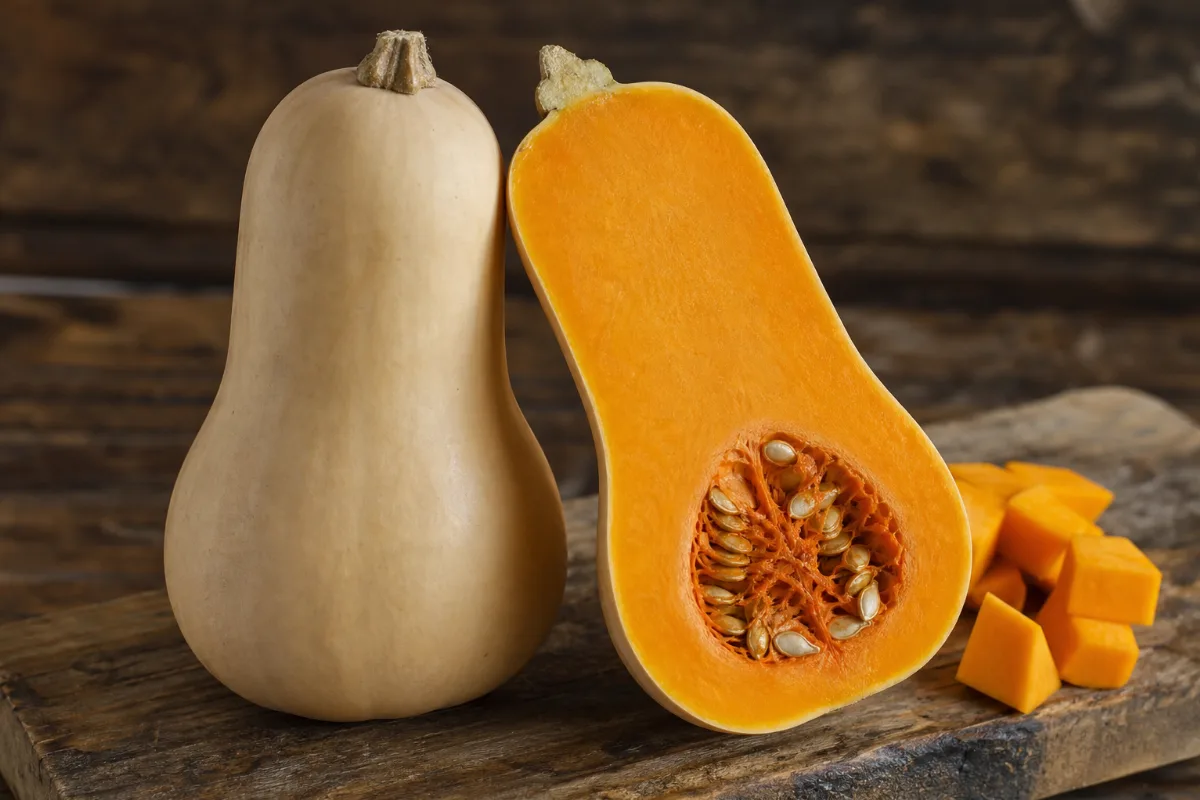
Vegetables · Vegetable
Butternut Squash
Cucurbita moschata · also called Butternut pumpkin, calabaza butternut (Spanish)
Butternut squash is a winter squash with orange flesh that is cooked and eaten. It is a rich source of carotenoids the body turns into vitamin A, and a good source of vitamin C and potassium. Eating more vegetables and fibre is linked to less heart disease in observational studies, but no trial has tested butternut squash itself. The main cautions are potassium for people with kidney disease or certain medicines, and throwing away any squash that tastes bitter.
General information, not medical advice. Last substantive update · Not medically reviewed. A named clinician has not signed off on this page. How this page is made
About Butternut Squash
Butternut squash is a nutritious winter squash, rich in provitamin A carotenoids and a good source of vitamin C and potassium. It is a healthy food, not a proven remedy: most health claims come from studies of vegetables or fibre in general, or from pills and seeds.
What it is
Butternut squash (Cucurbita moschata) is a winter squash in the gourd family. People cook and eat the orange flesh, fresh, frozen, canned or as puree.
USDA data for raw butternut squash: 45 kcal per 100 g. One cup of raw cubes (140 g) has about 63 kcal, 1.4 g protein, 2.8 g fibre, 745 micrograms vitamin A (RAE), 5,922 micrograms beta-carotene, 29 mg vitamin C, 493 mg potassium, 67 mg calcium and 48 mg magnesium. Cooked values were not read.
What the research shows
The firmest facts are about nutrients: vitamin A is needed for eyesight, potassium for heart and muscles, and vitamin C for tissue repair. Butternut squash is a rich source of the first and a good source of the other two. These are not trials of squash.
Observational studies link more fruit and vegetables to less heart disease, and fibre trials lowered weight, blood pressure and cholesterol. These are about vegetables and fibre in general.
The only squash-specific trials we found tested seed paste for iron and zinc in children, and used squash soups as a comparison in a blood sugar trial. Laboratory studies looked at freezing and boiling.
Food versus pills and seeds
The cancer trial used beta-carotene capsules and the iron trial used seed paste. Results for a capsule or a seed product do not carry over to eating the orange flesh.
Amounts
This page gives no amounts to eat. Ask a doctor, pharmacist or dietitian what is right for you, especially if you have kidney problems or take blood pressure medicine.
At a glance
Traditional uses history, not proof
- Eaten as a cooked winter vegetable
- Long use as food is not proof that it treats any condition
Studied for research
- Vitamin A for eyesight (from carotenoids), high certainty for the nutrient, no squash trial
- Potassium and vitamin C as nutrients, high certainty for the nutrients
- Fibre and regular bowels, low certainty, no squash trial
- Heart disease risk (fruit and vegetables as a group), low certainty, observational
- Blood sugar, iron and zinc, artery thickness, very low or insufficient evidence
- Beta-carotene pills and cancer in smokers, evidence against (pills, not squash)
Main compounds
- Beta-carotene
- Alpha-carotene
- Beta-cryptoxanthin
- Vitamin C
- Potassium
- Fibre
Common forms
- Fresh whole squash, cooked as food
- Frozen cubes
- Canned or pureed squash
- Pre-cut fresh squash (keep refrigerated)
- Squash seed paste (the iron trial used seeds, not the flesh)
Research links: MedlinePlus: Potassium in diet · MedlinePlus: Vitamin A · USDA FoodData Central: butternut squash, raw · Research Library · Genes & Biomarkers Library
What it is and its history
- Accepted scientific name
- Cucurbita moschata
- Naming authority
- (Duchesne) Duchesne ex Poir. (GBIF accepted)
- Common names
- Butternut squash (English); Butternut pumpkin (English); Calabaza butternut (Spanish)
- Family or group
- Cucurbitaceae (the gourd family), as given by GBIF and by the existing nutrient summary. Cucurbita moschata includes more than butternut; the loche squash of Peru is also this species.
- Classification
- Plantae > Tracheophyta > Magnoliopsida > Cucurbitales > Cucurbitaceae > Cucurbita > Cucurbita moschata
- Native range
- Not verified from a source read.
- Habitat
- Not verified from a source read.
- What it looks like
- Roots: Not verified.; Stems: Not verified.; Leaves: Not verified. The fruit is the food.; Flowers: Not verified.; Fruit: The existing summary describes a whole squash with orange flesh that is cooked and eaten. USDA gives a household portion of one cup of raw cubes as 140 g.
- Cultivation
- Not verified from a source read.
- Harvest and processing
- Sold fresh, frozen, canned or as puree, or as pre-cut cubes (existing nutrient summary). A 2024 laboratory study examined industrial freezing of organic butternut supplied for baby food. Home-cooking effects were not read.
- Look-alikes and adulterants
- Name: Other winter squash and pumpkins; Note: Different squash with their own nutrient values; the USDA figures here are only for raw butternut squash.; Name: Bitter non-edible squash; Note: Some squash taste bitter and have caused poisoning; the French series does not say which varieties. Throw away any squash that tastes bitter.; Name: 'Loche' squash; Note: A Peruvian landrace of the same species used in a laboratory study. It is not butternut, so its results are not assumed to apply.
- Sustainability and conservation
- Not assessed.
Photographs
What is inside, and how it may work
What it contains and how those compounds act in cells and animals. Laboratory and animal mechanisms are not proven effects in people.
Main compounds
| Compound | Family | Where it is concentrated | Activity studied | Level of evidence |
|---|---|---|---|---|
| Beta-carotene PubChem 5280489 | carotenoid | Flesh USDA: 4,230 micrograms per 100 g raw | Provitamin A: the body converts it to vitamin A (MedlinePlus). Capsules raised lung cancer in smokers in one trial. 19 16 11 | Human data |
| Alpha-carotene PubChem 6419725 | carotenoid | Flesh USDA: 834 micrograms per 100 g raw | A provitamin A carotenoid; no squash-specific effect was read. 19 | Human data |
| Beta-cryptoxanthin PubChem 5281235 | carotenoid | Flesh USDA: 3,470 micrograms per 100 g raw | A provitamin A carotenoid; no squash-specific effect was read. 19 | Human data |
| Vitamin C (L-ascorbic acid) PubChem 54670067 | vitamin | Flesh USDA: 21 mg per 100 g raw | Needed for tissue repair and collagen; cooking can reduce it (MedlinePlus). 19 17 | Human data |
| Potassium PubChem 813 | mineral | Flesh USDA: 352 mg per 100 g raw | Essential mineral; a caution in kidney disease and with some medicines (MedlinePlus). 19 15 | Human data |
| Epicatechin PubChem 72276 | polyphenol | Flesh, pomace and seed Bioaccessible 117.5 mg/kg in frozen squash flesh (laboratory) | Laboratory measurement only; no effect in people was read. 5 | Lab |
| Syringic acid PubChem 10742 | phenolic acid | Flesh, pomace and seed Bioaccessible 32.0 mg/kg in frozen squash flesh (laboratory) | Laboratory measurement only; no effect in people was read. 5 18 | Lab |
Mechanisms, receptors and pathways
| Target or pathway | Gene or receptor | What was found | Level |
|---|---|---|---|
| Carotenoids to vitamin A | Not named in the source | The body converts provitamin A carotenoids such as beta-carotene into vitamin A (MedlinePlus); absorption is better with a small amount of fat. 16 | Human data |
| Potassium balance | Not applicable | Potassium is needed for heart, muscle and acid-base balance; ACE inhibitors, ARBs and potassium-sparing diuretics can push blood potassium up (MedlinePlus). 15 | Human data |
| Fibre and the gut | Not applicable | Fibre adds bulk and helps prevent constipation (MedlinePlus). Fibre trials show lower weight, systolic blood pressure and total cholesterol (review). 14 9 | Human data |
Absorption, metabolism and elimination
- Absorption
- MedlinePlus says absorption of beta-carotene sources is improved if eaten with a small amount of fat. In a laboratory digestion model, industrial freezing did not significantly change alpha- and beta-carotene bioaccessibility.
- Distribution
- Not found.
- Metabolism
- The body converts provitamin A carotenoids into vitamin A (MedlinePlus). Details were not read.
- Elimination
- Not found.
- Bioavailability
- Not established for butternut squash in people in the sources read.
Isolated compounds versus whole extracts
The cancer trial used beta-carotene capsules and the iron trial used squash seed paste, so neither tells us about eating the orange flesh. MedlinePlus separates food (beta-carotene foods may reduce cancer risk) from supplements (no benefit, possible harm in smokers).
Nutritional composition
Nutrition from USDA FoodData Central (Squash, winter, butternut, raw, FDC 169295, SR Legacy, last updated 4/1/2019, read 2026-10-26). Per 100 g: 45 kcal, 1.0 g protein, 0.1 g fat, 11.7 g carbohydrate, 2.0 g fibre, 2.2 g total sugars, about 86 g water, 48 mg calcium, 0.7 mg iron, 34 mg magnesium, 352 mg potassium, 4 mg sodium, 21 mg vitamin C, 27 micrograms folate (DFE), 532 micrograms vitamin A (RAE), 4,230 micrograms beta-carotene, 834 micrograms alpha-carotene, 3,470 micrograms beta-cryptoxanthin, 1.44 mg vitamin E (alpha-tocopherol), 1.1 micrograms vitamin K, 0.2 mg manganese, 0.154 mg vitamin B-6. USDA household portion: 1 cup of raw cubes = 140 g, which holds about 63 kcal, 1.4 g protein, 2.8 g fibre, 3.1 g sugars, 67 mg calcium, 47.6 mg magnesium, 493 mg potassium, 29.4 mg vitamin C, 745 micrograms vitamin A (RAE) and 5,922 micrograms beta-carotene (our arithmetic from the per-100 g values). Figures vary with variety, ripeness and storage. Cooked, frozen and canned values were not read.
3 high certainty2 low certainty2 very low certainty2 not enough evidence1 evidence against
What was looked at
The 10 benefits and uses checked for Butternut Squash, each with how strong the evidence is. Tap one to open it.
- Vitamin A from carotenoids, for eyesightHigh certainty
- Fibre and regular bowelsLow certainty
- Potassium as a normal body nutrientHigh certainty
- Heart disease risk (fruit and vegetables as a group)Low certainty
- Vitamin C and scurvyHigh certainty
- Blood sugar after mealsNot enough evidence
- Iron and zinc in young children (seed paste)Very low certainty
- Cancer risk: carotenoids from food versus beta-carotene pillsEvidence against
- Blood beta-carotene and artery thicknessVery low certainty
- Keeping carotenoids when squash is frozen or boiledNot enough evidence
Lab markers tracked in the studies
Cardiovascular disease events and deathsBody weight, systolic blood pressure and total cholesterol (fibre trials)Carotid artery wall thickness (intima-media thickness)Blood sugar after meals and glucose variabilitySerum iron, ferritin, transferrin saturation and zinc
What is Butternut Squash good for?
The main studied uses and how strong the human evidence is for each. Many results are for vegetables or fibre as a group, for pills, or for seeds, not for eating butternut squash.
Benefits, one by one
Each card is a research question, not a promise. Tap a goal to filter. Open a card to see the studies, doses and limits.
Vitamin A from carotenoids, for eyesight
High certaintyButternut squash is a rich source of carotenoids that the body turns into vitamin A. Vitamin A is needed for eyesight, especially in low light. USDA lists 532 micrograms of vitamin A (RAE) per 100 g of raw squash, about 745 micrograms in one cup of cubes (140 g). This is a nutrient fact, not a trial of squash.
2 studiesCooked or raw squash as food. Values vary with variety, ripeness and …
Studies, doses and limits
What the trials found
MedlinePlus says vitamin A promotes good eyesight, especially in low light, and that plants supply it as provitamin A carotenoids such as beta-carotene; deeper colours mean more carotenoids. It does not name butternut squash, but lists orange and yellow vegetables. USDA lists 532 micrograms RAE, 4,230 micrograms beta-carotene, 834 micrograms alpha-carotene and 3,470 micrograms beta-cryptoxanthin per 100 g raw.
Results
The vitamin A role is well accepted and butternut squash is a rich source. No trial of butternut squash for eyesight was read. MedlinePlus says vitamin A deficiency is very rare in the United States.
Effect sizes as reported
USDA: 532 micrograms vitamin A (RAE) and 4,230 micrograms beta-carotene per 100 g raw; about 745 and 5,922 micrograms in one cup of cubes (140 g).
Why this rating
High for the nutrient role and for squash being a rich carotenoid source (health-agency statement and USDA data). There is no squash trial, and a varied diet normally supplies vitamin A.
Form and dose studied
Cooked or raw squash as food. Values vary with variety, ripeness and storage.
Who was studied
Anyone eating a varied diet. MedlinePlus ties deficiency to eye problems such as reversible night blindness and corneal damage.
Limits
A nutrient fact, not proof that extra squash improves eyesight in someone who already has enough vitamin A.
Why researchers looked
Orange vegetables are known as vitamin A foods, so people ask whether squash helps eyes and skin.
Traditional use
Butternut squash is a winter squash eaten cooked. Long use as food is not proof that it treats any condition.
Proposed mechanism Authoritative guidance
The body converts provitamin A carotenoids, mainly beta-carotene, into vitamin A (MedlinePlus). Absorption is better with a small amount of fat.
A proposed mechanism does not show that the effect happens in people.
Beta-carotene from food is not the same as vitamin A pills; see the Safety tab.
Fibre and regular bowels
Low certaintyOne cup of raw cubes has about 2.8 g of fibre (USDA: 2.0 g per 100 g). MedlinePlus says fibre adds bulk and helps prevent constipation. That is a statement about fibre in general. No trial of butternut squash itself was read.
3 studiesWhole squash as food.
Studies, doses and limits
What the trials found
MedlinePlus: fibre adds bulk to the diet and helps prevent constipation. A 2019 review of 185 observational studies and 58 trials found trials with higher fibre intake had lower body weight, systolic blood pressure and total cholesterol.
Results
Fibre helps bowel regularity as a general rule. Whether eating butternut squash does so was not tested in any study read.
Effect sizes as reported
USDA: 2.0 g fibre per 100 g raw; about 2.8 g in one cup of cubes (140 g).
Why this rating
Low for squash itself: the fibre statement is general, and no squash-specific trial was read. For fibre as a whole the reviewers rated certainty moderate.
Form and dose studied
Whole squash as food.
Who was studied
General adult diet.
Limits
Fibre findings are not squash findings. Raw and cooked squash may differ; cooked values were not read.
Why researchers looked
Squash is often described as a fibre food, so people ask whether it helps digestion.
Traditional use
Butternut squash is a winter squash eaten cooked. Long use as food is not proof that it treats any condition.
Proposed mechanism Authoritative guidance
Fibre adds bulk to stool (MedlinePlus).
A proposed mechanism does not show that the effect happens in people.
Adding fibre quickly can cause gas, bloating and cramps (MedlinePlus).
Potassium as a normal body nutrient
High certaintyPotassium helps the heart and muscles work. MedlinePlus names winter squash as a good vegetable source. USDA lists 352 mg per 100 g raw, about 493 mg in one cup of cubes. For people with kidney problems or some medicines, potassium needs care: see the Safety tab.
2 studiesSquash as food.
Studies, doses and limits
What the trials found
MedlinePlus lists winter squash, beans, lentils, tomatoes, potatoes and sweet potatoes as good sources of potassium. USDA lists 352 mg potassium per 100 g of raw butternut squash.
Results
Potassium is an essential mineral and squash is a good source. No trial of squash for blood pressure was read.
Effect sizes as reported
USDA: 352 mg per 100 g raw; about 493 mg in one cup of cubes (140 g).
Why this rating
High for the nutrient role (health-agency statement). Nothing here shows squash lowers blood pressure.
Form and dose studied
Squash as food.
Who was studied
Anyone eating a varied diet.
Limits
A nutrient fact. MedlinePlus says too much potassium (hyperkalaemia) can be dangerous in some people.
Why researchers looked
Squash is named as a potassium food, so people ask what potassium does.
Traditional use
Butternut squash is a winter squash eaten cooked. Long use as food is not proof that it treats any condition.
Proposed mechanism Authoritative guidance
Potassium is needed for heart health, muscle function, bone health and acid-base balance (MedlinePlus).
A proposed mechanism does not show that the effect happens in people.
Kidney disease and some blood pressure medicines can raise blood potassium; ask a clinician.
Heart disease risk (fruit and vegetables as a group)
Low certaintyStudies that follow large groups of people link eating more fruit and vegetables to less heart disease and fewer early deaths. These studies cannot show cause, and they are not about butternut squash alone.
2 studiesFruits and vegetables as food.
Studies, doses and limits
What the trials found
A 2017 analysis of 95 prospective studies found fruits and vegetables together linked to lower heart disease (RR 0.92 per 200 g a day), stroke (0.84) and all-cause death (0.90). Green-yellow vegetables were linked to lower cancer risk in the abstract. Butternut squash is not reported on its own.
Results
Lower heart disease with more fruit and vegetables is an observational link. It is not proof that squash protects the heart.
Effect sizes as reported
Per 200 g a day of fruits and vegetables combined: CVD RR 0.92 (0.90-0.95); stroke RR 0.84 (0.76-0.92); all-cause death RR 0.90 (0.87-0.93).
Why this rating
Low: observational studies of vegetables as a group, with high variation between studies in some results (I2 up to 83%).
Form and dose studied
Fruits and vegetables as food.
Who was studied
Adults in prospective cohort studies.
Limits
People who eat more vegetables differ in other ways. Not specific to squash.
Why researchers looked
Squash is a vegetable, so people ask whether it adds to the heart benefits seen for vegetables overall.
Traditional use
Butternut squash is a winter squash eaten cooked. Long use as food is not proof that it treats any condition.
Proposed mechanism Hypothesis
Not established. Suggested explanations include fibre, potassium and plant compounds.
A proposed mechanism does not show that the effect happens in people.
None specific.
Vitamin C and scurvy
High certaintyVitamin C is needed to repair tissue and make collagen; scurvy is the severe lack of it. MedlinePlus names winter squash as a vitamin C source. USDA lists 21 mg per 100 g raw, about 29 mg in one cup of cubes. Cooking can reduce the vitamin C content.
2 studiesRaw or cooked squash as food.
Studies, doses and limits
What the trials found
MedlinePlus lists winter squash among vitamin C sources and says cooking vitamin C-rich foods or storing them for a long time can reduce the vitamin C content.
Results
Vitamin C is essential and squash contributes some. No trial of squash for scurvy or colds was read.
Effect sizes as reported
USDA: 21.0 mg per 100 g raw; about 29.4 mg in one cup of cubes (140 g).
Why this rating
High for the nutrient role. Nothing shows squash prevents colds or other illness.
Form and dose studied
Raw or cooked squash as food.
Who was studied
General adult diet.
Limits
A nutrient fact, not a squash trial. Cooked values were not read.
Why researchers looked
Squash is named as a vitamin C food.
Traditional use
Butternut squash is a winter squash eaten cooked. Long use as food is not proof that it treats any condition.
Proposed mechanism Authoritative guidance
Vitamin C is needed for tissue repair and collagen (MedlinePlus).
A proposed mechanism does not show that the effect happens in people.
None specific.
Blood sugar after meals
Not enough evidenceThe only trial found used root and squash vegetable soups as the comparison, not as the thing being tested. Broccoli-type (cruciferous) soups gave lower after-meal sugar than the root/squash soups in 18 adults. It does not show that squash raises or lowers blood sugar.
1 studiesSoups of vegetables (trial detail).
Studies, doses and limits
What the trials found
A small 2025 crossover trial (VESSEL) gave non-diabetic adults with raised blood pressure cruciferous soups or root/squash soups for 2 weeks each. After-meal glucose and glucose variability were lower on the cruciferous soups. Average glucose did not differ.
Results
Squash was the comparison food. The result says cruciferous vegetables did better than root/squash soups in this small trial, not that squash is bad or good for blood sugar.
Effect sizes as reported
Variability -2.0% (95% CI -2.8 to -1.1) with cruciferous versus root/squash soups; 2-hour after-meal glucose -0.14 mmol/L.
Why this rating
Insufficient: 18 people, squash was not the tested food and the abstract does not name butternut.
Form and dose studied
Soups of vegetables (trial detail).
Who was studied
Non-diabetic adults with raised blood pressure.
Limits
Not a test of butternut squash. People with diabetes should ask their care team about food and medicine.
Why researchers looked
People with diabetes concerns often ask how starchy vegetables affect blood sugar.
Traditional use
Butternut squash is a winter squash eaten cooked. Long use as food is not proof that it treats any condition.
Proposed mechanism Hypothesis
Not established.
A proposed mechanism does not show that the effect happens in people.
Anyone treated for diabetes should not change medicine on their own.
Iron and zinc in young children (seed paste)
Very low certaintyOne school trial in South Africa gave preschool children butternut squash seed paste twice a week for 6 months. The comparison group ate squash flesh. The seed-paste group had slightly higher iron and zinc measures. This is about seeds, not the orange flesh, and the trial was small and unblinded.
1 studiesSeed paste (not the flesh).
Studies, doses and limits
What the trials found
A cluster-randomised trial in 276 preschool children (4 centres per group) compared squash seed paste with squash flesh over 6 months. The seed-paste group had higher serum iron, ferritin, transferrin saturation and zinc, and slightly higher weight-for-age.
Results
Small differences in blood markers favoured the seed paste over squash flesh. This tells us nothing about eating the flesh.
Effect sizes as reported
Serum iron +0.23, ferritin +0.21, transferrin saturation +0.33%, zinc +0.16 (units as printed in the abstract).
Why this rating
Very low: one trial, 8 centres, seed paste not flesh, no blinding stated, and odd units in the abstract.
Form and dose studied
Seed paste (not the flesh).
Who was studied
Preschool children in rural South Africa.
Limits
Not about butternut flesh. Seed paste is a different product. Choking risk of whole seeds for young children was not researched.
Why researchers looked
Seeds contain iron and zinc, so researchers tried them in children with poor diets.
Traditional use
Butternut squash is a winter squash eaten cooked. Long use as food is not proof that it treats any condition.
Proposed mechanism Authors interpretation
Seeds contain iron, zinc, copper, calcium and potassium (the trial authors).
A proposed mechanism does not show that the effect happens in people.
None reported in the abstract.
Cancer risk: carotenoids from food versus beta-carotene pills
Evidence againstMedlinePlus says eating foods that contain beta-carotene may lower cancer risk, but beta-carotene pills do not and may raise cancer risk in smokers. A large trial of pills in male smokers found more lung cancer. That result is about pills, not about eating squash.
2 studiesCapsules (the trial), not squash.
Studies, doses and limits
What the trials found
In the ATBC trial, 29,133 male smokers took 20 mg of beta carotene a day for 5 to 8 years. Lung cancer was 18% higher and total death 8% higher than in men not given it. MedlinePlus says foods with beta-carotene may reduce cancer risk but supplements do not and may increase it in smokers and asbestos-exposed workers.
Results
Beta-carotene capsules did not prevent lung cancer and may have harmed smokers. For squash as food, no cancer trial was read.
Effect sizes as reported
Lung cancer +18% (95% CI 3 to 36%) and total death +8% (95% CI 1 to 16%) with beta-carotene capsules in male smokers.
Why this rating
Evidence against beta-carotene capsules for cancer prevention in smokers (a randomised trial). Nothing was read for squash as food.
Form and dose studied
Capsules (the trial), not squash.
Who was studied
Male smokers aged 50 to 69.
Limits
A 1994 trial of pills in smokers. It is not a warning about eating squash.
Why researchers looked
Beta-carotene is the orange pigment in squash, so people ask about cancer and antioxidants.
Traditional use
Butternut squash is a winter squash eaten cooked. Long use as food is not proof that it treats any condition.
Proposed mechanism Authoritative guidance
Beta-carotene is called an antioxidant (MedlinePlus). The reason pills raised lung cancer risk in smokers is not known from the sources read.
A proposed mechanism does not show that the effect happens in people.
Smokers and people exposed to asbestos should not take beta-carotene supplements unless a doctor says so (MedlinePlus).
Blood beta-carotene and artery thickness
Very low certaintyA 2026 review of studies found that people with higher beta-carotene in their blood had very slightly thinner artery walls. The link was weak. It measured blood levels, not eating squash.
2 studiesBlood levels, not food.
Studies, doses and limits
What the trials found
The review pooled 8 studies (13 reviewed; 9,131 people). Blood beta-carotene was marginally linked to thinner carotid artery walls (OR 0.96). The lycopene link was stronger (OR 0.70), but USDA lists no lycopene in butternut squash.
Results
A weak link in blood levels; cause not shown.
Effect sizes as reported
Beta-carotene OR 0.96 (95% CI 0.92-0.99); I2 72.6%.
Why this rating
Very low: cross-sectional blood levels, high variation between studies, a surrogate marker, and no squash intake measured.
Form and dose studied
Blood levels, not food.
Who was studied
Adults, mean age 46 to 72.
Limits
Association only. Not about eating squash.
Why researchers looked
Carotenoid-rich foods are linked to healthier arteries in popular articles.
Traditional use
Butternut squash is a winter squash eaten cooked. Long use as food is not proof that it treats any condition.
Proposed mechanism Hypothesis
Carotenoids are called antioxidants; the review suggests but does not show a protective role.
A proposed mechanism does not show that the effect happens in people.
None specific.
Keeping carotenoids when squash is frozen or boiled
Not enough evidenceLaboratory tests, not people, suggest industrial freezing did not reduce how much carotene could be released from butternut squash in a digestion model. A test on a different variety of the same species found boiling cut tocopherols and polyphenols a lot. No study of home cooking of butternut in people was found.
2 studiesFrozen and boiled squash in the laboratory.
Studies, doses and limits
What the trials found
A 2024 laboratory study of organic butternut squash from baby-food production found no significant change in bioaccessible alpha- and beta-carotene after industrial freezing, and more bioaccessible epicatechin and syringic acid. A 2026 laboratory study of Peruvian loche squash (same species, different variety) found boiling lowered all compounds measured.
Results
Lab results only; they do not show what happens in the body or at home.
Effect sizes as reported
Loche squash boiled: tocopherols down 77-93%; phenolic acids retained 7-11%.
Why this rating
Insufficient: laboratory models only, one industrial process and one other variety.
Form and dose studied
Frozen and boiled squash in the laboratory.
Limits
No people were studied.
Why researchers looked
People ask whether cooking or freezing destroys the nutrients in squash.
Traditional use
Butternut squash is a winter squash eaten cooked. Long use as food is not proof that it treats any condition.
Proposed mechanism Laboratory research
In a laboratory digestion model, freezing did not change alpha- and beta-carotene bioaccessibility significantly.
A proposed mechanism does not show that the effect happens in people.
None.
Connections to the rest of health
How Butternut Squash connects to the rest of our health knowledge graph. Every link says what kind of connection it is. A safety link (for example to the liver) is a warning, not a benefit. A study that merely mentions a topic never creates a benefit link.
Explore every connection: goals, body systems, organs, symptoms, genes
B. Body systems
| Connected to | Kind of connection | Evidence status | Context | Studies |
|---|---|---|---|---|
| Eyes And Vision | Biological association | High certainty | Studied for: Vitamin A from carotenoids, for eyesight | 16 19 |
| Integumentary System | Biological association | High certainty | Studied for: Vitamin A from carotenoids, for eyesight Studied for: Vitamin C and scurvy | 16 19 17 |
| Digestive System | Biological association | Low certainty | Studied for: Fibre and regular bowels Studied for: Keeping carotenoids when squash is frozen or boiled | 14 19 9 5 4 |
| Cardiovascular System | Biological association | High certainty | Studied for: Potassium as a normal body nutrient Studied for: Heart disease risk (fruit and vegetables as a group) | 15 19 1 9 2 |
| Musculoskeletal System | Biological association | High certainty | Studied for: Potassium as a normal body nutrient | 15 19 |
| Immune System | Biological association | High certainty | Studied for: Vitamin C and scurvy | 17 19 |
| Blood Sugar Support | Biological association | Not enough evidence | Studied for: Blood sugar after meals | 3 |
| Endocrine System | Biological association | Not enough evidence | Studied for: Blood sugar after meals | 3 |
| Blood And Immune | Biological association | Very low certainty | Studied for: Iron and zinc in young children (seed paste) | 7 |
| Respiratory System | Biological association | Evidence against | Studied for: Cancer risk: carotenoids from food versus beta-carotene pills | 11 16 |
| Cellular | Biological association | Evidence against | Studied for: Cancer risk: carotenoids from food versus beta-carotene pills | 11 16 |
C. Body parts and organs
| Connected to | Kind of connection | Evidence status | Context | Studies |
|---|---|---|---|---|
| Kidneys | Adverse effect or risk | Documented risk | Potassium-rich food: a caution for kidney problems and for some blood pressure and heart medicines. Potassium-rich food: a caution for kidney problems and some medicines. Preparation or compound: Potassium in butternut squash |
15 19 |
I. Biomarkers
| Connected to | Kind of connection | Evidence status | Context | Studies |
|---|---|---|---|---|
| Cardiovascular disease events and deaths | Biological association | Low certainty | Measured in trials: lowered. A lab change is not the same as a health benefit. | 1 |
| Body weight, systolic blood pressure and total cholesterol (fibre trials) | Biological association | Low certainty | Measured in trials: lowered. A lab change is not the same as a health benefit. | 9 |
| Carotid artery wall thickness (intima-media thickness) | Biological association | Very low certainty | Measured in trials: lowered. A lab change is not the same as a health benefit. | 2 |
| Blood sugar after meals and glucose variability | Biological association | Not enough evidence | Measured in trials: no-change. A lab change is not the same as a health benefit. | 3 |
| Serum iron, ferritin, transferrin saturation and zinc | Biological association | Very low certainty | Measured in trials: raised. A lab change is not the same as a health benefit. | 7 |
K. Biological pathways
| Connected to | Kind of connection | Evidence status | Context | Studies |
|---|---|---|---|---|
| Vitamin A (as provitamin A carotenoids) | Preliminary mechanism | Human | Butternut squash is a rich source of provitamin A; vitamin A is needed for eyesight. | 16 19 |
| Potassium | Preliminary mechanism | Human | Butternut squash is a good potassium food; a caution in kidney disease and with some medicines. | 15 |
| Vitamin C | Preliminary mechanism | Human | Winter squash is a vitamin C source; cooking can lower it. | 17 |
L. Active compounds
| Connected to | Kind of connection | Evidence status | Context | Studies |
|---|---|---|---|---|
| Beta-carotene | Biological association | Human | Provitamin A: the body converts it to vitamin A (MedlinePlus). Capsules raised lung cancer in smokers in one trial. Preparation or compound: Flesh |
19 16 11 |
| Alpha-carotene | Biological association | Human | A provitamin A carotenoid; no squash-specific effect was read. Preparation or compound: Flesh |
19 |
| Beta-cryptoxanthin | Biological association | Human | A provitamin A carotenoid; no squash-specific effect was read. Preparation or compound: Flesh |
19 |
| Vitamin C (L-ascorbic acid) | Biological association | Human | Needed for tissue repair and collagen; cooking can reduce it (MedlinePlus). Preparation or compound: Flesh |
19 17 |
| Potassium | Biological association | Human | Essential mineral; a caution in kidney disease and with some medicines (MedlinePlus). Preparation or compound: Flesh |
19 15 |
| Epicatechin | Biological association | Lab | Laboratory measurement only; no effect in people was read. Preparation or compound: Flesh, pomace and seed |
5 |
| Syringic acid | Biological association | Lab | Laboratory measurement only; no effect in people was read. Preparation or compound: Flesh, pomace and seed |
5 18 |
Each connection is stored with the ingredient, the connected record, the kind of connection, the evidence status, the supporting studies, the preparation or compound involved, and a review date (last reviewed October 26, 2026).
Evidence at a glance: what changed in 5 lab markers
Tap a number to show only those markers. Counts are markers, not people.
The evidence
The research centre for Butternut Squash. Every record here was checked against PubMed or the publisher's page; we never list a study we have not verified.
Evidence by outcome
Bars show how many studies we found for each outcome, not how well it works. People are added up across trials only (reviews are not added, to avoid double counting).
How we rate evidence
High certainty
Several well-run trials or reviews agree; further research is unlikely to change the picture much.
Moderate certainty
Good trials point the same way, but some doubt remains.
Low certainty
Small, short or inconsistent trials. The finding could change with better research.
Very low certainty
Very little or very weak human data. Treat as a possibility only.
Mixed findings
Trials or reviews disagree with each other.
Not enough evidence
Not enough human research to say either way.
Evidence against
Good research found no benefit, or found harm.
We take the reviewers' own risk-of-bias and GRADE statements where they exist, and otherwise judge from study size, design, consistency, directness and whether a product matches what is sold. Many publications do not make evidence high. Method note: We started from our existing butternut squash summary, re-checked nutrition at USDA FoodData Central, read the MedlinePlus and FDA pages and searched PubMed for reviews, trials and case reports. Only abstracts were read for studies, and one 1994 report had no abstract. Items we could not verify are flagged in the research gaps.
Study library: every study we checked 19
| Study | Design | People | Product, dose, length | Result |
|---|---|---|---|---|
| Aune 2017 Fruit and vegetable intake and the risk of cardiovascular disease, total cancer and all-cause mortality-a systematic review and dose-response meta-analysis of prospective studies. Int J Epidemiol · PMID 28338764 · DOI |
Systematic review meta analysis |
Adults in 95 prospective (observational) studies | Fruits and vegetables as food (butternut squash is not named in the abstract) Fruit and vegetable foods Per 200 g a day in the analysis Follow-up varied · vs Lower intake |
Fruits and vegetables combined: per 200 g a day, summary relative risk 0.92 for coronary heart disease, 0.84 for stroke, 0.92 for cardiovascular disease, 0.97 for total cancer and 0.90 for all-cause death. Inverse links were seen for green leafy and cruciferous vegetables and salads. The authors say the numbers of premature deaths come from the associations being causal, which is not shown. CVD RR 0.92; stroke RR 0.84; all-cause mortality RR 0.90 (per 200 g a day) (CVD 0.92 (95% CI 0.90-0.95, I2 31%); stroke 0.84 (0.76-0.92, I2 73%); all-cause mortality 0.90 (0.87-0.93, I2 83%)) Methods, limits and fundingOutcomes: Coronary heart disease, stroke, cardiovascular disease, total cancer, all-cause death Limitations: Observational: people who eat more vegetables differ in other ways, so this cannot show cause. Fruits and vegetables pooled; butternut squash alone is not reported in the abstract. Funding and conflicts: Not stated in the abstract; PubMed lists no competing-interest statement. Read: abstract |
| Cavero-Redondo 2026 Circulating Lycopene and beta-Carotene Levels Are Inversely Associated with Carotid Intima-Media Thickness: A Systematic Review and Meta-Analysis. Nutrients · PMID 41978094 · DOI |
Systematic review meta analysis |
9131 Adults in 13 studies (8 in the meta-analysis), mean age 46.4 to 71.6 years |
Blood (circulating) beta-carotene and lycopene levels, not food or pills Cross-sectional · vs Low versus high blood level |
High blood lycopene was linked to thinner artery walls (OR 0.70). Blood beta-carotene was only marginally linked (OR 0.96). These were cross-sectional links. Beta-carotene OR 0.96; lycopene OR 0.70 (Beta-carotene 0.96 (95% CI 0.92-0.99, I2 72.6%); lycopene 0.70 (0.59-0.84, I2 65.7%)) Methods, limits and fundingOutcomes: Carotid intima-media thickness (artery wall thickness) Limitations: Blood levels, not intake of squash. Cross-sectional, so cause cannot be shown. USDA lists no lycopene in butternut squash. Funding and conflicts: Authors declare no conflicts of interest. Registration: PROSPERO CRD420251003810 Read: abstract |
| Connolly 2025 Cruciferous vegetables improve glycaemic control compared to root/squash vegetables in a randomized, controlled, crossover trial: The VEgetableS for vaScular hEaLth (VESSEL) study. Diabetes Obes Metab · PMID 40375391 · DOI |
Randomised crossover trial |
18 18 non-diabetic adults with raised blood pressure (89% women, median age 68) who finished the trial |
Cruciferous vegetable soups (active) versus root/squash vegetable soups (control); the abstract does not name butternut squash Vegetables 300 g a day (trial detail, not advice) Two weeks each, 2-week washout · vs Root/squash soups |
Blood sugar after meals and glucose variability were lower during the cruciferous soups than during the root/squash soups. Average glucose did not differ. The authors say the clinical impact is uncertain. Glucose variability -2.0% with cruciferous soups versus root/squash soups (Variability: -2.0% (95% CI -2.8 to -1.1); 2-hour after-meal glucose -0.14 mmol/L (-0.24 to -0.04)) Methods, limits and fundingOutcomes: Glucose variability and after-meal glucose (flash glucose monitor) Limitations: Squash vegetables were the comparison, not the thing tested. Very small trial. Not a test of butternut squash by itself. Funding and conflicts: Authors declare no competing interests. Registration: ANZCTR ACTRN12619001294145 Read: abstract |
| Jimenez-Aspee 2026 'Loche' Squash (Cucurbita moschata): Phytochemical Profile and Bioaccessibility of Carotenoids, Tocopherols, and (poly)Phenols. Plant Foods Hum Nutr · PMID 42471521 · DOI |
Laboratory analysis lab |
Laboratory samples of an ancient Peruvian landrace of Cucurbita moschata (not butternut), plus cell cultures | 'Loche' squash pulp, raw and boiled, in a laboratory digestion model Pulp · vs Raw pulp |
Boiling substantially reduced all quantified plant compounds: tocopherols lost 77-93% and phenolic acids kept only 7-11%. No effect on cell viability or glutathione was seen. Boiling reduced tocopherols by 77-93%; phenolic acids retained 7-11% (Not given in the abstract) Methods, limits and fundingOutcomes: Carotenoids, tocopherols and phenolics; cell glutathione Limitations: A different variety of the same species, in a laboratory model. Not butternut and not people. Funding and conflicts: Authors declare no competing interests. Read: abstract |
| Kamiloglu 2024 Bioaccessibility of Carotenoids and Polyphenols in Organic Butternut Squash (Cucurbita moschata): Impact of Industrial Freezing Process. Foods · PMID 38254540 · DOI |
Laboratory analysis lab |
Laboratory samples of organic butternut squash supplied for baby food (no people) | Butternut squash, fresh and industrially frozen, in a laboratory digestion model Flesh, pomace and seed · vs Fresh squash |
Industrial freezing did not significantly change how much alpha- and beta-carotene was bioaccessible in the digestion model. Frozen squash had more bioaccessible epicatechin and syringic acid than fresh. Discarded pomace and seed were richest in those two compounds. No significant change in alpha- or beta-carotene bioaccessibility after freezing (Not given in the abstract) Methods, limits and fundingOutcomes: Bioaccessible alpha- and beta-carotene, epicatechin and syringic acid Limitations: Laboratory model, not people. Says nothing about home cooking. Funding and conflicts: Authors declare no conflicts of interest. Read: abstract |
| Le Roux 2018 Poisoning by non-edible squash: retrospective series of 353 patients from French Poison Control Centers. Clin Toxicol (Phila) · PMID 29323540 · DOI |
Case series |
353 353 people reported to French Poison Control Centers, 2012 to 2016 (71.7% in group cases) |
Bitter-tasting non-edible squash eaten by mistake (not named as butternut) Fruit |
57.8% had diarrhoea, vomiting or abdominal pain, sometimes with dehydration, low blood pressure, fast heartbeat, headache or dizziness. There were no deaths and no severe cases; 14 people (4.0%) were moderate. 55.8% of the squash was bought in a store and 25.5% came from a garden. The authors advise throwing away any squash that tastes bitter. 57.8% had symptoms; 4.0% moderate; no deaths (Not applicable) Methods, limits and fundingOutcomes: Symptoms and severity of poisoning Limitations: Retrospective report series. It is about non-edible bitter squash, not butternut. How often bitter butternut occurs was not given. Funding and conflicts: No competing interests stated (PubMed lists none). Read: abstract |
| Motadi 2024 Effects of Cucurbita Moschata squash (Butternut) seed paste in improving zinc and iron status in children attending Early Childhood Development centres in Limpopo province, South Africa. PLoS One · PMID 38635826 · DOI |
Cluster randomised trial |
276 276 preschool children in 8 early childhood centres in Limpopo, South Africa (4 centres per group) |
Butternut squash SEED paste (intervention) versus butternut squash flesh (control) Seed (intervention); flesh (control) 100 g twice a week (trial detail, not advice) 6 months · vs Squash flesh twice a week |
The seed-paste group had higher serum iron, ferritin, transferrin saturation and serum zinc at the end, and slightly higher weight-for-age. The comparison group ate squash flesh, so this does not test squash flesh against nothing. Serum iron +0.23, ferritin +0.21, zinc +0.16 (units as printed in the abstract) (Serum iron 0.11-0.33; ferritin 0.13-0.39; zinc 0.13-0.25 (95% CI as printed)) Methods, limits and fundingOutcomes: Serum iron, ferritin, transferrin saturation, serum zinc, growth measures, food intake Limitations: Tests seeds, not the orange flesh. Four centres per group, no blinding stated. Units in the abstract look unusual and effects are tiny; read with caution. Funding and conflicts: Authors declare no conflict of interest. Registration: PACTR202308740458863 Read: abstract |
| Potter 1994 Butternut squash (Cucurbita moschata) dermatitis. Contact Dermatitis · PMID 8187500 · DOI |
Case report |
Case report (details not read) | Title only: PubMed has no abstract for this 1994 report, so nothing beyond the title is stated. Methods, limits and fundingOutcomes: Dermatitis Limitations: No abstract read. Funding and conflicts: Not stated. Read: title-only | |
| Reynolds 2019 Carbohydrate quality and human health: a series of systematic reviews and meta-analyses. Lancet · PMID 30638909 · DOI |
Systematic review meta analysis |
4635 185 prospective studies and 58 clinical trials with 4,635 adult participants (trials excluded supplements and weight-loss trials) |
Dietary fibre and whole grains (not butternut squash) Fibre from foods Not given in the abstract Varied · vs Lower intake |
Observational data: 15-30% lower all-cause and cardiovascular death and lower coronary heart disease, stroke, type 2 diabetes and colorectal cancer when comparing the highest with the lowest fibre eaters. Trials: significantly lower body weight, systolic blood pressure and total cholesterol with higher fibre intake. The reviewers rated certainty moderate for dietary fibre. Observational 15-30% lower risk (highest vs lowest fibre intake); trials: lower weight, systolic blood pressure, total cholesterol (Not given in the abstract) Methods, limits and fundingOutcomes: All-cause and cardiovascular death, heart disease, stroke, type 2 diabetes, colorectal cancer, body weight, blood pressure, cholesterol Limitations: About fibre in general, not butternut squash. Observational links cannot show cause. Funding and conflicts: No competing interests listed by PubMed. Read: abstract |
| Shah 2022 Hand Dermatitis Secondary to Exposure to Butternut Squash. Case Rep Dermatol · PMID 35813838 · DOI |
Case report |
1 One 28-year-old man |
Handling butternut squash Whole squash |
Dry, flaking skin on the right palm and fingers after contact with butternut squash. The authors think it was contact dermatitis and call it uncommon, but say it may happen more often than it is reported. Single case (Not applicable) Methods, limits and fundingOutcomes: Skin reaction on the hand Limitations: One person; no skin test described in the abstract. Funding and conflicts: One author lists many industry ties unrelated to squash; the other has none. Read: abstract |
| The Alpha-Tocopherol 1994 The effect of vitamin E and beta carotene on the incidence of lung cancer and other cancers in male smokers. N Engl J Med · PMID 8127329 · DOI |
Randomised controlled trial |
29133 29,133 male smokers aged 50 to 69 in Finland |
Beta carotene capsules (a supplement, not squash) 20 mg a day (trial detail, not advice) 5 to 8 years · vs Placebo; alpha-tocopherol alone, or both |
No fall in lung cancer with alpha-tocopherol or beta carotene. Lung cancer was higher in men given beta carotene (18% more). Total death was 8% higher with beta carotene, mainly from lung cancer and heart disease. The authors say the supplements may have harmful effects. Lung cancer +18% with beta carotene capsules; total death +8% (Lung cancer +18% (95% CI 3 to 36%); total death +8% (95% CI 1 to 16%)) Methods, limits and fundingOutcomes: Lung cancer and other cancers, total death Limitations: Capsules in male smokers; says nothing direct about eating squash. Old trial (1994). Funding and conflicts: Publicly funded (U.S. Public Health Service support listed by PubMed); no competing-interest statement. Read: abstract |
| s-fda-produce FDA: Selecting and Serving Produce Safely · Source |
Health agency n/a |
Methods, limits and fundingRead: full-text | ||
| s-gbif-cucurbita-moschata GBIF Backbone: Cucurbita moschata (Duchesne) Duchesne ex Poir. (usageKey 7393329) · Source |
Reference database n/a |
Methods, limits and fundingRead: full-text | ||
| s-medlineplus-fiber MedlinePlus: Fiber · Source |
Health agency n/a |
Methods, limits and fundingRead: full-text | ||
| s-medlineplus-potassium MedlinePlus: Potassium in diet · Source |
Health agency n/a |
Methods, limits and fundingRead: full-text | ||
| s-medlineplus-vita MedlinePlus: Vitamin A · Source |
Health agency n/a |
Methods, limits and fundingRead: full-text | ||
| s-medlineplus-vitc MedlinePlus: Vitamin C · Source |
Health agency n/a |
Methods, limits and fundingRead: full-text | ||
| s-pubchem-names PubChem: compound name lookups · Source |
Reference database n/a |
Methods, limits and fundingRead: full-text | ||
| s-usda-fdc-169295 USDA FoodData Central: Squash, winter, butternut, raw (FDC 169295) · Source |
Reference database n/a |
Methods, limits and fundingRead: full-text |
What we do not know yet
- No trial of eating butternut squash was found for eyesight, bowel regularity, blood sugar, blood pressure or heart disease.
- Studies of fruit, vegetables and fibre pool many foods, and a butternut-only result was not in the abstracts read.
- The seed paste trial tested seeds, not the flesh, and the laboratory studies on freezing and boiling were not in people.
- Allergy was found only in case reports; how common it is was not found.
- Pesticide residues, heavy metals, nitrate, oxalate, FODMAPs, histamine and the effect of home cooking were not researched.
How new research is added
New studies are found by a saved PubMed search and placed in a review queue before the page changes.
Lab markers
What changed in blood or saliva tests during trials. A changed number is not the same as feeling or being healthier, and we give no "normal ranges".
Other 5
Cardiovascular disease events and deaths
Lowered in trials
How many people in a study develop heart disease or stroke, or die of it.
Low certaintyResults and what it means
Why it was measured
These are the outcomes that matter most to health, so population studies count them.
Statistical vs. clinical meaning
An association in observational studies, not proof that vegetables prevent disease.
Safety implication
None specific.
| Study | Result | People | Product |
|---|---|---|---|
| 1 | Fruits and vegetables together, per 200 g a day: CVD RR 0.92 (95% CI 0.90-0.95), coronary heart disease RR 0.92, stroke RR 0.84, all-cause death RR 0.90 | Adults in 95 prospective studies | Fruits and vegetables as food (butternut squash not reported alone) |
Body weight, systolic blood pressure and total cholesterol (fibre trials)
Lowered in trials
Common risk markers measured in trials that gave people more fibre.
Low certaintyResults and what it means
Why it was measured
These markers track heart and metabolic risk.
Statistical vs. clinical meaning
Shown for fibre in general. The reviewers rated certainty moderate for fibre; for butternut squash alone nothing was tested.
Safety implication
None specific.
| Study | Result | People | Product |
|---|---|---|---|
| 9 | Clinical trials showed significantly lower body weight, systolic blood pressure and total cholesterol with higher dietary fibre intake (numbers not given in the abstract) | Adults in 58 clinical trials (4,635 participants) | Dietary fibre from foods (not butternut squash alone) |
Carotid artery wall thickness (intima-media thickness)
Lowered in trials
An ultrasound measure of how thick the neck artery wall is. It is a marker of early artery disease.
Very low certaintyResults and what it means
Why it was measured
Thicker walls are linked to a higher risk of heart attack and stroke.
Statistical vs. clinical meaning
A weak cross-sectional link in blood levels, not an effect of eating squash.
Safety implication
None specific.
| Study | Result | People | Product |
|---|---|---|---|
| 2 | Higher blood beta-carotene linked to thinner walls: OR 0.96 (95% CI 0.92-0.99), a marginal link | Adults in 8 studies (9,131 across 13 reviewed) | Blood beta-carotene level (not food) |
Blood sugar after meals and glucose variability
No clear change in trials
How high and how much blood sugar rises and swings after eating, measured by a skin sensor.
Not enough evidenceResults and what it means
Why it was measured
Large swings after meals are linked to long-term metabolic risk.
Statistical vs. clinical meaning
Squash was the control food. The trial does not test squash.
Safety implication
None specific.
| Study | Result | People | Product |
|---|---|---|---|
| 3 | Glucose variability was lower with cruciferous soups than with root/squash soups (-2.0%, 95% CI -2.8 to -1.1); mean glucose did not differ (p=0.411) | 18 non-diabetic adults with raised blood pressure | Root/squash vegetable soups were the comparison for cruciferous soups |
Serum iron, ferritin, transferrin saturation and zinc
Raised in trials
Blood tests that reflect iron and zinc in the body.
Very low certaintyResults and what it means
Why it was measured
Low iron and zinc are common in young children with poor diets.
Statistical vs. clinical meaning
Tiny changes in a small trial of seeds, not flesh.
Safety implication
None reported in the abstract.
| Study | Result | People | Product |
|---|---|---|---|
| 7 | Seed-paste group higher at 6 months: serum iron +0.23 (95% CI 0.11-0.33), ferritin +0.21 (0.13-0.39), transferrin saturation +0.33% (0.23-0.74), zinc +0.16 (0.13-0.25), units as printed | 276 preschool children | Butternut squash seed paste versus squash flesh, twice a week for 6 months |
Safety
What studies and official sources say about side effects, medicines and who should check first. Each point shows what kind of evidence it comes from.
Main points to know 3
- Kidney disease and some medicines: butternut squash is a good source of potassium. MedlinePlus names winter squash as a good source of potassium, and USDA lists 352 mg per 100 g of raw butternut squash. MedlinePlus says poor kidney function, ACE inhibitors, angiotensin receptor blockers (ARBs) and potassium-sparing diuretics (spironolactone, triamterene, amiloride) are common causes of too much potassium in the blood, which can cause dangerous heart rhythms. If this applies to you, ask a clinician about potassium-rich foods. Authoritative guidance 15 19
- Throw away squash that tastes bitter. A French Poison Control Centre series of 353 people poisoned by non-edible squash found stomach upset in 57.8%, with no deaths and no severe cases. The authors advise throwing away any squash that tastes bitter. That study is about bitter non-edible squash, not specifically butternut squash, and the abstract does not say how often bitter butternut occurs. Case series 6
- Beta-carotene pills are not the same as squash. In a large trial of male smokers, beta-carotene capsules were followed by more lung cancer and more deaths. MedlinePlus says beta-carotene supplements may increase cancer risk in current and former smokers and in asbestos-exposed workers, while foods with beta-carotene may lower it. That trial tested pills, not squash. Controlled trial 11 16
Side effects 4
| Effect | How often | Severity and recovery | Evidence |
|---|---|---|---|
| Orange-yellow skin colour from a lot of beta-carotene MedlinePlus says large amounts of beta-carotene will not make you seriously ill. No case from eating squash was read. | Not established | mild MedlinePlus: the skin colour returns to normal once beta-carotene intake falls | Authoritative guidance 16 |
| Gas, bloating and cramps if fibre goes up quickly A general fibre statement, not about squash. | Not established | mild MedlinePlus says this often goes away once the gut adjusts; adding fibre slowly helps | Authoritative guidance 14 |
| Skin rash (contact dermatitis) after handling squash One 2022 case report of hand dermatitis in a man who handled butternut squash; the authors call it uncommon. A 1994 report has only a title in PubMed. How common it is was not found. | Not established | not stated Not stated | Case report 10 8 |
| Vomiting, diarrhoea and stomach pain after eating a bitter squash About non-edible bitter squash, not shown to be butternut. | 57.8% of 353 people reported to French poison centres after eating non-edible squash | Mostly minor; 4.0% moderate; no deaths Not stated in the abstract | Case series 6 |
Liver
No liver injury from eating butternut squash was found. A liver-safety source (such as LiverTox) was not searched for this food page.
How often. No frequency was found.
Monitoring. No agency monitoring advice was found.
This is a safety connection. It is not evidence that Butternut Squash supports liver health.
Medicines and supplements 3
| With | Why it matters | Importance | Evidence | What to do |
|---|---|---|---|---|
| ACE inhibitors, ARBs and potassium-sparing diuretics (blood pressure and heart medicines) prescription | These medicines can raise blood potassium (MedlinePlus). Butternut squash is potassium-rich (USDA: 352 mg per 100 g raw). | MedlinePlus names winter squash as a good potassium source and, separately, names these medicines as causes of high potassium. The link is our reading of two facts. Normal food amounts have not been tested in a trial. | Authoritative guidance Low certainty 15 19 | If you take one of these medicines or have kidney disease, ask a clinician or pharmacist about potassium-rich foods. Do not change your medicine on your own. |
| Warfarin (blood thinner) prescription | Warfarin is affected by vitamin K in food. USDA lists only 1.1 micrograms of vitamin K per 100 g of raw butternut squash. | No source read names butternut squash as a problem with warfarin. Because the vitamin K content is low, a clinically important effect is not expected, but this was not tested. | Absence of evidence Not enough evidence 19 | Keep your diet steady and ask your warfarin clinic about any big change in what you eat. |
| Beta-carotene supplements (smokers and people exposed to asbestos) supplement | Not established. In the ATBC trial, 20 mg a day of beta-carotene in male smokers was followed by more lung cancer. | A randomised trial and MedlinePlus agree: capsules may raise cancer risk in smokers. This is about capsules, not squash. | Controlled trial Moderate certainty 11 16 | Smokers and people exposed to asbestos should ask a doctor before taking beta-carotene supplements. |
Who should check first 6
| Situation | Advice | Evidence |
|---|---|---|
| Kidney disease, or taking ACE inhibitors, ARBs or potassium-sparing diuretics | Ask a clinician or pharmacist about potassium-rich foods such as winter squash. Do not stop or change medicine on your own. | Authoritative guidance 15 |
| Squash that tastes bitter | Do not eat it. Throw it away (advice of the authors of the French poison-centre series). | Case series 6 |
| Pregnancy | MedlinePlus says large doses of vitamin A in pregnant women can cause birth defects; its warning is about preformed vitamin A, and butternut squash supplies beta-carotene, not preformed vitamin A. No official source read restricts butternut squash in pregnancy. Ask a midwife or doctor about vitamin A pills. | Authoritative guidance 16 19 |
| Breastfeeding | No source read gives breastfeeding advice for butternut squash, so none is stated. Ask a clinician about any supplement. | None found |
| Young children | MedlinePlus says babies and children are more sensitive to large doses of vitamin A, which is about preformed vitamin A and vitamin pills. Choking risk of squash pieces or seeds was not researched. Ask a paediatrician or health visitor about foods for babies. | Authoritative guidance 16 |
| Past rash or allergic reaction to squash | No official guidance was found. A case report describes contact dermatitis from handling squash. Ask a doctor or allergist. | Case report 10 |
Overdose, product quality and regulators
Summary. No toxicity from butternut squash eaten as ordinary food was found in the sources read. The documented danger is from bitter-tasting non-edible squash.
Animal. Not reviewed.
Human doses studied. The French poison-centre series describes people who ate bitter non-edible squash; the abstract does not give amounts.
High dose or long term signals. Potassium load (for people with kidney disease or certain medicines) and large beta-carotene intake (harmless yellow-orange skin) are the plausible concerns named by MedlinePlus.
Overdose response. Not found for squash.
Genotoxicity. Not researched.
Toxic or hazardous parts. Bitter-tasting squash fruit (non-edible types). Butternut seeds and skin were not researched for toxicity.
Squash can carry germs on its skin, and cutting through the skin can move them onto the flesh. Pesticide residues, heavy metals and nitrate levels in butternut squash were not researched.
Washing and cutting. The FDA says to wash all produce under running water before preparing or eating it, even if you do not eat the skin, so dirt and bacteria are not transferred when peeling or cutting. It says not to use soap, detergent or commercial produce wash, to scrub firm produce with a clean brush, and that washing reduces but does not eliminate bacteria. 12
Pre-cut squash. The FDA says to buy pre-cut or packaged produce only if refrigerated or surrounded by ice, and to refrigerate it at home at 40 F (4 C) or below. Cooking produce thoroughly kills harmful bacteria. 12
| Body | Action | Date |
|---|---|---|
| MedlinePlus (US National Library of Medicine) (United States) | Potassium in diet: winter squash is a good source; kidney problems, ACE inhibitors, ARBs and potassium-sparing diuretics are common causes of high blood potassium source | 2026-04-30 |
| MedlinePlus (US National Library of Medicine) (United States) | Vitamin A: foods with beta-carotene may reduce cancer risk but beta-carotene supplements do not and may increase it in smokers and asbestos-exposed workers; large preformed vitamin A in pregnancy can cause birth defects; large beta-carotene intake can turn skin yellow-orange source | 2025-01-21 |
| MedlinePlus (US National Library of Medicine) (United States) | Fiber: adding fibre quickly can cause gas, bloating and cramps; adding it slowly helps source | 2026-07-22 |
| FDA (US Food and Drug Administration) (United States) | Selecting and serving produce safely: wash all produce under running water, do not use soap, detergent or commercial produce wash, scrub firm produce, refrigerate pre-cut produce at 40 F (4 C) or below, cooking thoroughly kills harmful bacteria source | 2024-03-05 |
When to get medical help
- Trouble breathing, swelling of the lips, face or throat, or widespread hives after eating squash
- Abnormal heartbeat or severe muscle weakness in someone with kidney disease or on potassium-raising medicines (MedlinePlus says high potassium can cause dangerous heart rhythms)
- Severe vomiting or diarrhoea, dizziness or fainting after eating a bitter-tasting squash
Stop using the product and contact a clinician or emergency service. In the US, Poison Control is 1-800-222-1222.
General information only, not medical advice. Ask a clinician or pharmacist before use, especially with medicines, in pregnancy or with a health condition. See the Natural Remedy Safety guide.
Frequently asked questions
What is butternut squash good for?
Is butternut squash good for eyesight?
Is butternut squash high in potassium, and who should be careful?
Is butternut squash safe with warfarin?
No source read names butternut squash as a problem with warfarin, and USDA lists only 1.1 micrograms of vitamin K per 100 g raw. That does not prove it is safe for everyone. Keep your diet steady and ask your warfarin clinic.
Is butternut squash good for the heart?
Does butternut squash help constipation?
Is butternut squash bad for blood sugar?
We found no trial that tests it. In one small trial, root and squash soups were only the comparison, and broccoli-type soups gave lower after-meal sugar. If you take diabetes medicine, ask your care team about food choices.
Do beta-carotene pills have the same effect as squash?
Can butternut squash turn my skin orange?
MedlinePlus says very large amounts of beta-carotene can turn the skin yellow or orange, and that the colour returns to normal when intake falls. It will not make you seriously ill. No case from eating squash was read.
Is butternut squash safe in pregnancy?
What if my squash tastes bitter?
Throw it away. A French poison-centre series of 353 people who ate bitter non-edible squash found stomach upset in more than half, with no deaths. It does not say whether butternut was involved.
Can I be allergic to butternut squash?
Explore by health goal
Editorial transparency
- Written by
- AlternativeMed editorial team. Research compiled with AI assistance, then checked against the sources listed.
- Medical review
- None. This page has not been reviewed by a physician or pharmacist.
- First published
- 2026-10-26
- Last substantive update
- 2026-10-26
- How we research
- We started from our existing butternut squash summary, re-checked nutrition at USDA FoodData Central, read the MedlinePlus and FDA pages and searched PubMed for reviews, trials and case reports. Only abstracts were read for studies, and one 1994 report had no abstract. Items we could not verify are flagged in the research gaps.
- How we rate evidence
- See "How we rate evidence" in the Evidence tab.
- Independence
- No product is promoted on this page. No affiliate links are shown.
Sources 19
Each source was opened and checked. Where we read only the abstract, it says so. The small numbers in the text point here.
- Aune D, Giovannucci E, Boffetta P, et al.. Fruit and vegetable intake and the risk of cardiovascular disease, total cancer and all-cause mortality-a systematic review and dose-response meta-analysis of prospective studies.. Int J Epidemiol. 2017. PMID 28338764. DOI 10.1093/ije/dyw319. (abstract)
- Cavero-Redondo I, Saz-Lara A, Saz-Lara AD, et al.. Circulating Lycopene and beta-Carotene Levels Are Inversely Associated with Carotid Intima-Media Thickness: A Systematic Review and Meta-Analysis.. Nutrients. 2026. PMID 41978094. DOI 10.3390/nu18071043. (abstract)
- Connolly EL, Liu AH, Woodman RJ, et al.. Cruciferous vegetables improve glycaemic control compared to root/squash vegetables in a randomized, controlled, crossover trial: The VEgetableS for vaScular hEaLth (VESSEL) study.. Diabetes Obes Metab. 2025. PMID 40375391. DOI 10.1111/dom.16467. (abstract)
- Jimenez-Aspee F, Soto-Vasquez MR, Frank J, et al.. 'Loche' Squash (Cucurbita moschata): Phytochemical Profile and Bioaccessibility of Carotenoids, Tocopherols, and (poly)Phenols.. Plant Foods Hum Nutr. 2026. PMID 42471521. DOI 10.1007/s11130-026-01551-8. (abstract)
- Kamiloglu S, Koc Alibasoglu E, Acoglu Celik B, et al.. Bioaccessibility of Carotenoids and Polyphenols in Organic Butternut Squash (Cucurbita moschata): Impact of Industrial Freezing Process.. Foods. 2024. PMID 38254540. DOI 10.3390/foods13020239. (abstract)
- Le Roux G, Leborgne I, Labadie M, et al.. Poisoning by non-edible squash: retrospective series of 353 patients from French Poison Control Centers.. Clin Toxicol (Phila). 2018. PMID 29323540. DOI 10.1080/15563650.2018.1424891. (abstract)
- Motadi SA, Mbhenyane XG, Zuma MK, et al.. Effects of Cucurbita Moschata squash (Butternut) seed paste in improving zinc and iron status in children attending Early Childhood Development centres in Limpopo province, South Africa.. PLoS One. 2024. PMID 38635826. DOI 10.1371/journal.pone.0300845. (abstract)
- Potter TS, Hashimoto K. Butternut squash (Cucurbita moschata) dermatitis.. Contact Dermatitis. 1994. PMID 8187500. DOI 10.1111/j.1600-0536.1994.tb00588.x. (title-only)
- Reynolds A, Mann J, Cummings J, et al.. Carbohydrate quality and human health: a series of systematic reviews and meta-analyses.. Lancet. 2019. PMID 30638909. DOI 10.1016/S0140-6736(18)31809-9. (abstract)
- Shah MA, Feldman SR. Hand Dermatitis Secondary to Exposure to Butternut Squash.. Case Rep Dermatol. 2022. PMID 35813838. DOI 10.1159/000524930. (abstract)
- The Alpha-Tocopherol, Beta Carotene Cancer Prevention Study Group. The effect of vitamin E and beta carotene on the incidence of lung cancer and other cancers in male smokers.. N Engl J Med. 1994. PMID 8127329. DOI 10.1056/NEJM199404143301501. (abstract)
- . FDA: Selecting and Serving Produce Safely. . . (full-text)
- . GBIF Backbone: Cucurbita moschata (Duchesne) Duchesne ex Poir. (usageKey 7393329). . . (full-text)
- . MedlinePlus: Fiber. . . (full-text)
- . MedlinePlus: Potassium in diet. . . (full-text)
- . MedlinePlus: Vitamin A. . . (full-text)
- . MedlinePlus: Vitamin C. . . (full-text)
- . PubChem: compound name lookups. . . (full-text)
- . USDA FoodData Central: Squash, winter, butternut, raw (FDC 169295). . . (full-text)


