Vegetables · Vegetable
Zucchini (Courgette)
Cucurbita pepo · also called Courgette, summer squash, calabacín (Spanish)
Zucchini, also called courgette, is a summer squash eaten with its skin, raw or cooked. It is very low in calories and has some vitamin C, potassium and the eye pigment lutein. Eating more vegetables is linked to less heart disease in observational studies, but zucchini has not been studied on its own. The main cautions are a rare bitter zucchini (throw it away), potassium for people with kidney disease or certain medicines, and washing fresh produce.
General information, not medical advice. Last substantive update · Not medically reviewed. A named clinician has not signed off on this page. How this page is made
About Zucchini (Courgette)
Zucchini is a light, mild summer squash with some vitamin C and potassium. It is a healthy food, not a proven remedy: health claims come from studies of vegetables in general, or from potassium and lutein supplements. The important safety rule is simple: if a zucchini tastes bitter, throw it away.
What it is
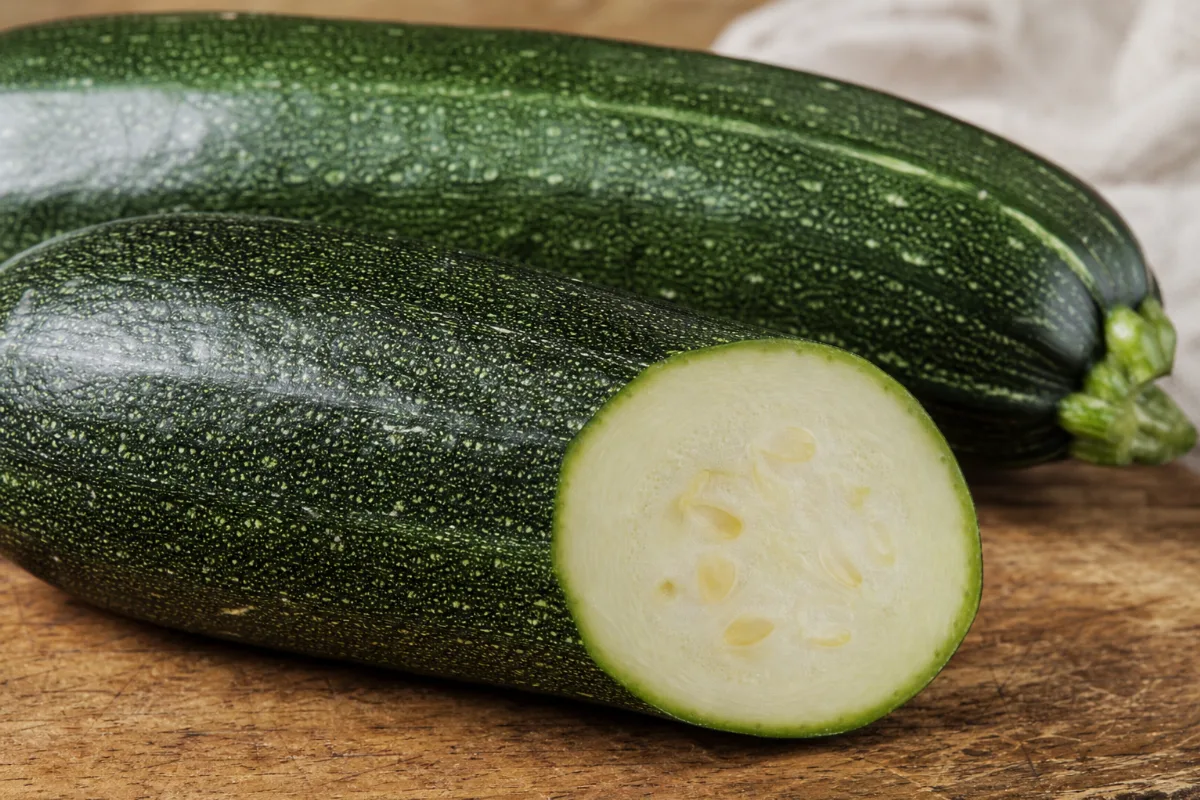
Zucchini (Cucurbita pepo), also called courgette, is a summer squash in the gourd family. The young fruit is eaten whole, skin included, raw or cooked.
USDA data for raw zucchini with skin: 17 kcal per 100 g, 94.8 g water, 1.0 g fibre, 261 mg potassium, 17.9 mg vitamin C, 24 micrograms folate (DFE), 4.3 micrograms vitamin K and about 2,120 micrograms lutein plus zeaxanthin. In a 124 g portion (about 1 cup chopped) that is about 21 kcal, 1.2 g fibre, 324 mg potassium and 22 mg vitamin C. Cooked, frozen and canned values were not read.
What the research shows
The firmest facts are about nutrients: vitamin C is needed for collagen and iron absorption, and zucchini contains some. These are not trials of zucchini.
Observational studies link more vegetables to less heart disease, and trials of potassium in general lowered blood pressure in people with high blood pressure. Neither tested zucchini.
The big eye trial tested lutein capsules, not zucchini, and found no significant benefit. We found no trial of eating zucchini for any health outcome.
Food versus capsules and supplements
The eye trials used lutein capsules and the blood pressure trials were about potassium in general. Results for a capsule or a mineral do not carry over to eating zucchini. In the eye trial, beta carotene capsules were also linked to more lung cancers in former smokers; that finding is about capsules, not vegetables.
Amounts
This page gives no amounts to eat. Ask a doctor, pharmacist or dietitian what is right for you, especially if you have kidney problems or take blood pressure medicine.
At a glance
Traditional uses history, not proof
- Eaten as a summer squash, raw in salads or cooked
- Long use as food is not proof that it treats any condition
Studied for research
- Vitamin C for tissue repair, high certainty for the nutrient, no zucchini trial
- Potassium and blood pressure, low certainty (trials of potassium in general)
- Heart disease risk (vegetables as a group), low certainty, observational
- Eye health, insufficient evidence (lutein capsule trials, not zucchini)
- Weight, insufficient evidence
Main compounds
- Vitamin C
- Potassium
- Lutein and zeaxanthin
- Beta-carotene
- Cucurbitacins (bitter toxins, rare)
Common forms
- Fresh zucchini, raw or cooked, with skin
- Frozen or canned zucchini
- Spiralized zucchini 'noodles'
Research links: 2017 review: fruit and vegetables and heart disease · French poison-centre series: bitter squash · MedlinePlus: Potassium in diet · Research Library · Genes & Biomarkers Library
What it is and its history
- Accepted scientific name
- Cucurbita pepo
- Naming authority
- L. (GBIF accepted)
- Common names
- Zucchini (English); Courgette (English (UK)); Summer squash (English); Calabacín (Spanish)
- Family or group
- Cucurbitaceae (the gourd family), as given by GBIF.
- Classification
- Plantae > Tracheophyta > Magnoliopsida > Cucurbitales > Cucurbitaceae > Cucurbita > Cucurbita pepo
- Native range
- Not verified from a source read.
- Habitat
- Not verified from a source read.
- What it looks like
- Roots: Not verified.; Stems: Not verified.; Leaves: Not verified.; Flowers: Not verified.; Fruit: The young fruit is eaten with its skin. USDA lists household portions of 124 g, 113 g and 196 g.
- Cultivation
- Not verified from a source read. The German case report says poisoning can occur in small garden plots in warm weather.
- Harvest and processing
- Eaten raw or cooked, frozen, canned or cut into noodle shapes (existing nutrient summary).
- Look-alikes and adulterants
- Name: Other squash and pumpkins; Note: Bitter 'non-edible' squash can be confused with edible ones (French poison-centre series). Bottle gourd (Lagenaria siceraria) is a different plant with the same bitter-toxin family.
- Sustainability and conservation
- Not assessed.
Photographs
What is inside, and how it may work
What it contains and how those compounds act in cells and animals. Laboratory and animal mechanisms are not proven effects in people.
Main compounds
| Compound | Family | Where it is concentrated | Activity studied | Level of evidence |
|---|---|---|---|---|
| Vitamin C (ascorbic acid) PubChem 54670067 | vitamin | Fruit USDA: 17.9 mg per 100 g raw | Needed for collagen, wound healing and iron absorption (MedlinePlus). 13 14 | Human data |
| Lutein PubChem 5281243 | carotenoid | Fruit (with skin) USDA: 2,120 micrograms per 100 g raw, lutein plus zeaxanthin together | A pigment found in the macula of the eye; tested as a supplement for macular degeneration with mixed results. 2 8 14 | Human data |
| Zeaxanthin PubChem 5280899 | carotenoid | Fruit (with skin) Included in the lutein plus zeaxanthin figure above | A companion pigment to lutein in the eye. 2 14 | Human data |
| Beta-carotene PubChem 5280489 | carotenoid | Fruit USDA: 120 micrograms per 100 g raw (listed from 7 data points, range 0 to 410) | A vitamin A precursor. Only a small amount in zucchini. 14 | Human data |
| Cucurbitacin B (one of the cucurbitacins) PubChem 5281316 | triterpenoid | Bitter fruit Not measured in the sources read | Cucurbitacins give the bitter taste and cause the poisoning in bitter squash (ICMR report for bottle gourd). Cucurbitacin B is named here as an example; which cucurbitacins occur in a given bitter zucchini was not found. 4 5 | Human data |
| Potassium PubChem 813 | mineral | Fruit USDA: 261 mg per 100 g raw | An electrolyte; higher intake lowered blood pressure in people with high blood pressure in trials of potassium in general. 1 12 14 | Human data |
Mechanisms, receptors and pathways
| Target or pathway | Gene or receptor | What was found | Level |
|---|---|---|---|
| Cucurbitacins and gut irritation | Not specified | The French poison-centre authors suggest the irritating effect of certain cucurbitacins may be behind the taste and toxicity of bitter squash. The mechanism was not studied. 7 | Human data |
| Potassium and blood pressure | Not specified | Higher potassium intake lowered blood pressure in people with high blood pressure in the BMJ review. How it does so was not stated in the abstract. 1 | Human data |
Absorption, metabolism and elimination
- Absorption
- Not found.
- Distribution
- Not found.
- Metabolism
- Not found.
- Elimination
- Not found.
- Bioavailability
- Not established for zucchini nutrients in the sources read.
Isolated compounds versus whole extracts
The eye trials used lutein capsules, and the blood pressure trials were about potassium intake in general. Results for a capsule or a mineral do not carry over to eating zucchini.
Nutritional composition
Nutrition from USDA FoodData Central (Squash, summer, zucchini, includes skin, raw, FDC 169291, SR Legacy, last updated 4/1/2019, read 2026-10-26). Per 100 g: 17 kcal, 94.8 g water, 1.21 g protein, 0.32 g fat, 3.11 g carbohydrate, 1.0 g fibre, 16 mg calcium, 0.37 mg iron, 18 mg magnesium, 38 mg phosphorus, 261 mg potassium, 8 mg sodium, 17.9 mg vitamin C, 24 micrograms folate (DFE), 10 micrograms vitamin A (RAE), 4.3 micrograms vitamin K, 0.163 mg vitamin B6, 0.094 mg riboflavin, 0.177 mg manganese, 120 micrograms beta-carotene, 2,120 micrograms lutein plus zeaxanthin. In a 124 g portion (about 1 cup chopped): about 21 kcal, 1.5 g protein, 1.2 g fibre, 324 mg potassium, 22 mg vitamin C, 30 micrograms folate, 5.3 micrograms vitamin K and 2,630 micrograms lutein plus zeaxanthin (our arithmetic from the per-100 g values). Values vary with variety, ripeness and storage. Cooked, frozen and canned values were not read.
1 high certainty2 low certainty2 not enough evidence
What was looked at
The 5 benefits and uses checked for Zucchini (Courgette), each with how strong the evidence is. Tap one to open it.
- Vitamin C for tissue repair and preventing scurvyHigh certainty
- Potassium and blood pressureLow certainty
- Eating more vegetables and heart diseaseLow certainty
- Lutein and eye health (macular degeneration)Not enough evidence
- A low-calorie, high-water vegetableNot enough evidence
Lab markers tracked in the studies
Systolic blood pressureCardiovascular disease eventsProgression to advanced macular degenerationMacular pigment optical density and visual acuity
What is Zucchini (Courgette) good for?
The main studied uses and how strong the human evidence is for each. Most results are for vegetables as a group, for potassium, or for capsules, not for eating zucchini.
Benefits, one by one
Each card is a research question, not a promise. Tap a goal to filter. Open a card to see the studies, doses and limits.
Vitamin C for tissue repair and preventing scurvy
High certaintyVitamin C is needed to make collagen, heal wounds and absorb iron. Zucchini has a fair amount: USDA lists 17.9 mg in 100 g of raw zucchini, which is about 22 mg in a 124 g portion. This is a nutrient fact, not a trial of zucchini.
2 studiesRaw or cooked zucchini as food. MedlinePlus says cooking or long stor…
Studies, doses and limits
What the trials found
MedlinePlus says vitamin C is needed for the growth and repair of tissues, that all fruits and vegetables contain some, and that scurvy is the severe form of deficiency. It lists winter squash, not zucchini, among the vegetables highest in vitamin C. USDA lists 17.9 mg per 100 g of raw zucchini with skin.
Results
The role of vitamin C is well accepted and zucchini contains some. No trial of zucchini for vitamin C status or scurvy was found.
Effect sizes as reported
USDA: 17.9 mg vitamin C per 100 g raw zucchini; about 22 mg in 124 g.
Why this rating
High for the nutrient role (health-agency statement) and for zucchini containing vitamin C (USDA data). It is not a trial of zucchini, and zucchini is not among the richest sources.
Form and dose studied
Raw or cooked zucchini as food. MedlinePlus says cooking or long storage can reduce vitamin C.
Who was studied
Anyone eating a varied diet. MedlinePlus says deficiency mainly affects older, malnourished adults.
Limits
Nutrient fact, not a zucchini trial. We did not find a zucchini-specific study of how cooking changes its vitamin C.
Why researchers looked
Many vegetables are named as vitamin C foods, so people ask whether zucchini counts.
Traditional use
Zucchini is eaten as a summer squash, raw or cooked. Long use as food is not proof that it treats any condition.
Proposed mechanism Authoritative guidance
Vitamin C is used to form collagen, heal wounds, repair cartilage, bones and teeth, and help the body absorb iron (MedlinePlus).
A proposed mechanism does not show that the effect happens in people.
Nothing specific to zucchini as food.
Potassium and blood pressure
Low certaintyZucchini has some potassium (261 mg per 100 g by USDA). A large review of trials found that more potassium lowered blood pressure in people with high blood pressure, but those trials were about potassium in general, not zucchini.
3 studiesZucchini as food; the review covers potassium from food and supplemen…
Studies, doses and limits
What the trials found
A 2013 BMJ review pooled 22 randomised trials (1,606 adults) of higher potassium intake from food or supplements. Systolic blood pressure fell by 3.49 mm Hg (95% CI 1.82 to 5.15) and diastolic by 1.96 mm Hg, in people with high blood pressure but not in those without. Higher intake was linked to lower stroke risk (RR 0.76, 0.66 to 0.89) in cohort studies, with no significant link to coronary heart disease. USDA lists 261 mg potassium per 100 g raw zucchini, about 324 mg in 124 g.
Results
The blood pressure effect is for potassium intake in general. Zucchini is one modest source of potassium. No trial of zucchini was found.
Effect sizes as reported
Potassium trials: systolic -3.49 mm Hg (1.82 to 5.15). Zucchini: 261 mg per 100 g.
Why this rating
Low for zucchini, because the trials did not test zucchini. The review's authors rate the potassium evidence for people with high blood pressure as high quality, but that is about potassium intake, not this vegetable.
Form and dose studied
Zucchini as food; the review covers potassium from food and supplements.
Who was studied
Adults with high blood pressure (benefit seen only there).
Limits
Not a zucchini trial. A cup of zucchini gives about 7% of the Daily Value for potassium, so it is not a high-potassium vegetable.
Why researchers looked
Potassium is a mineral in many vegetables, and blood pressure is a common reason people look at diet.
Traditional use
Zucchini is eaten as a summer squash, raw or cooked. Long use as food is not proof that it treats any condition.
Proposed mechanism Unknown
Not established by the sources read for this page.
A proposed mechanism does not show that the effect happens in people.
People with kidney disease or on some blood pressure medicines should ask a clinician about potassium-rich foods; see the Safety tab.
Eating more vegetables and heart disease
Low certaintyPeople who eat more fruit and vegetables have less heart disease and live longer in observational studies. Zucchini was not studied on its own, and these studies cannot prove that vegetables are the cause.
1 studiesWhole fruit and vegetables as food.
Studies, doses and limits
What the trials found
A 2017 meta-analysis of 95 prospective studies found that fruit and vegetables combined were linked to lower risk of cardiovascular disease (RR 0.92 per 200 g a day, 95% CI 0.90 to 0.95) and of death from any cause (RR 0.90, 0.87 to 0.93). The abstract also reports inverse links for green leafy and cruciferous vegetables. Zucchini and summer squash are not named in the abstract.
Results
Observational studies link more vegetables to less heart disease and early death. Nothing is shown for zucchini alone.
Effect sizes as reported
Fruit and vegetables combined, per 200 g/day: CVD RR 0.92 (0.90-0.95); all-cause mortality RR 0.90 (0.87-0.93).
Why this rating
Low, because the evidence is observational: people who eat more vegetables differ from others in many ways, heterogeneity for deaths is high (I2 83%), and zucchini was not analysed alone.
Form and dose studied
Whole fruit and vegetables as food.
Who was studied
Adults in prospective cohort studies.
Limits
Cannot show cause. The meta-analysis authors say the causal reading is conditional (its death estimates apply 'if the observed associations are causal').
Why researchers looked
Zucchini counts as a vegetable, and population studies ask whether eating more vegetables goes with better health.
Traditional use
Zucchini is eaten as a summer squash, raw or cooked. Long use as food is not proof that it treats any condition.
Proposed mechanism Unknown
Not established. The studies do not show which nutrient or plant compound might matter, if any.
A proposed mechanism does not show that the effect happens in people.
None specific.
Lutein and eye health (macular degeneration)
Not enough evidenceZucchini contains lutein and zeaxanthin, pigments found in the centre of the eye. The big AREDS2 trial of lutein plus zeaxanthin capsules did not slow advanced macular degeneration significantly. Zucchini itself was not tested.
4 studiesCapsules and tablets in the trials, not zucchini.
Studies, doses and limits
What the trials found
In AREDS2 (4,203 people aged 50 to 85 at risk of advanced AMD, median follow-up 5 years), lutein 10 mg plus zeaxanthin 2 mg capsules did not significantly reduce progression to advanced AMD versus placebo (HR 0.90, 98.7% CI 0.76-1.07, P=0.12). A 2026 meta-analysis of 9 trials (860 people) of lutein supplements reported better macular pigment density and visual acuity, mainly in early AMD and not in late AMD. A 2026 review of observational data links a Mediterranean-style diet to slower AMD progression, with fish most protective and vegetables next; it does not single out zucchini.
Results
Mixed for supplements, nothing for zucchini. The big trial of capsules was null; a pooled analysis of smaller trials was positive for early AMD.
Effect sizes as reported
AREDS2: HR 0.90 (0.76-1.07). Meta-analysis: MPOD Hedges' g -0.589, visual acuity g -0.827.
Why this rating
Insufficient for zucchini. All trials used supplements, and the results for them are mixed.
Form and dose studied
Capsules and tablets in the trials, not zucchini.
Who was studied
People with, or at risk of, age-related macular degeneration.
Limits
Supplements are not the food. Lutein from zucchini has not been tested.
Why researchers looked
Lutein and zeaxanthin are found in the macula of the eye, and zucchini is a food source (USDA lists about 2,120 micrograms of the two together per 100 g).
Traditional use
Zucchini is eaten as a summer squash, raw or cooked. Long use as food is not proof that it treats any condition.
Proposed mechanism Unknown
Not shown by the sources read. The AREDS2 abstract says observational data had suggested that lutein and zeaxanthin might lower the risk.
A proposed mechanism does not show that the effect happens in people.
In AREDS2, beta carotene capsules were linked to more lung cancers, mostly in former smokers. That finding is about capsules, not vegetables.
A low-calorie, high-water vegetable
Not enough evidenceZucchini has only 17 kcal per 100 g and is about 95% water (USDA). We found no study showing that eating zucchini leads to weight loss.
1 studiesRaw zucchini with skin (USDA).
Studies, doses and limits
What the trials found
USDA lists 17 kcal, 94.8 g water, 1.0 g fibre and 0.32 g fat per 100 g raw zucchini with skin. No trial of zucchini for body weight was found.
Results
The calorie figure is a USDA fact. No weight effect has been shown.
Effect sizes as reported
USDA: 17 kcal and 94.8 g water per 100 g.
Why this rating
There is no trial of zucchini for weight.
Form and dose studied
Raw zucchini with skin (USDA).
Who was studied
General adult diet.
Limits
A food having few calories is not proof that it causes weight loss.
Why researchers looked
Zucchini is often swapped in for pasta or other starchy foods, so people ask whether it helps with weight.
Traditional use
Zucchini is eaten as a summer squash, raw or cooked. Long use as food is not proof that it treats any condition.
Proposed mechanism Authoritative guidance
Not studied for zucchini. It is a food with few calories per weight, which is a fact about its composition, not a result.
A proposed mechanism does not show that the effect happens in people.
None specific.
Connections to the rest of health
How Zucchini (Courgette) connects to the rest of our health knowledge graph. Every link says what kind of connection it is. A safety link (for example to the liver) is a warning, not a benefit. A study that merely mentions a topic never creates a benefit link.
Explore every connection: goals, body systems, organs, symptoms, genes
B. Body systems
| Connected to | Kind of connection | Evidence status | Context | Studies |
|---|---|---|---|---|
| Blood And Immune | Biological association | High certainty | Studied for: Vitamin C for tissue repair and preventing scurvy | 13 14 |
| Integumentary System | Biological association | High certainty | Studied for: Vitamin C for tissue repair and preventing scurvy | 13 14 |
| Cardiovascular System | Biological association | Low certainty | Studied for: Potassium and blood pressure Studied for: Eating more vegetables and heart disease | 1 12 14 3 |
| Eyes And Vision | Biological association | Not enough evidence | Studied for: Lutein and eye health (macular degeneration) | 2 8 6 14 |
| Metabolism Weight | Biological association | Not enough evidence | Studied for: A low-calorie, high-water vegetable | 14 |
C. Body parts and organs
| Connected to | Kind of connection | Evidence status | Context | Studies |
|---|---|---|---|---|
| Digestive system | Adverse effect or risk | Documented risk | Bitter zucchini can cause vomiting, diarrhoea and dehydration; discard it. A rare bitter zucchini can cause vomiting, diarrhoea and dehydration; discard it. Preparation or compound: Bitter zucchini (cucurbitacins) |
7 5 |
| Kidneys | Adverse effect or risk | Documented risk | Potassium-rich foods may need limiting in kidney disease. Moderate potassium source; potassium-rich foods may need limiting in kidney disease. Preparation or compound: Potassium in zucchini |
12 |
I. Biomarkers
| Connected to | Kind of connection | Evidence status | Context | Studies |
|---|---|---|---|---|
| Systolic blood pressure | Biological association | Low certainty | Measured in trials: lowered. A lab change is not the same as a health benefit. | 1 |
| Cardiovascular disease events | Biological association | Low certainty | Measured in trials: lowered. A lab change is not the same as a health benefit. | 3 |
| Progression to advanced macular degeneration | Biological association | Not enough evidence | Measured in trials: no-change. A lab change is not the same as a health benefit. | 2 |
| Macular pigment optical density and visual acuity | Biological association | Low certainty | Measured in trials: improved. A lab change is not the same as a health benefit. | 8 |
K. Biological pathways
| Connected to | Kind of connection | Evidence status | Context | Studies |
|---|---|---|---|---|
| Vitamin C | Preliminary mechanism | Human | Zucchini contains vitamin C; it is needed for collagen and iron absorption. | 13 14 |
| Potassium | Preliminary mechanism | Human | Zucchini is a moderate potassium source; relevant for blood pressure and for kidney disease. | 1 12 |
| Lutein and zeaxanthin | Preliminary mechanism | Human | Eye pigments present in zucchini; supplements tested for macular degeneration. | 2 14 |
L. Active compounds
| Connected to | Kind of connection | Evidence status | Context | Studies |
|---|---|---|---|---|
| Vitamin C (ascorbic acid) | Biological association | Human | Needed for collagen, wound healing and iron absorption (MedlinePlus). Preparation or compound: Fruit |
13 14 |
| Lutein | Biological association | Human | A pigment found in the macula of the eye; tested as a supplement for macular degeneration with mixed results. Preparation or compound: Fruit (with skin) |
2 8 14 |
| Zeaxanthin | Biological association | Human | A companion pigment to lutein in the eye. Preparation or compound: Fruit (with skin) |
2 14 |
| Beta-carotene | Biological association | Human | A vitamin A precursor. Only a small amount in zucchini. Preparation or compound: Fruit |
14 |
| Cucurbitacin B (one of the cucurbitacins) | Biological association | Human | Cucurbitacins give the bitter taste and cause the poisoning in bitter squash (ICMR report for bottle gourd). Cucurbitacin B is named here as an example; which cucurbitacins occur in a given bitter zucchini was not found. Preparation or compound: Bitter fruit |
4 5 |
| Potassium | Biological association | Human | An electrolyte; higher intake lowered blood pressure in people with high blood pressure in trials of potassium in general. Preparation or compound: Fruit |
1 12 14 |
Each connection is stored with the ingredient, the connected record, the kind of connection, the evidence status, the supporting studies, the preparation or compound involved, and a review date (last reviewed October 26, 2026).
Evidence at a glance: what changed in 3 lab markers
Tap a number to show only those markers. Counts are markers, not people.
The evidence
The research centre for Zucchini (Courgette). Every record here was checked against PubMed or the publisher's page; we never list a study we have not verified.
Evidence by outcome
Bars show how many studies we found for each outcome, not how well it works. People are added up across trials only (reviews are not added, to avoid double counting).
How we rate evidence
High certainty
Several well-run trials or reviews agree; further research is unlikely to change the picture much.
Moderate certainty
Good trials point the same way, but some doubt remains.
Low certainty
Small, short or inconsistent trials. The finding could change with better research.
Very low certainty
Very little or very weak human data. Treat as a possibility only.
Mixed findings
Trials or reviews disagree with each other.
Not enough evidence
Not enough human research to say either way.
Evidence against
Good research found no benefit, or found harm.
We take the reviewers' own risk-of-bias and GRADE statements where they exist, and otherwise judge from study size, design, consistency, directness and whether a product matches what is sold. Many publications do not make evidence high. Method note: We started from our existing zucchini summary, re-checked nutrition at USDA FoodData Central, re-read the MedlinePlus and FDA pages and searched PubMed for reviews, trials and case reports. Only abstracts were read for studies, and one case report had no abstract. The German BfR notice could not be reached and is marked unverified. Items we could not verify are flagged in the research gaps.
Study library: every study we checked 14
| Study | Design | People | Product, dose, length | Result |
|---|---|---|---|---|
| Aburto 2013 Effect of increased potassium intake on cardiovascular risk factors and disease: systematic review and meta-analyses. BMJ · PMID 23558164 · DOI |
Systematic review meta analysis |
1606 22 randomised trials (1,606 adults) and 11 cohort studies (127,038 adults) |
Higher potassium intake (food and supplements) Potassium in general, not zucchini Study detail, not advice Trials of various lengths · vs Lower potassium intake |
Higher potassium intake lowered blood pressure in people with high blood pressure but not in those without; higher intake was linked to lower stroke risk. Systolic blood pressure -3.49 mm Hg; stroke RR 0.76 (Systolic -3.49 (95% CI 1.82 to 5.15); stroke RR 0.76 (0.66-0.89)) Methods, limits and fundingOutcomes: Blood pressure, stroke, heart disease, kidney function, blood lipids Limitations: About potassium intake in general, not zucchini. The authors note the benefit applies to people without impaired kidney handling of potassium. Funding and conflicts: Funding: PubMed lists non-US government support; not detailed in the abstract. Read: abstract |
| Age-Related Eye Disease Study 2 Research Group 2013 Lutein + zeaxanthin and omega-3 fatty acids for age-related macular degeneration: the Age-Related Eye Disease Study 2 (AREDS2) randomized clinical trial. JAMA · PMID 23644932 · DOI |
Controlled trial |
4203 4,203 people aged 50 to 85 at risk of advanced age-related macular degeneration (AMD) |
Lutein 10 mg plus zeaxanthin 2 mg capsules (and DHA plus EPA in other arms), on top of the AREDS formula Supplement capsules, not zucchini Study detail, not advice Median follow-up 5 years · vs Placebo |
Adding lutein plus zeaxanthin did not significantly reduce progression to advanced AMD compared with placebo. Lutein + zeaxanthin versus placebo: HR 0.90 (HR 0.90 (98.7% CI 0.76-1.07), P=0.12) Methods, limits and fundingOutcomes: Progression to advanced AMD (by eye); lung cancer also counted Limitations: Capsules in people already at risk, not food. Funding and conflicts: Funding is not stated in the abstract; PubMed lists NIH extramural and intramural research support. Registration: NCT00345176 Read: abstract |
| Aune 2017 Fruit and vegetable intake and the risk of cardiovascular disease, total cancer and all-cause mortality-a systematic review and dose-response meta-analysis of prospective studies. Int J Epidemiol · PMID 28338764 · DOI |
Systematic review meta analysis |
Adults in 95 prospective studies (142 publications) | Fruit and vegetables eaten as food (observational) Whole fruit and vegetables Study detail, not advice Prospective cohorts, various lengths · vs Lower versus higher intake |
Fruit and vegetables combined were linked to lower risk of cardiovascular disease and death; green leafy and cruciferous vegetables were also linked to lower cardiovascular disease and death. Per 200 g/day: CVD RR 0.92; all-cause mortality RR 0.90 (CVD 0.92 (95% CI 0.90-0.95, I2 31%); all-cause mortality 0.90 (0.87-0.93, I2 83%)) Methods, limits and fundingOutcomes: Cardiovascular disease, cancer, all-cause death Limitations: Observational: cannot show cause. Zucchini or summer squash was not named in the abstract. Funding and conflicts: Funding is not stated in the abstract. Read: abstract |
| Indian Council of Medical Research Task Force 2012 Assessment of effects on health due to consumption of bitter bottle gourd (Lagenaria siceraria) juice. Indian J Med Res · PMID 22382183 · DOI |
Case report |
Reported cases in India: 3 deaths and 26 hospital admissions | Very bitter bottle gourd juice (a different plant from zucchini) Bottle gourd juice Study detail, not advice |
Three older people with long-standing diabetes died after extremely bitter juice. Of 26 admitted, many had diarrhoea and vomiting of blood, and all recovered fully. 3 deaths; 26 admitted (n/a) Methods, limits and fundingOutcomes: Illness after drinking the juice Limitations: Bottle gourd juice, not zucchini; cases were collected by internet search and letters to hospitals. Funding and conflicts: Government expert committee (ICMR). Read: abstract |
| Jung 2020 [Food poisoning by cucurbitacines]. Dtsch Med Wochenschr · PMID 32668470 · DOI |
Case report |
1 One 66-year-old woman |
Bitter zucchini eaten as food Zucchini fruit Study detail, not advice Recovered; eating again after 2 days |
Fast heartbeat, low blood pressure, drowsiness, bloody diarrhoea, nausea and vomiting; acute colitis on ultrasound; improved with intravenous fluids and the colitis resolved by itself. One case (n/a) Methods, limits and fundingOutcomes: Symptoms and recovery Limitations: A single case report. Funding and conflicts: Funding is not stated in the abstract. Read: abstract |
| Keenan 2026 What Should Patients With Age-Related Macular Degeneration Eat? Am J Ophthalmol · PMID 41990981 · DOI |
Systematic review |
People with AMD (review of AREDS/AREDS2 and cohort studies) | Mediterranean-style diet (observational) Whole diet Study detail, not advice Cohort follow-up |
A Mediterranean diet was consistently linked to slower AMD progression; fish was most protective, followed by vegetables and less red meat. Vegetables were not broken down by type in the abstract. Not given in the abstract (Not given in the abstract) Methods, limits and fundingOutcomes: Progression of AMD Limitations: A focused (not systematic) review of observational data about the whole diet, not zucchini. Funding and conflicts: PubMed lists intramural NIH support. Read: abstract |
| Le Roux 2018 Poisoning by non-edible squash: retrospective series of 353 patients from French Poison Control Centers. Clin Toxicol (Phila) · PMID 29323540 · DOI |
Case report |
353 353 people reported to French Poison Control Centers, 2012 to 2016 |
Bitter, non-edible squash eaten as food Squash fruit (not only zucchini) Study detail, not advice Retrospective, 5 years |
57.8% had symptoms, mostly diarrhoea, vomiting and abdominal pain; no deaths or severe cases; 4.0% moderate. The authors recommend throwing away any bitter-tasting squash. 204 of 353 with symptoms (57.8%); 14 (4.0%) moderate severity (n/a) Methods, limits and fundingOutcomes: Symptoms and severity Limitations: Descriptive report; the squash types are not all zucchini. Funding and conflicts: Funding is not stated in the abstract. Read: abstract |
| Wang 2026 From Supplements to Sight: Quantifying the Impact of Lutein and Carotenoid on Age-Related Macular Degeneration-A Systematic Review and Meta-Analysis of Randomized Controlled Trials. J Ophthalmol · PMID 42028334 · DOI |
Systematic review meta analysis |
860 860 people with AMD in 9 randomised placebo-controlled trials |
Oral lutein, alone or with zeaxanthin or epilutein Supplements, not zucchini Study detail, not advice Various · vs Placebo |
Lutein supplements improved MPOD and BCVA, mainly in early-stage AMD; no significant benefit was found in late-stage disease. MPOD Hedges' g -0.589; BCVA Hedges' g -0.827 (p<0.001 (MPOD); p=0.001 (BCVA)) Methods, limits and fundingOutcomes: Macular pigment optical density (MPOD), best-corrected visual acuity (BCVA) Limitations: Supplements, not food. Small trials pooled; abstract gives no certainty rating. Funding and conflicts: Funding is not stated in the abstract. Read: abstract |
| s-bfr-bitter-courgettes BfR (Germany): Caution when eating bitter-tasting courgettes (zucchini), Notification 027/2015 · Source |
Health agency n/a |
Methods, limits and fundingRead: not-reached | ||
| s-fda-produce FDA: Selecting and Serving Produce Safely · Source |
Health agency n/a |
Methods, limits and fundingRead: full-text | ||
| s-gbif-cucurbita-pepo GBIF Backbone: Cucurbita pepo L. (usageKey 2874508) · Source |
Reference database n/a |
Methods, limits and fundingRead: full-text | ||
| s-medlineplus-potassium MedlinePlus: Potassium in diet · Source |
Health agency n/a |
Methods, limits and fundingRead: full-text | ||
| s-medlineplus-vitc MedlinePlus: Vitamin C · Source |
Health agency n/a |
Methods, limits and fundingRead: full-text | ||
| s-usda-fdc-169291 USDA FoodData Central: Squash, summer, zucchini, includes skin, raw (FDC 169291) · Source |
Reference database n/a |
Methods, limits and fundingRead: full-text |
What we do not know yet
- No trial of eating zucchini itself was found for blood pressure, heart disease, eye health, weight or any other outcome.
- The vegetable studies pool many vegetables; a zucchini-only result was not in the abstracts read.
- Allergy, pregnancy and breastfeeding, children, pesticide residues, nitrate, FODMAPs and the effect of cooking were not researched or not found.
- The German BfR notice on bitter courgettes could not be re-read, and the 2022 toxic squash case report has no abstract.
- Cucurbitacin levels in bitter zucchini and whether cooking changes them were not found.
How new research is added
New studies are found by a saved PubMed search and placed in a review queue before the page changes.
Lab markers
What changed in blood or saliva tests during trials. A changed number is not the same as feeling or being healthier, and we give no "normal ranges".
Other 4
Systolic blood pressure
Lowered in trials
The top number in a blood pressure reading: the pressure in the arteries when the heart beats.
Low certaintyResults and what it means
Why it was measured
High blood pressure raises the risk of stroke and heart disease.
Statistical vs. clinical meaning
A small fall with potassium in general. Not shown for zucchini.
Safety implication
The review found no significant harm to kidney function in adults; the authors say it applies to people without impaired potassium handling by the kidneys.
| Study | Result | People | Product |
|---|---|---|---|
| 1 | Higher potassium intake: systolic -3.49 mm Hg (95% CI 1.82 to 5.15) in adults; seen in people with high blood pressure but not in those without | 1,606 adults in 22 randomised trials | Higher potassium intake from food or supplements (not zucchini) |
Cardiovascular disease events
Lowered in trials
How many people in a study develop heart disease or stroke.
Low certaintyResults and what it means
Why it was measured
These are outcomes that matter most to health, so population studies count them.
Statistical vs. clinical meaning
An association in observational studies, not proof of cause.
Safety implication
None specific.
| Study | Result | People | Product |
|---|---|---|---|
| 3 | Fruit and vegetables combined, per 200 g a day: CVD RR 0.92 (95% CI 0.90-0.95) | Adults in prospective cohort studies | Fruit and vegetables as food (zucchini not analysed alone) |
Progression to advanced macular degeneration
No clear change in trials
Whether early age-related macular degeneration (AMD) in an eye worsens to the advanced stage.
Not enough evidenceResults and what it means
Why it was measured
Advanced AMD is the stage that causes serious loss of central vision.
Statistical vs. clinical meaning
No significant difference with capsules. Not a test of zucchini.
Safety implication
More lung cancers in the beta carotene group than the no beta carotene group (2.0% vs 0.9%), mostly in former smokers.
| Study | Result | People | Product |
|---|---|---|---|
| 2 | Lutein plus zeaxanthin versus placebo: HR 0.90 (98.7% CI 0.76-1.07), P=0.12; 5-year progression 29% vs 31% | 4,203 people aged 50 to 85 at risk | Lutein 10 mg plus zeaxanthin 2 mg capsules, median 5 years |
Macular pigment optical density and visual acuity
Improved in trials
A measure of how much lutein and zeaxanthin pigment is in the centre of the retina, and how sharp a person's best-corrected vision is.
Low certaintyResults and what it means
Why it was measured
These are used in trials as signs that a lutein supplement reaches the eye and might help vision.
Statistical vs. clinical meaning
Better pigment and vision scores with supplements in early AMD. Not shown for food.
Safety implication
None reported in the abstract.
| Study | Result | People | Product |
|---|---|---|---|
| 8 | Pooled lutein supplements: MPOD Hedges' g -0.589 (p<0.001); best-corrected visual acuity g -0.827 (p=0.001); benefit mainly in early AMD, none significant in late AMD | 860 people with AMD in 9 randomised trials | Oral lutein supplements, alone or with zeaxanthin (not zucchini) |
Safety
What studies and official sources say about side effects, medicines and who should check first. Each point shows what kind of evidence it comes from.
Main points to know 3
- Bitter zucchini: do not eat it. Rarely, a zucchini contains high levels of natural bitter toxins called cucurbitacins. In a French poison-centre series of 353 people poisoned by bitter squash, 57.8% had symptoms, mostly diarrhoea, vomiting and stomach pain; none died and 4.0% were of moderate severity, and the authors recommend throwing away any bitter squash. A German case report describes a 66-year-old woman with a fast heartbeat, low blood pressure, bloody diarrhoea and dehydration after eating a bitter zucchini; she recovered with fluids. Germany's BfR is reported to advise tasting a small raw piece and discarding the vegetable if it is bitter (we could not re-read that notice). Cooking was not shown to remove the bitterness. Case report 7 5 9
- Kidney disease and some blood pressure medicines: ask about potassium. Zucchini has a moderate amount of potassium (USDA: 261 mg per 100 g raw, about 324 mg in a 124 g portion). MedlinePlus says people with kidney problems, particularly those on dialysis, should not eat too many potassium-rich foods. It also names ACE inhibitors, ARBs and potassium-sparing diuretics (spironolactone, triamterene, amiloride) among causes of high blood potassium. MedlinePlus does not name zucchini on that page. Ask a clinician about potassium-rich foods. Authoritative guidance 12 14
- Raw produce can carry germs. The FDA says to wash produce under running water, to avoid soap or produce wash, and notes that children, older adults, pregnant women and people with weakened immune systems can be especially vulnerable to foodborne illness. Authoritative guidance 10
Side effects 3
| Effect | How often | Severity and recovery | Evidence |
|---|---|---|---|
| Vomiting, diarrhoea and stomach pain after eating a bitter squash or zucchini (cucurbitacin poisoning) The French series covers non-edible squash in general, not only zucchini. Over half of the squash had been bought in a shop and about a quarter came from a garden. | 204 of 353 (57.8%) of people in a French poison-centre series had symptoms | mostly minor; 14 of 353 (4.0%) moderate; none severe Usually recovered; the German case recovered after 2 days with intravenous fluids | Case report 7 5 |
| Bloody diarrhoea, low blood pressure and dehydration (one zucchini case) A single 66-year-old woman who ate a bitter zucchini. | One case | serious enough for the emergency department Recovered; colitis settled by itself | Case report 5 |
| Severe stomach bleeding and deaths after very bitter bottle gourd juice This is a different plant (bottle gourd) and a juice, not zucchini. It is shown because it is the same family of bitter toxins. | 3 deaths and 26 hospital admissions reported in India | life-threatening All 26 admitted patients recovered fully | Case report 4 |
Liver
No liver injury from eating zucchini was found. A liver-safety source (such as LiverTox) was not searched for this food page. The bottle gourd report notes raised liver enzymes in some patients, but that is a different plant. 4
How often. No frequency was found.
Monitoring. No agency monitoring advice was found.
This is a safety connection. It is not evidence that Zucchini (Courgette) supports liver health.
Medicines and supplements 2
| With | Why it matters | Importance | Evidence | What to do |
|---|---|---|---|---|
| Medicines that raise blood potassium (ACE inhibitors, ARBs, potassium-sparing diuretics) prescription | These medicines can raise potassium in the blood (MedlinePlus). Zucchini contains potassium (USDA: 261 mg per 100 g raw). | MedlinePlus does not name zucchini; the link is our reading of two separate facts. Zucchini is a moderate source (about 7% of the Daily Value per cup) and normal food amounts have not been tested in a trial. | Authoritative guidance Low certainty 12 14 | If you take one of these medicines or have kidney disease, ask a clinician or pharmacist about potassium-rich foods. |
| Warfarin (blood thinner) prescription | Warfarin works against vitamin K. USDA lists a low amount of vitamin K in zucchini (4.3 micrograms per 100 g). | No source read names zucchini as a concern for warfarin. This is a USDA value, not an interaction study. | Authoritative guidance Not enough evidence 14 | Anyone on warfarin should keep their usual diet steady and ask their clinic about foods. |
Who should check first 2
| Situation | Advice | Evidence |
|---|---|---|
| A zucchini that tastes bitter | Do not eat it. Taste a small raw piece first if you wish, and throw the zucchini away if it is bitter. The French poison-centre authors recommend disposing of any bitter-tasting squash. | Case report 7 5 |
| Kidney disease, especially on dialysis, or taking ACE inhibitors, ARBs or potassium-sparing diuretics | Ask a clinician about potassium-rich foods. The sources read gave no zucchini-specific advice. | Authoritative guidance 12 |
Overdose, product quality and regulators
Summary. Cultivated zucchini is normally eaten without trouble. The one documented danger is a rare bitter zucchini with high cucurbitacin levels.
Animal. Not reviewed.
Human doses studied. No dose study of zucchini was found. The poisoning reports describe ordinary meals of bitter squash.
Overdose response. The ICMR report on bottle gourd juice says there is no known antidote for cucurbitacin toxicity and that cases are treated with supportive care. Whether that applies the same way to zucchini was not found.
Genotoxicity. Not researched.
Toxic or hazardous parts. Bitter fruit with high cucurbitacin content. Leaves, flowers and seeds were not researched.
Raw produce can carry germs, and the FDA gives washing advice. Pesticide residues, heavy metals and nitrate levels in zucchini were not researched.
Food safety handling. The FDA says to wash all produce under running water, including produce grown at home, and that soap, detergent or commercial produce wash is not recommended. It also says to cut away damaged or bruised areas. 10
| Body | Action | Date |
|---|---|---|
| MedlinePlus (US National Library of Medicine) (United States) | Potassium page: people with kidney problems should not eat too many potassium-rich foods; ACE inhibitors, ARBs and potassium-sparing diuretics are listed among causes of high potassium source | 2026-04-30 |
| FDA (US Food and Drug Administration) (United States) | Produce safety page: wash produce under running water, no soap or produce wash; some groups, including pregnant women, are especially vulnerable to foodborne illness source | 2024-03-05 |
When to get medical help
- Trouble breathing, swelling of the lips, face or throat, or widespread hives after eating (call emergency services)
- Repeated vomiting, bloody diarrhoea, dizziness or fainting after eating a bitter zucchini or squash
- Signs of high blood potassium in someone with kidney disease or on the medicines listed, such as a very slow or irregular heartbeat
- Vomiting, diarrhoea, stomach pain or fever after eating raw produce
Stop using the product and contact a clinician or emergency service. In the US, Poison Control is 1-800-222-1222.
General information only, not medical advice. Ask a clinician or pharmacist before use, especially with medicines, in pregnancy or with a health condition. See the Natural Remedy Safety guide.
Frequently asked questions
What is zucchini good for?
Can a zucchini be poisonous?
What should I do if a zucchini tastes bitter?
Is zucchini good for the heart?
Observational studies link more fruit and vegetables to less heart disease (RR 0.92 per 200 g a day), but zucchini was not studied alone and the studies cannot show cause.
Does zucchini lower blood pressure?
Is zucchini high in potassium?
Is zucchini good for the eyes?
Does zucchini help with weight loss?
Not shown. It has few calories (17 kcal per 100 g) and is about 95% water, but no study of eating zucchini for weight was found.
Is zucchini safe with warfarin?
Zucchini has little vitamin K (4.3 micrograms per 100 g by USDA), and no source read named it as a concern. Anyone on warfarin should still ask their clinic about their usual diet.
Is zucchini safe in pregnancy?
No zucchini-specific caution was found. The FDA says pregnant women can be especially vulnerable to foodborne illness, so wash produce under running water. Ask your doctor.
Can I be allergic to zucchini?
Any food can cause a reaction, but the sources read gave no data on how common zucchini allergy is. For trouble breathing or swelling of the face or throat, call emergency services.
Does cooking change zucchini?
MedlinePlus says cooking or long storage can lower vitamin C in produce. Zucchini-specific effects of cooking were not found, and cooking was not shown to remove bitter toxins.
Explore by health goal
Editorial transparency
- Written by
- AlternativeMed editorial team. Research compiled with AI assistance, then checked against the sources listed.
- Medical review
- None. This page has not been reviewed by a physician or pharmacist.
- First published
- 2026-10-26
- Last substantive update
- 2026-10-26
- How we research
- We started from our existing zucchini summary, re-checked nutrition at USDA FoodData Central, re-read the MedlinePlus and FDA pages and searched PubMed for reviews, trials and case reports. Only abstracts were read for studies, and one case report had no abstract. The German BfR notice could not be reached and is marked unverified. Items we could not verify are flagged in the research gaps.
- How we rate evidence
- See "How we rate evidence" in the Evidence tab.
- Independence
- No product is promoted on this page. No affiliate links are shown.
Sources 14
Each source was opened and checked. Where we read only the abstract, it says so. The small numbers in the text point here.
- Aburto NJ. Effect of increased potassium intake on cardiovascular risk factors and disease: systematic review and meta-analyses.. BMJ. 2013. PMID 23558164. DOI 10.1136/bmj.f1378. (abstract)
- Age-Related Eye Disease Study 2 Research Group. Lutein + zeaxanthin and omega-3 fatty acids for age-related macular degeneration: the Age-Related Eye Disease Study 2 (AREDS2) randomized clinical trial.. JAMA. 2013. PMID 23644932. DOI 10.1001/jama.2013.4997. (abstract)
- Aune D. Fruit and vegetable intake and the risk of cardiovascular disease, total cancer and all-cause mortality-a systematic review and dose-response meta-analysis of prospective studies.. Int J Epidemiol. 2017. PMID 28338764. DOI 10.1093/ije/dyw319. (abstract)
- Indian Council of Medical Research Task Force. Assessment of effects on health due to consumption of bitter bottle gourd (Lagenaria siceraria) juice.. Indian J Med Res. 2012. PMID 22382183. DOI 10.4103/0971-5916.93424. (abstract)
- Jung C. [Food poisoning by cucurbitacines].. Dtsch Med Wochenschr. 2020. PMID 32668470. DOI 10.1055/a-1163-9741. (abstract)
- Keenan TDL. What Should Patients With Age-Related Macular Degeneration Eat?. Am J Ophthalmol. 2026. PMID 41990981. DOI 10.1016/j.ajo.2026.04.003. (abstract)
- Le Roux G. Poisoning by non-edible squash: retrospective series of 353 patients from French Poison Control Centers.. Clin Toxicol (Phila). 2018. PMID 29323540. DOI 10.1080/15563650.2018.1424891. (abstract)
- Wang WX. From Supplements to Sight: Quantifying the Impact of Lutein and Carotenoid on Age-Related Macular Degeneration-A Systematic Review and Meta-Analysis of Randomized Controlled Trials.. J Ophthalmol. 2026. PMID 42028334. DOI 10.1155/joph/2155378. (abstract)
- . BfR (Germany): Caution when eating bitter-tasting courgettes (zucchini), Notification 027/2015. . . (not-reached)
- . FDA: Selecting and Serving Produce Safely. . . (full-text)
- . GBIF Backbone: Cucurbita pepo L. (usageKey 2874508). . . (full-text)
- . MedlinePlus: Potassium in diet. . . (full-text)
- . MedlinePlus: Vitamin C. . . (full-text)
- . USDA FoodData Central: Squash, summer, zucchini, includes skin, raw (FDC 169291). . . (full-text)


