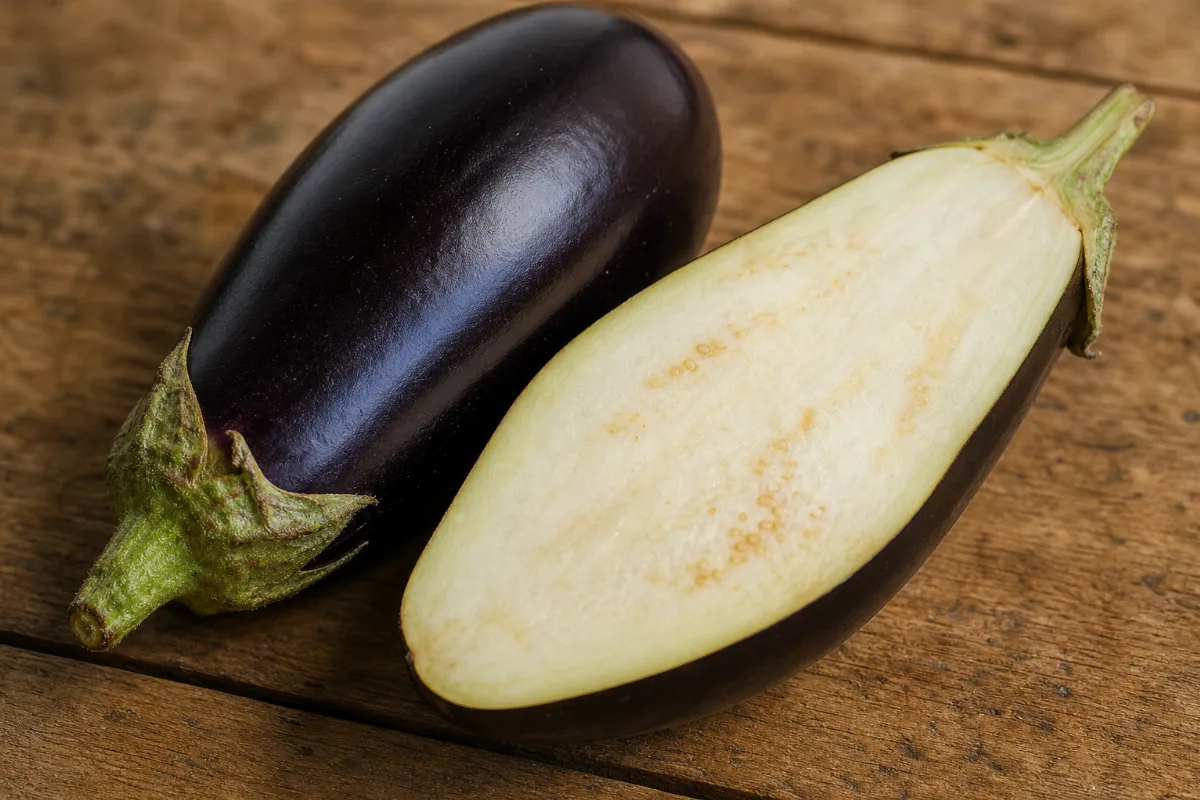
Vegetables · Vegetable
Eggplant
Solanum melongena · also called Aubergine, brinjal, garden egg, berenjena (Spanish)
Eggplant, also called aubergine, is the fruit of a nightshade plant, eaten cooked. It is low in calories and has some fibre, potassium and manganese. Its purple skin pigment has been studied only in the lab and in animals. One small trial of eggplant powder capsules reported lower blood pressure at some points, but two small cholesterol trials found no benefit over placebo. The main cautions are rare food allergy, potassium for people with kidney disease, and the oil soaked up when it is fried.
General information, not medical advice. Last substantive update · Not medically reviewed. A named clinician has not signed off on this page. How this page is made
About Eggplant
Eggplant is a low-calorie nightshade vegetable with some fibre and potassium. It is a healthy food, not a proven remedy: the few trials used capsules, powder or an infusion, and the pigment studies were done in the lab and in animals.
What it is
Eggplant (Solanum melongena), also called aubergine or brinjal, is the fruit of a plant in the nightshade family, the same family as tomato, pepper and potato. People usually eat the cooked flesh and often the skin.
USDA data for raw eggplant: 25 kcal per 100 g. One cup of cubes (82 g) has about 20 kcal, 2.5 g fibre, 0.8 g protein, 188 mg potassium, 0.19 mg manganese, 18 micrograms folate (DFE), 1.8 mg vitamin C and 2.9 micrograms vitamin K. These are raw values; USDA lists none for fried or baked eggplant.
What the research shows
One 12-week trial of eggplant powder capsules in 100 stressed adults reported lower blood pressure than placebo at some time points, mostly in small subgroups. It was one trial and no repeat was found.
Two small Brazilian trials of eggplant infusion and powder found no cholesterol benefit over placebo.
The purple skin pigment nasunin is an antioxidant in test tubes and lowered inflammation signals in mouse cells. In rats it was absorbed into the blood. None of this has been tested in people.
A reviewer says the claim that nightshades worsen bowel disease is based on limited evidence, and no trial of nightshade removal in arthritis had been done as of 2024.
Food versus capsules, powders and extracts
The blood pressure and cholesterol trials used dried powder in capsules or an infusion, and the pigment studies used purified nasunin or solvent extracts. None of these is the same as eating cooked eggplant, and a result for one form does not carry over to another.
Amounts
This page gives no amounts to eat. Ask a doctor, pharmacist or dietitian what is right for you, especially if you have kidney problems or take blood pressure medicine.
At a glance
Traditional uses history, not proof
- Eaten as a cooked vegetable, baked, grilled, roasted, stewed or fried
- Long use as food is not proof that it treats any condition
Studied for research
- Fibre and minerals in a low-calorie vegetable, high certainty for the nutrient facts, no trial
- Blood pressure (powder capsules), very low certainty, one small trial
- Blood cholesterol (infusion and powder), very low certainty, no benefit over placebo
- Antioxidant and anti-inflammatory activity of the purple pigment, insufficient evidence, lab and animal only
- Stress and mood (powder capsules), very low certainty, subgroup results
- Nightshade claims for bowel disease and arthritis, insufficient evidence either way
Main compounds
- Nasunin (purple anthocyanin pigment)
- Acetylcholine and other choline esters
- Chlorogenic acid
- Solasonine and solamargine (glycoalkaloids)
- Potassium
- Fibre
- Trace nicotine
Common forms
- Cooked fresh eggplant as food
- Fried eggplant, which takes up oil
- Canned, pickled or frozen eggplant dishes
- Dried powder in capsules or infusions (the trials used these, not the vegetable)
Research links: Trial of eggplant powder and blood pressure (2019) · Review of eggplant allergy (2021) · NHS: Food allergy · Research Library · Genes & Biomarkers Library
What it is and its history
- Accepted scientific name
- Solanum melongena
- Naming authority
- L. (GBIF accepted)
- Synonyms
- Solanum melongena Wall.; Solanum melongenum St.-Lag.
- Common names
- Eggplant (English); Aubergine (English); Brinjal (English); Garden egg (English); Berenjena (Spanish)
- Family or group
- Solanaceae (the nightshade family), which also includes tomato, pepper and potato (Kuang 2023).
- Classification
- Plantae > Tracheophyta > Magnoliopsida > Solanales > Solanaceae > Solanum > Solanum melongena
- Native range
- Not verified from a source read.
- Habitat
- Not verified from a source read.
- What it looks like
- Roots: Not verified.; Stems: Not verified.; Leaves: Not verified.; Flowers: Not verified.; Fruit: The fruit is the food, a berry (Igwe 2003 abstract). USDA gives a household portion of one cup of cubes as 82 g and a whole unpeeled eggplant of about 1-1/4 lb as 548 g.
- Cultivation
- Not verified from a source read.
- Harvest and processing
- Eaten cooked, usually baked, grilled, roasted, stewed or fried; also canned, pickled or frozen (existing nutrient summary). Dried powder is used in capsules and infusions in studies.
- Look-alikes and adulterants
- Name: Other nightshade foods (tomato, peppers, potato); Note: Related vegetables with their own pages. Nightshade reviews pool several of them, so their results are not specific to eggplant.; Name: Other eggplant types and 'garden egg'; Note: Garden egg is a name for Solanum melongena in the Nigerian study. Some small round or bitter-tasting 'eggplants' may be other species; the papers read do not say.
- Sustainability and conservation
- Not assessed.
Photographs
What is inside, and how it may work
What it contains and how those compounds act in cells and animals. Laboratory and animal mechanisms are not proven effects in people.
Main compounds
| Compound | Family | Where it is concentrated | Activity studied | Level of evidence |
|---|---|---|---|---|
| Nasunin (delphinidin 3-(p-coumaroylrutinoside)-5-glucoside) PubChem 154723842 | anthocyanin | Peel Not given in the sources read | Purple pigment. Antioxidant and anti-inflammatory in the lab; absorbed in rats. No human trial. 14 9 7 | Laboratory research |
| Acetylcholine (choline ester) PubChem 187 | choline ester | Fruit 2.3 mg in the 1.2 g daily powder dose of the blood pressure trial | The trial authors estimated that eggplant choline esters, mainly acetylcholine, were responsible for the blood pressure effect. Not proven. 13 | Human data |
| Chlorogenic acid PubChem 1794427 | phenolic acid | Fruit and peel Measured in a breeding study; no figure in the abstract | Measured as a health-related compound in eggplant lines. No health effect was read for it here. 12 | Lab |
| Solasonine PubChem 119247 | steroidal glycoalkaloid | Fruit and peel Measured; no figure in the abstract | Called a toxic steroidal glycoalkaloid by the authors; the amount in a serving was not found. 12 10 | Lab |
| Solamargine PubChem 73611 | steroidal glycoalkaloid | Fruit and peel Measured; no figure in the abstract | As for solasonine. 12 | Lab |
| Nicotine PubChem 89594 | alkaloid | Fruit 105 ng per g (about 0.1 microgram per g) in one method paper | Trace amounts found by a laboratory measuring method; no health effect tested. 1 | Lab |
Mechanisms, receptors and pathways
| Target or pathway | Gene or receptor | What was found | Level |
|---|---|---|---|
| Free-radical scavenging and iron binding by nasunin | Not applicable | Purified nasunin scavenged superoxide and hydroxyl radicals and protected rat brain tissue from fat damage in test tubes. 14 | Laboratory research |
| NF-kB, Akt and p38 signalling in macrophages | NF-kB, Akt, p38 (named in the abstract) | Nasunin lowered inflammation signals in mouse macrophages by lowering reactive oxygen species. 9 | Laboratory research |
| Choline esters and blood pressure (proposed) | Not specified | The trial authors propose acetylcholine from eggplant as the active substance. Not tested directly. 13 | Hypothesis |
| Allergen proteins: profilin (Sola m 1), lipid transfer protein, polyphenol oxidase | Sola m 1; PPO4 (Sola m PPO4) | Several eggplant proteins bind IgE from allergic people; the profilin cross-reacts with birch pollen profilin in the lab. 11 6 2 | Human samples |
Absorption, metabolism and elimination
- Absorption
- Nasunin was absorbed in its original form in rats and peaked in plasma at 15 minutes. Human absorption was not shown in the sources read.
- Distribution
- Not found.
- Metabolism
- The usual methylated and glucuronide products were not detected in rat blood or urine.
- Elimination
- Not found.
- Bioavailability
- Rat bioavailability was almost the same as a simpler anthocyanin. Human data were not found.
Isolated compounds versus whole extracts
The pigment studies used purified nasunin or solvent extracts, the cholesterol and blood pressure trials used dried powder in capsules or an infusion, and the eye study did not describe its form. None is the same as eating cooked eggplant, and results for one form should not be assumed for another.
Nutritional composition
Nutrition from USDA FoodData Central (Eggplant, raw, FDC 169228, SR Legacy, last updated 4/1/2019, read 2026-10-26). Per 100 g: 25 kcal, 0.98 g protein, 0.18 g fat, 5.88 g carbohydrate, 3.53 g sugars, 3.0 g fibre, about 92 g water, 9 mg calcium, 0.23 mg iron, 14 mg magnesium, 229 mg potassium, 2 mg sodium, 0.232 mg manganese, 0.081 mg copper, 22 micrograms folate (DFE), 0.084 mg vitamin B6, 2.2 mg vitamin C, 3.5 micrograms vitamin K, 36 micrograms lutein plus zeaxanthin. One cup of raw cubes (82 g): about 20.5 kcal, 0.8 g protein, 2.5 g fibre, 188 mg potassium, 0.19 mg manganese, 18 micrograms folate, 11 mg magnesium, 1.8 mg vitamin C and 2.9 micrograms vitamin K. These are raw values; USDA lists no fried or baked values for this item, and fried eggplant takes up oil. Figures vary with variety, ripeness and storage.
1 high certainty1 low certainty4 very low certainty4 not enough evidence
What was looked at
The 10 benefits and uses checked for Eggplant, each with how strong the evidence is. Tap one to open it.
- Fibre and minerals in a low-calorie vegetableHigh certainty
- Counting toward your daily fruit and vegetablesLow certainty
- Blood pressure (eggplant powder in capsules)Very low certainty
- Blood cholesterol (eggplant infusion and powder)Very low certainty
- Antioxidant activity of the purple skin pigment (lab only)Not enough evidence
- Inflammation signals in cells (lab only)Not enough evidence
- Does the pigment reach the blood? (rats only)Not enough evidence
- Pupil size and eye pressure (very old small study)Very low certainty
- Stress and mood (eggplant powder in capsules)Very low certainty
- Nightshade claims: bowel disease and arthritisNot enough evidence
Lab markers tracked in the studies
Blood pressureTotal and LDL cholesterolEye pressure (intraocular pressure)Mood and psychological-state scores
What is Eggplant good for?
The main studied uses and how strong the human evidence is for each. Most results are for capsules, powder, an infusion or a purified pigment, not for eating cooked eggplant.
Benefits, one by one
Each card is a research question, not a promise. Tap a goal to filter. Open a card to see the studies, doses and limits.
Fibre and minerals in a low-calorie vegetable
High certaintyRaw eggplant is low in calories and has some fibre, potassium, manganese and copper. USDA lists 25 kcal and 3.0 g of fibre per 100 g. One cup of cubes (82 g) has about 20 kcal and 2.5 g of fibre. This is a nutrient fact, not a trial of eggplant.
1 studiesRaw values only. USDA gives no fried or baked values for this item; f…
Studies, doses and limits
What the trials found
USDA FoodData Central lists, per 100 g of raw eggplant, 25 kcal, 0.98 g protein, 5.88 g carbohydrate, 3.53 g sugars, 3.0 g fibre, 229 mg potassium, 0.232 mg manganese, 0.081 mg copper, 22 micrograms folate (DFE), 0.084 mg vitamin B6 and 3.5 micrograms vitamin K. USDA gives one cup of cubes as 82 g.
Results
Eggplant is a low-energy vegetable with modest amounts of several minerals and vitamins. No trial of eggplant for any nutrient status was read.
Effect sizes as reported
USDA, per 100 g raw: 25 kcal, 3.0 g fibre, 229 mg potassium. Per cup of cubes (82 g): about 20.5 kcal, 2.5 g fibre, 188 mg potassium.
Why this rating
High only for the composition figures (USDA data). There is no study showing a health benefit from the fibre or minerals in eggplant itself.
Form and dose studied
Raw values only. USDA gives no fried or baked values for this item; fried eggplant takes up oil and is different.
Who was studied
Anyone eating a varied diet.
Limits
Nutrient information, not a trial. Values vary with variety, ripeness and storage. Cooking effects on nutrients were not read.
Why researchers looked
People ask what eggplant adds to a meal.
Traditional use
Eaten as a cooked vegetable. Long use as food is not proof that it treats any condition.
Proposed mechanism Reference database
Nutrient content as measured by USDA. No health effect is claimed from the content alone.
A proposed mechanism does not show that the effect happens in people.
Moderate potassium: see the Safety tab if you have kidney disease.
Counting toward your daily fruit and vegetables
Low certaintyWHO advises everyone older than 10 to aim for at least 400 g of fruits and vegetables a day. The NHS counts 80 g of fresh, canned or frozen vegetables as one portion. Eggplant is a vegetable, so it counts. This is general advice about vegetables, not proof about eggplant.
3 studiesFresh eggplant as food.
Studies, doses and limits
What the trials found
The WHO healthy diet fact sheet says everyone older than 10 should aim for at least 400 g of fruits and vegetables a day. The NHS says 80 g of fresh, canned or frozen fruit and vegetables counts as one portion. A USDA cup of eggplant cubes is 82 g.
Results
Eggplant fits the general advice to eat a variety of vegetables. No eggplant-specific health outcome is shown by this advice.
Effect sizes as reported
WHO: at least 400 g of fruits and vegetables a day (older than 10). NHS: 80 g is one portion.
Why this rating
The advice is from health agencies and rests mostly on observational research that was not read for this page. For eggplant itself, the certainty is low.
Form and dose studied
Fresh eggplant as food.
Who was studied
Everyone older than 10 (WHO).
Limits
General guidance, not specific to eggplant. The NHS page text read does not name aubergine.
Why researchers looked
Official diet advice is built around eating more fruit and vegetables.
Traditional use
Eaten as a cooked vegetable. Long use as food is not proof that it treats any condition.
Proposed mechanism Authoritative guidance
None claimed. This is a pattern-level dietary recommendation.
A proposed mechanism does not show that the effect happens in people.
None specific.
Blood pressure (eggplant powder in capsules)
Very low certaintyOne 12-week trial in 100 stressed adults with normal-high blood pressure or mild hypertension gave capsules of dried eggplant powder or placebo. The eggplant group had lower blood pressure at some time points, mainly in small subgroups. It is one trial of capsules, not of eggplant meals, and no repeat trial was found.
1 studiesDried eggplant powder in capsules. Not the same as eating cooked eggp…
Studies, doses and limits
What the trials found
In a Japanese randomised, double-blind, placebo-controlled trial (Nishimura 2019), 100 adults were randomised and 87 finished. The eggplant group took capsules with 1.2 g a day of eggplant powder (2.3 mg of acetylcholine, about 22 g of raw eggplant) for 12 weeks. Diastolic pressure was lower than placebo at week 8 overall (p = 0.024). At week 12 systolic pressure overall was lower (p = 0.046, labelled exploratory), and in the grade 1 hypertension subgroup both systolic (p = 0.037) and diastolic (p = 0.041) were lower. That subgroup was small (9 eggplant, 15 placebo).
Results
Lower blood pressure than placebo at some time points, with several results from subgroups or labelled exploratory. In the full text, home blood-pressure measured values did not differ between groups.
Effect sizes as reported
Overall diastolic pressure at week 8: p = 0.024. Overall systolic at week 12: p = 0.046 (exploratory). Mean differences in mmHg were not given in the text read.
Why this rating
One small trial of capsules with subgroup and exploratory results, no repeat trial found. The trial was supported by an agricultural research grant; the authors declared no conflict of interest.
Form and dose studied
Dried eggplant powder in capsules. Not the same as eating cooked eggplant.
Who was studied
Stressed adults with normal-high blood pressure or grade 1 hypertension in Japan.
Limits
Capsule product, not food. Small subgroups. Only 77 people were in the efficacy analysis. No stress benefit on the stress scale. No second trial found.
Why researchers looked
Eggplant contains choline esters such as acetylcholine, and the same team saw lower blood pressure in rats.
Traditional use
Eaten as a cooked vegetable. Long use as food is not proof that it treats any condition.
Proposed mechanism Human trial hypothesis
The authors suggest eggplant choline esters, mainly acetylcholine, may be responsible. This was estimated, not proven in the trial.
A proposed mechanism does not show that the effect happens in people.
Adverse events happened in both groups; the investigator judged them unrelated to the test food. If you take blood pressure medicine, do not change it because of eggplant; ask your clinician.
Blood cholesterol (eggplant infusion and powder)
Very low certaintyTwo small, older trials from Brazil tested powdered eggplant as an infusion or in capsules in people with high cholesterol. Neither showed a benefit over placebo. Cholesterol fell in some people, but it also fell on placebo.
2 studiesInfusion of powdered fruit (2000) and dried powder capsules (2004).
Studies, doses and limits
What the trials found
In a 2000 trial (Guimaraes) of 38 people with high cholesterol, an eggplant infusion for 5 weeks made no difference to total or LDL cholesterol compared with placebo. Within each person total cholesterol, LDL and apolipoprotein B fell, but with dietary advice no differences were seen. A 2004 trial (Silva) of 41 people with high blood fats gave capsules of dried eggplant powder (450 mg, twice a day) for 3 months. Total cholesterol and LDL fell, but the same happened on placebo.
Results
No benefit over placebo in either trial. The authors of the 2004 trial say the product needs more trials before it is recommended.
Effect sizes as reported
No between-group differences; numbers were not given in the abstracts.
Why this rating
Two small, short trials, only abstracts read, both with null results versus placebo. Neither tested eggplant as a food.
Form and dose studied
Infusion of powdered fruit (2000) and dried powder capsules (2004).
Who was studied
Adults with high cholesterol or high blood fats in Brazil.
Limits
Small, older trials, abstracts only, products not the same as a cooked vegetable.
Why researchers looked
Eggplant powder products have been sold in Brazil for high cholesterol.
Traditional use
Eaten as a cooked vegetable. Long use as food is not proof that it treats any condition.
Proposed mechanism None
No mechanism was tested in these trials.
A proposed mechanism does not show that the effect happens in people.
Do not replace cholesterol medicine with eggplant products.
Antioxidant activity of the purple skin pigment (lab only)
Not enough evidenceA major purple pigment in eggplant skin is called nasunin. In test tubes, purified nasunin mopped up free radicals and protected rat brain tissue from fat damage. Peel extracts also scored well in a test-tube antioxidant test. No human trial of eggplant or nasunin for antioxidant effects was found.
2 studiesPurified nasunin and solvent extracts of peel. Not the vegetable.
Studies, doses and limits
Results
Antioxidant activity in test tubes. This does not show an effect in people who eat eggplant.
Effect sizes as reported
Nasunin: superoxide scavenging 143 SOD-equivalent units per mg; hydroxyl scavenging 0.65 EPC-K1-equivalent micromol per mg. Protection of rat brain tissue at under 50 micromolar.
Why this rating
Lab only. A test-tube result does not tell us what happens in a person who eats eggplant.
Form and dose studied
Purified nasunin and solvent extracts of peel. Not the vegetable.
Limits
Lab tests with purified pigment and extracts, often at amounts you do not get from a plate of eggplant.
Why researchers looked
Purple vegetables are rich in anthocyanin pigments, which behave as antioxidants in the lab.
Traditional use
Eaten as a cooked vegetable. Long use as food is not proof that it treats any condition.
Proposed mechanism Laboratory research
Nasunin scavenged superoxide and hydroxyl radicals and held on to iron in test tubes (lab).
A proposed mechanism does not show that the effect happens in people.
None specific.
Inflammation signals in cells (lab only)
Not enough evidenceIn mouse immune cells grown in a dish, nasunin lowered the release of several inflammation signals after a bacterial stimulus. This was cell work with the isolated pigment. It has not been tested in people.
1 studiesIsolated nasunin.
Studies, doses and limits
Results
Lower inflammation signals in cultured mouse cells in a dose-dependent way.
Effect sizes as reported
No numbers in the abstract.
Why this rating
Cell-culture only.
Form and dose studied
Isolated nasunin.
Limits
One cell type, one stimulus, isolated pigment. No animal or human result in the paper.
Why researchers looked
Researchers looked at whether the pigment calms inflammation signals in cells.
Traditional use
Eaten as a cooked vegetable. Long use as food is not proof that it treats any condition.
Proposed mechanism Laboratory research
Nasunin reduced reactive oxygen species and the NF-kB, Akt and p38 signalling that drives release of TNF-alpha, interleukin-6 and nitric oxide in mouse macrophages (lab).
A proposed mechanism does not show that the effect happens in people.
None specific.
Does the pigment reach the blood? (rats only)
Not enough evidenceIn rats, nasunin was absorbed from the gut in its original form and showed up in the blood within about 15 minutes. Whether people absorb it from eating eggplant was not shown in the sources read.
1 studiesPurified nasunin given by mouth to rats.
Studies, doses and limits
Results
Quick absorption of the purified pigment in rats, with blood levels almost the same as a simpler anthocyanin.
Effect sizes as reported
Peak in plasma at 15 minutes.
Why this rating
Animal study of the purified pigment only.
Form and dose studied
Purified nasunin given by mouth to rats.
Limits
Rats are not people, and the dose was of purified pigment, not a serving of vegetable.
Why researchers looked
A pigment can only act in the body if it is absorbed.
Traditional use
Eaten as a cooked vegetable. Long use as food is not proof that it treats any condition.
Proposed mechanism Animal research
Acylated anthocyanin absorbed intact; usual breakdown products not found in plasma or urine (rat).
A proposed mechanism does not show that the effect happens in people.
None specific.
Pupil size and eye pressure (very old small study)
Very low certaintyA 2003 study from Nigeria gave volunteers 10 g of eggplant (garden egg) once and reported smaller pupils and lower eye pressure. The abstract does not say how many people took part, what form they ate, or whether there was a control group. It does not show that eggplant helps glaucoma.
1 studiesForm not described in the abstract.
Studies, doses and limits
What the trials found
In visually active male volunteers, 10 g of Solanum melongena was followed by 23 percent smaller pupils, a 9 percent shorter near point of convergence, 22 percent more accommodation and 25 percent lower intraocular pressure. Visual acuity did not change.
Results
Short-term changes in eye measures after one amount. Duration, safety and any benefit for eye disease were not studied.
Effect sizes as reported
Pupil -23 percent; intraocular pressure -25 percent; near point of convergence -9 percent; accommodation +22 percent.
Why this rating
Single old study, abstract only, unclear design and size, no control group described.
Form and dose studied
Form not described in the abstract.
Who was studied
Visually active men in Nigeria.
Limits
Unclear design and size; one dose; short-term; the authors' suggestion about glaucoma goes beyond the data.
Why researchers looked
Garden egg is used in local diets and was tested for effects on the eye.
Traditional use
Eaten as a cooked vegetable. Long use as food is not proof that it treats any condition.
Proposed mechanism Human observation
The authors describe a pupil-narrowing effect. The cause was not shown.
A proposed mechanism does not show that the effect happens in people.
People with eye disease or taking eye drops should not use eggplant in place of treatment.
Stress and mood (eggplant powder in capsules)
Very low certaintyThe same 12-week blood pressure trial of eggplant powder capsules also measured stress and mood. The stress scale did not differ between groups. In some subgroups, mood scores (such as vigor and friendliness) were better with eggplant. These were secondary and subgroup results.
1 studiesDried eggplant powder in capsules.
Studies, doses and limits
What the trials found
In the Nishimura 2019 trial (100 people randomised), negative psychological-state scores improved at week 8 or 12 in the normal-high blood pressure group. In the full text, visual-scale stress scores did not differ between groups, and some mood-scale (POMS-2) differences appeared only in the grade 1 hypertension subgroup.
Results
A few mood-scale differences in subgroups; no difference on the stress scale.
Effect sizes as reported
p-values for subgroups only; sizes not given in the abstract.
Why this rating
Secondary outcomes, subgroup findings, one trial, capsules.
Form and dose studied
Dried eggplant powder in capsules.
Who was studied
Stressed Japanese adults with normal-high blood pressure or grade 1 hypertension.
Limits
Many outcomes tested and no repeat trial; subgroup results are easily due to chance.
Why researchers looked
The trial enrolled stressed adults, and acetylcholine is a brain chemical, so the team also checked mood.
Traditional use
Eaten as a cooked vegetable. Long use as food is not proof that it treats any condition.
Proposed mechanism Human trial hypothesis
The authors suggest eggplant choline esters (acetylcholine) may play a part. Not shown.
A proposed mechanism does not show that the effect happens in people.
None specific. Do not use eggplant in place of care for anxiety or depression.
Nightshade claims: bowel disease and arthritis
Not enough evidenceSome people blame nightshade vegetables, including eggplant, for bowel or joint symptoms. A 2023 review says the human evidence is limited and the idea is new. A 2024 trial plan notes that no randomised trial of removing nightshades in rheumatoid arthritis had been done. The claim is unproven in either direction.
2 studiesNightshade vegetables as food.
Studies, doses and limits
What the trials found
The review (Kuang 2023) describes the existing literature as limited. The 2024 protocol (Golmohammadi) is a plan for a trial of 40 people with rheumatoid arthritis; it reports no results.
Results
No trial result was read. The idea that eggplant worsens bowel disease or arthritis is not shown, and neither is the idea that it is harmless for everyone.
Why this rating
A narrative review and a trial plan; no results.
Form and dose studied
Nightshade vegetables as food.
Who was studied
People with IBD, IBS or rheumatoid arthritis who suspect nightshades.
Limits
No outcome data. The review pools tomatoes, peppers, eggplants and potatoes.
Why researchers looked
Nightshades contain natural defence chemicals called glycoalkaloids, and patients often link them to symptoms.
Traditional use
Eaten as a cooked vegetable. Long use as food is not proof that it treats any condition.
Proposed mechanism Review hypothesis
The review says glycoalkaloids can disrupt the gut lining and may activate mast cells. This is a proposed mechanism, mostly from lab work.
A proposed mechanism does not show that the effect happens in people.
If a food seems to make you ill, tell your clinician rather than cutting out a whole plant family on your own.
Connections to the rest of health
How Eggplant connects to the rest of our health knowledge graph. Every link says what kind of connection it is. A safety link (for example to the liver) is a warning, not a benefit. A study that merely mentions a topic never creates a benefit link.
Explore every connection: goals, body systems, organs, symptoms, genes
B. Body systems
| Connected to | Kind of connection | Evidence status | Context | Studies |
|---|---|---|---|---|
| Digestive System | Biological association | High certainty | Studied for: Fibre and minerals in a low-calorie vegetable Studied for: Nightshade claims: bowel disease and arthritis | 24 10 4 |
| Cardiovascular System | Biological association | Very low certainty | Studied for: Blood pressure (eggplant powder in capsules) Studied for: Blood cholesterol (eggplant infusion and powder) | 13 5 16 |
| Nervous System | Biological association | Very low certainty | Studied for: Stress and mood (eggplant powder in capsules) | 13 |
| Musculoskeletal System | Biological association | Not enough evidence | Studied for: Nightshade claims: bowel disease and arthritis | 10 4 |
E. Health conditions
| Connected to | Kind of connection | Evidence status | Context | Studies |
|---|---|---|---|---|
| Food allergy | Adverse effect or risk | Documented risk | Allergy is rare but documented in case reports and a review. Eggplant allergy is rare but documented, including one case of anaphylaxis. Preparation or compound: Eggplant fruit and peel |
17 15 2 |
| High blood potassium (hyperkalemia) | Drug or supplement interaction | Documented risk | Moderate potassium food; relevant for kidney disease and some blood pressure medicines. Moderate potassium food; relevant for kidney disease and potassium-raising medicines. Preparation or compound: Potassium in eggplant |
21 24 |
I. Biomarkers
| Connected to | Kind of connection | Evidence status | Context | Studies |
|---|---|---|---|---|
| Blood pressure | Biological association | Very low certainty | Measured in trials: lowered. A lab change is not the same as a health benefit. | 13 |
| Total and LDL cholesterol | Biological association | Very low certainty | Measured in trials: no-change. A lab change is not the same as a health benefit. | 5 16 |
| Eye pressure (intraocular pressure) | Biological association | Very low certainty | Measured in trials: lowered. A lab change is not the same as a health benefit. | 8 |
| Mood and psychological-state scores | Biological association | Very low certainty | Measured in trials: mixed. A lab change is not the same as a health benefit. | 13 |
K. Biological pathways
L. Active compounds
| Connected to | Kind of connection | Evidence status | Context | Studies |
|---|---|---|---|---|
| Nasunin (delphinidin 3-(p-coumaroylrutinoside)-5-glucoside) | Biological association | In vitro | Purple pigment. Antioxidant and anti-inflammatory in the lab; absorbed in rats. No human trial. Preparation or compound: Peel |
14 9 7 |
| Acetylcholine (choline ester) | Biological association | Human | The trial authors estimated that eggplant choline esters, mainly acetylcholine, were responsible for the blood pressure effect. Not proven. Preparation or compound: Fruit |
13 |
| Chlorogenic acid | Biological association | Lab | Measured as a health-related compound in eggplant lines. No health effect was read for it here. Preparation or compound: Fruit and peel |
12 |
| Solasonine | Biological association | Lab | Called a toxic steroidal glycoalkaloid by the authors; the amount in a serving was not found. Preparation or compound: Fruit and peel |
12 10 |
| Solamargine | Biological association | Lab | As for solasonine. Preparation or compound: Fruit and peel |
12 |
| Nicotine | Biological association | Lab | Trace amounts found by a laboratory measuring method; no health effect tested. Preparation or compound: Fruit |
1 |
Each connection is stored with the ingredient, the connected record, the kind of connection, the evidence status, the supporting studies, the preparation or compound involved, and a review date (last reviewed October 26, 2026).
Evidence at a glance: what changed in 4 lab markers
Tap a number to show only those markers. Counts are markers, not people.
The evidence
The research centre for Eggplant. Every record here was checked against PubMed or the publisher's page; we never list a study we have not verified.
Evidence by outcome
Bars show how many studies we found for each outcome, not how well it works. People are added up across trials only (reviews are not added, to avoid double counting).
How we rate evidence
High certainty
Several well-run trials or reviews agree; further research is unlikely to change the picture much.
Moderate certainty
Good trials point the same way, but some doubt remains.
Low certainty
Small, short or inconsistent trials. The finding could change with better research.
Very low certainty
Very little or very weak human data. Treat as a possibility only.
Mixed findings
Trials or reviews disagree with each other.
Not enough evidence
Not enough human research to say either way.
Evidence against
Good research found no benefit, or found harm.
We take the reviewers' own risk-of-bias and GRADE statements where they exist, and otherwise judge from study size, design, consistency, directness and whether a product matches what is sold. Many publications do not make evidence high. Method note: We started from our existing eggplant summary, re-checked nutrition at USDA FoodData Central, read the health agency pages (NHS, MedlinePlus, FDA, WHO) and searched PubMed for trials, reviews and case reports. Most studies were read as abstracts only; the blood pressure trial and one allergy case report were read in full. Items we could not verify are flagged in the research gaps.
Study library: every study we checked 25
| Study | Design | People | Product, dose, length | Result |
|---|---|---|---|---|
| Barzegar 2025 An efficient microchip electromembrane extraction online with high-performance liquid chromatography for the measurement of nicotine in high consumption vegetables. Phytochemical Analysis · PMID 39031170 · DOI |
Laboratory method lab |
Vegetable samples: tomato, mushroom, eggplant, bell pepper, red pepper | Food samples measured for nicotine Fruit |
Eggplant had the highest nicotine level of the foods tested (105.0 ng per g) and tomato the lowest (3.4 ng per g). The paper is about a measuring method and tested no health effects. 105.0 ng per g in eggplant (about 0.1 microgram per g, our conversion); 3.4 ng per g in tomato. (Not applicable) Methods, limits and fundingOutcomes: Nicotine concentration Limitations: A laboratory method paper. No health conclusion can be drawn. The abstract says nicotine in plant foods has adverse effects; the paper did not test that. Funding and conflicts: Not stated in the abstract. Read: abstract |
| Berghi 2021 Solanum melongena allergy (A comprehensive review). Experimental and Therapeutic Medicine · PMID 34434275 · DOI |
Narrative review review |
Review of reports of allergy to eggplant | Eggplant (Solanum melongena) as food and as pollen Fruit |
Reactions range from gut to breathing symptoms. More than four mechanisms and molecules are thought to be involved, including lipid transfer protein, profilin and polyphenol oxidase. Reactions can be triggered by pollen or by eating the fruit, and cross-reactivity is important. Most of the literature is case series, and wide population studies are scarce. No effect sizes. (Not applicable) Methods, limits and fundingOutcomes: Allergic reactions and the molecules behind them Limitations: Narrative review. How common eggplant allergy is was not given in the abstract. Funding and conflicts: Not stated in the abstract. Read: abstract |
| Djouadi 2025 Antioxidant Activity of Different Phenolic-Rich Fractions Obtained From Peels of Turkish Dark Purple Eggplant. Food Science & Nutrition · PMID 40585487 · DOI |
Laboratory research in-vitro |
Laboratory extracts of eggplant peel | Peel extracts made with ethanol and water mixtures Peel |
The peel extracts contained phenolic compounds, anthocyanins and flavonoids. The extract made in a Soxhlet apparatus with absolute ethanol was the most effective at scavenging free radicals in the test. No numbers in the abstract. (Not applicable) Methods, limits and fundingOutcomes: Phenolic content and free-radical (DPPH) scavenging in a test tube Limitations: Lab only: extracts made with solvents, test-tube test. Funding and conflicts: Not stated in the abstract. Read: abstract |
| Golmohammadi 2024 The evaluation of nightshade elimination diet (NED) on inflammatory and rheumatologic markers of rheumatoid arthritis patients: study protocol for a randomized controlled trial. Trials · PMID 39127701 · DOI |
Trial protocol |
Planned: 40 people with rheumatoid arthritis | Nightshade elimination diet (tomato, eggplant and others) Planned 8 weeks · vs General anti-inflammatory diet advice |
This is a plan for a trial, not a result. The authors say patients with rheumatoid arthritis often link tomatoes and eggplants to symptoms and that no randomised trial of nightshades had been done. No results. (Not applicable) Methods, limits and fundingOutcomes: Planned: inflammatory and rheumatologic markers Limitations: A protocol only. No results are reported in this paper. Funding and conflicts: Not stated in the abstract. Registration: Iranian Registry of Clinical Trials IRCT20230220057465N1 Read: abstract |
| Guimaraes 2000 Eggplant (Solanum melongena) infusion has a modest and transitory effect on hypercholesterolemic subjects. Brazilian Journal of Medical and Biological Research · PMID 10973133 |
Controlled trial |
38 38 volunteers with high cholesterol |
Infusion (a tea-like drink) made from powdered eggplant fruit Fruit (powder) Not given in the abstract 5 weeks · vs Placebo |
There were no differences between the eggplant and placebo groups. Looking within each person over time, total cholesterol, LDL cholesterol and apolipoprotein B fell on the infusion. After dietary advice was added, no differences were seen within or between groups. The authors called the effect modest and transitory, and no different from that of standard diet and exercise advice. No between-group difference (numbers not given in the abstract). (Not given in the abstract) Methods, limits and fundingOutcomes: Total and LDL cholesterol, triglycerides, apolipoproteins A and B Limitations: Small, short trial. Only the abstract was read. An infusion of powder, not eggplant eaten as a meal. Funding and conflicts: Not stated in the abstract. Read: abstract |
| Harish Babu 2017 Emerging food allergens: Identification of polyphenol oxidase as an important allergen in eggplant (Solanum melongena L.). Immunobiology · PMID 28164808 · DOI |
Lab human samples |
6 6 people allergic to eggplant |
Eggplant peel extract Peel |
Skin tests and blood tests with a polyphenol oxidase (PPO) rich part of the peel were positive in all 6 allergic people. The authors identified PPO as an eggplant allergen. 6 of 6 positive. (Not applicable) Methods, limits and fundingOutcomes: Skin prick tests, IgE tests, protein identification Limitations: Very small lab study in people already known to be allergic. Funding and conflicts: Not stated in the abstract. Read: abstract |
| Ichiyanagi 2006 Gastrointestinal uptake of nasunin, acylated anthocyanin in eggplant. Journal of Agricultural and Food Chemistry · PMID 16848510 · DOI |
Animal research rat |
Rats | Nasunin (cis and trans isomers) given by mouth Peel pigment Not given in the abstract 8 hours of sampling · vs Another anthocyanin (delphinidin 3-glucoside) |
Nasunin was absorbed quickly in its original form and peaked in the blood after 15 minutes. Its blood levels were almost the same as those of a simpler anthocyanin. The usual breakdown products were not found in blood or urine. Peak plasma level at 15 minutes. (Not applicable) Methods, limits and fundingOutcomes: Blood plasma and urine levels of nasunin and its breakdown products Limitations: Rat study of the purified pigment. Human absorption was not shown. Funding and conflicts: Not stated in the abstract. Read: abstract |
| Igwe 2003 Effects of Solanum melongena (garden egg) on some visual functions of visually active Igbos of Nigeria. Journal of Ethnopharmacology · PMID 12738076 |
Clinical trial uncontrolled |
Visually active male volunteers in Nigeria (number not given in the abstract) | Solanum melongena (garden egg); form not described in the abstract A single bolus of 10 g Single dose · vs Not clear from the abstract |
After 10 g the pupils were smaller (23 percent), the near point of convergence was shorter (9 percent), accommodation was increased (22 percent) and eye pressure fell (25 percent). Visual acuity did not change. The authors suggest it might help people with raised eye pressure. Pupil size -23 percent; eye pressure -25 percent; near point of convergence -9 percent; accommodation +22 percent. (Not given) Methods, limits and fundingOutcomes: Pupil size, near point of convergence, accommodation, intraocular pressure, visual acuity Limitations: Very old, small, short study with no clear control group in the abstract; the abstract does not say what form was eaten or how many people took part. The conclusion about glaucoma goes beyond what the data show. Funding and conflicts: Not stated in the abstract. Read: abstract |
| Komatsu 2017 Nasunin inhibits the lipopolysaccharide-induced pro-inflammatory mediator production in RAW264 mouse macrophages by suppressing ROS-mediated activation of PI3K/Akt/NF-kB and p38 signaling pathways. Bioscience, Biotechnology, and Biochemistry · PMID 28812425 · DOI |
Laboratory research in-vitro |
Mouse immune cells (RAW264) grown in a dish | Nasunin (purple pigment of eggplant peel) Peel · vs Untreated stimulated cells |
Nasunin lowered the release of TNF-alpha, interleukin-6 and nitric oxide in a dose-dependent way and reduced NF-kB activation. The authors say the effect is explained at least in part by its antioxidant action. Dose-dependent reduction; no numbers in the abstract. (Not applicable) Methods, limits and fundingOutcomes: Inflammation signals (TNF-alpha, IL-6, nitric oxide) after a bacterial stimulus Limitations: Cell-culture only with the isolated pigment. Not tested in animals or people in this paper. Funding and conflicts: Not stated in the abstract. Read: abstract |
| Kuang 2023 Nightshade Vegetables: A Dietary Trigger for Worsening Inflammatory Bowel Disease and Irritable Bowel Syndrome? Digestive Diseases and Science · PMID 37202602 · DOI |
Narrative review review |
Review of the limited literature on nightshade vegetables (tomato, pepper, eggplant, white potato) and gut disease | Nightshade vegetables as food; glycoalkaloids Fruit |
The authors say nightshade glycoalkaloids have been shown to disrupt the gut lining and may activate mast cells, and that nightshades are attracting interest as a possible trigger of gut symptoms. They describe the existing literature on adverse effects as limited and present mast-cell links as new ideas to test. No effect sizes (narrative review). (Not applicable) Methods, limits and fundingOutcomes: Gut symptoms and inflammation in IBD and IBS; allergy and cross-reactivity Limitations: Narrative review, not a systematic one. It does not show that nightshades cause or worsen IBD or IBS in people. Funding and conflicts: Not stated in the abstract. Read: abstract |
| Maity 2020 Identification, cloning, and immunological studies on a major eggplant (Solanum melongena L.) allergen Sola m 1: A new member of profilin allergen family. Molecular Immunology · PMID 31901836 · DOI |
Lab human samples |
Blood samples from eggplant-allergic people | Recombinant eggplant profilin (Sola m 1) Seeds (most abundant) and other edible parts |
A profilin called Sola m 1 reacted with IgE from all eggplant-allergic patients tested and triggered histamine release. It shares more than 80 percent of its sequence with birch pollen profilin Bet v 2 and cross-reacted with it and with profilins from six other foods in the test. It was more abundant in the seeds than in other edible parts. IgE reaction in all patients tested (number not given in the abstract). (Not applicable) Methods, limits and fundingOutcomes: IgE binding, histamine release, cross-reactivity Limitations: Lab study of a purified protein with blood samples. Cross-reaction in a test tube does not show who will react when eating. Funding and conflicts: Not stated in the abstract. Read: abstract |
| Mennella 2010 Characterization of health-related compounds in eggplant (Solanum melongena L.) lines derived from introgression of allied species. Journal of Agricultural and Food Chemistry · PMID 20527988 · DOI |
Laboratory plant breeding lab |
Raw fruit and peel of 57 breeding lines of eggplant, three parent lines and three wild relatives | Raw eggplant fruit and peel Fruit and peel |
The study measured the steroidal glycoalkaloids solasonine and solamargine (which the authors call toxic) alongside chlorogenic acid, an anthocyanin and total phenols. Many breeding lines had lower glycoalkaloid levels than their wild parents. The abstract gives no figure for ordinary eggplant. No numbers in the abstract. (Not applicable) Methods, limits and fundingOutcomes: Glycoalkaloids (solamargine, solasonine), chlorogenic acid, delphinidin 3-rutinoside, phenols Limitations: Plant-breeding study. It does not say how much glycoalkaloid a serving holds or at what amount it would matter to health. Funding and conflicts: Not stated in the abstract. Read: abstract |
| Nishimura 2019 Daily Ingestion of Eggplant Powder Improves Blood Pressure and Psychological State in Stressed Individuals: A Randomized Placebo-Controlled Study. Nutrients · PMID 31744060 · DOI |
Controlled trial |
100 Adults with stress and normal-high blood pressure or grade 1 hypertension (100 randomised; 87 finished) |
Eggplant (Solanum melongena) powder in capsules Fruit (powder) 1.2 g powder a day (2.3 mg acetylcholine a day), equal to about 22 g raw eggplant a day (full text) 12 weeks · vs Placebo capsules |
Eggplant powder lowered diastolic blood pressure at week 8 (overall and in the normal-high group) and systolic and diastolic pressure at week 12 (overall and in the grade 1 hypertension group) compared with placebo. Negative psychological state scores improved at week 8 or 12 in the normal-high group. In the full text the week-12 systolic result overall was labelled exploratory (p = 0.046), the grade 1 hypertension group was small (9 eggplant, 15 placebo), the home-blood-pressure measured values did not differ between groups, and stress scores on the visual scale did not differ. Overall diastolic pressure at week 8: p = 0.024 vs placebo. Week-12 systolic overall: p = 0.046 (exploratory). Grade 1 hypertension subgroup at week 12: systolic p = 0.037, diastolic p = 0.041. Mean differences were not stated in the text read. (Not given in the text read) Methods, limits and fundingOutcomes: Hospital blood pressure (primary); stress and psychological state (secondary) Limitations: One trial, capsules of dried powder (not a meal of eggplant), several subgroup and exploratory results, small subgroups, no repeat trial found. Adverse events occurred in both groups and the principal investigator judged them unrelated to the test food. Funding and conflicts: Supported by a Japanese agricultural research-promotion grant (NARO Bio-oriented Technology Research Advancement Institution). One author is listed at the company ADEKA. The authors declared no conflicts of interest (full text). Read: abstract and full text (PMC6893753) |
| Noda 2000 Antioxidant activity of nasunin, an anthocyanin in eggplant peels. Toxicology · PMID 10962130 · DOI |
Laboratory research in-vitro |
Test tubes and rat brain tissue (homogenate) | Purified nasunin (a purple pigment) from eggplant peel Peel · vs Standard antioxidants (SOD and EPC-K1) |
Nasunin scavenged superoxide and hydroxyl radicals in the test and held on to iron (the authors explain the hydroxyl result by iron binding, not direct scavenging). At under 50 micromolar it protected rat brain tissue from fat damage. Superoxide scavenging 143 SOD-equivalent units per mg; hydroxyl scavenging 0.65 EPC-K1-equivalent micromol per mg. (Not applicable) Methods, limits and fundingOutcomes: Free-radical scavenging; fat (lipid) damage in rat brain tissue Limitations: Lab only: purified pigment, test tubes and ground rat brain tissue. Says nothing about eating eggplant. Funding and conflicts: Not stated in the abstract. Read: abstract |
| Palla 2020 Oral Allergy Syndrome Associated with Eggplant Particles Manifesting as Lichenoid Reaction - A Sequential Diagnostic Workout and Long-Term Follow Up. Indian Journal of Dermatology · PMID 33487725 · DOI |
Case report |
1 One 25-year-old man |
Eggplant (cooked, unpeeled, in a challenge test) Fruit and peel |
He had burning of the mouth and tongue and skin rashes after eggplant meals. Skin prick tests were positive, strongest with the peel extract, and a blood test found IgE to several eggplant proteins. In a supervised food challenge he developed rashes and burning of the mouth and throat and was treated with an epinephrine injection. After stopping eggplant he was symptom-free at one year. One case. (Not applicable) Methods, limits and fundingOutcomes: Mouth lesion, skin tests, blood test, food challenge Limitations: A single case; there is no abstract in PubMed, so the full text on PubMed Central was read. It says nothing about how common eggplant allergy is. Funding and conflicts: Not stated. Read: full-text (PMC7810081) |
| Silva 2004 Absence of hypolipidemic effect of Solanum melongena L. (eggplant) on hyperlipidemic patients. Arquivos Brasileiros de Endocrinologia e Metabologia · PMID 15640898 |
Controlled trial |
41 41 volunteers with high blood fats |
Dried powdered eggplant fruit in capsules Fruit (dried powder) Two capsules (450 mg) twice a day 3 months · vs Placebo capsules |
Total cholesterol, LDL and the LDL/HDL ratio fell in the eggplant group, but a similar fall was seen in the placebo group. Triglycerides, HDL, VLDL, liver enzymes, glucose and body mass index did not change significantly. The authors concluded that the product needs more trials before it is recommended for high blood fats. No difference from placebo (p-values not given in the abstract). (Not given in the abstract) Methods, limits and fundingOutcomes: Total cholesterol, LDL, HDL, VLDL, triglycerides, liver enzymes, glucose, body mass index Limitations: Small trial. Only the abstract was read. Capsules of dried powder, a product sold in Brazil, not eggplant eaten as a meal. The paper is in Portuguese with an English abstract. Funding and conflicts: Not stated in the abstract. Read: abstract |
| Ukleja-Sokolowska 2018 Recurrent anaphylaxis in patient allergic to eggplant - a Lipid transfer protein (LTP) syndrome. Asian Pacific Journal of Allergy and Immunology · PMID 29161052 · DOI |
Case report |
1 One 27-year-old man |
Baked eggplant Fruit |
Within minutes of eating a dish with baked eggplant he had shortness of breath, swelling of the face, lips and tongue, low blood pressure, a fast heartbeat and loss of consciousness. Skin tests were positive to both cooked and fresh eggplant, and blood tests suggested lipid transfer protein (LTP) syndrome. The authors say eggplant allergy is rare and most reported reactions were mild. One case. (Not applicable) Methods, limits and fundingOutcomes: Allergic reaction and testing Limitations: A single case; says nothing about how common serious reactions are. Funding and conflicts: Not stated in the abstract. Read: abstract |
| Varidi 2023 Changes in fat uptake, color, texture, and sensory properties of Aloe vera gel-coated eggplant rings during deep-fat frying process. Food Science & Nutrition · PMID 37051372 · DOI |
Laboratory food science lab |
Eggplant rings in a lab frying test | Deep-fried eggplant rings, with or without an Aloe vera gel coating Fruit Frying 2, 5 or 8 minutes at 160 or 180 C · vs Uncoated rings |
Frying time and temperature changed the oil taken up. The gel coating cut oil uptake by up to 50 percent. The abstract gives no figure for plain eggplant. Up to 50 percent less oil uptake with the gel coat. (Not applicable) Methods, limits and fundingOutcomes: Oil uptake, moisture, texture, colour, sensory scores Limitations: Food-science lab test. It does not say how much oil a serving of plain fried eggplant holds. Funding and conflicts: Not stated in the abstract. Read: abstract |
| s-fda-produce FDA: Selecting and serving produce safely · Source |
Health agency n/a |
Methods, limits and fundingRead: full-text | ||
| s-gbif-solanum-melongena GBIF Backbone: Solanum melongena L. (usageKey 2930617) · Source |
Reference database n/a |
Methods, limits and fundingRead: full-text | ||
| s-medlineplus-potassium MedlinePlus: Potassium in diet · Source |
Health agency n/a |
Methods, limits and fundingRead: full-text | ||
| s-nhs-5aday NHS: 5 A DAY, what counts · Source |
Health agency n/a |
Methods, limits and fundingRead: full-text | ||
| s-nhs-food-allergy NHS: Food allergy · Source |
Health agency n/a |
Methods, limits and fundingRead: full-text | ||
| s-usda-fdc-169228 USDA FoodData Central: Eggplant, raw (FDC 169228) · Source |
Reference database n/a |
Methods, limits and fundingRead: full-text | ||
| s-who-healthy-diet WHO: Healthy diet fact sheet · Source |
Health agency n/a |
Methods, limits and fundingRead: full-text |
What we do not know yet
- No trial of eating cooked eggplant itself was found for blood pressure, cholesterol or blood sugar.
- The blood pressure result rests on one trial of capsules, with subgroup and exploratory findings and no repeat.
- The pigment studies are lab or rat studies; no human trial of nasunin was found.
- How common eggplant allergy is was not found; only case reports, small lab studies and a review were read.
- Glycoalkaloid amounts per serving, pesticide residues, heavy metals, cooking effects, pregnancy and medicine interactions were not researched or not found.
How new research is added
New studies are found by a saved PubMed search and placed in a review queue before the page changes.
Lab markers
What changed in blood or saliva tests during trials. A changed number is not the same as feeling or being healthier, and we give no "normal ranges".
Other 4
Blood pressure
Lowered in trials
The pressure of blood in the arteries, measured as systolic (top number) and diastolic (bottom number).
Very low certaintyResults and what it means
Why it was measured
High blood pressure raises the risk of heart disease and stroke.
Statistical vs. clinical meaning
A small change at some time points in one trial; the size in mmHg was not found in the text read.
Safety implication
None found.
| Study | Result | People | Product |
|---|---|---|---|
| 13 | Hospital diastolic pressure lower than placebo at week 8 overall (p = 0.024); systolic lower at week 12 overall (p = 0.046, exploratory) and in the grade 1 hypertension subgroup (systolic p = 0.037, diastolic p = 0.041) | 100 stressed adults with normal-high blood pressure or grade 1 hypertension | Eggplant powder capsules (1.2 g a day) for 12 weeks |
Total and LDL cholesterol
No clear change in trials
Cholesterol in the blood; LDL is the type linked to clogged arteries.
Very low certaintyResults and what it means
Why it was measured
High LDL cholesterol raises heart-disease risk.
Statistical vs. clinical meaning
No benefit over placebo was shown.
Safety implication
None found.
| Study | Result | People | Product |
|---|---|---|---|
| 5 | No difference between eggplant infusion and placebo after 5 weeks (38 people) | People with high cholesterol | Eggplant infusion |
| 16 | Total cholesterol and LDL fell in the eggplant group but also fell in the placebo group (41 people, 3 months) | People with high blood fats | Dried eggplant powder capsules |
Eye pressure (intraocular pressure)
Lowered in trials
The fluid pressure inside the eye. High pressure is a risk factor for glaucoma.
Very low certaintyResults and what it means
Why it was measured
It was one of the eye measures in the study.
Statistical vs. clinical meaning
A short-term change in one old study; no benefit for eye disease was shown.
Safety implication
People with glaucoma should follow their eye doctor's treatment.
| Study | Result | People | Product |
|---|---|---|---|
| 8 | 25 percent lower eye pressure after a single 10 g amount; abstract does not give group size or controls | Visually active male volunteers | 10 g of garden egg, form not described |
Mood and psychological-state scores
Mixed results in trials
Questionnaire scores for mood states such as vigor and friendliness (POMS-2).
Very low certaintyResults and what it means
Why it was measured
It was a secondary outcome in the blood pressure trial.
Statistical vs. clinical meaning
Subgroup differences in a secondary outcome.
Safety implication
None found.
| Study | Result | People | Product |
|---|---|---|---|
| 13 | Negative psychological-state scores improved at week 8 or 12 in the normal-high blood pressure group; stress scores on the visual scale did not differ | Stressed adults with normal-high blood pressure or grade 1 hypertension | Eggplant powder capsules for 12 weeks |
Safety
What studies and official sources say about side effects, medicines and who should check first. Each point shows what kind of evidence it comes from.
Main points to know 5
- Allergy: rare, but serious reactions have been reported. Eggplant allergy is rare, and most reported reactions are mild, but one case report describes anaphylaxis within minutes of eating baked eggplant: swelling of the face, lips and tongue, low blood pressure and loss of consciousness. Another describes mouth burning and skin rashes, with a skin test and a supervised food challenge both positive. A 2021 review says several allergens are involved and that large population studies are scarce, so we do not know how common it is. The NHS says to call 999 (UK) if lips, mouth, throat or tongue suddenly swell or you struggle to breathe. In the US call 911. Case report 17 15 2 23
- Itchy mouth after raw produce is a separate, usually milder problem. The NHS says oral allergy syndrome (an itchy mouth and throat after raw fruit, vegetables or nuts) is not usually serious and that well-cooked produce helps. A lab study found an eggplant profilin that shares most of its sequence with birch pollen profilin and cross-reacted with it in the test. This is lab evidence, not proof of who will react. Authoritative guidance 23 11
- Potassium: eggplant has a moderate amount. Raw eggplant has 229 mg of potassium per 100 g (USDA). MedlinePlus says people with kidney problems, particularly those on dialysis, should not eat too many potassium-rich foods, and lists poor kidney function and ACE inhibitors and ARBs among common causes of high blood potassium. MedlinePlus does not name eggplant, so linking the two is our reading of separate facts. Ask your clinician if this applies to you. Authoritative guidance 21 24
- Nightshade claims are unproven either way. A 2023 review describes the evidence that nightshades worsen bowel disease as limited, and a 2024 trial plan says no randomised trial of nightshade removal in rheumatoid arthritis had been done. If a food seems to make you ill, tell your clinician rather than cutting out a whole plant family on your own. Narrative review 10 4
- Fried eggplant is not the same as the raw numbers. Eggplant takes up oil when deep-fried. A lab study found that frying time and temperature changed how much oil was taken up, and that a gel coating cut uptake by up to half. The USDA values on this page are for raw eggplant only. Laboratory 18 24
Side effects 2
| Effect | How often | Severity and recovery | Evidence |
|---|---|---|---|
| Allergic reactions: mouth burning, rashes, and in one case anaphylaxis Case reports and a review. No source read says how common eggplant allergy is. | Not established | mild to life-threatening in reported cases The man in the challenge-test report was symptom-free after stopping eggplant (1-year follow up); the anaphylaxis report does not describe follow up in the abstract. | Case report 17 15 2 |
| Adverse events during a 12-week trial of eggplant powder capsules The principal investigator judged all adverse events unrelated to the test food (full text). Capsules of dried powder, not a meal. | Both groups had some. Dropouts for adverse events in the eggplant group: 2 injury, 1 mild liver dysfunction, 1 nephropathy; in the placebo group: pneumonia, diverticulitis, high blood fats and hives (1 each) | not rated Not stated | Controlled trial 13 |
Liver
No liver injury from eating eggplant was found. One person in the eggplant-capsule group of a 12-week trial left the study with mild liver dysfunction; the investigator judged it unrelated to the test food. A liver-safety source (such as LiverTox) was not searched for this food page. 13
How often. No frequency was found.
Monitoring. No agency monitoring advice was found.
This is a safety connection. It is not evidence that Eggplant supports liver health.
Medicines and supplements 3
| With | Why it matters | Importance | Evidence | What to do |
|---|---|---|---|---|
| Medicines that raise blood potassium (ACE inhibitors, ARBs, potassium-sparing diuretics) prescription | These medicines can raise potassium in the blood (MedlinePlus). Raw eggplant has 229 mg potassium per 100 g (USDA). | MedlinePlus does not name eggplant; the link is our reading of two separate facts. Normal food amounts have not been tested in a trial. | Authoritative guidance Low certainty 21 24 | If you take one of these medicines or have kidney disease, ask a clinician or pharmacist about potassium-rich foods. |
| Blood pressure medicines prescription | A trial of eggplant powder capsules reported lower blood pressure at some time points. | No interaction study was found and the trial abstract does not describe medicine use. No interaction is claimed and none is ruled out. | None found Not enough evidence 13 | Do not change a prescribed medicine because of what you eat. Ask your clinician or pharmacist. |
| Any other medicine prescription | No source we could read describes a medicine interaction with eggplant as a food. We make no claim either way. | None found Not enough evidence | A pharmacist can check your own list of medicines. |
Who should check first 4
| Situation | Advice | Evidence |
|---|---|---|
| A known or suspected eggplant allergy | Avoid eggplant and ask an allergy specialist for testing. Get emergency help for swelling of the lips, face or throat or trouble breathing. | Case report 17 15 23 |
| Kidney disease or a potassium-restricted diet | Ask your kidney team how much potassium-rich food suits you. Eggplant has a moderate amount. | Authoritative guidance 21 24 |
| Pregnancy and breastfeeding | No source we could read points to a problem with cooked eggplant eaten as a food, and none was found that states it is safe either. Capsules or extracts have not been studied in pregnancy. Ask a clinician. | None found |
| Children | No eggplant-specific advice for children was found. WHO's general advice on fruit and vegetables for children is in its healthy diet fact sheet. | Authoritative guidance 25 |
Overdose, product quality and regulators
Summary. No toxicity from eggplant eaten as ordinary food was found in the sources read. Eggplant is a nightshade and makes natural defence chemicals (glycoalkaloids such as solasonine and solamargine). We did not find a source giving the amounts in a serving, so we make no claim about a safe or harmful level.
Animal. Not reviewed.
Human doses studied. A trial gave 1.2 g a day of dried eggplant powder in capsules for 12 weeks; the investigator judged the adverse events unrelated. Another gave 450 mg of powder twice a day for 3 months.
Overdose response. Not found.
Genotoxicity. Not researched.
Nicotine note. A 2025 laboratory method paper found trace nicotine in eggplant (105 ng per g, about 0.1 microgram per g by our conversion), the highest of the five foods tested. The paper tested no health effect and we draw no health conclusion.
Wash fresh eggplant before cutting. Pesticide residues and heavy metals in eggplant were not researched for this page.
Food safety handling. The FDA says to choose produce that is not bruised or damaged, to cut away damaged or bruised areas, to wash produce under running water, not to use soap, detergent or commercial produce wash, and to keep cut or packaged produce at 40 F (4 C) or below. 19
Oil in fried dishes. Deep-fried eggplant rings took up oil depending on frying time and temperature (lab test). 18
| Body | Action | Date |
|---|---|---|
| NHS (UK) (United Kingdom) | Food allergy page: call 999 for sudden swelling of the lips, mouth, throat or tongue or trouble breathing; oral allergy syndrome is not usually serious and well-cooked fruit and vegetables help. Does not name eggplant. source | 2026-08-20 |
| MedlinePlus (US National Library of Medicine) (United States) | Potassium in diet: people with kidney problems, particularly on dialysis, should not eat too many potassium-rich foods; high potassium is caused by poor kidney function and by ACE inhibitors and ARBs. Does not name eggplant. source | 2026-04-30 |
| FDA (US Food and Drug Administration) (United States) | Selecting and serving produce safely: choose undamaged produce, wash under running water, no soap or produce wash, refrigerate cut produce. source | 2024-03-05 |
| WHO (International) | Healthy diet fact sheet: everyone older than 10 should aim for at least 400 g of fruits and vegetables a day. source | 2026-01-26 |
When to get medical help
- Swelling of the lips, face, tongue or throat, trouble breathing, widespread hives or fainting after eating eggplant: call emergency services (999 in the UK, 911 in the US) and use an adrenaline auto-injector if you have one (NHS)
- Itching or burning of the mouth and throat after eating eggplant that keeps happening: see a doctor for allergy testing
- An irregular or abnormal heartbeat if you have kidney disease or take potassium-raising medicines: seek medical advice (MedlinePlus says too much potassium in the blood may cause abnormal and dangerous heart rhythms)
Stop using the product and contact a clinician or emergency service. In the US, Poison Control is 1-800-222-1222.
General information only, not medical advice. Ask a clinician or pharmacist before use, especially with medicines, in pregnancy or with a health condition. See the Natural Remedy Safety guide.
Frequently asked questions
What is eggplant good for?
Is eggplant the same as aubergine?
Yes. Eggplant, aubergine, brinjal and garden egg are names for the fruit of Solanum melongena in different places.
Does eggplant lower blood pressure?
One 12-week trial of eggplant powder capsules in 100 stressed adults reported lower blood pressure than placebo at some time points, mainly in small subgroups. It is one trial, no repeat was found, and it tested capsules rather than a meal. Do not change blood pressure medicine because of it.
Does eggplant lower cholesterol?
What is the purple colour in eggplant skin?
Can you be allergic to eggplant?
Are nightshades bad for arthritis or bowel disease?
Does eggplant contain nicotine?
A 2025 lab paper found trace nicotine in eggplant, about 0.1 microgram per g, the highest of five foods it tested. The paper tested no health effect, so no health conclusion can be drawn.
Is eggplant safe if I have kidney disease?
Is fried eggplant as healthy as baked?
Is eggplant safe in pregnancy?
No source we could read points to a problem with cooked eggplant as a food, and none states it is safe either. Capsules and extracts have not been studied in pregnancy. Ask a clinician.
How should I wash eggplant?
The FDA says to wash produce under running water, not to use soap, detergent or produce wash, to cut away damaged areas and to keep cut pieces at 40 F (4 C) or below.
Explore by health goal
Editorial transparency
- Written by
- AlternativeMed editorial team. Research compiled with AI assistance, then checked against the sources listed.
- Medical review
- None. This page has not been reviewed by a physician or pharmacist.
- First published
- 2026-10-26
- Last substantive update
- 2026-10-26
- How we research
- We started from our existing eggplant summary, re-checked nutrition at USDA FoodData Central, read the health agency pages (NHS, MedlinePlus, FDA, WHO) and searched PubMed for trials, reviews and case reports. Most studies were read as abstracts only; the blood pressure trial and one allergy case report were read in full. Items we could not verify are flagged in the research gaps.
- How we rate evidence
- See "How we rate evidence" in the Evidence tab.
- Independence
- No product is promoted on this page. No affiliate links are shown.
Sources 25
Each source was opened and checked. Where we read only the abstract, it says so. The small numbers in the text point here.
- Barzegar F, Kamankesh M, Mohammadi A.. An efficient microchip electromembrane extraction online with high-performance liquid chromatography for the measurement of nicotine in high consumption vegetables.. Phytochemical Analysis. 2025. PMID 39031170. DOI 10.1002/pca.3418. (abstract)
- Berghi ON, Vrinceanu D, Cergan R.. Solanum melongena allergy (A comprehensive review).. Experimental and Therapeutic Medicine. 2021. PMID 34434275. DOI 10.3892/etm.2021.10495. (abstract)
- Djouadi A, Yilmazer H, Djouadi A.. Antioxidant Activity of Different Phenolic-Rich Fractions Obtained From Peels of Turkish Dark Purple Eggplant.. Food Science & Nutrition. 2025. PMID 40585487. DOI 10.1002/fsn3.70521. (abstract)
- Golmohammadi A, Hosseinikia M, Sadeghi MK, et al.. The evaluation of nightshade elimination diet (NED) on inflammatory and rheumatologic markers of rheumatoid arthritis patients: study protocol for a randomized controlled trial.. Trials. 2024. PMID 39127701. DOI 10.1186/s13063-024-08372-7. (abstract)
- Guimaraes PR, Galvao AM, Batista CM, et al.. Eggplant (Solanum melongena) infusion has a modest and transitory effect on hypercholesterolemic subjects.. Brazilian Journal of Medical and Biological Research. 2000. PMID 10973133. (abstract)
- Harish Babu BN, Wilfred A, Venkatesh YP.. Emerging food allergens: Identification of polyphenol oxidase as an important allergen in eggplant (Solanum melongena L.).. Immunobiology. 2017. PMID 28164808. DOI 10.1016/j.imbio.2016.10.009. (abstract)
- Ichiyanagi T, Terahara N, Rahman MM, et al.. Gastrointestinal uptake of nasunin, acylated anthocyanin in eggplant.. Journal of Agricultural and Food Chemistry. 2006. PMID 16848510. DOI 10.1021/jf060238s. (abstract)
- Igwe SA, Akunyili DN, Ogbogu C.. Effects of Solanum melongena (garden egg) on some visual functions of visually active Igbos of Nigeria.. Journal of Ethnopharmacology. 2003. PMID 12738076. (abstract)
- Komatsu W, Itoh K, Akutsu S, et al.. Nasunin inhibits the lipopolysaccharide-induced pro-inflammatory mediator production in RAW264 mouse macrophages by suppressing ROS-mediated activation of PI3K/Akt/NF-kB and p38 signaling pathways.. Bioscience, Biotechnology, and Biochemistry. 2017. PMID 28812425. DOI 10.1080/09168451.2017.1362973. (abstract)
- Kuang R, Levinthal DJ, Ghaffari AA.. Nightshade Vegetables: A Dietary Trigger for Worsening Inflammatory Bowel Disease and Irritable Bowel Syndrome?. Digestive Diseases and Science. 2023. PMID 37202602. DOI 10.1007/s10620-023-07955-9. (abstract)
- Maity S, Bhakta S, Bhowmik M, et al.. Identification, cloning, and immunological studies on a major eggplant (Solanum melongena L.) allergen Sola m 1: A new member of profilin allergen family.. Molecular Immunology. 2020. PMID 31901836. DOI 10.1016/j.molimm.2019.12.014. (abstract)
- Mennella G, Rotino GL, Fibiani M, et al.. Characterization of health-related compounds in eggplant (Solanum melongena L.) lines derived from introgression of allied species.. Journal of Agricultural and Food Chemistry. 2010. PMID 20527988. DOI 10.1021/jf101004z. (abstract)
- Nishimura M, Suzuki M, Takahashi R, et al.. Daily Ingestion of Eggplant Powder Improves Blood Pressure and Psychological State in Stressed Individuals: A Randomized Placebo-Controlled Study.. Nutrients. 2019. PMID 31744060. DOI 10.3390/nu11112797. (abstract and full text (PMC6893753))
- Noda Y, Kneyuki T, Igarashi K, et al.. Antioxidant activity of nasunin, an anthocyanin in eggplant peels.. Toxicology. 2000. PMID 10962130. DOI 10.1016/s0300-483x(00)00202-x. (abstract)
- Palla S, Srinivasan AR, Subramanian K, et al.. Oral Allergy Syndrome Associated with Eggplant Particles Manifesting as Lichenoid Reaction - A Sequential Diagnostic Workout and Long-Term Follow Up.. Indian Journal of Dermatology. 2020. PMID 33487725. DOI 10.4103/ijd.IJD_13_19. (full-text (PMC7810081))
- Silva GE, Takahashi MH, Eik Filho W, et al.. Absence of hypolipidemic effect of Solanum melongena L. (eggplant) on hyperlipidemic patients.. Arquivos Brasileiros de Endocrinologia e Metabologia. 2004. PMID 15640898. (abstract)
- Ukleja-Sokolowska N, Gawronska-Ukleja E, Zbikowska-Gotz M, et al.. Recurrent anaphylaxis in patient allergic to eggplant - a Lipid transfer protein (LTP) syndrome.. Asian Pacific Journal of Allergy and Immunology. 2018. PMID 29161052. DOI 10.12932/AP0846. (abstract)
- Varidi M, Ahmadzadeh-Hashemi S, Nooshkam M.. Changes in fat uptake, color, texture, and sensory properties of Aloe vera gel-coated eggplant rings during deep-fat frying process.. Food Science & Nutrition. 2023. PMID 37051372. DOI 10.1002/fsn3.3238. (abstract)
- . FDA: Selecting and serving produce safely. . . (full-text)
- . GBIF Backbone: Solanum melongena L. (usageKey 2930617). . . (full-text)
- . MedlinePlus: Potassium in diet. . . (full-text)
- . NHS: 5 A DAY, what counts. . . (full-text)
- . NHS: Food allergy. . . (full-text)
- . USDA FoodData Central: Eggplant, raw (FDC 169228). . . (full-text)
- . WHO: Healthy diet fact sheet. . . (full-text)


