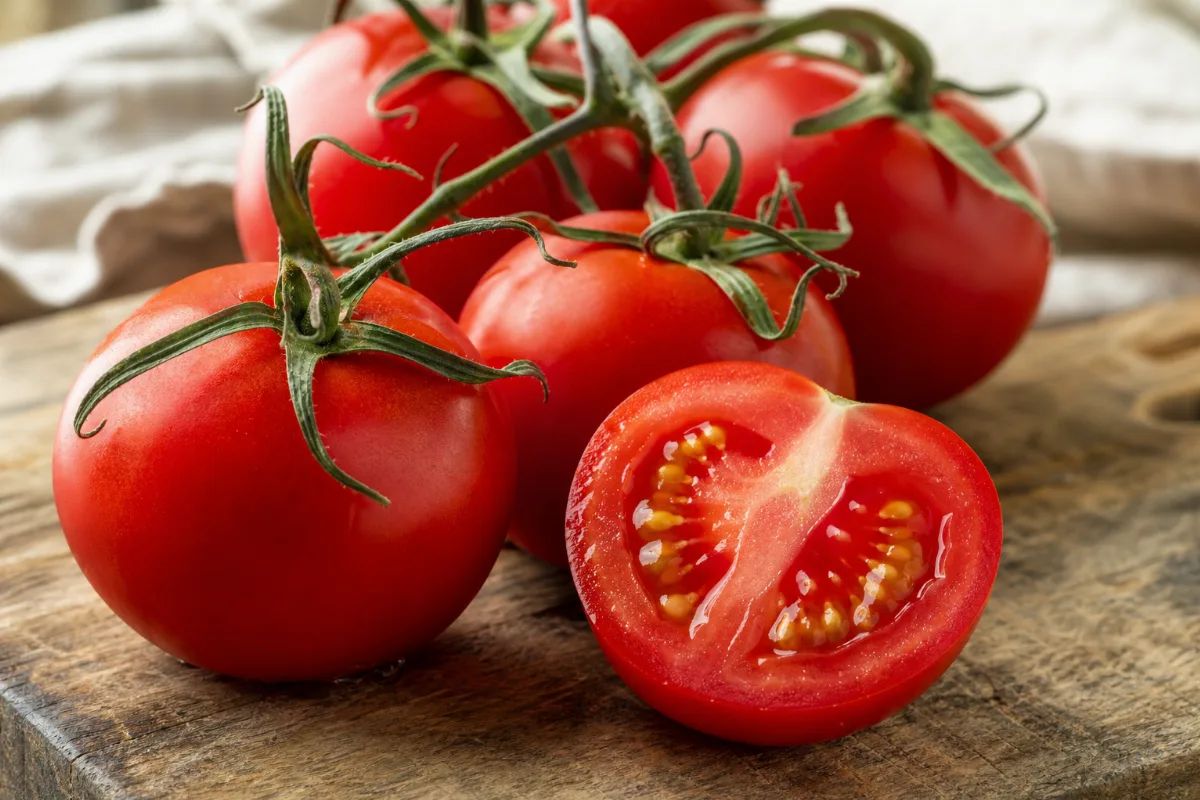
Functional Foods · Vegetable
Tomatoes
Solanum lycopersicum · also called Tomato, tomate (Spanish)
The tomato is the red fruit of a plant in the nightshade family, eaten raw, cooked and as sauce, paste and juice. A cup of chopped tomato has about 32 calories and is rich in the red pigment lycopene. Eating-habit studies link tomatoes with lower blood pressure risk and lower prostate cancer risk in some analyses, but a 12-week trial found no change in heart-risk markers. The main cautions are tomato allergy, the itchy mouth some people with hay fever get from raw tomato, and salt in canned and jarred products.
General information, not medical advice. Last substantive update · Not medically reviewed. A named clinician has not signed off on this page. How this page is made
About Tomatoes
The tomato is a low-calorie, lycopene-rich everyday food. Research on eating tomatoes is mostly observational, trial results are mixed, and the one larger trial of a high-tomato diet found no change in heart-risk markers, so it is best seen as a nutritious food rather than a proven remedy.
What it is
The tomato (Solanum lycopersicum) is the fruit of a plant in the nightshade family, which also includes peppers, eggplants and white potatoes. It is eaten raw, cooked and as sauce, paste and juice. Tomato juice has its own page.
USDA data we hold list raw tomato at 18 calories per 100 g, with 1.2 g of fibre, 13.7 mg of vitamin C, 237 mg of potassium and about 2,573 mcg of lycopene. One cup of chopped tomato (180 g) is about 32 calories.
What the research shows
Large studies that follow people over time link more tomato intake with lower risk of new high blood pressure, but they cannot show cause. Pooled trials found small drops in LDL cholesterol, mixing tomato foods, juices and capsules.
A 12-week trial of 225 healthy adults found no change in blood fats, inflammation or artery stiffness with a high-tomato diet or capsules. For prostate cancer, case-control studies show a link but cohort studies do not. A review of reviews says most evidence is low or very low quality.
Tomatoes versus lycopene capsules and cooking
Tomatoes as food and lycopene capsules are different products. Some pooled results, such as lower systolic pressure, came from capsules, and trial results for one do not transfer to the other.
In one single-serving study, cooked tomato with olive oil changed some inflammation markers more than raw tomato. That was one meal measured six hours later, so it says little about long-term health.
At a glance
Traditional uses history, not proof
- Eaten raw in salads, cooked into sauces, soups and stews, canned, and made into paste and juice
- No source we read documents a traditional medicinal use
Studied for research
- Blood pressure and new high blood pressure, low certainty
- LDL cholesterol and blood-vessel function in pooled trials, low certainty
- Heart-risk markers in a 12-week trial, evidence against a benefit
- Heart-related deaths in a review of reviews, low certainty
- Prostate cancer risk, mixed
- Blood fats and inflammation after one serving of raw or cooked tomato, very low certainty
Main compounds
- Lycopene, the red carotenoid pigment (about 2,573 mcg per 100 g raw)
- Beta-carotene, vitamin C and potassium
- Small amounts of fibre, vitamin K and folate
- Nightshade glycoalkaloids (discussed in a review)
Common forms
- Fresh raw tomato (the form the nutrition figures describe)
- Cooked tomato and tomato sauce
- Canned, paste and soup (can be high in sodium)
- Tomato juice (see its own page)
- Lycopene capsules (not the same as the food)
Research links: NHS: Food allergy · Tomato and lycopene umbrella review (Food Chemistry, 2021) · Tomato and lycopene and cardiovascular risk factors, meta-analysis (Atherosclerosis, 2017) · Tomato consumption and prostate cancer risk, meta-analysis (Scientific Reports, 2016) · FDA: Selecting and serving produce safely · Research Library · Genes & Biomarkers Library
What it is and its history
- Accepted scientific name
- Solanum lycopersicum
- Naming authority
- L. (GBIF accepted, usageKey 2930137)
- Synonyms
- Lycopersicon esculentum (used as an alias in the existing nutrient-graph summary; not checked in GBIF)
- Common names
- Tomato (English); Tomate (Spanish)
- Family or group
- Solanaceae (nightshade family), which also includes peppers, eggplants and white potatoes (named in a review we read).
- Classification
- Plantae > Tracheophyta > Magnoliopsida > Solanales > Solanaceae > Solanum > Solanum lycopersicum
- Native range
- Not verified from a source read.
- Habitat
- Not verified.
- What it looks like
- Roots: Not verified.; Stems: Not verified.; Leaves: Not verified.; Flowers: Not verified.; Fruit: The red fruit is eaten raw, cooked and as sauce, paste and juice (existing site summary; botanical details not re-sourced).
- Cultivation
- Not verified from a source read.
- Harvest and processing
- Eaten fresh, cooked, canned, as paste, sauce and soup, or as juice (existing site summary). Tomato juice has its own page.
- Look-alikes and adulterants
- Name: Other nightshade vegetables (peppers, eggplant, white potato); Note: The same plant family, discussed together in the nightshade review. Evidence for one is not evidence for another.
- Sustainability and conservation
- Not assessed.
Photographs
Traditional use and history history, not clinical proof
| Tradition or era | Documented use | Source |
|---|---|---|
| Everyday food | The tomato is eaten as a vegetable in cooking. No history source was read, so no dates or origins are stated. | NOT verified (no source read) |
Traditional use shows how it was used. It does not show that it works or is safe today.
What is inside, and how it may work
What it contains and how those compounds act in cells and animals. Laboratory and animal mechanisms are not proven effects in people.
Main compounds
| Compound | Family | Where it is concentrated | Activity studied | Level of evidence |
|---|---|---|---|---|
| Lycopene | carotenoid | Fruit 2,573 mcg per 100 g raw (USDA record we hold) | The red pigment; described as a potent fat-soluble antioxidant in a 2021 review. Studied as food and as capsules; the two are not the same. 14 3 | Composition data; antioxidant action is lab based |
| Beta-carotene | carotenoid | Fruit 449 mcg per 100 g raw (USDA record we hold) | A plant pigment the body can turn into vitamin A. Not tested here as a treatment. 14 | Composition data |
| Vitamin C | vitamin | Fruit 13.7 mg per 100 g raw (USDA record we hold) | A nutrient; tomato supplies a modest amount. 14 | Composition data |
| Glycoalkaloids | nightshade defence compounds | Not stated in the abstract | Discussed in a review as able to disrupt the gut lining and activate gut mast cells in lab work; relevance to eating ripe tomatoes is not shown. 2 | Review of limited literature |
Mechanisms, receptors and pathways
| Target or pathway | Gene or receptor | What was found | Level |
|---|---|---|---|
| Antioxidant action of lycopene | A 2021 review describes lycopene as a potent lipophilic antioxidant. This is a lab description; the human trials above did not test it. 3 | Lab | |
| Absorption helped by cooking and oil | The authors of a crossover trial say cooking and oil may increase how well tomato compounds are absorbed. This was stated as background; the trial measured blood markers, not absorption. 7 | Background statement |
Absorption, metabolism and elimination
- Absorption
- Not researched beyond the statement above.
- Distribution
- Not found.
- Metabolism
- Not found.
- Elimination
- Not found.
- Bioavailability
- Not established here.
Isolated compounds versus whole extracts
Pooled trials mixed tomato foods, juices and lycopene capsules, so they do not show what everyday tomatoes do. Lycopene capsules lowered systolic blood pressure in pooled trials, but a trial of a high-tomato diet or capsules found no change in several heart-risk markers. Observational studies measure tomato intake or dietary lycopene, not capsules. Tomato juice is covered on its own page.
Nutritional composition
Per 100 g of raw red ripe tomato (USDA FoodData Central record 170457, as held in our nutrient file): 18 kcal, 1.2 g fibre, 2.63 g sugars, 13.7 mg vitamin C, 237 mg potassium, 7.9 mcg vitamin K, 42 mcg vitamin A (RAE), 15 mcg folate, 0.06 mg copper, 2,573 mcg lycopene, 449 mcg beta-carotene and 5 mg sodium. One cup of chopped tomato (180 g) provides about 32 kcal, 2.2 g fibre, 4.7 g sugars and 25 mg vitamin C. Per-portion figures are calculated from the per-100 g values. Values vary with variety and ripeness. Canned and processed products differ and can contain added salt.
2 mixed findings3 low certainty3 very low certainty1 evidence against
What was looked at
The 9 benefits and uses checked for Tomatoes, each with how strong the evidence is. Tap one to open it.
- Blood pressure and new high blood pressure (tomato intake)Low certainty
- LDL cholesterol and blood-vessel function (pooled trials of tomato products)Low certainty
- Heart-risk markers in healthy adults (12-week trial of a high-tomato diet or lycopene capsules)Evidence against
- Death from heart disease and stroke (tomato intake and lycopene, review of reviews)Low certainty
- Prostate cancer risk (tomato intake)Mixed findings
- Prostate cancer risk (dietary lycopene intake in older Spanish men)Very low certainty
- Blood fats and inflammation markers after one serving (raw tomato, sauce, sauce with olive oil)Very low certainty
- Inflammation markers (IL-6 in pooled trials; none in the 12-week trial)Mixed findings
- Stomach cancer, metabolic syndrome and male fertility (review of reviews)Very low certainty
Lab markers tracked in the studies
LDL cholesterolBlood pressureFlow-mediated dilationInterleukin-6 (IL-6)Triglycerides
What is Tomatoes good for?
The main studied uses and how strong the human evidence is for each. Most results are links seen in eating habits or small changes in lab markers, not proof that tomatoes prevent or treat a disease.
Benefits, one by one
Each card is a research question, not a promise. Tap a goal to filter. Open a card to see the studies, doses and limits.
Blood pressure and new high blood pressure (tomato intake)
Low certaintyIn older Spanish adults at high heart risk, people who ate more tomato products had slightly lower diastolic blood pressure, and those who ate the most were less likely to develop high blood pressure over three years. This is a link seen in eating habits, not proof that tomatoes lower blood pressure.
1 studiesTomato and tomato products as eaten in the usual diet. Intake bands a…
Studies, doses and limits
What the trials found
A 2024 analysis inside the PREDIMED trial followed 7,056 older adults (82.5% with high blood pressure) for 3 years. Tomato intake came from a food-frequency questionnaire.
Results
Diastolic pressure was 0.65 mmHg lower in the middle intake group than in the lowest. Among 1,097 people without high blood pressure at the start, the highest-intake group had a lower risk of developing it.
Effect sizes as reported
Diastolic BP: -0.65 mmHg (95% CI -1.20 to -0.10), intermediate vs lowest. New high blood pressure: HR 0.64 (95% CI 0.51-0.89 as printed), highest vs lowest.
Why this rating
One observational analysis. People who eat more tomatoes may differ in diet and lifestyle. The hazard-ratio result rests on 1,097 people. The authors' wording about a 36% reduction is causal language the design cannot support.
Form and dose studied
Tomato and tomato products as eaten in the usual diet. Intake bands are described, not advised.
Who was studied
Older adults at high cardiovascular risk in Spain.
Limits
Association, not cause. Food questionnaires are imprecise. May not apply to other groups.
Why researchers looked
Tomatoes supply potassium and the red pigment lycopene, and tomato-rich diets such as the Mediterranean diet are linked with heart health.
Proposed mechanism Preliminary mechanism
Lycopene and other plant compounds have been suggested to act as antioxidants. This has not been shown to explain the blood pressure result.
A proposed mechanism does not show that the effect happens in people.
Salted tomato products such as sauces and canned soups can add sodium (see safety).
LDL cholesterol and blood-vessel function (pooled trials of tomato products)
Low certaintyA 2017 pooling of 21 trials found that tomato products lowered LDL ("bad") cholesterol and improved a test of how well blood vessels widen. Lycopene capsules, which are not food, lowered systolic blood pressure. Other measures did not change.
1 studiesMixed: tomato products and lycopene supplements. The result does not …
Studies, doses and limits
What the trials found
A systematic review and meta-analysis of 21 intervention trials in adults, searched to August 2016, pooling tomato products and lycopene supplements.
Results
Lower LDL cholesterol and better flow-mediated dilation with tomato interventions. Systolic blood pressure fell with lycopene supplements. No other outcome changed significantly.
Effect sizes as reported
LDL -0.22 mmol/L (p=0.006); flow-mediated dilation +2.53% (p=0.01); lycopene supplements: systolic BP -5.66 mmHg (p=0.002).
Why this rating
Trials of different tomato foods, juices and capsules were pooled, the abstract gives no quality rating, and the larger 12-week trial below found no change in lipids.
Form and dose studied
Mixed: tomato products and lycopene supplements. The result does not show what everyday tomatoes do, and the supplement result is not a food result.
Who was studied
Adults in 21 trials.
Limits
Markers only. Mixed products. Confidence intervals not given in the abstract.
Why researchers looked
Lycopene and other tomato compounds were thought to protect blood vessels and blood fats.
Proposed mechanism Preliminary mechanism
Antioxidant and anti-inflammatory effects of lycopene are the usual explanation. The pooled analysis did not test them.
A proposed mechanism does not show that the effect happens in people.
None specific.
Heart-risk markers in healthy adults (12-week trial of a high-tomato diet or lycopene capsules)
Evidence againstIn a trial of 225 healthy, moderately overweight middle-aged adults, 12 weeks of a high-tomato diet or lycopene capsules did not change blood fats, inflammation markers, insulin markers or artery stiffness compared with a low-tomato diet.
1 studiesHigh-tomato diet (about 32-50 mg of lycopene a day, as the authors st…
Studies, doses and limits
What the trials found
A single-blind randomised trial in the UK: 225 adults aged 40-65, 4-week low-tomato run-in, then 12 weeks of control diet, high-tomato diet or control diet plus 10 mg lycopene capsules daily.
Results
No significant change in any systemic marker. Lipid levels and arterial stiffness were also unaffected.
Effect sizes as reported
No significant change reported in the abstract.
Why this rating
This is a well-sized randomised trial with a null result for these markers in healthy adults. It does not rule out effects in people with higher risk or over longer periods.
Form and dose studied
High-tomato diet (about 32-50 mg of lycopene a day, as the authors state) or 10 mg lycopene capsules.
Who was studied
Healthy, moderately overweight adults aged 40-65.
Limits
12 weeks; markers only; healthy volunteers.
Why researchers looked
To test the link seen in eating-habit studies with a controlled trial.
Proposed mechanism None
Not applicable: no effect was found.
A proposed mechanism does not show that the effect happens in people.
None reported in the abstract.
Death from heart disease and stroke (tomato intake and lycopene, review of reviews)
Low certaintyA 2021 review of reviews found higher tomato intake linked with lower death from all causes, coronary heart disease and cerebrovascular disease, and higher dietary or blood lycopene linked with lower stroke and cardiovascular disease. Most of this evidence is low quality.
1 studiesTomato intake, dietary lycopene and blood lycopene, pooled.
Studies, doses and limits
What the trials found
An umbrella review of 17 meta-analyses and systematic reviews covering 20 health outcomes in humans.
Results
Inverse links for tomato intake with all-cause, coronary heart disease and cerebrovascular disease mortality; for lycopene with stroke and cardiovascular disease. The authors describe tomato or lycopene intake as generally safe and beneficial but say the quality of evidence was not high.
Effect sizes as reported
No pooled numbers in the abstract. Most findings were low or very low by GRADE; six were moderate.
Why this rating
Rests mostly on observational studies. The abstract does not say which six findings were moderate, so we apply the lower label. Dietary and blood lycopene are not the same as eating tomatoes.
Form and dose studied
Tomato intake, dietary lycopene and blood lycopene, pooled.
Who was studied
Adults in the reviewed studies.
Limits
Review of reviews; inherits their limits. Only the abstract was read.
Why researchers looked
Lycopene-rich tomatoes are a staple of heart-friendly eating patterns.
Proposed mechanism None
Not tested in this review.
A proposed mechanism does not show that the effect happens in people.
The authors advise caution about allergy.
Prostate cancer risk (tomato intake)
Mixed findingsA pooling of 24 studies found that men who ate more tomatoes had somewhat lower prostate cancer risk overall. The link was seen in case-control studies but not in the cohort studies, which follow healthy men forward and are more reliable.
1 studiesTomato intake in the usual diet.
Studies, doses and limits
What the trials found
A 2016 meta-analysis of 24 studies with 15,099 cases.
Results
Lower risk overall. Case-control studies showed a link; cohort studies did not reach significance. The link appeared in Asian and Oceania groups but not other regions. The authors found publication bias.
Effect sizes as reported
All: RR 0.86 (95% CI 0.75-0.98), I2 72.7%. Case-control RR 0.76 (0.61-0.94). Cohort RR 0.96 (0.84-1.10).
Why this rating
Large differences between studies, a null result in the cohort studies and publication bias.
Form and dose studied
Tomato intake in the usual diet.
Who was studied
Men in observational studies.
Limits
Association only. Case-control studies depend on memory of past eating.
Why researchers looked
Lycopene, the red pigment in tomatoes, has been suggested to protect the prostate.
Proposed mechanism Preliminary mechanism
Lycopene is an antioxidant in lab studies. Not shown to explain this result in men.
A proposed mechanism does not show that the effect happens in people.
None specific.
Prostate cancer risk (dietary lycopene intake in older Spanish men)
Very low certaintyIn 2,970 older men at high heart risk, those with the highest lycopene intake from food developed prostate cancer less often over about six years. Only 104 men developed it, so the result is uncertain.
1 studiesLycopene from the diet. Not a supplement and not advice.
Studies, doses and limits
What the trials found
A 2025 cohort analysis inside the PREDIMED trial, with food-frequency questionnaires repeated over time.
Results
Highest vs lowest quarter of lycopene intake: lower prostate cancer risk. A significant link appeared only above about 4.9 mg a day.
Effect sizes as reported
HR 0.46 (95% CI 0.23-0.95; p-trend 0.035); above 4.9 mg/day HR 0.36 (0.13-0.98).
Why this rating
Only 104 cases, wide confidence intervals, one observational cohort, and lycopene intake is not the same as tomato intake.
Form and dose studied
Lycopene from the diet. Not a supplement and not advice.
Who was studied
Men aged 55-80 at high cardiovascular risk, Spain.
Limits
Association only. Few cases. One country.
Why researchers looked
A newer cohort test of the lycopene idea.
Proposed mechanism None
Not tested.
A proposed mechanism does not show that the effect happens in people.
None specific.
Blood fats and inflammation markers after one serving (raw tomato, sauce, sauce with olive oil)
Very low certaintyIn 40 healthy adults, one serving of raw tomato, tomato sauce or tomato sauce with olive oil each lowered total cholesterol, triglycerides and some inflammation markers six hours later, compared with sugar water. Some inflammation markers changed more after sauce with olive oil. This is a short-term marker change only.
1 studiesSingle servings sized by body weight, as the trial design. Not advice.
Studies, doses and limits
What the trials found
A 2016 open randomised crossover trial: each of 40 healthy adults ate each item once on separate days; blood was taken at baseline and 6 hours later.
Results
All tomato forms lowered total cholesterol, triglycerides and several inflammation markers and raised HDL and IL-10 versus the control. IL-6, VCAM-1, LFA-1 and CD36 changed more after sauce with olive oil.
Effect sizes as reported
Direction stated in the abstract; no numbers.
Why this rating
One serving, six hours, 40 healthy people, open design, and a sugar-water control.
Form and dose studied
Single servings sized by body weight, as the trial design. Not advice.
Who was studied
Healthy adults.
Limits
Says little about long-term health or about eating tomatoes every day.
Why researchers looked
Cooking and fat are thought to help the body absorb tomato compounds.
Proposed mechanism Preliminary mechanism
The authors say cooking and oil may increase how well tomato compounds are absorbed. This was background, not tested here.
A proposed mechanism does not show that the effect happens in people.
None reported in the abstract.
Inflammation markers (IL-6 in pooled trials; none in the 12-week trial)
Mixed findingsThe pooled trials found lower IL-6, a blood marker of inflammation, with tomato interventions. The larger 12-week trial found no change in its inflammation markers. The result is mixed.
2 studiesTomato products pooled with other forms.
Studies, doses and limits
What the trials found
A 2017 meta-analysis of 21 trials and a 2012 trial of 225 adults.
Results
IL-6 lower in the pooled analysis; no significant change in inflammatory markers in the 12-week trial.
Effect sizes as reported
IL-6 standardised mean difference -0.25 (p=0.03) in the meta-analysis.
Why this rating
A small pooled effect against a null result in a larger single trial.
Form and dose studied
Tomato products pooled with other forms.
Who was studied
Adults.
Limits
Marker only.
Why researchers looked
Inflammation is part of the heart-risk picture.
Proposed mechanism None
Not tested.
A proposed mechanism does not show that the effect happens in people.
None specific.
Stomach cancer, metabolic syndrome and male fertility (review of reviews)
Very low certaintyThe 2021 review of reviews also reported links between tomato intake and lower stomach cancer, and between lycopene and lower metabolic syndrome and male infertility. The abstract gives no numbers, and most evidence was low or very low quality.
1 studiesTomato intake or lycopene, pooled.
Studies, doses and limits
What the trials found
An umbrella review of 17 meta-analyses and systematic reviews.
Results
Inverse links reported; no figures in the abstract.
Effect sizes as reported
Not given in the abstract.
Why this rating
The abstract says most evidence was low or very low and does not give a rating for each outcome, so the lowest label is used.
Form and dose studied
Tomato intake or lycopene, pooled.
Who was studied
Adults.
Limits
Review of reviews; abstract only.
Why researchers looked
Part of a broad look at tomato and lycopene.
Proposed mechanism None
Not described in the abstract.
A proposed mechanism does not show that the effect happens in people.
None specific.
Connections to the rest of health
How Tomatoes connects to the rest of our health knowledge graph. Every link says what kind of connection it is. A safety link (for example to the liver) is a warning, not a benefit. A study that merely mentions a topic never creates a benefit link.
Explore every connection: goals, body systems, organs, symptoms, genes
A. Wellness goals
| Connected to | Kind of connection | Evidence status | Context | Studies |
|---|---|---|---|---|
| Blood Pressure Support | Potential benefit | Low certainty | Blood pressure and new high blood pressure (tomato intake): In older Spanish adults at high heart risk, people who ate more tomato products had slightly lower diastolic blood pressure, and those who ate the most were less likely to develop high blood pressure over three years. This is a link seen in eating habits, not proof that tomatoes lower blood pressure. LDL cholesterol and blood-vessel function (pooled trials of tomato products): A 2017 pooling of 21 trials found that tomato products lowered LDL ("bad") cholesterol and improved a test of how well blood vessels widen. Lycopene capsules, which are not food, lowered systolic blood pressure. Other measures did not change. | 5 1 |
| Heart Health | Potential benefit | Low certainty | Blood pressure and new high blood pressure (tomato intake): In older Spanish adults at high heart risk, people who ate more tomato products had slightly lower diastolic blood pressure, and those who ate the most were less likely to develop high blood pressure over three years. This is a link seen in eating habits, not proof that tomatoes lower blood pressure. LDL cholesterol and blood-vessel function (pooled trials of tomato products): A 2017 pooling of 21 trials found that tomato products lowered LDL ("bad") cholesterol and improved a test of how well blood vessels widen. Lycopene capsules, which are not food, lowered systolic blood pressure. Other measures did not change. | 5 1 3 7 |
| Cholesterol Balance | Potential benefit | Low certainty | LDL cholesterol and blood-vessel function (pooled trials of tomato products): A 2017 pooling of 21 trials found that tomato products lowered LDL ("bad") cholesterol and improved a test of how well blood vessels widen. Lycopene capsules, which are not food, lowered systolic blood pressure. Other measures did not change. Blood fats and inflammation markers after one serving (raw tomato, sauce, sauce with olive oil): In 40 healthy adults, one serving of raw tomato, tomato sauce or tomato sauce with olive oil each lowered total cholesterol, triglycerides and some inflammation markers six hours later, compared with sugar water. Some inflammation markers changed more after sauce with olive oil. This is a short-term marker change only. | 1 7 |
| Heart Health | Evidence against | Heart-risk markers in healthy adults (12-week trial of a high-tomato diet or lycopene capsules): In a trial of 225 healthy, moderately overweight middle-aged adults, 12 weeks of a high-tomato diet or lycopene capsules did not change blood fats, inflammation markers, insulin markers or artery stiffness compared with a low-tomato diet. | 6 | |
| Cholesterol Balance | Evidence against | Heart-risk markers in healthy adults (12-week trial of a high-tomato diet or lycopene capsules): In a trial of 225 healthy, moderately overweight middle-aged adults, 12 weeks of a high-tomato diet or lycopene capsules did not change blood fats, inflammation markers, insulin markers or artery stiffness compared with a low-tomato diet. | 6 | |
| Mens Vitality | Potential benefit | Mixed findings | Prostate cancer risk (tomato intake): A pooling of 24 studies found that men who ate more tomatoes had somewhat lower prostate cancer risk overall. The link was seen in case-control studies but not in the cohort studies, which follow healthy men forward and are more reliable. Prostate cancer risk (dietary lycopene intake in older Spanish men): In 2,970 older men at high heart risk, those with the highest lycopene intake from food developed prostate cancer less often over about six years. Only 104 men developed it, so the result is uncertain. | 9 4 3 |
| Inflammation Balance | Potential benefit | Mixed findings | Inflammation markers (IL-6 in pooled trials; none in the 12-week trial): The pooled trials found lower IL-6, a blood marker of inflammation, with tomato interventions. The larger 12-week trial found no change in its inflammation markers. The result is mixed. | 1 6 |
| Metabolic Health | Potential benefit | Very low certainty | Stomach cancer, metabolic syndrome and male fertility (review of reviews): The 2021 review of reviews also reported links between tomato intake and lower stomach cancer, and between lycopene and lower metabolic syndrome and male infertility. The abstract gives no numbers, and most evidence was low or very low quality. | 3 |
B. Body systems
| Connected to | Kind of connection | Evidence status | Context | Studies |
|---|---|---|---|---|
| Cardiovascular System | Biological association | Low certainty | Studied for: Blood pressure and new high blood pressure (tomato intake) Studied for: LDL cholesterol and blood-vessel function (pooled trials of tomato products) | 5 1 6 3 7 |
| Reproductive System | Biological association | Mixed findings | Studied for: Prostate cancer risk (tomato intake) Studied for: Prostate cancer risk (dietary lycopene intake in older Spanish men) | 9 4 3 |
| Immune System | Biological association | Mixed findings | Studied for: Inflammation markers (IL-6 in pooled trials; none in the 12-week trial) | 1 6 |
| Digestive System | Biological association | Very low certainty | Studied for: Stomach cancer, metabolic syndrome and male fertility (review of reviews) | 3 |
E. Health conditions
| Connected to | Kind of connection | Evidence status | Context | Studies |
|---|---|---|---|---|
| Food allergy | Adverse effect or risk | Documented risk | Tomato allergy and pollen-related itchy mouth are possible; serious reactions need emergency care. Tomato allergy and pollen-related itchy mouth are possible. Preparation or compound: Raw tomato |
13 8 |
I. Biomarkers
| Connected to | Kind of connection | Evidence status | Context | Studies |
|---|---|---|---|---|
| LDL cholesterol | Biological association | Low certainty | Measured in trials: lowered in pooled trials; unchanged in the larger 12-week trial. A lab change is not the same as a health benefit. | 1 6 |
| Blood pressure | Biological association | Low certainty | Measured in trials: slightly lower in a cohort; lower systolic with lycopene capsules in pooled trials. A lab change is not the same as a health benefit. | 5 1 |
| Flow-mediated dilation | Biological association | Low certainty | Measured in trials: improved. A lab change is not the same as a health benefit. | 1 |
| Interleukin-6 (IL-6) | Biological association | Mixed findings | Measured in trials: lower in pooled trials; mixed overall. A lab change is not the same as a health benefit. | 1 7 |
| Triglycerides | Biological association | Very low certainty | Measured in trials: lowered 6 hours after one serving. A lab change is not the same as a health benefit. | 7 |
L. Active compounds
| Connected to | Kind of connection | Evidence status | Context | Studies |
|---|---|---|---|---|
| Lycopene | Biological association | Composition data; antioxidant action is lab based | The red pigment; described as a potent fat-soluble antioxidant in a 2021 review. Studied as food and as capsules; the two are not the same. Preparation or compound: Fruit |
14 3 |
| Beta-carotene | Biological association | Composition data | A plant pigment the body can turn into vitamin A. Not tested here as a treatment. Preparation or compound: Fruit |
14 |
| Vitamin C | Biological association | Composition data | A nutrient; tomato supplies a modest amount. Preparation or compound: Fruit |
14 |
| Glycoalkaloids | Biological association | Review of limited literature | Discussed in a review as able to disrupt the gut lining and activate gut mast cells in lab work; relevance to eating ripe tomatoes is not shown. | 2 |
Each connection is stored with the ingredient, the connected record, the kind of connection, the evidence status, the supporting studies, the preparation or compound involved, and a review date (last reviewed October 26, 2026).
Evidence at a glance: what the research found for 9 outcomes
Each outcome below is one thing researchers measured. Certainty is how far the evidence can be trusted, not how well it works. The full studies are on the next tab.
The evidence
The research centre for Tomatoes. Every record here was checked against PubMed or the publisher's page; we never list a study we have not verified.
Evidence by outcome
Bars show how many studies we found for each outcome, not how well it works. People are added up across trials only (reviews are not added, to avoid double counting).
How we rate evidence
High certainty
Several well-run trials or reviews agree; further research is unlikely to change the picture much.
Moderate certainty
Good trials point the same way, but some doubt remains.
Low certainty
Small, short or inconsistent trials. The finding could change with better research.
Very low certainty
Very little or very weak human data. Treat as a possibility only.
Mixed findings
Trials or reviews disagree with each other.
Not enough evidence
Not enough human research to say either way.
Evidence against
Good research found no benefit, or found harm.
We take the reviewers' own risk-of-bias and GRADE statements where they exist, and otherwise judge from study size, design, consistency, directness and whether a product matches what is sold. Many publications do not make evidence high. Method note: We started from our existing tomato summary, re-read PubMed abstracts for each study, the NHS and FDA pages, and checked the plant name in GBIF. Nutrition numbers come from a stored copy of the USDA record. Items we could not verify are flagged in the research gaps.
Study library: every study we checked 14
| Study | Design | People | Product, dose, length | Result |
|---|---|---|---|---|
| Cheng 2017 Tomato and lycopene supplementation and cardiovascular risk factors: A systematic review and meta-analysis. Atherosclerosis · PMID 28129549 · DOI |
Systematic review and meta analysis of intervention trials |
21 intervention trials in adults (searched from inception to August 2016) | Tomato products and lycopene supplements, analysed together and separately fruit products and lycopene capsules Varied Varied · vs Control or placebo |
Tomato interventions went with lower LDL cholesterol, lower IL-6 and better flow-mediated dilation (a test of blood-vessel widening). Lycopene supplements lowered systolic blood pressure. No other outcome changed significantly. LDL -0.22 mmol/L (p=0.006); IL-6 standardised mean difference -0.25 (p=0.03); flow-mediated dilation +2.53% (p=0.01); lycopene supplements: systolic BP -5.66 mmHg (p=0.002) Methods, limits and fundingOutcomes: LDL cholesterol, other blood fats, flow-mediated dilation, blood pressure, inflammation markers Limitations: Pools tomato foods, juices and lycopene capsules, so it does not show what eating tomatoes does. Markers, not heart attacks. Trial quality and size not given in the abstract. A larger trial included here found no change (see the 12-week trial). Funding and conflicts: Not stated in the abstract read Read: abstract |
| Kuang 2023 Nightshade Vegetables: A Dietary Trigger for Worsening Inflammatory Bowel Disease and Irritable Bowel Syndrome? Dig Dis Sci · PMID 37202602 · DOI |
Narrative review |
Limited literature on nightshade vegetables (including tomatoes, peppers, eggplants, white potatoes) and gut symptoms | Nightshade vegetables, including tomato fruit |
Nightshade glycoalkaloids have been shown to disrupt intestinal lining and may activate gut mast cells, a possible route to symptoms in IBS and IBD. The authors review the limited existing literature and say nightshades are attracting interest as a possible trigger. The abstract does not show that tomatoes cause or worsen these conditions. Qualitative Methods, limits and fundingOutcomes: Gut inflammation, IBS and IBD symptoms; allergy and cross-reactivity Limitations: A question-framed review of limited evidence; mechanisms mostly from lab work; tomatoes are not singled out in the abstract. Funding and conflicts: Not stated in the abstract read Read: abstract |
| Li 2021 Tomato and lycopene and multiple health outcomes: Umbrella review. Food Chem · PMID 33131949 · DOI |
Umbrella review of meta analyses and systematic reviews |
17 articles covering 20 health outcomes in humans (174 articles searched) | Tomato intake; dietary or blood lycopene fruit; lycopene Varied Varied · vs Lower intake |
Tomato intake was inversely linked with all-cause death, coronary heart disease death, cerebrovascular disease death, prostate cancer and stomach cancer. Dietary or blood lycopene was inversely linked with all-cause death, prostate cancer, stroke, cardiovascular disease, metabolic syndrome and male infertility. The authors advise caution about possible allergy and pollution. Most evidence was rated low or very low by GRADE, and six findings moderate. Qualitative in the abstract; no pooled numbers given there Methods, limits and fundingOutcomes: All-cause and heart-related death, stroke, cancers, metabolic syndrome, male infertility, safety Limitations: A review of reviews: it inherits the limits of the studies below it, which are mostly observational. The abstract does not say which six findings were moderate. Blood lycopene is not the same as eating tomatoes. Funding and conflicts: Not stated in the abstract read Read: abstract |
| Lopez-Solis 2025 Lycopene intake and prostate cancer risk in men at high cardiovascular risk: a prospective cohort study. BMC Med · PMID 41214650 · DOI |
Prospective cohort analysis inside the PREDIMED randomised diet trial |
2970 2,970 Spanish men aged 55-80 at high cardiovascular risk, mean follow-up 5.8 years, 104 prostate cancer cases |
Dietary lycopene intake from repeated food-frequency questionnaires (tomato is a major dietary source but the abstract does not give the split) fruit and other foods 5.8 years (mean) · vs Lowest quartile of lycopene intake |
Men in the highest lycopene-intake quartile had a lower risk of prostate cancer than men in the lowest quartile. A significant link appeared only above about 4.9 mg a day of lycopene intake. Highest vs lowest quartile: HR 0.46 (95% CI 0.23-0.95; p-trend 0.035). Above 4.9 mg/day: HR 0.36 (0.13-0.98). (0.23-0.95) Methods, limits and fundingOutcomes: New prostate cancer Limitations: Only 104 cases, so wide uncertainty. Observational and in one group of Spanish men at high heart risk. It measures lycopene from the diet, not tomatoes alone. The authors' conclusion about prevention is stronger than a cohort can show. Funding and conflicts: Author ties to nut, beer, wine and olive-oil bodies are listed; none to a tomato company. Full funding statement not read. Read: abstract |
| Murcia-Lesmes 2024 Association between tomato consumption and blood pressure in an older population at high cardiovascular risk: observational analysis of PREDIMED trial. Eur J Prev Cardiol · PMID 38001046 · DOI |
Prospective cohort analysis inside a randomised diet trial |
7056 7,056 older adults at high cardiovascular risk (82.5% had high blood pressure), 3-year follow-up |
Usual dietary tomato intake (including tomato products) from a food-frequency questionnaire fruit (tomato and tomato products) 3 years · vs Lowest tomato-intake group |
Diastolic blood pressure was 0.65 mmHg lower in the intermediate-intake group than in the lowest group. Among 1,097 people without high blood pressure at the start, the highest-intake group (over 110 g a day) had a lower risk of developing it than the lowest group. The authors conclude tomato intake is beneficial; that is stronger wording than an observational design allows. Diastolic BP, intermediate vs lowest: beta -0.65 mmHg (95% CI -1.20 to -0.10). New high blood pressure, highest vs lowest: HR 0.64 (95% CI 0.51-0.89, as printed in the abstract). (-1.20 to -0.10 (diastolic BP); 0.51-0.89 (hazard)) Methods, limits and fundingOutcomes: Systolic and diastolic blood pressure; new high blood pressure Limitations: Observational: people who eat more tomatoes may differ in other ways. The hazard-ratio analysis used 1,097 of the 7,056 people. Food-frequency questionnaires are imprecise. Older Spanish adults at high heart risk, so results may not apply to others. Funding and conflicts: Public funding is typical for PREDIMED; the abstract lists author ties to nut, beer, wine and olive-oil bodies (for example the California Walnut Commission) but none to a tomato company. Full funding statement not read. Read: abstract |
| Thies 2012 Effect of a tomato-rich diet on markers of cardiovascular disease risk in moderately overweight, disease-free, middle-aged adults: a randomized controlled trial. Am J Clin Nutr · PMID 22492370 · DOI |
Single blind randomised controlled trial |
225 225 moderately overweight, healthy adults aged 40-65 (94 men, 131 women), UK |
High-tomato diet (equal to 32-50 mg lycopene a day) or lycopene capsules (10 mg a day) tomato-based foods and lycopene capsules High-tomato diet or 10 mg lycopene capsules daily (stated as trial design, not advice) 12 weeks after a 4-week run-in · vs Control diet low in tomato-based foods |
None of the systemic markers changed significantly with the tomato diet or the capsules. Lipid levels and arterial stiffness were unaffected too. No significant change in the markers listed Methods, limits and fundingOutcomes: Inflammation markers, insulin resistance markers, blood fats, arterial stiffness Limitations: Healthy, moderately overweight middle-aged adults only; conventional markers, not heart events. Registered as ISRCTN34203810. Funding not in the abstract. Funding and conflicts: Not stated in the abstract read Read: abstract |
| Valderas-Martinez 2016 Tomato Sauce Enriched with Olive Oil Exerts Greater Effects on Cardiovascular Disease Risk Factors than Raw Tomato and Tomato Sauce: A Randomized Trial. Nutrients · PMID 26999197 · DOI |
Open randomised crossover feeding trial (single serving) |
40 40 healthy adults, each given all four test items on four separate days |
Raw tomato (7.0 g per kg body weight), tomato sauce, tomato sauce with refined olive oil (3.5 g per kg each), or a sugar-water control fruit (raw and cooked) Single serving per day of testing One occasion each; blood taken 6 hours later · vs Sugar solution |
Any form of tomato lowered total cholesterol, triglycerides and several inflammation markers and raised HDL cholesterol and IL-10 compared with the control. Changes in IL-6, VCAM-1, LFA-1 and CD36 were greater after sauce with olive oil than after raw tomato or plain sauce. Direction of differences stated; numbers not given in the abstract Methods, limits and fundingOutcomes: Blood fats and inflammation markers 6 hours after eating Limitations: One serving, measured at 6 hours, so it says little about long-term health. Open (not blinded). Control was sugar water, not another meal. Healthy adults only. Funding and conflicts: Not stated in the abstract read Read: abstract |
| Wlodarczyk 2022 Tomato Allergy: The Characterization of the Selected Allergens and Antioxidants of Tomato (Solanum lycopersicum)-A Review. Antioxidants (Basel) · PMID 35453329 · DOI |
Narrative review |
Literature on tomato allergens and allergic reactions | Tomato (Solanum lycopersicum) fruit |
Tomatoes are described as one of the most prevalent allergenic vegetables. Reactions can affect the gut, skin and lungs and can include anaphylactic shock. Tomato allergy is linked with grass pollen and latex allergy. The authors say the data on tomato allergens are not sufficient. Qualitative Methods, limits and fundingOutcomes: Tomato allergy and allergens Limitations: Narrative review; no frequency figures in the abstract. Funding and conflicts: Authors declare no conflict of interest Read: abstract |
| Xu 2016 Tomato consumption and prostate cancer risk: a systematic review and meta-analysis. Sci Rep · PMID 27841367 · DOI |
Systematic review and meta analysis (case control and cohort studies) |
24 published studies with 15,099 prostate cancer cases | Usual tomato intake fruit Varied · vs Lower intake |
Higher tomato intake went with lower prostate cancer risk overall, but with large differences between studies. Case-control studies showed a link; cohort studies did not reach significance. The link was seen in Asian and Oceania groups but not other regions. The authors found publication bias and call for more prospective studies. All: RR 0.86 (95% CI 0.75-0.98), heterogeneity I2 72.7%. Case-control RR 0.76 (0.61-0.94). Cohort RR 0.96 (0.84-1.10, not significant). Asian RR 0.43 (0.22-0.85); Oceania RR 0.81 (0.67-0.99). (0.75-0.98 (all studies)) Methods, limits and fundingOutcomes: Prostate cancer risk Limitations: Observational. High heterogeneity, significant publication bias, and null cohort results. Case-control studies rely on memory of past eating. Funding and conflicts: Not stated in the abstract read Read: abstract |
| s-fda-produce-safely FDA: Selecting and Serving Produce Safely · Source |
Official guidance page n/a |
Methods, limits and fundingRead: full-text | ||
| s-fda-sodium FDA: Sodium in Your Diet · Source |
Official guidance page n/a |
Methods, limits and fundingRead: full-text | ||
| s-gbif-solanum-lycopersicum GBIF Backbone: Solanum lycopersicum L. (usageKey 2930137) · Source |
Reference database n/a |
Methods, limits and fundingRead: full-text | ||
| s-nhs-food-allergy NHS: Food allergy · Source |
Official guidance page n/a |
Methods, limits and fundingRead: full-text | ||
| s-usda-fdc-170457 USDA FoodData Central: Tomatoes, red, ripe, raw, year round average (FDC 170457, SR Legacy) · Source |
Food composition database n/a |
Methods, limits and fundingRead: stored copy |
What we do not know yet
- No randomised trial has tested everyday tomatoes (not juice, extracts or capsules) for heart attacks, stroke or prostate cancer.
- The one larger trial of a high-tomato diet found no change in heart-risk markers in healthy adults.
- Pooled trials mix tomato foods with lycopene capsules.
- Pregnancy, breastfeeding, children's choking risk, acid reflux, kidney stones, potassium and medicine interactions were not researched.
- The USDA nutrition figures come from our stored copy and were not re-opened today; only abstracts were read for studies.
How new research is added
New studies are found by a saved PubMed search and placed in a review queue before the page changes.
Lab markers
What changed in blood or saliva tests during trials. A changed number is not the same as feeling or being healthier, and we give no "normal ranges".
Metabolic 2
LDL cholesterol
Lowered in pooled trials; unchanged in the larger 12-week trial in trials
The so-called bad cholesterol carried in the blood.
Low certaintyResults and what it means
Why it was measured
A common heart-risk marker.
Statistical vs. clinical meaning
A small change; mixed between studies. No one knows if it changes heart outcomes.
Safety implication
None specific.
Triglycerides
Lowered 6 hours after one serving in trials
A type of fat carried in the blood.
Very low certaintyResults and what it means
Why it was measured
High levels are a heart-risk marker.
Statistical vs. clinical meaning
A short-term change after one serving.
Safety implication
None specific.
| Study | Result | People | Product |
|---|---|---|---|
| 7 | Lower than the sugar-water control after any tomato form (numbers not in the abstract) | 40 healthy adults | One serving of raw tomato, sauce or sauce with olive oil |
Inflammatory 1
Interleukin-6 (IL-6)
Lower in pooled trials; mixed overall in trials
A signalling protein in the blood that rises with inflammation.
Mixed findingsResults and what it means
Why it was measured
A marker of inflammation linked with heart risk.
Statistical vs. clinical meaning
A marker only; the 12-week trial found no inflammation change.
Safety implication
None specific.
| Study | Result | People | Product |
|---|---|---|---|
| 1 | Standardised mean difference -0.25 (p=0.03) | Adults in pooled trials | Tomato interventions |
| 7 | IL-6 changed more after sauce with olive oil than after raw tomato or plain sauce (direction and size not in the abstract) | 40 healthy adults, one serving | Raw tomato, tomato sauce, sauce with olive oil |
Other 2
Blood pressure
Slightly lower in a cohort; lower systolic with lycopene capsules in pooled trials in trials
The force of blood against artery walls; systolic is the top number, diastolic the bottom.
Low certaintyResults and what it means
Why it was measured
High blood pressure is a major risk factor for heart disease and stroke.
Statistical vs. clinical meaning
Small changes. The capsule result is not a food result.
Safety implication
None specific.
| Study | Result | People | Product |
|---|---|---|---|
| 5 | Diastolic -0.65 mmHg (95% CI -1.20 to -0.10), middle vs lowest intake; lower risk of new high blood pressure in the highest group | 7,056 older adults at high heart risk | Usual tomato intake (observational) |
| 1 | Systolic -5.66 mmHg with lycopene supplements (p=0.002); tomato foods alone were not reported to change blood pressure | Adults in pooled trials | Lycopene supplements |
Flow-mediated dilation
Improved in trials
An ultrasound test of how well an artery widens when blood flow increases; a sign of blood-vessel health.
Low certaintySafety
What studies and official sources say about side effects, medicines and who should check first. Each point shows what kind of evidence it comes from.
Main points to know 4
- Tomato allergy is possible and can be serious. A 2022 review calls tomatoes one of the most prevalent allergenic vegetables. Reactions can involve the gut, skin and lungs, and can include anaphylactic shock. Tomato allergy has been linked with grass pollen allergy and latex allergy. The review notes that the data on tomato allergens are not sufficient, and no frequency figure is given. Review 8
- Raw tomato can cause an itchy mouth in people with pollen allergy. The NHS says some people get an itchy mouth and throat after eating raw fruit, vegetables or nuts, called oral allergy syndrome (pollen food syndrome). It is not usually serious, and eating fruit and vegetables that have been well cooked helps. Authoritative guidance 13
- Some people link nightshade vegetables with gut symptoms. Tomatoes belong to the nightshade family. A 2023 review of limited literature says nightshade compounds called glycoalkaloids can disrupt the gut lining in lab work and may activate gut mast cells, and that nightshades are attracting interest as a possible trigger for gut symptoms in irritable bowel syndrome and inflammatory bowel disease. This is a question, not an established finding, and the abstract does not single out tomatoes. Review 2
- Sauces, soups and canned tomato products can be high in sodium. The FDA says the Daily Value for sodium is less than 2,300 mg a day and advises limiting packaged sauces and mixes. Raw tomato is low in sodium (5 mg per 100 g in the USDA record we hold), so the concern is with processed products. Check the label. Authoritative guidance 11 14
Side effects 3
| Effect | How often | Severity and recovery | Evidence |
|---|---|---|---|
| Allergic reaction (itchy mouth and throat, hives, swelling, breathing trouble, anaphylaxis) Frequency not found in the sources read. | Not established | mild to severe Mild mouth symptoms usually settle; a serious reaction is an emergency. | Authoritative guidance 13 8 |
| Gut symptoms in people who feel nightshades trigger them Hypothesis from a review of limited literature, not shown for tomatoes. | Not established | unknown Not studied. | Review 2 |
| High sodium intake from processed tomato products A label check, not a problem of the raw fruit. | Not established | depends on the product Not applicable. | Authoritative guidance 11 |
Liver
No liver injury linked to eating tomatoes was found in the sources read. LiverTox was not checked.
How often. No frequency found.
This is a safety connection. It is not evidence that Tomatoes supports liver health.
Medicines and supplements 2
| With | Why it matters | Importance | Evidence | What to do |
|---|---|---|---|---|
| Prescription and over-the-counter medicines prescription | No source read describes a medicine interaction with eating tomatoes. The USDA record we hold lists 7.9 micrograms of vitamin K and 237 mg of potassium per 100 g of raw tomato; we did not find a source that links these amounts to an interaction, so we make no claim either way. | None found Not enough evidence 14 | A pharmacist can check your own medicines, including blood thinners and blood-pressure medicines. | |
| Lycopene capsules and tomato extracts supplement | Not researched. | Supplements were not checked for interactions. They are not the same as the food. | None found Not enough evidence | Ask a doctor or pharmacist before using concentrated products. |
Who should check first 3
| Situation | Advice | Evidence |
|---|---|---|
| Known tomato allergy with swelling or trouble breathing | Avoid tomato and get an allergy assessment. Follow your own emergency plan, including any prescribed adrenaline. | Authoritative guidance 13 8 |
| Itchy mouth after raw tomato in someone with hay fever | The NHS says this is not usually serious and that well-cooked fruit and vegetables help. See a doctor if unsure. | Authoritative guidance 13 |
| Pregnancy, breastfeeding, babies and young children | No source read gave a warning for tomatoes as an ordinary food, and no source was read that checks this directly. Ordinary food safety applies. Ask a clinician about your own situation. | None found |
Overdose, product quality and regulators
Summary. The ripe tomato fruit is an ordinary food. The sources read mention only allergy and the nightshade glycoalkaloid question.
Animal. Not reviewed.
Human doses studied. Trials used tomato foods or products for up to 12 weeks, and a trial of a high-tomato diet reported no safety findings in the abstract read.
Overdose response. Not found.
Genotoxicity. Not reviewed.
Toxic or hazardous parts. Nightshade glycoalkaloids are discussed in a review of the nightshade family. Leaves, stems and unripe green fruit were not checked in the sources read.
Like any raw produce, tomatoes can carry bacteria from soil or handling. The 2021 review of reviews advised caution about possible pollution without giving details.
Bacteria on produce. FDA says to wash produce under running water. Soap, detergent or commercial produce wash is not recommended. Washing reduces bacteria but does not eliminate them. Cooking produce thoroughly kills harmful bacteria. 10
Pollution (unspecified). The 2021 umbrella review says caution was warranted for potential allergy and pollution but the abstract does not say what kind of pollution or how much. 3
Sodium in processed products. Canned and jarred tomato products, soups and sauces can be high in sodium, so check the label. 11
| Body | Action | Date |
|---|---|---|
| FDA (US Food and Drug Administration) (United States) | Consumer advice on washing and serving fresh produce source | 2026-10-26 (page read) |
| FDA (United States) | Daily Value for sodium: less than 2,300 mg a day; limit packaged sauces source | 2026-10-26 (page read) |
| NHS (UK) (United Kingdom) | Describes oral allergy syndrome and lists signs of a serious allergic reaction source | 2026-10-26 (page read) |
When to get medical help
- Swelling of the lips, mouth, tongue or throat after eating tomato
- Trouble breathing, noisy breathing, wheezing or a tight throat
- Feeling dizzy, confused or faint, or skin turning pale, blue or grey
- A child who goes limp or floppy or stops responding normally
- Call emergency services (911 in the US, 999 in the UK) and use any prescribed adrenaline right away
Stop using the product and contact a clinician or emergency service. In the US, Poison Control is 1-800-222-1222.
General information only, not medical advice. Ask a clinician or pharmacist before use, especially with medicines, in pregnancy or with a health condition. See the Natural Remedy Safety guide.
Frequently asked questions
What are tomatoes good for?
Do tomatoes lower blood pressure?
Do tomatoes lower cholesterol?
Does lycopene or tomato prevent prostate cancer?
Are cooked tomatoes better than raw?
One single-serving study of 40 healthy adults found some inflammation markers changed more after sauce with olive oil than after raw tomato. It measured one meal at six hours, so it does not show a long-term benefit.
Are lycopene supplements the same as tomatoes?
How many calories and how much lycopene are in a tomato?
In the USDA data we hold, raw tomato has 18 calories and about 2,573 mcg of lycopene per 100 g. One cup of chopped tomato (180 g) is about 32 calories.
Why does raw tomato make my mouth itch?
When is a tomato reaction an emergency?
Are tomatoes bad for people with IBS or IBD because they are nightshades?
That is an open question. A 2023 review says nightshade compounds may disrupt the gut lining and activate gut mast cells and that nightshades are attracting interest as a trigger, but the literature is limited and the abstract does not single out tomatoes.
Are canned tomato products okay?
Do tomatoes interact with medicines?
We did not find a source describing a medicine interaction with eating tomatoes. A pharmacist can check your own medicines.
Explore by health goal
Heart HealthCholesterol BalanceMens VitalityBlood Pressure SupportInflammation BalanceMetabolic Health
Editorial transparency
- Written by
- AlternativeMed editorial team. Research compiled with AI assistance, then checked against the sources listed.
- Medical review
- None. This page has not been reviewed by a physician or pharmacist.
- First published
- 2026-10-26
- Last substantive update
- 2026-10-26
- How we research
- We started from our existing tomato summary, re-read PubMed abstracts for each study, the NHS and FDA pages, and checked the plant name in GBIF. Nutrition numbers come from a stored copy of the USDA record. Items we could not verify are flagged in the research gaps.
- How we rate evidence
- See "How we rate evidence" in the Evidence tab.
- Independence
- No product is promoted on this page. No affiliate links are shown.
Sources 14
Each source was opened and checked. Where we read only the abstract, it says so. The small numbers in the text point here.
- Cheng HM, Koutsidis G, Lodge JK, et al.. Tomato and lycopene supplementation and cardiovascular risk factors: A systematic review and meta-analysis.. Atherosclerosis. 2017. PMID 28129549. DOI 10.1016/j.atherosclerosis.2017.01.009. (abstract)
- Kuang R, Levinthal DJ, Ghaffari AA, et al.. Nightshade Vegetables: A Dietary Trigger for Worsening Inflammatory Bowel Disease and Irritable Bowel Syndrome?. Dig Dis Sci. 2023. PMID 37202602. DOI 10.1007/s10620-023-07955-9. (abstract)
- Li N, Wu X, Zhuang W, et al.. Tomato and lycopene and multiple health outcomes: Umbrella review.. Food Chem. 2021. PMID 33131949. DOI 10.1016/j.foodchem.2020.128396. (abstract)
- Lopez-Solis R, Castro-Barquero S, Donat-Vargas C, et al.. Lycopene intake and prostate cancer risk in men at high cardiovascular risk: a prospective cohort study.. BMC Med. 2025. PMID 41214650. DOI 10.1186/s12916-025-04440-0. (abstract)
- Murcia-Lesmes D, Dominguez-Lopez I, Laveriano-Santos EP, et al.. Association between tomato consumption and blood pressure in an older population at high cardiovascular risk: observational analysis of PREDIMED trial.. Eur J Prev Cardiol. 2024. PMID 38001046. DOI 10.1093/eurjpc/zwad363. (abstract)
- Thies F, Masson LF, Rudd A, et al.. Effect of a tomato-rich diet on markers of cardiovascular disease risk in moderately overweight, disease-free, middle-aged adults: a randomized controlled trial.. Am J Clin Nutr. 2012. PMID 22492370. DOI 10.3945/ajcn.111.026286. (abstract)
- Valderas-Martinez P, Chiva-Blanch G, Casas R, et al.. Tomato Sauce Enriched with Olive Oil Exerts Greater Effects on Cardiovascular Disease Risk Factors than Raw Tomato and Tomato Sauce: A Randomized Trial.. Nutrients. 2016. PMID 26999197. DOI 10.3390/nu8030170. (abstract)
- Wlodarczyk K, Smolinska B, Majak I. Tomato Allergy: The Characterization of the Selected Allergens and Antioxidants of Tomato (Solanum lycopersicum)-A Review.. Antioxidants (Basel). 2022. PMID 35453329. DOI 10.3390/antiox11040644. (abstract)
- Xu X, Li J, Wang X, et al.. Tomato consumption and prostate cancer risk: a systematic review and meta-analysis.. Sci Rep. 2016. PMID 27841367. DOI 10.1038/srep37091. (abstract)
- . FDA: Selecting and Serving Produce Safely. . . (full-text)
- . FDA: Sodium in Your Diet. . . (full-text)
- . GBIF Backbone: Solanum lycopersicum L. (usageKey 2930137). . . (full-text)
- . NHS: Food allergy. . . (full-text)
- . USDA FoodData Central: Tomatoes, red, ripe, raw, year round average (FDC 170457, SR Legacy). . . (stored copy)


