Vegetables · Vegetable
Chili Peppers
Capsicum annuum, Capsicum frutescens · also called Chilli peppers, hot peppers, chiles (Spanish)
Chili peppers are the hot pods of Capsicum plants, eaten fresh, dried, cooked or as sauce. Red chili is rich in vitamin C. Large studies link regular chili eating with fewer deaths, but these only show a link, not a cause. The main cautions are heartburn and stomach burning in sensitive people, allergy, and very hot challenge peppers.
General information, not medical advice. Last substantive update · Not medically reviewed. A named clinician has not signed off on this page. How this page is made
About Chili Peppers
Chili peppers are a vitamin C-rich food that adds heat and flavour. They are a food, not a proven remedy: the health claims rest mainly on observational studies of people who eat chili, on capsaicin products, and on a skin medicine.
What it is
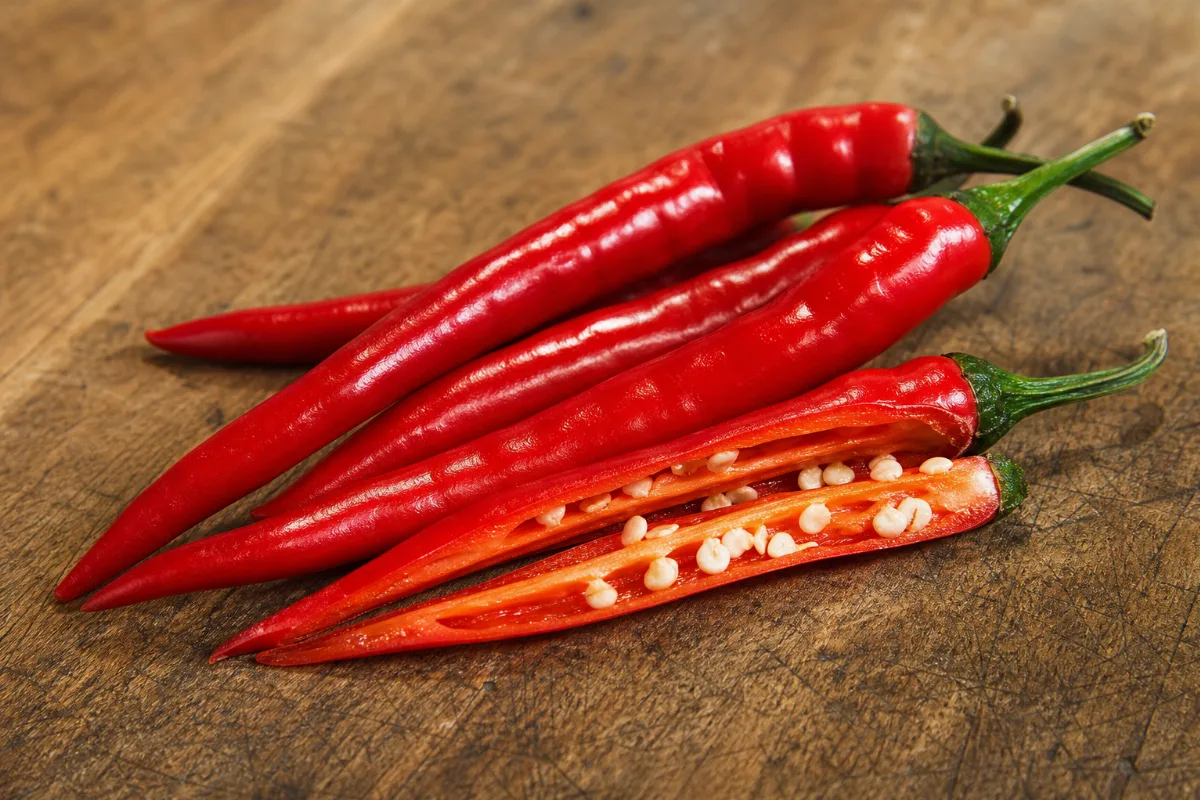
Chili peppers are the pods of Capsicum annuum and Capsicum frutescens, plants in the nightshade family. They are eaten fresh, dried, cooked or as sauce. The heat comes from capsaicin.
USDA data for raw red chili: 40 kcal per 100 g. One pepper (45 g) has about 18 kcal, 0.7 g fibre, 65 mg vitamin C, 0.23 mg vitamin B6, 145 mg potassium, 10 micrograms folate and 6 micrograms vitamin K. Most people eat chili in much smaller amounts than a whole pepper, so a spicy dish adds little. Cooked and dried values were not read.
What the research shows
The firmest fact is about a nutrient: red chili is a rich source of vitamin C. This is not a chili trial.
Large observational studies link regular chili or spicy-food eating with lower death from any cause and from heart disease. People who eat chili may differ in other ways, so this is not proof of cause, and an umbrella review calls the overall effect unclear.
The cholesterol trials used capsaicin or pepper-based products in overweight or obese adults, not chili food. Case-control studies give a mixed digestive cancer signal.
Food versus capsules and skin medicines
The cholesterol trials used capsaicin, capsinoid or pepper-based products, and the reflux trial used chili powder in capsules. Capsaicin creams, gels and patches are medicines for the skin: MedlinePlus says to keep them away from eyes, nose and mouth and from broken skin. Their results do not carry over to eating chili, and the death studies do not carry over to capsules or creams.
Amounts
This page gives no amounts to eat. Ask a doctor, pharmacist or dietitian what is right for you, especially if chili upsets your stomach or you are thinking of capsaicin supplements.
At a glance
Traditional uses history, not proof
- Eaten fresh, dried, cooked or as sauce for heat and flavour
- Long use as food is not proof that it treats any condition
Studied for research
- Vitamin C from red chili, high certainty for the nutrient, no chili trial
- Death from any cause in regular chili eaters, low certainty, observational
- Heart disease death in regular chili eaters, low certainty, observational
- Cholesterol and triglycerides (capsaicin products, not food), low certainty
- Reflux and indigestion, mixed evidence
- Digestive-tract cancer risk, mixed evidence, observational
- Capsaicin skin patches for nerve pain, low certainty (a medicine, not food)
Main compounds
- Capsaicin
- Vitamin C
- Beta-carotene
- Lutein and zeaxanthin
- Vitamin B6
- Potassium
Common forms
- Fresh and cooked chili pods as food
- Dried chili and chili flakes
- Chili powder and sauces (the pooled death study counts these as spicy food)
- Capsaicin capsules (a different product, used in some trials)
- Capsaicin cream, gel and patch (medicines for the skin)
Research links: Meta-analysis: spicy chilli food and mortality · Umbrella review: spicy food and chili peppers · MedlinePlus: Capsaicin Topical · Research Library · Genes & Biomarkers Library
What it is and its history
- Accepted scientific name
- Capsicum annuum
- Naming authority
- L. (GBIF accepted); Capsicum frutescens L. is also accepted
- Common names
- Chili peppers (English); Chilli peppers (English (British spelling)); Hot peppers (English); Chiles, ajies, pimientos picantes (Spanish)
- Family or group
- Solanaceae (the nightshade family), as given by GBIF and by the existing nutrient summary.
- Classification
- Plantae > Tracheophyta > Magnoliopsida > Solanales > Solanaceae > Capsicum > Capsicum annuum; Capsicum frutescens
- Native range
- Not verified from a source read.
- Habitat
- Not verified from a source read.
- What it looks like
- Roots: Not verified.; Stems: Not verified.; Leaves: Not verified.; Flowers: Not verified.; Fruit: The pod is the food. USDA gives household portions of one pepper (45 g) and half a cup chopped (75 g).
- Cultivation
- Not verified from a source read.
- Harvest and processing
- Eaten fresh, dried, cooked or as sauces and pastes; ground into powders (existing nutrient summary). Capsaicin supplements and skin products are separate products.
- Look-alikes and adulterants
- Name: Bell peppers; Note: Also Capsicum annuum but without strong heat; they have their own page. The lab allergy study used a bell pepper protein.; Name: Black pepper; Note: A different plant (Piper nigrum) used as a spice. Some allergy reviews say 'pepper' without saying which.; Name: Cayenne and other chili powders; Note: Ground chili products with their own pages.
- Sustainability and conservation
- Not assessed.
Photographs
What is inside, and how it may work
What it contains and how those compounds act in cells and animals. Laboratory and animal mechanisms are not proven effects in people.
Main compounds
| Compound | Family | Where it is concentrated | Activity studied | Level of evidence |
|---|---|---|---|---|
| Capsaicin PubChem 1548943 | capsaicinoid | Pod Not given in the sources read | The compound that gives chili its heat; triggers burning through the TRPV1 receptor (Gonlachanvit 2010). Used on the skin in pain medicines (MedlinePlus). 7 17 20 | Human data |
| Vitamin C (ascorbic acid) PubChem 54670067 | vitamin | Pod USDA: 144 mg per 100 g raw red chili | Helps protect cells and maintains skin, blood vessels, bones and cartilage (NHS). 18 21 19 | Human data |
| Beta-carotene | carotenoid | Pod USDA: 534 micrograms per 100 g raw red chili | Listed as a nutrient in the USDA file; no effect in chili was read. 21 | Composition |
| Lutein plus zeaxanthin | carotenoid | Pod USDA: 709 micrograms per 100 g raw red chili | Listed as a nutrient in the USDA file; no effect in chili was read. 21 | Composition |
| Vitamin B6 | vitamin | Pod USDA: 0.506 mg per 100 g raw red chili | Listed as a nutrient in the USDA file. 21 | Composition |
| Potassium | mineral | Pod USDA: 322 mg per 100 g raw red chili | Listed as a nutrient in the USDA file. 21 | Composition |
Mechanisms, receptors and pathways
| Target or pathway | Gene or receptor | What was found | Level |
|---|---|---|---|
| TRPV1 receptor in the gut | TRPV1 (transient receptor potential vanilloid-1) | Capsaicin can cause a painful burning sensation in the human gut through TRPV1. TRPV1-expressing fibres are reported to be increased in people with functional gut disorders. 7 10 | Human data |
| Pain nerves in the skin (topical capsaicin) | Not specified | Capsaicin on the skin first increases sensitivity, then reduces it, and with repeated use causes lasting desensitisation of pain nerve fibres. 6 17 | Human data |
Absorption, metabolism and elimination
- Absorption
- Not found.
- Distribution
- Not found.
- Metabolism
- Not found.
- Elimination
- Not found.
- Bioavailability
- Not established for chili nutrients in the sources read.
Isolated compounds versus whole extracts
The cholesterol trials tested capsaicin, capsinoid or pepper-based products, the reflux trial used chili powder in capsules, and the nerve pain trials used a prescription patch. None of these is the same as eating chili peppers in a meal. Observational studies of chili eaters cannot be applied to capsules or skin products either.
Nutritional composition
Nutrition from USDA FoodData Central (Peppers, hot chili, red, raw, FDC 170106, SR Legacy, last updated 4/1/2019, read 2026-10-26). Per 100 g: 40 kcal, 1.87 g protein, 0.44 g fat, 8.81 g carbohydrate, 5.3 g total sugars, 1.5 g fibre, 88 g water, 14 mg calcium, 1.03 mg iron, 23 mg magnesium, 322 mg potassium, 9 mg sodium, 144 mg vitamin C, 0.506 mg vitamin B6, 23 micrograms folate (DFE), 48 micrograms vitamin A (RAE), 14 micrograms vitamin K, 0.69 mg vitamin E, 0.129 mg copper, 534 micrograms beta-carotene and 709 micrograms lutein plus zeaxanthin. One pepper (45 g): about 18 kcal, 0.7 g fibre, 65 mg vitamin C, 0.23 mg vitamin B6, 145 mg potassium, 10 micrograms folate, 6 micrograms vitamin K, 22 micrograms vitamin A (RAE), 0.46 mg iron. Half a cup chopped (75 g): about 30 kcal and 108 mg vitamin C. Most people eat chili in much smaller amounts than a whole pepper, so a spicy dish usually adds little. Figures vary with variety, ripeness and storage. USDA's file did not list capsaicin, so the heat of a pepper is not given here, and cooked and dried values were not read.
1 high certainty2 mixed findings4 low certainty
What was looked at
The 7 benefits and uses checked for Chili Peppers, each with how strong the evidence is. Tap one to open it.
- Vitamin C from red chiliHigh certainty
- Living longer (all-cause death) in regular chili eatersLow certainty
- Heart disease death in regular chili eatersLow certainty
- Cholesterol and triglycerides (capsaicin products, not chili food)Low certainty
- Reflux, indigestion and stomach burningMixed findings
- Digestive-tract cancer risk (a possible harm, observational)Mixed findings
- Capsaicin on the skin for nerve pain (a medicine, not food)Low certainty
Lab markers tracked in the studies
Death from any causeDeath from heart and blood-vessel diseaseTotal cholesterolTriglyceridesLDL and HDL cholesterolStomach filling volume after a meal (gastric accommodation)
What is Chili Peppers good for?
The main studied uses and how strong the human evidence is for each. Most results are from observational studies of chili eaters, from capsaicin products, or from a skin medicine, not from trials of eating chili.
Benefits, one by one
Each card is a research question, not a promise. Tap a goal to filter. Open a card to see the studies, doses and limits.
Vitamin C from red chili
High certaintyVitamin C helps keep skin, blood vessels, bones and cartilage healthy, and a lack of it causes scurvy. The NHS lists peppers among good sources. USDA lists about 144 mg of vitamin C in 100 g of raw red chili, about 65 mg in one 45 g pepper. This is a nutrient fact, not a chili trial.
2 studiesRaw red chili pods as food. Values vary with variety, ripeness and st…
Studies, doses and limits
What the trials found
The NHS says vitamin C is found in a wide variety of fruit and vegetables, names peppers among good sources, says adults aged 19 to 64 need 40 mg a day and that this should come from a varied diet. USDA lists 144 mg of vitamin C per 100 g of raw red chili.
Results
Red chili is a rich vitamin C food on a per-weight basis. No trial of chili for vitamin C status was read. Most people eat chili in small amounts, so the real contribution of a spicy dish may be small.
Effect sizes as reported
USDA: 144 mg vitamin C per 100 g raw red chili; about 65 mg per pepper (45 g). NHS: adults 19 to 64 need 40 mg a day.
Why this rating
High for the nutrient role and for red chili being a rich source (NHS and USDA data). There is no chili-specific trial, and a varied diet normally supplies enough vitamin C.
Form and dose studied
Raw red chili pods as food. Values vary with variety, ripeness and storage; cooked values were not read.
Who was studied
Anyone eating a varied diet.
Limits
Nutrient fact, not a trial of chili. Green or dried chili, sauces and powders were not checked.
Why researchers looked
Red chili is often named as a vitamin C food, so people ask how much it adds.
Traditional use
Chili peppers are eaten fresh, dried, cooked or as sauce for heat and flavour. Long use as food is not proof that they treat any condition.
Proposed mechanism Authoritative guidance
Vitamin C helps protect cells, maintain skin, blood vessels, bones and cartilage, and helps wound healing (NHS).
A proposed mechanism does not show that the effect happens in people.
None specific for vitamin C from food.
Living longer (all-cause death) in regular chili eaters
Low certaintyIn large studies that followed people for years, those who ate chili regularly were less likely to die during the study than those who ate it rarely or never. This is a link, not proof. People who eat chili may differ in diet, income, region and habits.
4 studiesChili pepper or spicy food as eaten; categories of how often, not amo…
Studies, doses and limits
What the trials found
US NHANES III (16,179 adults, median 18.9 years): eating hot red chili pepper was linked to a 13% lower hazard of death (HR 0.87, 95% CI 0.77-0.97). Italian Moli-sani study (22,811 adults, median 8.2 years): chili more than 4 times a week versus none or rare, HR 0.77 (0.66-0.90). A meta-analysis of 4 cohorts (564,748 adults) found 12% lower all-cause death for regular spicy-food eaters (0.88, 0.86-0.90).
Results
Three observational sources point the same way: regular chili or spicy-food eaters died less often during follow-up. An umbrella review of 11 reviews still calls the overall health effect of spicy food and chili unclear.
Effect sizes as reported
NHANES HR 0.87 (0.77-0.97); Moli-sani HR 0.77 (0.66-0.90); meta-analysis 0.88 (0.86-0.90).
Why this rating
Low because all the evidence is observational. People who eat chili differ in other ways, intake was self-reported, and the pooled analysis covers spicy food in general (chili, sauce or oil), not only fresh pods. The effect is consistent across studies (I2 0% in the meta-analysis).
Form and dose studied
Chili pepper or spicy food as eaten; categories of how often, not amounts.
Who was studied
Adults in the United States, Italy, China and Iran.
Limits
Cannot show that chili caused the difference. Studies counted frequency, not amount, and the 'none' group may differ in many ways.
Why researchers looked
Chili is eaten daily in many parts of the world, so researchers ask whether regular eaters live longer.
Traditional use
Chili peppers are eaten fresh, dried, cooked or as sauce for heat and flavour. Long use as food is not proof that they treat any condition.
Proposed mechanism Unknown
Not established. The Italian study found that known heart-risk blood markers explained only a small part of the link. Capsaicin is the heat compound, but these studies did not test it.
A proposed mechanism does not show that the effect happens in people.
Not a reason to eat chili if it upsets your stomach; see the Safety tab.
Heart disease death in regular chili eaters
Low certaintyThe same large studies found fewer heart-related deaths in regular chili eaters. The link was less clear for stroke-type deaths. Again this is an association only.
3 studiesChili or spicy food as eaten.
Studies, doses and limits
What the trials found
Meta-analysis of 4 cohorts: regular spicy-food eaters had lower death from cardiac disease (HR 0.82, 95% CI 0.73-0.91) but not significantly lower death from cerebrovascular disorders (0.79, 0.53-1.17; I2 72%). Moli-sani: cardiovascular death HR 0.66 (0.50-0.86), ischemic heart disease death 0.56 (0.35-0.87), cerebrovascular death 0.39 (0.20-0.75). NHANES III: similar but not statistically significant trends for vascular death.
Results
Results for heart death are fairly consistent, but the stroke-type result differs between the pooled analysis and the Italian study, and the NHANES trend was not significant.
Effect sizes as reported
Cardiac death HR 0.82 (0.73-0.91) pooled; CVD death HR 0.66 (0.50-0.86) Moli-sani.
Why this rating
Low: observational, with inconsistent stroke results and only four cohorts in the pooled analysis. No trial tested eating chili for heart disease.
Form and dose studied
Chili or spicy food as eaten.
Who was studied
Adults in observational cohorts.
Limits
Cannot show cause. Cause of death was taken from records; diet from questionnaires.
Why researchers looked
Heart disease is a leading cause of death, so studies split deaths by cause.
Traditional use
Chili peppers are eaten fresh, dried, cooked or as sauce for heat and flavour. Long use as food is not proof that they treat any condition.
Proposed mechanism Authors interpretation
Not established. The authors of the Italian study report that known biomarkers of heart risk only marginally explained the link.
A proposed mechanism does not show that the effect happens in people.
None specific beyond the Safety tab.
Cholesterol and triglycerides (capsaicin products, not chili food)
Low certaintyA 2025 review of 12 randomised trials in overweight or obese adults found that capsaicin, capsinoid or pepper-based products lowered total cholesterol and triglycerides a little. LDL and HDL cholesterol did not change. These were products, so the result does not automatically apply to eating chili.
1 studiesCapsaicin, capsinoid and pepper-based products (capsules and similar)…
Studies, doses and limits
What the trials found
Meta-analysis of 12 randomised controlled trials in overweight or obese adults: total cholesterol WMD -9.97 mg/dL (95% CI -17.41 to -2.52), triglycerides WMD -14.29 mg/dL (-27.01 to -1.58). No significant effect on LDL-C or HDL-C.
Results
Small reductions in total cholesterol and triglycerides with capsaicin, capsinoid or pepper-based products in overweight or obese adults. No change in LDL or HDL.
Effect sizes as reported
Total cholesterol -9.97 mg/dL; triglycerides -14.29 mg/dL; LDL-C and HDL-C not significant.
Why this rating
Low: the pooled trials tested capsaicin, capsinoid or pepper-derived products in overweight or obese adults, not chili as food; the abstract gives no quality grade or participant total. The mix of products also makes the result hard to apply to a spicy meal.
Form and dose studied
Capsaicin, capsinoid and pepper-based products (capsules and similar), not fresh chili.
Who was studied
Overweight or obese adults.
Limits
Not the food. Overweight or obese adults only. No quality grade in the abstract.
Why researchers looked
Capsaicin is the heat compound in chili, and researchers ask whether it changes blood fats.
Traditional use
Chili peppers are eaten fresh, dried, cooked or as sauce for heat and flavour. Long use as food is not proof that they treat any condition.
Proposed mechanism Unknown
Not established in the sources read.
A proposed mechanism does not show that the effect happens in people.
Capsaicin products have their own side effects; ask a doctor or pharmacist before using supplements.
Reflux, indigestion and stomach burning
Mixed findingsChili can cause burning in the gut. A small trial found that chili capsules gave people with non-erosive reflux more abdominal burning than placebo. A review says that eating chili over a long time improved indigestion and reflux symptoms in small randomised studies. The results are mixed.
2 studiesChili powder in capsules (trial); chili as food (review).
Studies, doses and limits
What the trials found
Randomised double-blind crossover trial (15 healthy volunteers and 15 people with non-erosive reflux disease, 2 g of chili versus placebo in capsules, one dose): in the reflux group, chili caused less satiety, more severe abdominal burning (p < 0.05) and a trend to more heartburn (p = 0.06); healthy volunteers had similar symptoms with chili and placebo. A 2010 narrative review says acute chili can aggravate abdominal pain and burning in dyspepsia and IBS, while chronic eating of chili improved functional dyspepsia and reflux in small randomised controlled studies.
Results
A single dose of chili can worsen burning in people with reflux or functional gut disorders; a review reports some improvement with long-term eating in small trials. The long-term trials themselves were not read.
Effect sizes as reported
Reflux group gastric accommodation 451 vs 375 mL (chili vs placebo), p < 0.05.
Why this rating
Mixed: a very small crossover trial used capsules, and the long-term benefit comes from a one-author narrative review of small studies that were not read here.
Form and dose studied
Chili powder in capsules (trial); chili as food (review).
Who was studied
People with non-erosive reflux, dyspepsia or irritable bowel syndrome; healthy volunteers.
Limits
Very small. Capsules are not a meal. The review's long-term studies were not read.
Why researchers looked
Capsaicin triggers a burning sensation in the gut through the TRPV1 receptor, so researchers study chili in people with reflux and indigestion.
Traditional use
Chili peppers are eaten fresh, dried, cooked or as sauce for heat and flavour. Long use as food is not proof that they treat any condition.
Proposed mechanism Narrative review
Capsaicin acts on TRPV1 sensory nerve fibres in the gut, which can cause burning and pain. TRPV1 fibres are increased in people with functional gut disorders (author's review).
A proposed mechanism does not show that the effect happens in people.
If reflux or stomach pain persists, ask a clinician. Do not rely on chili, or on avoiding it, to treat a diagnosis.
Digestive-tract cancer risk (a possible harm, observational)
Mixed findingsA review of case-control studies linked high chili eating with a higher risk of digestive cancers, mainly cancer of the esophagus. The link went in opposite directions in different parts of the world, and these studies cannot show cause.
2 studiesHigh versus low chili intake as defined by each study.
Studies, doses and limits
What the trials found
Meta-analysis of 14 case-control studies (5,009 GI cancers among 11,310 participants): high chili intake linked to GI cancers overall (OR 1.64, 95% CI 1.00-2.70) and esophageal cancer (OR 2.71, 1.54-4.75). No significant link with gastric or colorectal cancer. Higher risk in Asian, African and North American studies; lower risk in South American (OR 0.50) and European (OR 0.30) studies. An umbrella review found direct links with esophageal, gastric and gallbladder cancer and called the overall picture unclear.
Results
Observational studies point to a possible higher risk of esophageal cancer with high chili intake, but results differ by region and the design is open to bias. The sources read do not show that chili as normally eaten causes cancer.
Effect sizes as reported
GI cancers OR 1.64 (1.00-2.70); esophageal cancer OR 2.71 (1.54-4.75).
Why this rating
Mixed: case-control studies depend on remembered diet and can be biased; the overall interval touches 1.00 and regional results point opposite ways.
Form and dose studied
High versus low chili intake as defined by each study.
Who was studied
Adults in case-control studies in Asia, Africa, the Americas and Europe.
Limits
Case-control design. Intake categories differ between studies. The regional pattern is not explained.
Why researchers looked
Very hot, irritating food is a suspected risk factor for gut cancers, so researchers compare chili intake in people with and without cancer.
Traditional use
Chili peppers are eaten fresh, dried, cooked or as sauce for heat and flavour. Long use as food is not proof that they treat any condition.
Proposed mechanism Unknown
Not established in the sources read. The authors only describe a statistical link.
A proposed mechanism does not show that the effect happens in people.
See the Safety tab. Anyone with swallowing trouble, ongoing pain or weight loss should see a doctor.
Capsaicin on the skin for nerve pain (a medicine, not food)
Low certaintyCapsaicin is the compound that gives chili its heat. Skin creams, gels and patches containing capsaicin are medicines used for pain. A Cochrane review of the clinic-applied 8% patch found that about 10% more people with nerve pain felt much improved than with a low-strength control patch. This tells you nothing about eating chili.
2 studiesCapsaicin patches, creams and gels (medicines). Not chili food.
Studies, doses and limits
What the trials found
Cochrane review (8 randomised, double-blind trials, 2,488 adults): for post-shingles nerve pain about 10% more people reported being much or very much improved at 8 and 12 weeks with 8% capsaicin than with the low-strength control (moderate quality evidence). Pain-intensity reductions were rated very low quality. Serious adverse events were similar (3.5% versus 3.2%). MedlinePlus describes over-the-counter capsaicin for minor muscle and joint pain.
Results
A modest benefit for some people with certain kinds of nerve pain with a clinic-applied medicine; the quality of evidence is moderate to very low.
Effect sizes as reported
About 10% more much-improved; NNT 8.8 (5.3-26) vs 7.0 (4.6-15) in the control.
Why this rating
Low overall: only some outcomes were moderate quality and most were very low. This is a skin medicine and says nothing about food.
Form and dose studied
Capsaicin patches, creams and gels (medicines). Not chili food.
Who was studied
Adults with post-shingles pain, HIV neuropathy or diabetic neuropathy.
Limits
Several authors report ties to drug companies, and the review was later flagged as not meeting the current Cochrane sponsorship definition. It does not apply to eating chili.
Why researchers looked
Applied to the skin, capsaicin first causes burning and then reduces the sensitivity of pain nerves.
Traditional use
Chili peppers are eaten fresh, dried, cooked or as sauce for heat and flavour. Long use as food is not proof that they treat any condition.
Proposed mechanism Authoritative guidance
Capsaicin on the skin causes enhanced sensitivity, then reduced sensitivity, and with repeated applications persistent desensitisation of pain nerve fibres (Cochrane review). MedlinePlus says it affects nerve cells in the skin linked to pain.
A proposed mechanism does not show that the effect happens in people.
MedlinePlus: keep out of eyes, nose and mouth, not on broken skin, avoid heat such as heating pads; severe burning needs a call to your doctor.
Connections to the rest of health
How Chili Peppers connects to the rest of our health knowledge graph. Every link says what kind of connection it is. A safety link (for example to the liver) is a warning, not a benefit. A study that merely mentions a topic never creates a benefit link.
Explore every connection: goals, body systems, organs, symptoms, genes
A. Wellness goals
| Connected to | Kind of connection | Evidence status | Context | Studies |
|---|---|---|---|---|
| Healthy Aging | Low certainty | Living longer (all-cause death) in regular chili eaters: In large studies that followed people for years, those who ate chili regularly were less likely to die during the study than those who ate it rarely or never. This is a link, not proof. People who eat chili may differ in diet, income, region and habits. | 5 3 9 1 | |
| Heart Health | Low certainty | Heart disease death in regular chili eaters: The same large studies found fewer heart-related deaths in regular chili eaters. The link was less clear for stroke-type deaths. Again this is an association only. | 9 3 5 | |
| Cholesterol Balance | Low certainty | Cholesterol and triglycerides (capsaicin products, not chili food): A 2025 review of 12 randomised trials in overweight or obese adults found that capsaicin, capsinoid or pepper-based products lowered total cholesterol and triglycerides a little. LDL and HDL cholesterol did not change. These were products, so the result does not automatically apply to eating chili. | 13 | |
| Digestive Support | Mixed findings | Reflux, indigestion and stomach burning: Chili can cause burning in the gut. A small trial found that chili capsules gave people with non-erosive reflux more abdominal burning than placebo. A review says that eating chili over a long time improved indigestion and reflux symptoms in small randomised studies. The results are mixed. | 10 7 |
B. Body systems
| Connected to | Kind of connection | Evidence status | Context | Studies |
|---|---|---|---|---|
| Blood And Immune | Biological association | High certainty | Studied for: Vitamin C from red chili | 18 21 |
| Integumentary System | Biological association | High certainty | Studied for: Vitamin C from red chili | 18 21 |
| Cardiovascular System | Biological association | Low certainty | Studied for: Living longer (all-cause death) in regular chili eaters Studied for: Heart disease death in regular chili eaters | 5 3 9 1 13 |
| Digestive System | Biological association | Mixed findings | Studied for: Reflux, indigestion and stomach burning Studied for: Digestive-tract cancer risk (a possible harm, observational) | 10 7 4 1 |
| Nervous System | Biological association | Low certainty | Studied for: Capsaicin on the skin for nerve pain (a medicine, not food) | 6 17 |
C. Body parts and organs
| Connected to | Kind of connection | Evidence status | Context | Studies |
|---|---|---|---|---|
| Stomach | Adverse effect or risk | Documented risk | Caused more abdominal burning than placebo in a small trial of people with non-erosive reflux. Chili capsules caused more abdominal burning than placebo in a small trial of people with non-erosive reflux. Preparation or compound: Chili powder in capsules |
10 7 |
| Blood vessels | Adverse effect or risk | Case report | A single case report links an ultra-hot pepper to reversible cerebral vasoconstriction syndrome and stroke in a teenager. Preparation or compound: Carolina Reaper pepper (ultra-hot) |
11 |
I. Biomarkers
| Connected to | Kind of connection | Evidence status | Context | Studies |
|---|---|---|---|---|
| Death from any cause | Biological association | Low certainty | Measured in trials: lowered. A lab change is not the same as a health benefit. | 5 3 9 |
| Death from heart and blood-vessel disease | Biological association | Low certainty | Measured in trials: lowered. A lab change is not the same as a health benefit. | 9 3 |
| Total cholesterol | Biological association | Low certainty | Measured in trials: lowered. A lab change is not the same as a health benefit. | 13 |
| Triglycerides | Biological association | Low certainty | Measured in trials: lowered. A lab change is not the same as a health benefit. | 13 |
| LDL and HDL cholesterol | Biological association | Low certainty | Measured in trials: no-change. A lab change is not the same as a health benefit. | 13 |
| Stomach filling volume after a meal (gastric accommodation) | Biological association | Low certainty | Measured in trials: raised. A lab change is not the same as a health benefit. | 10 |
J. Genes, receptors and enzymes
| Connected to | Kind of connection | Evidence status | Context | Studies |
|---|---|---|---|---|
| TRPV1 | Preliminary mechanism | Human | The receptor through which capsaicin causes burning in the gut. | 7 |
K. Biological pathways
L. Active compounds
| Connected to | Kind of connection | Evidence status | Context | Studies |
|---|---|---|---|---|
| Capsaicin | Biological association | Human | The compound that gives chili its heat; triggers burning through the TRPV1 receptor (Gonlachanvit 2010). Used on the skin in pain medicines (MedlinePlus). Preparation or compound: Pod |
7 17 20 |
| Vitamin C (ascorbic acid) | Biological association | Human | Helps protect cells and maintains skin, blood vessels, bones and cartilage (NHS). Preparation or compound: Pod |
18 21 19 |
| Beta-carotene | Biological association | Composition | Listed as a nutrient in the USDA file; no effect in chili was read. Preparation or compound: Pod |
21 |
| Lutein plus zeaxanthin | Biological association | Composition | Listed as a nutrient in the USDA file; no effect in chili was read. Preparation or compound: Pod |
21 |
| Vitamin B6 | Biological association | Composition | Listed as a nutrient in the USDA file. Preparation or compound: Pod |
21 |
| Potassium | Biological association | Composition | Listed as a nutrient in the USDA file. Preparation or compound: Pod |
21 |
Each connection is stored with the ingredient, the connected record, the kind of connection, the evidence status, the supporting studies, the preparation or compound involved, and a review date (last reviewed October 26, 2026).
The evidence
The research centre for Chili Peppers. Every record here was checked against PubMed or the publisher's page; we never list a study we have not verified.
Evidence by outcome
Bars show how many studies we found for each outcome, not how well it works. People are added up across trials only (reviews are not added, to avoid double counting).
How we rate evidence
High certainty
Several well-run trials or reviews agree; further research is unlikely to change the picture much.
Moderate certainty
Good trials point the same way, but some doubt remains.
Low certainty
Small, short or inconsistent trials. The finding could change with better research.
Very low certainty
Very little or very weak human data. Treat as a possibility only.
Mixed findings
Trials or reviews disagree with each other.
Not enough evidence
Not enough human research to say either way.
Evidence against
Good research found no benefit, or found harm.
We take the reviewers' own risk-of-bias and GRADE statements where they exist, and otherwise judge from study size, design, consistency, directness and whether a product matches what is sold. Many publications do not make evidence high. Method note: We started from our existing chili pepper summary, re-checked nutrition at USDA FoodData Central, read the NHS, MedlinePlus and FDA pages, and read the PubMed abstracts (esummary plus efetch) for each study. Only abstracts were read for studies. Items we could not verify are flagged in the research gaps.
Study library: every study we checked 21
| Study | Design | People | Product, dose, length | Result |
|---|---|---|---|---|
| Ao 2022 Spicy Food and Chili Peppers and Multiple Health Outcomes: Umbrella Review. Mol Nutr Food Res · PMID 36111960 · DOI |
Umbrella review |
11 systematic reviews and meta-analyses with 27 findings (humans) | Spicy food and chili pepper as food Fruit (pod) Varied Varied · vs Lower intake |
The authors call the health effect of spicy food and chili peppers unclear. Direct links were found with esophageal, gastric and gallbladder cancer. Negative (lower-risk) links were reported for metabolism, death and cardiovascular disease. They say spicy food and chili are typically safe but that high-quality proof is needed to confirm this. Not given in the abstract (Not given in the abstract) Methods, limits and fundingOutcomes: Many outcomes, including death, cardiovascular disease, metabolism and cancers Limitations: A review of reviews of mostly observational work; the abstract gives no certainty grades. Funding and conflicts: Authors declared no conflict of interest. Read: abstract |
| Berghea 2025 Spices, herbs and allergic reactions in children: myth or reality - a narrative review with scoping elements. Front Allergy · PMID 41306764 · DOI |
Narrative review |
Children (case reports, clinical, immunologic and molecular studies) | Spices and herbs Spice and herb |
Spice and herb allergies are increasingly recognised in children, with symptoms from mild oral reactions to anaphylaxis. Mustard, celery, coriander, fennel, cumin, anise and pepper are among those most often implicated. Management relies on strict avoidance and emergency preparedness. Not applicable (Not applicable) Methods, limits and fundingOutcomes: Spice and herb allergy in children Limitations: Narrative review of mostly case reports. The abstract does not say whether 'pepper' means chili or black pepper. Funding and conflicts: Authors declared no commercial relationships (one is a Frontiers editorial board member). Read: abstract |
| Bonaccio 2019 Chili Pepper Consumption and Mortality in Italian Adults. J Am Coll Cardiol · PMID 31856971 · DOI |
Cohort study |
22811 22,811 men and women in the Moli-sani Study (Italy), median follow-up 8.2 years, 1,236 deaths |
Chili pepper eaten as food (EPIC food frequency questionnaire) Fruit (pod) Categories: none/rare, up to 2, over 2 to 4, over 4 times a week Median 8.2 years |
Eating chili more than 4 times a week, compared with none or rare, was linked to lower all-cause death (HR 0.77), cardiovascular death (HR 0.66), ischemic heart disease death (HR 0.56) and cerebrovascular death (HR 0.39). The link with total death looked stronger in people without hypertension. Known heart-risk blood markers explained only a small part of the link. All-cause HR 0.77; CVD death HR 0.66; ischemic heart disease death HR 0.56; cerebrovascular death HR 0.39 (All-cause 0.66-0.90; CVD 0.50-0.86; ischemic heart disease 0.35-0.87; cerebrovascular 0.20-0.75) Methods, limits and fundingOutcomes: All-cause death, cardiovascular death, ischemic heart disease death, cerebrovascular death Limitations: Observational: the groups differ in other ways. Intake from a food questionnaire. Compared with none or rare, not with a fixed amount. Funding and conflicts: Not stated in the abstract. Read: abstract |
| Chen 2022 Association between chili pepper consumption and risk of gastrointestinal-tract cancers: A meta-analysis. Front Nutr · PMID 36407551 · DOI |
Systematic review meta analysis |
11310 14 case-control studies: 5,009 GI cancers among 11,310 participants |
Chili pepper eaten as food Fruit (pod) High versus low consumption · vs Low consumption |
High chili intake was linked to higher risk of GI cancers overall (OR 1.64) and especially esophageal cancer (OR 2.71). Gastric and colorectal cancer showed no significant link. By region, higher risk was seen in Asian, African and North American studies, and lower risk in South American and European studies. GI cancers OR 1.64; esophageal cancer OR 2.71; Europe OR 0.30; South America OR 0.50 (GI 1.00-2.70; esophageal 1.54-4.75; Asian 1.23-5.08; European 0.15-0.61) Methods, limits and fundingOutcomes: Gastric, esophageal and colorectal cancer Limitations: Case-control studies rely on people remembering past diet and can be biased. The overall interval touches 1.00. Results go in opposite directions in different regions. Funding and conflicts: Authors declared no commercial or financial relationships. Registration: PROSPERO CRD42022320670 Read: abstract |
| Chopan 2017 The Association of Hot Red Chili Pepper Consumption and Mortality: A Large Population-Based Cohort Study. PLoS One · PMID 28068423 · DOI |
Cohort study |
16179 16,179 US adults aged 18 or older (NHANES III), median follow-up 18.9 years |
Hot red chili pepper eaten as food (frequency questionnaire) Fruit (pod) Frequency of eating; amount not given in the abstract 273,877 person-years · vs People who did not eat hot red chili pepper |
Total death was 21.6% in chili eaters versus 33.6% in non-eaters. After adjustment the hazard ratio for death was 0.87, a 13% lower hazard. Trends for vascular death were similar but not statistically significant; there was no link with other causes. Adjusted HR 0.87 for all-cause death (95% CI 0.77-0.97 (P = 0.01)) Methods, limits and fundingOutcomes: Total and cause-specific death Limitations: Observational: cannot show chili caused the difference. Intake from a questionnaire taken in 1988-1994. Funding and conflicts: Authors declared no competing interests. Read: abstract |
| Derry 2017 Topical capsaicin (high concentration) for chronic neuropathic pain in adults. Cochrane Database Syst Rev · PMID 28085183 · DOI |
Systematic review meta analysis |
2488 8 randomised trials, 2,488 adults with nerve pain (shingles pain, HIV neuropathy, diabetic neuropathy) |
High-concentration (8%) capsaicin patch applied to the skin by a clinic (a medicine, not food) Capsaicin patch Single application At least 6 weeks · vs Low-concentration (0.04%) capsaicin or placebo |
About 10% more people with post-shingles nerve pain said they were much or very much improved than with the low-concentration patch (moderate quality evidence). Pain-reduction results were rated very low quality. Local side effects were common; serious adverse events were similar in both groups (3.5% versus 3.2%). The authors say the extra proportion who benefited was not large. About 10% more much-improved; serious adverse events 3.5% vs 3.2% (NNT 8.8 (5.3-26) vs 7.0 (4.6-15) for much improved at 8 and 12 weeks) Methods, limits and fundingOutcomes: Patient-reported improvement, pain reduction, side effects Limitations: A skin medicine given in a clinic; it says nothing about eating chili. Most outcomes rated moderate to very low quality. Funding and conflicts: Several authors report ties to drug companies (see the conflict statement in the record); the review was later flagged as not meeting a current Cochrane sponsorship definition. Read: abstract |
| Gonlachanvit 2010 Are rice and spicy diet good for functional gastrointestinal disorders? J Neurogastroenterol Motil · PMID 20535343 · DOI |
Narrative review |
Patients with functional gastrointestinal disorders (dyspepsia, IBS) and reflux | Chili and capsaicin as food Fruit (pod) Not given in the abstract Acute and chronic |
Capsaicin can cause a painful burning sensation in the gut through the TRPV1 receptor. The author says acute chili can aggravate abdominal pain and burning in dyspepsia and IBS, while chronic eating of chili improved functional dyspepsia and reflux symptoms in small randomised controlled studies. Not given in the abstract (Not given in the abstract) Methods, limits and fundingOutcomes: Abdominal pain, burning, dyspepsia and reflux symptoms Limitations: Narrative review (a single author) and the small trials it cites were not read here. Funding and conflicts: Conflicts of interest: none. Read: abstract |
| Lisiecka 2026 Allergic reactions to spices: a review of sensitivities to pepper, cumin, oregano, anise, mustard and other spices. Eur Ann Allergy Clin Immunol · PMID 40341008 · DOI |
Narrative review |
Literature 2010-2023 on spice hypersensitivity | Spices including pepper (the abstract does not say which pepper) Spice |
Spice allergies are often under-recognised. The main pepper allergens named are PR-10 proteins, profilins and defensins, which can cross-react with pollen and other plant allergens. Diagnosis uses skin prick tests and blood tests for specific IgE. Not applicable (Not applicable) Methods, limits and fundingOutcomes: Spice allergy Limitations: Narrative review. It is not clear that 'pepper' here means chili (Capsicum) rather than black pepper. Funding and conflicts: Not stated in the abstract. Read: abstract |
| Ofori-Asenso 2021 Association of Spicy Chilli Food Consumption With Cardiovascular and All-Cause Mortality: A Meta-Analysis of Prospective Cohort Studies. Angiology · PMID 33657876 · DOI |
Systematic review meta analysis |
564748 564,748 adults in 4 prospective cohorts (United States, China, Italy, Iran), median follow-up 9.7 years |
Spicy food (chilli pepper, chilli sauce or chilli oil) as food Fruit (pod) and products Regular (more than 1 day a week) versus none or less than 1 day a week Median 9.7 years |
Regular spicy food eaters had 12% lower all-cause death and lower death from cardiac disease. Death from cerebrovascular disorders was not significantly different. The authors say more studies in other populations are needed. All-cause HR/RR 0.88; cardiac death 0.82; cerebrovascular death 0.79 (not significant) (All-cause 0.86-0.90 (I2 0%); cardiac 0.73-0.91 (I2 0%); cerebrovascular 0.53-1.17 (I2 72.2%)) Methods, limits and fundingOutcomes: All-cause death, death from cardiac disease, death from cerebrovascular disease Limitations: Only 4 cohorts. Observational. Spicy food includes sauce and oil, not only fresh chili pods. Funding and conflicts: Not stated in the abstract. Read: abstract |
| Patcharatrakul 2020 Acute Effects of Red Chili, a Natural Capsaicin Receptor Agonist, on Gastric Accommodation and Upper Gastrointestinal Symptoms in Healthy Volunteers and Gastroesophageal Reflux Disease Patients. Nutrients · PMID 33291700 · DOI |
Controlled trial |
30 15 healthy volunteers and 15 patients with non-erosive reflux disease (NERD) |
Red chili powder in capsules Fruit (pod), powdered 2 g, single dose Single dose, crossover with one-week washout · vs Placebo capsules |
In NERD patients, chili gave a larger gastric volume than placebo and caused less satiety, more severe abdominal burning and a trend to more heartburn (p = 0.06). In healthy volunteers symptoms after chili and placebo were similar. NERD gastric accommodation 451 vs 375 mL (chili vs placebo), p < 0.05; more abdominal burning p < 0.05; heartburn trend p = 0.06 (Not given in the abstract) Methods, limits and fundingOutcomes: Gastric accommodation and upper gut symptoms Limitations: Very small randomised crossover trial. Capsules, not a meal. Single dose. Funding and conflicts: Authors declared no conflict of interest. Read: abstract |
| Taylor 2020 Fear the reaper: reversible cerebrovascular vasoconstriction syndrome after hot pepper ingestion. Radiol Case Rep · PMID 32280392 · DOI |
Case report |
1 One healthy 15-year-old boy |
Carolina Reaper pepper (one of the hottest peppers) eaten on a dare Fruit (pod) One pepper Single event |
Two days after eating the pepper he developed a sudden headache during football practice and was diagnosed with an acute cerebellar infarct (a type of stroke) and reversible cerebral vasoconstriction syndrome. The authors say mouth burning, numbness and vomiting are the main risks of such peppers, but that more serious complications have been reported. Not applicable (Not applicable) Methods, limits and fundingOutcomes: Headache, brain scan findings Limitations: A single case: shows it can happen, not how often. Cause and effect cannot be proven from one case. Funding and conflicts: Not stated in the abstract. Read: abstract |
| Willerroider 2003 Cloning and molecular and immunological characterisation of two new food allergens, Cap a 2 and Lyc e 1, profilins from bell pepper (Capsicum annuum) and Tomato (Lycopersicon esculentum). Int Arch Allergy Immunol · PMID 12915767 · DOI |
Laboratory and clinical study in-vitro-human-serum |
34 Sera from 34 food-allergic patients |
Recombinant profilin protein from bell pepper (Capsicum annuum), a lab-made protein Fruit · vs Tomato profilin |
Eleven of 34 food-allergic patients (32%) had IgE binding to both the bell pepper and tomato profilins, and the two proteins cross-reacted. 11 of 34 patients (32%) IgE binding (Not applicable) Methods, limits and fundingOutcomes: IgE binding to the profilin Limitations: Laboratory work on a bell pepper protein (same species, Capsicum annuum, as many chili peppers). It shows an allergen exists, not how often chili causes reactions. Funding and conflicts: Not stated in the abstract. Read: abstract |
| Yang 2025 The effect of capsaicin, capsinoids, and pepper-based interventions on lipid profiles in overweight or obese individuals: a systematic review and meta-analysis of randomized controlled trials. Diabetes Res Clin Pract · PMID 40939866 · DOI |
Systematic review meta analysis |
12 randomised trials in overweight or obese adults | Capsaicin, capsinoids and pepper-based products (not plain chili food) Pepper-derived products Varied; the abstract describes subgroups Varied · vs Control |
Total cholesterol fell by about 10 mg/dL and triglycerides by about 14 mg/dL. LDL and HDL cholesterol did not change significantly. Total cholesterol WMD -9.97 mg/dL; triglycerides WMD -14.29 mg/dL; LDL-C and HDL-C no significant change (Total cholesterol -17.41 to -2.52 (p = 0.009); triglycerides -27.01 to -1.58 (p = 0.028)) Methods, limits and fundingOutcomes: Triglycerides, total cholesterol, LDL-C, HDL-C Limitations: Products such as capsaicin or capsinoid capsules, not eating fresh chili. Overweight or obese adults only. Number of participants not given in the abstract. Funding and conflicts: Authors declared no competing interests. Read: abstract |
| s-fda-produce FDA: Selecting and Serving Produce Safely · Source |
Health agency n/a |
Methods, limits and fundingRead: full-text | ||
| s-gbif-capsicum-annuum GBIF Backbone: Capsicum annuum L. (usageKey 2932944) · Source |
Reference database n/a |
Methods, limits and fundingRead: full-text | ||
| s-gbif-capsicum-frutescens GBIF Backbone: Capsicum frutescens L. (usageKey 8403992) · Source |
Reference database n/a |
Methods, limits and fundingRead: full-text | ||
| s-medlineplus-capsaicin-topical MedlinePlus: Capsaicin Topical · Source |
Health agency n/a |
Methods, limits and fundingRead: full-text | ||
| s-nhs-vitamin-c NHS: Vitamin C · Source |
Health agency n/a |
Methods, limits and fundingRead: full-text | ||
| s-pubchem-ascorbic-acid PubChem: L-Ascorbic acid (CID 54670067) · Source |
Reference database n/a |
Methods, limits and fundingRead: full-text | ||
| s-pubchem-capsaicin PubChem: Capsaicin (CID 1548943) · Source |
Reference database n/a |
Methods, limits and fundingRead: full-text | ||
| s-usda-fdc-170106 USDA FoodData Central: Peppers, hot chili, red, raw (FDC 170106) · Source |
Reference database n/a |
Methods, limits and fundingRead: full-text |
What we do not know yet
- No randomised trial of eating whole chili peppers was found for death, heart disease, cholesterol or weight.
- The death studies pool chili pods, sauces and oil, and count how often people eat chili, not how much.
- The long-term reflux and indigestion trials summarised by a 2010 review were not read.
- How common chili allergy is, medicine interactions, pregnancy and breastfeeding, choking risk, pesticide residues, heavy metals and aflatoxin in dried chili were not researched.
- Cooked, dried and powdered chili values and capsaicin content by variety were not read.
How new research is added
New studies are found by a saved PubMed search and placed in a review queue before the page changes.
Lab markers
What changed in blood or saliva tests during trials. A changed number is not the same as feeling or being healthier, and we give no "normal ranges".
Metabolic 2
Total cholesterol
Lowered in trials
All the cholesterol carried in the blood.
Low certaintyResults and what it means
Why it was measured
High levels are one risk factor for heart disease.
Statistical vs. clinical meaning
A small change in a blood marker with products, not a heart outcome.
Safety implication
None found in the abstract.
| Study | Result | People | Product |
|---|---|---|---|
| 13 | WMD -9.97 mg/dL (95% CI -17.41 to -2.52, p = 0.009) | Overweight or obese adults in 12 randomised trials | Capsaicin, capsinoid and pepper-based products |
Triglycerides
Lowered in trials
A type of fat carried in the blood.
Low certaintyResults and what it means
Why it was measured
High levels are linked to heart disease risk.
Statistical vs. clinical meaning
A small change in a blood marker with products, not a heart outcome.
Safety implication
None found in the abstract.
| Study | Result | People | Product |
|---|---|---|---|
| 13 | WMD -14.29 mg/dL (95% CI -27.01 to -1.58, p = 0.028) | Overweight or obese adults in 12 randomised trials | Capsaicin, capsinoid and pepper-based products |
Other 4
Death from any cause
Lowered in trials
How many people in a study die during follow-up, from any cause.
Low certaintyResults and what it means
Why it was measured
It is the broadest outcome that matters to health, so large population studies count it.
Statistical vs. clinical meaning
An association in observational studies, not proof that chili lengthens life.
Safety implication
None specific.
| Study | Result | People | Product |
|---|---|---|---|
| 5 | Hot red chili eaters versus non-eaters: HR 0.87 (95% CI 0.77-0.97) | 16,179 US adults, median 18.9 years | Hot red chili pepper as food |
| 3 | Chili more than 4 times a week versus none or rare: HR 0.77 (0.66-0.90) | 22,811 Italian adults, median 8.2 years | Chili pepper as food |
| 9 | Regular spicy food versus none or under 1 day a week: pooled HR 0.88 (0.86-0.90) | 564,748 adults in 4 cohorts | Spicy food (chilli pepper, sauce or oil) |
Death from heart and blood-vessel disease
Lowered in trials
How many people in a study die of heart disease or stroke.
Low certaintyResults and what it means
Why it was measured
Heart and vessel disease is a leading cause of death.
Statistical vs. clinical meaning
An association only; the stroke-type result is not consistent.
Safety implication
None specific.
LDL and HDL cholesterol
No clear change in trials
The 'bad' (LDL) and 'good' (HDL) cholesterol carriers in the blood.
Low certaintyResults and what it means
Why it was measured
LDL is the main cholesterol target in heart prevention.
Statistical vs. clinical meaning
No clear change.
Safety implication
None found in the abstract.
| Study | Result | People | Product |
|---|---|---|---|
| 13 | No significant effect on LDL-C or HDL-C | Overweight or obese adults in 12 randomised trials | Capsaicin, capsinoid and pepper-based products |
Stomach filling volume after a meal (gastric accommodation)
Raised in trials
How much the stomach relaxes and expands to hold a meal.
Low certaintyResults and what it means
Why it was measured
Changes in how the stomach fills may relate to fullness and discomfort.
Statistical vs. clinical meaning
A measure of stomach behaviour in a very small trial, not a symptom benefit; chili also caused more burning.
Safety implication
More abdominal burning in the reflux group.
| Study | Result | People | Product |
|---|---|---|---|
| 10 | Reflux group: 451 vs 375 mL after chili vs placebo (p < 0.05); no difference in healthy volunteers | 15 people with non-erosive reflux and 15 healthy volunteers | 2 g chili powder in capsules, single dose |
Safety
What studies and official sources say about side effects, medicines and who should check first. Each point shows what kind of evidence it comes from.
Main points to know 5
- Burning and heartburn: chili can worsen stomach and gut symptoms in sensitive people. Capsaicin causes a burning sensation in the gut through the TRPV1 receptor. A 2010 review says acute chili can aggravate abdominal pain and burning in people with dyspepsia (indigestion) and irritable bowel syndrome. In a small randomised trial of 15 people with non-erosive reflux, 2 g of chili in capsules caused more abdominal burning than placebo and a trend to more heartburn. Healthy volunteers had similar symptoms with chili and placebo. If reflux or stomach pain keeps happening, ask a clinician. Rct and narrative review 7 10
- Ultra-hot 'challenge' peppers: a serious case report. A case report describes a healthy 15-year-old who ate a Carolina Reaper pepper on a dare. Two days later he had a sudden headache and was diagnosed with a stroke in the cerebellum and reversible cerebral vasoconstriction syndrome (a temporary narrowing of brain blood vessels). The authors say mouth burning, numbness and vomiting are the main usual risks of such peppers. This is a single case: it shows it can happen, not how often. Get urgent care for a sudden severe headache. Case report 11
- Allergy: reported to chili and other peppers, and to related pollens. A 2026 review of spice allergy lists pepper allergens (PR-10 proteins, profilins and defensins) that can cross-react with pollen and other plant allergens, and says spice allergies are often under-recognised. A 2025 review in children lists pepper among spices implicated, with symptoms from mild oral reactions to anaphylaxis. A lab study found IgE binding to bell pepper profilin (same species as many chilies) in 11 of 34 food-allergic patients. The reviews do not always say whether 'pepper' means chili or black pepper. Narrative review and laboratory 8 2 12
- Digestive cancers: a mixed, observational signal. A meta-analysis of 14 case-control studies linked high chili intake with higher risk of GI cancers (OR 1.64, 95% CI 1.00-2.70) and esophageal cancer (OR 2.71), but lower risk in European and South American studies. An umbrella review says the overall health effect of spicy food and chili is unclear. The sources read do not show that chili as normally eaten causes cancer. Case control 4 1
- Food poisoning from fresh produce. The FDA says harmful bacteria can reach produce in soil or water or after harvest, and that regulations reduce but do not eliminate the risk. Wash produce under running water (no soap or produce wash), keep perishable produce at 40 F (4 C) or below and use separate cutting boards for produce and raw meat. Authoritative guidance 14
Side effects 5
| Effect | How often | Severity and recovery | Evidence |
|---|---|---|---|
| Abdominal burning and less satiety after chili in people with non-erosive reflux Chili powder in capsules, 2 g, one dose. Healthy volunteers had similar symptoms with chili and placebo. | Reflux group (n = 15): more severe abdominal burning than placebo, p < 0.05; heartburn trend p = 0.06 | not stated Single dose; recovery not described in the abstract | Controlled trial 10 |
| Aggravated abdominal pain and burning in dyspepsia and IBS The review says acute exposure to capsaicin or chili can do this; no frequency in the abstract. | Not established | not stated Not stated | Narrative review 7 |
| Cerebellar infarct and reversible cerebral vasoconstriction syndrome after an ultra-hot pepper One 15-year-old who ate a Carolina Reaper on a dare. Frequency unknown. | Not established | serious The syndrome is described as reversible; outcome beyond that is not in the abstract | Case report 11 |
| Allergic reactions to peppers (mild oral reactions to anaphylaxis) No source read says how common chili allergy is. | Not established | not stated Not stated | Narrative review 2 8 |
| Burning, redness and itching at the site of capsaicin cream; cough and sneezing if dried residue is inhaled Skin medicine, not food. | Not established | mild to serious (serious: pain, swelling, blistering or eye pain) Burning generally disappears after several days (MedlinePlus) | Authoritative guidance 17 |
Liver
No liver injury from eating chili was found. A liver-safety source (such as LiverTox) was not searched for this food page.
How often. No frequency was found.
Monitoring. No agency monitoring advice was found.
This is a safety connection. It is not evidence that Chili Peppers supports liver health.
Medicines and supplements 2
| With | Why it matters | Importance | Evidence | What to do |
|---|---|---|---|---|
| Medicines taken by mouth (prescription and over the counter) prescription | Not described in the sources read. | No source read describes medicine interactions with chili peppers as a food, so no claim is made either way. | No source found Not enough evidence | A pharmacist can check your medicines if you have a question. |
| Heat on skin treated with capsaicin cream or gel (heating pads, electric blankets, hair dryers, heat lamps; also baths and showers) topical-product | Not explained on the page; MedlinePlus advises protecting treated skin from direct heat and not applying capsaicin just before or after showering, bathing or vigorous exercise. | Applies to capsaicin skin products only. | Authoritative guidance High certainty 17 | Follow the product label and ask a pharmacist. |
Who should check first 5
| Situation | Advice | Evidence |
|---|---|---|
| Reflux, indigestion (dyspepsia) or irritable bowel syndrome that flares with spicy food | Chili can bring on burning and pain in some people. Ask a clinician if symptoms continue; do not use chili, or avoid it, as a treatment on your own. | Rct and narrative review 7 10 |
| Known allergy to chili or other peppers, or pollen-food allergy | Avoid chili and ask an allergist. Call emergency services for trouble breathing or swelling of the face or throat. | Narrative review 8 2 |
| Eating ultra-hot peppers on a dare | Case reports describe serious problems. Seek urgent care for a sudden severe headache after eating a very hot pepper. | Case report 11 |
| Allergic to capsaicin, chili peppers or an ingredient of a capsaicin skin product | MedlinePlus says to tell your doctor and pharmacist before using topical capsaicin. | Authoritative guidance 17 |
| Pregnancy, young children, older age or weakened immunity (foodborne illness) | The FDA says children, older adults, pregnant women and people with weakened immune systems can be especially vulnerable to foodborne illness. Follow official food-safety advice for fresh produce. | Authoritative guidance 14 |
Overdose, product quality and regulators
Summary. No toxicity from chili as ordinary food was found in the sources read. The umbrella review calls spicy food and chili typically safe but says high-quality proof is needed to confirm it.
Animal. Not reviewed.
Human doses studied. A trial gave 2 g of chili powder in capsules as a single dose. Observational studies counted how often people ate chili, not amounts.
High dose or long term signals. Burning and stomach upset in sensitive people; possible esophageal cancer signal in case-control studies (mixed, observational).
Overdose response. Not found for chili as food.
Genotoxicity. Not researched.
Fresh chilies carry the same food-handling risks as other produce. Pesticide residues, heavy metals and aflatoxin in dried chili and chili powder were not researched.
Food safety handling. The FDA says to wash produce under running water, not to use soap, detergent or commercial produce wash, that washing reduces bacteria but does not eliminate them, to keep perishable produce at 40 F (4 C) or below, to cut away bruised areas, and to keep produce separate from raw meat, poultry and seafood. 14
| Body | Action | Date |
|---|---|---|
| FDA (US) (United States) | Selecting and Serving Produce Safely: wash produce under running water, no soap or produce wash; store perishable produce at 40 F or below; vulnerable groups include children, older adults, pregnant women and people with weakened immunity source | 2024-03-05 |
| MedlinePlus (US National Library of Medicine) (United States) | Capsaicin Topical: for minor muscle and joint pain; keep away from eyes, nose and mouth; not on broken skin; protect from heat; do not inhale dried residue; tell your doctor if allergic to chili peppers or if pregnant or breast-feeding source | 2020-10-15 |
When to get medical help
- Trouble breathing, swelling of the lips, face or throat, or widespread hives after eating chili
- A sudden severe headache after eating a very hot pepper (a case report links this to a stroke)
- Pain, swelling or blistering where capsaicin cream was applied, or eye pain after contact (MedlinePlus)
- Vomiting, diarrhoea, stomach pain or fever after eating fresh produce (the FDA lists these as symptoms of foodborne illness)
- Trouble swallowing, ongoing stomach pain or unplanned weight loss: see a doctor rather than relying on diet
Stop using the product and contact a clinician or emergency service. In the US, Poison Control is 1-800-222-1222.
General information only, not medical advice. Ask a clinician or pharmacist before use, especially with medicines, in pregnancy or with a health condition. See the Natural Remedy Safety guide.
Frequently asked questions
What are chili peppers good for?
Do chili peppers help you live longer?
Are chili peppers good for the heart?
Do chili peppers lower cholesterol?
Not shown for chili food. A 2025 review of 12 trials found small drops in total cholesterol and triglycerides with capsaicin, capsinoid or pepper-based products in overweight or obese adults, and no change in LDL or HDL.
Can chili cause heartburn?
Does chili cause or prevent stomach ulcers or cancer?
Is it dangerous to eat very hot challenge peppers?
A case report links an ultra-hot Carolina Reaper pepper eaten on a dare to a stroke and a temporary narrowing of brain blood vessels in a teenager. It is a single case, but a sudden severe headache after a very hot pepper needs urgent care.
Can you be allergic to chili peppers?
Is chili safe in pregnancy?
No official statement on chili as a food in pregnancy was found in the sources read. The FDA does say pregnant women can be especially vulnerable to foodborne illness, so wash fresh chilies and follow produce safety advice. Ask your midwife or doctor about your own diet.
Are capsaicin supplements the same as eating chili?
Is capsaicin cream the same as eating chili?
Do chili peppers help with weight loss?
Not shown. The sources read measured blood fats, not weight, so no weight-loss claim is made.
Explore by health goal
Healthy AgingHeart HealthCholesterol BalanceDigestive Support
Editorial transparency
- Written by
- AlternativeMed editorial team. Research compiled with AI assistance, then checked against the sources listed.
- Medical review
- None. This page has not been reviewed by a physician or pharmacist.
- First published
- 2026-10-26
- Last substantive update
- 2026-10-26
- How we research
- We started from our existing chili pepper summary, re-checked nutrition at USDA FoodData Central, read the NHS, MedlinePlus and FDA pages, and read the PubMed abstracts (esummary plus efetch) for each study. Only abstracts were read for studies. Items we could not verify are flagged in the research gaps.
- How we rate evidence
- See "How we rate evidence" in the Evidence tab.
- Independence
- No product is promoted on this page. No affiliate links are shown.
Sources 21
Each source was opened and checked. Where we read only the abstract, it says so. The small numbers in the text point here.
- Ao Z, Huang Z, Liu H. Spicy Food and Chili Peppers and Multiple Health Outcomes: Umbrella Review.. Mol Nutr Food Res. 2022. PMID 36111960. DOI 10.1002/mnfr.202200167. (abstract)
- Berghea EC, Feketea G, Cosoreanu MT, et al.. Spices, herbs and allergic reactions in children: myth or reality - a narrative review with scoping elements.. Front Allergy. 2025. PMID 41306764. DOI 10.3389/falgy.2025.1698559. (abstract)
- Bonaccio M, Di Castelnuovo A, Costanzo S, et al.. Chili Pepper Consumption and Mortality in Italian Adults.. J Am Coll Cardiol. 2019. PMID 31856971. DOI 10.1016/j.jacc.2019.09.068. (abstract)
- Chen C, Zhang M, Zheng X, Lang H. Association between chili pepper consumption and risk of gastrointestinal-tract cancers: A meta-analysis.. Front Nutr. 2022. PMID 36407551. DOI 10.3389/fnut.2022.935865. (abstract)
- Chopan M, Littenberg B. The Association of Hot Red Chili Pepper Consumption and Mortality: A Large Population-Based Cohort Study.. PLoS One. 2017. PMID 28068423. DOI 10.1371/journal.pone.0169876. (abstract)
- Derry S, Rice AS, Cole P, et al.. Topical capsaicin (high concentration) for chronic neuropathic pain in adults.. Cochrane Database Syst Rev. 2017. PMID 28085183. DOI 10.1002/14651858.CD007393.pub4. (abstract)
- Gonlachanvit S. Are rice and spicy diet good for functional gastrointestinal disorders?. J Neurogastroenterol Motil. 2010. PMID 20535343. DOI 10.5056/jnm.2010.16.2.131. (abstract)
- Lisiecka MF. Allergic reactions to spices: a review of sensitivities to pepper, cumin, oregano, anise, mustard and other spices.. Eur Ann Allergy Clin Immunol. 2026. PMID 40341008. DOI 10.23822/EurAnnACI.1764-1489.400. (abstract)
- Ofori-Asenso R, Mohsenpour MA, Nouri M, et al.. Association of Spicy Chilli Food Consumption With Cardiovascular and All-Cause Mortality: A Meta-Analysis of Prospective Cohort Studies.. Angiology. 2021. PMID 33657876. DOI 10.1177/0003319721995666. (abstract)
- Patcharatrakul T, Kriengkirakul C, Chaiwatanarat T, et al.. Acute Effects of Red Chili, a Natural Capsaicin Receptor Agonist, on Gastric Accommodation and Upper Gastrointestinal Symptoms in Healthy Volunteers and Gastroesophageal Reflux Disease Patients.. Nutrients. 2020. PMID 33291700. DOI 10.3390/nu12123740. (abstract)
- Taylor CS, Kelly BM, Nichols TA. Fear the reaper: reversible cerebrovascular vasoconstriction syndrome after hot pepper ingestion.. Radiol Case Rep. 2020. PMID 32280392. DOI 10.1016/j.radcr.2020.02.025. (abstract)
- Willerroider M, Fuchs H, Ballmer-Weber BK, et al.. Cloning and molecular and immunological characterisation of two new food allergens, Cap a 2 and Lyc e 1, profilins from bell pepper (Capsicum annuum) and Tomato (Lycopersicon esculentum).. Int Arch Allergy Immunol. 2003. PMID 12915767. DOI 10.1159/000072136. (abstract)
- Yang Q, La C, Prabahar K, et al.. The effect of capsaicin, capsinoids, and pepper-based interventions on lipid profiles in overweight or obese individuals: a systematic review and meta-analysis of randomized controlled trials.. Diabetes Res Clin Pract. 2025. PMID 40939866. DOI 10.1016/j.diabres.2025.112478. (abstract)
- . FDA: Selecting and Serving Produce Safely. . . (full-text)
- . GBIF Backbone: Capsicum annuum L. (usageKey 2932944). . . (full-text)
- . GBIF Backbone: Capsicum frutescens L. (usageKey 8403992). . . (full-text)
- . MedlinePlus: Capsaicin Topical. . . (full-text)
- . NHS: Vitamin C. . . (full-text)
- . PubChem: L-Ascorbic acid (CID 54670067). . . (full-text)
- . PubChem: Capsaicin (CID 1548943). . . (full-text)
- . USDA FoodData Central: Peppers, hot chili, red, raw (FDC 170106). . . (full-text)


