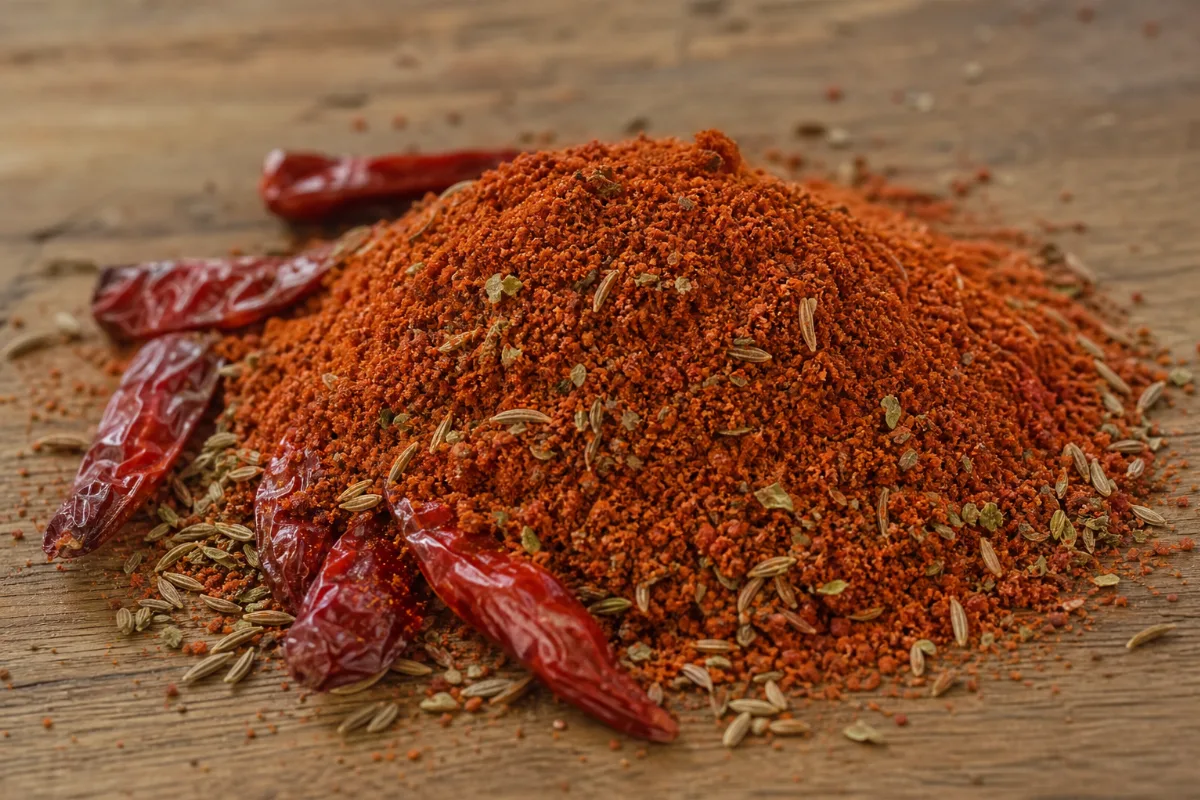
Spices · Spice blend
Chili powder
Spice blend (no single species) · also called chili seasoning, chili blend, chile powder, chilli powder
Chili powder is a ground spice. In the US it is usually a blend of dried chilies with cumin, garlic and oregano, and sometimes salt. Elsewhere the name can mean plain ground chile. We found no study of the blend itself, so its health effects are unknown. Large studies of people who eat chili pepper often show fewer deaths, but they cannot prove cause. The main cautions are salt, hidden allergens and possible lead or dyes in some products.
General information, not medical advice. Last substantive update · Not medically reviewed. A named clinician has not signed off on this page. How this page is made
About Chili powder
Chili powder is a flavoring, not a remedy. Usually it is a blend of ground chile with cumin, garlic and oregano. The blend has not been studied for health. Check the label for salt and allergens, and buy from a reliable source because some ground chile has had lead, dyes or mould toxins.
What it is
Wikipedia describes chili powder as the dried, ground fruit of one or more chili peppers, sometimes with other spices added. A blend is usually mostly chile with cumin, onion, garlic powder and sometimes salt, and hot versions often add cayenne.
In the US the name usually means a blend. In some other countries it means plain ground chile, so read the label. Recipes vary, so heat and flavor vary too.
Nutrition in a typical portion
USDA lists 1 teaspoon of chili powder as 2.7 g and 1 tablespoon as 8.0 g. A teaspoon gives about 8 kcal, 0.9 g fiber, 0.5 mg iron, 53 mg potassium and 77 mg sodium (worked out from the USDA values per 100 g). That is low in everything by the FDA's 5%-of-daily-value rule, so it is a flavoring, not a nutrient source. A tablespoon has about 230 mg of sodium, about 10% of the 2,300 mg daily value.
Note: we could not re-open the USDA site on the day this page was built, so these numbers come from stored USDA data and are not freshly checked. Real products vary.
What the research shows
We found no study of chili powder as a blend. The evidence we do have is about chili pepper itself. Cohorts of 16,179 US adults and 22,811 Italian adults, and a pooling of four cohorts with 564,748 adults, linked regular chili or spicy food with lower death risk. Chili eaters may differ in other ways, so this does not show cause.
A small trial found chili capsules caused more abdominal burning in people with reflux. An umbrella review called the overall health effect of chili unclear and found direct links with some digestive cancers.
Cumin, garlic and oregano, the other usual ingredients, are not covered here. See their own pages.
Blend versus single ingredients and supplements
The blend, plain chili pepper and capsaicin supplements are different things. Chili powder is not sold as a supplement. Findings about one do not carry over to another.
Amounts
This page gives no amounts to eat. Ask a doctor, pharmacist or dietitian if you have a condition or take medicines.
At a glance
Traditional uses history, not proof
- Cooking: chili con carne, tacos, stews, rubs and soups
- Long use in cooking is not proof that it treats any condition
Studied for research
- The blend itself: insufficient, no studies found
- Death from any cause (chili pepper eaters): low certainty, observational
- Heart disease death (chili pepper eaters): low certainty, observational
- Reflux symptoms (chili capsules): can make burning worse
- Digestive-tract cancer: mixed, a possible harm signal
Main compounds
- Capsaicin (from the chile, the main source of heat)
- Salt in some blends
Common forms
- Ready-ground blend
- Salt-free blend
- Pure ground chile (sold under the same name in some countries)
- Home-made blend
Research links: Wikipedia: Chili powder · CDC report: lead in spices (PubMed) · FDA: sesame allergen labeling · WHO: salt reduction · Research Library · Genes & Biomarkers Library
What it is and its history
- Accepted scientific name
- Spice blend (no single species)
- Synonyms
- chili seasoning; chili blend; chili seasoning mix
- Common names
- Chili powder (English); Chile powder / chilli powder (English); Chili seasoning (English)
- Family or group
- Chile peppers belong to the nightshade family.
- Classification
- Plantae > Solanaceae (the chile pepper part) > Capsicum > Not a single species
- What it looks like
- Fruit: Made from dried, ground chile fruit.
- Harvest and processing
- Wikipedia says chili powder is the dried, pulverized fruit of one or more varieties of chili pepper, sometimes with other spices added.
- Look-alikes and adulterants
- Name: Pure ground chile; Note: Wikipedia notes the same name can mean ground chile alone; blends add cumin, onion, garlic powder and sometimes salt.; Name: Cayenne; Note: One kind of hot chile; added to hot blends. A separate page.; Name: Paprika; Note: A milder ground chile spice.
Photographs
Traditional use and history history, not clinical proof
| Tradition or era | Documented use | Source |
|---|---|---|
Traditional use shows how it was used. It does not show that it works or is safe today.
What is inside, and how it may work
What it contains and how those compounds act in cells and animals. Laboratory and animal mechanisms are not proven effects in people.
Main compounds
| Compound | Family | Where it is concentrated | Activity studied | Level of evidence |
|---|---|---|---|---|
| Capsaicin PubChem 1548943 | capsaicinoid | Chile fruit Not given in the sources read | The compound mainly responsible for the burning feel in chile; activates the TRPV1 receptor (see the cayenne page for sources). 7 | Human data |
Mechanisms, receptors and pathways
| Target or pathway | Gene or receptor | What was found | Level |
|---|---|---|---|
| TRPV1 receptor (heat and pain sensing) | TRPV1 | The authors of the reflux trial link chili's effects in the stomach to TRPV1-sensitive pathways. Suggested mechanism only. 7 | Human data |
Absorption, metabolism and elimination
- Absorption
- Not found.
- Distribution
- Not found.
- Metabolism
- Not found.
- Elimination
- Not found.
- Bioavailability
- Not established.
Isolated compounds versus whole extracts
The death studies are about eating chili pepper and spicy food in general. Capsaicin supplements and creams are separate products, and the blend itself is untested. Findings in one group do not carry over to another.
Nutritional composition
Nutrition from USDA FoodData Central, SR Legacy entry 'Spices, chili powder' (FDC 171319, April 2018). NOT re-verified live on 2026-10-26: the USDA service refused requests, so these numbers come from the nutrient data already held in the project, which cites that entry. USDA household portions: 1 teaspoon = 2.7 g and 1 tablespoon = 8.0 g. One teaspoon (2.7 g), worked out from the per-100 g values: about 8 kcal, 0.9 g fiber, 0.5 mg iron, 53 mg potassium and 77 mg sodium (about 3% of the 2,300 mg daily value; FDA, read 2026-10-26). A tablespoon has about 230 mg of sodium, about 10% of the daily value. By the FDA rule that 5% or less is low, one teaspoon is low in everything listed, so chili powder is a flavouring, not a nutrient source. Real products vary, and salt-free blends have far less sodium.
1 mixed findings3 low certainty1 not enough evidence
What was looked at
The 5 benefits and uses checked for Chili powder, each with how strong the evidence is. Tap one to open it.
- Chili powder as a blend (no studies found)Not enough evidence
- Death from any cause (regular chili pepper eaters)Low certainty
- Heart disease death (regular chili pepper eaters)Low certainty
- Reflux and stomach burning (chili capsules)Low certainty
- Digestive-tract cancer (possible harm signal)Mixed findings
What is Chili powder good for?
The studied uses and how strong the human evidence is for each. The blend itself has not been studied; the findings below are about chili pepper.
Benefits, one by one
Each card is a research question, not a promise. Tap a goal to filter. Open a card to see the studies, doses and limits.
Chili powder as a blend (no studies found)
Not enough evidenceWe found no study that tests chili powder, the blend, for any health effect. Any evidence belongs to the single ingredients, mainly chili pepper.
1 studiesNot applicable.
Studies, doses and limits
Results
No results.
Why this rating
No studies of the blend were found.
Limits
Our search was small and focused on safety and chili. A study could exist that we missed.
Why researchers looked
Not studied as a blend.
Proposed mechanism Unknown
None to report for the blend.
A proposed mechanism does not show that the effect happens in people.
See the safety section: salt, allergens and possible lead.
Death from any cause (regular chili pepper eaters)
Low certaintyLarge studies that followed people over years found that those who ate chili pepper or spicy food regularly were less likely to die in the follow-up period. These studies are about chili pepper, not the blend, and cannot show chili is the cause.
3 studiesChili pepper, chili sauce or chili oil eaten as food; amounts were re…
Studies, doses and limits
What the trials found
A US cohort (16,179 adults), an Italian cohort (22,811 adults) and a pooling of 4 cohorts (564,748 adults).
Results
US cohort: death 21.6% in chili eaters versus 33.6% in non-eaters; adjusted hazard ratio 0.87. Italian cohort: chili pepper more than 4 times a week versus none or rare, hazard ratio 0.77. Pooled cohorts of spicy food (chilli pepper, sauce or oil): 0.88.
Effect sizes as reported
Hazard ratios 0.87 (95% CI 0.77 to 0.97), 0.77 (0.66 to 0.90) and 0.88 (0.86 to 0.90): roughly 12 to 23 percent lower death risk in regular eaters.
Why this rating
Observational studies in which chili eaters may differ in diet, income, smoking and other habits. Results point the same way in several countries but cannot show cause. None tested a spice blend.
Form and dose studied
Chili pepper, chili sauce or chili oil eaten as food; amounts were reported as how often, not grams.
Who was studied
Adults in the United States, Italy, China and Iran.
Limits
Frequency came from questionnaires. Spicy food in general, not chili powder blends.
Why researchers looked
Chili is eaten daily in many countries, so researchers asked whether regular eaters live longer.
Proposed mechanism Unknown
Not shown. In the Italian cohort known heart-risk blood markers explained only a small part of the link.
A proposed mechanism does not show that the effect happens in people.
Lower risk in observational data does not mean more heat is safer.
Heart disease death (regular chili pepper eaters)
Low certaintyThe Italian cohort and the pooled cohorts found lower heart-related death in regular eaters of chili. Stroke death results were mixed.
3 studiesChili pepper or spicy food as eaten.
Studies, doses and limits
What the trials found
Italian cohort and the 4-cohort pooling.
Results
Italian cohort: cardiovascular death hazard ratio 0.66 for regular eaters; ischemic heart disease 0.56; cerebrovascular 0.39. Pooling: cardiac death 0.82 (0.73 to 0.91); cerebrovascular 0.79 (0.53 to 1.17, not significant).
Effect sizes as reported
See results.
Why this rating
Observational; the pooled stroke result was not significant and the studies varied a lot (I2 72%).
Form and dose studied
Chili pepper or spicy food as eaten.
Who was studied
Adults.
Limits
Not the blend; frequency from questionnaires.
Why researchers looked
Chili has been linked to blood vessel effects in lab work, so researchers looked at heart outcomes.
Proposed mechanism Unknown
Not shown.
A proposed mechanism does not show that the effect happens in people.
See safety.
Reflux and stomach burning (chili capsules)
Low certaintyIn a small trial, chili in capsules caused more abdominal burning than placebo in people with non-erosive reflux. Healthy volunteers had similar symptoms with chili and placebo.
1 studies2 g of chili in capsules; not a blend.
Studies, doses and limits
What the trials found
One randomised double-blind crossover trial: 15 healthy volunteers and 15 people with non-erosive reflux.
Results
In the reflux group, chili gave greater stomach filling after a meal, less fullness, more abdominal burning (p < 0.05) and a trend to more heartburn (p = 0.06) than placebo.
Effect sizes as reported
Not summarised by one number.
Why this rating
One small single-dose trial, with chili given as capsules.
Form and dose studied
2 g of chili in capsules; not a blend.
Who was studied
Adults in Thailand.
Limits
Tiny sample; a single test.
Why researchers looked
Chili is often blamed for heartburn, so researchers tested it directly.
Proposed mechanism Preliminary mechanism
The authors link it to the TRPV1 heat receptor pathways of the gut; this is a suggested mechanism.
A proposed mechanism does not show that the effect happens in people.
If chili reliably brings on your symptoms, a doctor can help.
Digestive-tract cancer (possible harm signal)
Mixed findingsAn umbrella review found direct links between spicy food or chili and esophageal, gastric and gallbladder cancer, and said the overall health effect is unclear. These are associations and do not show cause.
1 studiesSpicy food and chili peppers.
Studies, doses and limits
What the trials found
One review of 11 systematic reviews and meta-analyses.
Results
Direct correlations with esophageal, gastric and gallbladder cancer; a significant nonlinear relationship between gastric cancer risk and capsaicin intake.
Effect sizes as reported
Not given in the abstract.
Why this rating
Review of mostly observational work; the same review also found links to lower death, so the overall picture is mixed.
Form and dose studied
Spicy food and chili peppers.
Who was studied
Mixed populations; regions differ.
Limits
Only the abstract was read; the individual reviews were not.
Why researchers looked
High chili intake is common in regions with higher rates of some cancers, so researchers checked.
Proposed mechanism Unknown
Not shown.
A proposed mechanism does not show that the effect happens in people.
Not a reason for alarm at normal cooking amounts, but a reason not to treat chili as a health food.
Connections to the rest of health
How Chili powder connects to the rest of our health knowledge graph. Every link says what kind of connection it is. A safety link (for example to the liver) is a warning, not a benefit. A study that merely mentions a topic never creates a benefit link.
Explore every connection: goals, body systems, organs, symptoms, genes
A. Wellness goals
| Connected to | Kind of connection | Evidence status | Context | Studies |
|---|---|---|---|---|
| Preventive Wellness | Not enough evidence | Chili powder as a blend (no studies found): We found no study that tests chili powder, the blend, for any health effect. Any evidence belongs to the single ingredients, mainly chili pepper. | 14 | |
| Preventive Wellness | Low certainty | Death from any cause (regular chili pepper eaters): Large studies that followed people over years found that those who ate chili pepper or spicy food regularly were less likely to die in the follow-up period. These studies are about chili pepper, not the blend, and cannot show chili is the cause. Digestive-tract cancer (possible harm signal): An umbrella review found direct links between spicy food or chili and esophageal, gastric and gallbladder cancer, and said the overall health effect is unclear. These are associations and do not show cause. | 4 3 6 2 | |
| Healthy Aging | Low certainty | Death from any cause (regular chili pepper eaters): Large studies that followed people over years found that those who ate chili pepper or spicy food regularly were less likely to die in the follow-up period. These studies are about chili pepper, not the blend, and cannot show chili is the cause. | 4 3 6 | |
| Heart Health | Low certainty | Heart disease death (regular chili pepper eaters): The Italian cohort and the pooled cohorts found lower heart-related death in regular eaters of chili. Stroke death results were mixed. | 3 6 2 | |
| Digestive Health | Low certainty | Reflux and stomach burning (chili capsules): In a small trial, chili in capsules caused more abdominal burning than placebo in people with non-erosive reflux. Healthy volunteers had similar symptoms with chili and placebo. | 7 |
B. Body systems
| Connected to | Kind of connection | Evidence status | Context | Studies |
|---|---|---|---|---|
| Whole Body | Biological association | Not enough evidence | Studied for: Chili powder as a blend (no studies found) Studied for: Death from any cause (regular chili pepper eaters) | 14 4 3 6 |
| Cardiovascular System | Biological association | Low certainty | Studied for: Heart disease death (regular chili pepper eaters) | 3 6 2 |
| Digestive System | Biological association | Low certainty | Studied for: Reflux and stomach burning (chili capsules) Studied for: Digestive-tract cancer (possible harm signal) | 7 2 |
E. Health conditions
| Connected to | Kind of connection | Evidence status | Context | Studies |
|---|---|---|---|---|
| Food allergy | Adverse effect or risk | Documented risk | Blends can contain celery, mustard or sesame, which are listed allergens. Preparation or compound: Spice blend ingredients |
10 11 |
| Lead poisoning | Adverse effect or risk | Documented risk | Lead was found in some ground chile samples from North Carolina homes; no frequency in shops is known. Lead was found in some chili powder samples from North Carolina homes; it is not known how common in shops. Preparation or compound: Ground chile |
1 |
J. Genes, receptors and enzymes
| Connected to | Kind of connection | Evidence status | Context | Studies |
|---|---|---|---|---|
| TRPV1 | Preliminary mechanism | Human | The heat and pain receptor that capsaicin activates. | 7 |
L. Active compounds
| Connected to | Kind of connection | Evidence status | Context | Studies |
|---|---|---|---|---|
| Capsaicin | Biological association | Human | The compound mainly responsible for the burning feel in chile; activates the TRPV1 receptor (see the cayenne page for sources). Preparation or compound: Chile fruit |
7 |
Each connection is stored with the ingredient, the connected record, the kind of connection, the evidence status, the supporting studies, the preparation or compound involved, and a review date (last reviewed October 26, 2026).
Evidence at a glance: what the research found for 5 outcomes
Each outcome below is one thing researchers measured. Certainty is how far the evidence can be trusted, not how well it works. The full studies are on the next tab.
The evidence
The research centre for Chili powder. Every record here was checked against PubMed or the publisher's page; we never list a study we have not verified.
Evidence by outcome
Bars show how many studies we found for each outcome, not how well it works. People are added up across trials only (reviews are not added, to avoid double counting).
How we rate evidence
High certainty
Several well-run trials or reviews agree; further research is unlikely to change the picture much.
Moderate certainty
Good trials point the same way, but some doubt remains.
Low certainty
Small, short or inconsistent trials. The finding could change with better research.
Very low certainty
Very little or very weak human data. Treat as a possibility only.
Mixed findings
Trials or reviews disagree with each other.
Not enough evidence
Not enough human research to say either way.
Evidence against
Good research found no benefit, or found harm.
We take the reviewers' own risk-of-bias and GRADE statements where they exist, and otherwise judge from study size, design, consistency, directness and whether a product matches what is sold. Many publications do not make evidence high. Method note: A small page because the blend itself is unstudied. We read PubMed abstracts for each study, the FDA, WHO and EU-allergen pages, and the CDC report through PubMed. Items we could not verify are flagged in the research gaps.
Study library: every study we checked 14
| Study | Design | People | Product, dose, length | Result |
|---|---|---|---|---|
| Angelon-Gaetz 2018 Lead in Spices, Herbal Remedies, and Ceremonial Powders Sampled from Home Investigations for Children with Elevated Blood Lead Levels - North Carolina, 2011-2018. MMWR Morb Mortal Wkly Rep · PMID 30462630 · DOI |
Cross sectional n/a (food testing) |
386 Spice, herbal remedy and ceremonial powder samples from 59 North Carolina homes investigated after children had high blood lead |
Samples from homes, tested for lead fruit Not reported as a dose |
28.8% of the 386 samples had 1 mg/kg lead or more. The 23 samples labeled chili powder or red pepper averaged 12.6 mg/kg (range 0.1 to 170). No US permissible lead limit for spices exists. Methods, limits and fundingOutcomes: Lead level in samples Limitations: Samples came from homes of children with high blood lead, so they are not a random picture of shops. One state. Label type only; not a blend count. Funding and conflicts: Authors completed ICMJE forms; no conflicts disclosed. Read: abstract |
| Ao 2022 Spicy Food and Chili Peppers and Multiple Health Outcomes: Umbrella Review. Mol Nutr Food Res · PMID 36111960 · DOI |
Umbrella review |
Eleven systematic reviews and meta-analyses with 27 findings | Spicy food and chili peppers, mostly as food fruit Not reported as a dose |
The authors call the overall health effect unclear. Direct links were found with esophageal, gastric and gallbladder cancer, and inverse links with metabolism, death and cardiovascular disease. They say spicy food is typically safe but high-quality proof is lacking. Methods, limits and fundingOutcomes: Many health outcomes Limitations: A review of reviews; mostly observational data; not the chili powder blend. Funding and conflicts: The authors declare no conflict of interest. Read: abstract |
| Bonaccio 2019 Chili Pepper Consumption and Mortality in Italian Adults. J Am Coll Cardiol · PMID 31856971 · DOI |
Cohort study |
22811 Adults in the Moli-sani cohort, Italy, median follow-up 8.2 years |
Chili pepper eaten as food (food-frequency questionnaire) fruit Not reported as a dose Median 8.2 years |
1,236 deaths. Eating chili pepper more than 4 times a week versus none or rare: hazard ratio 0.77 (95% CI 0.66 to 0.90) for all-cause death and 0.66 (0.50 to 0.86) for cardiovascular death. Methods, limits and fundingOutcomes: All-cause and cardiovascular death Limitations: Observational. Chili pepper, not a blend. Known heart-risk markers explained little of the link. Funding and conflicts: Research support from non-US government sources; no competing interest statement in the abstract. Read: abstract |
| Chopan 2017 The Association of Hot Red Chili Pepper Consumption and Mortality: A Large Population-Based Cohort Study. PLoS One · PMID 28068423 · DOI |
Cohort study |
16179 US adults in the NHANES III survey (1988-1994), followed a median of 18.9 years |
Hot red chili pepper eaten as food (questionnaire) fruit Not reported as a dose Median follow-up 18.9 years · vs People who did not eat hot red chili |
4,946 deaths. Total death 21.6% in chili eaters versus 33.6% in non-eaters. Adjusted hazard ratio 0.87 (95% CI 0.77 to 0.97), a 13% lower hazard. Similar but not statistically significant trends for vascular death. Methods, limits and fundingOutcomes: Total and cause-specific death Limitations: Observational: chili eaters may differ in other ways. Frequency came from a questionnaire. Chili pepper, not a spice blend. Funding and conflicts: Authors declared no competing interests. Read: abstract |
| Han 2025 Challenges in quality and safety analysis of fresh chili and powder thereof. J Chromatogr A · PMID 41066883 · DOI |
Cross sectional n/a (food testing) |
Czech retail fresh chili and chili powder, plus imported fresh chili tested 2022 to 2024 | Fresh chili and chili powder tested for pesticide residues, mould toxins and capsaicinoids fruit Not reported as a dose |
Some Czech retail samples had pesticide residues above limits, including three banned pesticides (carbofuran, chlorfluazuron, chlorpyrifos). Chili powder had mould toxins above maximum limits, especially ochratoxin A and aflatoxin B1. Imported fresh chili exceeded pesticide limits in 63.2%, 84.2% and 11.2% of samples in three years. Methods, limits and fundingOutcomes: Pesticide residues and mould toxins Limitations: One country; a method paper; number of retail samples not given in the abstract; chili powder, not a blend. Funding and conflicts: The authors declare no known competing interests. Read: abstract |
| Ofori-Asenso 2021 Association of Spicy Chilli Food Consumption With Cardiovascular and All-Cause Mortality: A Meta-Analysis of Prospective Cohort Studies. Angiology · PMID 33657876 · DOI |
Meta-analysis |
564748 Adults in 4 cohorts (United States, China, Italy, Iran), median follow-up 9.7 years |
Spicy food: chilli pepper, chilli sauce or chilli oil fruit Not reported as a dose |
Regular consumers had 12% lower all-cause death (pooled hazard ratio 0.88, 95% CI 0.86 to 0.90) and lower cardiac death (0.82, 0.73 to 0.91), but not lower cerebrovascular death (0.79, 0.53 to 1.17). Methods, limits and fundingOutcomes: All-cause, cardiac and cerebrovascular death Limitations: Pools observational cohorts; spicy food in general, not chili powder blends. Funding and conflicts: Not stated in the abstract. Read: abstract |
| Patcharatrakul 2020 Acute Effects of Red Chili, a Natural Capsaicin Receptor Agonist, on Gastric Accommodation and Upper Gastrointestinal Symptoms in Healthy Volunteers and Gastroesophageal Reflux Disease Patients. Nutrients · PMID 33291700 · DOI |
Controlled trial |
30 15 healthy volunteers and 15 people with non-erosive reflux disease (Thailand) |
2 g of chili in capsules versus placebo fruit 2 g in one sitting Single test, one-week washout · vs Placebo capsules |
In the reflux group chili caused more abdominal burning than placebo (p < 0.05), less fullness, and a trend toward more heartburn (p = 0.06). Healthy volunteers had similar symptoms with chili and placebo. Methods, limits and fundingOutcomes: Stomach filling and upper-gut symptoms Limitations: Small crossover study; one test; capsules, not food or a blend. Funding and conflicts: The authors declare no conflict of interest. Read: abstract |
| Ragab 2025 High-throughput LC-MS/MS method for the determination of 14 illegal dyes in complex food matrices and its application in a large-scale survey in Egypt. J Hazard Mater · PMID 40081050 · DOI |
Cross sectional n/a (food testing) |
2350 Chili products sampled over four years in Egypt |
Chili powder, sauce, flavor and snack samples tested for 14 illegal dyes fruit Not reported as a dose |
18.62% of chili powders, 14.05% of sauces, 12.87% of flavors and 11.32% of snacks contained illegal dyes. Sudan IV and Red B were most often found in chili powders (15.86% each). Methods, limits and fundingOutcomes: Share of samples with illegal dyes Limitations: One country; chili products in general, not blends and not a rate for any shop-bought product elsewhere. Funding and conflicts: The authors declare no known competing interests. Read: abstract |
| s-fda-dv FDA: Daily Value on the Nutrition and Supplement Facts Labels · Source |
Regulator n/a |
Methods, limits and fundingRead: full-text | ||
| s-fda-sesame FDA: FASTER Act, sesame is the ninth major food allergen · Source |
Regulator n/a |
Methods, limits and fundingRead: full-text | ||
| s-fsai-allergens FSAI (Ireland): List of 14 allergens (EU rules) · Source |
Regulator n/a |
Methods, limits and fundingRead: full-text | ||
| s-usda-fdc-171319 USDA FoodData Central, SR Legacy: Spices, chili powder (FDC 171319) · Source |
Reference database n/a |
Methods, limits and fundingRead: not-reopened | ||
| s-who-salt WHO: Salt reduction fact sheet · Source |
Health agency n/a |
Methods, limits and fundingRead: full-text | ||
| s-wiki-chili-powder Wikipedia: Chili powder · Source |
Encyclopedia n/a |
Methods, limits and fundingRead: full-text |
What we do not know yet
- No study tested chili powder as a blend for any health outcome.
- The death studies cover chili pepper or spicy food in general, not blends.
- The USDA numbers could not be re-opened live when this page was built.
- Medicines, pregnancy, breastfeeding and children: no source found for the blend.
- The lead data are from one state and from homes of children with high blood lead.
How new research is added
New studies are found by a saved PubMed search and placed in a review queue before the page changes.
Lab markers
What changed in blood or saliva tests during trials. A changed number is not the same as feeling or being healthier, and we give no "normal ranges".
Safety
What studies and official sources say about side effects, medicines and who should check first. Each point shows what kind of evidence it comes from.
Main points to know 5
- Salt: some blends carry a lot of sodium. Wikipedia says blends sometimes include salt. The USDA entry in our data shows about 77 mg of sodium in a teaspoon and about 230 mg in a tablespoon, about 10% of the 2,300 mg daily value for a tablespoon. WHO advises adults to take in less than 2000 mg of sodium a day and links high-sodium diets to raised blood pressure. Check the label if you limit salt. Authoritative guidance 14 12 9 13
- Allergens can hide in a spice mix. Celery, mustard and sesame are among the 14 EU allergens. US packaged foods must label sesame since 1 January 2023, and an FDA example shows sesame can sit inside 'spices' on an ingredient list. Read the ingredient list and the Contains line every time. We did not find a source saying a particular chili powder contains these. Authoritative guidance 10 11
- Lead has been found in some ground chile. A CDC report from North Carolina homes of children with high blood lead found 23 samples labeled chili powder or red pepper averaging 12.6 mg/kg lead, with a range of 0.1 to 170. The report says no US permissible limit for lead in spices exists. These samples came from homes of children with high lead, so they say little about any one product you buy. Cross sectional 1
- Quality: illegal dyes, mould toxins and pesticides in some chili products. An Egyptian survey of 2,350 chili products found illegal dyes in 18.62% of chili powders. Czech retail chili powder had mould toxins above limits, and some fresh and retail chili had pesticide residues above limits. These are local surveys on chili products, not on the blend, and not a rate for every product. Cross sectional 8 5
- Chili can burn the gut, skin and eyes. The heat comes from capsaicin. In a small trial, chili in capsules caused more abdominal burning than placebo in people with non-erosive reflux. Wash hands after handling hot chili and keep them from your eyes (a practical tip, not from a trial). A blend is often milder than pure hot chile, but heat varies by recipe. Controlled trial 7 14
Side effects 2
| Effect | How often | Severity and recovery | Evidence |
|---|---|---|---|
| More abdominal burning (and a trend to more heartburn) after chili in people with non-erosive reflux Chili in capsules; healthy volunteers had similar symptoms with chili and placebo. | 15 patients in a crossover trial | Not stated Single-test study | Controlled trial 7 |
| Allergic reaction to an ingredient in the mix (celery, mustard, sesame) These are listed allergens; whether a given blend contains them depends on the label. | Not established | Can be severe Not applicable | Authoritative guidance 10 11 |
Liver
No liver injury linked to chili powder was found in the sources read. A liver-safety source such as LiverTox was not checked.
How often. Not found.
Monitoring. Not found.
This is a safety connection. It is not evidence that Chili powder supports liver health.
Medicines and supplements 2
| With | Why it matters | Importance | Evidence | What to do |
|---|---|---|---|---|
| Medicines, as a blend in food prescription | Not established. Statements about capsaicin and medicines apply to concentrated supplements and are on the cayenne page. | None found Not enough evidence | If you take medicines for blood pressure, blood thinning or transplant, ask a pharmacist before using supplements made from chili. Normal cooking is a different matter and no rule was found. | |
| Foods food | No food interactions were described in the sources read. | None found Not enough evidence | None needed. |
Who should check first 2
| Situation | Advice | Evidence |
|---|---|---|
| Allergy to any ingredient (chili, cumin, garlic, oregano, celery, mustard, sesame) | Read the label and avoid the product if it contains an ingredient you react to. See an allergist. | Authoritative guidance 10 11 |
| Told to limit sodium | Choose a salt-free blend or check the sodium line on the label. | Authoritative guidance 13 9 |
Overdose, product quality and regulators
Summary. No toxicity from chili powder used as a spice was found in the sources read. The documented concerns are salt, allergens, burning, and contaminants in some products.
Animal. Not researched.
Human doses studied. Not given here.
Overdose response. Not found.
Genotoxicity. Not researched.
Ground chile has been found with lead, illegal dyes, mould toxins and pesticide residues in surveys. They are local surveys, not a rate for all products.
Lead. North Carolina home samples labeled chili powder or red pepper: 23 samples, average 12.6 mg/kg, range 0.1 to 170. 28.8% of all 386 spice, remedy and ceremonial samples had 1 mg/kg or more. The CDC lists polluted soil and water, grinding dust and deliberate adulteration to add color or weight as routes. 1
Illegal dyes. In an Egyptian survey of 2,350 chili products, 18.62% of chili powders contained illegal dyes such as Sudan IV and Red B. 8
Mould toxins and pesticides. Czech retail chili powder had mould toxins above maximum limits (ochratoxin A and aflatoxin B1); some retail samples had pesticide residues above limits, including three banned pesticides. 5
| Body | Action | Date |
|---|---|---|
| CDC (US) (United States) | MMWR 2018 report says no US permissible limit for lead in spices exists and suggests a national limit might reduce risk. source | 2018-11-23 |
| FDA (US) (United States) | Sesame must be labeled as an allergen on packaged foods and supplements from 1 January 2023. source | 2023-01-01 |
| WHO (International) | Adults should take in less than 2000 mg of sodium a day (under 5 g of salt). source | 2026-10-26 |
When to get medical help
- Swelling of the lips, tongue or throat, trouble breathing, or widespread hives after eating: call emergency services
- Severe or lasting stomach pain or vomiting after a very hot dish: seek medical care
- Chili in the eyes that does not settle after rinsing with water: seek care
Stop using the product and contact a clinician or emergency service. In the US, Poison Control is 1-800-222-1222.
General information only, not medical advice. Ask a clinician or pharmacist before use, especially with medicines, in pregnancy or with a health condition. See the Natural Remedy Safety guide.
Frequently asked questions
What is in chili powder?
In the US it is usually dried ground chile mixed with cumin, garlic powder and oregano, and sometimes onion powder or salt. Recipes vary.
Is chili powder the same as cayenne?
No. Cayenne is one kind of hot chile. Chili powder is usually a blend, and hot versions often add cayenne.
Is chili powder the same as pure ground chile?
Not always. In the US it is usually a blend, but in some countries the name means plain ground chile. Read the ingredient list.
Does chili powder have health benefits?
Does chili powder contain salt?
Can chili powder cause an allergic reaction?
Has lead been found in chili powder?
In North Carolina home samples, 23 labeled chili powder or red pepper averaged 12.6 mg/kg lead, up to 170. These came from homes of children with high lead levels, so they do not show how common it is in shops.
Are there dyes or mould toxins in chili powder?
Can chili powder upset my stomach?
It can. Chili capsules caused more abdominal burning than placebo in people with reflux. If chili reliably brings on symptoms, ask a doctor.
Is chili powder safe in pregnancy or with medicines?
We found no source on the blend. Ask your midwife, doctor or pharmacist.
Explore by health goal
Preventive WellnessHealthy AgingHeart HealthDigestive Health
Editorial transparency
- Written by
- AlternativeMed editorial team. Research compiled with AI assistance, then checked against the sources listed.
- Medical review
- None. This page has not been reviewed by a physician or pharmacist.
- First published
- 2026-10-26
- Last substantive update
- 2026-10-26
- How we research
- A small page because the blend itself is unstudied. We read PubMed abstracts for each study, the FDA, WHO and EU-allergen pages, and the CDC report through PubMed. Items we could not verify are flagged in the research gaps.
- How we rate evidence
- See "How we rate evidence" in the Evidence tab.
- Independence
- No product is promoted on this page. No affiliate links are shown.
Sources 14
Each source was opened and checked. Where we read only the abstract, it says so. The small numbers in the text point here.
- Angelon-Gaetz KA, Klaus C, Chaudhry EA, Bean DK. Lead in Spices, Herbal Remedies, and Ceremonial Powders Sampled from Home Investigations for Children with Elevated Blood Lead Levels - North Carolina, 2011-2018.. MMWR Morb Mortal Wkly Rep. 2018. PMID 30462630. DOI 10.15585/mmwr.mm6746a2. (abstract)
- Ao Z, Huang Z, Liu H, et al.. Spicy Food and Chili Peppers and Multiple Health Outcomes: Umbrella Review.. Mol Nutr Food Res. 2022. PMID 36111960. DOI 10.1002/mnfr.202200167. (abstract)
- Bonaccio M, Di Castelnuovo A, Costanzo S, et al.. Chili Pepper Consumption and Mortality in Italian Adults.. J Am Coll Cardiol. 2019. PMID 31856971. DOI 10.1016/j.jacc.2019.09.068. (abstract)
- Chopan M, Littenberg B. The Association of Hot Red Chili Pepper Consumption and Mortality: A Large Population-Based Cohort Study.. PLoS One. 2017. PMID 28068423. DOI 10.1371/journal.pone.0169876. (abstract)
- Han J, Schusterova D, Binova Z, et al.. Challenges in quality and safety analysis of fresh chili and powder thereof.. J Chromatogr A. 2025. PMID 41066883. DOI 10.1016/j.chroma.2025.466423. (abstract)
- Ofori-Asenso R, Mohsenpour MA, Nouri M, et al.. Association of Spicy Chilli Food Consumption With Cardiovascular and All-Cause Mortality: A Meta-Analysis of Prospective Cohort Studies.. Angiology. 2021. PMID 33657876. DOI 10.1177/0003319721995666. (abstract)
- Patcharatrakul T, Kriengkirakul C, Chaiwatanarat T, et al.. Acute Effects of Red Chili, a Natural Capsaicin Receptor Agonist, on Gastric Accommodation and Upper Gastrointestinal Symptoms in Healthy Volunteers and Gastroesophageal Reflux Disease Patients.. Nutrients. 2020. PMID 33291700. DOI 10.3390/nu12123740. (abstract)
- Ragab M, Khaled O, Elgendy N, et al.. High-throughput LC-MS/MS method for the determination of 14 illegal dyes in complex food matrices and its application in a large-scale survey in Egypt.. J Hazard Mater. 2025. PMID 40081050. DOI 10.1016/j.jhazmat.2025.137905. (abstract)
- . FDA: Daily Value on the Nutrition and Supplement Facts Labels. . . (full-text)
- . FDA: FASTER Act, sesame is the ninth major food allergen. . . (full-text)
- . FSAI (Ireland): List of 14 allergens (EU rules). . . (full-text)
- . USDA FoodData Central, SR Legacy: Spices, chili powder (FDC 171319). . . (not-reopened)
- . WHO: Salt reduction fact sheet. . . (full-text)
- . Wikipedia: Chili powder. . . (full-text)
Where to buy
Check the label first. Whatever you buy, look for these:
- Whole or ground: whole spices keep their flavor longer
- The origin and a packed-on or best-by date for freshness
- Organic or non-irradiated labeling if that matters to you
- A resealable, airtight container
Talk to a pharmacist or doctor before you start any supplement, especially if you take medicines. See the Safety tab for interactions.
Support our free guides: as an Amazon Associate we earn from qualifying purchases. Full disclosure.


