Spices · Spice
Paprika
Capsicum annuum · also called sweet paprika, hot paprika, pimentón (Spanish), colorau (Portuguese)
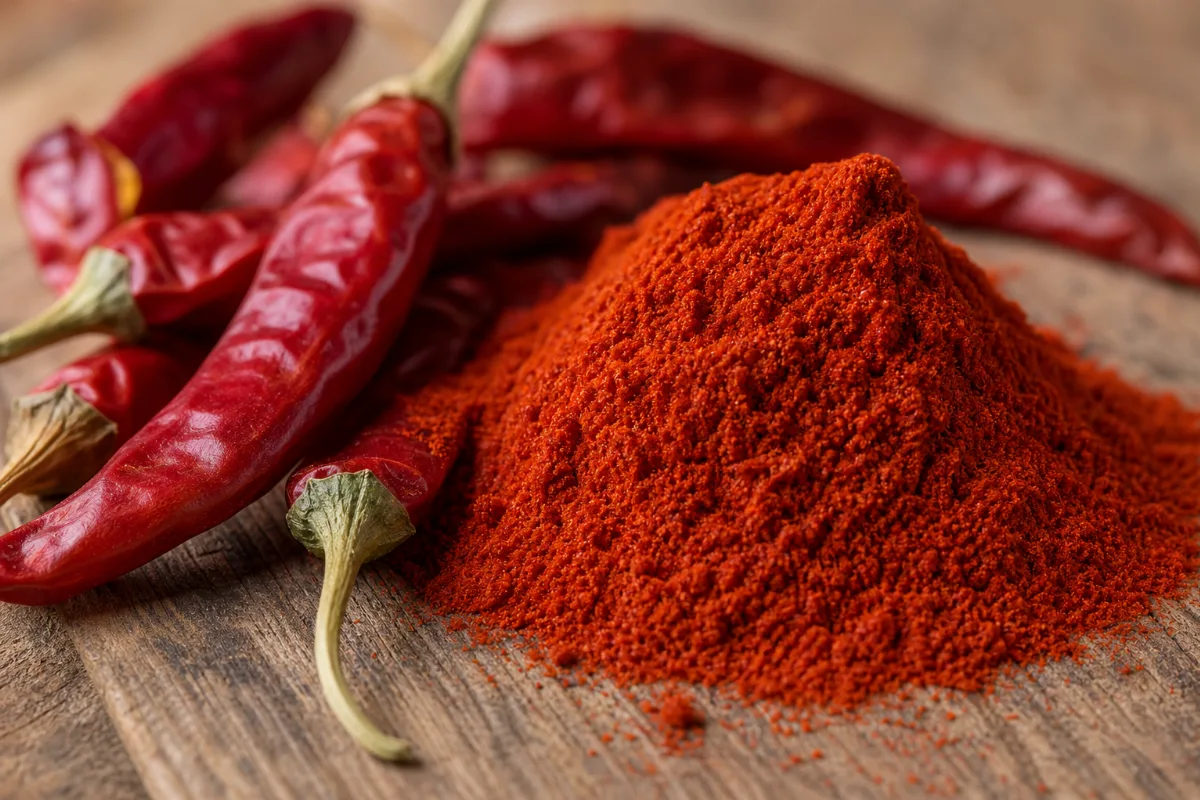
Paprika is a red spice made from dried, ground peppers, usually milder than chili powder. It colours and gently flavours stews, rice and rubs. Research on paprika itself is thin: the human studies are about spicy food in general or about concentrated pigment products. The main cautions are allergy in some people and contaminated or adulterated powders.
General information, not medical advice. Last substantive update · Not medically reviewed. A named clinician has not signed off on this page. How this page is made
About Paprika
Paprika is a seasoning and a colouring, not a remedy. It is mild, red and sweet or slightly hot, made from dried, ground peppers. Little research is about paprika itself. Cautions are allergy in some people and contaminated or adulterated powders.
What it is
Paprika is a spice made from dried and ground red peppers of Capsicum annuum, the nightshade family. GBIF confirms the species and family. Wikipedia says the peppers used tend to be milder and thinner-fleshed than those used for chili powder.
Sweet paprika is mostly the fruit wall with most seeds removed. Hotter paprika keeps some seeds and stalks. The red colour comes mainly from capsanthin and capsorubin; yellow and orange shades come from other carotenoids such as zeaxanthin and beta-carotene (Wikipedia, not checked against a primary source).
In the kitchen
Wikipedia says paprika is used in rice, stews, soups and sausages around the world. It is key in Hungarian goulash and paprikash, Spanish chorizo and paella, Portuguese colorau, and North African chermoula, and it is sprinkled on hummus.
Hungarian paprika is sold in five grades, from delicate to hot: különleges, édesnemes, félédes, rózsa and erős. Spanish pimentón comes mild (dulce), mildly spicy (agridulce) and spicy (picante). Pimentón de la Vera is dried over oak smoke and tastes smoky; it has its own page.
Nutrition in a typical portion
USDA lists 1 teaspoon of ground paprika as 2.3 g. That portion gives about 6.5 kcal, 0.8 g fiber, 52 mg potassium, 0.5 mg iron, 57 micrograms vitamin A (RAE), 0.7 mg vitamin E and almost no vitamin C (worked out from the USDA values per 100 g). One tablespoon is 6.8 g. These are small amounts, so paprika is a flavouring and colouring, not a meaningful source of nutrients. USDA data are from 2018 and real products vary.
What the research shows
No trial tested paprika as a cooking spice. The nearest food evidence is a cohort of 486,335 Chinese adults in which weekly spicy food eaters had slightly lower vascular disease risk (hazard ratios 0.95 to 0.97). It was about spicy food in general and cannot show cause.
A small crossover trial of a concentrated paprika pigment product found lower exercise heart rate and better exercise efficiency, but it had no placebo group and 21 mostly male volunteers. A 2026 review says human clinical evidence for capsanthin is insufficient.
A French cohort linked higher intake of colouring additives, including the paprika colour group, with type 2 diabetes. That concerns processed foods and shows association only.
Spice versus colouring and pigment products
Paprika in your cooking, paprika extract used as a food colouring (E 160c) and concentrated pigment products are different things. The EU additive was assessed by EFSA in 2015, as reported by Ireland's food safety authority, with limits that apply to the additive. The U.S. FDA lists paprika as a color additive defined as the ground dried pod of mild capsicum. Neither statement is advice about the spice in food.
Amounts
This page gives no amounts to eat. Ask a doctor, pharmacist or dietitian about concentrated products, especially if you take medicines.
At a glance
Traditional uses history, not proof
- Cooking: goulash, paprikash, paella, chorizo and rubs
- Colouring: gives dishes and sausages a red or orange shade
- Long use in cooking is not proof that it treats any condition
Studied for research
- Heart and vessel disease in spicy-food eaters: low certainty, observational, not paprika specifically
- Exercise efficiency (pigment extract): insufficient, one small trial with no placebo
- Red pigment as an antioxidant: insufficient, lab and review level
- Type 2 diabetes and colour additives: very low, a possible harm signal in processed foods
- Nerve-cell protection: insufficient, cells in a dish only
Main compounds
- Capsanthin (main red pigment)
- Capsorubin (red pigment)
- Zeaxanthin and other carotenoids (yellow and orange shades)
Common forms
- Ground sweet paprika
- Ground hot paprika
- Smoked paprika (pimentón de la Vera)
- Flakes
- Paprika extract used as a food colouring (E 160c)
- Paprika xanthophyll pigment products (concentrated, not a kitchen spice)
Research links: Spicy food and vascular disease, China Kadoorie Biobank (2025) · Review: capsanthin sources and bioactivities (2026) · USDA FoodData Central: paprika · U.S. eCFR: paprika as a color additive · Research Library · Genes & Biomarkers Library
What it is and its history
- Accepted scientific name
- Capsicum annuum
- Naming authority
- L. (GBIF accepted)
- Common names
- Paprika (English); Sweet paprika (English); Hot paprika (English); Pimentón (Spanish); Colorau (Portuguese); Tahmira (Moroccan)
- Family or group
- Solanaceae (the nightshade family), per GBIF.
- Classification
- Plantae > Tracheophyta > Magnoliopsida > Solanales > Solanaceae > Capsicum > Capsicum annuum
- Native range
- Wikipedia says Capsicum annuum is native to northern South America and southwestern North America. Not checked against a primary source.
- Habitat
- Not verified from a source read.
- What it looks like
- Roots: Not verified.; Stems: Not verified.; Leaves: Not verified.; Flowers: Not verified.; Fruit: Wikipedia says the peppers used for paprika tend to be milder and have thinner flesh than those used for chili powder, and the modern spice is usually made from European varieties in the Longum group. Not verified against a primary source.
- Cultivation
- Not verified.
- Harvest and processing
- Wikipedia says paprika is commonly produced by sun-drying the peppers, which can take up to 10 days in optimal conditions. Sweet paprika is mostly the fruit wall with more than half of the seeds removed; hot paprika keeps some seeds, stalks, ovules and calyces. Not verified against a primary source.
- Look-alikes and adulterants
- Name: Cayenne and chili powder; Note: Hotter Capsicum spices; chili powder is a blend. See the cayenne page.; Name: Smoked paprika (pimentón de la Vera); Note: Paprika dried over oak wood smoke, with a smoky taste and smell (Wikipedia). It has its own page.; Name: Bell peppers; Note: Wikipedia notes the word paprika is used in some regions for bell peppers (Grossum group), which are a vegetable, not this spice.
- Sustainability and conservation
- Not assessed.
Photographs
Traditional use and history history, not clinical proof
| Tradition or era | Documented use | Source |
|---|---|---|
Traditional use shows how it was used. It does not show that it works or is safe today.
What is inside, and how it may work
What it contains and how those compounds act in cells and animals. Laboratory and animal mechanisms are not proven effects in people.
Main compounds
| Compound | Family | Where it is concentrated | Activity studied | Level of evidence |
|---|---|---|---|---|
| Capsanthin PubChem 5281228 | carotenoid (keto-carotenoid) | Fruit Not given in the sources read | The main red pigment of ripe Capsicum fruits (Food Chem 2026 review); antioxidant in lab tests. 3 8 15 | Laboratory research |
| Capsorubin PubChem 5281229 | carotenoid | Fruit Not given | A second red pigment; Wikipedia names capsanthin and capsorubin as the red pigments of paprika. 19 16 | Chemical analysis |
| Zeaxanthin PubChem 5280899 | carotenoid (xanthophyll) | Fruit Not given | Wikipedia says yellow and orange paprika derive mainly from alpha-carotene, beta-carotene, zeaxanthin, lutein and beta-cryptoxanthin; one study found high zeaxanthin in orange paprika. 19 17 | Chemical analysis |
Mechanisms, receptors and pathways
| Target or pathway | Gene or receptor | What was found | Level |
|---|---|---|---|
| Antioxidant defence in nerve-like cells | Not specified | In cultured neuron-like cells, capsanthin lowered glutamate-induced reactive oxygen species and inflammatory cytokines and kept ATP levels. Lab only. 8 | Laboratory research |
| Oxygen delivery and red blood cell flexibility (hypothesis) | Not specified | The authors of the pigment trial propose that paprika xanthophylls improve oxygen delivery by making red blood cells more flexible. They did not measure this. 5 | Human data |
Absorption, metabolism and elimination
- Absorption
- Not found for paprika as food. The 2026 capsanthin review names poor oral bioavailability as a limit to use.
- Distribution
- Not found.
- Metabolism
- Not found.
- Elimination
- Not found.
- Bioavailability
- Described as poor for isolated capsanthin (review).
Isolated compounds versus whole extracts
The heart and vessel study is about spicy food in general. The exercise trial used a concentrated paprika xanthophyll pigment. The diabetes link is about colouring additives in processed food. The lab work used isolated capsanthin. None of these is a trial of paprika as a cooking spice.
Nutritional composition
Nutrition from USDA FoodData Central, SR Legacy: "Spices, paprika" (FDC 171329; SR Legacy April 2018; read 2026-10-26 from the bulk download kept in the project). Per 100 g: 282 kcal, 14.1 g protein, 12.9 g fat, 54.0 g carbohydrate, 34.9 g fiber, 229 mg calcium, 21.1 mg iron, 178 mg magnesium, 2280 mg potassium, 68 mg sodium, 4.33 mg zinc, 29.1 mg vitamin E, 2460 micrograms vitamin A (RAE), 80.3 micrograms vitamin K and 0.9 mg vitamin C. USDA household portions: 1 teaspoon ground = 2.3 g and 1 tablespoon = 6.8 g. One teaspoon (2.3 g), worked out from the per-100 g values: about 6.5 kcal, 0.3 g protein, 0.8 g fiber, 5 mg calcium, 0.5 mg iron, 4 mg magnesium, 52 mg potassium, 1.6 mg sodium, 0.7 mg vitamin E, 57 micrograms vitamin A (RAE), 1.9 micrograms vitamin K and 0.02 mg vitamin C. These are small amounts, so paprika is a flavouring and colouring, not a meaningful source of nutrients. Vitamin C is almost absent in the dried spice. Real products vary.
1 low certainty1 very low certainty3 not enough evidence
What was looked at
The 5 benefits and uses checked for Paprika, each with how strong the evidence is. Tap one to open it.
- Heart and blood-vessel disease (people who eat spicy food, not paprika specifically)Low certainty
- Exercise efficiency and thinking tests (paprika pigment extract)Not enough evidence
- Red pigment (capsanthin) as an antioxidantNot enough evidence
- Type 2 diabetes and food colouring additives (a possible harm signal, not a benefit)Very low certainty
- Nerve-cell protection (capsanthin in cultured cells)Not enough evidence
Lab markers tracked in the studies
Heart rate during exercise testsExercise efficiency
What is Paprika good for?
The studied uses and how strong the human evidence is for each. None of it is a trial of paprika in cooking: it is about spicy food in general, concentrated pigment products, additives in processed food, or cells in a dish.
Benefits, one by one
Each card is a research question, not a promise. Tap a goal to filter. Open a card to see the studies, doses and limits.
Heart and blood-vessel disease (people who eat spicy food, not paprika specifically)
Low certaintyA very large Chinese study found slightly lower risk of vascular disease in people who ate spicy food each week. The study asked about spicy food in general. It did not test paprika, and it cannot show that spicy food is the cause.
1 studiesSpicy food in the diet, reported as days per week; no amounts and no …
Studies, doses and limits
What the trials found
One cohort of 486,335 adults followed for a median of 12.1 years.
Results
Compared with eating spicy food less than once a week, vascular disease risk was lower at 1-2 days a week (hazard ratio 0.95), 3-5 days a week (0.96) and 6-7 days a week (0.97). The inverse link also held for ischemic heart disease and major coronary events.
Effect sizes as reported
Hazard ratios 0.95 (95% CI 0.93 to 0.97), 0.96 (0.94 to 0.99) and 0.97 (0.95 to 0.99): roughly 3 to 5 percent lower risk.
Why this rating
Observational data. Spicy food eaters may differ in diet and lifestyle. The question was about spicy food in general, so it is indirect evidence for paprika, which is usually mild.
Form and dose studied
Spicy food in the diet, reported as days per week; no amounts and no paprika.
Who was studied
Adults in China.
Limits
The abstract does not name paprika or any one spice. Questionnaire-based intake.
Why researchers looked
Chili-type spicy foods are eaten daily in many countries, so researchers asked whether regular eaters have fewer heart and vessel problems. Paprika is a mild member of the same pepper family.
Proposed mechanism Unknown
Not shown in this study.
A proposed mechanism does not show that the effect happens in people.
See the safety section.
Exercise efficiency and thinking tests (paprika pigment extract)
Not enough evidenceOne small Japanese trial of 21 students found a lower heart rate and better exercise efficiency after a concentrated paprika pigment product. There was no placebo group. This is a pigment supplement, not paprika in cooking.
1 studiesPaprika xanthophyll, a concentrated pigment product; amounts are not …
Studies, doses and limits
What the trials found
One crossover trial in 21 healthy college students (18 male, 3 female) with a one-month washout.
Results
Heart rate was lower and exercise efficiency higher in both the incremental test and the constant-load test. In thinking tests there were no significant differences between conditions, though within the xanthophyll condition the Trail Making Test B and one Stroop measure improved.
Effect sizes as reported
P values only in the abstract: heart rate p = 0.032 and 0.020, exercise efficiency p = 0.004 and 0.030, Trail Making Test B p = 0.034, Stroop p = 0.040.
Why this rating
A single small trial with no placebo group, mostly male volunteers and a pigment extract. The authors themselves say results should be interpreted with caution.
Form and dose studied
Paprika xanthophyll, a concentrated pigment product; amounts are not repeated here.
Who was studied
Healthy Japanese college students.
Limits
No placebo. Mechanism not measured. Not the spice.
Why researchers looked
Paprika xanthophylls are antioxidant pigments. The researchers suspected they might help red blood cells carry oxygen more efficiently.
Proposed mechanism Preliminary mechanism
The authors speculate better oxygen delivery through more flexible red blood cells. They did not measure red blood cell flexibility or brain blood flow.
A proposed mechanism does not show that the effect happens in people.
No safety findings in the abstract.
Red pigment (capsanthin) as an antioxidant
Not enough evidencePaprika is red mainly because of capsanthin. A 2026 review says this pigment shows promise in the lab, but that human clinical evidence is insufficient. Nothing here shows that the pigment in a pinch of paprika does anything for health.
1 studiesIsolated capsanthin and capsanthin-rich extracts in lab work.
Studies, doses and limits
Results
The review says capsanthin has considerable functional and industrial potential, but that use is limited by instability during processing and storage, poor oral bioavailability and incomplete understanding of how it works.
Why this rating
A narrative review of an isolated pigment, with no human trial of eating paprika to support a health claim.
Form and dose studied
Isolated capsanthin and capsanthin-rich extracts in lab work.
Limits
Isolated pigment is not the same as the spice. Absence of evidence is not evidence of no effect.
Why researchers looked
Carotenoid pigments act as antioxidants in lab tests, so researchers study capsanthin as a natural colour and possible active ingredient.
Proposed mechanism Laboratory research
Antioxidant activity in lab settings; not shown in people eating paprika.
A proposed mechanism does not show that the effect happens in people.
None reported in the abstract.
Type 2 diabetes and food colouring additives (a possible harm signal, not a benefit)
Very low certaintyA large French study linked higher intake of food colourings, including the paprika colour group, with more new cases of type 2 diabetes. The colours come mostly from processed foods. This does not show that the spice in a kitchen raises diabetes risk.
1 studiesPaprika extract used as a colouring in processed foods; not the home …
Studies, doses and limits
What the trials found
One cohort of 108,723 French adults followed for a median of 8.05 years, with 1,131 new diabetes cases.
Results
Higher intake of total food colouring additives had a hazard ratio of 1.38. For the paprika-capsanthin-capsorubin group the hazard ratio was 1.26 compared with non or lower consumers. Many other colours, natural and synthetic, showed similar positive associations.
Effect sizes as reported
Paprika colour group hazard ratio 1.26 (95% CI 1.08 to 1.46, P = 0.004); total colourings 1.38 (1.17 to 1.63).
Why this rating
Observational data on additives measured through industrial food records. People who eat many processed foods differ in many ways. The authors call for more study, and for reevaluation of colouring additives only if the finding is confirmed.
Form and dose studied
Paprika extract used as a colouring in processed foods; not the home spice and not a supplement.
Who was studied
Adults in France, mostly women.
Limits
Exposure estimated from food records and databases. Cannot show cause.
Why researchers looked
Food colourings are used in many processed foods, and researchers asked if eating more of them is linked to diabetes.
Proposed mechanism Unknown
Not established. The authors say further studies are needed on mechanisms.
A proposed mechanism does not show that the effect happens in people.
Signals possible harm from heavily coloured processed foods in general, not from cooking with paprika.
Nerve-cell protection (capsanthin in cultured cells)
Not enough evidenceIn a lab study, the red pigment capsanthin reduced stress markers in cultured nerve-like cells. This is cell work only. It says nothing about eating paprika.
1 studiesIsolated capsanthin, not eaten.
Studies, doses and limits
Results
Capsanthin attenuated glutamate-induced oxidative stress, stabilised antioxidant enzymes, reduced pro-inflammatory cytokines and preserved ATP in neuron-like cells.
Effect sizes as reported
Not given in the abstract.
Why this rating
Cells in a dish. No animal or human data.
Form and dose studied
Isolated capsanthin, not eaten.
Limits
Lab only; whether capsanthin from food reaches nerve cells was not tested.
Why researchers looked
Researchers tested whether an antioxidant pigment could protect nerve-like cells from glutamate stress.
Proposed mechanism Laboratory research
In the cells, capsanthin lowered reactive oxygen species and inflammatory cytokines and kept ATP levels up.
A proposed mechanism does not show that the effect happens in people.
None.
Connections to the rest of health
How Paprika connects to the rest of our health knowledge graph. Every link says what kind of connection it is. A safety link (for example to the liver) is a warning, not a benefit. A study that merely mentions a topic never creates a benefit link.
Explore every connection: goals, body systems, organs, symptoms, genes
A. Wellness goals
| Connected to | Kind of connection | Evidence status | Context | Studies |
|---|---|---|---|---|
| Heart Health | Low certainty | Heart and blood-vessel disease (people who eat spicy food, not paprika specifically): A very large Chinese study found slightly lower risk of vascular disease in people who ate spicy food each week. The study asked about spicy food in general. It did not test paprika, and it cannot show that spicy food is the cause. | 11 | |
| Preventive Wellness | Low certainty | Heart and blood-vessel disease (people who eat spicy food, not paprika specifically): A very large Chinese study found slightly lower risk of vascular disease in people who ate spicy food each week. The study asked about spicy food in general. It did not test paprika, and it cannot show that spicy food is the cause. | 11 | |
| Physical Stamina | Not enough evidence | Exercise efficiency and thinking tests (paprika pigment extract): One small Japanese trial of 21 students found a lower heart rate and better exercise efficiency after a concentrated paprika pigment product. There was no placebo group. This is a pigment supplement, not paprika in cooking. | 5 | |
| Endurance Support | Not enough evidence | Exercise efficiency and thinking tests (paprika pigment extract): One small Japanese trial of 21 students found a lower heart rate and better exercise efficiency after a concentrated paprika pigment product. There was no placebo group. This is a pigment supplement, not paprika in cooking. | 5 | |
| Cellular Protection | Not enough evidence | Red pigment (capsanthin) as an antioxidant: Paprika is red mainly because of capsanthin. A 2026 review says this pigment shows promise in the lab, but that human clinical evidence is insufficient. Nothing here shows that the pigment in a pinch of paprika does anything for health. | 3 | |
| Healthy Aging | Not enough evidence | Red pigment (capsanthin) as an antioxidant: Paprika is red mainly because of capsanthin. A 2026 review says this pigment shows promise in the lab, but that human clinical evidence is insufficient. Nothing here shows that the pigment in a pinch of paprika does anything for health. | 3 | |
| Blood Sugar Balance | Very low certainty | Type 2 diabetes and food colouring additives (a possible harm signal, not a benefit): A large French study linked higher intake of food colourings, including the paprika colour group, with more new cases of type 2 diabetes. The colours come mostly from processed foods. This does not show that the spice in a kitchen raises diabetes risk. | 10 | |
| Metabolic Health | Very low certainty | Type 2 diabetes and food colouring additives (a possible harm signal, not a benefit): A large French study linked higher intake of food colourings, including the paprika colour group, with more new cases of type 2 diabetes. The colours come mostly from processed foods. This does not show that the spice in a kitchen raises diabetes risk. | 10 | |
| Brain Health | Preliminary mechanism | Not enough evidence | Nerve-cell protection (capsanthin in cultured cells): In a lab study, the red pigment capsanthin reduced stress markers in cultured nerve-like cells. This is cell work only. It says nothing about eating paprika. | 8 |
| Cellular Protection | Preliminary mechanism | Not enough evidence | Nerve-cell protection (capsanthin in cultured cells): In a lab study, the red pigment capsanthin reduced stress markers in cultured nerve-like cells. This is cell work only. It says nothing about eating paprika. | 8 |
B. Body systems
| Connected to | Kind of connection | Evidence status | Context | Studies |
|---|---|---|---|---|
| Cardiovascular System | Biological association | Low certainty | Studied for: Heart and blood-vessel disease (people who eat spicy food, not paprika specifically) | 11 |
| Energy Fatigue | Biological association | Not enough evidence | Studied for: Exercise efficiency and thinking tests (paprika pigment extract) | 5 |
| Cellular | Biological association | Not enough evidence | Studied for: Red pigment (capsanthin) as an antioxidant | 3 |
| Blood Sugar Support | Biological association | Very low certainty | Studied for: Type 2 diabetes and food colouring additives (a possible harm signal, not a benefit) | 10 |
| Nervous System | Biological association | Not enough evidence | Studied for: Nerve-cell protection (capsanthin in cultured cells) | 8 |
C. Body parts and organs
| Connected to | Kind of connection | Evidence status | Context | Studies |
|---|---|---|---|---|
| Immune system | Adverse effect or risk | Documented risk | A confirmed work-related nose and eye allergy case, and a review listing pepper among spices that cause allergy in children. A confirmed work-related allergy case and a review of spice allergy in children. Preparation or compound: Ground paprika (handling and eating) |
1 2 |
G. Root causes and contributing factors
| Connected to | Kind of connection | Evidence status | Context | Studies |
|---|---|---|---|---|
| Heavy metal exposure | Adverse effect or risk | Documented risk | A 1996 report of lead poisoning in 141 adults from contaminated ground paprika. Adulteration, not normal paprika. A 1996 report of lead poisoning from adulterated ground paprika. Preparation or compound: Ground paprika adulterated with lead tetroxide |
6 |
| Environmental toxins | Adverse effect or risk | Documented risk | Surveys found ochratoxin A and aflatoxins in some paprika; levels vary by batch. Preparation or compound: Paprika with mould toxins |
4 7 |
I. Biomarkers
| Connected to | Kind of connection | Evidence status | Context | Studies |
|---|---|---|---|---|
| Heart rate during exercise tests | Biological association | Not enough evidence | Measured in trials: lowered. A lab change is not the same as a health benefit. | 5 |
| Exercise efficiency | Biological association | Not enough evidence | Measured in trials: raised. A lab change is not the same as a health benefit. | 5 |
L. Active compounds
| Connected to | Kind of connection | Evidence status | Context | Studies |
|---|---|---|---|---|
| Capsanthin | Biological association | In vitro | The main red pigment of ripe Capsicum fruits (Food Chem 2026 review); antioxidant in lab tests. Preparation or compound: Fruit |
3 8 15 |
| Capsorubin | Biological association | Chemical analysis | A second red pigment; Wikipedia names capsanthin and capsorubin as the red pigments of paprika. Preparation or compound: Fruit |
19 16 |
| Zeaxanthin | Biological association | Chemical analysis | Wikipedia says yellow and orange paprika derive mainly from alpha-carotene, beta-carotene, zeaxanthin, lutein and beta-cryptoxanthin; one study found high zeaxanthin in orange paprika. Preparation or compound: Fruit |
19 17 |
Each connection is stored with the ingredient, the connected record, the kind of connection, the evidence status, the supporting studies, the preparation or compound involved, and a review date (last reviewed October 26, 2026).
Evidence at a glance: what changed in 2 lab markers
Tap a number to show only those markers. Counts are markers, not people.
The evidence
The research centre for Paprika. Every record here was checked against PubMed or the publisher's page; we never list a study we have not verified.
Evidence by outcome
Bars show how many studies we found for each outcome, not how well it works. People are added up across trials only (reviews are not added, to avoid double counting).
How we rate evidence
High certainty
Several well-run trials or reviews agree; further research is unlikely to change the picture much.
Moderate certainty
Good trials point the same way, but some doubt remains.
Low certainty
Small, short or inconsistent trials. The finding could change with better research.
Very low certainty
Very little or very weak human data. Treat as a possibility only.
Mixed findings
Trials or reviews disagree with each other.
Not enough evidence
Not enough human research to say either way.
Evidence against
Good research found no benefit, or found harm.
We take the reviewers' own risk-of-bias and GRADE statements where they exist, and otherwise judge from study size, design, consistency, directness and whether a product matches what is sold. Many publications do not make evidence high. Method note: We started from our existing paprika summary, re-checked nutrition at USDA FoodData Central, read the FDA regulation and the Irish FSAI report, confirmed the species at GBIF, and read the PubMed abstract for each study. Only abstracts were read for PubMed studies. Items we could not verify are flagged in the research gaps.
Study library: every study we checked 19
| Study | Design | People | Product, dose, length | Result |
|---|---|---|---|---|
| Airaksinen 2015 Paprika rhinoconjunctivitis case reveals new occupational Capsicum allergens. Am J Ind Med · PMID 25944018 · DOI |
Case report |
1 One 28-year-old woman working in a kebab restaurant, Finland |
Paprika, cayenne and curry spices handled at work pod (ground spice) Workplace exposure Four years of work |
Skin prick test, specific IgE and nasal challenge confirmed work-related nose and eye allergy to Capsicum spices. Defensin J1 and vicilin were identified as the major paprika and cayenne allergens in this case. The authors say substantial spice handling at work poses an allergy risk. Methods, limits and fundingOutcomes: Allergy tests Limitations: One case. Describes occupational breathing-related allergy, not eating. Funding and conflicts: Not stated in the abstract. Read: abstract |
| Berghea 2025 Spices, herbs and allergic reactions in children: myth or reality - a narrative review with scoping elements. Front Allergy · PMID 41306764 · DOI |
Narrative review review |
Children (with some adult cases for context) | Spices and herbs in general various |
Spice and herb allergies are increasingly recognised in children, with symptoms from mild oral reactions to anaphylaxis. Pepper is among the most often implicated spices. Reactions can be IgE or non-IgE mediated, and cross-reactivity with birch and mugwort pollen is common. Management relies on strict avoidance and emergency preparedness. Methods, limits and fundingOutcomes: Allergy to spices and herbs in children Limitations: A narrative review. It lists pepper among spices; the abstract does not single out paprika. Funding and conflicts: Authors declared no commercial conflicts; one author was a Frontiers editorial board member, which the journal says had no impact. Read: abstract |
| Chen 2026 Recent advances in capsanthin: Sources, bioactivities, and potential strategies for utilization. Food Chem · PMID 42229047 · DOI |
Narrative review review |
Review of capsanthin, the red pigment of ripe Capsicum fruits | Capsanthin (isolated pigment) fruit pigment |
The review says capsanthin has functional and industrial potential, and that wider use is limited by unstable processing and storage, poor oral bioavailability, incomplete mechanisms and insufficient human clinical evidence. Methods, limits and fundingOutcomes: Sources, bioactivities, extraction and stability of capsanthin Limitations: A narrative review of a pigment, not of paprika as a food. Funding and conflicts: Authors declared no competing interests. Read: abstract |
| Hernández Hierro 2008 Aflatoxins and ochratoxin A in red paprika for retail sale in Spain: occurrence and evaluation of a simultaneous analytical method. J Agric Food Chem · PMID 18205310 · DOI |
Cross sectional n/a |
Retail red paprika, Spain (sample number not given in the abstract) | Retail ground red paprika ground pod |
Aflatoxins, when found, were far below the legal limits of 5 micrograms per kg for aflatoxin B1 and 10 micrograms per kg for total aflatoxins. Ochratoxin A was found more often, with a mean of 11.8 micrograms per kg and a wide range (SD 18.9). Methods, limits and fundingOutcomes: Mould toxins (aflatoxins and ochratoxin A) Limitations: Mainly a method paper; the survey is a by-product. The abstract gives no sample count. Funding and conflicts: Not stated in the abstract. Read: abstract |
| Kim 2025 Effects of Paprika Xanthophyll Intake on Endurance and Cognitive Function in College Students: A Crossover Randomized Controlled Trial. Nutrients · PMID 40944172 · DOI |
Controlled trial |
21 21 healthy college students (18 males, 3 females), Japan |
Paprika xanthophyll (a concentrated pigment product) pod (pigment extract) Not repeated here Crossover with a one-month washout · vs Control condition (the authors state there was no placebo group) |
Lower heart rate (p = 0.032 incremental test, p = 0.020 constant-load test) and higher exercise efficiency (p = 0.004 and p = 0.030) after paprika xanthophyll. No significant between-group differences in the thinking tests, although the group showed improvements in the Trail Making Test B (p = 0.034) and one Stroop measure (p = 0.040). Methods, limits and fundingOutcomes: Heart rate and exercise efficiency in exercise tests; Trail Making Test B and Stroop test Limitations: Small. No placebo control. Mostly male. Red blood cell flexibility and brain blood flow were not measured, so the authors' explanation is a guess. A pigment extract, not the spice. Funding and conflicts: Authors declared no conflicts of interest. Read: abstract |
| Kákosy 1996 Lead intoxication epidemic caused by ingestion of contaminated ground paprika. J Toxicol Clin Toxicol · PMID 8800188 · DOI |
Case series |
141 141 adults in Hungary who ate ground paprika contaminated with lead tetroxide (red lead) |
Ground paprika contaminated with red lead (an adulterated product) ground pod |
53 patients had symptoms and signs of lead poisoning, most often colic and/or anemia. 26 more showed increased lead absorption without symptoms. Chelation therapy (intravenous calcium disodium versenate) resulted in complete clinical recovery. Methods, limits and fundingOutcomes: Symptoms, blood lead and zinc protoporphyrin Limitations: A retrospective report from 1996 about a contaminated batch. It is not a normal feature of paprika. Funding and conflicts: Not stated in the abstract. Read: abstract |
| Palma 2025 Occurrence of ochratoxin A and total aflatoxins in capsicum-derived spices: a comparative estimation across countries. Food Addit Contam Part A · PMID 40769710 · DOI |
Cross sectional n/a |
Merkén and paprika sold in Chile, from several origin countries | Paprika and merkén (smoked chili spice) on the Chilean market ground pod |
Ochratoxin A was found in 84% of samples and aflatoxins in 6%, across both spices. Merkén was more contaminated than paprika. Samples above international limits were most numerous from Chile and China (n = 10 each) and the United States (n = 4). Both toxins were found together in 7 paprika samples. The authors' risk estimate was higher for merkén than for paprika. Methods, limits and fundingOutcomes: Ochratoxin A and aflatoxins Limitations: Chilean market only; origin countries unevenly sampled. The authors found no significant difference in how often countries exceeded limits (p = 0.681). Funding and conflicts: Not stated in the abstract. Read: abstract |
| Pap 2025 Exploring the Neuroprotective Properties of Capsanthin: Antioxidant Defense and Inflammatory Responses. Nutrients · PMID 41515136 · DOI |
Laboratory research in-vitro |
Retinoic-acid-differentiated SH-SY5Y neuron-like cells exposed to glutamate stress (cell culture) | Capsanthin (isolated pigment) fruit pigment Cell experiment · vs Untreated stressed cells |
Capsanthin reduced glutamate-induced reactive oxygen species, stabilised antioxidant enzyme activity, lowered pro-inflammatory cytokines and preserved ATP in the cultured cells. Methods, limits and fundingOutcomes: Oxidative stress, cytokines, ATP and cell-death markers Limitations: Cells in a dish. No animal or human data. Says nothing about paprika in food. Funding and conflicts: Authors declared no conflicts of interest. Read: abstract |
| Primožič 2025 Assessing the Authenticity and Quality of Paprika (Capsicum annuum) and Cinnamon (Cinnamomum spp.) in the Slovenian Market: A Multi-Analytical and Chemometric Approach. Foods · PMID 40647074 · DOI |
Cross sectional n/a |
45 45 paprika and 46 cinnamon samples from the Slovenian market |
Retail paprika ground pod |
Isotope and mineral markers classified paprika origin (Hungary, Serbia, Spain) with preliminary accuracy of 90%. Infrared spectra of some paprika samples were consistent with oleoresin removal or azo dye addition, although the authors say further verification is required. Methods, limits and fundingOutcomes: Origin, production method and possible adulteration Limitations: A method study on 45 samples. It does not say how many samples looked adulterated or confirm any adulteration. Funding and conflicts: Authors declared no conflicts of interest. Read: abstract |
| Shah 2026 Food Coloring Additives and Incidence of Type 2 Diabetes in the NutriNet-Santé Prospective Cohort. Diabetes Care · PMID 42157365 · DOI |
Cohort study |
108723 French adults in the NutriNet-Santé cohort, median follow-up 8.05 years (79.2% female) |
Food colouring additives from industrial foods, including the paprika-capsanthin-capsorubin colour group pod extract (colour additive) Not a dose: higher versus non or lower consumers Median 8.05 years · vs Non or lower consumers of each colour |
1,131 new diabetes cases. Higher intake of total food colouring additives had a hazard ratio of 1.38 (95% CI 1.17 to 1.63). For the paprika-capsanthin-capsorubin group the hazard ratio was 1.26 (1.08 to 1.46, P = 0.004). Many other colours, natural and synthetic, showed similar links. Methods, limits and fundingOutcomes: New type 2 diabetes Limitations: Observational. Intakes came from industrial food records. The authors say further studies are needed on mechanisms and, if confirmed, call for reevaluation of colouring additives. Funding and conflicts: Authors declared no conflicts of interest. Read: abstract |
| You 2025 Spicy food consumption and risk of vascular disease: Evidence from a large-scale Chinese prospective cohort of 0.5 million people. Chin Med J (Engl) · PMID 39030074 · DOI |
Cohort study |
486335 Adults in the China Kadoorie Biobank, median follow-up 12.1 years |
Spicy food eaten as part of the diet (frequency by questionnaire); not paprika specifically Not a dose: 1-2, 3-5 and 6-7 days a week versus less than once a week Median 12.1 years · vs People who ate spicy food less than once a week |
136,125 vascular disease cases. Compared with less than once a week, hazard ratios for vascular disease were 0.95 (95% CI 0.93 to 0.97) for 1-2 days a week, 0.96 (0.94 to 0.99) for 3-5 days and 0.97 (0.95 to 0.99) for 6-7 days. The inverse link also held for ischemic heart disease and major coronary events. Methods, limits and fundingOutcomes: Vascular disease, ischemic heart disease, major coronary events, stroke Limitations: Observational. The abstract does not name paprika or any one spice. Spicy food eaters may differ in other habits. Funding and conflicts: Authors declared no conflicts of interest. Read: abstract |
| s-fda-21cfr73-340 U.S. eCFR: 21 CFR 73.340 Paprika (color additive) · Source |
Regulation n/a |
Methods, limits and fundingRead: full-text | ||
| s-fsai-paprika-extract-2017 Food Safety Authority of Ireland: Initial assessment, Paprika Extract EXS0570IND (2017) · Source |
Health agency n/a |
Methods, limits and fundingRead: full-text | ||
| s-gbif-capsicum-annuum GBIF Backbone: Capsicum annuum L. (usageKey 2932944) · Source |
Reference database n/a |
Methods, limits and fundingRead: full-text | ||
| s-pubchem-capsanthin PubChem: Capsanthin (CID 5281228) · Source |
Reference database n/a |
Methods, limits and fundingRead: full-text | ||
| s-pubchem-capsorubin PubChem: Capsorubin (CID 5281229) · Source |
Reference database n/a |
Methods, limits and fundingRead: full-text | ||
| s-pubchem-zeaxanthin PubChem: Zeaxanthin (CID 5280899) · Source |
Reference database n/a |
Methods, limits and fundingRead: full-text | ||
| s-usda-fdc-171329 USDA FoodData Central: Spices, paprika (FDC 171329) · Source |
Reference database n/a |
Methods, limits and fundingRead: full-text | ||
| s-wiki-paprika Wikipedia: Paprika · Source |
Secondary reference n/a |
Methods, limits and fundingRead: full-text |
What we do not know yet
- No trial tested paprika as a cooking spice for any health outcome.
- The heart and vessel study is about spicy food in general and does not name paprika.
- The only human trial of a paprika product used a pigment extract in 21 people with no placebo group.
- The diabetes link concerns colouring additives in processed foods and shows association only.
- No medicine interaction or pregnancy data for paprika as a food was found; LiverTox, LactMed, NCCIH and EMA were not searched.
- Contamination surveys cover a few countries, and current regulator alerts were not located.
- History, native range and processing come from Wikipedia and were not checked against primary sources.
How new research is added
New studies are found by a saved PubMed search and placed in a review queue before the page changes.
Lab markers
What changed in blood or saliva tests during trials. A changed number is not the same as feeling or being healthier, and we give no "normal ranges".
Other 2
Heart rate during exercise tests
Lowered in trials
How fast the heart beats during a set exercise test. A lower rate at the same effort can mean the body is working more efficiently.
Not enough evidenceResults and what it means
Why it was measured
Used here as a marker of exercise efficiency.
Statistical vs. clinical meaning
A single small unblinded trial of a pigment extract; not evidence about paprika in food.
Safety implication
None reported in the abstract.
| Study | Result | People | Product |
|---|---|---|---|
| 5 | Lower heart rate in the incremental test (p = 0.032) and the constant-load test (p = 0.020) | 21 healthy college students | Paprika xanthophyll pigment product versus control (no placebo) |
Exercise efficiency
Raised in trials
How much work the body does for the energy it uses during exercise.
Not enough evidenceResults and what it means
Why it was measured
Main outcome of the paprika xanthophyll trial.
Statistical vs. clinical meaning
Same limits as above.
Safety implication
None reported in the abstract.
| Study | Result | People | Product |
|---|---|---|---|
| 5 | Higher exercise efficiency in the incremental test (p = 0.004) and the constant-load test (p = 0.030) | 21 healthy college students | Paprika xanthophyll pigment product versus control (no placebo) |
Safety
What studies and official sources say about side effects, medicines and who should check first. Each point shows what kind of evidence it comes from.
Main points to know 5
- Allergy. Paprika can cause allergy in some people. One documented case was work-related nose and eye allergy in a kebab-restaurant worker who handled paprika, cayenne and curry spices. A children's review lists pepper among spices that cause allergy, from mild mouth reactions to anaphylaxis, with cross-reactivity to birch and mugwort pollen. Case report 1 2
- Lead in a contaminated batch. In a 1996 report from Hungary, 141 adults ate ground paprika adulterated with red lead. 53 had symptoms such as colic or anemia, and 26 more had increased lead absorption without symptoms. This was adulteration, not normal paprika. Case series 6
- Mould toxins in some powders. Surveys have found ochratoxin A in paprika. A Spanish survey found aflatoxins far below legal limits but ochratoxin A more often (mean 11.8 micrograms per kg). A Chilean market study found ochratoxin A in 84% of paprika and merkén samples overall, and some samples from several countries were above international limits. Cross sectional 4 7
- Possible added dye. A study of 45 paprika samples in Slovenia saw infrared signs in some that were consistent with removed oleoresin or added azo dye. The authors say this needs further verification. Cross sectional 9
- Spice versus concentrated products. Almost all the safety sources here concern contamination or allergy, not toxicity of paprika as a food. Paprika extract used as a colouring (E 160c) and pigment supplements are concentrated products with their own limits. Authoritative guidance 13 12
Side effects 3
| Effect | How often | Severity and recovery | Evidence |
|---|---|---|---|
| Nose and eye allergy (rhinoconjunctivitis) from handling paprika at work One confirmed case with skin test, IgE and nasal challenge. The authors say substantial spice handling at work poses an allergy risk. | Not established | Mild to moderate in the case described Not stated in the abstract | Case report 1 |
| Spice allergy in children (mouth reactions to anaphylaxis) Pepper is among the spices most often implicated; the review does not single out paprika. | Not established | Mild to severe Not stated | Narrative review 2 |
| Lead poisoning (colic, anemia) from adulterated ground paprika Contamination with red lead, not a normal feature of paprika. | 53 of 141 exposed adults had symptoms | Serious; treated with chelation Complete clinical recovery after chelation therapy in the report | Case series 6 |
Liver
No liver injury from paprika as food was found in the sources read. LiverTox was not searched for paprika.
How often. No frequency was found.
Monitoring. No monitoring advice was found.
This is a safety connection. It is not evidence that Paprika supports liver health.
Medicines and supplements 2
| With | Why it matters | Importance | Evidence | What to do |
|---|---|---|---|---|
| Medicines (general) prescription | No medicine interaction with paprika used in cooking was found in the sources read. Absence of a report is not proof of safety. | None found Not enough evidence | Ask a pharmacist if you take regular medicines and plan to use concentrated paprika extracts or pigment supplements. | |
| Paprika xanthophyll or capsanthin supplements supplement | Not studied for interactions. The one human trial of a paprika pigment product did not report safety findings in its abstract. | Unknown. | None found Not enough evidence 5 3 | Ask a doctor or pharmacist before using concentrated pigment products. |
Who should check first 2
| Situation | Advice | Evidence |
|---|---|---|
| Known allergy to paprika or other Capsicum spices | Avoid paprika and products made with it. Seek emergency help for signs of a severe reaction. | Case report 1 2 |
| Spice allergy with birch or mugwort pollen allergy | The children's review notes cross-reactivity between spices and these pollens. Ask an allergy specialist about spices if you react to them. | Narrative review 2 |
Overdose, product quality and regulators
Summary. No toxicity of paprika as a spice was found in the sources read. The documented harms were allergy and contamination or adulteration of some powders.
Animal. Not researched.
Human doses studied. Not given here.
High dose or long term signals. No signal for the spice. A French cohort linked higher intake of food colouring additives, including the paprika colour group, with type 2 diabetes; this is an association about processed foods.
Overdose response. Not found.
Genotoxicity. Not researched.
Ground paprika has been found with lead (once, as deliberate adulteration), mould toxins and possible added dye in different studies. Results vary by batch and country.
Lead (adulteration). In 1996, 141 adults in Hungary ate ground paprika contaminated with lead tetroxide (red lead). 53 had symptoms and signs of poisoning, most often colic or anemia; they recovered after chelation. 6
Mould toxins (ochratoxin A, aflatoxins). Spanish retail red paprika: aflatoxins far below legal limits when found, ochratoxin A more often (mean 11.8 micrograms per kg). Chilean market (paprika and merkén): ochratoxin A in 84% and aflatoxins in 6% of samples; some samples from Chile, China and the United States exceeded international limits; merkén was more contaminated than paprika. 4 7
Possible adulteration with dye or removed oleoresin. Infrared spectra of some of 45 Slovenian paprika samples were consistent with oleoresin removal or azo dye addition. The authors say this needs further verification. 9
| Body | Action | Date |
|---|---|---|
| U.S. FDA (eCFR 21 CFR 73.340) (United States) | Lists paprika as a color additive, defined as the ground dried pod of mild capsicum (Capsicum annuum L.). It may be used to colour foods generally in amounts consistent with good manufacturing practice, with exceptions for foods that have standards of identity. Exempt from certification. source | 2024-04-01 |
| EFSA (EU), as reported by FSAI (Ireland) (European Union / Ireland) | FSAI reports that EFSA's 2015 opinion on paprika extract (E 160c) set an acceptable daily intake of 24 mg per kg body weight per day, and 1.7 mg per kg per day for total carotenoids from E 160c. This concerns the food additive. source | 2017 |
When to get medical help
- Trouble breathing, swelling of the lips, face or throat, or widespread hives after eating or handling paprika or other spices
- Repeated or severe stomach cramps (colic) or unusual paleness and tiredness after eating a spice product that may be contaminated; contact a doctor or poison control
Stop using the product and contact a clinician or emergency service. In the US, Poison Control is 1-800-222-1222.
General information only, not medical advice. Ask a clinician or pharmacist before use, especially with medicines, in pregnancy or with a health condition. See the Natural Remedy Safety guide.
Frequently asked questions
Is paprika hot?
Mostly not. Wikipedia says paprika is made from peppers that are milder than those used for chili powder. Sweet paprika is mild; hot paprika keeps some seeds and stalks. Hungarian and Spanish labels tell you the level, such as dulce (mild) and picante (hot).
Is paprika the same as chili powder or cayenne?
No. Paprika is made from milder peppers. Chili powder is a blend and cayenne is a hotter chili spice. See the cayenne page for the hotter spice.
What gives paprika its red colour?
Is paprika good for you?
Does paprika help the heart or blood pressure?
A large Chinese cohort linked weekly spicy food with slightly lower vascular disease risk, but it did not name paprika and cannot show cause. We found no blood pressure trial of paprika.
Is paprika a good source of vitamins?
Not in a teaspoon. USDA lists about 57 micrograms of vitamin A (as RAE) and 0.7 mg of vitamin E in 2.3 g, and almost no vitamin C. It is a flavouring, not a main source of nutrients.
Can you be allergic to paprika?
Is paprika safe in pregnancy and breastfeeding?
The sources we read give no paprika warning for food use, and they do not describe breastfeeding. Ask your midwife or doctor if you are unsure, especially about extracts.
Does paprika interact with medicines?
None were found for paprika as a food in the sources we read. Absence of a report is not proof of safety, so ask a pharmacist about concentrated pigment products.
Can paprika powder be contaminated?
Is paprika the same as the red food colouring E 160c?
No. E 160c is an extract used as a food additive with its own limits. Ireland's FSAI reports that EFSA set an acceptable daily intake for it in 2015. That figure applies to the additive, not the spice.
What is smoked paprika?
Pimentón de la Vera, per Wikipedia, is Spanish paprika dried over oak wood smoke, which gives a smoky taste and smell. It has its own page.
Explore by health goal
Cellular ProtectionHeart HealthPreventive WellnessPhysical StaminaEndurance SupportHealthy AgingBlood Sugar BalanceMetabolic HealthBrain Health
Editorial transparency
- Written by
- AlternativeMed editorial team. Research compiled with AI assistance, then checked against the sources listed.
- Medical review
- None. This page has not been reviewed by a physician or pharmacist.
- First published
- 2026-10-26
- Last substantive update
- 2026-10-26
- How we research
- We started from our existing paprika summary, re-checked nutrition at USDA FoodData Central, read the FDA regulation and the Irish FSAI report, confirmed the species at GBIF, and read the PubMed abstract for each study. Only abstracts were read for PubMed studies. Items we could not verify are flagged in the research gaps.
- How we rate evidence
- See "How we rate evidence" in the Evidence tab.
- Independence
- No product is promoted on this page. No affiliate links are shown.
Sources 19
Each source was opened and checked. Where we read only the abstract, it says so. The small numbers in the text point here.
- Airaksinen L, Riekki R, Vuokko A et al.. Paprika rhinoconjunctivitis case reveals new occupational Capsicum allergens.. Am J Ind Med. 2015. PMID 25944018. DOI 10.1002/ajim.22472. (abstract)
- Berghea EC, Feketea G, Cosoreanu MT et al.. Spices, herbs and allergic reactions in children: myth or reality - a narrative review with scoping elements.. Front Allergy. 2025. PMID 41306764. DOI 10.3389/falgy.2025.1698559. (abstract)
- Chen Q, Ren S, Wang M et al.. Recent advances in capsanthin: Sources, bioactivities, and potential strategies for utilization.. Food Chem. 2026. PMID 42229047. DOI 10.1016/j.foodchem.2026.149895. (abstract)
- Hernández Hierro JM, Garcia-Villanova RJ, Rodríguez Torrero P et al.. Aflatoxins and ochratoxin A in red paprika for retail sale in Spain: occurrence and evaluation of a simultaneous analytical method.. J Agric Food Chem. 2008. PMID 18205310. DOI 10.1021/jf073002c. (abstract)
- Kim D, Wadazumi T. Effects of Paprika Xanthophyll Intake on Endurance and Cognitive Function in College Students: A Crossover Randomized Controlled Trial.. Nutrients. 2025. PMID 40944172. DOI 10.3390/nu17172780. (abstract)
- Kákosy T, Hudák A, Náray M. Lead intoxication epidemic caused by ingestion of contaminated ground paprika.. J Toxicol Clin Toxicol. 1996. PMID 8800188. DOI 10.3109/15563659609028008. (abstract)
- Palma P, Calderón R, Godoy M et al.. Occurrence of ochratoxin A and total aflatoxins in capsicum-derived spices: a comparative estimation across countries.. Food Addit Contam Part A. 2025. PMID 40769710. DOI 10.1080/19440049.2025.2537863. (abstract)
- Pap R, Pandur E, Jánosa G et al.. Exploring the Neuroprotective Properties of Capsanthin: Antioxidant Defense and Inflammatory Responses.. Nutrients. 2025. PMID 41515136. DOI 10.3390/nu18010018. (abstract)
- Primožič S, Terro C, Strojnik L et al.. Assessing the Authenticity and Quality of Paprika (Capsicum annuum) and Cinnamon (Cinnamomum spp.) in the Slovenian Market: A Multi-Analytical and Chemometric Approach.. Foods. 2025. PMID 40647074. DOI 10.3390/foods14132323. (abstract)
- Shah S, Hasenböhler A, Javaux G et al.. Food Coloring Additives and Incidence of Type 2 Diabetes in the NutriNet-Santé Prospective Cohort.. Diabetes Care. 2026. PMID 42157365. DOI 10.2337/dc25-2727. (abstract)
- You D, Sun D, Zhao Z et al.. Spicy food consumption and risk of vascular disease: Evidence from a large-scale Chinese prospective cohort of 0.5 million people.. Chin Med J (Engl). 2025. PMID 39030074. DOI 10.1097/CM9.0000000000003177. (abstract)
- . U.S. eCFR: 21 CFR 73.340 Paprika (color additive). . . (full-text)
- . Food Safety Authority of Ireland: Initial assessment, Paprika Extract EXS0570IND (2017). . . (full-text)
- . GBIF Backbone: Capsicum annuum L. (usageKey 2932944). . . (full-text)
- . PubChem: Capsanthin (CID 5281228). . . (full-text)
- . PubChem: Capsorubin (CID 5281229). . . (full-text)
- . PubChem: Zeaxanthin (CID 5280899). . . (full-text)
- . USDA FoodData Central: Spices, paprika (FDC 171329). . . (full-text)
- . Wikipedia: Paprika. . . (full-text)
Where to buy
Check the label first. Whatever you buy, look for these:
- Whole or ground: whole spices keep their flavor longer
- The origin and a packed-on or best-by date for freshness
- Organic or non-irradiated labeling if that matters to you
- A resealable, airtight container
Talk to a pharmacist or doctor before you start any supplement, especially if you take medicines. See the Safety tab for interactions.
Support our free guides: as an Amazon Associate we earn from qualifying purchases. Full disclosure.


