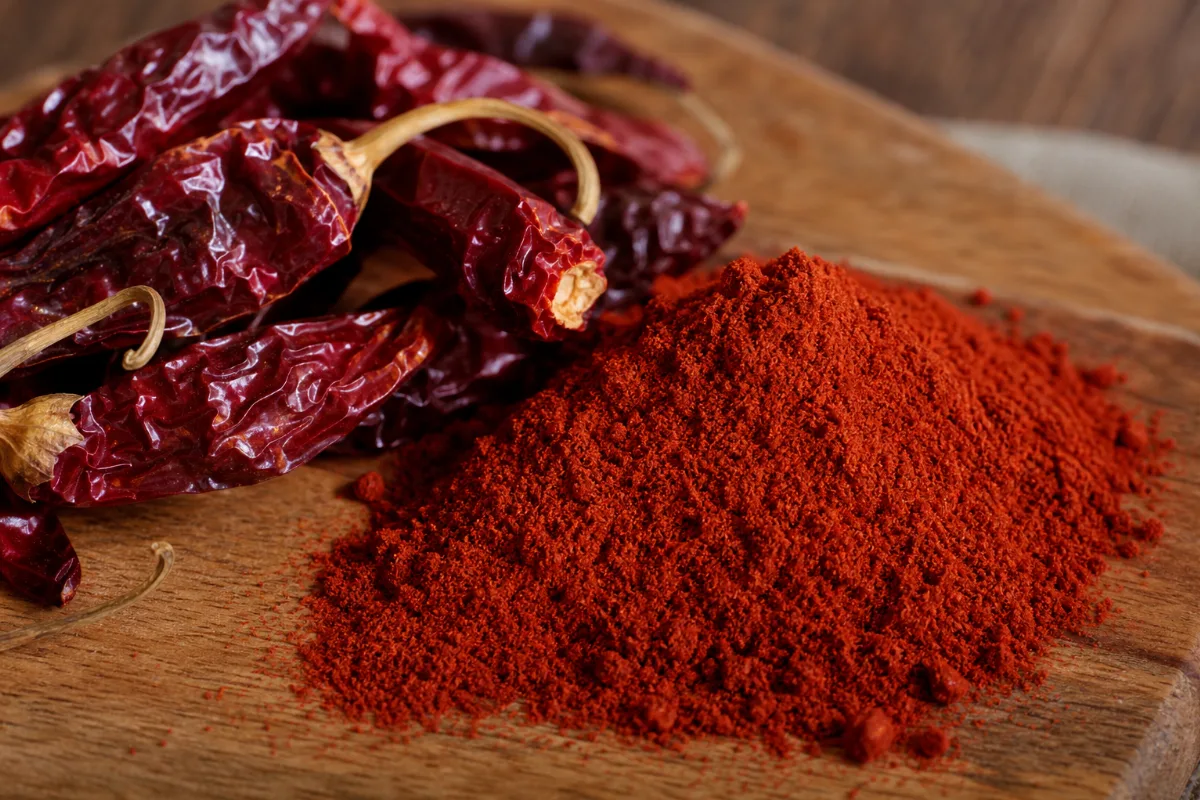
Spices · Spice
Smoked paprika (pimentón)
Capsicum annuum · also called pimentón, pimentón de la Vera, pimentón ahumado, Spanish smoked paprika
Smoked paprika is ground red pepper dried over a wood fire, which gives it a smoky, mildly sweet taste. Almost no research has looked at it as a food: the only health-marker study found was in rats. The main caution is that smoke leaves PAH residues, which vary a lot between powders, though a Spanish survey found the amount most people eat adds little to their total intake. Allergy is possible.
General information, not medical advice. Last substantive update · Not medically reviewed. A named clinician has not signed off on this page. How this page is made
About Smoked paprika (pimentón)
Smoked paprika is a flavoring, not a remedy. It is red pepper dried over a wood fire and ground. Health research on it is almost empty, and the main safety point is smoke residues (PAHs), which differ a lot between powders.
What it is
Smoked paprika is the dried, ground ripe fruit of red peppers, Capsicum annuum, in the nightshade family. The peppers are dried over a wood fire. The best-known type is Spanish Pimentón de la Vera, a protected name for paprika from the La Vera area, dried over oak or holm oak fires.
It comes as dulce (mild), agridulce (mildly spicy) and picante (hot). One cooking reference says the hot type uses cascabel chiles; we did not confirm that elsewhere.
In the kitchen
A cooking reference describes a dusky, smoky taste and says to use it sparingly because the flavor is strong. Most Spanish pimentón goes to chorizo makers; the rest is sold in small tins. It is also used in paella and sofrito, stews, rice and rubs.
If you have none, the same reference suggests plain paprika with a little ground chipotle chile.
Nutrition in a typical portion
USDA has no entry for smoked paprika, so these figures are for plain paprika. One teaspoon (2.3 g) gives about 6.5 kcal, 0.8 g fiber, 0.5 mg iron, 52 mg potassium, 57 micrograms vitamin A (RAE) and 0.7 mg vitamin E, worked out from the USDA values per 100 g. These are small amounts, so it is a flavoring and not a meaningful source of nutrients. USDA data are from 2018 and real products vary.
What the research shows
No trial or cohort in people has tested smoked paprika for any health outcome. The only health-marker study found fed healthy rats 5% smoked paprika for 30 days and saw normal values, with lower cholesterol in females only.
Most of what is known concerns the powder itself: lab measurements of smoke residues, a survey of how much Spanish people eat (139 g a year on average) and tests of mould and mixing.
Buying and storing
The protected Pimentón de la Vera name sets the drying method and a 14% moisture limit, and allows up to 3% sunflower oil. It does not set a PAH level. Smoke-flavored paprika is made differently and was measured as its own group in one study. Lab tests can detect mixing with paprika from other pepper varieties, but we found no survey of how common this is.
At a glance
Traditional uses history, not proof
- Cooking: Spanish chorizo, paella, sofrito, stews, rice and rubs
- No traditional medicine use was found in the sources read
Studied for research
- Cholesterol and antioxidant markers: insufficient, rats only
- Gut bacteria and diet markers: insufficient, rats only
- Blood sugar, blood pressure, weight, heart disease: no study found
Main compounds
- Benzo[a]pyrene and other PAHs (smoke residues, not part of the pepper)
- Wood-smoke phenolics (tentative, rat urine)
Common forms
- Pimentón de la Vera (dulce, agridulce, picante)
- Other smoked paprika
- Smoke-flavored paprika (made differently)
Research links: Spanish survey of smoked paprika use and PAH intake (2021) · Rat study of smoked and non-smoked paprika (2026) · Foods and Wines from Spain: Pimentón de la Vera PDO · USDA FoodData Central: paprika · Research Library · Genes & Biomarkers Library
What it is and its history
- Accepted scientific name
- Capsicum annuum
- Naming authority
- L. (GBIF accepted)
- Common names
- Smoked paprika (English); Pimenton (Spanish); Pimenton de la Vera (Spanish); Pimenton ahumado (Spanish); Spanish smoked paprika (English)
- Family or group
- Solanaceae (the nightshade family), per GBIF.
- Classification
- Plantae > Tracheophyta > Magnoliopsida > Solanales > Solanaceae > Capsicum > Capsicum annuum
- Native range
- Not verified from a source read.
- Habitat
- Not verified from a source read.
- What it looks like
- Roots: Not verified.; Stems: Not verified.; Leaves: Not verified.; Flowers: Not verified.; Fruit: The part used is the ripe red fruit, dried over wood smoke and ground (trade page).
- Cultivation
- The trade page says seedbeds are prepared from late February to early April and plantlets go out between about 15 May and 10 June. A cooking reference says peppers are picked in October.
- Harvest and processing
- Picked ripe and hand-harvested, then dried in on-farm chambers with smoke rising from a fire below for 10 to 15 days, taking moisture from about 80% to under 15%, then ground (trade page). The cooking reference adds that most is sold in bulk to chorizo makers.
- Look-alikes and adulterants
- Name: Plain (non-smoked) paprika; Note: Same plant, dried without smoke; PAH levels in the lab study were far lower.; Name: Smoke-flavored paprika; Note: Made differently from oak-dried paprika; tested as its own group in one study.; Name: Chipotle; Note: A smoked jalapeno chile, a different pepper; one cooking reference suggests paprika plus a little ground chipotle as a stand-in.
- Sustainability and conservation
- Not assessed.
Photographs
Traditional use and history history, not clinical proof
| Tradition or era | Documented use | Source |
|---|---|---|
Traditional use shows how it was used. It does not show that it works or is safe today.
What is inside, and how it may work
What it contains and how those compounds act in cells and animals. Laboratory and animal mechanisms are not proven effects in people.
Main compounds
| Compound | Family | Where it is concentrated | Activity studied | Level of evidence |
|---|---|---|---|---|
| Benzo[a]pyrene (a PAH formed by wood smoke) PubChem 2336 | polycyclic aromatic hydrocarbon | Smoke residue on the dried fruit, not made by the plant 5.8 to 97 micrograms per kg in 8 smoked Hungarian-study samples; up to 6.3 in 4 non-smoked samples | A marker of smoke contamination in food; levels vary by dryer and batch. 9 13 | Human exposure estimate |
| Wood-smoke phenolics (not named in the abstract) | phenolics | Smoke residue Not given | Tentatively matched to urine signals in rats given smoked paprika. 1 | Animal research |
Mechanisms, receptors and pathways
| Target or pathway | Gene or receptor | What was found | Level |
|---|---|---|---|
| Smoke deposition on drying peppers | Smoke from the fire adds PAHs to the dried fruit; a dryer with a closed chamber and fan lowered PAH levels in one study. 15 9 | Laboratory | |
| Gut bacteria and fat handling (rats) | In female rats on smoked paprika, higher gut bacterial diversity went along with lower total and LDL cholesterol; the authors call it a possible link only. 1 | Animal research |
Absorption, metabolism and elimination
- Absorption
- Not found for the spice as food. Rat urine showed signals tentatively matched to smoke phenolics.
- Distribution
- Not found.
- Metabolism
- Not found.
- Elimination
- Not found.
- Bioavailability
- Not established.
Isolated compounds versus whole extracts
Everything above is about the whole smoked spice. No isolated compound from smoked paprika was tested in people, and PAHs are residues from smoke, not part of the pepper.
Nutritional composition
Nutrition from USDA FoodData Central, SR Legacy (April 2018): "Spices, paprika" (FDC 171329), plain paprika, because USDA has no separate smoked paprika entry; read 2026-10-26 from the copy of the USDA data kept in the project. Per 100 g: 282 kcal, 14.1 g protein, 12.9 g fat, 54.0 g carbohydrate, 34.9 g fiber, 229 mg calcium, 21.1 mg iron, 178 mg magnesium, 2280 mg potassium, 68 mg sodium, 2460 micrograms vitamin A (RAE), 29.1 mg vitamin E, 80.3 micrograms vitamin K. USDA household portions: 1 teaspoon = 2.3 g and 1 tablespoon = 6.8 g. One teaspoon (2.3 g), worked out from the per-100 g values: about 6.5 kcal, 0.8 g fiber, 5 mg calcium, 0.5 mg iron, 52 mg potassium, 57 micrograms vitamin A (RAE), 0.7 mg vitamin E and 1.8 micrograms vitamin K. These are small amounts, so smoked paprika is a flavoring, not a meaningful source of nutrients. Smoking may change the values; no data were found. Real products vary.
2 not enough evidence
What was looked at
The 2 benefits and uses checked for Smoked paprika (pimentón), each with how strong the evidence is. Tap one to open it.
What is Smoked paprika (pimentón) good for?
There is very little research. Both entries below come from one study in healthy rats, so neither tells us anything about people.
Benefits, one by one
Each card is a research question, not a promise. Tap a goal to filter. Open a card to see the studies, doses and limits.
Cholesterol and antioxidant markers (rats only)
Not enough evidenceIn healthy rats fed smoked paprika for 30 days, blood values stayed in the normal range. Lower cholesterol showed up only in females given smoked paprika. This is animal work and says nothing yet about people.
1 studiesSmoked paprika (PDO Pimenton de la Vera) mixed into rat feed at 5% of…
Studies, doses and limits
Results
Rats on a 5% smoked paprika diet for 30 days: no organ changes; hematocrit, glucose, total antioxidant capacity and blood fats differed by diet and sex but stayed in the normal range. Lower total and LDL cholesterol in females given smoked paprika.
Effect sizes as reported
No numbers given in the abstract.
Why this rating
One rat study, one dose, small groups split by sex. No human study of smoked paprika for cholesterol or antioxidants was found.
Form and dose studied
Smoked paprika (PDO Pimenton de la Vera) mixed into rat feed at 5% of the diet. This is a share of rat feed, not a food amount for people.
Who was studied
Healthy Wistar rats.
Limits
Animal work only. The same study found no health problems, but it was not designed to test safety of the PAH residues over a lifetime.
Why researchers looked
Smoking changes what is in paprika, so researchers compared smoked and non-smoked paprika in a healthy animal model.
Proposed mechanism Animal preliminary
Not shown. The authors suggest a possible link between gut bacteria and fat handling, but call it only a possible link.
A proposed mechanism does not show that the effect happens in people.
See the safety section for smoke residues (PAHs).
Gut bacteria and diet markers (rats only)
Not enough evidenceThe same rat study looked at gut bacteria and urine. Smoked paprika changed gut bacteria patterns, differently in males and females, and raised some smoke-related phenolic markers in urine. What this means for people is unknown.
1 studiesSmoked or non-smoked paprika at 5% of rat feed.
Studies, doses and limits
Results
Gut (cecal) bacteria changed with sex-dependent patterns after 30 days of 5% smoked or non-smoked paprika. Several urine signals tentatively annotated as phenolic conjugates were higher with smoked paprika (males only, because females gave too little urine). In females on smoked paprika, higher bacterial diversity went along with lower gut fat.
Effect sizes as reported
No numbers given in the abstract.
Why this rating
Animal work, one dose, small sex-split groups, urine data from males only, and annotations were tentative.
Form and dose studied
Smoked or non-smoked paprika at 5% of rat feed.
Who was studied
Healthy Wistar rats.
Limits
No test of whether bacteria changes help or harm. Not a human study.
Why researchers looked
Wood smoke adds plant-like phenolic compounds to paprika, and researchers wanted to know whether the body takes them in and whether gut bacteria respond.
Proposed mechanism Animal preliminary
Smoke-derived phenolics were tentatively matched to urine signals in male rats. The meaning of the gut bacteria changes is not shown.
A proposed mechanism does not show that the effect happens in people.
See the safety section.
Connections to the rest of health
How Smoked paprika (pimentón) connects to the rest of our health knowledge graph. Every link says what kind of connection it is. A safety link (for example to the liver) is a warning, not a benefit. A study that merely mentions a topic never creates a benefit link.
Explore every connection: goals, body systems, organs, symptoms, genes
A. Wellness goals
| Connected to | Kind of connection | Evidence status | Context | Studies |
|---|---|---|---|---|
| Heart Health | Not enough evidence | Cholesterol and antioxidant markers (rats only): In healthy rats fed smoked paprika for 30 days, blood values stayed in the normal range. Lower cholesterol showed up only in females given smoked paprika. This is animal work and says nothing yet about people. | 1 | |
| Gut Digestive Health | Not enough evidence | Gut bacteria and diet markers (rats only): The same rat study looked at gut bacteria and urine. Smoked paprika changed gut bacteria patterns, differently in males and females, and raised some smoke-related phenolic markers in urine. What this means for people is unknown. | 1 |
B. Body systems
| Connected to | Kind of connection | Evidence status | Context | Studies |
|---|---|---|---|---|
| Immune system | Adverse effect or risk | Documented risk | A case report describes anaphylaxis after eating paprika, in a spice seller who tolerated other nightshades. A case report describes anaphylaxis after eating paprika. Preparation or compound: Paprika |
7 |
| Cardiovascular System | Biological association | Not enough evidence | Studied for: Cholesterol and antioxidant markers (rats only) | 1 |
| Digestive System | Biological association | Not enough evidence | Studied for: Gut bacteria and diet markers (rats only) | 1 |
G. Root causes and contributing factors
| Connected to | Kind of connection | Evidence status | Context | Studies |
|---|---|---|---|---|
| Environmental toxins | Adverse effect or risk | Documented risk | Smoke drying leaves PAH residues, and levels vary widely between samples. Preparation or compound: Smoke-dried paprika powder |
9 3 |
L. Active compounds
| Connected to | Kind of connection | Evidence status | Context | Studies |
|---|---|---|---|---|
| Benzo[a]pyrene (a PAH formed by wood smoke) | Biological association | Human exposure estimate | A marker of smoke contamination in food; levels vary by dryer and batch. Preparation or compound: Smoke residue on the dried fruit, not made by the plant |
9 13 |
| Wood-smoke phenolics (not named in the abstract) | Biological association | Animal | Tentatively matched to urine signals in rats given smoked paprika. Preparation or compound: Smoke residue |
1 |
Each connection is stored with the ingredient, the connected record, the kind of connection, the evidence status, the supporting studies, the preparation or compound involved, and a review date (last reviewed October 26, 2026).
Evidence at a glance: what the research found for 2 outcomes
Each outcome below is one thing researchers measured. Certainty is how far the evidence can be trusted, not how well it works. The full studies are on the next tab.
The evidence
The research centre for Smoked paprika (pimentón). Every record here was checked against PubMed or the publisher's page; we never list a study we have not verified.
Evidence by outcome
Bars show how many studies we found for each outcome, not how well it works. People are added up across trials only (reviews are not added, to avoid double counting).
How we rate evidence
High certainty
Several well-run trials or reviews agree; further research is unlikely to change the picture much.
Moderate certainty
Good trials point the same way, but some doubt remains.
Low certainty
Small, short or inconsistent trials. The finding could change with better research.
Very low certainty
Very little or very weak human data. Treat as a possibility only.
Mixed findings
Trials or reviews disagree with each other.
Not enough evidence
Not enough human research to say either way.
Evidence against
Good research found no benefit, or found harm.
We take the reviewers' own risk-of-bias and GRADE statements where they exist, and otherwise judge from study size, design, consistency, directness and whether a product matches what is sold. Many publications do not make evidence high. Method note: We started from our existing smoked paprika summary, re-opened its sources, re-checked nutrition at USDA FoodData Central values kept in the project, and read PubMed abstracts for each study plus the full text of the Spanish consumption paper. Two lab papers not found in PubMed were read as abstracts through Europe PMC. Items we could not verify are flagged in the research gaps.
Study library: every study we checked 15
| Study | Design | People | Product, dose, length | Result |
|---|---|---|---|---|
| Aranda 2026 Comparative dietary profiling of smoked and non-smoked paprika (Capsicum annuum L.) in Wistar rats Food & Function · PMID 42895087 · DOI |
Animal study rat |
30 Healthy Wistar rats, 16 females and 14 males, for 30 days |
Smoked or non-smoked paprika (Capsicum annuum L.; smoked type made as PDO Pimenton de la Vera) mixed into the diet at 5% fruit (ground) 5% of the diet 30 days · vs Control diet and non-smoked paprika diet |
No treatment-related changes in the organs examined. Blood values (hematocrit, glucose, total antioxidant capacity, blood fats) differed by diet and sex but all stayed in the normal range. Several urine signals tentatively annotated as phenolic conjugates were higher with smoked paprika. In females given smoked paprika, total and LDL cholesterol were lower, gut bacterial diversity was higher and the gut fat content was lower. Methods, limits and fundingOutcomes: Organ tissue, blood counts and chemistry, urine metabolites (males only), gut (cecal) bacteria Limitations: Rats, not people. Only one dose. Small groups split by sex. Urine work was in males only. The authors link cholesterol and gut bacteria only as a possible link. Funding and conflicts: No conflict statement or funding found in the abstract record; funding not checked in the full text. Read: abstract |
| Casquete 2017 Occurrence of Toxigenic Fungi and Mycotoxins during Smoked Paprika Production Journal of Food Protection · PMID 29154716 · DOI |
Laboratory study lab (microbiology) |
Dried peppers from six traditional La Vera dryers (four producers) | Smoke-dried peppers before milling fruit Storage tests of 30 days at 20 C · vs Different humidity levels |
Moulds were found in all dryers, including aflatoxin-producing species, but mycotoxins were not detected in the dried peppers sampled. In storage tests with added toxic moulds, penicillic acid appeared at 91 to 97% humidity and aflatoxins B1, B2 and G2 at 91 to 97% humidity. The authors advise controlling drying and storage so the peppers do not take up water again before milling. Methods, limits and fundingOutcomes: Mould, mould toxins (mycotoxins) and moisture Limitations: Six dryers only. The lab storage tests used added mould at very high humidity. It does not say how often finished powder on shop shelves holds mycotoxins. Funding and conflicts: No conflicts declared in the record; funding not checked. Read: abstract |
| Coleto 2021 An Approach to the Consumption of Smoked Paprika in Spain and its Impact on the Intake of Polycyclic Aromatic Hydrocarbons Foods · PMID 33946691 · DOI |
Survey / exposure estimate human (survey) |
Spanish food companies, households and restaurants (questionnaires) | Smoked paprika (Pimenton de la Vera PDO) eaten as food fruit (ground) Average 139 g per person per year Yearly intake estimate · vs Reference toxicity levels used by the authors |
Average use in Spain was 139 g per person per year. The authors judged PAH intake from smoked paprika to be a negligible fraction of total PAH intake, far behind other foods. The full text cites an earlier study with an average benzo[a]pyrene level of 104 micrograms per kg in Pimenton de la Vera. The paper says EU limits for herbs and spices are 10 micrograms per kg benzo[a]pyrene and 50 micrograms per kg for four PAHs combined, and that spice made from smoked Capsicum fruit is exempt because it is eaten in small amounts. Methods, limits and fundingOutcomes: How much smoked paprika people eat; PAH intake from it Limitations: An estimate from questionnaires, not a study of health outcomes. The 104 figure is quoted from another study. Authors work on the traditional product and their conclusion supports it. We did not open the EU regulation itself. Funding and conflicts: Authors declare no conflicts of interest. Funding not checked. Read: abstract and full text (Europe PMC) |
| Fuertes-Martinez 2024 Influence of Smoking and Paprika Spice on the Content of Polycyclic Aromatic Hydrocarbons (PAHs) in the Traditional Spanish Smoked Sausage Botillo del Bierzo Foods · PMID 39767030 · DOI |
Laboratory analysis lab (chemistry) |
Botillo del Bierzo smoked sausage made with four kinds of paprika | Sausage made with smoked, low-smoked, mixed or unsmoked paprika 24 h smoking of the sausage · vs Different paprika types |
The paprika used contributed to the sausage PAH content, and the type of paprika made a significant difference. Smoking the sausage itself for 24 hours added very little. Paprika with lower PAH content (unsmoked or mixed) still met the product origin rules. Sausage levels were well below the limits of 5 micrograms per kg benzo[a]pyrene and 30 micrograms per kg PAH4. Methods, limits and fundingOutcomes: PAH4 (four PAHs added together) and benzo[a]pyrene in the sausage Limitations: One sausage type. Not a study of people or of paprika eaten alone. Funding and conflicts: No conflicts declared. Regional research project (LESSCON). Read: abstract |
| Hernandez 2006 Detection of smoked paprika "Pimenton de La Vera" adulteration by free zone capillary electrophoresis (FZCE) Journal of Agricultural and Food Chemistry · PMID 16756339 · DOI |
Laboratory method lab (chemistry) |
Paprika from two local pepper varieties and one outside variety (Papri Queen) | Smoked paprika mixed with paprika from a pepper variety foreign to La Vera fruit (ground) 5 to 80% mixtures · vs Pure local paprika |
A protein test could detect mixing with the foreign variety at about 5 to 10% (weight) in the best marker. Methods, limits and fundingOutcomes: Whether protein patterns can detect mixing Limitations: Shows a test exists. It does not say how common mixing is in shops. Funding and conflicts: Research support from a non-US government source; no conflicts stated. Read: abstract |
| Lami 2023 Exploring Consumer Perceptions and Changing Consumption Patterns for Smoked Paprika: Implications for Traditional Food Products in Spain Foods · PMID 37509899 · DOI |
Consumer survey human (survey) |
Representative sample of Spanish consumers | Paprika, with Pimenton de la Vera the best-known version fruit (ground) Average 154.5 g per person per year |
Average paprika use was 154.5 g per person per year. Views were generally positive, less so among young people and big-city residents. Pimenton de la Vera PDO was the best-known type. Methods, limits and fundingOutcomes: Perceptions and how much paprika people use Limitations: A survey of attitudes and habits. The abstract does not separate smoked from other paprika in the 154.5 g figure. Funding and conflicts: Authors declare no conflict of interest; funders had no role in the design or reporting. Read: abstract |
| Vega de la Osada 1998 Sensitization to paprika: anaphylaxis after intake and rhinoconjunctivitis after contact through airways Medicina Clinica (Barcelona) · PMID 9789242 |
Case report human (case report) |
1 One woman who sold spices and condiments |
Paprika (type not stated in the abstract; Spanish article) fruit (ground) · vs Other nightshade foods |
The woman had anaphylaxis after eating paprika and nose and eye symptoms from handling spices at work. She tolerated other nightshade foods. Skin tests and blood tests were positive. The authors concluded the trigger in paprika was not shared with the other nightshades she was tested with. Methods, limits and fundingOutcomes: Allergy tests Limitations: A single case. The abstract does not say whether the paprika was smoked. Funding and conflicts: None stated. Read: abstract |
| de Oliveira 2025 Green microextraction and GC x GC/MS quantification of PAHs and derivatives in roasted/smoked spices and dry herbs: implications for food safety Food Chemistry · PMID 41061615 · DOI |
Laboratory method with risk modelling lab (chemistry) |
Commercial roasted and smoked spices and dry herbs (number of samples not given in the abstract) | Commercial smoked spices including smoked paprika, black pepper and smoke powder Modelled from how often the spice is eaten Lifetime cancer risk model · vs Accepted risk thresholds |
Most commercial samples had toxicologically acceptable PAH levels, but total risk depended on how often the spice is eaten. Smoke powder was a high-risk product (modelled lifetime cancer risk 1.07 x 10⁻⁴). Smoked paprika and black pepper were also flagged as needing monitoring. Methods, limits and fundingOutcomes: PAH levels and modelled cancer risk Limitations: A model, not a study of people. The abstract does not say how many smoked paprika samples were tested or how they scored. Funding and conflicts: Public research grants (Brazil). Authors declare no competing interests beyond those grants. Read: abstract |
| s-berki-2020 Berki M, Daood HG, Adanyi N, Tomosközi-Farkas R. Polycyclic aromatic hydrocarbons in smoked and non-smoked paprika samples. Journal of Food Processing and Preservation, 2020 · Source |
Laboratory analysis n/a (lab) |
Methods, limits and fundingRead: abstract (Europe PMC) | ||
| s-cooksinfo CooksInfo: Pimenton de la Vera · Source |
Cooking reference n/a |
Methods, limits and fundingRead: full-text | ||
| s-fws-pimenton Foods and Wines from Spain: Pimenton de la Vera PDO · Source |
Trade promotion page n/a |
Methods, limits and fundingRead: full-text | ||
| s-gbif-capsicum-annuum GBIF Backbone: Capsicum annuum L. (usageKey 2932944) · Source |
Reference database n/a |
Methods, limits and fundingRead: full-text | ||
| s-pubchem-bap PubChem: Benzo[a]pyrene (CID 2336) · Source |
Reference database n/a |
Methods, limits and fundingRead: full-text | ||
| s-usda-171329 USDA FoodData Central, SR Legacy (April 2018): Spices, paprika (FDC 171329) · Source |
Reference database n/a |
Methods, limits and fundingRead: full-text | ||
| s-velazquez-2022 Velazquez R, Cordoba MG, Hernandez A, et al. Effects of use of modified traditional driers in making smoked paprika "Pimenton de La Vera", on pepper quality and mitigation of PAH contamination. Journal of Food Composition and Analysis, 2022 · Source |
Laboratory study n/a (lab) |
Methods, limits and fundingRead: abstract (Europe PMC) |
What we do not know yet
- No human trial or cohort tested smoked paprika for any health outcome.
- The only health-marker study is in healthy rats at 5% of the diet.
- PAH measurements come from small samples in Hungary and Spain and may not match other brands.
- The EU contaminant limits were read second-hand only.
- No official statement on pregnancy, breastfeeding, children or medicines was located.
- Plant description, native range and history were not verified from primary sources.
How new research is added
New studies are found by a saved PubMed search and placed in a review queue before the page changes.
Lab markers
What changed in blood or saliva tests during trials. A changed number is not the same as feeling or being healthier, and we give no "normal ranges".
Safety
What studies and official sources say about side effects, medicines and who should check first. Each point shows what kind of evidence it comes from.
Main points to know 5
- Smoke leaves PAHs in the powder, and levels vary a lot. Drying peppers over wood smoke leaves polycyclic aromatic hydrocarbons (PAHs), a group of chemicals formed when wood burns. Benzo[a]pyrene, one well-studied PAH, ranged from below the detection limit to 6.3 micrograms per kg in non-smoked paprika and from 5.8 to 97 in smoked samples in one lab study of 15 Hungarian and imported samples. A Spanish paper cites an average of 104 micrograms per kg in Pimenton de la Vera. Levels depend on the dryer and the season. Laboratory analysis 9 3 15
- For the amounts people eat, the PAH share looks small, but a model says keep watching. A Spanish survey found average use of 139 g of smoked paprika per person per year and judged the PAH intake from it a negligible fraction of total PAH intake, far behind other foods. A 2025 lab-and-model study found most commercial smoked spices acceptable but named smoked paprika and black pepper as needing monitoring, because risk depends on how often the spice is eaten. These are estimates, not studies that followed people for health effects. Exposure estimate 3 8
- Allergy to paprika is possible. A case report describes a spice seller who had anaphylaxis after eating paprika and nose and eye symptoms from handling spices at work, yet tolerated other nightshade foods. One case cannot show how common this is. The abstract does not say whether the paprika was smoked. Case report 7
- Damp storage can allow mould and mould toxins. In six traditional La Vera dryers, moulds were found in the dried peppers, including aflatoxin-producing species, but mycotoxins were not detected in the peppers sampled. In lab storage tests at 91 to 97% humidity, aflatoxins and penicillic acid formed. Keeping the powder dry is sensible. Laboratory analysis 2
- Culinary amounts are not the same as supplements. Everything above concerns the spice as food. We found no smoked paprika supplement or extract studied in people, so nothing is known about concentrated forms. Gap 1
Side effects 1
| Effect | How often | Severity and recovery | Evidence |
|---|---|---|---|
| Allergic reaction (anaphylaxis, nose and eye symptoms) One case report in a spice seller; frequency unknown. | Not established | Can be serious Not stated | Case report 7 |
Liver
No liver injury from smoked paprika as food was found in the sources read. LiverTox was not searched for this spice. 1
How often. No frequency was found.
Monitoring. No monitoring advice was found.
This is a safety connection. It is not evidence that Smoked paprika (pimentón) supports liver health.
Medicines and supplements 1
| With | Why it matters | Importance | Evidence | What to do |
|---|---|---|---|---|
| Medicines in general prescription | No interaction between smoked paprika as food and any medicine was found. The absence of reports is not proof that there is none. | Gap Not enough evidence 1 | If you take medicines and use concentrated pepper products, ask a pharmacist. |
Who should check first 1
| Situation | Advice | Evidence |
|---|---|---|
| Known allergy to paprika or pepper | Avoid it. Ask an allergy doctor about related foods. | Case report 7 |
Overdose, product quality and regulators
Summary. The sources read give no amount of the spice that causes harm. The main concern raised by authors is long-term exposure to PAH residues, estimated rather than measured in people.
Animal. In healthy rats on 5% smoked paprika for 30 days, no treatment-related organ changes were seen (one small study).
Human doses studied. Not given here.
Overdose response. Not found.
Genotoxicity. Benzo[a]pyrene is a well-known PAH. We did not open a source that classifies it, so no classification is stated here.
Smoke-dried paprika carries PAH residues that vary between brands and batches; damp storage can lead to mould. Mixing with other pepper types is possible, and lab tests to detect it exist.
PAHs in the powder. Benzo[a]pyrene 5.8 to 97 micrograms per kg in smoked samples versus up to 6.3 in non-smoked; smoke-flavored samples were 6.3 to 7.0 (15 samples in all). 9
PAHs vary with how it is dried. PAH4 in dried peppers ranged 277 to 1208 micrograms per kg between seasons; a closed-chamber dryer with a fan lowered PAHs. In a smoked sausage, using paprika with less PAH kept the sausage within its limits. 15 4
Mould and mycotoxins. Mycotoxins not found in dried peppers from six dryers; they formed in lab storage at high humidity. 2
Mixing with other pepper types. A protein test can detect 5 to 10% mixing with a foreign variety. We found no survey of how common it is. 5
| Body | Action | Date |
|---|---|---|
| European Union (protected designation of origin) (European Union) | Pimenton de la Vera is a protected name: peppers from the La Vera area, dried over oak or holm oak fires, maximum 14% moisture, sunflower oil up to 3% allowed. source |
When to get medical help
- Trouble breathing, swelling of the lips, face or throat, widespread hives, or fainting after eating it: call emergency services.
- Itchy mouth, hives or stomach upset after eating it: stop and see a doctor.
Stop using the product and contact a clinician or emergency service. In the US, Poison Control is 1-800-222-1222.
General information only, not medical advice. Ask a clinician or pharmacist before use, especially with medicines, in pregnancy or with a health condition. See the Natural Remedy Safety guide.
Frequently asked questions
Is smoked paprika hot?
Not usually. Spanish pimenton comes in three levels: dulce (mild), agridulce (mildly spicy) and picante (hot). Check the label.
How is it different from regular paprika?
The peppers are dried over a wood fire instead of in the sun or in a dryer, which gives a smoky taste. The smoke also leaves PAH residues, which were much higher in smoked samples in one lab study (benzo[a]pyrene 5.8 to 97 micrograms per kg versus up to 6.3 in non-smoked).
Is smoked paprika bad for me because of the smoke?
Smoking leaves PAHs, and levels vary widely. A Spanish survey judged the PAH intake from normal use to be a negligible fraction of the total, far behind other foods. A 2025 model said smoked paprika should still be watched, because risk depends on how often it is eaten. None of this is a study of people's health.
Why do PAH levels differ so much between powders?
Levels depended on the dryer and the season in a Spanish study, and a closed-chamber dryer with a fan lowered them. Brands rarely print a PAH figure, so you cannot check this at home.
Is it healthier than plain paprika?
We found no human study that compares them. The only study found was in healthy rats, where smoked paprika was linked to lower cholesterol in females only.
Can smoked paprika lower cholesterol or blood sugar?
No human study has tested this. The only evidence is a 30-day rat study at 5% of the diet, which is animal work and not a basis for any health claim.
Is it safe in pregnancy or breastfeeding?
The sources we read give no warning and no clear statement for food amounts. Ask your midwife or doctor if you are unsure.
Can I use it with my medicines?
We found no reported interaction for smoked paprika as food, which is not proof there is none. If you also use concentrated pepper products, ask a pharmacist.
Can I be allergic to it?
Yes, paprika allergy is described. One case report is a spice seller who had anaphylaxis after eating paprika yet tolerated other nightshade foods. See the Safety tab for emergency signs.
Can it go mouldy?
Peppers can grow mould while drying and storing. In a Spanish study of six dryers, mycotoxins were not found in the dried peppers, but they formed in lab tests at high humidity. Keeping the powder dry is sensible.
What does Pimenton de la Vera on the label mean?
It is a protected name for paprika from the La Vera area of Extremadura, Spain, dried over oak or holm oak fires, with a 14% moisture limit. It does not guarantee a PAH level.
What can I use instead?
One cooking reference suggests plain paprika with a little ground chipotle chile. The smoke will be different from oak-dried pimenton.
Explore by health goal
Editorial transparency
- Written by
- AlternativeMed editorial team. Research compiled with AI assistance, then checked against the sources listed.
- Medical review
- None. This page has not been reviewed by a physician or pharmacist.
- First published
- 2026-10-26
- Last substantive update
- 2026-10-26
- How we research
- We started from our existing smoked paprika summary, re-opened its sources, re-checked nutrition at USDA FoodData Central values kept in the project, and read PubMed abstracts for each study plus the full text of the Spanish consumption paper. Two lab papers not found in PubMed were read as abstracts through Europe PMC. Items we could not verify are flagged in the research gaps.
- How we rate evidence
- See "How we rate evidence" in the Evidence tab.
- Independence
- No product is promoted on this page. No affiliate links are shown.
Sources 15
Each source was opened and checked. Where we read only the abstract, it says so. The small numbers in the text point here.
- Aranda M, Pariente JA, Terron MP, Gonzalez-Flores D, Aranda E, Ruiz-Moyano S, Velazquez R, Martin A. Comparative dietary profiling of smoked and non-smoked paprika (Capsicum annuum L.) in Wistar rats. Food & Function. 2026. PMID 42895087. DOI 10.1039/d6fo03991j. (abstract)
- Casquete R, Rodriguez A, Hernandez A, Martin A, Bartolome T, Cordoba JJ, Cordoba MG. Occurrence of Toxigenic Fungi and Mycotoxins during Smoked Paprika Production. Journal of Food Protection. 2017. PMID 29154716. DOI 10.4315/0362-028X.JFP-17-164. (abstract)
- Coleto JM, Martin A, Horrillo A, Mesias FJ, Velazquez R. An Approach to the Consumption of Smoked Paprika in Spain and its Impact on the Intake of Polycyclic Aromatic Hydrocarbons. Foods. 2021. PMID 33946691. DOI 10.3390/foods10050973. (abstract and full text (Europe PMC))
- Fuertes-Martinez JR, Guerra M, Rodriguez-Gonzalez A, Del Valle-Herrero H, Valenciano JB, Marcelo V. Influence of Smoking and Paprika Spice on the Content of Polycyclic Aromatic Hydrocarbons (PAHs) in the Traditional Spanish Smoked Sausage Botillo del Bierzo. Foods. 2024. PMID 39767030. DOI 10.3390/foods13244089. (abstract)
- Hernandez A, Martin A, Aranda E, Bartolome T, Cordoba Mde G. Detection of smoked paprika "Pimenton de La Vera" adulteration by free zone capillary electrophoresis (FZCE). Journal of Agricultural and Food Chemistry. 2006. PMID 16756339. DOI 10.1021/jf060349r. (abstract)
- Lami O, Sama-Berrocal C, Martin A, Mesias FJ, Velazquez R. Exploring Consumer Perceptions and Changing Consumption Patterns for Smoked Paprika: Implications for Traditional Food Products in Spain. Foods. 2023. PMID 37509899. DOI 10.3390/foods12142808. (abstract)
- Vega de la Osada F, Esteve Krauel P, Alonso Lebrero E, Ibanez Sandin MD, Munoz Martinez MC, Laso Borrego MT. Sensitization to paprika: anaphylaxis after intake and rhinoconjunctivitis after contact through airways. Medicina Clinica (Barcelona). 1998. PMID 9789242. (abstract)
- de Oliveira JB, Menezes HC, de Souza PP, de Lourdes Cardeal Z. Green microextraction and GC x GC/MS quantification of PAHs and derivatives in roasted/smoked spices and dry herbs: implications for food safety. Food Chemistry. 2025. PMID 41061615. DOI 10.1016/j.foodchem.2025.146655. (abstract)
- . Berki M, Daood HG, Adanyi N, Tomosközi-Farkas R. Polycyclic aromatic hydrocarbons in smoked and non-smoked paprika samples. Journal of Food Processing and Preservation, 2020. . . (abstract (Europe PMC))
- . CooksInfo: Pimenton de la Vera. . . (full-text)
- . Foods and Wines from Spain: Pimenton de la Vera PDO. . . (full-text)
- . GBIF Backbone: Capsicum annuum L. (usageKey 2932944). . . (full-text)
- . PubChem: Benzo[a]pyrene (CID 2336). . . (full-text)
- . USDA FoodData Central, SR Legacy (April 2018): Spices, paprika (FDC 171329). . . (full-text)
- . Velazquez R, Cordoba MG, Hernandez A, et al. Effects of use of modified traditional driers in making smoked paprika "Pimenton de La Vera", on pepper quality and mitigation of PAH contamination. Journal of Food Composition and Analysis, 2022. . . (abstract (Europe PMC))
Where to buy
Check the label first. Whatever you buy, look for these:
- Whole or ground: whole spices keep their flavor longer
- The origin and a packed-on or best-by date for freshness
- Organic or non-irradiated labeling if that matters to you
- A resealable, airtight container
Talk to a pharmacist or doctor before you start any supplement, especially if you take medicines. See the Safety tab for interactions.
Support our free guides: as an Amazon Associate we earn from qualifying purchases. Full disclosure.


