Spices · Spice
Aleppo pepper
Capsicum annuum · also called Halaby pepper, Halep biberi, Aleppo chili flakes
Aleppo pepper is a mildly hot, fruity chili sold as crushed flakes and used in Turkish, Middle Eastern and Mediterranean cooking. No study has looked at Aleppo pepper itself. Large studies of people who eat chili often link it to fewer deaths, but they cannot show chili is the cause. The main caution is burning of the gut, skin and eyes, plus allergy.
General information, not medical advice. Last substantive update · Not medically reviewed. A named clinician has not signed off on this page. How this page is made
About Aleppo pepper
Aleppo pepper is a seasoning, not a remedy. It is a mild, fruity, slightly salty chili flake used on food. Studies of chili eaters are mixed and cannot prove cause, no study looked at Aleppo pepper itself, and chili can burn the gut, skin and eyes.
What it is
Aleppo pepper, also called Halaby pepper, is a moderately hot variety of Capsicum annuum used in Turkish, Middle Eastern and Mediterranean cooking, says Wikipedia. GBIF confirms the species and its family, the nightshades.
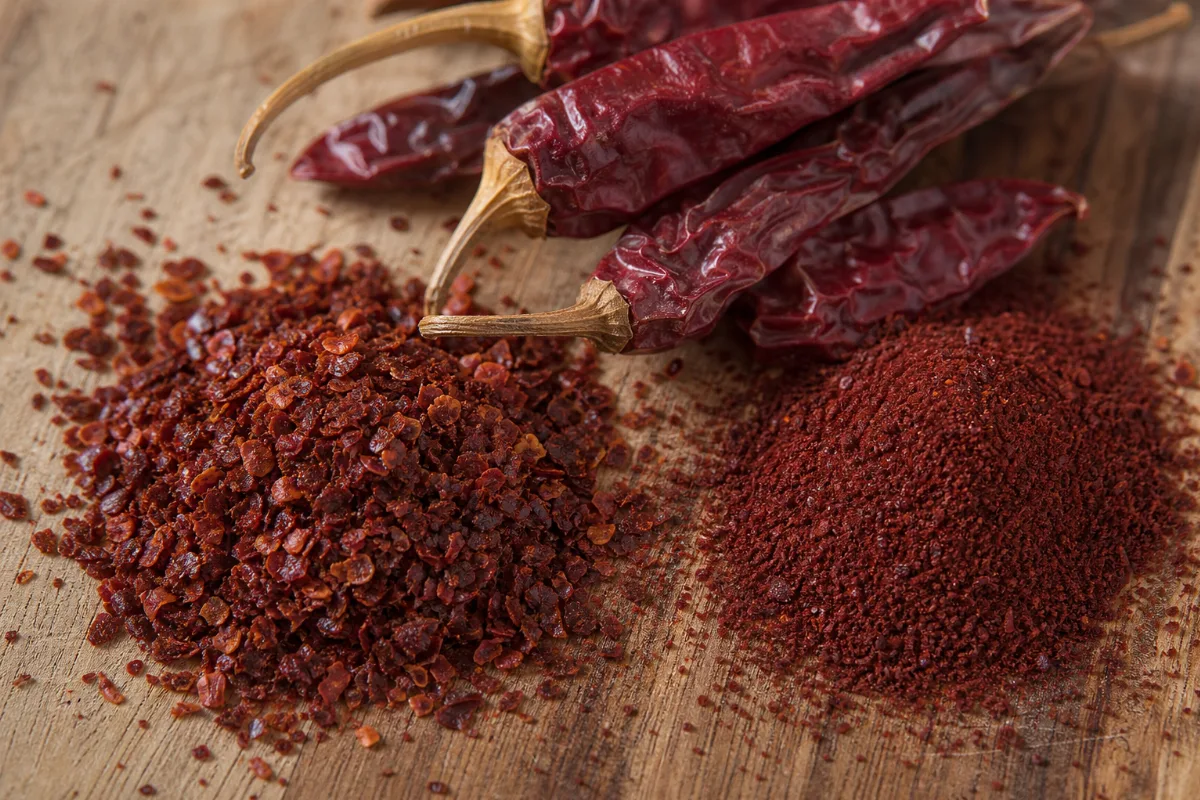
Wikipedia says it is named after the city of Aleppo in northern Syria and is grown in Syria and Turkey. The pods ripen to a deep red, are semi-dried, de-seeded and crushed or coarsely ground. In Turkish the flakes are called pul biber, a word also used for crushed chili in general. Urfa pul biber (isot) is a separate, specially prepared kind.
Flavor, heat and cooking
Wikipedia puts the heat at about 10,000 Scoville units, with heat that builds slowly. It gives crushed red pepper a typical range of 30,000 to 50,000. We did not check these figures against a primary source, and heat varies by product.
The taste is fruity and a little like raisins, with faint cumin-like notes, oilier and slightly salty. Wikipedia likens it to ancho chile. The flakes contain no seeds or inner flesh, which adds to the mildness. It is mostly sold as flakes and is a common part of meze. It can stand in for crushed red pepper or paprika; since plain crushed red pepper is usually hotter, taste before adding more.
The sources we read do not say when to add it or whether to toast it, so we give no rules here.
Nutrition
We could not give nutrition numbers for Aleppo pepper. The USDA file our earlier page used had no entry for it, and a fresh USDA lookup was blocked, so we did not re-check. Used by the pinch, a chili flake is a flavouring, not a meaningful source of nutrients.
What the research shows
We found no study of Aleppo pepper. Everything below is about chili or spicy food in general.
A US cohort of 16,179 adults and a pooling of four cohorts with 564,748 adults linked regular chili or spicy food with lower death risk (about 12 to 13 percent) and lower heart-disease death. Chili eaters may differ in other ways, so this does not show cause.
Case-control studies linked a high chili intake to higher risk of cancer of the food pipe, but not of the stomach or bowel, and the result differed by region. A review of small studies found chili can worsen burning right after a meal but may ease indigestion and reflux over time.
Food versus supplements
A pinch of flakes in a meal is very different from chili capsules or capsaicin products. The studies on blood pressure and calorie burning mostly used capsaicin products, and MSK's warnings are mainly for supplements.
Amounts
This page gives no amounts to eat. Ask a doctor, pharmacist or dietitian about supplements, especially if you take medicines.
At a glance
Traditional uses history, not proof
- Cooking: a flaky seasoning for meze, vegetables, eggs, meats and rubs
- Used as a milder stand-in for crushed red pepper or paprika
- Long use in cooking is not proof that it treats any condition
Studied for research
- Death from any cause and heart disease: low certainty, observational studies of chili in general
- Digestive-tract cancer: mixed, a possible harm signal in chili studies
- Reflux and indigestion: mixed; can make burning worse
- Appetite, weight and blood pressure: insufficient evidence
Main compounds
- Capsaicin (main source of the burn)
Common forms
- Crushed flakes (the usual form)
- Coarse or fine ground
- Whole dried pods
Research links: Memorial Sloan Kettering: Cayenne · Spicy chilli food and death: meta-analysis (2021) · Chili pepper and GI-tract cancers: meta-analysis (2022) · Wikipedia: Aleppo pepper · Research Library · Genes & Biomarkers Library
What it is and its history
- Accepted scientific name
- Capsicum annuum
- Naming authority
- L. (GBIF accepted)
- Common names
- Aleppo pepper (en); Halaby pepper (en); Halep biberi (tr); pul biber (Turkish word for chili flakes in general) (tr)
- Family or group
- Solanaceae (the nightshade family), per GBIF.
- Classification
- Plantae > Tracheophyta > Magnoliopsida > Solanales > Solanaceae > Capsicum > Capsicum annuum
- Native range
- Not verified from a source read. Wikipedia says chiles originated in South America.
- Habitat
- Not verified.
- What it looks like
- Roots: Not verified.; Stems: Not verified.; Leaves: Not verified.; Flowers: Not verified.; Fruit: Wikipedia says the pods are ripened to a burgundy colour, semi-dried, de-seeded and crushed or coarsely ground.
- Cultivation
- Wikipedia says it is grown in Syria and Turkey.
- Harvest and processing
- Wikipedia: ripened, semi-dried, de-seeded and crushed or coarsely ground; salt is often used in the drying.
- Look-alikes and adulterants
- Name: Crushed red pepper flakes; Note: Usually hotter, often with seeds; Wikipedia gives a typical range of 30,000 to 50,000 Scoville units.; Name: Urfa biber (isot); Note: A separate, specially prepared Turkish chili flake (Wikipedia).; Name: 'Aleppo-style' flakes; Note: May be made from other chilies; no source we read describes this, so check the label.
- Sustainability and conservation
- Not assessed.
Photographs
Traditional use and history history, not clinical proof
| Tradition or era | Documented use | Source |
|---|---|---|
Traditional use shows how it was used. It does not show that it works or is safe today.
What is inside, and how it may work
What it contains and how those compounds act in cells and animals. Laboratory and animal mechanisms are not proven effects in people.
Main compounds
| Compound | Family | Where it is concentrated | Activity studied | Level of evidence |
|---|---|---|---|---|
| Capsaicin PubChem 1548943 | capsaicinoid | Fruit Not given in the sources read; Aleppo pepper's capsaicin content was not found. | The compound mainly responsible for the burning feel; activates TRPV1 receptors on nerve endings (MSK; gut review). 7 3 | Human data |
Mechanisms, receptors and pathways
| Target or pathway | Gene or receptor | What was found | Level |
|---|---|---|---|
| TRPV1 receptor (heat and pain sensing) | TRPV1 | Capsaicin activates TRPV1 on tongue neurons, causing the burning feel (MSK), and on gut nerves, where it can cause burning pain (gut review). 7 3 | Human data |
Absorption, metabolism and elimination
- Absorption
- Not found for food.
- Distribution
- Not found.
- Metabolism
- Animal data suggest effects on CYP3A and P-gp (MSK).
- Elimination
- Not found.
- Bioavailability
- Not established.
Isolated compounds versus whole extracts
The death and cancer studies are about eating chili and spicy food. Capsaicin capsules and skin products are a different thing with their own cautions. No finding here is specific to Aleppo pepper.
Nutritional composition
We could not give nutrition numbers for Aleppo pepper. The existing site page said the USDA SR Legacy file has no entry for it, and a fresh lookup at USDA FoodData Central was blocked by a rate limit, so we did not re-verify it. Different chili products in the same file vary a lot, so we do not borrow numbers from cayenne or paprika. As a flavouring used by the pinch, it is not a meaningful source of nutrients.
2 mixed findings1 low certainty1 not enough evidence
What was looked at
The 4 benefits and uses checked for Aleppo pepper, each with how strong the evidence is. Tap one to open it.
What is Aleppo pepper good for?
The studied uses and how strong the human evidence is for each. All of it is about chili in general, not Aleppo pepper by name.
Benefits, one by one
Each card is a research question, not a promise. Tap a goal to filter. Open a card to see the studies, doses and limits.
Death from any cause and heart disease (people who eat chili often)
Low certaintyLarge studies that followed people over years found that regular eaters of chili or spicy food were less likely to die in the follow-up period. These studies are observational, so they cannot show that chili is the cause. None looked at Aleppo pepper by name.
2 studiesHot red chili, chili sauce or chili oil eaten as food; amounts were r…
Studies, doses and limits
What the trials found
Two human sources: a US cohort of 16,179 adults and a pooling of 4 cohorts with 564,748 adults.
Results
US cohort: death 21.6% in chili eaters versus 33.6% in non-eaters; adjusted hazard ratio 0.87. Pooled 4 cohorts of spicy food (chilli pepper, sauce or oil): 12% lower all-cause death and lower heart-disease death, with no clear difference for stroke death.
Effect sizes as reported
Hazard ratios 0.87 (95% CI 0.77 to 0.97) and 0.88 (0.86 to 0.90) for all-cause death; 0.82 (0.73 to 0.91) for cardiac death.
Why this rating
Observational studies in which chili eaters may differ in diet, income and other habits. The results point the same way in several countries, but cannot show cause. Not tested for Aleppo pepper, which is milder than most hot chilies.
Form and dose studied
Hot red chili, chili sauce or chili oil eaten as food; amounts were reported as how often, not as grams.
Who was studied
Adults in the United States, China, Italy and Iran.
Limits
Frequency came from questionnaires. Spicy food in general, not Aleppo pepper.
Why researchers looked
Chili and spicy food are eaten daily in many countries, so researchers asked whether regular eaters live longer.
Proposed mechanism Unknown
Not shown by these studies.
A proposed mechanism does not show that the effect happens in people.
See the safety section. A link in observational data does not mean more heat is safer.
Digestive-tract cancer risk (a possible harm signal)
Mixed findingsCase-control studies linked a high chili intake to a higher risk of cancer of the food pipe (esophagus), with differences between regions. These studies cannot show cause. They are included so readers see both directions.
1 studiesChili pepper eaten as food, high versus low intake.
Studies, doses and limits
What the trials found
One human systematic review of case-control studies.
Results
14 case-control studies: high chili intake linked to higher risk of GI cancers overall (OR 1.64, 95% CI 1.00 to 2.70) and esophageal cancer (OR 2.71, 1.54 to 4.75); no clear link for stomach or colorectal cancer. Higher risk in Asian, African and North American studies; lower in South American and European studies.
Effect sizes as reported
OR 1.64 (1.00 to 2.70) overall; OR 2.71 (1.54 to 4.75) esophageal.
Why this rating
Case-control studies rely on memory of past diet and cannot prove cause; the overall result just reaches the edge of significance and the direction changed between regions.
Form and dose studied
Chili pepper eaten as food, high versus low intake.
Who was studied
Adults; 5,009 GI cancers among 11,310 participants.
Limits
Chili in general, not Aleppo pepper. The reviewers did not give a safe or risky amount.
Why researchers looked
Spicy food irritates the gut lining, so researchers asked whether heavy chili eating raises cancer risk.
Proposed mechanism Unknown
Not shown.
A proposed mechanism does not show that the effect happens in people.
Possible harm signal, not proof of harm.
Reflux, indigestion and irritable bowel (mixed: can help or hurt)
Mixed findingsOne serving of chili can bring on pain and burning in people with indigestion or irritable bowel. A review says long-term chili eating eased indigestion and reflux symptoms in small trials. The effect depends on the person.
1 studiesChili or capsaicin as food.
Studies, doses and limits
What the trials found
One narrative review of small human studies.
Results
Acute chili or capsaicin can aggravate abdominal pain and burning in dyspepsia and IBS. Chronic chili eating improved functional dyspepsia and reflux symptoms in small randomized controlled studies, the review says.
Effect sizes as reported
Not given as numbers in the abstract.
Why this rating
A short narrative review that cites small trials we did not open. Acute and chronic effects point in opposite directions.
Form and dose studied
Chili or capsaicin as food.
Who was studied
People with functional gut disorders or reflux.
Limits
Review, not a systematic one; chili in general, not Aleppo pepper.
Why researchers looked
Capsaicin acts on pain-sensing nerves in the gut.
Proposed mechanism Human data
Capsaicin activates TRPV1 pain-sensing nerve fibres in the gut (human, per the review).
A proposed mechanism does not show that the effect happens in people.
If chili brings on burning or pain, it is reasonable to eat less of it and ask a doctor.
Appetite, calorie burning, weight and blood pressure
Not enough evidenceMemorial Sloan Kettering says the calorie-burning and appetite effects of capsaicin are small, and a systematic review it cites found no effect on blood pressure or heart rate. This is about capsaicin products mostly, not cooking amounts of chili flakes.
1 studiesCapsaicin products mostly; not cooking amounts.
Studies, doses and limits
What the trials found
A hospital summary of human studies (not opened).
Results
MSK summary: thermogenic and appetite effects of capsaicin are small; no impact on blood pressure or heart rate in a systematic review. We did not open those underlying studies.
Effect sizes as reported
Not given.
Why this rating
Second-hand summary from a hospital information page; supplement-level studies; nothing on Aleppo pepper or on cooking amounts.
Form and dose studied
Capsaicin products mostly; not cooking amounts.
Who was studied
Adults.
Limits
The underlying studies were not opened.
Why researchers looked
Chili's heat is linked to a small short rise in body heat and a feeling of fullness.
Proposed mechanism Human data
Capsaicin may raise body temperature slightly and change fuel use (MSK, from studies it cites).
A proposed mechanism does not show that the effect happens in people.
Capsaicin supplements are stronger than the spice and have their own cautions (see the safety section).
Connections to the rest of health
How Aleppo pepper connects to the rest of our health knowledge graph. Every link says what kind of connection it is. A safety link (for example to the liver) is a warning, not a benefit. A study that merely mentions a topic never creates a benefit link.
Explore every connection: goals, body systems, organs, symptoms, genes
A. Wellness goals
| Connected to | Kind of connection | Evidence status | Context | Studies |
|---|---|---|---|---|
| Preventive Wellness | Low certainty | Death from any cause and heart disease (people who eat chili often): Large studies that followed people over years found that regular eaters of chili or spicy food were less likely to die in the follow-up period. These studies are observational, so they cannot show that chili is the cause. None looked at Aleppo pepper by name. Digestive-tract cancer risk (a possible harm signal): Case-control studies linked a high chili intake to a higher risk of cancer of the food pipe (esophagus), with differences between regions. These studies cannot show cause. They are included so readers see both directions. | 2 5 1 | |
| Digestive Health | Mixed findings | Reflux, indigestion and irritable bowel (mixed: can help or hurt): One serving of chili can bring on pain and burning in people with indigestion or irritable bowel. A review says long-term chili eating eased indigestion and reflux symptoms in small trials. The effect depends on the person. | 3 | |
| Weight Management | Not enough evidence | Appetite, calorie burning, weight and blood pressure: Memorial Sloan Kettering says the calorie-burning and appetite effects of capsaicin are small, and a systematic review it cites found no effect on blood pressure or heart rate. This is about capsaicin products mostly, not cooking amounts of chili flakes. | 7 |
B. Body systems
| Connected to | Kind of connection | Evidence status | Context | Studies |
|---|---|---|---|---|
| Whole Body | Biological association | Low certainty | Studied for: Death from any cause and heart disease (people who eat chili often) | 2 5 |
| Digestive System | Biological association | Mixed findings | Studied for: Digestive-tract cancer risk (a possible harm signal) Studied for: Reflux, indigestion and irritable bowel (mixed: can help or hurt) | 1 3 |
| Metabolism Weight | Biological association | Not enough evidence | Studied for: Appetite, calorie burning, weight and blood pressure | 7 |
C. Body parts and organs
| Connected to | Kind of connection | Evidence status | Context | Studies |
|---|---|---|---|---|
| Stomach | Adverse effect or risk | Documented risk | MSK lists gut irritation and stomach pain; a review says chili can worsen burning in indigestion. Preparation or compound: Chili / capsaicin |
7 3 |
| Skin | Adverse effect or risk | Documented risk | MSK cites a case of skin burn after preparing a meal with red chili peppers. Preparation or compound: Fresh or dried chili on skin |
7 |
J. Genes, receptors and enzymes
| Connected to | Kind of connection | Evidence status | Context | Studies |
|---|---|---|---|---|
| TRPV1 | Preliminary mechanism | Human | The heat and pain receptor that capsaicin activates. | 7 |
L. Active compounds
Each connection is stored with the ingredient, the connected record, the kind of connection, the evidence status, the supporting studies, the preparation or compound involved, and a review date (last reviewed October 26, 2026).
Evidence at a glance: what the research found for 4 outcomes
Each outcome below is one thing researchers measured. Certainty is how far the evidence can be trusted, not how well it works. The full studies are on the next tab.
The evidence
The research centre for Aleppo pepper. Every record here was checked against PubMed or the publisher's page; we never list a study we have not verified.
Evidence by outcome
Bars show how many studies we found for each outcome, not how well it works. People are added up across trials only (reviews are not added, to avoid double counting).
How we rate evidence
High certainty
Several well-run trials or reviews agree; further research is unlikely to change the picture much.
Moderate certainty
Good trials point the same way, but some doubt remains.
Low certainty
Small, short or inconsistent trials. The finding could change with better research.
Very low certainty
Very little or very weak human data. Treat as a possibility only.
Mixed findings
Trials or reviews disagree with each other.
Not enough evidence
Not enough human research to say either way.
Evidence against
Good research found no benefit, or found harm.
We take the reviewers' own risk-of-bias and GRADE statements where they exist, and otherwise judge from study size, design, consistency, directness and whether a product matches what is sold. Many publications do not make evidence high. Method note: We started from our existing Aleppo pepper summary, re-read the Wikipedia articles and the Memorial Sloan Kettering page, checked the species at GBIF, and read the PubMed abstract of each study. Only abstracts were read for PubMed studies. This is a short page because little research exists; gaps are listed.
Study library: every study we checked 9
| Study | Design | People | Product, dose, length | Result |
|---|---|---|---|---|
| Chen 2022 Association between chili pepper consumption and risk of gastrointestinal-tract cancers: A meta-analysis. Front Nutr · PMID 36407551 · DOI |
Systematic review meta analysis |
14 case-control studies, 5,009 GI cancers among 11,310 participants | Chili pepper eaten as food fruit High versus low consumption · vs Low or no consumption |
High chili intake was linked to higher risk of GI cancers overall (OR 1.64, 95% CI 1.00 to 2.70) and esophageal cancer (OR 2.71, 1.54 to 4.75), with no significant link for stomach or colorectal cancer. Results differed by region: higher risk in Asian, African and North American studies, lower risk in South American (OR 0.50) and European (OR 0.30) studies. Methods, limits and fundingOutcomes: Risk of gastric, esophageal and colorectal cancer Limitations: Case-control studies cannot show cause and rely on memory of past diet. Chili in general. Funding and conflicts: Authors declared no commercial or financial relationships. Read: abstract |
| Chopan 2017 The Association of Hot Red Chili Pepper Consumption and Mortality: A Large Population-Based Cohort Study. PLoS One · PMID 28068423 · DOI |
Cohort study |
16179 US adults in the NHANES III survey (1988-1994), followed a median of 18.9 years |
Hot red chili pepper eaten as food (frequency by questionnaire) fruit Not a dose; eaters versus non-eaters Median follow-up 18.9 years · vs People who did not eat hot red chili |
4,946 deaths. Total death 21.6% in chili eaters versus 33.6% in non-eaters. After adjustment the hazard ratio was 0.87 (95% CI 0.77 to 0.97), a 13% lower hazard. Deaths from vascular disease showed similar but not statistically significant trends. Methods, limits and fundingOutcomes: Total and cause-specific death Limitations: Observational: chili eaters may differ in other ways. Frequency came from a questionnaire. Hot red chili in general, not Aleppo pepper. Funding and conflicts: Authors declared no competing interests. Read: abstract |
| Gonlachanvit 2010 Are rice and spicy diet good for functional gastrointestinal disorders? J Neurogastroenterol Motil · PMID 20535343 · DOI |
Narrative review |
People with functional gut disorders (indigestion, irritable bowel) and reflux, as described in a review | Chili or capsaicin as food fruit Not given in the abstract Single exposure versus chronic eating · vs Not given |
One serving of chili or capsaicin can aggravate abdominal pain and burning in people with dyspepsia or IBS. Chronic chili eating improved functional dyspepsia and reflux symptoms in small randomized controlled studies, the author says. Methods, limits and fundingOutcomes: Abdominal pain, burning, dyspepsia and reflux symptoms Limitations: A short narrative review, not a systematic one; the small trials it cites were not opened. Chili in general. Funding and conflicts: Author declared no conflicts. Read: abstract |
| Lisiecka 2026 Allergic reactions to spices: a review of sensitivities to pepper, cumin, oregano, anise, mustard and other spices. Eur Ann Allergy Clin Immunol · PMID 40341008 · DOI |
Narrative review |
Review of published reports of spice allergy | Spices including pepper fruit |
The review says spice allergies are under-recognized and that the main pepper allergens (PR-10 proteins, profilins, defensins) can cross-react with pollen and other plants. Mustard is described as one of the most allergenic spices. The abstract does not say whether pepper means black pepper or chili. Methods, limits and fundingOutcomes: Spice allergy and cross-reactivity Limitations: Narrative review; not specific to Aleppo pepper. Funding and conflicts: No funding or conflict statement in the abstract. Read: abstract |
| Ofori-Asenso 2021 Association of Spicy Chilli Food Consumption With Cardiovascular and All-Cause Mortality: A Meta-Analysis of Prospective Cohort Studies. Angiology · PMID 33657876 · DOI |
Systematic review meta analysis |
4 prospective cohorts (United States, China, Italy, Iran), 564,748 adults, median follow-up 9.7 years | Spicy food: chilli pepper, chilli sauce or chilli oil fruit Regular eaters versus none or less than 1 day a week Median 9.7 years |
Regular spicy-food eaters had 12% lower all-cause death (pooled HR 0.88, 95% CI 0.86 to 0.90; I2 0%) and lower death from cardiac disease (0.82, 0.73 to 0.91) but no significant difference for cerebrovascular death (0.79, 0.53 to 1.17; I2 72.2%). The authors call for more studies. Methods, limits and fundingOutcomes: All-cause, cardiac and cerebrovascular death Limitations: Observational pooling; spicy food in general, not Aleppo pepper. Funding and conflicts: No funding or conflict statement in the abstract. Read: abstract |
| s-gbif-capsicum-annuum GBIF Backbone: Capsicum annuum L. (usageKey 2932944) · Source |
Reference database n/a |
Methods, limits and fundingRead: full-text | ||
| s-msk-cayenne Memorial Sloan Kettering Cancer Center: About Herbs, Cayenne · Source |
Health agency n/a |
Methods, limits and fundingRead: full-text | ||
| s-wiki-aleppo Wikipedia: Aleppo pepper · Source |
Encyclopedia n/a |
Methods, limits and fundingRead: full-text | ||
| s-wiki-crushed Wikipedia: Crushed red pepper · Source |
Encyclopedia n/a |
Methods, limits and fundingRead: full-text |
What we do not know yet
- No study of Aleppo pepper itself, in food or as flakes, was found.
- The death and cancer studies cover chili or spicy food in general.
- Medicine, pregnancy and children's points come from cayenne and capsaicin sources, not Aleppo pepper.
- Heat, flavour, history and uses come from Wikipedia only.
- No nutrition numbers; the USDA entry could not be re-checked.
- Contamination (mould toxins, heavy metals) of Aleppo pepper was not researched.
- No EMA, EFSA, FDA or WHO statement on chili as food was found.
How new research is added
New studies are found by a saved PubMed search and placed in a review queue before the page changes.
Lab markers
What changed in blood or saliva tests during trials. A changed number is not the same as feeling or being healthier, and we give no "normal ranges".
Safety
What studies and official sources say about side effects, medicines and who should check first. Each point shows what kind of evidence it comes from.
Main points to know 3
- Chili burns: mouth, gut, skin and eyes. Aleppo pepper is a milder chili, but its heat compound, capsaicin, still irritates. MSK lists gut irritation and stomach pain as common with oral cayenne, a case of skin burn after preparing a meal with red chili peppers, and a case of gut-lining cell loss and bleeding in healthy volunteers who ate dietary capsicum. Wash hands after handling and keep them away from the eyes. Authoritative guidance 7
- Reflux, indigestion and irritable bowel. A review says one serving of chili can make abdominal pain and burning worse in people with indigestion or irritable bowel. Review 3
- Allergy. Spice allergy is recognised and can cross-react with pollen. MSK cites a man with asthma and hay fever who had anaphylaxis after a meal with a chili pepper (pepperoncini). Stop and get urgent help if breathing or swallowing is affected. Case report 7 4
Side effects 3
| Effect | How often | Severity and recovery | Evidence |
|---|---|---|---|
| Gut irritation and stomach pain MSK lists gut irritation and referred stomach pain as common with oral cayenne. This is for cayenne, not Aleppo pepper. | Not established | Usually mild and temporary Usually settles | Authoritative guidance 7 |
| Skin burn or contact dermatitis after handling One 34-year-old woman after preparing a meal with red chili peppers. | Not established | Mild; resolved by itself in the case reported Resolved | Case report 7 |
| High blood pressure after very large amounts of chili Reported in two men after eating large amounts of chili peppers. Not a cooking amount. | Not established | Not described Not described | Case report 7 |
Liver
No liver injury from chili as food was found in the sources read. LiverTox was not checked. 7
How often. No frequency was found.
Monitoring. No monitoring advice was found.
This is a safety connection. It is not evidence that Aleppo pepper supports liver health.
Medicines and supplements 3
| With | Why it matters | Importance | Evidence | What to do |
|---|---|---|---|---|
| Cyclosporin (transplant medicine) prescription | In animal models, long-term high-dose capsaicin raised cyclosporin levels, which suggests effects on CYP3A and P-gp (MSK). | MSK says capsaicin should be avoided in transplant patients to lower the risk of kidney or liver toxicity and neurotoxicity. This is stated for capsaicin supplements, not for chili in food. | Authoritative guidance Low certainty 7 | If you take cyclosporin, ask the transplant team or a pharmacist before using chili supplements. |
| Blood pressure medicines (including ACE inhibitors) prescription | MSK says capsaicin may affect antihypertensive action and may increase the cough linked to ACE inhibitors. | Stated for capsaicin or cayenne products; not stated for chili in food. | Authoritative guidance Low certainty 7 | If you take blood pressure medicine, ask a pharmacist before using chili supplements. |
| Medicines handled by CYP3A or P-gp, and antiplatelet drugs prescription | Animal models suggest capsaicin may alter drug absorption and metabolism and has antiplatelet effects (MSK). | MSK says the human relevance has not been determined. | Animal research Very low certainty 7 | Animal data only; mention any chili supplement to your pharmacist. |
Who should check first 1
Overdose, product quality and regulators
Summary. No toxicity from chili used as a spice was found in the sources read.
Animal. Not researched.
Human doses studied. Not given here.
High dose or long term signals. Case reports of high blood pressure in two men after large amounts of chili peppers (MSK).
Overdose response. Not found.
Genotoxicity. Not researched.
Aflatoxin, dyes and heavy metals in Aleppo pepper were not researched for this page.
Illegal dyes in chili products. The existing site summary said some traders have illegally added harmful synthetic dyes to chili products in general, citing Wikipedia's chili pepper article. We did not re-open that article, so this is not verified, and no source we read says it happened with Aleppo pepper.
Salt. Wikipedia says salt is often used in drying Aleppo pepper, so the flakes can be salty. Check the label if you limit salt. 8
| Body | Action | Date |
|---|---|---|
| Memorial Sloan Kettering Cancer Center (US hospital information page) (United States) | Says cayenne should be avoided in pregnancy and breastfeeding and lists herb-drug interactions for capsaicin. Not a regulator. source | 2026-07-15 |
When to get medical help
- Trouble breathing, swelling of the lips, face or throat, hives, or fainting after eating: call emergency services.
- Chili in the eye that does not settle after rinsing with water, or vomiting blood or black stools after eating spicy food: get medical care.
Stop using the product and contact a clinician or emergency service. In the US, Poison Control is 1-800-222-1222.
General information only, not medical advice. Ask a clinician or pharmacist before use, especially with medicines, in pregnancy or with a health condition. See the Natural Remedy Safety guide.
Frequently asked questions
Is Aleppo pepper hot?
What does Aleppo pepper taste like?
Fruity and a little raisin-like, with faint cumin notes, oily and slightly salty. It is not sugary.
What can I use instead of Aleppo pepper?
Is Aleppo pepper the same as pul biber?
Is Aleppo pepper the same as Halaby pepper?
Yes, per Wikipedia these are the same pepper. 'Aleppo-style' flakes may be other chilies, so check the label.
Does eating chili help you live longer?
Can chili cause cancer?
Case-control studies linked high chili intake to higher risk of food-pipe cancer, with differences by region. They cannot show cause, and none looked at Aleppo pepper.
Is Aleppo pepper bad for reflux or ulcers?
A review says one serving of chili can worsen burning in people with indigestion or irritable bowel, while long-term eating eased symptoms in small trials. If chili brings on symptoms, ask a doctor.
Can it interact with medicines?
MSK describes interactions for cayenne or capsaicin supplements (transplant and blood pressure medicines). It does not state them for chili in food. Ask a pharmacist.
Is it safe in pregnancy?
MSK says to avoid cayenne in pregnancy and breastfeeding but gives no limit for chili in cooking. Ask your midwife or doctor.
Can you be allergic to it?
Does it burn the skin or eyes?
It can. Capsaicin irritates, and MSK cites a skin burn after preparing red chili peppers. Wash hands and keep them from your face.
Explore by health goal
Editorial transparency
- Written by
- AlternativeMed editorial team. Research compiled with AI assistance, then checked against the sources listed.
- Medical review
- None. This page has not been reviewed by a physician or pharmacist.
- First published
- 2026-10-26
- Last substantive update
- 2026-10-26
- How we research
- We started from our existing Aleppo pepper summary, re-read the Wikipedia articles and the Memorial Sloan Kettering page, checked the species at GBIF, and read the PubMed abstract of each study. Only abstracts were read for PubMed studies. This is a short page because little research exists; gaps are listed.
- How we rate evidence
- See "How we rate evidence" in the Evidence tab.
- Independence
- No product is promoted on this page. No affiliate links are shown.
Sources 9
Each source was opened and checked. Where we read only the abstract, it says so. The small numbers in the text point here.
- Chen C, Zhang M, Zheng X, Lang H. Association between chili pepper consumption and risk of gastrointestinal-tract cancers: A meta-analysis.. Front Nutr. 2022. PMID 36407551. DOI 10.3389/fnut.2022.935865. (abstract)
- Chopan M, Littenberg B. The Association of Hot Red Chili Pepper Consumption and Mortality: A Large Population-Based Cohort Study.. PLoS One. 2017. PMID 28068423. DOI 10.1371/journal.pone.0169876. (abstract)
- Gonlachanvit S. Are rice and spicy diet good for functional gastrointestinal disorders?. J Neurogastroenterol Motil. 2010. PMID 20535343. DOI 10.5056/jnm.2010.16.2.131. (abstract)
- Lisiecka MF. Allergic reactions to spices: a review of sensitivities to pepper, cumin, oregano, anise, mustard and other spices.. Eur Ann Allergy Clin Immunol. 2026. PMID 40341008. DOI 10.23822/EurAnnACI.1764-1489.400. (abstract)
- Ofori-Asenso R, Mohsenpour MA, Nouri M, Faghih S, Liew D, Mazidi M. Association of Spicy Chilli Food Consumption With Cardiovascular and All-Cause Mortality: A Meta-Analysis of Prospective Cohort Studies.. Angiology. 2021. PMID 33657876. DOI 10.1177/0003319721995666. (abstract)
- . GBIF Backbone: Capsicum annuum L. (usageKey 2932944). . . (full-text)
- . Memorial Sloan Kettering Cancer Center: About Herbs, Cayenne. . . (full-text)
- . Wikipedia: Aleppo pepper. . . (full-text)
- . Wikipedia: Crushed red pepper. . . (full-text)
Where to buy
Check the label first. Whatever you buy, look for these:
- Whole or ground: whole spices keep their flavor longer
- The origin and a packed-on or best-by date for freshness
- Organic or non-irradiated labeling if that matters to you
- A resealable, airtight container
Talk to a pharmacist or doctor before you start any supplement, especially if you take medicines. See the Safety tab for interactions.
Support our free guides: as an Amazon Associate we earn from qualifying purchases. Full disclosure.


