Spices · Spice blend
Za'atar
Blend: Origanum syriacum or thyme, Rhus coriaria, Sesamum indicum · also called Zaatar, zatar
Za'atar is a tangy, herby, nutty Middle Eastern blend of wild thyme or oregano, sumac, toasted sesame seeds and salt. We found no study of people eating the blend, so its health effects are unknown. The main cautions are sesame allergy, salt, and mould poisons found in some mixes.
General information, not medical advice. Last substantive update · Not medically reviewed. A named clinician has not signed off on this page. How this page is made
About Za'atar
Za'atar is a savoury, tangy seasoning mostly used for flavour. It has almost no research as a blend, so no health benefit is proven. Food-safety information is better: sesame is a major allergen, salt varies a lot between mixes, and some tested mixes had too much aflatoxin.
What it is
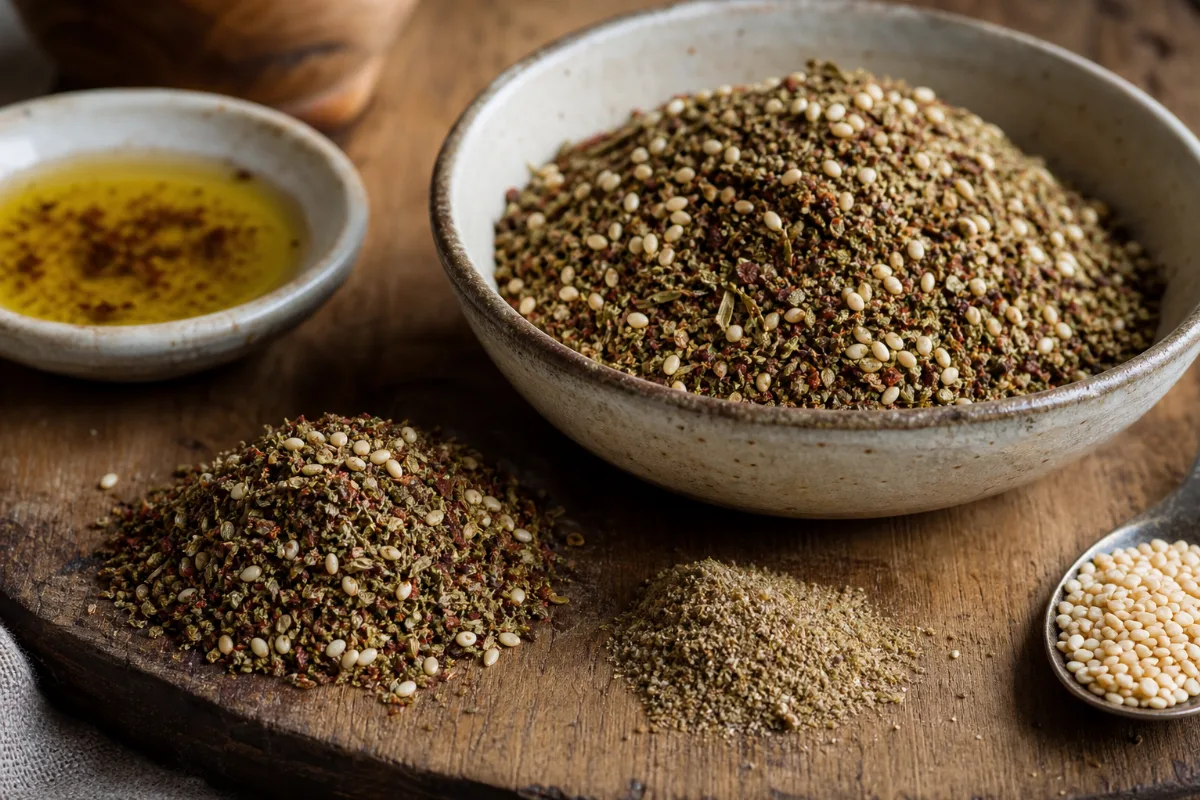
"Za'atar" is a Levantine word with two meanings. It names wild aromatic herbs, mainly Origanum syriacum, and it names a dry blend of the dried herb (or thyme, oregano or marjoram), sumac, toasted sesame seeds and salt. This page is about the blend.
Recipes vary by maker and region. Lebanese versions often use a lot of sumac, and Palestinian versions often add caraway. Some shop mixes add wheat flour as a bulking agent.
We found no standard nutrient table for the blend. In 16 ready-made mixes from local markets, sodium ranged from 105 to 1,425 mg per 100 g, and labels often did not match measured fat and fibre.
What the research shows
No study of people eating za'atar was found. A 2023 review of its compounds says the same, and rests on lab and animal work on single compounds.
Some ingredients have been studied alone. A 2024 pooling of 15 trials of sumac powder or supplements found small drops in the lower blood pressure number and in blood sugar markers, with no effect on weight. One very small trial of black sesame capsules found lower systolic pressure in the sesame group. Reviews of the wild herb describe antioxidant and antimicrobial activity in the lab.
None of this used za'atar or a seasoning amount, so it is not a reason to expect a benefit.
Seasoning versus supplements
The research is on extracts, essential oils, capsules and single ingredients. A pinch of the blend on bread is a much smaller exposure and was not tested. Do not assume results for oils, extracts or supplements apply to cooking.
Amounts
This page gives no amounts to eat. Ask a doctor, pharmacist or dietitian what is right for you, especially if you have an allergy, take medicines or watch your salt.
At a glance
Traditional uses history, not proof
- Stirred into olive oil as a dip for bread, or baked onto flatbreads
- Sprinkled on dips such as labneh and hummus, grilled meat, vegetables and grains
- The wild herb is a home and folk remedy in the Middle East (2022 review; no trial support read)
- Long use as food is not proof that it treats any condition
Studied for research
- The blend as a whole: no human study found (insufficient)
- Gut and antioxidant effects of single compounds: lab and animal work only (very low)
- Sumac alone: small drops in blood pressure and blood sugar markers in pooled trials (low)
- Black sesame capsules and blood pressure: one very small trial (very low)
- Thyme medicines for chesty cough: traditional use only, as medicines (insufficient)
Main compounds
- Thymol and carvacrol (herb oils)
- Rosmarinic and gallic acid
- Sumac polyphenols
Common forms
- Ready-made dry mix (salt, fillers and sesame vary)
- Homemade mix
- Mixed with olive oil as a dip
- Tea steeped from the herb in Oman
Research links: PubMed: 2023 review, no study of the whole za'atar mixture · PubMed: 2024 study of aflatoxins in za'atar mix products · FDA: sesame is the ninth major food allergen · Research Library · Genes & Biomarkers Library
What it is and its history
- Accepted scientific name
- Za'atar (spice blend; also the name of wild Levantine herbs)
- Common names
- Za'atar (English); Zaatar (English); Zatar (English); Zaatar (mezcla de especias) (Spanish)
- Family or group
- Ingredients: Origanum syriacum, thyme, oregano or marjoram (mint family); sumac (Rhus coriaria, cashew family); sesame (Sesamum indicum).
- Native range
- The wild herb is described as native to the Levant (Wikipedia); not checked in another source.
- Habitat
- Not verified.
- What it looks like
- Leaves: Dried and ground leaves and/or blossoms of the herb make up much of the mix (2024 study abstract).; Fruit: Sumac fruit and sesame seeds are added.
- Cultivation
- Not verified from a source read.
- Harvest and processing
- A 2021 review says air-drying at low temperatures kept the wild herb's quality better than oven-drying. The mix is ground and blended with sumac, toasted sesame and salt (recipe).
- Look-alikes and adulterants
- Name: Other herb blends; Note: Dukkah and other Middle Eastern blends use different ingredients. Do not assume a blend with the same name is the same recipe.; Name: Wild herbs also called za'atar; Note: Several different wild plants are called za'atar in different places, so recipes and strength differ (Wikipedia).
- Sustainability and conservation
- Not assessed.
Photographs
Traditional use and history history, not clinical proof
| Tradition or era | Documented use | Source |
|---|---|---|
| Levant and wider Middle East | A seasoning on bread, dips, meat and vegetables. Medieval Arabic and Jewish medical texts are said to record digestive uses (Wikipedia; not checked against the original texts). | s-wikipedia-zaatar |
| Folk medicine | The wild herb Origanum syriacum is described as a widely used medicinal plant in the Middle East, as a home and folk remedy and in the food and drink industry (2022 review). | p35807517 |
Traditional use shows how it was used. It does not show that it works or is safe today.
What is inside, and how it may work
What it contains and how those compounds act in cells and animals. Laboratory and animal mechanisms are not proven effects in people.
Main compounds
| Compound | Family | Where it is concentrated | Activity studied | Level of evidence |
|---|---|---|---|---|
| Thymol | terpene (phenol) | Herb essential oil | Named as one of the most common compounds in the wild herb's essential oil (2021 review). Antimicrobial and antioxidant activity in the lab. 1 | Lab |
| Carvacrol | terpene (phenol) | Herb essential oil | Named in the 2021 review and discussed with rosmarinic acid and gallic acid in the 2023 gut review. Pre-clinical findings. 1 2 | Lab |
| Rosmarinic acid and gallic acid | polyphenol | Herb | Discussed in the 2023 review for possible effects on gut bacteria and the gut lining; pre-clinical. 2 | Lab |
| Sumac polyphenols and acids | polyphenol / acid | Sumac fruit | Not examined for this page beyond the sumac trials. 6 | Unknown |
Mechanisms, receptors and pathways
| Target or pathway | Gene or receptor | What was found | Level |
|---|---|---|---|
| Antioxidant and antimicrobial activity | Not specified | Reviews describe antioxidant and antimicrobial activity of extracts and oils of the wild herb, and possible gut effects of single compounds. These are lab and pre-clinical findings and do not show the same happens when people eat the blend. 3 1 2 | Lab |
Absorption, metabolism and elimination
- Absorption
- Not found.
- Distribution
- Not found.
- Metabolism
- Not found.
- Elimination
- Not found.
- Bioavailability
- Not established in the sources read.
Isolated compounds versus whole extracts
The research is on extracts, essential oils, single compounds or single ingredients (sumac powder, sesame capsules). A sprinkle of the blend on food is a much smaller and mixed exposure and was not tested. Findings for oils, extracts and supplements do not carry over to the seasoning.
Nutritional composition
We found no standard USDA entry for za'atar and could not complete a USDA search (the shared key was rate-limited), so we give no nutrient table and no calories per teaspoon. In 16 ready-made mixes from local markets, sodium ranged from 105.1 to 1,425.3 mg per 100 g, and the labelled fat and fibre often did not match what was measured, so labels may be unreliable (2024 study). One test-kitchen recipe makes about 1/3 cup from 2 tablespoons dried thyme, 1 tablespoon dried oregano, 1 1/2 tablespoons sumac, 1 tablespoon toasted sesame seeds and 1/4 teaspoon salt. Recipes and shop mixes differ. This is not advice about how much to eat.
1 low certainty3 very low certainty2 not enough evidence
What was looked at
The 6 benefits and uses checked for Za'atar, each with how strong the evidence is. Tap one to open it.
- The blend as a whole (any health effect)Not enough evidence
- Gut health and antioxidant effects (compounds from the ingredients)Very low certainty
- Blood pressure and blood sugar markers (sumac, one ingredient)Low certainty
- Blood pressure (sesame, one ingredient)Very low certainty
- Antioxidant and antimicrobial effects of the wild za'atar herb (lab)Very low certainty
- Traditional use, including thyme medicines for chesty coughNot enough evidence
What is Za'atar good for?
The studied uses and how strong the human evidence is for each. No study tested za'atar as a blend, so every row is about an ingredient, an extract or lab work.
Benefits, one by one
Each card is a research question, not a promise. Tap a goal to filter. Open a card to see the studies, doses and limits.
The blend as a whole (any health effect)
Not enough evidenceNo study of people eating za'atar was found. Nothing can be said about benefits of the blend itself.
1 studiesNot applicable.
Studies, doses and limits
Results
No human evidence for the blend.
Why this rating
No human or animal study of the mixed blend was found in the sources read.
Limits
Evidence belongs to single ingredients, and mostly to extracts, oils or supplements.
Why researchers looked
People ask whether this traditional blend is good for health.
Traditional use
Za'atar is stirred into olive oil as a dip for bread, baked onto flatbreads and sprinkled on dips, meat and vegetables. Long use as food is not proof that it treats any condition.
Proposed mechanism Unknown
Not applicable.
A proposed mechanism does not show that the effect happens in people.
Allergy, salt and quality cautions in the Safety tab matter more than any proven benefit.
Gut health and antioxidant effects (compounds from the ingredients)
Very low certaintyA review of lab and animal work suggests plant compounds found in za'atar might help the gut. This is early science, not shown in people eating the blend.
2 studiesSingle compounds and extracts in lab studies; not the blend as eaten.
Studies, doses and limits
Results
Possible, not shown in people.
Effect sizes as reported
No numbers in the abstract.
Why this rating
Lab and animal findings on single compounds, in a narrative review that has no numbers in its abstract.
Form and dose studied
Single compounds and extracts in lab studies; not the blend as eaten.
Limits
Lab and animal findings do not show that the same happens when people eat a sprinkle of za'atar.
Why researchers looked
Za'atar herbs contain polyphenols and aromatic compounds with antioxidant activity in the lab.
Traditional use
Medieval and traditional texts are said to link za'atar plants to digestion (Wikipedia, not checked against the original texts).
Proposed mechanism Lab
The 2023 review discusses carvacrol, rosmarinic acid, gallic acid and other polyphenols acting on gut bacteria and the gut lining. These are pre-clinical findings.
A proposed mechanism does not show that the effect happens in people.
None specific to this finding.
Blood pressure and blood sugar markers (sumac, one ingredient)
Low certaintyPooled trials of sumac powder or supplements found a small drop in the lower blood pressure number and in blood sugar markers. This was sumac alone, not za'atar, and not a seasoning amount.
1 studiesPowder or supplements; forms not detailed in the abstract.
Studies, doses and limits
What the trials found
2024 pooling of 15 randomised trials: lower diastolic blood pressure (-2.88 mmHg), fasting glucose (-5.15 mg/dL) and HbA1c (-0.48 %). No effect on weight, BMI or waist circumference.
Results
Small changes in test numbers; sumac only.
Effect sizes as reported
DBP -2.88 mmHg (95% CI -4.22 to -1.54); fasting glucose -5.15 mg/dL; HbA1c -0.48 %.
Why this rating
Small trials, no certainty rating or dose in the abstract, and it is sumac powder or supplements, not a blend used as a seasoning.
Form and dose studied
Powder or supplements; forms not detailed in the abstract.
Who was studied
Adults.
Limits
Does not tell us what a sprinkle of za'atar does; za'atar contains much more than sumac.
Why researchers looked
Sumac is rich in plant compounds, so researchers asked whether it changes blood pressure and blood sugar.
Traditional use
Sumac gives za'atar its sour taste; some versions use a lot of it.
Proposed mechanism Unknown
Not established in people.
A proposed mechanism does not show that the effect happens in people.
If you take diabetes or blood pressure medicines and want sumac supplements, ask a pharmacist. This is a cautious inference, not a documented interaction.
Blood pressure (sesame, one ingredient)
Very low certaintyOne very small trial of black sesame meal capsules found lower systolic blood pressure in the sesame group after 4 weeks. It is too small to rely on and it is not za'atar.
1 studiesBlack sesame meal capsules.
Studies, doses and limits
What the trials found
30 adults with prehypertension, 4 weeks of black sesame meal capsules (2.52 g a day) or placebo. In the sesame group systolic pressure went from 129.3 to 121.0 mmHg (P<0.05). The abstract does not give the difference from placebo.
Results
Possible small effect; very uncertain.
Effect sizes as reported
Systolic BP 129.3 to 121.0 mmHg in the sesame group (before vs after).
Why this rating
Only 15 people per group, short, one trial, capsules of a different form from seeds on food, and no between-group comparison in the abstract.
Form and dose studied
Black sesame meal capsules.
Who was studied
Adults with prehypertension.
Limits
Not a trial of seeds eaten as food, and not za'atar. Sesame is a major allergen.
Why researchers looked
Sesame seeds contain compounds that researchers thought might affect blood pressure and oxidative stress.
Traditional use
Toasted sesame seeds give za'atar its nutty note.
Proposed mechanism Unknown
Not established; the authors suggest an antioxidant effect.
A proposed mechanism does not show that the effect happens in people.
Sesame allergy: see the Safety tab.
Antioxidant and antimicrobial effects of the wild za'atar herb (lab)
Very low certaintyReviews describe antioxidant and germ-fighting activity of extracts and oils of the wild herb Origanum syriacum in the lab. That does not show a benefit from eating the blend.
2 studiesExtracts and essential oils of Origanum syriacum.
Studies, doses and limits
Results
Lab findings only.
Effect sizes as reported
No numbers in the abstracts.
Why this rating
Lab and extract work. A narrative review does not rate the certainty of the evidence.
Form and dose studied
Extracts and essential oils of Origanum syriacum.
Limits
Extracts and essential oils are far stronger than a pinch of dried herb in a blend.
Why researchers looked
The wild herb is rich in aromatic oils such as thymol and carvacrol.
Traditional use
The wild herb is used as a home and folk remedy in the Middle East, according to a 2022 review.
Proposed mechanism Lab
A 2021 review names thymol, gamma-terpinene, carvacrol and alpha-pinene as the most common compounds in the herb's essential oil and says antimicrobial and antioxidant activity are its main functions. Lab findings.
A proposed mechanism does not show that the effect happens in people.
Concentrated oils and extracts are not food seasoning; ask a pharmacist before using them.
Traditional use, including thyme medicines for chesty cough
Not enough evidenceZa'atar herbs have a long folk-remedy history. The European Medicines Agency accepts certain thyme medicines for chesty coughs on traditional use only. That is about medicines, not about the blend as a seasoning.
2 studiesHerbal medicines, adults and adolescents over 12 (most products).
Studies, doses and limits
Results
Traditional use only.
Why this rating
EMA's own wording: not enough clinical trial evidence; use is plausible and traditional.
Form and dose studied
Herbal medicines, adults and adolescents over 12 (most products).
Who was studied
Adults and older children.
Limits
Medicine, not food seasoning; the blend was not assessed.
Why researchers looked
Thyme and related plants have been used for coughs for a very long time.
Traditional use
A 2022 review calls the wild herb a widely used home and folk remedy in the Middle East.
Proposed mechanism Unknown
Not applicable.
A proposed mechanism does not show that the effect happens in people.
Do not use thyme medicines if you are allergic to thyme or other mint-family plants (EMA).
Connections to the rest of health
How Za'atar connects to the rest of our health knowledge graph. Every link says what kind of connection it is. A safety link (for example to the liver) is a warning, not a benefit. A study that merely mentions a topic never creates a benefit link.
Explore every connection: goals, body systems, organs, symptoms, genes
B. Body systems
| Connected to | Kind of connection | Evidence status | Context | Studies |
|---|---|---|---|---|
| Whole Body | Biological association | Not enough evidence | Studied for: The blend as a whole (any health effect) | 2 |
| Digestive System | Biological association | Very low certainty | Studied for: Gut health and antioxidant effects (compounds from the ingredients) | 2 3 |
| Gut Health | Biological association | Very low certainty | Studied for: Gut health and antioxidant effects (compounds from the ingredients) | 2 3 |
| Cardiovascular System | Biological association | Low certainty | Studied for: Blood pressure and blood sugar markers (sumac, one ingredient) Studied for: Blood pressure (sesame, one ingredient) | 6 8 |
| Blood Sugar Support | Biological association | Low certainty | Studied for: Blood pressure and blood sugar markers (sumac, one ingredient) | 6 |
| Immune System | Biological association | Very low certainty | Studied for: Antioxidant and antimicrobial effects of the wild za'atar herb (lab) | 3 1 |
| Respiratory System | Biological association | Not enough evidence | Studied for: Traditional use, including thyme medicines for chesty cough | 12 3 |
K. Biological pathways
| Connected to | Kind of connection | Evidence status | Context | Studies |
|---|---|---|---|---|
| Anacardiaceae (cashew family) | Preliminary mechanism | Authoritative guidance | Sumac is a relative of cashew, pistachio and mango; cross-reaction within the family is plausible. | 9 |
L. Active compounds
| Connected to | Kind of connection | Evidence status | Context | Studies |
|---|---|---|---|---|
| Thymol | Biological association | Lab | Named as one of the most common compounds in the wild herb's essential oil (2021 review). Antimicrobial and antioxidant activity in the lab. Preparation or compound: Herb essential oil |
1 |
| Carvacrol | Biological association | Lab | Named in the 2021 review and discussed with rosmarinic acid and gallic acid in the 2023 gut review. Pre-clinical findings. Preparation or compound: Herb essential oil |
1 2 |
| Rosmarinic acid and gallic acid | Biological association | Lab | Discussed in the 2023 review for possible effects on gut bacteria and the gut lining; pre-clinical. Preparation or compound: Herb |
2 |
| Sumac polyphenols and acids | Biological association | Unknown | Not examined for this page beyond the sumac trials. Preparation or compound: Sumac fruit |
6 |
Each connection is stored with the ingredient, the connected record, the kind of connection, the evidence status, the supporting studies, the preparation or compound involved, and a review date (last reviewed October 26, 2026).
Evidence at a glance: what the research found for 6 outcomes
Each outcome below is one thing researchers measured. Certainty is how far the evidence can be trusted, not how well it works. The full studies are on the next tab.
The evidence
The research centre for Za'atar. Every record here was checked against PubMed or the publisher's page; we never list a study we have not verified.
Evidence by outcome
Bars show how many studies we found for each outcome, not how well it works. People are added up across trials only (reviews are not added, to avoid double counting).
How we rate evidence
High certainty
Several well-run trials or reviews agree; further research is unlikely to change the picture much.
Moderate certainty
Good trials point the same way, but some doubt remains.
Low certainty
Small, short or inconsistent trials. The finding could change with better research.
Very low certainty
Very little or very weak human data. Treat as a possibility only.
Mixed findings
Trials or reviews disagree with each other.
Not enough evidence
Not enough human research to say either way.
Evidence against
Good research found no benefit, or found harm.
We take the reviewers' own risk-of-bias and GRADE statements where they exist, and otherwise judge from study size, design, consistency, directness and whether a product matches what is sold. Many publications do not make evidence high. Method note: We started from our existing za'atar summary, re-read the study abstracts on PubMed, read the FDA, WHO, EMA, Anaphylaxis UK and AAAAI pages, the Lebanon lead study in full, a Wikipedia article and one recipe. Items we could not verify are flagged in the research gaps.
Study library: every study we checked 15
| Study | Design | People | Product, dose, length | Result |
|---|---|---|---|---|
| Alwafa 2021 Origanum syriacum L. (Za'atar), from Raw to Go: A Review. Plants (Basel) · PMID 34067806 · DOI |
Narrative review mixed |
Review of drying, markets and essential oil of Origanum syriacum | Origanum syriacum herb and its essential oil Herb and essential oil |
The authors say antimicrobial and antioxidant activities are the main functions of the herb's essential oil. 121 compounds have been identified in it; the most common are thymol, gamma-terpinene, carvacrol and alpha-pinene. Air-drying at low temperatures kept quality better than oven-drying. Qualitative Methods, limits and fundingOutcomes: Quality traits, market, essential oil composition and activity Limitations: Concerns the single wild herb and its oil, not the mixed blend. The abstract does not describe human studies. Funding and conflicts: Not stated in the abstract Read: abstract |
| Khalil 2023 The Impact of Za'atar Antioxidant Compounds on the Gut Microbiota and Gastrointestinal Disorders: Insights for Future Clinical Applications. Antioxidants (Basel) · PMID 36829984 · DOI |
Narrative review mixed |
Review of studies on single compounds found in za'atar (carvacrol, rosmarinic acid, gallic acid and other polyphenols), mostly pre-clinical | Za'atar plant compounds (not the blend) Leaves, fruits and seeds of za'atar ingredients |
The authors say that, to their knowledge, no studies have reported the effects of the whole za'atar mixture. Their overview of possible effects on the gut is based on pre-clinical studies of its components and single compounds. Qualitative; no effect sizes Methods, limits and fundingOutcomes: Possible effects on gut bacteria, gut lining and gut diseases Limitations: A narrative review. It reviews single compounds, not people eating za'atar. The abstract gives no numbers and no certainty rating. Funding and conflicts: Not stated in the abstract Read: abstract |
| Mesmar 2022 Origanum syriacum Phytochemistry and Pharmacological Properties: A Comprehensive Review. Molecules · PMID 35807517 · DOI |
Narrative review mixed |
Review of extracts and essential oils of the wild za'atar herb, Origanum syriacum | Extracts and essential oils of Origanum syriacum Herb (extracts and essential oils) |
The authors describe antioxidant, antimicrobial and antiparasitic capacity of the herb's compounds. They also discuss possible use in cancer, nerve diseases and peptic ulcers. The abstract does not say which of this was tested in people. Qualitative Methods, limits and fundingOutcomes: Chemistry and pharmacological properties Limitations: Extracts and essential oils are not the blend or a sprinkle on food. The abstract does not state how much of the evidence is from people, cells or animals. Funding and conflicts: Not stated in the abstract Read: abstract |
| Moussa 2024 Impact of source, packaging and presence of food safety management system on heavy metals levels in spices and herbs. PLoS One · PMID 39178188 · DOI |
Laboratory survey n/a |
96 96 composite samples of 13 dried herbs and spices sold in Lebanon, including thyme, thyme mix, oregano, sumac and sesame |
Laboratory analysis of lead, cadmium, mercury and arsenic Dried herbs and spices (ingredients of za'atar, not za'atar itself) |
20% (19/96) of samples were over the Codex lead limit and 4% (4/96) over the cadmium limit; all met the arsenic and mercury limits. In the full text, all thyme mix and thyme samples were over the lead limit, all sesame samples were acceptable, and sumac was over the limit in 25% to 33% of samples (the share given for black pepper, sumac and dried mint together). One thyme mix group was also above the cadmium limit. Unpackaged samples had the highest share over the lead limit (31%). 20% of samples over the lead limit overall Methods, limits and fundingOutcomes: Lead, cadmium, arsenic and mercury levels against Codex limits Limitations: One country. Za'atar mixes were not tested as such; the 'thyme mix' group is not described as za'atar. Small number of samples per spice (6 to 8). Funding and conflicts: Authors report no competing interests; no specific funding (full text, as read). Read: full-text |
| Mudalal 2024 The occurrence of aflatoxins and labelling compliance of locally produced za'atar mix products. Food Addit Contam Part A · PMID 38662874 · DOI |
Laboratory survey n/a |
16 16 za'atar mix products from local markets (the abstract does not name the country) |
Laboratory analysis of za'atar mix products Ready-made za'atar mixes |
11 of the 16 products (69%) had total aflatoxins above the European Commission maximum permitted limit. Total aflatoxins ranged from 2 to 63.7 ng/g. Measured and labelled fat did not agree for about 91% of samples, and fibre did not agree either. Sodium ranged from 105.1 to 1425.3 mg per 100 g. The author concludes that nutrition labels were not accurate and that aflatoxin levels were very high. 11 of 16 products over the EU aflatoxin limit; sodium 105.1-1425.3 mg/100 g Methods, limits and fundingOutcomes: Aflatoxins, nutrition content, sodium, colour, label accuracy Limitations: One small study of local products from one place; the abstract does not say how samples were chosen. It does not name the country. The reasons for the problem were not studied. Funding and conflicts: Not stated in the abstract Read: abstract |
| Taheri 2024 Effects of Sumac Consumption on Blood Pressure, Glycemic Indices, and Body Composition in Adults: A GRADE-assessed Systematic Review and Dose-response Meta-analysis. Diabetes Metab Syndr · PMID 39316955 · DOI |
Systematic review meta analysis |
15 randomised controlled trials in adults | Sumac consumption (forms not detailed in the abstract) · vs Control groups |
Sumac lowered diastolic blood pressure, fasting glucose, insulin, HbA1c, HOMA-IR and waist-to-hip ratio. It had no significant effect on weight, BMI or waist circumference. Diastolic BP -2.88 mmHg; fasting glucose -5.15 mg/dL; HbA1c -0.48 % (DBP -4.22 to -1.54; fasting glucose -8.73 to -1.57; HbA1c -0.84 to -0.12) Methods, limits and fundingOutcomes: Blood pressure, blood sugar markers, body measures Limitations: Sumac only, not za'atar. Small trials; the abstract gives no certainty rating, dose or form. The trials were of powder or supplements, not a seasoning. Funding and conflicts: Not stated in the abstract Read: abstract |
| Warren 2019 Prevalence and Severity of Sesame Allergy in the United States. JAMA Netw Open · PMID 31373655 · DOI |
Cross sectional survey |
78851 Survey answers from 40,453 adults and 38,408 children in a nationally representative sample of 51,819 US households (2015-2016) |
n/a |
About 0.49% of the US population reported a current sesame allergy, and 0.23% met the survey's criteria for convincing IgE-mediated allergy. Among those with convincing allergy, 23.6% to 37.2% had a severe reaction (depending on the definition), 81.6% had at least one other convincing food allergy and 33.7% had used adrenaline (epinephrine) for sesame. 0.49% (95% CI 0.40-0.58) reported current sesame allergy; 0.23% (0.19-0.28) convincing (0.19-0.28 (convincing allergy)) Methods, limits and fundingOutcomes: Sesame allergy prevalence and severity Limitations: Self-reported survey, not food challenges. Data from 2015-2016, before US sesame labelling began. Funding and conflicts: Not stated in the abstract Read: abstract |
| Wichitsranoi 2011 Antihypertensive and antioxidant effects of dietary black sesame meal in pre-hypertensive humans. Nutr J · PMID 21827664 · DOI |
Controlled trial |
30 30 adults with prehypertension (22 women, 8 men; average age about 50) |
Black sesame meal capsules (2.52 g a day) or placebo capsules Black sesame meal 2.52 g a day (black sesame meal capsules) 4 weeks · vs Placebo capsules |
After 4 weeks the black sesame group had lower systolic blood pressure (129.3 vs 121.0 mmHg, P<0.05) and lower MDA, a marker of oxidative stress, with higher vitamin E. The abstract reports these before-and-after changes in the sesame group; it does not report the difference from placebo. Systolic BP 129.3 to 121.0 mmHg in the sesame group (before vs after) Methods, limits and fundingOutcomes: Blood pressure, blood fats, oxidative stress Limitations: Very small (15 per group), 4 weeks, black sesame capsules, not za'atar. The abstract does not show a between-group comparison. Funding and conflicts: Not stated in the abstract Read: abstract |
| s-aaaai-cashew-pistachio AAAAI Ask the Expert: Cashew and pistachio cross-reactivity (including pink peppercorn) · Source |
Professional society page n/a |
Methods, limits and fundingRead: full-text | ||
| s-anaphylaxis-uk Anaphylaxis UK: Sesame allergy · Source |
Charity guidance n/a |
Methods, limits and fundingRead: full-text | ||
| s-atk-zaatar America's Test Kitchen: Za'atar recipe · Source |
Recipe n/a |
Methods, limits and fundingRead: full-text | ||
| s-ema-thyme EMA: Thyme (Thymi herba) herbal medicines · Source |
Regulator page n/a |
Methods, limits and fundingRead: full-text | ||
| s-fda-faster FDA: The FASTER Act - Sesame Is the Ninth Major Food Allergen · Source |
Regulator page n/a |
Methods, limits and fundingRead: full-text | ||
| s-who-salt WHO: Salt reduction fact sheet · Source |
Regulator page n/a |
Methods, limits and fundingRead: full-text | ||
| s-wikipedia-zaatar Wikipedia: Za'atar (read through the MediaWiki API 2026-10-26) · Source |
Encyclopedia n/a |
Methods, limits and fundingRead: full-text |
What we do not know yet
- No study of people eating za'atar as a blend was found.
- Findings for sumac and sesame come from powder, supplements or capsules, not seasoning amounts.
- The aflatoxin study is small, from one place, and does not name the country or brands.
- No nutrient table was found for the blend, and no source gives advice for pregnancy, breastfeeding, children or medicines.
- Thyme and oregano trials, Salmonella, oxalate, FODMAP and histamine were not researched.
How new research is added
New studies are found by a saved PubMed search and placed in a review queue before the page changes.
Lab markers
What changed in blood or saliva tests during trials. A changed number is not the same as feeling or being healthier, and we give no "normal ranges".
Safety
What studies and official sources say about side effects, medicines and who should check first. Each point shows what kind of evidence it comes from.
Main points to know 4
- Sesame allergy: za'atar usually contains sesame seeds. Toasted sesame seeds are a standard ingredient in the recipes read. Sesame is a major food allergen in the US (labelled since 1 January 2023). Reactions can be serious, can start up to 90 minutes later, and heating does not remove the part of sesame that causes allergy. Anyone with a sesame allergy should avoid za'atar unless the maker confirms it is sesame-free. Authoritative guidance 13 10 11 15
- Mould poisons (aflatoxins) were high in tested za'atar mixes. In one laboratory study of 16 za'atar mix products from local markets, 11 (69%) had total aflatoxins above the European Commission maximum permitted limit. It is one small study from one place, and it did not name the brands or say why levels were high. Buy from a seller you trust and store the mix dry. Other 5
- Salt: the amount varies a lot between mixes. The 16 mixes in that study held 105 to 1,425 mg of sodium per 100 g, and the labels did not match what was measured for fat and fibre. WHO advises adults to keep sodium under 2,000 mg a day, and says high sodium mainly raises blood pressure. A sprinkle is a small amount, but check the label if you limit salt. Authoritative guidance 5 14
- Cashew and pistachio allergy: sumac is in the same plant family. Sumac belongs to the cashew family (Anacardiaceae). The American Academy of Allergy, Asthma & Immunology says cross-reaction within the family is plausible but not universal. How often it happens with sumac in za'atar is not known. Ask an allergist. Authoritative guidance 9
Side effects 2
| Effect | How often | Severity and recovery | Evidence |
|---|---|---|---|
| Allergic reactions to sesame, from mild itching or hives to serious breathing, heart or blood pressure effects (anaphylaxis) Survey self-report, not food challenges. Sesame allergy is not specific to za'atar; za'atar is one food that contains sesame. | In a US survey, 0.49% of people reported a current sesame allergy and 0.23% met criteria for a convincing allergy; of those, 23.6% to 37.2% had had a severe reaction | Can be severe Not stated | Observational 7 10 |
| No adverse effects of the blend in people were described in any source read No human study of the blend exists in the sources read, so the absence of reports is not proof of safety. | Not established | not stated Not stated | Insufficient 2 |
Liver
No liver injury from za'atar was found in the sources read. A liver-safety source such as LiverTox was not searched for this food page. Aflatoxin levels in the mixes tested are a quality concern covered under contamination. 5
How often. No frequency was found.
Monitoring. No agency monitoring advice was found.
This is a safety connection. It is not evidence that Za'atar supports liver health.
Medicines and supplements 2
| With | Why it matters | Importance | Evidence | What to do |
|---|---|---|---|---|
| Diabetes and blood pressure medicines prescription | Pooled trials of sumac powder or supplements found small drops in blood sugar markers and in the lower blood pressure number. If true for a supplement, an extra effect is plausible. No source read describes an interaction with za'atar. | Unknown. This is a cautious inference for sumac supplements, not a documented interaction, and not about seasoning amounts. | Pharmacological theory Not enough evidence 6 | If you take these medicines and want concentrated sumac or herb products, ask a pharmacist. Culinary amounts of za'atar were not studied. |
| Medicines in general prescription | No interaction source was found for za'atar. | Insufficient Not enough evidence | The sources read do not describe interactions for the blend. Ask a pharmacist about the single ingredients if you take medicines. |
Who should check first 5
| Situation | Advice | Evidence |
|---|---|---|
| Sesame allergy | Avoid za'atar unless the label or the maker confirms it has no sesame. Check loose and unpackaged mixes extra carefully. Call emergency services for trouble breathing, swelling of the face or throat, or collapse. | Authoritative guidance 13 10 |
| Cashew or pistachio allergy | Ask an allergist before eating the sumac in za'atar. Cross-reaction is plausible but not guaranteed. | Authoritative guidance 9 |
| Wheat allergy or coeliac disease | Some commercial mixes use wheat flour as a bulking agent. Read the label. | Other 15 |
| Allergy to thyme or other mint-family (Lamiaceae) plants | EMA says thyme medicines must not be used by people allergic to thyme or other Lamiaceae plants. That statement is about medicines. Whether it applies to a seasoning is not stated; ask an allergist. | Authoritative guidance 12 |
| Watching sodium (high blood pressure, kidney or heart disease) | Check the salt in the mix and ask your clinician what is right for you. | Authoritative guidance 14 5 |
Overdose, product quality and regulators
Summary. No toxicity source for the blend was read. The practical concerns are allergy, aflatoxin and lead in some products, and salt.
Animal. Not researched.
Overdose response. Not found.
Genotoxicity. Not researched.
Spice mixes can carry mould poisons and metals. Two studies of ingredient or mix products found problems; both are small and from one place.
Aflatoxins. 11 of 16 za'atar mix products (69%) were above the European Commission limit for total aflatoxins (range 2 to 63.7 ng/g). 5
Lead and cadmium. In a 2024 study of 96 dried herb and spice samples sold in Lebanon, all thyme mix and thyme samples were over the Codex lead limit, sumac was over it in 25% to 33% of samples (shared figure with black pepper and dried mint) and all sesame samples were acceptable. Za'atar blends themselves were not tested; 'thyme mix' is not described as za'atar. 4
Labels and fillers. Measured and labelled fat did not agree for about 91% of the 16 mixes, and some commercial versions add wheat flour as a bulking agent. 5 15
| Body | Action | Date |
|---|---|---|
| FDA (US) (United States) | FASTER Act: sesame is the ninth major food allergen; packaged foods and supplements must label it from 1 January 2023 source | 2026-10-26 |
| WHO (International) | Adults should eat less than 2000 mg of sodium a day (less than 5 g of salt); high sodium mainly raises blood pressure source | 2026-10-26 |
| EMA / HMPC (European Union) | Thyme herbal medicines accepted for chesty coughs on traditional use; not to be used by people allergic to thyme or other Lamiaceae plants; most for adults and adolescents over 12 source | 2016-10-14 |
When to get medical help
- Trouble breathing, swelling of the lips, face or throat, widespread hives, repeated vomiting or collapse after eating za'atar (call emergency services)
- A sudden itchy mouth, hives or stomach cramps after eating sesame or sumac; stop eating it and get medical advice
Stop using the product and contact a clinician or emergency service. In the US, Poison Control is 1-800-222-1222.
General information only, not medical advice. Ask a clinician or pharmacist before use, especially with medicines, in pregnancy or with a health condition. See the Natural Remedy Safety guide.
Frequently asked questions
What is za'atar?
What does za'atar taste like?
Is za'atar healthy?
No study of people eating za'atar was found, so no benefit is proven. Some of its ingredients have been studied alone, and those findings may not carry over to a seasoning.
Does za'atar contain sesame?
Does cooking remove the sesame allergen?
No. Anaphylaxis UK says heating does not destroy the part of sesame that causes allergy.
How common is sesame allergy?
In a US survey, about 0.49% of people reported a current sesame allergy and 0.23% met criteria for a convincing allergy. Among those, 23.6% to 37.2% had had a severe reaction.
Is za'atar high in salt?
Can za'atar contain mould poisons?
In one small study, 11 of 16 za'atar mixes from local markets had total aflatoxins above the European Commission limit. One study is not proof about every brand; buy from a reputable seller and keep the mix dry.
Is za'atar safe with a cashew or pistachio allergy?
Ask an allergist. Sumac is in the cashew family, and the AAAAI says cross-reaction within the family is plausible but not universal.
Does za'atar contain wheat or gluten?
Some commercial mixes add wheat flour as a bulking agent. Check the label.
Is za'atar safe in pregnancy or with medicines?
The sources we read give no advice for pregnancy, breastfeeding or medicines for the blend. Ask your doctor or pharmacist if you are unsure.
Explore by health goal
Editorial transparency
- Written by
- AlternativeMed editorial team. Research compiled with AI assistance, then checked against the sources listed.
- Medical review
- None. This page has not been reviewed by a physician or pharmacist.
- First published
- 2026-10-26
- Last substantive update
- 2026-10-26
- How we research
- We started from our existing za'atar summary, re-read the study abstracts on PubMed, read the FDA, WHO, EMA, Anaphylaxis UK and AAAAI pages, the Lebanon lead study in full, a Wikipedia article and one recipe. Items we could not verify are flagged in the research gaps.
- How we rate evidence
- See "How we rate evidence" in the Evidence tab.
- Independence
- No product is promoted on this page. No affiliate links are shown.
Sources 15
Each source was opened and checked. Where we read only the abstract, it says so. The small numbers in the text point here.
- Alwafa RA, Mudalal S, Mauriello G. Origanum syriacum L. (Za'atar), from Raw to Go: A Review.. Plants (Basel). 2021. PMID 34067806. DOI 10.3390/plants10051001. (abstract)
- Khalil M, Abdallah H, Razuka-Ebela D, et al.. The Impact of Za'atar Antioxidant Compounds on the Gut Microbiota and Gastrointestinal Disorders: Insights for Future Clinical Applications.. Antioxidants (Basel). 2023. PMID 36829984. DOI 10.3390/antiox12020426. (abstract)
- Mesmar J, Abdallah R, Badran A, et al.. Origanum syriacum Phytochemistry and Pharmacological Properties: A Comprehensive Review.. Molecules. 2022. PMID 35807517. DOI 10.3390/molecules27134272. (abstract)
- Moussa L, Hassan HF, Savvaidis IN, et al.. Impact of source, packaging and presence of food safety management system on heavy metals levels in spices and herbs.. PLoS One. 2024. PMID 39178188. DOI 10.1371/journal.pone.0307884. (full-text)
- Mudalal S. The occurrence of aflatoxins and labelling compliance of locally produced za'atar mix products.. Food Addit Contam Part A. 2024. PMID 38662874. DOI 10.1080/19440049.2024.2346260. (abstract)
- Taheri S, Sohrabi Z, Bahari H, et al.. Effects of Sumac Consumption on Blood Pressure, Glycemic Indices, and Body Composition in Adults: A GRADE-assessed Systematic Review and Dose-response Meta-analysis.. Diabetes Metab Syndr. 2024. PMID 39316955. DOI 10.1016/j.dsx.2024.103122. (abstract)
- Warren CM, Chadha AS, Sicherer SH, et al.. Prevalence and Severity of Sesame Allergy in the United States.. JAMA Netw Open. 2019. PMID 31373655. DOI 10.1001/jamanetworkopen.2019.9144. (abstract)
- Wichitsranoi J, Weerapreeyakul N, Boonsiri P, et al.. Antihypertensive and antioxidant effects of dietary black sesame meal in pre-hypertensive humans.. Nutr J. 2011. PMID 21827664. DOI 10.1186/1475-2891-10-82. (abstract)
- . AAAAI Ask the Expert: Cashew and pistachio cross-reactivity (including pink peppercorn). . . (full-text)
- . Anaphylaxis UK: Sesame allergy. . . (full-text)
- . America's Test Kitchen: Za'atar recipe. . . (full-text)
- . EMA: Thyme (Thymi herba) herbal medicines. . . (full-text)
- . FDA: The FASTER Act - Sesame Is the Ninth Major Food Allergen. . . (full-text)
- . WHO: Salt reduction fact sheet. . . (full-text)
- . Wikipedia: Za'atar (read through the MediaWiki API 2026-10-26). . . (full-text)
Where to buy
Check the label first. Whatever you buy, look for these:
- Whole or ground: whole spices keep their flavor longer
- The origin and a packed-on or best-by date for freshness
- Organic or non-irradiated labeling if that matters to you
- A resealable, airtight container
Talk to a pharmacist or doctor before you start any supplement, especially if you take medicines. See the Safety tab for interactions.
Support our free guides: as an Amazon Associate we earn from qualifying purchases. Full disclosure.


