Spices · Spice blend
Dukkah
Blend of nuts, seeds and spices (no single species) · also called Duqqa, dukka
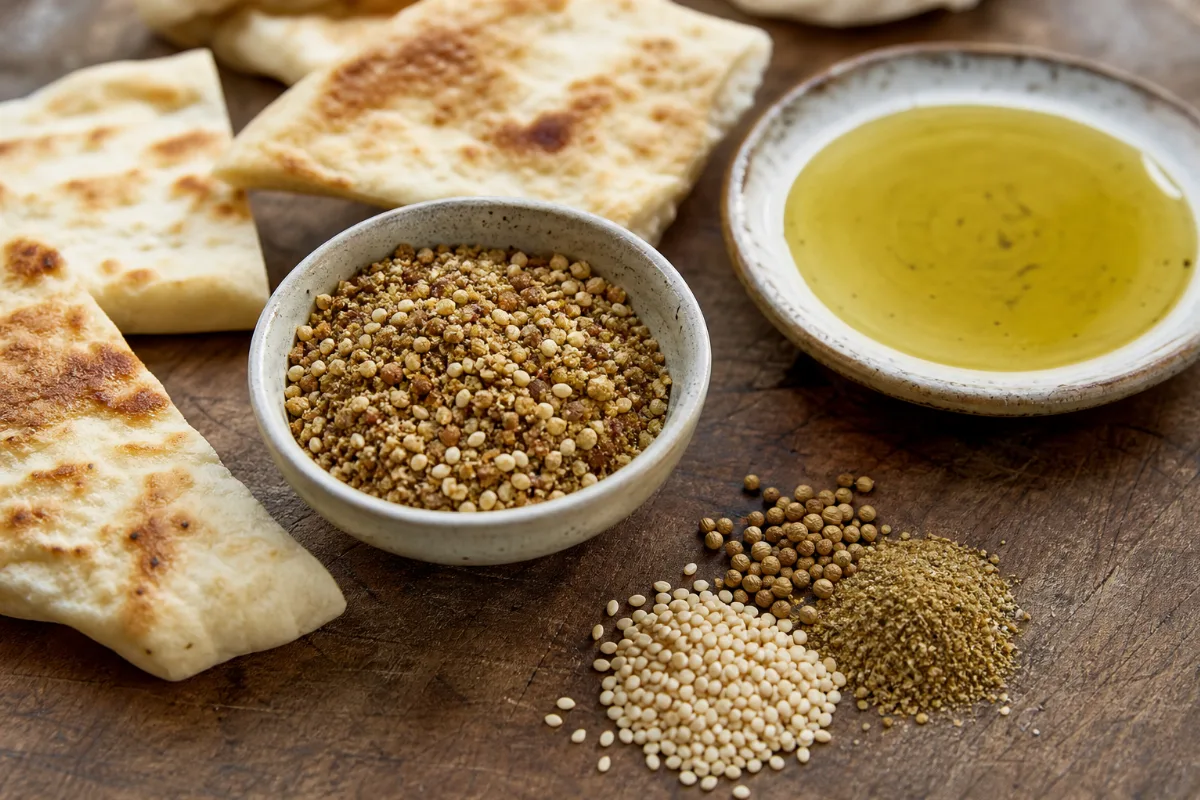
Dukkah is a crunchy Egyptian blend of toasted nuts, sesame, cumin and coriander, used as a dip with bread and oil or as a topping. It has almost never been studied as a blend. The main caution is allergy: it nearly always contains tree nuts and sesame, and sometimes peanuts.
General information, not medical advice. Last substantive update · Not medically reviewed. A named clinician has not signed off on this page. How this page is made
About Dukkah
Dukkah is a nutty, toasty, coarse Egyptian blend of nuts, sesame, cumin and coriander. It is a flavor, not a studied health food, and it is an allergy food because of the nuts and sesame.
What it is
Dukkah (also spelled duqqa) is an Egyptian and Middle Eastern condiment of nuts, seeds and spices, usually with hazelnuts. The name comes from an Arabic word meaning "to pound", because the roasted ingredients are pounded together to a texture that is neither powder nor paste.
There is no single recipe. Common ingredients are sesame, coriander seed, cumin, salt and black pepper. Some cooks use almonds, pistachios, cashews or peanuts instead of hazelnuts, and some add nigella, dill seed, chili, pine nuts, pumpkin seeds or sunflower seeds.
In the kitchen
Dukkah tastes nutty, toasty and warmly spiced, with earthy cumin and a citrus note from coriander. It is savory and a little salty, and the crunch is part of the point.
The classic way is to dip bread in olive oil and then into the dukkah. Cooks also sprinkle it on eggs, soft cheese, yogurt, hummus, salads, roasted vegetables and soups, or press it onto fish, chicken or tofu. Add it at the last moment to keep it crunchy. These are cooks' ideas, not tested figures.
Store it airtight in a cool, dark place. Because nuts can turn rancid, smell it before use and make a fresh batch if it smells stale or bitter.
What is in a serving
We found no nutrient entry for dukkah, so we give no nutrient table. One published recipe is mostly nuts and seeds by weight, so dukkah is probably more energy-dense than most dry spice blends; that is our reasoning, not a sourced number. Salt depends on the maker, so check the label.
For the nutrition of the main ingredients, see the pages on hazelnuts, sesame, cumin and coriander seed.
What the research shows
We found no study of people eating dukkah. The only paper found for the blend is a 2022 laboratory analysis, which looked at aroma and plant compounds and ran test-tube tests. It did not test any person.
The best nearby evidence is for whole tree nuts, which include hazelnuts. A 2015 pooling of 61 trials with 2,582 adults found modestly lower total and LDL cholesterol for each daily serving of nuts, with no significant effect on blood pressure. These were measured servings of nuts, far more than the nuts in a sprinkle of dukkah, and they measured blood tests, not heart attacks.
At a glance
Traditional uses history, not proof
- Eaten with bread dipped first in oil and then in the mix, in Egypt and across the Middle East
- Sprinkled on eggs, vegetables, soups, yogurt and cheese, or pressed on as a crust
Studied for research
- Dukkah as a whole: no human study found, insufficient evidence
- Whole tree nuts (an ingredient) and blood cholesterol, low certainty for dukkah
- Laboratory antioxidant tests of the blend: lab only, insufficient evidence
Main compounds
- Hazelnuts or other nuts
- Sesame seeds
- Cumin and coriander seed
- Salt and sometimes black pepper, paprika or chili
Common forms
- Ready-made dry coarse mix
- Homemade, toasted and pounded in a mortar
- Salt-free or nut-free homemade versions (check every ingredient)
Research links: FDA: Sesame is the ninth major food allergen · FDA: Food Allergies · FSAI: List of 14 allergens (EU rules) · Tree nuts and blood lipids, meta-analysis (Am J Clin Nutr, 2015) · Research Library · Genes & Biomarkers Library
What it is and its history
- Accepted scientific name
- Dukkah (also spelled duqqa, dukka)
- Synonyms
- duqqa; dukka; du'ah; do'a; dakka
- Common names
- Dukkah (English); Duqqa (English (transliteration of the Arabic name))
- Family or group
- Spice blend (nuts, seeds and spices)
- Native range
- Egypt and the wider Middle East (Wikipedia).
- Harvest and processing
- Nuts and seeds are dry-roasted, then pounded to a coarse, crumbly mix, neither powder nor paste (Wikipedia; one recipe blog agrees on toasting and pounding).
- Look-alikes and adulterants
- Name: Za'atar; Note: A different Middle Eastern sprinkle: herby and tangy, not mostly nuts (Stone Soup blog).
Photographs
Traditional use and history history, not clinical proof
| Tradition or era | Documented use | Source |
|---|---|---|
Traditional use shows how it was used. It does not show that it works or is safe today.
What is inside, and how it may work
What it contains and how those compounds act in cells and animals. Laboratory and animal mechanisms are not proven effects in people.
Main compounds
| Compound | Family | Where it is concentrated | Activity studied | Level of evidence |
|---|---|---|---|---|
| Rosmarinic acid, ferulic acid and rutin | phenolic compounds | Whole blend Not given in the abstract | Found in a laboratory analysis of dukkah; no effect in people was tested. 2 | Lab |
Absorption, metabolism and elimination
- Absorption
- Not found for the blend.
- Distribution
- Not found.
- Metabolism
- Not found.
- Elimination
- Not found.
- Bioavailability
- Not established.
Isolated compounds versus whole extracts
There is no isolated form of dukkah. Evidence for single ingredients (hazelnuts, sesame, cumin, coriander seed) belongs on their own pages, and much of it uses concentrated supplements.
Nutritional composition
We found no entry for dukkah in the USDA FoodData Central data checked earlier, and could not search the live database today because the USDA service was rate-limiting requests. So we give no nutrient table and no per-teaspoon figures. One published recipe makes about 200 g from 150 g of mixed nuts, 40 g of sesame, 30 g of cumin seed and 25 g of coriander seed, plus paprika, chili and salt, so the mix is mostly nuts and seeds by weight (Grantourismo blog; recipes differ). Our own reasoning, not a sourced figure: dukkah is probably more energy-dense than most dry spice blends because nuts and seeds are fat-rich. Salt depends on the maker. See the hazelnut and sesame pages for nutrition of those ingredients.
1 low certainty2 not enough evidence
What was looked at
The 3 benefits and uses checked for Dukkah, each with how strong the evidence is. Tap one to open it.
- Health effects of dukkah eaten as a condimentNot enough evidence
- Whole tree nuts eaten as a food (one ingredient, not dukkah)Low certainty
- Laboratory antioxidant and antibacterial tests of the blendNot enough evidence
Lab markers tracked in the studies
LDL cholesterol (blood fat linked to heart disease risk)
What is Dukkah good for?
Dukkah is a seasoning, and there is no study of it as a food. These rows show what little exists, mostly about one ingredient.
Benefits, one by one
Each card is a research question, not a promise. Tap a goal to filter. Open a card to see the studies, doses and limits.
Health effects of dukkah eaten as a condiment
Not enough evidenceNo study of people eating dukkah was found. Dukkah is a seasoning, not a studied food, so no benefit can be claimed for it.
1 studiesReady-made or homemade dry coarse mix used as a topping or dip.
Studies, doses and limits
What the trials found
No human study of dukkah was found in PubMed (a search for "dukkah" returned one laboratory paper and no trial).
Results
No human trial or survey of dukkah was found.
Why this rating
There is nothing to rate: no human study of the blend exists in the sources read.
Form and dose studied
Ready-made or homemade dry coarse mix used as a topping or dip.
Who was studied
Not studied.
Limits
Absence of studies is not proof of no effect, and not proof of safety. See the Safety tab for allergy.
Why researchers looked
It is not studied for health. Cooks use it as a topping for flavor and crunch.
Traditional use
Old accounts describe dukkah as a simple mix eaten with bread, made with salt, pepper and herbs or spices. They are not health claims.
Proposed mechanism Unknown
None established for the blend. The ingredients are studied one by one on their own pages.
A proposed mechanism does not show that the effect happens in people.
Contains nuts and sesame in nearly all versions. Allergy is the main issue.
Whole tree nuts eaten as a food (one ingredient, not dukkah)
Low certaintyPooled trials of whole tree nuts, which include hazelnuts, found modest drops in total and LDL cholesterol. Those were measured servings of nuts. A sprinkle of dukkah has far less nut.
1 studiesWhole tree nuts in measured servings. Not dukkah.
Studies, doses and limits
What the trials found
A 2015 pooling of 61 controlled trials (2,582 adults, 3 to 26 weeks) of tree nuts eaten as food.
Results
Per daily serving of nuts, total cholesterol was lower by 4.7 mg/dL and LDL cholesterol by 4.8 mg/dL. The effect on blood pressure was not statistically significant.
Effect sizes as reported
Total cholesterol -4.7 mg/dL (95% CI -5.3 to -4.0); LDL -4.8 mg/dL (95% CI -5.5 to -4.2). Stronger effects were seen at 60 g or more of nuts a day.
Why this rating
The pooled evidence for nuts as a food is reasonably consistent, but it is about blood tests in short trials, and it does not carry over to dukkah, where nuts are a small part of what is eaten. Rated low for dukkah.
Form and dose studied
Whole tree nuts in measured servings. Not dukkah.
Who was studied
Adults 18 and older without known heart disease.
Limits
Blood markers, not heart attacks. Not tested for a blend, and not for a pinch-sized topping. Authors gave no formal GRADE rating.
Why researchers looked
Nuts are a common food and cholesterol is a heart-risk marker.
Traditional use
Hazelnuts are the usual nut in classic dukkah, though recipes vary.
Proposed mechanism Unknown
Not established in the sources read.
A proposed mechanism does not show that the effect happens in people.
Nut allergy rules this out for those people.
Laboratory antioxidant and antibacterial tests of the blend
Not enough evidenceA 2022 Egyptian laboratory paper analysed dukkah and za'atar in test tubes and dishes. It found plant compounds and some antioxidant and bacteria-slowing activity. It did not test any person.
1 studiesLaboratory samples of the blend.
Studies, doses and limits
Results
Antioxidant values ranged from 125.15 to 337.26 micromolar Trolox equivalents per mg across the two blends; vapor from the blends slowed some bacteria in a dish.
Why this rating
Test-tube results; no animal or human data.
Form and dose studied
Laboratory samples of the blend.
Limits
Lab only. The abstract does not describe the recipes. Test-tube antioxidant levels are not proof of a health effect.
Why researchers looked
The authors wanted a first chemical profile of two traditional blends.
Traditional use
The paper says the blends are traditionally used for anti-inflammatory, blood-fat-lowering and anti-diabetic effects, and tests none of that.
Proposed mechanism Laboratory research
Phenolic compounds such as rosmarinic acid, ferulic acid and rutin were measured in the lab. Whether they matter after eating a sprinkle of dukkah was not tested.
A proposed mechanism does not show that the effect happens in people.
No safety finding.
Connections to the rest of health
How Dukkah connects to the rest of our health knowledge graph. Every link says what kind of connection it is. A safety link (for example to the liver) is a warning, not a benefit. A study that merely mentions a topic never creates a benefit link.
Explore every connection: goals, body systems, organs, symptoms, genes
A. Wellness goals
| Connected to | Kind of connection | Evidence status | Context | Studies |
|---|---|---|---|---|
| Cholesterol Balance | Low certainty | Whole tree nuts eaten as a food (one ingredient, not dukkah): Pooled trials of whole tree nuts, which include hazelnuts, found modest drops in total and LDL cholesterol. Those were measured servings of nuts. A sprinkle of dukkah has far less nut. | 1 | |
| Heart Health | Low certainty | Whole tree nuts eaten as a food (one ingredient, not dukkah): Pooled trials of whole tree nuts, which include hazelnuts, found modest drops in total and LDL cholesterol. Those were measured servings of nuts. A sprinkle of dukkah has far less nut. | 1 |
B. Body systems
| Connected to | Kind of connection | Evidence status | Context | Studies |
|---|---|---|---|---|
| Digestive System | Biological association | Not enough evidence | Studied for: Health effects of dukkah eaten as a condiment | 12 |
| Cardiovascular System | Biological association | Low certainty | Studied for: Whole tree nuts eaten as a food (one ingredient, not dukkah) | 1 |
| Whole Body | Biological association | Not enough evidence | Studied for: Laboratory antioxidant and antibacterial tests of the blend | 2 |
E. Health conditions
| Connected to | Kind of connection | Evidence status | Context | Studies |
|---|---|---|---|---|
| Food allergy | Adverse effect or risk | Documented risk | Nuts and sesame are major food allergens; dukkah almost always contains them. Preparation or compound: Dukkah (nuts and sesame) |
4 5 |
| Salmonella infection | Documented risk | FDA data on dried spices in general; nothing on dukkah itself. Preparation or compound: Dried spices in general |
6 | |
| Food allergy | Documented risk | Dukkah nearly always contains tree nuts and sesame, and sometimes peanuts; all are named allergens. Preparation or compound: Dukkah (nuts and sesame) |
4 5 7 | |
| Blood cholesterol | Preliminary or mixed | Pooled trials of whole tree nuts (one ingredient) found small drops in LDL cholesterol; not tested for dukkah. Preparation or compound: Whole tree nuts, not dukkah |
1 |
I. Biomarkers
| Connected to | Kind of connection | Evidence status | Context | Studies |
|---|---|---|---|---|
| LDL cholesterol (blood fat linked to heart disease risk) | Biological association | Low certainty | Measured in trials: lowered. A lab change is not the same as a health benefit. | 1 |
L. Active compounds
| Connected to | Kind of connection | Evidence status | Context | Studies |
|---|---|---|---|---|
| Rosmarinic acid, ferulic acid and rutin | Biological association | Lab | Found in a laboratory analysis of dukkah; no effect in people was tested. Preparation or compound: Whole blend |
2 |
Each connection is stored with the ingredient, the connected record, the kind of connection, the evidence status, the supporting studies, the preparation or compound involved, and a review date (last reviewed October 26, 2026).
Evidence at a glance: what changed in 1 lab markers
Tap a number to show only those markers. Counts are markers, not people.
The evidence
The research centre for Dukkah. Every record here was checked against PubMed or the publisher's page; we never list a study we have not verified.
Evidence by outcome
Bars show how many studies we found for each outcome, not how well it works. People are added up across trials only (reviews are not added, to avoid double counting).
How we rate evidence
High certainty
Several well-run trials or reviews agree; further research is unlikely to change the picture much.
Moderate certainty
Good trials point the same way, but some doubt remains.
Low certainty
Small, short or inconsistent trials. The finding could change with better research.
Very low certainty
Very little or very weak human data. Treat as a possibility only.
Mixed findings
Trials or reviews disagree with each other.
Not enough evidence
Not enough human research to say either way.
Evidence against
Good research found no benefit, or found harm.
We take the reviewers' own risk-of-bias and GRADE statements where they exist, and otherwise judge from study size, design, consistency, directness and whether a product matches what is sold. Many publications do not make evidence high. Method note: We started from our existing dukkah summary and re-read its sources: the FDA and FSAI allergen pages, the FDA spice update, the cooking blogs and Wikipedia. We searched PubMed for "dukkah" (one laboratory paper) and for the best nut evidence, and read the abstracts. We tried to re-check USDA nutrition but its service was rate-limiting, so no nutrient figures are given. Items we could not verify are flagged in the research gaps.
Study library: every study we checked 12
| Study | Design | People | Product, dose, length | Result |
|---|---|---|---|---|
| Del Gobbo 2015 Effects of tree nuts on blood lipids, apolipoproteins, and blood pressure: systematic review, meta-analysis, and dose-response of 61 controlled intervention trials. Am J Clin Nutr · PMID 26561616 · DOI |
Systematic review and meta analysis of controlled trials |
2582 Adults 18 and older without known heart disease; 61 trials of 3 to 26 weeks |
Tree nuts eaten as food (walnuts, pistachios, macadamia nuts, pecans, cashews, almonds, hazelnuts and Brazil nuts) Nut kernels Results were standardised by the authors to one 28.4 g serving a day; stronger effects were seen at 60 g a day or more. No dose advice is given here. 3 to 26 weeks · vs Control diets without the nut intervention |
Per daily serving, nut intake lowered total cholesterol (-4.7 mg/dL), LDL cholesterol (-4.8 mg/dL), ApoB (-3.7 mg/dL) and triglycerides (-2.2 mg/dL). The abstract reports no statistically significant effects on the other outcomes, which included blood pressure. The authors found no significant difference by nut type. Total cholesterol -4.7 mg/dL; LDL -4.8 mg/dL; ApoB -3.7 mg/dL; triglycerides -2.2 mg/dL (per serving per day) (Total cholesterol 95% CI -5.3 to -4.0; LDL -5.5 to -4.2; ApoB -5.2 to -2.3; triglycerides -3.8 to -0.5 mg/dL) Methods, limits and fundingOutcomes: Total, LDL and HDL cholesterol, triglycerides, apolipoproteins, blood pressure, C-reactive protein Limitations: Trials were short (3 to 26 weeks), measured blood tests and not heart attacks, and used measured nut servings. A pinch of dukkah is a much smaller amount of nuts. The abstract gives no formal GRADE rating. Funding and conflicts: Research support from the US National Institutes of Health (extramural), as listed in PubMed. Industry funding is not stated in the abstract. Read: abstract |
| Sedeek 2022 Unveiling Antimicrobial and Antioxidant Compositional Differences between Dukkah and Za'atar via SPME-GCMS and HPLC-DAD. Molecules · PMID 36235006 · DOI |
Laboratory analysis (no people) lab |
Laboratory samples of two spice blends (dukkah and za'atar). No people or animals. | Dukkah blend, tested in the laboratory Blend of nuts, seeds and spices · vs Za'atar blend |
Aroma analysis found mostly ethers and monoterpene hydrocarbons. Phenolic analysis found compounds including rosmarinic acid, ferulic acid and rutin. The blends' vapor slowed growth of some bacteria in a dish. Antioxidant tests gave values from 125.15 to 337.26 micromolar Trolox equivalents per mg across the two blends (the abstract does not say which blend gave which value). Not applicable (laboratory measurements) (Not given) Methods, limits and fundingOutcomes: Aroma compounds, phenolic compounds, vapor-phase antibacterial activity against bacteria in a dish, and antioxidant tests in a tube Limitations: Laboratory tests only. The abstract does not describe the exact recipes or the source of the samples. Test-tube antioxidant results do not show a health effect in people. The paper begins by saying the blends are used for anti-inflammatory, blood-fat-lowering and anti-diabetic effects, but it tests none of that. Funding and conflicts: The authors declare no conflict of interest. Read: abstract |
| Warren 2019 Prevalence and Severity of Sesame Allergy in the United States. JAMA Netw Open · PMID 31373655 · DOI |
Cross sectional survey |
78851 Responses from 40,453 adults and 38,408 children in a nationally representative sample of 51,819 US households (2015-2016) |
None (survey of sesame allergy) Sesame seed |
An estimated 0.49% of the US population reported a current sesame allergy; 0.23% met the survey criteria for convincing IgE-mediated allergy. Among those, an estimated 23.6% to 37.2% had had a severe reaction (depending on the definition), and about one-third had used epinephrine for sesame. About 82% had at least one more convincing food allergy. 0.49% reported; 0.23% convincing (0.49% (95% CI 0.40 to 0.58); 0.23% (95% CI 0.19 to 0.28)) Methods, limits and fundingOutcomes: Self-reported sesame allergy, with a stricter "convincing" definition based on reported symptoms Limitations: Self-reported by survey, not confirmed by food challenge. Data are from 2015-2016, before sesame labeling began in the US. Funding and conflicts: Not stated in the abstract. Read: abstract |
| s-fda-food-allergies FDA: Food Allergies · Source |
Regulator page n/a |
Methods, limits and fundingRead: full-text | ||
| s-fda-sesame FDA: The FASTER Act: Sesame Is the Ninth Major Food Allergen · Source |
Regulator page n/a |
Methods, limits and fundingRead: full-text | ||
| s-fda-spice-salmonella FDA: FDA updates spice risk profile, adds information about lower Salmonella prevalence in retail products (15 Feb 2018) · Source |
Regulator update n/a |
Methods, limits and fundingRead: full-text | ||
| s-fsai-14 FSAI (Ireland): List of 14 allergens · Source |
Regulator page (EU rules) n/a |
Methods, limits and fundingRead: full-text | ||
| s-grantourismo Grantourismo: Dukkah recipe for a Middle Eastern nut and spice blend · Source |
Cooking blog (recipe) n/a |
Methods, limits and fundingRead: full-text | ||
| s-nhs-babies NHS: Foods to avoid giving babies and young children · Source |
Official health advice n/a |
Methods, limits and fundingRead: full-text | ||
| s-nhs-pregnancy NHS: Foods to avoid in pregnancy · Source |
Official health advice n/a |
Methods, limits and fundingRead: full-text | ||
| s-stonesoup Stone Soup: What is dukkah used for? 10 tasty ideas · Source |
Cooking blog n/a |
Methods, limits and fundingRead: full-text | ||
| s-wiki-duqqa Wikipedia: Duqqa (dukkah) · Source |
Encyclopedia (secondary source) n/a |
Methods, limits and fundingRead: full-text |
What we do not know yet
- No human study of dukkah as a whole was found.
- No nutrient data for dukkah was found, so portion nutrition is not given.
- No source says which nuts or how much sesame commercial dukkahs contain.
- The only dukkah paper is a laboratory study; it says nothing about health effects in people.
How new research is added
New studies are found by a saved PubMed search and placed in a review queue before the page changes.
Lab markers
What changed in blood or saliva tests during trials. A changed number is not the same as feeling or being healthier, and we give no "normal ranges".
Metabolic 1
LDL cholesterol (blood fat linked to heart disease risk)
Lowered in trials
The amount of LDL cholesterol in a blood test, often called "bad" cholesterol.
Low certaintyResults and what it means
Why it was measured
It is a common marker of heart-disease risk.
Statistical vs. clinical meaning
A small change in a blood marker, found with whole nuts and not with dukkah. A blood marker is not the same as fewer heart attacks.
Safety implication
Not for anyone with a nut allergy.
| Study | Result | People | Product |
|---|---|---|---|
| 1 | LDL cholesterol was lower by 4.8 mg/dL per daily serving of tree nuts. | Adults without known heart disease in 61 trials | Whole tree nuts eaten as food, 3 to 26 weeks |
Safety
What studies and official sources say about side effects, medicines and who should check first. Each point shows what kind of evidence it comes from.
Main points to know 3
- Allergy comes first: dukkah nearly always contains tree nuts and sesame. Classic dukkah is made with hazelnuts or other nuts, sesame, cumin and coriander. Some recipes use peanuts. Tree nuts, peanuts and sesame are major food allergens in the US, and nuts and sesame are among the 14 EU allergens. Allergic reactions can range from hives and lip swelling to a life-threatening reaction called anaphylaxis. Anyone with a nut, peanut or sesame allergy should avoid dukkah unless the label and maker clearly say it is safe. Regulatory guidance 4 5 7 8
- Sesame labels have only been required since 2023 in the US. The FDA says sesame must be labeled on packaged foods from January 1, 2023, and that foods already on shelves before that did not have to be pulled. It also says some makers have changed recipes so foods may now contain small amounts of sesame. Read the ingredient list and the "Contains" line each time. Regulatory guidance 5
- Recipes differ, so the label matters. Dukkah has no single recipe. Sources describe blends with hazelnuts, almonds, pistachios, cashews or peanuts, and with extras such as nigella, dill seed, chili, pine nuts or sunflower seeds. Wikipedia, citing a dictionary of food, says packaged market dukkah in Cairo can be based on parched wheat flour mixed with cumin and caraway, which would matter for wheat allergy. We could not check that claim in the original book. Secondary source 12 8
Side effects 1
| Effect | How often | Severity and recovery | Evidence |
|---|---|---|---|
| Allergic reaction to nuts or sesame, from hives and swollen lips to anaphylaxis The survey was self-reported and pre-dates US sesame labeling. It is about sesame, not dukkah. | For sesame: in a 2015-2016 US survey, an estimated 0.49% of people reported a current sesame allergy and 0.23% met a stricter definition. Of the stricter group, an estimated 23.6% to 37.2% had had a severe reaction. For nuts in general no figure was read. | can be life-threatening Mild reactions pass; anaphylaxis needs emergency treatment. | Survey 3 4 |
Medicines and supplements 1
| With | Why it matters | Importance | Evidence | What to do |
|---|---|---|---|---|
| Medicines prescription | No dukkah-specific interaction was found. Cumin and coriander seeds as supplements are covered on their own pages. | None described for a seasoning-sized amount of the blend in the sources read. | None found Not enough evidence | If you take medicines, ask a pharmacist about concentrated supplements of cumin or coriander. Dukkah as a condiment is not described as a problem in the sources read. |
Who should check first 3
| Situation | Advice | Evidence |
|---|---|---|
| Allergy to tree nuts, peanuts or sesame | Avoid dukkah unless you made it yourself without those ingredients, or the maker confirms it is free of them. Carry the emergency medicine your doctor prescribed, if any. | Regulatory guidance 4 5 7 |
| Children under 5 and whole nuts | The NHS says whole nuts should not be given to children under 5 because of choking. Dukkah is coarse and crunchy, so ground or finely crushed forms are the safer texture; ask a health visitor or doctor before introducing nuts to a baby, especially with a family history of food allergy. | Official guidance 9 |
| Pregnancy and breastfeeding | The NHS says peanuts and other nuts are safe to eat in pregnancy unless you have an allergy or were told otherwise; it does not mention dukkah. No source read covers dukkah and breastfeeding. Ask your midwife or doctor about concentrated cumin or coriander supplements. | Official guidance 10 |
Overdose, product quality and regulators
Summary. No toxicity from dukkah eaten as a condiment was found in the sources read. No source gave a safe or unsafe amount of the blend.
Animal. Not found.
Overdose response. Not found.
Genotoxicity. Not found.
FDA found Salmonella less often in retail dried spices than in imported shipments of spice, and links this to treatment after import. That is about spices in general; dukkah was not tested. Nuts can turn rancid; one cook advises a sniff test and fresh batches if it smells stale or bitter. That is a cook's tip, not a poisoning risk the sources describe.
Salmonella in dried spices. In 9 of 11 types of retail dried spices, Salmonella was significantly less common than in imported shipments. 6
| Body | Action | Date |
|---|---|---|
| FDA (US) (United States) | Sesame is the ninth major food allergen; labeling required from January 1, 2023. Tree nuts, peanuts, milk, eggs, fish, shellfish, wheat and soybeans are the other eight. The type of tree nut must be named. source | 2023-01-01 |
| FSAI (Ireland), summarising EU rules (European Union) | Nuts (including hazelnuts), sesame seeds, celery, mustard and cereals containing gluten are among the 14 allergens that must be declared; peanuts are listed separately. source |
When to get medical help
- Hives, swelling of the lips, tongue or face, or a tight throat after eating dukkah: call your local emergency number.
- Trouble breathing, wheezing, dizziness, fainting or repeated vomiting after eating it: treat as an emergency.
- Someone with a known allergy who has been prescribed emergency medicine should use it as their doctor instructed and call for help.
- A young child who is choking on a nut or seed needs immediate first aid and emergency help.
Stop using the product and contact a clinician or emergency service. In the US, Poison Control is 1-800-222-1222.
General information only, not medical advice. Ask a clinician or pharmacist before use, especially with medicines, in pregnancy or with a health condition. See the Natural Remedy Safety guide.
Frequently asked questions
What is dukkah?
An Egyptian condiment of toasted, pounded nuts, sesame and spices such as cumin and coriander, eaten with bread and oil or sprinkled on food.
What does dukkah taste like?
Nutty, toasty and warmly spiced, with earthy cumin and citrusy coriander. It is savory and a little salty, and crunchy.
What nuts are in dukkah?
Does dukkah contain allergens?
Is dukkah good for you?
No study of dukkah itself was found, so we cannot say. Some of its ingredients are studied on their own pages. It is a seasoning, not a proven health food.
Can it lower cholesterol?
Not shown for dukkah. Pooled trials of whole tree nuts in measured servings found small drops in LDL cholesterol, but dukkah has far less nut per serving.
Has dukkah been studied in a laboratory?
Yes, once: a 2022 paper found plant compounds and some antioxidant and germ-slowing activity in test tubes and dishes. No person was tested.
Is dukkah safe in pregnancy?
The NHS says nuts are safe in pregnancy unless you have an allergy or were told otherwise. It does not mention dukkah. Ask your midwife or doctor if unsure.
Can children eat dukkah?
Whole nuts are a choking risk under age 5, and dukkah contains nuts and sesame, so allergy matters. Ask a health visitor or doctor before giving it to a baby, especially if allergies run in the family.
Does sesame have to be on the label?
Can dukkah go off?
Nuts can turn rancid. Smell it before using it, and if it smells stale or bitter, make a fresh batch. This is a cook's tip.
Does it interact with medicines?
We found no dukkah-specific interaction. Ask a pharmacist about concentrated supplements of cumin or coriander.
Explore by health goal
Editorial transparency
- Written by
- AlternativeMed editorial team. Research compiled with AI assistance, then checked against the sources listed.
- Medical review
- None. This page has not been reviewed by a physician or pharmacist.
- First published
- 2026-10-26
- Last substantive update
- 2026-10-26
- How we research
- We started from our existing dukkah summary and re-read its sources: the FDA and FSAI allergen pages, the FDA spice update, the cooking blogs and Wikipedia. We searched PubMed for "dukkah" (one laboratory paper) and for the best nut evidence, and read the abstracts. We tried to re-check USDA nutrition but its service was rate-limiting, so no nutrient figures are given. Items we could not verify are flagged in the research gaps.
- How we rate evidence
- See "How we rate evidence" in the Evidence tab.
- Independence
- No product is promoted on this page. No affiliate links are shown.
Sources 12
Each source was opened and checked. Where we read only the abstract, it says so. The small numbers in the text point here.
- Del Gobbo LC, Falk MC, Feldman R, et al.. Effects of tree nuts on blood lipids, apolipoproteins, and blood pressure: systematic review, meta-analysis, and dose-response of 61 controlled intervention trials.. Am J Clin Nutr. 2015. PMID 26561616. DOI 10.3945/ajcn.115.110965. (abstract)
- Sedeek MS, Afifi SM, Mansour MK, et al.. Unveiling Antimicrobial and Antioxidant Compositional Differences between Dukkah and Za'atar via SPME-GCMS and HPLC-DAD.. Molecules. 2022. PMID 36235006. DOI 10.3390/molecules27196471. (abstract)
- Warren CM, Chadha AS, Sicherer SH, et al.. Prevalence and Severity of Sesame Allergy in the United States.. JAMA Netw Open. 2019. PMID 31373655. DOI 10.1001/jamanetworkopen.2019.9144. (abstract)
- . FDA: Food Allergies. . . (full-text)
- . FDA: The FASTER Act: Sesame Is the Ninth Major Food Allergen. . . (full-text)
- . FDA: FDA updates spice risk profile, adds information about lower Salmonella prevalence in retail products (15 Feb 2018). . . (full-text)
- . FSAI (Ireland): List of 14 allergens. . . (full-text)
- . Grantourismo: Dukkah recipe for a Middle Eastern nut and spice blend. . . (full-text)
- . NHS: Foods to avoid giving babies and young children. . . (full-text)
- . NHS: Foods to avoid in pregnancy. . . (full-text)
- . Stone Soup: What is dukkah used for? 10 tasty ideas. . . (full-text)
- . Wikipedia: Duqqa (dukkah). . . (full-text)
Where to buy
Check the label first. Whatever you buy, look for these:
- Whole or ground: whole spices keep their flavor longer
- The origin and a packed-on or best-by date for freshness
- Organic or non-irradiated labeling if that matters to you
- A resealable, airtight container
Talk to a pharmacist or doctor before you start any supplement, especially if you take medicines. See the Safety tab for interactions.
Support our free guides: as an Amazon Associate we earn from qualifying purchases. Full disclosure.


