Spices · Spice blend
Garam masala
A blend of spices (not one plant) · also called Warm spice mix
Garam masala is a warm, sweet and savory blend of ground spices used in Indian and nearby cooking, often stirred in near the end. Recipes differ, so the blend has no fixed list. Almost no research exists on the blend itself, only one small meal test in people and two old mouse studies. The main cautions are contamination of some ground spices and any allergens or cassia in a particular mix.
General information, not medical advice. Last substantive update · Not medically reviewed. A named clinician has not signed off on this page. How this page is made
About Garam masala
Garam masala is a blend of ground spices from the Indian subcontinent. The recipe varies, little research exists on the blend itself, and so the page can say what is usually in it, what the few studies found and what cautions apply.
What it is
Garam masala is a blend of ground spices that began in the Indian subcontinent and is common in Indian, Pakistani, Nepalese and Bangladeshi cooking. The name means roughly 'warm spices', and it is used alone or with other seasonings.
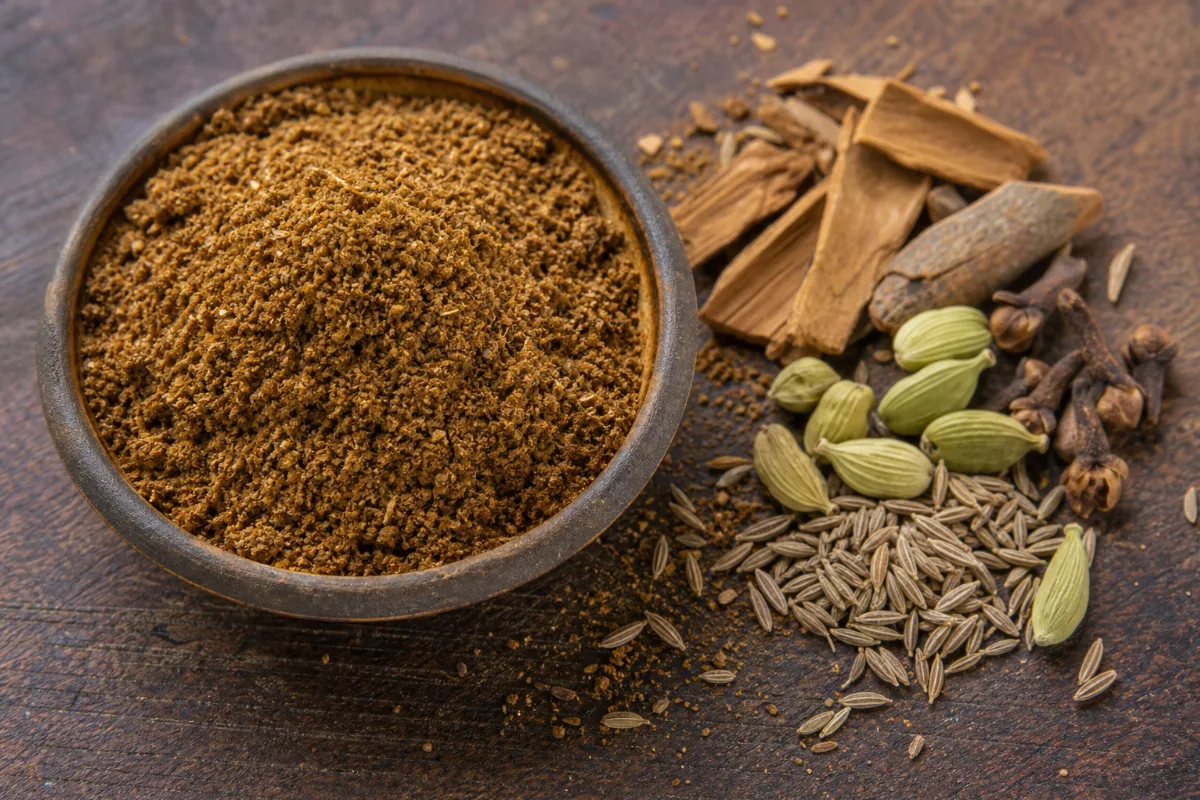
There is no one recipe. Wikipedia says the mix varies by region and by cook, and that none is considered more authentic than another. A typical Indian version includes fennel, Indian bay leaf, black and white pepper, cloves, cinnamon or cassia, mace, black and green cardamom, cumin, coriander seed and red chili. Some add star anise, asafoetida, nuts, onion, garlic, or grind it with water or vinegar into a paste.
In the kitchen
The spices are often roasted, then ground together, and the powder is added just before the end of cooking. It goes into marinades, pickles, stews and curries.
If you want to know what a single ingredient does, see its own page: Cumin, Cloves, Cardamom, Cinnamon, Black pepper, Coriander seed and Nutmeg.
Nutrition
No standard nutrition entry for garam masala was confirmed, so no calories or nutrient numbers are given. A blend depends on its recipe and on whether salt or fillers are added; read the label.
What the research shows
Little research exists on garam masala as a blend. One 1999 test in 18 healthy volunteers found faster stomach emptying after a meal with the blend, in 17 of 18 people. Two older mouse studies looked at tumours and liver enzymes. None of these shows a health benefit in people.
Other papers only measure what is in samples. Some ground spice blends were found to hold more than 100 mg/kg of the plant compound genistein, and garam masala was reported as very high in salicylates in a 1985 analysis. These are composition facts, not health findings.
The blend versus single spices and extracts
What a study of one spice or an extract found does not carry over to a blend, and the reverse is also true. Each ingredient is covered on its own page. This page gives no amounts to eat.
At a glance
Traditional uses history, not proof
- Added to curries, stews, marinades and pickles in Indian, Pakistani, Nepalese and Bangladeshi cooking
- Used alone or with other seasonings, often toasted and ground, or added just before the end of cooking
Studied for research
- Health effects of the blend as a whole: no human outcome trial found, insufficient
- Faster stomach emptying after a garam masala meal in a small human test, very low certainty
- Tumour and liver-enzyme changes in mice, animal only, insufficient for people
Main compounds
- Depends on the recipe; not a single compound list
- Genistein (found above 100 mg/kg in some blends and spice samples)
- Salicylates (very high in garam masala in a 1985 food analysis)
Common forms
- Pre-ground blend
- Whole spices toasted and ground at home
- Whole-spice form added to hot oil early (khada masala)
- Paste made with water, vinegar or another liquid in some recipes
Research links: PubMed: Gastro-intestinal effects of Indian spice mixture (Garam Masala), 1999 · CDC MMWR 2018: Lead in spices, herbal remedies and ceremonial powders (PubMed abstract) · FDA: Sesame is the ninth major food allergen · BfR (Germany): Coumarin in cinnamon and other foods · Research Library · Genes & Biomarkers Library
What it is and its history
- Accepted scientific name
- Garam masala (a spice blend, not a species)
- Common names
- Garam masala (English); Warm spice mix (English); Garam masala (Spanish)
- Native range
- Originates in the Indian subcontinent (Wikipedia).
- Harvest and processing
- Wikipedia says the components are roasted, then ground together or added to the dish before finishing the cooking.
- Look-alikes and adulterants
- Name: Curry powder; Note: A different blend; usually includes turmeric. See its own page.
Photographs
Traditional use and history history, not clinical proof
| Tradition or era | Documented use | Source |
|---|---|---|
Traditional use shows how it was used. It does not show that it works or is safe today.
What is inside, and how it may work
What it contains and how those compounds act in cells and animals. Laboratory and animal mechanisms are not proven effects in people.
Main compounds
| Compound | Family | Where it is concentrated | Activity studied | Level of evidence |
|---|---|---|---|---|
| Genistein (phytoestrogen) | isoflavone | Spice blends (cumin the likely source) Above 100 mg/kg in some curry powder, chilli powder, garam masala and tandoori powder samples | A plant compound found at measurable levels in some blends; the abstract gives no health meaning. 3 | Human composition |
| Salicylates | phenolic acids | Spice blends Very high per 100 g for garam masala in a 1985 food analysis (no number in the abstract) | Natural compounds related to aspirin's active part; the abstract does not give a health meaning. 9 | Composition |
Mechanisms, receptors and pathways
| Target or pathway | Gene or receptor | What was found | Level |
|---|---|---|---|
| Liver detoxification enzymes (GST, cytochrome P-450) | Not stated | A diet with garam masala for 10 days changed the levels of these enzymes in mice, not dose-dependently. 8 | Animal research |
Absorption, metabolism and elimination
- Absorption
- Not found for the blend.
- Distribution
- Not found.
- Metabolism
- Not found.
- Elimination
- Not found.
- Bioavailability
- Not established.
Isolated compounds versus whole extracts
The blend is a seasoning of several ground spices. Findings in the literature are for the blend in mice and for single spices elsewhere. Concentrated extracts are different and are on the spice pages.
Nutritional composition
No USDA FoodData Central entry for garam masala as a generic blend was confirmed. The USDA search could not be re-run today (rate limit), and an earlier note on the older page said no entry exists. So no calories, grams per teaspoon or nutrient numbers are given. Because recipes differ, a number from one brand would not describe another. Packaged blends may add salt or fillers, so use the label.
1 very low certainty3 not enough evidence
What was looked at
The 4 benefits and uses checked for Garam masala, each with how strong the evidence is. Tap one to open it.
- Health effects of garam masala as a blendNot enough evidence
- How fast food leaves the stomach after a garam masala mealVery low certainty
- Tumours in the offspring of mice given a cancer-causing chemicalNot enough evidence
- Liver detoxification enzymes in miceNot enough evidence
Lab markers tracked in the studies
Stomach emptying time (half-time)Tumour incidence in mouse offspring
What is Garam masala good for?
Very little human research exists on garam masala as a blend. These are the studied uses and how strong the evidence is. None are results for single spices.
Benefits, one by one
Each card is a research question, not a promise. Tap a goal to filter. Open a card to see the studies, doses and limits.
Health effects of garam masala as a blend
Not enough evidenceNo trial of garam masala as a blend for any health outcome (blood pressure, cholesterol, blood sugar, inflammation, weight) was found.
1 studiesNot applicable; this page gives no amounts.
Studies, doses and limits
What the trials found
One small meal test (see stomach emptying) and no trials of outcomes such as blood pressure or cholesterol.
Results
No human outcome trial of the blend was found.
Why this rating
No human trials of health outcomes; recipes differ, so one blend result would not apply to all blends.
Who was studied
Not studied.
Limits
Absence of studies is not proof of no effect, and it is not proof of benefit.
Why researchers looked
The blend is a daily food for many people, so readers ask whether it does anything.
Traditional use
Used as a finishing flavoring in North Indian, Pakistani, Nepalese and Bangladeshi cooking. Cooking tradition is not evidence of a health effect.
Proposed mechanism None
None established for the blend. What is in it varies, so the single spices have to be looked at one by one.
A proposed mechanism does not show that the effect happens in people.
See the safety file for lead, germs, mould toxins, sesame and component spices.
How fast food leaves the stomach after a garam masala meal
Very low certaintyIn 18 healthy volunteers, a rice cake meal with garam masala left the stomach faster than the same meal without it, in 17 of 18 people.
1 studiesGaram masala eaten with an Indian rice cake (idli); the amount is not…
Studies, doses and limits
What the trials found
One small test using a radiolabelled meal and scans of the stomach.
Results
Gastric emptying was faster with the spiced meal (p < 0.05). The lag phase did not differ.
Effect sizes as reported
Faster in 17 of 18 volunteers.
Why this rating
One meal test, 18 people, 1999, no amount or recipe given in the abstract, no check of long-term effect, and faster emptying is not shown to be good or bad.
Form and dose studied
Garam masala eaten with an Indian rice cake (idli); the amount is not given in the abstract.
Who was studied
Healthy adults in India.
Limits
Tiny, single meal, unknown blend recipe, funding not stated in the abstract.
Why researchers looked
Spices are eaten in large variety in tropical countries and there is little human work on how they affect gut transit.
Traditional use
Spiced food is often eaten for flavor and in some traditions to help digestion; the study does not test that belief.
Proposed mechanism Unknown
Not shown in the abstract.
A proposed mechanism does not show that the effect happens in people.
None reported in the abstract.
Tumours in the offspring of mice given a cancer-causing chemical
Not enough evidenceIn a 1995 mouse study, garam masala given to pregnant or nursing mice alongside a cancer-causing chemical was linked to fewer tumours in their young. This is animal work only.
1 studiesMouse doses are not food portions for people.
Studies, doses and limits
Results
Tumour incidence in offspring fell from 62% to 19% and 10% (pregnancy) and from 66% to 23% and 14% (nursing) at 10 and 30 mg per day.
Effect sizes as reported
See results.
Why this rating
Mouse study only, a cancer-causing chemical model, blend recipe not given in the abstract.
Form and dose studied
Mouse doses are not food portions for people.
Who was studied
Mice.
Limits
Animal result; does not show that eating garam masala prevents cancer.
Why researchers looked
Researchers in India tested a common food seasoning for possible cancer-protective effects in animals.
Proposed mechanism Animal research
The authors say more work is needed to find the active components and how they act.
A proposed mechanism does not show that the effect happens in people.
Not applicable.
Liver detoxification enzymes in mice
Not enough evidenceIn a 1992 ten-day mouse study, garam masala in the diet changed the levels of liver enzymes that help the body clear chemicals. The changes were not stronger with more garam masala.
1 studies0.5%, 1.0% and 1.5% of mouse diet.
Studies, doses and limits
Results
Significant but dose-independent changes in enzyme levels.
Effect sizes as reported
Not given in the abstract.
Why this rating
Ten-day mouse study; enzyme levels are not health outcomes.
Form and dose studied
0.5%, 1.0% and 1.5% of mouse diet.
Who was studied
Mice.
Limits
Short, animal, not an outcome in people.
Why researchers looked
Looking for possible cancer-protective actions in a common food additive.
Proposed mechanism Animal research
The authors call the blend a possible 'bifunctional inducer' of detoxification enzymes.
A proposed mechanism does not show that the effect happens in people.
Changes in liver enzymes can also affect how medicines are handled; the abstract does not address this.
Connections to the rest of health
How Garam masala connects to the rest of our health knowledge graph. Every link says what kind of connection it is. A safety link (for example to the liver) is a warning, not a benefit. A study that merely mentions a topic never creates a benefit link.
Explore every connection: goals, body systems, organs, symptoms, genes
B. Body systems
| Connected to | Kind of connection | Evidence status | Context | Studies |
|---|---|---|---|---|
| Digestive System | Biological association | Not enough evidence | Studied for: Health effects of garam masala as a blend Studied for: How fast food leaves the stomach after a garam masala meal | 12 6 |
E. Health conditions
| Connected to | Kind of connection | Evidence status | Context | Studies |
|---|---|---|---|---|
| Lead poisoning | Documented risk | Some ground spices from homes of children with high blood lead contained lead; garam masala was not named in the abstract. Some ground spices in a North Carolina home survey held lead; garam masala was not named in the abstract. Preparation or compound: Ground spices in general |
2 |
I. Biomarkers
| Connected to | Kind of connection | Evidence status | Context | Studies |
|---|---|---|---|---|
| Stomach emptying time (half-time) | Biological association | Very low certainty | Measured in trials: lowered (faster emptying). A lab change is not the same as a health benefit. | 6 |
| Tumour incidence in mouse offspring | Biological association | Not enough evidence | Measured in trials: lowered. A lab change is not the same as a health benefit. | 7 |
K. Biological pathways
| Connected to | Kind of connection | Evidence status | Context | Studies |
|---|---|---|---|---|
| Genistein | Preliminary mechanism | Composition | Found above 100 mg/kg in some spice blends, cumin the likely source. | 3 |
L. Active compounds
| Connected to | Kind of connection | Evidence status | Context | Studies |
|---|---|---|---|---|
| Genistein (phytoestrogen) | Biological association | Human composition | A plant compound found at measurable levels in some blends; the abstract gives no health meaning. Preparation or compound: Spice blends (cumin the likely source) |
3 |
| Salicylates | Biological association | Composition | Natural compounds related to aspirin's active part; the abstract does not give a health meaning. Preparation or compound: Spice blends |
9 |
Each connection is stored with the ingredient, the connected record, the kind of connection, the evidence status, the supporting studies, the preparation or compound involved, and a review date (last reviewed October 26, 2026).
Evidence at a glance: what changed in 1 lab markers
Tap a number to show only those markers. Counts are markers, not people.
The evidence
The research centre for Garam masala. Every record here was checked against PubMed or the publisher's page; we never list a study we have not verified.
Evidence by outcome
Bars show how many studies we found for each outcome, not how well it works. People are added up across trials only (reviews are not added, to avoid double counting).
How we rate evidence
High certainty
Several well-run trials or reviews agree; further research is unlikely to change the picture much.
Moderate certainty
Good trials point the same way, but some doubt remains.
Low certainty
Small, short or inconsistent trials. The finding could change with better research.
Very low certainty
Very little or very weak human data. Treat as a possibility only.
Mixed findings
Trials or reviews disagree with each other.
Not enough evidence
Not enough human research to say either way.
Evidence against
Good research found no benefit, or found harm.
We take the reviewers' own risk-of-bias and GRADE statements where they exist, and otherwise judge from study size, design, consistency, directness and whether a product matches what is sold. Many publications do not make evidence high. Method note: We searched PubMed for garam masala and read all seven abstracts, read Wikipedia, the FDA sesame page and the BfR coumarin page, and read the PubMed abstracts for the nutmeg and lead reports. Only abstracts were read for studies. Items we could not verify are in the research gaps.
Study library: every study we checked 12
| Study | Design | People | Product, dose, length | Result |
|---|---|---|---|---|
| Ali 2015 Natural occurrence of aflatoxins and ochratoxin A in processed spices marketed in Malaysia. Food Addit Contam Part A Chem Anal Control Expo Risk Assess · PMID 25658149 · DOI |
Market survey spice samples |
34 + 24 commercial processed spices Commercial powdered spices bought in Penang, Malaysia, including one named 'garam masala' |
Across all spices in study 1, 85% had aflatoxins (mean 1.61 ng/g) and 79% had ochratoxin A (mean 2.21 ng/g). In study 2, 88% had aflatoxins (mean 8.38 ng/g). Fifteen samples for aflatoxins and two for ochratoxin A exceeded the Malaysian limit of 5 ng/g. The abstract gives no garam masala result on its own. No garam masala-only figure in the abstract Methods, limits and fundingOutcomes: Mould toxin levels Limitations: Garam masala is one of many spices tested; no blend-specific result is given in the abstract; one country's market. Funding and conflicts: Not stated in the abstract Read: abstract | |
| Angelon-Gaetz 2018 Lead in Spices, Herbal Remedies, and Ceremonial Powders Sampled from Home Investigations for Children with Elevated Blood Lead Levels - North Carolina, 2011-2018. MMWR Morb Mortal Wkly Rep · PMID 30462630 · DOI |
Public health case series spice and remedy samples |
59 properties, 61 children Homes of children with confirmed elevated blood lead, North Carolina |
More than one fourth (28.8%) of the spices, herbal remedies and ceremonial powders sampled contained 1 mg/kg or more of lead. The authors say setting a national maximum limit for lead in spices and herbal remedies might reduce lead exposure. 28.8% of products sampled had at least 1 mg/kg lead Methods, limits and fundingOutcomes: Lead in the products sampled Limitations: Homes chosen because a child had high blood lead, so not a random sample of shops. The abstract does not name garam masala; the CDC full text could not be opened (access denied), so the product list was not checked. Funding and conflicts: No conflicts of interest disclosed Read: abstract | |
| Clarke 2004 Determination of unusual soya and non-soya phytoestrogen sources in beer, fish products and other foods. Food Addit Contam · PMID 15712520 · DOI |
Food composition analysis food samples |
30 spice samples (and other foods) Fish products, Indian foods and meals, spices and beers analysed in the UK |
Analysis of curry powders, chilli powder, crushed chillies, garam masala and tandoori powder found that some contained genistein at more than 100 mg/kg. Cumin was the most likely source material. One portion of a vindaloo curry contained 11 mg genistein. Some spice blends including garam masala above 100 mg/kg genistein Methods, limits and fundingOutcomes: Genistein and other phytoestrogens Limitations: Composition only. The abstract does not say how many garam masala samples were tested or what the amount means for health. Funding and conflicts: Not stated in the abstract Read: abstract | |
| Ehrenpreis 2014 Nutmeg poisonings: a retrospective review of 10 years experience from the Illinois Poison Center, 2001-2011. J Med Toxicol · PMID 24452991 · DOI |
Poison centre case series |
32 nutmeg ingestions People reported to the Illinois Poison Center, 2001 to 2011 |
32 cases: 17 (53.1%) unintentional, of which 10 were in children under 13 (4 eye exposures); 15 (46.9%) intentional, of which 5 involved combined drug intoxication, all aged 15 to 20. One patient with several drugs needed breathing support. The authors advise education about intentional nutmeg use with drugs and about exposures in young children. 32 cases over 10 years Methods, limits and fundingOutcomes: Type of exposure and outcome Limitations: Poison-centre reports only; no rate; says nothing about nutmeg in normal cooking. Funding and conflicts: Not stated in the abstract Read: abstract | |
| Hara-Kudo 2006 Salmonella prevalence and total microbial and spore populations in spices imported to Japan. J Food Prot · PMID 17066938 · DOI |
Market survey spice samples |
259 samples of 40 spice types Spices imported to Japan |
Salmonella was found in a black pepper and a red pepper sample, not in garam masala. The mean aerobic bacterial count was above 5.39 log CFU/g in turmeric, garam masala, curry powder and paprika. The authors say spices can contaminate foods they are added to and that ways to reduce germ load should be used. Mean bacterial count above 5.39 log CFU/g in garam masala (with three other spices) Methods, limits and fundingOutcomes: Salmonella and total bacterial counts Limitations: Imported samples tested in Japan in the early 2000s; a germ count is not the same as illness. Funding and conflicts: Not stated in the abstract Read: abstract | |
| Kochhar 1999 Gastro-intestinal effects of Indian spice mixture (Garam Masala). Trop Gastroenterol · PMID 10769605 |
Crossover style meal test (as described in abstract) |
18 18 well-nourished healthy adult volunteers in India |
Gastric emptying was faster with the spiced meal (p < 0.05); in 17 of 18 volunteers the spiced-meal half-time was lower than the spice-free meal. The lag phase did not differ. A trend to slower gastrocolic transit with the spice-free meal needed more subjects to confirm. Faster stomach emptying with the garam masala meal in 17 of 18 people; the abstract's half-time figure is garbled so no number is quoted here Methods, limits and fundingOutcomes: Gastric emptying time (t1/2) and gastrocolic transit Limitations: Single test meal, 18 people. The abstract does not give the amount of garam masala, the recipe of the blend, the order of meals or the funding. Faster emptying is not shown to be a health benefit. Funding and conflicts: Not stated in the abstract Read: abstract | |
| Rao 1995 Chemopreventive action of oriental food-seasoning spices mixture Garam masala on DMBA-induced transplacental and translactational carcinogenesis in mice. Nutr Cancer · PMID 7739919 · DOI |
Animal experiment mouse |
not stated Pregnant and nursing mice |
Offspring tumour incidence fell from 62% (control) to 19% and 10% (pregnancy exposure) and from 66% to 23% and 14% (nursing exposure) at the two garam masala levels; tumours per affected mouse also fell. Pregnancy model: 62% to 19% and 10%. Nursing model: 66% to 23% and 14%. Methods, limits and fundingOutcomes: Tumour incidence and tumours per mouse in the offspring Limitations: Mouse study with a cancer-causing chemical. The recipe of the blend is not given in the abstract. Not shown in people. Funding and conflicts: Not stated in the abstract Read: abstract | |
| Singh 1992 Evaluation of the modulatory influence of food additive-garam masala on hepatic detoxication system. Indian J Exp Biol · PMID 1294478 |
Animal experiment mouse |
not stated Swiss albino mice, 8 to 9 weeks old |
Significant but dose-independent changes in the levels of detoxification enzymes; the authors suggest possible chemopreventive potency. Changes were not dose-related. Methods, limits and fundingOutcomes: Liver detoxification enzymes (GST, cytochrome b5, cytochrome P-450) and sulfhydryl content Limitations: Ten-day mouse study; enzyme levels are not health outcomes; not shown in people. Funding and conflicts: Not stated in the abstract Read: abstract | |
| Swain 1985 Salicylates in foods. J Am Diet Assoc · PMID 4019987 |
Food composition analysis food samples |
333 food items Foods analysed in Australia |
Some herbs and spices, among them curry powder, paprika, thyme, garam masala and rosemary, were found to contain very high amounts of salicylate per 100 g of food. The abstract does not give the garam masala figure. No garam masala figure in the abstract Methods, limits and fundingOutcomes: Salicylate content Limitations: Composition only; a 1985 method; no health outcome. Funding and conflicts: Not stated in the abstract Read: abstract | |
| s-bfr-coumarin BfR (Germany): Frequently asked questions on coumarin in cinnamon and other foods · Source |
Regulator statement n/a |
Methods, limits and fundingRead: full-text | ||
| s-fda-sesame FDA: The FASTER Act: Sesame Is the Ninth Major Food Allergen · Source |
Regulator statement n/a |
Methods, limits and fundingRead: full-text | ||
| s-wiki-garam-masala Wikipedia: Garam masala · Source |
Encyclopedia (secondary source) n/a |
Methods, limits and fundingRead: full-text |
What we do not know yet
- No human trial of garam masala as a blend for any health outcome was found.
- The only human study is a single meal test in 18 people from 1999.
- The two mouse studies are old and give no blend recipe in their abstracts.
- Contamination surveys rarely report garam masala alone.
- No standard nutrition data for the blend was confirmed.
- No pregnancy, breastfeeding or medicine interaction advice for the blend was found.
How new research is added
New studies are found by a saved PubMed search and placed in a review queue before the page changes.
Lab markers
What changed in blood or saliva tests during trials. A changed number is not the same as feeling or being healthier, and we give no "normal ranges".
Other 2
Stomach emptying time (half-time)
Lowered (faster emptying) in trials
How long it takes for half of a meal to leave the stomach, measured with a scan after a radiolabelled meal.
Very low certaintyResults and what it means
Why it was measured
It shows how quickly food moves on from the stomach.
Statistical vs. clinical meaning
A single test meal; it does not show a health benefit or harm.
Safety implication
None found in the abstract.
| Study | Result | People | Product |
|---|---|---|---|
| 6 | Half-time was lower with garam masala in 17 of 18 volunteers (p < 0.05 for the group). | 18 healthy adults | Idli meal with or without garam masala |
Tumour incidence in mouse offspring
Lowered in trials
The share of young mice that developed tumours after the mother was given a cancer-causing chemical.
Not enough evidenceSafety
What studies and official sources say about side effects, medicines and who should check first. Each point shows what kind of evidence it comes from.
Main points to know 4
- Lead and other contamination can occur in ground spices. A North Carolina health report found 1 mg/kg or more of lead in 28.8% of the spices, herbal remedies and ceremonial powders sampled in homes of children with high blood lead. The abstract does not name garam masala, and the homes were not a random sample. Lead matters most for young children and pregnancy. Public health case series 2
- Mould toxins and germs have been found in some spices. A Malaysian survey found aflatoxins in most processed spices tested, some above that country's limit. A Japanese survey found Salmonella in two pepper samples (not in garam masala) and high germ counts in garam masala and three other spices. Neither abstract gives a garam masala-only mould result. Market survey 1 5
- Sesame and other allergens may be in a mix. Recipes vary and some mixes may include added ingredients. In the US, sesame must be labeled as an allergen on packaged foods since January 1, 2023. No source we read says garam masala usually contains sesame. Authoritative guidance 11
- Cassia and nutmeg in the blend: limits apply to large amounts. Germany's BfR sets a tolerable daily intake of 0.1 mg coumarin per kg body weight for cassia cinnamon and recommends moderate use. Poison-centre cases of nutmeg were mostly deliberate or accidental large amounts. The sources describe no problem from the small amount of a blend added to a dish. Authoritative guidance 10 4
Side effects 2
| Effect | How often | Severity and recovery | Evidence |
|---|---|---|---|
| Allergic reaction to an ingredient in a mix Read the ingredient list and the Contains line on packaged blends. No source we read gives a frequency for garam masala. | Not established | varies varies | Authoritative guidance 11 |
| Mixed-ingredient problems: no blend-specific adverse effect reports were found Reports exist for single spices at large amounts or concentrated forms (nutmeg poisoning, clove oil), not for a blend used as a seasoning. | Not established | not known not known | None found |
Liver
No liver injury from garam masala was found in the sources read. BfR notes that in especially sensitive people, comparatively small amounts of coumarin from cassia can cause liver damage that is usually reversible. 10
How often. Not known.
Monitoring. No monitoring advice found.
This is a safety connection. It is not evidence that Garam masala supports liver health.
Medicines and supplements 1
| With | Why it matters | Importance | Evidence | What to do |
|---|---|---|---|---|
| Medicines in general prescription | No interaction study of garam masala as a blend was found. Mouse liver enzymes changed after 10 days on a garam masala diet; this was not tested with medicines. | Unknown. Interactions of single spices are on their own pages. | Animal research Not enough evidence 8 | If you take a medicine and eat spice blends only as seasoning, no problem was found in these sources. Ask a pharmacist if you use spice supplements. |
Who should check first 1
| Situation | Advice | Evidence |
|---|---|---|
| Known allergy to an ingredient | Check the label on packaged blends or make your own so you know what is in it. | Authoritative guidance 11 |
Overdose, product quality and regulators
Summary. No toxicity data for garam masala as a blend was found, other than the contamination surveys above.
Animal. The mouse studies of the blend did not report toxicity in their abstracts.
Human doses studied. No safe intake is stated in the sources read.
High dose or long term signals. Cassia coumarin (BfR) and large amounts of nutmeg (poison-centre review) are concerns for those single spices at large amounts.
Overdose response. Not covered for the blend.
Genotoxicity. Not covered.
Surveys of ground spices found lead, mould toxins and high germ counts in some samples. Few are specific to garam masala.
Lead. 28.8% of spices, herbal remedies and ceremonial powders from homes of children with high blood lead had 1 mg/kg or more of lead; the abstract does not list garam masala. 2
Aflatoxins and ochratoxin A. 85% of 34 processed spices had aflatoxins and 79% had ochratoxin A in the first study, 88% had aflatoxins in the second; garam masala was one of the spices but is not reported separately. 1
Germs. Mean bacterial counts were above 5.39 log CFU/g in turmeric, garam masala, curry powder and paprika; Salmonella was found in two pepper samples, not garam masala. 5
| Body | Action | Date |
|---|---|---|
| FDA (US) (United States) | Sesame is a major food allergen that must be labeled on packaged foods and dietary supplements as of January 1, 2023. source | 2023-01-01 |
| BfR (Germany) (Germany) | Tolerable daily intake of coumarin 0.1 mg per kg body weight; recommends moderate use of cassia cinnamon. source | 2012 |
When to get medical help
- Trouble breathing, swelling of the face or throat, or hives after a meal: get emergency help.
- A child who may have eaten a large amount of a whole spice such as nutmeg: call your local poison centre.
Stop using the product and contact a clinician or emergency service. In the US, Poison Control is 1-800-222-1222.
General information only, not medical advice. Ask a clinician or pharmacist before use, especially with medicines, in pregnancy or with a health condition. See the Natural Remedy Safety guide.
Frequently asked questions
What is garam masala?
A blend of ground spices from the Indian subcontinent, used in Indian, Pakistani, Nepalese and Bangladeshi cooking. The name means roughly 'warm spices'.
What is in garam masala?
It varies. A typical Indian version includes cardamom, cinnamon or cassia, cloves, cumin, coriander seed, black pepper and often fennel, bay leaf and mace. Some recipes add star anise, chili, nuts, onion or garlic.
Is garam masala hot?
The name refers to warm spices, and pepper or chili can add heat in some recipes, but it is mainly warm and aromatic, not a hot chili blend.
Is garam masala good for you?
No human trial of the blend for any health outcome was found. The only human study was a small meal test showing faster stomach emptying, which is not shown to be a benefit. Enjoy it as a flavoring.
Does garam masala help digestion?
One 1999 test in 18 volunteers found a meal with garam masala left the stomach faster in 17 of 18 people. It was one meal and not a test of digestive symptoms, so it does not show better digestion.
Can garam masala prevent cancer?
Is garam masala safe in pregnancy and breastfeeding?
No source we read gives advice for the blend. Ask your midwife or doctor, especially about large amounts or spice supplements.
Can garam masala contain lead or other contaminants?
Does garam masala contain sesame or other allergens?
It depends on the recipe and the maker. US packaged foods must label sesame as an allergen since 2023, so read the ingredient list and the Contains line.
Does garam masala contain coumarin?
If the mix uses cassia cinnamon, it adds coumarin. Germany's BfR sets a daily limit and recommends moderate use of cassia, but its concern is heavy daily use, and the sources describe no problem from a pinch in a dish.
Does garam masala interact with medicines?
No interaction study of the blend was found. The sources read describe no interaction at cooking amounts. Ask a pharmacist if you take medicines and use spice supplements.
Is garam masala the same as curry powder?
No. They are different blends, and curry powder usually includes turmeric. See the curry powder page.
Explore by health goal
Editorial transparency
- Written by
- AlternativeMed editorial team. Research compiled with AI assistance, then checked against the sources listed.
- Medical review
- None. This page has not been reviewed by a physician or pharmacist.
- First published
- 2026-10-26
- Last substantive update
- 2026-10-26
- How we research
- We searched PubMed for garam masala and read all seven abstracts, read Wikipedia, the FDA sesame page and the BfR coumarin page, and read the PubMed abstracts for the nutmeg and lead reports. Only abstracts were read for studies. Items we could not verify are in the research gaps.
- How we rate evidence
- See "How we rate evidence" in the Evidence tab.
- Independence
- No product is promoted on this page. No affiliate links are shown.
Sources 12
Each source was opened and checked. Where we read only the abstract, it says so. The small numbers in the text point here.
- Ali N, Hashim NH, Shuib NS.. Natural occurrence of aflatoxins and ochratoxin A in processed spices marketed in Malaysia.. Food Addit Contam Part A Chem Anal Control Expo Risk Assess. 2015. PMID 25658149. DOI 10.1080/19440049.2015.1011712. (abstract)
- Angelon-Gaetz KA, Klaus C, Chaudhry EA, Bean DK.. Lead in Spices, Herbal Remedies, and Ceremonial Powders Sampled from Home Investigations for Children with Elevated Blood Lead Levels - North Carolina, 2011-2018.. MMWR Morb Mortal Wkly Rep. 2018. PMID 30462630. DOI 10.15585/mmwr.mm6746a2. (abstract)
- Clarke DB, Barnes KA, Lloyd AS.. Determination of unusual soya and non-soya phytoestrogen sources in beer, fish products and other foods.. Food Addit Contam. 2004. PMID 15712520. DOI 10.1080/02652030400006858. (abstract)
- Ehrenpreis JE, DesLauriers C, Lank P, et al.. Nutmeg poisonings: a retrospective review of 10 years experience from the Illinois Poison Center, 2001-2011.. J Med Toxicol. 2014. PMID 24452991. DOI 10.1007/s13181-013-0379-7. (abstract)
- Hara-Kudo Y, Ohtsuka LK, Onoue Y, et al.. Salmonella prevalence and total microbial and spore populations in spices imported to Japan.. J Food Prot. 2006. PMID 17066938. DOI 10.4315/0362-028x-69.10.2519. (abstract)
- Kochhar KP, Bijlani RL, Sachdeva U, et al.. Gastro-intestinal effects of Indian spice mixture (Garam Masala).. Trop Gastroenterol. 1999. PMID 10769605. (abstract)
- Rao AR, Hashim S.. Chemopreventive action of oriental food-seasoning spices mixture Garam masala on DMBA-induced transplacental and translactational carcinogenesis in mice.. Nutr Cancer. 1995. PMID 7739919. DOI 10.1080/01635589509514365. (abstract)
- Singh A, Rao AR.. Evaluation of the modulatory influence of food additive-garam masala on hepatic detoxication system.. Indian J Exp Biol. 1992. PMID 1294478. (abstract)
- Swain AR, Dutton SP, Truswell AS.. Salicylates in foods.. J Am Diet Assoc. 1985. PMID 4019987. (abstract)
- . BfR (Germany): Frequently asked questions on coumarin in cinnamon and other foods. . . (full-text)
- . FDA: The FASTER Act: Sesame Is the Ninth Major Food Allergen. . . (full-text)
- . Wikipedia: Garam masala. . . (full-text)
Where to buy
Check the label first. Whatever you buy, look for these:
- Whole or ground: whole spices keep their flavor longer
- The origin and a packed-on or best-by date for freshness
- Organic or non-irradiated labeling if that matters to you
- A resealable, airtight container
Talk to a pharmacist or doctor before you start any supplement, especially if you take medicines. See the Safety tab for interactions.
Support our free guides: as an Amazon Associate we earn from qualifying purchases. Full disclosure.


