Spices · Spice
Indian bay leaf (tej patta)
Cinnamomum tamala · also called Tej patta, tejpat, Indian bay leaf, Malabar leaf, Indian cassia
Tej patta is the leaf of a cinnamon-family tree, used whole in Indian and Nepali cooking and taken out before eating. It tastes like mild cinnamon with a clove edge, and it is not the same as common bay leaf. We found no human trial of eating it, so health claims rest on rat and lab work. The main caution is physical: do not swallow the stiff leaf.
General information, not medical advice. Last substantive update · Not medically reviewed. A named clinician has not signed off on this page. How this page is made
About Indian bay leaf (tej patta)
Tej patta is a seasoning leaf, not a proven remedy. As a leaf that is cooked and removed, the main caution is physical. The health research is mostly in rats and the lab.
What it is
Tej patta (Cinnamomum tamala) is the leaf of a laurel-family tree that grows wild in northern India, Nepal, Bangladesh, Myanmar and nearby countries. The tree can reach about 20 m tall.
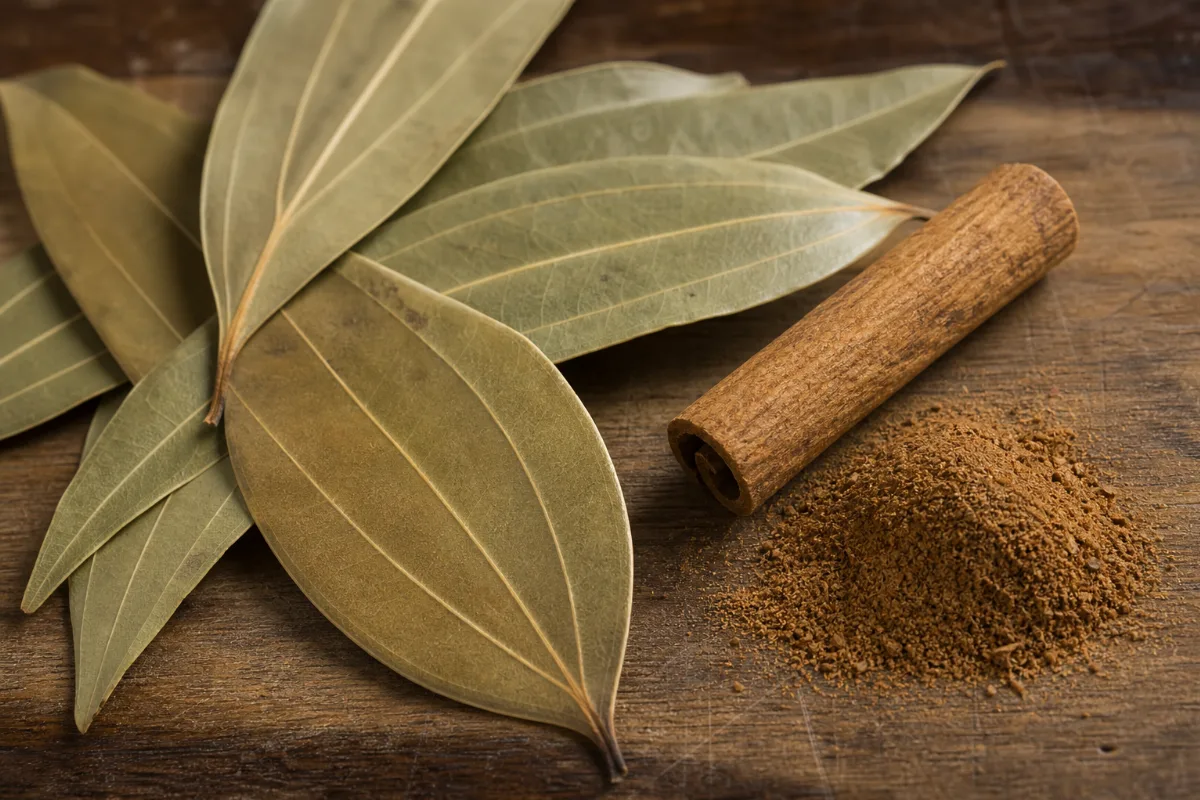
It is not the bay leaf of Mediterranean cooking (Laurus nobilis). Tej patta leaves are about twice as long and wide, usually olive green, with three veins. Shops often sell it as just 'bay leaf', so look for the Latin name or 'tej patta' on the pack.
Flavor and cooking
It tastes and smells like cassia cinnamon, but milder, with a clove-like note and a hint of pepper. Aroma compounds named for the leaf include beta-caryophyllene, linalool, caryophyllene oxide and eugenol.
It is used widely in Indian and Nepali cooking, especially Mughal-style dishes, and in rice dishes such as biryani and in garam masala. In Bhutan the leaves go into a herbal tea. Western bay leaf is sometimes used instead, but the flavour is different.
Nutrition
We give no nutrition numbers. Our existing summary says USDA's food database has no entry for Indian bay leaf, and we did not assume the entry for common bay leaf matches. Because the leaf is removed before eating, it is a flavouring and not a source of nutrients.
What the research shows
We found no human trial of eating the leaf. In rats made diabetic, a leaf extract and leaf oil lowered blood glucose according to a review. One rat study found that a concentrated extract reduced experimental diarrhoea. Lab dishes show activity against some bacteria.
The only human studies we found are one trial of a branded mix of mangosteen and tej patta extracts (run by the maker) and one skin-gel study in 13 women. Neither tests the spice as food.
Amounts
This page gives no amounts to eat. Ask a doctor, pharmacist or dietitian if you have questions, especially if you take regular medicines or are pregnant.
At a glance
Traditional uses history, not proof
- Whole leaf added to rice dishes, dal and spice mixes and removed before eating
- Leaf tea (tsheringma) in Bhutan
- Used in traditional medicine in South Asia
- Long use as food is not proof that it treats any condition
Studied for research
- Blood sugar, insufficient evidence (rat studies only)
- Diarrhoea, insufficient evidence (one rat study)
- Muscle strength, very low (one industry-linked trial of a combined supplement)
Main compounds
- Eugenol
- Beta-caryophyllene
- Linalool
Common forms
- Whole dried leaf as a seasoning
- Leaf extract and leaf essential oil (concentrated, studied in animals and the lab)
Research links: Rat study: leaf extract and diarrhoea · Review of Cinnamomum species (Front Pharmacol 2021) · GBIF: Cinnamomum tamala · Research Library · Genes & Biomarkers Library
What it is and its history
- Accepted scientific name
- Cinnamomum tamala
- Naming authority
- (Buch.-Ham.) T.Nees & Eberm. (GBIF accepted)
- Common names
- Indian bay leaf (English); Tej patta (Hindi); Tejpat (Hindi); Tejpatta (Hindi); Malabar leaf (English); Indian cassia (English); Hoja de laurel indio (Spanish)
- Family or group
- Lauraceae (the laurel family), as given by GBIF.
- Classification
- Plantae > Tracheophyta > Magnoliopsida > Laurales > Lauraceae > Cinnamomum > Cinnamomum tamala
- Native range
- Wikipedia: northern India (Assam and the western Himalayas), Bangladesh, Nepal, Myanmar, Laos, Vietnam and southwestern China. Not checked against a botanical database.
- Habitat
- Not verified from a source read.
- What it looks like
- Roots: Not verified.; Stems: A tree that can grow up to about 20 m tall (Wikipedia).; Leaves: About twice as long and wide as Mediterranean bay leaves, usually olive green, with three veins along the leaf (Wikipedia, Bay leaf page).; Flowers: Not verified.; Fruit: Not verified.
- Cultivation
- Not verified from a source read.
- Harvest and processing
- Not verified. The usual culinary form is the whole dried leaf (existing summary, not re-checked).
- Look-alikes and adulterants
- Name: Mediterranean bay leaf (Laurus nobilis); Note: A different plant: shorter, light to medium green, one main vein, with a pine and lemon note.; Name: Other 'bay' leaves; Note: Indonesian bay, West Indian bay, Mexican bay leaf and California bay are all different plants (Wikipedia).; Name: Cinnamon and cassia bark; Note: Same genus. Tej patta tastes like milder cassia. The bark of the tree is sometimes used like cinnamon but is regarded as inferior.
- Sustainability and conservation
- Wikipedia says the IUCN lists it as Least Concern; our existing summary carries this over. Not checked at IUCN.
Photographs
Traditional use and history history, not clinical proof
| Tradition or era | Documented use | Source |
|---|---|---|
Traditional use shows how it was used. It does not show that it works or is safe today.
What is inside, and how it may work
What it contains and how those compounds act in cells and animals. Laboratory and animal mechanisms are not proven effects in people.
Main compounds
| Compound | Family | Where it is concentrated | Activity studied | Level of evidence |
|---|---|---|---|---|
| Eugenol | phenylpropanoid | Leaf 3.8% w/w in one standardised 50% ethanol leaf extract (a concentrated extract, not a cooking leaf) | The main clove aroma compound. Listed as an aroma attribute of the leaf. 4 8 | Animal research |
| Beta-caryophyllene | sesquiterpene | Leaf Not given in the sources read | Listed as an aroma attribute. 8 | Reference only |
| Linalool | terpene alcohol | Leaf Not given in the sources read | Listed as an aroma attribute. 8 | Reference only |
| Caryophyllene oxide | sesquiterpene oxide | Leaf Not given in the sources read | Listed as an aroma attribute. 8 | Reference only |
| Tannins | polyphenol | Leaf 247.5 mg/g in the same standardised extract | Measured in the extract; no human meaning shown. 4 | Animal research |
Mechanisms, receptors and pathways
| Target or pathway | Gene or receptor | What was found | Level |
|---|---|---|---|
| Gut movement and antioxidant markers (rat gut) | Not specified | In castor-oil diarrhoea in rats, a leaf extract slowed gut transit, lowered fluid build-up and lipid peroxidation, and raised catalase. Animal and lab finding only. 4 | Animal research |
Absorption, metabolism and elimination
- Absorption
- Not found.
- Distribution
- Not found.
- Metabolism
- Not found.
- Elimination
- Not found.
- Bioavailability
- Not established.
Isolated compounds versus whole extracts
The cooking leaf, leaf extracts and leaf essential oil are different products. Almost all of the research is on concentrated extracts or oil in animals or lab dishes, which tells us little about a leaf simmered in a pot and removed.
Nutritional composition
No nutrition numbers are given. Our existing summary says USDA FoodData Central (SR Legacy) has no entry for Indian bay leaf, and its 'bay leaf' entry is for Laurus nobilis, which we did not assume matches. We could not re-check this because the USDA search was rate-limited on 2026-10-26. Because the leaf is removed before eating, it adds essentially no nutrition to a meal; that is our reading, not a measured value.
1 very low certainty5 not enough evidence
What was looked at
The 6 benefits and uses checked for Indian bay leaf (tej patta), each with how strong the evidence is. Tap one to open it.
- Blood sugar (rat studies only)Not enough evidence
- Diarrhoea (rat study)Not enough evidence
- Germ-killing action in the labNot enough evidence
- Antioxidant activity in lab testsNot enough evidence
- Muscle strength (combined extract supplement)Very low certainty
- Skin (a gel on the face, not food)Not enough evidence
What is Indian bay leaf (tej patta) good for?
We found no human trial of eating tej patta for any health purpose. The uses studied are listed below with their evidence.
Benefits, one by one
Each card is a research question, not a promise. Tap a goal to filter. Open a card to see the studies, doses and limits.
Blood sugar (rat studies only)
Not enough evidenceIn rats made diabetic, a leaf extract and the leaf essential oil lowered blood glucose. We found no human trial of tej patta leaf for blood sugar. This tells us nothing yet about eating the leaf in food.
1 studiesExtract and oil in rats, far from a leaf simmered in a pot.
Studies, doses and limits
What the trials found
No human trial found. Our search was limited (see gaps).
Results
A review table lists an ethanol leaf extract (500 mg/kg) in alloxan-diabetic rats and leaf essential oil in STZ-diabetic rats, each reported to lower blood glucose. The review gives no study design details for these.
Why this rating
Rat studies of extract or oil only; no human data; we read a review table, not the original papers.
Form and dose studied
Extract and oil in rats, far from a leaf simmered in a pot.
Limits
Original rat papers were not read. The review was read in part.
Why researchers looked
Other Cinnamomum species (cinnamon) are studied for blood sugar, so tej patta was tested too.
Traditional use
Tej patta leaf is a cooking leaf in India and Nepal. Long use as food is not proof that it treats any condition.
Proposed mechanism Animal research
Not established. Reported in animals only.
A proposed mechanism does not show that the effect happens in people.
Cinnamon-type cautions about coumarin and low blood sugar are about the genus in general; see the Safety tab.
Diarrhoea (rat study)
Not enough evidenceA concentrated alcohol extract of the leaf reduced castor-oil diarrhoea in rats. This was one rat study and no human data exist.
1 studiesStandardised ethanol extract (3.8% eugenol) in rats, not the cooking …
Studies, doses and limits
What the trials found
No human trial found.
Results
The 50% ethanol extract (25 to 100 mg/kg) lowered faecal output in a dose-dependent way in rats. The authors concluded it is useful for diarrhoea; that is not shown in people.
Why this rating
One rat study with a standardised extract; no human data.
Form and dose studied
Standardised ethanol extract (3.8% eugenol) in rats, not the cooking leaf.
Limits
The abstract gives no group sizes or confidence intervals.
Why researchers looked
The leaf is used as a spice and in traditional medicine in India, and diarrhoea is a classic test in animal studies.
Traditional use
Tej patta leaf is a cooking leaf in India and Nepal. Long use as food is not proof that it treats any condition.
Proposed mechanism Animal research
The extract slowed gut movement and fluid build-up in rats and changed antioxidant markers (animal and lab findings).
A proposed mechanism does not show that the effect happens in people.
Swallowing stiff whole leaves can itself harm the gut; see the Safety tab.
Germ-killing action in the lab
Not enough evidenceA methanol extract of tej patta was active against Staphylococcus aureus in a lab dish. A bark extract in the review also needed fairly high amounts. This does not show that eating the leaf fights infection.
2 studiesMethanol extract in lab dishes.
Studies, doses and limits
Results
Methanol extracts of four plants, including tej patta, were tested on microbes in dishes. The tej patta extract showed activity against Staphylococcus aureus; the abstract gives no numbers for it.
Why this rating
Test-tube results only.
Form and dose studied
Methanol extract in lab dishes.
Limits
Abstract only. No numbers for tej patta given.
Why researchers looked
Spice plants are screened in the lab for activity against germs.
Traditional use
Tej patta leaf is a cooking leaf in India and Nepal. Long use as food is not proof that it treats any condition.
Proposed mechanism Laboratory research
Not established. Lab dish test.
A proposed mechanism does not show that the effect happens in people.
None specific.
Antioxidant activity in lab tests
Not enough evidenceTej patta extracts were active in lab antioxidant tests. That is a chemistry result and does not show a benefit in people.
2 studiesExtract in lab tests.
Studies, doses and limits
Results
The review mentions tej patta in antioxidant assays; no human result is given.
Why this rating
Lab tests only; the review was read in part and gives no clinical result.
Form and dose studied
Extract in lab tests.
Limits
We did not open the original antioxidant papers.
Why researchers looked
Plant extracts are often tested for antioxidant activity.
Traditional use
Tej patta leaf is a cooking leaf in India and Nepal. Long use as food is not proof that it treats any condition.
Proposed mechanism Laboratory research
Lab chemistry assays (DPPH, FRAP, ORAC) per the review.
A proposed mechanism does not show that the effect happens in people.
None specific.
Muscle strength (combined extract supplement)
Very low certaintyOne 42-day trial in 38 men gave a branded mix of mangosteen rind extract and tej patta leaf extract. The mix group gained more strength and lean mass than placebo. It is one industry-linked trial of a mix, so the result cannot be credited to tej patta or to the leaf as a spice.
1 studies800 mg a day of the combined extract product for 42 days; not a cooki…
Studies, doses and limits
What the trials found
One randomised, double-blind, placebo-controlled trial of 38 men who finished.
Results
Per-protocol: bigger gains in bench press, leg press and leg extension repetitions than placebo (p < 0.0001), and more lean mass. Testosterone, IGF-1, insulin and lactate did not differ.
Why this rating
One small trial of a combined proprietary product, run by people linked to the maker, per-protocol analysis. Not tej patta alone.
Form and dose studied
800 mg a day of the combined extract product for 42 days; not a cooking amount.
Limits
Funded and designed by the maker (Laila Nutraceuticals), which filed a patent on the mix. Independent site ran the trial. Not replicated that we found.
Why researchers looked
A company tested its own supplement combination.
Traditional use
Tej patta leaf is a cooking leaf in India and Nepal. Long use as food is not proof that it treats any condition.
Proposed mechanism Not established
Not established.
A proposed mechanism does not show that the effect happens in people.
Safety checks in the trial stayed in the normal range, but the trial was small and short.
Skin (a gel on the face, not food)
Not enough evidenceA small trial put a gel with 4% tej patta leaf extract on one cheek and a plain gel on the other in 13 women for 90 days. The authors reported less melanin, redness, oil and pore size. This is about skin products, not eating the leaf.
2 studies4% extract in a gel applied to the skin.
Studies, doses and limits
What the trials found
One split-face controlled study of 13 healthy women.
Results
The extract gel was reported to improve several skin measurements compared with the plain gel.
Why this rating
13 women, a skin product, funding not stated.
Form and dose studied
4% extract in a gel applied to the skin.
Limits
Very small; no food relevance.
Why researchers looked
Plant phenols are studied for skin.
Traditional use
Tej patta leaf is a cooking leaf in India and Nepal. Long use as food is not proof that it treats any condition.
Proposed mechanism Not established
Not established.
A proposed mechanism does not show that the effect happens in people.
Skin products can irritate; cinnamon oil on the skin can cause redness and burning (review, genus level).
Connections to the rest of health
How Indian bay leaf (tej patta) connects to the rest of our health knowledge graph. Every link says what kind of connection it is. A safety link (for example to the liver) is a warning, not a benefit. A study that merely mentions a topic never creates a benefit link.
Explore every connection: goals, body systems, organs, symptoms, genes
E. Health conditions
| Connected to | Kind of connection | Evidence status | Context | Studies |
|---|---|---|---|---|
| Choking and gut injury from swallowing bay leaf | Adverse effect or risk | Documented risk | Bay leaves stay stiff after cooking and may cause choking or harm the digestive tract if swallowed whole or in large pieces. Preparation or compound: Stiff whole or large pieces of bay leaf |
7 |
L. Active compounds
| Connected to | Kind of connection | Evidence status | Context | Studies |
|---|---|---|---|---|
| Eugenol | Biological association | Animal | The main clove aroma compound. Listed as an aroma attribute of the leaf. Preparation or compound: Leaf |
4 8 |
| Beta-caryophyllene | Biological association | Reference only | Listed as an aroma attribute. Preparation or compound: Leaf |
8 |
| Linalool | Biological association | Reference only | Listed as an aroma attribute. Preparation or compound: Leaf |
8 |
| Caryophyllene oxide | Biological association | Reference only | Listed as an aroma attribute. Preparation or compound: Leaf |
8 |
| Tannins | Biological association | Animal | Measured in the extract; no human meaning shown. Preparation or compound: Leaf |
4 |
Each connection is stored with the ingredient, the connected record, the kind of connection, the evidence status, the supporting studies, the preparation or compound involved, and a review date (last reviewed October 26, 2026).
Evidence at a glance: what the research found for 6 outcomes
Each outcome below is one thing researchers measured. Certainty is how far the evidence can be trusted, not how well it works. The full studies are on the next tab.
The evidence
The research centre for Indian bay leaf (tej patta). Every record here was checked against PubMed or the publisher's page; we never list a study we have not verified.
Evidence by outcome
Bars show how many studies we found for each outcome, not how well it works. People are added up across trials only (reviews are not added, to avoid double counting).
How we rate evidence
High certainty
Several well-run trials or reviews agree; further research is unlikely to change the picture much.
Moderate certainty
Good trials point the same way, but some doubt remains.
Low certainty
Small, short or inconsistent trials. The finding could change with better research.
Very low certainty
Very little or very weak human data. Treat as a possibility only.
Mixed findings
Trials or reviews disagree with each other.
Not enough evidence
Not enough human research to say either way.
Evidence against
Good research found no benefit, or found harm.
We take the reviewers' own risk-of-bias and GRADE statements where they exist, and otherwise judge from study size, design, consistency, directness and whether a product matches what is sold. Many publications do not make evidence high. Method note: We started from our existing tej patta summary, re-read four PubMed abstracts and the Front Pharmacol review text, re-read two Wikipedia pages and checked the species name at GBIF. Little research exists, so this page is short. Items we could not verify are flagged in the research gaps.
Study library: every study we checked 8
| Study | Design | People | Product, dose, length | Result |
|---|---|---|---|---|
| Arshad 2020 Assessment of changes in biophysical parameters by dermocosmetic emulgel loaded with Cinnamomum tamala extract: A split-faced and placebo-controlled study. J Cosmet Dermatol · PMID 31680410 · DOI |
Controlled trial |
13 13 healthy women; split-face comparison |
Gel containing 4% Cinnamomum tamala leaf extract, put on the skin Leaf (extract) 4% in a gel 90 days · vs Placebo gel base on the other cheek |
Compared with the placebo gel, the extract gel was reported to lower melanin, redness, oil and the size and count of facial pores (p up to .05). Not applicable (Not stated in abstract) Methods, limits and fundingOutcomes: Skin melanin, redness, oil, pore size and count Limitations: 13 women, a skin gel, not food. Funding not stated in the abstract. Funding and conflicts: Not stated in the abstract. Read: abstract |
| Konda 2018 Combined extracts of Garcinia mangostana fruit rind and Cinnamomum tamala leaf supplementation enhances muscle strength and endurance in resistance trained males. J Int Soc Sports Nutr · PMID 30348185 · DOI |
Controlled trial |
38 38 resistance-trained men (mean age about 26) who finished a 42-day trial, plus a mouse experiment |
GMCT, a proprietary combination of mangosteen fruit-rind extract and tej patta leaf extract Fruit rind and leaf (extracts) 800 mg daily of the combined product (the supplement, not a cooking amount) 42 days · vs Matched placebo |
Per-protocol results: the combined extract group gained more on bench press, leg press and leg extension repetitions than placebo (p < 0.0001), and had larger arm circumference and lean mass gains. Free testosterone, IGF-1, insulin and lactate did not improve versus placebo. Blood, urine and vital-sign checks stayed in the normal range. Not applicable (Not stated in abstract) Methods, limits and fundingOutcomes: 1-rep-max bench press and leg press, leg extension repetitions, arm size, lean mass, hormone and lactate markers Limitations: One trial of a combined branded product, so the effect cannot be put down to tej patta. Small, per-protocol analysis. Not the leaf as a spice. Funding and conflicts: Industry: the sponsor, Laila Nutraceuticals, designed the protocol, four authors work for it, and it has filed a patent application on the combination. An independent site ran the trial. Read: abstract |
| Manandhar 2019 In Vitro Antimicrobial Activity of Some Medicinal Plants against Human Pathogenic Bacteria. J Trop Med · PMID 31065287 · DOI |
Laboratory research in-vitro |
Lab dishes with 12 disease-causing microbes and 2 reference strains | Methanol extracts of four plants, including Cinnamomum tamala Not in the abstract Lab test |
The methanol extracts of Artemisia vulgaris, Cinnamomum tamala and Ageratina adenophora showed activity against Staphylococcus aureus. The strongest results of the four plants were for Oxalis corniculata, not tej patta. Not applicable (lab) (Not applicable) Methods, limits and fundingOutcomes: Zone of inhibition by agar well diffusion Limitations: Lab dish only; the abstract gives no tej patta numbers. The authors' call for drug use is not supported by a test in people. Funding and conflicts: Not stated in the abstract. Read: abstract |
| Rao 2008 Antidiarrhoeal activity of the standardised extract of Cinnamomum tamala in experimental rats. J Nat Med · PMID 18493839 · DOI |
Animal study rat |
Rats with castor-oil-induced diarrhoea, plus a lab mast-cell test | 50% ethanol extract of Cinnamomum tamala leaf (3.8% eugenol w/w, tannin 247.5 mg/g) Leaf 25, 50 and 100 mg/kg by mouth (rats) Single dose · vs Castor-oil control groups |
The extract dose-dependently reduced the amount of faecal matter in castor-oil diarrhoea in rats, slowed charcoal-meal travel at 50 and 100 mg/kg, and lowered intestinal fluid accumulation (reported as 32.5 to 65.0 percent). It lowered lipid peroxidation and raised catalase. In the lab it protected mast cells at 5 and 10 mg/ml. Not applicable (animal) (Not stated in abstract) Methods, limits and fundingOutcomes: Faecal output, gut transit, intestinal fluid, lipid peroxidation, catalase, mast cells (lab) Limitations: Rats, concentrated extract. The abstract gives no group sizes. Not the leaf as eaten, and no human data. Funding and conflicts: Not stated in the abstract (research support, non-US government). Read: abstract |
| s-gbif-cinnamomum-tamala GBIF Backbone: Cinnamomum tamala (Buch.-Ham.) T.Nees & Eberm. (usageKey 9128079) · Source |
Reference database n/a |
Methods, limits and fundingRead: full-text | ||
| s-pmc8144503 Cinnamomum species: bridging phytochemistry knowledge, pharmacological properties and toxicological safety for health benefits · Source |
Narrative review mixed |
Methods, limits and fundingRead: partly | ||
| s-wiki-bay-leaf Wikipedia: Bay leaf · Source |
Encyclopedia n/a |
Methods, limits and fundingRead: full-text | ||
| s-wiki-cinnamomum-tamala Wikipedia: Cinnamomum tamala · Source |
Encyclopedia n/a |
Methods, limits and fundingRead: full-text |
What we do not know yet
- No human trial of eating the leaf was found; our PubMed check was one search for trials.
- No safety study, poisoning report, or coumarin figure for the leaf was found.
- Nutrition data, pregnancy, breastfeeding, allergy and contamination were not covered.
- Flavour and cooking facts rest on two encyclopedia pages, not a food-science source.
How new research is added
New studies are found by a saved PubMed search and placed in a review queue before the page changes.
Lab markers
What changed in blood or saliva tests during trials. A changed number is not the same as feeling or being healthier, and we give no "normal ranges".
Safety
What studies and official sources say about side effects, medicines and who should check first. Each point shows what kind of evidence it comes from.
Main points to know 3
- Take the leaf out before eating: stiff whole leaves can harm the gut or cause choking. Bay leaves, including the Indian kind, stay stiff after cooking. They may cause choking or harm the digestive tract if swallowed whole or in large pieces. This comes from an encyclopedia page about bay leaves in general, not from a study of tej patta. General source 7
- No human safety studies of the leaf were found. We found no safety trial of tej patta in food, and no report of poisoning or liver injury from the leaf. Absence of reports is not proof of safety. The two human studies we found used a branded supplement mix and a skin gel. Insufficient 2 1
- Cinnamon-family cautions are not measured for this leaf. A review says coumarin and cinnamaldehyde in Cinnamomum products might be linked to liver damage, low blood sugar, and interactions with medicines. It gives no coumarin figure for tej patta, so we cannot say how much this leaf contains. Concentrated extracts and oils are not the same as a leaf in a pot. Narrative review 6
Side effects 3
| Effect | How often | Severity and recovery | Evidence |
|---|---|---|---|
| Choking or injury to the digestive tract from swallowing whole or large pieces of stiff bay leaf About bay leaves in general. | Not stated | could be serious Not stated | General source 7 |
| Skin redness, irritation or burning from cinnamon essential oil on the skin Genus-level statement about cinnamon oil, not tej patta. | Not stated | mild to moderate Not stated | Narrative review 6 |
| No side effects reported in the 42-day trial of a tej patta plus mangosteen extract (blood, urine and vital signs stayed in the normal range) Small, short, industry-linked, a combined supplement. | 38 men finished | none reported Not applicable | Controlled trial 2 |
Liver
No liver injury from tej patta was found. A review notes that coumarin in some cinnamon products might harm the liver, but gives no figure for tej patta. LiverTox was not searched. 6
How often. No frequency found.
Monitoring. No agency monitoring advice found.
This is a safety connection. It is not evidence that Indian bay leaf (tej patta) supports liver health.
Medicines and supplements 2
| With | Why it matters | Importance | Evidence | What to do |
|---|---|---|---|---|
| Diabetes medicines prescription | Cinnamon-type products are linked to lower blood sugar in the genus review; tej patta leaf extract lowered glucose in diabetic rats. | No human interaction data for tej patta. Animal findings only. | Animal research Very low certainty 6 | If you take diabetes medicine and are thinking of an extract or supplement, ask a pharmacist first. Leaf used as a seasoning and removed before eating is the usual food use. |
| Statins, paracetamol (acetaminophen) and other medicines the review lists for large amounts of cinnamon prescription | The review says large amounts of Cinnamomum might interact with several medicines, with liver damage as the concern. | About cinnamon in general, not shown for tej patta. | Narrative review Very low certainty 6 | Ask a pharmacist before using extracts or supplements if you take regular medicines. |
Who should check first 3
| Situation | Advice | Evidence |
|---|---|---|
| Anyone, when cooking with whole leaves | Remove the leaves before serving and do not swallow them whole. | General source 7 |
| Pregnancy and breastfeeding | We did not find an official statement for tej patta. Normal seasoning in cooking is the usual food use; ask your doctor or midwife about extracts, oils or supplements. | Insufficient |
| Children | No source we read covers tej patta in children. Take the leaf out of the dish before serving to young children, because of the choking risk. | General source 7 |
Overdose, product quality and regulators
Summary. No toxic amount of tej patta leaf in food was found. A Wikipedia page says bay leaves are not toxic but are a choking and gut hazard if swallowed in pieces.
Animal. No animal toxicity study was read.
High dose or long term signals. Not researched.
Overdose response. Not described.
Genotoxicity. Not researched.
Mix-ups are the main practical issue. Shops often sell tej patta as plain 'bay leaf', and the Mediterranean bay leaf and some other 'bay' leaves are different plants. Contamination (moulds, pesticides, metals) of tej patta was not researched.
Look-alikes. Tej patta is the cinnamon-family leaf (Cinnamomum tamala), about twice as long and wide as Mediterranean bay with three veins, usually olive green. Wikipedia also notes that California bay (Umbellularia californica) contains umbellulone, which can cause methemoglobinemia. That is a different plant from the leaf this page covers. 7
| Body | Action | Date |
|---|
When to get medical help
- Choking, or severe pain in the chest, throat or belly after swallowing a piece of leaf
- Trouble breathing or swelling of the face or throat after a meal (allergy to this leaf is not documented in the sources read, but any such reaction is an emergency)
Stop using the product and contact a clinician or emergency service. In the US, Poison Control is 1-800-222-1222.
General information only, not medical advice. Ask a clinician or pharmacist before use, especially with medicines, in pregnancy or with a health condition. See the Natural Remedy Safety guide.
Frequently asked questions
What is tej patta?
Is tej patta the same as bay leaf?
What does tej patta taste like?
What is it used for in cooking?
Rice dishes such as biryani, and spice mixes such as garam masala, according to the encyclopedia page. It is used widely in Indian and Nepali cooking, especially Mughal-style dishes, and in a herbal tea called tsheringma in Bhutan. We did not read a cooking source on when to add it, so we give no rules.
Is tej patta good for you?
Does tej patta lower blood sugar?
In rats made diabetic, a leaf extract and the leaf oil lowered blood glucose, according to a review. We found no human trial, so this is not shown for people or for the leaf in food.
Does it help with diarrhoea or digestion?
Is tej patta safe to eat?
As a leaf that is cooked and taken out, it is a long-used seasoning. We found no safety studies of the leaf, so we cannot say more. The known hazard is physical: stiff leaves can cause choking or harm the gut if swallowed whole or in large pieces.
Is it safe with medicines?
We found no interaction data for tej patta. A review lists possible interactions for large amounts of cinnamon, including with diabetes medicines and statins, but does not tie them to this leaf. Ask a pharmacist before using an extract or supplement.
Is tej patta safe in pregnancy or while breastfeeding?
We did not find an official statement about it. Ask your doctor or midwife, especially about extracts, oils or supplements.
Does it contain coumarin like cassia?
We do not know. A review says coumarin in some cinnamon products may harm the liver in large amounts, but it gives no coumarin figure for tej patta, and we did not find one.
Can I use ordinary bay leaf instead?
Cooks do, mainly in biryani and garam masala, but the flavour is different.
Explore by health goal
Editorial transparency
- Written by
- AlternativeMed editorial team. Research compiled with AI assistance, then checked against the sources listed.
- Medical review
- None. This page has not been reviewed by a physician or pharmacist.
- First published
- 2026-10-26
- Last substantive update
- 2026-10-26
- How we research
- We started from our existing tej patta summary, re-read four PubMed abstracts and the Front Pharmacol review text, re-read two Wikipedia pages and checked the species name at GBIF. Little research exists, so this page is short. Items we could not verify are flagged in the research gaps.
- How we rate evidence
- See "How we rate evidence" in the Evidence tab.
- Independence
- No product is promoted on this page. No affiliate links are shown.
Sources 8
Each source was opened and checked. Where we read only the abstract, it says so. The small numbers in the text point here.
- Arshad W, Khan HMS, Akhtar N, Nawaz M. Assessment of changes in biophysical parameters by dermocosmetic emulgel loaded with Cinnamomum tamala extract: A split-faced and placebo-controlled study.. J Cosmet Dermatol. 2020. PMID 31680410. DOI 10.1111/jocd.13198. (abstract)
- Konda MR, Alluri KV, Janardhanan PK, Trimurtulu G, Sengupta K. Combined extracts of Garcinia mangostana fruit rind and Cinnamomum tamala leaf supplementation enhances muscle strength and endurance in resistance trained males.. J Int Soc Sports Nutr. 2018. PMID 30348185. DOI 10.1186/s12970-018-0257-4. (abstract)
- Manandhar S, Luitel S, Dahal RK. In Vitro Antimicrobial Activity of Some Medicinal Plants against Human Pathogenic Bacteria.. J Trop Med. 2019. PMID 31065287. DOI 10.1155/2019/1895340. (abstract)
- Rao CV, Vijayakumar M, Sairam K, Kumar V. Antidiarrhoeal activity of the standardised extract of Cinnamomum tamala in experimental rats.. J Nat Med. 2008. PMID 18493839. DOI 10.1007/s11418-008-0258-8. (abstract)
- . GBIF Backbone: Cinnamomum tamala (Buch.-Ham.) T.Nees & Eberm. (usageKey 9128079). . . (full-text)
- . Cinnamomum species: bridging phytochemistry knowledge, pharmacological properties and toxicological safety for health benefits. . . (partly)
- . Wikipedia: Bay leaf. . . (full-text)
- . Wikipedia: Cinnamomum tamala. . . (full-text)
Where to buy
Check the label first. Whatever you buy, look for these:
- Whole or ground: whole spices keep their flavor longer
- The origin and a packed-on or best-by date for freshness
- Organic or non-irradiated labeling if that matters to you
- A resealable, airtight container
Talk to a pharmacist or doctor before you start any supplement, especially if you take medicines. See the Safety tab for interactions.
Support our free guides: as an Amazon Associate we earn from qualifying purchases. Full disclosure.


