Spices · Spice
Bay leaf
Laurus nobilis · also called Bay laurel, sweet bay, laurel leaf, hoja de laurel (Spanish)
Bay leaf is the dried leaf of the bay laurel, added whole to soups, stews and curries for a mild herbal flavour. Two small studies looked at blood sugar and one at blood fats, all using capsules or cookies, not a leaf in a pot, so there is no proof it helps health. The main caution: a whole leaf stays stiff and should not be swallowed, so take it out before serving. One case report links months of daily bay leaf tea to liver injury.
General information, not medical advice. Last substantive update · Not medically reviewed. A named clinician has not signed off on this page. How this page is made
About Bay leaf
Bay leaf is a flavouring that is cooked in a dish and taken out. It adds taste, not nutrition, and the health studies we found used capsules, cookies with leaf powder or lab extracts. Safety is better documented than benefit: do not swallow whole leaves.
What it is
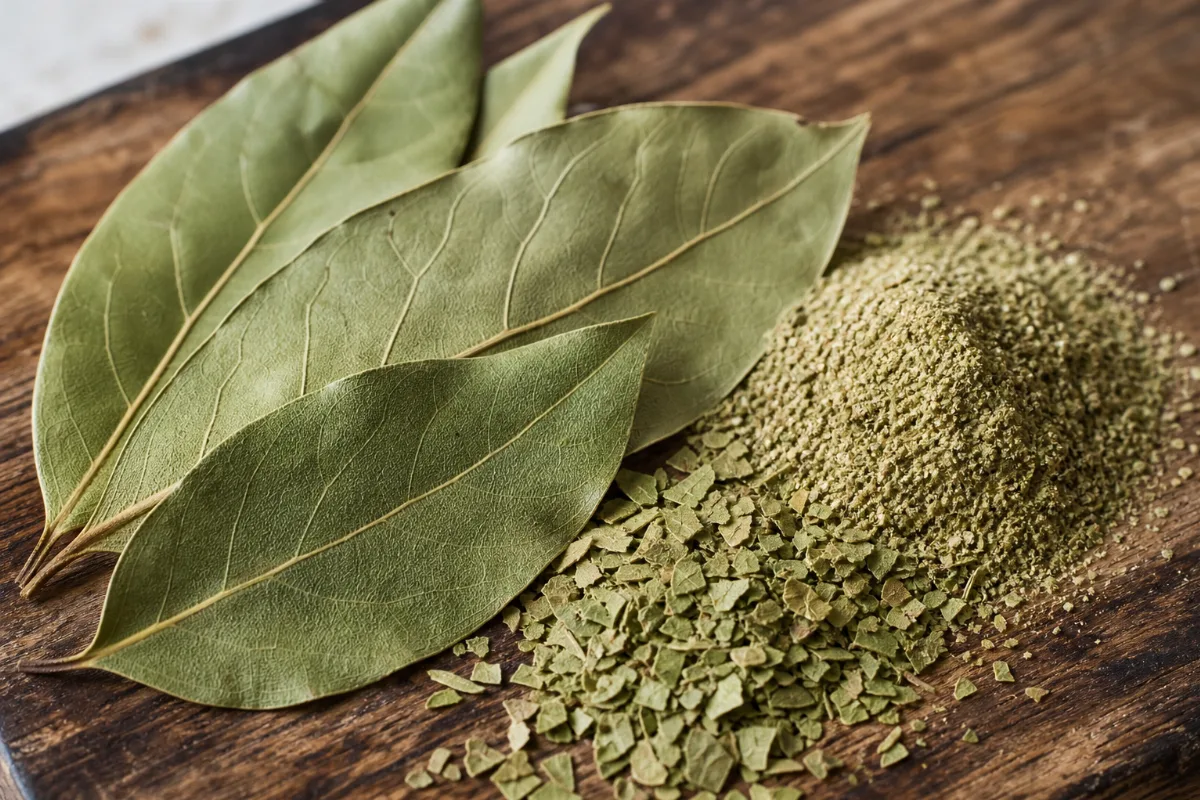
Bay leaf is the dried leaf of the bay laurel (Laurus nobilis), an evergreen tree of the laurel family. Wikipedia describes the leaves as used whole in broths, grains, soups and stews, and removed before serving. Fresh leaves are very mild; the full flavour develops over several weeks of drying.
Many other plants are also called bay, such as Indian bay (tejpat), Indonesian bay, West Indian bay and Mexican bay. They taste and look different, and California bay is a look-alike that contains a toxin.
USDA data for bay leaf: 313 kcal per 100 g, but nobody eats that much. A teaspoon of crumbled leaf is 0.6 g and gives about 2 kcal, 0.16 g fibre, 5 mg calcium and 3 mg potassium. Whole leaves are removed, so a leaf in a pot adds flavour, not nutrition.
What the research shows
We found no study of bay leaf used only as a cooking flavour. The studies we found used other forms.
A 2009 trial of 40 adults with type 2 diabetes gave capsules of ground leaf for 30 days. Blood sugar and cholesterol were lower in the leaf groups and not in the placebo group. The groups were small (about 10 people each) and no larger trial confirmed it.
A 2017 study of 20 healthy adults compared plain cookies with cookies baked with bay leaf powder. Blood sugar was lower at 30 and 45 minutes with the strongest cookies, but the total rise over two hours was not different. Appetite did not change and nobody reported gut discomfort.
A 2025 lab study found a leaf extract toxic to some human cancer cells in a dish. That is an early step and not evidence for people.
Spice versus capsules and extracts
A leaf simmered in a pot and removed is very different from capsules of ground leaf, cookies baked with leaf powder, strong tea or a lab extract. The studies and the liver case involved those stronger forms. Results from them do not carry over to cooking with a leaf.
Amounts
This page gives no amounts to use. Ask a doctor, pharmacist or dietitian if you have questions, especially about daily tea or capsules, diabetes medicine or liver disease.
At a glance
Traditional uses history, not proof
- Simmered whole in soups, stews, stocks and curries, then removed
- Used in desserts such as puddings and ice cream, infused into milk or butter
- Long use as a flavouring is not proof that it treats any condition
Studied for research
- Blood sugar in type 2 diabetes (capsules of ground leaf), very low certainty, one small trial
- Blood sugar after a meal (bay leaf cookies), mixed, one small study in healthy adults
- Cholesterol and triglycerides (capsules), very low certainty, same small trial
- Appetite and gut comfort (cookies), low certainty, no effect found
- Cancer cells in a dish (leaf extract), insufficient evidence, lab only
Main compounds
- Eucalyptol (1,8-cineole)
- Terpinyl acetate
- Methyleugenol
Common forms
- Whole dried leaf, removed before eating
- Ground bay leaf (much stronger, can be eaten)
- Fresh leaf (milder)
- Tea or infusion
- Capsules and extracts (used in studies, not the same as the spice)
Research links: 2009 trial: bay leaf capsules in type 2 diabetes · 2026 case report: liver injury with bay leaf tea · USDA FoodData Central: Spices, bay leaf · Research Library · Genes & Biomarkers Library
What it is and its history
- Accepted scientific name
- Laurus nobilis
- Naming authority
- L. (GBIF accepted)
- Common names
- Bay leaf (English); Bay laurel (English); Sweet bay (English); Laurel leaf (English); Hoja de laurel (Spanish)
- Family or group
- Lauraceae (the laurel family), per GBIF.
- Classification
- Plantae > Tracheophyta > Magnoliopsida > Laurales > Lauraceae > Laurus > Laurus nobilis
- Native range
- Not verified from a source read. Wikipedia names the Mediterranean bay laurel as the source of the bay leaf used in Mediterranean cooking.
- Habitat
- Not verified from a source read.
- What it looks like
- Roots: Not verified.; Stems: Not verified.; Leaves: The dried leaf is the spice. Wikipedia describes Mediterranean bay leaves as light- to medium-green with one large vein down the length.; Flowers: Not verified.; Fruit: Not verified.
- Cultivation
- Not verified from a source read.
- Harvest and processing
- Wikipedia: fresh leaves are very mild and do not develop their full flavour until several weeks after picking and drying. Sold whole, crushed or ground.
- Look-alikes and adulterants
- Name: Indian bay (Cinnamomum tamala, tejpat); Note: Wikipedia: about twice as long, with three veins, and tastes like mild cinnamon. A different spice.; Name: California bay (Umbellularia californica); Note: Wikipedia: looks similar but contains umbellulone, which can cause methemoglobinemia (a blood problem that limits oxygen).; Name: Cherry laurel and mountain laurel; Note: Wikipedia: unrelated, visually similar plants with poisonous leaves; not sold for cooking.; Name: Indonesian bay, West Indian bay, Mexican bay; Note: Other plants called bay (Syzygium polyanthum, Pimenta racemosa, Litsea glaucescens) used in other cuisines.
- Sustainability and conservation
- Not assessed.
Photographs
What is inside, and how it may work
What it contains and how those compounds act in cells and animals. Laboratory and animal mechanisms are not proven effects in people.
Main compounds
| Compound | Family | Where it is concentrated | Activity studied | Level of evidence |
|---|---|---|---|---|
| Eucalyptol (1,8-cineole) PubChem 2758 | terpene (essential oil) | Leaf (essential oil) Wikipedia: about 45% of the leaf's essential oil, which is about 1.3% of the leaf | A main smell compound of the oil. No health effect from cooking amounts was read. 13 | None found |
| Terpinyl acetate | terpene ester (essential oil) | Leaf (essential oil) Wikipedia: 8 to 12% of the oil | Part of the aroma. 13 | None found |
| Methyleugenol PubChem 7127 | phenylpropene (essential oil) | Leaf (essential oil) Wikipedia: about 3% of the oil | Listed by Wikipedia among the oil compounds. The sources read give no safe amount and no health finding for bay leaf. 13 | None found |
Mechanisms, receptors and pathways
| Target or pathway | Gene or receptor | What was found | Level |
|---|---|---|---|
| Insulin function | Not specified | The 2009 trial abstract says bay leaves improved insulin function in vitro (in a dish). Not shown in people. 5 | Laboratory research |
| Cancer cell death and cell cycle | Not specified | An ethanol leaf extract caused cell death and cell-cycle arrest in two cancer cell lines in a dish. 2 | Laboratory research |
Absorption, metabolism and elimination
- Absorption
- Not found.
- Distribution
- Not found.
- Metabolism
- Not found.
- Elimination
- Not found.
- Bioavailability
- Not found.
Isolated compounds versus whole extracts
The two trials used capsules of ground leaf and cookies with leaf powder, and the lab study used an alcohol extract. None tested a whole leaf simmered and removed, which is how bay leaf is normally used. The leaf oil is far stronger than the leaf.
Nutritional composition
Nutrition from USDA FoodData Central (Spices, bay leaf, FDC 170917, SR Legacy, April 2018; read 2026-10-26 from the project's copy of the download). Per 100 g: 313 kcal, 7.61 g protein, 8.36 g fat, 75.0 g carbohydrate, 26.3 g fibre, 834 mg calcium, 43.0 mg iron, 120 mg magnesium, 529 mg potassium, 23 mg sodium and 46.5 mg vitamin C. Nobody eats 100 g. USDA lists 0.6 g per teaspoon of crumbled leaf and 1.8 g per tablespoon. One teaspoon (0.6 g) gives about 2 kcal, 0.16 g fibre, 5 mg calcium, 0.26 mg iron, 3 mg potassium and 0.3 mg vitamin C (calculated from the per-100 g values). Whole leaves are taken out before eating, so the leaf in a pot adds flavour, not nutrition. Real products vary.
1 mixed findings1 low certainty2 very low certainty1 not enough evidence
What was looked at
The 5 benefits and uses checked for Bay leaf, each with how strong the evidence is. Tap one to open it.
- Blood sugar in type 2 diabetes (capsules of ground leaf)Very low certainty
- Blood sugar after a meal (bay leaf powder baked into cookies)Mixed findings
- Cholesterol and triglycerides (capsules of ground leaf)Very low certainty
- Appetite and gut comfort (bay leaf cookies)Low certainty
- Cancer cells in a dish (ethanol leaf extract)Not enough evidence
Lab markers tracked in the studies
Blood glucoseLDL cholesterolTriglycerides
What is Bay leaf good for?
The main studied uses and how strong the human evidence is for each. Almost all of it uses capsules or powder, not bay leaf as a cooking flavour.
Benefits, one by one
Each card is a research question, not a promise. Tap a goal to filter. Open a card to see the studies, doses and limits.
Blood sugar in type 2 diabetes (capsules of ground leaf)
Very low certaintyOne small trial of 40 adults with type 2 diabetes gave capsules of ground bay leaf for 30 days and reported lower blood sugar than at the start, with no change on placebo. No larger trial confirming this was found. Capsules of ground leaf are not the same as a leaf simmered in soup and then removed.
1 studiesCapsules of ground leaf, not culinary leaf.
Studies, doses and limits
What the trials found
Khan 2009 (J Clin Biochem Nutr): 40 adults with type 2 diabetes in four groups took capsules of ground bay leaf at three daily amounts, or placebo, for 30 days, then 10 days off.
Results
Serum glucose was lower in all three bay leaf groups, by 21 to 26% after 30 days. The placebo group showed no significant changes.
Effect sizes as reported
Glucose fell 21 to 26% after 30 days (percentages as given in the abstract).
Why this rating
One small trial of about 10 people per group, 30 days, from one team, with no confirming trial found. Only the abstract was read, so blinding, diet and medicine use are unknown to us.
Form and dose studied
Capsules of ground leaf, not culinary leaf.
Who was studied
Adults with type 2 diabetes (Pakistan).
Limits
The authors called their finding a suggestion. Not a treatment. Not a trial of bay leaf used as a cooking flavour.
Why researchers looked
Lab work suggested bay leaf might help the body respond to insulin, so researchers tried it in people with diabetes.
Traditional use
Bay leaf is mainly a cooking flavour. Long use in the kitchen is not proof that it treats any condition.
Proposed mechanism Laboratory research
The trial abstract says bay leaves improved insulin function in a dish (in vitro). No mechanism in people was shown.
A proposed mechanism does not show that the effect happens in people.
If you take diabetes medicine, ask a pharmacist before using bay leaf capsules or daily tea; see the Safety tab.
Blood sugar after a meal (bay leaf powder baked into cookies)
Mixed findingsIn a small crossover study of 20 healthy adults, cookies with 6% bay leaf powder gave lower blood sugar at 30 and 45 minutes than plain cookies. The total blood sugar response over two hours did not differ. The cookies were rated acceptable and caused no gut discomfort.
1 studiesBay leaf powder baked into cookies at 3% and 6% by weight (a test foo…
Studies, doses and limits
What the trials found
Khan 2017 (J Am Coll Nutr): 20 healthy adults ate three breakfasts 1 to 2 weeks apart: plain wheat cookies, cookies with 3% bay leaf powder, and cookies with 6% bay leaf powder.
Results
Blood glucose was lower after the 6% cookies than after plain cookies at 30 minutes (p = 0.014) and 45 minutes (p = 0.010). The overall glucose response over 2 hours (incremental area under the curve) was not different (p = 0.411). Appetite ratings did not differ.
Effect sizes as reported
Two time points lower; no difference in total response.
Why this rating
Small single-meal study in healthy people. The result is lower at two time points but not different overall, so the benefit is unclear.
Form and dose studied
Bay leaf powder baked into cookies at 3% and 6% by weight (a test food, not a normal cooking use).
Who was studied
Healthy adults (not people with diabetes).
Limits
Only the abstract was read. 20 people, one meal. Does not show a benefit for people with diabetes.
Why researchers looked
The same research group wanted to know whether bay leaf eaten in food, not capsules, changes blood sugar after a meal.
Traditional use
Bay leaf powder in baking is not a traditional recipe; this was a test food.
Proposed mechanism Not established
Not shown. The abstract does not explain why glucose was lower at two time points.
A proposed mechanism does not show that the effect happens in people.
None reported in the abstract; nobody reported gut discomfort.
Cholesterol and triglycerides (capsules of ground leaf)
Very low certaintyThe same small 2009 trial of adults with type 2 diabetes reported lower total and LDL cholesterol in all three capsule groups, and lower triglycerides and higher HDL in the two lower-amount groups. It was one small trial with no confirming study found.
1 studiesCapsules of ground leaf, not culinary leaf.
Studies, doses and limits
What the trials found
Khan 2009: 40 adults with type 2 diabetes, capsules of ground bay leaf or placebo for 30 days.
Results
Total cholesterol fell 20 to 24% and LDL cholesterol 32 to 40%. HDL rose 29% and 20%, and triglycerides fell 34% and 25%, in the two lower-amount groups. The placebo group showed no significant changes.
Effect sizes as reported
Total cholesterol -20 to -24%; LDL -32 to -40%; HDL +29% and +20%; triglycerides -34% and -25% (as reported in the abstract).
Why this rating
One small trial of about 10 people per group, 30 days, no confirming trial found, abstract only.
Form and dose studied
Capsules of ground leaf, not culinary leaf.
Who was studied
Adults with type 2 diabetes.
Limits
The same limits as the blood sugar result. Not about bay leaf as a flavour.
Why researchers looked
Researchers measured blood fats alongside blood sugar, because both matter in diabetes.
Traditional use
Not a traditional use.
Proposed mechanism Not established
Not shown in the trial abstract.
A proposed mechanism does not show that the effect happens in people.
Ask a pharmacist before using capsules if you take cholesterol or diabetes medicine.
Appetite and gut comfort (bay leaf cookies)
Low certaintyIn the 20-person cookie study, bay leaf powder did not change appetite ratings, and nobody reported gut discomfort. This is a small single-meal result in healthy adults.
1 studiesCookies with 3% or 6% bay leaf powder.
Studies, doses and limits
What the trials found
Khan 2017: appetite and gut well-being were rated before and for 2 hours after each breakfast.
Results
No significant effect on any appetite measure. All cookies were rated acceptable and no gut discomfort was reported.
Effect sizes as reported
No difference.
Why this rating
A null result from one small crossover study; abstract only.
Form and dose studied
Cookies with 3% or 6% bay leaf powder.
Who was studied
20 healthy adults.
Limits
Single meal. Says nothing about long-term use or about swallowing whole leaves.
Why researchers looked
Researchers checked whether bay leaf in food affects hunger or causes stomach upset.
Proposed mechanism Not established
Not applicable.
A proposed mechanism does not show that the effect happens in people.
This does not apply to whole leaves, which are a swallowing hazard; see the Safety tab.
Cancer cells in a dish (ethanol leaf extract)
Not enough evidenceA 2025 lab study found that an alcohol extract of bay leaf was toxic to some human cancer cell lines in a dish and much less toxic to normal skin cells. That is lab work only and says nothing about eating bay leaf or about treating cancer in people.
1 studiesEthanol extract of leaf, made in a lab.
Studies, doses and limits
Results
The extract was toxic to ovarian, head and neck, and colorectal cancer cells at low concentrations and less so to a breast cancer line. It was much less toxic to normal fibroblasts. The authors call the work preliminary and limited to lab tests of non-standardised samples.
Effect sizes as reported
Lab IC50 values only; not applicable to people.
Why this rating
Cell-line work only. No animal or human data were read.
Form and dose studied
Ethanol extract of leaf, made in a lab.
Limits
A cell result rarely carries over to people. No claim about cancer is made.
Why researchers looked
Plant extracts are often screened against cancer cells in a dish as a first step.
Proposed mechanism Laboratory research
The authors report cell death and a stop in the cell cycle in two cancer cell lines, and antioxidant activity in a lab test.
A proposed mechanism does not show that the effect happens in people.
None.
Connections to the rest of health
How Bay leaf connects to the rest of our health knowledge graph. Every link says what kind of connection it is. A safety link (for example to the liver) is a warning, not a benefit. A study that merely mentions a topic never creates a benefit link.
Explore every connection: goals, body systems, organs, symptoms, genes
A. Wellness goals
| Connected to | Kind of connection | Evidence status | Context | Studies |
|---|---|---|---|---|
| Blood Sugar Balance | Very low certainty | Blood sugar in type 2 diabetes (capsules of ground leaf): One small trial of 40 adults with type 2 diabetes gave capsules of ground bay leaf for 30 days and reported lower blood sugar than at the start, with no change on placebo. No larger trial confirming this was found. Capsules of ground leaf are not the same as a leaf simmered in soup and then removed. Blood sugar after a meal (bay leaf powder baked into cookies): In a small crossover study of 20 healthy adults, cookies with 6% bay leaf powder gave lower blood sugar at 30 and 45 minutes than plain cookies. The total blood sugar response over two hours did not differ. The cookies were rated acceptable and caused no gut discomfort. | 5 6 | |
| Cholesterol Balance | Very low certainty | Cholesterol and triglycerides (capsules of ground leaf): The same small 2009 trial of adults with type 2 diabetes reported lower total and LDL cholesterol in all three capsule groups, and lower triglycerides and higher HDL in the two lower-amount groups. It was one small trial with no confirming study found. | 5 |
B. Body systems
| Connected to | Kind of connection | Evidence status | Context | Studies |
|---|---|---|---|---|
| Blood Sugar Support | Biological association | Very low certainty | Studied for: Blood sugar in type 2 diabetes (capsules of ground leaf) Studied for: Blood sugar after a meal (bay leaf powder baked into cookies) | 5 6 |
| Cardiovascular System | Biological association | Very low certainty | Studied for: Cholesterol and triglycerides (capsules of ground leaf) | 5 |
| Digestive System | Biological association | Low certainty | Studied for: Appetite and gut comfort (bay leaf cookies) | 6 |
E. Health conditions
| Connected to | Kind of connection | Evidence status | Context | Studies |
|---|---|---|---|---|
| Swallowed foreign body (digestive tract blockage) | Adverse effect or risk | Documented risk | Case reports describe a swallowed bay leaf blocking or perforating the gut. A whole bay leaf stays stiff and has been reported to block or perforate the gut if swallowed. Preparation or compound: Whole bay leaf swallowed |
1 7 3 10 4 13 |
| Drug-induced liver disease | Adverse effect or risk | Documented risk | One probable herb-induced liver injury case that improved after stopping. One case report links regular bay leaf tea to probable herb-induced liver injury. Preparation or compound: Regular bay leaf tea |
9 |
I. Biomarkers
| Connected to | Kind of connection | Evidence status | Context | Studies |
|---|---|---|---|---|
| Blood glucose | Biological association | Very low certainty | Measured in trials: lowered. A lab change is not the same as a health benefit. | 5 6 |
| LDL cholesterol | Biological association | Very low certainty | Measured in trials: lowered. A lab change is not the same as a health benefit. | 5 |
| Triglycerides | Biological association | Very low certainty | Measured in trials: lowered. A lab change is not the same as a health benefit. | 5 |
L. Active compounds
| Connected to | Kind of connection | Evidence status | Context | Studies |
|---|---|---|---|---|
| Eucalyptol (1,8-cineole) | Biological association | None found | A main smell compound of the oil. No health effect from cooking amounts was read. Preparation or compound: Leaf (essential oil) |
13 |
| Terpinyl acetate | Biological association | None found | Part of the aroma. Preparation or compound: Leaf (essential oil) |
13 |
| Methyleugenol | Biological association | None found | Listed by Wikipedia among the oil compounds. The sources read give no safe amount and no health finding for bay leaf. Preparation or compound: Leaf (essential oil) |
13 |
Each connection is stored with the ingredient, the connected record, the kind of connection, the evidence status, the supporting studies, the preparation or compound involved, and a review date (last reviewed October 26, 2026).
Evidence at a glance: what changed in 3 lab markers
Tap a number to show only those markers. Counts are markers, not people.
The evidence
The research centre for Bay leaf. Every record here was checked against PubMed or the publisher's page; we never list a study we have not verified.
Evidence by outcome
Bars show how many studies we found for each outcome, not how well it works. People are added up across trials only (reviews are not added, to avoid double counting).
How we rate evidence
High certainty
Several well-run trials or reviews agree; further research is unlikely to change the picture much.
Moderate certainty
Good trials point the same way, but some doubt remains.
Low certainty
Small, short or inconsistent trials. The finding could change with better research.
Very low certainty
Very little or very weak human data. Treat as a possibility only.
Mixed findings
Trials or reviews disagree with each other.
Not enough evidence
Not enough human research to say either way.
Evidence against
Good research found no benefit, or found harm.
We take the reviewers' own risk-of-bias and GRADE statements where they exist, and otherwise judge from study size, design, consistency, directness and whether a product matches what is sold. Many publications do not make evidence high. Method note: We started from our existing bay leaf summary, re-checked nutrition at USDA FoodData Central (SR Legacy), matched the plant name in GBIF, read PubMed abstracts for the trials, the cookie study, the lab study and the liver case, and read the Wikipedia bay leaf article for culinary and look-alike facts. Several swallowing and allergy reports were available as titles only; these are flagged in the research gaps.
Study library: every study we checked 13
| Study | Design | People | Product, dose, length | Result |
|---|---|---|---|---|
| Ahmed 1993 Bay-leaf: an unusual oesophageal foreign body. J Laryngol Otol · PMID 8496654 · DOI |
Case report |
2 Two patients (details not in the abstract) |
Dried bay leaf swallowed or used on skin (see results) Leaf Single event |
The abstract says bay leaf as a foreign body causing blockage of the food pipe (oesophagus) has rarely been reported, and presents two such cases and how they were managed. Not applicable (case report) (Not applicable) Methods, limits and fundingOutcomes: Clinical course Limitations: Only the abstract was read and it gives no details of the patients, the outcome or the amount. Funding and conflicts: Not stated Read: abstract |
| Al-Mammori 2025 The Therapeutic Potential of Laurus nobilis L. Leaves Ethanolic Extract in Cancer Therapy. Molecules · PMID 41097432 · DOI |
Laboratory research in-vitro |
Human cancer cell lines and normal human skin fibroblasts in a dish | Ethanol extract of bay laurel leaf (non-standardised) Leaf Lab concentrations (micrograms per mL) Lab experiment · vs Untreated cells |
The extract was toxic to ovarian, head and neck, and colorectal cancer cells (IC50 3.8 to 4.4 micrograms per mL) and less so to a breast cancer line (18.5). It was much less toxic to normal fibroblasts (IC50 above 100). The authors say this is preliminary and limited to lab testing of non-standardised samples. Lab cell results only (Not applicable) Methods, limits and fundingOutcomes: Cell killing, cell cycle, antioxidant screening Limitations: Cells in a dish. Says nothing about eating bay leaf or about effects in people. Funding and conflicts: Authors declare no conflicts Read: abstract |
| Bell 1997 Bay leaf perforation of Meckel's diverticulum. Can J Surg · PMID 9126131 |
Case report |
1 One patient (Meckel's diverticulum is a pouch some people are born with in the small bowel) |
Dried bay leaf swallowed or used on skin (see results) Leaf Single event |
Title only: a bay leaf perforated a Meckel's diverticulum. No abstract was available, so no details were read. Not applicable (case report) (Not applicable) Methods, limits and fundingOutcomes: Clinical course Limitations: Title and citation only; nothing else was read. Funding and conflicts: Not stated Read: title-only |
| Buto 1990 Bay leaf impaction in the esophagus and hypopharynx. Ann Intern Med · PMID 2350114 · DOI |
Case report |
Not stated | Dried bay leaf swallowed or used on skin (see results) Leaf Single event |
Title only: bay leaf stuck in the food pipe and throat. No abstract was available, so no details were read. Not applicable (case report) (Not applicable) Methods, limits and fundingOutcomes: Clinical course Limitations: Title and citation only; nothing else was read. Funding and conflicts: Not stated Read: title-only |
| Khan 2009 Bay leaves improve glucose and lipid profile of people with type 2 diabetes. J Clin Biochem Nutr · PMID 19177188 · DOI |
Controlled trial |
40 40 adults with type 2 diabetes (Peshawar, Pakistan), four groups |
Capsules of ground bay leaf (Laurus nobilis) at three daily amounts, or placebo Leaf Three daily capsule amounts (more than a leaf in a pot) 30 days, then a 10-day washout · vs Placebo |
All three bay leaf groups had lower serum glucose (21 to 26% after 30 days). Total cholesterol fell 20 to 24% and LDL cholesterol 32 to 40%. HDL rose 29% and 20% and triglycerides fell 34% and 25% in the two lower-amount groups. The placebo group showed no significant changes. Percentage changes as reported in the abstract; no confidence intervals given there (Not given in the abstract) Methods, limits and fundingOutcomes: Serum glucose, total, LDL and HDL cholesterol, triglycerides Limitations: Only the abstract was read. About 10 people per group, 30 days, one research team, no confirming trial found. The abstract does not describe blinding, diet control, diabetes medicine use or funding. Capsules of leaf are not bay leaf used as a cooking flavour. Funding and conflicts: Not stated in the abstract Read: abstract |
| Khan 2017 Effect of Incorporating Bay Leaves in Cookies on Postprandial Glycemia, Appetite, Palatability, and Gastrointestinal Well-Being. J Am Coll Nutr · PMID 28853992 · DOI |
Rct crossover |
20 20 healthy adults |
Cookies made with bay leaf powder (Laurus nobilis) at 3% or 6% by weight, versus plain wheat cookies Leaf (powder) Cookies with 50 g of available carbohydrate; 3% and 6% leaf powder Single breakfast, 1 to 2 weeks apart · vs Plain wheat cookies |
Blood glucose was lower after the 6% cookies than the plain cookies at 30 minutes (p = 0.014) and 45 minutes (p = 0.010). The total glucose rise over 2 hours (incremental area under the curve) did not differ between cookies (p = 0.411). Appetite did not differ. All cookies were rated acceptable and nobody reported gut discomfort. Difference at two time points only; no difference in total glucose response (Not given in the abstract) Methods, limits and fundingOutcomes: Blood glucose for 2 hours, appetite, palatability, gut well-being Limitations: Only the abstract was read. Healthy adults, single meal, 20 people. The authors' conclusion of a reduced glycemic response rests on two time points, while the overall response did not differ. Funding and conflicts: Not stated in the abstract Read: abstract |
| Lingenfelser 1992 Bay leaf perforation of the small bowel in a patient with chronic calcific pancreatitis. J Clin Gastroenterol · PMID 1556436 |
Case report |
1 One patient with chronic calcific pancreatitis |
Dried bay leaf swallowed or used on skin (see results) Leaf Single event |
Title only: a bay leaf perforated the small bowel in a patient with chronic calcific pancreatitis. No abstract was available, so no details were read. Not applicable (case report) (Not applicable) Methods, limits and fundingOutcomes: Clinical course Limitations: Title and citation only; nothing else was read. Funding and conflicts: Not stated Read: title-only |
| Martinez-Fernandez 2023 Erythema multiforme-like allergic contact dermatitis from bay leaves in a home-made natural remedy. Contact Dermatitis · PMID 37105538 · DOI |
Case report |
1 Not stated in the title |
Dried bay leaf swallowed or used on skin (see results) Leaf Single event |
Title only: an allergic skin reaction to bay leaves in a home-made natural remedy applied to the skin. No abstract was available, so no details were read. Not applicable (case report) (Not applicable) Methods, limits and fundingOutcomes: Clinical course Limitations: Title and citation only. About skin use, not eating. Funding and conflicts: Not stated Read: title-only |
| Soare 2026 Herb-Induced Liver Injury by Laurus nobilis: A Case Assessed for Causality Using the Updated RUCAM. Life (Basel) · PMID 41598335 · DOI |
Case report |
1 One 55-year-old woman, Romania |
Regular bay leaf (Laurus nobilis) herbal infusions Leaf About 3 months before admission |
She had fatigue, loss of appetite, stomach pain and 12 kg weight loss. AST was 196 U/L and ALT 357 U/L and kept rising despite liver-protecting treatment. Other causes were excluded and a liver biopsy fit toxic hepatitis. The updated RUCAM scale scored 8 points, which means a probable herb-induced liver injury. She improved clinically and in blood tests after stopping the tea completely. RUCAM 8 (probable) (Not applicable) Methods, limits and fundingOutcomes: Liver enzymes, liver biopsy, causality score Limitations: One person. Only the abstract was read. The amount drunk is not given. A probable score is not proof, and it does not show that bay leaf in cooking harms the liver. Funding and conflicts: Authors declare no conflicts of interest Read: abstract |
| Tsang 1999 Duodenal obstruction secondary to bay leaf impaction. Ann Intern Med · PMID 10215575 · DOI |
Case report |
1 One patient |
Dried bay leaf swallowed or used on skin (see results) Leaf Single event |
Title only: a bay leaf lodged in the duodenum (first part of the small bowel) and blocked it. No abstract was available, so no details were read. Not applicable (case report) (Not applicable) Methods, limits and fundingOutcomes: Clinical course Limitations: Title and citation only; nothing else was read. Funding and conflicts: Not stated Read: title-only |
| s-gbif-laurus-nobilis GBIF Backbone: Laurus nobilis L. (usageKey 3034015) · Source |
Reference database n/a |
Methods, limits and fundingRead: full-text | ||
| s-usda-fdc-170917 USDA FoodData Central: Spices, bay leaf (FDC 170917, SR Legacy) · Source |
Reference database n/a |
Methods, limits and fundingRead: full-text | ||
| s-wikipedia-bay-leaf Wikipedia: Bay leaf · Source |
Secondary source n/a |
Methods, limits and fundingRead: full-text |
What we do not know yet
- No trial of bay leaf as a cooking flavour was found.
- The blood sugar and cholesterol result comes from one small 2009 trial with no confirming study.
- Several swallowing case reports were available as titles only, so details and outcomes were not read.
- Pregnancy, breastfeeding, child safety, contamination and the amount of tea linked to the liver case were not found.
- No regulator (EMA, EFSA, FDA, WHO, NCCIH) statement on bay leaf was opened.
How new research is added
New studies are found by a saved PubMed search and placed in a review queue before the page changes.
Lab markers
What changed in blood or saliva tests during trials. A changed number is not the same as feeling or being healthier, and we give no "normal ranges".
Metabolic 3
Blood glucose
Lowered in trials
The amount of sugar in the blood, measured fasting or after a meal.
Very low certaintyResults and what it means
Why it was measured
High blood sugar is the main marker used to follow diabetes.
Statistical vs. clinical meaning
A change in a lab number in small studies. It does not show that bay leaf prevents or treats diabetes.
Safety implication
People on diabetes medicine should ask a pharmacist before using capsules or daily tea.
| Study | Result | People | Product |
|---|---|---|---|
| 5 | Serum glucose lower by 21 to 26% after 30 days in all three capsule groups; no significant change on placebo | 40 adults with type 2 diabetes | Capsules of ground bay leaf, 30 days |
| 6 | Lower than plain cookies at 30 and 45 minutes with 6% bay leaf cookies; total 2-hour response not different | 20 healthy adults | Cookies with 3% or 6% bay leaf powder, single meal |
LDL cholesterol
Lowered in trials
So-called bad cholesterol in the blood.
Very low certaintyResults and what it means
Why it was measured
High LDL is a risk factor for heart disease.
Statistical vs. clinical meaning
A lab number in one small trial; it does not show fewer heart problems.
Safety implication
Ask a pharmacist before using capsules with cholesterol medicine.
| Study | Result | People | Product |
|---|---|---|---|
| 5 | LDL cholesterol fell 32 to 40% after 30 days across the three capsule groups; no significant change on placebo | 40 adults with type 2 diabetes | Capsules of ground bay leaf, 30 days |
Triglycerides
Lowered in trials
A type of fat carried in the blood.
Very low certaintyResults and what it means
Why it was measured
High triglycerides go with diabetes and heart risk.
Statistical vs. clinical meaning
One small trial; no confirming study found.
Safety implication
None specific.
| Study | Result | People | Product |
|---|---|---|---|
| 5 | Triglycerides fell 34% and 25% in the two lower-amount groups | 40 adults with type 2 diabetes | Capsules of ground bay leaf, 30 days |
Safety
What studies and official sources say about side effects, medicines and who should check first. Each point shows what kind of evidence it comes from.
Main points to know 4
- Do not swallow whole bay leaves: take them out before serving. A whole bay leaf stays stiff even after long cooking. Wikipedia says it may be a choking hazard or may harm the digestive tract if swallowed whole or in large pieces. Doctors have reported cases where a swallowed bay leaf lodged in the food pipe or throat, blocked the small bowel, or perforated it. The reports we found are single cases from 1990 to 1999 and give no rate. Ground bay leaf is eaten, but is much stronger. Case report 1 7 3 10 4 13
- Daily bay leaf tea: one case of liver injury. A 2026 case report describes a 55-year-old woman whose liver enzymes rose sharply after about 3 months of regular bay leaf infusions. Her doctors judged it a probable herb-induced liver injury and she improved after stopping. It is one person, and the authors link it to large amounts or concentrated infusions, not to normal cooking. Case report 9
- Make sure it is true bay: some look-alike leaves are poisonous. Wikipedia says true bay laurel leaves are not toxic, but some look-alike plants are. California bay contains umbellulone, which can cause methemoglobinemia (a blood problem that limits oxygen). Cherry laurel and mountain laurel have poisonous leaves and are not sold for cooking. Do not use leaves from garden plants unless the species is certain. Secondary source 13
- If you take diabetes medicine, ask before using capsules or daily tea. One small trial found lower blood sugar with capsules of ground bay leaf. No source we read describes an interaction with diabetes medicine, so this is a precaution from that trial, not a documented interaction. It does not apply to a leaf in a pot. Inference from trial 5
Side effects 3
| Effect | How often | Severity and recovery | Evidence |
|---|---|---|---|
| Food pipe or throat blockage, bowel blockage or perforation after swallowing a bay leaf Reports from 1990 to 1999: blockage of the food pipe or throat (1990, 1993), small-bowel perforation (1992, and 1997 in a Meckel's diverticulum) and blockage of the duodenum (1999). Only one of the five had an abstract; the others are titles. | Case reports only; no rate found | serious Outcomes not available in the abstracts or titles read | Case report 1 7 3 10 4 |
| Liver injury (raised AST and ALT) after months of regular bay leaf tea Probable on the RUCAM scale (8 points). Amount of tea not stated in the abstract. | One reported case | moderate to serious Improved after stopping tea | Case report 9 |
| Allergic skin reaction to bay leaves applied to the skin Title only was read. This is about skin use of bay leaf in a home remedy, not food. | Case reports | not stated Not stated | Case report 8 |
Liver
One 2026 case report links about 3 months of regular bay leaf infusions to a probable herb-induced liver injury (updated RUCAM score 8). AST was 196 U/L and ALT 357 U/L, a liver biopsy fit toxic hepatitis, and she improved after stopping the tea. No liver injury from bay leaf used in cooking was found. A liver-safety source (such as LiverTox) was not searched. 9
How often. No frequency was found; one case.
Monitoring. No agency monitoring advice was found.
- p41598335.
This is a safety connection. It is not evidence that Bay leaf supports liver health.
Medicines and supplements 2
| With | Why it matters | Importance | Evidence | What to do |
|---|---|---|---|---|
| Diabetes medicines (insulin, tablets) and other blood-sugar-lowering products prescription | One 30-day trial of capsules of ground bay leaf reported lower blood sugar in adults with type 2 diabetes, so an added effect with medicine is possible in theory. | No source read names a bay leaf and diabetes medicine interaction. The cookie study in healthy adults found lower glucose at two time points but no difference overall. | Inference from trial Very low certainty 5 6 | If you take diabetes medicine, ask a pharmacist before using bay leaf capsules or daily tea. Normal cooking with a leaf in the pot is not described as a problem in any source read. |
| Other prescription medicines, blood thinners, anaesthetics prescription | Not studied. | No interaction was found in the sources read. | None found Not enough evidence | Tell your doctor or pharmacist about herbal teas and supplements you use regularly. |
Who should check first 5
| Situation | Advice | Evidence |
|---|---|---|
| Anyone who could swallow a whole leaf: young children, people with swallowing problems, people eating food they cannot see well | Remove whole leaves before serving, or tie them in a bouquet garni or use a tea ball so they are easy to find. If someone swallows a leaf and has pain, trouble swallowing, vomiting or belly pain, get medical help. | Case report 1 7 3 10 4 13 |
| Daily or large amounts of bay leaf tea, or capsules | Ask a doctor or pharmacist first, particularly with liver disease or diabetes medicine. The liver case involved regular tea over months. | Case report 9 5 |
| Pregnancy and breastfeeding | No official statement for bay leaf was found, so we state none. Ask a midwife or doctor about teas and capsules. Using a leaf for flavour in food was not described as a problem in any source read. | None found |
| Children | No child safety data were found. The main concern is a child swallowing a whole leaf; see above. | Case report 1 13 |
| Known allergy to bay or laurel (including skin reactions) | Avoid it and ask an allergist or dermatologist. Case reports describe allergic skin reactions to bay leaves used on the skin. | Case report 8 |
Overdose, product quality and regulators
Summary. The sources read describe true bay leaf as not toxic. The documented harms are mechanical (swallowing a stiff leaf), one liver case with daily tea, and look-alike plants.
Animal. Not reviewed.
Human doses studied. A 30-day capsule trial in adults with type 2 diabetes and a single-meal cookie study in healthy adults; neither reported harm in the abstract (the abstracts do not list adverse events for the capsule trial).
High dose or long term signals. One liver case after months of tea. Methyleugenol is about 3% of the leaf oil (Wikipedia); the sources read give no safe amount and no finding for bay leaf.
Overdose response. Not found.
Genotoxicity. Not researched.
No contamination data for bay leaf (heavy metals, mould toxins, pesticide residues) were found in the sources read.
Mix-ups with other 'bay' plants. Several unrelated plants are sold or called bay (Indian bay, Indonesian bay, West Indian bay, Mexican bay); California bay, cherry laurel and mountain laurel are toxic look-alikes. 13
| Body | Action | Date |
|---|
When to get medical help
- Pain on swallowing, a feeling that something is stuck, vomiting, or severe belly pain after swallowing a bay leaf
- Yellow skin or eyes, dark urine, severe tiredness or loss of appetite after drinking bay leaf tea regularly
- Blue-grey skin or lips, headache and breathlessness after eating leaves from an unknown 'bay' plant
- Swelling of the lips, face or throat or trouble breathing after contact with bay leaf
Stop using the product and contact a clinician or emergency service. In the US, Poison Control is 1-800-222-1222.
General information only, not medical advice. Ask a clinician or pharmacist before use, especially with medicines, in pregnancy or with a health condition. See the Natural Remedy Safety guide.
Frequently asked questions
What is bay leaf good for?
Can you eat bay leaf?
Usually the whole leaf is taken out before serving. Wikipedia says it stays stiff and may be a choking hazard or may harm the digestive tract if swallowed. Ground bay leaf can be eaten, but it is much stronger.
What happens if I swallow a bay leaf?
Does bay leaf lower blood sugar?
Does bay leaf lower cholesterol?
The same small 2009 trial of capsules reported lower total and LDL cholesterol. It is one trial with no confirmation, and it used capsules, not cooking.
Can bay leaf tea harm the liver?
One 2026 case report links about 3 months of regular bay leaf tea to a probable liver injury in one woman, who improved after stopping. It is a single case and not proof for everyone.
Is bay leaf safe with diabetes medicine?
No interaction is documented. Because one trial reported lower blood sugar with capsules, ask a pharmacist before using capsules or daily tea. Cooking with a leaf was not described as a problem.
Is bay leaf safe in pregnancy?
No official statement for bay leaf was found, so we cannot say. Ask a midwife or doctor, especially about teas and capsules.
Are all bay leaves the same?
No. Indian bay (tejpat), Indonesian bay and Mexican bay are different plants. California bay looks similar but contains a toxin, and cherry laurel and mountain laurel have poisonous leaves. Buy leaf labelled Laurus nobilis.
Is bay leaf poisonous?
Does bay leaf have nutrition?
Very little in the amounts used. USDA lists 0.6 g per teaspoon of crumbled leaf, which gives about 2 kcal and small amounts of calcium and potassium. Whole leaves are removed before eating.
Explore by health goal
Editorial transparency
- Written by
- AlternativeMed editorial team. Research compiled with AI assistance, then checked against the sources listed.
- Medical review
- None. This page has not been reviewed by a physician or pharmacist.
- First published
- 2026-10-26
- Last substantive update
- 2026-10-26
- How we research
- We started from our existing bay leaf summary, re-checked nutrition at USDA FoodData Central (SR Legacy), matched the plant name in GBIF, read PubMed abstracts for the trials, the cookie study, the lab study and the liver case, and read the Wikipedia bay leaf article for culinary and look-alike facts. Several swallowing and allergy reports were available as titles only; these are flagged in the research gaps.
- How we rate evidence
- See "How we rate evidence" in the Evidence tab.
- Independence
- No product is promoted on this page. No affiliate links are shown.
Sources 13
Each source was opened and checked. Where we read only the abstract, it says so. The small numbers in the text point here.
- Ahmed K, McCormick MS. Bay-leaf: an unusual oesophageal foreign body.. J Laryngol Otol. 1993. PMID 8496654. DOI 10.1017/s0022215100122492. (abstract)
- Al-Mammori F, Qasem AMA, Al-Tawalbeh D, Abuarqoub D, Hmedat A. The Therapeutic Potential of Laurus nobilis L. Leaves Ethanolic Extract in Cancer Therapy.. Molecules. 2025. PMID 41097432. DOI 10.3390/molecules30194012. (abstract)
- Bell CD, Mustard RA. Bay leaf perforation of Meckel's diverticulum.. Can J Surg. 1997. PMID 9126131. (title-only)
- Buto SK, Tsang TK, Sielaff GW, Gutstein LL, Meiselman MS. Bay leaf impaction in the esophagus and hypopharynx.. Ann Intern Med. 1990. PMID 2350114. DOI 10.7326/0003-4819-113-1-82. (title-only)
- Khan A, Zaman G, Anderson RA. Bay leaves improve glucose and lipid profile of people with type 2 diabetes.. J Clin Biochem Nutr. 2009. PMID 19177188. DOI 10.3164/jcbn.08-188. (abstract)
- Khan I, Shah S, Ahmad J, Abdullah A, Johnson SK. Effect of Incorporating Bay Leaves in Cookies on Postprandial Glycemia, Appetite, Palatability, and Gastrointestinal Well-Being.. J Am Coll Nutr. 2017. PMID 28853992. DOI 10.1080/07315724.2017.1326324. (abstract)
- Lingenfelser T, Adams G, Solomons D, Marks IN. Bay leaf perforation of the small bowel in a patient with chronic calcific pancreatitis.. J Clin Gastroenterol. 1992. PMID 1556436. (title-only)
- Martinez-Fernandez A, Sanchez-Herreros C, Cabana-Navia R, Camino-Salvador JM, Palomo-Cousido S, Arribas-Granados P, Gatica-Ortega ME, Pastor-Nieto MA. Erythema multiforme-like allergic contact dermatitis from bay leaves in a home-made natural remedy.. Contact Dermatitis. 2023. PMID 37105538. DOI 10.1111/cod.14327. (title-only)
- Soare M, Calugar-Solea SF, Brisc C, Rus M, Bodog TM, Becheanu G, Brisc CM, Brisc MC. Herb-Induced Liver Injury by Laurus nobilis: A Case Assessed for Causality Using the Updated RUCAM.. Life (Basel). 2026. PMID 41598335. DOI 10.3390/life16010180. (abstract)
- Tsang TK, Flais MJ, Hsin G. Duodenal obstruction secondary to bay leaf impaction.. Ann Intern Med. 1999. PMID 10215575. DOI 10.7326/0003-4819-130-8-199904200-00022. (title-only)
- . GBIF Backbone: Laurus nobilis L. (usageKey 3034015). . . (full-text)
- . USDA FoodData Central: Spices, bay leaf (FDC 170917, SR Legacy). . . (full-text)
- . Wikipedia: Bay leaf. . . (full-text)
Where to buy
Check the label first. Whatever you buy, look for these:
- Whole or ground: whole spices keep their flavor longer
- The origin and a packed-on or best-by date for freshness
- Organic or non-irradiated labeling if that matters to you
- A resealable, airtight container
Talk to a pharmacist or doctor before you start any supplement, especially if you take medicines. See the Safety tab for interactions.
Support our free guides: as an Amazon Associate we earn from qualifying purchases. Full disclosure.


