Spices · Spice blend
Herbes de Provence
Blend of Thymus vulgaris, Satureja species, Salvia rosmarinus, Origanum vulgare and O. majorana; sometimes Lavandula angustifolia · also called Provencal herbs, hierbas provenzales (Spanish)
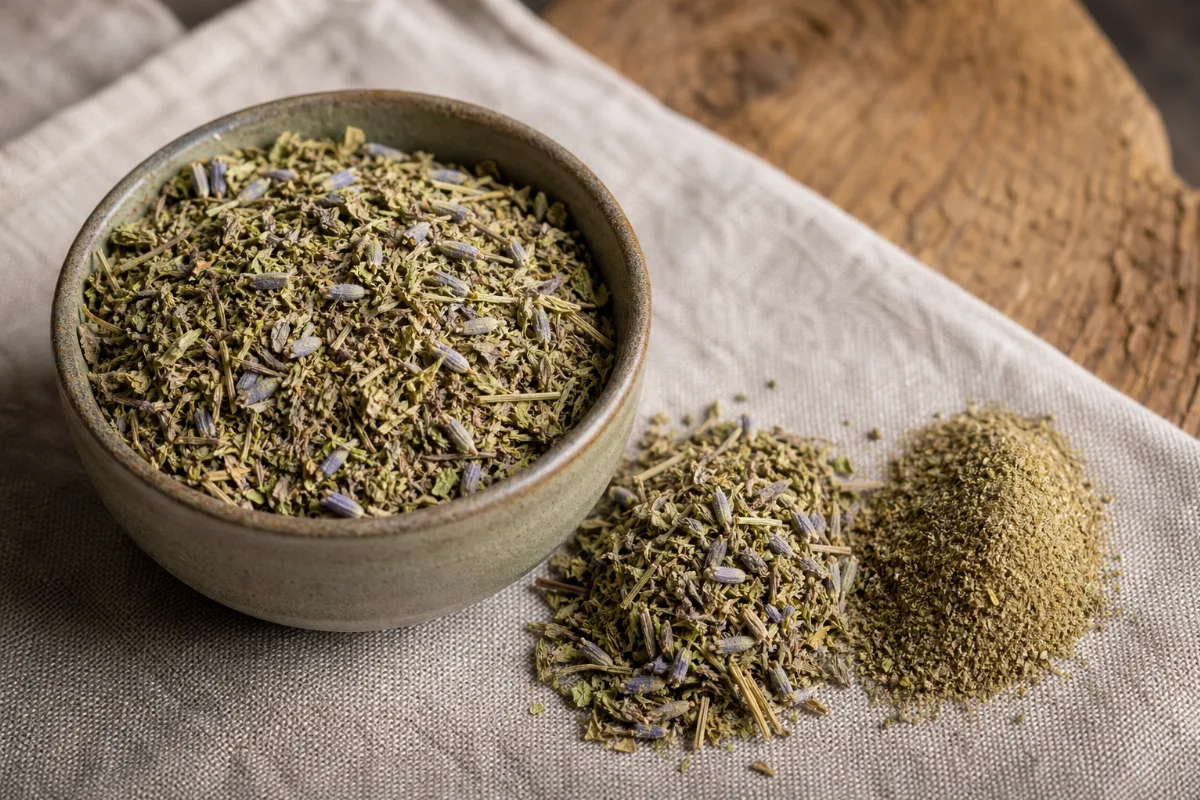
Herbes de Provence is a blend of dried herbs linked to southern France, usually thyme, savory, rosemary, oregano and marjoram, sometimes with lavender. It is used on grilled meat, fish and vegetable stews. No study of the blend in people was found, so it is a flavoring, not a proven remedy. The main cautions are allergy if you react to mint-family herbs and, for people on a blood thinner, daily herb teas.
General information, not medical advice. Last substantive update · Not medically reviewed. A named clinician has not signed off on this page. How this page is made
About Herbes de Provence
Herbes de Provence is an earthy, piney dried-herb blend for grilled meat, fish and vegetables. It is a flavoring. The blend is rarely studied as a blend, so most cautions come from the herbs in it.
What it is
Herbes de Provence is a mix of dried herbs considered typical of Provence in southern France. Savory, marjoram, rosemary, thyme and oregano form the base. Some makers add basil, bay leaf, tarragon, parsley, fennel, chervil or hyssop. In North America lavender is often included, but it is not in the 1910 Provencal cookbook the Wikipedia article cites.
Commercial blends were first sold in the 1970s, and the name has no legal protection. The French Label Rouge quality recipe is 19% thyme and 27% each of rosemary, savory and oregano. So what is in your jar depends on the label.
In the kitchen
The blend smells piney, earthy and herbal. Most of its herbs are in the mint family and carry strong aromatic oils. It is mainly used on grilled fish and meat and in vegetable stews, and also in vinaigrettes, on raw salads and rolled onto fresh goat cheese.
It can be added before, during or after cooking, or mixed with oil and lightly roasted first. We found no source that gives a usual recipe amount.
Nutrition in a teaspoon
There is no USDA record for the blend itself, so the numbers come from the single dried herbs. A level teaspoon weighs about 1.0 g for thyme, 1.2 g for rosemary, 1.0 g for oregano, 0.6 g for marjoram and 1.4 g for ground savory. That gives only 2 to 4 kcal, and small amounts of iron (about 0.35 to 1.2 mg) and calcium (about 12 to 30 mg) (our arithmetic from USDA values). Thyme is richest in vitamin K, about 17 micrograms per teaspoon.
Sodium in the single herbs is low (24 to 77 mg per 100 g), but blends sold with added salt differ, so read the label.
What the research shows
No study of the blend in people was found. A 2026 laboratory paper measured plant compounds in dried herbs and found a lot of rosmarinic acid in a herbes de Provence sample. A 1996 laboratory paper on an oily extract of Provencal herbs found antioxidant action, but also some DNA damage in test systems and toxicity to cells at the amounts that blocked HIV in the lab.
Neither shows an effect in people. Research on thyme, rosemary and oregano is on their own pages.
The seasoning versus teas, oils and extracts
A pinch of dried herbs in food is very different from herb teas, essential oils, extracts or medicines. The case report is about a tea, the cough use is about thyme medicines, and the 1996 laboratory work used oily extracts. Results for those do not carry over to the seasoning.
Amounts
This page gives no amounts to eat or take. Ask a doctor, pharmacist or dietitian what is right for you, especially in pregnancy, if you take a blood thinner, or before using herb teas, oils or supplements.
At a glance
Traditional uses history, not proof
- A seasoning for grilled meat and fish, vegetable stews, soups and vinaigrettes, and for rolling goat cheese
- Commercial blends only date from the 1970s, so the blend has no long history as a remedy
Studied for research
- The blend eaten as a seasoning: no human study found
- Antioxidant plant compounds in the dried herbs, laboratory finding only, insufficient evidence for people
- Thyme medicines for chesty coughs with colds, traditional use only, insufficient evidence
- Iron, calcium and vitamin K in the single dried herbs: small amounts per teaspoon
Main compounds
- Rosmarinic acid (10,255 micrograms per gram in one tested sample)
- Thymol and carvacrol (aroma compounds of thyme and oregano)
- Carnosic acid and carnosol (from rosemary)
Common forms
- Dried blend in jars or bags (check for added salt and lavender)
- Homemade mix of your own dried herbs
- Herb teas and oils of single herbs (not the same as the blend)
Research links: EMA: Thyme herb, herbal medicine summary · EMA: Rosemary leaf, herbal medicine summary · FDA: Spice risk profile update on Salmonella, 2018 · Spices, herbs and allergic reactions in children, review (Front Allergy, 2025) · Research Library · Genes & Biomarkers Library
What it is and its history
- Accepted scientific name
- A blend, not one plant species
- Synonyms
- Provencal herbs; Herbes de Provence (French spelling)
- Common names
- Herbes de Provence (French); Provencal herbs (English); Hierbas provenzales (Spanish)
- Family or group
- Mint family (Lamiaceae) for thyme, savory, rosemary, oregano, marjoram and lavender, as returned by the GBIF match.
- Classification
- Plantae > Tracheophyta > Magnoliopsida > Lamiales > Lamiaceae > Thymus, Satureja, Salvia, Origanum (and Lavandula when lavender is used) > several, one per herb
- Native range
- The herbs grow around the Mediterranean; the blend is linked to southern France (Provence) (Wikipedia).
- Cultivation
- Wikipedia says only about 10% of the blend sold in France is produced there; most comes from central and eastern Europe, North Africa or China. Not verified.
- Harvest and processing
- The herbs are dried and mixed; some makers lightly roast the mix in oil before cooking (a kitchen use, per Wikipedia).
- Look-alikes and adulterants
- Name: Italian seasoning; Note: A similar blend named in the Wikipedia article; its mix differs.
Photographs
Traditional use and history history, not clinical proof
| Tradition or era | Documented use | Source |
|---|---|---|
| Provencal home cooking | A quote in the Wikipedia article says Provencal grandmothers used thyme, rosemary and savory from the countryside one by one, not as a set mix. The names were descriptive, not a fixed recipe. | s-wiki-hdp (NOT verified; the cited book was not opened) |
| 1970s commercial blends | Spice wholesalers, including Ducros in France, started selling varying mixes under the name herbes de Provence in the 1970s. The name has no legal protection. | s-wiki-hdp (NOT verified; the cited book was not opened) |
| Label Rouge quality recipe | The French Label Rouge definition is 19% thyme and 27% each of rosemary, savory and oregano, per Wikipedia. Lavender is not in the 1910 Provencal cookbook cited, though it is common in North American blends. | s-wiki-hdp (NOT verified; the specification was not opened) |
Traditional use shows how it was used. It does not show that it works or is safe today.
What is inside, and how it may work
What it contains and how those compounds act in cells and animals. Laboratory and animal mechanisms are not proven effects in people.
Main compounds
| Compound | Family | Where it is concentrated | Activity studied | Level of evidence |
|---|---|---|---|---|
| Rosmarinic acid PubChem 5281792 | phenolic acid | Leaves of mint-family herbs 10,255 micrograms per gram in one herbes de Provence sample; 1121 in rosemary (2026 laboratory study) | Main non-volatile phenolic compound in the tested herbs and mixes; higher levels went with stronger test-tube antioxidant readings. 5 10 | Lab |
| Thymol PubChem 6989 | monoterpene phenol | Thyme and oregano leaves Not stated in the sources read | Named by the 2025 oregano case report authors, with carvacrol, as an aroma compound they link to a possible anticoagulant action; not shown in that case. 2 | Case report hypothesis |
| Carvacrol PubChem 10364 | monoterpene phenol | Oregano leaves Not stated in the sources read | Named with thymol in the oregano case report as a possible contributor to a clotting effect; unproven. 2 | Case report hypothesis |
| Carnosic acid and carnosol PubChem 65126 (carnosic acid), 442009 (carnosol) | diterpenes | Rosemary leaves Not stated in the sources read | Named as the main active parts of rosemary and Provencal herb extracts in a 1996 laboratory paper; reacted with radicals in test systems. 1 | Lab |
Mechanisms, receptors and pathways
| Target or pathway | Gene or receptor | What was found | Level |
|---|---|---|---|
| Antioxidant reactions in test tubes | Not applicable | Extracts of the herbs and of Provencal herb mixes reacted with free radicals in test tubes. This does not show an effect in the body. 5 1 | Lab |
| Liver enzyme blocking (CYP) and vitamin K blocker effect (suggested) | CYP2C9 and CYP3A4 (as named by the case authors) | The authors of one oregano tea case suggest that plant compounds block these enzymes and add an anticoagulant action. This was not tested. 2 | Hypothesis |
Absorption, metabolism and elimination
- Absorption
- Not found for the blend.
- Distribution
- Not found.
- Metabolism
- Not found for the blend.
- Elimination
- Not found.
- Bioavailability
- Not established in the sources read.
Isolated compounds versus whole extracts
The research that exists is on lab extracts of the herbs, herb teas, thyme medicines, and food-contamination checks, not on the dried blend eaten in food. Results for one do not carry over to the others.
Nutritional composition
There is no USDA record for herbes de Provence, so these values are for the single dried herbs it is built from (USDA FoodData Central, SR Legacy April 2018, read 2026-10-26 from our saved copy of the records). Per 100 g: thyme 276 kcal, 124 mg iron, 1890 mg calcium, 1710 micrograms vitamin K, 55 mg sodium; rosemary 331 kcal, 29.2 mg iron, 1280 mg calcium, 50 mg sodium; oregano 265 kcal, 36.8 mg iron, 1600 mg calcium, 622 micrograms vitamin K, 25 mg sodium; marjoram 271 kcal, 82.7 mg iron, 1990 mg calcium, 622 micrograms vitamin K, 77 mg sodium; ground savory 272 kcal, 37.9 mg iron, 2130 mg calcium, 24 mg sodium. A level teaspoon weighs 1.0 g (thyme leaves), 1.2 g (rosemary), 1.0 g (oregano leaves), 0.6 g (marjoram) or 1.4 g (ground savory). So a teaspoon of thyme has about 3 kcal, 1.2 mg iron, 19 mg calcium and 17 micrograms vitamin K (our arithmetic), and the other herbs give smaller amounts. Per teaspoon none of these is large, and the blend and your spoon differ. Blends sold with added salt will have more sodium, so read the label. No amount to eat is given.
1 high certainty3 not enough evidence
What was looked at
The 4 benefits and uses checked for Herbes de Provence, each with how strong the evidence is. Tap one to open it.
- Herbes de Provence eaten as seasoning (health effects of kitchen amounts)Not enough evidence
- Antioxidant plant compounds in the dried herbs (laboratory finding only)Not enough evidence
- Thyme herb medicines for chesty coughs with colds (traditional use, not the seasoning)Not enough evidence
- Minerals and vitamin K in the dried herbs (nutrient facts)High certainty
What is Herbes de Provence good for?
The studied uses and how strong the human evidence is for each. Very little is known about the blend itself, and nothing here is a reason to eat more or less of it.
Benefits, one by one
Each card is a research question, not a promise. Tap a goal to filter. Open a card to see the studies, doses and limits.
Herbes de Provence eaten as seasoning (health effects of kitchen amounts)
Not enough evidenceNo study was found in which people ate herbes de Provence and a health effect was measured. It is a flavoring, not a proven remedy.
2 studiesDried herb blend used in cooking. Not an extract, tea or oil.
Studies, doses and limits
What the trials found
A PubMed search for herbes de Provence on 2026-10-26 found only five loosely matching papers; none was a trial in people. Two were laboratory papers on extracts or dried herbs (read below), one was a food-contamination survey, and two were unrelated.
Results
No human trial of the blend was found.
Why this rating
No human study of the blend was found, so nothing can be said either way. Absence of studies is not proof of no effect, and not proof of an effect.
Form and dose studied
Dried herb blend used in cooking. Not an extract, tea or oil.
Who was studied
Not studied.
Limits
Eating a pinch of a seasoning is very different from taking concentrated herb products, and results for one do not carry over to the other.
Why researchers looked
Many people use the blend daily, so they ask whether it does anything for health.
Traditional use
It is a French-style seasoning for grilled meat, fish and vegetables. Commercial blends only appeared in the 1970s, so there is no long traditional health use of the blend itself.
Proposed mechanism None
None to report. The herbs in it contain strong aromatic compounds, but nothing shown for the blend in people.
A proposed mechanism does not show that the effect happens in people.
Mint-family allergy and medicine cautions are on the Safety tab.
Antioxidant plant compounds in the dried herbs (laboratory finding only)
Not enough evidenceA 2026 laboratory study found a lot of rosmarinic acid, a plant antioxidant, in a herbes de Provence sample and strong antioxidant action in test tubes. This was chemistry, not a study of people.
2 studiesSolvent extracts of the dried herbs and one oily commercial extract. …
Studies, doses and limits
What the trials found
A 2026 laboratory comparison of oregano, sage, basil, rosemary and herb mixes. A 1996 laboratory paper on an oily extract of a mix of Provencal herbs found antioxidant action but also some DNA damage in test systems.
Results
Rosmarinic acid ranged from 1121 micrograms per gram in rosemary to 10,255 micrograms per gram in the herbes de Provence sample.
Effect sizes as reported
Rosmarinic acid 10,255 micrograms per gram in one herbes de Provence sample (2026 laboratory study)
Why this rating
Laboratory measurements only. No person was tested, and test-tube antioxidant activity has not been shown to lead to a health benefit.
Form and dose studied
Solvent extracts of the dried herbs and one oily commercial extract. Not the dried blend as eaten.
Limits
One sample of the blend (the abstract does not say how many products), and the findings do not describe the body. The 1996 paper used oily extracts at amounts that were also toxic to cells.
Why researchers looked
Herbs of the mint family are rich in plant phenols, so scientists measure them and test their antioxidant strength in the laboratory.
Proposed mechanism Laboratory research
Rosmarinic acid and other phenolic compounds were measured in extracts; higher rosmarinic acid went with stronger test-tube antioxidant readings. Test-tube antioxidant strength is not shown to matter in the body.
A proposed mechanism does not show that the effect happens in people.
None for cooking amounts.
Thyme herb medicines for chesty coughs with colds (traditional use, not the seasoning)
Not enough evidenceThe EU medicines agency accepts some thyme herb medicines for chesty coughs with colds on long-standing use alone, not on trials. This is about medicines, not a pinch of the blend.
1 studiesThyme herb medicines (EU-assessed traditional medicines). Not the ble…
Studies, doses and limits
What the trials found
The EMA summary page says the HMPC accepted these medicines for productive coughs associated with colds because of long use, and that most are for adults and adolescents over 12.
Results
Regulatory status only; no trial results on the page.
Why this rating
The EMA says the use is based on long-standing tradition, so no trial result supports it here. It concerns thyme medicines, not thyme as a seasoning in a blend.
Form and dose studied
Thyme herb medicines (EU-assessed traditional medicines). Not the blend and not a cooking amount.
Who was studied
Adults and adolescents over 12 (most thyme medicines).
Limits
No trial was read. The blend contains other herbs too, in unknown amounts.
Why researchers looked
Thyme is one of the main herbs in the blend and has a long folk use for coughs.
Traditional use
The EMA's traditional-use status rests on long-standing use.
Proposed mechanism Not stated
Not described on the EMA summary page we read.
A proposed mechanism does not show that the effect happens in people.
Thyme medicines must not be used by people allergic to thyme or other mint-family plants, and may cause stomach problems (EMA).
Minerals and vitamin K in the dried herbs (nutrient facts)
High certaintyThe dried herbs in the blend hold some iron, calcium and, for thyme, vitamin K, but a teaspoon weighs only about 0.6 to 1.4 g, so the amounts are small.
1 studiesDried single herbs, per teaspoon.
Studies, doses and limits
What the trials found
USDA values for five dried herbs (SR Legacy 2018). There is no USDA record for the blend itself, so these figures are for single herbs, and the real mix varies.
Results
Per level teaspoon (our arithmetic): thyme 1.0 g gives about 1.2 mg iron, 19 mg calcium and 17 micrograms vitamin K; rosemary 1.2 g gives about 0.4 mg iron and 15 mg calcium; oregano 1.0 g about 0.4 mg iron, 16 mg calcium and 6 micrograms vitamin K; marjoram 0.6 g about 0.5 mg iron, 12 mg calcium and 4 micrograms vitamin K; savory 1.4 g about 0.5 mg iron and 30 mg calcium.
Effect sizes as reported
Thyme about 17 micrograms vitamin K per teaspoon (arithmetic from USDA)
Why this rating
Nutrient figures are measured values in a government database, so the facts are well supported. They do not show a health benefit, and the actual blend and portion will differ.
Form and dose studied
Dried single herbs, per teaspoon.
Limits
Single-herb data, from 2018, and the blend and your spoon differ. We did not compare these figures to daily values and do not call the blend a good source of anything.
Why researchers looked
People ask whether a seasoning adds anything nutritionally.
Proposed mechanism Reference data
Nutrient values from a food database, not a mechanism.
A proposed mechanism does not show that the effect happens in people.
People on a blood thinner that works against vitamin K should ask their prescriber about regular large changes in vitamin K intake; we did not read a source on blend-sized amounts.
Connections to the rest of health
How Herbes de Provence connects to the rest of our health knowledge graph. Every link says what kind of connection it is. A safety link (for example to the liver) is a warning, not a benefit. A study that merely mentions a topic never creates a benefit link.
Explore every connection: goals, body systems, organs, symptoms, genes
B. Body systems
| Connected to | Kind of connection | Evidence status | Context | Studies |
|---|---|---|---|---|
| Respiratory System | Biological association | Not enough evidence | Studied for: Thyme herb medicines for chesty coughs with colds (traditional use, not the seasoning) | 7 |
E. Health conditions
| Connected to | Kind of connection | Evidence status | Context | Studies |
|---|---|---|---|---|
| Food allergy | Documented risk | Mint-family herbs are among spices and herbs reported to cause allergy in children. Preparation or compound: Mint-family herbs such as oregano |
3 |
K. Biological pathways
| Connected to | Kind of connection | Evidence status | Context | Studies |
|---|---|---|---|---|
| Rosmarinic acid | Preliminary mechanism | Lab | Main phenolic compound measured in the dried herbs and mixes in a 2026 laboratory study. | 5 |
| Vitamin K | Preliminary mechanism | Reference data | Dried thyme holds it; relevant to people on warfarin-type medicines. | 11 |
L. Active compounds
| Connected to | Kind of connection | Evidence status | Context | Studies |
|---|---|---|---|---|
| Rosmarinic acid | Biological association | Lab | Main non-volatile phenolic compound in the tested herbs and mixes; higher levels went with stronger test-tube antioxidant readings. Preparation or compound: Leaves of mint-family herbs |
5 10 |
| Thymol | Biological association | Case report hypothesis | Named by the 2025 oregano case report authors, with carvacrol, as an aroma compound they link to a possible anticoagulant action; not shown in that case. Preparation or compound: Thyme and oregano leaves |
2 |
| Carvacrol | Biological association | Case report hypothesis | Named with thymol in the oregano case report as a possible contributor to a clotting effect; unproven. Preparation or compound: Oregano leaves |
2 |
| Carnosic acid and carnosol | Biological association | Lab | Named as the main active parts of rosemary and Provencal herb extracts in a 1996 laboratory paper; reacted with radicals in test systems. Preparation or compound: Rosemary leaves |
1 |
Each connection is stored with the ingredient, the connected record, the kind of connection, the evidence status, the supporting studies, the preparation or compound involved, and a review date (last reviewed October 26, 2026).
Evidence at a glance: what the research found for 4 outcomes
Each outcome below is one thing researchers measured. Certainty is how far the evidence can be trusted, not how well it works. The full studies are on the next tab.
The evidence
The research centre for Herbes de Provence. Every record here was checked against PubMed or the publisher's page; we never list a study we have not verified.
Evidence by outcome
Bars show how many studies we found for each outcome, not how well it works. People are added up across trials only (reviews are not added, to avoid double counting).
How we rate evidence
High certainty
Several well-run trials or reviews agree; further research is unlikely to change the picture much.
Moderate certainty
Good trials point the same way, but some doubt remains.
Low certainty
Small, short or inconsistent trials. The finding could change with better research.
Very low certainty
Very little or very weak human data. Treat as a possibility only.
Mixed findings
Trials or reviews disagree with each other.
Not enough evidence
Not enough human research to say either way.
Evidence against
Good research found no benefit, or found harm.
We take the reviewers' own risk-of-bias and GRADE statements where they exist, and otherwise judge from study size, design, consistency, directness and whether a product matches what is sold. Many publications do not make evidence high. Method note: We started from our existing page and Wikipedia for what the blend is, read the EMA thyme and rosemary summary pages and the FDA spice update, read nutrition for the single herbs from saved USDA records, searched PubMed for the blend and read abstracts only. Because very little research exists on the blend itself, this page is shorter than most. Items we could not verify are flagged in the research gaps.
Study library: every study we checked 12
| Study | Design | People | Product, dose, length | Result |
|---|---|---|---|---|
| Aruoma 1996 An evaluation of the antioxidant and antiviral action of extracts of rosemary and Provencal herbs. Food Chem Toxicol · PMID 8655093 · DOI |
Laboratory study laboratory (no people) |
Test-tube and cell tests, no people | A rosemary extract and an oily extract of a mixture of Provencal herbs (a trade product called Spice Cocktail) Herb extracts Not given as advice |
Both extracts blocked fat peroxidation in test systems and slowed HIV infection of cells, but at amounts that were also toxic to the cells. Both extracts also caused some DNA damage in two test systems. None reported for people Methods, limits and fundingOutcomes: Antioxidant and anti-HIV action in the laboratory; DNA damage tests Limitations: Very old laboratory study of oily extracts, not the dried blend as used in cooking. No human data. Funding and conflicts: Not stated in the abstract. Read: abstract |
| Beghriche 2025 Origanum vulgare and hemorrhagic risk, about a case. [Article in French] Ann Cardiol Angeiol (Paris) · PMID 39793412 · DOI |
Case report |
1 One 77-year-old woman in Algeria with atrial fibrillation, stable for years on the blood thinner acenocoumarol |
Oregano (Origanum vulgare) herbal tea, one 200 ml cup a day for a week, with occasional verbena tea Oregano leaves as an infusion Not given as advice |
Her INR, normally 2 to 3 for years, was 6.42 (far above target) after about a week of daily oregano tea. It fell to 3.80 the next day after stopping the tea and the blood thinner, and was 2.5 four days after restarting. She went back to the tea, so her tea was made much weaker and her blood-thinner dose was lowered; her INR was 2.3 at the last check in April 2024. INR 6.42 on oregano tea versus a usual 2 to 3 Methods, limits and fundingOutcomes: Blood clotting test (INR) while on a vitamin K blocker Limitations: A single case, a tea (not the herb used in cooking), and verbena tea was also taken from time to time, so oregano cannot be shown to be the only cause. The authors explain a possible link through plant compounds that block liver enzymes, which this case does not prove. Funding and conflicts: Not stated in the abstract. Read: abstract |
| Berghea 2025 Spices, herbs and allergic reactions in children: myth or reality - a narrative review with scoping elements. Front Allergy · PMID 41306764 · DOI |
Narrative review |
Children (selected adult cases for context) in case reports and clinical, immune and molecular studies | Spices and herbs eaten as food Various spices and herbs Not given as advice |
Spice and herb allergies are increasingly recognised in children, from mild mouth reactions to anaphylaxis. The most often named spices are mustard, celery, coriander, fennel, cumin, anise and pepper, plus herbs of the mint family such as mint, oregano and sage. Cross-reactions with birch and mugwort pollen are common, and an oral food challenge is the gold standard test. No rate given in the abstract Methods, limits and fundingOutcomes: Allergic reactions to spices and herbs Limitations: A narrative review: it does not say how common allergy is to any one herb, and it does not name thyme, rosemary, savory, marjoram or lavender in the abstract. Funding and conflicts: Authors declare no commercial or financial conflicts. Read: abstract |
| Chung 2017 Investigation of pyrrolizidine alkaloids including their respective N-oxides in selected food products available in Hong Kong by liquid chromatography electrospray ionisation mass spectrometry. Food Addit Contam Part A Chem Anal Control Expo Risk Assess · PMID 28406050 · DOI |
Market survey food samples (no people) |
234 234 food samples (48 food items) bought at random from a Hong Kong market |
Dried herbs and other foods tested for pyrrolizidine alkaloids Food samples including herbs de Provence, oregano, tarragon and cumin seed Not given as advice |
About half of the samples had detectable pyrrolizidine alkaloids, up to 11,000 micrograms per kilogram. Cumin seed was highest, then oregano, tarragon and herbs de Provence. For herbs de Provence the total ranged from 18 to 1300 micrograms per kilogram, with the highest single sample at 1300. Herbs de Provence: 18 to 1300 micrograms per kilogram (range across samples) Methods, limits and fundingOutcomes: Levels of pyrrolizidine alkaloids (natural plant compounds that can harm the liver) Limitations: One city, one year, and the abstract does not say how many herbes de Provence samples were bought. It measures contamination, not harm to people, and gives no safe level. Funding and conflicts: Not stated in the abstract. Read: abstract |
| Platkiewicz 2026 Antioxidant Properties and Bioactive Compounds of Oregano, Sage, Basil, Rosemary, and Herbal Mixtures. Antioxidants (Basel) · PMID 42792152 · DOI |
Laboratory analysis laboratory (no people) |
Dried herbs and herb mixes bought for testing, including one herbes de Provence mix; tested in the laboratory, not in people | Ethanol-water extracts of dried oregano, sage, basil, rosemary and herb mixes (including herbes de Provence) Dried leaves and mixes Not given as advice |
Oregano had the highest antioxidant activity in every test and rosemary the lowest. Rosmarinic acid was the main non-volatile phenolic compound in all of the Lamiaceae herbs and mixes, from 1121 micrograms per gram in rosemary to 10,255 micrograms per gram in the herbes de Provence sample. Rosmarinic acid levels went up and down together with the test-tube antioxidant results. Rosmarinic acid up to 10,255 micrograms per gram in herbes de Provence; no human outcome Methods, limits and fundingOutcomes: Antioxidant strength in test tubes and levels of plant compounds Limitations: A laboratory chemistry study of extracts. It shows what is in the dried herbs, not what happens in the body, and the abstract does not say how many different herbes de Provence products were tested. Funding and conflicts: Authors declare no conflicts of interest. Read: abstract |
| s-ema-rosemary EMA (HMPC): Rosmarini folium (rosemary leaf), herbal medicinal product summary page · Source |
Regulator summary n/a |
Methods, limits and fundingRead: full-text | ||
| s-ema-thyme EMA (HMPC): Thymi herba, herbal medicinal product summary page · Source |
Regulator summary n/a |
Methods, limits and fundingRead: full-text | ||
| s-fda-spice-2018 FDA: FDA Updates Spice Risk Profile, Adds Information About Lower Salmonella Prevalence in Retail Products (15 February 2018) · Source |
Regulator update n/a |
Methods, limits and fundingRead: full-text | ||
| s-gbif-hdp-herbs GBIF Backbone species match for the usual herbs (Thymus vulgaris, Salvia rosmarinus, Origanum vulgare, Origanum majorana, Satureja hortensis, Satureja montana, Lavandula angustifolia) · Source |
Reference database n/a |
Methods, limits and fundingRead: full-text | ||
| s-pubchem-hdp PubChem: rosmarinic acid (CID 5281792), thymol (6989), carvacrol (10364), carnosic acid (65126), carnosol (442009) · Source |
Reference database n/a |
Methods, limits and fundingRead: full-text | ||
| s-usda-fdc-herbs USDA FoodData Central (SR Legacy, April 2018): dried thyme 170938, rosemary 171333, oregano 171328, marjoram 170928, savory (ground) 170936 · Source |
Reference database n/a |
Methods, limits and fundingRead: full-text | ||
| s-wiki-hdp Wikipedia: Herbes de Provence (article text read 2026-10-26) · Source |
Encyclopedia n/a |
Methods, limits and fundingRead: full-text |
What we do not know yet
- No human study of herbes de Provence as a blend was found.
- Laboratory antioxidant results have not been linked to any effect in people.
- No safe level for pyrrolizidine alkaloids at seasoning amounts was found, and the survey did not say how many herbes de Provence samples it tested.
- Which herb in the blend most often causes allergy was not verified.
- Safety of seasoning amounts in pregnancy and breastfeeding was not addressed by the sources read.
- EFSA, NCCIH, WHO and LactMed were not searched.
How new research is added
New studies are found by a saved PubMed search and placed in a review queue before the page changes.
Lab markers
What changed in blood or saliva tests during trials. A changed number is not the same as feeling or being healthier, and we give no "normal ranges".
Safety
What studies and official sources say about side effects, medicines and who should check first. Each point shows what kind of evidence it comes from.
Main points to know 3
- In normal cooking amounts no harm from the blend was found, but there are a few things to know. No source we read reports harm from herbes de Provence used as a seasoning. The main cautions are allergy if you react to mint-family herbs (thyme, oregano, rosemary, marjoram, savory and lavender are all in that family), a case report of a blood-thinner test going up with daily oregano tea, natural liver-harming plant compounds measured in some herb samples, and germs in imported dried spices. Cautions for herb medicines in pregnancy are about medicines, not the seasoning. Mixed 3 2 4 8 7
- If you take a blood thinner, daily herb teas are the thing to ask about. One 77-year-old woman on acenocoumarol had an INR of 6.42 after about a week of a daily cup of oregano tea (plus occasional verbena), and it came down when she stopped. It is one case about a tea, not a seasoning, but it is the reason to ask your prescriber before regular herbal tea. Case report 2
- Allergy to mint-family herbs. A 2025 review lists herbs of the mint family, such as mint, oregano and sage, among the spices and herbs that cause allergy in children, sometimes severe, with cross-reaction to some pollens. The EMA says thyme medicines must not be used by people allergic to thyme or other plants of this family. Review 3 7
Side effects 2
| Effect | How often | Severity and recovery | Evidence |
|---|---|---|---|
| Allergic reactions to mint-family herbs, from itchy mouth to anaphylaxis The abstract does not name thyme, rosemary, savory, marjoram or lavender, so reactions to each herb in the blend were not verified. | Not given in the review abstract | mild to severe Not stated in the abstract | Review 3 |
| Contact dermatitis (skin reaction) with rosemary leaf medicines; stomach problems with thyme medicines These are listed for herbal medicines, not for the seasoning. | Not known (EMA) | mild Not stated | Authoritative guidance 6 7 |
Liver
No liver harm from the blend was found. Some herb samples contain pyrrolizidine alkaloids, a group of natural compounds known to be able to harm the liver; the survey read did not measure harm in people. The EMA says rosemary leaf medicines should not be used with liver disease, bile duct obstruction or gallstones (medicines, not seasoning). 4 6
How often. No case reports linked to the blend were found.
Monitoring. No agency monitoring advice for the blend was found.
This is a safety connection. It is not evidence that Herbes de Provence supports liver health.
Medicines and supplements 2
| With | Why it matters | Importance | Evidence | What to do |
|---|---|---|---|---|
| Blood thinners that work against vitamin K (for example acenocoumarol, warfarin) prescription | In one case report oregano tea (with occasional verbena) went with a high INR. The authors suggest plant compounds that block liver enzymes and an anticoagulant action; the case does not prove this. | One case about a tea, not the seasoning. It cannot show how often this happens. | Case report Very low certainty 2 | If you take a blood thinner, ask your prescriber or pharmacist before regular herbal teas or extracts, and mention herbs you use often. |
| Vitamin K and warfarin-type medicines prescription | USDA data show dried thyme holds vitamin K (about 17 micrograms in a level teaspoon, our arithmetic). Vitamin K works against warfarin-type blood thinners. | We did not read a source that says seasoning amounts change the INR, so no effect is claimed. | Nutrient data Not enough evidence 11 | Ask your prescriber if your diet changes a lot, including how much of vitamin-K-rich foods you eat. |
Who should check first 4
| Situation | Advice | Evidence |
|---|---|---|
| Allergy to thyme or other mint-family herbs | The EMA lists this as a reason not to use thyme medicines. If you have reacted to any herb in the blend, read the label and ask your doctor or allergist. | Authoritative guidance 7 |
| Pregnancy and breastfeeding | The EMA says not to use rosemary leaf medicines in pregnancy or breastfeeding. Its thyme page text we read says nothing about pregnancy, and no source we read gives a statement for the seasoning in food. Ask your midwife or doctor. | Authoritative guidance 6 7 |
| Children | The EMA says most thyme medicines should be used only by adults and adolescents over 12, and rosemary leaf medicines not under 12. This is about medicines, not seasoning food. | Authoritative guidance 7 6 |
| Bile duct obstruction, gallbladder inflammation, gallstones or liver disease | The EMA says not to use rosemary leaf medicines in these conditions. No statement about the seasoning was found. | Authoritative guidance 6 |
Overdose, product quality and regulators
Summary. No toxicity of the blend at cooking amounts was found in the sources read.
Animal. Not researched.
Human doses studied. No safe or unsafe amount of the blend is set in the sources read, and this page gives no amounts.
High dose or long term signals. A 1996 laboratory paper found that oily extracts of a Provencal herb mix and of rosemary caused some DNA damage in test systems and were toxic to cells at the amounts that blocked HIV. This is a laboratory finding about extracts, not the seasoning.
Overdose response. Not found.
Genotoxicity. Laboratory signal for oily extracts only (1996); not shown for the dried blend.
Dried herbs can carry germs and natural plant toxins. A Hong Kong market survey found pyrrolizidine alkaloids in about half of 234 food samples and in herbs de Provence samples. The FDA found Salmonella in imported dried spices, less often in retail packs.
Pyrrolizidine alkaloids. In 234 market food samples, cumin seed, oregano, tarragon and herbs de Provence had the highest totals. For herbs de Provence the total ranged from 18 to 1300 micrograms per kilogram. The abstract gives no health risk or safe level, and the number of herbes de Provence samples is not stated. 4
Salmonella and filth in spices. The FDA's 2018 update says that in 11 types of packaged retail dried spices Salmonella was significantly lower than in imported shipments, except in dehydrated garlic and basil. It did not test herbes de Provence. 8
Origin. Wikipedia says only about 10% of herbes de Provence sold in France is produced there, and the name has no legal protection. We did not verify this. 12
| Body | Action | Date |
|---|---|---|
| EMA, Committee on Herbal Medicinal Products (EU) (European Union) | Thyme herb summary page: traditional-use medicines for productive coughs with colds, mostly for adults and adolescents over 12; must not be used if allergic to thyme or other Lamiaceae plants; stomach problems may occur. Medicines, not seasoning. source | page read 2026-10-26 (undated in the text read) |
| EMA, Committee on Herbal Medicinal Products (EU) (European Union) | Rosemary leaf summary page: do not use under 12, in pregnancy or breastfeeding, with allergy to rosemary leaf, or with bile duct obstruction, gallbladder inflammation, gallstones or liver disease; contact dermatitis possible. Medicines, not seasoning. source | page read 2026-10-26 (undated in the text read) |
| FDA (US) (United States) | Update of the 2013 spice risk profile on pathogens and filth: Salmonella significantly lower in retail dried spices than in imports for 9 of 11 types; dehydrated garlic and basil were the exceptions. Herbes de Provence was not tested. source | 2018-02-15 |
When to get medical help
- Trouble breathing, swelling of the lips, face or throat, widespread hives or repeated vomiting soon after eating a herb blend: get emergency help (possible severe allergy).
- If you take a blood thinner and notice unusual bruising, nosebleeds, blood in urine or black stools after starting regular herbal teas: contact your prescriber the same day.
- Severe diarrhoea with fever or blood after eating food seasoned with dried herbs: see a doctor.
Stop using the product and contact a clinician or emergency service. In the US, Poison Control is 1-800-222-1222.
General information only, not medical advice. Ask a clinician or pharmacist before use, especially with medicines, in pregnancy or with a health condition. See the Natural Remedy Safety guide.
Frequently asked questions
What is herbes de Provence?
A blend of dried herbs linked to southern France, usually thyme, savory, rosemary, oregano and marjoram. Some makers add basil, bay leaf, tarragon, parsley or fennel, and lavender is common in North American blends.
Does it always contain lavender?
No. Lavender is common in North American blends but is not in the 1910 Provencal cookbook the Wikipedia article cites. Check the ingredient list.
What does it taste like?
Earthy, piney and herbal. It is not sweet. Lavender, if present, adds a floral note.
What is it used for in cooking?
Mostly grilled fish and meat and vegetable stews. It also goes into vinaigrettes, on raw salads and onto fresh goat cheese, and can be added before, during or after cooking.
Is herbes de Provence good for you?
Does it have any nutrients?
A teaspoon of the dried herbs gives only a few calories and small amounts of iron and calcium, and thyme gives some vitamin K. There is no USDA record for the blend itself, so these figures are for the single herbs.
Can you be allergic to it?
Can I use it if I take a blood thinner?
No problem has been reported for the seasoning in food. One case report links a daily cup of oregano tea to a very high clotting test in a woman on a blood thinner, so ask your prescriber about regular herb teas or extracts.
Is it safe in pregnancy and breastfeeding?
Is there anything to worry about in dried herb blends?
Is it the same as Italian seasoning?
No. Wikipedia describes Italian seasoning as a similar blend, but the mixes differ, so check the labels.
Do thyme medicines treat coughs?
The EMA accepts some thyme herb medicines for chesty coughs with colds on long-standing use alone, not on trials. That is about medicines, not the seasoning.
Explore by health goal
Editorial transparency
- Written by
- AlternativeMed editorial team. Research compiled with AI assistance, then checked against the sources listed.
- Medical review
- None. This page has not been reviewed by a physician or pharmacist.
- First published
- 2026-10-26
- Last substantive update
- 2026-10-26
- How we research
- We started from our existing page and Wikipedia for what the blend is, read the EMA thyme and rosemary summary pages and the FDA spice update, read nutrition for the single herbs from saved USDA records, searched PubMed for the blend and read abstracts only. Because very little research exists on the blend itself, this page is shorter than most. Items we could not verify are flagged in the research gaps.
- How we rate evidence
- See "How we rate evidence" in the Evidence tab.
- Independence
- No product is promoted on this page. No affiliate links are shown.
Sources 12
Each source was opened and checked. Where we read only the abstract, it says so. The small numbers in the text point here.
- Aruoma OI, Spencer JP, Rossi R, et al.. An evaluation of the antioxidant and antiviral action of extracts of rosemary and Provencal herbs.. Food Chem Toxicol. 1996. PMID 8655093. DOI 10.1016/0278-6915(96)00004-x. (abstract)
- Beghriche I, Belhachem A, Hamidene I, et al.. Origanum vulgare and hemorrhagic risk, about a case. [Article in French]. Ann Cardiol Angeiol (Paris). 2025. PMID 39793412. DOI 10.1016/j.ancard.2024.101856. (abstract)
- Berghea EC, Feketea G, Cosoreanu MT, et al.. Spices, herbs and allergic reactions in children: myth or reality - a narrative review with scoping elements.. Front Allergy. 2025. PMID 41306764. DOI 10.3389/falgy.2025.1698559. (abstract)
- Chung SWC, Lam ACH. Investigation of pyrrolizidine alkaloids including their respective N-oxides in selected food products available in Hong Kong by liquid chromatography electrospray ionisation mass spectrometry.. Food Addit Contam Part A Chem Anal Control Expo Risk Assess. 2017. PMID 28406050. DOI 10.1080/19440049.2017.1319579. (abstract)
- Platkiewicz J, Wrobel J, Jeszka-Skowron M, et al.. Antioxidant Properties and Bioactive Compounds of Oregano, Sage, Basil, Rosemary, and Herbal Mixtures.. Antioxidants (Basel). 2026. PMID 42792152. DOI 10.3390/antiox15091113. (abstract)
- . EMA (HMPC): Rosmarini folium (rosemary leaf), herbal medicinal product summary page. . . (full-text)
- . EMA (HMPC): Thymi herba, herbal medicinal product summary page. . . (full-text)
- . FDA: FDA Updates Spice Risk Profile, Adds Information About Lower Salmonella Prevalence in Retail Products (15 February 2018). . . (full-text)
- . GBIF Backbone species match for the usual herbs (Thymus vulgaris, Salvia rosmarinus, Origanum vulgare, Origanum majorana, Satureja hortensis, Satureja montana, Lavandula angustifolia). . . (full-text)
- . PubChem: rosmarinic acid (CID 5281792), thymol (6989), carvacrol (10364), carnosic acid (65126), carnosol (442009). . . (full-text)
- . USDA FoodData Central (SR Legacy, April 2018): dried thyme 170938, rosemary 171333, oregano 171328, marjoram 170928, savory (ground) 170936. . . (full-text)
- . Wikipedia: Herbes de Provence (article text read 2026-10-26). . . (full-text)
Where to buy
Check the label first. Whatever you buy, look for these:
- Whole or ground: whole spices keep their flavor longer
- The origin and a packed-on or best-by date for freshness
- Organic or non-irradiated labeling if that matters to you
- A resealable, airtight container
Talk to a pharmacist or doctor before you start any supplement, especially if you take medicines. See the Safety tab for interactions.
Support our free guides: as an Amazon Associate we earn from qualifying purchases. Full disclosure.


