Spices · Spice
Cloves
Syzygium aromaticum · also called Clove buds, clavos de olor (Spanish)
Cloves are the dried flower buds of a tree from Indonesia, used whole or ground to give food a warm, strong flavor. Almost all the research is on clove oil, a gel or concentrated extracts, not on the spice in cooking. Dental studies of the oil look promising but limited. The main caution is that clove oil has poisoned small children, so keep it away from them.
General information, not medical advice. Last substantive update · Not medically reviewed. A named clinician has not signed off on this page. How this page is made
About Cloves
Cloves are a strong, warm-flavored spice and a very concentrated manganese source by weight. They are a flavoring, not a proven remedy. Research is on clove oil, gel and extracts, and the oil can poison small children.
What it is
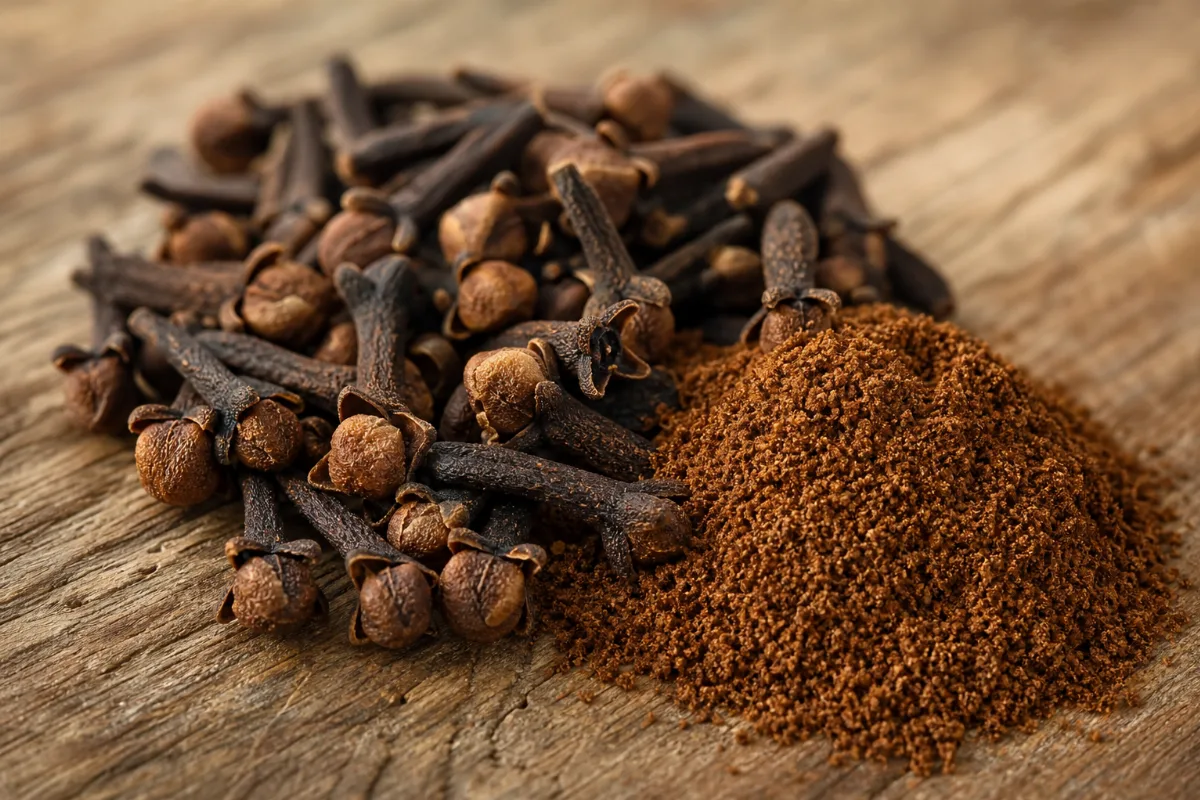
Cloves are the dried, unopened flower buds of Syzygium aromaticum, an evergreen tree of the myrtle family from the Maluku Islands of Indonesia. The buds are picked when they turn bright red, at about 1.5 to 2 cm long.
USDA data for ground cloves: 274 kcal per 100 g. A teaspoon is 2.1 g, so it gives about 6 kcal, 0.7 g fibre, 13 mg calcium, 21 mg potassium and 1.3 mg manganese (our arithmetic). Manganese is more than half of the 2.3 mg Daily Value on US labels. Everything else in a teaspoon is small.
In the kitchen
Eugenol is the main compound behind the taste and smell, and only a small amount of the spice is typically needed. Cloves pair well with cinnamon, allspice, vanilla, red wine, citrus peel, onion and star anise.
They are used in curries, marinades, baked ham, apples, pears and rhubarb, hot drinks, and blends such as pumpkin pie spice. In Malay cooking they are one of the "four sibling spices" with cinnamon, cardamom and star anise. In Mexico they are called clavos de olor.
What the research shows
No trial of cloves eaten as a spice was found. Dental studies used clove oil, eugenol or a gel. A 2025 systematic review of 21 studies lists clove oil among the plant products with the strongest pain relief and asks for larger trials, and one 73-person trial found a clove gel numbed the gum like benzocaine gel.
A small open-label pilot and a small crossover trial of one branded extract saw lower after-meal blood sugar and a lower hangover score. Both were industry-linked and are very low certainty. Cell and animal results are not proof for people.
The spice versus oil, gel and extracts
Oil, eugenol, gel and branded extracts are concentrated and are not the same as cooking with cloves. Dental results, poisoning cases and the extract trials do not carry over to the spice.
Amounts
This page gives no amounts to eat or take. Ask a doctor, pharmacist or dietitian what is right for you, especially in pregnancy, if you take blood thinners, or before using clove oil or supplements.
At a glance
Traditional uses history, not proof
- Used as a spice in Asian, African, Mediterranean and Middle Eastern cooking, in spice blends and in hot drinks
- Clove oil is traditionally used for toothache; long use is not proof from trials
Studied for research
- Cloves eaten as a spice: no human trial found
- Manganese in ground cloves, high certainty for the nutrient fact
- Toothache and dental pain with clove oil or eugenol, low certainty
- Numbing the gum before a needle with clove gel, low certainty
- Blood sugar and alcohol markers with branded extracts, very low certainty
Main compounds
- Eugenol (main flavor compound, 72 to 90% of the oil)
- Eugenyl acetate
- Beta-caryophyllene
- Manganese (60.1 mg per 100 g ground)
- Fibre (33.9 g per 100 g ground)
Common forms
- Whole buds and ground cloves as a spice
- Clove oil (concentrated; not a cooking ingredient)
- Clove gel or dental products
- Clove tea or infusion
- Branded clove bud extracts and capsules (not the same as the spice)
Research links: EMA: Clove oil herbal medicine page, monograph and assessment report · LiverTox: Eugenol (clove oil) · USDA FoodData Central: Spices, cloves, ground · Dental pain and plant products, systematic review (Int J Dent, 2025) · Research Library · Genes & Biomarkers Library
What it is and its history
- Accepted scientific name
- Syzygium aromaticum
- Naming authority
- (L.) Merr. & L.M.Perry (GBIF accepted)
- Synonyms
- Eugenia caryophyllus (Spreng.) Bullock et S.G. Harrison (given as a synonym by the EMA)
- Common names
- Cloves (English); Clove buds (English); Clavos de olor (Spanish)
- Family or group
- Myrtaceae (the myrtle family), as given by GBIF and Wikipedia.
- Classification
- Plantae > Tracheophyta > Magnoliopsida > Myrtales > Myrtaceae > Syzygium > Syzygium aromaticum
- Native range
- The Maluku (Moluccas) Islands of Indonesia (Wikipedia).
- Habitat
- Not verified from a source read.
- What it looks like
- Roots: Not verified.; Stems: An evergreen tree growing up to 8 to 12 metres tall (Wikipedia).; Leaves: Large leaves (Wikipedia).; Flowers: Crimson flowers in terminal clusters. The flower buds are pale at first, turn green and then bright red when ready to harvest; they are picked at 1.5 to 2 cm long (Wikipedia).; Fruit: Mother cloves are the ripe fruits: ovoid brown berries with one seed (Wikipedia).
- Cultivation
- Until the colonial era cloves grew only on a few islands of the Moluccas. Current leading producers are Indonesia, Madagascar, Tanzania, Sri Lanka and Comoros (Wikipedia).
- Harvest and processing
- The dried unopened flower buds are the spice. Wikipedia also names blown cloves (expanded flowers) and exhausted cloves (most of the oil distilled out).
- Look-alikes and adulterants
- Name: Clover and red clover; Note: Different plants with similar names (the herb pages for red clover and sweet clover are separate). Cloves are Syzygium aromaticum.; Name: Mother cloves and clove stalks; Note: Other parts of the same tree that Wikipedia lists separately from the buds.
- Sustainability and conservation
- Not assessed.
Photographs
Traditional use and history history, not clinical proof
| Tradition or era | Documented use | Source |
|---|---|---|
Traditional use shows how it was used. It does not show that it works or is safe today.
What is inside, and how it may work
What it contains and how those compounds act in cells and animals. Laboratory and animal mechanisms are not proven effects in people.
Main compounds
| Compound | Family | Where it is concentrated | Activity studied | Level of evidence |
|---|---|---|---|---|
| Eugenol PubChem 3314 | phenylpropanoid (phenol) | Flower bud (oil) 72 to 90% of the essential oil (Wikipedia) | Main compound behind the taste and smell. Active in lab tests. In people, studied as clove oil or gel in dentistry. Can irritate skin and mouth and cause allergy. 23 3 1 7 | Human data |
| Eugenyl acetate (eugenol acetate) PubChem 7136 | phenylpropanoid ester | Flower bud (oil) Not stated in the sources read | Named with eugenol and beta-caryophyllene as a main compound of clove oil (Biomolecules review). Lab antiplatelet effect cited by the EMA. 3 18 | Lab |
| Beta-caryophyllene PubChem 5281515 | sesquiterpene | Flower bud (oil) Not stated in the sources read | Named as a main compound of clove oil (Biomolecules review). No human effect shown in the sources read. PubChem lists the (-)-caryophyllene entry. 3 | Lab |
| Manganese | mineral | Dried bud (ground) USDA: 60.1 mg per 100 g ground cloves; about 1.26 mg per teaspoon (calculated) | Nutrient; US Daily Value 2.3 mg (FDA). 22 20 | Human data |
| Dietary fibre | carbohydrate | Dried bud (ground) USDA: 33.9 g per 100 g ground cloves; about 0.7 g per teaspoon (calculated) | Nutrient fact only; no clove-specific effect read. 22 | Human data |
Mechanisms, receptors and pathways
| Target or pathway | Gene or receptor | What was found | Level |
|---|---|---|---|
| Platelet clumping (antiplatelet effect) | Arachidonic acid pathway (thromboxane B2 formation) as described by the EMA | In laboratory tests clove oil inhibited platelet aggregation, which is the basis for the theoretical bleeding interaction with medicines that slow clotting. Not shown in people. 18 | Lab |
| Glucose handling by a clove bud extract | Muscle-cell glucose uptake, liver-cell glucose production, starch-digesting enzymes | In cell-based and cell-free tests, a polyphenol-rich clove bud extract increased glucose uptake in muscle cells, reduced glucose production in liver cells and blocked alpha-amylase and alpha-glucosidase. 12 | Lab |
| Many antimicrobial, anti-inflammatory and anticancer effects of extract, oil and eugenol | Not specific | Reviewed as laboratory and animal findings. Not shown in people. 3 | Lab and animal |
Absorption, metabolism and elimination
- Absorption
- Not found for cloves as food.
- Distribution
- Not found.
- Metabolism
- Not found for cloves as food. The EMA assessment discusses eugenol metabolism in animal studies; those details were not read closely.
- Elimination
- Not found.
- Bioavailability
- Not established in the sources read.
Isolated compounds versus whole extracts
Almost all the human research uses clove oil, eugenol, a gel or a branded extract, not the spice. The glucose and alcohol trials used a concentrated clove bud extract, and the dental studies used oil or gel. The poisoning cases are from the oil. Results for one do not carry over to the others.
Nutritional composition
Nutrition from USDA FoodData Central (Spices, cloves, ground, FDC 171321, SR Legacy, last updated 4/1/2019, read 2026-10-26). Per 100 g ground cloves: 274 kcal, 5.97 g protein, 13.0 g fat, 65.5 g carbohydrate, 33.9 g fibre, 632 mg calcium, 11.8 mg iron, 259 mg magnesium, 1020 mg potassium, 277 mg sodium, 60.1 mg manganese, 142 micrograms vitamin K and 0.2 mg vitamin C. The record lists a teaspoon as 2.1 g and a tablespoon as 6.5 g. One teaspoon (2.1 g, our arithmetic) holds about 6 kcal, 0.7 g fibre, 13 mg calcium, 0.25 mg iron, 5 mg magnesium, 21 mg potassium, 1.3 mg manganese and 3 micrograms vitamin K. Manganese stands out: one teaspoon is more than half the 2.3 mg FDA Daily Value. Everything else in a teaspoon is a small share, so cloves are a flavouring, not a main source of other nutrients. Real products vary. No amount to eat is given.
1 high certainty2 low certainty2 very low certainty3 not enough evidence
What was looked at
The 8 benefits and uses checked for Cloves, each with how strong the evidence is. Tap one to open it.
- Cloves eaten as a spice (health effects of kitchen amounts)Not enough evidence
- Manganese from ground cloves (a nutrient fact)High certainty
- Toothache and dental pain (clove oil or eugenol on the tooth or gum)Low certainty
- Surface numbing of the gum before a needle (clove gel)Low certainty
- Dry socket after tooth removal (clove products placed in the socket)Not enough evidence
- Blood sugar after meals (a clove bud extract, not the spice)Very low certainty
- Alcohol-related blood markers and hangover score (a clove bud extract, not the spice)Very low certainty
- Effects in cells and animals (infection, inflammation, cancer, weight)Not enough evidence
Lab markers tracked in the studies
Pain score after a needle in the gum (100 mm scale)Blood glucose two hours after a mealBlood acetaldehyde, C-reactive protein and interleukin-6 after alcohol
What is Cloves good for?
The main studied uses and how strong the human evidence is for each. Almost none of the results are for cloves eaten as a spice; they are for oil, gel or branded extracts.
Benefits, one by one
Each card is a research question, not a promise. Tap a goal to filter. Open a card to see the studies, doses and limits.
Cloves eaten as a spice (health effects of kitchen amounts)
Not enough evidenceNo trial was found of cloves eaten as a spice for any health outcome. Nearly all the human research is on clove oil, a gel on the gum, or concentrated extracts. Those are not the same as a pinch of ground cloves in a recipe.
1 studiesWhole buds or ground cloves in cooking. The other items on this page …
Studies, doses and limits
What the trials found
The EMA assessment says cloves are traditionally used as a spice, and that its committee judged a monograph for the buds unnecessary because tooth-pain use of the buds would come from food rather than from medicines. It reports no trials of the buds themselves.
Results
No human trial of cloves eaten as a spice was found in the sources read.
Why this rating
No human study of the spice in food was found, so nothing can be rated.
Form and dose studied
Whole buds or ground cloves in cooking. The other items on this page use oil, gel or extracts.
Who was studied
Not studied.
Limits
Absence of studies is not proof of no effect, and not proof of safety. See the Safety tab for the oil and for extracts.
Why researchers looked
Cloves are a very common spice, so people ask whether eating them does anything for health.
Traditional use
Cloves are used as a spice in many cuisines and in traditional medicine for toothache. Long use as food is not proof that they treat any condition.
Proposed mechanism Unknown
Not established for food amounts. Eugenol is the main compound behind the taste and smell (Wikipedia, EMA assessment), but no source read shows what it does at the level found in cooking.
A proposed mechanism does not show that the effect happens in people.
Cooking amounts are a different thing from clove oil, which has poisoned small children. See the Safety tab.
Manganese from ground cloves (a nutrient fact)
High certaintyGround cloves are unusually rich in manganese for a spice. One teaspoon (2.1 g) has about 1.3 mg, which is more than half of the 2.3 mg Daily Value on US food labels. It is a nutrient fact, not a trial of cloves, and a teaspoon is more than most recipes use.
2 studiesGround cloves. Whole buds were not listed separately in the record re…
Studies, doses and limits
What the trials found
USDA FoodData Central lists 60.1 mg of manganese per 100 g of ground cloves, and a teaspoon weighs 2.1 g, so one teaspoon holds about 1.26 mg (our arithmetic). The FDA lists the Daily Value for manganese as 2.3 mg.
Results
Ground cloves are a very concentrated manganese source by weight. Cooking amounts are usually a fraction of a teaspoon, so the real contribution is smaller.
Effect sizes as reported
USDA: 60.1 mg manganese per 100 g ground cloves; about 1.26 mg per teaspoon (2.1 g, calculated). FDA Daily Value: 2.3 mg.
Why this rating
High for the numbers, which come from a national food database and a regulator. No trial of cloves and manganese status was read, and real products vary (the USDA data are from 2011 to 2019).
Form and dose studied
Ground cloves. Whole buds were not listed separately in the record read.
Who was studied
Anyone eating a varied diet.
Limits
Nutrient information only. It does not show any health benefit from cloves.
Why researchers looked
People look up what a spice contributes to the diet.
Traditional use
Cloves are used as a spice in many cuisines and in traditional medicine for toothache. Long use as food is not proof that they treat any condition.
Proposed mechanism Nutrient database
Manganese is a mineral with a US Daily Value of 2.3 mg (FDA). What manganese does in the body was not researched for this page.
A proposed mechanism does not show that the effect happens in people.
None specific at food amounts. Concentrated clove products are a different matter; see the Safety tab.
Toothache and dental pain (clove oil or eugenol on the tooth or gum)
Low certaintyA 2025 review of 21 dental studies listed clove oil (eugenol) among the plant products with the strongest pain-relieving effects, but asked for larger trials. These studies used oil or eugenol in the mouth, not the spice in food, and clove was one of many plants. Tooth pain needs a dentist.
3 studiesClove oil or eugenol on the tooth or gum. Not the whole or ground spi…
Studies, doses and limits
What the trials found
The 2025 systematic review searched databases for 2015 to 2025 and included 21 studies (randomised trials, clinical trials and reviews) of plant-derived pain relievers in dentistry. It names clove oil (eugenol), turmeric, capsaicin and ginger among the agents with the strongest effect and concludes that eugenol, curcumin and capsaicin are promising alternatives or add-ons to standard pain relievers. The EMA adopted a traditional-use monograph for clove oil in 2011 and, after a 2020 review, no revision.
Results
Promising but limited. The abstract gives no clove-specific numbers.
Effect sizes as reported
No clove-specific effect size in the abstract.
Why this rating
A review that mixes many plants and gives no clove-specific figures, calls for larger trials, and rests on small studies. The EMA states that the traditional use is plausible but not based on controlled clinical data.
Form and dose studied
Clove oil or eugenol on the tooth or gum. Not the whole or ground spice. Oil can burn gums and is dangerous if swallowed by children.
Who was studied
Dental patients.
Limits
Not a trial of cloves as food. Preparation strengths differ between studies. See a dentist for tooth pain, because the oil only covers the pain for a short time (EMA).
Why researchers looked
Cloves have a long traditional use for toothache, and eugenol has a local numbing action.
Traditional use
The EMA says clove oil has traditional (long-standing) use for temporary relief of toothache from a dental cavity. That is not proof from trials.
Proposed mechanism Preliminary mechanism
The review says plant pain relievers in general act through routes such as blocking prostaglandin signals and effects on pain nerves, and the EMA describes analgesic and antimicrobial properties of clove oil. Not shown in the review for clove specifically.
A proposed mechanism does not show that the effect happens in people.
The EMA says to avoid contact of the oil with the gums when it is put in a cavity, and that it is not recommended under 18. See the Safety tab.
Surface numbing of the gum before a needle (clove gel)
Low certaintyIn one trial of 73 adult volunteers, a homemade clove gel and a 20% benzocaine gel both gave lower pain scores than placebo gels when a needle was put into the gum. There was no clear difference between clove and benzocaine. It was a single small trial of a gel.
1 studiesA gel on the gum. Not food.
Studies, doses and limits
What the trials found
A randomised, subject-blinded trial in 73 adult volunteers applied four substances to the gum for 5 minutes (homemade clove gel, 20% benzocaine gel and two lookalike placebos) before two needle sticks. Pain was scored on a 100 mm scale.
Results
Both gels scored significantly lower than placebo (p=0.005); clove and benzocaine did not differ significantly.
Effect sizes as reported
Both active gels lower than placebo, p=0.005; no significant difference between clove and benzocaine.
Why this rating
One small randomised trial in healthy volunteers with a single brief needle prick, not a toothache study, and a homemade gel of unknown strength.
Form and dose studied
A gel on the gum. Not food.
Who was studied
Healthy adult volunteers.
Limits
Short and artificial pain test. The trial authors say the gel might replace benzocaine; they do not show it is as good in real treatment.
Why researchers looked
Eugenol is said to numb surface tissue, so researchers compared a clove gel with a standard numbing gel.
Traditional use
Cloves are used as a spice in many cuisines and in traditional medicine for toothache. Long use as food is not proof that they treat any condition.
Proposed mechanism Hypothesis
Eugenol is described as having a local numbing action; this was not measured in the trial.
A proposed mechanism does not show that the effect happens in people.
Eugenol can irritate the mouth and cause contact allergy. See the Safety tab.
Dry socket after tooth removal (clove products placed in the socket)
Not enough evidenceA 2026 review found 8 recent clinical articles on herbal products for dry socket, including clove, and called them promising. The review gives no clove-only results, and says standard protocols are still needed.
1 studiesClove products placed in the socket by a dentist. Not food.
Studies, doses and limits
What the trials found
A narrative review of articles from 2010 to 2024 selected eight clinical studies of clove, turmeric, aloe vera, black cumin and olive oil. It concluded that herbal products are a promising alternative or add-on.
Results
Promising according to the authors, with no pooled numbers in the abstract.
Why this rating
A narrative review of eight small studies of different plants, with no clove-specific results in the abstract.
Form and dose studied
Clove products placed in the socket by a dentist. Not food.
Who was studied
Dental patients after extraction.
Limits
Abstract only. Products vary in strength and the authors ask for standardised protocols.
Why researchers looked
Dry socket is a painful tooth-removal complication, and clove oil has been tried as a dressing.
Traditional use
Cloves are used as a spice in many cuisines and in traditional medicine for toothache. Long use as food is not proof that they treat any condition.
Proposed mechanism Review claim
The review describes anti-inflammatory and antibacterial properties of the herbal products; not tested in this review for clove alone.
A proposed mechanism does not show that the effect happens in people.
Dental products only; see a dentist.
Blood sugar after meals (a clove bud extract, not the spice)
Very low certaintyIn a small open-label pilot of 13 people, a water-soluble clove bud extract was followed by lower after-meal blood sugar over 30 days. There was no placebo group and the extract maker took part in the work. This does not show that cooking with cloves lowers blood sugar.
1 studiesA branded water-soluble extract of unopened clove buds in capsules. N…
Studies, doses and limits
What the trials found
An open-label pilot gave a polyphenol-rich water-soluble extract of unopened clove buds for 30 days to 13 healthy volunteers, split by starting fasting glucose, and compared results with their own starting values.
Results
Mean after-meal glucose was significantly lower in both groups by day 12 and stayed lower to day 30. Fasting glucose fell significantly only in the group with higher starting values.
Effect sizes as reported
After-meal glucose: -13.29 mg/dL (group 1, 95% CI 3.329 to 23.24) and -16.67 mg/dL (group 2, 95% CI 4.687 to 28.65, P=0.0159) at day 12. Fasting glucose in group 2: -13.00 mg/dL at day 24 (P=0.0345) and -13.67 mg/dL at day 30 (P=0.0067).
Why this rating
13 people, no placebo group, open label, 30 days, retrospectively registered, and industry-linked (the extract maker and a supplement seller employ authors).
Form and dose studied
A branded water-soluble extract of unopened clove buds in capsules. Not whole or ground cloves.
Who was studied
Healthy volunteers, some with borderline-high fasting glucose.
Limits
Small, uncontrolled, brand-linked extract. The authors themselves call for larger trials.
Why researchers looked
Lab work suggested clove compounds affect sugar handling, so a branded extract was tried in volunteers.
Proposed mechanism Laboratory research
In cell and cell-free tests the extract increased glucose uptake in muscle cells, reduced glucose production in liver cells and blocked starch-digesting enzymes. Not shown to explain the human result.
A proposed mechanism does not show that the effect happens in people.
No interaction study with diabetes medicines was found; people using such medicines who want an extract should ask their pharmacist.
Alcohol-related blood markers and hangover score (a clove bud extract, not the spice)
Very low certaintyIn a randomised crossover trial of 16 men, a standardised clove bud extract taken with alcohol was linked to faster removal of acetaldehyde, lower inflammation markers and a lower hangover score than placebo. The makers of the extract ran the study. It is not a reason to drink, and it says nothing about cloves in food.
1 studiesA branded standardised clove bud extract in a capsule, taken with alc…
Studies, doses and limits
What the trials found
A randomised, double-blind, placebo-controlled crossover study in 16 male social drinkers gave a standardised polyphenolic extract of clove buds in a capsule or a placebo with alcohol, with a 2-week washout between periods. Blood was sampled at 0, 0.5, 2, 4 and 12 hours.
Results
Compared with placebo: faster elimination of blood acetaldehyde, lower oxidative stress, lipid peroxidation, C-reactive protein and interleukin-6, higher glutathione and superoxide dismutase, and a 55.34% lower hangover severity score.
Effect sizes as reported
Hangover severity 55.34% lower than placebo. Other results reported as significant; the abstract gives no further numbers.
Why this rating
16 men, single-day exposures, questionnaire and blood markers rather than health outcomes, and authors employed by the extract maker.
Form and dose studied
A branded standardised clove bud extract in a capsule, taken with alcohol. Not the spice.
Who was studied
Healthy male social drinkers.
Limits
Tiny, short, concentrated extract, industry-linked, men only.
Why researchers looked
Acetaldehyde from alcohol drives liver stress and hangover, and researchers tested whether clove polyphenols change it.
Proposed mechanism Authors interpretation
The authors say the extract helps clear acetaldehyde and calm oxidative stress and inflammation. Not independently shown.
A proposed mechanism does not show that the effect happens in people.
Alcohol itself is harmful; this result is no reason to drink. Concentrated clove products are not the same as the spice.
Effects in cells and animals (infection, inflammation, cancer, weight)
Not enough evidenceReviews describe many effects of clove extract, clove oil and eugenol in cells and animals, such as against microbes and parasites, inflammation and cancer cells. One 28-day study in 20 rats found less weight gain with a clove alcohol extract. None of this shows a benefit for people eating cloves.
2 studiesExtracts, oil and eugenol in laboratory or animal experiments, not fo…
Studies, doses and limits
Results
Lab and animal findings only. Obese rats given clove alcohol extract gained significantly less weight than untreated obese rats, with a bigger effect for cardamom.
Why this rating
Cell and animal studies cannot show benefit in people.
Form and dose studied
Extracts, oil and eugenol in laboratory or animal experiments, not food.
Who was studied
Cells and rats.
Limits
Doses in lab and animal work are often far above what anyone eats.
Why researchers looked
Clove is rich in eugenol, which is active in laboratory tests.
Traditional use
Cloves are also used for food preservation (Biomolecules review).
Proposed mechanism In vitro and animal
Reviews list eugenol, eugenyl acetate and beta-caryophyllene as the main compounds in clove oil and describe many cell and animal effects. These are laboratory and animal findings.
A proposed mechanism does not show that the effect happens in people.
A 90-day rat study of a clove decoction found changes in liver enzymes and blood values (EMA); see the Safety tab.
Connections to the rest of health
How Cloves connects to the rest of our health knowledge graph. Every link says what kind of connection it is. A safety link (for example to the liver) is a warning, not a benefit. A study that merely mentions a topic never creates a benefit link.
Explore every connection: goals, body systems, organs, symptoms, genes
A. Wellness goals
| Connected to | Kind of connection | Evidence status | Context | Studies |
|---|---|---|---|---|
| Blood Sugar Balance | Very low certainty | Blood sugar after meals (a clove bud extract, not the spice): In a small open-label pilot of 13 people, a water-soluble clove bud extract was followed by lower after-meal blood sugar over 30 days. There was no placebo group and the extract maker took part in the work. This does not show that cooking with cloves lowers blood sugar. | 12 |
B. Body systems
| Connected to | Kind of connection | Evidence status | Context | Studies |
|---|---|---|---|---|
| Digestive System | Biological association | Not enough evidence | Studied for: Cloves eaten as a spice (health effects of kitchen amounts) | 18 |
| Nutrition | Biological association | High certainty | Studied for: Manganese from ground cloves (a nutrient fact) | 22 20 |
| Nervous System | Biological association | Low certainty | Studied for: Toothache and dental pain (clove oil or eugenol on the tooth or gum) Studied for: Surface numbing of the gum before a needle (clove gel) | 14 19 17 1 16 |
| Pain Inflammation | Biological association | Low certainty | Studied for: Toothache and dental pain (clove oil or eugenol on the tooth or gum) | 14 19 17 |
| Blood Sugar Support | Biological association | Very low certainty | Studied for: Blood sugar after meals (a clove bud extract, not the spice) | 12 |
| Endocrine System | Biological association | Very low certainty | Studied for: Blood sugar after meals (a clove bud extract, not the spice) | 12 |
| Hepatic System | Biological association | Very low certainty | Studied for: Alcohol-related blood markers and hangover score (a clove bud extract, not the spice) | 11 |
| Immune System | Biological association | Not enough evidence | Studied for: Effects in cells and animals (infection, inflammation, cancer, weight) | 3 2 |
| Metabolism Weight | Biological association | Not enough evidence | Studied for: Effects in cells and animals (infection, inflammation, cancer, weight) | 3 2 |
E. Health conditions
| Connected to | Kind of connection | Evidence status | Context | Studies |
|---|---|---|---|---|
| Clove oil poisoning in young children | Documented risk | Case reports of liver failure and clotting disorder in toddlers. Swallowed clove oil, not the spice, caused liver failure and clotting disorder in toddlers. Preparation or compound: Swallowed clove oil, not the spice |
4 6 8 9 |
I. Biomarkers
| Connected to | Kind of connection | Evidence status | Context | Studies |
|---|---|---|---|---|
| Pain score after a needle in the gum (100 mm scale) | Biological association | Low certainty | Measured in trials: lowered. A lab change is not the same as a health benefit. | 1 |
| Blood glucose two hours after a meal | Biological association | Very low certainty | Measured in trials: lowered. A lab change is not the same as a health benefit. | 12 |
| Blood acetaldehyde, C-reactive protein and interleukin-6 after alcohol | Biological association | Very low certainty | Measured in trials: lowered. A lab change is not the same as a health benefit. | 11 |
K. Biological pathways
L. Active compounds
| Connected to | Kind of connection | Evidence status | Context | Studies |
|---|---|---|---|---|
| Eugenol | Biological association | Human | Main compound behind the taste and smell. Active in lab tests. In people, studied as clove oil or gel in dentistry. Can irritate skin and mouth and cause allergy. Preparation or compound: Flower bud (oil) |
23 3 1 7 |
| Eugenyl acetate (eugenol acetate) | Biological association | Lab | Named with eugenol and beta-caryophyllene as a main compound of clove oil (Biomolecules review). Lab antiplatelet effect cited by the EMA. Preparation or compound: Flower bud (oil) |
3 18 |
| Beta-caryophyllene | Biological association | Lab | Named as a main compound of clove oil (Biomolecules review). No human effect shown in the sources read. PubChem lists the (-)-caryophyllene entry. Preparation or compound: Flower bud (oil) |
3 |
| Manganese | Biological association | Human | Nutrient; US Daily Value 2.3 mg (FDA). Preparation or compound: Dried bud (ground) |
22 20 |
| Dietary fibre | Biological association | Human | Nutrient fact only; no clove-specific effect read. Preparation or compound: Dried bud (ground) |
22 |
Each connection is stored with the ingredient, the connected record, the kind of connection, the evidence status, the supporting studies, the preparation or compound involved, and a review date (last reviewed October 26, 2026).
Evidence at a glance: what changed in 3 lab markers
Tap a number to show only those markers. Counts are markers, not people.
The evidence
The research centre for Cloves. Every record here was checked against PubMed or the publisher's page; we never list a study we have not verified.
Evidence by outcome
Bars show how many studies we found for each outcome, not how well it works. People are added up across trials only (reviews are not added, to avoid double counting).
How we rate evidence
High certainty
Several well-run trials or reviews agree; further research is unlikely to change the picture much.
Moderate certainty
Good trials point the same way, but some doubt remains.
Low certainty
Small, short or inconsistent trials. The finding could change with better research.
Very low certainty
Very little or very weak human data. Treat as a possibility only.
Mixed findings
Trials or reviews disagree with each other.
Not enough evidence
Not enough human research to say either way.
Evidence against
Good research found no benefit, or found harm.
We take the reviewers' own risk-of-bias and GRADE statements where they exist, and otherwise judge from study size, design, consistency, directness and whether a product matches what is sold. Many publications do not make evidence high. Method note: We started from our existing cloves summary, re-checked nutrition at USDA FoodData Central, read the European Medicines Agency clove documents in full, and read PubMed abstracts. Only abstracts were read for studies. Items we could not verify are flagged in the research gaps.
Study library: every study we checked 23
| Study | Design | People | Product, dose, length | Result |
|---|---|---|---|---|
| Alqareer 2006 The effect of clove and benzocaine versus placebo as topical anesthetics. J Dent · PMID 16530911 · DOI |
Controlled trial |
73 73 adult volunteers |
Homemade clove gel (versus 20% benzocaine gel and two placebos) Gel on the gum; not food Not given as advice 5 minutes of contact before needle sticks · vs Placebo gels and benzocaine gel |
Both the clove gel and the benzocaine gel gave significantly lower mean pain scores than the placebos (p=0.005), with no significant difference between clove and benzocaine. The authors say clove gel might replace benzocaine before needle insertion. Both gels lower than placebo (p=0.005); clove not different from benzocaine Methods, limits and fundingOutcomes: Pain from two needle sticks on a 100 mm visual scale Limitations: Healthy volunteers, one needle prick on the gum, one session. Not a toothache study. The gel was homemade, so strength may differ from other products. Funding and conflicts: Not stated in the abstract. Read: abstract |
| Bakr 2025 Comparative Effect of Cardamom (Elettaria cardamomum) and Clove (Syzygium aromaticum) on Body Weight and Nutritional Status in Obese Experimental Animals. J Nutr Metab · PMID 41341469 · DOI |
Animal experiment rat |
20 20 male rats in four groups of five, 28 days |
Clove alcohol extract given by mouth Flower bud extract Not given as advice 28 days · vs Untreated obese rats |
Rats given the clove extract gained significantly less weight than untreated obese rats, with a bigger effect for cardamom. Animal study only. Less weight gain than obese controls (size not in the abstract) Methods, limits and fundingOutcomes: Body weight gain, food intake, feed efficiency, blood fats Limitations: Only five rats per group, extract not food, animals not people. Funding and conflicts: Authors declare no conflicts of interest. Read: abstract |
| Batiha 2020 Syzygium aromaticum L. (Myrtaceae): Traditional Uses, Bioactive Chemical Constituents, Pharmacological and Toxicological Activities. Biomolecules · PMID 32019140 · DOI |
Narrative review lab and animal |
Not a trial: a review of cell, animal and chemistry studies | Clove extracts, clove oil and eugenol Flower bud Not given as advice |
Reviews many effects of clove extract, clove essential oil and eugenol against microbes, parasites and in cell and animal models, and names eugenyl acetate, eugenol and beta-caryophyllene as the main compounds in the oil. Methods, limits and fundingOutcomes: Chemistry and biological activities Limitations: Describes laboratory and animal findings; none of these show a benefit in people eating cloves. Funding and conflicts: Authors declare no conflict of interest. Read: abstract |
| Brown 1992 Disseminated intravascular coagulation and hepatocellular necrosis due to clove oil. Blood Coagul Fibrinolysis · PMID 1450336 · DOI |
Case report |
1 One 2-year-old child |
Swallowed clove oil Essential oil Not given as advice Single ingestion |
The child developed disseminated intravascular coagulation (a serious clotting disorder) and liver cell death after swallowing clove oil, and was treated with heparin, fresh frozen plasma and clotting factor concentrates. Methods, limits and fundingOutcomes: Clotting and liver injury Limitations: Single case. Describes the oil, not the spice. Funding and conflicts: Not stated. Read: abstract |
| Chen 2011 Spice allergy. Ann Allergy Asthma Immunol · PMID 21875536 · DOI |
Narrative review |
Review of reports of spice allergy | Spices in general Various Not given as advice |
Says spice allergy seems rare (4 to 13 per 10,000 adults), most spice allergens are broken down by digestion so sensitisation is mostly through breathing in cross-reacting pollens (mugwort and birch), diagnosis rests on history and an oral challenge, and spice blends make the culprit hard to identify. Clove is not singled out in the abstract. 4 to 13 per 10,000 adults Methods, limits and fundingOutcomes: How common spice allergy is, how it arises, how it is diagnosed Limitations: Review; the abstract does not name clove. Funding and conflicts: Not stated in the abstract. Read: abstract |
| Eisen 2004 N-acetylcysteine for the treatment of clove oil-induced fulminant hepatic failure. J Toxicol Clin Toxicol · PMID 15083943 · DOI |
Case report |
1 One 3-month-old girl |
Swallowed clove oil (less than 8 mL) Essential oil Not given as advice Single ingestion |
The infant developed fulminant (sudden severe) liver failure after swallowing clove oil, was treated with intravenous N-acetylcysteine, and made a complete recovery. Methods, limits and fundingOutcomes: Liver failure and recovery Limitations: Single case. Describes the oil, not the spice. Funding and conflicts: Not stated. Read: abstract |
| Geier 2022 Contact sensitization to essential oils: IVDK data of the years 2010-2019. Contact Dermatitis · PMID 35417610 · DOI |
Observational clinic data |
10930 10,930 dermatitis patients patch tested with 12 essential oils in German-speaking clinics |
Clove oil on the skin (patch test), among 12 oils Oil Not given as advice |
8.3% of tested patients reacted to at least one oil. Clove oil caused positive reactions in 1.6% of those tested. Only six oils exceeded 1% positive. Clove oil 1.6% positive patch tests Methods, limits and fundingOutcomes: Positive patch-test reactions Limitations: People already attending skin clinics, so rates are higher than in the general public. This is about oil on the skin, not eating cloves. Funding and conflicts: Not stated in the abstract. Read: abstract |
| Janes 2005 Essential oil poisoning: N-acetylcysteine for eugenol-induced hepatic failure and analysis of a national database. Eur J Pediatr · PMID 15895251 · DOI |
Case report |
1 One 15-month-old boy, plus a UK national database analysis |
Swallowed clove oil (10 mL) Essential oil Not given as advice Single ingestion |
The toddler developed fulminant liver failure (ALT above 13,000 U/L at 24 hours) that improved after N-acetylcysteine. A national database showed a 14-fold rise in home accidents linked to aromatherapy products from 1994 to 1999. Methods, limits and fundingOutcomes: Liver failure and recovery; household accidents with aromatherapy products Limitations: Single case plus a database count. Describes the oil, not the spice. Funding and conflicts: Not stated. Read: abstract |
| Lane 1991 Clove oil ingestion in an infant. Hum Exp Toxicol · PMID 1679654 · DOI |
Case report |
1 One 7-month-old child |
Accidentally given clove oil by mouth Essential oil Not given as advice Single ingestion |
The infant developed central nervous system depression, urinary abnormalities and a large anion-gap acidosis, and recovered fully after supportive care and stomach washout. Methods, limits and fundingOutcomes: Nervous system, urine and acid-base changes Limitations: Single case. Describes the oil, not the spice. Funding and conflicts: Not stated. Read: abstract |
| LiverTox 2019 Eugenol (Clove Oil). LiverTox: Clinical and Research Information on Drug-Induced Liver Injury. LiverTox (NIH Bookshelf) · PMID 31869191 |
Health agency |
Public reference entry | Eugenol (clove oil) Oil Not given as advice |
Says eugenol in therapeutic doses has not been implicated in raised liver enzymes or clinically apparent liver injury, but that ingestion of high doses, as in an overdose, can cause severe liver injury. Also says eugenol is used widely as a flavouring for foods and teas. Methods, limits and fundingOutcomes: Liver injury Limitations: Summary record on PubMed read; the full chapter was not opened. Funding and conflicts: Public agency (NIDDK). Read: abstract |
| Mammen 2018 Clove Bud Polyphenols Alleviate Alterations in Inflammation and Oxidative Stress Markers Associated with Binge Drinking: A Randomized Double-Blinded Placebo-Controlled Crossover Study. J Med Food · PMID 30234415 · DOI |
Controlled trial |
16 16 male social drinkers |
Standardised polyphenolic extract of clove buds (a branded ingredient) in a capsule, taken with alcohol Flower bud extract Not given as advice Single day per period, 2-week washout between · vs Placebo capsule |
After alcohol, the extract was linked to faster removal of blood acetaldehyde, lower oxidative stress and lipid peroxidation, lower C-reactive protein and interleukin-6, higher glutathione and superoxide dismutase, and a 55.34% lower hangover severity score than placebo. Hangover severity score 55.34% lower than with placebo Methods, limits and fundingOutcomes: Blood acetaldehyde, oxidative stress, inflammation markers (CRP, IL-6), hangover score Limitations: Only 16 men, one-day exposures, a concentrated extract and a questionnaire score. This does not show anything about cloves used as a spice and is not a reason to drink alcohol. Funding and conflicts: Industry-linked: the authors work at the R&D centre of the extract maker (Akay Flavours and Aromatics). Read: abstract |
| Mohan 2019 Water-soluble polyphenol-rich clove extract lowers pre- and post-prandial blood glucose levels in healthy and prediabetic volunteers: an open label pilot study. BMC Complement Altern Med · PMID 31064377 · DOI |
Open label pilot |
13 13 otherwise healthy volunteers, split by starting fasting glucose (7 at 100 mg/dL or less, 6 between 101 and 125) |
Water-soluble polyphenol-rich extract of unopened clove buds (a branded supplement ingredient) Unopened flower buds, extract Not given as advice 30 days |
Mean after-meal glucose fell significantly in both groups by day 12 (group 1: 13.29 mg/dL lower; group 2: 16.67 mg/dL lower) and stayed lower to day 30. Fasting glucose fell significantly only in the group that started higher (13.00 mg/dL lower at day 24 and 13.67 mg/dL lower at day 30). Cell-based tests showed more glucose uptake and less glucose production; cell-free tests showed blocked starch-digesting enzymes. After-meal glucose: -13.29 mg/dL (group 1), -16.67 mg/dL (group 2) at day 12; fasting: -13.00 (day 24) and -13.67 mg/dL (day 30) in group 2 (Group 1 after-meal 95% CI 3.329 to 23.24; group 2 4.687 to 28.65 (P=0.0159); fasting group 2 day 30 P=0.0067) Methods, limits and fundingOutcomes: Fasting glucose and glucose 2 hours after a meal Limitations: Open label with no placebo group, only 13 people, 30 days, retrospectively registered. It tested an extract, not cloves used in cooking. Funding and conflicts: Industry-linked: the extract maker (Akay Flavours & Aromatics) employs two authors and a supplement company that sells products with it employs two more; the authors say they have no personal financial stake. Read: abstract |
| Moneret-Vautrin 2002 Food allergy and IgE sensitization caused by spices: CICBAA data (based on 589 cases of food allergy). Allerg Immunol (Paris) · PMID 12078423 |
Case series clinic data |
589 589 people in a French food-allergy data bank, a part of whom had spice skin-prick tests |
Native spices in skin-prick tests Spices Not given as advice |
Sensitisation was frequent to coriander, caraway, fennel and celery (32% of prick tests in children, 23% in adults) but "prick-tests to nutmeg, ginger and clove are currently negative". Spice food allergy was uncommon (2% of all food allergies). Clove prick tests negative in this data bank Methods, limits and fundingOutcomes: Sensitisation to spices Limitations: A skin-prick series from one centre; the abstract does not give how many people were tested with clove. Funding and conflicts: Not stated. Read: abstract |
| Reddy 2025 Analgesic Efficacy of Phytotherapeutic Agents in Dental Pain Management: A Systematic Review. Int J Dent · PMID 41322706 · DOI |
Systematic review |
Dental patients in 21 studies of plant-derived pain relievers (clove is one of many) | Plant agents including clove oil (eugenol); not the spice in food Oil or eugenol among many plant agents Not given as advice Varied · vs Varied |
The review lists clove oil (eugenol) among the plant agents with the strongest pain-relieving properties in dentistry and says larger trials and standardised preparations are needed. The abstract gives no clove-specific effect size. No clove-specific figure in the abstract Methods, limits and fundingOutcomes: Pain scores in dental settings Limitations: The abstract lumps many plants together and gives no clove-specific numbers or GRADE rating for clove. Forms and amounts are not stated in the abstract. Funding and conflicts: Authors declare no conflicts of interest. Read: abstract |
| Shim 2019 Heavy metals in spices commonly consumed in Republic of Korea. Food Addit Contam Part B Surveill · PMID 30466367 · DOI |
Market survey n/a (food samples) |
359 359 spice samples from Korean markets, including clove among 20 spices |
Dried spices Various Not given as advice |
Mean contents across spices ranged from 0.039 to 0.972 mg/kg for lead, 0.013 to 0.315 for cadmium, 0.121 to 0.861 for arsenic and 0.001 to 0.025 for mercury. The abstract gives no clove-specific figure. Methods, limits and fundingOutcomes: Lead, cadmium, arsenic and mercury Limitations: One country's market survey; no clove-specific result in the abstract. Funding and conflicts: Not stated in the abstract. Read: abstract |
| Siriwattanadom 2026 An Update on Herbal Remedies for Treatment of Alveolar Osteitis: A Narrative Review. Eur J Dent · PMID 41558540 · DOI |
Narrative review |
Eight recent clinical articles (2010 to 2024) on dry socket after tooth removal | Clove, turmeric, aloe vera, black cumin and olive oil products Products placed in the tooth socket Not given as advice Varied · vs Varied |
The review calls herbal products, including clove, a promising alternative or add-on and says standard protocols and standardised amounts are still needed because products differ. Not given in the abstract Methods, limits and fundingOutcomes: Dry socket symptoms and healing Limitations: Narrative review, no pooled figures or clove-specific results in the abstract. Funding and conflicts: None declared. Read: abstract |
| s-ema-addendum-2020 EMA (HMPC): Addendum to the assessment report on clove oil, EMA/HMPC/475451/2020, 18 November 2020 · Source |
Regulator review (periodic) n/a |
Methods, limits and fundingRead: full-text | ||
| s-ema-ar-2011 EMA (HMPC): Assessment report on Syzygium aromaticum, flos and floris aetheroleum, EMA/HMPC/534946/2010, 13 September 2011 · Source |
Regulator assessment report n/a |
Methods, limits and fundingRead: full-text | ||
| s-ema-monograph-oil EMA (HMPC): Community herbal monograph on Syzygium aromaticum, floris aetheroleum (clove oil), EMA/HMPC/534924/2010, adopted 13 September 2011 · Source |
Regulator monograph (traditional use) n/a |
Methods, limits and fundingRead: full-text | ||
| s-fda-dv FDA: Daily Value on the Nutrition and Supplement Facts Labels · Source |
Health agency n/a |
Methods, limits and fundingRead: full-text | ||
| s-gbif-syzygium-aromaticum GBIF Backbone: Syzygium aromaticum (L.) Merr. & L.M.Perry (usageKey 3183002) · Source |
Reference database n/a |
Methods, limits and fundingRead: full-text | ||
| s-usda-fdc-171321 USDA FoodData Central: Spices, cloves, ground (FDC 171321) · Source |
Reference database n/a |
Methods, limits and fundingRead: full-text | ||
| s-wiki-clove Wikipedia: Clove (article text read 2026-10-26) · Source |
Encyclopedia n/a |
Methods, limits and fundingRead: full-text |
What we do not know yet
- No trial of cloves eaten as a spice was found for any health outcome.
- The human extract trials used one branded ingredient and were industry-linked; no independent trial was found.
- The safety of cooking amounts in pregnancy and breastfeeding was not addressed by the sources read.
- No clove-specific result for heavy metals, germs or pesticides was read.
- How common clove allergy is was not found.
How new research is added
New studies are found by a saved PubMed search and placed in a review queue before the page changes.
Lab markers
What changed in blood or saliva tests during trials. A changed number is not the same as feeling or being healthier, and we give no "normal ranges".
Other 3
Pain score after a needle in the gum (100 mm scale)
Lowered in trials
How much pain a person marks on a 100 mm line after a needle is put into the gum.
Low certaintyResults and what it means
Why it was measured
It is a simple way to test whether a numbing gel works.
Statistical vs. clinical meaning
A short test in healthy volunteers; it does not show relief of real toothache.
Safety implication
Eugenol can irritate or sensitise the mouth and skin.
| Study | Result | People | Product |
|---|---|---|---|
| 1 | Clove gel and 20% benzocaine gel both had significantly lower mean pain scores than placebo (p=0.005); no significant difference between clove and benzocaine. | 73 adult volunteers | Homemade clove gel on the gum for 5 minutes |
Blood glucose two hours after a meal
Lowered in trials
The level of sugar in the blood two hours after the start of a meal.
Very low certaintyResults and what it means
Why it was measured
It reflects how well the body handles sugar after eating.
Statistical vs. clinical meaning
A small change in a small uncontrolled pilot; it is not a measure of diabetes control.
Safety implication
No interaction study with diabetes medicines was found.
| Study | Result | People | Product |
|---|---|---|---|
| 12 | Mean fell by 13.29 mg/dL (group 1) and 16.67 mg/dL (group 2) by day 12, and stayed lower to day 30. | 13 healthy volunteers | Water-soluble clove bud extract for 30 days, open label |
Blood acetaldehyde, C-reactive protein and interleukin-6 after alcohol
Lowered in trials
Acetaldehyde is a harmful by-product of alcohol breakdown. C-reactive protein and interleukin-6 are blood markers of inflammation.
Very low certaintyResults and what it means
Why it was measured
They show how the body is dealing with a binge of alcohol.
Statistical vs. clinical meaning
Marker changes in 16 men after one drinking session; not a protection for the liver.
Safety implication
Alcohol is harmful whatever the extract does.
| Study | Result | People | Product |
|---|---|---|---|
| 11 | Faster elimination of blood acetaldehyde and significantly lower C-reactive protein and interleukin-6 than with placebo; hangover score 55.34% lower. | 16 male social drinkers | Standardised clove bud polyphenol extract in a capsule, with alcohol |
Safety
What studies and official sources say about side effects, medicines and who should check first. Each point shows what kind of evidence it comes from.
Main points to know 5
- Clove oil is a poison for small children; the spice in food is a different thing. Swallowing clove oil has caused serious liver failure, a clotting disorder, deep drowsiness and acid build-up in babies and toddlers, in published case reports. One toddler needed treatment after about 10 mL; an infant under 8 mL. The EMA says life-threatening conditions were seen after 5 to 10 mL in children under 2. None of this is about cloves used in cooking, but keep the oil locked away. If a child may have swallowed any, call your local poison centre or emergency number straight away. Case report 4 6 8 9 19
- Pregnancy and breastfeeding: no data on medicinal use; food amounts are not addressed. The EMA found no data on medicinal clove oil use in pregnancy or breastfeeding and does not recommend it. The sources read do not address cloves as a spice in cooking. A LactMed entry was not found. Ask a midwife or doctor. Authoritative guidance 19 18
- Blood thinners and bleeding: a lab finding for clove oil, not shown in people. In laboratory tests clove oil reduced platelet clumping, and the EMA assessment says this may raise bleeding risk with medicines that slow clotting. The EMA assessor judged the interaction not relevant for short-term dental or mouthwash use. Nothing was found about cloves in food. If you take a blood thinner and plan to use clove oil, extracts or supplements, ask a pharmacist. Laboratory research 18
- Allergy and irritation: possible, mostly from the oil, rare from the spice. Clove oil caused positive skin patch tests in 1.6% of dermatitis-clinic patients. Spice allergy in general seems rare, and in one French allergy data bank skin-prick tests to clove were negative. The EMA lists mouth irritation and allergic reactions (frequency unknown) and reports a person with hand eczema who blistered after swallowing clove powder in a capsule challenge. Observational 7 5 13 18
- Clove cigarettes are tobacco products, not a food use of cloves. The EMA assessment reports acute lung injury, including deaths, in young people who smoked clove cigarettes (110 cases collected by US health authorities by 1984, two fatal, as cited by the EMA). Smoking them is not a way to take cloves. Case series 18
Side effects 3
| Effect | How often | Severity and recovery | Evidence |
|---|---|---|---|
| Serious liver injury, clotting disorder or deep drowsiness after a toddler swallows clove oil Oil only. LiverTox says eugenol at therapeutic doses has not been linked to liver injury, but a large swallowed dose can cause severe injury. | Case reports only; no frequency. A national UK database showed a 14-fold rise in home accidents with aromatherapy products from 1994 to 1999. | life-threatening in the cases reported The cases read recovered or improved with intensive hospital treatment, including N-acetylcysteine in two of them. | Case report 4 6 8 9 |
| Skin or mouth irritation and allergic contact dermatitis These patients were already at a skin clinic, so the rate in the general public is lower. The EMA also describes a woman whose lip and cheek burned after clove oil spilled on them and who had reduced skin sensation and dry skin for months afterwards (a single case in the assessment). | 1.6% positive patch tests to clove oil in 10,930 dermatitis patients (12 oils tested); EMA: frequency unknown | mild to moderate Not stated in the abstract | Observational 7 19 |
| Reaction to clove powder swallowed in a challenge test We did not open the original paper; this is what the EMA assessment says. | One person (a 22-year-old with hand eczema) in a report cited by the EMA | blisters on palms and fingers Not stated | Case report 18 |
Liver
Liver failure is documented after toddlers or infants swallowed clove oil (three case reports read, one with ALT above 13,000 U/L). LiverTox says eugenol (clove oil) at therapeutic doses has not been implicated in raised liver enzymes or clinically apparent liver injury, while ingestion of high doses, as in an overdose, can cause severe injury. In rats, a 90-day clove decoction at two dose levels changed liver enzymes and blood values (cited in the EMA assessment). No liver injury from cloves as a spice was found in the sources read. 6 8 4 10 18
How often. No frequency; case reports.
Monitoring. No agency monitoring advice was found. Poisoning from the oil is treated in hospital.
This is a safety connection. It is not evidence that Cloves supports liver health.
Medicines and supplements 4
| With | Why it matters | Importance | Evidence | What to do |
|---|---|---|---|---|
| Blood thinners and antiplatelet medicines prescription | Clove oil blocked platelet clumping in laboratory tests, and in one test its effect exceeded that of aspirin (cited by the EMA). The EMA assessment says the antiplatelet effect may raise the risk of bleeding with such medicines. | The EMA assessor called these interactions theoretical and not relevant for short-term dental or mouthwash use. No human interaction study was found and nothing about cloves in food. | Laboratory research Very low certainty 18 19 | If you take a blood thinner and plan to use clove oil or a supplement, ask a pharmacist or doctor. Do not change a prescribed medicine on your own. |
| Phenytoin blood test prescription | The EMA assessment says clove may give a false increase in phenytoin levels, citing a reference book (Gruenwald 2004) that we did not open. | Not explained further in the assessment. | Expert opinion Very low certainty 18 | If you take phenytoin and use clove products, tell the clinic that does your blood levels. |
| Diabetes medicines prescription | One small open-label trial of a clove bud extract saw lower blood glucose; no interaction study with diabetes medicines was found. | Unknown. No problem has been reported for cloves in food. | None found Not enough evidence 12 | If you take glucose-lowering medicines and want a clove extract, ask a pharmacist. |
| Other medicines (EMA statement for the oil) prescription | The EMA monograph for clove oil states that no interactions have been reported. | Applies to short-term oromucosal and dental use of the oil, not to supplements or food. | Authoritative guidance Low certainty 19 | Tell a pharmacist about any clove oil, extract or supplement you use. |
Who should check first 5
| Situation | Advice | Evidence |
|---|---|---|
| Babies and young children and clove oil | Keep clove oil out of reach. Do not give it to children. The EMA monograph does not recommend the oil under 18 because of lack of data. | Authoritative guidance 19 8 |
| Known allergy to Peru balsam or to clove or clove oil | The EMA monograph lists hypersensitivity to Peru balsam as a contraindication to clove oil medicines. Avoid clove products if you have reacted to cloves or eugenol. | Authoritative guidance 19 18 |
| Pregnancy and breastfeeding, medicinal clove oil or supplements | The EMA does not recommend them because of lack of data. Ask a midwife or doctor about food amounts. | Authoritative guidance 19 |
| Taking a blood thinner and using clove oil or supplements | Ask your pharmacist before using them. | Laboratory research 18 |
| Clove cigarettes | Avoid. They are tobacco products and the EMA assessment reports serious lung injury and deaths. | Case series 18 |
Overdose, product quality and regulators
Summary. No toxicity from cloves as a spice in cooking was found in the sources read. The documented harms are from clove oil swallowed by small children, skin and mouth irritation from the oil, and clove cigarettes.
Animal. The EMA addendum reports a rat oral LD50 of 3,597.5 mg/kg for clove oil and, at one tenth of that amount every third day for a month, changes in white cell counts, haemoglobin, liver enzymes, creatinine and urea (a 2011 rat study cited there; we did not open it).
Human doses studied. No safe intake for the spice is set in the sources read. The EMA reports that 5 to 10 mL of clove oil swallowed by children under 2 produced life-threatening conditions.
High dose or long term signals. In rats, a 90-day clove decoction changed liver enzymes and blood values (cited by the EMA). The EMA says eugenol gave equivocal genotoxicity and carcinogenicity findings and adequate tests on the whole oil were not done. One lab Ames test cited in the EMA addendum was positive with liver enzyme mix added, and the addendum says the test was not a full guideline test.
Overdose response. The EMA says overdose of the oil can cause central nervous system depression, urinary abnormalities, acid build-up in the blood, worse liver function, coma, seizure and low blood glucose, and that N-acetylcysteine has been used as an antidote. Treatment is supportive.
Genotoxicity. Equivocal for eugenol; incomplete for the whole oil (EMA).
Dried spices can contain trace metals, and a Korean market survey of 359 spice samples that included clove found mean lead, cadmium, arsenic and mercury within stated ranges across all spices. The abstract gives no clove-only figure. Adulteration with used cloves is mentioned by Wikipedia without detail.
Heavy metals in spices. In 359 market samples of 20 spices (including clove), mean lead ranged from 0.039 to 0.972 mg/kg, cadmium 0.013 to 0.315, arsenic 0.121 to 0.861 and mercury 0.001 to 0.025. No clove-specific result is in the abstract. 15
Used (exhausted) cloves. Wikipedia names a grade called exhausted cloves, with most of the oil already removed by distillation. Whether they are mixed into retail cloves was not confirmed by any source we read. 23
| Body | Action | Date |
|---|---|---|
| EMA, Committee on Herbal Medicinal Products (EU) (European Union) | Assessment report (13 September 2011) says cloves are traditionally used as a spice and, for tooth pain, treats clove buds as a food item rather than a medicine; a traditional-use monograph was adopted for clove oil only (mouth and throat inflammation, temporary toothache relief). Not recommended under 18, in pregnancy or breastfeeding. Interactions none reported. Periodic review in 2020 required no revision. source | 2011-09-13 |
| LiverTox (NIDDK, US National Institutes of Health) (United States) | Eugenol (clove oil) at therapeutic doses has not been implicated in liver injury, but ingestion of high doses, as in an overdose, can cause severe liver injury. source | 2019-10-28 |
| FDA (US Food and Drug Administration) (United States) | Daily Value for manganese on US food labels is 2.3 mg. We did not find an FDA statement on cloves. source | 2024-03-05 |
When to get medical help
- A child may have swallowed clove oil: call your local poison centre or emergency number at once (in the US, Poison Help 1-800-222-1222). Do not wait for symptoms.
- Unusual sleepiness, vomiting, seizure, yellow skin or eyes, or dark urine after a child swallows clove oil
- Trouble breathing, swelling of the lips, face or throat, or widespread hives after clove
- Breathlessness, coughing blood or chest pain after smoking clove cigarettes
- Tooth pain that lasts, or swelling of the face or jaw: see a dentist
Stop using the product and contact a clinician or emergency service. In the US, Poison Control is 1-800-222-1222.
General information only, not medical advice. Ask a clinician or pharmacist before use, especially with medicines, in pregnancy or with a health condition. See the Natural Remedy Safety guide.
Frequently asked questions
What are cloves?
What do cloves taste like and what are they used for?
A warm, strong flavor, mostly from eugenol. They go into curries, marinades, baked ham, apples and pears, hot drinks and spice blends such as pumpkin pie spice.
Are cloves good for you?
Do cloves cure a toothache?
Is clove oil safe to swallow?
Can cloves lower blood sugar?
One small open-label pilot of 13 people saw lower after-meal glucose with a branded clove bud extract. That was not the spice, had no placebo group and was industry-linked. It does not show that cooking with cloves lowers blood sugar.
Are cloves safe in pregnancy and breastfeeding?
Can I use cloves with blood thinners?
No problem has been reported for cloves in food. Clove oil reduced platelet clumping in the lab, and the EMA calls the interaction theoretical for short dental use. Ask a pharmacist if you use oil or supplements.
Can you be allergic to cloves?
Are clove cigarettes safer than regular cigarettes?
No. They are tobacco products, and the EMA assessment reports acute lung injury and deaths in young people who smoked them.
What is the difference between cloves, clove oil and clove supplements?
Do cloves fight infections or cancer?
Reviews describe such effects in cells and animals only. No human evidence for cloves as a spice was found.
Explore by health goal
Editorial transparency
- Written by
- AlternativeMed editorial team. Research compiled with AI assistance, then checked against the sources listed.
- Medical review
- None. This page has not been reviewed by a physician or pharmacist.
- First published
- 2026-10-26
- Last substantive update
- 2026-10-26
- How we research
- We started from our existing cloves summary, re-checked nutrition at USDA FoodData Central, read the European Medicines Agency clove documents in full, and read PubMed abstracts. Only abstracts were read for studies. Items we could not verify are flagged in the research gaps.
- How we rate evidence
- See "How we rate evidence" in the Evidence tab.
- Independence
- No product is promoted on this page. No affiliate links are shown.
Sources 23
Each source was opened and checked. Where we read only the abstract, it says so. The small numbers in the text point here.
- Alqareer A, Alyahya A, Andersson L. The effect of clove and benzocaine versus placebo as topical anesthetics.. J Dent. 2006. PMID 16530911. DOI 10.1016/j.jdent.2006.01.009. (abstract)
- Bakr EH, Mahboob RW, Al-Zahrani DS, et al.. Comparative Effect of Cardamom (Elettaria cardamomum) and Clove (Syzygium aromaticum) on Body Weight and Nutritional Status in Obese Experimental Animals.. J Nutr Metab. 2025. PMID 41341469. DOI 10.1155/jnme/8894025. (abstract)
- Batiha GE, Alkazmi LM, Wasef LG, et al.. Syzygium aromaticum L. (Myrtaceae): Traditional Uses, Bioactive Chemical Constituents, Pharmacological and Toxicological Activities.. Biomolecules. 2020. PMID 32019140. DOI 10.3390/biom10020202. (abstract)
- Brown SA, Biggerstaff J, Savidge GF. Disseminated intravascular coagulation and hepatocellular necrosis due to clove oil.. Blood Coagul Fibrinolysis. 1992. PMID 1450336. DOI 10.1097/00001721-199210000-00025. (abstract)
- Chen JL, Bahna SL. Spice allergy.. Ann Allergy Asthma Immunol. 2011. PMID 21875536. DOI 10.1016/j.anai.2011.06.020. (abstract)
- Eisen JS, Koren G, Juurlink DN, Ng VL. N-acetylcysteine for the treatment of clove oil-induced fulminant hepatic failure.. J Toxicol Clin Toxicol. 2004. PMID 15083943. DOI 10.1081/clt-120028751. (abstract)
- Geier J, Schubert S, Reich K, et al.. Contact sensitization to essential oils: IVDK data of the years 2010-2019.. Contact Dermatitis. 2022. PMID 35417610. DOI 10.1111/cod.14126. (abstract)
- Janes SE, Price CS, Thomas D. Essential oil poisoning: N-acetylcysteine for eugenol-induced hepatic failure and analysis of a national database.. Eur J Pediatr. 2005. PMID 15895251. DOI 10.1007/s00431-005-1692-1. (abstract)
- Lane BW, Ellenhorn MJ, Hulbert TV, McCarron M. Clove oil ingestion in an infant.. Hum Exp Toxicol. 1991. PMID 1679654. DOI 10.1177/096032719101000410. (abstract)
- LiverTox, NIDDK. Eugenol (Clove Oil). LiverTox: Clinical and Research Information on Drug-Induced Liver Injury.. LiverTox (NIH Bookshelf). 2019. PMID 31869191. (abstract)
- Mammen RR, Natinga Mulakal J, Mohanan R, et al.. Clove Bud Polyphenols Alleviate Alterations in Inflammation and Oxidative Stress Markers Associated with Binge Drinking: A Randomized Double-Blinded Placebo-Controlled Crossover Study.. J Med Food. 2018. PMID 30234415. DOI 10.1089/jmf.2017.4177. (abstract)
- Mohan R, Jose S, Mulakkal J, et al.. Water-soluble polyphenol-rich clove extract lowers pre- and post-prandial blood glucose levels in healthy and prediabetic volunteers: an open label pilot study.. BMC Complement Altern Med. 2019. PMID 31064377. DOI 10.1186/s12906-019-2507-7. (abstract)
- Moneret-Vautrin DA, Morisset M, Lemerdy P, et al.. Food allergy and IgE sensitization caused by spices: CICBAA data (based on 589 cases of food allergy).. Allerg Immunol (Paris). 2002. PMID 12078423. (abstract)
- Reddy MS, Ramachandra SS, Shetty SR, et al.. Analgesic Efficacy of Phytotherapeutic Agents in Dental Pain Management: A Systematic Review.. Int J Dent. 2025. PMID 41322706. DOI 10.1155/ijod/5614623. (abstract)
- Shim J, Cho T, Leem D, et al.. Heavy metals in spices commonly consumed in Republic of Korea.. Food Addit Contam Part B Surveill. 2019. PMID 30466367. DOI 10.1080/19393210.2018.1546772. (abstract)
- Siriwattanadom S, Kheawfu K, Laosuwan K, et al.. An Update on Herbal Remedies for Treatment of Alveolar Osteitis: A Narrative Review.. Eur J Dent. 2026. PMID 41558540. DOI 10.1055/s-0045-1814462. (abstract)
- . EMA (HMPC): Addendum to the assessment report on clove oil, EMA/HMPC/475451/2020, 18 November 2020. . . (full-text)
- . EMA (HMPC): Assessment report on Syzygium aromaticum, flos and floris aetheroleum, EMA/HMPC/534946/2010, 13 September 2011. . . (full-text)
- . EMA (HMPC): Community herbal monograph on Syzygium aromaticum, floris aetheroleum (clove oil), EMA/HMPC/534924/2010, adopted 13 September 2011. . . (full-text)
- . FDA: Daily Value on the Nutrition and Supplement Facts Labels. . . (full-text)
- . GBIF Backbone: Syzygium aromaticum (L.) Merr. & L.M.Perry (usageKey 3183002). . . (full-text)
- . USDA FoodData Central: Spices, cloves, ground (FDC 171321). . . (full-text)
- . Wikipedia: Clove (article text read 2026-10-26). . . (full-text)
Where to buy
Check the label first. Whatever you buy, look for these:
- Whole or ground: whole spices keep their flavor longer
- The origin and a packed-on or best-by date for freshness
- Organic or non-irradiated labeling if that matters to you
- A resealable, airtight container
Talk to a pharmacist or doctor before you start any supplement, especially if you take medicines. See the Safety tab for interactions.
Support our free guides: as an Amazon Associate we earn from qualifying purchases. Full disclosure.


