Spices · Spice
Star anise
Illicium verum · also called Chinese star anise, star aniseed, badian, anis estrellado (Spanish)
Star anise is the dried, star-shaped fruit of an Asian tree, used whole or ground for its sweet, licorice-like flavor. No study of star anise as a food shows a health benefit. The one human trial tested a mouthwash. The main caution is safety: toxic Japanese star anise can be mixed in, and the FDA advises against star anise tea, which has been linked to seizures in babies.
General information, not medical advice. Last substantive update · Not medically reviewed. A named clinician has not signed off on this page. How this page is made
About Star anise
Star anise is a flavoring spice, not a proven remedy. The key thing to know is safety: look-alike Japanese star anise is toxic, and star anise tea has made babies ill.
Safety first: Japanese star anise and tea
Japanese star anise (Illicium anisatum) contains anisatin, a nerve toxin, and is not edible. It looks very like the culinary Chinese star anise, and the fruits are often sold broken or ground. Doctors write that chemical tests are usually needed to tell them apart.
In 2003 the FDA advised the public not to drink teas brewed from star anise. About 40 people had become ill, including about 15 infants, with seizures, vomiting and jitteriness. A Pediatrics report of 7 infants says the tea should no longer be given to infants.
The sources read link harm to teas, home infusions and contaminated fruit, not to normal cooking. They cannot promise that a given jar is pure.
What it is
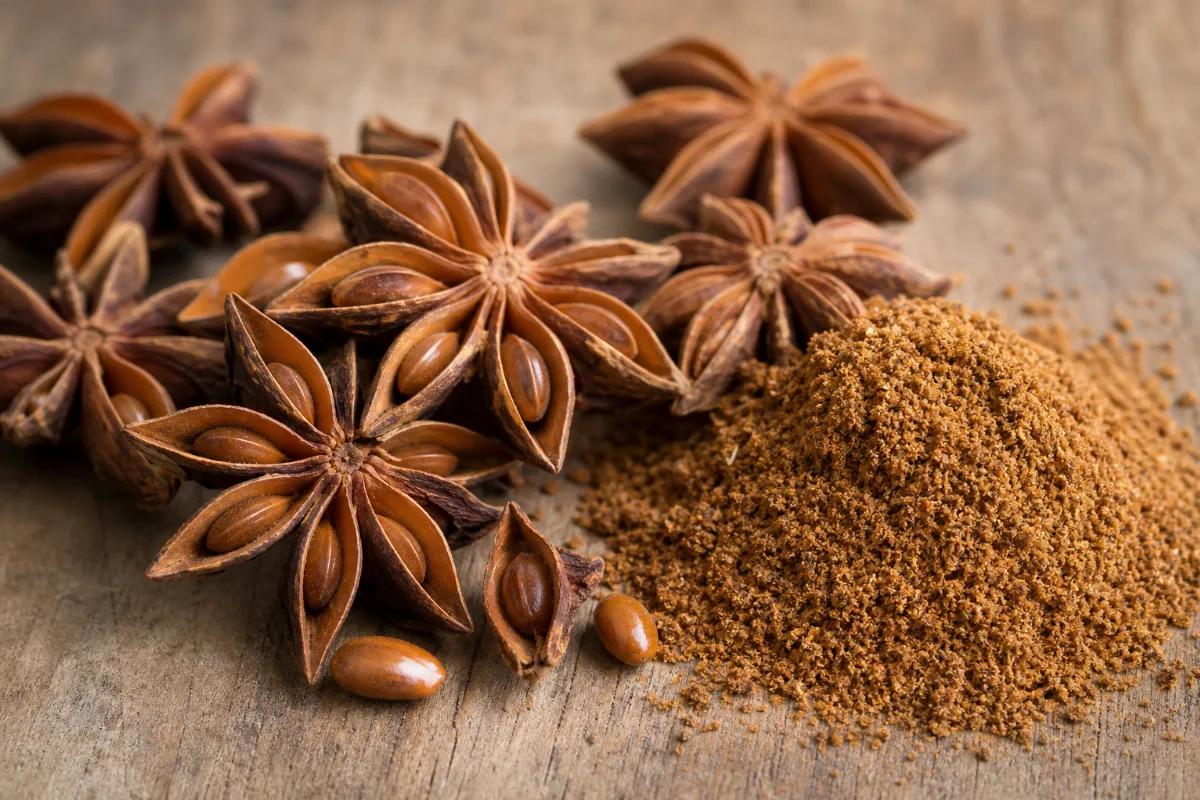
Star anise (Illicium verum) is the dried fruit of an evergreen tree native to South China and northeast Vietnam. The fruit is a reddish-brown star, usually with eight pods, each holding a shiny seed. It gets its anise-like flavor from anethole, the same compound found in anise, which is an unrelated plant.
It is used in Chinese, Malay and Indonesian cooking, in five-spice powder, and in the Vietnamese soup pho. Cooking facts here come from Wikipedia, a secondary source.
Nutrition
No nutrition table for star anise was read for this page, so we give no figures. It is used by the pod or the pinch, so it adds very little of any nutrient to a meal.
What the research shows
No trial of star anise as a food or spice was found. The only human trial, in 50 people, tested a mouthwash. Its abstract reports better gum and mouth germ measures than placebo but gives no scores, so we rate it very low.
Other findings come from lab and animal studies of extracts, which cannot show what eating the spice does. Star anise is a major source of shikimic acid for the flu medicine Tamiflu, but that is a manufacturing fact, not a health effect.
Spice versus tea, extract, oil and mouthwash
These are different products. The trial used a mouthwash. The harm reports come from teas and home infusions. Extracts and oils are far more concentrated than a pinch of spice, and their safety was not assessed in the sources read.
Amounts
This page gives no amounts to eat or drink. Ask a doctor, pharmacist or dietitian what is right for you.
At a glance
Traditional uses history, not proof
- Used in Chinese, Malay and Indonesian cooking and in five-spice powder
- Used in traditional Chinese medicine to dispel cold and relieve pain
- Home-made tea for infant colic in many cultures, which health authorities advise against
Studied for research
- Gum inflammation and mouth bacteria, very low certainty (one small mouthwash trial, not food)
- Infant colic tea, evidence against (no benefit, reports of harm)
- Antimicrobial and antioxidant effects, insufficient evidence (lab and animal only)
- Source of a flu-medicine ingredient, a manufacturing fact, not a health effect
Main compounds
- Trans-anethole (flavor)
- Shikimic acid
- Anisatin (toxin of Japanese star anise, not of the culinary spice)
Common forms
- Whole dried stars as a spice
- Ground spice (harder to check for mix-ups)
- Tea or infusion (FDA advises against, especially for babies)
- Essential oil and extracts (concentrated, not assessed)
Research links: FDA 2003: advisory on teas made from star anise · Pediatrics 2004: neurotoxicities in infants after star anise tea · Review 2011: Illicium verum botany, use, chemistry and pharmacology · Research Library · Genes & Biomarkers Library
What it is and its history
- Accepted scientific name
- Illicium verum
- Naming authority
- Hook.f. (GBIF accepted)
- Common names
- Star anise (English); Chinese star anise (English); Star aniseed (English); Badian (English); Anis estrellado (Spanish)
- Family or group
- Schisandraceae per GBIF (older sources use Illiciaceae).
- Classification
- Plantae > Tracheophyta > Magnoliopsida > Austrobaileyales > Schisandraceae > Illicium > Illicium verum
- Native range
- South China and northeast Vietnam (Wikipedia, secondary source). China is the main producer, then Vietnam.
- Habitat
- Not verified from a source read.
- What it looks like
- Roots: Not verified.; Stems: Medium-sized evergreen tree (Wikipedia).; Leaves: Aromatic, simple, lance-shaped to elliptic leaves (Wikipedia).; Flowers: Solitary, pink to dark red (Wikipedia).; Fruit: Star-shaped, reddish-brown, usually eight boat-shaped pods each holding a brown shiny seed; picked just before ripening (Wikipedia). The pods are the spice.
- Cultivation
- Not verified from a source read.
- Harvest and processing
- Sold as whole dried stars, broken pieces or ground spice, and as tea and oil. Fruits are picked just before ripening (Wikipedia).
- Look-alikes and adulterants
- Name: Japanese star anise (Illicium anisatum); Note: Toxic and not edible. GBIF match 7314073. Wikipedia says its fruit is smaller, does not form a regular star, usually has more than eight pods and smells weaker, but doctors write that the two look alike and are often sold broken or ground.; Name: Anise (Pimpinella anisum); Note: Unrelated plant with a similar flavour from the same compound, anethole (Wikipedia). Not a look-alike in danger terms.; Name: Other Illicium species; Note: A 2011 review names Illicium lanceolatum as poisonous; Wikipedia says swamp star anise (I. parviflorum) is highly toxic.
- Sustainability and conservation
- Not assessed.
Photographs
Traditional use and history history, not clinical proof
| Tradition or era | Documented use | Source |
|---|---|---|
Traditional use shows how it was used. It does not show that it works or is safe today.
What is inside, and how it may work
What it contains and how those compounds act in cells and animals. Laboratory and animal mechanisms are not proven effects in people.
Main compounds
| Compound | Family | Where it is concentrated | Activity studied | Level of evidence |
|---|---|---|---|---|
| Trans-anethole (anethole) PubChem 637563 | phenylpropanoid | Fruit Not given in the sources read | Gives star anise its anise-like flavour (Wikipedia, secondary). 12 | Secondary |
| Shikimic acid PubChem 8742 | organic acid | Fruit Not given in the sources read | Raw material for oseltamivir (Tamiflu); the fruit is a major source (Wang 2011). 8 | Manufacturing |
| Anisatin PubChem 115121 | sesquiterpene lactone (neurotoxin) | Fruit of Japanese star anise (Illicium anisatum) Signal over 1000 times larger in Japanese than in Chinese star anise (lab test); one contaminated Swiss sample held 7,800 micrograms per kg | Non-competitive antagonist of GABA receptors (Perret 2011); causes seizures. This is the toxin of the look-alike, not of the culinary spice. 5 7 6 | Human case and lab |
Mechanisms, receptors and pathways
| Target or pathway | Gene or receptor | What was found | Level |
|---|---|---|---|
| GABA receptors in the brain | GABA receptors | Anisatin from Japanese star anise blocks GABA receptors, which can cause seizures. This explains the infant poisonings. 5 | Human case |
Absorption, metabolism and elimination
- Absorption
- Not found.
- Distribution
- Not found.
- Metabolism
- Not found.
- Elimination
- In one infant, anisatin was found in urine 22 h after the last infusion and not at 33 h (Perret 2011).
- Bioavailability
- Not found.
Isolated compounds versus whole extracts
The only human trial used a mouthwash. Harm has been reported with teas, home infusions and contaminated fruit. Neither tells us what a pinch of the cooked spice does. Extracts and oils are far more concentrated than the spice in food.
Nutritional composition
No nutrition table for star anise was read for this page. The USDA FoodData Central lookup was rate limited during this check, and an earlier check of the summary noted no USDA entry for star anise. It is used by the pod or the pinch, so it adds very little of any nutrient to a meal, but we have no source figures to give. No amounts to eat are given here.
1 very low certainty2 not enough evidence1 evidence against
What was looked at
The 4 benefits and uses checked for Star anise, each with how strong the evidence is. Tap one to open it.
- Gum inflammation and mouth bacteria (star anise mouthwash)Very low certainty
- Infant colic (traditional star anise tea)Evidence against
- Antimicrobial, antioxidant, pain-relief and sedative effects (lab and animal studies)Not enough evidence
- Source of an ingredient for a flu medicine (shikimic acid)Not enough evidence
Lab markers tracked in the studies
Gum inflammation and bleeding scoresMouth germ count
What is Star anise good for?
The main studied uses and how strong the human evidence is for each. None of it is about star anise as a food.
Benefits, one by one
Each card is a research question, not a promise. Tap a goal to filter. Open a card to see the studies, doses and limits.
Gum inflammation and mouth bacteria (star anise mouthwash)
Very low certaintyOne small trial of 50 people tested a star anise mouthwash against a placebo mouthwash. The authors reported better gum scores, less gum bleeding and lower mouth germ counts. This was a mouthwash, not the spice in food, and it is a single small trial.
1 studiesMouthwash (product-specific). Not food, and not tea.
Studies, doses and limits
What the trials found
Assiry 2021 was a double-blind, randomised crossover trial in 50 people. Each person used the Illicium verum mouthwash for 21 days and a placebo mouthwash for 21 days, with a 14-day washout between. Gingival index, papillary bleeding index and oral microbial count were recorded.
Results
The abstract reports statistically significant differences (p < 0.05) between mouthwash and placebo for all three measures at both follow-ups. It gives no actual scores or effect sizes. The authors declared no conflict of interest.
Effect sizes as reported
Not given in the abstract.
Why this rating
Very low: one small trial, no scores or confidence intervals in the abstract, the mouthwash recipe is not described there, and the result has not been repeated. The authors' word 'potent' goes further than 50 people can show.
Form and dose studied
Mouthwash (product-specific). Not food, and not tea.
Who was studied
50 adults in a dental school trial.
Limits
Single trial, short, product-specific. It says nothing about cooking with the spice or drinking star anise tea.
Why researchers looked
Star anise has been used in many Asian countries as a traditional remedy, and its extracts slow some germs in the lab.
Traditional use
Star anise is a spice used whole or ground in cooking, in tea and in Chinese medicine. Long use is not proof that it treats any condition.
Proposed mechanism Unknown
Not shown in people. The authors say the mouthwash has antibacterial, anti-inflammatory and astringent properties; the abstract does not say which compound might be responsible.
A proposed mechanism does not show that the effect happens in people.
Do not swallow mouthwash. Ask a dentist before using a herbal mouthwash.
Infant colic (traditional star anise tea)
Evidence againstIn many cultures, star anise tea is given to babies for colic. No study shows that it helps. It has been linked to seizures and other serious reactions in infants, so health authorities advise against it.
3 studiesTea or infusion (home-made). Not culinary use.
Studies, doses and limits
What the trials found
The FDA 2003 advisory says about 40 people, including about 15 infants, became ill after star anise teas, with effects from seizures to vomiting, jitteriness and rapid eye movement, and that it knew of no scientific evidence that the teas help. A Pediatrics report described 7 infants with neurological reactions after home star anise tea. A Swiss case report described a 2-month-old with cyanosis, limb stiffening and seizure-like episodes after three bottles of an infusion of 4 to 5 star anise fruits each.
Results
No benefit was shown. Harm was documented in case reports and an FDA advisory. These are not trials, so they cannot say how often harm happens.
Effect sizes as reported
FDA 2003: about 40 ill, about 15 infants. Pediatrics 2004: 7 infants. Swiss case: anisatin 7,800 micrograms per kg in the fruit sample against a Swiss tolerance of 1,000.
Why this rating
Evidence is against giving star anise tea to infants: no benefit evidence exists and several independent reports of serious harm do.
Form and dose studied
Tea or infusion (home-made). Not culinary use.
Who was studied
Infants and young children.
Limits
Case reports and an agency advisory. The type of star anise was not always identified (FDA said it had not identified the type). Contamination with Japanese star anise was shown in some samples, not all.
Why researchers looked
Home use of star anise tea for colic led to reports of babies becoming ill, so doctors looked into it.
Traditional use
Star anise tea is used for infant colic in many cultures (Pediatrics 2004). Long use is not proof that it works, and here it has caused harm.
Proposed mechanism Case report
The harm is linked to anisatin, a nerve toxin in Japanese star anise (Illicium anisatum) that acts against GABA receptors in the brain. Contamination of Chinese star anise with Japanese star anise is the usual explanation, though overdose of the Chinese kind was also raised.
A proposed mechanism does not show that the effect happens in people.
Do not give star anise tea to babies or children. See the Safety tab.
Antimicrobial, antioxidant, pain-relief and sedative effects (lab and animal studies)
Not enough evidenceA review describes star anise extracts and compounds slowing germs, acting as antioxidants and affecting pain and sedation in lab and animal studies. None of this has been shown in people, and the same review lists convulsive effects too.
2 studiesCrude extracts and isolated compounds, not food amounts.
Studies, doses and limits
Results
Wang 2011 says crude extracts and active compounds have antimicrobial, antioxidant, insecticidal, analgesic, sedative and convulsive actions. The abstract gives no numbers.
Effect sizes as reported
Not given in the abstracts.
Why this rating
Insufficient for people: lab and animal studies of extracts and isolated compounds do not show what eating the spice does.
Form and dose studied
Crude extracts and isolated compounds, not food amounts.
Who was studied
Cells, microbes and animals.
Limits
Not tested in people. Extracts are far more concentrated than a spice in food.
Why researchers looked
Star anise has many plant compounds, so researchers test extracts in dishes and animals.
Traditional use
The review says the fruit has been used in traditional Chinese medicine to dispel cold, regulate the flow of Qi and relieve pain. Long use is not proof of effect.
Proposed mechanism Lab animal
Lab and animal findings only. The review lists volatile oils, sesquiterpenes, phenylpropanoids, lignans and flavonoids as compounds found in the fruit.
A proposed mechanism does not show that the effect happens in people.
The 'convulsive' finding is a reason for care with concentrated extracts and with look-alike species.
Source of an ingredient for a flu medicine (shikimic acid)
Not enough evidenceStar anise is a major source of shikimic acid, a raw material for the flu medicine oseltamivir (Tamiflu). That is a manufacturing fact. It does not mean the spice or its tea prevents or treats flu.
2 studiesIndustrial extraction of shikimic acid.
Studies, doses and limits
Results
No study read tests star anise or its tea against flu in people.
Why this rating
Insufficient: the fact is about drug manufacture, not a health effect of food.
Form and dose studied
Industrial extraction of shikimic acid.
Limits
Do not use star anise or its tea in place of flu medicine or vaccination. Ask a doctor about flu treatment.
Why researchers looked
The link to Tamiflu makes people ask whether the spice itself fights flu.
Traditional use
Not a traditional use.
Proposed mechanism Authoritative guidance
Shikimic acid from the fruit is chemically converted into the medicine in a factory. Eating the spice does not do this.
A proposed mechanism does not show that the effect happens in people.
Do not give infants star anise tea for any reason.
Connections to the rest of health
How Star anise connects to the rest of our health knowledge graph. Every link says what kind of connection it is. A safety link (for example to the liver) is a warning, not a benefit. A study that merely mentions a topic never creates a benefit link.
Explore every connection: goals, body systems, organs, symptoms, genes
B. Body systems
| Connected to | Kind of connection | Evidence status | Context | Studies |
|---|---|---|---|---|
| Nervous system | Adverse effect or risk | Documented risk | Seizures in infants after star anise tea. Seizures in infants after star anise tea, linked to Japanese star anise contamination. Preparation or compound: Star anise tea contaminated with Japanese star anise (anisatin) |
3 5 10 |
| Digestive System | Biological association | Very low certainty | Studied for: Gum inflammation and mouth bacteria (star anise mouthwash) Studied for: Infant colic (traditional star anise tea) | 1 10 3 5 |
| Nervous System | Biological association | Evidence against | Studied for: Infant colic (traditional star anise tea) | 10 3 5 |
| Blood And Immune | Biological association | Not enough evidence | Studied for: Source of an ingredient for a flu medicine (shikimic acid) | 8 12 |
E. Health conditions
I. Biomarkers
| Connected to | Kind of connection | Evidence status | Context | Studies |
|---|---|---|---|---|
| Gum inflammation and bleeding scores | Biological association | Very low certainty | Measured in trials: difference-reported (direction and size not given in the abstract). A lab change is not the same as a health benefit. | 1 |
| Mouth germ count | Biological association | Very low certainty | Measured in trials: difference-reported (direction and size not given in the abstract). A lab change is not the same as a health benefit. | 1 |
J. Genes, receptors and enzymes
| Connected to | Kind of connection | Evidence status | Context | Studies |
|---|---|---|---|---|
| GABA receptor | Preliminary mechanism | Human case | Target of the toxin anisatin in Japanese star anise. | 5 |
K. Biological pathways
| Connected to | Kind of connection | Evidence status | Context | Studies |
|---|---|---|---|---|
| Oseltamivir (Tamiflu) | Preliminary mechanism | Manufacturing | Made from shikimic acid, of which star anise is a major source. | 8 |
L. Active compounds
| Connected to | Kind of connection | Evidence status | Context | Studies |
|---|---|---|---|---|
| Trans-anethole (anethole) | Biological association | Secondary | Gives star anise its anise-like flavour (Wikipedia, secondary). Preparation or compound: Fruit |
12 |
| Shikimic acid | Biological association | Manufacturing | Raw material for oseltamivir (Tamiflu); the fruit is a major source (Wang 2011). Preparation or compound: Fruit |
8 |
| Anisatin | Biological association | Human case and lab | Non-competitive antagonist of GABA receptors (Perret 2011); causes seizures. This is the toxin of the look-alike, not of the culinary spice. Preparation or compound: Fruit of Japanese star anise (Illicium anisatum) |
5 7 6 |
Each connection is stored with the ingredient, the connected record, the kind of connection, the evidence status, the supporting studies, the preparation or compound involved, and a review date (last reviewed October 26, 2026).
Evidence at a glance: what the research found for 4 outcomes
Each outcome below is one thing researchers measured. Certainty is how far the evidence can be trusted, not how well it works. The full studies are on the next tab.
The evidence
The research centre for Star anise. Every record here was checked against PubMed or the publisher's page; we never list a study we have not verified.
Evidence by outcome
Bars show how many studies we found for each outcome, not how well it works. People are added up across trials only (reviews are not added, to avoid double counting).
How we rate evidence
High certainty
Several well-run trials or reviews agree; further research is unlikely to change the picture much.
Moderate certainty
Good trials point the same way, but some doubt remains.
Low certainty
Small, short or inconsistent trials. The finding could change with better research.
Very low certainty
Very little or very weak human data. Treat as a possibility only.
Mixed findings
Trials or reviews disagree with each other.
Not enough evidence
Not enough human research to say either way.
Evidence against
Good research found no benefit, or found harm.
We take the reviewers' own risk-of-bias and GRADE statements where they exist, and otherwise judge from study size, design, consistency, directness and whether a product matches what is sold. Many publications do not make evidence high. Method note: We started from our existing star anise summary, re-opened each PubMed study (summary plus abstract), re-read the FDA advisory, and checked plant names at GBIF and compound IDs at PubChem. Cooking and plant-description facts come from Wikipedia, a secondary source. One allergy report had no abstract. Gaps are listed above.
Study library: every study we checked 12
| Study | Design | People | Product, dose, length | Result |
|---|---|---|---|---|
| Assiry 2021 Crossover Analysis of the Astringent, Antimicrobial, and Anti-inflammatory Effects of Illicium verum/Star Anise in the Oral Cavity. Biomed Res Int · PMID 34195261 · DOI |
Randomized crossover trial |
50 50 adults, double-blind crossover |
Illicium verum mouthwash Not given in the abstract 21 days per period, 14-day washout · vs Placebo mouthwash |
Significant differences (p < 0.05) between mouthwash and placebo at both follow-ups for all three measures. Scores not given in the abstract. Not given in the abstract (Not given in the abstract) Methods, limits and fundingOutcomes: Gingival index, papillary bleeding index, oral microbial count Limitations: Small, single trial; formulation and scores not in the abstract; a mouthwash, not food. Funding and conflicts: Authors state no conflict of interest. Read: abstract |
| Hirschfeld 2008 Anaphylaxis after Oseltamivir (Tamiflu) therapy in a patient with sensitization to star anise and celery-carrot-mugwort-spice syndrome. Allergy · PMID 18186817 · DOI |
Case report |
1 One patient |
Oseltamivir in a person sensitized to star anise |
Title only. The PubMed record has no abstract, so the details were not read. 1 case (n/a) Methods, limits and fundingOutcomes: Anaphylaxis Limitations: Title only read. Funding and conflicts: Not stated Read: title-only |
| Ize-Ludlow 2004 Neurotoxicities in infants seen with the consumption of star anise tea. Pediatrics · PMID 15492355 · DOI |
Case report series |
7 7 infants with adverse neurologic reactions |
Star anise tea given at home Fruit Not given in the abstract Not given in the abstract |
The authors report 7 infants with adverse neurologic reactions after home star anise tea, and found evidence that Chinese star anise has been contaminated with Japanese star anise. They say the tea should no longer be given to infants. 7 cases (n/a) Methods, limits and fundingOutcomes: Neurologic reactions Limitations: Case reports; cannot give how common reactions are. Funding and conflicts: Not stated in the abstract. Read: abstract |
| Obando Pacheco 2016 Liver failure secondary to poisoning by a homemade product made of star and green anise in a 4-month-old infant. Rev Esp Enferm Dig · PMID 26875753 · DOI |
Case report |
1 One 4-month-old infant |
Daily home infusion of star anise (Illicium verum) and green anise (Pimpinella anisum) Fruit/seed Not given About two months |
Raised liver enzymes, severe clotting problems, low blood sugar, metabolic acidosis, seizures and nystagmus. Infectious, metabolic and autoimmune causes were excluded and the family reported the daily infusions. The authors stress the serious risk of home herbal infusions for infants. 1 case (n/a) Methods, limits and fundingOutcomes: Liver enzymes, clotting, blood sugar, seizures Limitations: Single case; two plants; species of star anise not tested in the abstract. Funding and conflicts: Not stated in the abstract. Read: abstract |
| Perret 2011 Apparent life-threatening event in infants: think about star anise intoxication! Arch Pediatr · PMID 21652187 · DOI |
Case report |
1 One 2-month-old infant (article in French; English abstract read) |
Infusion of 4 to 5 star anise fruits per 200 mL bottle, three bottles Fruit As described Hours before symptoms |
The infant recovered. Anisatin, the toxin of Japanese star anise, was found in urine 22 h after the last dose (not at 33 h). The fruit sample held 7,800 micrograms of anisatin per kg against a Swiss maximum of 1,000, showing contamination. The authors say the fruits are often sold broken or ground and chemical analysis is usually needed to detect adulteration. 1 case (n/a) Methods, limits and fundingOutcomes: Cyanosis, limb tetany, irritability, opisthotonos, nystagmus Limitations: Single case. Funding and conflicts: Not stated in the abstract. Read: abstract |
| Schrage 2013 Rapid and simple neurotoxin-based distinction of Chinese and Japanese star anise by direct plant spray mass spectrometry. J Chromatogr A · PMID 23932223 · DOI |
Laboratory method lab |
Star anise fruits | Chemical test for anisatin Fruit · vs Japanese star anise |
Ingestion of Chinese star anise contaminated with Japanese star anise can cause poisoning from anisatin. The two are morphologically similar. The anisatin signal was about 250 times higher in Japanese than in Chinese star anise, giving a yes/no answer in seconds. Not applicable (n/a) Methods, limits and fundingOutcomes: Detection of anisatin Limitations: Lab method. Funding and conflicts: Not stated in the abstract. Read: abstract |
| Shen 2012 Rapid control of Chinese star anise fruits and teas for neurotoxic anisatin by Direct Analysis in Real Time high resolution mass spectrometry. J Chromatogr A · PMID 22484123 · DOI |
Laboratory method lab |
Star anise fruits and 8 retail teas | Chemical test for anisatin Fruit · vs Japanese star anise |
Contaminated or adulterated star anise products can cause epilepsy, hallucinations and nausea because of anisatin. The anisatin signal was over 1000 times larger in Japanese than in Chinese star anise. None of 8 retail teas contained significant anisatin. Adulteration down to 1% by weight was measurable. Not applicable (n/a) Methods, limits and fundingOutcomes: Detection of anisatin Limitations: Lab method; only 8 teas. Funding and conflicts: Not stated in the abstract. Read: abstract |
| Wang 2011 Illicium verum: a review on its botany, traditional use, chemistry and pharmacology. J Ethnopharmacol · PMID 21549817 · DOI |
Narrative review lab-animal |
Literature review (books and databases) | Illicium verum fruit, extracts and compounds Fruit |
The fruit has long been used in traditional Chinese medicine and the food industry (dispelling cold, regulating Qi, relieving pain). It is sometimes contaminated with highly toxic Japanese star anise and poisonous star anise (I. lanceolatum), which contain neurotoxic sesquiterpenes. Crude extracts and compounds show antimicrobial, antioxidant, insecticidal, analgesic, sedative and convulsive actions. It is the major source of shikimic acid, a primary ingredient of Tamiflu. Not applicable (n/a) Methods, limits and fundingOutcomes: Botany, traditional use, chemistry, pharmacology, toxicology Limitations: Narrative review, not systematic; lab and animal evidence; abstract only read. Funding and conflicts: Not stated in the abstract. Read: abstract |
| Yang 2025 Current status and prospects of phytochemistry, pharmacological activity and medicinal and food applications of the genus Illicium Linn. Food Res Int · PMID 40597526 · DOI |
Systematic review lab-animal |
Literature review of the genus Illicium (about 40 species) | Illicium species Various |
Illicium verum is one of the most consumed spices. Illicium anisatum is not edible because of its anisatin, which is confirmed to cause neurotoxicity. The authors propose three groups: non-edible species (high toxicity, external medical use only), medicinal edible species (low toxicity) and edible species (safe for routine consumption). Not applicable (n/a) Methods, limits and fundingOutcomes: Chemistry, activity and uses by species Limitations: Review; the classification is the authors' proposal; abstract only read. Funding and conflicts: Authors declare no competing interests. Read: abstract |
| s-fda-2003 FDA: Center for Food Safety and Applied Nutrition 2003 (advisory on teas made from star anise) · Source |
Regulator statement n/a |
Methods, limits and fundingRead: full-text | ||
| s-gbif-illicium-verum GBIF Backbone: Illicium verum Hook.f. (usageKey 2889756) · Source |
Reference database n/a |
Methods, limits and fundingRead: full-text | ||
| s-wikipedia-illicium-verum Wikipedia: Illicium verum · Source |
Encyclopedia n/a |
Methods, limits and fundingRead: full-text |
What we do not know yet
- No trial of star anise as a food or spice was found for any health outcome.
- The one human trial tested a mouthwash and its abstract gives no scores.
- How common reactions to star anise tea are was not found; all reports are cases or an agency advisory.
- No nutrition table, pregnancy or breastfeeding statement, or medicine-interaction data was read.
- Heavy metals, mould toxins, pesticide residues and essential oil safety were not researched.
How new research is added
New studies are found by a saved PubMed search and placed in a review queue before the page changes.
Lab markers
What changed in blood or saliva tests during trials. A changed number is not the same as feeling or being healthier, and we give no "normal ranges".
Other 2
Gum inflammation and bleeding scores
Difference-reported (direction and size not given in the abstract) in trials
The gingival index scores redness and swelling of the gums. The papillary bleeding index scores bleeding from the gum tips between teeth.
Very low certaintyResults and what it means
Why it was measured
Dentists use these scores to compare mouth products.
Statistical vs. clinical meaning
One small trial of a mouthwash. It does not show an effect from eating the spice.
Safety implication
None reported in the abstract.
| Study | Result | People | Product |
|---|---|---|---|
| 1 | Statistically significant difference between star anise mouthwash and placebo for both scores (p < 0.05); scores not given in the abstract | 50 adults in a crossover trial | Illicium verum mouthwash, 21 days (not food) |
Mouth germ count
Difference-reported (direction and size not given in the abstract) in trials
A count of bacteria in a mouth sample.
Very low certaintyResults and what it means
Why it was measured
Used to see whether a mouthwash changes mouth bacteria.
Statistical vs. clinical meaning
A lab count, not a health outcome. One small trial.
Safety implication
None reported in the abstract.
| Study | Result | People | Product |
|---|---|---|---|
| 1 | Statistically significant difference between star anise mouthwash and placebo (p < 0.05); counts not given in the abstract | 50 adults in a crossover trial | Illicium verum mouthwash, 21 days (not food) |
Safety
What studies and official sources say about side effects, medicines and who should check first. Each point shows what kind of evidence it comes from.
Main points to know 5
- Japanese star anise is toxic and looks like the real thing. Japanese star anise (Illicium anisatum) contains anisatin, a nerve toxin, and is not edible. It has been found mixed into Chinese star anise (Illicium verum), the culinary spice. The fruits look alike, and they are often sold broken or ground, so doctors write that chemical tests are usually needed to tell them apart. A buyer cannot rely on looking at the pieces. The FDA says Japanese star anise should be used for decoration only. Case report 5 3 10 7
- Do not give star anise tea to babies or children. In 2003 the FDA advised the public not to drink teas brewed from star anise after about 40 people, including about 15 infants, became ill, with seizures, vomiting, jitteriness and rapid eye movement. A Pediatrics report of 7 infants says the tea should no longer be given to infants. A Swiss infant had seizure-like episodes after home-made star anise tea, and the fruit sample held 7.8 times the Swiss limit for anisatin. A Spanish case report describes liver failure in a 4-month-old given a daily infusion of star anise and green anise. Case report 10 3 5 4
- Cooking amounts: no harm reported in the sources read, but real star anise only. The sources read link harm to teas, home infusions and contaminated fruit, not to normal cooking. A 2025 review calls Illicium verum one of the most consumed spices and proposes it as safe for routine consumption, but also says Illicium anisatum is not edible. This page cannot guarantee that a given jar is pure. Review 9
- Allergy is possible. A case report links sensitization to star anise (together with celery-carrot-mugwort-spice syndrome) to anaphylaxis after a dose of the flu medicine oseltamivir. Only the title was read, and it is one person. Stop and get urgent help for trouble breathing or swelling of the face or throat after eating a spice. Case report 2
- Extracts, oils and mouthwash are not the same as the spice. Concentrated forms were not assessed for safety in the sources read. A 2011 review lists convulsive actions among the effects of star anise extracts and compounds in lab and animal work. Ask a doctor or pharmacist before using extracts or oils. Lab animal 8
Side effects 3
| Effect | How often | Severity and recovery | Evidence |
|---|---|---|---|
| Seizures, jerking, stiffening, vomiting and irritability in infants after star anise tea Linked to home-made tea and to Japanese star anise contamination, not shown for culinary use. | FDA 2003: about 40 ill, about 15 infants. Pediatrics 2004: 7 infants. How common it is was not found. | serious (seizures) The Swiss infant recovered; the other reports were not read in full | Case report 10 3 5 |
| Liver failure with clotting problems and seizures in a 4-month-old given a home star anise and green anise infusion daily for two months Two plants were in the infusion, and the species of star anise was not tested in the abstract. | One case | serious Outcome not given in the abstract | Case report 4 |
| Allergic reaction (anaphylaxis after oseltamivir in a person sensitized to star anise) Title only was read. | One case | serious Not stated | Case report 2 |
Liver
One case report describes liver injury (raised liver enzymes, clotting problems) in a 4-month-old after daily star anise and green anise infusions for two months. No liver injury from cooking amounts was found in the sources read. A LiverTox entry was not found. 4
How often. No frequency was found.
Monitoring. No agency monitoring advice was found.
- . 4-month-old infant, home infusion of star anise and green anise, liver failure with seizures 4
This is a safety connection. It is not evidence that Star anise supports liver health.
Medicines and supplements 2
| With | Why it matters | Importance | Evidence | What to do |
|---|---|---|---|---|
| No medicine interaction with culinary star anise is described in the sources read general | Unknown | Insufficient Not enough evidence | Tell your pharmacist about herbal teas and extracts you use. | |
| Oseltamivir (Tamiflu) in a person already allergic to star anise prescription | Unknown. One case report links allergy to star anise with anaphylaxis after the medicine. | Single case report; title only read. | Case report Very low certainty 2 | If you have a known spice allergy, tell the prescriber. |
Who should check first 4
| Situation | Advice | Evidence |
|---|---|---|
| Babies and young children (star anise tea or infusions) | Do not give them. The FDA advises against teas brewed from star anise for infants and children. | Authoritative guidance 10 3 |
| Whole, broken or ground pieces of unknown origin | Japanese star anise cannot be reliably told from Chinese star anise by eye, especially once broken or ground. Discard anything you suspect, and keep it away from children. | Case report 5 7 |
| Known allergy to star anise or related spices | Avoid it and ask an allergy clinician. | Case report 2 |
| Pregnancy and breastfeeding | No official statement about star anise was read. Culinary use is common, but ask your doctor about teas or extracts. The FDA advice against star anise tea covers the general public. | Insufficient 10 |
Overdose, product quality and regulators
Summary. The toxic one is Japanese star anise, not culinary Chinese star anise. Anisatin acts against GABA receptors in the brain and causes seizures.
Animal. Not reviewed.
Human doses studied. No safe or unsafe amount is stated in the sources read. A Swiss infant was given three 200 mL bottles of an infusion of 4 to 5 fruits each.
High dose or long term signals. Nerve and stomach effects in infants; overdose of Chinese star anise is also raised as a possible cause by the Swiss authors.
Overdose response. Seek urgent medical help for seizures or breathing trouble.
Genotoxicity. Not researched.
Toxic or hazardous parts. The fruit of Japanese star anise (Illicium anisatum). A mix-up species, Illicium lanceolatum, is also called poisonous in a 2011 review.
Mix-ups with Japanese star anise are the main quality risk.
Adulteration with Japanese star anise. A Swiss fruit sample linked to an infant case held 7,800 micrograms of anisatin per kg (Swiss tolerance 1,000). Pediatrics 2004 reports evidence of contamination of Chinese star anise sold in the United States. 5 3
Lab tests can tell them apart. Mass-spectrometry methods found anisatin signals hundreds to over 1,000 times higher in Japanese than in Chinese star anise, and one test found none of 8 retail star anise teas with significant anisatin. These are lab methods, not something a shopper can do. 7 6
How the look-alike is described. Wikipedia says Japanese star anise fruit is smaller, does not form a regular star, often has more than eight pods, smells weaker and has more pointed tips. Doctors write that the resemblance is strong and chemical testing is usually needed, so this is not a reliable test. 12 5
| Body | Action | Date |
|---|---|---|
| FDA (US) (United States) | 10 September 2003 advisory: do not consume teas brewed from star anise; FDA unaware of scientific evidence that the teas help; Chinese star anise is considered generally recognised as safe but may contain Japanese star anise, which should be used for decoration only source | 2003-09-10 |
When to get medical help
- A baby or child with seizures, jerking or stiffening, blue lips, repeated vomiting or unusual jitteriness after star anise tea: call emergency services and keep the product
- Anyone with seizures or confusion after eating or drinking a star anise product
- Trouble breathing, swelling of the lips, face or throat, or widespread hives after a spice
- Yellow skin or eyes, or dark urine, in an infant who has had herbal infusions
Stop using the product and contact a clinician or emergency service. In the US, Poison Control is 1-800-222-1222.
General information only, not medical advice. Ask a clinician or pharmacist before use, especially with medicines, in pregnancy or with a health condition. See the Natural Remedy Safety guide.
Frequently asked questions
What is star anise?
Is star anise safe to eat?
What is Japanese star anise and why does it matter?
Can I tell Japanese star anise by looking?
Can I give star anise tea to a baby for colic?
Is star anise the same as anise?
No. They are unrelated plants with a similar flavor from the same compound, anethole. Star anise is Illicium verum; anise is Pimpinella anisum.
Is star anise good for the gums or teeth?
Possibly, but the evidence is very weak. One small trial of 50 people used a mouthwash and reported better gum scores than placebo. It does not show that the cooking spice helps.
Does star anise treat or prevent flu?
Not shown. Star anise is a source of shikimic acid, a raw material for Tamiflu, but no study read shows that the spice or tea works against flu. Ask a doctor about flu care.
Is star anise safe in pregnancy or while breastfeeding?
No official statement was read. The FDA advice against star anise tea applies to the general public. Culinary use is common, but ask your doctor about teas, extracts or oils.
Can you be allergic to star anise?
Possibly. One case report links sensitization to star anise to anaphylaxis after a flu medicine. Only its title was read. Get urgent help for trouble breathing or swelling of the face or throat.
Does star anise interact with medicines?
No interaction with cooking amounts was found in the sources read. That is missing information, not proof of safety. Tell your pharmacist about herbal teas and extracts.
Explore by health goal
Editorial transparency
- Written by
- AlternativeMed editorial team. Research compiled with AI assistance, then checked against the sources listed.
- Medical review
- None. This page has not been reviewed by a physician or pharmacist.
- First published
- 2026-10-26
- Last substantive update
- 2026-10-26
- How we research
- We started from our existing star anise summary, re-opened each PubMed study (summary plus abstract), re-read the FDA advisory, and checked plant names at GBIF and compound IDs at PubChem. Cooking and plant-description facts come from Wikipedia, a secondary source. One allergy report had no abstract. Gaps are listed above.
- How we rate evidence
- See "How we rate evidence" in the Evidence tab.
- Independence
- No product is promoted on this page. No affiliate links are shown.
Sources 12
Each source was opened and checked. Where we read only the abstract, it says so. The small numbers in the text point here.
- Assiry AA, Karobari MI, Bhavikatti SK, et al.. Crossover Analysis of the Astringent, Antimicrobial, and Anti-inflammatory Effects of Illicium verum/Star Anise in the Oral Cavity.. Biomed Res Int. 2021. PMID 34195261. DOI 10.1155/2021/5510174. (abstract)
- Hirschfeld G, Weber L, Renkl A, et al.. Anaphylaxis after Oseltamivir (Tamiflu) therapy in a patient with sensitization to star anise and celery-carrot-mugwort-spice syndrome.. Allergy. 2008. PMID 18186817. DOI 10.1111/j.1398-9995.2007.01572.x. (title-only)
- Ize-Ludlow D, Ragone S, Bruck IS, et al.. Neurotoxicities in infants seen with the consumption of star anise tea.. Pediatrics. 2004. PMID 15492355. DOI 10.1542/peds.2004-0058. (abstract)
- Obando Pacheco P, Martinez-Martinez PL, Perez de Eulate Bazan Y, et al.. Liver failure secondary to poisoning by a homemade product made of star and green anise in a 4-month-old infant.. Rev Esp Enferm Dig. 2016. PMID 26875753. DOI 10.17235/reed.2016.3964/2015. (abstract)
- Perret C, Tabin R, Marcoz JP, et al.. Apparent life-threatening event in infants: think about star anise intoxication!. Arch Pediatr. 2011. PMID 21652187. DOI 10.1016/j.arcped.2011.03.024. (abstract)
- Schrage M, Shen Y, Claassen FW, et al.. Rapid and simple neurotoxin-based distinction of Chinese and Japanese star anise by direct plant spray mass spectrometry.. J Chromatogr A. 2013. PMID 23932223. DOI 10.1016/j.chroma.2013.07.072. (abstract)
- Shen Y, van Beek TA, Claassen FW, et al.. Rapid control of Chinese star anise fruits and teas for neurotoxic anisatin by Direct Analysis in Real Time high resolution mass spectrometry.. J Chromatogr A. 2012. PMID 22484123. DOI 10.1016/j.chroma.2012.03.058. (abstract)
- Wang GW, Hu WT, Huang BK, Qin LP. Illicium verum: a review on its botany, traditional use, chemistry and pharmacology.. J Ethnopharmacol. 2011. PMID 21549817. DOI 10.1016/j.jep.2011.04.051. (abstract)
- Yang S, Li J, Luo Y, et al.. Current status and prospects of phytochemistry, pharmacological activity and medicinal and food applications of the genus Illicium Linn.. Food Res Int. 2025. PMID 40597526. DOI 10.1016/j.foodres.2025.116816. (abstract)
- . FDA: Center for Food Safety and Applied Nutrition 2003 (advisory on teas made from star anise). . . (full-text)
- . GBIF Backbone: Illicium verum Hook.f. (usageKey 2889756). . . (full-text)
- . Wikipedia: Illicium verum. . . (full-text)
Where to buy
Check the label first. Whatever you buy, look for these:
- Whole or ground: whole spices keep their flavor longer
- The origin and a packed-on or best-by date for freshness
- Organic or non-irradiated labeling if that matters to you
- A resealable, airtight container
Talk to a pharmacist or doctor before you start any supplement, especially if you take medicines. See the Safety tab for interactions.
Support our free guides: as an Amazon Associate we earn from qualifying purchases. Full disclosure.


