Herbal Teas & Extracts · Herbal tea
Star Anise Tea
Illicium verum Hook.f. · also called Chinese star anise tea, badian tea, star anise infusion
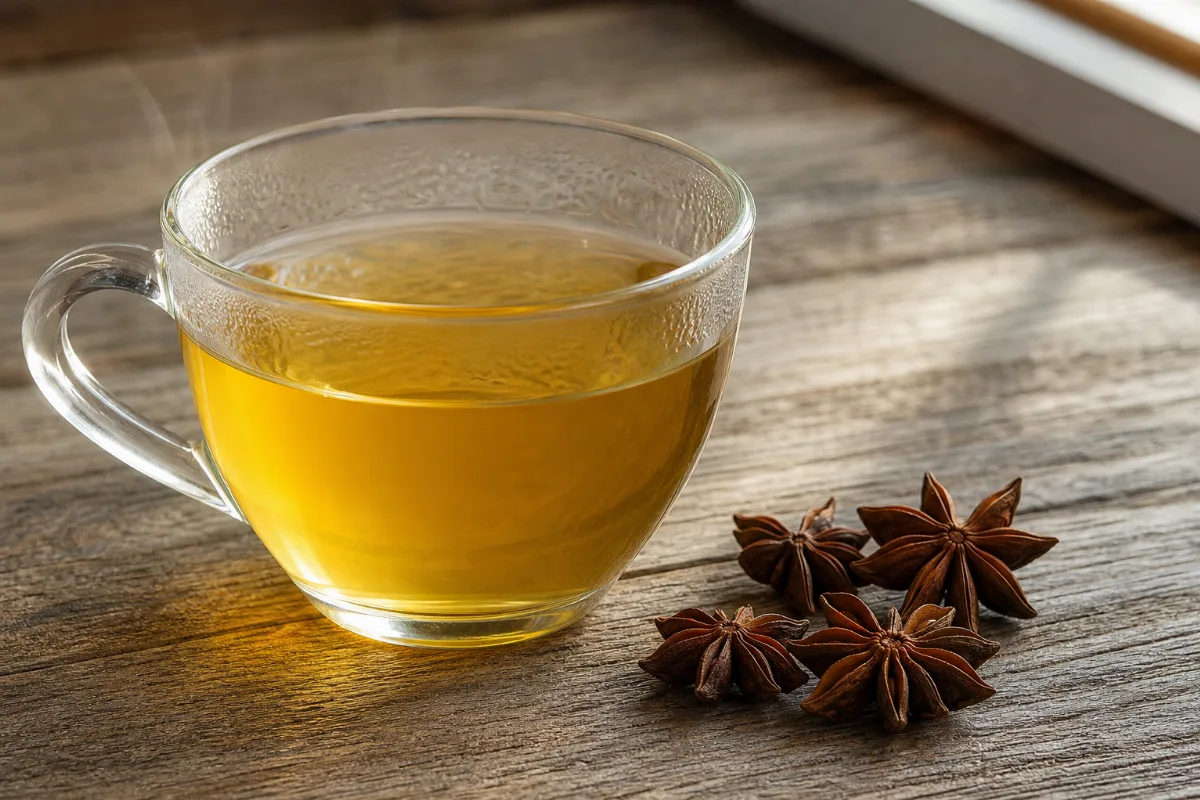
Star anise tea is a drink made from the star-shaped fruit of Chinese star anise. It is used traditionally for colic, digestion and the flu. We found no trial of the tea itself. The main caution: babies have had seizures after it, and so did many people in a herbal tea outbreak, linked to toxic Japanese star anise mixed in. Do not give it to babies.
General information, not medical advice. Last substantive update · Not medically reviewed. A named clinician has not signed off on this page. How this page is made
About Star Anise Tea
Star anise tea is a hot infusion of the dried fruit of Chinese star anise. No trial has tested it. The research is about harm: baby seizures, and an outbreak with a contaminated herbal tea, caused by Japanese star anise mixed in. Do not give it to babies. Ask a doctor first if you are pregnant or have epilepsy.
What star anise tea is
Star anise tea is made from the star-shaped dried fruit of Illicium verum Hook.f. (Chinese star anise), a tree in the Schisandraceae family (name checked in GBIF). It is a different plant from anise, or aniseed.
Its main aroma compound is trans-anethole. In one analysed star anise oil, anethole was 91.32 percent and estragole about 2 percent. A water infusion was not analysed.
Star anise is also a major industrial source of shikimic acid, a starting material for the flu drug oseltamivir.
The toxic look-alike
Japanese star anise (Illicium anisatum) contains anisatin, a nerve toxin. It has been found mixed into Chinese star anise sold for tea. The fruits look alike, especially when broken or ground, so laboratory tests are usually needed. A shopper cannot check, and this page gives no identification tips.
In a Dutch outbreak, 63 people became ill after a herbal tea and 16 had seizures; anisatin was confirmed in the tea. In babies, a Madrid study found an odds ratio of 18.0 for the infusion, and 7 infants were reported in Pediatrics.
What the research found on benefits
No trial of the tea was found for colic, digestion or flu. FDA said in 2003 it knew of no scientific evidence of benefit.
The only human trial tested a mouthwash in 50 people and found better gum scores than placebo. It gave no figures in the abstract and does not apply to tea.
Shikimic acid is a raw material for the flu drug, not a flu remedy in the cup. Ask a doctor about flu symptoms.
What is still missing
No trial of star anise tea.
No survey of how common the Japanese look-alike is in tea today.
No data on pregnancy, breastfeeding or medicines.
At a glance
Traditional uses history, not proof
- Star anise fruit has long been used in cooking and in traditional Chinese medicine.
- In many cultures the tea has been given to infants for colic. That use is now linked to harm and is not recommended.
Studied for research
- Infant colic (tea), insufficient; harm reported
- Digestion and wind (tea), insufficient
- Flu (shikimic acid source; tea itself), insufficient
- Gum inflammation (mouthwash, not tea), very-low
- Lab antibacterial and antioxidant effects, insufficient
Main compounds
- trans-Anethole, the main aroma compound
- Estragole, in small amounts
- Shikimic acid
- Anisatin, the toxin of the Japanese look-alike
Common forms
- Whole dried fruit
- Broken or ground fruit
- Tea bags and blends (check the label for the Latin name)
- Mouthwash and extracts (different from tea)
Research links: FDA advisory on star anise teas, 2003 · Infant neurotoxicity, Pediatrics (abstract) · Madrid case-control study (abstract) · Dutch herbal tea seizure outbreak (abstract) · Swiss infant case with anisatin levels (abstract) · EU statement on estragole · Research Library · Genes & Biomarkers Library
What it is and its history
- Accepted scientific name
- Illicium verum Hook.f.
- Naming authority
- Hook.f.
- Common names
- Star anise tea (English); Chinese star anise tea (English); Te de anis estrellado (Spanish); Badian (English)
- Family or group
- Schisandraceae
- Classification
- Plantae > Schisandraceae > Illicium > Illicium verum
- Native range
- Not read in the sources used.
- Habitat
- Not read.
- What it looks like
- Part used: The star-shaped dried fruit.
- Cultivation
- Not read. One review says it is an aromatic evergreen tree.
- Harvest and processing
- Not read.
- Look-alikes and adulterants
- Name: Japanese star anise (Illicium anisatum); Note: Toxic. Contains anisatin. Accepted species in GBIF (key 7314073). It has been found mixed into Chinese star anise.; Name: Illicium lanceolatum; Note: Named in a review as a poisonous star anise that may contaminate the true spice.; Name: Anise (Pimpinella anisum); Note: A different plant in the carrot family with a similar scent; see the anise tea page.
- Sustainability and conservation
- Not assessed in the sources read.
Photographs
Traditional use and history history, not clinical proof
| Tradition or era | Documented use | Source |
|---|---|---|
| Traditional use | A 2011 review says the fruit has long been used in traditional Chinese medicine and food, and that star anise tea has been given for infant colic in many cultures. | Wang 2011 and the infant case reports |
| 2000s infant illnesses | From March 2000 a series of babies with gut and nerve symptoms was seen in Spain; FDA issued an advisory in September 2003 after about 40 illnesses in the US. | Garzo Fernandez 2002 and FDA 2003 |
Traditional use shows how it was used. It does not show that it works or is safe today.
What is inside, and how it may work
What it contains and how those compounds act in cells and animals. Laboratory and animal mechanisms are not proven effects in people.
Main compounds
| Compound | Family | Where it is concentrated | Activity studied | Level of evidence |
|---|---|---|---|---|
| trans-Anethole PubChem 637563 | phenylpropanoid | Fruit (volatile oil) 91.32 percent of one star anise essential oil sample (not a tea) | The main aroma compound. Anethole formed the same type of DNA adducts as estragole at lower levels in lab work. 12 2 17 | Laboratory research |
| Estragole PubChem 8815 | phenylpropanoid | Fruit (volatile oil) 2.0 percent of the same oil sample | Genotoxic carcinogen in rodents (EU statement). 12 4 17 | Animal research |
| Anisatin PubChem 115121 | sesquiterpene lactone (neurotoxin) | Fruit of Illicium anisatum (Japanese star anise); about 250 times lower signal in Chinese star anise by one method | Non-competitive GABA receptor antagonist that can cause seizures. 19 10 20 17 | Human data |
| Shikimic acid | organic acid | Fruit; up to 17 percent of dry weight in one review | Starting material for oseltamivir; not the drug itself. 15 7 | Other |
Mechanisms, receptors and pathways
| Target or pathway | Gene or receptor | What was found | Level |
|---|---|---|---|
| GABA-A receptors (nerve inhibition) | GABA receptor | Anisatin from Japanese star anise blocks these receptors, which can cause overactive nerves and seizures. This is the explanation given for the infant and outbreak cases. 19 10 | Human data |
| Estragole and anethole metabolism | CYP and SULT enzymes | Estragole is turned into reactive products that bind DNA; anethole does so at lower levels. Shown in rat and human liver preparations and a small fennel tea pilot. 2 | Laboratory research |
Absorption, metabolism and elimination
- Absorption
- Anisatin was detectable in urine 22 hours after the last infusion in one infant, and not at 33 hours.
- Distribution
- Not read.
- Metabolism
- Not read for the tea.
- Elimination
- See absorption note (one infant).
- Bioavailability
- Not studied for tea.
Isolated compounds versus whole extracts
Shikimic acid and mouthwash results are for isolated or extracted forms. A tea is a water infusion of the whole fruit, and the amount of any compound in a cup was not measured in the sources read.
Nutritional composition
Star anise tea is not a studied source of vitamins or minerals. The spice is covered on its own food page.
1 very low certainty4 not enough evidence
What is Star Anise Tea good for?
The uses people ask about and how strong the evidence is for each. Read the certainty label first: for the tea itself there is no trial of benefit, and the safety tab matters more than this one.
Benefits, one by one
Each card is a research question, not a promise. Tap a goal to filter. Open a card to see the studies, doses and limits.
Infant colic (traditional use of the tea, not recommended)
Not enough evidenceNo trial shows star anise tea helps colic. Babies have had seizures after it. FDA said it knew of no scientific evidence of benefit and advised against giving the tea to infants and children.
4 studiesNot shown on this page.
Studies, doses and limits
What the trials found
No trial of star anise tea for colic was found. What exists is harm: a Madrid case-control study of babies under 3 months (18 cases, 36 controls) found an odds ratio of 18.0 (2.03 to 631) for the infusion, and the 7-infant Pediatrics report said the tea should no longer be given to infants.
Results
No benefit shown. Harm reported.
Effect sizes as reported
Odds ratio 18.0, 95 percent CI 2.03 to 631 (Garzo Fernandez 2002). The wide range means the study is small.
Why this rating
There is no trial of benefit. The only human data are reports of harm, which cannot say how often it happens.
Form and dose studied
Not shown on this page.
Who was studied
Babies; not recommended.
Limits
Case reports and one small case-control study show a link, not a rate.
Why researchers looked
Colic is hard on parents, and star anise tea has been a home remedy for it in many cultures.
Traditional use
Chinese star anise fruit has long been used in cooking and in traditional Chinese medicine, and star anise tea is given in several cultures for infant colic. Traditional use is not evidence of benefit.
Proposed mechanism Laboratory research
No mechanism for a calming effect on the gut in babies has been shown. The harm seen in babies is linked to anisatin, a nerve toxin in Japanese star anise that blocks GABA receptors (see the safety file).
A proposed mechanism does not show that the effect happens in people.
Do not give star anise tea to babies. Seizures, a floppy or stiff baby, or a baby who cannot be woken: call emergency services now.
Stomach comfort and wind in adults (traditional use only)
Not enough evidenceStar anise is used traditionally for stomach complaints. We found no trial of the tea for adults.
1 studiesNot shown on this page.
Studies, doses and limits
What the trials found
No human trial of star anise tea for digestion was found. The 2011 review lists traditional uses and lab pharmacology only.
Results
No human data.
Effect sizes as reported
None.
Why this rating
Traditional use and lab work only.
Form and dose studied
Not shown on this page.
Who was studied
Not studied.
Limits
No trial. Contamination with a toxic look-alike is a known problem (see safety).
Why researchers looked
Spice teas are common after meals and star anise is used in traditional Chinese medicine.
Traditional use
Chinese star anise fruit has long been used in cooking and in traditional Chinese medicine, and star anise tea is given in several cultures for infant colic. Traditional use is not evidence of benefit.
Proposed mechanism Laboratory research
Lab and animal work describes antimicrobial, analgesic and sedative activity of extracts. How that would apply to a cup of tea is not known.
A proposed mechanism does not show that the effect happens in people.
See the safety file before using star anise tea at all.
Flu: star anise as the source of shikimic acid (the tea is not a flu remedy)
Not enough evidenceStar anise is a main industrial source of shikimic acid, a starting material for the flu drug oseltamivir (Tamiflu). That does not mean the tea treats or prevents flu.
5 studiesNot shown on this page.
Studies, doses and limits
What the trials found
No human trial of star anise tea for flu was found. Reviews of shikimic acid production say it is a precursor extracted from pods (up to 17 percent of dry weight) and then converted to the drug. A 2010 letter titled for star anise tea in swine flu prevention and safety concerns was found by title only.
Results
No evidence that the tea helps with flu.
Effect sizes as reported
None.
Why this rating
Only chemistry and lab work. No trial.
Form and dose studied
Not shown on this page.
Who was studied
Not studied.
Limits
Shikimic acid is not the drug. We read only the title of the 2010 letter.
Why researchers looked
Because of the link to the flu drug, star anise tea was promoted during flu scares.
Traditional use
Chinese star anise fruit has long been used in cooking and in traditional Chinese medicine, and star anise tea is given in several cultures for infant colic. Traditional use is not evidence of benefit.
Proposed mechanism Laboratory research
Shikimic acid is extracted from the pods and then chemically made into the drug. Reviews describe this as industrial chemistry. The drug works against the flu virus; nothing in the sources read shows the tea does.
A proposed mechanism does not show that the effect happens in people.
Do not use the tea in place of flu vaccination or prescribed treatment. Ask a doctor about flu symptoms.
Gum inflammation and mouth bacteria (a mouthwash, not the tea)
Very low certaintyOne small crossover trial of 50 people found better gum measures with a star anise mouthwash than with placebo. This was a mouthwash, not a drink.
1 studiesNot shown on this page.
Studies, doses and limits
What the trials found
Assiry 2021: 50 people, double-blind, placebo mouthwash, 21 days each period with a 14-day washout. Gingival index, bleeding index and microbial count were better with star anise (p less than 0.05). The abstract gives no figures.
Results
Better gum and bleeding scores than placebo in one small trial.
Effect sizes as reported
Not given in the abstract.
Why this rating
One small trial, no figures in the abstract, funding not stated, and the authors' wording ('potent') is stronger than the data allow.
Form and dose studied
Not shown on this page.
Who was studied
Adults (details not in the abstract).
Limits
A mouthwash that is spat out, not a tea that is swallowed. The product is not described as a tea.
Why researchers looked
Star anise extracts show antibacterial effects in the lab.
Traditional use
Chinese star anise fruit has long been used in cooking and in traditional Chinese medicine, and star anise tea is given in several cultures for infant colic. Traditional use is not evidence of benefit.
Proposed mechanism Laboratory research
Lab work describes antimicrobial and anti-inflammatory activity of extracts.
A proposed mechanism does not show that the effect happens in people.
Swallowing star anise preparations carries the risks on the safety tab.
Antibacterial, antioxidant and sedative effects (lab and animal work only)
Not enough evidenceReviews describe effects in test tubes and animals. None has been shown in people drinking the tea.
1 studiesNot shown on this page.
Studies, doses and limits
What the trials found
None for the tea.
Results
Lab and animal findings only.
Effect sizes as reported
None.
Why this rating
Lab and animal only. Note the same review lists convulsive activity.
Form and dose studied
Not shown on this page.
Who was studied
Not studied in people.
Limits
Lab results often do not carry over to people.
Why researchers looked
Extracts and compounds from the fruit are tested against bacteria and for antioxidant activity.
Traditional use
Chinese star anise fruit has long been used in cooking and in traditional Chinese medicine, and star anise tea is given in several cultures for infant colic. Traditional use is not evidence of benefit.
Proposed mechanism Laboratory research
Extracts show antimicrobial, antioxidant, insecticidal, analgesic, sedative and convulsive activity in lab studies, according to a 2011 review.
A proposed mechanism does not show that the effect happens in people.
The same review notes convulsive activity and contamination with toxic species.
Connections to the rest of health
How Star Anise Tea connects to the rest of our health knowledge graph. Every link says what kind of connection it is. A safety link (for example to the liver) is a warning, not a benefit. A study that merely mentions a topic never creates a benefit link.
Explore every connection: goals, body systems, organs, symptoms, genes
A. Wellness goals
| Connected to | Kind of connection | Evidence status | Context | Studies |
|---|---|---|---|---|
| Digestive Comfort | Adverse effect or risk | Not enough evidence | Infant colic (traditional use of the tea, not recommended): No trial shows star anise tea helps colic. Babies have had seizures after it. FDA said it knew of no scientific evidence of benefit and advised against giving the tea to infants and children. | 6 9 22 18 |
| Digestive Comfort | Traditional use | Not enough evidence | Stomach comfort and wind in adults (traditional use only): Star anise is used traditionally for stomach complaints. We found no trial of the tea for adults. | 23 |
| Immune Support | Not enough evidence | Flu: star anise as the source of shikimic acid (the tea is not a flu remedy): Star anise is a main industrial source of shikimic acid, a starting material for the flu drug oseltamivir (Tamiflu). That does not mean the tea treats or prevents flu. Antibacterial, antioxidant and sedative effects (lab and animal work only): Reviews describe effects in test tubes and animals. None has been shown in people drinking the tea. | 7 15 23 11 22 | |
| Oral Health | Very low certainty | Gum inflammation and mouth bacteria (a mouthwash, not the tea): One small crossover trial of 50 people found better gum measures with a star anise mouthwash than with placebo. This was a mouthwash, not a drink. | 1 |
B. Body systems
| Connected to | Kind of connection | Evidence status | Context | Studies |
|---|---|---|---|---|
| Digestive System | Biological association | Not enough evidence | Studied for: Infant colic (traditional use of the tea, not recommended) Studied for: Stomach comfort and wind in adults (traditional use only) | 6 9 22 18 23 1 |
| Nervous System | Biological association | Not enough evidence | Studied for: Infant colic (traditional use of the tea, not recommended) | 6 9 22 18 |
| Immune System | Biological association | Not enough evidence | Studied for: Flu: star anise as the source of shikimic acid (the tea is not a flu remedy) Studied for: Antibacterial, antioxidant and sedative effects (lab and animal work only) | 7 15 23 11 22 |
D. Symptoms
| Connected to | Kind of connection | Evidence status | Context | Studies |
|---|---|---|---|---|
| Seizures | Adverse effect or risk | Low certainty | Infant case reports, a Spanish case-control study and a Dutch outbreak. Infant case reports, a Spanish case-control study and a Dutch outbreak; rate unknown. Preparation or compound: Star anise tea contaminated with Japanese star anise |
9 6 10 |
| Infantile colic | Adverse effect or risk | Low certainty | Used for colic; harm reported, no benefit shown. Used for colic; harm reported and no benefit shown. Preparation or compound: Star anise tea given for colic |
6 22 |
I. Biomarkers
| Connected to | Kind of connection | Evidence status | Context | Studies |
|---|---|---|---|---|
| Gingival index | Biological association | Very low certainty | Measured in trials: improved (mouthwash). A lab change is not the same as a health benefit. | 1 |
| Papillary bleeding index | Biological association | Very low certainty | Measured in trials: improved (mouthwash). A lab change is not the same as a health benefit. | 1 |
| Oral microbial count | Biological association | Very low certainty | Measured in trials: improved (mouthwash). A lab change is not the same as a health benefit. | 1 |
K. Biological pathways
| Connected to | Kind of connection | Evidence status | Context | Studies |
|---|---|---|---|---|
| GABA signalling | Preliminary mechanism | Human | Anisatin blocks GABA receptors. | 19 |
L. Active compounds
| Connected to | Kind of connection | Evidence status | Context | Studies |
|---|---|---|---|---|
| trans-Anethole | Biological association | In vitro | The main aroma compound. Anethole formed the same type of DNA adducts as estragole at lower levels in lab work. Preparation or compound: Fruit (volatile oil) |
12 2 17 |
| Estragole | Biological association | Animal | Genotoxic carcinogen in rodents (EU statement). Preparation or compound: Fruit (volatile oil) |
12 4 17 |
| Anisatin | Biological association | Human | Non-competitive GABA receptor antagonist that can cause seizures. Preparation or compound: Fruit of Illicium anisatum (Japanese star anise); about 250 times lower signal in Chinese star anise by one method |
19 10 20 17 |
| Shikimic acid | Biological association | Other | Starting material for oseltamivir; not the drug itself. Preparation or compound: Fruit; up to 17 percent of dry weight in one review |
15 7 |
Each connection is stored with the ingredient, the connected record, the kind of connection, the evidence status, the supporting studies, the preparation or compound involved, and a review date (last reviewed October 25, 2026).
The evidence
The research centre for Star Anise Tea. Every record here was checked against PubMed or the publisher's page; we never list a study we have not verified.
Evidence by outcome
Bars show how many studies we found for each outcome, not how well it works. People are added up across trials only (reviews are not added, to avoid double counting).
How we rate evidence
High certainty
Several well-run trials or reviews agree; further research is unlikely to change the picture much.
Moderate certainty
Good trials point the same way, but some doubt remains.
Low certainty
Small, short or inconsistent trials. The finding could change with better research.
Very low certainty
Very little or very weak human data. Treat as a possibility only.
Mixed findings
Trials or reviews disagree with each other.
Not enough evidence
Not enough human research to say either way.
Evidence against
Good research found no benefit, or found harm.
We take the reviewers' own risk-of-bias and GRADE statements where they exist, and otherwise judge from study size, design, consistency, directness and whether a product matches what is sold. Many publications do not make evidence high. Method note: We read the abstracts of 17 PubMed papers and the titles of 2 more, the FDA 2003 advisory page, the NHS drinks page and the EU estragole statement, and checked names in GBIF and compounds in PubChem. LactMed had no entry.
Study library: every study we checked 24
| Study | Design | People | Product, dose, length | Result |
|---|---|---|---|---|
| Assiry 2021 Crossover Analysis of the Astringent, Antimicrobial, and Anti-inflammatory Effects of Illicium verum/Star Anise in the Oral Cavity. Biomed Res Int · PMID 34195261 · DOI |
Randomized crossover trial |
50 Fifty people (details not in the abstract) |
Illicium verum mouthwash (not tea, not swallowed) fruit (extract form not stated in the abstract) Not shown on this page 21 days each period, 14-day washout · vs Placebo mouthwash |
Gum index, bleeding index and microbial count were all better with the star anise mouthwash than placebo (p less than 0.05). The abstract gives no figures. The authors call the effect potent. p<0.05 (no figures in abstract) Methods, limits and fundingOutcomes: Gingival index, papillary bleeding index, oral microbial count Limitations: Small double-blind crossover trial; no numbers in the abstract; funding not stated; mouthwash, not tea. Read: abstract |
| Bergau 2021 Bioactivation of estragole and anethole leads to common adducts in DNA and hemoglobin. Food Chem Toxicol · PMID 34015424 · DOI |
Lab study with human pilot lab and human pilot |
Rat and human liver fractions; a pilot in people drinking fennel tea for four weeks | Estragole and anethole; fennel tea in the pilot (not star anise) n/a Not shown on this page n/a · vs n/a |
Estragole is genotoxic and carcinogenic in rodents. Anethole formed the same type of adducts at lower levels. In the pilot, a blood marker of estragole and anethole exposure rose during four weeks of fennel tea and fell after. It tells us the compounds are processed this way in people; it does not show harm. Methods, limits and fundingOutcomes: DNA and haemoglobin adducts Limitations: Lab work plus a small pilot of fennel tea, not star anise. Participant number is not in the abstract. Read: abstract |
| Donner 2021 Neonate with Seizures After Consuming Star Anise Tea. R I Med J · PMID 34582506 |
Case report |
1 One previously healthy 2-week-old boy |
Star anise tea given for colic fruit Not shown on this page n/a · vs n/a |
The baby came to the emergency department with abnormal movements, irritability and vomiting after star anise tea given for colic. Methods, limits and fundingOutcomes: Abnormal movements, irritability, vomiting Limitations: The abstract available to us is short; product testing not stated. Read: abstract |
| European Medicines Agency 2014 EMA/HMPC: Public statement on the use of herbal medicinal products containing estragole (draft revision 1, 24 November 2014) EMA/HMPC/137212/2005 Rev 1 · Source |
Regulator statement n/a |
n/a | n/a n/a Not shown on this page n/a · vs n/a |
Estragole is a naturally occurring genotoxic carcinogen in rodents. The committee says exposure of sensitive groups such as young children and pregnant and breastfeeding women should be minimised, and that skin absorption data are missing. It names fennel and aniseed (Pimpinella anisum) as the interesting plants for Europe. In a rat gene-expression model it separated estragole (liver-cancer causing) from anethole (not liver-cancer causing). The statement does not mention star anise. Methods, limits and fundingOutcomes: n/a Limitations: Draft revision copy; does not cover star anise or tea. Star anise oil as tested in one paper held mostly anethole with about 2 percent estragole. Read: full-text |
| GBIF Secretariat 2026 GBIF Backbone Taxonomy: Illicium verum Hook.fil. (usageKey 2889756) and Illicium anisatum L. (usageKey 7314073) Web page / database · Source |
Database record n/a |
n/a | n/a n/a Not shown on this page n/a · vs n/a |
Both are accepted species, checked by API on 2026-10-25. The family is shown as Schisandraceae (older books use Illiciaceae). Methods, limits and fundingOutcomes: n/a Limitations: Name database only. Read: full-text |
| Garzo Fernandez 2002 [Cases of neurological symptoms associated with star anise consumption used as a carminative]. An Esp Pediatr · PMID 12392661 |
Case control |
54 Babies under 3 months in two Madrid emergency departments: 18 cases and 36 matched controls (23 cases studied overall; mean age 29.2 days) |
Star anise infusion given as a carminative (wind remedy) fruit Not shown on this page n/a · vs Matched controls without symptoms |
Nine of 36 controls (25%) had been given anise infusion. The Mantel-Haenszel odds ratio was 18.0 (2.03 to 631). The dose-response odds ratio was 11.7 (1.3 to 188.5) for low consumption and 18.2 (1.8 to 183.5) for high. Lab tests found Illicium verum contaminated with Illicium anisatum. The authors recommend avoiding the infusion in infants. OR 18.0 (2.03 to 631) Methods, limits and fundingOutcomes: Irritability, abnormal movements, vomiting, nystagmus; link to infusion use Limitations: Small study; confidence intervals are very wide. The abstract uses both star anise and anise infusion. Read: abstract |
| Ghosh 2012 Production of shikimic acid. Biotechnol Adv · PMID 22445787 · DOI |
Review n/a |
Review of ways to make shikimic acid | Shikimic acid (isolated compound) seeds (industrial source) Not shown on this page n/a · vs n/a |
Shikimic acid is a key starting material for the synthesis of oseltamivir (Tamiflu). Much of the supply comes from seeds of Chinese star anise, but extraction and purification are expensive, and fermentation is increasing. Methods, limits and fundingOutcomes: Production routes Limitations: Industry chemistry, not a health study. Read: abstract |
| Hirschfeld 2008 Anaphylaxis after Oseltamivir (Tamiflu) therapy in a patient with sensitization to star anise and celery-carrot-mugwort-spice syndrome. Allergy · PMID 18186817 · DOI |
Case report |
1 One patient |
Oseltamivir (Tamiflu); star anise sensitisation reported fruit Not shown on this page n/a · vs n/a |
Title only: a case report linking star anise sensitisation with celery-carrot-mugwort-spice syndrome and anaphylaxis after oseltamivir. No abstract is available. Methods, limits and fundingOutcomes: Anaphylaxis Limitations: Only the title was read; no details can be stated. Read: title-only |
| Ize-Ludlow 2004 Neurotoxicities in infants seen with the consumption of star anise tea. Pediatrics · PMID 15492355 · DOI |
Case series |
7 7 infants with adverse neurologic reactions after home-given star anise tea |
Home-made star anise tea or infusion fruit Not shown on this page n/a · vs n/a |
The authors report 7 infants with adverse neurologic reactions after home star anise tea. They also found evidence that Chinese star anise (Illicium verum) has been contaminated with Japanese star anise (Illicium anisatum). They conclude star anise tea should no longer be given to infants. Methods, limits and fundingOutcomes: Neurologic reactions; whether the star anise was contaminated Limitations: Case reports cannot give a rate of harm. The abstract does not say how many of the 7 products were tested. Read: abstract |
| Johanns 2002 [An epidemic of epileptic seizures after consumption of herbal tea]. Ned Tijdschr Geneeskd · PMID 12014242 |
Outbreak report |
63 63 people (ages not given in the abstract) in the Netherlands who got ill after a herbal tea |
A commercial herbal tea suspected to contain Japanese star anise fruit Not shown on this page n/a · vs n/a |
Symptoms began 2 to 4 hours after the tea: malaise, nausea, vomiting. Twenty-two people were hospitalised, 16 with generalised tonic-clonic seizures. All were discharged in good health. NMR analysis confirmed anisatin in the tea. The supplier was told to withdraw it. Methods, limits and fundingOutcomes: Symptoms, hospital admissions, lab analysis of the tea Limitations: Ages not given in the abstract. The tea was a blend and the abstract says it "possibly" contained Japanese star anise; anisatin was confirmed. Read: abstract |
| Khan 2010 Use of star anise tea in swine flue prevention and safety concerns. Complement Ther Clin Pract · PMID 20642029 · DOI |
Letter n/a |
n/a | Star anise tea fruit Not shown on this page n/a · vs n/a |
Title only: a letter on star anise tea for swine flu prevention and safety concerns. No abstract is available. Methods, limits and fundingOutcomes: n/a Limitations: Only the title was read. Read: title-only |
| Li 2020 Illicium verum essential oil, a potential natural fumigant in preservation of lotus seeds from fungal contamination. Food Chem Toxicol · PMID 32320716 · DOI |
Lab study lab |
One star anise essential oil sample tested against a mould on lotus seeds | Illicium verum essential oil (not tea) fruit Not shown on this page n/a · vs n/a |
Gas chromatography found trans-anethole 91.32 percent, D-limonene 2.0 percent and estragole 2.0 percent in the oil. The oil also stopped mould growth in lab and food tests. Methods, limits and fundingOutcomes: Oil composition; antifungal effect Limitations: Lab study of one oil. The composition of a water infusion was not measured. Read: abstract |
| Madden 2012 A case of infantile star anise toxicity. Pediatr Emerg Care · PMID 22391927 · DOI |
Case report |
1 One 3-month-old girl in an emergency department |
Star anise given for colic fruit Not shown on this page n/a · vs n/a |
The infant showed gastrointestinal and neurological signs of toxicity after recent star anise ingestion, in line with earlier reports. The abstract notes contamination with Japanese star anise has been linked to infant toxicity. Methods, limits and fundingOutcomes: Gastrointestinal and neurological signs Limitations: Single case; the abstract does not say whether the product was tested. Read: abstract |
| Mansouri 2023 Neurotoxicity in a child after ingestion of star anise. Ugeskr Laeger · PMID 36760188 |
Case report |
1 One 4-week-old boy with constipation and colic |
Herbal mixture of star anise fed the day before admission fruit Not shown on this page n/a · vs n/a |
He presented with seizures, myoclonic jerks and irritability and recovered quickly. Tests for other causes were normal, which supported star anise poisoning as the explanation. Methods, limits and fundingOutcomes: Seizures, myoclonic jerks, irritability Limitations: Single case; the diagnosis is an assumption supported by the course, not a lab confirmation, as the abstract reads. Read: abstract |
| Martinez 2015 Shikimic Acid Production in Escherichia coli: From Classical Metabolic Engineering Strategies to Omics Applied to Improve Its Production. Front Bioeng Biotechnol · PMID 26442259 · DOI |
Review n/a |
Review | Shikimic acid (isolated compound) pods (industrial source) Not shown on this page n/a · vs n/a |
Shikimic acid is a precursor in the synthesis of the drug oseltamivir phosphate. For the drug, it is extracted from Chinese star anise pods, up to 17 percent on a dry basis, and then made into the drug. Methods, limits and fundingOutcomes: Production Limitations: Industry chemistry, not a health study. Read: abstract |
| Minodier 2003 [Star anise poisoning in infants]. Arch Pediatr · PMID 12907070 · DOI |
Case series |
2 Two infants under 6 months in France |
Star anise herbal tea given by parents for colic fruit Not shown on this page n/a · vs n/a |
Tremors or spasms, stiffness, hyperexcitability with crying, abnormal eye movements and vomiting were seen. Contamination of Chinese star anise with Japanese star anise (named Illicium religiosum in the paper) was proved in one child. The paper states star anise products were theoretically prohibited in France from November 2001. Methods, limits and fundingOutcomes: Tremors, hypertonia, nystagmus, vomiting; product analysis Limitations: Two cases. Read: abstract |
| NCBI PubChem 2026 PubChem compound records: anethole (CID 637563, C10H12O), anisatin (CID 115121, C15H20O8), estragole (CID 8815, C10H12O) Web page / database · Source |
Database record n/a |
n/a | n/a n/a Not shown on this page n/a · vs n/a |
Names and formulas confirmed by API on 2026-10-25. Methods, limits and fundingOutcomes: n/a Limitations: Identity check only. Read: full-text |
| NHS (UK) NHS: Drinks and cups for babies and young children NHS web page · Source |
Regulator statement n/a |
n/a | n/a n/a Not shown on this page n/a · vs n/a |
The NHS says baby and herbal drinks usually contain sugars and are not recommended, and tea and coffee are not suitable for babies or young children. The page does not mention star anise. Methods, limits and fundingOutcomes: n/a Limitations: General advice for babies, not specific to star anise. Read: full-text |
| Perret 2011 [Apparent life-threatening event in infants: think about star anise intoxication!] Arch Pediatr · PMID 21652187 · DOI |
Case report |
1 One 2-month-old infant with cyanosis episodes, limb tetany and abnormal eye movements |
Home-made star anise infusion given for colic fruit Not shown on this page n/a · vs n/a |
Anisatin (the toxin of Japanese star anise) was found in trace amounts in urine 22 hours after the last infusion and was gone at 33 hours. The fruit sample held 7,800 micrograms per kilogram against a Swiss maximum tolerance value of 1,000. The authors warn of harm both from contamination with the Japanese species and from overdose of Chinese star anise. Methods, limits and fundingOutcomes: Anisatin in urine and in the fruit sample Limitations: A single case. Read: abstract |
| Schrage 2013 Rapid and simple neurotoxin-based distinction of Chinese and Japanese star anise by direct plant spray mass spectrometry. J Chromatogr A · PMID 23932223 · DOI |
Lab method study lab |
Chinese and Japanese star anise fruit samples | Illicium verum and I. anisatum fruit carpels fruit Not shown on this page n/a · vs n/a |
Contamination of Chinese star anise by the Japanese species can cause poisoning. A mass spectrometry method told the species apart in seconds by their anisatin signal, about 250 times higher in Japanese than in Chinese star anise. Methods, limits and fundingOutcomes: Anisatin signal Limitations: Needs laboratory equipment; not a home test. Read: abstract |
| Techen 2009 Detection of Illicium anisatum as adulterant of Illicium verum. Planta Med · PMID 19145553 · DOI |
Lab method study lab |
Powdered Illicium samples | Illicium verum and I. anisatum, powdered fruit Not shown on this page n/a · vs n/a |
A DNA method (ITS region cut with two enzymes) detected and told apart I. anisatum from other Illicium species in powdered samples. Methods, limits and fundingOutcomes: DNA-based detection Limitations: Laboratory method; no survey of how common contamination is. Read: abstract |
| US Food and Drug Administration 2003 FDA: Center for Food Safety and Applied Nutrition 2003 - FDA Issues Advisory on "Teas" (star anise) FDA enforcement story archive · Source |
Regulator statement n/a |
n/a | n/a n/a Not shown on this page n/a · vs n/a |
On 10 September 2003 FDA advised the public not to consume "teas" brewed from star anise. It had learned of illnesses in about 40 people, including about 15 infants, over two years, from seizures to vomiting, jitteriness and rapid eye movement. FDA said it was unaware of scientific evidence of benefit, advised consumers not to use the teas or give them to infants and children, and said it had not identified the type of star anise involved. It noted Chinese star anise may contain Japanese star anise, which it said should be used for decoration only. Methods, limits and fundingOutcomes: n/a Limitations: A 2003 interim advisory; we did not find a later FDA update. Read: full-text |
| Wang 2011 Illicium verum: a review on its botany, traditional use, chemistry and pharmacology. J Ethnopharmacol · PMID 21549817 · DOI |
Review lab/animal and review |
Review of botany, chemistry and pharmacology of Illicium verum | Illicium verum fruit and extracts fruit Not shown on this page n/a · vs n/a |
Chinese star anise fruit is used in traditional Chinese medicine and food. It is sometimes contaminated with toxic Japanese star anise (I. anisatum) and poisonous star anise (I. lanceolatum), which contain neurotoxic sesquiterpenes. Extracts show antimicrobial, antioxidant, insecticidal, analgesic, sedative and convulsive activity in laboratory studies. It is the major source of shikimic acid, a main ingredient in the antiflu drug Tamiflu. Methods, limits and fundingOutcomes: Traditional use, chemistry, lab pharmacology, toxicology Limitations: A narrative review of mostly lab work; no tea trial is described in the abstract. Read: abstract |
| Wangdi 2024 Case series: star anise toxicity presenting to the emergency department in Eastern Regional Referral Hospital in Bhutan. Int J Emerg Med · PMID 39266976 · DOI |
Case series |
2 Two patients (ages not given in the abstract) in an emergency department in Bhutan |
Star anise fruit eaten or drunk fruit Not shown on this page n/a · vs n/a |
Both had stomach and nerve symptoms after eating the fruit, with other causes ruled out. Both were treated with supportive care and discharged after 24 hours. The authors say toxicity has been reported from adulteration with similar toxic species and from high doses. Methods, limits and fundingOutcomes: Gastrointestinal and neurological symptoms Limitations: Two cases; ages and the exact preparation are not in the abstract. Read: abstract |
What we do not know yet
- No trial of star anise tea was found.
- No recent survey of Japanese star anise contamination in teas.
- No study of the tea in pregnancy, breastfeeding, epilepsy or with medicines.
- The amount of anethole, estragole or anisatin in a cup is unknown.
- The FDA advisory is from 2003. EMA, EFSA, NCCIH, LiverTox and LactMed statements on star anise tea were not found.
How new research is added
New studies are found by a saved PubMed search and are placed in a review queue. A person reads each one before it is added.
Lab markers
What changed in blood or saliva tests during trials. A changed number is not the same as feeling or being healthier, and we give no "normal ranges".
Other 3
Gingival index
Improved (mouthwash) in trials
A dentist's score for gum redness and swelling.
Very low certaintyResults and what it means
Why it was measured
It is the usual measure of gum inflammation.
Statistical vs. clinical meaning
A small trial of a mouthwash; no figures read.
Safety implication
None for the mouthwash in the abstract.
| Study | Result | People | Product |
|---|---|---|---|
| 1 | Better than placebo (p less than 0.05); the abstract gives no figures | 50 people in a crossover trial | Illicium verum mouthwash |
Papillary bleeding index
Improved (mouthwash) in trials
A score for how much the gums bleed on gentle probing.
Very low certaintyResults and what it means
Why it was measured
Bleeding is an early sign of gum disease.
Statistical vs. clinical meaning
A small trial of a mouthwash; no figures read.
Safety implication
None for the mouthwash in the abstract.
| Study | Result | People | Product |
|---|---|---|---|
| 1 | Better than placebo (p less than 0.05); the abstract gives no figures | 50 people in a crossover trial | Illicium verum mouthwash |
Oral microbial count
Improved (mouthwash) in trials
The number of bacteria grown from a mouth sample.
Very low certaintyResults and what it means
Why it was measured
A lab measure of mouth bacteria.
Statistical vs. clinical meaning
A small trial of a mouthwash; no figures read.
Safety implication
None for the mouthwash in the abstract.
| Study | Result | People | Product |
|---|---|---|---|
| 1 | Better than placebo (p less than 0.05); the abstract gives no figures | 50 people in a crossover trial | Illicium verum mouthwash |
Safety
What studies and official sources say about side effects, medicines and who should check first. Each point shows what kind of evidence it comes from.
Main points to know 7
- Do not give star anise tea to babies. Many babies have had seizures, jitteriness, vomiting, stiffness and abnormal eye movements after star anise tea given for colic. The Pediatrics report of 7 infants says the tea should no longer be given to infants. A Madrid case-control study found a strong link in babies under 3 months. FDA advised in 2003 not to give star anise teas to infants or children. Case reports show harm happens, not how often. Case series 9 6 19 13 16 3 14 22
- Contamination with toxic Japanese star anise has caused seizures in an outbreak, not only in babies. Japanese star anise (Illicium anisatum) contains anisatin, a nerve toxin that blocks GABA receptors, and it has been found mixed into Chinese star anise. In the Netherlands, 63 people (ages not given) got ill 2 to 4 hours after a herbal tea; 22 were hospitalised and 16 had generalised seizures. Anisatin was confirmed in the tea. The two species look alike, especially when the fruit is broken or ground, so laboratory tests are usually needed. A shopper cannot check this, and this page offers no way to do so. Case series 10 19 9 6 20 21 22
- Harm has also been reported from the true spice. The Swiss authors warn that harm can come from overdose of Chinese star anise, not only from contamination. Two patients in Bhutan had stomach and nerve symptoms after eating the fruit and recovered with supportive care. Case series 19 24
- Pregnancy, breastfeeding and children: no safety data, so avoid the tea. We found no study of star anise tea in pregnancy or breastfeeding, and no LactMed entry. The EU medicines committee says exposure to estragole should be minimised in young children and in pregnant and breastfeeding women. That statement covers estragole, which star anise contains in small amounts, not star anise tea itself. Ask your midwife or doctor. Authoritative guidance 4 12
- Anethole and estragole. Star anise oil is mostly trans-anethole with about 2 percent estragole in one analysed sample. The EU committee calls estragole a genotoxic carcinogen in rodents. In its rat model, anethole did not behave like a liver carcinogen. A German pilot found both compounds leave blood markers in people drinking fennel tea. None of this was measured in star anise tea, so the risk from a cup is unknown. Laboratory research 4 12 2
- Allergy is possible. One case report links sensitisation to star anise with celery-carrot-mugwort-spice syndrome and anaphylaxis after the flu drug oseltamivir. We read the title only. Case report 8
- Shikimic acid does not make the tea a flu remedy. Star anise is an industrial source of shikimic acid, which is then made into the flu drug. Reviews do not show the tea prevents or treats flu. Do not use it in place of a vaccine or prescribed treatment. Other 7 15 23
Side effects 4
| Effect | How often | Severity and recovery | Evidence |
|---|---|---|---|
| Seizures, abnormal movements, jitteriness (infants) Linked to contamination in several reports. | Not known; case reports and a case-control study | severe Usually recovered in the reports read; outcomes vary | Case series 9 6 14 |
| Vomiting, stomach upset | Not known | moderate Reversible in reports | Case series 10 24 13 |
| Generalised seizures after a contaminated herbal tea (outbreak) Tea possibly contained Japanese star anise; anisatin confirmed. | 16 of 63 ill people had seizures; 22 hospitalised | severe All discharged in good health | Case series 10 |
| Allergic reaction Title-only source. | Not known | variable Not known | Case report 8 |
Liver
No liver injury report linked to star anise tea was found in the sources read. This is not proof of safety.
This is a safety connection. It is not evidence that Star Anise Tea supports liver health.
Medicines and supplements 2
| With | Why it matters | Importance | Evidence | What to do |
|---|---|---|---|---|
| Oseltamivir (Tamiflu) and other prescribed medicines prescription | One case report links sensitisation to star anise with anaphylaxis after oseltamivir. | Single case, title only. No interaction study of the tea was found. | Case report Very low certainty 8 | Ask a pharmacist before combining herbal teas with prescribed medicines. |
| Medicines that lower the seizure threshold, and anti-seizure medicines prescription | Anisatin blocks GABA receptors, the opposite of how some anti-seizure and sedative medicines work. | Theoretical from the toxin's action; no study of the tea was found. | Laboratory research Very low certainty 19 | Anyone with epilepsy or on anti-seizure medicine should ask a doctor before drinking star anise tea. |
Who should check first 4
| Situation | Advice | Evidence |
|---|---|---|
| Babies and young children | Do not give star anise tea. | Case series 9 6 22 |
| Pregnancy and breastfeeding | No safety data. Avoid unless a doctor or midwife agrees. | Authoritative guidance 4 |
| Epilepsy or a history of seizures | Ask a doctor first; the toxin in the look-alike species causes seizures. | Case series 10 19 |
| Allergy to spices in the celery-carrot-mugwort family | Take care; one sensitisation case is reported. | Case report 8 |
Overdose, product quality and regulators
Summary. The documented danger is anisatin, a nerve toxin of Japanese star anise that blocks GABA receptors. It has been found in teas sold as Chinese star anise, and overdose of the true spice has also been blamed.
Animal. Lab work shows extracts of the true spice have convulsive activity as well as sedative and analgesic activity (2011 review).
Human doses studied. None. Amounts are not given on this page and no safe amount for babies exists.
High dose or long term signals. Overdose of Chinese star anise has been reported to cause poisoning (Swiss authors).
Overdose response. If someone has a seizure or becomes very unwell after star anise tea, call emergency services or a poison centre at once.
Genotoxicity. Estragole is genotoxic in rodents (EU statement). Star anise tea has not been tested.
Toxic or hazardous parts. The fruit is used. The look-alike Japanese star anise (Illicium anisatum) and Illicium lanceolatum are toxic; Japanese star anise is not a food.
Mix-ups with Japanese star anise are the main quality problem. One fruit sample in a Swiss infant case held 7,800 micrograms per kilogram of anisatin against a Swiss maximum tolerance value of 1,000. We found no survey of how common this is today.
Lookalike contamination. The two species look alike, especially broken or ground, so chemical analysis is usually needed. 19
Laboratory detection. Mass spectrometry and DNA methods can tell the species apart; the anisatin signal was about 250 times higher in Japanese than Chinese star anise. These need a laboratory. 20 21
Heavy metals and pesticides. Not found in the sources read.
| Body | Action | Date |
|---|---|---|
| US Food and Drug Administration (United States) | Advised the public on 10 September 2003 not to consume teas brewed from star anise, not to use them or give them to infants and children, after about 40 illnesses including about 15 infants; said it was unaware of scientific evidence of benefit and that Japanese star anise should be used for decoration only. source | 2003-09-10 |
| European Medicines Agency, HMPC (estragole statement) (European Union) | Estragole is a genotoxic carcinogen in rodents; exposure of young children and pregnant and breastfeeding women should be minimised. Does not mention star anise. source | 2014-11-24 |
| NHS (UK) (United Kingdom) | Baby and herbal drinks are not recommended; tea and coffee are not suitable for babies or young children. Star anise is not mentioned. source | n/d |
When to get medical help
- A seizure, stiffness, repeated jerking or a baby who cannot be woken after star anise tea: call emergency services now.
- Repeated vomiting, unusual crying or jitteriness, or abnormal eye movements in a baby after star anise tea: go to an emergency department.
- A child or adult with confusion, tremor or vomiting after a herbal tea: seek urgent care and keep the packet.
- Swelling of the lips or face, hives or trouble breathing: call emergency services (allergy).
- In the US, Poison Help is 1-800-222-1222. Elsewhere, call your local poison centre or emergency number.
Stop using the product and contact a clinician or emergency service. In the US, Poison Control is 1-800-222-1222.
General information only, not medical advice. Ask a clinician or pharmacist before use, especially with medicines, in pregnancy or with a health condition. See the Natural Remedy Safety guide.
Frequently asked questions
Is star anise tea safe for babies or for colic?
No. Babies given star anise tea for colic have had seizures, jitteriness, vomiting and abnormal eye movements. The authors of a 7-infant report said it should no longer be given to infants, and FDA advised against giving it to infants and children. No trial shows it helps colic. If a baby has a seizure or cannot be woken, call emergency services.
Why did star anise tea make people ill?
Does it only affect babies?
No. Contaminated tea has made others ill too. In a Dutch outbreak, 63 people (ages not given) became ill within 2 to 4 hours of a herbal tea, 22 were hospitalised and 16 had generalised seizures. Anisatin was confirmed in the tea. All were discharged in good health.
Can I tell safe star anise from the toxic kind?
Does star anise tea help with the flu?
Is star anise tea safe in pregnancy or while breastfeeding?
What are anethole and estragole in star anise?
Can star anise tea cause an allergic reaction?
It can in some people. One case report linked star anise sensitisation, in a person with celery-carrot-mugwort-spice syndrome, to anaphylaxis after a flu drug. We read the title only. Stop and get urgent help for swelling or trouble breathing.
Does star anise tea help digestion?
It is used for that in traditional medicine, but we found no trial. Reviews describe lab and animal effects only. Given the contamination risk, ask a clinician about safer options.
Is there any human trial on star anise?
Only one small trial of a mouthwash in 50 people, with better gum scores than placebo. It was not a tea, and the abstract gave no figures. No trial of the tea itself was found.
Is star anise tea the same as anise tea or anise oil?
Explore by health goal
Editorial transparency
- Written by
- AlternativeMed editorial team. Research compiled with AI assistance, then checked against PubMed records.
- Medical review
- None. This page has not been reviewed by a physician or pharmacist.
- First published
- 2026-10-25
- Last substantive update
- 2026-10-25
- How we research
- We read the abstracts of 17 PubMed papers and the titles of 2 more, the FDA 2003 advisory page, the NHS drinks page and the EU estragole statement, and checked names in GBIF and compounds in PubChem. LactMed had no entry.
- How we rate evidence
- See "How we rate evidence" in the Evidence tab.
- Independence
- No product is promoted on this page. No affiliate links are shown.
Sources 24
Each source was opened and checked. Where we read only the abstract, it says so. The small numbers in the text point here.
- Assiry AA, Karobari MI, Bhavikatti SK et al.. Crossover Analysis of the Astringent, Antimicrobial, and Anti-inflammatory Effects of Illicium verum/Star Anise in the Oral Cavity.. Biomed Res Int. 2021. PMID 34195261. DOI 10.1155/2021/5510174. (abstract)
- Bergau N, Herfurth UM, Sachse B et al.. Bioactivation of estragole and anethole leads to common adducts in DNA and hemoglobin.. Food Chem Toxicol. 2021. PMID 34015424. DOI 10.1016/j.fct.2021.112253. (abstract)
- Donner J, Ruest S. Neonate with Seizures After Consuming Star Anise Tea.. R I Med J. 2021. PMID 34582506. (abstract)
- European Medicines Agency, HMPC. EMA/HMPC: Public statement on the use of herbal medicinal products containing estragole (draft revision 1, 24 November 2014). EMA/HMPC/137212/2005 Rev 1. 2014. (full-text)
- GBIF Secretariat. GBIF Backbone Taxonomy: Illicium verum Hook.fil. (usageKey 2889756) and Illicium anisatum L. (usageKey 7314073). Web page / database. 2026. (full-text)
- Garzo Fernandez C, Gomez Pintado P, Barrasa Blanco A et al.. [Cases of neurological symptoms associated with star anise consumption used as a carminative].. An Esp Pediatr. 2002. PMID 12392661. (abstract)
- Ghosh S, Chisti Y, Banerjee UC. Production of shikimic acid.. Biotechnol Adv. 2012. PMID 22445787. DOI 10.1016/j.biotechadv.2012.03.001. (abstract)
- Hirschfeld G, Weber L, Renkl A et al.. Anaphylaxis after Oseltamivir (Tamiflu) therapy in a patient with sensitization to star anise and celery-carrot-mugwort-spice syndrome.. Allergy. 2008. PMID 18186817. DOI 10.1111/j.1398-9995.2007.01572.x. (title-only)
- Ize-Ludlow D, Ragone S, Bruck IS et al.. Neurotoxicities in infants seen with the consumption of star anise tea.. Pediatrics. 2004. PMID 15492355. DOI 10.1542/peds.2004-0058. (abstract)
- Johanns ES, van der Kolk LE, van Gemert HM et al.. [An epidemic of epileptic seizures after consumption of herbal tea].. Ned Tijdschr Geneeskd. 2002. PMID 12014242. (abstract)
- Khan TM. Use of star anise tea in swine flue prevention and safety concerns.. Complement Ther Clin Pract. 2010. PMID 20642029. DOI 10.1016/j.ctcp.2010.05.003. (title-only)
- Li Y, Wang Y, Kong W et al.. Illicium verum essential oil, a potential natural fumigant in preservation of lotus seeds from fungal contamination.. Food Chem Toxicol. 2020. PMID 32320716. DOI 10.1016/j.fct.2020.111347. (abstract)
- Madden GR, Schmitz KH, Fullerton K et al.. A case of infantile star anise toxicity.. Pediatr Emerg Care. 2012. PMID 22391927. DOI 10.1097/PEC.0b013e3182495ba7. (abstract)
- Mansouri A, Huusom AJ, Hjortshoj C et al.. Neurotoxicity in a child after ingestion of star anise.. Ugeskr Laeger. 2023. PMID 36760188. (abstract)
- Martinez JA, Bolivar F, Escalante A. Shikimic Acid Production in Escherichia coli: From Classical Metabolic Engineering Strategies to Omics Applied to Improve Its Production.. Front Bioeng Biotechnol. 2015. PMID 26442259. DOI 10.3389/fbioe.2015.00145. (abstract)
- Minodier P, Pommier P, Moulene E et al.. [Star anise poisoning in infants].. Arch Pediatr. 2003. PMID 12907070. DOI 10.1016/s0929-693x(03)00274-4. (abstract)
- NCBI PubChem. PubChem compound records: anethole (CID 637563, C10H12O), anisatin (CID 115121, C15H20O8), estragole (CID 8815, C10H12O). Web page / database. 2026. (full-text)
- NHS (UK). NHS: Drinks and cups for babies and young children. NHS web page. . (full-text)
- Perret C, Tabin R, Marcoz JP et al.. [Apparent life-threatening event in infants: think about star anise intoxication!]. Arch Pediatr. 2011. PMID 21652187. DOI 10.1016/j.arcped.2011.03.024. (abstract)
- Schrage M, Shen Y, Claassen FW et al.. Rapid and simple neurotoxin-based distinction of Chinese and Japanese star anise by direct plant spray mass spectrometry.. J Chromatogr A. 2013. PMID 23932223. DOI 10.1016/j.chroma.2013.07.072. (abstract)
- Techen N, Pan Z, Scheffler BE et al.. Detection of Illicium anisatum as adulterant of Illicium verum.. Planta Med. 2009. PMID 19145553. DOI 10.1055/s-0028-1112219. (abstract)
- US Food and Drug Administration. FDA: Center for Food Safety and Applied Nutrition 2003 - FDA Issues Advisory on "Teas" (star anise). FDA enforcement story archive. 2003. (full-text)
- Wang GW, Hu WT, Huang BK et al.. Illicium verum: a review on its botany, traditional use, chemistry and pharmacology.. J Ethnopharmacol. 2011. PMID 21549817. DOI 10.1016/j.jep.2011.04.051. (abstract)
- Wangdi S, Wangdi J, Wangchuk N. Case series: star anise toxicity presenting to the emergency department in Eastern Regional Referral Hospital in Bhutan.. Int J Emerg Med. 2024. PMID 39266976. DOI 10.1186/s12245-024-00651-z. (abstract)