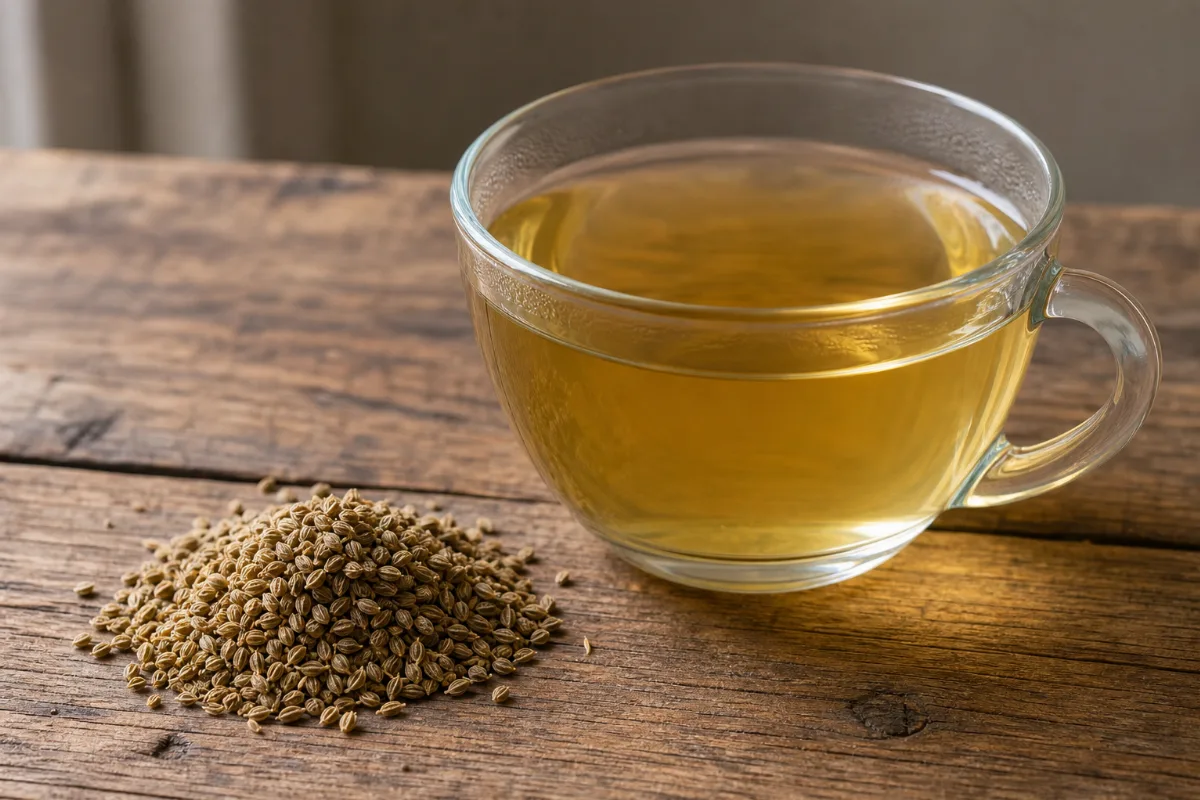
Herbal Teas & Extracts · Herbal tea
Anise Tea
Pimpinella anisum L. · also called Aniseed tea, anise seed tea
Anise tea is a hot drink made from the small dried fruit (aniseed) of Pimpinella anisum, a carrot-family plant. It is used traditionally for bloating, wind and coughs. The EU accepts it on long use only, and the one trial of the actual tea looked at breast milk in mothers of very preterm babies. It is not star anise, whose tea has harmed babies. The main cautions: allergy, and the EU does not recommend it in pregnancy, while breastfeeding or under 12.
General information, not medical advice. Last substantive update · Not medically reviewed. A named clinician has not signed off on this page. How this page is made
About Anise Tea
Anise tea is a hot infusion of aniseed, the dried fruit of Pimpinella anisum. The EU accepts it as a traditional remedy for bloating and cough. Only one trial has tested the tea, for breast milk volume after very preterm birth, with low-certainty results. Other trials used capsules, oil or powder. Ask a doctor first if you are pregnant, breastfeeding, allergic to carrot-family plants, or thinking of giving it to a child under 12.
What anise tea is
Anise tea is made from the small dried fruit, usually called the seed, of Pimpinella anisum L., a plant in the carrot family (Apiaceae; name checked in GBIF). Its main flavour compound is trans-anethole, and it also contains a little estragole.
The tea is a water infusion. Capsules, powder and essential oil are different products, and several trials on this page used them instead of tea.
Anise is not star anise
Star anise is the star-shaped fruit of a different, unrelated plant (Illicium verum). Star anise tea is the one linked to infant nerve reactions, and star anise has been found contaminated with a toxic look-alike. A homemade infusion of both star anise and green anise (Pimpinella anisum) was behind a case of liver failure in a 4-month-old.
Check the Latin name on a label, and do not give either tea to a baby. Read the separate page on star anise tea.
What the research shows
The EU herbal committee accepts aniseed tea for mild indigestion with bloating and wind and for cough with a cold, on long-standing use. It says there is insufficient evidence from clinical trials.
The one trial of an actual anise tea tested breast milk volume in mothers of babies born before 32 weeks: 129 analysed, 7 days, more pumped milk than placebo tea or no treatment on days 3 to 7. A 2026 review rates the evidence low certainty.
Positive results for irritable bowel syndrome, hot flashes and premenstrual syndrome came from oil or capsules. The COVID-19 gut trial used large daily amounts of powder and did not help bloating.
Caffeine
We found no test of caffeine in anise tea. LactMed's list of anise seed constituents does not include caffeine. If you must avoid caffeine, check the packet for added ingredients such as tea leaves.
At a glance
Traditional uses history, not proof
- In Europe the tea has been used for at least 30 years for mild indigestion with bloating and wind, and as an expectorant for coughs with a cold (EU herbal committee).
- Anise is a traditional milk-supply herb, and a gut and women's health herb in Persian and Unani medicine.
Studied for research
- Mild indigestion, bloating and wind (traditional use; no tea trial), insufficient
- Long-term indigestion (one study in a Cochrane review), low
- Irritable bowel syndrome (anise oil capsules, not tea), low
- Gut symptoms of COVID-19 (large amounts of powder, not tea), low
- Breast milk volume after preterm birth (tea), low
- Cough with a cold (traditional use; no tea trial), insufficient
- Hot flashes, menopause mood, premenstrual syndrome (capsules or unstated form), very-low to low
- Period pain (carrot-family herbs as a group), insufficient for anise
Main compounds
- trans-Anethole, the main flavour compound
- Estragole, in small amounts
- Phenolic acids and flavonoids
Common forms
- Whole or crushed aniseed (fruit) for tea
- Tea bags and blends (read the full ingredient list)
- Powder, capsules and essential oil (different from tea)
Research links: EU herbal committee: aniseed summary · EU herbal monograph on aniseed (PDF) · EU statement on estragole (PDF) · LactMed: anise and breastfeeding · Anise tea and milk volume, preterm mothers (abstract) · Review of herbal milk-supply trials, preterm mothers (abstract) · Research Library · Genes & Biomarkers Library
What it is and its history
- Accepted scientific name
- Pimpinella anisum L.
- Naming authority
- L.
- Common names
- Anise tea (English); Aniseed tea (English); Anise seed tea (English); Te de anis (Spanish); Infusion de anis (Spanish)
- Family or group
- Apiaceae
- Classification
- Plantae > Apiaceae > Pimpinella > Pimpinella anisum
- Native range
- Not read in the sources used.
- Habitat
- Not read.
- What it looks like
- Part used: The dried fruit, commonly called the seed (aniseed).
- Cultivation
- Not read.
- Harvest and processing
- The EMA covers the dried fruit, whole or crushed.
- Look-alikes and adulterants
- Name: Star anise (Illicium verum); Note: A different, unrelated plant (family Schisandraceae, GBIF key 2889756). Star anise tea has been linked to infant nerve reactions, and its fruit has been found contaminated with toxic Japanese star anise. See the star anise tea page.; Name: Fennel (Foeniculum vulgare); Note: A carrot-family relative that also contains anethole and estragole; the EU estragole statement covers both.
- Sustainability and conservation
- Not assessed in the sources read.
Photographs
Traditional use and history history, not clinical proof
| Tradition or era | Documented use | Source |
|---|---|---|
| European traditional medicine (regulatory view) | The EU herbal committee says aniseed tea has been used for at least 30 years, 15 of them in the EU, for mild indigestion with bloating and wind and for cough with a cold. | EMA public summary and monograph |
| Persian and Unani medicine | A 2016 trial abstract says anise oil has been suggested for bowel disorders in Persian medical textbooks. A 2026 trial abstract calls anise an Unani remedy for psychological symptoms in menopause. | Mosaffa-Jahromi 2016; Begum 2026 |
| Milk-supply herb | LactMed describes anise as a purported galactagogue and says it is included in some proprietary mixtures promoted to increase milk supply. | LactMed |
Traditional use shows how it was used. It does not show that it works or is safe today.
What is inside, and how it may work
What it contains and how those compounds act in cells and animals. Laboratory and animal mechanisms are not proven effects in people.
Main compounds
| Compound | Family | Where it is concentrated | Activity studied | Level of evidence |
|---|---|---|---|---|
| trans-Anethole PubChem 637563 | phenylpropanoid | Fruit (volatile oil) 87.96% and 88.49% of two aniseed essential oil samples (oil, not tea) | The main flavour compound. Described as a phytoestrogen by LactMed. Weak mutagenic potential in lab tests but unlikely to be genotoxic in the body (EMA). 20 19 17 5 15 | Laboratory research |
| Estragole (methyl chavicol) PubChem 8815 | phenylpropanoid | Fruit (volatile oil) A minor constituent; the EMA says herbal infusions of aniseed contain only a small amount | Genotoxic carcinogen in rodents (EMA). 7 5 15 | Animal research |
| Phenolic acids and flavonoids | polyphenols | Seeds | LactMed lists chlorogenic acid, naringenin, gallic acid, ellagic acid, taxifolin, caffeic acid, syringic acid and others among anise seed constituents. Amounts in a cup of tea were not found. 17 | Other |
Mechanisms, receptors and pathways
| Target or pathway | Gene or receptor | What was found | Level |
|---|---|---|---|
| Gut and airway smooth muscle | Not specified | In laboratory studies aniseed preparations had a relaxant effect on gut and airway muscle (EMA). Not shown in people. 6 | Laboratory research |
| Estragole and anethole bioactivation | CYP and SULT enzymes | In liver preparations estragole forms DNA and haemoglobin adducts; anethole forms the same type at lower levels. In a small pilot of fennel tea drinkers the blood marker rose and then fell. 3 | Laboratory research |
| Milk production and prolactin (hypothesis) | Prolactin | The milk-volume trial authors cite animal studies linking anethole to higher prolactin and milk production. LactMed calls anethole a phytoestrogen. Not measured in the trial's mothers. 11 17 | Animal research |
| Drug-metabolism and brain-drug effects of aniseed oil | Not specified | In mice, aniseed essential oil lowered blood levels of acetaminophen and caffeine and changed the effects of several brain drugs. 20 19 | Animal research |
Absorption, metabolism and elimination
- Absorption
- Not studied for anise tea.
- Distribution
- Not read.
- Metabolism
- Estragole and anethole are bioactivated by liver enzymes in lab systems (see mechanisms).
- Elimination
- LactMed says anethole is probably excreted into breast milk.
- Bioavailability
- Not studied for tea. In mice, aniseed oil lowered caffeine bioavailability.
Isolated compounds versus whole extracts
Most positive human results come from capsules of anise, anise oil or large amounts of powder. Only the milk-volume trial and a pooled estimate in a review used an actual anise tea. A cup of tea contains water-soluble parts of the fruit and little oil, so results for capsules, oil or powder may not apply to tea.
Nutritional composition
Anise tea is not a studied source of vitamins or minerals. The spice is covered on its own food page.
5 low certainty2 very low certainty3 not enough evidence
What was looked at
The 10 benefits and uses checked for Anise Tea, each with how strong the evidence is. Tap one to open it.
- Mild indigestion, bloating and wind (traditional use of the tea)Not enough evidence
- Long-term indigestion (functional dyspepsia), anise in a Cochrane reviewLow certainty
- Irritable bowel syndrome (anise OIL capsules, not tea)Low certainty
- Gut symptoms during COVID-19 (large amounts of aniseed POWDER)Low certainty
- Breast milk volume after preterm birth (anise TEA)Low certainty
- Cough with a cold (traditional use of the tea)Not enough evidence
- Hot flashes after menopause (anise CAPSULES)Very low certainty
- Mood and menopause symptoms (a 2026 anise trial, form not stated)Very low certainty
- Premenstrual syndrome (anise CAPSULES)Low certainty
- Period pain (carrot-family herbs, anise among them)Not enough evidence
What is Anise Tea good for?
The uses people ask about and how strong the evidence is for each. Read the certainty label first: for the tea itself there is almost no trial evidence, and several results come from capsules, oil or powder.
Benefits, one by one
Each card is a research question, not a promise. Tap a goal to filter. Open a card to see the studies, doses and limits.
Mild indigestion, bloating and wind (traditional use of the tea)
Not enough evidenceThe EU medicines committee accepts aniseed tea for mild indigestion with bloating and wind, but only on long use, not on trials. We found no trial of anise tea itself for this.
3 studiesNot shown on this page.
Studies, doses and limits
What the trials found
No randomized trial of anise tea for bloating or wind was found. The regulator's acceptance rests on traditional use. A COVID-19 trial of powdered aniseed found no benefit for bloating (see the gut-symptoms row).
Results
Traditional-use category only; no tea trial.
Why this rating
Regulatory acceptance based on long use, with no trial of the tea and one trial of a powder that did not help bloating.
Form and dose studied
Not shown on this page.
Who was studied
Adults and adolescents over 12 (EMA). Not recommended under 12.
Limits
Traditional use is not proof of benefit.
Why researchers looked
Aniseed tea is a common after-meal drink in many food cultures and a classic remedy for a bloated stomach.
Traditional use
The EU committee says there is evidence of at least 30 years of use, 15 of them in the EU, for this purpose (traditional use). Persian-medicine texts also describe anise for gut problems, as cited in a trial abstract.
Proposed mechanism Laboratory research
In laboratory studies aniseed preparations relaxed gut and airway muscle (EMA). How that applies to a cup of tea in a person is not shown.
A proposed mechanism does not show that the effect happens in people.
Two-week limit in the EU monograph; see the safety tab.
Long-term indigestion (functional dyspepsia), anise in a Cochrane review
Low certaintyA 2023 Cochrane review lists Pimpinella anisum among herbs that may ease long-term indigestion. It rests on one study of 107 people and is low certainty. The abstract does not say it was a tea.
1 studiesNot shown on this page.
Studies, doses and limits
What the trials found
The Cochrane review included 41 trials with 4,477 people testing 27 herbal medicines. For Pimpinella anisum it reports SMD -2.30 (95% CI -2.79 to -1.80) from 1 study of 107 people, low certainty. Peppermint with caraway oil had moderate certainty from 3 trials.
Results
A large reduction in symptom scores in one study; the form of anise is not given in the abstract.
Effect sizes as reported
SMD -2.30 (95% CI -2.79 to -1.80), 1 study, 107 people (Cochrane 2023).
Why this rating
The reviewers' own GRADE is low certainty, from a single study.
Form and dose studied
Not shown on this page.
Who was studied
Adults with functional dyspepsia.
Limits
One study. Not shown to be a tea. A very large effect from one small study may not hold up.
Why researchers looked
Many people with indigestion without a clear cause try herbs.
Traditional use
Anise is used in traditional medicine for stomach and gut complaints.
Proposed mechanism Laboratory research
Not established. Gut muscle relaxation has been seen in lab work.
A proposed mechanism does not show that the effect happens in people.
Review authors found few important side effects across herbal medicines overall, not specific to anise.
Irritable bowel syndrome (anise OIL capsules, not tea)
Low certaintyOne trial of 120 people found that enteric-coated anise oil capsules left more people symptom-free than placebo. That was a concentrated oil capsule, not a tea.
1 studiesNot shown on this page.
Studies, doses and limits
What the trials found
A three-arm double-blind trial in Iran gave 120 people with IBS 3 capsules a day for 4 weeks. In the intention-to-treat analysis 75% of the anise oil group, 35% of the placebo group and 52.5% of the peppermint oil group were free of IBS symptoms (P < 0.001). The number needed to treat was 4.
Results
More symptom-free people with anise oil capsules than placebo or the peppermint oil medicine.
Effect sizes as reported
75% vs 35% symptom-free (placebo); number needed to treat 4 (2016 trial).
Why this rating
A single trial of 120 people in one region, an oil capsule, not repeated that we found.
Form and dose studied
Not shown on this page.
Who was studied
Adults with irritable bowel syndrome.
Limits
Different product from a tea. Do not swallow essential oil. Funding not stated in the abstract.
Why researchers looked
Persian-medicine texts suggest anise oil for bowel problems, and IBS has few treatments that work for everyone.
Traditional use
The trial authors say anise oil is suggested for bowel disorders in Persian medical textbooks.
Proposed mechanism Not established
The authors say further studies are needed to find the mechanism.
A proposed mechanism does not show that the effect happens in people.
Essential oil should not be swallowed outside a tested capsule; ask a doctor.
Gut symptoms during COVID-19 (large amounts of aniseed POWDER)
Low certaintyA trial of 225 adults with COVID-19 found aniseed powder helped abdominal pain, appetite and diarrhoea more than placebo, but not nausea or bloating. It was a powder in large daily amounts, not a tea.
1 studiesNot shown on this page.
Studies, doses and limits
What the trials found
A double-blind placebo-controlled trial (registered IRCT20120506009651N3) gave 45 adults aniseed powder and 180 placebo (1:4) for 2 weeks on top of usual care. Improvement was more likely for abdominal pain (adjusted RR 0.55, 95% CI 0.46 to 0.72), loss of appetite (0.62, 0.47 to 0.82) and diarrhoea (0.19, 0.12 to 0.30), but not nausea or vomiting (0.87, 0.71 to 1.08) or bloating (0.87, 0.72 to 1.05). Two aniseed and three placebo participants had mild to moderate adverse events.
Results
Better pain, appetite and diarrhoea scores; no gain for nausea or bloating.
Effect sizes as reported
Adjusted RR 0.55 (abdominal pain), 0.62 (anorexia), 0.19 (diarrhoea).
Why this rating
One trial, an unbalanced design with 45 in the aniseed group, self-reported symptoms, and a powder, not a tea.
Form and dose studied
Not shown on this page.
Who was studied
Adults with mild COVID-19 and gut symptoms.
Limits
Not a tea. Not a treatment for COVID-19. Single trial.
Why researchers looked
Many people with COVID-19 have gut symptoms, and anise is used in Persian medicine for gut problems.
Traditional use
Anise is a traditional gut remedy in Persian medicine.
Proposed mechanism Preliminary mechanism
The authors point to broad lab activity of anise and trans-anethole. This is their interpretation, not proof.
A proposed mechanism does not show that the effect happens in people.
Do not use as a substitute for medical care for COVID-19.
Breast milk volume after preterm birth (anise TEA)
Low certaintyThis is the one use with a trial of an actual anise tea. In mothers of very preterm babies, anise tea went with more pumped milk over 7 days than placebo tea or no treatment. A 2026 review rates the evidence low certainty.
4 studiesNot shown on this page.
Studies, doses and limits
What the trials found
A three-arm trial in Tehran (Khalili 2023) included mothers of babies born before 32 weeks: 145 enrolled and 129 analysed (45 anise tea, 45 placebo tea, 39 no treatment). Over 7 days, pumped milk was higher with anise tea than with placebo tea and no treatment on days 3 to 7 (p < 0.05). Baby weight did not differ. No side effects were reported. A 2026 systematic review of herbal galactagogues in preterm mothers reports a mean difference of 98 ml (95% CI 63 to 133) by day 7 for anise seed tea, low certainty. LactMed also describes the evidence as low certainty and says milk-supply herbs should never replace a check of other causes of low supply.
Results
More pumped milk over a week; no gain in baby weight in that time.
Effect sizes as reported
Mean difference 98 ml by day 7 (95% CI 63 to 133), low certainty (2026 review).
Why this rating
The reviewers' own GRADE is low; one trial per herb, one hospital, 7 days, and the no-treatment group could not be blinded.
Form and dose studied
Not shown on this page.
Who was studied
Mothers of babies born before 32 weeks, pumping milk. Not tested in other mothers.
Limits
Only pumped milk volume was measured. Safety in breastfeeding is not established (EMA), and LactMed reports toxicity consistent with anethole in two newborns after excessive use of an anise-containing herbal tea blend. Talk to a lactation consultant or doctor first.
Why researchers looked
Breast milk is important for preterm babies, and milk supply is often low after a very early birth. Anise is a traditional milk-supply herb.
Traditional use
LactMed says anise is a purported galactagogue (milk-supply herb) and is included in some milk-supply tea mixtures.
Proposed mechanism Animal research
The trial authors cite animal studies that link anethole to higher prolactin and milk production. LactMed calls anethole a phytoestrogen. Neither is shown in the mothers in this trial.
A proposed mechanism does not show that the effect happens in people.
EMA does not recommend aniseed during pregnancy and breastfeeding. See the safety tab.
Cough with a cold (traditional use of the tea)
Not enough evidenceThe EU committee accepts aniseed tea as a traditional expectorant for cough with a cold. We found no trial of the tea for cough.
2 studiesNot shown on this page.
Studies, doses and limits
What the trials found
No trial of anise tea for cough was found. The committee's conclusion is based on traditional use, and it says there is insufficient evidence from clinical trials.
Results
Traditional-use category only.
Why this rating
No trial; regulator acceptance on long use only.
Form and dose studied
Not shown on this page.
Who was studied
Adults and adolescents over 12.
Limits
Traditional use is not proof of benefit. A cough that lasts or worsens needs a doctor.
Why researchers looked
Anise is an old cough and chest remedy in many food and herbal traditions.
Traditional use
Traditional use for at least 30 years (15 in the EU), as the EU committee states.
Proposed mechanism Laboratory research
In lab studies aniseed preparations relaxed airway muscle (EMA). Not shown in people drinking tea.
A proposed mechanism does not show that the effect happens in people.
The monograph says to see a doctor if symptoms last or get worse.
Hot flashes after menopause (anise CAPSULES)
Very low certaintyOne small trial of 72 women found fewer and milder hot flashes with anise capsules than with starch capsules. It was a capsule, not a tea, and the abstract gives unclear figures.
2 studiesNot shown on this page.
Studies, doses and limits
What the trials found
A double-blind trial of 72 postmenopausal women in Qazvin, Iran, gave anise or starch capsules for 4 weeks, with 4 weeks of follow-up. The anise group had fewer and less severe hot flashes by week 4 and stayed lower in follow-up; the control group did not change. The abstract does not give p-values or clear units.
Results
Fewer and milder hot flashes with anise capsules than with starch capsules.
Effect sizes as reported
Not clearly reported in the abstract.
Why this rating
One small trial from 2012, capsules, abstract with unclear statistics.
Form and dose studied
Not shown on this page.
Who was studied
Postmenopausal women with hot flashes.
Limits
Capsules, not tea. Not repeated that we found.
Why researchers looked
Some women look for non-hormonal options for hot flashes. LactMed calls anethole in anise a phytoestrogen.
Traditional use
Anise is used in traditional medicine for women's complaints.
Proposed mechanism Preliminary mechanism
Not established. Anethole is described as a phytoestrogen (LactMed), but that does not show how any effect would work.
A proposed mechanism does not show that the effect happens in people.
Women with hormone-sensitive conditions should ask a doctor; this has not been studied for anise tea.
Mood and menopause symptoms (a 2026 anise trial, form not stated)
Very low certaintyA 2026 trial of 60 menopausal women reports big improvements in mood scores with anise, but the effect looks unusually large, the form is not stated, and we only have the abstract. Treat it with caution.
1 studiesNot shown on this page.
Studies, doses and limits
What the trials found
60 menopausal women took anise twice a day or a matched placebo for 8 weeks. DASS-21 scores were lower with anise at 8 weeks (p < 0.0001), more than 80% of the anise group reported no depression, anxiety or stress symptoms, and the menopause symptom and vaginal health scores also improved. No adverse effects were reported and liver and kidney tests were checked.
Results
Large reported improvements in mood and menopause scores versus placebo.
Effect sizes as reported
p < 0.0001 for all main scores; numeric differences are not in the abstract.
Why this rating
A small, new, single-centre trial known only from its abstract, with an unusually large effect and an unstated form of anise.
Form and dose studied
Not shown on this page.
Who was studied
Menopausal women with psychological symptoms.
Limits
Not shown to be a tea. Not independently repeated. The 99.20% machine-learning accuracy says the groups differ, not that anise helps.
Why researchers looked
Menopause often brings low mood, anxiety and stress, and anise is a traditional Unani remedy for this.
Traditional use
The authors describe anise as an Unani remedy traditionally used for these problems.
Proposed mechanism Not established
Not established. The machine-learning part of the study classifies who got anise; it does not explain how anise would work.
A proposed mechanism does not show that the effect happens in people.
Low mood that lasts needs a doctor, not a herbal tea.
Premenstrual syndrome (anise CAPSULES)
Low certaintyA double-blind trial of 67 college students found lower premenstrual symptom scores with anise capsules than with placebo over two cycles. It was a capsule, not a tea.
1 studiesNot shown on this page.
Studies, doses and limits
What the trials found
67 women aged 18 to 35 with PMS took anise or starch capsules for 10 days around each period, for two cycles. The abstract reports lower symptom scores with anise after cycle one (13.9, 95% CI 16.5 to 11.4) and cycle two (9.8, 95% CI 12.4 to 7.3), both p < 0.001, but does not make clear whether the figures are changes within the group or differences from placebo.
Results
Lower PMS symptom scores with anise capsules than placebo.
Effect sizes as reported
13.9 and 9.8 points (cycles 1 and 2), as reported; basis unclear in the abstract.
Why this rating
One small double-blind trial of young students over two cycles, capsules, one team.
Form and dose studied
Not shown on this page.
Who was studied
Young women with PMS.
Limits
Capsules, not tea. Single trial.
Why researchers looked
PMS is common and has no single accepted treatment.
Traditional use
Anise is used in traditional medicine for women's complaints.
Proposed mechanism Not established
Not established.
A proposed mechanism does not show that the effect happens in people.
Safety in pregnancy is not established; see the safety tab.
Period pain (carrot-family herbs, anise among them)
Not enough evidenceA 2026 review of 14 trials of carrot-family herbs, including anise, finds them promising add-ons for period pain. The abstract does not give a separate result for anise.
1 studiesNot shown on this page.
Studies, doses and limits
What the trials found
The review included 14 randomized trials. Trials of anise and fennel against placebo had low risk of bias for randomization and outcome measurement. A meta-analysis of 7 trials against standard treatments such as mefenamic acid or ibuprofen found a statistically significant effect with low heterogeneity; fennel seed and dill seed subgroups were also significant. The abstract gives no result for anise alone.
Results
Carrot-family herbs as a group looked helpful; anise on its own is not separated.
Effect sizes as reported
Not given in the abstract.
Why this rating
For anise on its own there is no result in the abstract we read; the pooled result mixes several herbs.
Form and dose studied
Not shown on this page.
Who was studied
Women with primary dysmenorrhea.
Limits
Mixed herbs, mixed forms. Not shown for anise tea.
Why researchers looked
Period pain is common, and fennel, anise and dill are traditional remedies for it.
Traditional use
Apiaceae herbs including Pimpinella anisum are commonly used in traditional medicine for primary dysmenorrhea, as the review states.
Proposed mechanism Not established
Not covered in the abstract.
A proposed mechanism does not show that the effect happens in people.
Severe or new pelvic pain needs a doctor.
Connections to the rest of health
How Anise Tea connects to the rest of our health knowledge graph. Every link says what kind of connection it is. A safety link (for example to the liver) is a warning, not a benefit. A study that merely mentions a topic never creates a benefit link.
Explore every connection: goals, body systems, organs, symptoms, genes
A. Wellness goals
| Connected to | Kind of connection | Evidence status | Context | Studies |
|---|---|---|---|---|
| Digestive Support | Traditional use | Not enough evidence | Mild indigestion, bloating and wind (traditional use of the tea): The EU medicines committee accepts aniseed tea for mild indigestion with bloating and wind, but only on long use, not on trials. We found no trial of anise tea itself for this. | 5 6 14 |
| Gut Health | Traditional use | Not enough evidence | Mild indigestion, bloating and wind (traditional use of the tea): The EU medicines committee accepts aniseed tea for mild indigestion with bloating and wind, but only on long use, not on trials. We found no trial of anise tea itself for this. | 5 6 14 |
| Digestive Support | Low certainty | Long-term indigestion (functional dyspepsia), anise in a Cochrane review: A 2023 Cochrane review lists Pimpinella anisum among herbs that may ease long-term indigestion. It rests on one study of 107 people and is low certainty. The abstract does not say it was a tea. | 1 | |
| Digestive Support | Low certainty | Irritable bowel syndrome (anise OIL capsules, not tea): One trial of 120 people found that enteric-coated anise oil capsules left more people symptom-free than placebo. That was a concentrated oil capsule, not a tea. Gut symptoms during COVID-19 (large amounts of aniseed POWDER): A trial of 225 adults with COVID-19 found aniseed powder helped abdominal pain, appetite and diarrhoea more than placebo, but not nausea or bloating. It was a powder in large daily amounts, not a tea. | 13 14 | |
| Gut Health | Low certainty | Irritable bowel syndrome (anise OIL capsules, not tea): One trial of 120 people found that enteric-coated anise oil capsules left more people symptom-free than placebo. That was a concentrated oil capsule, not a tea. | 13 | |
| Immune Support | Low certainty | Gut symptoms during COVID-19 (large amounts of aniseed POWDER): A trial of 225 adults with COVID-19 found aniseed powder helped abdominal pain, appetite and diarrhoea more than placebo, but not nausea or bloating. It was a powder in large daily amounts, not a tea. | 14 | |
| Womens Wellness | Low certainty | Breast milk volume after preterm birth (anise TEA): This is the one use with a trial of an actual anise tea. In mothers of very preterm babies, anise tea went with more pumped milk over 7 days than placebo tea or no treatment. A 2026 review rates the evidence low certainty. | 11 4 17 5 | |
| Breathing Support | Traditional use | Not enough evidence | Cough with a cold (traditional use of the tea): The EU committee accepts aniseed tea as a traditional expectorant for cough with a cold. We found no trial of the tea for cough. | 5 6 |
| Menopause Support | Very low certainty | Hot flashes after menopause (anise CAPSULES): One small trial of 72 women found fewer and milder hot flashes with anise capsules than with starch capsules. It was a capsule, not a tea, and the abstract gives unclear figures. | 16 17 | |
| Menopause Support | Very low certainty | Mood and menopause symptoms (a 2026 anise trial, form not stated): A 2026 trial of 60 menopausal women reports big improvements in mood scores with anise, but the effect looks unusually large, the form is not stated, and we only have the abstract. Treat it with caution. | 2 | |
| Mood Balance | Very low certainty | Mood and menopause symptoms (a 2026 anise trial, form not stated): A 2026 trial of 60 menopausal women reports big improvements in mood scores with anise, but the effect looks unusually large, the form is not stated, and we only have the abstract. Treat it with caution. | 2 | |
| Womens Wellness | Low certainty | Premenstrual syndrome (anise CAPSULES): A double-blind trial of 67 college students found lower premenstrual symptom scores with anise capsules than with placebo over two cycles. It was a capsule, not a tea. | 8 | |
| Hormone Balance | Low certainty | Premenstrual syndrome (anise CAPSULES): A double-blind trial of 67 college students found lower premenstrual symptom scores with anise capsules than with placebo over two cycles. It was a capsule, not a tea. | 8 | |
| Womens Wellness | Not enough evidence | Period pain (carrot-family herbs, anise among them): A 2026 review of 14 trials of carrot-family herbs, including anise, finds them promising add-ons for period pain. The abstract does not give a separate result for anise. | 22 | |
| Pain Relief | Not enough evidence | Period pain (carrot-family herbs, anise among them): A 2026 review of 14 trials of carrot-family herbs, including anise, finds them promising add-ons for period pain. The abstract does not give a separate result for anise. | 22 |
B. Body systems
| Connected to | Kind of connection | Evidence status | Context | Studies |
|---|---|---|---|---|
| Digestive System | Biological association | Not enough evidence | Studied for: Mild indigestion, bloating and wind (traditional use of the tea) Studied for: Long-term indigestion (functional dyspepsia), anise in a Cochrane review | 5 6 14 1 13 |
| Reproductive System | Biological association | Low certainty | Studied for: Breast milk volume after preterm birth (anise TEA) Studied for: Hot flashes after menopause (anise CAPSULES) | 11 4 17 5 16 2 8 22 |
| Respiratory System | Biological association | Not enough evidence | Studied for: Cough with a cold (traditional use of the tea) | 5 6 |
| Endocrine System | Biological association | Very low certainty | Studied for: Hot flashes after menopause (anise CAPSULES) | 16 17 |
| Nervous System | Biological association | Very low certainty | Studied for: Mood and menopause symptoms (a 2026 anise trial, form not stated) | 2 |
D. Symptoms
| Connected to | Kind of connection | Evidence status | Context | Studies |
|---|---|---|---|---|
| Bloating and wind | Traditional use | Not enough evidence | EU traditional-use acceptance; no trial of the tea. Preparation or compound: Anise tea (aniseed infusion) |
5 |
| Low breast milk supply | Low certainty | One trial and a low-certainty review. One trial of 129 analysed mothers and a low-certainty review. Preparation or compound: Anise tea in mothers of preterm babies |
11 4 |
J. Genes, receptors and enzymes
| Connected to | Kind of connection | Evidence status | Context | Studies |
|---|---|---|---|---|
| CYP and SULT enzymes | Preliminary mechanism | In vitro | Bioactivate estragole and anethole in lab systems. | 3 |
L. Active compounds
| Connected to | Kind of connection | Evidence status | Context | Studies |
|---|---|---|---|---|
| trans-Anethole | Biological association | In vitro | The main flavour compound. Described as a phytoestrogen by LactMed. Weak mutagenic potential in lab tests but unlikely to be genotoxic in the body (EMA). Preparation or compound: Fruit (volatile oil) |
20 19 17 5 15 |
| Estragole (methyl chavicol) | Biological association | Animal | Genotoxic carcinogen in rodents (EMA). Preparation or compound: Fruit (volatile oil) |
7 5 15 |
| Phenolic acids and flavonoids | Biological association | Other | LactMed lists chlorogenic acid, naringenin, gallic acid, ellagic acid, taxifolin, caffeic acid, syringic acid and others among anise seed constituents. Amounts in a cup of tea were not found. Preparation or compound: Seeds |
17 |
Each connection is stored with the ingredient, the connected record, the kind of connection, the evidence status, the supporting studies, the preparation or compound involved, and a review date (last reviewed October 25, 2026).
Evidence at a glance: what the research found for 10 outcomes
Each outcome below is one thing researchers measured. Certainty is how far the evidence can be trusted, not how well it works. The full studies are on the next tab.
The evidence
The research centre for Anise Tea. Every record here was checked against PubMed or the publisher's page; we never list a study we have not verified.
Evidence by outcome
Bars show how many studies we found for each outcome, not how well it works. People are added up across trials only (reviews are not added, to avoid double counting).
How we rate evidence
High certainty
Several well-run trials or reviews agree; further research is unlikely to change the picture much.
Moderate certainty
Good trials point the same way, but some doubt remains.
Low certainty
Small, short or inconsistent trials. The finding could change with better research.
Very low certainty
Very little or very weak human data. Treat as a possibility only.
Mixed findings
Trials or reviews disagree with each other.
Not enough evidence
Not enough human research to say either way.
Evidence against
Good research found no benefit, or found harm.
We take the reviewers' own risk-of-bias and GRADE statements where they exist, and otherwise judge from study size, design, consistency, directness and whether a product matches what is sold. Many publications do not make evidence high. Method note: We read the abstracts of 16 PubMed papers (the milk-volume trial also in full text), the LactMed entry through its PubMed record, the EU aniseed monograph and public summary and the EU estragole statement, and checked names in GBIF and compounds in PubChem.
Study library: every study we checked 22
| Study | Design | People | Product, dose, length | Result |
|---|---|---|---|---|
| Baez 2023 Non-Chinese herbal medicines for functional dyspepsia. Cochrane Database Syst Rev · PMID 37323050 · DOI |
Systematic review of randomized trials |
4477 People with functional dyspepsia; 41 trials of 27 herbal medicines |
Herbal medicines; Pimpinella anisum is one of 27 fruit (seed) Not shown on this page Mostly 4 weeks · vs Placebo or other treatments |
The review lists Pimpinella anisum among herbs that may improve dyspepsia symptoms compared with placebo: SMD -2.30 (95% CI -2.79 to -1.80), from 1 study of 107 people, low certainty. Peppermint with caraway oil was rated moderate certainty. The abstract does not say what form of anise was used. SMD -2.30 (-2.79 to -1.80) Methods, limits and fundingOutcomes: Global dyspepsia symptoms, adverse events, quality of life Limitations: One study, low certainty. The abstract does not say whether the anise was a tea. Funding and conflicts: Cochrane review; conflict-of-interest statements list no relevant interests. Read: abstract |
| Begum 2026 Efficacy of Pimpinella anisum L. in Menopausal Women with Psychological Symptoms: A Randomized Controlled Study Integrated with Machine Learning Analysis. Curr Pharm Des · PMID 42152642 · DOI |
Randomized placebo controlled trial with machine learning analysis |
60 60 menopausal women with psychological symptoms, Unani medicine institute in India |
Anise taken by mouth twice a day (form not stated in the abstract) versus matched placebo fruit (seed) Not shown on this page 8 weeks · vs Matched placebo |
DASS-21 scores were lower with anise than placebo at 8 weeks (p < 0.0001), with more than 80% of the anise group reporting no symptoms of depression, anxiety or stress. The menopause symptom and vaginal health scores also improved (p < 0.0001); the placebo group showed no notable change. No adverse effects were observed, and liver and kidney tests were checked at baseline and 12 weeks. A machine-learning model told the groups apart with 99.20% accuracy. Methods, limits and fundingOutcomes: Depression, Anxiety and Stress Scale (DASS-21); menopause symptom index; vaginal health index; satisfaction Limitations: Small trial, abstract only. The size of the effect is unusually large for this kind of trial, which calls for caution. The machine-learning result says the groups differ, not that anise works. The form of anise is not stated in the abstract. Funding and conflicts: Not stated in the abstract. Read: abstract |
| Bergau 2021 Bioactivation of estragole and anethole leads to common adducts in DNA and hemoglobin. Food Chem Toxicol · PMID 34015424 · DOI |
Laboratory study plus a small human pilot lab and human pilot |
Rat and human liver preparations in the lab; a pilot in people who drank fennel tea for four weeks | Estragole and anethole; fennel tea in the pilot (not anise tea) fruit Not shown on this page 4 weeks (pilot) |
Estragole is genotoxic and carcinogenic in rodents. Anethole formed the same type of DNA and haemoglobin adducts, at lower levels. In a pilot, blood levels of an adduct marker rose during four weeks of an estragole- and anethole-rich fennel tea and fell during washout. The marker shows exposure; the abstract does not claim harm. Methods, limits and fundingOutcomes: Blood and DNA markers of the reactive breakdown products Limitations: Mostly lab work. The people drank fennel tea, not anise tea. Shows exposure, not harm. Read: abstract |
| Cragg 2026 Herbal galactagogues to improve breastmilk production and lactation in mothers of preterm babies: a systematic review of clinical trials. Eur J Clin Nutr · PMID 41350450 · DOI |
Systematic review of randomized trials |
Mothers of preterm babies; 10 randomized trials, each testing a different herbal galactagogue or mixture | Herbal galactagogues; Pimpinella anisum seed tea is one of them fruit (seed) Not shown on this page Up to day 7 in the trials pooled · vs Placebo or no treatment |
Two of the 10 trials were rated high risk of bias and the rest 'some concerns'. For Pimpinella anisum seed tea the review reports a mean difference of 98 ml (95% CI 63 to 133) in milk volume by day 7, with low certainty. Other herbs had similar low-certainty signals. MD 98 ml (63 to 133) Methods, limits and fundingOutcomes: Milk volume by day 7 Limitations: Reviewers rate all the evidence low certainty and ask for higher-quality trials. Each herb rests on one trial. Funding and conflicts: The authors declare no competing interests. Read: abstract |
| European Medicines Agency 2013 EMA/HMPC: Community herbal monograph on Pimpinella anisum L., fructus (EMA/HMPC/321184/2012), final, 12 November 2013 EMA/HMPC/321184/2012 · Source |
Regulator monograph n/a |
Adults and adolescents over 12 (traditional herbal tea) | n/a Not shown on this page |
Traditional use only (30+ years of use, no clinical-trial proof): relief of mild indigestion with bloating and wind, and as an expectorant in cough with a cold. Use under 12 is not recommended and has not been established for lack of safety data. Not to be taken for more than two weeks. Not for people allergic to aniseed, to carrot-family plants (caraway, celery, coriander, dill, fennel) or to anethole. Safety in pregnancy and breastfeeding has not been established, so use is not recommended. No interactions reported. No overdose case reported. Allergic reactions of the skin or breathing may occur, frequency not known. An aniseed water extract was negative in a bacterial mutation test; anethole showed weak mutagenic potential in lab tests but is unlikely to be genotoxic in the body; the cancer risk linked to estragole is not considered relevant for short-term use because herbal infusions of aniseed contain only a small amount. Methods, limits and fundingOutcomes: n/a Limitations: Traditional-use category, not proof of benefit. The EMA page also lists a periodic review of this monograph in progress; the 2013 final version is the one read. Read: full-text |
| European Medicines Agency 2016 EMA: Anisi fructus (aniseed), herbal medicinal product, public summary (first published 6 October 2016) EMA web page · Source |
Regulator public summary n/a |
General readers | n/a Not shown on this page |
The committee's conclusions cover dried aniseed fruit and preparations made by drying and crushing it, usually sold as a herbal tea. Based on long-standing use, they can be used for mild indigestion with bloating and flatulence and as an expectorant for cough with a cold, in adults and adolescents over 12, for no more than two weeks. The evidence is 'traditional use': there is insufficient evidence from clinical trials, but use is plausible and has been safe for at least 30 years (15 within the EU). In lab studies, aniseed preparations relaxed gut and airway muscle. Must not be used by people allergic to aniseed, Apiaceae plants or anethole. Methods, limits and fundingOutcomes: n/a Limitations: A summary of a regulatory opinion, not a trial. The page lists a monograph revision in progress. Read: full-text |
| European Medicines Agency 2022 EMA/HMPC: Public statement on the use of herbal medicinal products containing estragole, Revision 1 (EMA/HMPC/137212/2005 Rev 1 Corr 1), adopted 22 September 2021, published 1 March 2022 EMA/HMPC/137212/2005 Rev 1 · Source |
Regulator statement n/a |
General population; sensitive groups | n/a Not shown on this page |
Estragole is a naturally occurring genotoxic carcinogen (in rodents) with a DNA potency similar to safrole. Aniseed fruit and fennel are the main European sources. The committee concluded that intake of estragole from herbal medicines should be as low as practically achievable, with short use (maximum 14 days). Use in pregnant and breastfeeding women is not recommended if estragole intake goes above a stated guidance value, and use in children up to 11 years is not recommended above a stated guidance value, unless a risk assessment justifies it. Data on skin absorption are missing. The committee also says a conclusive assessment of estragole in herbal medicines is not possible at present because of open scientific questions. Methods, limits and fundingOutcomes: n/a Limitations: It covers herbal medicines, not tea sold as food, and the guidance values are not given on this page. It states a risk assessment, not harm shown in people. Read: full-text |
| Farahmand 2020 Could Anise decrease the intensity of premenstrual syndrome symptoms in comparison to placebo? A double-blind randomized clinical trial. J Complement Integr Med · PMID 32692701 · DOI |
Double blind randomized trial |
67 67 college students aged 18 to 35 with premenstrual syndrome, Iran |
Anise capsules (not tea) versus starch capsules fruit (seed) Not shown on this page Part of the cycle (7 days before to 3 days after the period), over 2 cycles · vs Starch capsules |
Symptom scores were lower in the anise group after the first and second cycles: the abstract gives 13.9 (95% CI 16.5 to 11.4) and 9.8 (95% CI 12.4 to 7.3), both p < 0.001. The abstract does not say clearly whether these are changes within the group or differences from placebo. The authors conclude anise lowered symptoms compared with placebo. Methods, limits and fundingOutcomes: Premenstrual Symptoms Screening Tool score Limitations: Small, young students, capsules not tea, two cycles only. The abstract is unclear on how the figures were calculated. Read: abstract |
| GBIF Secretariat 2026 GBIF Backbone Taxonomy: Pimpinella anisum L. (usageKey 8080300) and Illicium verum Hook.fil. (usageKey 2889756) Web page / database · Source |
Database record n/a |
n/a | n/a Not shown on this page |
Both names are ACCEPTED species checked by API on 2026-10-25. Pimpinella anisum L. is in the family Apiaceae, the carrot family. Illicium verum is in the family Schisandraceae. They are not related. Methods, limits and fundingOutcomes: n/a Limitations: Name database only. Read: full-text |
| Ize-Ludlow 2004 Neurotoxicities in infants seen with the consumption of star anise tea. Pediatrics · PMID 15492355 · DOI |
Case series |
7 7 infants in the United States with nerve reactions after home-made star anise tea |
Star anise tea (Illicium verum), not anise fruit Not shown on this page |
The authors report 7 cases of adverse nerve reactions in infants after star anise tea and say they found evidence that Chinese star anise had been contaminated with toxic Japanese star anise. They advise that star anise tea should no longer be given to infants. Methods, limits and fundingOutcomes: Nerve reactions; lab check of the star anise Limitations: About star anise, a different plant from anise. Included here because the two names are confused. Read: abstract |
| Khalili 2023 The effect of Pimpinella Anisum herbal tea on human milk volume and weight gain in the preterm infant: a randomized controlled clinical trial. BMC Complement Med Ther · PMID 36681821 · DOI |
Randomized controlled trial (three groups: anise tea, placebo tea, no treatment) |
129 Mothers of babies born before 32 weeks and admitted to intensive care at one hospital in Tehran, who were pumping milk; 145 enrolled, 129 analysed (45 anise tea, 45 placebo tea, 39 no treatment) |
Anise herbal tea made from a tea bag (prepared by a university school of Persian medicine), compared with a placebo tea and no treatment fruit (seed) Not shown on this page 7 days · vs Placebo tea and a no-treatment group |
The groups differed in milk volume on days 1, 3, 4, 5, 6 and 7 (p < 0.05). On day 1 the anise group was higher than the no-treatment group (p = 0.008). On days 3 to 7 the anise group pumped more than both the placebo and no-treatment groups (p < 0.05). There was no difference in infant weight on days 0, 3 or 7. The mothers reported no side effects. Methods, limits and fundingOutcomes: Volume of pumped milk each day; infant weight on days 0, 3 and 7 Limitations: One hospital, 7 days. The no-treatment group could not be blinded. Milk volume was pumped milk, not what the baby took. Tea amount and group means are not given on this page. Funding and conflicts: Funded by Iran University of Medical Sciences; the authors report no conflict of interest. Read: abstract and full text (Europe PMC) |
| Lisiecka 2026 Allergic reactions to spices: a review of sensitivities to pepper, cumin, oregano, anise, mustard and other spices. Eur Ann Allergy Clin Immunol · PMID 40341008 · DOI |
Literature review review |
Review of spice allergy research published from 2010 to 2023 | Spices including anise fruit (seed) Not shown on this page |
The review says allergies to anise are less common than some other spices but can be a serious problem because of cross-reactivity with birch pollen. Cross-reactivity among spices and other allergens complicates diagnosis. Methods, limits and fundingOutcomes: Spice allergy and cross-reactivity Limitations: A narrative review; no rate of anise allergy is given in the abstract. Read: abstract |
| Mosaffa-Jahromi 2016 Efficacy and safety of enteric coated capsules of anise oil to treat irritable bowel syndrome. J Ethnopharmacol · PMID 27815079 · DOI |
Randomized, double blind, three arm trial |
120 120 people with irritable bowel syndrome in Iran |
Enteric-coated capsules of anise oil (not tea), compared with placebo and with an enteric-coated peppermint oil medicine fruit (seed oil) Not shown on this page 4 weeks, with a 2-week follow-up · vs Placebo and peppermint oil capsules |
In the intention-to-treat analysis 75% of the anise oil group, 35% of the placebo group and 52.5% of the peppermint oil group were free of IBS symptoms (P < 0.001). The number needed to treat for the anise oil capsules was 4. The authors report benefit across pain, bloating, diarrhoea, constipation and quality of life. Methods, limits and fundingOutcomes: Symptom score (visual analogue scale); IBS quality of life Limitations: A capsule of concentrated oil, a different product from a tea. One trial from one region; funding not stated in the abstract. The result needs repeating by other teams. Funding and conflicts: Funding not stated in the abstract. Read: abstract |
| Mosaffa-Jahromi 2024 Efficacy and safety of aniseed powder for treating gastrointestinal symptoms of COVID-19: a randomized, placebo-controlled trial. Front Pharmacol · PMID 38292939 · DOI |
Randomized, double blind, placebo controlled add on trial (1:4 allocation) |
225 Adults with acute COVID-19 who did not need hospital care and had at least one gut symptom; 45 aniseed, 180 placebo |
Powdered aniseed taken in large daily amounts (powder, not tea), added to standard care fruit (seed) Not shown on this page 2 weeks · vs Placebo powder |
The aniseed group was more likely to report improvement in abdominal pain (adjusted RR 0.55, 95% CI 0.46 to 0.72), loss of appetite (RR 0.62, 0.47 to 0.82) and diarrhoea (RR 0.19, 0.12 to 0.30), but not nausea or vomiting (RR 0.87, 0.71 to 1.08) or bloating (RR 0.87, 0.72 to 1.05). Two aniseed and three placebo participants reported mild to moderate side effects. The powder contained trans-anethole 87 to 94%. Methods, limits and fundingOutcomes: Improvement of at least one point in gut symptom scores Limitations: Powder in large amounts, not tea. The 1:4 split left only 45 in the aniseed group. Symptom scores were self-reported. The abstract calls it powder but states a trans-anethole content of 87 to 94%, so what exactly was taken should be checked in the full paper. Funding and conflicts: No commercial or financial conflicts declared. Registration: IRCT20120506009651N3 Read: abstract |
| NCBI PubChem 2026 PubChem compound records: anethole (CID 637563, C10H12O) and estragole (CID 8815, C10H12O) Web page / database · Source |
Database record n/a |
n/a | n/a Not shown on this page |
Names and formulas confirmed by API on 2026-10-25. The two molecules have the same formula and different structures. Methods, limits and fundingOutcomes: n/a Limitations: Identity check only. Read: full-text |
| Nahidi 2012 The Study on the Effects of Pimpinella anisum on Relief and Recurrence of Menopausal Hot Flashes. Iran J Pharm Res · PMID 24250540 |
Double blind randomized trial |
72 72 postmenopausal women with hot flashes, rural and urban health centres in Qazvin, Iran |
Anise capsules (not tea) versus starch capsules fruit (seed) Not shown on this page 4 weeks, then 4 weeks of follow-up · vs Starch capsules |
In the anise group the frequency and severity of hot flashes fell by the end of week 4 and stayed lower during follow-up. The control group had no change. The abstract reports its figures as percentages without clear units and gives no p-values or confidence intervals. Methods, limits and fundingOutcomes: Frequency and severity of hot flashes Limitations: Small, capsules not tea, an unclear statistical report in the abstract, and no registration listed. Read: abstract |
| National Institute of Child Health and Human Development (LactMed) 2026 Anise (Drugs and Lactation Database, LactMed) LactMed (NCBI Bookshelf), entry dated 15 Oct 2026 · PMID 30000835 |
Reference database entry human and reference |
Breastfeeding mothers and infants | Anise (Pimpinella anisum) seeds and teas fruit (seed) Not shown on this page |
Anise seeds contain anethole, a phytoestrogen. Anise is a purported galactagogue, but few valid clinical trials support this. A meta-analysis found a small rise in milk volume on day 1 after birth versus no treatment, and low-certainty evidence that anise tea increases milk volume on day 7. Anethole is probably excreted into breast milk, and anise can give milk an odour. Anise is generally recognised as safe as a flavouring by the US FDA. Raised liver enzymes occurred in a woman taking a milk-supply tea that contains anise. Excessive maternal use of an herbal tea with anise and other herbs appeared to cause toxicity in two breastfed newborns, consistent with anethole. Methods, limits and fundingOutcomes: Milk supply, safety in breastfeeding Limitations: A summary entry, not a trial. The tea cases were blends, so anise alone cannot be blamed. Read: entry text read via its PubMed record |
| Obando Pacheco 2016 Liver failure secondary to poisoning by a homemade product made of star and green anise in a 4-month-old infant. Rev Esp Enferm Dig · PMID 26875753 · DOI |
Case report |
1 One 4-month-old infant in Spain |
A homemade daily infusion of star anise and green anise (Pimpinella anisum) given for two months fruit Not shown on this page 2 months |
The infant had raised liver enzymes, severe clotting problems, low blood sugar, mild acidosis and nerve signs such as seizures and abnormal eye movements. Infection, metabolic and autoimmune causes were ruled out. The family had given a daily infusion of star anise and green anise for the past two months. The authors stress the serious risk of homemade herb infusions for infants. Methods, limits and fundingOutcomes: Liver tests, clotting, blood sugar, nervous system signs Limitations: A single case with two plants in the infusion, so the harm cannot be pinned on anise rather than star anise. Read: abstract |
| Samojlik 2012 The influence of essential oil of aniseed (Pimpinella anisum, L.) on drug effects on the central nervous system. Fitoterapia · PMID 22926042 · DOI |
Animal study mouse |
Mice | Aniseed essential oil by mouth for 5 days (oil, not tea) fruit (seed oil) Not shown on this page 5 days · vs Control mice |
Trans-anethole made up 88.49% of the oil. Oil pretreatment increased the pain-relief effect of codeine and the movement impairment from midazolam, shortened pentobarbital sleeping time, and reduced the antidepressant-like effect of imipramine and fluoxetine. The authors conclude that aniseed oil preparations and drugs acting on the brain should not be taken together, pending clinical confirmation. Methods, limits and fundingOutcomes: Effects of codeine, diazepam, midazolam, pentobarbital, imipramine and fluoxetine Limitations: Mice and an oil; no human study. Whether tea has any such effect is unknown. Read: abstract |
| Samojlik 2016 Pharmacokinetic Herb-Drug Interaction between Essential Oil of Aniseed (Pimpinella anisum L., Apiaceae) and Acetaminophen and Caffeine: A Potential Risk for Clinical Practice. Phytother Res · PMID 26619825 · DOI |
Animal study mouse |
Mice | Aniseed essential oil for 5 days (concentrated oil, not tea) fruit (seed oil) Not shown on this page 5 days · vs Control mice |
Trans-anethole made up 87.96% of the oil. After oil pretreatment the peak blood level of acetaminophen taken by mouth was lower (p = 0.024) and the bioavailability of caffeine taken by mouth was lower (57% versus 101% in controls, p = 0.022). The authors say the loss of effect of these drugs should be considered with aniseed oil preparations. Methods, limits and fundingOutcomes: Blood levels of acetaminophen and caffeine Limitations: Mice, an essential oil and a small human-equivalent amount. It does not show the same happens with a cup of tea. Read: abstract |
| Slowianek 2020 New allergens from spices in the Apiaceae family: anise Pimpinella anisum L. and caraway Carum carvi L. Cent Eur J Immunol · PMID 33437175 · DOI |
Laboratory allergen study with patient sera human and lab |
Extracts of anise and caraway tested against antibodies and sera from spice-sensitive patients | Anise and caraway extracts fruit (seed) Not shown on this page |
The authors confirmed Bet v 1 look-alike proteins and profilins in anise and identified a new allergen, glyceraldehyde 3-phosphate dehydrogenase. People allergic to both birch and mugwort pollen are at particular risk of reacting to spices ('mugwort-celery-spice syndrome'). Methods, limits and fundingOutcomes: Which anise proteins cause allergy Limitations: Laboratory identification of allergens, not a count of how many people react to anise tea. Funding and conflicts: Authors declare no conflict of interest. Read: abstract |
| Thaliyil Poduval 2026 Efficacy of herbaceous Apiaceae plants in primary dysmenorrhea: A systematic review and meta-analysis of RCTs. Ann Pharm Fr · PMID 41653970 · DOI |
Systematic review and meta analysis of randomized trials |
Women with primary dysmenorrhea (period pain); 14 randomized trials of carrot-family herbs including anise, fennel, dill and cumin | Apiaceae herbs, including Pimpinella anisum fruit (seed) Not shown on this page Varied · vs Placebo or standard treatments such as mefenamic acid or ibuprofen |
Trials of anise and fennel against placebo had low risk of bias for randomization and outcome measurement. A meta-analysis of 7 trials against standard treatments found a statistically significant effect with low heterogeneity, and fennel seed and dill seed subgroups were also significant. The abstract gives no result for anise alone. The authors call the herbs potentially effective add-on treatments and ask for high-quality trials. Methods, limits and fundingOutcomes: Period pain Limitations: The pooled result mixes several herbs and is not specific to anise or to tea. Funding and conflicts: Registered on PROSPERO (CRD42024538888); funding not stated in the abstract. Registration: PROSPERO CRD42024538888 Read: abstract |
What we do not know yet
- No trial of anise tea was found for bloating, wind or cough, the uses the EU accepts.
- The only tea trial measured pumped milk in mothers of very preterm babies; it gives no data on other mothers.
- Most positive trials used capsules, oil or powder, not tea.
- No study of anise tea with any medicine; interaction data are mouse studies of oil.
- No survey of contaminants in anise tea. The EU monograph dates from 2013 and a review is listed as in progress.
How new research is added
New studies are found by a saved PubMed search and are placed in a review queue. A person reads each one before it is added.
Lab markers
What changed in blood or saliva tests during trials. A changed number is not the same as feeling or being healthier, and we give no "normal ranges".
Safety
What studies and official sources say about side effects, medicines and who should check first. Each point shows what kind of evidence it comes from.
Main points to know 5
- This is anise (Pimpinella anisum), not star anise. Star anise tea has poisoned babies.. Anise (also called aniseed) is the small fruit of a carrot-family plant. Star anise is the star-shaped fruit of a different plant (Illicium verum, family Schisandraceae); the two are not related, though both taste of liquorice. Star anise tea is the one linked to harm: a US report of 7 infants with nerve reactions, with evidence that Chinese star anise had been contaminated with toxic Japanese star anise. A Spanish case of liver failure in a 4-month-old followed a homemade daily infusion of both star anise and green anise (Pimpinella anisum) for two months, so anise cannot be cleared in that case. Check the Latin name on a label, and do not give any anise or star anise tea to a baby. See the separate star anise tea page. Case series 10 18 9
- Not recommended for children under 12, in pregnancy or while breastfeeding; not for more than two weeks.. The EU medicines committee's monograph for aniseed tea covers adults and adolescents over 12 only. It says use under 12 has not been established for lack of safety data, that safety in pregnancy and breastfeeding has not been established so use is not recommended, and that the tea should not be taken for more than two weeks. LactMed reports toxicity consistent with anethole in two breastfed newborns after excessive maternal use of an herbal tea with anise and other herbs. Ask a doctor, midwife or pharmacist first. Regulatory 5 6 17
- Estragole and anethole: the EU committee asks for as little exposure as possible.. Anise contains anethole (the main flavour compound) and a small amount of estragole. The EU herbal committee calls estragole a genotoxic carcinogen in rodents. For aniseed tea its monograph says the estragole cancer risk is not considered relevant for short-term use, because herbal infusions of aniseed contain only a small amount, and that anethole showed weak mutagenic potential in the lab but is unlikely to be genotoxic in the body. The committee's wider estragole statement (adopted 2021, published 2022) still asks that estragole intake from herbal medicines be as low as practically achievable, with short use of no more than 14 days, and that exposure of young children, pregnant and breastfeeding women be minimised. Lab work finds that the body turns both estragole and anethole into reactive products, anethole at lower levels; in a small pilot, people drinking fennel tea for four weeks showed rising blood markers of this exposure. That shows exposure, not harm. Regulatory 5 7 3
- Allergy: aniseed, anethole and carrot-family plants, and birch or mugwort pollen allergy.. The EU monograph bars anyone allergic to aniseed, to carrot-family plants (caraway, celery, coriander, dill, fennel) or to anethole, and says allergic reactions of the skin or breathing may occur, frequency not known. Lab work has found anise allergens, and a 2026 review says anise allergy is less common than some spice allergies but can be serious because of cross-reactivity with birch pollen. People allergic to both birch and mugwort pollen are at particular risk of spice reactions. Swelling of the lips or face or trouble breathing is an emergency. Regulatory 5 6 21 12
- Few drug interactions are documented. Mouse studies of anise OIL raise questions that have not been tested with tea.. The EU monograph lists no interactions as reported. Two mouse studies of concentrated aniseed essential oil (not tea) found lower blood levels of acetaminophen and caffeine and changed effects of codeine, midazolam, diazepam, pentobarbital and two antidepressants; the authors say these need clinical confirmation. We found no study of anise tea with ciprofloxacin or other antibiotics, blood thinners, hormone treatments or any other medicine. Ask a pharmacist if you take regular medicines. Animal research 5 20 19
Side effects 5
| Effect | How often | Severity and recovery | Evidence |
|---|---|---|---|
| Allergic reactions of the skin or breathing The monograph lists this as the undesirable effect. | Not known (EMA) | variable Not stated | Regulatory 5 6 |
| Toxicity in breastfed newborns after excessive maternal use of a tea blend containing anise and other herbs A blend, so anise alone cannot be blamed. LactMed says it was consistent with anethole toxicity. | Two newborns in LactMed | moderate to severe Not stated in the entry | Case report 17 |
| Raised liver enzymes in a woman taking a milk-supply tea containing anise A blend. | One report in LactMed | unknown Not stated | Case report 17 |
| Liver injury, seizures and low blood sugar in a 4-month-old given a daily infusion of star anise and green anise Two plants in the infusion; do not give to babies. | One case | severe Not stated in the abstract | Case report 18 |
| Mild to moderate side effects in a COVID-19 trial of large amounts of aniseed powder A powder, not a tea. | 2 of 45 on aniseed, 3 of 180 on placebo | mild to moderate Not stated | Controlled trial 14 |
Liver
We found no LiverTox entry for anise. LactMed reports raised liver enzymes in a woman taking a milk-supply tea blend containing anise, and a Spanish report describes liver failure in a 4-month-old given a homemade daily infusion of star anise and green anise (Pimpinella anisum). Both involve other herbs, so they do not show that anise tea alone harms the liver. The 2026 menopause trial says liver and kidney tests were checked and no adverse effects were seen, but gives no figures in the abstract. 18 17 2
- p26875753. 4-month-old with liver failure after a daily homemade infusion of star anise and green anise for 2 months
- p30000835. Raised liver enzymes in a woman taking a milk-supply tea blend that contains anise
This is a safety connection. It is not evidence that Anise Tea supports liver health.
Medicines and supplements 4
| With | Why it matters | Importance | Evidence | What to do |
|---|---|---|---|---|
| Acetaminophen and caffeine prescription and OTC | In mice, 5 days of aniseed essential oil lowered the peak blood level of oral acetaminophen and the bioavailability of oral caffeine. | Mouse study of concentrated oil at a human-equivalent amount. No study of tea or in people. | Animal research Very low certainty 20 | Ask a pharmacist before combining anise preparations with medicines you rely on. |
| Medicines that act on the brain (codeine, midazolam, diazepam, sleeping and antidepressant medicines) prescription | In mice, aniseed essential oil raised the pain-relief effect of codeine, worsened movement impairment from midazolam, shortened pentobarbital sleep and weakened imipramine and fluoxetine effects. | Mouse study of oil; the authors advise avoiding the combination until tested in people. | Animal research Very low certainty 19 | Ask a doctor or pharmacist if you take any such medicine. |
| Any medicine (EU monograph statement) regulatory | The EU monograph for aniseed tea lists interactions as 'None reported'. That means none reported, not that none exist. | Regulatory Not enough evidence 5 | Ask a pharmacist if you take regular medicines. | |
| Ciprofloxacin, other antibiotics, blood thinners and hormone treatments prescription | No source found. | We searched PubMed for an anise and ciprofloxacin or antibiotic interaction and found none for the tea. Absence of a study is not proof of safety. | None Not enough evidence | Ask a pharmacist. |
Who should check first 4
| Situation | Advice | Evidence |
|---|---|---|
| Allergy to aniseed, anethole, or carrot-family plants such as caraway, celery, coriander, dill or fennel | Do not use. | Regulatory 5 6 |
| Children under 12 | Not recommended; safety data are lacking. | Regulatory 5 7 |
| Pregnancy and breastfeeding | Not recommended; safety has not been established. | Regulatory 5 7 17 |
| Babies | Do not give anise or star anise tea. | Case report 18 10 |
Overdose, product quality and regulators
Summary. The EU monograph reports no case of overdose with aniseed tea. The concerns are estragole (a rodent carcinogen) and allergy, and the unknowns for infants and pregnancy.
Animal. Estragole is a genotoxic carcinogen in rodents (EMA). Concentrated aniseed oil changed the effects of several drugs in mice.
High dose or long term signals. The EU says to keep use under two weeks and as low as practical. Long-term use of anise tea has not been studied.
Overdose response. No overdose case is reported in the EU monograph. If someone has a seizure, repeated vomiting or trouble breathing after any herbal tea, call emergency services or a poison centre. In the US, Poison Help is 1-800-222-1222.
Genotoxicity. An aniseed water extract was negative in a bacterial mutation test; anethole showed weak mutagenic potential in lab tests but is unlikely to be genotoxic in the body (EMA monograph). Estragole is genotoxic in rodents.
Toxic or hazardous parts. The fruit (seed) is used. Do not confuse with star anise (Illicium), whose tea has poisoned infants.
We found no survey of heavy metals, pesticides or mix-ups in anise tea. The documented mix-up risk is the name: 'anise' and 'star anise' are different plants, and homemade infusions of both have harmed infants.
Name confusion with star anise. A US report of 7 infants found nerve reactions after star anise tea and evidence that Chinese star anise had been contaminated with Japanese star anise. A Spanish infant had liver failure after a homemade infusion of star anise and green anise. 10 18
Estragole in the tea. The EU monograph says herbal infusions of aniseed contain only a small amount of estragole. 5
Heavy metals and pesticides. Not found in the sources read.
| Body | Action | Date |
|---|---|---|
| European Medicines Agency, HMPC (aniseed monograph) (European Union) | Traditional herbal medicine for mild indigestion with bloating and wind, and as an expectorant in cough with a cold, for adults and adolescents over 12, not longer than two weeks. Not recommended under 12, in pregnancy or breastfeeding. Bars use in people allergic to aniseed, Apiaceae plants or anethole. source | 2013-11-12 |
| European Medicines Agency (aniseed public summary) (European Union) | Plain-language summary of the monograph; evidence is traditional use, not clinical trials. source | 2016-10-06 |
| European Medicines Agency, HMPC (estragole public statement, revision 1) (European Union) | Estragole intake from herbal medicines should be as low as practically achievable, use short (maximum 14 days), exposure of young children, pregnant and breastfeeding women minimised. source | 2022-03-01 |
| NIH LactMed (United States) | Anise is a purported milk-supply herb with low-certainty evidence; reports of toxicity in two newborns after excessive maternal use of an anise-containing tea blend; generally recognised as safe by the US FDA as a flavouring. source | 2026-10-15 |
When to get medical help
- Swelling of the lips, tongue or face, hives, or trouble breathing after anise tea: call emergency services (allergy).
- A baby with seizures, stiffness, repeated vomiting, abnormal eye movements, extreme sleepiness or yellow skin or eyes after any herbal tea: go to an emergency department now.
- A breastfed newborn who is unusually sleepy, feeding poorly or unwell after the mother has had a lot of herbal tea: call the doctor or midwife.
- In the US, Poison Help is 1-800-222-1222. Elsewhere, call your local poison centre or emergency number.
Stop using the product and contact a clinician or emergency service. In the US, Poison Control is 1-800-222-1222.
General information only, not medical advice. Ask a clinician or pharmacist before use, especially with medicines, in pregnancy or with a health condition. See the Natural Remedy Safety guide.
Frequently asked questions
Is anise tea the same as star anise tea?
No. Anise (aniseed) is the fruit of Pimpinella anisum, a carrot-family plant. Star anise is the star-shaped fruit of an unrelated plant, Illicium verum. Star anise tea has been linked to nerve reactions in babies and contamination with a toxic look-alike. Check the Latin name on a label. See our star anise tea page.
Does anise tea help with bloating and gas?
Does anise tea help a cough?
Does anise tea increase breast milk?
One trial in mothers of babies born before 32 weeks (129 analysed) found more pumped milk with anise tea than with placebo tea or no treatment over 7 days, with no difference in baby weight. A 2026 review rates this low certainty. LactMed says milk-supply herbs should never replace checking other causes of low supply, and the EU does not recommend aniseed while breastfeeding.
Is anise tea safe in pregnancy or while breastfeeding?
Can children or babies have anise tea?
What are estragole and anethole, and should I worry?
Anethole is the main flavour compound in anise; estragole is a smaller component that causes cancer in rodents. For aniseed tea the EU monograph says the estragole risk is not considered relevant for short-term use because infusions contain little. The EU still asks for the lowest possible exposure, a maximum of two weeks, and extra care for young children, pregnancy and breastfeeding.
Can anise tea cause an allergic reaction?
Does anise tea interact with medicines?
Do studies of anise for menopause, IBS or PMS apply to the tea?
Does anise tea contain caffeine?
We found no test of caffeine in anise tea, and LactMed's list of anise seed constituents does not include it. Blends may add tea leaves, so check the ingredient list.
What are the warning signs after drinking anise tea?
Swelling of the lips or face, hives or trouble breathing: call emergency services. A baby with seizures, repeated vomiting or abnormal eye movements, or a breastfed newborn who is unusually sleepy after the mother drank a lot of herbal tea: seek urgent care. In the US, Poison Help is 1-800-222-1222.
Explore by health goal
Digestive SupportWomens WellnessGut HealthMenopause SupportImmune SupportBreathing SupportMood BalanceHormone BalancePain Relief
Editorial transparency
- Written by
- AlternativeMed editorial team. Research compiled with AI assistance, then checked against PubMed records.
- Medical review
- None. This page has not been reviewed by a physician or pharmacist.
- First published
- 2026-10-25
- Last substantive update
- 2026-10-25
- How we research
- We read the abstracts of 16 PubMed papers (the milk-volume trial also in full text), the LactMed entry through its PubMed record, the EU aniseed monograph and public summary and the EU estragole statement, and checked names in GBIF and compounds in PubChem.
- How we rate evidence
- See "How we rate evidence" in the Evidence tab.
- Independence
- No product is promoted on this page. No affiliate links are shown.
Sources 22
Each source was opened and checked. Where we read only the abstract, it says so. The small numbers in the text point here.
- Baez G, Vargas C, Arancibia M et al.. Non-Chinese herbal medicines for functional dyspepsia.. Cochrane Database Syst Rev. 2023. PMID 37323050. DOI 10.1002/14651858.CD013323.pub2. (abstract)
- Begum A, Sultana A, Bin Heyat MB et al.. Efficacy of Pimpinella anisum L. in Menopausal Women with Psychological Symptoms: A Randomized Controlled Study Integrated with Machine Learning Analysis.. Curr Pharm Des. 2026. PMID 42152642. DOI 10.2174/0113816128433736260209142133. (abstract)
- Bergau N, Herfurth UM, Sachse B et al.. Bioactivation of estragole and anethole leads to common adducts in DNA and hemoglobin.. Food Chem Toxicol. 2021. PMID 34015424. DOI 10.1016/j.fct.2021.112253. (abstract)
- Cragg A, Levene I, Darabi S et al.. Herbal galactagogues to improve breastmilk production and lactation in mothers of preterm babies: a systematic review of clinical trials.. Eur J Clin Nutr. 2026. PMID 41350450. DOI 10.1038/s41430-025-01679-x. (abstract)
- European Medicines Agency, HMPC. EMA/HMPC: Community herbal monograph on Pimpinella anisum L., fructus (EMA/HMPC/321184/2012), final, 12 November 2013. EMA/HMPC/321184/2012. 2013. (full-text)
- European Medicines Agency. EMA: Anisi fructus (aniseed), herbal medicinal product, public summary (first published 6 October 2016). EMA web page. 2016. (full-text)
- European Medicines Agency, HMPC. EMA/HMPC: Public statement on the use of herbal medicinal products containing estragole, Revision 1 (EMA/HMPC/137212/2005 Rev 1 Corr 1), adopted 22 September 2021, published 1 March 2022. EMA/HMPC/137212/2005 Rev 1. 2022. (full-text)
- Farahmand M, Khalili D, Ramezani Tehrani F et al.. Could Anise decrease the intensity of premenstrual syndrome symptoms in comparison to placebo? A double-blind randomized clinical trial.. J Complement Integr Med. 2020. PMID 32692701. DOI 10.1515/jcim-2019-0077. (abstract)
- GBIF Secretariat. GBIF Backbone Taxonomy: Pimpinella anisum L. (usageKey 8080300) and Illicium verum Hook.fil. (usageKey 2889756). Web page / database. 2026. (full-text)
- Ize-Ludlow D, Ragone S, Bruck IS et al.. Neurotoxicities in infants seen with the consumption of star anise tea.. Pediatrics. 2004. PMID 15492355. DOI 10.1542/peds.2004-0058. (abstract)
- Khalili S, Amiri-Farahani L, Haghani S et al.. The effect of Pimpinella Anisum herbal tea on human milk volume and weight gain in the preterm infant: a randomized controlled clinical trial.. BMC Complement Med Ther. 2023. PMID 36681821. DOI 10.1186/s12906-023-03848-6. (abstract and full text (Europe PMC))
- Lisiecka MF. Allergic reactions to spices: a review of sensitivities to pepper, cumin, oregano, anise, mustard and other spices.. Eur Ann Allergy Clin Immunol. 2026. PMID 40341008. DOI 10.23822/EurAnnACI.1764-1489.400. (abstract)
- Mosaffa-Jahromi M, Lankarani KB, Pasalar M et al.. Efficacy and safety of enteric coated capsules of anise oil to treat irritable bowel syndrome.. J Ethnopharmacol. 2016. PMID 27815079. DOI 10.1016/j.jep.2016.10.083. (abstract)
- Mosaffa-Jahromi M, Molavi Vardanjani H, Fuzimoto A et al.. Efficacy and safety of aniseed powder for treating gastrointestinal symptoms of COVID-19: a randomized, placebo-controlled trial.. Front Pharmacol. 2024. PMID 38292939. DOI 10.3389/fphar.2024.1331177. (abstract)
- NCBI PubChem. PubChem compound records: anethole (CID 637563, C10H12O) and estragole (CID 8815, C10H12O). Web page / database. 2026. (full-text)
- Nahidi F, Kariman N, Simbar M et al.. The Study on the Effects of Pimpinella anisum on Relief and Recurrence of Menopausal Hot Flashes.. Iran J Pharm Res. 2012. PMID 24250540. (abstract)
- National Institute of Child Health and Human Development (LactMed). Anise (Drugs and Lactation Database, LactMed). LactMed (NCBI Bookshelf), entry dated 15 Oct 2026. 2026. PMID 30000835. (entry text read via its PubMed record)
- Obando Pacheco P, Martinez-Martinez PL, Perez de Eulate Bazan Y et al.. Liver failure secondary to poisoning by a homemade product made of star and green anise in a 4-month-old infant.. Rev Esp Enferm Dig. 2016. PMID 26875753. DOI 10.17235/reed.2016.3964/2015. (abstract)
- Samojlik I, Mijatovic V, Petkovic S et al.. The influence of essential oil of aniseed (Pimpinella anisum, L.) on drug effects on the central nervous system.. Fitoterapia. 2012. PMID 22926042. DOI 10.1016/j.fitote.2012.08.012. (abstract)
- Samojlik I, Petkovic S, Stilinovic N et al.. Pharmacokinetic Herb-Drug Interaction between Essential Oil of Aniseed (Pimpinella anisum L., Apiaceae) and Acetaminophen and Caffeine: A Potential Risk for Clinical Practice.. Phytother Res. 2016. PMID 26619825. DOI 10.1002/ptr.5523. (abstract)
- Slowianek M, Majak I, Leszczynska J et al.. New allergens from spices in the Apiaceae family: anise Pimpinella anisum L. and caraway Carum carvi L.. Cent Eur J Immunol. 2020. PMID 33437175. DOI 10.5114/ceji.2020.101236. (abstract)
- Thaliyil Poduval A, Ramalekshmi VL, Vijayan Sarangi N et al.. Efficacy of herbaceous Apiaceae plants in primary dysmenorrhea: A systematic review and meta-analysis of RCTs.. Ann Pharm Fr. 2026. PMID 41653970. DOI 10.1016/j.pharma.2026.01.005. (abstract)
Where to buy
Check the label first. Whatever you buy, look for these:
- The herb is the first or only ingredient
- Organic or lab-tested if that matters to you
- Loose leaf or tea bags, and how long they have been stored
- If you take medicines or are pregnant, ask a pharmacist about the herb first
Talk to a pharmacist or doctor before you start any supplement, especially if you take medicines. See the Safety tab for interactions.
Support our free guides: as an Amazon Associate we earn from qualifying purchases. Full disclosure.


