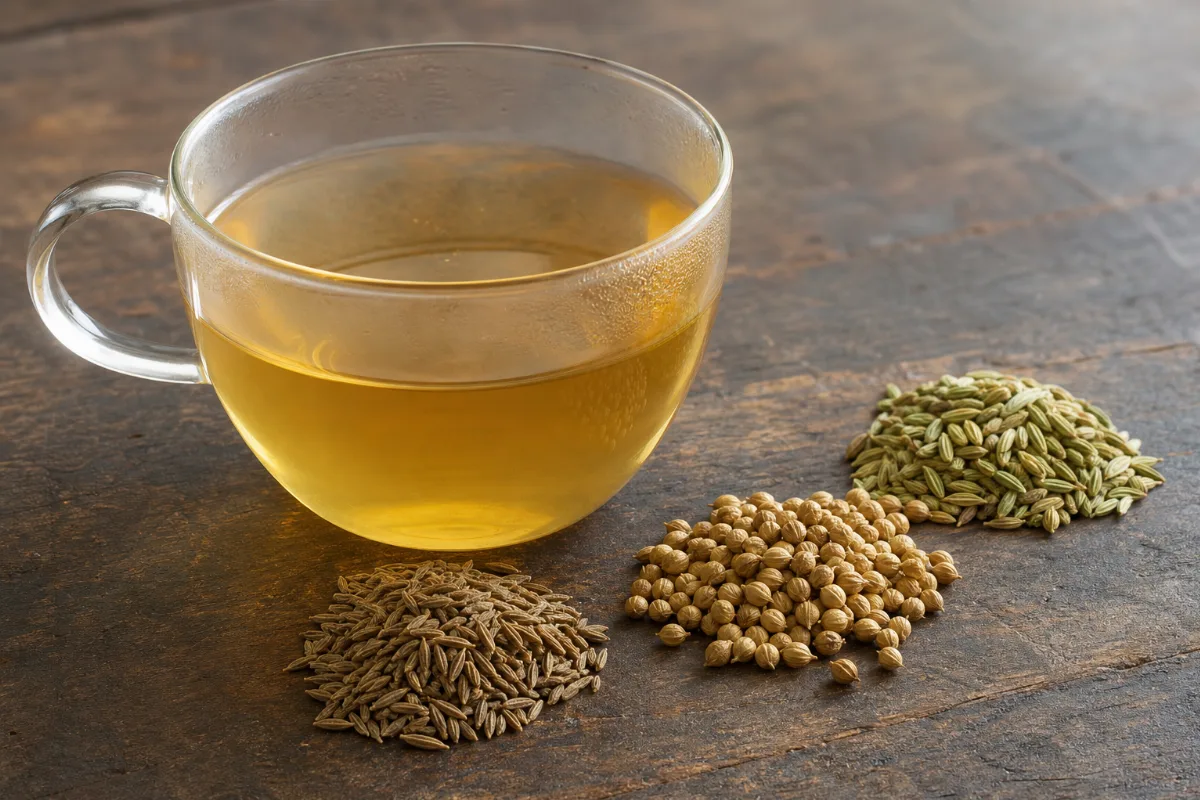
Herbal Teas & Extracts · Tea blend
Cumin, Coriander and Fennel (CCF) Tea
Cuminum cyminum L., Coriandrum sativum L. and Foeniculum vulgare Mill. · also called CCF tea, cumin coriander fennel seed tea, three-seed tea, comino cilantro hinojo
CCF tea is a herbal drink made from the dried seeds of cumin, coriander and fennel, spices common in Indian cooking and Ayurveda. We found no trial of the blend itself. Trials tested single seeds, mostly cumin as capsules, and one trial tested fennel tea alone after surgery. All three seeds are carrot-family plants, so people with that allergy should avoid it, and the EU does not recommend fennel preparations for children under 4 or in pregnancy.
General information, not medical advice. Last substantive update · Not medically reviewed. A named clinician has not signed off on this page. How this page is made
About Cumin, Coriander and Fennel (CCF) Tea
Cumin, coriander and fennel (CCF) tea is a herbal tea made from the dried seeds of three carrot-family spices. No trial of the blend was found. Cumin supplement trials show small and inconsistent changes in blood sugar, blood fats and weight, and fennel tea alone was followed by earlier bowel recovery in one trial after surgery. The main cautions are allergy to carrot-family plants, fennel's estragole (the EU limits fennel tea to 2 weeks in adults), pregnancy, breastfeeding, babies, and possible effects on blood sugar and hormone medicines.
What it is
CCF tea is made by steeping the dried seeds (technically the dried fruits) of cumin (Cuminum cyminum), coriander (Coriandrum sativum) and fennel (Foeniculum vulgare) in hot water. All three belong to the carrot or parsley family (Apiaceae), with anise, caraway, celery and dill. It is not true tea (Camellia sinensis).
No caffeine is expected, because none of the three is the tea plant. No source we read measured caffeine in this tea, so this is an inference. Blends sold as CCF tea may contain other herbs, so read the label.
What the research shows
We found no trial of the three-seed blend. The research is on single seeds. For cumin, several meta-analyses of capsule and extract trials found small improvements in blood fats, weight and waist size and, in two of three reviews, in fasting blood sugar. They disagree on how big the effects are, and the trials are small. For fennel, the EU accepts the tea as a traditional remedy for mild crampy stomach complaints, and one trial of 159 surgical patients found earlier bowel recovery with fennel tea than with water.
For coriander there is almost no human trial evidence: one small trial of coriander seed powder with garlic, and one capsule trial that combined it with a related plant that is not cumin. A Cochrane review rates the evidence for natural milk-boosters as low to very low.
Tea, extract, capsule and oil
A cup of tea is a weak water extract of the seeds. Most trials of cumin and coriander used capsules, extracts, powders or drops, and the fennel trial that tested tea used fennel alone. Essential oils of the three seeds are much more concentrated, are not drinks, and have their own safety limits. Results from one form should not be assumed for another. Any question about amounts is for your doctor or pharmacist.
Where it is used
A 2022 review names cumin, fennel and coriander among common Indian spices widely used in Ayurveda, the Indian traditional medicine system. The EU recognises fennel fruit tea as a traditional medicine in Europe. LactMed notes that cumin has been used, and coriander is purported, to increase milk supply. We did not find a source on the history or origin of the three-seed tea blend itself, so none is claimed.
What happens in the body
How the blend acts is not known. The seeds' main oils are linalool in coriander, cuminaldehyde in cumin and anethole (with a little estragole) in fennel, but no study read showed what these do in people drinking the tea. In the liver, fennel's estragole is turned into a reactive form, which is the basis for the EU's caution. A lab study of patient blood found shared allergens in anise, fennel, coriander and cumin, which explains why allergy to one can mean allergy to others.
At a glance
Traditional uses history, not proof
- India: a 2022 review names cumin, fennel and coriander among common spices widely used in Ayurveda; we did not find a source on this tea blend's own history
- Europe: the EU herbal committee lists fennel fruit tea as a traditional medicine for mild crampy stomach complaints with bloating and wind, based on long use
- Milk-supply tradition: LactMed says cumin has been used, and coriander is purported, to increase milk supply, with little trial support
Studied for research
- Mild crampy stomach complaints, bloating and wind (the tea), insufficient (traditional use; no trial of the blend)
- Bowel recovery after abdominal surgery (fennel tea; cumin capsules), low
- Blood sugar (cumin supplements), mixed
- Blood fats and weight (cumin supplements), low
- Breast milk supply, very low
- Period pain and infant colic (fennel, not the blend), low
Main compounds
- Linalool, the main compound of coriander seed oil (LactMed)
- Cuminaldehyde, a compound of cumin seed oil (LactMed)
- trans-Anethole, the main compound of fennel fruit oil, and a small amount of estragole, which causes liver tumours in rodents at high doses
- No caffeine expected: none of the three is the tea plant (an inference; no source measured it)
Common forms
- Herbal tea from the dried seeds, sold loose or in tea bags
- Blends that may contain other herbs, so the label matters
- Capsules, powders and extracts (most trials used these, and results do not carry over to tea)
- Essential oils of the three seeds (separate, concentrated products, not drinks)
Research links: EU herbal monograph on bitter fennel fruit (2024) · LactMed: cumin · LactMed: coriander · Meta-analysis of cumin on metabolic syndrome components (2025) · Fennel tea after gynaecological cancer surgery (2015) · Research Library · Genes & Biomarkers Library
What it is and its history
- Accepted scientific name
- Cuminum cyminum L., Coriandrum sativum L. and Foeniculum vulgare Mill. (three separate species)
- Naming authority
- All three names are accepted species in the GBIF backbone (keys 3034775, 3034871, 3034922).
- Common names
- Cumin (English); Coriander seed (cilantro is the leaf in US usage) (English); Fennel (English); Comino, cilantro (semilla de cilantro), hinojo (Spanish)
- Family or group
- Apiaceae, the carrot or parsley family, which also includes anise, caraway, celery and dill.
- Classification
- Plantae > Tracheophyta > Magnoliopsida > Apiales > Apiaceae > Cuminum; Coriandrum; Foeniculum > Cuminum cyminum; Coriandrum sativum; Foeniculum vulgare
- Look-alikes and adulterants
- Name: Black cumin (Nigella sativa); Note: A different plant (buttercup family) sometimes called black cumin or black seed.; Name: Bunium persicum; Note: Another carrot-family plant, called black or wild cumin in some places; used in the dyspepsia trial instead of Cuminum cyminum.; Name: Poison hemlock (Conium maculatum); Note: A poisonous carrot-family weed; never gather wild carrot-family seeds without expert identification.
Photographs
Traditional use and history history, not clinical proof
| Tradition or era | Documented use | Source |
|---|---|---|
| Ayurveda and Indian cooking | A 2022 review names cumin, fennel and coriander among common Indian spices widely used in Ayurveda, the Indian traditional medicine system. We did not find a source that describes the history of the three-seed tea itself or says where the blend name comes from. | p36438833 |
| European traditional use of fennel | The EU herbal committee accepts fennel fruit tea as a traditional herbal medicine for mild crampy stomach complaints, bloating and wind, based only on long use. | s-ema-hmpc-fennel-bitter |
| Milk-supply herbs | LactMed says cumin has been used as a milk-supply herb (galactagogue) and that coriander is a purported one with no valid clinical trials supporting it. | s-lactmed-cumin |
| Coriander as a digestive herb | A 2025 review lists coriander seed traditional uses as a digestive stimulant and carminative (wind reliever), among others. | p39719783 |
Traditional use shows how it was used. It does not show that it works or is safe today.
What is inside, and how it may work
What it contains and how those compounds act in cells and animals. Laboratory and animal mechanisms are not proven effects in people.
Main compounds
| Compound | Family | Where it is concentrated | Activity studied | Level of evidence |
|---|---|---|---|---|
| Linalool PubChem 6549 | terpene alcohol | Coriander seed (oil) LactMed says coriander seed oil consists mainly of linalool. Amounts in a cup of tea were not found. | Responsible for coriander's odour and taste (LactMed). No activity data were read for this page. 35 38 7 | None read |
| Cuminaldehyde PubChem 326 | aromatic aldehyde | Cumin seed (oil) LactMed says cumin seed oil contains cuminaldehyde and other aldehydes. Amounts in tea were not found. | No activity data were read for this page. 36 38 | None read |
| trans-Anethole PubChem 637563 | phenylpropanoid (aromatic ether) | Fennel fruit (oil) The main compound of fennel fruit oil (as read earlier for our fennel tea review). Amount in tea not measured in sources read. | LactMed describes anethole as a phytoestrogen that passes into breast milk; the EU monographs list allergy to anethole as a reason to avoid fennel. 37 38 30 31 | Summary only |
| Estragole PubChem 8815 | phenylpropanoid | Fennel fruit (minor part of the oil) Estragole is a small share of fennel oil (draft EMA statement). Not measured in this blend. | Causes liver tumours in rodents at high doses; the reason for the EU limits on fennel tea. 29 38 | Animal research |
Mechanisms, receptors and pathways
| Target or pathway | Gene or receptor | What was found | Level |
|---|---|---|---|
| Allergen cross-reactivity (Bet v 1-like proteins and profilin) | IgE antibodies binding Bet v 1-like and profilin-like allergens | In serum from 15 patients with reactions to spiced food, cross-reacting allergens were found in anise, fennel, coriander and cumin extracts. IgE binding was seen only in the 10 patients with pollen or celeriac allergy. 11 | In vitro (human serum) |
| Liver activation of estragole | Liver enzymes (as described in the EMA statement) | Estragole is turned into a reactive form in the liver, which is the basis of the rodent tumour findings. 29 | Animal research |
Absorption, metabolism and elimination
- Absorption
- No blood-level study of any compound from this blend was found.
- Distribution
- LactMed says no data exist on excretion of cumin components into breast milk; the EU fennel monographs say anethole is excreted in human milk.
- Metabolism
- No study read for the blend. For fennel, the liver activates estragole (EMA statement).
- Elimination
- Not studied for the blend.
- Bioavailability
- Not measured for any compound in this blend in people.
Isolated compounds versus whole extracts
Tea, capsules, extracts, drops and essential oils are very different exposures. Most trials of cumin and coriander tested capsules, extracts, powders or drops, and the fennel trial that tested tea used fennel alone. The essential oils are concentrated products and are not drinks. Results from one form cannot be assumed for another.
Nutritional composition
A cup of this tea is an infusion of the dried seeds in water; the sources read did not measure its nutrients, caffeine or compounds.
1 mixed findings5 low certainty3 very low certainty1 not enough evidence
What was looked at
The 10 benefits and uses checked for Cumin, Coriander and Fennel (CCF) Tea, each with how strong the evidence is. Tap one to open it.
- Mild crampy stomach complaints, bloating and wind: the three-seed tea (traditional use only)Not enough evidence
- Long-lasting indigestion (functional dyspepsia): a capsule of coriander plus a related plant (not tea)Very low certainty
- Bowel recovery after abdominal surgery: fennel tea and cumin extract capsules (separately)Low certainty
- Blood sugar (cumin supplements, not the blend)Mixed findings
- Blood fats: cumin supplements, and a garlic and coriander powder trialLow certainty
- Weight and waist size (cumin capsules)Low certainty
- Breast milk supply (cumin drops; fennel and coriander in milk-supply teas)Very low certainty
- Appetite (fennel tea, one small trial)Very low certainty
- Infant colic (fennel products, not the blend)Low certainty
- Period pain (fennel and other Apiaceae seeds, mostly capsules)Low certainty
Lab markers tracked in the studies
Time to first wind (flatus) after abdominal surgeryFasting blood sugarTotal cholesterol
What is Cumin, Coriander and Fennel (CCF) Tea good for?
The main studied uses and how strong the evidence is for each. No study tested the three-seed blend, so each row says which single seed and which form was tested. 'Insufficient' means no usable trial; 'low' means small trials of a different form; 'very low' means one small or indirect study; 'mixed' means studies disagree.
Benefits, one by one
Each card is a research question, not a promise. Tap a goal to filter. Open a card to see the studies, doses and limits.
Mild crampy stomach complaints, bloating and wind: the three-seed tea (traditional use only)
Not enough evidencePeople drink cumin, coriander and fennel tea after meals for bloating and wind. No trial of the blend as a tea was found. The EU accepts fennel fruit tea alone as a traditional remedy for mild crampy stomach complaints, bloating and wind, based on long use, not on trials.
3 studiesTrials used capsules, powders, extracts or drops of one or two seeds,…
Studies, doses and limits
What the trials found
No randomised trial of the cumin, coriander and fennel tea blend was found in PubMed. For fennel alone, the EU accepts the tea as traditional use. For cumin and coriander, the closest human data are the capsule trials listed below.
Results
No human trial of the three-seed tea for stomach or bowel complaints.
Why this rating
The blend has never been tested, and the EU view of fennel tea rests only on long use.
Form and dose studied
Trials used capsules, powders, extracts or drops of one or two seeds, not the three-seed tea. Amounts are not given here: ask a doctor or pharmacist.
Who was studied
Adults and adolescents. The EU does not recommend fennel fruit preparations under 4 years and limits them at 4 to 12.
Limits
Traditional use is not proof of benefit. Most mild stomach upsets pass without treatment.
Why researchers looked
The three seeds are classic after-meal spices in Indian cooking and Ayurveda, and fennel is also a classic digestive herb in Europe.
Traditional use
The EU herbal committee lists fennel fruit tea (bitter and sweet fennel monographs, revised January 2024) as a traditional herbal medicine for mild, spasmodic stomach and bowel complaints including bloating and wind, 'exclusively based upon long-standing use'. A 2022 review names cumin, fennel and coriander among common spices used in Ayurveda. We did not find a source that describes the CCF tea's own history.
Proposed mechanism None found
No mechanism was found for the blend. For the single seeds, only lab or animal work exists and it was not read for this page.
A proposed mechanism does not show that the effect happens in people.
The EU limits fennel fruit tea to 2 weeks in adults and says to see a doctor if symptoms persist or get worse.
Long-lasting indigestion (functional dyspepsia): a capsule of coriander plus a related plant (not tea)
Very low certaintyOne trial of 90 adults found that a capsule containing coriander and a related plant eased indigestion more than placebo. The related plant, Bunium persicum, is not cumin, and it was not a tea.
2 studiesTrials used capsules, powders, extracts or drops of one or two seeds,…
Studies, doses and limits
What the trials found
Azimi 2024: 90 adults with functional dyspepsia in Iran took a twice-daily capsule of Bunium persicum plus coriander or placebo for 4 weeks and were followed for 4 more weeks (40 per group finished). All clinical outcomes improved more than placebo, with no serious side effects.
Results
Improvement in symptom severity, frequency and quality of life versus placebo. The abstract gives no numbers.
Effect sizes as reported
Not given in the abstract.
Why this rating
One trial, 80 completers, no effect sizes in the abstract, a two-herb capsule that does not contain cumin or fennel.
Form and dose studied
Trials used capsules, powders, extracts or drops of one or two seeds, not the three-seed tea. Amounts are not given here: ask a doctor or pharmacist.
Who was studied
Adults with functional dyspepsia (excluded pregnancy, lactation and herb allergy).
Limits
Bunium persicum is a different plant. Single centre. Not tea. No numbers available to judge the size of the effect.
Why researchers looked
A 2025 review lists coriander seed as a traditional digestive stimulant and carminative (wind reliever).
Traditional use
Not described in the sources read.
Proposed mechanism None found
No mechanism was found for the blend. For the single seeds, only lab or animal work exists and it was not read for this page.
A proposed mechanism does not show that the effect happens in people.
No serious side effects were reported in the trial.
Bowel recovery after abdominal surgery: fennel tea and cumin extract capsules (separately)
Low certaintyIn two small trials, patients recovered bowel movement sooner with fennel tea (compared with water) or with cumin extract capsules (compared with placebo). Neither trial tested the three-seed blend.
2 studiesFennel fruit tea in the first trial; cumin extract capsules in the se…
Studies, doses and limits
What the trials found
Ma 2015: 159 women after gynaecological cancer surgery in China drank fennel fruit tea or plain water twice a day until first wind. Amin 2024: 74 patients after abdominal surgery in Iran took cumin extract capsules or placebo capsules in the hours after surgery.
Results
Fennel tea: time to first wind 53.1 versus 64.2 hours, time to first stool 4.3 versus 5.4 days, hospital stay 5.6 versus 6.7 days, ileus symptoms more common with water (RR 2.6). Cumin extract: time to passing gas 9.03 versus 11.72 hours and to stool 16.97 versus 26 hours; less pain, bloating, nausea and vomiting.
Effect sizes as reported
Fennel tea: flatus 53.1 vs 64.2 h. Cumin extract: gas 9.03 vs 11.72 h.
Why this rating
Two small single-centre trials of two different single seeds, one compared with water (not blinded) and one with placebo; the cumin abstract prints its p value as P > 0.001, a likely typo.
Form and dose studied
Fennel fruit tea in the first trial; cumin extract capsules in the second. Amounts not given here.
Who was studied
Adults after abdominal surgery under medical care.
Limits
Hospital setting; a tea of the blend was not tested; results may not apply to healthy people at home. Cochrane-level reviews were not found.
Why researchers looked
After abdominal surgery the bowel can stall (ileus), and herbs with a long carminative reputation were tried to speed recovery.
Traditional use
Not found.
Proposed mechanism None found
No mechanism was found for the blend. For the single seeds, only lab or animal work exists and it was not read for this page.
A proposed mechanism does not show that the effect happens in people.
No safety problems were mentioned in the abstracts, but they are short. Do not use herbs after surgery without asking the surgical team.
Blood sugar (cumin supplements, not the blend)
Mixed findingsReviews of cumin supplement trials disagree. Two found lower fasting blood sugar and one found no clear change. None tested a tea.
3 studiesTrials used capsules, powders, extracts or drops of one or two seeds,…
Studies, doses and limits
What the trials found
Three meta-analyses of randomised trials of cumin supplements. Karimian 2021 pooled 8 trials with 552 adults. Tavakoli-Rouzbehani 2021 pooled 8 studies. Liu 2025 pooled 9 trials in adults with metabolic disorders.
Results
Fasting blood sugar fell in two reviews (SMD -1.4 in 2021; SMD -1.38 in 2025) and HbA1c fell in one (SMD -1.71). The 2021 Karimian review found no significant change in fasting blood sugar (-17.77 mg/dl, 95% CI -36.42 to 0.87), insulin or HOMA-IR.
Effect sizes as reported
FBS SMD -1.38 (Liu 2025); WMD -17.77 mg/dl, not significant (Karimian 2021)
Why this rating
Reviews of mostly small trials disagree, with very high heterogeneity (I2 about 95% in the 2025 review).
Form and dose studied
Trials used capsules, powders, extracts or drops of one or two seeds, not the three-seed tea. Amounts are not given here: ask a doctor or pharmacist.
Who was studied
Adults with diabetes, metabolic syndrome or other disorders.
Limits
Mostly small supplement trials; high heterogeneity; no trial of cumin tea. Effects on blood sugar also mean a possible interaction with diabetes medicines (see the safety tab).
Why researchers looked
Cumin is a traditional herbal medicine, and trials tested it in people with diabetes or metabolic syndrome.
Traditional use
Not found in the sources read.
Proposed mechanism None found
No mechanism was found for the blend. For the single seeds, only lab or animal work exists and it was not read for this page.
A proposed mechanism does not show that the effect happens in people.
If cumin lowers blood sugar, it could add to the effect of diabetes medicines. This has not been studied for the tea.
Blood fats: cumin supplements, and a garlic and coriander powder trial
Low certaintyReviews found small improvements in cholesterol and triglycerides with cumin supplements. One small trial of coriander seed powder also found lower blood fats. None tested the tea.
4 studiesTrials used capsules, powders, extracts or drops of one or two seeds,…
Studies, doses and limits
What the trials found
Hadi 2018: 6 trials, 376 adults. Tavakoli-Rouzbehani 2022: 8 trials. Liu 2025: 9 trials. Zeb 2018: 80 patients with high blood fats, 20 per group, given garlic powder, coriander seed powder, both, or placebo.
Results
Cumin: total cholesterol -10.90 mg/dl and LDL -6.94 mg/dl, HDL +3.35 mg/dl (2018); total cholesterol -3.96 mg/dl (2022); triglycerides -0.58 SMD and HDL +0.77 SMD (2025). Coriander seed powder improved BMI, cholesterol, triglycerides and systolic blood pressure compared with placebo (no numbers in abstract).
Effect sizes as reported
Total cholesterol -10.90 mg/dl (2018) versus -3.96 mg/dl (2022)
Why this rating
Several reviews agree in direction but the size of effect differs between them, trials are small, and the coriander trial gave no numbers.
Form and dose studied
Trials used capsules, powders, extracts or drops of one or two seeds, not the three-seed tea. Amounts are not given here: ask a doctor or pharmacist.
Who was studied
Adults with high blood fats or metabolic problems.
Limits
Mostly capsule trials from a few countries; no trial of tea; the coriander trial had only 20 people per group and its abstract does not describe blinding.
Why researchers looked
Cumin and coriander seeds were tested for blood fats in small trials.
Traditional use
Not found in the sources read.
Proposed mechanism None found
No mechanism was found for the blend. For the single seeds, only lab or animal work exists and it was not read for this page.
A proposed mechanism does not show that the effect happens in people.
No safety problems were highlighted in the abstracts.
Weight and waist size (cumin capsules)
Low certaintyIn one 8-week trial in overweight adults, cumin capsules lowered weight about as much as the drug orlistat. Reviews found small drops in BMI and waist size. No trial tested the tea.
3 studiesTrials used capsules, powders, extracts or drops of one or two seeds,…
Studies, doses and limits
What the trials found
Taghizadeh 2015: 78 overweight adults, three groups, 8 weeks. Reviews: Tavakoli-Rouzbehani 2022 (8 trials) and Liu 2025 (9 trials).
Results
Weight changed by -1.1 kg with cumin, -0.9 kg with orlistat and +0.2 kg with placebo; BMI -0.4, -0.4 and +0.1. Reviews: BMI -0.88 kg/m2 (2022); waist circumference lower (SMD -0.46, 2025).
Effect sizes as reported
Weight -1.1 kg versus +0.2 kg on placebo
Why this rating
Small trials and reviews with high heterogeneity; changes are small.
Form and dose studied
Trials used capsules, powders, extracts or drops of one or two seeds, not the three-seed tea. Amounts are not given here: ask a doctor or pharmacist.
Who was studied
Overweight or obese adults.
Limits
Capsule trials, 8 weeks; no tea trial; no long-term follow-up.
Why researchers looked
Cumin was tested for weight and metabolic markers in adults.
Traditional use
Not found.
Proposed mechanism None found
No mechanism was found for the blend. For the single seeds, only lab or animal work exists and it was not read for this page.
A proposed mechanism does not show that the effect happens in people.
No safety problems were highlighted in the abstracts.
Breast milk supply (cumin drops; fennel and coriander in milk-supply teas)
Very low certaintyCumin, fennel and coriander are traditional milk-supply herbs, but good evidence is lacking. One Iranian trial of cumin drops reported higher milk indicators. A Cochrane review is very uncertain about fennel.
5 studiesDrops (cumin) and teas of other blends. Amounts not given here.
Studies, doses and limits
What the trials found
Farshad 2024: 117 breastfeeding mothers took cumin drops, nettle drops or placebo for 4 weeks. Foong 2020 (Cochrane): 41 trials of galactagogues. Wagner 2019: 60 women drank a fennel, anise, coriander and fenugreek tea or placebo, a safety trial in women without supply problems.
Results
Cumin drops: infant weight, feeds, wet diapers and stool frequency were all higher than with placebo (P<0.001) and higher than with nettle. Cochrane: very uncertain whether fennel or fenugreek improves infant weight; milk volume results ranged from benefit to little or no difference (very low certainty). The tea safety trial measured safety, not supply.
Effect sizes as reported
No usable effect size.
Why this rating
Very-low-certainty Cochrane evidence; the cumin trial used drops and indirect indicators; nothing tested the three-seed tea.
Form and dose studied
Drops (cumin) and teas of other blends. Amounts not given here.
Who was studied
Breastfeeding mothers of healthy term infants.
Limits
Only one trial of cumin; coriander has no valid trials per LactMed; the tea blend tested for safety contained other herbs and no cumin.
Why researchers looked
All three seeds are traditional milk-booster herbs, and they appear in commercial milk-supply teas.
Traditional use
LactMed says cumin has been used as a galactagogue, and that coriander is a purported galactagogue with no scientifically valid clinical trials to support the use.
Proposed mechanism None found
No mechanism was found for the blend. For the single seeds, only lab or animal work exists and it was not read for this page.
A proposed mechanism does not show that the effect happens in people.
See the safety tab. LactMed notes no data on cumin in breast milk, and a possible endocrine case with heavy coriander extract use.
Appetite (fennel tea, one small trial)
Very low certaintyIn nine overweight women, fennel tea lowered hunger and raised fullness ratings for one meal, but they did not eat less at lunch. This was fennel alone.
1 studiesFennel tea in the trial. Amounts not given here.
Studies, doses and limits
What the trials found
Bae 2015: nine overweight Korean women in a three-way crossover (fennel tea, fenugreek tea, placebo tea).
Results
Hunger and prospective food consumption fell and fullness rose with fennel tea compared with placebo tea (p<0.05). Food eaten at the lunch buffet did not differ.
Effect sizes as reported
Ratings improved; food intake no different
Why this rating
Nine people, one meal, subjective ratings, and fennel alone.
Form and dose studied
Fennel tea in the trial. Amounts not given here.
Who was studied
Overweight women.
Limits
Tiny crossover trial; a different tea from the blend.
Why researchers looked
Fennel seed is traditionally linked to appetite and digestion.
Traditional use
Not found.
Proposed mechanism None found
No mechanism was found for the blend. For the single seeds, only lab or animal work exists and it was not read for this page.
A proposed mechanism does not show that the effect happens in people.
No adverse effects were mentioned in the abstract.
Infant colic (fennel products, not the blend)
Low certaintyFennel is a classic remedy for babies with colic, but the best review says herbal agents cannot be recommended. Cumin and coriander were not tested for colic in anything we read. Babies need special care with herbal teas.
3 studiesNot applicable here. Ask a paediatrician about colic.
Studies, doses and limits
What the trials found
Biagioli 2016 (Cochrane): 18 small trials of 1014 infants.
Results
Herbal agents showed low-quality evidence of shorter crying (MD 1.33) and moderate-quality evidence of more responders (RR 2.05, 95% CI 1.56 to 2.70), but all studies were small and at high risk of bias. The review concluded herbal agents cannot be recommended for infants with colic.
Effect sizes as reported
Responders RR 2.05 (95% CI 1.56 to 2.70)
Why this rating
All trials small and biased; the herbal products were not this tea.
Who was studied
Infants under 4 months.
Limits
The reviewers advise against recommending herbal agents; this page does not suggest giving the blend to babies.
Why researchers looked
Fennel tea is a traditional European remedy for nursing babies with gas.
Traditional use
The EU does not recommend fennel fruit preparations in children under 4 years because of lack of data.
Proposed mechanism None found
No mechanism was found for the blend. For the single seeds, only lab or animal work exists and it was not read for this page.
A proposed mechanism does not show that the effect happens in people.
See the safety tab for baby cautions, including estragole in fennel.
Period pain (fennel and other Apiaceae seeds, mostly capsules)
Low certaintyA 2026 review pooled trials of carrot-family seeds, including fennel and dill, against painkillers for period pain and found a positive pooled result. It does not say which trials used cumin, and the trials were not of tea.
1 studiesMostly capsules and extracts.
Studies, doses and limits
What the trials found
Thaliyil Poduval 2026: 14 randomised trials, 7 in the meta-analysis, mostly compared with mefenamic acid or ibuprofen.
Results
Pooled results against standard treatments were statistically positive with low heterogeneity, including for fennel seed and dill seed. The authors call the herbs potentially effective add-on treatments.
Effect sizes as reported
Significant pooled effect against standard painkillers (no numbers in abstract)
Why this rating
Review of trials with some concerns about reporting; mostly compared with painkillers, not placebo; not tea.
Form and dose studied
Mostly capsules and extracts.
Who was studied
Young women with primary dysmenorrhea.
Limits
The abstract does not list which trials used cumin; the three-seed blend was not tested.
Why researchers looked
Fennel and cumin are traditional remedies for period pain.
Traditional use
Not found.
Proposed mechanism None found
No mechanism was found for the blend. For the single seeds, only lab or animal work exists and it was not read for this page.
A proposed mechanism does not show that the effect happens in people.
See the safety tab for pregnancy, allergy and hormone cautions.
Connections to the rest of health
How Cumin, Coriander and Fennel (CCF) Tea connects to the rest of our health knowledge graph. Every link says what kind of connection it is. A safety link (for example to the liver) is a warning, not a benefit. A study that merely mentions a topic never creates a benefit link.
Explore every connection: goals, body systems, organs, symptoms, genes
A. Wellness goals
| Connected to | Kind of connection | Evidence status | Context | Studies |
|---|---|---|---|---|
| Digestive Support | Not enough evidence | Mild crampy stomach complaints, bloating and wind: the three-seed tea (traditional use only): People drink cumin, coriander and fennel tea after meals for bloating and wind. No trial of the blend as a tea was found. The EU accepts fennel fruit tea alone as a traditional remedy for mild crampy stomach complaints, bloating and wind, based on long use, not on trials. | 30 31 18 | |
| Gut Health | Not enough evidence | Mild crampy stomach complaints, bloating and wind: the three-seed tea (traditional use only): People drink cumin, coriander and fennel tea after meals for bloating and wind. No trial of the blend as a tea was found. The EU accepts fennel fruit tea alone as a traditional remedy for mild crampy stomach complaints, bloating and wind, based on long use, not on trials. | 30 31 18 | |
| Digestive Support | Potential benefit | Very low certainty | Long-lasting indigestion (functional dyspepsia): a capsule of coriander plus a related plant (not tea): One trial of 90 adults found that a capsule containing coriander and a related plant eased indigestion more than placebo. The related plant, Bunium persicum, is not cumin, and it was not a tea. Bowel recovery after abdominal surgery: fennel tea and cumin extract capsules (separately): In two small trials, patients recovered bowel movement sooner with fennel tea (compared with water) or with cumin extract capsules (compared with placebo). Neither trial tested the three-seed blend. | 3 7 16 2 |
| Gut Health | Potential benefit | Low certainty | Bowel recovery after abdominal surgery: fennel tea and cumin extract capsules (separately): In two small trials, patients recovered bowel movement sooner with fennel tea (compared with water) or with cumin extract capsules (compared with placebo). Neither trial tested the three-seed blend. | 16 2 |
| Blood Sugar Balance | Potential benefit | Mixed findings | Blood sugar (cumin supplements, not the blend): Reviews of cumin supplement trials disagree. Two found lower fasting blood sugar and one found no clear change. None tested a tea. | 13 23 15 |
| Metabolic Health | Potential benefit | Mixed findings | Blood sugar (cumin supplements, not the blend): Reviews of cumin supplement trials disagree. Two found lower fasting blood sugar and one found no clear change. None tested a tea. Weight and waist size (cumin capsules): In one 8-week trial in overweight adults, cumin capsules lowered weight about as much as the drug orlistat. Reviews found small drops in BMI and waist size. No trial tested the tea. | 13 23 15 22 24 |
| Cholesterol Balance | Potential benefit | Low certainty | Blood fats: cumin supplements, and a garlic and coriander powder trial: Reviews found small improvements in cholesterol and triglycerides with cumin supplements. One small trial of coriander seed powder also found lower blood fats. None tested the tea. | 10 24 15 28 |
| Heart Health | Potential benefit | Low certainty | Blood fats: cumin supplements, and a garlic and coriander powder trial: Reviews found small improvements in cholesterol and triglycerides with cumin supplements. One small trial of coriander seed powder also found lower blood fats. None tested the tea. | 10 24 15 28 |
| Weight Management | Potential benefit | Low certainty | Weight and waist size (cumin capsules): In one 8-week trial in overweight adults, cumin capsules lowered weight about as much as the drug orlistat. Reviews found small drops in BMI and waist size. No trial tested the tea. Appetite (fennel tea, one small trial): In nine overweight women, fennel tea lowered hunger and raised fullness ratings for one meal, but they did not eat less at lunch. This was fennel alone. | 22 24 15 4 |
| Womens Wellness | Very low certainty | Breast milk supply (cumin drops; fennel and coriander in milk-supply teas): Cumin, fennel and coriander are traditional milk-supply herbs, but good evidence is lacking. One Iranian trial of cumin drops reported higher milk indicators. A Cochrane review is very uncertain about fennel. | 8 9 27 36 35 | |
| Digestive Support | Low certainty | Infant colic (fennel products, not the blend): Fennel is a classic remedy for babies with colic, but the best review says herbal agents cannot be recommended. Cumin and coriander were not tested for colic in anything we read. Babies need special care with herbal teas. | 6 30 31 | |
| Womens Wellness | Potential benefit | Low certainty | Period pain (fennel and other Apiaceae seeds, mostly capsules): A 2026 review pooled trials of carrot-family seeds, including fennel and dill, against painkillers for period pain and found a positive pooled result. It does not say which trials used cumin, and the trials were not of tea. | 26 |
| Pain Relief | Potential benefit | Low certainty | Period pain (fennel and other Apiaceae seeds, mostly capsules): A 2026 review pooled trials of carrot-family seeds, including fennel and dill, against painkillers for period pain and found a positive pooled result. It does not say which trials used cumin, and the trials were not of tea. | 26 |
B. Body systems
| Connected to | Kind of connection | Evidence status | Context | Studies |
|---|---|---|---|---|
| Digestive system | Not enough evidence | Fennel tea is accepted by the EU for mild stomach complaints on traditional use; small trials of single seeds after surgery; no trial of the blend. Preparation or compound: Cumin, coriander and fennel seeds |
30 31 16 2 | |
| Digestive System | Biological association | Not enough evidence | Studied for: Mild crampy stomach complaints, bloating and wind: the three-seed tea (traditional use only) Studied for: Long-lasting indigestion (functional dyspepsia): a capsule of coriander plus a related plant (not tea) | 30 31 18 3 7 16 2 6 |
| Blood Sugar Support | Biological association | Mixed findings | Studied for: Blood sugar (cumin supplements, not the blend) | 13 23 15 |
| Endocrine System | Biological association | Mixed findings | Studied for: Blood sugar (cumin supplements, not the blend) | 13 23 15 |
| Cardiovascular System | Biological association | Low certainty | Studied for: Blood fats: cumin supplements, and a garlic and coriander powder trial | 10 24 15 28 |
| Metabolism Weight | Biological association | Low certainty | Studied for: Blood fats: cumin supplements, and a garlic and coriander powder trial Studied for: Weight and waist size (cumin capsules) | 10 24 15 28 22 4 |
| Reproductive System | Biological association | Very low certainty | Studied for: Breast milk supply (cumin drops; fennel and coriander in milk-supply teas) Studied for: Period pain (fennel and other Apiaceae seeds, mostly capsules) | 8 9 27 36 35 26 |
E. Health conditions
| Connected to | Kind of connection | Evidence status | Context | Studies |
|---|---|---|---|---|
| Carrot-family (Apiaceae) allergy | Contraindication | Low certainty | Cross-reacting allergens in all three; EU lists Apiaceae allergy as a contraindication for fennel. Preparation or compound: Cumin, coriander, fennel seeds |
11 5 30 31 |
| Diabetes | Drug or supplement interaction | Very low certainty | Mixed meta-analyses on fasting blood sugar; possible additive effect with diabetes medicines. Preparation or compound: Cumin supplements |
15 13 23 |
| Pregnancy and breastfeeding | Contraindication | Low certainty | EU does not recommend fennel fruit preparations in pregnancy or breastfeeding; LactMed has no data on cumin and describes one possible adrenal case with heavy coriander extract. Preparation or compound: Fennel fruit tea; cumin and coriander (no data) |
30 31 36 35 |
| Infants and children | Contraindication | Low certainty | Not recommended under 4 years in the EU monographs. Preparation or compound: Fennel fruit tea |
30 31 6 |
I. Biomarkers
| Connected to | Kind of connection | Evidence status | Context | Studies |
|---|---|---|---|---|
| Time to first wind (flatus) after abdominal surgery | Biological association | Low certainty | Measured in trials: lowered. A lab change is not the same as a health benefit. | 16 2 |
| Fasting blood sugar | Biological association | Mixed findings | Measured in trials: mixed. A lab change is not the same as a health benefit. | 15 13 23 |
| Total cholesterol | Biological association | Low certainty | Measured in trials: lowered. A lab change is not the same as a health benefit. | 10 24 |
L. Active compounds
| Connected to | Kind of connection | Evidence status | Context | Studies |
|---|---|---|---|---|
| Linalool | Biological association | None read | Responsible for coriander's odour and taste (LactMed). No activity data were read for this page. Preparation or compound: Coriander seed (oil) |
35 38 7 |
| Cuminaldehyde | Biological association | None read | No activity data were read for this page. Preparation or compound: Cumin seed (oil) |
36 38 |
| trans-Anethole | Biological association | Summary only | LactMed describes anethole as a phytoestrogen that passes into breast milk; the EU monographs list allergy to anethole as a reason to avoid fennel. Preparation or compound: Fennel fruit (oil) |
37 38 30 31 |
| Estragole | Biological association | Animal | Causes liver tumours in rodents at high doses; the reason for the EU limits on fennel tea. Preparation or compound: Fennel fruit (minor part of the oil) |
29 38 |
Each connection is stored with the ingredient, the connected record, the kind of connection, the evidence status, the supporting studies, the preparation or compound involved, and a review date (last reviewed October 25, 2026).
The evidence
The research centre for Cumin, Coriander and Fennel (CCF) Tea. Every record here was checked against PubMed or the publisher's page; we never list a study we have not verified.
Evidence by outcome
Bars show how many studies we found for each outcome, not how well it works. People are added up across trials only (reviews are not added, to avoid double counting).
How we rate evidence
High certainty
Several well-run trials or reviews agree; further research is unlikely to change the picture much.
Moderate certainty
Good trials point the same way, but some doubt remains.
Low certainty
Small, short or inconsistent trials. The finding could change with better research.
Very low certainty
Very little or very weak human data. Treat as a possibility only.
Mixed findings
Trials or reviews disagree with each other.
Not enough evidence
Not enough human research to say either way.
Evidence against
Good research found no benefit, or found harm.
We take the reviewers' own risk-of-bias and GRADE statements where they exist, and otherwise judge from study size, design, consistency, directness and whether a product matches what is sold. Many publications do not make evidence high. Method note: We searched PubMed for the blend and for each seed, read the cited abstracts directly, checked plant names through GBIF and compound records through PubChem, and read the LactMed entries for cumin and coriander. The EU fennel monographs and estragole statement were read earlier for our fennel tea review and are reused here. EU monographs for cumin and coriander, LiverTox, NCCIH, Commission E and WHO entries were not read. The no-caffeine statement is an inference and is labelled so.
Study library: every study we checked 38
| Study | Design | People | Product, dose, length | Result |
|---|---|---|---|---|
| Abeyagunawardena 2024 Uncommon triggers of insulin autoimmune syndrome: a case report. J Med Case Rep · PMID 38926797 · DOI |
Case report human (case) |
1 A 67-year-old man with recurrent low blood sugar |
Omeprazole, and an herbal supplement containing coriander and ginger extracts taken daily for about a year, about two years earlier coriander and ginger extracts not shown here About 1 year · vs placebo |
Insulin autoimmune syndrome was diagnosed; omeprazole was the likely trigger, and the authors say coriander and ginger are worth considering as a possible association. Single case; cause not proven (not applicable) Methods, limits and fundingOutcomes: Low blood sugar episodes Limitations: Single case; the coriander link is speculative. Only the abstract was read. Read: abstract |
| Amin 2024 The effect of Cuminum cyminum on the return of bowel motility after abdominal surgery: a triple-blind randomized clinical trial. BMC Complement Med Ther · PMID 38965524 · DOI |
Triple blind randomized trial |
74 74 patients after abdominal surgery in Iran |
Cumin (Cuminum cyminum L.) extract capsules seed extract not shown here Two capsules in the hours after surgery · vs placebo |
Average time to passing gas was 9.03 h with cumin versus 11.72 h with placebo, and time to defecation 16.97 h versus 26 h. Pain, bloating, nausea and vomiting were less frequent with cumin. Gas passing 9.03 vs 11.72 h; defecation 16.97 vs 26 h (not given in abstract) Methods, limits and fundingOutcomes: Time to passing wind and first stool, pain, bloating, nausea, vomiting Limitations: Single trial; capsules of an extract, not tea; the abstract prints the p value as P > 0.001, a likely typo. The authors say more studies are needed. Only the abstract was read. Read: abstract |
| Azimi 2024 The Efficacy of the Herbal Formula of Bunium persicum and Coriandrum sativum on Clinical Symptoms of Patients with Functional Dyspepsia: A Double-Blind Randomized Controlled Trial. Complement Med Res · PMID 38981452 · DOI |
Double blind randomized placebo controlled trial |
90 90 adults with functional dyspepsia (Rome IV) in Kerman, Iran; 80 analysed |
Capsule of Bunium persicum (a different plant, sometimes called black or wild cumin) plus coriander (Coriandrum sativum L.) seed (as stated for the formula) not shown here 4 weeks, followed for 4 more · vs placebo |
All clinical outcomes improved significantly more than placebo, without serious side effects. The abstract gives no numbers. Improved versus placebo (no numbers in abstract) (not given in abstract) Methods, limits and fundingOutcomes: Dyspepsia severity, symptom frequency and quality of life Limitations: Bunium persicum is not Cuminum cyminum, so this is not a trial of cumin; two-herb capsule, not tea; single centre; no effect sizes in the abstract. Only the abstract was read. Read: abstract |
| Bae 2015 Fennel (Foeniculum vulgare) and Fenugreek (Trigonella foenum-graecum) Tea Drinking Suppresses Subjective Short-term Appetite in Overweight Women. Clin Nutr Res · PMID 26251835 · DOI |
Randomized single blind placebo controlled crossover trial |
9 Nine healthy overweight Korean women |
Fennel tea, fenugreek tea or placebo tea fennel fruit not shown here One drink each, one meal · vs placebo |
Fennel tea lowered hunger and raised fullness ratings compared with placebo tea (p<0.05), but food eaten at lunch did not differ. Ratings improved; food intake no different (not given in abstract) Methods, limits and fundingOutcomes: Subjective hunger and fullness; lunch buffet intake Limitations: Only nine women; one meal; subjective ratings; fennel alone, not the blend. Only the abstract was read. Funding and conflicts: No conflict declared in the earlier review of this paper Read: abstract |
| Berghea 2025 Spices, herbs and allergic reactions in children: myth or reality - a narrative review with scoping elements. Front Allergy · PMID 41306764 · DOI |
Narrative review human (review) |
Children (some adult cases for context) | Spices and herbs including coriander, fennel, cumin and anise seed (spices) not shown here · vs placebo |
Spice allergies in children range from mild mouth reactions to anaphylaxis. Coriander, fennel, cumin and anise are among the most frequently implicated spices; cross-reactivity with birch and mugwort pollen is common. Narrative (not applicable) Methods, limits and fundingOutcomes: Allergic reactions Limitations: Narrative review. Only the abstract was read. Read: abstract |
| Biagioli 2016 Pain-relieving agents for infantile colic. Cochrane Database Syst Rev · PMID 27631535 · DOI |
Cochrane systematic review |
1014 Infants under 4 months with colic; 18 small RCTs of 1014 infants |
Herbal agents, simethicone, sugars and drugs various not shown here Various · vs placebo |
Evidence is sparse and prone to bias. Herbal agents showed low-quality evidence of shorter crying and moderate-quality evidence of more responders, but the review concluded herbal agents, sugar, dicyclomine and cimetropium cannot be recommended for infants with colic. Herbal agents: more responders (RR 2.05) but not recommended (Responders 95% CI 1.56 to 2.70) Methods, limits and fundingOutcomes: Crying time and response Limitations: All studies small and at high risk of bias; the herbal agents were not the three-seed tea. Only the abstract was read. Read: abstract |
| Chaurasia 2025 Coriander: A holistic outlook on its chemistry and pharmacology. Food Chem · PMID 39719783 · DOI |
Narrative review review |
Review of coriander chemistry | Coriander (Coriandrum sativum L.) fruit (seed) and leaves seed and leaf not shown here · vs placebo |
The review lists linalool, geranyl acetate, limonene, camphor and geraniol among the main seed chemicals and describes traditional uses as a digestive stimulant and carminative, with antioxidant, anti-inflammatory and anti-hyperglycaemic work reported (not human trial results). Narrative (not applicable) Methods, limits and fundingOutcomes: Chemistry and pharmacology Limitations: Narrative review; the abstract does not separate lab, animal and human work. Only the abstract was read. Read: abstract |
| Farshad 2024 Comparison of the Effect of Cuminum Cyminum and Nettle Oral Drops on the Breast Milk Sufficiency Indicators in New Mothers. Sultan Qaboos Univ Med J · PMID 38828245 · DOI |
Triple blind randomized placebo controlled trial |
117 117 breastfeeding mothers of healthy infants aged 10 to 15 days in Tehran |
Green cumin (Cuminum cyminum) oral drops, nettle drops, or placebo drops seed (drops) not shown here 4 weeks · vs placebo |
All milk-adequacy indicators were higher in the cumin and nettle groups than placebo (P < 0.001), and higher with cumin than nettle. Higher indicators than placebo (not given in abstract) Methods, limits and fundingOutcomes: Infant weight, feeds, wet diapers, diaper weight, stool frequency Limitations: Drops, not tea; indirect indicators of milk supply; one Iranian setting; the cumin-versus-nettle comparison is not blinded evidence of a milk effect in other mothers. Only the abstract was read. Read: abstract |
| Foong 2020 Oral galactagogues (natural therapies or drugs) for increasing breast milk production in mothers of non-hospitalised term infants. Cochrane Database Syst Rev · PMID 32421208 · DOI |
Cochrane systematic review |
3005 Mothers of term infants; 41 RCTs with 3005 mothers |
Natural galactagogues including fennel, fenugreek and mixed botanical teas, versus placebo or none various not shown here Various · vs placebo |
Overall certainty low to very low. The authors are very uncertain whether fennel or fenugreek improves infant weight. Milk volume results for natural galactagogues ranged from benefit to little or no difference (very low certainty). Reported adverse effects were minor. No reliable effect size for fennel (not applicable) Methods, limits and fundingOutcomes: Milk volume, infant weight, continued breastfeeding Limitations: Very low certainty because of bias, heterogeneity and imprecision. Cumin and coriander were not among the listed galactagogues in the abstract. Only the abstract was read. Read: abstract |
| Hadi 2018 Cumin (Cuminum cyminum L.) is a safe approach for management of lipid parameters: A systematic review and meta-analysis of randomized controlled trials. Phytother Res · PMID 30088304 · DOI |
Systematic review and meta analysis of RCTs |
376 Adults; 6 RCTs with 376 participants |
Cumin (Cuminum cyminum L.) supplements seed not shown here Various · vs placebo |
Cumin lowered total cholesterol (MD -10.90 mg/dl) and LDL cholesterol (MD -6.94 mg/dl) and raised HDL (MD 3.35 mg/dl). Triglycerides were not significantly changed overall (MD -20.48 mg/dl, p = 0.053), but fell in people without high triglycerides. Total cholesterol MD -10.90 mg/dl; LDL MD -6.94 mg/dl (Total cholesterol 95% CI -21.39 to -0.42; LDL 95% CI -11.53 to -2.35) Methods, limits and fundingOutcomes: Blood lipids Limitations: Only six trials. The 2022 meta-analysis found a smaller total cholesterol effect (-3.96 mg/dl), so the size is uncertain. Only the abstract was read. Read: abstract |
| Jensen-Jarolim 1997 Characterization of allergens in Apiaceae spices: anise, fennel, coriander and cumin. Clin Exp Allergy · PMID 9420134 |
Laboratory study of patient sera human sera (in vitro) |
15 15 patients with adverse reactions to spiced food |
Extracts of anise, fennel, coriander and cumin seed not shown here · vs placebo |
Cross-reacting Bet v 1-like and profilin-like allergens were found in all four Apiaceae spices. IgE binding occurred only in the 10 of 15 patients (66%) who had pollen (birch, mugwort) or celeriac allergy; 5 of 15 had reactions but no IgE binding. 10/15 with IgE binding (not applicable) Methods, limits and fundingOutcomes: IgE binding and cross-reactivity Limitations: Small laboratory study from 1997. Only the abstract was read. Read: abstract |
| Jeswal 2015 Mycobiota and Natural Incidence of Aflatoxins, Ochratoxin A, and Citrinin in Indian Spices Confirmed by LC-MS/MS. Int J Microbiol · PMID 26229535 · DOI |
Laboratory survey food analysis |
Nine Indian spices including coriander, cumin and fennel | Whole spices seed (spices) not shown here · vs placebo |
Aspergillus moulds were found on all spice types. The highest aflatoxin levels were in red chilli and dry ginger; citrinin was found in several spices including coriander and cumin. Highest toxins in chilli, pepper and ginger (not applicable) Methods, limits and fundingOutcomes: Moulds and mould toxins (aflatoxins, ochratoxin A, citrinin) Limitations: Indian samples; the abstract does not list toxin levels for cumin, coriander or fennel; raw spices not tea. Only the abstract was read. Read: abstract |
| Karimian 2021 The effect of cumin (Cuminum cyminum L.) supplementation on glycemic indices: A systematic review and meta-analysis of randomized controlled trials. Phytother Res · PMID 33720457 · DOI |
Systematic review and meta analysis of RCTs |
552 Adults; 8 RCTs with 552 participants |
Cumin (Cuminum cyminum L.) supplements seed not shown here Various · vs placebo |
No significant change in fasting blood sugar (WMD -17.77 mg/dl, p = 0.06), insulin or HOMA-IR. The authors say the results do not support cumin for improving glycaemic markers. Fasting blood sugar WMD -17.77 mg/dl (not significant) (95% CI -36.42 to 0.87) Methods, limits and fundingOutcomes: Fasting blood sugar, insulin, HOMA-IR Limitations: Searched to November 2020 only. Disagrees with the 2021 and 2025 meta-analyses. Only the abstract was read. Read: abstract |
| Lisiecka 2026 Allergic reactions to spices: a review of sensitivities to pepper, cumin, oregano, anise, mustard and other spices. Eur Ann Allergy Clin Immunol · PMID 40341008 · DOI |
Narrative review human (review) |
Literature 2010 to 2023 | Spices including cumin and anise seed (spices) not shown here · vs placebo |
Cumin allergens belong to the PR-10 family and can provoke allergic reactions, with common cross-reactivity between cumin and other Apiaceae (umbelliferae). Diagnosis uses skin prick and specific IgE tests. Narrative (not applicable) Methods, limits and fundingOutcomes: Allergic reactions Limitations: Narrative review. Only the abstract was read. Read: abstract |
| Liu 2025 Potential benefits of Cuminum cyminum L supplementation on components of metabolic syndrome in adults with metabolic disorders: a GRADE-assessed systematic review and meta-analysis of randomized controlled trials. Front Nutr · PMID 41608519 · DOI |
Systematic review and meta analysis of RCTs |
Adults with metabolic disorders; 9 trials published 2013 to 2020, lasting 8 to 24 weeks | Cumin (Cuminum cyminum L.) supplements (forms varied) seed not shown here 8 to 24 weeks · vs placebo |
Cumin lowered fasting blood sugar (SMD -1.38), triglycerides (SMD -0.58) and waist circumference (SMD -0.46) and raised HDL cholesterol (SMD 0.77). Heterogeneity was very high for blood sugar, triglycerides and HDL (I2 about 89 to 95%). Fasting blood sugar SMD -1.38 (95% CI -2.26 to -0.50) Methods, limits and fundingOutcomes: Fasting blood sugar, triglycerides, waist circumference, HDL cholesterol Limitations: Very high heterogeneity; small trials; English-language only. The authors call for larger high-quality trials. Only the abstract was read. Read: abstract |
| Ma 2015 [The Effect of Fennel Tea Drinking on Postoperative Gut Recovery after Gynecological Malignancies Operation]. Sichuan Da Xue Xue Bao Yi Xue Ban · PMID 26867333 |
Randomized controlled trial (not blinded) |
159 159 women after laparotomy for gynaecological cancer in China |
Fennel fruit tea (Fructus Foeniculi, fennel alone) versus plain water fruit (seed) not shown here From the first morning after surgery until first wind · vs placebo |
Hospital stay 5.6 versus 6.7 days, time to flatus 53.1 versus 64.2 h and time to defecation 4.3 versus 5.4 days, all lower with fennel tea (P<0.001). Ileus symptoms were more common with water (RR 2.6, 95% CI 1.5 to 4.5). Flatus 53.1 vs 64.2 h (Ileus RR 2.6, 95% CI 1.5 to 4.5) Methods, limits and fundingOutcomes: Time to first wind and stool, hospital stay, ileus symptoms Limitations: Compared with water, so a placebo effect cannot be ruled out; one hospital; fennel only, not the three-seed blend. Only the abstract was read. Read: abstract |
| Mohebbi-Kian 2014 Efficacy of fennel and combined oral contraceptive on depot medroxyprogesterone acetate-induced amenorrhea: a randomized placebo-controlled trial. Contraception · PMID 24981150 · DOI |
Double blind randomized placebo controlled trial |
78 78 women in Iran who had stopped bleeding on the DMPA contraceptive injection |
Fennel capsules versus a low-dose contraceptive pill versus placebo fennel (as stated) not shown here 21 days · vs placebo |
Bleeding occurred in 73% with fennel, 81% with the pill and 19% with placebo. Bleeding 73% fennel vs 19% placebo (RR 3.1, 95% CI 1.6 to 6.2) Methods, limits and fundingOutcomes: Menstrual bleeding within 40 days Limitations: Capsules, not tea; small; shows a hormone-like effect of fennel in some women. Only the abstract was read. Read: abstract |
| Norouzkhani 2022 From kitchen to clinic: Pharmacotherapeutic potential of common spices in Indian cooking in age-related neurological disorders. Front Pharmacol · PMID 36438833 · DOI |
Narrative review review (mostly lab and animal) |
Review of Indian spices | Cumin, fennel, coriander and other spices widely used in Ayurveda seed (spices) not shown here · vs placebo |
The abstract names cumin, fennel and coriander among common Indian spices widely used in Ayurveda, the Indian traditional medicine system, and reviews their neuroprotective potential. Narrative (not applicable) Methods, limits and fundingOutcomes: Neuroprotective potential (mostly lab and animal) Limitations: Narrative review focused on brain disorders; used here only for the Ayurvedic use of the three spices. It does not mention a tea blend. Only the abstract was read. Read: abstract |
| Okdemir 2014 Premature thelarche related to fennel tea consumption? J Pediatr Endocrinol Metab · PMID 24030028 · DOI |
Case report |
1 One 12-month-old girl with breast development |
Fennel tea given daily for restlessness for about 6 months fennel (as stated) not shown here About 6 months · vs placebo |
Breast development regressed gradually and was normal about a year after the tea was stopped. The authors raise fennel tea as a possible preventable cause. Single case (not applicable) Methods, limits and fundingOutcomes: Breast development Limitations: Single case; cause not proven. Only the abstract was read. Read: abstract |
| Pessina 2026 Cumin anaphylaxis and allergy to spices in pediatrics: a case report and literature review. Front Immunol · PMID 42519315 · DOI |
Case report and literature review human (case) |
1 A child with anaphylaxis to cumin by inhalation, plus literature review |
Cumin spice seed (spice) not shown here · vs placebo |
The authors report what they believe is the first paediatric case of cumin anaphylaxis by inhalation. They say spices are increasingly found in packaged foods and that evidence on severity in children is contradictory. Single case plus review (not applicable) Methods, limits and fundingOutcomes: Allergic reactions Limitations: One case; narrative review. Only the abstract was read. Read: abstract |
| Shim 2018 Heavy metals in spices commonly consumed in Republic of Korea. Food Addit Contam Part B Surveill · PMID 30466367 · DOI |
Market survey food analysis |
359 359 retail spice samples (including coriander seed, cumin and fennel) |
Spices seed (spices) not shown here · vs placebo |
Mean content across spices ranged 0.039 to 0.972 mg/kg for lead, 0.013 to 0.315 for cadmium, 0.121 to 0.861 for arsenic and 0.001 to 0.025 for mercury. Ranges across all spices (not applicable) Methods, limits and fundingOutcomes: Lead, cadmium, arsenic, mercury Limitations: The abstract does not give separate figures for cumin, coriander or fennel; Korean market; whole spices, not tea. Only the abstract was read. Read: abstract |
| Taghizadeh 2015 Effect of the cumin cyminum L. Intake on Weight Loss, Metabolic Profiles and Biomarkers of Oxidative Stress in Overweight Subjects: A Randomized Double-Blind Placebo-Controlled Clinical Trial. Ann Nutr Metab · PMID 25766448 · DOI |
Randomized double blind placebo controlled trial (three groups) |
78 78 overweight adults aged 18 to 60 (60 women, 18 men) |
Cumin (Cuminum cyminum L.) capsules, compared with orlistat and placebo seed not shown here 8 weeks · vs placebo |
Cumin and orlistat gave a similar fall in weight (-1.1 and -0.9 kg versus +0.2 kg on placebo) and BMI (-0.4 versus +0.1). Only cumin lowered insulin (-1.4 versus +1.3 with orlistat and +0.3 with placebo). Weight -1.1 kg versus +0.2 kg placebo (not given in abstract) Methods, limits and fundingOutcomes: Weight, BMI, insulin and insulin sensitivity Limitations: Small, 8 weeks, capsules not tea. Conflicts of interest not stated in the abstract. Only the abstract was read. Read: abstract |
| Tavakoli-Rouzbehani 2021 The effects of Cuminum cyminum on glycemic parameters: A systematic review and meta-analysis of controlled clinical trials. J Ethnopharmacol · PMID 34371114 · DOI |
Systematic review and meta analysis of controlled trials |
Patients with different chronic diseases; 8 studies | Cumin (Cuminum cyminum L.) supplements seed not shown here Various · vs placebo |
Cumin reduced fasting blood sugar (SMD -1.4) and HbA1c (SMD -1.71) and raised QUICKI (SMD 0.89). Insulin was not significantly changed. The abstract is inconsistent on HOMA-IR. Fasting blood sugar SMD -1.4; HbA1c SMD -1.71 (Fasting blood sugar 95% CI -2.29 to -0.51; HbA1c 95% CI -3.24 to -0.18) Methods, limits and fundingOutcomes: Fasting blood sugar, HbA1c, insulin, HOMA-IR, QUICKI Limitations: Standardised differences, not clinical units; the abstract reports HOMA-IR twice with different statements. Only the abstract was read. Read: abstract |
| Tavakoli-Rouzbehani 2022 Efficacy of Cuminum Cyminum supplementation on lipid profile and anthropometric parameters: A systematic review and meta-analysis of randomized controlled clinical trials. Phytother Res · PMID 34825421 · DOI |
Systematic review and meta analysis of RCTs |
Adults; 8 included trials | Cumin (Cuminum cyminum L.) supplements seed not shown here Various · vs placebo |
Cumin lowered BMI (WMD -0.88 kg/m2) and total cholesterol (WMD -3.96 mg/dl); after adjusting for publication bias it also improved waist circumference, HDL and triglycerides. No effect on LDL overall, though trials longer than 8 weeks suggested benefit for LDL. BMI WMD -0.88 kg/m2; total cholesterol WMD -3.96 mg/dl (BMI 95% CI -1.58 to -0.18; total cholesterol 95% CI -6.51 to -1.04) Methods, limits and fundingOutcomes: Lipids, BMI, waist circumference Limitations: Publication-bias adjustment was needed; authors say further high-quality studies are needed. The abstract gives GRADE as used but not the grade. Only the abstract was read. Read: abstract |
| Thabit TMAM 2020 Determination of Some Common Heavy Metals and Radionuclides in Some Medicinal Herbs Using ICP-MS/MS. J AOAC Int · PMID 33241389 · DOI |
Laboratory analysis food analysis |
Ten medicinal herbs including cumin, coriander and fennel | Dried herbs dried herb not shown here · vs placebo |
Mercury was not detected in any sample. Arsenic was detected in anise, fennel, roselle and rosemary (0.031 to 5.88 mg/kg). Lead, cadmium and several other metals were detected in most samples. Ranges across herbs (not applicable) Methods, limits and fundingOutcomes: 12 elements including lead, cadmium, arsenic Limitations: The abstract gives ranges across all herbs, not per herb; source country of samples not stated in the abstract. Only the abstract was read. Read: abstract |
| Thaliyil Poduval 2026 Efficacy of herbaceous Apiaceae plants in primary dysmenorrhea: A systematic review and meta-analysis of RCTs. Ann Pharm Fr · PMID 41653970 · DOI |
Systematic review and meta analysis of RCTs |
Women with primary dysmenorrhea; 14 trials in the review, 7 in the meta-analysis | Apiaceae herbs including anise, dill, cumin and fennel seed not shown here Various · vs placebo |
Pooled results against standard painkillers (mefenamic acid or ibuprofen) were statistically positive with low heterogeneity, including for fennel seed and dill seed. The authors call Apiaceae plants potentially effective add-on treatments and say better trials are needed. Significant pooled effect against standard treatment (not given in abstract) Methods, limits and fundingOutcomes: Period pain Limitations: Compared mostly with painkillers rather than placebo; some trials had concerns about deviations and selective reporting; the abstract does not say which trials used cumin. Only the abstract was read. Read: abstract |
| Wagner 2019 The Safety of Mother's Milk Tea: Results of a Randomized Double-Blind, Controlled Study in Fully Breastfeeding Mothers and Their Infants. J Hum Lact · PMID 30005170 · DOI |
Randomized double blind placebo controlled safety trial |
60 60 healthy, fully breastfeeding women with no milk insufficiency, and their infants |
Mother's Milk herbal tea (fruits of bitter fennel, anise and coriander, fenugreek seed and other herbs) versus lemon verbena leaf placebo fruit/seed blend not shown here 30 days, with calls to infant age 12 months · vs placebo |
No adverse effects attributable to the tea were reported in mothers or infants, and no differences from placebo. No safety signal found (not applicable) Methods, limits and fundingOutcomes: Adverse effects in mothers and infants, quality of life, infant growth Limitations: Small safety trial of a multi-herb commercial blend (it contains fennel and coriander but not cumin); cannot speak for each herb alone or for a different blend. Funding and conflicts not stated in the abstract. Only the abstract was read. Funding and conflicts: Not stated in the abstract Read: abstract |
| Zeb 2018 Supplementation of garlic and coriander seed powder: Impact on body mass index, lipid profile and blood pressure of hyperlipidemic patients. Pak J Pharm Sci · PMID 30150192 |
Randomized controlled trial (four groups) |
80 80 patients with high blood fats (20 per group) |
Coriander seed powder (Coriandrum sativum), garlic powder, or both, versus placebo seed not shown here 40 days of supplements plus 20 days follow-up · vs placebo |
All three supplements improved BMI, cholesterol, triglycerides and systolic blood pressure compared with placebo (p<0.05); garlic had the largest effect on BMI, total and LDL cholesterol, and coriander the largest on blood pressure. The abstract gives no figures. Improved versus placebo (no numbers in abstract) (not given in abstract) Methods, limits and fundingOutcomes: BMI, lipids, blood pressure Limitations: 20 people per group; powder in a supplement, not tea; no numbers in the abstract; quality of blinding not stated. Only the abstract was read. Read: abstract |
| s-ema-estragole-statement-2014-draft Public statement on the use of herbal medicinal products containing estragole (EMA/HMPC/137212/2005 Rev 1), draft 2014 (European Medicines Agency, HMPC) · Source |
Regulatory statement n/a |
Methods, limits and fundingRead: summary-only | ||
| s-ema-hmpc-fennel-bitter EU herbal monograph on Foeniculum vulgare Miller subsp. vulgare var. vulgare, fructus (bitter fennel fruit), Final Revision 1, EMA/HMPC/372841/2016, adopted 31 January 2024 (European Medicines Agency, HMPC) · Source |
Regulatory monograph n/a |
Methods, limits and fundingRead: summary-only | ||
| s-ema-hmpc-fennel-sweet EU herbal monograph on Foeniculum vulgare Miller subsp. vulgare var. dulce (Miller) Thellung, fructus (sweet fennel fruit), Final Revision 1, EMEA/HMPC/372839/2016, adopted 31 January 2024 (European Medicines Agency, HMPC) · Source |
Regulatory monograph n/a |
Methods, limits and fundingRead: summary-only | ||
| s-gbif-coriandrum-sativum GBIF Backbone Taxonomy: Coriandrum sativum L. (usageKey 3034871) · Source |
Taxonomy database n/a |
Methods, limits and fundingRead: full-text | ||
| s-gbif-cuminum-cyminum GBIF Backbone Taxonomy: Cuminum cyminum L. (usageKey 3034775) · Source |
Taxonomy database n/a |
Methods, limits and fundingRead: full-text | ||
| s-gbif-foeniculum-vulgare GBIF Backbone Taxonomy: Foeniculum vulgare Mill. (usageKey 3034922) · Source |
Taxonomy database n/a |
Methods, limits and fundingRead: summary-only | ||
| s-lactmed-coriander Coriander. Drugs and Lactation Database (LactMed), National Institute of Child Health and Human Development (PMID 30000851, NBK501792) · Source |
Drug and lactation database n/a |
Methods, limits and fundingRead: full-text | ||
| s-lactmed-cumin Cumin. Drugs and Lactation Database (LactMed), National Institute of Child Health and Human Development (PMID 30000933, NBK501873) · Source |
Drug and lactation database n/a |
Methods, limits and fundingRead: full-text | ||
| s-lactmed-fennel Fennel. Drugs and Lactation Database (LactMed), National Institute of Child Health and Human Development · Source |
Drug and lactation database n/a |
Methods, limits and fundingRead: summary-only | ||
| s-pubchem-compounds PubChem compound records: linalool (CID 6549), cuminaldehyde (CID 326), trans-anethole (CID 637563), estragole (CID 8815) · Source |
Chemistry database n/a |
Methods, limits and fundingRead: full-text |
What we do not know yet
- No trial of the three-seed blend as a tea was found.
- Cumin and coriander have no tea trials at all; the cumin trials used capsules, extracts or drops.
- No human interaction study with the tea or with any medicine.
- Meta-analyses of cumin disagree on blood sugar and on the size of the cholesterol effect.
- No guidance on cumin or coriander tea from EU or other regulators was read, and the final revised EU estragole statement was not read.
- No source describing the origin of this tea blend was found.
- No long-term safety data for regular use in adults, pregnancy or children.
How new research is added
New studies are found by a saved PubMed search and placed in a review queue. A person checks each one before it is added.
Lab markers
What changed in blood or saliva tests during trials. A changed number is not the same as feeling or being healthier, and we give no "normal ranges".
Metabolic 1
Total cholesterol
Lowered in trials
All the cholesterol in the blood.
Low certaintyResults and what it means
Why it was measured
A common heart risk marker.
Statistical vs. clinical meaning
Small drops, and the two reviews disagree on size.
Safety implication
None reported.
Other 2
Time to first wind (flatus) after abdominal surgery
Lowered in trials
Hours until the first passing of gas after an operation, a sign the bowel is working again.
Low certaintyResults and what it means
Why it was measured
A standard measure of bowel recovery after surgery.
Statistical vs. clinical meaning
A recovery a few hours earlier could shorten hospital stay, but these are single small trials and neither tested the blend.
Safety implication
No harm was reported in the abstracts.
Fasting blood sugar
Mixed results in trials
Blood sugar after not eating overnight.
Mixed findingsResults and what it means
Why it was measured
A basic measure of blood sugar control.
Statistical vs. clinical meaning
Reviews disagree. A fall would matter for people with diabetes but could also mean a drug interaction.
Safety implication
Possible additive effect with diabetes medicines (not studied for the tea).
Safety
What studies and official sources say about side effects, medicines and who should check first. Each point shows what kind of evidence it comes from.
Main points to know 8
- Allergy: all three seeds belong to the carrot family, and spice allergy can be severe. Cumin, coriander and fennel are all in the carrot family (Apiaceae), and they share cross-reacting allergens with each other, with birch and mugwort pollen and with celery. A lab study found shared allergen types in anise, fennel, coriander and cumin extracts. Reviews list coriander, fennel, cumin and anise among the spices most often behind allergic reactions in children, from mouth itching to anaphylaxis, and report a child with cumin anaphylaxis by inhalation. The EU fennel monographs list allergy to carrot-family plants, to anethole and to mugwort pollen as a reason not to use fennel. LactMed also says people allergic to cumin or related herbs should avoid it. Authoritative guidance 11 5 20 14 36 30 31
- Babies and young children: the EU does not recommend fennel fruit preparations under 4 years. The 2024 EU fennel monographs, which include the herbal tea, say use is not recommended in children under 4 years because of lack of adequate data. For children 4 to 12 years the tea is limited to short use and is not recommended if the daily intake of estragole is above its guidance value. This is about fennel as a medicinal tea, not as a food. Fennel tea is nevertheless widely given to colicky babies. A Cochrane review concluded herbal agents cannot be recommended for colic. One 12-month-old girl developed breast development after about six months of daily fennel tea and it regressed after the tea stopped (single case report; cause not proven). We found no child safety guidance for cumin or coriander tea. Blends sold as CCF tea may also contain other herbs. Authoritative guidance 30 31 6 19
- Pregnancy and breastfeeding: not recommended for fennel by the EU; little or no data on cumin and coriander tea. The EU fennel monographs say safety in pregnancy and breastfeeding has not been established and use is not recommended; they give a daily estragole guidance value. In mice, a fennel seed extract caused dose-dependent birth defects (as stated in the monograph). LactMed says there are no data on cumin in nursing mothers, and that for coriander one nursing woman who drank a large amount of a coriander extract daily for a week later developed skin darkening, low mood and missed periods diagnosed as adrenal dysfunction (single case; LactMed says it was possibly caused by the heavy use). LactMed also reports raised liver enzymes in a woman taking a milk-supply tea that contains coriander. A small safety trial of a commercial milk-supply tea with fennel, anise, coriander and fenugreek found no harm, but it was a different blend. We found no source stating pregnancy safety for cumin or coriander tea. Ask a doctor or midwife. Authoritative guidance 30 31 37 36 35 27
- Estragole in fennel: a natural compound that causes liver tumours in rodents, so the EU limits fennel tea use to 2 weeks in adults. Fennel fruit contains a small amount of estragole. In rodents, high doses cause DNA damage and liver tumours, and the EU herbal committee says exposure should be kept as low as practically achievable. Its 2005 conclusion was that short-term use by adults at the usual tea level does not pose a significant cancer risk, but that exposure of young children, pregnant and breastfeeding women should be minimised. The EU monographs therefore limit fennel fruit tea to 2 weeks in adults. Cumin and coriander were not named in the sources read as estragole sources. The estragole content of a CCF blend depends on how much fennel it contains and was not measured in anything we read. Authoritative guidance 29 30 31
- Diabetes medicines: cumin may lower blood sugar, and a coriander case report links low blood sugar to a supplement. Two of three meta-analyses of cumin supplements found lower fasting blood sugar, and one case report describes a man with low blood sugar from insulin autoimmune syndrome who had taken a coriander and ginger supplement for about a year (omeprazole was the likelier trigger). No study tested the tea with diabetes medicines. People using insulin or tablets for diabetes should ask a pharmacist before drinking the tea regularly. Pharmacological theory 15 23 13 1
- Hormones: fennel produced bleeding in women on a contraceptive injection. In a trial of 78 women whose periods had stopped on the DMPA contraceptive injection, bleeding occurred in 73% with fennel capsules and 19% with placebo. Fennel is also described as having weak oestrogen-like activity in lab tests (EU monograph). This may matter for people on hormone treatment or with oestrogen-sensitive conditions; ask a specialist. Controlled trial 17 30 31
- Quality: metals and moulds in spices, and blends may hide other herbs. Surveys found lead, cadmium and arsenic in spice samples including cumin, coriander and fennel, and moulds and mould toxins on Indian spices including coriander, cumin and fennel (the worst aflatoxin levels were in chilli and ginger). The abstracts did not give separate figures for these three seeds. Products sold as CCF tea may contain other herbs or sweeteners, so read the label. Laboratory research 21 25 12
- Caffeine: none expected. None of the three is the tea plant (Camellia sinensis), so a pure seed blend is expected to be caffeine-free. No source we read measured caffeine in this tea, so this is an inference. Blends may contain true tea, so read the label. Other 33 32 34
Side effects 6
| Effect | How often | Severity and recovery | Evidence |
|---|---|---|---|
| Allergic reactions (itching, rash, swelling, wheeze, anaphylaxis) Cross-reaction with celery, carrot, mugwort and birch pollen is common. | Frequency not known (EU fennel monograph) | mild to severe Usually settles after stopping; severe reactions need emergency care | Authoritative guidance 11 5 20 30 31 |
| Sun sensitivity and skin reactions after skin contact LactMed lists phototoxic skin reactions after contact with cumin oil, and photosensitivity and contact dermatitis for coriander and fennel. This is about skin contact, mainly with the oil, not drinking the tea. | Occasional (LactMed) | mild to moderate Settles after stopping contact | Authoritative guidance 36 35 37 |
| Low blood sugar A single case report of low blood sugar with a coriander and ginger supplement; meta-analyses of cumin show lower fasting blood sugar. Not shown for tea. | Not known | unknown Unknown | Case report 1 15 |
| Breast development in a young girl given fennel tea daily Single case; cause not proven. | One case | unknown Regressed over about a year after stopping | Case report 19 |
| Breakthrough bleeding in women on the DMPA contraceptive injection (fennel capsules) Capsules, not tea. | 73% in the trial versus 19% on placebo | mild Not stated | Controlled trial 17 |
| No serious side effects in the trials we read The dyspepsia trial reported no serious side effects, and the milk-supply tea safety trial reported none attributable to the tea. Trials were short and small and tested different products. | Not applicable | none reported Not applicable | Controlled trial 3 27 |
Liver
We found no published case series of liver injury from cumin, coriander or fennel in people. LactMed reports raised liver enzymes in one woman taking a milk-supply tea that contains coriander (and fennel), but that case does not point to one herb. In animals, estragole from fennel damaged the liver at high doses and caused liver tumours in mice; these doses were far above human tea intake. LiverTox was not read for this page. 35 29
How often. No frequency of liver injury in people could be found.
Monitoring. No agency monitoring advice was found. Stop and get medical care for yellow skin or eyes, dark urine, pale stools, or severe stomach pain.
- .
This is a safety connection. It is not evidence that Cumin, Coriander and Fennel (CCF) Tea supports liver health.
Medicines and supplements 5
| With | Why it matters | Importance | Evidence | What to do |
|---|---|---|---|---|
| Diabetes medicines (insulin, metformin, sulfonylureas and others) prescription | Cumin supplements lowered fasting blood sugar in two of three meta-analyses, so an additive effect is possible in theory. | No interaction study with the tea or with medicines was found. One case report links a coriander and ginger supplement with low blood sugar episodes (likelier explained by another cause). | Pharmacological theory Very low certainty 15 23 13 1 | Ask a pharmacist before drinking the tea regularly if you use medicines for diabetes, and tell your doctor. |
| Hormonal contraception (including the DMPA injection) and menopause hormone therapy prescription | Fennel produced bleeding in women who had stopped bleeding on DMPA, so it may affect the womb lining or hormone balance. | In 78 women, bleeding occurred in 73% on fennel capsules versus 19% on placebo. How fennel affects contraceptive effectiveness has not been studied. | Controlled trial Low certainty 17 | Tell the prescriber if you use fennel products with hormonal contraception or hormone therapy. |
| Anti-oestrogen cancer drugs (tamoxifen, aromatase inhibitors) prescription | Theory only: fennel compounds showed weak oestrogen-like activity in lab cells (as read earlier for our fennel tea review). | No human study with these drugs was found. The EU fennel monographs list no interactions. | Pharmacological theory Not enough evidence 30 31 | Ask the oncology team before using fennel products regularly. |
| Blood thinners, blood pressure medicines and other prescription drugs prescription | Not studied. | The EU fennel monographs state no interactions have been reported. Absence of reports is not evidence of safety, because few interaction studies have been done. Nothing was found for cumin or coriander tea. | Authoritative guidance Not enough evidence 30 31 | Tell your pharmacist about any regular herbal teas. |
| Other herbs and foods containing estragole (basil, tarragon, anise) or other carrot-family herbs herbal | Total daily estragole from all sources adds up (EU statement). | Fennel adds to estragole from other sources. Allergy risk also adds up across carrot-family herbs. | Authoritative guidance Low certainty 29 30 31 | Do not stack several estragole-rich herbal products. |
Who should check first 7
| Situation | Advice | Evidence |
|---|---|---|
| Allergy to cumin, coriander, fennel, celery, carrot, aniseed, caraway or dill, or to mugwort pollen | Do not use. The EU fennel monographs list this as a contraindication. | Authoritative guidance 30 31 36 |
| Children under 4 years | The EU does not recommend fennel fruit preparations because of lack of data. Speak to a paediatrician about colic. | Authoritative guidance 30 31 |
| Children 4 to 12 years | Short use only and not above the EU estragole guidance value unless a risk assessment says otherwise (EU monographs). | Authoritative guidance 30 31 |
| Pregnancy and breastfeeding | Fennel fruit preparations are not recommended by the EU. For cumin and coriander tea no safety data were found. Speak to a midwife or doctor. | Authoritative guidance 30 31 36 35 |
| Use for longer than 2 weeks in adults | The EU fennel monographs say not to use the medicinal fennel fruit tea for more than 2 weeks, and to see a doctor if symptoms persist. | Authoritative guidance 30 31 |
| Diabetes treated with medicines; planned surgery | Ask your doctor or pharmacist first (blood sugar effect of cumin; ask the surgical team about herbal teas). | Pharmacological theory 15 23 |
| Oestrogen-sensitive cancer or conditions, hormone treatment | Not an EU contraindication, but ask your specialist first because of fennel's hormone-like effects. | Controlled trial 17 30 31 |
Overdose, product quality and regulators
Summary. Cumin, coriander and fennel are common spices with a long food history, and the EU reports no cases of fennel overdose. The main named concern is estragole in fennel. We found no formal toxicity assessment of the blend as a tea.
Animal. Estragole caused liver tumours in rodents at very high doses in the diet (draft EMA statement). An aqueous fennel seed extract caused dose-dependent birth defects in mice (EU monograph). Animal toxicity work on cumin and coriander was not read.
Human doses studied. Trials gave one or two seeds as capsules, drops or tea for days to weeks, or a multi-herb commercial tea for 30 days, with no serious problems reported in the abstracts. Amounts are not given here.
High dose or long term signals. LactMed describes one nursing woman who drank a large amount of a coriander extract daily for a week and later was diagnosed with adrenal dysfunction (single case, cause not proven). A single infant case of breast development followed months of daily fennel tea.
Overdose response. The EU fennel monographs state no cases of overdose have been reported.
Genotoxicity. Estragole is a genotoxic carcinogen in rodents according to the EU committee. Genotoxicity of cumin and coriander was not read.
Toxic or hazardous parts. The seeds (dried fruits) are the part used. Essential oils are a separate, much more concentrated product and are not drinks. Do not confuse these plants with poisonous carrot-family plants such as poison hemlock when foraging.
Quality is the main practical risk: heavy metals and moulds were found in spice surveys, estragole content varies with the fennel in a blend, and ready-made blends may contain other herbs.
Heavy metals in spices. In 359 Korean retail spices (including cumin, coriander seed and fennel), mean lead ranged 0.039 to 0.972 mg/kg, cadmium 0.013 to 0.315, arsenic 0.121 to 0.861 and mercury 0.001 to 0.025. The abstract does not give separate figures for each spice. 21
Metals in medicinal herbs. In an analysis of ten herbs including cumin, coriander and fennel, mercury was not detected; arsenic was detected in fennel and some other herbs (0.031 to 5.88 mg/kg across herbs); lead, cadmium and other metals were found in most samples. Ranges are for all herbs, not per herb. 25
Moulds and mould toxins. On nine Indian spices including coriander, cumin and fennel, Aspergillus moulds were common, citrinin was found on coriander and cumin, and the highest aflatoxin levels were in red chilli and dry ginger. 12
Blends and look-alikes. Products sold as CCF tea may contain other herbs. Whole seeds and tea bags can vary in estragole content (draft EMA statement: estragole content differs between products). 29
| Body | Action | Date |
|---|---|---|
| European Medicines Agency, HMPC (European Union) | EU herbal monograph on bitter fennel fruit, final Revision 1 (EMA/HMPC/372841/2016): traditional use for mild spasmodic stomach complaints including bloating and gas, minor menstrual spasm and cough with colds; not for adult use beyond 2 weeks; not recommended under 4 years; limits for 4 to 12 years; contraindicated in hypersensitivity to Apiaceae, anethole or mugwort pollen; pregnancy and breastfeeding not recommended; no interactions reported; no overdose cases. source | 2024-01-31 |
| European Medicines Agency, HMPC (European Union) | EU herbal monograph on sweet fennel fruit, final Revision 1 (EMEA/HMPC/372839/2016): same indications, limits and safety wording as the bitter fennel monograph. source | 2024-01-31 |
| European Medicines Agency, HMPC (European Union) | Public statement on herbal medicinal products containing estragole: short-term adult use at usual levels does not pose a significant cancer risk (2005 conclusion); exposure of young children, pregnant and breastfeeding women should be minimised. source | 2014-11-24 (draft read; final revision date not checked) |
| US National Library of Medicine, LactMed (coriander) (United States) | Coriander entry: seed oil mainly linalool; purported milk-supply herb with no scientifically valid clinical trials; generally recognised as safe (GRAS) as a food; allergic reactions, photosensitivity and contact dermatitis reported; one possible endocrine case with heavy extract use; raised liver enzymes with a coriander-containing milk-supply tea. source | 2026-10-15 (entry date in PubMed record) |
| US National Library of Medicine, LactMed (cumin) (United States) | Cumin entry: no data on excretion in milk or safety in nursing mothers or infants; used as a milk-supply herb; generally recognised as safe (GRAS) as a spice; occasional phototoxic skin reactions after contact with the oil; avoid if allergic to cumin or related herbs. source | 2026-10-15 (entry date in PubMed record) |
| US National Library of Medicine, LactMed (fennel) (United States) | Fennel entry: generally well tolerated in adults; avoid in people allergic to Apiaceae; excess maternal tea with fennel and anise may have caused toxicity in two newborns; may cause photosensitivity. source | 2026-10-15 (entry date in PubMed record) |
When to get medical help
- Swelling of the face, lips or throat, trouble breathing, wheezing or widespread hives after drinking the tea: call emergency services.
- A baby who turns blue or grey, breathes with difficulty, is limp or drowsy, or has a seizure after any herbal tea: go to emergency care.
- Shaking, sweating, confusion or fainting in someone using diabetes medicines (possible low blood sugar): follow your diabetes action plan and get urgent care.
- Yellow skin or eyes, dark urine or pale stools: stop and see a doctor.
- Vaginal bleeding in pregnancy, or any pregnancy concern after drinking herbal teas: contact your midwife or doctor.
Stop using the product and contact a clinician or emergency service. In the US, Poison Control is 1-800-222-1222.
General information only, not medical advice. Ask a clinician or pharmacist before use, especially with medicines, in pregnancy or with a health condition. See the Natural Remedy Safety guide.
Frequently asked questions
What is cumin, coriander and fennel (CCF) tea?
Is there research on the blend?
We did not find any trial of the three-seed blend as a tea. The research we found is on single seeds, mostly as capsules or extracts: cumin (blood sugar, blood fats, weight, bowel recovery after surgery), fennel (one tea trial after surgery, one tiny appetite trial) and coriander (one small trial of a coriander and garlic powder). Results for one seed in one form do not carry over to the tea.
Is CCF tea Ayurvedic?
The three seeds are common in Indian cooking, and a 2022 review names cumin, fennel and coriander among spices widely used in Ayurveda. We did not find a source that describes the history of this tea blend itself, so we cannot say more about its origin.
Is CCF tea good for digestion and bloating?
The EU accepts fennel fruit tea alone as a traditional remedy for mild crampy stomach complaints, bloating and wind, based on long use. No trial of the blend was found. Small trials of fennel tea and cumin extract after abdominal surgery found earlier bowel recovery, but those were hospital patients and single seeds.
Can it help with weight loss, blood sugar or cholesterol?
Does it contain caffeine?
Who should not drink it?
People allergic to cumin, coriander, fennel, celery, carrot, aniseed, caraway or dill, or to mugwort pollen, should avoid it; the EU lists this as a reason not to use fennel. The EU also does not recommend fennel fruit preparations under 4 years or in pregnancy and breastfeeding. Spice allergy can be severe.
Is it safe in pregnancy or while breastfeeding?
The EU says use of fennel fruit preparations is not recommended in pregnancy and breastfeeding because safety is not established. LactMed has no data on cumin in nursing mothers, and describes one case of adrenal problems after a woman drank a large amount of coriander extract for a week. A small safety trial of a different multi-herb milk-supply tea found no harm. Ask a midwife or doctor.
Is it safe for babies and children?
Does it interact with medicines?
No interaction studies were found for the tea. Cumin supplements lowered blood sugar in some reviews, so people using diabetes medicines should ask a pharmacist. Fennel capsules caused bleeding in women on the DMPA contraceptive injection, and women on hormone treatment should ask their doctor. The EU lists no reported fennel interactions, which mostly reflects little research.
Does it increase breast milk?
Does fennel's estragole matter?
Fennel contains a small amount of estragole, which causes liver tumours in rodents at very high doses. The EU says short-term adult use of fennel tea does not pose a significant cancer risk but limits the tea to 2 weeks in adults and says exposure of young children and pregnant and breastfeeding women should be minimised. How much estragole is in a CCF blend depends on the fennel in it and was not measured in anything we read.
Explore by health goal
Digestive SupportGut HealthMetabolic HealthWeight ManagementWomens WellnessBlood Sugar BalanceCholesterol BalanceHeart HealthPain Relief
Editorial transparency
- Written by
- AlternativeMed editorial team. Research compiled with AI assistance, then checked against the original sources.
- Medical review
- None. This page has not been reviewed by a physician or pharmacist.
- First published
- 2026-10-25
- Last substantive update
- 2026-10-25
- How we research
- We searched PubMed for the blend and for each seed, read the cited abstracts directly, checked plant names through GBIF and compound records through PubChem, and read the LactMed entries for cumin and coriander. The EU fennel monographs and estragole statement were read earlier for our fennel tea review and are reused here. EU monographs for cumin and coriander, LiverTox, NCCIH, Commission E and WHO entries were not read. The no-caffeine statement is an inference and is labelled so.
- How we rate evidence
- See "How we rate evidence" in the Evidence tab.
- Independence
- No product is promoted on this page. No affiliate links are shown. Funding is not stated in most trial abstracts.
Sources 38
Each source was opened and checked. Where we read only the abstract, it says so. The small numbers in the text point here.
- Abeyagunawardena I, Madurapperuma C, Thuvarakan P, et al.. Uncommon triggers of insulin autoimmune syndrome: a case report.. J Med Case Rep. 2024. PMID 38926797. DOI 10.1186/s13256-024-04616-x. (abstract)
- Amin EA, Ismail E, Mahboobeh R, Tabandeh S. The effect of Cuminum cyminum on the return of bowel motility after abdominal surgery: a triple-blind randomized clinical trial.. BMC Complement Med Ther. 2024. PMID 38965524. DOI 10.1186/s12906-024-04530-1. (abstract)
- Azimi M, Esfandiarpour M, Raeiszadeh M, et al.. The Efficacy of the Herbal Formula of Bunium persicum and Coriandrum sativum on Clinical Symptoms of Patients with Functional Dyspepsia: A Double-Blind Randomized Controlled Trial.. Complement Med Res. 2024. PMID 38981452. DOI 10.1159/000539472. (abstract)
- Bae J, Kim J, Choue R, Lim H. Fennel (Foeniculum vulgare) and Fenugreek (Trigonella foenum-graecum) Tea Drinking Suppresses Subjective Short-term Appetite in Overweight Women.. Clin Nutr Res. 2015. PMID 26251835. DOI 10.7762/cnr.2015.4.3.168. (abstract)
- Berghea EC, Feketea G, Cosoreanu MT, et al.. Spices, herbs and allergic reactions in children: myth or reality - a narrative review with scoping elements.. Front Allergy. 2025. PMID 41306764. DOI 10.3389/falgy.2025.1698559. (abstract)
- Biagioli E, Tarasco V, Lingua C, et al.. Pain-relieving agents for infantile colic.. Cochrane Database Syst Rev. 2016. PMID 27631535. DOI 10.1002/14651858.CD009999.pub2. (abstract)
- Chaurasia PK, Bharati SL. Coriander: A holistic outlook on its chemistry and pharmacology.. Food Chem. 2025. PMID 39719783. DOI 10.1016/j.foodchem.2024.142444. (abstract)
- Farshad F, Sahebzad ES, Kheirkhah M, et al.. Comparison of the Effect of Cuminum Cyminum and Nettle Oral Drops on the Breast Milk Sufficiency Indicators in New Mothers.. Sultan Qaboos Univ Med J. 2024. PMID 38828245. DOI 10.18295/squmj.3.2024.027. (abstract)
- Foong SC, Tan ML, Foong WC, et al.. Oral galactagogues (natural therapies or drugs) for increasing breast milk production in mothers of non-hospitalised term infants.. Cochrane Database Syst Rev. 2020. PMID 32421208. DOI 10.1002/14651858.CD011505.pub2. (abstract)
- Hadi A, Mohammadi H, Hadi Z, et al.. Cumin (Cuminum cyminum L.) is a safe approach for management of lipid parameters: A systematic review and meta-analysis of randomized controlled trials.. Phytother Res. 2018. PMID 30088304. DOI 10.1002/ptr.6162. (abstract)
- Jensen-Jarolim E, Leitner A, Hirschwehr R, et al.. Characterization of allergens in Apiaceae spices: anise, fennel, coriander and cumin.. Clin Exp Allergy. 1997. PMID 9420134. (abstract)
- Jeswal P, Kumar D. Mycobiota and Natural Incidence of Aflatoxins, Ochratoxin A, and Citrinin in Indian Spices Confirmed by LC-MS/MS.. Int J Microbiol. 2015. PMID 26229535. DOI 10.1155/2015/242486. (abstract)
- Karimian J, Farrokhzad A, Jalili C. The effect of cumin (Cuminum cyminum L.) supplementation on glycemic indices: A systematic review and meta-analysis of randomized controlled trials.. Phytother Res. 2021. PMID 33720457. DOI 10.1002/ptr.7075. (abstract)
- Lisiecka MF. Allergic reactions to spices: a review of sensitivities to pepper, cumin, oregano, anise, mustard and other spices.. Eur Ann Allergy Clin Immunol. 2026. PMID 40341008. DOI 10.23822/EurAnnACI.1764-1489.400. (abstract)
- Liu M, Wu S, Falahatzadeh M, et al.. Potential benefits of Cuminum cyminum L supplementation on components of metabolic syndrome in adults with metabolic disorders: a GRADE-assessed systematic review and meta-analysis of randomized controlled trials.. Front Nutr. 2025. PMID 41608519. DOI 10.3389/fnut.2025.1618108. (abstract)
- Ma HW, Zhao JT, Zhao X. [The Effect of Fennel Tea Drinking on Postoperative Gut Recovery after Gynecological Malignancies Operation].. Sichuan Da Xue Xue Bao Yi Xue Ban. 2015. PMID 26867333. (abstract)
- Mohebbi-Kian E, Mohammad-Alizadeh-Charandabi S, Bekhradi R. Efficacy of fennel and combined oral contraceptive on depot medroxyprogesterone acetate-induced amenorrhea: a randomized placebo-controlled trial.. Contraception. 2014. PMID 24981150. DOI 10.1016/j.contraception.2014.05.001. (abstract)
- Norouzkhani N, Karimi AG, Badami N, et al.. From kitchen to clinic: Pharmacotherapeutic potential of common spices in Indian cooking in age-related neurological disorders.. Front Pharmacol. 2022. PMID 36438833. DOI 10.3389/fphar.2022.960037. (abstract)
- Okdemir D, Hatipoglu N, Kurtoglu S, et al.. Premature thelarche related to fennel tea consumption?. J Pediatr Endocrinol Metab. 2014. PMID 24030028. DOI 10.1515/jpem-2013-0308. (abstract)
- Pessina B, Masiello E, Giovannini M, et al.. Cumin anaphylaxis and allergy to spices in pediatrics: a case report and literature review.. Front Immunol. 2026. PMID 42519315. DOI 10.3389/fimmu.2026.1838155. (abstract)
- Shim J, Cho T, Leem D, et al.. Heavy metals in spices commonly consumed in Republic of Korea.. Food Addit Contam Part B Surveill. 2018. PMID 30466367. DOI 10.1080/19393210.2018.1546772. (abstract)
- Taghizadeh M, Memarzadeh MR, Asemi Z, Esmaillzadeh A. Effect of the cumin cyminum L. Intake on Weight Loss, Metabolic Profiles and Biomarkers of Oxidative Stress in Overweight Subjects: A Randomized Double-Blind Placebo-Controlled Clinical Trial.. Ann Nutr Metab. 2015. PMID 25766448. DOI 10.1159/000373896. (abstract)
- Tavakoli-Rouzbehani OM, Faghfouri AH, Anbari M, et al.. The effects of Cuminum cyminum on glycemic parameters: A systematic review and meta-analysis of controlled clinical trials.. J Ethnopharmacol. 2021. PMID 34371114. DOI 10.1016/j.jep.2021.114510. (abstract)
- Tavakoli-Rouzbehani OM, Faghfouri AH, Anbari M, et al.. Efficacy of Cuminum Cyminum supplementation on lipid profile and anthropometric parameters: A systematic review and meta-analysis of randomized controlled clinical trials.. Phytother Res. 2022. PMID 34825421. DOI 10.1002/ptr.7327. (abstract)
- Thabit TMAM, Elgeddawy DIH, Shokr SA. Determination of Some Common Heavy Metals and Radionuclides in Some Medicinal Herbs Using ICP-MS/MS.. J AOAC Int. 2020. PMID 33241389. DOI 10.1093/jaoacint/qsaa037. (abstract)
- Thaliyil Poduval A, Ramalekshmi VL, Vijayan Sarangi N, et al.. Efficacy of herbaceous Apiaceae plants in primary dysmenorrhea: A systematic review and meta-analysis of RCTs.. Ann Pharm Fr. 2026. PMID 41653970. DOI 10.1016/j.pharma.2026.01.005. (abstract)
- Wagner CL, Boan AD, Marzolf A, et al.. The Safety of Mother's Milk Tea: Results of a Randomized Double-Blind, Controlled Study in Fully Breastfeeding Mothers and Their Infants.. J Hum Lact. 2019. PMID 30005170. DOI 10.1177/0890334418787474. (abstract)
- Zeb F, Safdar M, Fatima S, et al.. Supplementation of garlic and coriander seed powder: Impact on body mass index, lipid profile and blood pressure of hyperlipidemic patients.. Pak J Pharm Sci. 2018. PMID 30150192. (abstract)
- . Public statement on the use of herbal medicinal products containing estragole (EMA/HMPC/137212/2005 Rev 1), draft 2014 (European Medicines Agency, HMPC). . . (summary-only)
- . EU herbal monograph on Foeniculum vulgare Miller subsp. vulgare var. vulgare, fructus (bitter fennel fruit), Final Revision 1, EMA/HMPC/372841/2016, adopted 31 January 2024 (European Medicines Agency, HMPC). . . (summary-only)
- . EU herbal monograph on Foeniculum vulgare Miller subsp. vulgare var. dulce (Miller) Thellung, fructus (sweet fennel fruit), Final Revision 1, EMEA/HMPC/372839/2016, adopted 31 January 2024 (European Medicines Agency, HMPC). . . (summary-only)
- . GBIF Backbone Taxonomy: Coriandrum sativum L. (usageKey 3034871). . . (full-text)
- . GBIF Backbone Taxonomy: Cuminum cyminum L. (usageKey 3034775). . . (full-text)
- . GBIF Backbone Taxonomy: Foeniculum vulgare Mill. (usageKey 3034922). . . (summary-only)
- . Coriander. Drugs and Lactation Database (LactMed), National Institute of Child Health and Human Development (PMID 30000851, NBK501792). . . (full-text)
- . Cumin. Drugs and Lactation Database (LactMed), National Institute of Child Health and Human Development (PMID 30000933, NBK501873). . . (full-text)
- . Fennel. Drugs and Lactation Database (LactMed), National Institute of Child Health and Human Development. . . (summary-only)
- . PubChem compound records: linalool (CID 6549), cuminaldehyde (CID 326), trans-anethole (CID 637563), estragole (CID 8815). . . (full-text)
Where to buy
Check the label first. Whatever you buy, look for these:
- The herb is the first or only ingredient
- Organic or lab-tested if that matters to you
- Loose leaf or tea bags, and how long they have been stored
- If you take medicines or are pregnant, ask a pharmacist about the herb first
Talk to a pharmacist or doctor before you start any supplement, especially if you take medicines. See the Safety tab for interactions.
Support our free guides: as an Amazon Associate we earn from qualifying purchases. Full disclosure.


