Herbal Teas & Extracts · Herbal tea
Fennel Tea
Foeniculum vulgare Mill. · also called Fennel seed tea, fennel fruit tea, bitter fennel, sweet fennel, hinojo, Fenchel
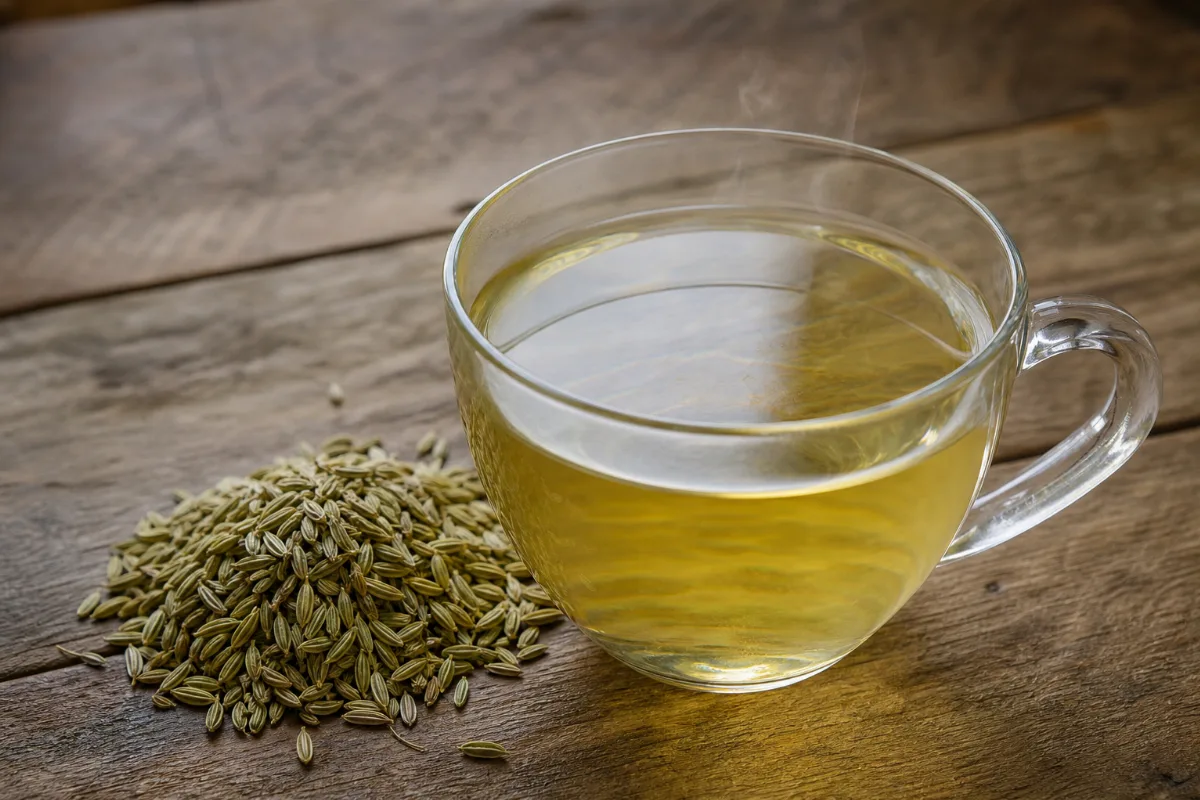
Fennel tea is a herbal drink made from the dried fruit, usually called the seed, of fennel. The EU accepts it as a traditional remedy for mild crampy stomach complaints, bloating and wind, based on long use rather than trials. Colic trials in babies tested fennel oil and mixed products, not tea, and the EU does not recommend fennel fruit preparations for children under 4. It is also not recommended in pregnancy or breastfeeding, and people allergic to carrot-family plants or mugwort should avoid it.
General information, not medical advice. Last substantive update · Not medically reviewed. A named clinician has not signed off on this page. How this page is made
About Fennel Tea
Fennel tea is a herbal tea made from the dried fruit (the 'seed') of fennel, Foeniculum vulgare. The EU accepts it as a traditional remedy for mild crampy stomach complaints, bloating, wind, period spasm and cough with a cold, on long use rather than trials. The best human data for the tea itself are one surgical-recovery trial and one nine-person appetite trial. The main cautions are babies under 4, pregnancy, breastfeeding, allergy to carrot-family plants or mugwort, and the natural compound estragole.
What it is
Fennel tea is made by steeping the dried fruit of fennel (Foeniculum vulgare Mill.) in hot water. The fruit is commonly called a seed. Fennel belongs to the carrot or parsley family (Apiaceae), with aniseed, caraway, celery, coriander and dill. The EU monographs list the herbal tea as the form of the dried fruit for oral use, in two varieties called bitter fennel and sweet fennel.
Fennel is not the tea plant (Camellia sinensis), so no caffeine is expected. No source we read measured caffeine in fennel tea, so this is an inference. Blends sold as fennel tea may contain other herbs, so read the label.
What the research shows
The EU herbal committee lists fennel fruit tea as a traditional medicine for mild, crampy stomach and bowel complaints with bloating and wind, minor spasm with menstrual periods, and cough with a cold. It says this rests only on long-standing use.
For the tea itself, the only human trial we found is the Chinese study of 159 surgical patients, where the tea was followed by earlier bowel recovery than water, and a tiny nine-woman crossover trial of appetite ratings. The trials of fennel for infant colic, IBS, period pain and menopause tested oil, capsules, extracts or mixed products, not a cup of tea. A Cochrane review of colic remedies concluded that herbal agents cannot be recommended.
Tea, extract, capsule and oil
A cup of tea is a weak water extract of the fruit. Capsules and powdered extracts are more concentrated, and the essential oil is a separate product, much richer in anethole and estragole, that is not a drink. In a lab test the estragole in a bitter fennel tea preparation caused fewer DNA changes in human liver cells than expected, and fennel seed powder did not damage DNA while the oil harmed cells at the highest level. Results from one form should not be assumed for another. Any question about amounts is for your doctor or pharmacist.
Where it is used
A 2012 review describes fennel as a traditional remedy in Europe, the Mediterranean and Asia, used for cramps, as a milk booster and as the classic remedy for nursing babies with gas and colic. The EU monographs date the first herbal monographs to 2007, with revised versions adopted in January 2024. We did not read original old texts, so no older history is claimed.
What happens in the body
How fennel tea might act is not settled. Fennel tea relaxed the upper part of guinea pig stomach muscle in a dish, which is only a lab clue. The main compound, anethole, and the minor compound estragole are processed by the liver. After volunteers drank fennel tea, a breakdown product of estragole appeared in their urine within the first hour and was almost cleared in 8 hours, with big differences between people.
At a glance
Traditional uses history, not proof
- Europe: the EU herbal committee lists fennel fruit tea as a traditional medicine for mild, crampy stomach and bowel complaints with bloating and wind, minor spasm with menstrual periods, and cough with a cold, based on long use
- Europe and the Mediterranean: a 2012 review describes fennel infusion as the classic home remedy for nursing babies with gas and colic cramps, and fennel as a traditional milk booster
- Iran: trial authors describe fennel as part of traditional laxative blends and as a traditional remedy for period pain
Studied for research
- Mild crampy stomach complaints, bloating and wind (tea), insufficient (traditional use; no trial of the tea)
- Infant colic (oil and mixed products, not tea), low
- Bowel recovery after abdominal surgery (tea), low
- Irritable bowel syndrome (curcumin and fennel oil capsule, not tea), low
- Period pain (mostly capsules and extracts), low
- Menopause symptoms (capsules and powder), mixed
- Breast milk supply, insufficient
- Cough with a cold, insufficient (traditional use only)
Main compounds
- trans-Anethole, the main compound of fennel fruit oil, which has weak oestrogen-like activity in lab tests
- Estragole, a minor compound that causes liver tumours in rodents at high doses and is the reason for the EU safety limits
- Fenchone, another oil compound (no activity data were found)
- No caffeine expected: fennel is not the tea plant (an inference; no source measured it)
Common forms
- Herbal tea from the dried fruit (the form in the EU monograph)
- Tea bags, instant teas and blends, some sold for babies or for milk supply (estragole levels vary widely and blends may contain other herbs)
- Capsules, powders and liquid extracts (the trials often tested these; results do not carry over to tea)
- Fennel essential oil (a separate product, not a drink)
Research links: EU herbal monograph on bitter fennel fruit (2024) · EU herbal monograph on sweet fennel fruit (2024) · LactMed: fennel · Cochrane review: pain-relieving agents for infantile colic (2016) · Fennel tea after gynaecological cancer surgery (2015) · Research Library · Genes & Biomarkers Library
What it is and its history
- Accepted scientific name
- Foeniculum vulgare Mill.
- Naming authority
- Mill. (Philip Miller), Gard. Dict., ed. 8: n.° 1 (1768) (GBIF). GBIF status: accepted species (name-match confidence 98). NCBI Taxonomy files fennel under a different name, Anethum foeniculum (taxid 2849586), so the two databases do not use the same name.
- Synonyms
- Anethum panmorium Roxb. ex Fleming; Anethum pannorium Roxb.; Foeniculum luteum Fisch.; Foeniculum luteum Fisch. ex Sweet; Foeniculum sativum Gaertn.; Meum piperatum Ten.; Meum piperinum Colla; Tenoria romana Schkuhr ex Schult.
- Common names
- Fennel (English); Sweet fennel (var. dulce) (English); Bitter fennel (var. vulgare) (English); Hinojo (Spanish); Fenouil commun (French); Fenchel (Echter Fenchel) (German); Finocchio comune (Italian); Funcho; erva-doce (Portuguese); Hui xiang (茴香) (Chinese); Shamar (شمر) (Arabic)
- Family or group
- Apiaceae (the carrot or parsley family, also called Umbelliferae; order Apiales). Relatives include carrot, celery, dill, anise, caraway, coriander and cumin. Allergy can cross between members of this family, which is why the EU monograph lists hypersensitivity to Apiaceae as a reason not to use fennel.
- Classification
- Plantae > Tracheophyta > Magnoliopsida (dicots) > Apiales > Apiaceae > Foeniculum > Foeniculum vulgare
- Native range
- The review by Rafieian and colleagues says fennel is generally considered native to the Mediterranean shores and has become widespread in many regions of the world (abstract of p36803269). GBIF lists it as introduced in places such as the Galapagos and Saint Helena. Native range was not checked against a flora.
- Habitat
- A hardy perennial herb (Rafieian). Not verified against a flora; habitat details such as soil and climate were not retrieved.
- What it looks like
- Roots: Not described in the sources read.; Stems: Grooved stems (Rafieian abstract). Height and hollow stems not verified.; Leaves: Intermittent leaves with a sheath at the base of the leaf stalk (Rafieian abstract). The finely feathered leaf form is general knowledge, not checked against a flora.; Flowers: Usually bisexual flowers in a yellow umbrella-shaped cluster (an umbel) (Rafieian abstract).; Fruit: The dry fruit, commonly called 'seed', is the part used medicinally (EU monographs 'fructus'). It is the source of the essential oil: about 2 to 6% oil in bitter fennel fruit, with anethole as the main compound (draft EMA statement table and Rafieian).
- Cultivation
- Not covered by the sources read.
- Harvest and processing
- The EU monographs describe the herbal substance as the dry fruit (commonly called 'seed') complying with the European Pharmacopoeia, used as a herbal tea. Tea bags may hold cut or powdered fruit; whole fruit gives less estragole in the cup than fine-cut material (Dutch analysis of fennel teas). Oil is a separate product distilled from the fruit.
- Look-alikes and adulterants
- Name: Poison hemlock (Conium maculatum); Note: Accepted species, family Apiaceae (GBIF key 3034807). A deadly poisonous relative with similar-looking feathery leaves and umbrella flowers. That it is poisonous and easily confused is general knowledge, not taken from a source read here. Never pick wild plants for eating unless an expert has identified them.; Name: Dill (Anethum graveolens); Note: Accepted species, family Apiaceae (GBIF key 3034646). Similar feathery leaves and umbels; a different herb with a different taste. Dill oil is a known adulterant of fennel oil (Liu 2026).; Name: Anise (Pimpinella anisum); Note: Accepted species, family Apiaceae (GBIF key 8080300). Its fruit also contains anethole and smells similar; anise oil is a known adulterant of fennel oil.; Name: Star anise (Illicium verum); Note: Accepted species, family Schisandraceae, NOT the carrot family (GBIF key 2889756). Its oil also contains anethole and is used to adulterate or imitate fennel oil (Murphy 2024).; Name: Giant fennel (Ferula communis); Note: Accepted species, family Apiaceae (GBIF key 8048981). A different, larger plant; a review of its toxicity exists (PubMed 26949491, not read). Not the same as culinary fennel.; Name: Sea fennel (Crithmum maritimum); Note: Accepted species, family Apiaceae (GBIF key 3632234). A coastal herb sometimes called sea fennel; not a Foeniculum.
Photographs
Traditional use and history history, not clinical proof
| Tradition or era | Documented use | Source |
|---|---|---|
| Traditional European, Mediterranean and Asian use (as summarised in a 2012 review) | Gori and colleagues write that fennel was traditionally used in Europe and the Mediterranean as an antispasmodic, diuretic, anti-inflammatory, painkiller, secretion-promoting remedy, milk-booster (galactagogue) and eye lotion; as a poultice for snake bites; in Asian cultures to speed removal of poisons; that it was one of the ancient Saxons' nine sacred herbs; and that in the Middle Ages it was hung over doorways on Midsummer's Eve to ward off spirits. They also call fennel infusion the classical remedy for nursing babies for gas and colic cramps. | p22899959 |
| Persian (Iranian) traditional medicine | Iranian trial authors describe fennel as part of traditional laxative blends (constipation trial, PMID 31763211) and, as an infusion with dry cupping, a traditional Persian treatment for infrequent periods (PMID 30856025). These statements come from trial abstracts, not from historical texts read directly. | p30856025 |
| EU herbal regulation (2007 and 2024) | The EU herbal committee adopted monographs on bitter fennel fruit and sweet fennel fruit on 5 July 2007 and issued revised versions adopted on 31 January 2024. They recognise traditional use for mild spasmodic stomach and bowel complaints including bloating and gas, minor spasm with menstrual periods, and cough with colds, 'exclusively based upon long-standing use'. | s-ema-hmpc-fennel-bitter |
| Estragole safety review (2005 onward) | In November 2005 the EU herbal committee adopted a public statement on estragole, concluding that short-term adult use at recommended doses does not pose a significant cancer risk but that exposure of young children, pregnant and breastfeeding women should be minimised. A revision was drafted in 2014 and its limits appear in the 2024 monographs. | s-ema-estragole-statement-2014-draft |
| Modern use for milk supply | LactMed describes fennel as a purported milk-boosting herb used in traditional medicine and in proprietary mixtures. | s-lactmed-fennel |
| Herbal teas for colicky babies | A 2008 Turkish trial and 2017 and 2016 reviews treat herbal teas and fennel products as commonly used remedies for infant colic. The abstracts give no history, and we did not research older history. | p18592627 |
Traditional use shows how it was used. It does not show that it works or is safe today.
What is inside, and how it may work
What it contains and how those compounds act in cells and animals. Laboratory and animal mechanisms are not proven effects in people.
Main compounds
| Compound | Family | Where it is concentrated | Activity studied | Level of evidence |
|---|---|---|---|---|
| trans-Anethole PubChem 637563 | phenylpropanoid (aromatic ether) | Fruit (essential oil) The main compound of fennel fruit oil (more than half of the oil in the analyses we read). How much reaches a cup of tea was not measured in the sources read. | Main compound of fennel oil and the usual 'marker' of its smell and taste. In rodents it improved delayed stomach emptying; in mice it reduced lung inflammation; in cells its breakdown product bound the oestrogen receptor. Described by LactMed as a phytoestrogen that passes into breast milk. Weak mutagenicity in animals (EU monograph). It forms the same DNA and haemoglobin adduct types as estragole, at lower levels. 24 82 10 73 51 13 80 76 | Animal research |
| Estragole (methyl chavicol) PubChem 8815 | phenylpropanoid (alkenylbenzene) | Fruit (essential oil) 3.5 to 12% of bitter fennel oil and 1.5 to 5.0% of sweet fennel oil, about 0.3% of bitter fennel fruit (draft EMA statement table); up to 6.1% in bitter oil and 5.0% in sweet oil (EFSA). In dry fennel preparations 0.15 to 13.3 mg/g (van den Berg 2014). | Causes liver tumours in rodents at high doses after being activated by liver enzymes; basis of the EU's limits for children, pregnancy and breastfeeding. A minor oil component but the main safety concern. 75 76 81 21 45 19 | Animal research |
| Fenchone PubChem 14525 | monoterpene ketone | Fruit (essential oil) 24.5% of one fennel oil analysed (Stefanescu 2023) | Named as a major oil constituent by LactMed. The sources read gave no activity data for fenchone alone. 82 80 | None found |
| Plant polyphenols such as flavonoids | polyphenols | Fruit Not measured in the sources read | Some herb flavonoids blocked estragole activation in cell tests (not shown for fennel). Presence in tea was not checked. 6 5 | Laboratory research |
Mechanisms, receptors and pathways
| Target or pathway | Gene or receptor | What was found | Level |
|---|---|---|---|
| Stomach smooth muscle (store-operated calcium entry) | Store-operated Ca2+ channels (exact target not identified) | Fennel tea relaxed the upper stomach and increased contraction force in the lower stomach in guinea pig tissue strips. Nerve and nitric oxide blockers did not stop it; the store-operated calcium channel blocker SKF-96365 did. 8 | Animal research |
| Estragole bioactivation (liver enzymes then sulfate conjugation) | Cytochrome P450 enzymes; sulfotransferases (SULT) | After hydroxylation by P450 enzymes and sulfation by SULT, estragole forms 1'-sulfoxyestragole, which makes DNA adducts and causes liver tumours in rodents. In rats, adducts rose with dose and were highest in liver. 56 19 13 5 | Animal research |
| Detoxification and excretion of estragole in people | Glutathione conjugation (mercapturic acid AMPAC) | In 12 volunteers who drank fennel tea, the glutathione-based breakdown product AMPAC appeared in urine within the first hour, with a half-life of about 1.1 hours and near-complete clearance within 8 hours, with large differences between people. 49 | Human data |
| Blocking of the activating enzyme by other plant compounds | SULT inhibition by flavonoids (quercetin, kaempferol, nevadensin and others) | In cells and models, certain flavonoids from herbs and spices, especially nevadensin from basil, strongly reduced estragole DNA adducts. Not shown for fennel itself. 6 5 | Laboratory research |
| Whole fennel versus oil in liver cells | Cell death and DNA damage | In human HepG2 liver cells, fennel seed powder caused no DNA damage or cell death; fennel seed oil caused no DNA damage but strong dose-dependent cell death at the highest dose. 42 | Laboratory research |
| Oestrogen receptor | Oestrogen receptor alpha (ESR1) | A breakdown product of anethole (4-hydroxy-1-propenylbenzene), not anethole itself, displaced oestradiol from the receptor and made MCF-7 breast cancer cells grow at low concentrations; at much higher concentrations anethole reduced survival of both oestrogen-sensitive and insensitive breast cancer cells. 51 16 | Laboratory research |
| Metal binding in the gut (drug absorption) | Metal ions in the extract | Fennel extract cut ciprofloxacin absorption in rats; the authors attribute this to metal ions forming a complex with the antibiotic. 74 | Animal research |
Absorption, metabolism and elimination
- Absorption
- No blood-level study of anethole or fenchone after tea or capsules was found. Fennel's estragole is absorbed after drinking tea: in 12 volunteers its breakdown product appeared in urine within the first hour (p31565931).
- Distribution
- The EU monographs say there is evidence that trans-anethole is excreted in human breast milk (also LactMed). No tissue distribution data in people were found.
- Metabolism
- In liver fractions and cells, estragole is hydroxylated by P450 enzymes then sulfated or glucuronidated; the sulfate is reactive and the glucuronide is a detoxification product. Anethole follows the same route more weakly. Glutathione conjugation to AMPAC was shown in people (p31565931, p34015424, p22844077).
- Elimination
- AMPAC half-life 0.78 to 1.54 hours (mean 1.13 +/- 0.21), nearly cleared in 8 hours; total excreted 93 to 1,076 nanograms after 500 mL of tea containing 2.2 mg estragole, showing large between-person differences (p31565931).
- Bioavailability
- Not measured for any fennel compound in people. In rats, an aqueous fennel extract cut ciprofloxacin bioavailability to about 0.52 of control (p10678493).
Isolated compounds versus whole extracts
Fennel tea, powdered seed, capsules and essential oil are very different exposures. The oil concentrates anethole and estragole. A cup of tea extracts only a small fraction of the estragole in the fruit, and whole fruit gives about a third of what fine-cut material gives. In a human liver cell test, fennel seed powder did not damage DNA while the oil killed cells at the highest level, and in 2026 a bitter fennel tea preparation made fewer estragole DNA adducts in liver cells than expected. The EU limits are set on daily estragole intake. Trials of 'fennel' therefore cannot be compared across products, and animal tests with pure estragole or anethole overstate or understate what tea does.
Nutritional composition
Fennel tea is an infusion of the dried fruit in water. We did not find reliable nutrient values for the tea or for fennel fruit, and it is not meant as a source of vitamins or minerals. (The fennel bulb eaten as a vegetable is a different food.)
1 mixed findings4 low certainty3 very low certainty3 not enough evidence
What was looked at
The 11 benefits and uses checked for Fennel Tea, each with how strong the evidence is. Tap one to open it.
- Mild cramping stomach and bowel complaints, bloating and wind: fennel fruit tea (traditional use)Not enough evidence
- Infant colic: fennel oil, mixed herbal products and herbal tea (not fennel tea alone)Low certainty
- Getting the bowels moving after abdominal surgeryLow certainty
- Irritable bowel syndrome (IBS): pain, bloating and bowel habitLow certainty
- ConstipationVery low certainty
- Wind and indigestion after surgery or eating: fennel capsules and mixed supplements (not tea)Very low certainty
- Appetite, weight and blood fats: a small fennel tea trial and capsule trialsVery low certainty
- Period pain (primary dysmenorrhoea)Low certainty
- Menopause symptoms such as hot flushesMixed findings
- Breast milk supply (galactagogue use)Not enough evidence
- Cough and chest congestionNot enough evidence
Lab markers tracked in the studies
Crying time in colicky infants (minutes per day)Time to first passing of gas after abdominal surgery
What is Fennel Tea good for?
The main studied uses of fennel tea and how strong the evidence is for each. 'Insufficient' means no usable trial of the tea; 'low' means small trials, often of a different fennel product; 'very low' means a single small or mixed study. Where a result comes from oil, capsules or a mixed product, it is said so.
Benefits, one by one
Each card is a research question, not a promise. Tap a goal to filter. Open a card to see the studies, doses and limits.
Mild cramping stomach and bowel complaints, bloating and wind: fennel fruit tea (traditional use)
Not enough evidenceThe EU lists fennel fruit tea as a traditional remedy for mild, crampy stomach and bowel complaints including bloating and wind, based on long use, not on trials. No trial of the tea for these complaints was found. A 2025 lab study found that fennel tea relaxed part of guinea pig stomach muscle in a dish.
3 studiesHerbal tea from the dried fruit is the form in the EU monograph. Amou…
Studies, doses and limits
What the trials found
No randomised trial of fennel tea for stomach or bowel complaints in otherwise healthy people was found. The EU view rests on long use. The only tea trial for the gut that we found was in surgical patients (see the surgery entry below).
Results
Traditional-use status only; no human trial of the tea for these complaints.
Why this rating
Regulators accept it as traditional use only, and the only mechanism work is on animal tissue.
Form and dose studied
Herbal tea from the dried fruit is the form in the EU monograph. Amounts are not given here: ask a doctor or pharmacist.
Who was studied
Adults and adolescents; the EU does not recommend it under 4 years and limits it at 4 to 12 (see the safety tab).
Limits
Traditional-use status is not proof of benefit. Most mild stomach upsets pass without treatment.
Why researchers looked
Fennel seed is a classic after-meal herb in Europe, the Mediterranean and Asia, and the tea is the form most people know.
Traditional use
The EU herbal committee (monographs on bitter and sweet fennel fruit, revised January 2024) lists the herbal tea as a traditional herbal medicinal product for symptomatic treatment of mild, spasmodic gastro-intestinal complaints including bloating and flatulence, 'exclusively based upon long-standing use'.
Proposed mechanism Animal research
In guinea pig stomach strips in a dish, freshly brewed fennel tea relaxed the upper stomach and made the lower stomach contract more strongly. The effect was blocked by a store-operated calcium channel blocker. Nobody has shown this happens in people drinking the tea.
A proposed mechanism does not show that the effect happens in people.
The EU limits use of the tea to 2 weeks in adults and says to see a doctor if symptoms persist or get worse.
Infant colic: fennel oil, mixed herbal products and herbal tea (not fennel tea alone)
Low certaintyA few small trials found less crying in colicky babies with a fennel seed oil emulsion and with a chamomile, fennel and lemon balm extract. Neither was fennel tea. A Cochrane review calls the herbal evidence weak and says herbal agents cannot be recommended for colic. Safety in babies is a separate and serious question: the EU does not recommend fennel fruit preparations under 4 years.
11 studiesA fennel seed oil emulsion (Alexandrovich), a standardised chamomile,…
Studies, doses and limits
What the trials found
Alexandrovich 2003 (125 infants aged 2 to 12 weeks, Russia): fennel seed oil emulsion versus placebo; colic was judged gone in 65% (40/62) on fennel versus 23.7% (14/59) on placebo. Savino 2005 (93 breastfed infants, Italy): a three-herb extract (chamomile, fennel, lemon balm; ColiMil) cut daily crying from about 201 to 77 minutes versus about 199 to 170 on placebo over one week. A meta-analysis of three fennel-containing trials (Harb 2016) found 72 minutes a day less crying (95% CI -126 to -18). Reviews (Perry 2011, Perry 2019, Anheyer 2017) call fennel extract promising but note flaws, missing independent repeats and high or unclear risk of bias. A 2023 parent survey of 1,218 families (Gavish) found 65% of parents rated a fennel-based product as successful, but there was no placebo and the authors were consultants to the maker. Biagioli 2016 (Cochrane review, 18 trials, 1,014 infants, all small and at high risk of bias): herbal agents against placebo gave low-quality evidence of shorter crying and moderate-quality evidence of more responders, but with big differences between trials, and the authors conclude that herbal agents cannot be recommended for infants with colic. Arikan 2008 (175 infants, Turkey) tested a herbal tea against massage, sugar solution, special formula and no treatment: crying fell in every group, but the abstract does not name the herbs in the tea, so it is not counted as a fennel result. We found no placebo-controlled trial of fennel tea alone in colicky babies.
Results
Small to moderate reductions in crying time in trials of fennel oil and fennel combinations, with large uncertainty. Not tested for fennel tea alone.
Effect sizes as reported
Fennel oil emulsion: colic gone in 65% versus 23.7% (absolute risk reduction 41%, 95% CI 25 to 57). Meta-analysis of 3 fennel-containing trials: -72.1 min/day (95% CI -126.4 to -17.7).
Why this rating
A small number of small trials, one of them a three-herb combination and one a fennel oil emulsion, not a tea; reviewers rate the trials as high or unclear risk of bias with no independent repeat; Cochrane concludes herbal agents cannot be recommended.
Form and dose studied
A fennel seed oil emulsion (Alexandrovich), a standardised chamomile, fennel and lemon balm extract (Savino), fennel-based commercial products (Gavish), and an unnamed herbal tea (Arikan). Different products cannot be swapped for one another and none of them is a cup of fennel tea.
Who was studied
Colicky infants roughly 2 weeks to 3 months old, mostly breastfed.
Limits
Few trials; different products; two of the three trials in the pooled result are not fennel alone; crying time is reported by parents; colic usually improves with age on its own; funding often not stated.
Why researchers looked
Colic is long spells of crying in an otherwise healthy baby, usually in the first three months. Fennel tea is a very old home remedy for it, so researchers tested fennel products.
Traditional use
Gori and colleagues note that fennel infusions are the classic home remedy given to nursing babies for gas and colic cramps. Fennel is also a traditional European remedy for mild cramping stomach complaints in older children and adults.
Proposed mechanism Preliminary mechanism
Fennel oil and its main compound, trans-anethole, relaxed stomach muscle in guinea pig tissue and helped delayed stomach emptying in rodents. No study has shown that this is how fennel works in a colicky baby.
A proposed mechanism does not show that the effect happens in people.
No side effects were reported in these trials, but they were short and small. The EU monographs do not recommend fennel fruit preparations under 4 years because of lack of data and the estragole question; one baby girl developed breast development after months of daily fennel tea (single case report). Ask a paediatrician before giving a baby any herbal tea.
Getting the bowels moving after abdominal surgery
Low certaintyOne Chinese randomised trial of 159 women found that fennel fruit tea after gynaecological cancer surgery was followed by an earlier return of bowel movement and a shorter hospital stay than plain water. A second trial used a heated fennel pack on the belly, not a drink. Both were single-centre trials in surgical patients.
2 studiesFennel fruit tea (filtrate only) in one trial; a heated fennel pack o…
Studies, doses and limits
What the trials found
Ma 2015 (159 women after surgery for gynaecological cancer; article in Chinese): fennel fruit tea (filtrate only) twice a day from the first morning after surgery until first flatus versus plain water. Time to first flatus 53.1 versus 64.2 hours, first bowel movement 4.3 versus 5.4 days, hospital stay 5.6 versus 6.7 days (all P<0.001); ileus symptoms were more common with water (relative risk 2.6, 95% CI 1.5 to 4.5). Chen 2020 (381 patients after major abdominal surgery for liver, pancreas or stomach tumours): a heated fennel pack on the belly versus a heated rice-husk pack. Time to first flatus, first bowel movement and fasting time were shorter (P<0.05 each), bloating eased (P<0.001); in patients with bowel reconstruction hospital stay was 9.25 versus 11.1 days (P=0.023).
Results
Faster return of bowel function and shorter hospital stay in both trials.
Effect sizes as reported
Tea: flatus 53.1 versus 64.2 h; stay 5.6 versus 6.7 days; ileus RR 2.6 (1.5 to 4.5). Pack: hospital stay in reconstruction subgroup 9.25 versus 11.1 days (P=0.023).
Why this rating
Two randomised trials of reasonable size agree in direction, but both are single-centre, in Chinese surgical patients, and one is not blinded (tea versus water). The pack trial's fennel is applied to skin.
Form and dose studied
Fennel fruit tea (filtrate only) in one trial; a heated fennel pack on the abdomen in the other. Amounts are not given here.
Who was studied
Adults after major abdominal or gynaecological cancer surgery in China.
Limits
Single centre; tea trial compares with water; the pack trial tests external heat with a heated control pack; hospital-stay result was a subgroup; abstracts only.
Why researchers looked
After abdominal surgery the bowel often slows down (ileus), which delays eating and going home. Cheap, safe aids are wanted.
Traditional use
Warm fennel packs and fennel tea are used in traditional Chinese nursing for stomach and belly problems.
Proposed mechanism Pharmacological theory
Not tested in these trials. The authors suggest fennel stimulates gut movement; heat itself may also help.
A proposed mechanism does not show that the effect happens in people.
The tea authors call it safe and well tolerated (no specific adverse events listed in the abstract). After surgery, anything by mouth should only be used if the surgical team agrees.
Irritable bowel syndrome (IBS): pain, bloating and bowel habit
Low certaintyOne placebo-controlled trial found that a capsule combining curcumin (from turmeric) and fennel essential oil eased IBS symptoms over 30 days, and an open study of a similar product reported improvement. Fennel was never tested alone and neither product was a tea.
3 studiesCurcumin plus fennel essential oil capsules (a combination). Not fenn…
Studies, doses and limits
What the trials found
Portincasa 2016 (121 adults with mild to moderate IBS, Italy): curcumin plus fennel essential oil capsules or placebo for 30 days. The average IBS symptom score fell 50% with the capsules versus 26% with placebo (P<0.001); 25.9% were symptom-free versus 6.8% (P=0.005). Di Ciaula 2018 (211 adults, open, no control group): a turmeric-plus-fennel-oil product (Enterofytol) was followed by lower symptom scores and better quality of life over two months, in all IBS subtypes. A 2020 meta-analysis of Western herbal medicines in IBS (Hawrelak, 33 trials) found peppermint oil, Aloe vera and asafoetida effective; the curcumin-fennel oil combination showed efficacy in one trial that had not been repeated.
Results
Better symptom scores than placebo in one 30-day trial of a combination product; an uncontrolled study agrees in direction.
Effect sizes as reported
IBS symptom score relative fall 50.05 +/- 28.85% versus 26.12 +/- 30.62% with placebo (P<0.001); symptom-free 25.9% versus 6.8%.
Why this rating
Only one placebo-controlled trial, 30 days long, of a curcumin plus fennel oil combination; the second study had no control group. The meta-analysis notes the result has not been repeated.
Form and dose studied
Curcumin plus fennel essential oil capsules (a combination). Not fennel tea, seed or oil alone.
Who was studied
Adults with mild to moderate IBS (all subtypes in the open study).
Limits
Fennel was not tested alone. Short duration. Funding not stated in the abstracts. Placebo group improved about a quarter.
Why researchers looked
IBS is common, has few good treatments, and fennel is a traditional antispasmodic and anti-gas herb.
Traditional use
The EU herbal committee lists bitter and sweet fennel fruit tea as a traditional medicine for mild, cramping stomach and bowel complaints including bloating and gas. This is a statement about long use, not proof from trials.
Proposed mechanism Pharmacological theory
Fennel oil is thought to relax gut muscle and curcumin to calm inflammation. The trial authors proposed this; it was not measured in the trial.
A proposed mechanism does not show that the effect happens in people.
No serious problems reported in these studies. Essential oil is concentrated, and the EU herbal committee proposed in 2022 to withdraw its monograph on bitter fennel oil because of new safety concerns (see safety file).
Constipation
Very low certaintySeveral small trials of herbal formulas that contain fennel found better bowel movements than placebo or even than a standard laxative. But every formula contained other herbs, and three contained senna or aloe, which are well-known laxatives. Fennel alone has not been tested for constipation.
4 studiesHerbal formulas, capsules and one tea blend that contain fennel with …
Studies, doses and limits
What the trials found
Azimi 2022 (50 adults over 60 with functional constipation, Iran): a fennel-plus-Damask-rose formula improved constipation severity, stool consistency and quality of life more than polyethylene glycol 4000 (all P<0.001) with milder side effects. Eliasvandi 2019 (64 postmenopausal women): a ten-ingredient capsule that includes anise or fennel and senna leaves gave more bowel movements than placebo (mean difference 4.2). Picon 2010 (20 adults, crossover): a tea of anise, fennel, elderberry and senna cut colon transit time from 42.3 to 15.7 hours (P<0.001). Ghafarzadegan 2025 (61 patients after fracture surgery): a capsule of senna, aloe, fennel, coriander and caraway improved constipation (P<0.001).
Results
Formulas containing fennel work better than placebo in short trials, but the active ingredient is likely senna or aloe in three of them. The fennel-plus-rose formula had no stimulant laxative and beat a standard laxative on some measures.
Effect sizes as reported
Transit time 15.7 h (95% CI 11.1 to 20.2) versus 42.3 h (33.5 to 51.1) on placebo (Picon, with senna). Bowel movement frequency +4.2 versus placebo (Eliasvandi, with senna).
Why this rating
All trials are small, short, tested mixtures, and three contained senna or aloe. Fennel's own contribution is unknown. Only one used a fennel-plus-rose mix with no stimulant laxative, in 50 older adults.
Form and dose studied
Herbal formulas, capsules and one tea blend that contain fennel with other herbs. No fennel-alone product was tested.
Who was studied
Older adults, postmenopausal women, adults with chronic constipation, orthopaedic patients after surgery (opioid-related).
Limits
Combination products; senna/aloe confounders; very small samples; short follow-up; abstract-only reading; one confidence interval is printed inconsistently in the original abstract.
Why researchers looked
Fennel is part of many traditional laxative blends in Persian, Brazilian and other herbal traditions.
Traditional use
Traditional Persian medicine books list fennel in laxative blends; the trial authors describe this. This is traditional use, not proof.
Proposed mechanism Pharmacological theory
Not shown. The trial authors suggest fennel helps gut movement; senna and aloe in some blends act on the bowel directly.
A proposed mechanism does not show that the effect happens in people.
Mild diarrhoea in the fennel-rose group; a small fall in blood potassium during the senna-containing tea (Picon). No serious events reported.
Wind and indigestion after surgery or eating: fennel capsules and mixed supplements (not tea)
Very low certaintyA double-blind trial after caesarean section found fennel capsules lowered wind ratings about as much as an anti-gas medicine, and one open study of a seven-ingredient supplement was done in people with indigestion. Neither tested fennel tea, and neither can show fennel worked on its own.
2 studiesFennel capsules (trial 1) and a seven-ingredient supplement (trial 2)…
Studies, doses and limits
What the trials found
Jourshari 2024 (double-blind trial of women after a caesarean section in Iran): fennel capsules versus dimethicone capsules, one dose every 6 hours for four doses. Gas scores fell in both groups and did not differ between them after adjusting for baseline (P=0.607). Pellicano 2014 (91 adults with functional dyspepsia after H. pylori treatment): an open, non-randomised comparison of a supplement of alginate, calcium carbonate, pineapple, papaya, ginger, an enzyme and fennel. All 55 users and 31 of 36 non-users stayed off acid-reducing drugs while waiting for a breath test (P=0.008); well-being improved by 1.78 points with the supplement. No randomised trial of fennel alone for dyspepsia was found.
Results
Both treatments reduced gas; fennel did no better or worse than dimethicone.
Effect sizes as reported
No between-group difference (F(1,72)=0.27, P=0.607).
Why this rating
One small trial against an active comparator with no placebo, and one open, non-randomised study of a seven-ingredient supplement. Neither tested tea.
Form and dose studied
Fennel capsules (trial 1) and a seven-ingredient supplement (trial 2). Not tea.
Who was studied
Women after caesarean section.
Limits
No placebo; gas often settles on its own; one centre; abstract only.
Why researchers looked
Gas after surgery is common and uncomfortable. Fennel is a traditional carminative (a remedy for gas).
Traditional use
The EU monograph lists fennel fruit tea for bloating and gas on the basis of long traditional use.
Proposed mechanism Pharmacological theory
The trial authors suggest fennel stimulates bowel movement. Not tested in the trial.
A proposed mechanism does not show that the effect happens in people.
No harm was reported in the abstract (not specifically stated).
Appetite, weight and blood fats: a small fennel tea trial and capsule trials
Very low certaintyFennel tea eased hunger ratings in nine women for one meal, but the food they ate at lunch did not change. Trials of fennel capsules found no clear effect on weight or cholesterol in postmenopausal women.
4 studiesFennel tea (one trial, with a separate fenugreek tea arm), fennel wit…
Studies, doses and limits
What the trials found
Bae 2015 (9 overweight women, crossover): fennel tea lowered hunger and raised fullness ratings versus placebo tea (P<0.05) but did not change food eaten at lunch. Khan 2024 (obese adults, 3 months): chia plus fennel seeds reported better BMI and lipids (P<0.05); no numbers in the abstract. Afiat 2018 (60 postmenopausal women, 3 months): no significant effect on cholesterol, LDL, HDL or triglycerides. Saghafi 2017 (47 overweight postmenopausal women): no significant effect on weight, BMI, waist or fat distribution.
Results
Mixed: tiny positive appetite and combination results, null results for fennel alone on weight and lipids.
Effect sizes as reported
Lipids: triglycerides P=0.679, total cholesterol P=0.103, LDL P=0.146, HDL P=0.266 (fennel versus placebo).
Why this rating
A nine-person crossover trial with subjective ratings only, plus capsule trials with mixed or null results.
Form and dose studied
Fennel tea (one trial, with a separate fenugreek tea arm), fennel with chia seeds and fennel capsules. Amounts are not given here.
Who was studied
Overweight women, obese adults, postmenopausal women.
Limits
Tiny crossover (9 people); no numbers in the chia trial; combination; short.
Why researchers looked
Fennel seeds are fibre-rich and traditional as digestive and appetite herbs.
Traditional use
Not found.
Proposed mechanism Pharmacological theory
Not shown; fibre content proposed by the chia-fennel authors.
A proposed mechanism does not show that the effect happens in people.
No adverse effects were reported in these studies.
Period pain (primary dysmenorrhoea)
Low certaintyMore than a dozen small trials, mostly from Iran and mostly in students, suggest fennel products can ease period pain, and several found them about as good as mefenamic acid or ibuprofen. Cochrane rates all supplement evidence in this area as low or very low, and the trials disagree a lot. Most trials used capsules, extracts or essence, not tea.
9 studiesMostly capsules, extracts and fruit essence; tea is named in some rep…
Studies, doses and limits
What the trials found
Lee 2020 (meta-analysis, 12 randomised trials): seven trials (n=502) found fennel similar to conventional drugs for pain (SMD 0.07, 95% CI -0.08 to 0.21); against placebo (n=468) fennel was better (SMD -3.27, 95% CI -5.28 to -1.26) but the trials disagreed very strongly (I2 98%), with signs of publication bias. Shahrahmani 2021 (12 studies): fennel beat placebo (SMD -0.632, 95% CI -0.827 to -0.436, 7 articles) and did not differ from mefenamic acid (SMD -0.214, 95% CI -0.446 to 0.017). Xu 2020 gave a small fennel effect (WMD 0.528, very wide CI 0.119 to 6.829). Thaliyil Poduval 2026 (14 trials of carrot-family herbs) found carrot-family herbs including fennel were effective add-ons, with some bias concerns. The Cochrane review (Pattanittum 2016, 27 trials of supplements) rated all evidence low or very low quality; for fennel versus placebo one trial of 43 women found no consistent benefit (MD -0.34 points, 95% CI -0.74 to 0.06). Individual trials: Namavar Jahromi 2003 (30 women): fennel essence and mefenamic acid both beat no treatment; mefenamic acid was stronger on days 2 and 3 and 5 women dropped out because of the smell. Modaress Nejad 2006 (110 girls): 80% versus 73% had relief on fennel versus mefenamic acid, not significantly different. Ghodsi 2014 (80 students, no-treatment control): lower nausea and weakness and shorter periods. Negi 2026 (384 women, crossover): fennel lowered pain (to 4.61 from about 6) versus placebo (6.24), but ginger worked better.
Results
Many small positive trials; the best pooled analyses disagree on how much, and Cochrane judges the evidence low or very low.
Effect sizes as reported
Versus placebo: SMD -0.632 (95% CI -0.827 to -0.436) in one meta-analysis; SMD -3.27 with I2 98% in another; Cochrane MD -0.34 points (95% CI -0.74 to 0.06, one trial). Versus mefenamic acid: no clear difference (SMD 0.07 and -0.214).
Why this rating
Many small trials point the same way, but the main pooled analyses differ widely, risk of bias is moderate with signs of publication bias, Cochrane rates all supplement evidence low or very low, and most data come from students in one country.
Form and dose studied
Mostly capsules, extracts and fruit essence; tea is named in some reports. Details differ between trials and are not given here.
Who was studied
Young women and students, mostly in Iran, with moderate to severe period pain.
Limits
Small trials; mixed products; high inconsistency; no long-term data; side effects poorly reported (only three of twelve trials checked); odour was a reason to drop out.
Why researchers looked
Period cramps are very common in young women, and drugs like ibuprofen do not suit everyone. Fennel is a traditional remedy for menstrual cramps.
Traditional use
The EU herbal committee lists bitter and sweet fennel fruit tea as a traditional medicine for minor spasm associated with menstrual periods. That is long-standing use, not trial proof. The EU monograph does not recommend this use under age 12.
Proposed mechanism Pharmacological theory
Fennel tea relaxed stomach muscle in guinea pig tissue, and the trial authors suggest fennel may relax the womb in a similar way. Relaxing the womb was not shown in the women studied.
A proposed mechanism does not show that the effect happens in people.
The EU does not recommend fennel fruit tea for period spasm under age 12. One trial reported a mild rise in menstrual flow. Pregnant women and women with hormone-sensitive conditions should read the safety tab.
Menopause symptoms such as hot flushes
Mixed findingsResults are mixed. A 2021 meta-analysis of two placebo-controlled trials found fennel eased menopausal symptoms, and two further trials agreed, but one placebo-controlled trial found no difference because its placebo group improved too. All were small and from Iran.
8 studiesFennel capsules, fennel seed powder and mixed extracts. No trial in t…
Studies, doses and limits
What the trials found
Lee 2021 (meta-analysis, 7 randomised trials): two placebo-controlled trials (n=145) favoured fennel for menopausal symptoms (SMD -1.32, 95% CI -1.76 to -0.87), but risk of bias was concerning and other outcomes were unclear. Rahimikian 2017 (90 women, triple-blind): menopause rating scale fell with fennel at 4, 8 and 10 weeks versus placebo (P<0.001). Ghaffari 2020 (80 women): symptom score fell from 30.8 to 19 with fennel seed powder versus 31.2 to 26.4 with starch; oestradiol did not differ. Mahdavian 2019 (120 women): a chamomile-fennel-saffron mix improved menopause scores in the two higher-dose groups. Jenabi 2023 (76 women): a fennel-valerian extract lowered hot flash frequency and severity versus placebo. Ghazanfarpour 2018 (50 women, double-blind): both groups improved, with no significant difference from placebo; the authors blame a high placebo response. Ghavi 2023 (125 women): FSH and oestradiol changed with fennel and evening primrose oil versus placebo, but the direction is not given in the abstract.
Results
Two to four small trials favour fennel; one equally small trial does not. Hormone-level findings are inconsistent.
Effect sizes as reported
Meta-analysis of 2 trials: SMD -1.32 (95% CI -1.76 to -0.87). Kupperman index -11.8 points with fennel versus -4.8 with starch (Ghaffari, own subtraction).
Why this rating
Small trials disagree: some show clear benefit, one shows none with a high placebo response, and the meta-analysis pooled only two trials with concerning risk of bias.
Form and dose studied
Fennel capsules, fennel seed powder and mixed extracts. No trial in the abstracts we read used a tea. Details are not given here.
Who was studied
Postmenopausal and perimenopausal women aged 45 to 65, Iran.
Limits
Small; short; combinations; placebo response high in menopause trials; oestrogen effect unresolved; abstract only.
Why researchers looked
Fennel contains anethole, which has weak oestrogen-like effects in lab tests, so researchers asked whether it could help menopausal symptoms.
Traditional use
No specific traditional claim for menopause appears in the abstracts read.
Proposed mechanism Laboratory research
In lab cells, a breakdown product of anethole bound to the oestrogen receptor and made breast cancer cells grow (Nakagawa 2003), but one trial found blood oestradiol did not rise with fennel (Ghaffari 2020). So whether fennel eases menopause symptoms through an oestrogen-like effect is unproven.
A proposed mechanism does not show that the effect happens in people.
No serious side effects reported in the trials. Women with hormone-sensitive cancers should talk to their doctor first because of fennel's weak plant-oestrogen-like compounds (see safety).
Breast milk supply (galactagogue use)
Not enough evidenceFennel tea is widely used by breastfeeding mothers to boost milk supply, but good evidence is lacking. A Cochrane review says it is very uncertain whether fennel improves infant weight. A safety trial of a blended tea that contains fennel found no harm over a month. The EU says use in pregnancy and breastfeeding is not recommended.
4 studiesFennel tea, blended 'lactation' teas and capsules. A 2026 survey of 5…
Studies, doses and limits
What the trials found
Foong 2020 (Cochrane review, 41 trials, 3,005 mothers, of drug and natural galactagogues): evidence overall was low to very low certainty; 'very uncertain whether fennel or fenugreek improves infant weight'; milk volume results for natural products could not be pooled (I2 99%); reported side effects were minor. LactMed reports that two small studies saw increases in some measures (milk volume, fat content, infant weight gain) with fennel, while no rise in prolactin was found. Wagner 2019 (60 mothers with no milk shortage): Mother's Milk tea (bitter fennel, anise, coriander, fenugreek and other herbs) versus lemon verbena tea for 30 days found no adverse effects in mothers or infants up to 12 months and no differences in infant growth. This trial tested safety, not supply. Muslu 2026 (51 herbal lactation teas on sale in Turkey) reports fennel as the most often listed herb (94.1%), with milk-supply claims on 98% of products; the authors stress that this does not show the real contents, effectiveness or safety.
Results
No reliable evidence that fennel raises milk supply; short-term safety of one blended tea looked reassuring in a small trial.
Effect sizes as reported
Not pooled for fennel (Cochrane).
Why this rating
Cochrane rates the whole field low to very low and cannot say whether fennel improves infant weight; the one safety trial did not test supply.
Form and dose studied
Fennel tea, blended 'lactation' teas and capsules. A 2026 survey of 51 lactation teas sold online in Turkey found fennel declared in 94% of them.
Who was studied
Breastfeeding mothers of healthy term infants.
Limits
Blends; mothers without milk shortage; no fennel-only trials in the abstracts; large inconsistency; abstract only.
Why researchers looked
Many mothers worry about low milk supply, and fennel is a classic folk 'milk-boosting' herb.
Traditional use
LactMed describes fennel as a purported galactagogue used in traditional medicine and in proprietary milk-supply products.
Proposed mechanism Pharmacological theory
LactMed notes that anethole is a plant oestrogen-like compound but that no rise in prolactin was found with fennel in nursing mothers.
A proposed mechanism does not show that the effect happens in people.
The EU monographs say safety in breastfeeding has not been established and use is not recommended. Anethole passes into breast milk, and LactMed says excessive use of a fennel and anise tea appeared to cause toxicity in two newborns. See the safety tab.
Cough and chest congestion
Not enough evidenceThe EU lists fennel fruit tea as a traditional expectorant for cough with a cold, based on long use. We found no human trial. Mouse studies show anti-inflammatory effects in injured lungs, which does not show it helps coughs in people.
3 studiesFennel fruit tea (traditional); extract or anethole in mice. Amounts …
Studies, doses and limits
What the trials found
No human trials of fennel for cough were found. Evidence is the EU monograph's traditional-use listing and two mouse studies (Zhang 2018, Lee 2015).
Results
No human results.
Effect sizes as reported
Not available.
Why this rating
Traditional use and mouse studies only.
Form and dose studied
Fennel fruit tea (traditional); extract or anethole in mice. Amounts are not given here.
Who was studied
Mice.
Limits
No human trials.
Why researchers looked
Fennel is a traditional cough remedy.
Traditional use
The EU herbal monographs (2024) list traditional use of fennel fruit tea as an expectorant for cough associated with colds, based on long-standing use only.
Proposed mechanism Animal research
In mice with lung injury caused by a bacterial toxin, a fennel extract and trans-anethole lowered inflammation. Both were given as injections or at high doses.
A proposed mechanism does not show that the effect happens in people.
EU limits on estragole apply to teas; see safety file.
Connections to the rest of health
How Fennel Tea connects to the rest of our health knowledge graph. Every link says what kind of connection it is. A safety link (for example to the liver) is a warning, not a benefit. A study that merely mentions a topic never creates a benefit link.
Explore every connection: goals, body systems, organs, symptoms, genes
A. Wellness goals
| Connected to | Kind of connection | Evidence status | Context | Studies |
|---|---|---|---|---|
| Digestive Support | Not enough evidence | Mild cramping stomach and bowel complaints, bloating and wind: fennel fruit tea (traditional use): The EU lists fennel fruit tea as a traditional remedy for mild, crampy stomach and bowel complaints including bloating and wind, based on long use, not on trials. No trial of the tea for these complaints was found. A 2025 lab study found that fennel tea relaxed part of guinea pig stomach muscle in a dish. | 76 77 8 | |
| Gut Health | Not enough evidence | Mild cramping stomach and bowel complaints, bloating and wind: fennel fruit tea (traditional use): The EU lists fennel fruit tea as a traditional remedy for mild, crampy stomach and bowel complaints including bloating and wind, based on long use, not on trials. No trial of the tea for these complaints was found. A 2025 lab study found that fennel tea relaxed part of guinea pig stomach muscle in a dish. | 76 77 8 | |
| Digestive Support | Potential benefit | Low certainty | Infant colic: fennel oil, mixed herbal products and herbal tea (not fennel tea alone): A few small trials found less crying in colicky babies with a fennel seed oil emulsion and with a chamomile, fennel and lemon balm extract. Neither was fennel tea. A Cochrane review calls the herbal evidence weak and says herbal agents cannot be recommended for colic. Safety in babies is a separate and serious question: the EU does not recommend fennel fruit preparations under 4 years. Getting the bowels moving after abdominal surgery: One Chinese randomised trial of 159 women found that fennel fruit tea after gynaecological cancer surgery was followed by an earlier return of bowel movement and a shorter hospital stay than plain water. A second trial used a heated fennel pack on the belly, not a drink. Both were single-centre trials in surgical patients. | 4 67 33 59 60 7 25 14 9 76 55 43 17 62 18 34 11 22 61 26 |
| Calm Relaxation | Potential benefit | Low certainty | Infant colic: fennel oil, mixed herbal products and herbal tea (not fennel tea alone): A few small trials found less crying in colicky babies with a fennel seed oil emulsion and with a chamomile, fennel and lemon balm extract. Neither was fennel tea. A Cochrane review calls the herbal evidence weak and says herbal agents cannot be recommended for colic. Safety in babies is a separate and serious question: the EU does not recommend fennel fruit preparations under 4 years. | 4 67 33 59 60 7 25 14 9 76 55 |
| Gut Health | Potential benefit | Low certainty | Getting the bowels moving after abdominal surgery: One Chinese randomised trial of 159 women found that fennel fruit tea after gynaecological cancer surgery was followed by an earlier return of bowel movement and a shorter hospital stay than plain water. A second trial used a heated fennel pack on the belly, not a drink. Both were single-centre trials in surgical patients. Irritable bowel syndrome (IBS): pain, bloating and bowel habit: One placebo-controlled trial found that a capsule combining curcumin (from turmeric) and fennel essential oil eased IBS symptoms over 30 days, and an open study of a similar product reported improvement. Fennel was never tested alone and neither product was a tea. | 43 17 62 18 34 11 22 61 26 |
| Digestive Support | Traditional use | Very low certainty | Wind and indigestion after surgery or eating: fennel capsules and mixed supplements (not tea): A double-blind trial after caesarean section found fennel capsules lowered wind ratings about as much as an anti-gas medicine, and one open study of a seven-ingredient supplement was done in people with indigestion. Neither tested fennel tea, and neither can show fennel worked on its own. | 36 58 |
| Weight Management | Potential benefit | Very low certainty | Appetite, weight and blood fats: a small fennel tea trial and capsule trials: Fennel tea eased hunger ratings in nine women for one meal, but the food they ate at lunch did not change. Trials of fennel capsules found no clear effect on weight or cholesterol in postmenopausal women. | 12 38 2 66 |
| Cholesterol Balance | Potential benefit | Very low certainty | Appetite, weight and blood fats: a small fennel tea trial and capsule trials: Fennel tea eased hunger ratings in nine women for one meal, but the food they ate at lunch did not change. Trials of fennel capsules found no clear effect on weight or cholesterol in postmenopausal women. | 12 38 2 66 |
| Metabolic Health | Potential benefit | Very low certainty | Appetite, weight and blood fats: a small fennel tea trial and capsule trials: Fennel tea eased hunger ratings in nine women for one meal, but the food they ate at lunch did not change. Trials of fennel capsules found no clear effect on weight or cholesterol in postmenopausal women. | 12 38 2 66 |
| Womens Wellness | Potential benefit | Low certainty | Period pain (primary dysmenorrhoea): More than a dozen small trials, mostly from Iran and mostly in students, suggest fennel products can ease period pain, and several found them about as good as mefenamic acid or ibuprofen. Cochrane rates all supplement evidence in this area as low or very low, and the trials disagree a lot. Most trials used capsules, extracts or essence, not tea. Menopause symptoms such as hot flushes: Results are mixed. A 2021 meta-analysis of two placebo-controlled trials found fennel eased menopausal symptoms, and two further trials agreed, but one placebo-controlled trial found no difference because its placebo group improved too. All were small and from Iran. | 40 68 72 70 57 52 47 30 53 41 65 27 29 44 35 28 51 |
| Hormone Balance | Potential benefit | Low certainty | Period pain (primary dysmenorrhoea): More than a dozen small trials, mostly from Iran and mostly in students, suggest fennel products can ease period pain, and several found them about as good as mefenamic acid or ibuprofen. Cochrane rates all supplement evidence in this area as low or very low, and the trials disagree a lot. Most trials used capsules, extracts or essence, not tea. | 40 68 72 70 57 52 47 30 53 |
| Menopause Support | Potential benefit | Mixed findings | Menopause symptoms such as hot flushes: Results are mixed. A 2021 meta-analysis of two placebo-controlled trials found fennel eased menopausal symptoms, and two further trials agreed, but one placebo-controlled trial found no difference because its placebo group improved too. All were small and from Iran. | 41 65 27 29 44 35 28 51 |
| Womens Wellness | Traditional use | Not enough evidence | Breast milk supply (galactagogue use): Fennel tea is widely used by breastfeeding mothers to boost milk supply, but good evidence is lacking. A Cochrane review says it is very uncertain whether fennel improves infant weight. A safety trial of a blended tea that contains fennel found no harm over a month. The EU says use in pregnancy and breastfeeding is not recommended. | 23 71 80 50 |
| Immune Support | Traditional use | Not enough evidence | Cough and chest congestion: The EU lists fennel fruit tea as a traditional expectorant for cough with a cold, based on long use. We found no human trial. Mouse studies show anti-inflammatory effects in injured lungs, which does not show it helps coughs in people. | 76 73 39 |
| Inflammation Balance | Traditional use | Not enough evidence | Cough and chest congestion: The EU lists fennel fruit tea as a traditional expectorant for cough with a cold, based on long use. We found no human trial. Mouse studies show anti-inflammatory effects in injured lungs, which does not show it helps coughs in people. | 76 73 39 |
B. Body systems
| Connected to | Kind of connection | Evidence status | Context | Studies |
|---|---|---|---|---|
| Reproductive system | Drug or supplement interaction | Mixed findings | Bleeding in women on DMPA (73% versus 19% placebo); weak oestrogen-like lab activity; pregnancy and breastfeeding use not recommended. Preparation or compound: Fennel fruit; anethole |
48 51 76 |
| Liver | Adverse effect or risk | Very low certainty | Rodent liver tumours at high doses; no human case series found. Preparation or compound: Estragole |
75 15 19 |
| Immune system (allergy) | Contraindication | Low certainty | Cross-reactivity with the carrot family and mugwort pollen; oil is a skin and airway sensitiser. Preparation or compound: Fennel fruit and oil |
76 77 21 |
| Skin | Adverse effect or risk | Low certainty | Itching or irritation in gel trial; photosensitivity listed by LactMed; low furocoumarin content in fruit. Preparation or compound: Fennel on the skin, essential oil |
3 80 37 |
| Digestive system | Not enough evidence | EU traditional use for mild crampy stomach complaints, bloating and wind; one tea trial after abdominal surgery. Preparation or compound: Fennel fruit tea |
76 77 43 | |
| Digestive System | Biological association | Not enough evidence | Studied for: Mild cramping stomach and bowel complaints, bloating and wind: fennel fruit tea (traditional use) Studied for: Infant colic: fennel oil, mixed herbal products and herbal tea (not fennel tea alone) | 76 77 8 4 67 33 59 60 7 25 14 9 55 43 17 62 18 34 11 22 61 26 36 58 |
| Metabolism Weight | Biological association | Very low certainty | Studied for: Appetite, weight and blood fats: a small fennel tea trial and capsule trials | 12 38 2 66 |
| Reproductive System | Biological association | Low certainty | Studied for: Period pain (primary dysmenorrhoea) Studied for: Menopause symptoms such as hot flushes | 40 68 72 70 57 52 47 30 53 41 65 27 29 44 35 28 51 23 71 80 50 |
| Endocrine System | Biological association | Mixed findings | Studied for: Menopause symptoms such as hot flushes | 41 65 27 29 44 35 28 51 |
| Respiratory System | Biological association | Not enough evidence | Studied for: Cough and chest congestion | 76 73 39 |
C. Body parts and organs
E. Health conditions
| Connected to | Kind of connection | Evidence status | Context | Studies |
|---|---|---|---|---|
| Carrot-family (Apiaceae) allergy | Contraindication | Low certainty | Official contraindication, including cross-reaction with mugwort pollen. Preparation or compound: Fennel fruit |
76 77 |
| Pregnancy and breastfeeding | Contraindication | Low certainty | Not recommended by the EU monographs. Preparation or compound: Fennel fruit tea |
76 77 80 |
| Infants and children | Contraindication | Low certainty | Not recommended under 4 years by the EU monographs. Preparation or compound: Fennel fruit tea |
76 77 |
G. Root causes and contributing factors
| Connected to | Kind of connection | Evidence status | Context | Studies |
|---|---|---|---|---|
| Medication interactions | Drug or supplement interaction | Very low certainty | Rat study: ciprofloxacin peak level down 83% and exposure down 48% with fennel extract; no human study. Preparation or compound: Aqueous fennel extract |
74 |
I. Biomarkers
| Connected to | Kind of connection | Evidence status | Context | Studies |
|---|---|---|---|---|
| Crying time in colicky infants (minutes per day) | Biological association | Low certainty | Measured in trials: lowered. A lab change is not the same as a health benefit. | 67 33 |
| Time to first passing of gas after abdominal surgery | Biological association | Low certainty | Measured in trials: lowered. A lab change is not the same as a health benefit. | 43 |
J. Genes, receptors and enzymes
| Connected to | Kind of connection | Evidence status | Context | Studies |
|---|---|---|---|---|
| Cytochrome P450 enzymes (estragole 1'-hydroxylation) | Preliminary mechanism | In vitro | Activate estragole to its reactive form in liver fractions; individual differences in enzyme activity explain the wide range in urinary AMPAC between volunteers. | 56 49 54 |
| Sulfotransferases (SULT) | Preliminary mechanism | In vitro | Make the reactive 1'-sulfoxyestragole; blocked by certain plant flavonoids in cells and models (not shown for fennel). | 6 5 13 |
| Oestrogen receptor alpha (ESR1) | Preliminary mechanism | In vitro | A breakdown product of anethole displaced oestradiol from the receptor in a test system and made MCF-7 cells grow at low concentration. | 51 |
L. Active compounds
| Connected to | Kind of connection | Evidence status | Context | Studies |
|---|---|---|---|---|
| trans-Anethole | Biological association | Animal | Main compound of fennel oil and the usual 'marker' of its smell and taste. In rodents it improved delayed stomach emptying; in mice it reduced lung inflammation; in cells its breakdown product bound the oestrogen receptor. Described by LactMed as a phytoestrogen that passes into breast milk. Weak mutagenicity in animals (EU monograph). It forms the same DNA and haemoglobin adduct types as estragole, at lower levels. Preparation or compound: Fruit (essential oil) |
24 82 10 73 51 13 80 76 |
| Estragole (methyl chavicol) | Biological association | Animal | Causes liver tumours in rodents at high doses after being activated by liver enzymes; basis of the EU's limits for children, pregnancy and breastfeeding. A minor oil component but the main safety concern. Preparation or compound: Fruit (essential oil) |
75 76 81 21 45 19 |
| Fenchone | Biological association | None found | Named as a major oil constituent by LactMed. The sources read gave no activity data for fenchone alone. Preparation or compound: Fruit (essential oil) |
82 80 |
| Plant polyphenols such as flavonoids | Biological association | In vitro | Some herb flavonoids blocked estragole activation in cell tests (not shown for fennel). Presence in tea was not checked. Preparation or compound: Fruit |
6 5 |
Each connection is stored with the ingredient, the connected record, the kind of connection, the evidence status, the supporting studies, the preparation or compound involved, and a review date (last reviewed October 25, 2026).
Evidence at a glance: what changed in 2 lab markers
Tap a number to show only those markers. Counts are markers, not people.
The evidence
The research centre for Fennel Tea. Every record here was checked against PubMed or the publisher's page; we never list a study we have not verified.
Evidence by outcome
Bars show how many studies we found for each outcome, not how well it works. People are added up across trials only (reviews are not added, to avoid double counting).
How we rate evidence
High certainty
Several well-run trials or reviews agree; further research is unlikely to change the picture much.
Moderate certainty
Good trials point the same way, but some doubt remains.
Low certainty
Small, short or inconsistent trials. The finding could change with better research.
Very low certainty
Very little or very weak human data. Treat as a possibility only.
Mixed findings
Trials or reviews disagree with each other.
Not enough evidence
Not enough human research to say either way.
Evidence against
Good research found no benefit, or found harm.
We take the reviewers' own risk-of-bias and GRADE statements where they exist, and otherwise judge from study size, design, consistency, directness and whether a product matches what is sold. Many publications do not make evidence high. Method note: We read the EU herbal monographs on bitter and sweet fennel fruit and the LactMed fennel entry, checked plant names through GBIF, searched PubMed and read the cited abstracts directly. The final revised EU estragole statement and entries from NCCIH, Commission E, WHO and LiverTox were not read. The no-caffeine statement is an inference and is labelled so.
Study library: every study we checked 82
| Study | Design | People | Product, dose, length | Result |
|---|---|---|---|---|
| Ackermann 2026 Formation and persistence of estragole-derived DNA adducts in human liver cells and tissue. Arch Toxicol · PMID 41915187 · DOI |
Laboratory study (human liver tissue and cells) in-vitro |
Human liver samples and metabolically active human liver cells | Estragole, and a bitter fennel tea preparation fruit/seed (tea) not shown here see abstract |
Estragole-derived DNA adducts were found in many human liver samples, at levels comparable to the related compound methyleugenol. Repeated short exposure of liver cells to estragole built up adducts. A bitter fennel tea preparation also produced adducts in liver cells, but at lower levels than expected. The authors say the adduct levels found are well below those reported to cause mutations or chromosome damage in human cells and in rodents. Adducts present in human liver; lower than expected with fennel tea Methods, limits and fundingOutcomes: Estragole-derived DNA adducts Limitations: Laboratory work; shows exposure markers, not disease. Abstract only. Read: abstract |
| Afiat 2018 The Effect of Short-term Treatment with Fennel on Lipid Profile in Postmenopausal Women: A Randomized Controlled Trial. J Menopausal Med · PMID 29765924 · DOI |
Randomized controlled trial (double blind, placebo controlled) |
60 Postmenopausal women, Iran |
Fennel fruit/seed not shown here 3 months · vs Placebo |
No significant differences between fennel and placebo for any lipid. A borderline HDL rise within the fennel group (P=0.052). Triglycerides P=0.679, total cholesterol P=0.103, LDL P=0.146, HDL P=0.266 Methods, limits and fundingOutcomes: Total and LDL cholesterol, HDL cholesterol, triglycerides Limitations: Small; authors suggest higher doses or longer treatment could matter. Abstract only. Funding and conflicts: Authors declared no conflict of interest Read: abstract |
| Akha 2014 The effect of fennel (Foeniculum vulgare) gel 3% in decreasing hair thickness in idiopathic mild to moderate hirsutism, A randomized placebo controlled clinical trial. Caspian J Intern Med · PMID 24490010 |
Randomized controlled trial (double blind, placebo controlled) |
44 Women with mild to moderate idiopathic hirsutism, Sari, Iran |
Fennel gel 3% fruit/seed (gel) not shown here 24 weeks · vs Placebo gel |
Hair thickness fell from 97.9 to 75.6 microns with fennel (P<0.001). Eight patients reported itching (4) or irritation with itching (4); three of each four were on fennel gel. The difference was not statistically significant. Hair thickness -22.3 microns (own subtraction) Methods, limits and fundingOutcomes: Facial hair thickness (microscope) Limitations: Small; the abstract shows the change within the fennel group, not the between-group difference. Topical use. Abstract only. Registration: IRCT 138901213672N1 Read: abstract |
| Alexandrovich 2003 The effect of fennel (Foeniculum Vulgare) seed oil emulsion in infantile colic: a randomized, placebo-controlled study. Altern Ther Health Med · PMID 12868253 |
Randomized controlled trial |
125 Infants aged 2 to 12 weeks with colic (Wessel criteria), two clinics in Russia (St Petersburg) |
Fennel seed oil emulsion fruit/seed (oil) not shown here Not given in the abstract (cumulative crying judged against a weekly threshold) · vs Placebo |
Colic was eliminated in 65% (40/62) of infants on fennel oil emulsion and 23.7% (14/59) on placebo (P<0.01). No side effects reported in either group. Absolute risk reduction 41%; number needed to treat 2 (ARR 95% CI 25 to 57; NNT 95% CI 2 to 4) Methods, limits and fundingOutcomes: Colic relief, defined as cumulative crying under 9 hours a week Limitations: Abstract only. 121 of 125 infants appear in the group counts. Outcome counted by parent report. Dose, duration, emulsion make-up and funding not given in the abstract. Small single-product trial that has not been repeated by an independent team. Read: abstract |
| Alhusainy 2010 Identification of nevadensin as an important herb-based constituent inhibiting estragole bioactivation and physiology-based biokinetic modeling of its possible in vivo effect. Toxicol Appl Pharmacol · PMID 20226806 · DOI |
Laboratory and modelling study in-vitro |
Rat hepatocytes, rat and human liver fractions | Nevadensin (a basil flavonoid) with estragole basil not shown here · vs Estragole alone |
Nevadensin blocked the enzyme that activates estragole (Ki 4 nanomolar) and, in models, nearly abolished formation of the carcinogenic metabolite. The authors note a food matrix with such blockers could lower cancer risk compared with pure estragole. Nevadensin is from basil, not fennel. Predicted inhibition above 83% Methods, limits and fundingOutcomes: Estragole DNA adducts Limitations: Basil compound; models; abstract only. Read: abstract |
| Alhusainy 2012 Matrix modulation of the bioactivation of estragole by constituents of different alkenylbenzene-containing herbs and spices and physiologically based biokinetic modeling of possible in vivo effects. Toxicol Sci · PMID 22649189 · DOI |
Laboratory and modelling study in-vitro |
Herb and spice extracts; human HepG2 cells; computer models | Flavonoids (quercetin, kaempferol, myricetin, apigenin, nevadensin) from alkenylbenzene-containing herbs and spices various herbs not shown here |
Flavonoids blocked this enzyme and reduced DNA adducts in cells, and models predicted lower activation of estragole when it is taken with them. The abstract does not state that fennel itself contains these flavonoids. Not applicable Methods, limits and fundingOutcomes: Block of the enzyme (SULT) that makes the cancer-causing estragole metabolite Limitations: Not specific to fennel. Cells and models only. Abstract only. Read: abstract |
| Anheyer 2017 Herbal Medicines for Gastrointestinal Disorders in Children and Adolescents: A Systematic Review. Pediatrics · PMID 28562281 · DOI |
Systematic review |
1927 Children and adolescents 0 to 18 years with gastrointestinal disorders; 14 randomised trials |
Herbal treatments including fennel oil, fennel tea and fennel-containing compound preparations (for colic), peppermint oil, and others various not shown here Various · vs Placebo, no treatment or drugs |
Evidence was found for different fennel preparations (oil, tea, herbal compound) in treating infantile colic. Peppermint oil helped functional abdominal pain. No serious adverse events were reported. Few studies existed for any one herb. Not pooled Methods, limits and fundingOutcomes: Effectiveness and safety of herbs for stomach and bowel disorders in children Limitations: Search to July 2016. Few trials per herb. Only the abstract was read. Funding and conflicts: One author reported grants from herbal-medicine companies (Schwabe Pharma, Steigerwald, Repha); the others reported none (as stated in the record) Read: abstract |
| Annahazi 2025 Fennel Tea Has a Region-Specific Effect on the Motility of the Stomach. Neurogastroenterol Motil · PMID 41214408 · DOI |
Laboratory study (animal tissue) animal |
Smooth muscle strips from guinea pig stomach (antrum, corpus, fundus) | Freshly brewed fennel tea, 0.78 to 100 microlitres per mL in an organ bath fruit/seed (tea) not shown here Minutes per exposure · vs Strips before and after tea; blockers (tetrodotoxin, L-NAME, SKF-96365) |
Fennel tea relaxed the upper stomach (fundus and corpus) at every concentration and increased the force of contractions in the lower stomach (antrum). The relaxation was blocked by SKF-96365, a store-operated calcium channel blocker, but not by nerve or nitric oxide blockers. Significant relaxation (P<0.05) at all concentrations in fundus and corpus Methods, limits and fundingOutcomes: Muscle tone, amplitude and frequency of contractions Limitations: Guinea pig tissue in a dish; not people. The exact target was not identified. Abstract only. Funding and conflicts: Authors declared no conflicts Read: abstract |
| Arikan 2008 Effectiveness of massage, sucrose solution, herbal tea or hydrolysed formula in the treatment of infantile colic. J Clin Nurs · PMID 18592627 · DOI |
Randomised controlled trial (five groups) |
175 Infants with colic, Erzurum, Turkey |
A herbal tea (the abstract does not name the herbs), massage, sucrose solution, hydrolysed formula, or no treatment not shown here see abstract · vs No treatment and other interventions |
Crying fell in all four intervention groups. The hydrolysed formula group improved most and the massage group least; the herbal tea group sat in between. The abstract does not give the herbs in the tea or the numbers for each group. Crying reduced in all intervention groups; tea not singled out Methods, limits and fundingOutcomes: Hours of crying a day over one week (parent diary) Limitations: The abstract does not say that the tea contained fennel, so it cannot be counted as a fennel result. Parents measured the outcome. Abstract only. Read: abstract |
| Asano 2016 Anethole restores delayed gastric emptying and impaired gastric accommodation in rodents. Biochem Biophys Res Commun · PMID 26915803 · DOI |
Animal study (mice and rats) animal |
Mice with drug-delayed stomach emptying; rats tested for stomach accommodation | Anethole; also fennel oil and Anchu-san (a Japanese herbal medicine containing anethole) fruit/seed (oil, isolated compound) not shown here Single dosing · vs Vehicle |
Anethole improved clonidine-induced delayed stomach emptying but did not change normal emptying in mice. Fennel oil and Anchu-san also restored emptying. Anethole stimulated stomach accommodation in rats. Not given as numbers in the abstract Methods, limits and fundingOutcomes: Gastric emptying; gastric accommodation (stomach relaxing to hold food) Limitations: Rodent study; isolated compound; abstract only. Read: abstract |
| Azimi 2022 Efficacy of the herbal formula of Foeniculum vulgare and Rosa damascena on elderly patients with functional constipation: A double-blind randomized controlled trial. J Integr Med · PMID 35339396 · DOI |
Randomized controlled trial (double blind, active controlled) |
50 Adults over 60 with functional constipation (Rome IV), a hospital clinic in Kerman, Iran; 25 per group finished |
Herbal formula of fennel (Foeniculum vulgare) and Damask rose (Rosa damascena). A COMBINATION. fruit/seed (with rose) not shown here 4 weeks of treatment plus 4 weeks follow-up · vs Polyethylene glycol 4000 (a standard laxative) |
Both groups improved. The herbal formula group had a greater improvement in constipation severity, stool consistency and quality of life (all P<0.001), with milder side effects (mild diarrhoea) and longer relief than PEG 4000. Between-group P<0.001 for all three main outcomes (values not given in the abstract) Methods, limits and fundingOutcomes: Constipation severity, stool consistency, constipation quality of life, side effects Limitations: Small trial. Active comparator only, no placebo. Fennel and rose given together. Mechanism unknown. Single centre. Abstract only. Registration: Iranian Registry of Clinical Trials IRCT20200108046056N1 Read: abstract |
| Bae 2015 Fennel (Foeniculum vulgare) and Fenugreek (Trigonella foenum-graecum) Tea Drinking Suppresses Subjective Short-term Appetite in Overweight Women. Clin Nutr Res · PMID 26251835 · DOI |
Randomized crossover trial (single blind, placebo controlled) |
9 Nine overweight Korean women |
Fennel tea and fenugreek tea fruit/seed (tea) not shown here Single sessions · vs Placebo tea |
Fennel tea reduced hunger and prospective food consumption and increased fullness compared with placebo tea (P<0.05) on rating scales. Actual food eaten at lunch did not differ. Ratings improved; food intake no different Methods, limits and fundingOutcomes: Subjective appetite (hunger, fullness) and lunch buffet intake Limitations: Only nine women; single meal; subjective ratings only. Funding and conflicts: No conflict declared Read: abstract |
| Bergau 2021 Bioactivation of estragole and anethole leads to common adducts in DNA and hemoglobin. Food Chem Toxicol · PMID 34015424 · DOI |
Laboratory and human pilot study |
Rat and human liver fractions; a pilot with volunteers drinking fennel tea for four weeks | Estragole, anethole; fennel tea rich in both fruit/seed (tea) not shown here 4 weeks of tea, then washout |
Estragole and anethole formed the same type of adducts, anethole at lower levels. In the pilot, haemoglobin adduct levels in volunteers rose significantly during four weeks of fennel tea and fell during washout. Significant rise during consumption Methods, limits and fundingOutcomes: Haemoglobin and DNA adducts Limitations: Pilot; number of volunteers not given in the abstract; adducts show exposure, not disease. Abstract only. Read: abstract |
| Biagioli 2016 Pain-relieving agents for infantile colic. Cochrane Database Syst Rev · PMID 27631535 · DOI |
Systematic review (Cochrane) |
1014 Infants under 4 months with colic; 18 randomised trials of drugs, sugars and herbal agents |
Pain-relieving agents including herbal agents (fennel is among the herbs in the wider literature; the abstract does not list herbs) various not shown here see abstract |
All studies were small and at high risk of bias. Herbal agents versus placebo: low-quality evidence of shorter crying (mean difference 1.33, three studies, 279 infants, very inconsistent) and moderate-quality evidence of more responders (RR 2.05). No serious adverse events for herbal agents. The authors conclude that herbal agents, sugar, dicyclomine and cimetropium cannot be recommended for infants with colic. Crying duration MD 1.33; responders RR 2.05 (MD 0.71 to 1.96; RR 1.56 to 2.70) Methods, limits and fundingOutcomes: Crying time and response Limitations: The abstract does not say which herbs were pooled. One author was an author of two included trials and reported consultancy fees from infant-formula companies. Abstract only. Funding and conflicts: One author was an author of two included trials; consultancy fees from infant-formula companies declared (stated in the record) Read: abstract |
| Bristol 2011 NTP 3-month toxicity studies of estragole (CAS No. 140-67-0) administered by gavage to F344/N rats and B6C3F1 mice. Toxic Rep Ser · PMID 21445103 |
Animal toxicity study (rats and mice) animal |
F344/N rats and B6C3F1 mice, 10 per sex per group | Estragole (>99% pure) by gavage, 37.5 to 600 mg/kg isolated compound not shown here 3 months · vs Corn oil vehicle |
At 300 and 600 mg/kg weight gain was reduced, rats developed a mild anaemia, and liver enzymes and liver weights rose with liver changes. Relative liver weight rose from 75 mg/kg in females. Effects were stronger in males. Liver weights increased at 75 mg/kg and above (females) Methods, limits and fundingOutcomes: Body weight, blood tests, organ weights, liver changes Limitations: Pure estragole at doses far above human exposure; only the first part of the long abstract was read. Abstract only. Read: abstract |
| Chen 2012 Anethole suppressed cell survival and induced apoptosis in human breast cancer cells independent of estrogen receptor status. Phytomedicine · PMID 22464689 · DOI |
Laboratory study (human breast cancer cells) in-vitro |
MCF-7 (oestrogen-receptor positive) and MDA-MB-231 (negative) human breast cancer cells | Anethole at about 1 millimolar isolated compound not shown here Not given · vs Untreated |
Anethole reduced survival and triggered cell death in both cell types regardless of oestrogen receptor status. Not given Methods, limits and fundingOutcomes: Cell survival and cell-death pathways Limitations: A very high concentration, in a dish. Abstract only. Read: abstract |
| Chen 2020 Heated fennel therapy promotes the recovery of gastrointestinal function in patients after complex abdominal surgery: A single-center prospective randomized controlled trial in China. Surgery · PMID 32682507 · DOI |
Randomized controlled trial (surgeon blinded) |
381 Patients after major abdominal surgery for liver/bile duct, pancreatic or stomach tumours, China |
HEATED FENNEL PACK applied on the abdomen (an external heat treatment), compared with a heated rice-husk pack. Fennel was NOT swallowed. fruit/seed (external pack) not shown here After surgery until bowel function returned · vs Heated rice husk pack |
Time to first flatus, first defecation and fasting time were shorter with the fennel pack (P<0.05 each). Abdominal distension eased (P<0.001). In patients with bowel reconstruction, hospital stay was 9.25 versus 11.1 days (P=0.023). Hospital stay (reconstruction subgroup) 9.25 +/- 5.1 versus 11.1 +/- 6.4 days Methods, limits and fundingOutcomes: Time to first flatus and defecation, fasting time, hospital stay, pain, distension Limitations: The pack is applied on the skin, so the result does not apply to fennel tea or capsules. Heat itself may matter; the comparison pack was also heated but different. Single centre. Subgroup finding. Abstract only. Read: abstract |
| Di Ciaula 2018 Efficacy of bio-optimized extracts of turmeric and essential fennel oil on the quality of life in patients with irritable bowel syndrome. Ann Gastroenterol · PMID 30386118 · DOI |
Open pilot (uncontrolled) study |
211 Adults with IBS recruited by family doctors (14% diarrhoea-predominant, 24% constipation-predominant, 62% mixed) |
Enterofytol: bio-optimised turmeric extract plus fennel essential oil. A COMBINATION product. fruit/seed (essential oil) not shown here 2 months |
IBS severity fell and quality of life improved in all three IBS subtypes. People with diarrhoea-predominant IBS started worst and improved most. Not given as a number in the abstract Methods, limits and fundingOutcomes: IBS severity index and quality of life Limitations: No control group, so placebo response and natural change cannot be separated. Combination product. The record lists no conflicts, but some authors appear to have links to the product company; this was not checked. Read: abstract |
| Ding 2015 In vivo genotoxicity of estragole in male F344 rats. Environ Mol Mutagen · PMID 25361439 · DOI |
Animal study (rats) animal |
Male F344 rats | Estragole 300, 600 or 1,000 mg/kg by mouth; safrole for comparison isolated compound not shown here 48 hours · vs Corn oil |
Estragole caused dose-dependent DNA damage in the liver (the organ where it causes cancer in rodents) but not in the stomach, and no micronuclei in blood. Oxidative damage appeared to contribute. Dose-dependent liver DNA damage Methods, limits and fundingOutcomes: DNA damage in liver and stomach; micronuclei Limitations: Very high single doses in rats. Abstract only. Read: abstract |
| Donner 2021 Neonate with Seizures After Consuming Star Anise Tea. R I Med J · PMID 34582506 |
Case report |
1 A previously healthy 2-week-old boy with abnormal movements, irritability and vomiting, USA |
Star anise tea (Illicium verum), given for colic. NOT fennel. fruit (star anise) not shown here see abstract |
The authors note that Chinese star anise is used as an herbal colic treatment, is often contaminated with Japanese star anise, or is used in high amounts, which causes nerve and stomach toxicity. The baby was seen in the emergency department. One case Methods, limits and fundingOutcomes: Neurological signs Limitations: A different plant (star anise, not fennel or anise). Included only because it shows what can go wrong with colic teas given to newborns. Abstract only. Read: abstract |
| EFSA Panel on Additives and Products or Substances used in Animal Feed (FEEDAP) 2023 Safety and efficacy of feed additives consisting of essential oils from the fruit and stems of Foeniculum vulgare Mill. ssp. vulgare: Bitter fennel oil for use in all animal species and sweet fennel oil for use in dogs and cats (FEFANA asbl). EFSA J · PMID 37908453 · DOI |
Regulatory/scientific opinion n/a |
Bitter fennel oil and sweet fennel oil used as animal feed flavourings | Fennel essential oils (estragole up to 6.1% in bitter oil, up to 5.0% in sweet oil) fruit and stem essential oil not shown here |
The oils are irritants to skin and eyes and are dermal and respiratory sensitisers. Because estragole is over 1%, fennel oils are classified as suspected of causing genetic defects and cancer and should be handled accordingly. Not applicable Methods, limits and fundingOutcomes: Safety for animals, consumers and handlers Limitations: An opinion on animal feed use, not on human supplements. Abstract only. Funding and conflicts: EFSA panel opinion Read: abstract |
| Eliasvandi 2019 Effect of an herbal capsule on chronic constipation among menopausal women: A randomized controlled clinical trial. Avicenna J Phytomed · PMID 31763211 · DOI |
Randomized controlled trial (triple blind, placebo controlled) |
64 Postmenopausal women with chronic constipation, Iran |
Traditional herbal capsule of many ingredients including Roman anise, green anise or fennel, cloves, violet, Terminalia chebula, raisins, Alhagi maurorum, SENNA LEAVES and golqand. A MANY-HERB COMBINATION that contains a stimulant laxative (senna). mixed not shown here Not given in the abstract · vs Placebo |
Bowel movements were more frequent on the herbal capsule than placebo (mean difference 4.2). Straining and other symptoms fell more (P<0.001). Mean difference in bowel movement frequency 4.2; symptom score difference -15.4 (Bowel frequency CI as printed 0.3 to 4.5 (inconsistent with the mean difference of 4.2; quoted as printed); symptom score CI -19.29 to -11.5) Methods, limits and fundingOutcomes: Bowel movement frequency and constipation symptom scores Limitations: Fennel is one of about ten ingredients and senna is a known laxative, so the result says nothing specific about fennel. The printed confidence interval does not match the mean difference. Funding and conflicts: Authors declared no conflict of interest Read: abstract |
| Foong 2020 Oral galactagogues (natural therapies or drugs) for increasing breast milk production in mothers of non-hospitalised term infants. Cochrane Database Syst Rev · PMID 32421208 · DOI |
Systematic review and meta analysis (Cochrane) |
3005 Breastfeeding mothers of healthy term infants; 41 randomised trials of oral galactagogues, 27 of natural ones including fennel |
Natural galactagogues (banana flower, fennel, fenugreek, ginger, moringa, shatavari and others) and drugs various not shown here Various · vs Placebo or no treatment |
Certainty of evidence was low to very low. For fennel specifically, the review is "very uncertain" whether fennel or fenugreek improves infant weight. Natural galactagogues may help infant weight and milk volume in some subgroup analyses, but magnitude is very uncertain. Milk volume results could not be pooled (I2 99%). Reported adverse effects were minor (e.g. maple-syrup-smelling urine, urticaria in infants). Not pooled for fennel Methods, limits and fundingOutcomes: Continued breastfeeding, infant weight, milk volume, adverse effects Limitations: Judged low to very low certainty by Cochrane (high risk of bias, large inconsistency, imprecision). Only the abstract was read. Read: abstract |
| Félix 2026 Effect of Aromatherapy Massage With Foeniculum vulgare Mill. Seed Essential Oil Compared to Massage on Anxiety, Well-Being, and Sleep Quality: An Exploratory Randomized Study. Health Sci Rep · PMID 42147465 · DOI |
Randomized exploratory study |
40 Adult participants (country not stated in the abstract; authors are from Portugal) |
Massage with 1.6% fennel seed essential oil in sweet almond oil (aromatherapy massage; 78.2% trans-anethole in the oil) versus massage with almond oil alone fruit/seed (essential oil, skin and inhaled) not shown here 2 months · vs Massage with almond oil only |
State anxiety was lower in the fennel oil group after the last session (32.47 versus 41.75; difference -9.28, P=0.007). Sleep and well-being differences did not reach statistical significance. State anxiety difference -9.28 (Not given) Methods, limits and fundingOutcomes: State anxiety (STAI), sleep (PSQI), well-being (WHO-5) Limitations: Exploratory; 40 people; no change over time within groups (P=0.536 and 0.381), which makes the between-group difference hard to interpret; skin and aroma exposure, not swallowed. Read: abstract |
| Gavish 2023 A real-world evaluation of an herbal treatment for infantile colic reported by 1218 parents in Israel. J Pediatr Nurs · PMID 36528454 · DOI |
Observational study (retrospective online survey, case control) |
1218 Parents of babies with colic in Israel; 771 used a fennel-based product, the rest used nothing |
BabyCalm, a fennel-based commercial herbal product (Hisunit Ltd., Israel) not shown here Not given in the abstract · vs Parents who used no product |
Parents rated the treatment successful in 65% of cases and reported clear improvement within 30 minutes for 69% to 79% of symptoms. Fewer colic symptoms were reported by users than non-users. Perceived success 65% Methods, limits and fundingOutcomes: Parent-perceived treatment success and symptom improvement Limitations: Parent opinion collected after the fact, not blinded, no placebo, parents chose whether to use the product. Cannot show the product caused the improvement. Funding and conflicts: Two authors were paid scientific consultants of the product maker (stated in the record) Read: abstract |
| Ghafarzadegan 2025 Efficacy of an Iranian herbal medicine formula for postoperative constipation in trauma patients with hip and lower limb fractures: A triple-blind, placebo-controlled randomized clinical trial. Int J Orthop Trauma Nurs · PMID 39951927 · DOI |
Randomized controlled trial (triple blind, placebo controlled) |
61 Patients with constipation after surgery for hip or leg fractures, Kashan, Iran |
Herbal Laxative Capsule: SENNA (Cassia angustifolia), Aloe vera, fennel, coriander, caraway. A MANY-HERB COMBINATION that includes two known laxative plants. mixed not shown here 1 week · vs Placebo |
Constipation severity and stool consistency improved more with the capsule than placebo (P<0.001). No significant adverse effects were reported. P<0.001 (values not given in the abstract) Methods, limits and fundingOutcomes: Constipation severity, stool consistency, patient satisfaction Limitations: Senna and aloe are established laxatives, so the result says nothing specific about fennel. Short, small trial. Abstract only. Funding and conflicts: Authors declared no competing interests Read: abstract |
| Ghaffari 2020 The effect of Fennel seed powder on estradiol levels, menopausal symptoms, and sexual desire in postmenopausal women. Menopause · PMID 33110044 · DOI |
Randomized controlled trial |
80 Postmenopausal women aged 45 to 60, Yasuj, Iran |
Fennel seed powder fruit/seed (powder) not shown here 8 weeks · vs Starch capsules |
Menopausal symptom score fell from 30.8 to 19 in the fennel group and from 31.2 to 26.4 in the control group (P<0.05). Sexual desire did not change significantly. Estradiol fell in both groups (60.4 to 52.6 on fennel, 55.1 to 39.9 on control); the difference between groups was not significant. Symptom score -11.8 versus -4.8 points (own subtraction); estradiol not different between groups Methods, limits and fundingOutcomes: Kupperman index (menopausal symptoms), sexual desire (Hurlbert index), blood estradiol Limitations: Abstract does not say whether the trial was blinded. Abstract only. Read: abstract |
| Ghavi 2023 Comparison of the Effect of Fennel and Evening Primrose Oil on Menopausal Problems and Hormonal Levels: A Randomized Controlled Trial. Iran J Nurs Midwifery Res · PMID 37694196 · DOI |
Randomized controlled trial (triple blind) |
125 Postmenopausal women, Iran |
Fennel or evening primrose oil, versus placebo fruit/seed not shown here 8 weeks · vs Placebo |
FSH and estradiol changed significantly in the fennel and evening primrose groups versus placebo (P<0.001). The abstract does not state which direction. MRS scores did not differ between fennel and evening primrose after treatment. Hormone changes P<0.001 (direction not given in the abstract) Methods, limits and fundingOutcomes: FSH, estradiol and Menopause Rating Scale Limitations: The abstract does not say whether hormones rose or fell, so it cannot be used to support or rule out an oestrogen-like effect. Abstract only. Funding and conflicts: Nothing to declare Read: abstract |
| Ghazanfarpour 2018 A double-blind, placebo-controlled trial of Fennel (Foeniculum vulgare) on menopausal symptoms: A high placebo response. J Turk Ger Gynecol Assoc · PMID 29755029 · DOI |
Randomized controlled trial (double blind, placebo controlled) |
50 Postmenopausal women, Mashhad, Iran |
Oral fennel fruit/seed not shown here 3 months · vs Placebo |
Both groups improved on hot flushes, night sweats, sweating, anxiety and depressed mood. No difference between fennel and placebo except for one item (coughing and sneezing when urinating, P=0.03). Authors blame a high placebo response. No significant difference between groups on most items Methods, limits and fundingOutcomes: Menopause-Specific Quality of Life questionnaire Limitations: Small; high placebo response. Abstract only. Funding and conflicts: Authors declared no conflict of interest Read: abstract |
| Ghodsi 2014 The effect of fennel on pain quality, symptoms, and menstrual duration in primary dysmenorrhea. J Pediatr Adolesc Gynecol · PMID 25085020 · DOI |
Randomized clinical trial (no treatment control) |
80 Female students with primary dysmenorrhoea, Iran |
Fennel soft capsule fruit/seed not shown here 3 months · vs No medication |
Nausea and weakness were lower and period length shorter after 2 and 3 months with fennel. Well-being improved. Not given as numbers for pain in the abstract Methods, limits and fundingOutcomes: Pain (visual scale, McGill questionnaire), symptoms, menstrual duration, well-being Limitations: No placebo, so people knew they were treated. The abstract does not report a pain score difference clearly. Abstract only. Read: abstract |
| Gori 2012 Can estragole in fennel seed decoctions really be considered a danger for human health? A fennel safety update. Evid Based Complement Alternat Med · PMID 22899959 · DOI |
Narrative review in-vitro |
Fennel safety literature on estragole in decoctions | Fennel seed decoctions fruit/seed not shown here |
The authors argue that estragole in a decoction is part of a mixture and that pure estragole is inactivated by other substances in the decoction, so the cancer risk from decoctions may be overstated. They note the classic use of fennel infusions for infant colic. Not applicable Methods, limits and fundingOutcomes: Whether estragole in fennel decoctions is a real danger Limitations: Opinion review (Italian herbal-medicine researchers); the EMA does not adopt this view in its limits. Abstract only. Read: abstract |
| Gumus 2023 Assessment of Toxic Pyrrolizidine and Tropane Alkaloids in Herbal Teas and Culinary Herbs Using LC-Q-ToF/MS. Foods · PMID 37835225 · DOI |
Laboratory survey in-vitro |
Herbal teas and culinary herbs sold in Turkish markets | Many herbal teas including fennel tea fruit/seed (tea) not shown here |
At least a few of these toxic plant alkaloids were found in every product tested. Total contents across black, green, mixed, flavoured, chamomile, sage, linden, fennel, rosehip, peppermint and thyme samples ranged from 4.6 to 1,054.5 ng per g. The abstract does not give a separate figure for fennel tea. Range 4.6 to 1,054.5 ng/g across all teas Methods, limits and fundingOutcomes: Pyrrolizidine and tropane alkaloids Limitations: No separate fennel result in the abstract; one country. Abstract only. Funding and conflicts: Author declared no conflict of interest Read: abstract |
| Harb 2016 Infant Colic-What works: A Systematic Review of Interventions for Breast-fed Infants. J Pediatr Gastroenterol Nutr · PMID 26655941 · DOI |
Systematic review and meta analysis |
Breastfed or mixed-fed infants under 6 months with colic; 17 randomised trials | Interventions for colic; subgroup of 3 trials of preparations containing fennel (oil) fruit/seed (oil) not shown here Various · vs Placebo or other |
In the 3 fennel-containing trials the pooled difference in crying time was -72.1 minutes a day. Probiotics (Lactobacillus reuteri) gave -55.8 minutes a day at day 21 across 6 trials. Fennel preparations: mean difference -72.1 min/day (95% CI -126.4 to -17.7) Methods, limits and fundingOutcomes: Crying time (minutes a day) Limitations: Only three small trials were pooled and they used different fennel products (including a three-herb combination). The authors note limitations and call for better trials. Only the abstract was read. Read: abstract |
| Hawrelak 2020 Western herbal medicines in the treatment of irritable bowel syndrome: A systematic review and meta-analysis. Complement Ther Med · PMID 31987249 · DOI |
Systematic review and meta analysis |
Adults with IBS; 33 double-blind placebo-controlled trials of Western herbal medicines (17 on peppermint oil) | Western herbal medicines, including the combination of curcumin and Foeniculum vulgare oil, Pimpinella anisum oil, and others various not shown here Various · vs Placebo |
Peppermint oil, Aloe vera and asafoetida were effective in pooled analyses. The curcumin plus fennel oil combination was among those that showed efficacy in a single well-designed trial. Apart from peppermint oil, Aloe vera and asafoetida, none of the positive trials had been repeated. Not pooled for fennel Methods, limits and fundingOutcomes: IBS symptoms and quality of life Limitations: Fennel only appears as one unreplicated combination trial. Only the abstract was read. Read: abstract |
| Jenabi 2023 Effect of Fennel-Valerian Extract on Hot Flashes and Sleep Disorders in Postmenopausal Women: A Randomized Trial. J Menopausal Med · PMID 37160299 · DOI |
Randomized trial |
76 Postmenopausal women with hot flashes and sleep problems, Iran |
Fennel-valerian extract capsule. A TWO-HERB COMBINATION. fruit/seed (with valerian) not shown here 8 weeks · vs Starch placebo capsule |
Hot flash frequency and severity were lower than control at one and two months (P<0.05). PSQI score lower than control at two months (P=0.030). Hot flash duration rose in both groups. P<0.05 for frequency and severity Methods, limits and fundingOutcomes: Hot flash frequency, severity, duration; sleep (PSQI) Limitations: Combination with valerian (a sleep herb); abstract does not state blinding; abstract only. Funding and conflicts: No conflicts declared Read: abstract |
| Jourshari 2024 A comparative study of fennel and dimethicone capsule effects on flatulence rate after cesarean section: A double-blind randomized controlled trial. J Educ Health Promot · PMID 39309989 · DOI |
Randomized controlled trial (double blind) |
Women with flatulence after a caesarean section, teaching hospital in Iran (group sizes not given in the abstract) | Fennel capsules versus dimethicone (simethicone-type anti-gas medicine) capsules not shown here About 1 day (four doses) · vs Dimethicone |
Flatulence fell in both groups. After adjusting for the starting level, there was no difference between fennel and dimethicone. No between-group difference (F(1,72)=0.27, P=0.607) Methods, limits and fundingOutcomes: Flatulence rating on a 0-10 style visual analogue scale before and one hour after each dose Limitations: No placebo group, so a fall in gas that would have happened anyway cannot be ruled out. Fennel dose and product not given in the abstract. Small hospital trial. Abstract only. Funding and conflicts: Authors declared no financial or other interests Read: abstract |
| Kerekes 2019 Furocoumarin Content of Fennel-Below the Safety Threshold. Molecules · PMID 31387269 · DOI |
Laboratory analysis (chemistry) in-vitro |
33 33 fennel fruit samples of different origins |
Fennel fruit (psoralen, bergapten and imperatorin measured by LC-MS) fruit/seed not shown here |
At the highest therapeutic dose in the EU monograph the furocoumarin intake from the samples reached up to 1.22 micrograms a day, which is below the most restrictive recommendations. The authors conclude fennel is safe in this respect. Up to 1.22 micrograms a day Methods, limits and fundingOutcomes: Furocoumarin (a sun-sensitising compound family) content Limitations: Measures content, not skin reactions in people. Did not look at essential oil or at skin contact with fresh plant. Abstract only. Funding and conflicts: Authors declared no conflict of interest Read: abstract |
| Khan 2024 Effect of Salvia hispanica (Chia seeds) and Foeniculum vulgare (Fennel seeds) against weight-loss and lipid profile in obese human subjects. Pak J Pharm Sci · PMID 38747274 |
Randomized controlled trial |
Obese adults aged 25 to 40, Jinnah Hospital Lahore | Chia seeds PLUS fennel seeds. A TWO-SEED COMBINATION. fruit/seed (with chia) not shown here 3 months · vs Placebo |
The authors report significant (P<0.05) improvements in BMI, LDL, HDL, triglycerides and total cholesterol. No numbers in the abstract. Not given Methods, limits and fundingOutcomes: BMI and blood lipids Limitations: Two seeds given together, so fennel cannot be singled out; no numbers, group sizes or doses in the abstract. Abstract only. Read: abstract |
| Lee 2015 Foeniculum vulgare Mill. Protects against Lipopolysaccharide-induced Acute Lung Injury in Mice through ERK-dependent NF-κB Activation. Korean J Physiol Pharmacol · PMID 25729281 · DOI |
Animal study (mice) animal |
Mice with lipopolysaccharide-induced acute lung injury | Foeniculum vulgare extract (125, 250 or 500 microlitres/kg, by injection) fruit/seed (extract) not shown here Single dose before injury · vs Dexamethasone; vehicle |
Fennel lowered inflammatory cells and cytokines dose-dependently and reduced ERK phosphorylation. Not given as numbers in the abstract Methods, limits and fundingOutcomes: Inflammatory cells, IL-6, TNF-alpha, MMP-9, nitric oxide Limitations: Given by injection (not swallowed) to mice; abstract only. Read: abstract |
| Lee 2020 Fennel for Reducing Pain in Primary Dysmenorrhea: A Systematic Review and Meta-Analysis of Randomized Controlled Trials. Nutrients · PMID 33182553 · DOI |
Systematic review and meta analysis |
Women with primary dysmenorrhoea; 12 randomised trials | Fennel (various forms) versus placebo or conventional pain drugs fruit/seed not shown here Various · vs Placebo or conventional drugs (e.g. mefenamic acid) |
Seven trials (n=502) found fennel similar to conventional drugs for pain (SMD 0.07, 95% CI -0.08 to 0.21, I2 0%). Versus placebo (n=468) fennel reduced pain (SMD -3.27, 95% CI -5.28 to -1.26) but with very high inconsistency (I2 98%). Only three trials checked side effects; one reported minor ones. Risk of bias moderate; publication bias suspected. Versus drugs SMD 0.07; versus placebo SMD -3.27 (Versus drugs -0.08 to 0.21; versus placebo -5.28 to -1.26) Methods, limits and fundingOutcomes: Menstrual pain Limitations: I2 of 98% against placebo means trials disagree greatly, so the pooled number should not be trusted as a size. Many small trials with favourable results (possible publication bias). Mostly Iranian. Abstract only. Funding and conflicts: Authors declared no conflict of interest Read: abstract |
| Lee 2021 Fennel (Foeniculum vulgare Miller) for the management of menopausal women's health: A systematic review and meta-analysis. Complement Ther Clin Pract · PMID 33725577 · DOI |
Systematic review and meta analysis |
Menopausal women; 7 randomised trials of fennel | Fennel (various) versus placebo fruit/seed not shown here Various · vs Placebo |
Two trials against placebo (n=145) favoured fennel for menopausal symptoms (SMD -1.32, 95% CI -1.76 to -0.87). Other trials found no benefit for sexual function, quality of life or psychological health. No serious adverse events. Concerning risk of bias in general. Menopausal symptoms SMD -1.32 (-1.76 to -0.87) Methods, limits and fundingOutcomes: Menopausal symptoms, sexual function, quality of life, mood Limitations: Only two trials in the pooled result, both small, with concerning risk of bias. Abstract only. Read: abstract |
| Levorato 2018 In vitro toxicity evaluation of estragole-containing preparations derived from Foeniculum vulgare Mill. (fennel) on HepG2 cells. Food Chem Toxicol · PMID 29233689 · DOI |
Laboratory study (human liver cells) in-vitro |
HepG2 human liver cancer cells | Fennel seed powder and fennel seed essential oil fruit/seed not shown here Not given in the abstract · vs Untreated |
Fennel seed powder caused no DNA damage, cell death or cell cycle change. The essential oil caused no DNA damage but did produce marked dose-dependent cell death and cell cycle arrest at the highest dose. The authors suggest estragole genotoxicity may be reduced in whole botanical mixtures. No DNA damage with either Methods, limits and fundingOutcomes: DNA damage, cell death, cell cycle Limitations: Cells in a dish; abstract only. Read: abstract |
| Ma 2015 [The Effect of Fennel Tea Drinking on Postoperative Gut Recovery after Gynecological Malignancies Operation]. Sichuan Da Xue Xue Bao Yi Xue Ban · PMID 26867333 |
Randomized controlled trial |
159 Women after abdominal surgery for gynaecological cancers, Sichuan, China (article in Chinese) |
Fennel fruit tea (Fructus Foeniculi), filtrate only, twice a day from the morning after surgery until first flatus. Control: plain water. fruit/seed not shown here Until first passing of gas · vs Water |
Hospital stay 5.6 versus 6.7 days, time to flatus 53.1 versus 64.2 hours, time to first bowel movement 4.3 versus 5.4 days (all P<0.001, tea versus water). Ileus symptoms were more common in the control group (relative risk 2.6). Time to flatus about 11 hours shorter (own subtraction); ileus relative risk 2.6 (Ileus relative risk 95% CI 1.5 to 4.5) Methods, limits and fundingOutcomes: Time to first flatus and first bowel movement, hospital stay, ileus symptoms Limitations: Not blinded in an obvious way (tea versus water). Single Chinese centre. Abstract only. Tea given to adult cancer surgery patients, which is not the same as use in healthy people. Read: abstract |
| Mahdavian 2019 Effect of the Mixed Herbal Medicines Extract (Fennel, Chamomile, and Saffron) on Menopause Syndrome: a Randomized Controlled Clinical Trial. J Caring Sci · PMID 31598511 · DOI |
Randomized controlled trial (triple blind, placebo controlled) |
120 Perimenopausal women aged 45 to 65, Iran |
Drops of mixed extract: chamomile, fennel and saffron. A THREE-HERB COMBINATION. fruit/seed (with chamomile and saffron) not shown here 12 weeks · vs Placebo |
Physical, psychological and urogenital scores improved in groups B and D, not in group A or placebo. The high-dose group B improved most (effect size 0.92). Effect size 0.92 (group B) Methods, limits and fundingOutcomes: Menopause Rating Scale Limitations: Three-herb mix; the lowest dose did not work; funding not stated; abstract only. Read: abstract |
| Martins 2012 Estragole: a weak direct-acting food-borne genotoxin and potential carcinogen. Mutat Res · PMID 22561883 · DOI |
Laboratory study (cells) in-vitro |
V79 and CHO hamster cells | Estragole fruit/seed (isolated compound) not shown here Up to 24 hours · vs Untreated |
Estragole was a weak direct-acting genotoxin without needing liver enzymes: it caused DNA strand breaks and formed DNA adducts in a dose-dependent way, and damage was partly repaired. Dose-dependent DNA adducts Methods, limits and fundingOutcomes: DNA damage, DNA adducts, apoptosis Limitations: Cell lines; isolated compound at high concentration. Abstract only. Read: abstract |
| Mihats 2017 Levels of estragole in fennel teas marketed in Austria and assessment of dietary exposure. Int J Food Sci Nutr · PMID 27917696 · DOI |
Chemical analysis and exposure assessment in-vitro |
42 42 fennel teas on the Austrian market |
Fennel teas fruit/seed (tea) not shown here |
Estimated estragole exposure was 0.25 to 5.04 micrograms per kg a day for children, 0.32 to 6.42 for women, 0.15 to 2.93 for men and 0.008 to 20.78 for infants. Nearly half of the teas gave MOEs above 10,000, but some were below, indicating a priority for risk management. Teas are used only briefly, so the authors say the estimates are probably conservative. Infant exposure up to 20.78 micrograms per kg per day Methods, limits and fundingOutcomes: Estragole in teas; daily exposure; margin of exposure Limitations: Exposure model; one national market. Abstract only. Read: abstract |
| Modaress Nejad 2006 Comparison of the effectiveness of fennel and mefenamic acid on pain intensity in dysmenorrhoea. East Mediterr Health J · PMID 17037712 |
Randomized controlled trial |
110 High-school girls (mean age 13) with dysmenorrhoea, Kerman, Iran |
Fennel extract fruit/seed not shown here 2 months · vs Mefenamic acid |
Complete pain relief or pain decrease in 80% on fennel and 73% on mefenamic acid; no longer needed to rest 80% versus 62%. No significant difference between groups. No significant difference between fennel and mefenamic acid Methods, limits and fundingOutcomes: Pain relief Limitations: No placebo group; dose not given; older (2002) study; abstract only. Read: abstract |
| Mohebbi-Kian 2014 Efficacy of fennel and combined oral contraceptive on depot medroxyprogesterone acetate-induced amenorrhea: a randomized placebo-controlled trial. Contraception · PMID 24981150 · DOI |
Randomized controlled trial (double blind, double dummy, placebo controlled) |
78 Married women in Hamadan, Iran, with no periods for 45 to 140 days after depot medroxyprogesterone (DMPA) contraceptive injections |
Fennel capsules (two a day) for 21 days; a low-dose combined oral contraceptive; or placebo fruit/seed (capsule) not shown here 21 days; bleeding followed for 40 days · vs Placebo |
Bleeding occurred in 73% on fennel, 81% on the pill and 19% on placebo (fennel relative risk 3.1, 95% CI 1.6 to 6.2). Mean bleeding amount was higher with fennel (21 cc) than with the pill (14 cc) or placebo (12 cc). More women on fennel (73%) had the next DMPA injection than on placebo (31%). Bleeding RR 3.1 (fennel versus placebo) (1.6 to 6.2) Methods, limits and fundingOutcomes: Menstrual bleeding and continuing the DMPA method Limitations: Small trial. It shows fennel can bring on bleeding and larger blood loss in women on a hormonal injection, which is a hormone-active effect. Read: abstract |
| Monien 2019 Detection of N-Acetyl-S-[3'-(4-methoxyphenyl)allyl]-l-Cys (AMPAC) in Human Urine Samples after Controlled Exposure to Fennel Tea: A New Metabolite of Estragole and trans-Anethole. Chem Res Toxicol · PMID 31565931 · DOI |
Human exposure study (controlled) |
12 12 healthy adult volunteers (6 women, 6 men), Germany |
Fennel tea, 500 mL containing 2.2 mg estragole; one volunteer also took isolated trans-anethole fruit/seed (tea) not shown here Single dose; urine collected for 8 hours |
Before the tea AMPAC was undetectable. It appeared in the first hour, had a half-life of about 1.1 hours and was almost fully cleared in 8 hours. Total excreted ranged from 93 to 1,076 nanograms, showing large differences between people. Trans-anethole produced much less of it. AMPAC 93 to 1,076 ng total (Not given) Methods, limits and fundingOutcomes: Urinary AMPAC, a breakdown product that shows the body detoxified the reactive estragole metabolite Limitations: Shows exposure and handling of estragole, not harm. Small number of healthy volunteers. Abstract only. Read: abstract |
| Muslu 2026 Health Claims, Labeling Practices, and Consumer Information Characteristics of Herbal Lactation Teas Marketed to Breastfeeding Women in Turkiye: A Cross-Sectional Digital Marketplace Analysis. Breastfeed Med · PMID 42802916 · DOI |
Cross sectional marketplace analysis n/a |
51 51 unique herbal lactation teas sold online in Turkiye (searched January 2026) |
Herbal lactation teas various not shown here see abstract |
Fennel was the most often declared botanical (94.1% of products), followed by anise (82.4%) and nettle (64.7%). Milk-supply claims appeared on 98.0% of products and digestive, gas or colic claims on 27.5%. Products had a median of 7 botanical ingredients. The authors say the findings do not establish real composition, claim support, effectiveness or safety. Fennel declared in 94.1% of 51 products Methods, limits and fundingOutcomes: Ingredients and claims on the product pages Limitations: Describes online product pages only; one country. Abstract only. Read: abstract |
| Nakagawa 2003 Cytotoxic and xenoestrogenic effects via biotransformation of trans-anethole on isolated rat hepatocytes and cultured MCF-7 human breast cancer cells. Biochem Pharmacol · PMID 12818366 · DOI |
Laboratory study (rat liver cells and human breast cancer cells) in-vitro |
Isolated rat hepatocytes and cultured MCF-7 human breast cancer cells | trans-Anethole and its metabolites isolated compound not shown here Hours · vs Untreated |
Anethole itself did not affect MCF-7 growth, but its breakdown product 4-hydroxy-1-propenylbenzene bound to the oestrogen receptor alpha and made MCF-7 cells grow at low concentrations; at higher concentrations it was toxic. Oestrogen-receptor displacement IC50 about 1e-5 M for the metabolite Methods, limits and fundingOutcomes: Cell death; binding to oestrogen receptor; cell growth Limitations: Cells in a dish; the metabolite level in people after normal use is not known. Abstract only. Read: abstract |
| Namavar Jahromi 2003 Comparison of fennel and mefenamic acid for the treatment of primary dysmenorrhea. Int J Gynaecol Obstet · PMID 12566188 · DOI |
Cohort comparison in the same women (three cycles, not randomised) |
30 Women aged 15 to 24 with moderate to severe primary dysmenorrhoea, Iran |
Sweet fennel fruit essence, 2% (Foeniculum vulgare var. dulce) fruit/seed (essence) not shown here One cycle (versus a no-treatment cycle and a mefenamic acid cycle) · vs Mefenamic acid; a no-medicine control cycle |
Both fennel and mefenamic acid reduced pain compared with the control cycle (P<0.001). Mefenamic acid was stronger on days 2 and 3 (P<0.05). Five women (16.6%) dropped out because of fennel odour; one reported mildly increased menstrual flow. Both better than no treatment; mefenamic acid stronger on days 2-3 Methods, limits and fundingOutcomes: Pain on a 10-point scale Limitations: Each woman went through the cycles in a fixed order, so order and expectation effects are possible; not blinded or randomised; small. Read: abstract |
| Negi 2026 Efficacy of ginger and fennel in relieving primary dysmenorrhea: A triple-blind crossover controlled trial. J Educ Health Promot · PMID 42829743 · DOI |
Crossover trial (triple blind, placebo controlled) |
384 Women aged 18 to 26 with primary dysmenorrhoea, Dehradun, India |
Ginger, fennel or placebo capsules fruit/seed (fennel) not shown here 3 cycles per treatment with washouts · vs Placebo |
Pain fell from 6.14 to 3.28 with ginger, to 4.61 with fennel, and 6.24 (little change) with placebo. Ginger was strongest. Fennel pain score about 4.61 versus placebo about 6.24 after treatment (starting level not given for fennel in the abstract) Methods, limits and fundingOutcomes: Pain severity (visual scale), McGill questionnaire, pain duration Limitations: Starting score for the fennel period is not given. Abstract only. Funding and conflicts: Authors declared no conflict of interest Read: abstract |
| Ning 2017 Study on inter-ethnic human differences in bioactivation and detoxification of estragole using physiologically based kinetic modeling. Arch Toxicol · PMID 28357488 · DOI |
Computer modelling study in-vitro |
Liver fraction data from Chinese and Caucasian donors | Estragole (modelled dietary intake) isolated compound not shown here |
About 0.02% of the dose was converted to the ultimate carcinogenic metabolite in Chinese and 0.09% in Caucasian subjects (a 4.5-fold difference), with similar detoxification. 0.02% versus 0.09% Methods, limits and fundingOutcomes: Share of estragole converted to the cancer-causing metabolite Limitations: Model based on liver fractions. Abstract only. Funding and conflicts: Authors declared no conflict of interest Read: abstract |
| Okdemir 2014 Premature thelarche related to fennel tea consumption? J Pediatr Endocrinol Metab · PMID 24030028 · DOI |
Case report |
1 A 12-month-old girl in Turkey with breast development (premature thelarche) |
Fennel tea, two to three teaspoons a day for about 6 months not shown here About 6 months |
Breast development regressed gradually and was normal by the end of one year after the tea was stopped. The authors suggest anethole as a plant oestrogen-like compound. Single case Methods, limits and fundingOutcomes: Breast development after stopping fennel tea Limitations: One case: shows a possible link, cannot show cause or how common. Abstract only. Read: abstract |
| Paini 2012 In vivo validation of DNA adduct formation by estragole in rats predicted by physiologically based biodynamic modelling. Mutagenesis · PMID 22844077 · DOI |
Animal study (rats) animal |
60 Male Sprague Dawley rats, 10 per group |
Estragole single oral doses 5 to 300 mg/kg isolated compound not shown here 48 hours · vs Vehicle |
DNA adducts rose with dose and were highest in the liver, with lower levels in lung and kidney. A computer model predicted values within an order of magnitude. Dose-dependent liver DNA adducts Methods, limits and fundingOutcomes: DNA adducts in liver, kidney and lung Limitations: Single doses far above human exposure. Abstract only. Read: abstract |
| Pattanittum 2016 Dietary supplements for dysmenorrhoea. Cochrane Database Syst Rev · PMID 27000311 · DOI |
Systematic review and meta analysis (Cochrane) |
3101 Women with moderate or severe primary dysmenorrhoea; 27 randomised trials of 12 herbs and 5 non-herbal supplements, mostly students in Iran |
Dietary supplements including fennel fruit/seed (fennel) not shown here Various · vs Placebo, no treatment, other supplements, NSAIDs |
All evidence was low or very low quality. For fennel versus placebo or no treatment, one trial of 43 women found no consistent benefit (MD -0.34 points, 95% CI -0.74 to 0.06). Ginger, fenugreek, valerian and others had limited evidence of benefit. Few trials reported adverse effects. Fennel MD -0.34 points (1 trial, 43 women) (-0.74 to 0.06) Methods, limits and fundingOutcomes: Pain intensity (0-10 scale) and adverse effects Limitations: Cochrane counted only the fennel trial that met its criteria; other fennel trials were in separate comparisons. Abstract only; search to March 2015. Read: abstract |
| Pellicano 2014 Benefit of supplements in functional dyspepsia after treatment of Helicobacter pylori. Minerva Gastroenterol Dietol · PMID 25384804 |
Open non randomised comparative study |
91 Adults with functional dyspepsia after treatment for Helicobacter pylori, Italy |
Perdiges food supplement: sodium alginate, calcium carbonate, pineapple, papaya, ginger, alpha-galactosidase AND fennel. A MULTI-INGREDIENT COMBINATION. not shown here 30 days · vs No supplement |
All 55 treated people (100%) and 31 of 36 untreated (86.1%) stayed off proton-pump inhibitors (P=0.008). Well-being score improved by 1.78 points with the supplement and worsened by 0.08 without (P<0.0001). Score +1.78 versus -0.08 Methods, limits and fundingOutcomes: Staying off acid-reducing drugs (PPIs); well-being score on a visual scale Limitations: Open, not randomised or blinded. Seven active ingredients, so fennel cannot be singled out. Waiting period before a breath test, not a long-term trial. Abstract only. Read: abstract |
| Perry 2011 Nutritional supplements and other complementary medicines for infantile colic: a systematic review. Pediatrics · PMID 21444591 · DOI |
Systematic review |
Infants with colic; 15 randomised trials of nutritional supplements and other complementary medicines | Several complementary medicines, including fennel extract, mixed herbal tea and sugar solutions various not shown here Various · vs Placebo in 13 of 15 trials |
Eleven of 15 trials favoured the complementary medicine, but none was free of flaws and most treatments had no independent repeat trial. The authors say encouraging results exist for fennel extract, mixed herbal tea and sugar solutions, but the idea that any of these is effective is not currently supported. Not pooled (narrative) Methods, limits and fundingOutcomes: Crying time and related colic outcomes Limitations: Search ended February 2010. Eight of 15 trials were of good quality by Jadad score. Only the abstract was read. Read: abstract |
| Perry 2019 An overview of systematic reviews of complementary and alternative therapies for infantile colic. Syst Rev · PMID 31711532 · DOI |
Overview of systematic reviews |
Infants up to 1 year with colic; 16 systematic reviews of complementary therapies | Complementary therapies including probiotics, fennel extract, spinal manipulation, acupuncture, soy various not shown here Various · vs Various |
Probiotics, fennel extract and spinal manipulation show promise, with concerns remaining. Most of the 16 reviews had high or unclear risk of bias and low confidence in findings. Larger, better trials are needed. Not pooled Methods, limits and fundingOutcomes: Review quality (AMSTAR-2, ROBIS) and conclusions about colic Limitations: Overview of reviews, not of trials. Search to September 2018. Only the abstract was read. One author (Perry) wrote one of the included reviews. Funding and conflicts: One author wrote an included review; others declared none (as stated in the record) Read: abstract |
| Picon 2010 Randomized clinical trial of a phytotherapic compound containing Pimpinella anisum, Foeniculum vulgare, Sambucus nigra, and Cassia augustifolia for chronic constipation. BMC Complement Altern Med · PMID 20433751 · DOI |
Randomized crossover trial (single blind, placebo controlled) |
20 Adults with chronic constipation, Brazil |
Tea of a compound of anise (Pimpinella anisum), fennel (Foeniculum vulgare), elderberry (Sambucus nigra) and SENNA (Cassia angustifolia). A COMBINATION that includes a stimulant laxative. mixed not shown here 5 days per treatment with a 9-day washout · vs Placebo |
Average transit time was 15.7 hours on the compound and 42.3 hours on placebo (P<0.001). Daily bowel movements rose. Quality of life did not change. Serum potassium fell slightly during active treatment. Transit time 15.7 h versus 42.3 h (95% CI 11.1 to 20.2 (active) and 33.5 to 51.1 (placebo)) Methods, limits and fundingOutcomes: Colonic transit time measured by X-ray Limitations: Only 20 people and 5 days. Senna is a stimulant laxative, so the result says little about fennel. Slight fall in potassium. Abstract only. Registration: ClinicalTrials.gov NCT00872430 Read: abstract |
| Portincasa 2016 Curcumin and Fennel Essential Oil Improve Symptoms and Quality of Life in Patients with Irritable Bowel Syndrome. J Gastrointestin Liver Dis · PMID 27308645 · DOI |
Randomized controlled trial |
121 Adults with mild-to-moderate irritable bowel syndrome (IBS), Italy |
Curcumin plus fennel essential oil capsules (CU-FEO). A COMBINATION product with turmeric extract, so the effect cannot be put down to fennel alone. fruit/seed (essential oil) not shown here 30 days · vs Placebo |
The average relative fall in IBS-SSS was 50.05% with CU-FEO and 26.12% with placebo (P<0.001). 25.9% were symptom-free on CU-FEO versus 6.8% on placebo (P=0.005). All quality-of-life areas improved more on CU-FEO. Relative IBS-SSS fall 50.05 +/- 28.85% versus 26.12 +/- 30.62% Methods, limits and fundingOutcomes: Change in IBS symptom severity score (IBS-SSS); IBS quality of life Limitations: Abstract only. Curcumin and fennel oil were given together, so fennel alone was not tested. 30 days only. Placebo group also improved by about a quarter. Funding not stated in the abstract (two authors list a company affiliation; the record gives no detail). Read: abstract |
| Rabsch 2005 Molecular epidemiology of Salmonella enterica serovar Agona: characterization of a diffuse outbreak caused by aniseed-fennel-caraway infusion. Epidemiol Infect · PMID 16181503 · DOI |
Laboratory/epidemiological outbreak investigation |
165 Salmonella Agona isolates from infants with gastroenteritis in Germany, plus aniseed and tea samples |
Aniseed-fennel-caraway infusion in tea bags; untreated aniseed imported from Turkey fruit/seed (tea bag) not shown here 2002-2003 outbreak |
Clonally identical Salmonella Agona was found in 36 isolates from infants with gastroenteritis, in an untreated batch of aniseed from Turkey and in a fennel-aniseed-caraway infusion in tea bags, pointing to the tea as a source of infection. Matching bacterial type in infants, aniseed and tea bags Methods, limits and fundingOutcomes: Typing of bacteria to find the source Limitations: The tea contained fennel, aniseed and caraway; the abstract points to aniseed as the likely carrier. Shows contamination of one product batch, not a general problem. Abstract only. Read: abstract |
| Raffo 2011 Quantification of estragole in fennel herbal teas: implications on the assessment of dietary exposure to estragole. Food Chem Toxicol · PMID 21094197 · DOI |
Chemical analysis and exposure assessment in-vitro |
Commercial fennel herbal teas (tea bags, instant, loose seed) | Fennel herbal teas fruit/seed (tea) not shown here |
Estragole ranged from 241 to 2,058 micrograms per litre in tea bags, 9 to 912 in diluted instant teas and 251 to 1,718 in teas from loose seeds. Adult exposure up to 10 micrograms per kg a day; infants up to 51 (tea bags) and 23 (instant teas) micrograms per kg a day. Some instant teas designed for infants had relatively high levels. Infant exposure up to 51 micrograms per kg per day Methods, limits and fundingOutcomes: Estragole concentration and dietary exposure Limitations: Exposure model. Abstract only. Read: abstract |
| Rahimikian 2017 Effect of Foeniculum vulgare Mill. (fennel) on menopausal symptoms in postmenopausal women: a randomized, triple-blind, placebo-controlled trial. Menopause · PMID 28509813 · DOI |
Randomized controlled trial (triple blind, placebo controlled) |
90 Postmenopausal women aged 45 to 60, Tehran |
Fennel soft capsules fruit/seed not shown here 8 weeks plus 2 weeks follow-up · vs Placebo |
MRS fell in the fennel group at 4, 8 and 10 weeks and not in the placebo group (P<0.001 between groups). Authors say no serious side effects. Between-group P<0.001 at 4, 8, 10 weeks (values not in the abstract) Methods, limits and fundingOutcomes: Menopause Rating Scale (MRS) Limitations: Single-country trial; funding not stated; abstract only. A later Iranian trial (Ghazanfarpour 2018) found no difference from placebo. Read: abstract |
| Saghafi 2017 The Effect of Foeniculum Vulgare (Fennel) on Body Composition in Postmenopausal Women with Excess Weight: A Double-blind Randomized Placebo-controlled Trial. J Menopausal Med · PMID 29354616 · DOI |
Secondary analysis of a randomized controlled trial |
47 Overweight postmenopausal women, Iran |
Fennel fruit/seed not shown here 12 weeks · vs Placebo |
No significant effect. The fennel group had a slight, non-significant rise in weight and fat distribution. No significant between-group difference Methods, limits and fundingOutcomes: Body weight, BMI, waist and hip, fat distribution Limitations: Secondary analysis; small; abstract only. Funding and conflicts: Fennel capsules supplied by Barij Essence Pharmaceutical Company; authors state the company did not shape the research Read: abstract |
| Savino 2005 A randomized double-blind placebo-controlled trial of a standardized extract of Matricariae recutita, Foeniculum vulgare and Melissa officinalis (ColiMil) in the treatment of breastfed colicky infants. Phytother Res · PMID 16041731 · DOI |
Randomized controlled trial |
93 Breastfed infants with colic (Wessel criteria), Turin, Italy; 88 finished |
ColiMil: standardised extract of chamomile (Matricaria recutita), fennel (Foeniculum vulgare) and lemon balm (Melissa officinalis). A COMBINATION product, so the effect cannot be put down to fennel alone. not shown here 1 week · vs Placebo |
Average crying time fell from 201.2 to 76.9 minutes a day with the extract and from 198.7 to 169.9 on placebo (P<0.005). Crying time fell in 85.4% on the extract versus 48.9% on placebo. No side effects reported. About 124 minutes a day less crying with the extract versus about 29 minutes with placebo (own subtraction from the reported means) Methods, limits and fundingOutcomes: Daily crying time and side effects Limitations: Abstract only. Three-herb combination. One week only. 5 of 93 infants did not finish. Funding not stated in the abstract. Read: abstract |
| Shahrahmani 2021 Effect of fennel on primary dysmenorrhea: a systematic review and meta-analysis. J Complement Integr Med · PMID 34187122 · DOI |
Systematic review and meta analysis |
Women with primary dysmenorrhoea; 12 studies in the meta-analysis (Jadad quality scoring) | Foeniculum vulgare (fennel) versus placebo and versus mefenamic acid fruit/seed not shown here Various · vs Placebo; mefenamic acid |
Fennel reduced pain versus placebo (SMD -0.632, 95% CI -0.827 to -0.436; 7 articles, I2 0%). Fennel and mefenamic acid did not differ (SMD -0.214, 95% CI -0.446 to 0.017; 6 trials). Versus placebo SMD -0.632; versus mefenamic acid SMD -0.214 (-0.827 to -0.436; -0.446 to 0.017) Methods, limits and fundingOutcomes: Pain intensity Limitations: Search to January 2019; small trials; quality rated with Jadad scale only. Abstract only. The authors recommend fennel strongly, which goes further than the data. Read: abstract |
| Skalli 2011 Epileptic seizure induced by fennel essential oil. Epileptic Disord · PMID 21865126 · DOI |
Case report |
1 A 38-year-old woman with well-controlled epilepsy |
Cakes containing an unknown amount of fennel essential oil fruit/seed (essential oil, eaten) not shown here Single exposure |
She had a generalised tonic-clonic seizure and was unconscious for 45 minutes after eating the cakes. The authors suggest people with epilepsy should avoid fennel essential oil. Single case Methods, limits and fundingOutcomes: Seizure Limitations: One case with unknown amount; shows a possible link only. Abstract only. Read: abstract |
| Thaliyil Poduval 2026 Efficacy of herbaceous Apiaceae plants in primary dysmenorrhea: A systematic review and meta-analysis of RCTs. Ann Pharm Fr · PMID 41653970 · DOI |
Systematic review and meta analysis |
Women with primary dysmenorrhoea; 14 randomised trials of herbs from the carrot family (fennel, anise, dill, cumin) | Herbs from the Apiaceae family including fennel seed fruit/seed not shown here Various · vs Placebo or standard treatments (mefenamic acid, ibuprofen) |
Seven trials against standard treatments pooled to a statistically significant effect with low heterogeneity, and a fennel and dill seed subgroup against mefenamic acid or ibuprofen also favoured the herbs. Risk of bias had concerns in trials against standard treatments (deviations from intervention, selective reporting). Statistically significant (value not given in the abstract) Methods, limits and fundingOutcomes: Pain and safety Limitations: The abstract gives no numbers, and mixes several herbs. Concerns about bias. Abstract only. Registration: PROSPERO CRD42024538888 Read: abstract |
| Wagner 2019 The Safety of Mother's Milk® Tea: Results of a Randomized Double-Blind, Controlled Study in Fully Breastfeeding Mothers and Their Infants. J Hum Lact · PMID 30005170 · DOI |
Randomized controlled trial (double blind, safety study) |
60 Exclusively breastfeeding mothers with no milk shortage, and their infants, USA |
Mother's Milk herbal tea: bitter fennel, anise and coriander fruits, fenugreek seed and other herbs. A MULTI-HERB BLEND. fruit/seed (blend) not shown here 30 days; follow-up to infant age 12 months · vs Lemon verbena leaf tea (placebo) |
No adverse effects attributable to the tea were reported at any time. No differences between tea and placebo in symptoms, quality of life, infant growth or satisfaction. No difference in infant growth or adverse symptoms (P>0.05) Methods, limits and fundingOutcomes: Maternal and infant adverse effects, infant growth Limitations: Mothers had no milk shortage, so the trial says nothing about milk supply. Blend of many herbs. Small. Adverse effects self-reported. Abstract only. The tea is a commercial product; funding not stated in the abstract. Read: abstract |
| Xu 2020 Efficacy of herbal medicine (cinnamon/fennel/ginger) for primary dysmenorrhea: a systematic review and meta-analysis of randomized controlled trials. J Int Med Res · PMID 32603204 · DOI |
Systematic review and meta analysis |
647 Women with primary dysmenorrhoea; 9 studies of cinnamon, fennel or ginger |
Cinnamon, fennel or ginger versus placebo fruit/seed (fennel) not shown here Various · vs Placebo |
Fennel versus placebo: WMD 0.528 (95% CI 0.119 to 6.829) reduction in pain intensity; ginger and cinnamon larger. Only cinnamon shortened pain duration. Fennel vs placebo WMD 0.528 (0.119 to 6.829 (as printed; very wide)) Methods, limits and fundingOutcomes: Pain intensity and duration Limitations: The fennel confidence interval is very wide and printed oddly (0.119 to 6.829). Mixed herbs in one analysis. Abstract only. Read: abstract |
| Zhang 2018 Fennel main constituent, trans‑anethole treatment against LPS‑induced acute lung injury by regulation of Th17/Treg function. Mol Med Rep · PMID 29901094 · DOI |
Animal study (mice) animal |
Mice with lipopolysaccharide-induced acute lung injury | trans-Anethole, 36.4, 72.8 or 145.6 mg/kg fruit/seed (isolated compound) not shown here 7 days · vs Dexamethasone; untreated |
Anethole reduced lung tissue damage and inflammatory cells and shifted immune cells toward the regulatory type. Not given as numbers in the abstract Methods, limits and fundingOutcomes: Lung damage, inflammatory cells, IL-17 and IL-10, Th17/Treg cells Limitations: Mouse injury model; isolated compound at high doses; abstract only. Read: abstract |
| Zhu 1999 Effect of oral administration of fennel (Foeniculum vulgare) on ciprofloxacin absorption and disposition in the rat. J Pharm Pharmacol · PMID 10678493 · DOI |
Animal pharmacokinetic study (rats) animal |
10 Male Sprague-Dawley rats (5 per group) |
Ciprofloxacin 20 mg/kg by mouth with or without aqueous fennel extract (2 g herb/kg) fruit/seed (aqueous extract) not shown here 6-hour and 24-hour sampling · vs Ciprofloxacin alone |
With fennel, ciprofloxacin peak level fell 83%, AUC fell 48% and urinary recovery fell 43% (relative bioavailability about 0.52). Distribution volume and half-life rose. The authors think metal ions in the extract bind the antibiotic. Peak -83%, AUC -48%, urinary recovery -43% (Not given) Methods, limits and fundingOutcomes: Blood levels of ciprofloxacin Limitations: Five rats per group; rat dose of 2 g herb/kg is high in human terms; shows a chelation-type effect, not proof in people. Abstract only. Read: abstract |
| s-ema-estragole-statement-2014-draft Public statement on the use of herbal medicinal products containing estragole, DRAFT Revision 1 (24 November 2014), EMA/HMPC/137212/2005 Rev 1 (European Medicines Agency, HMPC) · Source |
Regulatory statement n/a |
Methods, limits and fundingRead: full-text | ||
| s-ema-hmpc-fennel-bitter EU herbal monograph on Foeniculum vulgare Miller subsp. vulgare var. vulgare, fructus (bitter fennel fruit), Final Revision 1, EMA/HMPC/372841/2016, adopted 31 January 2024 (European Medicines Agency, HMPC) · Source |
Regulatory monograph n/a |
Methods, limits and fundingRead: full-text | ||
| s-ema-hmpc-fennel-sweet EU herbal monograph on Foeniculum vulgare Miller subsp. vulgare var. dulce (Mill.) Batt. & Trab., fructus (sweet fennel fruit), Final Revision 1, EMEA/HMPC/372839/2016, adopted 31 January 2024 (European Medicines Agency, HMPC) · Source |
Regulatory monograph n/a |
Methods, limits and fundingRead: full-text | ||
| s-gbif-foeniculum-vulgare GBIF Backbone Taxonomy: Foeniculum vulgare Mill. (usageKey 3034922) · Source |
Reference database n/a |
Methods, limits and fundingRead: full-text | ||
| s-hmpc-meeting-report-2022-07 HMPC meeting report, 18-20 July 2022 (EMA/HMPC/658338/2022): draft revised fennel fruit monographs and draft public statement on bitter fennel oil · Source |
Committee report n/a |
Methods, limits and fundingRead: full-text | ||
| s-lactmed-fennel Fennel. Drugs and Lactation Database (LactMed), National Institute of Child Health and Human Development (entry dated 2026-10-15 in the PubMed record) · Source |
Reference database n/a |
Methods, limits and fundingRead: full-text | ||
| van den Berg 2014 Chemical analysis of estragole in fennel based teas and associated safety assessment using the Margin of Exposure (MOE) approach. Food Chem Toxicol · PMID 24384409 · DOI |
Chemical analysis and risk assessment in-vitro |
Dry fennel preparations and infusions; fennel tea intake of 1 to 3 cups | Fennel-based teas fruit/seed (tea) not shown here Lifetime and short-term models |
Estragole was 0.15 to 13.3 mg per gram of dry fennel; infusions held far less (0.4 to 133.4 micrograms per 25 mL from 1 g). Whole fruit gave about three times less than fine cut material. For adults MOEs pointed to low priority for risk management, especially for one cup a day. For children MOEs were mostly below 10,000, indicating priority for risk management, but if use is limited to 1-2 weeks MOEs rise about a thousand-fold. MOE below 10,000 for children with continued use Methods, limits and fundingOutcomes: Estragole content and margin of exposure (MOE) compared with rodent tumour data Limitations: A calculation from rodent data. Brands tested are from one time and market. Abstract only. Read: abstract |
| Ștefănescu 2023 Fennel Essential Oil as a Complementary Therapy in the Management of Diabetes. Pharmaceutics · PMID 38139998 · DOI |
Animal study (rats) with chemical analysis animal |
Diabetic rats | Fennel essential oil, topical or oral (64.6% trans-anethole, 24.5% fenchone) fruit/seed (essential oil) not shown here 4 weeks · vs Untreated diabetic rats |
Blood sugar fell significantly in diabetic rats with no difference between skin and oral use. P<=0.05 (numbers not in abstract) Methods, limits and fundingOutcomes: Blood sugar; ex vivo cataract model Limitations: Rat study only; abstract only. Funding and conflicts: Authors declared no conflict of interest Read: abstract |
What we do not know yet
- No placebo-controlled trial of fennel tea alone for colic, indigestion, IBS or bloating was found.
- The colic trials tested a fennel oil emulsion and a three-herb extract, so they cannot show what a cup of tea does.
- The one human trial of the tea for the gut was in surgical patients in one Chinese hospital and compared it with water.
- No human study of fennel tea in pregnancy or breastfeeding was found; advice rests on the EU monographs and lab and animal data.
- No human interaction study with any medicine was found; the antibiotic signal is from rats.
- Whether fennel acts like oestrogen in women is unresolved.
- The final EU outcome for the bitter fennel oil monograph and the final revised estragole statement were not checked.
- No long-term safety data for regular fennel tea in babies or adults were found.
How new research is added
New studies are found by a saved PubMed search and placed in a review queue. A person checks each one before it is added.
Lab markers
What changed in blood or saliva tests during trials. A changed number is not the same as feeling or being healthier, and we give no "normal ranges".
Other 2
Crying time in colicky infants (minutes per day)
Lowered in trials
How long a baby cries or fusses each day, usually written in a parent diary. Colic is often defined as crying for more than 3 hours a day, 3 days a week, in a healthy baby.
Low certaintyResults and what it means
Why it was measured
Main outcome of colic trials.
Statistical vs. clinical meaning
A drop of an hour or more a day would matter to families, but the intervals are wide and parents measured it. Colic also fades by itself.
Safety implication
No harm was reported, but infant safety data are thin.
| Study | Result | People | Product |
|---|---|---|---|
| 67 | Crying fell from 201.2 to 76.9 min/day with the three-herb extract versus 198.7 to 169.9 min/day with placebo (P<0.005) | 88 breastfed colicky infants finishing | Chamomile + fennel + lemon balm extract, 1 week |
| 33 | Pooled difference -72.1 min/day (95% CI -126.4 to -17.7) across 3 fennel-containing trials | Breastfed or mixed-fed colicky infants | Fennel-containing preparations (mixed products) |
Time to first passing of gas after abdominal surgery
Lowered in trials
How many hours after an operation it takes until a patient first passes wind. It is a simple sign that the bowel is working again.
Low certaintyResults and what it means
Why it was measured
Delayed bowel recovery (ileus) keeps patients in hospital.
Statistical vs. clinical meaning
About 11 hours sooner (our subtraction). One trial, one centre, not blinded.
Safety implication
No adverse events were listed in the abstract.
| Study | Result | People | Product |
|---|---|---|---|
| 43 | 53.1 hours with fennel fruit tea versus 64.2 hours with plain water (P<0.001) | 159 women after gynaecological cancer surgery, China | Fennel fruit tea twice a day versus water |
Safety
What studies and official sources say about side effects, medicines and who should check first. Each point shows what kind of evidence it comes from.
Main points to know 9
- Babies and young children: the EU does not recommend fennel fruit preparations under 4 years. The 2024 EU monographs on bitter and sweet fennel fruit, which include the herbal tea, say use is not recommended in children under 4 years because of lack of adequate data. For children 4 to 12 years the tea is limited to short use (less than one week) for mild passing symptoms, and the monograph says it is not recommended if the daily intake of estragole is above its guidance value, unless a risk assessment based on adequate safety data says otherwise. Use for period spasm under 12 is not recommended. This is about medicinal fruit preparations, not fennel as a food. Fennel tea is nevertheless widely given to colicky babies. Colic trials of fennel products reported no side effects, but they were small and short. A Cochrane review concluded herbal agents cannot be recommended for infant colic. One 12-month-old girl developed breast development after about six months of daily fennel tea, and it faded over a year after the tea stopped (single case report; cause not proven). Measurements of fennel teas sold for infants and adults found estragole levels that vary widely, and estimates of infant intake from bagged and instant teas were higher than those for adults per kilogram of body weight. Ask a paediatrician before giving a baby any herbal tea. Authoritative guidance 76 77 55 64 46 81 14 7 4
- Estragole: a natural fennel compound that causes liver tumours in rodents, so exposure is kept low and tea use is kept short. Fennel fruit contains anethole (the main compound) and a smaller amount of estragole. In rodents, estragole at high doses causes DNA damage and liver tumours, and the EU herbal committee calls it a genotoxic carcinogen in rodents and says exposure of the general population should be kept as low as practically achievable. The committee's 2005 conclusion was that short-term use by adults at the usual tea level does not pose a significant cancer risk, but that exposure of young children, pregnant and breastfeeding women should be minimised. That is why the EU monographs limit the tea to 2 weeks in adults and set daily estragole guidance values for children, pregnancy and breastfeeding. Estragole content varies a lot between products. Much less ends up in a cup of tea than in the oil, and whole fruit gives less than finely cut material. Margin-of-exposure studies find low priority for risk management for adults drinking about a cup a day, but not for children if use continues over a long time. In 2026, estragole-related DNA adducts (a marker of exposure) were found in many human liver samples at levels far below those reported to cause mutations, and a bitter fennel tea preparation produced adducts in human liver cells at lower levels than expected. The meaning for health is unknown. Authoritative guidance 76 77 75 81 46 64 19 45 1 13
- Pregnancy and breastfeeding: the EU says use is not recommended. The EU monographs say safety in pregnancy and breastfeeding has not been established and, without enough data, use is not recommended. They give a daily estragole guidance value for pregnant and breastfeeding women. A fennel seed extract given to pregnant mice caused dose-dependent birth defects (as stated in the monograph), and no fertility data are available. Anethole passes into breast milk. LactMed says fennel is generally well tolerated in adults and has been used in babies for colic, but that excessive use by mothers of a herbal tea containing fennel, anise and other herbs appeared to cause toxicity in two breastfed newborns, and that fennel can cause allergy and sun sensitivity. A small safety trial of a blended fennel-containing tea in breastfeeding mothers found no adverse effects, but it tested a multi-herb blend and cannot speak for fennel alone. Ask a doctor or midwife before using fennel tea while pregnant or breastfeeding. Authoritative guidance 76 77 80 71
- Allergy: people allergic to carrot-family plants or mugwort pollen should avoid fennel. The EU monographs list as contraindications allergy to fennel, to plants of the carrot family (Apiaceae) such as aniseed, caraway, celery, coriander and dill, to anethole, and to mugwort pollen because of cross-reaction. Allergic reactions of the skin or breathing may occur; how often is not known. LactMed adds that fennel can cause allergic reactions affecting the airways or skin. Authoritative guidance 76 77 80
- Medicines: an antibiotic absorption signal in rats; the EU lists no reported interactions, but studies are almost absent. In rats, an aqueous fennel extract given with ciprofloxacin cut the antibiotic's peak blood level by 83% and its total exposure by 48%, probably because metal ions in the extract bind it. No human study was found. The EU monographs say no interactions have been reported, which reflects little research rather than proven absence. Fennel brought on bleeding in women who had stopped bleeding on a hormonal contraceptive injection, so it could in principle affect hormone treatments. See the interactions list. Animal research 74 76 48
- Hormone-sensitive conditions: weak oestrogen-like activity in the lab, mixed human data. Fennel is often called a plant-oestrogen herb. In lab work a breakdown product of anethole bound to the oestrogen receptor and made oestrogen-sensitive breast cancer cells grow, while anethole itself reduced survival of breast cancer cells at a very high concentration. In people, an 8-week trial of fennel seed powder in postmenopausal women found oestradiol did not rise, and a second trial reported changes in hormone levels without giving the direction in its abstract. Fennel brought on bleeding in 73% of women with no periods on a contraceptive injection (19% with placebo). The EU monographs do not list hormone-sensitive conditions as contraindications and we found no study of fennel with tamoxifen or similar drugs. Women with oestrogen-sensitive cancers or conditions, or on hormone treatment, should ask their specialist first. This is a precaution based on lab work and mixed data, not a proven harm. Preliminary mechanism 51 27 48 55 76
- Tea, concentrated extracts and essential oil are different products. Most trials of fennel tested capsules, extracts, oil or mixed herbal products, not a cup of tea. The essential oil is far more concentrated in anethole and estragole. One case report describes a seizure in a woman with epilepsy after she ate cakes with an unknown amount of fennel essential oil, and in July 2022 the EU committee proposed withdrawing its monograph on bitter fennel oil because of new safety concerns (the final decision was not checked). Oil is not a drink. Safety findings for one form cannot be assumed for another. Ask a doctor or pharmacist about concentrated products. Authoritative guidance 69 79 76
- Blends and look-alike teas: read the label, especially for babies. Many tea bags sold as 'fennel' or 'colic' teas are blends. A 2005 report links an outbreak of Salmonella in German infants to an aniseed-fennel-caraway tea in tea bags and to untreated aniseed. A 2021 case report describes a two-week-old baby with seizures after star anise tea given for colic (star anise is a different plant; the authors note it is often contaminated with a toxic Japanese star anise). A Turkish survey of toxic plant alkaloids in herbal teas found traces in every product tested, including fennel tea, without giving a separate fennel figure. Case report 63 20 32
- Caffeine: none expected. Fennel is a carrot-family plant, not the tea plant (Camellia sinensis), so no caffeine is expected in a pure fennel infusion. No source we read measured caffeine in fennel tea, so this is an inference. Blends may contain true tea, so read the label. Other 78
Side effects 8
| Effect | How often | Severity and recovery | Evidence |
|---|---|---|---|
| Allergic reactions of the skin or breathing (rash, itch, wheeze) Possible cross-reaction in people allergic to celery, carrot, aniseed, caraway, coriander, dill or mugwort pollen. | Frequency not known (EU monograph) | mild to severe Usually settles after stopping; severe reactions need emergency care | Authoritative guidance 76 77 80 |
| Mild diarrhoea The fennel-rose formula had milder side effects than the laxative it was compared with. | Reported as mild in the fennel-rose formula group (Azimi 2022); counts not given in the abstract | mild Settles after stopping | Controlled trial 11 |
| Sun sensitivity (photosensitivity) Fennel contains small amounts of furocoumarins (psoralen, bergapten, imperatorin) that can sensitise skin to sunlight. LactMed advises avoiding excessive sun or UV while using fennel. Fresh plant juice on skin carries more risk than a swallowed fruit. | Not known; LactMed lists it under adverse reactions, and furocoumarin content in fennel fruit was low (up to 1.22 micrograms a day at the top EU dose) | mild to moderate Fades with avoiding sun | Authoritative guidance 80 37 |
| Premature breast development in a 12-month-old after months of daily fennel tea (single case) Does not prove fennel was the cause. | One case report; no frequency | moderate (distressing; regressed over a year) Regressed over about a year after stopping | Case report 55 |
| Toxicity in two breastfed newborns after the mother drank a lot of a herbal tea containing fennel and anise Tea had several herbs. Anethole is the suspected cause according to LactMed. | Two infants (cited in LactMed, individual reports not read) | moderate Not stated in the LactMed text | Case report 80 |
| No adverse effects found in several trials Trials were small and short, so they cannot detect rare harm. | No adverse effects attributable to a fennel-containing tea in 60 breastfeeding mothers and infants over a month, with follow-up to 12 months; no side effects reported in colic trials of fennel oil and a three-herb extract | n/a n/a | Controlled trial 71 4 67 |
| Seizure after eating fennel essential oil (single case) Oil in cakes, not tea; the woman had epilepsy. | One case report; no frequency | severe Recovered | Case report 69 |
| Heavier or earlier menstrual bleeding Capsule, essence and extract trials, not tea. A concern if you bleed heavily or are pregnant. | One of 30 women in one period-pain trial; more bleeding in women on a contraceptive injection | mild to moderate Ends after the course | Controlled trial 52 48 |
Liver
We found no published case series of liver injury from fennel in people. LactMed reports raised liver enzymes in one woman taking a milk-supply tea that contains fennel, and diarrhoea with an enlarged liver in a woman taking fennel, fenugreek and goat's rue together, but neither case points to fennel alone and the original reports were not read. In animals, estragole (a minor part of fennel) damaged the liver at high doses and caused liver tumours in mice. These animal doses were far above human tea intake. 80 15 19
How often. No frequency of liver injury in people could be found. A LiverTox entry for fennel was not read.
Monitoring. No agency monitoring advice was found. Stop and seek care for yellow skin or eyes, dark urine, pale stools or severe tiredness.
- .
- .
This is a safety connection. It is not evidence that Fennel Tea supports liver health.
Medicines and supplements 6
| With | Why it matters | Importance | Evidence | What to do |
|---|---|---|---|---|
| Ciprofloxacin and similar antibiotics that bind metals prescription | Metal ions in the fennel extract may bind the antibiotic in the gut, as they do with calcium and iron products. | In rats, an aqueous fennel extract cut ciprofloxacin peak levels by 83% and total exposure by 48%. No human study was found. If the same happened in people, the antibiotic could fail to reach effective levels. | Animal research Very low certainty 74 | Ask a pharmacist before taking fennel tea or supplements while on ciprofloxacin or related antibiotics; the study authors suggest a gap between doses. |
| Hormonal contraception, including the DMPA injection, and menopausal hormone therapy prescription | Fennel produced bleeding in women who had stopped bleeding on DMPA, so it may affect the womb lining or hormone balance. | In 78 women with DMPA-induced amenorrhoea, bleeding occurred in 73% on fennel, 81% on a contraceptive pill and 19% on placebo. How fennel affects contraceptive effectiveness has not been studied. | Controlled trial Low certainty 48 | Tell the prescriber if you use fennel supplements with hormonal contraception or hormone therapy. |
| Tamoxifen, aromatase inhibitors and other anti-oestrogen cancer drugs prescription | Theory only: fennel compounds showed oestrogen-like activity in lab cells, which could in principle oppose anti-oestrogen treatment. | No human study of fennel with these drugs was found, and a human trial did not show a rise in oestradiol with fennel. The EU monographs list no interaction. | Pharmacological theory Not enough evidence 51 27 76 | Ask the oncology team before using fennel supplements, teas or oils. |
| Anti-seizure medicines and epilepsy (essential oil, not tea) prescription | A seizure followed eating cakes containing an unknown amount of fennel essential oil in a woman with epilepsy. | One case report only; the oil is far more concentrated than tea. No case with tea was found. | Case report Very low certainty 69 | People with epilepsy should avoid fennel essential oil and ask their neurologist about concentrated fennel products. |
| Blood thinners, diabetes medicines, blood pressure medicines and other prescription drugs prescription | Not studied. | The EU monographs state no interactions have been reported. Absence of reports is not evidence of safety, because few interaction studies have been done. A rat study found lower blood sugar after fennel oil (animal only). | Authoritative guidance Not enough evidence 76 77 82 | Tell your pharmacist about fennel supplements or regular medicinal teas. |
| Other herbs and foods containing estragole (basil, tarragon, anise) or the same family herbal | Total daily estragole from all sources adds up; the EU says total exposure should be considered. | Estragole also comes from other foods (draft EMA statement). Fennel tea adds to this. Some herbs contain compounds that block estragole activation in lab tests (flavonoids, nevadensin from basil), but this was not shown for fennel. | Authoritative guidance Low certainty 75 6 5 76 | Do not use several estragole-rich herbal products at once. |
Who should check first 7
| Situation | Advice | Evidence |
|---|---|---|
| Allergy to fennel, to carrot-family plants (aniseed, caraway, celery, coriander, dill), to anethole, or to mugwort pollen | Do not use fennel fruit preparations (EU monographs). | Authoritative guidance 76 77 |
| Children under 4 years | Fennel fruit preparations are not recommended because of lack of adequate data (EU monographs). Speak to a paediatrician about colic remedies. | Authoritative guidance 76 77 |
| Children 4 to 12 years | Short use only (less than one week), and not recommended if estragole intake is above the EU guidance value unless a risk assessment justifies it; use for menstrual spasm is not recommended under 12 (EU monographs). | Authoritative guidance 76 77 |
| Pregnancy and breastfeeding | Use is not recommended (EU monographs), and the monographs set a daily estragole limit. Speak to a midwife or doctor. | Authoritative guidance 76 77 80 |
| Oestrogen-sensitive cancer or conditions, hormone treatment | Not an EU contraindication, but ask your specialist first because of fennel's weak oestrogen-like lab activity and bleeding effect in women on hormones. | Laboratory research 51 48 76 |
| Use for longer than 2 weeks in adults | The EU monographs say not to take fennel fruit medicinal tea for more than 2 weeks. | Authoritative guidance 76 77 |
| Epilepsy (essential oil) | Avoid fennel essential oil; a seizure case has been reported. This is not an official contraindication for the tea. | Case report 69 |
Overdose, product quality and regulators
Summary. Fennel fruit eaten as a spice or drunk as a tea is common. The EU reports no case of overdose. The main concern is estragole, which causes DNA damage and liver tumours in rodents at doses far above human tea intake, and the essential oil concentrates it.
Animal. Estragole caused liver tumours in female mice fed very high amounts in the diet for 12 months (most of the female mice developed liver tumours; draft EMA statement, citing Miller 1983); NTP 3-month rat and mouse studies found mild anaemia, raised liver enzymes and liver weight at high doses. An aqueous fennel seed extract caused dose-dependent birth defects in mice given it from day 6 to 15 of pregnancy (EU monograph).
Human doses studied. Fennel tea has been given to 12 volunteers in a controlled study: the estragole breakdown product in urine was cleared within 8 hours, with large differences between people. Capsule trials of fennel have run for up to 8 weeks, and a fennel fruit tea was given to surgical patients for a few days; no serious events were mentioned in the abstracts that report safety.
High dose or long term signals. Haemoglobin adducts (a marker of exposure to reactive estragole and anethole metabolites) rose in volunteers drinking fennel tea for four weeks and fell after stopping. The meaning for health is unknown. A single infant case of breast development and a seizure after fennel oil are the only human toxicity signals found, apart from allergy.
Overdose response. The EU monographs state no cases of overdose have been reported.
Genotoxicity. Estragole is a weak direct-acting genotoxin in cells and, after liver activation, forms DNA adducts; anethole forms the same adduct types at lower levels. In a human liver cell model, fennel seed powder did not damage DNA, but the oil was toxic to cells at the highest dose. A fennel aqueous extract was negative in the Ames test, and anethole showed weak mutagenic activity in animals (EU monograph). The EU says estragole is a genotoxic carcinogen in rodents.
Toxic or hazardous parts. The fruit (seed) is the part used for tea; the stem and bulb are eaten as a vegetable. Essential oil is concentrated and contains more estragole. Do not confuse fennel with poisonous carrot-family plants such as poison hemlock when picking wild plants.
Product quality is the main practical risk: estragole content varies widely, tea bags have been linked to Salmonella, blends may hide other herbs, and toxic plant alkaloids were found in herbal teas in one survey.
Estragole content varies widely. Estragole in dry fennel preparations differed more than 80-fold between products, teas from tea bags and from loose seeds differed widely, and some instant teas aimed at infants had relatively high levels. Whole fruit gave about three times less estragole than fine-cut material. 81 64 46
Salmonella in tea bags. In 2002-2003 an outbreak of Salmonella Agona in German infants was linked to an aniseed-fennel-caraway tea in tea bags and to untreated aniseed from Turkey. 63
Star anise colic tea in a newborn. A two-week-old baby had seizures after star anise tea given for colic; the authors note star anise is often contaminated with Japanese star anise. A different plant from fennel, but a warning about look-alike teas for babies. 20
Furocoumarins (sun-sensitising compounds). Content in fennel fruit was low and below the strictest recommendations at the highest amount in the EU monograph. 37
Pyrrolizidine and tropane alkaloids in herbal teas. A Turkish market survey found traces of these plant toxins in every tea or herb tested, including fennel tea. The abstract gives a combined range, not a separate fennel figure. 32
Labels on lactation teas. A 2026 survey of 51 herbal lactation teas found fennel declared in 94% and a median of 7 herbs per product; the authors say this does not establish real contents. 50
| Body | Action | Date |
|---|---|---|
| European Medicines Agency, HMPC (European Union) | EU herbal monograph on bitter fennel fruit (Foeniculum vulgare subsp. vulgare var. vulgare, fructus), final Revision 1 (EMA/HMPC/372841/2016): traditional use for mild spasmodic stomach complaints including bloating and gas, minor menstrual spasm and cough with colds; not for adult use beyond 2 weeks; not recommended under 4 years; limits for 4 to 12 years; contraindicated in hypersensitivity to Apiaceae, anethole or mugwort pollen; pregnancy and breastfeeding not recommended; daily estragole guidance values for pregnancy, breastfeeding and children under 12; allergic reactions possible; no interactions reported; no overdose cases. source | 2024-01-31 |
| European Medicines Agency, HMPC (European Union) | EU herbal monograph on sweet fennel fruit (var. dulce), final Revision 1 (EMEA/HMPC/372839/2016): same indications, limits and safety wording as the bitter fennel fruit monograph. source | 2024-01-31 |
| European Medicines Agency, HMPC (European Union) | Public statement on the use of herbal medicinal products containing estragole (EMA/HMPC/137212/2005 Rev 1). The 2005 statement concluded that short-term adult use at recommended doses does not pose a significant cancer risk and asked that exposure of young children, pregnant and breastfeeding women be minimised. The revised statement sets the guidance values quoted in the 2024 fennel monographs. source | 2014-11-24 (draft read); final revision date not checked |
| European Medicines Agency, HMPC (European Union) | Meeting report July 2022: draft revised fennel fruit monographs adopted for consultation; because of new safety concerns the HMPC proposed withdrawing the EU monograph on bitter fennel oil and issuing a public statement instead. source | 2022-07-20 |
| US National Library of Medicine, LactMed (United States) | Fennel entry: generally well tolerated in adults, fennel oil is generally recognised as safe (GRAS) as a food ingredient per the entry; avoid in people allergic to Apiaceae; excess maternal tea may have caused toxicity in two newborns; may cause photosensitivity; some sources limit use to 2 weeks. source | 2026-10-15 (entry date in PubMed record) |
When to get medical help
- Swelling of the face, lips or throat, trouble breathing, wheezing or widespread hives after fennel: call emergency services.
- A baby who turns blue or grey, breathes with difficulty, is limp or drowsy after any herbal tea: go to emergency care.
- A baby with seizures, abnormal movements or repeated vomiting after a colic tea: go to emergency care. Star anise is a known cause.
- A baby with fever, bloody diarrhoea or repeated vomiting after herbal tea (Salmonella is possible): seek medical care.
- A seizure or confusion after fennel essential oil or a product containing it: call emergency services.
- Yellow skin or eyes, dark urine, pale stools, severe tiredness or pain in the upper right belly: stop fennel and see a doctor.
- Heavy vaginal bleeding, or any bleeding in pregnancy, while using fennel: contact a doctor or midwife.
- Breast development, vaginal bleeding or other signs of early puberty in a young child given fennel tea: stop the tea and see a paediatrician.
- Stomach pain with fever, vomiting, blood in the stool or a swollen belly, or symptoms that last longer than a week or two: see a doctor instead of relying on tea.
Stop using the product and contact a clinician or emergency service. In the US, Poison Control is 1-800-222-1222.
General information only, not medical advice. Ask a clinician or pharmacist before use, especially with medicines, in pregnancy or with a health condition. See the Natural Remedy Safety guide.
Frequently asked questions
What is fennel tea?
Is fennel tea good for digestion and bloating?
Is fennel tea safe for babies with colic?
The EU does not recommend fennel fruit preparations, including the tea, for children under 4 years because of lack of data. Colic trials used fennel oil and mixed extracts, not tea, and a Cochrane review does not recommend herbal agents for colic. A single case report describes early breast development in a baby girl given fennel tea daily for months. Ask a paediatrician first.
Is fennel tea safe in pregnancy or while breastfeeding?
The EU says safety in pregnancy and breastfeeding has not been established and use is not recommended. LactMed notes that excessive use of a herbal tea with fennel and anise seemed to cause toxicity in two breastfed newborns. A small trial of a blended tea found no harm, but it was not fennel alone. Ask a doctor or midwife.
Does fennel tea increase breast milk?
What is estragole and should I worry?
Estragole is a natural compound in fennel that causes liver tumours in rodents at high doses. The EU says short-term adult use of the tea is not a significant cancer risk, but asks that exposure of young children and pregnant and breastfeeding women be minimised, and limits the tea to 2 weeks in adults. Levels differ a lot between products.
Who should avoid fennel tea?
Does fennel tea interact with medicines?
Does fennel tea act like oestrogen?
Does fennel tea help with period pain or menopause?
Is fennel tea the same as fennel oil or fennel seed capsules?
Does fennel tea contain caffeine?
No caffeine is expected because fennel is not the tea plant. No source we read measured it, so this is an inference. Blends may add true tea, so check the label.
Explore by health goal
Digestive SupportGut HealthWomens WellnessCalm RelaxationWeight ManagementCholesterol BalanceMetabolic HealthHormone BalanceMenopause SupportImmune SupportInflammation Balance
Editorial transparency
- Written by
- AlternativeMed editorial team. Research compiled with AI assistance, then checked against the original sources.
- Medical review
- None. This page has not been reviewed by a physician or pharmacist.
- First published
- 2026-10-25
- Last substantive update
- 2026-10-25
- How we research
- We read the EU herbal monographs on bitter and sweet fennel fruit and the LactMed fennel entry, checked plant names through GBIF, searched PubMed and read the cited abstracts directly. The final revised EU estragole statement and entries from NCCIH, Commission E, WHO and LiverTox were not read. The no-caffeine statement is an inference and is labelled so.
- How we rate evidence
- See "How we rate evidence" in the Evidence tab.
- Independence
- No product is promoted on this page. No affiliate links are shown. Funding is not stated in several trial abstracts; the 2023 Israeli colic survey had authors who consult for the product maker.
Sources 82
Each source was opened and checked. Where we read only the abstract, it says so. The small numbers in the text point here.
- Ackermann G, Abel-Beckmann M, Quarz C, et al.. Formation and persistence of estragole-derived DNA adducts in human liver cells and tissue.. Arch Toxicol. 2026. PMID 41915187. DOI 10.1007/s00204-026-04364-5. (abstract)
- Afiat M, Amini E, Ghazanfarpour M, et al.. The Effect of Short-term Treatment with Fennel on Lipid Profile in Postmenopausal Women: A Randomized Controlled Trial.. J Menopausal Med. 2018. PMID 29765924. DOI 10.6118/jmm.2018.24.1.29. (abstract)
- Akha O, Rabiei K, Kashi Z, et al.. The effect of fennel (Foeniculum vulgare) gel 3% in decreasing hair thickness in idiopathic mild to moderate hirsutism, A randomized placebo controlled clinical trial.. Caspian J Intern Med. 2014. PMID 24490010. (abstract)
- Alexandrovich I, Rakovitskaya O, Kolmo E, et al.. The effect of fennel (Foeniculum Vulgare) seed oil emulsion in infantile colic: a randomized, placebo-controlled study.. Altern Ther Health Med. 2003. PMID 12868253. (abstract)
- Alhusainy W, Paini A, Punt A, et al.. Identification of nevadensin as an important herb-based constituent inhibiting estragole bioactivation and physiology-based biokinetic modeling of its possible in vivo effect.. Toxicol Appl Pharmacol. 2010. PMID 20226806. DOI 10.1016/j.taap.2010.02.017. (abstract)
- Alhusainy W, van den Berg SJ, Paini A, et al.. Matrix modulation of the bioactivation of estragole by constituents of different alkenylbenzene-containing herbs and spices and physiologically based biokinetic modeling of possible in vivo effects.. Toxicol Sci. 2012. PMID 22649189. DOI 10.1093/toxsci/kfs196. (abstract)
- Anheyer D, Frawley J, Koch AK, et al.. Herbal Medicines for Gastrointestinal Disorders in Children and Adolescents: A Systematic Review.. Pediatrics. 2017. PMID 28562281. DOI 10.1542/peds.2017-0062. (abstract)
- Annahazi A, Kuch B, Ridzal L, et al.. Fennel Tea Has a Region-Specific Effect on the Motility of the Stomach.. Neurogastroenterol Motil. 2025. PMID 41214408. DOI 10.1111/nmo.70201. (abstract)
- Arikan D, Alp H, Gozum S, Orbak Z, Cifci EK. Effectiveness of massage, sucrose solution, herbal tea or hydrolysed formula in the treatment of infantile colic.. J Clin Nurs. 2008. PMID 18592627. DOI 10.1111/j.1365-2702.2007.02093.x. (abstract)
- Asano T, Aida S, Suemasu S, et al.. Anethole restores delayed gastric emptying and impaired gastric accommodation in rodents.. Biochem Biophys Res Commun. 2016. PMID 26915803. DOI 10.1016/j.bbrc.2016.02.078. (abstract)
- Azimi M, Niayesh H, Raeiszadeh M, et al.. Efficacy of the herbal formula of Foeniculum vulgare and Rosa damascena on elderly patients with functional constipation: A double-blind randomized controlled trial.. J Integr Med. 2022. PMID 35339396. DOI 10.1016/j.joim.2022.03.001. (abstract)
- Bae J, Kim J, Choue R, et al.. Fennel (Foeniculum vulgare) and Fenugreek (Trigonella foenum-graecum) Tea Drinking Suppresses Subjective Short-term Appetite in Overweight Women.. Clin Nutr Res. 2015. PMID 26251835. DOI 10.7762/cnr.2015.4.3.168. (abstract)
- Bergau N, Herfurth UM, Sachse B, et al.. Bioactivation of estragole and anethole leads to common adducts in DNA and hemoglobin.. Food Chem Toxicol. 2021. PMID 34015424. DOI 10.1016/j.fct.2021.112253. (abstract)
- Biagioli E, Tarasco V, Lingua C, Moja L, Savino F. Pain-relieving agents for infantile colic.. Cochrane Database Syst Rev. 2016. PMID 27631535. DOI 10.1002/14651858.CD009999.pub2. (abstract)
- Bristol DW. NTP 3-month toxicity studies of estragole (CAS No. 140-67-0) administered by gavage to F344/N rats and B6C3F1 mice.. Toxic Rep Ser. 2011. PMID 21445103. (abstract)
- Chen CH, deGraffenried LA. Anethole suppressed cell survival and induced apoptosis in human breast cancer cells independent of estrogen receptor status.. Phytomedicine. 2012. PMID 22464689. DOI 10.1016/j.phymed.2012.02.017. (abstract)
- Chen B, He Y, Xiao Y, et al.. Heated fennel therapy promotes the recovery of gastrointestinal function in patients after complex abdominal surgery: A single-center prospective randomized controlled trial in China.. Surgery. 2020. PMID 32682507. DOI 10.1016/j.surg.2020.05.040. (abstract)
- Di Ciaula A, Portincasa P, Maes N, et al.. Efficacy of bio-optimized extracts of turmeric and essential fennel oil on the quality of life in patients with irritable bowel syndrome.. Ann Gastroenterol. 2018. PMID 30386118. DOI 10.20524/aog.2018.0304. (abstract)
- Ding W, Levy DD, Bishop ME, et al.. In vivo genotoxicity of estragole in male F344 rats.. Environ Mol Mutagen. 2015. PMID 25361439. DOI 10.1002/em.21918. (abstract)
- Donner J, Ruest S. Neonate with Seizures After Consuming Star Anise Tea.. R I Med J. 2021. PMID 34582506. (abstract)
- EFSA Panel on Additives and Products or Substances used in Animal Feed (FEEDAP), Bampidis V, Azimonti G, et al.. Safety and efficacy of feed additives consisting of essential oils from the fruit and stems of Foeniculum vulgare Mill. ssp. vulgare: Bitter fennel oil for use in all animal species and sweet fennel oil for use in dogs and cats (FEFANA asbl).. EFSA J. 2023. PMID 37908453. DOI 10.2903/j.efsa.2023.8348. (abstract)
- Eliasvandi P, Khodaie L, Mohammad Alizadeh Charandabi S, et al.. Effect of an herbal capsule on chronic constipation among menopausal women: A randomized controlled clinical trial.. Avicenna J Phytomed. 2019. PMID 31763211. DOI 10.22038/AJP.2019.13109. (abstract)
- Foong SC, Tan ML, Foong WC, et al.. Oral galactagogues (natural therapies or drugs) for increasing breast milk production in mothers of non-hospitalised term infants.. Cochrane Database Syst Rev. 2020. PMID 32421208. DOI 10.1002/14651858.CD011505.pub2. (abstract)
- Félix BP, Rodrigues A, Sousa MJ, et al.. Effect of Aromatherapy Massage With Foeniculum vulgare Mill. Seed Essential Oil Compared to Massage on Anxiety, Well-Being, and Sleep Quality: An Exploratory Randomized Study.. Health Sci Rep. 2026. PMID 42147465. DOI 10.1002/hsr2.72436. (abstract)
- Gavish L, Korchia G, Cohen S, et al.. A real-world evaluation of an herbal treatment for infantile colic reported by 1218 parents in Israel.. J Pediatr Nurs. 2023. PMID 36528454. DOI 10.1016/j.pedn.2022.12.002. (abstract)
- Ghafarzadegan R, Zarei M, Norouzi N, et al.. Efficacy of an Iranian herbal medicine formula for postoperative constipation in trauma patients with hip and lower limb fractures: A triple-blind, placebo-controlled randomized clinical trial.. Int J Orthop Trauma Nurs. 2025. PMID 39951927. DOI 10.1016/j.ijotn.2025.101163. (abstract)
- Ghaffari P, Hosseininik M, Afrasiabifar A, et al.. The effect of Fennel seed powder on estradiol levels, menopausal symptoms, and sexual desire in postmenopausal women.. Menopause. 2020. PMID 33110044. DOI 10.1097/GME.0000000000001604. (abstract)
- Ghavi F, Shakeri F, Farahnaz H, et al.. Comparison of the Effect of Fennel and Evening Primrose Oil on Menopausal Problems and Hormonal Levels: A Randomized Controlled Trial.. Iran J Nurs Midwifery Res. 2023. PMID 37694196. DOI 10.4103/ijnmr.ijnmr_149_22. (abstract)
- Ghazanfarpour M, Najafi MN, Sharghi NB, et al.. A double-blind, placebo-controlled trial of Fennel (Foeniculum vulgare) on menopausal symptoms: A high placebo response.. J Turk Ger Gynecol Assoc. 2018. PMID 29755029. DOI 10.4274/jtgga.2017.0124. (abstract)
- Ghodsi Z, Asltoghiri M. The effect of fennel on pain quality, symptoms, and menstrual duration in primary dysmenorrhea.. J Pediatr Adolesc Gynecol. 2014. PMID 25085020. DOI 10.1016/j.jpag.2013.12.003. (abstract)
- Gori L, Gallo E, Mascherini V, et al.. Can estragole in fennel seed decoctions really be considered a danger for human health? A fennel safety update.. Evid Based Complement Alternat Med. 2012. PMID 22899959. DOI 10.1155/2012/860542. (abstract)
- Gumus ZP. Assessment of Toxic Pyrrolizidine and Tropane Alkaloids in Herbal Teas and Culinary Herbs Using LC-Q-ToF/MS.. Foods. 2023. PMID 37835225. DOI 10.3390/foods12193572. (abstract)
- Harb T, Matsuyama M, David M, et al.. Infant Colic-What works: A Systematic Review of Interventions for Breast-fed Infants.. J Pediatr Gastroenterol Nutr. 2016. PMID 26655941. DOI 10.1097/MPG.0000000000001075. (abstract)
- Hawrelak JA, Wohlmuth H, Pattinson M, et al.. Western herbal medicines in the treatment of irritable bowel syndrome: A systematic review and meta-analysis.. Complement Ther Med. 2020. PMID 31987249. DOI 10.1016/j.ctim.2019.102233. (abstract)
- Jenabi E, Khazaei S, Aghababaei S, et al.. Effect of Fennel-Valerian Extract on Hot Flashes and Sleep Disorders in Postmenopausal Women: A Randomized Trial.. J Menopausal Med. 2023. PMID 37160299. DOI 10.6118/jmm.22026. (abstract)
- Jourshari MS, Rezasoltani P, Nazari M, et al.. A comparative study of fennel and dimethicone capsule effects on flatulence rate after cesarean section: A double-blind randomized controlled trial.. J Educ Health Promot. 2024. PMID 39309989. DOI 10.4103/jehp.jehp_389_23. (abstract)
- Kerekes D, Csorba A, Gosztola B, et al.. Furocoumarin Content of Fennel-Below the Safety Threshold.. Molecules. 2019. PMID 31387269. DOI 10.3390/molecules24152844. (abstract)
- Khan G, Hussain MI, Gull Khan J, et al.. Effect of Salvia hispanica (Chia seeds) and Foeniculum vulgare (Fennel seeds) against weight-loss and lipid profile in obese human subjects.. Pak J Pharm Sci. 2024. PMID 38747274. (abstract)
- Lee HS, Kang P, Kim KY, et al.. Foeniculum vulgare Mill. Protects against Lipopolysaccharide-induced Acute Lung Injury in Mice through ERK-dependent NF-κB Activation.. Korean J Physiol Pharmacol. 2015. PMID 25729281. DOI 10.4196/kjpp.2015.19.2.183. (abstract)
- Lee HW, Ang L, Lee MS, et al.. Fennel for Reducing Pain in Primary Dysmenorrhea: A Systematic Review and Meta-Analysis of Randomized Controlled Trials.. Nutrients. 2020. PMID 33182553. DOI 10.3390/nu12113438. (abstract)
- Lee HW, Ang L, Kim E, et al.. Fennel (Foeniculum vulgare Miller) for the management of menopausal women's health: A systematic review and meta-analysis.. Complement Ther Clin Pract. 2021. PMID 33725577. DOI 10.1016/j.ctcp.2021.101360. (abstract)
- Levorato S, Dominici L, Fatigoni C, et al.. In vitro toxicity evaluation of estragole-containing preparations derived from Foeniculum vulgare Mill. (fennel) on HepG2 cells.. Food Chem Toxicol. 2018. PMID 29233689. DOI 10.1016/j.fct.2017.12.014. (abstract)
- Ma HW, Zhao JT, Zhao X. [The Effect of Fennel Tea Drinking on Postoperative Gut Recovery after Gynecological Malignancies Operation].. Sichuan Da Xue Xue Bao Yi Xue Ban. 2015. PMID 26867333. (abstract)
- Mahdavian M, Mirzaii Najmabadi K, Hosseinzadeh H, et al.. Effect of the Mixed Herbal Medicines Extract (Fennel, Chamomile, and Saffron) on Menopause Syndrome: a Randomized Controlled Clinical Trial.. J Caring Sci. 2019. PMID 31598511. DOI 10.15171/jcs.2019.026. (abstract)
- Martins C, Cação R, Cole KJ, et al.. Estragole: a weak direct-acting food-borne genotoxin and potential carcinogen.. Mutat Res. 2012. PMID 22561883. DOI 10.1016/j.mrgentox.2012.04.009. (abstract)
- Mihats D, Pilsbacher L, Gabernig R, et al.. Levels of estragole in fennel teas marketed in Austria and assessment of dietary exposure.. Int J Food Sci Nutr. 2017. PMID 27917696. DOI 10.1080/09637486.2016.1262334. (abstract)
- Modaress Nejad V, Asadipour M. Comparison of the effectiveness of fennel and mefenamic acid on pain intensity in dysmenorrhoea.. East Mediterr Health J. 2006. PMID 17037712. (abstract)
- Mohebbi-Kian E, Mohammad-Alizadeh-Charandabi S, Bekhradi R. Efficacy of fennel and combined oral contraceptive on depot medroxyprogesterone acetate-induced amenorrhea: a randomized placebo-controlled trial.. Contraception. 2014. PMID 24981150. DOI 10.1016/j.contraception.2014.05.001. (abstract)
- Monien BH, Sachse B, Niederwieser B, et al.. Detection of N-Acetyl-S-[3'-(4-methoxyphenyl)allyl]-l-Cys (AMPAC) in Human Urine Samples after Controlled Exposure to Fennel Tea: A New Metabolite of Estragole and trans-Anethole.. Chem Res Toxicol. 2019. PMID 31565931. DOI 10.1021/acs.chemrestox.9b00287. (abstract)
- Muslu M, Korkmaz I. Health Claims, Labeling Practices, and Consumer Information Characteristics of Herbal Lactation Teas Marketed to Breastfeeding Women in Turkiye: A Cross-Sectional Digital Marketplace Analysis.. Breastfeed Med. 2026. PMID 42802916. DOI 10.1177/15568253261492468. (abstract)
- Nakagawa Y, Suzuki T. Cytotoxic and xenoestrogenic effects via biotransformation of trans-anethole on isolated rat hepatocytes and cultured MCF-7 human breast cancer cells.. Biochem Pharmacol. 2003. PMID 12818366. DOI 10.1016/s0006-2952(03)00208-9. (abstract)
- Namavar Jahromi B, Tartifizadeh A, Khabnadideh S. Comparison of fennel and mefenamic acid for the treatment of primary dysmenorrhea.. Int J Gynaecol Obstet. 2003. PMID 12566188. DOI 10.1016/s0020-7292(02)00372-7. (abstract)
- Negi R, Sharma SK, Madar IH, et al.. Efficacy of ginger and fennel in relieving primary dysmenorrhea: A triple-blind crossover controlled trial.. J Educ Health Promot. 2026. PMID 42829743. DOI 10.4103/jehp.jehp_391_25. (abstract)
- Ning J, Louisse J, Spenkelink B, et al.. Study on inter-ethnic human differences in bioactivation and detoxification of estragole using physiologically based kinetic modeling.. Arch Toxicol. 2017. PMID 28357488. DOI 10.1007/s00204-017-1941-x. (abstract)
- Okdemir D, Hatipoglu N, Kurtoglu S, et al.. Premature thelarche related to fennel tea consumption?. J Pediatr Endocrinol Metab. 2014. PMID 24030028. DOI 10.1515/jpem-2013-0308. (abstract)
- Paini A, Punt A, Scholz G, et al.. In vivo validation of DNA adduct formation by estragole in rats predicted by physiologically based biodynamic modelling.. Mutagenesis. 2012. PMID 22844077. DOI 10.1093/mutage/ges031. (abstract)
- Pattanittum P, Kunyanone N, Brown J, et al.. Dietary supplements for dysmenorrhoea.. Cochrane Database Syst Rev. 2016. PMID 27000311. DOI 10.1002/14651858.CD002124.pub2. (abstract)
- Pellicano R, Ribaldone DG, Saracco GM, et al.. Benefit of supplements in functional dyspepsia after treatment of Helicobacter pylori.. Minerva Gastroenterol Dietol. 2014. PMID 25384804. (abstract)
- Perry R, Hunt K, Ernst E. Nutritional supplements and other complementary medicines for infantile colic: a systematic review.. Pediatrics. 2011. PMID 21444591. DOI 10.1542/peds.2010-2098. (abstract)
- Perry R, Leach V, Penfold C, et al.. An overview of systematic reviews of complementary and alternative therapies for infantile colic.. Syst Rev. 2019. PMID 31711532. DOI 10.1186/s13643-019-1191-5. (abstract)
- Picon PD, Picon RV, Costa AF, et al.. Randomized clinical trial of a phytotherapic compound containing Pimpinella anisum, Foeniculum vulgare, Sambucus nigra, and Cassia augustifolia for chronic constipation.. BMC Complement Altern Med. 2010. PMID 20433751. DOI 10.1186/1472-6882-10-17. (abstract)
- Portincasa P, Bonfrate L, Scribano ML, et al.. Curcumin and Fennel Essential Oil Improve Symptoms and Quality of Life in Patients with Irritable Bowel Syndrome.. J Gastrointestin Liver Dis. 2016. PMID 27308645. DOI 10.15403/jgld.2014.1121.252.ccm. (abstract)
- Rabsch W, Prager R, Koch J, et al.. Molecular epidemiology of Salmonella enterica serovar Agona: characterization of a diffuse outbreak caused by aniseed-fennel-caraway infusion.. Epidemiol Infect. 2005. PMID 16181503. DOI 10.1017/S0950268805004152. (abstract)
- Raffo A, Nicoli S, Leclercq C. Quantification of estragole in fennel herbal teas: implications on the assessment of dietary exposure to estragole.. Food Chem Toxicol. 2011. PMID 21094197. DOI 10.1016/j.fct.2010.11.011. (abstract)
- Rahimikian F, Rahimi R, Golzareh P, et al.. Effect of Foeniculum vulgare Mill. (fennel) on menopausal symptoms in postmenopausal women: a randomized, triple-blind, placebo-controlled trial.. Menopause. 2017. PMID 28509813. DOI 10.1097/GME.0000000000000881. (abstract)
- Saghafi N, Ghazanfarpour M, Khadivzadeh T, et al.. The Effect of Foeniculum Vulgare (Fennel) on Body Composition in Postmenopausal Women with Excess Weight: A Double-blind Randomized Placebo-controlled Trial.. J Menopausal Med. 2017. PMID 29354616. DOI 10.6118/jmm.2017.23.3.166. (abstract)
- Savino F, Cresi F, Castagno E, et al.. A randomized double-blind placebo-controlled trial of a standardized extract of Matricariae recutita, Foeniculum vulgare and Melissa officinalis (ColiMil) in the treatment of breastfed colicky infants.. Phytother Res. 2005. PMID 16041731. DOI 10.1002/ptr.1668. (abstract)
- Shahrahmani H, Ghazanfarpour M, Shahrahmani N, et al.. Effect of fennel on primary dysmenorrhea: a systematic review and meta-analysis.. J Complement Integr Med. 2021. PMID 34187122. DOI 10.1515/jcim-2019-0212. (abstract)
- Skalli S, Soulaymani Bencheikh R. Epileptic seizure induced by fennel essential oil.. Epileptic Disord. 2011. PMID 21865126. DOI 10.1684/epd.2011.0451. (abstract)
- Thaliyil Poduval A, Ramalekshmi VL, Vijayan Sarangi N, et al.. Efficacy of herbaceous Apiaceae plants in primary dysmenorrhea: A systematic review and meta-analysis of RCTs.. Ann Pharm Fr. 2026. PMID 41653970. DOI 10.1016/j.pharma.2026.01.005. (abstract)
- Wagner CL, Boan AD, Marzolf A, et al.. The Safety of Mother's Milk® Tea: Results of a Randomized Double-Blind, Controlled Study in Fully Breastfeeding Mothers and Their Infants.. J Hum Lact. 2019. PMID 30005170. DOI 10.1177/0890334418787474. (abstract)
- Xu Y, Yang Q, Wang X. Efficacy of herbal medicine (cinnamon/fennel/ginger) for primary dysmenorrhea: a systematic review and meta-analysis of randomized controlled trials.. J Int Med Res. 2020. PMID 32603204. DOI 10.1177/0300060520936179. (abstract)
- Zhang S, Chen X, Devshilt I, et al.. Fennel main constituent, trans‑anethole treatment against LPS‑induced acute lung injury by regulation of Th17/Treg function.. Mol Med Rep. 2018. PMID 29901094. DOI 10.3892/mmr.2018.9149. (abstract)
- Zhu M, Wong PY, Li RC. Effect of oral administration of fennel (Foeniculum vulgare) on ciprofloxacin absorption and disposition in the rat.. J Pharm Pharmacol. 1999. PMID 10678493. DOI 10.1211/0022357991777218. (abstract)
- . Public statement on the use of herbal medicinal products containing estragole, DRAFT Revision 1 (24 November 2014), EMA/HMPC/137212/2005 Rev 1 (European Medicines Agency, HMPC). . . (full-text)
- . EU herbal monograph on Foeniculum vulgare Miller subsp. vulgare var. vulgare, fructus (bitter fennel fruit), Final Revision 1, EMA/HMPC/372841/2016, adopted 31 January 2024 (European Medicines Agency, HMPC). . . (full-text)
- . EU herbal monograph on Foeniculum vulgare Miller subsp. vulgare var. dulce (Mill.) Batt. & Trab., fructus (sweet fennel fruit), Final Revision 1, EMEA/HMPC/372839/2016, adopted 31 January 2024 (European Medicines Agency, HMPC). . . (full-text)
- . GBIF Backbone Taxonomy: Foeniculum vulgare Mill. (usageKey 3034922). . . (full-text)
- . HMPC meeting report, 18-20 July 2022 (EMA/HMPC/658338/2022): draft revised fennel fruit monographs and draft public statement on bitter fennel oil. . . (full-text)
- . Fennel. Drugs and Lactation Database (LactMed), National Institute of Child Health and Human Development (entry dated 2026-10-15 in the PubMed record). . . (full-text)
- van den Berg SJ, Alhusainy W, Restani P, et al.. Chemical analysis of estragole in fennel based teas and associated safety assessment using the Margin of Exposure (MOE) approach.. Food Chem Toxicol. 2014. PMID 24384409. DOI 10.1016/j.fct.2013.12.035. (abstract)
- Ștefănescu R, Ősz BE, Pintea A, et al.. Fennel Essential Oil as a Complementary Therapy in the Management of Diabetes.. Pharmaceutics. 2023. PMID 38139998. DOI 10.3390/pharmaceutics15122657. (abstract)
Where to buy
Check the label first. Whatever you buy, look for these:
- The herb is the first or only ingredient
- Organic or lab-tested if that matters to you
- Loose leaf or tea bags, and how long they have been stored
- If you take medicines or are pregnant, ask a pharmacist about the herb first
Talk to a pharmacist or doctor before you start any supplement, especially if you take medicines. See the Safety tab for interactions.
Support our free guides: as an Amazon Associate we earn from qualifying purchases. Full disclosure.


