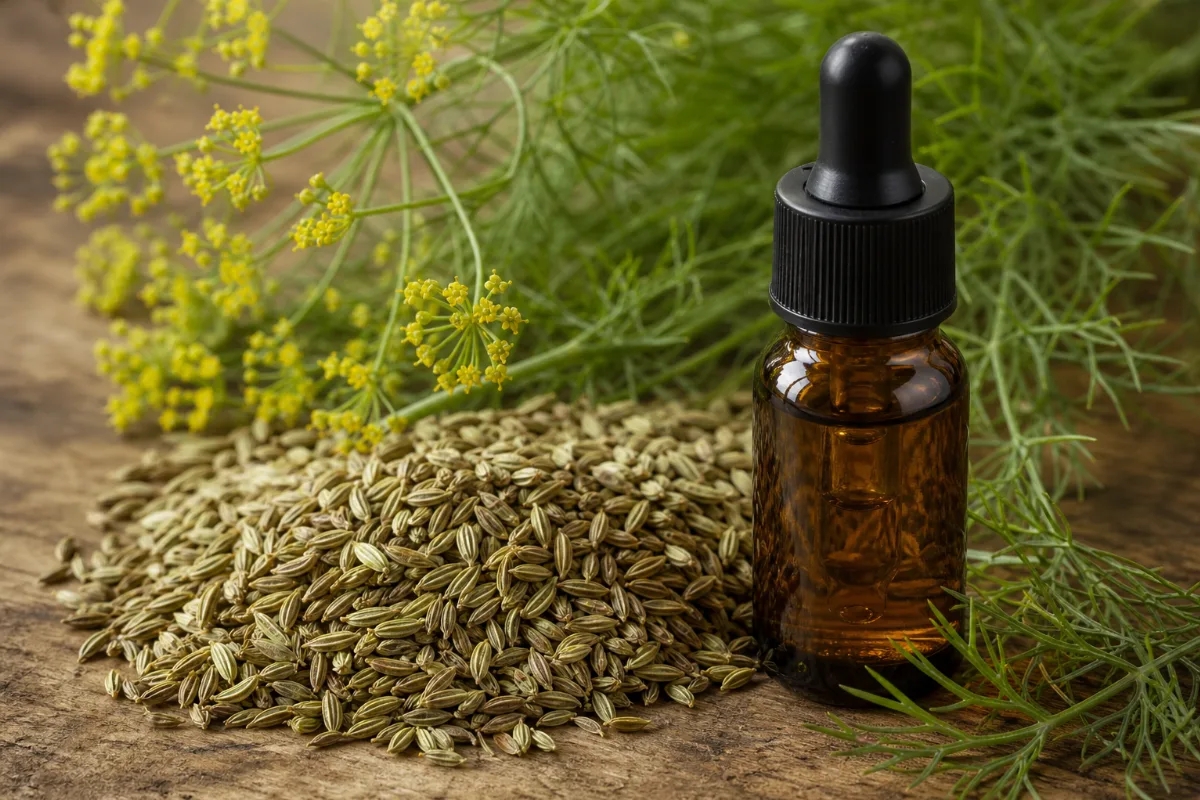
Essential Oils & Aromatherapy · Essential oil
Fennel Oil (Sweet and Bitter)
Foeniculum vulgare Mill. · also called Sweet fennel oil, bitter fennel oil, fennel seed oil, fennel essential oil
Fennel oil is the sweet, licorice-smelling oil distilled from fennel seeds (the dry fruits). It is used in aromatherapy and some flavourings, and small trials have looked at infant colic, period pain and massage for anxiety. The evidence is limited and often about fennel in other forms. The main cautions: do not swallow the oil (one seizure case is reported), and EU regulators ask that children and pregnant or breastfeeding women have as little estragole as possible.
General information, not medical advice. Last substantive update · Not medically reviewed. A named clinician has not signed off on this page. How this page is made
About Fennel Oil (Sweet and Bitter)
Fennel oil comes from fennel seeds. It is used in aromatherapy and flavourings, and small studies have looked at infant colic, period pain and massage for anxiety. The certainty is low or very low, and much of the period-pain research is on fennel in other forms. Safety comes first: do not swallow the oil, avoid it with epilepsy or fennel or carrot-family allergy, and keep it away from babies, pregnancy and breastfeeding.
What fennel oil is
Fennel oil is the essential oil from the dry fruits, called seeds, of fennel, Foeniculum vulgare Mill. GBIF lists this as the accepted name, in the carrot family, Apiaceae. The EU committee describes two types, sweet fennel and bitter fennel, which differ in estragole.
In the one seed oil analysed in a 2026 trial, 78.2% was trans-anethole. Estragole is a related compound. Fenchone is named, among other ketones, in a survey of oils that can cause seizures; the abstract does not say which plant holds which.
Poison Control says it can be hard to know the species, strength or contaminants in an essential oil bottle.
What people use it for, and how strong the evidence is
For infant colic there is one placebo-controlled trial of a fennel seed oil emulsion and pooled results for fennel preparations; reviewers call them encouraging but flawed. For period pain, pooled analyses favour fennel over placebo, but the studies used capsules, extracts or seed and the oil is not clearly tested. For anxiety, sleep and well-being there is one exploratory massage trial of 40 adults.
The product in each trial is not advice. This page does not tell you how much to use or how to use it. A pharmacist or aromatherapist trained in safety can advise on made products.
The research in one view
Most of the research is small, old or about fennel in forms other than the oil. The colic trial is from 2003 and the abstract gives no dose, route or funding. The period-pain analyses show huge disagreement between trials and signs of publication bias. The massage trial is exploratory and its scent is hard to hide. The authors of every review ask for better trials.
Bottled oil, emulsions, capsules and teas are different things
The emulsion given to babies, the capsules in the period-pain trials, the 1.6% massage mix and fennel tea are different products. Results for one do not show that bottled oil works or is safe. Poison Control says diluting an essential oil in a carrier oil is the best way to avoid a bad skin reaction. Sweet and bitter fennel oil differ in estragole, and what is in a bottle can be unclear.
What authorities say
The EU herbal committee (HMPC) lists bitter fennel fruit tea for mild gut spasm, minor period spasm and cough, not recommended under 4 years, and not recommended in pregnancy or breastfeeding (monograph revised January 2024). Its estragole statement (2014) names fennel fruit and oil and asks for minimal exposure of children and pregnant or breastfeeding women. Poison Control and Pet Poison Helpline give the general and pet warnings. We did not find or read a statement from the FDA, EFSA, NCCIH, LiverTox or LactMed, nor the EMA's page on bitter fennel oil.
Pets
Pet Poison Helpline says cats and birds are at the greatest risk from essential oils, and that swallowing is the highest-risk route. Fennel is not on its list of common poisoning oils, but that is not proof it is safe, and we found no fennel-specific pet report. Keep the oil away from pets and call a vet or pet poison line after any exposure.
At a glance
Traditional uses history, not proof
- Fennel fruit as a tea is a traditional European remedy for mild gut spasm with bloating, minor period spasm and cough (EU herbal committee; this is the fruit tea, not the oil).
- Fennel infusions are a classic remedy for gas and colic in nursing babies (2012 review).
- Used today in aromatherapy and as a flavouring.
Studied for research
- Infant colic, fennel seed oil emulsion and other fennel preparations, low
- Period pain, fennel capsules, extracts and seed (oil not clearly tested), low
- Anxiety, diluted oil in massage, very-low
- Sleep and well-being, diluted oil in massage, insufficient
Main compounds
- trans-Anethole, 78.2% in one analysed oil
- Estragole, 1.5 to 5.0% of sweet and 3.5 to 12.0% of bitter fennel oil (EMA table)
- Fenchone, named among convulsant ketones in the oils of 11 plants including fennel
Common forms
- Essential oil (sweet or bitter) from the seeds
- Diluted massage oil (as used in one trial)
- Fennel seed oil emulsion (infant colic trial)
- Capsules and fruit teas are different products
Research links: EMA: EU herbal monograph on bitter fennel fruit · EMA: Public statement on estragole · Poison Control: Essential oils · Pet Poison Helpline: Essential oils · Seizure after fennel oil, case report (abstract) · Infant colic trial of fennel seed oil (abstract) · Research Library · Genes & Biomarkers Library
What it is and its history
- Accepted scientific name
- Foeniculum vulgare
- Naming authority
- Mill.
- Synonyms
- Name: Foeniculum vulgare Mill. subsp. vulgare var. dulce (Mill.) Batt. et Trab.; Note: Named in the EU estragole statement as sweet fennel (also Roman fennel).; Name: Foeniculum vulgare Mill. subsp. vulgare var. vulgare; Note: Named in the EU statement and monograph as bitter fennel (also common fennel).
- Common names
- Fennel oil (English); Sweet fennel oil (English); Bitter fennel oil (English); Fennel seed oil (English); Fennel essential oil (English)
- Family or group
- Apiaceae (carrot family), per GBIF.
- Classification
- Plantae > Tracheophyta > Magnoliopsida > Apiales > Apiaceae > Foeniculum > Foeniculum vulgare
- Native range
- Not covered by the sources read.
- Habitat
- Not checked.
- What it looks like
- Part used: The oil comes from the fruits, usually called seeds (the 2003 trial calls it fennel seed oil; the 2026 trial used fennel seed essential oil made by hydrodistillation). This page does not describe how to recognise the plant.
- Cultivation
- Not covered by the sources read.
- Harvest and processing
- The 2026 trial's oil was extracted by hydrodistillation. Other methods were not read.
- Look-alikes and adulterants
- Name: Other oils sold under similar names; Note: Poison Control says it can be hard to know the species and strength in an essential oil bottle. A source naming particular look-alike oils was not read, so none is listed.
- Sustainability and conservation
- Not checked.
Traditional use and history history, not clinical proof
| Tradition or era | Documented use | Source |
|---|---|---|
| Traditional European herbal medicine (fruit as a tea) | The EU herbal committee lists bitter fennel fruit as a traditional herbal medicinal product for mild gut spasm with bloating and gas, minor spasm with periods, and as an expectorant in cough with a cold, based on long-standing use. This concerns the fruit as a tea, not the oil. | EMA, HMPC |
| Remedy for nursing babies | A 2012 review says fennel infusions are the classical decoction for nursing babies to prevent gas and colic spasm, and that fennel was traditionally used as an antispasmodic, diuretic, anti-inflammatory and galactagogue. | Gori 2012 |
Traditional use shows how it was used. It does not show that it works or is safe today.
What is inside, and how it may work
What it contains and how those compounds act in cells and animals. Laboratory and animal mechanisms are not proven effects in people.
Main compounds
| Compound | Family | Where it is concentrated | Activity studied | Level of evidence |
|---|---|---|---|---|
| trans-Anethole PubChem 637563 | phenylpropanoid | Fennel seed essential oil 78.2% in the one hydrodistilled oil analysed in a 2026 trial. | Allergen in case reports; in people, a small amount was turned into a reactive breakdown product after a volunteer took isolated anethole. Role in the oil's effects is not shown. 8 15 12 25 | Human lab |
| Estragole PubChem 8815 | phenylpropanoid (alkenylbenzene) | Fennel fruit and oil 1.5 to 5.0% of sweet fennel oil and 3.5 to 12.0% of bitter fennel oil (EMA table). | Genotoxic carcinogen in rodents (EMA). 22 25 | Animal regulatory |
| Fenchone PubChem 14525 | monoterpene ketone | Not stated in the sources read Not stated in the sources read. | Named, with camphor, thujone and others, among the monoterpene ketones behind the convulsant effect of the oils of 11 plants including fennel; the abstract does not say which plant holds which. 6 25 | Review |
Mechanisms, receptors and pathways
| Target or pathway | Gene or receptor | What was found | Level |
|---|---|---|---|
| Estragole bioactivation | CYP enzymes and sulfotransferases | Estragole is hydroxylated and then sulfated to a reactive form that binds DNA; anethole forms the same kinds of adducts at lower levels. In people drinking fennel tea for four weeks a blood marker of this exposure rose and then fell after washout. This shows exposure, not harm. 4 12 22 | Human pilot and lab |
| Seizure-causing oils | GABA signalling and ion channels | A 2019 review says convulsant oils act mainly by changing GABA signalling and ion channels, and that more research is needed. It is a general statement about many oils, not tested for fennel. 3 | Review mixed |
| Gut spasm and movement | The 2003 colic trial authors say fennel seed oil has been shown to reduce intestinal spasm and increase small-bowel movement. We did not read that work. 1 | Unverified background claim |
Absorption, metabolism and elimination
- Absorption
- Trans-anethole is excreted in human breast milk (EU monograph). Skin absorption of estragole is unknown (EU statement).
- Distribution
- Not established in the sources read.
- Metabolism
- In 12 volunteers drinking fennel tea, a breakdown product of estragole and anethole appeared in urine, mostly in the first hour, with a half-life of about 1.1 hours and almost complete clearance within 8 hours; amounts varied widely between people.
- Elimination
- See metabolism.
- Bioavailability
- Not established.
Isolated compounds versus whole extracts
Fennel seed oil emulsions, diluted massage oil, fennel capsules, fennel tea and fennel fruit are different products. Results do not carry between them. The EU monograph limits are for the fruit as a tea, and one review argues the tea's other substances may inactivate estragole, which cannot be assumed for the concentrated oil.
Nutritional composition
Fennel oil is not a food or a nutrient and is not a supplement to swallow.
2 low certainty1 very low certainty1 not enough evidence
What is Fennel Oil (Sweet and Bitter) good for?
The uses people ask about and how strong the evidence is for each. Read the certainty label first: several results are about fennel capsules, extracts or seed rather than the essential oil, and none is advice to swallow or use the oil undiluted.
Benefits, one by one
Each card is a research question, not a promise. Tap a goal to filter. Open a card to see the studies, doses and limits.
Infant colic (fennel seed oil emulsion and other fennel preparations)
Low certaintyOne 2003 trial of 125 babies found less colic with a fennel seed oil emulsion than with placebo, and reviews call the fennel results encouraging but flawed. This is a medicine-style trial in babies. It is not a reason to give a baby fennel oil, and EU advice is against fennel products under 4 years.
6 studiesStudied as set products or set massage mixes (details are in the resu…
Studies, doses and limits
What the trials found
A 2003 randomized, placebo-controlled trial of 125 infants aged 2 to 12 weeks with colic at two clinics (fennel seed oil emulsion). Reviews: Perry 2011 (15 trials of complementary medicines, 'some encouraging results for fennel extract' but all trials flawed), Anheyer 2017 (14 trials in children; evidence for different fennel preparations in infant colic, no serious adverse events reported) and Harb 2016 (3 fennel studies pooled).
Results
2003 trial: colic eliminated in 65% (40 of 62) on the emulsion versus 23.7% (14 of 59) on placebo (P < 0.01); no side effects reported in either group. Harb 2016: the 3 pooled studies of fennel preparations had a mean difference of -72.1 minutes of crying a day (95% CI -126.4 to -17.7) and the authors say preparations containing fennel oil appear effective, with limitations. Perry 2011 says no complementary medicine is yet supported and replications are missing.
Effect sizes as reported
2003 oil trial: colic eliminated in 65% vs 23.7% on placebo (absolute risk reduction 41%, 95% CI 25 to 57). 2016 pooled fennel preparations (3 studies): 72.1 fewer minutes of crying a day (95% CI -126.4 to -17.7).
Why this rating
One placebo-controlled trial of the oil, and pooled results from only 3 small studies of mixed fennel preparations; reviewers describe every trial as flawed and say independent replication is missing. Colic often passes by itself, and the abstracts do not give the dose, route or funding.
Form and dose studied
Studied as set products or set massage mixes (details are in the results). No amounts are advised here. Bottled essential oil is very concentrated: do not swallow it and do not use it undiluted; ask a pharmacist.
Who was studied
Infants 2 to 12 weeks old with colic.
Limits
Dose, route, product and funding are not in the abstract of the 2003 trial. The pooled studies include products other than the pure oil. Anheyer 2017 notes grants from herbal-medicine makers to one author. Fennel's estragole content is the reason EU advice is against fennel products in young children (see Safety).
Why researchers looked
Fennel is a traditional remedy for gas and tummy cramps, and the 2003 trial authors say fennel seed oil has been shown to reduce gut spasm and increase small-bowel movement (a background statement in the abstract; we did not read the animal work).
Traditional use
The EU herbal committee lists fennel fruit tea as a traditional medicine for mild gut spasm with bloating and gas (a tea, not the oil). Gori 2012 notes fennel infusions are a classic remedy for nursing babies to prevent gas and colic spasm.
Proposed mechanism Preliminary mechanism
The 2003 trial abstract says fennel seed oil has been shown to reduce intestinal spasms and increase motility of the small intestine. That is a claim about earlier work that we did not read, so we treat it as unverified.
A proposed mechanism does not show that the effect happens in people.
The EU monograph for fennel fruit tea does not recommend use under 4 years and says estragole intake for children should be kept very low. A pediatrician should be asked about any fennel product for a baby. Swallowed essential oils can poison children (see Safety).
Period pain (fennel capsules, extracts and seed; oil not clearly tested)
Low certaintySeveral pooled analyses say fennel eased period pain more than placebo, and about as well as ordinary pain medicines. But these trials used fennel seed, extracts or capsules, and the abstracts do not show that any used the essential oil. The results are very uneven and probably biased towards good news.
5 studiesStudied as set products or set massage mixes (details are in the resu…
Studies, doses and limits
What the trials found
Two meta-analyses of 12 fennel trials each (Lee 2020; Shahrahmani 2021), a 2026 meta-analysis of 14 trials of Apiaceae plants (anise, dill, cumin, fennel and others), and a 2026 triple-blind crossover trial of 384 young women in India using fennel capsules.
Results
Lee 2020: against placebo fennel lowered pain (SMD -3.27, 95% CI -5.28 to -1.26), but the trials disagreed hugely (I-squared 98%) and the authors saw publication bias; against drugs (7 trials, 502 people) the effect was similar (SMD 0.07). Shahrahmani 2021: against placebo (7 articles) SMD -0.632 (95% CI -0.827 to -0.436); against mefenamic acid no difference. 2026 meta-analysis: Apiaceae plants 'potentially effective adjunct therapies', needing better trials. 2026 trial: fennel capsules lowered the pain score (VAS to 4.61 vs 6.24 on placebo) but ginger worked better (VAS to 3.28).
Effect sizes as reported
Lee 2020: vs placebo SMD -3.27 (95% CI -5.28 to -1.26, I-squared 98%); vs drugs SMD 0.07 (95% CI -0.08 to 0.21). Shahrahmani 2021: vs placebo SMD -0.632 (95% CI -0.827 to -0.436); vs mefenamic acid SMD -0.214 (95% CI -0.446 to 0.017).
Why this rating
Pooled results lean the same way, but trials are small and uneven (I-squared 98% in one analysis), the authors see publication bias, the products vary, and the abstracts do not show any used the essential oil. So this says little about bottled oil.
Form and dose studied
Studied as set products or set massage mixes (details are in the results). No amounts are advised here. Bottled essential oil is very concentrated: do not swallow it and do not use it undiluted; ask a pharmacist.
Who was studied
Young women with primary dysmenorrhea (no underlying disease).
Limits
The preparations are not described in the abstracts; the 2026 trial used capsules that were not stated to contain essential oil, and two of its authors are linked to a food and nutraceutical company although no conflict is declared. Swallowing is the route in these trials, which this page does not advise for the oil.
Why researchers looked
Fennel has been used traditionally for menstrual cramps. Researchers have tested it in young women with painful periods that have no underlying disease (primary dysmenorrhea).
Traditional use
The EU herbal committee lists fennel fruit tea as a traditional medicine for minor spasm with periods (a tea, not the oil), and says its use for this in children under 12 is not recommended.
Proposed mechanism Preliminary mechanism
No mechanism is given in the abstracts we read.
A proposed mechanism does not show that the effect happens in people.
Safety in pregnancy is not established and fennel is not recommended then (see Safety). Severe or new period pain needs a doctor.
Anxiety (aromatherapy massage with diluted fennel seed oil)
Very low certaintyOne small Portuguese trial of 40 adults found lower anxiety scores after massage with diluted fennel seed oil than after massage with almond oil alone. The authors call it exploratory, and a strong scent is hard to hide from people, so it needs repeating.
1 studiesStudied as set products or set massage mixes (details are in the resu…
Studies, doses and limits
What the trials found
A 2026 exploratory randomized trial of 40 adults: 20 had massage with fennel seed oil (1.6% in sweet almond oil) and 20 had massage with almond oil alone, one session every 15 days for 2 months. The oil was 78.2% trans-anethole (one lab analysis).
Results
After the last session the state-anxiety score was 32.47 in the oil group and 41.75 in the massage-alone group (difference -9.28, p = 0.007). Neither group changed significantly over time on its own scores (p = 0.536 and p = 0.381).
Effect sizes as reported
State anxiety (STAI) after the last session: 32.47 oil massage vs 41.75 massage alone; difference -9.28 (p = 0.007).
Why this rating
One exploratory trial of 40 people. Scent makes blinding doubtful. Neither group changed over time, which makes the single between-group difference hard to read. Not repeated.
Form and dose studied
Studied as set products or set massage mixes (details are in the results). No amounts are advised here. Bottled essential oil is very concentrated: do not swallow it and do not use it undiluted; ask a pharmacist.
Who was studied
Adults in Portugal; the abstract does not describe their anxiety levels.
Limits
Small, exploratory, scent unblinded, one comparison, no repeat. The authors declare no conflict of interest. The trial does not show that diluting the oil makes it safe for everyone, and it was not about the oil alone.
Why researchers looked
The authors say fennel seed essential oil has been reported as potentially beneficial for anxiety and sleep problems.
Traditional use
Not described in the sources read for this use.
Proposed mechanism Preliminary mechanism
No mechanism was tested in the trial.
A proposed mechanism does not show that the effect happens in people.
Skin allergy to fennel and to anethole is possible; the oil is used diluted in the trial and must not be swallowed (see Safety). People with epilepsy, pregnant women and children should ask a clinician.
Sleep quality and well-being (aromatherapy massage with diluted fennel seed oil)
Not enough evidenceIn the same small trial, more people in the oil group reported strong well-being and good sleep a month after the sessions ended, but the average scores did not differ in a statistically meaningful way. This is not evidence of help.
1 studiesStudied as set products or set massage mixes (details are in the resu…
Studies, doses and limits
What the trials found
The same 2026 trial of 40 adults, using the Pittsburgh Sleep Quality questionnaire and the WHO-5 Well-Being Index.
Results
One month after the end, 89% of the oil group vs 65% of the massage-alone group reported strong well-being, and 32% vs 25% reported good sleep. The authors state these differences were not statistically significant when comparing mean questionnaire scores.
Effect sizes as reported
Strong well-being 89% vs 65% and good sleep 32% vs 25% one month after the end; mean scores not significantly different.
Why this rating
The measured averages did not differ significantly, and the trial is small and exploratory.
Form and dose studied
Studied as set products or set massage mixes (details are in the results). No amounts are advised here. Bottled essential oil is very concentrated: do not swallow it and do not use it undiluted; ask a pharmacist.
Who was studied
Adults in Portugal.
Limits
Percentages are from a single follow-up time; the means were not different; 40 people.
Why researchers looked
Sleep and well-being were measured alongside anxiety in the same trial.
Traditional use
Not described in the sources read for this use.
Proposed mechanism Preliminary mechanism
Not tested.
A proposed mechanism does not show that the effect happens in people.
See Safety for skin allergy, seizures, pregnancy and children.
Connections to the rest of health
How Fennel Oil (Sweet and Bitter) connects to the rest of our health knowledge graph. Every link says what kind of connection it is. A safety link (for example to the liver) is a warning, not a benefit. A study that merely mentions a topic never creates a benefit link.
Explore every connection: goals, body systems, organs, symptoms, genes
A. Wellness goals
| Connected to | Kind of connection | Evidence status | Context | Studies |
|---|---|---|---|---|
| Digestive Support | Low certainty | Infant colic (fennel seed oil emulsion and other fennel preparations): One 2003 trial of 125 babies found less colic with a fennel seed oil emulsion than with placebo, and reviews call the fennel results encouraging but flawed. This is a medicine-style trial in babies. It is not a reason to give a baby fennel oil, and EU advice is against fennel products under 4 years. | 1 10 14 2 23 22 | |
| Womens Wellness | Low certainty | Period pain (fennel capsules, extracts and seed; oil not clearly tested): Several pooled analyses say fennel eased period pain more than placebo, and about as well as ordinary pain medicines. But these trials used fennel seed, extracts or capsules, and the abstracts do not show that any used the essential oil. The results are very uneven and probably biased towards good news. | 11 16 18 13 23 | |
| Anxiety Support | Very low certainty | Anxiety (aromatherapy massage with diluted fennel seed oil): One small Portuguese trial of 40 adults found lower anxiety scores after massage with diluted fennel seed oil than after massage with almond oil alone. The authors call it exploratory, and a strong scent is hard to hide from people, so it needs repeating. | 8 | |
| Better Sleep | Not enough evidence | Sleep quality and well-being (aromatherapy massage with diluted fennel seed oil): In the same small trial, more people in the oil group reported strong well-being and good sleep a month after the sessions ended, but the average scores did not differ in a statistically meaningful way. This is not evidence of help. | 8 |
B. Body systems
| Connected to | Kind of connection | Evidence status | Context | Studies |
|---|---|---|---|---|
| Digestive System | Biological association | Low certainty | Studied for: Infant colic (fennel seed oil emulsion and other fennel preparations) | 1 10 14 2 23 22 |
| Reproductive System | Biological association | Low certainty | Studied for: Period pain (fennel capsules, extracts and seed; oil not clearly tested) | 11 16 18 13 23 |
| Nervous System | Biological association | Very low certainty | Studied for: Anxiety (aromatherapy massage with diluted fennel seed oil) | 8 |
| Stress Mood | Biological association | Very low certainty | Studied for: Anxiety (aromatherapy massage with diluted fennel seed oil) | 8 |
| Sleep Recovery | Biological association | Not enough evidence | Studied for: Sleep quality and well-being (aromatherapy massage with diluted fennel seed oil) | 8 |
E. Health conditions
| Connected to | Kind of connection | Evidence status | Context | Studies |
|---|---|---|---|---|
| Contact dermatitis | Adverse effect or risk | Documented risk | Allergy is listed in the EU monograph; anethole contact allergy case report. Preparation or compound: Fennel and anethole |
23 15 |
| Epilepsy / seizures | Adverse effect or risk | Case report | One case report and reviews naming fennel among seizure-causing oils. Preparation or compound: Fennel essential oil taken by mouth |
17 6 3 |
| Infantile colic | Low certainty | One placebo-controlled trial and reviews; safety limits for young children apply. Preparation or compound: Fennel seed oil emulsion and fennel preparations |
1 10 23 | |
| Primary dysmenorrhea (period pain) | Low certainty | Pooled analyses; oil not clearly tested. Preparation or compound: Fennel capsules, extracts and seed |
11 16 13 |
I. Biomarkers
| Connected to | Kind of connection | Evidence status | Context | Studies |
|---|---|---|---|---|
| Daily crying time and colic status | Biological association | Low certainty | Measured in trials: decrease. A lab change is not the same as a health benefit. | 1 10 |
| Period pain score (visual analogue scale) | Biological association | Low certainty | Measured in trials: decrease. A lab change is not the same as a health benefit. | 13 11 16 18 |
| State anxiety score (STAI) | Biological association | Very low certainty | Measured in trials: decrease. A lab change is not the same as a health benefit. | 8 |
J. Genes, receptors and enzymes
L. Active compounds
| Connected to | Kind of connection | Evidence status | Context | Studies |
|---|---|---|---|---|
| trans-Anethole | Biological association | Human lab | Allergen in case reports; in people, a small amount was turned into a reactive breakdown product after a volunteer took isolated anethole. Role in the oil's effects is not shown. Preparation or compound: Fennel seed essential oil |
8 15 12 25 |
| Estragole | Biological association | Animal regulatory | Genotoxic carcinogen in rodents (EMA). Preparation or compound: Fennel fruit and oil |
22 25 |
| Fenchone | Biological association | Review | Named, with camphor, thujone and others, among the monoterpene ketones behind the convulsant effect of the oils of 11 plants including fennel; the abstract does not say which plant holds which. Preparation or compound: Not stated in the sources read |
6 25 |
Each connection is stored with the ingredient, the connected record, the kind of connection, the evidence status, the supporting studies, the preparation or compound involved, and a review date (last reviewed October 25, 2026).
The evidence
The research centre for Fennel Oil (Sweet and Bitter). Every record here was checked against PubMed or the publisher's page; we never list a study we have not verified.
Evidence by outcome
Bars show how many studies we found for each outcome, not how well it works. People are added up across trials only (reviews are not added, to avoid double counting).
How we rate evidence
High certainty
Several well-run trials or reviews agree; further research is unlikely to change the picture much.
Moderate certainty
Good trials point the same way, but some doubt remains.
Low certainty
Small, short or inconsistent trials. The finding could change with better research.
Very low certainty
Very little or very weak human data. Treat as a possibility only.
Mixed findings
Trials or reviews disagree with each other.
Not enough evidence
Not enough human research to say either way.
Evidence against
Good research found no benefit, or found harm.
We take the reviewers' own risk-of-bias and GRADE statements where they exist, and otherwise judge from study size, design, consistency, directness and whether a product matches what is sold. Many publications do not make evidence high. Method note: We read the abstracts of 19 PubMed papers, the full EMA monograph and estragole statement, and the Poison Control and Pet Poison Helpline pages, and checked the plant name in GBIF and the compounds in PubChem. We did not read a statement from the FDA, EFSA, NCCIH, LiverTox or LactMed.
Study library: every study we checked 25
| Study | Design | People | Product, dose, length | Result |
|---|---|---|---|---|
| Alexandrovich 2003 The effect of fennel (Foeniculum Vulgare) seed oil emulsion in infantile colic: a randomized, placebo-controlled study. Alternative Therapies in Health and Medicine · PMID 12868253 |
Randomized controlled trial |
125 Infants aged 2 to 12 weeks with colic, two clinics (St. Petersburg) |
Fennel seed oil emulsion seed oil, as an emulsion Not stated in the abstract Not stated in the abstract · vs Placebo |
Colic was eliminated in 65% (40 of 62) of infants on the emulsion versus 23.7% (14 of 59) on placebo (P < 0.01). Absolute risk reduction 41% (95% CI 25 to 57); number needed to treat 2 (95% CI 2 to 4). The abstract says side effects were not reported in either group. ARR 41%; NNT 2 (25 to 57) Methods, limits and fundingOutcomes: Relief of colic (cumulative crying under 9 hours a week; Wessel criteria) Limitations: The abstract does not give the dose, how the emulsion was given, the length of treatment or who paid. Colic usually passes by itself. One trial, not repeated by an independent team in the sources we read. Product details are not given, so it cannot be tied to any bottled oil. Funding and conflicts: Not stated in the abstract (listed as non-US government research support). Read: abstract |
| Anheyer 2017 Herbal Medicines for Gastrointestinal Disorders in Children and Adolescents: A Systematic Review. Pediatrics · PMID 28562281 · DOI |
Systematic review |
1927 14 trials in children and adolescents with gastrointestinal disorders |
Herbal treatments, including different fennel preparations (oil, tea, herbal compound) for infant colic n/a n/a n/a · vs No treatment, placebo or medicine |
The review found evidence for effectiveness of different fennel preparations (for example oil, tea or a herbal compound) in infants with colic. No serious adverse events were reported. The authors say the results have to be read carefully because there were few trials and more rigorous trials are needed. Methods, limits and fundingOutcomes: Effectiveness and safety Limitations: Few trials per herb; the abstract does not separate the oil trials. One author reported grants from herbal-medicine makers (Schwabe Pharma, Steigerwald, Repha). Funding and conflicts: One author reported grants from herbal-medicine makers; the others reported no conflicts. Read: abstract |
| Bahr 2019 The Effects of Various Essential Oils on Epilepsy and Acute Seizure: A Systematic Review. Evidence-Based Complementary and Alternative Medicine · PMID 31239862 · DOI |
Systematic review mixed |
Human case reports, animal and lab studies of essential oils and seizures | Many essential oils n/a n/a n/a · vs n/a |
The review says internal use of essential oils such as sage, hyssop, rosemary, camphor, pennyroyal, eucalyptus, cedar, thuja and fennel can cause epileptic seizures, because of constituents like thujone, 1,8-cineole, camphor or pinocamphone. It says the effects seem to come mainly from changes in GABA signalling and ion channels, and that more research is needed. Methods, limits and fundingOutcomes: Convulsant or anticonvulsant effects Limitations: Mixed human, animal and lab evidence; the abstract does not give fennel-specific details or say whether skin or inhaled use is a risk. Funding and conflicts: Not stated in the abstract. Read: abstract |
| Bergau 2021 Bioactivation of estragole and anethole leads to common adducts in DNA and hemoglobin. Food and Chemical Toxicology · PMID 34015424 · DOI |
Laboratory and pilot human human and lab |
Rat and human liver fractions in the lab, plus a pilot of people drinking fennel tea for four weeks | Estragole and anethole in the lab; estragole- and anethole-rich fennel tea in people tea (not the oil) As in the study 4 weeks of tea, then washout · vs None |
In the lab, both estragole and, at lower levels, anethole formed DNA and haemoglobin adducts through the same steps. In the pilot, the blood marker rose during four weeks of fennel tea and fell during washout. The authors say the marker may be used to monitor internal exposure. Methods, limits and fundingOutcomes: Reactive-metabolite markers (DNA and haemoglobin adducts) Limitations: Shows exposure to reactive metabolites; it does not show disease. Small pilot; tea, not oil. Funding and conflicts: Not stated in the abstract (German federal risk assessment institute authors). Read: abstract |
| Berghea 2025 Spices, herbs and allergic reactions in children: myth or reality - a narrative review with scoping elements. Frontiers in Allergy · PMID 41306764 · DOI |
Narrative review n/a |
Case reports, clinical, immunologic and molecular studies on spice and herb allergy in children | Spices and herbs, fennel among them n/a n/a n/a · vs n/a |
The review lists fennel among the most frequently implicated spices (with mustard, celery, coriander, cumin, anise, pepper and mint-family herbs). Symptoms range from mild mouth reactions to anaphylaxis, and cross-reactivity with birch and mugwort pollen is common. Methods, limits and fundingOutcomes: Spice and herb allergy in children Limitations: A narrative review; it is about spices and herbs as foods and does not study the essential oil. Funding and conflicts: The authors declare no commercial or financial relationships. Read: abstract |
| Burkhard 1999 Plant-induced seizures: reappearance of an old problem. Journal of Neurology · PMID 10460442 · DOI |
Case report |
3 Three healthy people (two adults, one child) with seizures after taking essential oils for treatment, plus a literature survey |
Essential oils taken by mouth for therapeutic purposes n/a n/a n/a · vs n/a |
The survey names the essential oils of 11 plants, fennel among them, as powerful convulsants because of reactive monoterpene ketones such as camphor, thujone, cineole, pulegone and fenchone. The authors report the three cases (the abstract does not say which oils) as support for plant-related toxic seizures; the adults did well and the child had a less favourable course. Methods, limits and fundingOutcomes: Seizures Limitations: The abstract does not say which of the 3 patients took which oil, or which plant's oil contains which ketone. Funding and conflicts: Not stated in the abstract. Read: abstract |
| Dosoky 2021 Maternal Reproductive Toxicity of Some Essential Oils and Their Constituents. International Journal of Molecular Sciences · PMID 33673548 · DOI |
Narrative review mixed |
Review of studies on essential oils in pregnancy | Essential oil constituents including anethole n/a n/a n/a · vs n/a |
The review says using herbs or essential oils in pregnancy is questionable, and lists anethole among the constituents whose reproductive effects it summarises. The abstract does not give a conclusion for fennel oil. Methods, limits and fundingOutcomes: Effects on the female reproductive system and fetus Limitations: The abstract names the constituents but gives no findings for them; we did not read the full text. Funding and conflicts: The authors declare no conflict of interest. Read: abstract |
| Felix 2026 Effect of Aromatherapy Massage With Foeniculum vulgare Mill. Seed Essential Oil Compared to Massage on Anxiety, Well-Being, and Sleep Quality: An Exploratory Randomized Study. Health Science Reports · PMID 42147465 · DOI |
Randomized controlled trial |
40 40 adults in Portugal, randomly split into two groups of 20 |
Fennel seed essential oil (hydrodistilled) 1.6% in sweet almond oil, used in massage seed essential oil, diluted, on the skin 1.6% in almond oil (a trial detail, not advice) One session every 15 days for 2 months · vs Massage with sweet almond oil alone |
The oil was 78.2% trans-anethole. The state-anxiety score was lower in the oil group after the last session (32.47 vs 41.75; difference -9.28, p = 0.007). Neither group changed significantly over time (p = 0.536 and p = 0.381). More people in the oil group reported strong well-being (89% vs 65%) and good sleep (32% vs 25%) one month after the end, but the mean questionnaire scores did not differ significantly. State anxiety difference -9.28 Methods, limits and fundingOutcomes: State anxiety (STAI), sleep quality (Pittsburgh), well-being (WHO-5) Limitations: The authors call it exploratory. Only 40 people. The scent of the oil is hard to hide from the people using it, so blinding is doubtful. The groups did not change over time on their own scores, which makes the single between-group difference harder to read. Not confirmed by another trial. Funding and conflicts: The authors declare no conflicts of interest. Read: abstract |
| Gori 2012 Can estragole in fennel seed decoctions really be considered a danger for human health? A fennel safety update. Evidence-Based Complementary and Alternative Medicine · PMID 22899959 · DOI |
Narrative review mixed |
Review of fennel safety (fennel seed decoctions and essential oil used as flavourings and remedies) | Fennel seed decoction seed, as a decoction n/a n/a · vs n/a |
The authors say fennel has been charged with being dangerous because of estragole carcinogenicity, but that this overlooks that the remedy is a mixture, and that recent research confirms pure estragole is inactivated by many substances in the decoction. Methods, limits and fundingOutcomes: Whether estragole in fennel seed decoctions is a danger Limitations: This is the authors' argument about decoctions. It does not address the concentrated essential oil, and the EMA committee keeps its estragole limits. The authors are from a clinical pharmacology unit; no funding is stated in the abstract. Funding and conflicts: Not stated in the abstract. Read: abstract |
| Harb 2016 Infant Colic-What works: A Systematic Review of Interventions for Breast-fed Infants. Journal of Pediatric Gastroenterology and Nutrition · PMID 26655941 · DOI |
Systematic review |
17 randomized trials in breast-fed or mixed-fed infants under 6 months; 3 of them tested fennel preparations | Preparations containing fennel (pooled from 3 studies) n/a n/a n/a · vs Placebo or other |
The 3 studies of fennel preparations had an overall mean difference of -72.1 minutes of crying a day (95% CI -126.4 to -17.7). The authors say preparations containing fennel oil 'appear effective', although there are limitations, and call for better-designed trials. MD -72.1 min/day (-126.4 to -17.7) Methods, limits and fundingOutcomes: Daily crying time at day 21 Limitations: Only 3 small studies were pooled; the abstract does not say what each contained. The result covers fennel preparations, and the abstract does not give the trial sizes. Funding and conflicts: Not stated in the abstract. Read: abstract |
| Lee 2020 Fennel for Reducing Pain in Primary Dysmenorrhea: A Systematic Review and Meta-Analysis of Randomized Controlled Trials. Nutrients · PMID 33182553 · DOI |
Meta-analysis |
12 randomized trials of fennel for period pain | Fennel (various preparations; the abstract does not give them) n/a n/a n/a · vs Placebo or conventional pain medicines |
Against conventional drugs (7 trials, 502 people) the effect of fennel was similar (SMD 0.07, 95% CI -0.08 to 0.21). Against placebo (468 people) fennel lowered pain (SMD -3.27, 95% CI -5.28 to -1.26), but the trials disagreed a great deal (I-squared 98%). Only 3 studies looked at adverse events and one reported minor ones. The authors saw signs of publication bias (many small studies with favourable results). SMD -3.27 vs placebo; 0.07 vs drugs (-5.28 to -1.26) Methods, limits and fundingOutcomes: Pain in primary dysmenorrhea Limitations: Very large disagreement between trials; publication bias; risk of bias moderate; the abstract does not say how many trials used the essential oil. Funding and conflicts: No conflict of interest declared. Read: abstract |
| Monien 2019 Detection of N-Acetyl-S-[3'-(4-methoxyphenyl)allyl]-l-Cys (AMPAC) in Human Urine Samples after Controlled Exposure to Fennel Tea: A New Metabolite of Estragole and trans-Anethole. Chemical Research in Toxicology · PMID 31565931 · DOI |
Human exposure study |
12 12 healthy adults (6 women, 6 men) |
500 mL of fennel tea containing 2.2 mg of estragole tea (not the oil) As in the study Single exposure · vs None |
The breakdown product was found in urine in most people after drinking the tea, with the highest amounts in the first hour, and was almost all cleared within 8 hours. Amounts varied a lot between people. It was also made, to a much smaller extent, in one volunteer who took isolated trans-anethole. The authors say it may serve as a marker of exposure to the reactive form. Methods, limits and fundingOutcomes: Urinary breakdown product (AMPAC) of estragole and anethole Limitations: A biomarker study that shows how the body handles estragole; it does not show harm. Tea, not oil. Funding and conflicts: Not stated in the abstract (German federal risk assessment institute authors). Read: abstract |
| Negi 2026 Efficacy of ginger and fennel in relieving primary dysmenorrhea: A triple-blind crossover controlled trial. Journal of Education and Health Promotion · PMID 42829743 · DOI |
Randomized controlled trial |
384 384 young women aged 18 to 26 with period pain, India |
Fennel capsules (480 mg each; the abstract does not say whether they contained essential oil), ginger capsules, or placebo capsules, by mouth Not advice; see the paper First 3 days of the period, for 3 cycles (crossover) · vs Placebo capsules |
Ginger lowered pain the most (VAS 6.14 to 3.28). Fennel lowered it to 4.61 (versus 6.24 on placebo, which barely changed). The authors report significant differences between groups (P < 0.001) and conclude both helped, with ginger better. Methods, limits and fundingOutcomes: Pain on a visual analogue scale (VAS), McGill pain questionnaire, pain duration Limitations: The capsules are not stated to be essential oil, so this is not evidence about the oil. Crossover design; the abstract gives no effect-size interval. Two authors are linked to a food and nutraceutical company, although the authors state no conflict of interest. Funding and conflicts: Authors state no conflict; two authors list a food and nutraceutical company (Womy Foods and Nutraceuticals) as an affiliation. Read: abstract |
| Perry 2011 Nutritional supplements and other complementary medicines for infantile colic: a systematic review. Pediatrics · PMID 21444591 · DOI |
Systematic review |
15 15 randomized trials of complementary medicines for infant colic (13 placebo-controlled) |
Various complementary medicines, including fennel extract n/a n/a n/a · vs Placebo or other |
15 trials met the criteria; 8 were of good quality; 11 showed a significant result in favour of the complementary medicine. None was free of flaws and independent replications were missing for most. The authors found 'some encouraging results' for fennel extract, mixed herbal tea and sugar solutions, but say none of these treatments is supported by the evidence yet. Methods, limits and fundingOutcomes: Colic outcomes; trial quality (Jadad, Cochrane risk of bias) Limitations: Covers many treatments; the abstract does not separate the fennel trials or say which used the essential oil. The authors say all trials have major limitations. Funding and conflicts: Not stated in the abstract (non-US government research support). Read: abstract |
| Poon 2006 Cheilitis caused by contact allergy to anethole in spearmint flavoured toothpaste. Australasian Journal of Dermatology · PMID 17034478 · DOI |
Case report |
1 A 63-year-old woman with 6 years of lip inflammation |
Anethole (a flavour in her toothpaste) n/a n/a n/a · vs n/a |
A patch test was positive to anethole, and her cheilitis resolved after she stopped the flavoured toothpaste. Methods, limits and fundingOutcomes: Cause of persistent cheilitis (lip inflammation) Limitations: One case. It shows anethole (the main compound of fennel oil) can cause a contact allergy, not how common that is. Funding and conflicts: Not stated in the abstract. Read: abstract |
| Shahrahmani 2021 Effect of fennel on primary dysmenorrhea: a systematic review and meta-analysis. Journal of Complementary and Integrative Medicine · PMID 34187122 · DOI |
Meta-analysis |
12 trials of Foeniculum vulgare for period pain | Foeniculum vulgare (various preparations; not given in the abstract) n/a n/a n/a · vs Placebo or mefenamic acid |
Against placebo (7 articles) fennel lowered pain intensity (SMD -0.632, 95% CI -0.827 to -0.436, I-squared 0%). Against mefenamic acid (6 trials) the effect was not different (SMD -0.214, 95% CI -0.446 to 0.017). SMD -0.632 vs placebo (-0.827 to -0.436) Methods, limits and fundingOutcomes: Intensity of period pain Limitations: Quality scored with the Jadad scale; the abstract does not say how many trials used the oil or give the trial sizes. Funding and conflicts: Not stated in the abstract. Read: abstract |
| Skalli 2011 Epileptic seizure induced by fennel essential oil. Epileptic Disorders · PMID 21865126 · DOI |
Case report |
1 A 38-year-old woman with well-controlled epilepsy on treatment (Morocco) |
Fennel essential oil in cakes, swallowed; quantity unknown essential oil, swallowed in food Unknown Single event · vs n/a |
After eating a number of cakes containing an unknown amount of fennel essential oil she had a generalised tonic-clonic seizure and stayed unconscious for 45 minutes, with involuntary diarrhoea. The authors say the oil should probably be avoided by people with epilepsy and that products should be labelled with the seizure risk. Methods, limits and fundingOutcomes: Seizure Limitations: One case; the amount is unknown and other causes cannot be fully excluded from the abstract. Funding and conflicts: Not stated in the abstract. Read: abstract |
| Thaliyil Poduval 2026 Efficacy of herbaceous Apiaceae plants in primary dysmenorrhea: A systematic review and meta-analysis of RCTs. Annales Pharmaceutiques Francaises · PMID 41653970 · DOI |
Meta-analysis |
14 randomized trials of Apiaceae plants (anise, dill, cumin, fennel and others) for period pain | Apiaceae herbs including fennel seed n/a n/a n/a · vs Placebo or standard treatments such as mefenamic acid or ibuprofen |
Seven studies compared the plants with standard treatments and pooled to a statistically significant effect with low disagreement; fennel seed and dill seed also did so against mefenamic acid or ibuprofen. The authors call Apiaceae plants 'potentially effective adjunct therapies' and say high-quality trials are needed. Studies of fennel against standard treatments had concerns about deviations from the planned treatment and selective reporting. Methods, limits and fundingOutcomes: Period pain Limitations: The pooled result covers several plants. The abstract gives no numbers and does not say whether any trial used the essential oil. Funding and conflicts: Not stated in the abstract. Read: abstract |
| Turkyilmaz 2008 A striking and frequent cause of premature thelarche in children: Foeniculum vulgare. Journal of Pediatric Surgery · PMID 18970951 · DOI |
Case series |
Children with isolated premature thelarche (early breast development), Turkey | Herbal preparations of Foeniculum vulgare, used for gas and gut regulation in children n/a n/a Long-term use · vs n/a |
The authors say long-term use of preparations such as Foeniculum vulgare may cause premature thelarche and that such use should be limited. The abstract does not give numbers or say whether the products contained the essential oil. Methods, limits and fundingOutcomes: Cause of premature thelarche Limitations: The abstract gives no numbers, no control group and no product details, so it can show a link in time, not a cause. Funding and conflicts: Not stated in the abstract. Read: abstract |
| n/a Poison Control (US National Capital Poison Center): Essential oils, poisonous when misused (page read 2026-10-25; undated) n/a · Source |
Authoritative guidance n/a |
n/a | n/a n/a n/a n/a · vs n/a |
Essential oils can be poisonous if swallowed or absorbed and can cause skin rashes. Breathing an oil into the lungs while trying to swallow it can cause pneumonia. Children have thin skin and immature livers, which might make them more susceptible. It can be hard to know the species, concentration or contaminants in a bottle. Diluting an oil in a carrier oil is the best way to avoid a bad skin reaction. Essential oils may interact with medications. Oils must be locked away from children and pets. Poison center help: 1-800-222-1222 (US). Sage and eucalyptus oils are named as causing seizures; fennel is not mentioned. Methods, limits and fundingOutcomes: General essential-oil safety Limitations: A general page with no fennel-specific data. Read: full-text |
| n/a Pet Poison Helpline: Essential oils (page read 2026-10-25) n/a · Source |
Authoritative guidance n/a |
n/a | n/a n/a n/a n/a · vs n/a |
Essential oil poisoning can affect all species, but cats and birds are at the greatest risk. Signs include drooling, vomiting, lethargy, loss of appetite and irritation of the skin, airways and mouth; most oils cause signs within 6 to 8 hours, and severe cases can take 3 to 7 days to resolve. Swallowing is the highest-risk route, then skin, then breathing. The oils it lists as common causes of poisoning do not include fennel. Do not induce vomiting; for any exposure contact a veterinarian or pet poison line. Methods, limits and fundingOutcomes: Essential oils and pets Limitations: Fennel is not on its list, which does not prove fennel oil is safe for pets. No fennel-specific report was found. Read: full-text |
| n/a 2014 European Medicines Agency, HMPC: Public statement on the use of herbal medicinal products containing estragole, EMA/HMPC/137212/2005 Rev 1, 24 November 2014 (read 2026-10-25) n/a · Source |
Authoritative guidance n/a |
n/a | n/a n/a n/a n/a · vs n/a |
The committee names fennel (both fruit and essential oil) and anise fruit as the plants of most interest in Europe for estragole. It concludes estragole is a naturally occurring genotoxic carcinogen in rodents with a DNA potency similar to safrole, and that short-time use of herbal medicinal products by adults at the recommended posology does not pose a significant cancer risk. Exposure of young children, pregnant and breastfeeding women should be minimised. Data on absorption of estragole through the skin are missing, so products for the skin need further study; for skin use the statement limits use to intact skin. Table 1 gives estragole as 1.5 to 5.0% of sweet fennel oil and 3.5 to 12.0% of bitter fennel oil. Methods, limits and fundingOutcomes: Estragole toxicology, exposure limits, content in plants and oils Limitations: A statement about herbal medicinal products in the EU, not a ruling on bottled aromatherapy oils. Read: full-text |
| n/a 2024 European Medicines Agency, HMPC: EU herbal monograph on Foeniculum vulgare Miller subsp. vulgare var. vulgare, fructus (bitter fennel fruit), EMA/HMPC/372841/2016, final revision 1, 31 January 2024 (read 2026-10-25) n/a · Source |
Authoritative guidance n/a |
n/a | n/a n/a n/a n/a · vs n/a |
This is a monograph on bitter fennel fruit as a herbal tea for traditional use, not on the essential oil. It lists mild gut spasm with bloating, minor spasm with periods and cough as traditional uses. Contraindications: allergy to the plant, to the carrot family (aniseed, caraway, celery, coriander, dill), to anethole, or to mugwort pollen. Not recommended in children under 4 for the tea indications and under 12 for the period indication. Safety in pregnancy and breastfeeding is not established and use is not recommended; trans-anethole is excreted in breast milk. Allergic reactions of the skin or breathing can occur. No interactions or overdoses reported. Estragole is considered a genotoxic carcinogen in rodents (liver tumours in mice); an aqueous seed extract was teratogenic in mice. Estragole intake should be kept as low as practically achievable, with set limits for pregnant and breastfeeding women and for children under 12. Methods, limits and fundingOutcomes: Traditional use, contraindications, children, pregnancy, undesirable effects, estragole Limitations: It applies to the fruit as a herbal tea, not to the essential oil. We cannot say the same limits apply to the oil. Read: full-text |
| n/a 2026 GBIF Backbone Taxonomy: Foeniculum vulgare Mill., species key 3034922 (GBIF match API, read 2026-10-25) n/a · Source |
Registry or database n/a |
n/a | n/a n/a n/a n/a · vs n/a |
Accepted species name Foeniculum vulgare Mill., family Apiaceae, order Apiales, kingdom Plantae (exact match, confidence 99). Methods, limits and fundingOutcomes: Accepted name and family Limitations: Name and family only; synonyms were not read. Read: full-text |
| n/a 2026 PubChem: anethole (CID 637563), estragole (CID 8815) and fenchone (CID 14525) compound records (PubChem API, read 2026-10-25) n/a · Source |
Registry or database n/a |
n/a | n/a n/a n/a n/a · vs n/a |
Anethole (trans form CID 637563) and estragole (CID 8815) are isomers with the formula C10H12O. Fenchone (CID 14525) is C10H16O, 1,3,3-trimethylbicyclo[2.2.1]heptan-2-one. Methods, limits and fundingOutcomes: Compound identity Limitations: Identity only; no amounts or activity. Read: full-text |
What we do not know yet
- What the evidence supports: low for infant colic and period pain, very-low for anxiety, insufficient for sleep.
- No trial of the essential oil on period pain was found in the abstracts read.
- No independent repeat of the 2003 colic trial of the oil was found.
- No fennel-oil-specific poisoning series, pet report or skin-use seizure data were found.
- No statement from the FDA, EFSA, NCCIH, LiverTox or LactMed was read, nor the EMA page on bitter fennel oil.
- Skin absorption of estragole from the oil is unknown (EU statement).
How new research is added
New studies are found by a saved PubMed search and are placed in a review queue. A person reads each one before it is added.
Lab markers
What changed in blood or saliva tests during trials. A changed number is not the same as feeling or being healthier, and we give no "normal ranges".
Other 3
Daily crying time and colic status
Decrease in trials
Minutes of crying a day, or whether a baby still meets the standard (Wessel) colic criteria; lower is better.
Low certaintyResults and what it means
Why it was measured
The main outcome in the colic trials; it is reported by parents.
Statistical vs. clinical meaning
A parent-reported symptom score, not a lab test.
Safety implication
A calmer baby does not show a product is safe for babies; see the estragole limits for young children.
Period pain score (visual analogue scale)
Decrease in trials
A self-rated score of pain intensity on a line from no pain to worst pain; lower is better.
Low certaintyResults and what it means
Why it was measured
The main outcome in the period-pain trials.
Statistical vs. clinical meaning
A self-rated pain score.
Safety implication
Does not show safety; most trials used fennel taken by mouth in forms other than the oil.
State anxiety score (STAI)
Decrease in trials
A questionnaire score of how anxious a person feels at the moment; lower is better.
Very low certaintyResults and what it means
Why it was measured
The main outcome of the massage trial.
Statistical vs. clinical meaning
A self-rated questionnaire score, not a lab test.
Safety implication
A lower score does not show the oil is safe for everyone.
| Study | Result | People | Product |
|---|---|---|---|
| 8 | 32.47 (oil massage) vs 41.75 (massage alone) after the last session; difference -9.28, p = 0.007; neither group changed significantly over time. |
Safety
What studies and official sources say about side effects, medicines and who should check first. Each point shows what kind of evidence it comes from.
Main points to know 4
- Do not swallow fennel oil. One case report links it to a seizure, and essential oils in general poison children.. A 38-year-old woman with well-controlled epilepsy had a generalised seizure and stayed unconscious for 45 minutes after eating cakes made with an unknown amount of fennel essential oil. Her doctors say the oil should probably be avoided by people with epilepsy. A 1999 survey names the oils of 11 plants, fennel among them, as powerful convulsants, because of reactive monoterpene ketones such as camphor, thujone, cineole, pulegone and fenchone (the abstract does not say which plant holds which). A 2019 review likewise lists fennel among oils whose internal use can cause seizures. Poison Control adds that breathing an oil into the lungs while swallowing can cause pneumonia, and that children's thin skin and immature livers may make them more susceptible. Keep all bottles locked away from children and pets. Case report 17 6 3 20
- Estragole: a regulator calls it a rodent carcinogen, and asks that children and pregnant or breastfeeding women be exposed as little as possible.. The EU herbal committee (HMPC) names fennel fruit and fennel essential oil as the plants of most interest in Europe for estragole. It concludes estragole is a genotoxic carcinogen in rodents (liver tumours in mice), with DNA potency like safrole. It judged that short-term adult use of herbal medicinal products at the recommended dose does not pose a significant cancer risk, but says exposure of young children and pregnant and breastfeeding women should be minimised, and that data on absorption through the skin are missing. Its table gives estragole as 1.5 to 5.0% of sweet fennel oil and 3.5 to 12.0% of bitter fennel oil. These are statements about herbal medicines in the EU, not rulings on bottled aromatherapy oil. Tests in people who drank fennel tea show the body turns estragole and anethole into reactive breakdown products; that shows exposure, not harm. One review of fennel decoctions argues the tea's other substances may inactivate estragole; that is the authors' argument and it does not cover the concentrated oil. Regulatory 22 23 12 4 9
- Not recommended for babies and young children, in pregnancy or while breastfeeding.. The EU monograph for fennel fruit tea says the use is not recommended in children under 4 years because of lack of adequate data, and sets an estragole limit for children under 12. It says safety in pregnancy and breastfeeding has not been established and use is not recommended; trans-anethole is excreted in human breast milk. These limits are written for fennel fruit herbal tea, not the oil, and we cannot say the oil is safer. The infant colic trials (see Benefits) are not a reason to give a baby the oil. Regulatory 23 22
- Skin and breathing allergy to fennel and anethole is documented; never use the oil undiluted.. The EU monograph lists allergy to fennel, to carrot-family plants (aniseed, caraway, celery, coriander, dill), to anethole and to mugwort pollen as contraindications, and lists allergic reactions of skin or breathing as a possible effect. A 2025 review lists fennel among the spices most often implicated in allergy in children. One case report describes lip inflammation from contact allergy to anethole in a toothpaste. Poison Control says diluting an essential oil in a carrier oil is the best way to avoid a bad skin reaction. No amount is advised here; stop using any product that causes a rash. Case report 23 5 15 20
Side effects 5
| Effect | How often | Severity and recovery | Evidence |
|---|---|---|---|
| Seizure after swallowing the oil (case report) One reported case after an unknown amount in cakes. Reviews name fennel among seizure-causing oils when taken internally. Seizures from skin use or breathing the scent are not described in the sources read. | Not established | severe The woman was unconscious for 45 minutes; her later course is not given in the abstract | Case report 17 6 3 |
| Allergic reaction of the skin or breathing The EU monograph lists skin or breathing allergy as possible. Fennel is among spices commonly implicated in allergy in children, with cross-reactions to birch and mugwort pollen. | Frequency not known (EU monograph) | mild to severe Not stated | Regulatory 23 5 |
| Contact allergy to anethole (lip inflammation from toothpaste) Anethole was the main compound (78.2%) in the one fennel seed oil analysed in a 2026 trial. One case. | Not established | moderate Cleared after stopping the toothpaste | Case report 15 |
| Premature breast development in girls (association with long-term fennel herbal preparations) Turkish paediatric surgeons say long-term use of Foeniculum vulgare preparations in children may cause premature thelarche. The abstract gives no numbers, no control group and no product details, and says nothing about the essential oil. Cause is not proven. No source we read proves an estrogen-like effect of the oil in people. | Not established | mild Not given in the abstract | Case series 19 |
| Gut upset or other effects in the trials The 2003 infant trial reported no side effects in either group; only 3 of the 12 period-pain trials looked at side effects and one reported minor ones. Absence of reports in small trials is not proof of safety. | Not established | minor Not stated | Trial report 1 11 |
Liver
We found no report of liver injury in people from fennel oil in the sources read; LiverTox was not read. Estragole causes liver tumours in mice at high doses, which is why regulators limit it; that is animal evidence. 22 23
How often. Not established in people.
Monitoring. Not applicable.
This is a safety connection. It is not evidence that Fennel Oil (Sweet and Bitter) supports liver health.
Medicines and supplements 2
| With | Why it matters | Importance | Evidence | What to do |
|---|---|---|---|---|
| Prescription and over-the-counter medicines, in general medicines-general | The EU monograph for fennel fruit tea reports no interactions. Poison Control says essential oils may interact with medications. No specific fennel oil interaction was found in the sources read. | No specific interaction was found. Absence from the sources read is not proof of none. | Regulatory Not enough evidence 23 20 | Tell your pharmacist or doctor if you take regular medicines before using any essential oil. |
| Medicines for epilepsy anti-seizure-medicines | The woman in the seizure case report was on treatment and her epilepsy was well controlled, yet she still had a seizure after fennel oil. | Case report only; shows medicine did not prevent the seizure, not a drug interaction. | Case report Very low certainty 17 | People with epilepsy should ask their neurologist before using fennel oil in any way. |
Who should check first 6
| Situation | Advice | Evidence |
|---|---|---|
| Swallowing the oil, or any product not made to be swallowed | Do not swallow. If a child or pet may have swallowed any, call poison control (US: 1-800-222-1222) or your emergency number. | Case report 17 20 |
| Epilepsy or a history of seizures | Reviews name fennel oil among oils that can trigger seizures when taken internally, and the case report's authors say people with epilepsy should probably avoid it. Ask a neurologist. | Case report 17 6 3 |
| Allergy to fennel, anise, celery, caraway, coriander or dill (carrot family), to anethole, or to mugwort pollen | Listed as contraindications in the EU monograph for fennel fruit. Avoid the oil. | Regulatory 23 |
| Pregnancy and breastfeeding | Not recommended in the EU monograph for fennel fruit; safety is not established. Ask a midwife or doctor. | Regulatory 23 7 |
| Babies and young children | Fennel fruit products are not recommended under 4 years (EU monograph), and estragole exposure in children is limited. Keep the oil out of reach. | Regulatory 23 22 20 |
| Undiluted use on the skin | Do not apply undiluted. Poison Control advises diluting essential oils in a carrier oil. The EU estragole statement says data on skin absorption are missing and limits use to intact skin. | Regulatory 20 22 |
Overdose, product quality and regulators
Summary. Toxicity of the oil is described by one seizure case report, reviews naming fennel among seizure-causing oils, EU estragole findings in rodents, and general poison-centre advice. No lethal or safe amount is established in the sources read and none is stated here.
Amounts. No safe amount is established, and this page gives none. In the seizure case the amount was unknown.
Onset and course. Seizure case: seizure after eating cakes made with the oil, with 45 minutes of unconsciousness. Pets: signs of essential oil poisoning usually within 6 to 8 hours (Pet Poison Helpline, general).
Repeated use. EU concern is about estragole exposure over time (rodent liver tumours at high doses). Repeated use of fennel preparations has been linked, weakly, with early breast development in girls.
Animal data. Estragole causes liver tumours in mice and shows suggestive evidence in rats; an aqueous fennel seed extract was teratogenic in mice (EU monograph).
Toxic parts. The seed oil is concentrated. The compounds of concern named in the sources are estragole (genotoxic in rodents) and, for seizures, monoterpene ketones such as fenchone (the abstract of the survey does not say which plant holds which).
Not read. LiverTox, LactMed, FDA, EFSA, RIFM, IFRA and Tisserand safety data on fennel oil were not read. EMA's page on bitter fennel oil was not read, so we do not state why EMA took a position on it.
Sweet and bitter fennel oils differ in estragole, and the bottle may not tell you which you have.
Sweet versus bitter fennel oil. The EU committee's table gives estragole as 1.5 to 5.0% of sweet fennel oil and 3.5 to 12.0% of bitter fennel oil. 22
Composition varies. One hydrodistilled fennel seed oil analysed in a 2026 trial was 78.2% trans-anethole. Other batches will differ, and the abstract does not give estragole or fenchone for that oil. 8
Unknown species, strength and contaminants. Poison Control says it can be hard to know the plant species, concentration of active ingredient or whether contaminants are in an essential oil bottle. 20
| Body | Action | Date |
|---|---|---|
| European Medicines Agency, HMPC (EU herbal monograph, bitter fennel fruit) (European Union) | Traditional herbal tea for mild gut spasm, minor period spasm and cough. Not recommended under 4 years (under 12 for the period indication). Safety in pregnancy and breastfeeding not established; not recommended. Contraindicated in allergy to the plant, carrot-family plants, anethole or mugwort pollen. Allergic skin or breathing reactions can occur. Estragole is a genotoxic carcinogen in rodents; keep exposure as low as practically achievable. It covers the fruit as a tea, not the oil. source | 2024-01 |
| European Medicines Agency, HMPC (public statement on estragole) (European Union) | Names fennel fruit and fennel essential oil as the plants of most interest for estragole. Estragole is a genotoxic carcinogen in rodents; short-term adult use of herbal medicinal products at the recommended dose does not pose a significant cancer risk, but exposure of young children and pregnant and breastfeeding women should be minimised; skin absorption data are missing. Gives estragole as 1.5 to 5.0% of sweet fennel oil and 3.5 to 12.0% of bitter fennel oil. source | 2014-11 |
| Poison Control (National Capital Poison Center) (United States) | General essential-oil safety: poisonous if swallowed, dilute for skin, lock away from children and pets, call a poison centre. source | n/d |
| Pet Poison Helpline (United States) | Cats and birds are at greatest risk from essential oils; fennel is not on its list of common poisoning oils. source | n/d |
When to get medical help
- If a child or pet may have swallowed fennel oil, call poison control straight away (US: Poison Help 1-800-222-1222; for pets, a vet or a pet poison line) or your local emergency number. Do not make them vomit.
- A seizure, unusual drowsiness, confusion or difficulty breathing after swallowing or using any essential oil is an emergency: call your emergency number.
- Swelling of the face or lips, wheezing or a spreading rash after contact is a possible severe allergy: seek urgent help.
Stop using the product and contact a clinician or emergency service. In the US, Poison Control is 1-800-222-1222.
General information only, not medical advice. Ask a clinician or pharmacist before use, especially with medicines, in pregnancy or with a health condition. See the Natural Remedy Safety guide.
Frequently asked questions
Is fennel oil safe to swallow?
No. Poison Control says swallowed essential oils can be poisonous, and one case report describes a generalised seizure with 45 minutes of unconsciousness after cakes containing an unknown amount of fennel essential oil. If a child or pet may have swallowed any, call poison control (US: 1-800-222-1222) or your emergency number.
Can fennel oil cause seizures?
Taken by mouth, it has been reported to. A woman with well-controlled epilepsy had a seizure after eating cakes made with the oil, and her doctors say people with epilepsy should probably avoid it. A 1999 survey and a 2019 review list fennel among oils that can cause seizures when taken internally. We found no source on skin use or scent for this risk. Ask a neurologist if you have epilepsy.
What is the estragole concern with fennel oil?
The EU herbal committee says estragole is a genotoxic carcinogen in rodents. It judged that short-term adult use of herbal medicines at recommended amounts does not pose a significant cancer risk, but asks that young children, pregnant women and breastfeeding women have as little as possible. Estragole is 1.5 to 5.0% of sweet fennel oil and 3.5 to 12.0% of bitter fennel oil in its table. Skin absorption data are missing. These are statements about herbal medicines, not aromatherapy bottles.
Is fennel oil safe for babies and children?
Keep it away. The EU monograph for fennel fruit tea does not recommend use under 4 years, and the estragole statement asks for minimal exposure in young children. Poison Control notes children's thin skin and immature livers. A colic trial gave an emulsion to babies, but this is not advice and the details are not in the abstract. Ask a pediatrician.
Is fennel oil safe in pregnancy or breastfeeding?
Can fennel oil cause an allergic reaction?
Yes. The EU monograph lists skin or breathing allergy as possible and lists allergy to fennel, aniseed, caraway, celery, coriander, dill, anethole or mugwort pollen as reasons not to use it. Fennel is among spices often implicated in allergy in children, and one case report describes lip inflammation from anethole in a toothpaste. Stop using a product that causes a rash.
Does fennel oil help infant colic?
Possibly, but the evidence is weak. One 2003 trial of 125 infants found colic eliminated in 65% on a fennel seed oil emulsion versus 23.7% on placebo. Pooling three studies of fennel preparations, a 2016 review found 72.1 fewer minutes of crying a day, and reviewers call all trials flawed. Colic often passes by itself. Do not give a baby fennel oil; ask a pediatrician.
Does fennel help period pain?
Pooled results say yes for fennel, but the evidence is low certainty. A 2021 analysis found fennel lowered pain more than placebo and not differently from mefenamic acid. A 2020 analysis found a big effect against placebo but with huge disagreement between trials and signs of publication bias. A 2026 trial of 384 women found fennel capsules helped, with ginger helping more. The abstracts do not show these used the essential oil.
Does fennel oil massage help anxiety?
One small trial suggests it might. In 40 adults, anxiety scores after the last session were lower with fennel seed oil massage than with almond oil massage alone (32.47 versus 41.75). The authors call it exploratory, the scent is hard to hide, and neither group changed significantly over time. Sleep and well-being averages did not differ significantly.
Is fennel oil safe for cats and dogs?
Not known. Pet Poison Helpline says cats and birds face the greatest risk from essential oils, and that swallowing is the highest-risk route. Fennel is not on its list of common poisoning oils, but not listed is not proof of safety, and we found no fennel-specific pet report. Ask a vet.
Does fennel oil act like estrogen?
Not shown for the oil in people. One paediatric report links long-term fennel herbal preparations in children with early breast development in girls, but it gives no numbers, no control group and does not mention the oil. We read no source that proves an estrogen-like effect of fennel oil in people.
Does fennel oil interact with medicines?
Explore by health goal
Editorial transparency
- Written by
- AlternativeMed editorial team. Research compiled with AI assistance, then checked against PubMed records.
- Medical review
- None. This page has not been reviewed by a physician or pharmacist.
- First published
- 2026-10-25
- Last substantive update
- 2026-10-25
- How we research
- We read the abstracts of 19 PubMed papers, the full EMA monograph and estragole statement, and the Poison Control and Pet Poison Helpline pages, and checked the plant name in GBIF and the compounds in PubChem. We did not read a statement from the FDA, EFSA, NCCIH, LiverTox or LactMed.
- How we rate evidence
- See "How we rate evidence" in the Evidence tab.
- Independence
- No product is promoted on this page. No affiliate links are shown.
Sources 25
Each source was opened and checked. Where we read only the abstract, it says so. The small numbers in the text point here.
- Alexandrovich I, Rakovitskaya O, Kolmo E, et al. The effect of fennel (Foeniculum Vulgare) seed oil emulsion in infantile colic: a randomized, placebo-controlled study.. Alternative Therapies in Health and Medicine. 2003. PMID 12868253. (abstract)
- Anheyer D, Frawley J, Koch AK, et al. Herbal Medicines for Gastrointestinal Disorders in Children and Adolescents: A Systematic Review.. Pediatrics. 2017. PMID 28562281. DOI 10.1542/peds.2017-0062. (abstract)
- Bahr TA, Rodriguez D, Beaumont C, Allred K. The Effects of Various Essential Oils on Epilepsy and Acute Seizure: A Systematic Review.. Evidence-Based Complementary and Alternative Medicine. 2019. PMID 31239862. DOI 10.1155/2019/6216745. (abstract)
- Bergau N, Herfurth UM, Sachse B, et al. Bioactivation of estragole and anethole leads to common adducts in DNA and hemoglobin.. Food and Chemical Toxicology. 2021. PMID 34015424. DOI 10.1016/j.fct.2021.112253. (abstract)
- Berghea EC, Feketea G, Cosoreanu MT, et al. Spices, herbs and allergic reactions in children: myth or reality - a narrative review with scoping elements.. Frontiers in Allergy. 2025. PMID 41306764. DOI 10.3389/falgy.2025.1698559. (abstract)
- Burkhard PR, Burkhardt K, Haenggeli CA, Landis T. Plant-induced seizures: reappearance of an old problem.. Journal of Neurology. 1999. PMID 10460442. DOI 10.1007/s004150050429. (abstract)
- Dosoky NS, Setzer WN. Maternal Reproductive Toxicity of Some Essential Oils and Their Constituents.. International Journal of Molecular Sciences. 2021. PMID 33673548. DOI 10.3390/ijms22052380. (abstract)
- Felix BP, Rodrigues A, Sousa MJ, et al. Effect of Aromatherapy Massage With Foeniculum vulgare Mill. Seed Essential Oil Compared to Massage on Anxiety, Well-Being, and Sleep Quality: An Exploratory Randomized Study.. Health Science Reports. 2026. PMID 42147465. DOI 10.1002/hsr2.72436. (abstract)
- Gori L, Gallo E, Mascherini V, et al. Can estragole in fennel seed decoctions really be considered a danger for human health? A fennel safety update.. Evidence-Based Complementary and Alternative Medicine. 2012. PMID 22899959. DOI 10.1155/2012/860542. (abstract)
- Harb T, Matsuyama M, David M, Hill RJ. Infant Colic-What works: A Systematic Review of Interventions for Breast-fed Infants.. Journal of Pediatric Gastroenterology and Nutrition. 2016. PMID 26655941. DOI 10.1097/MPG.0000000000001075. (abstract)
- Lee HW, Ang L, Lee MS, et al. Fennel for Reducing Pain in Primary Dysmenorrhea: A Systematic Review and Meta-Analysis of Randomized Controlled Trials.. Nutrients. 2020. PMID 33182553. DOI 10.3390/nu12113438. (abstract)
- Monien BH, Sachse B, Niederwieser B, Abraham K. Detection of N-Acetyl-S-[3'-(4-methoxyphenyl)allyl]-l-Cys (AMPAC) in Human Urine Samples after Controlled Exposure to Fennel Tea: A New Metabolite of Estragole and trans-Anethole.. Chemical Research in Toxicology. 2019. PMID 31565931. DOI 10.1021/acs.chemrestox.9b00287. (abstract)
- Negi R, Sharma SK, Madar IH, et al. Efficacy of ginger and fennel in relieving primary dysmenorrhea: A triple-blind crossover controlled trial.. Journal of Education and Health Promotion. 2026. PMID 42829743. DOI 10.4103/jehp.jehp_391_25. (abstract)
- Perry R, Hunt K, Ernst E. Nutritional supplements and other complementary medicines for infantile colic: a systematic review.. Pediatrics. 2011. PMID 21444591. DOI 10.1542/peds.2010-2098. (abstract)
- Poon TS, Freeman S. Cheilitis caused by contact allergy to anethole in spearmint flavoured toothpaste.. Australasian Journal of Dermatology. 2006. PMID 17034478. DOI 10.1111/j.1440-0960.2006.00300.x. (abstract)
- Shahrahmani H, Ghazanfarpour M, Shahrahmani N, et al. Effect of fennel on primary dysmenorrhea: a systematic review and meta-analysis.. Journal of Complementary and Integrative Medicine. 2021. PMID 34187122. DOI 10.1515/jcim-2019-0212. (abstract)
- Skalli S, Soulaymani Bencheikh R. Epileptic seizure induced by fennel essential oil.. Epileptic Disorders. 2011. PMID 21865126. DOI 10.1684/epd.2011.0451. (abstract)
- Thaliyil Poduval A, Ramalekshmi VL, Vijayan Sarangi N, et al. Efficacy of herbaceous Apiaceae plants in primary dysmenorrhea: A systematic review and meta-analysis of RCTs.. Annales Pharmaceutiques Francaises. 2026. PMID 41653970. DOI 10.1016/j.pharma.2026.01.005. (abstract)
- Turkyilmaz Z, Karabulut R, Sonmez K, Can Basaklar A. A striking and frequent cause of premature thelarche in children: Foeniculum vulgare.. Journal of Pediatric Surgery. 2008. PMID 18970951. DOI 10.1016/j.jpedsurg.2008.07.027. (abstract)
- n/a. Poison Control (US National Capital Poison Center): Essential oils, poisonous when misused (page read 2026-10-25; undated). n/a. . (full-text)
- n/a. Pet Poison Helpline: Essential oils (page read 2026-10-25). n/a. . (full-text)
- n/a. European Medicines Agency, HMPC: Public statement on the use of herbal medicinal products containing estragole, EMA/HMPC/137212/2005 Rev 1, 24 November 2014 (read 2026-10-25). n/a. 2014. (full-text)
- n/a. European Medicines Agency, HMPC: EU herbal monograph on Foeniculum vulgare Miller subsp. vulgare var. vulgare, fructus (bitter fennel fruit), EMA/HMPC/372841/2016, final revision 1, 31 January 2024 (read 2026-10-25). n/a. 2024. (full-text)
- n/a. GBIF Backbone Taxonomy: Foeniculum vulgare Mill., species key 3034922 (GBIF match API, read 2026-10-25). n/a. 2026. (full-text)
- n/a. PubChem: anethole (CID 637563), estragole (CID 8815) and fenchone (CID 14525) compound records (PubChem API, read 2026-10-25). n/a. 2026. (full-text)