Essential Oils & Aromatherapy · Essential oil
Basil Oil (Sweet Basil)
Ocimum basilicum L. · also called Sweet basil oil, basil essential oil, linalool basil oil, methyl chavicol basil oil
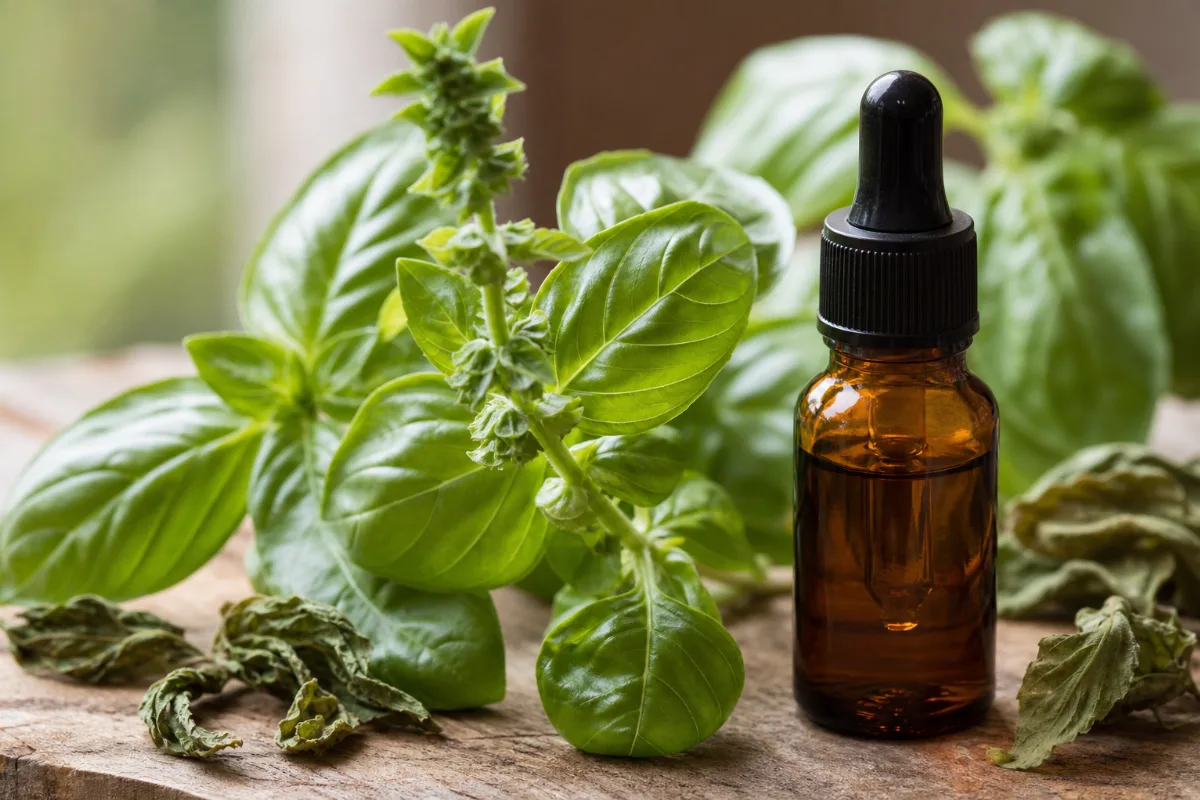
Basil oil is the strong, sweet, herby oil taken from the leaves of the basil plant. It is used in aromatherapy and on the skin, and a few small studies looked at migraine and tiredness. The evidence for benefits is very thin. The main caution: some basil oils are mostly estragole, a compound the EU medicines agency calls a genotoxic carcinogen in animals, so basil oil should not be swallowed and is best avoided in pregnancy and around young children and pets.
General information, not medical advice. Last substantive update · Not medically reviewed. A named clinician has not signed off on this page. How this page is made
About Basil Oil (Sweet Basil)
Basil oil is taken from the leaves of the basil plant and used in aromatherapy and on the skin. Human research is very thin: one small migraine trial where everyone also took a painkiller, a tiny blend pilot, and lab-only work. Safety comes first. Some basil oils are mostly estragole, which the EU medicines agency calls a genotoxic carcinogen based on animal studies. Basil oil also caused strong skin sensitization in a mouse test. Do not swallow it.
What basil oil is
Basil oil is the essential oil of Ocimum basilicum, a plant in the mint family (Lamiaceae; GBIF accepted name).
Basil oil is not one thing. A 2026 study of 90 basil lines found five chemical types: linalool, methyl chavicol (estragole), citral, methyl cinnamate and methyl eugenol. One 2023 oil was 86% methyl chavicol. Methyl eugenol is another compound that a 2021 review calls genotoxic and carcinogenic. No source we read compares the safety of the types in people.
Poison Control says it can be hard to know the species, strength and contaminants in an essential oil bottle. Holy basil (Ocimum tenuiflorum) is a different plant.
What people use it for, and how strong the evidence is
The evidence is thin. The one migraine trial found less pain over time, but everyone also took acetaminophen. The inhaler pilot used three oils in 14 people. The anxiety trial used a syrup, not the oil. Findings on germs and enzymes come from the lab only.
The strengths used in the trial are not advice. This page does not tell you how strong to use basil oil. A pharmacist can advise on made products.
The research in one view
There are three small human studies and a lot of lab work. Only the syrup trial shows a registration number in its abstract, none gives effect sizes in its abstract, and a strong scent is hard to hide from a comparison group. Most of the reading on estragole is about food and medicines, not aromatherapy.
Oil, powdered herb, food and syrup are different things
Lab work suggests powdered basil contains a compound that blocks the step that activates estragole, while basil oil products contained little of it. So results for the cooking herb or a syrup should not be carried over to the concentrated oil. Poison Control says diluting an essential oil in a carrier oil is the best way to avoid a bad skin reaction, and not to use oils on damaged skin.
What authorities say
The EMA's 2005 estragole statement is described above. A revised version exists (the Austrian regulator's March 2024 notice says medicines had to comply by March 2024), but we did not read its values. The FDA says a plant source does not make a product safe and that plant materials can be irritating or allergenic on the skin. We did not find or read a statement from LiverTox or LactMed, and we did not read the 2001 EU Scientific Committee on Food opinion on estragole that the EMA cites.
At a glance
Traditional uses history, not proof
- No history of basil oil is described in the sources we read.
- The EU medicines agency lists sweet basil and its essential oil among the natural sources of estragole (EMA 2005).
Studied for research
- Migraine, on the skin with a painkiller, very low
- Mental tiredness, inhaled blend with basil, insufficient
- Anxiety in depression, basil syrup (not the oil), very low
- Germ-killing in lab dishes, laboratory only
- Sugar and inflammation enzymes in the test tube, laboratory only
Main compounds
- Estragole (methyl chavicol), 5% to 85% of sweet basil oil in the EMA table; 86% in one 2023 analysis
- Linalool, citral, methyl cinnamate and methyl eugenol types also exist (a 2026 study found five types)
Common forms
- Essential oil (basil leaf)
- Blends for inhalers and diffusers
- Skin products containing the oil
- Basil syrup (a different product, not the oil)
Research links: EMA: Public statement on herbal medicinal products containing estragole (2005) · Poison Control: Essential oils · Pet Poison Helpline: Essential oils · FDA: Aromatherapy · Migraine trial (abstract) · Estragole in human liver cells, 2025 (abstract) · Research Library · Genes & Biomarkers Library
What it is and its history
- Accepted scientific name
- Ocimum basilicum
- Naming authority
- L.
- Common names
- Sweet basil oil (English); Basil essential oil (English)
- Family or group
- Lamiaceae (mint family), per GBIF.
- Classification
- Plantae > Tracheophyta > Magnoliopsida > Lamiales > Lamiaceae > Ocimum > Ocimum basilicum
- Native range
- Not covered by the sources read.
- Habitat
- Not checked.
- What it looks like
- Part used: Leaf oil is the usual product; the 2023 and 2026 chemistry papers analyse plant essential oil. The extraction method is not stated in the abstracts read.
- Cultivation
- A 2026 field study grew 90 basil genotypes in Turkey; no further cultivation detail was read.
- Harvest and processing
- Not covered by the sources read.
- Look-alikes and adulterants
- Name: Holy basil (Ocimum tenuiflorum); Note: A different species with its own page; the EMA table lists estragole in it too. Results for one do not carry to the other.; Name: Other estragole-rich oils (tarragon, fennel, anise); Note: These share the estragole concern; the EMA statement lists them with sweet basil.
- Sustainability and conservation
- Not checked.
Traditional use and history history, not clinical proof
| Tradition or era | Documented use | Source |
|---|---|---|
| Not covered | No source read for this page describes the history of basil oil, so none is stated here. The only use shown in the EMA text is as a natural source of estragole in aromatic plants and essential oils. | EMA 2005 |
Traditional use shows how it was used. It does not show that it works or is safe today.
What is inside, and how it may work
What it contains and how those compounds act in cells and animals. Laboratory and animal mechanisms are not proven effects in people.
Main compounds
| Compound | Family | Where it is concentrated | Activity studied | Level of evidence |
|---|---|---|---|---|
| Estragole (methyl chavicol) PubChem 8815 | phenylpropene (alkenylbenzene) | Sweet basil leaf oil, in methyl chavicol types 5 to 85% in sweet basil essential oil (EMA table); 86% in one 2023 analysis. | Turned in the liver into a metabolite that binds DNA; genotoxic and carcinogenic in animal studies per the EMA. 18 15 8 1 | Animal research |
| Linalool PubChem 6549 | monoterpene alcohol | Linalool-type basil oils Not given in the sources read; only named as one of five chemotypes. | Not studied in the sources read for basil oil. 18 3 | None read |
| Eugenol PubChem 3314 | phenylpropene | Not quantified for basil in the sources read Not given. | Gave a positive mouse skin-sensitization result (EC3 5.4%) when tested alone as a comparison with whole oils. 18 6 | Animal research |
| Methyl eugenol PubChem 7127 | phenylpropene (alkenylbenzene) | Methyl-eugenol-type basil oils Not given; named as one of five chemotypes. | Known to be genotoxic and carcinogenic per a 2021 review of foods. 18 3 4 | Review |
| trans-Anethole | phenylpropene | One methyl chavicol-rich basil oil 8% in one 2023 analysis. | Not described in the abstract beyond composition. 8 | Laboratory |
Mechanisms, receptors and pathways
| Target or pathway | Gene or receptor | What was found | Level |
|---|---|---|---|
| Activation of estragole in the liver | CYP1A2, SULT1A1 | Estragole is activated by CYP1A2 and SULT1A1 to a metabolite (1'-hydroxyestragole) that forms DNA adducts. In human liver cells chromosome damage needed a threshold level of adducts. 1 15 | Laboratory research |
| Blocking of the sulfation step by plant compounds | Sulfotransferases (SULT) | Powdered basil contained a compound, nevadensin, that blocked the sulfation step in the test tube. Basil essential oil products contained little of it. Modeling suggests the effect may be limited at lower exposure. 19 | Laboratory research |
| Skin sensitization | Basil oil sensitized mice at under 2.5%; the oil's potency did not differ much from its main component. 6 | Animal research | |
| Bacteria and enzymes in the test tube | Alpha-amylase, alpha-glucosidase, lipoxygenase, tyrosinase | A methyl-chavicol-rich oil stopped bacterial growth in dishes and blocked these enzymes. 8 | Laboratory research |
Absorption, metabolism and elimination
- Absorption
- Not studied for basil oil. The EMA says data on absorption of estragole through the skin are missing.
- Distribution
- Not established.
- Metabolism
- In rats and mice, low amounts of estragole are mostly broken down by O-demethylation; as the amount rises, 1-hydroxylation (the activating step) becomes more important (EMA). In two volunteers given estragole by mouth for 6 months, 0.2% and 0.4% of the amount was excreted as 1-hydroxyestragole.
- Elimination
- Not established beyond the above.
- Bioavailability
- Not established.
Isolated compounds versus whole extracts
Basil essential oil, powdered basil, basil in food, and basil syrup are different products. Lab work suggests powdered basil contains a compound that blocks estragole's activation, while basil oil products contain little of it. A syrup trial and cooking-herb exposure say nothing about concentrated oil.
Nutritional composition
Basil oil is not a food or a nutrient and is not a supplement to swallow. The only swallowed basil product studied in people was a syrup.
2 very low certainty3 not enough evidence
What is Basil Oil (Sweet Basil) good for?
The uses people ask about and how strong the evidence is for each. Read the certainty label first: none of these results is strong, and none is advice to swallow the oil or use it undiluted.
Benefits, one by one
Each card is a research question, not a promise. Tap a goal to filter. Open a card to see the studies, doses and limits.
Migraine headaches (basil oil on the skin, with acetaminophen)
Very low certaintyOne small trial of basil oil rubbed on the skin found less migraine pain and fewer attacks over three months than placebo. Everyone in the trial also took acetaminophen, so it does not show basil oil works on its own.
3 studiesStudied as skin or inhaled products or a syrup; strengths are given i…
Studies, doses and limits
What the trials found
One triple-blind randomized trial of 144 people with migraine (Iran, 2020): three strengths of basil oil or placebo on the skin every 8 hours for 3 months, all with acetaminophen.
Results
The strength-by-time effect was significant for pain intensity and attack frequency (both p < 0.001). Over time, the odds of higher pain and the rate of attacks fell in the basil groups compared with placebo. No effect sizes were given in the abstract.
Effect sizes as reported
Not given as effect sizes in the abstracts read.
Why this rating
Single trial, add-on to a painkiller, no chemotype or estragole content given for the oil, no registration or funding statement in the abstract, no repeat by other groups found.
Form and dose studied
Studied as skin or inhaled products or a syrup; strengths are given in the results where the abstract gives them. They are not advice.
Who was studied
Adults diagnosed with migraine.
Limits
Cannot separate basil oil from the acetaminophen. The oil's chemistry is not described, and basil oils differ widely (see Safety). Skin use only; the trial says nothing about diffusers or swallowing.
Why researchers looked
The trial team wanted to test a complementary option for migraine, as the abstract explains.
Traditional use
Not described in the sources read.
Proposed mechanism Preliminary mechanism
Not shown in the trial abstract. Test-tube work reports that basil oil blocks an inflammation enzyme (lipoxygenase), but that has not been linked to migraine in people.
A proposed mechanism does not show that the effect happens in people.
Skin reactions are possible (see Safety). Some basil oils are rich in estragole, a compound the EMA calls a genotoxic carcinogen in animals; the abstract does not say whether this oil was.
Mental tiredness and burnout feeling (inhaled blend containing basil)
Not enough evidenceA tiny pilot study found people felt less burnout after sniffing a blend of peppermint, basil and helichrysum oils than after rose water. Basil cannot be separated from the other two oils.
1 studiesStudied as skin or inhaled products or a syrup; strengths are given i…
Studies, doses and limits
What the trials found
One randomized, double-blind pilot of 14 people (13 women, 1 man) with self-rated mental exhaustion or moderate burnout.
Results
Both groups felt less burnout, but the oil-blend group had a much greater reduction. The abstract gives no numbers.
Effect sizes as reported
Not given as effect sizes in the abstracts read.
Why this rating
Very small pilot, a three-oil blend, a strong scent that makes blinding hard, no numbers reported, no repeat found.
Form and dose studied
Studied as skin or inhaled products or a syrup; strengths are given in the results where the abstract gives them. They are not advice.
Who was studied
Adults with self-assessed mental exhaustion.
Limits
Basil alone was not tested. Rose water is a weak comparison. The result is a self-rating on a 0 to 10 scale.
Why researchers looked
The pilot tested a personal inhaler for mental exhaustion, as the abstract explains.
Traditional use
Not described in the sources read.
Proposed mechanism Preliminary mechanism
Not studied. The authors give no mechanism in the abstract.
A proposed mechanism does not show that the effect happens in people.
No basil-specific lung, asthma or allergy data from inhaling were found in the sources read; that is not proof there is no risk.
Anxiety in people with depression (basil SYRUP, not the oil)
Very low certaintyA 2025 trial in 60 people with depression found lower anxiety and depression scores after four weeks of a swallowed basil syrup than placebo. This is a different product from basil essential oil, which should not be swallowed.
1 studiesStudied as skin or inhaled products or a syrup; strengths are given i…
Studies, doses and limits
What the trials found
One randomized, single-blind, placebo-controlled trial (60 people with major depressive disorder, Iran), registered as IRCT20230318057752N1.
Results
Anxiety (Hamilton scale) and depression (Beck inventory) scores fell significantly more with basil syrup than placebo (p < 0.05). No score values were given in the abstract.
Effect sizes as reported
Not given as effect sizes in the abstracts read.
Why this rating
One small single-blind trial, no scores in the abstract, a swallowed syrup rather than the oil, no repeat found.
Form and dose studied
Studied as skin or inhaled products or a syrup; strengths are given in the results where the abstract gives them. They are not advice.
Who was studied
Adults with major depressive disorder.
Limits
The syrup's make-up is not described. Results cannot be carried over to the essential oil, and the oil must not be swallowed. Depression needs care from a clinician.
Why researchers looked
The trial team tested basil syrup for anxiety in people with depression, as the abstract explains.
Traditional use
Not described in the sources read.
Proposed mechanism Preliminary mechanism
Not described in the abstract.
A proposed mechanism does not show that the effect happens in people.
Not described in the abstract. Ask a doctor before adding a herbal product if you take medicines for depression or anxiety.
Germ-killing in lab dishes (laboratory only)
Not enough evidenceIn the lab, a methyl-chavicol-rich basil oil stopped bacteria growing in dishes. No trial has tested basil oil against an infection in people.
1 studiesStudied as skin or inhaled products or a syrup; strengths are given i…
Studies, doses and limits
What the trials found
No human trial found. One 2023 laboratory study.
Results
The oil (86% methyl chavicol and 8% trans-anethole) showed antibacterial effects with sizeable inhibition zones in the dish tests.
Effect sizes as reported
Not given as effect sizes in the abstracts read.
Why this rating
Laboratory work only; what happens in dishes often does not happen in the body.
Form and dose studied
Studied as skin or inhaled products or a syrup; strengths are given in the results where the abstract gives them. They are not advice.
Who was studied
Not applicable (no people).
Limits
One oil of one chemistry type. No comparison with standard treatments. Does not show it treats any infection, and it should not be put on infected skin or wounds in place of care.
Why researchers looked
The 2023 study tested the oil against bacteria in dishes.
Traditional use
Not described in the sources read.
Proposed mechanism Preliminary mechanism
Antibacterial activity in dishes (well diffusion and dilution tests) against Gram-positive and Gram-negative strains.
A proposed mechanism does not show that the effect happens in people.
See Safety. This oil type is mostly estragole.
Blood-sugar and inflammation enzymes in the test tube (laboratory only)
Not enough evidenceIn test tubes, basil oil blocked enzymes involved in digesting sugars and in inflammation. This says nothing yet about blood sugar or inflammation in people.
1 studiesStudied as skin or inhaled products or a syrup; strengths are given i…
Studies, doses and limits
What the trials found
No human trial found.
Results
Enzyme blocking was reported with IC50 values of about 51 and 40 micrograms per millilitre for the two sugar enzymes and about 18 for lipoxygenase, a laboratory measure of potency.
Effect sizes as reported
Not given as effect sizes in the abstracts read.
Why this rating
Test-tube results only; no animal or human outcomes in the abstract.
Form and dose studied
Studied as skin or inhaled products or a syrup; strengths are given in the results where the abstract gives them. They are not advice.
Who was studied
Not applicable.
Limits
Concentrations used in the lab are not what the body would meet. No evidence for blood sugar control in people.
Why researchers looked
The 2023 study screened the oil against several enzymes in the test tube.
Traditional use
Not described in the sources read.
Proposed mechanism Preliminary mechanism
Blocked alpha-amylase, alpha-glucosidase and lipoxygenase (and tyrosinase, a skin-pigment enzyme) in the test tube.
A proposed mechanism does not show that the effect happens in people.
Do not swallow basil oil to try to affect blood sugar; people on diabetes medicines should talk to a doctor or pharmacist.
Connections to the rest of health
How Basil Oil (Sweet Basil) connects to the rest of our health knowledge graph. Every link says what kind of connection it is. A safety link (for example to the liver) is a warning, not a benefit. A study that merely mentions a topic never creates a benefit link.
Explore every connection: goals, body systems, organs, symptoms, genes
A. Wellness goals
| Connected to | Kind of connection | Evidence status | Context | Studies |
|---|---|---|---|---|
| Pain Relief | Very low certainty | Migraine headaches (basil oil on the skin, with acetaminophen): One small trial of basil oil rubbed on the skin found less migraine pain and fewer attacks over three months than placebo. Everyone in the trial also took acetaminophen, so it does not show basil oil works on its own. | 2 8 15 | |
| Reduce Fatigue | Not enough evidence | Mental tiredness and burnout feeling (inhaled blend containing basil): A tiny pilot study found people felt less burnout after sniffing a blend of peppermint, basil and helichrysum oils than after rose water. Basil cannot be separated from the other two oils. | 10 | |
| Stress Reduction | Not enough evidence | Mental tiredness and burnout feeling (inhaled blend containing basil): A tiny pilot study found people felt less burnout after sniffing a blend of peppermint, basil and helichrysum oils than after rose water. Basil cannot be separated from the other two oils. | 10 | |
| Anxiety Support | Very low certainty | Anxiety in people with depression (basil SYRUP, not the oil): A 2025 trial in 60 people with depression found lower anxiety and depression scores after four weeks of a swallowed basil syrup than placebo. This is a different product from basil essential oil, which should not be swallowed. | 9 | |
| Mood Balance | Very low certainty | Anxiety in people with depression (basil SYRUP, not the oil): A 2025 trial in 60 people with depression found lower anxiety and depression scores after four weeks of a swallowed basil syrup than placebo. This is a different product from basil essential oil, which should not be swallowed. | 9 | |
| Blood Sugar Balance | Not enough evidence | Blood-sugar and inflammation enzymes in the test tube (laboratory only): In test tubes, basil oil blocked enzymes involved in digesting sugars and in inflammation. This says nothing yet about blood sugar or inflammation in people. | 8 | |
| Inflammation Balance | Not enough evidence | Blood-sugar and inflammation enzymes in the test tube (laboratory only): In test tubes, basil oil blocked enzymes involved in digesting sugars and in inflammation. This says nothing yet about blood sugar or inflammation in people. | 8 |
B. Body systems
| Connected to | Kind of connection | Evidence status | Context | Studies |
|---|---|---|---|---|
| Pain Inflammation | Biological association | Very low certainty | Studied for: Migraine headaches (basil oil on the skin, with acetaminophen) Studied for: Blood-sugar and inflammation enzymes in the test tube (laboratory only) | 2 8 15 |
| Nervous System | Biological association | Very low certainty | Studied for: Migraine headaches (basil oil on the skin, with acetaminophen) | 2 8 15 |
| Brain Focus | Biological association | Not enough evidence | Studied for: Mental tiredness and burnout feeling (inhaled blend containing basil) Studied for: Anxiety in people with depression (basil SYRUP, not the oil) | 10 9 |
| Stress Mood | Biological association | Not enough evidence | Studied for: Mental tiredness and burnout feeling (inhaled blend containing basil) Studied for: Anxiety in people with depression (basil SYRUP, not the oil) | 10 9 |
| Immune Support | Biological association | Not enough evidence | Studied for: Germ-killing in lab dishes (laboratory only) | 8 |
| Metabolic Health | Biological association | Not enough evidence | Studied for: Blood-sugar and inflammation enzymes in the test tube (laboratory only) | 8 |
E. Health conditions
| Connected to | Kind of connection | Evidence status | Context | Studies |
|---|---|---|---|---|
| Contact dermatitis | Adverse effect or risk | Documented risk | Strong sensitization in a mouse test; essential oils in general are a recognised cause of contact allergy. Strong sensitization in a mouse test. Preparation or compound: Basil essential oil on the skin |
6 11 |
| Essential oil poisoning | Adverse effect or risk | Documented risk | General statement from Poison Control; no basil-oil case found. Preparation or compound: Swallowed essential oil (general) |
12 |
| Migraine | Very low certainty | One small trial; cannot separate oil from the painkiller. Preparation or compound: Basil oil on the skin, with acetaminophen |
2 |
I. Biomarkers
| Connected to | Kind of connection | Evidence status | Context | Studies |
|---|---|---|---|---|
| Migraine pain intensity and attack frequency | Biological association | Very low certainty | Measured in trials: decrease. A lab change is not the same as a health benefit. | 2 |
| Anxiety rating (Hamilton scale) and depression score (Beck) | Biological association | Very low certainty | Measured in trials: decrease. A lab change is not the same as a health benefit. | 9 |
J. Genes, receptors and enzymes
| Connected to | Kind of connection | Evidence status | Context | Studies |
|---|---|---|---|---|
| CYP1A2 and SULT1A1 | Preliminary mechanism | In vitro | Liver enzymes that activate estragole. | 1 |
L. Active compounds
| Connected to | Kind of connection | Evidence status | Context | Studies |
|---|---|---|---|---|
| Estragole (methyl chavicol) | Biological association | Animal | Turned in the liver into a metabolite that binds DNA; genotoxic and carcinogenic in animal studies per the EMA. Preparation or compound: Sweet basil leaf oil, in methyl chavicol types |
18 15 8 1 |
| Linalool | Biological association | None read | Not studied in the sources read for basil oil. Preparation or compound: Linalool-type basil oils |
18 3 |
| Eugenol | Biological association | Animal | Gave a positive mouse skin-sensitization result (EC3 5.4%) when tested alone as a comparison with whole oils. Preparation or compound: Not quantified for basil in the sources read |
18 6 |
| Methyl eugenol | Biological association | Review | Known to be genotoxic and carcinogenic per a 2021 review of foods. Preparation or compound: Methyl-eugenol-type basil oils |
18 3 4 |
| trans-Anethole | Biological association | Laboratory | Not described in the abstract beyond composition. Preparation or compound: One methyl chavicol-rich basil oil |
8 |
Each connection is stored with the ingredient, the connected record, the kind of connection, the evidence status, the supporting studies, the preparation or compound involved, and a review date (last reviewed October 25, 2026).
The evidence
The research centre for Basil Oil (Sweet Basil). Every record here was checked against PubMed or the publisher's page; we never list a study we have not verified.
Evidence by outcome
Bars show how many studies we found for each outcome, not how well it works. People are added up across trials only (reviews are not added, to avoid double counting).
How we rate evidence
High certainty
Several well-run trials or reviews agree; further research is unlikely to change the picture much.
Moderate certainty
Good trials point the same way, but some doubt remains.
Low certainty
Small, short or inconsistent trials. The finding could change with better research.
Very low certainty
Very little or very weak human data. Treat as a possibility only.
Mixed findings
Trials or reviews disagree with each other.
Not enough evidence
Not enough human research to say either way.
Evidence against
Good research found no benefit, or found harm.
We take the reviewers' own risk-of-bias and GRADE statements where they exist, and otherwise judge from study size, design, consistency, directness and whether a product matches what is sold. Many publications do not make evidence high. Method note: We read the abstracts of 12 PubMed papers, the full text of the EMA 2005 estragole statement, and the Poison Control, FDA, Pet Poison Helpline and Austrian BASG pages, and checked the plant name in GBIF and the compounds in PubChem. We did not read the revised EMA statement, the 2001 SCF opinion, LiverTox or LactMed.
Study library: every study we checked 19
| Study | Design | People | Product, dose, length | Result |
|---|---|---|---|---|
| Ackermann 2025 Molecular dosimetry of estragole and 1'-hydroxyestragole-induced DNA adduct formation, clastogenicity and cytotoxicity in human liver cell models. Archives of Toxicology · PMID 40397106 · DOI |
Laboratory study in-vitro |
Human liver cell lines (HepG2, HepG2-CYP1A2), primary human liver cells and primary rat liver cells | Estragole and its metabolite 1'-hydroxyestragole in cell culture n/a Concentration series in the lab n/a · vs n/a |
Estragole formed DNA adducts in the liver cells in a concentration-dependent way. Chromosome damage appeared at the higher lab concentrations, and its metabolite was 10 to 50 times more potent at forming adducts. A threshold level of adducts was needed before chromosome damage and cell death appeared. The authors say such levels are unlikely to be reached in humans from chronic exposure through phytomedicines or diet. Methods, limits and fundingOutcomes: DNA adducts, chromosome damage (clastogenicity), cell death Limitations: Cell studies only. The conclusion is about diet and phytomedicines; the abstract does not address essential oil use on skin or in the air. Funding and conflicts: Authors declare no conflict of interest. Read: abstract |
| Ahmadifard 2020 The Efficacy of Topical Basil Essential Oil on Relieving Migraine Headaches: A Randomized Triple-Blind Study. Complementary Medicine Research · PMID 32155616 · DOI |
Randomized controlled trial |
144 People diagnosed with migraine (Iran) |
Basil essential oil on the skin, three strengths (2, 4 and 6%) oil (the abstract does not name the plant part or chemotype) Three strengths, applied every 8 hours 3 months · vs Placebo; every person in all four groups also took acetaminophen (325 mg every 12 hours) |
The strength-by-time interaction was significant for both pain intensity (p < 0.001) and attack frequency (p < 0.001). The odds of higher pain intensity and the rate of attacks in the basil groups, compared with placebo, fell over the study time. Methods, limits and fundingOutcomes: Migraine pain intensity (visual analog scale) and attack frequency, at weeks 2, 4, 8 and 12 Limitations: Everyone also took acetaminophen, so the trial cannot show basil oil works alone. The abstract gives no effect sizes, no chemotype or estragole content for the oil, no registration and no funding statement. One trial from one region. Funding and conflicts: Not stated in the abstract. Read: abstract |
| Barut 2026 Chemical profiling and chemotypic diversity of basil (Ocimum basilicum L.) genotypes: a large-scale evaluation of bioactive compounds and antioxidant capacity. BMC Plant Biology · PMID 42231174 · DOI |
Plant chemistry study plant |
90 90 basil genotypes grown in a field experiment in Turkey (2023 and 2024) |
n/a plant essential oil (GC-MS analysis) n/a n/a · vs n/a |
Five distinct chemotypes were found: linalool, methyl chavicol, citral, methyl cinnamate and methyl eugenol. Methods, limits and fundingOutcomes: Essential oil composition and antioxidant measures Limitations: A plant-breeding study, not a human or safety study. Funding and conflicts: No competing interests declared. Read: abstract |
| Eisenreich 2021 Alkenylbenzenes in Foods: Aspects Impeding the Evaluation of Adverse Health Effects. Foods · PMID 34574258 · DOI |
Narrative review review |
Review of what is known about safrole, methyleugenol, estragole and related plant compounds in foods | n/a n/a n/a n/a · vs n/a |
Alkenylbenzenes are found in herbs and spices such as basil and fennel seeds. Essential oils and products from them, such as basil-containing pesto or plant food supplements, often have a high alkenylbenzene content. Safrole and methyleugenol are known to be genotoxic and carcinogenic; the review discusses the uncertainties that stop a conclusive evaluation of human harm from foods containing safrole, methyleugenol and estragole. Methods, limits and fundingOutcomes: Adverse health effects of alkenylbenzenes Limitations: A review of foods, not of aromatherapy. It lists uncertainties; it does not give a risk figure for essential oil use. Funding and conflicts: Authors declare no conflict of interest. Read: abstract |
| Götz 2023 Occurrence of Alkenylbenzenes in Plants: Flavours and Possibly Toxic Plant Metabolites. Plants · PMID 37299054 · DOI |
Narrative review review |
Review of alkenylbenzenes in essential oils and extracts used for flavouring | n/a n/a n/a n/a · vs n/a |
Gives an overview of potentially toxic alkenylbenzenes, with a focus on the widely known genotoxic ones: safrole, methyleugenol and estragole. Notes that quantitative data on their occurrence, especially in final supplements and processed foods, are still limited. Methods, limits and fundingOutcomes: Where alkenylbenzenes occur in plants and flavourings Limitations: A review of flavourings; the abstract does not name basil oil or give exposure figures for it. Funding and conflicts: Authors declare no conflict of interest. Read: abstract |
| Lalko 2006 Investigation of the dermal sensitization potential of various essential oils in the local lymph node assay. Food and Chemical Toxicology · PMID 16324777 · DOI |
Animal study mouse |
Mice (local lymph node assay) | Seven essential oils including basil oil, plus citral, eugenol and geraniol oils applied to the skin of mice Five concentrations from 2.5% to 50% n/a · vs n/a |
Basil oil gave a positive result at less than 2.5% (EC3 below 2.5%), which the authors class as moderate or stronger sensitizing potency. Clove leaf, litsea cubeba, lemongrass and palmarosa oils were weak (EC3 6.5 to 9.6%); citronella and geranium oils were negative. Citral, eugenol and geraniol gave EC3 of 6.3%, 5.4% and 11.4%. The potency of each oil did not differ much from that of its main component. Methods, limits and fundingOutcomes: Skin sensitization potency (EC3: the concentration needed for a positive result) Limitations: A mouse test, not a human patch test. The abstract does not name the basil oil's chemotype. Industry-linked (see funding note). Funding and conflicts: Industry-linked: the contact address on the record is at rifm.org (Research Institute for Fragrance Materials, a fragrance-industry body). Funding not stated in the abstract. Read: abstract |
| Nesslany 2010 Risk assessment of consumption of methylchavicol and tarragon: the genotoxic potential in vivo and in vitro. Mutation Research · PMID 19913108 · DOI |
Laboratory and animal study rat/in-vitro |
Rat liver cells in culture and rats given tarragon or methylchavicol by mouth | Methylchavicol (estragole), and tarragon leaf as a plant food pure compound and tarragon leaf (deep-frozen or dried) n/a n/a · vs n/a |
Methylchavicol (estragole) was confirmed as a genotoxic chemical in rat liver cells in the dish and in the livers of exposed rats. Deep-frozen tarragon was clearly less genotoxic than the pure compound, and dried tarragon was negative. The authors concluded tarragon consumption presents no genotoxic risk to humans. Methods, limits and fundingOutcomes: DNA repair activity (unscheduled DNA synthesis) in liver cells Limitations: Rat and cell work on tarragon, a different plant and a food form. It supports that estragole itself is genotoxic, but says nothing direct about basil essential oil. Funding and conflicts: Not stated in the abstract; non-US government research support noted. Read: abstract |
| Qasem 2023 Determination of Chemical Composition and Investigation of Biological Activities of Ocimum basilicum L. Molecules · PMID 36677672 · DOI |
Laboratory study in-vitro/animal |
Basil essential oil from Ocimum basilicum L. tested in the lab (bacteria, enzymes) plus toxicity tests and computer modeling | Basil essential oil (OBEO) and aqueous extract n/a n/a n/a · vs n/a |
The oil was dominated by methyl chavicol (86%) and trans-anethole (8%). It showed antibacterial effects against Gram-positive and Gram-negative bacteria in dishes, and blocked the enzymes alpha-amylase, alpha-glucosidase, lipoxygenase and tyrosinase in the test tube. The authors say acute and chronic toxicity tests showed safety. Methods, limits and fundingOutcomes: Oil composition; antibacterial, enzyme-blocking (amylase, glucosidase, lipoxygenase, tyrosinase) activity; toxicity tests Limitations: Test tube and computer work. The abstract does not say which animals, amounts or tissues the toxicity tests used, so that safety statement cannot be weighed here, and it sits against the estragole concerns of the EMA. The oil was a methyl chavicol type; results do not carry to other types. Funding and conflicts: Authors declare no conflict of interest. Read: abstract |
| Talaei 2025 Basil (Ocimum basilicum) to Alleviate Anxiety in Patients With Major Depressive Disorder: A Randomized Placebo-Controlled Clinical Trial. Brain and Behavior · PMID 41236933 · DOI |
Randomized controlled trial |
60 People with major depressive disorder (Fasa, Iran) |
Basil syrup (taken by mouth) - NOT the essential oil syrup (the abstract does not name the plant part) n/a 4 weeks · vs Placebo syrup |
The basil group had significant falls in both anxiety and depression scores compared with the placebo group (p < 0.05). Methods, limits and fundingOutcomes: Anxiety (Hamilton Anxiety Rating Scale) and depression (Beck Depression Inventory) Limitations: Single-blinded and small. A swallowed syrup is a different product from the oil, so it says nothing about basil oil. The abstract gives no scores or effect sizes. The authors call for larger and longer studies. Funding and conflicts: Registered (IRCT20230318057752N1). Authors declare no conflicts of interest. Registration: IRCT20230318057752N1 Read: abstract |
| Varney 2013 Effect of inhaled essential oils on mental exhaustion and moderate burnout: a small pilot study. Journal of Alternative and Complementary Medicine · PMID 23140115 · DOI |
Randomized controlled trial |
14 13 women and 1 man with self-assessed mental exhaustion or moderate burnout |
Inhaled blend of peppermint, basil and helichrysum oils (a combination) essential oils in a personal inhaler n/a 1 week of use (3 times a day on weekdays), after a baseline week and before a washout week · vs Rose water inhaler |
Both groups felt less burnout, but the oil-blend group had a much greater reduction (no numbers in the abstract). Methods, limits and fundingOutcomes: Self-rated burnout feeling (0 to 10 scale) Limitations: Pilot study of 14 people. A three-oil blend, so basil cannot be separated. A strong scent makes true blinding hard. No numbers, p-values or funding in the abstract. Funding and conflicts: Not stated in the abstract. Read: abstract |
| de Groot 2016 Essential Oils, Part IV: Contact Allergy. Dermatitis · PMID 27427818 · DOI |
Narrative review review |
Review of essential oils reported to cause contact allergy | n/a n/a n/a n/a · vs n/a |
Nearly 80 essential oils have caused contact allergy. Of 55 tested in consecutive patients suspected of contact dermatitis, nine (laurel, turpentine, orange, tea tree, citronella, ylang-ylang, sandalwood, clove and costus root) gave more than 2% positive patch tests. Relevance data are generally missing. Most reactions came from pure oils or high-concentration products. Co-reactivity with other essential oils and fragrance mix is frequent. Methods, limits and fundingOutcomes: Which essential oils cause contact allergy and how often Limitations: The abstract does not name basil oil among the nine. It does not say whether basil was one of the 55 tested. Funding and conflicts: Not stated in the abstract. Read: abstract |
| n/a Poison Control (US): Essential oils: Poisonous when misused (page read 2026-10-25; no date shown) n/a · Source |
Authoritative guidance n/a |
n/a | n/a n/a n/a n/a · vs n/a |
Misuse of essential oils can cause serious poisoning. Many can cause rashes on the skin, and some are poisonous if absorbed through the skin or swallowed. Aspirating a swallowed oil can cause pneumonia. Children have thin skin and immature livers, which may make them more susceptible. Essential oils may interact with medications. Essential oil products are not well regulated, so it can be hard to know the species, concentration or contaminants in a bottle. Diluting in a carrier oil is the best way to avoid a bad skin reaction, and oils should not be used on damaged skin. Bottles should be locked away from children and pets. Basil oil is not named on the page. Methods, limits and fundingOutcomes: Essential oil safety Limitations: General page on essential oils; it does not mention basil oil or estragole. Read: full-text |
| n/a Pet Poison Helpline: Essential Oils (page read 2026-10-25) n/a · Source |
Authoritative guidance n/a |
n/a | n/a n/a n/a n/a · vs n/a |
Essential oil poisoning can affect all species, but cats and birds are at greatest risk. Common signs are drooling, vomiting, lethargy, loss of appetite and irritation of the skin, mouth or airways; signs usually appear within 6 to 8 hours; severe cases can take 3 to 7 days to resolve. Oral exposure is the highest-risk route, then skin, then breathing the vapour. Its list of oils that can cause poisoning includes tarragon (an estragole-rich plant) but does not name basil. Do not induce vomiting. Helpline for North America: 800-213-6680. Methods, limits and fundingOutcomes: Essential oil poisoning in pets Limitations: Basil oil is not named in the list on the page. That is not proof basil oil is safe for pets. Read: full-text |
| n/a US Food and Drug Administration (FDA): Aromatherapy (page read 2026-10-25) n/a · Source |
Authoritative guidance n/a |
n/a | n/a n/a n/a n/a · vs n/a |
Says a plant source does not make a product safe: many plants contain materials that are toxic, irritating or likely to cause allergic reactions on the skin. Cosmetics do not need FDA approval before sale, and a product with health claims (such as treating a condition) can be regulated as a drug. Methods, limits and fundingOutcomes: Regulation and safety of aromatherapy products Limitations: General page; it does not mention basil oil. Read: full-text |
| n/a 2005 European Medicines Agency, Committee on Herbal Medicinal Products (HMPC): Public statement on the use of herbal medicinal products containing estragole (EMEA/HMPC/137212/2005, final, adopted November 2005; full text read 2026-10-25) n/a · Source |
Authoritative guidance n/a |
n/a | n/a n/a n/a n/a · vs n/a |
Names sweet basil (Ocimum basilicum) and its essential oil (estragole 5 to 85% in the oil) among the natural sources of estragole. States that available data show estragole is a naturally occurring genotoxic carcinogen with a DNA potency similar to safrole, based on mouse liver tumour studies and genotoxicity tests. Concludes that herbal medicinal products used short-term in adults at recommended posology do not pose a significant cancer risk, but exposure of sensitive groups such as young children, pregnant and breastfeeding women should be minimised. Says toxicity data on skin (topical) preparations are missing because skin absorption data are missing. Notes no data on reproductive toxicity and no long-term human studies. Reports that JECFA gave no acceptable daily intake in 1981 and that estragole is approved for US food use and generally recognised as safe by the flavour industry panel. Methods, limits and fundingOutcomes: Uses, safety and regulatory view of estragole Limitations: This is the original 2005 statement. A revised version (Rev 1) exists (see the BASG notice); its guidance values were not read. It covers medicines, not aromatherapy or perfume. Written for herbal medicinal products, not essential oil in the air or on the skin. Read: full-text |
| n/a 2024 Austrian Federal Office for Safety in Health Care (BASG): Medicinal products containing estragole (notice dated 2024-03-15; page read 2026-10-25) n/a · Source |
Authoritative guidance n/a |
n/a | n/a n/a n/a n/a · vs n/a |
Confirms that a revised EMA/HMPC public statement on estragole (EMA/HMPC/137212/2005 Rev 1) exists with a guidance value for estragole, and that medicinal products had to comply within two years, by March 2024, according to a February 2022 CMDh report. Methods, limits and fundingOutcomes: Existence and timing of the revised EMA statement Limitations: The notice gives no numbers and no groups. The revised statement itself was not read, so its limits are not quoted on this page. Read: full-text |
| n/a 2026 GBIF Backbone Taxonomy: Ocimum basilicum L., match API, species key 2927096 (read 2026-10-25) n/a · Source |
Authoritative guidance n/a |
n/a | n/a n/a n/a n/a · vs n/a |
Accepted name Ocimum basilicum L., family Lamiaceae, order Lamiales (status ACCEPTED, exact match). Methods, limits and fundingOutcomes: Accepted plant name Limitations: Taxonomy only. Read: full-text |
| n/a 2026 PubChem name lookups for linalool (CID 6549), estragole (CID 8815), eugenol (CID 3314) and methyleugenol (CID 7127) (read 2026-10-25) n/a · Source |
Authoritative guidance n/a |
n/a | n/a n/a n/a n/a · vs n/a |
Compound identities and formulas: linalool C10H18O, estragole C10H12O, eugenol C10H12O2, methyleugenol C11H14O2. Methods, limits and fundingOutcomes: Compound identity Limitations: Identity only. Read: full-text |
| van den Berg 2013 Matrix-derived combination effect and risk assessment for estragole from basil-containing plant food supplements (PFS). Food and Chemical Toxicology · PMID 23959103 · DOI |
Laboratory and modeling in-vitro/model |
Test-tube enzyme work, computer (PBK) modeling and risk calculation; no people | Basil-containing food supplements (powdered basil and basil essential oil products) powdered basil material and basil essential oil n/a n/a · vs n/a |
Basil-containing supplements can contain estragole, which can be turned into a genotoxic and carcinogenic 1'-sulfoxy metabolite. Powdered basil products contained a compound (nevadensin) that blocked this step in the test tube; products made of basil essential oil contained little of such blockers. Methods, limits and fundingOutcomes: Whether compounds in basil products block the enzyme step that turns estragole into a genotoxic, carcinogenic metabolite Limitations: Laboratory and modeling only. The authors say the protective effect may be limited at lower exposure levels and should be judged case by case. Funding and conflicts: Research supported by non-US government funds; no industry funding stated in the abstract. Read: abstract |
What we do not know yet
- What the evidence supports: very low for migraine and anxiety (syrup), insufficient for tiredness and lab findings.
- No repeat of the migraine trial and no trial of basil oil alone.
- No human patch-test or poisoning data for basil oil.
- No comparison of the safety of linalool-type and methyl-chavicol-type oils.
- The revised 2024 EMA statement, the 2001 EU Scientific Committee on Food opinion, LiverTox and LactMed were not read.
- No study of pregnancy, breastfeeding or children's safety, and no basil-oil pet case.
How new research is added
New studies are found by a saved PubMed search and are placed in a review queue. A person reads each one before it is added.
Lab markers
What changed in blood or saliva tests during trials. A changed number is not the same as feeling or being healthier, and we give no "normal ranges".
Other 2
Migraine pain intensity and attack frequency
Decrease in trials
A 0 to 10 style visual analog scale for pain, plus a count of attacks, recorded before the study and at weeks 2, 4, 8 and 12.
Very low certaintyResults and what it means
Why it was measured
The two main outcomes of the migraine trial.
Statistical vs. clinical meaning
A self-reported pain score, not a lab marker.
Safety implication
A lower score does not show the oil is safe for everyone.
| Study | Result | People | Product |
|---|---|---|---|
| 2 | Odds of higher pain intensity and rate of attacks in the basil groups fell over time compared with placebo (strength-by-time p < 0.001 for both); no effect sizes in the abstract. All groups also took acetaminophen. |
Anxiety rating (Hamilton scale) and depression score (Beck)
Decrease in trials
Clinician-rated anxiety and self-rated depression questionnaires; lower is better.
Very low certaintyResults and what it means
Why it was measured
The outcomes of the basil syrup trial.
Statistical vs. clinical meaning
Questionnaire scores, single-blind trial.
Safety implication
Not about the oil.
| Study | Result | People | Product |
|---|---|---|---|
| 9 | Both scores fell significantly more with basil syrup than placebo over 4 weeks (p < 0.05); values not given in the abstract. This was a syrup, not the oil. |
Safety
What studies and official sources say about side effects, medicines and who should check first. Each point shows what kind of evidence it comes from.
Main points to know 4
- Some basil oils are mostly estragole, which the EU medicines agency calls a genotoxic carcinogen. The EMA's herbal committee (2005 statement, read in full) names sweet basil oil as a source of estragole at 5 to 85%. It says the available data show estragole is a naturally occurring genotoxic carcinogen with a DNA potency similar to safrole, based on liver tumours in mice and genotoxicity tests. It concluded that short-term adult use of herbal medicines at the recommended amounts is not a significant cancer risk, and asked that exposure of young children, pregnant and breastfeeding women be minimised. A 2025 human liver-cell study found DNA damage only above a threshold and judged those levels unlikely from diet or phytomedicines. No study of cancer in people from basil oil was found. The EMA also said skin absorption data are missing, so skin and aromatherapy use is not covered by its conclusion. Regulatory 15 1 8 7
- Basil oil is a likely skin sensitizer in a mouse test. In a mouse lymph node test, basil oil caused a positive sensitization result at under 2.5%, a potency the authors class as moderate or stronger, stronger than clove leaf or lemongrass oils in the same test. That is an animal test from fragrance-industry authors, not a human patch test, and no human basil-oil patch-test data were found. Allergy to essential oils is a recognised problem: nearly 80 oils have caused contact allergy, mostly from pure or high-concentration products, and people often react to several oils. Animal research 6 11
- Do not swallow basil oil. Poison Control says some essential oils are poisonous if swallowed, and that choking on a swallowed oil can cause pneumonia. Basil oil is not named on that page and no basil-oil poisoning case was found, so the risk is not measured. Swallowing also adds the estragole concern above. The only swallowed basil product studied in people was a syrup, which is a different product. Authoritative guidance 12 15
- Keep it away from children, pregnant and breastfeeding women, and pets. The EMA asks that estragole exposure be minimised for young children and for pregnant and breastfeeding women. Poison Control says children have thin skin and immature livers. Pet Poison Helpline says cats and birds are at greatest risk from essential oils; its list does not name basil but does name tarragon, another estragole-rich plant. No basil-oil study in these groups was found. Regulatory 15 12 13
Side effects 4
| Effect | How often | Severity and recovery | Evidence |
|---|---|---|---|
| Skin irritation or allergic contact dermatitis The mouse test points to a strong sensitizing potential; the FDA says plant-derived materials can be irritating or allergenic on the skin. No human case series for basil oil was found, so the human rate is unknown. | Not established | mild to severe (not measured for basil oil) Not stated in the sources read. | Animal research 6 11 14 |
| Poisoning if swallowed (breathing, stomach, nervous system effects are described for essential oils in general) Basil oil is not named by Poison Control and no basil-oil case was found. | Not established | can be serious (general statement for essential oils) Not stated for basil oil. | Authoritative guidance 12 |
| Possible long-term liver cancer risk from estragole (animal and cell findings) Liver tumours were seen in mice given estragole or its metabolites. The EMA found no long-term human data. Cell work suggests a threshold of DNA damage must be passed. The estragole content of basil oils varies from low to very high. | Not established | serious if it occurred; not shown in people Not applicable. | Animal research 15 19 1 |
| Side effects in the migraine trial The abstract reports no adverse events either way, so safety cannot be read from the trial. | Not established | Not reported in the abstract Not reported | Controlled trial 2 |
Liver
No report of liver injury in people from basil oil was found in the sources read; LiverTox was not read. The liver concern is theoretical and comes from animal and cell work: estragole is activated in the liver (enzymes CYP1A2 and SULT1A1) to a metabolite that damages DNA, and the EMA cites liver tumours in mice. 15 1 19
How often. Not established in people.
Monitoring. Not applicable.
This is a safety connection. It is not evidence that Basil Oil (Sweet Basil) supports liver health.
Medicines and supplements 3
| With | Why it matters | Importance | Evidence | What to do |
|---|---|---|---|---|
| Prescription and over-the-counter medicines, in general medicines-general | Poison Control says essential oils may interact with medications. No basil-oil interaction was found in the sources read. | Unknown. Absence from the sources read is not proof of none. | Authoritative guidance Not enough evidence 12 | Ask your pharmacist or doctor if you take regular medicines, especially for liver conditions. |
| Medicines or products that affect liver enzymes (CYP1A2) or sulfotransferases liver-enzymes | Estragole is activated by CYP1A2 and SULT1A1 in the liver (human liver cells). In the test tube, powdered basil contains a compound (nevadensin) that blocks the sulfation step, but basil essential oil products contained little of it. | Mechanism only. No study tested a medicine against basil oil in people. | Mechanistic Not enough evidence 1 19 | Tell a pharmacist about basil oil if you take medicines processed by the liver. |
| Acetaminophen (paracetamol) painkillers | In the migraine trial every group took acetaminophen alongside basil oil on the skin. | The abstract reports no interaction finding, either way. | Controlled trial Not enough evidence 2 | No conclusion can be drawn. |
Who should check first 4
| Situation | Advice | Evidence |
|---|---|---|
| Swallowing the oil | Do not swallow. If a child or pet may have swallowed any, call poison control straight away. | Authoritative guidance 12 |
| Pregnancy, breastfeeding, and young children | The EMA asks that estragole exposure be minimised in these groups. Ask a doctor or midwife before using basil oil. | Regulatory 15 |
| Known allergy to essential oils, fragrance, or a history of contact dermatitis | Avoid. A dermatologist can patch test the specific product. | Review 11 6 |
| Damaged or broken skin | Poison Control says not to use essential oils on damaged skin. | Authoritative guidance 12 |
Overdose, product quality and regulators
Summary. Toxicity is described by regulators and by animal and cell studies, not by human poisoning reports. The main points are estragole genotoxicity and carcinogenicity in animals, strong skin sensitization in a mouse test, and general essential-oil poisoning if swallowed.
Amounts. No safe amount is established, and this page gives none. The estragole content of sweet basil oils ranges widely (5 to 85% in the EMA table, 86% in one 2023 analysis).
Onset and course. Not described for basil oil.
Repeated use. The long-term concern is repeated exposure to estragole over many years. The EMA found no long-term human studies.
Animal data. Mice developed liver tumours after estragole or its metabolites (EMA). Rat liver cells and rat livers showed DNA repair activity with methylchavicol. A 2023 lab paper says toxicity tests showed safety, but its abstract does not say what was tested, so this is not weighed here.
Toxic parts. Basil leaf oil; estragole (methyl chavicol) and methyl eugenol, where present, are the compounds of concern.
Not read. The 2001 SCF opinion on estragole (cited by the EMA, not read), the revised 2024 EMA statement values, LiverTox, human patch-test data for basil oil, pet cases for basil oil, and any seizure or asthma data were not read or not found.
Basil oil is not one product. Its chemistry varies by type, and essential oil products are poorly regulated.
Chemotypes differ. A study of 90 basil genotypes found five chemotypes: linalool, methyl chavicol (estragole), citral, methyl cinnamate and methyl eugenol. The EMA table gives 5 to 85% estragole in sweet basil oil. One 2023 oil was 86% methyl chavicol. Methyl eugenol is another alkenylbenzene that the 2021 review calls genotoxic and carcinogenic. No source read compares the safety of the types. 3 15 8 4
Unknown species, strength and contaminants. Poison Control says it can be hard to know the species, concentration or contaminants in an essential oil bottle. 12
Holy basil is a different plant. Holy basil (Ocimum tenuiflorum) is a separate species; the EMA table lists estragole in it too. Results for one do not carry to the other. 15
Basil in food supplements. Basil-containing supplements can contain estragole; a 2021 review says essential oils or products from them often have a high alkenylbenzene content and data on final products are limited. 19 4 5
| Body | Action | Date |
|---|---|---|
| European Medicines Agency (EMA), Committee on Herbal Medicinal Products (HMPC) (European Union) | 2005 public statement: estragole (found in sweet basil oil) is a naturally occurring genotoxic carcinogen with DNA potency similar to safrole; short-term adult use of herbal medicines at the recommended amounts judged not a significant cancer risk; exposure of young children, pregnant and breastfeeding women should be minimised; topical preparations need more study. source | 2005-11 |
| US Food and Drug Administration (FDA) (United States) | Aromatherapy page: plant-derived materials can be toxic, irritating or allergenic on the skin; cosmetics do not need pre-approval; products with health claims can be regulated as drugs. Basil is not mentioned. source | |
| Poison Control (US national poison help service) (United States) | Essential oils can be poisonous if swallowed or absorbed; keep them locked away from children and pets; dilution in a carrier oil is the best way to avoid skin reactions. Basil oil is not named. source | |
| Pet Poison Helpline (United States) | Cats and birds are at greatest risk from essential oils; its list of oils that can cause poisoning does not name basil but names tarragon. source |
When to get medical help
- If a child or pet may have swallowed basil oil, call poison control straight away (US: Poison Help 1-800-222-1222; for pets, a vet or Pet Poison Helpline 800-213-6680) or your local emergency number. Do not make them vomit.
- Coughing or choking while swallowing oil, then fever or breathing trouble later (possible oil in the lungs): get medical help.
- A spreading rash, blistering, or swelling of the face or lips after using a basil product: stop, wash the area with soap and water, and get medical help. Trouble breathing is an emergency.
- Drowsiness, confusion, repeated vomiting or a seizure after any exposure: call emergency services.
Stop using the product and contact a clinician or emergency service. In the US, Poison Control is 1-800-222-1222.
General information only, not medical advice. Ask a clinician or pharmacist before use, especially with medicines, in pregnancy or with a health condition. See the Natural Remedy Safety guide.
Frequently asked questions
Is basil oil safe to swallow?
No. Poison Control says some essential oils are poisonous if swallowed, and choking on one can cause pneumonia. Basil oil is not named on that page, but it is often rich in estragole, which the EU medicines agency calls a genotoxic carcinogen in animals. If a child or pet may have swallowed any, call poison control (US: 1-800-222-1222) or your emergency number.
Does basil oil cause cancer?
Not shown in people. The EMA says estragole, found at 5% to 85% in sweet basil oil, is a genotoxic carcinogen in animal studies (liver tumours in mice), and asked that exposure be minimised for young children and pregnant and breastfeeding women. No human cancer study was found. A 2025 human liver-cell study found damage only above a threshold unlikely to be reached through diet or phytomedicines, but that did not test aromatherapy.
Is estragole in every basil oil?
No, it varies. A 2026 study found five basil chemical types: linalool, methyl chavicol (estragole), citral, methyl cinnamate and methyl eugenol. One 2023 oil was 86% methyl chavicol. Methyl eugenol is also called genotoxic and carcinogenic in a 2021 review. Ask the seller for the type and a lab report. No source we read compares their safety in people.
Can basil oil cause an allergic skin reaction?
Does basil oil help migraine?
Maybe a little, but the evidence is very low. In a 2020 triple-blind trial of 144 people, basil oil on the skin was linked with less pain and fewer attacks over three months than placebo. Everyone also took acetaminophen, the oil's make-up was not described, and it has not been repeated. See a doctor for migraine.
Does basil oil help with stress, tiredness or anxiety?
Is basil oil safe for cats and dogs?
Be careful. Pet Poison Helpline says cats and birds are at greatest risk from essential oils, and swallowing is the highest-risk route. Its list of oils that can cause poisoning does not name basil but names tarragon, another estragole-rich plant. No basil-oil pet case was found. Ask a vet before using any essential oil near pets.
Is basil oil safe in pregnancy or breastfeeding?
Better avoided unless a doctor or midwife says otherwise. The EMA's estragole statement asks that exposure of pregnant and breastfeeding women be minimised, and says it found no data on reproductive toxicity. No basil-oil study in pregnancy was found, and no LactMed record was read.
Is basil oil safe for children?
Does basil oil interact with medicines?
No specific interaction was found, which is not proof there is none. Poison Control says essential oils may interact with medications. In the lab, estragole is activated by liver enzymes (CYP1A2 and SULT1A1). Tell a pharmacist about basil oil if you take regular medicines, especially for the liver.
Is basil oil the same as holy basil or eating basil?
No. Holy basil is a different species (Ocimum tenuiflorum). Eating basil leaves in food is a very different exposure from concentrated oil; lab work suggests powdered basil contains a compound that blocks estragole's activation, while basil oil products contained little of it. Results for the herb or a syrup do not carry over to the oil.
Is it safe to use basil oil on my skin or in a diffuser?
This page cannot say. The EMA noted that data on estragole absorption through the skin are missing, and no basil-oil skin or inhaled safety study was found. Poison Control says diluting an oil in a carrier oil is the best way to avoid a bad skin reaction and not to use it on damaged skin. Ask a pharmacist, and keep pets and children away from diffusers.
Explore by health goal
Pain ReliefReduce FatigueStress ReductionAnxiety SupportMood BalanceBlood Sugar BalanceInflammation Balance
Editorial transparency
- Written by
- AlternativeMed editorial team. Research compiled with AI assistance, then checked against PubMed records.
- Medical review
- None. This page has not been reviewed by a physician or pharmacist.
- First published
- 2026-10-25
- Last substantive update
- 2026-10-25
- How we research
- We read the abstracts of 12 PubMed papers, the full text of the EMA 2005 estragole statement, and the Poison Control, FDA, Pet Poison Helpline and Austrian BASG pages, and checked the plant name in GBIF and the compounds in PubChem. We did not read the revised EMA statement, the 2001 SCF opinion, LiverTox or LactMed.
- How we rate evidence
- See "How we rate evidence" in the Evidence tab.
- Independence
- No product is promoted on this page. No affiliate links are shown.
Sources 19
Each source was opened and checked. Where we read only the abstract, it says so. The small numbers in the text point here.
- Ackermann G, Peil M, Quarz C, et al. Molecular dosimetry of estragole and 1'-hydroxyestragole-induced DNA adduct formation, clastogenicity and cytotoxicity in human liver cell models.. Archives of Toxicology. 2025. PMID 40397106. DOI 10.1007/s00204-025-04084-2. (abstract)
- Ahmadifard M, Yarahmadi S, Ardalan A, et al. The Efficacy of Topical Basil Essential Oil on Relieving Migraine Headaches: A Randomized Triple-Blind Study.. Complementary Medicine Research. 2020. PMID 32155616. DOI 10.1159/000506349. (abstract)
- Barut M, Tansi LS. Chemical profiling and chemotypic diversity of basil (Ocimum basilicum L.) genotypes: a large-scale evaluation of bioactive compounds and antioxidant capacity.. BMC Plant Biology. 2026. PMID 42231174. DOI 10.1186/s12870-026-09147-9. (abstract)
- Eisenreich A, Götz ME, Sachse B, et al. Alkenylbenzenes in Foods: Aspects Impeding the Evaluation of Adverse Health Effects.. Foods. 2021. PMID 34574258. DOI 10.3390/foods10092139. (abstract)
- Götz ME, Eisenreich A, Frenzel J, et al. Occurrence of Alkenylbenzenes in Plants: Flavours and Possibly Toxic Plant Metabolites.. Plants. 2023. PMID 37299054. DOI 10.3390/plants12112075. (abstract)
- Lalko J, Api AM. Investigation of the dermal sensitization potential of various essential oils in the local lymph node assay.. Food and Chemical Toxicology. 2006. PMID 16324777. DOI 10.1016/j.fct.2005.10.006. (abstract)
- Nesslany F, Parent-Massin D, Marzin D. Risk assessment of consumption of methylchavicol and tarragon: the genotoxic potential in vivo and in vitro.. Mutation Research. 2010. PMID 19913108. DOI 10.1016/j.mrgentox.2009.11.003. (abstract)
- Qasem A, Assaggaf H, Mrabti HN, et al. Determination of Chemical Composition and Investigation of Biological Activities of Ocimum basilicum L.. Molecules. 2023. PMID 36677672. DOI 10.3390/molecules28020614. (abstract)
- Talaei M, Zare K, Hashemi Y, et al. Basil (Ocimum basilicum) to Alleviate Anxiety in Patients With Major Depressive Disorder: A Randomized Placebo-Controlled Clinical Trial.. Brain and Behavior. 2025. PMID 41236933. DOI 10.1002/brb3.70994. (abstract)
- Varney E, Buckle J. Effect of inhaled essential oils on mental exhaustion and moderate burnout: a small pilot study.. Journal of Alternative and Complementary Medicine. 2013. PMID 23140115. DOI 10.1089/acm.2012.0089. (abstract)
- de Groot AC, Schmidt E. Essential Oils, Part IV: Contact Allergy.. Dermatitis. 2016. PMID 27427818. DOI 10.1097/DER.0000000000000197. (abstract)
- n/a. Poison Control (US): Essential oils: Poisonous when misused (page read 2026-10-25; no date shown). n/a. . (full-text)
- n/a. Pet Poison Helpline: Essential Oils (page read 2026-10-25). n/a. . (full-text)
- n/a. US Food and Drug Administration (FDA): Aromatherapy (page read 2026-10-25). n/a. . (full-text)
- n/a. European Medicines Agency, Committee on Herbal Medicinal Products (HMPC): Public statement on the use of herbal medicinal products containing estragole (EMEA/HMPC/137212/2005, final, adopted November 2005; full text read 2026-10-25). n/a. 2005. (full-text)
- n/a. Austrian Federal Office for Safety in Health Care (BASG): Medicinal products containing estragole (notice dated 2024-03-15; page read 2026-10-25). n/a. 2024. (full-text)
- n/a. GBIF Backbone Taxonomy: Ocimum basilicum L., match API, species key 2927096 (read 2026-10-25). n/a. 2026. (full-text)
- n/a. PubChem name lookups for linalool (CID 6549), estragole (CID 8815), eugenol (CID 3314) and methyleugenol (CID 7127) (read 2026-10-25). n/a. 2026. (full-text)
- van den Berg SJ, Klaus V, Alhusainy W, et al. Matrix-derived combination effect and risk assessment for estragole from basil-containing plant food supplements (PFS).. Food and Chemical Toxicology. 2013. PMID 23959103. DOI 10.1016/j.fct.2013.08.019. (abstract)