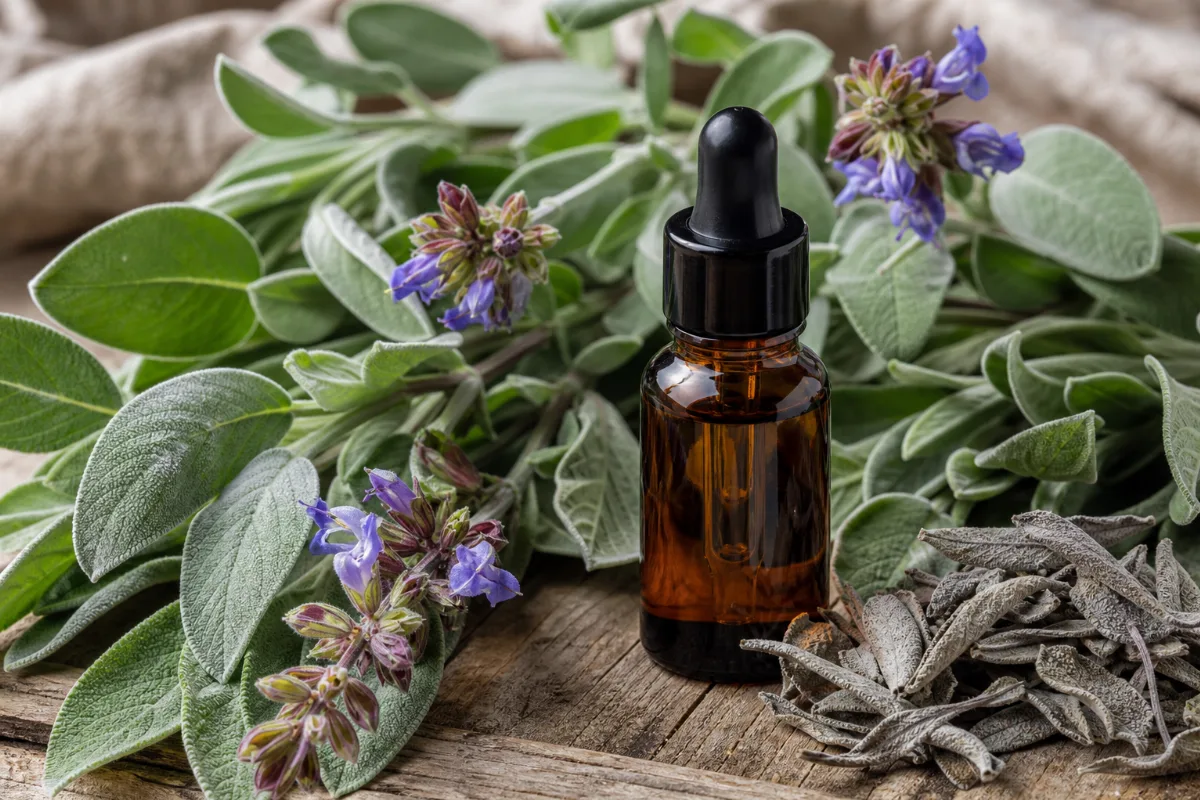
Essential Oils & Aromatherapy · Essential oil (caution)
Sage Oil (Dalmatian and Spanish)
Salvia officinalis and Salvia lavandulifolia · also called Common sage oil, Dalmatian sage oil, Spanish sage oil, Salvia officinalis oil
Sage oil is a strong oil distilled from sage leaves. Swallowing it has caused seizures, including in a baby and a small child, and the EU medicines regulator judged its benefits do not outweigh its risks. Small memory trials used a low-thujone Spanish sage oil in research capsules, with low certainty. Keep it away from pregnancy, children, people with epilepsy and pets, and never swallow it.
General information, not medical advice. Last substantive update · Not medically reviewed. A named clinician has not signed off on this page. How this page is made
About Sage Oil (Dalmatian and Spanish)
Sage oil is a concentrated oil with a real seizure risk. It is rich in thujone (common or Dalmatian sage) or in camphor and cineole (Spanish sage), and swallowing it has caused seizures, including in a baby and a small child. The EU medicines regulator judged it negative on benefit and risk. Small memory trials used a Spanish sage oil in research capsules; they are low-certainty and do not make swallowing it safe.
Safety first
Sage oil can cause seizures if swallowed. Reports describe a newborn and a young child with generalised seizures after sage oil for colic, and older poisonings with convulsions and coma that needed intensive care. US poison-centre guidance says that swallowing more than a very small amount has caused seizures in children. No safe amount has been set.
Avoid sage oil in pregnancy and breastfeeding, in babies and children, and if you or your child has epilepsy or has had an unexplained seizure. The EU assessment calls the oil a moderate skin irritant and says it is not recommended for aromatherapy. Keep it away from pets, especially cats and birds.
If anyone may have swallowed it, call a poison centre or emergency services at once, even if they seem well (US Poison Help: 1-800-222-1222; numbers elsewhere were not checked). Call emergency services for a seizure.
Which sage? Keep these three apart
Sage oil here means oil from common sage (Salvia officinalis, sold as Dalmatian sage oil) or from Spanish sage (Salvia lavandulifolia). Common sage oil is high in thujone and camphor. Spanish sage oil is mainly camphor and 1,8-cineole in the papers we read, but it still sits among oils linked to seizures.
Clary sage oil comes from a different plant (Salvia sclarea) and has its own page. Sage leaf extracts used in memory trials are not essential oil either. Results and warnings for one of these do not carry over to the others.
What the research shows
There are three small papers on a Spanish sage oil swallowed once in research capsules by healthy adults. They found some better memory-test scores and mood ratings for a few hours. They came from one research group, were not repeated by others, and used a standardised research oil. Certainty is low.
No human trial of Dalmatian (common sage) oil for any use was found, and no trial of smelling sage oil. Two leaf-extract trials (not oil) also found some memory gains. For every traditional use, there is no human evidence for the oil.
Quality and labels
Sage oils differ a great deal. EMA says the composition of the oil varies with source, harvest time and other factors, and individual Spanish sage plants can have very different oil profiles. Poison Control says it can be hard to know the species, the concentration of active ingredients or any contaminants in an essential oil bottle.
Check the full Latin name on the label. We found no survey of contamination in retail sage oil.
At a glance
Traditional uses history, not proof
- Swallowed for colic or acne (documented seizures)
- Sage leaf for sore throat, sweating and mild stomach upset (leaf, not oil)
- Scent and flavouring in tiny food amounts
- Old reputation for helping memory
Studied for research
- Memory and mood tests: small single-dose trials of a Spanish sage oil in research capsules (low certainty)
- Sage leaf extract and memory: two small trials, a different product (low certainty)
- Everything else: no human trial of the oil
Main compounds
- Thujone: a convulsant, main compound of common (Dalmatian) sage oil
- Camphor: a convulsant found in both sage oils
- 1,8-Cineole: main compound of many Spanish sage oils
Common forms
- Essential oil distilled from common sage leaf (Dalmatian sage oil)
- Essential oil from Spanish sage
- Not the same: clary sage oil (a different plant) and sage leaf extracts
Research links: EMA public statement on sage oil · NCCIH: Sage · Poison Control: Essential oils · Research Library · Genes & Biomarkers Library
What it is and its history
- Accepted scientific name
- Salvia officinalis L. (common sage; source of Dalmatian sage oil) and Salvia lavandulifolia Spreng. (Spanish sage)
- Naming authority
- Both names are ACCEPTED in the GBIF backbone (usage keys 2927004 and 7948017), checked 2026-10-25. Papers also spell the Spanish species lavandulaefolia (Vahl).
- Common names
- Sage oil (English); Common sage oil (English); Dalmatian sage oil (English); Spanish sage oil (English); Salvia officinalis oil (Latin); Aceite esencial de salvia (Spanish)
- Family or group
- Lamiaceae (mint family)
- Classification
- Plantae > Tracheophyta > Magnoliopsida > Lamiales > Lamiaceae > Salvia > Salvia officinalis; Salvia lavandulifolia
- Native range
- NCCIH says common sage and Spanish sage are both shrubs native to the Mediterranean region and Middle East. EMA names the area around the Adriatic Sea for common sage.
- Habitat
- Not verified.
- What it looks like
- Roots: Not verified.; Stems: Both are shrubs (NCCIH).; Leaves: Not verified in this file. The oil is distilled from the leaves (EMA).; Flowers: Not verified.; Fruit: Not verified.
- Cultivation
- Not verified. Spanish sage grown in trials in Spain and under common conditions (papers) shows large differences between individual plants.
- Harvest and processing
- The essential oil is distilled from the leaves (EMA); yield and composition vary with harvest time and source (EMA).
- Look-alikes and adulterants
- Name: Salvia sclarea L. (clary sage); Note: A different plant and a different oil (clary sage oil has its own page). GBIF key 2927000. Not the same as sage oil, and not the subject of the thujone warnings here.; Name: Sage leaf extracts; Note: Extracts of leaf used in memory trials are a different product from the essential oil.; Name: White sage (Salvia apiana) and Greek sage (Salvia fruticosa); Note: Other sages sold under the word "sage". Not checked beyond the name; do not assume the same chemistry.
- Sustainability and conservation
- Not assessed in the sources read.
Photographs
Traditional use and history history, not clinical proof
| Tradition or era | Documented use | Source |
|---|---|---|
| European herbal medicine | Sage leaf has traditional use for mild stomach upset, sweating, mouth and throat irritation and minor skin problems (EMA). A British herbal tradition holds that sage improves memory (as stated in the 2003 trial abstract). Sage oil has also been used as a scent, seasoning and remedy (Poison Control). | s-ema-hmpc-sage |
| Home use of the oil (colic, acne) | EMA cites cases where sage oil was swallowed for colic in a baby and a child, and for acne in an adult. These uses led to poisoning. | s-ema-ar-sage |
| Regulation | EMA concluded in 2010 (statement corrected 2016) that sage oil has a negative benefit-risk balance as a traditional herbal medicine. | s-ema-ps-sage-oil |
Traditional use shows how it was used. It does not show that it works or is safe today.
What is inside, and how it may work
What it contains and how those compounds act in cells and animals. Laboratory and animal mechanisms are not proven effects in people.
Main compounds
| Compound | Family | Where it is concentrated | Activity studied | Level of evidence |
|---|---|---|---|---|
| alpha-Thujone PubChem 261491 | Monoterpene ketone | Essential oil of common sage leaf 10-60% of common sage oil (EMA, quoting a reference book); varies a lot between oils. | Convulsant; blocks calming GABA-A signals in lab tests. 4 15 8 21 | Laboratory research |
| beta-Thujone PubChem 91456 | Monoterpene ketone | Essential oil of common sage leaf 4-36% of common sage oil (EMA, quoting a reference book). | Also a convulsant, similar to alpha-thujone. 15 8 21 | Laboratory research |
| Camphor PubChem 2537 | Monoterpene ketone | Essential oil of both sages 5-20% of common sage oil (EMA); a main component of Spanish sage oil in the papers read. | Convulsant; named with thujone as a cause of sage oil toxicity. 19 3 8 21 | Animal research |
| 1,8-Cineole (eucalyptol) PubChem 2758 | Monoterpene ether | Essential oil of both sages 1-15% of common sage oil (EMA); up to 75.2% in some Spanish sage plants (one paper). | The most active single compound against acetylcholinesterase in a Spanish sage oil lab study; also listed with seizure-causing compounds. 3 30 2 21 | Laboratory research |
Mechanisms, receptors and pathways
| Target or pathway | Gene or receptor | What was found | Level |
|---|---|---|---|
| GABA-A receptors (calming brain signals) | GABA-A receptor | In cells with these receptors, alpha-thujone blocked every receptor type tested, most strongly one that carries steady background inhibition. Earlier work showed the thujones are convulsants that block the GABA-gated chloride channel. 4 15 | Laboratory research |
| Breakdown of thujones by liver enzymes | Cytochrome P450 (including CYP3A4) | Liver enzymes from mice, rats and humans turned thujones into metabolites that were weaker blockers and weaker toxicants, so the oxidation is a detoxification step. 15 | Laboratory research |
| Toxicity is not only thujone | Not applicable | In rat and brine shrimp tests of four thujone-containing oils, toxic and behaviour-changing effects were not explained by thujone alone; other oil compounds also correlated with toxicity. 25 | Animal research |
| Acetylcholinesterase (memory enzyme) in the lab | Acetylcholinesterase | Spanish sage oil strongly blocked human acetylcholinesterase in the lab; 1,8-cineole was the most active single compound in another lab study. Not shown to explain any effect in people. 16 3 | Laboratory research |
Absorption, metabolism and elimination
- Absorption
- Not studied for sage oil in people in the sources read. The published cases show that swallowed oil reaches the brain, but they give no blood levels.
- Distribution
- Not studied in the sources read.
- Metabolism
- In the lab, thujones are oxidised by liver enzymes (including human liver microsomes and CYP3A4) to weaker compounds (Hold 2001).
- Elimination
- Not described in the sources read.
- Bioavailability
- Not studied.
Isolated compounds versus whole extracts
Thujone is the best-known toxic compound, but the whole oil is more than thujone: camphor, cineole and other compounds add to the effect, and Spanish sage oil has little thujone yet has its own toxicity concerns. Safety findings about thujone alone, or about sage leaf tea, do not carry over to the concentrated oil.
Nutritional composition
Sage oil is not a nutrient. It has no place as a food supplement; sage leaf as a cooking herb is a different matter.
3 low certainty2 not enough evidence1 evidence against
What is Sage Oil (Dalmatian and Spanish) good for?
Safety comes first with this oil. Below are the uses people try it for and how strong the research is.
Benefits, one by one
Each card is a research question, not a promise. Tap a goal to filter. Open a card to see the studies, doses and limits.
Memory and thinking tests in healthy adults (Spanish sage oil, swallowed in research capsules)
Low certaintyIn small research trials, a single swallowed amount of Spanish sage oil (Salvia lavandulifolia) improved some memory test scores in healthy young adults for a few hours. These were lab tests with a low-thujone oil, supervised by researchers. They do not make swallowing sage oil safe, and the EU medicines regulator judged the oil negative on benefit and risk.
4 studiesNot covered. This page gives no amounts and no way to use the oil.
Studies, doses and limits
What the trials found
Three placebo-controlled crossover studies from one research group: two experiments in one paper (20 people, then 24 people), a second paper of 24 people (the abstracts do not say whether these overlap), and a 2011 trial of 36 people. All were healthy young adults given a single swallowed amount of a standardised Spanish sage oil in capsules, with tests up to 6 hours later.
Results
Immediate word recall improved with one oil amount in both experiments of the 2003 paper. The 2005 paper reported better "speed of memory" at both oil amounts tested and better "secondary memory" at one. The 2011 trial found better secondary memory and attention tasks, mostly at 1 hour. Other amounts and other tests did not show a clear effect in the abstracts.
Effect sizes as reported
None of the abstracts give effect sizes.
Why this rating
Small, single-dose, short-term trials in healthy young people from one research group, with no independent repeat and no long-term or patient trials. The oil was a low-thujone Spanish sage oil, not the Dalmatian (common sage) oil.
Form and dose studied
Not covered. This page gives no amounts and no way to use the oil.
Who was studied
Healthy young adults.
Limits
One group of researchers; single doses; funding not stated in the abstracts; the study oil was a standardised research preparation, not a shop bottle; the 2003 and 2005 papers may share volunteers. Capsules were swallowed in a supervised setting. Sage oil has caused seizures when swallowed outside research, so this is not a how-to.
Why researchers looked
Sage has an old reputation for helping memory, and the oil blocks an enzyme (acetylcholinesterase) in the lab that Alzheimer medicines also target.
Traditional use
British herbal books have long said sage helps memory (as stated in the abstract of the 2003 trial).
Proposed mechanism Preliminary mechanism
In the lab, Spanish sage oil strongly blocked human acetylcholinesterase, and it was made up almost entirely of monoterpenoids. Whether that explains any effect in people is not shown.
A proposed mechanism does not show that the effect happens in people.
The 2011 abstract calls the oil "well-tolerated" in that trial. Swallowing sage oil has caused seizures, including in children (see Safety). Spanish sage oil also has a toxicity report tied to a compound called sabinyl acetate (a 1993 paper, title only).
Mood and alertness (Spanish sage oil, swallowed in research capsules)
Low certaintyThe same small trials measured how people felt. Volunteers rated themselves more alert, calm and content after Spanish sage oil in one trial, and less mentally tired and more alert in another. These are self-ratings after a single swallowed amount.
2 studiesNot covered. This page gives no amounts and no way to use the oil.
Studies, doses and limits
What the trials found
Two of the trials above: 24 healthy young adults (2005 paper) and 36 healthy adults (2011 paper), both placebo-controlled and double-blind crossover designs.
Results
2005 paper: self-rated alertness, calmness and contentedness rose after the higher oil amount, and calmness after the lower amount. 2011 paper: reduced mental fatigue and increased alertness, more clearly at 4 hours after the dose.
Effect sizes as reported
None given in the abstracts.
Why this rating
Self-rated mood in small single-dose trials. A strong scent or the taste of an oil can make it hard to keep people unaware of what they took.
Form and dose studied
Not covered. This page gives no amounts and no way to use the oil.
Who was studied
Healthy adults.
Limits
Self-rating scales; short follow-up; one research group; no information on repeated use or on people with illnesses.
Why researchers looked
Mood and mental fatigue were tracked alongside memory in the same crossover trials.
Traditional use
Not specific.
Proposed mechanism Preliminary mechanism
Not established. The authors link the effects to the oil blocking acetylcholinesterase.
A proposed mechanism does not show that the effect happens in people.
See Safety: sage oil is a known seizure risk if swallowed.
Memory and thinking with sage leaf extracts (a different product, not the oil)
Low certaintyTrials of sage leaf extracts, not essential oil, also found some memory benefits. They are a different product with different chemistry and are listed here only so they are not confused with the oil.
3 studiesExtracts in capsules are a different product from the oil. This page …
Studies, doses and limits
What the trials found
Two randomised controlled trials. One crossover trial in 20 older adults (over 65) tested a standardised common sage (Salvia officinalis) extract in single doses. One parallel-group trial in 94 adults aged 30-60 tested a proprietary combined sage extract for 29 days against placebo.
Results
Older adults: one extract level was linked to better secondary memory at all test times and better attention accuracy than placebo; other levels helped memory to a lesser extent. Adults 30-60: the combined extract was linked to better working memory and accuracy tasks (Corsi Blocks, Numeric Working Memory, Name to Face Recall), both acutely and after 29 days.
Effect sizes as reported
No effect sizes in the abstracts.
Why this rating
Two small trials of different extracts in different age groups. The authors of the 2021 trial note the results fell slightly outside earlier work and need a follow-up. The extract was a proprietary product.
Form and dose studied
Extracts in capsules are a different product from the oil. This page gives no amounts for either.
Who was studied
Healthy older adults; healthy adults aged 30-60.
Limits
Small numbers; short follow-up (single doses, then 29 days); funding not stated in the abstracts and the 2021 product is proprietary, so the trial may have industry links.
Why researchers looked
Sage extracts are sold as memory supplements, and the oil trials above led researchers to test extracts.
Traditional use
Same long reputation for memory as above.
Proposed mechanism Preliminary mechanism
The older-adult trial confirmed cholinesterase-blocking in the lab for the extract. The 2021 trial used a proprietary mix of common sage polyphenols and Spanish sage terpenoids; its abstract does not explain how it works.
A proposed mechanism does not show that the effect happens in people.
Extracts do not carry the same oil-swallowing seizure warning, but the thujone content of any sage product is not always known.
Swallowing sage oil as a home remedy (for colic, acne or other complaints)
Evidence againstSage oil has been swallowed for stomach colic in babies and children and for acne. Poisoning reports describe seizures, including in a baby and a small child, and coma needing intensive care in other cases. This is a documented harm, not a benefit.
5 studiesNo amount is given. No amount of swallowed sage oil is recommended.
Studies, doses and limits
What the trials found
Case reports and case series: a newborn and a young child with seizures after sage oil; eight intoxications reported from sage, hyssop, thuja and cedar oils in a 1981 paper; EMA cites a poisoning after swallowing sage oil for acne.
Results
Generalised seizures after sage oil in the newborn and the child, who recovered (the newborn had repeated seizures). The 1981 French report describes convulsions as the main symptom. EMA says clinical intoxications included coma needing intensive care (as quoted from the 1981 paper).
Effect sizes as reported
Not applicable; no rate of harm is known.
Why this rating
The only human reports are harms. No trial shows a benefit that would balance them.
Form and dose studied
No amount is given. No amount of swallowed sage oil is recommended.
Who was studied
Babies, children and adults who swallowed the oil.
Limits
Case reports cannot show how common the harm is.
Why researchers looked
Not studied for benefit. The reports are poisonings.
Traditional use
The EU assessment report describes sage oil being swallowed for colic and for acne (as quoted from older sources).
Proposed mechanism Preliminary mechanism
The oil is rich in thujone and camphor, which are convulsant compounds that block calming signals in the brain (lab and animal findings).
A proposed mechanism does not show that the effect happens in people.
Do not swallow sage oil. In an emergency call a poison centre or emergency services.
Traditional and aromatherapy uses (colds, sore throat, sweating, digestion, skin, menopause)
Not enough evidenceSage has many traditional uses, but there is no human trial of the essential oil for any of them. The EU medicines regulator found the oil negative on benefit and risk and says it is not recommended for aromatherapy.
3 studiesNot covered. This page gives no amounts and no way to use the oil.
Studies, doses and limits
What the trials found
No human study of sage oil for these uses was found. Studies of sage leaf for hot flushes and blood sugar exist, but they are a different product (see the Sage page).
Results
None for the oil.
Effect sizes as reported
Not applicable.
Why this rating
No human trial of the oil. The EU committee judged the benefits of sage oil do not outweigh its risks.
Form and dose studied
Not covered. This page gives no amounts and no way to use the oil.
Who was studied
Not applicable.
Limits
Absence of trials is not proof that the oil does nothing, but it means no benefit has been shown.
Why researchers looked
Sage leaf is an old kitchen and medicine plant, and the oil is its concentrated form.
Traditional use
The EU monograph accepts traditional use of sage LEAF preparations for mild stomach upset, sweating, mouth and throat irritation and minor skin irritation. That covers leaf teas and rinses, not the oil.
Proposed mechanism Preliminary mechanism
Not studied for the oil.
A proposed mechanism does not show that the effect happens in people.
Sage oil is a moderate skin irritant according to the EU report, which also says it is not recommended for aromatherapy.
Lab findings: blocking cholinesterase, antioxidant and germ-killing tests
Not enough evidenceIn test tubes, sage oils block an enzyme linked to memory (acetylcholinesterase), mop up free radicals and slow some germs. These are lab results only. They are not evidence of a benefit in people.
2 studiesNot covered.
Studies, doses and limits
What the trials found
None. Test-tube work.
Results
Lab inhibition of enzymes and germs by oil samples.
Effect sizes as reported
Not applicable.
Why this rating
Lab only. Lab results often do not carry over to people.
Form and dose studied
Not covered.
Who was studied
Not applicable.
Limits
Oils from one region of Spain; no human or animal outcome measured.
Why researchers looked
Researchers look for plant compounds that might help memory or fight germs.
Traditional use
Not applicable.
Proposed mechanism Preliminary mechanism
Oils of Spanish sage from Murcia (Spain) were mostly camphor, 1,8-cineole, camphene and alpha-pinene. All the oils tested slowed acetylcholinesterase and lipoxygenase in the lab; 1,8-cineole was the most active single compound against acetylcholinesterase. Some oils or compounds slowed E. coli, Staphylococcus aureus and Candida albicans.
A proposed mechanism does not show that the effect happens in people.
None for lab work.
Connections to the rest of health
How Sage Oil (Dalmatian and Spanish) connects to the rest of our health knowledge graph. Every link says what kind of connection it is. A safety link (for example to the liver) is a warning, not a benefit. A study that merely mentions a topic never creates a benefit link.
Explore every connection: goals, body systems, organs, symptoms, genes
A. Wellness goals
| Connected to | Kind of connection | Evidence status | Context | Studies |
|---|---|---|---|---|
| Memory Support | Low certainty | Memory and thinking tests in healthy adults (Spanish sage oil, swallowed in research capsules): In small research trials, a single swallowed amount of Spanish sage oil (Salvia lavandulifolia) improved some memory test scores in healthy young adults for a few hours. These were lab tests with a low-thujone oil, supervised by researchers. They do not make swallowing sage oil safe, and the EU medicines regulator judged the oil negative on benefit and risk. Memory and thinking with sage leaf extracts (a different product, not the oil): Trials of sage leaf extracts, not essential oil, also found some memory benefits. They are a different product with different chemistry and are listed here only so they are not confused with the oil. | 27 28 16 7 26 31 22 | |
| Better Focus | Low certainty | Memory and thinking tests in healthy adults (Spanish sage oil, swallowed in research capsules): In small research trials, a single swallowed amount of Spanish sage oil (Salvia lavandulifolia) improved some memory test scores in healthy young adults for a few hours. These were lab tests with a low-thujone oil, supervised by researchers. They do not make swallowing sage oil safe, and the EU medicines regulator judged the oil negative on benefit and risk. | 27 28 16 7 | |
| Mood Support | Low certainty | Mood and alertness (Spanish sage oil, swallowed in research capsules): The same small trials measured how people felt. Volunteers rated themselves more alert, calm and content after Spanish sage oil in one trial, and less mentally tired and more alert in another. These are self-ratings after a single swallowed amount. | 28 16 | |
| Reduce Fatigue | Low certainty | Mood and alertness (Spanish sage oil, swallowed in research capsules): The same small trials measured how people felt. Volunteers rated themselves more alert, calm and content after Spanish sage oil in one trial, and less mentally tired and more alert in another. These are self-ratings after a single swallowed amount. | 28 16 | |
| Cognitive Performance | Low certainty | Memory and thinking with sage leaf extracts (a different product, not the oil): Trials of sage leaf extracts, not essential oil, also found some memory benefits. They are a different product with different chemistry and are listed here only so they are not confused with the oil. | 26 31 22 | |
| Digestive Support | Evidence against | Swallowing sage oil as a home remedy (for colic, acne or other complaints): Sage oil has been swallowed for stomach colic in babies and children and for acne. Poisoning reports describe seizures, including in a baby and a small child, and coma needing intensive care in other cases. This is a documented harm, not a benefit. | 14 19 2 8 20 | |
| Digestive Support | Traditional use | Not enough evidence | Traditional and aromatherapy uses (colds, sore throat, sweating, digestion, skin, menopause): Sage has many traditional uses, but there is no human trial of the essential oil for any of them. The EU medicines regulator found the oil negative on benefit and risk and says it is not recommended for aromatherapy. | 7 8 9 |
| Healthy Skin | Traditional use | Not enough evidence | Traditional and aromatherapy uses (colds, sore throat, sweating, digestion, skin, menopause): Sage has many traditional uses, but there is no human trial of the essential oil for any of them. The EU medicines regulator found the oil negative on benefit and risk and says it is not recommended for aromatherapy. | 7 8 9 |
| Menopause Support | Traditional use | Not enough evidence | Traditional and aromatherapy uses (colds, sore throat, sweating, digestion, skin, menopause): Sage has many traditional uses, but there is no human trial of the essential oil for any of them. The EU medicines regulator found the oil negative on benefit and risk and says it is not recommended for aromatherapy. | 7 8 9 |
| Healthy Aging | Not enough evidence | Lab findings: blocking cholinesterase, antioxidant and germ-killing tests: In test tubes, sage oils block an enzyme linked to memory (acetylcholinesterase), mop up free radicals and slow some germs. These are lab results only. They are not evidence of a benefit in people. | 3 16 |
B. Body systems
| Connected to | Kind of connection | Evidence status | Context | Studies |
|---|---|---|---|---|
| Brain and nerves | Adverse effect or risk | Documented | Seizures reported after swallowing sage oil, including in a baby and a child. A safety relationship, not a benefit. Seizures after swallowing sage oil, including in a baby and a child. Preparation or compound: Sage essential oil; thujone, camphor |
7 14 19 |
| Reproductive system | Contraindication | Authoritative guidance | Avoid in pregnancy and breastfeeding; mouse and review evidence only. Preparation or compound: Sage essential oil; thujone |
8 5 6 |
| Skin | Adverse effect or risk | Authoritative guidance | Moderate skin irritant per EMA; allergy possible. Preparation or compound: Sage essential oil |
8 18 |
| Nervous System | Biological association | Low certainty | Studied for: Memory and thinking tests in healthy adults (Spanish sage oil, swallowed in research capsules) Studied for: Mood and alertness (Spanish sage oil, swallowed in research capsules) | 27 28 16 7 26 31 22 14 19 2 8 20 3 |
| Brain Focus | Biological association | Low certainty | Studied for: Memory and thinking tests in healthy adults (Spanish sage oil, swallowed in research capsules) Studied for: Memory and thinking with sage leaf extracts (a different product, not the oil) | 27 28 16 7 26 31 22 |
| Stress Mood | Biological association | Low certainty | Studied for: Mood and alertness (Spanish sage oil, swallowed in research capsules) | 28 16 |
| Digestive System | Biological association | Evidence against | Studied for: Swallowing sage oil as a home remedy (for colic, acne or other complaints) Studied for: Traditional and aromatherapy uses (colds, sore throat, sweating, digestion, skin, menopause) | 14 19 2 8 20 7 9 |
| Respiratory System | Biological association | Not enough evidence | Studied for: Traditional and aromatherapy uses (colds, sore throat, sweating, digestion, skin, menopause) | 7 8 9 |
| Integumentary System | Biological association | Not enough evidence | Studied for: Traditional and aromatherapy uses (colds, sore throat, sweating, digestion, skin, menopause) | 7 8 9 |
| Immune System | Biological association | Not enough evidence | Studied for: Lab findings: blocking cholinesterase, antioxidant and germ-killing tests | 3 16 |
I. Biomarkers
| Connected to | Kind of connection | Evidence status | Context | Studies |
|---|---|---|---|---|
| Word recall and secondary memory (computerised test battery) | Biological association | Low certainty | Measured in trials: raised. A lab change is not the same as a health benefit. | 27 28 16 |
| Self-rated alertness, calmness and mental fatigue | Biological association | Low certainty | Measured in trials: raised. A lab change is not the same as a health benefit. | 28 16 |
| Working memory and accuracy tasks (sage leaf extracts) | Biological association | Low certainty | Measured in trials: raised. A lab change is not the same as a health benefit. | 31 26 |
| Acetylcholinesterase activity (lab test) | Biological association | Not enough evidence | Measured in trials: lowered. A lab change is not the same as a health benefit. | 3 16 |
K. Biological pathways
L. Active compounds
| Connected to | Kind of connection | Evidence status | Context | Studies |
|---|---|---|---|---|
| Thujone | In vitro | Blocks GABA-A receptors in lab tests; the main convulsant compound of common sage oil. Preparation or compound: Alpha- and beta-thujone |
4 15 17 | |
| alpha-Thujone | Biological association | In vitro | Convulsant; blocks calming GABA-A signals in lab tests. Preparation or compound: Essential oil of common sage leaf |
4 15 8 21 |
| beta-Thujone | Biological association | In vitro | Also a convulsant, similar to alpha-thujone. Preparation or compound: Essential oil of common sage leaf |
15 8 21 |
| Camphor | Biological association | Animal | Convulsant; named with thujone as a cause of sage oil toxicity. Preparation or compound: Essential oil of both sages |
19 3 8 21 |
| 1,8-Cineole (eucalyptol) | Biological association | In vitro | The most active single compound against acetylcholinesterase in a Spanish sage oil lab study; also listed with seizure-causing compounds. Preparation or compound: Essential oil of both sages |
3 30 2 21 |
Each connection is stored with the ingredient, the connected record, the kind of connection, the evidence status, the supporting studies, the preparation or compound involved, and a review date (last reviewed October 25, 2026).
Evidence at a glance: what changed in 4 lab markers
Tap a number to show only those markers. Counts are markers, not people.
The evidence
The research centre for Sage Oil (Dalmatian and Spanish). Every record here was checked against PubMed or the publisher's page; we never list a study we have not verified.
Evidence by outcome
Bars show how many studies we found for each outcome, not how well it works. People are added up across trials only (reviews are not added, to avoid double counting).
How we rate evidence
High certainty
Several well-run trials or reviews agree; further research is unlikely to change the picture much.
Moderate certainty
Good trials point the same way, but some doubt remains.
Low certainty
Small, short or inconsistent trials. The finding could change with better research.
Very low certainty
Very little or very weak human data. Treat as a possibility only.
Mixed findings
Trials or reviews disagree with each other.
Not enough evidence
Not enough human research to say either way.
Evidence against
Good research found no benefit, or found harm.
We take the reviewers' own risk-of-bias and GRADE statements where they exist, and otherwise judge from study size, design, consistency, directness and whether a product matches what is sold. Many publications do not make evidence high. Method note: We started from our existing sage summaries, searched PubMed, and read the abstract of every PubMed study cited (three have no abstract, so only titles are used). We read the full EMA public statement on sage oil, the EMA assessment report and monograph, and the NCCIH, Poison Control and Pet Poison Helpline pages. The LactMed page was blocked and could not be read. Where a source was not found, the page says so.
Study library: every study we checked 31
| Study | Design | People | Product, dose, length | Result |
|---|---|---|---|---|
| Berghea 2025 Spices, herbs and allergic reactions in children: myth or reality - a narrative review with scoping elements Frontiers in allergy · PMID 41306764 · DOI |
Review |
Children (case reports and reviews) | Spices and herbs, including sage and other Lamiaceae herbs Food herbs Not applicable Not applicable · vs Not applicable |
Reports that herbs of the mint family such as mint, oregano and sage are among those implicated in allergy in children, with symptoms from mild oral reactions to anaphylaxis. Mostly food exposures; not essential oil. Sage can cause allergy in some children, mostly from food. Methods, limits and fundingOutcomes: Allergic reactions in children Limitations: Narrative review; food herbs, not oil. Funding and conflicts: Not stated in the abstract. Read: abstract |
| Burkhard 1999 Plant-induced seizures: reappearance of an old problem Journal of neurology · PMID 10460442 · DOI |
Case series |
3 Three healthy patients (two adults, one child) with seizures linked to essential oils; plus a literature survey |
Essential oils (11 plants named in the survey, including sage) Essential oil Not applicable Not applicable · vs Not applicable |
The survey names essential oils of 11 plants as powerful convulsants: eucalyptus, fennel, hyssop, pennyroyal, rosemary, sage, savin, tansy, thuja, turpentine and wormwood. It attributes this to reactive monoterpene ketones such as camphor, pinocamphone, thujone, cineole, pulegone, sabinyl acetate and fenchone. Outcome was good in the two adults and less favourable in the child. Sage oil sits among known seizure-causing oils. Methods, limits and fundingOutcomes: Seizures and a review of convulsant oils Limitations: Three cases; the abstract does not say which oil caused each case. Funding and conflicts: Not stated in the abstract. Read: abstract |
| Cutillas 2017 Composition and Antioxidant, Antienzymatic and Antimicrobial Activities of Volatile Molecules from Spanish Salvia lavandulifolia (Vahl) Essential Oils Molecules (Basel, Switzerland) · PMID 28825692 · DOI |
Laboratory in vitro |
Not applicable (lab study) | Salvia lavandulifolia (Spanish sage) essential oils from Murcia, Spain Essential oil (distilled from cultivated plants) Not applicable Not applicable · vs Not applicable |
The main components were camphor, 1,8-cineole, camphene and alpha-pinene. All oils inhibited lipoxygenase and acetylcholinesterase (bornyl acetate and limonene were most active against lipoxygenase; 1,8-cineole against acetylcholinesterase). Oils and some single compounds slowed E. coli, Staphylococcus aureus and Candida albicans. Lab activity only. Methods, limits and fundingOutcomes: Oil composition by gas chromatography; antioxidant, anti-enzyme and antimicrobial tests in the lab Limitations: Test-tube study; no animals or people; several oil samples from one region (Murcia). Funding and conflicts: Not stated in the abstract. Read: abstract |
| Czyzewska 2013 Monoterpene α-thujone exerts a differential inhibitory action on GABA(A) receptors implicated in phasic and tonic GABAergic inhibition European journal of pharmacology · PMID 23376563 · DOI |
Laboratory in vitro |
Cells expressing human or rat GABA-A receptors (no people) | alpha-Thujone Compound Not applicable Not applicable · vs Not applicable |
Alpha-thujone inhibited all the receptor types tested, with the strongest effect on a type that carries tonic inhibition. The authors note that at high doses thujone can induce epileptic activity. Lab support for the way thujone can raise seizure risk. Methods, limits and fundingOutcomes: Effect on GABA-A receptor currents Limitations: Cell work only. Funding and conflicts: Not stated in the abstract. Read: abstract |
| Domaracký 2007 Effects of selected plant essential oils on the growth and development of mouse preimplantation embryos in vivo Physiological research · PMID 16497088 · DOI |
Animal experiment mouse |
Female ICR mice fed oil in the diet for 2 weeks, then mated | Sage essential oil (Salvia officinalis) in the diet; four other oils tested Essential oil Not applicable 2 weeks · vs Not applicable |
Sage oil negatively influenced the distribution of embryos by nucleus number. Cinnamon oil reduced nucleus number; clove and oregano oils increased cell death; only thyme oil had no detectable effect. The authors conclude none of the oils had any positive effect on embryo development. Sage oil changed early-embryo development in mice. Methods, limits and fundingOutcomes: Viability and development of day-4 embryos Limitations: Mice, diet exposure; not applicable to inhaled or skin use in women. Funding and conflicts: Not stated in the abstract. Read: abstract |
| Dosoky 2021 Maternal Reproductive Toxicity of Some Essential Oils and Their Constituents International journal of molecular sciences · PMID 33673548 · DOI |
Review mixed |
Review of animal and human reports | Essential oils and constituents including thujone and camphor Essential oil constituents Not applicable Not applicable · vs Not applicable |
Reviews the effects of essential oil constituents (anethole, apiole, citral, camphor, thymoquinone, trans-sabinyl acetate, methyl salicylate, thujone, pulegone and others) on the female reproductive system in pregnancy, naming abortion, hormone changes, maternal toxicity, teratogenicity and embryo-fetotoxicity as concerns. Thujone and camphor are listed among compounds of concern in pregnancy. Methods, limits and fundingOutcomes: Reproductive toxicity concerns Limitations: Review of mostly animal data; not specific to sage oil. Funding and conflicts: Not stated in the abstract. Read: abstract |
| European Medicines Agency 2016 Public statement on Salvia officinalis L., aetheroleum (sage oil), EMA/HMPC/41843/2009 Corr. 1 EMA public statement (adopted by HMPC 15 July 2010; corrected text 2 February 2016) · Source |
Authoritative guidance |
Not applicable | Sage essential oil Essential oil of leaf Not applicable Not applicable · vs Not applicable |
Read in full (two pages). Sage oil is characterised by high levels of thujone. Using it in single-ingredient products carries a high risk of going over the maximum daily thujone intake that the committee set for sage leaf medicines. Thujone is toxic and may cause seizures at high doses, shown in animal studies and indicated by case reports. The committee concluded that the benefit-risk balance of sage oil is negative and that the benefits do not outweigh the risks. The data were not adequate to write a monograph for the oil. The EU herbal committee judged sage oil negative on benefit and risk. Methods, limits and fundingOutcomes: Benefit-risk assessment of sage oil as a traditional herbal medicine Limitations: Regulatory statement about use as a traditional herbal medicine; it is not a statement about perfume, flavour or other uses. Funding and conflicts: Not applicable. Read: full-text |
| European Medicines Agency 2016 Assessment report on Salvia officinalis L., folium and Salvia officinalis L., aetheroleum (EMA/HMPC/150801/2015) EMA assessment report (final, revision 1) · Source |
Authoritative guidance |
Not applicable | Sage leaf and sage essential oil Leaf and essential oil Not applicable Not applicable · vs Not applicable |
Text extracted and the safety, toxicology and composition sections read (42 pages; the clinical-efficacy sections for leaf were not read in detail). Sage oil: epileptiform convulsions can occur after prolonged use of the pure oil or alcoholic extracts (German Commission E 1990, as quoted); sage oil is reported to be a moderate skin irritant and is not recommended for aromatherapy (Barnes 2007, Newall 2002, as quoted); a case of human poisoning followed swallowing sage oil for acne (as quoted); clinical intoxications with tonic-clonic or clonic convulsions and coma needed intensive care (Millet 1981, as quoted); two children had generalised seizures after sage oil, a 33-day-old boy and a 5-year-old girl (Halicioglu 2011); the pure oil should not be taken in pregnancy (Commission E, as quoted); safety in pregnancy and breastfeeding is not established and use is not recommended; no fertility data. Rat data: oil convulsions above 0.50 g/kg and deaths above 3.2 g/kg; oral LD50 2.6 g/kg (ESCOP, as quoted). Oil composition varies a great deal with source and harvest; thujone range quoted from Bradley 2006 for the oil is alpha-thujone 10-60% and beta-thujone 4-36%, camphor 5-20%, 1,8-cineole 1-15%. No clinically documented drug interactions; an earlier interaction warning was deleted from the monograph. Primary regulatory source for the oil safety statements on this page. Items marked as quoted are second-hand and were not checked against the original books. Methods, limits and fundingOutcomes: Constituents, toxicology, adverse events, overdose, pregnancy, interactions Limitations: Several statements are quoted from older reference books (Barnes, Newall, Wichtl, Blumenthal) that we did not read. Funding and conflicts: Not applicable. Read: full-text |
| European Medicines Agency 2016 European Union herbal monograph on Salvia officinalis L., folium (EMA/HMPC/277152/2015) EMA herbal monograph (final, revision 1, compiled 20 September 2016) · Source |
Authoritative guidance |
Not applicable | Sage leaf preparations (and a statement on oil) Leaf Not applicable Not applicable · vs Not applicable |
Read in full (9 pages). Traditional use only, for leaf preparations. Use under 18 not established. Pregnancy and breastfeeding: safety not established, use not recommended; no fertility data. No case of overdose from sage leaves; intake of sage oil corresponding to more than 15 g of sage leaf is reported to cause a sensation of heat, fast heartbeat, vertigo and epileptiform convulsions (seizures). Thujone is reported to be neurotoxic, so low-thujone types should be preferred. Genotoxicity and carcinogenicity tests have not been done; reproductive toxicity tests have not been done. Daily thujone from leaf medicines must stay under a stated ceiling. The monograph covers the leaf, not the oil, but it carries the oil overdose warning. Methods, limits and fundingOutcomes: Traditional-use status, pregnancy, children, overdose, thujone Limitations: Leaf monograph; do not read its limits as limits for the oil. Funding and conflicts: Not applicable. Read: full-text |
| Fournier 1993 Contribution to the study of Salvia lavandulifolia essential oil: potential toxicity attributable to sabinyl acetate Planta medica · PMID 8441788 · DOI |
Other not stated |
Not stated in the record | Salvia lavandulifolia (Spanish sage) essential oil Essential oil Not applicable Not applicable · vs Not applicable |
Only the title and record type were available: the paper is titled "Contribution to the study of Salvia lavandulifolia essential oil: potential toxicity attributable to sabinyl acetate". PubMed gives no abstract, so no result is reported here. Title suggests that Spanish sage oil also has a toxicity concern. Methods, limits and fundingOutcomes: Toxicity potentially due to sabinyl acetate Limitations: No abstract read; nothing beyond the title is claimed. Funding and conflicts: Not stated in the abstract. Read: title-only |
| GBIF Secretariat 2026 GBIF Backbone: Salvia lavandulifolia Spreng. (usageKey 7948017) GBIF species API · Source |
Reference database n/a |
n/a | Salvia lavandulifolia n/a Not applicable Not applicable · vs Not applicable |
Name match returned ACCEPTED, EXACT, family Lamiaceae, order Lamiales (checked 2026-10-25). Authors cited in papers also spell it lavandulaefolia (Vahl). Accepted species. Methods, limits and fundingOutcomes: Accepted name Limitations: Name check only; some papers use the spelling lavandulaefolia. Funding and conflicts: Not applicable. Read: full-text |
| GBIF Secretariat 2026 GBIF Backbone: Salvia sclarea L. (usageKey 2927000) GBIF species API · Source |
Reference database n/a |
n/a | Salvia sclarea (clary sage) n/a Not applicable Not applicable · vs Not applicable |
Name match returned ACCEPTED, EXACT, family Lamiaceae (checked 2026-10-25). Accepted species; a different plant from garden sage. Methods, limits and fundingOutcomes: Accepted name Limitations: Name check only. Funding and conflicts: Not applicable. Read: full-text |
| GBIF Secretariat 2026 GBIF Backbone: Salvia officinalis L. (usageKey 2927004) GBIF species API · Source |
Reference database n/a |
n/a | Salvia officinalis n/a Not applicable Not applicable · vs Not applicable |
Name match returned ACCEPTED, EXACT, family Lamiaceae, order Lamiales (checked 2026-10-25). Accepted species. Methods, limits and fundingOutcomes: Accepted name Limitations: Name check only. Funding and conflicts: Not applicable. Read: full-text |
| Halicioglu 2011 Toxicity of Salvia officinalis in a newborn and a child: an alarming report Pediatric neurology · PMID 21907890 · DOI |
Case series |
2 A newborn and a toddler with seizures after accidental exposure to sage oil |
Sage essential oil Essential oil Not applicable Not applicable · vs Not applicable |
Two cases of generalised tonic-clonic seizures. In the toddler it was a single event; in the newborn it was repeated. Both had good outcomes. No other cause was found. EMA, quoting the paper, gives the ages as a 33-day-old boy given sage oil for colic and a 5-year-old girl who took about 5 ml for colic. Shows that sage oil can cause seizures in very young children. Methods, limits and fundingOutcomes: Clinical course of seizures Limitations: Two cases; cannot show how often it happens; no sage oil analysis in the abstract. Funding and conflicts: Not stated in the abstract. Read: abstract |
| Höld 2001 Detoxification of alpha- and beta-Thujones (the active ingredients of absinthe): site specificity and species differences in cytochrome P450 oxidation in vitro and in vivo Chemical research in toxicology · PMID 11368559 · DOI |
Laboratory in vitro and animal |
Mouse, rat and human liver microsomes; treated mice, rats and fruit flies | alpha- and beta-Thujones Compound Not applicable Not applicable · vs Not applicable |
Earlier work showed the thujones are convulsants that block the GABA-gated chloride channel. In this study, liver enzymes (including human liver microsomes and recombinant P450 3A4) turned the thujones into metabolites that were weaker blockers and weaker toxicants, so the oxidation is a detoxification step. Thujones are convulsants; liver enzymes detoxify them. Methods, limits and fundingOutcomes: How thujones are broken down; toxicity of breakdown products Limitations: Lab and animal work; species differ in how thujones are processed. Funding and conflicts: Not stated in the abstract. Read: abstract |
| Kennedy 2011 Monoterpenoid extract of sage (Salvia lavandulaefolia) with cholinesterase inhibiting properties improves cognitive performance and mood in healthy adults Journal of psychopharmacology (Oxford, England) · PMID 20937617 · DOI |
Randomized crossover |
36 36 healthy adults |
Spanish sage (Salvia lavandulaefolia) essential oil in capsules Essential oil A single amount in capsules (not repeated here) Single dose, 7 days apart · vs Placebo |
In the lab the oil was a potent inhibitor of human acetylcholinesterase and was almost entirely monoterpenoids. After swallowing, secondary memory and attention tasks improved, mostly at 1 hour, and mental fatigue fell and alertness rose, more at 4 hours. Better secondary memory, attention and mood after a single amount, in a trial the authors call well tolerated. Methods, limits and fundingOutcomes: Computerised memory and attention tasks and Cognitive Demand Battery 1 h and 4 h after dosing; lab test of cholinesterase inhibition Limitations: Healthy adults; single dose; the abstract does not state funding (PubMed lists non-US government research support). Funding and conflicts: Not stated in the abstract. Read: abstract |
| Lachenmeier 2010 Risk assessment of thujone in foods and medicines containing sage and wormwood--evidence for a need of regulatory changes? Regulatory toxicology and pharmacology : RTP · PMID 20727933 · DOI |
Risk assessment rat (risk assessment) |
Rodent data; exposure estimates for adults | Thujone (from sage and wormwood teas, foods and medicines); not the oil Compound Not applicable Not applicable · vs Not applicable |
Using the US National Toxicology Program long-term data, the lower confidence limit for seizures in 10% of male rats was 11 mg/kg/day. The authors propose an acceptable daily intake of 0.11 mg/kg/day, and estimate that between 2 and 20 cups of wormwood or sage tea would be needed to reach it. They view short-term medicinal use of these herbs as safe. Thujone threshold in rats; the paper is about teas, foods and medicines, not the concentrated oil. Methods, limits and fundingOutcomes: Benchmark dose for clonic seizures in rats; estimate of tea cups needed to reach a proposed intake limit Limitations: Rat data; applies to tea and food exposures, not to sage oil, which can deliver far more thujone. Funding and conflicts: Not stated in the abstract. Read: abstract |
| Mayer 2011 Allergic contact dermatitis caused by Salvia officinalis extract Contact dermatitis · PMID 21392032 · DOI |
Case report |
1 A case of allergic contact dermatitis |
Salvia officinalis extract (not the oil) Extract Not applicable Not applicable · vs Not applicable |
Only the title and record type (case report) were available: "Allergic contact dermatitis caused by Salvia officinalis extract". PubMed gives no abstract, so no further detail is reported. A skin allergy to a sage extract has been reported. Methods, limits and fundingOutcomes: Allergic skin reaction Limitations: No abstract read; the product was an extract, not the essential oil. Funding and conflicts: Not stated in the abstract. Read: title-only |
| Millet 1981 Toxicity of some essential plant oils. Clinical and experimental study Clinical toxicology · PMID 7333081 · DOI |
Case series human and rat |
8 Eight people poisoned by commercial essences of sage, hyssop, thuja and cedar; rats for the experiments |
Commercial essential oils (sage and hyssop tested in rats) Essential oil Not applicable Not applicable · vs Not applicable |
Tonic-clonic convulsions were the main symptom in the eight human cases (the oils were sage, hyssop, thuja and cedar). In rats the convulsant action came from the central nervous system. For sage oil, the amount from which brain events were only subclinical was 0.3 g/kg; convulsions appeared above 0.50 g/kg and became lethal above 3.2 g/kg. The toxicity was linked to camphor in commercial sage oil and to camphor and thujone in Dalmatian sage oil. Sage oil is a central convulsant; camphor and thujone are the suspected causes. Methods, limits and fundingOutcomes: Human symptoms; rat brain-wave recordings and seizure thresholds Limitations: The human cases involved several oils, not only sage; the rat figures are not human limits. Funding and conflicts: Not stated in the abstract. Read: abstract |
| National Capital Poison Center (Poison Control) Essential oils: Poisonous when misused poison.org article · Source |
Authoritative guidance |
Not applicable | Essential oils in general, with a line on sage oil Essential oils Not applicable Not applicable · vs Not applicable |
Read in full (2026-10-25). Misuse of essential oils can cause serious poisoning. Children have thin skin and immature livers and may be more susceptible. Essential oils can interact with medicines. Swallowing an oil that gets into the lungs can cause pneumonia. Allergy to an essential oil is a real possibility; the most common reaction is a skin rash. On sage: sage oil has been used as a scent, seasoning and remedy, and swallowing more than a very small amount has caused seizures in children. It cites the Halicioglu 2011 sage oil case report. If someone swallows an essential oil, use the Poison Control online tool or call a poison centre (US 1-800-222-1222). Keep oils locked up, out of sight and reach of children and pets. US poison-centre guidance that names sage oil as a cause of seizures in children. Methods, limits and fundingOutcomes: Poisoning risks of essential oils, advice after swallowing, allergy Limitations: General essential-oil page; the sage line is one sentence; no publication date was visible in the text we read. Funding and conflicts: Not applicable. Read: full-text |
| National Center for Biotechnology Information (PubChem) 2026 PubChem compound records: thujone (CID 261491), beta-thujone (91456), camphor (2537), 1,8-cineole (2758) PubChem PUG REST · Source |
Reference database n/a |
n/a | Sage oil constituents n/a Not applicable Not applicable · vs Not applicable |
All four CIDs were opened on 2026-10-25 and matched the names and formulas given (C10H16O for the thujones and camphor; C10H18O for 1,8-cineole). Identity confirmed. Methods, limits and fundingOutcomes: Compound identity Limitations: Identity check only. Funding and conflicts: Not applicable. Read: full-text |
| National Center for Complementary and Integrative Health (NCCIH Sage: usefulness and safety nccih.nih.gov health page · Source |
Authoritative guidance |
Not applicable | Sage (common sage and Spanish sage) Mostly leaf products Not applicable Not applicable · vs Not applicable |
Read in full (page text, 2026-10-25). Common sage (Salvia officinalis) and Spanish sage (Salvia lavandulaefolia) are two different species used as traditional remedies. Only small amounts of research exist. A few small studies suggest common sage, Spanish sage or both may improve test scores for memory in healthy people, but the evidence is small. Sage is likely safe in food amounts; some species including common sage contain thujone, which can be toxic in large amounts, so sage may be unsafe in high doses or if consumed for long periods. It may be unsafe in pregnancy because of thujone; little is known about breastfeeding. The page does not discuss the essential oil separately. US government summary: small evidence for memory, thujone caution, pregnancy caution. Methods, limits and fundingOutcomes: Plain-language summary of research and safety Limitations: About sage products in general, not the essential oil; no page date was visible in the text we read. Funding and conflicts: Not applicable. Read: full-text |
| Pet Poison Helpline (veterinary animal poison centre) Essential oils (Pet Poison Helpline) petpoisonhelpline.com pet safety page · Source |
Authoritative guidance animal (pets) |
Pets (all species; cats and birds at greatest risk) | Essential oils in general, with sage on a list Essential oils Not applicable Not applicable · vs Not applicable |
Read in full (2026-10-25). Essential oil poisoning can affect all species, but cats and birds are at the greatest risk. Common signs include drooling, vomiting, lethargy, loss of appetite and irritation of the skin, airways and mouth. Swallowing is the highest-risk route, then skin, then breathing. The page lists sage among the oils that can cause poisoning. Severe cases may need seizure control and liver protection. It gives no sage-specific figures. Veterinary poison-centre guidance lists sage oil among oils that can poison pets. Methods, limits and fundingOutcomes: Which oils can poison pets and how Limitations: General page; no sage-specific data and no author credentials beyond a student extern. Funding and conflicts: Not applicable. Read: full-text |
| Raal 2007 Composition of the essential oil of Salvia officinalis L. from various European countries Natural product research · PMID 17487611 · DOI |
Laboratory plant chemistry |
Sage leaf samples (no people) | Essential oil of Salvia officinalis from Estonia and other European countries Essential oil Not applicable Not applicable · vs Not applicable |
In 40 identified components, the main ones were 1,8-cineole, camphor, alpha-thujone, beta-thujone, borneol and viridiflorol. Oil content varied; three samples did not meet the European Pharmacopoeia standard. The concentration of the toxic thujones appeared comparatively high in Estonian-grown sage. Common sage oil varies in composition between countries. Methods, limits and fundingOutcomes: Oil yield and composition by gas chromatography Limitations: Plant samples; chemotypes were not determined. Funding and conflicts: Not stated in the abstract. Read: abstract |
| Radulović 2017 Toxic essential oils. Part V: Behaviour modulating and toxic properties of thujones and thujone-containing essential oils of Salvia officinalis L., Artemisia absinthium L., Thuja occidentalis L. and Tanacetum vulgare L Food and chemical toxicology : an international journal published for the British Industrial Biological Research Association · PMID 28472675 · DOI |
Laboratory rat and brine shrimp |
Rats and brine shrimp (no people) | Essential oils of Salvia officinalis, Artemisia absinthium, Thuja occidentalis and Tanacetum vulgare Essential oil Not applicable Not applicable · vs Not applicable |
The authors found that the toxic and behaviour-changing effects of these oils should not be linked to thujones alone; other oil constituents showed clear links to toxicity or brain activity. Thujone content does not tell the whole toxicity story. Methods, limits and fundingOutcomes: Behaviour tests in rats, brine shrimp toxicity and statistical link to oil composition Limitations: Animal and invertebrate work; includes four oils, not only sage. Funding and conflicts: Not stated in the abstract. Read: abstract |
| Scholey 2008 An extract of Salvia (sage) with anticholinesterase properties improves memory and attention in healthy older volunteers Psychopharmacology · PMID 18350281 · DOI |
Randomized crossover |
20 20 healthy older volunteers, over 65 (mean age 72.95) |
Standardised extract of Salvia officinalis (common sage), swallowed; not the oil Leaf extract (not stated in the abstract) Four extract levels and placebo (not repeated here) Single doses, 7-day washout · vs Placebo |
Compared with placebo, one extract level was linked to significantly better secondary memory at all test times and better attention accuracy; other levels helped secondary memory to a lesser extent. The lab test confirmed cholinesterase-blocking properties. Dose-related benefit on memory processing after single doses. Methods, limits and fundingOutcomes: Cognitive Drug Research computerised battery 1, 2.5, 4 and 6 hours after dosing Limitations: Twenty people; single doses; the authors call for larger studies; funding not stated in the abstract. Funding and conflicts: Not stated in the abstract. Read: abstract |
| Tildesley 2003 Salvia lavandulaefolia (Spanish sage) enhances memory in healthy young volunteers Pharmacology, biochemistry, and behavior · PMID 12895685 · DOI |
Randomized crossover |
Healthy young adult volunteers (20 in trial 1; 24 in trial 2) | Standardised essential oil extract of Salvia lavandulaefolia (Spanish sage), swallowed Essential oil Several single amounts (not repeated here) Single doses, 7-day washout · vs Placebo |
Two placebo-controlled, double-blind crossover experiments. One of the oil amounts tested significantly improved immediate word recall in both experiments. First systematic evidence that Spanish sage oil can acutely change memory in healthy young adults. Methods, limits and fundingOutcomes: Immediate and delayed word recall and other computerised tests up to 6 hours after dosing Limitations: Healthy young adults only; single doses; funding not stated in the abstract; the paper gives no safety findings in the abstract. Funding and conflicts: Not stated in the abstract. Read: abstract |
| Tildesley 2005 Positive modulation of mood and cognitive performance following administration of acute doses of Salvia lavandulaefolia essential oil to healthy young volunteers Physiology & behavior · PMID 15639154 · DOI |
Randomized crossover |
24 24 healthy young adult volunteers |
Standardised essential oil of Salvia lavandulaefolia (Spanish sage), swallowed Essential oil Two single amounts (not repeated here) Single doses, 7-day washout · vs Placebo |
Both amounts improved "Speed of Memory"; the lower amount also improved "Secondary Memory". Alertness, calmness and contentedness rose after the higher amount, and calmness after the lower amount. Consistent improvements in memory speed and mood after single doses. Methods, limits and fundingOutcomes: Five cognitive factors from the CDR battery; mood scales (Bond-Lader) Limitations: Single doses in healthy young adults; funding not stated in the abstract; the sample size is the same as trial 2 of the 2003 paper and the abstracts do not say whether these are the same people. Funding and conflicts: Not stated in the abstract. Read: abstract |
| US Food and Drug Administration (eCFR) 21 CFR 182.20: Essential oils, oleoresins (solvent-free), and natural extractives (including distillates) Code of Federal Regulations, Title 21 · Source |
Authoritative guidance |
Not applicable | Sage and Spanish sage essential oils (food flavouring use) Essential oil Not applicable Not applicable · vs Not applicable |
Read in the electronic Code of Federal Regulations (2026-10-25). The list of essential oils generally recognized as safe for their intended use as flavourings includes sage (Salvia officinalis L.) and Spanish sage (Salvia lavandulaefolia Vahl), as well as Greek sage and clary sage. Listed as a food flavouring; this is not an approval for medicinal use, swallowing as a remedy, or skin use. Methods, limits and fundingOutcomes: Food-flavouring status Limitations: The regulation addresses food flavouring "for their intended use" (tiny amounts in food); it says nothing about swallowing the oil as a remedy. Funding and conflicts: Not applicable. Read: full-text |
| Usano-Alemany 2014 Comprehensive phenological description of essential-oil chemotypes of Salvia lavandulifolia Vahl grown under the same environmental conditions Chemistry & biodiversity · PMID 25491340 · DOI |
Laboratory plant chemistry |
12 Twelve individual Spanish sage plants grown under the same conditions |
Salvia lavandulifolia essential oil chemotypes Essential oil Not applicable Not applicable · vs Not applicable |
Different plants had markedly different oil profiles that persisted over three years, with 1,8-cineole the main compound (up to 75.2%). Some plants were high in limonene, trans-caryophyllene, spathulenol or viridiflorol. Spanish sage oil is not one standard product. Methods, limits and fundingOutcomes: Oil composition across plants and seasons Limitations: Plant chemistry only. Funding and conflicts: Not stated in the abstract. Read: abstract |
| Wightman 2021 The Acute and Chronic Cognitive Effects of a Sage Extract: A Randomized, Placebo Controlled Study in Healthy Humans Nutrients · PMID 33466627 · DOI |
Randomized parallel |
94 94 healthy adults aged 30-60 (25 men, 69 women) |
Proprietary extract combining Salvia officinalis polyphenols and Salvia lavandulaefolia terpenoids (Cognivia); not the oil Leaf extract Fixed daily capsule amount (not repeated here) 29 days · vs Placebo |
A consistent significant benefit was observed on working memory and accuracy tasks (Corsi Blocks, Numeric Working Memory, Name to Face Recall), acutely and between day 1 and day 29. The authors say the results fall slightly outside earlier single-sage studies and need a follow-up. Working memory and accuracy better than placebo on several tasks. Methods, limits and fundingOutcomes: Cognitive tests 120 and 240 minutes after the first dose and after 29 days Limitations: Proprietary product, so industry links are possible (funding not stated in the abstract); results need to be repeated. Funding and conflicts: Not stated in the abstract. Read: abstract |
What we do not know yet
- No trial of Dalmatian (common sage) oil for any use.
- The memory trials are small single-dose studies of one Spanish oil by one research group.
- No frequency of harm is known, and no safe amount.
- No sage-specific study of skin reactions, pets or epilepsy.
- The LactMed entry, NIH LiverTox, WHO, ESCOP and Health Canada were not read.
- Three records have no abstract, so only their titles are used.
How new research is added
New studies are found by a saved PubMed search and placed in a review queue. A person reads each one before it changes any rating or safety wording.
Lab markers
What changed in blood or saliva tests during trials. A changed number is not the same as feeling or being healthier, and we give no "normal ranges".
Other 4
Word recall and secondary memory (computerised test battery)
Raised in trials
Scores on computer tests of remembering word lists and learned items, some minutes to hours after learning.
Low certaintyResults and what it means
Why it was measured
Main outcome in the Spanish sage oil trials.
Statistical vs. clinical meaning
Small gains on lab tests in healthy people; not shown to matter in daily life.
Safety implication
The oil is a seizure risk if swallowed outside research.
| Study | Result | People | Product |
|---|---|---|---|
| 27 | Immediate word recall improved after one of the oil amounts in both experiments. | 20 then 24 healthy young adults | Spanish sage oil, single swallowed amounts, crossover |
| 28 | Speed of memory improved at both oil amounts; secondary memory improved at one amount. | 24 healthy young adults | Spanish sage oil, single swallowed amounts, crossover |
| 16 | Secondary memory and attention tasks improved, mostly at 1 hour. | 36 healthy adults | Spanish sage oil in capsules, single amount, crossover |
Self-rated alertness, calmness and mental fatigue
Raised in trials
How people score their own alertness, calm, contentment and tiredness on rating scales.
Low certaintyResults and what it means
Why it was measured
Mood was a secondary outcome in the oil trials.
Statistical vs. clinical meaning
Self-ratings after a single dose.
Safety implication
See Safety.
| Study | Result | People | Product |
|---|---|---|---|
| 28 | Alertness, calmness and contentedness rose after the higher oil amount; calmness rose after the lower amount. | 24 healthy young adults | Spanish sage oil, single swallowed amounts |
| 16 | Mental fatigue fell and alertness rose, more at 4 hours after the dose. | 36 healthy adults | Spanish sage oil in capsules, single amount |
Working memory and accuracy tasks (sage leaf extracts)
Raised in trials
Computer tasks that test holding and using information in mind and how accurately people do it.
Low certaintyResults and what it means
Why it was measured
Main outcome of the 2021 extract trial.
Statistical vs. clinical meaning
Extract trials; not evidence for the oil.
Safety implication
None reported in the abstracts.
| Study | Result | People | Product |
|---|---|---|---|
| 31 | Better scores on Corsi Blocks, Numeric Working Memory and Name to Face Recall within day 1 and day 29, and between day 1 and day 29. | 94 healthy adults aged 30-60 | Proprietary combined sage extract (not the oil) for 29 days vs placebo |
| 26 | Secondary memory and attention accuracy improved with one extract level. | 20 healthy adults over 65 | Common sage extract (not the oil), single amounts, crossover |
Acetylcholinesterase activity (lab test)
Lowered in trials
How strongly an oil blocks a brain enzyme that breaks down acetylcholine, a messenger used in memory.
Not enough evidenceResults and what it means
Why it was measured
Gives a reason to test sage oil for memory.
Statistical vs. clinical meaning
A lab measure, not a health outcome.
Safety implication
None.
Safety
What studies and official sources say about side effects, medicines and who should check first. Each point shows what kind of evidence it comes from.
Main points to know 10
- Do not swallow sage oil: it has caused seizures, including in a baby and a small child. Sage oil is rich in thujone and camphor, which can cause seizures. The EU assessment lists a sense of heat, a fast heartbeat, vertigo and seizures after sage oil intake, and describes poisonings with convulsions and coma that needed intensive care. A newborn and a young child had generalised seizures after sage oil given or taken for colic. US poison-centre guidance says that swallowing more than a very small amount has caused seizures in children. No safe amount has been set, and none is given here. Case series 8 14 19 20 9
- The EU medicines regulator rates sage oil as negative on benefit and risk. The European herbal committee (HMPC) said sage oil carries a high risk of passing the daily thujone ceiling it set for sage leaf medicines, that thujone is toxic and may cause seizures at high doses, and that the benefits of sage oil do not outweigh its risks. It found the data too weak to write a monograph for the oil. The thujone ceiling applies to leaf medicines and is not a safe amount for the oil. Authoritative guidance 7 8
- "Spanish sage" is lower in thujone but is not a safe version. Spanish sage oil (Salvia lavandulifolia) is mainly camphor, 1,8-cineole and pinenes in the papers we read, with thujone not among its main components. It still sits among convulsant essential oils: a 1999 review names camphor, cineole and sabinyl acetate among the seizure-causing compounds, and a 1993 paper (title only) reports toxicity of Spanish sage oil linked to sabinyl acetate. The memory trials used a standardised research oil under supervision. Oils from different batches and species can differ a great deal. Other 3 30 2 10 16
- Pregnancy and breastfeeding: avoid sage oil. The EU documents say safety in pregnancy and breastfeeding is not established and use is not recommended, and they quote the German Commission E advice that the pure oil should not be taken in pregnancy. NCCIH says sage may be unsafe in pregnancy because of thujone. In mice, sage oil in the diet for two weeks changed how early embryos developed. A 2021 review lists thujone among oil compounds of concern for pregnancy. We found no study in pregnant women. Authoritative guidance 8 9 22 5 6
- People with epilepsy or a past seizure: do not use sage oil. Sage oil is a known seizure-causing oil, and thujone blocks the brain's main calming (GABA-A) signals in lab and animal tests. No study has tested sage oil in people with epilepsy. Our reading of the evidence is that anyone with a seizure disorder, or a past unexplained seizure, should not use it. A toddler had a first seizure after a home-made sage tea (a case quoted by EMA; we did not read the original). Pharmacological theory 2 4 15 8
- Babies and children are at the highest risk. EMA says use under 18 is not established. The only published sage-oil poisonings in children describe seizures. Poison Control notes that children have thin skin and immature livers and may be more affected. Keep the bottle locked away, out of sight and reach. Case report 9 14 20
- Skin: sage oil is a moderate irritant, and allergy is possible. The EU assessment says sage oil is reported to be a moderate skin irritant and is not recommended for aromatherapy (quoting older reference books). A case report describes allergic contact dermatitis from a sage extract (title only). A 2025 review lists sage among Lamiaceae herbs linked to allergy in children, mostly from food. Poison Control says any essential oil can cause a rash, and that a reaction means stopping use and washing the oil off. We found no sage-specific figure for a safe dilution, so none is given. Authoritative guidance 8 18 1 20
- Pets: sage oil can poison them, cats and birds most of all. Pet Poison Helpline lists sage among essential oils that can poison pets, and says cats and birds are at the greatest risk; swallowing is the highest-risk route. We found no sage-specific pet study. Keep the oil away from pets and call a vet or animal poison line if a pet has licked or swallowed it. Authoritative guidance 23
- Oil that is swallowed can reach the lungs. Poison Control says that if someone tries to swallow an essential oil and chokes so that some goes into the lungs, it can cause pneumonia. If it may have happened, call a poison centre. Authoritative guidance 20
- Sage in cooking is a different matter from the oil. NCCIH says sage is likely safe in the amounts found in food. The FDA lists sage and Spanish sage essential oils as generally recognized as safe as food flavourings, which means tiny amounts in food. That does not apply to swallowing the oil as a remedy or to using it on the skin. Authoritative guidance 22 29
Side effects 6
| Effect | How often | Severity and recovery | Evidence |
|---|---|---|---|
| Seizures (tonic-clonic or clonic convulsions) After swallowing the oil, mostly in babies, children and home-remedy use. No rate of harm is known. | Not established | serious Both children in the best-described report recovered; the newborn had repeated seizures. Coma needing intensive care is described in older cases. | Case series 14 19 8 20 |
| Feeling of heat, fast heartbeat, vertigo Reported by EMA after oil intake equal to a large amount of sage leaf, ahead of seizures. | Not established | moderate Not described | Authoritative guidance 9 8 |
| Skin irritation or allergic rash Moderate skin irritant per EMA; allergy to an extract is described in one case report (title only). | Not established | mild to moderate Usually clears when stopped and washed off (Poison Control, general oils) | Authoritative guidance 8 20 18 |
| Lung inflammation (aspiration pneumonia) if the oil goes into the lungs General essential-oil guidance from Poison Control. | Not established | serious Not described for sage oil | Authoritative guidance 20 |
| Harm to early pregnancy (animal and review evidence only) Sage oil in mouse diet changed early-embryo development. No study in pregnant women. | Not established | unknown in people Not applicable | Animal research 5 6 8 |
| Poisoning in pets Cats and birds most at risk. | Not established | moderate to serious Most pet oil cases recover with veterinary care (Pet Poison Helpline, general) | Authoritative guidance 23 |
Liver
We found no published human case of liver injury from sage oil in the sources read. That is not proof of safety: the oil has not been studied for liver effects, and Poison Control notes that children have immature livers. We could not find or read an NIH LiverTox entry for sage, so no LiverTox rating is given. 20 8
How often. Unknown. No frequency of any harm from sage oil is known.
Monitoring. No agency monitoring advice was found. Anyone with liver disease should ask a doctor before using any essential oil. Seek urgent care for yellow skin or eyes, dark urine or severe itching.
This is a safety connection. It is not evidence that Sage Oil (Dalmatian and Spanish) supports liver health.
Medicines and supplements 3
| With | Why it matters | Importance | Evidence | What to do |
|---|---|---|---|---|
| Anti-seizure medicines and sedatives that act on the brain's calming (GABA-A) system prescription | Theory only: thujone blocks GABA-A receptors in lab and animal tests, and EMA says this could theoretically unbalance the brain's signals and trigger a seizure. | No interaction has been documented in people (EMA deleted an earlier interaction warning for sage leaf because none is documented). The concern rests on the mechanism and on seizure reports with the oil. This reading is ours, not a regulator statement. | Pharmacological theory Very low certainty 8 4 15 | If you take anti-seizure medicine, do not use sage oil. Tell your doctor or pharmacist about any essential oil you use. |
| Other seizure-causing essential oils (for example hyssop, wormwood, eucalyptus, rosemary, camphor-rich oils) supplement | These oils share the same kind of reactive ketone compounds (camphor, thujone, cineole) named in a 1999 review of convulsant oils. | No study of combining oils was found. The risk of adding up is a reasonable concern, not a documented one. | Theoretical Not enough evidence 2 19 | Do not combine; better not to use sage oil at all. |
| Medicines in general prescription | Not studied for sage oil. The EMA documents report no documented clinical interactions for sage leaf. | Unknown for the oil. | Authoritative guidance Not enough evidence 8 20 | Ask a doctor or pharmacist before using any essential oil if you take regular medicines (Poison Control notes oils may interact with medicines). |
Who should check first 7
| Situation | Advice | Evidence |
|---|---|---|
| Swallowing (anyone) | Do not swallow sage oil. The EU regulator rates it negative on benefit and risk. | Authoritative guidance 7 8 20 |
| Pregnancy | Avoid. EMA says use is not recommended; Commission E (as quoted by EMA) says the pure oil should not be used in pregnancy; NCCIH says sage may be unsafe in pregnancy. | Authoritative guidance 8 9 22 |
| Breastfeeding | Avoid. EMA says safety is not established. NCCIH says little is known. A LactMed entry could not be opened, so it is not quoted. | Authoritative guidance 8 22 |
| Epilepsy, past seizure or a seizure-prone child | Do not use. No study of sage oil in people with epilepsy exists; this is our reading of the seizure reports and the mechanism. | Pharmacological theory 2 14 4 |
| Babies and children | Do not use. EMA says use under 18 is not established, and the poisonings in children involved seizures. | Case report 9 14 20 |
| Known allergy to sage, or to herbs of the mint family | Do not use. Hypersensitivity is a contraindication in the EU monograph. | Authoritative guidance 9 1 |
| Damaged or broken skin | Do not apply essential oils to damaged skin (Poison Control, general advice). | Authoritative guidance 20 |
Overdose, product quality and regulators
Summary. The toxic part of sage is its essential oil, rich in thujone and camphor. The oil acts on the brain and can cause seizures. Thujone is the best-known cause, but other oil compounds (camphor, cineole, and for Spanish sage perhaps sabinyl acetate) also add to the toxicity, so a low-thujone oil is not safe by default.
Animal. EMA, quoting ESCOP and a 1981 rat study, reports that sage oil caused convulsions of brain origin in rats above 0.50 g/kg and deaths above 3.2 g/kg, with an oral LD50 of 2.6 g/kg. In an 8-week study in 5 rats per group, the lowest level tested was well tolerated, a higher level caused some convulsions and the highest levels killed most or all animals. These animal figures are not human limits. A long-term US toxicology study of thujone found seizures in male rats (a risk assessment gave 11 mg/kg/day as the lower bound for clonic seizures in 10% of male rats). A rat and brine-shrimp study found other oil compounds besides thujone contributed to toxicity.
Human doses studied. Spanish sage oil was swallowed once in capsules by healthy adults in supervised research trials (see Benefits). This page gives no amounts and no amount is advised.
High dose or long term signals. EMA says seizures can follow prolonged use of the pure oil or alcoholic extracts, or an overdose. No long-term human study of the oil exists.
Overdose response. If someone, especially a child, has swallowed sage oil or has a seizure after any sage product, call emergency services or a poison centre at once (US Poison Help: 1-800-222-1222; numbers elsewhere were not checked).
Genotoxicity. No adequate genotoxicity or carcinogenicity tests have been done on sage (EMA); no reproductive toxicity studies exist for Salvia officinalis (EMA). EMA reports no suspicion of carcinogenic potential.
Toxic or hazardous parts. The essential oil (distilled from the leaves) and strong alcoholic extracts are the concern. Leaf as food or tea is a different, lower-risk matter.
Quality and labelling are a safety issue. Sage oils are not alike: composition varies with the plant, region and harvest, and "sage" on its own can mean different plants.
Oil composition varies. EMA says the oil has a very variable composition depending on source, harvest time and other factors. In one set of European samples, the main oil components were 1,8-cineole, camphor, alpha-thujone, beta-thujone, borneol and viridiflorol, and the oil from Estonian sage had comparatively high thujone. 8 24
Different sages are different oils. Spanish sage oil is camphor- and cineole-rich with little or no thujone among its main components; clary sage (Salvia sclarea) is a different plant and oil; white sage and Greek sage are other plants again. Sources use the spellings lavandulifolia and lavandulaefolia for the same Spanish sage. 3 30 11 12
Hard to know what is in the bottle. Poison Control says essential oil products are not well regulated and it can be hard to know the species, the concentration of active ingredients, or any contaminants. 20
| Body | Action | Date |
|---|---|---|
| European Medicines Agency, Committee on Herbal Medicinal Products (HMPC) (European Union) | Public statement on sage essential oil: the benefit-risk balance of sage oil as a single-ingredient traditional herbal medicine is negative; high thujone risk; seizures at high doses; data not adequate for a monograph. source | 2016-02-02 |
| European Medicines Agency, Committee on Herbal Medicinal Products (HMPC) (European Union) | Herbal monograph on sage LEAF (traditional use only). Not recommended under 18, in pregnancy or breastfeeding; overdose with sage oil can cause heat, fast heartbeat, vertigo and seizures; thujone is neurotoxic and low-thujone types are preferred. This is a leaf monograph, not an oil monograph. source | 2016-09-20 |
| European Medicines Agency, Committee on Herbal Medicinal Products (HMPC) (European Union) | Assessment report on sage leaf and sage oil: oil may cause epileptiform convulsions; moderate skin irritant, not recommended for aromatherapy; cases of seizures in a newborn and a child; pure oil should not be taken in pregnancy (Commission E, as quoted). source | 2016 |
| NIH National Center for Complementary and Integrative Health (NCCIH) (United States) | Sage may be unsafe in high amounts or for long periods because of thujone, and may be unsafe in pregnancy; only small amounts of research exist on memory. The page is about sage in general and does not cover the oil separately. source | |
| Poison Control (National Capital Poison Center) (United States) | Sage oil has caused seizures in children if more than a very small amount is swallowed; call a poison centre (1-800-222-1222) after any swallowing of an essential oil; keep oils away from children and pets. source | |
| Pet Poison Helpline (United States) | Sage is on a list of essential oils that can poison pets; cats and birds are at the greatest risk. source | |
| US Food and Drug Administration (21 CFR 182.20) (United States) | Sage and Spanish sage essential oils are listed as generally recognized as safe as food flavourings for their intended use. This does not cover swallowing the oil as a remedy, aromatherapy or skin use. source |
When to get medical help
- Anyone who has swallowed sage oil, or a product containing it: call a poison centre or emergency services now (US Poison Help 1-800-222-1222), even if they seem well.
- A seizure, a stiff or jerking body, loss of awareness, or unusual sleepiness or confusion after any sage product: call emergency services.
- A fast heartbeat, feeling very hot, dizziness or vertigo after sage oil.
- Coughing, choking or trouble breathing after oil was swallowed or inhaled.
- A skin rash, swelling, hives or blistering: stop, wash the oil off with soap and water, and see a doctor if it does not settle. Trouble breathing or swelling of the face is an emergency.
- A pet that has licked, swallowed or been treated with the oil and drools, vomits, or seems weak: call a vet or animal poison line at once.
Stop using the product and contact a clinician or emergency service. In the US, Poison Control is 1-800-222-1222.
General information only, not medical advice. Ask a clinician or pharmacist before use, especially with medicines, in pregnancy or with a health condition. See the Natural Remedy Safety guide.
Frequently asked questions
Is sage oil safe?
Why can sage oil cause seizures?
Common sage oil contains thujone, which blocks the brain's main calming signals in lab tests, and camphor, which is also a convulsant. Papers also point to other oil compounds adding to the effect. The result in people is seizures after swallowing the oil, reported in babies, children and adults.
Is Spanish sage oil safer than Dalmatian sage oil?
Can I use sage oil in pregnancy or while breastfeeding?
Sources say avoid it. EMA says safety has not been established and use is not recommended, the German Commission E (as quoted by EMA) says the pure oil should not be used in pregnancy, and NCCIH says sage may be unsafe in pregnancy. Mouse work found sage oil changed early embryo development. No study in pregnant women exists.
Is sage oil safe for children?
Is sage oil safe for people with epilepsy?
Can sage oil irritate skin or cause an allergy?
Yes, it can. The EU assessment calls sage oil a moderate skin irritant and says it is not recommended for aromatherapy. A case report describes allergic contact dermatitis from a sage extract, and a 2025 review lists sage among mint-family herbs linked to allergy in children, mostly from food. We found no sage-specific safe dilution, so we give none.
Is sage oil safe around pets?
It may not be. Pet Poison Helpline lists sage among essential oils that can poison pets, and says cats and birds are at greatest risk. We found no sage-specific pet study. Keep the oil out of reach and call a vet if a pet has licked or swallowed it.
What is the difference between sage oil, clary sage oil and sage leaf extract?
They are three different products. Sage oil here is distilled from common sage (Salvia officinalis) or Spanish sage (Salvia lavandulifolia). Clary sage oil comes from a different plant, Salvia sclarea, and has its own page. Sage leaf extracts used in memory trials are not essential oil, so their results do not apply to the oil.
Does sage oil improve memory?
Small trials in healthy young adults found some memory-test gains after a single swallowed amount of Spanish sage oil in research capsules, with low certainty. They were supervised studies by one research group. They do not make swallowing the oil safe, and no trial tested common (Dalmatian) sage oil or smelling it.
What should I do if someone has swallowed sage oil?
What does the EU medicines regulator say about sage oil?
Explore by health goal
Memory SupportDigestive SupportBetter FocusMood SupportReduce FatigueCognitive PerformanceHealthy SkinMenopause SupportHealthy Aging
Editorial transparency
- Written by
- AlternativeMed editorial team. Research compiled with AI assistance, then checked against PubMed records.
- Medical review
- None. This page has not been reviewed by a physician or pharmacist.
- First published
- 2026-10-25
- Last substantive update
- 2026-10-25
- How we research
- We started from our existing sage summaries, searched PubMed, and read the abstract of every PubMed study cited (three have no abstract, so only titles are used). We read the full EMA public statement on sage oil, the EMA assessment report and monograph, and the NCCIH, Poison Control and Pet Poison Helpline pages. The LactMed page was blocked and could not be read. Where a source was not found, the page says so.
- How we rate evidence
- See "How we rate evidence" in the Evidence tab.
- Independence
- No product is promoted on this page. No affiliate links are shown, because we do not recommend anyone buy or use sage oil.
Sources 31
Each source was opened and checked. Where we read only the abstract, it says so. The small numbers in the text point here.
- Berghea EC, Feketea G, Cosoreanu MT, et al.. Spices, herbs and allergic reactions in children: myth or reality - a narrative review with scoping elements. Frontiers in allergy. 2025. PMID 41306764. DOI 10.3389/falgy.2025.1698559. (abstract)
- Burkhard PR, Burkhardt K, Haenggeli CA, Landis T. Plant-induced seizures: reappearance of an old problem. Journal of neurology. 1999. PMID 10460442. DOI 10.1007/s004150050429. (abstract)
- Cutillas AB, Carrasco A, Martinez-Gutierrez R, et al.. Composition and Antioxidant, Antienzymatic and Antimicrobial Activities of Volatile Molecules from Spanish Salvia lavandulifolia (Vahl) Essential Oils. Molecules (Basel, Switzerland). 2017. PMID 28825692. DOI 10.3390/molecules22081382. (abstract)
- Czyzewska MM, Mozrzymas JW. Monoterpene α-thujone exerts a differential inhibitory action on GABA(A) receptors implicated in phasic and tonic GABAergic inhibition. European journal of pharmacology. 2013. PMID 23376563. DOI 10.1016/j.ejphar.2013.01.032. (abstract)
- Domaracký M, Rehák P, Juhás S, Koppel J. Effects of selected plant essential oils on the growth and development of mouse preimplantation embryos in vivo. Physiological research. 2007. PMID 16497088. DOI 10.33549/physiolres.930929. (abstract)
- Dosoky NS, Setzer WN. Maternal Reproductive Toxicity of Some Essential Oils and Their Constituents. International journal of molecular sciences. 2021. PMID 33673548. DOI 10.3390/ijms22052380. (abstract)
- European Medicines Agency, Committee on Herbal Medicinal Products (HMPC). Public statement on Salvia officinalis L., aetheroleum (sage oil), EMA/HMPC/41843/2009 Corr. 1. EMA public statement (adopted by HMPC 15 July 2010; corrected text 2 February 2016). 2016. (full-text)
- European Medicines Agency, Committee on Herbal Medicinal Products (HMPC). Assessment report on Salvia officinalis L., folium and Salvia officinalis L., aetheroleum (EMA/HMPC/150801/2015). EMA assessment report (final, revision 1). 2016. (full-text)
- European Medicines Agency, Committee on Herbal Medicinal Products (HMPC). European Union herbal monograph on Salvia officinalis L., folium (EMA/HMPC/277152/2015). EMA herbal monograph (final, revision 1, compiled 20 September 2016). 2016. (full-text)
- Fournier G, Pages N, Cosperec I. Contribution to the study of Salvia lavandulifolia essential oil: potential toxicity attributable to sabinyl acetate. Planta medica. 1993. PMID 8441788. DOI 10.1055/s-2006-959617. (title-only)
- GBIF Secretariat. GBIF Backbone: Salvia lavandulifolia Spreng. (usageKey 7948017). GBIF species API. 2026. (full-text)
- GBIF Secretariat. GBIF Backbone: Salvia sclarea L. (usageKey 2927000). GBIF species API. 2026. (full-text)
- GBIF Secretariat. GBIF Backbone: Salvia officinalis L. (usageKey 2927004). GBIF species API. 2026. (full-text)
- Halicioglu O, Astarcioglu G, Yaprak I, Aydinlioglu H. Toxicity of Salvia officinalis in a newborn and a child: an alarming report. Pediatric neurology. 2011. PMID 21907890. DOI 10.1016/j.pediatrneurol.2011.05.012. (abstract)
- Höld KM, Sirisoma NS, Casida JE. Detoxification of alpha- and beta-Thujones (the active ingredients of absinthe): site specificity and species differences in cytochrome P450 oxidation in vitro and in vivo. Chemical research in toxicology. 2001. PMID 11368559. DOI 10.1021/tx000242c. (abstract)
- Kennedy DO, Dodd FL, Robertson BC, et al.. Monoterpenoid extract of sage (Salvia lavandulaefolia) with cholinesterase inhibiting properties improves cognitive performance and mood in healthy adults. Journal of psychopharmacology (Oxford, England). 2011. PMID 20937617. DOI 10.1177/0269881110385594. (abstract)
- Lachenmeier DW, Uebelacker M. Risk assessment of thujone in foods and medicines containing sage and wormwood--evidence for a need of regulatory changes?. Regulatory toxicology and pharmacology : RTP. 2010. PMID 20727933. DOI 10.1016/j.yrtph.2010.08.012. (abstract)
- Mayer E, Gescheidt-Shoshany H, Weltfriend S. Allergic contact dermatitis caused by Salvia officinalis extract. Contact dermatitis. 2011. PMID 21392032. DOI 10.1111/j.1600-0536.2010.01848.x. (title-only)
- Millet Y, Jouglard J, Steinmetz MD, et al.. Toxicity of some essential plant oils. Clinical and experimental study. Clinical toxicology. 1981. PMID 7333081. DOI 10.3109/15563658108990357. (abstract)
- National Capital Poison Center (Poison Control). Essential oils: Poisonous when misused. poison.org article. . (full-text)
- National Center for Biotechnology Information (PubChem). PubChem compound records: thujone (CID 261491), beta-thujone (91456), camphor (2537), 1,8-cineole (2758). PubChem PUG REST. 2026. (full-text)
- National Center for Complementary and Integrative Health (NCCIH, NIH). Sage: usefulness and safety. nccih.nih.gov health page. . (full-text)
- Pet Poison Helpline (veterinary animal poison centre). Essential oils (Pet Poison Helpline). petpoisonhelpline.com pet safety page. . (full-text)
- Raal A, Orav A, Arak E. Composition of the essential oil of Salvia officinalis L. from various European countries. Natural product research. 2007. PMID 17487611. DOI 10.1080/14786410500528478. (abstract)
- Radulović NS, Genčić MS, Stojanović NM, et al.. Toxic essential oils. Part V: Behaviour modulating and toxic properties of thujones and thujone-containing essential oils of Salvia officinalis L., Artemisia absinthium L., Thuja occidentalis L. and Tanacetum vulgare L. Food and chemical toxicology : an international journal published for the British Industrial Biological Research Association. 2017. PMID 28472675. DOI 10.1016/j.fct.2017.04.044. (abstract)
- Scholey AB, Tildesley NT, Ballard CG, et al.. An extract of Salvia (sage) with anticholinesterase properties improves memory and attention in healthy older volunteers. Psychopharmacology. 2008. PMID 18350281. DOI 10.1007/s00213-008-1101-3. (abstract)
- Tildesley NT, Kennedy DO, Perry EK, et al.. Salvia lavandulaefolia (Spanish sage) enhances memory in healthy young volunteers. Pharmacology, biochemistry, and behavior. 2003. PMID 12895685. DOI 10.1016/s0091-3057(03)00122-9. (abstract)
- Tildesley NT, Kennedy DO, Perry EK, et al.. Positive modulation of mood and cognitive performance following administration of acute doses of Salvia lavandulaefolia essential oil to healthy young volunteers. Physiology & behavior. 2005. PMID 15639154. DOI 10.1016/j.physbeh.2004.09.010. (abstract)
- US Food and Drug Administration (eCFR). 21 CFR 182.20: Essential oils, oleoresins (solvent-free), and natural extractives (including distillates). Code of Federal Regulations, Title 21. . (full-text)
- Usano-Alemany J, Palá-Paúl J, Herráiz-Peñalver D. Comprehensive phenological description of essential-oil chemotypes of Salvia lavandulifolia Vahl grown under the same environmental conditions. Chemistry & biodiversity. 2014. PMID 25491340. DOI 10.1002/cbdv.201400090. (abstract)
- Wightman EL, Jackson PA, Spittlehouse B, et al.. The Acute and Chronic Cognitive Effects of a Sage Extract: A Randomized, Placebo Controlled Study in Healthy Humans. Nutrients. 2021. PMID 33466627. DOI 10.3390/nu13010218. (abstract)