Essential Oils & Aromatherapy · Essential oil
Clary Sage Oil
Salvia sclarea L. · also called Clary sage, clary
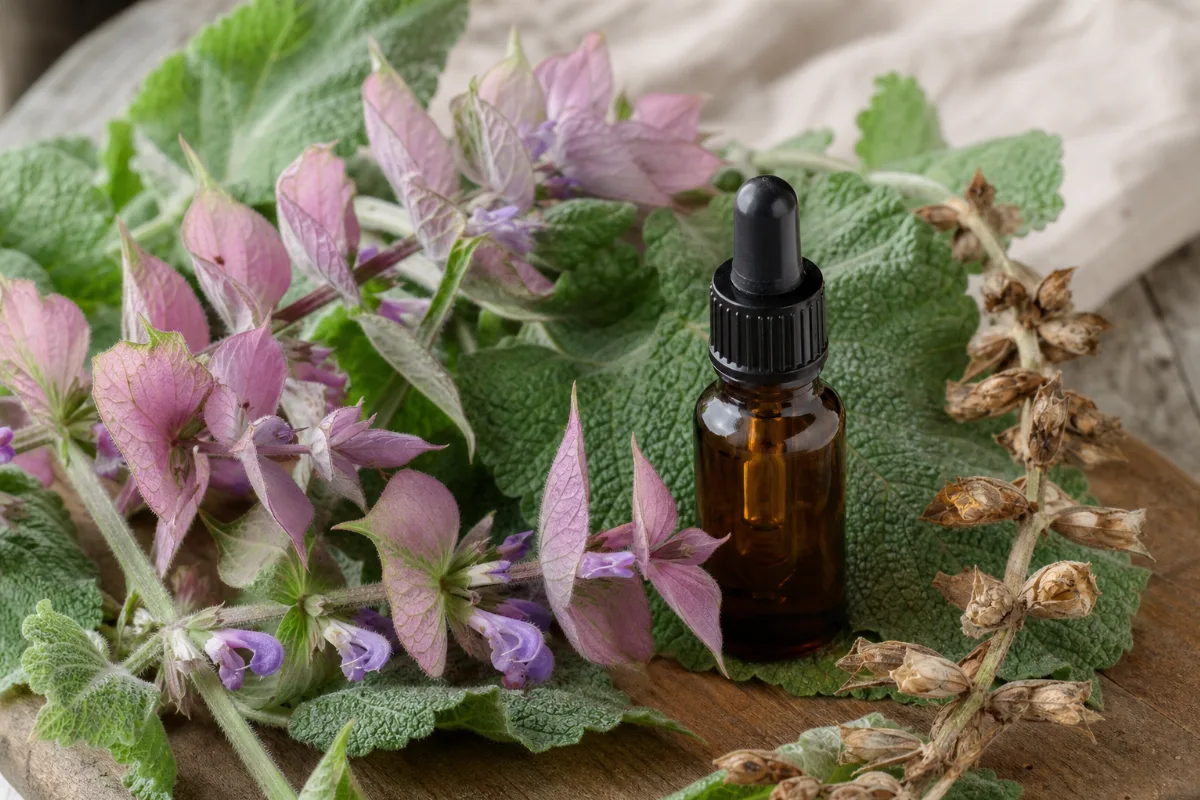
Clary sage oil is the strong, herbal-floral oil from the flowering stems of Salvia sclarea. It is smelled in diffusers and used in massage blends. Small trials link smelling it to lower stress scores and blood pressure readings, but they are short and weak, and it has not been shown to start labour. The main cautions: never swallow the bottled oil, ask a midwife or doctor before using it in pregnancy, and treat it as a skin allergen.
General information, not medical advice. Last substantive update · Not medically reviewed. A named clinician has not signed off on this page. How this page is made
About Clary Sage Oil
Clary sage oil is the strong, herbal-floral oil from the flowering stems of Salvia sclarea. People smell it in diffusers and use it in massage blends. Small trials link smelling it to lower stress scores and blood pressure readings, but they are short and weak. It has not been shown to start labour or balance hormones. Safety first: do not swallow the bottled oil, check with a midwife or doctor before using it in pregnancy, and treat it as a skin allergen.
What clary sage oil is
Clary sage oil is the essential oil of Salvia sclarea, a plant in the mint family (Lamiaceae). EFSA describes the oil as made from the fresh or dried flowering stems. GBIF lists the species as accepted.
A yeast study names linalool and linalyl acetate as the two main components of the oil. Oil from this plant is not the same as common sage oil (Salvia officinalis).
What people use it for, and how strong the evidence is
The most studied use is calm and stress. A 34-woman trial found lower systolic blood pressure and slower breathing after smelling the oil during a stressful bladder test. A 72-person trial in people with diabetic foot ulcers found lower stress scores with mild low mood. Cortisol fell in 22 menopausal women, with no comparison group. Certainty is low to very low.
For labour, the claim that clary sage starts labour is not supported: a pilot saw no contractions and a footbath study found no difference from a plain footbath. Several results for period pain, sleep and quality of life are for blends with lavender and marjoram, not clary sage alone.
Pain after kidney stone surgery fell in a small trial of the smelled oil. Hormone claims are not supported by the estrogen paper we read.
The research in one view
We read 17 trials, reviews, lab studies and regulator records. Most are small, short and use scent, which is hard to hide from a comparison group. No large independent trial of clary sage oil alone was found.
The two stress trials with comparison groups come from the same Korean research group. Where a result is for a blend, a different oil or an animal, the page says so.
The oil, common sage and the herb are different things
Clary sage (Salvia sclarea) and common sage (Salvia officinalis) are separate species in GBIF. Results for one do not carry over to the other. One 2025 trial calls clary sage "Salvia officinalis", so we left it out.
Bottled essential oil, a massage blend and a diffuser are different exposures, and a scent is not the same as swallowing or skin use.
What regulators say
EFSA (2024) judged clary sage oil safe as an animal feed additive up to species-specific levels and safe for the consumer and the environment, and classed it as an irritant and sensitiser for handlers. That opinion is about feed, not about diffusing or skin use.
We did not read an EMA, NCCIH, LiverTox, LactMed or FDA statement on clary sage oil.
At a glance
Traditional uses history, not proof
- Oil of the flowering stems is recognised to flavour food (EFSA).
- Sage oils used as a scent, seasoning and remedy (Poison Control; the page does not name the species).
- Used in aromatherapy research on labour anxiety (2019 review).
Studied for research
- Stress and blood pressure during a stressful test, smelled oil, low
- Stress scores in diabetic foot ulcer, smelled oil, low
- Pain after kidney stone surgery, smelled oil, low
- Stress hormones in menopause, very-low
- Starting labour, insufficient
- Hormone balance, insufficient
- Period pain and sleep, three-oil blends, very-low
Main compounds
- Linalool, named as a main component
- Linalyl acetate, named as a main component
Common forms
- Essential oil (made from the flowering stems)
- Massage blends and diffused oil (different exposures)
- Common sage oil and sage herb (different products)
Research links: EFSA opinion on clary sage oil (abstract) · Poison Control: Essential oils · Blood pressure trial (abstract) · Labour pilot study (abstract) · GBIF: Salvia sclarea · Research Library · Genes & Biomarkers Library
What it is and its history
- Accepted scientific name
- Salvia sclarea
- Naming authority
- L.
- Common names
- Clary sage (English); Clary (English)
- Family or group
- Lamiaceae (mint family), per GBIF.
- Classification
- Plantae > Tracheophyta > Magnoliopsida > Lamiales > Lamiaceae > Salvia > Salvia sclarea
- Native range
- Not checked.
- Habitat
- Not checked.
- What it looks like
- Part used: EFSA describes the oil as made from the fresh or dried flowering stems. This page does not describe how to recognise the plant.
- Look-alikes and adulterants
- Name: Common sage (Salvia officinalis) and "sage oil"; Note: GBIF lists Salvia officinalis L. (key 2927004) as a separate accepted species. Results for common sage oil or sage herb do not carry over to clary sage oil, and one trial calls clary sage "Salvia officinalis". Poison Control's sage oil warning does not name the species.
- Sustainability and conservation
- Not checked.
Traditional use and history history, not clinical proof
| Tradition or era | Documented use | Source |
|---|---|---|
| Flavouring | EFSA says the oil of the flowering stems of Salvia sclarea is recognised to flavour food. | EFSA |
| Scent, seasoning and remedy (sage oils in general) | Poison Control says sage oil (Salvia) has been used as a scent, seasoning and remedy. It does not name clary sage. | Poison Control |
| Aromatherapy in labour | A 2019 review lists clary sage among oils used in aromatherapy research on labour anxiety. We read no source on older traditional use of clary sage and make no claim about it. | Ghiasi et al. 2019 |
Traditional use shows how it was used. It does not show that it works or is safe today.
What is inside, and how it may work
What it contains and how those compounds act in cells and animals. Laboratory and animal mechanisms are not proven effects in people.
Main compounds
| Compound | Family | Where it is concentrated | Activity studied | Level of evidence |
|---|---|---|---|---|
| Linalool PubChem 6549 | monoterpene alcohol | Oil of the flowering stems No typical value given in the sources read. | Named with linalyl acetate as one of the two main components of clary sage oil in a yeast lab study. In the same lab study, linalool changed yeast cell membranes. 20 2 | Laboratory |
| Linalyl acetate PubChem 8294 | monoterpene ester | Oil of the flowering stems No typical value given in the sources read. | The other main component named in the yeast lab study. In a trial of 72 people with diabetic foot ulcers, inhaling linalyl acetate alone lowered anxiety and depression scores in people with moderate to severe low mood, where the whole oil did not. 21 2 14 | Human trial (small) |
Mechanisms, receptors and pathways
| Target or pathway | Gene or receptor | What was found | Level |
|---|---|---|---|
| Yeast cell membranes | Not applicable | In the lab, clary sage oil, linalool and linalyl acetate made Candida albicans membranes more fluid and caused loss of cell contents. 2 | Laboratory research |
| Stress hormone and serotonin in blood | Cortisol, 5-hydroxytryptamine | Cortisol fell and serotonin rose after menopausal women smelled the oil; this is a measured change in a small uncontrolled study, not a shown mechanism. 9 | Human biomarker (uncontrolled) |
| Anxious behaviour in mice | Corticosterone | Mice fed the oil showed less anxious and dominant behaviour in some groups; submissive mice had lower corticosterone. 6 | Animal research |
Absorption, metabolism and elimination
- Absorption
- Not established in the sources read.
- Distribution
- Not established.
- Metabolism
- Not established.
- Elimination
- Not established.
- Bioavailability
- Not established.
Isolated compounds versus whole extracts
The whole oil and one of its components can act differently. In the diabetic foot ulcer trial, the whole oil lowered stress in people with mild low mood, while linalyl acetate alone lowered anxiety and depression in people with moderate to severe low mood. Clary sage oil, common sage oil, sage herb and sage tea are different products.
Nutritional composition
Clary sage oil is not a nutrient. EFSA says the oil is recognised to flavour food, which is not advice to swallow the bottled oil.
3 low certainty6 very low certainty3 not enough evidence
What was looked at
The 12 benefits and uses checked for Clary Sage Oil, each with how strong the evidence is. Tap one to open it.
- Blood pressure and breathing rate during a stressful bladder test (smelled oil)Low certainty
- Stress and anxiety scores in people with a diabetic foot ulcer (smelled oil)Low certainty
- Stress hormone and serotonin changes in menopausal women (smelled oil)Very low certainty
- Blood pressure in women with hypertension (oil vapours, many oils)Very low certainty
- Anxious and dominant behaviour in mice (oil eaten in food)Very low certainty
- Starting labour: oxytocin and contractions (smelled oil or footbath)Not enough evidence
- Anxiety in the first stage of labour (mixed-oil review)Not enough evidence
- Period pain (three-oil blend in a massage cream)Very low certainty
- Sleep and quality of life (three-oil blend)Very low certainty
- Pain and nausea after kidney stone surgery (smelled oil)Low certainty
- Hormone balance and salivary estrogen (smelled oil)Not enough evidence
- Effect on Candida yeast cells (lab only)Very low certainty
Lab markers tracked in the studies
Systolic blood pressureCortisol5-hydroxytryptamine (serotonin) in bloodBreathing rateSalivary oxytocinPeriod pain score
What is Clary Sage Oil good for?
The uses people ask about and how strong the evidence is for each. Read the certainty label first: nothing here is better than low, and several results are for blends.
Benefits, one by one
Each card is a research question, not a promise. Tap a goal to filter. Open a card to see the studies, doses and limits.
Blood pressure and breathing rate during a stressful bladder test (smelled oil)
Low certaintyIn a small trial of 34 women having a bladder pressure test, smelling clary sage oil for an hour was followed by lower systolic blood pressure and slower breathing than almond oil. Lavender did not do this. It was one short test in a stressful setting, not a trial in people with high blood pressure.
1 studiesNot covered. This page gives no amounts and no ways of using the oil.
Studies, doses and limits
What the trials found
One double-blind randomized trial in 34 women with urinary incontinence; clary sage, lavender and almond oil (control) were each smelled for 60 minutes.
Results
Systolic pressure fell more with clary sage than with almond oil (p=0.048) and than with lavender (p=0.026). Diastolic pressure fell more than with lavender (p=0.034). Breathing rate fell more than with almond oil (p<0.001). Lavender tended to raise blood pressure.
Effect sizes as reported
Statistically significant but the abstract gives no actual blood pressure numbers.
Why this rating
One small randomized, double-blind trial. A scent is hard to hide, so people may guess which group they are in. The abstract does not report the cortisol result it measured.
Form and dose studied
Not covered. This page gives no amounts and no ways of using the oil.
Who was studied
Women with urinary incontinence having a bladder pressure test.
Limits
One trial, 34 women, one session; not people with high blood pressure; no follow-up.
Why researchers looked
Clary sage scent is a common aromatherapy choice for relaxation, and the researchers wanted to see if it changed body signs of stress.
Traditional use
No traditional-use statement from a regulator was found for this use.
Proposed mechanism Preliminary mechanism
Not established. The abstract suggests relaxation through the nervous system but does not test how.
A proposed mechanism does not show that the effect happens in people.
Do not swallow essential oil from a bottle, and ask a midwife or doctor before using any oil in pregnancy. See the Safety tab.
Stress and anxiety scores in people with a diabetic foot ulcer (smelled oil)
Low certaintyIn a 2025 trial of 72 people with a diabetic foot ulcer, smelling clary sage oil lowered stress scores compared with almond oil in people with mild low mood. In people with moderate to severe low mood, a single component of the oil (linalyl acetate) lowered anxiety and depression scores, but the whole oil did not.
1 studiesNot covered. This page gives no amounts and no ways of using the oil.
Studies, doses and limits
What the trials found
Randomized blinded trial, 72 people: 43 with mild and 29 with moderate to severe low mood, split into three small groups each (clary sage oil, linalyl acetate, almond oil as control).
Results
Compared with almond oil, clary sage oil lowered stress scores in the mild-low-mood group (p<0.05 and p<0.01 for the stress measures). Linalyl acetate lowered anxiety and depression scores in the moderate to severe group (p<0.05).
Effect sizes as reported
Significant on self-rated visual scales; groups of 9 to 15 people.
Why this rating
A randomized, blinded trial but the subgroups are tiny, outcomes are self-rated scales after one session, and several comparisons were made. The same research group ran the 2013 trial.
Form and dose studied
Not covered. This page gives no amounts and no ways of using the oil.
Who was studied
Adults with diabetic foot ulcer and type 2 diabetes.
Limits
One trial; one exposure; tiny subgroups; no lasting follow-up; does not show the oil treats depression or the ulcer.
Why researchers looked
Foot ulcers are linked with low mood, and researchers looked for a simple add-on to ordinary care.
Traditional use
No traditional-use statement from a regulator was found for this use.
Proposed mechanism Preliminary mechanism
Not established. The trial compared the whole oil with one of its components and found different results in different groups.
A proposed mechanism does not show that the effect happens in people.
Do not swallow essential oil from a bottle, and ask a midwife or doctor before using any oil in pregnancy. See the Safety tab.
Stress hormone and serotonin changes in menopausal women (smelled oil)
Very low certaintyIn 22 menopausal women, blood cortisol (a stress hormone) fell and serotonin rose after they smelled clary sage oil. The study had no comparison group described in its abstract, so the changes could have other explanations. It does not show that clary sage balances hormones or treats depression.
1 studiesNot covered. This page gives no amounts and no ways of using the oil.
Studies, doses and limits
What the trials found
A before-and-after study of 22 women in their 50s, grouped by depression questionnaires.
Results
Cortisol fell significantly and 5-hydroxytryptamine (serotonin) rose significantly after inhaling the oil. Thyroid-stimulating hormone fell but not significantly. Cortisol fell more in the depression-tendency group on two of three questionnaires (for example 31% vs 16% on KBDI-II).
Effect sizes as reported
Percent changes in blood markers; no symptom scores.
Why this rating
Blood markers only, no control group described, 22 women. Expectation and time can change cortisol.
Form and dose studied
Not covered. This page gives no amounts and no ways of using the oil.
Who was studied
Menopausal women in their 50s in Korea.
Limits
No placebo comparison; short term; markers are not symptoms.
Why researchers looked
Clary sage is traditionally associated with women in midlife, so researchers measured stress chemistry in menopausal women.
Traditional use
No traditional-use statement from a regulator was found.
Proposed mechanism Preliminary mechanism
Not established. The authors call the effect antidepressant-like but only measured blood chemicals.
A proposed mechanism does not show that the effect happens in people.
Do not swallow essential oil from a bottle, and ask a midwife or doctor before using any oil in pregnancy. See the Safety tab.
Blood pressure in women with hypertension (oil vapours, many oils)
Very low certaintyA large Russian comparison of 23 oil vapours reported that clary sage vapour lowered blood pressure in women with hypertension during a relaxation session. The abstract gives no numbers, so the size of the effect is unknown.
2 studiesNot covered. This page gives no amounts and no ways of using the oil.
Studies, doses and limits
What the trials found
Comparative study of 849 women aged 55 to 89 with hypertension: relaxation with oil vapour versus relaxation alone; 10 or 20 minute sessions.
Results
The abstract says clary sage, bay laurel, Caucasian nepeta and one mint variety lowered blood pressure at both 10 and 20 minutes, and ten other oils had no effect. No blood pressure figures are in the abstract.
Effect sizes as reported
Not given in the abstract.
Why this rating
Only the abstract was read: no numbers, no randomisation detail, no safety data. Effects measured right after a single session.
Form and dose studied
Not covered. This page gives no amounts and no ways of using the oil.
Who was studied
Women aged 55 to 89 with hypertension.
Limits
Abstract only; lasting effects unknown; not a replacement for blood pressure care.
Why researchers looked
Researchers searched for simple, mild blood pressure aids among many oils.
Traditional use
No traditional-use statement from a regulator was found.
Proposed mechanism Preliminary mechanism
Not established.
A proposed mechanism does not show that the effect happens in people.
This is not a way to treat high blood pressure. Keep taking prescribed medicines and ask your doctor about any change.
Anxious and dominant behaviour in mice (oil eaten in food)
Very low certaintyIn mice, long-term feeding with clary sage oil in their food was followed by less anxious and dominant behaviour in some groups. This is animal work with the oil eaten, so it says little about smelling the oil in people.
1 studiesNot covered. This page gives no amounts and no ways of using the oil.
Studies, doses and limits
What the trials found
Mouse experiment: clary sage oil extract mixed into food versus sunflower oil.
Results
Dominant mice exposed from conception via the mother ate clary sage oil food and showed less dominant and anxiety-like behaviour. Submissive mice showed a similar tendency and lower blood corticosterone.
Why this rating
Animal study only; oil in food, not inhaled; no human data.
Form and dose studied
Not covered. This page gives no amounts and no ways of using the oil.
Who was studied
Mice.
Limits
Does not tell us anything about people or about scent.
Why researchers looked
Researchers noted the oil contains linalool and omega-3 fatty acids and tested mood-related behaviour in mice.
Proposed mechanism Preliminary mechanism
The authors link the effect to compounds in the oil, but the abstract does not test how it works.
A proposed mechanism does not show that the effect happens in people.
Mouse feeding study only. We do not advise swallowing essential oil.
Starting labour: oxytocin and contractions (smelled oil or footbath)
Not enough evidenceClary sage is often said to bring on labour. The small studies we found do not show this. In an 11-woman pilot at 38 to 40 weeks, no uterine contractions were seen. In a footbath study with clary sage and lavender (82 women in three groups), oxytocin rose within the oil group but the change was not different from the plain footbath group, and contractions did not differ.
2 studiesNot covered. This page gives no amounts and no ways of using the oil.
Studies, doses and limits
What the trials found
A feasibility pilot of 11 women (smelling the oil for 20 minutes) and a non-randomized study of 82 women (footbath with clary sage and lavender versus jasmine versus plain footbath).
Results
Pilot: oxytocin rose in 3 of 5 women who smelled the oil and could not be measured in 2; no contractions in either group; authors report no negative effects of the protocol. Footbath: oxytocin rose significantly within the oil group (p=0.035) but not versus control; contractions and cortisol did not differ.
Effect sizes as reported
No significant difference from control in the footbath study.
Why this rating
Tiny pilot and a non-randomized study of a two-oil blend. Neither shows that clary sage starts labour, and neither tests safety for mother or baby.
Form and dose studied
Not covered. This page gives no amounts and no ways of using the oil.
Who was studied
Healthy women at term pregnancy in Japan.
Limits
Small and non-randomized; blend of oils; single sessions; no safety conclusions possible.
Why researchers looked
Clary sage is a traditional midwives' oil, and researchers tested whether it raises oxytocin, the hormone that drives contractions.
Traditional use
No regulator statement for this use was found.
Proposed mechanism Preliminary mechanism
Oxytocin was measured in saliva; no mechanism was shown.
A proposed mechanism does not show that the effect happens in people.
Not for use in pregnancy or labour without a midwife or doctor. Do not swallow essential oil. See the Safety tab.
Anxiety in the first stage of labour (mixed-oil review)
Not enough evidenceA 2019 review of 16 papers found that most studies of aromatherapy in the first stage of labour suggested less anxiety. Clary sage was one of the oils used in three papers, along with lavender and many others. Clary sage on its own is not separated out.
1 studiesNot covered. This page gives no amounts and no ways of using the oil.
Studies, doses and limits
What the trials found
Systematic review: 14 published and 2 unpublished papers from Iran, Egypt, Korea and Italy.
Results
The authors report that a majority of studies suggested aromatherapy reduced labour anxiety and ask for methodologically rigorous studies. Oils used: lavender in 5 papers; rose, clary sage, geranium and frankincense in 3 papers each; others in 1 or 2.
Effect sizes as reported
Direction only; no pooled numbers in the abstract.
Why this rating
Many oils lumped together, risk of bias noted by the authors, and no clary-sage-only result.
Form and dose studied
Not covered. This page gives no amounts and no ways of using the oil.
Who was studied
Women in labour.
Limits
Cannot tell what clary sage adds; the authors call for better studies.
Why researchers looked
Anxiety is common in labour, and many midwives offer aromatherapy.
Traditional use
No regulator statement for this use was found.
Proposed mechanism Preliminary mechanism
Not assessed.
A proposed mechanism does not show that the effect happens in people.
Not for use in pregnancy or labour without a midwife or doctor. Do not swallow essential oil. See the Safety tab.
Period pain (three-oil blend in a massage cream)
Very low certaintyIn a 48-person double-blind trial, a massage cream with lavender, clary sage and marjoram lowered period pain scores over one cycle, and pain lasted fewer days in the oil group. But the comparison group, who used a cream with synthetic fragrance, also improved. Clary sage on its own was not tested.
1 studiesNot covered. This page gives no amounts and no ways of using the oil.
Studies, doses and limits
What the trials found
Randomized double-blind trial, 48 outpatients with primary dysmenorrhea, 24 per group.
Results
Pain scores fell significantly in both groups (p<0.001). Pain duration fell from 2.4 to 1.8 days in the oil group. The abstract does not report a significant difference between the groups.
Effect sizes as reported
Both groups improved; duration shorter with oil.
Why this rating
Three-oil blend, a fragrance comparison that also improved, small groups.
Form and dose studied
Not covered. This page gives no amounts and no ways of using the oil.
Who was studied
Outpatients with primary period pain.
Limits
Cannot separate clary sage from lavender and marjoram; no long-term follow-up.
Why researchers looked
Period pain is common, and aromatherapy massage is a popular home choice.
Traditional use
No regulator statement for this use was found.
Proposed mechanism Preliminary mechanism
The authors list linalyl acetate, linalool, eucalyptol and beta-caryophyllene as the main compounds in the blend; they did not test how they work.
A proposed mechanism does not show that the effect happens in people.
Not for use in pregnancy or labour without a midwife or doctor. Do not swallow essential oil. See the Safety tab.
Sleep and quality of life (three-oil blend)
Very low certaintyIn 132 working women, a blend of lavender, clary sage and marjoram improved sleep quality and quality of life over four weeks, compared with a placebo of distilled water. It did better than lavender alone for quality of life. The abstract does not say how the oils were used, and clary sage on its own was not tested.
1 studiesNot covered. This page gives no amounts and no ways of using the oil.
Studies, doses and limits
What the trials found
Randomized controlled trial of 132 working women aged 24 to 55: placebo, lavender oil, blended oil or acupressure massage for 4 weeks.
Results
All active groups improved sleep and quality of life (p<0.05). The blend gave a greater quality-of-life gain than lavender alone, and the blend and acupressure gave greater sleep gains than lavender alone.
Effect sizes as reported
Significant differences between groups; sizes not given in the abstract.
Why this rating
A three-oil blend; self-rated outcomes; route of use unclear in the abstract.
Form and dose studied
Not covered. This page gives no amounts and no ways of using the oil.
Who was studied
Working women aged 24 to 55.
Limits
Clary sage alone is not tested; four weeks only.
Why researchers looked
Many people try aromatherapy for sleep and everyday stress.
Traditional use
No regulator statement for this use was found.
Proposed mechanism Preliminary mechanism
Not assessed.
A proposed mechanism does not show that the effect happens in people.
Do not swallow essential oil from a bottle, and ask a midwife or doctor before using any oil in pregnancy. See the Safety tab.
Pain and nausea after kidney stone surgery (smelled oil)
Low certaintyIn 79 patients after kidney stone surgery, pain fell significantly in the group that smelled clary sage oil, compared with no aromatherapy. Nausea trended down with clary sage and lavender; lavender had the fewest vomiting episodes.
1 studiesNot covered. This page gives no amounts and no ways of using the oil.
Studies, doses and limits
What the trials found
Randomized trial in 79 patients: clary sage (26), lavender (27) or control (26), smelled right after surgery and again at 3 and 6 hours.
Results
Pain fell significantly in the clary sage group. Nausea trended down in both oil groups. The lavender group had the lowest incidence of vomiting.
Effect sizes as reported
Pain significant with clary sage; no numbers in the abstract.
Why this rating
One small randomized trial. Scents are hard to hide so people know their group; pain is self-rated.
Form and dose studied
Not covered. This page gives no amounts and no ways of using the oil.
Who was studied
Adults after percutaneous nephrolithotomy.
Limits
One trial; short follow-up; not a replacement for pain medicine.
Why researchers looked
Hospitals look for gentle add-ons for pain and nausea after surgery.
Traditional use
No regulator statement for this use was found.
Proposed mechanism Preliminary mechanism
Not assessed.
A proposed mechanism does not show that the effect happens in people.
Do not swallow essential oil from a bottle, and ask a midwife or doctor before using any oil in pregnancy. See the Safety tab.
Hormone balance and salivary estrogen (smelled oil)
Not enough evidenceClary sage is often said to balance hormones. In a study of ten oils in perimenopausal women, the abstract reports increased salivary estrogen after geranium and rose otto. It names no increase for clary sage. We found no good evidence of hormone balancing.
1 studiesNot covered. This page gives no amounts and no ways of using the oil.
Studies, doses and limits
What the trials found
Exposure study of ten oils, including clary sage, in perimenopausal women (only the abstract was read).
Results
Salivary estrogen rose after geranium and rose otto compared with a control odour. No clary sage increase is named.
Effect sizes as reported
Not given in the abstract.
Why this rating
Abstract only; no sample size in the abstract; a lab marker, not symptoms.
Form and dose studied
Not covered. This page gives no amounts and no ways of using the oil.
Who was studied
Perimenopausal women.
Limits
Does not support a hormone claim for clary sage.
Why researchers looked
Some oils are traditionally linked with menopause symptoms.
Traditional use
No regulator statement for this use was found.
Proposed mechanism Preliminary mechanism
Not assessed.
A proposed mechanism does not show that the effect happens in people.
Not for use in pregnancy or labour without a midwife or doctor. Do not swallow essential oil. See the Safety tab.
Effect on Candida yeast cells (lab only)
Very low certaintyIn a test-tube study, clary sage oil and its two main components upset the membrane of Candida albicans yeast cells and killed them. This shows nothing about treating infections in people.
1 studiesNot covered. This page gives no amounts and no ways of using the oil.
Studies, doses and limits
What the trials found
Laboratory study on yeast cells; no animals or people.
Results
The oil, linalool and linalyl acetate each changed membrane properties and caused loss of cell contents; the authors conclude the oil disturbs the membrane and leads to cell death.
Effect sizes as reported
Lab effect only.
Why this rating
Test-tube work only.
Form and dose studied
Not covered. This page gives no amounts and no ways of using the oil.
Who was studied
Candida albicans cells.
Limits
Does not support treating thrush or any infection.
Why researchers looked
Researchers study oils as possible antimicrobial agents.
Proposed mechanism Preliminary mechanism
The oil made the yeast cell membrane more fluid and cell contents leaked out (lab).
A proposed mechanism does not show that the effect happens in people.
Lab work only; not a treatment. Do not put essential oils in the mouth or on mucous membranes.
Connections to the rest of health
How Clary Sage Oil connects to the rest of our health knowledge graph. Every link says what kind of connection it is. A safety link (for example to the liver) is a warning, not a benefit. A study that merely mentions a topic never creates a benefit link.
Explore every connection: goals, body systems, organs, symptoms, genes
A. Wellness goals
| Connected to | Kind of connection | Evidence status | Context | Studies |
|---|---|---|---|---|
| Stress Reduction | Low certainty | Blood pressure and breathing rate during a stressful bladder test (smelled oil): In a small trial of 34 women having a bladder pressure test, smelling clary sage oil for an hour was followed by lower systolic blood pressure and slower breathing than almond oil. Lavender did not do this. It was one short test in a stressful setting, not a trial in people with high blood pressure. Stress and anxiety scores in people with a diabetic foot ulcer (smelled oil): In a 2025 trial of 72 people with a diabetic foot ulcer, smelling clary sage oil lowered stress scores compared with almond oil in people with mild low mood. In people with moderate to severe low mood, a single component of the oil (linalyl acetate) lowered anxiety and depression scores, but the whole oil did not. | 12 14 | |
| Calm Relaxation | Low certainty | Blood pressure and breathing rate during a stressful bladder test (smelled oil): In a small trial of 34 women having a bladder pressure test, smelling clary sage oil for an hour was followed by lower systolic blood pressure and slower breathing than almond oil. Lavender did not do this. It was one short test in a stressful setting, not a trial in people with high blood pressure. Sleep and quality of life (three-oil blend): In 132 working women, a blend of lavender, clary sage and marjoram improved sleep quality and quality of life over four weeks, compared with a placebo of distilled water. It did better than lavender alone for quality of life. The abstract does not say how the oils were used, and clary sage on its own was not tested. | 12 8 1 | |
| Blood Pressure Support | Low certainty | Blood pressure and breathing rate during a stressful bladder test (smelled oil): In a small trial of 34 women having a bladder pressure test, smelling clary sage oil for an hour was followed by lower systolic blood pressure and slower breathing than almond oil. Lavender did not do this. It was one short test in a stressful setting, not a trial in people with high blood pressure. Blood pressure in women with hypertension (oil vapours, many oils): A large Russian comparison of 23 oil vapours reported that clary sage vapour lowered blood pressure in women with hypertension during a relaxation session. The abstract gives no numbers, so the size of the effect is unknown. | 12 17 | |
| Anxiety Support | Low certainty | Stress and anxiety scores in people with a diabetic foot ulcer (smelled oil): In a 2025 trial of 72 people with a diabetic foot ulcer, smelling clary sage oil lowered stress scores compared with almond oil in people with mild low mood. In people with moderate to severe low mood, a single component of the oil (linalyl acetate) lowered anxiety and depression scores, but the whole oil did not. | 14 | |
| Mood Balance | Low certainty | Stress and anxiety scores in people with a diabetic foot ulcer (smelled oil): In a 2025 trial of 72 people with a diabetic foot ulcer, smelling clary sage oil lowered stress scores compared with almond oil in people with mild low mood. In people with moderate to severe low mood, a single component of the oil (linalyl acetate) lowered anxiety and depression scores, but the whole oil did not. | 14 | |
| Stress Reduction | Very low certainty | Stress hormone and serotonin changes in menopausal women (smelled oil): In 22 menopausal women, blood cortisol (a stress hormone) fell and serotonin rose after they smelled clary sage oil. The study had no comparison group described in its abstract, so the changes could have other explanations. It does not show that clary sage balances hormones or treats depression. | 9 | |
| Menopause Support | Very low certainty | Stress hormone and serotonin changes in menopausal women (smelled oil): In 22 menopausal women, blood cortisol (a stress hormone) fell and serotonin rose after they smelled clary sage oil. The study had no comparison group described in its abstract, so the changes could have other explanations. It does not show that clary sage balances hormones or treats depression. Hormone balance and salivary estrogen (smelled oil): Clary sage is often said to balance hormones. In a study of ten oils in perimenopausal women, the abstract reports increased salivary estrogen after geranium and rose otto. It names no increase for clary sage. We found no good evidence of hormone balancing. | 9 13 | |
| Mood Balance | Very low certainty | Stress hormone and serotonin changes in menopausal women (smelled oil): In 22 menopausal women, blood cortisol (a stress hormone) fell and serotonin rose after they smelled clary sage oil. The study had no comparison group described in its abstract, so the changes could have other explanations. It does not show that clary sage balances hormones or treats depression. | 9 | |
| Anxiety Support | Very low certainty | Anxious and dominant behaviour in mice (oil eaten in food): In mice, long-term feeding with clary sage oil in their food was followed by less anxious and dominant behaviour in some groups. This is animal work with the oil eaten, so it says little about smelling the oil in people. | 6 | |
| Womens Wellness | Not enough evidence | Starting labour: oxytocin and contractions (smelled oil or footbath): Clary sage is often said to bring on labour. The small studies we found do not show this. In an 11-woman pilot at 38 to 40 weeks, no uterine contractions were seen. In a footbath study with clary sage and lavender (82 women in three groups), oxytocin rose within the oil group but the change was not different from the plain footbath group, and contractions did not differ. Period pain (three-oil blend in a massage cream): In a 48-person double-blind trial, a massage cream with lavender, clary sage and marjoram lowered period pain scores over one cycle, and pain lasted fewer days in the oil group. But the comparison group, who used a cream with synthetic fragrance, also improved. Clary sage on its own was not tested. | 15 16 11 | |
| Womens Wellness | Not enough evidence | Anxiety in the first stage of labour (mixed-oil review): A 2019 review of 16 papers found that most studies of aromatherapy in the first stage of labour suggested less anxiety. Clary sage was one of the oils used in three papers, along with lavender and many others. Clary sage on its own is not separated out. | 5 | |
| Anxiety Support | Not enough evidence | Anxiety in the first stage of labour (mixed-oil review): A 2019 review of 16 papers found that most studies of aromatherapy in the first stage of labour suggested less anxiety. Clary sage was one of the oils used in three papers, along with lavender and many others. Clary sage on its own is not separated out. | 5 | |
| Better Sleep | Very low certainty | Sleep and quality of life (three-oil blend): In 132 working women, a blend of lavender, clary sage and marjoram improved sleep quality and quality of life over four weeks, compared with a placebo of distilled water. It did better than lavender alone for quality of life. The abstract does not say how the oils were used, and clary sage on its own was not tested. | 8 | |
| Womens Wellness | Not enough evidence | Hormone balance and salivary estrogen (smelled oil): Clary sage is often said to balance hormones. In a study of ten oils in perimenopausal women, the abstract reports increased salivary estrogen after geranium and rose otto. It names no increase for clary sage. We found no good evidence of hormone balancing. | 13 |
B. Body systems
| Connected to | Kind of connection | Evidence status | Context | Studies |
|---|---|---|---|---|
| Nervous System | Biological association | Low certainty | Studied for: Blood pressure and breathing rate during a stressful bladder test (smelled oil) Studied for: Stress and anxiety scores in people with a diabetic foot ulcer (smelled oil) | 12 14 9 6 5 8 1 |
| Heart Circulation | Biological association | Low certainty | Studied for: Blood pressure and breathing rate during a stressful bladder test (smelled oil) Studied for: Blood pressure in women with hypertension (oil vapours, many oils) | 12 17 |
| Stress Mood | Biological association | Low certainty | Studied for: Stress and anxiety scores in people with a diabetic foot ulcer (smelled oil) Studied for: Stress hormone and serotonin changes in menopausal women (smelled oil) | 14 9 |
| Reproductive Health | Biological association | Not enough evidence | Studied for: Starting labour: oxytocin and contractions (smelled oil or footbath) Studied for: Anxiety in the first stage of labour (mixed-oil review) | 15 16 5 11 13 |
| Immune System | Biological association | Very low certainty | Studied for: Effect on Candida yeast cells (lab only) | 2 |
E. Health conditions
| Connected to | Kind of connection | Evidence status | Context | Studies |
|---|---|---|---|---|
| Contact dermatitis | Adverse effect or risk | Documented risk | EFSA classes the oil as a skin and eye irritant and dermal sensitiser for handlers; no clary-sage-specific case series found. Preparation or compound: Clary sage oil on skin |
3 18 |
| Pregnancy | Not enough evidence | Safety not demonstrated; small pilot studies only. Preparation or compound: Clary sage oil (smelled or footbath) |
10 15 16 |
I. Biomarkers
| Connected to | Kind of connection | Evidence status | Context | Studies |
|---|---|---|---|---|
| Systolic blood pressure | Biological association | Low certainty | Measured in trials: decrease. A lab change is not the same as a health benefit. | 12 17 |
| Cortisol | Biological association | Very low certainty | Measured in trials: decrease. A lab change is not the same as a health benefit. | 9 |
| 5-hydroxytryptamine (serotonin) in blood | Biological association | Very low certainty | Measured in trials: increase. A lab change is not the same as a health benefit. | 9 |
| Breathing rate | Biological association | Low certainty | Measured in trials: decrease. A lab change is not the same as a health benefit. | 12 |
| Salivary oxytocin | Biological association | Not enough evidence | Measured in trials: increase. A lab change is not the same as a health benefit. | 15 16 |
| Period pain score | Biological association | Very low certainty | Measured in trials: decrease. A lab change is not the same as a health benefit. | 11 |
K. Biological pathways
| Connected to | Kind of connection | Evidence status | Context | Studies |
|---|---|---|---|---|
| Cortisol | Preliminary mechanism | Human biomarker | Fell in a small, uncontrolled study after smelling the oil. | 9 |
| Oxytocin (saliva) | Preliminary mechanism | Human biomarker | Studied before labour; no significant difference from control in the footbath study. | 15 16 |
L. Active compounds
| Connected to | Kind of connection | Evidence status | Context | Studies |
|---|---|---|---|---|
| Linalool | Biological association | Laboratory | Named with linalyl acetate as one of the two main components of clary sage oil in a yeast lab study. In the same lab study, linalool changed yeast cell membranes. Preparation or compound: Oil of the flowering stems |
20 2 |
| Linalyl acetate | Biological association | Human trial (small) | The other main component named in the yeast lab study. In a trial of 72 people with diabetic foot ulcers, inhaling linalyl acetate alone lowered anxiety and depression scores in people with moderate to severe low mood, where the whole oil did not. Preparation or compound: Oil of the flowering stems |
21 2 14 |
Each connection is stored with the ingredient, the connected record, the kind of connection, the evidence status, the supporting studies, the preparation or compound involved, and a review date (last reviewed October 25, 2026).
Evidence at a glance: what the research found for 12 outcomes
Each outcome below is one thing researchers measured. Certainty is how far the evidence can be trusted, not how well it works. The full studies are on the next tab.
The evidence
The research centre for Clary Sage Oil. Every record here was checked against PubMed or the publisher's page; we never list a study we have not verified.
Evidence by outcome
Bars show how many studies we found for each outcome, not how well it works. People are added up across trials only (reviews are not added, to avoid double counting).
How we rate evidence
High certainty
Several well-run trials or reviews agree; further research is unlikely to change the picture much.
Moderate certainty
Good trials point the same way, but some doubt remains.
Low certainty
Small, short or inconsistent trials. The finding could change with better research.
Very low certainty
Very little or very weak human data. Treat as a possibility only.
Mixed findings
Trials or reviews disagree with each other.
Not enough evidence
Not enough human research to say either way.
Evidence against
Good research found no benefit, or found harm.
We take the reviewers' own risk-of-bias and GRADE statements where they exist, and otherwise judge from study size, design, consistency, directness and whether a product matches what is sold. Many publications do not make evidence high. Method note: We read the abstracts of 17 PubMed papers and the Poison Control page, checked the plant name in GBIF and the compounds in PubChem. The EFSA opinion was read as an abstract only. We did not read an EMA, NCCIH, LiverTox, LactMed or FDA statement.
Study library: every study we checked 21
| Study | Design | People | Product, dose, length | Result |
|---|---|---|---|---|
| Amirhosseini 2020 Effectiveness of Aromatherapy for Relief of Pain, Nausea, and Vomiting after Percutaneous Nephrolithotomy: A Randomized Controlled Trial. Complement Med Res · PMID 32575103 · DOI |
Randomized clinical trial |
79 Patients after percutaneous nephrolithotomy (kidney stone surgery) |
Clary sage essential oil (Salvia sclarea), inhaled, compared with lavender oil flowering stems (oil) Not reported here Inhaled right after surgery and 3 and 6 hours later · vs no aromatherapy (control) |
Pain fell significantly in the clary sage group. Nausea trended down in both oil groups. The lavender group had the fewest vomiting episodes. Group sizes were 26 (clary sage), 27 (lavender) and 26 (control). Pain fell significantly with clary sage versus control Methods, limits and fundingOutcomes: Pain, nausea and vomiting episodes on visual scales Limitations: Small groups; scent is hard to hide, so people know which group they are in; pain is self-rated. Funding and conflicts: Not stated in the abstract. Read: abstract |
| Blaskó Á 2017 Effects of clary sage oil and its main components, linalool and linalyl acetate, on the plasma membrane of Candida albicans: an in vivo EPR study. Apoptosis · PMID 27826675 · DOI |
Laboratory study (yeast cells) yeast (in vitro) |
Candida albicans yeast cells in the lab | Clary sage essential oil (Salvia sclarea) and its two main components, linalool and linalyl acetate oil Not reported here Lab exposure · vs untreated yeast cells |
The oil and its two main components made the yeast cell membrane more fluid and caused loss of cell contents; the authors conclude the oil disturbs the membrane and leads to cell death. Lab effect on yeast membranes Methods, limits and fundingOutcomes: Plasma membrane fluidity (EPR spectroscopy), loss of cell metabolites, cell death Limitations: Test-tube yeast work only; says nothing about treating infection in people. Funding and conflicts: Not stated in the abstract. Read: abstract |
| EFSA Panel on Additives and Products or Substances used in Animal Feed (FEEDAP) 2024 Safety and efficacy of a feed additive consisting of an essential oil derived from the flowering stems of Salvia sclarea L. (clary sage oil) for use in all animal species (FEFANA asbl). EFSA J · PMID 39545222 · DOI |
Regulator opinion (EFSA FEEDAP panel) animal and human handlers |
Animals (feed additive) and the people who handle the additive | Clary sage essential oil (Salvia sclarea) as a feed additive flowering stems (oil) Not reported here |
EFSA judged the oil safe for target animals up to species-specific feed levels, with the lowest level of all listed species groups for cats. It judged the use safe for the consumer and the environment. For people handling it, the oil is an irritant to skin and eyes and a dermal and respiratory sensitiser. EFSA notes the oil of the flowering stems is recognised to flavour food. Handler classification: irritant and sensitiser Methods, limits and fundingOutcomes: Safety for animals, consumers, environment and users Limitations: About feed additives at feed-level amounts, not about diffusing, massage or swallowing the oil; only the abstract was read. Funding and conflicts: EFSA scientific panel opinion. Read: abstract |
| Flaman 2001 Unintentional exposure of young children to camphor and eucalyptus oils. Paediatr Child Health · PMID 20084213 · DOI |
Poison centre chart review plus literature search |
251 Children in Toronto who swallowed an essential oil or oil product |
Eucalyptus oil, camphorated oil and vapour rubs (not clary sage) oils Not reported here |
251 children swallowed such products. Common symptoms were cough and vomiting; two had seizures but recovered. The literature search found 18 paediatric reports; main symptoms were vomiting, sleepiness, coma and seizures, and one child died. Swallowing essential oils can be life-threatening for children Methods, limits and fundingOutcomes: Symptoms after swallowing Limitations: Other oils, not clary sage; shows the type of risk, not clary sage-specific risk. Funding and conflicts: Not stated in the abstract. Read: abstract |
| Ghiasi 2019 A Systematic Review on the Anxiolytic Effect of Aromatherapy during the First Stage of Labor. J Caring Sci · PMID 30915314 · DOI |
Systematic review (qualitative) |
Women in the first stage of labour; 14 published and 2 unpublished papers (Iran, Egypt, Korea, Italy) | Aromatherapy with various oils: lavender in 5 papers; rose, clary sage, geranium and frankincense in 3 papers each oils Not reported here Varied · vs Varied |
The authors report that a majority of studies suggested aromatherapy reduced anxiety in the first stage of labour, and recommend more methodologically rigorous studies. Direction only; no pooled numbers in the abstract Methods, limits and fundingOutcomes: Labour anxiety Limitations: Many oils mixed together; clary sage alone is not separated; risk of bias was assessed but ratings are not in the abstract. Funding and conflicts: Not stated in the abstract. Read: abstract |
| Gross 2013 Chronic food administration of Salvia sclarea oil reduces animals' anxious and dominant behavior. J Med Food · PMID 23444964 · DOI |
Animal experiment (mice) mouse |
Mice bred or selected for dominant or submissive behaviour | Salvia sclarea oil extract mixed into the animals' food (not inhaled) oil extract Not reported here Chronic feeding, from weaning or from conception via the mother · vs sunflower oil in food |
Dominant mice whose mothers ate the clary sage oil food from conception showed less dominant and anxiety-like behaviour than sunflower oil controls. Submissive mice showed a similar tendency and lower blood corticosterone. Behaviour and corticosterone in mice Methods, limits and fundingOutcomes: Dominant and anxiety-like behaviour tests, blood corticosterone Limitations: Mice, oil eaten in food rather than smelled; sample size not given in the abstract; says nothing about people. We do not advise swallowing essential oil. Funding and conflicts: Not stated in the abstract. Read: abstract |
| Hajabdollahi 2025 A comparison of the effect of aromatherapy with Jasmine (Jasminum) and clary sage (Salvia officinalis) on sexual dysfunction in women of reproductive age: A randomized controlled clinical trial. J Educ Health Promot · PMID 40144179 · DOI |
Triple blind randomized trial |
168 Women aged 15 to 45 with low sexual function scores |
Jasmine and "Salvia officinalis" aromatherapy (the paper calls it clary sage in its title) Not reported here 6 weeks · vs sweet almond (placebo) and no treatment |
The paper reports better scores with both aromas than control. We did not use this result for clary sage because the species named in the abstract is Salvia officinalis (common sage), not Salvia sclarea. Not used Methods, limits and fundingOutcomes: Female Sexual Function Index Limitations: Species mix-up in the paper: title says clary sage, abstract says Salvia officinalis; baseline scores in the abstract contain implausible figures. Funding and conflicts: Not stated in the abstract. Read: abstract |
| Kao 2017 Comparisons for Effectiveness of Aromatherapy and Acupressure Massage on Quality of Life in Career Women: A Randomized Controlled Trial. J Altern Complement Med · PMID 28504569 · DOI |
Randomized controlled trial |
132 Working women aged 24 to 55 |
Blend of lavender, clary sage and marjoram oils (1:1:1) compared with lavender oil alone, acupressure massage and a placebo oils Not reported here 4 weeks · vs distilled water (placebo); lavender oil; acupressure massage |
After 4 weeks all three active groups (blend, lavender, acupressure) improved sleep quality and quality of life (p<0.05). The blend gave a greater quality-of-life gain than lavender alone, and the blend and acupressure gave greater sleep gains than lavender alone. The abstract does not say how the oils were applied. Active groups improved; blend beat lavender alone Methods, limits and fundingOutcomes: Pittsburgh Sleep Quality Index, SF-36 quality of life Limitations: Three-oil blend, so clary sage alone is not tested; route of use not given in the abstract; self-rated outcomes. Funding and conflicts: Not stated in the abstract. Read: abstract |
| Lee 2014 Changes in 5-hydroxytryptamine and cortisol plasma levels in menopausal women after inhalation of clary sage oil. Phytother Res · PMID 24802524 · DOI |
Single group before and after study (no placebo group described in the abstract) |
22 Menopausal women in their 50s, grouped by depression questionnaire scores |
Clary sage essential oil (Salvia sclarea), inhaled flowering stems (oil) Not reported here Not reported in the abstract |
After inhaling the oil, cortisol fell significantly and 5-hydroxytryptamine rose significantly. Thyroid-stimulating hormone fell in all groups but not significantly. Cortisol fell more in the group with depression tendency than in the normal group when two of the three questionnaires were used (for example 31% vs 16% with KBDI-II). Cortisol down, serotonin up (significant); TSH down (not significant) Methods, limits and fundingOutcomes: Plasma cortisol, 5-hydroxytryptamine (serotonin), thyroid-stimulating hormone Limitations: No control group described, so expectation or the passage of time could explain the changes; 22 women; blood markers, not symptoms. The authors call the oil antidepressant-like; this does not show it treats depression. Funding and conflicts: Not stated in the abstract. Read: abstract |
| Lis-Balchin 1999 Possible health and safety problems in the use of novel plant essential oils and extracts in aromatherapy. J R Soc Promot Health · PMID 10673845 · DOI |
Narrative review |
Aromatherapy users (general) | Aromatherapy essential oils in general, not clary sage alone oils Not reported here |
The author says commonly used oils are seldom dangerous in massage and have low systemic toxicity at 2% dilution when not adulterated, but that safety in pregnancy, childbirth and babies has not been clearly demonstrated, and that sensitisation is a growing concern. General caution Methods, limits and fundingOutcomes: Safety of aromatherapy oils Limitations: A 1999 review; not about clary sage by name; the abstract does not give clary-specific findings. Funding and conflicts: Not stated in the abstract. Read: abstract |
| Ou 2012 Pain relief assessment by aromatic essential oil massage on outpatients with primary dysmenorrhea: a randomized, double-blind clinical trial. J Obstet Gynaecol Res · PMID 22435409 · DOI |
Double blind randomized controlled trial |
48 Outpatients with primary period pain (dysmenorrhea), pain score above 5 of 10 |
Cream with a blend of lavender, clary sage and marjoram oils (2:1:1), massaged on the lower abdomen daily for one cycle oils Not reported here One menstrual cycle · vs unscented cream with synthetic fragrance |
Pain scores fell significantly (p<0.001) in both the oil group and the synthetic fragrance group. Pain duration fell from 2.4 to 1.8 days in the oil group. The abstract does not report a significant difference between the groups. Both groups improved; duration shorter in the oil group Methods, limits and fundingOutcomes: Numeric and verbal pain scores, duration of pain Limitations: Three-oil blend, not clary sage alone; the fragrance cream group improved too; 24 per group. Funding and conflicts: Not stated in the abstract. Read: abstract |
| Seol 2013 Randomized controlled trial for Salvia sclarea or Lavandula angustifolia: differential effects on blood pressure in female patients with urinary incontinence undergoing urodynamic examination. J Altern Complement Med · PMID 23360656 · DOI |
Double blind randomized controlled trial |
34 Women with urinary incontinence having a bladder pressure test (urodynamic examination) |
Clary sage essential oil (Salvia sclarea), inhaled as vapour flowering stems (oil) Not reported here 60 minutes of inhalation · vs sweet almond oil (control) and lavender oil |
Systolic blood pressure fell more with clary sage than with almond oil (p=0.048) and than with lavender (p=0.026). Diastolic pressure fell more than with lavender (p=0.034). Breathing rate fell more than with almond oil (p<0.001). Lavender tended to raise blood pressure. The abstract does not give the cortisol result. Clary sage versus control: systolic p=0.048; breathing rate p<0.001 Methods, limits and fundingOutcomes: Systolic and diastolic blood pressure, pulse rate, respiratory rate, salivary cortisol Limitations: Small group; a stressful medical test, not a blood pressure trial; the abstract gives no actual blood pressure numbers; the same research group later ran the diabetic foot ulcer trial. Funding and conflicts: Not stated in the abstract; PubMed lists non-US-government research support. Read: abstract |
| Shinohara 2017 Effects of essential oil exposure on salivary estrogen concentration in perimenopausal women. Neuro Endocrinol Lett · PMID 28326753 |
Exposure study of ten essential oils (details limited in the abstract) |
Perimenopausal women | Ten oils smelled, including clary sage, compared with a control odour oils Not reported here Not reported in the abstract · vs control odour |
The abstract reports increases in salivary estrogen after geranium and rose otto compared with a control odour. It names no increase for clary sage. Increase only for geranium and rose otto Methods, limits and fundingOutcomes: Salivary estrogen Limitations: Only the abstract was read; sample size not given in the abstract; salivary estrogen is a lab marker, not a symptom. Funding and conflicts: Not stated in the abstract. Read: abstract |
| Son 2025 Differential effects of clary sage (Salvia sclarea L.) oil and linalyl acetate on depression levels in diabetic foot ulcer patients with T2DM: a randomized blinded controlled trial. Front Med (Lausanne) · PMID 39911870 · DOI |
Randomized blinded controlled trial |
72 Adults with diabetic foot ulcer and type 2 diabetes, split into mild (43) and moderate to severe (29) depression by a visual scale |
Clary sage essential oil (Salvia sclarea) and, separately, linalyl acetate (one of its components), inhaled by natural breathing flowering stems (oil) Not reported here Single inhalation session · vs sweet almond oil (control) |
Compared with almond oil, clary sage oil reduced stress scores in people with mild depression (p<0.05 and p<0.01 for the stress measures). Linalyl acetate, not the whole oil, reduced anxiety and depression scores in people with moderate to severe depression (p<0.05). Groups were small (9 to 15 people each). Clary sage versus almond oil: stress scale p<0.05 / p<0.01 in the mild-depression group Methods, limits and fundingOutcomes: Blood pressure, heart rate, and visual analogue scales for depression, anxiety and stress Limitations: Very small subgroups; one short exposure; self-rated scales; many comparisons; the same research group ran the 2013 blood pressure trial. Funding and conflicts: Not stated in the abstract. Registered in the Korean clinical trials registry (KCT0009722). Registration: KCT0009722 Read: abstract |
| Tadokoro 2017 Changes in salivary oxytocin after inhalation of clary sage essential oil scent in term-pregnant women: a feasibility pilot study. BMC Res Notes · PMID 29216912 · DOI |
Quasi experimental feasibility pilot |
11 Women with single pregnancies at 38 to 40 weeks |
Clary sage essential oil (Salvia sclarea), scent inhaled for 20 minutes (diluted) flowering stems (oil) Not reported here 20 minutes · vs inhaling the carrier without the oil |
Oxytocin 15 minutes after inhaling rose in 3 of 5 women who smelled the oil and could not be measured in 2. In the 6-woman comparison group it rose in 2, fell in 2 and was unmeasurable in 2. No uterine contractions were seen in either group. Cortisol fell in both groups. The authors report no negative effects of the protocol. 3 of 11 women could not give enough saliva. No effect on contractions seen; oxytocin changes uneven Methods, limits and fundingOutcomes: Salivary oxytocin, uterine contractions, cortisol, feasibility Limitations: Only 11 women, a feasibility pilot; cannot show effect or safety; no randomisation described. Funding and conflicts: Not stated in the abstract. Registered in a Japanese trial registry (UMIN000017830). Registration: UMIN000017830 Read: abstract |
| Tadokoro 2023 Changes in Salivary Oxytocin Level of Term Pregnant Women after Aromatherapy Footbath for Spontaneous Labor Onset: A Non-Randomized Experimental Study. Int J Environ Res Public Health · PMID 37444109 · DOI |
Non randomized experimental study |
82 Low-risk women at term pregnancy in Japan |
Footbath with clary sage and lavender oils (combined), compared with a jasmine oil footbath and a plain footbath oils Not reported here Single footbath session · vs plain footbath (no oil); jasmine oil footbath |
Oxytocin rose significantly within the clary sage and lavender group (p=0.035, 28 women). The change did not differ significantly from the plain-footbath group (27 women), and contractions and cortisol changes did not differ either. The authors suggest the small sample may be why. Within-group rise; no significant difference from control Methods, limits and fundingOutcomes: Salivary oxytocin (main), uterine contractions, cortisol Limitations: Blend of two oils, so clary sage alone is not tested; groups not randomized; one session. Funding and conflicts: PubMed lists non-US-government research support. Read: abstract |
| Yarosh 2023 [Impact of essential oil vapors inhalation on blood pressure in patients with hypertension]. Vopr Kurortol Fizioter Lech Fiz Kult · PMID 37141519 · DOI |
Comparative study of oil vapours (randomisation not stated in the abstract) |
849 Women aged 55 to 89 with hypertension |
Vapours of 23 different essential oils including clary sage, each with a relaxation session oils from several plants Not reported here 10 or 20 minutes · vs relaxation session without oil vapour |
The abstract says clary sage, bay laurel, Caucasian nepeta and one mint variety lowered blood pressure at both 10 and 20 minutes. Ten other oils, including spicate lavender, had no effect. Blood pressure numbers are not given in the abstract. Direction of effect only; no numbers in the abstract Methods, limits and fundingOutcomes: Systolic and diastolic blood pressure, heart rate, circulation indices Limitations: Abstract has no numbers, no randomisation detail and no safety data; the paper is in Russian with an English abstract; one measurement session, so lasting effects are unknown. Funding and conflicts: Not stated in the abstract. Read: abstract |
| n/a 2026 Poison Control (National Capital Poison Center): Essential oils: Poisonous when misused (page read 2026-10-25) n/a · Source |
Poison centre education page n/a |
n/a | n/a |
Says misuse of essential oils can cause serious poisoning; product contents are hard to know; children have thin skin and immature livers; oils may interact with medicines; pure oils are potent and diluting in a carrier oil is the best way to avoid skin reactions; do not use on damaged skin; allergy to oils is a very real possibility, mostly rash; a reaction with trouble breathing is an emergency. Its sage oil (Salvia) line: swallowing more than a very small amount has caused seizures in children. Keep oils out of sight and reach of children and pets. Methods, limits and fundingOutcomes: Essential oil poisoning, allergy, children and pets Limitations: General essential oil guidance; the sage oil line does not name the species; no clary sage-specific entry. Read: full-text |
| n/a 2026 GBIF Backbone Taxonomy: Salvia sclarea L., species key 2927000 (GBIF match API, read 2026-10-25) n/a · Source |
Registry or database n/a |
n/a | n/a |
Accepted species name Salvia sclarea L., family Lamiaceae, order Lamiales, kingdom Plantae (match type exact). Salvia officinalis L. (key 2927004) is a separate accepted species. Methods, limits and fundingOutcomes: Accepted name and family Read: full-text |
| n/a 2026 PubChem: Linalool, CID 6549 (PUG REST, read 2026-10-25) n/a · Source |
Chemical registry n/a |
n/a | n/a |
Linalool, formula C10H18O, 3,7-dimethylocta-1,6-dien-3-ol. Methods, limits and fundingOutcomes: Identity Read: full-text |
| n/a 2026 PubChem: Linalyl acetate, CID 8294 (PUG REST, read 2026-10-25) n/a · Source |
Chemical registry n/a |
n/a | n/a |
Linalyl acetate, formula C12H20O2, 3,7-dimethylocta-1,6-dien-3-yl acetate. Methods, limits and fundingOutcomes: Identity Read: full-text |
What we do not know yet
- What the evidence supports: stress, blood pressure and surgical pain are low; hormones and starting labour are insufficient.
- No large independent trial of clary sage oil alone was found.
- No safety study in pregnancy, breastfeeding or children.
- No source on alcohol or sedative interactions, and no veterinary source on diffusing.
- No EMA, NCCIH, LiverTox, LactMed or FDA statement was read.
How new research is added
New studies are found by a saved PubMed search and are placed in a review queue. A person reads each one before it is added.
Lab markers
What changed in blood or saliva tests during trials. A changed number is not the same as feeling or being healthier, and we give no "normal ranges".
Hormonal 1
Cortisol
Decrease in trials
A hormone released during stress, measured in blood or saliva.
Very low certaintyResults and what it means
Why it was measured
Used as a stress marker in oil-smelling studies.
Statistical vs. clinical meaning
A stress marker; changes can happen with rest or expectation.
Safety implication
A lower marker does not show the oil treats stress or depression.
| Study | Result | People | Product |
|---|---|---|---|
| 9 | Fell significantly after inhaling clary sage oil in 22 menopausal women; no control group described. |
Other 5
Systolic blood pressure
Decrease in trials
The top blood pressure number, measured when the heart beats.
Low certaintyResults and what it means
Why it was measured
Measured as a stress sign during a medical test and in a hypertension study.
Statistical vs. clinical meaning
A short-term reading around a session; it does not show lasting blood pressure control.
Safety implication
A drop does not show the oil is safe or useful for people on blood pressure medicines; ask a doctor.
5-hydroxytryptamine (serotonin) in blood
Increase in trials
A chemical messenger linked to mood; measured in blood plasma.
Very low certaintyResults and what it means
Why it was measured
Used by the authors as an antidepressant-like signal.
Statistical vs. clinical meaning
Blood levels of serotonin are not the same as brain serotonin or mood.
Safety implication
Does not show the oil improves mood.
| Study | Result | People | Product |
|---|---|---|---|
| 9 | Rose significantly after inhaling clary sage oil in 22 menopausal women; no control group described. |
Breathing rate
Decrease in trials
Breaths per minute, which usually slows with relaxation.
Low certaintyResults and what it means
Why it was measured
Measured as a relaxation sign in the bladder test trial.
Statistical vs. clinical meaning
A simple relaxation sign during one test.
Safety implication
Not a safety measure for people with asthma or breathing problems.
| Study | Result | People | Product |
|---|---|---|---|
| 12 | Fell more with clary sage than with almond oil (p<0.001) in 34 women. |
Salivary oxytocin
Increase in trials
A hormone that helps drive uterine contractions and bonding; measured here in spit.
Not enough evidenceResults and what it means
Why it was measured
Used to test whether clary sage could start labour.
Statistical vs. clinical meaning
A hormone level is not labour; no study showed that clary sage starts labour.
Safety implication
A rise in a marker does not show the oil is safe in pregnancy.
Period pain score
Decrease in trials
A 0 to 10 self-rating of period pain.
Very low certaintyResults and what it means
Why it was measured
Main outcome in the blend trial.
Statistical vs. clinical meaning
Self-rated; both groups improved.
Safety implication
No safety information for the blend in pregnancy.
| Study | Result | People | Product |
|---|---|---|---|
| 11 | Fell significantly in both the oil blend and the synthetic fragrance cream groups; pain lasted 2.4 then 1.8 days in the oil group. |
Safety
What studies and official sources say about side effects, medicines and who should check first. Each point shows what kind of evidence it comes from.
Main points to know 5
- Pregnancy: no source shows clary sage oil is safe, and it does not reliably start labour. Ask a midwife or doctor first.. A 1999 review says the safety of aromatherapy oils in pregnancy, childbirth and babies has not been clearly demonstrated. We found no safety study of clary sage oil in pregnancy. In an 11-woman pilot at 38 to 40 weeks, no uterine contractions were seen after smelling the oil, and in a footbath study with clary sage and lavender (82 women in three groups) contractions did not differ from a plain footbath. Those studies were too small to show safety. Review 10 15 16
- Do not swallow essential oil. Poison Control says swallowing more than a very small amount of sage oil has caused seizures in children.. Poison Control lists sage oil (Salvia) among oils that have caused seizures in children when more than a very small amount was swallowed. The page does not name which sage species. A Toronto poison centre review found 251 children who swallowed eucalyptus, camphor or vapour-rub products; two had seizures and a literature search found one death. Those were other oils, but they show the kind of risk. We found no clary-sage-specific poisoning report. Case report 18 4
- The oil is an irritant to skin and eyes and a skin and breathing-passage sensitiser, according to EFSA.. In its 2024 opinion on clary sage oil as a feed additive, EFSA says people handling the oil should treat it as an irritant to skin and eyes and as a dermal and respiratory sensitiser. EFSA does not give how often this happens. Poison Control says allergy to essential oils is a real possibility, mostly a rash, and that pure oils are potent. We found no clary-sage-specific patch-test or case series in our PubMed search. Regulatory 3 18
- Pets and children: keep the oil locked away. Cats have the lowest feed limit of any animal group EFSA listed.. EFSA set safe feed levels for many animals, and cats had the lowest of the groups listed. That concerns a feed additive, not diffusing or skin use, and it is not a safety rule for the home. Poison Control says to keep oils out of sight and reach of children and pets, and notes that children have thin skin and immature livers. Ask a veterinarian about cats and dogs. Regulatory 3 18
- Not a substitute for care for high blood pressure, labour pain or low mood.. Benefit studies are small and short. Do not stop or change medicines because of a trial result about a scent. Ask a doctor or pharmacist if you take blood pressure medicines or have a pregnancy, asthma or an allergy to fragrances. General 12 17
Side effects 5
| Effect | How often | Severity and recovery | Evidence |
|---|---|---|---|
| Skin and eye irritation; skin sensitisation (allergy) EFSA treats the oil as an irritant and sensitiser for handlers. Poison Control says to stop using an oil at once if a rash occurs and gently wash it off. No clary-sage-specific frequency was found. | Not established | Not stated by EFSA Not stated in the sources read | Regulatory 3 18 |
| Breathing-passage (respiratory) sensitisation EFSA classification applies to people handling the oil. Whether home diffusing causes this was not found in the sources read. | Not established | Not stated by EFSA Not stated in the sources read | Regulatory 3 |
| Poisoning if swallowed (seizures in children reported for sage oil) The sage oil line in Poison Control does not name the species. The Toronto review concerns eucalyptus and camphor products. | Not established | Serious in children Not stated | Case report 18 4 |
| Lung inflammation (pneumonia) if oil is breathed into the lungs while swallowing General Poison Control statement about essential oils. | Not established | Can be serious Not stated | Regulatory 18 |
| Adverse events in the trials we read The 11-woman pilot reports no negative effects of its protocol. The other trial abstracts we read do not mention adverse events, which is not the same as none occurring. | Not reported in most abstracts | n/a n/a | Clinical trial 15 12 |
Liver
We did not find liver injury described for clary sage oil in the sources we read. A LiverTox record was not searched or read, so none is cited. Poison Control notes that children have immature livers. 18
How often. Not established.
This is a safety connection. It is not evidence that Clary Sage Oil supports liver health.
Medicines and supplements 4
| With | Why it matters | Importance | Evidence | What to do |
|---|---|---|---|---|
| Medicines in general medicines (general) | Not described for clary sage. | Poison Control says essential oils may interact with medications in general. No clary-sage-specific interaction was found. | General warning Not enough evidence 18 | Tell your pharmacist about any oil product you use, especially if you take regular medicines. |
| Medicines for high blood pressure blood pressure medicines | Theoretical only. Two small studies saw lower blood pressure readings after smelling the oil. | No study looked at clary sage with blood pressure medicines. The size and length of any effect are unknown. | Theoretical Not enough evidence 12 17 | Do not change medicines because of a scent. Ask a doctor or pharmacist. |
| Alcohol alcohol | We found no source that says clary sage oil interacts with alcohol, so we make no claim either way. Online statements that it does were not verified. | Not found Not enough evidence 18 | Ask a pharmacist if you are unsure. Poison Control notes that essential oil products often contain other oils or alcohol. | |
| Sedatives and sleep medicines sedatives and sleep medicines | No source we read reports sedation or a sedative interaction with clary sage oil. | Not found Not enough evidence | Ask a pharmacist if you use sleep or anxiety medicines. |
Who should check first 5
| Situation | Advice | Evidence |
|---|---|---|
| Swallowing essential oil, by anyone, especially children | Do not swallow. If a child or pet may have swallowed any essential oil, call poison control (US: 1-800-222-1222) or your emergency number. | Case report 18 4 |
| Pregnancy, labour and breastfeeding | Safety has not been shown. Ask a midwife or doctor before using any oil. | Review 10 15 16 |
| Known fragrance or essential oil allergy, eczema or broken skin | Poison Control says not to use essential oils on damaged skin and to stop at once if a rash appears. Ask a doctor or pharmacist. | Regulatory 18 3 |
| Babies and young children | Keep out of sight and reach. No clary-sage safety study in children was found. | Regulatory 18 |
| Cats, dogs and other pets | Keep the oil locked away and ask a veterinarian about diffusing. No oil-specific pet guidance was found. | Regulatory 3 18 |
Overdose, product quality and regulators
Summary. Toxicity is described by Poison Control for sage oil in general (seizures in children after swallowing more than a very small amount) and by EFSA's irritant and sensitiser classification for clary sage oil. No clary-sage-specific poisoning report was found.
Amounts. No safe amount is established, and this page gives none.
Onset and course. Not described for clary sage oil.
Repeated use. Not described for clary sage oil. EFSA classes it as a sensitiser, which concerns repeated or sensitising exposure.
Animal data. EFSA judged the oil safe for target animals up to species-specific feed levels, with the lowest level of all groups for cats. This is a feed additive judgement, not guidance for diffusing or skin use.
Toxic parts. The essential oil is the concentrated form of the flowering stems.
Not read. The full EFSA opinion (only the abstract was read), any veterinary papers on diffusing oils near cats and dogs, and any asthma or lung studies were not read.
Essential oil products are not well regulated, so what is in the bottle can differ from the label.
Unknown species, strength and contaminants. Poison Control says it can be hard to know what species of plant, what concentration of active ingredient, or whether contaminants are in an essential oil bottle. Products may also contain other oils or alcohol. 18
Species mix-up in the research itself. A 2025 trial of "clary sage" aromatherapy for sexual function names Salvia officinalis (common sage) in its abstract. Clary sage is Salvia sclarea. We did not use that trial because the species is unclear. 7 19
| Body | Action | Date |
|---|---|---|
| EFSA FEEDAP Panel (European Food Safety Authority) (European Union) | Judged clary sage oil safe as an animal feed additive up to species-specific levels (lowest for cats), safe for the consumer and the environment, and an irritant to skin and eyes and a dermal and respiratory sensitiser for people handling it. Notes the oil of the flowering stems is recognised to flavour food. source | 2024-11 |
| Poison Control (National Capital Poison Center) (United States) | General essential oil guidance: misuse can cause serious poisoning, children and pets must not reach the oils, sage oil swallowed in more than a very small amount has caused seizures in children, rashes are the commonest allergy, and a reaction with trouble breathing is an emergency. source | 2026 |
When to get medical help
- If a child or pet may have swallowed any essential oil, call poison control straight away (US: Poison Help 1-800-222-1222) or your local emergency number.
- Trouble breathing, a swollen face or throat, or a fit (seizure) after any exposure is an emergency: call emergency services.
- A skin rash after using an oil: stop using it and gently wash it off (Poison Control). See a doctor if it persists.
- In pregnancy, speak to your midwife or doctor before using the oil, and straight away if anything feels wrong.
Stop using the product and contact a clinician or emergency service. In the US, Poison Control is 1-800-222-1222.
General information only, not medical advice. Ask a clinician or pharmacist before use, especially with medicines, in pregnancy or with a health condition. See the Natural Remedy Safety guide.
Frequently asked questions
Is clary sage oil safe to swallow?
We do not advise swallowing essential oil from a bottle. Poison Control says swallowing more than a very small amount of sage oil has caused seizures in children, though its page does not name the species. A Toronto poison centre review of other oils found that swallowing can be life-threatening for children. If a child or pet may have swallowed any oil, call poison control (US: 1-800-222-1222) or your emergency number.
Is clary sage oil safe in pregnancy?
Does clary sage oil start labour?
The studies we read do not show this. In an 11-woman pilot at 38 to 40 weeks, no uterine contractions were seen after smelling the oil. In a footbath study with clary sage and lavender (82 women in three groups), oxytocin rose within the oil group but did not differ from the plain footbath group, and contractions did not differ either. Both studies were too small to settle the question or show safety.
Can clary sage oil cause skin or allergic reactions?
EFSA says people handling the oil should treat it as an irritant to skin and eyes and as a skin and breathing-passage sensitiser. Poison Control says allergy to essential oils is a real possibility, mostly a rash, and that you should stop using an oil and gently wash it off if a rash appears. We found no clary-sage-specific patch-test series, so we cannot say how common it is.
Does clary sage oil help anxiety or stress?
Small trials point that way but are weak. In one 34-woman trial, smelling it was followed by lower blood pressure and slower breathing during a stressful test. In a 72-person trial, it lowered stress scores in people with mild low mood. Cortisol fell in a 22-woman study with no comparison group. Certainty is low to very low, and we found no large independent trial.
Does clary sage oil lower blood pressure?
Does clary sage oil balance hormones or help menopause?
We found no good evidence. In a ten-oil study the abstract reports raised salivary estrogen for geranium and rose otto, and none named for clary sage. In 22 menopausal women, cortisol fell and serotonin rose after smelling the oil, but the study had no comparison group and measured blood chemicals, not symptoms.
Is clary sage oil safe for cats, dogs and other pets?
Is clary sage oil safe for children?
Does clary sage oil interact with alcohol or medicines?
We found no source that says it interacts with alcohol, so we make no claim either way. Poison Control says essential oils may interact with medicines in general. No study looked at clary sage with blood pressure or sleep medicines. Tell your pharmacist about any oil you use.
Does clary sage oil help period pain?
A three-oil cream (lavender, clary sage, marjoram) lowered period pain over a cycle in a 48-woman trial, but the comparison cream with synthetic fragrance helped too. Clary sage on its own was not tested.
Explore by health goal
Womens WellnessStress ReductionCalm RelaxationAnxiety SupportBlood Pressure SupportMood BalanceMenopause SupportBetter Sleep
Editorial transparency
- Written by
- AlternativeMed editorial team. Research compiled with AI assistance, then checked against PubMed records.
- Medical review
- None. This page has not been reviewed by a physician or pharmacist.
- First published
- 2026-10-25
- Last substantive update
- 2026-10-25
- How we research
- We read the abstracts of 17 PubMed papers and the Poison Control page, checked the plant name in GBIF and the compounds in PubChem. The EFSA opinion was read as an abstract only. We did not read an EMA, NCCIH, LiverTox, LactMed or FDA statement.
- How we rate evidence
- See "How we rate evidence" in the Evidence tab.
- Independence
- No product is promoted on this page. No affiliate links are shown.
Sources 21
Each source was opened and checked. Where we read only the abstract, it says so. The small numbers in the text point here.
- Amirhosseini M, Dehghan M, Mangolian Shahrbabaki P, et al. Effectiveness of Aromatherapy for Relief of Pain, Nausea, and Vomiting after Percutaneous Nephrolithotomy: A Randomized Controlled Trial.. Complement Med Res. 2020. PMID 32575103. DOI 10.1159/000508333. (abstract)
- Blaskó Á, Gazdag Z, Gróf P, et al. Effects of clary sage oil and its main components, linalool and linalyl acetate, on the plasma membrane of Candida albicans: an in vivo EPR study.. Apoptosis. 2017. PMID 27826675. DOI 10.1007/s10495-016-1321-7. (abstract)
- EFSA Panel on Additives and Products or Substances used in Animal Feed (FEEDAP), Villa RE, Azimonti G, et al. Safety and efficacy of a feed additive consisting of an essential oil derived from the flowering stems of Salvia sclarea L. (clary sage oil) for use in all animal species (FEFANA asbl).. EFSA J. 2024. PMID 39545222. DOI 10.2903/j.efsa.2024.9016. (abstract)
- Flaman Z, Pellechia-Clarke S, Bailey B, et al. Unintentional exposure of young children to camphor and eucalyptus oils.. Paediatr Child Health. 2001. PMID 20084213. DOI 10.1093/pch/6.2.80. (abstract)
- Ghiasi A, Bagheri L, Haseli A. A Systematic Review on the Anxiolytic Effect of Aromatherapy during the First Stage of Labor.. J Caring Sci. 2019. PMID 30915314. DOI 10.15171/jcs.2019.008. (abstract)
- Gross M, Nesher E, Tikhonov T, et al. Chronic food administration of Salvia sclarea oil reduces animals' anxious and dominant behavior.. J Med Food. 2013. PMID 23444964. DOI 10.1089/jmf.2012.0137. (abstract)
- Hajabdollahi Z, Loripoor M, Mohseni M, et al. A comparison of the effect of aromatherapy with Jasmine (Jasminum) and clary sage (Salvia officinalis) on sexual dysfunction in women of reproductive age: A randomized controlled clinical trial.. J Educ Health Promot. 2025. PMID 40144179. DOI 10.4103/jehp.jehp_1175_23. (abstract)
- Kao YH, Huang YC, Chung UL, et al. Comparisons for Effectiveness of Aromatherapy and Acupressure Massage on Quality of Life in Career Women: A Randomized Controlled Trial.. J Altern Complement Med. 2017. PMID 28504569. DOI 10.1089/acm.2016.0403. (abstract)
- Lee KB, Cho E, Kang YS. Changes in 5-hydroxytryptamine and cortisol plasma levels in menopausal women after inhalation of clary sage oil.. Phytother Res. 2014. PMID 24802524. DOI 10.1002/ptr.5163. (abstract)
- Lis-Balchin M. Possible health and safety problems in the use of novel plant essential oils and extracts in aromatherapy.. J R Soc Promot Health. 1999. PMID 10673845. DOI 10.1177/146642409911900407. (abstract)
- Ou MC, Hsu TF, Lai AC, et al. Pain relief assessment by aromatic essential oil massage on outpatients with primary dysmenorrhea: a randomized, double-blind clinical trial.. J Obstet Gynaecol Res. 2012. PMID 22435409. DOI 10.1111/j.1447-0756.2011.01802.x. (abstract)
- Seol GH, Lee YH, Kang P, et al. Randomized controlled trial for Salvia sclarea or Lavandula angustifolia: differential effects on blood pressure in female patients with urinary incontinence undergoing urodynamic examination.. J Altern Complement Med. 2013. PMID 23360656. DOI 10.1089/acm.2012.0148. (abstract)
- Shinohara K, Doi H, Kumagai C, et al. Effects of essential oil exposure on salivary estrogen concentration in perimenopausal women.. Neuro Endocrinol Lett. 2017. PMID 28326753. (abstract)
- Son JW, Kang P, Min SS, et al. Differential effects of clary sage (Salvia sclarea L.) oil and linalyl acetate on depression levels in diabetic foot ulcer patients with T2DM: a randomized blinded controlled trial.. Front Med (Lausanne). 2025. PMID 39911870. DOI 10.3389/fmed.2025.1523441. (abstract)
- Tadokoro Y, Horiuchi S, Takahata K, et al. Changes in salivary oxytocin after inhalation of clary sage essential oil scent in term-pregnant women: a feasibility pilot study.. BMC Res Notes. 2017. PMID 29216912. DOI 10.1186/s13104-017-3053-3. (abstract)
- Tadokoro Y, Takahata K, Shuo T, et al. Changes in Salivary Oxytocin Level of Term Pregnant Women after Aromatherapy Footbath for Spontaneous Labor Onset: A Non-Randomized Experimental Study.. Int J Environ Res Public Health. 2023. PMID 37444109. DOI 10.3390/ijerph20136262. (abstract)
- Yarosh AM, Tonkovtseva VV, Grigoriev PE, et al. [Impact of essential oil vapors inhalation on blood pressure in patients with hypertension].. Vopr Kurortol Fizioter Lech Fiz Kult. 2023. PMID 37141519. DOI 10.17116/kurort202310002122. (abstract)
- n/a. Poison Control (National Capital Poison Center): Essential oils: Poisonous when misused (page read 2026-10-25). n/a. 2026. (full-text)
- n/a. GBIF Backbone Taxonomy: Salvia sclarea L., species key 2927000 (GBIF match API, read 2026-10-25). n/a. 2026. (full-text)
- n/a. PubChem: Linalool, CID 6549 (PUG REST, read 2026-10-25). n/a. 2026. (full-text)
- n/a. PubChem: Linalyl acetate, CID 8294 (PUG REST, read 2026-10-25). n/a. 2026. (full-text)
Where to buy
Check the label first. Whatever you buy, look for these:
- The botanical (Latin) name on the label and 100% pure oil
- A dark glass bottle and a batch number
- Essential oils are strong: dilute for skin, and do not swallow unless a qualified professional directs it
- Keep away from children and pets
Talk to a pharmacist or doctor before you start any supplement, especially if you take medicines. See the Safety tab for interactions.
Support our free guides: as an Amazon Associate we earn from qualifying purchases. Full disclosure.


