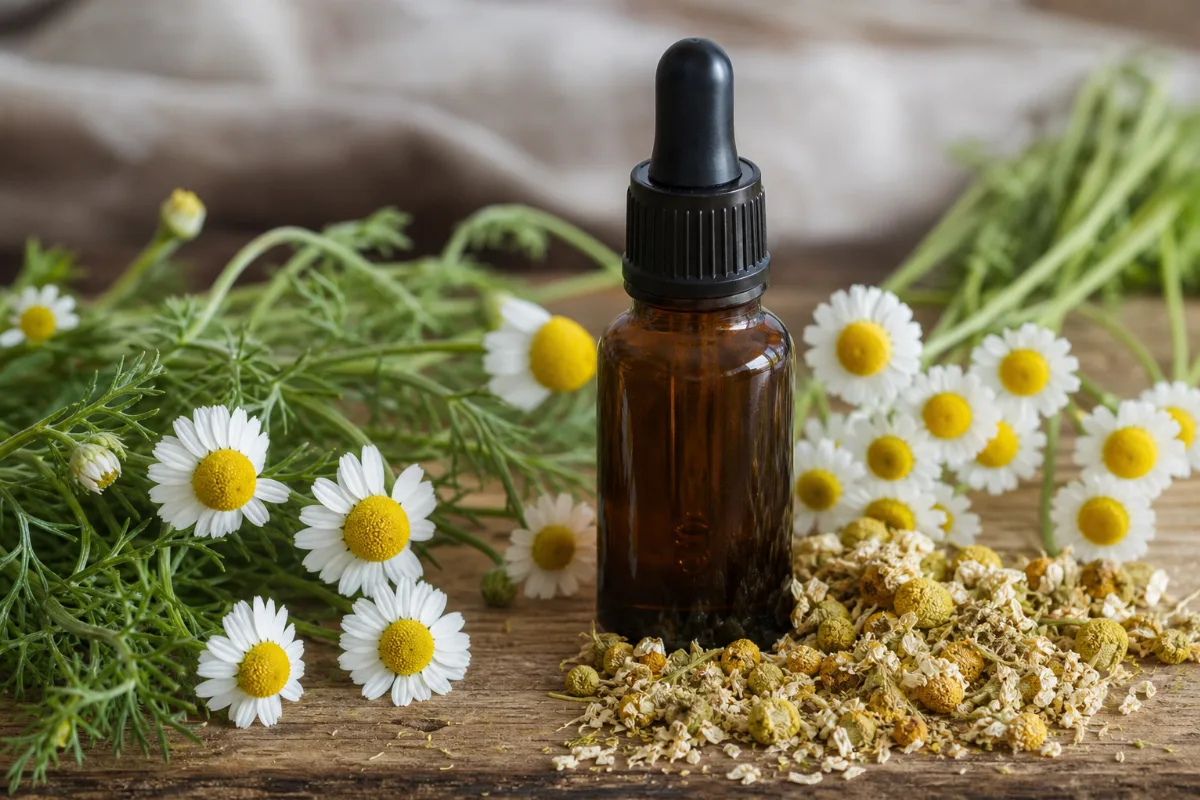
Essential Oils & Aromatherapy · Essential oil
Chamomile Oil (Roman and German)
Chamaemelum nobile (Roman) and Matricaria chamomilla (German) · also called Roman chamomile oil, German chamomile oil, chamomile essential oil
Chamomile oil is a soft, sweet flower oil from two daisy-family plants, Roman and German chamomile, used in aromatherapy and skin products. People try it for calm, sleep and pain. Trials are small and short, so no benefit is proven. The main caution: people allergic to ragweed or daisies may react, and it must not be swallowed.
General information, not medical advice. Last substantive update · Not medically reviewed. A named clinician has not signed off on this page. How this page is made
About Chamomile Oil (Roman and German)
Chamomile oil is a soft flower scent used in aromatherapy and skin care. Small trials report lower anxiety, better sleep and less pain after cesarean birth, but they are short, self-rated and often hard to hide from the comparison group. Safety comes first: chamomile is a daisy-family allergen, the oil is not for swallowing, and safety in pregnancy is not established.
What chamomile oil is
"Chamomile oil" can mean two different oils. Roman chamomile is Chamaemelum nobile and German chamomile is Matricaria chamomilla, also written Matricaria recutita. Both are in the daisy family (Asteraceae, per GBIF). The essential oil is distilled from the flowers.
The oil is a mixture. Papers name alpha-bisabolol, chamazulene, bisabolol oxides, farnesene and, for a Roman chamomile oil, alpha-pinene among its compounds. Two oils sold as chamomile can lead with different compounds.
Chamomile oil is not a food or a nutrient, and it is not the same product as chamomile tea or extract.
What people use it for, and how strong the evidence is
For anxiety, a double-blind trial of 154 heart patients found lower scores with German chamomile oil scent than with a sesame-oil placebo, and trials in older adults, orthopedic patients and children also found lower scores. They are small, short and self-rated, and several tested blends.
For sleep, one trial of 80 young adults with insomnia reported better scores after 15 days, with no scent in the comparison group. Reviews of scent for sleep pool many oils.
For pain after cesarean birth, hospital trials and a 2025 review found lower pain with aromatherapy, with chamomile looking better in a subgroup. In labour, one trial found less intense contractions but not fewer or shorter ones. Brain, cancer-cell and germ findings are from rats and test tubes only.
The research in one view
Every trial is small and short, relies on self-rating, and a scent is hard to hide from a comparison group. Most are from Iran, and several do not name the chamomile species. No large independent trial and no meta-analysis of chamomile oil alone was found.
We found no trial of the essential oil on infants, and none on the skin for eczema or wounds.
Oil, tea, extract and blends are different things
Several trials tested chamomile blended with lavender or bitter orange. Their results do not describe chamomile alone. Chamomile tea and extract trials are not counted here.
Roman and German chamomile oils are different, and two oils sold as chamomile can have different main compounds. Poison Control says it is hard to know the species, strength and contaminants in a bottle.
What regulators say
NCCIH (updated November 2024) and the EU herbal monograph for German chamomile flowers (2015) both describe the herb, tea and extracts, not the distilled oil. Both warn about allergy, and the EU monograph does not recommend most preparations in pregnancy.
Poison Control gives general warnings for all essential oils. We did not find or read a statement about this oil from IFRA, the EU cosmetics regulator or FDA.
At a glance
Traditional uses history, not proof
- The plant was described in ancient medical writings in China, Egypt, Greece and Rome (NCCIH, about the herb).
- Chamomile the herb is promoted today for colds, indigestion, anxiety, insomnia and infant colic (NCCIH, about the herb, not the oil).
- Used topically for wound healing and cracked nipples in herbal practice (LactMed, about the herb and ointments).
Studied for research
- Anxiety in hospital patients, smelled, low
- Depression, anxiety and stress in older adults, low
- Dental anxiety in children, very-low
- Anxiety with chamomile blends, very-low
- Sleep in insomnia, smelled, low
- Pain after cesarean birth, low
- Contractions in labour, very-low
- Lab and rat findings only, very-low
Main compounds
- Alpha-bisabolol
- Chamazulene
- Bisabolol oxides
- Farnesene
- Alpha-pinene (named in a Roman chamomile oil)
Common forms
- Essential oil distilled from flowers (Roman and German are different oils)
- Scent on a cotton ball, paper or in a nebulizer, as in trials
- Blends with lavender or bitter orange
- Skin and cosmetic products and ointments
Research links: Poison Control: Essential oils · NCCIH: Chamomile · EMA herbal monograph on German chamomile flowers · LactMed: Chamomile · Anxiety in heart patients (abstract) · Chamomile oil and insomnia (abstract) · Aromatherapy and cesarean pain, review (abstract) · Research Library · Genes & Biomarkers Library
What it is and its history
- Accepted scientific name
- Chamaemelum nobile (Roman chamomile) and Matricaria chamomilla (German chamomile)
- Naming authority
- Chamaemelum nobile (L.) All.; Matricaria chamomilla L.
- Synonyms
- Name: Anthemis nobilis L.; For: Chamaemelum nobile; Source: GBIF match API: synonym, accepted key 5391599; Name: Matricaria recutita L.; For: Matricaria chamomilla; Source: GBIF match API: synonym, accepted key 8370958; Name: Chamomilla recutita (L.) Rauschert; For: Matricaria chamomilla; Source: GBIF match API: synonym, accepted key 8370958
- Common names
- Roman chamomile (English); German chamomile (English); Chamomile (English)
- Family or group
- Asteraceae, the daisy family (also called Compositae), per GBIF for both species.
- Native range
- Not checked in a source read for this page.
- Habitat
- Not described in the papers read.
- What it looks like
- Part used: The oil is distilled from the flowers (the sources read for composition describe a flower essential oil). How each producer distils it was not read.
- Look-alikes and adulterants
- Name: Roman versus German chamomile oil; Note: These are two different plants and two different oils. Many trials say only "chamomile" and do not name the species. LactMed says both contain similar ingredients such as bisabolol and farnesene and the flavonoids; the two oils' exact makeup was not compared in a source we read.; Name: Other products called chamomile; Note: Chamomile tea, extracts, ointments and infused oils are different products from the distilled essential oil.
- Sustainability and conservation
- Not checked (no IUCN or CITES source read).
Traditional use and history history, not clinical proof
| Tradition or era | Documented use | Source |
|---|---|---|
| Ancient medical writings (chamomile the plant) | NCCIH says chamomile was described in ancient medical writings and was an important medicinal herb in ancient China, Egypt, Greece and Rome. Today the plant is promoted for the common cold, indigestion, anxiety, insomnia, infant colic and other conditions. This is about the herb, not the distilled oil. | NCCIH (Chamomile, updated November 2024) |
| Modern herbal use | LactMed says chamomile is used orally as a sedative and for stomach conditions, topically for wound healing, and has been used for cracked nipples and as a milk-supply herb, with no valid clinical trials for the last use. Again this is the herb, not the oil. | LactMed (Chamomile) |
Traditional use shows how it was used. It does not show that it works or is safe today.
What is inside, and how it may work
What it contains and how those compounds act in cells and animals. Laboratory and animal mechanisms are not proven effects in people.
Main compounds
| Compound | Family | Where it is concentrated | Activity studied | Level of evidence |
|---|---|---|---|---|
| Alpha-bisabolol PubChem 1549992 | sesquiterpene alcohol | Flower oil (varies by oil) Varies; a main compound in an Indian oil, and with chamazulene and bisabolol oxide A it made up 81% of the volatile compounds of a commercial oil in a rat study. | A dermatology note says it is thought to be anti-inflammatory and skin-soothing, and that contact allergy to bisabolol has been reported. No effect of the compound in people was tested in the papers read. 24 4 2 22 | Laboratory |
| Chamazulene PubChem 10719 | azulene hydrocarbon | Flower oil (varies by oil) Named as a main compound in three oils described in papers read (an Indian oil, a commercial oil in the rat study and a Matricaria recutita oil); not among the leading compounds of the commercial oil in the food-chemistry paper. No percentage is given. | No separate effect tested in the papers read. 4 2 22 | Laboratory |
| Alpha-bisabolol oxides (A and B) | oxidised sesquiterpene | Flower oil Alpha-bisabolol oxide B was 11.60% in a Matricaria recutita oil; bisabolol oxide A was a main compound in another oil. | Not tested separately in the papers read. 26 2 | Laboratory |
| Beta-farnesene PubChem 5281517 | sesquiterpene | Flower oil (Z)-beta-farnesene was 33.90% in a Matricaria recutita oil; LactMed names farnesene among chamomile ingredients. | Not tested separately in the papers read. 26 7 22 | Laboratory |
| Alpha-pinene PubChem 6654 | monoterpene | Roman chamomile oil Named by the authors as a main component of the Roman chamomile oil in the rat study; no percentage in the abstract. | Inhaled alpha-pinene reduced depression-like behaviour in rats in a swim test, like the whole oil. 14 22 | In vivo animal |
Mechanisms, receptors and pathways
| Target or pathway | Gene or receptor | What was found | Level |
|---|---|---|---|
| Brain energy proteins and parvalbumin (rats) | Cytochrome c oxidase subunits, ATP synthase subunit e, parvalbumin | Inhaled alpha-pinene, a main component of Roman chamomile oil in this paper, raised proteins linked to energy production in the hippocampus and prefrontal cortex and parvalbumin mRNA in the hippocampus of depression-prone rats. 14 | In vivo animal |
| Antioxidant, anti-inflammatory and neurotransmitter changes (rats, test tube) | TNF-alpha, amyloid markers, noradrenaline, dopamine, serotonin | In aluminium-treated rats the oil lowered markers such as TNF-alpha and amyloid markers and raised noradrenaline, dopamine and serotonin systems relative to untreated diseased rats. 2 | In vivo animal |
Absorption, metabolism and elimination
- Absorption
- Not established for chamomile oil in people in the sources read. Poison Control says essential oils in general can be absorbed through the skin or swallowed.
- Distribution
- Not established.
- Metabolism
- Not established. EMA reports CYP450-based interactions with chamomile taken by mouth in transplant patients.
- Elimination
- Not established.
- Bioavailability
- Not established.
Isolated compounds versus whole extracts
The oil is a mixture, and two oils sold as chamomile can have different main compounds. Results for the whole oil, for one compound such as alpha-pinene, for blends and for chamomile tea cannot be swapped for one another.
Nutritional composition
Chamomile oil is not a nutrient and is not a food ingredient to take for health. Chamomile flowers are used in food and tea; that is a different product.
4 low certainty5 very low certainty1 not enough evidence
What was looked at
The 10 benefits and uses checked for Chamomile Oil (Roman and German), each with how strong the evidence is. Tap one to open it.
- Anxiety in hospital patients (chamomile oil scent)Low certainty
- Depression, anxiety and stress in older adults (chamomile oil scent at night)Low certainty
- Anxiety in children at the dentist (chamomile, lavender or peppermint scent)Very low certainty
- Anxiety with chamomile blends (nurses and heart-unit patients)Very low certainty
- Sleep in young adults with insomnia (chamomile oil scent)Low certainty
- Sleep with scent in general, and with chamomile massage blendsNot enough evidence
- Depression-like behaviour in rats (Roman chamomile oil scent)Very low certainty
- Pain after cesarean birth (chamomile oil scent)Low certainty
- Contractions and satisfaction in labour (chamomile smell)Very low certainty
- Brain, cancer-cell and germ tests (lab and rat studies only)Very low certainty
Lab markers tracked in the studies
Anxiety questionnaire scores (Spielberger, Beck and similar)Pittsburgh Sleep Quality Index (PSQI)Heart rate and blood pressurePain visual analog scale (VAS)
What is Chamomile Oil (Roman and German) good for?
The uses people ask about and how strong the evidence is for each. Read the certainty label first: none is better than low, and several are blends or animal work.
Benefits, one by one
Each card is a research question, not a promise. Tap a goal to filter. Open a card to see the studies, doses and limits.
Anxiety in hospital patients (chamomile oil scent)
Low certaintyIn a double-blind trial of 154 heart patients, anxiety scores fell more with German chamomile oil scent than with a sesame-oil placebo over two nights. A trial of 90 patients waiting for emergency bone surgery also found lower anxiety and pain than no aroma, though damask rose worked faster.
2 studiesNot covered. This page gives no amounts and no way to use the oil.
Studies, doses and limits
What the trials found
Two randomized trials: 154 patients with acute coronary syndrome (oil or sesame-oil placebo, two nights) and 90 patients before emergency orthopedic surgery (rose, chamomile or nothing).
Results
Heart patients: anxiety score fell by 5.2 points with the oil and 1.0 with placebo; blood pressure and heart rate were also lower (P < 0.001 for anxiety and heart rate). Surgery patients: pain and anxiety fell more with both aromas than with no aroma (P < .001); rose lowered anxiety faster than chamomile straight after, with no clear difference after 1 hour (P = .07).
Effect sizes as reported
Anxiety score fall 5.2 vs 1.0 points (heart patients).
Why this rating
Two small trials in specific hospital groups, short, self-rated, and a scent is hard to hide from comparison groups. Only the heart trial had a placebo. Chamomile species is named in one trial only.
Form and dose studied
Not covered. This page gives no amounts and no way to use the oil.
Who was studied
Hospital patients: heart patients and people waiting for emergency orthopedic surgery.
Limits
Short trials in Iran with scores that people rate themselves. Not shown for anxiety disorders and not a replacement for care.
Why researchers looked
Anxiety is common before and during hospital care, and a scent is a low-cost thing to try.
Traditional use
NCCIH notes chamomile the herb is promoted for anxiety; that is about the plant, not the distilled oil.
Proposed mechanism Preliminary mechanism
Not established.
A proposed mechanism does not show that the effect happens in people.
Skin contact with the oil is a daisy-family allergy risk (see Safety); the trials used inhaled oil.
Depression, anxiety and stress in older adults (chamomile oil scent at night)
Low certaintyIn 183 older adults, inhaling chamomile oil (or lavender) for 30 nights was reported to lower depression, anxiety and stress scores more than inhaling water, still true a month later. The abstract gives no scores.
1 studiesNot covered. This page gives no amounts and no way to use the oil.
Studies, doses and limits
What the trials found
One randomized three-arm trial: 61 people in each of a chamomile, lavender and water group.
Results
Depression, anxiety and stress scale scores were lower in the oil groups than in the water group straight after and one month after the 30 nights (p < 0.01).
Effect sizes as reported
Lower scores than the water group; no numbers in the abstract.
Why this rating
One trial with no scores shown, a comparison group that smelled nothing, and self-rated answers. Chamomile species not named in the abstract.
Form and dose studied
Not covered. This page gives no amounts and no way to use the oil.
Who was studied
Community-dwelling older adults in Iran.
Limits
Cannot check the size of the effect from the abstract.
Why researchers looked
Older people living at home often have low mood and worry, and a bedtime scent is easy to try.
Proposed mechanism Preliminary mechanism
Not established.
A proposed mechanism does not show that the effect happens in people.
Older people may take medicines that interact with other products; ask a pharmacist (see Safety).
Anxiety in children at the dentist (chamomile, lavender or peppermint scent)
Very low certaintyA 2025 trial of 100 children aged 6 to 9 reported larger falls in dental anxiety with chamomile or lavender scent than with peppermint or nothing. Anxiety scores rose slightly in the group with no scent.
1 studiesNot covered. This page gives no amounts and no way to use the oil.
Studies, doses and limits
What the trials found
One randomized four-arm trial: 100 children, pulp treatment, scents given through a nebulizer.
Results
Anxiety fell by 2.04 points with chamomile and 1.80 with lavender (no clear difference between them), 0.68 with peppermint and rose by 0.04 with no scent. Pulse rate fell most with chamomile (P < 0.001). Oxygen saturation did not differ.
Effect sizes as reported
Anxiety change -2.04 (chamomile) vs +0.04 (no scent).
Why this rating
One short report from one clinic, a child-rated face scale, and no hidden comparison. Children are the group at most risk from essential oils.
Form and dose studied
Not covered. This page gives no amounts and no way to use the oil.
Who was studied
Children aged 6 to 9 at one dental clinic in Egypt.
Limits
This is not a reason to use essential oil on or near children (see Safety). Ask a children's doctor first.
Why researchers looked
Dental visits make many children anxious.
Proposed mechanism Preliminary mechanism
Not established.
A proposed mechanism does not show that the effect happens in people.
Children are more vulnerable to essential oils (Poison Control). Keep oils out of children's reach.
Anxiety with chamomile blends (nurses and heart-unit patients)
Very low certaintyTwo trials used chamomile blended with another oil, so chamomile alone is not tested. A chamomile-lavender blend lowered nurses' anxiety scores, and a chamomile and bitter-orange blend lowered anxiety in heart-unit patients.
2 studiesNot covered. This page gives no amounts and no way to use the oil.
Studies, doses and limits
What the trials found
Two randomized trials: 120 hospital nurses (chamomile-lavender oil, with and without music) and 76 patients in a cardiac care unit (chamomile with Citrus aurantium).
Results
Nurses: average anxiety scores 37.82 with the chamomile-lavender oil against 56.08 in the control group (p < 0.0001). Heart-unit patients: state anxiety fell from 57.9 to 35.3 in the blend group and differed significantly from the other group (p < 0.001).
Effect sizes as reported
Nurses 37.82 vs 56.08 (control); patients 57.9 to 35.3.
Why this rating
Both are blends, so the result cannot be credited to chamomile. The comparison groups had no scent and the abstracts say little about how the studies were hidden or funded.
Form and dose studied
Not covered. This page gives no amounts and no way to use the oil.
Who was studied
Hospital nurses and cardiac-unit patients in Iran.
Limits
Blends. Short follow-up (days).
Why researchers looked
Blends are common in aromatherapy, and trials often test them.
Proposed mechanism Preliminary mechanism
Not established.
A proposed mechanism does not show that the effect happens in people.
Blend trials; skin contact was not the route in the heart-unit trial (eye pad).
Sleep in young adults with insomnia (chamomile oil scent)
Low certaintyIn 80 young adults with insomnia, 10 minutes of chamomile oil scent a day for 15 days gave bigger improvements in sleep quality and insomnia scores than a usual routine. No adverse events were reported.
1 studiesNot covered. This page gives no amounts and no way to use the oil.
Studies, doses and limits
What the trials found
One randomized trial: 40 people with oil and 40 with their usual routine, aged 18 to 35.
Results
Sleep quality (PSQI) and insomnia severity (ISI) improved more with the oil than in the control group (P < 0.001 for both). The control group's PSQI also fell (P = 0.033). No adverse events in either group.
Effect sizes as reported
Between-group differences P < 0.001; numbers not in the abstract.
Why this rating
One short trial of 80 people, self-rated sleep, and the comparison group did nothing, so expectation can explain part of it. The authors ask for a trial with an active comparison.
Form and dose studied
Not covered. This page gives no amounts and no way to use the oil.
Who was studied
Young adults aged 18 to 35 with insomnia in India.
Limits
Short (15 days), no placebo scent, and chamomile species not named in the abstract.
Why researchers looked
Many people with poor sleep look for drug-free options.
Proposed mechanism Preliminary mechanism
Not established.
A proposed mechanism does not show that the effect happens in people.
No adverse events reported in this trial (abstract).
Sleep with scent in general, and with chamomile massage blends
Not enough evidenceA 2025 review of 27 studies (2,072 people) found inhaled aromatherapy improved sleep in people with other illnesses, but pooled many oils and had weak blinding. A burns trial of a lavender and chamomile massage also found better sleep and anxiety, so chamomile alone cannot be judged.
2 studiesNot covered. This page gives no amounts and no way to use the oil.
Studies, doses and limits
What the trials found
One meta-analysis (all oils, chamomile not singled out) and one 105-patient burns trial with a lavender and chamomile massage.
Results
Pooled analysis: sleep score mean difference -2.90 (95% CI -3.85 to -1.95), with anxiety and depression scores also lower. Burns trial: groups differed in anxiety (P<0.001) and sleep quality (P=0.027).
Effect sizes as reported
Meta-analysis mean difference -2.90 (all oils).
Why this rating
These sources test many oils or a two-oil massage. They cannot show what chamomile oil does on its own. Studies in the review often lacked blinding and did not test oil purity.
Form and dose studied
Not covered. This page gives no amounts and no way to use the oil.
Who was studied
Adults with insomnia alongside other illnesses; people with burns.
Limits
Mixed oils, mixed methods, quasi-experimental design in the burns trial.
Why researchers looked
Sleep trouble is common in people who are ill.
Proposed mechanism Preliminary mechanism
Not established.
A proposed mechanism does not show that the effect happens in people.
Massage means skin contact: see the daisy-family allergy warning (Safety).
Depression-like behaviour in rats (Roman chamomile oil scent)
Very low certaintyIn a rat strain bred to show depression-like behaviour, two weeks of breathing in Roman chamomile oil, or its component alpha-pinene, reduced that behaviour in a swim test. This is animal work only.
1 studiesNot covered. This page gives no amounts and no way to use the oil.
Studies, doses and limits
What the trials found
One animal experiment. No human trial of chamomile oil for depression was found.
Results
Inhaled Roman chamomile oil and alpha-pinene reduced depression-like behaviour in the rats. Alpha-pinene changed brain proteins linked to energy production and one calcium-binding protein.
Effect sizes as reported
Animal behaviour test only.
Why this rating
Rats only, and a swim test is not a model of human depression. One author is at a company research centre; funding is not stated in the abstract.
Form and dose studied
Not covered. This page gives no amounts and no way to use the oil.
Who was studied
Wistar-Kyoto rats.
Limits
Does not show any effect on human depression.
Why researchers looked
Researchers wanted to learn how aromas might affect mood circuits.
Proposed mechanism Preliminary mechanism
The authors point to energy-production proteins and a calcium-binding protein in rat brains after alpha-pinene. This is animal work.
A proposed mechanism does not show that the effect happens in people.
Animal study; no safety information for people.
Pain after cesarean birth (chamomile oil scent)
Low certaintyA 2025 review of 17 trials (1,490 women) found aromatherapy lowered pain after cesarean birth, and the chamomile subgroup looked more effective. Two single trials (128 and 136 women) reported lower pain with inhaled chamomile oil alongside usual hospital care.
3 studiesNot covered. This page gives no amounts and no way to use the oil.
Studies, doses and limits
What the trials found
One meta-analysis (all oils, chamomile as a subgroup) and two randomized trials of inhaled chamomile oil after planned or spinal-anaesthesia cesarean birth.
Results
Meta-analysis: pain standardised mean difference -1.19 (95% CI -1.93 to -0.45); chamomile oil, single and short sessions looked more effective in subgroups. Trial of 128 first-time mothers: pain lower than placebo at 4, 8 and 12 hours (p<0.01). Trial of 136 women: chamomile with oxygen lowered pain most, and chamomile alone also beat routine care.
Effect sizes as reported
Pain SMD -1.19 (all oils pooled).
Why this rating
The pooled result mixes many oils, and the chamomile finding is a subgroup. The single trials are from Iran, use self-rated pain and give no scores in their abstracts. One has a 2025 corrigendum that was not read.
Form and dose studied
Not covered. This page gives no amounts and no way to use the oil.
Who was studied
Women after cesarean birth, treated in hospital.
Limits
Given alongside usual care. It does not replace pain medicine and is no reason to use oil at home.
Why researchers looked
Pain after cesarean birth is common, and women look for options that add to medicine.
Proposed mechanism Preliminary mechanism
Not established.
A proposed mechanism does not show that the effect happens in people.
Trials were in hospital under supervision. Pregnancy and newborn safety of the oil is not established (see Safety).
Contractions and satisfaction in labour (chamomile smell)
Very low certaintyOne trial of 130 first-time mothers found that smelling chamomile did not change how long or how many contractions there were, but the contractions were rated less intense at 5 to 7 cm and satisfaction was higher.
1 studiesNot covered. This page gives no amounts and no way to use the oil.
Studies, doses and limits
What the trials found
One randomized trial of 130 first-time mothers in the first stage of labour.
Results
Duration and number of contractions did not differ. Contraction intensity was lower at 5 to 7 cm dilatation (p = .004) and satisfaction was higher (p < .001).
Effect sizes as reported
Intensity lower at 5-7 cm; no scores in the abstract.
Why this rating
One trial. The abstract does not say which chamomile, how strong the oil was or how groups were kept apart, and intensity is not the same as pain.
Form and dose studied
Not covered. This page gives no amounts and no way to use the oil.
Who was studied
First-time mothers in the first stage of labour in Iran.
Limits
Does not show that the oil is safe in labour or for the baby. Ask a midwife or doctor.
Why researchers looked
Some women want drug-free ways to feel more comfortable in labour.
Proposed mechanism Preliminary mechanism
Not established.
A proposed mechanism does not show that the effect happens in people.
Pregnancy: safety of essential oils in pregnancy and childbirth has not been clearly demonstrated (1999 review). Ask a midwife or doctor.
Brain, cancer-cell and germ tests (lab and rat studies only)
Very low certaintyIn test tubes, chamomile oil mopped up free radicals, slowed two kinds of bacteria and reduced cancer cell lines. In rats given aluminium to model Alzheimer-type changes, it lowered markers of brain damage. None of this shows any effect in people.
2 studiesNot covered. This page gives no amounts and no way to use the oil.
Studies, doses and limits
What the trials found
Two lab papers: a rat and test-tube study of commercial chamomile oil, and a cell-line study of German chamomile (Matricaria recutita) oil. No human study was found.
Results
The main compounds in the rat study oil were alpha-bisabolol, chamazulene and bisabolol oxide A. In the cell-line study the oil lowered survival of cancer cells and of normal mouse cells too.
Effect sizes as reported
Lab and animal results only.
Why this rating
Cells in dishes and rats. The oil also reduced survival of normal mouse cells, so these tests do not show a safe or selective effect.
Form and dose studied
Not covered. This page gives no amounts and no way to use the oil.
Who was studied
Cell lines and albino rats.
Limits
Does not show any effect on dementia or cancer in people.
Why researchers looked
Chamomile oil is rich in compounds that behave interestingly in lab tests.
Proposed mechanism Preliminary mechanism
The rat study links the oil's effect to its antioxidant and anti-inflammatory compounds and brain chemicals. This is animal work.
A proposed mechanism does not show that the effect happens in people.
Lab findings only; no safety information for people.
Connections to the rest of health
How Chamomile Oil (Roman and German) connects to the rest of our health knowledge graph. Every link says what kind of connection it is. A safety link (for example to the liver) is a warning, not a benefit. A study that merely mentions a topic never creates a benefit link.
Explore every connection: goals, body systems, organs, symptoms, genes
A. Wellness goals
| Connected to | Kind of connection | Evidence status | Context | Studies |
|---|---|---|---|---|
| Anxiety Support | Low certainty | Anxiety in hospital patients (chamomile oil scent): In a double-blind trial of 154 heart patients, anxiety scores fell more with German chamomile oil scent than with a sesame-oil placebo over two nights. A trial of 90 patients waiting for emergency bone surgery also found lower anxiety and pain than no aroma, though damask rose worked faster. Depression, anxiety and stress in older adults (chamomile oil scent at night): In 183 older adults, inhaling chamomile oil (or lavender) for 30 nights was reported to lower depression, anxiety and stress scores more than inhaling water, still true a month later. The abstract gives no scores. | 21 3 8 | |
| Calm Relaxation | Low certainty | Anxiety in hospital patients (chamomile oil scent): In a double-blind trial of 154 heart patients, anxiety scores fell more with German chamomile oil scent than with a sesame-oil placebo over two nights. A trial of 90 patients waiting for emergency bone surgery also found lower anxiety and pain than no aroma, though damask rose worked faster. | 21 3 | |
| Stress Reduction | Low certainty | Depression, anxiety and stress in older adults (chamomile oil scent at night): In 183 older adults, inhaling chamomile oil (or lavender) for 30 nights was reported to lower depression, anxiety and stress scores more than inhaling water, still true a month later. The abstract gives no scores. | 8 | |
| Mood Balance | Low certainty | Depression, anxiety and stress in older adults (chamomile oil scent at night): In 183 older adults, inhaling chamomile oil (or lavender) for 30 nights was reported to lower depression, anxiety and stress scores more than inhaling water, still true a month later. The abstract gives no scores. | 8 | |
| Anxiety Support | Very low certainty | Anxiety in children at the dentist (chamomile, lavender or peppermint scent): A 2025 trial of 100 children aged 6 to 9 reported larger falls in dental anxiety with chamomile or lavender scent than with peppermint or nothing. Anxiety scores rose slightly in the group with no scent. | 1 | |
| Calm Relaxation | Very low certainty | Anxiety in children at the dentist (chamomile, lavender or peppermint scent): A 2025 trial of 100 children aged 6 to 9 reported larger falls in dental anxiety with chamomile or lavender scent than with peppermint or nothing. Anxiety scores rose slightly in the group with no scent. | 1 | |
| Anxiety Support | Very low certainty | Anxiety with chamomile blends (nurses and heart-unit patients): Two trials used chamomile blended with another oil, so chamomile alone is not tested. A chamomile-lavender blend lowered nurses' anxiety scores, and a chamomile and bitter-orange blend lowered anxiety in heart-unit patients. | 28 16 | |
| Stress Reduction | Very low certainty | Anxiety with chamomile blends (nurses and heart-unit patients): Two trials used chamomile blended with another oil, so chamomile alone is not tested. A chamomile-lavender blend lowered nurses' anxiety scores, and a chamomile and bitter-orange blend lowered anxiety in heart-unit patients. | 28 16 | |
| Better Sleep | Low certainty | Sleep in young adults with insomnia (chamomile oil scent): In 80 young adults with insomnia, 10 minutes of chamomile oil scent a day for 15 days gave bigger improvements in sleep quality and insomnia scores than a usual routine. No adverse events were reported. | 6 | |
| Sleep Quality | Low certainty | Sleep in young adults with insomnia (chamomile oil scent): In 80 young adults with insomnia, 10 minutes of chamomile oil scent a day for 15 days gave bigger improvements in sleep quality and insomnia scores than a usual routine. No adverse events were reported. | 6 | |
| Better Sleep | Not enough evidence | Sleep with scent in general, and with chamomile massage blends: A 2025 review of 27 studies (2,072 people) found inhaled aromatherapy improved sleep in people with other illnesses, but pooled many oils and had weak blinding. A burns trial of a lavender and chamomile massage also found better sleep and anxiety, so chamomile alone cannot be judged. | 5 23 | |
| Anxiety Support | Not enough evidence | Sleep with scent in general, and with chamomile massage blends: A 2025 review of 27 studies (2,072 people) found inhaled aromatherapy improved sleep in people with other illnesses, but pooled many oils and had weak blinding. A burns trial of a lavender and chamomile massage also found better sleep and anxiety, so chamomile alone cannot be judged. | 5 23 | |
| Mood Balance | Very low certainty | Depression-like behaviour in rats (Roman chamomile oil scent): In a rat strain bred to show depression-like behaviour, two weeks of breathing in Roman chamomile oil, or its component alpha-pinene, reduced that behaviour in a swim test. This is animal work only. | 14 | |
| Pain Relief | Low certainty | Pain after cesarean birth (chamomile oil scent): A 2025 review of 17 trials (1,490 women) found aromatherapy lowered pain after cesarean birth, and the chamomile subgroup looked more effective. Two single trials (128 and 136 women) reported lower pain with inhaled chamomile oil alongside usual hospital care. | 25 29 27 | |
| Womens Wellness | Low certainty | Pain after cesarean birth (chamomile oil scent): A 2025 review of 17 trials (1,490 women) found aromatherapy lowered pain after cesarean birth, and the chamomile subgroup looked more effective. Two single trials (128 and 136 women) reported lower pain with inhaled chamomile oil alongside usual hospital care. | 25 29 27 | |
| Pain Relief | Very low certainty | Contractions and satisfaction in labour (chamomile smell): One trial of 130 first-time mothers found that smelling chamomile did not change how long or how many contractions there were, but the contractions were rated less intense at 5 to 7 cm and satisfaction was higher. | 13 | |
| Womens Wellness | Very low certainty | Contractions and satisfaction in labour (chamomile smell): One trial of 130 first-time mothers found that smelling chamomile did not change how long or how many contractions there were, but the contractions were rated less intense at 5 to 7 cm and satisfaction was higher. | 13 | |
| Cellular Protection | Very low certainty | Brain, cancer-cell and germ tests (lab and rat studies only): In test tubes, chamomile oil mopped up free radicals, slowed two kinds of bacteria and reduced cancer cell lines. In rats given aluminium to model Alzheimer-type changes, it lowered markers of brain damage. None of this shows any effect in people. | 2 26 |
B. Body systems
| Connected to | Kind of connection | Evidence status | Context | Studies |
|---|---|---|---|---|
| Nervous System | Biological association | Low certainty | Studied for: Anxiety in hospital patients (chamomile oil scent) Studied for: Depression, anxiety and stress in older adults (chamomile oil scent at night) | 21 3 8 1 28 16 6 5 23 14 2 26 |
| Stress Mood | Biological association | Low certainty | Studied for: Anxiety in hospital patients (chamomile oil scent) Studied for: Depression, anxiety and stress in older adults (chamomile oil scent at night) | 21 3 8 28 16 |
| Sleep Recovery | Biological association | Low certainty | Studied for: Sleep in young adults with insomnia (chamomile oil scent) Studied for: Sleep with scent in general, and with chamomile massage blends | 6 5 23 |
| Pain Inflammation | Biological association | Low certainty | Studied for: Pain after cesarean birth (chamomile oil scent) Studied for: Contractions and satisfaction in labour (chamomile smell) | 25 29 27 13 |
| Reproductive System | Biological association | Low certainty | Studied for: Pain after cesarean birth (chamomile oil scent) Studied for: Contractions and satisfaction in labour (chamomile smell) | 25 29 27 13 |
E. Health conditions
| Connected to | Kind of connection | Evidence status | Context | Studies |
|---|---|---|---|---|
| Contact dermatitis | Adverse effect or risk | Documented risk | Nipple dermatitis from Roman chamomile ointment (patch-test confirmed in two women, LactMed); bisabolol contact dermatitis reported in Europe. Nipple dermatitis from Roman chamomile ointment confirmed by patch test in two women; bisabolol contact dermatitis reported in Europe. Preparation or compound: Roman chamomile ointment and bisabolol on the skin |
7 17 24 |
| Pregnancy | Not enough evidence | Safety not established for the oil; EMA does not recommend most chamomile preparations in pregnancy. Preparation or compound: Chamomile and essential oils |
9 15 |
I. Biomarkers
| Connected to | Kind of connection | Evidence status | Context | Studies |
|---|---|---|---|---|
| Anxiety questionnaire scores (Spielberger, Beck and similar) | Biological association | Low certainty | Measured in trials: decrease. A lab change is not the same as a health benefit. | 21 1 28 |
| Pittsburgh Sleep Quality Index (PSQI) | Biological association | Low certainty | Measured in trials: decrease. A lab change is not the same as a health benefit. | 6 23 |
| Heart rate and blood pressure | Biological association | Low certainty | Measured in trials: decrease. A lab change is not the same as a health benefit. | 21 1 |
| Pain visual analog scale (VAS) | Biological association | Low certainty | Measured in trials: decrease. A lab change is not the same as a health benefit. | 29 27 |
K. Biological pathways
| Connected to | Kind of connection | Evidence status | Context | Studies |
|---|---|---|---|---|
| Parvalbumin and energy-production proteins | Preliminary mechanism | In vivo animal | Rat hippocampus after alpha-pinene inhalation. | 14 |
L. Active compounds
| Connected to | Kind of connection | Evidence status | Context | Studies |
|---|---|---|---|---|
| Alpha-bisabolol | Biological association | Laboratory | A dermatology note says it is thought to be anti-inflammatory and skin-soothing, and that contact allergy to bisabolol has been reported. No effect of the compound in people was tested in the papers read. Preparation or compound: Flower oil (varies by oil) |
24 4 2 22 |
| Chamazulene | Biological association | Laboratory | No separate effect tested in the papers read. Preparation or compound: Flower oil (varies by oil) |
4 2 22 |
| Alpha-bisabolol oxides (A and B) | Biological association | Laboratory | Not tested separately in the papers read. Preparation or compound: Flower oil |
26 2 |
| Beta-farnesene | Biological association | Laboratory | Not tested separately in the papers read. Preparation or compound: Flower oil |
26 7 22 |
| Alpha-pinene | Biological association | In vivo animal | Inhaled alpha-pinene reduced depression-like behaviour in rats in a swim test, like the whole oil. Preparation or compound: Roman chamomile oil |
14 22 |
Each connection is stored with the ingredient, the connected record, the kind of connection, the evidence status, the supporting studies, the preparation or compound involved, and a review date (last reviewed October 25, 2026).
Evidence at a glance: what the research found for 10 outcomes
Each outcome below is one thing researchers measured. Certainty is how far the evidence can be trusted, not how well it works. The full studies are on the next tab.
The evidence
The research centre for Chamomile Oil (Roman and German). Every record here was checked against PubMed or the publisher's page; we never list a study we have not verified.
Evidence by outcome
Bars show how many studies we found for each outcome, not how well it works. People are added up across trials only (reviews are not added, to avoid double counting).
How we rate evidence
High certainty
Several well-run trials or reviews agree; further research is unlikely to change the picture much.
Moderate certainty
Good trials point the same way, but some doubt remains.
Low certainty
Small, short or inconsistent trials. The finding could change with better research.
Very low certainty
Very little or very weak human data. Treat as a possibility only.
Mixed findings
Trials or reviews disagree with each other.
Not enough evidence
Not enough human research to say either way.
Evidence against
Good research found no benefit, or found harm.
We take the reviewers' own risk-of-bias and GRADE statements where they exist, and otherwise judge from study size, design, consistency, directness and whether a product matches what is sold. Many publications do not make evidence high. Method note: We read the abstracts of 23 PubMed records (one has no abstract), the NCCIH page, the EU herbal monograph and the Poison Control page, checked the plant names in GBIF and the compounds in PubChem. We did not find or read a LiverTox, IFRA or FDA statement for the oil.
Study library: every study we checked 29
| Study | Design | People | Product, dose, length | Result |
|---|---|---|---|---|
| Abdel Rehim 2025 The effects of lavender, chamomile and peppermint inhalation aromatherapy on dental anxiety in children: A randomized controlled trial J Dent Sci · PMID 40654405 · DOI |
Randomized four arm trial |
100 Children aged 6 to 9 having pulp treatment at a dental clinic (Egypt) |
Chamomile essential oil by nebulizer (arms for lavender and peppermint too) Not reported here one dental visit · vs no essential oil |
Anxiety score fell by 2.04 (SD 0.79) points with chamomile and 1.80 (SD 0.91) with lavender, with no clear difference between them, and by 0.68 with peppermint. The control group rose by 0.04. Pulse rate fell most with chamomile (22.84 beats a minute, SD 5.86). Oxygen saturation did not differ. Anxiety score change -2.04 chamomile vs +0.04 control Methods, limits and fundingOutcomes: Dental anxiety (animated emoji scale), pulse rate, oxygen saturation Limitations: One visit. Children rated their own feelings on a face scale, and the control group had no scent so groups could tell apart. Children are the group poison centres worry most about with essential oils. Funding and conflicts: The authors declared no conflict of interest. Read: abstract |
| Alahmady 2024 Biochemical characterization of chamomile essential oil: Antioxidant, antibacterial, anticancer and neuroprotective activity and potential treatment for Alzheimer's disease Saudi J Biol Sci · PMID 38229887 · DOI |
Laboratory and animal study rat |
80 Albino rats given aluminium chloride to model Alzheimer-type changes; plus lab tests |
Chamomile essential oil (commercial) flower oil Not reported here · vs untreated and diseased rats |
The main volatile compounds were alpha-bisabolol, chamazulene and bisabolol oxide A (81% of volatile compounds together). The oil mopped up free radicals in a test tube, slowed two kinds of bacteria and reduced a brain cancer cell line. In treated rats, markers of brain damage were lower than in untreated diseased rats. Lab and animal results only Methods, limits and fundingOutcomes: Oil chemistry, antioxidant test, bacteria and cell line tests, brain chemicals and tissue in rats Limitations: Rats and test tubes only. It does not show any effect on dementia or cancer in people. Funding and conflicts: The authors declared no competing interests. Read: abstract |
| Bahrami 2024 Comparison of the Effects of Aromatherapy With Damask Rose and Chamomile Essential Oil on Preoperative Pain and Anxiety in Emergency Orthopedic Surgery: A Randomized Controlled Trial J Perianesth Nurs · PMID 38300194 · DOI |
Randomized three arm controlled trial |
90 Patients waiting for emergency orthopedic surgery (Iran) |
Chamomile essential oil, inhaled (a separate damask rose arm); species not named in the abstract Not reported here three inhalations over 3 hours, checked straight after and 1 hour later · vs no aromatherapy |
Pain and anxiety fell over time in both the rose and chamomile groups compared with the control group (P < .001). Straight after the intervention, anxiety was lower with rose than with chamomile or control (P = .01). One hour later there was no clear difference between rose and chamomile (P = .07). Both aromas lowered pain and anxiety scores more than control; rose faster for anxiety Methods, limits and fundingOutcomes: Pain and anxiety on a visual analog scale Limitations: Self-rated scores, one session, no blinding mentioned. The abstract gives no scores. Funding and conflicts: The authors declared no conflict of interest. Read: abstract |
| Bora 2025 Comparison between Indian and commercial chamomile essential oils: Chemical compositions, antioxidant activities and preventive effect on oxidation of Asian seabass visceral depot fat oil Food Chem X · PMID 40104615 · DOI |
Laboratory chemistry study n/a |
Two chamomile essential oils: an indigenous Indian oil and a commercial oil; tested on fish fat oil | Chamomile essential oils (Indian and commercial) flower oil Not reported here lab storage test · vs butylated hydroxytoluene (food preservative) for comparison |
The Indian oil was dominated by alpha-bisabolol and chamazulene; the commercial oil by alpha-farnesene and delta-cadinene. Both mopped up free radicals about equally in two tests. Two oils with different main compounds Methods, limits and fundingOutcomes: Oil composition (SPME-GC-MS), antioxidant tests Limitations: Food chemistry paper; it says nothing about use in people. It does show that two oils both sold as chamomile can have different main compounds. Funding and conflicts: The authors declared no competing interests. Read: abstract |
| Chen 2025 Inhalation aromatherapy for the treatment of comorbid insomnia: a systematic review and meta-analysis Front Psychiatry · PMID 40230824 · DOI |
Systematic review and meta analysis |
2072 Adults with insomnia alongside other illnesses; 27 publications |
Inhalation aromatherapy with various oils (chamomile is not singled out in the abstract) various Not reported here varied · vs various |
Inhalation aromatherapy relieved sleep problems (mean difference -2.90, 95% CI -3.85 to -1.95) and lowered anxiety and depression scores. The included studies varied a lot, often lacked blinding, and did not test the purity or strength of the oils. The authors say better trials are needed. Sleep score mean difference -2.90 (all oils pooled) (-3.85 to -1.95) Methods, limits and fundingOutcomes: Sleep quality, anxiety, depression Limitations: Pools many different oils. The abstract does not break out chamomile. Funding and conflicts: The authors declared no commercial or financial relationships. Read: abstract |
| Deepa 2025 Effects of chamomile oil inhalation on sleep quality in young adults with insomnia: A randomized controlled trial Int J Psychiatry Med · PMID 39545336 · DOI |
Randomized controlled trial |
80 Young adults aged 18 to 35 with insomnia (Chennai, India) |
Chamomile oil, inhaled flower oil (species not named in the abstract) Not reported here 10 minutes a day for 15 days · vs usual routine, no scent |
Compared with the control group, both sleep quality (PSQI) and insomnia severity (ISI) scores improved with the oil (P < 0.001 for both). The control group also had a significant PSQI fall (P = 0.033). No adverse events were reported in either group. Between-group PSQI and ISI improvement, P < 0.001; numbers not in the abstract Methods, limits and fundingOutcomes: Pittsburgh Sleep Quality Index (PSQI) and Insomnia Severity Index (ISI) Limitations: Control group had no scent or placebo, so people knew which group they were in. Self-rated sleep. The authors say an active control group is needed. Funding and conflicts: The authors declared no potential conflicts of interest. Read: abstract |
| Drugs and Lactation Database (LactMed) 2026 Chamomile Drugs and Lactation Database (LactMed) · PMID 30000867 |
Drug and lactation database entry (LactMed) n/a |
Not a trial; reference entry for chamomile (German and Roman) | Chamomile (herb and preparations) flower Not reported here |
Names two species, German chamomile (Matricaria recutita) and Roman chamomile (Chamaemelum nobile). No data on safety in nursing mothers or infants. Topical chamomile is a known sensitising agent; two women developed contact dermatitis of the nipples after a cracked-nipple ointment containing 10.5% Roman chamomile extracts and oil, confirmed as Roman chamomile by patch test. Possible cross-reaction with other aster-family plants (echinacea, feverfew, milk thistle). Methods, limits and fundingOutcomes: Safety summary for breastfeeding Limitations: Entry is about chamomile in general, not the distilled oil. Only the first section was read. Funding and conflicts: Not applicable. Read: abstract |
| Ebrahimi 2022 The effects of Lavender and Chamomile essential oil inhalation aromatherapy on depression, anxiety and stress in older community-dwelling people: A randomized controlled trial Explore (NY) · PMID 33454232 · DOI |
Randomized three arm controlled trial |
183 Community-dwelling older adults (Iran) |
Chamomile essential oil (species not named in the abstract), inhaled; a separate lavender arm Not reported here 30 nights, checked at the end and one month later · vs inhaled distilled water |
Depression, anxiety and stress scores were lower in both the lavender and the chamomile groups than in the water group, straight after the 30 nights and one month later (p < 0.01). Lower DASS scores than water group; no numbers in the abstract Methods, limits and fundingOutcomes: Depression, Anxiety and Stress Scale (DASS) Limitations: The abstract gives no scores. Water is not a scent, so people can tell which group they are in. Chamomile species not named. Funding and conflicts: The authors declared no conflict of interest. Funders had no role in the study. Read: abstract |
| European Medicines Agency 2015 European Union herbal monograph on Matricaria recutita L., flos (EMA/HMPC/55843/2011) n/a · Source |
Regulator monograph n/a |
n/a | n/a |
Adopted 7 July 2015 for German chamomile flowers and their teas and extracts. Contraindicated in hypersensitivity to the plant and to other plants of the Asteraceae (Compositae) family. Severe allergic reactions (breathlessness, swelling, collapse, anaphylactic shock) after mucosal contact with liquid chamomile preparations have been reported, frequency not known. Safety in pregnancy and lactation is established only for the comminuted flower (tea) preparation, and for the other preparations it has not been established and use is not recommended. CYP450-based interactions were reported in kidney-transplant patients taking high doses for about two months by mouth; none reported for skin, mouth rinse or inhalation use. No overdose case reported. Use in many age groups under 12 has not been established. Methods, limits and fundingOutcomes: n/a Limitations: The monograph covers flowers, teas and extracts, not the distilled essential oil. Full PDF read. Read: full-text |
| Flaman 2001 Unintentional exposure of young children to camphor and eucalyptus oils Paediatr Child Health · PMID 20084213 · DOI |
Poison centre chart review plus literature search |
251 Children in Toronto who swallowed essential oil products (1995 to 1997) |
Eucalyptus oil, camphorated oil and vapour rubs (not chamomile) various Not reported here |
251 children swallowed an essential oil or product containing one. The most common symptoms were cough, vomiting and cough with vomiting; two had seizures but recovered. A literature search found 18 reports of children who swallowed such oils, with vomiting, lethargy, coma and seizures, and one child died. Methods, limits and fundingOutcomes: Symptoms after swallowing Limitations: Covers eucalyptus and camphor products, not chamomile oil. It shows what swallowed essential oils can do to children in general. Funding and conflicts: Not stated in the abstract. Read: abstract |
| GBIF 2026 GBIF Backbone Taxonomy: Chamaemelum nobile (L.) All. (match API read 2026-10-25) n/a · Source |
Registry or database n/a |
n/a | n/a |
Accepted species name Chamaemelum nobile (L.) All., family Asteraceae, key 5391599, status ACCEPTED, confidence 99. Anthemis nobilis L. (key 3105279) is listed as a synonym of it. Methods, limits and fundingOutcomes: n/a Limitations: Synonym list beyond the one checked was not read. Read: full-text |
| GBIF 2026 GBIF Backbone Taxonomy: Matricaria chamomilla L. (match API read 2026-10-25) n/a · Source |
Registry or database n/a |
n/a | n/a |
Accepted species name Matricaria chamomilla L., family Asteraceae, key 8370958, status ACCEPTED, confidence 99. Matricaria recutita L. (key 3103774) and Chamomilla recutita (L.) Rauschert (key 5391086) are listed as synonyms of it. Methods, limits and fundingOutcomes: n/a Limitations: Other synonyms were not read. Read: full-text |
| Heidari-Fard 2018 The effect of chamomile odor on contractions of the first stage of delivery in primpara women: A clinical trial Complement Ther Clin Pract · PMID 30057060 · DOI |
Randomized clinical trial |
130 First-time mothers in the first stage of labour (Iran) |
Chamomile "essence" smelled (species and strength not given in the abstract) Not reported here during the first stage of labour · vs control group |
Duration and number of contractions did not differ. At 5 to 7 cm dilatation the intensity of contractions was lower in the chamomile group (p = .004). Satisfaction was higher (p < .001). Contraction intensity lower at 5-7 cm; no effect on duration or number Methods, limits and fundingOutcomes: Duration, number and intensity of contractions; satisfaction Limitations: Contraction intensity is not the same as pain. The abstract gives no scores, no blinding details and no species. Safety of the oil in labour is not shown. Funding and conflicts: Funding and conflicts are not given in the abstract. Read: abstract |
| Kong 2017 Inhalation of Roman chamomile essential oil attenuates depressive-like behaviors in Wistar Kyoto rats Sci China Life Sci · PMID 28527112 · DOI |
Animal experiment rat |
Wistar-Kyoto rats (a strain bred to show depression-like behaviour) | Roman chamomile essential oil by inhalation (and its component alpha-pinene) flower oil Not reported here two weeks · vs untreated rats |
Inhaling Roman chamomile oil or alpha-pinene reduced depression-like behaviour in the swim test. Alpha-pinene changed brain proteins linked to energy production and one calcium-binding protein. Animal behaviour test only Methods, limits and fundingOutcomes: Forced swim test behaviour; brain proteins Limitations: Rats only. A rat swim test does not show an effect on human depression. One author is at a company research centre (Kao China); funding is not stated in the abstract. Funding and conflicts: Funding not stated in the abstract. One author affiliation is a company research centre (Kao (China) Research Center). Read: abstract |
| Lis-Balchin 1999 Possible health and safety problems in the use of novel plant essential oils and extracts in aromatherapy J R Soc Promot Health · PMID 10673845 · DOI |
Review n/a |
Aromatherapy practice | Essential oils in aromatherapy various Not reported here |
The author says common essential oils in massage are seldom dangerous and have low systemic toxicity, especially at 2% dilution if not adulterated. Safety during pregnancy, childbirth and babies has not been clearly demonstrated, and sensitisation is a growing concern. Methods, limits and fundingOutcomes: Health and safety problems Limitations: 1999 review, general to essential oils, not chamomile specific. Funding and conflicts: Not stated in the abstract. Read: abstract |
| Mahmoodabadipoor 2024 Effect of Citrus aurantium and chamomile aromas on anxiety and vital signs in cardiac care unit patients: A randomized clinical trial Health Sci Rep · PMID 39669183 · DOI |
Randomized clinical trial (two groups) |
76 Patients in a cardiac care unit (Iran) |
Blend of chamomile and Citrus aurantium (bitter orange) essences on an eye pad flower oil blended with citrus oil Not reported here three nights · vs comparison group (routine care) |
In the aroma group state anxiety fell from 57.9 (SD 11.4) to 35.3 (SD 8.4) and trait anxiety from 50 (SD 12.5) to 38.5 (SD 8.2). After the intervention the two groups differed significantly (p < 0.001). Heart rate also improved. State anxiety 57.9 to 35.3 in the blend group Methods, limits and fundingOutcomes: Spielberger state and trait anxiety, vital signs Limitations: A blend, so the result cannot be credited to chamomile alone. Control group details are not given in the abstract. Funding and conflicts: The authors declared no competing interests. Read: abstract |
| McGeorge 1991 Allergic contact dermatitis of the nipple from Roman chamomile ointment Contact Dermatitis · PMID 2040155 · DOI |
Case report n/a |
A woman with nipple dermatitis (title only; no abstract in PubMed) | Roman chamomile ointment flower preparation Not reported here |
The title reports allergic contact dermatitis of the nipple from a Roman chamomile ointment. PubMed holds no abstract, so no further detail was read. Methods, limits and fundingOutcomes: Allergic contact dermatitis of the nipple Limitations: Only the title and record were read. An ointment, not the pure oil. Funding and conflicts: Not stated. Read: title-only |
| NIH National Center for Complementary and Integrative Health 2024 Chamomile (NCCIH, US National Institutes of Health) n/a · Source |
Government fact sheet n/a |
n/a | n/a |
Describes German and Roman chamomile (the sheet focuses on German chamomile). Studies have not produced enough reliable evidence to rate usefulness for specific conditions. Chamomile is likely safe orally in food amounts. Side effects are uncommon: nausea, dizziness, allergic reactions including severe hypersensitivity and anaphylaxis. Allergy is more likely in people allergic to ragweed, chrysanthemums, marigolds or daisies. Used near the eyes it might cause irritation. It might act like estrogen and might weaken birth control pills in preliminary studies. Interactions with warfarin and some liver-processed drugs have been reported. Little is known about use in pregnancy or breastfeeding. One 2019 review found one insomnia study with no benefit. Methods, limits and fundingOutcomes: n/a Limitations: About chamomile the herb (mainly tea and supplements), not the essential oil. Page last updated November 2024. Read: full-text |
| Paulsen 2017 Systemic allergic dermatitis caused by sesquiterpene lactones Contact Dermatitis · PMID 27568784 · DOI |
Review n/a |
Patients allergic to Compositae plants | Sesquiterpene-lactone plants including chamomile tea various Not reported here |
Patients allergic to Compositae are routinely warned about vegetables, spices, teas and herbal remedies from this plant family. The evidence is mostly anecdotal, but a few reports and oral challenges show such reactions exist. The review names chamomile tea among products that may cause systemic reactions. Methods, limits and fundingOutcomes: Systemic allergic dermatitis Limitations: About ingestion of Compositae plants (including chamomile tea), not the essential oil. Evidence mostly anecdotal, as the review says. Funding and conflicts: Not stated in the abstract. Read: abstract |
| Poison Control (US national poison centers) 2024 Essential oils: Poisonous when misused (Poison Control) n/a · Source |
Poison centre guidance n/a |
n/a | n/a |
Misuse of essential oils can cause serious poisoning. Many oils cause rashes on skin and some are poisonous if swallowed or absorbed. Oil that enters the lungs can cause pneumonia. Children have thin skin and immature livers and may be more susceptible. Oils may interact with medicines. It is hard to know the species, concentration or contaminants in a bottle. Allergy is a real possibility and rash is the most common reaction; trouble breathing is a medical emergency. If someone swallows an essential oil, call 1-800-222-1222 (US). If you have young children, consider discarding bottles; otherwise lock them out of sight and reach of children and pets. Methods, limits and fundingOutcomes: n/a Limitations: General to essential oils; chamomile is not named. The page shows no date; references are to 2024 access. Read: full-text |
| Pourshaikhian 2024 Effects of aromatherapy with Matricaria chamomile essential oil on anxiety and hemodynamic indices in patients with acute coronary syndrome, 2021: a randomized controlled trial BMC Complement Med Ther · PMID 38172912 · DOI |
Randomized double blind placebo controlled trial |
154 Adults with acute coronary syndrome in hospital (Iran) |
Matricaria chamomilla (German chamomile) essential oil, inhaled from a cotton ball flower oil Not reported here two consecutive nights · vs sesame oil on a cotton ball |
Anxiety score, systolic and diastolic blood pressure and heart rate were lower in the oil group than the placebo group (P < 0.001 for anxiety and heart rate). The anxiety score fell by 5.2 (SD 1.9) with the oil and 1 (SD 1.18) with placebo. Anxiety score fall 5.2 vs 1.0 points Methods, limits and fundingOutcomes: Anxiety (6-item Spielberger questionnaire), blood pressure and heart rate Limitations: Two nights only. Anxiety was rated through an interview. The abstract does not say whether the scent of the oil could be told from the sesame oil. Funding and conflicts: The authors declared no competing interests. Registered: IRCT20080825001083N11. Registration: IRCT20080825001083N11 Read: abstract |
| PubChem 2026 PubChem compound records: bisabolol, chamazulene, alpha-pinene, beta-farnesene (PUG REST read 2026-10-25) n/a · Source |
Registry or database n/a |
n/a | n/a |
Bisabolol CID 1549992 (C15H26O); chamazulene CID 10719 (C14H16); alpha-pinene CID 6654 (C10H16); beta-farnesene CID 5281517 (C15H24). Methods, limits and fundingOutcomes: n/a Limitations: Formula and ID only; the alpha-bisabolol stereoisomer entries (for example levomenol, CID 442343) were not compared. Read: full-text |
| Rafii 2020 The effect of aromatherapy massage with lavender and chamomile oil on anxiety and sleep quality of patients with burns Burns · PMID 31859096 · DOI |
Quasi experimental trial (three groups) |
105 Patients with burns (Iran) |
Massage with a lavender and chamomile oil blend blend Not reported here three sessions in one week, before bed · vs placebo massage, and routine care |
The groups differed in anxiety (P<0.001) and sleep quality (P=0.027) after the intervention. Massage alone also lowered anxiety. Anxiety P<0.001; sleep quality P=0.027 Methods, limits and fundingOutcomes: Spielberger anxiety and Pittsburgh sleep quality Limitations: Not randomized in the strict sense (the authors call it quasi-experimental; patients were recruited by convenience). Two oils plus massage, so chamomile cannot be separated out. Funding and conflicts: Funding and conflicts are not given in the abstract. Read: abstract |
| Russell 2010 Bisabolol Dermatitis · PMID 20137740 |
Short dermatology note n/a |
Patients with suspected allergic contact dermatitis | Bisabolol (isolated from German chamomile) flower constituent Not reported here |
Bisabolol is a plant compound from German chamomile, found in creams, lotions, cleansers, sunscreens and makeup. Contact dermatitis from it has been reported in Europe and may occur in the United States. People sensitised to it should avoid bisabolol-containing products. Methods, limits and fundingOutcomes: Contact dermatitis from bisabolol Limitations: Short note with no numbers. About isolated bisabolol, not the whole oil. Funding and conflicts: Not stated in the abstract. Read: abstract |
| Wang 2025 Effects of aromatherapy on discomfort in mothers undergoing cesarean section: A systematic review and meta-analysis of randomized controlled trials Complement Ther Clin Pract · PMID 39675059 · DOI |
Systematic review and meta analysis of randomized trials |
1490 Women having cesarean birth; 17 trials |
Aromatherapy with various oils (chamomile oil was one subgroup) various Not reported here varied · vs various controls |
Aromatherapy lowered pain after cesarean birth (standardised mean difference -1.19, 95% CI -1.93 to -0.45), nausea (risk ratio 0.52), need for pain medicine (risk ratio 0.60) and raised satisfaction. In subgroup analyses chamomile oil, a single session and short sessions looked more effective. Pain SMD -1.19 (all oils pooled) (-1.93 to -0.45) Methods, limits and fundingOutcomes: Pain, nausea, pain-medicine need, satisfaction after cesarean birth Limitations: Pools many oils, doses and controls; the chamomile finding is a subgroup. Subgroup comparisons are weaker evidence than the main result. Funding and conflicts: The authors declared no competing interests. Read: abstract |
| Yilmaz 2026 Exploring the chemical composition and anti-cancer potential of Matricaria recutita L. essential oil Z Naturforsch C J Biosci · PMID 40966193 · DOI |
Laboratory (cell line) study in-vitro |
Human lung, liver and breast cancer cell lines and mouse fibroblast cells | Matricaria recutita essential oil flower oil Not reported here cell culture · vs untreated cells |
Main constituents were (Z)-beta-farnesene (33.90%), alpha-bisabolol oxide B (11.60%) and others. The oil lowered cell survival in all four cell lines, including the normal mouse cells, in a dose-dependent way. Cell survival lower in dish tests Methods, limits and fundingOutcomes: Oil chemistry; cell survival (MTT assay) Limitations: Cells in a dish only. Because normal mouse cells were also affected, this is not evidence of a safe or selective effect in people. Funding and conflicts: Funding and conflicts are not given in the abstract. Read: abstract |
| Zamani Habibabad 2023 Effect of chamomile aromatherapy with and without oxygen on pain of women in post cesarean section with spinal anesthesia: A randomized clinical trial Heliyon · PMID 37123948 · DOI |
Randomized clinical trial (four groups) |
136 Women after cesarean birth under spinal anesthesia (Yasuj, Iran) |
Chamomile essential oil in a nebulizer, with or without oxygen flower oil (species not named in the abstract) Not reported here three sessions between 6 and 7 hours after surgery · vs routine care only (and an oxygen-only group) |
Pain differed between groups (P < 0.001). Chamomile with oxygen lowered pain more than the other three groups. Chamomile alone and oxygen alone each lowered pain more than routine care (P < 0.05). Combined chamomile and oxygen lowest pain; no numbers in the abstract Methods, limits and fundingOutcomes: Pain on a visual analog scale Limitations: Oxygen was part of the design, so the oil effect is hard to separate. A corrigendum to this paper was published in 2025 (PMID 40535870); its content was not read. Funding and conflicts: The authors stated no conflict of interest. Read: abstract |
| Zamanifar 2020 The Effect of Music Therapy and Aromatherapy with Chamomile-Lavender Essential Oil on the Anxiety of Clinical Nurses: A Randomized and Double-Blind Clinical Trial J Med Life · PMID 32341707 · DOI |
Randomized double blind clinical trial (four groups) |
120 Hospital nurses (Iran) |
Chamomile-lavender essential oil blend (plus a music group and a combined group) blend Not reported here three work shifts · vs control group (no intervention) |
Average anxiety scores after the intervention were 37.82 with the chamomile-lavender oil, 39.28 with music and 40.03 with both, against 56.08 in the control group (p < 0.0001). Anxiety 37.82 (blend) vs 56.08 (control) Methods, limits and fundingOutcomes: Beck Anxiety Inventory Limitations: A blend of two oils, so chamomile alone is not tested. Short follow-up. The control group had no scent. Funding and conflicts: Funding and conflicts are not given in the abstract. Read: abstract |
| Zardosht 2021 Effect of Chamomile Oil on Cesarean Section Pain in Primiparous Women: A Randomized Clinical Trial Curr Rev Clin Exp Pharmacol · PMID 32228427 · DOI |
Randomized double blind placebo controlled trial |
128 First-time mothers after planned cesarean birth (Iran) |
Chamomile oil, inhaled flower oil (species not named in the abstract) Not reported here inhalations at 4, 8 and 12 hours after surgery · vs a placebo drop |
Pain was lower in the chamomile group than the placebo group at 4, 8 and 12 hours (p<0.01). The authors say need for pain medicine was also lower and recommend the oil; the abstract does not give the figures. Lower pain at 4, 8 and 12 hours; no numbers in the abstract Methods, limits and fundingOutcomes: Pain on a visual analog scale Limitations: Self-rated pain. The abstract does not describe how the placebo smell was matched. The claim of "no side effects" is the authors' wording; the abstract does not describe how side effects were checked. Funding and conflicts: Funding and conflicts are not given in the abstract. Read: abstract |
What we do not know yet
- What the evidence supports: anxiety, sleep and cesarean pain are low certainty; blends, labour and animal work are very-low.
- No source counts allergic reactions to the pure oil; the data are for the herb, ointments and bisabolol.
- No trial of chamomile essential oil on infants, and none for skin problems.
- No oil-specific source for pets, asthma, seizures, sun sensitivity or headache.
- No LiverTox, Commission E, IFRA or FDA statement for the oil was read.
How new research is added
New studies are found by a saved PubMed search and are placed in a review queue. A person reads each one before it is added.
Lab markers
What changed in blood or saliva tests during trials. A changed number is not the same as feeling or being healthier, and we give no "normal ranges".
Other 4
Anxiety questionnaire scores (Spielberger, Beck and similar)
Decrease in trials
Self-rated or interview-rated numbers for how anxious someone feels; lower is better.
Low certaintyResults and what it means
Why it was measured
Main outcome in the anxiety trials.
Statistical vs. clinical meaning
Self-rated and open to expectation; the chamomile-lavender result is a blend.
Safety implication
A lower score does not show the oil is safe or that it treats an anxiety disorder.
Pittsburgh Sleep Quality Index (PSQI)
Decrease in trials
A questionnaire score for how well someone has slept; lower is better.
Low certaintyResults and what it means
Why it was measured
Main outcome of the insomnia trial and a measure in the burns trial.
Statistical vs. clinical meaning
Self-rated sleep, no placebo scent in the insomnia trial.
Safety implication
None.
Heart rate and blood pressure
Decrease in trials
Measured pulse and blood pressure; here read as signs of calm in hospital patients.
Low certaintyResults and what it means
Why it was measured
Secondary outcomes in trials of hospital patients and children.
Statistical vs. clinical meaning
Short-term readings in specific groups; a lower reading is not a treatment for blood pressure.
Safety implication
Anyone on blood pressure medicine should not change it because of a scent.
Pain visual analog scale (VAS)
Decrease in trials
A line on which a person marks how bad their pain is; lower is better.
Low certaintyResults and what it means
Why it was measured
Main outcome in the cesarean pain trials.
Statistical vs. clinical meaning
Self-rated pain in hospital trials from one country, with no scores in the abstracts.
Safety implication
A lower pain score does not show it is safe to skip pain medicine.
Safety
What studies and official sources say about side effects, medicines and who should check first. Each point shows what kind of evidence it comes from.
Main points to know 6
- Chamomile is a daisy-family plant, so people allergic to ragweed, daisies, marigolds or chrysanthemums are more likely to react.. NCCIH says allergic reactions to chamomile, including severe hypersensitivity and anaphylaxis, can occur, and are more likely in people allergic to related plants such as ragweed, chrysanthemums, marigolds or daisies. The EU herbal monograph for German chamomile flowers lists allergy to the plant or to other Asteraceae (Compositae) plants as a contraindication and reports severe reactions (breathlessness, swelling, collapse) after mucosal contact with liquid chamomile preparations, frequency not known. A review of allergy to Compositae plants says such patients are routinely warned about teas and herbal remedies from this family, with chamomile tea named among products that may cause systemic reactions. All of this is about the plant and its tea, extracts and ointments. We found no source that counts reactions to the distilled oil, so how often it happens is not known. Authoritative guidance 18 9 19
- Skin contact can cause allergic dermatitis. Roman chamomile products and the compound bisabolol have both been linked to it.. The LactMed database says topical chamomile is a known sensitising agent and describes two women who developed contact dermatitis of the nipples and areolas after using a cracked-nipple ointment with 10.5% Roman chamomile extracts and oil; patch tests confirmed Roman chamomile. A 1991 case report title also describes nipple dermatitis from a Roman chamomile ointment (no abstract was available). A short dermatology note says contact dermatitis from bisabolol, a compound from German chamomile found in many creams and lotions, has been reported in Europe. These are ointments and isolated compounds, not the pure oil, and no rate is given. Case report 7 17 24
- Do not swallow essential oil. No chamomile-oil poisoning case was found, but poison centres warn about all oils.. Poison Control says some essential oils are poisonous if swallowed or absorbed through the skin, and oil that enters the lungs can cause pneumonia. A Toronto poison-centre review found 251 children who swallowed essential oil products (eucalyptus, camphor and vapour rubs, not chamomile), with cough, vomiting and in two cases seizures; a literature search found 18 more reports with vomiting, lethargy, coma and seizures, and one death. We found no case or amount for chamomile oil, and this page gives none. If anyone swallows an essential oil, call your poison centre (US: 1-800-222-1222) or emergency number. Authoritative guidance 20 10
- Pregnancy and babies: safety of the oil is not established.. The EU monograph says safety in pregnancy and breastfeeding is established only for the plain comminuted flower (tea) and not for the other preparations, for which use is not recommended; the monograph does not cover the essential oil. NCCIH says little is known about chamomile in pregnancy or breastfeeding. A 1999 review of aromatherapy says safety in pregnancy, childbirth and babies has not been clearly demonstrated. Trials that gave the scent in labour or after cesarean birth were done in hospital with staff, and are not a safety guarantee. Authoritative guidance 9 18 15 7
- Medicines: the interaction reports are for chamomile taken by mouth. None were found for the oil.. NCCIH says interactions between chamomile and warfarin and some liver-processed drugs have been reported, that chamomile might weaken birth control pills in preliminary studies, might act like estrogen, and might interact with sedatives in theory. The EU monograph reports CYP450-based interactions in kidney-transplant patients taking high doses by mouth for about two months and lists none reported for skin, mouth rinse or inhalation use. Whether the distilled oil in a diffuser or on the skin does any of this was not found. Ask a pharmacist if you take warfarin, transplant medicine, hormones or sedatives. Authoritative guidance 18 9
- Children, eyes and pets: keep oil away.. Poison Control says children have thin skin and immature livers and may be more susceptible to essential oils, and advises locking bottles out of sight and reach of children and pets, and not using oils on damaged skin. NCCIH says chamomile might irritate if used near the eyes. We found no chamomile-oil-specific source on pets. Authoritative guidance 20 18
Side effects 5
| Effect | How often | Severity and recovery | Evidence |
|---|---|---|---|
| Allergic skin reaction (contact dermatitis) Case reports are of ointments and of the compound bisabolol. Poison Control says rash is the most common allergic reaction to essential oils. | Not established for the oil. | Not graded in the sources read. Usually settles when the exposure stops; the allergy itself can persist (inference from how contact allergy is described, not from a chamomile source). | Case report 7 17 24 |
| Severe allergic reaction, including anaphylaxis Reports follow mucosal contact with liquid chamomile preparations and eating or drinking chamomile; not shown for diffused oil. | Frequency not known (EMA). | Severe (breathlessness, swelling, collapse, anaphylactic shock described by EMA). Not described. | Authoritative guidance 9 18 7 |
| Eye irritation NCCIH says chamomile might cause eye irritation if used near the eyes. | Not stated. | Not stated. Not described. | Authoritative guidance 18 |
| Nausea and dizziness (chamomile taken by mouth) This is about the herb taken by mouth, not oil; oil is not for swallowing. | Uncommon (NCCIH). | Not stated. Not described. | Authoritative guidance 18 |
| Adverse events in the aromatherapy trials Small, short trials are too small to find uncommon harms. "No side effects" in one trial is the authors' wording. | One insomnia trial (80 people) reported no adverse events; other abstracts do not report how side effects were checked. | Not applicable. Not applicable. | Clinical trial 6 29 |
Liver
No liver injury linked to chamomile oil was described in the sources we read. NCCIH cites a LiverTox entry for chamomile (the herb), which we did not open, so we make no claim about it. 18
How often. Not established.
This is a safety connection. It is not evidence that Chamomile Oil (Roman and German) supports liver health.
Medicines and supplements 5
| With | Why it matters | Importance | Evidence | What to do |
|---|---|---|---|---|
| Ragweed, daisies, marigolds, chrysanthemums and other daisy-family (Asteraceae) plants; also echinacea, feverfew and milk thistle allergy | Related plants share allergy-causing compounds (the review names sesquiterpene lactones). | NCCIH says allergic reactions are more likely in people allergic to related plants. LactMed lists possible cross-reactivity with aster-family plants. | Authoritative guidance Moderate certainty 18 9 7 19 | If you react to ragweed or daisy-family plants, avoid chamomile products and ask an allergist or pharmacist. |
| Warfarin (a blood thinner) drug | Not described by NCCIH. | NCCIH says interactions between chamomile and warfarin have been reported. These concern chamomile taken by mouth; none was found for the oil. | Authoritative guidance Low certainty 18 | Tell the person who manages your warfarin before using any chamomile product. |
| Birth control pills and estrogen-sensitive conditions (such as breast or uterine cancer) drug | Chamomile might have some of the same effects as estrogen (NCCIH). | Preliminary studies suggest chamomile taken with birth control pills might reduce the pills' effect. This is for the herb, not shown for the oil. | Authoritative guidance Low certainty 18 | Ask a doctor or pharmacist if you use hormone medicine or have an estrogen-sensitive condition. |
| Drugs processed by the liver, including transplant medicine drug | CYP450 enzyme effects were reported (EMA). | EMA reports CYP450-based interactions in kidney-transplant patients taking high doses by mouth for about two months, and none reported for skin, mouth-rinse or inhalation use. NCCIH says interactions with some liver-processed drugs have been reported. | Authoritative guidance Low certainty 9 18 | If you take transplant or other prescription medicine, ask a pharmacist first. |
| Sedatives drug | Theoretical (NCCIH). | NCCIH says there are theoretical reasons to suspect interactions with sedatives. No interaction was shown. | Theoretical Not enough evidence 18 | Ask a pharmacist if you take sleeping or anxiety medicine. |
Who should check first 4
| Situation | Advice | Evidence |
|---|---|---|
| Known allergy to chamomile, ragweed or other daisy-family plants, or a past reaction to chamomile products | Avoid. EMA lists this allergy as a contraindication for chamomile flower preparations. | Authoritative guidance 9 18 |
| Pregnancy, breastfeeding and babies | Safety not established for the oil. Ask a midwife or doctor first. | Authoritative guidance 9 15 |
| Damaged or broken skin; near the eyes | Poison Control says not to use essential oils on damaged skin. NCCIH says chamomile might irritate the eyes. | Authoritative guidance 20 18 |
| Swallowing the oil, for any reason | Do not. Call poison control if it happens. | Authoritative guidance 20 |
Overdose, product quality and regulators
Summary. No lethal or toxic amount for chamomile oil is described in the sources we read. Poison centres warn that essential oils in general can poison if swallowed, and the EU monograph for chamomile flowers reports no overdose case. The monograph does not cover the oil.
Amounts. No safe amount is established, and this page gives none.
Onset and course. Not described for chamomile oil.
Repeated use. Repeated skin exposure is the route linked to allergy in the case reports of ointments. Rates for the oil were not found.
Animal data. A rat and test-tube study of chamomile oil reported benefits, not toxicity; it is not a safety study. A cell-line study found the oil lowered survival of normal mouse cells as well as cancer cells.
Toxic parts. The oil is the concentrated flower distillate. Which compounds cause allergy was not worked out for the oil in the sources read; a review names sesquiterpene lactones for the plant family.
Not read. LiverTox for chamomile (cited by NCCIH), the Commission E monograph, IFRA and EU cosmetic allergen rules, veterinary sources on pets.
The oil is sold under many names and grades, and two oils sold as chamomile can have quite different main compounds.
Same name, different chemistry. A lab paper compared an Indian chamomile oil dominated by alpha-bisabolol and chamazulene with a commercial chamomile oil dominated by alpha-farnesene and delta-cadinene. A German chamomile (Matricaria recutita) oil in another paper was led by (Z)-beta-farnesene with alpha-bisabolol oxide B. So a bottle labelled chamomile does not guarantee a particular makeup. 4 26
Unknown species, strength and contaminants. Poison Control says it can be hard to know what species, concentration or contaminants are in an essential oil bottle, and that essential oil products are not well regulated. 20
Roman or German, often not stated. Several trials say only "chamomile oil" or "chamomile essence" and do not name the species, so the product studied is not always clear. 29 13 6
| Body | Action | Date |
|---|---|---|
| NIH National Center for Complementary and Integrative Health (NCCIH) (United States) | Fact sheet on chamomile (mainly German chamomile; the herb, not the oil): evidence is not enough to rate usefulness for specific conditions; allergy including anaphylaxis can occur, more likely with ragweed or daisy-family allergy; warfarin and birth-control interactions; little is known about pregnancy and breastfeeding. source | Last updated November 2024 |
| European Medicines Agency, Committee on Herbal Medicinal Products (HMPC) (European Union) | Herbal monograph on Matricaria recutita L., flos (flowers, teas and extracts): allergy to the plant or other Asteraceae is a contraindication; severe allergic reactions after mucosal contact with liquid preparations, frequency not known; pregnancy and lactation safety only for plain flower tea; no overdose reported. Does not cover the essential oil. source | Adopted 7 July 2015 |
| Poison Control (US national poison centers) (United States) | Essential oils can poison if swallowed or absorbed; keep locked away from children and pets; do not use on damaged skin; call 1-800-222-1222 after swallowing. source | Page undated (references to 2024) |
| NIH LactMed (Drugs and Lactation Database) (United States) | No data on chamomile in nursing mothers or infants; topical chamomile is a known sensitiser, with Roman chamomile nipple dermatitis described; possible cross-reaction with aster-family plants. source | Entry dated 15 October 2026 in PubMed |
When to get medical help
- If a child or pet may have swallowed any essential oil, call poison control (US: 1-800-222-1222) or your local emergency number right away.
- Swelling of the face or throat, trouble breathing, or a spreading rash after contact with chamomile or an oil needs urgent medical care.
- Choking or coughing after oil is swallowed can mean it has entered the lungs: seek emergency care.
- A rash that appears after use: stop, wash the oil off with soap and water, and see a doctor if it does not clear.
Stop using the product and contact a clinician or emergency service. In the US, Poison Control is 1-800-222-1222.
General information only, not medical advice. Ask a clinician or pharmacist before use, especially with medicines, in pregnancy or with a health condition. See the Natural Remedy Safety guide.
Frequently asked questions
Is chamomile oil safe to swallow?
No. Do not swallow essential oil. Poison Control warns that some oils are poisonous if swallowed or absorbed, and that oil reaching the lungs can cause pneumonia. We found no chamomile-oil case and no safe amount, and this page gives none. If anyone may have swallowed any essential oil, call poison control (US: 1-800-222-1222) or your emergency number.
I am allergic to ragweed. Can I use chamomile oil?
Be careful. NCCIH says people allergic to ragweed, daisies, marigolds or chrysanthemums are more likely to react to chamomile, and the EU monograph lists daisy-family allergy as a contraindication for chamomile flower products. Those sources are about the plant, tea and extracts, not the oil, so we cannot say how often the oil causes it. Ask an allergist or pharmacist first.
Can chamomile oil on the skin cause a rash?
Yes, it can. LactMed says topical chamomile is a known sensitiser and describes two women with nipple dermatitis from a Roman chamomile ointment, confirmed by patch test. Bisabolol, a compound from German chamomile, has also caused contact dermatitis in Europe. These were ointments and an isolated compound, not the pure oil, and no rate is available. If a rash appears, stop and wash it off.
Does chamomile oil help anxiety?
Possibly in specific hospital settings, but this is not proven. In a double-blind trial of 154 heart patients, anxiety scores fell more with German chamomile oil scent than with a sesame-oil placebo. Trials in older adults and orthopedic patients also found lower scores, but they are small and self-rated, and blends are not chamomile alone.
Does chamomile oil help you sleep?
Does chamomile oil ease pain after a cesarean birth or in labour?
In hospital trials, inhaled chamomile oil was linked to lower pain after cesarean birth, and a 2025 review of 17 trials found aromatherapy lowered pain with chamomile looking more effective in a subgroup. In labour, one trial found less intense contractions at 5 to 7 cm and higher satisfaction, but no change in how long or how many. Safety in pregnancy is not established, so this is not advice to try it.
Is chamomile oil safe in pregnancy or while breastfeeding?
Not shown to be safe. The EU monograph does not recommend most chamomile preparations in pregnancy or breastfeeding because data are lacking, and a 1999 review says safety of essential oils in pregnancy and babies has not been clearly demonstrated. LactMed has no data for nursing mothers. Ask a midwife or doctor.
Is chamomile oil safe for babies and children?
Ask a children's doctor first. Poison Control says children have thin skin and immature livers and may be more susceptible. We found no trial of the essential oil on babies. One 100-child dental trial reported lower anxiety with scent but was too small and short to show safety. Keep bottles out of reach.
Is chamomile oil safe for cats and dogs?
We found no chamomile-oil-specific source on pets. Poison Control says to keep essential oils out of the sight and reach of children and pets. Ask a vet before using any oil around animals.
Does chamomile oil interact with medicines?
No interaction with the oil itself was found. For chamomile taken by mouth, NCCIH reports interactions with warfarin and some liver-processed drugs, and a possible effect on birth control pills, while the EU monograph lists none for skin or inhalation use. Ask a pharmacist if you take any of these or sedatives.
What is the difference between Roman and German chamomile oil?
They are two different plants: Roman chamomile (Chamaemelum nobile) and German chamomile (Matricaria chamomilla, also called Matricaria recutita). Papers show two oils sold as chamomile can have different main compounds, for example alpha-bisabolol and chamazulene in one and farnesene in others. Many trials do not say which one they used.
Explore by health goal
Anxiety SupportCalm RelaxationStress ReductionMood BalanceBetter SleepPain ReliefWomens WellnessSleep QualityCellular Protection
Editorial transparency
- Written by
- AlternativeMed editorial team. Research compiled with AI assistance, then checked against PubMed records.
- Medical review
- None. This page has not been reviewed by a physician or pharmacist.
- First published
- 2026-10-25
- Last substantive update
- 2026-10-25
- How we research
- We read the abstracts of 23 PubMed records (one has no abstract), the NCCIH page, the EU herbal monograph and the Poison Control page, checked the plant names in GBIF and the compounds in PubChem. We did not find or read a LiverTox, IFRA or FDA statement for the oil.
- How we rate evidence
- See "How we rate evidence" in the Evidence tab.
- Independence
- No product is promoted on this page. No affiliate links are shown. Industry links are labelled where the abstract gave them.
Sources 29
Each source was opened and checked. Where we read only the abstract, it says so. The small numbers in the text point here.
- Abdel Rehim YM, Gadallah LK, El-Motayam AK. The effects of lavender, chamomile and peppermint inhalation aromatherapy on dental anxiety in children: A randomized controlled trial. J Dent Sci. 2025. PMID 40654405. DOI 10.1016/j.jds.2024.12.004. (abstract)
- Alahmady NF, Alkhulaifi FM, Abdullah Momenah M, et al. Biochemical characterization of chamomile essential oil: Antioxidant, antibacterial, anticancer and neuroprotective activity and potential treatment for Alzheimer's disease. Saudi J Biol Sci. 2024. PMID 38229887. DOI 10.1016/j.sjbs.2023.103912. (abstract)
- Bahrami F, Hanifi N, Mardani A. Comparison of the Effects of Aromatherapy With Damask Rose and Chamomile Essential Oil on Preoperative Pain and Anxiety in Emergency Orthopedic Surgery: A Randomized Controlled Trial. J Perianesth Nurs. 2024. PMID 38300194. DOI 10.1016/j.jopan.2023.10.021. (abstract)
- Bora B, Yin T, Zhang B, et al. Comparison between Indian and commercial chamomile essential oils: Chemical compositions, antioxidant activities and preventive effect on oxidation of Asian seabass visceral depot fat oil. Food Chem X. 2025. PMID 40104615. DOI 10.1016/j.fochx.2025.102292. (abstract)
- Chen HB, Zhang YD, Qin Y, et al. Inhalation aromatherapy for the treatment of comorbid insomnia: a systematic review and meta-analysis. Front Psychiatry. 2025. PMID 40230824. DOI 10.3389/fpsyt.2025.1485693. (abstract)
- Deepa Y, Vijay A, Nivethitha L, et al. Effects of chamomile oil inhalation on sleep quality in young adults with insomnia: A randomized controlled trial. Int J Psychiatry Med. 2025. PMID 39545336. DOI 10.1177/00912174241301279. (abstract)
- . Chamomile. Drugs and Lactation Database (LactMed). 2026. PMID 30000867. (abstract)
- Ebrahimi H, Mardani A, Basirinezhad MH, et al. The effects of Lavender and Chamomile essential oil inhalation aromatherapy on depression, anxiety and stress in older community-dwelling people: A randomized controlled trial. Explore (NY). 2022. PMID 33454232. DOI 10.1016/j.explore.2020.12.012. (abstract)
- European Medicines Agency, Committee on Herbal Medicinal Products (HMPC). European Union herbal monograph on Matricaria recutita L., flos (EMA/HMPC/55843/2011). n/a. 2015. (full-text)
- Flaman Z, Pellechia-Clarke S, Bailey B, et al. Unintentional exposure of young children to camphor and eucalyptus oils. Paediatr Child Health. 2001. PMID 20084213. DOI 10.1093/pch/6.2.80. (abstract)
- GBIF. GBIF Backbone Taxonomy: Chamaemelum nobile (L.) All. (match API read 2026-10-25). n/a. 2026. (full-text)
- GBIF. GBIF Backbone Taxonomy: Matricaria chamomilla L. (match API read 2026-10-25). n/a. 2026. (full-text)
- Heidari-Fard S, Mohammadi M, Fallah S. The effect of chamomile odor on contractions of the first stage of delivery in primpara women: A clinical trial. Complement Ther Clin Pract. 2018. PMID 30057060. DOI 10.1016/j.ctcp.2018.04.009. (abstract)
- Kong Y, Wang T, Wang R, et al. Inhalation of Roman chamomile essential oil attenuates depressive-like behaviors in Wistar Kyoto rats. Sci China Life Sci. 2017. PMID 28527112. DOI 10.1007/s11427-016-9034-8. (abstract)
- Lis-Balchin M. Possible health and safety problems in the use of novel plant essential oils and extracts in aromatherapy. J R Soc Promot Health. 1999. PMID 10673845. DOI 10.1177/146642409911900407. (abstract)
- Mahmoodabadipoor F, Imani-Goghary Z, Balvardi M, et al. Effect of Citrus aurantium and chamomile aromas on anxiety and vital signs in cardiac care unit patients: A randomized clinical trial. Health Sci Rep. 2024. PMID 39669183. DOI 10.1002/hsr2.70113. (abstract)
- McGeorge BC, Steele MC. Allergic contact dermatitis of the nipple from Roman chamomile ointment. Contact Dermatitis. 1991. PMID 2040155. DOI 10.1111/j.1600-0536.1991.tb01672.x. (title-only)
- NIH National Center for Complementary and Integrative Health. Chamomile (NCCIH, US National Institutes of Health). n/a. 2024. (full-text)
- Paulsen E. Systemic allergic dermatitis caused by sesquiterpene lactones. Contact Dermatitis. 2017. PMID 27568784. DOI 10.1111/cod.12671. (abstract)
- Poison Control (US national poison centers). Essential oils: Poisonous when misused (Poison Control). n/a. 2024. (full-text)
- Pourshaikhian M, Moghadamnia MT, Kazemnezhad Leyli E, et al. Effects of aromatherapy with Matricaria chamomile essential oil on anxiety and hemodynamic indices in patients with acute coronary syndrome, 2021: a randomized controlled trial. BMC Complement Med Ther. 2024. PMID 38172912. DOI 10.1186/s12906-023-04326-9. (abstract)
- PubChem, US National Library of Medicine. PubChem compound records: bisabolol, chamazulene, alpha-pinene, beta-farnesene (PUG REST read 2026-10-25). n/a. 2026. (full-text)
- Rafii F, Ameri F, Haghani H, et al. The effect of aromatherapy massage with lavender and chamomile oil on anxiety and sleep quality of patients with burns. Burns. 2020. PMID 31859096. DOI 10.1016/j.burns.2019.02.017. (abstract)
- Russell K, Jacob SE. Bisabolol. Dermatitis. 2010. PMID 20137740. (abstract)
- Wang X, Liu Y, Yan Y, et al. Effects of aromatherapy on discomfort in mothers undergoing cesarean section: A systematic review and meta-analysis of randomized controlled trials. Complement Ther Clin Pract. 2025. PMID 39675059. DOI 10.1016/j.ctcp.2024.101935. (abstract)
- Yilmaz S, Fidan H, Çağlayan M, et al. Exploring the chemical composition and anti-cancer potential of Matricaria recutita L. essential oil. Z Naturforsch C J Biosci. 2026. PMID 40966193. DOI 10.1515/znc-2025-0121. (abstract)
- Zamani Habibabad H, Afrasiabifar A, Mansourian A, et al. Effect of chamomile aromatherapy with and without oxygen on pain of women in post cesarean section with spinal anesthesia: A randomized clinical trial. Heliyon. 2023. PMID 37123948. DOI 10.1016/j.heliyon.2023.e15323. (abstract)
- Zamanifar S, Bagheri-Saveh MI, Nezakati A, et al. The Effect of Music Therapy and Aromatherapy with Chamomile-Lavender Essential Oil on the Anxiety of Clinical Nurses: A Randomized and Double-Blind Clinical Trial. J Med Life. 2020. PMID 32341707. DOI 10.25122/jml-2019-0105. (abstract)
- Zardosht R, Basiri A, Sahebkar A, et al. Effect of Chamomile Oil on Cesarean Section Pain in Primiparous Women: A Randomized Clinical Trial. Curr Rev Clin Exp Pharmacol. 2021. PMID 32228427. DOI 10.2174/1574884715666200331133157. (abstract)
Where to buy
Check the label first. Whatever you buy, look for these:
- The botanical (Latin) name on the label and 100% pure oil
- A dark glass bottle and a batch number
- Essential oils are strong: dilute for skin, and do not swallow unless a qualified professional directs it
- Keep away from children and pets
Talk to a pharmacist or doctor before you start any supplement, especially if you take medicines. See the Safety tab for interactions.
Support our free guides: as an Amazon Associate we earn from qualifying purchases. Full disclosure.


