Essential Oils & Aromatherapy · Essential oil
Neroli Oil
Citrus x aurantium L. (bitter orange blossom) · also called Neroli, bitter orange blossom oil, orange blossom oil (check the Latin name on the label)
Neroli oil is the fragrant oil made from the blossoms of the bitter orange tree. It is used in perfume and aromatherapy. Small trials, mostly from Iran, report lower anxiety scores when people smell it, and one short trial reports better menopause scores. The evidence is weak and mostly self-rated. The main cautions: never swallow it, it can cause skin allergy, safety in pregnancy and for children is not clearly shown, and many bottles are not pure neroli.
General information, not medical advice. Last substantive update · Not medically reviewed. A named clinician has not signed off on this page. How this page is made
About Neroli Oil
Neroli oil comes from bitter orange blossoms. It is used in perfume and aromatherapy. Small trials report lower anxiety scores in labor, in heart patients and in pregnancy, better sleep in pregnancy, and better menopause scores in one 5-day trial. These are self-rated and the scent is hard to hide, so we rate them low or very low. The main risks are skin allergy, poisoning if swallowed, unknown safety in pregnancy and for children, and fake or diluted oil.
What neroli oil is
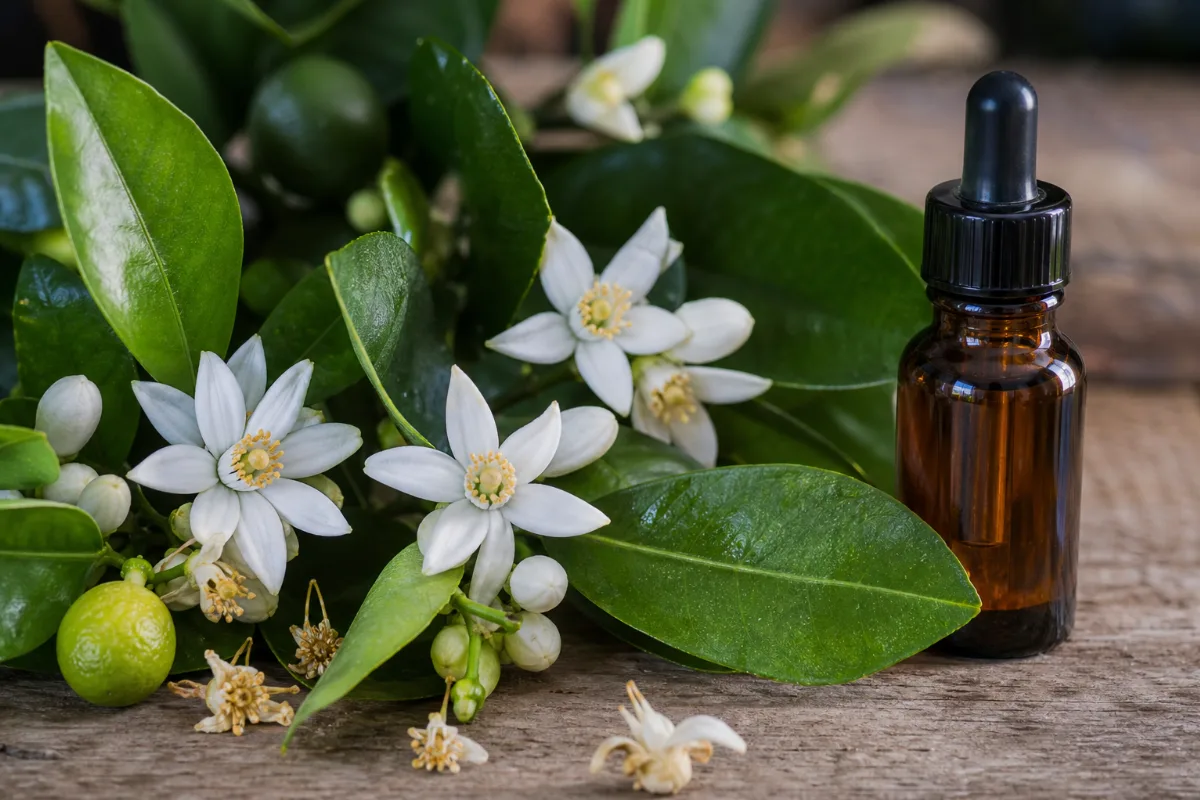
Neroli oil is the oil of the flowers of the bitter orange tree, Citrus x aurantium L., in the citrus family. GBIF accepts this name and lists Citrus aurantium var. amara as a synonym. It is one of the most expensive natural oils because the yield is small.
Two analyses of neroli oil name different main compounds: linalool (28.5%), linalyl acetate and limonene in one, and limonene (27.5%), nerolidol and alpha-terpineol in another. The mix varies with origin and batch.
What people use it for, and how strong the evidence is
Neroli is used for its scent in perfume and in aromatherapy for anxiety, sleep, labor, menopause and low mood. NCCIH says bitter orange oil is generally well tolerated on skin and in aromatherapy, but that it is unclear whether it helps with anxiety or insomnia.
Bitter orange blossoms are used in traditional medicine in Iran and some other countries. Traditional use is not proof that it works.
The research in one view
Labor: two small trials found lower anxiety, and one found lower pain. Heart patients: a double-blind trial of 140 and a single-blind trial of 80 found lower anxiety. Pregnancy: single trials of 68 women found lower depression and anxiety and better sleep. Menopause: a 5-day trial of 63 women found better physical scores and sexual desire. Blood pressure was lower for a short time in two trials.
Almost all outcomes were self-rated, the scent is hard to hide, and the trials are small and mostly from Iran. A 90-woman experiment found body responses to neroli and lavender followed what people were told to expect. A 2026 review of 12 trials in women calls neroli effective and safe; we rate the evidence lower because results were not pooled and blinding is not reported in the abstract.
No human trial supports neroli for pain, inflammation, seizures or infection. Those findings are from mice, rats and test tubes. Cortisol and estrogen did not change significantly in the menopause trial.
Neroli oil, hydrosol, peel oil and blends are different things
Neroli oil (from flowers), neroli hydrosol (orange flower water), bitter orange peel oil, petitgrain oil (from the same species, and a known way to cut neroli) and bitter orange fruit supplements are different products. Several trials say only "Citrus aurantium oil" without the plant part. The dental trials used lavender-neroli blends. One labor trial used a "distillate" that may be a water-based product.
Bitter orange fruit supplements contain synephrine and NCCIH links them to heart rhythm events and strokes in reports, mostly in multi-ingredient products. That concern does not describe neroli oil.
What regulators say
NCCIH says bitter orange has not been clearly shown helpful for any health purpose. Poison Control, a US poison center service, warns about swallowing and skin reactions from essential oils in general. We did not find a European (EMA) monograph or a US FDA statement on neroli oil; absence of a page is not proof that none exists.
At a glance
Traditional uses history, not proof
- Used for scent in perfumery and fragrances such as cologne (research papers).
- Bitter orange blossoms are used in traditional medicine in Iran and some other countries, for example for pain and seizures, according to animal-study authors.
- Used in aromatherapy for anxiety and sleep; NCCIH says it is unclear whether this helps.
Studied for research
- Anxiety in labor, low
- Anxiety in heart patients and before heart tests, low
- Sleep in pregnancy, low
- Menopause symptoms and sexual desire, low
- Depression and anxiety in pregnancy, very low
- Blood pressure (short-term), very low
- Nausea after chemotherapy, very low
- Anxiety in children at the dentist (blend with lavender), very low
- Hormone balance, insufficient
- Pain, inflammation and seizures (animal work only), insufficient
Main compounds
- Linalool, main compound in one analysis
- Linalyl acetate
- Limonene
- Nerolidol, farnesol and alpha-terpineol
Common forms
- Neroli essential oil (from the blossoms)
- Blends with lavender or other oils
- Hydrosol (orange flower water): a different, water-based product
Research links: Poison Control: Essential oils · NCCIH: Bitter orange · Menopause trial (abstract) · Labor trial (abstract) · Skin allergy patch-test data (abstract) · Adulteration study (abstract) · Research Library · Genes & Biomarkers Library
What it is and its history
- Accepted scientific name
- Citrus x aurantium
- Naming authority
- L.
- Synonyms
- Name: Citrus aurantium var. amara; Authority: L.; Status: SYNONYM
- Common names
- Neroli (English); Bitter orange blossom oil (English); Orange blossom oil (check the Latin name on the label) (English)
- Family or group
- Rutaceae (the citrus family), per GBIF.
- Classification
- Plantae > Tracheophyta > Magnoliopsida > Sapindales > Rutaceae > Citrus > Citrus aurantium
- Native range
- NCCIH says the bitter orange tree is native to Southeast Asia. Neroli oil in the studies read came from Tunisia, Iran and Egypt among other places.
- Habitat
- Not checked.
- What it looks like
- Part used: Flowers (blossoms). The oil is made from the flowers; other products from the same tree (peel oil, petitgrain from leaves and twigs, fruit extract) are different products.
- Look-alikes and adulterants
- Name: Bitter orange peel oil and orange oil; Note: Made from the fruit peel by pressing; NCCIH and a review treat them as different oils. The review lists pressed bitter orange oil as low risk for sun-triggered skin reactions.; Name: Petitgrain oil; Note: An oil from the same species (a review lists orange petitgrain as Citrus aurantium); the plant part used is not stated in the sources read. The 2021 French study could detect 10% petitgrain added to neroli.; Name: Neroli hydrosol (orange flower water); Note: A water-based product, a different thing from the oil. Whether the "distillate" in one labor trial was a hydrosol is not stated.
- Sustainability and conservation
- Not checked.
Traditional use and history history, not clinical proof
| Tradition or era | Documented use | Source |
|---|---|---|
| Perfumery | A 2012 paper says neroli oil is one of the most widely used floral oils in perfumery, and a 2021 paper says it is among the most expensive natural products because of its poor yield and use in fragrances such as cologne. | Pak J Biol Sci 2012; J Chromatogr B 2021 |
| Traditional medicine in Iran and some other countries | Bitter orange blossoms are used as medicine, including for pain, inflammation and seizures, according to the authors of animal studies. Traditional use is not proof that it works. | Nat Prod Commun 2014; J Nat Med 2015 |
| Modern aromatherapy | NCCIH says bitter orange oil has been used in aromatherapy for conditions including anxiety and insomnia, but it is unclear whether this helps. | NCCIH |
Traditional use shows how it was used. It does not show that it works or is safe today.
What is inside, and how it may work
What it contains and how those compounds act in cells and animals. Laboratory and animal mechanisms are not proven effects in people.
Main compounds
| Compound | Family | Where it is concentrated | Activity studied | Level of evidence |
|---|---|---|---|---|
| Linalool PubChem 6549 | monoterpene alcohol | Blossom oil 28.5% in one analysed neroli oil; not reported as a main compound in a Tunisian oil. | A main component in one analysis. Marketing says it relaxes; no human study isolating it was read here. 34 11 | Laboratory |
| Linalyl acetate PubChem 8294 | ester | Blossom oil 19.6% in one analysed neroli oil. Added synthetic linalyl acetate is one suspected adulteration. | Not studied alone in the sources read. 35 11 21 | Laboratory |
| Limonene PubChem 22311 | monoterpene | Blossom oil 27.5% in a Tunisian neroli oil; 4.6% in an Iranian one. | Not studied alone in the sources read. 36 3 11 | Laboratory |
| Nerolidol, farnesol and alpha-terpineol | sesquiterpene alcohols and a monoterpene alcohol | Blossom oil Nerolidol 9.1% to 17.5%, E,E-farnesol 8% to 9.1%, alpha-terpineol 4.9% to 14% depending on the analysis. | Not studied alone in the sources read. 11 3 | Laboratory |
Mechanisms, receptors and pathways
| Target or pathway | Gene or receptor | What was found | Level |
|---|---|---|---|
| GABA-benzodiazepine site (mice) | GABA-A receptor complex | In mice neroli protected against induced seizures and the protection was reduced by flumazenil, so the authors suggest a GABA-related action. No human data. 4 | Animal research |
| Nitric oxide / cyclic GMP pathway (rodents) | Nitric oxide synthase | Pain and swelling in rodents were reduced and the authors link this to the nitric oxide pathway. No human data. 11 | Animal research |
| Expectation and learned response to odour | Not applicable | In 90 women, body responses to lavender, neroli and placebo odour followed the suggestion given. 5 | Human data |
| Microbes in test tubes | Not applicable | Neroli slowed bacteria and fungi in test tubes; this does not show it treats infection. 3 | Laboratory research |
Absorption, metabolism and elimination
- Absorption
- Not established in the sources read.
- Distribution
- Not established.
- Metabolism
- Not established.
- Elimination
- Not established.
- Bioavailability
- Not established.
Isolated compounds versus whole extracts
Neroli oil, neroli hydrosol, Citrus aurantium peel oil, petitgrain oil, bitter orange supplements and blends with lavender or ylang-ylang are different products. Results for one do not carry to another. Several trials say only "Citrus aurantium oil".
Nutritional composition
Neroli oil is not a nutrient and carries no nutrition claim. NCCIH says bitter orange is likely safe in food amounts, which is not a statement about swallowing the oil.
5 low certainty6 very low certainty2 not enough evidence
What is Neroli Oil good for?
The uses people ask about and how strong the human evidence is for each. All of it comes from small trials, so read it together with the safety section.
Benefits, one by one
Each card is a research question, not a promise. Tap a goal to filter. Open a card to see the studies, doses and limits.
Anxiety in labor
Low certaintyTwo small trials in women in labor found lower self-rated anxiety with neroli in the air or on a gauze at the collar. Both rely on self-rating and the scent is hard to hide.
3 studiesNot covered. This page gives no amounts and no ways of using the oil.
Studies, doses and limits
What the trials found
An Italian trial of 88 women in labor (44 per group) and an Iranian trial of 126 women (63 per group). The Iranian trial used a "distillate" on gauze that the paper later calls blossom oil, so it may not be the pure oil.
Results
Italy: anxiety and perceived pain were lower with neroli than without at every stage of labor (p < 0.05). Iran: anxiety was lower in the neroli group at 3-4 cm and at 6-8 cm dilation, compared with a saline gauze.
Effect sizes as reported
Lower self-rated anxiety scores; the abstracts give no numbers for the size of the drop.
Why this rating
Two small randomized trials in the same direction, but self-rated, hard to blind, from two research groups with no independent repeat. The Iranian product may be a water-based distillate.
Form and dose studied
Not covered. This page gives no amounts and no ways of using the oil.
Who was studied
Women in labor, Italy and Iran.
Limits
Self-rated outcomes; scent can reveal the group; the control in the Italian abstract is not described; the two products differ.
Why researchers looked
Labor is stressful, and midwives look for drug-free ways to ease worry.
Traditional use
Bitter orange blossoms are used in perfumery and, in Iran and some other countries, in traditional medicine (Pak J Biol Sci 2012; Nat Prod Commun 2014).
Proposed mechanism Preliminary mechanism
Not established. The papers read describe the effect of the oil on scores, not how it works in the body.
A proposed mechanism does not show that the effect happens in people.
Neroli oil is for smelling or, when diluted in a carrier oil, for the skin. Never swallow it. See the Safety tab.
Anxiety in heart patients and before heart tests
Low certaintyTwo trials in Iranian hospitals found lower anxiety scores after patients smelled Citrus aurantium oil. One was double-blind with a flower oil in paraffin; the other was single-blind with one short session.
3 studiesNot covered. This page gives no amounts and no ways of using the oil.
Studies, doses and limits
What the trials found
A double-blind placebo-controlled trial of 140 patients with acute coronary syndrome (paraffin as placebo), and a single-blind trial of 80 patients before coronary angiography (distilled water as control). A Korean non-randomized study of 64 patients used a lavender-ylang-ylang-neroli blend and found no effect before angiography.
Results
ACS trial: anxiety score 34.66 (SD 9.6) with neroli against 42.36 (SD 6.4) with paraffin (p < 0.0001); no side effect was observed. Angiography trial: anxiety fell from 53.30 to 42.37 in the oil group, with no significant change in the control group. Blend study: no effect before angiography, some effect after.
Effect sizes as reported
About 8 points lower anxiety score on the state-trait scale in the ACS trial.
Why this rating
One double-blind trial with a clear result and one single-blind trial, both from Iran, both self-rated. The third study was non-randomized and used a blend.
Form and dose studied
Not covered. This page gives no amounts and no ways of using the oil.
Who was studied
Hospital patients with heart disease or about to have a heart test, Iran and Korea.
Limits
Short follow-up; self-rated; scent can reveal group; plant part not stated in the angiography trial; results are for anxiety, not for any heart outcome.
Why researchers looked
Hospital stays and heart tests cause worry that can raise heart rate and blood pressure.
Traditional use
Bitter orange blossoms are used in perfumery and, in Iran and some other countries, in traditional medicine (Pak J Biol Sci 2012; Nat Prod Commun 2014).
Proposed mechanism Preliminary mechanism
Not established. The papers read describe the effect of the oil on scores, not how it works in the body.
A proposed mechanism does not show that the effect happens in people.
Neroli oil is for smelling or, when diluted in a carrier oil, for the skin. Never swallow it. See the Safety tab.
Depression and anxiety in pregnancy
Very low certaintyOne trial of 68 pregnant women found lower depression and anxiety scores after a month of breathing Citrus aurantium oil from a facemask, but no clear change in stress.
3 studiesNot covered. This page gives no amounts and no ways of using the oil.
Studies, doses and limits
What the trials found
A trial of 68 pregnant women (Iran) compared the oil with odourless sweet almond oil, both breathed from a facemask for one month.
Results
Depression scores fell by 4.80 points with the oil and rose by 1.03 with almond oil (p < 0.001). Anxiety fell by 3.37 points against a rise of 0.79 (p < 0.001). The stress score improved more with the oil but the difference was not significant (p = 0.166). A 2025 review of 21 aromatherapy studies in pregnancy lists Citrus aurantium and orange blossom among oils that reduced anxiety.
Effect sizes as reported
Depression and anxiety scores lower than with almond oil; stress not clearly different.
Why this rating
One small trial. The same registration number is used for the sleep trial below, so the two papers may be parts of one study. An erratum was published and the abstract does not say what changed. The plant part is not stated.
Form and dose studied
Not covered. This page gives no amounts and no ways of using the oil.
Who was studied
Pregnant women in the second and third trimester, Iran.
Limits
Small, one region, self-rated, scent hard to hide. Nothing about the baby was measured in the abstract.
Why researchers looked
Low mood and worry are common in pregnancy, and many women want to avoid medicines.
Traditional use
Bitter orange blossoms are used in perfumery and, in Iran and some other countries, in traditional medicine (Pak J Biol Sci 2012; Nat Prod Commun 2014).
Proposed mechanism Preliminary mechanism
Not established. The papers read describe the effect of the oil on scores, not how it works in the body.
A proposed mechanism does not show that the effect happens in people.
Pregnancy is a time to ask your midwife or doctor before using any essential oil. See the Safety tab.
Anxiety in children at the dentist (blend with lavender)
Very low certaintyTwo trials in Syria found less anxiety in children who breathed a lavender-neroli blend through a mask during a dental injection. Because lavender is in the mix, this does not show neroli alone works.
3 studiesNot covered. This page gives no amounts and no ways of using the oil.
Studies, doses and limits
What the trials found
Two randomized trials by the same research group: 54 children aged 6-11 and 56 children aged 6-10, using a nasal mask in a dental clinic. The second added music.
Results
Anxiety, heart rate, blood pressure and pain scores were lower with the blend in the 2025 trial. The 2024 trial found lower anxiety and vital signs but no difference in pain (p = 0.176).
Effect sizes as reported
Lower anxiety scores in both trials; the size is not given in the abstracts.
Why this rating
Small trials from one group, a two-oil blend (and music in one), compared with an empty or scent-free mask.
Form and dose studied
Not covered. This page gives no amounts and no ways of using the oil.
Who was studied
Children aged 6 to 11 having a dental nerve-block injection, supervised setting.
Limits
Blend, not neroli alone; one research group; supervised clinic; nothing here supports home use for children. Poison Control says children may be more vulnerable to essential oils.
Why researchers looked
Fear of dental injections makes some children refuse care.
Traditional use
Not described in the sources read.
Proposed mechanism Preliminary mechanism
Not established. The papers read describe the effect of the oil on scores, not how it works in the body.
A proposed mechanism does not show that the effect happens in people.
Children can be harmed by essential oils, especially if swallowed. Keep bottles out of reach. See the Safety tab.
Sleep quality (mostly in pregnancy)
Low certaintyOne trial of 68 pregnant women found better self-rated sleep after a month of breathing Citrus aurantium oil. Two pooled analyses of aromatherapy for sleep also favour it, but they mix many oils.
4 studiesNot covered. This page gives no amounts and no ways of using the oil.
Studies, doses and limits
What the trials found
The trial compared the oil with placebo. A 2024 meta-analysis of 14 trials (1,043 people) found aromatherapy improved sleep scores and said rose and citrus aurantium effects were more obvious than lavender. A 2025 meta-analysis of 27 trials (2,072 people) of aromatherapy in general found better sleep but noted a lack of blinding and of purity testing.
Results
Trial: sleep score 4.37 (SD 1.85) with the oil against 8.48 (SD 2.62) with placebo after one month (p < 0.001; lower is better). Meta-analysis of 14 trials: SMD -1.63, 95% CI -2.20 to -1.04, with stronger effects in Iran than elsewhere.
Effect sizes as reported
Large drop in self-rated sleep scores in the trial; the pooled analyses mix oils.
Why this rating
One randomized trial plus pooled analyses of mixed oils. The pooled results are not neroli-specific, effects were larger in one country, and sleep was self-rated.
Form and dose studied
Not covered. This page gives no amounts and no ways of using the oil.
Who was studied
Pregnant women with sleep problems (trial); mixed adults (pooled analyses).
Limits
Plant part not stated; self-rated; scent hard to hide; the broader meta-analyses did not test oil purity.
Why researchers looked
Sleep problems are common in late pregnancy, and sleep medicines are usually avoided.
Traditional use
Bitter orange blossoms are used in perfumery and, in Iran and some other countries, in traditional medicine (Pak J Biol Sci 2012; Nat Prod Commun 2014).
Proposed mechanism Preliminary mechanism
Not established. The papers read describe the effect of the oil on scores, not how it works in the body.
A proposed mechanism does not show that the effect happens in people.
Neroli oil is for smelling or, when diluted in a carrier oil, for the skin. Never swallow it. See the Safety tab.
Anxiety overall (pooled with other essential oils)
Low certaintyA 2023 pooled analysis of 44 trials ranked Citrus aurantium oil near the top for lowering anxiety scores, but it is an indirect ranking and the plant part is not stated.
1 studiesNot covered. This page gives no amounts and no ways of using the oil.
Studies, doses and limits
What the trials found
A network meta-analysis of 44 randomized trials (3,419 people with anxiety) of ten kinds of essential oil.
Results
Essential oils together lowered state anxiety (WMD -6.63, 95% CI -8.17 to -5.08). Citrus aurantium ranked second for state anxiety (WMD -9.62, 95% CrI -13.32 to -5.93) and first for trait anxiety (WMD -9.62, 95% CrI -15.62 to -3.70). The authors call it the most recommended oil.
Effect sizes as reported
About 10 points lower scores on the anxiety scales, estimated indirectly.
Why this rating
Pooled, mixed-quality trials; an indirect ranking; the "citrus aurantium" oil may include peel or leaf oil rather than only blossom.
Form and dose studied
Not covered. This page gives no amounts and no ways of using the oil.
Who was studied
People with anxiety, many settings.
Limits
The abstract does not say which plant part or which trials drove the Citrus aurantium result.
Why researchers looked
Many small trials of different oils exist, so reviewers compared them together.
Traditional use
Not described in the sources read.
Proposed mechanism Preliminary mechanism
Not established.
A proposed mechanism does not show that the effect happens in people.
Neroli oil is for smelling or, when diluted in a carrier oil, for the skin. Never swallow it. See the Safety tab.
Menopause symptoms and sexual desire
Low certaintyIn one 5-day trial of 63 postmenopausal women, breathing low-strength neroli improved the physical part of a menopause score and sexual desire compared with almond oil. A pooled review calls the evidence limited.
2 studiesNot covered. This page gives no amounts and no ways of using the oil.
Studies, doses and limits
What the trials found
A Korean randomized trial of 63 healthy postmenopausal women; plus a 2021 review of seven placebo-controlled aromatherapy trials (four on symptoms, three on sexual desire) that included lavender and low-dose neroli.
Results
Both neroli groups had better scores in the physical domain of the MENQOL questionnaire and in sexual desire than the almond-oil group. The review says aromatherapy with lavender or low-dose neroli beat placebo for total symptom score and for sexual desire, and calls the evidence limited.
Effect sizes as reported
Better scores; no pooled numbers in the abstracts.
Why this rating
One 5-day trial plus a review of mixed oils with blinding as the weak point.
Form and dose studied
Not covered. This page gives no amounts and no ways of using the oil.
Who was studied
Healthy postmenopausal women, Korea.
Limits
Five days only; healthy women, not women with severe symptoms; self-rated; funding not stated.
Why researchers looked
Hot flushes and low mood around menopause send many women looking for drug-free options.
Traditional use
Bitter orange blossoms are used in perfumery and, in Iran and some other countries, in traditional medicine (Pak J Biol Sci 2012; Nat Prod Commun 2014).
Proposed mechanism Preliminary mechanism
Not established. The papers read describe the effect of the oil on scores, not how it works in the body.
A proposed mechanism does not show that the effect happens in people.
Neroli oil is for smelling or, when diluted in a carrier oil, for the skin. Never swallow it. See the Safety tab.
Blood pressure and heart rate (short-term)
Very low certaintyIn two short trials blood pressure was lower after breathing neroli oil. These are small changes measured soon after, not proof that it lowers blood pressure for long.
3 studiesNot covered. This page gives no amounts and no ways of using the oil.
Studies, doses and limits
What the trials found
Blood pressure was a secondary measure: 63 postmenopausal women over 5 days, and 80 patients before angiography after one session. A lavender-ylang-ylang-neroli blend study in 64 patients found blood pressure differed between groups 4 hours after treatment (the abstract does not give the direction).
Results
Menopause trial: systolic blood pressure was lower in the 0.5% group and diastolic pressure was lower in both neroli groups than with almond oil. Angiography trial: systolic fell from 134.82 to 124.49 mm Hg and diastolic from 84.49 to 79.23 mm Hg 20 minutes after smelling the oil, with no significant change in the control group.
Effect sizes as reported
Lower readings in the short term.
Why this rating
Secondary outcomes, short windows (minutes to days), small groups, and readings can fall with relaxation or rest alone.
Form and dose studied
Not covered. This page gives no amounts and no ways of using the oil.
Who was studied
Postmenopausal women; patients before heart testing.
Limits
Nothing shows a lasting effect on blood pressure or heart disease. The oil is not a blood-pressure treatment; ask a doctor or pharmacist about blood pressure care.
Why researchers looked
Stress can raise blood pressure, so researchers checked it while testing calming oils.
Traditional use
Bitter orange blossoms are used in perfumery and, in Iran and some other countries, in traditional medicine (Pak J Biol Sci 2012; Nat Prod Commun 2014).
Proposed mechanism Preliminary mechanism
Not established. The papers read describe the effect of the oil on scores, not how it works in the body.
A proposed mechanism does not show that the effect happens in people.
Neroli oil is for smelling or, when diluted in a carrier oil, for the skin. Never swallow it. See the Safety tab.
Pain during labor and period pain
Very low certaintyNeroli was linked to lower self-rated pain in one labor trial of 88 women. A narrative review reports less period pain too. The review did not pool numbers.
2 studiesNot covered. This page gives no amounts and no ways of using the oil.
Studies, doses and limits
What the trials found
The Italian labor trial measured pain on a visual scale. The 2026 review of 12 trials (1,170 women) reports lower pain in labor and in primary dysmenorrhea (period pain) and less premenstrual syndrome, but only as a narrative summary.
Results
Labor: perceived pain was lower with neroli than control at all stages (p < 0.05). Review: pain lower in primary period pain and in labor, and less premenstrual syndrome. No numbers are in the abstract.
Effect sizes as reported
Lower self-rated pain; sizes not given.
Why this rating
One labor trial plus a narrative review whose individual trials were not read here.
Form and dose studied
Not covered. This page gives no amounts and no ways of using the oil.
Who was studied
Women in labor; women with period pain or premenstrual symptoms (review).
Limits
Self-rated pain; scent makes blinding hard; the review did not pool results and rates the evidence higher than we do.
Why researchers looked
Drug-free pain relief during labor and periods is of wide interest.
Traditional use
Bitter orange blossoms are used in perfumery and, in Iran and some other countries, in traditional medicine (Pak J Biol Sci 2012; Nat Prod Commun 2014).
Proposed mechanism Preliminary mechanism
Not established. The papers read describe the effect of the oil on scores, not how it works in the body.
A proposed mechanism does not show that the effect happens in people.
Neroli oil is for smelling or, when diluted in a carrier oil, for the skin. Never swallow it. See the Safety tab.
Nausea after chemotherapy and in pregnancy
Very low certaintyOne trial of 92 women with breast cancer found less delayed nausea (days 3 to 5) when Citrus aurantium oil was added to usual anti-sickness medicine.
2 studiesNot covered. This page gives no amounts and no ways of using the oil.
Studies, doses and limits
What the trials found
A randomized trial compared Citrus aurantium oil with sunflower oil, both on the skin above the lip, over five days. The 2025 review of aromatherapy in pregnancy found citrus oils helped nausea but did not separate neroli.
Results
Nausea, vomiting and retching scores were lower in the oil group from day 3 to day 5 (p < 0.05); there was no difference on days 1 and 2.
Effect sizes as reported
Less nausea on days 3 to 5.
Why this rating
One trial, one centre, self-rated, alongside usual medicine; the pregnancy review mixes oils.
Form and dose studied
Not covered. This page gives no amounts and no ways of using the oil.
Who was studied
Women with breast cancer on chemotherapy, Iran.
Limits
Not a replacement for anti-sickness medicine; people on chemotherapy should ask their cancer team before using any oil.
Why researchers looked
Chemotherapy sickness can last for days after treatment.
Traditional use
Not described in the sources read.
Proposed mechanism Preliminary mechanism
Not established. The papers read describe the effect of the oil on scores, not how it works in the body.
A proposed mechanism does not show that the effect happens in people.
Neroli oil is for smelling or, when diluted in a carrier oil, for the skin. Never swallow it. See the Safety tab.
Quality of life in dialysis patients (foot massage)
Very low certaintyA trial of 105 dialysis patients found better quality-of-life scores after 4 weeks of foot massage with Citrus aurantium oil than with massage alone. Massage itself may explain part of it.
1 studiesNot covered. This page gives no amounts and no ways of using the oil.
Studies, doses and limits
What the trials found
A randomized trial with three groups: lavender oil massage, Citrus aurantium oil massage, or foot massage only, three times a week for four weeks.
Results
Quality-of-life scores (SF-36) were better in both oil groups than in the massage-only group. Lavender and Citrus aurantium did not differ from each other.
Effect sizes as reported
Better scores than massage alone.
Why this rating
One trial; the plant part is not stated; blinding is not described in the abstract; oil on skin is a different use from smelling it.
Form and dose studied
Not covered. This page gives no amounts and no ways of using the oil.
Who was studied
Adults on chronic haemodialysis, Iran.
Limits
Skin use brings the allergy risk described on the Safety tab. People on dialysis should ask their kidney team.
Why researchers looked
People on long-term dialysis often report poor quality of life.
Traditional use
Bitter orange blossoms are used in perfumery and, in Iran and some other countries, in traditional medicine (Pak J Biol Sci 2012; Nat Prod Commun 2014).
Proposed mechanism Preliminary mechanism
Not established. The papers read describe the effect of the oil on scores, not how it works in the body.
A proposed mechanism does not show that the effect happens in people.
Neroli oil is for smelling or, when diluted in a carrier oil, for the skin. Never swallow it. See the Safety tab.
Hormone balance
Not enough evidenceThe menopause trial found that cortisol and estrogen only tended to improve and not by a significant amount, so hormone-balancing claims are not supported.
1 studiesNot covered. This page gives no amounts and no ways of using the oil.
Studies, doses and limits
What the trials found
The same 63-woman menopause trial measured blood cortisol and estrogen.
Results
Pulse, cortisol and estrogen "tended to improve" compared with almond oil, but the abstract does not report them as significant.
Effect sizes as reported
No clear effect.
Why this rating
Only one short trial; non-significant trends should not be treated as an effect.
Form and dose studied
Not covered. This page gives no amounts and no ways of using the oil.
Who was studied
Postmenopausal women.
Limits
The authors suggest neroli "may have potential" to improve the endocrine system; the data in the abstract do not show it.
Why researchers looked
Marketing for essential oils often claims they balance hormones.
Traditional use
No traditional use described in the sources read.
Proposed mechanism Preliminary mechanism
Not established. The papers read describe the effect of the oil on scores, not how it works in the body.
A proposed mechanism does not show that the effect happens in people.
Neroli oil is for smelling or, when diluted in a carrier oil, for the skin. Never swallow it. See the Safety tab.
Pain, inflammation, seizures and germs (lab and animal work only)
Not enough evidenceIn mice, rats and test tubes neroli reduced pain responses, swelling and seizures and slowed germs. None of this has been shown in people.
3 studiesNot covered. This page gives no amounts and no ways of using the oil.
Studies, doses and limits
What the trials found
Animal and test-tube studies: mice and rats given neroli (several dose levels), and a test-tube study on bacteria, fungi and antioxidant activity.
Results
Fewer pain responses and less paw swelling in rodents; protection against induced seizures in mice; slowed growth of bacteria and fungi in test tubes. Animal doses cannot be turned into human amounts.
Effect sizes as reported
Effects in animals and test tubes only.
Why this rating
No human data on these outcomes. Animal findings often do not carry to people. The seizure finding is not a reason to use the oil for epilepsy.
Form and dose studied
Not covered. This page gives no amounts and no ways of using the oil.
Who was studied
Mice, rats, test tubes.
Limits
Do not use neroli oil for pain, infection or seizures on the strength of this work.
Why researchers looked
Early lab work tests whether traditional uses have a biological basis.
Traditional use
In Iran, bitter orange blossoms are used in traditional medicine for pain and seizures, per the authors.
Proposed mechanism Preliminary mechanism
In mice the oil protected against induced seizures, and the effect was reduced by flumazenil, which blocks the benzodiazepine site, so the authors suggest a GABA-related action. In rodents pain and swelling were reduced, with a nitric oxide pathway suggested.
A proposed mechanism does not show that the effect happens in people.
Neroli oil is for smelling or, when diluted in a carrier oil, for the skin. Never swallow it. See the Safety tab.
Connections to the rest of health
How Neroli Oil connects to the rest of our health knowledge graph. Every link says what kind of connection it is. A safety link (for example to the liver) is a warning, not a benefit. A study that merely mentions a topic never creates a benefit link.
Explore every connection: goals, body systems, organs, symptoms, genes
A. Wellness goals
| Connected to | Kind of connection | Evidence status | Context | Studies |
|---|---|---|---|---|
| Anxiety Support | Low certainty | Anxiety in labor: Two small trials in women in labor found lower self-rated anxiety with neroli in the air or on a gauze at the collar. Both rely on self-rating and the scent is hard to hide. Anxiety in heart patients and before heart tests: Two trials in Iranian hospitals found lower anxiety scores after patients smelled Citrus aurantium oil. One was double-blind with a flower oil in paraffin; the other was single-blind with one short session. | 22 20 5 19 17 23 18 14 27 2 1 29 | |
| Womens Wellness | Low certainty | Anxiety in labor: Two small trials in women in labor found lower self-rated anxiety with neroli in the air or on a gauze at the collar. Both rely on self-rating and the scent is hard to hide. Depression and anxiety in pregnancy: One trial of 68 pregnant women found lower depression and anxiety scores after a month of breathing Citrus aurantium oil from a facemask, but no clear change in stress. | 22 20 5 18 14 27 15 28 6 7 12 24 | |
| Calm Relaxation | Low certainty | Anxiety in heart patients and before heart tests: Two trials in Iranian hospitals found lower anxiety scores after patients smelled Citrus aurantium oil. One was double-blind with a flower oil in paraffin; the other was single-blind with one short session. Anxiety in children at the dentist (blend with lavender): Two trials in Syria found less anxiety in children who breathed a lavender-neroli blend through a mask during a dental injection. Because lavender is in the mix, this does not show neroli alone works. | 19 17 23 2 1 29 16 | |
| Better Sleep | Low certainty | Sleep quality (mostly in pregnancy): One trial of 68 pregnant women found better self-rated sleep after a month of breathing Citrus aurantium oil. Two pooled analyses of aromatherapy for sleep also favour it, but they mix many oils. | 15 28 6 14 | |
| Anxiety Support | Low certainty | Anxiety overall (pooled with other essential oils): A 2023 pooled analysis of 44 trials ranked Citrus aurantium oil near the top for lowering anxiety scores, but it is an indirect ranking and the plant part is not stated. | 25 | |
| Menopause Support | Low certainty | Menopause symptoms and sexual desire: In one 5-day trial of 63 postmenopausal women, breathing low-strength neroli improved the physical part of a menopause score and sexual desire compared with almond oil. A pooled review calls the evidence limited. | 7 12 | |
| Blood Pressure Support | Biological association | Very low certainty | Blood pressure and heart rate (short-term): In two short trials blood pressure was lower after breathing neroli oil. These are small changes measured soon after, not proof that it lowers blood pressure for long. | 7 17 23 |
| Hormone Balance | Not enough evidence | Hormone balance: The menopause trial found that cortisol and estrogen only tended to improve and not by a significant amount, so hormone-balancing claims are not supported. | 7 | |
| Anxiety Support | Preliminary mechanism | Not enough evidence | Pain, inflammation, seizures and germs (lab and animal work only): In mice, rats and test tubes neroli reduced pain responses, swelling and seizures and slowed germs. None of this has been shown in people. | 11 4 3 |
B. Body systems
| Connected to | Kind of connection | Evidence status | Context | Studies |
|---|---|---|---|---|
| Stress Mood | Biological association | Low certainty | Studied for: Anxiety in labor Studied for: Anxiety in heart patients and before heart tests | 22 20 5 19 17 23 18 14 27 2 1 29 15 28 6 25 7 12 16 |
| Reproductive Health | Biological association | Low certainty | Studied for: Anxiety in labor Studied for: Depression and anxiety in pregnancy | 22 20 5 18 14 27 7 12 |
| Cardiovascular System | Biological association | Low certainty | Studied for: Anxiety in heart patients and before heart tests Studied for: Blood pressure and heart rate (short-term) | 19 17 23 7 |
| Nervous System | Biological association | Low certainty | Studied for: Sleep quality (mostly in pregnancy) Studied for: Pain, inflammation, seizures and germs (lab and animal work only) | 15 28 6 14 11 4 3 |
| Pain Inflammation | Biological association | Very low certainty | Studied for: Pain during labor and period pain Studied for: Pain, inflammation, seizures and germs (lab and animal work only) | 22 27 11 4 3 |
| Digestive System | Biological association | Very low certainty | Studied for: Nausea after chemotherapy and in pregnancy | 24 14 |
C. Body parts and organs
E. Health conditions
| Connected to | Kind of connection | Evidence status | Context | Studies |
|---|---|---|---|---|
| Contact dermatitis | Adverse effect or risk | Documented risk | 1.1% positive patch tests in 10,930 clinic patients. Preparation or compound: Neroli oil on skin |
10 |
I. Biomarkers
| Connected to | Kind of connection | Evidence status | Context | Studies |
|---|---|---|---|---|
| State-Trait Anxiety Inventory score | Biological association | Low certainty | Measured in trials: lowered. A lab change is not the same as a health benefit. | 19 17 |
| Anxiety score in labor (visual scale or questionnaire) | Biological association | Low certainty | Measured in trials: lowered. A lab change is not the same as a health benefit. | 22 20 |
| DASS-21 depression and anxiety scores | Biological association | Very low certainty | Measured in trials: lowered. A lab change is not the same as a health benefit. | 18 |
| Pittsburgh Sleep Quality Index (PSQI) | Biological association | Low certainty | Measured in trials: lowered. A lab change is not the same as a health benefit. | 15 |
| Menopause-Specific Quality of Life (MENQOL), physical domain | Biological association | Low certainty | Measured in trials: lowered. A lab change is not the same as a health benefit. | 7 |
| Blood pressure (systolic and diastolic) | Biological association | Very low certainty | Measured in trials: lowered. A lab change is not the same as a health benefit. | 7 17 |
| Rhodes Index of Nausea, Vomiting and Retching | Biological association | Very low certainty | Measured in trials: lowered. A lab change is not the same as a health benefit. | 24 |
| SF-36 quality-of-life score | Biological association | Very low certainty | Measured in trials: raised. A lab change is not the same as a health benefit. | 16 |
J. Genes, receptors and enzymes
| Connected to | Kind of connection | Evidence status | Context | Studies |
|---|---|---|---|---|
| GABA-A receptor complex | Preliminary mechanism | Animal | Animal finding in mice only. | 4 |
L. Active compounds
| Connected to | Kind of connection | Evidence status | Context | Studies |
|---|---|---|---|---|
| Linalool | Biological association | Laboratory | A main component in one analysis. Marketing says it relaxes; no human study isolating it was read here. Preparation or compound: Blossom oil |
34 11 |
| Linalyl acetate | Biological association | Laboratory | Not studied alone in the sources read. Preparation or compound: Blossom oil |
35 11 21 |
| Limonene | Biological association | Laboratory | Not studied alone in the sources read. Preparation or compound: Blossom oil |
36 3 11 |
| Nerolidol, farnesol and alpha-terpineol | Biological association | Laboratory | Not studied alone in the sources read. Preparation or compound: Blossom oil |
11 3 |
Each connection is stored with the ingredient, the connected record, the kind of connection, the evidence status, the supporting studies, the preparation or compound involved, and a review date (last reviewed October 25, 2026).
Evidence at a glance: what changed in 8 lab markers
Tap a number to show only those markers. Counts are markers, not people.
The evidence
The research centre for Neroli Oil. Every record here was checked against PubMed or the publisher's page; we never list a study we have not verified.
Evidence by outcome
Bars show how many studies we found for each outcome, not how well it works. People are added up across trials only (reviews are not added, to avoid double counting).
How we rate evidence
High certainty
Several well-run trials or reviews agree; further research is unlikely to change the picture much.
Moderate certainty
Good trials point the same way, but some doubt remains.
Low certainty
Small, short or inconsistent trials. The finding could change with better research.
Very low certainty
Very little or very weak human data. Treat as a possibility only.
Mixed findings
Trials or reviews disagree with each other.
Not enough evidence
Not enough human research to say either way.
Evidence against
Good research found no benefit, or found harm.
We take the reviewers' own risk-of-bias and GRADE statements where they exist, and otherwise judge from study size, design, consistency, directness and whether a product matches what is sold. Many publications do not make evidence high. Method note: We searched PubMed and read the abstracts of 28 papers, read the Poison Control and NCCIH bitter orange pages in full, read the safety table of a citrus essential oils review, checked the plant name in GBIF and compounds in PubChem. We did not find or read an EMA, FDA, LiverTox or LactMed statement on neroli. Certainty ratings are the compiler's own reading. Several trials do not state the plant part used, which we flag.
Study library: every study we checked 36
| Study | Design | People | Product, dose, length | Result |
|---|---|---|---|---|
| Abdalhai 2024 The effect of aromatherapy with Lavender-Neroli oil and music in management of pediatric dental anxiety: a randomized control trial BDJ Open · PMID 38286818 · DOI |
Controlled trial |
56 56 children aged 6 to 10 having a dental nerve-block injection (Syria), 28 per group |
Lavender-neroli oil blend plus favourite music versus an empty nasal mask Blend of lavender and neroli Not stated in the abstract 5 minutes before and during the injection · vs Empty nasal mask |
Dental anxiety and vital signs (except oxygen saturation) were lower in the aromatherapy-plus-music group. There was no difference in pain between groups (p = 0.176). Lower anxiety; no difference in pain Methods, limits and fundingOutcomes: Facial Image Scale, FLACC pain scale, vital signs Limitations: Blend plus music, so the effect of the oil alone cannot be separated; compared with an empty mask. Funding and conflicts: Authors declare no competing interests. Read: abstract |
| Abdalhai 2025 Lavender-Neroli Aromatherapy for Reducing Dental Anxiety and Pain in Children During Anesthesia: A Two-Arm Randomized Controlled Trial Medical Sciences (Basel) · PMID 40981164 · DOI |
Controlled trial |
54 54 children aged 6 to 11 having a dental nerve-block injection (Syria) |
Lavender-neroli oil blend breathed through a nasal mask versus a scent-free mask Blend of lavender and neroli (proportions not in the abstract) Not stated in the abstract 5 minutes before and during the injection · vs Scent-free mask |
Anxiety, heart rate, blood pressure and pain scores were lower with the blend (p < 0.05). Oxygen saturation did not change. Lower anxiety and pain scores in the blend group Methods, limits and fundingOutcomes: Facial Image Scale (anxiety), FLACC pain scale, heart rate, blood pressure, oxygen saturation Limitations: A two-oil blend, so the result cannot be given to neroli alone. Supervised dental setting. Funding and conflicts: Authors declare no conflicts of interest. Read: abstract |
| Ammar 2012 Chemical composition and in vitro antimicrobial and antioxidant activities of Citrus aurantium l. flowers essential oil (Neroli oil) Pakistan Journal of Biological Sciences · PMID 24163946 · DOI |
Laboratory lab |
Neroli oil from fresh flowers grown in Nabeul, Tunisia | Test-tube tests of neroli oil Flowers (neroli) Not applicable Not applicable · vs Antibiotic or antifungal drugs for comparison |
Main components were limonene (27.5%), E-nerolidol (17.5%), alpha-terpineol (14%), alpha-terpinyl acetate (11.7%) and E,E-farnesol (8%). The oil slowed bacteria and fungi in test tubes and had antioxidant activity. Germ-slowing in test tubes Methods, limits and fundingOutcomes: Composition; germ-killing and antioxidant activity in test tubes Limitations: Test-tube work; it does not show neroli treats any infection. Funding and conflicts: Not stated in the abstract. Read: abstract |
| Azanchi 2014 Anticonvulsant activity of Citrus aurantium blossom essential oil (neroli): involvment of the GABAergic system Natural Product Communications · PMID 25532295 |
Animal research animal |
Mice | Neroli oil given to mice before induced seizures Blossom (neroli) Animal doses (not applicable to people) Acute models · vs Vehicle; diazepam for comparison |
Neroli protected mice against induced seizures at 20 and 40 mg/kg, and the effect was reduced by flumazenil, a drug that blocks the benzodiazepine site. Animal seizure protection Methods, limits and fundingOutcomes: Seizure protection in mice Limitations: Animal study. No human data; says nothing about seizure risk or benefit in people. Funding and conflicts: Not stated in the abstract. Read: abstract |
| Campenni 2004 Role of suggestion in odor-induced mood change Psychological Reports · PMID 15362382 · DOI |
Experiment |
90 90 undergraduate women |
Ambient lavender, neroli or no odour, with suggestions that the odour is relaxing, stimulating or nothing Not stated Not stated One session · vs Placebo odour |
Heart rate and skin conductance followed what people were told the odour would do. The authors say expectation plays a significant role in odour-evoked mood change. Expectation shaped the body response Methods, limits and fundingOutcomes: Heart rate, skin conductance, mood questionnaire Limitations: Students in a lab, one session. Funding and conflicts: Not stated in the abstract. Read: abstract |
| Chen 2025 Inhalation aromatherapy for the treatment of comorbid insomnia: a systematic review and meta-analysis Frontiers in Psychiatry · PMID 40230824 · DOI |
Meta-analysis |
2072 27 publications, 2,072 patients with insomnia alongside another illness |
Inhalation aromatherapy (various oils, not neroli-specific) Various Not stated in the abstract Various · vs Controls (various) |
Pooled sleep scores improved (MD -2.90, 95% CI -3.85 to -1.95). The studies were heterogeneous, often unblinded, and did not test the purity of the oils. Better sleep scores in general aromatherapy Methods, limits and fundingOutcomes: Sleep quality, anxiety, depression Limitations: Not specific to neroli. Heterogeneity, lack of blinding, no independent testing of purity. Funding and conflicts: No commercial conflicts reported. Read: abstract |
| Choi 2014 Effects of Inhalation of Essential Oil of Citrus aurantium L. var. amara on Menopausal Symptoms, Stress, and Estrogen in Postmenopausal Women: A Randomized Controlled Trial Evidence-Based Complementary and Alternative Medicine · PMID 25024731 · DOI |
Controlled trial |
63 63 healthy postmenopausal women (Korea) |
Neroli oil (Citrus aurantium L. var. amara) inhaled at 0.1% or 0.5% versus almond oil Blossom (neroli oil) 0.1% or 0.5% in the trial; amounts not advice 5 minutes twice daily for 5 days · vs Almond oil |
Compared with almond oil, both neroli groups had better scores in the physical domain of the menopause questionnaire and in sexual desire. Systolic blood pressure was lower in the 0.5% group; diastolic blood pressure was lower in both neroli groups. Pulse, cortisol and estrogen only tended to improve. Better physical menopause score and sexual desire; lower blood pressure Methods, limits and fundingOutcomes: Menopause score (MENQOL), sexual desire, blood pressure, pulse, cortisol, estrogen, stress score Limitations: Very short (5 days), small, healthy women, self-rated outcomes, scent is hard to hide. Cortisol and estrogen changes were not significant. Funding and conflicts: Not stated in the abstract. Read: abstract |
| Cuchet 2021 Determination of enantiomeric and stable isotope ratio fingerprints of active secondary metabolites in neroli (Citrus aurantium L.) essential oils for authentication by multidimensional gas chromatography and GC-C/P-IRMS Journal of Chromatography B · PMID 34731745 · DOI |
Laboratory method product |
Neroli essential oils of different origins | Advanced chemical tests to authenticate neroli oil Bitter orange blossoms Not applicable Not applicable · vs Not applicable |
The authors say neroli oil is among the most expensive natural products because of its poor yield, that multiple adulterations are found on the market and are becoming more sophisticated. Their tests could tell Egyptian origin and could detect a 10% addition of petitgrain oil. Methods can detect some fakes Methods, limits and fundingOutcomes: Authentication of origin and purity Limitations: A laboratory method paper; it does not measure how common fakes are. Funding and conflicts: Not stated in the abstract. Read: abstract |
| Dosoky 2018 Biological Activities and Safety of Citrus spp. Essential Oils International Journal of Molecular Sciences · PMID 29976894 · DOI |
Narrative review review |
Review of citrus essential oils including neroli, bitter orange and petitgrain | Citrus essential oils Various Not applicable Not applicable · vs Not applicable |
Distilled citrus oils are not phototoxic, while pressed (expressed) oils carry a low to moderate risk because of furanocoumarins. Its table lists neroli as not phototoxic and as having an acute oral LD50 of 4.55 g/kg in rats, and lists bitter orange (pressed) oil as low risk. Neroli listed as not phototoxic Methods, limits and fundingOutcomes: Safety tables Limitations: A review that cites older safety data; the safety table was read in full text, the rest was not. Funding and conflicts: Authors declare no conflict of interest; dōTERRA had no role in the review. Read: full-text (safety table and phototoxicity paragraph) |
| Geier 2022 Contact sensitization to essential oils: IVDK data of the years 2010-2019 Contact Dermatitis · PMID 35417610 · DOI |
Cohort study |
10930 10,930 patients with suspected skin allergy patch tested to 12 essential oils (German-speaking skin clinic network) |
Patch tests with essential oils including neroli oil Not applicable Patch test Retrospective, 2010 to 2019 · vs Not applicable |
908 patients (8.3%) reacted to at least one oil. Six oils had more than 1% positive reactions: ylang ylang 3.9%, lemongrass 2.6%, jasmine absolute 1.8%, sandalwood 1.8%, clove 1.6% and neroli 1.1%. Reactions to several oils at once were common. Masseurs and cosmeticians were over-represented. 1.1% of tested patients reacted to neroli oil Methods, limits and fundingOutcomes: Positive skin patch-test reactions Limitations: These are patients already suspected of skin allergy, not the public. Patch tests are not a rate of reaction in ordinary use. Funding and conflicts: Not stated in the abstract. Read: abstract |
| Khodabakhsh 2015 Analgesic and anti-inflammatory activities of Citrus aurantium L. blossoms essential oil (neroli): involvement of the nitric oxide/cyclic-guanosine monophosphate pathway Journal of Natural Medicine · PMID 25762161 · DOI |
Animal research animal |
Mice and rats | Neroli oil given to animals Blossom (neroli) Animal doses (not applicable to people) Acute and chronic models · vs Vehicle; diclofenac for comparison |
Neroli reduced pain responses and swelling in mice and rats; at 40 mg/kg the effect on swelling was close to diclofenac. The oil contained linalool (28.5%), linalyl acetate (19.6%), nerolidol (9.1%), E,E-farnesol (9.1%), alpha-terpineol (4.9%) and limonene (4.6%). Animal pain and swelling reduced Methods, limits and fundingOutcomes: Pain responses and inflammation in animals Limitations: Animal study, injected doses; does not show an effect in people. Funding and conflicts: Not stated in the abstract. Read: abstract |
| Lee 2021 Aromatherapy for Managing Menopausal Symptoms: A Systematic Review and Meta-Analysis of Randomized Placebo-Controlled Trials Journal of Alternative and Complementary Medicine · PMID 34242093 · DOI |
Meta-analysis |
Seven randomized placebo-controlled trials of aromatherapy in menopausal women; four on symptoms, three on sexual desire | Aromatherapy by inhalation or massage (lavender, low-dose neroli, mixed oils) Various Not stated in the abstract Not stated in the abstract · vs Placebo |
Lavender or low-dose neroli inhalation beat placebo for total menopausal symptom score. All three studies of sexual desire favoured aromatherapy. The authors call the evidence limited. Better symptom scores and sexual desire versus placebo, limited evidence Methods, limits and fundingOutcomes: Total menopausal symptom score; sexual desire Limitations: Seven trials, mixed oils, blinding was the weak point, further studies needed per the authors. Funding and conflicts: Not stated in the abstract. Read: abstract |
| Lis-Balchin 1999 Possible health and safety problems in the use of novel plant essential oils and extracts in aromatherapy Journal of the Royal Society for the Promotion of Health · PMID 10673845 · DOI |
Narrative review review |
Aromatherapy practice | Essential oils in aromatherapy (general) General General General · vs Not applicable |
Commonly used oils are seldom dangerous in massage, with low systemic toxicity at 2% dilution if not adulterated, but safety during pregnancy, childbirth and in babies has not been clearly demonstrated. Sensitisation is a growing concern. Not applicable Methods, limits and fundingOutcomes: Safety Limitations: Old, general, not specific to neroli. Funding and conflicts: Not stated in the abstract. Read: abstract |
| Mascarenhas 2025 Effectiveness of aromatherapy on physiological and psychological symptoms during pregnancy: a systematic review and meta-analysis Complementary Therapies in Medicine · PMID 41192533 · DOI |
Meta-analysis |
21 studies (16 randomized) of aromatherapy in pregnancy | Aromatherapy in pregnancy (various oils, including bitter orange and orange blossom) Various Not stated in the abstract Various · vs Various |
Aromatherapy lowered nausea and vomiting (SMD -0.92), anxiety (SMD -0.67) and improved sleep. The authors name Citrus aurantium and orange blossom among the oils that reduced anxiety or helped sleep, and call for larger high-quality studies. Pooled benefit for aromatherapy in general; neroli not separated Methods, limits and fundingOutcomes: Nausea and vomiting, anxiety, sleep Limitations: Mixed oils; the neroli share cannot be read from the abstract. Funding and conflicts: No conflicts reported. Read: abstract |
| Mohammadi 2022 The Impact of Aromatherapy with Citrus Aurantium Essential Oil on Sleep Quality in Pregnant Women with Sleep Disorders: A Randomized Controlled Clinical Trial International Journal of Community-Based Nursing and Midwifery · PMID 35855386 · DOI |
Controlled trial |
68 68 pregnant women, 28 to 34 weeks, with sleep problems (Iran) |
Citrus aurantium essential oil inhaled from a facemask versus placebo Not stated in the abstract Five drops twice daily for 20 minutes (study detail, not advice) One month · vs Placebo |
After one month the sleep score was 4.37 (SD 1.85) with the oil and 8.48 (SD 2.62) with placebo (p < 0.001). Better self-rated sleep Methods, limits and fundingOutcomes: Pittsburgh Sleep Quality Index (lower is better) Limitations: Self-rated, single region, scent hard to hide. Pregnancy safety for the baby was not a measured outcome. Funding and conflicts: Not stated in the abstract. Registration: IRCT20200512047414N1 Read: abstract |
| Mohammadpourhodki 2021 The Effect of Aromatherapy Massage With Lavender and Citrus Aurantium Essential Oil on Quality of Life of Patients on Chronic Hemodialysis: A Parallel Randomized Clinical Trial Study Journal of Pain and Symptom Management · PMID 32889038 · DOI |
Controlled trial |
105 105 patients on long-term haemodialysis (Iran) |
Foot massage with lavender oil or with Citrus aurantium oil, three times a week Not stated in the abstract Not stated in the abstract Four weeks · vs Foot massage only |
Quality-of-life scores were better in both oil groups than in the massage-only group. Lavender and C. aurantium did not differ from each other. Better quality-of-life scores than massage alone Methods, limits and fundingOutcomes: Quality of life (SF-36) Limitations: Only the oil versus no oil is compared; blinding is not described in the abstract, and massage itself can lift mood. Funding and conflicts: Not stated in the abstract. Read: abstract |
| Moradi 2021 Essential Oil from Citrus aurantium Alleviates Anxiety of Patients Undergoing Coronary Angiography: A Single-Blind, Randomized Controlled Trial Chinese Journal of Integrative Medicine · PMID 32572778 · DOI |
Controlled trial |
80 80 patients about to have coronary angiography (Iran), 40 per group |
Inhaled Citrus aurantium essential oil versus distilled water Not stated in the abstract 15 to 20 minutes, about 60 minutes before angiography One session · vs Distilled water |
In the oil group anxiety fell from 53.30 to 42.37, systolic pressure from 134.82 to 124.49 mm Hg and diastolic from 84.49 to 79.23 mm Hg (all p < 0.05). In the distilled-water group nothing changed significantly. No adverse reactions. Lower anxiety and vital signs 20 minutes after smelling the oil Methods, limits and fundingOutcomes: State-Trait Anxiety Inventory, blood pressure, breathing and pulse rate, adverse reactions Limitations: Single-blind, registered after the trial ran, plant part not stated, one session only, self-rated anxiety. Funding and conflicts: Not stated in the abstract. Registration: IRCT2016040816797N2 (registered retrospectively) Read: abstract |
| Moradi 2025 The effect of aromatherapy with Citrus Aurantium essential oil on depression, stress and anxiety in pregnant women; a randomized controlled clinical trial Taiwanese Journal of Obstetrics and Gynecology · PMID 40368523 · DOI |
Controlled trial |
68 68 pregnant women (Iran) |
Citrus aurantium essential oil inhaled from a facemask versus odourless sweet almond oil Not stated in the abstract Five drops twice daily for 20 minutes (study detail, not advice) One month · vs Sweet almond oil |
Depression fell by 4.80 points with the oil and rose by 1.03 with almond oil (p < 0.001). Anxiety fell by 3.37 versus a rise of 0.79 (p < 0.001). The stress score improved more with the oil but the difference was not significant (p = 0.166). Lower depression and anxiety; no clear effect on stress Methods, limits and fundingOutcomes: Depression, Anxiety and Stress Scale (DASS-21) Limitations: Same registration number as the sleep trial above, so the two papers may come from one study. An erratum was published; the abstract does not say what was corrected. Funding and conflicts: Authors declare no conflicts of interest ("Nothing to declare"). Registration: IRCT20200512047414N1 Read: abstract |
| Moslemi 2019 Citrus aurantium Aroma for Anxiety in Patients with Acute Coronary Syndrome: A Double-Blind Placebo-Controlled Trial Journal of Alternative and Complementary Medicine · PMID 31211612 · DOI |
Controlled trial |
140 140 hospitalised patients with acute coronary syndrome (Iran), mean age 56.7 |
Inhaled aroma: 30% essential oil of C. aurantium L. flowers in paraffin Flowers (neroli) 30% in paraffin, three times daily (study detail, not advice) From 2 days after admission · vs Paraffin alone |
After the intervention, anxiety scores were 34.66 (SD 9.6) with neroli and 42.36 (SD 6.4) with paraffin (p < 0.0001). No side effect was observed. About 8 points lower anxiety score Methods, limits and fundingOutcomes: State-Trait Anxiety Inventory Limitations: Self-rated, one hospital, short follow-up, scent can reveal group. Funding and conflicts: Not stated in the abstract. Read: abstract |
| Namazi 2014 Aromatherapy with citrus aurantium oil and anxiety during the first stage of labor Iranian Red Crescent Medical Journal · PMID 25068058 · DOI |
Controlled trial |
126 Pregnant women in the first stage of labor (Iran), 63 per group |
Gauze with 4 mL of C. aurantium distillate on the collar versus saline gauze Called "blossom oil" in the conclusion; "distillate" in the methods 4 mL on gauze (study detail, not advice) Gauze changed every 30 minutes during first stage of labor · vs Saline gauze |
Anxiety was lower in the aromatherapy group at both 3-4 cm and 6-8 cm dilation. Apgar scores were recorded but the abstract gives no result for them. Lower self-rated anxiety in labor Methods, limits and fundingOutcomes: State anxiety (Spielberger questionnaire) at 3-4 cm and 6-8 cm; Apgar scores Limitations: The abstract calls the product a distillate, which could be a water-based product rather than oil; it does not say. Scent makes blinding hard. Funding and conflicts: Not stated in the abstract. Read: abstract |
| Pierson 2021 Type and magnitude of non-compliance and adulteration in neroli, mandarin and bergamot essential oils purchased on-line: potential consumer vulnerability Scientific Reports · PMID 34045520 · DOI |
Product analysis product |
31 31 samples of neroli, mandarin and bergamot oils bought online from consumer sellers |
Gas chromatography of the oils against ISO AFNOR standards Neroli, mandarin and bergamot oils Not applicable Not applicable · vs ISO AFNOR standard ranges |
More than 45% of the samples failed the standard and more than 19% were diluted with solvents such as propylene glycol, dipropylene glycol, triethyl citrate or vegetable oil. Possible causes include swapping in cheaper oil such as sweet orange, adding linalool and linalyl acetate (maybe synthetic), age, harvest or making; some may be natural variation. Almost half failed; about one in five diluted Methods, limits and fundingOutcomes: Compliance with the standard and signs of adulteration Limitations: The abstract does not split the results by oil, so the neroli share is unknown. Thirty-one samples is a small sample. Funding and conflicts: Part supported by a grant from Pharmapur UG (Germany); the company had no input into design, analysis or presentation. Read: abstract |
| Scandurra 2022 The Effectiveness of Neroli Essential Oil in Relieving Anxiety and Perceived Pain in Women during Labor: A Randomized Controlled Trial Healthcare (Basel) · PMID 35206980 · DOI |
Controlled trial |
88 88 women in labor (Italy), 44 per group |
Neroli essential oil aromatherapy Blossom (neroli) Not stated in the abstract During labor (latent, early and late active phases) · vs Control group (no aromatherapy; details not in the abstract) |
Anxiety and perceived pain were lower in the neroli group than in the control group at all stages of labor (p < 0.05). Both rose as labor progressed, but less in the neroli group. Lower self-rated anxiety and pain at every stage Methods, limits and fundingOutcomes: Anxiety and perceived pain on a visual analogue scale Limitations: Self-rated, the scent makes blinding hard, the abstract does not describe the control in detail or the route of use. Funding and conflicts: Authors declare no conflict of interest. Read: abstract |
| Song 2018 Effects of Aromatherapy on Stress Responses, Autonomic Nervous System Activity and Blood Pressure in the Patients Undergoing Coronary Angiography: A Non-Randomized Controlled Trial Journal of Korean Academy of Nursing · PMID 29535280 · DOI |
Non randomized trial |
64 Patients having coronary angiography (Korea): 34 in the aroma group, 30 in the control group |
Inhaled blend of lavender, ylang-ylang and neroli (4:2:1) Blend Twice, before and after angiography (study detail) Around one procedure · vs No aroma |
The aromatherapy was not effective before angiography but was after it; stress index and blood pressure differed between groups 4 hours after the second treatment. Mixed: no effect before, some effect after Methods, limits and fundingOutcomes: Stress index, autonomic nervous system activity, blood pressure Limitations: Not randomized, three-oil blend, so it says little about neroli alone. Funding and conflicts: Authors declare no conflict of interest. Read: abstract |
| Tabei 2025 The effect of Citrus aurantium inhalation aromatherapy on chemotherapy-induced nausea and vomiting in breast cancer patients: a randomized controlled trial BMC Complementary Medicine and Therapies · PMID 41057867 · DOI |
Controlled trial |
92 92 women with breast cancer having chemotherapy (Iran), 46 per group |
C. aurantium essential oil inhaled, on top of standard anti-sickness medicine, versus sunflower oil Not stated in the abstract Two drops on the skin above the lip (study detail, not advice) Five days · vs Sunflower oil |
Scores were lower in the oil group from day 3 to day 5 (p < 0.05); there was no difference on days 1 and 2. Less delayed nausea (days 3 to 5) Methods, limits and fundingOutcomes: Nausea, vomiting and retching (Rhodes Index) Limitations: One centre, self-rated, scent hard to hide, used alongside usual anti-sickness medicine. Funding and conflicts: Authors declare no competing interests. Registration: IRCT20240305061177N1 Read: abstract |
| Tan 2023 Essential oils for treating anxiety: a systematic review of randomized controlled trials and network meta-analysis Frontiers in Public Health · PMID 37325306 · DOI |
Network meta analysis |
3419 44 randomized trials of 10 kinds of essential oil in 3,419 people with anxiety |
Essential oils for anxiety (jasmine, citrus aurantium, rose, lavender, lemon and others) Citrus aurantium oil; plant part not stated in the abstract Not stated in the abstract Various · vs Controls (various) |
Essential oils together lowered state anxiety (WMD -6.63, 95% CI -8.17 to -5.08). In the indirect ranking, Citrus aurantium lowered state anxiety by WMD -9.62 (95% CrI -13.32 to -5.93) and trait anxiety by WMD -9.62 (95% CrI -15.62 to -3.70). Citrus aurantium ranked second for state anxiety and first for trait anxiety Methods, limits and fundingOutcomes: State and Trait Anxiety Inventory scores, blood pressure, heart rate Limitations: Mixed trials of varying quality; indirect comparison; the plant part of "citrus aurantium" oil is not stated, so it may include peel or leaf oil. The authors call it the most recommended oil. Funding and conflicts: No conflict of interest reported. Read: abstract |
| Volpato 2015 Effect of essential oil from Citrus aurantium in maternal reproductive outcome and fetal anomaly frequency in rats Anais da Academia Brasileira de Ciencias · PMID 25806990 · DOI |
Animal research animal |
Pregnant Wistar rats, at least 12 per group | Bitter orange essential oil from the fruit, by mouth, three dose levels Fruit (peel), not blossom Mouth dosing by tube (animal study) Days 0 to 14 of pregnancy · vs Vehicle |
The top dose lowered placental weights, but no change was seen in maternal reproduction, ossification or malformations. The authors conclude the oil was not teratogenic in rats. No malformations in rats Methods, limits and fundingOutcomes: Maternal reproduction and fetal anomalies Limitations: Animal study of a different oil (fruit, not blossom) given by mouth; it cannot show neroli is safe in pregnant women. Funding and conflicts: Not stated in the abstract. Read: abstract |
| Yilmaz 2026 Therapeutic potential of Neroli Essential Oil (Citrus aurantium) in obstetrics and gynecology: A systematic review Explore (New York) · PMID 41936209 · DOI |
Systematic review |
1170 Twelve randomized trials in 1,170 women aged 15 to 80 |
Neroli essential oil (Citrus aurantium) in women's health trials Not stated in the abstract Not stated in the abstract Not stated in the abstract · vs Various |
The author reports lower pain in primary period pain and labor, less premenstrual syndrome, lower anxiety and depression in pregnancy, better sleep, less nausea in pregnancy and chemotherapy, and better sexual satisfaction in breastfeeding and postmenopausal women. Results were not pooled because the trials differed too much. Narrative summary favouring neroli; no pooled numbers Methods, limits and fundingOutcomes: Pain, anxiety, depression, sleep, nausea, sexual satisfaction Limitations: Narrative synthesis only. Self-rated outcomes, scent is hard to blind, and the abstract does not say how well each trial was blinded. The author rates the evidence as high quality using a checklist (score 8 to 10) and calls neroli safe; we read that more cautiously. Funding and conflicts: Author declares no competing interests. Read: abstract |
| Zhen 2024 The effectiveness of aromatic extract on insomnia: a meta-analysis Sleep & Breathing · PMID 39615005 · DOI |
Meta-analysis |
1043 14 randomized trials of aromatherapy for sleep, 1,043 people |
Aromatic essential oils for sleep (rose, citrus aurantium, lavender and others) Citrus aurantium oil; plant part not stated in the abstract Various Various · vs Controls (various) |
Pooled effect favoured aromatherapy (SMD -1.63, 95% CI -2.20 to -1.04). The effects of rose and citrus aurantium were more obvious than those of lavender. Six trials had low overall risk of bias and eight had some concerns. Large pooled effect on sleep scores Methods, limits and fundingOutcomes: Sleep quality questionnaires Limitations: Mixed oils and questionnaires; results were stronger in Iran than elsewhere, which the authors flag; self-rated sleep. Funding and conflicts: No competing interests reported. Read: abstract |
| n/a Poison Control (National Capital Poison Center): Essential oils: Poisonous when misused (page undated) n/a · Source |
Authoritative guidance n/a |
n/a | n/a n/a n/a n/a · vs n/a |
Many essential oils can cause rashes, some are poisonous if absorbed through skin or swallowed, and swallowing can send oil into the lungs and cause pneumonia. Children have thin skin and immature livers. Oils may interact with medicines. It can be hard to know the species, strength or contaminants in a bottle. Diluting in a carrier oil is the best way to avoid a bad skin reaction; do not use on damaged skin; stop at once if a rash appears. Keep bottles locked away from children and pets. It describes an 18-month-old poisoned by a small swallowed amount of lavender home fragrance. Methods, limits and fundingOutcomes: General safety of essential oils Limitations: General page on all essential oils, not about neroli; the page carries no date. Read: full-text |
| n/a NCCIH (NIH): Bitter Orange: Usefulness and Safety (undated fact sheet) n/a · Source |
Authoritative guidance n/a |
n/a | n/a n/a n/a n/a · vs n/a |
Says bitter orange has not been clearly shown to help any health purpose, that bitter orange oil is generally well tolerated on skin or in aromatherapy, that it is unclear whether aromatherapy for anxiety or insomnia helps, and that serious heart events have been reported with bitter orange supplements (mostly multi-ingredient products containing p-synephrine). It says bitter orange may not be safe in pregnancy or breastfeeding. Methods, limits and fundingOutcomes: Bitter orange fruit, peel and oil safety Limitations: About the fruit, peel and its supplements, not specifically neroli (blossom) oil; the page date was not read. Read: full-text |
| n/a 2026 EMA herbal medicines: bitter-orange flower monograph (not confirmed) n/a · Source |
Authoritative guidance n/a |
n/a | n/a n/a n/a n/a · vs n/a |
Two guessed EMA monograph addresses returned "page not found". No EMA statement on bitter orange flower or neroli was read. Methods, limits and fundingOutcomes: Looked for a European herbal monograph on bitter orange flower Limitations: Absence of a page found is not proof there is no monograph. Read: not-found |
| n/a 2026 GBIF Backbone Taxonomy: Citrus x aurantium L. (accepted species, key 8077391; match API read 2026-10-25) n/a · Source |
Authoritative guidance n/a |
n/a | n/a n/a n/a n/a · vs n/a |
Accepted species Citrus x aurantium L., family Rutaceae. Methods, limits and fundingOutcomes: Accepted name and family Limitations: Name database only. Read: full-text |
| n/a 2026 GBIF Backbone Taxonomy: Citrus aurantium var. amara L. (synonym, key 8162833; match API read 2026-10-25) n/a · Source |
Authoritative guidance n/a |
n/a | n/a n/a n/a n/a · vs n/a |
Citrus aurantium var. amara L. is a SYNONYM of the accepted species Citrus x aurantium L. (key 8077391). Methods, limits and fundingOutcomes: Synonym check Limitations: Name database only. Read: full-text |
| n/a 2026 PubChem: Linalool (CID 6549; PUG REST name search read 2026-10-25) n/a · Source |
Authoritative guidance n/a |
n/a | n/a n/a n/a n/a · vs n/a |
Linalool matches PubChem CID 6549. Methods, limits and fundingOutcomes: Compound identifier Limitations: Identifier only. Read: full-text |
| n/a 2026 PubChem: Linalyl acetate (CID 8294; PUG REST name search read 2026-10-25) n/a · Source |
Authoritative guidance n/a |
n/a | n/a n/a n/a n/a · vs n/a |
Linalyl acetate matches PubChem CID 8294. Methods, limits and fundingOutcomes: Compound identifier Limitations: Identifier only. Read: full-text |
| n/a 2026 PubChem: Limonene (CID 22311; PUG REST name search read 2026-10-25) n/a · Source |
Authoritative guidance n/a |
n/a | n/a n/a n/a n/a · vs n/a |
Limonene matches PubChem CID 22311. Methods, limits and fundingOutcomes: Compound identifier Limitations: Identifier only. Read: full-text |
What we do not know yet
- What the evidence supports: low certainty for anxiety in labor and heart patients, sleep in pregnancy and menopause scores; very low or insufficient for everything else.
- No large, independent trial of neroli alone; most trials are small and from Iran, and several do not state the plant part or form.
- Nothing on long-term use, children (neroli alone), asthma, seizures or medicine interactions.
- No EMA, FDA, LiverTox, LactMed or EU fragrance-allergen (SCCS) statement was read; the phototoxicity statement comes from one review table.
- The adulteration study does not report neroli separately.
How new research is added
New studies are found by a saved PubMed search and are placed in a review queue. A person reads each one before it is added.
Lab markers
What changed in blood or saliva tests during trials. A changed number is not the same as feeling or being healthier, and we give no "normal ranges".
Other 8
State-Trait Anxiety Inventory score
Lowered in trials
A 20-item self-rated questionnaire; a higher score means more worry right now.
Low certaintyResults and what it means
Why it was measured
To see whether smelling the oil changes how anxious people say they feel.
Statistical vs. clinical meaning
Statistically significant in two Iranian hospital trials; a questionnaire score, not a health outcome.
Safety implication
No side effect or adverse reaction was reported in either abstract.
| Study | Result | People | Product |
|---|---|---|---|
| 19 | 34.66 (SD 9.6) with neroli versus 42.36 (SD 6.4) with paraffin after the intervention (p < 0.0001) | 140 patients with acute coronary syndrome | Flower oil 30% in paraffin, inhaled |
| 17 | 53.30 to 42.37 in the oil group; no significant change in the distilled-water group | 80 patients before coronary angiography | Citrus aurantium oil inhaled once |
Anxiety score in labor (visual scale or questionnaire)
Lowered in trials
A line on which a woman marks how anxious she feels, or a questionnaire; higher means more anxious.
Low certaintyResults and what it means
Why it was measured
To see whether neroli lowers worry during labor.
Statistical vs. clinical meaning
Significant but self-rated; sizes are not in the abstracts.
Safety implication
Apgar scores were recorded in one trial; the abstract gives no result.
DASS-21 depression and anxiety scores
Lowered in trials
A 21-question self-rated scale of depression, anxiety and stress; a higher score is worse.
Very low certaintyResults and what it means
Why it was measured
To see whether the oil changes mood during pregnancy.
Statistical vs. clinical meaning
Significant for depression and anxiety, not for stress; one small trial.
Safety implication
The authors call it safe, but the abstract gives no side-effect count.
| Study | Result | People | Product |
|---|---|---|---|
| 18 | Depression -4.80 versus +1.03 with almond oil (p < 0.001); anxiety -3.37 versus +0.79 (p < 0.001); stress -3.77 versus +1.39, not significant (p = 0.166) | 68 pregnant women | Citrus aurantium oil from a facemask, one month |
Pittsburgh Sleep Quality Index (PSQI)
Lowered in trials
A questionnaire on sleep; a lower score means better sleep.
Low certaintyResults and what it means
Why it was measured
To see whether the oil improves sleep in pregnancy.
Statistical vs. clinical meaning
Large self-rated difference in one trial; baseline scores were 9.89 (oil) and 8.12 (placebo), not significantly different.
Safety implication
Not reported in the abstract.
| Study | Result | People | Product |
|---|---|---|---|
| 15 | 4.37 (SD 1.85) with the oil versus 8.48 (SD 2.62) with placebo after one month (p < 0.001) | 68 pregnant women with sleep problems | Citrus aurantium oil from a facemask |
Menopause-Specific Quality of Life (MENQOL), physical domain
Lowered in trials
A questionnaire where women score hot flushes, aches and other physical symptoms; a lower score means fewer symptoms.
Low certaintyResults and what it means
Why it was measured
To see whether neroli eases menopause symptoms.
Statistical vs. clinical meaning
Statistically significant in a 5-day trial; self-rated.
Safety implication
Not reported in the abstract.
| Study | Result | People | Product |
|---|---|---|---|
| 7 | Physical-domain score improved in both neroli groups compared with almond oil | 63 postmenopausal women | 0.1% or 0.5% neroli inhaled for 5 days |
Blood pressure (systolic and diastolic)
Lowered in trials
The pressure of blood on artery walls, in mm Hg.
Very low certaintyResults and what it means
Why it was measured
Stress and calm can move blood pressure in the short term.
Statistical vs. clinical meaning
Short-term readings in small trials.
Safety implication
A fall in blood pressure could matter for people already on blood-pressure medicine; no case is reported in the abstracts.
| Study | Result | People | Product |
|---|---|---|---|
| 7 | Systolic lower in the 0.5% group; diastolic lower in both neroli groups, compared with almond oil | 63 postmenopausal women | Neroli inhaled for 5 days |
| 17 | Systolic 134.82 to 124.49 mm Hg and diastolic 84.49 to 79.23 mm Hg 20 minutes after inhaling; no significant change in controls | 80 patients before angiography | Citrus aurantium oil inhaled once |
Rhodes Index of Nausea, Vomiting and Retching
Lowered in trials
A self-rating of how often and how badly someone feels sick; lower is better.
Very low certaintyResults and what it means
Why it was measured
To see whether the oil eases delayed chemotherapy nausea.
Statistical vs. clinical meaning
One trial of 92 patients.
Safety implication
Used alongside usual anti-sickness medicine.
| Study | Result | People | Product |
|---|---|---|---|
| 24 | Lower scores in the oil group on days 3, 4 and 5 (p < 0.05); no difference on days 1 and 2 | 92 women with breast cancer on chemotherapy | C. aurantium oil inhaled versus sunflower oil |
SF-36 quality-of-life score
Raised in trials
A 36-question health survey; a higher score means better self-rated quality of life.
Very low certaintyResults and what it means
Why it was measured
To see whether massage with the oil changes how well people feel.
Statistical vs. clinical meaning
Significant versus massage alone in one trial.
Safety implication
Skin use can cause allergy; see the Safety tab.
| Study | Result | People | Product |
|---|---|---|---|
| 16 | Better in both oil groups than in the massage-only group; lavender and C. aurantium did not differ | 105 haemodialysis patients | Foot massage with oil, 3 times a week for 4 weeks |
Safety
What studies and official sources say about side effects, medicines and who should check first. Each point shows what kind of evidence it comes from.
Main points to know 7
- Do not swallow neroli oil. Keep it away from children and pets.. Poison Control says some essential oils are poisonous if swallowed or absorbed through the skin, and that choking on an oil can send it into the lungs and cause pneumonia. Children have thin skin and immature livers, so they may be more vulnerable. It advises locking bottles away from children and pets. We found no case report of neroli oil poisoning, so we cannot say how dangerous a small swallowed amount is. Poison Control describes a toddler who became very drowsy after swallowing a small amount of a different oil (lavender home fragrance). Rat tests list an acute oral LD50 of 4.55 g/kg for neroli, which is an animal figure and not a safe amount for people. Regulatory 29 9
- Neroli oil can cause skin allergy.. In a German-speaking clinic network, 1.1% of 10,930 patients with suspected skin allergy reacted to neroli oil on a patch test. Neroli was one of only six oils above 1% (ylang ylang 3.9%, lemongrass 2.6%, jasmine absolute 1.8%, sandalwood 1.8%, clove 1.6%). Reactions to several oils at once were common, and masseurs and cosmeticians were more affected. These are patients already suspected of allergy, not the public. Poison Control says to stop at once if a rash appears and to wash the oil off, to dilute oils in a carrier oil rather than use them neat, and never to use them on damaged skin. Cohort study 10 29
- Neroli oil is not bitter orange peel oil, and the phototoxicity concern is different.. Neroli is made from the blossoms. A review of citrus oils says distilled citrus oils are not phototoxic, while pressed (expressed) oils carry a low to moderate risk of sun-triggered skin reactions because of furanocoumarins. Its table lists neroli as not phototoxic and pressed bitter orange oil as low risk. Do not assume this holds for other citrus oils, and check the Latin name on any bottle: "orange oil" or "bitter orange oil" may be the peel oil. Bitter orange fruit supplements (synephrine) are a separate product with heart concerns described by NCCIH; those do not describe neroli oil. Review 9 30
- Pregnancy, breastfeeding and babies: safety has not been clearly shown.. Trials gave neroli to women in labor and pregnancy and reported no harm in their abstracts, but safety for the baby was not what they measured. A 1999 review said the safety of aromatherapy oils in pregnancy, childbirth and babies has not been clearly demonstrated. NCCIH says bitter orange may not be safe in pregnancy or breastfeeding. Ask your midwife or doctor before using any essential oil. Review 13 30 15 18 22
- Bottles are often not pure neroli.. In 31 online-bought oils (neroli, mandarin and bergamot), more than 45% failed the industry standard and more than 19% were diluted with solvents or vegetable oil; cheaper oils such as sweet orange, or added linalool and linalyl acetate, were suspected. French chemists say neroli is among the most expensive natural oils and multiple fakes are on the market. A fake may hold an ingredient you react to. Product analysis 21 8 29
- Scent studies are shaped by expectation.. In 90 women, heart rate and skin conductance followed the suggestion given about neroli and lavender, so part of any calming effect can come from belief. Most neroli trials are self-rated and small. Experiment 5
- Seizure, asthma and medicine questions are not answered.. We found no human report that neroli oil triggers seizures or asthma, and no study of neroli with medicines. That is not proof of safety. In mice neroli protected against induced seizures, which is not advice for people with epilepsy. People with asthma, epilepsy or on blood pressure or sedating medicines should ask a doctor or pharmacist before using any essential oil. Gap 4 29
Side effects 3
| Effect | How often | Severity and recovery | Evidence |
|---|---|---|---|
| Allergic skin reaction (contact dermatitis) Clinic population. Poison Control: stop at once if a rash appears and wash it off. | 1.1% of 10,930 patch-tested clinic patients (not the public) | mild to severe in other oils; not graded in the abstract Usually settles when the oil is stopped; not stated in the abstract | Cohort study 10 |
| No side effects reported in two hospital trials Only one short exposure or a few days; the other trial abstracts do not say whether side effects were checked, so this is weak reassurance. | 0 of 140 and 0 of 80 patients | n/a n/a | Controlled trial 19 17 |
| Poisoning or lung inflammation if swallowed or choked on (essential oils in general) General Poison Control warning on essential oils. | No neroli case found | can be serious Not established for neroli | Regulatory 29 |
Liver
We did not find liver injury described for neroli oil in the sources read. A LiverTox record was not looked for in this build, so none was read. Poison Control says children may be more susceptible because of immature livers. 29
How often. Not established.
Monitoring. Not applicable.
This is a safety connection. It is not evidence that Neroli Oil supports liver health.
Medicines and supplements 3
| With | Why it matters | Importance | Evidence | What to do |
|---|---|---|---|---|
| Medicines in general general | Not established for neroli. | Poison Control says essential oils may interact with medications. No neroli-specific interaction was found. | Regulatory Not enough evidence 29 | Tell your pharmacist or doctor about any essential oil you use, especially if you take blood pressure or sedating medicines. |
| Blood pressure medicines blood pressure medicines | Theory only: neroli was followed by short-term drops in blood pressure in two small trials. | No case of an interaction was found; whether the drops could add to medicine effects is unknown. | Theoretical Not enough evidence 7 17 | Ask a doctor or pharmacist if you take blood pressure medicine. |
| Bitter orange fruit supplements (synephrine) different product | Different part of the plant and a different product. | NCCIH reports heart rhythm events, heart attacks and strokes in people taking bitter orange supplements, mostly multi-ingredient products, with unclear cause. This does not describe neroli oil. | Authoritative guidance Low certainty 30 | Do not treat neroli oil and bitter orange supplements as the same thing; ask a pharmacist about the supplement. |
Who should check first 4
| Situation | Advice | Evidence |
|---|---|---|
| Swallowing neroli oil or any essential oil | Do not swallow. If a child or pet may have swallowed any essential oil, call poison control (US: 1-800-222-1222) or your emergency number. | Regulatory 29 |
| A known allergy to fragrances or to essential oils, or a rash after using a scented product | Avoid neroli oil and ask a doctor; neroli caused positive patch tests in 1.1% of clinic patients. | Cohort study 10 |
| Damaged or broken skin | Poison Control says not to use essential oils on damaged skin. | Regulatory 29 |
| Pregnancy, breastfeeding, babies and young children | Ask a midwife or doctor first. Safety has not been clearly shown, and children may be more vulnerable. | Review 13 29 |
Overdose, product quality and regulators
Summary. No lethal amount in people is established in the sources read and none is stated here.
Amounts. No safe amount is established, and this page gives none.
Onset and course. No neroli case found.
Repeated use. Repeated skin contact is linked to allergic sensitisation in clinic data.
Animal data. A review table lists neroli oil with an acute dermal LD50 above 5 g/kg in rabbits and an acute oral LD50 of 4.55 g/kg in rats. Animal numbers do not give a human safe level.
Toxic parts. Blossom oil; a rat study of bitter orange fruit oil found no malformations but was a different oil.
Not read. Original sources for the LD50 values, veterinary papers on cats and dogs, asthma and lung studies, and a LiverTox record.
Neroli is costly, and fakes and dilution are documented.
Adulteration of online neroli, mandarin and bergamot oils. More than 45% of 31 samples failed ISO AFNOR standards and more than 19% were diluted with solvents (propylene or dipropylene glycol, triethyl citrate) or vegetable oil. Possible causes include swapping in sweet orange oil, adding linalool or linalyl acetate (maybe synthetic), age, harvest or production. The results are not split by oil. 21
Sophisticated adulteration of neroli. A 2021 French study says neroli oil is among the most expensive natural products, that multiple adulterations are found, and that advanced chemical tests can tell Egyptian origin and detect 10% petitgrain oil added. 8
Unknown species, strength and contaminants. Poison Control says it can be hard to know the plant species, strength or contaminants in an essential oil bottle. 29
Natural variation. Two analyses of neroli oil found different main compounds (linalool 28.5% in one; limonene 27.5% in another), so composition varies by origin and batch. 11 3
| Body | Action | Date |
|---|---|---|
| Poison Control (National Capital Poison Center) (United States) | Warns that essential oils can cause rashes, can be poisonous if swallowed or absorbed, and should be kept away from children and pets; advises dilution in a carrier oil for skin and no use on damaged skin. source | n/a (page undated) |
| NCCIH (NIH) (United States) | On bitter orange: not clearly shown helpful for any health purpose; bitter orange oil is generally well tolerated on skin or in aromatherapy; unclear whether aromatherapy helps anxiety or insomnia; its supplement safety concerns are about fruit products, not blossom oil. source | n/a (date not read) |
When to get medical help
- If a child or pet may have swallowed any essential oil, call poison control straight away (US: Poison Help 1-800-222-1222) or your local emergency number. Do not make them vomit.
- Trouble breathing, collapse, a seizure or being very hard to wake: call emergency services at once.
- Choking or coughing while swallowing oil, then fever or breathing trouble later (possible oil in the lungs): get medical help.
- A spreading rash, blistering or swelling of the face or lips after using a product with neroli: stop, wash the area, and get medical help.
Stop using the product and contact a clinician or emergency service. In the US, Poison Control is 1-800-222-1222.
General information only, not medical advice. Ask a clinician or pharmacist before use, especially with medicines, in pregnancy or with a health condition. See the Natural Remedy Safety guide.
Frequently asked questions
What is neroli oil?
Is neroli oil safe?
It is not safe to swallow. Poison Control says some essential oils are poisonous if swallowed and can cause pneumonia if inhaled into the lungs while choking. It can cause skin allergy. In two hospital trials no side effects were reported, but those were short. We found no neroli poisoning case, and no study of long-term use.
Does neroli oil help with anxiety?
Small trials found lower self-rated anxiety in labor, in heart patients and in pregnancy. The best-designed one, in 140 heart patients, found anxiety scores about 8 points lower (34.66 versus 42.36). The scent is hard to hide and expectation matters, so we rate the evidence low. It is not a treatment for an anxiety disorder.
Can neroli oil help during labor or pregnancy?
Two small trials found less anxiety in labor and one found lower pain. Single trials in pregnant women found better sleep and lower depression and anxiety. None measured safety for the baby, and a 1999 review said safety in pregnancy and childbirth has not been clearly shown. Ask your midwife or doctor first.
Does neroli oil help with menopause symptoms?
Does neroli oil improve sleep?
Can neroli oil lower blood pressure?
Can neroli oil cause an allergic reaction?
Yes. In a German skin-clinic network, 1.1% of 10,930 suspected-allergy patients reacted to neroli on a patch test, and people often reacted to several oils at once. Masseurs and cosmeticians were more affected. Poison Control says to stop at once if a rash appears, wash it off, and never use oils on damaged skin.
Is neroli oil the same as bitter orange peel oil, and does it cause sun sensitivity?
No. Neroli is made from the blossoms; orange and bitter orange oils are usually from the peel. A review lists neroli as not phototoxic and distilled citrus oils as generally not phototoxic, while pressed peel oils carry a low to moderate risk. Do not assume it holds for other citrus oils, and check the Latin name on the label.
Is the neroli oil I buy real?
Often not fully. In a 2021 study of 31 online neroli, mandarin and bergamot oils, more than 45% failed purity standards and more than 19% were diluted with solvents or vegetable oil. A French study says neroli is among the most expensive natural oils and fakes are becoming more sophisticated. We cannot recommend a product.
Is neroli oil safe for children and pets?
Keep it out of reach. Poison Control says children may be more vulnerable and advises locking oils away from children and pets. Two dental trials used a lavender-neroli blend through a mask in children aged 6 to 11 in a supervised clinic; that is not advice for home use. No neroli-specific guidance on cats or dogs was found.
What do health agencies say about neroli oil?
NCCIH says bitter orange has not been clearly shown helpful for any health purpose and that bitter orange oil is generally well tolerated on skin or in aromatherapy, but it is unclear if it helps anxiety or sleep. Poison Control warns about swallowing and skin reactions from essential oils in general. We found no EMA monograph or FDA statement on neroli (not confirmed).
Explore by health goal
Anxiety SupportWomens WellnessCalm RelaxationBetter SleepMenopause SupportBlood Pressure SupportHormone Balance
Editorial transparency
- Written by
- AlternativeMed editorial team. Research compiled with AI assistance, then checked against PubMed records.
- Medical review
- None. This page has not been reviewed by a physician or pharmacist.
- First published
- 2026-10-25
- Last substantive update
- 2026-10-25
- How we research
- We searched PubMed and read the abstracts of 28 papers, read the Poison Control and NCCIH bitter orange pages in full, read the safety table of a citrus essential oils review, checked the plant name in GBIF and compounds in PubChem. We did not find or read an EMA, FDA, LiverTox or LactMed statement on neroli. Certainty ratings are the compiler's own reading. Several trials do not state the plant part used, which we flag.
- How we rate evidence
- See "How we rate evidence" in the Evidence tab.
- Independence
- No product is promoted on this page. No affiliate links are shown. One adulteration study was partly funded by a company (Pharmapur UG) that had no input into its design or results.
Sources 36
Each source was opened and checked. Where we read only the abstract, it says so. The small numbers in the text point here.
- Abdalhai R, Kouchaji C, Alkhatib R. The effect of aromatherapy with Lavender-Neroli oil and music in management of pediatric dental anxiety: a randomized control trial. BDJ Open. 2024. PMID 38286818. DOI 10.1038/s41405-024-00186-8. (abstract)
- Abdalhai R, Tolibah YA, Alkhatib R, et al. Lavender-Neroli Aromatherapy for Reducing Dental Anxiety and Pain in Children During Anesthesia: A Two-Arm Randomized Controlled Trial. Medical Sciences (Basel). 2025. PMID 40981164. DOI 10.3390/medsci13030166. (abstract)
- Ammar AH, Bouajila J, Lebrihi A, et al. Chemical composition and in vitro antimicrobial and antioxidant activities of Citrus aurantium l. flowers essential oil (Neroli oil). Pakistan Journal of Biological Sciences. 2012. PMID 24163946. DOI 10.3923/pjbs.2012.1034.1040. (abstract)
- Azanchi T, Shafaroodi H, Asgarpanah J. Anticonvulsant activity of Citrus aurantium blossom essential oil (neroli): involvment of the GABAergic system. Natural Product Communications. 2014. PMID 25532295. (abstract)
- Campenni CE, Crawley EJ, Meier ME. Role of suggestion in odor-induced mood change. Psychological Reports. 2004. PMID 15362382. DOI 10.2466/pr0.94.3c.1127-1136. (abstract)
- Chen HB, Zhang YD, Qin Y, et al. Inhalation aromatherapy for the treatment of comorbid insomnia: a systematic review and meta-analysis. Frontiers in Psychiatry. 2025. PMID 40230824. DOI 10.3389/fpsyt.2025.1485693. (abstract)
- Choi SY, Kang P, Lee HS, et al. Effects of Inhalation of Essential Oil of Citrus aurantium L. var. amara on Menopausal Symptoms, Stress, and Estrogen in Postmenopausal Women: A Randomized Controlled Trial. Evidence-Based Complementary and Alternative Medicine. 2014. PMID 25024731. DOI 10.1155/2014/796518. (abstract)
- Cuchet A, Anchisi A, Schiets F, et al. Determination of enantiomeric and stable isotope ratio fingerprints of active secondary metabolites in neroli (Citrus aurantium L.) essential oils for authentication by multidimensional gas chromatography and GC-C/P-IRMS. Journal of Chromatography B. 2021. PMID 34731745. DOI 10.1016/j.jchromb.2021.123003. (abstract)
- Dosoky NS, Setzer WN. Biological Activities and Safety of Citrus spp. Essential Oils. International Journal of Molecular Sciences. 2018. PMID 29976894. DOI 10.3390/ijms19071966. (full-text (safety table and phototoxicity paragraph))
- Geier J, Schubert S, Reich K, et al. Contact sensitization to essential oils: IVDK data of the years 2010-2019. Contact Dermatitis. 2022. PMID 35417610. DOI 10.1111/cod.14126. (abstract)
- Khodabakhsh P, Shafaroodi H, Asgarpanah J. Analgesic and anti-inflammatory activities of Citrus aurantium L. blossoms essential oil (neroli): involvement of the nitric oxide/cyclic-guanosine monophosphate pathway. Journal of Natural Medicine. 2015. PMID 25762161. DOI 10.1007/s11418-015-0896-6. (abstract)
- Lee HW, Ang L, Choi J, et al. Aromatherapy for Managing Menopausal Symptoms: A Systematic Review and Meta-Analysis of Randomized Placebo-Controlled Trials. Journal of Alternative and Complementary Medicine. 2021. PMID 34242093. DOI 10.1089/acm.2020.0315. (abstract)
- Lis-Balchin M. Possible health and safety problems in the use of novel plant essential oils and extracts in aromatherapy. Journal of the Royal Society for the Promotion of Health. 1999. PMID 10673845. DOI 10.1177/146642409911900407. (abstract)
- Mascarenhas VHA, Caroci-Becker A, Nick JM, et al. Effectiveness of aromatherapy on physiological and psychological symptoms during pregnancy: a systematic review and meta-analysis. Complementary Therapies in Medicine. 2025. PMID 41192533. DOI 10.1016/j.ctim.2025.103279. (abstract)
- Mohammadi F, Moradi M, Niazi A, et al. The Impact of Aromatherapy with Citrus Aurantium Essential Oil on Sleep Quality in Pregnant Women with Sleep Disorders: A Randomized Controlled Clinical Trial. International Journal of Community-Based Nursing and Midwifery. 2022. PMID 35855386. DOI 10.30476/IJCBNM.2022.92696.1900. (abstract)
- Mohammadpourhodki R, Sadeghnezhad H, Ebrahimi H, et al. The Effect of Aromatherapy Massage With Lavender and Citrus Aurantium Essential Oil on Quality of Life of Patients on Chronic Hemodialysis: A Parallel Randomized Clinical Trial Study. Journal of Pain and Symptom Management. 2021. PMID 32889038. DOI 10.1016/j.jpainsymman.2020.08.032. (abstract)
- Moradi K, Ashtarian H, Danzima NY, et al. Essential Oil from Citrus aurantium Alleviates Anxiety of Patients Undergoing Coronary Angiography: A Single-Blind, Randomized Controlled Trial. Chinese Journal of Integrative Medicine. 2021. PMID 32572778. DOI 10.1007/s11655-020-3266-5. (abstract)
- Moradi M, Niazi A, Mohammadi Payandar F, et al. The effect of aromatherapy with Citrus Aurantium essential oil on depression, stress and anxiety in pregnant women; a randomized controlled clinical trial. Taiwanese Journal of Obstetrics and Gynecology. 2025. PMID 40368523. DOI 10.1016/j.tjog.2024.10.020. (abstract)
- Moslemi F, Alijaniha F, Naseri M, et al. Citrus aurantium Aroma for Anxiety in Patients with Acute Coronary Syndrome: A Double-Blind Placebo-Controlled Trial. Journal of Alternative and Complementary Medicine. 2019. PMID 31211612. DOI 10.1089/acm.2019.0061. (abstract)
- Namazi M, Amir Ali Akbari S, Mojab F, et al. Aromatherapy with citrus aurantium oil and anxiety during the first stage of labor. Iranian Red Crescent Medical Journal. 2014. PMID 25068058. DOI 10.5812/ircmj.18371. (abstract)
- Pierson M, Fernandez X, Antoniotti S. Type and magnitude of non-compliance and adulteration in neroli, mandarin and bergamot essential oils purchased on-line: potential consumer vulnerability. Scientific Reports. 2021. PMID 34045520. DOI 10.1038/s41598-021-90307-2. (abstract)
- Scandurra C, Mezzalira S, Cutillo S, et al. The Effectiveness of Neroli Essential Oil in Relieving Anxiety and Perceived Pain in Women during Labor: A Randomized Controlled Trial. Healthcare (Basel). 2022. PMID 35206980. DOI 10.3390/healthcare10020366. (abstract)
- Song EJ, Lee MY. Effects of Aromatherapy on Stress Responses, Autonomic Nervous System Activity and Blood Pressure in the Patients Undergoing Coronary Angiography: A Non-Randomized Controlled Trial. Journal of Korean Academy of Nursing. 2018. PMID 29535280. DOI 10.4040/jkan.2018.48.1.1. (abstract)
- Tabei P, Molazem Z, Rivaz M, et al. The effect of Citrus aurantium inhalation aromatherapy on chemotherapy-induced nausea and vomiting in breast cancer patients: a randomized controlled trial. BMC Complementary Medicine and Therapies. 2025. PMID 41057867. DOI 10.1186/s12906-025-05052-0. (abstract)
- Tan L, Liao FF, Long LZ, et al. Essential oils for treating anxiety: a systematic review of randomized controlled trials and network meta-analysis. Frontiers in Public Health. 2023. PMID 37325306. DOI 10.3389/fpubh.2023.1144404. (abstract)
- Volpato GT, Francia-Farje LA, Damasceno DC, et al. Effect of essential oil from Citrus aurantium in maternal reproductive outcome and fetal anomaly frequency in rats. Anais da Academia Brasileira de Ciencias. 2015. PMID 25806990. DOI 10.1590/0001-3765201520140354. (abstract)
- Yilmaz S. Therapeutic potential of Neroli Essential Oil (Citrus aurantium) in obstetrics and gynecology: A systematic review. Explore (New York). 2026. PMID 41936209. DOI 10.1016/j.explore.2026.103413. (abstract)
- Zhen H, Wang Y, Zheng F, et al. The effectiveness of aromatic extract on insomnia: a meta-analysis. Sleep & Breathing. 2024. PMID 39615005. DOI 10.1007/s11325-024-03215-w. (abstract)
- n/a. Poison Control (National Capital Poison Center): Essential oils: Poisonous when misused (page undated). n/a. . (full-text)
- n/a. NCCIH (NIH): Bitter Orange: Usefulness and Safety (undated fact sheet). n/a. . (full-text)
- n/a. EMA herbal medicines: bitter-orange flower monograph (not confirmed). n/a. 2026. (not-found)
- n/a. GBIF Backbone Taxonomy: Citrus x aurantium L. (accepted species, key 8077391; match API read 2026-10-25). n/a. 2026. (full-text)
- n/a. GBIF Backbone Taxonomy: Citrus aurantium var. amara L. (synonym, key 8162833; match API read 2026-10-25). n/a. 2026. (full-text)
- n/a. PubChem: Linalool (CID 6549; PUG REST name search read 2026-10-25). n/a. 2026. (full-text)
- n/a. PubChem: Linalyl acetate (CID 8294; PUG REST name search read 2026-10-25). n/a. 2026. (full-text)
- n/a. PubChem: Limonene (CID 22311; PUG REST name search read 2026-10-25). n/a. 2026. (full-text)