Essential Oils & Aromatherapy · Essential oil
Petitgrain Oil
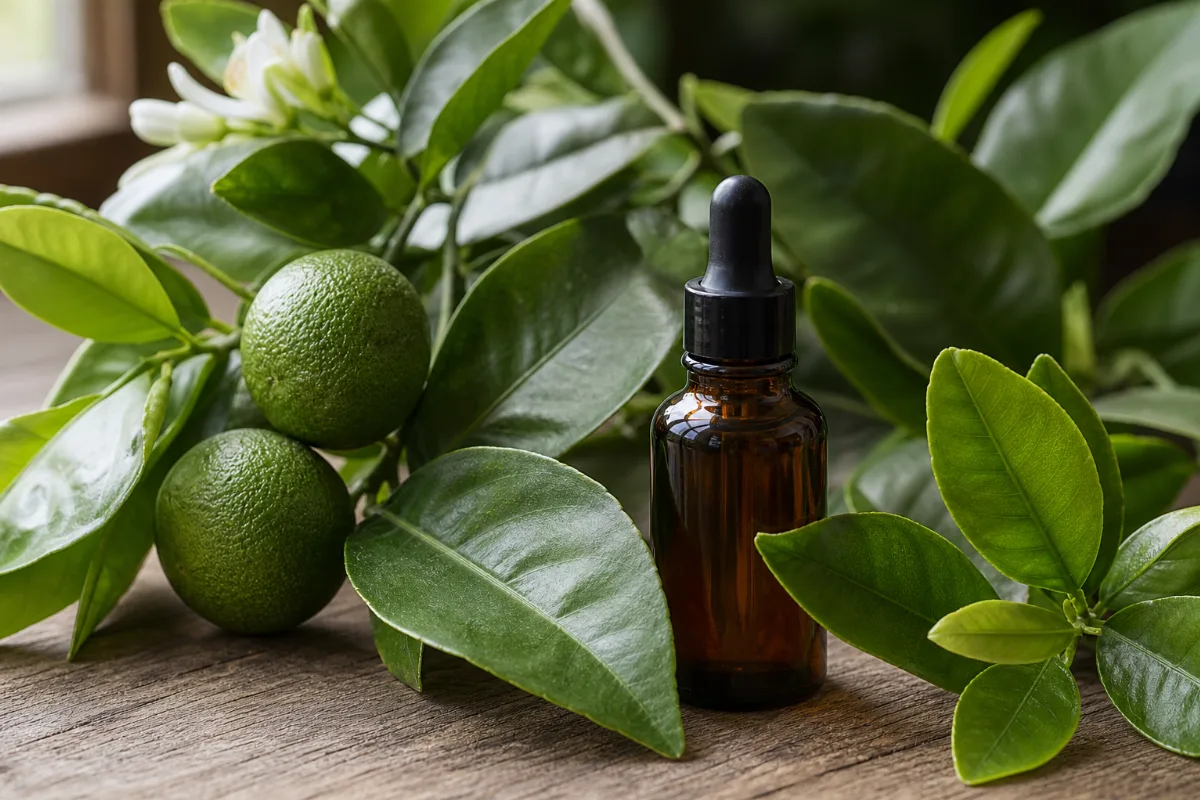
Citrus x aurantium L. (leaves) · also called Petitgrain bigarade oil, bitter orange leaf oil
Petitgrain oil is the fresh, floral-citrus oil steam-distilled from the leaves of the bitter orange tree. It is used as a scent in perfumes, flavourings and aromatherapy. The research is thin: one small one-session trial of its scent, and a sleep trial that used it in a blend of seven oils. The main caution: it is a skin irritant and allergen, it gets more allergenic as it ages in air, and bottled oil should never be swallowed or used undiluted.
General information, not medical advice. Last substantive update · Not medically reviewed. A named clinician has not signed off on this page. How this page is made
About Petitgrain Oil
Petitgrain oil comes from the leaves of the bitter orange tree. It smells fresh, green and floral and is used in perfumes, flavourings and aromatherapy. The human research is very small: one one-session scent trial, and a sleep trial using a seven-oil blend. Safety comes first: it is a skin irritant and sensitiser, it becomes more allergenic as it ages in air, it should not be swallowed, and cats and birds are most at risk from essential oils.
What petitgrain oil is
Petitgrain oil is made by steam-distilling the leaves (EFSA also mentions twigs) of the bitter orange tree, Citrus x aurantium, in the citrus family. The word petitgrain comes from the small green fruit the oil was first made from. The same tree gives neroli oil from its blossoms and a peel oil from the fruit. These are different oils. The word petitgrain is also used for leaf oils of mandarin and lemon trees.
EFSA's specification for the oil is mostly linalyl acetate (40% to 72%) and linalool (10% to 32%), with smaller amounts of alpha-terpineol, limonene, geranyl acetate and geraniol. A lab study of leaves picked in different months found very different amounts, so one bottle can differ from another.
What people use it for, and how strong the evidence is
Petitgrain is used as a scent for calm, stress and sleep. There is one small trial of the scent alone: 42 workers, one session, almond oil as the comparison, a borderline result. Anxiety scores fell in both groups. A 2026 care-home trial of 60 older adults used a five-oil night blend with petitgrain plus a morning blend and found better sleep and memory, but petitgrain cannot be separated from the other oils, and people can smell what they are given.
In test tubes the oil slowed some bacteria and had weak antioxidant results. We found no human trial for skin, acne, pain or infection. This page does not advise any amount or way of use.
The research in one view
A PubMed search for petitgrain found 19 records. Only two were human trials with petitgrain in them, both small and both hard to blind because of the smell. The rest are chemistry, lab tests and safety work. NCCIH says little rigorous research has been done on aromatherapy for insomnia.
Quality and adulteration
Poison Control says essential oils are not well regulated, so it can be hard to know the plant species, the strength or any contaminants in a bottle. A 2021 paper says multiple adulterations of neroli oil are found on the market, and showed lab methods can detect 10% petitgrain oil added to neroli. So expensive neroli may contain petitgrain. We did not find a study of how often petitgrain itself is adulterated. EFSA says the typical shelf life is at least 12 months in tightly closed containers, cool, dry and away from light. Air makes the oil more allergenic.
What authorities say
EFSA (2021) assessed petitgrain bigarade oil as an animal feed flavouring and said it is recognised to flavour food. It also said to consider the oil an irritant to skin, eyes and airways and a skin sensitiser. FDA says claims to treat anxiety or help sleep make a product a drug, and that natural does not mean safe. Poison Control and Pet Poison Helpline give the general warnings above. We did not find or read a RIFM, IFRA, LiverTox, LactMed or EMA statement for petitgrain.
At a glance
Traditional uses history, not proof
- The name comes from the small green fruit the oil was first made from; today it is made from the leaves (EFSA).
- Recognised as a food flavouring and listed in a flavour-ingredients handbook (EFSA).
- The bitter orange plant is commonly used as an alternative treatment for insomnia, anxiety and epilepsy, according to a 2002 mouse paper. That is about the plant, not petitgrain oil.
Studied for research
- Work performance and calm, scent in a room, very-low
- Anxiety and mood, insufficient
- Sleep and memory in older adults, five-oil blend, insufficient
- Slowing germs in a test tube, insufficient
- Antioxidant tests in a dish, insufficient
- Skin care, pain and infection, insufficient (no human trial found)
Main compounds
- Linalyl acetate, 40% to 72% by EFSA specification
- Linalool, 10% to 32% by EFSA specification
- Alpha-terpineol, limonene, geranyl acetate and geraniol in smaller amounts
Common forms
- Essential oil (steam-distilled leaves)
- Fragrance and flavour ingredient
- Aromatherapy blends (scent only)
Research links: EFSA opinion on petitgrain bigarade oil (abstract) · Poison Control: Essential oils · Pet Poison Helpline: Essential oils · Petitgrain scent and work performance trial (abstract) · Sleep and memory blend trial (abstract) · NCCIH: Aromatherapy · Research Library · Genes & Biomarkers Library
What it is and its history
- Accepted scientific name
- Citrus x aurantium
- Naming authority
- L.
- Common names
- Petitgrain oil (English); Petitgrain bigarade oil (English); Bitter orange leaf oil (English)
- Family or group
- Rutaceae (citrus family), per GBIF.
- Classification
- Plantae > Tracheophyta > Magnoliopsida > Sapindales > Rutaceae > Citrus > Citrus aurantium
- Native range
- EFSA calls Citrus x aurantium a native species to Europe, widely grown commercially and for decoration. The four batches EFSA assessed came from Egypt.
- Habitat
- Not checked.
- What it looks like
- Part used: Leaves (and twigs, per EFSA's consumer section) are steam-distilled. This page does not describe how to recognise the plant.
- Cultivation
- Not covered by the sources read.
- Harvest and processing
- Steam distillation of the leaves; the vapour is condensed and the oil separated from the water by decantation (EFSA). A lab study used hydrodistillation on leaves picked at five times of the year.
- Look-alikes and adulterants
- Name: Neroli oil (same tree, blossoms); Note: A different oil with its own page. The patch-test data cited here concern neroli, not petitgrain.; Name: Bitter orange peel oil (same tree, fruit); Note: A different oil with its own page.; Name: Petitgrain mandarin and petitgrain lemon oils; Note: Leaf oils from other citrus trees sold under the same word 'petitgrain'. A 2013 paper treats them as separate oils.
- Sustainability and conservation
- Not covered by the sources read.
Traditional use and history history, not clinical proof
| Tradition or era | Documented use | Source |
|---|---|---|
| Name origin | EFSA says 'petitgrain' refers to the small green fruit from which the oil was originally extracted, and 'bigarade' is an anglicised form of the French for bitter orange. Today the oil comes from the leaves. | EFSA FEEDAP Panel 2021 |
| Flavour and fragrance | EFSA says petitgrain bigarade oil is recognised to flavour food and is listed in Fenaroli's Handbook of Flavour Ingredients and by FEMA (number 2855). | EFSA FEEDAP Panel 2021 |
| Traditional medicine of the bitter orange plant | A 2002 paper says Citrus aurantium is commonly used as an alternative treatment for insomnia, anxiety and epilepsy. This is about the plant in general, not petitgrain oil. | Carvalho-Freitas and Costa 2002 (abstract) |
Traditional use shows how it was used. It does not show that it works or is safe today.
What is inside, and how it may work
What it contains and how those compounds act in cells and animals. Laboratory and animal mechanisms are not proven effects in people.
Main compounds
| Compound | Family | Where it is concentrated | Activity studied | Level of evidence |
|---|---|---|---|---|
| Linalyl acetate PubChem 8294 | monoterpene ester | Steam-distilled leaf oil 40% to 72% by EFSA specification (mean 53.25% in four Egyptian batches). A lab study found 0.77% to 24.77% in oils from leaves picked in different months. | Weakly allergenic when fresh and much more allergenic after air oxidation (mouse test). Its role in people's mood or sleep is not shown. 20 4 6 14 | Laboratory |
| Linalool PubChem 6549 | monoterpene alcohol | Steam-distilled leaf oil 10% to 32% by EFSA specification (mean 24.55%). A lab study found 43.2% to 65.97% in other leaf oils. | Forms allergenic hydroperoxides on air exposure. Its role in people's mood or sleep is not shown. 21 4 6 11 | Laboratory |
| Other main components | terpenes and terpene esters | Steam-distilled leaf oil Alpha-terpineol (1% to 7%), limonene (1% to 6%), geranyl acetate (1.5% to 5.5%) and geraniol (1% to 4%) by EFSA specification. | Not described for petitgrain in the sources read. 4 | Laboratory |
Mechanisms, receptors and pathways
| Target or pathway | Gene or receptor | What was found | Level |
|---|---|---|---|
| Autonomic nervous system (suggested) | The 2017 trial authors suggest petitgrain's main compounds balance the sympathetic and parasympathetic systems. The study measured heart-rate variability but did not test the compounds or a mechanism. 10 | Hypothesis | |
| Growth of bacteria and fungi in a dish | Leaf oil slowed Bacillus subtilis and Staphylococcus aureus at a few mg/mL, with weaker effects on a yeast and a fungus. The authors link some effects to caryophyllene oxide. Dish work only. 6 | Laboratory research | |
| Skin sensitisation after air oxidation | Linalyl acetate and linalool form hydroperoxides in air, and these are the most potent sensitisers among the oxidation products (mouse test; patients allergic to oxidised linalool also reacted to oxidised linalyl acetate). 14 9 11 | Animal and patch test |
Absorption, metabolism and elimination
- Absorption
- Not established for petitgrain oil in the sources read. EFSA's feed opinion says the main compounds are expected to be extensively metabolised and excreted in the animal species.
- Distribution
- Not established.
- Metabolism
- EFSA notes cats have an unusually low capacity for glucuronidation, which is why it set the lowest safe feed level for cats.
- Elimination
- Not established.
- Bioavailability
- Not established.
Isolated compounds versus whole extracts
The leaf oil is a mixture of many compounds, with linalyl acetate and linalool the largest. Results for the whole oil, for single compounds, and for other oils such as lavender, neroli, peel oil or blends do not carry over to each other. The sleep and memory trial used a blend of seven oils.
Nutritional composition
Petitgrain oil is not a nutrient. EFSA says it is recognised as a food flavouring, which concerns small amounts in food. Bottled essential oil should not be swallowed.
1 very low certainty5 not enough evidence
What is Petitgrain Oil good for?
The uses people ask about and how strong the evidence is for each. Read the certainty label first: the research is scent in a room, a blend, or test-tube work, not bottled oil swallowed or used undiluted.
Benefits, one by one
Each card is a research question, not a promise. Tap a goal to filter. Open a card to see the studies, doses and limits.
Work performance and calm (petitgrain scent in a room)
Very low certaintyIn one small one-session trial, office workers in a room scented with petitgrain finished a computer task a little faster than workers in a room with almond oil. The result was borderline and has not been repeated, so the certainty is very low.
2 studiesStudied as scent in the air (diffuser or inhaled blend). No amounts a…
Studies, doses and limits
What the trials found
One randomized trial (Huang and Capdevila 2017): 42 university administrative staff in a computer classroom, petitgrain oil diffused for the scent group and almond oil for the control group, in a single session.
Results
The petitgrain group finished the task 2.28 minutes faster (p = 0.05). Four heart-rate variability measures differed between groups (p = 0.02 to 0.05). Everyone in both groups scored lower on anxiety and tension questionnaires after the session, so the abstract does not show a calming effect specific to petitgrain.
Effect sizes as reported
Task time 2.28 minutes faster than control (p = 0.05). Heart-rate variability differences at p = 0.02 to 0.05.
Why this rating
One small trial, one session, borderline p-values, no repeat study, and people can smell which room they are in. The abstract gives no group sizes, funding or registration.
Form and dose studied
Studied as scent in the air (diffuser or inhaled blend). No amounts are advised here. Bottled essential oil is concentrated: do not swallow it and do not use it undiluted on skin; ask a pharmacist.
Who was studied
Healthy administrative workers at one university.
Limits
The abstract says the starting sample was 42 people but not how many were analysed. It does not give the strength of the scent in the room.
Why researchers looked
Petitgrain smells fresh and floral, and its main scent compounds (linalyl acetate and linalool) are also found in lavender. Researchers wondered whether it would calm the body's stress response.
Traditional use
No traditional use for petitgrain oil was found in the sources read.
Proposed mechanism Preliminary mechanism
The authors suggest a balance of the 'fight or flight' and 'rest and digest' nervous systems through linalyl acetate, linalool and myrcene. The study did not test this. It is an idea, not a finding.
A proposed mechanism does not show that the effect happens in people.
Breathing essential oil can irritate the airways (EFSA), and the oil is a skin sensitiser. See the Safety tab. Not studied in children, pregnancy or people with asthma.
Anxiety and mood
Not enough evidenceNo trial showed that petitgrain oil lowers anxiety more than a neutral scent. The one human trial that measured anxiety saw scores fall in both groups. An animal study found calming effects, but of bitter orange peel oil and a leaf extract, not petitgrain.
4 studiesStudied as scent in the air (diffuser or inhaled blend). No amounts a…
Studies, doses and limits
What the trials found
The petitgrain diffuser trial measured anxiety (STAI) and mood (POMS). NCCIH says little rigorous research has been done on aromatherapy for insomnia and that one lemon and lavender study found no effect on stress indicators. A 2022 review describes citrus oils as relaxing but its abstract does not rate the human evidence.
Results
Diffuser trial: anxiety, tension and vigour scores fell in every participant, with no scent-specific group difference reported in the abstract. Mouse study: effects seen with peel oil, not leaf oil.
Effect sizes as reported
Not available: no anxiety trial of petitgrain oil with a group difference was found.
Why this rating
No human trial isolates petitgrain's effect on anxiety or mood. The animal study used a different oil and is not evidence for people.
Form and dose studied
Studied as scent in the air (diffuser or inhaled blend). No amounts are advised here. Bottled essential oil is concentrated: do not swallow it and do not use it undiluted on skin; ask a pharmacist.
Who was studied
None for petitgrain alone.
Limits
Mixed preparations, a different oil in animals, and only one small human trial measuring anxiety.
Why researchers looked
Citrus oils are widely used in aromatherapy to relax and lift mood.
Traditional use
A 2002 mouse paper says the bitter orange plant is commonly used as an alternative treatment for insomnia, anxiety and epilepsy. That statement is about the plant, not specifically petitgrain oil.
Proposed mechanism Preliminary mechanism
Not shown for petitgrain. A mouse study of bitter orange peel oil found longer barbiturate sleeping time and more time in the open arms of a maze, which the authors take as sedative and anxiety-lowering signs. That was peel oil swallowed by mice.
A proposed mechanism does not show that the effect happens in people.
Do not swallow. The mouse study gave oil by mouth; this page does not advise that.
Sleep and memory in older adults (five-oil night blend)
Not enough evidenceIn a care home, older adults who breathed a night blend that included petitgrain, along with a morning blend, slept better and scored better on memory tests than a control group. Because seven oils were mixed, we cannot say what petitgrain did.
2 studiesStudied as scent in the air (diffuser or inhaled blend). No amounts a…
Studies, doses and limits
What the trials found
One single-blind randomized trial (Ede Sarikaya 2026, NCT06208800): 60 care-home residents aged 65 or older in Istanbul. The night blend was vetiver, cedarwood, clary sage, petitgrain and grapefruit; the morning blend was peppermint and palmarosa; each inhaled for 10 minutes a day for 30 days.
Results
Versus control: more total sleep, more REM and deep sleep and a shorter time to fall asleep on a smartwatch (all p < .001), better sleep and sleepiness questionnaires, and better orientation, memory and concentration scores.
Effect sizes as reported
Reported by the authors as large (d = 1.12 to 1.47) for the whole blend, not for petitgrain alone.
Why this rating
A multi-oil blend, one care home, single-blind (people can smell the oil), consumer smartwatch sleep data, and no arm for petitgrain alone. The trial can say nothing about petitgrain on its own.
Form and dose studied
Studied as scent in the air (diffuser or inhaled blend). No amounts are advised here. Bottled essential oil is concentrated: do not swallow it and do not use it undiluted on skin; ask a pharmacist.
Who was studied
Adults 65 and older in one residential care home.
Limits
Seven oils in two blends. Funding not stated in the abstract.
Why researchers looked
Sleep problems and memory decline often occur together in older people, and researchers tested scent blends as a gentle add-on.
Traditional use
No traditional use for petitgrain oil in sleep was found in the sources read.
Proposed mechanism Preliminary mechanism
Not assessed by the trial.
A proposed mechanism does not show that the effect happens in people.
Older skin and lungs may react to oils; see Safety.
Slowing germs in a test tube
Not enough evidenceIn a lab, petitgrain oil slowed the growth of some bacteria, a yeast and a fungus. That does not show it treats any infection in a person.
1 studiesLab study only. No use is advised.
Studies, doses and limits
What the trials found
None found.
Results
Antibacterial activity against 12 organisms was tested. The strongest effects were on Gram-positive bacteria, with weaker effects on yeast and fungus.
Effect sizes as reported
Lowest effective amounts in the dish: 2.7 mg/mL (Bacillus subtilis), 4.8 mg/mL (Staphylococcus aureus), 9.2 mg/mL (a yeast), 5 mg/mL (a fungus).
Why this rating
Lab only. No animal or human infection study of petitgrain was found.
Form and dose studied
Lab study only. No use is advised.
Who was studied
None.
Limits
Hydrodistilled oils from one region; test-tube amounts are not amounts that could be used safely on a person.
Why researchers looked
Many plant oils slow germs in a dish, so researchers tested petitgrain from leaves collected in different seasons.
Traditional use
No traditional use found in the sources read.
Proposed mechanism Preliminary mechanism
The authors found positive links between certain oil compounds, such as caryophyllene oxide, and germ-slowing, and saw different results by harvest month. This is correlation in a dish.
A proposed mechanism does not show that the effect happens in people.
The oil is a skin sensitiser; do not put bottled oil on skin or wounds undiluted.
Antioxidant tests in a dish
Not enough evidenceIn dish tests, petitgrain oil showed weak antioxidant activity in one study, while another found that oil from old leaves scored best among bitter orange oils. Antioxidant tests in a dish do not show a benefit in the body.
2 studiesLab study only. No use is advised.
Studies, doses and limits
What the trials found
None found.
Results
2012 (five seasonal samples): weak activity in both tests. 2013 (Greek trees): old-leaf oil had the highest DPPH activity of peel, flower, young-leaf and old-leaf oils.
Effect sizes as reported
Antioxidant activity weak (IC50 above 10,000 mg/L in two tests).
Why this rating
Test-tube results that differ between studies; no human or animal outcome.
Form and dose studied
Lab study only. No use is advised.
Who was studied
None.
Limits
Different methods and trees. 'Antioxidant' in a dish is not a health claim.
Why researchers looked
Citrus oils are often screened for antioxidant activity.
Traditional use
No traditional use found in the sources read.
Proposed mechanism Preliminary mechanism
Chemical tests (DPPH and ABTS) of how well the oil neutralises test radicals. The authors link the weak result to a small amount of phenols in the oil.
A proposed mechanism does not show that the effect happens in people.
None specific.
Skin care, acne, pain and infection
Not enough evidenceWe found no human trial of petitgrain oil for skin conditions, pain or infection. Websites that promote it for these uses are going beyond the research we could find.
2 studiesNo use is advised.
Studies, doses and limits
What the trials found
None found in a PubMed search for petitgrain (19 records, none a skin, pain or infection trial in people). NCCIH says little rigorous research has been done on aromatherapy generally.
Results
No results to report.
Effect sizes as reported
Not available.
Why this rating
No evidence in people.
Form and dose studied
No use is advised.
Who was studied
None.
Limits
Absence from PubMed is not proof of no effect, but it means there is nothing to rely on.
Why researchers looked
Not studied in people for these uses.
Traditional use
Not found in the sources read.
Proposed mechanism Preliminary mechanism
Not assessed.
A proposed mechanism does not show that the effect happens in people.
The oil is a skin irritant and sensitiser (EFSA). See Safety.
Connections to the rest of health
How Petitgrain Oil connects to the rest of our health knowledge graph. Every link says what kind of connection it is. A safety link (for example to the liver) is a warning, not a benefit. A study that merely mentions a topic never creates a benefit link.
Explore every connection: goals, body systems, organs, symptoms, genes
A. Wellness goals
| Connected to | Kind of connection | Evidence status | Context | Studies |
|---|---|---|---|---|
| Productivity Support | Very low certainty | Work performance and calm (petitgrain scent in a room): In one small one-session trial, office workers in a room scented with petitgrain finished a computer task a little faster than workers in a room with almond oil. The result was borderline and has not been repeated, so the certainty is very low. | 10 4 | |
| Stress Reduction | Very low certainty | Work performance and calm (petitgrain scent in a room): In one small one-session trial, office workers in a room scented with petitgrain finished a computer task a little faster than workers in a room with almond oil. The result was borderline and has not been repeated, so the certainty is very low. | 10 4 | |
| Anxiety Support | Not enough evidence | Anxiety and mood: No trial showed that petitgrain oil lowers anxiety more than a neutral scent. The one human trial that measured anxiety saw scores fall in both groups. An animal study found calming effects, but of bitter orange peel oil and a leaf extract, not petitgrain. | 10 2 1 17 | |
| Calm Relaxation | Not enough evidence | Anxiety and mood: No trial showed that petitgrain oil lowers anxiety more than a neutral scent. The one human trial that measured anxiety saw scores fall in both groups. An animal study found calming effects, but of bitter orange peel oil and a leaf extract, not petitgrain. | 10 2 1 17 | |
| Mood Balance | Not enough evidence | Anxiety and mood: No trial showed that petitgrain oil lowers anxiety more than a neutral scent. The one human trial that measured anxiety saw scores fall in both groups. An animal study found calming effects, but of bitter orange peel oil and a leaf extract, not petitgrain. | 10 2 1 17 | |
| Better Sleep | Not enough evidence | Sleep and memory in older adults (five-oil night blend): In a care home, older adults who breathed a night blend that included petitgrain, along with a morning blend, slept better and scored better on memory tests than a control group. Because seven oils were mixed, we cannot say what petitgrain did. | 5 17 | |
| Memory Support | Not enough evidence | Sleep and memory in older adults (five-oil night blend): In a care home, older adults who breathed a night blend that included petitgrain, along with a morning blend, slept better and scored better on memory tests than a control group. Because seven oils were mixed, we cannot say what petitgrain did. | 5 17 | |
| Immune Support | Not enough evidence | Slowing germs in a test tube: In a lab, petitgrain oil slowed the growth of some bacteria, a yeast and a fungus. That does not show it treats any infection in a person. | 6 | |
| Cellular Protection | Not enough evidence | Antioxidant tests in a dish: In dish tests, petitgrain oil showed weak antioxidant activity in one study, while another found that oil from old leaves scored best among bitter orange oils. Antioxidant tests in a dish do not show a benefit in the body. | 6 12 | |
| Healthy Skin | Not enough evidence | Skin care, acne, pain and infection: We found no human trial of petitgrain oil for skin conditions, pain or infection. Websites that promote it for these uses are going beyond the research we could find. | 17 4 |
B. Body systems
| Connected to | Kind of connection | Evidence status | Context | Studies |
|---|---|---|---|---|
| Stress Mood | Biological association | Very low certainty | Studied for: Work performance and calm (petitgrain scent in a room) Studied for: Anxiety and mood | 10 4 2 1 17 |
| Nervous System | Biological association | Very low certainty | Studied for: Work performance and calm (petitgrain scent in a room) Studied for: Anxiety and mood | 10 4 2 1 17 |
| Sleep Recovery | Biological association | Not enough evidence | Studied for: Sleep and memory in older adults (five-oil night blend) | 5 17 |
| Brain Focus | Biological association | Not enough evidence | Studied for: Sleep and memory in older adults (five-oil night blend) | 5 17 |
| Skin Hair Beauty | Biological association | Not enough evidence | Studied for: Slowing germs in a test tube Studied for: Skin care, acne, pain and infection | 6 17 4 |
| Immune System | Biological association | Not enough evidence | Studied for: Slowing germs in a test tube | 6 |
| Whole Body Balance | Biological association | Not enough evidence | Studied for: Antioxidant tests in a dish | 6 12 |
| Integumentary System | Biological association | Not enough evidence | Studied for: Skin care, acne, pain and infection | 17 4 |
E. Health conditions
| Connected to | Kind of connection | Evidence status | Context | Studies |
|---|---|---|---|---|
| Allergic contact dermatitis | Adverse effect or risk | Documented risk | Skin sensitiser per EFSA; oxidised linalyl acetate and linalool are potent allergens in lab and patch-test work. Skin sensitiser per EFSA; oxidised linalyl acetate and linalool are potent allergens in lab work. Preparation or compound: Petitgrain oil, especially air-exposed oil |
4 14 9 11 |
| Essential oil poisoning | Adverse effect or risk | Documented risk | General warnings; no petitgrain case found. Preparation or compound: Swallowed essential oils in general |
15 16 |
I. Biomarkers
| Connected to | Kind of connection | Evidence status | Context | Studies |
|---|---|---|---|---|
| Heart-rate variability (HRV) | Biological association | Very low certainty | Measured in trials: mixed. A lab change is not the same as a health benefit. | 10 |
| Anxiety questionnaire score (STAI) | Biological association | Not enough evidence | Measured in trials: decrease in all groups. A lab change is not the same as a health benefit. | 10 |
L. Active compounds
| Connected to | Kind of connection | Evidence status | Context | Studies |
|---|---|---|---|---|
| Linalyl acetate | Biological association | Laboratory | Weakly allergenic when fresh and much more allergenic after air oxidation (mouse test). Its role in people's mood or sleep is not shown. Preparation or compound: Steam-distilled leaf oil |
20 4 6 14 |
| Linalool | Biological association | Laboratory | Forms allergenic hydroperoxides on air exposure. Its role in people's mood or sleep is not shown. Preparation or compound: Steam-distilled leaf oil |
21 4 6 11 |
| Other main components | Biological association | Laboratory | Not described for petitgrain in the sources read. Preparation or compound: Steam-distilled leaf oil |
4 |
Each connection is stored with the ingredient, the connected record, the kind of connection, the evidence status, the supporting studies, the preparation or compound involved, and a review date (last reviewed October 25, 2026).
Evidence at a glance: what changed in 1 lab markers
Tap a number to show only those markers. Counts are markers, not people.
The evidence
The research centre for Petitgrain Oil. Every record here was checked against PubMed or the publisher's page; we never list a study we have not verified.
Evidence by outcome
Bars show how many studies we found for each outcome, not how well it works. People are added up across trials only (reviews are not added, to avoid double counting).
How we rate evidence
High certainty
Several well-run trials or reviews agree; further research is unlikely to change the picture much.
Moderate certainty
Good trials point the same way, but some doubt remains.
Low certainty
Small, short or inconsistent trials. The finding could change with better research.
Very low certainty
Very little or very weak human data. Treat as a possibility only.
Mixed findings
Trials or reviews disagree with each other.
Not enough evidence
Not enough human research to say either way.
Evidence against
Good research found no benefit, or found harm.
We take the reviewers' own risk-of-bias and GRADE statements where they exist, and otherwise judge from study size, design, consistency, directness and whether a product matches what is sold. Many publications do not make evidence high. Method note: We read the abstracts of 14 PubMed records, the full EFSA opinion on petitgrain bigarade oil, and the Poison Control, Pet Poison Helpline, FDA and NCCIH pages, and checked the plant name in GBIF and the compounds in PubChem. We did not find or read a RIFM, IFRA, LiverTox or LactMed statement.
Study library: every study we checked 21
| Study | Design | People | Product, dose, length | Result |
|---|---|---|---|---|
| Agarwal 2022 Citrus Essential Oils in Aromatherapy: Therapeutic Effects and Mechanisms. Antioxidants (Basel) · PMID 36552586 · DOI |
Narrative review review |
Published work on citrus essential oils from fruit peel, flowers and leaves | Citrus essential oils in general leaf, flower and peel oils n/a n/a · vs n/a |
A general review. It says citrus oils are used in aromatherapy for their scent and are said to relax and lift mood, and it focuses on antioxidant properties. The abstract does not rate the human evidence or name petitgrain. Methods, limits and fundingOutcomes: Composition, properties and proposed mechanisms of citrus oils in aromatherapy Limitations: A broad review of many citrus oils; the abstract gives no trial counts, safety findings or ratings for petitgrain. Funding and conflicts: Not stated in the abstract. Read: abstract |
| Carvalho-Freitas 2002 Anxiolytic and sedative effects of extracts and essential oil from Citrus aurantium L. Biological and Pharmaceutical Bulletin · PMID 12499653 · DOI |
Animal study mouse |
Male Swiss mice | Bitter orange PEEL essential oil and a leaf extract (70% ethanol-water), swallowed by mice peel oil; leaf extract (not leaf essential oil) 0.5 and 1.0 g/kg in mice Single doses, tests 30 minutes later · vs Control mice |
In mice, the peel oil at the higher amount increased barbiturate sleeping time and open-arm time in the maze, and at the lower amount delayed seizures. Some leaf-extract fractions lengthened sleeping time. The leaf essential oil (petitgrain) itself was not tested. Methods, limits and fundingOutcomes: Sleeping time after a sedative, time in the open arms of a maze, seizure tests Limitations: Mouse study. The oil tested was peel oil, not petitgrain, and it was swallowed, which this page does not advise. It does not show anything about people. Funding and conflicts: Not stated in the abstract. Read: abstract |
| Cuchet 2021 Determination of enantiomeric and stable isotope ratio fingerprints of active secondary metabolites in neroli (Citrus aurantium L.) essential oils for authentication by multidimensional gas chromatography and GC-C/P-IRMS. Journal of Chromatography B · PMID 34731745 · DOI |
Laboratory study in vitro |
Neroli oils (bitter orange blossoms) tested for adulteration | Neroli oil, with petitgrain oil added as a test adulterant blossom oil n/a n/a · vs n/a |
The authors say multiple adulterations of neroli oil are found on the market. Their isotope and enantiomer methods could detect an addition of 10% of petitgrain oil to neroli. Methods, limits and fundingOutcomes: Whether lab methods can detect adulteration Limitations: About neroli, not petitgrain quality. It shows petitgrain is used to stretch the more expensive neroli oil, and says nothing about how often petitgrain itself is faked. Funding and conflicts: Not stated in the abstract. Read: abstract |
| EFSA FEEDAP Panel (Bampidis 2021 Safety and efficacy of a feed additive consisting of an essential oil from the leaves of Citrus x aurantium L. (petitgrain bigarade oil) for use in all animal species (FEFANA asbl). EFSA Journal · PMID 34136000 · DOI |
Authoritative guidance regulatory |
Four batches of petitgrain bigarade oil from Egypt, assessed as an animal feed flavouring | Petitgrain bigarade oil leaf (the opinion also says leaves and twigs) n/a n/a · vs n/a |
Main components were linalyl acetate (40% to 72%; mean 53.25% in four batches), linalool (10% to 32%; mean 24.55%), alpha-terpineol, limonene, geranyl acetate and geraniol. The panel set different safe feed levels for different animals, lowest for cats (because cats clear many compounds slowly), and said the oil should be considered an irritant to skin, eyes and the respiratory tract and a skin sensitiser. It found no consumer safety concern from the feed use. Bergapten (a sun-sensitising compound reported in aerial parts of the plant) was below the detection limit in all four batches. No specific safety data for users were provided; the maker's safety data sheet lists skin and eye irritation and sensitisation hazards. Data on contaminants were not provided. Methods, limits and fundingOutcomes: Composition, safety for animals, consumers, users and the environment Limitations: A regulatory opinion about animal feed, using one company's four batches from Egypt. It is not a human skin or aromatherapy study. The panel read no data on pregnancy or children. Funding and conflicts: Request from the European Commission; applicant FEFANA (feed-additive industry association). Read: full-text |
| Ede Sarikaya 2026 Effects of inhaled aromatherapy on sleep quality and cognitive function in older adults: a randomised controlled trial. Journals of Gerontology. Series A · PMID 42011111 · DOI |
Randomized controlled trial |
60 Adults aged 65 or older living in a care home in Istanbul |
Five-oil night blend (vetiver, cedarwood, clary sage, petitgrain, grapefruit) plus a morning peppermint-palmarosa blend, inhaled essential oils not stated in the abstract 10 minutes a day for 30 days · vs Control group (no blend described in the abstract) |
Compared with the control group, the blend group had more total sleep time (d = 1.29), more REM sleep (d = 1.34), more deep sleep (d = 1.47) and shorter time to fall asleep (d = -1.12), all p < .001, and better memory and orientation scores. The abstract does not separate petitgrain from the other oils. Methods, limits and fundingOutcomes: Pittsburgh Sleep Quality Index, Epworth Sleepiness Scale, memory and orientation test, and smartwatch sleep measures Limitations: Single-blind, 60 people, one care home, 30 days. Seven oils in two blends, so petitgrain's own part cannot be known. People can smell what they are given. The sleep data came from consumer smartwatches. Funding not stated in the abstract. Funding and conflicts: Not stated in the abstract. Registration: NCT06208800 Read: abstract |
| Ellouze 2012 Season's variation impact on Citrus aurantium leaves essential oil: chemical composition and biological activities. Journal of Food Science · PMID 22897411 · DOI |
Laboratory study in vitro |
Petitgrain oils distilled from bitter orange leaves taken at 5 times of the year | Petitgrain essential oil (hydrodistilled) leaf n/a n/a · vs n/a |
46 compounds identified. Main ones: linalool (43.2% to 65.97%), linalyl acetate (0.77% to 24.77%) and alpha-terpineol (9.29% to 12.12%), with clear differences by harvest month. Antioxidant activity was weak. Against bacteria the lowest effective amounts were 2.7 mg/mL for Bacillus subtilis and 4.8 mg/mL for Staphylococcus aureus, with weaker effects on yeast (9.2 mg/mL) and a fungus (5 mg/mL). Methods, limits and fundingOutcomes: Composition by GC-MS; antioxidant and antimicrobial activity in the lab Limitations: Test-tube work only. It shows the oil can slow some germs in a dish, not that it treats any infection in a person. One region's samples. Funding and conflicts: Not stated in the abstract. Read: abstract |
| Geier 2015 Diagnostic workup of fragrance allergy. Der Hautarzt · PMID 26253114 · DOI |
Narrative review review |
Patients with suspected fragrance contact allergy | Fragrance materials n/a n/a n/a · vs n/a |
Lists frequently sensitizing fragrance materials, including ylang ylang, lemongrass, sandalwood and jasmine, and, less frequently, clove, cedarwood, neroli (Citrus aurantium amara flower oil) and patchouli. Petitgrain is not on the list in the abstract. It says the two standard fragrance mixes give false-positive reactions in up to 50% of patch-tested patients, so single components must also be tested. Methods, limits and fundingOutcomes: How fragrance allergy is diagnosed and which materials are frequent sensitizers Limitations: An expert review in German with an English abstract. Not being named in an abstract is not proof of safety. Funding and conflicts: Not stated in the abstract. Read: abstract |
| Geier 2022 Contact sensitization to essential oils: IVDK data of the years 2010-2019. Contact Dermatitis · PMID 35417610 · DOI |
Retrospective analysis |
10930 Dermatitis patients patch-tested to 12 essential oils at German-speaking skin clinics |
Twelve essential oils, patch tested (the abstract names six; petitgrain is not named) oils n/a 2010 to 2019 · vs n/a |
Of 10,930 patients, 908 (8.3%) reacted to at least one oil. Six oils had more than 1% positive tests: ylang ylang (3.9%), lemongrass (2.6%), jasmine absolute (1.8%), sandalwood (1.8%), clove (1.6%) and neroli (1.1%). Reactions among oils, and to oils and fragrances, were frequent. Masseurs and cosmeticians were at higher risk. Methods, limits and fundingOutcomes: Share of patients with a positive patch test Limitations: Skin-clinic patients, not the general public. Petitgrain is not named in the abstract, so no petitgrain rate is available. Neroli is a different oil from the same tree (blossoms). Funding and conflicts: Not stated in the abstract. Read: abstract |
| Hagvall 2008 Lavender oil lacks natural protection against autoxidation, forming strong contact allergens on air exposure. Contact Dermatitis · PMID 18759894 · DOI |
Laboratory study human and mouse |
Lavender oil exposed to air; mouse test; patients already allergic to oxidized linalool | Lavender oil (a different oil, rich in linalool and linalyl acetate) flower oil n/a Air exposure · vs n/a |
Linalool and linalyl acetate oxidized in air-exposed lavender oil at the same rate as the pure compounds, and the oil became a stronger sensitizer. Patients allergic to oxidized linalool also reacted on patch testing to air-exposed lavender oil and to oxidized linalyl acetate. Methods, limits and fundingOutcomes: Oxidation, sensitizing strength, and patch-test reactions Limitations: This is lavender oil, not petitgrain. It matters here only because petitgrain oil is also rich in linalool and linalyl acetate. Whether petitgrain behaves the same way in daily use was not tested in this study. Funding and conflicts: Not stated in the abstract. Read: abstract |
| Huang 2017 Aromatherapy Improves Work Performance Through Balancing the Autonomic Nervous System. Journal of Alternative and Complementary Medicine · PMID 27763785 · DOI |
Randomized controlled trial |
42 Administrative university workers (initial sample 42, mean age 42, 10 men) |
Petitgrain essential oil, diffused in the room essential oil (plant part not stated in the abstract) not stated in the abstract One session, while doing a computer task · vs Almond oil diffused (neutral oil) |
The petitgrain group finished the task 2.28 minutes faster than the control group (p = 0.05). Some heart-rate variability measures differed between groups (low frequency p = 0.05, high frequency p = 0.02, SDNN p = 0.05, RMSSD p = 0.02). Everyone, in both groups, scored lower on anxiety (STAI), tension and vigour scales after the session. 2.28 minutes faster task time vs control (p = 0.05) Methods, limits and fundingOutcomes: Time to finish a computer task; anxiety (STAI) and mood (POMS) questionnaires; heart-rate variability (HRV) Limitations: One short session, small sample, p-values at or near 0.05. The abstract does not say how many people finished or give group sizes, funding or a registration. Smell cannot be hidden from the control group. The authors credit linalyl acetate, linalool and myrcene, but the study did not test that. Funding and conflicts: Not stated in the abstract. Read: abstract |
| Rudback 2014 Determination of allergenic hydroperoxides in essential oils using gas chromatography with electron ionization mass spectrometry. Journal of Separation Science · PMID 24482420 · DOI |
Laboratory study in vitro |
Essential oils left to oxidize in air in the lab | Sweet orange oil and petitgrain oil, autoxidized oils n/a Two months in air · vs n/a |
Isomers of linalyl acetate hydroperoxide and linalool hydroperoxide were detected in petitgrain oil that had been autoxidized for two months. (In sweet orange oil, limonene-2-hydroperoxide was found at 19 micrograms per mg.) Methods, limits and fundingOutcomes: Detection of allergy-causing hydroperoxides Limitations: A chemistry method paper. It shows the compounds can form; it does not give a skin-reaction rate for petitgrain. The abstract does not name the petitgrain's tree species. Funding and conflicts: Not stated in the abstract. Read: abstract |
| Sarrou 2013 Volatile constituents and antioxidant activity of peel, flowers and leaf oils of Citrus aurantium L. growing in Greece. Molecules · PMID 24002139 · DOI |
Laboratory study in vitro |
Bitter orange peel, flower (neroli) and leaf (petitgrain) oils from trees in Greece | Peel, flower and leaf essential oils peel, flower, leaf (old and young) n/a n/a · vs n/a |
31 components were measured across the three oils. Linalool ranged from 0.76% to 58.21% and limonene from 0.53% to 94.67% across the different plant parts. In the DPPH test the oil from old leaves had the highest antioxidant activity of the four samples, followed by flowers, young leaves and peel. Methods, limits and fundingOutcomes: Composition by GC-MS; antioxidant activity (DPPH test) Limitations: Lab chemistry only. The abstract does not say which part gave which figure, and antioxidant tests in a dish do not show a benefit in the body. Funding and conflicts: Not stated in the abstract. Read: abstract |
| Schipilliti 2013 Determination of petitgrain oils landmark parameters by using gas chromatography-combustion-isotope ratio mass spectrometry and enantioselective multidimensional gas chromatography. Analytical and Bioanalytical Chemistry · PMID 22552788 · DOI |
Laboratory study in vitro |
Italian mandarin and lemon petitgrain oils | Mandarin and lemon petitgrain oils (leaf oils of OTHER citrus trees) leaf n/a n/a · vs n/a |
Measured the chemistry of mandarin and lemon petitgrain oils and compared it with the matching peel oils. The abstract reports that the isotope values of the petitgrain oils were very close to those of the matching peel oils. Methods, limits and fundingOutcomes: Reference chemistry for authenticity checks Limitations: About petitgrain from mandarin and lemon trees, not bitter orange. It is cited only to show that the name petitgrain covers leaf oils from several citrus trees. Funding and conflicts: Not stated in the abstract. Read: abstract |
| Skold 2008 Autoxidation of linalyl acetate, the main component of lavender oil, creates potent contact allergens. Contact Dermatitis · PMID 18154552 · DOI |
Laboratory study mouse |
Pure linalyl acetate exposed to air; mouse skin-sensitization test (local lymph node assay) | Linalyl acetate (a main component of petitgrain oil as well as lavender oil) synthetic compound n/a Air exposure for up to 10 weeks · vs n/a |
Linalyl acetate lost content on air exposure and formed hydroperoxides, an epoxide and an alcohol. Pure linalyl acetate was a weak sensitizer (EC3 25%). After 10 weeks in air the sample was much stronger (EC3 3.6%). The authors say the hydroperoxides were the most potent. Methods, limits and fundingOutcomes: Oxidation products and allergy-causing strength (EC3 value; lower means stronger) Limitations: A pure compound tested in mice, not petitgrain oil in people. Funding and conflicts: Not stated in the abstract. Read: abstract |
| n/a Poison Control (America's Poison Centers): Essential oils, poisonous when misused (page read 2026-10-25; no date shown) n/a · Source |
Authoritative guidance n/a |
n/a | n/a n/a n/a n/a · vs n/a |
Misuse of essential oils can cause serious poisoning. Many oils cause rashes on the skin and some are poisonous if swallowed or absorbed. Swallowing and choking so that oil enters the lungs can cause pneumonia. Children have thin skin and immature livers and may be more susceptible. Essential oils may interact with medicines. Diluting in a carrier oil is the best way to avoid a bad reaction on skin; do not use on damaged skin. Stop at once if a rash appears. Allergy to an essential oil is a real possibility, and a rash is the most common type. It can be hard to know the species, strength or contaminants in a bottle. Few uses have been studied scientifically. Methods, limits and fundingOutcomes: Uses, evidence and safety Limitations: A general page. It does not mention petitgrain. Read: full-text |
| n/a Pet Poison Helpline: Essential oils (page read 2026-10-25; written by a veterinary student extern, class of 2023) n/a · Source |
Authoritative guidance n/a |
n/a | n/a n/a n/a n/a · vs n/a |
Essential oil poisoning can affect all species, but cats and birds are at greatest risk. Common signs are drooling, vomiting, lethargy and irritation of the skin and mouth. Signs usually start within 6 to 8 hours; severe cases can take 3 to 7 days to resolve. Swallowing is the highest-risk route, then skin, then breathing. Citrus oils (orange, lemon, lime, bergamot, mandarin, grapefruit) are on its list of oils that can cause poisoning. Do not induce vomiting. Methods, limits and fundingOutcomes: Uses, evidence and safety Limitations: A helpline article, not a veterinary study. Petitgrain is not named; the list names other citrus oils. Read: full-text |
| n/a 2020 National Center for Complementary and Integrative Health (NCCIH, US): Aromatherapy (page read 2026-10-25; last updated January 2020) n/a · Source |
Authoritative guidance n/a |
n/a | n/a n/a n/a n/a · vs n/a |
Aromatherapy is the use of plant essential oils, mostly by inhaling them or putting a diluted form on the skin. It is sometimes used for insomnia, but it is not known whether it helps because little rigorous research has been done. In one study of lemon and lavender scents in people under stress, lemon had a positive effect on mood but neither scent affected stress indicators, immune markers or pain control. Methods, limits and fundingOutcomes: Uses, evidence and safety Limitations: Short general page; petitgrain is not mentioned. Read: full-text |
| n/a 2023 US Food and Drug Administration (FDA): Aromatherapy (page read 2026-10-25; content current as of 8 September 2023) n/a · Source |
Authoritative guidance n/a |
n/a | n/a n/a n/a n/a · vs n/a |
Products sold with aromatherapy claims are regulated as cosmetics or drugs depending on their intended use. Claims to treat anxiety, ease pain or help you sleep are drug claims. A plant origin does not make an essential oil safe: many plants contain materials that are toxic, irritating or likely to cause allergic reactions on the skin, and certain citrus oils used safely in food can be harmful in cosmetics, particularly on skin exposed to the sun. Methods, limits and fundingOutcomes: Uses, evidence and safety Limitations: A general page. Petitgrain is not named. Read: full-text |
| n/a 2026 GBIF Backbone Taxonomy: Citrus x aurantium L., species key 8077391 (GBIF match API, read 2026-10-25) n/a · Source |
Registry or database n/a |
n/a | n/a n/a n/a n/a · vs n/a |
Accepted species name Citrus x aurantium L., family Rutaceae, order Sapindales, kingdom Plantae (match type exact, confidence 97 to 98). Methods, limits and fundingOutcomes: Accepted name and family Limitations: Name and family only; synonyms were not read. Read: full-text |
| n/a 2026 PubChem compound record: linalyl acetate, CID 8294 (PubChem API, read 2026-10-25) n/a · Source |
Registry or database n/a |
n/a | n/a n/a n/a n/a · vs n/a |
Linalyl acetate, formula C12H20O2, IUPAC name 3,7-dimethylocta-1,6-dien-3-yl acetate. Methods, limits and fundingOutcomes: Compound identity Limitations: Identity only. Read: full-text |
| n/a 2026 PubChem compound record: linalool, CID 6549 (PubChem API, read 2026-10-25) n/a · Source |
Registry or database n/a |
n/a | n/a n/a n/a n/a · vs n/a |
Linalool, formula C10H18O, IUPAC name 3,7-dimethylocta-1,6-dien-3-ol. Methods, limits and fundingOutcomes: Compound identity Limitations: Identity only. Read: full-text |
What we do not know yet
- What the evidence supports: very-low for scent and work performance, insufficient for everything else.
- No trial of petitgrain alone for sleep, anxiety, pain or skin.
- No patch-test rate for petitgrain oil.
- No poisoning report for petitgrain oil in people or pets.
- No study of pregnancy, breastfeeding, children or people with asthma.
- No RIFM, IFRA, LiverTox, LactMed or EMA statement was found or read.
How new research is added
New studies are found by a saved PubMed search and are placed in a review queue. A person reads each one before it is added.
Lab markers
What changed in blood or saliva tests during trials. A changed number is not the same as feeling or being healthier, and we give no "normal ranges".
Other 2
Heart-rate variability (HRV)
Mixed results in trials
The small beat-to-beat changes in heart rhythm that reflect how the stress and rest branches of the nervous system are balanced.
Very low certaintyResults and what it means
Why it was measured
Used in the diffuser trial as a marker of calm versus arousal.
Statistical vs. clinical meaning
A body signal, not proof of feeling better or of a health benefit.
Safety implication
A change in HRV does not show the oil is safe for everyone.
| Study | Result | People | Product |
|---|---|---|---|
| 10 | Low-frequency, high-frequency, SDNN and RMSSD measures differed between the petitgrain and control groups (p = 0.02 to 0.05). |
Anxiety questionnaire score (STAI)
Decrease in all groups in trials
A questionnaire measuring how anxious a person feels right now; lower is calmer.
Not enough evidenceResults and what it means
Why it was measured
The standard measure of state anxiety in the diffuser trial.
Statistical vs. clinical meaning
A drop in both groups means the questionnaire cannot show a petitgrain-specific effect.
Safety implication
None.
| Study | Result | People | Product |
|---|---|---|---|
| 10 | Scores fell from before to after in everyone, in both the petitgrain and almond-oil groups. |
Safety
What studies and official sources say about side effects, medicines and who should check first. Each point shows what kind of evidence it comes from.
Main points to know 5
- Petitgrain oil is a skin irritant and a skin sensitiser, and it gets more allergenic as it ages in air.. EFSA says to consider the oil an irritant to skin, eyes and the respiratory tract and a skin sensitiser; the maker's safety data sheet lists skin and eye irritation and sensitisation hazards. Its two main compounds, linalyl acetate and linalool, form stronger allergens when exposed to air. In mouse tests, linalyl acetate oxidised for 10 weeks was about seven times stronger as a sensitiser than the pure compound (EC3 3.6% versus 25%), and in a chemistry study, linalyl acetate and linalool hydroperoxides were found in petitgrain oil left in air for two months. In lavender oil, which shares these compounds, people already allergic to oxidised linalool also reacted to air-exposed lavender oil and to oxidised linalyl acetate. We found no patch-test rate for petitgrain itself. Neroli oil, from the blossoms of the same tree, caused positive patch tests in 1.1% of dermatitis patients at German-speaking skin clinics. Old, thick or air-exposed oil should not go on skin. Do not use bottled oil undiluted. Regulatory and laboratory 4 14 9 11 8 15
- Do not swallow essential oil. It can poison, and choking on it can cause pneumonia.. Poison Control says misuse of essential oils can cause serious poisoning, that some oils are poisonous if swallowed, and that swallowing and choking so that oil enters the lungs can cause pneumonia. Children have thin skin and immature livers and may be more vulnerable. We found no poison-centre case series or case report for petitgrain oil, so we cannot say how toxic it is. EFSA says petitgrain oil is recognised as a food flavouring, which is about tiny amounts in food; that is not a reason to swallow bottled essential oil. Keep bottles locked away from children and pets. Authoritative guidance 15 4
- Cats and birds are most at risk from essential oils; avoid diffusing or applying oil around pets.. Pet Poison Helpline says essential oil poisoning can affect all species but cats and birds are at greatest risk, and that swallowing is the highest-risk route, then skin, then breathing. Its list of oils that can cause poisoning includes citrus oils such as orange, lemon, bergamot and mandarin; petitgrain is not named. In its safety assessment of petitgrain oil as feed, EFSA set the lowest safe level for cats of all the animals it listed, because cats clear many compounds slowly. These figures are for feed and are not advice for diffusers or skin products. Ask a vet before using any essential oil near a pet. Authoritative guidance 16 4
- Breathing: the oil can irritate the airways; people with asthma should be careful.. EFSA says to consider petitgrain oil an irritant to the respiratory tract. That is a regulatory finding from a feed assessment, not a diffuser study. We found no study of petitgrain oil in people with asthma or other lung conditions, so no safe level can be given. Stop and get fresh air if scent causes coughing, wheeze, headache or a tight chest. Regulatory 4
- Sun: petitgrain is not labelled phototoxic, but the evidence is thin.. FDA says certain citrus oils that are safe in food can be harmful in cosmetics, particularly on skin exposed to the sun. EFSA says the sun-sensitising compound bergapten has been reported in aerial parts of the bitter orange plant but was below the detection limit in all four petitgrain oil batches tested. Those were four batches from Egypt, which is not a guarantee for other bottles. We found no report of sun reactions to petitgrain oil. Regulatory and laboratory 18 4
Side effects 5
| Effect | How often | Severity and recovery | Evidence |
|---|---|---|---|
| Skin irritation EFSA says to treat the oil as a skin irritant. Poison Control says rash is the most common reaction to essential oils. | Not established | mild to moderate (not described for petitgrain in the sources read) Not stated | Regulatory 4 15 |
| Allergic contact dermatitis (itchy, red, blistering rash that can spread) Clinic patients, not the general public. Air-exposed linalyl acetate and linalool form stronger allergens. | No petitgrain figure found. Neroli oil (same tree, blossoms): 1.1% of 10,930 dermatitis patients had a positive patch test. | mild to severe Not stated in the sources read | Regulatory and laboratory 4 8 14 9 11 |
| Eye irritation EFSA says to treat the oil as an eye irritant. Keep it away from eyes. | Not established | not described Not stated | Regulatory 4 |
| Airway irritation when breathed A regulatory finding, not from diffuser trials. | Not established | not described Not stated | Regulatory 4 |
| Reactions in trials The two trial abstracts do not report adverse effects either way. That is not proof of none. | Not established | none reported in the abstracts n/a | RCT 10 5 |
Liver
We found no report of liver injury from petitgrain oil. LiverTox was not found or read. Pet Poison Helpline's general page says severe essential oil poisoning in pets may need liver-protecting medicines (not specific to petitgrain). 16
How often. Not established.
Monitoring. Not applicable.
This is a safety connection. It is not evidence that Petitgrain Oil supports liver health.
Medicines and supplements 2
| With | Why it matters | Importance | Evidence | What to do |
|---|---|---|---|---|
| Other fragrance and essential oil allergies (lavender, neroli, linalool and linalyl acetate in perfumes and cosmetics) fragrance-allergy | Petitgrain oil is rich in linalyl acetate and linalool. Patients allergic to oxidised linalool also reacted to oxidised linalyl acetate and to air-exposed lavender oil. Skin clinics see frequent reactions among oils and between oils and fragrances. | Someone allergic to lavender or to perfumes containing these compounds may react to petitgrain. This is an inference from compound overlap; petitgrain itself was not patch tested in the sources read. | Laboratory and patch test Low certainty 9 8 7 | If you have a fragrance allergy, avoid it, and ask a dermatologist about patch testing. |
| Prescription and over-the-counter medicines, in general medicines-general | Poison Control says essential oils may interact with medicines. No petitgrain-specific interaction is named in the sources read. | No specific interaction was found. Absence from the sources read is not proof of none. | Authoritative guidance Not enough evidence 15 | Ask your pharmacist or doctor if you take regular medicines before using oils on large areas of skin. |
Who should check first 5
| Situation | Advice | Evidence |
|---|---|---|
| Swallowing the oil, or any scent product not made to be swallowed | Do not swallow. If a child or pet may have swallowed any, call poison control (US: 1-800-222-1222) or your emergency number. | Authoritative guidance 15 |
| Known allergy to lavender, neroli, linalool, linalyl acetate or fragrances in general; known essential oil allergy | Avoid. A patch test by a dermatologist can identify the cause. | Laboratory and patch test 9 8 |
| Undiluted bottled oil on skin; old or air-exposed oil; damaged skin | Not advised here. Poison Control says diluting an essential oil in a carrier oil is the best way to avoid a bad reaction and that oils should not be used on damaged skin. No dilution figure for petitgrain was verified, so none is given. | Authoritative guidance 15 11 |
| Around cats, birds and other pets; around babies and young children | Keep bottles locked away. Do not diffuse or apply oil near pets or babies without a vet's or pediatrician's advice. | Authoritative guidance 16 15 |
| Asthma or other airway conditions | Use caution and ask your doctor; EFSA calls the oil an airway irritant. | Regulatory 4 |
Overdose, product quality and regulators
Summary. No poisoning case reports or lethal amounts for petitgrain oil were found. The nearest information is EFSA's animal-feed opinion, which used read-across from the safety of its main compounds to set safe feed levels, and Poison Control's general warnings.
Amounts. No safe amount for people is established, and this page gives none.
Onset and course. For essential oils in pets, Pet Poison Helpline says signs usually start within 6 to 8 hours and severe cases can take 3 to 7 days to resolve (general, not petitgrain-specific).
Repeated use. Repeated skin use can sensitise; see above.
Animal data. EFSA assessed four batches for use as feed in many species and set different safe levels per species, lowest for cats. It said the oil is not expected to raise consumer risk from animal products.
Toxic parts. The oil is the concentrated leaf distillate. No single toxic compound is named in the sources read.
Not read. LiverTox, poison-centre statistics for petitgrain, RIFM and IFRA assessments, and any asthma or seizure data were not found or read.
Quality is hard to judge from a bottle. Petitgrain oil composition varies, and it can be used to stretch more expensive neroli oil.
Unknown species, strength and contaminants. Poison Control says essential oil products are not well regulated and that it can be hard to know the plant species, the concentration of active ingredient or whether there are contaminants. 15
Composition varies. Linalyl acetate ranged from 0.77% to 24.77% and linalool from 43.2% to 65.97% across oils distilled from leaves picked in different months (one lab study). EFSA's four Egyptian batches had 52.3% to 54.1% linalyl acetate. The name 'petitgrain' is also used for leaf oils of mandarin and lemon trees, which are different oils. 6 4 13
Adulteration of neroli with petitgrain. A 2021 paper says multiple adulterations of neroli oil are found on the market and that a mix of lab methods can detect 10% petitgrain oil added to neroli. So an expensive neroli oil may contain petitgrain. We did not find a study of how often petitgrain itself is adulterated. 3
Impurity data. EFSA says the applicant referred to periodic testing for heavy metals, pesticides and other contaminants but provided no data. It notes that steam distillation makes carry-over of heavy metals unlikely except for mercury. The typical shelf life was stated as at least 12 months in tightly closed containers, cool, dry and protected from light. 4
Oxidation in air. Linalyl acetate and linalool hydroperoxides were found in petitgrain oil left in air for two months, and oxidised linalyl acetate is a much stronger skin sensitiser than the fresh compound. 11 14
| Body | Action | Date |
|---|---|---|
| European Food Safety Authority (EFSA), FEEDAP Panel (European Union) | Safety and efficacy opinion on petitgrain bigarade oil as an animal feed flavouring: safe at stated feed levels (lowest for cats), no consumer safety concern, and the oil should be considered an irritant to skin, eyes and the respiratory tract and a skin sensitiser. Recognised to flavour food (FEMA 2855). source | 2021 |
| Poison Control (US national poison help service) (United States) | General essential oil page: misuse can cause serious poisoning; dilute for skin use; stop if a rash appears; keep locked away from children and pets. Petitgrain is not mentioned. source | |
| Pet Poison Helpline (United States) | Essential oil poisoning can affect all species, cats and birds most; lists citrus oils among oils that can cause poisoning. Petitgrain is not named. Not veterinary advice. source | |
| US Food and Drug Administration (FDA) (United States) | Aromatherapy page: claims to treat anxiety, pain or sleep make a product a drug; natural origin does not mean safe; certain citrus oils can be harmful on sun-exposed skin. Petitgrain is not named. source | 2023-09 |
| NCCIH (US) (United States) | Aromatherapy page: little rigorous research on aromatherapy for insomnia. Petitgrain is not named. source | 2020-01 |
When to get medical help
- If a child or pet may have swallowed essential oil, call poison control straight away (US: Poison Help 1-800-222-1222; for pets, a vet or a pet poison line) or your local emergency number. Do not make them vomit.
- Unusual sleepiness, confusion, unsteadiness, a seizure, trouble breathing or being hard to wake: call emergency services at once.
- Coughing or choking while swallowing oil, then fever or breathing trouble later (possible oil in the lungs): get medical help.
- A spreading rash, blistering, or swelling of the face or lips after using a product with petitgrain: stop, wash the area with soap and water, and get medical help.
- Wheeze or a tight chest when oil is diffused: stop and move to fresh air. If it does not settle quickly, seek medical help.
Stop using the product and contact a clinician or emergency service. In the US, Poison Control is 1-800-222-1222.
General information only, not medical advice. Ask a clinician or pharmacist before use, especially with medicines, in pregnancy or with a health condition. See the Natural Remedy Safety guide.
Frequently asked questions
Is petitgrain oil safe to swallow?
No. Poison Control says misuse of essential oils can cause serious poisoning and that swallowing and choking so that oil enters the lungs can cause pneumonia. We found no poisoning report for petitgrain itself, so its toxicity is unknown. EFSA calls it a food flavouring, but that is about tiny amounts in food, not bottled oil. If a child or pet may have swallowed any, call poison control (US: 1-800-222-1222) or your emergency number.
Can petitgrain oil cause an allergic reaction?
Yes, it can. EFSA says to treat it as a skin irritant and sensitiser. Its main compounds form stronger allergens when exposed to air, and allergenic hydroperoxides were found in petitgrain oil left in air for two months. We found no patch-test rate for petitgrain; the same tree's blossom oil (neroli) gave positive patch tests in 1.1% of dermatitis patients. Stop and wash if a rash appears.
Can I put petitgrain oil on my skin undiluted?
This page does not advise it. Poison Control says diluting an essential oil in a carrier oil is the best way to avoid a bad skin reaction, and that oils should not go on damaged skin. We could not verify a safe dilution figure for petitgrain, so none is given. Ask a pharmacist or a qualified aromatherapist.
Is petitgrain oil safe for cats and dogs?
Be careful. Pet Poison Helpline says cats and birds are at greatest risk from essential oils, and its list of oils that can poison pets names other citrus oils such as orange, lemon and bergamot; petitgrain is not named. EFSA set the lowest safe feed level for cats because they clear many compounds slowly. That is a feed figure, not diffuser advice. Ask a vet before using any oil near a pet.
Does petitgrain oil help with anxiety or stress?
Not proven. In one small trial, office workers in a petitgrain-scented room finished a task 2.28 minutes faster than workers with almond oil (p = 0.05), but anxiety scores fell in both groups. Mouse results for calming effects came from peel oil and a leaf extract. Certainty is very low to insufficient.
Does petitgrain oil help you sleep?
Unknown for petitgrain alone. A 2026 trial of 60 care-home residents aged 65 or older used a night blend of five oils (including petitgrain) plus a morning blend and found better sleep and memory scores, but seven oils were mixed and people could smell what they were given. NCCIH says little rigorous research has been done on aromatherapy for insomnia.
Is petitgrain oil the same as neroli oil?
Does petitgrain oil make skin sensitive to the sun?
We found no report of this. FDA says certain citrus oils that are safe in food can be harmful on sun-exposed skin. EFSA says bergapten (a sun-sensitising compound) is reported in the plant but was below the detection limit in four batches of petitgrain oil. That is one maker's batches, so it is not a guarantee.
Is petitgrain oil safe in pregnancy or breastfeeding?
Is petitgrain oil safe for children?
Keep the oil away from babies and children. Poison Control says children have thin skin and immature livers and may be more vulnerable to essential oils. No petitgrain safety trial in children was found. Ask a pediatrician or pharmacist first.
Does petitgrain oil interact with medicines?
No specific interaction was found, which is not proof there is none. Poison Control says essential oils may interact with medicines. If you take medicine, ask a pharmacist. If you are allergic to lavender or perfumes with linalool or linalyl acetate, avoid petitgrain, because those compounds overlap.
Explore by health goal
Productivity SupportStress ReductionAnxiety SupportCalm RelaxationMood BalanceBetter SleepMemory SupportImmune SupportCellular ProtectionHealthy Skin
Editorial transparency
- Written by
- AlternativeMed editorial team. Research compiled with AI assistance, then checked against PubMed records.
- Medical review
- None. This page has not been reviewed by a physician or pharmacist.
- First published
- 2026-10-25
- Last substantive update
- 2026-10-25
- How we research
- We read the abstracts of 14 PubMed records, the full EFSA opinion on petitgrain bigarade oil, and the Poison Control, Pet Poison Helpline, FDA and NCCIH pages, and checked the plant name in GBIF and the compounds in PubChem. We did not find or read a RIFM, IFRA, LiverTox or LactMed statement.
- How we rate evidence
- See "How we rate evidence" in the Evidence tab.
- Independence
- No product is promoted on this page. No affiliate links are shown.
Sources 21
Each source was opened and checked. Where we read only the abstract, it says so. The small numbers in the text point here.
- Agarwal P, Sebghatollahi Z, Kamal M, et al. Citrus Essential Oils in Aromatherapy: Therapeutic Effects and Mechanisms.. Antioxidants (Basel). 2022. PMID 36552586. DOI 10.3390/antiox11122374. (abstract)
- Carvalho-Freitas MI, Costa M. Anxiolytic and sedative effects of extracts and essential oil from Citrus aurantium L.. Biological and Pharmaceutical Bulletin. 2002. PMID 12499653. DOI 10.1248/bpb.25.1629. (abstract)
- Cuchet A, Anchisi A, Schiets F, et al. Determination of enantiomeric and stable isotope ratio fingerprints of active secondary metabolites in neroli (Citrus aurantium L.) essential oils for authentication by multidimensional gas chromatography and GC-C/P-IRMS.. Journal of Chromatography B. 2021. PMID 34731745. DOI 10.1016/j.jchromb.2021.123003. (abstract)
- EFSA FEEDAP Panel (Bampidis V, Azimonti G, Bastos ML, et al). Safety and efficacy of a feed additive consisting of an essential oil from the leaves of Citrus x aurantium L. (petitgrain bigarade oil) for use in all animal species (FEFANA asbl).. EFSA Journal. 2021. PMID 34136000. DOI 10.2903/j.efsa.2021.6624. (full-text)
- Ede Sarikaya B, Ates S, Kaman T, et al. Effects of inhaled aromatherapy on sleep quality and cognitive function in older adults: a randomised controlled trial.. Journals of Gerontology. Series A. 2026. PMID 42011111. DOI 10.1093/gerona/glag105. (abstract)
- Ellouze I, Abderrabba M, Sabaou N, et al. Season's variation impact on Citrus aurantium leaves essential oil: chemical composition and biological activities.. Journal of Food Science. 2012. PMID 22897411. DOI 10.1111/j.1750-3841.2012.02846.x. (abstract)
- Geier J, Uter W. Diagnostic workup of fragrance allergy.. Der Hautarzt. 2015. PMID 26253114. DOI 10.1007/s00105-015-3658-1. (abstract)
- Geier J, Schubert S, Reich K, et al. Contact sensitization to essential oils: IVDK data of the years 2010-2019.. Contact Dermatitis. 2022. PMID 35417610. DOI 10.1111/cod.14126. (abstract)
- Hagvall L, Skold M, Braared-Christensson J, et al. Lavender oil lacks natural protection against autoxidation, forming strong contact allergens on air exposure.. Contact Dermatitis. 2008. PMID 18759894. DOI 10.1111/j.1600-0536.2008.01402.x. (abstract)
- Huang L, Capdevila L. Aromatherapy Improves Work Performance Through Balancing the Autonomic Nervous System.. Journal of Alternative and Complementary Medicine. 2017. PMID 27763785. DOI 10.1089/acm.2016.0061. (abstract)
- Rudback J, Ramzy A, Karlberg AT, Nilsson U. Determination of allergenic hydroperoxides in essential oils using gas chromatography with electron ionization mass spectrometry.. Journal of Separation Science. 2014. PMID 24482420. DOI 10.1002/jssc.201300843. (abstract)
- Sarrou E, Chatzopoulou P, Dimassi-Theriou K, Therios I. Volatile constituents and antioxidant activity of peel, flowers and leaf oils of Citrus aurantium L. growing in Greece.. Molecules. 2013. PMID 24002139. DOI 10.3390/molecules180910639. (abstract)
- Schipilliti L, Bonaccorsi I, Sciarrone D, et al. Determination of petitgrain oils landmark parameters by using gas chromatography-combustion-isotope ratio mass spectrometry and enantioselective multidimensional gas chromatography.. Analytical and Bioanalytical Chemistry. 2013. PMID 22552788. DOI 10.1007/s00216-012-6031-6. (abstract)
- Skold M, Hagvall L, Karlberg AT. Autoxidation of linalyl acetate, the main component of lavender oil, creates potent contact allergens.. Contact Dermatitis. 2008. PMID 18154552. DOI 10.1111/j.1600-0536.2007.01262.x. (abstract)
- n/a. Poison Control (America's Poison Centers): Essential oils, poisonous when misused (page read 2026-10-25; no date shown). n/a. . (full-text)
- n/a. Pet Poison Helpline: Essential oils (page read 2026-10-25; written by a veterinary student extern, class of 2023). n/a. . (full-text)
- n/a. National Center for Complementary and Integrative Health (NCCIH, US): Aromatherapy (page read 2026-10-25; last updated January 2020). n/a. 2020. (full-text)
- n/a. US Food and Drug Administration (FDA): Aromatherapy (page read 2026-10-25; content current as of 8 September 2023). n/a. 2023. (full-text)
- n/a. GBIF Backbone Taxonomy: Citrus x aurantium L., species key 8077391 (GBIF match API, read 2026-10-25). n/a. 2026. (full-text)
- n/a. PubChem compound record: linalyl acetate, CID 8294 (PubChem API, read 2026-10-25). n/a. 2026. (full-text)
- n/a. PubChem compound record: linalool, CID 6549 (PubChem API, read 2026-10-25). n/a. 2026. (full-text)