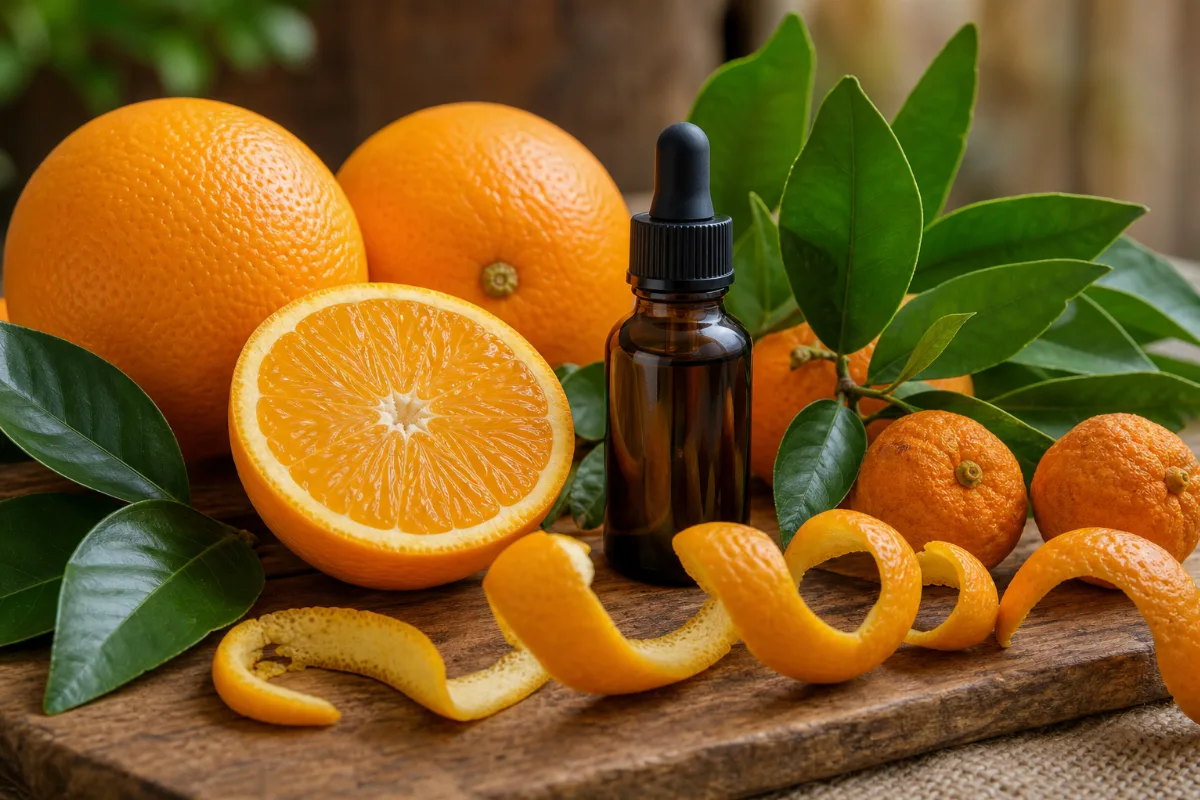
Essential Oils & Aromatherapy · Essential oil
Orange Oil (Sweet and Bitter)
Citrus sinensis (sweet orange) and Citrus x aurantium (bitter orange) · also called Sweet orange oil, bitter orange oil, Seville orange oil, orange peel oil
Orange oil is the strong citrus oil from the peel of sweet or bitter oranges. People smell it for calm, and use it in cleaning products, perfumes and flavourings. Small trials suggest it may ease anxiety, pain in labour and nausea, but they are few and small. The main caution: pressed bitter orange oil can make skin burn in the sun, stale oil can cause skin allergy, and swallowing it or letting pets lick it is dangerous.
General information, not medical advice. Last substantive update · Not medically reviewed. A named clinician has not signed off on this page. How this page is made
About Orange Oil (Sweet and Bitter)
Orange oil comes from the peel of sweet or bitter oranges. People smell it for calm and use it in cleaners, polish and flavourings. A few small trials of the scent suggest less anxiety, labour pain and chemotherapy nausea, all rated low. Safety comes first: pressed bitter orange oil can cause sun-triggered burns, stale oil can cause skin allergy, swallowing is dangerous, and citrus limonene can poison cats.
What orange oil is
Orange essential oil comes from the peel of the fruit. Sweet orange oil (Citrus sinensis) is the one most often sold. Bitter orange oil (Citrus aurantium, also called Seville orange) is sharper. NCCIH says the bitter orange tree is native to Southeast Asia. The plant database GBIF treats sweet orange as a synonym of bitter orange (Citrus x aurantium), but the trials and safety lists treat them as two oils, and so does this page.
In one lab analysis, limonene was 85.32% of cold-pressed sweet orange peel oil. Oils can be pressed or distilled, and this changes the sun-sensitivity risk. Poison Control says it can be hard to know the species, strength or contaminants in an essential oil bottle.
Bitter orange supplements (tablets taken by mouth) are a different product. NCCIH reports serious heart concerns with them. This page is about the oil.
What people use it for, and how strong the evidence is
Anxiety has the most trials: two dental waiting-room trials, a children's dental trial and a stress test, plus a pooled analysis. Pain and anxiety in labour and nausea during chemotherapy each rest on one recent trial. Fungal skin infections and sleep have no usable evidence. All results are low or weaker.
The trial amounts are not advice. This page does not tell you how much to use. A midwife, doctor or pharmacist can advise if you are pregnant, ill or on medicines.
The research in one view
Most trials are small, from one group or one clinic, and rely on people scoring their own feelings. A strong scent cannot be hidden, so people may guess which group they are in. The pooled analysis ranked bitter orange oil high, but its abstract does not say how many trials tested it, and NCCIH says benefit is unclear. We read abstracts, not full papers.
Scent, skin, polish and supplements are different things
The trials tested orange scent in a room or sniffed from the skin above the lip. They do not show that putting the oil on the skin is safe or useful, or that swallowing it is. Poison Control says diluting an essential oil in a carrier oil is the best way to avoid a bad skin reaction, and it should not go on damaged skin. This page gives no dilution figure.
What authorities say
NCCIH (page last updated November 2024) says bitter orange has not been clearly shown to help any health purpose, that bitter orange oil is generally well tolerated on the skin and in aromatherapy, and that it is unclear whether it helps anxiety or insomnia. The FDA says aromatherapy claims such as treating anxiety or helping sleep make a product a drug, and that some citrus oils can harm sun-exposed skin. Poison Control gives the general poisoning and allergy warnings. We did not read the IFRA standard for orange oils, LiverTox, LactMed or any EU opinion.
At a glance
Traditional uses history, not proof
- The fruit, peel and essential oils of bitter orange are used in cooking, to flavour beer and spirits, and in perfumes (NCCIH).
- Bitter orange oil is used on the skin and in aromatherapy, including for anxiety and insomnia, but NCCIH says it is unclear whether this helps.
- Orange oil is a common ingredient in furniture polish and wood-care products (Poison Control).
Studied for research
- Anxiety, smelling the oil, low
- Pain and anxiety in labour, sweet orange scent, low
- Nausea after chemotherapy, bitter orange scent as an add-on, low
- Fungal skin infections, on the skin, insufficient
- Sleep problems, insufficient
- Killing germs in the lab, insufficient
Main compounds
- Limonene, 85.32% of one cold-pressed sweet orange peel oil (one lab study)
- Oxypeucedanin, a sun-sensitizing compound found in large amounts in bitter orange oil in a 1985 analysis
Common forms
- Essential oil, pressed (expressed) from the peel
- Essential oil, distilled from the peel
- Scent in the air (diffuser, room scent)
- Cleaning and polish products
- Bitter orange supplements (a different product, not covered here)
Research links: NCCIH: Bitter Orange · FDA: Aromatherapy · Poison Control: Essential oils · NAHA: Safety · Essential oils for anxiety, pooled analysis (abstract) · Sweet orange oil in labour (abstract) · Research Library · Genes & Biomarkers Library
What it is and its history
- Accepted scientific name
- Citrus × aurantium
- Naming authority
- L.
- Synonyms
- Citrus sinensis (Mill.) Pers. (sweet orange), listed by GBIF as a synonym
- Common names
- Sweet orange oil (English); Bitter orange oil (English); Seville orange oil (English); Orange peel oil (English)
- Family or group
- Rutaceae (citrus family), per GBIF.
- Classification
- Plantae > Rutaceae > Citrus > Citrus × aurantium
- Native range
- NCCIH says the bitter orange tree is native to Southeast Asia. The native range of sweet orange was not read.
- Habitat
- Not checked.
- What it looks like
- Part used: The peel (fruit rind) is the usual source of orange essential oil; the 2018 oil analysis used cold-pressed navel orange peel. This page does not describe how to recognise the plant.
- Cultivation
- Not covered by the sources read.
- Harvest and processing
- Pressed (expressed) or distilled from the peel, per the Tisserand Institute and the 2018 analysis (cold pressed). Pressed and distilled citrus oils differ in sun sensitivity.
- Look-alikes and adulterants
- Name: Other citrus oils (lemon, lime, bergamot, mandarin, grapefruit); Note: NAHA's lists put expressed lemon, lime and bergamot among photosensitizers and sweet orange, mandarin and distilled lemon and lime among non-phototoxic oils.
- Sustainability and conservation
- Not checked.
Traditional use and history history, not clinical proof
| Tradition or era | Documented use | Source |
|---|---|---|
| Cooking, flavouring and perfume | NCCIH says the fruit, peel and essential oils of bitter orange are used in cooking, as flavourings in beer and spirits, and to add aromas to perfumes. The fruit is too sour to eat raw. | NCCIH |
| Aromatherapy and skin | NCCIH says bitter orange oil is used on the skin and in aromatherapy, including for anxiety and insomnia, and that it is unclear whether this is beneficial. A 2012 trial's authors describe sweet orange as used by aromatherapists as a tranquilizer. | NCCIH; Goes 2012 abstract |
| Household products | Poison Control notes orange oil and lemon oil are common ingredients in furniture polishes and other wood care products. | Poison Control |
Traditional use shows how it was used. It does not show that it works or is safe today.
What is inside, and how it may work
What it contains and how those compounds act in cells and animals. Laboratory and animal mechanisms are not proven effects in people.
Main compounds
| Compound | Family | Where it is concentrated | Activity studied | Level of evidence |
|---|---|---|---|---|
| Limonene (D-limonene) PubChem 22311 | monoterpene | Peel oil 85.32% of cold-pressed navel orange peel oil in one lab analysis; a lighter fraction had 60.44%. A figure for bitter orange oil was not read. | The main compound. It reacts with air to form hydroperoxides, which are strong skin sensitizers. The labour trial authors suggest limonene may modulate pain and anxiety pathways (hypothesis). 21 2 15 9 | Laboratory |
| Oxypeucedanin PubChem 33306 | furanocoumarin | Pressed bitter orange peel oil 'Large amounts' in bitter-orange and lime oils in a 1985 analysis; the abstract gives no figure. | Made colored guinea pig skin darken under light in the 1985 study; about a quarter as potent as bergapten. 21 8 | Laboratory animal |
| Bergapten PubChem 2355 | furanocoumarin | Pressed lemon oil (as studied) Found in lemon oil in the 1985 study; its presence in orange oils was not reported in the abstract. | The more potent sun-sensitizer of the two compounds found in lemon oil. 21 8 | Laboratory |
Mechanisms, receptors and pathways
| Target or pathway | Gene or receptor | What was found | Level |
|---|---|---|---|
| Sun-triggered skin damage (phototoxicity) | The Tisserand Institute says furanocoumarins enter skin cells and, under UVA light, bind to the cell's DNA, causing cell death and a burn-like reaction. Distillation leaves them behind, which is why distilled citrus oils are not phototoxic. 18 8 | Expert summary | |
| Skin allergy to oxidized limonene | After exposure to air, limonene forms hydroperoxides that sensitize the skin much more strongly than limonene itself. 15 10 | Human patch test | |
| Calming effect of smelling orange oil | Not established. The labour trial authors suggest limonene may modulate neurotransmission linked to pain and anxiety; no trial tested this. 9 | Hypothesis |
Absorption, metabolism and elimination
- Absorption
- Not established in the sources read.
- Distribution
- Not established.
- Metabolism
- Not established.
- Elimination
- Not established.
- Bioavailability
- Not established.
Isolated compounds versus whole extracts
Orange essential oil, orange scent in a room, bitter orange supplements (p-synephrine tablets taken by mouth), citrus furniture polish and the fruit itself are different things. Results for one do not carry over to another. Pressed and distilled oils differ in sun sensitivity, and sweet and bitter orange oils differ in how they are classed.
Nutritional composition
Orange essential oil is not a nutrient or a supplement to swallow. NCCIH says bitter orange is likely safe in the amounts commonly found in foods, which is different from the concentrated oil.
4 low certainty2 very low certainty3 not enough evidence
What was looked at
The 9 benefits and uses checked for Orange Oil (Sweet and Bitter), each with how strong the evidence is. Tap one to open it.
- Anxiety in a dental waiting room (adults, orange scent in the air)Low certainty
- Anxiety in children having dental treatment (orange aroma)Very low certainty
- Anxiety during a stress test in healthy men (sweet orange aroma)Very low certainty
- Anxiety overall: pooled trials versus the US health agency viewLow certainty
- Pain and anxiety in labour (sweet orange scent)Low certainty
- Nausea and vomiting after chemotherapy (bitter orange scent, added to medicines)Low certainty
- Fungal skin infections (bitter orange oil on the skin)Not enough evidence
- Sleep problems (insomnia)Not enough evidence
- Killing germs in the lab (food preservation)Not enough evidence
Lab markers tracked in the studies
State anxiety score (self-report)Salivary cortisol and pulse rateLabour pain score (visual analogue scale)Nausea, vomiting and retching score (Rhodes Index)
What is Orange Oil (Sweet and Bitter) good for?
The uses people ask about and how strong the evidence is for each. Read the certainty label first: all of these are about smelling the oil, not swallowing it and not putting it undiluted on the skin.
Benefits, one by one
Each card is a research question, not a promise. Tap a goal to filter. Open a card to see the studies, doses and limits.
Anxiety in a dental waiting room (adults, orange scent in the air)
Low certaintyTwo Austrian trials in dental waiting rooms found that people waiting in a room scented with orange reported less anxiety and a better mood than people with no scent. The first found this in women; the second, with 200 people, in the group as a whole.
3 studiesStudied as orange scent diffused in a waiting room. No amount is give…
Studies, doses and limits
What the trials found
Two trials by the same research group: 72 adults in 2000, 200 adults in 2005 (orange, lavender, music and no-treatment groups).
Results
2000 trial: women who smelled orange had lower state anxiety, a more positive mood and higher calmness than controls. 2005 trial: both orange and lavender lowered anxiety and improved mood compared with the no-odor condition.
Effect sizes as reported
Not reported as numbers in the abstracts. In 2000, women in the orange group had lower state anxiety, a better mood and higher calmness than controls. In 2005, orange and lavender each lowered anxiety and improved mood compared with no odor.
Why this rating
Two small trials, one research group, self-reported scores measured once while waiting, and a scent in a room cannot be hidden, so people may expect to feel calmer.
Form and dose studied
Studied as orange scent diffused in a waiting room. No amount is given as advice here.
Who was studied
Adults waiting for dental treatment in Austria.
Limits
One research group. Self-rated anxiety only. The 2000 effect was seen in women; the abstract reports the effect for women only. Not tested in people with an anxiety disorder.
Why researchers looked
Dental visits make many people anxious, and a scent in the room is easy to add and carries little risk of a drug effect.
Traditional use
Citrus scents are used by aromatherapists for anxiety (the child dental trial authors say so). We found no traditional-medicine source for orange oil specifically.
Proposed mechanism Preliminary mechanism
The authors suggest odors can change emotional state. How orange scent would do this in the brain is not shown in these trials.
A proposed mechanism does not show that the effect happens in people.
Scent in a room still reaches everyone in it, including children, pets and people with asthma or allergy. See the Safety tab.
Anxiety in children having dental treatment (orange aroma)
Very low certaintyIn a crossover trial of 30 children aged 6 to 9, stress markers (saliva cortisol and pulse) rose less during a dental visit with orange aroma than during a visit without it.
2 studiesOrange essential oil aroma in the treatment room. No amount is given …
Studies, doses and limits
What the trials found
One randomized crossover trial of 30 children (Iran, 2011).
Results
Compared with the visit without aroma, the aroma visit showed a statistically significant difference in change in salivary cortisol and pulse rate.
Effect sizes as reported
Salivary cortisol fell 1.047 nmol/l more, and pulse rate 6.73 per minute more, at the aroma visit than at the no-aroma visit (P = 0.014 and 0.005).
Why this rating
One small crossover trial; a child can smell the aroma so blinding is not possible; the abstract does not say who funded it, which orange species was used, or whether the small difference matters to a child.
Form and dose studied
Orange essential oil aroma in the treatment room. No amount is given as advice.
Who was studied
Healthy children aged 6 to 9 having a dental cleaning and fissure sealant.
Limits
30 children, two visits, no information on how the visit order was chosen in the abstract. Not tested in children with high dental anxiety.
Why researchers looked
Dental fear is common in children. Cortisol and pulse are body signs of stress that do not rely on a child describing their feelings.
Traditional use
No traditional use specific to children was found in the sources read.
Proposed mechanism Preliminary mechanism
Not examined in the trial. The authors point to citrus fragrance being used by aromatherapists for anxiety.
A proposed mechanism does not show that the effect happens in people.
Children have thin skin and developing livers (Poison Control) and must never be given the oil to swallow. This result is about aroma only.
Anxiety during a stress test in healthy men (sweet orange aroma)
Very low certaintyIn 40 healthy men given a mildly stressful colour-word test, those who first smelled sweet orange oil (at two of three amounts) did not show the rise in anxiety and tension that the comparison groups did. Heart rate and muscle tension still rose.
1 studiesSweet orange oil aroma, three amounts tested, compared with tea tree …
Studies, doses and limits
What the trials found
One randomized trial of 40 healthy men (Brazil, 2012).
Results
Orange aroma groups (2.5 and 10 drops) showed no significant change in state anxiety, subjective tension and tranquillity during the stress test, unlike controls. Heart rate and muscle activity changes were not prevented in any group.
Effect sizes as reported
Not given as numbers in the abstract. Two of the three amounts tested kept anxiety from rising during the test; the middle amount is not described as working.
Why this rating
A single small trial in healthy men, one short artificial stressor, and a missing effect at the middle amount, which makes a clear pattern hard to claim. The authors say the clinical relevance is not shown.
Form and dose studied
Sweet orange oil aroma, three amounts tested, compared with tea tree aroma and water. No amount is given as advice.
Who was studied
Healthy young men. Not tested in women, children, older adults or people with anxiety disorders.
Limits
Forty men split across five groups, so very few per group. Acute test only.
Why researchers looked
To check whether the scent has a calming effect in a controlled stress situation, not only in a waiting room.
Traditional use
Aromatherapists use sweet orange as a tranquilizer, according to the trial authors.
Proposed mechanism Preliminary mechanism
Not examined. The authors compare the pattern to what is seen with diazepam, which also left body changes in place.
A proposed mechanism does not show that the effect happens in people.
None reported in the abstract.
Anxiety overall: pooled trials versus the US health agency view
Low certaintyA 2023 pooled analysis of 44 trials ranked bitter orange (Citrus aurantium) oil near the top of ten essential oils for lowering anxiety scores. The US National Center for Complementary and Integrative Health says it is unclear whether bitter orange oil helps anxiety or insomnia. Read together, the pooled result is promising but unproven.
2 studiesMostly inhaled essential oil; the review pooled many forms and amount…
Studies, doses and limits
What the trials found
One systematic review and network meta-analysis (2023), searched to November 2022, plus the NCCIH page (updated November 2024).
Results
Essential oils together lowered state anxiety (WMD -6.63) and trait anxiety (WMD -4.97), and blood pressure and heart rate. Citrus aurantium came second for state anxiety and first for trait anxiety. NCCIH: it is unclear whether this is beneficial.
Effect sizes as reported
Network meta-analysis of 44 trials (10 oils): Citrus aurantium weighted mean difference -9.62 on state anxiety (95% CrI -13.32 to -5.93) and -9.62 on trait anxiety (95% CrI -15.62 to -3.7), compared with other oils and controls.
Why this rating
The abstract does not say how many of the 44 trials tested Citrus aurantium, indirect comparisons rest on few trials per oil, scents cannot be blinded, and NCCIH does not endorse the result.
Form and dose studied
Mostly inhaled essential oil; the review pooled many forms and amounts.
Who was studied
People with anxiety, many in hospital or dental settings, in the 44 trials.
Limits
We read the abstract only, not the full paper. The authors' wording that bitter orange is the 'most recommended' oil goes further than the evidence supports.
Why researchers looked
Many small aromatherapy trials exist, so reviewers pooled them to compare oils.
Traditional use
NCCIH says bitter orange oil has been used in aromatherapy for various conditions including anxiety and insomnia.
Proposed mechanism Preliminary mechanism
Not shown. A review ranking does not explain why an oil might work.
A proposed mechanism does not show that the effect happens in people.
Bitter orange oil on the skin raises a sun-sensitivity question (see Safety tab); aroma-only use avoids skin contact.
Pain and anxiety in labour (sweet orange scent)
Low certaintyIn one Brazilian trial of 84 women in labour, women who breathed in sweet orange oil rated their pain and anxiety lower than women who breathed in distilled water. The women's blood pressure, heart rate, breathing rate and the baby's heart rate were also lower.
1 studiesInhaled sweet orange oil, 250 microlitres in the trial; this is a stu…
Studies, doses and limits
What the trials found
One single-blind randomized trial, 42 women per group (2025).
Results
Lower pain intensity and anxiety with sweet orange oil than with water. Also lower maternal blood pressure, heart rate and breathing rate, and a lower fetal heart rate.
Effect sizes as reported
Pain scores fell over time with the oil (p = 0.0411), mainly in first-stage labour and first-time mothers (p = 0.0022); anxiety also fell (p < 0.0001). Exact score differences are not given in the abstract.
Why this rating
One single-blind trial of modest size with self-rated outcomes; a scent cannot be hidden from the woman. The lower fetal heart rate is reported without saying whether it matters.
Form and dose studied
Inhaled sweet orange oil, 250 microlitres in the trial; this is a study detail, not advice.
Who was studied
Pregnant women in labour at one site in northeast Brazil.
Limits
One trial, one region. No safety outcomes beyond vital signs. The abstract does not describe how long the effect lasted.
Why researchers looked
Women often want gentle, non-drug ways to cope in labour.
Traditional use
The trial authors describe aromatherapy as a tool used to support natural birth. No older traditional source was read.
Proposed mechanism Preliminary mechanism
The authors suggest limonene, the main compound in the oil, may act on the nerve systems linked to pain and anxiety. This is their idea; the trial did not test it.
A proposed mechanism does not show that the effect happens in people.
The lower baby heart rate was reported without comment on whether it is good, neutral or a concern. Talk to your midwife or doctor before using any scent in labour.
Nausea and vomiting after chemotherapy (bitter orange scent, added to medicines)
Low certaintyIn one Iranian trial of 92 women having chemotherapy for breast cancer, women who sniffed bitter orange oil, on top of their usual anti-nausea medicines, had less nausea, vomiting and retching on days 3 to 5 than women who sniffed sunflower oil. There was no difference on days 1 and 2.
1 studiesCitrus aurantium oil inhaled from the skin above the lip, two drops i…
Studies, doses and limits
What the trials found
One registered parallel-group randomized trial (April to August 2024).
Results
Lower symptom scores with the oil on days 3 to 5; no difference on days 1 and 2. Scores in the control group did not change over the five days.
Effect sizes as reported
Total nausea, vomiting and retching scores were lower with the oil than with sunflower oil on days 3 to 5 (P < 0.05); no significant difference on days 1 and 2.
Why this rating
One trial at one clinic, self-reported scores, and the oil's scent could reveal which group a woman was in. It was an add-on to medicines.
Form and dose studied
Citrus aurantium oil inhaled from the skin above the lip, two drops in the trial; a study detail, not advice.
Who was studied
Women with breast cancer having chemotherapy at one clinic in Iran.
Limits
Not a replacement for anti-nausea medicines. Not tested in men, children or other cancers. The result for days 1 and 2 was null.
Why researchers looked
Nausea can last for days after chemotherapy, even with medicines.
Proposed mechanism Preliminary mechanism
Not examined.
A proposed mechanism does not show that the effect happens in people.
Ask the cancer care team before adding any oil or scent.
Fungal skin infections (bitter orange oil on the skin)
Not enough evidenceNCCIH says it is unclear whether bitter orange oil on the skin helps ringworm, athlete's foot or jock itch, because the only study did not compare it with other treatments or a placebo.
1 studiesNot given here.
Studies, doses and limits
What the trials found
One uncontrolled study, described only in the NCCIH page.
Results
Results are described as difficult to interpret.
Effect sizes as reported
Not available. NCCIH says the one study had no comparison group.
Why this rating
A single study with no comparison group, known only from a summary.
Form and dose studied
Not given here.
Limits
We did not read the original study. Bitter orange oil on skin that is then in the sun carries a sun-sensitivity question (see Safety tab).
Why researchers looked
Citrus oils show germ-killing action in the lab.
Proposed mechanism Preliminary mechanism
Not examined here.
A proposed mechanism does not show that the effect happens in people.
Do not put undiluted oil on the skin.
Sleep problems (insomnia)
Not enough evidenceNCCIH says it is unclear whether bitter orange oil in aromatherapy helps insomnia. We found no trial of orange oil for sleep in the sources read.
1 studiesNot applicable.
Studies, doses and limits
Results
No results to report.
Effect sizes as reported
Not available.
Why this rating
No trial found; only the agency statement that benefit is unclear.
Limits
We did not search for sleep trials beyond the sources listed.
Why researchers looked
Calming scents are often tried at bedtime.
Traditional use
NCCIH says bitter orange oil has been used in aromatherapy for various conditions including insomnia.
Proposed mechanism Preliminary mechanism
Not examined.
A proposed mechanism does not show that the effect happens in people.
Scent left on all night can reach children and pets.
Killing germs in the lab (food preservation)
Not enough evidenceIn test-tube work, cold-pressed sweet orange peel oil and a lighter fraction of it slowed the growth of germs that spoil food or cause disease. This is lab work only and does not show that orange oil treats an infection in people.
1 studiesLab dishes only.
Studies, doses and limits
Results
Both oil samples showed good activity against spoiling and disease-causing microorganisms in lab dishes.
Effect sizes as reported
Limonene made up 85.32% of cold-pressed navel orange peel oil.
Why this rating
Lab-only evidence from one navel orange variety.
Form and dose studied
Lab dishes only.
Limits
Not a human result.
Why researchers looked
Food scientists look for natural preservatives.
Proposed mechanism Preliminary mechanism
The authors report good antimicrobial activity of the oils and some of their parts in the lab; the exact mechanism is not given in the abstract.
A proposed mechanism does not show that the effect happens in people.
Not applicable.
Connections to the rest of health
How Orange Oil (Sweet and Bitter) connects to the rest of our health knowledge graph. Every link says what kind of connection it is. A safety link (for example to the liver) is a warning, not a benefit. A study that merely mentions a topic never creates a benefit link.
Explore every connection: goals, body systems, organs, symptoms, genes
A. Wellness goals
| Connected to | Kind of connection | Evidence status | Context | Studies |
|---|---|---|---|---|
| Anxiety Support | Low certainty | Anxiety in a dental waiting room (adults, orange scent in the air): Two Austrian trials in dental waiting rooms found that people waiting in a room scented with orange reported less anxiety and a better mood than people with no scent. The first found this in women; the second, with 200 people, in the group as a whole. Anxiety in children having dental treatment (orange aroma): In a crossover trial of 30 children aged 6 to 9, stress markers (saliva cortisol and pulse) rose less during a dental visit with orange aroma than during a visit without it. | 6 7 23 4 16 1 | |
| Anxiety Support | Low certainty | Anxiety overall: pooled trials versus the US health agency view: A 2023 pooled analysis of 44 trials ranked bitter orange (Citrus aurantium) oil near the top of ten essential oils for lowering anxiety scores. The US National Center for Complementary and Integrative Health says it is unclear whether bitter orange oil helps anxiety or insomnia. Read together, the pooled result is promising but unproven. | 14 23 | |
| Womens Wellness | Low certainty | Pain and anxiety in labour (sweet orange scent): In one Brazilian trial of 84 women in labour, women who breathed in sweet orange oil rated their pain and anxiety lower than women who breathed in distilled water. The women's blood pressure, heart rate, breathing rate and the baby's heart rate were also lower. | 9 | |
| Digestive Support | Low certainty | Nausea and vomiting after chemotherapy (bitter orange scent, added to medicines): In one Iranian trial of 92 women having chemotherapy for breast cancer, women who sniffed bitter orange oil, on top of their usual anti-nausea medicines, had less nausea, vomiting and retching on days 3 to 5 than women who sniffed sunflower oil. There was no difference on days 1 and 2. | 13 | |
| Healthy Skin | Not enough evidence | Fungal skin infections (bitter orange oil on the skin): NCCIH says it is unclear whether bitter orange oil on the skin helps ringworm, athlete's foot or jock itch, because the only study did not compare it with other treatments or a placebo. | 23 | |
| Better Sleep | Not enough evidence | Sleep problems (insomnia): NCCIH says it is unclear whether bitter orange oil in aromatherapy helps insomnia. We found no trial of orange oil for sleep in the sources read. | 23 |
B. Body systems
| Connected to | Kind of connection | Evidence status | Context | Studies |
|---|---|---|---|---|
| Stress Mood | Biological association | Low certainty | Studied for: Anxiety in a dental waiting room (adults, orange scent in the air) Studied for: Anxiety in children having dental treatment (orange aroma) | 6 7 23 4 16 1 14 9 |
| Reproductive System | Biological association | Low certainty | Studied for: Pain and anxiety in labour (sweet orange scent) | 9 |
| Digestive System | Biological association | Low certainty | Studied for: Nausea and vomiting after chemotherapy (bitter orange scent, added to medicines) | 13 |
| Integumentary System | Biological association | Not enough evidence | Studied for: Fungal skin infections (bitter orange oil on the skin) | 23 |
| Nervous System | Biological association | Not enough evidence | Studied for: Sleep problems (insomnia) | 23 |
E. Health conditions
| Connected to | Kind of connection | Evidence status | Context | Studies |
|---|---|---|---|---|
| Phototoxic dermatitis | Adverse effect or risk | Documented risk | Lab analysis and professional-association listing; no human case read. Preparation or compound: Pressed bitter orange oil (oxypeucedanin) |
8 17 |
| Contact dermatitis | Adverse effect or risk | Documented risk | Patch-test clinic series. Preparation or compound: Oxidized limonene |
10 15 |
| Essential oil poisoning | Adverse effect or risk | Documented risk | General Poison Control guidance; no orange-specific case read. Preparation or compound: Essential oils in general |
16 |
I. Biomarkers
| Connected to | Kind of connection | Evidence status | Context | Studies |
|---|---|---|---|---|
| State anxiety score (self-report) | Biological association | Low certainty | Measured in trials: decrease. A lab change is not the same as a health benefit. | 14 6 1 |
| Salivary cortisol and pulse rate | Biological association | Very low certainty | Measured in trials: decrease. A lab change is not the same as a health benefit. | 4 |
| Labour pain score (visual analogue scale) | Biological association | Low certainty | Measured in trials: decrease. A lab change is not the same as a health benefit. | 9 |
| Nausea, vomiting and retching score (Rhodes Index) | Biological association | Low certainty | Measured in trials: decrease. A lab change is not the same as a health benefit. | 13 |
L. Active compounds
| Connected to | Kind of connection | Evidence status | Context | Studies |
|---|---|---|---|---|
| Limonene (D-limonene) | Biological association | Laboratory | The main compound. It reacts with air to form hydroperoxides, which are strong skin sensitizers. The labour trial authors suggest limonene may modulate pain and anxiety pathways (hypothesis). Preparation or compound: Peel oil |
21 2 15 9 |
| Oxypeucedanin | Biological association | Laboratory animal | Made colored guinea pig skin darken under light in the 1985 study; about a quarter as potent as bergapten. Preparation or compound: Pressed bitter orange peel oil |
21 8 |
| Bergapten | Biological association | Laboratory | The more potent sun-sensitizer of the two compounds found in lemon oil. Preparation or compound: Pressed lemon oil (as studied) |
21 8 |
Each connection is stored with the ingredient, the connected record, the kind of connection, the evidence status, the supporting studies, the preparation or compound involved, and a review date (last reviewed October 25, 2026).
Evidence at a glance: what the research found for 9 outcomes
Each outcome below is one thing researchers measured. Certainty is how far the evidence can be trusted, not how well it works. The full studies are on the next tab.
The evidence
The research centre for Orange Oil (Sweet and Bitter). Every record here was checked against PubMed or the publisher's page; we never list a study we have not verified.
Evidence by outcome
Bars show how many studies we found for each outcome, not how well it works. People are added up across trials only (reviews are not added, to avoid double counting).
How we rate evidence
High certainty
Several well-run trials or reviews agree; further research is unlikely to change the picture much.
Moderate certainty
Good trials point the same way, but some doubt remains.
Low certainty
Small, short or inconsistent trials. The finding could change with better research.
Very low certainty
Very little or very weak human data. Treat as a possibility only.
Mixed findings
Trials or reviews disagree with each other.
Not enough evidence
Not enough human research to say either way.
Evidence against
Good research found no benefit, or found harm.
We take the reviewers' own risk-of-bias and GRADE statements where they exist, and otherwise judge from study size, design, consistency, directness and whether a product matches what is sold. Many publications do not make evidence high. Method note: We read the abstracts of 15 PubMed papers and the NCCIH, FDA, Poison Control, NAHA, ASPCA and Tisserand Institute pages, checked the plant name in GBIF and compounds in PubChem. We did not read an IFRA standard, LiverTox, LactMed or an EU opinion.
Study library: every study we checked 23
| Study | Design | People | Product, dose, length | Result |
|---|---|---|---|---|
| Goes 2012 Effect of sweet orange aroma on experimental anxiety in humans. Journal of Alternative and Complementary Medicine · PMID 22849536 · DOI |
Randomized controlled trial |
40 Healthy men given a stress test (Stroop Color-Word Test, video monitored) |
Sweet orange (Citrus sinensis) essential oil aroma, inhaled before the test essential oil, inhaled Three amounts tested (the abstract counts them in drops) Single exposure before one test · vs Tea tree oil aroma; water |
People in the 2.5-drop and 10-drop orange groups showed no significant rise in state anxiety, tension or loss of calm during the stress test, unlike the control groups. Body measures such as heart rate still changed in every group. Methods, limits and fundingOutcomes: State anxiety, tension, calm, heart rate, muscle activity Limitations: Forty healthy men, one short lab stress, a mid amount (5 drops) is not described as working in the abstract, and the authors say clinical relevance is unproven. Funding and conflicts: Not stated in the abstract. Read: abstract |
| Guo 2018 Chemical composition and antimicrobial activity of Gannan navel orange (Citrus sinensis Osbeck cv. Newhall) peel essential oils. Food Science & Nutrition · PMID 30258585 · DOI |
Laboratory study lab |
Cold-pressed navel orange peel oil and a lighter fraction of it, tested in the lab | Cold-pressed sweet orange (Citrus sinensis) peel oil essential oil |
Limonene was 85.32% of the cold-pressed oil and 60.44% of the light fraction. Both showed good antimicrobial activity against spoiling and pathogenic microorganisms in the lab; the authors suggest food preservation. Methods, limits and fundingOutcomes: Chemical makeup (GC-MS); growth of spoiling and disease-causing germs in lab dishes Limitations: One navel orange variety, test-tube work only. It does not show any effect in people. Funding and conflicts: Not stated in the abstract. Read: abstract |
| Hooser 1986 Effects of an insecticidal dip containing d-limonene in the cat. Journal of the American Veterinary Medical Association · PMID 3771360 |
Animal study cats |
Cats given one skin application of a commercial dip with 78.2% d-limonene | d-Limonene insecticidal dip (not orange oil itself) insecticide dip One skin application · vs Recommended concentration of the dip |
At the maker's recommended strength there were no signs. At 5 times it, mild drooling, unsteadiness and shivering. At 15 times it, drooling, moderate to severe unsteadiness, shivering and a severe drop in body temperature for hours. No deaths or lasting effects were seen. Methods, limits and fundingOutcomes: Signs of poisoning Limitations: Skin dips, not diffused or bottled orange oil, and an old study. The abstract does not give the exact number of cats. Funding and conflicts: Not stated in the abstract. Read: abstract |
| Jafarzadeh 2013 Effect of aromatherapy with orange essential oil on salivary cortisol and pulse rate in children during dental treatment: A randomized controlled clinical trial. Advances in Biomedical Research · PMID 23930255 · DOI |
Randomized crossover trial |
30 Children aged 6 to 9 having a dental cleaning and fissure sealant (Iran) |
Orange essential oil aroma during dental treatment essential oil, aroma Amount not given here Two dental visits, one with the aroma and one without · vs The same children at a visit with no aroma |
The difference in change in salivary cortisol (1.047 nmol/l) and pulse rate (6.73 per minute) between the aroma visit and the no-aroma visit was statistically significant (P = 0.014 and P = 0.005). Methods, limits and fundingOutcomes: Salivary cortisol and pulse rate before and after treatment Limitations: Only 30 children, no blinding possible with a scent, and the abstract does not name the orange species or say who paid. The size of the difference is small and its importance to a child is not shown. Funding and conflicts: Not stated in the abstract. Read: abstract |
| Kejlová 2010 Phototoxicity of essential oils intended for cosmetic use. Toxicology in Vitro · PMID 20688147 · DOI |
Laboratory and human patch test lab and human |
Orange, lemon and Litsea cubeba essential oils; lab tests, then a skin photopatch test in a limited group of volunteers | Orange, lemon and Litsea cubeba essential oils as cosmetic ingredients essential oil Concentrations tested in the paper; not advice |
Phototoxicity depended on the amount of light-active compounds in the oil and on the solvent used. The authors say the safe level from the skin-model test could not be applied directly to people (3 of 8 tested oils evoked a phototoxic reaction) and a safety factor of 10 should be used. Methods, limits and fundingOutcomes: Phototoxicity in cell and skin-model tests, then in human volunteers Limitations: The abstract does not say which of the eight oils reacted, or whether the orange oil was sweet or bitter. Small volunteer group. Funding and conflicts: Not stated in the abstract. Read: abstract |
| Lehrner 2000 Ambient odor of orange in a dental office reduces anxiety and improves mood in female patients. Physiology & Behavior · PMID 11134689 · DOI |
Randomized controlled trial |
72 Adults aged 22 to 57 waiting for dental treatment (Austria) |
Ambient orange odor (sweet orange, Citrus sinensis, per the authors) diffused in the waiting room essential oil, diffused Amount not given here One waiting-room visit · vs No odor in the air |
Compared with controls, women exposed to orange odor had lower state anxiety, a more positive mood and higher calmness. The abstract reports the effect for women only. Methods, limits and fundingOutcomes: State and trait anxiety, mood, alertness, calmness, pain (self-report) Limitations: Small groups, self-reported scores, and a scent in a room is hard to hide from people, so they may guess which group they are in. Effect seen in women only. Funding and conflicts: Not stated in the abstract. Read: abstract |
| Lehrner 2005 Ambient odors of orange and lavender reduce anxiety and improve mood in a dental office. Physiology & Behavior · PMID 16095639 · DOI |
Controlled trial |
200 Adults aged 18 to 77 waiting for dental procedures (Austria) |
Ambient orange odor and, in another group, lavender odor, diffused in the waiting room essential oil, diffused Amount not given here One waiting-room visit · vs Music group; no odor and no music group |
Compared with the control condition, both orange and lavender odors lowered anxiety and improved mood in patients waiting for dental treatment. Methods, limits and fundingOutcomes: State anxiety, mood, alertness, calmness (self-report) Limitations: Self-reported scores, one waiting-room visit, and the odor cannot be hidden from the people breathing it. The abstract gives no effect sizes. Funding and conflicts: Not stated in the abstract. Read: abstract |
| Naganuma 1985 A study of the phototoxicity of lemon oil. Archives of Dermatological Research · PMID 4096528 · DOI |
Laboratory analysis lab and animal |
Lemon oil and other citrus oils (lab analysis; skin test on guinea pigs) | Fractions of lemon oil; other citrus oils including bitter orange oil essential oil |
In lemon oil the phototoxic compounds were oxypeucedanin and bergapten. Among other citrus oils, lime oil and bitter-orange oil also contained large amounts of oxypeucedanin. Oxypeucedanin caused skin darkening in colored guinea pigs under light. Methods, limits and fundingOutcomes: Which compounds make citrus oils phototoxic; amounts in different oils Limitations: A 1985 lab and guinea pig study of lemon oil. The abstract gives no figure for bitter orange oil and says nothing about sweet orange oil or about people. Oxypeucedanin was one-quarter as potent as bergapten. Funding and conflicts: Not stated in the abstract. Read: abstract |
| Nascimento 2025 Effectiveness of aromatherapy with sweet orange oil (Citrus sinensis L.) in relieving pain and anxiety during labor. Explore (New York) · PMID 39577393 · DOI |
Randomized controlled trial |
84 Pregnant women in labor (northeast Brazil) |
Sweet orange (Citrus sinensis) essential oil, inhaled essential oil, inhaled 250 microlitres in the trial; not advice During labor · vs Distilled water, same volume |
Pain scores fell over time with the oil (p = 0.0411), mostly in first-stage and first-time mothers (p = 0.0022). Anxiety fell (p < 0.0001). Blood pressure, heart rate, breathing rate and the baby's heart rate also fell (p < 0.0001). Methods, limits and fundingOutcomes: Pain (visual analogue scale), anxiety (STAI-E), blood pressure, heart rate, breathing rate, fetal heart rate Limitations: Single-blind (a scent is hard to hide), 42 women per group, self-reported pain and anxiety. The abstract does not say whether the lower baby heart rate matters. One trial in one region. Funding and conflicts: Not stated in the abstract. Read: abstract |
| Nath 2017 Contact Allergy to Hydroperoxides of Linalool and D-Limonene in a US Population. Dermatitis · PMID 28885310 · DOI |
Retrospective patch test series |
103 Patients with suspected fragrance allergy tested at a US clinic |
Hydroperoxides of D-limonene (limonene that has reacted with air) and linalool, patch-tested chemical, not oil |
Positive reactions to the hydroperoxides of D-limonene were found in 8% (7 of 90) and to those of linalool in 20% (19 of 96). The authors suggest testing for both in everyone with suspected fragrance allergy. Methods, limits and fundingOutcomes: Share with a positive patch-test reaction Limitations: These were people already suspected of fragrance allergy, so the figures are not rates in the general public. It tested the chemicals, not orange oil itself. Funding and conflicts: Not stated in the abstract. Read: abstract |
| Nicholson 1995 Toxicity of Insecticides and Skin Care Products of Botanical Origin. Veterinary Dermatology · PMID 34644891 · DOI |
Review animals |
Review of poisonings in animals from plant-derived insecticides and grooming products | Plant-derived products including d-limonene, linalool and melaleuca oil products |
d-Limonene may cause excess drooling, a marked fall in body temperature, shivering and unsteadiness in cats. Skin exposure of cats to a spray containing linalool, d-limonene and another ingredient at 5 and 10 times the normal strength caused depression and lying down for several days, followed by recovery without treatment. Poisoning is uncommon and usually follows strengths above the maker's advice. Methods, limits and fundingOutcomes: Poisoning signs Limitations: A 1995 review of pet-care products, not of orange oil. Mixed ingredients. Funding and conflicts: Not stated in the abstract. Read: abstract |
| Placzek 2007 Evaluation of phototoxic properties of fragrances. Acta Dermato-Venereologica · PMID 17598033 · DOI |
Laboratory study lab |
43 fragrances tested on human red blood cells in the lab | Fragrances including 'orange oil' (type not named in the abstract) essential oil |
Moderate UVA-induced haemolysis (5% to 11%) was found with bergamot oil, lime oil, orange oil and some other materials. Oakmoss was much stronger (up to 100%). The effect depended on concentration and UV dose. Methods, limits and fundingOutcomes: Photohaemolysis (red cell damage with UV light) as a sign of phototoxic potential Limitations: A test-tube test, not skin. The abstract does not say whether the orange oil was sweet or bitter, or pressed or distilled. The authors say clinical links still need study. Funding and conflicts: Not stated in the abstract. Read: abstract |
| Tabei 2025 The effect of Citrus aurantium inhalation aromatherapy on chemotherapy-induced nausea and vomiting in breast cancer patients: a randomized controlled trial. BMC Complementary Medicine and Therapies · PMID 41057867 · DOI |
Randomized controlled trial |
92 Women with breast cancer having chemotherapy at one clinic (Iran) |
Citrus aurantium (bitter orange) essential oil, inhaled from the skin above the lip, added to usual anti-nausea medicines essential oil, inhaled Two drops in the trial; not advice Five days · vs Sunflower oil in the same way, plus usual anti-nausea medicines |
Total scores were lower with the oil than with sunflower oil on days 3 to 5 (P < 0.05). There was no significant difference on days 1 and 2. Methods, limits and fundingOutcomes: Nausea, vomiting and retching (Rhodes Index) over 5 days Limitations: One clinic (recruitment April to August 2024), self-reported scores, and the scent of the oil could reveal who got it. It was an add-on to medicines, so it cannot show the oil works alone. Registered with the Iranian trials registry. Funding and conflicts: Not stated in the abstract. Read: abstract |
| Tan 2023 Essential oils for treating anxiety: a systematic review of randomized controlled trials and network meta-analysis. Frontiers in Public Health · PMID 37325306 · DOI |
Network meta analysis |
3419 People with anxiety in 44 randomized trials of 10 essential oils (total trial participants) |
Ten essential oils, including Citrus aurantium (bitter orange) essential oils, mostly inhaled or on the skin Varied Varied · vs Controls in the included trials |
Pooled, essential oils lowered state anxiety (weighted mean difference -6.63, 95% CI -8.17 to -5.08) and trait anxiety (-4.97, 95% CI -6.73 to -3.20). In the network comparison Citrus aurantium came second for state anxiety (-9.62, 95% CrI -13.32 to -5.93) and first for trait anxiety (-9.62, 95% CrI -15.62 to -3.7). The authors call it the most recommended oil, which is stronger than the data allow. Methods, limits and fundingOutcomes: State and trait anxiety scores; blood pressure; heart rate Limitations: The abstract does not say how many trials tested Citrus aurantium, so its ranking may rest on a few small trials. Network comparisons are indirect. Many aromatherapy trials cannot hide the scent. Oils and anxiety scales varied. Funding and conflicts: Not stated in the abstract. Read: abstract |
| de Groot 2019 Limonene Hydroperoxides. Dermatitis · PMID 31433385 · DOI |
Review |
Review of limonene contact allergy | Limonene and its air-formed hydroperoxides chemical |
Limonene is a widely used fragrance. After exposure to air it forms hydroperoxides that are far stronger sensitizers than pure limonene, and testing patients suspected of contact dermatitis found high rates of positive reactions. The author notes some positive results may be false-positive irritant reactions. Methods, limits and fundingOutcomes: Sensitizing potency of limonene after air exposure Limitations: A short review; not specific to orange oil and not a population rate. Funding and conflicts: Not stated in the abstract. Read: abstract |
| n/a Poison Control: Essential oils: Poisonous when misused (page read 2026-10-25; undated) n/a · Source |
Authoritative guidance n/a |
General readers | n/a |
Misuse of essential oils can cause serious poisoning. Essential oil products are not well regulated and it can be hard to know the species, concentration or contaminants in a bottle. Many oils can cause rashes, and some are poisonous if absorbed through the skin or swallowed. Breathing an essential oil into the lungs while swallowing can cause pneumonia. Children have thin skin and immature livers, which may make them more susceptible. Diluting pure oils in a carrier oil is the best way to avoid a bad skin reaction; do not use oils on damaged skin. Allergy to an essential oil is a very real possibility. Orange oil and lemon oil are common ingredients in furniture polishes and other wood care products. If someone swallows an essential oil, use the Poison Control online tool or call 1-800-222-1222. Methods, limits and fundingOutcomes: Poisoning, skin and allergy risks of essential oils Limitations: A general page about essential oils. It gives no orange-oil poisoning cases. Read: full-text |
| n/a NAHA (National Association for Holistic Aromatherapy): Safety (page read 2026-10-25; undated) n/a · Source |
Professional association guidance n/a |
Aromatherapy users and practitioners | n/a |
NAHA lists expressed bitter orange (Citrus aurantium) among essential oils considered photosensitizers, and sweet orange (Citrus sinensis) among non-phototoxic citrus oils, alongside distilled lemon and lime. In its pregnancy section it lists diluted sweet orange among oils that appear safe in pregnancy, while saying essential oil use in pregnancy is controversial and not fully understood. Methods, limits and fundingOutcomes: Skin reactions, phototoxicity, pregnancy guidance Limitations: A professional trade association, not a regulator. Undated page. Gives no study data for orange oils. Read: full-text |
| n/a Tisserand Institute: Phototoxicity: essential oils, sun and safety (Robert Tisserand; page read 2026-10-25) n/a · Source |
Expert opinion n/a |
Aromatherapy users | n/a |
Phototoxicity from essential oils is described as one of the most predictable toxic reactions, and it is preventable. Furanocoumarins in some plants bind to DNA in skin cells when UV light is present, causing cell death and a burn-like reaction. Citrus oils can be distilled or expressed (pressed). Because furanocoumarins are heavy and do not evaporate easily, distilled citrus oils contain virtually no furanocoumarins and are not phototoxic. Most phototoxic essential oils are expressed citrus oils. IFRA (International Fragrance Association) has published safety guidelines for citrus oils since 1974, and phototoxic reactions to commercial fragrances have become very rare since. Methods, limits and fundingOutcomes: How phototoxic reactions happen and how they are prevented Limitations: An educational page by an aromatherapy author. It does not name orange oils. Read: full-text |
| n/a ASPCA: Toxic and Non-toxic Plants: Orange (Citrus sinensis) (page read 2026-10-25; undated) n/a · Source |
Authoritative guidance n/a |
Pet owners | n/a |
Lists Citrus sinensis as toxic to dogs, cats and horses. Toxic principles are given as essential oils and psoralens. Signs listed are vomiting, diarrhea, depression and possible dermatitis. It says the fruit is edible, but skins and plant material can cause problems. Methods, limits and fundingOutcomes: Toxicity of the orange plant to animals Limitations: A plant listing, not a study of the bottled oil. Read: full-text |
| n/a GBIF Backbone Taxonomy: name match for Citrus sinensis and Citrus aurantium (API read 2026-10-25) n/a · Source |
Database n/a |
Plant names | n/a |
Citrus × aurantium L. is the ACCEPTED name (species key 8077391, family Rutaceae). Citrus sinensis (Mill.) Pers. (key 3190158) is listed as a SYNONYM of it. Methods, limits and fundingOutcomes: Accepted names Limitations: GBIF merges sweet and bitter orange under one name; the aromatherapy and safety sources, and the trials, still treat them as two separate oils. Read: full-text |
| n/a PubChem: compound records for D-limonene, oxypeucedanin, bergapten (API read 2026-10-25) n/a · Source |
Database n/a |
Compounds | n/a |
Limonene CID 22311, C10H16. Oxypeucedanin CID 33306, C16H14O5. Bergapten CID 2355, C12H8O4. Methods, limits and fundingOutcomes: Identity of compounds Limitations: Identity only. Read: full-text |
| n/a 2023 FDA: Aromatherapy (page read 2026-10-25; content current as of 2023-09-08) n/a · Source |
Regulatory n/a |
General readers | n/a |
A plant origin does not make an essential oil safe. Certain citrus oils used safely in food can also be harmful in cosmetics, particularly when applied to skin exposed to the sun. Claims that a product will ease pain, treat anxiety or help sleep are drug claims, and drugs need FDA approval before they are sold. Methods, limits and fundingOutcomes: How aromatherapy products are regulated; natural does not mean safe Limitations: A general page; it does not name orange oil. Read: full-text |
| n/a 2024 NCCIH: Bitter Orange: Usefulness and Safety (page read 2026-10-25; last updated November 2024) n/a · Source |
Authoritative guidance n/a |
General readers | n/a |
Bitter orange has not been clearly shown to be helpful for any health purpose. It is unclear whether bitter orange oil on the skin helps fungal skin infections (the only study had no comparison group). Bitter orange oil has been used in aromatherapy for anxiety and insomnia, but it is unclear whether this is beneficial. Bitter orange oil is generally well tolerated when used on the skin or in aromatherapy. Serious concerns exist about bitter orange dietary supplements: heart rhythm problems, heart attacks and strokes were reported, mostly with multi-ingredient products. It may not be safe in pregnancy or breastfeeding, and animal data suggest it might decrease milk production. In a US FDA analysis of 59 supplements, only 5 of 23 products with a labelled synephrine amount were within 80% to 120% of it, and six were adulterated with synthetic amines. Methods, limits and fundingOutcomes: Usefulness and safety of bitter orange (Citrus aurantium) as a supplement, topical oil and aromatherapy oil Limitations: The page covers the plant and its supplements more than the essential oil. It does not mention phototoxicity. Read: full-text |
What we do not know yet
- What the evidence supports: low for anxiety, labour pain and chemotherapy nausea; insufficient for fungal skin infections, sleep and lab germ-killing.
- No human photopatch study naming sweet or bitter orange oil, pressed or distilled.
- No orange-oil poisoning case in children or pets was found, and no study of diffused orange oil near pets.
- The pooled anxiety analysis does not say how many trials tested bitter orange oil.
- No trial compares sweet and bitter orange scent directly.
- No IFRA standard text, LiverTox, LactMed or EU opinion was read.
How new research is added
New studies are found by a saved PubMed search and are placed in a review queue. A person reads each one before it is added.
Lab markers
What changed in blood or saliva tests during trials. A changed number is not the same as feeling or being healthier, and we give no "normal ranges".
Other 4
State anxiety score (self-report)
Decrease in trials
A questionnaire (such as the State-Trait Anxiety Inventory) asking how anxious a person feels right now; lower is calmer.
Low certaintyResults and what it means
Why it was measured
The main outcome in the scent trials.
Statistical vs. clinical meaning
A feeling reported by the person, not a lab measurement. Scent cannot be hidden, so expectation may play a part.
Safety implication
A lower score does not show the oil is safe for everyone.
| Study | Result | People | Product |
|---|---|---|---|
| 14 | Pooled across essential oils, state anxiety fell by 6.63 points (95% CI -8.17 to -5.08); the Citrus aurantium network estimate was -9.62 (95% CrI -13.32 to -5.93). | ||
| 6 | Women exposed to orange odor reported lower state anxiety than controls in a dental waiting room. | ||
| 1 | State anxiety did not rise during a stress test in the sweet orange groups at two of three amounts. |
Salivary cortisol and pulse rate
Decrease in trials
Cortisol is a stress hormone measured in a saliva sample. Pulse rate is heartbeats per minute.
Very low certaintyResults and what it means
Why it was measured
Body signs of stress that do not depend on a child describing how they feel.
Statistical vs. clinical meaning
A small measured difference in one trial; whether it matters for a child is not known.
Safety implication
None established.
| Study | Result | People | Product |
|---|---|---|---|
| 4 | Compared with a visit with no aroma, change in salivary cortisol differed by 1.047 nmol/l (P = 0.014) and change in pulse rate by 6.73 per minute (P = 0.005) in 30 children. |
Labour pain score (visual analogue scale)
Decrease in trials
A line from no pain to worst pain on which the woman marks her pain; lower is better.
Low certaintyResults and what it means
Why it was measured
The main outcome in the labour trial.
Statistical vs. clinical meaning
A self-rated feeling. Scent cannot be hidden.
Safety implication
The baby's heart rate was also lower; the abstract does not say what that means.
| Study | Result | People | Product |
|---|---|---|---|
| 9 | Pain intensity fell over time with sweet orange oil compared with distilled water (p = 0.0411), mostly in first-stage labour and first-time mothers (p = 0.0022). |
Nausea, vomiting and retching score (Rhodes Index)
Decrease in trials
A questionnaire where the patient scores how often and how bad nausea, vomiting and retching have been; lower is better.
Low certaintyResults and what it means
Why it was measured
The main outcome in the chemotherapy trial.
Statistical vs. clinical meaning
A self-rated symptom score.
Safety implication
None established.
| Study | Result | People | Product |
|---|---|---|---|
| 13 | Total scores were lower with the oil than with sunflower oil on days 3 to 5 (P < 0.05) and not different on days 1 and 2. |
Safety
What studies and official sources say about side effects, medicines and who should check first. Each point shows what kind of evidence it comes from.
Main points to know 4
- Bitter orange oil that is pressed (expressed) from the peel can make skin burn in the sun. Sweet orange is listed as non-phototoxic, but the evidence is thinner than it sounds.. NAHA lists expressed bitter orange (Citrus aurantium) as a photosensitizer, and sweet orange (Citrus sinensis) as non-phototoxic. A 1985 lab analysis found bitter-orange oil, like lime oil, contained large amounts of oxypeucedanin, a compound that darkened colored guinea pig skin under light. The Tisserand Institute says distilled citrus oils contain virtually no such compounds and are not phototoxic, while most phototoxic oils are pressed citrus oils. But two lab studies of 'orange oil' (the type was not named in the abstracts) found some phototoxic activity: moderate UVA damage to red blood cells in a 43-fragrance screen, and, in a cosmetic-oil study that included orange oil, a skin-model safe level that could not be applied directly to people. The FDA says certain citrus oils used safely in food can be harmful in cosmetics, particularly on skin exposed to sun. We found no report of a sweet orange oil sunburn in the sources read. Check the label for the species and for pressed or distilled, keep any orange oil off skin that will be in the sun, and do not use any undiluted. Laboratory and authoritative guidance 17 8 18 12 5 22
- Orange oil can cause skin allergy, especially when it has gone stale from air.. Limonene, the main compound in orange oil, reacts with air to form hydroperoxides that are far stronger skin sensitizers than fresh limonene (a 2019 review). In a US clinic, 8% (7 of 90) of people already suspected of fragrance allergy reacted to patch tests of limonene hydroperoxides. Poison Control says allergy to an essential oil is a very real possibility; the usual sign is a skin rash. These were clinic patients, so the figures are not rates for the general public, and some positive tests may be irritation rather than allergy. Stop a product that causes a rash and wash it off. Case series 10 15 16
- Do not swallow orange oil. Keep it away from children.. Poison Control says essential oils can cause serious poisoning if swallowed, that breathing an oil into the lungs while swallowing can cause pneumonia, and that children's thin skin and immature livers may make them more susceptible. It notes orange oil and lemon oil are common in furniture polish and wood-care products, which are also kept in homes. We did not find a report of a child poisoned specifically by orange oil in the sources read, so the danger of a given amount is not known. If a child or pet may have swallowed any, call poison control (US: 1-800-222-1222) or your emergency number. Authoritative guidance 16
- Cats and dogs: orange plant material and citrus limonene can poison them.. The ASPCA lists the orange plant (Citrus sinensis) as toxic to dogs, cats and horses, naming essential oils and psoralens as toxic principles, with vomiting, diarrhea, depression and possible dermatitis as signs. In cats, a skin dip made with 78.2% d-limonene (the main compound in orange oil) caused no signs at the maker's strength but drooling, unsteadiness, shivering and a severe drop in body temperature at 15 times that strength; no deaths or lasting effects were seen. A 1995 review reports the same signs. These were insecticide dips, not diffusers or bottled oil, and we found no study of diffused orange oil in pets. Keep bottles and used cloths where pets cannot reach them. Animal and authoritative guidance 19 3 11
Side effects 5
| Effect | How often | Severity and recovery | Evidence |
|---|---|---|---|
| Sun-triggered skin reaction (phototoxicity): a burn-like reaction on skin exposed to light Pressed bitter orange oil is the main concern; sweet orange is listed as non-phototoxic by NAHA, yet two lab studies of unspecified 'orange oil' found some activity. | Not established | burn-like (as the Tisserand Institute describes phototoxic oils in general; no orange-specific case read) Not stated in the sources read | Laboratory and authoritative guidance 17 8 18 22 |
| Allergic contact dermatitis (itchy rash) from oxidized limonene Clinic population, so not general-public rates. | 8% (7 of 90) of fragrance-allergy clinic patients reacted to limonene hydroperoxides | rash; not graded in the abstract Not stated in the abstract | Case series 10 15 16 |
| Skin irritation Poison Control says many essential oils can cause rashes on the skin and advises diluting them in a carrier oil and not using them on damaged skin. NCCIH says bitter orange oil is generally well tolerated on the skin or in aromatherapy. | Not established | not graded Not stated | Authoritative guidance 16 23 |
| Poisoning if swallowed; pneumonia if drawn into the lungs General essential-oil guidance, not specific to orange oil. | Not established | serious (general essential-oil statement) Not stated | Authoritative guidance 16 |
| Unsteadiness, drooling and low body temperature in cats after strong d-limonene skin dips Dips, not diffusers. | Not established | mild at 5 times, moderate to severe at 15 times the recommended strength No deaths or lasting effects in the study | Animal study 3 11 |
Liver
We found no report of liver injury from orange essential oil in the sources read. LiverTox was not read. Poison Control says children's immature livers may make them more sensitive to essential oils in general. 16
How often. Not established.
This is a safety connection. It is not evidence that Orange Oil (Sweet and Bitter) supports liver health.
Medicines and supplements 4
| With | Why it matters | Importance | Evidence | What to do |
|---|---|---|---|---|
| Prescription and over-the-counter medicines, in general medicines-general | Poison Control says essential oils may interact with medicines. NCCIH advises talking to your health care provider before using bitter orange or other herbal products if you take medicine. No specific orange-oil interaction was found. | No specific interaction was found. Absence from the sources read is not proof of none. | Authoritative guidance Not enough evidence 16 23 | Ask your pharmacist or doctor if you take regular medicines. |
| Standard anti-nausea medicines in chemotherapy medicines-chemotherapy-antiemetics | In the one trial, bitter orange oil was used alongside standard anti-nausea medicines, not instead of them, and the abstract does not report any interaction. | Not assessed. | Clinical trial Not enough evidence 13 | Do not stop or replace anti-nausea medicines. Tell the cancer care team about any oil you use. |
| Bitter orange dietary supplements (p-synephrine) taken by mouth: stimulants, heart medicines bitter-orange-supplements | Bitter orange supplements are a different product from the essential oil. NCCIH reports heart rhythm problems, heart attacks and strokes in people taking mostly multi-ingredient bitter orange products, and says it is unclear whether bitter orange was the cause. | Not about the oil. Included only so the two are not confused. | Authoritative guidance Not enough evidence 23 | Do not treat the essential oil and the supplement as the same thing. Ask a pharmacist before taking any bitter orange supplement. |
| Medicines affected by citrus juices (for example Seville orange juice) citrus-juice-drug-interactions | Not covered by the sources read. | Unknown for the essential oil. | Not read Not enough evidence | Ask a pharmacist. |
Who should check first 5
| Situation | Advice | Evidence |
|---|---|---|
| Swallowing the oil, or any product not made to be swallowed | Do not swallow. If a child or pet may have swallowed any, call poison control (US: 1-800-222-1222) or your emergency number. | Authoritative guidance 16 |
| Putting orange oil on skin that will be in sunlight | Avoid, especially pressed bitter orange oil. Check the label for the species and for pressed or distilled. | Laboratory and authoritative guidance 17 18 22 |
| Undiluted oil on the skin, or any oil on broken or damaged skin | Do not use undiluted oil. Poison Control says diluting in a carrier oil is the best way to avoid a bad reaction, and not to use oils on damaged skin. This page does not give a dilution figure. | Authoritative guidance 16 |
| A past rash or allergy to citrus oils, limonene or fragrances | Avoid it and ask a doctor or pharmacist; patch-test results show oxidized limonene can sensitize. | Case series 10 15 |
| Homes with cats, dogs, birds or other pets | Keep strong oils where pets cannot reach them, and do not put them on pets. We found no study of diffused orange oil in pets. | Animal and authoritative guidance 19 3 |
Overdose, product quality and regulators
Summary. Toxicity of orange oil is described by general essential-oil guidance (Poison Control), plant-level pet toxicity (ASPCA), cat studies with d-limonene dips, and lab studies of sun sensitivity. No poisoning case specific to orange essential oil was read.
Amounts. No safe or toxic amount is established here, and this page gives none.
Onset and course. Cats given strong d-limonene dips showed drooling, unsteadiness and shivering and recovered with no lasting effects (the abstracts give hours; one review says several days for a related spray).
Repeated use. Repeated skin use with air-aged oil can lead to allergy (limonene hydroperoxide patch tests).
Animal data. A cat study of a 78.2% d-limonene dip (no signs at the recommended strength; mild at 5 times; moderate to severe at 15 times) and a 1995 review of plant-derived pet products.
Toxic parts. The peel oil is the concentrated form. Oxypeucedanin is the sun-sensitizing compound found in bitter-orange oil in the 1985 analysis. Limonene is the main compound (85.32% of one cold-pressed sweet orange oil).
Not read. LiverTox, poison-centre statistics for orange oil, asthma or lung studies of diffused citrus oil, and seizure data were not read.
Essential oil products are not well regulated, so what is in the bottle can differ from the label. Two orange oils can be very different products: pressed or distilled, sweet or bitter.
Unknown species, strength and contaminants. Poison Control says it can be hard to know what species of plant, what concentration of active ingredient or whether contaminants are in an essential oil bottle. 16
Pressed versus distilled. The Tisserand Institute says distilled citrus oils contain virtually no sun-sensitizing furanocoumarins, while pressed (expressed) oils can. 18
Fresh versus stale oil. Limonene reacts with air to form hydroperoxides that are strong skin sensitizers, so air-exposed oil is more likely to cause allergy. 15
Bitter orange supplements (not the oil). In an FDA analysis of 59 bitter orange supplements, only 5 of 23 products with a labelled synephrine amount were close to it, and six were adulterated with synthetic amines. This concerns tablets and capsules, not the essential oil. 23
| Body | Action | Date |
|---|---|---|
| National Center for Complementary and Integrative Health (NCCIH) (United States) | Says bitter orange has not been clearly shown to be helpful for any health purpose, that bitter orange oil is generally well tolerated on the skin or in aromatherapy, that benefit for anxiety or insomnia is unclear, and that bitter orange supplements raise serious heart concerns. source | 2024-11 |
| US Food and Drug Administration (FDA) (United States) | Says certain citrus oils used safely in food can also be harmful in cosmetics, particularly when applied to skin exposed to the sun; claims to treat anxiety or help sleep make a product a drug. source | 2023-09-08 |
| Poison Control (US national poison help service) (United States) | Essential oils can be poisonous if swallowed or absorbed; keep them locked away from children and pets; dilute for skin use; stop if a rash appears. General page, not orange specific. source | |
| National Association for Holistic Aromatherapy (NAHA), a professional association, not a regulator (United States) | Lists expressed bitter orange as a photosensitizer and sweet orange as non-phototoxic; lists diluted sweet orange among oils that appear safe in pregnancy while calling the topic controversial. source |
When to get medical help
- If a child or pet may have swallowed orange oil or a furniture polish that contains it, call poison control straight away (US: Poison Help 1-800-222-1222; for pets, a vet or a pet poison line) or your local emergency number. Do not make them vomit.
- Coughing or choking while swallowing oil, then fever or trouble breathing later (possible oil in the lungs): get medical help.
- A rash, blistering or swelling of the face or lips after using an orange oil product: stop, wash the area, and get medical help.
- A painful, blistering or darkening skin patch where oil was on skin that then saw sunlight: keep the area out of the sun and get medical advice.
- Difficulty breathing after an allergic reaction to any essential oil is an emergency.
Stop using the product and contact a clinician or emergency service. In the US, Poison Control is 1-800-222-1222.
General information only, not medical advice. Ask a clinician or pharmacist before use, especially with medicines, in pregnancy or with a health condition. See the Natural Remedy Safety guide.
Frequently asked questions
Is orange oil safe to swallow?
No. Poison Control says essential oils can cause serious poisoning if swallowed, and oil drawn into the lungs can cause pneumonia. Children may be more sensitive. We found no case naming orange oil itself, but that does not make it safe. If a child or pet may have swallowed any, call poison control (US: 1-800-222-1222) or your emergency number.
Can orange oil burn my skin in the sun?
Pressed bitter orange oil can. NAHA lists expressed bitter orange as a photosensitizer, and a 1985 lab analysis found large amounts of oxypeucedanin in bitter-orange oil, which darkened guinea pig skin under light. The FDA says certain citrus oils can harm skin exposed to the sun. NAHA lists sweet orange as non-phototoxic, but two lab studies of unspecified 'orange oil' found some activity, so keep any orange oil off skin that will be in the sun.
What is the difference between sweet and bitter orange oil?
They come from different fruit (Citrus sinensis and Citrus aurantium). Safety lists treat them differently: NAHA lists expressed bitter orange as phototoxic and sweet orange as not. Trials used sweet orange for labour and bitter orange for chemotherapy nausea. GBIF treats sweet orange as a synonym of bitter orange, so the names overlap.
Does pressed or distilled orange oil matter?
For sun sensitivity, yes. The Tisserand Institute says distilled citrus oils contain virtually no sun-sensitizing furanocoumarins and are not phototoxic, while pressed citrus oils can. Check the label for how the oil was made.
Can orange oil cause an allergic reaction?
Is orange oil safe for cats and dogs?
Not as strong oil. The ASPCA lists the orange plant as toxic to dogs, cats and horses, with vomiting, diarrhea and depression. In cats, strong d-limonene skin dips caused drooling, unsteadiness, shivering and a severe drop in body temperature, with no lasting effects. We found no study of diffused orange oil in pets, so keep it out of their reach and do not put it on them.
Does orange oil reduce anxiety?
Possibly a little, but the evidence is low. Two dental waiting-room trials found less anxiety with orange scent in the air, and a pooled analysis of 44 trials ranked bitter orange oil highly. NCCIH says it is unclear whether bitter orange aromatherapy helps anxiety. Scores are self-reported and the scent is hard to hide.
Is orange oil safe in pregnancy or labour?
Unclear. NAHA lists diluted sweet orange among oils that appear safe in pregnancy but calls the topic controversial. NCCIH says bitter orange may not be safe in pregnancy or breastfeeding (about bitter orange products in general). In one labour trial of 84 women, sweet orange scent lowered pain and anxiety scores and also lowered the baby's heart rate; the abstract does not say whether that matters. Ask your midwife or doctor.
Can orange oil help nausea from chemotherapy?
One trial of 92 women found less nausea on days 3 to 5, but not days 1 and 2, when bitter orange oil was added to usual anti-nausea medicines. It is one clinic. Do not replace your medicines, and tell your care team about any oil you use.
Is orange oil safe for children?
Does orange oil interact with medicines?
No specific interaction was found in the sources we read, which is not proof there is none. Poison Control notes essential oils may interact with medicines. Bitter orange supplements are a different product with heart-safety concerns reported by NCCIH. Tell a pharmacist about any oil or supplement you use.
Is it safe to put orange oil on my skin without diluting it?
Explore by health goal
Anxiety SupportWomens WellnessDigestive SupportHealthy SkinBetter Sleep
Editorial transparency
- Written by
- AlternativeMed editorial team. Research compiled with AI assistance, then checked against PubMed records.
- Medical review
- None. This page has not been reviewed by a physician or pharmacist.
- First published
- 2026-10-25
- Last substantive update
- 2026-10-25
- How we research
- We read the abstracts of 15 PubMed papers and the NCCIH, FDA, Poison Control, NAHA, ASPCA and Tisserand Institute pages, checked the plant name in GBIF and compounds in PubChem. We did not read an IFRA standard, LiverTox, LactMed or an EU opinion.
- How we rate evidence
- See "How we rate evidence" in the Evidence tab.
- Independence
- No product is promoted on this page. No affiliate links are shown.
Sources 23
Each source was opened and checked. Where we read only the abstract, it says so. The small numbers in the text point here.
- Goes TC, Antunes FD, Alves PB, et al. Effect of sweet orange aroma on experimental anxiety in humans.. Journal of Alternative and Complementary Medicine. 2012. PMID 22849536. DOI 10.1089/acm.2011.0551. (abstract)
- Guo Q, Liu K, Deng W, et al. Chemical composition and antimicrobial activity of Gannan navel orange (Citrus sinensis Osbeck cv. Newhall) peel essential oils.. Food Science & Nutrition. 2018. PMID 30258585. DOI 10.1002/fsn3.688. (abstract)
- Hooser SB, Beasley VR, Everitt JI. Effects of an insecticidal dip containing d-limonene in the cat.. Journal of the American Veterinary Medical Association. 1986. PMID 3771360. (abstract)
- Jafarzadeh M, Arman S, Pour FF. Effect of aromatherapy with orange essential oil on salivary cortisol and pulse rate in children during dental treatment: A randomized controlled clinical trial.. Advances in Biomedical Research. 2013. PMID 23930255. DOI 10.4103/2277-9175.107968. (abstract)
- Kejlová K, Jírová D, Bendová H, et al. Phototoxicity of essential oils intended for cosmetic use.. Toxicology in Vitro. 2010. PMID 20688147. DOI 10.1016/j.tiv.2010.07.025. (abstract)
- Lehrner J, Eckersberger C, Walla P, et al. Ambient odor of orange in a dental office reduces anxiety and improves mood in female patients.. Physiology & Behavior. 2000. PMID 11134689. DOI 10.1016/s0031-9384(00)00308-5. (abstract)
- Lehrner J, Marwinski G, Lehr S, et al. Ambient odors of orange and lavender reduce anxiety and improve mood in a dental office.. Physiology & Behavior. 2005. PMID 16095639. DOI 10.1016/j.physbeh.2005.06.031. (abstract)
- Naganuma M, Hirose S, Nakayama Y, et al. A study of the phototoxicity of lemon oil.. Archives of Dermatological Research. 1985. PMID 4096528. DOI 10.1007/BF00412492. (abstract)
- Nascimento JC, Gonçalves VSDS, Souza BRS, et al. Effectiveness of aromatherapy with sweet orange oil (Citrus sinensis L.) in relieving pain and anxiety during labor.. Explore (New York). 2025. PMID 39577393. DOI 10.1016/j.explore.2024.103081. (abstract)
- Nath NS, Liu B, Green C, et al. Contact Allergy to Hydroperoxides of Linalool and D-Limonene in a US Population.. Dermatitis. 2017. PMID 28885310. DOI 10.1097/DER.0000000000000318. (abstract)
- Nicholson SS. Toxicity of Insecticides and Skin Care Products of Botanical Origin.. Veterinary Dermatology. 1995. PMID 34644891. DOI 10.1111/j.1365-3164.1995.tb00057.x. (abstract)
- Placzek M, Frömel W, Eberlein B, et al. Evaluation of phototoxic properties of fragrances.. Acta Dermato-Venereologica. 2007. PMID 17598033. DOI 10.2340/00015555-0251. (abstract)
- Tabei P, Molazem Z, Rivaz M, et al. The effect of Citrus aurantium inhalation aromatherapy on chemotherapy-induced nausea and vomiting in breast cancer patients: a randomized controlled trial.. BMC Complementary Medicine and Therapies. 2025. PMID 41057867. DOI 10.1186/s12906-025-05052-0. (abstract)
- Tan L, Liao FF, Long LZ, et al. Essential oils for treating anxiety: a systematic review of randomized controlled trials and network meta-analysis.. Frontiers in Public Health. 2023. PMID 37325306. DOI 10.3389/fpubh.2023.1144404. (abstract)
- de Groot A. Limonene Hydroperoxides.. Dermatitis. 2019. PMID 31433385. DOI 10.1097/DER.0000000000000465. (abstract)
- n/a. Poison Control: Essential oils: Poisonous when misused (page read 2026-10-25; undated). n/a. . (full-text)
- n/a. NAHA (National Association for Holistic Aromatherapy): Safety (page read 2026-10-25; undated). n/a. . (full-text)
- n/a. Tisserand Institute: Phototoxicity: essential oils, sun and safety (Robert Tisserand; page read 2026-10-25). n/a. . (full-text)
- n/a. ASPCA: Toxic and Non-toxic Plants: Orange (Citrus sinensis) (page read 2026-10-25; undated). n/a. . (full-text)
- n/a. GBIF Backbone Taxonomy: name match for Citrus sinensis and Citrus aurantium (API read 2026-10-25). n/a. . (full-text)
- n/a. PubChem: compound records for D-limonene, oxypeucedanin, bergapten (API read 2026-10-25). n/a. . (full-text)
- n/a. FDA: Aromatherapy (page read 2026-10-25; content current as of 2023-09-08). n/a. 2023. (full-text)
- n/a. NCCIH: Bitter Orange: Usefulness and Safety (page read 2026-10-25; last updated November 2024). n/a. 2024. (full-text)
Where to buy
Check the label first. Whatever you buy, look for these:
- The botanical (Latin) name on the label and 100% pure oil
- A dark glass bottle and a batch number
- Essential oils are strong: dilute for skin, and do not swallow unless a qualified professional directs it
- Keep away from children and pets
Talk to a pharmacist or doctor before you start any supplement, especially if you take medicines. See the Safety tab for interactions.
Support our free guides: as an Amazon Associate we earn from qualifying purchases. Full disclosure.


