Essential Oils & Aromatherapy · Essential oil
Lemon Oil
Citrus limon (L.) Osbeck · also called Lemon essential oil, lemon peel oil, cold-pressed lemon oil, expressed lemon oil, distilled lemon oil
Lemon oil is the strong-smelling essential oil from the peel of the lemon. It is used in diffusers, cleaning and polish products and cosmetics. Small trials of the scent for nausea are mixed, and evidence for anxiety is weak. The main cautions: pressed lemon oil on skin can react badly with sunlight, and it should never be swallowed.
General information, not medical advice. Last substantive update · Not medically reviewed. A named clinician has not signed off on this page. How this page is made
About Lemon Oil
Lemon oil is best known as a fresh scent. Small trials of smelling it for nausea are mixed, and evidence for anxiety is weak. Safety comes first: pressed lemon oil on skin can react with sunlight, it should not be swallowed, air-exposed oil can cause allergy, and the lemon plant is listed as toxic to pets.
What lemon oil is
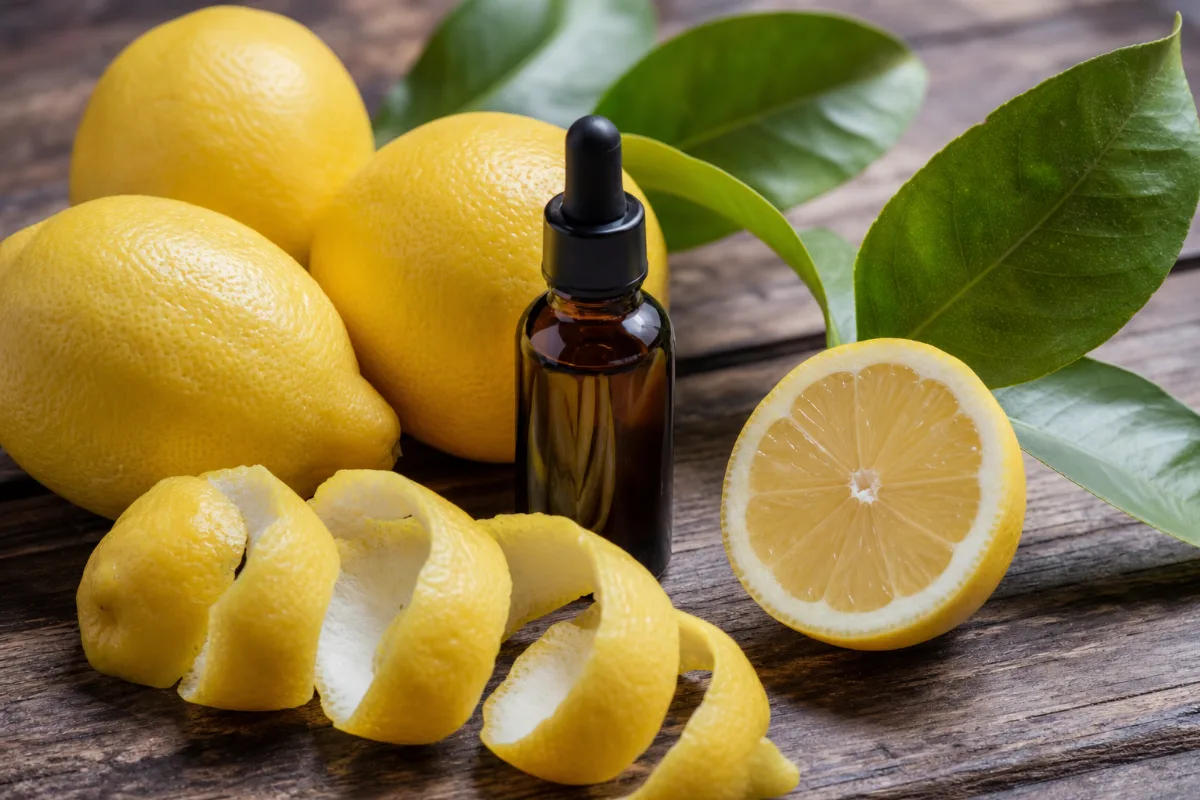
Lemon oil is the essential oil of the lemon, Citrus limon. It is made from the peel. GBIF lists the accepted name as Citrus x limon (L.) Osbeck, in the citrus family, Rutaceae.
In one lemon oil sample analysed in a lab, limonene made up 60.7%, beta-pinene 12.6% and gamma-terpinene 10.3%. Other bottles will differ.
Pressed (expressed) oil and distilled oil are different products, and lemon juice, lemon water and the fruit are different again. Poison Control says it can be hard to know the species, strength or contaminants in an essential oil bottle.
What people use it for, and how strong the evidence is
The best-studied use is smelling lemon oil for nausea. In pregnancy, two small trials of 100 and 90 women found lower nausea scores after two days, and a 2026 review of five studies rates the quality low to moderate. After surgery the results are mixed: two small trials were positive, but a knee-replacement trial found no benefit for lemon.
For anxiety and mood the evidence is thin. A 2023 network meta-analysis puts lemon among oils with lower trait anxiety scores, but with a very wide range. NCCIH describes one study where lemon improved mood without changing stress markers.
A trial in 63 women found lower menopause symptom scores after massage with diluted lemon oil, though peppermint did better. A controlled experiment in students found a diffusing lemon oil made impulse control and memory sensitivity worse, not better.
The research in one view
Most trials are small, short and self-rated, and a scent is hard to hide from a comparison group. Several of the lemon trials come from Iran. We read abstracts, not full texts.
Reviews of aromatherapy in general, such as the Cochrane review of nausea after surgery, mix many oils and are not about lemon alone.
Smelling, skin use and swallowing are different things
Almost all the benefit studies tested smelling the oil. They do not show that putting oil on skin or swallowing it works, and those uses carry the main risks on this page.
A trial of a lemon and peppermint mix, or of a four-oil blend, cannot show what lemon alone does.
What regulators say
The FDA says a plant source does not make an essential oil safe, that certain citrus oils can harm sun-exposed skin in cosmetics, and that claims to treat or relieve conditions are drug claims. EFSA, in a 2021 opinion on animal feed additives, said expressed lemon oil should be treated as an irritant and skin sensitiser and may cause phototoxicity.
NCCIH lists lemon among oils used in aromatherapy and describes only one study on lemon scent and mood. We did not find a LiverTox, LactMed or EMA record for lemon oil.
At a glance
Traditional uses history, not proof
- Used in aromatherapy, where oils are inhaled or applied diluted to the skin (NCCIH).
- Recognised as a food flavouring (EFSA).
Studied for research
- Nausea in pregnancy, smelled oil, low
- Nausea after surgery, smelled oil, mixed
- Anxiety, smelled oil, very low
- Pain after surgery, smelled oil, very low
- Menopause symptoms, diluted oil in massage, very low
- Focus and thinking in a diffuser-scented room, against
- Treating disease, immunity or detox, insufficient
Main compounds
- Limonene, the main component in one analysed sample
- Beta-pinene and gamma-terpinene
- Bergapten and oxypeucedanin (furocoumarins in pressed oil)
Common forms
- Pressed (expressed) lemon oil from the peel
- Distilled lemon oil
- Lemon-scented cleaning, polish and cosmetic products
- Lemon juice, lemon water and the fruit (different products)
Research links: FDA: Aromatherapy · NCCIH: Aromatherapy · Poison Control: Essential oils · ASPCA: Lemon · Phototoxicity of lemon oil, 1985 (abstract) · Lemon scent and pregnancy nausea trial (abstract) · Research Library · Genes & Biomarkers Library
What it is and its history
- Accepted scientific name
- Citrus limon
- Naming authority
- (L.) Osbeck
- Common names
- Lemon (English); Lemon oil (English); Lemon peel oil (English); Expressed (cold-pressed) lemon oil (English); Distilled lemon oil (English)
- Family or group
- Rutaceae (the citrus family), per GBIF.
- Classification
- Plantae > Tracheophyta > Magnoliopsida > Sapindales > Rutaceae > Citrus > Citrus limon
- Native range
- Not checked.
- Habitat
- Not checked.
- What it looks like
- Part used: The oil is made from the lemon's peel. Pressed (expressed) and distilled oils are different products (EFSA, SKLM). This page does not describe how to recognise the plant.
- Look-alikes and adulterants
- Name: Other citrus oils (lime, bitter orange, bergamot); Note: Lime oil and bitter-orange oil also contained large amounts of oxypeucedanin in the 1985 study; results for one citrus oil do not carry over to another.; Name: Lemon-scented but different plants (lemongrass, lemon balm, lemon verbena, lemon eucalyptus); Note: Different plants and different oils; not covered here. This note is general knowledge, not from a source read.; Name: Lemon juice, lemon water and the fruit; Note: A different product from the peel oil; findings do not carry over.
- Sustainability and conservation
- Not checked (no IUCN or CITES source read).
Traditional use and history history, not clinical proof
| Tradition or era | Documented use | Source |
|---|---|---|
| Aromatherapy | NCCIH lists lemon among the many essential oils used in aromatherapy, where oils are inhaled or applied diluted to the skin. | NCCIH |
| Food flavouring | EFSA says Citrus limon and its preparations are recognised to flavour food. | EFSA FEEDAP Panel (2021) |
Traditional use shows how it was used. It does not show that it works or is safe today.
What is inside, and how it may work
What it contains and how those compounds act in cells and animals. Laboratory and animal mechanisms are not proven effects in people.
Main compounds
| Compound | Family | Where it is concentrated | Activity studied | Level of evidence |
|---|---|---|---|---|
| Limonene PubChem 22311 | monoterpene | Peel oil 60.7% in one lemon oil sample analysed by GC-MS; other samples will differ. | The main component of that sample. It readily oxidises in air, and the oxidised form (hydroperoxides) is a potent skin sensitiser. 13 11 3 | Laboratory |
| Beta-pinene PubChem 14896 | monoterpene | Peel oil 12.6% in the same sample. | Listed as a common constituent; no activity claim made here. 14 11 | Laboratory |
| Gamma-terpinene PubChem 7461 | monoterpene | Peel oil 10.3% in the same sample. | Listed as a common constituent; no activity claim made here. 15 11 | Laboratory |
| Bergapten PubChem 2355 | furocoumarin (psoralen type) | Pressed peel oil 4 to 87 ppm across lemon oils from different regions (1985). | One of two compounds that explained essentially all of the phototoxic activity of lemon oil in the 1985 assay; about four times as potent as oxypeucedanin. 16 18 | Laboratory |
| Oxypeucedanin PubChem 33306 | furocoumarin | Pressed peel oil 26 to 728 ppm across lemon oils from different regions (1985). | The second phototoxic compound; caused photopigmentation on coloured guinea pig skin. Lime and bitter-orange oils also contain a lot. 17 18 | Animal research |
Mechanisms, receptors and pathways
| Target or pathway | Gene or receptor | What was found | Level |
|---|---|---|---|
| Light-activated skin injury (phototoxicity) | Not applicable | Furocoumarins in pressed lemon oil, mainly bergapten and oxypeucedanin, account for essentially all of the oil's phototoxic activity in a 1985 assay. 18 12 | Laboratory and animal |
| Skin sensitisation by oxidised limonene | Immune (allergic) response | Limonene autoxidises in air into hydroperoxides that are potent sensitisers; patch-test clinics find allergy to them in a minority of tested patients. 3 19 | Human clinic series |
| Antibacterial and antibiofilm activity | Not applicable | In lab tests one lemon oil sample inhibited growth of bacteria and Candida and Salmonella biofilm, and slightly helped against Salmonella in vacuum-packed carrot. Lab and food model only; it does not show benefit in people. 11 | Laboratory research |
| How smelling lemon might ease nausea or lift mood | Not established | No mechanism was shown in the trials read. Expectation and the pleasantness of the smell may contribute; a scent is hard to hide from a comparison group. 20 | Hypothesis |
Absorption, metabolism and elimination
- Absorption
- Not established in the sources read.
- Distribution
- Not established.
- Metabolism
- Not established.
- Elimination
- Not established.
- Bioavailability
- Not established.
Isolated compounds versus whole extracts
Pressed lemon oil, distilled lemon oil, the fruit, lemon juice and lemon water are different products. The safety points about sunlight apply to pressed oil, which contains furocoumarins; a German commission found none in distilled oils. Trial results for smelling the oil do not apply to skin use or swallowing.
Nutritional composition
Lemon oil is not a nutrient. EFSA notes citrus preparations are recognised as food flavourings, but this page does not advise swallowing the oil.
1 mixed findings1 low certainty6 very low certainty3 not enough evidence1 evidence against
What was looked at
The 12 benefits and uses checked for Lemon Oil, each with how strong the evidence is. Tap one to open it.
- Nausea and vomiting of pregnancy (smelling lemon oil)Low certainty
- Nausea and vomiting after surgery (smelling lemon oil)Mixed findings
- Chemotherapy nausea in children (peppermint and lemon mix in a diffuser)Very low certainty
- Anxiety (smelling lemon oil, indirect comparison)Very low certainty
- Anxiety, blood pressure and heart tracing after a heart attack (smelling lemon oil)Very low certainty
- Mood in people under stress (lemon vs lavender scent)Not enough evidence
- Pain after surgery (smelling lemon oil)Very low certainty
- Delirium and inflammation markers after heart bypass surgery (smelling lemon oil)Very low certainty
- Menopausal symptoms (massage with diluted lemon oil)Very low certainty
- Memory and thinking in dementia (a blend of four oils)Not enough evidence
- Thinking and attention with an oil diffuser in a room (lemon oil)Evidence against
- Treating disease, boosting immunity, detox or weight loss (claims)Not enough evidence
Lab markers tracked in the studies
Nausea and vomiting scoreUse of rescue anti-sickness medicineTrait anxiety scoreSystolic blood pressureCRP and neutrophil-to-lymphocyte ratioMenopause Rating Scale (MRS)
What is Lemon Oil good for?
The uses people ask about and how strong the evidence is for each. Read the certainty label first: almost all of it is small trials of smelling the oil.
Benefits, one by one
Each card is a research question, not a promise. Tap a goal to filter. Open a card to see the studies, doses and limits.
Nausea and vomiting of pregnancy (smelling lemon oil)
Low certaintyTwo small trials from Iran, one with lemon oil and one with a lemon and peppermint mix, found lower nausea scores than a dummy scent after two days. A 2026 review of five studies calls the quality low to moderate and says better trials are needed.
3 studiesNot covered. This page gives no amounts and no ways of using the oil.
Studies, doses and limits
What the trials found
One double-blind randomized trial of 100 pregnant women with lemon oil (4 days); one double-blind randomized trial of 90 pregnant women with a lemon and peppermint mix (4 days); one systematic review of five studies.
Results
In the 100-woman trial, nausea and vomiting scores (PUQE-24) were lower with lemon than with a placebo scent on day 2 (P = 0.017) and day 4 (P = 0.039). In the 90-woman trial of the lemon and peppermint mix, the groups differed on days 2, 3 and 4, and the authors say it could reduce mild to moderate nausea and vomiting. The 2026 review says most of its five studies reported lower severity and frequency of symptoms.
Effect sizes as reported
Only P values are given in the abstracts read; no pooled size.
Why this rating
Small trials, only four days, self-rated scores, and a scent that people can recognise. The review rates the quality of the five studies as low to moderate and lists small samples, possible bias and weak methods.
Form and dose studied
Not covered. This page gives no amounts and no ways of using the oil.
Who was studied
Pregnant women with nausea and vomiting, mostly mild to moderate.
Limits
Four-day follow-up; the lemon-only trial reports a difference on two of four days; the second trial used a mix, so it cannot show lemon alone works; the abstracts do not report side effects.
Why researchers looked
Many pregnant women have nausea and look for gentle options. Lemon is a familiar, pleasant scent.
Traditional use
Not covered by the sources we read.
Proposed mechanism Preliminary mechanism
Not established. The papers we read do not claim a mechanism. A pleasant smell and expectation of relief may play a part, and a scent is hard to hide from the comparison group.
A proposed mechanism does not show that the effect happens in people.
No safety study in pregnancy was found. Ask a midwife, doctor or pharmacist before using any essential oil in pregnancy. See the Safety tab.
Nausea and vomiting after surgery (smelling lemon oil)
Mixed findingsResults are mixed. Two small trials (leg fracture surgery and heart bypass surgery) found less nausea with lemon scent, but a four-arm trial after knee replacement found lemon did not cut the use of anti-sickness medicine.
5 studiesNot covered. This page gives no amounts and no ways of using the oil.
Studies, doses and limits
What the trials found
Fracture surgery: 90 patients, lemon scent vs control. Heart bypass surgery: 104 patients, lemon vs odourless placebo (triple-blind). Knee replacement: a four-arm placebo trial of lavender, lemon, peppermint and saline (120 subjects as written in the abstract; the wording on group size is unclear). Also two reviews of aromatherapy in general, which are not specific to lemon.
Results
Fracture surgery: nausea and vomiting were lower with lemon (P = 0.001) and anti-sickness drugs were given less often in the recovery room (P = 0.04) and 16 hours after surgery (P = 0.03). Bypass surgery: nausea and vomiting severity was lower at every check (P < 0.001), with fewer vomiting episodes and fewer rescue drugs. Knee replacement: nausea scores did not differ between groups, and lemon and lavender did not reduce anti-sickness drug use (peppermint did). Cochrane review of aromatherapy of any type (16 studies, 1,036 people, last search 2017): no clear effect on nausea severity against placebo (SMD -0.22, 95% CI -0.63 to 0.18, low certainty) but fewer rescue anti-sickness drugs (RR 0.60, 95% CI 0.37 to 0.97, low certainty). A 2026 meta-analysis of 13 trials (1,294 patients) of aromatherapy of any type found lower nausea scores and less rescue medicine.
Effect sizes as reported
General aromatherapy (not lemon-specific): Cochrane SMD -0.22 (95% CI -0.63 to 0.18) for severity; RR 0.60 (0.37 to 0.97) for rescue drugs. 2026 meta-analysis: mean difference -1.02 on a nausea scale (95% CI -1.60 to -0.45), odds ratio 0.33 for rescue drugs (0.20 to 0.55).
Why this rating
Two small positive single-site trials and one clear null trial for lemon; the Cochrane review of aromatherapy in general is low certainty and found no clear effect on severity; the newer meta-analysis is positive but not about lemon alone and did not systematically assess safety.
Form and dose studied
Not covered. This page gives no amounts and no ways of using the oil.
Who was studied
Adults after fracture surgery, heart bypass surgery and knee replacement.
Limits
A scent cannot easily be hidden; scores are self-rated; the trials were run as add-ons to usual care; the review results mix many oils and other scents.
Why researchers looked
Nausea after an operation is common and anti-sickness medicines do not always work, so teams look for add-ons.
Traditional use
Not covered by the sources we read.
Proposed mechanism Preliminary mechanism
Not established.
A proposed mechanism does not show that the effect happens in people.
Follow the surgical team's advice about nausea medicine. Trials gave the scent on top of usual care. See the Safety tab.
Chemotherapy nausea in children (peppermint and lemon mix in a diffuser)
Very low certaintyOne Turkish trial in 90 children with leukaemia tested a peppermint and lemon mix in a diffuser. The authors say it helped nausea and quality of life. Because it is a mix and we read only the abstract, it says little about lemon alone.
1 studiesNot covered. This page gives no amounts and no ways of using the oil.
Studies, doses and limits
What the trials found
One randomized trial: 90 children aged 2 to 12 receiving chemotherapy; three groups (peppermint and lemon through a diffuser, water through a diffuser as placebo, and no intervention).
Results
Pulse and breathing rates were lower and quality of life higher in the scent group. The change in nausea, vomiting and retching scores between the first and fourth chemotherapy cycle was larger in the scent group than in the other groups. The abstract gives no figures for the size of the nausea change.
Effect sizes as reported
Not given in the abstract.
Why this rating
A mix of two oils, so lemon alone cannot be judged; the abstract gives no numbers for the nausea result; one trial in children; the scent is hard to hide.
Form and dose studied
Not covered. This page gives no amounts and no ways of using the oil.
Who was studied
Children aged 2 to 12 with leukaemia having chemotherapy.
Limits
Combination product (peppermint and lemon); abstract only; one trial.
Why researchers looked
Chemotherapy causes nausea and vomiting that can delay treatment.
Traditional use
Not covered by the sources we read.
Proposed mechanism Preliminary mechanism
Not established.
A proposed mechanism does not show that the effect happens in people.
Children: Poison Control says children have thin skin and immature livers. Do not use essential oils on children without asking their medical team. See the Safety tab.
Anxiety (smelling lemon oil, indirect comparison)
Very low certaintyA 2023 network meta-analysis of 44 trials ranked lemon among the oils with lower trait anxiety scores, but the range of possible effects was very wide and almost touched zero.
1 studiesNot covered. This page gives no amounts and no ways of using the oil.
Studies, doses and limits
What the trials found
A systematic review and network meta-analysis of 44 randomized trials (3,419 people) of 10 kinds of essential oil. Lemon is one of the 10.
Results
Across all oils, state anxiety fell (WMD -6.63, 95% CI -8.17 to -5.08) and trait anxiety fell (WMD -4.97, 95% CI -6.73 to -3.20). For lemon on the trait anxiety score the estimate was WMD -8.48 with a credible interval of -16.67 to -0.33. Bitter orange ranked first for trait anxiety.
Effect sizes as reported
Lemon, trait anxiety: WMD -8.48 (95% CrI -16.67 to -0.33).
Why this rating
The lemon figure comes from an indirect (network) comparison with a very wide range, from few trials; the trials were varied and the scent is hard to hide.
Form and dose studied
Not covered. This page gives no amounts and no ways of using the oil.
Who was studied
Adults with anxiety in many settings.
Limits
Indirect comparison; wide range; mixed trial quality; the abstract does not say how many lemon trials were included.
Why researchers looked
Aromatherapy is widely offered for anxiety in hospitals and clinics.
Traditional use
Not covered by the sources we read.
Proposed mechanism Preliminary mechanism
Not established.
A proposed mechanism does not show that the effect happens in people.
Smelling is the form studied. See the Safety tab.
Anxiety, blood pressure and heart tracing after a heart attack (smelling lemon oil)
Very low certaintyOne Iranian trial of 100 people after a heart attack found lower systolic blood pressure and anxiety in the lemon group by the fourth day.
1 studiesNot covered. This page gives no amounts and no ways of using the oil.
Studies, doses and limits
What the trials found
One assessor-blinded randomized trial, 100 patients with acute myocardial infarction, lemon scent vs paraffin for three days.
Results
Systolic blood pressure and ST-segment and T-wave changes differed between groups on days 3 and 4. Heart rate and anxiety differed on day 4.
Effect sizes as reported
Only P-value level differences reported in the abstract.
Why this rating
One trial, short, in a hospital setting; the abstract gives no figures.
Form and dose studied
Not covered. This page gives no amounts and no ways of using the oil.
Who was studied
Adults with acute myocardial infarction.
Limits
Abstract only; no numbers given; one study group.
Why researchers looked
Heart attack patients are often anxious, and anxiety raises the heart's workload.
Traditional use
Not covered by the sources we read.
Proposed mechanism Preliminary mechanism
Not established.
A proposed mechanism does not show that the effect happens in people.
People in a coronary care unit are under medical care. Do not use any oil in place of it. See the Safety tab.
Mood in people under stress (lemon vs lavender scent)
Not enough evidenceNCCIH describes one study where lemon scent improved mood in people under stress, but neither lemon nor lavender changed stress markers, immune markers or pain control.
1 studiesNot covered. This page gives no amounts and no ways of using the oil.
Studies, doses and limits
What the trials found
One study described in a short NCCIH summary. We did not find or read the original paper.
Results
Lemon had a positive effect on mood. Neither scent affected stress indicators, biochemical markers of immune change or pain control.
Effect sizes as reported
Not given.
Why this rating
Second-hand summary of a single study; the original was not read; self-rated mood.
Form and dose studied
Not covered. This page gives no amounts and no ways of using the oil.
Who was studied
People under stress.
Limits
Original study not read; no size or design given.
Why researchers looked
Citrus scents are popular for lifting mood.
Traditional use
Not covered by the sources we read.
Proposed mechanism Preliminary mechanism
Not established.
A proposed mechanism does not show that the effect happens in people.
See the Safety tab.
Pain after surgery (smelling lemon oil)
Very low certaintyTwo small trials, one after leg fracture surgery and one after heart bypass surgery, found lower pain scores with lemon scent.
2 studiesNot covered. This page gives no amounts and no ways of using the oil.
Studies, doses and limits
What the trials found
Fracture surgery: 90 patients. Heart bypass surgery: 104 patients with an odourless placebo (triple-blind).
Results
Fracture surgery: pain lower with lemon (P < 0.001). Heart bypass: pain lower at all eight checks over three days (P < 0.001).
Effect sizes as reported
P values only.
Why this rating
Only two trials of lemon, both self-rated, a scent is hard to hide, results come from small groups.
Form and dose studied
Not covered. This page gives no amounts and no ways of using the oil.
Who was studied
Adults after surgery.
Limits
Abstract only; no figures for pain size; short follow-up.
Why researchers looked
Pain after surgery is common and a scent is a low-risk add-on that nurses can offer.
Traditional use
Not covered by the sources we read.
Proposed mechanism Preliminary mechanism
Not established.
A proposed mechanism does not show that the effect happens in people.
Follow the surgical team's advice about pain care. See the Safety tab.
Delirium and inflammation markers after heart bypass surgery (smelling lemon oil)
Very low certaintyOne triple-blind trial in 104 bypass patients reported less delirium and lower CRP with lemon scent. It is a single trial and large effects need repeating.
1 studiesNot covered. This page gives no amounts and no ways of using the oil.
Studies, doses and limits
What the trials found
One triple-blind randomized trial, 104 patients, lemon vs odourless placebo for about 72 hours after breathing-tube removal.
Results
Delirium: 11.8% vs 28.8% at 24 hours, 15.7% vs 34.6% at 48 hours, 7.8% vs 23.1% at 72 hours. CRP and the neutrophil-to-lymphocyte ratio were lower at 72 hours. No scent-related adverse events were seen.
Effect sizes as reported
Delirium rates as above; no confidence intervals in the abstract.
Why this rating
One trial; large effects from a small group; no replication.
Form and dose studied
Not covered. This page gives no amounts and no ways of using the oil.
Who was studied
Adults after elective heart bypass surgery.
Limits
Single trial; abstract only.
Why researchers looked
Delirium and inflammation slow recovery after heart surgery.
Traditional use
Not covered by the sources we read.
Proposed mechanism Preliminary mechanism
Not established.
A proposed mechanism does not show that the effect happens in people.
Delirium is a medical problem; it needs the care team. See the Safety tab.
Menopausal symptoms (massage with diluted lemon oil)
Very low certaintyA small Turkish trial of 63 women found lower menopause symptom scores after four weeks of massage with lemon oil in a carrier oil. Peppermint worked better than lemon in the same trial.
1 studiesNot covered. This page gives no amounts and no ways of using the oil.
Studies, doses and limits
What the trials found
One double-blind randomized placebo-controlled trial: 63 women in three groups of 21 (lemon, peppermint, or plain sweet almond oil). Hand and arm massage twice a week for 4 weeks.
Results
Symptom scores (MRS) changed over time in the lemon group (F = 9.561, p = 0.003) and the peppermint group (F = 15.687, p = 0.001). Peppermint was more effective than lemon. Lemon helped psychological symptoms (p = 0.011); only peppermint helped urogenital symptoms (p = 0.001).
Effect sizes as reported
Lemon group: F = 9.561, p = 0.003, eta-squared 0.139.
Why this rating
Small groups (21 each); four weeks; self-rated; the trial's lemon and peppermint were tested in separate groups, not as a mix.
Form and dose studied
Not covered. This page gives no amounts and no ways of using the oil.
Who was studied
Menopausal and postmenopausal women.
Limits
One trial; abstract only; massage itself may help.
Why researchers looked
Women look for non-drug help with menopause symptoms.
Traditional use
Not covered by the sources we read.
Proposed mechanism Preliminary mechanism
Not established.
A proposed mechanism does not show that the effect happens in people.
Diluted oil on the skin can still cause allergy, and lemon oil on skin can react with sunlight. See the Safety tab.
Memory and thinking in dementia (a blend of four oils)
Not enough evidenceA small Japanese study used rosemary and lemon in the morning and lavender and orange in the evening in 28 older people. Orientation scores improved. It cannot show whether lemon did anything.
1 studiesNot covered. This page gives no amounts and no ways of using the oil.
Studies, doses and limits
What the trials found
One controlled clinical trial with a control period, a treatment period and a washout, in 28 older people (17 with Alzheimer's disease).
Results
People showed better personal orientation on two scales after the aromatherapy period, and Alzheimer's patients improved on the total TDAS score. Routine lab tests did not change.
Effect sizes as reported
Not given in the abstract.
Why this rating
Four oils together; small; each person acted as their own control; the design was not clearly randomized.
Form and dose studied
Not covered. This page gives no amounts and no ways of using the oil.
Who was studied
Older adults, 17 of them with Alzheimer's disease.
Limits
A blend, so lemon alone cannot be judged; small sample.
Why researchers looked
Non-drug options for dementia are in demand.
Traditional use
Not covered by the sources we read.
Proposed mechanism Preliminary mechanism
Not established.
A proposed mechanism does not show that the effect happens in people.
See the Safety tab.
Thinking and attention with an oil diffuser in a room (lemon oil)
Evidence againstA Canadian experiment with 59 students found no thinking benefit. Reaction time was shorter, but control of impulses and memory sensitivity were worse, and an unscented oil diffuser did the same.
1 studiesNot covered. This page gives no amounts and no ways of using the oil.
Studies, doses and limits
What the trials found
One double-blind randomized experiment in a simulated office: 59 university students; lemon oil vs deionized water in an ultrasonic diffuser; two more groups tested particles from unscented grapeseed oil.
Results
Exposure to the diffuser emissions shortened reaction time but made response-inhibition control and memory sensitivity significantly worse, pointing to more impulsive decisions. The responses to lemon and to unscented grapeseed oil were similar.
Effect sizes as reported
Not given in the abstract.
Why this rating
A small, short experiment in young adults, but it is controlled and it points the opposite way from the claim. The similar response to unscented oil suggests the particles, not the smell, may matter.
Form and dose studied
Not covered. This page gives no amounts and no ways of using the oil.
Who was studied
University students.
Limits
Short exposure; a simulated office; students only.
Why researchers looked
Citrus scents are sold for focus and alertness.
Traditional use
Not covered by the sources we read.
Proposed mechanism Preliminary mechanism
Not established.
A proposed mechanism does not show that the effect happens in people.
A diffuser puts particles and chemicals into room air. See the Safety tab.
Treating disease, boosting immunity, detox or weight loss (claims)
Not enough evidenceAmong the papers we read, none tested lemon oil as a treatment for any disease, for immunity, detox or weight loss. This was not an exhaustive search.
2 studiesNot covered. This page gives no amounts and no ways of using the oil.
Studies, doses and limits
What the trials found
No human trial found among the papers we read.
Results
The FDA says claims that a product will treat depression or anxiety, ease pain or help you sleep are drug claims, and that a plant source does not make a product safe.
Why this rating
Absence of evidence in a limited search.
Form and dose studied
Not covered. This page gives no amounts and no ways of using the oil.
Limits
Our search covered the topics on this page, not every claim.
Why researchers looked
Online sellers often make these claims.
Traditional use
Not covered by the sources we read.
Proposed mechanism Preliminary mechanism
Not established.
A proposed mechanism does not show that the effect happens in people.
Claims to treat disease are drug claims in US law. See the Safety tab.
Connections to the rest of health
How Lemon Oil connects to the rest of our health knowledge graph. Every link says what kind of connection it is. A safety link (for example to the liver) is a warning, not a benefit. A study that merely mentions a topic never creates a benefit link.
Explore every connection: goals, body systems, organs, symptoms, genes
A. Wellness goals
| Connected to | Kind of connection | Evidence status | Context | Studies |
|---|---|---|---|---|
| Digestive Support | Low certainty | Nausea and vomiting of pregnancy (smelling lemon oil): Two small trials from Iran, one with lemon oil and one with a lemon and peppermint mix, found lower nausea scores than a dummy scent after two days. A 2026 review of five studies calls the quality low to moderate and says better trials are needed. | 33 25 21 | |
| Womens Wellness | Low certainty | Nausea and vomiting of pregnancy (smelling lemon oil): Two small trials from Iran, one with lemon oil and one with a lemon and peppermint mix, found lower nausea scores than a dummy scent after two days. A 2026 review of five studies calls the quality low to moderate and says better trials are needed. Menopausal symptoms (massage with diluted lemon oil): A small Turkish trial of 63 women found lower menopause symptom scores after four weeks of massage with lemon oil in a carrier oil. Peppermint worked better than lemon in the same trial. | 33 25 21 4 | |
| Digestive Support | Mixed findings | Nausea and vomiting after surgery (smelling lemon oil): Results are mixed. Two small trials (leg fracture surgery and heart bypass surgery) found less nausea with lemon scent, but a four-arm trial after knee replacement found lemon did not cut the use of anti-sickness medicine. | 23 27 2 9 31 | |
| Digestive Support | Very low certainty | Chemotherapy nausea in children (peppermint and lemon mix in a diffuser): One Turkish trial in 90 children with leukaemia tested a peppermint and lemon mix in a diffuser. The authors say it helped nausea and quality of life. Because it is a mix and we read only the abstract, it says little about lemon alone. | 26 | |
| Anxiety Support | Potential benefit | Very low certainty | Anxiety (smelling lemon oil, indirect comparison): A 2023 network meta-analysis of 44 trials ranked lemon among the oils with lower trait anxiety scores, but the range of possible effects was very wide and almost touched zero. | 30 |
| Stress Reduction | Potential benefit | Very low certainty | Anxiety (smelling lemon oil, indirect comparison): A 2023 network meta-analysis of 44 trials ranked lemon among the oils with lower trait anxiety scores, but the range of possible effects was very wide and almost touched zero. | 30 |
| Anxiety Support | Very low certainty | Anxiety, blood pressure and heart tracing after a heart attack (smelling lemon oil): One Iranian trial of 100 people after a heart attack found lower systolic blood pressure and anxiety in the lemon group by the fourth day. | 22 | |
| Heart Health | Very low certainty | Anxiety, blood pressure and heart tracing after a heart attack (smelling lemon oil): One Iranian trial of 100 people after a heart attack found lower systolic blood pressure and anxiety in the lemon group by the fourth day. Delirium and inflammation markers after heart bypass surgery (smelling lemon oil): One triple-blind trial in 104 bypass patients reported less delirium and lower CRP with lemon scent. It is a single trial and large effects need repeating. | 22 27 | |
| Mood Balance | Not enough evidence | Mood in people under stress (lemon vs lavender scent): NCCIH describes one study where lemon scent improved mood in people under stress, but neither lemon nor lavender changed stress markers, immune markers or pain control. | 20 | |
| Stress Reduction | Not enough evidence | Mood in people under stress (lemon vs lavender scent): NCCIH describes one study where lemon scent improved mood in people under stress, but neither lemon nor lavender changed stress markers, immune markers or pain control. | 20 | |
| Pain Relief | Very low certainty | Pain after surgery (smelling lemon oil): Two small trials, one after leg fracture surgery and one after heart bypass surgery, found lower pain scores with lemon scent. | 23 27 | |
| Brain Health | Very low certainty | Delirium and inflammation markers after heart bypass surgery (smelling lemon oil): One triple-blind trial in 104 bypass patients reported less delirium and lower CRP with lemon scent. It is a single trial and large effects need repeating. | 27 | |
| Menopause Support | Very low certainty | Menopausal symptoms (massage with diluted lemon oil): A small Turkish trial of 63 women found lower menopause symptom scores after four weeks of massage with lemon oil in a carrier oil. Peppermint worked better than lemon in the same trial. | 4 | |
| Memory Support | Not enough evidence | Memory and thinking in dementia (a blend of four oils): A small Japanese study used rosemary and lemon in the morning and lavender and orange in the evening in 28 older people. Orientation scores improved. It cannot show whether lemon did anything. | 10 | |
| Brain Health | Not enough evidence | Memory and thinking in dementia (a blend of four oils): A small Japanese study used rosemary and lemon in the morning and lavender and orange in the evening in 28 older people. Orientation scores improved. It cannot show whether lemon did anything. | 10 | |
| Cognitive Performance | Evidence against | Thinking and attention with an oil diffuser in a room (lemon oil): A Canadian experiment with 59 students found no thinking benefit. Reaction time was shorter, but control of impulses and memory sensitivity were worse, and an unscented oil diffuser did the same. | 5 | |
| Immune Support | Not enough evidence | Treating disease, boosting immunity, detox or weight loss (claims): Among the papers we read, none tested lemon oil as a treatment for any disease, for immunity, detox or weight loss. This was not an exhaustive search. | 32 20 | |
| Detoxification Support | Not enough evidence | Treating disease, boosting immunity, detox or weight loss (claims): Among the papers we read, none tested lemon oil as a treatment for any disease, for immunity, detox or weight loss. This was not an exhaustive search. | 32 20 |
B. Body systems
| Connected to | Kind of connection | Evidence status | Context | Studies |
|---|---|---|---|---|
| Digestive System | Biological association | Low certainty | Studied for: Nausea and vomiting of pregnancy (smelling lemon oil) Studied for: Nausea and vomiting after surgery (smelling lemon oil) | 33 25 21 23 27 2 9 31 26 |
| Reproductive System | Biological association | Low certainty | Studied for: Nausea and vomiting of pregnancy (smelling lemon oil) Studied for: Menopausal symptoms (massage with diluted lemon oil) | 33 25 21 4 |
| Nervous System | Biological association | Very low certainty | Studied for: Anxiety (smelling lemon oil, indirect comparison) Studied for: Anxiety, blood pressure and heart tracing after a heart attack (smelling lemon oil) | 30 22 20 23 27 10 5 |
| Stress Mood | Biological association | Very low certainty | Studied for: Anxiety (smelling lemon oil, indirect comparison) Studied for: Mood in people under stress (lemon vs lavender scent) | 30 20 |
| Cardiovascular System | Biological association | Very low certainty | Studied for: Anxiety, blood pressure and heart tracing after a heart attack (smelling lemon oil) Studied for: Delirium and inflammation markers after heart bypass surgery (smelling lemon oil) | 22 27 |
| Pain Inflammation | Biological association | Very low certainty | Studied for: Pain after surgery (smelling lemon oil) | 23 27 |
| Endocrine System | Biological association | Very low certainty | Studied for: Menopausal symptoms (massage with diluted lemon oil) | 4 |
| Immune System | Biological association | Not enough evidence | Studied for: Treating disease, boosting immunity, detox or weight loss (claims) | 32 20 |
E. Health conditions
| Connected to | Kind of connection | Evidence status | Context | Studies |
|---|---|---|---|---|
| Phototoxic dermatitis | Adverse effect or risk | Documented risk | Lab and volunteer evidence plus regulator statements. Preparation or compound: Pressed lemon oil (furocoumarins) |
18 12 6 |
| Contact dermatitis | Adverse effect or risk | Documented risk | Patch-test clinic series. Preparation or compound: Oxidised limonene in air-exposed oil |
19 29 28 3 |
| Nausea and vomiting of pregnancy | Potential benefit | Preliminary human | Two small trials and a review of five studies; low certainty. Preparation or compound: Lemon oil, smelled |
33 25 21 |
H. Lifestyle and habits
| Connected to | Kind of connection | Evidence status | Context | Studies |
|---|---|---|---|---|
| Sun exposure | Adverse effect or risk | Documented risk | FDA and lab evidence. Preparation or compound: Pressed lemon oil on skin |
32 18 |
I. Biomarkers
| Connected to | Kind of connection | Evidence status | Context | Studies |
|---|---|---|---|---|
| Nausea and vomiting score | Biological association | Mixed findings | Measured in trials: decrease. A lab change is not the same as a health benefit. | 33 23 2 |
| Use of rescue anti-sickness medicine | Biological association | Mixed findings | Measured in trials: decrease. A lab change is not the same as a health benefit. | 23 2 9 |
| Trait anxiety score | Biological association | Very low certainty | Measured in trials: decrease. A lab change is not the same as a health benefit. | 30 |
| Systolic blood pressure | Biological association | Very low certainty | Measured in trials: decrease. A lab change is not the same as a health benefit. | 22 30 |
| CRP and neutrophil-to-lymphocyte ratio | Biological association | Very low certainty | Measured in trials: decrease. A lab change is not the same as a health benefit. | 27 |
| Menopause Rating Scale (MRS) | Biological association | Very low certainty | Measured in trials: decrease. A lab change is not the same as a health benefit. | 4 |
K. Biological pathways
L. Active compounds
| Connected to | Kind of connection | Evidence status | Context | Studies |
|---|---|---|---|---|
| Limonene | Biological association | Laboratory | The main component of that sample. It readily oxidises in air, and the oxidised form (hydroperoxides) is a potent skin sensitiser. Preparation or compound: Peel oil |
13 11 3 |
| Beta-pinene | Biological association | Laboratory | Listed as a common constituent; no activity claim made here. Preparation or compound: Peel oil |
14 11 |
| Gamma-terpinene | Biological association | Laboratory | Listed as a common constituent; no activity claim made here. Preparation or compound: Peel oil |
15 11 |
| Bergapten | Biological association | Laboratory | One of two compounds that explained essentially all of the phototoxic activity of lemon oil in the 1985 assay; about four times as potent as oxypeucedanin. Preparation or compound: Pressed peel oil |
16 18 |
| Oxypeucedanin | Biological association | Animal | The second phototoxic compound; caused photopigmentation on coloured guinea pig skin. Lime and bitter-orange oils also contain a lot. Preparation or compound: Pressed peel oil |
17 18 |
Each connection is stored with the ingredient, the connected record, the kind of connection, the evidence status, the supporting studies, the preparation or compound involved, and a review date (last reviewed October 25, 2026).
Evidence at a glance: what the research found for 12 outcomes
Each outcome below is one thing researchers measured. Certainty is how far the evidence can be trusted, not how well it works. The full studies are on the next tab.
The evidence
The research centre for Lemon Oil. Every record here was checked against PubMed or the publisher's page; we never list a study we have not verified.
Evidence by outcome
Bars show how many studies we found for each outcome, not how well it works. People are added up across trials only (reviews are not added, to avoid double counting).
How we rate evidence
High certainty
Several well-run trials or reviews agree; further research is unlikely to change the picture much.
Moderate certainty
Good trials point the same way, but some doubt remains.
Low certainty
Small, short or inconsistent trials. The finding could change with better research.
Very low certainty
Very little or very weak human data. Treat as a possibility only.
Mixed findings
Trials or reviews disagree with each other.
Not enough evidence
Not enough human research to say either way.
Evidence against
Good research found no benefit, or found harm.
We take the reviewers' own risk-of-bias and GRADE statements where they exist, and otherwise judge from study size, design, consistency, directness and whether a product matches what is sold. Many publications do not make evidence high. Method note: We read the abstracts of 23 PubMed papers and the FDA, NCCIH, Poison Control and ASPCA pages, checked the plant name in GBIF and compounds in PubChem. We did not find or read a LiverTox, LactMed or EMA record for lemon oil.
Study library: every study we checked 33
| Study | Design | People | Product, dose, length | Result |
|---|---|---|---|---|
| ASPCA ASPCA: Toxic and Non-toxic Plants: Lemon (page read 2026-10-25) n/a · Source |
Animal poison control plant listing n/a |
Dogs, cats and horses | n/a |
Lists lemon (as Citrus limonia) as toxic to dogs, cats and horses; toxic principles essential oils and psoralens; signs vomiting, diarrhea, depression, potential dermatitis; fruit is edible but skins and plant material can cause problems. Methods, limits and fundingOutcomes: Toxicity of the lemon plant to pets Limitations: About the plant and peel, not diffused oil. Read: full-text |
| Baek 2025 Outcomes of Aromatherapy in Nausea and Vomiting After Total Knee Arthroplasty J Perianesth Nurs · PMID 39066774 · DOI |
Prospective randomized four arm placebo controlled trial |
120 120 subjects after total knee replacement under spinal anaesthesia (the abstract says 120 were allocated to each of four groups; total unclear) |
Lavender, lemon or peppermint oil (inhaled) vs saline oil Not reported here from right after surgery; checked to day 3 · vs normal saline placebo |
Nausea and vomiting scores did not differ between groups from right after surgery to day 3 (P > .05). Anti-sickness drug use was lower only in the peppermint group (P = .030). Lavender and lemon did not reduce anti-sickness drug use. Satisfaction did not differ. Methods, limits and fundingOutcomes: Nausea and vomiting (Halpin scale); anti-sickness drug use; satisfaction Limitations: A null result for lemon; group size wording in the abstract is unclear. Funding and conflicts: Conflict of interest: none to report. Read: abstract |
| Botvid 2026 Ten Years of Patch Testing to Hydroperoxides of Limonene and Linalool: Prevalence, Patterns and Clinical Insights Contact Dermatitis · PMID 41638887 · DOI |
Retrospective registry study |
6719 6,719 consecutively patch-tested patients (Denmark), 2014 to 2025 |
Patch test to limonene and linalool hydroperoxides oil Not reported here |
Positive reactions: 1.6% to limonene hydroperoxide and 3.1% to linalool hydroperoxide; most were weak; co-reactivity with other fragrance allergens supports true allergenicity. Methods, limits and fundingOutcomes: Prevalence of positive reactions Limitations: Clinic patients. Funding and conflicts: No conflicts declared. Read: abstract |
| Doner 2024 The effect of aromatherapy massage with lemon and peppermint essential oil on menopausal symptoms: A double-blinded, randomized placebo controlled clinical trial Explore (NY) · PMID 37743153 · DOI |
Double blind randomized placebo controlled trial (three groups) |
63 63 menopausal and postmenopausal women |
Lemon or peppermint essential oil (separate groups), diluted in sweet almond oil, in massage oil (diluted in carrier oil) Not reported here hand and arm massage, twice a week for 4 weeks, 30-minute sessions · vs plain sweet almond oil |
Scores changed over time in the lemon group (F = 9.561, p = 0.003, eta-squared 0.139) and the peppermint group (F = 15.687, p = 0.001). Peppermint was more effective than lemon. For psychological symptoms only lemon was effective (p = 0.011); for urogenital symptoms only peppermint (p = 0.001). Methods, limits and fundingOutcomes: Menopause Symptoms Rating Scale (MRS) Limitations: 21 women per group; four weeks; massage itself may help. Funding and conflicts: Registered NCT05677698; conflicts not stated in the abstract. Registration: NCT05677698 Read: abstract |
| Du 2022 The impact of emissions from an essential oil diffuser on cognitive performance Indoor Air · PMID 34709668 · DOI |
Double blind between subject randomized experiment |
59 59 university students (34 female, 25 male) in a simulated office |
Lemon essential oil in an ultrasonic diffuser; also unscented grapeseed oil as a particle source oil emissions Not reported here single exposure session · vs deionized water diffuser |
Exposure to the emissions shortened reaction time at the cost of significantly worse response-inhibition control and memory sensitivity. The responses to lemon and to unscented grapeseed oil were similar, as were ratings of odour pleasantness and intensity. Methods, limits and fundingOutcomes: Five computer tests: reasoning, response inhibition, memory, risk-taking, decision-making Limitations: Small; students; one session. Funding and conflicts: Not stated in the abstract. Read: abstract |
| EFSA FEEDAP Panel 2021 Safety and efficacy of feed additives consisting of expressed lemon oil and its fractions from Citrus limon (L.) Osbeck and of lime oil from Citrus aurantiifolia (Christm.) Swingle for use in all animal species (FEFANA asbl) EFSA J · PMID 33968248 · DOI |
Regulatory scientific opinion n/a |
Animal feed additives | Expressed and distilled lemon oil, lime oil oil Not reported here |
Considered irritants to skin, eyes and airways and skin sensitisers; expressed lemon oil and its fractions contain furocoumarins and may cause phototoxicity; no conclusion for companion animals and ornamental fish not normally exposed to citrus by-products. Methods, limits and fundingOutcomes: Safety for animals, consumers and users Limitations: About feed additives, not aromatherapy. Funding and conflicts: Regulator opinion. Read: abstract |
| GBIF Secretariat 2026 GBIF Backbone Taxonomy: Citrus x limon (L.) Osbeck, species key 7647136 (GBIF match API, read 2026-10-25) n/a · Source |
Registry or database n/a |
n/a | n/a |
Accepted species Citrus x limon (L.) Osbeck, canonical name Citrus limon, family Rutaceae, order Sapindales, class Magnoliopsida, kingdom Plantae (match type EXACT, confidence 97). Methods, limits and fundingOutcomes: Accepted name and family Limitations: Synonyms were not listed. Read: full-text |
| Guth 2011 Update of the toxicological assessment of furanocoumarins in foodstuffs (Update of the SKLM statement of 23/24 September 2004) Mol Nutr Food Res · PMID 21433281 · DOI |
Expert commission opinion n/a |
Foodstuffs with citrus oils | Cold-pressed and distilled citrus oils oil Not reported here |
Highest levels likely in lime and bergamot products; distilled and cold-pressed oils differ; no furanocoumarins found in distilled oils. Methods, limits and fundingOutcomes: Furanocoumarin levels and intake Limitations: Food-safety context; abstract only. Funding and conflicts: Expert commission. Read: abstract |
| Hines 2018 Aromatherapy for treatment of postoperative nausea and vomiting Cochrane Database Syst Rev · PMID 29523018 · DOI |
Cochrane systematic review with meta analysis (GRADE used) |
1036 16 studies (randomized and controlled clinical trials) with 1,036 participants; searches to March 2017 |
Aromatherapy of various types (peppermint, isopropyl alcohol, blends and others); not lemon-specific oil Not reported here varied · vs placebo or standard anti-sickness drugs |
Against placebo, aromatherapy did not clearly reduce nausea severity (SMD -0.22, 95% CI -0.63 to 0.18; low certainty; 241 participants) and did not give more nausea-free patients (very low certainty), but fewer needed rescue anti-sickness drugs (RR 0.60, 95% CI 0.37 to 0.97; 609 participants; low certainty). Overall evidence quality ranged from moderate to very low. No data on adverse events for this comparison. SMD -0.22; RR 0.60 (-0.63 to 0.18; 0.37 to 0.97) Methods, limits and fundingOutcomes: Nausea severity and duration; rescue anti-sickness drugs; adverse events; satisfaction Limitations: Not lemon-specific; search ended in 2017. Funding and conflicts: A small nursing research grant funded the original 2012 review; the funder had no influence on the findings. Read: abstract |
| Jimbo 2009 Effect of aromatherapy on patients with Alzheimer's disease Psychogeriatrics · PMID 20377818 · DOI |
Controlled clinical trial with control, treatment and washout periods |
28 28 elderly people, 17 with Alzheimer's disease |
Rosemary and lemon oils in the morning; lavender and orange in the evening (a four-oil blend) oils (blend) Not reported here 28 days of aromatherapy after a 28-day control period and before a 28-day washout · vs own control period |
All patients improved in personal orientation (GBSS-J and TDAS) after therapy; patients with Alzheimer's improved on total TDAS. Routine lab tests did not change. Caregiver burden scores did not change. Methods, limits and fundingOutcomes: Gottfries-Brane-Steen scale, FAST, HDS-R and TDAS cognitive scores; routine labs Limitations: A four-oil blend; small; not clearly randomized. Funding and conflicts: Not stated in the abstract. Read: abstract |
| Kacaniova 2024 Citrus limon Essential Oil: Chemical Composition and Selected Biological Properties Focusing on the Antimicrobial (In Vitro, In Situ), Antibiofilm, Insecticidal Activity and Preservative Effect against Salmonella enterica Inoculated in Carrot Plants (Basel) · PMID 38498554 · DOI |
Laboratory chemical analysis and in vitro / food model tests lab |
One Citrus limon essential oil sample | Citrus limon essential oil oil Not reported here lab |
GC-MS found limonene 60.7%, beta-pinene 12.6% and gamma-terpinene 10.3%. The oil had acceptable antibacterial and strong antibiofilm activity in lab tests and a slight anti-Salmonella effect in sous-vide carrot. Methods, limits and fundingOutcomes: Chemical profile; antibacterial, antibiofilm and food preservation tests Limitations: One sample; lab only; says nothing about use in people. Funding and conflicts: Not stated in the abstract. Read: abstract |
| Kejlova 2010 Phototoxicity of essential oils intended for cosmetic use Toxicol In Vitro · PMID 20688147 · DOI |
Laboratory skin model tests and human photopatch test lab and human |
Orange, lemon and Litsea cubeba oils (with a linked bergamot study); limited group of volunteers | Essential oils on skin with light oil Not reported here |
Phototoxicity depended on photoactive components and the solvent. 3 of 8 tested oils evoked a phototoxic reaction in volunteers at the highest non-phototoxic skin-model concentration, so a safety factor of 10 should be applied. Methods, limits and fundingOutcomes: Phototoxic potential Limitations: Small volunteer group; abstract does not say which oils reacted. Funding and conflicts: Not stated in the abstract. Read: abstract |
| NCBI PubChem 2026 PubChem compound record: limonene (CID 22311), read 2026-10-25 n/a · Source |
Registry or database n/a |
n/a | n/a |
CID 22311, molecular formula C10H16 (found by PubChem name search for limonene). Methods, limits and fundingOutcomes: Compound identity Limitations: Identity only. Read: full-text |
| NCBI PubChem 2026 PubChem compound record: beta-pinene (CID 14896), read 2026-10-25 n/a · Source |
Registry or database n/a |
n/a | n/a |
CID 14896, molecular formula C10H16 (found by PubChem name search). Methods, limits and fundingOutcomes: Compound identity Limitations: Identity only. Read: full-text |
| NCBI PubChem 2026 PubChem compound record: gamma-terpinene (CID 7461), read 2026-10-25 n/a · Source |
Registry or database n/a |
n/a | n/a |
CID 7461, molecular formula C10H16 (found by PubChem CID lookup). Methods, limits and fundingOutcomes: Compound identity Limitations: Identity only. Read: full-text |
| NCBI PubChem 2026 PubChem compound record: bergapten (CID 2355), read 2026-10-25 n/a · Source |
Registry or database n/a |
n/a | n/a |
CID 2355, molecular formula C12H8O4 (found by PubChem name search). Methods, limits and fundingOutcomes: Compound identity Limitations: Identity only. Read: full-text |
| NCBI PubChem 2026 PubChem compound record: oxypeucedanin (CID 33306), read 2026-10-25 n/a · Source |
Registry or database n/a |
n/a | n/a |
CID 33306, molecular formula C16H14O5 (found by PubChem name search). Methods, limits and fundingOutcomes: Compound identity Limitations: Identity only. Read: full-text |
| Naganuma 1985 A study of the phototoxicity of lemon oil Arch Dermatol Res · PMID 4096528 · DOI |
Laboratory fractionation and biological assay animal and lab |
Lemon oils produced in different regions of the world; coloured guinea pigs | Lemon oil and its fractions on skin oil Not reported here |
Oxypeucedanin and bergapten explained essentially all phototoxic activity in all samples. Amounts varied by more than 20-fold between regions (bergapten 4 to 87 ppm; oxypeucedanin 26 to 728 ppm). Lime and bitter-orange oils also contained large amounts of oxypeucedanin. Oxypeucedanin caused photopigmentation in coloured guinea pigs without prior visible redness. Methods, limits and fundingOutcomes: Which compounds cause phototoxicity Limitations: 1985 samples; animal and lab work. Funding and conflicts: Not stated. Read: abstract |
| Nath 2017 Contact Allergy to Hydroperoxides of Linalool and D-Limonene in a US Population Dermatitis · PMID 28885310 · DOI |
Retrospective patch test study |
103 103 patients with suspected fragrance allergy (Duke, USA) |
Patch test to limonene hydroperoxides oil Not reported here |
8% (7 of 90) reacted to hydroperoxides of D-limonene; 20% (19 of 96) to hydroperoxides of linalool. Methods, limits and fundingOutcomes: Positive patch test reactions Limitations: People already suspected of fragrance allergy. Funding and conflicts: Not stated in the abstract. Read: abstract |
| National Center for Complementary and Integrative Health 2020 NCCIH: Aromatherapy (Last Updated January 2020; page read 2026-10-25) n/a · Source |
Regulator / government consumer summary n/a |
General readers | n/a |
Says essential oils are used by inhaling or applying a diluted form to the skin, lists lemon among oils used, says little is known about aromatherapy for insomnia, and describes one study where lemon improved mood in people under stress but neither lemon nor lavender changed stress indicators, immune markers or pain control. Methods, limits and fundingOutcomes: Overview of aromatherapy; lemon and lavender scent study in people under stress Limitations: Short summary; the original study is not named. Read: full-text |
| Rafiei 2026 The Effect of Lemon Aromatherapy on Nausea and Vomiting During Pregnancy: A Systematic Review J Midwifery Womens Health · PMID 42186869 · DOI |
Systematic review |
Five studies of lemon aromatherapy in pregnant women | Lemon essential oil aromatherapy oil Not reported here varied · vs varied |
Five studies were included; overall quality ranged from low to moderate (Cochrane Risk of Bias 2). Most studies reported significant reductions in severity and frequency. The authors say lemon aromatherapy may be an effective and safe complementary therapy but that evidence is limited by small samples, possible bias and weak methods. Methods, limits and fundingOutcomes: Nausea and vomiting severity and frequency (mostly PUQE) Limitations: No pooled number in the abstract; the safety wording rests on limited evidence. Funding and conflicts: Not stated in the abstract. Read: abstract |
| Rambod 2020 The effect of lemon inhalation aromatherapy on blood pressure, electrocardiogram changes, and anxiety in acute myocardial infarction patients: A clinical, multi-centered, assessor-blinded trial design Complement Ther Clin Pract · PMID 32379635 · DOI |
Multicentre assessor blinded randomized trial |
100 100 patients with acute myocardial infarction |
Lemon essential oil, inhaled oil Not reported here 3 consecutive days · vs paraffin |
Systolic pressure and ST-segment and T-wave changes differed between groups on days 3 and 4; heart rate and anxiety differed on day 4. The authors suggest the aromatherapy for coronary care units. Methods, limits and fundingOutcomes: Blood pressure, electrocardiogram changes, anxiety Limitations: No figures in the abstract; short; hospital setting. Funding and conflicts: Conflict of interest: none declared. Registration: IRCT 33151 Read: abstract |
| Rambod 2023 The effect of lemon inhalation aromatherapy on pain, nausea, as well as vomiting and neurovascular assessment in patients for lower extremity fracture surgery: a randomized trial BMC Complement Med Ther · PMID 37355604 · DOI |
Randomized controlled trial |
90 90 patients having lower-limb fracture surgery |
Lemon essential oil, inhaled oil Not reported here from the morning of surgery to 16 hours after surgery · vs control |
Pain (P < 0.001) and nausea and vomiting (P = 0.001) differed between groups. The amount and duration of nausea and vomiting were lower with lemon. Anti-sickness drug use was lower in the recovery room (P = 0.04) and 16 hours after surgery (P = 0.03). Methods, limits and fundingOutcomes: Pain, nausea, vomiting and retching; neurovascular checks Limitations: Self-rated scores; a scent cannot easily be hidden; one centre. Funding and conflicts: Conflict of interest: none. Registration: IRCT20130616013690N10 Read: abstract |
| Rose Ann Gould Soloway Poison Control: Essential oils: Poisonous when misused (page read 2026-10-25) n/a · Source |
Poison centre consumer article n/a |
General readers | n/a |
Misuse can cause serious poisoning; essential oils are not well regulated so contents can differ from the label; aspiration can cause pneumonia; children have thin skin and immature livers; do not use on damaged skin; allergy is a real possibility; orange and lemon oil are common in furniture polish; call 1-800-222-1222 if swallowed. Methods, limits and fundingOutcomes: Poisoning and safety of essential oils Limitations: General essential-oil article; page is undated. Read: full-text |
| Safajou 2020 The Effect of Combined Inhalation Aromatherapy with Lemon and Peppermint on Nausea and Vomiting of Pregnancy: A Double-Blind, Randomized Clinical Trial Iran J Nurs Midwifery Res · PMID 33344211 · DOI |
Double blind randomized controlled trial |
90 90 pregnant women with nausea and vomiting of pregnancy |
Lemon and peppermint essential oils together (a mix), inhaled oil Not reported here 4 days · vs placebo |
Scores were not different between groups before treatment or on day 1 but became significantly different on days 2, 3 and 4. The authors conclude the mix could reduce mild to moderate nausea and vomiting. Time effect in the aromatherapy group F(2,84) = 22.92, p < 0.001; placebo group F(2,78) = 0.26, p = 0.836 Methods, limits and fundingOutcomes: Nausea, vomiting (PUQE-24) and fatigue (Fatigue Severity Scale) Limitations: A mix of two oils, so it cannot show lemon alone works; abstract only. Funding and conflicts: Conflict of interest: nothing to declare. Read: abstract |
| Sanci 2023 Effect of peppermint-lemon aromatherapy on nausea-vomiting and quality of life in pediatric patients with leukemia: A randomized controlled trial J Pediatr Nurs · PMID 37453895 · DOI |
Randomized controlled trial (three groups) |
90 90 children aged 2 to 12 having chemotherapy for leukaemia |
Peppermint (Mentha piperita) and lemon (Citrus limon) essential oils together through a diffuser oil Not reported here across chemotherapy cycles 1 to 4 · vs water diffuser placebo; and a no-intervention control |
Pulse and breathing rates were lower and quality of life higher in the scent group. The nausea change from cycle 1 to cycle 4 was larger than in the other groups. The abstract gives no figures. Methods, limits and fundingOutcomes: Nausea, vomiting and retching index; quality of life; pulse and breathing rate Limitations: A mix of two oils; no figures in the abstract. Funding and conflicts: Conflict of interest: none declared. Read: abstract |
| Sangi 2026 Effect of Lemon Inhalation Aromatherapy on Postoperative Pain, Nausea and Vomiting, Delirium, and Inflammatory Markers After Coronary Artery Bypass Grafting: A Triple-Blind Randomized Trial Iran J Pharm Res · PMID 41757132 · DOI |
Triple blind randomized controlled trial |
104 104 adults having elective coronary artery bypass surgery (103 completed) |
Lemon essential oil, inhaled oil Not reported here from the evening before surgery until 72 hours after the breathing tube was removed · vs odourless placebo |
Pain and nausea and vomiting severity were lower with lemon at every check (P < 0.001), with fewer vomiting episodes and fewer rescue anti-sickness drugs. Delirium was lower at 24 h (11.8% vs 28.8%), 48 h (15.7% vs 34.6%) and 72 h (7.8% vs 23.1%). CRP and the neutrophil-to-lymphocyte ratio were lower at 72 hours. No adverse events linked to the scent were observed. One lemon-group patient was withdrawn after a stroke. Methods, limits and fundingOutcomes: Pain and nausea/vomiting (0-10 scale); delirium (ICDSC); CRP and neutrophil-to-lymphocyte ratio Limitations: One trial from a small number of centres; abstract only; large effects in a small trial deserve replication. Funding and conflicts: Conflict of interest: none declared. Read: abstract |
| Schubert 2023 Patch testing hydroperoxides of limonene and linalool in consecutive patients-Results of the IVDK 2018-2020 Contact Dermatitis · PMID 37177844 · DOI |
Multicentre patch test study |
5511 5,511 consecutive patch-tested patients (Germany) |
Patch test to limonene and linalool hydroperoxides oil Not reported here |
Positive to limonene hydroperoxides in 3.1% (170) and to linalool hydroperoxides in 8.8% (483); most weak, doubtful or irritant. The authors say the test preparations show irritant potential and risk of false positives. Methods, limits and fundingOutcomes: Positive reactions Limitations: Test preparation may irritate. Funding and conflicts: Not stated in the abstract. Read: abstract |
| Sukakul 2022 Contact allergy to oxidized linalool and oxidized limonene: Patch testing in consecutive patients with dermatitis Contact Dermatitis · PMID 34561893 · DOI |
Retrospective patch test study |
5773 5,773 consecutive dermatitis patients (Sweden), 2013 to 2020 |
Patch test to oxidised limonene and linalool oil Not reported here |
Contact allergy to oxidised linalool 7.0% and oxidised limonene 5.1%, with rising trends; the authors say clinical relevance needs more study. Methods, limits and fundingOutcomes: Prevalence of contact allergy Limitations: Clinic patients. Funding and conflicts: Not stated in the abstract. Read: abstract |
| Tan 2023 Essential oils for treating anxiety: a systematic review of randomized controlled trials and network meta-analysis Front Public Health · PMID 37325306 · DOI |
Systematic review and network meta analysis |
3419 44 randomized trials (3,419 people with anxiety), 10 kinds of essential oil |
Essential oils, including lemon (Citrus limon) oil Not reported here varied · vs control |
Essential oils lowered state anxiety (WMD -6.63) and trait anxiety (WMD -4.97), systolic pressure (WMD -6.83) and heart rate (WMD -3.43). In the network comparison, bitter orange ranked best for trait anxiety (WMD -9.62); lemon had WMD -8.48 (95% CrI -16.67 to -0.33); lavender WMD -5.5. Lemon trait anxiety WMD -8.48 (-16.67 to -0.33 (credible interval)) Methods, limits and fundingOutcomes: State and trait anxiety scores; systolic blood pressure; heart rate Limitations: Indirect comparison; wide range for lemon; varied trial quality. Funding and conflicts: No commercial conflicts declared. Registered CRD42022331319. Registration: PROSPERO CRD42022331319 Read: abstract |
| Tang 2026 The effect of aromatherapy on postoperative nausea and vomiting: a systematic review and meta-analysis Ann Med Surg (Lond) · PMID 42433863 · DOI |
Systematic review and meta analysis of randomized trials |
1294 13 randomized trials, 1,294 patients after surgery |
Aromatherapy of various types; not lemon-specific oil Not reported here within 24 hours after surgery · vs control |
Nausea severity was lower (mean difference -1.02, 95% CI -1.60 to -0.45), rescue drug use was lower (OR 0.33, 95% CI 0.20 to 0.55) and composite PONV was lower (OR 0.24, 95% CI 0.12 to 0.50). No serious adverse events were reported in the included studies, but safety was not systematically assessed. MD -1.02; OR 0.33; OR 0.24 (-1.60 to -0.45; 0.20 to 0.55; 0.12 to 0.50) Methods, limits and fundingOutcomes: Nausea score (VAS); rescue anti-sickness drug use; composite PONV rate Limitations: Not lemon-specific; safety not systematically assessed. Funding and conflicts: No competing interests and no specific funding stated. Read: abstract |
| US Food and Drug Administration 2023 FDA: Aromatherapy (content current as of 2023-09-08; page read 2026-10-25) n/a · Source |
Regulator statement n/a |
General readers | n/a |
Says claims such as easing pain, treating depression or anxiety or helping sleep are drug claims, that plant origin does not make a product safe, and that certain citrus oils used safely in food can be harmful in cosmetics, particularly on skin exposed to the sun. Methods, limits and fundingOutcomes: How aromatherapy products are regulated; natural does not mean safe Limitations: General statement about cosmetics; names citrus oils in general, not lemon oil by name. Read: full-text |
| Yavari Kia 2014 The effect of lemon inhalation aromatherapy on nausea and vomiting of pregnancy: a double-blinded, randomized, controlled clinical trial Iran Red Crescent Med J · PMID 24829772 · DOI |
Double blind randomized controlled trial |
100 100 pregnant women with nausea and vomiting |
Lemon essential oil, inhaled oil Not reported here 4 days of treatment, scored over 24 hours before and each day · vs placebo scent |
Mean nausea and vomiting scores were significantly lower with lemon than placebo on day 2 (P = 0.017) and day 4 (P = 0.039). Within each group, scores changed over the five time points. Methods, limits and fundingOutcomes: Nausea, vomiting and retch intensity (PUQE-24) Limitations: Four days; self-rated; the abstract does not mention side effects or registration. Funding and conflicts: Not stated in the abstract. Read: abstract |
What we do not know yet
- What the evidence supports: nausea with smelled oil is low (pregnancy) to mixed (after surgery); everything else is very low or insufficient.
- No safety study in pregnancy, breastfeeding or newborns.
- No oil-specific veterinary source for cats or dogs.
- No modern measurement of furocoumarins in today's lemon oils was read.
- No large independent trial of lemon scent for anxiety or nausea.
How new research is added
New studies are found by a saved PubMed search and are placed in a review queue. A person reads each one before it is added.
Lab markers
What changed in blood or saliva tests during trials. A changed number is not the same as feeling or being healthier, and we give no "normal ranges".
Other 6
Nausea and vomiting score
Decrease in trials
A questionnaire score for how much nausea, vomiting and retching a person has (for example PUQE-24 in pregnancy, or the Rhodes index after surgery).
Mixed findingsResults and what it means
Why it was measured
It is the main outcome in the trials.
Statistical vs. clinical meaning
Self-rated; people can smell which scent they get.
Safety implication
Not applicable.
| Study | Result | People | Product |
|---|---|---|---|
| 33 | Lower with lemon than with placebo scent on day 2 (P = 0.017) and day 4 (P = 0.039) in 100 pregnant women. | ||
| 23 | Nausea and vomiting lower with lemon scent than control after fracture surgery in 90 patients (P = 0.001). | ||
| 2 | Scores did not differ between lemon, lavender, peppermint and saline groups after knee replacement (P > .05). |
Use of rescue anti-sickness medicine
Decrease in trials
How often patients needed extra medicine to stop nausea or vomiting.
Mixed findingsResults and what it means
Why it was measured
It is a less subjective sign than a self-rated score.
Statistical vs. clinical meaning
Shows some practical effect in some trials, but not in the lemon knee-replacement trial.
Safety implication
Not applicable.
| Study | Result | People | Product |
|---|---|---|---|
| 23 | Fewer anti-sickness drug doses with lemon scent in the recovery room (P = 0.04) and 16 hours after surgery (P = 0.03). | ||
| 2 | Lemon and lavender did not reduce anti-sickness drug use after knee replacement; peppermint did (P = 0.030). | ||
| 9 | Aromatherapy of any type: RR 0.60 (95% CI 0.37 to 0.97) for needing rescue drugs, low certainty (not lemon-specific). |
Trait anxiety score
Decrease in trials
A questionnaire (the Trait Anxiety Inventory) that rates how anxious a person usually is.
Very low certaintyResults and what it means
Why it was measured
It was the main anxiety outcome in the pooled trials.
Statistical vs. clinical meaning
Self-rated; very wide range for lemon.
Safety implication
Not applicable.
| Study | Result | People | Product |
|---|---|---|---|
| 30 | Lemon: WMD -8.48 (95% CrI -16.67 to -0.33) from the network meta-analysis; all oils together WMD -4.97 (95% CI -6.73 to -3.20). |
Systolic blood pressure
Decrease in trials
The upper blood pressure number.
Very low certaintyResults and what it means
Why it was measured
Measured in the heart attack trial.
Statistical vs. clinical meaning
Hospital readings over a few days.
Safety implication
Not applicable.
CRP and neutrophil-to-lymphocyte ratio
Decrease in trials
Blood markers of inflammation.
Very low certaintyMenopause Rating Scale (MRS)
Decrease in trials
A questionnaire that scores menopause symptoms.
Very low certaintyResults and what it means
Safety
What studies and official sources say about side effects, medicines and who should check first. Each point shows what kind of evidence it comes from.
Main points to know 5
- Pressed lemon oil on skin plus sunlight can burn or darken skin.. Pressed (expressed) lemon oil contains furocoumarins, which cause phototoxicity. A 1985 lab study found two of them, oxypeucedanin and bergapten, explained essentially all of the phototoxic activity in every sample, and the amounts varied more than 20-fold between oils from different regions. EFSA (2021) says expressed lemon oil may cause phototoxicity. The FDA says certain citrus oils used safely in food can be harmful in cosmetics, particularly on skin exposed to the sun. A German food-safety commission reported no furocoumarins in distilled oils, so pressed and distilled oils differ. Laboratory and regulator 18 6 8 32 12
- Do not swallow lemon oil. If someone has, call a poison centre.. Poison Control says misuse of essential oils can cause serious poisoning, and that if someone chokes on an essential oil so that some enters the lungs it can cause pneumonia. Orange and lemon oil are common in furniture polish and wood-care products. We found no source that gives a harmful amount for lemon oil, and this page gives none. Authoritative guidance 24
- Air-exposed (oxidised) lemon oil is a skin allergen.. Limonene, a common fragrance ingredient, turns into hydroperoxides when it meets air, and these are potent skin sensitisers. In patch-test clinics, between 1.6% and 8% of people tested reacted to them, depending on the clinic and who was tested. These studies tested the oxidised chemical, not lemon oil itself, and were in people already being tested for skin problems. Case series 19 29 28 3
- Keep lemon oil away from children and pets.. Poison Control says children have thin skin and immature livers, which might make them more susceptible to toxic effects, and that bottles should be locked away from children and pets. The ASPCA lists the lemon plant as toxic to dogs, cats and horses, naming essential oils and psoralens, with vomiting, diarrhea and depression and possibly dermatitis. That entry is about the plant, not oil in a diffuser. Authoritative guidance 24 1
- Pregnancy: trials of the scent exist, but no safety study was found.. The nausea trials in pregnant women tested smelling lemon oil. Their abstracts do not report safety in detail, and no study of safety for the baby was found. Ask a midwife, doctor or pharmacist before using any essential oil in pregnancy. Gap 33 21
Side effects 6
| Effect | How often | Severity and recovery | Evidence |
|---|---|---|---|
| Phototoxic skin reaction (burn, redness or darkening after sun) In a lab and volunteer study of cosmetic oils including lemon, 3 of 8 oils caused a phototoxic reaction in volunteers at the highest level that looked safe in a skin model; the abstract does not say which three. The study says a safety factor of 10 should be applied when moving from the skin model to people. Furocoumarin content differs between oils. | Not established | Not stated in the abstracts read; the 1985 study produced pigmentation without earlier redness in coloured guinea pigs. Not stated. | Laboratory and human photopatch 18 12 6 |
| Allergic contact dermatitis to oxidised limonene These figures are for the test chemical (limonene hydroperoxides), in clinic patients. They are not rates for the public or for lemon oil. The German authors say the test preparation may itself irritate and give false positives. | US: 8% (7 of 90) of people with suspected fragrance allergy. Sweden: 5.1% of 5,773 dermatitis patients. Germany (IVDK): 3.1% (170 of 5,511), but most were weak, doubtful or irritant. Denmark: 1.6% of 6,719. | Mostly weak reactions in the German and Danish series. Not stated in the abstracts. | Case series 19 29 28 3 |
| Irritation of skin, eyes and airways; skin sensitisation EFSA says expressed lemon oil and its fractions should be treated as irritants to skin, eyes and the respiratory tract and as skin sensitisers (feed-additive opinion). | Not established | Not stated. Not stated. | Regulator 6 |
| Lung inflammation (pneumonia) if oil is inhaled into the lungs while swallowing General statement about essential oils from Poison Control. | Not established | Can be serious. Not stated. | Authoritative guidance 24 |
| Poorer impulse control and memory sensitivity in a room with a diffusing lemon oil 59 students, one session. Unscented oil particles did the same, so particles may matter more than scent. | Not established | Small tests in a lab setting. Not stated. | Controlled trial 5 |
| Vomiting, diarrhea and depression (low mood or sluggishness) in pets; possible dermatitis ASPCA lists the lemon plant as toxic to dogs, cats and horses; skins and plant material can cause problems. | Not established | Not stated. Not stated. | Authoritative guidance 1 |
Liver
We did not find a description of liver injury from lemon oil in the sources we read. No LiverTox record was read. Poison Control notes that children have immature livers. 24
How often. Not established.
This is a safety connection. It is not evidence that Lemon Oil supports liver health.
Medicines and supplements 3
| With | Why it matters | Importance | Evidence | What to do |
|---|---|---|---|---|
| Medicines or products that also increase sun sensitivity photosensitising medicines | Theoretical: two things that make skin more sensitive to light might add together. | No study or source read tested this combination. Not established. | Theoretical Not enough evidence 32 | Ask a pharmacist about any product on the skin if you take a medicine that warns about sun sensitivity. |
| Prescription and over-the-counter medicines medicines in general | Poison Control says essential oils may also interact with medications; no lemon-specific interaction was found. | Authoritative guidance Not enough evidence 24 | Tell your doctor or pharmacist about any essential oil you use, especially before an operation or if you take regular medicines. | |
| Anti-sickness medicines after surgery anti-sickness care | In one knee-replacement trial lemon did not reduce use of anti-sickness drugs; in another trial fewer doses were used. | Controlled trial Low certainty 23 2 | Follow the surgical team's plan; do not replace prescribed nausea medicine with a scent. |
Who should check first 5
| Situation | Advice | Evidence |
|---|---|---|
| Swallowing essential oil, especially by or near children | Do not swallow it. If anyone may have, call poison control (US: 1-800-222-1222) or your local emergency number. | Authoritative guidance 24 |
| Pressed lemon oil on skin that will be in sunlight | A risk shown in lab and volunteer work. Ask a pharmacist; check whether a product is pressed or distilled. This page gives no strengths. | Laboratory and regulator 18 8 32 |
| Known fragrance or citrus allergy, or past reaction to an essential oil | Stop using it and gently wash it off if a rash occurs (Poison Control). Ask a doctor. | Authoritative guidance 24 |
| Damaged skin | Poison Control says do not use essential oils on damaged skin. | Authoritative guidance 24 |
| Pets in the home | Keep bottles locked away from pets. Ask a vet about diffusing. No oil-specific veterinary source was read for lemon. | Authoritative guidance 24 1 |
Overdose, product quality and regulators
Summary. Toxicity is described by Poison Control for essential oils in general and by the ASPCA for the lemon plant in pets. We found no source giving a harmful swallowed amount of lemon oil.
Amounts. No safe or harmful amount is established here, and this page gives none.
Onset and course. Not described for lemon oil in the sources read.
Repeated use. Repeated skin exposure to oxidised oil is linked to allergy in clinic series.
Animal data. ASPCA: lemon plant toxic to dogs, cats and horses (essential oils and psoralens); signs vomiting, diarrhea, depression; potential dermatitis.
Toxic parts. Pressed oil contains furocoumarins (bergapten and oxypeucedanin); the ASPCA entry names skins and plant material.
Not read. Veterinary papers on citrus oils in cats and dogs, LiverTox, any asthma-specific study, and the original IFRA standard for lemon oil.
Essential oil products are not well regulated, so what is in a bottle can differ from the label, and oil can oxidise with age and air.
Unknown species, strength or contaminants. Poison Control says it can be hard to know the species, the concentration of active ingredient or whether there are contaminants. 24
Pressed vs distilled oil. A German food-safety commission reported that distilled and cold-pressed citrus oils differ in furocoumarin levels and that none were found in distilled oils. 8
Variation between oils. In 1985, the two phototoxic compounds varied by more than 20-fold between lemon oils from different regions (bergapten 4 to 87 ppm; oxypeucedanin 26 to 728 ppm). Modern oils may differ. 18
Air-exposed oil. Limonene readily oxidises on exposure to air into potent sensitisers. 19 3
| Body | Action | Date |
|---|---|---|
| US Food and Drug Administration (United States) | Says plant origin does not make an essential oil safe; certain citrus oils used safely in food can be harmful in cosmetics, particularly on skin exposed to the sun; claims to treat or relieve conditions are drug claims. source | 2023-09-08 |
| EFSA FEEDAP Panel (European Union) | In an opinion on animal feed additives, said expressed lemon oil and its fractions should be considered irritants to skin, eyes and airways, skin sensitisers, and may cause phototoxicity; for companion animals no conclusion could be drawn on safety. source | 2021-04-30 |
| DFG Senate Commission on Food Safety (SKLM) (Germany) | Reported that distilled and cold-pressed citrus oils differ in furanocoumarins and that none were found in distilled oils. source | 2011-03-24 |
| NCCIH (NIH) (United States) | Lists lemon among oils used in aromatherapy and describes one study of lemon and lavender scent in people under stress. source | 2020-01 |
| Poison Control (National Capital Poison Center) (United States) | Essential oils can cause serious poisoning when misused; swallowing: call 1-800-222-1222; orange and lemon oil are common in furniture polish. source | undated (page read 2026-10-25) |
When to get medical help
- If anyone, or a pet, may have swallowed lemon or any essential oil, call poison control (US: 1-800-222-1222; pets: ASPCA (888) 426-4435, a fee may apply) or your local emergency number.
- Trouble breathing, collapse, a seizure, or being very hard to wake: call emergency services.
- Choking or coughing while swallowing oil, then fever or breathing trouble (possible pneumonia): seek urgent care.
- Blistering, severe burning or marked darkening of skin after oil on skin and sun exposure: see a doctor.
- A rash after use: stop, gently wash it off, and ask a pharmacist or doctor. Any allergic reaction with difficulty breathing is a medical emergency (Poison Control).
Stop using the product and contact a clinician or emergency service. In the US, Poison Control is 1-800-222-1222.
General information only, not medical advice. Ask a clinician or pharmacist before use, especially with medicines, in pregnancy or with a health condition. See the Natural Remedy Safety guide.
Frequently asked questions
Can lemon oil make skin burn in the sun?
Is lemon oil safe to swallow?
No. We do not advise swallowing essential oil. Poison Control says misuse can cause serious poisoning, and oil breathed into the lungs can cause pneumonia. If anyone may have swallowed it, call poison control (US: 1-800-222-1222) or your emergency number.
What is the difference between pressed and distilled lemon oil?
Does lemon oil help nausea in pregnancy?
Does lemon oil help nausea after an operation?
Does lemon oil help anxiety or mood?
Does lemon oil help menopause symptoms?
One trial of 63 women found lower symptom scores after four weeks of massage with diluted lemon oil, but peppermint worked better. It is a single small trial and the massage itself may help.
Can lemon oil cause an allergic reaction?
Is lemon oil safe around pets?
Is lemon oil safe for children?
Does lemon oil detox the body, boost immunity or treat disease?
Is lemon oil the same as lemon juice, lemon water or lemon balm?
No. Lemon oil is the essential oil of the peel. Juice, lemon water and the fruit are different products, and lemon balm is a different plant. Findings for one do not carry over to the others.
Explore by health goal
Digestive SupportWomens WellnessAnxiety SupportStress ReductionHeart HealthBrain HealthMood BalancePain ReliefMenopause SupportMemory SupportCognitive PerformanceImmune SupportDetoxification Support
Editorial transparency
- Written by
- AlternativeMed editorial team. Research compiled with AI assistance, then checked against PubMed records.
- Medical review
- None. This page has not been reviewed by a physician or pharmacist.
- First published
- 2026-10-25
- Last substantive update
- 2026-10-25
- How we research
- We read the abstracts of 23 PubMed papers and the FDA, NCCIH, Poison Control and ASPCA pages, checked the plant name in GBIF and compounds in PubChem. We did not find or read a LiverTox, LactMed or EMA record for lemon oil.
- How we rate evidence
- See "How we rate evidence" in the Evidence tab.
- Independence
- No product is promoted on this page. No affiliate links are shown.
Sources 33
Each source was opened and checked. Where we read only the abstract, it says so. The small numbers in the text point here.
- ASPCA. ASPCA: Toxic and Non-toxic Plants: Lemon (page read 2026-10-25). n/a. . (full-text)
- Baek SW, Noh JH, Lee D. Outcomes of Aromatherapy in Nausea and Vomiting After Total Knee Arthroplasty. J Perianesth Nurs. 2025. PMID 39066774. DOI 10.1016/j.jopan.2024.03.008. (abstract)
- Botvid S, Sogaard R, Schwensen JFB, et al. Ten Years of Patch Testing to Hydroperoxides of Limonene and Linalool: Prevalence, Patterns and Clinical Insights. Contact Dermatitis. 2026. PMID 41638887. DOI 10.1111/cod.70102. (abstract)
- Doner SI, Dag Tuzmen H, Duran B, et al. The effect of aromatherapy massage with lemon and peppermint essential oil on menopausal symptoms: A double-blinded, randomized placebo controlled clinical trial. Explore (NY). 2024. PMID 37743153. DOI 10.1016/j.explore.2023.09.001. (abstract)
- Du B, Schwartz-Narbonne H, Tandoc M, et al. The impact of emissions from an essential oil diffuser on cognitive performance. Indoor Air. 2022. PMID 34709668. DOI 10.1111/ina.12919. (abstract)
- EFSA FEEDAP Panel. Safety and efficacy of feed additives consisting of expressed lemon oil and its fractions from Citrus limon (L.) Osbeck and of lime oil from Citrus aurantiifolia (Christm.) Swingle for use in all animal species (FEFANA asbl). EFSA J. 2021. PMID 33968248. DOI 10.2903/j.efsa.2021.6548. (abstract)
- GBIF Secretariat. GBIF Backbone Taxonomy: Citrus x limon (L.) Osbeck, species key 7647136 (GBIF match API, read 2026-10-25). n/a. 2026. (full-text)
- Guth S, Habermeyer M, Schrenk D, Eisenbrand G. Update of the toxicological assessment of furanocoumarins in foodstuffs (Update of the SKLM statement of 23/24 September 2004). Mol Nutr Food Res. 2011. PMID 21433281. DOI 10.1002/mnfr.201100011. (abstract)
- Hines S, Steels E, Chang A, Gibbons K. Aromatherapy for treatment of postoperative nausea and vomiting. Cochrane Database Syst Rev. 2018. PMID 29523018. DOI 10.1002/14651858.CD007598.pub3. (abstract)
- Jimbo D, Kimura Y, Taniguchi M, et al. Effect of aromatherapy on patients with Alzheimer's disease. Psychogeriatrics. 2009. PMID 20377818. DOI 10.1111/j.1479-8301.2009.00299.x. (abstract)
- Kacaniova M, Cmikova N, Vukovic NL, et al. Citrus limon Essential Oil: Chemical Composition and Selected Biological Properties Focusing on the Antimicrobial (In Vitro, In Situ), Antibiofilm, Insecticidal Activity and Preservative Effect against Salmonella enterica Inoculated in Carrot. Plants (Basel). 2024. PMID 38498554. DOI 10.3390/plants13040524. (abstract)
- Kejlova K, Jirova D, Bendova H, et al. Phototoxicity of essential oils intended for cosmetic use. Toxicol In Vitro. 2010. PMID 20688147. DOI 10.1016/j.tiv.2010.07.025. (abstract)
- NCBI PubChem. PubChem compound record: limonene (CID 22311), read 2026-10-25. n/a. 2026. (full-text)
- NCBI PubChem. PubChem compound record: beta-pinene (CID 14896), read 2026-10-25. n/a. 2026. (full-text)
- NCBI PubChem. PubChem compound record: gamma-terpinene (CID 7461), read 2026-10-25. n/a. 2026. (full-text)
- NCBI PubChem. PubChem compound record: bergapten (CID 2355), read 2026-10-25. n/a. 2026. (full-text)
- NCBI PubChem. PubChem compound record: oxypeucedanin (CID 33306), read 2026-10-25. n/a. 2026. (full-text)
- Naganuma M, Hirose S, Nakayama Y, et al. A study of the phototoxicity of lemon oil. Arch Dermatol Res. 1985. PMID 4096528. DOI 10.1007/BF00412492. (abstract)
- Nath NS, Liu B, Green C, Atwater AR. Contact Allergy to Hydroperoxides of Linalool and D-Limonene in a US Population. Dermatitis. 2017. PMID 28885310. DOI 10.1097/DER.0000000000000318. (abstract)
- National Center for Complementary and Integrative Health. NCCIH: Aromatherapy (Last Updated January 2020; page read 2026-10-25). n/a. 2020. (full-text)
- Rafiei Z, Radkhah N, Dehghan P, et al. The Effect of Lemon Aromatherapy on Nausea and Vomiting During Pregnancy: A Systematic Review. J Midwifery Womens Health. 2026. PMID 42186869. DOI 10.1111/jmwh.70135. (abstract)
- Rambod M, Rakhshan M, Tohidinik S, et al. The effect of lemon inhalation aromatherapy on blood pressure, electrocardiogram changes, and anxiety in acute myocardial infarction patients: A clinical, multi-centered, assessor-blinded trial design. Complement Ther Clin Pract. 2020. PMID 32379635. DOI 10.1016/j.ctcp.2020.101155. (abstract)
- Rambod M, Pasyar N, Karimian Z, et al. The effect of lemon inhalation aromatherapy on pain, nausea, as well as vomiting and neurovascular assessment in patients for lower extremity fracture surgery: a randomized trial. BMC Complement Med Ther. 2023. PMID 37355604. DOI 10.1186/s12906-023-04047-z. (abstract)
- Rose Ann Gould Soloway, William G. Troutman. Poison Control: Essential oils: Poisonous when misused (page read 2026-10-25). n/a. . (full-text)
- Safajou F, Soltani N, Taghizadeh M, et al. The Effect of Combined Inhalation Aromatherapy with Lemon and Peppermint on Nausea and Vomiting of Pregnancy: A Double-Blind, Randomized Clinical Trial. Iran J Nurs Midwifery Res. 2020. PMID 33344211. DOI 10.4103/ijnmr.IJNMR_11_19. (abstract)
- Sanci Y, Yildiz S, Aycicek A, et al. Effect of peppermint-lemon aromatherapy on nausea-vomiting and quality of life in pediatric patients with leukemia: A randomized controlled trial. J Pediatr Nurs. 2023. PMID 37453895. DOI 10.1016/j.pedn.2023.07.001. (abstract)
- Sangi S, Amouzegar Zavareh SM, Sahraei H, et al. Effect of Lemon Inhalation Aromatherapy on Postoperative Pain, Nausea and Vomiting, Delirium, and Inflammatory Markers After Coronary Artery Bypass Grafting: A Triple-Blind Randomized Trial. Iran J Pharm Res. 2026. PMID 41757132. DOI 10.5812/ijpr-168770. (abstract)
- Schubert S, Geier J, Brans R, et al. Patch testing hydroperoxides of limonene and linalool in consecutive patients-Results of the IVDK 2018-2020. Contact Dermatitis. 2023. PMID 37177844. DOI 10.1111/cod.14332. (abstract)
- Sukakul T, Bruze M, Mowitz M, et al. Contact allergy to oxidized linalool and oxidized limonene: Patch testing in consecutive patients with dermatitis. Contact Dermatitis. 2022. PMID 34561893. DOI 10.1111/cod.13980. (abstract)
- Tan L, Liao FF, Long LZ, et al. Essential oils for treating anxiety: a systematic review of randomized controlled trials and network meta-analysis. Front Public Health. 2023. PMID 37325306. DOI 10.3389/fpubh.2023.1144404. (abstract)
- Tang H, Liu H, Liu M, et al. The effect of aromatherapy on postoperative nausea and vomiting: a systematic review and meta-analysis. Ann Med Surg (Lond). 2026. PMID 42433863. DOI 10.1097/MS9.0000000000005202. (abstract)
- US Food and Drug Administration. FDA: Aromatherapy (content current as of 2023-09-08; page read 2026-10-25). n/a. 2023. (full-text)
- Yavari Kia P, Safajou F, Shahnazi M, et al. The effect of lemon inhalation aromatherapy on nausea and vomiting of pregnancy: a double-blinded, randomized, controlled clinical trial. Iran Red Crescent Med J. 2014. PMID 24829772. DOI 10.5812/ircmj.14360. (abstract)
Where to buy
Check the label first. Whatever you buy, look for these:
- The botanical (Latin) name on the label and 100% pure oil
- A dark glass bottle and a batch number
- Essential oils are strong: dilute for skin, and do not swallow unless a qualified professional directs it
- Keep away from children and pets
Talk to a pharmacist or doctor before you start any supplement, especially if you take medicines. See the Safety tab for interactions.
Support our free guides: as an Amazon Associate we earn from qualifying purchases. Full disclosure.


