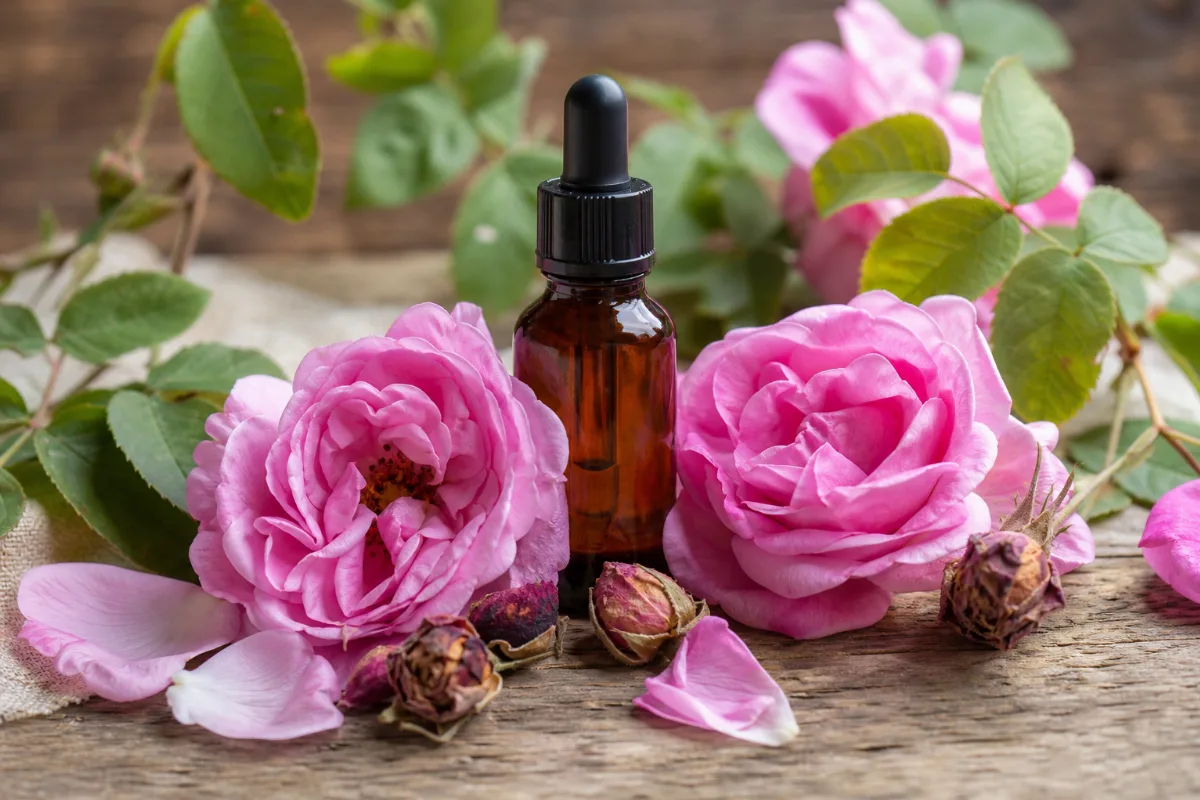
Essential Oils & Aromatherapy · Essential oil
Rose Oil
Rosa x damascena and Rosa x centifolia · also called Rose otto, rose absolute, damask rose oil, attar of roses, rose essential oil
Rose oil is the costly, sweet-smelling oil taken from rose petals. It comes as rose otto (distilled) and rose absolute (made another way), and is used as a scent and in massage and skin products. The research is small: a few trials on anxiety, labour pain and period symptoms, with low to very low certainty. The main cautions: its main scent chemicals are known skin allergens, it should not be swallowed, and expensive rose oil is often faked.
General information, not medical advice. Last substantive update · Not medically reviewed. A named clinician has not signed off on this page. How this page is made
About Rose Oil
Rose oil is a costly aromatherapy and perfume oil with a few small studies behind its uses. Safety comes first: its main scent chemicals are known skin allergens, it should not be swallowed or used undiluted, and cats and birds are at special risk from essential oils. Fakes are common. The evidence for benefit is limited and mostly from small trials of aroma.
What rose oil is: otto, absolute and other rose products
Rose otto (also called rose oil) is traditionally made by water distillation of Rosa damascena petals, and it costs a lot because the yield is low. Rose absolute is a different product: it is made from a petal concrete, an extract of the petals. Many perfumery books say solvents are used to make absolutes, but we did not find a source that spells it out or measures solvent leftovers.
Citronellol and geraniol are the main compounds, with phenylethyl alcohol, nerol and linalool. In one Indian study citronellol ranged from 16 to 35% and geraniol from 8 to 30%, depending on cultivar and growing site. Rose water is a different product, and rosehip seed oil comes from a different rose and part of the plant.
Quality: fakes and pesticide traces
A 2023 paper calls rose oil a common target for adulteration that "can cause harm to consumers". Geranium oil, palmarosa oil and phenylethyl alcohol are named as likely add-ins, and synthetic mixes share the main compounds with the real thing, so a laboratory test is needed to tell.
A lab study found that pesticides on rose petals were concentrated 100 to 300 times in the absolute. In real Turkish samples chlorpyrifos reached 27 mg/kg in absolutes against 0.05 mg/kg in the flowers. Otto was not tested. Look for the botanical name, otto or absolute, the country and a batch test report.
What people use it for, and how strong the evidence is
For anxiety and pain in labour, two small hospital trials and a pooled review point the same way: lower scores with rose aroma. The pooled review counts lavender and rose together. For anxiety around a heart test or Caesarean section, and for stress and sleep in staff, results are small, self-rated and not blinded. Certainty is low to very low.
For period problems the picture is mixed: one short trial of rose aroma added to a pain injection did slightly better, but a pooled review of seven trials found no significant pain effect, only small gains for headache, tiredness and bloating. For PMS, two student trials from one team were positive against baseline. For pregnancy back pain there is one trial. For migraine the one trial was null overall.
The research in one view
Most trials came from Iran, with small groups, self-rated outcomes and a scent that people can identify. No trial said whether it used otto or absolute. Cell and bacteria findings have not been tested in people. A 2024 review of blossom oils calls the use "safe in studies" but also notes skin side effects and says clinical research is thin.
Nothing here shows that rose oil treats a disease.
Oil, absolute, water and tea are different things
Rose tea (petals in hot water), rose water and rosehip seed oil are different products with their own evidence and risks. Do not judge the oil by tea or water results, or the reverse.
What regulators say
We did not find a regulator that approves rose oil as a medicine. Poison Control and Pet Poison Helpline give general essential-oil warnings that do not name rose. NCCIH describes aromatherapy but the part we could read does not name rose. We could not read the EU allergen labelling law, Tisserand, IFRA or SCCS entries, so none is quoted.
At a glance
Traditional uses history, not proof
- Scent in perfumes, cosmetics and household products (review of blossom oils).
- Aromatherapy, inhaled or applied diluted to skin (NCCIH describes aromatherapy this way).
- Rose oil, rose water, concrete and absolute are made from the same flowers.
Studied for research
- Pain and anxiety in early labour, aroma, low
- Anxiety and pain around a procedure, aroma, very low
- Anxiety and sleep in stressed staff, aroma, very low
- Painful periods, aroma, mixed
- Premenstrual syndrome, aroma, low
- Pregnancy back pain, on the skin, low
- Migraine, on the skin, insufficient
Main compounds
- Citronellol and geraniol, the main scent chemicals and fragrance allergens
- Phenylethyl alcohol (mainly in rose water and absolutes)
- Nerol, linalool, rose oxide and long-chain hydrocarbons
Common forms
- Rose otto (water-distilled essential oil)
- Rose absolute (made from a petal concrete)
- Rose water and hydrosol (different products)
- Rosehip seed oil (a different oil from a different part of the plant)
Research links: Poison Control: Essential oils · Pet Poison Helpline: Essential oils · NCCIH: Aromatherapy · Rose oil authenticity and adulteration (abstract) · Skin allergy to essential oils, IVDK data (abstract) · Pesticides in rose absolute (abstract) · Research Library · Genes & Biomarkers Library
What it is and its history
- Accepted scientific name
- Rosa x damascena Mill. (damask rose); the absolute and some oils also come from Rosa x centifolia L. (cabbage or Provence rose)
- Naming authority
- Rosa x damascena Mill., Gard. Dict. (Ed. 8) Rosa No. 15 (1768); Rosa x centifolia L., Sp. Pl. 1: 491-492 (1753) (GBIF)
- Common names
- Rose oil (English); Rose otto (English); Rose absolute (English); Damask rose (English); Burgundy rose (NCBI name for R. x centifolia) (English)
- Family or group
- Rosaceae (rose family).
- Classification
- Plantae > Tracheophyta > Magnoliopsida > Rosales > Rosaceae > Rosa > Rosa x damascena; Rosa x centifolia
- Native range
- NOT verified from a source read.
- Habitat
- NOT verified.
- What it looks like
- Part used: The oil comes from the flowers. A 2011 study distilled oil and rose water from Rosa damascena petals at bud, half-bloom and full-bloom stages and says the plant is grown commercially for rose oil, water, concrete and absolute.
- Look-alikes and adulterants
- Name: Rosehip seed oil (Rosa canina and relatives); Note: A fatty oil pressed from fruit seeds, not an essential oil. It has its own page. Do not use rose oil results for it, or the reverse.; Name: Rosa alba, Rosa gallica and other oil-bearing roses; Note: Bulgarian oils from R. alba and R. gallica differ from R. damascena in a lab study; products may not state the species.
- Sustainability and conservation
- Not assessed here.
Photographs
Traditional use and history history, not clinical proof
| Tradition or era | Documented use | Source |
|---|---|---|
| Perfumery and cosmetics | A review says oils from blossoms including Rosa x damascena are very popular as fragrances in perfumes, cosmetics and household products and are used in aromatherapy. | Prosche 2024 |
| Rose oil trade | A 2023 paper says rose oil is traditionally produced by water distillation of Rosa damascena and is of high economic value because the yield is low. A 2011 paper says Rosa damascena is grown for rose oil, rose water, concrete and absolute. | Raeber 2023; Verma 2011 |
| Older medical history | No source read describes older medical use of rose oil, so none is stated. | none |
Traditional use shows how it was used. It does not show that it works or is safe today.
What is inside, and how it may work
What it contains and how those compounds act in cells and animals. Laboratory and animal mechanisms are not proven effects in people.
Main compounds
| Compound | Family | Where it is concentrated | Activity studied | Level of evidence |
|---|---|---|---|---|
| Citronellol PubChem 8842 | acyclic monoterpene alcohol | Flower (oil) 21.22% in one analysed sample; 15.9-35.3% in North Indian oils | Main scent chemical; a fragrance allergen in patch tests (0.5% positive in one series). 36 35 27 | Analysis |
| Geraniol PubChem 637566 | acyclic monoterpene alcohol | Flower (oil) 14.1% in one sample; 8.3-30.2% in North Indian oils | Main scent chemical; the most frequent fragrance allergen in a Spanish series; the authors of a lab TB study link geraniol plus nerol to the oil's effect on bacteria. 36 35 29 34 | Analysis |
| Nerol PubChem 643820 | acyclic monoterpene alcohol | Flower (oil) 4.0-9.6% in North Indian oils | Scent chemical related to geraniol. 35 34 | Analysis |
| 2-Phenylethanol (phenylethyl alcohol) PubChem 6054 | aromatic alcohol | Flower (rose water, absolute) 66.2-81% of rose water volatiles; main compound in rose distillate | Honey-rose smell; also a cheap adulterant. 35 17 3 | Analysis |
| Linalool PubChem 6549 | acyclic monoterpene alcohol | Flower (oil) 0.7-2.8% in North Indian oils | Minor scent chemical and a labelled fragrance allergen (0.2% positive in one series). 35 27 | Analysis |
| Rose oxide PubChem 27866 | monoterpene ether | Flower (oil) Not quantified in the abstracts read | Named by the authors as one of the minor quality markers; chiral forms separated. 26 | Analysis |
| Long-chain hydrocarbons (nonadecane, heneicosane, eicosane) | alkanes | Flower (oil) Nonadecane 4.5-16.0% and heneicosane 2.6-7.9% in Indian oils; eicosane 11.03% in one sample | Long-chain hydrocarbons; levels vary with growing site and distillation. 35 36 | Analysis |
Mechanisms, receptors and pathways
| Target or pathway | Gene or receptor | What was found | Level |
|---|---|---|---|
| Calming of autonomic arousal (proposed) | not identified | The 2009 skin-application test suggests lower breathing rate and blood pressure; the review mentions less sympathetic activity. No mechanism was shown in people. 13 19 | Hypothesis |
| Tyrosinase inhibition | TYR | In a test tube the oil was a reversible mixed-type inhibitor of tyrosinase and lowered melanin in mouse cells. 36 | Laboratory research |
| Antibacterial action on M. tuberculosis | efflux pump genes (strain differences) | Oils were active in culture; the authors hypothesise geraniol and nerol drive the effect. 34 | Laboratory research |
| Cytotoxicity to cancer cell lines | not identified | Concrete and absolute were toxic to HepG2 and MCF7 cells in a dish and not to normal lymphocytes at 10 micrograms/mL. 9 | Laboratory research |
Absorption, metabolism and elimination
- Absorption
- No human blood-level data were found for inhaled or skin-applied rose oil. The 2009 test with breathing masks suggests skin application can change body measures, but no absorption was measured.
- Distribution
- Not studied.
- Metabolism
- Not studied.
- Elimination
- Not studied.
- Bioavailability
- Not studied.
Isolated compounds versus whole extracts
Rose oil is a mixture of many chemicals; citronellol and geraniol dominate, with phenylethyl alcohol in the water-soluble fraction and in absolutes. Composition changes with cultivar, growing site and flower stage, and cheap look-alikes copy the main compounds. Results for one product therefore do not transfer reliably to another, and none of the trials say whether they used otto, absolute or a diluted blend.
Nutritional composition
Not a food. Rose oil is not a source of nutrients.
1 mixed findings4 low certainty4 very low certainty2 not enough evidence
What is Rose Oil good for?
The uses people ask about and how strong the evidence is for each. Read the certainty label first: none of these is better than low, most trials came from Iran, and the smell of rose cannot be hidden from the people in the trials.
Benefits, one by one
Each card is a research question, not a promise. Tap a goal to filter. Open a card to see the studies, doses and limits.
Pain and anxiety in early labour (rose aroma in hospital)
Low certaintyIn two small hospital trials, women who breathed rose aroma in early labour rated their pain and anxiety lower than women given saline or usual care. A review that pooled pain results counted rose and lavender together. The evidence is low.
3 studiesRose (Rosa damascena) oil or essence inhaled by aroma; the amount per…
Studies, doses and limits
What the trials found
Hamdamian 2018: 110 first-time mothers in Iran; rose essence or saline repeated through the first stage; pain and anxiety were lower in the rose group at every time point (p < 0.05). Li 2025: 76 first-time mothers analysed in early labour; rose aroma, saline placebo in the same device, or usual care; anxiety and pain were lower with rose at 60 and 120 minutes. A 2021 systematic review of obstetric aromatherapy could pool only the pain results, and found an effect for lavender and Rosa damascena oils together.
Results
Positive on self-rated pain and anxiety in both trials, and in a pooled review that mixes lavender and rose.
Effect sizes as reported
Statistically significant at each time point; the abstracts do not give point sizes. The pooled review result is for rose and lavender together.
Why this rating
Two randomised trials and one review point the same way, but they are small, from one or two countries, rely on self-rated scores, and the smell of rose cannot be hidden from the women, so expectation can drive the result.
Form and dose studied
Rose (Rosa damascena) oil or essence inhaled by aroma; the amount per session is given in each paper and is not advice.
Who was studied
First-time mothers in hospital labour wards.
Limits
Unblinded by smell; only first-time mothers; no comparison with a different pleasant scent; adverse effects and effects on the baby are not reported in the abstracts.
Why researchers looked
Labour is painful and frightening, and gentle non-drug options are popular, so research teams tested rose aromatherapy next to usual care.
Traditional use
Rose is a popular aromatherapy scent. No regulator we found accepts it for labour pain.
Proposed mechanism Hypothesis
Not worked out in people. Authors of the trials suggest a calming effect of scent on the nervous system, but none of the abstracts we read tested a mechanism.
A proposed mechanism does not show that the effect happens in people.
Safety is covered in the Safety tab: rose oil and absolute can cause skin allergy, they are not for swallowing, and they should not be used undiluted. No amounts are advised here. Anyone pregnant should ask a doctor or midwife before using any essential oil.
Anxiety and pain around a medical procedure (heart angiography, Caesarean section)
Very low certaintyTwo small Iranian trials found lower anxiety (and lower pain after Caesarean section) in people who breathed rose aroma, compared with water or saline. It is very low certainty.
2 studiesRose oil inhaled from a pad or cotton ball; the amounts are in the pa…
Studies, doses and limits
What the trials found
Bikmoradi 2022: 98 people before coronary angiography breathed rose or distilled water for 20 minutes; stress, anxiety and several heart measures changed (p = 0.001 to 0.02); the control group also changed significantly. Abbasijahromi 2020: 90 women after Caesarean section; pain and anxiety were lower with rose or lavender than with saline (p < 0.001), and the abstract says rose showed a larger effect than lavender.
Results
Positive on self-rated anxiety and pain versus control; the angiography trial also found changes in the control group.
Effect sizes as reported
Statistically significant; the abstracts do not give sizes.
Why this rating
Two small single-centre trials from the same country, self-rated outcomes, and strong smells are hard to blind. The angiography abstract reports changes in the control group too.
Form and dose studied
Rose oil inhaled from a pad or cotton ball; the amounts are in the papers and are not advice.
Who was studied
Adults before angiography; women after Caesarean section.
Limits
Single hospitals; short follow-up; no repeat; no comparison of rose with any other scent in the angiography trial.
Why researchers looked
Waiting for a procedure causes anxiety, so researchers tested a scent in hospital.
Traditional use
Rose is a popular aromatherapy scent for calm.
Proposed mechanism Hypothesis
Not worked out in people. Authors of the trials suggest a calming effect of scent on the nervous system, but none of the abstracts we read tested a mechanism.
A proposed mechanism does not show that the effect happens in people.
Safety is covered in the Safety tab: rose oil and absolute can cause skin allergy, they are not for swallowing, and they should not be used undiluted. No amounts are advised here.
Anxiety and sleep in hospital staff under stress (one trial)
Very low certaintyIn one Iranian trial, operating-room staff who breathed rose oil and kept a scented cloth by the pillow for a month scored lower on anxiety and better on sleep than staff given paraffin oil. The trial was not blinded. Certainty is very low.
1 studiesRose (Rosa damascena) oil on a pillow cloth and inhaled; amounts are …
Studies, doses and limits
What the trials found
Mahdood 2022: 80 operating-room staff; rose oil or paraffin oil inhaled at work and on a pillow cloth for 30 nights; state anxiety fell more with rose both 90 minutes after the first session and at day 31, and sleep quality scores improved more at day 31 (all p < .001). The authors say it was not blinded.
Results
Positive on self-rated anxiety and sleep versus paraffin oil.
Effect sizes as reported
Statistically significant (p < .001); sizes are not in the abstract.
Why this rating
One trial of 80 people, not blinded, self-rated, in a very stressful period; no replication found.
Form and dose studied
Rose (Rosa damascena) oil on a pillow cloth and inhaled; amounts are in the paper and are not advice.
Who was studied
Hospital operating-room staff.
Limits
Not blinded; one site; pandemic setting; no objective sleep measurement.
Why researchers looked
Hospital staff were under heavy stress during the COVID-19 pandemic, so a gentle bedtime scent was tested.
Traditional use
Rose is a popular aromatherapy scent; no regulator we found accepts it for sleep.
Proposed mechanism Hypothesis
Not worked out in people. Authors of the trials suggest a calming effect of scent on the nervous system, but none of the abstracts we read tested a mechanism.
A proposed mechanism does not show that the effect happens in people.
Safety is covered in the Safety tab: rose oil and absolute can cause skin allergy, they are not for swallowing, and they should not be used undiluted. No amounts are advised here.
Calm and lower breathing rate after rose oil on the skin (healthy adults)
Very low certaintyIn a 2009 test, 40 healthy volunteers wore breathing masks so they could not smell the oil. Rose oil on the skin lowered breathing rate and blood pressure and people felt more calm. It is one small experiment.
1 studiesRose oil applied to the skin in a controlled test; the amount is in t…
Studies, doses and limits
What the trials found
Hongratanaworakit 2009: 40 healthy volunteers; rose oil or placebo applied to the skin with breathing masks; compared with placebo, rose oil lowered breathing rate, blood oxygen saturation and systolic blood pressure, and people rated themselves as more calm and relaxed and less alert.
Results
Positive on breathing rate, systolic blood pressure and self-rated calm; oxygen saturation also fell.
Effect sizes as reported
Statistically significant versus placebo; no numbers in the abstract.
Why this rating
One small experiment from 2009, no replication found, short test in healthy people, abstract lacks sizes and randomisation details.
Form and dose studied
Rose oil applied to the skin in a controlled test; the amount is in the paper and is not advice.
Who was studied
Healthy volunteers.
Limits
Healthy people, not patients; the lowering of oxygen saturation is not clearly a benefit; no long-term data.
Why researchers looked
Researchers wanted to separate the effect of smell from the effect of oil absorbed through the skin.
Traditional use
Rose oil is used in aromatherapy; NCCIH describes aromatherapy as inhaling oils or applying them diluted to skin.
Proposed mechanism Hypothesis
Authors suggest absorption through the skin lowered "autonomic arousal" (the body's alert state). No blood levels were measured.
A proposed mechanism does not show that the effect happens in people.
Safety is covered in the Safety tab: rose oil and absolute can cause skin allergy, they are not for swallowing, and they should not be used undiluted. No amounts are advised here.
Anxiety, sleep and low mood overall (a 2022 review of rose in many forms)
Very low certaintyA 2022 review of 38 studies (including 10 in animals) concluded that Rosa damascena looks promising for anxiety, sleep and low mood. But it mixes oil, extracts, dried plant, aromatherapy and swallowed forms, so it cannot tell you about rose oil alone.
1 studiesMixed: oil, essence, extract and dried plant, by aroma and by mouth.
Studies, doses and limits
What the trials found
Mohamadi 2022: 10 animal studies and 38 studies in total were included; people with anxiety, sleep problems or depression were studied with essential oil, essence, extract and dried plant, by aroma and by mouth. The authors called R. damascena effective but asked for better research.
Results
Positive overall in the authors' words; no pooled effect size given in the abstract.
Effect sizes as reported
No effect size in the abstract.
Why this rating
The conclusion covers many forms and uses, includes animals, and the abstract gives no quality rating or pooled number; it should not be applied to the oil alone.
Form and dose studied
Mixed: oil, essence, extract and dried plant, by aroma and by mouth.
Who was studied
People with anxiety, sleep disturbance or depression, plus animals.
Limits
Mixed forms; no pooling; abstract only.
Why researchers looked
Many small studies of rose in different forms existed, so a team gathered them.
Traditional use
No traditional-use source was read for this use.
Proposed mechanism Animal research
The review lists lower sympathetic nervous system activity and changes in brain chemicals, mostly from animal work.
A proposed mechanism does not show that the effect happens in people.
Safety is covered in the Safety tab: rose oil and absolute can cause skin allergy, they are not for swallowing, and they should not be used undiluted. No amounts are advised here. Swallowing is not advised for the oil.
Painful periods (rose oil aroma, with a drug or alone)
Mixed findingsOne trial found a small extra drop in pain when rose aroma was added to a diclofenac injection, but a 2021 pooled review of seven trials found no significant pain benefit overall. Results are mixed.
2 studiesRose oil aroma, skin or oral products in the review; amounts are not …
Studies, doses and limits
What the trials found
Uysal 2016: 100 people with primary dysmenorrhea got diclofenac injection alone or with rose aroma; pain fell in both groups and was lower at 30 minutes with the rose add-on (p = 0.019). Koohpayeh 2021 pooled seven trials (276 treated, 272 comparison; aroma, skin and oral forms mixed): menstrual pain difference -0.47 (95% CI -1.25 to 0.31), not significant.
Results
Mixed: one positive add-on trial, but the pooled result for pain is not significant.
Effect sizes as reported
Pooled pain difference -0.47, 95% CI -1.25 to 0.31 (not significant). Single trial: add-on lower at 30 minutes, p = 0.019.
Why this rating
The best summary found no significant effect on pain; the one positive trial is short and used a drug as the base.
Form and dose studied
Rose oil aroma, skin or oral products in the review; amounts are not advice.
Who was studied
Women aged 18-35 with period pain or PMS.
Limits
Few trials; forms mixed; short follow-up; no scent-matched control.
Why researchers looked
Period pain is common and women look for gentle add-ons.
Traditional use
No traditional-use source was read for this use.
Proposed mechanism Hypothesis
Not worked out in people. Authors of the trials suggest a calming effect of scent on the nervous system, but none of the abstracts we read tested a mechanism.
A proposed mechanism does not show that the effect happens in people.
Safety is covered in the Safety tab: rose oil and absolute can cause skin allergy, they are not for swallowing, and they should not be used undiluted. No amounts are advised here.
Premenstrual syndrome symptoms (rose aroma in two trials)
Low certaintyTwo student trials from one Iranian team found PMS scores fell over two months with rose aroma. The comparison was mostly to the starting score, so it is hard to say how much came from the oil. Certainty is low.
2 studiesRose aroma inhaled briefly for several days a cycle; amounts are in t…
Studies, doses and limits
What the trials found
Heydari 2018: 66 students (64 finished); rose aroma or sweet almond oil aroma twice daily for 5 days each cycle, over 2 months; psychological, physical, social and total scores improved with rose versus baseline (P < 0.001 to 0.002) and not with almond oil. Heydari 2019: 95 students; rose, bitter-orange blossom or almond oil; rose improved physical and social scores significantly and mental scores (P = 0.007).
Results
Positive within the rose groups; between-group differences are not given in the abstracts.
Effect sizes as reported
Significant improvement versus baseline in rose groups.
Why this rating
Two small trials from the same team and the same type of participant, self-rated, and the abstracts compare to baseline rather than group versus group.
Form and dose studied
Rose aroma inhaled briefly for several days a cycle; amounts are in the papers and are not advice.
Who was studied
Female students with PMS.
Limits
Same research group; students only; no repeat elsewhere.
Why researchers looked
PMS affects mood and body for many women, and a pleasant scent is an easy thing to try.
Traditional use
Not stated in any source read.
Proposed mechanism Hypothesis
Not worked out in people. Authors of the trials suggest a calming effect of scent on the nervous system, but none of the abstracts we read tested a mechanism.
A proposed mechanism does not show that the effect happens in people.
Safety is covered in the Safety tab: rose oil and absolute can cause skin allergy, they are not for swallowing, and they should not be used undiluted. No amounts are advised here.
Headache, tiredness and bloating around periods (pooled review)
Low certaintyThe same 2021 review found small but statistically significant drops in period-related headache, tiredness and bloating with rose products. The trials mix aroma, skin and swallowed forms, so this is not specific to the oil.
1 studiesAromatherapy, skin and oral Rosa damascena products pooled together.
Studies, doses and limits
What the trials found
Koohpayeh 2021: pooled differences were -0.42 for headache (95% CI -0.74 to -0.11), -0.48 for fatigue (-0.87 to -0.09) and -0.72 for bloating (-1.21 to -0.22); anxiety was not significant (-0.40, -0.91 to 0.11).
Results
Positive for three symptoms, not significant for anxiety and pain.
Effect sizes as reported
Headache -0.42, fatigue -0.48, bloating -0.72 (all significant); anxiety -0.40 (not).
Why this rating
Pooled from only seven small trials with mixed forms; the authors call for better quality studies.
Form and dose studied
Aromatherapy, skin and oral Rosa damascena products pooled together.
Who was studied
Women aged 18-35.
Limits
Forms mixed; the review says quality was a problem.
Why researchers looked
The review looked at secondary period symptoms alongside pain.
Traditional use
Not stated.
Proposed mechanism Hypothesis
Not worked out in people. Authors of the trials suggest a calming effect of scent on the nervous system, but none of the abstracts we read tested a mechanism.
A proposed mechanism does not show that the effect happens in people.
Safety is covered in the Safety tab: rose oil and absolute can cause skin allergy, they are not for swallowing, and they should not be used undiluted. No amounts are advised here. Swallowed rose products are not the same as the oil and are not covered here.
Low back pain in pregnancy (rose oil rubbed on the skin)
Low certaintyOne Iranian trial of 120 pregnant women found less back pain after four weeks with rose oil in almond oil than with almond oil alone or no treatment. Function did not differ from the carrier. This is one trial and the safety of essential oils in pregnancy is not settled.
1 studiesRose oil diluted in almond oil on the skin; the amount is in the pape…
Studies, doses and limits
What the trials found
Shirazi 2017: 120 pregnant women with low back pain; rose oil in almond oil, almond oil alone, or no treatment, for 4 weeks. Pain was lower than with the carrier or no treatment; function improved versus no treatment but not versus the carrier. The authors report no significant adverse effect.
Results
Positive for pain versus carrier and no treatment; function not different from carrier.
Effect sizes as reported
Significant pain decrease; no numbers in the abstract.
Why this rating
One trial, one site; rubbing in any oil can ease pain, and the carrier-only group is the useful comparison.
Form and dose studied
Rose oil diluted in almond oil on the skin; the amount is in the paper and is not advice.
Who was studied
Pregnant women with back pain.
Limits
One trial; no data on the baby beyond the abstract's statement of no significant adverse effect.
Why researchers looked
Back pain is common in pregnancy and medicines are limited.
Traditional use
Not stated.
Proposed mechanism Hypothesis
Not worked out in people. Authors of the trials suggest a calming effect of scent on the nervous system, but none of the abstracts we read tested a mechanism.
A proposed mechanism does not show that the effect happens in people.
Safety is covered in the Safety tab: rose oil and absolute can cause skin allergy, they are not for swallowing, and they should not be used undiluted. No amounts are advised here. Pregnant women should ask a doctor or midwife before using any essential oil.
Migraine pain (rose oil on the skin)
Not enough evidenceIn a small cross-over trial the rose oil did not lower migraine pain more than placebo overall. A split into "hot" and "cold" types by a traditional system found less pain only in the hot type, which is a hypothesis, not a result to rely on.
1 studiesRose oil on the skin; amount in the paper, not advice.
Studies, doses and limits
What the trials found
Niazi 2017: 40 people with migraine; two attacks treated with rose oil or placebo on the skin, then cross-over. No significant overall difference in pain, nausea, light or sound sensitivity. Subgroup: lower pain in "hot" migraine.
Results
Null overall; subgroup finding is a hypothesis.
Effect sizes as reported
No significant overall difference.
Why this rating
One tiny trial with a null main result; the subgroup was an after-the-fact split.
Form and dose studied
Rose oil on the skin; amount in the paper, not advice.
Who was studied
People with migraine headache.
Limits
Small; subgroup analysis.
Why researchers looked
Skin application of oils is traditional for headaches in some medicines.
Traditional use
Traditional Persian medicine "hot and cold" types (described in the abstract).
Proposed mechanism Hypothesis
Not worked out in people. Authors of the trials suggest a calming effect of scent on the nervous system, but none of the abstracts we read tested a mechanism.
A proposed mechanism does not show that the effect happens in people.
Safety is covered in the Safety tab: rose oil and absolute can cause skin allergy, they are not for swallowing, and they should not be used undiluted. No amounts are advised here.
Findings in test tubes and cells (skin pigment, TB bacteria, cancer cell lines)
Not enough evidenceIn lab dishes, rose oil blocked an enzyme that makes skin pigment, slowed tuberculosis bacteria and was toxic to two cancer cell lines. These are cells and bacteria, not people, and they say nothing about treating anything.
3 studiesNot applicable
Studies, doses and limits
What the trials found
No human trials. Wu 2024: enzyme and mouse melanoma cells. Valcheva 2024: tuberculosis bacteria in culture, four Bulgarian rose species. Hagag 2014: concrete and absolute from Taif rose on human cancer cell lines and blood cells.
Results
Lab activity only.
Effect sizes as reported
No human data.
Why this rating
Cells and bacteria in a dish; no animal or human test is described.
Form and dose studied
Not applicable
Who was studied
None.
Limits
Results at lab concentrations do not predict effects on people or on skin.
Why researchers looked
Rose oil is rich in geraniol, which the authors of one lab study link to its effect on bacteria.
Traditional use
Not stated.
Proposed mechanism Laboratory research
Tyrosinase blocking (pigment), effects on bacteria linked by the authors to geraniol and nerol, and cell toxicity at tens of micrograms per mL.
A proposed mechanism does not show that the effect happens in people.
Do not read lab findings as a reason to use the oil on skin or to swallow it.
Connections to the rest of health
How Rose Oil connects to the rest of our health knowledge graph. Every link says what kind of connection it is. A safety link (for example to the liver) is a warning, not a benefit. A study that merely mentions a topic never creates a benefit link.
Explore every connection: goals, body systems, organs, symptoms, genes
A. Wellness goals
| Connected to | Kind of connection | Evidence status | Context | Studies |
|---|---|---|---|---|
| Pain Relief | Low certainty | Pain and anxiety in early labour (rose aroma in hospital): In two small hospital trials, women who breathed rose aroma in early labour rated their pain and anxiety lower than women given saline or usual care. A review that pooled pain results counted rose and lavender together. The evidence is low. Anxiety and pain around a medical procedure (heart angiography, Caesarean section): Two small Iranian trials found lower anxiety (and lower pain after Caesarean section) in people who breathed rose aroma, compared with water or saline. It is very low certainty. | 10 16 4 2 1 28 | |
| Anxiety Support | Low certainty | Pain and anxiety in early labour (rose aroma in hospital): In two small hospital trials, women who breathed rose aroma in early labour rated their pain and anxiety lower than women given saline or usual care. A review that pooled pain results counted rose and lavender together. The evidence is low. Anxiety and pain around a medical procedure (heart angiography, Caesarean section): Two small Iranian trials found lower anxiety (and lower pain after Caesarean section) in people who breathed rose aroma, compared with water or saline. It is very low certainty. | 10 16 4 2 1 18 | |
| Womens Wellness | Low certainty | Pain and anxiety in early labour (rose aroma in hospital): In two small hospital trials, women who breathed rose aroma in early labour rated their pain and anxiety lower than women given saline or usual care. A review that pooled pain results counted rose and lavender together. The evidence is low. Premenstrual syndrome symptoms (rose aroma in two trials): Two student trials from one Iranian team found PMS scores fell over two months with rose aroma. The comparison was mostly to the starting score, so it is hard to say how much came from the oil. Certainty is low. | 10 16 4 11 12 28 | |
| Stress Reduction | Very low certainty | Anxiety and pain around a medical procedure (heart angiography, Caesarean section): Two small Iranian trials found lower anxiety (and lower pain after Caesarean section) in people who breathed rose aroma, compared with water or saline. It is very low certainty. Anxiety and sleep in hospital staff under stress (one trial): In one Iranian trial, operating-room staff who breathed rose oil and kept a scented cloth by the pillow for a month scored lower on anxiety and better on sleep than staff given paraffin oil. The trial was not blinded. Certainty is very low. | 2 1 18 | |
| Better Sleep | Very low certainty | Anxiety and sleep in hospital staff under stress (one trial): In one Iranian trial, operating-room staff who breathed rose oil and kept a scented cloth by the pillow for a month scored lower on anxiety and better on sleep than staff given paraffin oil. The trial was not blinded. Certainty is very low. | 18 | |
| Calm Relaxation | Very low certainty | Calm and lower breathing rate after rose oil on the skin (healthy adults): In a 2009 test, 40 healthy volunteers wore breathing masks so they could not smell the oil. Rose oil on the skin lowered breathing rate and blood pressure and people felt more calm. It is one small experiment. | 13 | |
| Stress Relaxation | Very low certainty | Calm and lower breathing rate after rose oil on the skin (healthy adults): In a 2009 test, 40 healthy volunteers wore breathing masks so they could not smell the oil. Rose oil on the skin lowered breathing rate and blood pressure and people felt more calm. It is one small experiment. | 13 | |
| Mood Balance | Very low certainty | Anxiety, sleep and low mood overall (a 2022 review of rose in many forms): A 2022 review of 38 studies (including 10 in animals) concluded that Rosa damascena looks promising for anxiety, sleep and low mood. But it mixes oil, extracts, dried plant, aromatherapy and swallowed forms, so it cannot tell you about rose oil alone. | 19 | |
| Anxiety Support | Very low certainty | Anxiety, sleep and low mood overall (a 2022 review of rose in many forms): A 2022 review of 38 studies (including 10 in animals) concluded that Rosa damascena looks promising for anxiety, sleep and low mood. But it mixes oil, extracts, dried plant, aromatherapy and swallowed forms, so it cannot tell you about rose oil alone. | 19 | |
| Better Sleep | Very low certainty | Anxiety, sleep and low mood overall (a 2022 review of rose in many forms): A 2022 review of 38 studies (including 10 in animals) concluded that Rosa damascena looks promising for anxiety, sleep and low mood. But it mixes oil, extracts, dried plant, aromatherapy and swallowed forms, so it cannot tell you about rose oil alone. | 19 | |
| Womens Wellness | Mixed findings | Painful periods (rose oil aroma, with a drug or alone): One trial found a small extra drop in pain when rose aroma was added to a diclofenac injection, but a 2021 pooled review of seven trials found no significant pain benefit overall. Results are mixed. | 33 15 | |
| Pain Relief | Mixed findings | Painful periods (rose oil aroma, with a drug or alone): One trial found a small extra drop in pain when rose aroma was added to a diclofenac injection, but a 2021 pooled review of seven trials found no significant pain benefit overall. Results are mixed. | 33 15 | |
| Mood Balance | Low certainty | Premenstrual syndrome symptoms (rose aroma in two trials): Two student trials from one Iranian team found PMS scores fell over two months with rose aroma. The comparison was mostly to the starting score, so it is hard to say how much came from the oil. Certainty is low. | 11 12 | |
| Hormone Balance | Low certainty | Premenstrual syndrome symptoms (rose aroma in two trials): Two student trials from one Iranian team found PMS scores fell over two months with rose aroma. The comparison was mostly to the starting score, so it is hard to say how much came from the oil. Certainty is low. | 11 12 | |
| Womens Wellness | Low certainty | Headache, tiredness and bloating around periods (pooled review): The same 2021 review found small but statistically significant drops in period-related headache, tiredness and bloating with rose products. The trials mix aroma, skin and swallowed forms, so this is not specific to the oil. | 15 | |
| Reduce Fatigue | Low certainty | Headache, tiredness and bloating around periods (pooled review): The same 2021 review found small but statistically significant drops in period-related headache, tiredness and bloating with rose products. The trials mix aroma, skin and swallowed forms, so this is not specific to the oil. | 15 | |
| Mobility Support | Low certainty | Low back pain in pregnancy (rose oil rubbed on the skin): One Iranian trial of 120 pregnant women found less back pain after four weeks with rose oil in almond oil than with almond oil alone or no treatment. Function did not differ from the carrier. This is one trial and the safety of essential oils in pregnancy is not settled. | 28 | |
| Pain Relief | Not enough evidence | Migraine pain (rose oil on the skin): In a small cross-over trial the rose oil did not lower migraine pain more than placebo overall. A split into "hot" and "cold" types by a traditional system found less pain only in the hot type, which is a hypothesis, not a result to rely on. | 22 | |
| Healthy Skin | Not enough evidence | Findings in test tubes and cells (skin pigment, TB bacteria, cancer cell lines): In lab dishes, rose oil blocked an enzyme that makes skin pigment, slowed tuberculosis bacteria and was toxic to two cancer cell lines. These are cells and bacteria, not people, and they say nothing about treating anything. | 36 34 9 | |
| Cellular Protection | Not enough evidence | Findings in test tubes and cells (skin pigment, TB bacteria, cancer cell lines): In lab dishes, rose oil blocked an enzyme that makes skin pigment, slowed tuberculosis bacteria and was toxic to two cancer cell lines. These are cells and bacteria, not people, and they say nothing about treating anything. | 36 34 9 |
B. Body systems
| Connected to | Kind of connection | Evidence status | Context | Studies |
|---|---|---|---|---|
| Nervous System | Biological association | Low certainty | Studied for: Pain and anxiety in early labour (rose aroma in hospital) Studied for: Anxiety and pain around a medical procedure (heart angiography, Caesarean section) | 10 16 4 2 1 18 13 19 22 |
| Reproductive System | Biological association | Low certainty | Studied for: Pain and anxiety in early labour (rose aroma in hospital) Studied for: Painful periods (rose oil aroma, with a drug or alone) | 10 16 4 33 15 11 12 28 |
| Stress Mood | Biological association | Very low certainty | Studied for: Anxiety and pain around a medical procedure (heart angiography, Caesarean section) Studied for: Calm and lower breathing rate after rose oil on the skin (healthy adults) | 2 1 13 19 11 12 |
| Sleep Recovery | Biological association | Very low certainty | Studied for: Anxiety and sleep in hospital staff under stress (one trial) | 18 |
| Pain Inflammation | Biological association | Mixed findings | Studied for: Painful periods (rose oil aroma, with a drug or alone) Studied for: Migraine pain (rose oil on the skin) | 33 15 22 |
| Musculoskeletal System | Biological association | Low certainty | Studied for: Low back pain in pregnancy (rose oil rubbed on the skin) | 28 |
| Skin Hair Beauty | Biological association | Not enough evidence | Studied for: Findings in test tubes and cells (skin pigment, TB bacteria, cancer cell lines) | 36 34 9 |
| Cells | Biological association | Not enough evidence | Studied for: Findings in test tubes and cells (skin pigment, TB bacteria, cancer cell lines) | 36 34 9 |
C. Body parts and organs
E. Health conditions
| Connected to | Kind of connection | Evidence status | Context | Studies |
|---|---|---|---|---|
| Contact dermatitis | Adverse effect or risk | Documented risk | Patch-test data on rose's main chemicals; no rose-specific figure. Patch-test data on rose's main chemicals. Preparation or compound: Rose oil and absolute (geraniol, citronellol) |
27 29 8 |
I. Biomarkers
| Connected to | Kind of connection | Evidence status | Context | Studies |
|---|---|---|---|---|
| Anxiety score (self-rated) | Biological association | Very low certainty | Measured in trials: lowered. A lab change is not the same as a health benefit. | 18 1 16 |
| Labour or surgical pain score (self-rated) | Biological association | Low certainty | Measured in trials: lowered. A lab change is not the same as a health benefit. | 10 1 |
| Blood pressure, breathing rate, heart rate | Biological association | Very low certainty | Measured in trials: lowered. A lab change is not the same as a health benefit. | 13 2 |
| Sleep quality score (PSQI) | Biological association | Very low certainty | Measured in trials: improved. A lab change is not the same as a health benefit. | 18 |
| Period pain score (VAS) | Biological association | Mixed findings | Measured in trials: lowered. A lab change is not the same as a health benefit. | 33 15 |
| Premenstrual symptoms score (PSST) | Biological association | Low certainty | Measured in trials: lowered. A lab change is not the same as a health benefit. | 11 12 |
| Back pain and disability score | Biological association | Low certainty | Measured in trials: lowered. A lab change is not the same as a health benefit. | 28 |
| Migraine pain intensity over 24 hours | Biological association | Not enough evidence | Measured in trials: no change. A lab change is not the same as a health benefit. | 22 |
J. Genes, receptors and enzymes
| Connected to | Kind of connection | Evidence status | Context | Studies |
|---|---|---|---|---|
| TYR | Preliminary mechanism | In vitro | Tyrosinase (skin pigment enzyme) inhibition in a test tube. | 36 |
L. Active compounds
| Connected to | Kind of connection | Evidence status | Context | Studies |
|---|---|---|---|---|
| Geraniol | Adverse effect or risk | Low certainty | Fragrance allergen; most frequent single fragrance allergen in a Spanish series. Fragrance allergen and a main rose oil compound. Preparation or compound: Geraniol (rose oil component) |
29 27 36 |
| Citronellol | Adverse effect or risk | Low certainty | Fragrance allergen, 0.5% positive patch tests in one series. Fragrance allergen and a main rose oil compound. Preparation or compound: Citronellol (rose oil component) |
27 36 |
| Citronellol | Biological association | Analysis | Main scent chemical; a fragrance allergen in patch tests (0.5% positive in one series). Preparation or compound: Flower (oil) |
36 35 27 |
| Geraniol | Biological association | Analysis | Main scent chemical; the most frequent fragrance allergen in a Spanish series; the authors of a lab TB study link geraniol plus nerol to the oil's effect on bacteria. Preparation or compound: Flower (oil) |
36 35 29 34 |
| Nerol | Biological association | Analysis | Scent chemical related to geraniol. Preparation or compound: Flower (oil) |
35 34 |
| 2-Phenylethanol (phenylethyl alcohol) | Biological association | Analysis | Honey-rose smell; also a cheap adulterant. Preparation or compound: Flower (rose water, absolute) |
35 17 3 |
| Linalool | Biological association | Analysis | Minor scent chemical and a labelled fragrance allergen (0.2% positive in one series). Preparation or compound: Flower (oil) |
35 27 |
| Rose oxide | Biological association | Analysis | Named by the authors as one of the minor quality markers; chiral forms separated. Preparation or compound: Flower (oil) |
26 |
| Long-chain hydrocarbons (nonadecane, heneicosane, eicosane) | Biological association | Analysis | Long-chain hydrocarbons; levels vary with growing site and distillation. Preparation or compound: Flower (oil) |
35 36 |
Each connection is stored with the ingredient, the connected record, the kind of connection, the evidence status, the supporting studies, the preparation or compound involved, and a review date (last reviewed October 25, 2026).
Evidence at a glance: what changed in 6 lab markers
Tap a number to show only those markers. Counts are markers, not people.
The evidence
The research centre for Rose Oil. Every record here was checked against PubMed or the publisher's page; we never list a study we have not verified.
Evidence by outcome
Bars show how many studies we found for each outcome, not how well it works. People are added up across trials only (reviews are not added, to avoid double counting).
How we rate evidence
High certainty
Several well-run trials or reviews agree; further research is unlikely to change the picture much.
Moderate certainty
Good trials point the same way, but some doubt remains.
Low certainty
Small, short or inconsistent trials. The finding could change with better research.
Very low certainty
Very little or very weak human data. Treat as a possibility only.
Mixed findings
Trials or reviews disagree with each other.
Not enough evidence
Not enough human research to say either way.
Evidence against
Good research found no benefit, or found harm.
We take the reviewers' own risk-of-bias and GRADE statements where they exist, and otherwise judge from study size, design, consistency, directness and whether a product matches what is sold. Many publications do not make evidence high. Method note: We read the abstracts of the PubMed papers listed, plus the Poison Control and Pet Poison Helpline pages and part of the NCCIH aromatherapy page, checked plant names in GBIF and NCBI and compounds in PubChem. We could not read EU law, Tisserand, IFRA, SCCS or LiverTox.
Study library: every study we checked 36
| Study | Design | People | Product, dose, length | Result |
|---|---|---|---|---|
| Abbasijahromi 2020 Compare the effect of aromatherapy using lavender and Damask rose essential oils on the level of anxiety and severity of pain following C-section: A double-blinded randomized clinical trial. J Complement Integr Med · PMID 31730539 · DOI |
Controlled trial |
90 90 women after Caesarean section at one Iranian hospital (three groups) |
Rose oil (Rosa x damascena) (damask rose) or lavender oil, inhaled from cotton balls oil 30 minutes, measured 5 minutes after · vs Normal saline on cotton |
Pain and overt anxiety were lower with lavender or rose than with saline (p < 0.001); the abstract says rose showed a larger effect than lavender, but no difference between the two oils in anxiety. Statistically significant versus control; numbers not in the abstract. Methods, limits and fundingOutcomes: Pain (VAS) and anxiety (STAI) Limitations: One hospital; short follow-up; smell makes blinding hard; the abstract says double-blinded but gives no detail. Funding and conflicts: Not stated in the abstract Read: abstract |
| Bikmoradi 2022 Impact of inhalation aromatherapy with Damask Rose (Rosa damascena) on stress, anxiety and hemodynamic parameters of patients undergoing coronary angiography: a single blind randomized clinical trial. J Complement Integr Med · PMID 34018381 · DOI |
Controlled trial |
98 98 patients before coronary angiography at one Iranian hospital |
Rose oil (Rosa x damascena) inhaled (diluted in the aromatherapy product) oil 20 minutes before the procedure · vs Distilled water inhaled |
Stress, anxiety and several heart measures differed between the groups after the aroma; the abstract also reports significant changes within the control group. Reported as significant (p = 0.001 to 0.02 for heart measures); size of group difference not given in the abstract. Methods, limits and fundingOutcomes: Stress and anxiety (DASS-21), heart rate, blood pressure, oxygen saturation Limitations: Single blind; the abstract reports significant changes in the control group as well, so the extra effect of rose is not clear; one hospital. Funding and conflicts: Not stated in the abstract Registration: IRCT201702019759N8 Read: abstract |
| Cebi 2021 Quantification of the Geranium Essential Oil, Palmarosa Essential Oil and Phenylethyl Alcohol in Rosa damascena Essential Oil Using ATR-FTIR Spectroscopy Combined with Chemometrics. Foods · PMID 34441625 · DOI |
Lab analysis |
Rosa damascena oil spiked with 0-100% geranium oil, palmarosa oil or phenylethyl alcohol | Rose oil spiked with likely adulterants oil Not applicable · vs None |
Geranium oil, palmarosa oil and phenylethyl alcohol were named as probable adulterants and could be quantified in spiked samples (R2 of 0.96 or more). Method study; no survey of shop products. Methods, limits and fundingOutcomes: Detection of adulterants by infrared spectroscopy Limitations: Spiked laboratory mixtures, not shop bottles; does not say how common adulteration is. Funding and conflicts: Not stated in the abstract Read: abstract |
| Di Vito 2021 Is aromatherapy effective in obstetrics? A systematic review and meta-analysis. Phytother Res · PMID 33300141 · DOI |
Systematic review |
17 randomised trials of essential oils in obstetrics (anxiety, nausea, labour pain, episiotomy) | Essential oils; meta-analysis possible only for labour pain with Lavandula and Rosa damascena oil Varies · vs Varies |
A meta-analysis was possible only for labour pain, and it identified an effect of lavender and Rosa damascena oils. Pooled labour-pain effect for the two oils together; number not in the abstract. Methods, limits and fundingOutcomes: Anxiety, nausea, labour pain, episiotomy Limitations: The abstract says the trials were too different to pool for anything but pain, and that bias was found; lavender and rose are pooled together. Funding and conflicts: Not stated in the abstract Read: abstract |
| European Union 2023 EU Regulation 2023/1545 (extended fragrance allergen labelling) - not read eur-lex.europa.eu, blocked 2026-10-25 · Source |
Authoritative guidance |
Not applicable | Fragrance allergen labelling |
The EUR-Lex page returned no content when we tried to open it, so nothing from it is used as fact on this page. Methods, limits and fundingOutcomes: Regulatory status Limitations: Not read; not verified. Read: not-read |
| GBIF Secretariat 2026 GBIF Backbone Taxonomy: Rosa x damascena Mill. GBIF API, checked 2026-10-25 · Source |
Database record plant |
Not applicable | Rosa x damascena |
Accepted species, key 7390572, family Rosaceae, order Rosales, genus Rosa, authority Mill., Gard. Dict. (Ed. 8) Rosa No. 15 (1768). Methods, limits and fundingOutcomes: Identity Limitations: Database entry. Read: full-text |
| GBIF Secretariat 2026 GBIF Backbone Taxonomy: Rosa x centifolia L. GBIF API, checked 2026-10-25 · Source |
Database record plant |
Not applicable | Rosa x centifolia |
Accepted species, key 3002410, family Rosaceae, authority L., Sp. Pl. 1: 491-492 (1753). Methods, limits and fundingOutcomes: Identity Limitations: Database entry. Read: full-text |
| Geier 2022 Contact sensitization to essential oils: IVDK data of the years 2010-2019. Contact Dermatitis · PMID 35417610 · DOI |
Observational |
10930 10,930 dermatitis patients patch tested with essential oils at German-speaking skin clinics 2010-2019 |
Twelve essential oils, patch test (the abstract does not say whether rose was one of them) various oils Not applicable · vs None |
908 patients (8.3%) reacted to at least one oil. Only six oils gave more than 1% positives: ylang ylang 3.9%, lemongrass 2.6%, jasmine absolute 1.8%, sandalwood 1.8%, clove 1.6% and neroli 1.1%. Reactions between oils and fragrances were frequent. Rose is not among the six oils named above 1%; whether it was tested is not stated. Methods, limits and fundingOutcomes: Percentage with a positive patch test Limitations: Patients already seen for dermatitis; the abstract does not name the twelve oils; positive patch test shows allergy, not everyday rates. Funding and conflicts: Not stated in the abstract Read: abstract |
| Hagag 2014 Cytogenetic, cytotoxic and GC-MS studies on concrete and absolute oils from Taif rose, Saudi Arabia. Cytotechnology · PMID 24101441 · DOI |
Lab cells |
Human blood lymphocytes and two human cancer cell lines (HepG2, MCF7) | Concrete and absolute oils of Taif rose (Rosa damascena trigintipetala) concrete and absolute Not applicable · vs None |
Both oils were cytotoxic to HepG2 and MCF7 cancer cells (IC50 about 16 to 25 micrograms/mL) and were not toxic to normal lymphocytes at 10 micrograms/mL; the absolute showed an antimutagenic effect there. Lab only. Methods, limits and fundingOutcomes: Cytotoxicity, genotoxicity, antimutagenic activity Limitations: Cell lines only; no animals or people; a high-dose cell effect does not mean a treatment. Funding and conflicts: Not stated in the abstract Read: abstract |
| Hamdamian 2018 Effects of aromatherapy with Rosa damascena on nulliparous women's pain and anxiety of labor during first stage of labor. J Integr Med · PMID 29526235 · DOI |
Controlled trial |
110 110 first-time mothers in an Iranian maternity hospital, first stage of labour |
Rose oil (Rosa x damascena) essence, inhaled oil Repeated through the first stage of labour · vs Normal saline |
Pain was lower in the rose group than the control group at each of three assessments (4-5, 6-7 and 8-10 cm), and anxiety was lower at both assessments (p < 0.05). Statistically significant (p < 0.05) at every time point; the abstract gives no mean differences. Methods, limits and fundingOutcomes: Labour pain (numerical scale at three stages of cervical opening); anxiety (Spielberger) Limitations: One country, single hospital; the smell of rose cannot be hidden from women, so expectation may matter; the abstract gives no numbers or adverse events. Funding and conflicts: Not stated in the abstract Registration: IRCT201306258801N3 Read: abstract |
| Heydari 2018 Evaluation of aromatherapy with essential oils of Rosa damascena for the management of premenstrual syndrome. Int J Gynaecol Obstet · PMID 29788545 · DOI |
Controlled trial |
66 66 female students with premenstrual syndrome (64 finished), Shiraz, Iran |
Rose oil (Rosa x damascena) aromatherapy in an oil blend, inhaled oil 5 minutes twice daily for 5 days in the luteal phase, over 2 months · vs Sweet almond oil aromatherapy |
At 2 months the rose group improved on psychological, physical, social and total scores versus its own baseline (P < 0.001 to 0.002); the almond oil group did not. Improvement versus baseline reported in rose group only; no between-group figure in the abstract. Methods, limits and fundingOutcomes: Premenstrual Symptoms Screening Tool (psychological, physical, social, total) Limitations: Small, young, student sample, one site; the abstract compares to baseline, not group against group; self-rated. Funding and conflicts: Not stated in the abstract Registration: IRCT2016031113940N3 Read: abstract |
| Heydari 2019 The effect of aromatherapy on mental, physical symptoms, and social functions of females with premenstrual syndrome: A randomized clinical trial. J Family Med Prim Care · PMID 31681680 · DOI |
Controlled trial |
95 95 female students with premenstrual syndrome |
Rose oil (Rosa x damascena) or Citrus aurantium blossom oil, aromatherapy oil Two months · vs Sweet almond oil aromatherapy |
Mental symptoms fell with rose (P = 0.007) and with bitter-orange blossom (P = 0.004); physical symptoms and social function improved significantly only with rose (P = 0.042 and P < 0.001). Statistically significant within groups; no clear between-group numbers in the abstract. Methods, limits and fundingOutcomes: Premenstrual Symptoms Screening Tool Limitations: Same research group as the 2018 trial; students only; self-rated; two different oils make the comparison harder. Funding and conflicts: Not stated in the abstract Read: abstract |
| Hongratanaworakit 2009 Relaxing effect of rose oil on humans. Nat Prod Commun · PMID 19370942 |
Controlled trial |
40 Forty healthy volunteers (country not stated in abstract) |
Rose oil (Rosa x damascena), applied to skin with breathing masks so no smell was inhaled oil (skin application) Single session · vs Placebo (control substance) |
Compared with placebo, rose oil lowered breathing rate, blood oxygen saturation and systolic blood pressure, and people rated themselves as more calm, more relaxed and less alert. Statistically significant versus placebo for breathing rate, oxygen saturation and systolic blood pressure; numbers not in the abstract. Methods, limits and fundingOutcomes: Blood pressure, breathing rate, blood oxygen saturation, pulse, skin temperature; self-rated calm, relaxation, alertness Limitations: Healthy volunteers, short test, abstract does not state randomisation, blinding or sizes of change. Oxygen saturation falling is not clearly a benefit. Relaxation is self-rated. Funding and conflicts: Not stated in the abstract Read: abstract |
| Khan 2014 Concentrated tea tree oil toxicosis in dogs and cats: 443 cases (2002-2012). J Am Vet Med Assoc · PMID 24344857 · DOI |
Observational dog and cat |
443 337 dogs and 106 cats exposed to 100% tea tree oil, US and Canada (ASPCA data) |
Tea tree oil (NOT rose oil), skin and mouth exposure oil Not applicable · vs None |
Concentrated tea tree oil caused salivation, drowsiness, weakness, unsteadiness and tremors within 2 to 12 hours, lasting up to 72 hours; younger, smaller cats were worst hit. Case series; shows that concentrated essential oil can poison cats. It says nothing about rose oil. Methods, limits and fundingOutcomes: Signs of poisoning Limitations: A different oil; shows a risk pattern for concentrated oils only. Funding and conflicts: Not stated in the abstract Read: abstract |
| Koohpayeh 2021 Effects of Rosa damascena (Damask rose) on menstruation-related pain, headache, fatigue, anxiety, and bloating: A systematic review and meta-analysis of randomized controlled trials. J Educ Health Promot · PMID 34485569 · DOI |
Meta-analysis |
548 Seven randomised trials, 18-35 year old women with painful periods or premenstrual syndrome (276 treated and 272 comparison) |
Rosa damascena products: aromatherapy, topical and oral intake oil Varies · vs Placebo, no treatment or usual care |
Pain: weighted mean difference -0.47 (95% CI -1.25 to 0.31), not significant. Anxiety -0.40 (-0.91 to 0.11), not significant. Headache -0.42 (-0.74 to -0.11), fatigue -0.48 (-0.87 to -0.09) and bloating -0.72 (-1.21 to -0.22) were significant. Pain not significant; headache, fatigue and bloating small but significant. Methods, limits and fundingOutcomes: Menstrual pain (primary), headache, fatigue, anxiety, bloating Limitations: Only seven trials; the pooled studies mix aromatherapy, skin and oral forms; the authors call for better quality trials. Funding and conflicts: Not stated in the abstract Read: abstract |
| Li 2025 Effects of Rosa damascena on Labor Pain and Anxiety in Primiparous Women. Holist Nurs Pract · PMID 39212535 · DOI |
Controlled trial |
76 76 first-time mothers analysed, early (latent) labour; randomised to rose aroma, placebo (saline in the same device) or usual care |
Rose oil (Rosa x damascena) aromatherapy oil At least 30 minutes, measured to 120 minutes · vs Saline inhaled through the same device, or usual care |
The rose group had lower anxiety and pain scores than the placebo and control groups at 60 and 120 minutes. Statistically significant at 60 and 120 minutes; numbers not in the abstract. Methods, limits and fundingOutcomes: Pain, anxiety and uterine contractions at enrolment, 30, 60 and 120 minutes Limitations: Only 76 analysed; early labour only; self-rated outcomes; the abstract gives no figures, funding or adverse events. Funding and conflicts: Not stated in the abstract Read: abstract |
| Mahboubifar 2021 Evaluation of adulteration in distillate samples of Rosa damascena Mill using colorimetric sensor arrays, chemometric tools and dispersive liquid-liquid microextraction-GC-MS. Phytochem Anal · PMID 33759244 · DOI |
Lab analysis |
Rose (R. damascena) distillates, diluted and synthetic mixtures | Rose distillate versus synthetic adulterates oil Not applicable · vs None |
A colour-sensor method told genuine distillate from diluted or synthetic samples with accuracy up to 0.98. The main compounds in both genuine and synthetic samples were geraniol, citronellol and phenylethyl alcohol. Method study. Genuine and synthetic mixes look alike on main compounds. Methods, limits and fundingOutcomes: Discrimination of natural from synthetic or diluted samples Limitations: Distillate (rose water type) samples; funded by Shiraz University of Medical Sciences. Funding and conflicts: Shiraz University of Medical Sciences Read: abstract |
| Mahdood 2022 Effects of Inhalation Aromatherapy With Rosa damascena (Damask Rose) on the State Anxiety and Sleep Quality of Operating Room Personnel During the COVID-19 Pandemic: A Randomized Controlled Trial. J Perianesth Nurs · PMID 35256247 · DOI |
Controlled trial |
80 80 operating-room staff in Iran during the COVID-19 pandemic |
Rose oil (Rosa x damascena) (damask rose) oil, inhaled and on a pillow cloth oil 30 nights · vs Paraffin oil |
Anxiety scores fell more with rose oil than with paraffin oil, 90 minutes after the first session and on day 31, and sleep scores improved more at day 31 (all p < .001). Statistically significant for anxiety and sleep; the abstract does not give the size of the change. Methods, limits and fundingOutcomes: State anxiety (Spielberger) and sleep quality (Pittsburgh Sleep Quality Index) Limitations: Not blinded (stated in the abstract); self-rated outcomes; staff were under pandemic stress; one country. Funding and conflicts: Not stated in the abstract Read: abstract |
| Mohamadi 2022 Evidence for Rosa damascena efficacy in mental disorders in preclinical animal studies and clinical trials: A systematic review. Phytother Res · PMID 35653142 · DOI |
Systematic review human and animal |
10 animal studies and 38 studies in total included; people with anxiety, sleep disturbance and depression | Rose oil (Rosa x damascena) essential oil, essence, extract and dried plant (aromatherapy and oral) oil Varies · vs Varies |
The authors judged R. damascena effective for mental disorders but said better research on timing and duration is needed. The review mixes oil, extract, dried plant, inhaled and oral forms. No pooled effect in the abstract. Methods, limits and fundingOutcomes: Effects on mental disorders Limitations: The abstract does not give study quality; it mixes forms and animals with people; its conclusion is broader than the oil alone. Funding and conflicts: Not stated in the abstract Read: abstract |
| NCBI Taxonomy 2026 NCBI Taxonomy: Rosa x damascena and Rosa x centifolia NCBI E-utilities, checked 2026-10-25 · Source |
Database record plant |
Not applicable | Rosa x damascena (taxid 3765, "damask rose") and Rosa x centifolia (taxid 396733, "Burgundy rose") |
Both are listed as species and active records. Methods, limits and fundingOutcomes: Identity Limitations: Database entry. Read: full-text |
| NCCIH 2026 Aromatherapy nccih.nih.gov/health/aromatherapy, partly read 2026-10-25 · Source |
Authoritative guidance |
General public | Aromatherapy (essential oils) in general |
NCCIH describes aromatherapy as using essential oils most often by inhaling them or applying them diluted to the skin. Only the opening paragraphs loaded when we read the page; rose is not named in them. Evidence and safety sections were not read. Methods, limits and fundingOutcomes: Definition Limitations: Partial page read. Read: partial |
| Niazi 2017 Efficacy of topical Rose (Rosa damascena Mill.) oil for migraine headache: A randomized double-blinded placebo-controlled cross-over trial. Complement Ther Med · PMID 28917373 · DOI |
Controlled trial |
40 40 people with migraine headache |
Rose oil (Rosa x damascena), applied to the skin oil Two migraine attacks per person (cross-over) · vs Placebo |
Overall there was no significant difference in pain, nausea or sensitivity to light and sound. Only in a subgroup split by a traditional "hot" type of migraine was pain lower after rose oil. No significant overall difference; subgroup finding is a hypothesis. Methods, limits and fundingOutcomes: Pain intensity over 24 hours; photophobia, phonophobia, nausea and vomiting Limitations: Small; the useful finding comes from a subgroup split made after the fact in a traditional-medicine framework; follow-up short. Funding and conflicts: Not stated in the abstract Read: abstract |
| Pet Poison Helpline 2026 Essential oils (Pet Poison Helpline) petpoisonhelpline.com, read 2026-10-25 · Source |
Authoritative guidance pets |
Pets | Essential oils in general (rose is not named) |
Essential oil poisoning can affect all species, but cats and birds are at the greatest risk. Common signs: drooling, vomiting, lethargy, loss of appetite and irritation of skin and mouth; signs usually show within 6 to 8 hours. Oral exposure carries the highest risk, then skin, then breathing. Its list of oils known to cause poisoning does not include rose, which is not proof that rose is safe. Methods, limits and fundingOutcomes: Pet toxicity statements Limitations: General; rose not named; no rose-specific pet data found. Read: full-text |
| Poison Control (America's Poison Centers) 2026 Essential oils: Poisonous when misused poison.org/articles/essential-oils, read 2026-10-25 · Source |
Authoritative guidance |
General public | Essential oils in general (rose is not named in the text read) |
Poison Control says essential oils are poisonous if swallowed in some cases, that oil breathed into the lungs can cause pneumonia, and that children have thin skin and immature livers. Many essential oils can cause rashes; pure oils are potent and diluting in a carrier oil is the best way to avoid a skin reaction; do not use on damaged skin. A rash is the commonest allergic reaction; any reaction with breathing difficulty is an emergency. Essential oils may interact with medicines, and it is hard to know what species, concentration or contaminants are in a bottle. Keep oils locked up out of reach of children and pets. Methods, limits and fundingOutcomes: Poisoning, skin, allergy, child safety Limitations: General statements; rose is not named; US source. Read: full-text |
| Prosche 2024 Flower Power: An Overview on Chemistry and Biological Impact of Selected Essential Oils from Blossoms. Planta Med · PMID 38843799 · DOI |
Review human and lab |
Review of blossom essential oils: lavender, chamomile, rose, jasmine, bitter orange, ylang ylang and Michelia alba | Essential oils from flowers including Rosa x damascena oil Not applicable · vs None |
The authors say use of these oils is consistently described as safe in studies and meta-analyses, with notes that side effects can occur, especially on the skin, and that evidence-based clinical studies are still under-represented. Narrative review; no pooled figures. Methods, limits and fundingOutcomes: Chemistry and biological effects Limitations: Narrative review; its word "safe" rests on small trials; funding and author affiliations were not read. Funding and conflicts: Not stated in the abstract Read: abstract |
| Raeber 2023 Determination of Major, Minor and Chiral Components as Quality and Authenticity Markers of Rosa damascena Oil by GC-FID. Plants (Basel) · PMID 36771592 · DOI |
Lab analysis |
10 10 authentic rose oil samples |
Rosa damascena oil (water distilled) oil Not applicable · vs None |
The authors say rose oil is of high economic value because of its low yield, is a common target for adulteration "which can cause harm to consumers", and that standards do not look at minor components or the mirror-image forms of terpenes. Method development. Methods, limits and fundingOutcomes: Method to check major, minor and chiral components for authenticity Limitations: Method paper on 10 samples; no market survey. Funding and conflicts: Not stated in the abstract Read: abstract |
| Schnuch 2007 Sensitization to 26 fragrances to be labelled according to current European regulation. Results of the IVDK and review of the literature. Contact Dermatitis · PMID 17577350 · DOI |
Observational |
21325 21,325 patients patch tested in German skin clinics in 2003-2004 with 26 fragrances then required on EU labels |
26 fragrance substances including citronellol, geraniol, citral and linalool single chemicals Not applicable · vs None |
Citronellol 0.5%, geraniol 0.4%, citral 0.6%, linalool 0.2% positive (tree moss 2.4% and oak moss 2.0% were highest). Citronellol and geraniol each gave a few positives per thousand patients tested. Methods, limits and fundingOutcomes: Sensitisation rates (standardised) Limitations: Patients already at skin clinics; 2003-2004 data; names of substances, not of oils; the rose oil itself was not tested. Funding and conflicts: Not stated in the abstract Read: abstract |
| Shirazi 2017 The Effect of Topical Rosa damascena (Rose) Oil on Pregnancy-Related Low Back Pain: A Randomized Controlled Clinical Trial. J Evid Based Complementary Altern Med · PMID 27335145 · DOI |
Controlled trial |
120 120 pregnant women with low back pain |
Rose oil (Rosa x damascena) in almond oil, applied to the skin oil 4 weeks · vs Almond oil carrier alone; no treatment |
Pain was lower than with carrier oil or no treatment. Function improved versus no intervention but not versus carrier oil. The authors report no significant adverse effect. Significant pain decrease versus carrier and no treatment; function not different from carrier. Methods, limits and fundingOutcomes: Pain (VAS) and function (Roland-Morris) Limitations: One site; rubbing in an oil can itself ease pain; the abstract gives no numbers or safety detail. Funding and conflicts: Not stated in the abstract Read: abstract |
| Silvestre 2019 Sensitization to fragrances in Spain: A 5-year multicentre study (2011-2015). Contact Dermatitis · PMID 30430587 · DOI |
Observational |
19588 19,588 patients patch tested at 23 Spanish centres, 2011-2015 |
Fragrance markers and specific fragrance series single chemicals Not applicable · vs None |
1,590 (8.1%) reacted to a fragrance marker; among those who then had individual fragrances tested, geraniol was the most frequent allergen. Geraniol was the most common single fragrance allergen after the markers. Methods, limits and fundingOutcomes: Reactions to individual fragrances Limitations: Patients already at skin clinics; rose oil itself not tested. Funding and conflicts: Not stated in the abstract Read: abstract |
| Tascone 2015 Behavior of Multiclass Pesticide Residue Concentrations during the Transformation from Rose Petals to Rose Absolute. J Agric Food Chem · PMID 25942486 · DOI |
Lab plant material |
Rose flowers spiked with 54 pesticides and flowers from four treated fields in Turkey | Rose petals, concrete and absolute absolute Not applicable · vs None |
All pesticides except three were extracted and concentrated in the absolute, by a factor of about 100 to 300. In real samples chlorpyrifos was 0.01-0.05 mg/kg in flowers and 0.65-27.25 mg/kg in the absolutes; methidathion was 4.7 mg/kg in one absolute. Lab study of the absolute; shows pesticides can concentrate. Methods, limits and fundingOutcomes: Pesticide levels in petals, concrete and absolute Limitations: Fields in one country; the abstract does not say what is safe in a finished product; otto was not studied. Funding and conflicts: Not stated in the abstract Read: abstract |
| Tisserand Institute 2026 Tisserand Institute essential oil safety guidance (rose entries) - not read not opened · Source |
Professional guidance |
Not applicable | Rose oil safety data |
We did not read a Tisserand Institute or IFRA page on rose oil, so no safe dilution figure and no pregnancy guidance from them is given here. Methods, limits and fundingOutcomes: Dilution limits, pregnancy guidance Limitations: Not read; not verified. Read: not-read |
| Uter 2013 Categorization of fragrance contact allergens for prioritization of preventive measures: clinical and experimental data and consideration of structure-activity relationships. Contact Dermatitis · PMID 23889298 · DOI |
Review |
Review of published human and animal evidence on fragrance allergens | Fragrance chemicals and 28 natural extracts (essential oils) various Not applicable · vs None |
54 chemicals and 28 natural extracts (essential oils) are established contact allergens in humans; the authors say 127 fragrance substances and natural mixtures should be disclosed on labels because they sensitise skin. Review; no rates. Methods, limits and fundingOutcomes: Which fragrances are established contact allergens Limitations: The abstract does not name the 28 natural extracts, so rose oil cannot be assumed to be on the list. Funding and conflicts: Not stated in the abstract Read: abstract |
| Uysal 2016 Investigating the effect of rose essential oil in patients with primary dysmenorrhea. Complement Ther Clin Pract · PMID 27502800 · DOI |
Controlled trial |
100 100 people with primary dysmenorrhea (painful periods) |
Rose oil (Rosa x damascena) essential oil, aromatherapy, as an add-on to a diclofenac injection oil Pain measured at baseline, 10 and 30 minutes · vs Diclofenac injection alone |
Pain fell in both groups; at 30 minutes pain was lower in the rose add-on group than with the diclofenac alone (p = 0.019). Add-on group had a lower pain score at 30 minutes (p = 0.019); size not in the abstract. Methods, limits and fundingOutcomes: Pain (VAS) Limitations: Only 30 minutes of follow-up; an add-on to a drug, not rose alone; no scent-matched comparison. Funding and conflicts: Not stated in the abstract Read: abstract |
| Valcheva 2024 Antimycobacterial Activity of Essential Oils from Bulgarian Rosa Species Against Phylogenomically Different Mycobacterium tuberculosis Strains. Pharmaceutics · PMID 39598517 · DOI |
Lab bacteria |
Mycobacterium tuberculosis in culture (reference and clinical strains) | Essential oils of four Bulgarian roses: R. damascena, R. alba, R. centifolia, R. gallica essential oil Not applicable · vs None |
R. alba oil was the most active in all strains and R. gallica the least active; the abstract gives no figures for R. damascena or R. centifolia. The authors suggest combined geraniol and nerol is the key. Lab only. Methods, limits and fundingOutcomes: Minimal inhibitory concentration Limitations: Bacteria in a dish, no animals or people; concentrations are far from anything a person could safely reach. Funding and conflicts: Bulgarian Science Fund (public) Read: abstract |
| Verma 2011 Volatile constituents of essential oil and rose water of damask rose (Rosa damascena Mill.) cultivars from North Indian hills. Nat Prod Res · PMID 21711177 · DOI |
Lab plant material |
Rose oil and rose water from North Indian hill-grown Rosa damascena cultivars | Rose oil (distilled) and rose water oil and rose water Not applicable · vs None |
Oil of one cultivar had citronellol 15.9-35.3%, geraniol 8.3-30.2%, nerol 4.0-9.6%, nonadecane 4.5-16.0%, heneicosane 2.6-7.9% and linalool 0.7-2.8%. Rose water had phenylethyl alcohol 66-81%. Growing site and flower stage changed the mix. R. damascena is described as grown for oil, water, concrete and absolute. Composition study. Methods, limits and fundingOutcomes: Volatile composition by GC Limitations: Indian cultivars only; composition varies by origin. Funding and conflicts: Not stated in the abstract Read: abstract |
| Wu 2024 Rosa × damascena Herrm. essential oil: anti-tyrosinase activity and phytochemical composition. Front Pharmacol · PMID 39323629 · DOI |
Lab cells |
Isolated enzyme and mouse melanoma cells (B16F10) | Rosa x damascena essential oil (analysed by GC-MS) essential oil Not applicable · vs None |
The oil blocked tyrosinase in a test tube and lowered melanin in mouse cells. GC-MS found citronellol 21.22%, geraniol 14.1%, eicosane 11.03%, heneicosane 6.65% and 1-nonadecene 5.16%. Lab only. Methods, limits and fundingOutcomes: Tyrosinase (skin pigment enzyme) activity, melanin content Limitations: Cells and enzymes only, no people; the oil sample used may differ from retail products. Funding and conflicts: Not stated in the abstract Read: abstract |
What we do not know yet
- What the evidence supports: low for labour pain and anxiety, PMS and pregnancy back pain; mixed for period pain; very low for anxiety around procedures, stress and sleep; insufficient for migraine and lab findings.
- No trial states whether it used otto or absolute.
- No safe skin dilution figure was read from a reliable source, so none is given.
- No rose-specific source on poisoning, pets, pregnancy, babies or asthma.
- No study of solvent leftovers in absolutes.
- No independent repeat of the Iranian trials elsewhere was found.
How new research is added
New studies are found by a saved PubMed search and are placed in a review queue. A person reads each one before it is added.
Lab markers
What changed in blood or saliva tests during trials. A changed number is not the same as feeling or being healthier, and we give no "normal ranges".
Other 8
Anxiety score (self-rated)
Lowered in trials
A questionnaire (Spielberger, DASS-21 or STAI) that scores how anxious a person feels. Lower is calmer.
Very low certaintyResults and what it means
Why it was measured
It is the main outcome in the aroma trials.
Statistical vs. clinical meaning
Statistically significant in several small trials; the size of the change in everyday terms is not given in the abstracts.
Safety implication
None identified from this measure.
| Study | Result | People | Product |
|---|---|---|---|
| 18 | Anxiety fell more with rose oil than paraffin oil at 90 minutes and day 31 (p < .001); no numbers in the abstract | 80 hospital staff | Rose oil aroma and pillow cloth |
| 1 | Anxiety lower with rose or lavender than saline (p < 0.001); no numbers in the abstract | 90 women after Caesarean section | Rose or lavender aroma, once |
| 16 | Lower anxiety with rose aroma than placebo and usual care at 60 and 120 minutes; no numbers in the abstract | 76 first-time mothers in early labour | Rose aroma |
Labour or surgical pain score (self-rated)
Lowered in trials
A 0-10 scale or visual line where a person marks how bad pain feels. Lower is better.
Low certaintyResults and what it means
Why it was measured
It is the main outcome in the labour and Caesarean trials.
Statistical vs. clinical meaning
Statistically significant in small trials; point sizes missing.
Safety implication
None identified from this measure.
| Study | Result | People | Product |
|---|---|---|---|
| 10 | Pain lower with rose than saline at all three stages of cervical opening (p < 0.05); no numbers in the abstract | 110 first-time mothers | Rose essence inhaled |
| 1 | Pain lower with rose or lavender than saline (p < 0.001); no numbers in the abstract | 90 women after Caesarean section | Rose or lavender inhaled |
Blood pressure, breathing rate, heart rate
Lowered in trials
Body measures of the "alert" state of the nervous system.
Very low certaintyResults and what it means
Why it was measured
Used to see whether scent or skin absorption calms the body.
Statistical vs. clinical meaning
Significant in small trials, but the control also changed in one and no sizes are reported.
Safety implication
None identified from this measure.
| Study | Result | People | Product |
|---|---|---|---|
| 13 | Lower breathing rate, oxygen saturation and systolic blood pressure than placebo; no numbers in the abstract | 40 healthy volunteers | Rose oil on the skin, breathing masks |
| 2 | Heart rate, blood pressure and oxygen saturation changed (p = 0.001 to 0.02), but the control group also changed | 98 people before angiography | Rose aroma, 20 minutes |
Sleep quality score (PSQI)
Improved in trials
A questionnaire that scores sleep over the last month. Lower is better.
Very low certaintyResults and what it means
Why it was measured
The main sleep outcome in the staff trial.
Statistical vs. clinical meaning
One unblinded trial; size not given.
Safety implication
None identified from this measure.
| Study | Result | People | Product |
|---|---|---|---|
| 18 | Sleep scores improved more with rose oil than paraffin oil at day 31 (p < .001); no numbers in the abstract | 80 hospital staff | Rose oil pillow cloth, 30 nights |
Period pain score (VAS)
Lowered in trials
A 0-10 line where a person rates pain. Lower is better.
Mixed findingsResults and what it means
Why it was measured
The main outcome in the period-pain trials.
Statistical vs. clinical meaning
One short add-on trial is significant; the pooled analysis is not.
Safety implication
None identified from this measure.
Premenstrual symptoms score (PSST)
Lowered in trials
A questionnaire that scores PMS symptoms. Lower is better.
Low certaintyResults and what it means
Why it was measured
Main outcome in the two PMS trials.
Statistical vs. clinical meaning
Within-group changes; between-group figures not given.
Safety implication
None identified from this measure.
| Study | Result | People | Product |
|---|---|---|---|
| 11 | Psychological, physical, social and total scores improved versus baseline with rose aroma, not with almond oil | 66 students | Rose aroma, 2 months |
| 12 | Physical and social scores improved significantly with rose only; mental scores with rose and bitter-orange blossom | 95 students | Rose or bitter-orange blossom aroma |
Back pain and disability score
Lowered in trials
VAS for pain and the Roland-Morris questionnaire for daily activity limits. Lower is better.
Low certaintyResults and what it means
Why it was measured
Outcomes of the pregnancy back pain trial.
Statistical vs. clinical meaning
One trial; no numbers in the abstract.
Safety implication
The abstract reports no significant adverse effect.
| Study | Result | People | Product |
|---|---|---|---|
| 28 | Pain lower than carrier or no treatment; function better than no treatment only | 120 pregnant women | Rose oil in almond oil, 4 weeks |
Migraine pain intensity over 24 hours
No change in trials
Pain scores over time after treating an attack.
Not enough evidenceResults and what it means
Why it was measured
Primary outcome of the migraine trial.
Statistical vs. clinical meaning
Null overall.
Safety implication
None identified from this measure.
| Study | Result | People | Product |
|---|---|---|---|
| 22 | No significant overall difference from placebo; lower pain in a "hot" subgroup | 40 people with migraine | Rose oil on the skin |
Safety
What studies and official sources say about side effects, medicines and who should check first. Each point shows what kind of evidence it comes from.
Main points to know 5
- Rose oil and rose absolute can cause skin allergy. Never put either on the skin undiluted.. The main scent chemicals in rose oil, citronellol and geraniol (about a fifth and a seventh of one analysed oil), are on the list of fragrance allergens that skin clinics test for. In German patch tests of 21,325 patients, citronellol gave 0.5% positive tests and geraniol 0.4%; in Spain geraniol was the most frequent single fragrance allergen. A German series of 10,930 patients tested twelve essential oils, and jasmine absolute (a similar flower absolute) gave 1.8% positives; the abstract does not say whether rose was among the twelve. These people were already at skin clinics, so none of the figures is a rate for ordinary users. Poison Control says pure oils are potent, that diluting in a carrier oil is the best way to avoid a skin reaction, and that essential oils should not be used on damaged skin. We found no rose-specific patch-test figure and no source that calls rose oil non-allergenic. Observational 27 29 8 36 35 24
- Do not swallow rose oil or absolute, and keep it away from children.. Poison Control says some essential oils are poisonous if swallowed, that oil breathed into the lungs while swallowing can cause pneumonia, and that children have thin skin and immature livers and may be more vulnerable. It does not name rose, and we found no rose oil poisoning report, but that is not proof of safety. Rose absolute is a different product from otto and a lab study found it can concentrate pesticide traces from the petals (see Quality). If anyone, especially a child, has swallowed any essential oil, call a poison centre. Authoritative guidance 24 30
- Cats and birds are at special risk from essential oils, and no source says rose oil is safe for pets.. Pet Poison Helpline says cats and birds are at the greatest risk from essential oils, with drooling, vomiting, sleepiness and skin or mouth irritation; signs usually appear within 6 to 8 hours. Rose is not on its list of oils known to cause poisoning, which is not proof that rose is safe. A US case series of 443 dogs and cats exposed to concentrated tea tree oil (a different oil) found serious nervous signs lasting up to 3 days, worst in small, young cats. No rose-specific pet data were found. Authoritative guidance 23 14
- Costly rose oil is a common target for fakes, so the bottle may not contain what the label says.. A 2023 paper says rose oil is of high economic value because of its low yield, is a common target for adulteration, and that this "can cause harm to consumers". Geranium oil, palmarosa oil and phenylethyl alcohol were named as likely adulterants, and synthetic or diluted samples can be told from genuine ones only with laboratory methods. Poison Control also says it can be hard to know what species, concentration or contaminants are in an essential oil bottle. Allergy and other reactions can come from the added material, not only from rose. Lab 26 3 17 24
- Pregnancy, breastfeeding and babies: no safety source for rose oil was read.. Rose aromatherapy has been tested in hospital labour wards and after Caesarean section, and rose oil on the skin has been tested in 120 pregnant women with back pain, with the authors reporting no significant adverse effect. None of the abstracts we read reports on the baby, and we did not read any regulator or aromatherapy-safety guidance on rose oil in pregnancy or for babies. Ask a doctor or midwife before using any essential oil in pregnancy, while breastfeeding, or on a baby. Other 10 16 28 31
Side effects 4
| Effect | How often | Severity and recovery | Evidence |
|---|---|---|---|
| Allergic contact dermatitis (skin allergy) to the oil or to its fragrance chemicals The percentages come from people already attending a dermatitis clinic; they are not rates in ordinary users. Concomitant reactions between oils and fragrances were frequent. | Citronellol 0.5% and geraniol 0.4% positive in 21,325 patch-tested patients (2003-2004); jasmine absolute 1.8% in 10,930 patients (2010-2019). No figure for rose oil itself was found. | moderate Not stated in the abstracts; sensitisation can last (general dermatology knowledge, not from a source read). | Observational 27 29 8 32 |
| Skin irritation and rash General essential-oil guidance; rose is not named. | Not given for rose. | mild Poison Control says to wash off and stop. | Authoritative guidance 24 |
| Adverse effects reported in rose oil trials Absence of reporting in short trials is not proof of safety. | The pregnancy back-pain trial reports no significant adverse effect; the other abstracts do not report adverse events. | unknown Not applicable | Controlled trial 28 |
| Poisoning if swallowed (nervous system signs, breathing problems from inhaled oil) General warning from Poison Control for essential oils; not rose-specific. | No rose oil case found. | serious Depends on the oil; not described for rose. | Authoritative guidance 24 |
Liver
We found no report of liver injury from rose oil in the sources we could read. Poison Control says a few essential oils are poisonous to the liver if swallowed and does not name rose. LiverTox was not opened. 24
How often. No figure found.
Monitoring. Not applicable: no liver signal was found, and swallowing the oil is not advised.
This is a safety connection. It is not evidence that Rose Oil supports liver health.
Medicines and supplements 3
| With | Why it matters | Importance | Evidence | What to do |
|---|---|---|---|---|
| Prescription and other medicines (general warning) medicines | Poison Control says essential oils may interact with medicines; it names no rose-specific mechanism. | Unknown. | Other Not enough evidence 24 | If you take regular medicines, especially for blood pressure, seizures or anxiety, ask a doctor or pharmacist before using rose oil beyond a passing scent. |
| Other fragrances and essential oils fragrance allergens | Patch-test series found reactions to several oils and fragrances at once, which fits shared allergen chemicals such as geraniol and citronellol. | Someone allergic to one scented product may react to rose oil. | Observational Low certainty 8 29 | If you have reacted to perfume or another essential oil, ask a doctor or pharmacist before using rose oil. |
| Diclofenac (an anti-inflammatory drug) pain medicines | None; the trial gave rose aroma and diclofenac together. | No harm was reported in the abstract; it was a 30-minute trial. | Controlled trial Very low certainty 33 | Do not replace prescribed pain treatment with a scent. |
Who should check first 6
| Situation | Advice | Evidence |
|---|---|---|
| A past rash or allergy to rose products, perfumes, geraniol, citronellol or other essential oils | Do not use the oil. Seek medical advice. | Observational 27 29 8 |
| Broken, burnt or inflamed skin | Do not apply essential oils (Poison Control). | Authoritative guidance 24 |
| Babies and young children | Keep the oil out of reach. Ask a doctor or pharmacist before any use around a baby. | Authoritative guidance 24 |
| Pregnancy and breastfeeding | Ask a doctor or midwife first; no rose-specific guidance was read. | Other 31 |
| Households with cats or birds | Do not use or diffuse essential oils near them without a vet's advice; keep bottles locked away. | Authoritative guidance 23 |
| Anyone who has swallowed rose oil | Call a poison centre or emergency number; do not make them vomit. | Authoritative guidance 24 |
Overdose, product quality and regulators
Summary. The concern is the concentrated oil or absolute: a skin allergen, not for swallowing, risky for pets. No rose oil poisoning case was found in the sources we read.
Amounts. No safe amount is established here, and none is given.
Onset and course. Not described for rose. For pets, signs usually show within 6 to 8 hours with most essential oils.
Repeated use. Repeated skin contact is the setting for allergy in patch-test series; masseurs and cosmeticians were over-represented in one series.
Animal data. No animal toxicity data for rose oil were found. In human blood cells in a dish, concrete and absolute from Taif rose were not toxic at 10 micrograms/mL; this is cell work only and not a safety limit.
Toxic parts. The oil or absolute. Rose petals as food are a different product.
Not read. LiverTox, EFSA, SCCS, IFRA and Tisserand entries on rose were not read.
Rose oil is costly and often adulterated, and absolutes can concentrate pesticide residues from the petals.
Pesticides in rose absolute. In a lab study that followed spiked and field-grown roses through concrete to absolute, all but three of 54 pesticides were extracted and concentrated in the absolute by a factor of about 100 to 300. In real Turkish samples chlorpyrifos was 0.01-0.05 mg/kg in flowers and 0.65-27.25 mg/kg in absolutes. Otto (distilled oil) was not tested. 30
Adulteration with cheaper oils and synthetics. Geranium oil, palmarosa oil and phenylethyl alcohol were named as probable adulterants; synthetic mixtures share the main compounds (geraniol, citronellol, phenylethyl alcohol) with genuine distillate, so smell alone is not a test. 26 3 17
Solvent leftovers in absolutes. NOT verified from a source read: general perfumery knowledge says absolutes are made with solvents, and we did not find a study measuring solvent residue in rose absolute. 30
Mixed-up products: otto, absolute, rose water, rosehip oil. Rose oil, rose water, concrete and absolute are separate products from the same flowers; rosehip oil comes from the fruit seeds of a different rose and is not rose oil. 35
| Body | Action | Date |
|---|---|---|
| Poison Control (America's Poison Centers) (United States) | General essential oil guidance: some are poisonous if swallowed, many cause rashes, dilute in a carrier oil, do not use on damaged skin, keep locked away from children and pets. Rose is not named. source | 2026 |
| Pet Poison Helpline (United States and Canada) | Cats and birds are at greatest risk from essential oils; rose is not on its list of oils known to cause poisoning. source | 2026 |
| NCCIH, National Institutes of Health (United States) | Describes aromatherapy as inhaling essential oils or applying them diluted to the skin. Only the opening paragraphs loaded; rose is not named there. source | 2020 |
When to get medical help
- If anyone, especially a child, has swallowed rose oil or any essential oil, or has choked on it: call a poison centre (US 1-800-222-1222) or your emergency number right away, even if they seem well.
- Drowsiness, confusion, vomiting, breathing trouble or a seizure after swallowing an essential oil: emergency help now.
- Swelling of the face or lips, wheezing or trouble breathing after using or smelling rose oil: stop and get urgent medical help.
- A red, itchy, blistering or weeping rash where the oil touched the skin: wash it off with soap and water, stop using it and see a doctor or pharmacist.
- Oil in the eye: rinse with plenty of water and get medical help. A pet that drools, vomits, is very sleepy or has trouble breathing after exposure: call a vet or an animal poison line.
Stop using the product and contact a clinician or emergency service. In the US, Poison Control is 1-800-222-1222.
General information only, not medical advice. Ask a clinician or pharmacist before use, especially with medicines, in pregnancy or with a health condition. See the Natural Remedy Safety guide.
Frequently asked questions
Is rose oil safe to swallow?
No. We do not advise swallowing essential oil or absolute. Poison Control warns that some essential oils are poisonous if swallowed and that oil breathed into the lungs can cause pneumonia. It does not name rose, and we found no rose poisoning report, but that is not proof of safety. If a child or pet may have swallowed any essential oil, call poison control (US: 1-800-222-1222) or your emergency number.
Can rose oil cause a skin rash or allergy?
Yes, it can. Rose oil is rich in citronellol and geraniol, which are fragrance allergens. In German skin clinics 0.5% of patients tested reacted to citronellol and 0.4% to geraniol; in Spain geraniol was the most frequent single fragrance allergen. Those were people with skin problems, so these are not rates for everyone, and we found no figure for rose oil itself. Poison Control says to dilute in a carrier oil and not to use essential oils on damaged skin. Stop use and see a doctor or pharmacist if a rash appears.
What is the difference between rose otto and rose absolute?
Rose otto is the oil traditionally made by water distillation of rose petals. Rose absolute is a different product made from a petal concrete. Many perfumery sources say solvents are used for absolutes, but we did not find a study that says so or measures what is left behind. Their smell and make-up differ, and no trial says which one it used.
Why is rose oil so expensive, and is it often fake?
The yield from petals is low, so real oil is costly, and a 2023 paper calls it a common target for adulteration that can harm consumers. Geranium oil, palmarosa oil and synthetic phenylethyl alcohol are named as likely add-ins. A very cheap bottle labelled rose oil is unlikely to be pure; look for the botanical name, otto or absolute, country of origin and a batch test report.
Does rose oil help with anxiety?
Possibly a little, and the evidence is weak. Small trials, mostly from Iran, found lower self-rated anxiety when people breathed rose aroma before a heart test, after a Caesarean section or during work stress. Many were not blinded, and in one the control group changed too. It is not a treatment for an anxiety disorder.
Does rose aromatherapy help in labour?
Two small trials of first-time mothers found lower pain and anxiety with rose aroma than with saline or usual care, and a review that pooled lavender and rose found a pain effect. The trials were small, mostly self-rated and smell is hard to hide. Talk to your midwife or doctor before using any oil in labour.
Does rose oil help period pain or PMS?
Is rose oil safe in pregnancy and breastfeeding?
We could not find a regulator or safety guide on this. Rose aroma was tested in labour and after Caesarean section, and rose oil on the skin in 120 pregnant women with back pain with no significant adverse effect reported. The abstracts say nothing about babies. Ask a doctor or midwife before using any essential oil in pregnancy or while breastfeeding.
Is rose oil safe for cats, dogs and birds?
No source says so. Pet Poison Helpline says cats and birds are at the greatest risk from essential oils, with drooling, vomiting and sleepiness within 6 to 8 hours. Rose is not on its list of known poisoning oils, which is not proof of safety. If a pet shows signs after exposure, call a vet or an animal poison line.
Is rose oil the same as rosehip oil, rose water or rose tea?
No. Rose oil is the aromatic oil from the flowers. Rose water is a different, watery product. Rosehip seed oil is pressed from the seeds of the fruit of another rose. Rose tea is petals in hot water. Each has its own page and results from one do not apply to another.
Can children or babies use rose oil?
We do not advise it. Poison Control says children have thin skin and immature livers and may be more vulnerable to essential oils, and that bottles should be locked away from children and pets. We found no study of rose oil in children. Ask a doctor or pharmacist.
Is rose oil approved as a medicine?
Explore by health goal
Pain ReliefWomens WellnessAnxiety SupportStress ReductionBetter SleepMood BalanceCalm RelaxationStress RelaxationHormone BalanceReduce FatigueMobility SupportHealthy SkinCellular Protection
Editorial transparency
- Written by
- AlternativeMed editorial team. Research compiled with AI assistance, then checked against PubMed records.
- Medical review
- None. This page has not been reviewed by a physician or pharmacist.
- First published
- 2026-10-25
- Last substantive update
- 2026-10-25
- How we research
- We read the abstracts of the PubMed papers listed, plus the Poison Control and Pet Poison Helpline pages and part of the NCCIH aromatherapy page, checked plant names in GBIF and NCBI and compounds in PubChem. We could not read EU law, Tisserand, IFRA, SCCS or LiverTox.
- How we rate evidence
- See "How we rate evidence" in the Evidence tab.
- Independence
- No product is promoted on this page. No affiliate links are shown.
Sources 36
Each source was opened and checked. Where we read only the abstract, it says so. The small numbers in the text point here.
- Abbasijahromi A, Hojati H, Nikooei S et al.. Compare the effect of aromatherapy using lavender and Damask rose essential oils on the level of anxiety and severity of pain following C-section: A double-blinded randomized clinical trial.. J Complement Integr Med. 2020. PMID 31730539. DOI 10.1515/jcim-2019-0141. (abstract)
- Bikmoradi A, Roshanaei G, Moradkhani S et al.. Impact of inhalation aromatherapy with Damask Rose (Rosa damascena) on stress, anxiety and hemodynamic parameters of patients undergoing coronary angiography: a single blind randomized clinical trial.. J Complement Integr Med. 2022. PMID 34018381. DOI 10.1515/jcim-2020-0415. (abstract)
- Cebi N. Quantification of the Geranium Essential Oil, Palmarosa Essential Oil and Phenylethyl Alcohol in Rosa damascena Essential Oil Using ATR-FTIR Spectroscopy Combined with Chemometrics.. Foods. 2021. PMID 34441625. DOI 10.3390/foods10081848. (abstract)
- Di Vito M, Cacaci M, Martini C et al.. Is aromatherapy effective in obstetrics? A systematic review and meta-analysis.. Phytother Res. 2021. PMID 33300141. DOI 10.1002/ptr.6975. (abstract)
- European Union. EU Regulation 2023/1545 (extended fragrance allergen labelling) - not read. eur-lex.europa.eu, blocked 2026-10-25. 2023. (not-read)
- GBIF Secretariat. GBIF Backbone Taxonomy: Rosa x damascena Mill.. GBIF API, checked 2026-10-25. 2026. (full-text)
- GBIF Secretariat. GBIF Backbone Taxonomy: Rosa x centifolia L.. GBIF API, checked 2026-10-25. 2026. (full-text)
- Geier J, Schubert S, Reich K et al.. Contact sensitization to essential oils: IVDK data of the years 2010-2019.. Contact Dermatitis. 2022. PMID 35417610. DOI 10.1111/cod.14126. (abstract)
- Hagag HA, Bazaid SA, Abdel-Hameed el-SS et al.. Cytogenetic, cytotoxic and GC-MS studies on concrete and absolute oils from Taif rose, Saudi Arabia.. Cytotechnology. 2014. PMID 24101441. DOI 10.1007/s10616-013-9644-5. (abstract)
- Hamdamian S, Nazarpour S, Simbar M et al.. Effects of aromatherapy with Rosa damascena on nulliparous women's pain and anxiety of labor during first stage of labor.. J Integr Med. 2018. PMID 29526235. DOI 10.1016/j.joim.2018.02.005. (abstract)
- Heydari N, Abootalebi M, Jamalimoghadam N et al.. Evaluation of aromatherapy with essential oils of Rosa damascena for the management of premenstrual syndrome.. Int J Gynaecol Obstet. 2018. PMID 29788545. DOI 10.1002/ijgo.12534. (abstract)
- Heydari N, Abootalebi M, Tayebi N et al.. The effect of aromatherapy on mental, physical symptoms, and social functions of females with premenstrual syndrome: A randomized clinical trial.. J Family Med Prim Care. 2019. PMID 31681680. DOI 10.4103/jfmpc.jfmpc_452_19. (abstract)
- Hongratanaworakit T. Relaxing effect of rose oil on humans.. Nat Prod Commun. 2009. PMID 19370942. (abstract)
- Khan SA, McLean MK, Slater MR. Concentrated tea tree oil toxicosis in dogs and cats: 443 cases (2002-2012).. J Am Vet Med Assoc. 2014. PMID 24344857. DOI 10.2460/javma.244.1.95. (abstract)
- Koohpayeh SA, Hosseini M, Nasiri M et al.. Effects of Rosa damascena (Damask rose) on menstruation-related pain, headache, fatigue, anxiety, and bloating: A systematic review and meta-analysis of randomized controlled trials.. J Educ Health Promot. 2021. PMID 34485569. DOI 10.4103/jehp.jehp_18_21. (abstract)
- Li Y, Zhu Y, Hu Q et al.. Effects of Rosa damascena on Labor Pain and Anxiety in Primiparous Women.. Holist Nurs Pract. 2025. PMID 39212535. DOI 10.1097/HNP.0000000000000693. (abstract)
- Mahboubifar M, Hemmateenejad B, Jassbi AR. Evaluation of adulteration in distillate samples of Rosa damascena Mill using colorimetric sensor arrays, chemometric tools and dispersive liquid-liquid microextraction-GC-MS.. Phytochem Anal. 2021. PMID 33759244. DOI 10.1002/pca.3044. (abstract)
- Mahdood B, Imani B, Khazaei S. Effects of Inhalation Aromatherapy With Rosa damascena (Damask Rose) on the State Anxiety and Sleep Quality of Operating Room Personnel During the COVID-19 Pandemic: A Randomized Controlled Trial.. J Perianesth Nurs. 2022. PMID 35256247. DOI 10.1016/j.jopan.2021.09.011. (abstract)
- Mohamadi N, Pourkorrani MHS, Langarizadeh MA et al.. Evidence for Rosa damascena efficacy in mental disorders in preclinical animal studies and clinical trials: A systematic review.. Phytother Res. 2022. PMID 35653142. DOI 10.1002/ptr.7496. (abstract)
- NCBI Taxonomy. NCBI Taxonomy: Rosa x damascena and Rosa x centifolia. NCBI E-utilities, checked 2026-10-25. 2026. (full-text)
- NCCIH, National Institutes of Health. Aromatherapy. nccih.nih.gov/health/aromatherapy, partly read 2026-10-25. 2026. (partial)
- Niazi M, Hashempur MH, Taghizadeh M et al.. Efficacy of topical Rose (Rosa damascena Mill.) oil for migraine headache: A randomized double-blinded placebo-controlled cross-over trial.. Complement Ther Med. 2017. PMID 28917373. DOI 10.1016/j.ctim.2017.07.009. (abstract)
- Pet Poison Helpline. Essential oils (Pet Poison Helpline). petpoisonhelpline.com, read 2026-10-25. 2026. (full-text)
- Poison Control (America's Poison Centers). Essential oils: Poisonous when misused. poison.org/articles/essential-oils, read 2026-10-25. 2026. (full-text)
- Prosche S, Stappen I. Flower Power: An Overview on Chemistry and Biological Impact of Selected Essential Oils from Blossoms.. Planta Med. 2024. PMID 38843799. DOI 10.1055/a-2215-2791. (abstract)
- Raeber J, Favrod S, Steuer C. Determination of Major, Minor and Chiral Components as Quality and Authenticity Markers of Rosa damascena Oil by GC-FID.. Plants (Basel). 2023. PMID 36771592. DOI 10.3390/plants12030506. (abstract)
- Schnuch A, Uter W, Geier J et al.. Sensitization to 26 fragrances to be labelled according to current European regulation. Results of the IVDK and review of the literature.. Contact Dermatitis. 2007. PMID 17577350. DOI 10.1111/j.1600-0536.2007.01088.x. (abstract)
- Shirazi M, Mohebitabar S, Bioos S et al.. The Effect of Topical Rosa damascena (Rose) Oil on Pregnancy-Related Low Back Pain: A Randomized Controlled Clinical Trial.. J Evid Based Complementary Altern Med. 2017. PMID 27335145. DOI 10.1177/2156587216654601. (abstract)
- Silvestre JF, Mercader P, González-Pérez R et al.. Sensitization to fragrances in Spain: A 5-year multicentre study (2011-2015).. Contact Dermatitis. 2019. PMID 30430587. DOI 10.1111/cod.13152. (abstract)
- Tascone O, Fillâtre Y, Roy C et al.. Behavior of Multiclass Pesticide Residue Concentrations during the Transformation from Rose Petals to Rose Absolute.. J Agric Food Chem. 2015. PMID 25942486. DOI 10.1021/acs.jafc.5b00985. (abstract)
- Tisserand Institute. Tisserand Institute essential oil safety guidance (rose entries) - not read. not opened. 2026. (not-read)
- Uter W, Johansen JD, Börje A et al.. Categorization of fragrance contact allergens for prioritization of preventive measures: clinical and experimental data and consideration of structure-activity relationships.. Contact Dermatitis. 2013. PMID 23889298. DOI 10.1111/cod.12117. (abstract)
- Uysal M, Doğru HY, Sapmaz E et al.. Investigating the effect of rose essential oil in patients with primary dysmenorrhea.. Complement Ther Clin Pract. 2016. PMID 27502800. DOI 10.1016/j.ctcp.2016.05.002. (abstract)
- Valcheva V, Mileva M, Dogonadze M et al.. Antimycobacterial Activity of Essential Oils from Bulgarian Rosa Species Against Phylogenomically Different Mycobacterium tuberculosis Strains.. Pharmaceutics. 2024. PMID 39598517. DOI 10.3390/pharmaceutics16111393. (abstract)
- Verma RS, Padalia RC, Chauhan A et al.. Volatile constituents of essential oil and rose water of damask rose (Rosa damascena Mill.) cultivars from North Indian hills.. Nat Prod Res. 2011. PMID 21711177. DOI 10.1080/14786419.2010.520162. (abstract)
- Wu Q, Fang W, Liu H et al.. Rosa × damascena Herrm. essential oil: anti-tyrosinase activity and phytochemical composition.. Front Pharmacol. 2024. PMID 39323629. DOI 10.3389/fphar.2024.1451452. (abstract)