Essential Oils & Aromatherapy · Essential oil
Geranium Oil
Pelargonium graveolens (Thunb.) L'Hér. · also called Geranium, rose-scented geranium, rose geranium
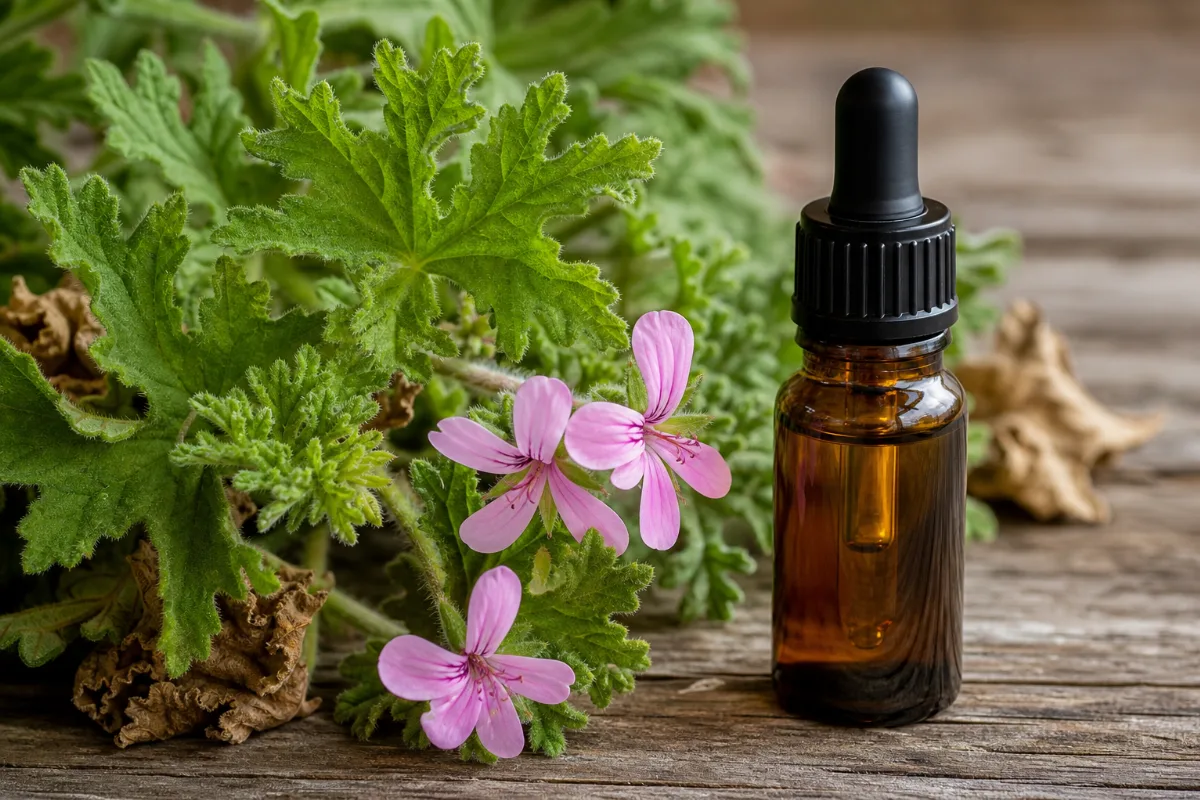
Geranium oil is a sweet, rosy-smelling oil made by distilling the rose-scented geranium plant. It is used in perfumes, massage oils and aromatherapy. Small trials of breathing it in report less self-rated anxiety and tiredness, but they are small and short. The main caution: it can cause skin allergy, it should never be swallowed, and the geranium plant is listed as toxic to cats and dogs.
General information, not medical advice. Last substantive update · Not medically reviewed. A named clinician has not signed off on this page. How this page is made
About Geranium Oil
Geranium oil is best known as a sweet floral scent. A handful of small trials in Iran report lower self-rated anxiety and tiredness after people breathed it in. These trials are short and hard to blind. Safety comes first: do not swallow the oil, it can cause skin allergy in some people, and the garden plant is listed as toxic to pets.
What geranium oil is
Geranium oil usually means oil from rose-scented geranium, Pelargonium graveolens, an accepted species in the geranium family (Geraniaceae) according to GBIF. The oil is made by distillation. A related product, the absolute, is made by solvent extraction and has a different make-up.
In one distilled oil studied, the main compounds were iso-menthone (15.71%), epi-alpha-cadinol (15.49%), iso-menthol, geranyl formate, geraniol (6.16%) and citronellol (5.53%). Across countries the make-up differs: citronellol and geraniol, and menthone and isomenthone, move in opposite directions.
Several trials say only 'geranium', so a result may not apply to every bottle with that name.
What people use it for, and how strong the evidence is
Anxiety is the best-studied use. Three small trials in Iran of breathing in geranium oil report lower self-rated anxiety: 80 heart-attack patients, 150 people before hernia surgery and 100 first-time mothers in early labour. One trial found less tiredness in 84 intensive-care nurses than with a sunflower-oil placebo, but no clear sleep gain.
After gallbladder surgery, pain was lower and sleep better with geranium or lavender than with standard care, but the comparison group had no scent. A 1% gel made with the oil beat placebo gel for a fungal mouth infection under dentures in one trial of 80. Other results belong to blends or are single lab markers. We found no good evidence for acne, wounds, skin infection or hormone balance.
The research in one view
Most trials are small, short and self-reported, and a smell is hard to hide from a comparison group. In two of the trials the comparison group got no scent at all. The labour trial abstract gives no score sizes. A 2019 review of aromatherapy in labour asks for stronger studies.
We found no big independent trial and no trial of geranium oil in an anxiety disorder.
Oil, absolute, blends and the plant are different things
A result for a blend (such as the rhinitis trial) or a prepared gel does not carry over to bottled oil. The absolute is a different product from the distilled oil. The garden plant's pet-toxicity listing is not about the oil.
What regulators say
The FDA says an 'aromatherapy' product's status depends on its claims. Claims that it will relieve pain, treat depression or anxiety, or help you sleep are drug claims, and drugs need FDA approval. The page does not name geranium oil. We did not find an EMA, NCCIH or LiverTox page for geranium oil.
At a glance
Traditional uses history, not proof
- No documented traditional use was found in the sources we read.
Studied for research
- Anxiety around medical events, smelled oil, low
- Tiredness in nurses, smelled oil, low
- Pain and sleep after surgery, smelled oil, very low
- Denture-related mouth infection, 1% gel, low
- Sleep, rhinitis, stress massage blends, hormone marker, insufficient
Main compounds
- Geraniol
- Citronellol
- Linalool
Common forms
- Essential oil (distilled)
- Absolute (solvent-extracted, a different product)
- Blends and massage oils containing geranium
- Garden geranium plant (a different thing)
Research links: Poison Control: Essential oils · ASPCA: Geranium · FDA: Aromatherapy · Patch-test study including geranium oil bourbon (abstract) · Trial in heart-attack patients (abstract) · Trial in intensive-care nurses (abstract) · Research Library · Genes & Biomarkers Library
What it is and its history
- Accepted scientific name
- Pelargonium graveolens
- Naming authority
- (Thunb.) L'Hér.
- Common names
- Geranium (English); Rose-scented geranium (English); Rose geranium (English)
- Family or group
- Geraniaceae (geranium family), per GBIF.
- Classification
- Plantae > Tracheophyta > Magnoliopsida > Geraniales > Geraniaceae > Pelargonium > Pelargonium graveolens
- Native range
- Not checked.
- Habitat
- Not checked.
- What it looks like
- Part used: The part of the plant used for the oil is not stated in the sources we read. This page does not describe how to recognise the plant.
- Look-alikes and adulterants
- Name: Other geraniums and Pelargonium species; Note: The ASPCA entry covers 'Pelargonium species' as a group. Trials often say only 'geranium', so the species is not always certain. Geranium oil can also be confused with rose oil, and is sometimes used to adulterate it.
- Sustainability and conservation
- Not checked (no IUCN or CITES source read).
Traditional use and history history, not clinical proof
| Tradition or era | Documented use | Source |
|---|---|---|
| Traditional use | No source we read describes a documented traditional use of geranium oil. Claims that it is 'traditionally used' for hormones or skin are therefore not repeated here. | PubMed and the pages listed |
| Modern perfumery and aromatherapy | The papers read call the plant an economically important crop whose oil is made by distillation, and describe a related product (the absolute) made by solvent extraction. Older history was not verified from a source. | Fekri 2021 |
Traditional use shows how it was used. It does not show that it works or is safe today.
What is inside, and how it may work
What it contains and how those compounds act in cells and animals. Laboratory and animal mechanisms are not proven effects in people.
Main compounds
| Compound | Family | Where it is concentrated | Activity studied | Level of evidence |
|---|---|---|---|---|
| Geraniol PubChem 637566 | monoterpene alcohol | Not stated 6.16% in the one distilled oil studied; varies between oils | A fragrance allergen on the European labelling list of 2007; weak sensitiser in a mouse test; named by the ASPCA as a toxic principle of the plant for pets. 27 5 12 18 24 | Laboratory |
| Citronellol PubChem 8842 | monoterpene alcohol | Not stated 5.53% in the one distilled oil studied; varies between oils | A fragrance allergen on the European labelling list of 2007; l-citronellol reacted in 2% or more in one patch-test study. Its amount moves opposite to geraniol as leaves age. 28 5 13 18 | Laboratory |
| Linalool PubChem 6549 | monoterpene alcohol | Not stated Amount not given in the abstract; rose together with geraniol across published oils | A fragrance allergen on the European labelling list of 2007; named by the ASPCA as a toxic principle of the plant for pets. 29 5 18 24 | Laboratory |
| Iso-menthone, epi-alpha-cadinol, iso-menthol, geranyl formate | mixed terpenes and esters | Not stated 15.71%, 15.49%, 6.46% and 6.22% in the one distilled oil studied | No activity described in the abstract. PubChem identifiers were not checked for these. 5 | Laboratory |
Mechanisms, receptors and pathways
| Target or pathway | Gene or receptor | What was found | Level |
|---|---|---|---|
| Skin sensitisation | Immune sensitisation (contact allergy) | Geranium oil was negative in a mouse skin-sensitisation test while geraniol alone was a weak sensitiser; people already sensitive to fragrance reacted to geranium oil bourbon in patch tests. 12 13 | Animal and human patch test |
| Estrogen | Salivary estrogen level | Smelling geranium and rose otto was followed by higher salivary estrogen than a control odour in one study. The mechanism is not known. 19 | Human marker |
Absorption, metabolism and elimination
- Absorption
- Not established in the sources read.
- Distribution
- Not established.
- Metabolism
- Not established.
- Elimination
- Not established.
- Bioavailability
- Not established.
Isolated compounds versus whole extracts
The distilled oil, the solvent-extracted absolute, blends containing geranium, a prepared 1% gel and the garden plant are different things. Trial results apply to the product tested; the pet-toxicity listing is for the plant.
Nutritional composition
Geranium oil is not a nutrient and is not a food. It is a scent and skin-care ingredient.
3 low certainty1 very low certainty5 not enough evidence
What was looked at
The 9 benefits and uses checked for Geranium Oil, each with how strong the evidence is. Tap one to open it.
- Anxiety around medical events (smelling the oil)Low certainty
- Tiredness in intensive-care nurses (smelling the oil)Low certainty
- Pain and sleep after gallbladder surgery (smelling the oil)Very low certainty
- Sleep (smelling the oil)Not enough evidence
- Mouth thrush under dentures (1% gel made with the oil)Low certainty
- Year-round allergic rhinitis (smelling a three-oil blend)Not enough evidence
- Work stress in nurses (massage with lavender and geranium)Not enough evidence
- Hormone marker: salivary estrogen (smelling the oil)Not enough evidence
- Pain after shingles (topical geranium oil)Not enough evidence
Lab markers tracked in the studies
Self-rated anxiety score (for example the Spielberger scale)Visual Analog Fatigue Scale (VAS-F)Diastolic blood pressure in early labourSalivary estrogenYeast growth in the mouth under dentures
What is Geranium Oil good for?
The uses people ask about and how strong the evidence is. Read the certainty label first: every result here comes from small trials of smelling the oil or from mixed products.
Benefits, one by one
Each card is a research question, not a promise. Tap a goal to filter. Open a card to see the studies, doses and limits.
Anxiety around medical events (smelling the oil)
Low certaintyThree small randomized trials in Iran found lower self-rated anxiety after people breathed in geranium oil: 80 heart-attack patients (with a placebo patch), 150 people waiting for hernia surgery (the comparison group got nothing) and 100 first-time mothers in early labour (with a placebo). The trials are small, short and a scent is hard to hide.
4 studiesNot covered. This page gives no amounts and no ways of using the oil.
Studies, doses and limits
What the trials found
Three randomized trials (80, 150 and 100 people) and one qualitative review of aromatherapy in labour that included geranium among several oils.
Results
Heart-attack trial: the geranium group had bigger falls in anxiety scores than the placebo group (P<0.001). Hernia trial: both geranium and music groups were lower than the no-treatment group (P<0.001), and geranium fell more than music. Labour trial: anxiety and diastolic blood pressure fell significantly in the geranium group; the abstract gives no sizes. The labour review says most studies of aromatherapy (many oils) suggested less anxiety and asks for stronger studies.
Effect sizes as reported
Not given in the abstracts read (P values only).
Why this rating
Small trials with self-rated scores and short follow-up. A scent is hard to blind, and in the hernia trial the comparison group had no scent. The labour abstract gives no numbers. Only one trial used a placebo patch and was described as triple-blind.
Form and dose studied
Not covered. This page gives no amounts and no ways of using the oil.
Who was studied
Adults in hospital: after a heart attack, before hernia surgery, and first-time mothers in early labour. All three trials are from Iran.
Limits
Short, small, self-rated; no pain, labour length or baby outcomes; not shown to treat an anxiety disorder.
Why researchers looked
Anxiety is common in hospital, and a pleasant smell is a low-cost add-on that nurses can offer.
Traditional use
No traditional use of geranium oil was found in the sources we read.
Proposed mechanism Preliminary mechanism
Not established in the abstracts read. No mechanism is claimed here.
A proposed mechanism does not show that the effect happens in people.
Inhaling an oil can still bother some people, and the oil is a known skin allergen. Never swallow it. See the Safety tab.
Tiredness in intensive-care nurses (smelling the oil)
Low certaintyIn one double-blind trial of 84 intensive-care nurses, fatigue scores were lower right after smelling Pelargonium graveolens oil than after a sunflower-oil placebo. Sleep scores did not show a clear gain. It is one small trial.
1 studiesNot covered. This page gives no amounts and no ways of using the oil.
Studies, doses and limits
What the trials found
One randomized, double-blind, placebo-controlled trial of 84 nurses.
Results
Fatigue on the Visual Analog Fatigue Scale was lower in the geranium group than in the placebo group immediately after and 60 minutes after the aromatherapy (P<0.05). The abstract reports no significant difference in sleep scores in the geranium group before and after (P>0.05).
Effect sizes as reported
Not given in the abstract (P value only).
Why this rating
A single trial with a real placebo (sunflower oil), but small, self-rated and followed for only an hour.
Form and dose studied
Not covered. This page gives no amounts and no ways of using the oil.
Who was studied
Intensive-care nurses working with Covid-19 patients (Iran).
Limits
One trial, one hospital, one hour of follow-up. It does not show lasting relief of fatigue.
Why researchers looked
Nurses on Covid-19 wards were very tired, and a self-care scent was proposed.
Traditional use
No traditional use of geranium oil was found in the sources we read.
Proposed mechanism Preliminary mechanism
Not established in the abstracts read. No mechanism is claimed here.
A proposed mechanism does not show that the effect happens in people.
A tired person who still feels unwell for long should see a doctor; fatigue can have medical causes.
Pain and sleep after gallbladder surgery (smelling the oil)
Very low certaintyIn one single-blind trial of 153 people after gallbladder keyhole surgery, pain was lower with lavender or geranium oil than with standard care alone, and sleep quality rose more with geranium than with lavender. The comparison group got no scent, so expectation could explain part of it.
1 studiesNot covered. This page gives no amounts and no ways of using the oil.
Studies, doses and limits
What the trials found
One randomized single-blind trial in three groups of 51 (control, lavender, geranium), registered as NCT05464602.
Results
Pain was lower in both oil groups than in the control group after surgery (P<0.01). Sleep quality rose more in the geranium group than in the lavender group (P<0.01). The abstract gives no pain scores.
Effect sizes as reported
Not given in the abstract (P values only).
Why this rating
The control group had no scent and the trial was only single-blind, so the smell cannot be separated from expectation. One trial, short follow-up, no scores in the abstract.
Form and dose studied
Not covered. This page gives no amounts and no ways of using the oil.
Who was studied
Adults after laparoscopic gallbladder removal.
Limits
One trial; no placebo scent; the abstract does not show how large the changes were.
Why researchers looked
Pain and poor sleep after surgery are common, and a scent is a drug-free add-on.
Traditional use
No traditional use was found in the sources we read.
Proposed mechanism Preliminary mechanism
Not established in the abstract read. No mechanism is claimed here.
A proposed mechanism does not show that the effect happens in people.
Follow the surgical team's advice about pain and sleep after an operation.
Sleep (smelling the oil)
Not enough evidenceThere is no good evidence that geranium oil helps sleep. The intensive-care nurse trial found no clear gain in sleep scores. A large 2025 review of smelled aromatherapy found better sleep scores in people with insomnia and another illness, but it pooled many different scents and does not single out geranium.
2 studiesNot covered. This page gives no amounts and no ways of using the oil.
Studies, doses and limits
What the trials found
The nurse trial (84 people) measured sleep as a second outcome. The review pooled 27 publications (2,072 people) of many aromatherapy products.
Results
Nurse trial: no significant difference in sleep scores in the geranium group before and after (P>0.05). Review: pooled insomnia scores improved (mean difference -2.90, 95% CI -3.85 to -1.95), but studies were very different, often unblinded and without independent purity testing.
Effect sizes as reported
Review MD -2.90 (-3.85 to -1.95), many scents pooled.
Why this rating
The only geranium-specific sleep result in the trials we read was not significant, and the review does not isolate geranium.
Form and dose studied
Not covered. This page gives no amounts and no ways of using the oil.
Who was studied
Intensive-care nurses; people with insomnia alongside another illness (review).
Limits
No trial of geranium oil in people with insomnia was found.
Why researchers looked
A relaxing scent at bedtime is a common reason people buy essential oils.
Traditional use
No traditional use was found in the sources we read.
Proposed mechanism Preliminary mechanism
Not established.
A proposed mechanism does not show that the effect happens in people.
Long-lasting sleep problems need a clinician.
Mouth thrush under dentures (1% gel made with the oil)
Low certaintyIn one double-blind trial of 80 denture wearers, a 1% gel made with Pelargonium graveolens oil did better than a placebo gel for denture stomatitis, a fungal mouth infection, after 14 days. This is one small trial of a made-up gel, not a reason to put essential oil in the mouth.
1 studiesNot covered. This page gives no amounts and no ways of using the oil.
Studies, doses and limits
What the trials found
One randomized double-blind placebo-controlled trial, 40 people in each group.
Results
After treatment 34% of the geranium gel group had improved completely, 56% partially and 10% not at all, against 5%, 25% and 70% with placebo gel. Fungal growth fell significantly more with the geranium gel (P<0.0001).
Effect sizes as reported
Complete improvement 34% vs 5%.
Why this rating
A real placebo and a clear gap, but one trial, 14 days, one centre, and no check of lasting results or side effects in the abstract.
Form and dose studied
Not covered. This page gives no amounts and no ways of using the oil.
Who was studied
Adults with complete dentures and denture stomatitis in Isfahan, Iran.
Limits
One trial; a prepared gel is not bottled oil; side effects are not described in the abstract.
Why researchers looked
The plant oil has shown activity against the yeast Candida in the lab, as the authors note, so a gel was tried.
Proposed mechanism Preliminary mechanism
The authors say earlier studies showed anti-inflammatory and antifungal activity of the plant against Candida albicans (the earlier studies were not read).
A proposed mechanism does not show that the effect happens in people.
A topical gel in a dental study is not the same as putting bottled oil in the mouth or on the skin. Do not swallow essential oil.
Year-round allergic rhinitis (smelling a three-oil blend)
Not enough evidenceA blend of sandalwood, geranium and Ravensara oils beat almond-oil placebo on nasal symptom scores in 54 adults over 7 days. The result belongs to the blend, not to geranium alone.
1 studiesNot covered. This page gives no amounts and no ways of using the oil.
Studies, doses and limits
What the trials found
One randomized controlled trial, 54 adults.
Results
Nasal symptom scores improved more with the blend than with almond oil, especially nasal blockage; rhinitis quality of life and fatigue scores also improved more.
Effect sizes as reported
Not given in the abstract.
Why this rating
A blend of three oils, so geranium cannot be credited; one small trial, one week.
Form and dose studied
Not covered. This page gives no amounts and no ways of using the oil.
Who was studied
Adults aged 20 to 60 with year-round allergic rhinitis.
Limits
Cannot be attributed to geranium; short.
Why researchers looked
Allergic rhinitis symptoms are common and people look for scent-based help.
Proposed mechanism Preliminary mechanism
Not established in the abstract read. No mechanism is claimed here.
A proposed mechanism does not show that the effect happens in people.
Allergic rhinitis is a medical condition; see a clinician for treatment.
Work stress in nurses (massage with lavender and geranium)
Not enough evidenceIn a pilot trial, six massages with lavender and geranium oils (each at 1% in cream) were followed by lower heart rate and blood pressure in a surgical-centre nursing team. Massage, lavender or geranium could each explain it.
1 studiesNot covered. This page gives no amounts and no ways of using the oil.
Studies, doses and limits
What the trials found
One pilot randomized trial; the abstract does not give how many people took part.
Results
Heart rate and blood pressure were lower after the massage sessions. The abstract gives no between-group result for the stress scales.
Effect sizes as reported
Not given in the abstract.
Why this rating
A pilot study of a mixed-oil massage, with no number of participants and no clear comparison in the abstract.
Form and dose studied
Not covered. This page gives no amounts and no ways of using the oil.
Who was studied
Nursing staff of a surgical centre in Brazil.
Limits
Mixed oils plus massage; cannot be credited to geranium.
Why researchers looked
Nurses in surgical centres have stressful work.
Proposed mechanism Preliminary mechanism
Not established in the abstract read. No mechanism is claimed here.
A proposed mechanism does not show that the effect happens in people.
Massage oils are applied to the skin diluted; see the Safety tab on skin allergy.
Hormone marker: salivary estrogen (smelling the oil)
Not enough evidenceOne study found a higher level of estrogen in the spit of perimenopausal women after they smelled geranium or rose otto, compared with a control smell. It is one lab marker. No symptom relief was shown.
1 studiesNot covered. This page gives no amounts and no ways of using the oil.
Studies, doses and limits
What the trials found
One exposure study of ten oils; the abstract gives no number of women and no figures.
Results
Salivary estrogen rose with geranium and with rose otto compared with a control odour.
Effect sizes as reported
Not given in the abstract.
Why this rating
A single lab marker, no symptom outcome and no numbers in the abstract.
Form and dose studied
Not covered. This page gives no amounts and no ways of using the oil.
Who was studied
Perimenopausal women.
Limits
No symptom benefit shown; no replication found; saliva levels are not a treatment result.
Why researchers looked
Some oils are thought to ease menopause symptoms, so researchers checked a hormone marker.
Proposed mechanism Preliminary mechanism
Not established. The authors suggest only that smell exposure might influence estrogen secretion.
A proposed mechanism does not show that the effect happens in people.
Hormone problems and menopause symptoms need a clinician.
Pain after shingles (topical geranium oil)
Not enough evidenceA short letter in the American Journal of Medicine in 2003 describes a randomized trial of topical geranium oil for nerve pain after shingles. PubMed has no abstract for it and the full text is paid. We have not read it and give no result.
1 studiesNot covered. This page gives no amounts and no ways of using the oil.
Studies, doses and limits
What the trials found
One randomized trial reported in a letter; not read.
Results
Not read. No result is given.
Effect sizes as reported
Not available.
Why this rating
We could not read the paper, so no judgement of its quality or result can be made.
Form and dose studied
Not covered. This page gives no amounts and no ways of using the oil.
Who was studied
People with postherpetic neuralgia.
Limits
Title and record only.
Why researchers looked
Pain after shingles is hard to treat.
Proposed mechanism Preliminary mechanism
Not read.
A proposed mechanism does not show that the effect happens in people.
Pain after shingles needs medical care.
Connections to the rest of health
How Geranium Oil connects to the rest of our health knowledge graph. Every link says what kind of connection it is. A safety link (for example to the liver) is a warning, not a benefit. A study that merely mentions a topic never creates a benefit link.
Explore every connection: goals, body systems, organs, symptoms, genes
A. Wellness goals
| Connected to | Kind of connection | Evidence status | Context | Studies |
|---|---|---|---|---|
| Anxiety Support | Potential benefit | Low certainty | Anxiety around medical events (smelling the oil): Three small randomized trials in Iran found lower self-rated anxiety after people breathed in geranium oil: 80 heart-attack patients (with a placebo patch), 150 people waiting for hernia surgery (the comparison group got nothing) and 100 first-time mothers in early labour (with a placebo). The trials are small, short and a scent is hard to hide. | 20 9 16 8 |
| Calm Relaxation | Potential benefit | Low certainty | Anxiety around medical events (smelling the oil): Three small randomized trials in Iran found lower self-rated anxiety after people breathed in geranium oil: 80 heart-attack patients (with a placebo patch), 150 people waiting for hernia surgery (the comparison group got nothing) and 100 first-time mothers in early labour (with a placebo). The trials are small, short and a scent is hard to hide. | 20 9 16 8 |
| Reduce Fatigue | Potential benefit | Low certainty | Tiredness in intensive-care nurses (smelling the oil): In one double-blind trial of 84 intensive-care nurses, fatigue scores were lower right after smelling Pelargonium graveolens oil than after a sunflower-oil placebo. Sleep scores did not show a clear gain. It is one small trial. | 11 |
| Sleep Quality | Potential benefit | Very low certainty | Pain and sleep after gallbladder surgery (smelling the oil): In one single-blind trial of 153 people after gallbladder keyhole surgery, pain was lower with lavender or geranium oil than with standard care alone, and sleep quality rose more with geranium than with lavender. The comparison group got no scent, so expectation could explain part of it. Sleep (smelling the oil): There is no good evidence that geranium oil helps sleep. The intensive-care nurse trial found no clear gain in sleep scores. A large 2025 review of smelled aromatherapy found better sleep scores in people with insomnia and another illness, but it pooled many different scents and does not single out geranium. | 1 11 3 |
| Better Sleep | Potential benefit | Not enough evidence | Sleep (smelling the oil): There is no good evidence that geranium oil helps sleep. The intensive-care nurse trial found no clear gain in sleep scores. A large 2025 review of smelled aromatherapy found better sleep scores in people with insomnia and another illness, but it pooled many different scents and does not single out geranium. | 11 3 |
| Healthy Skin | Low certainty | Mouth thrush under dentures (1% gel made with the oil): In one double-blind trial of 80 denture wearers, a 1% gel made with Pelargonium graveolens oil did better than a placebo gel for denture stomatitis, a fungal mouth infection, after 14 days. This is one small trial of a made-up gel, not a reason to put essential oil in the mouth. Pain after shingles (topical geranium oil): A short letter in the American Journal of Medicine in 2003 describes a randomized trial of topical geranium oil for nerve pain after shingles. PubMed has no abstract for it and the full text is paid. We have not read it and give no result. | 17 10 | |
| Breathing Support | Not enough evidence | Year-round allergic rhinitis (smelling a three-oil blend): A blend of sandalwood, geranium and Ravensara oils beat almond-oil placebo on nasal symptom scores in 54 adults over 7 days. The result belongs to the blend, not to geranium alone. | 4 | |
| Stress Reduction | Potential benefit | Not enough evidence | Work stress in nurses (massage with lavender and geranium): In a pilot trial, six massages with lavender and geranium oils (each at 1% in cream) were followed by lower heart rate and blood pressure in a surgical-centre nursing team. Massage, lavender or geranium could each explain it. | 15 |
| Hormone Balance | Not enough evidence | Hormone marker: salivary estrogen (smelling the oil): One study found a higher level of estrogen in the spit of perimenopausal women after they smelled geranium or rose otto, compared with a control smell. It is one lab marker. No symptom relief was shown. | 19 |
B. Body systems
| Connected to | Kind of connection | Evidence status | Context | Studies |
|---|---|---|---|---|
| Nervous System | Biological association | Low certainty | Studied for: Anxiety around medical events (smelling the oil) Studied for: Tiredness in intensive-care nurses (smelling the oil) | 20 9 16 8 11 10 |
| Stress Mood | Biological association | Low certainty | Studied for: Anxiety around medical events (smelling the oil) Studied for: Work stress in nurses (massage with lavender and geranium) | 20 9 16 8 15 |
| Energy Fatigue | Biological association | Low certainty | Studied for: Tiredness in intensive-care nurses (smelling the oil) | 11 |
| Sleep Recovery | Biological association | Very low certainty | Studied for: Pain and sleep after gallbladder surgery (smelling the oil) Studied for: Sleep (smelling the oil) | 1 11 3 |
| Pain Inflammation | Biological association | Very low certainty | Studied for: Pain and sleep after gallbladder surgery (smelling the oil) Studied for: Pain after shingles (topical geranium oil) | 1 10 |
| Integumentary System | Biological association | Low certainty | Studied for: Mouth thrush under dentures (1% gel made with the oil) | 17 |
| Respiratory System | Biological association | Not enough evidence | Studied for: Year-round allergic rhinitis (smelling a three-oil blend) | 4 |
| Endocrine System | Biological association | Not enough evidence | Studied for: Hormone marker: salivary estrogen (smelling the oil) | 19 |
E. Health conditions
| Connected to | Kind of connection | Evidence status | Context | Studies |
|---|---|---|---|---|
| Contact dermatitis | Adverse effect or risk | Documented risk | Allergic skin reactions in patch-test studies of fragrance-sensitive people. Preparation or compound: Geranium oil bourbon; geraniol, citronellol, linalool |
13 18 |
| Anxiety | Potential benefit | Low certainty | Three small trials with self-rated scores. Preparation or compound: Smelled geranium oil |
20 9 16 |
| Fatigue | Potential benefit | Low certainty | One double-blind trial in 84 nurses. Preparation or compound: Smelled Pelargonium graveolens oil |
11 |
I. Biomarkers
| Connected to | Kind of connection | Evidence status | Context | Studies |
|---|---|---|---|---|
| Self-rated anxiety score (for example the Spielberger scale) | Biological association | Low certainty | Measured in trials: decrease. A lab change is not the same as a health benefit. | 20 9 16 |
| Visual Analog Fatigue Scale (VAS-F) | Biological association | Low certainty | Measured in trials: decrease. A lab change is not the same as a health benefit. | 11 |
| Diastolic blood pressure in early labour | Biological association | Not enough evidence | Measured in trials: decrease. A lab change is not the same as a health benefit. | 16 |
| Salivary estrogen | Biological association | Not enough evidence | Measured in trials: increase. A lab change is not the same as a health benefit. | 19 |
| Yeast growth in the mouth under dentures | Biological association | Low certainty | Measured in trials: decrease. A lab change is not the same as a health benefit. | 17 |
L. Active compounds
| Connected to | Kind of connection | Evidence status | Context | Studies |
|---|---|---|---|---|
| Geraniol | Low certainty | A labelled fragrance allergen; weak sensitiser in a mouse test. Labelled fragrance allergen; weak sensitiser in a mouse test. Preparation or compound: Geraniol, a main component |
18 12 5 | |
| Citronellol | Low certainty | A labelled fragrance allergen; l-citronellol reacted in 2% or more in one patch-test study. Preparation or compound: Citronellol, a main component |
13 18 5 | |
| Geraniol | Biological association | Laboratory | A fragrance allergen on the European labelling list of 2007; weak sensitiser in a mouse test; named by the ASPCA as a toxic principle of the plant for pets. | 27 5 12 18 24 |
| Citronellol | Biological association | Laboratory | A fragrance allergen on the European labelling list of 2007; l-citronellol reacted in 2% or more in one patch-test study. Its amount moves opposite to geraniol as leaves age. | 28 5 13 18 |
| Linalool | Biological association | Laboratory | A fragrance allergen on the European labelling list of 2007; named by the ASPCA as a toxic principle of the plant for pets. | 29 5 18 24 |
| Iso-menthone, epi-alpha-cadinol, iso-menthol, geranyl formate | Biological association | Laboratory | No activity described in the abstract. PubChem identifiers were not checked for these. | 5 |
Each connection is stored with the ingredient, the connected record, the kind of connection, the evidence status, the supporting studies, the preparation or compound involved, and a review date (last reviewed October 25, 2026).
Evidence at a glance: what the research found for 9 outcomes
Each outcome below is one thing researchers measured. Certainty is how far the evidence can be trusted, not how well it works. The full studies are on the next tab.
The evidence
The research centre for Geranium Oil. Every record here was checked against PubMed or the publisher's page; we never list a study we have not verified.
Evidence by outcome
Bars show how many studies we found for each outcome, not how well it works. People are added up across trials only (reviews are not added, to avoid double counting).
How we rate evidence
High certainty
Several well-run trials or reviews agree; further research is unlikely to change the picture much.
Moderate certainty
Good trials point the same way, but some doubt remains.
Low certainty
Small, short or inconsistent trials. The finding could change with better research.
Very low certainty
Very little or very weak human data. Treat as a possibility only.
Mixed findings
Trials or reviews disagree with each other.
Not enough evidence
Not enough human research to say either way.
Evidence against
Good research found no benefit, or found harm.
We take the reviewers' own risk-of-bias and GRADE statements where they exist, and otherwise judge from study size, design, consistency, directness and whether a product matches what is sold. Many publications do not make evidence high. Method note: We read the abstracts of 21 PubMed papers (the 2003 shingles letter has no abstract and was not read) and the Poison Control, ASPCA and FDA pages, checked the plant name in GBIF and the compounds in PubChem. We did not find or read a LiverTox, LactMed, EMA or NCCIH statement for this oil.
Study library: every study we checked 29
| Study | Design | People | Product, dose, length | Result |
|---|---|---|---|---|
| Akutay 2026 Aromatherapy Improves Pain, Sleep and Physiological Parameters in Laparoscopic Cholecystectomy Patients: A Single-Blind, Parallel Group, and Randomized Controlled Trial. Chin J Integr Med · PMID 40490599 · DOI |
Randomized single blind controlled trial, three groups (NCT05464602) |
153 Adults after laparoscopic gallbladder surgery |
Inhaled lavender essential oil or inhaled geranium essential oil (separate groups) oil Not reported here before and after surgery, one day after · vs control group had standard treatment only (no scent) |
Pain was lower after surgery in both oil groups than in the control group (P<0.01). Sleep quality rose more in the geranium group than in the lavender group (P<0.01). The abstract says physiological parameters differed within groups. A weak link was seen between painkiller use and sleep quality in the geranium group (r=0.297). Methods, limits and fundingOutcomes: Pain intensity, sleep quality, physiological parameters Limitations: The control group got no scent, so expectation cannot be separated from the smell; single-blind; the abstract gives no pain scores; short follow-up. Funding and conflicts: Not stated in the abstract. Read: abstract |
| Cebi 2021 Quantification of the Geranium Essential Oil, Palmarosa Essential Oil and Phenylethyl Alcohol in Rosa damascena Essential Oil Using ATR-FTIR Spectroscopy Combined with Chemometrics. Foods · PMID 34441625 · DOI |
Laboratory analytical method lab |
Rose (Rosa damascena) oil spiked with 0 to 100% of geranium oil, palmarosa oil or phenylethyl alcohol | Rose oil spiked with geranium oil as a probable adulterant oil Not reported here |
Geranium oil is named as one of the probable adulterants of rose oil. Infrared spectroscopy with statistics could detect and measure it in spiked samples. Methods, limits and fundingOutcomes: Detecting adulterants Limitations: Laboratory spiked samples, not market samples. It is about geranium oil being used to cheapen rose oil, not about geranium oil itself being adulterated. Funding and conflicts: Not stated in the abstract. Read: abstract |
| Chen 2025 Inhalation aromatherapy for the treatment of comorbid insomnia: a systematic review and meta-analysis. Front Psychiatry · PMID 40230824 · DOI |
Systematic review and meta analysis (PROSPERO CRD42023455278) |
2072 27 publications, 2,072 people with insomnia alongside another illness |
Inhaled aromatherapy with many different herbs and oils (the abstract does not name geranium) oil Not reported here varied · vs varied |
Pooled sleep scores improved (mean difference -2.90, 95% CI -3.85 to -1.95); anxiety and depression scores also fell. Studies were heterogeneous, often unblinded and without independent purity testing; the authors call for higher-quality trials. MD -2.90 (-3.85 to -1.95) Methods, limits and fundingOutcomes: Insomnia scores, anxiety, depression Limitations: Many scents pooled together; geranium is not isolated in this abstract. Funding and conflicts: Not stated in the abstract. Read: abstract |
| Choi 2016 Effect of Inhalation of Aromatherapy Oil on Patients with Perennial Allergic Rhinitis: A Randomized Controlled Trial. Evid Based Complement Alternat Med · PMID 27034695 · DOI |
Randomized controlled trial |
54 Adults aged 20 to 60 with year-round allergic rhinitis |
Inhaled blend of sandalwood, geranium and Ravensara essential oils (a mix, not geranium alone) oil Not reported here 7 days · vs almond oil (placebo) |
The blend group improved more than placebo on nasal symptoms (especially nasal blockage), rhinitis quality of life and fatigue. The result belongs to the three-oil blend and cannot be given to geranium alone. Methods, limits and fundingOutcomes: Total Nasal Symptom Score, rhinitis quality of life, sleep quality, fatigue Limitations: A blend of three oils; short; small; self-rated. Funding and conflicts: Not stated in the abstract. Read: abstract |
| Fekri 2021 Studies on essential oil from rose-scented geranium, Pelargonium graveolens L'Hérit. (Geraniaceae). Nat Prod Res · PMID 31679416 · DOI |
Laboratory chemistry and meta analysis of published compositions lab |
One hydro-distilled oil sample plus published oil compositions from different countries | Pelargonium graveolens essential oil and the absolute made from it by solvent extraction Not reported here |
In the oil studied, the main compounds were iso-menthone (15.71%), epi-alpha-cadinol (15.49%), iso-menthol (6.46%), geranyl formate (6.22%), geraniol (6.16%) and citronellol (5.53%). The absolute had a different make-up. Across countries, menthone and isomenthone, and citronellol and geraniol, moved in opposite directions, and geraniol rose together with linalool. Methods, limits and fundingOutcomes: Chemical composition Limitations: One oil sample plus published data; composition differs between oils. Funding and conflicts: Not stated in the abstract. Read: abstract |
| Flaman 2001 Unintentional exposure of young children to camphor and eucalyptus oils. Paediatr Child Health · PMID 20084213 |
Poison centre chart review plus literature search |
251 Children in Toronto who swallowed an essential oil or an oil product (Dec 1995 to Mar 1997) |
Camphorated oil, eucalyptus oil and vapour products (not geranium) oil Not reported here |
251 children were reported. The most common symptoms were cough and vomiting; two children had seizures but recovered. A literature search found 18 reports with vomiting, lethargy, coma and seizures, and one child died. The authors say essential oils can be harmful, even life-threatening, if swallowed by children. Methods, limits and fundingOutcomes: Symptoms after swallowing Limitations: About camphor and eucalyptus, not geranium. It shows that swallowing essential oils can be serious; it says nothing about the size of the risk from geranium oil. Funding and conflicts: Not stated in the abstract. Read: abstract |
| Geier 2022 Contact sensitization to essential oils: IVDK data of the years 2010-2019. Contact Dermatitis · PMID 35417610 · DOI |
Retrospective analysis of clinic patch test data |
10930 Dermatitis patients patch-tested in German-speaking clinics, 2010 to 2019 |
Twelve essential oils patch-tested oil Not reported here patch test |
908 of 10,930 patients (8.3%) reacted to at least one of the 12 oils. Only six oils caused more than 1% positive reactions (ylang ylang, lemongrass, jasmine absolute, sandalwood, clove and neroli). Masseurs and cosmeticians were over-represented among people who reacted. The abstract does not name geranium. Methods, limits and fundingOutcomes: Frequency of reaction to essential oils Limitations: Geranium is not named in the abstract, so this paper gives no geranium result; it is used here only for the general picture of oil allergy. Funding and conflicts: Not stated in the abstract. Read: abstract |
| Ghiasi 2019 A Systematic Review on the Anxiolytic Effect of Aromatherapy during the First Stage of Labor. J Caring Sci · PMID 30915314 · DOI |
Systematic review (qualitative) |
Women in the first stage of labour; 14 published and 2 unpublished papers (Iran, Egypt, Korea, Italy) | Many essential oils; geranium was one of the oils in 3 of the articles (with rose, clary sage and frankincense) oil Not reported here varied · vs varied |
A majority of the studies suggested aromatherapy lowered anxiety in the first stage of labour. The authors recommend it as a complementary therapy but ask for methodologically rigorous studies. Methods, limits and fundingOutcomes: Anxiety in first-stage labour Limitations: Results were reported qualitatively; many oils together, so the review does not isolate geranium. Funding and conflicts: Not stated in the abstract. Read: abstract |
| Goli 2022 Comparing the effects of geranium aromatherapy and music therapy on the anxiety level of patients undergoing inguinal hernia surgery: A clinical trial. Explore (NY) · PMID 32888828 · DOI |
Randomized clinical trial, three groups |
150 Adults waiting for inguinal hernia surgery (Iran) |
Inhaled geranium essential oil (species not stated in the abstract) or instrumental music oil Not reported here single session before surgery · vs control group received no intervention |
Anxiety scores differed between the three groups (P=0.011). Both the inhaled geranium group and the music group had significantly lower anxiety than the control group (P<0.001), and the fall was greater with geranium than with music. The control group got no scent and no music. Methods, limits and fundingOutcomes: Spielberger State-Trait Anxiety Inventory (primary outcome) Limitations: The control group had no placebo scent, so the trial cannot separate the effect of the smell from expectation or from simply getting attention. Funding and conflicts: Not stated in the abstract. Read: abstract |
| Greenway 2003 Temporary relief of postherpetic neuralgia pain with topical geranium oil. Am J Med · PMID 14599644 · DOI |
Randomized trial reported as a letter |
People with pain after shingles (postherpetic neuralgia) | Topical geranium oil oil Not reported here not available · vs not available |
PubMed lists this as a randomized controlled trial letter but gives no abstract, and the full text is behind a subscription. We did not read it, so no result, size or number is given here. Methods, limits and fundingOutcomes: Pain Limitations: Not read. No abstract available. Funding and conflicts: Not known. Read: title-only |
| Karimi 2024 The effect of Aromatherapy with Pelargonium graveolens (P. graveolens) on the fatigue and sleep quality of critical care nurses during the Covid-19 pandemic: A randomized controlled trial. Explore (NY) · PMID 37400355 · DOI |
Randomized double blind placebo controlled trial |
84 Intensive-care nurses working with Covid-19 patients |
Inhaled Pelargonium graveolens essential oil (pure) oil Not reported here three working shifts · vs sunflower oil (placebo) |
Fatigue scores immediately and 60 minutes after the aromatherapy were lower in the geranium group than in the placebo group (P<0.05). The abstract reports no significant difference in sleep scores in the geranium group before and after the intervention (P>0.05). Methods, limits and fundingOutcomes: Fatigue (Visual Analog Fatigue Scale, VAS-F); sleep quality (Verran and Snyder-Halpern scale) Limitations: Short follow-up (one hour after inhaling); self-rated; one setting. Funding and conflicts: Funding: the PubMed record lists a non-US government research support type; no details in the abstract. Read: abstract |
| Lalko 2006 Investigation of the dermal sensitization potential of various essential oils in the local lymph node assay. Food Chem Toxicol · PMID 16324777 |
Animal skin sensitisation test (local lymph node assay) animal |
Laboratory mice | Seven essential oils (basil, citronella, clove leaf, geranium, litsea cubeba, lemongrass, palmarosa) and three components (citral, eugenol, geraniol) oil Not reported here |
Geranium and citronella oils were negative in the test. Other oils were weak to moderate sensitisers. The component geraniol gave an EC3 of 11.4%, a weak result. The authors note that an oil's potency did not differ much from its main component. Methods, limits and fundingOutcomes: Skin sensitisation potency (EC3) Limitations: Mouse test, not people; and a negative mouse test did not stop geranium oil bourbon reacting in human patch tests (a different study), so tests can disagree. Funding and conflicts: Not stated in the abstract. Read: abstract |
| Larsen 2001 Fragrance contact dermatitis: a worldwide multicenter investigation (Part II). Contact Dermatitis · PMID 11380544 |
Multicentre patch test study |
178 Fragrance-sensitive patients at 8 centres worldwide |
Skin patch tests with a fragrance mix and 20 other fragrance materials, including geranium oil bourbon oil Not reported here patch test |
78.7% reacted to the fragrance mix. Materials reacting in 2% or more of people included jasmine absolute, geranium oil bourbon and l-citronellol, among others. The authors say these should be evaluated further to confirm they cause allergy. Methods, limits and fundingOutcomes: Skin reactions to patch tests Limitations: People already known to be fragrance sensitive, so it shows that reactions happen, not how often in the general public. 'Geranium oil bourbon' is one named type of the oil. Funding and conflicts: Not stated in the abstract. Read: abstract |
| Lis-Balchin 1999 Possible health and safety problems in the use of novel plant essential oils and extracts in aromatherapy. J R Soc Promot Health · PMID 10673845 |
Narrative review |
Aromatherapy practice | Essential oils in massage and aromatherapy oil Not reported here |
The author says common oils used in massage are seldom dangerous at 2% dilution if they are not adulterated, but their safety in pregnancy, childbirth and babies has not been clearly demonstrated. Sensitisation is a growing concern. Methods, limits and fundingOutcomes: Safety Limitations: Old narrative review (1999); not about geranium oil in particular. Funding and conflicts: Not stated in the abstract. Read: abstract |
| Montibeler 2018 Effectiveness of aromatherapy massage on the stress of the surgical center nursing team: a pilot study. Rev Esc Enferm USP · PMID 30156654 · DOI |
Pilot randomized controlled trial |
Nursing staff of a hospital surgical centre in Brazil | Massage with lavender (Lavandula angustifolia) and geranium (Pelargonium graveolens) essential oils, each at 1% in a neutral cream oil Not reported here six massage sessions · vs not described in the abstract |
Heart rate and blood pressure were lower after the massage sessions. The authors say aromatherapy lowered biophysiological measures. The abstract gives no between-group results for the stress scales and no number of participants. Methods, limits and fundingOutcomes: Heart rate, blood pressure, work stress scales Limitations: Pilot study; the massage itself, the lavender or the geranium could each explain the change; number of people not given in the abstract. Funding and conflicts: Not stated in the abstract. Read: abstract |
| Rashidi Fakari 2015 Effect of Inhalation of Aroma of Geranium Essence on Anxiety and Physiological Parameters during First Stage of Labor in Nulliparous Women: a Randomized Clinical Trial. J Caring Sci · PMID 26161367 · DOI |
Randomized clinical trial, geranium versus placebo |
100 First-time mothers in the first stage of labour, one hospital in Iran |
Inhaled geranium essential oil (species not stated in the abstract) oil Not reported here first stage of labour · vs placebo |
The abstract says the mean anxiety score fell significantly after inhaling geranium, and so did diastolic blood pressure. It does not give the score sizes or the comparison with the placebo group. The authors say the aroma can be recommended as a non-invasive anti-anxiety aid in childbirth. Methods, limits and fundingOutcomes: Spielberger anxiety questionnaire; blood pressure, respiratory rate, pulse Limitations: Abstract gives no numbers or between-group comparison; one hospital; the trial measured anxiety and vital signs only, not pain, length of labour or the baby's health. Funding and conflicts: Not stated in the abstract. Read: abstract |
| Sabzghabaee 2011 Clinical evaluation of the essential oil of Pelargonium graveolens for the treatment of denture stomatitis. Dent Res J (Isfahan) · PMID 23372587 |
Randomized double blind placebo controlled trial |
80 Complete-denture wearers with denture stomatitis (Isfahan, Iran) |
Pelargonium graveolens essential oil in a 1% topical gel, versus placebo gel oil Not reported here 14 days · vs placebo gel |
After treatment, 34% of the geranium gel group had improved completely, 56% partially and 10% not at all, against 5%, 25% and 70% in the placebo group. Fungal growth fell significantly more in the geranium group (P<0.0001). Methods, limits and fundingOutcomes: Clinical improvement and fungal growth Limitations: One trial, 14 days, one centre; a 1% gel in a mouth product is a different thing from bottled oil. Funding and conflicts: Not stated in the abstract. Read: abstract |
| Schnuch 2007 Sensitization to 26 fragrances to be labelled according to current European regulation. Results of the IVDK and review of the literature. Contact Dermatitis · PMID 17577350 |
Patch test series from a clinic network (IVDK) and literature review |
21325 Patients patch-tested in German-speaking dermatology clinics, 2003 to 2004 |
26 fragrance substances that had to be labelled under the European rule at that time, including citronellol, geraniol and linalool pure substances Not reported here patch test |
Sensitisation rates (standardised for sex and age) were 0.5% for citronellol, 0.4% for geraniol and 0.2% for linalool, against 2.4% for tree moss and 2.3% for HMPCC at the top of the list. The authors say some of the 26 matter a lot for contact allergy and some hardly at all. Methods, limits and fundingOutcomes: Frequency of skin sensitisation Limitations: Clinic patients with suspected skin problems, so not general-public rates; these are pure substances, not geranium oil; the list of labelled substances was the rule in 2007 and has since changed (not checked here). Funding and conflicts: Not stated in the abstract. Read: abstract |
| Shinohara 2017 Effects of essential oil exposure on salivary estrogen concentration in perimenopausal women. Neuro Endocrinol Lett · PMID 28326753 |
Exposure study with control odour |
Perimenopausal women | Smelled essential oils: ten oils were tested, including geranium and rose otto oil Not reported here · vs control odour |
Smelling geranium and rose otto was followed by a higher salivary estrogen level than a control odour. The abstract does not give numbers, the number of women or any effect on symptoms. Methods, limits and fundingOutcomes: Salivary estrogen Limitations: A single laboratory marker; no symptom outcome; sample details not given in the abstract. Funding and conflicts: Not stated in the abstract. Read: abstract |
| Shirzadegan 2017 Effects of geranium aroma on anxiety among patients with acute myocardial infarction: A triple-blind randomized clinical trial. Complement Ther Clin Pract · PMID 29122262 · DOI |
Randomized triple blind placebo controlled trial |
80 Hospital patients with acute myocardial infarction (heart attack) |
Inhaled geranium essential oil (species not stated in the abstract), on a patch inside an oxygen mask oil Not reported here two days · vs placebo patch |
The geranium group had significantly bigger falls in anxiety scores than the placebo group at all stages of the intervention (P<0.001). The authors recommend inhaled geranium oil as an easy way to lower anxiety in these patients. Methods, limits and fundingOutcomes: Anxiety scores Limitations: Short follow-up, self-rated scores, a scent is hard to hide even with a placebo patch; the abstract does not say which scale was used or give score sizes. Funding and conflicts: Not stated in the abstract. Read: abstract |
| Tang 2025 Ratio Quantification of Geranium and Rose Essential Oil Mixtures via Deep Learning Analysis of Complex Raman Spectra. ACS Meas Sci Au · PMID 41425308 · DOI |
Laboratory analytical method lab |
2,700 laboratory Raman spectra of rose oil, geranium oil and their mixtures | Rose essential oil, geranium essential oil and mixtures oil Not reported here |
The authors say essential oils are increasingly adulterated because of their high value. They built a computer model that could split mixed rose-and-geranium spectra into their parts, with similarity above 0.99 in an outside test set. Methods, limits and fundingOutcomes: Detecting the mixing ratio Limitations: A lab method paper, not a survey of what is sold; it does not say how often geranium oil is adulterated. Funding and conflicts: Not stated in the abstract. Read: abstract |
| de Groot 2016 Essential Oils, Part III: Chemical Composition. Dermatitis · PMID 27427817 · DOI |
Narrative review lab |
Chemistry of essential oils that have caused contact allergy | Essential oils in general oil Not reported here |
The review says that most oils have 100 to 250 identified components, but 450 to 500 chemicals have been found in some oils, naming lavender, geranium and rosemary. Limonene, linalool and alpha-pinene are important parts of more than 20 oils. Methods, limits and fundingOutcomes: Chemical composition Limitations: General review of oils that cause allergy; it does not give geranium percentages in the abstract. Funding and conflicts: Not stated in the abstract. Read: abstract |
| n/a 2026 Poison Control (US): Essential oils, poisonous when misused (page read 2026-10-25) n/a · Source |
Poison centre education page n/a |
n/a | n/a |
Says misuse of essential oils can cause serious poisoning, and that many oils can cause rashes and some can be poisonous if absorbed through the skin or swallowed. Aspirating (breathing in) a swallowed oil can cause pneumonia. Children have thin skin and immature livers, which may make them more susceptible. Essential oil products are not well regulated, so species, concentration and contaminants can be unknown. Oils may interact with medicines. Diluting in a carrier oil is the best way to avoid a bad skin reaction from direct contact, and oils should not go on damaged skin. If a rash appears, stop and wash the oil off with soap and water. Bottles should be locked away from children and pets. It describes an 18-month-old poisoned by a small amount of swallowed lavender extract (not geranium). It does not name geranium oil. Methods, limits and fundingOutcomes: Poisoning risk, skin reactions Limitations: General page, not geranium-specific. Read: full-text |
| n/a 2026 ASPCA Animal Poison Control: Geranium (Pelargonium species), toxic and non-toxic plants listing (page read 2026-10-25) n/a · Source |
Veterinary poison centre plant listing n/a |
n/a | n/a |
Lists geranium (Pelargonium species, many cultivars; family Geraniaceae) as toxic to dogs, cats and horses. Toxic principles named: geraniol and linalool. Clinical signs: vomiting, anorexia, depression and dermatitis. Methods, limits and fundingOutcomes: Pet toxicity of the plant Limitations: The listing is for the garden plant (Pelargonium species), not for the concentrated oil or for diffusing. Read: full-text |
| n/a 2026 FDA: Aromatherapy (cosmetic products page, read 2026-10-25) n/a · Source |
Regulator page n/a |
n/a | n/a |
Explains that how an 'aromatherapy' product is regulated depends on its intended use. A product meant only to cleanse or make a person smell good is a cosmetic, which does not need FDA approval before sale. Claims that a product will relieve pain, treat depression or anxiety, or help you sleep are drug claims, and a drug needs FDA approval for safety and effectiveness. A plant origin does not keep an ingredient out of drug rules. Methods, limits and fundingOutcomes: Regulation of aromatherapy products and claims Limitations: Does not name geranium oil. Read: full-text |
| n/a 2026 GBIF Backbone Taxonomy: Pelargonium graveolens (Thunb.) L'Hér., species key 2891608 (GBIF match API, read 2026-10-25) n/a · Source |
Registry or database n/a |
n/a | n/a |
Accepted species name Pelargonium graveolens (Thunb.) L'Hér., family Geraniaceae, order Geraniales, kingdom Plantae (match type exact, confidence 99). Methods, limits and fundingOutcomes: Accepted name and family Read: full-text |
| n/a 2026 PubChem compound: geraniol, CID 637566 (PUG REST, read 2026-10-25) n/a · Source |
Chemistry database n/a |
n/a | n/a |
Geraniol, formula C10H18O, IUPAC name (2E)-3,7-dimethylocta-2,6-dien-1-ol. Methods, limits and fundingOutcomes: Compound identity Read: full-text |
| n/a 2026 PubChem compound: citronellol, CID 8842 (PUG REST, read 2026-10-25) n/a · Source |
Chemistry database n/a |
n/a | n/a |
Citronellol, formula C10H20O, IUPAC name 3,7-dimethyloct-6-en-1-ol (the record for the name without a stated mirror form). Methods, limits and fundingOutcomes: Compound identity Read: full-text |
| n/a 2026 PubChem compound: linalool, CID 6549 (PUG REST, read 2026-10-25) n/a · Source |
Chemistry database n/a |
n/a | n/a |
Linalool, formula C10H18O, IUPAC name 3,7-dimethylocta-1,6-dien-3-ol. Methods, limits and fundingOutcomes: Compound identity Read: full-text |
What we do not know yet
- What the evidence supports: anxiety and tiredness from smelling the oil are low; everything else is very low or insufficient.
- No poison-centre case or study of swallowed geranium oil was found.
- No oil-specific source on cats or dogs.
- No geranium-specific statement on pregnancy, breastfeeding or children.
- No EMA, NCCIH, LiverTox or LactMed statement was looked up for geranium oil.
How new research is added
New studies are found by a saved PubMed search and are placed in a review queue. A person reads each one before it is added.
Lab markers
What changed in blood or saliva tests during trials. A changed number is not the same as feeling or being healthier, and we give no "normal ranges".
Other 5
Self-rated anxiety score (for example the Spielberger scale)
Decrease in trials
A questionnaire in which people rate their own anxiety; a lower number means less anxiety.
Low certaintyResults and what it means
Why it was measured
The main outcome in all three geranium anxiety trials.
Statistical vs. clinical meaning
A symptom score, not a blood test. It reflects how people feel at the time and can be shaped by expectation.
Safety implication
A lower score does not show the oil is safe for everyone.
| Study | Result | People | Product |
|---|---|---|---|
| 20 | Anxiety scores fell more with geranium than with placebo in 80 heart-attack patients (P<0.001). | ||
| 9 | Scores were lower with geranium and with music than with no treatment in 150 hernia-surgery patients (P<0.001); the fall was larger with geranium than music. | ||
| 16 | The mean anxiety score fell significantly in 100 first-time mothers who breathed geranium oil; no sizes given in the abstract. |
Visual Analog Fatigue Scale (VAS-F)
Decrease in trials
A self-rated scale of how tired a person feels; a lower score means less tiredness.
Low certaintyResults and what it means
Why it was measured
The main outcome in the nurse trial.
Statistical vs. clinical meaning
A feeling score taken within an hour of the scent.
Safety implication
Not a measure of safety.
| Study | Result | People | Product |
|---|---|---|---|
| 11 | Fatigue was lower with geranium oil than with sunflower-oil placebo immediately and 60 minutes after the aromatherapy (P<0.05) in 84 intensive-care nurses. |
Diastolic blood pressure in early labour
Decrease in trials
The lower number of a blood pressure reading.
Not enough evidenceResults and what it means
Why it was measured
A physiological measure recorded alongside anxiety in the labour trial.
Statistical vs. clinical meaning
A secondary measure with no numbers available to us.
Safety implication
Anyone with blood pressure problems should follow their own clinician's advice.
| Study | Result | People | Product |
|---|---|---|---|
| 16 | The abstract says diastolic blood pressure fell significantly after inhaling geranium oil; it gives no figures and no comparison with the placebo group. |
Salivary estrogen
Increase in trials
The level of estrogen in saliva, used as a rough marker of hormone activity.
Not enough evidenceResults and what it means
Why it was measured
To test whether smelling oils affects hormones in perimenopausal women.
Statistical vs. clinical meaning
A marker only; it is not a symptom and not a treatment result.
Safety implication
Anyone with a hormone-sensitive condition should ask a clinician before using any product claimed to act on hormones.
| Study | Result | People | Product |
|---|---|---|---|
| 19 | Salivary estrogen was higher after smelling geranium and rose otto than after a control odour; no figures in the abstract. |
Yeast growth in the mouth under dentures
Decrease in trials
A lab count of fungus taken from the denture area.
Low certaintyResults and what it means
Why it was measured
The measure of infection in the denture stomatitis trial.
Statistical vs. clinical meaning
A lab count plus clinical look, in one small trial.
Safety implication
Does not show the oil is safe to put in the mouth.
| Study | Result | People | Product |
|---|---|---|---|
| 17 | Fungal growth fell significantly more with the 1% geranium gel than with placebo gel (P<0.0001) over 14 days in 80 people. |
Safety
What studies and official sources say about side effects, medicines and who should check first. Each point shows what kind of evidence it comes from.
Main points to know 5
- Do not swallow essential oils. Swallowing can poison children, and no geranium-specific safe amount exists.. Poison Control says misuse of essential oils can cause serious poisoning, that some oils are poisonous if swallowed, and that breathing a swallowed oil into the lungs can cause pneumonia. A Toronto poison-centre review of 251 children who swallowed essential-oil products (camphor, eucalyptus and vapour products, not geranium) found vomiting and cough most often, seizures in two, and one child death in the literature search. We found no case report or study of swallowed geranium oil, so we cannot say how dangerous it is. That is not proof it is safe. Keep bottles locked away from children and pets. Case series 23 6
- Geranium oil can cause skin allergy in some people.. In a worldwide patch-test study of 178 fragrance-sensitive people, geranium oil bourbon and l-citronellol were among the materials that reacted in 2% or more. Geranium oil contains geraniol and citronellol, and a composition study also links geraniol with linalool. In a large German series of 21,325 patients, pure citronellol caused allergy in 0.5%, geraniol in 0.4% and linalool in 0.2%. All three are on the list of 26 fragrances that had to be labelled in Europe at the time of that paper, so they are the names to look for on a label. In a mouse skin test geranium oil itself was negative, so tests can disagree. Poison Control says to stop at once if a rash appears and to wash the oil off with soap and water. Get medical help for swelling of the face or trouble breathing. Case series 13 18 5 12 23
- Pets: the geranium plant is listed as toxic to dogs, cats and horses.. The ASPCA lists geranium (Pelargonium) as toxic to dogs, cats and horses and names geraniol and linalool as the toxic principles. Signs are vomiting, loss of appetite, depression and dermatitis. This is the garden plant, not the oil or a diffuser. We found no source on the oil in pets, so keep oils and diffusers away from cats, dogs and other pets and ask a vet. Regulatory 24 23
- Pregnancy, breastfeeding and babies: safety has not been shown.. A 1999 review said the safety of aromatherapy oils in pregnancy, childbirth and babies has not been clearly demonstrated. Inhaled geranium has been tested for anxiety in early labour, but the trial measured anxiety and vital signs, not the baby's health. We found no geranium-specific pregnancy or breastfeeding statement. Ask your midwife or doctor. Narrative review 14 16
- What is in the bottle may not match the label.. Poison Control says essential oil products are not well regulated and it can be hard to know the species, strength or contaminants. Geranium and rose oil mixtures are a studied adulteration problem: papers describe geranium oil being used to cheapen rose oil, and the authors of a 2025 paper say essential oils are increasingly adulterated because of their high value. The chemistry of geranium oil also differs between samples. Laboratory 23 21 2 5
Side effects 5
| Effect | How often | Severity and recovery | Evidence |
|---|---|---|---|
| Allergic skin reaction (contact dermatitis) Clinic populations, so these are not general-public rates. The 21,325-patient figures are for pure fragrance substances, not for geranium oil itself. | Geranium oil bourbon reacted in 2% or more of 178 fragrance-sensitive patients; pure citronellol 0.5%, geraniol 0.4%, linalool 0.2% of 21,325 clinic patients | mild to severe; not graded in the abstracts Not stated in the abstracts; Poison Control says to stop use and wash off | Case series 13 18 23 |
| Skin sensitisation in a mouse test A negative mouse test does not rule out human allergy; tests can disagree. | Geranium oil was negative; geraniol alone gave a weak result (EC3 11.4%) | weak n/a | Animal research 12 |
| Poisoning, vomiting, drowsiness, seizures after swallowing essential oils in general Not specific to geranium oil. No swallowed-geranium case was found. | 251 children in one Toronto poison-centre series; geranium oil not among the oils reported | from mild to life-threatening in other oils (camphor, eucalyptus) Most recovered; one death in the literature | Case series 6 23 |
| Increased risk of oil allergy in people who handle oils at work Geranium is not named in the abstract, so this is a general picture only. | Masseurs and cosmeticians over-represented among 908 of 10,930 patients who reacted to at least one of 12 oils | not stated Not stated | Case series 7 |
| Other effects from trials of smelled geranium oil The abstracts of the geranium trials do not describe side effects, so the absence of reports does not show there are none. | Not established | not reported in the abstracts n/a | RCT 20 9 16 11 1 |
Liver
We did not find liver injury described for geranium oil in the sources we read. No LiverTox record was looked up for this oil, so none was read. Poison Control says children may be more sensitive because of immature livers (general essential-oil statement). 23
How often. Not established.
This is a safety connection. It is not evidence that Geranium Oil supports liver health.
Medicines and supplements 2
| With | Why it matters | Importance | Evidence | What to do |
|---|---|---|---|---|
| Medicines (general essential-oil warning) general | Poison Control says essential oils may interact with medicines. No geranium-specific interaction was found. | Unknown for geranium oil. Not described is not proof of none. | Regulatory Not enough evidence 23 | Tell your pharmacist about any essential oil product, and your surgical team before an operation. |
| Blood pressure medicines (open question) blood-pressure-medicines | One labour trial reported a fall in diastolic blood pressure after inhaling geranium oil; no interaction was studied. | Unknown. Mentioned only because blood pressure was measured; the abstract has no figures. | Theoretical Not enough evidence 16 | If you take blood pressure medicines or have blood pressure problems, ask your clinician. |
Who should check first 5
| Situation | Advice | Evidence |
|---|---|---|
| Swallowing essential oil, especially by or near children | Do not swallow. If a child or pet may have swallowed any essential oil, call poison control (US: 1-800-222-1222) or your emergency number. | Case series 23 6 |
| Known allergy to fragrance, geraniol, citronellol or linalool, or a history of reacting to essential oils or perfumed products | Avoid. These people were the ones who reacted in the patch-test studies. | Case series 13 18 |
| Damaged or broken skin | Poison Control says not to use essential oils on damaged skin. | Regulatory 23 |
| Homes with cats, dogs or other pets | The geranium plant is listed as toxic to cats and dogs. Keep oils and diffusers away from pets and ask a vet. | Regulatory 24 |
| Pregnancy, breastfeeding, babies and young children | Safety has not been shown; ask a midwife, doctor or paediatric clinician first. | Narrative review 14 23 |
Overdose, product quality and regulators
Summary. Toxicity of geranium oil is not described in the sources we read. General essential-oil poisoning cases and the ASPCA plant listing are the only toxicity sources. No lethal amount is established and none is stated here.
Amounts. No safe amount is established, and this page gives none.
Onset and course. Not described for geranium oil.
Repeated use. Repeated skin contact is the setting for allergy; masseurs and cosmeticians are over-represented among people who react to oils.
Animal data. Pets: the garden plant is listed as toxic to dogs, cats and horses (ASPCA). No oil-specific veterinary source was found. In a mouse skin test geranium oil was negative for sensitisation.
Toxic parts. The oil is the concentrated form. Geraniol and linalool are named by the ASPCA as the toxic principles in the plant.
Not read. No poison-centre case of geranium oil, no veterinary paper on the oil in cats or dogs, and no study on asthma, epilepsy, sun sensitivity or breathing irritation from a diffuser was found. Not found is not proof of none.
Essential oil products are not well regulated, so what is in the bottle can differ from the label. Geranium oil is both a possible adulterant of rose oil and subject to composition differences.
Unknown species, strength and contaminants. Poison Control says it can be hard to know what species, what concentration or whether contaminants are in an essential oil bottle. 23
Adulteration of oils of high value. A 2025 laboratory paper says essential oils are increasingly adulterated because of their high value, and tested a way of measuring rose-and-geranium mixtures. A 2021 paper names geranium oil as a probable adulterant of rose oil and tested how to detect it. 21 2
Chemistry differs between oils. Across oils from different countries, menthone and isomenthone, and citronellol and geraniol, moved in opposite directions. Geranium oil may hold 450 to 500 different chemicals, according to a chemistry review. The absolute made by solvent extraction differs from the distilled oil. 5 22
'Geranium' on a label. Several trials say only 'geranium', not which species or chemical type, so a trial result may not apply to every bottle labelled geranium. 20 9 16
| Body | Action | Date |
|---|---|---|
| FDA (US), cosmetics page on aromatherapy (United States) | A product meant only to cleanse or make a person smell good is a cosmetic, which needs no FDA approval before sale. Claims that a product will relieve pain, treat depression or anxiety, or help you sleep are drug claims, and drugs need FDA approval. A plant origin does not exempt a product. source | n/a |
| Poison Control (US) (United States) | General essential-oil warning: serious poisoning is possible if misused; keep bottles locked away from children and pets; stop and wash off if a rash appears; do not use on damaged skin. source | n/a |
| ASPCA Animal Poison Control (United States) | Lists geranium (Pelargonium species) as toxic to dogs, cats and horses; toxic principles geraniol and linalool. source | n/a |
When to get medical help
- If a child or pet may have swallowed any essential oil, call poison control straight away (US: Poison Help 1-800-222-1222) or your local emergency number. Do not make them vomit.
- Trouble breathing, collapse, a seizure, or being very hard to wake: call emergency services at once.
- Choking or coughing while swallowing oil, then fever or breathing trouble later (possible oil in the lungs): get medical help.
- A spreading rash, blistering, or swelling of the face or lips after contact with a geranium or other fragranced product: stop, wash the area with soap and water, and get medical help.
Stop using the product and contact a clinician or emergency service. In the US, Poison Control is 1-800-222-1222.
General information only, not medical advice. Ask a clinician or pharmacist before use, especially with medicines, in pregnancy or with a health condition. See the Natural Remedy Safety guide.
Frequently asked questions
Is geranium oil safe to swallow?
No. We do not advise swallowing essential oils. Poison Control says some essential oils are poisonous if swallowed and that breathing a swallowed oil into the lungs can cause pneumonia. We found no study of swallowed geranium oil, so we cannot say how dangerous it is, and that is not proof it is safe. If a child or pet may have swallowed any essential oil, call poison control (US: 1-800-222-1222) or your emergency number.
Can geranium oil cause an allergic reaction?
Yes, in some people. In a worldwide study of 178 fragrance-sensitive patients, geranium oil bourbon and l-citronellol were among the materials that reacted in 2% or more. Geranium oil contains geraniol and citronellol, which are fragrance allergens named on European labels. Stop and wash the oil off if a rash appears.
Why do labels list geraniol, citronellol and linalool?
They are fragrance substances that can cause skin allergy in some people, and they were among 26 substances that had to be named on European cosmetic labels at the time of a 2007 paper. In that paper of 21,325 patients, 0.5% reacted to citronellol, 0.4% to geraniol and 0.2% to linalool. They are found in geranium oil. We did not read the current legal list.
Does geranium oil help with anxiety?
Small trials of smelled geranium oil report lower self-rated anxiety in heart-attack patients, people before hernia surgery and first-time mothers in early labour. They are small, short and a scent is hard to blind, so we rate the evidence low. It has not been shown to treat an anxiety disorder.
Does geranium oil help labour or labour pain?
One trial of 100 first-time mothers measured anxiety and found it fell after breathing in geranium oil; it did not measure pain or the baby's health, and the abstract has no score sizes. A review of aromatherapy in early labour included geranium among several oils and asked for stronger studies. Ask your midwife before using any oil in labour.
Does geranium oil help shingles pain?
Not shown. A 2003 letter describes a randomized trial of topical geranium oil for pain after shingles, but it has no abstract and we could not read it. We give no result. Pain after shingles needs medical care.
Does geranium oil balance hormones?
Not shown. One study saw higher salivary estrogen after perimenopausal women smelled geranium or rose otto. That is a single lab marker and does not show relief of symptoms.
Is geranium oil safe for cats and dogs?
Be careful. The ASPCA lists the geranium plant as toxic to dogs, cats and horses, naming geraniol and linalool, with vomiting, loss of appetite, depression and skin problems. That entry is for the plant, not the oil or a diffuser, and we found no source on the oil in pets. Keep oils away from pets and ask a vet.
Is geranium oil safe in pregnancy or for children?
Is the geranium oil in the bottle always pure?
Not always. Poison Control says essential oil products are not well regulated, so species, strength and contaminants can be unknown. Papers on rose oil describe geranium oil being used to cheapen it, and a 2025 paper says valuable oils are increasingly adulterated. Oil composition also differs between samples.
Is geranium oil the same as rose geranium oil?
What does the FDA say about aromatherapy oils?
The FDA says whether a product is a cosmetic or a drug depends on its claims. Claims that a product will relieve pain, treat depression or anxiety, or help you sleep are drug claims, and drugs need FDA approval. The page does not name geranium oil.
Explore by health goal
Sleep QualityHealthy SkinAnxiety SupportCalm RelaxationReduce FatigueBetter SleepBreathing SupportStress ReductionHormone Balance
Editorial transparency
- Written by
- AlternativeMed editorial team. Research compiled with AI assistance, then checked against PubMed records.
- Medical review
- None. This page has not been reviewed by a physician or pharmacist.
- First published
- 2026-10-25
- Last substantive update
- 2026-10-25
- How we research
- We read the abstracts of 21 PubMed papers (the 2003 shingles letter has no abstract and was not read) and the Poison Control, ASPCA and FDA pages, checked the plant name in GBIF and the compounds in PubChem. We did not find or read a LiverTox, LactMed, EMA or NCCIH statement for this oil.
- How we rate evidence
- See "How we rate evidence" in the Evidence tab.
- Independence
- No product is promoted on this page. No affiliate links are shown.
Sources 29
Each source was opened and checked. Where we read only the abstract, it says so. The small numbers in the text point here.
- Akutay S, Doner A, Ceyhan O. Aromatherapy Improves Pain, Sleep and Physiological Parameters in Laparoscopic Cholecystectomy Patients: A Single-Blind, Parallel Group, and Randomized Controlled Trial.. Chin J Integr Med. 2026. PMID 40490599. DOI 10.1007/s11655-025-3823-z. (abstract)
- Cebi N. Quantification of the Geranium Essential Oil, Palmarosa Essential Oil and Phenylethyl Alcohol in Rosa damascena Essential Oil Using ATR-FTIR Spectroscopy Combined with Chemometrics.. Foods. 2021. PMID 34441625. DOI 10.3390/foods10081848. (abstract)
- Chen HB, Zhang YD, Qin Y, et al. Inhalation aromatherapy for the treatment of comorbid insomnia: a systematic review and meta-analysis.. Front Psychiatry. 2025. PMID 40230824. DOI 10.3389/fpsyt.2025.1485693. (abstract)
- Choi SY, Park K. Effect of Inhalation of Aromatherapy Oil on Patients with Perennial Allergic Rhinitis: A Randomized Controlled Trial.. Evid Based Complement Alternat Med. 2016. PMID 27034695. DOI 10.1155/2016/7896081. (abstract)
- Fekri N, El Amir D, Owis A. Studies on essential oil from rose-scented geranium, Pelargonium graveolens L'Hérit. (Geraniaceae).. Nat Prod Res. 2021. PMID 31679416. DOI 10.1080/14786419.2019.1682581. (abstract)
- Flaman Z, Pellechia-Clarke S, Bailey B. Unintentional exposure of young children to camphor and eucalyptus oils.. Paediatr Child Health. 2001. PMID 20084213. (abstract)
- Geier J, Schubert S, Reich K, et al. Contact sensitization to essential oils: IVDK data of the years 2010-2019.. Contact Dermatitis. 2022. PMID 35417610. DOI 10.1111/cod.14126. (abstract)
- Ghiasi A, Bagheri L, Haseli A. A Systematic Review on the Anxiolytic Effect of Aromatherapy during the First Stage of Labor.. J Caring Sci. 2019. PMID 30915314. DOI 10.15171/jcs.2019.008. (abstract)
- Goli R, Arad M, Mam-Qaderi M, et al. Comparing the effects of geranium aromatherapy and music therapy on the anxiety level of patients undergoing inguinal hernia surgery: A clinical trial.. Explore (NY). 2022. PMID 32888828. DOI 10.1016/j.explore.2020.08.004. (abstract)
- Greenway FL, Frome BM, Engels TM 3rd, et al. Temporary relief of postherpetic neuralgia pain with topical geranium oil.. Am J Med. 2003. PMID 14599644. DOI 10.1016/s0002-9343(03)00434-0. (title-only)
- Karimi N, Hasanvand S, Beiranvand A, et al. The effect of Aromatherapy with Pelargonium graveolens (P. graveolens) on the fatigue and sleep quality of critical care nurses during the Covid-19 pandemic: A randomized controlled trial.. Explore (NY). 2024. PMID 37400355. DOI 10.1016/j.explore.2023.06.006. (abstract)
- Lalko J, Api AM. Investigation of the dermal sensitization potential of various essential oils in the local lymph node assay.. Food Chem Toxicol. 2006. PMID 16324777. (abstract)
- Larsen W, Nakayama H, Fischer T, et al. Fragrance contact dermatitis: a worldwide multicenter investigation (Part II).. Contact Dermatitis. 2001. PMID 11380544. (abstract)
- Lis-Balchin M. Possible health and safety problems in the use of novel plant essential oils and extracts in aromatherapy.. J R Soc Promot Health. 1999. PMID 10673845. (abstract)
- Montibeler J, Domingos TDS, Braga EM. Effectiveness of aromatherapy massage on the stress of the surgical center nursing team: a pilot study.. Rev Esc Enferm USP. 2018. PMID 30156654. DOI 10.1590/S1980-220X2017038303348. (abstract)
- Rashidi Fakari F, Tabatabaeichehr M, Kamali H, et al. Effect of Inhalation of Aroma of Geranium Essence on Anxiety and Physiological Parameters during First Stage of Labor in Nulliparous Women: a Randomized Clinical Trial.. J Caring Sci. 2015. PMID 26161367. DOI 10.15171/jcs.2015.014. (abstract)
- Sabzghabaee AM, Shirdare Z, Ebadian B, et al. Clinical evaluation of the essential oil of Pelargonium graveolens for the treatment of denture stomatitis.. Dent Res J (Isfahan). 2011. PMID 23372587. (abstract)
- Schnuch A, Uter W, Geier J, et al. Sensitization to 26 fragrances to be labelled according to current European regulation. Results of the IVDK and review of the literature.. Contact Dermatitis. 2007. PMID 17577350. (abstract)
- Shinohara K, Doi H, Kumagai C, et al. Effects of essential oil exposure on salivary estrogen concentration in perimenopausal women.. Neuro Endocrinol Lett. 2017. PMID 28326753. (abstract)
- Shirzadegan R, Gholami M, Hasanvand S, et al. Effects of geranium aroma on anxiety among patients with acute myocardial infarction: A triple-blind randomized clinical trial.. Complement Ther Clin Pract. 2017. PMID 29122262. DOI 10.1016/j.ctcp.2017.10.005. (abstract)
- Tang JW, Hong YX, Chen J, et al. Ratio Quantification of Geranium and Rose Essential Oil Mixtures via Deep Learning Analysis of Complex Raman Spectra.. ACS Meas Sci Au. 2025. PMID 41425308. DOI 10.1021/acsmeasuresciau.5c00088. (abstract)
- de Groot AC, Schmidt E. Essential Oils, Part III: Chemical Composition.. Dermatitis. 2016. PMID 27427817. DOI 10.1097/DER.0000000000000193. (abstract)
- n/a. Poison Control (US): Essential oils, poisonous when misused (page read 2026-10-25). n/a. 2026. (full-text)
- n/a. ASPCA Animal Poison Control: Geranium (Pelargonium species), toxic and non-toxic plants listing (page read 2026-10-25). n/a. 2026. (full-text)
- n/a. FDA: Aromatherapy (cosmetic products page, read 2026-10-25). n/a. 2026. (full-text)
- n/a. GBIF Backbone Taxonomy: Pelargonium graveolens (Thunb.) L'Hér., species key 2891608 (GBIF match API, read 2026-10-25). n/a. 2026. (full-text)
- n/a. PubChem compound: geraniol, CID 637566 (PUG REST, read 2026-10-25). n/a. 2026. (full-text)
- n/a. PubChem compound: citronellol, CID 8842 (PUG REST, read 2026-10-25). n/a. 2026. (full-text)
- n/a. PubChem compound: linalool, CID 6549 (PUG REST, read 2026-10-25). n/a. 2026. (full-text)
Where to buy
Check the label first. Whatever you buy, look for these:
- The botanical (Latin) name on the label and 100% pure oil
- A dark glass bottle and a batch number
- Essential oils are strong: dilute for skin, and do not swallow unless a qualified professional directs it
- Keep away from children and pets
Talk to a pharmacist or doctor before you start any supplement, especially if you take medicines. See the Safety tab for interactions.
Support our free guides: as an Amazon Associate we earn from qualifying purchases. Full disclosure.


