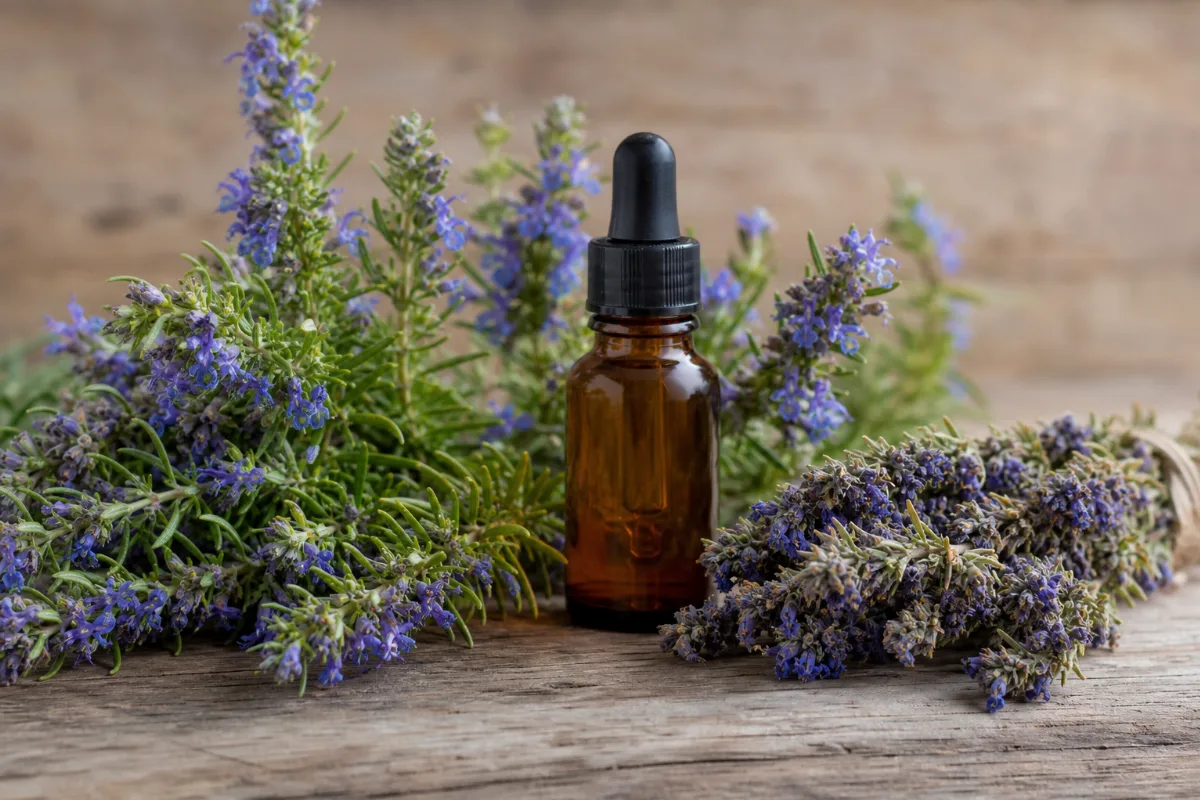
Essential Oils & Aromatherapy · Essential oil (caution)
Hyssop Oil
Hyssopus officinalis L. · also called Hyssop oil, hyssop essential oil, hisopo
Hyssop oil is a strong essential oil from a mint-family plant. Reports and reviews link it to seizures, including in a child, and it is not safe to swallow. The only human trial we found tested a syrup, not the oil, and gave a mixed result. Keep it away from children, pets, pregnancy and anyone with epilepsy.
General information, not medical advice. Last substantive update · Not medically reviewed. A named clinician has not signed off on this page. How this page is made
About Hyssop Oil
Hyssop oil is a seizure-linked essential oil. Case reports, two reviews, a regulator bulletin and rat studies point to the same ketones. No trial of the oil in people exists, so no safe or useful use has been shown.
What hyssop oil is
Hyssop oil is the concentrated essential oil of Hyssopus officinalis, a plant of the mint family. It is not the same as hyssop tea or an extract syrup.
The oil is a mixture. Its main parts include pinocamphone, isopinocamphone and beta-pinene, and the mix changes a lot with where the plant grew. In one review, two oils from the same region in Italy had very different pinocamphone levels (34% and 18.5%).
It is used as a flavour and in cosmetics and household products, according to a 2022 review. Flavouring a food is not the same as swallowing the oil.
What people use it for, and how strong the evidence is
Traditional uses are colds, cough, poor appetite and spasm. No trial of the oil was found for any of them.
The only human trial we found tested a syrup made from a hyssop extract in 60 adults with asthma. It was mixed: some improved and some got worse, and the split was worked out afterwards. It says nothing about the oil and does not replace asthma medicine.
Test-tube and rat findings exist but cannot be carried over to people.
The research in one view
Safety: case reports, two rat papers from 1979 and 1981, a mouse study of how the ketones act, two reviews, a regulator bulletin and poison-centre pages. Benefit: one small mixed trial of a different product, plus lab and rat work.
The honest picture is that the danger is better documented than any benefit. We found no trial of hyssop oil in people.
Oil, tea, syrup and herb are different things
The seizure reports concern the essential oil. A Spanish breastfeeding database says the oil is neurotoxic and linked to seizures, while moderate, occasional use of the herb as an infusion or extract has rare, mild side effects. The liver record also treats the herb, not the oil.
A result for a syrup or tea does not carry over to the oil, and a safe-looking herb does not make a bottle of oil safe. Bottles also vary in strength and makeup, and Poison Control notes it is hard to know what is in one.
What regulators and poison centres say
Medsafe, New Zealand's medicines regulator, lists hyssop among essential oils associated with seizures (2011 bulletin, which says it is over five years old). Pet Poison Helpline names hyssop among oils that can poison pets. Poison Control gives general essential oil warnings and does not name hyssop.
We did not read any European, US or fragrance-industry (IFRA) statement on hyssop oil, so this page cannot say what limits apply.
At a glance
Traditional uses history, not proof
- Hyssop plants are used traditionally for colds, cough, loss of appetite and spasm (2022 review).
- Recommended in Persian Medicine texts for asthma (2024 trial abstract).
- Used as a flavour in drinks and foods and in cosmetics and household products (2022 review).
Studied for research
- Asthma, extract syrup (not the oil), very-low
- Colds and cough, traditional only, insufficient
- Germ-killing in test tubes, insufficient
- Seizures in rats, water extract, insufficient
Main compounds
- Pinocamphone, a main ketone (linked to seizures)
- Isopinocamphone, a main ketone
- Beta-pinene
Common forms
- Essential oil (concentrated)
- Herb tea or infusion (a different product)
- Syrup of extract (a different product)
Research links: Medsafe: essential oils and seizures · Plant-induced seizures (1999 report, abstract) · Toxicity of some essential plant oils (1981, abstract) · Essential oils and seizures, systematic review (2019, abstract) · Poison Control: Essential oils · GBIF: Hyssopus officinalis · Research Library · Genes & Biomarkers Library
What it is and its history
- Accepted scientific name
- Hyssopus officinalis
- Naming authority
- L.
- Common names
- Hyssop (English); Hyssop oil (English); Hisopo (Spanish)
- Family or group
- Lamiaceae, the mint family (GBIF); sage, rosemary, lavender and thyme are in the same family.
- Classification
- Plantae > Lamiaceae > Hyssopus > Hyssopus officinalis
- Native range
- Per e-lactancia the herb comes from the Middle East and southern Europe; the 2022 review says the genus is widespread in central Asia, the East Mediterranean and Mongolia. Not checked in a botanical source.
- Habitat
- Not verified.
- What it looks like
- Part used: The oil is made from the plant (the flowering tops are the usual part for the herb per e-lactancia). The distillation method is not described in the sources read.
- Look-alikes and adulterants
- Name: Other Hyssopus species; Note: The 2024 review says the genus has seven species. Oils from different plants and places can have very different makeup, so a label saying 'hyssop' does not fix the ketone content.
- Sustainability and conservation
- Not checked.
Traditional use and history history, not clinical proof
| Tradition or era | Documented use | Source |
|---|---|---|
| Traditional herbal medicine | The 2022 review says Hyssopus species are used for cold, cough, loss of appetite, fungal infection and spasmodic conditions, and the oil is used as a flavour in drinks and foods and in cosmetics and household products. | Sharifi-Rad et al. 2022 |
| Persian medicine | The 2024 asthma trial says hyssop has been recommended in Persian Medicine texts for asthma. | Daneshfard et al. 2024 |
| Folk use listed by a breastfeeding database | e-lactancia lists traditional use for breathing complaints, poor digestion, painful periods and high blood pressure, and on the skin for cleaning wounds. It also says Germany's Commission E did not consider these claims proven. | e-lactancia 2024 |
| Early toxicology | Convulsions after hyssop and other essences were described in people and tested in rats in 1979 to 1981 (see Safety). | Millet et al. 1979 and 1981 |
Traditional use shows how it was used. It does not show that it works or is safe today.
What is inside, and how it may work
What it contains and how those compounds act in cells and animals. Laboratory and animal mechanisms are not proven effects in people.
Main compounds
| Compound | Family | Where it is concentrated | Activity studied | Level of evidence |
|---|---|---|---|---|
| Pinocamphone PubChem 6427105 | monoterpene ketone | Essential oil 34% and 18.5% in oils from two Italian sites (2022 review); varies by plant. | Linked to the oil's convulsant action. Powerfully convulsant in rats. The pinanones block the GABA-A receptor in mouse brain membranes. 8 6 10 16 | Animal research |
| Isopinocamphone PubChem 84532 | monoterpene ketone | Essential oil 3.2% and 29% in the two Italian oils; 22.5 to 28.7% in a Polish oil (2022 review). | The second ketone linked to the oil's neurotoxicity in the 1979 paper. 8 10 16 | Animal research |
| Beta-pinene PubChem 14896 | monoterpene hydrocarbon | Essential oil About 10.5 to 10.8% in the two Italian oils; 6.7 to 12.0% in the Polish oil (2022 review). | Named as a main constituent; no separate activity is claimed here. 10 16 | Laboratory research |
Mechanisms, receptors and pathways
| Target or pathway | Gene or receptor | What was found | Level |
|---|---|---|---|
| GABA-A receptor (calming brain receptor) | GABA-A | cis- and trans-3-pinanones and hyssop oil acted as GABA-A receptor antagonists in mouse brain membranes (IC50 35 to 64 micromolar), and injected pinanones caused tonic/clonic convulsions in mice that diazepam relieved. 6 | In vivo animal |
| Seizure circuits (rats) | Not specified | The oil's convulsant action was central, shown by electrocortical records in unanaesthetised rats. 9 8 | In vivo animal |
| Several receptors and ion channels (review summary) | NMDA, GABA, glycine, acetylcholine receptors; sodium and calcium channels | The 2022 review says hyssop oil modulates these in lab work. The detail was not checked against the underlying papers. 10 | Review summary |
Absorption, metabolism and elimination
- Absorption
- Not established in people. Seizures have followed both swallowing and skin use of seizure-linked oils in general (Medsafe).
- Distribution
- Not established.
- Metabolism
- Mouse and human liver microsomes and a human P450 enzyme (3A4) turned cis-3-pinanone mainly into 2-hydroxy-cis-3-pinanone; trans-3-pinanone was broken down more slowly. The metabolites were less toxic in the mouse work.
- Elimination
- Conjugates of metabolites were found in mouse urine after cis-3-pinanone.
- Bioavailability
- Not established.
Isolated compounds versus whole extracts
The oil is a mixture whose ketone content varies from plant to plant. The convulsant effect has been tied to pinocamphone and isopinocamphone, which are concentrated in the oil. The herb as a tea or syrup is a different product and was not the subject of the seizure reports.
Nutritional composition
Hyssop oil is not a nutrient. The 2022 review says the oil is used to flavour food and drinks, which is not the same as swallowing the oil.
1 very low certainty3 not enough evidence
What is Hyssop Oil good for?
The uses people ask about and how strong the evidence is for each. Read the certainty label first: none is better than very-low, and none of it tested the oil.
Benefits, one by one
Each card is a research question, not a promise. Tap a goal to filter. Open a card to see the studies, doses and limits.
Asthma symptoms (a hyssop extract syrup, not the oil)
Very low certaintyOne trial of 60 adults with mild-to-moderate asthma compared hyssop syrup with sugar syrup for 4 weeks on top of usual treatment. People with a productive cough improved on breathing tests and symptom scores. People with a dry cough got worse. The split was worked out after the results were in, so it is weak.
1 studiesNot covered. This page gives no amounts and no way to use hyssop or i…
Studies, doses and limits
What the trials found
One randomized, placebo-controlled trial: 60 adults, hyssop extract syrup or plain sugar syrup, 4 weeks, as an add-on to usual asthma treatment.
Results
In patients with productive cough the hyssop group improved on FEV1 (a breathing test), Asthma Control Test score at week 4, peak flow, a mid-airflow measure (MEF25-75%) and wheezing severity. Patients with dry cough got worse on these measures. The abstract gives no numbers.
Effect sizes as reported
No effect sizes in the abstract.
Why this rating
One small trial; the productive-cough and dry-cough groups were defined after the data were in; a syrup of extract, not the oil; no numbers in the abstract; one group got worse. It does not show that hyssop treats asthma and it must not replace prescribed asthma treatment.
Form and dose studied
Not covered. This page gives no amounts and no way to use hyssop or its oil.
Who was studied
Adults with mild-to-moderate asthma already on usual treatment.
Limits
60 people, 4 weeks, one research group. Dry-cough patients worsened. Funding not stated in the abstract.
Why researchers looked
Hyssop has a long traditional place in Persian and other herbal medicine for chest complaints.
Traditional use
Reviews list traditional use of Hyssopus plants for colds, cough, loss of appetite and spasm.
Proposed mechanism Preliminary mechanism
Not established.
A proposed mechanism does not show that the effect happens in people.
This trial tested a syrup of herb extract, not the essential oil. The oil itself is a seizure risk (see Safety).
Colds, cough, loss of appetite and spasm (traditional use)
Not enough evidenceHyssop plants have been used for colds, cough, poor appetite and spasm. The reviews we read describe tradition and test-tube work. They do not show benefit in people for the essential oil.
2 studiesNot covered. This page gives no amounts and no way to use the oil.
Studies, doses and limits
What the trials found
None found for the essential oil. The only human trial we found tested an extract syrup (see above).
Results
Reviews list traditional uses. No trial of the oil in colds or cough was found in the sources we read.
Effect sizes as reported
None.
Why this rating
Tradition and lab work are not human evidence.
Form and dose studied
Not covered. This page gives no amounts and no way to use the oil.
Who was studied
Not applicable.
Limits
Reviews, not trials. The reviews were read as abstracts and, for one, in part as full text.
Why researchers looked
A long history of use in folk medicine.
Traditional use
The 2022 review says Hyssopus species are used for cold, cough, loss of appetite, fungal infection and spasmodic conditions. The oil is also used as an additive in beverages, foods and cosmetics.
Proposed mechanism Preliminary mechanism
Not established in people.
A proposed mechanism does not show that the effect happens in people.
Hyssop oil can cause seizures (see Safety). This page gives no way to use it.
Antiviral and antifungal activity (test tube)
Not enough evidenceIn test-tube studies, hyssop extracts and oil were reported to act against some viruses and fungi. That is lab work only. It does not show that anything helps an infection in a person.
1 studiesNot covered. This page gives no amounts and no way to use the oil.
Studies, doses and limits
What the trials found
None found.
Results
The 2022 review abstract says extracts of Hyssopus are reported to have potential antiviral and antifungal activity in test-tube studies. The abstract gives no figures.
Effect sizes as reported
None.
Why this rating
Test-tube only. Many things kill germs in a dish and are unsafe or useless in the body.
Form and dose studied
Not covered. This page gives no amounts and no way to use the oil.
Who was studied
Not applicable.
Limits
Abstract-level reading; the individual lab papers were not opened.
Why researchers looked
Researchers screen aromatic plants for germ-killing effects.
Traditional use
Hyssop was used traditionally for infections of the chest and skin.
Proposed mechanism Preliminary mechanism
Not established.
A proposed mechanism does not show that the effect happens in people.
Test-tube findings only. The oil can cause seizures (see Safety).
Delayed seizures in rats (water extract, not the oil)
Not enough evidenceIn one rat study, an injected water extract of hyssop delayed the stages of a seizure that a drug had triggered, at one middle dose. This is animal work and it is about a different product from the oil, which has caused seizures.
1 studiesNot covered. This page gives no amounts and no way to use hyssop or i…
Studies, doses and limits
What the trials found
None.
Results
At 100 mg/kg the extract significantly delayed stages 5 and 6 of seizure in rats given a seizure-inducing drug; the abstract reports no such effect at the other two doses. The authors say it 'might' have anticonvulsant effects.
Effect sizes as reported
Significant at one dose (p<0.05); no other numbers in the abstract.
Why this rating
A small rat study with injected plant water extract. It cannot be carried over to people and it does not offset the seizure danger of the essential oil.
Form and dose studied
Not covered. This page gives no amounts and no way to use hyssop or its oil.
Who was studied
Not applicable (rats).
Limits
5 to 10 rats per group; one dose showed the effect; funding not stated in the abstract.
Why researchers looked
Some herbs have calming effects in animals.
Traditional use
None specific.
Proposed mechanism Preliminary mechanism
The authors checked a brain gene (iNOS). It rose, but they say the effect probably did not work through it.
A proposed mechanism does not show that the effect happens in people.
This is a water extract in rats. The essential oil does the opposite: it causes seizures at high enough doses (see Safety).
Connections to the rest of health
How Hyssop Oil connects to the rest of our health knowledge graph. Every link says what kind of connection it is. A safety link (for example to the liver) is a warning, not a benefit. A study that merely mentions a topic never creates a benefit link.
Explore every connection: goals, body systems, organs, symptoms, genes
A. Wellness goals
| Connected to | Kind of connection | Evidence status | Context | Studies |
|---|---|---|---|---|
| Breathing Support | Very low certainty | Asthma symptoms (a hyssop extract syrup, not the oil): One trial of 60 adults with mild-to-moderate asthma compared hyssop syrup with sugar syrup for 4 weeks on top of usual treatment. People with a productive cough improved on breathing tests and symptom scores. People with a dry cough got worse. The split was worked out after the results were in, so it is weak. | 4 | |
| Breathing Support | Traditional use | Not enough evidence | Colds, cough, loss of appetite and spasm (traditional use): Hyssop plants have been used for colds, cough, poor appetite and spasm. The reviews we read describe tradition and test-tube work. They do not show benefit in people for the essential oil. | 10 1 |
| Immune Support | Traditional use | Not enough evidence | Colds, cough, loss of appetite and spasm (traditional use): Hyssop plants have been used for colds, cough, poor appetite and spasm. The reviews we read describe tradition and test-tube work. They do not show benefit in people for the essential oil. | 10 1 |
| Immune Support | Not enough evidence | Antiviral and antifungal activity (test tube): In test-tube studies, hyssop extracts and oil were reported to act against some viruses and fungi. That is lab work only. It does not show that anything helps an infection in a person. | 10 | |
| Calm Relaxation | Not enough evidence | Delayed seizures in rats (water extract, not the oil): In one rat study, an injected water extract of hyssop delayed the stages of a seizure that a drug had triggered, at one middle dose. This is animal work and it is about a different product from the oil, which has caused seizures. | 5 |
B. Body systems
| Connected to | Kind of connection | Evidence status | Context | Studies |
|---|---|---|---|---|
| Respiratory System | Biological association | Very low certainty | Studied for: Asthma symptoms (a hyssop extract syrup, not the oil) Studied for: Colds, cough, loss of appetite and spasm (traditional use) | 4 10 1 |
| Immune System | Biological association | Not enough evidence | Studied for: Antiviral and antifungal activity (test tube) | 10 |
| Nervous System | Biological association | Not enough evidence | Studied for: Delayed seizures in rats (water extract, not the oil) | 5 |
E. Health conditions
| Connected to | Kind of connection | Evidence status | Context | Studies |
|---|---|---|---|---|
| Seizures | Adverse effect or risk | Documented risk | Case reports and reviews link the oil to convulsions; Medsafe lists hyssop among seizure-linked oils. Preparation or compound: Hyssop essential oil (pinocamphone and isopinocamphone) |
9 3 2 11 |
| Epilepsy | Contraindication | Authority statement | Medsafe says people with epilepsy should be warned about such oils. Preparation or compound: Hyssop essential oil |
11 |
I. Biomarkers
| Connected to | Kind of connection | Evidence status | Context | Studies |
|---|---|---|---|---|
| Asthma Control Test (ACT) score | Biological association | Very low certainty | Measured in trials: increase. A lab change is not the same as a health benefit. | 4 |
| FEV1 (forced expiratory volume in one second) | Biological association | Very low certainty | Measured in trials: increase. A lab change is not the same as a health benefit. | 4 |
| Time to reach seizure stages 5 and 6 (rats) | Biological association | Not enough evidence | Measured in trials: increase. A lab change is not the same as a health benefit. | 5 |
J. Genes, receptors and enzymes
| Connected to | Kind of connection | Evidence status | Context | Studies |
|---|---|---|---|---|
| GABA-A receptor | Preliminary mechanism | In vivo animal | Blocked by hyssop pinanones in mouse brain membranes. | 6 |
L. Active compounds
| Connected to | Kind of connection | Evidence status | Context | Studies |
|---|---|---|---|---|
| Pinocamphone | Biological association | Animal | Linked to the oil's convulsant action. Powerfully convulsant in rats. The pinanones block the GABA-A receptor in mouse brain membranes. Preparation or compound: Essential oil |
8 6 10 16 |
| Isopinocamphone | Biological association | Animal | The second ketone linked to the oil's neurotoxicity in the 1979 paper. Preparation or compound: Essential oil |
8 10 16 |
| Beta-pinene | Biological association | In vitro | Named as a main constituent; no separate activity is claimed here. Preparation or compound: Essential oil |
10 16 |
Each connection is stored with the ingredient, the connected record, the kind of connection, the evidence status, the supporting studies, the preparation or compound involved, and a review date (last reviewed October 25, 2026).
The evidence
The research centre for Hyssop Oil. Every record here was checked against PubMed or the publisher's page; we never list a study we have not verified.
Evidence by outcome
Bars show how many studies we found for each outcome, not how well it works. People are added up across trials only (reviews are not added, to avoid double counting).
How we rate evidence
High certainty
Several well-run trials or reviews agree; further research is unlikely to change the picture much.
Moderate certainty
Good trials point the same way, but some doubt remains.
Low certainty
Small, short or inconsistent trials. The finding could change with better research.
Very low certainty
Very little or very weak human data. Treat as a possibility only.
Mixed findings
Trials or reviews disagree with each other.
Not enough evidence
Not enough human research to say either way.
Evidence against
Good research found no benefit, or found harm.
We take the reviewers' own risk-of-bias and GRADE statements where they exist, and otherwise judge from study size, design, consistency, directness and whether a product matches what is sold. Many publications do not make evidence high. Method note: We read the abstracts of 10 PubMed papers and a LiverTox record, read the Medsafe, Poison Control, Pet Poison Helpline and e-lactancia pages in full and part of one review's full text, and checked the plant name in GBIF and compounds in PubChem. We did not find or read EMA, FDA, IFRA or LactMed statements.
Study library: every study we checked 16
| Study | Design | People | Product, dose, length | Result |
|---|---|---|---|---|
| Atazhanova 2024 The Genus Hyssopus: Traditional Use, Phytochemicals and Pharmacological Properties Plants (Basel) · PMID 38931115 · DOI |
Narrative review review |
Literature on the genus Hyssopus | Hyssopus plants and extracts plant Not reported here n/a · vs n/a |
The review says the genus has seven species and that extract chemistry depends on place of growth, weather, chemotype and extraction method. Its abstract reports no human evidence of benefit. None. Methods, limits and fundingOutcomes: Botany, chemistry, pharmacology Limitations: Abstract only was read; the review is mostly lab and traditional-use material. Funding and conflicts: Not stated in the abstract. Read: abstract |
| Bahr 2019 The Effects of Various Essential Oils on Epilepsy and Acute Seizure: A Systematic Review Evid Based Complement Alternat Med · PMID 31239862 · DOI |
Systematic review human, animal, lab |
Human case reports, animal models and test-tube studies of essential oils and seizures | Many essential oils oils Not reported here n/a · vs n/a |
The review says some oils have convulsant effects and may trigger seizures in both epileptic and healthy people. It lists internal use of sage, hyssop, rosemary, camphor, pennyroyal, eucalyptus, cedar, thuja and fennel oils as able to cause epileptic seizures, because they contain thujone, 1,8-cineole, camphor or pinocamphone. It points to effects on the GABA system and on ion channels, and says more research is needed to confirm how this works. No numbers in the abstract. Methods, limits and fundingOutcomes: Convulsant and anticonvulsant effects of essential oils Limitations: A review of mixed-quality material (case reports, animal and lab work). The abstract gives no hyssop-specific case counts. Funding and conflicts: Not stated in the abstract. Read: abstract |
| Burkhard 1999 Plant-induced seizures: reappearance of an old problem J Neurol · PMID 10460442 · DOI |
Case reports (three patients) plus a literature survey |
3 Three healthy people (two adults, one child) with a seizure after taking several essential oils for treatment |
Several essential oils (which ones, and whether hyssop was one, is not stated in the abstract) oils Not reported here not stated · vs none |
Two adults had an isolated generalised tonic-clonic seizure and the child had a generalised tonic status. Outcome was good in the two adults and less favourable in the child. A literature survey names essential oils of 11 plants as powerful convulsants, hyssop among them, because of reactive monoterpene ketones such as camphor, pinocamphone, thujone, cineole, pulegone, sabinyl acetate and fenchone. No effect size; case reports. Methods, limits and fundingOutcomes: Seizure type, outcome, literature survey of convulsant oils Limitations: The abstract does not say which oils the three patients took or whether hyssop was one of them. Three cases cannot give a rate. The hyssop statement comes from the survey of earlier literature. Funding and conflicts: Not stated in the abstract. Read: abstract |
| Daneshfard 2024 Effect of Hyssop (Hyssopus officinalis) Syrup on Mild to Moderate Asthma: A Randomized Double-Blind Placebo-Controlled Trial Tanaffos · PMID 39959798 |
Randomized triple blind placebo controlled trial |
60 Adults with mild-to-moderate asthma on usual treatment |
Hyssop syrup (a Hyssopus officinalis extract syrup, not the essential oil) herb extract in syrup Not reported here 4 weeks · vs plain sugar syrup |
In patients with productive cough, the hyssop group improved on FEV1, Asthma Control Test (at week 4), peak flow, MEF25-75% and wheezing severity. Patients with dry cough got worse on those measures. The authors conclude the syrup suits productive cough and a higher BMI but not dry cough, and state that this split came from subgrouping after the data were in. Direction only; no numbers in the abstract. Methods, limits and fundingOutcomes: Asthma Control Test, lung function tests, EPR3 control rating, wheezing severity Limitations: 60 people; the cough split was decided after the fact, which weakens it. A syrup of herb extract, so it says nothing about the essential oil. Funding not stated in the abstract. Dry-cough patients got worse. Funding and conflicts: Not stated in the abstract. Read: abstract |
| Gholami 2020 Effects of aqueous extract of Hyssopus officinalis on seizures induced by pentylenetetrazole and hippocampus mRNA level of iNOS in rats Avicenna J Phytomed · PMID 32523876 |
Animal experiment (rats) rat |
33 Adult male Wistar rats given a seizure-inducing drug |
Hyssop aqueous (water) extract, injected into the abdomen water extract of the plant Not reported here single dose before seizure induction · vs saline |
At 100 mg/kg the extract significantly delayed the time to seizure stages 5 and 6 and raised iNOS expression in the hippocampus. The authors say it 'might' have anticonvulsant effects, and that this did not appear to work through iNOS. The 50 and 200 mg/kg groups did not show the same delay in the abstract. Significant at 100 mg/kg only (p<0.05). Methods, limits and fundingOutcomes: Seizure stage latency; hippocampus iNOS gene expression Limitations: Rats (5 to 10 per group, injected extract of the herb, not the essential oil). An aqueous extract does not contain the oil's ketones in the same way. This does not make the oil safe. Funding and conflicts: Not stated in the abstract. Read: abstract |
| Höld 2002 Metabolism and mode of action of cis- and trans-3-pinanones (the active ingredients of hyssop oil) Xenobiotica · PMID 12028660 · DOI |
Laboratory and mouse study mouse and lab |
Mouse and human liver microsomes; mice | cis- and trans-3-pinanones and hyssop oil oil constituents Not reported here single treatments · vs n/a |
The authors call the pinanones the principal active ingredients of hyssop oil. Both pinanones and hyssop oil acted as GABA-A receptor antagonists in mouse brain membranes (IC50 35 to 64 micromolar). Injected pinanones caused tonic/clonic convulsions in mice (LD50 175 to over 250 mg per kg) that diazepam relieved. Two metabolites of cis-3-pinanone had reduced toxicity. IC50 35 to 64 micromolar; mouse LD50 175 to >250 mg/kg (injected). Methods, limits and fundingOutcomes: Metabolism; GABA-A receptor binding; convulsions in mice Limitations: Mouse and lab work; the human liver part shows metabolism only. Not a human safety figure. Funding and conflicts: Support: US public health service research funding (as listed on PubMed). Read: abstract |
| LiverTox 2018 Hyssop (LiverTox record) LiverTox: Clinical and Research Information on Drug-Induced Liver Injury · PMID 31643710 |
Reference record reference |
n/a | Hyssop herb (leaves and flowers) herb Not reported here n/a · vs n/a |
The record says hyssop is prepared from the leaves and flowers of Hyssopus officinalis, is widely used and has not been implicated in causing liver injury. The annotated bibliography lists general herbal-liver reviews that do not discuss hyssop. No cases listed. Methods, limits and fundingOutcomes: Liver injury reports Limitations: A short record about the herb. It does not treat the essential oil separately, and absence of reports is not proof of safety. Funding and conflicts: Public (NIH). Read: record text via PubMed |
| Millet 1979 Experimental study of the toxic convulsant properties of commercial preparations of essences of sage and hyssop Rev Electroencephalogr Neurophysiol Clin · PMID 493616 · DOI |
Animal experiment (rats) rat |
Unanaesthetised rats | Commercial essences of hyssop and sage essential oil Not reported here single doses · vs sage essence |
Commercial essences of sage and hyssop had caused poisoning of people and were convulsant in rats, acting on the brain. Hyssop was more powerful than sage. For hyssop the dose below which brain-wave changes were subclinical was 0.08 g/kg, convulsions appeared above 0.13 g/kg and became lethal above 1.25 g/kg. The authors link the neurotoxicity to the ketones pinocamphone and isopinocamphone; pinocamphone was powerfully convulsant and lethal above 0.05 ml/kg. Same rat thresholds as the 1981 paper. Methods, limits and fundingOutcomes: Convulsions and cortical brain-wave changes Limitations: Rat work. Doses do not transfer to people. Number of animals not given in the abstract. Abstract of a French-language paper. Funding and conflicts: Not stated in the abstract. Read: abstract |
| Millet 1981 Toxicity of some essential plant oils. Clinical and experimental study Clin Toxicol · PMID 7333081 · DOI |
Case series (eight human poisonings) plus rat experiments human and rat |
8 Eight people poisoned by commercial essences of sage, hyssop, thuja and cedar; unanaesthetised rats |
Commercial hyssop essential oil (and sage oil) given to rats; human cases from commercial essences of sage, hyssop, thuja and cedar essential oil Not reported here single doses; also repeated daily low doses in rats · vs sage oil in the same experiments |
Eight human intoxications were attributed to commercial essences of sage, hyssop, thuja and cedar, with tonic-clonic convulsions the major symptom. In rats the convulsant action was of central nervous system origin. The dose below which brain-wave changes were only subclinical was 0.08 g/kg for hyssop oil (0.3 g/kg for sage oil). Above 0.13 g/kg hyssop oil caused convulsions and above 1.25 g/kg it was lethal (sage oil: 0.50 and 3.2 g/kg). Repeated daily injection of subclinical doses showed a cumulative toxic effect of hyssop oil. The authors link hyssop toxicity to pinocamphone and say its neurotoxicity was shown in rats for the first time. Rat thresholds: 0.08 g/kg subclinical, 0.13 g/kg convulsions, 1.25 g/kg lethal (hyssop oil). Methods, limits and fundingOutcomes: Convulsions; electrocortical (brain-wave) records in rats Limitations: The abstract does not say how many of the eight human cases involved hyssop. Rat doses were injected, and are not a safe or toxic figure for people. Funding and conflicts: Support: non-US government research funding (as listed on PubMed); no company link stated. Read: abstract |
| Sharifi-Rad 2022 Hyssopus Essential Oil: An Update of Its Phytochemistry, Biological Activities, and Safety Profile Oxid Med Cell Longev · PMID 35069979 · DOI |
Narrative review review |
Literature on hyssop essential oil | Hyssopus essential oil oil Not reported here n/a · vs n/a |
The abstract names beta-pinene, pinocamphone and isopinocamphone as important constituents, reports antiviral and antifungal activity of extracts in test-tube studies and sedative effects in animal studies, and says the plant is believed relatively safe at food levels but that more studies are needed on safety. The full text (read in part, sections on chemistry and safety) repeats the convulsant warning from the older literature, reports rat figures from the 1979 and 1981 papers, lists allergic reactions and airway irritation as other possible effects, says no clinical trials of hyssop oil adverse effects in humans have been done, and says there is very little research on hyssop in pregnancy. No effect sizes. Methods, limits and fundingOutcomes: Chemistry, biological activities, safety Limitations: A narrative review that relies on older papers for its safety statements. Two statements in it (about oil not crossing the blood-brain barrier, and about marrubiin) sit oddly with the convulsant findings and are not used on this page. Funding and conflicts: Not stated in the abstract. Read: full-text (sections 7 and 8 and chemistry read; not all references opened) |
| n/a 2011 Medsafe (New Zealand): Complementary Corner, essential oils associated with seizures. Prescriber Update 32(4), December 2011 n/a · Source |
Regulator bulletin regulator |
n/a | n/a n/a Not reported here n/a · vs n/a |
Medsafe reminds health professionals that essential oils, given by mouth or on the skin, can rarely cause seizures in young children and in people with epilepsy. Its list of oils generally associated with seizures includes hyssop (Hyssopus officinalis), alongside eucalyptus, fennel, pennyroyal, rosemary, sage, savin, tansy, thuja, turpentine and wormwood. It says the risk of seizure appears very low but adverse reactions are likely under-reported, that seizures have followed oral and skin use, that exposure to an essential oil product should be considered in any unexplained first seizure, and that people with epilepsy should be warned. Methods, limits and fundingOutcomes: n/a Limitations: The page itself says it is more than five years old and some content may no longer be current. It lists oils in general; it gives no hyssop-specific case. Read: full text |
| n/a 2024 e-lactancia (APILAM): Hisop / hyssop and breastfeeding (in Spanish) n/a · Source |
Breastfeeding safety database record guidance |
n/a | n/a n/a Not reported here n/a · vs n/a |
Rated 'probable compatibility' for the herb. Says no published data on excretion into breast milk were found, the plant is little studied, and Germany's Commission E did not consider its claimed properties proven. Says the essential oil is neurotoxic and has been linked to seizures (citing LiverTox, Burkhard 1999, Blumenthal 1998 and Millet 1981), while moderate, non-continuous use of the herb as an infusion or extract or on the skin has rare, mild side effects; moderate use in breastfeeding is possible but dispensable. Methods, limits and fundingOutcomes: n/a Limitations: A database summary by clinicians; it rates the herb as a whole, and its warning about the oil is the point relevant here. Read: full text (Spanish) |
| n/a 2026 Poison Control (National Capital Poison Center): Essential oils, poisonous when misused n/a · Source |
Poison centre guidance guidance |
n/a | n/a n/a Not reported here n/a · vs n/a |
Says misuse of essential oils can cause serious poisoning; some are poisonous if swallowed or absorbed through the skin; children have thin skin and immature livers and may be more susceptible; oils may interact with medicines; allergy is a real possibility, most often a skin rash; aspirating an oil can cause pneumonia; it is hard to know species, concentration or contamination in a bottle; keep oils locked up out of reach of children and pets; call 1-800-222-1222 if swallowed. It names eucalyptus, sage and camphor as seizure risks. Hyssop is NOT named on the page. Methods, limits and fundingOutcomes: n/a Limitations: Undated page; general guidance for all oils. Hyssop is not mentioned. Read: full text |
| n/a 2026 Pet Poison Helpline: Essential oils n/a · Source |
Veterinary poison centre guidance guidance |
n/a | n/a n/a Not reported here n/a · vs n/a |
Says essential oil poisoning can affect all species but cats and birds are at greatest risk; oral exposure is the highest-risk route, then skin, then breathing it in; signs usually appear within 6 to 8 hours and can take 3 to 7 days to resolve; its list of oils that can cause poisoning names hyssop, and says seizure control may be needed in severe cases. Methods, limits and fundingOutcomes: n/a Limitations: Undated student-written page; general to all oils, with hyssop appearing in a list. Read: full text |
| n/a 2026 GBIF Backbone Taxonomy: Hyssopus officinalis L. (match API read 2026-10-25) n/a · Source |
Registry or database registry |
n/a | n/a n/a Not reported here n/a · vs n/a |
Accepted species Hyssopus officinalis L., rank species, status ACCEPTED, family Lamiaceae, match confidence 99, species key 5341387. Methods, limits and fundingOutcomes: n/a Limitations: Taxonomy only. Read: full text |
| n/a 2026 PubChem compound records: pinocamphone (CID 6427105), isopinocamphone (CID 84532), beta-pinene (CID 14896) (read 2026-10-25) n/a · Source |
Registry or database registry |
n/a | n/a n/a Not reported here n/a · vs n/a |
Name lookups returned CID 6427105 pinocamphone (C10H16O, 2,6,6-trimethylbicyclo[3.1.1]heptan-3-one), CID 84532 isopinocamphone (C10H16O, same name with a different stereochemistry) and CID 14896 beta-pinene (C10H16). Methods, limits and fundingOutcomes: n/a Limitations: Identity of the molecules only. Read: full text |
What we do not know yet
- No LactMed, EMA/HMPC, FDA, IFRA or EU flavouring statement was read.
- The hyssop-specific details of the human cases (which oil, how much, which route) are not in the abstracts; full texts were not opened.
- No skin patch-test study of hyssop oil was found.
- No human trial of the oil's safety exists.
- No trial of hyssop oil in any condition was found, so what the oil does in people is unknown.
- What the evidence supports: danger is documented by case reports and animal work (low); benefits are very-low or insufficient.
How new research is added
New studies are found by a saved PubMed search and are placed in a review queue. A person reads each one before it is added.
Lab markers
What changed in blood or saliva tests during trials. A changed number is not the same as feeling or being healthier, and we give no "normal ranges".
Other 3
Asthma Control Test (ACT) score
Increase in trials
A short questionnaire in which people rate their own asthma symptoms; higher means better control.
Very low certaintyResults and what it means
Why it was measured
One of the main outcomes of the hyssop syrup trial.
Statistical vs. clinical meaning
Self-rated, one small trial, groups defined after the fact.
Safety implication
A better score on a syrup says nothing about the safety of the essential oil.
| Study | Result | People | Product |
|---|---|---|---|
| 4 | Higher at week 4 in the hyssop syrup group among patients with productive cough; worse among patients with dry cough. No numbers in the abstract. |
FEV1 (forced expiratory volume in one second)
Increase in trials
How much air a person can blow out in the first second of a hard breath out; a standard breathing test.
Very low certaintyResults and what it means
Why it was measured
A lung-function outcome of the asthma trial.
Statistical vs. clinical meaning
A measured test, but the result depends on how people were grouped afterwards.
Safety implication
None for the oil.
| Study | Result | People | Product |
|---|---|---|---|
| 4 | Improved in patients with productive cough on hyssop syrup; worsened in patients with dry cough. No numbers in the abstract. |
Time to reach seizure stages 5 and 6 (rats)
Increase in trials
How long it took rats to reach the more severe stages of a drug-triggered seizure; a longer time is a smaller effect of the seizure drug.
Not enough evidenceResults and what it means
Why it was measured
Main outcome of the rat study.
Statistical vs. clinical meaning
Animal marker; says nothing about people or the oil.
Safety implication
None. The essential oil is the seizure-linked product.
| Study | Result | People | Product |
|---|---|---|---|
| 5 | Longer at 100 mg/kg of hyssop water extract than with saline; not significant at the other doses in the abstract. |
Safety
What studies and official sources say about side effects, medicines and who should check first. Each point shows what kind of evidence it comes from.
Main points to know 7
- Hyssop oil is linked to seizures (convulsions). This is the main danger.. A 1981 paper reports eight human poisonings from commercial essences of sage, hyssop, thuja and cedar, with convulsions as the main symptom (it does not say how many involved hyssop). A 1999 report describes three healthy people, including a child, who had a seizure after taking several essential oils for treatment, and surveys the literature naming hyssop among 11 plant oils that are powerful convulsants. A 2019 systematic review lists internal use of hyssop oil among oils that can cause epileptic seizures, in people with and without epilepsy. New Zealand's medicines regulator lists hyssop among oils associated with seizures. Case series 9 3 2 11
- In rats, the gap between a brain effect and a lethal dose is small, and low doses add up.. In rats, hyssop oil at 0.08 g/kg caused brain-wave changes without visible signs; convulsions appeared above 0.13 g/kg; above 1.25 g/kg it was lethal. Repeating a dose that had been silent caused clonic seizures, so the effect is cumulative. These are injected animal doses, not figures for people, and no safe amount for people is known. Animal research 9 8
- The danger is chemical: the ketones in the oil block a calming brain receptor.. Pinocamphone and isopinocamphone are the main ketones of the oil. Pinocamphone was powerfully convulsant in rats. The pinanones (the active parts of hyssop oil) blocked the GABA-A receptor in mouse brain membranes and caused convulsions in mice. This explains why the oil, unlike the herb in tea, is the concern. Animal research 8 6
- Children and people with epilepsy are the groups named by the regulator.. Medsafe says oils like these can rarely cause seizures in young children and in people with epilepsy, after swallowing or on the skin, and that the risk appears very low but is probably under-reported. In the 1999 report the child recovered less well than the two adults. Poison Control adds that children have thin skin and immature livers and may be more susceptible to essential oils in general. Authoritative guidance 11 3 13
- Pregnancy: no safety data, and a review says it might make the womb contract.. The 2022 review says there is very little research on hyssop in pregnancy and that it might make the uterus contract or start menstruation. This is a possibility stated without data. Review 10
- Pets, especially cats and birds, can be poisoned.. Pet Poison Helpline lists hyssop among essential oils that can poison animals, says cats and birds are at greatest risk, and says swallowing is the highest-risk route. Authoritative guidance 14
- There is no trial of the oil's safety in people.. The 2022 review says no clinical trials of hyssop essential oil adverse effects in humans have been done, and that reports come only from hospital clinical data. Absence of studies is not evidence of safety. Review 10
Side effects 4
| Effect | How often | Severity and recovery | Evidence |
|---|---|---|---|
| Seizures (generalised tonic-clonic, or tonic status in a child) Case reports cannot give a rate, and the abstracts do not say how much oil was taken or whether hyssop was among the oils in each case. | Not known. The 1999 report has 3 patients (oils unspecified); the 1981 paper has 8 poisonings from four oils including hyssop. Medsafe calls the risk very low but probably under-reported. | Serious. In the 1999 report the child's course was less favourable than the adults'. Good outcome in the two adults in the 1999 report; less favourable in the child. | Case series 3 9 11 |
| Allergic reactions, and irritation of the airways The general aromatherapy figure is not about hyssop. Poison Control says allergy to an oil is a real possibility, most often a skin rash. | No hyssop-specific figure. The 2022 review quotes a figure for 3,000 aromatherapy patients in general: skin reactions in 0.99%, mostly contact dermatitis. | Not graded for hyssop. Not described for hyssop. | Review 10 |
| Drowsiness and sensory effects at high doses Stated in the 2022 review's limitations section without case data. | Not known. | Not graded. Not described. | Review 10 |
| Poisoning signs in pets General to essential oils, with hyssop on the list of oils named. | Not known for hyssop. | Vomiting, drooling, lethargy and skin or airway irritation are common with oils generally; severe cases may need seizure control. Mild cases resolve in hours; severe cases can take 3 to 7 days. | Authoritative guidance 14 |
Liver
LiverTox says the herb hyssop is widely used and has not been implicated in liver injury. It does not cover the essential oil separately. No liver case report involving hyssop oil was found in the sources read. 7
How often. Not established.
Monitoring. No agency monitoring advice found. People with liver disease should ask a doctor or pharmacist.
This is a safety connection. It is not evidence that Hyssop Oil supports liver health.
Medicines and supplements 4
| With | Why it matters | Importance | Evidence | What to do |
|---|---|---|---|---|
| Other oils linked to seizures (sage, rosemary, eucalyptus, fennel, camphor, pennyroyal, thuja, wormwood and others) other-seizure-linked-oils | The 1999 patients took several such oils together; the reviews name the same family of ketones (camphor, thujone, pinocamphone, cineole). | Stacking oils may add to the seizure risk. This is an inference from case reports and from the shared ketones; no study measured the combination. | Case report Low certainty 3 2 | Do not combine these oils. If you have used several, tell a doctor or pharmacist. |
| Medicines for epilepsy antiseizure-medicines | Theoretical: the oil's ketones block a calming receptor (GABA-A) that many seizure medicines act through. | No case or trial of this interaction was found. Medsafe says people with epilepsy should be warned about these oils. | Theoretical Not enough evidence 6 11 | If you take medicine for epilepsy, ask a doctor or pharmacist before any hyssop product. |
| Sedatives, sleeping pills, alcohol sedatives | Theoretical: the 2022 review reports sedative effects of Hyssopus extracts in animals. | No human interaction case was found. | Theoretical Not enough evidence 10 | Tell a pharmacist about any sedative you take. |
| Prescription and over-the-counter medicines in general unknown | Poison Control says essential oils may interact with medications. | General statement; no hyssop-specific interaction was found. | Authoritative guidance Not enough evidence 13 | Ask a pharmacist. |
Who should check first 5
| Situation | Advice | Evidence |
|---|---|---|
| Epilepsy or any past seizure | Avoid. Medsafe says people with epilepsy should be warned about oils of this kind. | Authoritative guidance 11 2 |
| Children, especially young children | Keep the oil away from children entirely. Seizures are described in a child in the 1999 report, and Medsafe names young children. | Case report 3 11 |
| Pregnancy | Avoid. There are no safety data and a review says it might cause the womb to contract. | Review 10 |
| Swallowing the oil | Do not swallow hyssop oil. The seizure reports and the reviews concern internal use above all. | Review 2 3 |
| Homes with cats or birds | Keep the oil away from pets and out of the air they breathe. | Authoritative guidance 14 |
Overdose, product quality and regulators
Summary. Hyssop oil is a neurotoxic oil: the ketones pinocamphone and isopinocamphone excite the brain and can cause convulsions. In rats, convulsions appeared above 0.13 g/kg and death above 1.25 g/kg; low silent doses added up on repeat. No toxic or safe amount for people is established and none is given here.
Amounts. No safe amount is established, and this page gives none.
Onset and course. Not described for hyssop in the sources read. Poison Control says seizures can begin within minutes with camphor, a related ketone; that statement is about camphor, not hyssop.
Repeated use. In rats, repeated daily low doses that were silent at first produced seizure activity, showing a cumulative effect.
Animal data. Rats (1979 and 1981 papers): brain-wave changes at 0.08 g/kg, convulsions above 0.13 g/kg, lethal above 1.25 g/kg; pinocamphone lethal above 0.05 ml/kg. Mice: pinanones caused convulsions that diazepam relieved.
Toxic parts. The essential oil (concentrated, ketone-rich). The herb as a tea is a different product and is not covered by these findings.
Not read. Full texts of the 1979, 1981 and 1999 papers; EMA, FDA, IFRA and EU flavouring limits for pinocamphone; Tisserand-style safety tables; veterinary case papers.
One bottle of hyssop oil can differ a lot from another, and the ketones behind the seizure risk vary.
Unknown species, strength and contaminants. Poison Control says it can be hard to know what species, concentration or contaminants are in an essential oil bottle. 13
The ketone mix varies by plant. The 2022 review reports oils from two sites near Urbino, Italy with pinocamphone at 34% and 18.5% and isopinocamphone at 3.2% and 29%, and a Polish oil with isopinocamphone at 22.5 to 28.7% and pinocamphone at 11.4 to 18.0%. A 2024 review says composition depends on place of growth, weather, chemotype and extraction. 10 1
| Body | Action | Date |
|---|---|---|
| Medsafe (New Zealand Medicines and Medical Devices Safety Authority) (New Zealand) | Prescriber Update bulletin: essential oils including hyssop can rarely cause seizures in young children and people with epilepsy, after oral or skin use; risk very low but under-reported; consider in unexplained first seizures; warn people with epilepsy. source | 2011-12 |
| LiverTox (NIDDK, US) (United States) | Herb record: hyssop widely used, not implicated in liver injury. The essential oil is not covered separately. source | 2018-03-30 |
| Poison Control (National Capital Poison Center, US) (United States) | General essential oil guidance: misuse can cause serious poisoning; call 1-800-222-1222 if swallowed. Hyssop is not named on the page. source |
When to get medical help
- A seizure, fit, sudden stiffening, jerking or loss of awareness after hyssop oil (or any essential oil) is an emergency: call your local emergency number.
- If a child or pet may have swallowed any essential oil, call poison control (US: 1-800-222-1222) or your local emergency number right away. Do not wait for signs.
- Coughing or choking after oil is swallowed can mean it has entered the lungs: seek emergency care.
- Swelling of the face or throat, trouble breathing, or a spreading rash after contact needs urgent medical care; a mild rash means stop and wash the oil off.
- Unexplained confusion, strong drowsiness or unsteadiness in a child near essential oils needs a doctor the same day.
Stop using the product and contact a clinician or emergency service. In the US, Poison Control is 1-800-222-1222.
General information only, not medical advice. Ask a clinician or pharmacist before use, especially with medicines, in pregnancy or with a health condition. See the Natural Remedy Safety guide.
Frequently asked questions
Is hyssop oil safe?
Can hyssop oil cause seizures?
Why does hyssop oil cause seizures?
Is hyssop oil safe for children?
Is hyssop oil safe in pregnancy or while breastfeeding?
Can people with epilepsy use hyssop oil?
Is hyssop oil dangerous for pets?
It can be. Pet Poison Helpline lists hyssop among oils that can poison animals, with cats and birds at greatest risk and swallowing the highest-risk route.
Can hyssop oil help asthma or coughs?
Not shown. The one trial we found tested a hyssop extract syrup, not the oil, in 60 adults, and its result split by cough type with one group getting worse. Do not stop prescribed asthma treatment.
Is hyssop tea the same as hyssop oil?
Can hyssop oil damage the liver?
No liver injury from hyssop was found. LiverTox says the herb has not been implicated, but it does not cover the oil separately, and absence of reports is not proof of safety.
What should I do if someone has swallowed hyssop oil or had a seizure?
Explore by health goal
Editorial transparency
- Written by
- AlternativeMed editorial team. Research compiled with AI assistance, then checked against PubMed records.
- Medical review
- None. This page has not been reviewed by a physician or pharmacist.
- First published
- 2026-10-25
- Last substantive update
- 2026-10-25
- How we research
- We read the abstracts of 10 PubMed papers and a LiverTox record, read the Medsafe, Poison Control, Pet Poison Helpline and e-lactancia pages in full and part of one review's full text, and checked the plant name in GBIF and compounds in PubChem. We did not find or read EMA, FDA, IFRA or LactMed statements.
- How we rate evidence
- See "How we rate evidence" in the Evidence tab.
- Independence
- No product is promoted on this page. No affiliate links are shown. Industry links are labelled where the abstract gave them; none was stated.
Sources 16
Each source was opened and checked. Where we read only the abstract, it says so. The small numbers in the text point here.
- Atazhanova G, Ishmuratova M, Levaya Y, et al. The Genus Hyssopus: Traditional Use, Phytochemicals and Pharmacological Properties. Plants (Basel). 2024. PMID 38931115. DOI 10.3390/plants13121683. (abstract)
- Bahr TA, Rodriguez D, Beaumont C, Allred K. The Effects of Various Essential Oils on Epilepsy and Acute Seizure: A Systematic Review. Evid Based Complement Alternat Med. 2019. PMID 31239862. DOI 10.1155/2019/6216745. (abstract)
- Burkhard PR, Burkhardt K, Haenggeli CA, Landis T. Plant-induced seizures: reappearance of an old problem. J Neurol. 1999. PMID 10460442. DOI 10.1007/s004150050429. (abstract)
- Daneshfard B, Amini F, Jaladat AM, et al. Effect of Hyssop (Hyssopus officinalis) Syrup on Mild to Moderate Asthma: A Randomized Double-Blind Placebo-Controlled Trial. Tanaffos. 2024. PMID 39959798. (abstract)
- Gholami M, Jafari F, Baradaran Z, et al. Effects of aqueous extract of Hyssopus officinalis on seizures induced by pentylenetetrazole and hippocampus mRNA level of iNOS in rats. Avicenna J Phytomed. 2020. PMID 32523876. (abstract)
- Höld KM, Sirisoma NS, Sparks SE, Casida JE. Metabolism and mode of action of cis- and trans-3-pinanones (the active ingredients of hyssop oil). Xenobiotica. 2002. PMID 12028660. DOI 10.1080/00498250110095745. (abstract)
- LiverTox, NIDDK. Hyssop (LiverTox record). LiverTox: Clinical and Research Information on Drug-Induced Liver Injury. 2018. PMID 31643710. (record text via PubMed)
- Millet Y, Tognetti P, Lavaire-Perlovisi M, Steinmetz MD. Experimental study of the toxic convulsant properties of commercial preparations of essences of sage and hyssop. Rev Electroencephalogr Neurophysiol Clin. 1979. PMID 493616. DOI 10.1016/s0370-4475(79)80047-7. (abstract)
- Millet Y, Jouglard J, Steinmetz MD, Tognetti P, Joanny P, Arditti J. Toxicity of some essential plant oils. Clinical and experimental study. Clin Toxicol. 1981. PMID 7333081. DOI 10.3109/15563658108990357. (abstract)
- Sharifi-Rad J, Quispe C, Kumar M, et al. Hyssopus Essential Oil: An Update of Its Phytochemistry, Biological Activities, and Safety Profile. Oxid Med Cell Longev. 2022. PMID 35069979. DOI 10.1155/2022/8442734. (full-text (sections 7 and 8 and chemistry read; not all references opened))
- n/a. Medsafe (New Zealand): Complementary Corner, essential oils associated with seizures. Prescriber Update 32(4), December 2011. n/a. 2011. (full text)
- n/a. e-lactancia (APILAM): Hisop / hyssop and breastfeeding (in Spanish). n/a. 2024. (full text (Spanish))
- n/a. Poison Control (National Capital Poison Center): Essential oils, poisonous when misused. n/a. 2026. (full text)
- n/a. Pet Poison Helpline: Essential oils. n/a. 2026. (full text)
- n/a. GBIF Backbone Taxonomy: Hyssopus officinalis L. (match API read 2026-10-25). n/a. 2026. (full text)
- n/a. PubChem compound records: pinocamphone (CID 6427105), isopinocamphone (CID 84532), beta-pinene (CID 14896) (read 2026-10-25). n/a. 2026. (full text)