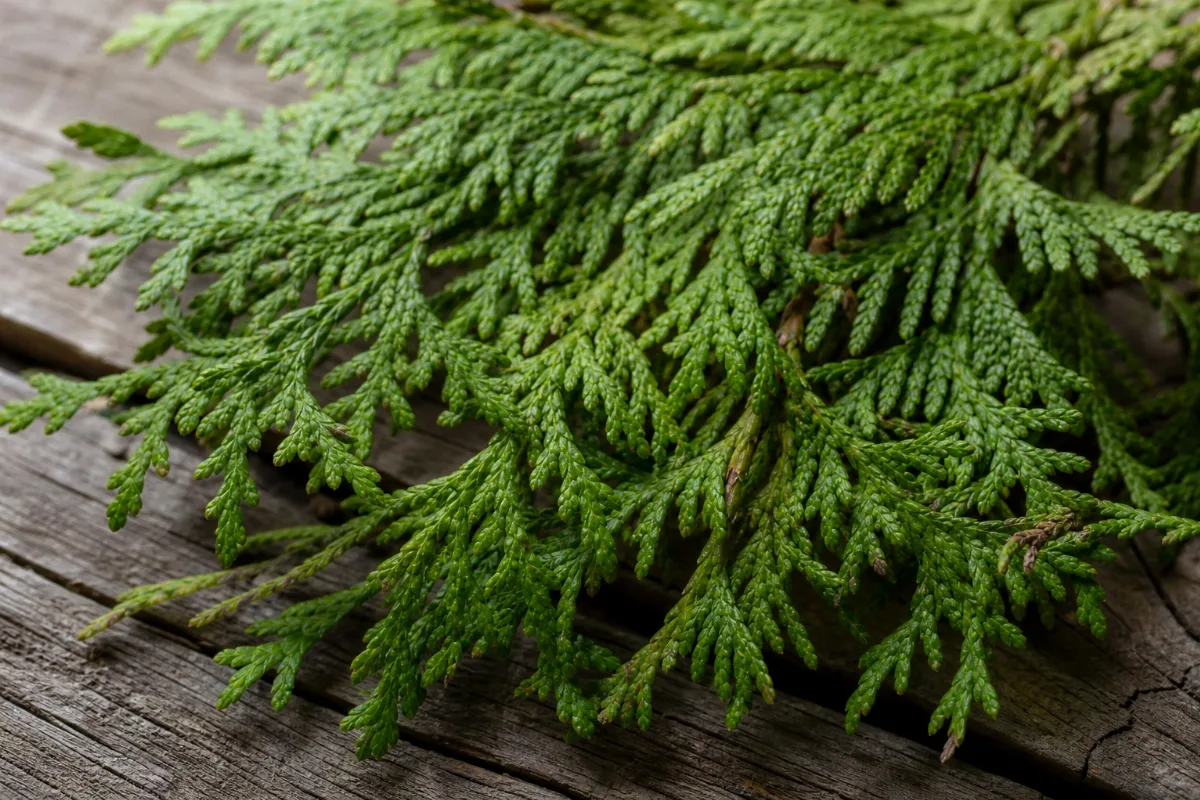
Herbs & Botanicals · Conifer used for warts and homeopathy
Thuja
Thuja occidentalis · also called Northern white cedar, eastern arborvitae, arbor vitae, tree of life
Thuja is the leafy twig of the northern white cedar, a conifer from eastern North America. It is used as a tincture on warts, in a multi-herb cold remedy and, in very diluted form, in homeopathy. The evidence is thin: no trial of thuja alone, only case reports for warts. The key caution is thujone, a natural compound that can cause seizures and is a reason to avoid thuja in pregnancy.
General information, not medical advice. Last substantive update · Not medically reviewed. A named clinician has not signed off on this page. How this page is made
About Thuja
Thuja is the leafy twig of the northern white cedar. Human evidence for thuja alone is very thin. Thujone seizure risk, pregnancy, liver and kidney cautions, and the difference between the herb and homeopathic Thuja are the main points.
What it is
Thuja (Thuja occidentalis) is a conifer from eastern North America, also called northern white cedar or arbor vitae. The leaf twigs are the part used. It is a different tree from the true cedars.
The leaf holds an essential oil that is mostly thujone, plus water-soluble polysaccharides, flavonoids and tannins. Thuja is used as a tincture on warts, as one ingredient in a European multi-herb cold remedy, and in homeopathy as a mother tincture and dilutions.
How it may work
In cells and animals, thuja polysaccharides activated immune cells and showed some antiviral activity. This is lab work. It has not been shown to happen in people who take or apply thuja.
Thujone, the oil's main part, blocks GABA-A receptors in the brain. That is the mechanism behind its seizure risk.
What the research shows
No controlled trial of thuja alone was found. One small trial of a multi-herb product that includes thuja improved lung function in bronchitis on antibiotics, but the effect cannot be given to thuja. For warts there are two case reports and one small homeopathy pilot that found no clear benefit over placebo. Cell results on cancer are not evidence in people.
Because the best trials are of mixtures and the review that summarises them was written by authors who work for the product's maker, the evidence for thuja stays at very low certainty.
At a glance
Traditional uses history, not proof
- Warts and papillomas, as a tincture on the skin
- Bronchial catarrh and bronchitis with phlegm
- Bed-wetting, cystitis and absent periods
- Rheumatism and psoriasis
- Homeopathy: a main remedy for warts and growths
Studied for research
- Colds and bronchitis (only as one part of a multi-herb product), very low certainty
- Warts (case reports only), insufficient
- Warts (homeopathic Thuja, different product), no clear benefit over placebo
- Immune and antiviral effects (lab and animal only), insufficient
- Anti-cancer effects (cell studies only), insufficient
Main compounds
- Thujone (alpha and beta; PubChem CID 261491)
- Fenchone (PubChem CID 14525)
- Water-soluble polysaccharides and glycoproteins
- Flavonoids, tannins and proanthocyanidins
Common forms
- Dried leaf twig
- Alcohol tincture
- Essential oil (highest thujone concern)
- Multi-herb extract with Echinacea and Baptisia
- Homeopathic mother tincture and dilutions (a different product)
Research links: EMA/HMPC public statement on thujone-containing herbal products (2012) · Naser 2005: Thuja occidentalis review (PubMed) · Patel 2021: liver injury case, black cohosh and thuja (PubMed) · Hauke 2002: multi-herb product in bronchitis (PubMed) · Dey 2021: homeopathic medicines for warts (PubMed) · Kwok 2012: Cochrane review of topical wart treatments (PubMed) · Research Library · Genes & Biomarkers Library
The plant and its history
- Accepted scientific name
- Thuja occidentalis L.
- Naming authority
- L. (GBIF accepted species, key 2684178)
- Synonyms
- None listed here; synonym list not retrieved.
- Common names
- Northern white cedar (English); Eastern arborvitae (English); Arbor vitae (English); Tree of life (English); Thuja (English); Tuya occidental (Spanish (NOT verified))
- Botanical family
- Cupressaceae (cypress family)
- Classification
- Plantae > Tracheophyta > Pinopsida > Pinales > Cupressaceae > Thuja > Thuja occidentalis
- Native range
- Eastern North America; grown as an ornamental tree in Europe and Brazil (2020 review).
- Habitat
- Not verified from a botanical source read.
- What the plant looks like
- Roots: Not relevant to medicinal use.; Stems: An evergreen conifer tree; details not verified from a primary source.; Leaves: Scale-like leaf twigs (the medicinal part: Thujae occidentalis herba). The 2005 review describes cultivars and notes that fresh leaf contains essential oil.; Flowers: Not relevant.; Fruit: Small cones; not verified.
- Cultivation
- Not verified.
- Harvest and processing
- Not verified. The review says extraction method changes thujone content.
- Look-alikes and adulterants
- Name: Thuja plicata (western red cedar); Note: A different accepted species (GBIF 2684171). Its oil and chemistry differ.; Name: Thuja orientalis (Oriental arborvitae); Note: Used in Asian medicine; GBIF treatment under Platycladus not verified here.; Name: Juniperus sabina (savin); Note: A different conifer reported in the review as mixed with thuja in historical abortion attempts; NOT verified here.; Name: True cedars (Cedrus); Note: Different genus; cedarwood oil is a different product.
- Sustainability and conservation
- Not verified.
Traditional use and history history, not clinical proof
| Tradition or era | Documented use | Source |
|---|---|---|
| North American Indigenous medicine | The 2005 review says Indigenous people showed European explorers in the 16th century that the tree helped weakness from scurvy. The 2020 review says tea or decoction of inner bark of young twigs was used for constipation and headache. | p15841280 |
| European folk medicine | Used for bronchial catarrh, bed-wetting, cystitis, psoriasis, uterine tumours, absent periods and rheumatism; tincture on warts. | p15841280 |
| Folk abortion attempts | Decoctions were traditionally used to try to end pregnancy, often mixed with savin tops. The review says these attempts mostly failed and often caused fatal poisoning. | p15841280 |
| Homeopathy | Thuja mother tincture and dilutions are among the main homeopathic remedies, used for warts and growths. This is a separate product. | p33228192 |
| Modern European regulation | The EU herbal committee issued a 2012 statement on thujone-containing herbal products. No monograph for Thuja was found. | s-ema-thujone |
Traditional use shows how a plant was used. It does not show that a supplement works or is safe today.
What is inside, and how it may work
What the plant contains and how those compounds act in cells and animals. Laboratory and animal mechanisms are not proven effects in people.
Main compounds
| Compound | Family | Where it is concentrated | Activity studied | Level of evidence |
|---|---|---|---|---|
| alpha-Thujone PubChem 261491 | monoterpene ketone (essential oil) | Leaf twigs (essential oil) About 65 percent of the fresh-leaf monoterpene fraction as thujone (2005 review); thujone 0.76 to 2.4 percent in dry plant per the 2020 review, 85 percent alpha and 15 percent beta. | Blocks GABA-A receptors; seizures in animals. 3 15 1 | Animal research |
| beta-Thujone (isothujone) | monoterpene ketone | Leaf twigs About 8 percent of the monoterpene fraction as isothujone (2005 review). | Less potent than alpha-thujone at GABA-A receptors (about 2 to 3 fold, EU statement). 3 12 | Animal research |
| Fenchone PubChem 14525 | monoterpene ketone | Leaf twigs About 8 percent of the monoterpene fraction (2005 review). | Not characterised for thuja. 12 16 | Insufficient |
| Water-soluble polysaccharides and glycoproteins | polysaccharide / glycoprotein | Leaf About 4.9 percent water-soluble polysaccharides in the fresh plant (2005 review). | Immune-cell stimulation and antiviral effects in the lab; considered important to the plant's activity by the 2005 reviewers. 12 | Laboratory research |
| Flavonoids, tannins and proanthocyanidins | polyphenols | Leaf Not quantified here. | Antioxidant activity in the lab. 1 | Laboratory research |
Mechanisms, receptors and pathways
| Target or pathway | Gene or receptor | What was found | Level |
|---|---|---|---|
| GABA-A receptor (chloride channel) block by alpha-thujone | GABA-A receptor | Alpha-thujone rapidly modulates the GABA-gated chloride channel; effect appears reversible; basis of convulsions. 3 | Animal research |
| Liver heme synthesis (porphyrin) | ALAS1 (5-aminolevulinic acid synthase) | Thujone induced the enzyme and porphyrin build-up in chick embryo liver cells, suggesting it may be porphyrinogenic. 3 | Laboratory research |
| Immune-cell activation | Cytokine production, macrophage activation | Polysaccharide-rich fractions stimulated cytokines, antibody-producing cells and macrophages in cells and animals. 12 | Laboratory research |
| Cancer-cell death pathways (apoptosis, autophagy) | Caspase-3, PARP-1, Beclin-1, LC3B | Mother tincture reduced growth of HPV-16 cervical cancer cells in the dish. 13 | Laboratory research |
Absorption, metabolism and elimination
- Absorption
- No human absorption data for thuja products. In a pilot absinthe study, thujone was not detectable in blood after 3.85 mg (detection limit 0.34 ng/ml), so blood levels after oral intake are unknown.
- Distribution
- In mice, peak brain thujone was measured within minutes after injection at poisoning doses (EU statement).
- Metabolism
- In human liver preparations CYP2A6 is the main enzyme, then CYP3A4 and a little CYP2B6; hydroxylation and glucuronidation are the main routes. Clearance estimates suggest a strong first-pass effect.
- Elimination
- Not established for thuja in people.
- Bioavailability
- Unknown for thuja products.
Isolated compounds versus whole extracts
Thujone explains the main safety risk, but oil toxicity and effects on the nervous system were not explained by thujone alone in the oil-composition study, so other components also matter. Any lab effects of polysaccharides or whole extracts cannot be assigned to thujone.
Nutritional composition
A nutrient table does not apply. Thuja is not a food; it is not eaten for vitamins or minerals.
1 low certainty1 very low certainty3 not enough evidence
What is Thuja good for?
The studied uses and how strong the human evidence is for each. For thuja, no use is well established.
Benefits, one by one
Each card is a research question, not a promise. Tap a goal to filter. Open a card to see the studies, doses and limits.
Colds and bronchitis (as one part of a multi-herb product)
Very low certaintyThuja is an ingredient in a European multi-herb product studied for colds and for chest infections treated with antibiotics. Those trials tested the mixture, not thuja alone, so we cannot say what thuja itself does. No trial of thuja alone was found.
2 studiesMulti-herb liquid extract (Echinacea, Baptisia, Thuja). Amounts are n…
Studies, doses and limits
What the trials found
One randomised, placebo-controlled trial (Hauke 2002, 53 adults with a flare of chronic bronchitis on macrolide antibiotics) tested the combination product Esberitox N for 28 days. On day 10 the breathing test FEV1 was 68.7 percent of predicted with the product and 59.2 percent with placebo (p = 0.0303). Time to half the maximal improvement was 5.7 versus 12.8 days. The abstract does not list the herbs; the 2005 review says the product contains Thuja with Echinacea purpurea, Echinacea pallida and Baptisia tinctoria. The 2005 review also summarises common-cold trials of the same product, second-hand, written by authors who work for its maker. Those figures were not independently checked.
Results
Positive in a small trial of the mixture. No effect can be assigned to thuja.
Effect sizes as reported
FEV1 difference 267 ml (p = 0.0499) on day 10 in the bronchitis trial. Cold-trial numbers in the review were not re-checked.
Why this rating
Only multi-herb product trials exist, with industry links, and one small trial was read directly. Thuja alone has not been tested.
Form and dose studied
Multi-herb liquid extract (Echinacea, Baptisia, Thuja). Amounts are not given here; ask a doctor or pharmacist.
Who was studied
Adults with a bronchitis flare (53) and adults with colds (reported in the review).
Limits
Mixture of herbs; small trial; manufacturer-linked authors; trial funder not stated in the abstract; thuja alone untested.
Why researchers looked
Thuja has been used in folk medicine for bronchial catarrh, and lab work suggests its polysaccharides can stimulate immune cells.
Traditional use
Folk medicine used thuja for bronchial catarrh and bronchitis with phlegm. This is tradition, not proof.
Proposed mechanism Preliminary mechanism
Lab and animal work reports that water-soluble polysaccharides and glycoproteins from the herb can activate immune cells and raise cytokine and antibody production. Whether this happens in people at normal exposure is not shown.
A proposed mechanism does not show that the effect happens in people.
Thuja contains thujone, which can cause seizures in high exposure. See the safety section. Do not use thuja products in pregnancy or breastfeeding without a doctor.
Immune activity and antiviral effects (lab and animal work only)
Not enough evidenceIn cells and animals, thuja extracts and their polysaccharides have been reported to activate immune cells and block some viruses. There is no human trial of thuja alone showing an immune benefit.
3 studiesNot applicable (lab extracts, not products people take).
Studies, doses and limits
What the trials found
None for thuja alone. The 2005 review states that no controlled trial of Thuja alone has been done. The 2020 review lists antioxidant, anti-inflammatory, antibacterial, antiviral and anticancer lab activity.
Results
Lab and animal findings only.
Effect sizes as reported
Not applicable.
Why this rating
No human data for thuja alone; cell and animal results do not predict benefit in people.
Form and dose studied
Not applicable (lab extracts, not products people take).
Who was studied
Cells and animals.
Limits
Lab doses and conditions differ from human use. A widely cited lab paper on melanoma cells has been retracted and was not used.
Why researchers looked
Researchers tested whether thuja's polysaccharides explain its folk use against warts and infections.
Traditional use
Used in folk medicine and homeopathy for warts, catarrh and infections.
Proposed mechanism Laboratory research
Reported in lab and animal studies: stimulation of macrophages and cytokine production, effects on HIV-infected cells in the dish, and anti-inflammatory activity in mice. These are cell and animal results only.
A proposed mechanism does not show that the effect happens in people.
Lab activity says nothing about safety; the main known risk is thujone neurotoxicity.
Warts (traditional tincture and extract on the skin)
Not enough evidenceThuja tincture is a traditional wart remedy. We found no controlled trial of thuja on warts. There are two single-patient case reports, which cannot show that it works.
4 studiesTincture or extract applied to the skin in the cases; preparation and…
Studies, doses and limits
What the trials found
Joseph 2013 describes one kidney-transplant patient whose resistant finger warts cleared after a Thuja occidentalis extract. Murali 2020 describes one 8-year-old child with laryngeal papillomas given thuja alongside surgery. Both are single cases with no comparison group, and warts can clear without treatment. For context, the Cochrane review of 85 wart trials (8,815 people) found salicylic acid beat placebo (RR 1.56, 95% CI 1.20 to 2.03); its abstract does not mention thuja.
Results
Two case reports, no trial.
Effect sizes as reported
None for thuja.
Why this rating
No controlled trial; only two uncontrolled cases.
Form and dose studied
Tincture or extract applied to the skin in the cases; preparation and amount not described in the abstracts.
Who was studied
One transplant patient; one child.
Limits
Case reports only; unknown preparation; a laryngeal papilloma is a medical problem for a doctor, not for self-treatment.
Why researchers looked
Thuja has long been used on warts and papillomas caused by human papilloma virus (HPV), and lab work suggests antiviral activity.
Traditional use
The 2020 review says the tincture has been used on warts, papillomas and genital warts caused by HPV. This is tradition.
Proposed mechanism Laboratory research
Proposed: antiviral and immune-stimulating effects of thuja polysaccharides and thujone. Shown only in cells and animals.
A proposed mechanism does not show that the effect happens in people.
No safety study of thuja on skin was found. Thuja tincture is alcohol-based and thujone can be absorbed; see the safety section. Do not put thuja on genital warts, the face or broken skin without medical advice.
Warts (homeopathic Thuja, a different product)
Low certaintyA small placebo-controlled pilot of individualised homeopathic medicines for warts, where Thuja was the most often chosen remedy, found no significant difference from placebo.
1 studiesHomeopathic dilutions chosen for each person.
Studies, doses and limits
What the trials found
Dey 2021: 60 people, double-blind, 3 months. Thuja was prescribed to 28.3 percent of patients (with Natrum muriaticum and Sulphur among the others). Both groups improved; the differences between homeopathy and placebo were not significant: wart number median 1 vs 1 (p = 0.741), wart size 5.6 vs 6.3 mm (p = 0.515), quality of life score 4.5 vs 4.5 (p = 0.935). No harms were reported.
Results
No significant difference from placebo.
Effect sizes as reported
All between-group p values above 0.05.
Why this rating
One small pilot with several remedies; no benefit over placebo was shown. Certainty that homeopathic Thuja has no extra effect over placebo is low, not high, because the trial was a pilot.
Form and dose studied
Homeopathic dilutions chosen for each person.
Who was studied
60 people with skin warts in India.
Limits
Pilot study; individualised remedies, so Thuja alone cannot be separated.
Why researchers looked
Homeopathy uses Thuja as a main wart remedy.
Traditional use
Homeopathic Thuja is made by diluting a mother tincture in steps. It is a separate product from the herb or tincture.
Proposed mechanism Other
No mechanism is established for diluted homeopathic preparations. Lab work on the undiluted mother tincture is not the same as a diluted remedy.
A proposed mechanism does not show that the effect happens in people.
Highly diluted preparations contain little or no thujone and are a different product from the herb, tincture or oil. The thujone content of dilutions was not described in the sources we read.
Anti-cancer effects (cell studies only)
Not enough evidenceThuja extracts and thujone slow the growth of some cancer cells in the dish. This has not been tested in people with cancer, and thuja is not a cancer treatment.
3 studiesNot applicable.
Studies, doses and limits
What the trials found
None. A frequently cited 2011 lab paper on melanoma cells was retracted in 2026 and is not used here.
Results
Cell results only.
Effect sizes as reported
Not applicable.
Why this rating
Cell studies only; no animal-to-human link and no trials.
Form and dose studied
Not applicable.
Who was studied
Cultured cells.
Limits
Lab concentrations may not be reachable safely in the body. Thujone is itself a neurotoxin.
Why researchers looked
Homeopathy and folk medicine have used thuja for tumours and growths, so labs tested it on cancer cell lines.
Traditional use
Folk uses included uterine tumours and growths. This is tradition.
Proposed mechanism Laboratory research
In cervical cancer cells (HPV-16 positive), a thuja mother tincture slowed growth and migration and triggered cell-death pathways, and thujone was named as the main active component (Pal 2022).
A proposed mechanism does not show that the effect happens in people.
Do not replace cancer treatment with thuja. Thujone causes seizures at high exposure.
Connections to the rest of health
How Thuja connects to the rest of our health knowledge graph. Every link says what kind of connection it is. A safety link (for example to the liver) is a warning, not a benefit. A study that merely mentions a topic never creates a benefit link.
Explore every connection: goals, body systems, organs, symptoms, genes
A. Wellness goals
| Connected to | Kind of connection | Evidence status | Context | Studies |
|---|---|---|---|---|
| Immune Support | Very low certainty | Colds and bronchitis (as one part of a multi-herb product): Thuja is an ingredient in a European multi-herb product studied for colds and for chest infections treated with antibiotics. Those trials tested the mixture, not thuja alone, so we cannot say what thuja itself does. No trial of thuja alone was found. | 7 12 | |
| Seasonal Wellness | Very low certainty | Colds and bronchitis (as one part of a multi-herb product): Thuja is an ingredient in a European multi-herb product studied for colds and for chest infections treated with antibiotics. Those trials tested the mixture, not thuja alone, so we cannot say what thuja itself does. No trial of thuja alone was found. | 7 12 | |
| Lung Support | Very low certainty | Colds and bronchitis (as one part of a multi-herb product): Thuja is an ingredient in a European multi-herb product studied for colds and for chest infections treated with antibiotics. Those trials tested the mixture, not thuja alone, so we cannot say what thuja itself does. No trial of thuja alone was found. | 7 12 | |
| Breathing Support | Very low certainty | Colds and bronchitis (as one part of a multi-herb product): Thuja is an ingredient in a European multi-herb product studied for colds and for chest infections treated with antibiotics. Those trials tested the mixture, not thuja alone, so we cannot say what thuja itself does. No trial of thuja alone was found. | 7 12 | |
| Immune Support | Preliminary mechanism | Not enough evidence | Immune activity and antiviral effects (lab and animal work only): In cells and animals, thuja extracts and their polysaccharides have been reported to activate immune cells and block some viruses. There is no human trial of thuja alone showing an immune benefit. | 12 1 4 |
| Healthy Skin | Not enough evidence | Warts (traditional tincture and extract on the skin): Thuja tincture is a traditional wart remedy. We found no controlled trial of thuja on warts. There are two single-patient case reports, which cannot show that it works. | 9 11 10 1 | |
| Healthy Skin | Low certainty | Warts (homeopathic Thuja, a different product): A small placebo-controlled pilot of individualised homeopathic medicines for warts, where Thuja was the most often chosen remedy, found no significant difference from placebo. | 2 | |
| Cellular Protection | Preliminary mechanism | Not enough evidence | Anti-cancer effects (cell studies only): Thuja extracts and thujone slow the growth of some cancer cells in the dish. This has not been tested in people with cancer, and thuja is not a cancer treatment. | 13 1 4 |
B. Body systems
| Connected to | Kind of connection | Evidence status | Context | Studies |
|---|---|---|---|---|
| Immune Support | Biological association | Very low certainty | Studied for: Colds and bronchitis (as one part of a multi-herb product) Studied for: Immune activity and antiviral effects (lab and animal work only) | 7 12 1 4 |
| Respiratory Health | Biological association | Very low certainty | Studied for: Colds and bronchitis (as one part of a multi-herb product) | 7 12 |
| Integumentary System | Biological association | Not enough evidence | Studied for: Warts (traditional tincture and extract on the skin) Studied for: Warts (homeopathic Thuja, a different product) | 9 11 10 1 2 |
| Immune System | Biological association | Not enough evidence | Studied for: Warts (traditional tincture and extract on the skin) Studied for: Anti-cancer effects (cell studies only) | 9 11 10 1 13 4 |
C. Body parts and organs
| Connected to | Kind of connection | Evidence status | Context | Studies |
|---|---|---|---|---|
| Brain | Adverse effect or risk | Low certainty | Seizures from thujone blocking GABA-A receptors; animal evidence plus human poisonings with thujone-rich oils. Preparation or compound: Thujone; essential oil; strong extracts |
3 17 |
| Liver | Adverse effect or risk | Very low certainty | One probable herb-induced liver injury case. Preparation or compound: Thuja with black cohosh |
14 |
| Reproductive organs | Contraindication | Low certainty | Avoid in pregnancy; no safety studies; historical abortion attempts failed and sometimes poisoned. Preparation or compound: Thuja herb and extracts |
3 12 |
E. Health conditions
| Connected to | Kind of connection | Evidence status | Context | Studies |
|---|---|---|---|---|
| Epilepsy | Contraindication | Low certainty | Thujone is a convulsant. Preparation or compound: Thujone |
3 |
| Pregnancy | Contraindication | Low certainty | EU committee asks for minimised use. Preparation or compound: Thuja herb and extracts |
3 |
| Warts | Not enough evidence | Case reports only; no trial. Preparation or compound: Thuja tincture |
9 11 |
I. Biomarkers
| Connected to | Kind of connection | Evidence status | Context | Studies |
|---|---|---|---|---|
| Forced expiratory volume in one second (FEV1) | Biological association | Very low certainty | Measured in trials: raised. A lab change is not the same as a health benefit. | 7 |
| Wart number and size | Biological association | Low certainty | Measured in trials: lowered. A lab change is not the same as a health benefit. | 2 |
| Dermatology Life Quality Index (DLQI) | Biological association | Low certainty | Measured in trials: lowered. A lab change is not the same as a health benefit. | 2 |
J. Genes, receptors and enzymes
| Connected to | Kind of connection | Evidence status | Context | Studies |
|---|---|---|---|---|
| GABA-A receptor | Preliminary mechanism | Animal | Blocked by alpha-thujone; basis of seizure risk. | 3 |
| CYP2A6 | Preliminary mechanism | In vitro | Main enzyme breaking down alpha-thujone in human liver preparations. | 3 |
| CYP3A4 | Preliminary mechanism | In vitro | Second enzyme in thujone metabolism. | 3 |
K. Biological pathways
| Connected to | Kind of connection | Evidence status | Context | Studies |
|---|---|---|---|---|
| Apoptosis and autophagy in cancer cells | Preliminary mechanism | In vitro | Seen with a thuja mother tincture in cell culture. | 13 |
L. Active compounds
| Connected to | Kind of connection | Evidence status | Context | Studies |
|---|---|---|---|---|
| alpha-Thujone | Biological association | Animal | Blocks GABA-A receptors; seizures in animals. Preparation or compound: Leaf twigs (essential oil) |
3 15 1 |
| beta-Thujone (isothujone) | Biological association | Animal | Less potent than alpha-thujone at GABA-A receptors (about 2 to 3 fold, EU statement). Preparation or compound: Leaf twigs |
3 12 |
| Fenchone | Biological association | Not enough evidence | Not characterised for thuja. Preparation or compound: Leaf twigs |
12 16 |
| Water-soluble polysaccharides and glycoproteins | Biological association | In vitro | Immune-cell stimulation and antiviral effects in the lab; considered important to the plant's activity by the 2005 reviewers. Preparation or compound: Leaf |
12 |
| Flavonoids, tannins and proanthocyanidins | Biological association | In vitro | Antioxidant activity in the lab. Preparation or compound: Leaf |
1 |
Each connection is stored with the ingredient, the connected record, the kind of connection, the evidence status, the supporting studies, the preparation or compound involved, and a review date (last reviewed October 25, 2026).
Evidence at a glance: what changed in 3 lab markers
Tap a number to show only those markers. Counts are markers, not people.
The evidence
The research centre for Thuja. Every record here was checked against PubMed or the publisher's page; we never list a study we have not verified.
Evidence by outcome
Bars show how many studies we found for each outcome, not how well it works. People are added up across trials only (reviews are not added, to avoid double counting).
How we rate evidence
High certainty
Several well-run trials or reviews agree; further research is unlikely to change the picture much.
Moderate certainty
Good trials point the same way, but some doubt remains.
Low certainty
Small, short or inconsistent trials. The finding could change with better research.
Very low certainty
Very little or very weak human data. Treat as a possibility only.
Mixed findings
Trials or reviews disagree with each other.
Not enough evidence
Not enough human research to say either way.
Evidence against
Good research found no benefit, or found harm.
We take the reviewers' own risk-of-bias and GRADE statements where they exist, and otherwise judge from study size, design, consistency, directness and whether a product matches what is sold. Many publications do not make evidence high. Method note: We started from our existing thuja summary, then read PubMed abstracts for the key trials and case reports, the EU thujone statement in full and parts of two reviews. Names were checked in GBIF and compounds in PubChem. EMA thuja monograph, NCCIH, LiverTox and LactMed records were not found, and Commission E and ESCOP positions were not read.
Study library: every study we checked 18
| Study | Design | People | Product, dose, length | Result |
|---|---|---|---|---|
| Caruntu 2020 Thuja occidentalis L. (Cupressaceae): Ethnobotany, Phytochemistry and Biological Activity Molecules · PMID 33228192 · DOI |
Narrative review lab and animal |
Review of traditional use, chemistry and lab pharmacology | Thuja occidentalis leaf and twigs (essential oil, extracts, tincture) |
Traditional uses listed: liver complaints, bronchitis with phlegm, psoriasis, bed-wetting, absent periods, cystitis, uterine tumours, diarrhoea, rheumatism; the tincture on warts and genital warts from human papilloma virus. Constituents: essential oil (thujone is the main part, about 85 percent alpha and 15 percent beta), coumarins, flavonoids, tannins, proanthocyanidins. Reported lab activities include antioxidant, anti-inflammatory, antibacterial, antiviral and anti-cancer effects. Methods, limits and fundingOutcomes: Traditional uses, chemical constituents, reported lab activities Limitations: A review of mostly cell and animal work; it does not show benefit in people. Only the first part of the full text and the reference list were read. Read: abstract + part of full text |
| Dey 2021 A Randomized, Double-Blind, Placebo-Controlled, Pilot Trial of Individualized Homeopathic Medicines for Cutaneous Warts Homeopathy · PMID 33761570 · DOI |
Controlled trial |
60 People with skin warts at a homeopathic hospital in West Bengal |
Individualised homeopathic medicines (Thuja occidentalis was the most often prescribed, 28.3 percent of patients; also Natrum muriaticum and Sulphur) homeopathic dilutions (not herbal extract) 3 months · vs Identical-looking placebo |
Both groups improved over time, with larger within-group changes in the homeopathy group, but the differences between homeopathy and placebo were not significant. After 3 months, wart number was a median of 1 in both groups (p = 0.741), wart size 5.6 mm vs 6.3 mm (p = 0.515), quality-of-life score 4.5 vs 4.5 (p = 0.935). No harms were reported. No significant difference between groups (all p above 0.05) Methods, limits and fundingOutcomes: Number and size of warts, Dermatology Life Quality Index Limitations: Pilot trial, 60 people. Thuja was only one of several remedies and was given as a homeopathic dilution, which is a different product from the herb. Read: abstract |
| EMA Committee on Herbal Medicinal Products (HMPC) 2012 Public statement on the use of herbal medicinal products containing thujone (Rev. 1) EMA/HMPC/732886/2010 Rev. 1 · Source |
Authoritative guidance |
Regulatory statement on thujone-containing herbs (cedar leaf, sage, tansy, wormwood and others) | Thujone and thujone-containing herbal products cedar leaf, sage, wormwood and other thujone plants |
Thujone is a neurotoxicant that blocks GABA-A receptors; seizures are the main sign in animals and in human poisonings with thujone-rich oils. Use in pregnant women and children should be minimised because no studies exist. Liver enzymes CYP2A6, CYP3A4 and CYP2B6 break thujone down; interactions with drugs are judged unlikely but not well studied. Reproductive toxicity studies have not been performed. Batch thujone content must be shown. Methods, limits and fundingOutcomes: Mechanism, animal toxicity, human poisonings, metabolism, advice for sensitive groups Limitations: It is a statement about thujone in general, mainly built on sage and wormwood assessments. It is not a monograph on Thuja occidentalis and it does not say Thuja is safe or effective. Read: full-text |
| Evidence-Based Complementary and Alternative Medicine (retraction notice) 2026 RETRACTION: Thujone-Rich Fraction of Thuja occidentalis Demonstrates Major Anti-Cancer Potentials: Evidences from In Vitro Studies on A375 Cells Evid Based Complement Alternat Med · PMID 42389676 · DOI |
Other other |
Retraction notice for the 2011 melanoma-cell paper (PMID 21647317) | not applicable not applicable |
The journal retracted the widely cited 2011 lab paper on a thujone-rich fraction and melanoma cells. We did not use that paper or its findings. Methods, limits and fundingOutcomes: Retraction status Limitations: The abstract is only the retraction notice. The reason for retraction is not given in the record we read. Read: abstract |
| GBIF Secretariat 2026 GBIF Backbone Taxonomy: Thuja plicata Donn ex D.Don (key 2684171) GBIF API species/match · Source |
Database or regulator record |
Taxonomic record | Thuja plicata (western red cedar) not applicable |
Accepted species, a different Thuja. Methods, limits and fundingOutcomes: Accepted name Limitations: A name record only. Read: full-text |
| GBIF Secretariat 2026 GBIF Backbone Taxonomy: Thuja occidentalis L. (key 2684178) GBIF API species/match · Source |
Database or regulator record |
Taxonomic record | Thuja occidentalis not applicable |
Accepted species, family Cupressaceae, order Pinales (exact match), checked 2026-10-25. Methods, limits and fundingOutcomes: Accepted name, family, order Limitations: A name record only. Read: full-text |
| Hauke 2002 Esberitox N as supportive therapy when providing standard antibiotic treatment in subjects with a severe bacterial infection (acute exacerbation of chronic bronchitis) Chemotherapy · PMID 12476043 · DOI |
Controlled trial |
53 Adults with an acute flare of chronic bronchitis needing antibiotics (FEV1 35 to 75 percent of predicted when well) |
Esberitox N (multi-herb product; the abstract does not list its herbs, the 2005 review says it contains Thuja with Echinacea and Baptisia) plus macrolide antibiotic multi-herb extract 28 days · vs Placebo plus the same antibiotics |
On day 10 the baseline-adjusted FEV1 was 68.7 percent of predicted with the product and 59.2 percent with placebo (p = 0.0303). The difference was 267 ml (p = 0.0499). Time to half the maximal improvement was 5.7 days versus 12.8 days. No serious adverse events were recorded. FEV1 68.7 vs 59.2 percent of predicted, day 10 (p = 0.0303) Methods, limits and fundingOutcomes: FEV1 (breathing test) on day 10, time to half of maximal improvement, adverse events Limitations: Small trial (53 people) of a mixture, so any effect cannot be assigned to thuja. The abstract does not state the funder; the product maker also wrote the 2005 review. Funding and conflicts: Funder not stated in the abstract; product from Schaper & Brummer (per the 2005 review). Read: abstract |
| Hermanns-Clausen 2019 Accidental intoxication by outdoor and garden plants: data from two German poison centres Bundesgesundheitsblatt Gesundheitsforschung Gesundheitsschutz · PMID 30478484 · DOI |
Observational |
42344 Children exposed to garden plants (mostly ages 6 months to 5 years) |
Outdoor plants including Thuja species garden plant |
Out of 42,344 confirmed exposures, 93 percent had no symptoms. Of 26 plant genera that caused 70 percent of exposures, only eight (including Thuja) led to at least moderate symptoms. Methods, limits and fundingOutcomes: Severity of symptoms after accidental exposure Limitations: The abstract does not give Thuja counts or symptoms. Thuja species, not only T. occidentalis. Read: abstract |
| Joseph 2013 Successful treatment of verruca vulgaris with Thuja occidentalis in a renal allograft recipient Indian J Nephrol · PMID 24049274 · DOI |
Case report |
1 One kidney-transplant recipient with many warts that had not responded to freezing or radiosurgery |
Thuja occidentalis extract (preparation not described in the abstract) unspecified |
The authors report that the extract cleared the resistant warts on the other fingers, left only superficial scars and did not affect the transplant function. Methods, limits and fundingOutcomes: Wart clearance and kidney graft function Limitations: A single case with no comparison group. Warts can clear on their own, so this cannot show that thuja worked. Read: abstract |
| Kwok 2012 Topical treatments for cutaneous warts Cochrane Database Syst Rev · PMID 22972052 · DOI |
Systematic review |
8815 Healthy adults and children with common (non-genital) warts; 85 randomised trials |
Topical wart treatments (salicylic acid, cryotherapy, others) not applicable |
Salicylic acid beat placebo for clearing warts (risk ratio 1.56, 95% CI 1.20 to 2.03). Cryotherapy against placebo favoured neither (RR 1.45, 95% CI 0.65 to 3.23). The abstract does not mention thuja. Salicylic acid vs placebo: RR 1.56 (1.20 to 2.03) Methods, limits and fundingOutcomes: Wart clearance Limitations: Many trials had high risk of bias. The abstract does not mention thuja, so this is context for how warts are usually treated, not evidence about thuja. Read: abstract |
| Murali 2020 Role of thuja in the management of laryngeal papilloma BMJ Case Rep · PMID 33370999 · DOI |
Case report |
1 One 8-year-old child with juvenile laryngeal papillomatosis (warts on the vocal folds) |
Thuja occidentalis as adjuvant to standard care unspecified |
The authors describe the outcome of thuja as an add-on to surgery. The abstract frames thuja as widely used for warts but gives no numbers. Methods, limits and fundingOutcomes: Course of the papillomas Limitations: A single case in a child, with surgery as the main treatment. It cannot show that thuja helped and it is not a safety study. Read: abstract |
| Naser 2005 Thuja occidentalis (Arbor vitae): A Review of its Pharmaceutical, Pharmacological and Clinical Properties Evid Based Complement Alternat Med · PMID 15841280 · DOI |
Narrative review human and lab |
Review of botany, chemistry, lab work and clinical studies | Thuja occidentalis herb and a multi-herb product that contains it leaf twigs (Thujae occidentalis herba) |
No controlled trial of Thuja alone was found. Many trials were done with a product that combines Echinacea purpurea, Echinacea pallida, Baptisia tinctoria and Thuja. The review describes thujone content by solvent, a mean of 1.16 mg per g of herb in 12 batches, poisoning symptoms from the fresh plant (vomiting, convulsions, liver and kidney effects), a recommendation not to use Thuja in pregnancy or breastfeeding without a doctor, and skin rashes as the most common reported side effect of the combination product. Methods, limits and fundingOutcomes: Thujone content by extraction, immune effects in lab work, trials of a Thuja-containing product, safety and post-marketing data Limitations: The authors work for the maker of the combination product, so the review may favour it. Trial numbers for the combination product are second-hand and cannot be assigned to Thuja alone. The review says thujone plants do not have abortive effects, yet also says folk abortion attempts failed and sometimes caused fatal poisoning. Funding and conflicts: Authors are employed by Schaper & Brummer, maker of the combination product (affiliation listed in the paper). Read: full-text |
| Pal 2022 Apoptotic and autophagic death union by Thuja occidentalis homeopathic drug in cervical cancer cells with thujone as the bioactive principle J Integr Med · PMID 35752587 · DOI |
Laboratory research in-vitro |
Human cervical cancer cells (SiHa, HPV-16 infected) in the lab | Thuja homeopathic mother tincture (alcohol extract) and a thujone component mother tincture |
The mother tincture slowed growth and migration of the cancer cells and triggered cell death pathways in the dish (IC50 17.3 microlitres per mL). Thujone was named as the main active component by gas chromatography-mass spectrometry. Methods, limits and fundingOutcomes: Cell growth, migration, cell-death markers Limitations: Cell work only. It does not show that thuja treats HPV, warts or cancer in people. Read: abstract |
| Patel 2021 Herb-Induced Liver Injury by Cimicifuga racemosa and Thuja occidentalis Herbal Medications for Fertility Case Rep Gastrointest Med · PMID 33532101 · DOI |
Case report |
1 One 40-year-old woman, no prior liver disease |
Black cohosh (Cimicifuga racemosa) and Thuja occidentalis taken together as fertility products unspecified |
Acute liver injury appeared after using both products. Symptoms resolved and liver tests improved a lot after both were stopped. Methods, limits and fundingOutcomes: Liver blood tests and symptoms; causality scored with the updated RUCAM method Limitations: One case. Two products were taken together, so thuja cannot be named as the sole cause. The abstract gives no product doses or brands. Read: abstract |
| PubChem 2026 PubChem compound 261491: thujone, (1S,4R,5R)-4-methyl-1-propan-2-ylbicyclo[3.1.0]hexan-3-one PubChem PUG REST · Source |
Database or regulator record |
Chemical record | alpha-thujone not applicable |
CID 261491, formula C10H16O; the name search "alpha-thujone" returns this CID. Methods, limits and fundingOutcomes: Identifier and formula Limitations: A name and formula record only. Read: full-text |
| PubChem 2026 PubChem compound 14525: fenchone PubChem PUG REST · Source |
Database or regulator record |
Chemical record | fenchone not applicable |
The name search "fenchone" returns CID 14525. Methods, limits and fundingOutcomes: Identifier Limitations: A name record only. Read: abstract |
| Radulovic 2017 Toxic essential oils. Part V: Behaviour modulating and toxic properties of thujones and thujone-containing essential oils of Salvia officinalis, Artemisia absinthium, Thuja occidentalis and Tanacetum vulgare Food Chem Toxicol · PMID 28472675 · DOI |
Animal study animal and lab |
Rats (behaviour tests) and brine shrimp / microbes (toxicity) | Essential oils of four thujone plants including Thuja occidentalis essential oil |
The behaviour-changing and toxic effects of the oils were not explained by thujone alone; other oil components also correlated with toxicity and effects on the central nervous system. The authors say risk assessment should look at the whole oil, not only thujone. Methods, limits and fundingOutcomes: Behaviour, sleep with diazepam, brine shrimp toxicity versus chemical composition Limitations: Animal and lab work only; it does not give a human safe level. Read: abstract |
| Wendt 2023 Exposures to fruit plants in Germany from 2010-2019: analysis of the Erfurt joint poison information center database Bundesgesundheitsblatt Gesundheitsforschung Gesundheitsschutz · PMID 37828294 · DOI |
Observational |
16088 Calls to a German poison information centre about plant exposures (mostly young children) |
Fruit-bearing garden and park plants including Thuja species cones / garden plant |
Thuja species were among the plants with the most enquiries. Across all plants, most exposures had no symptoms (82 percent) and severe outcomes were rare (0.3 percent). The abstract does not break the figures down for Thuja. Methods, limits and fundingOutcomes: Frequency and severity of exposures Limitations: Thuja-specific outcomes are not in the abstract. The category is Thuja species, not only T. occidentalis. Read: abstract |
What we do not know yet
- No controlled trial of thuja alone for any use.
- No study of thuja tincture or oil on skin.
- No safety studies in pregnancy, breastfeeding or children.
- No human drug-interaction study.
- The thujone content of homeopathic dilutions is not described in the sources read.
- ESCOP and Commission E positions were not found.
How new research is added
New studies are found by a saved PubMed search and placed in a review queue. A person reads each one before it changes any rating or safety wording.
Lab markers
What changed in blood or saliva tests during trials. A changed number is not the same as feeling or being healthier, and we give no "normal ranges".
Other 3
Forced expiratory volume in one second (FEV1)
Raised in trials
How much air a person can breathe out hard in one second. It is a standard breathing test and a higher result means better lung function.
Very low certaintyResults and what it means
Why it was measured
It shows how well the airways work during and after a bronchitis flare.
Statistical vs. clinical meaning
Statistically significant in one small trial of a mixture. The effect of thuja alone is unknown.
Safety implication
None identified from this measure.
| Study | Result | People | Product |
|---|---|---|---|
| 7 | Baseline-adjusted FEV1 on day 10 was 68.7 percent of predicted with the multi-herb product against 59.2 percent with placebo (p = 0.0303); difference 267 ml (p = 0.0499). | 53 adults with an acute flare of chronic bronchitis | Esberitox N (multi-herb, includes Thuja per the 2005 review) plus macrolide antibiotic, 28 days |
Wart number and size
Lowered in trials
How many warts a person has and how large they are.
Low certaintyResults and what it means
Why it was measured
These are the main outcomes in wart trials.
Statistical vs. clinical meaning
No significant difference between homeopathy and placebo in this pilot.
Safety implication
None identified from this measure.
| Study | Result | People | Product |
|---|---|---|---|
| 2 | After 3 months median wart number was 1 in both groups (p = 0.741) and size 5.6 mm vs 6.3 mm (p = 0.515); not significant. | 60 people with skin warts | Individualised homeopathic medicines (Thuja most often) vs placebo |
Dermatology Life Quality Index (DLQI)
Lowered in trials
A 10-question score of how much a skin problem affects daily life. A lower score means less impact.
Low certaintyResults and what it means
Why it was measured
It shows whether people feel better, not just whether warts shrink.
Statistical vs. clinical meaning
No difference between groups.
Safety implication
None identified from this measure.
| Study | Result | People | Product |
|---|---|---|---|
| 2 | DLQI total after 3 months was 4.5 in both groups (p = 0.935). | 60 people with skin warts | Individualised homeopathic medicines (Thuja most often) vs placebo |
Safety
What studies and official sources say about side effects, medicines and who should check first. Each point shows what kind of evidence it comes from.
Main points to know 8
- Thujone can cause seizures; this is the central risk. Thuja leaf and especially its essential oil contain thujone, a nerve poison that blocks GABA-A receptors (the brain's calming system). The EU herbal committee calls it a severe neurotoxicant. Seizures are the main sign in animals and in human poisonings with thujone-rich oils. No safe level for thuja products has been set. The committee's own limits for sage and wormwood do not apply to thuja. Authoritative guidance 3 12 17
- Do not use in pregnancy or while breastfeeding. The EU committee says no studies exist for pregnant women or children, so thujone-containing herbal products should be minimised for them. The 2005 review advises against thuja in pregnancy and breastfeeding without a doctor. Thuja was traditionally tried to end pregnancy, but the review says this mostly failed and sometimes caused fatal poisoning; its text on 'abortive effects' is internally inconsistent. Treat thuja as unsafe in pregnancy. Authoritative guidance 3 12
- Liver: one case report; liver and kidney irritation after poisoning. One woman developed acute liver injury while using thuja and black cohosh together, scored as probable by RUCAM, and recovered after stopping both. The 2005 review lists liver and kidney effects after overdose or abuse of thuja extracts and after eating the fresh plant. No frequency is known. Case report 14 12
- Skin: reactions are reported; skin safety on warts is unstudied. In the manufacturer's post-marketing data in the 2005 review, skin rashes were the most reported side effect of the combination product (about five reports per million treated people). We found no study of thuja tincture or oil applied to warts or skin, so irritation risk is unknown. Tinctures are alcohol-based and thujone may be absorbed. Other 12
- Homeopathic Thuja is a different product. Homeopathic Thuja is a mother tincture diluted in steps. Highly diluted remedies are not the same as the herb, tincture or essential oil, and the thujone content of dilutions was not described in the sources we read. Safety warnings on this page apply to the herb, tincture, essential oil and strong extracts, not automatically to high dilutions. Low dilutions and mother tincture can still contain thujone; check the label and ask a pharmacist. Other 2 13 3
- Essential oil and strong alcoholic extracts carry the highest concern. The EU statement describes severe poisonings after thujone-rich essential oil. In the review, extracting with strong alcohol pulled out far more thujone than water. Do not swallow thuja essential oil. Authoritative guidance 3 12
- Children and pets: garden plant poisonings. German poison centre data show Thuja species among plants most often involved in calls about young children, and among eight genera that led to at least moderate symptoms in a large child series. Most exposures had no symptoms. Keep trimmings and cones away from children. Other 8 18
- Official positions: a statement on thujone, no monograph for thuja. The EU committee (HMPC) issued a public statement on thujone and a recommendation to minimise use in pregnancy and childhood. We found no EU herbal monograph for Thuja occidentalis. Positions of ESCOP and the German Commission E on thuja were not found or read and are not claimed. Authoritative guidance 3
Side effects 7
| Effect | How often | Severity and recovery | Evidence |
|---|---|---|---|
| Seizures and convulsions from thujone Severe human poisonings reported with thujone-rich oils; animal studies match the human picture. Case details for thuja specifically were not read. | Not established | serious Animal neuronal effect described as reversible; deaths occur at high exposure. | Authoritative guidance 3 12 |
| Vomiting, stomach pain, diarrhoea, gastroenteritis after the fresh plant Second-hand from the 2005 review; the underlying case reports were not read. | Not established | moderate Infants who ate leaves and twigs had mild stomach upset and vomiting (review). | Other 12 |
| Headache, agitation, convulsions, liver and kidney damage in poisoning with the fresh plant Listed in the review as intoxication symptoms; sources are older toxicology texts. | Not established | serious Not stated. | Other 12 |
| Acute liver injury (with black cohosh) One 40-year-old woman; causality scored probable; thuja not isolated. | Not established | serious Resolved after stopping both products. | Case report 14 |
| Skin rash From the combination product's post-marketing data, reported by authors linked to the maker. | About five reports per million treated people (combination product, manufacturer data) | mild Mild and transient in most reports. | Other 12 |
| Sleeplessness (possibly related) One event in a combination-product trial judged possibly related; not specific to thuja. | Not established | mild Not stated. | Other 12 |
| Poorer attention and mood effects at higher thujone exposure (absinthe study) From a 25-person volunteer study of absinthe described in the EU statement; it did not involve thuja. | Not established | mild Early effect at 30 minutes in volunteers. | Authoritative guidance 3 |
Liver
We found one published human case of liver injury linked to thuja: a 40-year-old woman who used thuja and black cohosh together for fertility developed acute liver injury (RUCAM probable), and both liver symptoms and tests improved after stopping both. No dedicated LiverTox entry for thuja was found (a Bookshelf search gave two hits that were not opened). The 2005 review also lists liver and kidney effects after overdose or abuse of extracts and after the fresh plant. In the EU statement, thujone caused brain, spleen and kidney changes in rats at high amounts and was porphyrinogenic in chick liver cells. 14 12 3
How often. No frequency is known. One case does not show how common this is.
Monitoring. No agency monitoring advice was found. Anyone with liver disease, or who notices dark urine, yellow skin or eyes, or severe tiredness, should stop and see a doctor.
- . 40-year-old woman, thuja plus black cohosh, probable herb-induced liver injury, full recovery after stopping. 14
This is a safety connection. It is not evidence that Thuja supports liver health.
Medicines and supplements 5
| With | Why it matters | Importance | Evidence | What to do |
|---|---|---|---|---|
| Anti-seizure medicines (anticonvulsants) prescription | Theory: thujone blocks the GABA-A system that many anti-seizure drugs rely on. | No interaction study was found. | Pharmacological theory Very low certainty 3 | Do not take thuja if you have epilepsy or take anti-seizure medicine unless a doctor agrees. |
| Sedatives, sleep medicines, benzodiazepines and alcohol prescription | Thujone acts on the same GABA-A receptor system as these; effects could oppose or add. | Not studied. In a volunteer absinthe study cited by the EU committee, high thujone with alcohol affected attention at 30 minutes. | Pharmacological theory Very low certainty 3 | Ask a pharmacist before combining. |
| Medicines broken down by liver enzymes CYP2A6, CYP3A4 or CYP2B6 prescription | Thujone is broken down by these enzymes in liver preparations. The EU committee judged induction or inhibition of drug metabolism to be 'probably not likely' because several enzymes act, but says this is not well defined. | No human interaction study found. | Authoritative guidance Very low certainty 3 | If you take medicines with narrow safety margins, ask a pharmacist. |
| Black cohosh and other herbs or medicines that can affect the liver herb | Unknown. The only liver case involved thuja plus black cohosh together. | One case report; cannot separate the two herbs. | Case report Very low certainty 14 | Avoid combining liver-risk products without medical advice. |
| Other thujone-containing herbs and oils (sage, wormwood, tansy, cedar oil) herb | Thujone intake adds up. | The EU committee notes food and several herbs together add to total thujone intake. | Authoritative guidance Low certainty 3 17 | Do not stack thujone herbs. |
Who should check first 7
| Situation | Advice | Evidence |
|---|---|---|
| Pregnancy | Avoid. The EU committee says use should be minimised and no safety studies exist. | Authoritative guidance 3 12 |
| Breastfeeding | Avoid. No safety data; the 2005 review advises a doctor first. No LactMed entry was found. | Authoritative guidance 3 12 |
| Children | Avoid. The EU committee asks for minimised use in children and children are the main group of accidental garden-plant exposures. | Authoritative guidance 3 8 |
| Epilepsy or any seizure disorder | Avoid, because thujone causes seizures. | Authoritative guidance 3 |
| Liver disease or kidney disease | Avoid unless a doctor advises; liver injury case and liver and kidney effects after overdose are reported. | Case report 14 12 |
| Swallowing the essential oil | Do not. Severe poisonings have been described with thujone-rich oils. | Authoritative guidance 3 |
| Warts on the genitals, face or broken skin, or a child's growth | See a doctor first; do not self-treat with thuja. No skin safety study exists. | Other 10 11 |
Overdose, product quality and regulators
Summary. The toxic part is thujone, mostly in the leaves, twigs and essential oil. It acts on the brain. Seizures are the leading sign in animals and in human poisonings with thujone-rich oils.
Animal. The EU statement reports oral LD50 values of 192 mg/kg in rats, 230 mg/kg in mice and 396 mg/kg in guinea pigs for a thujone mixture. In a 14-week rat study there were deaths with convulsions at the top dose. In a US National Toxicology Program 2-year study, seizures and early death occurred in rats at mid and high doses, with brain, spleen and kidney changes; there was some evidence of cancer-promoting activity in male rats (preputial gland tumours). Reproductive toxicity studies have not been performed.
Human doses studied. No dose of thuja is recommended here. In the one combination-product bronchitis trial the product was well tolerated for 28 days with no serious events.
High dose or long term signals. The EU statement notes that humans appear at least as sensitive as animals, and that there is no safe-level determination for thuja.
Overdose response. Described for thujone and the fresh plant: vomiting, stomach pain, diarrhoea, agitation, convulsions, and in severe cases liver and kidney damage, irregular heart rhythm and death. Seek emergency help.
Genotoxicity. Thujone tested negative in the Ames test. In mice a small rise in micronucleated blood cells was seen in females in a 3-month study (EU statement).
Toxic plant parts. Fresh leaf and twig, essential oil and strong alcoholic extracts. Water extracts carry less thujone: in the review, about 0.6 mg thujone per g of herb with water against 2.8 mg with 30 percent ethanol and 7.9 mg with 90 percent ethanol.
The main quality issue is that thujone content varies. Thuja is also easily confused with other conifers.
Thujone content varies by batch and extraction. In 12 batches the mean thujone was 1.16 mg per g of herb and the maximum 2.95 mg per g (0.30 percent). Stronger alcohol extracts much more thujone. Another cited source gives 0.76 to 2.4 percent in dry plant oil. The EU committee says thujone content must be shown for every batch. 12 1 3
Other plants called cedar or thuja. Thuja plicata (western red cedar) is a different species. 'Cedar' oils may come from true cedars (Cedrus) or other conifers. The review says savin tops were historically mixed with thuja in abortion attempts. Oils from different species have different thujone content and toxicity. 5 12 17
Homeopathic labels. Homeopathic Thuja is sold by potency (for example mother tincture, low or high dilutions). Thujone content by potency was not described in the sources read. 13 2
| Body | Action | Date |
|---|---|---|
| European Medicines Agency, Committee on Herbal Medicinal Products (HMPC) (European Union) | Public statement on thujone-containing herbal products (EMA/HMPC/732886/2010 Rev. 1): thujone treated as a neurotoxicant; use in pregnancy and children to be minimised; thujone content to be shown for every batch. source | 2012-05-22 |
When to get medical help
- A seizure or convulsion, or a child who is limp or unresponsive after swallowing thuja, its oil or plant material: call emergency services.
- Repeated vomiting, severe stomach pain or diarrhoea after eating thuja leaves or twigs.
- Dark urine, yellow skin or eyes, or severe tiredness while using a thuja product.
- Little or no urine, or sudden swelling, after a poisoning.
- Pregnancy bleeding or cramps after using a thuja product.
Stop the supplement and contact a clinician or emergency service. In the US, Poison Control is 1-800-222-1222.
General information only, not medical advice. Ask a clinician or pharmacist before use, especially with medicines, in pregnancy or with a health condition. See the Natural Remedy Safety guide.
Frequently asked questions
What is thuja?
Is thuja the same as cedar?
What is in it?
Does thuja work for warts?
It is a traditional wart remedy, but we found only two single-patient case reports and no controlled trial. A small homeopathy pilot, where Thuja was the most often chosen remedy, found no clear benefit over placebo. For proven treatments, the Cochrane review found salicylic acid beat placebo.
Does thuja help colds or bronchitis?
What is thujone and why is it risky?
Is thuja safe in pregnancy or while breastfeeding?
Can thuja harm the liver or kidneys?
Is thuja safe on the skin?
Is homeopathic Thuja the same thing?
No. Homeopathic Thuja is made by diluting the mother tincture in steps, so highly diluted remedies are a different product from the herb, tincture or oil. The thujone content of dilutions was not described in what we read, and low dilutions can still contain thujone. A pilot trial of homeopathic wart remedies found no clear difference from placebo.
Does thuja interact with medicines?
No interaction study was found. In theory thujone could oppose anti-seizure medicines or add to sedatives and alcohol. The EU committee thinks drug-metabolism interactions are probably not likely but not well studied.
Explore by health goal
Immune SupportHealthy SkinSeasonal WellnessLung SupportBreathing SupportCellular Protection
Editorial transparency
- Written by
- AlternativeMed editorial team. Research compiled with AI assistance, then checked against PubMed records.
- Medical review
- None. This page has not been reviewed by a physician or pharmacist.
- First published
- 2026-10-25
- Last substantive update
- 2026-10-25
- How we research
- We started from our existing thuja summary, then read PubMed abstracts for the key trials and case reports, the EU thujone statement in full and parts of two reviews. Names were checked in GBIF and compounds in PubChem. EMA thuja monograph, NCCIH, LiverTox and LactMed records were not found, and Commission E and ESCOP positions were not read.
- How we rate evidence
- See "How we rate evidence" in the Evidence tab.
- Independence
- No product is promoted on this page. No affiliate links are shown. Industry links are flagged where the papers show them.
Sources 18
Each source was opened and checked. Where we read only the abstract, it says so. The small numbers in the text point here.
- Caruntu S, Ciceu A, Olah NK, et al.. Thuja occidentalis L. (Cupressaceae): Ethnobotany, Phytochemistry and Biological Activity. Molecules. 2020. PMID 33228192. DOI 10.3390/molecules25225416. (abstract + part of full text)
- Dey S, Hashmi S, Saha S, et al.. A Randomized, Double-Blind, Placebo-Controlled, Pilot Trial of Individualized Homeopathic Medicines for Cutaneous Warts. Homeopathy. 2021. PMID 33761570. DOI 10.1055/s-0040-1722232. (abstract)
- EMA Committee on Herbal Medicinal Products (HMPC). Public statement on the use of herbal medicinal products containing thujone (Rev. 1). EMA/HMPC/732886/2010 Rev. 1. 2012. (full-text)
- Evidence-Based Complementary and Alternative Medicine (retraction notice). RETRACTION: Thujone-Rich Fraction of Thuja occidentalis Demonstrates Major Anti-Cancer Potentials: Evidences from In Vitro Studies on A375 Cells. Evid Based Complement Alternat Med. 2026. PMID 42389676. DOI 10.1155/ecam/9814357. (abstract)
- GBIF Secretariat. GBIF Backbone Taxonomy: Thuja plicata Donn ex D.Don (key 2684171). GBIF API species/match. 2026. (full-text)
- GBIF Secretariat. GBIF Backbone Taxonomy: Thuja occidentalis L. (key 2684178). GBIF API species/match. 2026. (full-text)
- Hauke W, Kohler G, Henneicke-von Zepelin HH, et al.. Esberitox N as supportive therapy when providing standard antibiotic treatment in subjects with a severe bacterial infection (acute exacerbation of chronic bronchitis). Chemotherapy. 2002. PMID 12476043. DOI 10.1159/000066763. (abstract)
- Hermanns-Clausen M, Koch I, Pietsch J, et al.. Accidental intoxication by outdoor and garden plants: data from two German poison centres. Bundesgesundheitsblatt Gesundheitsforschung Gesundheitsschutz. 2019. PMID 30478484. DOI 10.1007/s00103-018-2853-5. (abstract)
- Joseph R, Pulimood SA, Abraham P, et al.. Successful treatment of verruca vulgaris with Thuja occidentalis in a renal allograft recipient. Indian J Nephrol. 2013. PMID 24049274. DOI 10.4103/0971-4065.116316. (abstract)
- Kwok CS, Gibbs S, Bennett C, et al.. Topical treatments for cutaneous warts. Cochrane Database Syst Rev. 2012. PMID 22972052. DOI 10.1002/14651858.CD001781.pub3. (abstract)
- Murali S, Saravanam PK, Dinakaran N. Role of thuja in the management of laryngeal papilloma. BMJ Case Rep. 2020. PMID 33370999. DOI 10.1136/bcr-2020-238846. (abstract)
- Naser B, Bodinet C, Tegtmeier M, et al.. Thuja occidentalis (Arbor vitae): A Review of its Pharmaceutical, Pharmacological and Clinical Properties. Evid Based Complement Alternat Med. 2005. PMID 15841280. DOI 10.1093/ecam/neh065. (full-text)
- Pal A, Das S, Basu S, et al.. Apoptotic and autophagic death union by Thuja occidentalis homeopathic drug in cervical cancer cells with thujone as the bioactive principle. J Integr Med. 2022. PMID 35752587. DOI 10.1016/j.joim.2022.06.004. (abstract)
- Patel R, Alavi F, Ortega S, et al.. Herb-Induced Liver Injury by Cimicifuga racemosa and Thuja occidentalis Herbal Medications for Fertility. Case Rep Gastrointest Med. 2021. PMID 33532101. DOI 10.1155/2021/8858310. (abstract)
- PubChem. PubChem compound 261491: thujone, (1S,4R,5R)-4-methyl-1-propan-2-ylbicyclo[3.1.0]hexan-3-one. PubChem PUG REST. 2026. (full-text)
- PubChem. PubChem compound 14525: fenchone. PubChem PUG REST. 2026. (abstract)
- Radulovic NS, Gencic MS, Stojanovic NM, et al.. Toxic essential oils. Part V: Behaviour modulating and toxic properties of thujones and thujone-containing essential oils of Salvia officinalis, Artemisia absinthium, Thuja occidentalis and Tanacetum vulgare. Food Chem Toxicol. 2017. PMID 28472675. DOI 10.1016/j.fct.2017.04.044. (abstract)
- Wendt S, Prasa D, Lubbert C, et al.. Exposures to fruit plants in Germany from 2010-2019: analysis of the Erfurt joint poison information center database. Bundesgesundheitsblatt Gesundheitsforschung Gesundheitsschutz. 2023. PMID 37828294. DOI 10.1007/s00103-023-03780-7. (abstract)