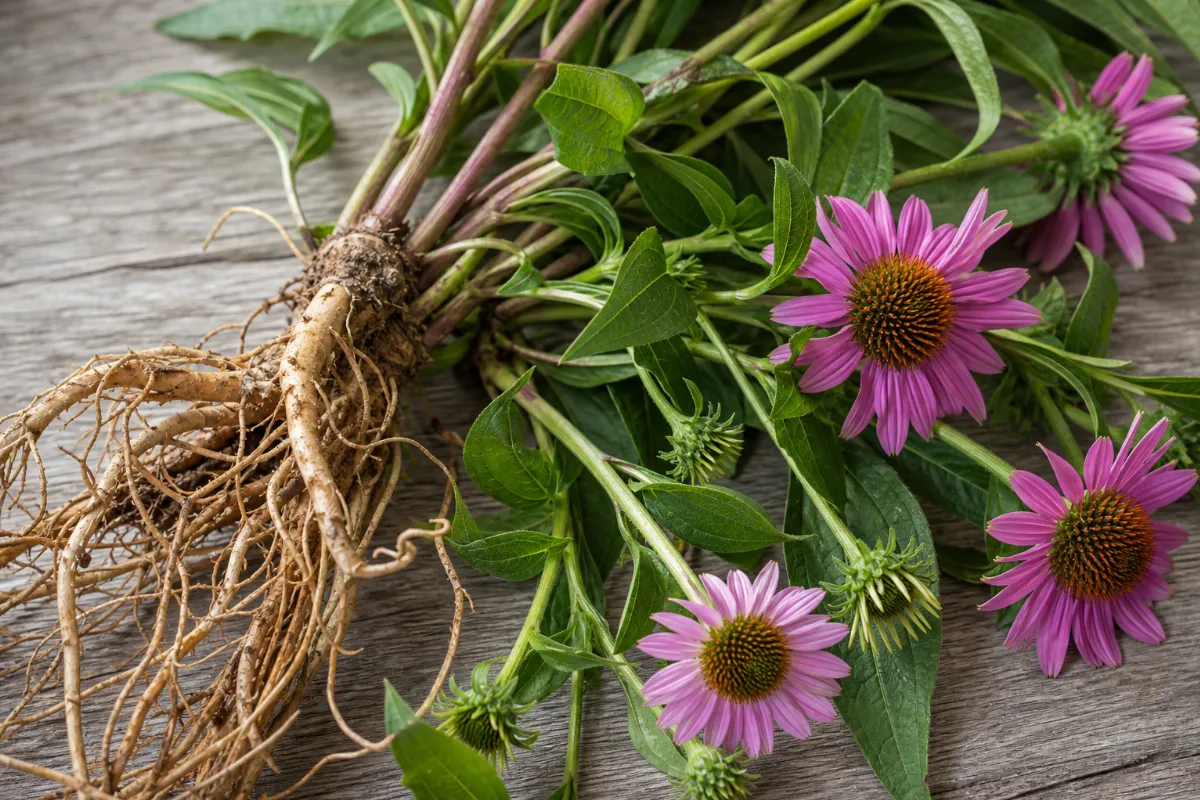
Herbs & Botanicals · Herbs · Purple coneflower, taken for colds
Echinacea
Echinacea purpurea (L.) Moench, E. angustifolia DC. and E. pallida (Nutt.) Nutt. · also called Purple coneflower, narrow-leaf purple coneflower or Kansas snakeroot (E. angustifolia), pale purple coneflower (E. pallida), equinácea (Spanish), échinacée pourpre (French), Roter Sonnenhut (German)
Echinacea is a group of three North American daisy-family plants. The flowering tops, the roots or both are used as fresh juice, alcohol tinctures, dry extracts in capsules and tablets, tea, lozenges and throat sprays. It is bought mostly to ward off or shorten colds. This profile covers echinacea as a herb and supplement. The three species and the many kinds of product are not interchangeable, so a result from one product should not be assumed for another.
General information, not medical advice. Last substantive update · Not medically reviewed. A named clinician has not signed off on this page. How this page is made
About Echinacea
Echinacea (purple coneflower) is a group of three North American daisy-family plants used for centuries by Plains peoples for wounds and infections and, since the late 1800s, widely bought in Europe and North America to prevent or shorten colds. It is one of the most-tested herbs, yet the evidence stays low in certainty because the products differ so much. For preventing colds there may be a small benefit; for treating a cold that has started, most independent trials found none. Many of the positive trials involve one maker's fresh-plant extract. The anxiety findings come from a single patented extract. The main cautions are allergy to daisy-family plants, autoimmune disease and immune suppression (a theory-based precaution), children under 12, pregnancy and a few medicine interactions. Quality varies between brands.
What it is
Echinacea is a genus of daisy-family (Asteraceae) plants native to North America. Three species are sold as the herb: Echinacea purpurea (purple coneflower), E. angustifolia (narrow-leaf) and E. pallida (pale). The flowering tops (aerial parts), the root or the whole plant are used, fresh or dried.
It is taken as pressed juice, alcohol tinctures, dry extracts in capsules and tablets, tea, lozenges and throat sprays, and applied to the skin as creams. Many shelf products are blends that also contain sage, elderberry, zinc or vitamin C.
The word coneflower is also used for other plants, such as Rudbeckia, which are different plants.
What makes it distinctive
Echinacea does not have one active ingredient. Four very different groups are suggested to matter: alkamides, caffeic acid derivatives (cichoric acid in E. purpurea, echinacoside in E. angustifolia and E. pallida), polysaccharides and glycoproteins. None has been proven to be the one that matters in people.
In test tubes and animals, echinacea extracts stimulate some immune cells, bind a cannabinoid-type receptor (CB2) and, in a dish, inactivate some enveloped viruses such as coronaviruses. That is lab work. Only the alkamides have been followed in human blood, at very low levels, and nobody has shown these levels explain any health effect.
The three species differ chemically, and so do the plant parts and the solvents used. Juice, alcohol tinctures, dry extracts and tea are different things. A good result with one maker's extract of fresh E. purpurea cannot be assumed for a root capsule, an E. angustifolia tincture or another brand.
Historical and current uses
The EU medicines agency reports, quoting older sources, that peoples of the North American plains used echinacea, especially E. angustifolia root, for more ailments than almost any other plant: wounds, burns, bites and stings, toothache, sore throat and cough. Which tribes used which species for what was not checked here.
Echinacea reached Europe in the late 1800s and 1900s, and commercial growing of E. purpurea began in Germany in the late 1930s. Most studies since 1939 used pressed juice of the flowering plant.
Today the EU lists the pressed juice of fresh E. purpurea herb for well-established short-term prevention and treatment of the common cold (up to 10 days), and several root products as traditional herbal medicines for cold symptoms, mild acne or small wounds. In the US it is sold as a dietary supplement, which is not approved by the FDA before sale.
What the research shows
Prevention and treatment are kept separate because they give different answers. For prevention, the independent Cochrane review (24 trials, 4,631 people) found no single comparison significant but a possible 10% to 20% lower risk in a post hoc pooling; a 2019 pooled analysis found a risk ratio of 0.78 and warned the benefit may be too small to matter. For treatment, only 1 of 7 trials reporting cold length found a significant benefit. Certainty is low, and the reviews disagree with each other.
Many of the positive trials, and several of the reviews that report larger benefits, are linked to the maker of one brand of fresh-plant alcohol extract of E. purpurea. Trials of other products, such as pressed-juice powder, root capsules, unrefined herb-and-root blends and E. angustifolia root extracts, mostly found no clear effect. Some pooled analyses are by authors paid by manufacturers, so they are weighed with care.
In children the results are mixed (one large trial found no benefit and more rash; maker-linked trials found fewer infections). The anxiety findings come from one patented extract of E. angustifolia root, and the largest trial did not beat placebo on its main anxiety measure. For skin, herpes, HPV, immune markers and athletes the studies are small, uncontrolled or null. No trial was found comparing echinacea head to head with elderberry, and vitamin C appears only as the comparison arm in one children's trial.
Root, leaf, powder, extract: what is the difference?
Pressed juice or alcohol extract of fresh plant
Juice pressed from the fresh flowering herb, or an alcohol extract of freshly harvested plant (for example 95% herb and 5% root). The EU well-established cold use is for expressed juice, 1.5 to 4.5 mL a dose and 6 to 9 mL a day, for no more than 10 days.
This is the form behind most positive cold trials, and several of those trials are linked to the maker of one brand. A trial of freeze-dried pressed-juice powder found no benefit, so two products from the same species can give opposite results.
Root tinctures and liquid extracts
Alcohol-and-water extracts, usually of root. EU traditional-use monographs describe E. pallida root tincture (1:5, 50% ethanol) and E. angustifolia root tincture (1:5, 45% ethanol, 1 to 2 mL three times a day).
The E. angustifolia root extracts tested in the large virus-challenge trial showed no effect on infection or symptoms. In a small study a tincture gave higher and faster alkamide peaks in blood than tablets. Alcohol content matters for children, pregnancy and anyone avoiding alcohol.
Capsules and tablets (dry extract or powder)
Dry extract (for example a 60% ethanol extract) or powdered herb or root. Doses in trials ranged from 200 mg of extract to several grams of raw herb or root a day.
Two US trials of root or whole-plant capsules found no benefit for treating colds. Many abstracts do not state the extract ratio, and whole-plant blends cannot be tied to one species. Milligrams of one product cannot be converted to another.
Tea (infusion or decoction)
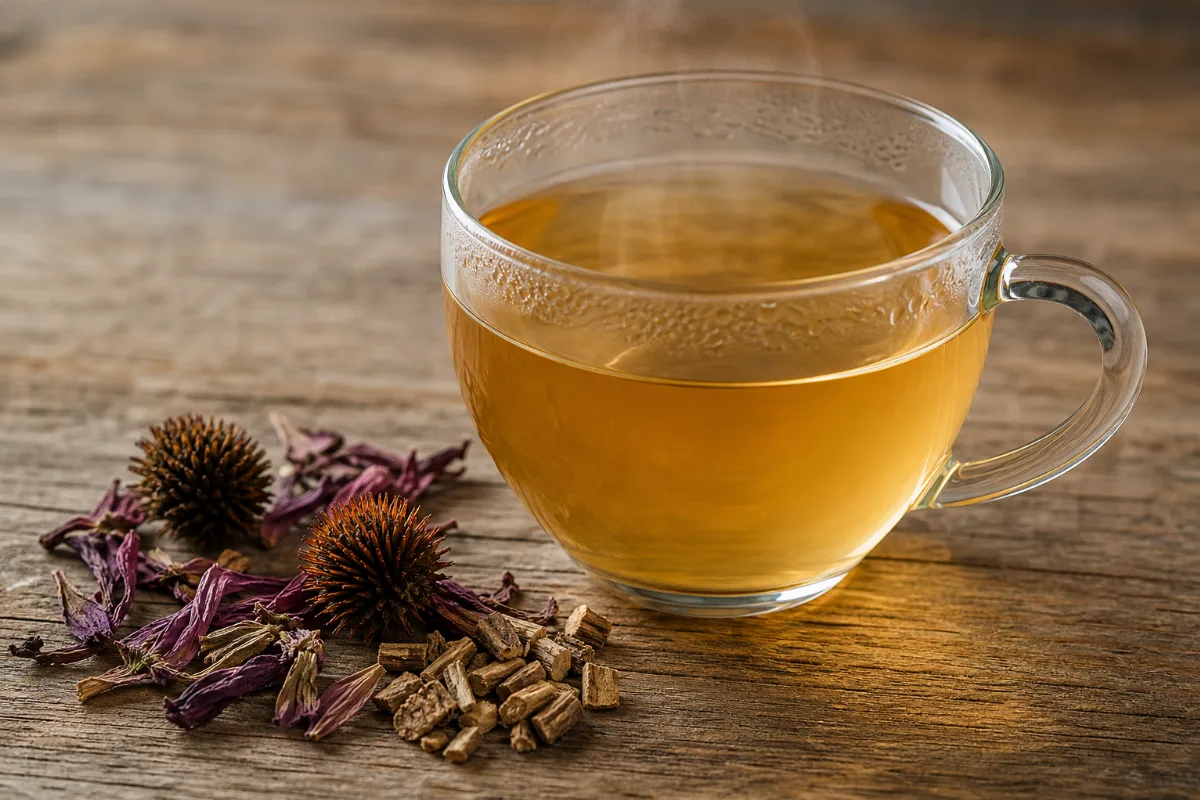
Cut root or herb steeped in hot water. The EU traditional-use monograph for E. angustifolia root describes 1 g in 150 mL of boiling water, three times a day, for cold symptoms.
No placebo-controlled trial of echinacea tea was found. Water extracts contain a different mix of compounds than alcohol extracts, so trial results for tinctures and capsules cannot be applied to tea.
Lozenges and throat sprays
Solid forms dissolved in the mouth, and alcohol-based sprays (often echinacea with sage, up to two puffs ten times a day in one trial).
The spray trial had no placebo group and cannot credit the effect to echinacea alone. No clinical trial of an echinacea lozenge was found. Lozenges raised blood alkamide levels with dose in one small study.
Skin creams and ointments
Creams made from alkamides, creams and gels for skin care, and ointments with 10% to 20% pressed juice for small wounds (EU traditional use, up to 1 week).
The eczema and skin-hydration studies are small and early and do not apply to swallowed products. The EU says echinacea products should not be applied to the breast of a breastfeeding mother.
Patented E. angustifolia root extract (EP107)
A standardised extract of E. angustifolia root, taken as 20 or 40 mg twice a day in the anxiety trials.
All the anxiety and mood evidence is for this one product. It does not apply to other echinacea supplements.
At a glance
Traditional uses history, not proof
- Peoples of the North American plains used echinacea, especially E. angustifolia root, for wounds, burns, bites, toothache, sore throat and cough (as reported by the EU medicines agency, quoting older sources)
- European and American medicine adopted it from the late 1800s for infections and colds; most studies since the 1930s used fresh pressed juice of the flowering plant
- EU well-established use: short-term prevention and treatment of the common cold with the pressed juice of fresh E. purpurea herb, for no more than 10 days
- EU traditional use: cold symptoms with certain root extracts, mild acne spots, and small skin wounds (ointment, up to 1 week)
Studied for research
- Preventing colds in adults, low certainty
- Treating a cold once it has started, low certainty (most independent trials found no benefit)
- Children's respiratory infections, low certainty (mixed, several trials funded by the product maker)
- Anxiety, low certainty (one patented E. angustifolia root extract)
- Mood, very low certainty
- Eczema cream, skin hydration, genital herpes, HPV-related lesions, immune lab markers: very low or low, small studies
Main compounds
- Alkamides (alkylamides), found mainly in the root; the only group measured in human blood, at very low levels
- Caffeic acid derivatives: cichoric acid is the main one in E. purpurea; echinacoside in E. angustifolia and E. pallida roots
- Polysaccharides and glycoproteins (water-soluble parts of unknown importance in people)
Common forms
- Pressed juice or alcohol extract of fresh plant (the form behind the EU cold monograph and many maker-linked trials)
- Root or herb tinctures and dry extracts in capsules or tablets (doses from about 200 mg of extract to several grams of raw root in trials)
- Tea of cut root (traditional use only; no placebo-controlled tea trial found)
- Lozenges, throat sprays (often with sage) and creams or ointments
Research links: NIH NCCIH: Echinacea · EU herbal monograph: Echinacea purpurea herb, fresh (EMA) · EU draft herbal monograph: Echinacea purpurea root (EMA) · Research Library · Genes & Biomarkers Library
The plant and its history
- Accepted scientific name
- Echinacea purpurea (L.) Moench (the herb-market 'echinacea' is three species: E. purpurea, E. angustifolia DC. and E. pallida (Nutt.) Nutt.)
- Naming authority
- GBIF accepted names: E. purpurea (L.) Moench, published in Methodus 591 (1794); E. angustifolia DC., Prodr. 5: 554 (1836); E. pallida (Nutt.) Nutt., Trans. Amer. Philos. Soc. 7: 354 (1840); genus Echinacea Moench (1794). NCBI Taxonomy gives the same authorities.
- Synonyms
- Rudbeckia purpurea L. (basionym of E. purpurea); Echinacea purpurea var. purpurea; Echinacea serotina (Nutt.) DC. (listed by GBIF as a synonym of E. purpurea); Echinacea intermedia Lindl.; Brauneria purpurea (L.) Britton; Lepachys purpurea (L.) Raf.; Echinacea angustifolia var. strigosa McGregor; Echinacea pallida var. angustifolia (DC.) Cronquist (a synonym of E. angustifolia); Brauneria angustifolia (DC.) A.Heller; Rudbeckia pallida Nutt. (basionym of E. pallida); Brauneria pallida (Nutt.) Britton
- Common names
- Echinacea (English); Purple coneflower (English); Eastern purple coneflower (E. purpurea) (English); Narrow-leaf purple coneflower, Kansas snakeroot, black sampson (E. angustifolia) (English); Pale purple coneflower (E. pallida) (English); Equinacea; equinácea púrpura (E. purpurea) (Spanish); Equinácea de hoja estrecha (E. angustifolia) (Spanish); Equinácea pálida (E. pallida) (Spanish); Échinacée pourpre (French); Roter Sonnenhut; Purpur-Sonnenhut (German)
- Botanical family
- Asteraceae (daisy family, order Asterales), so a person allergic to ragweed, daisies, chrysanthemums or marigolds may react to it; the EU monograph lists hypersensitivity to Asteraceae as a contraindication.
- Classification
- Plantae > Tracheophyta > Magnoliopsida > Asterales > Asteraceae > Echinacea > Echinacea purpurea; E. angustifolia; E. pallida
- Native range
- The genus is native only to eastern and central North America (wet to dry prairies and open woodland), with ten species and a few more depending on the author (Wikipedia, secondary; not checked in Plants of the World Online). E. purpurea is the common garden and farm species and is cultivated commercially in Germany since the late 1930s (EMA).
- Habitat
- Drought-tolerant perennials of prairies and open woods (Wikipedia, secondary).
- What the plant looks like
- Roots: Taproots in most species; E. purpurea grows from a short caudex with fibrous roots (Wikipedia, secondary).; Stems: Erect and usually unbranched, up to about 140 cm (Wikipedia).; Leaves: Alternate, usually rough and hairy; shape varies by species (Wikipedia).; Flowers: Single heads at the end of long stalks, with a spiny central 'cone' and drooping or spreading ray petals ranging from dark purple to pale pink, white or yellow; flowers in summer. Pollen is usually yellow and usually white in E. pallida (Wikipedia).; Fruit: Three or four-angled dry fruits (cypselae) with a persistent crown (Wikipedia).
- Cultivation
- Not verified from a primary source. E. purpurea has been farmed in Germany since the late 1930s (EMA).
- Harvest and processing
- Ph. Eur. herb is the whole or cut flowering aerial parts of E. purpurea; the EU monograph covers juice pressed from the fresh herb as soon as possible after harvest and kept by pasteurisation or by a suitable amount of ethanol (EMA). Root preparations: dry extract (DER 5.5-7.5:1; 45% ethanol), water extract (DER 4:1), tincture 1:5 in 55% ethanol (draft root report). Drying and harvest-timing practice were not verified.
- Look-alikes and adulterants
- Name: Other Echinacea species; Note: Roots and herb of E. angustifolia, E. pallida and E. purpurea are sold as 'echinacea' and may be mixed, which changes the chemistry as described above. E. tennesseensis and E. laevigata are rare wild species that were historically under US protection (Wikipedia, secondary): they are not the supplement plants.; Name: Rudbeckia and other 'coneflowers'; Note: Echinacea purpurea was first described as Rudbeckia purpurea by Linnaeus in 1753 and moved to Echinacea by Moench in 1794 (Wikipedia, GBIF, NCBI). Rudbeckia (black-eyed Susan) is a different genus and is not an Echinacea substitute.; Name: Species mix-ups and substitution risk; Note: Barnes and colleagues (p16102249) report that commercial echinacea products may contain one or more of the three species and that some do not meet pharmacopoeia quality standards. Adulteration with other plants was not documented in the EMA reports read here; contamination and adulteration belong to the safety file.
- Sustainability and conservation
- Not verified for the three medicinal species. Wikipedia (secondary) notes two other Echinacea species, E. tennesseensis and E. laevigata, were listed as endangered in the USA (E. tennesseensis since delisted, E. laevigata now threatened); wild-harvest pressure on E. angustifolia or E. pallida was not documented in the sources read.
The plant and the parts used
Traditional use and history history, not clinical proof
| Tradition or era | Documented use | Source |
|---|---|---|
| Indigenous peoples of the North American plains and prairies (before European settlement; the sources give no dates) | EMA reports, quoting Foster (1996), that Echinacea species were used by American Indians for more ailments than any other plant: E. angustifolia was universally used as an antidote for snakebite and other venomous bites and stings; traditional healers used it on wounds, burns and insect bites, chewed the root for toothache and throat infections, and took it by mouth for pain, coughs, stomach cramps and snake bites. A 2021 paper states that historical ethnobotanies of prairie peoples show treatment of many painful conditions with Echinacea. Specific tribes were NOT checked in this work, because the EMA text does not name them. | s-ema-ar-echinacea-herba-2014 |
| Native American medicine in general (review, 2000) | A review notes that many botanicals sold as supplements today were used by Native Americans, that seven of the ten most common ones were used extensively by them, and that there are very few data to support such use. | p10919925 |
| Late 1700s: first European mention of E. purpurea (1787) | EMA states that E. purpurea was first mentioned in 1787, for treating ulcers on horses' backs caused by saddles; the plant was then largely neglected until the Eclectic Dispensatory of 1852. EMA quotes this from older sources not checked in the original. | s-ema-ar-echinacea-herba-2014 |
| United States, from about 1880 (Meyers Blood Purifier) | EMA (quoting Hostettmann 2003) says the first Echinacea preparation, Meyers Blood Purifier, appeared around 1880, for rheumatism, neuralgia and rattlesnake bites. | s-ema-ar-echinacea-herba-2014 |
| Germany and Europe, 1895 to the 1930s | By 1895 Echinacea products were available in Germany for homeopathic physicians; demand grew and supplies ran short over the next 30 years; commercial growing of E. purpurea began in Germany in the late 1930s, bringing Echinacea products to a wide European audience. Most pharmacology and clinical studies since 1939 used fresh pressed juice of the flowering plant. Forms included ointment, liquids for outside and inside use, and ampoules for injection (Rote Liste 1961, per EMA). | s-ema-ar-echinacea-herba-2014 |
| Modern European regulation: EU herbal monographs 2008 and 2014/2015 | Dried E. purpurea herb and root have European Pharmacopoeia monographs (herb 01/2008:1823; root 01/2008:1824). The EU monograph on fresh E. purpurea herb (juice) lists well-established use for short-term prevention and treatment of the common cold by mouth (single dose 1.5-4.5 mL juice, daily 6-9 mL, not more than 10 days, not for children under 12) and traditional use for small superficial wounds on the skin (not more than 1 week). Not recommended for people with progressive systemic disorders, autoimmune disease, immunodeficiency or immunosuppression, or who are allergic to Asteraceae. A root report (traditional use, dry extracts) is in draft form. | s-ema-monograph-echinacea-herba-2015 |
| Commission E (1989), ESCOP (2003) and WHO (1999) | EMA reports that these three monographs recommend semi-solid preparations for skin use and state no pharmacodynamic or pharmacokinetic drug interactions of Echinacea purpurea herb preparations in humans (as EMA reports). Their oral indications were not read in the originals here. | s-ema-ar-echinacea-herba-2014 |
Traditional use shows how a plant was used. It does not show that a supplement works or is safe today.
What is inside, and how it may work
What the plant contains and how those compounds act in cells and animals. Laboratory and animal mechanisms are not proven effects in people.
Main compounds
| Compound | Family | Where it is concentrated | Activity studied | Level of evidence |
|---|---|---|---|---|
| Dodeca-2E,4E,8Z,10Z-tetraenoic acid isobutylamide (main alkamide, one isomer) PubChem 11413953 | alkamide (alkylamide: fatty-acid isobutylamide) | Root; also aerial parts of E. purpurea EMA gives 3.45 mg/g in E. purpurea flower heads of young plants; roots have much more (four alkamides above 1 mg/g). The USP herb monograph asks for at least 0.01% dodecatetraenoic acid isobutylamides. Dried root alkamide total quoted as 0.01-0.7% (s-ema-ar-echinacea-radix-2016). | Binds CB2 cannabinoid receptors (Ki about 60 nM) in cell tests and lowers LPS-driven TNF-alpha, IL-1beta and IL-12p70 in whole blood in a CB2-independent way too; raises IL-6 at 50 nM. The only Echinacea constituent group with measured human blood levels, which were very low (below 1 ng/mL for typical doses). Broken down by liver enzymes (CYP1A2, 2C9, 2D6, 2E1). 87 31 15 113 103 116 | Laboratory research |
| Dodeca-2E,4E,8Z,10E-tetraenoic acid isobutylamide (E/Z isomer partner) PubChem 6440539 | alkamide | Root; aerial parts The extract literature reports the 10E and 10Z forms together as 'dodeca-2E,4E,8Z,10E/Z-tetraenoic acid isobutylamides'; they are not separated in most papers. | Reported together with the 10Z isomer; the human blood studies measure the two forms as one signal. 113 112 37 116 | Laboratory research |
| Undeca-2Z,4E-diene-8,10-diynoic acid isobutylamide and related diyne alkamides | alkamide (alkamide with two triple bonds) | Root (prominent in E. purpurea and E. angustifolia roots) EMA lists it among four root alkamides above 1 mg/g in E. purpurea; no consistent content figure across products. | In the lab, a terminal-triple-bond alkylamide of this kind blocked the liver-enzyme breakdown of another alkylamide (mechanism-based inactivation). Alkamides from E. angustifolia root (A5, A7, A8) blocked COX-2 enzyme activity in a human cell line. PubChem CID not found for the exact isomers. 66 50 117 | Laboratory research |
| Cichoric acid (chicoric acid; 2,3-O-dicaffeoyltartaric acid) PubChem 5281764 | caffeic acid derivative (hydroxycinnamic acid ester) | Aerial parts and root of E. purpurea; the main caffeic acid derivative of E. purpurea 1-5% of dried E. purpurea herb; 0.6-2.1% (or 1.7-2.4% in a second quote) of E. purpurea root; Ph. Eur. root requires at least 0.5% caftaric plus cichoric acid, herb at least 0.1% (s-ema-ar-echinacea-herba-2014, s-ema-ar-echinacea-radix-2016). | Antioxidant in test-tube radical tests. Crossed gut-cell layers poorly and could not be found in human blood after tablets, so effects inside the body are unproven. In macrophages it showed little or no effect on COX-2 or cytokines in the work EMA quotes. 67 116 117 | Laboratory research |
| Caftaric acid (2-O-caffeoyltartaric acid) PubChem 6440397 | caffeic acid derivative | Aerial parts and root of E. purpurea About 0.2-0.8% of E. purpurea root (EMA quote); used with cichoric acid as the pharmacopoeia marker. | Antioxidant in test tubes, but the weakest radical-quencher of the compounds in one quoted study (EC50 20.5 microM versus 6.6 microM for echinacoside). Predicted by computer docking to bind spike protein of SARS-CoV-2; this is a prediction only. 106 117 | Laboratory research |
| Echinacoside PubChem 5281771 | caffeic acid derivative (phenylethanoid glycoside) | Roots of E. angustifolia and E. pallida (main caffeic acid derivative there); practically absent from E. purpurea aerial parts No content figure verified for E. angustifolia or E. pallida roots in this file. | Strong antioxidant in test tubes (highest DPPH-quenching capacity in the compounds tested); anti-hyaluronidase and anti-inflammatory activity in rat studies quoted by EMA (original not checked). Crossed gut-cell layers poorly. 67 117 | Animal research |
| Cynarin (1,3-dicaffeoylquinic acid) PubChem 5281769 | caffeic acid derivative | Roots of other Echinacea species (E. angustifolia) EMA: characteristic of other Echinacea species and practically absent from E. purpurea aerial parts. One lab paper nonetheless reported cynarin in a water extract from fresh E. purpurea aerial parts (p24434371), so this is a point on which sources differ. | No specific activity data verified here. 28 116 | Laboratory research |
| Verbascoside PubChem 5281800 | caffeic acid derivative (phenylethanoid glycoside) | Root Listed by EMA among root caffeic acid derivatives; no content figure. | No activity data verified here. 117 | Laboratory research |
| Chlorogenic acid PubChem 1794427 | caffeic acid derivative | Root Listed by EMA among root caffeic acid derivatives; no content figure. | No activity data verified here. 117 | Laboratory research |
| Caffeic acid PubChem 689043 | hydroxycinnamic acid | Building block of the derivatives above Not a major free constituent per the sources read. | Studied in rabbits: after IV doses, about 55-63% was passed in urine unchanged within 2 hours (EMA, citing Uang and Hsu 1997, original not checked). 116 | Animal research |
| Polysaccharides (e.g. PS I 4-O-methyl-glucuronoarabinoxylan about 35,000 Da; PS II acidic arabinorhamnogalactan about 450,000 Da; a xyloglucan) | polysaccharide | Aerial parts and root 2-7% of dried E. purpurea herb (EMA quoting Glavac 2012); a water extract from fresh herb was 80% polysaccharide in one lab study (p24434371). | In cells, a polysaccharide-rich extract switched on macrophages (IL-6, TNF, IL-12, nitric oxide via TLR4, ERK, p38, JNK, NF-kappaB) and in mice lowered Listeria load after oral dosing. In human T-cell lines it enhanced or reduced IL-2 and interferon-gamma depending on cell density. No single molecule has a PubChem CID, as these are mixtures. 100 28 14 116 | Animal research |
| Arabinogalactans and an arabinogalactan-containing glycoprotein | polysaccharide and glycoprotein | Root EMA root report: glycoprotein sugar part of about 64-84% arabinose, 2-5% galactose and 6% galactosamine (quoted from older texts, original not checked). | Described by EMA as one of the groups suggested to carry immune effects; no direct activity data checked here. 117 | Laboratory research |
| Polyacetylenes, ketoalkenes and ketoalkynes | polyacetylene (polyyne) | Root, notably in E. pallida EMA root report: small amounts of polyynes (0.01 mg/100 g) in E. purpurea root; ketoalkenes and ketoalkynes are linked to light-triggered antifungal action. | In the lab, light (near UV) boosted antifungal effects of Echinacea extracts, mostly attributed to ketoalkenes and ketoalkynes (EMA quoting Binns 2000). No CIDs looked up. 117 | Laboratory research |
| Essential oil (volatile oil) | terpenoids | Herb: 0.08-0.32%; root about 0.1% 0.08-0.32% in E. purpurea herb; about 0.1% in E. purpurea root (EMA). | No activity data verified here. Components include the compounds listed next. 116 117 | Laboratory research |
| Beta-caryophyllene PubChem 5281515 | sesquiterpene | Herb and root volatile oil No content figure verified. | No activity data verified here for Echinacea. 116 | Laboratory research |
| Caryophyllene oxide PubChem 1742210 | sesquiterpene oxide | Herb and root volatile oil No content figure verified. | No activity data verified here. 116 | Laboratory research |
| Germacrene D PubChem 5317570 | sesquiterpene | Herb volatile oil No content figure verified. | No activity data verified here. 116 | Laboratory research |
| Humulene (alpha-humulene) PubChem 5281520 | sesquiterpene | Root volatile oil No content figure verified. | No activity data verified here. 117 | Laboratory research |
| Bornyl acetate and borneol PubChem 93009 | monoterpenoids | Herb volatile oil No content figure verified. Borneol is PubChem CID 64685 (C10H18O). | No activity data verified here. 116 | Laboratory research |
| Tussilagine and isotussilagine (pyrrolizidine alkaloids) PubChem 149801 | pyrrolizidine alkaloid (saturated type) | Root EMA root report lists them as small amounts and calls them 'non toxic' pyrrolizidine alkaloids. No content figure verified. | They have a fully saturated ring (hexahydropyrrolizine in PubChem naming), unlike the double-bonded liver-toxic types. The toxicity statement is EMA's; this file did not test it. Safety belongs in the safety file. 117 | Laboratory research |
Mechanisms, receptors and pathways
| Target or pathway | Gene or receptor | What was found | Level |
|---|---|---|---|
| Cannabinoid type 2 receptor (CB2) and the endocannabinoid system | CNR2 (CB2); CNR1 (CB1) weakly | Alkamides from Echinacea bound CB2 with a Ki of about 60 nM (CB1 above 1500 nM) and raised calcium in CB2-carrying cells; this fit with the early finding that alkamides switch on TNF-alpha gene activity through CB2, cAMP, p38/MAPK, JNK and NF-kappaB. Mixed root and herb extracts gave stronger-than-additive CB2 signalling and more IL-10. In rats, oral root extract reduced inflammatory pain, partly reversed by cannabinoid-receptor blockers. The anti-inflammatory effects on TNF-alpha, IL-1beta and IL-12 in whole blood did not require CB2, so CB2 is only part of the story. Concentrations used (nanomolar) are above typical human blood levels of about 0.2-10 ng/mL measured after dosing, which is a gap between the lab and the body. Not shown to matter in humans. 31 87 15 62 113 37 | Laboratory research |
| Cytokines in human blood cells (alkamides) | TNF, IL1B, IL12A/IL12B, IL6, IL10, IL8 (CXCL8) | In whole blood in a test tube, alkamides lowered LPS-driven TNF-alpha, IL-1beta and IL-12p70 (5-500 nM). In healthy volunteers who took E. purpurea tincture or tablets, blood drawn 23-24 h later and stimulated with LPS showed lower TNF-alpha and IL-8 (and, with lozenges, lower IL-12p70, IL-6 and IL-10); IL-6 did not change in the tincture/tablet study. These are small studies (10 people in the best-described one) of changes in blood-cell test readings, not of actual illness. 87 112 37 | Human data |
| Macrophage activation by polysaccharides | TLR4, MAPK1/3 (ERK), MAPK14 (p38), MAPK8 (JNK), NFKB1; IL6, TNF, IL12, NOS2 | An endotoxin-free E. purpurea polysaccharide-rich extract made mouse macrophages release IL-6, TNF, IL-12 and nitric oxide through TLR4-dependent and -independent routes, and oral dosing lowered Listeria in the spleen of infected mice. A water-soluble polysaccharide extract (80% polysaccharide) from fresh aerial parts boosted IL-2 and interferon-gamma in dense human Jurkat T-cell cultures but modestly lowered interferon-gamma in sparse ones. Whether polysaccharides get into the blood after swallowing is not shown. 100 28 | Animal research |
| Tonic interferon signalling and antiviral innate immunity | JAK1; interferon-stimulated genes; pattern recognition receptors; endogenous retrovirus (HERV) sequences | In THP-1 monocytes Echinaforce switched on antiviral innate immunity genes involving tonic interferon signalling, partly through JAK1 (the inhibitor filgotinib confirmed this), and changed DNA methylation around repeat elements including endogenous retroviral sequences. A cell line in a dish; the authors' suggestion about protection from coronaviruses is a hypothesis. 21 | Laboratory research |
| Direct antiviral (virus-killing) action | Viral envelope and spike protein; TMPRSS2 (host enzyme, predicted) | On direct contact, Echinaforce inactivated common-cold coronavirus 229E (IC50 3.2 microg/mL) and, at about 50 microg/mL, SARS-CoV-1, MERS-CoV and SARS-CoV-2; it protected pre-treated reconstituted nasal tissue but pre-treating ordinary cells did not stop infection and treating after infection did little. Another study found activity against SARS-CoV-2 variants of concern (EC50 3.62-12.03 microg/mL) and used computer docking to predict binding of alkamides, caftaric acid and feruloyl-tartaric acid to spike and TMPRSS2 (a prediction only). Test-tube data from one commercial extract and company-linked authors; no protection from infection was shown in people here. 96 106 | Laboratory research |
| Cyclooxygenase-2 (COX-2) and prostaglandin E2 | PTGS2 (COX-2) | In human neuroglioma cells, an E. angustifolia root CO2 extract lowered prostaglandin E2, and three alkamides (A5, A7, A8) blocked COX-2 enzyme activity, yet none lowered COX-2 mRNA or protein; the extract and most alkamides actually increased COX-2 levels without more prostaglandin. EMA also quotes work on 5-lipoxygenase inhibition by root alkamide fractions (original not checked). 50 117 | Laboratory research |
| Cough and airway tone (polysaccharide-phenolic-protein complex) | Not identified | A 10 kDa complex isolated from E. purpurea flowering parts suppressed cough about as much as codeine and relaxed airways more than salbutamol in animal tests, per the authors. Species and doses are not in the abstract. Not tested in people. 14 | Animal research |
| Antioxidant effects | Not applicable (direct radical scavenging) | Echinacoside and cichoric acid scavenge free radicals in test tubes, and cichoric acid with an alkamide mixture or high-molecular-weight water extract was stronger together (EMA, quoting Dalby-Brown 2005, original not checked). Test-tube chemistry only; caffeic acid conjugates barely cross gut-cell layers. 117 67 | Laboratory research |
| Liver drug-metabolising enzymes and P-glycoprotein (herb-drug effects) | CYP3A4, CYP1A2, CYP2C9, CYP2D6, ABCB1 (P-gp), NR1I2 (PXR) | In people, E. purpurea root 400 mg four times daily for 8 days increased clearance of IV midazolam by 34% (liver CYP3A induction) while raising oral midazolam availability (intestinal CYP3A inhibition) and lowered caffeine oral clearance (CYP1A2); 500 mg three times daily for 28 days lowered midazolam AUC (ratio 0.73) but did not change lopinavir-ritonavir or fexofenadine; a third study of four botanicals found no significant effect on CYP1A2, 2D6, 2E1 or 3A4 ratios; warfarin (S-form) clearance rose slightly without a clinically meaningful change in INR; docetaxel levels did not change in 10 patients. In liver cells, extracts activated PXR and raised CYP3A4, CYP1A2 and MDR1 gene activity. Overall: modest and product-dependent, mixed across studies. 35 82 38 2 34 5 | Human data |
| Liver breakdown of alkamides | CYP1A1, CYP1A2, CYP2A13, CYP2C9, CYP2D6, CYP2E1 | Human liver microsomes broke down alkamides in a NADPH-dependent way (epoxidation, hydroxylation, de-alkylation); recombinant CYP1A1/1A2/2A13/2D6 were most active on the main tetraene alkamide, with CYP2E1 making the dominant hydroxylated product in microsomes and CYP2C9 the epoxides. A terminal-alkyne alkamide inhibited the breakdown of another one (mechanism-based inactivation). 66 103 | Laboratory research |
Absorption, metabolism and elimination
- Absorption
- Only alkamides have been followed in human blood. After one dose of E. purpurea (Echinaforce) tablets, tablets for children or a throat spray, the peak of the main dodecatetraenoic acid isobutylamides in blood was only about 0.22 ng/mL (p18240099). In 10 volunteers a tincture peaked at 30 minutes (0.40 ng/mL) and tablets at 45 minutes (0.12 ng/mL), with about a quarter as much absorbed from the tablets (p16995328). Lozenges with 0.07, 0.21 and 0.9 mg of alkamides gave peaks of 0.65, 1.00 and 8.88 ng/mL at 32, 25 and 19 minutes; absorption was linear with dose and so fast (about 6 minutes) that some may pass through the mouth lining (p18583121). An E. angustifolia root extract (60% ethanol, 2.5 mL, n = 11) peaked at 30 minutes at 10.88 ng/mL (p15901750). In a phase I tablet trial alkylamides appeared in blood after 20 minutes (p18007516). In gut-cell layers (Caco-2), alkamides crossed easily, apparently by simple diffusion, while caftaric acid, echinacosides and cichoric acid crossed poorly (p18007516; EMA citing Jager 2002 and Matthias 2004, originals not checked).
- Distribution
- No human tissue-distribution data were found. Blood levels of alkamides are in the low ng/mL range and 'only a fraction of the dose', and caffeic acid conjugates (cichoric acid, caftaric acid, echinacosides) could not be found in blood at all after tablets (p18007516). Whether polysaccharides, glycoproteins or other water-soluble components reach the blood or act on the gut lining and mouth is not known.
- Metabolism
- Human liver microsomes broke down alkamides by cytochrome P450 enzymes: epoxides, hydroxylated and de-alkylated products formed, with CYP1A2, CYP2D6, CYP2E1 and CYP2C9 named for the main tetraene alkamide (p15885678, p20135639). In an extract alkamides were broken down less than the pure compounds, and one alkamide with a terminal triple bond blocked the breakdown of another (p15885678). In rats the absolute oral bioavailability of the tetraene alkamides was 29.2 +/- 2.3% as pure compounds and 47.1 +/- 7.2% from a root extract, with a half-life of 123 versus 36 minutes (EMA quoting Ardjomand-Woelkart 2011, original not checked).
- Elimination
- No human elimination or urinary data were found for alkamides. Rat data above suggest a short half-life (36 min pure; 123 min in a root extract). For caffeic acid, rabbits passed about 55-63% unchanged in urine within 2 hours after IV doses (EMA quoting Uang and Hsu 1997, original not checked); this is a building block, not a measured human Echinacea result.
- Bioavailability
- Absolute human oral bioavailability is not established because there is no intravenous comparison in people. Relative exposure differs by form: tincture gave higher and faster alkamide peaks than tablets in one small study (p16995328), and all three Echinaforce products gave very similar low peaks in another (p18240099). Lozenge levels rose in proportion to dose (p18583121). The authors of these studies connect low ng/mL blood levels with changes in blood-cell test readings 23-24 hours later, but this is not a proven cause. Herb-drug interactions have been tested: midazolam clearance changed in opposite directions in liver and gut (p14749695), midazolam exposure fell with 28 days of E. purpurea (p20653355), a four-botanical study found no significant CYP effect (p15536458), S-warfarin clearance rose slightly with no clinically meaningful change in INR (p20573086) and docetaxel was unchanged (p23701184). Interaction advice belongs in the safety file.
113 112 37 111 67 66 103 35 82 38 2 34 116
Isolated compounds versus whole extracts
Echinacea does not have one 'active ingredient'. Four very different groups are suggested to matter: alkamides, caffeic acid derivatives, polysaccharides, and glycoproteins (EMA, ESCOP), and none has been proven to be the one that matters in people. Alkamides are the only group found in human blood, at very low levels, and they bind CB2 receptors in cell tests but also work in ways that do not need CB2 (p16547349). Cichoric acid and the other caffeic acid derivatives barely cross gut-cell layers and could not be found in blood after tablets (p18007516); in the lab they act mainly as antioxidants. Polysaccharide-rich extracts activate macrophages and T-cell lines in test tubes and animals (p18618312, p24434371) but their absorption is unmeasured. Mixing the root and herb extracts gave stronger-than-additive effects on CB2 signalling, IL-10 and TNF-alpha in human cells (p19303464), and an alkamide with a terminal triple bond changed the liver breakdown of another alkamide (p15885678), so the whole extract is plausibly more than its parts, but 'synergy' is shown only in test tubes. The extract also differs by plant part, species and solvent: juice, ethanol tinctures, dry extracts and teas are not interchangeable. Practical point: a result with one brand (for example Echinaforce) cannot be assumed for another, and results with E. purpurea cannot be assumed for E. angustifolia or E. pallida.
Nutritional composition
A nutrient table is not meaningful for echinacea: it is taken as a small amount of juice, tincture, extract, tea or capsule for its plant compounds, not as a food. No vitamin or mineral content was verified for any Echinacea part and none is claimed here. The compounds that matter are listed under the compound section above (alkamides, caffeic acid derivatives, polysaccharides, glycoproteins).
Products, quality and comparisons
Independent evidence comes first. Nothing in this section is a paid ranking. If a product link is added later, it will be marked clearly as an affiliate link and will never change what the research says.
Quality indicators
- Species named in full (Echinacea purpurea, E. angustifolia or E. pallida) and the plant part stated (fresh herb, root, or mixed)
- Preparation stated: pressed juice, tincture with ratio and alcohol percent, dry extract with extract ratio and solvent, or powder
- Marker compounds in mg per serving (alkamides, chicoric acid, polysaccharides) if the maker claims standardization, with the test method
- The Ph. Eur. monograph reference where used (1824 purpurea root, 1822 pallida root, 1821 angustifolia root, per the EU monographs)
- Batch or lot number and a certificate of analysis on request
- Honest label for other ingredients (sage, elderberry, zinc, vitamin C) and for alcohol content
Identity and authenticity
- A 2018 study tested 53 Echinacea products sold in Europe with HPTLC and DNA metabarcoding. Echinacea DNA was detected in 34 of the 38 products retained for the DNA test (89 percent). The DNA test could not separate one Echinacea species from another because the genus varies little. Across all products, the ingredients listed on labels matched what was found only 43 percent of the time.
- Authors of that study note that species are hard to tell apart by shape because they overlap and hybridize, and mention deliberate adulteration as a concern. Unverified in this file: the exact adulterants found were not in the abstract.
- E. purpurea, E. angustifolia and E. pallida differ chemically, so a trial of one may not apply to another. The Turner 2005 trial of E. angustifolia root found no effect, while the E. purpurea herb extracts tested elsewhere gave mixed results.
Standardization and extract strength
- The Goel 2004 trial named a fresh-plant liquid with alkamides 0.25 mg/mL, cichoric acid 2.5 mg/mL and polysaccharides 25 mg/mL (Echinilin), and found a 23.1 percent lower symptom score in the per-protocol group.
- Alkamides are mostly in the root and cichoric acid is a main phenolic of the herb; in a 2019 lab study chicoric and caftaric acids were the main phenolics and the best solvent differed by plant part (water for caftaric acid from leaves; 40 percent ethanol for chicoric acid from flowers and roots).
- A 2020 US National Toxicology Program paper found that in one E. purpurea root extract chosen for testing, caftaric, chicoric and chlorogenic acids and the main alkamide were only a small fraction of the extract, and said selecting a representative product is difficult.
- Pharmacokinetics show alkamides reach a peak in blood about 30 to 45 minutes after a dose; tincture gave a higher peak than tablets with the same alkamide content (0.40 vs 0.12 ng/mL).
- No agreed single 'active compound' is established for echinacea; a marker percentage on a label does not prove the product will behave like a trial product.
Third-party testing
- US dietary supplements are not approved by the FDA before sale; the content can differ from the label. We did not re-read independent testing programs' lists (USP, NSF, ConsumerLab and others) and cannot say which echinacea products carry a seal.
- A seal speaks for that programme's test, not for effect. Ask for the lot's certificate of analysis.
Contaminants and adulterants
- Heavy metals, pesticides, microbes and solvent residues in echinacea supplements were not covered by the sources we read for this file.
- A lab study of high-pressure pasteurization of E. purpurea was found in searches but not read, so no statement is made about it.
Reading a product label
- Find the species and the part used (herb, root, whole plant).
- Is it juice, tincture, dry extract or powder? Note extract ratio, solvent and alcohol percent.
- Compare mg per serving and servings per day with the trial or monograph dose you care about; do not assume equality.
- Check for added sage, elderberry, zinc, vitamin C or other herbs; a combination cannot be credited to echinacea alone.
- Look at the stated use: short-course, not year-round, unless the product says otherwise and a clinician agrees.
- Check allergy warnings for daisy-family plants (Asteraceae) and the age limit (the monographs advise against use under 12 years).
- Look for a lot number, expiry date and a certificate of analysis.
Certifications and what they actually mean
| Certification | What it means | What it does not tell you |
|---|---|---|
| EU traditional herbal medicinal product registration or well-established-use authorisation | European regulators accept the product for a stated mild indication (for example cold relief) based on long-standing or well-established use at the doses in the EU herbal monograph. | Traditional-use status does not claim trial-proven efficacy. Rules apply to the product, not to all supplements. |
| European Pharmacopoeia monograph compliance (Ph. Eur. 1821, 1822, 1824) | The EU root monographs state that the material complies with these pharmacopoeia standards for E. angustifolia, E. pallida and E. purpurea roots. | A maker's statement; check a certificate of analysis. |
| Independent third-party seal (USP, NSF or similar) | A named programme tested a sample against its own criteria. | We did not verify any echinacea listing; a seal is not proof of effect. |
Comparing price and servings
Do not compare bottle prices. Step 1: cost per serving = bottle price / servings per bottle. Step 2: servings per day needed to reach the daily amount of the same type of preparation (for example mL of juice or mg of dry extract). Step 3: cost per day = cost per serving x servings per day. If a marker such as alkamides or cichoric acid is stated by the same test method, cost per mg of marker = bottle price / (servings x mg per serving). Compare only products of the same preparation type. Leave prices blank until a real current product is entered; no prices are included here.
Extract types compared
| Extract | Plant part | Standardization | Trials | Evidence note | Safety note | Limitations | Studies |
|---|---|---|---|---|---|---|---|
| Echinaforce (fresh E. purpurea extract) and its tablet, junior and hotdrink forms | herb 95% + root 5% | Fresh-plant alcohol extract; tablets 400 mg in the children's trial | Brinkeborn 1999 (treatment); Jawad 2012 (4 months prevention, 755 adults); Ogal 2021 (children, 1,200 mg/day); Kolev 2022 (2,400 mg/day, open); Raus 2015 (vs oseltamivir) | Positive results in most of these maker-linked trials: fewer colds, fewer antibiotic courses in children, noninferiority to oseltamivir in flu. | Jawad: adverse drug reactions 9% echinacea vs 10% placebo; Ogal: fewer adverse events than vitamin C control. | Most trials sponsored by or linked to the maker; one used vitamin C as control and one had no placebo; results do not apply to other brands. | 13 55 80 59 88 |
| Pressed juice powder (freeze-dried) | aerial parts | 100 mg three times a day; no marker data in the abstract | Yale & Liu 2004 (128 adults) | No difference from placebo in symptoms or time to resolution. | Not reported as a concern in the abstract. | Single small trial; shows that two products from the same species can differ in results. | 114 |
| Echinilin (fresh E. purpurea liquid) | fresh plant (part not in abstract) | Alkamides 0.25, cichoric acid 2.5, polysaccharides 25 mg/mL | Goel 2004 (282 adults) | 23.1% lower daily symptom scores in the per-protocol group. | A few adverse events in both groups. | Only 128 of 282 caught a cold; one trial. | 33 |
| E. angustifolia root extracts (CO2, 60% ethanol, 20% ethanol) | root | Chemically defined; three profiles | Turner 2005 (437 volunteers, rhinovirus) | No significant effect of any extract on infection or symptoms. | Not reported in the abstract. | Challenge model with one virus; alkamides peak at 30 minutes (PK study). | 105 111 |
| Unrefined mixed herb and root capsules | herb 25% + E. purpurea root 25% + E. angustifolia root 50% | Not stated | Barrett 2002 (148 students) | No detectable benefit or harm. | No harm detected. | One mixture; cannot be tied to one species. | 9 |
| Dried-root tablets (species not in abstract) | root | Dose as dried-root equivalent | Barrett 2010 (719 people) | Non-significant trend to shorter illness (0.53 days, CI -1.25 to 0.19). | Not stated in abstract. | Variability limited power. | 10 |
| Fluid extract | unspecified | Not stated | Grimm 1999 (108 adults) | No significant effect on incidence, duration or severity. | Side effects 20% vs 13% (P=0.44). | Small. | 36 |
| 60% ethanolic extract (Korean trial) | unspecified | 200 mg a day | Lee 2024 (80 adults) | NK-cell activity and some cytokines rose; no change in cold or fatigue scores. | No adverse reactions reported. | Biomarker study. | 60 |
Compare Echinacea with another ingredient
Echinacea vs Elderberry
Both are marketed for colds and flu and both have mixed evidence. No trial compares them directly. Elderberry's best results come from a few small trials of specific products; echinacea has more trials but very different products and mostly non-significant results.
| Echinacea | Elderberry | |
|---|---|---|
| Benefits studied | Preventing and shortening colds; some flu and sore-throat uses | Duration and severity of colds and flu, mostly in adults |
| Evidence certainty | low: the 2014 Cochrane review (24 trials, 4,631 people) did not pool; none of 12 prevention comparisons was significant (post hoc pooling suggests 10-20 percent fewer colds) and only 1 of 7 treatment trials showed shorter colds; the 2019 meta-analysis found prevention RR 0.78 (0.68-0.88) but no clear effect on duration; reviewers cite very different products and risk of selective reporting | low: the 2019 meta-analysis (180 people) reports a large effect but no numbers in its abstract; the 2020 rapid review of 5 studies says symptoms may be shorter within 48 hours of onset but did no pooling; the 2020 emergency-room trial of 87 people found no benefit |
| Typical studied dose | Varies by product: for example 300 mg/day pressed juice powder (no benefit), 1,200 mg/day in children, 2,400 mg/day for adult prevention; EU juice monograph 6-9 mL a day for up to 10 days | 60 ml a day of syrup for 5 days in one trial (15 mL four times a day); other products vary |
| Head-to-head trial | None found against elderberry; one echinacea drink was noninferior to oseltamivir in 473 flu patients | None found |
| Safety and interactions | Echinacea: Short courses: mild stomach upset and rash most often; rare allergic reactions, including severe ones; rash in children in one trial (7.1 vs 2.7 percent); healthy-volunteer data show changes in midazolam and caffeine clearance (CYP3A, CYP1A2); avoid with daisy-family allergy | No serious events in short trials; raw berries are poisonous; pregnancy data lacking |
| Forms | Juice, tincture, capsules and tablets, tea, lozenges, throat spray, ointment | Syrup, capsule, lozenge, juice, gummy |
| Cost note | Use the price-per-day formula; no prices stored | Use the price-per-day formula; no prices stored |
Echinacea vs Vitamin C
Vitamin C is taken every day to shorten colds a little, with its clearest benefit in people under extreme physical stress; echinacea is used at the first signs or in prevention blocks with uneven results. Only one trial used vitamin C as a comparison for echinacea, and it was not a placebo.
| Echinacea | Vitamin C | |
|---|---|---|
| Benefits studied | Preventing and shortening colds; some flu and sore-throat uses | Cold prevention and shortening |
| Evidence certainty | low: the 2014 Cochrane review (24 trials, 4,631 people) did not pool; none of 12 prevention comparisons was significant (post hoc pooling suggests 10-20 percent fewer colds) and only 1 of 7 treatment trials showed shorter colds; the 2019 meta-analysis found prevention RR 0.78 (0.68-0.88) but no clear effect on duration; reviewers cite very different products and risk of selective reporting | mixed: the 2013 Cochrane review (29 comparisons, 11,306 people) found no reduction in cold risk in the general community (RR 0.97, 0.94-1.00) but a halving of risk in 598 people under heavy exercise stress (RR 0.48, 0.35-0.64); regular use shortened colds 8% in adults and 14% in children; no consistent effect when taken only after a cold started |
| Typical studied dose | Varies by product: for example 300 mg/day pressed juice powder (no benefit), 1,200 mg/day in children, 2,400 mg/day for adult prevention; EU juice monograph 6-9 mL a day for up to 10 days | 0.2 g a day or more in the review's trials; 1-2 g a day in children shortened colds by 18% |
| Head-to-head trial | One children's prevention trial used vitamin C 50 mg three times a day as the control for echinacea: fewer infection episodes with echinacea (OR 0.52, 0.30-0.91); it was not a placebo, so it does not show vitamin C is useless | Only as a control arm in the children's trial (see left) |
| Safety and interactions | Echinacea: Short courses: mild stomach upset and rash most often; rare allergic reactions, including severe ones; rash in children in one trial (7.1 vs 2.7 percent); healthy-volunteer data show changes in midazolam and caffeine clearance (CYP3A, CYP1A2); avoid with daisy-family allergy | Described in the review as low cost and safe; not re-verified here |
| Forms | Juice, tincture, capsules and tablets, tea, lozenges, throat spray, ointment | Tablets, powders, foods |
| Cost note | Use the price-per-day formula; no prices stored | Use the price-per-day formula; no prices stored |
Echinacea vs Zinc
Both are taken at the first sign of a cold and both have uneven evidence. Zinc's review is recent and graded; it suggests a possible shortening of colds. No trial compares the two.
| Echinacea | Zinc | |
|---|---|---|
| Benefits studied | Preventing and shortening colds; some flu and sore-throat uses | Prevention and treatment of the common cold |
| Evidence certainty | low: the 2014 Cochrane review (24 trials, 4,631 people) did not pool; none of 12 prevention comparisons was significant (post hoc pooling suggests 10-20 percent fewer colds) and only 1 of 7 treatment trials showed shorter colds; the 2019 meta-analysis found prevention RR 0.78 (0.68-0.88) but no clear effect on duration; reviewers cite very different products and risk of selective reporting | low: 2024 Cochrane review of 34 trials (8,526 people): little or no effect on preventing colds (RR 0.93, 0.85-1.01); as treatment may shorten colds (-2.37 days, -4.21 to -0.53; low certainty; very uneven results) |
| Typical studied dose | Varies by product: for example 300 mg/day pressed juice powder (no benefit), 1,200 mg/day in children, 2,400 mg/day for adult prevention; EU juice monograph 6-9 mL a day for up to 10 days | Zinc gluconate lozenges 45 to 276 mg a day for 4.5 to 21 days in the review's lozenge trials |
| Head-to-head trial | None found | None found |
| Safety and interactions | Echinacea: Short courses: mild stomach upset and rash most often; rare allergic reactions, including severe ones; rash in children in one trial (7.1 vs 2.7 percent); healthy-volunteer data show changes in midazolam and caffeine clearance (CYP3A, CYP1A2); avoid with daisy-family allergy | Not summarised in this file |
| Forms | Juice, tincture, capsules and tablets, tea, lozenges, throat spray, ointment | Lozenges, tablets, syrups, nasal |
| Cost note | Use the price-per-day formula; no prices stored | Use the price-per-day formula; no prices stored |
Echinacea vs Vitamin D
Vitamin D is studied for prevention, mainly in people who start low; echinacea for first-sign use and prevention blocks. The two have not been compared, and the recent vitamin D update lost statistical significance.
| Echinacea | Vitamin D | |
|---|---|---|
| Benefits studied | Preventing and shortening colds; some flu and sore-throat uses | Preventing acute respiratory infections |
| Evidence certainty | low: the 2014 Cochrane review (24 trials, 4,631 people) did not pool; none of 12 prevention comparisons was significant (post hoc pooling suggests 10-20 percent fewer colds) and only 1 of 7 treatment trials showed shorter colds; the 2019 meta-analysis found prevention RR 0.78 (0.68-0.88) but no clear effect on duration; reviewers cite very different products and risk of selective reporting | mixed: the 2017 individual-participant meta-analysis (11,321 people) found a lower risk (adjusted OR 0.88, 0.81-0.96), strongest with very low levels (OR 0.30, 0.17-0.53); the 2025 update of 40 trials (61,589 people) found OR 0.94 (0.88-1.00, p=0.057), not statistically significant |
| Typical studied dose | Varies by product: for example 300 mg/day pressed juice powder (no benefit), 1,200 mg/day in children, 2,400 mg/day for adult prevention; EU juice monograph 6-9 mL a day for up to 10 days | Daily, weekly or bolus doses; the 2025 update found no effect modification by dose size |
| Head-to-head trial | None found | None found |
| Safety and interactions | Echinacea: Short courses: mild stomach upset and rash most often; rare allergic reactions, including severe ones; rash in children in one trial (7.1 vs 2.7 percent); healthy-volunteer data show changes in midazolam and caffeine clearance (CYP3A, CYP1A2); avoid with daisy-family allergy | No change in serious adverse events in either meta-analysis |
| Forms | Juice, tincture, capsules and tablets, tea, lozenges, throat spray, ointment | Capsules, drops, tablets |
| Cost note | Use the price-per-day formula; no prices stored | Use the price-per-day formula; no prices stored |
Echinacea vs Andrographis (Andrographis paniculata)
Andrographis has more trials with larger reported effects on symptoms, but reviewers call the quality poor and many used mixtures. The single head-to-head study in children favoured the Andrographis product, and it had no placebo group.
| Echinacea | Andrographis (Andrographis paniculata) | |
|---|---|---|
| Benefits studied | Preventing and shortening colds; some flu and sore-throat uses | Symptom relief in acute respiratory infections (cough, sore throat, time to recovery) |
| Evidence certainty | low: the 2014 Cochrane review (24 trials, 4,631 people) did not pool; none of 12 prevention comparisons was significant (post hoc pooling suggests 10-20 percent fewer colds) and only 1 of 7 treatment trials showed shorter colds; the 2019 meta-analysis found prevention RR 0.78 (0.68-0.88) but no clear effect on duration; reviewers cite very different products and risk of selective reporting | low: 2017 review of 33 trials (7,175 people): cough SMD -0.39 (-0.67 to -0.10) and sore throat SMD -1.13 (-1.37 to -0.89) versus placebo, but methodological quality overall poor |
| Typical studied dose | Varies by product: for example 300 mg/day pressed juice powder (no benefit), 1,200 mg/day in children, 2,400 mg/day for adult prevention; EU juice monograph 6-9 mL a day for up to 10 days | Varied; not tabulated here |
| Head-to-head trial | One children's trial (130 children) found the Andrographis product Kan Jang more effective than an echinacea preparation (Immunal) when each was added to standard treatment; neither was compared with placebo | Kan Jang vs Immunal (see left) |
| Safety and interactions | Echinacea: Short courses: mild stomach upset and rash most often; rare allergic reactions, including severe ones; rash in children in one trial (7.1 vs 2.7 percent); healthy-volunteer data show changes in midazolam and caffeine clearance (CYP3A, CYP1A2); avoid with daisy-family allergy | No major adverse events; minor ones mostly gastrointestinal |
| Forms | Juice, tincture, capsules and tablets, tea, lozenges, throat spray, ointment | Capsules and tablets, often in mixtures |
| Cost note | Use the price-per-day formula; no prices stored | Use the price-per-day formula; no prices stored |
Other supplements people compare it with
- Elderberry (Colds and flu): A few small trials of specific products; one emergency-room trial found no benefit. Evidence: low. 46 44 64
- Vitamin C (Cold prevention, heavy exercise stress): No community-wide benefit but a large effect in people under extreme exercise stress in the Cochrane review. Evidence: mixed. 49
- Zinc lozenges (Cold treatment): May shorten colds; non-serious side effects more common. Evidence: low. 76
- Vitamin D (Respiratory infection prevention): Helped most when levels were very low; 2025 update not statistically significant overall. Evidence: mixed. 65 56
- Andrographis (Symptoms of respiratory infection): Reported symptom benefits; poor study quality. Evidence: low. 52
- Oseltamivir (prescription antiviral) (Influenza): Used as the comparison drug in a maker-linked echinacea trial; ask a clinician. Not evaluated beyond that abstract. Evidence: insufficient. 88
Where to buy
Check the label first. Whatever you buy, look for these:
- The plant part and the extract type or ratio on the label
- A standardized amount of the active compounds, where relevant
- A third-party testing mark (USP, NSF or ConsumerLab)
- Interactions: ask a pharmacist if you take medicines, are pregnant or have a medical condition
Talk to a pharmacist or doctor before you start any supplement, especially if you take medicines. See the Safety tab for interactions.
Support our free guides: as an Amazon Associate we earn from qualifying purchases. Full disclosure.
11 low certainty5 very low certainty2 not enough evidence
What was looked at
The 18 benefits and uses checked for Echinacea, each with how strong the evidence is. Tap one to open it.
- Preventing colds and respiratory infections (adults)Low certainty
- Treating a cold once it has started (adults)Low certainty
- Deliberately caught colds (virus challenge studies)Low certainty
- Children: preventing and treating respiratory infectionsLow certainty
- Fewer complications and less antibiotic useLow certainty
- Flu and sore throatLow certainty
- COVID-19 and coronavirusesNot enough evidence
- AnxietyLow certainty
- Mood and wellbeingVery low certainty
- Children who keep getting infections (colds, tonsillitis, ear infections)Low certainty
- Eczema (atopic dermatitis), as a skin creamVery low certainty
- Skin hydration and fine lines (cosmetic)Very low certainty
- Recurrent genital herpesLow certainty
- HPV-related cervical lesions and genital wartsVery low certainty
- Immune markers (cytokines, saliva antibodies)Very low certainty
- Athletes: blood oxygen carriers and enduranceLow certainty
- Anxiety and moodLow certainty
- Carpal tunnel pain (mixed product)Not enough evidence
Lab markers tracked in the studies
Respiratory virus detection and viral loadNasal interleukin-8 and neutrophilsAntibiotic courses and daysState-Trait Anxiety Inventory (STAI)HADS-A and Hamilton Anxiety Scale (HAM-A)Positive and negative affect (PANAS)Saliva antibody (s-IgA)Inflammation signals in blood (IL-6, TNF-alpha, IL-8, IL-10)Erythropoietin (EPO)Hemoglobin and hematocritMaximal oxygen uptake (VO2max)Eczema severity score (local SCORAD)Skin barrier fats (ceramides, cholesterol)Skin moisture (corneometer reading)
What is Echinacea good for?
The main proposed uses and how strong the human evidence is for each. "Low" is the best rating any echinacea use reached here. "Low", "very low" and "insufficient" mean few, small, mixed or product-specific trials. Nothing here is a proven treatment, and the ratings are this profile's reading of the reviews, not formal grades unless stated. Colds are split into prevention (taking it daily beforehand) and treatment (taking it after symptoms start) because the results differ.
Benefits, one by one
Each card is a research question, not a promise. Tap a goal to filter. Open a card to see the studies, doses and limits.
Preventing colds and respiratory infections (adults)
Low certaintyTaking echinacea every day for weeks to months might slightly lower the chance of catching a cold. The best independent review found a possible 10% to 20% lower risk but no single trial that proved it, and the effect may not matter much in daily life.
9 studiesAlcohol (ethanol) extract of fresh E. purpurea herb (about 95% herb, …
Studies, doses and limits
What the trials found
Cochrane review (Karsch-Volk 2014, 10 prevention trials): none of 12 comparisons was individually significant, but a post hoc pooling suggested a 10% to 20% lower risk of a cold. David 2019 pooled prevention trials and found a risk ratio of 0.78 (95% CI 0.68 to 0.88), saying the benefit might not be clinically meaningful. Shah 2007 reported a larger drop (odds ratio 0.42) but is less cautious and had an erratum. Schapowal 2015 (6 high-quality trials, 2,458 people) found fewer recurrent infections (RR 0.649). Gancitano 2024 (industry-linked authors) found RR 0.75 for at least one infection. Individual trials: Jawad 2012 (755 healthy adults, E. purpurea herb extract, 4 months) found fewer colds, especially in people who took it as directed. Kolev 2022 (120 adults, open trial without placebo) found fewer SARS-CoV-2-positive swabs (5 vs 14) but no significant drop in symptomatic episodes. Tiralongo 2012 (175 air travellers, root extract) was borderline (p=0.05). O'Neil 2008 (E. purpurea capsules, 8 weeks) found no difference in sick days. Many positive trials used the same manufacturer's alcohol extract of fresh E. purpurea herb.
Results
Small possible reduction in colds with some products; not consistent across products or trials.
Effect sizes as reported
Cochrane post hoc relative risk reduction 10% to 20%; David 2019 RR 0.78 (0.68 to 0.88); Schapowal 2015 RR 0.649 (0.545 to 0.774); Gancitano 2024 RR 0.75 (0.69 to 0.81); Shah 2007 OR 0.42 (0.25 to 0.71).
Why this rating
Individual trials are mostly not significant, pooled results differ between reviews (the Cochrane authors refused to pool the main analysis), products and plant parts vary widely, and the most positive reviews involve authors paid by a manufacturer. The reviewers themselves described the effect as of questionable clinical relevance.
Form and dose studied
Alcohol (ethanol) extract of fresh E. purpurea herb (about 95% herb, 5% root), taken daily for 4 months in Jawad 2012; 2,400 mg a day of a similar extract in Kolev 2022; root extract standardised to 4.4 mg alkylamides in the travel trial; E. purpurea capsules in O'Neil 2008.
Who was studied
Mostly healthy adults. Three trials in Schapowal's pooling involved people who catch infections often, were stressed or had a weaker immune state.
Limits
Many different products; most trials small or short; several reviews include trials funded by the makers; prevention trials run for weeks to months, so long-term safety is not shown.
Why researchers looked
Echinacea is mainly bought to ward off colds, so cold prevention is its most studied immune use.
Traditional use
Plains Indian peoples of North America used echinacea roots for infections, wounds and sore throats; European and American medicine later adopted it for colds and flu.
Proposed mechanism Laboratory research
Lab and animal work suggests echinacea extracts may stimulate certain immune cells and may act directly on some enveloped viruses (such as flu and coronaviruses) in a dish. This is not shown to be how it works in people.
A proposed mechanism does not show that the effect happens in people.
Adverse events were similar to placebo in the large prevention trial (Jawad 2012). Cochrane noted a trend towards more drop-outs from adverse events in prevention trials.
Treating a cold once it has started (adults)
Low certaintyMost of the best-designed trials found that echinacea taken after cold symptoms begin does not shorten the cold or make it clearly milder. A few trials of specific standardised products found some benefit, so results depend heavily on the product.
9 studiesTested: E. purpurea juice or alcohol extracts (aerial parts), E. angu…
Studies, doses and limits
What the trials found
Cochrane 2014: only 1 of 7 treatment trials reporting duration found a significant benefit; the authors concluded benefits for treating colds were not shown. David 2019 found cold duration was not significantly different (mean difference -0.45 days). Shah 2007 reported 1.4 days shorter colds. Negative trials: Barrett 2010 (719 people, E. angustifolia root tablets, 10.2 g in the first 24 hours; 0.53 days shorter, CI -1.25 to 0.19, not significant), Barrett 2002 (148 students, unrefined mixture of species and parts, no benefit), Yale 2004 (128 adults, E. purpurea pressed juice, 100 mg three times a day, no difference). Turner 2005 (E. angustifolia root, deliberate infection) found no effect. Positive trials: Goel 2004 (282 adults who often get colds, standardised fresh E. purpurea, symptom scores 23.1% lower in the per-protocol analysis) and Brinkeborn 1999 (Echinaforce and a 7-times concentrate worked better than placebo; a root-only product did not). Aucoin 2020 (rapid review) concluded echinacea may help symptoms if started at the first sign, particularly products using E. purpurea or E. purpurea plus E. angustifolia with standardised active compounds.
Results
Mixed: no benefit in the best-known independent trials and in the Cochrane review; benefit in a few standardised-product trials.
Effect sizes as reported
Cochrane: no pooled treatment effect; David 2019 duration MD -0.45 days (CI as printed 1.85 to 0.94); Shah 2007 WMD -1.44 days (-2.24 to -0.64); Barrett 2010 -0.53 days (-1.25 to 0.19); Goel 2004 symptom scores 23.1% lower (p<0.01, per-protocol).
Why this rating
Reviews disagree, individual trials split roughly evenly, and benefit seems to depend on the specific product (species, plant part and extraction). The Cochrane authors call a weak benefit from some products possible but not shown.
Form and dose studied
Tested: E. purpurea juice or alcohol extracts (aerial parts), E. angustifolia root tablets, mixed unrefined capsules. Dosing ranged from 300 mg of pressed juice a day (Yale 2004) up to 5.1 to 10.2 g of dried root a day (Barrett 2010).
Who was studied
Healthy adults and students who caught a cold naturally; trial in adolescents and adults aged 12 to 80 (Barrett 2010).
Limits
Pooled results mix many products; self-reported symptoms; people start at different stages of the cold; several positive trials involve the manufacturer.
Why researchers looked
Many people start echinacea at the first sign of a cold hoping to shorten it.
Traditional use
Used traditionally for colds, coughs and sore throats, typically as a fresh-root tincture or tea.
Proposed mechanism Laboratory research
Possible immune-stimulating and mild anti-inflammatory effects seen in lab studies; none proven to explain any effect in people.
A proposed mechanism does not show that the effect happens in people.
Adverse events were similar between echinacea and placebo in most treatment trials.
Deliberately caught colds (virus challenge studies)
Low certaintyIn studies where volunteers were deliberately infected with a cold virus, echinacea did not clearly protect them. Pooling three studies suggested a small protective effect, but the one large trial of root extract found nothing.
4 studiesE. angustifolia root extracts (Turner 2005); E. purpurea 2.5 mL three…
Studies, doses and limits
What the trials found
Schoop 2006 pooled 3 challenge studies: the chance of a clinical cold was 55% higher with placebo (OR 1.55, CI 1.02 to 2.36, p=0.043), but symptom scores were not significantly different. Individual studies: Turner 2000 (infection 44% vs 57%, illness 36% vs 43%, not significant), Sperber 2004 (48 adults, E. purpurea; colds in 58% vs 82%, p=0.114, too small to be conclusive), and Turner 2005 in the New England Journal of Medicine (437 volunteers randomised, 399 analysed; three E. angustifolia root extracts; no significant effect on infection, symptoms, IL-8 or virus levels).
Results
Mostly null in the individual studies; borderline positive when pooled.
Effect sizes as reported
Schoop 2006 OR 1.55 (1.02 to 2.36) for a cold with placebo vs echinacea; symptom score difference -1.96 (-4.83 to 0.90).
Why this rating
Small studies, different products, a borderline pooled result and a large null trial of one root extract.
Form and dose studied
E. angustifolia root extracts (Turner 2005); E. purpurea 2.5 mL three times a day for 14 days (Sperber 2004); dose not stated for Turner 2000 in the abstract.
Who was studied
Healthy adult volunteers in quarantine-style studies.
Limits
Results apply to a single virus type (rhinovirus 39) and to the specific extracts tested.
Why researchers looked
Deliberate infection removes guesswork about who was exposed and when, giving a cleaner test than waiting for natural colds.
Proposed mechanism Pharmacological theory
Not established; these trials test whether any benefit shows up under controlled exposure.
A proposed mechanism does not show that the effect happens in people.
No important safety signal reported in the abstracts.
Children: preventing and treating respiratory infections
Low certaintyFor children, treatment trials were mixed: the largest US trial found no benefit and more rashes, while brand-specific trials found shorter illness at a higher dose or fewer infections. A 2025 review found benefits, but its evidence is limited and several trials were funded by the product maker.
5 studiesEchinaforce Junior (400 mg alcohol extract of fresh E. purpurea) thre…
Studies, doses and limits
What the trials found
Treatment: Taylor 2003 (JAMA, 407 children aged 2 to 11, 707 colds) found no difference in duration (median 9 days in both) or severity, and rash was more frequent with echinacea (7.1% vs 2.7%, p=0.008). Weishaupt 2020 (79 children aged 4 to 12, no placebo) found that 5 tablets a day (2,000 mg) shortened episodes by up to 1.7 days compared with 3 tablets a day. Prevention: Ogal 2021 (about 201 children aged 4 to 12, controlled with vitamin C, not placebo; 2 x 2 months) found 32.5% fewer infection episodes (OR 0.52, CI 0.30 to 0.91). Reviews: Pham 2025 (9 trials) reported lower incidence (RR 0.81) but also more adverse events (RR 1.38); Mazi 2025 (5 trials) reported some benefit, noting mixed results.
Results
Mixed. A large treatment trial was negative; a small dose-comparison and a vitamin-C-controlled prevention trial were positive.
Effect sizes as reported
Taylor 2003 duration p=0.89; rash 7.1% vs 2.7%; Weishaupt 2020 up to 1.7 days shorter at 5 vs 3 tablets (p<0.02); Ogal 2021 OR 0.52 (0.30 to 0.91); Pham 2025 incidence RR 0.81 (0.75 to 0.87), adverse events RR 1.38 (1.08 to 1.78).
Why this rating
Few trials, one large negative trial, positive trials from a single manufacturer's product, and a control that was not an inert placebo in the prevention trial. One review graded certainty as high, but its own text lists concerns about bias.
Form and dose studied
Echinaforce Junior (400 mg alcohol extract of fresh E. purpurea) three times a day for prevention; 1,200 to 2,000 mg extract a day for treatment in Weishaupt 2020.
Who was studied
Children aged 2 to 12.
Limits
Different products and doses; no placebo in two key positive designs; rash signal in the one large negative trial.
Why researchers looked
Children get many colds, and parents look for options that avoid antibiotics.
Traditional use
Echinacea has long been used in family remedies for colds; paediatric evidence is much newer.
Proposed mechanism Pharmacological theory
Not shown in children; proposed immune and antiviral effects come from lab studies.
A proposed mechanism does not show that the effect happens in people.
Rash was more common with echinacea in Taylor 2003; people allergic to daisy-family plants should avoid echinacea.
Fewer complications and less antibiotic use
Low certaintyA few manufacturer-linked analyses and trials report that people on echinacea needed fewer antibiotics, mostly in children. Those results are large but come from limited trials with potential bias, so they should be treated as unproven.
5 studiesAlcohol extracts of fresh E. purpurea (Echinaforce) in the main trial…
Studies, doses and limits
What the trials found
Gancitano 2024 (30 trials, 5,652 people) reported lower need for antibiotics (RR 0.60, CI 0.39 to 0.93) and 70% fewer antibiotic days (IRR 0.29), with complications reduced (RR 0.44). Schapowal 2015 found complications (pneumonia, ear infection, tonsillitis) less frequent (RR 0.503). Ogal 2021 in children: 6 antibiotic courses in 6 children vs 24 courses in 15 children on vitamin C. Pham 2025 reported antibiotic use RR 0.18 in children. Weishaupt 2020 reported an antibiotic prescription rate of 4.6% (no comparison group).
Results
Large reductions reported in sponsor-linked analyses and in one vitamin-C-controlled children's trial.
Effect sizes as reported
Antibiotic need RR 0.60 (0.39 to 0.93), antibiotic days IRR 0.29 (0.11 to 0.74) Gancitano 2024; complications RR 0.503 (0.384 to 0.658) Schapowal 2015; antibiotic use RR 0.18 (0.13 to 0.25) Pham 2025 (children).
Why this rating
Results come from few trials, mainly with one manufacturer's alcohol extract, and the two largest effect estimates come from reviews with authors paid by that manufacturer or with signs of publication bias.
Form and dose studied
Alcohol extracts of fresh E. purpurea (Echinaforce) in the main trials.
Who was studied
Mostly children aged 4 to 12 and generally healthy adults.
Limits
Antibiotic prescribing depends on local habits; outcome counts are small; products are not interchangeable.
Why researchers looked
Reducing unnecessary antibiotics matters for public health, so researchers look at whether preventing infections cuts antibiotic use.
Traditional use
Not a traditional use; a modern research outcome.
Proposed mechanism Pharmacological theory
Proposed: fewer viral infections lead to fewer secondary bacterial complications. Not demonstrated directly.
A proposed mechanism does not show that the effect happens in people.
Echinacea should not replace antibiotics for a bacterial infection or for a sick child; see a clinician for high fever or worsening illness.
Flu and sore throat
Low certaintyOne trial found an echinacea hot drink performed about as well as the flu drug oseltamivir for early flu, but it had no placebo group. A spray combining echinacea and sage was about as good as a standard throat spray for sore throat.
2 studiesEchinaforce Hotdrink for 10 days (Raus 2015); echinacea/sage spray, 2…
Studies, doses and limits
What the trials found
Raus 2015 (473 people with early flu symptoms, E. purpurea hot drink for 10 days vs 5 days of oseltamivir): recovery at day 10 was 90.1% vs 84.8%; complications 2.46% vs 6.45% (p=0.076); fewer side effects with echinacea; the design only tested whether echinacea was not worse, with no placebo group. Schapowal 2009 (154 people, echinacea/sage spray vs chlorhexidine/lidocaine spray): response in 3 days 63.8% vs 57.8%, similar; no placebo group.
Results
Similar to comparators in two trials without placebo arms.
Effect sizes as reported
Recovery at 10 days 90.1% vs 84.8% (echinacea hot drink vs oseltamivir); sore throat response 63.8% vs 57.8% (echinacea/sage spray vs chlorhexidine/lidocaine).
Why this rating
No placebo groups, product-specific, sponsor-linked, and flu recovers on its own.
Form and dose studied
Echinaforce Hotdrink for 10 days (Raus 2015); echinacea/sage spray, 2 puffs every 2 hours (Schapowal 2009).
Who was studied
Adults and teens with early flu symptoms or acute sore throat in primary care.
Limits
Comparator trials cannot show echinacea beats placebo; combination product for sore throat.
Why researchers looked
Echinacea is marketed for flu and sore throats, and a small number of branded trials exist.
Traditional use
Traditional throat and infection remedy; the combination with sage follows European herbal practice.
Proposed mechanism Laboratory research
Lab studies show the extract can inactivate influenza and other enveloped viruses on contact; whether that happens in the body is not shown.
A proposed mechanism does not show that the effect happens in people.
Fewer nausea and vomiting events than oseltamivir in Raus 2015; echinacea should not replace medical care for severe flu.
COVID-19 and coronaviruses
Not enough evidenceEchinacea extracts inactivate coronaviruses in lab dishes. In people, there is no proof it prevents or treats COVID-19: the one human study was small, open (no placebo) and sponsor-funded.
4 studiesEchinaforce extract in the human study (2,400 mg a day for prevention…
Studies, doses and limits
What the trials found
Kolev 2022 (120 healthy adults, open, no placebo, sponsor-funded): 5 vs 14 SARS-CoV-2-positive swabs (RR 0.37, p=0.03), but symptomatic episodes were not significantly different (RR 0.70) and numbers were tiny. Lab studies: Signer 2020 and Vimalanathan 2022. Aucoin 2020 found no studies of echinacea in COVID-19-like illness.
Results
No reliable human evidence; lab inactivation of virus on contact.
Effect sizes as reported
Kolev 2022 SARS-CoV-2-positive samples RR 0.37 (p=0.03); symptomatic episodes RR 0.70 (p>0.05). Lab EC50 3.62 to 12.03 micrograms/mL.
Why this rating
Only one small unblinded human study; the rest is lab work.
Form and dose studied
Echinaforce extract in the human study (2,400 mg a day for prevention).
Who was studied
Healthy adults in one trial.
Limits
No placebo and no blinding; a handful of positive swabs; sponsor-funded.
Why researchers looked
Lab results with coronaviruses led to a small trial during the COVID-19 pandemic.
Proposed mechanism Laboratory research
In lab dishes the extract inactivated common-cold coronavirus, MERS, SARS-CoV-1 and SARS-CoV-2 and blocked cell entry in some assays; computer models suggest binding to the spike protein. Lab results do not show effects in people.
A proposed mechanism does not show that the effect happens in people.
Not a substitute for vaccination or medical treatment.
Anxiety
Low certaintyA few small trials of one specific patented extract of Echinacea angustifolia root (EP107) found lower anxiety scores, but the largest 6-week trial did not beat placebo on its main anxiety measure. This evidence is early and comes from one research group's product.
6 studiesE. angustifolia root extract EP107: 20 to 40 mg twice a day (human tr…
Studies, doses and limits
What the trials found
Haller 2020: a placebo-controlled trial of 40 mg twice a day for 7 days of E. angustifolia root extract in volunteers with high anxiety scores (STAI) found state anxiety fell about 11 points vs about 3 with placebo (p<0.01); depression and stress scores did not change. Haller 2013: in healthy volunteers with high anxiety scores, 2 tablets a day (20 mg each) lowered STAI scores while 1 tablet did not. Lopresti 2021 (108 adults with mild-to-moderately severe anxiety, 6 weeks, 20 or 40 mg twice a day): anxiety fell in all groups but not more than placebo on the main measure (CUXOS). Haller 2025: with the HADS anxiety scale the extract beat placebo; the Hamilton anxiety total score did not.
Results
Positive in the researcher group's short trials; null on the main outcome in the longer independent-style trial (anxiety was lower than baseline in all groups).
Effect sizes as reported
Haller 2020 state anxiety about -11 vs -3 points (p<0.01); Lopresti 2021 no difference from placebo on CUXOS; Haller 2025 HADS-A better than placebo, HAM-A total not significant (numbers not in abstracts).
Why this rating
Small trials, one patented extract, authors holding patents on its use, mixed results across anxiety scales, and short follow-up.
Form and dose studied
E. angustifolia root extract EP107: 20 to 40 mg twice a day (human trials). Not the same as typical cold-remedy products.
Who was studied
Adult volunteers with high anxiety scores; adults with mild-to-moderate anxiety.
Limits
Evidence cannot be extended to other echinacea products; no trials in people with clinical anxiety disorders reported in the abstracts; follow-up up to 6 weeks.
Why researchers looked
Researchers noticed that some echinacea compounds (alkylamides) affect brain signalling and tested them in anxiety models.
Traditional use
Not a traditional use of echinacea.
Proposed mechanism Animal research
In rat brain slices, one echinacea extract reduced excitatory nerve signalling in the hippocampus, a brain area involved in anxiety. In rats, certain preparations reduced anxiety-like behaviour in several tests. This has not been shown to explain the human effect.
A proposed mechanism does not show that the effect happens in people.
Adverse effects were rare and mild in Haller 2020; no signs of sedation or reward in rats.
Mood and wellbeing
Very low certaintyOne 6-week trial found better positive and negative mood scores and emotional wellbeing with Echinacea angustifolia than placebo, even though anxiety did not change more than with placebo. This is a secondary result and not yet confirmed.
2 studiesEP107 E. angustifolia extract, 20 or 40 mg twice a day for 6 weeks.
Studies, doses and limits
What the trials found
Lopresti 2021: both doses of E. angustifolia extract (EP107) gave larger improvements than placebo on PANAS positive and negative affect and the SF-36 emotional wellbeing score; the authors say these were secondary outcomes and need confirming. Haller 2020 found no change in depression (BDI) or stress (PSS) scores over 7 days. No trial of echinacea for diagnosed depression or for memory or thinking tasks was found in this review.
Results
One positive secondary result, one null in a different trial.
Effect sizes as reported
Numbers not in abstracts.
Why this rating
Secondary outcomes from a single trial, with a different 7-day trial showing no change in depression or stress scores.
Form and dose studied
EP107 E. angustifolia extract, 20 or 40 mg twice a day for 6 weeks.
Who was studied
Adults with mild-to-moderate anxiety.
Limits
Not tested in depression; single research product.
Why researchers looked
Researchers looked for mood effects alongside the anxiety work.
Proposed mechanism Preliminary mechanism
Unknown; lab data on hippocampal signalling are only a possible lead.
A proposed mechanism does not show that the effect happens in people.
No safety concerns noted in the abstracts.
Children who keep getting infections (colds, tonsillitis, ear infections)
Low certaintyIn children, echinacea has been tested to prevent repeat infections. Results are mixed. A 2021 trial in children aged 4 to 12 found fewer infection episodes and far fewer antibiotic courses than vitamin C. A mixed echinacea-propolis-vitamin C syrup cut illness episodes by about half in toddlers. But in ear-infection-prone toddlers, echinacea taken during colds did not help and may have raised the risk. Product type and the way it was used seem to matter.
6 studiesEchinaforce Junior 400 mg three times daily for two 2-month blocks; o…
Studies, doses and limits
What the trials found
2021 trial (Switzerland/UK, children 4-12 years): Echinaforce Junior 400 mg three times daily vs vitamin C 50 mg, two 2-month periods. Infection episodes OR 0.52 (95% CI 0.30-0.91); antibiotic courses 6 vs 24; complications 11 vs 30. One author works for the maker. 2004 trial (430 children aged 1-5): echinacea-propolis-vitamin C elixir for 12 weeks gave 0.9 vs 1.8 episodes per child (p<.001); the mixture means echinacea cannot be credited alone. 2020 Egyptian study (300 children with recurrent tonsillitis, not clearly randomized): echinacea added to azithromycin gave fewer attacks than azithromycin alone. 2008 US trial (90 toddlers with recurrent ear infections): echinacea taken for 10 days at each cold was linked to more infections (65% vs 41%; RR 1.59, 95% CI 1.04-2.42). A 2025 meta-analysis of 9 trials found fewer infections (RR 0.81) and less antibiotic use (RR 0.18) but moderately more mild side effects (RR 1.38); a 2025 systematic review of 5 trials reported similar direction and mentions high-certainty ratings by its own GRADE assessment.
Results
Fewer infection episodes and antibiotic courses in the better trials; no benefit, and possibly harm, for ear infections in one small trial.
Effect sizes as reported
Infection episodes OR 0.52 (95% CI 0.30-0.91) in the 2021 trial; meta-analysis: incidence RR 0.81 (0.75-0.87), antibiotic use RR 0.18 (0.13-0.25), ear infection episodes RR 0.56 (0.44-0.73), adverse events RR 1.38 (1.08-1.78).
Why this rating
Products and doses vary widely; the largest trial used vitamin C rather than placebo and has a manufacturer link; one trial mixes herbs; one trial points the other way; the tonsillitis study was not clearly randomized. A review reports high certainty on its own GRADE, but the compiler rates the whole picture low because of these problems. Cold and flu treatment itself is covered in the immune and respiratory section.
Form and dose studied
Echinaforce Junior 400 mg three times daily for two 2-month blocks; other trials used syrups and extracts at varied doses.
Who was studied
Children from 1 to 12 years; most data from European and Middle Eastern trials.
Limits
Mixed products; comparator not always inactive; short follow-up; some trials had company links.
Why researchers looked
Young children get many infections and parents look for ways to cut antibiotic use.
Traditional use
Echinacea has long been used for infections in North America and Europe. Use in children is a modern research question.
Proposed mechanism Preliminary mechanism
Lab and animal work suggests echinacea extracts affect immune cells and may act on some viruses. This has not been shown to explain the trial results.
A proposed mechanism does not show that the effect happens in people.
Adverse events were moderately more common in the pooled analysis (mostly mild: stomach upset, skin rash). Echinacea may be a poor choice for toddlers prone to ear infections based on one trial. Ask a paediatrician before giving any herb to a child.
Eczema (atopic dermatitis), as a skin cream
Very low certaintyA cream made from echinacea alkylamides lowered eczema severity scores in a published trial and improved skin barrier fats. The abstract gives no group sizes or numbers, so this is early evidence for a cream, not for pills or teas.
1 studiesAlkylamide extract in a cream (strength not stated).
Studies, doses and limits
What the trials found
Oláh 2017 combined lab work and three human trials. A patch test found the cream well tolerated. In an eczema trial, local SCORAD (severity score) fell versus baseline and versus the comparator. In a third trial, skin lipids (ceramide EOS, cholesterol) were higher at Day 15 than at baseline. Group sizes, doses, trial length and the comparator are not in the abstract.
Results
Lower local eczema severity score than the comparator cream; better skin barrier fats.
Effect sizes as reported
Statistically significant fall in local SCORAD; no numbers or confidence intervals in the abstract.
Why this rating
One report with three small trials, no group sizes or numbers in the abstract, a cream from a specific research group, no independent repeat found.
Form and dose studied
Alkylamide extract in a cream (strength not stated).
Who was studied
People with atopic eczema; population details not in the abstract.
Limits
Details missing from the abstract; comparator unclear; not tested on other skin conditions here.
Why researchers looked
Eczema is a long-lasting itchy skin condition and people look for gentle anti-inflammatory creams.
Traditional use
Echinacea was used on wounds and skin problems by Native American peoples, but the eczema work is modern and based on a specific extract.
Proposed mechanism Laboratory research
In lab-grown skin cells, the extract lowered inflammatory signals (IL-6, IL-8). The alkylamides are thought to act on the CB2 receptor, part of the body's own cannabinoid system, according to the authors.
A proposed mechanism does not show that the effect happens in people.
Echinacea can cause allergic skin reactions in people allergic to daisy-family plants (Asteraceae); the patch test found the cream well tolerated in that trial. Do not put it on broken or infected skin without medical advice.
Skin hydration and fine lines (cosmetic)
Very low certaintyA small Thai study of 10 healthy adults found that echinacea cream and gel raised skin moisture and reduced wrinkle measurements after one month. There was no placebo group described, so it is a very early cosmetic finding.
1 studiesEchinacea purpurea cream and gel (strength not stated); shelf life sh…
Studies, doses and limits
What the trials found
Yotsawimonwat 2010: 10 healthy volunteers aged 25-40 used the cream or gel for 1 month. The moisture reading rose by up to 10.6 and 11.4 AU and wrinkle measures fell 9.47% (cream) and 14.92% (gel). No irritation. The extract itself lost strength within 2 to 4 months in storage.
Results
Higher skin moisture readings and lower wrinkle measures; no irritation.
Effect sizes as reported
Hydration +10.6 (cream) and +11.4 (gel) AU; wrinkles -9.47% and -14.92%; no p-values given in the abstract.
Why this rating
Ten healthy people, no placebo group described, no statistics given in the abstract.
Form and dose studied
Echinacea purpurea cream and gel (strength not stated); shelf life short.
Who was studied
Healthy adults aged 25 to 40.
Limits
Tiny; uncontrolled; short; the products degraded in storage.
Why researchers looked
Echinacea contains plant chemicals that protect against oxidation, and makers add it to skin products.
Traditional use
Traditional skin use was for wounds and sores, not for wrinkles.
Proposed mechanism Laboratory research
The authors link the effect to antioxidant plant chemicals in the extract. This was measured in the lab, not shown in the skin.
A proposed mechanism does not show that the effect happens in people.
No irritation in this study.
Recurrent genital herpes
Low certaintyA 6-month crossover trial in 50 people with frequent genital herpes found no significant benefit from Echinacea purpurea compared with placebo. Lab studies show activity against herpes virus, but this did not carry over to people.
1 studiesEchinaforce (E. purpurea plant and root extract); dose not stated in …
Studies, doses and limits
What the trials found
Vonau 2001, London: 50 people with frequently recurring genital herpes took Echinaforce for 6 months and placebo for 6 months in a double-blind crossover. Recurrence frequency and severity (history, clinical review, visual analogue scales) showed no significant difference.
Results
No benefit shown.
Effect sizes as reported
No statistically significant difference; no numbers in the abstract.
Why this rating
One small trial with a clear null result; dose not in the abstract. Rated low because the evidence is one trial, pointing against a benefit. A cold-sore (oral herpes) trial was not found.
Form and dose studied
Echinaforce (E. purpurea plant and root extract); dose not stated in the abstract.
Who was studied
Adults with frequent genital herpes recurrences.
Limits
One trial, 50 people, dose not in the abstract.
Why researchers looked
Herpes comes back repeatedly and people look for immune-boosting options.
Traditional use
Echinacea has been promoted in the popular press for herpes; this is not a documented traditional use.
Proposed mechanism Laboratory research
Lab studies show echinacea extracts can block herpes virus in cells. That has not been shown to work in people.
A proposed mechanism does not show that the effect happens in people.
No safety concern reported in the abstract.
HPV-related cervical lesions and genital warts
Very low certaintyTwo small Italian studies tested echinacea supplements for HPV-related problems. In women with mild cervical changes, a combination of echinacea plus vaginal hyaluronic acid did better at 6 and 12 months than either alone. In people treated for genital warts, a root-extract supplement was linked to fewer relapses in those over 25. Both studies are small and have design weaknesses.
2 studiesOral echinacea extracts (E. angustifolia plus E. purpurea) with or wi…
Studies, doses and limits
What the trials found
Riemma 2022 (153 women with low-grade cervical lesions, 3 months of treatment): persistent CIN-1 at 6 months 15/51 (echinacea plus hyaluronic acid) vs 23/48 (echinacea alone) vs 27/49 (hyaluronic acid alone); at 12 months 5/51 vs 15/48 vs 14/48 (p=0.03 for each comparison). No difference at 3 months. De Rosa 2019 (genital warts after CO2 laser, supplement group n=64, 4 months): relapses were significantly fewer in the supplement group among people over 25, in both men and women.
Results
Fewer persistent lesions with the combined arm at 6 and 12 months; fewer wart relapses in over-25s.
Effect sizes as reported
Persistent CIN-1 at 12 months 5/51 vs 14/48 (hyaluronic acid alone), p=0.03; wart relapse numbers not in the abstract text read.
Why this rating
Two small studies with design problems: in the first, echinacea alone did not clearly beat hyaluronic acid alone; the second has no placebo and its description of itself is inconsistent.
Form and dose studied
Oral echinacea extracts (E. angustifolia plus E. purpurea) with or without vaginal hyaluronic acid; wart study used root extracts for 4 months.
Who was studied
Women with low-grade cervical lesions; men and women after wart laser treatment.
Limits
Single-blind or unblinded; no placebo; small; combination effect cannot be credited to echinacea alone. Does not replace HPV screening or follow-up.
Why researchers looked
HPV usually clears on its own but can leave lesions that need follow-up, so women and clinicians look for immune support.
Traditional use
Not a traditional use; a modern question based on echinacea's immune effects.
Proposed mechanism Pharmacological theory
The authors propose that echinacea boosts the immune response against the virus. This is a theory in these studies.
A proposed mechanism does not show that the effect happens in people.
No safety concern reported in the abstracts. See the safety section for general cautions.
Immune markers (cytokines, saliva antibodies)
Very low certaintyTwo small human studies measured immune signals. In 10 healthy people, a single echinacea capsule was followed by lower pro-inflammatory signals and higher IL-10 after 24 hours, with no comparison group. In an exercise study of 32 people, 4 weeks of echinacea kept saliva antibody (s-IgA) from falling after hard exercise. Neither shows a health benefit by itself.
2 studiesSingle 10 mg E. angustifolia softgel; E. purpurea supplement for 4 we…
Studies, doses and limits
What the trials found
Dall'Acqua 2015: 10 healthy volunteers took one 10 mg E. angustifolia lipophilic softgel; blood at 24 hours showed lower IL-6, TNF-alpha and IL-8 and higher IL-10 than before (no control group, no values in the abstract). Hall 2007: 32 people did an exercise test before and after 4 weeks of echinacea or placebo; saliva s-IgA fell 45% in the placebo group and rose 7% in the echinacea group.
Results
Cytokine and s-IgA measures moved in the direction of less immune dip or less inflammation signalling.
Effect sizes as reported
s-IgA after exercise: -45% (placebo) vs +7% (echinacea); cytokine changes direction only.
Why this rating
One uncontrolled 10-person single-dose study and one small trial; no clinical outcome; immune markers do not equal being healthier. The abstract does not give a dose for the exercise trial.
Form and dose studied
Single 10 mg E. angustifolia softgel; E. purpurea supplement for 4 weeks (dose not in abstract).
Who was studied
Healthy adults.
Limits
Tiny; no placebo in the cytokine study; markers only; no reference ranges given.
Why researchers looked
Researchers measure immune signals to see whether echinacea changes how the immune system behaves.
Traditional use
Echinacea is traditionally taken to strengthen resistance to infection.
Proposed mechanism Laboratory research
Alkylamides in echinacea are reported to lower IL-6, TNF-alpha and IL-8 gene activity and raise IL-10 in blood cells. In a lab (Jurkat T-cell) study a water extract rich in sugars both raised and lowered cytokine release depending on cell density, so effects are not simple.
A proposed mechanism does not show that the effect happens in people.
Echinacea may stimulate immune activity; people with autoimmune conditions are usually advised to check with a doctor (see safety section).
Athletes: blood oxygen carriers and endurance
Low certaintySome athletes take echinacea hoping to raise red blood cell production and fitness. A 2024 meta-analysis of 6 small studies (107 athletes) found no clear change in hemoglobin, erythropoietin or maximal oxygen uptake.
1 studiesVaried supplements and doses.
Studies, doses and limits
What the trials found
Deccy 2024 pooled 6 studies with 107 athletes. Hemoglobin effect size 0.38 (95% CI -0.04 to 0.80, I2=70%), hematocrit 0.34 (-0.10 to 0.78, I2=86%), erythropoietin -0.29 (-0.75 to 0.17, I2=67%), maximal oxygen uptake -0.20 (-0.60 to 0.21, I2=0%). None reached significance; there was a lot of difference between studies for blood measures.
Results
No effect on aerobic capacity or red blood cell measures.
Effect sizes as reported
See above; all confidence intervals include zero.
Why this rating
Meta-analysis of 6 small studies with high inconsistency; the authors call the evidence base limited. The result is probably a true lack of large effect, but small effects cannot be excluded.
Form and dose studied
Varied supplements and doses.
Who was studied
Athletes.
Limits
Few small trials with different products.
Why researchers looked
Early reports suggested echinacea might raise erythropoietin (the hormone that signals red blood cell production).
Traditional use
No traditional use for athletic performance.
Proposed mechanism Pharmacological theory
A theory that echinacea could increase erythropoietin, mainly from animal and small human studies; the meta-analysis did not support it.
A proposed mechanism does not show that the effect happens in people.
Not a safety study.
Anxiety and mood
Low certaintyIn a 6-week trial of 108 adults with mild-to-moderate anxiety, an echinacea angustifolia extract (EP107) did not reduce anxiety more than placebo. Mood and emotional wellbeing scores improved more, but only in secondary measures that need confirming.
1 studiesEP107 E. angustifolia extract, 20 or 40 mg twice daily.
Studies, doses and limits
What the trials found
Lopresti 2021 (Perth, 108 adults, 104 analysed): placebo vs EP107 20 mg or 40 mg twice daily for 6 weeks. The anxiety scale (CUXOS) fell in all groups with no difference from placebo. Positive and negative mood scores (PANAS) and SF-36 emotional wellbeing improved more with echinacea.
Results
No extra anxiety benefit over placebo; some mood gains in secondary measures.
Effect sizes as reported
Anxiety: no difference from placebo; mood scores better than placebo (values not in the abstract).
Why this rating
One 6-week trial; main anxiety result null; mood gains only in secondary outcomes; a single narrow extract. If the mind section covers this herb's anxiety evidence, read it there too.
Form and dose studied
EP107 E. angustifolia extract, 20 or 40 mg twice daily.
Who was studied
Adults with mild-to-moderate anxiety.
Limits
One trial; secondary outcomes; one extract.
Why researchers looked
An earlier pair of human trials suggested the extract might calm anxiety quickly (reported in this trial's abstract, not read).
Traditional use
Not a traditional use for anxiety.
Proposed mechanism Pharmacological theory
The authors suggest an effect on mood-related brain chemistry; not shown in this trial.
A proposed mechanism does not show that the effect happens in people.
No safety concern is stated in the abstract.
Carpal tunnel pain (mixed product)
Not enough evidenceOne Italian trial of 60 people with carpal tunnel syndrome compared shock wave therapy with a supplement containing echinacea, alpha lipoic acid, conjugated linoleic acid and quercetin. Both improved pain and function up to 6 months. Because the supplement had several ingredients and there was no placebo, echinacea's own effect is unknown.
1 studiesPerinerv-type supplement (dose not stated).
Studies, doses and limits
What the trials found
Notarnicola 2015: 60 patients randomised to shock wave therapy or the supplement. Both groups improved in pain, symptom severity, function and nerve tests up to 6 months; the supplement group showed a trend to better pain relief.
Results
Both treatments improved symptoms; no placebo to compare.
Effect sizes as reported
Trend only; no numbers in the abstract.
Why this rating
Mixed ingredients, no placebo, no numbers in the abstract.
Form and dose studied
Perinerv-type supplement (dose not stated).
Who was studied
Adults with carpal tunnel syndrome.
Limits
Cannot separate echinacea from other ingredients.
Why researchers looked
Echinacea alkylamides are thought to act on the body's cannabinoid system, which affects pain, so a pain trial was run.
Traditional use
No traditional use for carpal tunnel.
Proposed mechanism Pharmacological theory
The authors say echinacea acts on the body's cannabinoid system; this is a theory in this study.
A proposed mechanism does not show that the effect happens in people.
No safety information in the abstract.
Connections to the rest of health
How Echinacea connects to the rest of our health knowledge graph. Every link says what kind of connection it is. A safety link (for example to the liver) is a warning, not a benefit. A study that merely mentions a topic never creates a benefit link.
Explore every connection: goals, body systems, organs, symptoms, genes
A. Wellness goals
| Connected to | Kind of connection | Evidence status | Context | Studies |
|---|---|---|---|---|
| Immune Support | Potential benefit | Low certainty | Preventing colds and respiratory infections (adults): Taking echinacea every day for weeks to months might slightly lower the chance of catching a cold. The best independent review found a possible 10% to 20% lower risk but no single trial that proved it, and the effect may not matter much in daily life. Treating a cold once it has started (adults): Most of the best-designed trials found that echinacea taken after cold symptoms begin does not shorten the cold or make it clearly milder. A few trials of specific standardised products found some benefit, so results depend heavily on the product. | 57 18 95 92 29 55 59 102 79 4 10 9 114 33 13 93 104 99 105 101 110 80 84 68 88 91 16 1 108 107 90 19 |
| Immune Support | Preliminary mechanism | Not enough evidence | COVID-19 and coronaviruses: Echinacea extracts inactivate coronaviruses in lab dishes. In people, there is no proof it prevents or treats COVID-19: the one human study was small, open (no placebo) and sponsor-funded. | 59 96 106 4 |
| Anxiety Support | Potential benefit | Low certainty | Anxiety: A few small trials of one specific patented extract of Echinacea angustifolia root (EP107) found lower anxiety scores, but the largest 6-week trial did not beat placebo on its main anxiety measure. This evidence is early and comes from one research group's product. Anxiety and mood: In a 6-week trial of 108 adults with mild-to-moderate anxiety, an echinacea angustifolia extract (EP107) did not reduce anxiety more than placebo. Mood and emotional wellbeing scores improved more, but only in secondary measures that need confirming. | 42 41 63 43 54 40 |
| Calm Relaxation | Potential benefit | Low certainty | Anxiety: A few small trials of one specific patented extract of Echinacea angustifolia root (EP107) found lower anxiety scores, but the largest 6-week trial did not beat placebo on its main anxiety measure. This evidence is early and comes from one research group's product. | 42 41 63 43 54 40 |
| Mood Balance | Potential benefit | Very low certainty | Mood and wellbeing: One 6-week trial found better positive and negative mood scores and emotional wellbeing with Echinacea angustifolia than placebo, even though anxiety did not change more than with placebo. This is a secondary result and not yet confirmed. Anxiety and mood: In a 6-week trial of 108 adults with mild-to-moderate anxiety, an echinacea angustifolia extract (EP107) did not reduce anxiety more than placebo. Mood and emotional wellbeing scores improved more, but only in secondary measures that need confirming. | 63 42 |
| Healthy Skin | Potential benefit | Very low certainty | Eczema (atopic dermatitis), as a skin cream: A cream made from echinacea alkylamides lowered eczema severity scores in a published trial and improved skin barrier fats. The abstract gives no group sizes or numbers, so this is early evidence for a cream, not for pills or teas. | 81 |
| Inflammation Balance | Potential benefit | Very low certainty | Eczema (atopic dermatitis), as a skin cream: A cream made from echinacea alkylamides lowered eczema severity scores in a published trial and improved skin barrier fats. The abstract gives no group sizes or numbers, so this is early evidence for a cream, not for pills or teas. | 81 |
| Healthy Skin | Preliminary mechanism | Very low certainty | Skin hydration and fine lines (cosmetic): A small Thai study of 10 healthy adults found that echinacea cream and gel raised skin moisture and reduced wrinkle measurements after one month. There was no placebo group described, so it is a very early cosmetic finding. | 115 |
| Womens Wellness | Potential benefit | Very low certainty | HPV-related cervical lesions and genital warts: Two small Italian studies tested echinacea supplements for HPV-related problems. In women with mild cervical changes, a combination of echinacea plus vaginal hyaluronic acid did better at 6 and 12 months than either alone. In people treated for genital warts, a root-extract supplement was linked to fewer relapses in those over 25. Both studies are small and have design weaknesses. | 90 19 |
| Immune Support | Biological association | Very low certainty | Immune markers (cytokines, saliva antibodies): Two small human studies measured immune signals. In 10 healthy people, a single echinacea capsule was followed by lower pro-inflammatory signals and higher IL-10 after 24 hours, with no comparison group. In an exercise study of 32 people, 4 weeks of echinacea kept saliva antibody (s-IgA) from falling after hard exercise. Neither shows a health benefit by itself. | 17 39 |
| Inflammation Balance | Biological association | Very low certainty | Immune markers (cytokines, saliva antibodies): Two small human studies measured immune signals. In 10 healthy people, a single echinacea capsule was followed by lower pro-inflammatory signals and higher IL-10 after 24 hours, with no comparison group. In an exercise study of 32 people, 4 weeks of echinacea kept saliva antibody (s-IgA) from falling after hard exercise. Neither shows a health benefit by itself. | 17 39 |
| Endurance Support | Demonstrated clinical effect | Low certainty | Athletes: blood oxygen carriers and endurance: Some athletes take echinacea hoping to raise red blood cell production and fitness. A 2024 meta-analysis of 6 small studies (107 athletes) found no clear change in hemoglobin, erythropoietin or maximal oxygen uptake. | 20 |
| Physical Stamina | Demonstrated clinical effect | Low certainty | Athletes: blood oxygen carriers and endurance: Some athletes take echinacea hoping to raise red blood cell production and fitness. A 2024 meta-analysis of 6 small studies (107 athletes) found no clear change in hemoglobin, erythropoietin or maximal oxygen uptake. | 20 |
| Joint Support | Preliminary mechanism | Not enough evidence | Carpal tunnel pain (mixed product): One Italian trial of 60 people with carpal tunnel syndrome compared shock wave therapy with a supplement containing echinacea, alpha lipoic acid, conjugated linoleic acid and quercetin. Both improved pain and function up to 6 months. Because the supplement had several ingredients and there was no placebo, echinacea's own effect is unknown. | 78 |
| Inflammation Balance | Preliminary mechanism | Not enough evidence | Carpal tunnel pain (mixed product): One Italian trial of 60 people with carpal tunnel syndrome compared shock wave therapy with a supplement containing echinacea, alpha lipoic acid, conjugated linoleic acid and quercetin. Both improved pain and function up to 6 months. Because the supplement had several ingredients and there was no placebo, echinacea's own effect is unknown. | 78 |
B. Body systems
| Connected to | Kind of connection | Evidence status | Context | Studies |
|---|---|---|---|---|
| Immune system | Adverse effect or risk | Low certainty | Allergic reactions (hives, asthma, anaphylaxis) are the main immune-related harm. The immune-stimulation concern in autoimmune disease is theoretical (EU monographs). Allergic reactions (hives, asthma, anaphylaxis) are the main immune-related harm; the immune-stimulation concern in autoimmune disease is theoretical. Preparation or compound: Echinacea purpurea products in general |
72 71 26 53 |
| Respiratory system | Adverse effect or risk | Low certainty | Acute asthma attacks after first doses are described in Australian reports. Safety relationship, not a benefit. Preparation or compound: Echinacea products in allergy-prone people |
72 26 |
| Hepatic system | Adverse effect or risk | Very low certainty | Isolated reports; controlled trials of echinacea alone have not linked it to liver injury (per LiverTox summary). Preparation or compound: Unspecified |
74 89 |
| Reproductive system | Contraindication | Low certainty | Pregnancy and lactation: not recommended unless a doctor advises (EU monographs), though a large cohort found no excess malformations. Pregnancy and breastfeeding: not recommended unless a doctor advises (EU), though a large cohort found no excess malformations. Preparation or compound: Echinacea products |
26 48 |
| Immune system | Contraindication | Very low certainty | Autoimmune disease and immune suppression: EU monographs advise against use as a precaution. Autoimmune disease and immune suppression: EU monographs advise against use as a precaution, not on proven harm. Preparation or compound: Echinacea products |
26 27 3 |
| Digestive system | Adverse effect or risk | Low certainty | Stomach upset, nausea and abdominal pain are the most common side effects. Preparation or compound: Echinacea products |
73 53 |
| Immune System | Biological association | Low certainty | Studied for: Preventing colds and respiratory infections (adults) Studied for: Treating a cold once it has started (adults) | 57 18 95 92 29 55 59 102 79 4 10 9 114 33 13 93 104 99 105 101 110 80 84 68 88 91 96 106 16 1 108 81 107 90 19 17 39 |
| Respiratory System | Biological association | Low certainty | Studied for: Preventing colds and respiratory infections (adults) Studied for: Treating a cold once it has started (adults) | 57 18 95 92 29 55 59 102 79 4 10 9 114 33 13 93 104 99 105 101 110 80 84 68 88 91 96 106 16 1 108 |
| Stress Mood | Biological association | Low certainty | Studied for: Anxiety Studied for: Mood and wellbeing | 42 41 63 43 54 40 |
| Nervous System | Biological association | Low certainty | Studied for: Anxiety Studied for: Mood and wellbeing | 42 41 63 43 54 40 78 |
| Integumentary System | Biological association | Very low certainty | Studied for: Eczema (atopic dermatitis), as a skin cream Studied for: Skin hydration and fine lines (cosmetic) | 81 115 |
| Reproductive System | Biological association | Low certainty | Studied for: Recurrent genital herpes Studied for: HPV-related cervical lesions and genital warts | 107 90 19 |
| Cardiovascular System | Biological association | Low certainty | Studied for: Athletes: blood oxygen carriers and endurance | 20 |
| Musculoskeletal System | Biological association | Low certainty | Studied for: Athletes: blood oxygen carriers and endurance Studied for: Carpal tunnel pain (mixed product) | 20 78 |
C. Body parts and organs
| Connected to | Kind of connection | Evidence status | Context | Studies |
|---|---|---|---|---|
| Skin | Adverse effect or risk | Low certainty | Rash in children (7.1% versus 2.7% of infections); erythema nodosum case; severe skin reactions listed by EU as reported. Rash in children (7.1% of infections versus 2.7%); a case of erythema nodosum; severe skin reactions listed by the EU as reported. Preparation or compound: Echinacea purpurea (oral) |
101 97 26 |
| Liver | Adverse effect or risk | Very low certainty | Isolated case reports of liver injury; frequency unknown. A safety relationship, not a benefit. Isolated case reports of liver injury; frequency unknown; controlled trials of echinacea alone have not linked it to liver injury. Preparation or compound: Echinacea alone or in herbal mixtures (not specified in the cases we read) |
89 58 74 |
D. Symptoms
| Connected to | Kind of connection | Evidence status | Context | Studies |
|---|---|---|---|---|
| Common cold (prevention) | Potential benefit | Low certainty | Possible 10% to 20% lower risk of a cold in a post hoc pooling; not proven in single trials; many positive trials are maker-linked. Preparation or compound: Mostly fresh-plant E. purpurea extracts, daily for weeks to months |
57 18 92 55 |
| Common cold (treatment) | Potential benefit | Low certainty | Most independent trials found no shorter cold; a few trials of specific standardised products did. Preparation or compound: Varies by product |
57 18 10 33 |
| Respiratory infections in children | Potential benefit | Low certainty | Mixed: one large trial found no benefit and more rash; maker-linked trials found fewer infections. Preparation or compound: Varies by product |
101 80 84 |
| Anxiety | Potential benefit | Low certainty | Small trials of one patented E. angustifolia root extract; the largest trial did not beat placebo on its main measure. Preparation or compound: EP107 E. angustifolia root extract, 20 to 40 mg twice a day |
42 63 43 |
G. Root causes and contributing factors
| Connected to | Kind of connection | Evidence status | Context | Studies |
|---|---|---|---|---|
| Medication side effects | Drug or supplement interaction | Low certainty | Mild changes in CYP3A and CYP1A2 activity in volunteers; case report of low platelets with etoposide. Preparation or compound: Echinacea purpurea root and extracts |
35 82 12 |
| Medicine interactions | Drug or supplement interaction | Low certainty | Small, mixed changes in CYP3A and CYP1A2 activity in volunteers; a case report of low platelets with etoposide. | 35 82 12 2 |
I. Biomarkers
| Connected to | Kind of connection | Evidence status | Context | Studies |
|---|---|---|---|---|
| Respiratory virus detection and viral load | Biological association | Low certainty | Measured in trials: mixed. A lab change is not the same as a health benefit. | 59 80 55 105 |
| Nasal interleukin-8 and neutrophils | Biological association | Low certainty | Measured in trials: no-change. A lab change is not the same as a health benefit. | 10 105 |
| Antibiotic courses and days | Biological association | Low certainty | Measured in trials: lowered. A lab change is not the same as a health benefit. | 80 29 84 |
| State-Trait Anxiety Inventory (STAI) | Biological association | Low certainty | Measured in trials: lowered. A lab change is not the same as a health benefit. | 42 41 |
| HADS-A and Hamilton Anxiety Scale (HAM-A) | Biological association | Low certainty | Measured in trials: mixed. A lab change is not the same as a health benefit. | 43 63 |
| Positive and negative affect (PANAS) | Biological association | Very low certainty | Measured in trials: raised. A lab change is not the same as a health benefit. | 63 |
| Saliva antibody (s-IgA) | Biological association | Very low certainty | Measured in trials: raised. A lab change is not the same as a health benefit. | 39 |
| Inflammation signals in blood (IL-6, TNF-alpha, IL-8, IL-10) | Biological association | Very low certainty | Measured in trials: mixed. A lab change is not the same as a health benefit. | 17 |
| Erythropoietin (EPO) | Biological association | Low certainty | Measured in trials: no-change. A lab change is not the same as a health benefit. | 20 |
| Hemoglobin and hematocrit | Biological association | Low certainty | Measured in trials: no-change. A lab change is not the same as a health benefit. | 20 |
| Maximal oxygen uptake (VO2max) | Biological association | Low certainty | Measured in trials: no-change. A lab change is not the same as a health benefit. | 20 |
| Eczema severity score (local SCORAD) | Biological association | Very low certainty | Measured in trials: lowered. A lab change is not the same as a health benefit. | 81 |
| Skin barrier fats (ceramides, cholesterol) | Biological association | Very low certainty | Measured in trials: raised. A lab change is not the same as a health benefit. | 81 |
| Skin moisture (corneometer reading) | Biological association | Very low certainty | Measured in trials: raised. A lab change is not the same as a health benefit. | 115 |
J. Genes, receptors and enzymes
| Connected to | Kind of connection | Evidence status | Context | Studies |
|---|---|---|---|---|
| CB2 cannabinoid receptor (CNR2) | Preliminary mechanism | In vitro | Alkamides bind CB2 (Ki about 60 nM) and activate calcium signalling in CB2-carrying cells; some of their cytokine effects need CB2, others do not | 87 31 15 62 |
| CB1 cannabinoid receptor (CNR1) | Preliminary mechanism | In vitro | Weak or no binding by the pure alkamides tested (Ki above 1500 nM); some root extracts showed CB1 activity in a receptor-movement assay that tracked alkamide content | 87 62 |
| TNF (tumour necrosis factor) | Preliminary mechanism | In vitro | Alkamides switched on TNF mRNA but blocked LPS-driven TNF protein in human monocytes; whole-blood TNF fell in volunteers 23-24 h after dosing | 31 87 112 37 |
| IL6, IL10, IL12, IL1B, CXCL8 (IL-8) | Preliminary mechanism | Human | Cytokine shifts in human blood cells and in volunteers' LPS-stimulated blood; IL-10 rose with combined root and herb extracts; direction depends on stimulus and timing | 87 112 37 15 |
| IL2 and IFNG (interferon-gamma) | Preliminary mechanism | In vitro | Polysaccharide-rich extract enhanced or reduced IL-2 and interferon-gamma in Jurkat T-cells depending on cell density | 28 |
| PTGS2 (COX-2) | Preliminary mechanism | In vitro | Three E. angustifolia alkamides blocked COX-2 enzyme activity in a human cell line but did not lower its expression | 50 |
| CYP3A4 and CYP3A (intestinal and liver) | Preliminary mechanism | Human | Human studies show both inhibition (intestine) and induction (liver); liver-cell studies show PXR activation raising CYP3A4 expression | 35 82 5 38 |
| CYP1A2 | Preliminary mechanism | Human | Oral clearance of caffeine fell in one human study; extract raised CYP1A2 expression in liver cells; no significant change in another study | 35 5 38 |
| CYP2C9, CYP2D6, CYP2E1 | Preliminary mechanism | In vitro | Involved in breakdown of the main alkamide in liver preparations; no clinically relevant change in CYP2C9 or 2D6 activity in people in the studies read | 103 35 38 |
| ABCB1 (P-glycoprotein, MDR1) | Preliminary mechanism | In vitro | Extract raised MDR1 expression via PXR in liver cells; fexofenadine (a P-gp substrate) showed no change in healthy volunteers | 5 82 |
| NR1I2 (pregnane X receptor, PXR) | Preliminary mechanism | In vitro | Echinacea fractions and a capsule activated PXR 3.5- to 5-fold in liver cells | 5 |
| TMPRSS2 (host enzyme) and SARS-CoV-2 spike protein | Preliminary mechanism | In vitro | Computer docking predicted alkamide, caftaric acid and feruloyl-tartaric acid binding; this is a prediction | 106 |
K. Biological pathways
| Connected to | Kind of connection | Evidence status | Context | Studies |
|---|---|---|---|---|
| Tonic interferon / JAK1 signalling | Preliminary mechanism | In vitro | Echinaforce switched on antiviral innate-immunity genes in THP-1 monocytes; the response depended partly on JAK1 | 21 |
| TLR4 and MAPK/NF-kappaB signalling | Preliminary mechanism | Animal | Polysaccharide-rich extract activated macrophages through TLR4-dependent and -independent routes and ERK, p38, JNK, NF-kappaB | 100 31 |
| Midazolam clearance (CYP3A phenotype) | Preliminary mechanism | Human | Used in human studies to measure CYP3A; fell in AUC by 23-27% with E. purpurea | 35 82 |
L. Active compounds
| Connected to | Kind of connection | Evidence status | Context | Studies |
|---|---|---|---|---|
| Dodeca-2E,4E,8Z,10Z-tetraenoic acid isobutylamide (main alkamide, one isomer) | Biological association | In vitro | Binds CB2 cannabinoid receptors (Ki about 60 nM) in cell tests and lowers LPS-driven TNF-alpha, IL-1beta and IL-12p70 in whole blood in a CB2-independent way too; raises IL-6 at 50 nM. The only Echinacea constituent group with measured human blood levels, which were very low (below 1 ng/mL for typical doses). Broken down by liver enzymes (CYP1A2, 2C9, 2D6, 2E1). Preparation or compound: Root; also aerial parts of E. purpurea |
87 31 15 113 103 116 |
| Dodeca-2E,4E,8Z,10E-tetraenoic acid isobutylamide (E/Z isomer partner) | Biological association | In vitro | Reported together with the 10Z isomer; the human blood studies measure the two forms as one signal. Preparation or compound: Root; aerial parts |
113 112 37 116 |
| Undeca-2Z,4E-diene-8,10-diynoic acid isobutylamide and related diyne alkamides | Biological association | In vitro | In the lab, a terminal-triple-bond alkylamide of this kind blocked the liver-enzyme breakdown of another alkylamide (mechanism-based inactivation). Alkamides from E. angustifolia root (A5, A7, A8) blocked COX-2 enzyme activity in a human cell line. PubChem CID not found for the exact isomers. Preparation or compound: Root (prominent in E. purpurea and E. angustifolia roots) |
66 50 117 |
| Cichoric acid (chicoric acid; 2,3-O-dicaffeoyltartaric acid) | Biological association | In vitro | Antioxidant in test-tube radical tests. Crossed gut-cell layers poorly and could not be found in human blood after tablets, so effects inside the body are unproven. In macrophages it showed little or no effect on COX-2 or cytokines in the work EMA quotes. Preparation or compound: Aerial parts and root of E. purpurea; the main caffeic acid derivative of E. purpurea |
67 116 117 |
| Caftaric acid (2-O-caffeoyltartaric acid) | Biological association | In vitro | Antioxidant in test tubes, but the weakest radical-quencher of the compounds in one quoted study (EC50 20.5 microM versus 6.6 microM for echinacoside). Predicted by computer docking to bind spike protein of SARS-CoV-2; this is a prediction only. Preparation or compound: Aerial parts and root of E. purpurea |
106 117 |
| Echinacoside | Biological association | Animal | Strong antioxidant in test tubes (highest DPPH-quenching capacity in the compounds tested); anti-hyaluronidase and anti-inflammatory activity in rat studies quoted by EMA (original not checked). Crossed gut-cell layers poorly. Preparation or compound: Roots of E. angustifolia and E. pallida (main caffeic acid derivative there); practically absent from E. purpurea aerial parts |
67 117 |
| Cynarin (1,3-dicaffeoylquinic acid) | Biological association | In vitro | No specific activity data verified here. Preparation or compound: Roots of other Echinacea species (E. angustifolia) |
28 116 |
| Verbascoside | Biological association | In vitro | No activity data verified here. Preparation or compound: Root |
117 |
| Chlorogenic acid | Biological association | In vitro | No activity data verified here. Preparation or compound: Root |
117 |
| Caffeic acid | Biological association | Animal | Studied in rabbits: after IV doses, about 55-63% was passed in urine unchanged within 2 hours (EMA, citing Uang and Hsu 1997, original not checked). Preparation or compound: Building block of the derivatives above |
116 |
| Polysaccharides (e.g. PS I 4-O-methyl-glucuronoarabinoxylan about 35,000 Da; PS II acidic arabinorhamnogalactan about 450,000 Da; a xyloglucan) | Biological association | Animal | In cells, a polysaccharide-rich extract switched on macrophages (IL-6, TNF, IL-12, nitric oxide via TLR4, ERK, p38, JNK, NF-kappaB) and in mice lowered Listeria load after oral dosing. In human T-cell lines it enhanced or reduced IL-2 and interferon-gamma depending on cell density. No single molecule has a PubChem CID, as these are mixtures. Preparation or compound: Aerial parts and root |
100 28 14 116 |
| Arabinogalactans and an arabinogalactan-containing glycoprotein | Biological association | In vitro | Described by EMA as one of the groups suggested to carry immune effects; no direct activity data checked here. Preparation or compound: Root |
117 |
| Polyacetylenes, ketoalkenes and ketoalkynes | Biological association | In vitro | In the lab, light (near UV) boosted antifungal effects of Echinacea extracts, mostly attributed to ketoalkenes and ketoalkynes (EMA quoting Binns 2000). No CIDs looked up. Preparation or compound: Root, notably in E. pallida |
117 |
| Essential oil (volatile oil) | Biological association | In vitro | No activity data verified here. Components include the compounds listed next. Preparation or compound: Herb: 0.08-0.32%; root about 0.1% |
116 117 |
| Beta-caryophyllene | Biological association | In vitro | No activity data verified here for Echinacea. Preparation or compound: Herb and root volatile oil |
116 |
| Caryophyllene oxide | Biological association | In vitro | No activity data verified here. Preparation or compound: Herb and root volatile oil |
116 |
| Germacrene D | Biological association | In vitro | No activity data verified here. Preparation or compound: Herb volatile oil |
116 |
| Humulene (alpha-humulene) | Biological association | In vitro | No activity data verified here. Preparation or compound: Root volatile oil |
117 |
| Bornyl acetate and borneol | Biological association | In vitro | No activity data verified here. Preparation or compound: Herb volatile oil |
116 |
| Tussilagine and isotussilagine (pyrrolizidine alkaloids) | Biological association | In vitro | They have a fully saturated ring (hexahydropyrrolizine in PubChem naming), unlike the double-bonded liver-toxic types. The toxicity statement is EMA's; this file did not test it. Safety belongs in the safety file. Preparation or compound: Root |
117 |
Each connection is stored with the ingredient, the connected record, the kind of connection, the evidence status, the supporting studies, the preparation or compound involved, and a review date (last reviewed October 24, 2026).
Evidence at a glance: what changed in 14 lab markers
Tap a number to show only those markers. Counts are markers, not people.
The evidence
The research centre for Echinacea. Every record here was checked against PubMed or the publisher's page; we never list a study we have not verified.
Evidence by outcome
Bars show how many studies we found for each outcome, not how well it works. People are added up across trials only (reviews are not added, to avoid double counting).
How we rate evidence
High certainty
Several well-run trials or reviews agree; further research is unlikely to change the picture much.
Moderate certainty
Good trials point the same way, but some doubt remains.
Low certainty
Small, short or inconsistent trials. The finding could change with better research.
Very low certainty
Very little or very weak human data. Treat as a possibility only.
Mixed findings
Trials or reviews disagree with each other.
Not enough evidence
Not enough human research to say either way.
Evidence against
Good research found no benefit, or found harm.
We take the reviewers' own risk-of-bias and GRADE statements where they exist, and otherwise judge from study size, design, consistency, directness and whether a product matches what is sold. Many publications do not make evidence high. Method note: We searched PubMed, NIH NCCIH, the EU herbal monographs and other regulators' pages, opened each source and recorded the study design, people, product, dose and result as reported. Most studies were read as abstracts only; the EU monographs and assessment reports were read in full. Some sources (the NIH LiverTox and LactMed entries and the Commission E and WHO monographs) could not be read directly, and nothing is claimed about them beyond what is marked. Facts about early Native American use and ancient history rest on the EU assessment report and encyclopedia summaries and are marked as not verified at source. No study is cited that we could not verify.
Study library: every study we checked 119
| Study | Design | People | Product, dose, length | Result |
|---|---|---|---|---|
| Abdel-Naby Awad 2020 Echinacea can help with Azithromycin in prevention of recurrent tonsillitis in children. Am J Otolaryngol · PMID 32487336 · DOI |
Prospective comparative |
300 Children with recurrent tonsillitis (100 per group) |
Commercial echinacea oral suspension added to azithromycin unspecified 5 ml three times daily for 10 days each month 6 months · vs Azithromycin alone, or no preventive treatment |
Both treated groups had fewer attacks and milder symptoms than no treatment; the azithromycin plus echinacea group did better than azithromycin alone. Fewer attacks with azithromycin plus echinacea than with azithromycin alone; numbers not given in the abstract Methods, limits and fundingOutcomes: Number of tonsillitis attacks and symptom severity Limitations: Described as a prospective comparative study, not clearly randomized or blinded in the abstract. Echinacea was only an add-on to an antibiotic, so its own effect is unknown. Product, species and plant part are not stated. No numbers in the abstract. Read: abstract |
| Abdul 2010 Pharmacokinetic and pharmacodynamic interactions of echinacea and policosanol with warfarin in healthy subjects. British Journal of Clinical Pharmacology · PMID 20573086 · DOI |
Controlled trial |
12 12 healthy men with known CYP2C9 and VKORC1 genotype, open-label randomised crossover |
Echinacea at recommended doses (product not named in the abstract) unspecified Recommended dose 2 weeks before a single warfarin dose · vs Warfarin alone; policosanol |
(S)-warfarin apparent clearance was higher with echinacea (90% CI of ratio 1.01-1.18) and its plasma level lower, but this did not produce a clinically significant change in INR (90% CI of INR AUC 0.91-1.31) and platelet aggregation was unaffected. Small rise in (S)-warfarin clearance, no INR change (Clearance ratio 90% CI 1.01-1.18; INR AUC 90% CI 0.91-1.31) Methods, limits and fundingOutcomes: Warfarin levels, INR, platelet aggregation Limitations: Single warfarin dose in healthy men, not long-term warfarin patients. Read: abstract |
| Ardjomand-Woelkart 2016 Review and Assessment of Medicinal Safety Data of Orally Used Echinacea Preparations. Planta Medica · PMID 26441065 · DOI |
Systematic review |
Published literature on interactions, contraindications, adverse events, duration and pregnancy | Orally used Echinacea preparations unspecified Long-term studies up to 6 months |
The authors say safety data are product specific. In human studies of standardised E. purpurea preparations, no significant inhibition of CYP2D6 or CYP3A4 was found, though liver-microsome experiments gave contradictory results. Adverse events in trials of single-ingredient preparations were generally mild and mostly without proven cause. Because of long-term studies up to 6 months with no toxicity concerns reported, they say echinacea can be recommended for long-term use. They call the contraindications for autoimmune disease and immune suppression questionable, because lipophilic (alkamide-containing) preparations suppress cellular immune responses and benefits in autoimmunity were reported. They found no association with malformations in pregnancy in a literature review, while noting mouse data on embryonic blood-vessel growth. They conclude the preparations are well tolerated in children and adults. Methods, limits and fundingOutcomes: Safety profile Limitations: Abstract only. The conclusions are more reassuring than the regulatory monographs; the authors' own view, not a consensus. Per the 2014 Cochrane review's conflict statement, both authors took part in echinacea trials included there; their funding for this review was not checked. Read: abstract |
| Aucoin 2020 The effect of Echinacea spp. on the prevention or treatment of COVID-19 and other respiratory tract infections in humans: A rapid review. Adv Integr Med · PMID 32837894 · DOI |
Systematic review |
Human studies of Echinacea for acute respiratory tract infections (rapid review written during COVID-19) | Echinacea (E. purpurea, E. angustifolia and combinations) unspecified Varied · vs Placebo |
Echinacea may help symptoms of respiratory infections and colds, especially when started at the first sign. The studies that reported benefit used E. purpurea or E. purpurea plus E. angustifolia with standardised amounts of active compounds. No studies in COVID-19-like illness were found. Few adverse events were reported. Not a pooled analysis Methods, limits and fundingOutcomes: Duration and severity of respiratory infections; cytokine changes; adverse events Limitations: Rapid review (shortcuts in the search and appraisal); no pooled numbers; no COVID-19 studies found. Funding and conflicts: No competing interests declared Read: abstract |
| Awortwe 2015 Echinacea purpurea up-regulates CYP1A2, CYP3A4 and MDR1 gene expression by activation of pregnane X receptor pathway. Xenobiotica · PMID 25377539 · DOI |
Laboratory research in-vitro |
Human liver (HepG2) cells | Echinacea purpurea crude extracts, fractions and a capsule product unspecified · vs Control |
Two fractions and a capsule product strongly activated the pregnane X receptor (about 3.5 to 5-fold) and raised CYP1A2, CYP3A4 and MDR1 (P-glycoprotein) expression. The authors conclude echinacea can cause herb-drug interactions by this route. Methods, limits and fundingOutcomes: PXR activation; CYP1A2, CYP3A4 and MDR1 expression Limitations: Cell experiment only. Read: abstract |
| Balciunaite 2020 Identification of Echinacea Purpurea (L.) Moench Root LysM Lectin with Nephrotoxic Properties. Toxins · PMID 32013058 · DOI |
Animal research animal |
15 15 male Balb/C mice |
Purified lectin (about 40 kDa) from E. purpurea root, injected root 5 microg, injected four times a week 5 weeks |
The purified root lectin caused statistically significant kidney glomerular vacuolisation (p<0.05) and kidney tubular necrosis (p<0.001) in mice. Methods, limits and fundingOutcomes: Kidney tissue changes Limitations: An isolated protein injected into mice; not an oral product and not evidence that echinacea supplements harm human kidneys. Read: abstract |
| Barcz 2007 Influence of Echinacea purpurea intake during pregnancy on fetal growth and tissue angiogenic activity. Folia Histochemica et Cytobiologica · PMID 18292834 |
Animal research animal |
Pregnant mice | Alcoholic E. purpurea products (Echinapur, Esberitox, Immunal forte) unspecified · vs Standard diet |
Angiogenic activity of fetal tissue was increased with Esberitox, decreased with Immunal forte and not different with Echinapur. VEGF and bFGF were lower in all echinacea groups than in controls. With Echinapur and Esberitox the number of fetuses per litter was slightly lower, near the edge of statistical significance. The authors say human fetal development might be affected and that these products should not be recommended in pregnancy. Methods, limits and fundingOutcomes: Fetal blood-vessel growth activity, VEGF and bFGF, litter size Limitations: Mouse study with commercial multi-ingredient or alcoholic products; effects differed between products; relevance to people is unknown. No numbers in the abstract. Read: abstract |
| Barnes 2005 Echinacea species (Echinacea angustifolia (DC.) Hell., Echinacea pallida (Nutt.) Nutt.,Echinacea purpurea (L.) Moench): a review of their chemistry, pharmacology and clinical properties J Pharm Pharmacol · PMID 16102249 · DOI |
Narrative review |
Review of laboratory, animal and human work on three Echinacea species | E. angustifolia, E. pallida, E. purpurea preparations unspecified various |
Says the three species have a long medicinal history, that alkamides and caffeic acid derivatives are considered important, that the constituent profile differs between species, that some marketed products fail quality standards, and that clinical evidence is not definitive. Methods, limits and fundingOutcomes: Chemistry, pharmacology, clinical properties and safety Limitations: Narrative review from 2005; not a systematic search, and now old. Read: abstract |
| Barrett 2002 Treatment of the common cold with unrefined echinacea. A randomized, double-blind, placebo-controlled trial. Ann Intern Med · PMID 12484708 · DOI |
Controlled trial |
148 148 students with a recently started cold |
Unrefined Echinacea purpurea herb (25%) and root (25%) with E. angustifolia root (50%) in capsules root+herb 1 g six times on day 1, then three times a day (up to 10 days) Up to 10 days · vs Placebo |
No statistically significant differences; severity curves almost identical. Cold lasted 6.27 days with echinacea vs 5.75 days with placebo. Duration difference -0.52 day; adjusted hazard ratio 1.24 (Duration -1.09 to 0.22 days; hazard ratio 0.86 to 1.78) Methods, limits and fundingOutcomes: Cold severity and duration Limitations: Small trial in college students; one unrefined mixed product. Funding and conflicts: Not stated in the abstract Read: abstract |
| Barrett 2010 Echinacea for treating the common cold: a randomized trial. Ann Intern Med · PMID 21173411 · DOI |
Controlled trial |
719 Adults and adolescents aged 12 to 80 with a new common cold |
Echinacea angustifolia root tablets root 10.2 g dried root equivalent in the first 24 hours, then 5.1 g a day for 4 days 5 days · vs Placebo pills, open-label echinacea, and no pills |
No statistically significant difference between blinded echinacea and blinded placebo for severity or duration, though results leaned toward benefit. IL-8 and neutrophil counts were also not significantly different. Severity difference 28 points (p=0.089); duration 0.53 days shorter (p=0.075) (Severity -69 to 13; duration -1.25 to 0.19 days) Methods, limits and fundingOutcomes: Area under the curve for global severity of cold symptoms; illness duration; nasal-wash interleukin-8 and neutrophils Limitations: The authors note higher-than-expected variability, so the trial was not powered to detect small benefits. One dose and one product only. Funding and conflicts: Funded by the US National Center for Complementary and Alternative Medicine (NIH) Registration: ClinicalTrials.gov NCT00065715 Read: abstract |
| Borchers 2000 Inflammation and Native American medicine: the role of botanicals Am J Clin Nutr · PMID 10919925 · DOI |
Narrative review |
Review of North American botanicals used by Native peoples | Three purple coneflower (Echinacea) species among many botanicals unspecified |
Notes that many botanicals sold today as supplements were used by Native Americans, that seven of the ten most common botanicals sold in the USA were used extensively by them, and that there are very few data to support such use. Methods, limits and fundingOutcomes: Immune effects of Native American medicinal plants Limitations: Review from 2000; the abstract does not itemise specific Echinacea uses. Read: abstract |
| Bossaer 2012 Probable etoposide interaction with Echinacea. Journal of Dietary Supplements · PMID 22607644 · DOI |
Case report |
1 61-year-old man with lung cancer on cisplatin plus etoposide with radiation |
Echinacea (product not stated) unspecified |
He was admitted on day 8 of the first cycle with very low platelets (lowest 16 x 10^3/L, needing platelet transfusion). He was found to be taking echinacea, which was stopped. In the next cycle without echinacea his platelet low point was 44 x 10^3/L and no transfusion was needed. The authors call it a probable interaction and suggest avoiding echinacea with etoposide. Methods, limits and fundingOutcomes: Low platelets during chemotherapy Limitations: Single case; chemotherapy itself lowers platelets and cisplatin and radiation were also given. The CYP3A4 mechanism is the authors' idea, not shown. Read: abstract |
| Brinkeborn 1999 Echinaforce and other Echinacea fresh plant preparations in the treatment of the common cold. A randomized, placebo controlled, double-blind clinical trial. Phytomedicine · PMID 10228604 · DOI |
Controlled trial |
559 559 healthy adults recruited; 246 caught a cold and were analysed |
Echinaforce (E. purpurea, 95% herb and 5% root), its 7-times concentrate, a special root preparation herb 2 tablets three times a day Until recovered, up to 7 days · vs Placebo |
Echinaforce and its concentrate worked better than placebo; the special root preparation did not. Not given in the abstract Methods, limits and fundingOutcomes: Complaint index (12 symptoms, doctor recorded) Limitations: Abstract gives no numbers or dose details. Funding and conflicts: Not stated in the abstract Read: abstract |
| Capek 2015 Chemical and pharmacological profiles of Echinacea complex Int J Biol Macromol · PMID 25999016 · DOI |
In vitro and animal animal |
Animal tests of airway response (species not stated in the abstract) | Polysaccharide-phenolic-protein complex (about 10 kDa) isolated from E. purpurea flowering herb aerial parts · vs codeine and salbutamol |
The complex had cough-suppressing action similar to codeine and a bronchodilator action reported as larger than salbutamol in the animal tests. Methods, limits and fundingOutcomes: Cough suppression and bronchodilation Limitations: Animal data from one lab; the abstract does not give species or doses; not tested in people. Read: abstract |
| Chicca 2009 Synergistic immunomopharmacological effects of N-alkylamides in Echinacea purpurea herbal extracts Int Immunopharmacol · PMID 19303464 · DOI |
Laboratory research in-vitro |
Human immune cells (PBMCs) in culture | Ethanolic E. purpurea root and herb tinctures and their N-alkylamides root and herb · vs single extracts vs combination |
Combining the root and herb extracts gave more than the sum of the parts: more CB2-driven calcium release, much more anti-inflammatory IL-10, and stronger lowering of TNF-alpha than either alone. Alkylamides were also reported to act on endocannabinoid transport and breakdown. Methods, limits and fundingOutcomes: Calcium release through CB2; LPS-driven cytokines Limitations: Cells in a dish; synergy not shown in people. Funding and conflicts: Co-authors from the product maker (Bioforce); funding not stated in the abstract. Read: abstract |
| Cohen 2004 Effectiveness of an herbal preparation containing echinacea, propolis, and vitamin C in preventing respiratory tract infections in children: a randomized, double-blind, placebo-controlled, multicenter study. Arch Pediatr Adolesc Med · PMID 14993078 · DOI |
Controlled trial |
430 Children aged 1 to 5 years |
Chizukit elixir: echinacea 50 mg/mL plus propolis 50 mg/mL plus vitamin C 10 mg/mL unspecified Dose volume not stated in abstract 12 weeks (winter) · vs Placebo elixir |
Illness episodes 138 vs 308 (55% reduction); 0.9 vs 1.8 episodes per child (p<.001); fever days per child 2.1 vs 5.4. Side effects rare, mild and transient. About 50% fewer episodes per child with the mixture Methods, limits and fundingOutcomes: Number of illness episodes, days with fever Limitations: The product mixes echinacea with propolis and vitamin C, so echinacea alone cannot be credited. Echinacea species and plant part not given in the abstract. Read: abstract |
| Dall'Acqua 2015 Pharmacokinetics and immunomodulatory effect of lipophilic Echinacea extract formulated in softgel capsules. Eur J Pharm Biopharm · PMID 26455420 · DOI |
Human uncontrolled |
10 10 healthy human volunteers |
E. angustifolia lipophilic extract softgel capsule (10 mg) unspecified 10 mg, single dose Blood tested before and 24 hours after |
Reported lower IL-6, TNF-alpha and IL-8 and higher IL-10 at 24 hours than before. Direction of change only; no values given in the abstract Methods, limits and fundingOutcomes: Blood levels and gene activity of IL-2, IL-6, IL-8, IL-10, TNF-alpha Limitations: Ten people, one dose, no placebo group, 24 hours only. The abstract attributes the effect to one alkylamide. Read: abstract |
| David 2019 Echinacea for the prevention and treatment of upper respiratory tract infections: A systematic review and meta-analysis. Complement Ther Med · PMID 31126553 · DOI |
Meta-analysis |
Randomised double-blind placebo-controlled trials in otherwise healthy people of any age | Echinacea-containing preparations (any) unspecified Varied · vs Placebo |
Prevention: pooled risk ratio 0.78. Duration: no significant effect. Safety: no significant difference from placebo in the short term. Prevention RR 0.78; duration mean difference -0.45 days; safety RR 1.09 (Prevention 0.68 to 0.88; duration (as printed) 1.85 to 0.94; safety 0.95 to 1.25) Methods, limits and fundingOutcomes: Prevention of upper respiratory infection, duration of infection, safety (adverse events) Limitations: The authors state a risk of selective reporting and a lot of clinical heterogeneity; they deviated from their protocol. The abstract does not give the number of participants. The printed duration confidence interval looks mis-typed (as printed in the abstract), so only the direction is relied on. Funding and conflicts: No conflict stated in the abstract Registration: PROSPERO CRD42018090783 Read: abstract |
| De Rosa 2019 Effect of Immunomodulatory Supplements Based on Echinacea Angustifolia and Echinacea Purpurea on the Posttreatment Relapse Incidence of Genital Condylomatosis: A Prospective Randomized Study. Biomed Res Int · PMID 31111049 · DOI |
Controlled trial |
Men and women treated with CO2 laser for genital warts (condylomatosis); Group A n=64 | HPVADL18 oral supplement: dry root extracts of E. purpurea and E. angustifolia (exact doses cut off in the abstract text read) root Not fully readable in the abstract text read 4 months of treatment; follow-up at 1, 6 and 12 months · vs Group B: laser only, follow-up |
Relapse incidence differed between groups and fell over 12 months in both. Relapses were significantly fewer with the supplement in people over 25, in both men and women. Fewer relapses in the supplement group in people over 25; exact numbers not in the abstract text read Methods, limits and fundingOutcomes: Relapse of genital warts Limitations: The abstract calls it both randomized and single-arm; the supplement group size is the only one clearly given; no placebo; the abstract text read was incomplete. Read: abstract |
| Deccy 2024 Echinacea Supplementation Does Not Impact Aerobic Capacity and Erythropoiesis in Athletes: A Meta-Analysis. Nutrients · PMID 38999738 · DOI |
Meta-analysis |
107 Athletes; 6 studies |
Echinacea supplements (products varied) unspecified Varied Varied · vs Placebo |
No significant change in hemoglobin, hematocrit, erythropoietin or VO2max. Hemoglobin effect size 0.38 (95% CI -0.04 to 0.80, I2=70%); hematocrit 0.34 (-0.10 to 0.78, I2=86%); erythropoietin -0.29 (-0.75 to 0.17, I2=67%); VO2max -0.20 (-0.60 to 0.21, I2=0%) (see effect) Methods, limits and fundingOutcomes: Hemoglobin, hematocrit, erythropoietin, maximal oxygen uptake (VO2max) Limitations: Only 6 small studies; high inconsistency between studies for blood measures; the authors call the evidence base limited. Read: abstract |
| Declerck 2021 Echinacea purpurea (L.) Moench treatment of monocytes promotes tonic interferon signaling, increased innate immunity gene expression and DNA repeat hypermethylated silencing of endogenous retroviral sequences BMC Complement Med Ther · PMID 33980308 · DOI |
Laboratory research in-vitro |
THP-1 human monocyte cell line | Echinaforce (standardised E. purpurea extract) herb · vs untreated cells |
The extract switched on antiviral 'innate immunity' genes involving tonic interferon signalling, depended partly on JAK1 (confirmed with the inhibitor filgotinib), and changed DNA methylation around repeat sequences including endogenous retrovirus sequences. The authors suggest this could help against common-cold coronaviruses. Methods, limits and fundingOutcomes: Gene activity, DNA methylation, protein kinase activity Limitations: One cell line in a dish; claims about SARS-CoV-2 are the authors' hypothesis, not tested in people. Funding and conflicts: Co-author employed by A. Vogel Bioforce AG; others declare no conflict. Read: abstract |
| EMA 2012 Community herbal monograph on Echinacea angustifolia DC., radix (EMA/HMPC/688216/2008) European Medicines Agency · Source |
Authoritative guidance n/a |
Adolescents, adults and elderly | See traditional_prep |
Traditional use for supportive treatment of common cold: tea 1 g in 150 mL three times a day; powder 500 mg up to 3 times a day; tincture 1-2 mL three times a day; liquid extract 0.25-1 mL three times a day; see a doctor if symptoms last over 10 days. Methods, limits and fundingOutcomes: Posology, duration, warnings Limitations: Older monograph (2008, document dated 2012); a newer revision may exist; not checked. Read: full-text |
| EMA 2015 European Union herbal monograph on Echinacea purpurea (L.) Moench, herba recens (EMA/HMPC/48704/2014 Corr 1) European Medicines Agency · Source |
Authoritative guidance n/a |
Adolescents, adults and elderly | See traditional_prep |
Well-established use for short-term prevention and treatment of common cold: expressed juice 1.5-4.5 mL per dose, 6-9 mL a day, no more than 10 days, not under 12 years. Traditional use cutaneous: 10-20 g/100 g juice ointment, 2-3 times a day, no more than 1 week. Methods, limits and fundingOutcomes: Posology, duration, warnings Limitations: Regulator summary of the evidence, not a new trial. Read in full (7 pages). Read: full-text |
| EMA 2017 European Union herbal monograph on Echinacea purpurea (L.) Moench, radix (EMA/HMPC/424583/2016) European Medicines Agency · Source |
Authoritative guidance n/a |
Adolescents, adults and elderly | See traditional_prep |
Traditional use: dry extract (DER 5.5-7.5:1, ethanol 45%) 40 mg every second hour, 360 mg a day for common cold symptoms; dry aqueous extract (DER 4:1) 150-300 mg a day for mild acne; see a doctor if cold lasts over 10 days or acne over 2 weeks. Methods, limits and fundingOutcomes: Posology, duration, warnings Limitations: Traditional use based on long-standing use only. Read the dosing and composition sections. Read: full-text |
| EMA 2018 European Union herbal monograph on Echinacea pallida (Nutt.) Nutt., radix (EMA/HMPC/737380/2017) European Medicines Agency · Source |
Authoritative guidance n/a |
Adolescents, adults and elderly | See traditional_prep |
Traditional use for relief of common cold symptoms: dry extract 24-30 mg per dose, 90-96 mg a day; tincture 1:5 (ethanol 50%) 25 drops per dose, 125 drops a day; see a doctor if symptoms last over 10 days. Methods, limits and fundingOutcomes: Posology, duration, warnings Limitations: Traditional use only. Read the dosing and composition sections. Read: full-text |
| European Medicines Agency 2015 European Union herbal monograph on Echinacea purpurea (L.) Moench, herba recens (EMA/HMPC/48704/2014 Corr 1) EMA monograph, adopted 24 November 2014, corrected version dated 24 November 2015 · Source |
Authoritative guidance |
Echinacea purpurea fresh aerial parts: expressed juice and dried expressed juice unspecified (fresh flowering aerial parts) Adolescents, adults, elderly: single dose 1.5-4.5 ml expressed juice, daily dose 6-9 ml (well-established use, oral) Not more than 10 days (oral); not more than 1 week (cutaneous traditional use) |
Read in full (7 pages). Well-established use: short-term prevention and treatment of the common cold; do not use for more than 10 days. Traditional use: small superficial wounds, skin use, not more than 1 week. Contraindication: hypersensitivity to the active substance and to other plants of the Asteraceae (Compositae) family. Not recommended in progressive systemic disorders, autoimmune diseases, immunodeficiencies, immunosuppression and diseases of the white blood cell system. Possible risk of severe hypersensitivity reactions in atopic patients, who should consult a doctor. Not recommended under 12 years (insufficient data). Interactions: none reported. Pregnancy and lactation: limited data (several hundreds of exposed pregnancies) indicate no adverse effects; in the absence of sufficient data use is not recommended unless advised by a doctor; no fertility data; products containing echinacea should not be applied to the breast of breastfeeding women. Driving: no studies. Undesirable effects: rash, urticaria, itching, facial swelling; severe reactions (Stevens-Johnson syndrome, angioedema, Quincke oedema, bronchospasm with airway obstruction, asthma, anaphylactic shock) have been reported, frequency not known; association with autoimmune diseases cannot be excluded. Overdose: no case reported. Preclinical: expressed juice showed no toxicity in single-dose (rodent), 4-week repeated-dose (rodent) and in vitro and in vivo genotoxicity studies; reproductive toxicity and carcinogenicity tests not performed. Methods, limits and fundingOutcomes: Regulatory safety statements Limitations: Covers only one preparation (fresh-herb expressed juice), not capsules, root extracts or tinctures. A regulatory summary, not new data. Read: full-text | |
| European Medicines Agency 2016 Draft European Union herbal monograph on Echinacea purpurea (L.) Moench, radix (EMA/HMPC/424583/2016) EMA draft monograph released for consultation 22 November 2016 (draft status; whether it was finalised was not checked) · Source |
Authoritative guidance |
Echinacea purpurea root dry extracts (ethanol 45% DER 5.5-7.5:1; water DER 4:1) root Common cold: 40 mg extract every second hour, 360 mg a day; mild acne: 50-100 mg per dose, 150-300 mg a day See a doctor if symptoms last more than 10 days (cold) or 2 weeks (acne) |
Read in full (7 pages). Traditional use only. Contraindication: hypersensitivity to the active substance and other Asteraceae (Compositae). Not recommended in progressive systemic disorders, autoimmune diseases, immunodeficiencies, immunosuppression and diseases of the white blood cell system. Possible risk of anaphylactic reactions in atopic patients. Not recommended under 12 years. Interactions: none reported. Pregnancy and lactation: safety not established, use not recommended; no fertility data. Undesirable effects: hypersensitivity (skin) reactions, frequency not known. No overdose cases reported. Reproductive toxicity, genotoxicity and carcinogenicity tests not performed. Methods, limits and fundingOutcomes: Regulatory safety statements (draft) Limitations: Draft document from 2016; the final version may differ. Root preparations only. Read: full-text | |
| Fonseca 2014 Echinacea purpurea (L.) Moench modulates human T-cell cytokine response Int Immunopharmacol · PMID 24434371 · DOI |
Laboratory research in-vitro |
Human Jurkat T-cells (cell line) | EchNWA: water-soluble polysaccharide-rich extract of fresh E. purpurea aerial parts aerial parts dose-ranging · vs untreated cells |
The extract was 80% polysaccharides (mostly a 10 kDa entity), contained cynarin, cichoric and caftaric acids and no detectable alkylamides. It boosted IL-2 and interferon-gamma in strongly packed T-cells after stimulation but modestly lowered interferon-gamma in sparse cells; it did nothing without stimulation. The authors attribute this to the polysaccharides, not the phenolics. Methods, limits and fundingOutcomes: IL-2 and interferon-gamma release Limitations: Cell line, test tube only. Note that the abstract says cynarin was present, although EMA says cynarin is practically absent from E. purpurea aerial parts; the authors do not explain the difference. Funding and conflicts: Not stated in the abstract. Read: abstract |
| Gancitano 2024 Echinacea Reduces Antibiotics by Preventing Respiratory Infections: A Meta-Analysis (ERA-PRIMA). Antibiotics (Basel) · PMID 38667040 · DOI |
Meta-analysis |
5652 30 clinical trials (39 comparisons) of echinacea for prevention or treatment of respiratory tract infections |
Echinacea preparations; subgroup of alcoholic extracts from freshly harvested E. purpurea unspecified Varied · vs Placebo or control |
Fewer infections, complications and antibiotic days with echinacea; alcoholic extracts of fresh E. purpurea gave the largest effect. Adverse events were similar to control. Monthly occurrence RR 0.68; at least one infection RR 0.75; recurrent infections RR 0.60; complications RR 0.44; need for antibiotics RR 0.60; antibiotic days IRR 0.29 (0.61 to 0.77; 0.69 to 0.81; 0.46 to 0.80; 0.36 to 0.54; 0.39 to 0.93; 0.11 to 0.74) Methods, limits and fundingOutcomes: Monthly infection occurrence; people with at least one infection; recurrent infections; complications; antibiotic use; safety Limitations: Pooled prevention and treatment trials and many products. Several authors received consulting fees from the maker of a leading echinacea product. Its estimates are larger than the independent Cochrane and David 2019 reviews. Funding and conflicts: Authors R.S., W.C.A. and S.L.J. received honoraria from A. Vogel AG; the statistician was paid by the same company Read: abstract |
| German Federal Health Agency German Commission E monographs on Echinacea (as summarised by secondary sources) Secondary web summaries; the original Bundesanzeiger text was not found · Source |
Authoritative guidance |
Echinacea purpurea herb / E. pallida root unspecified Continuous use about 6 to 8 weeks at most (as reported second-hand) |
Not read at source. Search summaries say the Commission E advised against use in progressive systemic diseases (tuberculosis, leukosis, collagenosis, multiple sclerosis, HIV infection, AIDS and other autoimmune diseases) and discouraged continuous use beyond about 8 weeks. One summary attributes the list to the E. pallida root monograph, not the E. purpurea herb monograph. Methods, limits and fundingOutcomes: Regulatory safety statements Limitations: Second-hand only. Exact wording, dates and which species each statement applies to are NOT verified. Read: summary-only | |
| Gertsch 2004 Echinacea alkylamides modulate TNF-alpha gene expression via cannabinoid receptor CB2 and multiple signal transduction pathways FEBS Lett · PMID 15556647 · DOI |
Laboratory research in-vitro |
Primary human monocytes/macrophages (cell culture) | Echinaforce tincture (E. purpurea) and its alkylamides herb |
The tincture switched on TNF-alpha mRNA in the cells but not TNF-alpha protein, and strongly blocked LPS-driven TNF-alpha protein early on (prolonged later). The alkylamides were responsible, working through CB2 cannabinoid receptors, cAMP, p38/MAPK, JNK and NF-kappaB. Methods, limits and fundingOutcomes: TNF-alpha gene and protein; receptor pathway Limitations: Cells in a dish; effects on the common cold in people not shown here. Authors from the product maker. Funding and conflicts: Co-authors from the product maker (Bioforce); funding not stated in the abstract. Read: abstract |
| Gilroy 2003 Echinacea and truth in labeling. Archives of Internal Medicine · PMID 12639203 · DOI |
Case series in-vitro |
59 59 single-herb echinacea products bought in Denver stores in August 2000 |
Retail echinacea products unspecified |
6 of 59 (10%) contained no measurable echinacea. The species found matched the label in 31 (52%). Of 21 products labelled standardised, 9 (43%) met the standard on the label. The authors conclude echinacea from retail stores often does not contain the labelled species and a standardisation claim does not guarantee accurate labelling. Methods, limits and fundingOutcomes: Species and content versus label Limitations: Products bought in 2000 in one US city; may not reflect today's market. Read: abstract |
| Goel 2004 Efficacy of a standardized echinacea preparation (Echinilin) for the treatment of the common cold: a randomized, double-blind, placebo-controlled trial. J Clin Pharm Ther · PMID 14748902 · DOI |
Controlled trial |
282 Adults 18 to 65 with 2 or more colds in the previous year (128 developed a cold: 59 echinacea, 69 placebo) |
Echinilin, a standardised fresh-plant Echinacea purpurea preparation unspecified 10 doses on day 1, then 4 doses a day 7 days · vs Placebo |
Total daily symptom scores were 23.1% lower with echinacea than placebo in people who followed the protocol. Symptom scores 23.1% lower (p<0.01), per-protocol analysis Methods, limits and fundingOutcomes: Daily symptom scores; response rate Limitations: Analysis was of the people who followed the protocol (per-protocol), and only about 45% of enrolled people got a cold. Single trial. Funding and conflicts: Not stated in the abstract Read: abstract |
| Goey 2013 The effect of Echinacea purpurea on the pharmacokinetics of docetaxel. British Journal of Clinical Pharmacology · PMID 23701184 · DOI |
Clinical trial |
10 10 evaluable cancer patients receiving docetaxel, before-and-after design |
Commercial Echinacea purpurea extract (oral drops) unspecified 20 drops three times a day 14 days · vs Own docetaxel cycle without echinacea |
Docetaxel AUC was 3278 +/- 1086 before and 3480 +/- 1285 ng.h/ml after echinacea (not significant). Half-life 30.8 to 25.6 h (P=0.56). Peak 2224 to 2097 ng/ml (P=0.30). The authors conclude the product at the recommended dose may be combined safely with docetaxel. No significant change Methods, limits and fundingOutcomes: Docetaxel blood levels Limitations: Only 10 patients, two weeks of echinacea, one product; small studies can miss modest effects. Read: abstract |
| Gorski 2004 The effect of echinacea (Echinacea purpurea root) on cytochrome P450 activity in vivo. Clinical Pharmacology & Therapeutics · PMID 14749695 · DOI |
Clinical trial |
12 12 healthy volunteers (6 men), open-label, before and after |
Echinacea purpurea root root 400 mg four times a day 8 days · vs Own baseline (probe drugs caffeine, tolbutamide, dextromethorphan, midazolam given before and after) |
IV midazolam clearance rose 34% (32 to 43 L/h, P=.003) and its exposure (AUC) fell 23% (127 to 102 microg.h/L, P=.024), meaning liver CYP3A activity went up. Oral midazolam availability rose (0.23 to 0.33, P=.028): liver availability fell (0.72 to 0.61, P=.006) while gut availability rose (0.33 to 0.61, P=.015), so the gut enzyme was reduced. Overall oral clearance of midazolam did not change (P=.655). Caffeine oral clearance fell from 6.6 to 4.9 L/h (P=.049), suggesting CYP1A2 was slowed. Tolbutamide (CYP2C9) fell 11%, not judged relevant; dextromethorphan (CYP2D6) unchanged. The authors advise caution with drugs dependent on CYP3A or CYP1A2. Midazolam IV clearance +34%; caffeine oral clearance about -26% (Midazolam oral availability 90% CI 108%-153%; caffeine oral clearance ratio 90% CI 58%-96%) Methods, limits and fundingOutcomes: CYP1A2, CYP2C9, CYP2D6 and CYP3A activity Limitations: Small, open-label, not placebo-controlled, one root product at a high dose. Opposite gut and liver effects make the net effect drug-dependent. Read: abstract |
| Grimm 1999 A randomized controlled trial of the effect of fluid extract of Echinacea purpurea on the incidence and severity of colds and respiratory infections. Am J Med · PMID 10230741 · DOI |
Controlled trial |
108 Adults with more than 3 colds in the past year |
Fluid extract of E. purpurea unspecified 4 mL twice a day (8 mL a day) 8 weeks · vs Placebo juice |
At least one infection 65% vs 74% (RR 0.88); no significant difference in incidence, duration or severity. RR 0.88 (95% CI 0.60 to 1.22) Methods, limits and fundingOutcomes: Incidence, duration, severity of colds Limitations: Small; not powered for small effects. Read: abstract |
| Guiotto 2008 Pharmacokinetics and immunomodulatory effects of phytotherapeutic lozenges (bonbons) with Echinacea purpurea extract Phytomedicine · PMID 18583121 · DOI |
Pharmacokinetic study |
Healthy volunteers (number not stated in the abstract) | E. purpurea extract lozenges herb 0.07, 0.21 and 0.9 mg of the main alkamides single dose per level · vs three dose levels compared |
Alkamides were measurable 10-20 minutes after dosing; peak levels were 0.65 +/- 0.41 ng/mL (0.07 mg), 1.00 +/- 0.21 ng/mL (0.21 mg) and 8.88 +/- 5.89 ng/mL (0.9 mg), reached at 32, 25 and 19 minutes. Absorption was linear with dose and very fast (half-life of absorption about 6 minutes), suggesting some may enter through the lining of the mouth. IL-12p70, IL-8, IL-6, IL-10 and TNF were lower 24 h after dosing, not dose-dependent. Methods, limits and fundingOutcomes: Alkamide blood levels; cytokines 24 h later Limitations: Number of volunteers not given in the abstract; cytokine change was not tied to any illness outcome. Funding and conflicts: Authors include company-affiliated researchers; funding not stated in the abstract. Read: abstract |
| Gurley 2004 In vivo assessment of botanical supplementation on human cytochrome P450 phenotypes: Citrus aurantium, Echinacea purpurea, milk thistle, and saw palmetto. Clinical Pharmacology & Therapeutics · PMID 15536458 · DOI |
Controlled trial |
12 12 healthy volunteers, each taking four supplements in turn with 30-day washouts |
Echinacea purpurea extract (one of four botanicals) unspecified 28 days · vs Own baseline |
No significant effect on CYP1A2, CYP2D6, CYP2E1 or CYP3A4 activity was found for the four supplements. The authors describe the echinacea effects as minor and say further study is merited. Cichoric acid content matched the label. No significant change Methods, limits and fundingOutcomes: CYP1A2, CYP2D6, CYP2E1, CYP3A4 phenotype ratios Limitations: Single-time-point ratios rather than full pharmacokinetics; may be less sensitive than the Gorski and Penzak designs. Read: abstract |
| Hall 2007 Echinacea purpurea and mucosal immunity. Int J Sports Med · PMID 17436202 · DOI |
Controlled trial |
32 32 people who completed an exercise protocol known to lower mucosal immunity |
Echinacea purpurea supplement unspecified 4 weeks · vs Placebo |
Before the supplement, exercise lowered s-IgA by 69% (placebo group) and 43% (echinacea group). After 4 weeks, s-IgA fell 45% in placebo and rose 7% in echinacea; secretion rate fell 45% vs 7%. Infection counts did not differ; duration was 8.6 days (placebo) vs 3.4 days (echinacea). s-IgA fall after exercise 45% (placebo) vs a 7% rise (echinacea) after 4 weeks Methods, limits and fundingOutcomes: Saliva s-IgA concentration and secretion rate before and after exercise; upper respiratory infection log Limitations: Small; dose not in the abstract; no confidence intervals; infection duration is self-logged. Infection duration belongs to the respiratory section. Read: abstract |
| Haller 2010 The effect of Echinacea preparations in three laboratory tests of anxiety: comparison with chlordiazepoxide. Phytother Res · PMID 21031616 · DOI |
Animal research animal |
Rats in anxiety tests | Five Echinacea preparations compared with chlordiazepoxide unspecified 3 to 8 mg/kg for the extract that worked across a wide range Lab · vs Chlordiazepoxide; vehicle |
Three of five preparations reduced anxiety-like behaviour; only one did so across a wide dose range, without making the rats less active. Not applicable Methods, limits and fundingOutcomes: Elevated plus-maze, social interaction, shock-induced social avoidance Limitations: Animal work; only some preparations worked, so results cannot be assumed for other products. Funding and conflicts: Not stated in the abstract Read: abstract |
| Haller 2013 The anxiolytic potential and psychotropic side effects of an echinacea preparation in laboratory animals and healthy volunteers. Phytother Res · PMID 22451347 · DOI |
Controlled trial |
Rats, and healthy human volunteers scoring high on STAI | Echinacea angustifolia extract (20 mg tablets in humans) unspecified 1 or 2 tablets a day (20 mg each) 1 week of treatment, followed 2 more weeks · vs Placebo not described in abstract for humans |
Rats showed less anxiety with no sign of harm up to 3000 mg/kg. In people, 2 tablets a day lowered STAI scores within 3 days; 1 tablet did not. Higher dose lowered STAI (numbers not in abstract) Methods, limits and fundingOutcomes: Rat anxiety tests; human STAI scores Limitations: Mixed rat and human report; human part appears small and uncontrolled in the abstract wording. Funding and conflicts: Not stated in the abstract Read: abstract |
| Haller 2020 Double-blind placebo controlled trial of the anxiolytic effects of a standardized Echinacea extract. Phytother Res · PMID 31876052 · DOI |
Controlled trial |
Volunteers scoring above 45 on state or trait anxiety (STAI) | Standardised Echinacea angustifolia root extract root 40 mg twice a day 7 days, then 3-week washout · vs Placebo |
State anxiety fell about 11 points on echinacea vs about 3 on placebo (p<0.01), lasting through the washout. Depression and stress scores were unchanged. State anxiety about -11 vs about -3 points (p<0.01) Methods, limits and fundingOutcomes: State-Trait Anxiety Inventory (STAI), Beck Depression Inventory, Perceived Stress Scale Limitations: Short; participants not clinically diagnosed (volunteers with high scores); same research group and patented extract as other positive trials; number of people not stated in the abstract. Funding and conflicts: Not stated in the abstract (authors hold patent applications per a later paper) Read: abstract |
| Haller 2025 The Effects of Echinacea (EP107(TM)) on Anxiety: A Comparison of Anxiety Measures in a Randomized, Double Blind, Placebo-Controlled Study. Pharmaceuticals (Basel) · PMID 40006076 · DOI |
Controlled trial |
Adults with anxiety (multicenter, placebo-controlled) | Echinacea angustifolia EP107 extract root · vs Placebo |
Anxiety was lower than placebo on HADS-A. HAM-A total score was not significantly different, though three psychic-anxiety items were better than placebo. HADS-A significantly better than placebo; HAM-A total not significant (numbers not in abstract) Methods, limits and fundingOutcomes: HADS anxiety subscale and Hamilton Anxiety Scale (HAM-A) Limitations: Re-analysis built on a hypothesis from the earlier negative trial, with patent-holding authors; abstract gives no numbers. Funding and conflicts: Two authors own patent applications on echinacea for anxiety; one author employed by Anxiofit Ltd Read: abstract |
| Harnett 2020 The effects of Sambucus nigra berry on acute respiratory viral infections: A rapid review of clinical studies. Adv Integr Med · PMID 32864330 · DOI |
Systematic review |
936 5 clinical studies of black elderberry, adults |
Black elderberry mono-preparations (extract or lozenge) Varied Up to 16 days · vs Placebo |
May reduce duration and severity when taken within 48 hours of onset; no evidence for COVID-19; rapid review, no pooling. Methods, limits and fundingOutcomes: Cold and flu symptoms Limitations: Rapid review without grading. Read: abstract |
| Harput Doner 2025 Botanical Adulterants Prevention Bulletin: Echinacea (reported by NutraIngredients, 29 July 2025) News report of the 31st BAPP bulletin (July 2025); the bulletin itself was not read · Source |
Authoritative guidance |
Echinacea roots, aerial parts and extracts unspecified |
News report read. States: most authenticity problems likely come from inadvertent blending of two Echinacea species in the same batch, though some cases are intentional; American feverfew or prairie dock (Parthenium integrifolium) was historically the main adulterant of echinacea roots but recent authenticity studies have not reported it; some products substitute Cistanche species (E. angustifolia extracts adulterated with Cistanche in one case); some products combine undeclared leaf extracts with root extracts. Methods, limits and fundingOutcomes: Adulteration and mislabelling Limitations: News summary of a bulletin we did not read. Author spelling taken from the news article. Read: summary-only | |
| Hawkins 2019 Black elderberry (Sambucus nigra) supplementation effectively treats upper respiratory symptoms: A meta-analysis of randomized, controlled clinical trials. Complement Ther Med · PMID 30670267 · DOI |
Meta-analysis |
180 Elderberry supplementation, upper respiratory symptoms |
Black elderberry (Sambucus nigra) Varied various · vs Placebo |
Large mean effect size reported; no numeric effect or CI in the abstract. Methods, limits and fundingOutcomes: Symptom reduction Limitations: Only 180 participants; no numbers in abstract. Read: abstract |
| Health Canada Echinacea Root (Health Canada non-prescription drugs labelling standard) Health Canada labelling standard web page (read 24 Oct 2026) · Source |
Authoritative guidance |
Echinacea root root |
Read. The labelling standard page lists a warning only for sore-throat claims ('If symptoms are severe or persist for more than 2 days consult a doctor'), says dosage should be specified for adults, and gives no contraindications, pregnancy, breastfeeding, autoimmune or age statements. Its reference list includes a 1987 article titled 'Detection of Parthenium integrifolium L. adulteration of Echinacea purpurea'. Methods, limits and fundingOutcomes: Labelling statements Limitations: A labelling standard, not a full safety assessment; absence of warnings on this page does not mean absence of risk. Read: full-text | |
| Heitmann 2016 Pregnancy outcomes after prenatal exposure to echinacea: the Norwegian Mother and Child Cohort Study. European Journal of Clinical Pharmacology · PMID 26895223 · DOI |
Cohort study |
68522 68,522 Norwegian women and their children; 363 (0.5%) used echinacea in pregnancy |
Echinacea (self-reported) unspecified Not recorded in the abstract Not recorded in the abstract · vs Women who did not use echinacea |
Use of echinacea was not associated with an increased risk of malformations or adverse pregnancy outcomes. Users were older, delivered more often before 2002 and smoked less. No increased risk found Methods, limits and fundingOutcomes: Malformations and common adverse pregnancy outcomes Limitations: Only 363 exposed pregnancies; self-reported use by questionnaire; product, dose and timing not given in the abstract; small numbers can miss uncommon outcomes. Read: abstract |
| Hemilä 2013 Vitamin C for preventing and treating the common cold. Cochrane Database Syst Rev · PMID 23440782 · DOI |
Systematic review |
11306 29 trial comparisons of vitamin C for colds |
Vitamin C 0.2 g/day or more 0.2 g a day or more various · vs Placebo |
General community RR 0.97 (0.94-1.00); 598 people under heavy exercise stress RR 0.48 (0.35-0.64); colds 8% shorter in adults and 14% in children; no consistent effect when started after symptoms began. RR 0.97 (community) (95% CI 0.94 to 1.00) Methods, limits and fundingOutcomes: Colds, duration, severity Limitations: Cochrane 2013. Read: abstract |
| Hinz 2007 Alkamides from Echinacea inhibit cyclooxygenase-2 activity in human neuroglioma cells Biochem Biophys Res Commun · PMID 17599805 · DOI |
Laboratory research in-vitro |
H4 human neuroglioma cells | CO2 extract of E. angustifolia root and eight isolated alkamides root 48 h · vs untreated cells |
The extract lowered prostaglandin E2. Three alkamides (A5, A7, A8) interfered with COX-2 enzyme activity. None of the COX-2-reducing alkamides lowered COX-2 mRNA or protein; the extract and most alkamides actually increased COX-2 levels without more prostaglandin. Methods, limits and fundingOutcomes: COX-2 activity and prostaglandin E2 formation Limitations: Cell line only. Read: abstract |
| Hoban 2019 Analysis of spontaneous adverse drug reactions to echinacea, valerian, black cohosh and ginkgo in Australia from 2000 to 2015. Journal of Integrative Medicine · PMID 31113761 · DOI |
Case series |
Spontaneous reports to the Australian TGA, 2000-2015, for four herbs | Echinacea purpurea (and three other herbs) unspecified |
Most reports for the four herbs were mild or moderate. Every herb had life-threatening reports, and in each life-threatening case the herb was taken together with prescription medicines. The authors say most severe reactions involved a herb-drug interaction. The abstract gives its liver numbers only for black cohosh, not echinacea. Methods, limits and fundingOutcomes: Severity of reported reactions Limitations: Abstract only; echinacea-specific counts were not in the abstract. Spontaneous reports cannot give rates or prove cause. Read: abstract |
| Hu 2017 Andrographis paniculata (Chuān Xīn Lián) for symptomatic relief of acute respiratory tract infections in adults and children: A systematic review and meta-analysis. PLoS One · PMID 28783743 · DOI |
Meta-analysis |
7175 33 RCTs of Andrographis paniculata in acute respiratory infections |
Andrographis paniculata (alone or in herbal mixtures) Varied various · vs Placebo and usual care |
Cough SMD -0.39 (-0.67 to -0.10); sore throat SMD -1.13 (-1.37 to -0.89); methodological quality overall poor; minor adverse events mostly gastrointestinal. Sore throat SMD -1.13 (95% CI -1.37 to -0.89) Methods, limits and fundingOutcomes: Symptom relief Limitations: Poor quality, much heterogeneity, often herbal mixtures. Registration: CRD42016035679 Read: abstract |
| Huntley 2005 The safety of herbal medicinal products derived from Echinacea species: a systematic review. Drug Safety · PMID 15853441 · DOI |
Systematic review |
Clinical studies and spontaneous reports (WHO and national programmes); combination and homeopathic products excluded | Echinacea mono-preparations (E. angustifolia, E. pallida, E. purpurea) unspecified |
Six databases, WHO and national reporting data, and 23 manufacturers' files were searched. Adverse events were not commonly reported. Stomach and gut upsets and rashes were most frequent. In rare cases echinacea can be linked to allergic reactions that may be severe. Short-term use had a relatively good safety profile with a slight risk of transient, reversible events. People with allergy or asthma should think carefully before using it. Use in pregnancy and lactation seemed ill-advised because of too little data. Methods, limits and fundingOutcomes: Adverse events, allergy, pregnancy Limitations: Abstract only. No event rates in the abstract. Searches ended before 2005. Read: abstract |
| Hájos 2012 The effects of an Echinacea preparation on synaptic transmission and the firing properties of CA1 pyramidal cells in the hippocampus. Phytother Res · PMID 21717515 · DOI |
Laboratory research in-vitro |
Brain slices (rat hippocampus) | Echinacea extract that worked in anxiety tests unspecified Several lab concentrations Lab · vs Untreated slices |
The extract reduced excitatory nerve signalling and changed firing of CA1 cells; no change in inhibitory signalling. Not applicable Methods, limits and fundingOutcomes: Nerve-cell signalling Limitations: Lab tissue study; suggests a possible explanation, not proof in people. Funding and conflicts: Not stated in the abstract Read: abstract |
| Jawad 2012 Safety and Efficacy Profile of Echinacea purpurea to Prevent Common Cold Episodes: A Randomized, Double-Blind, Placebo-Controlled Trial. Evid Based Complement Alternat Med · PMID 23024696 · DOI |
Controlled trial |
755 755 healthy adults |
Alcohol extract of freshly harvested Echinacea purpurea (95% herb, 5% root) herb 4 months · vs Placebo |
Fewer cold episodes and episode days and fewer painkiller-treated episodes; fewer virally confirmed colds, especially enveloped-virus infections; strongest in people with recurrent infections and people who took it as directed. Safety was not worse than placebo. Not given in the abstract Methods, limits and fundingOutcomes: Cold episodes, episode days, virally confirmed colds, safety Limitations: Benefit grew with compliance, which can be a sign of other differences between people; abstract gives no numbers. Funding and conflicts: Echinaforce is an A. Vogel product; funding and author links are not stated in this abstract Read: abstract |
| Jolliffe 2025 Vitamin D supplementation to prevent acute respiratory infections: systematic review and meta-analysis of stratified aggregate data. Lancet Diabetes Endocrinol · PMID 39993397 · DOI |
Meta-analysis |
61589 40 trials, stratified aggregate data |
Vitamin D Any various · vs Placebo |
OR 0.94 (0.88-1.00, p=0.057), not statistically significant; serious adverse events OR 0.96 (0.90-1.04). OR 0.94 (95% CI 0.88 to 1.00) Methods, limits and fundingOutcomes: Acute respiratory infection risk Limitations: Funnel-plot asymmetry noted. Read: abstract |
| Karsch-Völk 2014 Echinacea for preventing and treating the common cold. Cochrane Database Syst Rev · PMID 24554461 · DOI |
Systematic review |
4631 24 double-blind trials (healthy adults and some children), 10 prevention trials and 15 treatment trials (one did both) |
Echinacea single-ingredient preparations (many species and plant parts) unspecified Varied · vs Placebo |
No prevention comparison out of 12 was statistically significant; a post hoc pooling suggested a 10% to 20% lower risk of a cold. Only 1 of 7 treatment trials that reported cold duration found a significant effect. Drop-outs from side effects did not differ, with a trend to more in prevention trials. The authors concluded echinacea had not been shown to help treat colds, though a weak benefit from some products is possible. Post hoc pooled relative risk reduction 10% to 20% in prevention (as stated in the abstract); no pooled treatment effect (not pooled) Methods, limits and fundingOutcomes: Colds: number of people with at least one cold (prevention); cold duration (treatment); drop-outs from side effects Limitations: Authors chose not to pool the main analysis because the trials differ a lot. 8 of 24 trials had high risk of bias, 6 unclear. Only 7 trials used E. purpurea aerial parts. Some review authors had been involved in 8 of the included trials (they did not extract or grade those). Funding and conflicts: Review authors report involvement in some included trials; no other conflict stated for two authors Read: abstract |
| Kocaman 2008 Echinacea-induced severe acute hepatitis with features of cholestatic autoimmune hepatitis. European Journal of Internal Medicine · PMID 18249315 · DOI |
Case report |
1 One patient |
Echinacea unspecified |
Only the title was available (no abstract in PubMed): a report of severe acute hepatitis with features of cholestatic autoimmune hepatitis attributed to echinacea. Details (product, doses, other medicines, outcome) were not read. Methods, limits and fundingOutcomes: Liver injury Limitations: Title only; details unknown. Read: summary-only |
| Kolev 2022 Echinacea Purpurea For the Long-Term Prevention of Viral Respiratory Tract Infections During Covid-19 Pandemic: A Randomized, Open, Controlled, Exploratory Clinical Study. Front Pharmacol · PMID 35559249 · DOI |
Controlled trial |
120 120 healthy adults aged 18 to 75, followed through the COVID-19 pandemic |
Echinaforce (Echinacea purpurea alcoholic extract) chewable tablets unspecified 2400 mg a day for prevention; 4000 mg a day for up to 10 days during acute illness About 5 months (3 cycles of 2, 2 and 1 month, with 1-week breaks) · vs No treatment (open, no placebo) |
SARS-CoV-2-positive swabs 5 vs 14 (RR 0.37, p=0.03). Symptomatic episodes 10 vs 14 (not significant). Echinacea during illness lowered viral load and fever days but not overall symptom severity. SARS-CoV-2-positive samples RR 0.37 (p=0.03); symptomatic episodes RR 0.70 (p>0.05); fever days 1 vs 11 (p=0.003) Methods, limits and fundingOutcomes: Virus-positive swabs including SARS-CoV-2, symptomatic episodes, viral load, fever days Limitations: No placebo and no blinding, so expectations may colour results; small numbers (5 vs 14 positives); sponsor-funded; the authors call for confirmatory studies. Funding and conflicts: Sponsored by A. Vogel AG (supplied product); several authors paid by the sponsor Read: abstract |
| Lee 2024 A randomized, double-blind, placebo-controlled study on immune improvement effects of ethanolic extract of Echinacea purpurea (L.) Moench in Korean adults. Phytother Res · PMID 38743584 · DOI |
Controlled trial |
80 Healthy Korean adults |
60% ethanolic extract of E. purpurea (EPE) unspecified 200 mg a day 8 weeks · vs Placebo |
NK-cell activity and IL-2, IFN-gamma, TNF-alpha rose significantly vs placebo; no change in WURSS-21 or fatigue scores; no adverse reactions reported. Methods, limits and fundingOutcomes: NK-cell activity, cytokines, WURSS-21, fatigue scale Limitations: Laboratory markers, not illness outcomes; part of the plant not stated in abstract. Read: abstract |
| Liatsos 2006 Severe thrombotic thrombocytopenic purpura (TTP) induced or exacerbated by the immunostimulatory herb Echinacea. American Journal of Hematology · PMID 16493617 · DOI |
Case report |
1 One patient |
Echinacea unspecified |
Only the title was available (no abstract in PubMed): a letter reporting severe thrombotic thrombocytopenic purpura (a blood-clotting and low-platelet condition) 'induced or exacerbated' by echinacea. Details were not read. Methods, limits and fundingOutcomes: Blood disorder Limitations: Title only; details unknown. Read: summary-only |
| Liu 2021 Interactions of Echinacea spp. Root Extracts and Alkylamides With the Endocannabinoid System and Peripheral Inflammatory Pain Front Pharmacol · PMID 33986678 · DOI |
In vitro and animal animal |
Cells expressing cannabinoid receptors plus rats with inflammatory pain | Root extracts of several E. angustifolia and E. purpurea accessions root oral, dose-dependent (doses not given in the abstract) not given · vs CB1/CB2 blockers |
Activity at cannabinoid receptors differed between plant accessions and could be predicted from alkylamide content. Four isolated alkylamides activated CB2 but not CB1. Oral root extract of either species reduced inflammatory pain in rats, and this was partly reversed by cannabinoid-receptor blockers. The authors link this to Indigenous prairie use for painful conditions. Methods, limits and fundingOutcomes: Cannabinoid receptor activity; pain in rats Limitations: Rats and cells; no human pain data. Part-funded by an industry-partnered grant, authors state no personal financial interest. Funding and conflicts: Mitacs grant with industry partner; authors declare no conflict. Read: abstract |
| Lopresti 2021 An investigation into the anxiety-relieving and mood-enhancing effects of Echinacea angustifolia (EP107™): A randomised, double-blind, placebo-controlled study. J Affect Disord · PMID 34217960 · DOI |
Controlled trial |
108 Adults with mild-to-moderately severe anxiety (104 analysed) |
Echinacea angustifolia extract EP107 unspecified 20 mg or 40 mg twice a day (the abstract also quotes 40 and 80 mg a day) 6 weeks · vs Placebo |
Anxiety fell in all groups but not more than with placebo. Positive and negative affect and emotional wellbeing improved more than placebo, which the authors suggest may be an antidepressant-like effect. Anxiety not different from placebo; PANAS and SF-36 emotional wellbeing better than placebo (numbers not in abstract) Methods, limits and fundingOutcomes: Anxiety (CUXOS), positive and negative affect (PANAS), SF-36 wellbeing, insomnia (BIS) Limitations: The mood findings came from secondary outcomes only and need confirming; the main anxiety outcome was negative. Funding and conflicts: Not stated in the abstract (product EP107 is a patented extract; funding unknown) Read: abstract |
| Macknin 2020 Elderberry Extract Outpatient Influenza Treatment for Emergency Room Patients Ages 5 and Above: a Randomized, Double-Blind, Placebo-Controlled Trial. J Gen Intern Med · PMID 32929634 · DOI |
Controlled trial |
87 Emergency-room patients over 4 years with confirmed influenza |
Elderberry extract 15 mL (5.7 g) four times a day (adults) for 5 days 5 days · vs Placebo |
4.9 vs 5.3 days (p=0.57): no benefit found. Methods, limits and fundingOutcomes: Days to mild or no symptoms Limitations: Small sample. Registration: NCT03410862 Read: abstract |
| Martineau 2017 Vitamin D supplementation to prevent acute respiratory tract infections: systematic review and meta-analysis of individual participant data. BMJ · PMID 28202713 · DOI |
Meta-analysis |
11321 25 trials, individual participant data |
Vitamin D2 or D3 Daily, weekly or bolus various · vs Placebo |
Adjusted OR 0.88 (0.81-0.96); stronger with baseline level below 25 nmol/L (OR 0.30, 0.17-0.53); serious adverse events OR 0.98 (0.80-1.20). aOR 0.88 (95% CI 0.81 to 0.96) Methods, limits and fundingOutcomes: Acute respiratory tract infection Limitations: Evidence graded high quality by the authors for these analyses. Read: abstract |
| Matthias 2005 Cytochrome P450 enzyme-mediated degradation of Echinacea alkylamides in human liver microsomes Chem Biol Interact · PMID 15885678 · DOI |
Laboratory research in-vitro |
Human liver microsome preparations (test tube) | Echinacea alkylamides (extract and pure synthetic compounds) unspecified |
Alkylamides were broken down in a time- and NADPH-dependent way, which points to cytochrome P450 enzymes. One alkylamide with a terminal triple bond (undeca-2-ene-8,10-diynamide) blocked the breakdown of another and acted as a mechanism-based inactivator of P450s. Metabolites were epoxides, hydroxylated and de-alkylated forms. Methods, limits and fundingOutcomes: Breakdown of alkylamides by liver enzymes Limitations: Test tube only; does not show what happens in people taking tablets. Read: abstract |
| Matthias 2005 Bioavailability of Echinacea constituents: Caco-2 monolayers and pharmacokinetics of the alkylamides and caffeic acid conjugates Molecules · PMID 18007516 · DOI |
Pharmacokinetic study plus cell model |
Caco-2 gut-cell layers plus a phase I clinical trial in healthy volunteers (number of volunteers not given in the abstract) | Ethanolic Echinacea liquid extract made into tablets unspecified (alkylamide-rich ethanolic extract) one tablet; the abstract does not give the mg single dose, plasma followed for 12 h |
Caffeic acid conjugates crossed the cell layer poorly; alkylamides crossed rapidly. In healthy volunteers alkylamides appeared in blood within 20 minutes of a tablet; caffeic acid conjugates could not be found in any blood sample. Methods, limits and fundingOutcomes: Gut-layer passage; blood levels of alkylamides and caffeic acid conjugates Limitations: Abstract gives no numbers or sample size for the human part. Authors are from a herbal company laboratory. Read: abstract |
| Mazi 2025 Role of Echinacea in the management and prevention of acute respiratory tract infections in children: A systematic review of the evidence. J Family Community Med · PMID 41234257 · DOI |
Systematic review |
5 randomised trials of echinacea in children with acute cough or respiratory tract infection | Echinacea purpurea (tablets and hydro-ethanolic extracts looked most consistent) unspecified Up to 2000 mg/day in the higher-dose trials Varied · vs Placebo or control |
The authors say echinacea may reduce infections, viral load, symptom severity and antibiotic prescriptions, with benefit varying by product and dose; some studies showed no difference from placebo. Not pooled Methods, limits and fundingOutcomes: Symptom duration, infection incidence, viral load, antibiotic prescriptions Limitations: Only 5 trials with some concerns about randomisation, blinding and selective reporting. The authors' own GRADE rating says high certainty for symptom duration and antibiotic use, which we do not adopt because of these concerns and the small number of trials. Funding and conflicts: No conflicts declared Read: abstract |
| Miller 1998 Herbal medicinals: selected clinical considerations focusing on known or potential drug-herb interactions. Archives of Internal Medicine · PMID 9818800 · DOI |
Systematic review |
Narrative review of herb-drug interactions | Echinacea (and other herbs) unspecified Use beyond 8 weeks |
The review states that if used beyond 8 weeks echinacea could cause liver toxicity and should not be used with other known liver-toxic drugs (examples named: anabolic steroids, amiodarone, methotrexate, ketoconazole). It also notes echinacea lacks the 1,2-saturated necrine ring tied to the liver toxicity of pyrrolizidine alkaloids. Methods, limits and fundingOutcomes: Potential liver and drug concerns Limitations: 1998 narrative review. The 8-week liver warning is a precaution based on reasoning, not on cases we could find. Not a review of trials. Read: abstract |
| Modarai 2011 Safety of Herbal Medicinal Products: Echinacea and Selected Alkylamides Do Not Induce CYP3A4 mRNA Expression. Evidence-Based Complementary and Alternative Medicine · PMID 19906827 · DOI |
Laboratory research in-vitro |
Human liver (HepG2) cells | Echinaforce extract and four alkylamides unspecified 22, 11.6 and 1.16 microg/mL extract; 1.62 and 44 nM alkylamides 96 hours · vs Vehicle; rifampicin 50 microM |
Neither the extract nor the alkylamides changed CYP3A4 mRNA, whereas rifampicin raised it 3.8-fold. No change Methods, limits and fundingOutcomes: CYP3A4 mRNA Limitations: Cell experiment; contradicts the human induction seen in other studies, so cell results should not be used alone. Authors are linked to a manufacturer-related product (Echinaforce); funding not checked. Read: abstract |
| Mullins 1998 Echinacea-associated anaphylaxis. Medical Journal of Australia · PMID 9507713 · DOI |
Case report |
1 A woman with atopy; plus surveyed atopic patients |
Commercial echinacea extract (taken with other supplements) unspecified |
One atopic woman had anaphylaxis after taking several supplements including a commercial echinacea extract; allergy to echinacea was confirmed by skin-prick and RAST testing. Up to 5% of surveyed atopic patients regularly took echinacea. Echinacea-binding IgE was found in atopic people (19% by skin test; 20% moderate to strong by RAST). The author raises the possibility of severe reactions even with first-time use because of cross-reactivity with structurally similar allergens. Methods, limits and fundingOutcomes: Anaphylaxis, IgE to echinacea Limitations: A single case plus an informal survey; a letter-length report. The cross-reactivity explanation is a possibility, not proven. Read: abstract |
| Mullins 2002 Adverse reactions associated with echinacea: the Australian experience. Annals of Allergy, Asthma & Immunology · PMID 11814277 · DOI |
Case series |
5 5 privately referred patients plus 51 reports to the Australian Adverse Drug Reactions Advisory Committee; skin-prick testing of 100 atopic people who had never taken echinacea |
Echinacea products unspecified |
Of the 5 patients, 2 had anaphylaxis, 1 had an acute asthma attack 10 minutes after the first-ever dose, 1 had recurrent mild asthma with each dose, and 1 had a rash that returned on rechallenge; 3 had positive skin-prick tests. Of the 51 national reports, 26 suggested possible IgE-mediated allergy: 4 anaphylaxis, 12 acute asthma, 10 hives or angioedema. These 26 were aged 2 to 58, 78% female, over half known to be atopic; 4 were hospitalised and 4 reacted after their first known exposure. Twenty percent of 100 atopic people who had never taken echinacea had a positive skin-prick test to it. Not applicable (case series) Methods, limits and fundingOutcomes: Allergic and other reactions Limitations: Case reports and spontaneous reports cannot give how often reactions happen. Report selection and recall bias. The cross-reactivity idea is a hypothesis. Read: abstract |
| National Center for Complementary and Integrative Health (NIH) Echinacea: Usefulness and Safety (NCCIH Herbs at a Glance) NCCIH web page (read 24 Oct 2026; page date not shown in the text we read) · Source |
Authoritative guidance |
Echinacea purpurea, E. angustifolia, E. pallida (various) unspecified |
Read in full. Says it is likely safe for most adults to consume E. purpurea extracts, and some E. purpurea plus E. angustifolia mixtures, for short periods. Some people have allergic reactions, which may be severe. Most common side effects are digestive (abdominal pain, nausea, stomach pain). Possibly safe for children for short periods of E. purpurea extract, but some children in a trial developed rashes that may have been allergic; there is concern that reactions could be severe in children; talk to the child's health care provider first. Conflicting evidence about interactions with drugs the liver breaks down; theoretical reasons to suspect interaction with immunosuppressants or caffeine. Some studies of solid or liquid extracts of E. purpurea and E. angustifolia suggest it is possibly safe for up to 7 days during the first trimester. Little is known about safety while breastfeeding. Notes dietary supplements are not approved by FDA before sale. Methods, limits and fundingOutcomes: Safety summary Limitations: Consumer fact sheet. No numbers or frequencies. Does not describe the autoimmune question in detail. Read: full-text | |
| National Institute of Diabetes and Digestive and Kidney Diseases (NIDDK) Echinacea (LiverTox: Clinical and Research Information on Drug-Induced Liver Injury) LiverTox record; the page blocks automated access · Source |
Authoritative guidance |
Echinacea (oral) unspecified |
Not read at source (blocked). A search-engine summary of the record says echinacea is generally well tolerated with only few and minor adverse effects, but there have been isolated reports of serum enzyme elevations and clinically apparent liver injury attributed to it, and that in multiple controlled trials echinacea alone has not been linked to liver injury. The likelihood score letter was not confirmed. Methods, limits and fundingOutcomes: Liver safety summary Limitations: Second-hand summary only. NOT verified against the record. The bookshelf number was taken from a search result and not checked. Read: summary-only | |
| National Library of Medicine (NIH) 2024 Echinacea (LactMed, Drugs and Lactation Database) LactMed entry, last revised 15 October 2024 per a search summary; the page itself blocks automated access · Source |
Authoritative guidance |
Echinacea (oral) unspecified |
Not read at source (blocked). A search-engine summary of the entry says: no specific use during breastfeeding; alkamides were detected in breast milk in only one mother; no data on safety and efficacy in nursing mothers or infants; some sources say safe in recommended doses, others advise avoiding it for lack of published safety data; reported side effects are mostly digestive, with occasional rash or allergy; may alter metabolism of drugs handled by cytochrome P450. Methods, limits and fundingOutcomes: Breastfeeding safety Limitations: Second-hand summary only. NOT verified against the entry. Read: summary-only | |
| Nault 2024 Zinc for prevention and treatment of the common cold. Cochrane Database Syst Rev · PMID 38719213 · DOI |
Systematic review |
8526 34 trials of zinc for colds |
Zinc (lozenges, tablets, syrups, nasal) Gluconate lozenges 45-276 mg/day for 4.5-21 days various · vs Placebo |
Prevention RR 0.93 (0.85-1.01, low certainty); treatment may shorten colds by 2.37 days (-4.21 to -0.53; low certainty, I2 97%). MD -2.37 days (treatment) (95% CI -4.21 to -0.53) Methods, limits and fundingOutcomes: Cold risk and duration Limitations: Very uneven results across trials. Read: abstract |
| Neri 2006 Oral Echinacea purpurea extract in low-grade, steroid-dependent, autoimmune idiopathic uveitis: a pilot study. Journal of Ocular Pharmacology and Therapeutics · PMID 17238809 · DOI |
Clinical trial |
51 51 patients with low-grade steroid-dependent autoimmune uveitis (non-randomised comparison) |
Echinacea purpurea extract unspecified 150 mg twice a day, added to steroid treatment 9 months follow-up · vs Steroid therapy alone |
32 patients received echinacea plus steroids and the others steroids alone. Uveitis settled in 19 of 21 anterior and 9 of 11 intermediate uveitis patients on echinacea, with steroid-off times of 209 and 146 days; the abstract's figures for the comparison group are internally unclear, so they are not used here. No adverse reactions attributed to echinacea were recorded. The authors call it safe and effective. No harm signal in this small group Methods, limits and fundingOutcomes: Uveitis control and adverse reactions Limitations: Small pilot, not described as randomised or blinded; group sizes in the abstract do not add up exactly (51 recruited, 32 + 20 listed). Cannot show safety in autoimmune disease in general. Read: abstract |
| Notarnicola 2015 Comparison of shock wave therapy and nutraceutical composed of Echinacea angustifolia, alpha lipoic acid, conjugated linoleic acid and quercetin (perinerv) in patients with carpal tunnel syndrome. Int J Immunopathol Pharmacol · PMID 25953494 · DOI |
Controlled trial |
60 Patients with carpal tunnel syndrome |
Perinerv: E. angustifolia plus alpha lipoic acid, conjugated linoleic acid and quercetin unspecified Up to 6 months · vs Shock wave therapy (no placebo) |
Both treatments improved pain, symptoms, function and nerve tests up to 6 months. A trend to better pain relief was seen with the supplement. Both improved; trend only for pain with the supplement; no numbers in the abstract Methods, limits and fundingOutcomes: Pain, symptom severity, function, nerve tests Limitations: Mixed product, so echinacea cannot be credited; no placebo; the authors' attribution of the pain trend to echinacea is a guess. Read: abstract |
| O'Neil 2008 Effects of echinacea on the frequency of upper respiratory tract symptoms: a randomized, double-blind, placebo-controlled trial. Ann Allergy Asthma Immunol · PMID 18450126 · DOI |
Controlled trial |
90 90 hospital staff volunteers (58 analysed: 28 echinacea, 30 placebo) |
Commercial Echinacea purpurea capsules unspecified 3 capsules twice a day 8 weeks (winter) · vs Placebo (parsley) |
No significant difference (9 vs 14 sick days per person; p=0.67). 9 vs 14 sick days per person (z -0.42, p=0.67) Methods, limits and fundingOutcomes: Frequency of upper respiratory symptoms Limitations: Large drop-out (32 of 90 not analysed); small; commercial capsules of unknown standardisation. Funding and conflicts: Not stated in the abstract Read: abstract |
| Ogal 2021 Echinacea reduces antibiotic usage in children through respiratory tract infection prevention: a randomized, blinded, controlled clinical trial. Eur J Med Res · PMID 33832544 · DOI |
Controlled trial |
201 Children aged 4 to 12 (about 103 on echinacea and 98 on control) |
Echinaforce Junior tablets (400 mg freshly harvested Echinacea purpurea alcoholic extract) unspecified 400 mg three times a day Two periods of 2 months, with a 1-week break · vs Vitamin C 50 mg three times a day (control; not an inert placebo) |
32.5% fewer infection episodes (OR 0.52); antibiotic courses 6 (5.8% of children) vs 24 (15.3%); infection complications 11 vs 30; influenza detections 3 vs 20. Infection episodes OR 0.52 (p=0.021); antibiotic days reduced by 80.2% (OR 0.30 to 0.91) Methods, limits and fundingOutcomes: Respiratory tract infection episodes, antibiotic courses, complications, virus detections, adverse events Limitations: Control was vitamin C, not an inert placebo. Parent-reported diaries. Participant count here is the sum of the two analysis groups in the abstract (103 + 98). Funding and conflicts: One author a consultant to A. Vogel AG; another an employee; sponsor-linked Registration: ClinicalTrials.gov NCT02971384 Read: abstract |
| Oláh 2017 Echinacea purpurea-derived alkylamides exhibit potent anti-inflammatory effects and alleviate clinical symptoms of atopic eczema. J Dermatol Sci · PMID 28610718 · DOI |
Controlled trial |
Lab keratinocytes plus three human skin trials (patch test, atopic eczema, skin lipids); group sizes not given in the abstract | Echinacea purpurea alkylamide extract in a cream unspecified · vs Comparator cream (type not stated in abstract) |
The cream was well tolerated in the patch test. Local SCORAD fell versus baseline and versus the comparator. Skin lipids (ceramide EOS, cholesterol) were higher at Day 15 than baseline. Lower local SCORAD than the comparator; numbers and confidence intervals are not given in the abstract Methods, limits and fundingOutcomes: Local SCORAD (eczema severity score), skin irritation, skin lipids Limitations: Group sizes, doses, trial length and the comparator are not in the abstract. Alkylamide extract cream from a company-linked research group (affiliations only; no funding statement in the abstract). Cream only; not an oral product. Read: abstract |
| Penzak 2010 Echinacea purpurea significantly induces cytochrome P450 3A activity but does not alter lopinavir-ritonavir exposure in healthy subjects. Pharmacotherapy · PMID 20653355 · DOI |
Clinical trial |
13 13 healthy volunteers (8 men, 5 women), open-label single sequence |
Echinacea purpurea (plant part not stated in the abstract) unspecified 500 mg three times a day 28 days (14 days with lopinavir-ritonavir, 14 days alone) · vs Own baseline |
Lopinavir-ritonavir levels did not change with 14 days of echinacea: lopinavir AUC ratio 0.96 (90% CI 0.83-1.10), peak ratio 1.00 (0.88-1.12). Midazolam AUC fell (ratio 0.73, 90% CI 0.61-0.85, p=0.008) and its oral clearance rose (ratio 1.37, 1.10-1.63, p=0.02), showing CYP3A induction. Fexofenadine (P-glycoprotein) did not change. The authors say echinacea is unlikely to alter boosted protease inhibitors but may modestly lower other CYP3A drug levels. Midazolam exposure about -27% (AUC ratio 0.73 (0.61-0.85)) Methods, limits and fundingOutcomes: Lopinavir and ritonavir levels; CYP3A (midazolam) and P-glycoprotein (fexofenadine) activity Limitations: Small, open-label, healthy volunteers, one product. Read: abstract |
| Perri 2006 Safety and efficacy of echinacea (Echinacea angustafolia, e. purpurea and e. pallida) during pregnancy and lactation. Canadian Journal of Clinical Pharmacology · PMID 17085774 |
Systematic review |
Pregnancy and lactation literature | Echinacea unspecified |
The reviewers cite a prospective cohort study showing that oral echinacea in the first trimester did not increase major malformations, and low-level (expert opinion) evidence that recommended doses are safe in pregnancy and lactation. They conclude it is non-teratogenic when used in pregnancy but advise caution during lactation until better human studies exist. Methods, limits and fundingOutcomes: Pregnancy and lactation safety Limitations: Abstract only; 2006; the evidence for lactation was expert opinion only. Read: abstract |
| Pham 2025 Efficacy and safety of Echinacea purpurea in treating upper respiratory infections and complications of otitis media in children: Systematic review and meta-analysis. Clin Nutr ESPEN · PMID 40311928 · DOI |
Meta-analysis |
3169 9 randomised controlled trials in children with upper respiratory infection or otitis media (ear infection) |
Echinacea purpurea (roots, leaves and flowers; capsules and extracts) unspecified Varied · vs Placebo |
Reduced treatment duration, infection incidence and antibiotic use for upper respiratory infection, and fewer ear-infection episodes, but no shorter ear-infection treatment. Adverse events were moderately more common with echinacea (mostly mild). Duration SMD -0.19; incidence RR 0.81; antibiotic use RR 0.18; adverse events RR 1.38; ear-infection episodes RR 0.56 (SMD -0.30 to -0.09; RR 0.75 to 0.87; RR 0.13 to 0.25; RR 1.08 to 1.78; RR 0.44 to 0.73) Methods, limits and fundingOutcomes: Treatment duration, infection incidence, antibiotic use, adverse events; ear-infection episodes Limitations: Funnel plot suggested publication bias and trials differ a lot; mixed plant parts and doses; the antibiotic-use result is very large and the abstract does not say how many trials it rests on. Participant count here is the sum of the treatment (1,518) and placebo (1,651) groups in the abstract. Funding and conflicts: No competing interest declared Read: abstract |
| Pilarska 2022 The Presence of Molds and Their Secondary Metabolites in Purple Coneflower-Based Dietary Supplements (Echinacea purpurea (L.) Moench). Toxins · PMID 36136545 · DOI |
Case series in-vitro |
21 21 purple coneflower supplements from the Polish market (sachets 5, dry raw material 3, capsules 9, tablets 4) |
Retail E. purpurea supplements unspecified |
Average mould count was 1012 colony-forming units per gram; the most common moulds were Aspergillus, Phoma and Eurotium. Mycotoxins found: zearalenone in 18 of 21 samples, deoxynivalenol in 5 of 21 and T-2 toxin in 3 of 21. The abstract does not say whether levels were above any legal limit. Methods, limits and fundingOutcomes: Mould and mycotoxin contamination Limitations: One country, 21 samples; levels versus safety limits not in the abstract. Read: abstract |
| Raclariu 2018 What's in the box? Authentication of Echinacea herbal products using DNA metabarcoding and HPTLC. Phytomedicine · PMID 29895490 · DOI |
Case series in-vitro |
53 53 Echinacea herbal products sold across Europe |
Retail echinacea products unspecified |
Echinacea DNA was detected in 34 of 38 retained products (89%), but the method could not tell Echinacea species apart. All tested products showed differences between the label and what the DNA test found; overall ingredient fidelity was 43%. Methods, limits and fundingOutcomes: Authenticity of ingredients Limitations: Authenticity method study; the abstract does not say which unlabelled plants were found or whether any were harmful. Read: abstract |
| Raduner 2006 Alkylamides from Echinacea are a new class of cannabinomimetics. Cannabinoid type 2 receptor-dependent and -independent immunomodulatory effects J Biol Chem · PMID 16547349 · DOI |
Laboratory research in-vitro |
Human cells and whole blood in a test tube; binding assays | Pure alkylamides from Echinacea (A1 = dodeca-2E,4E,8Z,10Z-tetraenoic acid isobutylamide; A2 = dodeca-2E,4E-dienoic acid isobutylamide) · vs anandamide, CB2 blocker SR144528 |
A1 and A2 bound CB2 more strongly than the body's own cannabinoids (Ki about 60 nM; CB1 above 1500 nM). They lowered LPS-driven TNF-alpha, IL-1beta and IL-12p70 (5-500 nM), but in a way that did not depend on CB2. Overall the effects are not only due to CB2 binding. Methods, limits and fundingOutcomes: Binding to cannabinoid receptors; cytokines in whole blood Limitations: Test tube only; concentrations are nanomolar while human blood levels after a dose were around 0.2-10 ng/mL. Read: abstract |
| Rauš 2015 Effect of an Echinacea-Based Hot Drink Versus Oseltamivir in Influenza Treatment: A Randomized, Double-Blind, Double-Dummy, Multicenter, Noninferiority Clinical Trial. Curr Ther Res Clin Exp · PMID 26265958 · DOI |
Controlled trial |
473 Adults with flu symptoms for 48 hours or less, treated in primary care in the Czech Republic |
Echinaforce Hotdrink (Echinacea purpurea formulation) unspecified 10 days · vs Oseltamivir (5 days then placebo); no placebo-only arm |
Recovery was similar to oseltamivir (90.1% vs 84.8% recovered at 10 days). Complications 2.46% vs 6.45% (p=0.076), and fewer side effects (nausea, vomiting) with echinacea. Recovery at day 5 50.2% vs 48.8%; day 10 90.1% vs 84.8% (echinacea vs oseltamivir) Methods, limits and fundingOutcomes: Proportion recovered each day (non-inferiority); complications; adverse events Limitations: No placebo group, so it cannot show that echinacea beats doing nothing; non-inferiority design; people recover from flu anyway; complications difference was not significant. Product-specific. Funding and conflicts: Not stated in the abstract (Echinaforce is an A. Vogel product) Registration: Eudra-CT 2010-021571-88 Read: abstract |
| Reznik 2021 [A medicinal liver injury with an immunomodulatory drug of natural origin. Case report]. Terapevticheskii Arkhiv · PMID 36286888 · DOI |
Case report |
1 39-year-old patient |
Multi-herb 'immunostimulating collection' containing St John's wort, elecampane, kopeichnik, echinacea, licorice and rosehip unspecified Symptoms began 10 days after starting |
Yellow skin and eyes, dark urine, pale stools and itching 10 days after starting the herbal mix. Viral hepatitis markers were negative. ALT rose to 2800 U/L and AST to 1776 U/L; total bilirubin was reported up to 577 (unit printed as U/l in the abstract). Everything cleared after stopping the mix and supportive treatment. Methods, limits and fundingOutcomes: Liver injury Limitations: Six herbs were taken together, so echinacea cannot be named as the cause. Article in Russian; abstract only. Read: abstract |
| Riemma 2022 Echinacea angustifolia and Echinacea purpurea Supplementation Combined with Vaginal Hyaluronic Acid to Boost the Remission of Cervical Low-Grade Squamous Intraepithelial Lesions (L-SILs): A Randomized Controlled Trial. Medicina (Kaunas) · PMID 35630063 · DOI |
Controlled trial |
153 Women of reproductive age with HPV-related low-grade cervical lesions (CIN-1), Naples |
Oral echinacea extracts (E. angustifolia and E. purpurea) with or without vaginal hyaluronic acid unspecified 3 months of treatment; follow-up to 12 months · vs Vaginal hyaluronic acid alone |
No difference at 3 months. Persistent CIN-1 at 6 months: 15/51 (echinacea plus hyaluronic acid) vs 23/48 (echinacea alone) vs 27/49 (hyaluronic acid alone). At 12 months: 5/51 vs 15/48 vs 14/48. Combined arm better than each single arm at 6 and 12 months (p=0.03 for each comparison); echinacea alone was not compared with a no-treatment group Methods, limits and fundingOutcomes: Persistent CIN-1 at 3, 6 and 12 months Limitations: Single-blind; modest size; benefit appeared only in the combination arm, so echinacea alone did not clearly beat hyaluronic acid alone (23/48 vs 27/49 at 6 months); the authors say sample size limits the quality of the evidence. Funding and conflicts: Authors declare no conflict of interest Read: abstract |
| Schapowal 2009 Echinacea/sage or chlorhexidine/lidocaine for treating acute sore throats: a randomized double-blind trial. Eur J Med Res · PMID 19748859 · DOI |
Controlled trial |
154 Adults and teens (12 or older) with acute sore throat |
Echinacea/sage spray (combination product) unspecified 2 puffs every 2 hours, up to 10 times a day Up to 5 days · vs Chlorhexidine/lidocaine spray (no placebo) |
Similar response (63.8% echinacea/sage vs 57.8% comparator). Response 63.8% vs 57.8% Methods, limits and fundingOutcomes: Response rate in first 3 days (50% or more fewer symptoms) Limitations: Combination with sage; compared with another spray, not with placebo; cannot isolate echinacea. Participant count includes 133 analysed per protocol. Funding and conflicts: Not stated in the abstract Read: abstract |
| Schapowal 2015 Echinacea reduces the risk of recurrent respiratory tract infections and complications: a meta-analysis of randomized controlled trials. Adv Ther · PMID 25784510 · DOI |
Meta-analysis |
2458 6 randomised placebo-controlled trials (Jadad score 4 or more) in generally healthy people; recurrent respiratory infections |
Echinacea extracts (ethanolic extracts and pressed juices) unspecified Varied · vs Placebo |
Fewer recurrent infections and fewer complications with echinacea. Alcohol (ethanol) extracts looked better than pressed juices. Effect strongest in people who are susceptible, stressed or immune-weakened. Recurrent infections RR 0.649; susceptible people RR 0.501; virologically confirmed RR 0.420; complications RR 0.503 (0.545 to 0.774; 0.380 to 0.661; 0.222 to 0.796; 0.384 to 0.658) Methods, limits and fundingOutcomes: Recurrent respiratory infections; infections in susceptible people; complications Limitations: Only 6 selected high-quality trials, fixed-effect model (assumes the trials are alike); the abstract does not say which products the six trials tested or state conflicts of interest. Funding and conflicts: Not stated in the abstract Read: abstract |
| Schoop 2006 Echinacea in the prevention of induced rhinovirus colds: a meta-analysis. Clin Ther · PMID 16678640 · DOI |
Meta-analysis |
3 experimental rhinovirus-challenge studies in volunteers | Echinacea extracts (various) unspecified Varied · vs Placebo |
The chance of a clinical cold was 55% higher with placebo than with echinacea; total symptom scores did not differ significantly. Cold OR (placebo vs echinacea) 1.55; symptom score difference -1.96 (not significant) (OR 1.02 to 2.36; score -4.83 to 0.90) Methods, limits and fundingOutcomes: Development of a symptomatic cold after deliberate rhinovirus infection; total symptom score Limitations: Only 3 studies, borderline result (p=0.043), pooled different products; authors say larger trials are needed. Funding and conflicts: Not stated in the abstract Read: abstract |
| Senica 2019 Which Plant Part of Purple Coneflower (Echinacea purpurea (L.) Moench) Should be Used for Tea and Which for Tincture? J Med Food · PMID 30222488 · DOI |
Other trial lab-chemistry |
Lab extracts of purple coneflower roots, flowers and leaves | Water, 40% ethanol and 100% ethanol extracts root, flower, leaf |
Caftaric acid best from leaves in water (2673 mg/100 g dry weight); chicoric acid highest in 40% ethanol from flowers (1572) and roots (1396 mg/100 g dry weight); 100% ethanol gave the lowest yield. Methods, limits and fundingOutcomes: Phenolic compounds by HPLC-MS Limitations: Lab chemistry, not human use. Read: abstract |
| Shah 2007 Evaluation of echinacea for the prevention and treatment of the common cold: a meta-analysis. Lancet Infect Dis · PMID 17597571 · DOI |
Meta-analysis |
14 unique studies of echinacea for colds (prevention and treatment) | Echinacea preparations (various) unspecified Varied · vs Placebo |
Odds of developing a cold were 58% lower and colds were 1.4 days shorter; results held in several subgroup checks. Incidence OR 0.42; duration WMD -1.44 days (OR 0.25 to 0.71; WMD -2.24 to -0.64) Methods, limits and fundingOutcomes: Cold incidence (odds ratio); cold duration (weighted mean difference) Limitations: Strong disagreement between studies (heterogeneity p<0.001). Pooled many different products. Its estimates are much larger than the Cochrane review and the later David 2019 review. An erratum was published for this article. Funding and conflicts: Not stated in the abstract Read: abstract |
| Signer 2020 In vitro virucidal activity of Echinaforce®, an Echinacea purpurea preparation, against coronaviruses, including common cold coronavirus 229E and SARS-CoV-2. Virol J · PMID 32907596 · DOI |
Laboratory research in-vitro |
Cell cultures and lab models of human nasal lining | Echinaforce (Echinacea purpurea extract) unspecified 3.2 to 50 micrograms/mL (lab concentrations) Lab · vs Untreated cultures |
The extract inactivated common-cold coronavirus HCoV-229E (IC50 3.2 micrograms/mL), and MERS, SARS-CoV-1 and SARS-CoV-2 at about 50 micrograms/mL, but did not stop infection when cells were pre-treated. IC50 3.2 micrograms/mL for HCoV-229E Methods, limits and fundingOutcomes: Virus infectivity after contact with the extract Limitations: Lab study only: shows the extract can inactivate virus on contact, not that swallowing it protects people. Funding and conflicts: Employees of A. Vogel AG among authors Read: abstract |
| Soon 2001 Recurrent erythema nodosum associated with Echinacea herbal therapy. Journal of the American Academy of Dermatology · PMID 11174391 · DOI |
Case report |
1 One patient |
Echinacea herbal therapy unspecified |
A case of recurrent erythema nodosum (tender red skin lumps) temporally and perhaps causally linked to echinacea use. Methods, limits and fundingOutcomes: Skin reaction Limitations: Single case. The authors say 'perhaps causally'. Read: abstract |
| Spasov 2004 Comparative controlled study of Andrographis paniculata fixed combination, Kan Jang and an Echinacea preparation as adjuvant, in the treatment of uncomplicated respiratory disease in children. Phytother Res · PMID 14750201 · DOI |
Controlled trial |
130 Children 4-11 with uncomplicated colds |
Immunal (E. purpurea extract) as add-on to standard treatment, vs Kan Jang (Andrographis) unspecified Not in abstract 10 days · vs Standard treatment alone |
Kan Jang was significantly more effective than Immunal; Immunal did not show the same effect. Methods, limits and fundingOutcomes: Symptom severity, nasal secretion, recovery Limitations: Not a placebo trial; both products were add-ons to standard treatment. Read: abstract |
| Sperber 2004 Echinacea purpurea for prevention of experimental rhinovirus colds. Clin Infect Dis · PMID 15156472 · DOI |
Controlled trial |
48 48 healthy adults deliberately infected with rhinovirus type 39 |
Echinacea purpurea (plant part not stated in the abstract) unspecified 2.5 mL three times a day 14 days (7 days before and 7 days after infection) · vs Placebo |
92% infected on echinacea vs 95% on placebo; colds developed in 58% vs 82% (not statistically significant, p=0.114). Colds 58% vs 82% (p=0.114) Methods, limits and fundingOutcomes: Infection rate; cold development Limitations: Too small to detect differences (authors' own comment). Funding and conflicts: Not stated in the abstract Read: abstract |
| Sullivan 2008 Echinacea-induced macrophage activation Immunopharmacol Immunotoxicol · PMID 18618312 · DOI |
In vitro and animal animal |
Mouse macrophages and mice infected with Listeria | Endotoxin-free E. purpurea extract enriched in plant polysaccharide (EP) unspecified oral (dose not given in the abstract) 3 days after infection · vs untreated |
The polysaccharide extract made macrophages release IL-6, TNF, IL-12 and nitric oxide through TLR4-dependent and -independent routes involving ERK, p38, JNK and NF-kappaB, and oral dosing reduced the bacterial load of Listeria in the spleen of mice. Methods, limits and fundingOutcomes: Cytokine and nitric oxide release; bacterial load in spleen Limitations: Mouse and cell work; whether this happens in people taking commercial products is unknown. Read: abstract |
| Taylor 2003 Efficacy and safety of echinacea in treating upper respiratory tract infections in children: a randomized controlled trial. JAMA · PMID 14657066 · DOI |
Controlled trial |
407 Children aged 2 to 11 years; 707 colds (337 treated with echinacea, 370 with placebo) |
Echinacea purpurea (unspecified preparation in the abstract) unspecified Up to 10 days per cold, up to 3 colds over 4 months · vs Placebo |
No difference in cold duration or severity. Rash occurred in 7.1% of colds treated with echinacea versus 2.7% with placebo. Median duration 9 days in both groups (p=0.89); rash 7.1% vs 2.7% (p=0.008) Methods, limits and fundingOutcomes: Cold duration and severity (parent-recorded); adverse events Limitations: Single product and dose; the abstract does not give the plant part or dose. Funding and conflicts: Not stated in the abstract Read: abstract |
| Tiralongo 2012 Randomised, double blind, placebo-controlled trial of echinacea supplementation in air travellers. Evid Based Complement Alternat Med · PMID 22229040 · DOI |
Controlled trial |
175 Adults travelling long-haul by plane for 1 to 5 weeks |
Echinacea root extract standardised to 4.4 mg alkylamides root Before, during and after travel (1-5 weeks) · vs Placebo |
Symptoms rose in both groups during travel; the echinacea group had borderline significantly lower scores (P=0.05). Respiratory symptom scores borderline lower (P=0.05) Methods, limits and fundingOutcomes: Upper respiratory symptoms before, after and 4 weeks after travel Limitations: Borderline result; self-reported symptoms; travel setting. Funding and conflicts: Not stated in the abstract Read: abstract |
| Toselli 2010 Metabolism of the major Echinacea alkylamide N-isobutyldodeca-2E,4E,8Z,10Z-tetraenamide by human recombinant cytochrome P450 enzymes and human liver microsomes Phytother Res · PMID 20135639 · DOI |
Laboratory research in-vitro |
Human recombinant enzymes and human liver microsomes (test tube) | N-isobutyldodeca-2E,4E,8Z,10Z-tetraenamide (pure alkylamide) |
Main enzymes were CYP1A1, CYP1A2, CYP2A13 and CYP2D6 (recombinant); in liver microsomes CYP2E1 gave the main hydroxylated product, CYP2C9 the epoxides and CYP1A2 the de-alkylated product. Methods, limits and fundingOutcomes: Which human enzymes break down the main alkamide Limitations: Test tube only. Read: abstract |
| Turner 2000 Ineffectiveness of echinacea for prevention of experimental rhinovirus colds. Antimicrob Agents Chemother · PMID 10817735 · DOI |
Controlled trial |
Volunteers deliberately infected with rhinovirus | Echinacea (preparation not specified in the abstract) unspecified · vs Placebo |
Infection occurred in 44% (echinacea) vs 57% (placebo) and illness in 36% vs 43%; no significant difference. Infection 44% vs 57%; illness 36% vs 43% (not significant) Methods, limits and fundingOutcomes: Infection and illness after rhinovirus exposure Limitations: Research letter; tiny abstract; numbers of people not given in the abstract. Funding and conflicts: Not stated in the abstract Read: abstract |
| Turner 2005 An evaluation of Echinacea angustifolia in experimental rhinovirus infections. N Engl J Med · PMID 16049208 · DOI |
Controlled trial |
437 437 volunteers randomised; 399 analysed after deliberate infection with rhinovirus type 39 |
Echinacea angustifolia root extracts (supercritical CO2, 60% ethanol, 20% ethanol) root Started 7 days before (prevention) or at infection (treatment); followed 5 days · vs Placebo |
No significant effect of any extract on infection rate, symptoms, nasal secretions, IL-8, neutrophils or virus titre. No statistically significant differences Methods, limits and fundingOutcomes: Infection rate; symptom severity; nasal secretions; IL-8; virus levels Limitations: Used E. angustifolia root only, not E. purpurea; experimental infection in a quarantine setting. Funding and conflicts: Not stated in the abstract Read: abstract |
| Vimalanathan 2022 Broad Antiviral Effects of Echinacea purpurea against SARS-CoV-2 Variants of Concern and Potential Mechanism of Action. Microorganisms · PMID 36363737 · DOI |
Laboratory research in-vitro |
Cell cultures and computer docking models | Echinaforce extract (Echinacea purpurea) unspecified Concentrations 3.62 to 12.03 micrograms/mL (lab) Lab · vs Untreated cultures |
The extract blocked growth of all tested SARS-CoV-2 variants (including omicron) in cells and reduced entry of spike-pseudotyped particles; computer models suggested binding to spike protein and TMPRSS2. EC50 3.62 to 12.03 micrograms/mL Methods, limits and fundingOutcomes: Virus propagation and cell entry for SARS-CoV-2 variants Limitations: Cell and computer study only; does not show any effect in people. Funding and conflicts: No conflict declared Read: abstract |
| Vonau 2001 Does the extract of the plant Echinacea purpurea influence the clinical course of recurrent genital herpes? Int J STD AIDS · PMID 11231867 · DOI |
Controlled trial |
50 Adults with frequently recurrent genital herpes, London clinic |
Echinaforce, E. purpurea plant and root extract herb+root Dose not stated in abstract 6 months on each treatment (crossover, one year total) · vs Placebo |
No statistically significant benefit of Echinaforce over placebo. No significant difference Methods, limits and fundingOutcomes: Frequency and severity of recurrences (history, clinical review, visual analogue scales) plus blood and immune tests Limitations: Single centre; dose not in the abstract; no numbers reported in the abstract. Read: abstract |
| Wahl 2008 Echinacea purpurea and osteopathic manipulative treatment in children with recurrent otitis media: a randomized controlled trial. BMC Complement Altern Med · PMID 18831749 · DOI |
Controlled trial |
90 Children aged 12 to 60 months with recurrent ear infections (84 followed for at least 3 months) |
E. purpurea root and seed alcohol extract root+seed Dose not stated in abstract; taken for 10 days at the first sign of each cold 6-month follow-up · vs Placebo (2x2 trial with osteopathic treatment or sham) |
Ear infection occurred in 65% with echinacea vs 41% with placebo, a higher risk with echinacea. RR 1.59 (95% CI 1.04-2.42), borderline higher risk with echinacea (1.04-2.42) Methods, limits and fundingOutcomes: At least one acute ear infection during follow-up Limitations: Small; borderline result; the authors say it may increase the risk, which could be chance. Taken only during colds, not as ongoing prevention. Registration: NCT00010465 Read: abstract |
| Waidyanatha 2020 A strategy for test article selection and phytochemical characterization of Echinacea purpurea extract for safety testing. Food Chem Toxicol · PMID 31931071 · DOI |
Other trial lab-chemistry |
One E. purpurea root extract chosen for US National Toxicology Program testing | Chemical and DNA characterisation root |
Caftaric, chicoric and chlorogenic acids and the main alkamide made up only a small fraction of the extract. Methods, limits and fundingOutcomes: Product selection and phytochemistry Limitations: Describes one extract. Read: abstract |
| Weishaupt 2020 Safety and Dose-Dependent Effects of Echinacea for the Treatment of Acute Cold Episodes in Children: A Multicenter, Randomized, Open-Label Clinical Trial. Children (Basel) · PMID 33333722 · DOI |
Controlled trial |
79 Children aged 4 to 12 with cold and flu episodes (68 children treated 130 episodes) |
Echinaforce Junior tablets (alcoholic Echinacea purpurea extract) unspecified 1200 mg or 2000 mg extract a day (3 or 5 tablets daily) Per episode (average episode 7.5 days) · vs Two Echinacea dose levels compared; no placebo |
Five tablets a day shortened episodes by up to 1.7 days compared with three tablets a day. Treatment was well tolerated. Episode duration reduced by up to 1.7 days (p<0.02) at the higher dose Methods, limits and fundingOutcomes: Episode duration; tolerability; antibiotic prescriptions Limitations: No placebo group, so it shows a dose difference only and cannot show echinacea beats placebo. Sponsor-funded. Funding and conflicts: Sponsored by A. Vogel AG; two authors are employees of the company Read: abstract |
| Woelkart 2005 Bioavailability and pharmacokinetics of alkamides from the roots of Echinacea angustifolia in humans J Clin Pharmacol · PMID 15901750 · DOI |
Pharmacokinetic study |
11 11 healthy adults, randomised open crossover |
Echinacea angustifolia root, 60% ethanol extract root 2.5 mL (one of the doses tested) single dose · vs different doses of the same extract |
The main alkamides (dodeca-2E,4E,8Z,10E/Z-tetraenoic acid isobutylamides) peaked at 30 minutes at 10.88 ng/mL for the 2.5 mL dose. Methods, limits and fundingOutcomes: Plasma levels of six alkamides Limitations: Single dose in healthy adults; abstract gives only the peak figure for the 2.5 mL dose. Read: abstract |
| Woelkart 2006 Bioavailability and pharmacokinetics of Echinacea purpurea preparations and their interaction with the immune system Int J Clin Pharmacol Ther · PMID 16995328 · DOI |
Pharmacokinetic study with ex vivo immune test |
10 10 volunteers (8 test, 2 placebo), randomised single-dose crossover |
Echinaforce tincture versus Echinaforce tablets (E. purpurea) herb 4 mL tincture or 12 tablets, each with 0.07 mg of the main alkamides single dose; blood drawn up to 23 h · vs placebo |
Tincture peaked at 30 minutes (0.40 ng/mL), tablets at 45 minutes (0.12 ng/mL). A quarter of the alkamide in tablets was absorbed relative to tincture. 23 hours after dosing, TNF-alpha and IL-8 were significantly lower in LPS-stimulated blood; IL-6 did not change significantly. Methods, limits and fundingOutcomes: Alkamide blood levels; effects on blood cells stimulated with LPS in a test tube (TNF-alpha, IL-8, IL-6) Limitations: Only 10 people (2 on placebo); the immune read-out was done on blood in a test tube, not in people fighting an infection. Funding and conflicts: Authors include company-affiliated researchers (Bioforce); funding not stated in the abstract. Read: abstract |
| Woelkart 2008 Pharmacokinetics of the main alkamides after administration of three different Echinacea purpurea preparations in humans Planta Med · PMID 18240099 · DOI |
Pharmacokinetic study |
Healthy volunteers (number not stated in the abstract) | Echinaforce tablets, Echinaforce Junior tablets, and an Echinacea sore throat spray (E. purpurea) herb (Echinaforce) alkamides in the low-mg range per dose single dose |
Peak blood level was 0.22 +/- 0.07 ng/mL after tablets, 0.22 +/- 0.15 ng/mL after the Junior tablets and 0.23 +/- 0.16 ng/mL after the throat spray; areas under the curve were 0.22, 0.20 and 0.23 ng/mL x h. All three products gave very similar, very low blood levels Methods, limits and fundingOutcomes: Plasma levels of the main alkamides (dodeca-2E,4E,8Z,10E/Z-tetraenoic acid isobutylamides) Limitations: Small single-dose study of one brand; abstract does not give n. Funding and conflicts: Authors include employees or collaborators of the product maker (Bioforce/A. Vogel) per author list; funding not stated in the abstract. Read: abstract |
| Yale 2004 Echinacea purpurea therapy for the treatment of the common cold: a randomized, double-blind, placebo-controlled clinical trial. Arch Intern Med · PMID 15197051 · DOI |
Controlled trial |
128 128 adults with common cold symptoms for under 24 hours |
Echinacea purpurea freeze-dried pressed juice of the aerial parts herb 100 mg three times a day Up to 14 days · vs Lactose placebo |
No significant difference in symptom scores or time to resolution. No difference (time to resolution p=0.73) Methods, limits and fundingOutcomes: Total symptom scores and time to symptom resolution Limitations: Modest sample size; one product and dose. Funding and conflicts: Not stated in the abstract Read: abstract |
| Yotsawimonwat 2010 Skin improvement and stability of Echinacea purpurea dermatological formulations. Int J Cosmet Sci · PMID 20384903 · DOI |
Other |
10 10 healthy volunteers aged 25-40 |
Echinacea purpurea extract in a cream and in a gel unspecified 1 month |
No skin irritation. Hydration index rose by up to 10.6 AU (cream) and 11.4 AU (gel). Wrinkles decreased by 9.47% (cream) and 14.92% (gel). The extract lost stability quickly (shelf life 2 to 4 months at 4 C). Hydration up to 10.6 and 11.4 AU; wrinkle decrease 9.47% and 14.92%; no statistics given in the abstract Methods, limits and fundingOutcomes: Skin irritation, skin hydration (corneometer), wrinkle reduction Limitations: Only 10 healthy people; no placebo or control group is described in the abstract; no p-values; very short. Read: abstract |
| s-ema-ar-echinacea-herba-2014 EMA/HMPC/557979/2013: Assessment report on Echinacea purpurea (L.) Moench, herba recens (final, 24 November 2014) · Source |
Authoritative guidance n/a |
Methods, limits and fundingRead: full-text | ||
| s-ema-ar-echinacea-radix-2016 EMA/HMPC/424584/2016: Assessment report on Echinacea purpurea (L.) Moench, radix (DRAFT, 22 November 2016) · Source |
Authoritative guidance n/a |
Methods, limits and fundingRead: full-text | ||
| s-gbif-echinacea GBIF Backbone Taxonomy: Echinacea Moench (genus key 3150914), E. purpurea (3150935), E. angustifolia (3150933), E. pallida (3150919) · Source |
Reference database n/a |
Methods, limits and fundingRead: full-text | ||
| s-ncbi-taxonomy-echinacea NCBI Taxonomy: Echinacea (TaxId 53747), E. purpurea (53751), E. angustifolia (308558), E. pallida (53749) · Source |
Reference database n/a |
Methods, limits and fundingRead: full-text |
What we do not know yet
- What the evidence supports: a possible small benefit from daily use for preventing colds, with low certainty. Treating an existing cold is mostly not supported by independent trials.
- Products differ: species, plant part and extraction vary a lot and few head-to-head trials exist. Most positive prevention and children's trials used one maker's fresh-plant alcohol extract, and independent replication with placebo is limited.
- The Cochrane review is more than a decade old and no newer independent review of that size was found. Several newer pooled analyses are by authors linked to makers.
- Doses are missing from many abstracts, and full texts and funding details were not read for most studies, so conflicts of interest are marked as not stated where the abstract is silent.
- Mind and mood: all anxiety and mood findings are from one patented extract, with no trial in people with diagnosed anxiety or depression and none for memory or thinking.
- Safety: no study measures how often serious allergic reactions or liver injury happen. The autoimmune warning is theoretical, and there is no data beyond about 6 months, in children under 2 or in breastfed infants.
- Interactions: the data are small volunteer studies with different products. There is no study with transplant drugs and none that measured real outcomes such as bleeding or rejection.
- Pregnancy: 363 exposed pregnancies in one Norwegian cohort are too few to exclude rare malformations.
- Quality: heavy metals, pesticides and solvent residues in echinacea products were not covered, and no independent testing seal was verified.
- Not read at source: the NIH LiverTox and LactMed entries, the German Commission E and WHO monographs (only second-hand summaries were seen), and the final EU root monograph. Statements about them are not made here.
How new research is added
New studies are found by a saved PubMed search and are placed in a review queue. A person reads each one before it changes any evidence rating, safety wording or dose information. New publications never change ratings automatically.
Lab markers
What changed in blood or saliva tests during trials. A changed number is not the same as feeling or being healthier, and we give no "normal ranges".
Organ function 1
Hemoglobin and hematocrit
No clear change in trials
Hemoglobin is the oxygen-carrying protein in red blood cells; hematocrit is the share of blood made of red cells.
Low certaintyResults and what it means
Why it was measured
Used to see whether echinacea raises red blood cell levels in athletes.
Statistical vs. clinical meaning
Small positive effect sizes whose confidence intervals include zero; high inconsistency between studies.
Safety implication
None reported.
| Study | Result | People | Product |
|---|---|---|---|
| 20 | Hemoglobin effect size 0.38 (95% CI -0.04 to 0.80, I2=70%); hematocrit 0.34 (-0.10 to 0.78, I2=86%); not statistically significant | Athletes (6 studies, 107 athletes) | Echinacea vs placebo |
Other 13
Respiratory virus detection and viral load
Mixed results in trials
Swabs or nasal samples tested by PCR to see which viruses are present and how much.
Low certaintyResults and what it means
Why it was measured
Shows whether an infection is real and whether treatment lowers the amount of virus.
Statistical vs. clinical meaning
Lower virus counts in one sponsor-funded open trial and in two sponsor-linked trials; challenge trial with root extract found nothing. Fewer viruses in a swab is not the same as feeling better.
Safety implication
None identified.
| Study | Result | People | Product |
|---|---|---|---|
| 59 | SARS-CoV-2-positive samples 5 vs 14 (RR 0.37, p=0.03); viral load reduced by at least 2.12 log10 and time to clearing virus shorter by 8.0 days (all viruses) during illness | 120 healthy adults, open trial | Echinaforce 2,400 mg/day for prevention, 4,000 mg/day during illness |
| 80 | Influenza detections 3 vs 20 (p=0.012); enveloped-virus detections 29 vs 47 (p=0.0038) | Children aged 4 to 12 | Echinaforce Junior 400 mg three times a day vs vitamin C |
| 55 | Fewer virally confirmed colds, especially enveloped viruses (P<0.05) | 755 healthy adults | E. purpurea herb extract, 4 months |
| 105 | No effect on rhinovirus infection or virus titre | 399 volunteers analysed | E. angustifolia root extracts |
Nasal interleukin-8 and neutrophils
No clear change in trials
Signals and white blood cells in nasal-wash fluid that rise during a cold and show the strength of the local inflammatory response.
Low certaintyResults and what it means
Why it was measured
Used to test whether echinacea changes the immune response in the nose during a cold.
Statistical vs. clinical meaning
Neither trial found a measurable effect on these immune markers; this does not rule out effects of other preparations.
Safety implication
None.
| Study | Result | People | Product |
|---|---|---|---|
| 10 | Median IL-8 change 58 ng/L (echinacea) vs 39 ng/L (placebo) and neutrophil change 2 vs 1 cells/hpf: not statistically significant | 719 people with a new cold | E. angustifolia root tablets, 5 days |
| 105 | No significant effect on IL-8 or polymorphonuclear leukocyte concentrations | 399 volunteers analysed | E. angustifolia root extracts |
Antibiotic courses and days
Lowered in trials
How many antibiotic prescriptions or days of antibiotic treatment people needed.
Low certaintyResults and what it means
Why it was measured
A practical measure of complications and clinical need.
Statistical vs. clinical meaning
Large relative reductions but from few trials with possible bias.
Safety implication
Fewer antibiotics could mean fewer side effects, but treatment decisions should be made with a clinician.
| Study | Result | People | Product |
|---|---|---|---|
| 80 | 6 courses in 6 children vs 24 courses in 15 children; 45 vs 216 antibiotic days (reduction 80.2%, p<0.001) | Children aged 4 to 12 | Echinaforce Junior 400 mg three times a day vs vitamin C |
| 29 | Need for antibiotics RR 0.60 (0.39 to 0.93); antibiotic days IRR 0.29 (0.11 to 0.74) | Pooled trials (5,652 people) | Echinacea preparations |
| 84 | Antibiotic use RR 0.18 (0.13 to 0.25) in children | Children, pooled trials | E. purpurea products |
State-Trait Anxiety Inventory (STAI)
Lowered in trials
A questionnaire where people rate their current (state) and general (trait) anxiety. Higher scores mean more anxiety.
Low certaintyResults and what it means
Why it was measured
The most common self-rated anxiety scale in the echinacea anxiety work.
Statistical vs. clinical meaning
Self-rated scores; short trials from the group that developed the extract.
Safety implication
None noted.
| Study | Result | People | Product |
|---|---|---|---|
| 42 | State anxiety about 11 points lower vs about 3 with placebo (p<0.01); maintained after 3-week washout | Volunteers with STAI above 45 | E. angustifolia root extract 40 mg twice a day for 7 days |
| 41 | 2 tablets a day lowered STAI within 3 days; 1 tablet did not | Healthy volunteers with high STAI | E. angustifolia extract 20 mg tablets, 7 days |
HADS-A and Hamilton Anxiety Scale (HAM-A)
Mixed results in trials
HADS-A is a self-rated scale focused on psychic anxiety (worry). HAM-A is rated by a clinician and includes many body symptoms.
Low certaintyResults and what it means
Why it was measured
Used to test whether the choice of scale explains why some echinacea trials found an effect and others did not.
Statistical vs. clinical meaning
The authors of the 2025 report explain the earlier null result by the type of scale, but that is a post hoc explanation not yet confirmed in a new trial.
Safety implication
None noted.
| Study | Result | People | Product |
|---|---|---|---|
| 43 | HADS-A better than placebo; HAM-A total not significant; 3 psychic-anxiety HAM-A items better than placebo (numbers not in abstract) | Adults with anxiety | E. angustifolia EP107 extract |
| 63 | CUXOS anxiety reduction not different from placebo at 20 or 40 mg twice a day | 104 adults with mild-to-moderately severe anxiety | EP107 extract for 6 weeks |
Positive and negative affect (PANAS)
Raised in trials
A questionnaire where people rate how often they feel positive or negative emotions.
Very low certaintyResults and what it means
Why it was measured
Measures day-to-day mood rather than anxiety.
Statistical vs. clinical meaning
Secondary outcome in one trial; needs confirming.
Safety implication
None noted.
| Study | Result | People | Product |
|---|---|---|---|
| 63 | Greater improvement than placebo in positive and negative affect at both doses (numbers not in abstract) | 104 adults with mild-to-moderately severe anxiety | EP107 20 or 40 mg twice a day, 6 weeks |
Saliva antibody (s-IgA)
Raised in trials
The main antibody found in saliva and on the lining of the nose and throat, part of the body's first line of defence.
Very low certaintyResults and what it means
Why it was measured
Hard exercise lowers s-IgA for a while, and researchers asked whether echinacea blunts that dip.
Statistical vs. clinical meaning
A small trial with no confidence intervals. A higher s-IgA reading does not by itself mean fewer infections; in this trial infection counts did not differ.
Safety implication
None reported.
| Study | Result | People | Product |
|---|---|---|---|
| 39 | s-IgA fell 45% after exercise in the placebo group and rose 7% in the echinacea group after 4 weeks; secretion rate fell 45% vs 7% | 32 people who completed an exercise protocol | Echinacea purpurea supplement vs placebo, 4 weeks |
Inflammation signals in blood (IL-6, TNF-alpha, IL-8, IL-10)
Mixed results in trials
Small proteins released by immune cells. IL-6, TNF-alpha and IL-8 promote inflammation; IL-10 calms it.
Very low certaintyResults and what it means
Why it was measured
Used to see whether echinacea shifts the body toward less inflammatory signalling.
Statistical vs. clinical meaning
Ten people, one dose, no placebo; a 24-hour change may be chance or daily variation. Not a clinical outcome.
Safety implication
None reported in the abstract.
| Study | Result | People | Product |
|---|---|---|---|
| 17 | Lower IL-6, TNF-alpha and IL-8 and higher IL-10 at 24 hours than before the capsule (direction only; values not given in the abstract) | 10 healthy volunteers | One 10 mg E. angustifolia lipophilic softgel |
Erythropoietin (EPO)
No clear change in trials
A hormone, made mainly by the kidneys, that tells the body to make red blood cells.
Low certaintyResults and what it means
Why it was measured
Early reports suggested echinacea might raise EPO, which athletes care about.
Statistical vs. clinical meaning
Interval includes zero; only 6 small studies; moderate inconsistency.
Safety implication
None reported.
| Study | Result | People | Product |
|---|---|---|---|
| 20 | Effect size -0.29 (95% CI -0.75 to 0.17, I2=67%); not significant | Athletes (6 studies, 107 athletes) | Echinacea vs placebo |
Maximal oxygen uptake (VO2max)
No clear change in trials
The most oxygen the body can use during hard exercise, a measure of aerobic fitness.
Low certaintyResults and what it means
Why it was measured
Tests whether echinacea improves endurance capacity.
Statistical vs. clinical meaning
Consistent across studies (I2=0%) but the studies are few and small.
Safety implication
None reported.
| Study | Result | People | Product |
|---|---|---|---|
| 20 | Effect size -0.20 (95% CI -0.60 to 0.21, I2=0%); not significant | Athletes (6 studies, 107 athletes) | Echinacea vs placebo |
Eczema severity score (local SCORAD)
Lowered in trials
A clinician's score of how severe eczema is in an area of skin: redness, swelling, oozing, scratch marks, dryness and itch.
Very low certaintyResults and what it means
Why it was measured
Used to judge whether an eczema cream helps.
Statistical vs. clinical meaning
Reported as statistically significant, but without group sizes or values in the abstract.
Safety implication
Cream was well tolerated in a patch test in the same report.
| Study | Result | People | Product |
|---|---|---|---|
| 81 | Local SCORAD fell significantly versus baseline and versus the comparator; numbers not given in the abstract | People with atopic eczema (group size not in the abstract) | Echinacea purpurea alkylamide cream |
Skin barrier fats (ceramides, cholesterol)
Raised in trials
Fats between skin cells that keep moisture in and irritants out; often low in eczema.
Very low certaintyResults and what it means
Why it was measured
Used to see whether the cream strengthens the skin barrier.
Statistical vs. clinical meaning
Compared with baseline in a trial whose size is not in the abstract.
Safety implication
None reported.
| Study | Result | People | Product |
|---|---|---|---|
| 81 | Higher total epidermal lipids, ceramide EOS and cholesterol at Day 15 than baseline; more lipid layers seen under the microscope | Skin trial volunteers (number not in the abstract) | Echinacea purpurea alkylamide cream |
Skin moisture (corneometer reading)
Raised in trials
An instrument reading of how much water is in the top layer of skin.
Very low certaintyResults and what it means
Why it was measured
Used to test cosmetic moisturising effects.
Statistical vs. clinical meaning
Ten people, no placebo group described, no p-values in the abstract.
Safety implication
No irritation.
| Study | Result | People | Product |
|---|---|---|---|
| 115 | Hydration index up by up to 10.6 AU (cream) and 11.4 AU (gel) after 1 month; wrinkles down 9.47% and 14.92% | 10 healthy volunteers aged 25-40 | Echinacea purpurea cream or gel, 1 month |
Dosage and forms
What researchers actually gave people in trials. These are study numbers, not advice for you.
Study doses are not advice and may not suit you. Ask a clinician or pharmacist.
How to read these numbers: four different kinds of dose
Four kinds of numbers must not be mixed. (1) Studied doses are what volunteers took in trials. They vary a lot because the products differ: for example 300 mg a day of pressed-juice powder for up to 14 days (no benefit); 200 mg a day of a 60 percent ethanol extract for 8 weeks (immune lab markers rose, cold scores did not change); 1,200 mg a day of a fresh-plant extract in children for two 2-month periods; 2,400 mg a day of the same maker's tablets for adult prevention, with 4,000 mg a day for acute symptoms up to 10 days; 8 mL a day of fluid extract for 8 weeks (no benefit); and root-equivalent doses of 5.1 to 10.2 g of dried root a day for 5 days (no significant benefit). Many abstracts do not give the dose. Milligrams of one product cannot be converted to another. (2) Label serving sizes are set by the maker and need not match any trial. A bottle may hold juice, tincture, dry extract, root powder, or a blend with sage, elderberry, zinc or vitamin C. (3) Official guidance: the EU herbal monograph for the fresh herb of E. purpurea (well-established use) gives 1.5 to 4.5 mL of expressed juice per dose and 6 to 9 mL a day for the short-term prevention and treatment of the common cold, not for more than 10 days, and not recommended under 12 years. It advises a doctor if symptoms last more than 10 days, says the product is not recommended in progressive systemic disorders, autoimmune diseases, immunodeficiency or immunosuppression and diseases of the white blood cell system, lists hypersensitivity to plants of the daisy family (Asteraceae) as a contraindication, warns that atopic people should ask a doctor first, and advises against use in pregnancy and breastfeeding unless a doctor says so. The root monographs (E. purpurea, E. pallida, E. angustifolia) are traditional-use only, with 10 days as the point to see a doctor for a cold. A 2005 safety review found short-term use carried a slight risk of mild, reversible effects such as stomach upsets and rashes and rare, sometimes severe allergic reactions. (4) Traditional amounts are the tea, powder and tincture doses in the traditional preparations list. Short-course use is the common thread: the regulators and most trials describe starting at the first signs of a cold and stopping within about 10 days, or prevention blocks of about 2 months to 4 months in a few maker-sponsored trials. Long-term safety beyond those periods was not covered by the sources we read. Echinacea can change how the body handles some medicines: in healthy volunteers, 8 days of E. purpurea root changed the clearance of midazolam and caffeine, so people on medicines cleared by CYP3A or CYP1A2 enzymes should ask a pharmacist. None of these four is a prescription; ask a clinician first if you are pregnant, breastfeeding, allergic to daisy-family plants, have asthma or an immune or autoimmune condition, or take medicines.
Doses used in studies 5
Treating a cold
Adults within 24 h of cold onset · 128 people · compared with lactose placebo
100 mg three times a day · Until relief or 14 days
Freeze-dried pressed juice of the aerial parts · aerial parts
What the trial found
No difference in symptom scores or time to resolution (P=0.73).
Treating a cold
College students with a recent cold · 148 people · compared with placebo
1 g six times on day 1, then 1 g three times a day (3,000 mg a day) · Up to 10 days
Capsules of unrefined herb and root mixture · herb 25% + E. purpurea root 25% + E. angustifolia root 50%
What the trial found
No significant difference; mean duration 6.27 days (echinacea) vs 5.75 (placebo).
Preventing respiratory infections and antibiotic use
Children 4-12 · 201 people · compared with vitamin c 50 mg three times a day (not placebo)
400 mg three times a day · Two 2-month periods, 1-week break
Echinaforce Junior tablets · herb (fresh alcoholic extract) · 400 mg per tablet
What the trial found
Episodes OR 0.52 (0.30-0.91); antibiotic courses 6 vs 24; flu detections 3 vs 20.
Preventing virus infections (incl. SARS-CoV-2)
Healthy adults 18-75 · 120 people · compared with no intervention (open)
Daily for prevention; 4,000 mg a day for acute symptoms up to 10 days · Cycles of 2, 2 and 1 month with 1-week breaks
Echinaforce chewable tablets · herb (as Echinaforce)
What the trial found
SARS-CoV-2 positive samples 5 vs 14 (RR 0.37, p=0.03); fever days 1 vs 11; symptom severity unchanged.
Immune markers
Healthy Korean adults · 80 people · compared with placebo
Once daily (schedule not stated) · 8 weeks
60% ethanolic extract of E. purpurea · unspecified
What the trial found
NK-cell activity and IL-2, IFN-gamma and TNF-alpha rose; cold-symptom and fatigue scores unchanged.
Traditional preparations Ayurveda, not clinical dosing
Expressed juice of fresh flowering herb (E. purpurea herba recens)
European (EU herbal monograph, well-established use)
Single dose 1.5-4.5 mL expressed juice; daily dose 6-9 mL; for short-term prevention and treatment of the common cold; do not use for more than 10 days; start at first signs of a cold
The regulator classes this as well-established medicinal use, not traditional use; not recommended under 12 years. Product must be an expressed juice (drug-extract ratio 1.5-2.5:1) or the dried juice.
Dried expressed juice (E. purpurea herb)
European (EU herbal monograph)
Doses should correspond to the expressed juice posology above
Same limits: up to 10 days, not under 12 years.
Ointment or cream with expressed juice (E. purpurea herb), skin use
European (EU herbal monograph, traditional use)
10-20 g of expressed juice per 100 g of product; apply a small amount to the area 2-3 times a day; not for more than 1 week
For small superficial wounds only; traditional use exclusively; see a doctor if signs of skin infection. Not for the breast of breastfeeding women.
Dry ethanolic root extract (E. purpurea root, DER 5.5-7.5:1, ethanol 45%)
European (EU herbal monograph, traditional use)
40 mg every second hour, daily dose 360 mg (40 mg nine times a day), for relief of common cold symptoms; start at first signs; see a doctor if over 10 days
Oral and oromucosal (lozenge-type) solid forms; material complies with Ph. Eur. monograph 1824.
Dry aqueous root extract (E. purpurea root, DER 4:1, water)
European (EU herbal monograph, traditional use)
Adults and elderly: 50-100 mg per dose, 150-300 mg a day; adolescents: 50 mg per dose, 100 mg a day; for mild acne spots and pimples; see a doctor if over 2 weeks
Traditional use only; not recommended under 12 years.
Dry ethanolic root extract (E. pallida root, DER 4-8:1, ethanol 50%)
European (EU herbal monograph, traditional use)
24-30 mg per dose, 90-96 mg a day, for relief of common cold symptoms; see a doctor if over 10 days
Material complies with Ph. Eur. monograph 1822; oral and oromucosal.
Tincture of pale coneflower root (E. pallida root 1:5, ethanol 50%)
European (EU herbal monograph, traditional use)
25 drops per dose; 125 drops a day
Drop size and alcohol content: follow the product label; ethanol warning applies.
Tea (infusion or decoction) of narrow-leaved coneflower root (E. angustifolia root)
European (EU herbal monograph, traditional use)
1 g of cut root in 150 mL boiling water, infused at least 10 minutes (or simmered 10 minutes as a decoction), three times a day
Supportive treatment of common cold; start at first signs; see a doctor if over 10 days; not under 12 years.
Powdered root (E. angustifolia)
European (EU herbal monograph, traditional use)
500 mg up to three times a day
Same limits as the tea.
Tincture of narrow-leaved coneflower root (1:5, ethanol 45%)
European (EU herbal monograph, traditional use)
1-2 mL three times a day
Same limits as the tea.
Liquid extract of narrow-leaved coneflower root (DER 1:1, ethanol 45%)
European (EU herbal monograph, traditional use)
0.25-1 mL three times a day
Same limits as the tea.
Forms and preparations
Pressed juice or fresh-plant alcohol extract (liquid or tablet)
Juice pressed from the fresh flowering herb, or an alcohol extract of freshly harvested plant (for example 95 percent herb and 5 percent root). The EU monograph's well-established use covers expressed juice.
Studied for, and limits
Studied for
Cold treatment and prevention in adults and children; influenza symptoms
Can results be compared?
Trials of the Echinaforce type of extract and of the plain juice powder reached opposite results; do not assume one result applies to the other.
Limits
Several of the positive trials were run by or linked to the maker; the Cochrane review did not pool because the products differ.
Tincture
Alcohol-and-water extract, usually of root. Tinctures from E. pallida (1:5, 50% ethanol) and E. angustifolia (1:5, 45% ethanol) are described in the EU monographs.
Studied for, and limits
Studied for
Alkamide absorption (4 mL tincture gave a peak at 30 minutes); traditional cold use
Can results be compared?
A tincture and a tablet of the same product gave the same lab effect on immune markers in 10 volunteers, though tablets delivered about a quarter of the alkamides.
Limits
No placebo trial of a plain tincture was found; the PK study had 10 people. Alcohol content matters for children, pregnancy and people avoiding alcohol.
Capsules and tablets (dry extract or powder)
Dry extract (for example 60% ethanol extract, or dry root extract per the EU monographs) or powdered herb or root in capsules.
Studied for, and limits
Studied for
Cold treatment (no benefit in two U.S. trials of root or whole plant), immune markers (200 mg/day), CYP interaction study (400 mg root four times a day)
Can results be compared?
Doses range from 200 mg of extract to several grams of raw herb or root a day; extract ratio and solvent differ.
Limits
Many studies do not state the extract ratio; whole-plant mixtures cannot be tied to one species.
Tea (infusion or decoction)
Cut root or herb steeped in hot water. The EU monograph for E. angustifolia root describes 1 g in 150 mL three times a day.
Studied for, and limits
Studied for
Traditional cold use only; no tea trial read
Can results be compared?
Water extracts contain a different mix of compounds than alcohol extracts: in a lab study, caftaric acid was best extracted by water from leaves, chicoric acid by 40 percent ethanol from flowers and roots.
Limits
No clinical trial of echinacea tea found in our searches; the lab study measured chemicals, not health effects.
Lozenges and oromucosal tablets
The EU root monographs allow solid forms for oral and oromucosal use (dissolved in the mouth).
Throat spray (often with sage)
Alcohol-based echinacea/sage mouth and throat spray, two puffs up to ten times a day.
Studied for, and limits
Studied for
Acute sore throat
Can results be compared?
Composition and strength not given in the abstract.
Limits
One trial, no placebo (compared with a chlorhexidine/lidocaine spray); the effect cannot be credited to echinacea alone.
Ointment or cream with juice (skin)
Semi-solid product with 10 to 20 percent expressed juice, for small wounds (traditional use).
Studied for, and limits
Studied for
Small superficial wounds (traditional use only)
Can results be compared?
Cannot be compared with oral forms.
Limits
No trial read; regulator documents only.
Safety
What studies and official sources say about side effects, medicines and who should check first. Each point shows what kind of evidence it comes from.
Main points to know 10
- Short-term use looks well tolerated in trials, but allergic reactions can be serious. A 2005 systematic review found that side effects with echinacea are not commonly reported, with stomach and gut upsets and rashes most frequent, and rare allergic reactions that may be severe. The 2014 Cochrane review (24 trials, 4631 people) found that drop-outs and side effects did not differ significantly from placebo, with a non-significant trend to more drop-outs from side effects in prevention trials. In a 4-month trial of 755 healthy adults, 49.9% of people on a fresh-herb extract and 47.5% on placebo reported at least one adverse event, and no serious events occurred with echinacea. NCCIH says it is likely safe for most adults for short periods, with digestive upset the most common effect. These trials were mostly short, used different products, and cannot rule out reactions that are uncommon. Systematic review 73 53 57 55 3
- People with allergies (hay fever, asthma, eczema) or allergy to daisy-family plants are the main group at risk. Echinacea belongs to the daisy family (Asteraceae), the same family as ragweed. The EU monographs list allergy to echinacea or other daisy-family plants as a reason not to use it and warn of possible severe reactions in people prone to allergy (atopic). Case reports and Australian drug-reaction reports describe anaphylaxis, asthma attacks, hives and swelling, some after the very first dose. In one Australian review 20% of 100 allergy-prone people who had never taken echinacea had a positive skin-prick test to it, which led the authors to suggest cross-reactivity with other allergens. This is a hypothesis; how often serious reactions happen is unknown. Case series 26 27 72 71 53
- Rash is the clearest signal in children. In a 2003 randomised trial of 407 children aged 2 to 11, rash occurred in 7.1% of infections treated with echinacea versus 2.7% with placebo (P=.008), although overall adverse events did not differ. A 2025 meta-analysis of 9 trials in children found adverse events moderately more common with echinacea (RR 1.38, 95% CI 1.08 to 1.78) but generally mild. NCCIH says reactions could be severe in children and to talk to the child's health care provider first. The EU monographs do not recommend use under 12 years. Controlled trial 101 84 73 26
- Autoimmune disease and weakened immunity: official advice says avoid it, but the evidence of harm is thin. Echinacea is traditionally described as an immune stimulant, so the EU monographs say it is not recommended in autoimmune diseases, immune deficiency, immune suppression and diseases of the white blood cell system, and that an association with autoimmune disease cannot be excluded. NCCIH says there are theoretical reasons to suspect an interaction with immunosuppressants. This is a precaution based on how echinacea is thought to act, not on trials showing flare-ups. One 2016 safety review calls the contraindication questionable, and a small pilot of 51 people with autoimmune uveitis reported no adverse reactions to echinacea. Individual case reports link echinacea with erythema nodosum, a blood-platelet disorder and a liver injury with autoimmune features, but their details are limited. Until better data exist, people with these conditions, or taking immune-suppressing medicines, should talk to their doctor first. Pharmacological theory 26 27 73 3 77 97 61 58
- Mild drug interactions are possible, mainly through liver enzymes. In healthy volunteers, echinacea root at 400 mg four times a day for 8 days raised liver CYP3A activity (IV midazolam clearance up 34%) while lowering gut CYP3A activity, and slowed caffeine clearance (CYP1A2) by about a quarter. A second study (500 mg three times a day for 28 days) found midazolam exposure fell 27%. Other studies found no change with lopinavir-ritonavir, docetaxel or a 28-day probe test, and only a small change in warfarin handling without a change in clotting (INR). The net effect depends on the drug. EU monographs say no interactions have been reported; NCCIH says the evidence is conflicting. Controlled trial 35 82 38 34 2 73
- Liver injury has been reported only in isolated cases. Case reports include a 39-year-old woman who developed jaundice 10 days after starting a six-herb immune mix that contained echinacea (liver enzymes in the thousands, recovered after stopping) and a letter describing acute hepatitis attributed to echinacea itself. A search summary of NIH's LiverTox says there have been isolated reports of enzyme elevations and clinically apparent liver injury, and that echinacea alone has not been linked to liver injury in multiple controlled trials. No study measures how often this happens. Case report 89 58 74 55
- Serious reactions in national reports usually involved other medicines too. In Australian spontaneous reports from 2000 to 2015, most reactions to echinacea, valerian, black cohosh and ginkgo were mild or moderate. Each herb had life-threatening reports, and in each of those the herb had been taken together with prescription medicines. The authors say most severe reactions involved a herb-drug interaction. Spontaneous reports cannot give rates and cannot prove the herb caused the reaction. Case series 51
- Pregnancy and breastfeeding: reassuring cohort data, but official advice is cautious. A Norwegian cohort of 68,522 pregnancies, including 363 with echinacea use, found no link to malformations or adverse pregnancy outcomes. NCCIH says some studies suggest it is possibly safe for up to 7 days in the first trimester. The EU herba monograph notes several hundred exposed pregnancies without adverse effects but still does not recommend use in pregnancy and lactation unless a doctor advises it, and the root monograph draft does not recommend it. A mouse study raised a question about effects on fetal blood-vessel growth. For breastfeeding the data are very limited. Authoritative guidance 48 73 26 27 83 7
- Use short courses; the official limits are 10 days (EU) and long-term use has been tested up to about 6 months. The EU herba monograph says not to use the product for more than 10 days for prevention and treatment of the common cold, and not more than 1 week for the skin-use traditional product. Secondhand reports of the German Commission E say continuous use for more than 6 to 8 weeks was discouraged. A 1998 review warned about liver toxicity beyond 8 weeks, as a precaution. Against this, a 4-month trial of 755 adults found no safety signal and a 2016 review said published studies up to 6 months raised no toxicity concerns. Long-term safety beyond about 6 months is not established. Authoritative guidance 26 30 69 55 3
- Product quality and identity are a real safety issue. In a Denver survey of 59 retail products, 6 (10%) contained no measurable echinacea and only 52% matched the labelled species. In a European survey of 53 products, ingredient label fidelity was 43%. A small Polish survey of 21 supplements found moulds and mycotoxins. A 2025 industry bulletin summary says the historic adulterant, prairie dock (Parthenium), has not been reported in recent studies, while species mix-ups, undeclared leaf and Cistanche substitution are current concerns. Findings come from sampled products and vary by country and year. Laboratory research 32 86 85 45
Side effects 11
| Effect | How often | Severity and recovery | Evidence |
|---|---|---|---|
| Stomach and gut upset (abdominal pain, nausea, stomach pain) NCCIH calls these the most common side effects; the 2005 review says gut upsets and rashes are most frequent. No percentage in the sources we read. | Not established | mild Reversible | Authoritative guidance 73 53 3 |
| Rash EU monograph lists rash, urticaria, itching and facial swelling with frequency not known. | 7.1% of infections treated with echinacea versus 2.7% with placebo in children aged 2 to 11 (Taylor 2003) | mild to moderate Usually reversible on stopping (recurred on rechallenge in one case) | Controlled trial 101 72 26 73 |
| Allergic reactions: hives, swelling (angioedema), asthma attacks In 51 Australian reports, 26 suggested IgE-mediated allergy (12 acute asthma, 10 hives or angioedema, 4 anaphylaxis); 4 were hospitalised. These are reports, not rates. | Not established | moderate to severe Resolves with treatment and avoidance; reactions can recur on re-exposure | Case series 72 71 26 53 |
| Anaphylaxis Confirmed by skin-prick and RAST testing in a woman with atopy. The EU monograph lists anaphylactic shock, frequency not known. | Not established | severe Needs emergency treatment | Case report 71 72 26 |
| Severe skin reactions (Stevens-Johnson syndrome) and bronchospasm with airway obstruction Listed in the EU herba monograph as reported, with frequency not known. We did not find the underlying case reports. | Not established | severe Unknown | Authoritative guidance 26 |
| Erythema nodosum (tender red lumps on the skin) A single case, described as perhaps causally linked. | Not established | moderate Recurred with echinacea in one reported patient | Case report 97 |
| Thrombotic thrombocytopenic purpura (low platelets with clotting) Only the title of this letter was available. Cannot be assessed further. | Not established | severe Unknown (details not read) | Case report 61 |
| Low platelets during etoposide chemotherapy One patient on cisplatin, etoposide and radiation; chemotherapy itself lowers platelets. | Not established | severe Improved in the next cycle after echinacea was stopped | Case report 12 |
| Liver injury (jaundice, high liver enzymes) See the liver section. Frequency unknown. | Not established | moderate to severe Recovered after stopping in the case we could read | Case report 89 58 74 |
| Possible association with autoimmune disease The EU monograph says an association with autoimmune diseases cannot be excluded. This is a caution, not a demonstrated effect. | Not established | unknown Unknown | Authoritative guidance 26 58 |
| Events in long trials looked similar to placebo One manufacturer's fresh-herb extract in healthy adults; may not apply to other products or to sick or allergic people. | 177 of 355 (49.9%) on echinacea versus 172 of 362 (47.5%) on placebo reported any adverse event over 4 months; stopping because of side effects 0.8% versus 0.6% | mostly mild Not applicable | Controlled trial 55 59 57 |
Liver
Liver injury from echinacea is described only in isolated case reports. The case we could read in detail is a 39-year-old woman who developed jaundice, dark urine, pale stools and itching 10 days after starting a herbal immune mix of six plants (St John's wort, elecampane, kopeichnik, echinacea, licorice, rosehip); ALT reached 2800 U/L and AST 1776 U/L, viral hepatitis tests were negative, and everything cleared after the mix was stopped. Because six herbs were taken together, echinacea cannot be named as the cause. A separate letter titled 'Echinacea-induced severe acute hepatitis with features of cholestatic autoimmune hepatitis' exists, but we could read only its title. A search summary of NIH's LiverTox record says echinacea is generally well tolerated, with isolated reports of enzyme elevations and clinically apparent liver injury, and that controlled trials of echinacea alone have not linked it to liver injury; we could not open the record to see its likelihood score or case list. A 1998 review warned that use beyond 8 weeks might cause liver toxicity and advised against combining with known liver-toxic drugs, while noting echinacea lacks the chemical ring structure that makes some pyrrolizidine alkaloids toxic to the liver. In the 4-month trial of 755 adults no clinically relevant changes in blood chemistry were reported, though liver enzymes were not reported separately in the text we read. 89 58 74 69 55
How often. No study measures how often echinacea causes liver injury, so no rate can be given. LiverTox wording ('isolated reports') comes from a search summary, not from the record itself.
Monitoring. No monitoring is recommended in the sources we read. Anyone with yellow skin or eyes, dark urine, pale stools or severe itching should stop and see a doctor.
- Reznik 2021, Terapevticheskii Arkhiv (article in Russian) (1 woman, aged 39 patients). Jaundice, dark urine, pale stools, itching, 10 days after starting; ALT up to 2800 U/L, AST up to 1776 U/L, viral hepatitis markers negative Other possible causes: Six-herb mixture including St John's wort and licorice; echinacea only one ingredient 89
- Kocaman 2008, European Journal of Internal Medicine (letter) (1 (details not read) patients). Title: severe acute hepatitis with features of cholestatic autoimmune hepatitis Other possible causes: Not available (title only) 58
This is a safety connection. It is not evidence that Echinacea supports liver health.
Medicines and supplements 8
| With | Why it matters | Importance | Evidence | What to do |
|---|---|---|---|---|
| Medicines the liver breaks down through CYP3A, including midazolam and many others prescription | Echinacea root (400 mg four times a day, 8 days) raised liver CYP3A activity and lowered gut CYP3A activity in 12 volunteers: IV midazolam clearance +34%, oral availability up (gut) while liver availability down. In 13 volunteers (500 mg three times a day, 28 days) midazolam exposure fell 27% (AUC ratio 0.73). A 28-day phenotype study in 12 volunteers found no significant change. Cell studies disagree: one showed PXR activation and higher CYP3A4 expression, another showed no change in CYP3A4 mRNA. | Modest, direction depends on the drug and how much is cleared by gut versus liver. The authors of the 2010 study say it may cause modest decreases in blood levels of some CYP3A drugs. Which real drugs are affected has not been tested. | Controlled trial Low certainty 35 82 38 5 70 73 | Tell the doctor or pharmacist if taking prescription medicines, especially those with a narrow safety margin (for example transplant, cancer or blood-thinning medicines), before using echinacea. |
| Caffeine and other medicines cleared by CYP1A2 otc | Oral clearance of caffeine fell from 6.6 to 4.9 L/h (P=.049, 90% CI of ratio 58%-96%) in 12 volunteers after 8 days of echinacea root. The 28-day phenotype study found no significant CYP1A2 effect. | Small and inconsistent; NCCIH says theoretical reasons suggest an interaction with caffeine. No study tested effects on caffeine sensitivity or other CYP1A2 drugs. | Controlled trial Very low certainty 35 38 73 | Heavy caffeine users may notice jitteriness; people on CYP1A2-dependent medicines should ask a pharmacist. |
| Ritonavir-boosted HIV protease inhibitors (lopinavir-ritonavir) prescription | Ritonavir is a strong CYP3A inhibitor and masked echinacea's induction. | In 13 volunteers lopinavir AUC ratio was 0.96 (90% CI 0.83-1.10) and ritonavir exposure did not change significantly after 14 days of echinacea 500 mg three times a day. | Controlled trial Low certainty 82 | No change was seen with this combination in the study, but ask the HIV care team before use. |
| Docetaxel (chemotherapy) prescription | Tested because echinacea may affect CYP3A4. | In 10 cancer patients, 14 days of echinacea drops did not significantly change docetaxel AUC (3278 versus 3480 ng.h/ml), half-life or peak. | Controlled trial Low certainty 34 | Not a reason to start echinacea during chemotherapy; discuss with the oncology team. |
| Etoposide (chemotherapy) prescription | Proposed CYP3A4 interaction (idea only). | One case report of severe low platelets in a patient on cisplatin, etoposide and radiation who was taking echinacea; the next cycle without echinacea had a milder platelet drop. Chemotherapy alone also causes this. | Case report Very low certainty 12 | Avoid echinacea during chemotherapy unless the oncology team agrees. |
| Warfarin prescription | In 12 healthy men echinacea for 2 weeks increased (S)-warfarin apparent clearance (ratio 90% CI 1.01 to 1.18). | No clinically significant change in INR (AUC of INR 90% CI 0.91 to 1.31) or platelet aggregation after a single warfarin dose. Long-term warfarin patients were not tested. | Controlled trial Low certainty 2 | People on warfarin should tell their clinician and have INR checked if they start or stop echinacea. |
| Immunosuppressant and immune-modifying medicines (for example cyclosporine, tacrolimus, corticosteroids, methotrexate, biologic drugs) prescription | Echinacea is described as an immune stimulant, so it might work against these drugs. The 2016 safety review points out that alkamide-rich preparations suppress some cellular immune responses, so the direction is unclear. | EU monographs do not recommend use with immunosuppression; NCCIH says a theoretical interaction. No human trial of echinacea with these drugs was found. | Pharmacological theory Very low certainty 26 27 73 3 | Do not combine unless a specialist agrees, particularly after an organ transplant. |
| Other medicines known to harm the liver (for example amiodarone, methotrexate, ketoconazole, anabolic steroids) prescription | A 1998 review said echinacea used beyond 8 weeks could cause liver toxicity and so should not be combined with known liver-toxic drugs (reasoning, not cases). | Not shown in studies; isolated liver case reports exist. | Pharmacological theory Very low certainty 69 89 | Keep courses short and check with the prescriber. |
Who should check first 10
| Situation | Advice | Evidence |
|---|---|---|
| Allergy to echinacea or to other daisy-family (Asteraceae/Compositae) plants such as ragweed, chrysanthemum, marigold, daisies | Do not use. Both EU monographs list hypersensitivity to the active substance and to other Asteraceae as a contraindication. | Authoritative guidance 26 27 73 |
| Allergy-prone people (hay fever, allergic asthma, eczema, past anaphylaxis) | Talk to a doctor first. The EU monographs warn of a possible risk of severe hypersensitivity or anaphylaxis in atopic patients. | Case series 26 72 71 |
| Autoimmune disease, immune deficiency, immune-suppressing treatment, diseases of the white blood cells | Not recommended in the EU monographs. This is a precaution based on echinacea's presumed immune stimulation rather than proven harm; seek specialist advice. | Pharmacological theory 26 27 3 77 |
| Progressive systemic illnesses such as tuberculosis, leukaemia, connective tissue disease, multiple sclerosis, HIV/AIDS | German Commission E contraindications, reported second-hand, list these. The EU monographs use the broader wording above. | Authoritative guidance 30 |
| Children under 12 | Not recommended in the EU monographs for lack of data. Rash was more frequent in one trial of children aged 2 to 11. NCCIH says to ask the child's health care provider first. | Controlled trial 26 27 101 73 84 |
| Pregnancy | Not recommended unless a doctor advises (EU monographs). A Norwegian cohort found no excess malformations and NCCIH says possibly safe for up to 7 days in the first trimester, so exposure by accident is not a reason for alarm, but the data are limited. | Authoritative guidance 26 27 48 73 83 7 |
| Breastfeeding | Little is known (NCCIH). The EU monograph does not recommend use unless a doctor advises, and says echinacea products should not be applied to the breast. LactMed (second-hand summary) reports alkamides in the milk of one mother and no safety data. | Authoritative guidance 73 26 75 83 |
| Taking chemotherapy, transplant medicines or other medicines with a narrow safety margin | Ask the treating team first; see the interactions section. | Case report 12 82 73 |
| History of liver disease or unexplained liver tests | No formal contraindication in the sources we read; given isolated liver case reports, ask a doctor. | Case report 89 58 |
| Long continuous use | EU herba monograph: no more than 10 days for a cold; skin use no more than 1 week. See the duration note in key safety. | Authoritative guidance 26 30 |
Overdose, product quality and regulators
Summary. Laboratory and animal tests of the best-studied preparation (fresh-herb expressed juice) show low toxicity, and no overdose has been reported in the EU monographs. Reproductive toxicity and cancer tests have not been done for that juice, so these are unknown. The main real-world risks are allergy and quality problems, not poisoning.
Animal. EU herba monograph: expressed juice of Echinacea purpurea showed no toxicity in single-dose rodent tests and 4-week repeated-dose rodent tests. Reproductive toxicity and carcinogenicity tests were not performed. A purified lectin injected into mice (5 microg four times a week for 5 weeks) caused kidney glomerular vacuolisation and tubular necrosis; this was an isolated protein by injection and not an oral product. In pregnant mice, alcoholic E. purpurea products changed blood-vessel growth activity in fetal tissue in a product-dependent way and slightly reduced litter size on the border of significance.
Human doses studied. Echinaforce fresh-herb extract at 2,400 mg extract a day (up to 4,000 mg a day during colds) for 4 months in 755 adults without a safety signal; 800 mg three times a day in cycles over about 23 weeks in 120 volunteers; echinacea root 400 mg four times a day for 8 days, and 500 mg three times a day for 28 days, in interaction studies.
High dose or long term signals. No toxic dose was identified in humans in the sources we read. Official limits on duration (10 days EU herba; 6 to 8 weeks Commission E, second-hand) are precautionary. Trials reached 4 to about 6 months.
Overdose response. The EU monographs state no case of overdose has been reported. We did not find any overdose case series.
Genotoxicity. EU herba monograph: expressed juice was negative in in vitro and in vivo genotoxicity studies. The draft root monograph says genotoxicity and carcinogenicity tests for root preparations had not been performed.
Echinacea is one of the best-selling herbs and it is often mislabelled. Studies of retail products found missing or wrong species, low fidelity to the label, and mould toxins. Allergy risk depends on what is actually in the bottle, so quality matters.
Wrong or missing echinacea in retail products. Of 59 single-herb products bought in Denver in 2000, 6 (10%) had no measurable echinacea, species matched the label in 31 (52%), and 9 of 21 products labelled standardised (43%) met the label standard. 32
Label fidelity in Europe. In 53 products sold across Europe tested by HPTLC and DNA metabarcoding, echinacea DNA was found in 34 of 38 retained products (89%), the method could not separate Echinacea species, and overall ingredient fidelity to the label was 43%. 86
Species mix-ups: E. purpurea, E. angustifolia and E. pallida. A 2025 BAPP bulletin summary says most authenticity problems likely come from inadvertent blending of two Echinacea species in the same batch, with some deliberate cases. Safety data are product-specific, and the roots, leaves and flowers differ in chemistry, so a mix-up changes what the person is exposed to. 45 3
Prairie dock (Parthenium integrifolium, also called American feverfew). Historically the main adulterant of echinacea root; a 1987 German paper detected it in E. purpurea products. The 2025 BAPP summary says recent authenticity studies have not reported it. Prairie dock is also a daisy-family plant; whether it adds allergy risk was not found in our sources. The 'American feverfew' name should not be confused with feverfew (Tanacetum parthenium). 45 47
Other substitutions: Cistanche and undeclared leaf. Reported in some root extracts, per the 2025 BAPP summary (the bulletin itself was not read). 45
Mould and mycotoxins. In 21 Polish supplements the average mould count was 1012 cfu/g; zearalenone was present in 18 of 21, deoxynivalenol in 5 of 21 and T-2 toxin in 3 of 21 (levels versus limits not in the abstract). 85
| Body | Action | Date |
|---|---|---|
| European Medicines Agency, Committee on Herbal Medicinal Products (HMPC) (European Union) | Herbal monograph for Echinacea purpurea herba recens (expressed juice): well-established use for short-term prevention and treatment of the common cold, no more than 10 days; traditional use for small superficial wounds (skin use, no more than 1 week). Contraindicated in hypersensitivity to echinacea or other Asteraceae. Not recommended in autoimmune disease, immune deficiency, immune suppression and white-blood-cell diseases; atopic patients should consult a doctor; not recommended under 12 years; pregnancy and lactation not recommended unless advised by a doctor (several hundred exposed pregnancies without adverse effects). Undesirable effects: rash, urticaria, itching, facial swelling, and severe reactions including Stevens-Johnson syndrome, angioedema, asthma and anaphylactic shock, frequency not known. Interactions: none reported. No overdose reported. source | 2014-11-24 (adopted); corrected version 2015-11-24 |
| European Medicines Agency, HMPC (draft) (European Union) | Draft monograph for Echinacea purpurea radix dry extracts: traditional use for relief of common cold symptoms and for spots and pimples due to mild acne. Same contraindication for Asteraceae allergy; not recommended in autoimmune disease and immune suppression; possible anaphylactic risk in atopic patients; not recommended under 12 years; pregnancy and lactation not recommended; skin hypersensitivity reactions, frequency not known; interactions none reported. Whether a final version has replaced this draft was not checked. Monographs for E. angustifolia and E. pallida roots exist but were not read. source | 2016-11-22 |
| U.S. Food and Drug Administration / NIH (NCCIH) (United States) | Sold as a dietary supplement; not approved by FDA before sale (per NCCIH). NCCIH: likely safe for most adults for short periods; allergic reactions may be severe; common side effects are digestive; possibly safe for children short term but some developed rashes; conflicting evidence about interactions with liver-processed drugs and theoretical concern with immunosuppressants and caffeine; possibly safe up to 7 days in the first trimester; little known about breastfeeding. No FDA-specific echinacea safety action was found. source | NCCIH page read 2026-10-24 (page date not shown) |
| Health Canada (Canada) | Labelling standard for echinacea root lists dosage for adults and a sore-throat warning (see a doctor if severe or lasting more than 2 days); the page lists no contraindication, pregnancy or autoimmune statements. source |
When to get medical help
- Trouble breathing, wheezing, throat or tongue swelling, hives all over, dizziness or fainting soon after taking echinacea: call emergency services. This can be anaphylaxis.
- A rash with blisters, peeling skin or sores in the mouth or eyes: stop echinacea and get urgent medical care.
- Yellow skin or eyes, dark urine, pale stools, severe itching, or nausea with pain in the upper right belly: stop echinacea and get medical care the same day.
- New easy bruising, tiny red or purple spots on the skin, nosebleeds or confusion, especially during chemotherapy: stop echinacea and get urgent care.
- New asthma attacks or worse asthma after starting echinacea: stop it and see a doctor promptly.
- A new rash in a child after echinacea: stop it and call the child's doctor.
Stop the supplement and contact a clinician or emergency service. In the US, Poison Control is 1-800-222-1222.
General information only, not medical advice. Ask a clinician or pharmacist before use, especially with medicines, in pregnancy or with a health condition. See the Natural Remedy Safety guide.
Frequently asked questions
Does echinacea prevent colds?
It might lower the chance a little. The independent Cochrane review found no single prevention trial that proved it, but a post hoc pooling suggested 10% to 20% fewer colds, and a 2019 pooled analysis found a risk ratio of 0.78, which the authors said might not matter much in daily life. Trials that were not clearly positive used other products. Many of the positive trials used one maker's fresh-plant extract. Certainty is low and reviews disagree.
Does echinacea treat a cold once I have it?
Probably not much. Most of the best-designed trials found that taking it after symptoms start did not shorten the cold or make it clearly milder; the Cochrane review found only 1 of 7 treatment trials with a significant benefit. A few trials of specific standardised fresh-plant products found some benefit, so results depend heavily on the product. Certainty is low.
How long should I take echinacea?
Keep courses short. The EU limit for the fresh-herb juice is no more than 10 days for a cold, and it advises seeing a doctor if symptoms last longer. In the trials, prevention blocks lasted about 2 to 4 months in a few maker-sponsored studies, and the longest ran about 6 months. Long-term safety beyond that is not established.
Which species and plant part should I choose?
No species or part has been shown to be best. The three species (E. purpurea, E. angustifolia, E. pallida) differ chemically, and so do the herb, root and whole plant. The EU monograph for the fresh juice covers E. purpurea only, and E. angustifolia root extracts did not work in the large virus-challenge trial. Choose a product that names the species and the part used, and do not assume a result from one product applies to another.
Is echinacea safe for children?
Be careful. The EU does not recommend it under 12 years for lack of data, and the US NIH says to ask the child's health care provider first. In one large trial of 407 children aged 2 to 11, rash occurred in 7.1% of infections treated with echinacea versus 2.7% with placebo. A 2025 pooled analysis found mild side effects moderately more common (risk ratio 1.38). Benefits in children are mixed and several trials were funded by the product maker.
Can I take echinacea in pregnancy or while breastfeeding?
Ask a doctor first. The EU does not recommend it in pregnancy or breastfeeding unless a doctor advises. A Norwegian cohort of 363 pregnancies exposed to echinacea found no link to malformations or adverse outcomes, and the US NIH says up to 7 days in the first trimester is possibly safe, so a past exposure is not a reason for alarm. The data are too small to exclude rare problems. Breastfeeding data are very limited.
Can I take echinacea if I have an autoimmune disease or take immune-suppressing medicine?
Ask your specialist first. The EU advises against it in autoimmune disease, immune deficiency and immune suppression because echinacea is described as an immune stimulant. This is a precaution based on theory: no trial showed flare-ups, and one 2016 review calls the contraindication questionable. A small pilot of 51 people with autoimmune uveitis reported no adverse reactions. Do not combine it with transplant medicines unless a specialist agrees.
Does echinacea interact with medicines?
Possibly, but the findings are mixed. In small volunteer studies echinacea root changed how the body handles midazolam (a CYP3A medicine, in opposite directions in liver and gut) and slowed caffeine clearance by about a quarter in one study. Other studies found no change with lopinavir-ritonavir, docetaxel or warfarin (clotting did not change). One case report links it with low platelets during etoposide chemotherapy. The EU says no interactions have been reported and the NIH says the evidence is conflicting. Ask a pharmacist, especially with chemotherapy, transplant or narrow-margin medicines.
Who should not use echinacea because of allergy?
Anyone allergic to echinacea or to other daisy-family (Asteraceae) plants such as ragweed, chrysanthemum, marigold or daisies should not use it. People with hay fever, allergic asthma, eczema or a past severe reaction should ask a doctor first. Reports describe hives, swelling, asthma attacks and anaphylaxis, some after the first dose. Stop and get emergency help for trouble breathing, throat swelling or fainting.
What are the side effects?
Usually mild: stomach upset, nausea, abdominal pain and rash. In a 4-month trial of 755 healthy adults, 49.9% on a fresh-herb extract and 47.5% on placebo reported any adverse event, and stopping because of side effects was rare. Serious but rare reports include allergic reactions, a few severe skin reactions listed by the EU, and isolated liver injury cases. How often these happen is unknown.
What is the best form of echinacea?
No form has been proven best. Trials of pressed juice and a maker's fresh-plant extract gave the most positive results, but those trials are mostly maker-linked, and a pressed-juice powder, root capsules and E. angustifolia root extracts found no benefit. For quality, look for the species and plant part, the extract type and amount, and independent testing. A 2018 DNA study of 53 European products found label fidelity of only 43%, so labels cannot be taken for granted.
Does echinacea boost the immune system?
It changes some immune signals in lab dishes, animals and a few small human studies, but that has not been shown to make people healthier. In 80 adults, a 60% ethanol extract raised natural killer cell activity without changing cold or fatigue scores. Another small study found it kept saliva antibodies from falling after hard exercise. Boosting is not a measured medical outcome, and in autoimmune disease it is a reason for caution, not a benefit.
Explore by health goal
Immune SupportInflammation BalanceAnxiety SupportMood BalanceHealthy SkinCalm RelaxationWomens WellnessEndurance SupportPhysical StaminaJoint Support
Editorial transparency
- Written by
- AlternativeMed editorial team. Research compiled with AI assistance, then checked against PubMed records.
- Medical review
- None. This page has not been reviewed by a physician or pharmacist.
- First published
- 2026-10-24
- Last substantive update
- 2026-10-24
- How we research
- We searched PubMed, NIH NCCIH, the EU herbal monographs and other regulators' pages, opened each source and recorded the study design, people, product, dose and result as reported. Most studies were read as abstracts only; the EU monographs and assessment reports were read in full. Some sources (the NIH LiverTox and LactMed entries and the Commission E and WHO monographs) could not be read directly, and nothing is claimed about them beyond what is marked. Facts about early Native American use and ancient history rest on the EU assessment report and encyclopedia summaries and are marked as not verified at source. No study is cited that we could not verify.
- How we rate evidence
- See "How we rate evidence" in the Evidence tab.
- Independence
- No product is promoted on this page. No affiliate links are shown. If one is added later it will be labelled and kept apart from the evidence.
Sources 119
Each source was opened and checked. Where we read only the abstract, it says so. The small numbers in the text point here.
- Abdel-Naby Awad OG. Echinacea can help with Azithromycin in prevention of recurrent tonsillitis in children.. Am J Otolaryngol. 2020. PMID 32487336. DOI 10.1016/j.amjoto.2019.102344. (abstract)
- Abdul MI, Jiang X, Williams KM, et al.. Pharmacokinetic and pharmacodynamic interactions of echinacea and policosanol with warfarin in healthy subjects.. British Journal of Clinical Pharmacology. 2010. PMID 20573086. DOI 10.1111/j.1365-2125.2010.03620.x. (abstract)
- Ardjomand-Woelkart K, Bauer R. Review and Assessment of Medicinal Safety Data of Orally Used Echinacea Preparations.. Planta Medica. 2016. PMID 26441065. DOI 10.1055/s-0035-1558096. (abstract)
- Aucoin M, Cooley K, Saunders PR, et al.. The effect of Echinacea spp. on the prevention or treatment of COVID-19 and other respiratory tract infections in humans: A rapid review.. Adv Integr Med. 2020. PMID 32837894. DOI 10.1016/j.aimed.2020.07.004. (abstract)
- Awortwe C, Manda VK, Avonto C, et al.. Echinacea purpurea up-regulates CYP1A2, CYP3A4 and MDR1 gene expression by activation of pregnane X receptor pathway.. Xenobiotica. 2015. PMID 25377539. DOI 10.3109/00498254.2014.973930. (abstract)
- Balciunaite G, Haimi PJ, Mikniene Z, et al.. Identification of Echinacea Purpurea (L.) Moench Root LysM Lectin with Nephrotoxic Properties.. Toxins. 2020. PMID 32013058. DOI 10.3390/toxins12020088. (abstract)
- Barcz E, Sommer E, Nartowska J, et al.. Influence of Echinacea purpurea intake during pregnancy on fetal growth and tissue angiogenic activity.. Folia Histochemica et Cytobiologica. 2007. PMID 18292834. (abstract)
- Barnes J, Anderson LA, Gibbons S et al.. Echinacea species (Echinacea angustifolia (DC.) Hell., Echinacea pallida (Nutt.) Nutt.,Echinacea purpurea (L.) Moench): a review of their chemistry, pharmacology and clinical properties. J Pharm Pharmacol. 2005. PMID 16102249. DOI 10.1211/0022357056127. (abstract)
- Barrett BP, Brown RL, Locken K, et al.. Treatment of the common cold with unrefined echinacea. A randomized, double-blind, placebo-controlled trial.. Ann Intern Med. 2002. PMID 12484708. DOI 10.7326/0003-4819-137-12-200212170-00006. (abstract)
- Barrett B, Brown R, Rakel D, et al.. Echinacea for treating the common cold: a randomized trial.. Ann Intern Med. 2010. PMID 21173411. DOI 10.7326/0003-4819-153-12-201012210-00003. (abstract)
- Borchers AT, Keen CL, Stern JS et al.. Inflammation and Native American medicine: the role of botanicals. Am J Clin Nutr. 2000. PMID 10919925. DOI 10.1093/ajcn/72.2.339. (abstract)
- Bossaer JB, Odle BL. Probable etoposide interaction with Echinacea.. Journal of Dietary Supplements. 2012. PMID 22607644. DOI 10.3109/19390211.2012.682643. (abstract)
- Brinkeborn RM, Shah DV, Degenring FH. Echinaforce and other Echinacea fresh plant preparations in the treatment of the common cold. A randomized, placebo controlled, double-blind clinical trial.. Phytomedicine. 1999. PMID 10228604. DOI 10.1016/S0944-7113(99)80027-0. (abstract)
- Capek P, Šutovská M, Kocmálová M et al.. Chemical and pharmacological profiles of Echinacea complex. Int J Biol Macromol. 2015. PMID 25999016. DOI 10.1016/j.ijbiomac.2015.05.010. (abstract)
- Chicca A, Raduner S, Pellati F et al.. Synergistic immunomopharmacological effects of N-alkylamides in Echinacea purpurea herbal extracts. Int Immunopharmacol. 2009. PMID 19303464. DOI 10.1016/j.intimp.2009.03.006. (abstract)
- Cohen HA, Varsano I, Kahan E, et al.. Effectiveness of an herbal preparation containing echinacea, propolis, and vitamin C in preventing respiratory tract infections in children: a randomized, double-blind, placebo-controlled, multicenter study.. Arch Pediatr Adolesc Med. 2004. PMID 14993078. DOI 10.1001/archpedi.158.3.217. (abstract)
- Dall'Acqua S, Perissutti B, Grabnar I, et al.. Pharmacokinetics and immunomodulatory effect of lipophilic Echinacea extract formulated in softgel capsules.. Eur J Pharm Biopharm. 2015. PMID 26455420. DOI 10.1016/j.ejpb.2015.09.021. (abstract)
- David S, Cunningham R. Echinacea for the prevention and treatment of upper respiratory tract infections: A systematic review and meta-analysis.. Complement Ther Med. 2019. PMID 31126553. DOI 10.1016/j.ctim.2019.03.011. (abstract)
- De Rosa N, Giampaolino P, Lavitola G, et al.. Effect of Immunomodulatory Supplements Based on Echinacea Angustifolia and Echinacea Purpurea on the Posttreatment Relapse Incidence of Genital Condylomatosis: A Prospective Randomized Study.. Biomed Res Int. 2019. PMID 31111049. DOI 10.1155/2019/3548396. (abstract)
- Deccy S, Bartkowiak C, Rodricks N, et al.. Echinacea Supplementation Does Not Impact Aerobic Capacity and Erythropoiesis in Athletes: A Meta-Analysis.. Nutrients. 2024. PMID 38999738. DOI 10.3390/nu16131991. (abstract)
- Declerck K, Novo CP, Grielens L et al.. Echinacea purpurea (L.) Moench treatment of monocytes promotes tonic interferon signaling, increased innate immunity gene expression and DNA repeat hypermethylated silencing of endogenous retroviral sequences. BMC Complement Med Ther. 2021. PMID 33980308. DOI 10.1186/s12906-021-03310-5. (abstract)
- EMA, HMPC. Community herbal monograph on Echinacea angustifolia DC., radix (EMA/HMPC/688216/2008). European Medicines Agency. 2012. (full-text)
- EMA, Committee on Herbal Medicinal Products (HMPC). European Union herbal monograph on Echinacea purpurea (L.) Moench, herba recens (EMA/HMPC/48704/2014 Corr 1). European Medicines Agency. 2015. (full-text)
- EMA, HMPC. European Union herbal monograph on Echinacea purpurea (L.) Moench, radix (EMA/HMPC/424583/2016). European Medicines Agency. 2017. (full-text)
- EMA, HMPC. European Union herbal monograph on Echinacea pallida (Nutt.) Nutt., radix (EMA/HMPC/737380/2017). European Medicines Agency. 2018. (full-text)
- European Medicines Agency, Committee on Herbal Medicinal Products (HMPC). European Union herbal monograph on Echinacea purpurea (L.) Moench, herba recens (EMA/HMPC/48704/2014 Corr 1). EMA monograph, adopted 24 November 2014, corrected version dated 24 November 2015. 2015. (full-text)
- European Medicines Agency, Committee on Herbal Medicinal Products (HMPC). Draft European Union herbal monograph on Echinacea purpurea (L.) Moench, radix (EMA/HMPC/424583/2016). EMA draft monograph released for consultation 22 November 2016 (draft status; whether it was finalised was not checked). 2016. (full-text)
- Fonseca FN, Papanicolaou G, Lin H et al.. Echinacea purpurea (L.) Moench modulates human T-cell cytokine response. Int Immunopharmacol. 2014. PMID 24434371. DOI 10.1016/j.intimp.2013.12.019. (abstract)
- Gancitano G, Mucci N, Stange R, et al.. Echinacea Reduces Antibiotics by Preventing Respiratory Infections: A Meta-Analysis (ERA-PRIMA).. Antibiotics (Basel). 2024. PMID 38667040. DOI 10.3390/antibiotics13040364. (abstract)
- German Federal Health Agency, Commission E (reported through secondary web summaries). German Commission E monographs on Echinacea (as summarised by secondary sources). Secondary web summaries; the original Bundesanzeiger text was not found. . (summary-only)
- Gertsch J, Schoop R, Kuenzle U et al.. Echinacea alkylamides modulate TNF-alpha gene expression via cannabinoid receptor CB2 and multiple signal transduction pathways. FEBS Lett. 2004. PMID 15556647. DOI 10.1016/j.febslet.2004.10.064. (abstract)
- Gilroy CM, Steiner JF, Byers T, et al.. Echinacea and truth in labeling.. Archives of Internal Medicine. 2003. PMID 12639203. DOI 10.1001/archinte.163.6.699. (abstract)
- Goel V, Lovlin R, Barton R, et al.. Efficacy of a standardized echinacea preparation (Echinilin) for the treatment of the common cold: a randomized, double-blind, placebo-controlled trial.. J Clin Pharm Ther. 2004. PMID 14748902. DOI 10.1111/j.1365-2710.2003.00542.x. (abstract)
- Goey AK, Meijerman I, Rosing H, et al.. The effect of Echinacea purpurea on the pharmacokinetics of docetaxel.. British Journal of Clinical Pharmacology. 2013. PMID 23701184. DOI 10.1111/bcp.12159. (abstract)
- Gorski JC, Huang SM, Pinto A, et al.. The effect of echinacea (Echinacea purpurea root) on cytochrome P450 activity in vivo.. Clinical Pharmacology & Therapeutics. 2004. PMID 14749695. DOI 10.1016/j.clpt.2003.09.013. (abstract)
- Grimm W, Müller HH. A randomized controlled trial of the effect of fluid extract of Echinacea purpurea on the incidence and severity of colds and respiratory infections.. Am J Med. 1999. PMID 10230741. DOI 10.1016/s0002-9343(98)00406-9. (abstract)
- Guiotto P, Woelkart K, Grabnar I et al.. Pharmacokinetics and immunomodulatory effects of phytotherapeutic lozenges (bonbons) with Echinacea purpurea extract. Phytomedicine. 2008. PMID 18583121. DOI 10.1016/j.phymed.2008.05.003. (abstract)
- Gurley BJ, Gardner SF, Hubbard MA, et al.. In vivo assessment of botanical supplementation on human cytochrome P450 phenotypes: Citrus aurantium, Echinacea purpurea, milk thistle, and saw palmetto.. Clinical Pharmacology & Therapeutics. 2004. PMID 15536458. DOI 10.1016/j.clpt.2004.07.007. (abstract)
- Hall H, Fahlman MM, Engels HJ. Echinacea purpurea and mucosal immunity.. Int J Sports Med. 2007. PMID 17436202. DOI 10.1055/s-2007-964895. (abstract)
- Haller J, Hohmann J, Freund TF. The effect of Echinacea preparations in three laboratory tests of anxiety: comparison with chlordiazepoxide.. Phytother Res. 2010. PMID 21031616. DOI 10.1002/ptr.3181. (abstract)
- Haller J, Freund TF, Pelczer KG, et al.. The anxiolytic potential and psychotropic side effects of an echinacea preparation in laboratory animals and healthy volunteers.. Phytother Res. 2013. PMID 22451347. DOI 10.1002/ptr.4677. (abstract)
- Haller J, Krecsak L, Zámbori J. Double-blind placebo controlled trial of the anxiolytic effects of a standardized Echinacea extract.. Phytother Res. 2020. PMID 31876052. DOI 10.1002/ptr.6558. (abstract)
- Haller J, Faludi G, Kovacs G, et al.. The Effects of Echinacea (EP107(TM)) on Anxiety: A Comparison of Anxiety Measures in a Randomized, Double Blind, Placebo-Controlled Study.. Pharmaceuticals (Basel). 2025. PMID 40006076. DOI 10.3390/ph18020264. (abstract)
- Harnett J, Oakes K, Carè J et al.. The effects of Sambucus nigra berry on acute respiratory viral infections: A rapid review of clinical studies.. Adv Integr Med. 2020. PMID 32864330. DOI 10.1016/j.aimed.2020.08.001. (abstract)
- Harput Doner S, Gafner S (American Botanical Council / BAPP) (per news report). Botanical Adulterants Prevention Bulletin: Echinacea (reported by NutraIngredients, 29 July 2025). News report of the 31st BAPP bulletin (July 2025); the bulletin itself was not read. 2025. (summary-only)
- Hawkins J, Baker C, Cherry L et al.. Black elderberry (Sambucus nigra) supplementation effectively treats upper respiratory symptoms: A meta-analysis of randomized, controlled clinical trials.. Complement Ther Med. 2019. PMID 30670267. DOI 10.1016/j.ctim.2018.12.004. (abstract)
- Health Canada. Echinacea Root (Health Canada non-prescription drugs labelling standard). Health Canada labelling standard web page (read 24 Oct 2026). . (full-text)
- Heitmann K, Havnen GC, Holst L, et al.. Pregnancy outcomes after prenatal exposure to echinacea: the Norwegian Mother and Child Cohort Study.. European Journal of Clinical Pharmacology. 2016. PMID 26895223. DOI 10.1007/s00228-016-2021-5. (abstract)
- Hemilä H, Chalker E. Vitamin C for preventing and treating the common cold.. Cochrane Database Syst Rev. 2013. PMID 23440782. DOI 10.1002/14651858.CD000980.pub4. (abstract)
- Hinz B, Woelkart K, Bauer R. Alkamides from Echinacea inhibit cyclooxygenase-2 activity in human neuroglioma cells. Biochem Biophys Res Commun. 2007. PMID 17599805. DOI 10.1016/j.bbrc.2007.06.073. (abstract)
- Hoban CL, Byard RW, Musgrave IF. Analysis of spontaneous adverse drug reactions to echinacea, valerian, black cohosh and ginkgo in Australia from 2000 to 2015.. Journal of Integrative Medicine. 2019. PMID 31113761. DOI 10.1016/j.joim.2019.04.007. (abstract)
- Hu XY, Wu RH, Logue M et al.. Andrographis paniculata (Chuān Xīn Lián) for symptomatic relief of acute respiratory tract infections in adults and children: A systematic review and meta-analysis.. PLoS One. 2017. PMID 28783743. DOI 10.1371/journal.pone.0181780. (abstract)
- Huntley AL, Thompson Coon J, Ernst E. The safety of herbal medicinal products derived from Echinacea species: a systematic review.. Drug Safety. 2005. PMID 15853441. DOI 10.2165/00002018-200528050-00003. (abstract)
- Hájos N, Holderith N, Németh B, et al.. The effects of an Echinacea preparation on synaptic transmission and the firing properties of CA1 pyramidal cells in the hippocampus.. Phytother Res. 2012. PMID 21717515. DOI 10.1002/ptr.3556. (abstract)
- Jawad M, Schoop R, Suter A, et al.. Safety and Efficacy Profile of Echinacea purpurea to Prevent Common Cold Episodes: A Randomized, Double-Blind, Placebo-Controlled Trial.. Evid Based Complement Alternat Med. 2012. PMID 23024696. DOI 10.1155/2012/841315. (abstract)
- Jolliffe DA, Camargo CA Jr, Sluyter JD et al.. Vitamin D supplementation to prevent acute respiratory infections: systematic review and meta-analysis of stratified aggregate data.. Lancet Diabetes Endocrinol. 2025. PMID 39993397. DOI 10.1016/S2213-8587(24)00348-6. (abstract)
- Karsch-Völk M, Barrett B, Kiefer D, et al.. Echinacea for preventing and treating the common cold.. Cochrane Database Syst Rev. 2014. PMID 24554461. DOI 10.1002/14651858.CD000530.pub3. (abstract)
- Kocaman O, Hulagu S, Senturk O. Echinacea-induced severe acute hepatitis with features of cholestatic autoimmune hepatitis.. European Journal of Internal Medicine. 2008. PMID 18249315. DOI 10.1016/j.ejim.2007.04.014. (summary-only)
- Kolev E, Mircheva L, Edwards MR, et al.. Echinacea Purpurea For the Long-Term Prevention of Viral Respiratory Tract Infections During Covid-19 Pandemic: A Randomized, Open, Controlled, Exploratory Clinical Study.. Front Pharmacol. 2022. PMID 35559249. DOI 10.3389/fphar.2022.856410. (abstract)
- Lee SK, Lee DR, Kim HL et al.. A randomized, double-blind, placebo-controlled study on immune improvement effects of ethanolic extract of Echinacea purpurea (L.) Moench in Korean adults.. Phytother Res. 2024. PMID 38743584. DOI 10.1002/ptr.8224. (abstract)
- Liatsos G, Elefsiniotis I, Todorova R, et al.. Severe thrombotic thrombocytopenic purpura (TTP) induced or exacerbated by the immunostimulatory herb Echinacea.. American Journal of Hematology. 2006. PMID 16493617. DOI 10.1002/ajh.20531. (summary-only)
- Liu R, Caram-Salas NL, Li W et al.. Interactions of Echinacea spp. Root Extracts and Alkylamides With the Endocannabinoid System and Peripheral Inflammatory Pain. Front Pharmacol. 2021. PMID 33986678. DOI 10.3389/fphar.2021.651292. (abstract)
- Lopresti AL, Smith SJ. An investigation into the anxiety-relieving and mood-enhancing effects of Echinacea angustifolia (EP107™): A randomised, double-blind, placebo-controlled study.. J Affect Disord. 2021. PMID 34217960. DOI 10.1016/j.jad.2021.06.054. (abstract)
- Macknin M, Wolski K, Negrey J et al.. Elderberry Extract Outpatient Influenza Treatment for Emergency Room Patients Ages 5 and Above: a Randomized, Double-Blind, Placebo-Controlled Trial.. J Gen Intern Med. 2020. PMID 32929634. DOI 10.1007/s11606-020-06170-w. (abstract)
- Martineau AR, Jolliffe DA, Hooper RL et al.. Vitamin D supplementation to prevent acute respiratory tract infections: systematic review and meta-analysis of individual participant data.. BMJ. 2017. PMID 28202713. DOI 10.1136/bmj.i6583. (abstract)
- Matthias A, Gillam EM, Penman KG et al.. Cytochrome P450 enzyme-mediated degradation of Echinacea alkylamides in human liver microsomes. Chem Biol Interact. 2005. PMID 15885678. DOI 10.1016/j.cbi.2005.04.003. (abstract)
- Matthias A, Penman KG, Matovic NJ et al.. Bioavailability of Echinacea constituents: Caco-2 monolayers and pharmacokinetics of the alkylamides and caffeic acid conjugates. Molecules. 2005. PMID 18007516. DOI 10.3390/10101242. (abstract)
- Mazi A, Alqahtani RM. Role of Echinacea in the management and prevention of acute respiratory tract infections in children: A systematic review of the evidence.. J Family Community Med. 2025. PMID 41234257. DOI 10.4103/jfcm.jfcm_144_25. (abstract)
- Miller LG. Herbal medicinals: selected clinical considerations focusing on known or potential drug-herb interactions.. Archives of Internal Medicine. 1998. PMID 9818800. DOI 10.1001/archinte.158.20.2200. (abstract)
- Modarai M, Silva E, Suter A, et al.. Safety of Herbal Medicinal Products: Echinacea and Selected Alkylamides Do Not Induce CYP3A4 mRNA Expression.. Evidence-Based Complementary and Alternative Medicine. 2011. PMID 19906827. DOI 10.1093/ecam/nep174. (abstract)
- Mullins RJ. Echinacea-associated anaphylaxis.. Medical Journal of Australia. 1998. PMID 9507713. DOI 10.5694/j.1326-5377.1998.tb126773.x. (abstract)
- Mullins RJ, Heddle R. Adverse reactions associated with echinacea: the Australian experience.. Annals of Allergy, Asthma & Immunology. 2002. PMID 11814277. DOI 10.1016/S1081-1206(10)63591-0. (abstract)
- National Center for Complementary and Integrative Health (NIH). Echinacea: Usefulness and Safety (NCCIH Herbs at a Glance). NCCIH web page (read 24 Oct 2026; page date not shown in the text we read). . (full-text)
- National Institute of Diabetes and Digestive and Kidney Diseases (NIDDK), NIH. Echinacea (LiverTox: Clinical and Research Information on Drug-Induced Liver Injury). LiverTox record; the page blocks automated access. . (summary-only)
- National Library of Medicine (NIH). Echinacea (LactMed, Drugs and Lactation Database). LactMed entry, last revised 15 October 2024 per a search summary; the page itself blocks automated access. 2024. (summary-only)
- Nault D, Machingo TA, Shipper AG et al.. Zinc for prevention and treatment of the common cold.. Cochrane Database Syst Rev. 2024. PMID 38719213. DOI 10.1002/14651858.CD014914.pub2. (abstract)
- Neri PG, Stagni E, Filippello M, et al.. Oral Echinacea purpurea extract in low-grade, steroid-dependent, autoimmune idiopathic uveitis: a pilot study.. Journal of Ocular Pharmacology and Therapeutics. 2006. PMID 17238809. DOI 10.1089/jop.2006.22.431. (abstract)
- Notarnicola A, Maccagnano G, Tafuri S, et al.. Comparison of shock wave therapy and nutraceutical composed of Echinacea angustifolia, alpha lipoic acid, conjugated linoleic acid and quercetin (perinerv) in patients with carpal tunnel syndrome.. Int J Immunopathol Pharmacol. 2015. PMID 25953494. DOI 10.1177/0394632015584501. (abstract)
- O'Neil J, Hughes S, Lourie A, et al.. Effects of echinacea on the frequency of upper respiratory tract symptoms: a randomized, double-blind, placebo-controlled trial.. Ann Allergy Asthma Immunol. 2008. PMID 18450126. DOI 10.1016/S1081-1206(10)60603-5. (abstract)
- Ogal M, Johnston SL, Klein P, et al.. Echinacea reduces antibiotic usage in children through respiratory tract infection prevention: a randomized, blinded, controlled clinical trial.. Eur J Med Res. 2021. PMID 33832544. DOI 10.1186/s40001-021-00499-6. (abstract)
- Oláh A, Szabó-Papp J, Soeberdt M, et al.. Echinacea purpurea-derived alkylamides exhibit potent anti-inflammatory effects and alleviate clinical symptoms of atopic eczema.. J Dermatol Sci. 2017. PMID 28610718. DOI 10.1016/j.jdermsci.2017.05.015. (abstract)
- Penzak SR, Robertson SM, Hunt JD, et al.. Echinacea purpurea significantly induces cytochrome P450 3A activity but does not alter lopinavir-ritonavir exposure in healthy subjects.. Pharmacotherapy. 2010. PMID 20653355. DOI 10.1592/phco.30.8.797. (abstract)
- Perri D, Dugoua JJ, Mills E, et al.. Safety and efficacy of echinacea (Echinacea angustafolia, e. purpurea and e. pallida) during pregnancy and lactation.. Canadian Journal of Clinical Pharmacology. 2006. PMID 17085774. (abstract)
- Pham TP, Vu TM, Doan PM, et al.. Efficacy and safety of Echinacea purpurea in treating upper respiratory infections and complications of otitis media in children: Systematic review and meta-analysis.. Clin Nutr ESPEN. 2025. PMID 40311928. DOI 10.1016/j.clnesp.2025.04.025. (abstract)
- Pilarska G, Twaruzek M, Altyn I. The Presence of Molds and Their Secondary Metabolites in Purple Coneflower-Based Dietary Supplements (Echinacea purpurea (L.) Moench).. Toxins. 2022. PMID 36136545. DOI 10.3390/toxins14090607. (abstract)
- Raclariu AC, Tebrencu CE, Ichim MC, et al.. What's in the box? Authentication of Echinacea herbal products using DNA metabarcoding and HPTLC.. Phytomedicine. 2018. PMID 29895490. DOI 10.1016/j.phymed.2018.03.058. (abstract)
- Raduner S, Majewska A, Chen JZ et al.. Alkylamides from Echinacea are a new class of cannabinomimetics. Cannabinoid type 2 receptor-dependent and -independent immunomodulatory effects. J Biol Chem. 2006. PMID 16547349. DOI 10.1074/jbc.M601074200. (abstract)
- Rauš K, Pleschka S, Klein P, et al.. Effect of an Echinacea-Based Hot Drink Versus Oseltamivir in Influenza Treatment: A Randomized, Double-Blind, Double-Dummy, Multicenter, Noninferiority Clinical Trial.. Curr Ther Res Clin Exp. 2015. PMID 26265958. DOI 10.1016/j.curtheres.2015.04.001. (abstract)
- Reznik EV, Yudin DV, Gudilova YY, et al.. [A medicinal liver injury with an immunomodulatory drug of natural origin. Case report].. Terapevticheskii Arkhiv. 2021. PMID 36286888. DOI 10.26442/00403660.2021.08.200975. (abstract)
- Riemma G, Schettino MT, Munno GM, et al.. Echinacea angustifolia and Echinacea purpurea Supplementation Combined with Vaginal Hyaluronic Acid to Boost the Remission of Cervical Low-Grade Squamous Intraepithelial Lesions (L-SILs): A Randomized Controlled Trial.. Medicina (Kaunas). 2022. PMID 35630063. DOI 10.3390/medicina58050646. (abstract)
- Schapowal A, Berger D, Klein P, et al.. Echinacea/sage or chlorhexidine/lidocaine for treating acute sore throats: a randomized double-blind trial.. Eur J Med Res. 2009. PMID 19748859. DOI 10.1186/2047-783x-14-9-406. (abstract)
- Schapowal A, Klein P, Johnston SL. Echinacea reduces the risk of recurrent respiratory tract infections and complications: a meta-analysis of randomized controlled trials.. Adv Ther. 2015. PMID 25784510. DOI 10.1007/s12325-015-0194-4. (abstract)
- Schoop R, Klein P, Suter A, et al.. Echinacea in the prevention of induced rhinovirus colds: a meta-analysis.. Clin Ther. 2006. PMID 16678640. DOI 10.1016/j.clinthera.2006.02.001. (abstract)
- Senica M, Mlinsek G, Veberic R et al.. Which Plant Part of Purple Coneflower (Echinacea purpurea (L.) Moench) Should be Used for Tea and Which for Tincture?. J Med Food. 2019. PMID 30222488. DOI 10.1089/jmf.2018.0026. (abstract)
- Shah SA, Sander S, White CM, et al.. Evaluation of echinacea for the prevention and treatment of the common cold: a meta-analysis.. Lancet Infect Dis. 2007. PMID 17597571. DOI 10.1016/S1473-3099(07)70160-3. (abstract)
- Signer J, Jonsdottir HR, Albrich WC, et al.. In vitro virucidal activity of Echinaforce®, an Echinacea purpurea preparation, against coronaviruses, including common cold coronavirus 229E and SARS-CoV-2.. Virol J. 2020. PMID 32907596. DOI 10.1186/s12985-020-01401-2. (abstract)
- Soon SL, Crawford RI. Recurrent erythema nodosum associated with Echinacea herbal therapy.. Journal of the American Academy of Dermatology. 2001. PMID 11174391. DOI 10.1067/mjd.2001.112219. (abstract)
- Spasov AA, Ostrovskij OV, Chernikov MV et al.. Comparative controlled study of Andrographis paniculata fixed combination, Kan Jang and an Echinacea preparation as adjuvant, in the treatment of uncomplicated respiratory disease in children.. Phytother Res. 2004. PMID 14750201. DOI 10.1002/ptr.1359. (abstract)
- Sperber SJ, Shah LP, Gilbert RD, et al.. Echinacea purpurea for prevention of experimental rhinovirus colds.. Clin Infect Dis. 2004. PMID 15156472. DOI 10.1086/386324. (abstract)
- Sullivan AM, Laba JG, Moore JA et al.. Echinacea-induced macrophage activation. Immunopharmacol Immunotoxicol. 2008. PMID 18618312. DOI 10.1080/08923970802135534. (abstract)
- Taylor JA, Weber W, Standish L, et al.. Efficacy and safety of echinacea in treating upper respiratory tract infections in children: a randomized controlled trial.. JAMA. 2003. PMID 14657066. DOI 10.1001/jama.290.21.2824. (abstract)
- Tiralongo E, Lea RA, Wee SS, et al.. Randomised, double blind, placebo-controlled trial of echinacea supplementation in air travellers.. Evid Based Complement Alternat Med. 2012. PMID 22229040. DOI 10.1155/2012/417267. (abstract)
- Toselli F, Matthias A, Bone KM et al.. Metabolism of the major Echinacea alkylamide N-isobutyldodeca-2E,4E,8Z,10Z-tetraenamide by human recombinant cytochrome P450 enzymes and human liver microsomes. Phytother Res. 2010. PMID 20135639. DOI 10.1002/ptr.3111. (abstract)
- Turner RB, Riker DK, Gangemi JD. Ineffectiveness of echinacea for prevention of experimental rhinovirus colds.. Antimicrob Agents Chemother. 2000. PMID 10817735. DOI 10.1128/AAC.44.6.1708-1709.2000. (abstract)
- Turner RB, Bauer R, Woelkart K, et al.. An evaluation of Echinacea angustifolia in experimental rhinovirus infections.. N Engl J Med. 2005. PMID 16049208. DOI 10.1056/NEJMoa044441. (abstract)
- Vimalanathan S, Shehata M, Sadasivam K, et al.. Broad Antiviral Effects of Echinacea purpurea against SARS-CoV-2 Variants of Concern and Potential Mechanism of Action.. Microorganisms. 2022. PMID 36363737. DOI 10.3390/microorganisms10112145. (abstract)
- Vonau B, Chard S, Mandalia S, et al.. Does the extract of the plant Echinacea purpurea influence the clinical course of recurrent genital herpes?. Int J STD AIDS. 2001. PMID 11231867. DOI 10.1258/0956462011916947. (abstract)
- Wahl RA, Aldous MB, Worden KA, et al.. Echinacea purpurea and osteopathic manipulative treatment in children with recurrent otitis media: a randomized controlled trial.. BMC Complement Altern Med. 2008. PMID 18831749. DOI 10.1186/1472-6882-8-56. (abstract)
- Waidyanatha S, Pierfelice J, Cristy T et al.. A strategy for test article selection and phytochemical characterization of Echinacea purpurea extract for safety testing.. Food Chem Toxicol. 2020. PMID 31931071. DOI 10.1016/j.fct.2020.111125. (abstract)
- Weishaupt R, Bächler A, Feldhaus S, et al.. Safety and Dose-Dependent Effects of Echinacea for the Treatment of Acute Cold Episodes in Children: A Multicenter, Randomized, Open-Label Clinical Trial.. Children (Basel). 2020. PMID 33333722. DOI 10.3390/children7120292. (abstract)
- Woelkart K, Koidl C, Grisold A et al.. Bioavailability and pharmacokinetics of alkamides from the roots of Echinacea angustifolia in humans. J Clin Pharmacol. 2005. PMID 15901750. DOI 10.1177/0091270004273493. (abstract)
- Woelkart K, Marth E, Suter A et al.. Bioavailability and pharmacokinetics of Echinacea purpurea preparations and their interaction with the immune system. Int J Clin Pharmacol Ther. 2006. PMID 16995328. DOI 10.5414/cpp44401. (abstract)
- Woelkart K, Dittrich P, Beubler E et al.. Pharmacokinetics of the main alkamides after administration of three different Echinacea purpurea preparations in humans. Planta Med. 2008. PMID 18240099. DOI 10.1055/s-2008-1034284. (abstract)
- Yale SH, Liu K. Echinacea purpurea therapy for the treatment of the common cold: a randomized, double-blind, placebo-controlled clinical trial.. Arch Intern Med. 2004. PMID 15197051. DOI 10.1001/archinte.164.11.1237. (abstract)
- Yotsawimonwat S, Rattanadechsakul J, Rattanadechsakul P, et al.. Skin improvement and stability of Echinacea purpurea dermatological formulations.. Int J Cosmet Sci. 2010. PMID 20384903. DOI 10.1111/j.1468-2494.2009.00559.x. (abstract)
- . EMA/HMPC/557979/2013: Assessment report on Echinacea purpurea (L.) Moench, herba recens (final, 24 November 2014). . . (full-text)
- . EMA/HMPC/424584/2016: Assessment report on Echinacea purpurea (L.) Moench, radix (DRAFT, 22 November 2016). . . (full-text)
- . GBIF Backbone Taxonomy: Echinacea Moench (genus key 3150914), E. purpurea (3150935), E. angustifolia (3150933), E. pallida (3150919). . . (full-text)
- . NCBI Taxonomy: Echinacea (TaxId 53747), E. purpurea (53751), E. angustifolia (308558), E. pallida (53749). . . (full-text)


