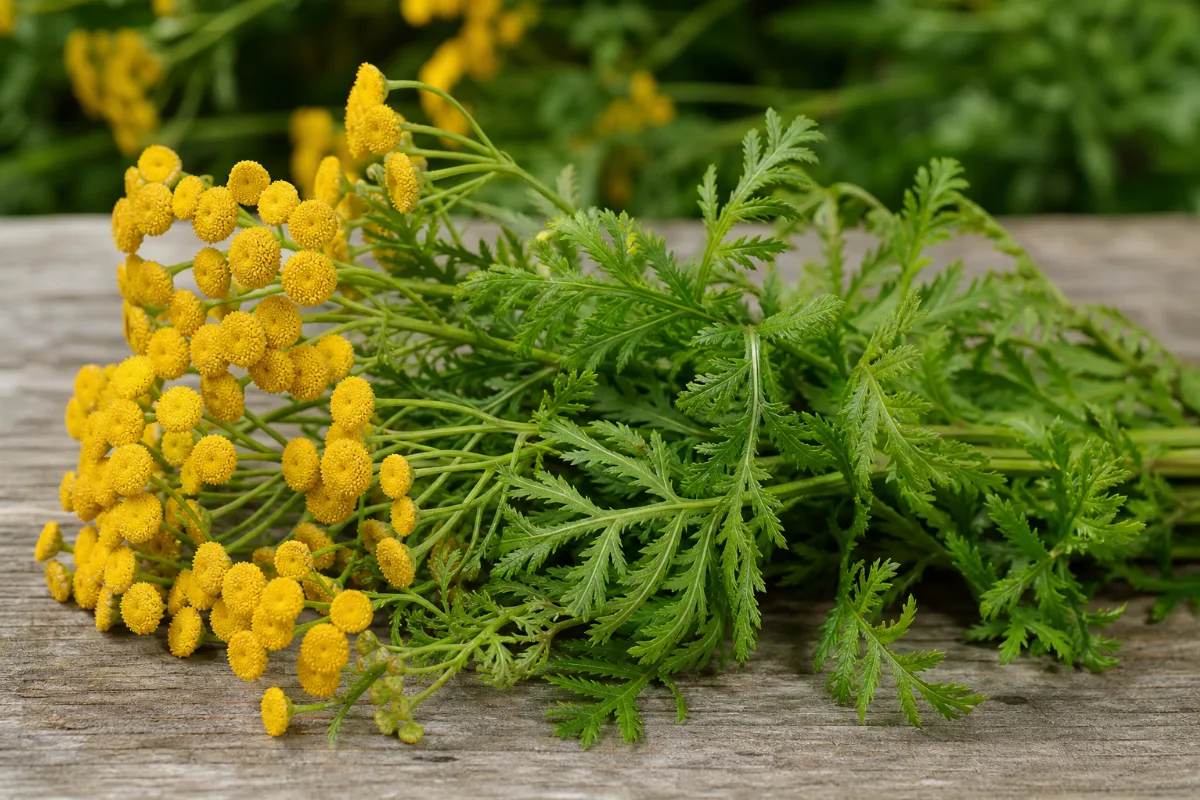
Herbs & Botanicals · Old worm herb, poisonous to swallow
Tansy
Tanacetum vulgare L. · also called Tansy, common tansy
Tansy is a yellow-flowered plant of the daisy family that was once used for intestinal worms, digestion and periods. It is poisonous to swallow, mostly because of thujone, a nerve toxin that can cause seizures, and poisoning deaths have been reported. There are no human trials of tansy, only lab and animal studies. Do not use it in pregnancy, and do not swallow the oil.
General information, not medical advice. Last substantive update · Not medically reviewed. A named clinician has not signed off on this page. How this page is made
About Tansy
Tansy (Tanacetum vulgare) is a poisonous daisy-family herb once used for worms, digestion and periods. No human trials exist. Thujone can cause seizures and tansy oil has caused deaths; avoid it, above all in pregnancy.
Safety first
Tansy is not safe to swallow. The WHO/JECFA thujone monograph says tansy oil causes convulsions and that human deaths have been reported. A consumer reference says people have died after as little as 10 drops of the oil and after teas or powders; we could not trace those cases to named papers.
Do not use it in pregnancy or breastfeeding, and keep it away from children. Do not use the oil. If someone has swallowed tansy and has a seizure, confusion, repeated vomiting or yellow skin, call emergency services or poison control.
What it is
Common tansy (Tanacetum vulgare L.) is a tall perennial of the daisy family (Asteraceae) with button-like yellow flower heads and feathery leaves. It grows along roadsides and meadows and is a listed noxious weed in some US states, after being brought from Europe as a medicine and garden plant.
It is a different plant from feverfew (same genus, Tanacetum parthenium) and from tansy ragwort (Jacobaea vulgaris), whose alkaloids harm the liver. It is also not the 'blue tansy' of aromatherapy oils.
What the research shows
We found no human trials. Studies are in dishes (worm and egg killing, antioxidant tests) and in rats (a memory study with the oil and a diuretic study with a leaf extract). These cannot tell us whether tansy is useful or safe for a person, and the effective amounts in dishes are high.
Traditional use is real but is not proof. Old uses for worms, digestion and periods have never been tested in patients.
Why thujone and camphor matter
Thujone blocks the brain's calming GABA receptor and causes convulsions in animals. How much causes seizures in people is not known. The amount of thujone in tansy varies hugely: from about 6% of one Bulgarian oil to the dominant part of many Norwegian plants and 84% in a Brazilian-tested oil. Some plants are rich in camphor instead.
You cannot tell the type by looking at the plant, and the EMA asks that thujone content be specified for any herbal product. The EMA statement is general; it is not a tansy monograph.
At a glance
Traditional uses history, not proof
- Folk medicine in Europe: used as a worm remedy, antispasmodic and bile-promoting herb, and for diarrhoea and digestive problems (2023 paper)
- Folk use to start periods is listed by a consumer reference; this use is linked to poisoning and miscarriage risk and is not recommended
- Moroccan folk medicine: leaves used as a diuretic
- Introduced to North America from Europe for medicine and as a garden plant; now a noxious weed in some states
Studied for research
- Intestinal worms: killed some worms and eggs in dishes, insufficient (no human data)
- Antioxidant and anti-inflammatory activity in cells, insufficient
- Memory in rats given the oil, insufficient
- Diuretic effect in rats, insufficient
- Digestion and periods: traditional use only, insufficient
Main compounds
- Thujone (alpha and beta), a nerve toxin that blocks GABA-A receptors; content varies from about 6% to over 80% of the oil depending on plant type
- Camphor, high in some plant types (25% in one Bulgarian oil)
- Borneol and 1,8-cineole in the oil
- Sesquiterpene lactones, a class that causes daisy-family skin allergy (which ones occur in tansy was not verified)
- Phenolic acids and flavonoids
Common forms
- Essential oil (the main poisoning risk)
- Dried herb as tea or powder (reported unsafe)
- Capsules (no human trials found)
- Flavouring in thujone-free alcoholic drinks only (US rule)
- Skin products (allergy risk; reported unsafe on skin by a consumer reference)
Research links: EMA public statement on herbal medicines containing thujone · WHO/JECFA thujone monograph · US rule on tansy as a flavouring (21 CFR 172.510) · Research Library · Genes & Biomarkers Library
The plant and its history
- Accepted scientific name
- Tanacetum vulgare L.
- Naming authority
- L. (Linnaeus); ACCEPTED species in the GBIF backbone (key 3118274).
- Synonyms
- GBIF lists infraspecific names such as Tanacetum vulgare var. crispum DC. and subsp. boreale (not a full list).
- Common names
- Tansy (English); Common tansy (English)
- Botanical family
- Asteraceae (daisy family)
- Classification
- Plantae > Tracheophyta > Magnoliopsida > Asterales > Asteraceae > Tanacetum > Tanacetum vulgare
- Native range
- Introduced from Europe to North America (Montana State University). Native range beyond 'Europe' not verified.
- Habitat
- Meadows, riparian areas, roadsides, ditches and railroad tracks; higher-moisture disturbed soil (Montana State University).
- What the plant looks like
- Roots: Creeping rhizomes that form dense patches (Montana State University).; Stems: Often reddish, about 3-4 feet tall, with white sap (Montana State University).; Leaves: Alternate, feathery, pinnately compound with sharply lobed, toothed segments.; Flowers: Yellow button-like heads in flat-topped compact clusters.; Fruit: Reproduces mainly by seed (Montana State University).
- Cultivation
- Not verified in the sources read.
- Harvest and processing
- Flowers, leaves and aerial parts are used for extracts and steam- or hydro-distilled oil in the studies read.
- Look-alikes and adulterants
- Name: Tansy ragwort, Jacobaea vulgaris Gaertn. (syn. Senecio jacobaea); Note: A different species (GBIF key 5388602) with liver-damaging pyrrolizidine alkaloids. Do not confuse. Not the same as common tansy.; Name: Feverfew, Tanacetum parthenium (L.) Sch.Bip.; Note: Same genus, different species (GBIF key 3118430); has its own EU monograph; kept separate on its own page.
- Sustainability and conservation
- Listed as a noxious weed in Montana; not assessed otherwise in the sources read.
Traditional use and history history, not clinical proof
| Tradition or era | Documented use | Source |
|---|---|---|
| Folk medicine in Europe | A 2023 paper says tansy has been used in folk medicine as a worm remedy, antispasmodic and bile-promoting herb, for diarrhoea and digestive problems, and outdoors as an insecticide in veterinary practice. | p37630407 |
| Consumer reference listing | RxList lists use for gut ulcers, gas, poor appetite, migraine and nerve pain, rheumatism, round- and threadworm in children, and to start periods. It says the name comes from the Greek 'athanasia' (immortality) and that tansy was used for embalming (these two statements NOT verified in a primary source). | s-rxlist-tansy |
| North America | Introduced from Europe for medicinal use and as an ornamental plant; now a noxious weed in some US states. | s-msu-tansy |
| Moroccan folk medicine | Tansy leaves are used as a diuretic. | p17113735 |
Traditional use shows how a plant was used. It does not show that a supplement works or is safe today.
What is inside, and how it may work
What the plant contains and how those compounds act in cells and animals. Laboratory and animal mechanisms are not proven effects in people.
Main compounds
| Compound | Family | Where it is concentrated | Activity studied | Level of evidence |
|---|---|---|---|---|
| beta-Thujone PubChem 91456 | monoterpene ketone (volatile oil) | Essential oil of aerial parts Dominant in 22 of 40 Norwegian plants (81% of the thujone fraction); 84.13% of one Brazilian-tested oil | Nerve toxin: blocks the GABA-A receptor in animals 20 7 18 | Animal research |
| alpha-Thujone PubChem 261491 | monoterpene ketone (volatile oil) | Essential oil of aerial parts Dominant in 2 of 40 Norwegian plants | Blocks GABA-A receptors; convulsant in animals 20 8 | Animal research |
| Camphor PubChem 2537 | monoterpene ketone | Essential oil 25.24% of a Bulgarian oil; dominant in 6 of 40 Norwegian plants | Has its own US poison-centre guideline; seizure effect not described in the abstract read 11 20 15 | Laboratory research |
| 1,8-Cineole (eucalyptol) PubChem 2758 | monoterpene ether | Essential oil 5.99% of the Bulgarian oil; main compound in Quebec oil along with camphor and borneol | Part of the oil profile 11 2 | Laboratory research |
| Borneol PubChem 64685 | monoterpene alcohol | Essential oil Named among main compounds in tansy oil by JECFA and in Quebec oil | Part of oil profile 9 2 | Laboratory research |
| Sesquiterpene lactones (specific compounds not verified) | sesquiterpene lactones | Aerial parts (not verified for tansy specifically) | A class of compounds that are the main skin sensitisers in daisy-family plants; which ones occur in tansy was not verified in what we read. 10 17 | Human data |
| Phenolic acids and flavonoids | phenolics | Plant parts compared in the 2021 study 107 compounds identified in extracts (all groups) | Antioxidant activity in test tubes 1 | Laboratory research |
Mechanisms, receptors and pathways
| Target or pathway | Gene or receptor | What was found | Level |
|---|---|---|---|
| GABA-A receptor chloride channel block (thujone) | GABA-A receptor | Thujone inhibits the receptor and causes excitation and convulsions in animals in a dose-dependent way. 18 8 | Animal research |
| Thujone metabolism by liver enzymes | CYP2A6, CYP3A4, CYP2B6 | Human liver preparations metabolise thujone mainly via CYP2A6, then CYP3A4 and CYP2B6. 18 | Laboratory research |
| Nitric oxide production and oxidation (oil) | Not specified | Quebec oil lowered nitric oxide production and blocked intracellular oxidation in cells, driven mainly by alpha-humulene. 2 | Laboratory research |
| Neurotrophic signalling | BDNF | Oil raised hippocampal BDNF in rats; extracts lowered BDNF gene activity in a hypothalamic cell line. Mixed and not human. 14 1 | Animal research |
Absorption, metabolism and elimination
- Absorption
- No data for tansy in people.
- Distribution
- Not studied for tansy.
- Metabolism
- Thujone is broken down mainly by CYP2A6, then CYP3A4 and CYP2B6 in human liver preparations.
- Elimination
- Not studied for tansy.
- Bioavailability
- Unknown. The toxicology review names bioavailability as a main gap.
Isolated compounds versus whole extracts
Oil, water extract and whole herb are very different. Oils range from about 6% thujone with 25% camphor (Bulgaria) to thujone-dominant types (Norway, Brazil-tested oil 84% beta-thujone); water extracts carry little oil. Poisoning reports concern oil and also teas and powders.
Nutritional composition
Tansy is not a food and has no nutritional role. In the US it is allowed as a flavouring only in thujone-free alcoholic drinks.
5 not enough evidence
What is Tansy good for?
The studied uses and how strong the evidence is. 'Insufficient' means there is not enough to judge: here, because there are no human studies at all. These are lab and animal results and give no reason to take tansy.
Benefits, one by one
Each card is a research question, not a promise. Tap a goal to filter. Open a card to see the studies, doses and limits.
Intestinal worms and parasites (traditional use; lab tests only)
Not enough evidenceTansy has been used as a worm remedy in folk medicine. In test tubes, tansy extracts killed some worms and worm eggs. No one has tested it in people, and it is dangerous to swallow.
3 studiesExtracts and oil used in dishes, at high strengths. No dose for peopl…
Studies, doses and limits
What the trials found
No human trial of tansy for this use was found in PubMed. Nothing is known about whether it works or is safe for this in people. The tests below were done on sheep stomach worms and on blood-fluke worms (Schistosoma mansoni) in dishes, not on the human roundworms and threadworms of traditional use.
Results
Schistosoma mansoni: at 200 ug/mL both a crude extract and the essential oil killed all adult worms; at 100 and 50 ug/mL only the extract did. Sheep stomach worms (Trichostrongylidae): ethanol and acetone extracts of leaf and flower stopped larvae from developing in most tests and blocked up to 95.8% of eggs from hatching at the highest strengths tested.
Effect sizes as reported
No effect sizes in animals or people. Lab results only.
Why this rating
Only test-tube studies on worms that are not the usual human gut worms. No animal treatment trial, no human trial.
Form and dose studied
Extracts and oil used in dishes, at high strengths. No dose for people exists; the herb is not safe to swallow.
Who was studied
None tested in people.
Limits
Dish tests do not show that a swallowed herb would clear worms from a body, or would do so safely. Safe, proven worm medicines exist and should be chosen with a doctor or pharmacist.
Why researchers looked
Folk use against gut worms is the most common traditional claim for tansy.
Traditional use
A 2023 paper describes folk use as an anthelmintic (worm remedy), antispasmodic and for diarrhoea and digestive problems; a consumer reference says it was used for roundworm and threadworm in children.
Proposed mechanism Laboratory research
Not worked out. The most tested oil was 84% beta-thujone, a nerve toxin to animals.
A proposed mechanism does not show that the effect happens in people.
Tansy is not safe to swallow. Thujone can cause seizures and tansy oil has caused deaths; see the Safety tab.
Antioxidant and anti-inflammatory activity (lab only)
Not enough evidenceIn test tubes and cell tests, tansy extracts and oil showed antioxidant activity and lowered a marker of inflammation. This does not show a benefit for people.
3 studiesOils and extracts in dishes; amounts are not comparable with any prod…
Studies, doses and limits
What the trials found
No human trial of tansy for this use was found in PubMed. Nothing is known about whether it works or is safe for this in people.
Results
See mechanism. No human or animal disease result is available here.
Effect sizes as reported
None for people.
Why this rating
Lab tests of extracts and oils only. Antioxidant tests in a dish rarely predict an effect in the body.
Form and dose studied
Oils and extracts in dishes; amounts are not comparable with any product.
Who was studied
None.
Limits
Cell results; the same 2021 extracts killed cells at 5-10 times the concentration that changed gene activity, a sign that the useful and harmful ranges may be close.
Why researchers looked
Plants rich in phenols and terpenes are often screened for antioxidant and inflammation markers.
Traditional use
None specific beyond general folk use.
Proposed mechanism Laboratory research
Quebec oil (mainly camphor, borneol and 1,8-cineole) lowered nitric oxide production in cells and blocked intracellular oxidation; alpha-humulene seemed to drive the anti-inflammatory effect. A Bulgarian oil (camphor type) had an antioxidant score of 605.4 +/- 49.3 umol TE/mL (ORAC). A 2021 study found 107 compounds in extracts and stronger activity in hexane and hydroalcoholic than in water extracts.
A proposed mechanism does not show that the effect happens in people.
Tansy is not safe to swallow. Thujone can cause seizures and tansy oil has caused deaths; see the Safety tab.
Memory (one rat study with the essential oil)
Not enough evidenceOne 2026 rat study found better memory-test scores after four weeks of tansy oil. It is not a human result and the oil can be toxic.
3 studiesOil in rats only.
Studies, doses and limits
What the trials found
No human trial of tansy for this use was found in PubMed. Nothing is known about whether it works or is safe for this in people.
Results
Rats given 0.5 or 1.5 mL/kg of tansy oil for 28 days did better in avoidance, spatial and recognition memory tests; hippocampal BDNF rose; no tissue damage was reported.
Effect sizes as reported
No numbers read.
Why this rating
One rat study, doses far above anything safe for people, thujone content not given in the abstract.
Form and dose studied
Oil in rats only.
Who was studied
None.
Limits
Rats are not people. Brain-active oils that boost memory in rats may also lower the seizure threshold (thujone is a convulsant in animals).
Why researchers looked
Tansy is rich in plant chemicals and its effect on thinking had not been tested.
Traditional use
None.
Proposed mechanism Animal research
Authors link it to higher BDNF (a brain growth protein) in the hippocampus. A separate 2021 cell study found extracts lowered BDNF gene activity in a different cell line, so the picture is mixed.
A proposed mechanism does not show that the effect happens in people.
Tansy is not safe to swallow. Thujone can cause seizures and tansy oil has caused deaths; see the Safety tab. Do not use oil to try to improve memory.
Fluid and urine (diuretic effect in rats)
Not enough evidenceTansy leaf water extract made rats pass more urine. No human data exist.
2 studiesWater extract of leaves in rats.
Studies, doses and limits
What the trials found
No human trial of tansy for this use was found in PubMed. Nothing is known about whether it works or is safe for this in people.
Results
In healthy rats, 100 mg/kg water extract raised urine, sodium and potassium; 24-hour urine volume was similar to furosemide. In 8 days only tansy raised urinary potassium. No kidney toxicity seen in that short study.
Effect sizes as reported
No numbers read.
Why this rating
One rat study in healthy animals.
Form and dose studied
Water extract of leaves in rats.
Who was studied
None.
Limits
Short rat study. A reported 'kidney or liver damage' risk exists in poisoning reports (see Safety). Extra potassium loss could matter for people on diuretics (inference only).
Why researchers looked
Tansy leaves are used as a diuretic in Moroccan folk medicine.
Traditional use
A Moroccan study notes tansy leaves are used as a diuretic.
Proposed mechanism Animal research
Rat study suggests at least two active principles, one furosemide-like and one thiazide-like.
A proposed mechanism does not show that the effect happens in people.
Tansy is not safe to swallow. Thujone can cause seizures and tansy oil has caused deaths; see the Safety tab.
Digestive complaints and menstrual use (traditional use only)
Not enough evidenceTansy has been used for stomach and gut problems and for periods. No trials exist, and the plant is poisonous, so this use is not recommended.
2 studiesNone established; not safe to swallow.
Studies, doses and limits
What the trials found
No human trial of tansy for this use was found in PubMed. Nothing is known about whether it works or is safe for this in people.
Results
No results exist.
Effect sizes as reported
None.
Why this rating
Traditional use only; no trial, no regulator endorsement (no EU monograph and no approved medicine for tansy was found).
Form and dose studied
None established; not safe to swallow.
Who was studied
None.
Limits
Traditional use is not evidence of safety. The same uses are linked in sources to poisoning and to miscarriage risk.
Why researchers looked
Old herbals and folk medicine.
Traditional use
A Bulgarian paper lists folk use as antispasmodic, bile-promoting and for diarrhoea and digestive problems; a consumer reference lists stomach and intestinal ulcers, gas and poor appetite, and says some women use tansy to start periods.
Proposed mechanism Pharmacological theory
Not studied.
A proposed mechanism does not show that the effect happens in people.
Taking tansy to start a period is dangerous: it is linked to poisoning and miscarriage risk. See Safety.
Connections to the rest of health
How Tansy connects to the rest of our health knowledge graph. Every link says what kind of connection it is. A safety link (for example to the liver) is a warning, not a benefit. A study that merely mentions a topic never creates a benefit link.
Explore every connection: goals, body systems, organs, symptoms, genes
A. Wellness goals
| Connected to | Kind of connection | Evidence status | Context | Studies |
|---|---|---|---|---|
| Digestive Support | Traditional use | Not enough evidence | Intestinal worms and parasites (traditional use; lab tests only): Tansy has been used as a worm remedy in folk medicine. In test tubes, tansy extracts killed some worms and worm eggs. No one has tested it in people, and it is dangerous to swallow. Digestive complaints and menstrual use (traditional use only): Tansy has been used for stomach and gut problems and for periods. No trials exist, and the plant is poisonous, so this use is not recommended. | 7 12 21 11 |
| Inflammation Balance | Preliminary mechanism | Not enough evidence | Antioxidant and anti-inflammatory activity (lab only): In test tubes and cell tests, tansy extracts and oil showed antioxidant activity and lowered a marker of inflammation. This does not show a benefit for people. | 2 11 1 |
| Memory Support | Preliminary mechanism | Not enough evidence | Memory (one rat study with the essential oil): One 2026 rat study found better memory-test scores after four weeks of tansy oil. It is not a human result and the oil can be toxic. | 14 1 9 |
| Detoxification Support | Preliminary mechanism | Not enough evidence | Fluid and urine (diuretic effect in rats): Tansy leaf water extract made rats pass more urine. No human data exist. | 13 21 |
| Womens Wellness | Traditional use | Not enough evidence | Digestive complaints and menstrual use (traditional use only): Tansy has been used for stomach and gut problems and for periods. No trials exist, and the plant is poisonous, so this use is not recommended. | 11 21 |
B. Body systems
| Connected to | Kind of connection | Evidence status | Context | Studies |
|---|---|---|---|---|
| Nervous system | Adverse effect or risk | Low certainty | Convulsions in poisoning; GABA-A block in animals. Preparation or compound: Thujone; tansy oil |
9 18 |
| Hepatic system | Adverse effect or risk | Low certainty | Hepatitis and liver damage listed in poisoning. Preparation or compound: Tansy oil |
9 |
| Reproductive system | Contraindication | Low certainty | Avoid in pregnancy (consumer reference, extension page, EMA caution). Preparation or compound: Tansy herb and oil |
21 16 4 |
| Digestive System | Biological association | Not enough evidence | Studied for: Intestinal worms and parasites (traditional use; lab tests only) Studied for: Digestive complaints and menstrual use (traditional use only) | 7 12 21 11 |
| Immune System | Biological association | Not enough evidence | Studied for: Antioxidant and anti-inflammatory activity (lab only) | 2 11 1 |
| Nervous System | Biological association | Not enough evidence | Studied for: Memory (one rat study with the essential oil) | 14 1 9 |
| Urinary System | Biological association | Not enough evidence | Studied for: Fluid and urine (diuretic effect in rats) | 13 21 |
| Reproductive System | Biological association | Not enough evidence | Studied for: Digestive complaints and menstrual use (traditional use only) | 11 21 |
I. Biomarkers
| Connected to | Kind of connection | Evidence status | Context | Studies |
|---|---|---|---|---|
| Worm death and egg hatching in a dish | Biological association | Not enough evidence | Measured in trials: raised. A lab change is not the same as a health benefit. | 7 12 |
| Nitric oxide production in cells (inflammation marker) | Biological association | Not enough evidence | Measured in trials: lowered. A lab change is not the same as a health benefit. | 2 |
| BDNF in the rat hippocampus | Biological association | Not enough evidence | Measured in trials: raised. A lab change is not the same as a health benefit. | 14 1 |
| Urine volume and electrolytes (rats) | Biological association | Not enough evidence | Measured in trials: raised. A lab change is not the same as a health benefit. | 13 |
J. Genes, receptors and enzymes
| Connected to | Kind of connection | Evidence status | Context | Studies |
|---|---|---|---|---|
| GABA-A receptor (GABR genes) | Preliminary mechanism | Animal | Thujone blocks it; basis of the seizure warnings. | 18 8 |
| CYP2A6, CYP3A4, CYP2B6 | Preliminary mechanism | In vitro | Thujone-metabolising enzymes; possible drug interactions. | 18 |
| BDNF | Preliminary mechanism | Animal | Raised in rat hippocampus after oil; lowered in a cell line. | 14 1 |
L. Active compounds
| Connected to | Kind of connection | Evidence status | Context | Studies |
|---|---|---|---|---|
| beta-Thujone | Biological association | Animal | Nerve toxin: blocks the GABA-A receptor in animals Preparation or compound: Essential oil of aerial parts |
20 7 18 |
| alpha-Thujone | Biological association | Animal | Blocks GABA-A receptors; convulsant in animals Preparation or compound: Essential oil of aerial parts |
20 8 |
| Camphor | Biological association | In vitro | Has its own US poison-centre guideline; seizure effect not described in the abstract read Preparation or compound: Essential oil |
11 20 15 |
| 1,8-Cineole (eucalyptol) | Biological association | In vitro | Part of the oil profile Preparation or compound: Essential oil |
11 2 |
| Borneol | Biological association | In vitro | Part of oil profile Preparation or compound: Essential oil |
9 2 |
| Sesquiterpene lactones (specific compounds not verified) | Biological association | Human | A class of compounds that are the main skin sensitisers in daisy-family plants; which ones occur in tansy was not verified in what we read. Preparation or compound: Aerial parts (not verified for tansy specifically) |
10 17 |
| Phenolic acids and flavonoids | Biological association | In vitro | Antioxidant activity in test tubes Preparation or compound: Plant parts compared in the 2021 study |
1 |
Each connection is stored with the ingredient, the connected record, the kind of connection, the evidence status, the supporting studies, the preparation or compound involved, and a review date (last reviewed October 25, 2026).
Evidence at a glance: what changed in 4 lab markers
Tap a number to show only those markers. Counts are markers, not people.
The evidence
The research centre for Tansy. Every record here was checked against PubMed or the publisher's page; we never list a study we have not verified.
Evidence by outcome
Bars show how many studies we found for each outcome, not how well it works. People are added up across trials only (reviews are not added, to avoid double counting).
How we rate evidence
High certainty
Several well-run trials or reviews agree; further research is unlikely to change the picture much.
Moderate certainty
Good trials point the same way, but some doubt remains.
Low certainty
Small, short or inconsistent trials. The finding could change with better research.
Very low certainty
Very little or very weak human data. Treat as a possibility only.
Mixed findings
Trials or reviews disagree with each other.
Not enough evidence
Not enough human research to say either way.
Evidence against
Good research found no benefit, or found harm.
We take the reviewers' own risk-of-bias and GRADE statements where they exist, and otherwise judge from study size, design, consistency, directness and whether a product matches what is sold. Many publications do not make evidence high. Method note: We searched PubMed, read the WHO/JECFA thujone monograph, the EMA public statement on thujone, the US flavouring rule (21 CFR 172.510 via Cornell), a consumer drug reference (RxList) and a university extension page, and checked plant names in GBIF and NCBI and compounds in PubChem. Only abstracts were read for PubMed studies. Not verified: no NCCIH, EU tansy monograph, Health Canada, LiverTox or LactMed entry was found; EU flavouring limits could not be opened; the 1852 case report was not read; death and miscarriage statements come from a consumer reference and an extension page. Certainty ratings are the compiler's own reading. No study is cited that we could not verify.
Study library: every study we checked 23
| Study | Design | People | Product, dose, length | Result |
|---|---|---|---|---|
| Ak 2021 Tanacetum vulgare L. (Tansy) as an effective bioresource with promising pharmacological effects from natural arsenal. Food Chem Toxicol · PMID 34015423 · DOI |
Laboratory study (chemical profile, enzyme tests, cell test) in-vitro |
Hexane, hydroalcoholic and water extracts of tansy plant parts, tested in test tubes and in a hypothalamic cell line | Tansy extracts (hexane, hydroalcoholic, water) aerial parts (plant parts compared) Not applicable Not applicable · vs Not applicable |
107 compounds were identified (phenolic acids, flavonoids, terpenoids, fatty acids). Hexane and hydroalcoholic extracts were stronger than water in antioxidant and enzyme tests. At 10 ug/mL extracts changed gene activity (DAT up; TNF-alpha and BDNF down) and norepinephrine release in cells; at 50-100 ug/mL they reduced cell survival. Shows chemistry and test-tube activity only (Not applicable) Methods, limits and fundingOutcomes: Chemical profile, antioxidant tests, enzyme inhibition, cell viability and gene expression Limitations: Cell and enzyme tests. Concentrations and results cannot be moved to people. The same extracts killed cells at 5-10 times the 'helpful' concentration. Funding and conflicts: Not stated in the abstract Read: abstract |
| Cote 2017 Anti-Inflammatory, Antioxidant, Antibiotic, and Cytotoxic Activities of Tanacetum vulgare L. Essential Oil and Its Constituents. Medicines (Basel) · PMID 28930249 · DOI |
Laboratory study in-vitro |
Cell-based tests of Quebec tansy oil and its main compounds | Essential oil (steam distilled) aerial parts In culture In culture · vs Not applicable |
Main compounds were camphor, borneol and 1,8-cineole. The oil lowered nitric oxide production (anti-inflammatory test) and blocked intracellular oxidation; the anti-inflammatory effect seemed driven mainly by alpha-humulene. Test-tube anti-inflammatory and antioxidant activity (Not applicable) Methods, limits and fundingOutcomes: Oil chemistry, nitric oxide, antioxidant cell test Limitations: Only the first part of the abstract was read for the antioxidant and anti-inflammatory results; antibiotic and cytotoxic results are not described here. Cells only. Funding and conflicts: Not stated in the abstract Read: abstract |
| Dalton JC Jr 1852 A Case of Poisoning with Oil of Tansy (West J Med Surg 1852;10(5):440-443) Dalton JC Jr, West J Med Surg · Source |
Historical case report (record only) not applicable |
Not applicable | Tansy (Tanacetum vulgare) and thujone essential oil Not applicable Not applicable · vs Not applicable |
Only the title, journal reference and PubMed ID 38210582 were seen. The scanned text was not read, so no clinical details are given here. Not applicable (Not applicable) Methods, limits and fundingOutcomes: Safety and regulatory information Limitations: Scanned 19th-century article; contents NOT read. Funding and conflicts: Not applicable Read: record only (title and citation) |
| European Medicines Agency 2012 Public statement on the use of herbal medicinal products containing thujone (EMA/HMPC/732886/2010 Rev. 1) European Medicines Agency, HMPC · Source |
Regulator public statement not applicable |
Not applicable | Tansy (Tanacetum vulgare) and thujone aerial parts Not applicable Not applicable · vs Not applicable |
Names tansy among plants whose oils contain thujone in highly variable amounts (with cedar leaf, sage, wormwood, thyme, rosemary). Calls thujone a severe neurotoxicant, though views differ. Says there are no studies allowing assessment of sensitive groups such as pregnant women and children, so thujone-containing herbal products in these groups should be minimised, and that the amount of thujone in a preparation needs to be specified. Not applicable (Not applicable) Methods, limits and fundingOutcomes: Safety and regulatory information Limitations: This is a general thujone statement. It is NOT a tansy monograph; the tansy herb itself has no EU monograph that we found. Text extracted from the PDF automatically. Funding and conflicts: Not applicable Read: full text read 2026-10-25 |
| GBIF 2026 GBIF Backbone: Jacobaea vulgaris Gaertn. (tansy ragwort) GBIF · Source |
Taxonomy database not applicable |
Not applicable | Tansy (Tanacetum vulgare) and thujone not applicable Not applicable Not applicable · vs Not applicable |
ACCEPTED species, key 5388602, family Asteraceae. A separate species from Tanacetum vulgare. Not applicable (Not applicable) Methods, limits and fundingOutcomes: Safety and regulatory information Limitations: Database record only. Funding and conflicts: Not applicable Read: API response read 2026-10-25 |
| GBIF 2026 GBIF Backbone: Tanacetum vulgare L. GBIF · Source |
Taxonomy database not applicable |
Not applicable | Tansy (Tanacetum vulgare) and thujone not applicable Not applicable Not applicable · vs Not applicable |
ACCEPTED species, key 3118274, family Asteraceae, order Asterales, exact match (confidence 99). Synonym list includes Tanacetum vulgare var. crispum DC. and subsp. boreale. Not applicable (Not applicable) Methods, limits and fundingOutcomes: Safety and regulatory information Limitations: Database record only. Funding and conflicts: Not applicable Read: API response read 2026-10-25 |
| Godinho 2014 Anthelmintic activity of crude extract and essential oil of Tanacetum vulgare (Asteraceae) against adult worms of Schistosoma mansoni. ScientificWorldJournal · PMID 24672320 · DOI |
Laboratory study in-vitro |
Adult Schistosoma mansoni worms in culture | Crude extract and essential oil of tansy aerial parts (oil 84% beta-thujone) aerial parts 50-200 ug/mL (in culture) In culture · vs Not applicable |
At 200 ug/mL both extract and oil killed all adult worms; at 100 and 50 ug/mL only the extract did. Extract also reduced egg production. Killed blood-fluke worms in a dish (Not applicable) Methods, limits and fundingOutcomes: Worm movement, death, eggs Limitations: Test tube only. Schistosomes are blood flukes, not the roundworms or threadworms of traditional use. Not tested in animals or people. Funding and conflicts: Not stated in the abstract Read: abstract |
| Hold 2000 Alpha-thujone (the active component of absinthe): gamma-aminobutyric acid type A receptor modulation and metabolic detoxification. Proc Natl Acad Sci U S A · PMID 10725394 · DOI |
Laboratory and animal study animal |
Not read in this file (title only) | Alpha-thujone (isolated compound) Not applicable Not applicable Not applicable · vs Not applicable |
The PubMed title states that alpha-thujone modulates the GABA-A receptor and is metabolically detoxified. Abstract not re-read for numbers in this file; used only for the mechanism named in its title and in the EMA statement. Thujone acts on the brain's main calming (GABA) receptor (Not applicable) Methods, limits and fundingOutcomes: Mechanism of thujone nerve toxicity Limitations: Title and EMA description used for the mechanism; no numbers quoted. Not tested in people. Funding and conflicts: Not stated in the abstract Read: title (abstract not re-read for this file) |
| IPCS INCHEM / JECFA n/d Thujone (monograph 519), WHO Food Additives Series 16 IPCS INCHEM / JECFA · Source |
Regulator style toxicology monograph not applicable |
Not applicable | Tansy (Tanacetum vulgare) and thujone essential oil Not applicable Not applicable · vs Not applicable |
Tansy oil is about half thujones (alpha and beta) plus camphor and borneol. Acute oral LD50 in rats 1.15 g/kg; toxic to dogs at 300 mg/kg by mouth. Oil of tansy causes convulsions; signs of poisoning include vomiting, gastroenteritis, flushing, cramps, loss of consciousness, rapid breathing, heart rhythm problems, bleeding from the gut and hepatitis; death by circulatory or respiratory arrest and organ damage; human fatalities have been reported. Undiluted oil did not irritate human skin in a 48-hour patch test and did not sensitise 25 volunteers. Not applicable (Not applicable) Methods, limits and fundingOutcomes: Safety and regulatory information Limitations: Old monograph (year not shown on the page); case details not given; not a clinical review. Funding and conflicts: Not applicable Read: full text read 2026-10-25 |
| Jovanovic 2003 [Compositae dermatitis]. Med Pregl · PMID 12793186 · DOI |
Narrative review (article in Croatian, English abstract) |
Review of daisy-family contact allergy | Daisy-family plants incl. tansy various Not applicable Not applicable · vs Not applicable |
Compositae allergy is among the top ten contact allergies in Europe; sesquiterpene lactones are the main sensitisers. The abstract lists feverfew (70-90%), tansy (54%) and dandelion (65%) among wild-growing sensitising plants; the abstract does not say exactly what the percentages are a share of. Daisy-family contact allergy is common and tansy is on the list (Not applicable) Methods, limits and fundingOutcomes: Causes and frequency of Compositae dermatitis Limitations: Percentages are not clearly defined in the abstract; use only as 'tansy is a recognised sensitiser'. Funding and conflicts: Not stated in the abstract Read: abstract |
| Karcheva-Bahchevanska 2023 A Study of the Chemical Composition, Antioxidant Potential, and Acute Toxicity of Bulgarian Tanacetum vulgare L. Essential Oil. Molecules · PMID 37630407 · DOI |
Laboratory and rat study animal |
Wild tansy flower oil from the western Rhodope Mountains, Bulgaria; Wistar rats | Essential oil of the inflorescences inflorescences (flower heads) Single dose Single dose · vs Not applicable |
Camphor chemotype: camphor 25.24%, trans-chrysanthenyl acetate 18.35%, cis-verbenol 10.58%, thujone 6.06%, 1,8-cineole 5.99%. ORAC 605.4 +/- 49.3 umol TE/mL. Found non-toxic by mouth in a single-dose rat test; intraperitoneal LD50 14.9 g/kg. Low-thujone oil was not acutely toxic by mouth in rats (Not applicable) Methods, limits and fundingOutcomes: Oil composition, antioxidant capacity (ORAC), acute toxicity in rats Limitations: Single-dose rat test of a low-thujone oil. It does not cancel the human poisoning reports, which involve oils and plants of other types. Funding and conflicts: No conflict of interest declared Read: abstract |
| Klavina 2023 Anthelmintic Activity of Tanacetum vulgare L. (Leaf and Flower) Extracts against Trichostrongylidae Nematodes in Sheep In Vitro. Animals (Basel) · PMID 37443974 · DOI |
Laboratory study in-vitro |
Sheep stomach-worm eggs and larvae in culture | Ethanol and acetone extracts of tansy leaves and flowers leaves and flowers 10-500 mg/mL (in culture) In culture · vs Not applicable |
All extracts showed egg- and larva-killing activity; larvae were fully inhibited by most extracts, egg inhibition reached 95.8% and 93.3% for two leaf extracts. Killed sheep worm eggs and larvae in a dish (Not applicable) Methods, limits and fundingOutcomes: Egg hatching and larval development Limitations: Test tube only, in sheep parasites, at high concentrations. No result in living animals or people. Funding and conflicts: No conflict of interest declared Read: abstract |
| Lahlou 2007 Diuretic activity of the aqueous extracts of Carum carvi and Tanacetum vulgare in normal rats. J Ethnopharmacol · PMID 17113735 · DOI |
Rat study animal |
Male Wistar rats, single dose and 8-day dosing | Water extract of tansy leaves (also caraway fruit) leaves 100 mg/kg (rats) Single dose and 8 days · vs Furosemide 10 mg/kg and untreated rats |
Tansy extract raised urine output at all time points; after 24 h the volume was similar to furosemide. Sodium and potassium in urine rose; in the 8-day test only tansy raised potassium loss. No kidney toxicity or other adverse effects seen during the study. Water extract acted as a diuretic in normal rats (Not applicable) Methods, limits and fundingOutcomes: Urine volume, sodium and potassium Limitations: Healthy rats, short study. Potassium loss is a reason for caution with diuretic medicines (inference, not tested in people). Funding and conflicts: Not stated in the abstract Read: abstract |
| Lechkova 2026 Neurocognitive and Memory-Enhancing Effect of Tanacetum vulgare Essential Oil: Involvement of Hippocampal Neurotrophic Signaling. Pharmaceutics · PMID 42076101 · DOI |
Rat study animal |
Rats given tansy oil for 28 days, with behavioural tests after one week | Tansy essential oil (0.5 and 1.5 mL/kg) essential oil (plant part not stated in the abstract) 0.5 and 1.5 mL/kg 28 days · vs Control rats (not detailed in the abstract) |
Both doses improved short- and long-term memory traces in avoidance tasks (stronger at the lower dose); spatial and recognition memory were better at both doses; hippocampal BDNF rose, with no tissue changes reported. Better memory-test results in rats (Not applicable) Methods, limits and fundingOutcomes: Memory tests, hippocampal BDNF Limitations: Rat study only; dose in mL/kg of oil is not a safe human amount and thujone content of the oil is not given in the abstract. Not a human finding. Funding and conflicts: No conflict of interest declared Read: abstract |
| Manoguerra 2006 Camphor Poisoning: an evidence-based practice guideline for out-of-hospital management. Clin Toxicol (Phila) · PMID 16809137 · DOI |
Expert consensus poison centre guideline |
People exposed to camphor-containing products | Camphor-containing products Not applicable Not applicable Not applicable · vs Not applicable |
US poison centres handled about 10,000 camphor ingestions a year (1990-2003). The guideline sets a hospital-referral threshold and says any deliberate or malicious exposure goes straight to hospital. It applies to camphor alone, not to mixtures such as plant oils. Camphor has its own poison-centre guideline (Not applicable) Methods, limits and fundingOutcomes: When to refer camphor exposures to hospital Limitations: The part of the abstract read does not describe camphor's effects. Camphor is a main part of some tansy oils (JECFA lists camphor; one Bulgarian oil was 25% camphor), but no tansy case was linked to camphor in what we read. Funding and conflicts: Written for the American Association of Poison Control Centers Read: abstract |
| Montana State University Extension 2023 Common tansy (Tanacetum vulgare), Monthly weed post 2023 Montana State University Extension · Source |
University extension page not applicable |
Not applicable | Tansy (Tanacetum vulgare) and thujone aerial parts Not applicable Not applicable · vs Not applicable |
Common tansy is an exotic perennial of the daisy family on Montana's noxious weed list, introduced from Europe for medicine and as an ornamental. It contains thujone, described as a toxin that can cause miscarriages, convulsions, stomach pain and skin irritation, and is considered toxic to livestock and humans if enough is eaten; it is unpalatable so livestock poisoning is rare. Not applicable (Not applicable) Methods, limits and fundingOutcomes: Safety and regulatory information Limitations: A weed-control page, not a medical source. Funding and conflicts: Not applicable Read: full text read 2026-10-25 |
| Paulsen 2001 Sensitization and cross-reaction patterns in Danish Compositae-allergic patients. Contact Dermatitis · PMID 11683829 · DOI |
Patch test case series |
190 190 Danish patients with proven daisy-family contact allergy over 8 years |
Patch tests with daisy-family extracts including tansy aerial parts (extract) Not applicable Not applicable · vs Not applicable |
Feverfew gave the most positive reactions, followed by tansy, wild chamomile, yarrow and arnica. Cross-reactions between chrysanthemum and feverfew/tansy/chamomile may explain part of the pattern. Tansy triggers skin reactions in people already allergic to daisy-family plants (Not applicable) Methods, limits and fundingOutcomes: Positive patch-test reactions Limitations: Patients were already known to be allergic. It does not give the chance of allergy in the general public. Funding and conflicts: Not stated in the abstract Read: abstract |
| Pelkonen 2013 Thujone and thujone-containing herbal medicinal and botanical products: toxicological assessment. Regul Toxicol Pharmacol · PMID 23201408 · DOI |
Toxicology review animal |
Review of animal, lab and human-liver-preparation data on thujone | Thujone (isolated compound) and thujone-containing herbs Not applicable Not applicable Not applicable · vs Not applicable |
Thujone blocks the GABA-A receptor and causes excitation and convulsions in animals in a dose-dependent way; nerve toxicity is the main outcome in acute and long-term studies; some equivocal evidence of cancer in rats. In human liver preparations CYP2A6 is the main metabolising enzyme, then CYP3A4, then CYP2B6. The authors say the data for setting safe limits are of variable use and give a best estimate of 3-7 mg a day from herbal products and diet. Main gaps: human dose-effect data and bioavailability. Authoritative review of thujone, not of tansy itself (Not applicable) Methods, limits and fundingOutcomes: Toxicity, metabolism, exposure limits Limitations: The abstract does not name tansy. It treats thujone as a group; tansy thujone content varies widely. Funding and conflicts: Not stated in the abstract Read: abstract |
| Pietkiewicz 2015 Human Dermatitis After Skin Exposure to Jacobaea vulgaris and Spectrum of Health Hazards Induced by This Plant to Humans and Livestock. J Agromedicine · PMID 25906282 · DOI |
Case report and review |
1 A migrant farm worker with blistering dermatitis, plus review |
Tansy ragwort (Jacobaea vulgaris) sap whole plant (sap) Not applicable Contact · vs Not applicable |
Sesquiterpene lactones in tansy ragwort sap cause allergic and light-triggered dermatitis; its pyrrolizidine alkaloids are a serious threat to livestock after eating it. The plant is a noxious weed regulated in many countries. A different plant from common tansy (Not applicable) Methods, limits and fundingOutcomes: Dermatitis; hazards of the plant Limitations: This is tansy ragwort, NOT common tansy. It is cited only to show the two must not be confused. Funding and conflicts: Not stated in the abstract Read: abstract |
| Rohloff 2004 Chemotypical variation of tansy (Tanacetum vulgare L.) from 40 different locations in Norway. J Agric Food Chem · PMID 15030239 · DOI |
Plant chemistry study plant |
40 Wild tansy from 40 Norwegian locations grown together for 2 years |
Essential oil of leaves and flower buds (hydrodistillation) aerial parts (leaves and flower buds) Not applicable Not applicable · vs Not applicable |
Oil yield 0.35-1.90% (average 0.81%). Seven chemotypes: alpha-thujone (2 plants), beta-thujone (22), camphor (6), chrysanthenyl acetate/chrysanthenol (3), chrysanthenone (2), artemisia ketone/alcohol (3), 1,8-cineole (2). Thujone plants were dominated by beta-thujone. Two plants from the same field can have very different oil (Not applicable) Methods, limits and fundingOutcomes: Oil yield and oil chemistry Limitations: Norwegian plants only; other regions have other mixes. Plant chemistry, not toxicity. Funding and conflicts: Not stated in the abstract Read: abstract |
| RxList (consumer drug reference) n/d Tansy (RxList supplements monograph) RxList (consumer drug reference) · Source |
Consumer reference not applicable |
Not applicable | Tansy (Tanacetum vulgare) and thujone aerial parts Not applicable Not applicable · vs Not applicable |
States tansy is unsafe by mouth: people have died after as little as 10 drops of oil, and deaths are reported from teas or powders; short of death it can cause restlessness, vomiting, severe diarrhoea, stomach pain, dizziness, tremors, kidney or liver damage, bleeding, abortion in pregnant women and seizures. Unsafe on the skin (severe reaction), unsafe in pregnancy and breastfeeding; possible allergy in ragweed/daisy-family allergy; concern in porphyria; alcohol interaction rated Major (added drowsiness). Says there is not enough science to give a dose. Warns not to confuse with tansy ragwort. Not applicable (Not applicable) Methods, limits and fundingOutcomes: Safety and regulatory information Limitations: Consumer reference without cited case details; the 'deaths' and 'miscarriage' statements could not be traced to named papers here. Funding and conflicts: Not applicable Read: full text read 2026-10-25 |
| US Food and Drug Administration (via Cornell LII) n/d 21 CFR 172.510: Natural flavoring substances and natural substances used in conjunction with flavors US Food and Drug Administration (via Cornell LII) · Source |
Regulation not applicable |
Not applicable | Tansy (Tanacetum vulgare) and thujone aerial parts Not applicable Not applicable · vs Not applicable |
Tansy (Tanacetum vulgare L.) appears in the list of natural flavouring substances with the condition 'in alcoholic beverages only; finished alcoholic beverage thujone free'. Not applicable (Not applicable) Methods, limits and fundingOutcomes: Safety and regulatory information Limitations: Read through Cornell LII's copy, not the eCFR site; the date of the version was not checked. Funding and conflicts: Not applicable Read: full text read 2026-10-25 |
| Wiedenfeld H. 2011 Plants containing pyrrolizidine alkaloids: toxicity and problems. Food Addit Contam Part A · PMID 21360374 · DOI |
Review |
Review of PA-containing plants | Pyrrolizidine alkaloid plants incl. Jacobaea vulgaris (syn. Senecio jacobaea) various Not applicable Not applicable · vs Not applicable |
PAs are toxic to people and livestock; the liver is the first target organ; many human poisonings are reported, mostly from food contamination; the Jacobaea vulgaris problem in Europe is named. Explains why tansy ragwort is dangerous (Not applicable) Methods, limits and fundingOutcomes: Toxicity of PA plants Limitations: About tansy ragwort and other PA plants, not common tansy. The abstract does not say common tansy contains PAs. Funding and conflicts: Not stated in the abstract Read: abstract |
What we do not know yet
- What the evidence supports: nothing about benefit. There are no human trials of tansy.
- What is uncertain: how much thujone or camphor causes harm in people, how common poisoning is, and the exact details of the reported deaths.
- Not verified: the 1852 case report text was not read; EU flavouring limits, Health Canada, LiverTox, LactMed and WHO/Commission E were not confirmed.
How new research is added
New studies are found by a saved PubMed search and are placed in a review queue. A person reads each one before it changes any evidence rating or safety wording.
Lab markers
What changed in blood or saliva tests during trials. A changed number is not the same as feeling or being healthier, and we give no "normal ranges".
Other 4
Worm death and egg hatching in a dish
Raised in trials
The share of parasite worms, larvae or eggs killed or blocked when exposed to tansy extract in a lab dish.
Not enough evidenceResults and what it means
Why it was measured
A first screen for possible worm-killing action.
Statistical vs. clinical meaning
A dish result is not a clinical result. It says nothing about safe or effective use in a person.
Safety implication
The most worm-active oil was mostly beta-thujone, which is toxic to nerves.
| Study | Result | People | Product |
|---|---|---|---|
| 7 | 100% death of adult S. mansoni worms at 200 ug/mL (extract and oil); extract alone also at 100 and 50 ug/mL | Adult worms in culture | Crude extract and oil of tansy aerial parts |
| 12 | Larval inhibition up to 100% for most extracts; egg inhibition 95.8% (50% acetone leaf extract, 200 mg/mL) and 93.3% (50% ethanol leaf extract, 500 mg/mL) | Sheep stomach worms (Trichostrongylidae) in culture | Ethanol and acetone extracts of leaf and flower |
Nitric oxide production in cells (inflammation marker)
Lowered in trials
Nitric oxide made by immune cells in a dish is used as a quick test for anti-inflammatory activity.
Not enough evidenceResults and what it means
Why it was measured
Screening for anti-inflammatory action.
Statistical vs. clinical meaning
Lab marker only; not a symptom or disease outcome.
Safety implication
None for the marker itself.
| Study | Result | People | Product |
|---|---|---|---|
| 2 | Tansy oil from northern Quebec lowered nitric oxide production; effect driven mainly by alpha-humulene (numbers not read) | Cells in culture | Steam-distilled essential oil and its main compounds |
BDNF in the rat hippocampus
Raised in trials
BDNF is a protein that supports nerve cell growth. Here it was measured in rat brain tissue.
Not enough evidenceResults and what it means
Why it was measured
Proposed as the way the oil improved memory.
Statistical vs. clinical meaning
Two animal/cell results point in different directions; neither is a human outcome.
Safety implication
None for the marker.
Urine volume and electrolytes (rats)
Raised in trials
How much urine and how much sodium and potassium rats passed after the extract.
Not enough evidenceResults and what it means
Why it was measured
Standard test for a diuretic.
Statistical vs. clinical meaning
Animal result in healthy rats only.
Safety implication
Potassium loss is a possible concern with other diuretics (inference).
| Study | Result | People | Product |
|---|---|---|---|
| 13 | Urine output rose at all time points; 24-hour volume similar to furosemide; sodium and potassium in urine rose | Healthy male Wistar rats | Water extract of tansy leaves 100 mg/kg |
Safety
What studies and official sources say about side effects, medicines and who should check first. Each point shows what kind of evidence it comes from.
Main points to know 6
- Tansy is not safe to swallow, and the oil is the main danger. Tansy contains thujone and, depending on the plant, camphor. The WHO/JECFA monograph says tansy oil causes convulsions, that poisoning signs include vomiting, gastroenteritis, loss of consciousness, heart rhythm problems, bleeding from the gut and hepatitis, and that human deaths have been reported. A consumer reference says people have died after as little as 10 drops of oil and after teas or powders. Details of individual cases could not be traced here (the 1852 case report's text was not read). Authoritative guidance 9 21 3
- Thujone can cause seizures. In animals thujone blocks the GABA-A receptor, the brain's main calming switch, and causes convulsions in a dose-dependent way. The EMA calls thujone a severe neurotoxicant, though some experts rate the human risk lower. How much it takes to cause seizures in people is not known. Thujone content in tansy varies from about 6% of the oil (Bulgarian camphor type) to about half or more (other types), and you cannot tell by looking at a plant or most labels. Animal research 8 18 4 11 20
- Do not use in pregnancy or breastfeeding. A consumer reference says tansy is unsafe in pregnancy because it may bring on bleeding and contractions and can cause miscarriage, and unsafe when breastfeeding. A university extension page says thujone can cause miscarriage and reports abortion in cattle after large amounts. The EMA says there are no studies to assess thujone in pregnant women and children, so exposure in these groups should be minimised. No clinical study was found; the warning rests on reference works and animal reports. Authoritative guidance 21 16 4
- Liver, kidney and bleeding harm are listed in poisoning. The JECFA monograph lists hepatitis and gut bleeding in tansy oil poisoning; the consumer reference adds kidney or liver damage. No LiverTox record for tansy was found, so there is no formal liver-injury rating, and no case series with lab values was read. Authoritative guidance 9 21
- Daisy-family skin allergy. Tansy is in the daisy family (Asteraceae). In a Danish patch-test series of 190 people already allergic to daisy-family plants, tansy was among the plants that most often caused a positive skin test (after feverfew). A review lists tansy among recognised sensitising plants. People allergic to ragweed, chrysanthemum, chamomile or feverfew may react. Case series 17 10 21
- Do not confuse with tansy ragwort. Tansy ragwort (Jacobaea vulgaris, also called Senecio jacobaea) is a different plant. Its pyrrolizidine alkaloids damage the liver and are a known problem for livestock and people. Nothing we read says common tansy (Tanacetum vulgare) contains these alkaloids, so the two are kept apart on this page. 'Blue tansy' oil comes from another species too and is not covered here. Authoritative guidance 19 23 5 6
Side effects 5
| Effect | How often | Severity and recovery | Evidence |
|---|---|---|---|
| Convulsions or seizures, tremors, loss of consciousness Mostly linked to the essential oil. Animal work shows the mechanism (GABA-A block). | Not established | severe Not stated in the sources read. Deaths have been reported. | Authoritative guidance 9 21 |
| Vomiting, severe diarrhoea, stomach pain, gastroenteritis Listed poisoning signs; no frequency is given. | Not established | moderate to severe Not stated. | Authoritative guidance 9 21 |
| Dizziness, restlessness, rapid breathing, heart rhythm problems Listed poisoning signs. | Not established | moderate to severe Not stated. | Authoritative guidance 9 21 |
| Gut bleeding, hepatitis, kidney or liver damage Listed in poisoning from the oil; not confirmed by any case series we could read. | Not established | severe Not stated. | Authoritative guidance 9 21 |
| Skin reactions (rash, allergic contact dermatitis) The JECFA monograph found undiluted oil non-irritating in a 48-hour human patch test and non-sensitising in 25 volunteers, but allergic people react to plant extracts. A consumer reference calls skin use unsafe. | Not established | mild to moderate Usually settles when contact stops (general knowledge of contact allergy; not verified for tansy). | Case series 17 10 |
Liver
No LiverTox entry for tansy was found, so there is no standard rating of liver-injury likelihood. The JECFA monograph lists hepatitis among signs of tansy oil poisoning and a consumer reference lists liver damage. We read no case with blood-test values. Tansy ragwort, a different plant, does cause pyrrolizidine alkaloid liver injury; that must not be applied to common tansy. 9 21 23
How often. No frequency was found. Not finding reports is not proof of safety.
Monitoring. No agency monitoring advice was found. Anyone with liver disease should avoid it.
This is a safety connection. It is not evidence that Tansy supports liver health.
Medicines and supplements 5
| With | Why it matters | Importance | Evidence | What to do |
|---|---|---|---|---|
| Alcohol substance | Both can cause drowsiness. | A consumer reference rates this combination Major (added sleepiness). | Authoritative guidance Very low certainty 21 | Do not combine; better still, do not take tansy. |
| Anti-seizure medicines and other medicines that act on GABA (for example benzodiazepines, sleep aids) prescription | Thujone blocks the GABA-A receptor, the target these medicines use. | Could weaken them or lower the seizure threshold. Based on the animal mechanism only; no human interaction report was found. | Pharmacological theory Very low certainty 18 8 | Ask a doctor or pharmacist before any contact with tansy; best avoided. |
| Medicines broken down by liver enzymes CYP2A6, CYP3A4 or CYP2B6 prescription | Human liver preparations metabolise thujone mainly by CYP2A6, then CYP3A4 and CYP2B6, so competition or inhibition is possible. | Theory only; no human study. | Pharmacological theory Very low certainty 18 | Mention it to a pharmacist if exposed. |
| Diuretics, lithium, heart medicines sensitive to potassium prescription | A tansy leaf extract raised urine output and potassium loss in rats. | Animal finding only; no human interaction report. | Animal research Very low certainty 13 | Ask a pharmacist. |
| Other herbs high in thujone (wormwood, sage oil, thuja, cedar leaf) herb | Thujone adds up across products. | The EMA says thujone is found in tansy, wormwood, sage and others in variable amounts and asks that thujone content be specified. No combined-use study exists. | Authoritative guidance Very low certainty 4 | Do not stack thujone herbs. |
Who should check first 6
| Situation | Advice | Evidence |
|---|---|---|
| Pregnancy and breastfeeding | Avoid. Do not use. | Authoritative guidance 21 16 4 |
| Children | Avoid. The EMA says thujone exposure in children should be minimised because no studies exist. | Authoritative guidance 4 |
| Epilepsy or any seizure history | Avoid (inference from the thujone mechanism; not stated by a regulator for tansy). | Pharmacological theory 18 |
| Liver or kidney disease | Avoid; poisoning reports list liver and kidney harm. | Authoritative guidance 9 21 |
| Allergy to daisy-family plants (ragweed, chrysanthemum, chamomile, feverfew, yarrow) | Avoid contact and use. | Case series 17 21 |
| Porphyria | A consumer reference raises concern that tansy might make it worse; no clinical data. Avoid. | Authoritative guidance 21 |
Overdose, product quality and regulators
Summary. The main hazard is thujone (a nerve toxin) and, in camphor-type plants, camphor. Content differs hugely between plants, so risk differs too.
Animal. JECFA: tansy oil acute oral LD50 in rats 1.15 g/kg, dermal LD50 in rabbits above 5 g/kg; toxic to dogs by mouth at 300 mg/kg. A Bulgarian camphor-type oil (6% thujone) was non-toxic by mouth in a single-dose rat test; its intraperitoneal LD50 was 14.9 g/kg. Thujone itself causes convulsions in rodents, rabbits and cats; long studies show nerve toxicity as the main outcome and equivocal cancer signals in rats.
Human doses studied. None. No human dosing study of tansy exists, and a consumer reference says there is not enough science to give a dose.
High dose or long term signals. Human poisoning with convulsions and death has been reported for oil, and deaths are reported after teas and powders (consumer reference, details not verified).
Overdose response. Seek emergency care. Camphor has a separate US poison-centre guideline (hospital referral threshold for ingestion; effects not described in the abstract read).
Genotoxicity. Not assessed for tansy in the sources read. For thujone the toxicology review reports equivocal evidence of carcinogenicity in rats.
Toxic plant parts. The oil from leaves and flowering tops is the most concentrated source. The whole herb (tea, powder) has also been linked to deaths in a consumer reference.
No contamination study of tansy products was found. The big quality issue is that the toxic content varies by plant type.
Chemotype changes the thujone and camphor content. In 40 Norwegian wild populations, seven oil types were found: beta-thujone (22 plants), camphor (6), alpha-thujone (2) and others. A Bulgarian oil had 6% thujone and 25% camphor; JECFA gives about 50% thujones for tansy oil. A label rarely states the type. 20 11 9
Look-alike and name confusion. Tansy ragwort (Jacobaea vulgaris) is a separate, liver-toxic plant; 'blue tansy' oil is another species. Check the Latin name. 21 5 19
| Body | Action | Date |
|---|---|---|
| US Food and Drug Administration (United States) | 21 CFR 172.510 lists tansy (Tanacetum vulgare L.) as a flavouring only in alcoholic beverages, with the finished drink thujone free. source | |
| European Medicines Agency, HMPC (European Union) | Public statement on herbal medicinal products containing thujone (EMA/HMPC/732886/2010 Rev. 1, 2012) names tansy as a thujone source and asks that thujone content be specified; it advises minimising use in pregnant women and children. source |
When to get medical help
- Seizure, convulsions, confusion or loss of consciousness after swallowing tansy or its oil: call emergency services or poison control at once.
- Repeated vomiting, severe diarrhoea or belly pain, vomiting blood or black stools.
- Yellow skin or eyes, dark urine, much less urine than usual.
- Pregnant and swallowed tansy in any form: seek urgent medical care.
- A child swallowed any tansy product: call poison control now.
Stop the supplement and contact a clinician or emergency service. In the US, Poison Control is 1-800-222-1222.
General information only, not medical advice. Ask a clinician or pharmacist before use, especially with medicines, in pregnancy or with a health condition. See the Natural Remedy Safety guide.
Frequently asked questions
Is tansy safe to take?
Can tansy cause seizures?
Is tansy safe in pregnancy or breastfeeding?
Does tansy kill intestinal worms?
Does tansy improve memory?
One rat study found better memory scores after four weeks of tansy oil. It is not a human result and the oil is hazardous.
Can tansy harm the liver or kidneys?
Can tansy cause a skin allergy?
Does tansy interact with medicines?
Is tansy the same as feverfew or tansy ragwort?
Is tansy legal?
Is there a safe amount of tansy?
No safe amount has been established; a consumer reference says there is not enough science to give a dose. Ask a doctor or pharmacist about amounts of any herb.
What should I do if someone swallowed tansy?
Call poison control or emergency services at once, especially for seizures, confusion, repeated vomiting, yellow skin, pregnancy or a child.
Explore by health goal
Digestive SupportInflammation BalanceMemory SupportDetoxification SupportWomens Wellness
Editorial transparency
- Written by
- AlternativeMed editorial team. Research compiled with AI assistance, then checked against PubMed records.
- Medical review
- None. This page has not been reviewed by a physician or pharmacist.
- First published
- 2026-10-25
- Last substantive update
- 2026-10-25
- How we research
- We searched PubMed, read the WHO/JECFA thujone monograph, the EMA public statement on thujone, the US flavouring rule (21 CFR 172.510 via Cornell), a consumer drug reference (RxList) and a university extension page, and checked plant names in GBIF and NCBI and compounds in PubChem. Only abstracts were read for PubMed studies. Not verified: no NCCIH, EU tansy monograph, Health Canada, LiverTox or LactMed entry was found; EU flavouring limits could not be opened; the 1852 case report was not read; death and miscarriage statements come from a consumer reference and an extension page. Certainty ratings are the compiler's own reading. No study is cited that we could not verify.
- How we rate evidence
- See "How we rate evidence" in the Evidence tab.
- Independence
- No product is promoted on this page. No affiliate links are shown. If one is added later it will be labelled and kept apart from the evidence.
Sources 23
Each source was opened and checked. Where we read only the abstract, it says so. The small numbers in the text point here.
- Ak G, Gevrenova R, Sinan KI, et al.. Tanacetum vulgare L. (Tansy) as an effective bioresource with promising pharmacological effects from natural arsenal.. Food Chem Toxicol. 2021. PMID 34015423. DOI 10.1016/j.fct.2021.112268. (abstract)
- Cote H, Boucher MA, Pichette A, Legault J.. Anti-Inflammatory, Antioxidant, Antibiotic, and Cytotoxic Activities of Tanacetum vulgare L. Essential Oil and Its Constituents.. Medicines (Basel). 2017. PMID 28930249. DOI 10.3390/medicines4020034. (abstract)
- Dalton JC Jr, West J Med Surg. A Case of Poisoning with Oil of Tansy (West J Med Surg 1852;10(5):440-443). Dalton JC Jr, West J Med Surg. 1852. (record only (title and citation))
- European Medicines Agency, HMPC. Public statement on the use of herbal medicinal products containing thujone (EMA/HMPC/732886/2010 Rev. 1). European Medicines Agency, HMPC. 2012. (full text read 2026-10-25)
- GBIF. GBIF Backbone: Jacobaea vulgaris Gaertn. (tansy ragwort). GBIF. 2026. (API response read 2026-10-25)
- GBIF. GBIF Backbone: Tanacetum vulgare L.. GBIF. 2026. (API response read 2026-10-25)
- Godinho LS, Aleixo de Carvalho LS, Barbosa de Castro CC, et al.. Anthelmintic activity of crude extract and essential oil of Tanacetum vulgare (Asteraceae) against adult worms of Schistosoma mansoni.. ScientificWorldJournal. 2014. PMID 24672320. DOI 10.1155/2014/460342. (abstract)
- Hold KM, Sirisoma NS, Ikeda T, et al.. Alpha-thujone (the active component of absinthe): gamma-aminobutyric acid type A receptor modulation and metabolic detoxification.. Proc Natl Acad Sci U S A. 2000. PMID 10725394. DOI 10.1073/pnas.070042397. (title (abstract not re-read for this file))
- IPCS INCHEM / JECFA. Thujone (monograph 519), WHO Food Additives Series 16. IPCS INCHEM / JECFA. n/d. (full text read 2026-10-25)
- Jovanovic M, Poljacki M.. [Compositae dermatitis].. Med Pregl. 2003. PMID 12793186. DOI 10.2298/mpns0302043j. (abstract)
- Karcheva-Bahchevanska D, Benbassat N, Georgieva Y, et al.. A Study of the Chemical Composition, Antioxidant Potential, and Acute Toxicity of Bulgarian Tanacetum vulgare L. Essential Oil.. Molecules. 2023. PMID 37630407. DOI 10.3390/molecules28166155. (abstract)
- Klavina A, Keidane D, Ganola K, et al.. Anthelmintic Activity of Tanacetum vulgare L. (Leaf and Flower) Extracts against Trichostrongylidae Nematodes in Sheep In Vitro.. Animals (Basel). 2023. PMID 37443974. DOI 10.3390/ani13132176. (abstract)
- Lahlou S, Tahraoui A, Israili Z, Lyoussi B.. Diuretic activity of the aqueous extracts of Carum carvi and Tanacetum vulgare in normal rats.. J Ethnopharmacol. 2007. PMID 17113735. DOI 10.1016/j.jep.2006.10.005. (abstract)
- Lechkova B, Shishmanova-Doseva M, Benbassat N, et al.. Neurocognitive and Memory-Enhancing Effect of Tanacetum vulgare Essential Oil: Involvement of Hippocampal Neurotrophic Signaling.. Pharmaceutics. 2026. PMID 42076101. DOI 10.3390/pharmaceutics18040449. (abstract)
- Manoguerra AS, Erdman AR, Wax PM, et al.. Camphor Poisoning: an evidence-based practice guideline for out-of-hospital management.. Clin Toxicol (Phila). 2006. PMID 16809137. DOI 10.1080/15563650600671696. (abstract)
- Montana State University Extension. Common tansy (Tanacetum vulgare), Monthly weed post 2023. Montana State University Extension. 2023. (full text read 2026-10-25)
- Paulsen E, Andersen KE, Hausen BM.. Sensitization and cross-reaction patterns in Danish Compositae-allergic patients.. Contact Dermatitis. 2001. PMID 11683829. DOI 10.1034/j.1600-0536.2001.450402.x. (abstract)
- Pelkonen O, Abass K, Wiesner J.. Thujone and thujone-containing herbal medicinal and botanical products: toxicological assessment.. Regul Toxicol Pharmacol. 2013. PMID 23201408. DOI 10.1016/j.yrtph.2012.11.002. (abstract)
- Pietkiewicz P, Gornowicz-Porowska J, Bowszyc-Dmochowska M, Dmochowski M.. Human Dermatitis After Skin Exposure to Jacobaea vulgaris and Spectrum of Health Hazards Induced by This Plant to Humans and Livestock.. J Agromedicine. 2015. PMID 25906282. DOI 10.1080/1059924X.2015.1010065. (abstract)
- Rohloff J, Mordal R, Dragland S.. Chemotypical variation of tansy (Tanacetum vulgare L.) from 40 different locations in Norway.. J Agric Food Chem. 2004. PMID 15030239. DOI 10.1021/jf0352430. (abstract)
- RxList (consumer drug reference). Tansy (RxList supplements monograph). RxList (consumer drug reference). n/d. (full text read 2026-10-25)
- US Food and Drug Administration (via Cornell LII). 21 CFR 172.510: Natural flavoring substances and natural substances used in conjunction with flavors. US Food and Drug Administration (via Cornell LII). n/d. (full text read 2026-10-25)
- Wiedenfeld H.. Plants containing pyrrolizidine alkaloids: toxicity and problems.. Food Addit Contam Part A. 2011. PMID 21360374. DOI 10.1080/19440049.2010.541288. (abstract)