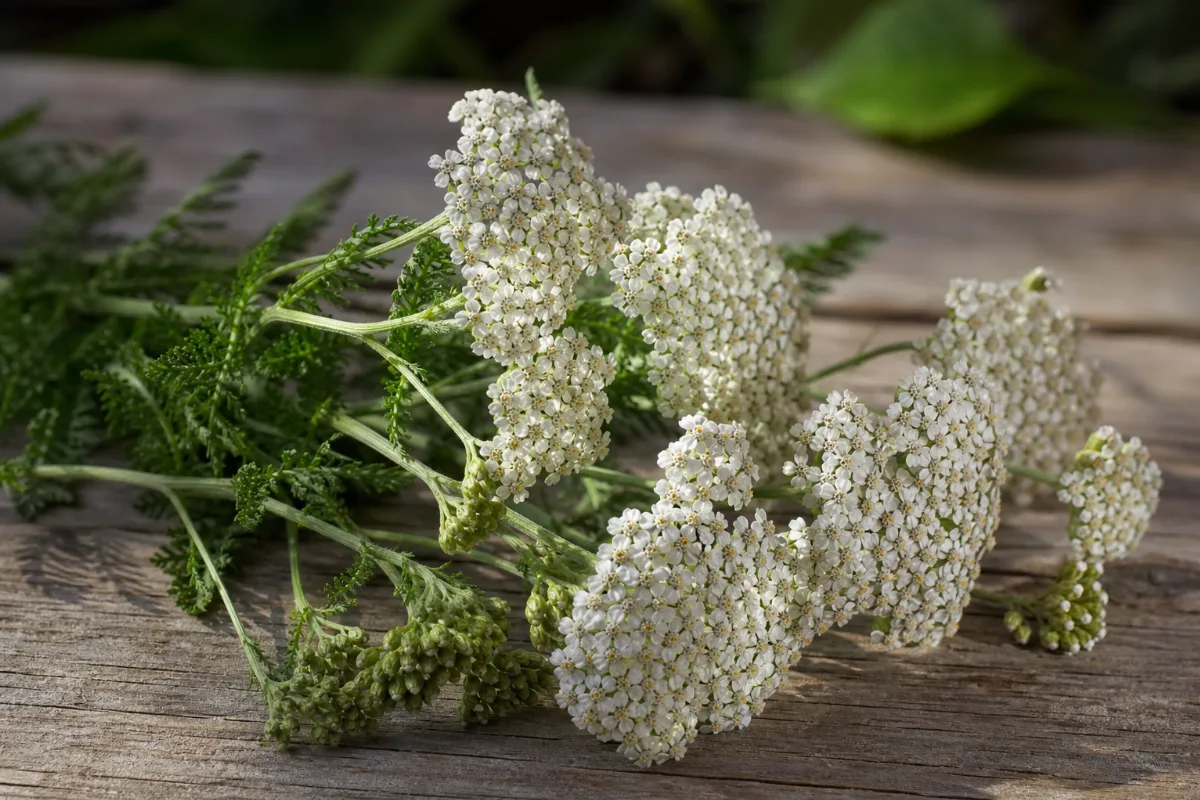
Herbs & Botanicals · Herbs · Old digestive and wound herb of the daisy family, with only very-low-certainty human evidence for any use
Yarrow
Achillea millefolium L. · also called Yarrow, common yarrow, milfoil, bloodwort, milenrama (Spanish), achillee millefeuille (French), Schafgarbe (German)
Yarrow is a feathery-leaved plant of the daisy family whose dried flowering tops have long been used as a bitter digestive tea, for period cramps and on small wounds. Human research is limited to a handful of small single trials, mainly from Iran. The EU lists it as a traditional herbal medicine only. Its main cautions are allergy in people sensitive to daisy-family plants and no use in pregnancy or breastfeeding.
General information, not medical advice. Last substantive update · Not medically reviewed. A named clinician has not signed off on this page. How this page is made
About Yarrow
Yarrow (Achillea millefolium) is a feathery-leaved daisy-family plant used for centuries as a bitter digestive herb, a tea for period cramps and a dressing for small cuts. Today its flowering tops are sold as tea, tinctures, extracts and ointments. The human research is small: single trials from Iran for period pain, multiple sclerosis (as an add-on), childbirth wounds, mouth sores and yeast infection, mostly rated very low certainty. The EU lists it as a traditional medicine only. The main safety points are allergy in people sensitive to daisy-family plants, no use in pregnancy or breastfeeding, and unanswered questions about blood thinners.
What it is
Yarrow (Achillea millefolium L.) is a perennial of the daisy family (Asteraceae). The medicinal part is the dried flowering tops, which the European Pharmacopoeia defines as containing at least 2 ml/kg of essential oil and at least 0.02% proazulenes (expressed as chamazulene), a blue-oil-forming group of compounds. Plant names were checked in GBIF and the NCBI taxonomy; GBIF lists 48 synonyms or forms of this species, and several close relatives such as Achillea wilhelmsii are separate species.
The plant contains bitter sesquiterpene lactones, flavonoids (apigenin, luteolin, rutin), tannins, caffeic and caffeoylquinic acids and a volatile oil with camphor, 1,8-cineole and sometimes thujone. The chemistry varies with the plant's chromosome type and where it grows.
Traditional and current uses
The EU assessment report lists traditional European uses for digestion and appetite, bile flow, menstrual problems, bleeding, baths and wounds. The EU herbal committee kept a narrow list in its 2020 revision: temporary loss of appetite, mild spasmodic gut complaints with bloating and flatulence, minor menstrual spasm and small superficial wounds, for adults and adolescents over 12. It says these uses rest on long use and not on clinical trials, and that the EU 'well-established use' standard is not met.
People also use yarrow for fever, bleeding, skin conditions and many other things. Those uses are not supported by the human research we found.
Why yarrow is different from other daisy-family herbs
Chamomile and yarrow share proazulene chemistry: in lab work, matricin and related compounds turn into chamazulene carboxylic acid, which blocked the inflammation enzyme COX-2. The authors propose yarrow's proazulenes do the same, but the human volunteer data were for matricin, not yarrow.
Yarrow is also a recognised cause of contact allergy, through sesquiterpene lactones such as alpha-peroxyachifolid. That allergy risk is the main reason the EU lists daisy-family allergy as a contraindication.
What the research shows
There is no systematic review or meta-analysis of yarrow in people. The human trials are single small studies: period pain (one trial), MS as an add-on to usual care (75 people), episiotomy wounds (140 women), chemotherapy mouth sores (56 patients), vaginal yeast infection (80 women), a kidney-disease marker (31 people), a cosmetic skin test and a three-herb eczema trial that found no benefit. The one irritable bowel trial found used a different species and was negative.
Most trials come from Iran, are short, report few numbers in their abstracts and have not been repeated. Several relied on preparations that are not described (tea bags, an ointment, a distillate), so they cannot be matched to products on shelves. Rat and lab studies suggest effects on blood pressure, urine output, bleeding time and the stomach lining, but these have not been tested in people.
At a glance
Traditional uses history, not proof
- European folk medicine: the EU assessment report lists digestive complaints, loss of appetite, bile stimulation, menstrual problems, bleeding, baths and wounds
- Germany: a 1938 handbook already mentions yarrow for painful periods, and the 1990 Commission E monograph (known through the EU report only) covers loss of appetite, dyspepsia and hip baths
- United Kingdom and Hungary: used as a sweat-inducing herb and as a bleeding-stopper (per the EU report)
- EU today: registered as a traditional herbal medicine for loss of appetite, mild spasmodic gut complaints, minor menstrual spasm and small superficial wounds
Studied for research
- Period pain, very low
- Multiple sclerosis as an add-on to usual care, very low
- Wounds after childbirth, very low
- Mouth sores from chemotherapy, very low
- Vaginal yeast infection, very low (less effective than clotrimazole)
- Digestive complaints and appetite, insufficient
- Bleeding, blood pressure and urine flow: rat studies only
- Eczema as part of a three-herb mix, no benefit over placebo
Main compounds
- Proazulenes such as achillicin, which give chamazulene in the oil, and bitter sesquiterpene lactones such as achillin
- Peroxide-type sesquiterpene lactones (alpha-peroxyachifolid), the main skin sensitisers
- Flavonoids (apigenin, luteolin, rutin) and caffeic and caffeoylquinic acids
- Volatile oil with camphor, 1,8-cineole and a variable amount of thujone, plus 3-4% tannins
Common forms
- Dried flowering tops as tea
- Tinctures and liquid extracts (contain alcohol)
- Water dry extracts
- Ointments and creams
- Essential oil and distillate (not for swallowing as oil)
Research links: EU herbal monograph on yarrow herb (European Medicines Agency) · EU assessment report on yarrow herb (European Medicines Agency) · EMA yarrow herb page and summary for the public · Research Library · Genes & Biomarkers Library
The plant and its history
- Accepted scientific name
- Achillea millefolium L.
- Naming authority
- L. (Linnaeus); accepted species in the GBIF backbone (key 3120060), checked 2026-10-25
- Synonyms
- GBIF lists 48 synonyms or infraspecific names for this accepted name, many of them subspecies or regional forms, for example Achillea millefolium subsp. borealis, Achillea lanulosa subsp. alpicola, Achillea laxiflora A.Nelson (1902) and Achillea intermedia Schleich. (1821).
- Common names
- Yarrow (English); Common yarrow (English); Milfoil (English); Bloodwort (English); Milenrama (Spanish); Achillee millefeuille (French); Schafgarbe (German); Duizendblad (Dutch); Milefolio (Portuguese); Ziele krwawnika (Polish)
- Botanical family
- Asteraceae (daisy family, also called Compositae)
- Classification
- Plantae > Tracheophyta > Magnoliopsida > Asterales > Asteraceae > Achillea > Achillea millefolium
- Native range
- Not checked in the sources read. Yarrow is widely known as native across Europe and temperate Asia and common as a weed or garden plant in many other regions; this is general knowledge, not verified here.
- Habitat
- Not verified in the sources read. Commonly seen in meadows, roadsides and lawns (general knowledge).
- What the plant looks like
- Roots: Not verified in the sources read.; Stems: Not verified in the sources read.; Leaves: Not verified in the sources read; commonly described as finely divided, feathery leaves (general knowledge).; Flowers: The part used medicinally is the dried flowering tops (Ph. Eur. definition, quoted in the EU assessment report). Flower colour and head size not verified here.; Fruit: Not relevant to the medicinal use; not verified.
- Cultivation
- Not verified in the sources read.
- Harvest and processing
- The European Pharmacopoeia defines the herbal substance as the whole or cut, dried flowering tops, with at least 2 ml/kg essential oil and at least 0.02% proazulenes expressed as chamazulene (as quoted in the EU assessment report). The EU monograph also covers expressed juice, liquid extract, tinctures and water dry extracts.
- Look-alikes and adulterants
- Name: Other Achillea species (A. asiatica, A. collina, A. pratensis, A. nobilis, A. ptarmica, A. filipendulina, A. wilhelmsii); Note: All are accepted species in GBIF. The 'millefolium group' is taxonomically complicated and plants differ in chromosome number and chemistry. A. wilhelmsii was the species used in the IBS trial and should not be treated as common yarrow.; Name: Finely leaved umbellifers such as poison hemlock (Conium maculatum L., GBIF accepted); Note: Foraging guides often warn that some fern-like carrot-family leaves can be mistaken for yarrow. This warning was not verified in the sources read; do not forage plants for medicine unless an expert has identified them.
- Sustainability and conservation
- Not assessed in the sources read.
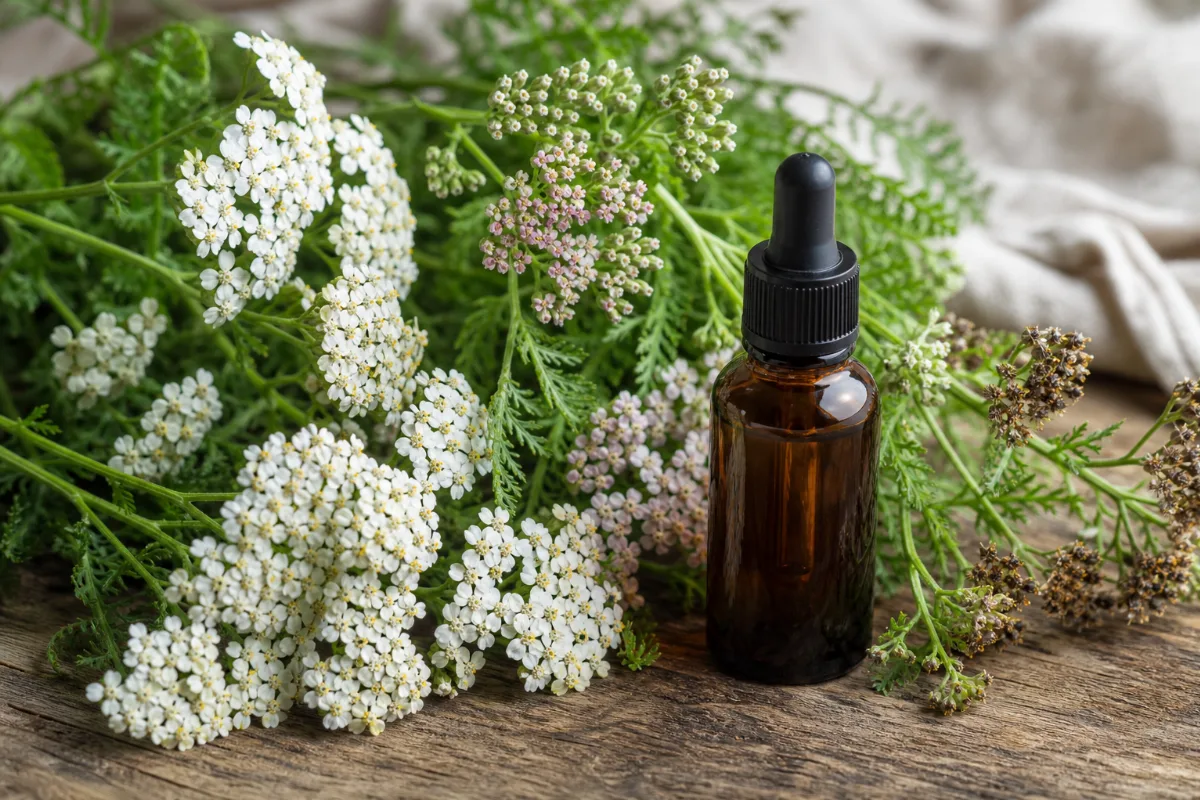
The plant and the parts used
Traditional use and history history, not clinical proof
| Tradition or era | Documented use | Source |
|---|---|---|
| European folk and herbal medicine | The EU assessment report lists traditional European uses: digestive complaints, loss of appetite, bile stimulation, menstrual problems and cramps, bleeding (haemorrhoids, uterus, nose), baths for sweating, and wounds and skin inflammation. A German handbook of 1938 already mentions yarrow for painful periods. | s-ema-ar-yarrow |
| Germany, Commission E monograph (1990) | Internal use for loss of appetite and dyspepsia; hip baths for cramp-like lower pelvic pain. Known only through the EU report. | s-ema-ar-yarrow |
| EU herbal monograph (2011, revised 2020) | Registered as a traditional herbal medicine for loss of appetite, mild spasmodic gut complaints, minor menstrual spasm and small superficial wounds. Revision 1 was adopted on 23 September 2020; a periodic review call opened in 2026. | s-ema-hmpc-yarrow-monograph |
| Ancient Greece and the name Achillea | Popular accounts link the name Achillea to the Greek hero Achilles using the plant on soldiers' wounds. NOT verified: this was not found in any source read. | Not verified |
| Hungarian, UK and Romanian traditions | The EU report cites Hungarian use for 'female diseases' and bleeding, UK use as a diaphoretic and haemostatic, and Romanian use for stomach inflammation and baths for babies and eczema patients. | s-ema-ar-yarrow |
Traditional use shows how a plant was used. It does not show that a supplement works or is safe today.
What is inside, and how it may work
What the plant contains and how those compounds act in cells and animals. Laboratory and animal mechanisms are not proven effects in people.
Main compounds
| Compound | Family | Where it is concentrated | Activity studied | Level of evidence |
|---|---|---|---|---|
| Chamazulene (formed from proazulenes such as achillicin) PubChem 10719 | azulene, blue sesquiterpene | Flowering tops and essential oil (diploid and tetraploid plants) Up to 25% of the essential oil in diploid and tetraploid plants, none in hexaploid plants (EU report). The Ph. Eur. requires at least 0.02% proazulenes expressed as chamazulene. | Proazulenes are anti-inflammatory in the lab and animals; their breakdown product chamazulene carboxylic acid blocked COX-2 in a test. 12 27 | Animal research |
| Azulene (parent ring) PubChem 9231 | azulene | Reference compound for the azulene family; not itself reported in yarrow here. 22 | Laboratory research | |
| Achillin PubChem 442139 | guaianolide sesquiterpene lactone | Aerial parts | The EU report describes achillin as an antimicrobial and anti-inflammatory agent in the O'Donnell (1999) account. 12 22 | Laboratory research |
| alpha-Peroxyachifolid | peroxide-type guaianolide sesquiterpene lactone | Flowers and whole plant | The main sensitiser in yarrow: strong skin sensitiser in guinea pigs and a cause of contact allergy. 17 12 | Animal research |
| Apigenin PubChem 5280443 | flavone (flavonoid) | Aerial parts | Listed among yarrow flavonoids in the EU report; yarrow flavonoids were antispasmodic in lab tests. 12 5 | Laboratory research |
| Luteolin PubChem 5280445 | flavone (flavonoid) | Aerial parts | Listed among yarrow flavonoids in the EU report. 12 | Laboratory research |
| Rutin PubChem 5280805 | flavonol glycoside | Aerial parts | Listed among yarrow flavonoids in the EU report. 12 | Laboratory research |
| Caffeoylquinic acids (chlorogenic acid shown as the reference compound) PubChem 1794427 | phenolic acid | Aerial parts | Dicaffeoylquinic acids were responsible for the bile-flow effect in the lab work of Benedek and Kopp. 5 22 | Laboratory research |
| alpha-Thujone PubChem 261491 | monoterpene ketone (essential oil) | Essential oil, variable 0 to 26.6% of the oil in one survey, mean about 2.3%; many papers find none (EU report). | A seizure-causing compound at high doses; the EU judged yarrow levels too low to be a risk at monograph use. 12 | Animal research |
| beta-Thujone PubChem 91456 | monoterpene ketone (essential oil) | Essential oil, variable 0 to 11.0% of the oil in one survey, mean about 1.6% (EU report). | As alpha-thujone. 12 | Animal research |
| Camphor PubChem 2537 | monoterpene ketone | Essential oil | One of the main oil components named in the EU report. 12 | Laboratory research |
| 1,8-Cineole (eucalyptol) PubChem 2758 | monoterpene ether | Essential oil | One of the main oil components named in the EU report. 12 | Laboratory research |
| Achilleine and other alkaloids / bases | alkaloid-like base | Aerial parts | The EU report cites preclinical evidence that achilleine may have anticoagulant activity; relevance unclear. 12 | Laboratory research |
| Tannins | polyphenol | Aerial parts 3-4% condensed and hydrolysable tannins (EU report) | Astringent plant tannins; no yarrow-specific test found. 12 | Laboratory research |
Mechanisms, receptors and pathways
| Target or pathway | Gene or receptor | What was found | Level |
|---|---|---|---|
| Cyclooxygenase-2 (COX-2) inhibition | PTGS2 | Chamazulene carboxylic acid, a breakdown product of the proazulenes found in yarrow and chamomile, blocked COX-2 but not COX-1 and had anti-inflammatory activity in animal models. Volunteers who swallowed matricin (a chamomile/yarrow proazulene) had micromolar plasma levels of the acid. The authors propose yarrow proazulenes work the same way. 27 | Animal research |
| Gut muscle relaxation (antispasmodic) | In lab tests the authors report that yarrow flavonoids mediated the antispasmodic action. 5 | Laboratory research | |
| Bile flow (choleretic action) | Dicaffeoylquinic acids caused the bile-flow effect in the authors' lab work. 5 | Laboratory research | |
| Human neutrophil elastase inhibition | ELANE | Yarrow extracts and fractions inhibited this inflammation-linked enzyme in vitro. 5 | Laboratory research |
| Calcium-channel-like vessel relaxation and lower blood pressure | A crude extract lowered blood pressure in anaesthetised rats and relaxed rabbit aorta in a verapamil-like way, partly through nitric oxide. 19 | Animal research | |
| Bradykinin B2 receptor and prostaglandin pathway in diuresis | BDKRB2 | A yarrow fraction raised urine output in rats and the effect was blocked by a bradykinin B2 blocker and by indomethacin. 31 | Animal research |
| Glutathione system and detox enzymes (NQO1, glutathione S-transferase) | NQO1; GST family | A water extract changed glutathione levels and enzyme activities in several rat organs and worsened the liver-enzyme rise after paracetamol. 2 | Animal research |
| Stomach lining protection and antioxidant defences | A hydroalcoholic extract reduced stomach lesions in rats and prevented the fall in glutathione and superoxide dismutase activity. 26 | Animal research | |
| T-cell sensitisation by sesquiterpene lactones (allergy) | Alpha-peroxyachifolid sensitised all guinea pigs tested; more than half of daisy-family-allergic patients reacted to yarrow extract on patch test. 17 | Human data | |
| Skin renewal markers | KRT10; TGM1; FLG | In lab-kept skin biopsies a cosmetic yarrow extract improved cytokeratin 10, transglutaminase-1 and filaggrin expression and epidermal thickness. Supplier-authored. 25 | Laboratory research |
Absorption, metabolism and elimination
- Absorption
- The EU assessment states specific pharmacokinetic data for yarrow are not available. No human absorption study of a yarrow tea, extract or capsule was found.
- Distribution
- Not studied for yarrow.
- Metabolism
- Not studied directly. In human volunteers given matricin (a proazulene shared with chamomile, not yarrow itself), plasma levels of chamazulene carboxylic acid reached the micromolar range, and matricin converted to the acid in artificial stomach fluid but not intestinal fluid. A 2023 review says yarrow may affect CYP liver enzymes, but its abstract does not name human data.
- Elimination
- Not studied for yarrow.
- Bioavailability
- Unknown.
Isolated compounds versus whole extracts
Yarrow is a mixture of bitter compounds, flavonoids, tannins, volatile oil and sesquiterpene lactones, and the mixture changes with the plant's chromosome type and origin. Different effects are tied to different parts of that mixture: flavonoids to gut relaxation, dicaffeoylquinic acids to bile flow, proazulenes to anti-inflammatory action (lab work), and sesquiterpene lactones to both digestive stimulation and skin allergy. Because the sensitisers sit in the whole plant, results from a purified compound or a single extract cannot be applied to tea or to a different extract. A water extract, an alcohol extract, a distillate and an ointment each gave different results in the studies we read.
Nutritional composition
Yarrow is used as a bitter medicinal herb, not as a food source of nutrients. The EU report lists small amounts of vitamin C and folate among its constituents but gives no amounts, so yarrow should not be counted as a meaningful source of any vitamin or mineral. Nutrient content was not looked up further.
6 very low certainty6 not enough evidence1 evidence against
What was looked at
The 13 benefits and uses checked for Yarrow, each with how strong the evidence is. Tap one to open it.
- Period pain (primary dysmenorrhea)Very low certainty
- Multiple sclerosis: relapses, MRI lesions and disability (add-on to usual care)Very low certainty
- MS thinking, fatigue and muscle stiffness (spasticity)Not enough evidence
- Mild stomach and gut complaints, bloating and crampsNot enough evidence
- Loss of appetiteNot enough evidence
- Wound healing and pain after childbirth (episiotomy)Very low certainty
- Stopping bleeding (the folk use as 'bloodwort')Not enough evidence
- Mouth sores caused by chemotherapy (oral mucositis)Very low certainty
- Vaginal yeast infectionVery low certainty
- Eczema (atopic dermatitis), as part of a three-herb mixEvidence against
- Skin appearance (wrinkles and pores) in cosmeticsVery low certainty
- Blood pressure and urine flow ('water pill' effect)Not enough evidence
- Nitric oxide markers in chronic kidney diseaseNot enough evidence
Lab markers tracked in the studies
Annualised relapse rate (multiple sclerosis)MRI lesion volume (multiple sclerosis)Expanded Disability Status Scale (EDSS)Thinking tests in MS (word-pair learning, PASAT, Wisconsin card sorting)Period pain on a visual analogue scale (VAS)Oral mucositis severity scoreVaginal Candida culture negativePlasma nitrite and nitratePain after episiotomy (visual analogue scale)Wrinkle and pore appearance
What is Yarrow good for?
The main proposed uses and how strong the human evidence is for each. "Very low" means a single small or unclear study, "insufficient" means there is not enough to judge, and "against" means a good trial found no benefit. Nothing about yarrow is rated higher than very low. These results come from specific teas, extracts, ointments and a distillate and cannot be moved to other yarrow products or to related species.
Benefits, one by one
Each card is a research question, not a promise. Tap a goal to filter. Open a card to see the studies, doses and limits.
Period pain (primary dysmenorrhea)
Very low certaintyOne small placebo-controlled trial of yarrow tea found less period pain than placebo over two cycles. It is the only human trial found for this use, so the evidence is very weak.
2 studiesTea bags of yarrow; the abstract does not say which plant part or str…
Studies, doses and limits
What the trials found
One double-blind trial in female university students in Iran gave placebo or yarrow tea bags for 3 days in each of 2 periods. Pain was scored on a visual analogue scale.
Results
The fall in pain score was larger with yarrow than with placebo after 1 month (P = .001) and 2 months (P < .0001). The abstract gives no actual pain scores, no number of women and no information on side effects.
Effect sizes as reported
No effect size or confidence interval is given in the abstract.
Why this rating
A single small trial from one region, reported in a short abstract with no group size, no scores and no side-effect data. No replication found. No systematic review exists.
Form and dose studied
Tea bags of yarrow; the abstract does not say which plant part or strength.
Who was studied
Young women with painful periods. Not tested in adolescents under 18 specifically, in women with endometriosis, or with heavy bleeding.
Limits
Short follow-up (two cycles). Pain is self-reported. Cannot be compared with standard treatments such as anti-inflammatory painkillers.
Why researchers looked
Yarrow is traditionally used for menstrual cramps and to bring on or ease periods.
Traditional use
The EU herbal committee (EMA/HMPC) lists yarrow herb as a traditional herbal medicine for loss of appetite, mild spasmodic gut complaints with bloating and flatulence, minor menstrual spasm and small superficial wounds, based on long use and not on clinical trials.
Proposed mechanism Preliminary mechanism
In lab tests, flavonoids from yarrow relaxed gut muscle (an antispasmodic action) and yarrow extracts showed anti-inflammatory activity. This has not been shown to explain period pain relief in women.
A proposed mechanism does not show that the effect happens in people.
Yarrow is not recommended in pregnancy. Anyone who may be pregnant, or has heavy or unexplained bleeding, should not self-treat with yarrow.
Multiple sclerosis: relapses, MRI lesions and disability (add-on to usual care)
Very low certaintyOne placebo-controlled trial of a yarrow water extract, taken for a year alongside usual MS treatment, reported fewer relapses and better scores on several scales. It is a single trial from one group and has not been repeated, so it is a lead, not proof.
1 studiesAqueous (water) extract, plant part not stated in the abstract. The t…
Studies, doses and limits
What the trials found
A triple-blind, placebo-controlled trial randomised 75 people with MS into three groups: placebo, 250 mg/day or 500 mg/day of an aqueous (water) extract of yarrow, taken for 1 year as an add-on to their usual treatment.
Results
The abstract says both doses reduced the yearly relapse rate, the higher dose reduced the volume of MRI lesions, time to first relapse was longer, the EDSS disability score fell, and the MS functional composite improved.
Effect sizes as reported
Effect sizes and confidence intervals are not in the abstract.
Why this rating
One trial, one research group, 75 people, with many outcomes tested and no effect sizes in the abstract. It has not been replicated. People stayed on their usual MS medicines, so yarrow was not tested alone.
Form and dose studied
Aqueous (water) extract, plant part not stated in the abstract. The trial doses are in the study record.
Who was studied
Adults with MS in Iran on standard MS treatment. Not tested in progressive MS specifically, in people on newer MS drugs, or in people who are pregnant.
Limits
Single trial, small, no independent replication found, side effects not reported in the abstract. Anyone with MS should not change MS treatment on this evidence.
Why researchers looked
MS is a long-term immune condition of the brain and spinal cord. The trial authors proposed that yarrow has anti-inflammatory and nerve-related actions, based on lab and animal work.
Traditional use
No traditional use for MS is recorded in the EU monograph.
Proposed mechanism Preliminary mechanism
The trial paper does not state a mechanism in its abstract. Yarrow flavonoids and other constituents have shown anti-inflammatory activity in lab and animal tests, but no effect on human MS biology has been shown.
A proposed mechanism does not show that the effect happens in people.
Yarrow can cause allergic reactions in people allergic to daisy-family plants. Possible interactions with MS and other medicines have not been studied. Talk to the MS team before adding yarrow.
MS thinking, fatigue and muscle stiffness (spasticity)
Not enough evidenceThe same MS trial reported better results on three thinking tests. It also measured fatigue and muscle stiffness, but the published abstract does not report those results, so no conclusion can be drawn about them.
1 studiesSame aqueous extract as above.
Studies, doses and limits
What the trials found
In the one trial (75 people, 1 year), the tests included word-pair learning, the PASAT (a timed attention and memory task) and the Wisconsin card sorting test. Fatigue (fatigue severity scale) and muscle stiffness (Ashworth scale) were measured too.
Results
The abstract says word-pair learning, PASAT and Wisconsin card sorting scores improved. It does not state any result for fatigue, spasticity, depression or anxiety; we did not read the full text.
Effect sizes as reported
No numbers are given in the abstract.
Why this rating
One small trial; the abstract does not report the fatigue or spasticity results at all, so there is nothing to rate for those. The thinking-test result is a single-trial signal among many outcomes tested.
Form and dose studied
Same aqueous extract as above.
Who was studied
Adults with MS.
Limits
Results for fatigue and spasticity are unknown to us until the full paper is read. Thinking tests can improve with practice, and practice effects are controlled only by the placebo group.
Why researchers looked
Fatigue, stiffness and slowed thinking are common problems in MS.
Traditional use
No traditional use for these problems is recorded.
Proposed mechanism Preliminary mechanism
Not established for yarrow.
A proposed mechanism does not show that the effect happens in people.
As above.
Mild stomach and gut complaints, bloating and cramps
Not enough evidenceYarrow is a long-used digestive herb in Europe and is registered there for mild gut complaints on the basis of tradition. No human trial of common yarrow for digestion was found. A trial of a related species in irritable bowel syndrome showed no difference from placebo.
4 studiesTraditionally a bitter tea; the EU monograph also lists extracts and …
Studies, doses and limits
What the trials found
No randomised trial of Achillea millefolium for digestive complaints was found. A placebo-controlled trial of a different species, Achillea wilhelmsii, in 90 people with irritable bowel syndrome found symptom scores fell in both groups with no significant difference between them and no adverse events reported.
Results
Rat study: the extract reduced alcohol-induced stomach lesions by 35, 56 and 81% at three doses and cut chronic ulcers by 43% and 65%. IBS trial of A. wilhelmsii: severity 282.56 to 178.06 with the herb and 265.93 to 197.74 with placebo, not significantly different.
Effect sizes as reported
No human effect size exists for common yarrow.
Why this rating
No human trial of common yarrow. The only trial was of another species and was negative. Lab and rat results do not show a human benefit.
Form and dose studied
Traditionally a bitter tea; the EU monograph also lists extracts and tinctures. No product or dose is endorsed here.
Who was studied
Adults and adolescents over 12 under the EU monograph.
Limits
No trial for common yarrow. The related-species trial cannot be applied to it.
Why researchers looked
Yarrow has been taken as a bitter tea for poor appetite, bloating and gut spasm for centuries.
Traditional use
The EU herbal committee (EMA/HMPC) lists yarrow herb as a traditional herbal medicine for loss of appetite, mild spasmodic gut complaints with bloating and flatulence, minor menstrual spasm and small superficial wounds, based on long use and not on clinical trials.
Proposed mechanism Animal research
In lab tests (reported by one research group), yarrow flavonoids relaxed gut muscle and dicaffeoylquinic acids increased bile flow. In rats, a yarrow extract protected the stomach lining against alcohol and acid damage.
A proposed mechanism does not show that the effect happens in people.
Persistent or worsening stomach pain, vomiting, weight loss or black stools need medical assessment, not herbal self-treatment. Daisy-family allergy is a contraindication.
Loss of appetite
Not enough evidenceYarrow is registered in the EU as a traditional bitter for temporary loss of appetite. No clinical trial was found, so this rests on tradition alone.
2 studiesTea or liquid preparations in the EU monograph.
Studies, doses and limits
What the trials found
No clinical trial of yarrow for appetite was found in the search.
Why this rating
No human data at all; the EU assessment says the traditional-use status is based on long use, not trials.
Form and dose studied
Tea or liquid preparations in the EU monograph.
Who was studied
Adults and adolescents over 12.
Limits
No trials.
Why researchers looked
Bitter herbs are traditionally used to stimulate appetite.
Traditional use
The EU herbal committee (EMA/HMPC) lists yarrow herb as a traditional herbal medicine for loss of appetite, mild spasmodic gut complaints with bloating and flatulence, minor menstrual spasm and small superficial wounds, based on long use and not on clinical trials.
Proposed mechanism Pharmacological theory
Bitter compounds are thought to stimulate digestive secretions. This has not been tested for yarrow in people.
A proposed mechanism does not show that the effect happens in people.
Persistent loss of appetite or unexplained weight loss should be checked by a doctor.
Wound healing and pain after childbirth (episiotomy)
Very low certaintyIn one trial of 140 first-time mothers, yarrow ointment was linked to less pain, redness, swelling and bruising over the first two weeks than a placebo ointment or nothing. Wound opening and discharge did not differ. It is one trial and the ointment recipe is not described.
3 studiesYarrow ointment (formulation not described). EU monograph wound use i…
Studies, doses and limits
What the trials found
A double-blind trial in 140 first-time mothers compared yarrow ointment, St John's wort ointment, placebo ointment and no treatment (35 each). Healing was scored on days 7, 10 and 14.
Results
Pain was lower at all three time points, redness and swelling lower at days 7 and 10 and bruising lower at day 7 with the yarrow ointment than with the control groups (p < 0.05). Discharge and wound opening did not differ. Yarrow was not compared with St John's wort.
Effect sizes as reported
Scores are not in the abstract.
Why this rating
One trial from one country, no description of the ointment in the abstract, no scores and no side-effect reporting.
Form and dose studied
Yarrow ointment (formulation not described). EU monograph wound use is a dressing soaked in an infusion.
Who was studied
Women after a first vaginal birth with an episiotomy.
Limits
Single trial, small, unknown formulation. The EU monograph only covers small superficial wounds.
Why researchers looked
Yarrow has folk names such as bloodwort (GBIF vernacular list) and is traditionally applied to cuts.
Traditional use
The EU herbal committee (EMA/HMPC) lists yarrow herb as a traditional herbal medicine for loss of appetite, mild spasmodic gut complaints with bloating and flatulence, minor menstrual spasm and small superficial wounds, based on long use and not on clinical trials. The EU monograph's wound use is for small superficial wounds, as a dressing soaked in a tea.
Proposed mechanism Animal research
The EU assessment lists antibacterial, antispasmodic and anti-inflammatory effects of yarrow in laboratory studies; rats treated with an extract on a liver cut bled for a shorter time.
A proposed mechanism does not show that the effect happens in people.
Skin reactions can happen: yarrow contains sesquiterpene lactones that cause contact allergy. People allergic to daisy-family plants should not put yarrow on skin or wounds. Signs of infection need medical care. Not for deep or infected wounds.
Stopping bleeding (the folk use as 'bloodwort')
Not enough evidenceYarrow is famous in folklore for stopping bleeding. The only study found is in rats, with the extract applied straight onto a cut. No human trial exists, and a regulatory report even notes a possible blood-thinning compound, so the idea is unproven in both directions.
2 studiesDirect application of a lab extract to a surgical cut in rats; not a …
Studies, doses and limits
What the trials found
No human trial of yarrow for bleeding was found. In 12 rats, applying a methanol extract of the aerial parts to a liver cut shortened bleeding time by 36.1% and 31.9% in the two arms, and the liver showed no damage on microscopy at 4, 6 and 8 weeks.
Results
Animal result only.
Effect sizes as reported
No human numbers.
Why this rating
Rat data from one small study; no human data; conflicting preclinical suggestions of anticoagulant activity.
Form and dose studied
Direct application of a lab extract to a surgical cut in rats; not a tea or capsule.
Limits
Rats only; the dose and route are not applicable to people.
Why researchers looked
Folk stories link the name Achillea to the Greek hero Achilles treating wounds (a popular story; not verified in the sources read).
Traditional use
Traditional use for bleeding and wounds is widely described; the EU monograph accepts only small superficial wounds.
Proposed mechanism Animal research
Not established. The EU assessment report cites preclinical evidence that a yarrow constituent, achilleine, may have anticoagulant activity, which would pull the other way.
A proposed mechanism does not show that the effect happens in people.
Heavy or non-stopping bleeding needs emergency care. Do not rely on yarrow to stop serious bleeding, and tell your surgeon if you use yarrow before surgery because the effect on bleeding is not established.
Mouth sores caused by chemotherapy (oral mucositis)
Very low certaintyIn one small trial, adding a yarrow distillate to a routine mouthwash was linked to much lower mouth-sore scores than the routine rinse alone. The control group got worse, and patients likely knew which they had, so the result should be treated with caution.
1 studiesDistilled yarrow (hydrosol) added to a mouthwash.
Studies, doses and limits
What the trials found
A double-blind randomised trial of 56 cancer patients with chemotherapy-induced mouth sores added distilled yarrow to the routine mouthwash (15 mL gargled 4 times a day for 14 days) or used the routine mouthwash alone.
Results
The mean severity score started at 2.39 in both groups. With yarrow it fell to 1.07 at day 7 and 0.32 at day 14. In the routine-mouthwash group it rose to 2.75 and 2.89 (p < 0.001).
Effect sizes as reported
Scores as listed; no confidence intervals in the abstract.
Why this rating
One small trial from one site, a control group without a placebo liquid, and a control group that worsened unusually. Registered in the Iranian trial registry (IRCT2013092214729N1).
Form and dose studied
Distilled yarrow (hydrosol) added to a mouthwash.
Who was studied
Adults having chemotherapy.
Limits
Single-centre, 56 people, 14 days. Cannot be applied to teas or other yarrow products.
Why researchers looked
Chemotherapy often causes painful mouth sores; yarrow was tested as a soothing rinse.
Traditional use
Not covered by the EU monograph.
Proposed mechanism Preliminary mechanism
Possible anti-inflammatory and mild antibacterial effects in lab studies.
A proposed mechanism does not show that the effect happens in people.
People having chemotherapy should only use anything in the mouth if their cancer team agrees. Mouth sores that persist or look infected need their care team.
Vaginal yeast infection
Very low certaintyA trial of yarrow vaginal cream against the standard drug clotrimazole found the yarrow cream cleared the infection less often than clotrimazole, though symptoms eased in both groups. There was no placebo group.
1 studiesVaginal cream made with an aqueous yarrow extract.
Studies, doses and limits
What the trials found
A double-blind randomised trial of 80 women compared a vaginal cream made with an aqueous yarrow extract with 1% clotrimazole cream for 7 days.
Results
Quality-of-life scores improved in both groups but more with clotrimazole. Vulvar redness improved in both with no clear difference (p = 0.1). Candida cultures were negative in 28 women (77%) on clotrimazole and 18 (53%) on yarrow (p < 0.05).
Effect sizes as reported
Culture clearance 77% vs 53%.
Why this rating
One trial, no placebo, and yarrow was less effective than the standard drug on the main infection test. Nothing shows yarrow cream is better than doing nothing.
Form and dose studied
Vaginal cream made with an aqueous yarrow extract.
Who was studied
Women with confirmed yeast infection.
Limits
Only 7 days, no safety table in the abstract.
Why researchers looked
Yarrow extracts block yeast in the lab, which led to this trial.
Traditional use
Not covered by the EU monograph.
Proposed mechanism Laboratory research
In the lab the extract stopped growth of Candida at a concentration of 37.5 mg/mL for the reference strain.
A proposed mechanism does not show that the effect happens in people.
Untreated or repeat vaginal infections should be checked by a clinician. Skin and mucosa can react to yarrow in daisy-family-allergic people. Not for use in pregnancy.
Eczema (atopic dermatitis), as part of a three-herb mix
Evidence againstA three-herb mix that included yarrow did not work better than placebo for eczema. This says nothing about yarrow alone, and yarrow can itself cause skin allergy.
1 studiesThree-herb COMBINATION (not yarrow alone).
Studies, doses and limits
What the trials found
A double-blind randomised trial of 49 patients gave a combination of Eleutherococcus, yarrow and Lamium album for 2 weeks and followed them to week 8.
Results
Both the herbal and placebo groups improved and stayed in partial remission to week 8, with no significant difference between them.
Effect sizes as reported
No numbers in the abstract.
Why this rating
A well-designed placebo-controlled trial found no benefit, but it tested a combination and gives no yarrow-specific information.
Form and dose studied
Three-herb COMBINATION (not yarrow alone).
Who was studied
Adults and children with atopic dermatitis.
Limits
Combination product; abstract gives no scores.
Why researchers looked
Several skin herbs have been tried for eczema.
Traditional use
Not covered by the EU monograph.
Proposed mechanism Preliminary mechanism
Not established.
A proposed mechanism does not show that the effect happens in people.
People with eczema often have daisy-family sensitivities; yarrow on the skin can make dermatitis worse.
Skin appearance (wrinkles and pores) in cosmetics
Very low certaintyA supplier-linked trial found a 2% yarrow extract cream improved the look of wrinkles and pores versus placebo after 2 months. This is about appearance, not health, and was done by the company that sells the extract.
2 studiesCosmetic extract at 2% in a product.
Studies, doses and limits
What the trials found
A study with lab biopsies and a 2-month in-vivo test compared 2% yarrow extract with placebo and with glycolic acid as a reference.
Results
Wrinkle and pore appearance improved significantly versus placebo; the abstract says results were directionally better than glycolic acid.
Effect sizes as reported
No numbers or group size in the abstract.
Why this rating
Cosmetic appearance only; group size missing; authors work for the company that makes the extract.
Form and dose studied
Cosmetic extract at 2% in a product.
Who was studied
Adults using skin products.
Limits
Industry-linked; cosmetic endpoint.
Why researchers looked
Yarrow extract is used as an ingredient in anti-ageing cosmetics.
Traditional use
Not covered by the EU monograph.
Proposed mechanism Laboratory research
In skin biopsies kept alive in the lab, the extract improved markers of skin renewal and increased epidermal thickness.
A proposed mechanism does not show that the effect happens in people.
Yarrow is a known contact allergen; the cosmetic safety panel advises products be formulated to be non-sensitising and to limit thujone and other constituents of concern.
Blood pressure and urine flow ('water pill' effect)
Not enough evidenceRat studies show yarrow extracts can lower blood pressure and raise urine output. No human blood-pressure or diuretic trial was found. This matters mainly for safety if you take blood-pressure pills or diuretics.
2 studiesLab extracts; the water extract (closest to tea) did not increase uri…
Studies, doses and limits
What the trials found
No human trial found. In anaesthetised rats a crude extract caused a dose-dependent fall in blood pressure. In rats, hydroethanolic extract and a dichloromethane fraction, but not the water extract, increased urine volume and sodium and potassium excretion like hydrochlorothiazide.
Results
Animal results only.
Why this rating
Only animal and tissue work, some with injected extracts.
Form and dose studied
Lab extracts; the water extract (closest to tea) did not increase urine in the rat test.
Why researchers looked
Yarrow has been used in folk medicine for heart and kidney complaints.
Traditional use
Described as widely used in Brazilian folk medicine for heart and kidney disorders (rat study introduction); not accepted in the EU monograph.
Proposed mechanism Animal research
In rats, extracts lowered blood pressure and relaxed blood vessels like the calcium-channel blocker verapamil; alcohol extracts raised urine output through bradykinin and prostaglandin pathways.
A proposed mechanism does not show that the effect happens in people.
Possible additive effects with blood-pressure medicines and diuretics are a theory only; see the safety tab.
Nitric oxide markers in chronic kidney disease
Not enough evidenceA small trial in kidney patients measured a blood marker of nitric oxide, which may add to bleeding tendency. Yarrow made it fall slightly, but the change was not statistically significant. Bleeding itself was not measured.
1 studiesPowdered yarrow flower.
Studies, doses and limits
What the trials found
A randomised trial of 31 patients with chronic kidney disease gave powdered yarrow flower or placebo, 3 days a week for 2 months.
Results
Nitrite fell from 0.82 to 0.63 umol/L and nitrate from 50.55 to 44.09 umol/L with yarrow; both rose slightly with placebo. The changes were not statistically significant.
Effect sizes as reported
Not significant.
Why this rating
A preliminary, tiny trial with a lab marker and no clinical outcome.
Form and dose studied
Powdered yarrow flower.
Who was studied
Adults with chronic kidney disease.
Limits
Surrogate marker only; no bleeding or kidney-function outcome in the abstract.
Why researchers looked
Nitric oxide is thought to contribute to bleeding tendency in kidney disease, and yarrow reduced nitric oxide in lab tests.
Traditional use
Not covered by the EU monograph.
Proposed mechanism Laboratory research
Nitric-oxide-scavenging properties have been reported for some Achillea species.
A proposed mechanism does not show that the effect happens in people.
People with kidney disease should not use herbal products without kidney-team advice.
Connections to the rest of health
How Yarrow connects to the rest of our health knowledge graph. Every link says what kind of connection it is. A safety link (for example to the liver) is a warning, not a benefit. A study that merely mentions a topic never creates a benefit link.
Explore every connection: goals, body systems, organs, symptoms, genes
A. Wellness goals
| Connected to | Kind of connection | Evidence status | Context | Studies |
|---|---|---|---|---|
| Women's wellness | Potential benefit | Very low certainty | One small trial for period pain; EU traditional use for minor menstrual spasm. Preparation or compound: Yarrow tea |
18 11 |
| Womens Wellness | Potential benefit | Very low certainty | Period pain (primary dysmenorrhea): One small placebo-controlled trial of yarrow tea found less period pain than placebo over two cycles. It is the only human trial found for this use, so the evidence is very weak. Vaginal yeast infection: A trial of yarrow vaginal cream against the standard drug clotrimazole found the yarrow cream cleared the infection less often than clotrimazole, though symptoms eased in both groups. There was no placebo group. | 18 11 30 |
| Brain Health | Preliminary mechanism | Very low certainty | Multiple sclerosis: relapses, MRI lesions and disability (add-on to usual care): One placebo-controlled trial of a yarrow water extract, taken for a year alongside usual MS treatment, reported fewer relapses and better scores on several scales. It is a single trial from one group and has not been repeated, so it is a lead, not proof. | 1 |
| Inflammation Balance | Preliminary mechanism | Very low certainty | Multiple sclerosis: relapses, MRI lesions and disability (add-on to usual care): One placebo-controlled trial of a yarrow water extract, taken for a year alongside usual MS treatment, reported fewer relapses and better scores on several scales. It is a single trial from one group and has not been repeated, so it is a lead, not proof. | 1 |
| Cognitive Performance | Preliminary mechanism | Not enough evidence | MS thinking, fatigue and muscle stiffness (spasticity): The same MS trial reported better results on three thinking tests. It also measured fatigue and muscle stiffness, but the published abstract does not report those results, so no conclusion can be drawn about them. | 1 |
| Memory Support | Preliminary mechanism | Not enough evidence | MS thinking, fatigue and muscle stiffness (spasticity): The same MS trial reported better results on three thinking tests. It also measured fatigue and muscle stiffness, but the published abstract does not report those results, so no conclusion can be drawn about them. | 1 |
| Reduce Fatigue | Preliminary mechanism | Not enough evidence | MS thinking, fatigue and muscle stiffness (spasticity): The same MS trial reported better results on three thinking tests. It also measured fatigue and muscle stiffness, but the published abstract does not report those results, so no conclusion can be drawn about them. | 1 |
| Digestive Support | Traditional use | Not enough evidence | Mild stomach and gut complaints, bloating and cramps: Yarrow is a long-used digestive herb in Europe and is registered there for mild gut complaints on the basis of tradition. No human trial of common yarrow for digestion was found. A trial of a related species in irritable bowel syndrome showed no difference from placebo. Loss of appetite: Yarrow is registered in the EU as a traditional bitter for temporary loss of appetite. No clinical trial was found, so this rests on tradition alone. | 11 10 26 5 12 |
| Gut Health | Traditional use | Not enough evidence | Mild stomach and gut complaints, bloating and cramps: Yarrow is a long-used digestive herb in Europe and is registered there for mild gut complaints on the basis of tradition. No human trial of common yarrow for digestion was found. A trial of a related species in irritable bowel syndrome showed no difference from placebo. | 11 10 26 5 |
| Healthy Skin | Potential benefit | Very low certainty | Wound healing and pain after childbirth (episiotomy): In one trial of 140 first-time mothers, yarrow ointment was linked to less pain, redness, swelling and bruising over the first two weeks than a placebo ointment or nothing. Wound opening and discharge did not differ. It is one trial and the ointment recipe is not described. Mouth sores caused by chemotherapy (oral mucositis): In one small trial, adding a yarrow distillate to a routine mouthwash was linked to much lower mouth-sore scores than the routine rinse alone. The control group got worse, and patients likely knew which they had, so the result should be treated with caution. | 16 11 3 20 25 4 |
| Healthy Skin | Traditional use | Not enough evidence | Stopping bleeding (the folk use as 'bloodwort'): Yarrow is famous in folklore for stopping bleeding. The only study found is in rats, with the extract applied straight onto a cut. No human trial exists, and a regulatory report even notes a possible blood-thinning compound, so the idea is unproven in both directions. | 3 12 |
| Inflammation Balance | Potential benefit | Very low certainty | Mouth sores caused by chemotherapy (oral mucositis): In one small trial, adding a yarrow distillate to a routine mouthwash was linked to much lower mouth-sore scores than the routine rinse alone. The control group got worse, and patients likely knew which they had, so the result should be treated with caution. | 20 |
| Healthy Skin | Demonstrated clinical effect | Evidence against | Eczema (atopic dermatitis), as part of a three-herb mix: A three-herb mix that included yarrow did not work better than placebo for eczema. This says nothing about yarrow alone, and yarrow can itself cause skin allergy. | 28 |
| Healthy Aging | Potential benefit | Very low certainty | Skin appearance (wrinkles and pores) in cosmetics: A supplier-linked trial found a 2% yarrow extract cream improved the look of wrinkles and pores versus placebo after 2 months. This is about appearance, not health, and was done by the company that sells the extract. | 25 4 |
| Blood Pressure Support | Preliminary mechanism | Not enough evidence | Blood pressure and urine flow ('water pill' effect): Rat studies show yarrow extracts can lower blood pressure and raise urine output. No human blood-pressure or diuretic trial was found. This matters mainly for safety if you take blood-pressure pills or diuretics. | 19 31 |
| Heart Health | Preliminary mechanism | Not enough evidence | Blood pressure and urine flow ('water pill' effect): Rat studies show yarrow extracts can lower blood pressure and raise urine output. No human blood-pressure or diuretic trial was found. This matters mainly for safety if you take blood-pressure pills or diuretics. | 19 31 |
B. Body systems
| Connected to | Kind of connection | Evidence status | Context | Studies |
|---|---|---|---|---|
| Skin | Adverse effect or risk | Low certainty | Contact dermatitis and cross-reaction with other daisy-family plants; EU contraindication for people allergic to Asteraceae. Preparation or compound: Yarrow herb and extracts; sesquiterpene lactones (alpha-peroxyachifolid) |
11 12 17 |
| Respiratory system | Adverse effect or risk | Very low certainty | One case of occupational asthma and hives after handling dried flowers. Preparation or compound: Dried yarrow flowers (inhaled) |
8 12 |
| Reproductive system | Contraindication | Very low certainty | Traditional abortifacient reputation, little testing; EU says not recommended in pregnancy and lactation. Traditional abortifacient reputation, little testing; EU says not recommended in pregnancy and breastfeeding. Preparation or compound: Yarrow herb and extracts |
11 12 |
| Cardiovascular system | Drug or supplement interaction | Very low certainty | Possible anticoagulant action of achilleine (preclinical) alongside topical clotting action in rats; possible blood-pressure lowering in rats. No human data. Preparation or compound: Yarrow extracts; achilleine |
12 3 19 |
| Digestive system | Traditional use | Not enough evidence | EU traditional use for appetite and mild spasmodic gut complaints; no trial of common yarrow. Preparation or compound: Yarrow herb tea and extracts |
11 10 |
| Nervous system | Preliminary mechanism | Very low certainty | One small MS add-on trial; unreplicated. Preparation or compound: Yarrow aqueous extract |
1 |
| Reproductive System | Biological association | Very low certainty | Studied for: Period pain (primary dysmenorrhea) Studied for: Wound healing and pain after childbirth (episiotomy) | 18 11 16 3 30 |
| Nervous System | Biological association | Very low certainty | Studied for: Multiple sclerosis: relapses, MRI lesions and disability (add-on to usual care) Studied for: MS thinking, fatigue and muscle stiffness (spasticity) | 1 |
| Immune System | Biological association | Very low certainty | Studied for: Multiple sclerosis: relapses, MRI lesions and disability (add-on to usual care) Studied for: Mouth sores caused by chemotherapy (oral mucositis) | 1 20 |
| Digestive System | Biological association | Not enough evidence | Studied for: Mild stomach and gut complaints, bloating and cramps Studied for: Loss of appetite | 11 10 26 5 12 20 |
| Integumentary System | Biological association | Very low certainty | Studied for: Wound healing and pain after childbirth (episiotomy) Studied for: Stopping bleeding (the folk use as 'bloodwort') | 16 11 3 12 28 25 4 |
| Cardiovascular System | Biological association | Not enough evidence | Studied for: Stopping bleeding (the folk use as 'bloodwort') Studied for: Blood pressure and urine flow ('water pill' effect) | 3 12 19 31 29 |
| Urinary System | Biological association | Not enough evidence | Studied for: Blood pressure and urine flow ('water pill' effect) Studied for: Nitric oxide markers in chronic kidney disease | 19 31 29 |
C. Body parts and organs
I. Biomarkers
| Connected to | Kind of connection | Evidence status | Context | Studies |
|---|---|---|---|---|
| Annualised relapse rate (multiple sclerosis) | Biological association | Very low certainty | Measured in trials: lowered. A lab change is not the same as a health benefit. | 1 |
| MRI lesion volume (multiple sclerosis) | Biological association | Very low certainty | Measured in trials: lowered. A lab change is not the same as a health benefit. | 1 |
| Expanded Disability Status Scale (EDSS) | Biological association | Very low certainty | Measured in trials: lowered. A lab change is not the same as a health benefit. | 1 |
| Thinking tests in MS (word-pair learning, PASAT, Wisconsin card sorting) | Biological association | Not enough evidence | Measured in trials: raised. A lab change is not the same as a health benefit. | 1 |
| Period pain on a visual analogue scale (VAS) | Biological association | Very low certainty | Measured in trials: lowered. A lab change is not the same as a health benefit. | 18 |
| Oral mucositis severity score | Biological association | Very low certainty | Measured in trials: lowered. A lab change is not the same as a health benefit. | 20 |
| Vaginal Candida culture negative | Biological association | Very low certainty | Measured in trials: mixed. A lab change is not the same as a health benefit. | 30 |
| Plasma nitrite and nitrate | Biological association | Not enough evidence | Measured in trials: no-change. A lab change is not the same as a health benefit. | 29 |
| Pain after episiotomy (visual analogue scale) | Biological association | Very low certainty | Measured in trials: lowered. A lab change is not the same as a health benefit. | 16 |
| Wrinkle and pore appearance | Biological association | Very low certainty | Measured in trials: lowered. A lab change is not the same as a health benefit. | 25 |
J. Genes, receptors and enzymes
| Connected to | Kind of connection | Evidence status | Context | Studies |
|---|---|---|---|---|
| PTGS2 (COX-2) | Preliminary mechanism | In vitro | Target of chamazulene carboxylic acid in a lab test. | 27 |
| ELANE (neutrophil elastase) | Preliminary mechanism | In vitro | Inhibited by yarrow extracts in vitro. | 5 |
| BDKRB2 (bradykinin B2 receptor) | Preliminary mechanism | Animal | Involved in the rat diuretic effect of a yarrow fraction. | 31 |
| NQO1 and glutathione S-transferases | Preliminary mechanism | Animal | Activity changed in several rat organs by a yarrow water extract. | 2 |
K. Biological pathways
| Connected to | Kind of connection | Evidence status | Context | Studies |
|---|---|---|---|---|
| Nitric oxide signalling | Preliminary mechanism | Animal | Yarrow's vessel relaxation in rabbit aorta was partly NO-dependent; plasma NO metabolites fell slightly (not significantly) in kidney patients. | 19 29 |
| Glutathione pathway / drug detox | Preliminary mechanism | Animal | Possible basis for the paracetamol interaction signal in rats. | 2 |
L. Active compounds
| Connected to | Kind of connection | Evidence status | Context | Studies |
|---|---|---|---|---|
| Chamazulene (formed from proazulenes such as achillicin) | Biological association | Animal | Proazulenes are anti-inflammatory in the lab and animals; their breakdown product chamazulene carboxylic acid blocked COX-2 in a test. Preparation or compound: Flowering tops and essential oil (diploid and tetraploid plants) |
12 27 |
| Azulene (parent ring) | Biological association | In vitro | Reference compound for the azulene family; not itself reported in yarrow here. | 22 |
| Achillin | Biological association | In vitro | The EU report describes achillin as an antimicrobial and anti-inflammatory agent in the O'Donnell (1999) account. Preparation or compound: Aerial parts |
12 22 |
| alpha-Peroxyachifolid | Biological association | Animal | The main sensitiser in yarrow: strong skin sensitiser in guinea pigs and a cause of contact allergy. Preparation or compound: Flowers and whole plant |
17 12 |
| Apigenin | Biological association | In vitro | Listed among yarrow flavonoids in the EU report; yarrow flavonoids were antispasmodic in lab tests. Preparation or compound: Aerial parts |
12 5 |
| Luteolin | Biological association | In vitro | Listed among yarrow flavonoids in the EU report. Preparation or compound: Aerial parts |
12 |
| Rutin | Biological association | In vitro | Listed among yarrow flavonoids in the EU report. Preparation or compound: Aerial parts |
12 |
| Caffeoylquinic acids (chlorogenic acid shown as the reference compound) | Biological association | In vitro | Dicaffeoylquinic acids were responsible for the bile-flow effect in the lab work of Benedek and Kopp. Preparation or compound: Aerial parts |
5 22 |
| alpha-Thujone | Biological association | Animal | A seizure-causing compound at high doses; the EU judged yarrow levels too low to be a risk at monograph use. Preparation or compound: Essential oil, variable |
12 |
| beta-Thujone | Biological association | Animal | As alpha-thujone. Preparation or compound: Essential oil, variable |
12 |
| Camphor | Biological association | In vitro | One of the main oil components named in the EU report. Preparation or compound: Essential oil |
12 |
| 1,8-Cineole (eucalyptol) | Biological association | In vitro | One of the main oil components named in the EU report. Preparation or compound: Essential oil |
12 |
| Achilleine and other alkaloids / bases | Biological association | In vitro | The EU report cites preclinical evidence that achilleine may have anticoagulant activity; relevance unclear. Preparation or compound: Aerial parts |
12 |
| Tannins | Biological association | In vitro | Astringent plant tannins; no yarrow-specific test found. Preparation or compound: Aerial parts |
12 |
Each connection is stored with the ingredient, the connected record, the kind of connection, the evidence status, the supporting studies, the preparation or compound involved, and a review date (last reviewed October 25, 2026).
Evidence at a glance: what changed in 10 lab markers
Tap a number to show only those markers. Counts are markers, not people.
The evidence
The research centre for Yarrow. Every record here was checked against PubMed or the publisher's page; we never list a study we have not verified.
Evidence by outcome
Bars show how many studies we found for each outcome, not how well it works. People are added up across trials only (reviews are not added, to avoid double counting).
How we rate evidence
High certainty
Several well-run trials or reviews agree; further research is unlikely to change the picture much.
Moderate certainty
Good trials point the same way, but some doubt remains.
Low certainty
Small, short or inconsistent trials. The finding could change with better research.
Very low certainty
Very little or very weak human data. Treat as a possibility only.
Mixed findings
Trials or reviews disagree with each other.
Not enough evidence
Not enough human research to say either way.
Evidence against
Good research found no benefit, or found harm.
We take the reviewers' own risk-of-bias and GRADE statements where they exist, and otherwise judge from study size, design, consistency, directness and whether a product matches what is sold. Many publications do not make evidence high. Method note: We searched PubMed, read the EU herbal monograph and the EU assessment report on yarrow herb and the EMA yarrow page, and checked plant names in GBIF and the NCBI taxonomy and compounds in PubChem. Only abstracts were read for the PubMed studies, and two of them (a contact dermatitis review and an occupational asthma case) have no usable abstract, so they are quoted through the EU report. Some sources were not verified: no NCCIH page on yarrow was found; the NIH LiverTox and LactMed pages could not be opened; FDA records were not searched; the German Commission E and WHO monographs are known only through the EU report; the rat pregnancy study is described only as the EU report describes it; and the outcome of the 2026 EU periodic review was not checked. The thujone worst-case figure is the EU committee's own arithmetic. Certainty ratings are the compiler's own reading, not formal grades. No study is cited that we could not verify.
Study library: every study we checked 31
| Study | Design | People | Product, dose, length | Result |
|---|---|---|---|---|
| Ayoobi 2019 Achillea millefolium is beneficial as an add-on therapy in patients with multiple sclerosis: A randomized placebo-controlled clinical trial. Phytomedicine · PMID 30599916 · DOI |
Controlled trial |
75 Adults with multiple sclerosis (MS) in Iran, already on standard MS treatment |
A. millefolium aqueous (water) extract, taken as an add-on to usual MS treatment unspecified 250 mg/day or 500 mg/day 1 year · vs Placebo |
Both doses lowered the yearly relapse rate. Lesion volume fell significantly in the higher-dose group. Time to first relapse was longer, the MS functional composite z-score rose, the EDSS score fell, and word-pair learning, PASAT and Wisconsin card sorting scores improved. The abstract does not report results for fatigue (FSS) or spasticity (Ashworth), mood or anxiety. Relapse rate, EDSS and some thinking tests favoured yarrow; effect sizes are not in the abstract Methods, limits and fundingOutcomes: Primary: annualised relapse rate. Also MRI lesion number and volume, EDSS disability score, MS functional composite, fatigue severity scale, Ashworth spasticity scale, mood, anxiety and several thinking tests Limitations: Triple-blind, but a single Iranian research group, 75 people over 1 year. The abstract gives no effect sizes, no confidence intervals, no side-effect data and no results for fatigue or spasticity, though these were measured. Add-on to usual drugs, so it cannot show yarrow works alone. Many outcomes were tested, which raises the chance of a false positive. Not replicated that we found. Funding and conflicts: Not stated in the abstract Read: abstract |
| Baggio 2016 Modulation of antioxidant systems by subchronic exposure to the aqueous extract of leaves from Achillea millefolium L. in rats. Nat Prod Res · PMID 25870009 · DOI |
Animal research animal |
Rats | Aqueous extract of A. millefolium leaves by mouth leaf 1 g/kg twice a day; paracetamol (acetaminophen) 600 mg/kg in the interaction test 7 days · vs Vehicle |
The extract changed glutathione and detoxifying enzyme activity in several organs (uterus glutathione up 73%, kidney down 23%). In preliminary experiments, it made the rise in ALT, AST and LDH after acetaminophen larger. The authors say this points to a potential toxic interaction with substances cleared by the glutathione pathway. Possible worse liver injury with acetaminophen in rats Methods, limits and fundingOutcomes: Glutathione, antioxidant enzymes, liver enzymes after acetaminophen Limitations: Preliminary rat result at a very high dose with very high acetaminophen. Not shown in people. Funding and conflicts: Not stated in the abstract Read: abstract |
| Bagheri 2024 Safety and hemostatic effect of Achillea millefolium L. in localized bleeding. Hepatol Forum · PMID 38283274 · DOI |
Animal research animal |
12 Female Wistar rats with liver incisions |
Methanol-macerated (hydroalcoholic) extract of the aerial parts of A. millefolium applied to the cut on a sponge aerial parts 150 mg/kg applied to the incision Liver checked at 4, 6 and 8 weeks · vs Untreated control incision on the same animal |
Bleeding time on the treated cut was 36.1% and 31.9% shorter in the two groups. No liver damage was seen on microscopy after 4, 6 and 8 weeks. Shorter bleeding time in rats when applied directly to a cut Methods, limits and fundingOutcomes: Bleeding time; liver histology Limitations: Twelve rats, topical use, small and short. Does not show a drink or capsule affects bleeding in people. Funding and conflicts: No conflict of interest declared Read: abstract |
| Becker 2016 Safety Assessment of Achillea millefolium as Used in Cosmetics. Int J Toxicol · PMID 27913788 · DOI |
Authoritative guidance |
Cosmetic use (expert panel review) | Achillea millefolium extract, flower extract and flower/leaf/stem extract in cosmetics flower / flower-leaf-stem |
The Cosmetic Ingredient Review panel raised concerns about linalool, thujone, quercetin, hydroquinone and alpha-peroxyachifolid, and concluded the extracts are safe as used in cosmetics when formulated to be non-sensitising. Safe in cosmetics only if non-sensitising Methods, limits and fundingOutcomes: Safety of cosmetic use Limitations: Applies to cosmetic use, not to teas or capsules. Funding and conflicts: Not stated in the abstract Read: abstract |
| Benedek 2007 Achillea millefolium L. s.l. revisited: recent findings confirm the traditional use. Wien Med Wochenschr · PMID 17704978 · DOI |
Narrative review in-vitro |
Not applicable (lab findings summarised by the authors) | Yarrow (A. millefolium s.l.) extracts and fractions unspecified |
The authors report that flavonoids in yarrow mediated the antispasmodic action in lab tests, dicaffeoylquinic acids caused the bile-flow (choleretic) effect, and extracts blocked human neutrophil elastase, an inflammation-linked enzyme, in vitro. Lab support for traditional gut and inflammation uses Methods, limits and fundingOutcomes: Gut spasm, bile flow and inflammation-related enzyme findings in the laboratory Limitations: Short review of the authors' own lab work. In vitro and animal-tissue results, not human trials. The authors say the findings confirm the traditional use; that is their reading. Funding and conflicts: Not stated in the abstract Read: abstract |
| Calapai 2014 Contact dermatitis as an adverse reaction to some topically used European herbal medicinal products - part 1: Achillea millefolium-Curcuma longa. Contact Dermatitis · PMID 24621152 · DOI |
Narrative review |
Topical herbal medicinal products evaluated by the European Medicines Agency | Topical A. millefolium products (the review covers yarrow and turmeric) unspecified |
The PubMed abstract is only a one-sentence scope statement and gives no findings. We did not read the full text. Not available from the abstract Methods, limits and fundingOutcomes: Contact dermatitis reports Limitations: Abstract has no results, so nothing is claimed from it beyond the scope. Funding and conflicts: Not stated Read: summary-only |
| Cavalcanti 2006 Safety and antiulcer efficacy studies of Achillea millefolium L. after chronic treatment in Wistar rats. J Ethnopharmacol · PMID 16647233 · DOI |
Animal research animal |
Male and female Wistar rats | Aqueous extract of the aerial parts of A. millefolium by mouth aerial parts 0.3 to 1.2 g/kg per day 28 or 90 days, with 30-day recovery groups · vs Water vehicle |
Slight changes in liver weight, cholesterol, HDL-cholesterol and glucose were seen but did not track with dose or time. The authors concluded there were no signs of relevant toxicity, even at very long exposure. The extract also protected the gastric lining in this study. No relevant toxicity in rats Methods, limits and fundingOutcomes: Clinical signs, weights, blood counts, biochemistry, organ pathology Limitations: Rats, not people. Mated animals and pregnancy were not tested here. Funding and conflicts: Not stated in the abstract Read: abstract |
| Compes 2006 Occupational asthma from dried flowers of Carthamus tinctorious (safflower) and Achillea millefolium (yarrow). Allergy · PMID 16942580 · DOI |
Case report |
1 Woman, 44, who handled dried flowers at work (details as summarised in the EU assessment report) |
Dried yarrow flowers (inhaled) flower Symptoms began 5 months after first contact |
PubMed has no abstract. The EU assessment report summarises the case: skin prick test positive to yarrow flower extract, and a challenge with aqueous yarrow extract caused a 31% fall in FEV1 (a lung test). One confirmed case of occupational asthma Methods, limits and fundingOutcomes: Rhinitis, asthma and hives Limitations: Single case; figures taken second-hand from the EU report; the case involved both safflower and yarrow. Funding and conflicts: Not applicable Read: summary-only |
| Dalsenter 2004 Reproductive evaluation of aqueous crude extract of Achillea millefolium L. (Asteraceae) in Wistar rats. Reprod Toxicol · PMID 15279880 · DOI |
Animal research animal |
Adult male Wistar rats; immature female rats | Aqueous extract of A. millefolium leaves by mouth leaf 0.3, 0.6 and 1.2 g/kg per day 90 days (males); 3 days (females) · vs Vehicle |
No signs of toxicity. The highest dose increased the share of abnormal sperm. Other male reproductive measures were unchanged, and young females showed no uterus-growing (oestrogen-like) effect. Small rise in abnormal sperm at the top dose in rats Methods, limits and fundingOutcomes: Reproductive organ weights, sperm counts and shape; uterine weight in young females Limitations: Males and immature females only. This does not test pregnancy. Funding and conflicts: Not stated in the abstract Read: abstract |
| Derakhshande 2019 Efficacy and safety of Achillea wilhelmsii C. Koch capsules on symptom severity and quality of life in patients with irritable bowel syndrome: a randomized, placebo-controlled clinical trial. J Complement Integr Med · PMID 31442203 · DOI |
Controlled trial |
90 Adults with irritable bowel syndrome (IBS) |
Capsules of a DIFFERENT species, Achillea wilhelmsii C. Koch (not A. millefolium) unspecified Not given in the abstract Not given in the abstract · vs Placebo capsules (45 per group) |
IBS severity fell from 282.56 +/- 103.57 to 178.06 +/- 88.40 on the herb and from 265.93 +/- 93.56 to 197.74 +/- 106.26 on placebo. The difference between groups was not significant (p > 0.05). No adverse events were reported. No difference from placebo Methods, limits and fundingOutcomes: IBS symptom severity index and IBS quality of life (IBS-QOL) Limitations: A different species, so it cannot be read as evidence for common yarrow. Authors recommend larger and longer studies. Funding and conflicts: Not stated in the abstract Read: abstract |
| EMA Committee on Herbal Medicinal Products (HMPC) 2020 European Union herbal monograph on Achillea millefolium L., herba - Revision 1 (EMA/HMPC/376416/2019) EMA/HMPC/376416/2019 (adopted 23 September 2020) · Source |
Authoritative guidance |
Adolescents (12 and over), adults and elderly; traditional use only | Yarrow herb (above-ground parts): tea, juice, liquid extract, tincture, water dry extract aerial parts Not restated here |
Traditional use only; well-established use not met. Contraindication: hypersensitivity to yarrow and to other Asteraceae (Compositae). Not recommended under 12 (data lacking). Pregnancy and lactation: safety not established, not recommended. Fertility: no data. Interactions: none reported. Side effects: skin hypersensitivity, frequency not known. Overdose: no case reported. Ames test negative for a water dry extract; reproductive toxicity and carcinogenicity tests not performed. Traditional use registered; not a clinical-trial endorsement Methods, limits and fundingOutcomes: Traditional use for loss of appetite, mild spasmodic gut complaints with bloating and flatulence, minor menstrual spasm, and small superficial wounds Limitations: Traditional-use status is based on long use (30 years, including 15 in the EU), not on clinical trials. Funding and conflicts: Regulator document Read: full-text |
| EMA Committee on Herbal Medicinal Products (HMPC) 2020 Assessment report on Achillea millefolium L., herba - Revision 1 (EMA/HMPC/376415/2019) EMA/HMPC/376415/2019 · Source |
Authoritative guidance |
Regulatory review of traditional use, laboratory data and safety | Yarrow herb and its preparations aerial parts |
Reports that yarrow oil can contain thujone (alpha 0-26.6%, beta 0-11.0% in one survey, mean about 2.3% and 1.6%) but that most papers find little or none, and that the worst-case thujone in the maximum monograph daily dose is about 1.5 mg. Records the traditional reputation as an abortifacient and emmenagogue and a rat study (Boswell-Ruys 2003) of high-dose ethanolic extract in pregnancy that found lower fetal weight and higher placental weight, no malformations, with the authors advising against use in pregnancy; the assessor judged that study not relevant to the monograph because the plant part and ratio differed. Cites preclinical, not clinical, evidence that the constituent achilleine may have anticoagulant activity, of unclear relevance. Summarises allergy: guinea pig sensitisation, a child with Compositae dermatitis, and an occupational asthma case. Notes alcoholic extracts were not phototoxic in clinical testing. Overall: use can be considered safe apart from hypersensitivity; pregnancy and lactation use not recommended for lack of data. Regulator's safety assessment Methods, limits and fundingOutcomes: Constituents, thujone content, toxicology, reproductive toxicity, allergy reports, interactions, pregnancy Limitations: A regulatory summary of other sources; several cited papers were not independently opened by us. Funding and conflicts: Regulator document Read: full-text |
| European Medicines Agency 2020 Millefolii herba (yarrow herb): herbal medicinal product page and summary for the public (EMA/513753/2020) EMA website; summary EMA/513753/2020 first published 2020-12-03 · Source |
Authoritative guidance |
Public summary of the EU herbal monograph | Yarrow herb preparations aerial parts |
Page read 2026-10-25. States the uses are 'traditional use', that clinical-trial evidence is insufficient, that skin allergic reactions have been reported with unknown frequency, and that people allergic to Asteraceae must not take yarrow herb medicines. Lists the monograph as under a call for scientific data for periodic review, with a revision-2 consultation 2026-03-15 to 2026-06-15; the outcome was not checked. Status page Methods, limits and fundingOutcomes: Status of the EU monograph Limitations: The 2026 periodic-review outcome was not checked. Funding and conflicts: Regulator document Read: full-text |
| Farasati Far 2023 Achillea millefolium: Mechanism of action, pharmacokinetic, clinical drug-drug interactions and tolerability. Heliyon · PMID 38076118 · DOI |
Narrative review mixed |
Not applicable (literature review) | Yarrow (A. millefolium), white, red and yellow forms unspecified |
The abstract says the authors sorted possible interactions into minor and serious and name effects on cytochrome P450 liver enzymes that could raise levels of erythromycin, diazepam and cyclosporine. The abstract does not name the underlying studies or say whether any were done in people. Interaction claims are theoretical in this abstract Methods, limits and fundingOutcomes: Mechanisms, pharmacokinetics and possible drug interactions Limitations: Narrative review, no stated method for grading evidence. The abstract does not show human interaction data; we read only the abstract. The interaction list should be treated as unconfirmed. Funding and conflicts: No competing interests declared Read: abstract |
| GBIF Secretariat 2026 GBIF backbone taxonomy: Achillea millefolium L. (key 3120060) GBIF species API, queried 2026-10-25 · Source |
Database in-vitro |
Plant name check | Not applicable unspecified |
ACCEPTED species, family Asteraceae, order Asterales. GBIF lists 48 synonyms or infraspecific names (many are subspecies and regional forms). Related species Achillea asiatica, A. ptarmica, A. collina, A. nobilis, A. pratensis, A. filipendulina and A. wilhelmsii are accepted species in their own right. Name verified Methods, limits and fundingOutcomes: Accepted name, family, synonyms and neighbour species Limitations: Taxonomy of the A. millefolium group is complex; GBIF treats many forms as synonyms. Funding and conflicts: Not applicable Read: full-text |
| Hajhashemi 2018 The effect of Achillea millefolium and Hypericum perforatum ointments on episiotomy wound healing in primiparous women. J Matern Fetal Neonatal Med · PMID 28027682 · DOI |
Controlled trial |
140 First-time mothers with an episiotomy (a surgical cut at birth) |
Yarrow (A. millefolium) ointment applied to the wound; a separate St John's wort (Hypericum) ointment arm unspecified Not given in the abstract Assessed on days 7, 10 and 14 after delivery · vs Placebo ointment and a no-treatment group (35 women per group, four groups) |
Pain was lower at days 7, 10 and 14, redness and swelling lower at days 7 and 10, and bruising lower at day 7 with yarrow or St John's wort ointment than with the control groups (p < 0.05). Discharge and wound opening did not differ. Less pain, redness, swelling and bruising early on; no difference in wound opening or discharge Methods, limits and fundingOutcomes: Redness, bruising (ecchymosis), swelling, discharge, wound opening; pain on a visual analogue scale Limitations: The abstract does not say how the yarrow ointment was made or what it contained, and gives no scores. Yarrow was not compared directly with St John's wort. The abstract does not report side effects. Single country. Funding and conflicts: Not stated in the abstract Read: abstract |
| Hausen 1991 alpha-Peroxyachifolid and other new sensitizing sesquiterpene lactones from yarrow (Achillea millefolium L., Compositae). Contact Dermatitis · PMID 1868717 · DOI |
Animal + patch test series |
Guinea pigs; Compositae-sensitive patients followed 1985-1990 | Short ether extract of yarrow and its isolated sesquiterpene lactones unspecified 5-year follow-up of patients |
Five peroxide-type guaianolide sesquiterpene lactones were identified. The main one, alpha-peroxyachifolid, was a strong sensitiser in guinea pigs. More than 50% of Compositae-sensitive patients reacted to a short ether extract of yarrow on patch testing. Exacerbation of the patch-test sites by UV irradiation was never observed. More than half of Compositae-allergic patients reacted on patch test Methods, limits and fundingOutcomes: Sensitising ability; patch-test reactions Limitations: Patch tests used a concentrated ether extract on already-sensitive patients, so the percentage does not apply to the general public. 1991. Funding and conflicts: Not stated in the abstract Read: abstract |
| Jenabi 2015 Effect of Achillea Millefolium on Relief of Primary Dysmenorrhea: A Double-Blind Randomized Clinical Trial. J Pediatr Adolesc Gynecol · PMID 26238568 · DOI |
Controlled trial |
Female university students in western Iran with primary (period) pain; the abstract gives no group size | Yarrow (A. millefolium) tea bags; the abstract does not say which plant part unspecified 3 days per cycle for 2 menstrual cycles (the abstract gives no dose per bag) 2 menstrual cycles · vs Placebo tea bag |
The mean fall in pain score was larger with yarrow than with placebo at 1 month (P = .001) and 2 months (P < .0001). The abstract gives no actual scores, no group size and no side-effect data. Pain fell more with yarrow than placebo; size not given in the abstract Methods, limits and fundingOutcomes: Period pain severity on a visual analogue scale (VAS) Limitations: Self-reported pain only. The abstract does not state the number of women, how the placebo was made, or any side effects. Short (2 cycles) and single-site. A tea whose plant part and strength are not stated cannot be compared with other yarrow products. Funding and conflicts: Not stated in the abstract Read: abstract |
| Khan 2011 Blood pressure lowering, cardiovascular inhibitory and bronchodilatory actions of Achillea millefolium. Phytother Res · PMID 20857434 · DOI |
Animal research animal |
Anaesthetised rats; guinea pig heart and windpipe tissue; rabbit aorta rings | Crude extract of A. millefolium given into the animal or applied to tissue unspecified 1-100 mg/kg (rats); 0.3-10 mg/mL on tissue Acute · vs Verapamil used as a comparison in tissue tests |
The extract lowered blood pressure in a dose-dependent way in anaesthetised rats, slowed and weakened beating of guinea-pig atria, relaxed rabbit aorta in a verapamil-like way (partly through nitric oxide), and relaxed guinea-pig windpipe strips. Lower blood pressure in anaesthetised rats Methods, limits and fundingOutcomes: Blood pressure, heart rate, vessel relaxation, airway relaxation Limitations: Animal and tissue work only, injected or applied directly. Not proof of a blood-pressure effect from tea or capsules in people. Funding and conflicts: Not stated in the abstract Read: abstract |
| Miranzadeh 2015 Effect of adding the herb Achillea millefolium on mouthwash on chemotherapy induced oral mucositis in cancer patients: A double-blind randomized controlled trial. Eur J Oncol Nurs · PMID 25667123 · DOI |
Controlled trial |
56 Cancer patients with chemotherapy-induced mouth sores (oral mucositis) |
Distilled yarrow (A. millefolium) solution added to the routine mouthwash, gargled unspecified 15 mL, 4 times a day 14 days · vs Routine mouthwash alone |
Severity score started at 2.39 +/- 0.875 in both groups. In the yarrow group it fell to 1.07 +/- 0.85 at day 7 and 0.32 +/- 0.54 at day 14. In the routine-mouthwash group it rose to 2.75 +/- 0.87 and 2.89 +/- 0.956 (p < 0.001). Large difference between groups in the severity score Methods, limits and fundingOutcomes: Oral mucositis severity score at baseline, day 7 and day 14 Limitations: Small trial (56) from one region. The abstract does not say who was blinded to the routine-mouthwash group, and the control group got no added placebo liquid, so patients may have known. The control group got worse, which is unusual. A distillate is not the same as a tea or extract. Funding and conflicts: Not stated in the abstract. Registered: IRCT2013092214729N1 Registration: IRCT2013092214729N1 Read: abstract |
| NCBI 2026 NCBI Taxonomy: Achillea millefolium (taxid 13329) NCBI Taxonomy esummary, queried 2026-10-25 · Source |
Database in-vitro |
Plant name check | Not applicable unspecified |
Achillea millefolium is a species (taxid 13329) in the eudicots. Name verified Methods, limits and fundingOutcomes: Name and rank Limitations: Not applicable Funding and conflicts: Not applicable Read: full-text |
| NCBI PubChem 2026 PubChem compound records for yarrow constituents (CIDs checked 2026-10-25) PubChem PUG REST · Source |
Database in-vitro |
Compound identity check | Not applicable unspecified |
Verified CIDs and formulas: chamazulene 10719 (C14H16), azulene 9231, apigenin 5280443, luteolin 5280445, rutin 5280805, quercetin 5280343, chlorogenic acid 1794427, alpha-thujone 261491, beta-thujone 91456, camphor 2537, 1,8-cineole 2758, achillin 442139. IDs verified Methods, limits and fundingOutcomes: Compound IDs and formulas Limitations: PubChem 'Thujone' (261491) is the alpha-thujone entry. Funding and conflicts: Not applicable Read: full-text |
| NCCIH (NIH) 2026 NCCIH: no yarrow fact sheet found https://www.nccih.nih.gov/health/yarrow returned 404 on 2026-10-25 · Source |
Authoritative guidance |
Search for a US NIH fact sheet on yarrow | Not applicable unspecified |
The direct address for a yarrow page returned 'not found'. We found no NCCIH fact sheet on yarrow. This is a limited check of one URL, not a full site search. No NCCIH page found Methods, limits and fundingOutcomes: Regulatory status Limitations: One URL tried. Funding and conflicts: Not applicable Read: summary-only |
| No authors listed (Cosmetic Ingredient Review) 2001 Final report on the safety assessment of Yarrow (Achillea millefolium) Extract. Int J Toxicol · PMID 11558643 · DOI |
Authoritative guidance mixed |
Cosmetic use (expert panel review) | Yarrow extract in cosmetics; sesquiterpene lactones, polyacetylenes, coumarins and flavonoids noted among its components unspecified Used at 0.5% to 10% in products |
Only limited toxicity data. Guinea pigs were sensitised to crude whole-plant and flower extracts. A yarrow tea was weakly genotoxic in a fruit-fly test. Product formulations with 0.1% to 0.5% were generally not irritating, patients reacted to a Compositae mix containing yarrow and to yarrow itself, and alcoholic extracts of dried leaves and stalks did not produce a phototoxic response. The panel judged the data insufficient to support safety in cosmetics and listed missing data (UV absorption and photosensitisation data, organ histopathology, reproductive and developmental toxicity, two genotoxicity studies, clinical sensitisation testing). Data judged insufficient in 2001 Methods, limits and fundingOutcomes: Safety of cosmetic use Limitations: Older report (2001), later revised by the 2016 panel. Cosmetic context. Funding and conflicts: Not stated in the abstract Read: abstract |
| Pain 2011 Surface rejuvenating effect of Achillea millefolium extract. Int J Cosmet Sci · PMID 21711463 · DOI |
Controlled trial |
Healthy adults (in vivo part); human skin biopsies kept alive in the lab (ex vivo part) | Cosmetic yarrow (A. millefolium) extract at 2% in a skin product unspecified 2% extract in the product 2 months · vs Placebo; glycolic acid as a reference |
In skin biopsies the extract improved markers of skin renewal (cytokeratin 10, transglutaminase-1, filaggrin) and increased skin thickness. In people, 2 months of 2% extract significantly improved the appearance of wrinkles and pores versus placebo, and the abstract says results were directionally better than glycolic acid. Better wrinkle and pore appearance than placebo; group size not in the abstract Methods, limits and fundingOutcomes: Skin cell markers (ex vivo); appearance of wrinkles and pores (in vivo) Limitations: Cosmetic appearance scores, not a health outcome. Group size is not given in the abstract. Authors are employees of the company (BASF Beauty Care) that sells the extract. Funding and conflicts: Industry: authors' affiliation is BASF Beauty Care Solutions France (the extract supplier) Read: abstract |
| Potrich 2010 Antiulcerogenic activity of hydroalcoholic extract of Achillea millefolium L.: involvement of the antioxidant system. J Ethnopharmacol · PMID 20420892 · DOI |
Animal research animal |
Rats with stomach lesions caused by ethanol or acetic acid | Hydroalcoholic extract of A. millefolium given by mouth unspecified 30, 100 and 300 mg/kg (ethanol model); 1 and 10 mg/kg (acetic acid ulcer) Not given in the abstract · vs Vehicle |
Ethanol-induced lesions fell by 35, 56 and 81% at the three doses. Chronic acetic-acid ulcers fell by 43% and 65% at 1 and 10 mg/kg, with more cell growth in the stomach lining and protection of antioxidant markers. Less stomach damage in rats Methods, limits and fundingOutcomes: Stomach lesion size, glutathione, superoxide dismutase, myeloperoxidase Limitations: Rat study only. Shows a possible stomach-protective action, not that yarrow heals stomach ulcers in people. Funding and conflicts: Not stated in the abstract Read: abstract |
| Ramadan 2006 Chamazulene carboxylic acid and matricin: a natural profen and its natural prodrug, identified through similarity to synthetic drug substances. J Nat Prod · PMID 16872141 · DOI |
Mixed (lab, animal, human volunteers) mixed |
Lab chemistry, animals, and human volunteers given matricin | Matricin (a proazulene found in chamomile and yarrow) and its product chamazulene carboxylic acid unspecified |
Chamazulene carboxylic acid blocked cyclooxygenase-2 but not COX-1 and was anti-inflammatory in several animal models. When volunteers took matricin by mouth, plasma levels of the acid were in the micromolar range. Matricin turned into the acid in artificial stomach fluid but not intestinal fluid. The authors propose yarrow proazulenes act the same way. Plausible anti-inflammatory chemistry; the yarrow link is a proposal Methods, limits and fundingOutcomes: COX-2 inhibition, anti-inflammatory activity in animals, plasma levels after oral matricin Limitations: The human data are for matricin, not yarrow. That yarrow proazulenes behave the same way is the authors' proposal. Funding and conflicts: Not stated in the abstract Read: abstract |
| Shapira 2005 Treatment of atopic dermatitis with herbal combination of Eleutherococcus, Achillea millefolium, and Lamium album has no advantage over placebo: a double blind, placebo-controlled, randomized trial. J Am Acad Dermatol · PMID 15793525 · DOI |
Controlled trial |
49 Patients with atopic dermatitis (eczema) |
Three-herb COMBINATION: Eleutherococcus, yarrow (A. millefolium) and white dead-nettle (Lamium album) unspecified Not given in the abstract 2 weeks of treatment, followed to week 8 · vs Placebo |
Patients on the herbal mix improved, and kept partial remission to week 8, but the placebo group improved to a similar degree with no significant difference. No difference from placebo Methods, limits and fundingOutcomes: Objective and subjective eczema measures Limitations: A three-herb mix, so the result says nothing about yarrow on its own. Small. Abstract gives no scores. Funding and conflicts: Not stated in the abstract Read: abstract |
| Vahid 2012 Effect of herbal medicine achillea millefolium on plasma nitrite and nitrate levels in patients with chronic kidney disease: a preliminary study. Iran J Kidney Dis · PMID 22976260 |
Controlled trial |
31 Patients with chronic kidney disease (bleeding tendency is common in this group) |
Powdered yarrow (A. millefolium) flower, taken by mouth flower 1.5 g, 3 days a week 2 months · vs Placebo |
Not statistically significant. In the yarrow group nitrite went from 0.82 +/- 0.51 to 0.63 +/- 0.42 umol/L and nitrate from 50.55 +/- 17.92 to 44.09 +/- 17.49 umol/L; both rose slightly in the placebo group. Bleeding itself was not measured. Small, non-significant fall in nitric oxide markers Methods, limits and fundingOutcomes: Plasma nitrite and nitrate (breakdown products of nitric oxide, a chemical that relaxes blood vessels and may add to bleeding tendency) Limitations: Preliminary study of 31 people (16 yarrow, 15 placebo). A lab marker, not a clinical outcome, and the result was not statistically significant. No bleeding or safety outcome is reported in the abstract. Funding and conflicts: Not stated in the abstract Read: abstract |
| Zakeri 2020 The effect of Achillea Millefolium L. on vulvovaginal candidiasis compared with clotrimazole: A randomized controlled trial. Complement Ther Med · PMID 32951733 · DOI |
Controlled trial |
80 Women with vaginal yeast infection (vulvovaginal candidiasis), confirmed clinically and by laboratory test |
Vaginal cream made with an aqueous extract of A. millefolium unspecified Cream used for 7 days 7 days · vs Clotrimazole 1% vaginal cream (standard antifungal) |
Quality-of-life scores improved in both groups but more in the clotrimazole group (p < 0.05). Vulvar redness improved in both groups with no clear difference (p = 0.1). Candida culture was negative in 28 women (77%) on clotrimazole and 18 women (53%) on yarrow cream (p < 0.05). The lab inhibitory concentration was 37.5 mg/mL. Yarrow cream cleared infection less often than clotrimazole Methods, limits and fundingOutcomes: Dermatology life quality index, vulvar redness, vaginal Candida culture Limitations: No placebo group, so improvement may be natural recovery. Yarrow did worse than the standard drug on culture. The abstract does not give how many women were tested for each culture result. Authors say larger studies are needed. Funding and conflicts: Not stated in the abstract Read: abstract |
| de Souza 2013 Involvement of bradykinin and prostaglandins in the diuretic effects of Achillea millefolium L. (Asteraceae). J Ethnopharmacol · PMID 23791807 · DOI |
Animal research animal |
Male Wistar rats in metabolic cages | Aqueous extract, hydroethanolic extract and a dichloromethane sub-fraction of A. millefolium, by mouth unspecified Aqueous 125-500 mg/kg; hydroethanolic 30-300 mg/kg; fraction 10-30 mg/kg 8 hours · vs Hydrochlorothiazide 10 mg/kg and vehicle |
The hydroethanolic extract and the fraction, but not the aqueous extract, increased urine volume and sodium and potassium excretion, like hydrochlorothiazide. The fraction's effect was abolished by a bradykinin blocker and by indomethacin. Water-pill-like effect in rats from alcohol extract and fraction, not water extract Methods, limits and fundingOutcomes: Urine volume and sodium and potassium excretion Limitations: Rats only. The water extract (the closest to tea) did not increase urine in this experiment. Funding and conflicts: Not stated in the abstract Read: abstract |
What we do not know yet
- What the evidence supports: nothing about yarrow is above very low certainty. Period pain, MS (as an add-on), childbirth wounds, mouth sores and yeast infection each rest on one small trial, and the EU accepts only a few minor traditional uses.
- What is uncertain: trial abstracts often omit scores, group sizes and side effects, and several used undescribed preparations (tea bags, ointment, distillate). The MS trial measured fatigue and muscle stiffness but its abstract does not report them.
- What is missing: no systematic review, no trial of common yarrow for digestion or appetite, no human interaction, pregnancy, breastfeeding or pharmacokinetic study, and no data on how common yarrow allergy is.
- What we could not check: LiverTox, LactMed, FDA records, the German Commission E monograph and the WHO monograph (the last two only through the EU report), and the outcome of the 2026 EU periodic review.
How new research is added
New studies are found by a saved PubMed search and are placed in a review queue. A person reads each one before it changes any evidence rating or safety wording. New publications never change ratings automatically.
Lab markers
What changed in blood or saliva tests during trials. A changed number is not the same as feeling or being healthier, and we give no "normal ranges".
Other 10
Annualised relapse rate (multiple sclerosis)
Lowered in trials
The average number of MS relapses (new or worsening episodes of symptoms) per person per year.
Very low certaintyResults and what it means
Why it was measured
The main outcome of the MS trial and a standard way to judge whether an MS treatment works.
Statistical vs. clinical meaning
One trial; the abstract gives no rates, so the size of the benefit cannot be judged.
Safety implication
Relapse rate is a clinical outcome, but relapses are few in a 1-year trial of 75 people, so chance matters.
| Study | Result | People | Product |
|---|---|---|---|
| 1 | The abstract says both yarrow doses decreased the annual relapse rate versus placebo. Rates and statistics are not given in the abstract. | 75 adults with MS | Yarrow aqueous extract, two doses, 1 year, add-on to usual treatment |
MRI lesion volume (multiple sclerosis)
Lowered in trials
The total size of MS scars (lesions) seen on a brain MRI scan.
Very low certaintyResults and what it means
Why it was measured
An imaging marker of disease activity in MS.
Statistical vs. clinical meaning
A single-trial imaging change; no values given in the abstract.
Safety implication
Scan changes do not always mean the person feels or functions better.
| Study | Result | People | Product |
|---|---|---|---|
| 1 | The abstract says the mean change in lesion volume was significantly lower in the 500 mg/day group. It does not say whether the 250 mg/day group differed. | 75 adults with MS | Yarrow aqueous extract, 500 mg/day, 1 year |
Expanded Disability Status Scale (EDSS)
Lowered in trials
A 0-10 score of disability in MS, judged by a neurologist. A lower score means less disability.
Very low certaintyResults and what it means
Why it was measured
The standard measure of disability in MS trials.
Statistical vs. clinical meaning
Single trial; the size of the change is not in the abstract.
Safety implication
A small EDSS change may not be clinically meaningful; the abstract does not say how big it was.
| Study | Result | People | Product |
|---|---|---|---|
| 1 | The abstract says the add-on yarrow decreased the EDSS score. No values are given. | 75 adults with MS | Yarrow aqueous extract, 1 year |
Thinking tests in MS (word-pair learning, PASAT, Wisconsin card sorting)
Raised in trials
Tests of learning, attention and mental flexibility.
Not enough evidenceResults and what it means
Why it was measured
Thinking problems are common in MS.
Statistical vs. clinical meaning
One trial, many tests, no values in the abstract.
Safety implication
Test scores are not the same as everyday function.
| Study | Result | People | Product |
|---|---|---|---|
| 1 | The abstract says performance improved on word-pair learning, PASAT and Wisconsin card sorting. No scores are given. | 75 adults with MS | Yarrow aqueous extract, 1 year |
Period pain on a visual analogue scale (VAS)
Lowered in trials
A self-rated pain score, usually on a 0-10 or 0-100 line.
Very low certaintyResults and what it means
Why it was measured
How women with painful periods rate pain.
Statistical vs. clinical meaning
Single small trial, no scores or group sizes in the abstract.
Safety implication
Pain scores are a real patient outcome, but the size of the change is unknown.
| Study | Result | People | Product |
|---|---|---|---|
| 18 | The mean fall in pain score was greater with yarrow tea than placebo at 1 month (P = .001) and 2 months (P < .0001). No scores are given in the abstract. | Female university students with primary dysmenorrhea | Yarrow tea bags for 3 days per period, 2 periods |
Oral mucositis severity score
Lowered in trials
A clinician-rated score of mouth sores after chemotherapy; higher means worse.
Very low certaintyResults and what it means
Why it was measured
The main outcome of the mouthwash trial.
Statistical vs. clinical meaning
Large numerical difference but a single small trial with blinding concerns.
Safety implication
Clinician-rated clinical outcome.
| Study | Result | People | Product |
|---|---|---|---|
| 20 | Yarrow group: 2.39 +/- 0.875 at baseline, 1.07 +/- 0.85 at day 7, 0.32 +/- 0.54 at day 14. Routine-mouthwash group: 2.39 baseline, 2.75 +/- 0.87 at day 7, 2.89 +/- 0.956 at day 14 (p < 0.001). | 56 cancer patients with chemotherapy-induced mouth sores | Distilled yarrow added to routine mouthwash, 15 mL 4 times daily, 14 days |
Vaginal Candida culture negative
Mixed results in trials
Whether a vaginal swab grows yeast after treatment.
Very low certaintyResults and what it means
Why it was measured
A lab test of whether the infection has cleared.
Statistical vs. clinical meaning
Yarrow cleared the infection less often than the standard drug. There was no placebo group.
Safety implication
A direct infection test.
| Study | Result | People | Product |
|---|---|---|---|
| 30 | Culture negative in 28 women (77%) on clotrimazole and 18 women (53%) on yarrow cream (p < 0.05). | 80 women with vulvovaginal candidiasis | Yarrow aqueous extract cream vs 1% clotrimazole cream, 7 days |
Plasma nitrite and nitrate
No clear change in trials
Breakdown products of nitric oxide in blood, used as an indirect marker of nitric oxide.
Not enough evidenceResults and what it means
Why it was measured
Nitric oxide may contribute to bleeding tendency in kidney disease.
Statistical vs. clinical meaning
Not statistically significant in a preliminary trial.
Safety implication
A lab marker, not a clinical outcome.
| Study | Result | People | Product |
|---|---|---|---|
| 29 | Nitrite 0.82 +/- 0.51 to 0.63 +/- 0.42 umol/L and nitrate 50.55 +/- 17.92 to 44.09 +/- 17.49 umol/L with yarrow; both slightly higher with placebo; not statistically significant. | 31 people with chronic kidney disease | Powdered yarrow flower, 1.5 g, 3 days a week, 2 months |
Pain after episiotomy (visual analogue scale)
Lowered in trials
Self-rated wound pain.
Very low certaintyResults and what it means
Why it was measured
How much the stitched wound hurts.
Statistical vs. clinical meaning
Single trial; no values in the abstract.
Safety implication
Self-rated and potentially affected by knowing which ointment you got.
| Study | Result | People | Product |
|---|---|---|---|
| 16 | Perineal pain was lower on days 7, 10 and 14 with yarrow ointment than with the control groups (p < 0.05). Scores not given in the abstract. | 140 first-time mothers with episiotomy (four groups of 35) | Yarrow ointment, formulation not described |
Wrinkle and pore appearance
Lowered in trials
Instrument or grader assessment of skin surface roughness.
Very low certaintyResults and what it means
Why it was measured
A cosmetic outcome.
Statistical vs. clinical meaning
Industry-linked cosmetic test.
Safety implication
Cosmetic appearance, not a health outcome.
| Study | Result | People | Product |
|---|---|---|---|
| 25 | A 2-month treatment with 2% yarrow extract significantly improved the appearance of wrinkles and pores versus placebo, and the abstract says it was directionally better than glycolic acid. | Healthy adults; group size not given in the abstract | 2% yarrow extract in a skin product |
Safety
What studies and official sources say about side effects, medicines and who should check first. Each point shows what kind of evidence it comes from.
Main points to know 9
- Allergy to daisy-family plants, and skin reactions. Yarrow belongs to the daisy family (Asteraceae, also called Compositae). The EU herbal committee says people allergic to yarrow or to other plants of this family must not use yarrow herb medicines, and that skin allergic reactions have been reported with unknown frequency. The sensitising compounds are sesquiterpene lactones, mainly one called alpha-peroxyachifolid. In a 5-year patch-test follow-up of people already allergic to daisy-family plants, more than half reacted to a yarrow extract. That figure is for already-allergic patients and a strong test extract, not for the public. Authoritative guidance 11 12 17 24
- Breathing and hives from handling dried yarrow. One woman who handled dried yarrow flowers at work developed runny nose, asthma and hives; skin-prick and lung challenge tests confirmed an allergy to yarrow flower. This is a single case, summarised second-hand from the EU assessment report. Anyone with hay fever or asthma who reacts to daisy-family pollen or dried flowers should be careful with yarrow. Case report 8 12
- Pregnancy: not recommended. Yarrow has a long reputation as an abortifacient and as a herb that affects the menstrual cycle. The EU assessment report says this reputation has hardly been tested scientifically. The EU monograph says safety in pregnancy has not been established and use is not recommended. In one rat study, a very high dose of an alcohol extract of yarrow leaves and stems given in pregnancy was linked to lower fetal weight and higher placental weight, with no malformations; alcohol may have contributed, and the EU assessor judged the study not directly relevant because the plant part and preparation differed. No human pregnancy data exist. Avoid yarrow as a medicine when pregnant or trying to conceive unless a clinician approves it. Authoritative guidance 11 12
- Breastfeeding: not recommended (no data). No data on yarrow in breastfeeding were found. The EU monograph does not recommend use in breastfeeding because safety has not been established. The EU assessment notes an older handbook advising that excessive use be avoided in breastfeeding, and calls the advice unsupported by clinical data. We could not open the LactMed database page (the site blocked our request), so we do not know whether it has an entry. Authoritative guidance 11 12
- Thujone is present in some yarrow oil, but usually in small amounts. Thujone is a compound that can cause seizures at high doses. It varies a lot in yarrow oil: one survey of 19 European samples found alpha-thujone from 0 to 26.6% and beta-thujone from 0 to 11.0% of the oil, with averages near 2% and 1.6%, while most other papers found much less or none. The EU committee concluded thujone is a minor component and too low to be a risk at monograph use; its worst-case sum for the maximum monograph daily dose (teas) was about 1.5 mg of thujone. This worst-case figure is the EU's own arithmetic, not a measured value. Pure essential oil is a different matter and should not be swallowed. Authoritative guidance 12
- Sun sensitivity (photosensitivity): no human reports found. None of the sources read report yarrow causing sun sensitivity in people. In clinical testing, alcoholic extracts of dried yarrow aerial parts did not produce a phototoxic response, and in a 1991 patch-test follow-up exposing test sites to UV light never made reactions worse. The 2001 cosmetic safety panel still listed missing UV absorption and photosensitisation data. Absence of reports is not proof of safety, and the tests used extracts, not tea. Authoritative guidance 24 17 12
- Bleeding and blood thinners: unclear, treat with caution. Yarrow is famous as a herb that stops bleeding, yet the EU assessment cites limited preclinical evidence that a yarrow constituent (achilleine) has anticoagulant activity and says its clinical relevance is unclear. In rats, an extract applied directly to a liver cut shortened bleeding time. No human study of yarrow and bleeding or blood-thinning medicines was found. If you take warfarin, aspirin, clopidogrel or similar medicines, or you are about to have surgery, tell your doctor about yarrow. Pharmacological theory 12 3
- Interactions have not been studied in people. The EU monograph states no interactions have been reported, but no interaction study in people was found either. Possible interactions listed below are based on rat studies, laboratory findings or review articles, and are theoretical. Authoritative guidance 11 14
- Children under 12. The EU monograph does not recommend yarrow medicines in children under 12 because of lack of adequate data. Authoritative guidance 11
Side effects 5
| Effect | How often | Severity and recovery | Evidence |
|---|---|---|---|
| Allergic contact dermatitis (itchy, blistering rash where yarrow touched the skin) Numerous case reports; frequency is not known. Cross-reactions with other daisy-family plants occur. | Not established | mild to moderate Usually clears after stopping contact; the EU assessment says treatment must be stopped immediately. | Case report 12 17 6 |
| Generalised skin eruption after drinking yarrow tea in a sensitised person Reported in 1929 and quoted second-hand in the EU assessment report. | Not established | moderate Not stated. | Case report 12 |
| Runny nose, asthma and hives from handling dried yarrow flowers (occupational) One reported case. | Not established | moderate Not stated. | Case report 8 12 |
| Rise in the share of abnormal sperm at the highest dose in rats (3.1%, still under the usual range for these rats) Animal finding only; human fertility data do not exist. | Not established | unknown Not stated. | Animal research 9 12 |
| Adverse events in human trials The IBS trial of a related species (Achillea wilhelmsii) reported no adverse events. The abstracts of the yarrow trials we found (period pain, MS, wounds, mouth sores, candidiasis) do not report side effects, so their safety is unknown from what we read. | Not established | not reported Not applicable | Controlled trial 10 |
Liver
We found no published human case of liver injury from yarrow in the sources read. We could not open an NIH LiverTox page for yarrow (the site blocked our request), so no LiverTox likelihood score is given and we do not know if there is one. In rats given a water extract by mouth for 28 or 90 days, there were slight, non-dose-related changes in liver weight and blood fats and the authors saw no relevant toxicity. Applied to liver cuts, an extract caused no liver damage on microscopy at 4 to 8 weeks. In a separate preliminary rat test, a water extract made the rise in liver enzymes (ALT, AST) after a paracetamol (acetaminophen) overdose-sized dose larger, which the authors read as a possible toxic interaction with substances cleared through the glutathione pathway. Rat tests, at very high doses. 7 3 2 12
How often. No frequency of human liver injury was found. Not finding reports is not proof that none exist; human exposure in trials was small.
Monitoring. No agency monitoring advice was found. People with liver disease, or who use paracetamol regularly or in large amounts, should ask a doctor or pharmacist first. Seek care for yellow skin or eyes, dark urine, pale stools or severe itching.
This is a safety connection. It is not evidence that Yarrow supports liver health.
Medicines and supplements 8
| With | Why it matters | Importance | Evidence | What to do |
|---|---|---|---|---|
| Paracetamol (acetaminophen) over-the-counter | In rats a yarrow water extract changed glutathione and detox enzymes and increased the liver-enzyme rise caused by paracetamol. | Unknown in people. The rat test used very high doses. | Animal research Very low certainty 2 12 | No human data. Do not combine heavy paracetamol use with yarrow products without asking a pharmacist. |
| Blood thinners and antiplatelet medicines (for example warfarin, aspirin, clopidogrel) prescription | The EU assessment cites limited preclinical evidence that the yarrow constituent achilleine has anticoagulant activity. Rats showed shorter bleeding time when an extract was put on a cut, which points the other way. | Unclear; the EU report says clinical relevance, if any, is not clear. | Pharmacological theory Very low certainty 12 3 | Tell your doctor if you use yarrow and take blood thinners, and tell your surgeon before surgery. |
| Blood pressure medicines prescription | In anaesthetised rats a yarrow extract lowered blood pressure and relaxed blood vessels like a calcium-channel blocker. | Unknown in people; no human blood-pressure trial exists. | Animal research Very low certainty 19 | No human data. If you take blood pressure medicine, ask your pharmacist before regular use of yarrow products. |
| Water pills (diuretics) and lithium prescription | In rats, alcohol extracts and a fraction of yarrow increased urine and sodium and potassium loss like hydrochlorothiazide; the water extract did not. Lithium levels depend on how the body handles sodium and water, so a diuretic effect could in theory matter, but no study of yarrow and lithium was found and we found no source linking the two. | Unknown; lithium has a narrow safe range, so any herb with a possible diuretic effect is a question for the prescriber. | Pharmacological theory Very low certainty 31 | If you take lithium or a diuretic, ask your prescriber before using yarrow regularly. |
| Medicines broken down by liver CYP enzymes (the review names erythromycin, diazepam and cyclosporine) prescription | A 2023 review says yarrow may affect cytochrome P450 enzymes and so raise levels of these drugs. We read only its abstract and could not see the underlying studies or whether any were in people. | Unconfirmed. Treat as a theoretical flag. | Pharmacological theory Very low certainty 14 | People on narrow-range drugs such as cyclosporine should ask their transplant team before using yarrow. |
| Multiple sclerosis medicines prescription | In the one MS trial, yarrow extract was taken on top of usual MS treatment. | The abstract reports no interaction data and no side-effect data. | Controlled trial Not enough evidence 1 | Do not replace MS medicines. Tell the MS team if you use yarrow. |
| Alcohol-sensitive medicines when using yarrow tinctures (for example metronidazole or disulfiram) prescription | Yarrow tinctures and liquid extracts contain ethanol (alcohol). The EU requires alcohol labelling on such products. | Applies to the alcohol content of the product, not to yarrow itself. | Authoritative guidance Low certainty 11 | Check the label and ask a pharmacist if you take a medicine that must not be mixed with alcohol. |
| Other daisy-family herbs (chamomile, arnica, feverfew, echinacea) herb | People allergic to one daisy-family plant may react to others. | Allergy cross-reaction rather than a drug interaction. | Authoritative guidance Low certainty 11 12 | If you are allergic to one, do not assume yarrow is safe. |
Who should check first 8
| Situation | Advice | Evidence |
|---|---|---|
| Allergy to yarrow or to other plants of the daisy family (Asteraceae/Compositae) | Do not use. This is the EU monograph's contraindication. | Authoritative guidance 11 12 |
| Pregnancy or trying to conceive | Not recommended: safety not established and a traditional abortifacient reputation. | Authoritative guidance 11 12 |
| Breastfeeding | Not recommended: no data. | Authoritative guidance 11 12 |
| Children under 12 | Not recommended: lack of data. | Authoritative guidance 11 |
| Taking blood thinners, or before surgery or dental work | Ask your doctor first; the effect on bleeding in people is not known. | Pharmacological theory 12 3 |
| Taking lithium, a diuretic, a blood-pressure medicine or cyclosporine | Ask the prescriber first; the possible effects are theoretical. | Pharmacological theory 31 19 14 |
| Signs of infection in a wound being treated with yarrow | See a clinician. The EU monograph says to seek advice if a skin infection appears. | Authoritative guidance 11 |
| Hay fever or asthma triggered by daisy-family pollen or dried flowers | Take care when handling dried yarrow; one occupational asthma case is reported. | Case report 8 |
Overdose, product quality and regulators
Summary. Animal tests show low toxicity from yarrow water extract by mouth. The main real-world risk is allergy, not poisoning. No overdose case has been reported to the EU regulator. Carcinogenicity (cancer) tests have not been done.
Animal. In rats, single oral doses of a hot-water extract of 3 and 10 g/kg caused no toxic signs over 14 days. Daily doses of 0.3 to 1.2 g/kg for 28 or 90 days caused no relevant toxicity, with only small changes in liver weight, cholesterol and glucose that did not follow dose or time. In mice, an intraperitoneal (injected) LD50 of 1.5 g/kg is reported for dry extracts, which is not an oral figure.
Human doses studied. In the human trials we found, doses ranged from tea bags and a powdered flower in tablets to an extract taken for a year; none of the abstracts report adverse effects.
High dose or long term signals. At the top dose in rats (1.2 g/kg/day for 90 days) the share of abnormal sperm rose to 3.1%, still under the normal range for that strain. A high dose of alcohol extract in pregnant rats was associated with lower fetal weight and higher placental weight.
Overdose response. The EU monograph states no case of overdose has been reported. Swallowing essential oil is a separate matter; no case reports of yarrow oil poisoning were found.
Genotoxicity. An Ames test (bacteria) of a water dry extract was negative. A yarrow tea gave inconclusive weak genotoxic signs in a fruit-fly test, and the essential oil raised mitotic recombination in a fungus (Aspergillus) test, according to the EU report. The 2001 cosmetic review asked for two more genotoxicity studies, including one in a mammalian system, and the EU monograph says cancer-risk tests have not been done.
Toxic plant parts. The aerial parts (flowering tops) are the part used. No specific toxic plant part is identified. The sensitising lactones are found in the flowers and whole plant.
We found no yarrow-specific contamination or adulteration studies. Two quality points matter: the chemistry of the plant varies by its chromosome number and origin, and different Achillea species are sold under the name yarrow.
Chemical makeup varies by plant type. The EU report says the oil composition depends on the number of chromosomes: diploid and tetraploid plants contain proazulenes including chamazulene (up to 25% of the oil), while hexaploid plants have none. A 19-sample European survey found thujone from 0 to 26.6% (alpha) in the oil. 12
Other Achillea species. Other species such as Achillea wilhelmsii and A. millefolium aggregate forms are used in trials and products. Results from one species should not be applied to another. 10 15
Cosmetic products. The cosmetic safety panel raised concerns about thujone, linalool, quercetin, hydroquinone and alpha-peroxyachifolid in cosmetics and advised manufacturers to formulate to be non-sensitising and to limit impurities. 4
| Body | Action | Date |
|---|---|---|
| European Medicines Agency, Committee on Herbal Medicinal Products (HMPC) (European Union) | EU herbal monograph on Achillea millefolium L., herba, Revision 1 (EMA/HMPC/376416/2019): traditional use only, for temporary loss of appetite, mild spasmodic gut complaints with bloating and flatulence, minor menstrual spasm and small superficial wounds. Well-established use is not met because no suitable clinical studies exist. Contraindication: hypersensitivity to yarrow and other Asteraceae. Not recommended under 12. Pregnancy and lactation: not recommended (safety not established). Fertility: no data. Interactions: none reported. Side effects: skin hypersensitivity, frequency not known. Overdose: none reported. source | 2020-09-23 |
| European Medicines Agency (European Union) | The EMA yarrow page lists the monograph as under periodic review: a call for scientific data and a draft revision-2 consultation ran from 2026-03-15 to 2026-06-15. We did not check the outcome. source | 2026-03-16 |
| National Center for Complementary and Integrative Health (NCCIH, US NIH) (United States) | Not found. The address for a yarrow fact sheet returned 'not found'. No NCCIH statement on yarrow was located. source | |
| Cosmetic Ingredient Review expert panel (United States) | 2001: data insufficient to support yarrow extract safety in cosmetics. 2016: yarrow extracts safe as used in cosmetics when formulated to be non-sensitising; concerns about linalool, thujone, quercetin, hydroquinone and alpha-peroxyachifolid. source | 2016 |
When to get medical help
- Trouble breathing, wheezing, a swollen face, lips or throat, or widespread hives after using or handling yarrow: call emergency services now.
- A spreading, blistering or very itchy rash after yarrow on the skin or by mouth: stop and see a clinician.
- Vaginal bleeding or cramping in pregnancy after using yarrow: contact your midwife or doctor at once.
- Bleeding that will not stop, black stools, or blood in urine, especially if you also take a blood thinner: seek urgent care.
- Yellow skin or eyes, dark urine, pale stools or severe itching: stop and seek medical advice.
Stop the supplement and contact a clinician or emergency service. In the US, Poison Control is 1-800-222-1222.
General information only, not medical advice. Ask a clinician or pharmacist before use, especially with medicines, in pregnancy or with a health condition. See the Natural Remedy Safety guide.
Frequently asked questions
Does yarrow help period cramps?
Possibly a little, but the evidence is very weak. One small placebo-controlled trial of yarrow tea in young women in Iran found less period pain than placebo over two cycles. No second trial was found, and the abstract does not give the pain scores. The EU lists yarrow as a traditional herb for minor menstrual spasm, based on long use. Yarrow is not recommended during pregnancy.
Does yarrow help multiple sclerosis?
One small year-long trial (75 people) reported that a yarrow water extract added to usual MS treatment lowered relapses and disability scores and improved some thinking tests, with fewer MRI lesions at the higher dose. The abstract gives no sizes for these changes and has not been repeated. Nobody should stop or replace MS treatment because of it, and anyone with MS should tell their team if they use yarrow.
Can yarrow stop bleeding?
Folklore says so, but the only study found is in rats, where a lab extract put straight on a liver cut shortened bleeding time. No human trial exists. The EU assessment also cites limited preclinical evidence that a yarrow compound may have blood-thinning activity. Serious bleeding needs emergency care.
Is yarrow safe in pregnancy or breastfeeding?
It is not recommended. The EU monograph says safety has not been established, and yarrow has a traditional reputation for affecting the menstrual cycle and as an abortifacient. A rat study of a very high alcohol-extract dose found lower fetal weight and higher placental weight but no malformations. No human data exist.
Who is allergic to yarrow?
People allergic to other daisy-family plants are at higher risk, and the EU says they must not use yarrow medicines. Yarrow contains sesquiterpene lactones that cause contact dermatitis, and in an older patch-test series more than half of daisy-family-allergic patients reacted to a yarrow extract. One occupational asthma case with dried flowers is also reported. How common yarrow allergy is in the general public is not known.
Does yarrow make you sensitive to the sun?
No human reports of sun sensitivity from yarrow were found in the sources read. Alcoholic extracts of dried yarrow did not cause a phototoxic reaction in clinical testing, and UV light never worsened patch-test reactions in a 1991 series. A 2001 cosmetic panel still noted that UV data were missing, so this is not a guarantee.
Does yarrow contain thujone?
Some yarrow oils do, but the amount varies widely: from none to over 26% of the oil in one survey, with most papers finding little or none. The EU committee judged thujone too low in yarrow at monograph use to be a risk, using worst-case arithmetic of about 1.5 mg of thujone for the maximum daily tea amount. Pure essential oil should not be swallowed.
Does yarrow interact with medicines?
No interaction study in people was found, and the EU monograph says none have been reported. Questions come from animal and lab work: possible blood-thinning activity, lower blood pressure and extra urine in rats, a worse liver-enzyme rise with paracetamol in rats, and a review abstract raising liver-enzyme effects on drugs such as cyclosporine. Treat these as unconfirmed and ask a pharmacist if you take blood thinners, blood-pressure pills, diuretics, lithium or transplant drugs.
Does yarrow help digestion or irritable bowel syndrome?
Does yarrow heal wounds?
Possibly, but the evidence is thin. A trial in new mothers found less pain and swelling with a yarrow ointment than with placebo ointment or nothing during the first two weeks, with no difference in wound opening. The EU accepts it for small superficial wounds as a traditional use only. People allergic to daisy-family plants should not use it on skin, and infected wounds need medical care.
Is yarrow approved as a medicine?
Can yarrow help eczema or skin problems?
Explore by health goal
Healthy SkinWomens WellnessInflammation BalanceDigestive SupportBrain HealthCognitive PerformanceMemory SupportReduce FatigueGut HealthHealthy AgingBlood Pressure SupportHeart Health
Editorial transparency
- Written by
- AlternativeMed editorial team. Research compiled with AI assistance, then checked against PubMed records.
- Medical review
- None. This page has not been reviewed by a physician or pharmacist.
- First published
- 2026-10-25
- Last substantive update
- 2026-10-25
- How we research
- We searched PubMed, read the EU herbal monograph and the EU assessment report on yarrow herb and the EMA yarrow page, and checked plant names in GBIF and the NCBI taxonomy and compounds in PubChem. Only abstracts were read for the PubMed studies, and two of them (a contact dermatitis review and an occupational asthma case) have no usable abstract, so they are quoted through the EU report. Some sources were not verified: no NCCIH page on yarrow was found; the NIH LiverTox and LactMed pages could not be opened; FDA records were not searched; the German Commission E and WHO monographs are known only through the EU report; the rat pregnancy study is described only as the EU report describes it; and the outcome of the 2026 EU periodic review was not checked. The thujone worst-case figure is the EU committee's own arithmetic. Certainty ratings are the compiler's own reading, not formal grades. No study is cited that we could not verify.
- How we rate evidence
- See "How we rate evidence" in the Evidence tab.
- Independence
- No product is promoted on this page. No affiliate links are shown. If one is added later it will be labelled and kept apart from the evidence.
Sources 31
Each source was opened and checked. Where we read only the abstract, it says so. The small numbers in the text point here.
- Ayoobi F, Moghadam-Ahmadi A, Amiri H, et al.. Achillea millefolium is beneficial as an add-on therapy in patients with multiple sclerosis: A randomized placebo-controlled clinical trial.. Phytomedicine. 2019. PMID 30599916. DOI 10.1016/j.phymed.2018.06.017. (abstract)
- Baggio CH, Otofuji Gde M, Freitas CS, et al.. Modulation of antioxidant systems by subchronic exposure to the aqueous extract of leaves from Achillea millefolium L. in rats.. Nat Prod Res. 2016. PMID 25870009. DOI 10.1080/14786419.2015.1030738. (abstract)
- Bagheri A, Amin G, Tavangar SM, et al.. Safety and hemostatic effect of Achillea millefolium L. in localized bleeding.. Hepatol Forum. 2024. PMID 38283274. DOI 10.14744/hf.2022.2022.0041. (abstract)
- Becker LC, Bergfeld WF, Belsito DV, et al.. Safety Assessment of Achillea millefolium as Used in Cosmetics.. Int J Toxicol. 2016. PMID 27913788. DOI 10.1177/1091581816677717. (abstract)
- Benedek B, Kopp B. Achillea millefolium L. s.l. revisited: recent findings confirm the traditional use.. Wien Med Wochenschr. 2007. PMID 17704978. DOI 10.1007/s10354-007-0431-9. (abstract)
- Calapai G, Miroddi M, Minciullo PL, et al.. Contact dermatitis as an adverse reaction to some topically used European herbal medicinal products - part 1: Achillea millefolium-Curcuma longa.. Contact Dermatitis. 2014. PMID 24621152. DOI 10.1111/cod.12222. (summary-only)
- Cavalcanti AM, Baggio CH, Freitas CS, et al.. Safety and antiulcer efficacy studies of Achillea millefolium L. after chronic treatment in Wistar rats.. J Ethnopharmacol. 2006. PMID 16647233. DOI 10.1016/j.jep.2006.03.011. (abstract)
- Compes E, Bartolome B, Fernandez-Nieto M, et al.. Occupational asthma from dried flowers of Carthamus tinctorious (safflower) and Achillea millefolium (yarrow).. Allergy. 2006. PMID 16942580. DOI 10.1111/j.1398-9995.2006.01138.x. (summary-only)
- Dalsenter PR, Cavalcanti AM, Andrade AJ, et al.. Reproductive evaluation of aqueous crude extract of Achillea millefolium L. (Asteraceae) in Wistar rats.. Reprod Toxicol. 2004. PMID 15279880. DOI 10.1016/j.reprotox.2004.04.011. (abstract)
- Derakhshande P, Navabi SJ, Shokoohinia Y, et al.. Efficacy and safety of Achillea wilhelmsii C. Koch capsules on symptom severity and quality of life in patients with irritable bowel syndrome: a randomized, placebo-controlled clinical trial.. J Complement Integr Med. 2019. PMID 31442203. DOI 10.1515/jcim-2018-0123. (abstract)
- EMA Committee on Herbal Medicinal Products (HMPC). European Union herbal monograph on Achillea millefolium L., herba - Revision 1 (EMA/HMPC/376416/2019). EMA/HMPC/376416/2019 (adopted 23 September 2020). 2020. (full-text)
- EMA Committee on Herbal Medicinal Products (HMPC). Assessment report on Achillea millefolium L., herba - Revision 1 (EMA/HMPC/376415/2019). EMA/HMPC/376415/2019. 2020. (full-text)
- European Medicines Agency. Millefolii herba (yarrow herb): herbal medicinal product page and summary for the public (EMA/513753/2020). EMA website; summary EMA/513753/2020 first published 2020-12-03. 2020. (full-text)
- Farasati Far B, Behzad G, Khalili H. Achillea millefolium: Mechanism of action, pharmacokinetic, clinical drug-drug interactions and tolerability.. Heliyon. 2023. PMID 38076118. DOI 10.1016/j.heliyon.2023.e22841. (abstract)
- GBIF Secretariat. GBIF backbone taxonomy: Achillea millefolium L. (key 3120060). GBIF species API, queried 2026-10-25. 2026. (full-text)
- Hajhashemi M, Ghanbari Z, Movahedi M, et al.. The effect of Achillea millefolium and Hypericum perforatum ointments on episiotomy wound healing in primiparous women.. J Matern Fetal Neonatal Med. 2018. PMID 28027682. DOI 10.1080/14767058.2016.1275549. (abstract)
- Hausen BM, Breuer J, Weglewski J, et al.. alpha-Peroxyachifolid and other new sensitizing sesquiterpene lactones from yarrow (Achillea millefolium L., Compositae).. Contact Dermatitis. 1991. PMID 1868717. DOI 10.1111/j.1600-0536.1991.tb01722.x. (abstract)
- Jenabi E, Fereidoony B. Effect of Achillea Millefolium on Relief of Primary Dysmenorrhea: A Double-Blind Randomized Clinical Trial.. J Pediatr Adolesc Gynecol. 2015. PMID 26238568. DOI 10.1016/j.jpag.2014.12.008. (abstract)
- Khan AU, Gilani AH. Blood pressure lowering, cardiovascular inhibitory and bronchodilatory actions of Achillea millefolium.. Phytother Res. 2011. PMID 20857434. DOI 10.1002/ptr.3303. (abstract)
- Miranzadeh S, Adib-Hajbaghery M, Soleymanpoor L, et al.. Effect of adding the herb Achillea millefolium on mouthwash on chemotherapy induced oral mucositis in cancer patients: A double-blind randomized controlled trial.. Eur J Oncol Nurs. 2015. PMID 25667123. DOI 10.1016/j.ejon.2014.10.019. (abstract)
- NCBI. NCBI Taxonomy: Achillea millefolium (taxid 13329). NCBI Taxonomy esummary, queried 2026-10-25. 2026. (full-text)
- NCBI PubChem. PubChem compound records for yarrow constituents (CIDs checked 2026-10-25). PubChem PUG REST. 2026. (full-text)
- NCCIH (NIH). NCCIH: no yarrow fact sheet found. https://www.nccih.nih.gov/health/yarrow returned 404 on 2026-10-25. 2026. (summary-only)
- No authors listed (Cosmetic Ingredient Review). Final report on the safety assessment of Yarrow (Achillea millefolium) Extract.. Int J Toxicol. 2001. PMID 11558643. DOI 10.1080/10915810160233785. (abstract)
- Pain S, Altobelli C, Boher A, et al.. Surface rejuvenating effect of Achillea millefolium extract.. Int J Cosmet Sci. 2011. PMID 21711463. DOI 10.1111/j.1468-2494.2011.00667.x. (abstract)
- Potrich FB, Allemand A, da Silva LM, et al.. Antiulcerogenic activity of hydroalcoholic extract of Achillea millefolium L.: involvement of the antioxidant system.. J Ethnopharmacol. 2010. PMID 20420892. DOI 10.1016/j.jep.2010.04.014. (abstract)
- Ramadan M, Goeters S, Watzer B, et al.. Chamazulene carboxylic acid and matricin: a natural profen and its natural prodrug, identified through similarity to synthetic drug substances.. J Nat Prod. 2006. PMID 16872141. DOI 10.1021/np0601556. (abstract)
- Shapira MY, Raphaelovich Y, Gilad L, et al.. Treatment of atopic dermatitis with herbal combination of Eleutherococcus, Achillea millefolium, and Lamium album has no advantage over placebo: a double blind, placebo-controlled, randomized trial.. J Am Acad Dermatol. 2005. PMID 15793525. DOI 10.1016/j.jaad.2003.05.008. (abstract)
- Vahid S, Dashti-Khavidaki S, Ahmadi F, et al.. Effect of herbal medicine achillea millefolium on plasma nitrite and nitrate levels in patients with chronic kidney disease: a preliminary study.. Iran J Kidney Dis. 2012. PMID 22976260. (abstract)
- Zakeri S, Esmaeilzadeh S, Gorji N, et al.. The effect of Achillea Millefolium L. on vulvovaginal candidiasis compared with clotrimazole: A randomized controlled trial.. Complement Ther Med. 2020. PMID 32951733. DOI 10.1016/j.ctim.2020.102483. (abstract)
- de Souza P, Crestani S, da Silva Rde C, et al.. Involvement of bradykinin and prostaglandins in the diuretic effects of Achillea millefolium L. (Asteraceae).. J Ethnopharmacol. 2013. PMID 23791807. DOI 10.1016/j.jep.2013.06.015. (abstract)
Where to buy
Check the label first. Whatever you buy, look for these:
- The plant part and the extract type or ratio on the label
- A standardized amount of the active compounds, where relevant
- A third-party testing mark (USP, NSF or ConsumerLab)
- Interactions: ask a pharmacist if you take medicines, are pregnant or have a medical condition
Talk to a pharmacist or doctor before you start any supplement, especially if you take medicines. See the Safety tab for interactions.
Support our free guides: as an Amazon Associate we earn from qualifying purchases. Full disclosure.


