Spices · Spice
Fennel Seed
Foeniculum vulgare · also called Sweet fennel, saunf, hinojo (Spanish)
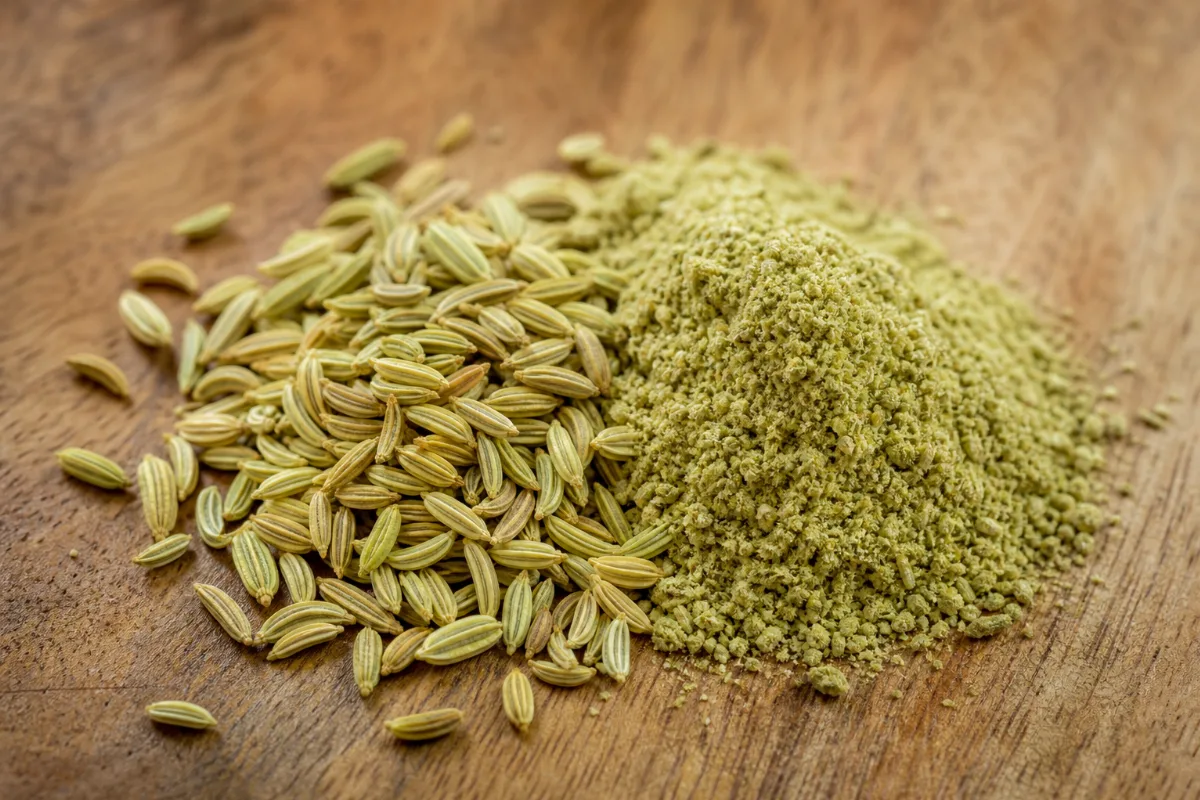
Fennel seed is the dried fruit of the fennel plant, used whole or ground as a sweet, aniseed-flavoured spice. Studies of fennel teas, oils and capsules suggest possible help for baby colic, period pain and menopause symptoms, but the trials are small and none tested the spice in food. The European Medicines Agency accepts fennel tea only as a traditional remedy. The main cautions are allergy (fennel is related to celery), pregnancy and young children for fennel medicines, and estragole in concentrated products.
General information, not medical advice. Last substantive update · Not medically reviewed. A named clinician has not signed off on this page. How this page is made
About Fennel Seed
Fennel seed is a sweet, aniseed-flavoured spice with some fibre, calcium, iron and potassium by weight, eaten in tiny amounts. Health research is on fennel teas, oils, extracts and capsules: it is promising but low certainty for baby colic, period pain and menopause symptoms, and no trial tested the spice in food. Safety cautions are mostly for concentrated products, pregnancy, small children and people allergic to the carrot family.
What it is
Fennel seed is the dried fruit of fennel (Foeniculum vulgare), a plant in the carrot family. The same plant gives the fennel bulb vegetable, fennel tea and fennel oil, which are different products. The seed's volatile oil is made largely of anethole, with fenchone and estragole (LactMed).
USDA data for whole fennel seed, per 100 g: 345 kcal, 39.8 g fibre, 1200 mg calcium, 18.5 mg iron, 1690 mg potassium and 21 mg vitamin C. One teaspoon (2 g) has about 7 kcal, 0.8 g fibre, 24 mg calcium and 34 mg potassium (our arithmetic). A spice is eaten in small amounts, so it adds little to daily nutrient intake.
What the research shows
For infant colic, the best-known trial used a fennel seed oil emulsion and found colic eliminated in 65% of babies versus 24% on placebo. A 2016 review pooled 3 studies of fennel-containing products and found about 72 fewer minutes of crying a day. Reviews say the trials had flaws and need to be repeated.
For period pain, meta-analyses of small trials found less pain than placebo and a similar effect to mefenamic acid, but with suspected publication bias. For menopause symptoms, a review of 7 trials found concerning risk of bias; two placebo-controlled trials favoured fennel for symptom scores.
EMA accepts fennel tea for mild gut spasm, bloating, gas, minor period cramps and cough with a cold as a traditional use only, which means it rests on long use and not on trial results. No human trial of the seed eaten as a spice was found.
Spice, tea, oil and capsules
The colic, period pain and menopause studies used products, not the spice. An EFSA opinion on concentrated fennel oils reports estragole up to 6.1% and classes them as suspected of causing genetic defects and cancer, which is about oil. A 2012 review argues estragole in seed decoctions may be less of a concern than pure estragole; that is the authors' view. Results do not carry over between the forms.
Amounts
This page gives no amounts to eat or take. Ask a doctor, pharmacist or dietitian what is right for you, especially if you are pregnant, breastfeeding or giving anything to a child.
At a glance
Traditional uses history, not proof
- Used in cooking and chewed after meals in some cultures
- Fennel tea is a traditional European remedy for gas and cramps; long use is not proof that it works
Studied for research
- Infant colic, low certainty (oil emulsions, extracts and teas, not the spice)
- Gas and mild gut cramps in adults, insufficient evidence (traditional use; one capsule trial with no placebo)
- Period pain, low certainty (meta-analyses of small trials)
- Menopause symptoms, low certainty (few small trials)
- Cough with a cold, insufficient evidence (traditional use only)
- Heart and blood pressure, insufficient evidence (lab and animal studies only)
Main compounds
- trans-Anethole
- Estragole
- Fenchone
- Dietary fibre
Common forms
- Whole or ground seed as a spice
- Fennel tea (the form EMA covers)
- Extracts, capsules and oil are concentrated products, covered only where studied
Research links: EMA herbal monograph on sweet fennel fruit (2024) · LactMed: Fennel · USDA FoodData Central: Spices, fennel seed · Research Library · Genes & Biomarkers Library
What it is and its history
- Accepted scientific name
- Foeniculum vulgare
- Naming authority
- Mill. (GBIF accepted)
- Common names
- Fennel seed (English); Sweet fennel (English); Saunf (Hindi); Semillas de hinojo (Spanish)
- Family or group
- Apiaceae (the carrot family), as given by GBIF.
- Classification
- Plantae > Tracheophyta > Magnoliopsida > Apiales > Apiaceae > Foeniculum > Foeniculum vulgare
- Native range
- Not verified from a source read.
- Habitat
- Not verified from a source read.
- What it looks like
- Roots: Not verified.; Stems: Not verified.; Leaves: Not verified.; Flowers: Not verified.; Fruit: EMA describes the herbal substance as the dry fruit of sweet fennel (Foeniculum vulgare subsp. vulgare var. dulce). The 'seed' of the spice is this dried fruit.
- Cultivation
- Not verified from a source read.
- Harvest and processing
- The dried fruit is used whole or ground. EMA says the material complies with the European Pharmacopoeia monograph for sweet fennel. Cooking and storage details were not read from a source.
- Look-alikes and adulterants
- Name: Fennel bulb; Note: The swollen base of the same plant, eaten as a vegetable. A different product with its own page.; Name: Bitter fennel and sweet fennel; Note: EFSA and EMA separate bitter and sweet types of Foeniculum vulgare ssp. vulgare. Their oils differ in estragole content (up to 6.1% bitter and 5.0% sweet in oils reviewed by EFSA).; Name: Anise, star anise, caraway, dill and celery; Note: Other carrot-family spices or plants with a similar flavour or look. EMA and LactMed warn about cross-allergy with this family.
- Sustainability and conservation
- Not assessed.
Photographs
Traditional use and history history, not clinical proof
| Tradition or era | Documented use | Source |
|---|---|---|
| Traditional European and Mediterranean medicine | Used as a remedy for spasm and gas; fennel infusions are a classic drink for nursing babies to prevent flatulence and colic spasm. It was also used as a diuretic, galactagogue (to raise milk supply), eye lotion and more. Taken from the introduction of a 2012 safety review; the legends it mentions (for example, hung over doorways in the Middle Ages) are not verified history. | Gori et al. 2012 (p22899959), abstract read 2026-10-26 |
| Modern European regulation | EMA accepts sweet fennel fruit tea as a traditional herbal medicine for mild gut spasm, bloating and gas, minor period spasm and cough with a cold, based on long-standing use. The current monograph was adopted 31 January 2024. | EMA/HMPC monograph EMEA/HMPC/372839/2016, read in full 2026-10-26 |
Traditional use shows how it was used. It does not show that it works or is safe today.
What is inside, and how it may work
What it contains and how those compounds act in cells and animals. Laboratory and animal mechanisms are not proven effects in people.
Main compounds
| Compound | Family | Where it is concentrated | Activity studied | Level of evidence |
|---|---|---|---|---|
| trans-Anethole PubChem 637563 | phenylpropene | Fruit (seed) and oil Described as the largest part of the volatile oil (LactMed); no percentage read | Described as a phytoestrogen (LactMed); excreted in breast milk (EMA, LactMed). Showed weak mutagenic activity in laboratory animals (EMA). EMA lists anethole allergy as a contraindication. 8 19 | Regulatory |
| Estragole PubChem 8815 | phenylpropene | Fruit (seed) and oil Up to 6.1% in bitter fennel oil and up to 5.0% in sweet fennel oil (EFSA); seed content not read | Caused liver tumours in mice and is considered a genotoxic carcinogen in rodents (EMA). Concentrated oils are classed as suspected of causing genetic defects and cancer (EFSA). 19 13 4 | Animal research |
| Fenchone PubChem 14525 | monoterpene ketone | Fruit (seed) and oil Not read | Named with anethole as a main volatile component in the 2025 review and in LactMed. No activity read. 16 8 | Unknown |
| Dietary fibre | fibre | Seed USDA: 39.8 g per 100 g whole seed | Seeds are a concentrated fibre source by weight, but spice portions are tiny. 22 | Composition |
Mechanisms, receptors and pathways
| Target or pathway | Gene or receptor | What was found | Level |
|---|---|---|---|
| Stomach muscle movement | Store-operated calcium channels (suggested) | In guinea pig stomach muscle strips in a dish, fennel tea relaxed the upper stomach and increased contractions in the lower stomach. The relaxing effect was reduced by a calcium-channel blocker. Animal tissue only; this does not show an effect in people. 15 | Animal research |
| Pollen-food cross-reactivity (mugwort, celery, fennel) | Api g 5-like protein | In one patient, IgE to a fennel protein highly similar to a celery allergen cross-reacted with mugwort pollen. One case; lab immunoblot work. 5 | Case report |
| Estrogen-like activity | Not read | LactMed describes anethole as a phytoestrogen. In one menopause trial, blood estradiol did not differ significantly from placebo. 8 9 | Human data |
Absorption, metabolism and elimination
- Absorption
- Not found for fennel seed.
- Distribution
- Trans-anethole is excreted in human breast milk (EMA, LactMed).
- Metabolism
- Not read. EMA names estragole metabolites as carcinogenic in mice.
- Elimination
- Not found.
- Bioavailability
- Not established for food amounts.
Isolated compounds versus whole extracts
Most benefit studies used oil emulsions, extracts, teas, capsules or creams, not fennel seed as a cooking spice. Safety limits from EMA apply to tea medicines, and EFSA's classification is for concentrated oil with more than 1% estragole. We do not assume results carry over between the spice, the tea and the oil.
Nutritional composition
Nutrition from USDA FoodData Central (Spices, fennel seed, FDC 171323, SR Legacy, last updated 4/1/2019, read 2026-10-26). Per 100 g: 345 kcal, 15.8 g protein, 14.9 g fat (0.48 g saturated), 52.3 g carbohydrate, 39.8 g fibre, 8.8 g water, 1200 mg calcium, 18.5 mg iron, 385 mg magnesium, 487 mg phosphorus, 1690 mg potassium, 88 mg sodium, 3.7 mg zinc, 1.07 mg copper, 6.53 mg manganese, 21.0 mg vitamin C. Vitamin K and total sugars are not listed for this entry. USDA household portions: 1 teaspoon of whole seed is 2 g and 1 tablespoon is 5.8 g. Our arithmetic from the per-100 g values: one teaspoon (2 g) gives about 7 kcal, 0.8 g fibre, 24 mg calcium, 0.4 mg iron and 34 mg potassium; one tablespoon (5.8 g) gives about 20 kcal, 2.3 g fibre, 70 mg calcium, 1.1 mg iron and 98 mg potassium. A spice is eaten in small amounts, so its share of daily nutrients is small. Values vary with variety and growing conditions. This is a description of composition, not advice on how much to eat.
3 low certainty4 not enough evidence
What was looked at
The 7 benefits and uses checked for Fennel Seed, each with how strong the evidence is. Tap one to open it.
- Infant colic (crying in babies)Low certainty
- Gas, bloating and mild gut cramps in adultsNot enough evidence
- Cough with a coldNot enough evidence
- Fennel seed in food for digestionNot enough evidence
- Heart and blood pressureNot enough evidence
- Period pain (primary dysmenorrhea)Low certainty
- Menopause symptoms (hot flushes, sleep, mood)Low certainty
Lab markers tracked in the studies
Daily crying time in infants with colicFlatulence rating after caesarean sectionPeriod pain intensityMenopause symptom score (Kupperman index)Blood estradiol (an estrogen)
What is Fennel Seed good for?
The main studied uses and how strong the human evidence is for each. Most results are for teas, oils, extracts or capsules, not for fennel seed eaten as a spice.
Benefits, one by one
Each card is a research question, not a promise. Tap a goal to filter. Open a card to see the studies, doses and limits.
Infant colic (crying in babies)
Low certaintySeveral small trials gave babies a fennel seed oil emulsion, extract or tea and found less crying. A 2003 trial of 125 infants found colic eliminated in 65% on fennel oil emulsion versus 24% on placebo. Reviews call the results encouraging but flawed. These were products made for babies, not fennel as a spice, and EMA advises against fennel medicines under 4 years. Talk to a paediatrician first.
4 studiesFennel seed oil emulsion, fennel extract, fennel tea and mixed herbal…
Studies, doses and limits
What the trials found
The 2003 randomised placebo-controlled trial (125 infants aged 2 to 12 weeks, two clinics) used a fennel seed oil emulsion. Colic was eliminated by the Wessel criteria in 65% (40/62) versus 23.7% (14/59) on placebo (P < 0.01; absolute risk reduction 41%, 95% CI 25 to 57). No side effects were reported in either group. A 2016 systematic review pooled 3 studies of preparations containing fennel: mean difference in crying time of -72.1 min/day (95% CI -126.4 to -17.7). A 2011 review found encouraging results for fennel extract but said all trials had major limitations. A 2017 review of herbal medicines for children's gut disorders found evidence for different fennel preparations (oil, tea, herbal compound) in infant colic.
Results
Less crying in the trials read, with caveats on trial quality. Products were oil emulsions, extracts, teas and mixed herbal products, not culinary fennel seed.
Effect sizes as reported
2003 trial: 65% vs 23.7% colic eliminated; pooled crying time -72.1 min/day (95% CI -126.4 to -17.7) across 3 studies of preparations containing fennel (2016 review).
Why this rating
Low: the trials are few and small, the reviews say all had flaws and that independent repeats are missing, the pooled result includes mixed products, and the 2017 review's authors report grants from herbal-medicine companies (one author). None of this is about fennel used as a spice.
Form and dose studied
Fennel seed oil emulsion, fennel extract, fennel tea and mixed herbal products given to infants in trials. Not the spice.
Who was studied
Infants with colic, mostly under 3 months.
Limits
Colic usually passes on its own. Safety of fennel products in babies is not established by EMA, which does not recommend fennel medicines under 4 years for lack of data (see the Safety tab).
Why researchers looked
Fennel infusions are a classic home remedy for babies with gas and colic (Gori 2012), so researchers have tested it.
Traditional use
Fennel seed is used in cooking and, traditionally, as a tea after meals. Long use as food is not proof that it treats any condition.
Proposed mechanism Animal research
Not established. Lab work on fennel tea in guinea pig stomach muscle found relaxing and motility-raising effects (see the stomach muscle item below). That is animal tissue, not a proven explanation for colic.
A proposed mechanism does not show that the effect happens in people.
Do not give a baby fennel tea, oil or extract without asking a paediatrician. See the Safety tab.
Gas, bloating and mild gut cramps in adults
Not enough evidenceThe European Medicines Agency accepts fennel tea for mild gut spasm, bloating and gas as a traditional use only, meaning it rests on long use, not on trial results. One small trial after caesarean birth found fennel capsules and dimethicone (an anti-gas medicine) both reduced flatulence with no difference between them. There was no placebo group. No study of fennel seed as a cooking spice was found.
3 studiesTea of the fruit (EMA), capsules (2024 trial). Not the spice in food.
Studies, doses and limits
What the trials found
EMA lists the traditional use of sweet fennel fruit as a herbal tea for mild spasmodic gut complaints including bloating and flatulence, based only on long-standing use. In a 2024 double-blind trial in women after caesarean section, both fennel capsules and dimethicone reduced flatulence scores; there was no significant difference between groups (P = 0.607).
Results
Both treatments lowered flatulence; fennel was not shown to beat anything, since there was no placebo group. No trial of fennel seed as a food was found.
Effect sizes as reported
Fennel group F(7,266) = 215.0; dimethicone F(7,245) = 198.5; between-group difference after adjusting for baseline F(1,72) = 0.27, P = 0.607 (2024 trial).
Why this rating
Insufficient: traditional-use status is not trial evidence, the one trial read had no placebo group and tested capsules in a special setting, and the stomach-muscle work is on animal tissue.
Form and dose studied
Tea of the fruit (EMA), capsules (2024 trial). Not the spice in food.
Who was studied
Adults with mild gas; women after caesarean section in the trial.
Limits
Gas after caesarean section is a special case. Lab results on animal tissue do not show a benefit in people.
Why researchers looked
Chewing fennel seed after meals is a long tradition, and fennel tea is a classic remedy for gas.
Traditional use
Fennel seed is used in cooking and, traditionally, as a tea after meals. Long use as food is not proof that it treats any condition.
Proposed mechanism Animal research
Not established in people. In guinea pig stomach muscle in a lab dish, fennel tea relaxed the upper stomach and increased contractions in the lower stomach (2025 study).
A proposed mechanism does not show that the effect happens in people.
Persistent bloating, weight loss, blood in stool or severe pain need a clinician. EMA says tea should not be taken for more than 2 weeks in adults.
Cough with a cold
Not enough evidenceEMA lists fennel tea as a traditional expectorant (to loosen phlegm) in cough with a cold. This is based on long use only. No trial was found.
1 studiesHerbal tea of the fruit (EMA listing).
Studies, doses and limits
Results
No trial found.
Effect sizes as reported
No data.
Why this rating
Insufficient: the listing rests on long-standing use only, and no human study was found.
Form and dose studied
Herbal tea of the fruit (EMA listing).
Limits
Traditional-use status means the product is accepted for sale on long use, not that it has been shown to work.
Why researchers looked
Fennel tea is used in folk medicine for coughs.
Traditional use
Fennel seed is used in cooking and, traditionally, as a tea after meals. Long use as food is not proof that it treats any condition.
Proposed mechanism None found
Not established.
A proposed mechanism does not show that the effect happens in people.
A cough that lasts more than a few weeks, or comes with fever, breathlessness or blood, needs a clinician.
Fennel seed in food for digestion
Not enough evidenceMany people chew fennel seed after a meal. No study of eating fennel seed in cooking amounts for digestion was found, so this use is not tested.
1 studiesNot applicable.
Studies, doses and limits
Results
No data for the spice in food.
Effect sizes as reported
No data.
Why this rating
Insufficient: no human study of the seed eaten as a spice was found. Results for oil, tea or capsules do not carry over.
Limits
Absence of trials is not proof of no effect, only that none was found.
Why researchers looked
After-meal fennel seed is a common custom, so people ask if it works.
Traditional use
Fennel seed is used in cooking and, traditionally, as a tea after meals. Long use as food is not proof that it treats any condition.
Proposed mechanism None found
Not established for food amounts.
A proposed mechanism does not show that the effect happens in people.
See the Safety tab for allergy and estragole.
Heart and blood pressure
Not enough evidenceA 2025 review reports that lab and animal studies of fennel show blood-pressure-lowering, antioxidant and other effects. We found no human trial of fennel seed for blood pressure, so this is lab and animal evidence only.
1 studiesExtracts and oils in experiments.
Studies, doses and limits
Results
Lab and animal findings only. The review itself says potential interactions with heart medicines and the limits of current studies need clinical research.
Effect sizes as reported
No human data.
Why this rating
Insufficient: lab and animal evidence only. Only the abstract of the review was read.
Form and dose studied
Extracts and oils in experiments.
Limits
Cell and animal results often do not hold in people.
Why researchers looked
Fennel has many plant compounds, so researchers test it in cells and animals.
Traditional use
Fennel seed is used in cooking and, traditionally, as a tea after meals. Long use as food is not proof that it treats any condition.
Proposed mechanism Animal research
The review attributes effects to volatile oils such as trans-anethole and fenchone, flavonoids and phenolic acids, mostly from in vitro and animal experiments.
A proposed mechanism does not show that the effect happens in people.
If you take heart or blood pressure medicine, ask your pharmacist before using fennel supplements or strong teas.
Period pain (primary dysmenorrhea)
Low certaintyReviews of small trials in young women found fennel seed products eased period pain more than placebo and about as much as common pain medicines. The trials differed a lot and small trials with good results were over-represented, so this is promising but low certainty. These were capsules, extracts and drinks, not fennel as a spice.
4 studiesFennel seed capsules, extracts, drinks and similar products. Not the …
Studies, doses and limits
What the trials found
A 2020 meta-analysis of 12 randomised trials (Nutrients): against conventional pain drugs, 7 trials (n = 502) showed a similar effect (SMD 0.07, 95% CI -0.08 to 0.21, I2 = 0%); against placebo, fennel reduced pain (n = 468, SMD -3.27, 95% CI -5.28 to -1.26) but with very high inconsistency between trials (I2 = 98%). The authors saw signs of publication bias because there were many small trials with favourable results; only three studies assessed side effects and one reported minor ones. A 2021 meta-analysis of 12 studies found less pain than placebo (SMD -0.632, 95% CI -0.827 to -0.436, I2 = 0%, 7 articles) and no difference from mefenamic acid. A 2026 review of 14 trials of carrot-family herbs (including fennel) judged them potentially useful add-on treatments; its abstract does not give a fennel-only result.
Results
Lower period pain than placebo and similar to standard pain medicines in small trials; large differences between trials; possible publication bias.
Effect sizes as reported
Vs placebo: SMD -0.632 (95% CI -0.827 to -0.436; 2021, 7 articles) or SMD -3.27 (95% CI -5.28 to -1.26; I2 98%; 2020). Vs drugs: SMD 0.07 (95% CI -0.08 to 0.21; 2020) and SMD -0.214 (95% CI -0.446 to 0.017; 2021) for mefenamic acid.
Why this rating
Low: the meta-analyses are consistent in direction, but the trials are small, the 2020 pooled result is highly inconsistent (I2 98%), publication bias was suspected and the 2026 review noted concerns about deviations and selective reporting in trials against standard treatments.
Form and dose studied
Fennel seed capsules, extracts, drinks and similar products. Not the spice.
Who was studied
Young women with primary dysmenorrhea.
Limits
Only abstracts were read. Products and trial quality varied. Pain that is severe, new or different needs a clinician, because other causes need to be ruled out.
Why researchers looked
Fennel is used in traditional medicine for menstrual cramps, and EMA lists it for minor spasm with periods as a traditional use.
Traditional use
Fennel seed is used in cooking and, traditionally, as a tea. Long use as food is not proof that it treats any condition.
Proposed mechanism Unknown
Not established. Fennel contains anethole, which LactMed describes as a phytoestrogen. How it might ease pain was not shown in the reviews read.
A proposed mechanism does not show that the effect happens in people.
EMA says pregnancy safety is not established; see the Safety tab. EMA advises against use in children under 12 for this indication.
Menopause symptoms (hot flushes, sleep, mood)
Low certaintyA 2021 review pooled two placebo-controlled trials and found fennel improved overall menopause symptom scores. A trial of fennel seed powder capsules over 8 weeks found a lower symptom score than placebo but no clear change in estradiol or sexual desire. The trials were small and the review flagged risk of bias, so certainty is low. The review found no clear benefit for quality of life or psychological health.
2 studiesFennel seed powder capsules, extracts and creams. Not the spice in fo…
Studies, doses and limits
What the trials found
A 2021 systematic review (Complement Ther Clin Pract) found 7 randomised trials in menopausal women and noted concerning risks of bias. Pooling 2 placebo-controlled trials (n = 145) favoured fennel for menopausal symptoms (SMD -1.32, 95% CI -1.76 to -0.87). Other studies failed to show benefit for sexual function, quality of life and psychological health. No serious adverse events were reported. In a separate 2020 randomised trial of 80 postmenopausal women (fennel seed powder capsules vs starch capsules, 8 weeks), the menopausal symptom score fell from 30.8 to 19 on fennel and from 31.2 to 26.4 on placebo (P < 0.05); sexual desire did not change significantly and the decline in estradiol was not significantly different between groups (P > 0.05).
Results
Lower symptom scores than placebo in small trials; no clear benefit for sexual desire, quality of life or psychological health; estradiol not shown to change.
Effect sizes as reported
Pooled SMD -1.32 (95% CI -1.76 to -0.87; n = 145; 2021). Symptom score 30.8 to 19 vs 31.2 to 26.4 (2020 trial).
Why this rating
Low: few small trials with concerning risk of bias, and the largest pooled effect rests on only two placebo-controlled trials. Quality of life and mood results were unclear.
Form and dose studied
Fennel seed powder capsules, extracts and creams. Not the spice in food.
Who was studied
Postmenopausal and menopausal women.
Limits
Only abstracts were read. Menopause symptoms also respond strongly to placebo.
Why researchers looked
Fennel contains anethole, described by LactMed as a phytoestrogen, so researchers have tested it for menopause symptoms.
Traditional use
Fennel seed is used in cooking and, traditionally, as a tea. Long use as food is not proof that it treats any condition.
Proposed mechanism Human data
Not established. A trial measured estradiol and saw no significant between-group difference.
A proposed mechanism does not show that the effect happens in people.
Fennel's phytoestrogen effects have not been studied in women with hormone-sensitive conditions in any source read. Ask a clinician first if this applies to you.
Connections to the rest of health
How Fennel Seed connects to the rest of our health knowledge graph. Every link says what kind of connection it is. A safety link (for example to the liver) is a warning, not a benefit. A study that merely mentions a topic never creates a benefit link.
Explore every connection: goals, body systems, organs, symptoms, genes
A. Wellness goals
| Connected to | Kind of connection | Evidence status | Context | Studies |
|---|---|---|---|---|
| Gut Health | Traditional use | Not enough evidence | Gas, bloating and mild gut cramps in adults: The European Medicines Agency accepts fennel tea for mild gut spasm, bloating and gas as a traditional use only, meaning it rests on long use, not on trial results. One small trial after caesarean birth found fennel capsules and dimethicone (an anti-gas medicine) both reduced flatulence with no difference between them. There was no placebo group. No study of fennel seed as a cooking spice was found. | 19 14 15 |
| Digestive Support | Traditional use | Not enough evidence | Gas, bloating and mild gut cramps in adults: The European Medicines Agency accepts fennel tea for mild gut spasm, bloating and gas as a traditional use only, meaning it rests on long use, not on trial results. One small trial after caesarean birth found fennel capsules and dimethicone (an anti-gas medicine) both reduced flatulence with no difference between them. There was no placebo group. No study of fennel seed as a cooking spice was found. | 19 14 15 |
| Digestive Support | Not enough evidence | Fennel seed in food for digestion: Many people chew fennel seed after a meal. No study of eating fennel seed in cooking amounts for digestion was found, so this use is not tested. | 21 |
B. Body systems
| Connected to | Kind of connection | Evidence status | Context | Studies |
|---|---|---|---|---|
| Digestive System | Biological association | Low certainty | Studied for: Infant colic (crying in babies) Studied for: Gas, bloating and mild gut cramps in adults | 2 6 3 7 19 14 15 21 |
| Respiratory System | Biological association | Not enough evidence | Studied for: Cough with a cold | 19 |
| Cardiovascular System | Biological association | Not enough evidence | Studied for: Heart and blood pressure | 16 |
| Reproductive System | Biological association | Low certainty | Studied for: Period pain (primary dysmenorrhea) Studied for: Menopause symptoms (hot flushes, sleep, mood) | 10 12 18 19 11 9 |
E. Health conditions
| Connected to | Kind of connection | Evidence status | Context | Studies |
|---|---|---|---|---|
| Celery-mugwort-spice allergy | Adverse effect or risk | Reported | Fennel is a relative of celery; some people allergic to mugwort pollen or celery also react to it. Fennel is related to celery; some people allergic to mugwort or celery also react to it. Preparation or compound: Fennel seed and other fennel parts |
1 5 19 |
| Infantile colic | Preliminary | Small trials of fennel oil emulsion, extract and tea found less crying; reviews call them flawed. Preparation or compound: Fennel seed oil emulsion, extract and tea (not the spice) |
2 6 |
I. Biomarkers
| Connected to | Kind of connection | Evidence status | Context | Studies |
|---|---|---|---|---|
| Daily crying time in infants with colic | Biological association | Low certainty | Measured in trials: lowered. A lab change is not the same as a health benefit. | 6 2 3 7 |
| Flatulence rating after caesarean section | Biological association | Not enough evidence | Measured in trials: lowered. A lab change is not the same as a health benefit. | 14 |
| Period pain intensity | Biological association | Low certainty | Measured in trials: lowered. A lab change is not the same as a health benefit. | 12 10 18 |
| Menopause symptom score (Kupperman index) | Biological association | Low certainty | Measured in trials: lowered. A lab change is not the same as a health benefit. | 9 11 |
| Blood estradiol (an estrogen) | Biological association | Low certainty | Measured in trials: no-change. A lab change is not the same as a health benefit. | 9 |
K. Biological pathways
| Connected to | Kind of connection | Evidence status | Context | Studies |
|---|---|---|---|---|
| Estragole | Preliminary mechanism | Animal | Natural compound in fennel fruit; liver tumours in mice; regulatory limits for medicines. | 19 13 |
| Anethole | Preliminary mechanism | Regulatory | Main volatile compound; phytoestrogen; excreted in breast milk. | 8 19 |
| Potassium | Preliminary mechanism | Composition | Seed is a concentrated source by weight (1690 mg per 100 g), but portions are tiny. | 22 |
L. Active compounds
| Connected to | Kind of connection | Evidence status | Context | Studies |
|---|---|---|---|---|
| Estragole | Adverse effect or risk | Animal | Caused liver tumours in mice; regulators set limits for pregnancy and children for fennel medicines. Caused liver tumours in mice; EMA sets limits for fennel medicines in pregnancy and children. Preparation or compound: Fennel fruit and oil |
19 13 |
| trans-Anethole | Biological association | Regulatory | Described as a phytoestrogen (LactMed); excreted in breast milk (EMA, LactMed). Showed weak mutagenic activity in laboratory animals (EMA). EMA lists anethole allergy as a contraindication. Preparation or compound: Fruit (seed) and oil |
8 19 |
| Estragole | Biological association | Animal | Caused liver tumours in mice and is considered a genotoxic carcinogen in rodents (EMA). Concentrated oils are classed as suspected of causing genetic defects and cancer (EFSA). Preparation or compound: Fruit (seed) and oil |
19 13 4 |
| Fenchone | Biological association | Unknown | Named with anethole as a main volatile component in the 2025 review and in LactMed. No activity read. Preparation or compound: Fruit (seed) and oil |
16 8 |
| Dietary fibre | Biological association | Composition | Seeds are a concentrated fibre source by weight, but spice portions are tiny. Preparation or compound: Seed |
22 |
Each connection is stored with the ingredient, the connected record, the kind of connection, the evidence status, the supporting studies, the preparation or compound involved, and a review date (last reviewed October 26, 2026).
Evidence at a glance: what changed in 5 lab markers
Tap a number to show only those markers. Counts are markers, not people.
The evidence
The research centre for Fennel Seed. Every record here was checked against PubMed or the publisher's page; we never list a study we have not verified.
Evidence by outcome
Bars show how many studies we found for each outcome, not how well it works. People are added up across trials only (reviews are not added, to avoid double counting).
How we rate evidence
High certainty
Several well-run trials or reviews agree; further research is unlikely to change the picture much.
Moderate certainty
Good trials point the same way, but some doubt remains.
Low certainty
Small, short or inconsistent trials. The finding could change with better research.
Very low certainty
Very little or very weak human data. Treat as a possibility only.
Mixed findings
Trials or reviews disagree with each other.
Not enough evidence
Not enough human research to say either way.
Evidence against
Good research found no benefit, or found harm.
We take the reviewers' own risk-of-bias and GRADE statements where they exist, and otherwise judge from study size, design, consistency, directness and whether a product matches what is sold. Many publications do not make evidence high. Method note: We started from our existing fennel seed summary, re-read the EMA herbal monograph in full, re-checked nutrition at USDA FoodData Central, read the LactMed entry and searched PubMed for reviews, trials and case reports. Only abstracts were read for studies. Items we could not verify are flagged in the research gaps.
Study library: every study we checked 22
| Study | Design | People | Product, dose, length | Result |
|---|---|---|---|---|
| p12078423 2002, Allerg Immunol (Paris): Food allergy and IgE sensitization caused by spices: CICBAA data (589 cases of food allergy) · Source |
Case series |
Methods, limits and fundingRead: abstract | ||
| p12868253 2003, Altern Ther Health Med: The effect of fennel (Foeniculum vulgare) seed oil emulsion in infantile colic: a randomized, placebo-controlled study · Source |
Controlled trial human, infants |
Methods, limits and fundingRead: abstract | ||
| p21444591 2011, Pediatrics: Nutritional supplements and other complementary medicines for infantile colic: a systematic review · Source |
Systematic review human, infants |
Methods, limits and fundingRead: abstract | ||
| p22899959 2012, Evid Based Complement Alternat Med: Can estragole in fennel seed decoctions really be considered a danger for human health? A fennel safety update · Source |
Narrative review n/a |
Methods, limits and fundingRead: abstract | ||
| p24067338 2013, Eur Ann Allergy Clin Immunol: Mugwort-fennel-allergy-syndrome associated with sensitization to an allergen homologous to Api g 5 · Source |
Case report human, one patient |
Methods, limits and fundingRead: abstract | ||
| p26655941 2016, J Pediatr Gastroenterol Nutr: Infant colic - what works: a systematic review of interventions for breast-fed infants · Source |
Systematic review human, infants |
Methods, limits and fundingRead: abstract | ||
| p28562281 2017, Pediatrics: Herbal medicines for gastrointestinal disorders in children and adolescents: a systematic review · Source |
Systematic review human, children |
Methods, limits and fundingRead: abstract | ||
| p30000852 LactMed (Drugs and Lactation Database): Fennel · Source |
Health agency |
Methods, limits and fundingRead: full-text | ||
| p33110044 2020, Menopause: The effect of fennel seed powder on estradiol levels, menopausal symptoms, and sexual desire in postmenopausal women · Source |
Controlled trial |
Methods, limits and fundingRead: abstract | ||
| p33182553 2020, Nutrients: Fennel for reducing pain in primary dysmenorrhea: a systematic review and meta-analysis of randomized controlled trials · Source |
Systematic review |
Methods, limits and fundingRead: abstract | ||
| p33725577 2021, Complement Ther Clin Pract: Fennel (Foeniculum vulgare Miller) for the management of menopausal women's health: a systematic review and meta-analysis · Source |
Systematic review |
Methods, limits and fundingRead: abstract | ||
| p34187122 2021, J Complement Integr Med: Effect of fennel on primary dysmenorrhea: a systematic review and meta-analysis · Source |
Systematic review |
Methods, limits and fundingRead: abstract | ||
| p37908453 EFSA Journal 2023: Safety and efficacy of feed additives consisting of essential oils from the fruit and stems of Foeniculum vulgare Mill. ssp. vulgare: bitter fennel oil and sweet fennel oil · Source |
Regulatory opinion n/a |
Methods, limits and fundingRead: abstract | ||
| p39309989 2024, J Educ Health Promot: A comparative study of fennel and dimethicone capsule effects on flatulence rate after cesarean section (double-blind randomized controlled trial) · Source |
Controlled trial |
Methods, limits and fundingRead: abstract | ||
| p41214408 2025, Neurogastroenterol Motil: Fennel tea has a region-specific effect on the motility of the stomach · Source |
Animal research guinea pig stomach muscle strips |
Methods, limits and fundingRead: abstract | ||
| p41305003 2025, Pharmaceuticals (Basel): Cardiovascular effects, phytochemistry, drug interactions, and safety profile of Foeniculum vulgare Mill. (fennel): a comprehensive review · Source |
Narrative review mostly in vitro and animal |
Methods, limits and fundingRead: abstract | ||
| p41306764 2025, Front Allergy: Spices, herbs and allergic reactions in children: myth or reality (narrative review with scoping elements) · Source |
Narrative review |
Methods, limits and fundingRead: abstract | ||
| p41653970 2026, Ann Pharm Fr: Efficacy of herbaceous Apiaceae plants in primary dysmenorrhea: a systematic review and meta-analysis of RCTs · Source |
Systematic review |
Methods, limits and fundingRead: abstract | ||
| s-ema-fennel-dulce-monograph EMA/HMPC: European Union herbal monograph on Foeniculum vulgare Miller subsp. vulgare var. dulce, fructus (EMEA/HMPC/372839/2016, final revision 1) · Source |
Regulatory monograph n/a |
Methods, limits and fundingRead: full-text | ||
| s-gbif-foeniculum-vulgare GBIF Backbone: Foeniculum vulgare Mill. (usageKey 3034922) · Source |
Reference database n/a |
Methods, limits and fundingRead: full-text | ||
| s-pubmed-search-fennel-seed Our PubMed searches for human studies of fennel seed (run 2026-10-26) · Source |
Search log n/a |
Methods, limits and fundingRead: search-results | ||
| s-usda-fdc-171323 USDA FoodData Central: Spices, fennel seed (FDC 171323) · Source |
Reference database n/a |
Methods, limits and fundingRead: full-text |
What we do not know yet
- No human trial of fennel seed eaten as a cooking spice was found for any outcome.
- Infant colic, period pain and menopause trials used oils, extracts, teas and capsules, were small, and only their abstracts were read.
- No source gives an estragole figure for cooking amounts; aflatoxin, heavy metals and adulteration were not researched.
- How often fennel seed in food causes allergy was not found.
- LiverTox, the EMA estragole public statement and the original LactMed case reports were not read.
How new research is added
New studies are found by a saved PubMed search and placed in a review queue before the page changes.
Lab markers
What changed in blood or saliva tests during trials. A changed number is not the same as feeling or being healthier, and we give no "normal ranges".
Other 5
Daily crying time in infants with colic
Lowered in trials
How many minutes a day a baby with colic cries.
Low certaintyResults and what it means
Why it was measured
Crying time is the main way colic is measured in trials.
Statistical vs. clinical meaning
Promising but low-certainty. The trials had flaws and used products, not the spice.
Safety implication
EMA does not recommend fennel medicines under 4 years for lack of adequate data.
| Study | Result | People | Product |
|---|---|---|---|
| 6 | Pooled mean difference -72.1 min/day (95% CI -126.4 to -17.7) across 3 studies of preparations containing fennel | Breast-fed and mixed-fed infants under 6 months with colic | Fennel-containing preparations (oil, tea or mixed herbal products), not culinary seed |
| 2 | Colic eliminated in 65% vs 23.7% on placebo (cumulative crying under 9 hours a week) | 125 infants aged 2 to 12 weeks | Fennel seed oil emulsion |
Flatulence rating after caesarean section
Lowered in trials
A 0 to 10 style visual scale women use to rate how much gas they feel.
Not enough evidenceResults and what it means
Why it was measured
Gas is a common discomfort after caesarean birth.
Statistical vs. clinical meaning
Both treatments lowered the score; fennel was not compared with placebo.
Safety implication
None reported in the abstract.
| Study | Result | People | Product |
|---|---|---|---|
| 14 | Flatulence fell in both the fennel and dimethicone groups, with no difference between them (P = 0.607) | Women after caesarean section | Fennel capsules compared with dimethicone capsules (no placebo group) |
Period pain intensity
Lowered in trials
How strong a woman rates her menstrual pain on a pain scale.
Low certaintyResults and what it means
Why it was measured
Pain scores are the main outcome in dysmenorrhea trials.
Statistical vs. clinical meaning
Consistent direction, but small trials, high inconsistency in one analysis and possible publication bias.
Safety implication
Few trials assessed side effects; minor ones were reported in one study.
| Study | Result | People | Product |
|---|---|---|---|
| 12 | Less pain than placebo: SMD -0.632 (95% CI -0.827 to -0.436), I2 = 0%, 7 articles; no difference from mefenamic acid | Women with primary dysmenorrhea in 12 studies | Foeniculum vulgare products (capsules, extracts, drinks), not the spice |
| 10 | Vs placebo SMD -3.27 (95% CI -5.28 to -1.26), I2 = 98%; vs conventional drugs SMD 0.07 (95% CI -0.08 to 0.21) | Women with primary dysmenorrhea in 12 trials | Fennel products |
Menopause symptom score (Kupperman index)
Lowered in trials
A questionnaire score that adds up hot flushes, sleep trouble, mood and other menopause symptoms.
Low certaintyResults and what it means
Why it was measured
It is the standard summary of menopause symptoms in these trials.
Statistical vs. clinical meaning
Lower scores than placebo in small trials with risk of bias.
Safety implication
No serious adverse events were reported in the review.
| Study | Result | People | Product |
|---|---|---|---|
| 9 | Score fell from 30.8 to 19 on fennel and from 31.2 to 26.4 on placebo over 8 weeks (P < 0.05) | 80 postmenopausal women aged 45 to 60 | Fennel seed powder capsules vs starch capsules |
| 11 | Pooled SMD -1.32 (95% CI -1.76 to -0.87) for 2 placebo-controlled trials | 145 menopausal women | Fennel products |
Blood estradiol (an estrogen)
No clear change in trials
The level of the main estrogen hormone measured in a blood sample.
Low certaintyResults and what it means
Why it was measured
Fennel contains a phytoestrogen (anethole), so trials ask if hormone levels change.
Statistical vs. clinical meaning
No significant hormone change shown in one small trial.
Safety implication
None reported.
| Study | Result | People | Product |
|---|---|---|---|
| 9 | Estradiol fell in both groups; the difference between fennel and placebo groups was not significant (P > 0.05) | 80 postmenopausal women | Fennel seed powder capsules, 8 weeks |
Safety
What studies and official sources say about side effects, medicines and who should check first. Each point shows what kind of evidence it comes from.
Main points to know 6
- Cooking amounts are not the same as teas, oils and capsules. Fennel seed is a normal food spice. The cautions below come mostly from rules for fennel medicines and teas (EMA), concentrated oils (EFSA) and rodent studies of a natural compound called estragole. EMA says total exposure to estragole should be kept as low as practically achievable in the general population. No source we read gives an estragole figure for cooking amounts or sets a limit for them. A 2012 review argues that estragole in fennel seed decoctions may be less of a danger than pure estragole, because other substances in the decoction inactivate it; this is the authors' view from the literature, not a regulator's finding. Regulatory opinion 19 13 4
- Allergy: fennel is in the carrot family, with celery, and mugwort pollen allergy can overlap. EMA lists allergy to the carrot family (aniseed, caraway, celery, coriander and dill), to anethole, and to mugwort pollen as reasons not to use fennel medicines, and says skin or breathing reactions can occur at an unknown frequency. A French data bank of 589 food allergy cases found prick-test sensitisation to coriander, caraway, fennel and celery in 32% of tests in children and 23% in adults, and 3 of 10 mugwort-celery-spice reactions were to fennel. A 2025 review names fennel among the spices most often implicated in allergy in children, with symptoms from mild mouth reactions to anaphylaxis. In one patient, a fennel protein cross-reacted with mugwort pollen. LactMed adds that people allergic to carrots, celery or other carrot-family plants should avoid fennel because of cross-allergy. If you have reacted to celery, mugwort pollen or spices, ask an allergy clinician. For trouble breathing or swelling of the face or throat, call emergency services. Case series 19 1 5 17 8
- Pregnancy and breastfeeding: EMA does not recommend fennel medicines. EMA says safety in pregnancy and breastfeeding has not been established and, without enough data, use of fennel tea medicines is not recommended. It sets a limit for estragole intake of below 0.05 mg per person per day in pregnant and breast-feeding women. In pregnant mice, an aqueous extract of fennel seeds caused dose-dependent harm to the embryos; this is animal evidence only. EMA also says trans-anethole is excreted in human breast milk. LactMed (revised October 2026) says excessive use by a mother of an herbal tea containing fennel, anise and other herbs appeared to cause toxicity in 2 breastfed newborns, consistent with anethole, and describes two small studies of fennel as a milk-boosting herb with mixed results and no rise in prolactin. No source we read sets a limit for fennel seed used in cooking. Ask your doctor or midwife. Regulatory opinion 19 8
- Babies and young children: fennel products are not recommended without medical advice. EMA does not recommend fennel tea medicines in children under 4 years because of a lack of adequate data. For ages 4 to 12 it does not recommend use if estragole intake is above 1.0 microgram per kg of body weight a day, unless a risk assessment based on adequate safety data says otherwise, and tea is for short-term use only (under a week). This sits alongside small colic trials that reported no side effects (see the Benefits tab). Both are true: the trials are small, and the regulator says data are inadequate. Ask a paediatrician before giving a baby any fennel tea, oil or extract. Regulatory opinion 19 2
- Estragole causes liver tumours in mice; concentrated oils carry a warning. EMA says estragole and some of its metabolites caused liver tumours in mice and gave suggestive but indirect evidence of cancer in rats, and that estragole is considered a genotoxic carcinogen in rodents. An aqueous fennel extract was negative in a bacterial mutation test. An EFSA opinion on fennel essential oils (an animal feed review) reports estragole up to 6.1% in bitter fennel oil and up to 5.0% in sweet fennel oil, and classes the oils as suspected of causing genetic defects and cancer because estragole is above 1%. That is about concentrated oil. No human cancer study of fennel seed was found. Animal research 19 13
- Tea and medicine use: time limit. EMA says fennel tea medicines should not be taken by adults for more than 2 weeks, and that if symptoms worsen or persist a doctor or qualified health care practitioner should be consulted. No cases of overdose have been reported (EMA). Regulatory opinion 19
Side effects 3
| Effect | How often | Severity and recovery | Evidence |
|---|---|---|---|
| Allergic reactions affecting the skin or breathing (itchy mouth, hives, swelling, anaphylaxis) Spice-allergy studies do not always say which fennel part or product was involved. | Frequency not known (EMA). Spice allergy was 2% of all food allergies in one French data bank, and fennel was behind 3 of 10 mugwort-celery-spice reactions there. | mild to serious (the 2025 review lists symptoms up to anaphylaxis) Not stated | Case series 19 1 17 |
| Sensitivity to sunlight (photosensitivity) after oral or topical use LactMed lists photosensitivity among the allergic reactions of fennel; no frequency or detail in the abstract. | Not established | not stated Not stated | Authoritative guidance 8 |
| Toxicity in breastfed newborns after the mother drank large amounts of a fennel-and-anise herbal tea A mixed herbal tea, not fennel seed in cooking. Only the LactMed summary was read, not the original reports. | 2 newborns, as described by LactMed | not stated in the abstract Not stated | Case report 8 |
Liver
LactMed describes diarrhoea and an enlarged liver in a woman taking fennel, fenugreek and goat's rue together, and raised liver enzymes in another woman taking a tea blend that contains fennel. Those were combinations, so the cause cannot be assigned to fennel. Estragole caused liver tumours in mice (EMA). LiverTox was not searched. 8 19
How often. No frequency was found.
Monitoring. No agency monitoring advice was found.
This is a safety connection. It is not evidence that Fennel Seed supports liver health.
Medicines and supplements 2
| With | Why it matters | Importance | Evidence | What to do |
|---|---|---|---|---|
| Prescription and over-the-counter medicines in general prescription | EMA lists interactions with other medicinal products as none reported. A 2025 review's abstract says potential interactions with cardiovascular drugs need clinical research but names none. | Regulatory opinion Low certainty 19 16 | Tell your pharmacist about any fennel tea, extract or capsule you take regularly. 'None reported' means none documented, not proven safe. | |
| Hormone treatments and hormone-sensitive conditions condition | LactMed describes anethole, the main compound in fennel seed oil, as a phytoestrogen. | No source we read tests fennel with hormone therapy or in hormone-sensitive cancers. In one menopause trial, blood estradiol did not differ significantly from placebo. | Authoritative guidance Not enough evidence 8 9 | If you have a hormone-sensitive condition or take hormone treatment, ask your doctor before using fennel supplements or strong teas. Cooking amounts have not been studied. |
Who should check first 3
| Situation | Advice | Evidence |
|---|---|---|
| Allergy to fennel, to carrot-family plants (aniseed, caraway, celery, coriander, dill), to anethole, or to mugwort pollen | EMA lists these as contraindications for fennel medicines. Avoid fennel until an allergy clinician has advised you. Call emergency services for trouble breathing or swelling of the face or throat. | Regulatory opinion 19 1 5 |
| Pregnancy and breastfeeding (fennel medicines, teas and supplements) | EMA does not recommend them because safety is not established. Ask your doctor or midwife about fennel in your whole diet. | Regulatory opinion 19 8 |
| Babies and children under 12 (fennel medicines, teas, oils) | EMA does not recommend fennel medicines under 4 years, and sets estragole limits for ages 4 to 12. Ask a paediatrician. | Regulatory opinion 19 |
Overdose, product quality and regulators
Summary. Fennel seed is a long-standing food spice, and EMA reports no cases of overdose. The toxicity concerns are about estragole in concentrated products and rodent studies.
Animal. Estragole caused liver tumours in mice (EMA). A fennel seed extract given to pregnant mice caused dose-dependent harm to embryos (EMA, from one study of 24 mice).
Human doses studied. Trials in infants, women with period pain and menopausal women report no or few side effects in the abstracts read; they were small and mostly short.
High dose or long term signals. EMA limits tea use to 2 weeks in adults. Concentrated fennel oils are classed as suspected of causing genetic defects and cancer (EFSA).
Overdose response. No cases of overdose reported (EMA).
Genotoxicity. Estragole is considered a genotoxic carcinogen in rodents (EMA). An aqueous fennel extract was negative in a bacterial (Ames) mutation test. Anethole showed weak mutagenic activity in laboratory animals (EMA).
Aflatoxin (a mould toxin), heavy metals, pesticide residues and adulteration in fennel seed were not researched. Concentrated oils vary in estragole content (up to 5.0% to 6.1% in the oils EFSA reviewed).
Estragole content of concentrated oil. EFSA reports estragole up to 6.1% in bitter fennel oil and up to 5.0% in sweet fennel oil; the seed in food was not measured in any source read. 13
| Body | Action | Date |
|---|---|---|
| EMA / HMPC (European Medicines Agency) (European Union) | Herbal monograph for sweet fennel fruit: traditional use only for mild gut spasm, bloating and gas, minor period spasm and cough with a cold; not for under 4 years; not recommended in pregnancy and breastfeeding; estragole limits of 0.05 mg per day in pregnant and breast-feeding women and 1.0 microgram per kg body weight in children under 12; tea not for more than 2 weeks in adults; interactions none reported source | 2024-01-31 |
| EFSA (European Food Safety Authority) (European Union) | Opinion on fennel essential oils as animal feed additives: estragole up to 6.1% in bitter fennel oil and 5.0% in sweet fennel oil; oils classed as suspected of causing genetic defects and cancer. Concentrated oil, not the seed source | 2023-10-30 |
| LactMed (US National Library of Medicine) (United States) | Fennel entry: anethole is excreted in breast milk; avoid if allergic to carrots, celery or other carrot-family plants; photosensitivity and allergy possible; fennel oil is listed as generally recognised as safe for food use by the FDA (as LactMed states it) source | 2026-10-15 |
When to get medical help
- Trouble breathing, swelling of the lips, face or throat, widespread hives, or faintness after eating fennel (call emergency services)
- Itching or swelling of the mouth or throat after eating fennel, celery or related spices, especially in someone with hay fever to mugwort
- A baby who is drowsy, feeding poorly or unwell after the mother drank a large amount of a fennel herbal tea
- Symptoms that worsen or last beyond about two weeks of using fennel tea (see a doctor)
Stop using the product and contact a clinician or emergency service. In the US, Poison Control is 1-800-222-1222.
General information only, not medical advice. Ask a clinician or pharmacist before use, especially with medicines, in pregnancy or with a health condition. See the Natural Remedy Safety guide.
Frequently asked questions
What is fennel seed good for?
Does fennel help baby colic?
Small trials of fennel seed oil emulsion, extract and tea found less crying, and a 2016 review pooled 3 studies (about 72 fewer minutes of crying a day). Reviews say the trials had flaws. EMA does not recommend fennel medicines under 4 years, so ask a paediatrician before giving a baby any fennel product.
Does fennel help bloating and gas?
EMA accepts fennel tea for mild gut spasm, bloating and gas as a traditional use only. One trial after caesarean section found fennel capsules and dimethicone both lowered flatulence with no difference between them and no placebo group. Lab work on guinea pig stomach muscle is not proof in people.
Does fennel help period pain?
Does fennel help menopause symptoms?
Is fennel seed safe in pregnancy and breastfeeding?
EMA does not recommend fennel medicines and teas in pregnancy and breastfeeding because safety is not established, and sets an estragole limit for these groups. A fennel seed extract harmed embryos in pregnant mice. LactMed notes anethole passes into breast milk. No source we read sets a limit for cooking amounts, so ask your doctor or midwife.
Is fennel seed safe for children?
Can I be allergic to fennel?
What is estragole and should I worry?
Estragole is a natural compound in fennel fruit and oil. EMA says it caused liver tumours in mice, so it limits intake from fennel medicines. EFSA reports up to 6.1% estragole in bitter fennel oil. We found no estragole figure for cooking amounts, and a 2012 review argues seed decoctions may be less of a concern than pure estragole.
Does fennel seed interact with medicines?
Is fennel seed the same as fennel bulb or fennel tea?
Is fennel seed the same as anise?
No. They are different plants in the carrot family with a similar aniseed-like flavour. EMA lists aniseed allergy as a contraindication for fennel medicines because of cross-allergy.
Explore by health goal
Editorial transparency
- Written by
- AlternativeMed editorial team. Research compiled with AI assistance, then checked against the sources listed.
- Medical review
- None. This page has not been reviewed by a physician or pharmacist.
- First published
- 2026-10-26
- Last substantive update
- 2026-10-26
- How we research
- We started from our existing fennel seed summary, re-read the EMA herbal monograph in full, re-checked nutrition at USDA FoodData Central, read the LactMed entry and searched PubMed for reviews, trials and case reports. Only abstracts were read for studies. Items we could not verify are flagged in the research gaps.
- How we rate evidence
- See "How we rate evidence" in the Evidence tab.
- Independence
- No product is promoted on this page. No affiliate links are shown.
Sources 22
Each source was opened and checked. Where we read only the abstract, it says so. The small numbers in the text point here.
- . 2002, Allerg Immunol (Paris): Food allergy and IgE sensitization caused by spices: CICBAA data (589 cases of food allergy). . . (abstract)
- . 2003, Altern Ther Health Med: The effect of fennel (Foeniculum vulgare) seed oil emulsion in infantile colic: a randomized, placebo-controlled study. . . (abstract)
- . 2011, Pediatrics: Nutritional supplements and other complementary medicines for infantile colic: a systematic review. . . (abstract)
- . 2012, Evid Based Complement Alternat Med: Can estragole in fennel seed decoctions really be considered a danger for human health? A fennel safety update. . . (abstract)
- . 2013, Eur Ann Allergy Clin Immunol: Mugwort-fennel-allergy-syndrome associated with sensitization to an allergen homologous to Api g 5. . . (abstract)
- . 2016, J Pediatr Gastroenterol Nutr: Infant colic - what works: a systematic review of interventions for breast-fed infants. . . (abstract)
- . 2017, Pediatrics: Herbal medicines for gastrointestinal disorders in children and adolescents: a systematic review. . . (abstract)
- . LactMed (Drugs and Lactation Database): Fennel. . . (full-text)
- . 2020, Menopause: The effect of fennel seed powder on estradiol levels, menopausal symptoms, and sexual desire in postmenopausal women. . . (abstract)
- . 2020, Nutrients: Fennel for reducing pain in primary dysmenorrhea: a systematic review and meta-analysis of randomized controlled trials. . . (abstract)
- . 2021, Complement Ther Clin Pract: Fennel (Foeniculum vulgare Miller) for the management of menopausal women's health: a systematic review and meta-analysis. . . (abstract)
- . 2021, J Complement Integr Med: Effect of fennel on primary dysmenorrhea: a systematic review and meta-analysis. . . (abstract)
- . EFSA Journal 2023: Safety and efficacy of feed additives consisting of essential oils from the fruit and stems of Foeniculum vulgare Mill. ssp. vulgare: bitter fennel oil and sweet fennel oil. . . (abstract)
- . 2024, J Educ Health Promot: A comparative study of fennel and dimethicone capsule effects on flatulence rate after cesarean section (double-blind randomized controlled trial). . . (abstract)
- . 2025, Neurogastroenterol Motil: Fennel tea has a region-specific effect on the motility of the stomach. . . (abstract)
- . 2025, Pharmaceuticals (Basel): Cardiovascular effects, phytochemistry, drug interactions, and safety profile of Foeniculum vulgare Mill. (fennel): a comprehensive review. . . (abstract)
- . 2025, Front Allergy: Spices, herbs and allergic reactions in children: myth or reality (narrative review with scoping elements). . . (abstract)
- . 2026, Ann Pharm Fr: Efficacy of herbaceous Apiaceae plants in primary dysmenorrhea: a systematic review and meta-analysis of RCTs. . . (abstract)
- . EMA/HMPC: European Union herbal monograph on Foeniculum vulgare Miller subsp. vulgare var. dulce, fructus (EMEA/HMPC/372839/2016, final revision 1). . . (full-text)
- . GBIF Backbone: Foeniculum vulgare Mill. (usageKey 3034922). . . (full-text)
- . Our PubMed searches for human studies of fennel seed (run 2026-10-26). . . (search-results)
- . USDA FoodData Central: Spices, fennel seed (FDC 171323). . . (full-text)
Where to buy
Check the label first. Whatever you buy, look for these:
- Whole or ground: whole spices keep their flavor longer
- The origin and a packed-on or best-by date for freshness
- Organic or non-irradiated labeling if that matters to you
- A resealable, airtight container
Talk to a pharmacist or doctor before you start any supplement, especially if you take medicines. See the Safety tab for interactions.
Support our free guides: as an Amazon Associate we earn from qualifying purchases. Full disclosure.


