Spices · Spice
Dill seed
Anethum graveolens · also called Dill fruit, ain jaradeh (Arabic name for the seed)
Dill seed is the dried fruit of the dill plant, used in pickles, breads and cold dishes. There are no studies of dill seed as a seasoning. Small trials of dill supplements (powder in capsules) report mixed changes in cholesterol and lower insulin markers. The main cautions are allergy in people sensitive to the celery family and asking a doctor before using supplements with medicines or in pregnancy.
General information, not medical advice. Last substantive update · Not medically reviewed. A named clinician has not signed off on this page. How this page is made
About Dill seed
Dill seed is a kitchen spice, not a proven remedy. Eating it in cooking has not been studied for health effects. The research is on supplements, and the main cautions are allergy and checking with a doctor or pharmacist before using supplements with medicines or in pregnancy.
What it is
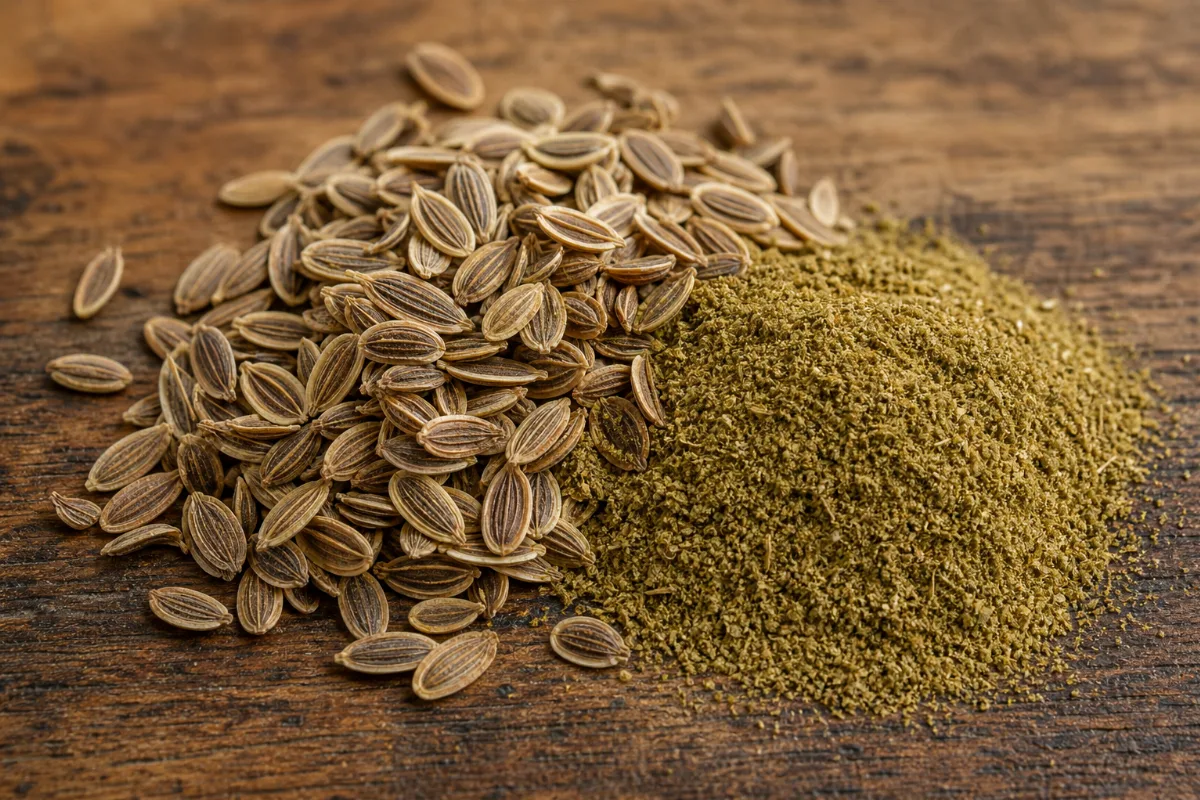
Dill seed comes from dill (Anethum graveolens), an annual plant in the celery family. The 'seeds' are really the dried fruits, about 4 to 5 mm long and ridged. The leaves are sold separately as dill weed.
USDA data for dill seed per 100 g: 305 kcal, 21.1 g fibre, 1,520 mg calcium, 16.3 mg iron, 256 mg magnesium and 1,190 mg potassium. A teaspoon weighs 2.1 g (USDA) and holds only about 6 kcal, 0.4 g fibre, 32 mg calcium, 0.3 mg iron, 5 mg magnesium and 25 mg potassium. A seasoning portion is small, so dill seed is a flavour, not a meaningful source of these nutrients.
In the kitchen
Dill is best known as the flavour of dill pickles. The seed goes into breads and the spirit akvavit in Sweden, and in Arab countries it is called ain jaradeh and used in cold dishes such as fattoush and in pickles (Wikipedia, not independently verified).
A 2021 study found carvone and limonene as main components of the oil in dill fruits. We did not read a source that describes the taste in words, so the usual description, a warm, slightly sharp, caraway-like note with some citrus, is general kitchen knowledge and not a cited finding.
What the research shows
No study of dill seed used as a seasoning was found. The human research is on supplements such as dill powder in capsules.
Two 2022 pooled reviews agree that dill supplements lowered LDL cholesterol but disagree on other blood fats. One also found lower insulin and insulin resistance scores, but fasting blood sugar did not change significantly. The trials are small and the authors ask for better ones.
Period pain, labor and milk supply have even less support: one small trial, one small review, and a health-agency statement that no valid trial supports use for milk supply.
Food versus capsules and oil
All the benefit trials used supplements or remedy use, and results do not carry over to a pinch of seed in cooking. Dill seed oil is a separate, concentrated product. Supplements are not approved before sale, and labels can differ from contents (LactMed).
Amounts
This page gives no amounts to eat or take. USDA lists a teaspoon of dill seed as 2.1 g and a tablespoon as 6.6 g. Ask a doctor, pharmacist or dietitian what is right for you, especially if you take medicines or are pregnant.
At a glance
Traditional uses history, not proof
- Flavouring pickles, including dill pickles
- In breads and the spirit akvavit in Sweden
- In cold dishes such as fattoush and in pickles in Arab countries (called ain jaradeh)
- Long use in cooking is not proof that it treats any condition
Studied for research
- Blood fats (cholesterol, triglycerides), mixed results from supplement trials
- Insulin and insulin resistance, low certainty, supplement trials
- Period pain, very low certainty, one small trial of powder
- Length of labor, insufficient evidence
- Milk supply when breastfeeding, no valid trial supports it (LactMed)
Main compounds
- Carvone
- Limonene
- Trans-anethole
- Flavonoids
Common forms
- Whole dill seed as a spice
- Ground seed
- Dill powder in capsules (used in the trials, not a seasoning)
- Dill seed oil (concentrated; used in soap-making)
Research links: 2022 pooled review: dill supplements, blood fats and blood sugar · LactMed (NIH): Dill · USDA FoodData Central: Spices, dill seed · Research Library · Genes & Biomarkers Library
What it is and its history
- Accepted scientific name
- Anethum graveolens
- Naming authority
- L. (GBIF accepted)
- Common names
- Dill seed (English); Dill fruit (English); Ain jaradeh (Arabic name used for the seed) (Arabic (transliterated))
- Family or group
- Apiaceae (the celery or carrot family, also called Umbelliferae), as given by GBIF and by a 2022 review abstract.
- Classification
- Plantae > Tracheophyta > Magnoliopsida > Apiales > Apiaceae > Anethum > Anethum graveolens
- Native range
- Wikipedia (not independently verified): native to North Africa, Iran and the Arabian Peninsula, and also described as native to North Africa and West Asia; grown widely in Eurasia.
- Habitat
- Wikipedia (not independently verified): needs warm to hot summers with high sunshine and rich, well-drained soil.
- What it looks like
- Roots: Wikipedia: grows from a taproot like a carrot.; Stems: Wikipedia: slender and hollow; the plant grows up to 0.5 to 1.5 metres tall.; Leaves: Wikipedia: finely divided, softly delicate leaves. The leaves are sold separately as dill weed; this page is about the seed.; Flowers: Wikipedia: small white to yellow scented flowers in umbels.; Fruit: Wikipedia: the 'seeds' come from dried fruit 4 to 5 mm long and 1 mm thick, straight to slightly curved, with a ridged surface.
- Cultivation
- Wikipedia (not independently verified): the seed is harvested by cutting the flower heads when the seed begins to ripen.
- Harvest and processing
- Wikipedia: the seed is dried and stored in an airtight container. Dill oil is extracted from leaves, stems and seeds, and the oil from the seeds is distilled and used in making soaps.
- Look-alikes and adulterants
- Name: Dill weed (the leaves) and Indian dill; Note: Dill weed is the leafy part of the same plant. A 2022 review abstract names two cultivated dills, European dill (Anethum graveolens) and Indian dill (Anethum sowa); trial results for one are not assumed to apply to the other.; Name: Caraway, fennel seed and other seed spices; Note: Related seed spices with their own pages. The 2021 composition study found different main oil components in dill and fennel fruits.
- Sustainability and conservation
- Not assessed.
Photographs
Traditional use and history history, not clinical proof
| Tradition or era | Documented use | Source |
|---|---|---|
| p34838903 |
Traditional use shows how it was used. It does not show that it works or is safe today.
What is inside, and how it may work
What it contains and how those compounds act in cells and animals. Laboratory and animal mechanisms are not proven effects in people.
Main compounds
| Compound | Family | Where it is concentrated | Activity studied | Level of evidence |
|---|---|---|---|---|
| Carvone PubChem 7439 | terpenoid (essential oil component) | Fruit (seed) In one study, 42.41 percent of the essential oil of the fruits of one dill cultivar | A main aroma compound of dill seed oil (LactMed and the 2021 study). A small, old study of d-carvone found no effect on milk supply (LactMed). 3 7 | Human data |
| Limonene PubChem 22311 | terpene (essential oil component) | Fruit (seed) In one study, 50.19 percent of the essential oil of the fruits of one dill cultivar | A main component of dill seed oil (LactMed and the 2021 study). No health effect of limonene from dill was read. 3 7 | Lab |
| Trans-anethole, phenolics and flavonoids | phenolics | Seed | Named by LactMed as present in dill seeds. No amounts or effects were read. 7 | Lab |
Absorption, metabolism and elimination
- Absorption
- Not found.
- Distribution
- Not found.
- Metabolism
- Not found.
- Elimination
- Not found.
- Bioavailability
- Not found.
Isolated compounds versus whole extracts
Every benefit result on this page comes from supplements (powder or capsules) or from seed in labor studies, not from seasoning. The aroma compounds carvone and limonene are only part of dill seed oil, and the oil is a separate, concentrated product.
Nutritional composition
Nutrition from USDA FoodData Central (Spices, dill seed; FDC 170925; SR Legacy, last updated 4/1/2019; read 2026-10-26). Per 100 g: 305 kcal, 16.0 g protein, 14.5 g fat, 55.2 g carbohydrate, 21.1 g fibre, 7.7 g water, 1,520 mg calcium, 16.3 mg iron, 256 mg magnesium, 277 mg phosphorus, 1,190 mg potassium, 20 mg sodium, 5.2 mg zinc, 1.83 mg manganese and 21.0 mg vitamin C. USDA lists household portions of 2.1 g for one teaspoon and 6.6 g for one tablespoon. One teaspoon (2.1 g) therefore holds about 6 kcal, 0.4 g fibre, 32 mg calcium, 0.3 mg iron, 5 mg magnesium and 25 mg potassium (our calculation from the per-100 g values). Real products vary and the USDA values come from older analyses. A seasoning portion is small, so dill seed is a flavour, not a meaningful source of these nutrients.
1 mixed findings1 low certainty1 very low certainty1 not enough evidence1 evidence against
What was looked at
The 5 benefits and uses checked for Dill seed, each with how strong the evidence is. Tap one to open it.
- Blood fats (cholesterol and triglycerides)Mixed findings
- Insulin and insulin resistanceLow certainty
- Period pain (primary dysmenorrhea)Very low certainty
- Length of laborNot enough evidence
- Milk supply when breastfeedingEvidence against
Lab markers tracked in the studies
LDL cholesterolTotal cholesterol, triglycerides and HDLFasting insulin and HOMA-IRFasting blood glucosePeriod pain score (visual analogue scale)Length of the stages of labor
What is Dill seed good for?
The studied uses and how strong the human evidence is for each. All benefit results are for supplements or remedy use, not for dill seed in cooking.
Benefits, one by one
Each card is a research question, not a promise. Tap a goal to filter. Open a card to see the studies, doses and limits.
Blood fats (cholesterol and triglycerides)
Mixed findingsTwo 2022 pooled reviews looked at dill supplements and blood fats. They did not agree. One found lower LDL cholesterol but no clear change in total cholesterol, triglycerides or HDL. The other reported lower total cholesterol, LDL and triglycerides, and also a fall in HDL, the 'good' cholesterol. These were supplements, not dill seed used as a seasoning.
2 studiesOral dill supplements (powder, capsules or similar; the abstracts do …
Studies, doses and limits
What the trials found
Review 1 (Crit Rev Food Sci Nutr 2022) pooled 7 randomised trials with 330 adults. Review 2 (Curr Probl Cardiol 2022) pooled 6 randomised trials with 171 treated adults. Both looked at oral dill supplements in adults. The abstracts do not give the plant part for every trial.
Results
Review 1: LDL fell (mean difference -15.64 mg/dL, 95% CI -24.55 to -6.73), but total cholesterol, triglycerides and HDL did not change significantly. Review 2: total cholesterol, LDL and triglycerides fell, and HDL also fell (reported as -2.19, 95% CI -3.58 to -0.81). The Review 2 abstract is not consistent with itself: its last sentence says HDL did not improve. Its figures are given without units in the abstract, so they cannot be compared with Review 1.
Effect sizes as reported
Review 1: LDL -15.64 mg/dL (95% CI -24.55 to -6.73; P = 0.001). Review 2: total cholesterol -3.71, LDL -1.51, triglycerides -2.48, HDL -2.19 (units not stated in the abstract).
Why this rating
Mixed. The two reviews disagree on triglycerides, total cholesterol and HDL. The trials are small and the authors of both reviews ask for better trials. Review 1 says higher doses and longer treatment looked better in a subgroup analysis. No trial tested dill seed as a seasoning.
Form and dose studied
Oral dill supplements (powder, capsules or similar; the abstracts do not list every form).
Who was studied
Adults, including people with type 2 diabetes or raised blood fats.
Limits
Small trials. The abstracts do not give trial quality. Supplement results do not carry over to cooking.
Why researchers looked
Dill is a common kitchen herb and spice, and several small trials looked at blood fats.
Traditional use
Dill seed is a kitchen spice. Long use in cooking is not proof that it treats any condition.
Proposed mechanism Unknown
The abstracts read do not explain how dill might change blood fats.
A proposed mechanism does not show that the effect happens in people.
The abstracts did not report side effects. Anyone taking cholesterol or diabetes medicine should ask a pharmacist or doctor before using dill supplements.
Insulin and insulin resistance
Low certaintyA 2022 pooled review of dill supplement trials found lower insulin and a lower insulin resistance score (HOMA-IR), but no clear change in fasting blood sugar. One small trial in people with type 2 diabetes found similar changes. None of this was dill seed used in cooking.
2 studiesDill powder in capsules (3 g a day in the 2020 trial). This is a supp…
Studies, doses and limits
What the trials found
Review 1 (7 randomised trials, 330 adults) pooled insulin, HOMA-IR and fasting glucose. A separate 2020 trial in Trials (Iran): 42 patients with type 2 diabetes were randomly given dill powder in capsules or placebo capsules. The 2020 trial reports no competing interests.
Results
Review 1: serum insulin -2.28 microunits/mL (95% CI -3.62 to -0.93) and HOMA-IR -1.06 (95% CI -1.91 to -0.20); no significant change in fasting blood glucose. Its dose-response analysis reported a significant fall in fasting glucose at doses of 1,500 mg a day. The 2020 trial found that insulin, HOMA-IR, LDL, total cholesterol and malondialdehyde fell in the dill group compared with its own baseline, and that the changes in insulin, LDL, total cholesterol and malondialdehyde were also lower than in the placebo group. HDL and total antioxidant capacity rose.
Effect sizes as reported
Review 1: insulin -2.28 microunits/mL; HOMA-IR -1.06; fasting glucose not significant. 2020 trial: P < 0.05 for the changes listed; the abstract gives no effect sizes.
Why this rating
Low. One pooled review, small trials, and the authors ask for further research. The 2020 trial had 42 people. Fasting glucose, the usual diabetes measure, did not change in the pooled result.
Form and dose studied
Dill powder in capsules (3 g a day in the 2020 trial). This is a supplement trial, not seasoning amounts, and no advice on amounts is given here.
Who was studied
Adults, including people with type 2 diabetes.
Limits
Lab markers, not diabetes complications. Small trials. The abstract of the 2020 trial reports within-group changes against baseline as well as against placebo.
Why researchers looked
People with type 2 diabetes sometimes take herbs and spices, so small trials checked insulin markers.
Traditional use
Dill seed is a kitchen spice. Long use in cooking is not proof that it treats any condition.
Proposed mechanism Unknown
The abstracts read do not explain how dill might change insulin markers.
A proposed mechanism does not show that the effect happens in people.
People using diabetes medicines should ask their doctor or pharmacist before adding dill supplements.
Period pain (primary dysmenorrhea)
Very low certaintyOne small trial in 75 young women found that dill powder lowered period pain scores about as much as the painkiller mefenamic acid. It is one trial in students and it used capsules of powder, not seasoning.
1 studiesDill powder in capsules around menstruation in the trial. Not seasoni…
Studies, doses and limits
What the trials found
A 2014 double-blind randomised trial (J Res Med Sci) of 75 single female students aged 18 to 28 at a university in Qom, Iran. Groups: dill powder 1,000 mg every 12 hours for 5 days starting 2 days before expected menstruation, for two cycles; mefenamic acid 250 mg; or a starch capsule as placebo. Pain was scored with a verbal scale and a visual analogue scale (VAS). The authors declared no conflict of interest.
Results
On the VAS, the dill and mefenamic acid groups had significantly lower pain in the first and second months after treatment, while the placebo group improved significantly only in the second month (P < 0.05). The authors concluded dill was as effective as mefenamic acid. The abstract gives no pain score numbers.
Effect sizes as reported
Not given in the abstract (P < 0.05 for the changes described).
Why this rating
Very low. One small trial in young students, with the placebo group also improving, and no effect sizes in the abstract. The authors ask for studies of side effects and interactions.
Form and dose studied
Dill powder in capsules around menstruation in the trial. Not seasoning amounts. No advice on amounts is given here.
Who was studied
Young women with moderate to severe period pain (mild cases were excluded).
Limits
One trial, 75 people, abstract only. Pain scores are self-reported.
Why researchers looked
Some women look for herbal options for period pain.
Traditional use
Dill seed is a kitchen spice. Long use in cooking is not proof that it treats any condition.
Proposed mechanism Unknown
The abstract does not explain how dill might ease pain.
A proposed mechanism does not show that the effect happens in people.
The authors recommend studies of side effects and interactions. Anyone with severe period pain should see a doctor.
Length of labor
Not enough evidenceA 2020 review of two trials and two cohort studies reported shorter labor stages after dill seed. Its authors recommended it for low-risk pregnancies, but there are very few studies and this is not an official safety statement. Anyone who is pregnant should ask a midwife or doctor first.
1 studiesDill seed (form and amount not described in the abstract).
Studies, doses and limits
What the trials found
Systematic review (Complement Ther Clin Pract 2020) of randomised trials and observational studies of dill seed in labor. It found two randomised trials and two retrospective cohort studies.
Results
In the two randomised trials the first stage of labor was shorter (mean difference -43.66, 95% CI -52.99 to -34.33), as was the second stage (-15.76, 95% CI -20.06 to -11.47) and the third stage (-1.79, 95% CI -2.62 to -0.95). The two cohort studies reported shorter first and second stages. The abstract does not state the unit of these differences.
Effect sizes as reported
Mean differences: first stage -43.66, second stage -15.76, third stage -1.79 (unit not stated in the abstract).
Why this rating
Insufficient. Only two randomised trials, plus two retrospective cohorts. The abstract does not describe the form, dose, safety outcomes or trial quality.
Form and dose studied
Dill seed (form and amount not described in the abstract).
Who was studied
Women in labor.
Limits
Abstract only. Very few studies. The abstract does not report effects on mother or baby other than timing.
Why researchers looked
Prolonged labor is linked with complications, so researchers looked at herbs that might shorten it.
Traditional use
Dill seed is a kitchen spice. Long use in cooking is not proof that it treats any condition.
Proposed mechanism Unknown
The abstract does not explain how dill might change labor.
A proposed mechanism does not show that the effect happens in people.
The abstract reports no safety outcomes. No official advice on dill seed as a remedy in pregnancy was found.
Milk supply when breastfeeding
Evidence againstDill is said to increase breast milk. LactMed, the NIH drug and lactation database, says no scientifically valid clinical trials support this, and one small, old study found no effect of d-carvone, a main dill component.
1 studiesNot applicable.
Studies, doses and limits
What the trials found
LactMed (NIH), record dated 2026 Oct 15. It cites one small, old study of d-carvone with no galactogogue effect. It also says dill is one component of an herbal mixture that showed some evidence of benefit, which does not show an effect of dill alone.
Results
No scientifically valid clinical trial supports the use (LactMed). One small, old study of d-carvone found no effect.
Why this rating
No valid trial supports it, and the one small study of a main component found no effect. This rests on the LactMed summary only.
Who was studied
Breastfeeding mothers.
Limits
Only the LactMed summary was read, not the studies it cites.
Why researchers looked
LactMed calls dill a purported galactogogue, which means a food or herb said to raise milk supply.
Traditional use
Dill is described as a purported milk-supply remedy (LactMed). Long use is not proof that it works.
Proposed mechanism Authoritative guidance
LactMed says dill seeds contain an essential oil rich in carvone and limonene, plus phenolics such as trans-anethole and flavonoids. It does not say how, or whether, they affect milk supply.
A proposed mechanism does not show that the effect happens in people.
LactMed says galactogogues should never replace evaluation and counselling on modifiable factors that affect milk production. See the Safety tab for breastfeeding.
Connections to the rest of health
How Dill seed connects to the rest of our health knowledge graph. Every link says what kind of connection it is. A safety link (for example to the liver) is a warning, not a benefit. A study that merely mentions a topic never creates a benefit link.
Explore every connection: goals, body systems, organs, symptoms, genes
B. Body systems
| Connected to | Kind of connection | Evidence status | Context | Studies |
|---|---|---|---|---|
| Cardiovascular System | Biological association | Mixed findings | Studied for: Blood fats (cholesterol and triglycerides) | 6 9 |
| Endocrine System | Biological association | Low certainty | Studied for: Insulin and insulin resistance | 6 2 |
| Reproductive System | Biological association | Very low certainty | Studied for: Period pain (primary dysmenorrhea) Studied for: Length of labor | 4 10 7 |
E. Health conditions
| Connected to | Kind of connection | Evidence status | Context | Studies |
|---|---|---|---|---|
| Food allergy | Adverse effect or risk | Case reports | Occasional allergic skin reactions are reported, mainly after contact with fresh dill. Preparation or compound: Dill (fresh herb contact; celery-family cross-reactions) |
7 1 |
I. Biomarkers
| Connected to | Kind of connection | Evidence status | Context | Studies |
|---|---|---|---|---|
| LDL cholesterol | Biological association | Low certainty | Measured in trials: lowered. A lab change is not the same as a health benefit. | 6 9 2 |
| Total cholesterol, triglycerides and HDL | Biological association | Mixed findings | Measured in trials: mixed. A lab change is not the same as a health benefit. | 6 9 |
| Fasting insulin and HOMA-IR | Biological association | Low certainty | Measured in trials: lowered. A lab change is not the same as a health benefit. | 6 2 |
| Fasting blood glucose | Biological association | Low certainty | Measured in trials: no-change. A lab change is not the same as a health benefit. | 6 |
| Period pain score (visual analogue scale) | Biological association | Very low certainty | Measured in trials: lowered. A lab change is not the same as a health benefit. | 4 |
| Length of the stages of labor | Biological association | Not enough evidence | Measured in trials: lowered. A lab change is not the same as a health benefit. | 10 |
L. Active compounds
| Connected to | Kind of connection | Evidence status | Context | Studies |
|---|---|---|---|---|
| Carvone | Biological association | Human | A main aroma compound of dill seed oil (LactMed and the 2021 study). A small, old study of d-carvone found no effect on milk supply (LactMed). Preparation or compound: Fruit (seed) |
3 7 |
| Limonene | Biological association | Lab | A main component of dill seed oil (LactMed and the 2021 study). No health effect of limonene from dill was read. Preparation or compound: Fruit (seed) |
3 7 |
| Trans-anethole, phenolics and flavonoids | Biological association | Lab | Named by LactMed as present in dill seeds. No amounts or effects were read. Preparation or compound: Seed |
7 |
Each connection is stored with the ingredient, the connected record, the kind of connection, the evidence status, the supporting studies, the preparation or compound involved, and a review date (last reviewed October 26, 2026).
The evidence
The research centre for Dill seed. Every record here was checked against PubMed or the publisher's page; we never list a study we have not verified.
Evidence by outcome
Bars show how many studies we found for each outcome, not how well it works. People are added up across trials only (reviews are not added, to avoid double counting).
How we rate evidence
High certainty
Several well-run trials or reviews agree; further research is unlikely to change the picture much.
Moderate certainty
Good trials point the same way, but some doubt remains.
Low certainty
Small, short or inconsistent trials. The finding could change with better research.
Very low certainty
Very little or very weak human data. Treat as a possibility only.
Mixed findings
Trials or reviews disagree with each other.
Not enough evidence
Not enough human research to say either way.
Evidence against
Good research found no benefit, or found harm.
We take the reviewers' own risk-of-bias and GRADE statements where they exist, and otherwise judge from study size, design, consistency, directness and whether a product matches what is sold. Many publications do not make evidence high. Method note: We started from our existing dill seed summary, re-checked nutrition at USDA FoodData Central and identity in GBIF, and re-read each study in PubMed. Only abstracts were read for studies. Items we could not verify are flagged in the research gaps.
Study library: every study we checked 13
| Study | Design | People | Product, dose, length | Result |
|---|---|---|---|---|
| Freeman 1999 Allergy to fresh dill. Allergy · PMID 10380793 · DOI |
Case report |
Methods, limits and fundingRead: title-only | ||
| Haidari 2020 The effects of Anethum graveolens (dill) powder supplementation on clinical and metabolic status in patients with type 2 diabetes. Trials · PMID 32503652 · DOI |
Controlled trial |
Methods, limits and fundingRead: abstract | ||
| Hao 2021 Comparison of Nutritional Compositions and Essential Oil Profiles of Different Parts of a Dill and Two Fennel Cultivars. Foods · PMID 34441561 · DOI |
Laboratory plant |
Methods, limits and fundingRead: abstract | ||
| Heidarifar 2014 Effect of Dill (Anethum graveolens) on the severity of primary dysmenorrhea in compared with mefenamic acid: A randomized, double-blind trial. J Res Med Sci · PMID 25097605 |
Controlled trial |
Methods, limits and fundingRead: abstract | ||
| Lisiecka 2026 Allergic reactions to spices: a review of sensitivities to pepper, cumin, oregano, anise, mustard and other spices. Eur Ann Allergy Clin Immunol · PMID 40341008 · DOI |
Review |
Methods, limits and fundingRead: abstract | ||
| Mousavi 2022 The effects of Anethum graveolens (dill) supplementation on lipid profile and glycemic control: a systematic review and meta-analysis of randomized controlled trials. Crit Rev Food Sci Nutr · PMID 33624557 · DOI |
Meta-analysis |
Methods, limits and fundingRead: abstract | ||
| National Institute of Child Health and Human Development 2026 Dill. Drugs and Lactation Database (LactMed). LactMed (NIH) · PMID 30000937 |
Health agency |
Methods, limits and fundingRead: abstract | ||
| National Institute of Child Health and Human Development 2026 Cumin. Drugs and Lactation Database (LactMed). LactMed (NIH) · PMID 30000933 |
Health agency |
Methods, limits and fundingRead: abstract | ||
| Sadeghi 2022 Anethum graveolens L. (Dill) Effect on Human Lipid Profile: An Updated Systematic Review. Curr Probl Cardiol · PMID 34838903 · DOI |
Systematic review |
Methods, limits and fundingRead: abstract | ||
| Talebi 2020 Effect of dill (Anethum Graveolens Linn) seed on the duration of labor: A systematic review. Complement Ther Clin Pract · PMID 33130423 · DOI |
Systematic review |
Methods, limits and fundingRead: abstract | ||
| s-gbif-anethum-graveolens GBIF Backbone: Anethum graveolens L. (usageKey 3034646) · Source |
Reference database n/a |
Methods, limits and fundingRead: full-text | ||
| s-usda-fdc-170925 USDA FoodData Central: Spices, dill seed (FDC 170925) · Source |
Reference database n/a |
Methods, limits and fundingRead: full-text | ||
| s-wikipedia-dill Wikipedia: Dill · Source |
Encyclopedia n/a |
Methods, limits and fundingRead: full-text |
What we do not know yet
- No study of dill seed used as a seasoning was found for any health outcome.
- All benefit results come from supplement trials, mostly small, and the two lipid reviews disagree on several blood fats.
- No interaction study of dill with any medicine, and no official advice on dill seed as a remedy in pregnancy, was found. The FDA GRAS status was read only as reported by LactMed.
- Plant description, native range and cooking uses come from Wikipedia and were not independently verified. The taste description is general kitchen knowledge.
- Liver safety, contamination of dill seed, and choking risk for small children were not researched. The allergy case report was read by title only.
How new research is added
New studies are found by a saved PubMed search and placed in a review queue before the page changes.
Lab markers
What changed in blood or saliva tests during trials. A changed number is not the same as feeling or being healthier, and we give no "normal ranges".
Metabolic 1
LDL cholesterol
Lowered in trials
The cholesterol carried in low-density lipoproteins, often called 'bad' cholesterol because high levels are linked to heart disease.
Low certaintyResults and what it means
Why it was measured
It is a standard blood test for heart disease risk.
Statistical vs. clinical meaning
A lab marker, not a heart-disease outcome. Both pooled reviews found lower LDL, but the trials are small and the authors of both ask for better ones.
Safety implication
None reported in the abstracts.
| Study | Result | People | Product |
|---|---|---|---|
| 6 | Pooled mean difference -15.64 mg/dL (95% CI -24.55 to -6.73; P = 0.001) | Adults in 7 randomised trials (330 people) | Oral dill (Anethum graveolens) supplements |
| 9 | Lower LDL reported (mean difference -1.51, 95% CI -2.65 to -0.47; P = 0.005; units not stated in the abstract) | 6 randomised trials (171 treated adults) | Dill supplements |
| 2 | LDL fell in the dill group compared with baseline and compared with placebo (P < 0.05); no effect size in the abstract | 42 patients with type 2 diabetes | Dill powder 3 g a day in capsules versus placebo |
Other 5
Total cholesterol, triglycerides and HDL
Mixed results in trials
Other parts of a standard blood fat test. HDL is the 'good' cholesterol; higher is usually better.
Mixed findingsResults and what it means
Why it was measured
They are read together with LDL to judge heart disease risk.
Statistical vs. clinical meaning
The two reviews disagree. A fall in HDL would not be a benefit.
Safety implication
A possible fall in HDL was reported by one review and not by the other.
| Study | Result | People | Product |
|---|---|---|---|
| 6 | No significant change in total cholesterol, triglycerides or HDL | Adults in 7 randomised trials (330 people) | Oral dill supplements |
| 9 | Lower total cholesterol, triglycerides and HDL reported; the abstract's last sentence says HDL did not improve | 6 randomised trials (171 treated adults) | Dill supplements |
Fasting insulin and HOMA-IR
Lowered in trials
Insulin is the hormone that moves sugar from blood into cells. HOMA-IR is a score worked out from fasting insulin and glucose to estimate insulin resistance.
Low certaintyResults and what it means
Why it was measured
Insulin resistance is a feature of type 2 diabetes and related conditions.
Statistical vs. clinical meaning
Lab markers only. Small trials.
Safety implication
People using blood-sugar medicines should ask a pharmacist or doctor before using dill supplements, because insulin markers changed in these trials.
| Study | Result | People | Product |
|---|---|---|---|
| 6 | Insulin -2.28 microunits/mL (95% CI -3.62 to -0.93; P = 0.001); HOMA-IR -1.06 (95% CI -1.91 to -0.20; P = 0.01) | Adults in 7 randomised trials (330 people) | Oral dill supplements |
| 2 | Insulin, HOMA-IR fell compared with baseline; the change in insulin was also lower than with placebo (P < 0.05) | 42 patients with type 2 diabetes | Dill powder 3 g a day in capsules versus placebo |
Fasting blood glucose
No clear change in trials
The blood sugar level after an overnight fast.
Low certaintyResults and what it means
Why it was measured
It is the standard first test for diabetes control.
Statistical vs. clinical meaning
Insulin markers moved in the pooled result, but fasting glucose overall did not.
Safety implication
None reported in the abstract.
| Study | Result | People | Product |
|---|---|---|---|
| 6 | No significant effect on fasting blood glucose overall; the dose-response analysis reported a significant fall at doses of 1,500 mg a day | Adults in 7 randomised trials (330 people) | Oral dill supplements |
Period pain score (visual analogue scale)
Lowered in trials
A self-rated pain score, usually a line from 'no pain' to 'worst pain'.
Very low certaintyResults and what it means
Why it was measured
Pain is what the person feels, so it is rated by the person.
Statistical vs. clinical meaning
A symptom score in one small trial. The abstract gives no numbers.
Safety implication
The authors recommend studies of side effects and interactions.
| Study | Result | People | Product |
|---|---|---|---|
| 4 | Lower pain in the first and second months for dill and for mefenamic acid; the placebo group was significant only in the second month (P < 0.05) | 75 single female students aged 18 to 28 with moderate to severe period pain | Dill powder 1,000 mg every 12 hours for 5 days per cycle, for two cycles (versus mefenamic acid 250 mg or starch placebo) |
Length of the stages of labor
Lowered in trials
How long the first, second and third stages of labor last.
Not enough evidenceResults and what it means
Why it was measured
Prolonged labor is linked with complications.
Statistical vs. clinical meaning
Timing only. The abstract reports no outcome for mother or baby.
Safety implication
Not reported in the abstract.
| Study | Result | People | Product |
|---|---|---|---|
| 10 | Two randomised trials: first stage -43.66, second stage -15.76, third stage -1.79 (mean differences; unit not stated in the abstract). Two cohort studies: shorter first and second stages. | Women in labor, in 2 randomised trials and 2 retrospective cohort studies | Dill seed (form and amount not described in the abstract) |
Safety
What studies and official sources say about side effects, medicines and who should check first. Each point shows what kind of evidence it comes from.
Main points to know 4
- Allergy: dill is in the celery family and rare reactions are reported. LactMed says dill is generally well tolerated, but occasional allergic skin reactions have been reported, especially after contact with fresh dill. A 1999 case report is titled 'Allergy to fresh dill' (only the title was available). A 2026 review of spice allergy says cross-reactivity between cumin and other plants in the celery family (Umbelliferae) is common; it does not name dill. If you react to celery, cumin or related spices, ask an allergist before using dill seed. Authoritative guidance 7 1 5
- Seasoning is not the same as capsules, powders or oils. All the human trials on this page used supplements such as powder in capsules, not dill seed as a seasoning. No source read gives a safe upper limit for dill supplements. LactMed notes that supplements are not approved before sale, that labels often differ from the contents, and that results from one product may not apply to another. Ask a pharmacist or doctor before using concentrated dill products. Authoritative guidance 8 7
- Diabetes and cholesterol medicines: ask before using supplements. In trials of dill supplements, insulin markers and blood fats changed. No source read tested dill with any medicine. If you take medicine for diabetes or cholesterol, ask a pharmacist or doctor before adding dill supplements. Do not change a prescribed medicine on your own. Inference 6 2
- Pregnancy and breastfeeding: food is common, remedy use has no official advice. LactMed says dill is generally recognized as safe (GRAS) as a food by the US FDA. It says no valid clinical trials support dill for milk supply. In two studies, nursing mothers were given d-carvone, a component of dill, and no adverse effects were noted in the mothers or infants. A 2020 review reported shorter labor with dill seed, but we found no official statement on dill seed as a remedy in pregnancy. Ask a midwife or doctor before using it as a remedy. Authoritative guidance 7 10
Side effects 2
| Effect | How often | Severity and recovery | Evidence |
|---|---|---|---|
| Allergic skin reactions (mainly after contact with fresh dill) The 1999 case report was available as a title only. The reaction described by LactMed is mainly to fresh dill, not specifically to the seed. | Occasional (LactMed); no rate given | not stated Not stated | Authoritative guidance 7 1 |
| Side effects of dill supplements in trials The abstracts read do not report side effects. The period pain trial authors recommend studies of side effects and interactions. | Not established | not stated Not stated | Not reported 4 |
Liver
No liver injury from dill seed was found in the sources read. A liver-safety source such as LiverTox was not searched, so this is not a statement that it is safe for the liver.
How often. No frequency was found.
Monitoring. No agency monitoring advice was found.
This is a safety connection. It is not evidence that Dill seed supports liver health.
Medicines and supplements 3
| With | Why it matters | Importance | Evidence | What to do |
|---|---|---|---|---|
| Diabetes medicines (when dill is taken as a supplement) prescription | Not described in the abstracts. Dill supplements lowered insulin and an insulin resistance score in trials. | No interaction study was read. The concern is an inference from lab markers changing in trials, not a documented interaction. | Inference Not enough evidence 6 2 | Ask a pharmacist or doctor before using dill supplements with diabetes medicine. Do not change a medicine on your own. |
| Cholesterol medicines (when dill is taken as a supplement) prescription | Not described in the abstracts. Pooled trials of dill supplements reported changes in LDL and other blood fats. | No interaction study was read. This is an inference, not a documented interaction. | Inference Not enough evidence 6 9 | Ask a pharmacist or doctor before using dill supplements with cholesterol medicine. |
| Medicines in general, when dill is used as a seasoning prescription | The sources read name no medicine problem with dill seed in cooking. The absence of a warning is not proof of safety. | Not reported Not enough evidence 7 | If you take medicines and are unsure, ask a pharmacist. |
Who should check first 3
| Situation | Advice | Evidence |
|---|---|---|
| Allergy to dill, celery or related celery-family plants or spices | Avoid dill seed and ask an allergist, because cross-reactions among celery-family plants are reported. | Authoritative guidance 7 5 |
| Pregnant and considering dill seed or dill supplements as a remedy | Ask a midwife or doctor first. No official statement on dill seed as a remedy in pregnancy was found. | Inference 10 |
| Taking diabetes or cholesterol medicine and considering dill supplements | Ask a pharmacist or doctor first. Do not change a medicine on your own. | Inference 6 2 |
Overdose, product quality and regulators
Summary. No toxicity from dill seed as a seasoning was found in the sources read.
Animal. Not reviewed.
Human doses studied. Supplement trials gave dill powder in capsules (for example 3 g a day in people with type 2 diabetes, and 1,000 mg twice a day around menstruation). The abstracts report no harms. This is not a statement of a safe amount.
Overdose response. Not found.
Genotoxicity. Not researched.
No source read describes contamination or adulteration of dill seed itself.
Supplement quality. LactMed (in its cumin entry) says dietary supplements do not need pre-market approval, may differ from their labels, and clinical results for one product may not apply to another. 8
Spice contamination in general. Mould toxins, heavy metals and germs in dill seed specifically were not researched.
| Body | Action | Date |
|---|---|---|
| US FDA (as reported by LactMed) (United States) | LactMed reports that dill is generally recognized as safe (GRAS) as a food by the FDA. source | 2026-10-15 (LactMed record date) |
When to get medical help
- Trouble breathing, swelling of the lips, face or throat, widespread hives or fainting after eating dill seed or a spice mix
- A rash or swelling after touching or eating dill
- Symptoms of low blood sugar (shakiness, sweating, confusion) in someone taking diabetes medicine who has started dill supplements
Stop using the product and contact a clinician or emergency service. In the US, Poison Control is 1-800-222-1222.
General information only, not medical advice. Ask a clinician or pharmacist before use, especially with medicines, in pregnancy or with a health condition. See the Natural Remedy Safety guide.
Frequently asked questions
What is dill seed good for?
It is a seasoning, used in pickles, breads and cold dishes. No study shows that eating it in cooking treats or prevents any condition. The health research is on supplements.
What does dill seed taste like?
It is a warm, slightly sharp, caraway-like flavour with some citrus, and stronger than the leaves. This is general kitchen knowledge, not a cited finding. A study found carvone and limonene as main components of the oil.
Does dill seed lower cholesterol?
Does dill seed help with blood sugar or diabetes?
Is dill seed safe with medicines?
Is dill seed safe in pregnancy?
Does dill seed help with labor?
A 2020 review of two trials and two cohort studies reported shorter labor stages. There are very few studies and no official safety statement, so this is not enough to rely on. Ask a midwife.
Does dill increase breast milk?
LactMed says no scientifically valid clinical trials support this traditional claim, and one small, old study of d-carvone found no effect.
Does dill seed help period pain?
One small trial of 75 young women found dill powder lowered pain about as much as mefenamic acid. It is a single trial and the placebo group also improved, so the evidence is very weak.
Can you be allergic to dill seed?
Is dill seed the same as dill weed?
Explore by health goal
Editorial transparency
- Written by
- AlternativeMed editorial team. Research compiled with AI assistance, then checked against the sources listed.
- Medical review
- None. This page has not been reviewed by a physician or pharmacist.
- First published
- 2026-10-26
- Last substantive update
- 2026-10-26
- How we research
- We started from our existing dill seed summary, re-checked nutrition at USDA FoodData Central and identity in GBIF, and re-read each study in PubMed. Only abstracts were read for studies. Items we could not verify are flagged in the research gaps.
- How we rate evidence
- See "How we rate evidence" in the Evidence tab.
- Independence
- No product is promoted on this page. No affiliate links are shown.
Sources 13
Each source was opened and checked. Where we read only the abstract, it says so. The small numbers in the text point here.
- Freeman GL. Allergy to fresh dill.. Allergy. 1999. PMID 10380793. DOI 10.1034/j.1398-9995.1999.00083.x. (title-only)
- Haidari F, Zakerkish M, Borazjani F, et al.. The effects of Anethum graveolens (dill) powder supplementation on clinical and metabolic status in patients with type 2 diabetes.. Trials. 2020. PMID 32503652. DOI 10.1186/s13063-020-04401-3. (abstract)
- Hao Y, Kang J, Guo X, et al.. Comparison of Nutritional Compositions and Essential Oil Profiles of Different Parts of a Dill and Two Fennel Cultivars.. Foods. 2021. PMID 34441561. DOI 10.3390/foods10081784. (abstract)
- Heidarifar R, Mehran N, Heidari A, et al.. Effect of Dill (Anethum graveolens) on the severity of primary dysmenorrhea in compared with mefenamic acid: A randomized, double-blind trial.. J Res Med Sci. 2014. PMID 25097605. (abstract)
- Lisiecka MF. Allergic reactions to spices: a review of sensitivities to pepper, cumin, oregano, anise, mustard and other spices.. Eur Ann Allergy Clin Immunol. 2026. PMID 40341008. DOI 10.23822/EurAnnACI.1764-1489.400. (abstract)
- Mousavi SM, Beatriz Pizarro A, Akhgarjand C, et al.. The effects of Anethum graveolens (dill) supplementation on lipid profile and glycemic control: a systematic review and meta-analysis of randomized controlled trials.. Crit Rev Food Sci Nutr. 2022. PMID 33624557. DOI 10.1080/10408398.2021.1889459. (abstract)
- National Institute of Child Health and Human Development. Dill. Drugs and Lactation Database (LactMed).. LactMed (NIH). 2026. PMID 30000937. (abstract)
- National Institute of Child Health and Human Development. Cumin. Drugs and Lactation Database (LactMed).. LactMed (NIH). 2026. PMID 30000933. (abstract)
- Sadeghi M, Kabiri S, Amerizadeh A, et al.. Anethum graveolens L. (Dill) Effect on Human Lipid Profile: An Updated Systematic Review.. Curr Probl Cardiol. 2022. PMID 34838903. DOI 10.1016/j.cpcardiol.2021.101072. (abstract)
- Talebi F, Malchi F, Abedi P, et al.. Effect of dill (Anethum Graveolens Linn) seed on the duration of labor: A systematic review.. Complement Ther Clin Pract. 2020. PMID 33130423. DOI 10.1016/j.ctcp.2020.101251. (abstract)
- . GBIF Backbone: Anethum graveolens L. (usageKey 3034646). . . (full-text)
- . USDA FoodData Central: Spices, dill seed (FDC 170925). . . (full-text)
- . Wikipedia: Dill. . . (full-text)
Where to buy
Check the label first. Whatever you buy, look for these:
- Whole or ground: whole spices keep their flavor longer
- The origin and a packed-on or best-by date for freshness
- Organic or non-irradiated labeling if that matters to you
- A resealable, airtight container
Talk to a pharmacist or doctor before you start any supplement, especially if you take medicines. See the Safety tab for interactions.
Support our free guides: as an Amazon Associate we earn from qualifying purchases. Full disclosure.


