Spices · Spice
Caraway
Carum carvi · also called Caraway seed, caraway fruit, Kümmel (German), alcaravea (Spanish)
Caraway is a seed spice, really the dried fruit of a carrot-family plant, used in rye bread, sauerkraut and stews. Capsules of caraway oil with peppermint oil eased indigestion in short trials, but the spice itself has not been tested. The main caution is allergy: people allergic to birch or mugwort pollen, celery or other carrot-family plants may react.
General information, not medical advice. Last substantive update · Not medically reviewed. A named clinician has not signed off on this page. How this page is made
About Caraway
Caraway is a warm, slightly sweet, anise-like seed spice used in rye bread, sauerkraut and stews. It is a flavouring, not a proven remedy. Trials of indigestion used capsules of caraway oil with peppermint oil; the spice itself has not been studied for health.
What it is
Caraway (Carum carvi) is a plant in the carrot family (Apiaceae). The part used is the dried fruit, usually sold as caraway seed. The EU calls the herbal substance 'caraway fruit'.
USDA data for caraway seed per 100 g: 333 kcal, 19.8 g protein, 14.6 g fat, 49.9 g carbohydrate, 38.0 g fibre, 689 mg calcium, 16.2 mg iron and 1,350 mg potassium. Nobody eats 100 g. USDA lists 2.1 g for a teaspoon of whole seed; one teaspoon gives about 7 kcal, 0.8 g fibre, 14 mg calcium, 0.3 mg iron and 28 mg potassium (calculated from the per-100 g values). A teaspoon is mostly flavour. USDA SR Legacy data are from 2019 and real products vary.
What the research shows
The best human evidence is for peppermint oil and caraway oil taken together as capsules in adults with indigestion that has no clear cause. A Cochrane review rated the result moderate certainty for overall symptoms at four weeks. A 2019 meta-analysis rated the underlying trials low or very low quality. One review and one trial concern a maker's own products, so treat them with some caution.
The EU committee accepts caraway fruit tea for bloating and gas as a traditional use only. No trial of caraway alone, or of caraway used as a spice, was found.
LactMed says no valid trial supports caraway for milk supply or infant colic.
Spice, tea and oil capsules are different things
The trials used capsules of caraway oil together with peppermint oil. The lab work used isolated carvone, the main aroma compound. The seed in your kitchen is a different product, and nothing read shows that it acts like these concentrated ones.
Amounts
This page gives no amounts to eat or take. Ask a doctor, pharmacist or dietitian what is right for you, especially if you are pregnant, breastfeeding, have liver or bile-duct disease or are thinking about oil capsules.
At a glance
Traditional uses history, not proof
- Used whole in rye bread, sauerkraut and stews
- Caraway fruit tea for bloating and gas (accepted in the EU as a traditional use only)
- Long use as food or tea is not proof that it treats any condition
Studied for research
- Indigestion, peppermint plus caraway oil capsules, moderate certainty for the oil combination, not the spice
- Bloating and gas, traditional use only, insufficient evidence
- Breast milk supply and infant colic, insufficient evidence
- Hunger and stomach function in healthy people (oil combination), very low certainty
- Carvone (aroma compound), lab findings only
Main compounds
- Carvone
- Dietary fibre
- Iron
- Calcium
- Potassium
Common forms
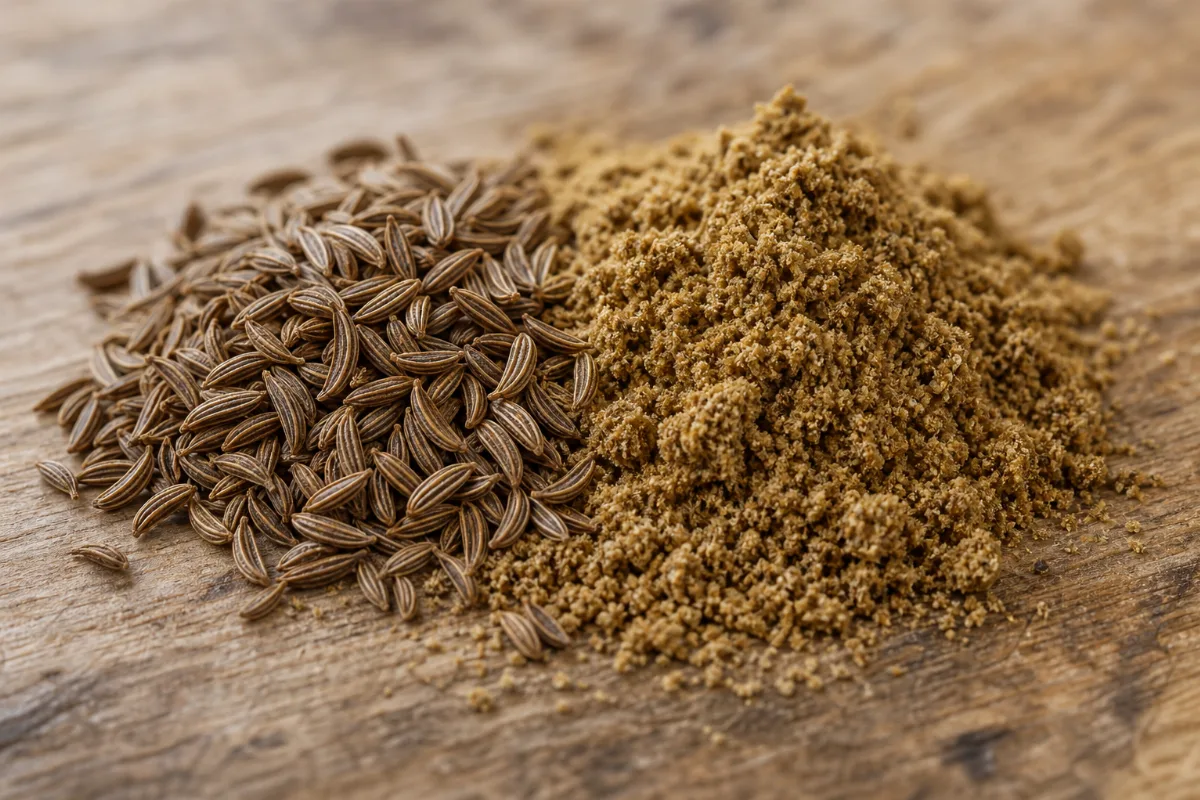
- Whole seed as a cooking spice
- Ground caraway
- Tea made from the crushed fruit (the EU traditional-use form)
- Caraway oil capsules, usually with peppermint oil (the trials tested these)
Research links: EMA: EU herbal monograph on caraway fruit · 2023 Cochrane review: herbal medicines for functional dyspepsia · LactMed: Caraway · Research Library · Genes & Biomarkers Library
What it is and its history
- Accepted scientific name
- Carum carvi
- Naming authority
- L. (GBIF accepted)
- Common names
- Caraway (English); Kümmel (German); Alcaravea (Spanish)
- Family or group
- Apiaceae (the carrot family), as given by GBIF. The EU monograph names fennel, anise, celery, coriander and dill as other Apiaceae plants for allergy purposes.
- Classification
- Plantae > Tracheophyta > Magnoliopsida > Apiales > Apiaceae > Carum > Carum carvi
- Native range
- Not verified from a source read.
- Habitat
- Not verified from a source read.
- What it looks like
- Roots: Not verified.; Stems: Not verified.; Leaves: Not verified.; Flowers: Not verified.; Fruit: The part used is the dried fruit; the EU monograph calls the herbal substance 'caraway fruit' (Carvi fructus). USDA lists one teaspoon of whole seed as 2.1 g and one tablespoon as 6.7 g.
- Cultivation
- Not verified from a source read.
- Harvest and processing
- Sold as whole seed, ground spice, oil and tea; the EU monograph covers the comminuted (crushed) fruit used as a herbal tea.
- Look-alikes and adulterants
- Name: Cumin and fennel; Note: The EU monograph and USDA records do not discuss look-alikes. Cumin and fennel are different plants; the EU lists fennel as a related allergy risk. Evidence for one is not evidence for another.
- Sustainability and conservation
- Not assessed.
Photographs
What is inside, and how it may work
What it contains and how those compounds act in cells and animals. Laboratory and animal mechanisms are not proven effects in people.
Main compounds
| Compound | Family | Where it is concentrated | Activity studied | Level of evidence |
|---|---|---|---|---|
| Carvone PubChem 7439 | monoterpene (aroma compound) | Fruit (seed) Not given in the sources read | The principal volatile compound of caraway; S-(+)-carvone is the form mostly found in caraway and R-(-)-carvone is mostly found in spearmint. Lab studies only (2026 review). 4 | Lab |
| Dietary fibre | carbohydrate | Seed 38.0 g per 100 g; about 0.8 g in one teaspoon (2.1 g) (USDA) | Provides fibre; the amount in a teaspoon is small. Not tested here as a treatment. 12 | Composition data |
| Iron | mineral | Seed 16.2 mg per 100 g; about 0.34 mg in one teaspoon (USDA) | Composition fact only. Absorption from a spice was not studied. 12 | Composition data |
| Calcium | mineral | Seed 689 mg per 100 g; about 14 mg in one teaspoon (USDA) | Composition fact only. 12 | Composition data |
| Potassium | mineral | Seed 1,350 mg per 100 g; about 28 mg in one teaspoon (USDA) | Composition fact only. 12 | Composition data |
Mechanisms, receptors and pathways
| Target or pathway | Gene or receptor | What was found | Level |
|---|---|---|---|
| Aryl hydrocarbon receptor (AhR) | AhR | A 2026 evidence-graded review says both carvone forms act as noncompetitive allosteric antagonists of AhR, validated in mouse skin. The authors say this does not mean AhR explains caraway's traditional effects. 4 | Lab and animal |
| GABA-A receptor | GABA-A receptor | Listed in the same review as a best-characterised (Tier A) carvone target. Lab level; says nothing about effects of eating caraway. 4 | Lab |
Absorption, metabolism and elimination
- Absorption
- Not found for caraway as a food.
- Distribution
- Small but measurable amounts of d-carvone were found in the milk of mothers given the pure chemical in two studies (LactMed).
- Metabolism
- Not found.
- Elimination
- Not found.
- Bioavailability
- Not established.
Isolated compounds versus whole extracts
The indigestion trials used capsules of caraway oil plus peppermint oil, and the lab work used isolated carvone. The seed used in cooking is different, and nothing read shows that kitchen amounts of the seed act like these products.
Nutritional composition
Source: USDA FoodData Central, 'Spices, caraway seed' (FDC 170918, SR Legacy, last updated 4/1/2019), read 2026-10-26. Per 100 g: 333 kcal, 9.9 g water, 19.8 g protein, 14.6 g fat, 49.9 g carbohydrate, 38.0 g fibre, 689 mg calcium, 16.2 mg iron, 258 mg magnesium, 568 mg phosphorus, 1,350 mg potassium, 17 mg sodium and 5.5 mg zinc. Nobody eats 100 g of a spice. A typical household measure per USDA is 2.1 g for one teaspoon of whole seed and 6.7 g for one tablespoon. One teaspoon (2.1 g) gives about 7 kcal, 0.4 g protein, 0.3 g fat, 1.0 g carbohydrate, 0.8 g fibre, 14 mg calcium, 0.3 mg iron, 5 mg magnesium, 28 mg potassium. One tablespoon (6.7 g) gives about 22 kcal, 2.5 g fibre, 46 mg calcium, 1.1 mg iron, 17 mg magnesium and 91 mg potassium. Per-portion figures are calculated from the per-100 g values. Real products vary. A teaspoon is mostly flavour, not a meaningful source of most nutrients.
1 moderate certainty1 very low certainty3 not enough evidence
What was looked at
The 5 benefits and uses checked for Caraway, each with how strong the evidence is. Tap one to open it.
- Indigestion (functional dyspepsia), peppermint plus caraway oil capsulesModerate certainty
- Bloating and gas (traditional use of caraway fruit tea)Not enough evidence
- Breast milk supply and infant colic (traditional claims)Not enough evidence
- Appetite and stomach function (oil combination, healthy people)Very low certainty
- Carvone, the main aroma compound (lab findings only)Not enough evidence
Lab markers tracked in the studies
Overall indigestion symptom scoreShare of people whose indigestion improvedDyspepsia-related quality of lifeHunger rating when fastingStomach emptying rate
What is Caraway good for?
The main studied uses and how strong the human evidence is for each. Almost all results are for capsules of caraway oil with peppermint oil, not for the spice.
Benefits, one by one
Each card is a research question, not a promise. Tap a goal to filter. Open a card to see the studies, doses and limits.
Indigestion (functional dyspepsia), peppermint plus caraway oil capsules
Moderate certaintyIn trials of adults with indigestion that has no clear cause, capsules holding peppermint oil and caraway oil together eased symptoms more than placebo over about four weeks. This is a concentrated oil product. It is not the spice, and caraway alone was not tested.
4 studiesFixed peppermint-oil plus caraway-oil capsules. Not caraway seed, not…
Studies, doses and limits
What the trials found
A 2023 Cochrane review (41 trials of herbal medicines) and a 2019 meta-analysis of 5 trials (578 people) both found the oil combination did better than placebo. A 2023 meta-analysis of one manufacturer's product (Menthacarin) and a 2019 trial of a different caraway-oil-plus-menthol capsule point the same way, with a mixed result in the whole trial group.
Results
Probably a large improvement in overall symptoms and more people improving at four weeks, with little or no difference in side effects. The 2019 pooling also saw less upper-stomach pain.
Effect sizes as reported
Cochrane: overall symptoms SMD -0.87 (2 trials, 210 people); improvement rate RR 1.53 (3 trials, 305 people). 2019 meta-analysis: global improvement NNT 3, epigastric pain improvement RR 1.61.
Why this rating
Cochrane rates these results moderate certainty for the oil combination, based on only 2 to 3 small trials. The 2019 meta-analysis rates the same body of trials low or very low quality. One review covers one maker's product and used the maker's data. Nothing here is about caraway alone or the spice.
Form and dose studied
Fixed peppermint-oil plus caraway-oil capsules. Not caraway seed, not tea.
Who was studied
Adults with functional dyspepsia (one product also studied from age 12 per the 2023 Menthacarin review).
Limits
Two oils tested together, so the effect of caraway alone is unknown. Short trials (about 4 weeks). One review and one trial concern proprietary products. No trial of caraway as a cooking spice was found.
Why researchers looked
Caraway fruit is an old digestive remedy in Europe, so researchers tested its oil, together with peppermint oil, in people with indigestion.
Traditional use
Caraway seeds are used in cooking and as a tea after meals in parts of Europe. Long use is not proof that it works.
Proposed mechanism Laboratory research
A 2026 review of the lab evidence says carvone, the main caraway aroma compound, has plausible links to its traditional digestive uses. This is lab-level evidence and does not show how the oil capsules work in people.
A proposed mechanism does not show that the effect happens in people.
Side effects were not clearly different from placebo in the trials. See the Safety tab for allergy and liver cautions. Ask a doctor or pharmacist before using oil capsules.
Bloating and gas (traditional use of caraway fruit tea)
Not enough evidenceThe EU accepts caraway fruit as a herbal tea for bloating and gas, but only as a traditional use. That means it rests on long use, not on trials.
1 studiesHerbal tea made from the crushed fruit.
Studies, doses and limits
What the trials found
The EMA committee (HMPC) lists caraway fruit as a traditional herbal medicinal product for symptomatic relief of bloating and flatulence, 'exclusively based upon long-standing use'. No trial of caraway alone for bloating was found.
Results
No trial results exist for caraway alone.
Why this rating
A regulator accepted it on tradition. No human trial of caraway tea or seed alone for bloating or gas was found.
Form and dose studied
Herbal tea made from the crushed fruit.
Who was studied
Adults and teenagers (EU monograph).
Limits
Tradition is not evidence of benefit. The monograph says to see a doctor if symptoms last more than 2 weeks.
Why researchers looked
Carminative (gas-easing) use of caraway goes back a long way in European folk medicine.
Traditional use
Caraway fruit tea for bloating and flatulence.
Proposed mechanism Not established
Not established. The EU monograph does not require mechanism data for traditional-use products.
A proposed mechanism does not show that the effect happens in people.
EU advice against use with liver or bile-duct disease, achlorhydria, under 12 years, and in pregnancy or breastfeeding applies to the medicine, not to food amounts. See the Safety tab.
Breast milk supply and infant colic (traditional claims)
Not enough evidenceCaraway is sometimes drunk to make more milk or to ease colic in a breastfed baby. LactMed says no valid clinical trial supports either use.
1 studiesTea or seed taken by mouth (folk use).
Studies, doses and limits
What the trials found
LactMed (US National Library of Medicine, 2006) found no scientifically valid trial for either use; one small, old study found no milk-supply effect.
Results
No benefit shown.
Why this rating
No valid clinical trial; the one small old study found no effect.
Form and dose studied
Tea or seed taken by mouth (folk use).
Who was studied
Breastfeeding mothers.
Limits
A short agency summary rather than a full review.
Why researchers looked
Caraway appears in some lactation teas and folk advice.
Traditional use
Used as a lactation tea ingredient, and in Persian traditional medicine to reduce milk oversupply. Tradition is not evidence.
Proposed mechanism Not established
Not established.
A proposed mechanism does not show that the effect happens in people.
LactMed notes the FDA lists caraway as 'generally recognized as safe' and that stomach side effects are the main ones. Ask a midwife, doctor or lactation consultant.
Appetite and stomach function (oil combination, healthy people)
Very low certaintyIn 32 healthy adults a peppermint-and-caraway oil dose did not change how fast the stomach emptied, but it raised hunger and lowered fullness ratings when fasting.
1 studiesPeppermint oil plus caraway oil (oral).
Studies, doses and limits
What the trials found
A 2024 randomised single-blinded trial in 32 healthy adults compared a peppermint oil plus caraway oil dose with placebo.
Results
No effect on gastric emptying or pressure. Higher fasted hunger and lower fasted satiety. Less epigastric burning, bloating and fullness.
Effect sizes as reported
Emptying p = 0.54; fasted hunger p = 0.016; satiety p = 0.008.
Why this rating
One small trial in healthy people, one acute dose, two oils together. Not a trial of the spice.
Form and dose studied
Peppermint oil plus caraway oil (oral).
Who was studied
Healthy adults.
Limits
Small, short, not in patients, not caraway alone.
Why researchers looked
Researchers wanted to know how the oil combination, already used for indigestion, acts on the stomach.
Traditional use
Caraway is used after heavy meals in some food traditions; this was not tested here.
Proposed mechanism Not established
Not established. The trial measured stomach emptying and pressure and found no change.
A proposed mechanism does not show that the effect happens in people.
None specific beyond the allergy and liver cautions on the Safety tab.
Carvone, the main aroma compound (lab findings only)
Not enough evidenceCarvone gives caraway much of its smell. A 2026 review collects lab and screening data on carvone alone. It is not human evidence and says nothing about eating caraway.
1 studiesIsolated carvone in lab studies.
Studies, doses and limits
Results
45 molecular targets and 99 activities are listed, graded in four tiers; it also reports no effect on 55 cancer cell lines.
Why this rating
Lab and screening evidence on an isolated compound. No human trial of carvone or of caraway for these activities is described.
Form and dose studied
Isolated carvone in lab studies.
Limits
Says nothing about doses or effects in people.
Why researchers looked
Carvone is the main volatile compound in caraway, so scientists test what it does in cells and in tubes.
Traditional use
Caraway is a long-used carminative (gas-easing) and flavouring plant.
Proposed mechanism Laboratory research
Lab studies report carvone blocking the aryl hydrocarbon receptor and acting on the GABA-A receptor. The review says this may match some traditional uses; it does not show that it happens in people who eat caraway.
A proposed mechanism does not show that the effect happens in people.
Concentrated caraway oil is a different product from the spice.
Connections to the rest of health
How Caraway connects to the rest of our health knowledge graph. Every link says what kind of connection it is. A safety link (for example to the liver) is a warning, not a benefit. A study that merely mentions a topic never creates a benefit link.
Explore every connection: goals, body systems, organs, symptoms, genes
A. Wellness goals
| Connected to | Kind of connection | Evidence status | Context | Studies |
|---|---|---|---|---|
| Digestive Support | Demonstrated clinical effect | Moderate certainty | Indigestion (functional dyspepsia), peppermint plus caraway oil capsules: In trials of adults with indigestion that has no clear cause, capsules holding peppermint oil and caraway oil together eased symptoms more than placebo over about four weeks. This is a concentrated oil product. It is not the spice, and caraway alone was not tested. | 2 5 6 3 |
| Gut Health | Demonstrated clinical effect | Moderate certainty | Indigestion (functional dyspepsia), peppermint plus caraway oil capsules: In trials of adults with indigestion that has no clear cause, capsules holding peppermint oil and caraway oil together eased symptoms more than placebo over about four weeks. This is a concentrated oil product. It is not the spice, and caraway alone was not tested. | 2 5 6 3 |
| Gut Health | Traditional use | Not enough evidence | Bloating and gas (traditional use of caraway fruit tea): The EU accepts caraway fruit as a herbal tea for bloating and gas, but only as a traditional use. That means it rests on long use, not on trials. | 10 |
B. Body systems
| Connected to | Kind of connection | Evidence status | Context | Studies |
|---|---|---|---|---|
| Digestive System | Biological association | Moderate certainty | Studied for: Indigestion (functional dyspepsia), peppermint plus caraway oil capsules Studied for: Bloating and gas (traditional use of caraway fruit tea) | 2 5 6 3 10 7 |
| Reproductive System | Biological association | Not enough evidence | Studied for: Breast milk supply and infant colic (traditional claims) | 8 |
E. Health conditions
| Connected to | Kind of connection | Evidence status | Context | Studies |
|---|---|---|---|---|
| Food allergy | Documented risk | Cross-reaction with birch and mugwort pollen, celery and other carrot-family plants. Preparation or compound: Caraway seed proteins |
10 9 | |
| Dyspepsia (indigestion) | Clinical evidence (oil combination) | Moderate-certainty benefit for the oil combination, not caraway alone. Peppermint plus caraway oil capsules probably improved symptoms; caraway alone was not tested. Preparation or compound: Peppermint plus caraway oil capsules |
2 |
I. Biomarkers
| Connected to | Kind of connection | Evidence status | Context | Studies |
|---|---|---|---|---|
| Overall indigestion symptom score | Biological association | Moderate certainty | Measured in trials: lowered. A lab change is not the same as a health benefit. | 2 |
| Share of people whose indigestion improved | Biological association | Low certainty | Measured in trials: raised. A lab change is not the same as a health benefit. | 2 5 |
| Dyspepsia-related quality of life | Biological association | Low certainty | Measured in trials: improved. A lab change is not the same as a health benefit. | 2 |
| Hunger rating when fasting | Biological association | Very low certainty | Measured in trials: raised. A lab change is not the same as a health benefit. | 7 |
| Stomach emptying rate | Biological association | Very low certainty | Measured in trials: no-change. A lab change is not the same as a health benefit. | 7 |
J. Genes, receptors and enzymes
L. Active compounds
| Connected to | Kind of connection | Evidence status | Context | Studies |
|---|---|---|---|---|
| Carvone | Biological association | Lab | The principal volatile compound of caraway; S-(+)-carvone is the form mostly found in caraway and R-(-)-carvone is mostly found in spearmint. Lab studies only (2026 review). Preparation or compound: Fruit (seed) |
4 |
| Dietary fibre | Biological association | Composition data | Provides fibre; the amount in a teaspoon is small. Not tested here as a treatment. Preparation or compound: Seed |
12 |
| Iron | Biological association | Composition data | Composition fact only. Absorption from a spice was not studied. Preparation or compound: Seed |
12 |
| Calcium | Biological association | Composition data | Composition fact only. Preparation or compound: Seed |
12 |
| Potassium | Biological association | Composition data | Composition fact only. Preparation or compound: Seed |
12 |
Each connection is stored with the ingredient, the connected record, the kind of connection, the evidence status, the supporting studies, the preparation or compound involved, and a review date (last reviewed October 26, 2026).
Evidence at a glance: what changed in 4 lab markers
Tap a number to show only those markers. Counts are markers, not people.
The evidence
The research centre for Caraway. Every record here was checked against PubMed or the publisher's page; we never list a study we have not verified.
Evidence by outcome
Bars show how many studies we found for each outcome, not how well it works. People are added up across trials only (reviews are not added, to avoid double counting).
How we rate evidence
High certainty
Several well-run trials or reviews agree; further research is unlikely to change the picture much.
Moderate certainty
Good trials point the same way, but some doubt remains.
Low certainty
Small, short or inconsistent trials. The finding could change with better research.
Very low certainty
Very little or very weak human data. Treat as a possibility only.
Mixed findings
Trials or reviews disagree with each other.
Not enough evidence
Not enough human research to say either way.
Evidence against
Good research found no benefit, or found harm.
We take the reviewers' own risk-of-bias and GRADE statements where they exist, and otherwise judge from study size, design, consistency, directness and whether a product matches what is sold. Many publications do not make evidence high. Method note: We started from our existing caraway summary, re-checked nutrition at USDA FoodData Central and the species at GBIF, read the EU herbal monograph in full, and read PubMed abstracts for the reviews and trials. Only abstracts were read for studies. Items we could not verify are flagged in the research gaps.
Study library: every study we checked 12
| Study | Design | People | Product, dose, length | Result |
|---|---|---|---|---|
| Alawadhi 2024 Heavy metals in spices and herbs from worldwide markets: A systematic review and health risk assessment. Environ Pollut · PMID 39306065 · DOI |
Systematic review of surveys (PRISMA) n/a |
50 peer-reviewed studies of heavy metals in culinary spices and herbs worldwide | Culinary spices and herbs, including caraway from Bahrain Dried spice |
Metal levels varied by country and spice. In Bahrain, caraway and green cardamom had high lead (2.2 micrograms per gram) and cadmium (0.9 micrograms per gram). Some spices from Africa and Europe exceeded permitted limits. The non-cancer risk estimate showed no risk for all spices studied except cadmium in chamomile in Turkey. Lead-based cancer risk estimates ranged widely. Caraway (Bahrain) Pb 2.2 micrograms/g, Cd 0.9 micrograms/g (n/a) Methods, limits and fundingOutcomes: Heavy metal levels (lead, cadmium and others) and estimated health risk Limitations: Not specific to caraway on the market elsewhere. One country's caraway sample is one data point. The abstract does not say how many caraway samples were tested. Funding and conflicts: Not stated in the abstract. Read: abstract |
| Báez 2023 Non-Chinese herbal medicines for functional dyspepsia. Cochrane Database Syst Rev · PMID 37323050 · DOI |
Systematic review meta analysis (RCTs) |
4477 41 trials, 4,477 people with functional dyspepsia (indigestion with no clear cause), 27 herbal medicines; the peppermint-and-caraway oil result rests on 2 to 3 trials |
Fixed combination of peppermint oil and caraway oil (oral capsules), versus placebo Oils (not the spice) Not given in the abstract About 4 weeks · vs Placebo |
Peppermint and caraway oil together probably gave a large improvement in overall indigestion symptoms and raised the share of people who improved, compared with placebo, at four weeks. There may be little or no difference in side effects. The authors say more high-quality trials are needed. Global symptoms SMD -0.87 (2 trials, 210 people, moderate certainty); improvement rate RR 1.53 (3 trials, 305 people, moderate); adverse events RR 1.56 (3 trials, 305 people, low); Nepean Dyspepsia Index quality of life MD -131.40 (1 trial, 99 people, moderate) (Symptoms 95% CI -1.15 to -0.58, I2 0%; improvement rate 95% CI 1.30 to 1.81, I2 0%; adverse events 95% CI 0.69 to 3.53, I2 47%; quality of life 95% CI -193.76 to -69.04) Methods, limits and fundingOutcomes: Overall dyspepsia symptoms, improvement rate, adverse events, quality of life Limitations: Two oils tested together as capsules: nothing here shows what caraway does alone or as a spice. Short trials (about 4 weeks). The abstract does not say who funded the individual trials. Funding and conflicts: Not stated in the abstract (Cochrane review; support listed as non-US government). Read: abstract |
| Chey 2019 A Novel, Duodenal-Release Formulation of a Combination of Caraway Oil and L-Menthol for the Treatment of Functional Dyspepsia: A Randomized Controlled Trial. Clin Transl Gastroenterol · PMID 30939487 · DOI |
Randomised placebo controlled trial |
95 95 adults with functional dyspepsia (mean age 43.4, 75.8 percent women) |
Caraway oil with L-menthol in a duodenal-release capsule (COLM-SST) versus placebo Oil (not the spice) Capsule product, details in the paper 4 weeks · vs Placebo |
At 24 hours the capsule group had fewer postprandial distress symptoms (P = 0.039). In people with more severe symptoms, about three quarters improved a lot after 4 weeks versus half on placebo. There was no significant difference in the overall symptom score for the whole group at 2 and 4 weeks. Side effects were mild to moderate and none were serious. Postprandial distress symptoms at 24 hours P = 0.039; overall score at 2 and 4 weeks: no significant difference (P values only in the abstract) Methods, limits and fundingOutcomes: Dyspepsia symptom scores at 24 hours, 2 weeks and 4 weeks Limitations: Small trial. Specially formulated product, not a spice. Many results were in a more severe subgroup. Other dyspepsia medicines were allowed. Funding and conflicts: Funding not stated in the abstract; the formulation is a proprietary product. Read: abstract |
| Dvořák 2026 Molecular Targets and Biological Activities of Carvone: An Evidence-Graded Review. Molecules · PMID 42738766 · DOI |
Narrative review of lab and screening data (evidence graded) lab |
108 literature sources plus PubChem and ChEMBL bioassay records (lab data, no human trial) | Isolated carvone (S-(+)-carvone is mostly from caraway, R-(-)-carvone mostly from spearmint) Isolated compound, not the spice |
The review lists 45 molecular targets and 99 biological activities, graded in four evidence tiers. The best-characterised target is the aryl hydrocarbon receptor (AhR) and the GABA-A receptor (Tier A). It reports no activity of carvone against 55 cancer cell lines in the NCI-60 screen. The authors say it gives a plausible mechanism for traditional carminative, antimicrobial and topical uses, not proof. 45 targets, 99 activities, 38 classes (counts from the abstract) (n/a) Methods, limits and fundingOutcomes: Molecular targets and biological activities of carvone Limitations: Lab and screening findings on an isolated compound. Says nothing about eating caraway or about doses in people. Funding and conflicts: Not stated in the abstract. Read: abstract |
| Li 2019 A Combination of Peppermint Oil and Caraway Oil for the Treatment of Functional Dyspepsia: A Systematic Review and Meta-Analysis. Evid Based Complement Alternat Med · PMID 31827561 · DOI |
Systematic review meta analysis (RCTs) |
578 5 randomised trials, 578 people with functional dyspepsia |
Combination of peppermint oil and caraway oil (POCO) versus placebo Oils (not the spice) Not given in the abstract Short-term · vs Placebo |
The combination did better than placebo for overall improvement and for upper-stomach pain. The total number of side effects did not differ from placebo. The authors call the quality of evidence low or very low and ask for larger, better-designed trials. Global improvement RR 0.59 for 'not much or very much improvement', NNT 3; epigastric pain improvement RR 1.61, NNT 3; adverse events NNH 40 (no significant difference) (Global RR 95% CI 0.49 to 0.71, I2 36%; pain RR 95% CI 1.28 to 2.03, I2 0%) Methods, limits and fundingOutcomes: Global improvement of symptoms, epigastric pain, adverse events Limitations: Low or very low quality evidence by the authors' own rating. Small trials. Combination of two oils, not caraway alone. Funding and conflicts: Not stated in the abstract. Read: abstract |
| Madisch 2023 Menthacarin, a Proprietary Peppermint Oil and Caraway Oil Combination, Improves Multiple Complaints in Patients with Functional Gastrointestinal Disorders: A Systematic Review and Meta-Analysis. Dig Dis · PMID 36502789 · DOI |
Systematic review meta analysis (RCTs) |
580 5 randomised trials, 580 people with functional dyspepsia; 3 trials, 249 people in the pooled analysis |
Menthacarin: one manufacturer's peppermint-oil-plus-caraway-oil product Oils (not the spice) Not given in the abstract Varied · vs Placebo or a reference drug |
The authors report less pain and better global impression with this one product than with placebo, and call it effective and safe for functional dyspepsia. Pain intensity SMD 0.80; Clinical Global Impression item 2 RR 2.65 (Pain 95% CI 0.39 to 1.21; global impression 95% CI 1.81 to 3.87) Methods, limits and fundingOutcomes: Epigastric pain intensity; Clinical Global Impression item 2 Limitations: One proprietary product. The search included the manufacturer's own information system, so the sources are not independent of the maker. Only 3 trials were pooled. Funding and conflicts: Manufacturer data used in the search (stated in the abstract); funding of the review not stated in the abstract. Treat as industry-linked. Read: abstract |
| Masuy 2024 The combination of L-menthol and caraway oil does not affect gastric function but increases hunger in healthy subjects. Neurogastroenterol Motil · PMID 39056471 · DOI |
Randomised single blinded placebo controlled trial |
32 32 healthy adults |
Peppermint oil (L-menthol) plus caraway oil (POCO) versus placebo Oils (not the spice) Not given in the abstract Single acute administration · vs Placebo |
In healthy people the oil combination did not change gastric emptying or pressure in the stomach. In the fasted state it raised hunger and lowered satiety ratings. It also lowered epigastric burning, bloating and fullness scores. The authors say the effect in patients is still to be worked out. Gastric emptying p = 0.54; fasted hunger p = 0.016; fasted satiety p = 0.008; epigastric burning, bloating and fullness p < 0.05 (P values only in the abstract) Methods, limits and fundingOutcomes: Gastric emptying (13C-breath test), intragastric pressure, hunger and satiety scores, GI symptoms Limitations: Only 32 healthy people, single dose. Not a trial in people with symptoms. Two oils together. Funding and conflicts: Not stated in the abstract. Read: abstract |
| National Institute of Child Health and Human Development (NIH) 2006 Caraway. In: Drugs and Lactation Database (LactMed). LactMed (NCBI Bookshelf) · PMID 30000850 |
Health agency drug record |
Breastfeeding mothers and infants (record summarises the literature) | Caraway by mouth as a galactogogue or colic remedy; d-carvone given experimentally Seed Not given in the record read |
No scientifically valid clinical trials support caraway for milk supply or for reducing colic in breastfed infants; one small, old study found no milk-supply effect. Small but measurable amounts of d-carvone were found in the milk of mothers given the pure chemical in two studies, with no adverse effects noted in mothers or infants. LactMed says the US FDA lists caraway as 'generally recognized as safe' and that main side effects are heartburn, belching, flatulence and nausea. None reported (n/a) Methods, limits and fundingOutcomes: Milk supply, infant colic, safety in breastfeeding Limitations: A short agency summary dated 2006, not a systematic review. Read as the PubMed/Bookshelf abstract only. Supplement contents can differ from the label (LactMed). Funding and conflicts: Public agency record; no industry funding stated. Read: abstract |
| Słowianek 2020 New allergens from spices in the Apiaceae family: anise Pimpinella anisum L. and caraway Carum carvi L. Cent Eur J Immunol · PMID 33437175 · DOI |
Laboratory immunoblot study with patient sera lab |
Extracts of anise and caraway; sera from patients sensitive to spices (number not in the abstract) | Caraway extract (protein analysis) Seed extract |
The authors found new caraway allergens, including a Bet v 1 analogue, a profilin and elongation factor alpha. They say allergy to spices is relatively rare, but spices added to many dishes can be eaten unknowingly. People allergic to both birch and mugwort pollen are at particular risk ('mugwort-celery-spice syndrome'). Proteins identified; no reaction rates in the abstract (n/a) Methods, limits and fundingOutcomes: Presence of birch-pollen-type allergens (Bet v 1 analogues) and profilins; new allergenic proteins Limitations: Laboratory study. The abstract gives no number of patients and no rate of reactions in people who eat caraway. Funding and conflicts: Not stated in the abstract. Read: abstract |
| s-ema-caraway-monograph EMA/HMPC: European Union herbal monograph on Carum carvi L., fructus (EMA/HMPC/715092/2013) · Source |
Regulator monograph n/a |
Methods, limits and fundingRead: full-text | ||
| s-gbif-carum-carvi GBIF Backbone: Carum carvi L. (usageKey 3034714) · Source |
Reference database n/a |
Methods, limits and fundingRead: full-text | ||
| s-usda-fdc-170918 USDA FoodData Central: Spices, caraway seed (FDC 170918) · Source |
Reference database n/a |
Methods, limits and fundingRead: full-text |
What we do not know yet
- No trial of caraway seed or caraway tea alone (without peppermint oil) was found for indigestion, bloating or gas.
- No study of caraway as a cooking spice was found for any health outcome.
- No allergy rate for caraway was found; only a lab study and the EU statement.
- Pesticides, mould toxins and the effect of toasting or cooking were not researched.
How new research is added
New studies are found by a saved PubMed search and placed in a review queue before the page changes.
Lab markers
What changed in blood or saliva tests during trials. A changed number is not the same as feeling or being healthier, and we give no "normal ranges".
Other 5
Overall indigestion symptom score
Lowered in trials
A questionnaire score for upper-stomach symptoms such as pain, fullness and early satiety.
Moderate certaintyResults and what it means
Why it was measured
It is the main way trials judge whether indigestion has eased.
Statistical vs. clinical meaning
Probably a large improvement for the oil combination in short trials. Not a test of caraway alone or of the spice.
Safety implication
Adverse events RR 1.56 (95% CI 0.69 to 3.53; low certainty): little or no clear difference from placebo.
| Study | Result | People | Product |
|---|---|---|---|
| 2 | Peppermint plus caraway oil versus placebo at 4 weeks: SMD -0.87 (95% CI -1.15 to -0.58; 2 studies, 210 people; moderate certainty) | Adults with functional dyspepsia | Peppermint oil plus caraway oil capsules |
Share of people whose indigestion improved
Raised in trials
The fraction of trial participants rated as improved on a global scale.
Low certaintyResults and what it means
Why it was measured
It shows how many individuals, not just the average, felt better.
Statistical vs. clinical meaning
Both reviews favour the combination, but the 2019 authors rate the trials low or very low quality, so the true effect may differ.
Safety implication
No significant difference in total adverse events versus placebo in the 2019 meta-analysis (NNH 40).
| Study | Result | People | Product |
|---|---|---|---|
| 2 | Improvement rate RR 1.53 (95% CI 1.30 to 1.81; 3 studies, 305 people; moderate certainty) | Adults with functional dyspepsia | Peppermint oil plus caraway oil capsules |
| 5 | Global improvement NNT 3; epigastric pain improvement RR 1.61 (95% CI 1.28 to 2.03); authors rate evidence low or very low | 578 adults, 5 trials | Peppermint oil plus caraway oil |
Dyspepsia-related quality of life
Improved in trials
The Nepean Dyspepsia Index, a questionnaire on how indigestion affects daily life.
Low certaintyResults and what it means
Why it was measured
Symptoms matter most when they change daily life.
Statistical vs. clinical meaning
Based on a single trial of 99 people, so I rate it low even though Cochrane's own label is moderate.
Safety implication
None specific.
| Study | Result | People | Product |
|---|---|---|---|
| 2 | Nepean Dyspepsia Index MD -131.40 (95% CI -193.76 to -69.04; 1 study, 99 people; moderate certainty) | Adults with functional dyspepsia | Peppermint oil plus caraway oil capsules |
Hunger rating when fasting
Raised in trials
A 100 mm visual-analogue scale where people mark how hungry they feel.
Very low certaintyResults and what it means
Why it was measured
The trial wanted to see whether the oil combination changes appetite sensations.
Statistical vs. clinical meaning
A small acute effect on how hungry people felt. It does not show a change in eating or weight.
Safety implication
None specific.
| Study | Result | People | Product |
|---|---|---|---|
| 7 | Fasted hunger higher after peppermint plus caraway oil than placebo (p = 0.016); fasted satiety lower (p = 0.008); no difference in the fed state (p > 0.31) | 32 healthy adults | Peppermint oil plus caraway oil, single dose |
Stomach emptying rate
No clear change in trials
How fast food leaves the stomach, measured with a 13C breath test.
Very low certaintyResults and what it means
Why it was measured
Slow emptying is one suggested cause of indigestion.
Statistical vs. clinical meaning
No change seen in healthy people with one dose.
Safety implication
None specific.
| Study | Result | People | Product |
|---|---|---|---|
| 7 | No significant difference in gastric emptying rate (p = 0.54) or intragastric pressure (p > 0.08) | 32 healthy adults | Peppermint oil plus caraway oil, single dose |
Safety
What studies and official sources say about side effects, medicines and who should check first. Each point shows what kind of evidence it comes from.
Main points to know 4
- Allergy: people allergic to birch or mugwort pollen, celery or other carrot-family plants may react to caraway. The EU herbal monograph lists allergy to caraway, to other carrot-family (Apiaceae) plants such as fennel, anise, celery, coriander and dill, to mugwort or to birch as a reason not to use caraway medicines. A 2020 laboratory study found new caraway allergens, including a birch-pollen-type protein and a profilin, and says spice allergy is relatively rare but can be hidden in mixed dishes. If you get an itchy mouth or a serious reaction after caraway, stop and ask an allergy doctor. Authoritative guidance 10 9
- Liver and bile-duct disease, achlorhydria, gallstones: the EU advises against caraway medicines. The EU monograph says use of the caraway tea medicine in people with liver disease, cholangitis, achlorhydria, gallstones or other biliary disorders is not recommended. The monograph is about medicines, not food. No source read describes harm to the liver or bile ducts from caraway used in cooking. Authoritative guidance 10
- Pregnancy and breastfeeding: medicines not recommended; food amounts not described as harmful. The EU committee says safety in pregnancy and breastfeeding has not been established and does not recommend the medicine in pregnancy or lactation. LactMed (a US National Library of Medicine record) says caraway is listed by the US FDA as generally recognized as safe and is usually well tolerated, with heartburn, belching, gas and nausea as the main side effects. Ask your midwife or doctor. Authoritative guidance 10 8
- Caraway oil capsules are not the same as the spice. The indigestion trials used capsules of caraway oil together with peppermint oil. No study of caraway as a cooking spice, or of its safety at kitchen amounts beyond the agency statements above, was found. Ask a pharmacist before using oil products. Authoritative guidance 2
Side effects 4
| Effect | How often | Severity and recovery | Evidence |
|---|---|---|---|
| Heartburn, belching, gas and nausea LactMed lists these as the primary side effects of caraway and calls it usually well tolerated. | Not given | Mild (stated as the main side effects) Not stated | Authoritative guidance 8 |
| Side effects of peppermint plus caraway oil capsules compared with placebo The 2019 meta-analysis also found no significant difference in the total number of adverse events (NNH 40). These are oil capsules, not the spice. | Adverse events RR 1.56 (95% CI 0.69 to 3.53; 3 studies, 305 people; low certainty): little or no clear difference from placebo | Not stated in the abstract Not stated | Systematic review 2 5 |
| Side effects of a caraway-oil-plus-menthol capsule 95 adults, 4 weeks, a proprietary capsule. | Not given in the abstract | Mild to moderate; no serious adverse events reported Not stated | Controlled trial 3 |
| Undesirable effects of caraway fruit tea (EU traditional medicine) The monograph says to see a doctor if adverse reactions occur or if symptoms last more than 2 weeks. | None known | n/a n/a | Authoritative guidance 10 |
Liver
No liver injury from caraway used in food was found. The EU monograph does not recommend the caraway tea medicine for people who already have liver disease, cholangitis, gallstones or other biliary disorders. A liver-safety database (such as LiverTox) was not opened for this page. 10
How often. No case reports of liver injury were found in the sources read.
Monitoring. No agency monitoring advice was found.
This is a safety connection. It is not evidence that Caraway supports liver health.
Medicines and supplements 3
| With | Why it matters | Importance | Evidence | What to do |
|---|---|---|---|---|
| Prescription and over-the-counter medicines (general) prescription | The EU monograph says no interactions with other medicinal products have been reported. No human interaction study was found. | Authoritative guidance Not enough evidence 10 | Absence of reports is not proof of safety. Ask a pharmacist if you plan to take caraway oil capsules or take regular medicines. | |
| Peppermint oil supplement | Used together on purpose in capsules in the trials. | This is a combination product, not an interaction problem as such. Each oil has its own cautions. | Controlled trial Moderate certainty 2 | Read the product label and ask a pharmacist. |
| Medicines that lower stomach acid (acid reducers) prescription | Not studied. | The sources read do not describe any link. The EU monograph advises against the caraway medicine in achlorhydria (very low stomach acid). | Unknown Not enough evidence 10 | No evidence either way; ask a pharmacist if unsure. |
Who should check first 5
| Situation | Advice | Evidence |
|---|---|---|
| Allergy to caraway, to carrot-family plants (fennel, anise, celery, coriander, dill), to mugwort or to birch | The EU monograph lists this as a contraindication to the medicine. Avoid caraway and ask an allergy doctor. | Authoritative guidance 10 9 |
| Liver disease, cholangitis, achlorhydria, gallstones or other biliary disorders | The EU advises against the caraway tea medicine. Ask your doctor about food amounts. | Authoritative guidance 10 |
| Pregnancy or breastfeeding, using caraway as a medicine | The EU says use is not recommended because safety data are lacking. LactMed says caraway is generally recognized as safe by the FDA and usually well tolerated. Ask your midwife or doctor. | Authoritative guidance 10 8 |
| Children under 12 years, using caraway as a medicine | The EU does not recommend the medicine under 12 years because of too little data. Caraway as a normal food flavouring was not covered by the sources read. | Authoritative guidance 10 |
| Symptoms that last more than 2 weeks, or get worse | The EU monograph says to see a doctor or qualified health professional. | Authoritative guidance 10 |
Overdose, product quality and regulators
Summary. No overdose case is reported in the EU monograph, and it lists no known undesirable effects for the tea. It also says adequate tests for reproductive toxicity, genotoxicity and carcinogenicity have not been performed.
Animal. Not reviewed.
Human doses studied. Amounts in the trials are not given in the abstracts read.
Overdose response. No case of overdose has been reported (EU monograph).
Genotoxicity. The EU monograph says adequate tests have not been performed.
Spices can carry heavy metals. One systematic review found high lead and cadmium in caraway from Bahrain. Pesticides, mould toxins and other contaminants of caraway were not researched.
Heavy metals in spices. A 2024 systematic review of 50 studies reported caraway and green cardamom from Bahrain with lead at 2.2 micrograms per gram and cadmium at 0.9 micrograms per gram. Some spices from Africa and Europe exceeded permitted limits. The review's non-cancer risk estimate showed no risk across spices except cadmium in chamomile in Turkey. 1
Supplement labels. LactMed says supplements may differ from their labels in what they contain. 8
| Body | Action | Date |
|---|---|---|
| EMA / HMPC (European Union) (European Union) | Final monograph on Carum carvi fructus: traditional herbal medicinal product (herbal tea) for symptomatic relief of bloating and flatulence, based only on long-standing use. Contraindicated with hypersensitivity to caraway, other Apiaceae, mugwort or birch. Not recommended in liver disease, cholangitis, achlorhydria, gallstones or biliary disorders, in pregnancy and lactation, or under 12 years. Interactions none reported; undesirable effects none known. source | 2015-07-07 |
When to get medical help
- Trouble breathing, swelling of the lips, face or throat, or widespread hives after eating caraway or a dish that contains it
- Yellow skin or eyes, dark urine or severe upper-right belly pain (possible liver or bile-duct trouble) in someone using caraway products
- Indigestion that lasts more than 2 weeks or keeps getting worse (the EU monograph says to see a doctor)
- Black stools, vomiting blood or severe belly pain with indigestion
Stop using the product and contact a clinician or emergency service. In the US, Poison Control is 1-800-222-1222.
General information only, not medical advice. Ask a clinician or pharmacist before use, especially with medicines, in pregnancy or with a health condition. See the Natural Remedy Safety guide.
Frequently asked questions
What is caraway good for?
Does caraway help with indigestion?
Does caraway tea help with gas and bloating?
The EU accepts caraway fruit tea for bloating and gas as a traditional use only. No trial of caraway alone was found.
Can I be allergic to caraway?
Is caraway safe in pregnancy?
Is caraway safe while breastfeeding?
LactMed says the FDA lists caraway as generally recognized as safe and that it is usually well tolerated. It says no valid trial shows caraway increases milk or reduces colic.
Can caraway interact with my medicines?
The EU monograph says no interactions have been reported, but no interaction study was found. Ask a pharmacist, especially about oil capsules.
Should people with liver or gallbladder problems avoid caraway?
The EU advises against the caraway tea medicine in liver disease, bile-duct inflammation, gallstones and other biliary disorders. Ask your doctor about food amounts.
Can children have caraway?
The EU does not recommend the caraway tea medicine under 12 years because there is too little data. Ask a paediatrician about the medicine. The sources read do not cover caraway as a normal food flavouring for children.
Is caraway the same as cumin or fennel?
Is there heavy metal in caraway?
A 2024 review found high lead and cadmium in caraway from Bahrain. Not every jar is affected, and the data are one country's samples.
What does carvone do?
Carvone is the main aroma compound in caraway. A 2026 review lists many lab findings, but they are not human evidence and do not show that eating caraway has these effects.
Explore by health goal
Editorial transparency
- Written by
- AlternativeMed editorial team. Research compiled with AI assistance, then checked against the sources listed.
- Medical review
- None. This page has not been reviewed by a physician or pharmacist.
- First published
- 2026-10-26
- Last substantive update
- 2026-10-26
- How we research
- We started from our existing caraway summary, re-checked nutrition at USDA FoodData Central and the species at GBIF, read the EU herbal monograph in full, and read PubMed abstracts for the reviews and trials. Only abstracts were read for studies. Items we could not verify are flagged in the research gaps.
- How we rate evidence
- See "How we rate evidence" in the Evidence tab.
- Independence
- No product is promoted on this page. No affiliate links are shown.
Sources 12
Each source was opened and checked. Where we read only the abstract, it says so. The small numbers in the text point here.
- Alawadhi N, Abass K, Khaled R, et al.. Heavy metals in spices and herbs from worldwide markets: A systematic review and health risk assessment.. Environ Pollut. 2024. PMID 39306065. DOI 10.1016/j.envpol.2024.124999. (abstract)
- Báez G, Vargas C, Arancibia M, et al.. Non-Chinese herbal medicines for functional dyspepsia.. Cochrane Database Syst Rev. 2023. PMID 37323050. DOI 10.1002/14651858.CD013323.pub2. (abstract)
- Chey WD, Lacy BE, Cash BD, et al.. A Novel, Duodenal-Release Formulation of a Combination of Caraway Oil and L-Menthol for the Treatment of Functional Dyspepsia: A Randomized Controlled Trial.. Clin Transl Gastroenterol. 2019. PMID 30939487. DOI 10.14309/ctg.0000000000000021. (abstract)
- Dvořák Z, Hrubý J. Molecular Targets and Biological Activities of Carvone: An Evidence-Graded Review.. Molecules. 2026. PMID 42738766. DOI 10.3390/molecules31173106. (abstract)
- Li J, Lv L, Zhang J, et al.. A Combination of Peppermint Oil and Caraway Oil for the Treatment of Functional Dyspepsia: A Systematic Review and Meta-Analysis.. Evid Based Complement Alternat Med. 2019. PMID 31827561. DOI 10.1155/2019/7654947. (abstract)
- Madisch A, Frieling T, Zimmermann A, et al.. Menthacarin, a Proprietary Peppermint Oil and Caraway Oil Combination, Improves Multiple Complaints in Patients with Functional Gastrointestinal Disorders: A Systematic Review and Meta-Analysis.. Dig Dis. 2023. PMID 36502789. DOI 10.1159/000528553. (abstract)
- Masuy I, Verbeure W, Ruilova Sosoranga E, et al.. The combination of L-menthol and caraway oil does not affect gastric function but increases hunger in healthy subjects.. Neurogastroenterol Motil. 2024. PMID 39056471. DOI 10.1111/nmo.14880. (abstract)
- National Institute of Child Health and Human Development (NIH). Caraway. In: Drugs and Lactation Database (LactMed).. LactMed (NCBI Bookshelf). 2006. PMID 30000850. (abstract)
- Słowianek M, Majak I, Leszczyńska J, et al.. New allergens from spices in the Apiaceae family: anise Pimpinella anisum L. and caraway Carum carvi L.. Cent Eur J Immunol. 2020. PMID 33437175. DOI 10.5114/ceji.2020.101236. (abstract)
- . EMA/HMPC: European Union herbal monograph on Carum carvi L., fructus (EMA/HMPC/715092/2013). . . (full-text)
- . GBIF Backbone: Carum carvi L. (usageKey 3034714). . . (full-text)
- . USDA FoodData Central: Spices, caraway seed (FDC 170918). . . (full-text)
Where to buy
Check the label first. Whatever you buy, look for these:
- Whole or ground: whole spices keep their flavor longer
- The origin and a packed-on or best-by date for freshness
- Organic or non-irradiated labeling if that matters to you
- A resealable, airtight container
Talk to a pharmacist or doctor before you start any supplement, especially if you take medicines. See the Safety tab for interactions.
Support our free guides: as an Amazon Associate we earn from qualifying purchases. Full disclosure.


