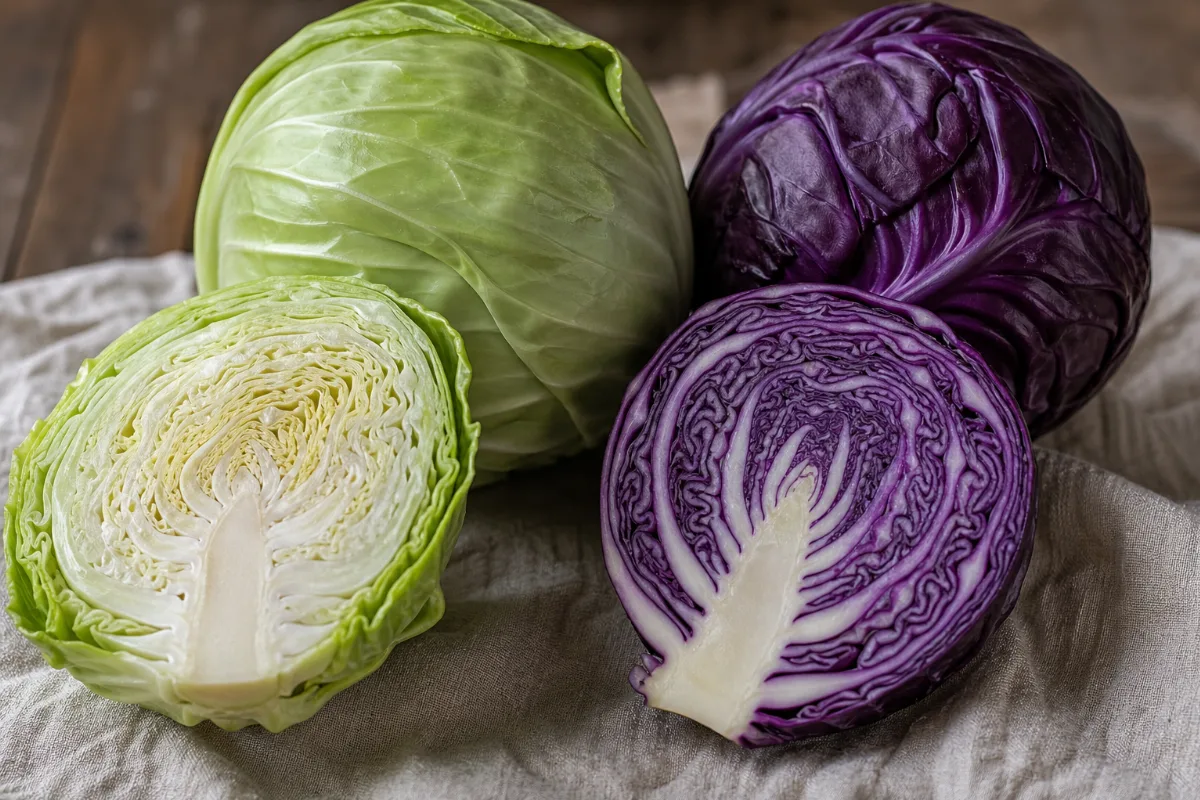
Vegetables · Vegetable
Cabbage
Brassica oleracea (cabbage group) · also called Green cabbage, white cabbage, red cabbage, repollo (Spanish)
Cabbage is a leafy vegetable eaten raw, cooked or fermented. It is a good source of vitamin C and vitamin K. Studies that follow people over time link more cruciferous vegetables with less heart disease and bowel cancer, but they cannot prove cabbage is the reason. The main cautions are warfarin (because of vitamin K), a thyroid worry that studies mostly do not support, and food poisoning from raw produce.
General information, not medical advice. Last substantive update · Not medically reviewed. A named clinician has not signed off on this page. How this page is made
About Cabbage
Cabbage is a nutritious everyday vegetable, a good source of vitamin C and vitamin K. It is a healthy food, not a proven remedy: most health claims come from studies of cruciferous vegetables in general, or from leaves used on the skin.
What it is
Cabbage (Brassica oleracea, the cabbage group) belongs to the mustard or cabbage family. The leaves of the tight head are eaten raw or cooked, and green, white and red types are common. Sauerkraut and kimchi are fermented cabbage and have their own pages.
USDA data for raw green cabbage: 25 kcal per 100 g. One cup of chopped leaves (89 g) has about 22 kcal, 2.2 g fibre, 32.6 mg vitamin C, 67.6 micrograms vitamin K, 38 micrograms folate (DFE) and 151 mg potassium. Raw red cabbage has more vitamin C (57.0 mg per 100 g) but less vitamin K (38.2 micrograms). Cooked, fermented and canned values were not read.
What the research shows
The firmest facts are about nutrients: vitamin C prevents scurvy and vitamin K is needed for blood to clot, and cabbage is a source of both. These are not trials of cabbage.
Pooled observational studies link more cruciferous vegetables to lower heart disease, bowel cancer and type 2 diabetes, but not to bladder cancer. These studies mix cabbage with broccoli and others and cannot show cause.
Cabbage leaf wraps on the knee eased pain more than usual care in one trial, but not more than a diclofenac gel. Cold leaves on the breast may ease pain after birth, but Cochrane rates the certainty very low. Both are skin treatments, not eating cabbage.
Food versus leaf wraps, sauerkraut and plant chemicals
The knee and breast results are for whole leaves on the skin. The bowel trial tested sauerkraut, which is a fermented food. Lab studies of glucosinolates and sulforaphane do not show that eating cabbage prevents disease, and a 2026 review says the amount of active compound the body gets varies widely with cooking and gut bacteria.
Amounts
This page gives no amounts to eat. Ask a doctor, pharmacist or dietitian what is right for you, especially if you take warfarin or have a thyroid condition.
At a glance
Traditional uses history, not proof
- Eaten as a vegetable, raw in salads and slaws, or cooked
- Fermented into sauerkraut and kimchi
- Whole leaves wrapped on sore joints or swollen breasts as a home remedy
- Long use as food is not proof that it treats any condition
Studied for research
- Vitamin C, high certainty for the nutrient, no cabbage trial
- Vitamin K for blood clotting, high certainty for the nutrient, no cabbage trial
- Heart disease risk (cruciferous and leafy vegetables), low certainty, observational
- Bowel cancer risk (cruciferous vegetables), low certainty, observational
- Type 2 diabetes risk (cruciferous vegetables), low certainty, observational
- Knee osteoarthritis pain (leaf wraps on the skin), low certainty
- Breast engorgement (cold leaves on the skin), very low certainty
- Sauerkraut and irritable bowel symptoms, very low certainty
Main compounds
- Vitamin C
- Vitamin K (phylloquinone)
- Folate
- Glucosinolates
- Isothiocyanates such as sulforaphane
- Anthocyanins (red cabbage)
- Goitrin
Common forms
- Raw, shredded or chopped
- Cooked (boiled, steamed, stir-fried, braised)
- Red, white and green types
- Fermented as sauerkraut or kimchi (separate pages)
- Whole leaves used as a skin wrap (not eaten)
Research links: NHS: Warfarin · 2024 review: do brassica vegetables affect the thyroid? · Cochrane review: treatments for breast engorgement · Research Library · Genes & Biomarkers Library
What it is and its history
- Accepted scientific name
- Brassica oleracea
- Naming authority
- L. (GBIF accepted species; cabbage is the variety capitata)
- Common names
- Cabbage (English); Green cabbage (English); White cabbage (English); Red cabbage (English); Repollo (Spanish)
- Family or group
- Brassicaceae (the mustard or cabbage family), as given by GBIF.
- Classification
- Plantae > Tracheophyta > Magnoliopsida > Brassicales > Brassicaceae > Brassica > Brassica oleracea
- Native range
- Not verified from a source read.
- Habitat
- Not verified from a source read.
- What it looks like
- Roots: Not verified.; Stems: Not verified.; Leaves: The leaves of the head are the food. USDA gives household portions of 1 cup chopped = 89 g, 1 cup shredded = 70 g, 1 medium head = 908 g (green) and 839 g (red, medium head).; Flowers: Not verified.; Fruit: Not verified.
- Cultivation
- Not verified from a source read.
- Harvest and processing
- Eaten raw or cooked, and also fermented as sauerkraut and kimchi, which have their own pages. Cooking and long storage can reduce vitamin C (MedlinePlus). Effects of cooking on other nutrients were not read.
- Look-alikes and adulterants
- Name: Other Brassica oleracea vegetables; Note: Kale, broccoli, cauliflower, Brussels sprouts and kohlrabi are other forms of the same species, with their own pages. Studies of 'cruciferous vegetables' pool several of them.; Name: Napa (Chinese) cabbage and bok choy; Note: These belong to a different species (Brassica rapa) and are not covered by the USDA entries used here; this was not verified from a source read.
- Sustainability and conservation
- Not assessed.
Photographs
What is inside, and how it may work
What it contains and how those compounds act in cells and animals. Laboratory and animal mechanisms are not proven effects in people.
Main compounds
| Compound | Family | Where it is concentrated | Activity studied | Level of evidence |
|---|---|---|---|---|
| Vitamin C (ascorbic acid) PubChem 54670067 | vitamin | Leaf USDA: 36.6 mg per 100 g raw green; 57.0 mg raw red | Essential vitamin; deficiency causes scurvy (MedlinePlus). Cooking and storage reduce it. 24 27 28 | Human data |
| Vitamin K (phylloquinone) PubChem 5284607 | vitamin | Leaf USDA: 76.0 micrograms per 100 g raw green; 38.2 micrograms raw red | Needed for blood-clotting proteins (MedlinePlus). Affects warfarin. 25 27 28 | Human data |
| Folate (vitamin B9) PubChem 135398658 | vitamin | Leaf USDA: 43 micrograms DFE per 100 g raw green; 18 micrograms raw red | B vitamin; USDA lists it in cabbage. No health claim is made here. 27 28 | Human data |
| Glucosinolates | sulfur compounds (glucosinolates) | Leaf A 2026 lab analysis of white cabbage lines found totals of 19.7 to 67.8 micromoles per gram dry weight, 73.0% aliphatic, 26.9% indolyl | Inactive precursors; the body gets isothiocyanates, indoles and other products after enzyme breakdown. Health effects in people are not proven. 5 17 9 | Laboratory research |
| Sulforaphane (an isothiocyanate) PubChem 5350 | isothiocyanate | Leaf (after breakdown of glucosinolates) Not given in the sources read | LactMed says cabbage contains sulforaphane and that it is detectable in breast milk. Reviews describe lab effects; human health effects of cabbage are not shown. 23 9 | Laboratory research |
| Goitrin PubChem 7568320 | glucosinolate breakdown product | Leaf (after breakdown of progoitrin) Not given for cabbage in the sources read | Can lower thyroid iodine uptake in theory; see the Safety tab. 6 | Human data |
| Anthocyanins (e.g. cyanidin type) PubChem 128861 | pigment | Leaf of red cabbage Not given in the sources read | Give red cabbage its purple colour. No human health outcome was read. 28 | Not tested |
Mechanisms, receptors and pathways
| Target or pathway | Gene or receptor | What was found | Level |
|---|---|---|---|
| Vitamin K and blood clotting | Clotting factors II, VII, IX and X (named by MedlinePlus) | Vitamin K is used by the liver to make clotting proteins; warfarin works against vitamin K, which is why steady intake matters. 25 | Human data |
| Glucosinolate breakdown to isothiocyanates | Myrosinase enzyme; Nrf2 pathway (described in reviews) | Cutting or chewing lets the plant enzyme turn glucosinolates into active products such as isothiocyanates. A 2026 review says similar glucosinolate levels can give very different amounts of active products depending on the enzyme, cooking and gut bacteria. In lab and cell work isothiocyanates activate Nrf2 detoxification and cause cell death in cancer cells; this does not show a benefit from eating cabbage. 17 9 | Laboratory research |
| Thyroid iodine uptake | Not specified | Goitrin and thiocyanate can lower thyroid iodine uptake in theory; a 2024 systematic review found no adverse thyroid effect of brassica vegetables in the diet, especially with enough iodine. 6 | Human data |
Absorption, metabolism and elimination
- Absorption
- Not found for cabbage nutrients in the sources read.
- Distribution
- LactMed says sulforaphane from cabbage is detectable in breast milk.
- Metabolism
- Not found.
- Elimination
- Not found.
- Bioavailability
- A 2026 review says what the body gets from glucosinolates depends on conversion to isothiocyanates, which varies with enzymes, processing and gut bacteria.
Isolated compounds versus whole extracts
The leaf wrap and breast engorgement results are for whole leaves on the skin, not eating. The sauerkraut trial tested a fermented product. Concentrated sulforaphane or glucosinolate supplements are different products and were not assessed.
Nutritional composition
Nutrition from USDA FoodData Central (SR Legacy items 169975 'Cabbage, raw' and 169977 'Cabbage, red, raw', last updated 4/1/2019, read 2026-10-26). Green cabbage, raw, per 100 g: 25 kcal, 1.28 g protein, 0.1 g fat, 5.8 g carbohydrate, 2.5 g fibre, 3.2 g sugars, about 92 g water, 40 mg calcium, 0.47 mg iron, 12 mg magnesium, 170 mg potassium, 18 mg sodium, 36.6 mg vitamin C, 43 micrograms folate (DFE), 76 micrograms vitamin K, 0.16 mg manganese, 0.124 mg vitamin B6. One cup of chopped green cabbage (89 g): about 22 kcal, 1.1 g protein, 2.2 g fibre, 32.6 mg vitamin C, 38 micrograms folate, 67.6 micrograms vitamin K, 151 mg potassium. Red cabbage, raw, per 100 g: 31 kcal, 1.43 g protein, 7.37 g carbohydrate, 2.1 g fibre, 3.83 g sugars, 45 mg calcium, 0.8 mg iron, 243 mg potassium, 57.0 mg vitamin C, 18 micrograms folate, 38.2 micrograms vitamin K, 670 micrograms beta-carotene, 329 micrograms lutein plus zeaxanthin; one cup chopped (89 g) holds about 50.7 mg vitamin C and 34 micrograms vitamin K. Figures vary with variety, ripeness and storage. Cooked, fermented and canned values were not read.
2 high certainty5 low certainty3 very low certainty
What was looked at
The 10 benefits and uses checked for Cabbage, each with how strong the evidence is. Tap one to open it.
- Vitamin C from cabbageHigh certainty
- Vitamin K for normal blood clottingHigh certainty
- Heart disease risk (cruciferous and green leafy vegetables)Low certainty
- Colorectal cancer risk (cruciferous vegetables)Low certainty
- Type 2 diabetes risk (cruciferous vegetables)Low certainty
- Cabbage leaf wraps for knee osteoarthritis painLow certainty
- Cabbage leaves for breast engorgement while breastfeedingVery low certainty
- Bladder cancer risk (cruciferous vegetables)Low certainty
- Sauerkraut (fermented cabbage) and irritable bowel symptomsVery low certainty
- Inflammation markers and death risk (cabbage-family foods in one cohort)Very low certainty
Lab markers tracked in the studies
Cardiovascular disease eventsColorectal cancer casesNew cases of type 2 diabetesKnee pain scoreBreast pain scoreIBS symptom severity score
What is Cabbage good for?
The main studied uses and how strong the human evidence is for each. Many results are for cruciferous vegetables as a group, for leaves used on the skin, or for fermented cabbage, not for eating cabbage.
Benefits, one by one
Each card is a research question, not a promise. Tap a goal to filter. Open a card to see the studies, doses and limits.
Vitamin C from cabbage
High certaintyCabbage is a good vegetable source of vitamin C. USDA lists 36.6 mg in 100 g of raw green cabbage and 57.0 mg in raw red cabbage, about 33 mg in one cup (89 g) of chopped green. Too little vitamin C causes scurvy. This is a nutrient fact, not a cabbage trial.
3 studiesRaw leaves as food; cooking and long storage can lower vitamin C (Med…
Studies, doses and limits
What the trials found
MedlinePlus lists spinach, cabbage, turnip greens and other leafy greens among the vegetables with the highest vitamin C. It says severe vitamin C deficiency is called scurvy and mainly affects older, malnourished adults, and that cooking vitamin C-rich foods or storing them for a long time can reduce the vitamin C content. USDA gives 36.6 mg per 100 g for raw green cabbage and 57.0 mg per 100 g for raw red cabbage.
Results
Cabbage is a recognised vitamin C food. No trial of eating cabbage for vitamin C status or scurvy was read.
Effect sizes as reported
USDA: green cabbage, raw, 36.6 mg per 100 g (about 32.6 mg per 89 g cup chopped); red cabbage, raw, 57.0 mg per 100 g (about 50.7 mg per 89 g cup).
Why this rating
High for the nutrient role and for cabbage being a source (health-agency statement and USDA data). There is no cabbage-specific trial, and the pages read do not say that extra vitamin C from any source adds benefit in someone who already has enough.
Form and dose studied
Raw leaves as food; cooking and long storage can lower vitamin C (MedlinePlus).
Who was studied
Anyone eating a varied diet; scurvy is linked to older, malnourished adults (MedlinePlus).
Limits
Nutrient fact, not a trial of cabbage. Values vary with variety, ripeness and storage.
Why researchers looked
Cabbage is often named as a vitamin C food, so people ask what that does for the body.
Traditional use
Cabbage is eaten as a vegetable, raw or cooked. Long use as food is not proof that it treats any condition.
Proposed mechanism Authoritative guidance
Vitamin C is an essential vitamin; too little causes scurvy, which mainly affects older, malnourished adults (MedlinePlus).
A proposed mechanism does not show that the effect happens in people.
None specific for the food.
Vitamin K for normal blood clotting
High certaintyVitamin K is needed for blood to clot. MedlinePlus lists cabbage among the vegetables with vitamin K. USDA lists 76 micrograms in 100 g of raw green cabbage (about 68 micrograms in one cup of chopped leaves) and 38.2 micrograms in raw red cabbage. If you take warfarin, the same vitamin K matters for a different reason: see the Safety tab.
3 studiesRaw leaves as food. Values vary with variety, ripeness and storage.
Studies, doses and limits
What the trials found
MedlinePlus says vitamin K is needed to make clotting factors in the liver, that deficiency is very rare, and lists green leafy vegetables and vegetables such as Brussels sprouts, broccoli, cauliflower and cabbage as food sources. USDA lists 76.0 micrograms of vitamin K (phylloquinone) per 100 g of raw green cabbage and 38.2 micrograms per 100 g of raw red cabbage.
Results
The clotting role of vitamin K is well accepted, and cabbage is a source. No trial of cabbage for clotting was read.
Effect sizes as reported
USDA: green cabbage 76.0 micrograms per 100 g (about 67.6 micrograms per 89 g cup chopped); red cabbage 38.2 micrograms per 100 g (about 34 micrograms per 89 g cup).
Why this rating
High for the nutrient role and for cabbage being a source (health-agency statement and USDA data). There is no cabbage-specific trial, and MedlinePlus says deficiency is very rare.
Form and dose studied
Raw leaves as food. Values vary with variety, ripeness and storage.
Who was studied
Anyone eating a varied diet.
Limits
Nutrient fact, not a trial of cabbage. Cooked-cabbage values were not read.
Why researchers looked
Cabbage is named as a vitamin K food, so people ask what it does for the body.
Traditional use
Cabbage is eaten as a vegetable, raw or cooked. Long use as food is not proof that it treats any condition.
Proposed mechanism Authoritative guidance
Vitamin K is used by the liver to make clotting proteins (clotting factors II, VII, IX and X) (MedlinePlus).
A proposed mechanism does not show that the effect happens in people.
People taking warfarin should keep vitamin K intake steady and ask their clinic; see the Safety tab.
Heart disease risk (cruciferous and green leafy vegetables)
Low certaintyStudies that follow people over time link eating more cruciferous and green leafy vegetables with less heart disease. These are observational studies, they pool cabbage with other vegetables, and they cannot show that cabbage itself protects the heart.
2 studiesVegetables as food.
Studies, doses and limits
What the trials found
A 2016 meta-analysis (Pollock) pooled eight studies of green leafy vegetables including cruciferous vegetables and cardiovascular disease and found a relative risk of 0.842 (95% CI 0.753 to 0.941). A 2017 meta-analysis of 95 prospective studies (Aune and colleagues) found that eating more fruit and vegetables combined was linked to lower cardiovascular disease and death from any cause, and said inverse associations were seen for cruciferous vegetables and for green leafy vegetables. The abstract does not give a cabbage-only figure.
Results
Higher intake of cruciferous and green leafy vegetables was linked to lower heart disease in observational studies. Neither abstract isolates cabbage.
Effect sizes as reported
Green leafy including cruciferous vegetables and total cardiovascular disease: RR 0.842 (95% CI 0.753-0.941), 8 studies (Pollock 2016). Fruit and vegetables combined per 200 g/day: cardiovascular disease RR 0.92 (0.90-0.95); all-cause mortality RR 0.90 (0.87-0.93) (Aune 2017).
Why this rating
Low because the evidence is from observational studies, which cannot show cause, and because cabbage is pooled with other vegetables. The 2016 abstract does not report heterogeneity.
Form and dose studied
Vegetables as food.
Who was studied
Adults in prospective studies.
Limits
Observational. People who eat more vegetables differ in other ways. The combined figures are not for cabbage alone.
Why researchers looked
Large studies ask whether people who eat more vegetables have fewer heart attacks and strokes.
Traditional use
Cabbage is eaten as a vegetable, raw or cooked. Long use as food is not proof that it treats any condition.
Proposed mechanism Unknown
Not established. The papers read report associations only.
A proposed mechanism does not show that the effect happens in people.
None specific.
Colorectal cancer risk (cruciferous vegetables)
Low certaintyA 2013 review of 35 studies found that people who ate more cruciferous vegetables had a lower risk of colorectal cancer. The abstract says cabbage and broccoli gave similar results, but the follow-up (prospective) studies were only borderline significant. This is an association, not proof.
2 studiesCruciferous vegetables as food.
Studies, doses and limits
What the trials found
Wu and colleagues (2013) pooled 24 case-control studies and 11 prospective studies and found a relative risk of 0.82 (95% CI 0.75 to 0.90) for the highest versus lowest cruciferous vegetable intake and colorectal cancer. The abstract says an analysis specific to cabbage and broccoli gave similar results, that case-control studies gave similar results, and that the prospective studies showed borderline significance. A 2017 meta-analysis (Aune) linked cruciferous vegetables to lower total cancer risk.
Results
An inverse association was found in pooled observational studies; the better-designed follow-up studies were only borderline.
Effect sizes as reported
Cruciferous vegetables and colorectal cancer, highest versus lowest intake: RR 0.82 (95% CI 0.75-0.90), 24 case-control and 11 prospective studies.
Why this rating
Low because the data are observational, case-control studies are prone to recall bias, and the prospective studies were only borderline. The abstract does not give a cabbage-only number.
Form and dose studied
Cruciferous vegetables as food.
Who was studied
Adults in case-control and prospective studies.
Limits
Observational; cabbage is pooled with broccoli and others; the abstract asks for more work on preparation methods.
Why researchers looked
Cabbage-family vegetables contain glucosinolates, which are studied in the lab for cancer, so researchers compare people who eat more and less of them.
Traditional use
Cabbage is eaten as a vegetable, raw or cooked. Long use as food is not proof that it treats any condition.
Proposed mechanism Preliminary mechanism
Glucosinolate breakdown products are studied in lab and animal work; see the science section. The meta-analysis reports associations only.
A proposed mechanism does not show that the effect happens in people.
None specific.
Type 2 diabetes risk (cruciferous vegetables)
Low certaintyA 2016 meta-analysis of four follow-up studies found that people who ate the most cruciferous vegetables had a lower risk of type 2 diabetes than people who ate the least. It is an observational result and not about cabbage alone.
1 studiesCruciferous vegetables as food.
Studies, doses and limits
What the trials found
Jia and colleagues (2016) analysed prospective cohort studies. Based on four of them, the highest versus lowest intake of cruciferous vegetables was linked to a summary relative risk of 0.84 (95% CI 0.73 to 0.96) for type 2 diabetes, with heterogeneity of I2 54.4%. Seven cohort studies in all (16,544 diabetes cases among 306,723 people) were identified for the review. The authors say further large prospective studies are needed.
Results
Higher cruciferous vegetable intake was linked to lower type 2 diabetes in four cohort studies.
Effect sizes as reported
Cruciferous vegetables, highest versus lowest: SRR 0.84 (95% CI 0.73-0.96), I2 54.4%, 4 cohort studies.
Why this rating
Low because the finding is observational, rests on only four cohorts, and has moderate heterogeneity. Cabbage is not separated out.
Form and dose studied
Cruciferous vegetables as food.
Who was studied
Adults in prospective cohorts, follow-up 4.6 to 24 years.
Limits
Observational; cannot show cause; few studies.
Why researchers looked
Researchers ask whether particular vegetable groups, not just vegetables overall, are linked to diabetes.
Traditional use
Cabbage is eaten as a vegetable, raw or cooked. Long use as food is not proof that it treats any condition.
Proposed mechanism Unknown
Not established. The paper reports an association only.
A proposed mechanism does not show that the effect happens in people.
None specific.
Cabbage leaf wraps for knee osteoarthritis pain
Low certaintyTwo small trials tested cabbage leaves wrapped on the knee. In the larger one (81 people) pain after 4 weeks was lower than with usual care but not lower than with a diclofenac pain gel. A smaller open-label trial found leaf wraps and a cooling gel pad improved similarly, so cold may explain part of the effect. This is a skin wrap, not eating cabbage.
3 studiesWhole cabbage leaves applied to the skin of the knee for 1 to 2 hours…
Studies, doses and limits
What the trials found
Lauche and colleagues (2016) randomly assigned 81 people with stage II to III knee osteoarthritis to 4 weeks of cabbage leaf wraps (daily for at least 2 hours), topical diclofenac gel, or usual care. Pain on a visual analogue scale was lower with wraps than with usual care (difference -12.1, 95% CI -23.1 to -1.0, p = 0.033) but not significantly different from the gel (-8.6, 95% CI -21.5 to 4.4, p = 0.190). A 2022 open-label trial (Chobpenthai and colleagues) in people with grade 3 to 4 osteoarthritis compared cabbage leaf for 1 hour daily (20 people), a cooling gel pad (20) and diclofenac gel (20) for 4 weeks. Cabbage leaf and the cooling pad gave similar improvements and both did better than diclofenac gel. A 2025 narrative review of topical pain products rated cabbage leaf wraps as level B (SORT) for some musculoskeletal pain.
Results
Wraps beat usual care but not diclofenac gel in one trial; they matched a cooling pad and beat the gel in another small unblinded trial.
Effect sizes as reported
Lauche 2016, pain difference at 4 weeks versus usual care -12.1 (95% CI -23.1 to -1.0); versus gel -8.6 (95% CI -21.5 to 4.4). Chobpenthai 2022: group differences significant (Oxford Knee Score p = 0.012, pain score p < 0.001); effect sizes not given in the abstract.
Why this rating
Low because both trials were small and could not be blinded, one was open-label with 20 people per group, and the cooling pad did as well as the leaf, so cold may explain the benefit. The two trials disagree on whether wraps beat diclofenac gel.
Form and dose studied
Whole cabbage leaves applied to the skin of the knee for 1 to 2 hours daily for 4 weeks (not eaten).
Who was studied
Adults with symptomatic knee osteoarthritis, stage II to IV.
Limits
Skin application, not a food effect. Small, unblinded trials. The 2025 review is narrative.
Why researchers looked
Cabbage leaf wraps are a home remedy for sore joints, so researchers tested them on knee osteoarthritis.
Traditional use
Cabbage is eaten as a vegetable, raw or cooked. Long use as food is not proof that it treats any condition.
Proposed mechanism Unknown
Not established; a cooling or placebo-type effect has not been ruled out.
A proposed mechanism does not show that the effect happens in people.
In Lauche 2016 the abstract reports 2 adverse events in each active group and says the applications were otherwise well tolerated. See the Safety tab.
Cabbage leaves for breast engorgement while breastfeeding
Very low certaintyWomen have put cabbage leaves on swollen, sore breasts after birth. A Cochrane review found cold cabbage leaves may ease breast pain a little more than routine care, but the certainty is very low and it concluded no firm conclusions can be drawn. A second meta-analysis found less pain but no clear change in engorgement itself. This is a skin treatment, not eating cabbage.
3 studiesWhole leaves, cold or at room temperature, applied to the breast (not…
Studies, doses and limits
What the trials found
The 2020 Cochrane review (Zakarija-Grkovic and Stewart; 21 studies, 2,170 women, all treatments) said meta-analysis was not possible and results come from single trials. For breast pain, cold cabbage leaves may be more effective than routine care (mean difference -1.03 points on a 0 to 10 scale, 95% CI -1.53 to -0.53; 152 women; very low certainty) or cold gel packs (-0.63, 95% CI -1.09 to -0.17; very low certainty). For breast hardness, cold cabbage leaves versus routine care gave -0.58 (95% CI -0.82 to -0.34; low certainty). The review was uncertain about cold versus room-temperature leaves, and breast swelling and adverse events were not reported. A 2023 meta-analysis (Ozkaya and Korukcu; 8 studies) found cold cabbage leaf application significantly reduced breast pain but not breast engorgement. LactMed reports that one meta-analysis found no good evidence leaves were better than no treatment because engorgement tends to improve over time anyway.
Results
Cold leaves may reduce breast pain and hardness a little; no clear effect on engorgement itself; certainty is very low to low.
Effect sizes as reported
Cochrane: cold cabbage leaves versus routine care for breast pain, mean difference -1.03 on a 0-10 scale (95% CI -1.53 to -0.53), 152 women, very low certainty.
Why this rating
The Cochrane authors rated the certainty very low for pain and low for hardness because of weak study design, imprecision and inconsistency. The second meta-analysis found no engorgement benefit.
Form and dose studied
Whole leaves, cold or at room temperature, applied to the breast (not eaten).
Who was studied
Breastfeeding women with engorged breasts in the first days after birth.
Limits
Skin application. Few small trials; cold alone may explain the soothing effect.
Why researchers looked
Swollen, painful breasts are common in the first days after birth, and cabbage leaves are a widely used home remedy.
Traditional use
Cabbage is eaten as a vegetable, raw or cooked. Long use as food is not proof that it treats any condition.
Proposed mechanism Unknown
Not established; the cold may be what soothes.
A proposed mechanism does not show that the effect happens in people.
Painful, red or feverish breasts need a clinician; see the Safety tab.
Bladder cancer risk (cruciferous vegetables)
Low certaintyA 2022 meta-analysis of cohort studies did not find that people who ate the most cruciferous vegetables had significantly lower bladder cancer risk. This is a null result and is not about cabbage alone.
1 studiesCruciferous vegetables as food.
Studies, doses and limits
What the trials found
Yu and colleagues (2022) pooled cohort studies and found that the highest versus lowest cruciferous vegetable intake was not significantly associated with bladder cancer risk (RR 0.92, 95% CI 0.80 to 1.06). The linear dose-response analyses were also not significant. The authors say the results do not support the hypothesis that cruciferous vegetables lower bladder cancer risk and ask for more large cohorts.
Results
No significant link was found.
Effect sizes as reported
Highest versus lowest cruciferous vegetable intake and bladder cancer: RR 0.92 (95% CI 0.80-1.06).
Why this rating
Low because it is observational; the result is a clear null in the pooled cohorts but cabbage is not separated out.
Form and dose studied
Cruciferous vegetables as food.
Who was studied
Adults in cohort studies.
Limits
Observational; number of cohorts is not given in the abstract.
Why researchers looked
Glucosinolate breakdown products are studied for bladder cancer, so researchers compared people who eat more and less of cruciferous vegetables.
Traditional use
Cabbage is eaten as a vegetable, raw or cooked. Long use as food is not proof that it treats any condition.
Proposed mechanism Unknown
Not established.
A proposed mechanism does not show that the effect happens in people.
None specific.
Sauerkraut (fermented cabbage) and irritable bowel symptoms
Very low certaintyA small Norwegian trial gave 34 people with irritable bowel syndrome sauerkraut every day for 6 weeks. Symptom scores improved in both the pasteurized and unpasteurized groups, with no difference between them. There was no group eating nothing, so the trial cannot say sauerkraut was the cause. Fermented cabbage is not the same food as fresh cabbage.
1 studiesFermented (sauerkraut), pasteurized or unpasteurized, as a daily supp…
Studies, doses and limits
What the trials found
Nielsen and colleagues (2018) randomly assigned 34 Norwegian adults with irritable bowel syndrome to pasteurized sauerkraut (15 people) or unpasteurized sauerkraut (19 people) as a daily supplement to their diet for 6 weeks. The IBS Symptom Severity Score fell in both groups (mean change -38.57 for pasteurized and -56.99 for unpasteurized, P < 0.04 for improvement), with no difference between groups. Gut bacteria composition changed in both. The authors call the study underpowered.
Results
Symptoms improved in both groups, with no difference between them; there was no non-sauerkraut control group.
Effect sizes as reported
IBS-SSS mean change: -38.57 +/- 17.08 (pasteurized) versus -56.99 +/- 16.92 (unpasteurized); no difference between groups.
Why this rating
Very low because the pilot had only 34 people, no group without sauerkraut, and the authors call it underpowered. It tested a fermented product, not fresh cabbage.
Form and dose studied
Fermented (sauerkraut), pasteurized or unpasteurized, as a daily supplement to the diet for 6 weeks.
Who was studied
Adults with irritable bowel syndrome in Norway.
Limits
Fermented food, not raw or cooked cabbage. Small pilot with no comparison group without sauerkraut.
Why researchers looked
Fermented cabbage contains lactic acid bacteria and fibre, so researchers asked whether it helps gut symptoms.
Traditional use
Cabbage is eaten as a vegetable, raw or cooked. Long use as food is not proof that it treats any condition.
Proposed mechanism Hypothesis
The authors suggest that prebiotic compounds in the sauerkraut, rather than live bacteria, may explain the effect. This was not proven.
A proposed mechanism does not show that the effect happens in people.
Sauerkraut can be salty; this page did not research that. See the sauerkraut page.
Inflammation markers and death risk (cabbage-family foods in one cohort)
Very low certaintyOne US cohort study found that people who ate foods in a group that included broccoli, cabbage, cauliflower, Brussels sprouts, sauerkraut and kimchi had lower inflammation markers and lower odds of death. The group is mixed and cabbage cannot be separated out, and the finding is only an association.
1 studiesCabbage-family vegetables and fermented cabbage foods, eaten as food.
Studies, doses and limits
What the trials found
Carris and colleagues (2024) used data from the Multi-Ethnic Study of Atherosclerosis. They looked at six food categories and nine inflammation markers. The category they call 'broccoli' (broccoli, cabbage, cauliflower, Brussels sprouts, sauerkraut and kimchee) was associated with lower inflammation and lower mortality odds. Low and high intake versus none were linked to lower mortality odds in models with IL-6 and D-dimer. The authors call for randomised trials to check the finding.
Results
A mixed category that included cabbage was linked to lower inflammation and lower mortality odds.
Effect sizes as reported
Numbers were not given in the abstract.
Why this rating
Very low because it is an observational analysis of a mixed food category, with the numbers not reported in the abstract, and cabbage is not separate.
Form and dose studied
Cabbage-family vegetables and fermented cabbage foods, eaten as food.
Who was studied
Adults in a US cohort.
Limits
Observational; category is mixed; no effect size in the abstract.
Why researchers looked
Researchers looked for everyday foods linked to lower chronic inflammation and mortality.
Traditional use
Cabbage is eaten as a vegetable, raw or cooked. Long use as food is not proof that it treats any condition.
Proposed mechanism Unknown
Not established.
A proposed mechanism does not show that the effect happens in people.
None specific.
Connections to the rest of health
How Cabbage connects to the rest of our health knowledge graph. Every link says what kind of connection it is. A safety link (for example to the liver) is a warning, not a benefit. A study that merely mentions a topic never creates a benefit link.
Explore every connection: goals, body systems, organs, symptoms, genes
B. Body systems
| Connected to | Kind of connection | Evidence status | Context | Studies |
|---|---|---|---|---|
| Blood And Immune | Biological association | High certainty | Studied for: Vitamin C from cabbage Studied for: Vitamin K for normal blood clotting | 24 27 28 25 2 |
| Cardiovascular System | Biological association | High certainty | Studied for: Vitamin K for normal blood clotting Studied for: Heart disease risk (cruciferous and green leafy vegetables) | 25 27 28 13 1 2 |
| Digestive System | Biological association | Low certainty | Studied for: Colorectal cancer risk (cruciferous vegetables) Studied for: Sauerkraut (fermented cabbage) and irritable bowel symptoms | 18 1 11 |
| Endocrine System | Biological association | Low certainty | Studied for: Type 2 diabetes risk (cruciferous vegetables) | 8 |
| Bones Joints Muscles | Biological association | Low certainty | Studied for: Cabbage leaf wraps for knee osteoarthritis pain | 10 3 14 |
| Reproductive System | Biological association | Very low certainty | Studied for: Cabbage leaves for breast engorgement while breastfeeding | 20 12 23 |
| Urinary System | Biological association | Low certainty | Studied for: Bladder cancer risk (cruciferous vegetables) | 19 |
C. Body parts and organs
| Connected to | Kind of connection | Evidence status | Context | Studies |
|---|---|---|---|---|
| Thyroid | Low certainty | A theoretical concern; a 2024 systematic review found no adverse thyroid effect of brassica vegetables, especially with enough iodine. A theoretical concern; a 2024 systematic review found no adverse thyroid effect from brassica vegetables, especially with enough iodine. Preparation or compound: Glucosinolate breakdown products (goitrin, thiocyanate) |
7 6 |
I. Biomarkers
| Connected to | Kind of connection | Evidence status | Context | Studies |
|---|---|---|---|---|
| Cardiovascular disease events | Biological association | Low certainty | Measured in trials: lowered. A lab change is not the same as a health benefit. | 13 1 |
| Colorectal cancer cases | Biological association | Low certainty | Measured in trials: lowered. A lab change is not the same as a health benefit. | 18 |
| New cases of type 2 diabetes | Biological association | Low certainty | Measured in trials: lowered. A lab change is not the same as a health benefit. | 8 |
| Knee pain score | Biological association | Low certainty | Measured in trials: lowered. A lab change is not the same as a health benefit. | 10 3 |
| Breast pain score | Biological association | Very low certainty | Measured in trials: lowered. A lab change is not the same as a health benefit. | 20 12 |
| IBS symptom severity score | Biological association | Very low certainty | Measured in trials: lowered. A lab change is not the same as a health benefit. | 11 |
K. Biological pathways
| Connected to | Kind of connection | Evidence status | Context | Studies |
|---|---|---|---|---|
| Vitamin K | Preliminary mechanism | Human | Cabbage supplies vitamin K; vitamin K is needed for clotting and affects warfarin. | 25 26 |
| Vitamin C | Preliminary mechanism | Human | Cabbage is a vitamin C food; deficiency causes scurvy. | 24 |
| Glucosinolates and isothiocyanates | Preliminary mechanism | In vitro | Plant compounds of the cabbage family studied in the lab for cancer; human benefit of eating cabbage is not proven. | 17 9 |
L. Active compounds
| Connected to | Kind of connection | Evidence status | Context | Studies |
|---|---|---|---|---|
| Vitamin C (ascorbic acid) | Biological association | Human | Essential vitamin; deficiency causes scurvy (MedlinePlus). Cooking and storage reduce it. Preparation or compound: Leaf |
24 27 28 |
| Vitamin K (phylloquinone) | Biological association | Human | Needed for blood-clotting proteins (MedlinePlus). Affects warfarin. Preparation or compound: Leaf |
25 27 28 |
| Folate (vitamin B9) | Biological association | Human | B vitamin; USDA lists it in cabbage. No health claim is made here. Preparation or compound: Leaf |
27 28 |
| Glucosinolates | Biological association | In vitro | Inactive precursors; the body gets isothiocyanates, indoles and other products after enzyme breakdown. Health effects in people are not proven. Preparation or compound: Leaf |
5 17 9 |
| Sulforaphane (an isothiocyanate) | Biological association | In vitro | LactMed says cabbage contains sulforaphane and that it is detectable in breast milk. Reviews describe lab effects; human health effects of cabbage are not shown. Preparation or compound: Leaf (after breakdown of glucosinolates) |
23 9 |
| Goitrin | Biological association | Human | Can lower thyroid iodine uptake in theory; see the Safety tab. Preparation or compound: Leaf (after breakdown of progoitrin) |
6 |
| Anthocyanins (e.g. cyanidin type) | Biological association | Not tested | Give red cabbage its purple colour. No human health outcome was read. Preparation or compound: Leaf of red cabbage |
28 |
Each connection is stored with the ingredient, the connected record, the kind of connection, the evidence status, the supporting studies, the preparation or compound involved, and a review date (last reviewed October 26, 2026).
Evidence at a glance: what changed in 6 lab markers
Tap a number to show only those markers. Counts are markers, not people.
The evidence
The research centre for Cabbage. Every record here was checked against PubMed or the publisher's page; we never list a study we have not verified.
Evidence by outcome
Bars show how many studies we found for each outcome, not how well it works. People are added up across trials only (reviews are not added, to avoid double counting).
How we rate evidence
High certainty
Several well-run trials or reviews agree; further research is unlikely to change the picture much.
Moderate certainty
Good trials point the same way, but some doubt remains.
Low certainty
Small, short or inconsistent trials. The finding could change with better research.
Very low certainty
Very little or very weak human data. Treat as a possibility only.
Mixed findings
Trials or reviews disagree with each other.
Not enough evidence
Not enough human research to say either way.
Evidence against
Good research found no benefit, or found harm.
We take the reviewers' own risk-of-bias and GRADE statements where they exist, and otherwise judge from study size, design, consistency, directness and whether a product matches what is sold. Many publications do not make evidence high. Method note: We started from our existing cabbage summary, re-checked nutrition at USDA FoodData Central, read the health agency pages (NHS, MedlinePlus, FDA, LactMed) and searched PubMed for reviews, trials and case reports. Only abstracts were read for studies, and two allergy reports had no abstract. Items we could not verify are flagged in the research gaps.
Study library: every study we checked 28
| Study | Design | People | Product, dose, length | Result |
|---|---|---|---|---|
| Aune 2017 Fruit and vegetable intake and the risk of cardiovascular disease, total cancer and all-cause mortality-a systematic review and dose-response meta-analysis of prospective studies. Int J Epidemiol · PMID 28338764 · DOI |
Systematic review meta analysis |
Adults in 95 prospective studies (142 publications) | Fruit and vegetable intake as food Fruit and vegetables Per 200 g/day (analysis unit, not advice) Prospective follow-up · vs Lower intake |
For fruit and vegetables combined, each 200 g/day was linked to lower risk of coronary heart disease, stroke, cardiovascular disease, total cancer and death from any cause. The abstract says inverse associations were seen for green leafy vegetables and cruciferous vegetables with cardiovascular disease and all-cause mortality, and for green-yellow and cruciferous vegetables with total cancer risk. No cabbage-only figure is given in the abstract. Combined fruit and vegetables per 200 g/day: cardiovascular disease RR 0.92; total cancer RR 0.97; all-cause mortality RR 0.90 (CVD 0.92 (0.90-0.95); total cancer 0.97 (0.95-0.99); all-cause mortality 0.90 (0.87-0.93)) Methods, limits and fundingOutcomes: Cardiovascular disease, total cancer, all-cause mortality Limitations: Prospective observational studies cannot show cause. The combined figures are not for cabbage. Cruciferous-specific figures are not in the abstract. Funding and conflicts: Not stated in the abstract. Read: abstract |
| Carris 2024 Association of Common Foods with Inflammation and Mortality: Analysis from a Large Prospective Cohort Study. J Med Food · PMID 38354278 · DOI |
Cohort study |
Adults in the Multi-Ethnic Study of Atherosclerosis (MESA) | Foods in the MESA 'broccoli' category (broccoli, cabbage, cauliflower, Brussels sprouts, sauerkraut, kimchee) Vegetables and fermented vegetables Low and high intake versus none Prospective follow-up · vs No consumption |
The mixed 'broccoli' category was associated with lower inflammation and lower mortality odds. The authors call for randomised trials. Not given in the abstract (Not given) Methods, limits and fundingOutcomes: Inflammatory markers; all-cause mortality Limitations: Observational; mixed category; no numbers in the abstract. Funding and conflicts: Not stated in the abstract. Read: abstract |
| Chobpenthai 2022 Efficacy of Cabbage Leaf versus Cooling Gel Pad or Diclofenac Gel for Patients with Knee Osteoarthritis: A Randomized Open-Labeled Controlled Clinical Trial. Pain Res Manag · PMID 35719197 · DOI |
Controlled trial |
60 Adults with grade 3 to 4 knee osteoarthritis (Kellgren and Lawrence) |
Cabbage leaf application Leaf, applied to the knee 1 hour once a day 4 weeks · vs Cooling gel pad (20 people, 20 minutes daily) and diclofenac gel (20 people, 4 times daily) |
The cabbage leaf group and the cooling gel pad group both improved significantly on the Oxford Knee Score and pain score. The three treatments differed significantly (Oxford Knee Score p = 0.012; pain score p < 0.001). The authors say leaf and cooling pad improved symptoms similarly and did better than diclofenac gel. Effect sizes not given in the abstract (Not given) Methods, limits and fundingOutcomes: Numerical Rating Scale pain score; Oxford Knee Score Limitations: Open-label; small groups (20 per group); the cooling pad did as well as the leaf, so cold may explain the benefit. Funding and conflicts: Not stated in the abstract. Read: abstract |
| Dölle 2013 Cabbage allergy: a rare cause of food-induced anaphylaxis. Acta Derm Venereol · PMID 23306716 · DOI |
Case report |
Case report: a person with food-induced anaphylaxis (letter) | Raw or cooked cabbage (eaten) Leaves |
Only the title and publication type were read (the PubMed record has no abstract). The title reports cabbage allergy as a rare cause of food-induced anaphylaxis. Not available (Not available) Methods, limits and fundingOutcomes: Allergic reaction to cabbage Limitations: No abstract to read. A report of one or a few people; it cannot show how common allergy is. Funding and conflicts: Not stated. Read: abstract |
| Fabjan 2026 Glucosinolate variation, heterosis, and prediction of hybrid performance from parental values in white cabbage (Brassica oleracea var. capitata). Front Plant Sci · PMID 41799973 · DOI |
Laboratory analysis plant |
14 doubled haploid cabbage lines, 11 derived hybrids and 2 commercial hybrids | White cabbage plant tissue analysis Head |
Thirteen glucosinolates were found; total concentrations ranged from 19.7 to 67.8 micromoles per gram dry weight, with aliphatic types 73.0%, indolyl 26.9% and aromatic 0.1%. Not applicable (Not applicable) Methods, limits and fundingOutcomes: Glucosinolate concentrations Limitations: Plant-breeding lab study; no people were studied. Funding and conflicts: Not stated in the abstract. Read: abstract |
| Felker 2016 Concentrations of thiocyanate and goitrin in human plasma, their precursor concentrations in brassica vegetables, and associated potential risk for hypothyroidism. Nutr Rev · PMID 26946249 · DOI |
Narrative review |
Review of thiocyanate and goitrin in people and brassica vegetables | Brassica vegetables Leaves and heads Radioiodine uptake inhibited by 194 micromoles of goitrin but not by 77 micromoles (as stated in the abstract) |
Collards, Brussels sprouts and some Russian kale (Brassica napus) contain enough goitrin to potentially decrease thyroid iodine uptake. Turnip tops, commercial broccoli, broccoli rabe and Brassica oleracea kale have less than 10 micromoles of goitrin per 100 g and are considered minimal risk. Thiocyanate from indole glucosinolates is judged minimal risk. Cabbage is not named in the abstract. Not applicable (Not applicable) Methods, limits and fundingOutcomes: Goitrin and thiocyanate levels; theoretical thyroid risk Limitations: Narrative review; estimates and surrogates used; cabbage not named. Funding and conflicts: Not stated in the abstract (NIH extramural support listed in PubMed). Read: abstract |
| Galanty 2024 Do Brassica Vegetables Affect Thyroid Function?-A Comprehensive Systematic Review. Int J Mol Sci · PMID 38612798 · DOI |
Systematic review mixed |
123 articles of in vitro, animal and human studies | Brassica vegetables and extracts Plants Not given in the abstract Varied |
The authors say most results cast doubt on the claim that brassica plants have antithyroid effects in humans, and that including brassica vegetables in the daily diet, particularly with adequate iodine, poses no adverse effects on thyroid function. Not applicable (Not applicable) Methods, limits and fundingOutcomes: Thyroid mass and histology, TSH, T3, T4, iodine uptake, thyroid cancer cells Limitations: Mixes lab, animal and human work; numbers not given in the abstract; does not separate cabbage. Funding and conflicts: Not stated in the abstract. Read: abstract |
| Jia 2016 Consumption of citrus and cruciferous vegetables with incident type 2 diabetes mellitus based on a meta-analysis of prospective study. Prim Care Diabetes · PMID 26778708 · DOI |
Meta-analysis |
306,723 participants in 7 prospective cohort studies; 16,544 type 2 diabetes cases (4 cohorts for the cruciferous analysis) | Cruciferous vegetables as food Leaves, heads and florets Not given in the abstract 4.6 to 24 years · vs Lowest intake |
Highest versus lowest cruciferous vegetable intake was linked to a lower risk of type 2 diabetes, with significant heterogeneity. Citrus fruit showed no protective link. SRR 0.84 (95% CI 0.73-0.96; I2 54.4%) Methods, limits and fundingOutcomes: Incident type 2 diabetes Limitations: Observational; only four cohorts; heterogeneity; not cabbage alone. Funding and conflicts: Not stated in the abstract. Read: abstract |
| Labudda 2026 The Chemopreventive and Anticancer Potential of Glucosinolates and Their Hydrolysis Products from Cruciferous Vegetables. Nutrients · PMID 41829922 · DOI |
Narrative review mixed |
Integrative literature review | Glucosinolates, isothiocyanates and indoles from cruciferous vegetables Cruciferous vegetables |
The review says isothiocyanates activate Nrf2-mediated detoxification and modulate pathways linked to cancer in lab work, that epidemiological data show inverse associations between cruciferous vegetable intake and cancer risk with variability, and that larger standardised trials are needed. Not applicable (Not applicable) Methods, limits and fundingOutcomes: Mechanisms, epidemiology and cancer-related biomarkers Limitations: Narrative review; mostly mechanism and biomarker work (largely glucoraphanin and sulforaphane); not cabbage-specific. Funding and conflicts: Not stated in the abstract. Read: abstract |
| Lauche 2016 Efficacy of Cabbage Leaf Wraps in the Treatment of Symptomatic Osteoarthritis of the Knee: A Randomized Controlled Trial. Clin J Pain · PMID 26889617 · DOI |
Controlled trial |
81 81 adults (mean age 65.9) with stage II to III knee osteoarthritis |
Cabbage leaf wraps Leaf, applied to the knee Daily for at least 2 hours 4 weeks (follow-up at 12 weeks) · vs Topical diclofenac gel (10 mg/g) or usual care |
After 4 weeks the wrap group had less pain than usual care but not less than the gel. Significant effects were also found in WOMAC, SF-36, chair-stand and pressure-pain scores versus usual care. Except for 2 adverse events in each active group, the applications were well tolerated. The authors say wraps are more effective than usual care but not than diclofenac gel. Pain difference versus usual care -12.1; versus gel -8.6 (Versus usual care -23.1 to -1.0 (p = 0.033); versus gel -21.5 to 4.4 (p = 0.190)) Methods, limits and fundingOutcomes: Pain intensity (visual analogue scale); WOMAC; quality of life; function Limitations: Not blinded (wraps cannot be hidden); a skin treatment, not a food; abstract does not give the funder. Funding and conflicts: Not stated in the abstract. Read: abstract |
| Nielsen 2018 Lacto-fermented sauerkraut improves symptoms in IBS patients independent of product pasteurisation - a pilot study. Food Funct · PMID 30256365 · DOI |
Controlled trial |
34 34 Norwegian adults with irritable bowel syndrome |
Lacto-fermented sauerkraut (pasteurized or unpasteurized) Fermented cabbage Daily supplement to the diet (amount not given in the abstract) 6 weeks, follow-up to week 8 · vs Pasteurized versus unpasteurized sauerkraut |
Symptoms improved in both groups with no difference between groups; gut bacteria composition changed. The authors say the study was underpowered and the effect may come from prebiotic compounds rather than live bacteria. IBS-SSS change -38.57 (pasteurized) and -56.99 (unpasteurized) (Both P < 0.04 for improvement) Methods, limits and fundingOutcomes: IBS Symptom Severity Score; gut microbiota Limitations: Pilot; underpowered; no group without sauerkraut; fermented food. Funding and conflicts: Not stated in the abstract. Read: abstract |
| Ozkaya 2023 Effect of cold cabbage leaf application on breast engorgement and pain in the postpartum period: A systematic review and meta-analysis. Health Care Women Int · PMID 35766462 · DOI |
Meta-analysis |
Eight studies of postpartum women | Cold cabbage leaf application Leaf, applied to the breast Not given in the abstract Varied · vs Control care |
Pooled results showed cold cabbage leaf application significantly reduced breast pain, but no significant reduction in breast engorgement. The authors say more experimental studies are needed for engorgement. Not given in the abstract (Not given) Methods, limits and fundingOutcomes: Breast engorgement and breast pain Limitations: Only eight studies; numbers not given in the abstract; searched Turkish and English databases. Funding and conflicts: Not stated in the abstract. Read: abstract |
| Pollock 2016 The effect of green leafy and cruciferous vegetable intake on the incidence of cardiovascular disease: A meta-analysis. JRSM Cardiovasc Dis · PMID 27540481 · DOI |
Meta-analysis |
Adults in 8 studies of green leafy vegetables (including cruciferous) and cardiovascular disease | Green leafy vegetables including cruciferous vegetables, as food Leaves and heads Not given in the abstract Varied · vs Lower intake |
The overall random-effects relative risk for total cardiovascular disease was 0.842, which the author describes as a 15.8% reduced incidence. RR 0.842 (95% CI 0.753-0.941, p = 0.002) Methods, limits and fundingOutcomes: Incidence of total cardiovascular disease Limitations: Observational studies; the abstract gives no cabbage-only figure and no heterogeneity figure. A single-author meta-analysis. Funding and conflicts: Not stated in the abstract. Read: abstract |
| Smith 2025 Making Sense of Topical Pain Relief Options: Comparing Topical Analgesics in Efficacy and Safety. Sports Health · PMID 39460722 · DOI |
Narrative review |
Review of topical analgesics for musculoskeletal and other pain (86 articles) | Cabbage leaf wraps among several topical products Leaf · vs Other topical analgesics |
The review says topical NSAIDs and cabbage leaf wraps appear well suited for multiple types of acute musculoskeletal pain (level 2 evidence) and rates cabbage leaf wraps as SORT level B ('promising results'). Not applicable (Not applicable) Methods, limits and fundingOutcomes: Pain relief Limitations: Narrative review of secondary literature; cabbage is one of many products; the abstract gives no cabbage-specific numbers. Funding and conflicts: Not stated in the abstract. Read: abstract |
| Thomson 2025 Prevalence of gastrointestinal symptoms in the UK adult population and perceived effects of foods. Eur J Nutr · PMID 40848137 · DOI |
Survey |
516 516 UK adults (85% female, median age 38) |
Foods people believe cause symptoms Various Past month |
86% reported GI symptoms in the past month; 23% believed Brussels sprouts cause flatulence and 34% believed beans do. The authors say flatulence did not worry most respondents and that reassurance about fibre could help dietary advice. Not applicable (Not applicable) Methods, limits and fundingOutcomes: Gastrointestinal symptoms and perceived food triggers Limitations: Online questionnaire; beliefs not measurements; mostly women; cabbage not reported in the abstract. Funding and conflicts: Not stated in the abstract. Read: abstract |
| Vovolis 2009 IgE-mediated allergy to raw cabbage but not to cooked. Allergy · PMID 19222418 · DOI |
Case report |
Case report: a person allergic to raw but not cooked cabbage | Raw or cooked cabbage (eaten) Leaves |
Only the title and publication type were read (the PubMed record has no abstract). The title reports IgE-mediated allergy to raw cabbage but not to cooked cabbage. Not available (Not available) Methods, limits and fundingOutcomes: Allergic reaction to cabbage Limitations: No abstract to read. A report of one or a few people; it cannot show how common allergy is. Funding and conflicts: Not stated. Read: abstract |
| Wondołowska-Grabowska 2026 From Glucosinolate Content to Isothiocyanate Yield: Rethinking Brassica Functionality. Nutrients · PMID 42654204 · DOI |
Narrative review mixed |
Narrative review | Brassica vegetables Leaves, heads |
The review says glucosinolates are inactive precursors and that similar glucosinolate profiles can give very different levels of active isothiocyanates depending on enzyme activity, processing, food matrix and gut bacteria, so precursor amount alone is an unreliable guide to health value. Not applicable (Not applicable) Methods, limits and fundingOutcomes: Glucosinolate hydrolysis and isothiocyanate formation Limitations: Narrative review; no human health outcome data. Funding and conflicts: Not stated in the abstract. Read: abstract |
| Wu 2013 Cruciferous vegetables intake and the risk of colorectal cancer: a meta-analysis of observational studies. Ann Oncol · PMID 23211939 · DOI |
Meta-analysis |
Adults in 24 case-control and 11 prospective studies | Cruciferous vegetables as food Leaves, heads and florets Not given in the abstract Varied · vs Lower intake |
Pooled, highest versus lowest cruciferous vegetable intake was linked to lower colorectal cancer risk. An analysis specific to cabbage and broccoli gave a similar result. Case-control studies gave similar results; the prospective studies showed borderline statistical significance. Inverse associations were also seen for colon cancer. RR 0.82 (95% CI 0.75-0.90) Methods, limits and fundingOutcomes: Colorectal cancer, colon cancer Limitations: Observational, mostly case-control studies (prone to recall bias); the prospective studies were only borderline. Cabbage-only figures are not in the abstract. Funding and conflicts: Not stated in the abstract. Read: abstract |
| Yu 2022 Dietary consumption of cruciferous vegetables and bladder cancer risk: A systematic review and meta-analysis. Front Nutr · PMID 36061884 · DOI |
Systematic review meta analysis |
Adults in cohort studies | Cruciferous vegetables as food Leaves, heads and florets Linear dose-response per 10 g/day or 1 serving/week (analysis unit, not advice) Prospective follow-up · vs Lowest intake |
The highest cruciferous vegetable intake was not significantly associated with a lower risk of bladder cancer, and the dose-response analyses were not significant. The authors say the results do not support the hypothesis. RR 0.92 (95% CI 0.80-1.06) Methods, limits and fundingOutcomes: Bladder cancer Limitations: Observational; number of cohorts not given in the abstract; cabbage not separated. Funding and conflicts: Not stated in the abstract. Read: abstract |
| Zakarija-Grkovic 2020 Treatments for breast engorgement during lactation. Cochrane Database Syst Rev · PMID 32944940 · DOI |
Systematic review |
2170 21 studies, 2,170 women randomised (all treatments); cabbage leaf comparisons 63 to 152 women |
Cabbage leaves (cold, room temperature, and extract cream) Leaf, applied to the breast Not given in the abstract Varied · vs Routine care, cold gel packs, hot water bag, placebo cream |
Cold cabbage leaves may reduce breast pain and hardness more than routine care or cold gel packs, but certainty is very low to low. Results for cold versus room-temperature leaves and for leaf extract cream were uncertain. Breast swelling and adverse events were not reported for the cabbage comparisons. The authors conclude cabbage leaves, cold gel packs, herbal compresses and massage may be promising but the certainty is low and robust conclusions cannot be drawn. Cold leaves versus routine care, pain MD -1.03 (0-10 scale); hardness MD -0.58 (Pain -1.53 to -0.53; hardness -0.82 to -0.34 (152 women)) Methods, limits and fundingOutcomes: Breast pain, hardness, engorgement, satisfaction, adverse events Limitations: Meta-analysis not possible; single small trials; weak designs; units of analysis were sometimes breasts, not women. Funding and conflicts: Not stated in the abstract. Read: abstract |
| s-fda-produce FDA: Selecting and Serving Produce Safely · Source |
Health agency n/a |
Methods, limits and fundingRead: full-text | ||
| s-gbif-brassica-oleracea GBIF Backbone: Brassica oleracea L. (usageKey 3042845) · Source |
Reference database n/a |
Methods, limits and fundingRead: full-text | ||
| s-lactmed-cabbage LactMed (NICHD): Cabbage · Source |
Health agency n/a |
Methods, limits and fundingRead: full-text | ||
| s-medlineplus-vitc MedlinePlus: Vitamin C · Source |
Health agency n/a |
Methods, limits and fundingRead: full-text | ||
| s-medlineplus-vitk MedlinePlus: Vitamin K · Source |
Health agency n/a |
Methods, limits and fundingRead: full-text | ||
| s-nhs-warfarin NHS: Warfarin · Source |
Health agency n/a |
Methods, limits and fundingRead: full-text | ||
| s-usda-fdc-169975 USDA FoodData Central: Cabbage, raw (FDC 169975) · Source |
Reference database n/a |
Methods, limits and fundingRead: full-text | ||
| s-usda-fdc-169977 USDA FoodData Central: Cabbage, red, raw (FDC 169977) · Source |
Reference database n/a |
Methods, limits and fundingRead: full-text |
What we do not know yet
- No trial of eating cabbage itself was found for heart disease, cancer, diabetes or gut symptoms.
- Cruciferous vegetable studies pool several vegetables, and a cabbage-only result was not in the abstracts read.
- Cabbage leaf wrap trials are small and unblinded; cold alone may explain the benefit.
- Allergy was found only in case reports with no abstracts; how common it is was not found.
- The NHS warfarin page does not name cabbage; pesticide residues, heavy metals, FODMAPs and the effect of cooking on vitamin K were not researched.
- Red cabbage health effects in people: only a trial protocol with no results was found.
How new research is added
New studies are found by a saved PubMed search and placed in a review queue before the page changes.
Lab markers
What changed in blood or saliva tests during trials. A changed number is not the same as feeling or being healthier, and we give no "normal ranges".
Other 6
Cardiovascular disease events
Lowered in trials
How many people in a study develop heart disease or stroke.
Low certaintyResults and what it means
Why it was measured
These are the outcomes that matter most, so population studies count them.
Statistical vs. clinical meaning
An association in observational studies, not proof that cabbage prevents disease.
Safety implication
None specific.
| Study | Result | People | Product |
|---|---|---|---|
| 13 | Green leafy vegetables including cruciferous vegetables: RR 0.842 (95% CI 0.753-0.941) for total cardiovascular disease | Adults in 8 studies | Green leafy and cruciferous vegetables as food (not cabbage alone) |
Colorectal cancer cases
Lowered in trials
How many people in a study are diagnosed with cancer of the colon or rectum.
Low certaintyResults and what it means
Why it was measured
Population studies compare cancer rates in people who eat more and less of a food.
Statistical vs. clinical meaning
An association; the stronger-design (prospective) studies were only borderline.
Safety implication
None specific.
| Study | Result | People | Product |
|---|---|---|---|
| 18 | Cruciferous vegetables, highest versus lowest intake: RR 0.82 (95% CI 0.75-0.90); prospective studies borderline significant | 24 case-control and 11 prospective studies | Cruciferous vegetables as food (cabbage and broccoli analysed together gave a similar result) |
New cases of type 2 diabetes
Lowered in trials
How many people in a study develop type 2 diabetes during follow-up.
Low certaintyResults and what it means
Why it was measured
Cohort studies compare diabetes rates by vegetable intake.
Statistical vs. clinical meaning
An association from observational studies.
Safety implication
None specific.
| Study | Result | People | Product |
|---|---|---|---|
| 8 | Cruciferous vegetables, highest versus lowest: SRR 0.84 (95% CI 0.73-0.96) | Four prospective cohorts | Cruciferous vegetables as food (not cabbage alone) |
Knee pain score
Lowered in trials
Pain in the knee rated by the person on a 0 to 100 line (visual analogue scale).
Low certaintyResults and what it means
Why it was measured
Pain is the main complaint in knee osteoarthritis.
Statistical vs. clinical meaning
Better than usual care, not better than the gel. A skin application, not eating cabbage.
Safety implication
2 adverse events in each active group (type not stated in the abstract).
| Study | Result | People | Product |
|---|---|---|---|
| 10 | Cabbage leaf wraps versus usual care: difference -12.1 (95% CI -23.1 to -1.0, p = 0.033); versus diclofenac gel -8.6 (95% CI -21.5 to 4.4, p = 0.190) | 81 people with stage II to III knee osteoarthritis | Cabbage leaf wraps daily for at least 2 hours for 4 weeks |
Breast pain score
Lowered in trials
Breast pain rated by the woman on a 0 to 10 scale.
Very low certaintyResults and what it means
Why it was measured
Pain is the main symptom of breast engorgement.
Statistical vs. clinical meaning
Small difference, very low certainty; Cochrane says no robust conclusions can be drawn.
Safety implication
Adverse events were not reported for cabbage leaves in the Cochrane review.
| Study | Result | People | Product |
|---|---|---|---|
| 20 | Cold cabbage leaves versus routine care: mean difference -1.03 points (95% CI -1.53 to -0.53); versus cold gel packs -0.63 (95% CI -1.09 to -0.17); very low certainty | 152 women | Cold cabbage leaves on the breast |
IBS symptom severity score
Lowered in trials
A questionnaire score of how bad irritable bowel symptoms are (IBS-SSS).
Very low certaintyResults and what it means
Why it was measured
It is the standard way to follow symptom change in IBS trials.
Statistical vs. clinical meaning
No comparison group without sauerkraut, so cause is unknown.
Safety implication
Not reported in the abstract.
| Study | Result | People | Product |
|---|---|---|---|
| 11 | Mean change -38.57 (pasteurized) and -56.99 (unpasteurized), both improved (P < 0.04); no difference between groups | 34 adults with IBS | Sauerkraut daily for 6 weeks |
Safety
What studies and official sources say about side effects, medicines and who should check first. Each point shows what kind of evidence it comes from.
Main points to know 4
- Warfarin: cabbage contains vitamin K, so keep intake steady and ask your clinic. MedlinePlus lists cabbage among vegetables with vitamin K and says sudden changes in vitamin K intake can change how warfarin works, so it is important to keep vitamin K levels steady day to day. The NHS says foods high in vitamin K, such as broccoli, spinach and other green leafy vegetables, can affect how warfarin works. You can still eat them, but talk to your warfarin clinic. The NHS page does not name cabbage; the link to cabbage is through MedlinePlus and USDA vitamin K data. Do not change a prescribed medicine on your own. Authoritative guidance 26 25 27
- Thyroid: a long-standing worry, mostly not borne out in people. Cabbage-family vegetables contain compounds that, in theory, can interfere with thyroid iodine uptake. A 2024 systematic review of 123 articles (lab, animal and human studies) concluded that eating brassica vegetables, particularly with enough iodine, poses no adverse effects on thyroid function. A 2016 review found that collards, Brussels sprouts and some Russian kale contain enough goitrin to matter in theory, judged kale of Brassica oleracea and commercial broccoli of minimal risk, and judged the risk from thiocyanate minimal. It did not single out cabbage. If you have a thyroid condition or low iodine, ask a clinician. Systematic review 7 6
- Food poisoning from raw produce. The FDA says washing produce reduces but does not eliminate bacteria, and that cooking produce thoroughly kills harmful bacteria. Children, older adults, pregnant women and people with weakened immune systems can be especially vulnerable to foodborne illness. Cut or packaged cabbage should be kept cold. Authoritative guidance 21
- Allergy is rare but has been reported. A case report describes IgE-mediated allergy to raw cabbage but not to cooked cabbage, and another describes cabbage allergy as a rare cause of food-induced anaphylaxis. These show it can happen, not how often. Anaphylaxis is an emergency. Case report 16 4
Side effects 3
| Effect | How often | Severity and recovery | Evidence |
|---|---|---|---|
| Gas, bloating and rumbling (perceived) A belief survey, not a measurement. No study that measured gas after eating cabbage was found. The authors note flatulence did not worry most respondents. | In a 2025 online survey of 516 UK adults, 23% believed Brussels sprouts cause flatulence; cabbage was not reported separately in the abstract | not stated Not stated | Survey 15 |
| Allergic reactions, including anaphylaxis, to raw cabbage Only titles were read; no abstract is available. No source read says how common cabbage allergy is. | Not established | serious in one report (anaphylaxis) Not stated | Case report 16 4 |
| Skin reactions or other events with leaf wraps This is about cabbage leaves on the skin, not eating cabbage. The Cochrane review of breast engorgement did not report adverse events for cabbage leaves. | 2 adverse events in each active group in an 81-person knee trial (types not stated in the abstract) | not stated Not stated in the abstract | Controlled trial 10 |
Liver
No liver injury from eating cabbage was found in the sources read. A liver-safety source (such as LiverTox) was not searched for this food page.
How often. No frequency was found.
Monitoring. No agency monitoring advice was found.
This is a safety connection. It is not evidence that Cabbage supports liver health.
Medicines and supplements 3
| With | Why it matters | Importance | Evidence | What to do |
|---|---|---|---|---|
| Warfarin (blood thinner) prescription | Vitamin K helps blood clot, and warfarin works by lowering vitamin K activity. Cabbage contains vitamin K (USDA: 76.0 micrograms per 100 g raw green, 38.2 micrograms raw red). | MedlinePlus says sudden changes in vitamin K intake can change warfarin's effect; the NHS says you can still eat high vitamin K foods but should ask your warfarin clinic. The NHS page does not name cabbage. | Authoritative guidance High certainty 26 25 27 28 | Ask your warfarin clinic. Do not change your medicine on your own. The NHS says do not take vitamin K supplements while taking warfarin. |
| Vitamin K supplements supplement | Same vitamin as in cabbage, in concentrated form. | The NHS says not to take vitamin K supplements while on warfarin. | Authoritative guidance High certainty 26 | Ask a clinician or pharmacist first. |
| Thyroid medicines or iodine shortage condition | Goitrin and thiocyanate from glucosinolate breakdown can lower thyroid iodine uptake in theory. | A 2024 systematic review found no adverse thyroid effect of brassica vegetables in the diet, particularly with adequate iodine. No study of cabbage with thyroid medicine was read. | Systematic review Low certainty 7 6 | If you have a thyroid condition, ask your clinician about your diet and iodine. |
Who should check first 6
| Situation | Advice | Evidence |
|---|---|---|
| Taking warfarin | Keep vitamin K intake steady and follow your warfarin clinic's advice. Do not stop or change medicine on your own. | Authoritative guidance 26 25 |
| Known allergy to cabbage | Avoid it and ask an allergist. Call emergency services for trouble breathing or swelling of the face or throat. | Case report 16 4 |
| Thyroid disease or low iodine intake | Ask a clinician. The 2024 review found no adverse effect with adequate iodine, but it did not study every condition. | Systematic review 7 |
| Pregnancy, young children, older age or weakened immunity (foodborne illness) | The FDA says these groups can be especially vulnerable to foodborne illness. Follow official food-safety advice for raw produce. | Authoritative guidance 21 |
| Breastfeeding | LactMed says low-quality evidence suggests a mother eating cabbage might cause colic in a breastfed infant, and that there is no good evidence for cutting cabbage out to change infant crying. The authors of one meta-analysis it cites felt cabbage leaves on the breast were cheap, unlikely to cause harm and might be soothing. Painful, red or feverish breasts need a clinician. | Authoritative guidance 23 |
| Broken skin, infected or very sore breasts (leaf wraps) | No safety data for cabbage leaves on broken skin were read. Red, hot or feverish breasts need a clinician. | Authoritative guidance 23 |
Overdose, product quality and regulators
Summary. No toxicity from cabbage as ordinary food was found in the sources read. The cautions are specific to certain medicines, conditions and handling.
Animal. Not reviewed.
Human doses studied. Trials of leaf wraps (1 to 2 hours a day for 4 weeks) and sauerkraut (daily for 6 weeks) reported no serious problems in their abstracts, though neither was designed mainly to test safety.
Overdose response. Not found.
Genotoxicity. Not researched.
Raw produce can carry germs. Pesticide residues, heavy metals and nitrate levels in cabbage were not researched, and no cabbage-specific outbreak was verified.
Food safety handling. The FDA says to wash all produce under running water, not to use soap, detergent or commercial produce wash, that washing reduces but does not eliminate bacteria, that cooking produce thoroughly kills harmful bacteria, and to keep cut or packaged produce at 40 F (4 C) or below. 21
| Body | Action | Date |
|---|---|---|
| NHS (UK) (United Kingdom) | Warfarin page: foods high in vitamin K such as broccoli, spinach and other green leafy vegetables can affect how warfarin works; you can still eat them but talk to your warfarin clinic. Cabbage is not named. source | 2026-02-24 |
| MedlinePlus (US National Library of Medicine) (United States) | Vitamin K page: lists cabbage among vegetable sources; sudden changes in vitamin K intake can change how warfarin works, so keep intake steady. source | 2025-01-21 |
| FDA (US) (United States) | Selecting and Serving Produce Safely: wash under running water, no soap or produce wash, refrigerate cut produce, cooking kills harmful bacteria; vulnerable groups listed. source | 2024-03-05 |
| LactMed (NICHD, US) (United States) | Cabbage entry: leaves on the breast for engorgement have mixed evidence; low-quality evidence that eating cabbage may cause infant colic; no good evidence for cutting it out. source | 2006 |
When to get medical help
- Trouble breathing, swelling of the lips, face or throat, or widespread hives after eating cabbage
- Signs of serious bleeding while taking warfarin, such as blood in urine or stool, unexplained bruising or nosebleeds (NHS)
- Vomiting, diarrhoea, stomach pain or fever after eating raw produce (symptoms of foodborne illness)
- Red, hot, very painful or feverish breasts while breastfeeding
Stop using the product and contact a clinician or emergency service. In the US, Poison Control is 1-800-222-1222.
General information only, not medical advice. Ask a clinician or pharmacist before use, especially with medicines, in pregnancy or with a health condition. See the Natural Remedy Safety guide.
Frequently asked questions
What is cabbage good for?
Is cabbage safe with warfarin?
Does cabbage harm the thyroid?
Mostly not shown. Compounds such as goitrin can lower thyroid iodine uptake in theory. A 2024 systematic review of 123 articles concluded that brassica vegetables in the diet, particularly with enough iodine, pose no adverse effect on thyroid function. A 2016 review did not single out cabbage. Ask a clinician if you have a thyroid condition.
Does cabbage cause gas?
Many people believe cabbage-family vegetables do: in a 2025 UK survey of 516 adults, 23% believed Brussels sprouts cause flatulence. That is a belief, not a measurement, and we found no study measuring gas from cabbage.
Does eating cabbage lower cancer risk?
Is cabbage good for the heart?
Is red cabbage healthier than green?
Do cabbage leaf wraps help knee pain?
Do cabbage leaves help engorged breasts?
Does cooking change cabbage?
Can I be allergic to cabbage?
Is cabbage safe in pregnancy and breastfeeding?
No cabbage-specific pregnancy advice was found. The FDA says pregnant women can be especially vulnerable to foodborne illness, so wash cabbage and keep it cold. LactMed says low-quality evidence suggests a mother eating cabbage might cause colic in her baby, and no good evidence supports cutting it out. Ask your doctor.
Explore by health goal
Editorial transparency
- Written by
- AlternativeMed editorial team. Research compiled with AI assistance, then checked against the sources listed.
- Medical review
- None. This page has not been reviewed by a physician or pharmacist.
- First published
- 2026-10-26
- Last substantive update
- 2026-10-26
- How we research
- We started from our existing cabbage summary, re-checked nutrition at USDA FoodData Central, read the health agency pages (NHS, MedlinePlus, FDA, LactMed) and searched PubMed for reviews, trials and case reports. Only abstracts were read for studies, and two allergy reports had no abstract. Items we could not verify are flagged in the research gaps.
- How we rate evidence
- See "How we rate evidence" in the Evidence tab.
- Independence
- No product is promoted on this page. No affiliate links are shown.
Sources 28
Each source was opened and checked. Where we read only the abstract, it says so. The small numbers in the text point here.
- Aune D, Giovannucci E, Boffetta P, et al.. Fruit and vegetable intake and the risk of cardiovascular disease, total cancer and all-cause mortality-a systematic review and dose-response meta-analysis of prospective studies.. Int J Epidemiol. 2017. PMID 28338764. DOI 10.1093/ije/dyw319. (abstract)
- Carris NW, Mhaskar R, Coughlin E, et al.. Association of Common Foods with Inflammation and Mortality: Analysis from a Large Prospective Cohort Study.. J Med Food. 2024. PMID 38354278. DOI 10.1089/jmf.2023.0203. (abstract)
- Chobpenthai T, Arunwatthanangkul P, Mahikul W, et al.. Efficacy of Cabbage Leaf versus Cooling Gel Pad or Diclofenac Gel for Patients with Knee Osteoarthritis: A Randomized Open-Labeled Controlled Clinical Trial.. Pain Res Manag. 2022. PMID 35719197. DOI 10.1155/2022/3122153. (abstract)
- Dölle S, Hompes S, Lange L, et al.. Cabbage allergy: a rare cause of food-induced anaphylaxis.. Acta Derm Venereol. 2013. PMID 23306716. DOI 10.2340/00015555-1519. (abstract)
- Fabjan P, Mikulič-Petkovšek M, Kastelec D, et al.. Glucosinolate variation, heterosis, and prediction of hybrid performance from parental values in white cabbage (Brassica oleracea var. capitata).. Front Plant Sci. 2026. PMID 41799973. DOI 10.3389/fpls.2026.1703515. (abstract)
- Felker P, Bunch R, Leung AM. Concentrations of thiocyanate and goitrin in human plasma, their precursor concentrations in brassica vegetables, and associated potential risk for hypothyroidism.. Nutr Rev. 2016. PMID 26946249. DOI 10.1093/nutrit/nuv110. (abstract)
- Galanty A, Grudzińska M, Paździora W, et al.. Do Brassica Vegetables Affect Thyroid Function?-A Comprehensive Systematic Review.. Int J Mol Sci. 2024. PMID 38612798. DOI 10.3390/ijms25073988. (abstract)
- Jia X, Zhong L, Song Y, et al.. Consumption of citrus and cruciferous vegetables with incident type 2 diabetes mellitus based on a meta-analysis of prospective study.. Prim Care Diabetes. 2016. PMID 26778708. DOI 10.1016/j.pcd.2015.12.004. (abstract)
- Labudda M, Rybarczyk-Płońska A, Sobieszek KA, et al.. The Chemopreventive and Anticancer Potential of Glucosinolates and Their Hydrolysis Products from Cruciferous Vegetables.. Nutrients. 2026. PMID 41829922. DOI 10.3390/nu18050751. (abstract)
- Lauche R, Gräf N, Cramer H, et al.. Efficacy of Cabbage Leaf Wraps in the Treatment of Symptomatic Osteoarthritis of the Knee: A Randomized Controlled Trial.. Clin J Pain. 2016. PMID 26889617. DOI 10.1097/AJP.0000000000000352. (abstract)
- Nielsen ES, Garnås E, Jensen KJ, et al.. Lacto-fermented sauerkraut improves symptoms in IBS patients independent of product pasteurisation - a pilot study.. Food Funct. 2018. PMID 30256365. DOI 10.1039/c8fo00968f. (abstract)
- Ozkaya M, Korukcu O. Effect of cold cabbage leaf application on breast engorgement and pain in the postpartum period: A systematic review and meta-analysis.. Health Care Women Int. 2023. PMID 35766462. DOI 10.1080/07399332.2022.2090567. (abstract)
- Pollock RL. The effect of green leafy and cruciferous vegetable intake on the incidence of cardiovascular disease: A meta-analysis.. JRSM Cardiovasc Dis. 2016. PMID 27540481. DOI 10.1177/2048004016661435. (abstract)
- Smith AC, Smith MS, Roach RP, et al.. Making Sense of Topical Pain Relief Options: Comparing Topical Analgesics in Efficacy and Safety.. Sports Health. 2025. PMID 39460722. DOI 10.1177/19417381241280593. (abstract)
- Thomson CL, Garcia AL, Edwards CA, et al.. Prevalence of gastrointestinal symptoms in the UK adult population and perceived effects of foods.. Eur J Nutr. 2025. PMID 40848137. DOI 10.1007/s00394-025-03780-0. (abstract)
- Vovolis V, Poulios G, Koutsostathis N, et al.. IgE-mediated allergy to raw cabbage but not to cooked.. Allergy. 2009. PMID 19222418. DOI 10.1111/j.1398-9995.2009.02007.x. (abstract)
- Wondołowska-Grabowska A, Szpunar-Krok E, Węgielewski M, et al.. From Glucosinolate Content to Isothiocyanate Yield: Rethinking Brassica Functionality.. Nutrients. 2026. PMID 42654204. DOI 10.3390/nu18162624. (abstract)
- Wu QJ, Yang Y, Vogtmann E, et al.. Cruciferous vegetables intake and the risk of colorectal cancer: a meta-analysis of observational studies.. Ann Oncol. 2013. PMID 23211939. DOI 10.1093/annonc/mds601. (abstract)
- Yu P, Yu L, Lu Y, et al.. Dietary consumption of cruciferous vegetables and bladder cancer risk: A systematic review and meta-analysis.. Front Nutr. 2022. PMID 36061884. DOI 10.3389/fnut.2022.944451. (abstract)
- Zakarija-Grkovic I, Stewart F. Treatments for breast engorgement during lactation.. Cochrane Database Syst Rev. 2020. PMID 32944940. DOI 10.1002/14651858.CD006946.pub4. (abstract)
- . FDA: Selecting and Serving Produce Safely. . . (full-text)
- . GBIF Backbone: Brassica oleracea L. (usageKey 3042845). . . (full-text)
- . LactMed (NICHD): Cabbage. . . (full-text)
- . MedlinePlus: Vitamin C. . . (full-text)
- . MedlinePlus: Vitamin K. . . (full-text)
- . NHS: Warfarin. . . (full-text)
- . USDA FoodData Central: Cabbage, raw (FDC 169975). . . (full-text)
- . USDA FoodData Central: Cabbage, red, raw (FDC 169977). . . (full-text)


