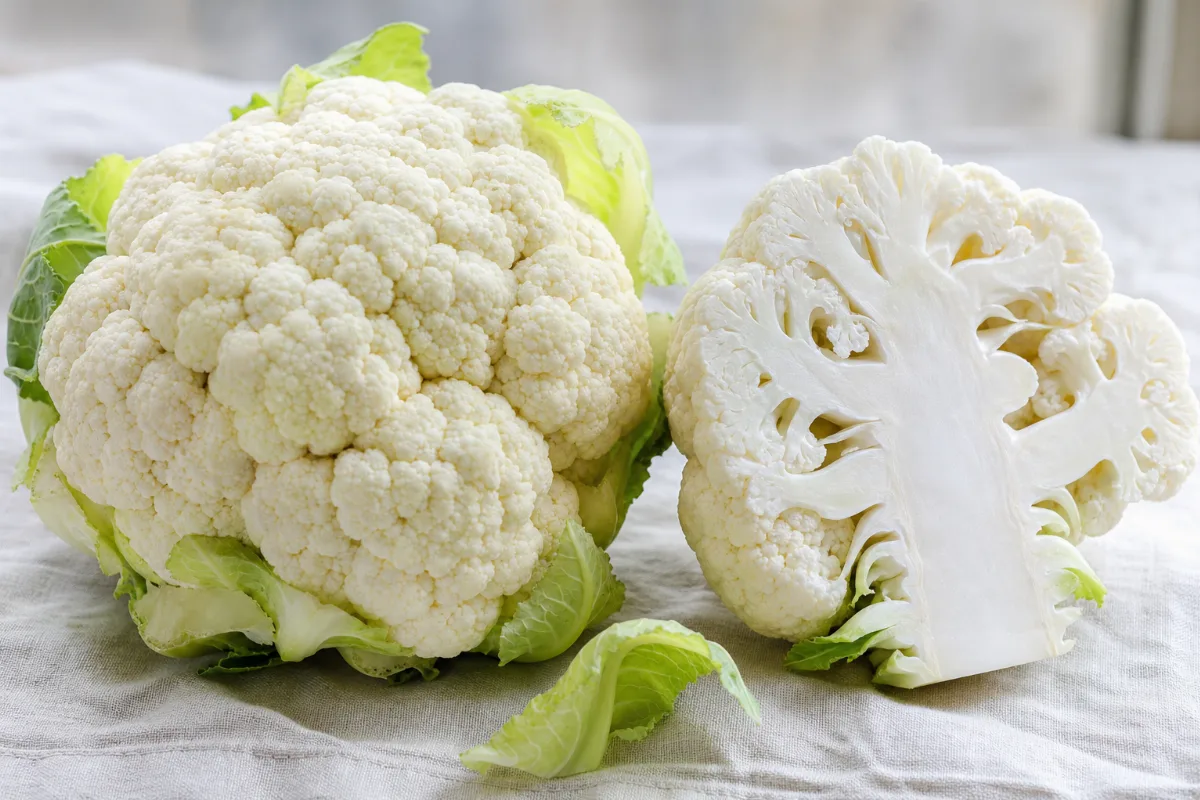
Vegetables · Vegetable
Cauliflower
Brassica oleracea (cauliflower group) · also called Coliflor (Spanish)
Cauliflower is a mild cruciferous vegetable eaten raw or cooked. It has vitamin C, folate, vitamin K, choline and fibre, and few calories. Studies of cruciferous vegetables as a group link them to less heart disease and fewer deaths, but these are observational and not about cauliflower alone. The main cautions are warfarin (vitamin K), gas and bloating for some people, and a rare allergy.
General information, not medical advice. Last substantive update · Not medically reviewed. A named clinician has not signed off on this page. How this page is made
About Cauliflower
Cauliflower is a nutritious, mild vegetable in the cabbage family, with vitamin C, folate, choline and fibre. It is a healthy food, not a proven remedy: the health findings come from studies of cruciferous vegetables in general, and none tested cauliflower on its own.
What it is
Cauliflower is the cultivated head of Brassica oleracea in the cabbage (mustard) family. People eat it fresh, cooked, frozen, pickled, or as riced or processed products.
USDA data for raw cauliflower: 25 kcal per 100 g. One cup chopped (107 g, our arithmetic) has about 27 kcal, 2.1 g fibre, 2.1 g protein, 52 mg vitamin C, 61 micrograms folate (DFE), 17 micrograms vitamin K, 47 mg choline and 320 mg potassium. Cooked, frozen and canned values were not read.
What the research shows
The firmest facts are about nutrients: cauliflower supplies vitamin C, folate and choline, with a modest amount of vitamin K. These are not trials of cauliflower.
Observational studies link more cruciferous vegetables to less heart disease and stroke, fewer deaths, fewer digestive-tract cancers and less type 2 diabetes. They pool broccoli, cabbage, cauliflower and others, and people who eat more vegetables differ in other ways. We rate this as low certainty.
Compounds such as sulforaphane get a lot of attention, but human benefit from eating cauliflower has not been shown, and raw cauliflower yielded the least isothiocyanate of nine vegetables in one study the Linus Pauling Institute cites.
Food versus extracts
Studies of purified sulforaphane or broccoli sprouts are not studies of cauliflower. Results for an extract do not carry over to eating the vegetable.
Amounts
This page gives no amounts to eat. Ask a doctor, pharmacist or dietitian what is right for you, especially if you take warfarin or have thyroid disease.
At a glance
Traditional uses history, not proof
- Eaten as a vegetable, raw, steamed, roasted or boiled
- Long use as food is not proof that it treats any condition
Studied for research
- Vitamin C, folate, vitamin K and choline as a food source, high certainty for the nutrients, no cauliflower trial
- Heart disease and stroke risk (cruciferous vegetables as a group), low certainty, observational
- Risk of dying from any cause (cruciferous vegetables), low certainty, observational
- Digestive-tract cancers (cruciferous vegetables), low certainty, observational
- Type 2 diabetes risk (cruciferous vegetables), low certainty, observational
- Sulforaphane and glucosinolates, insufficient human evidence
- Low-calorie, lower-carbohydrate swaps, insufficient evidence
Main compounds
- Vitamin C
- Folate
- Vitamin K (phylloquinone)
- Choline
- Glucosinolates
- Sulforaphane and other isothiocyanates
- Fibre
Common forms
- Raw florets and chopped cauliflower
- Cooked cauliflower (steamed, roasted or boiled)
- Frozen florets
- Riced or processed cauliflower products (ingredients vary)
Research links: MedlinePlus: Vitamin K in diet · NHS: IBS diet, lifestyle and medicines · 2024 review: brassica vegetables and thyroid function · Research Library · Genes & Biomarkers Library
What it is and its history
- Accepted scientific name
- Brassica oleracea (cauliflower group)
- Naming authority
- L. (GBIF accepted species; USDA lists it as Brassica oleracea, Botrytis Group)
- Synonyms
- Brassica oleracea var. botrytis
- Common names
- Cauliflower (English); Coliflor (Spanish)
- Family or group
- Brassicaceae (the cabbage or mustard family), as given by GBIF. The 2005 case report calls it Cruciferae, an older name for the same family.
- Classification
- Plantae > Tracheophyta > Magnoliopsida > Brassicales > Brassicaceae > Brassica > Brassica oleracea
- Native range
- Not verified from a source read.
- Habitat
- Not verified from a source read.
- What it looks like
- Roots: Not verified.; Stems: Not verified.; Leaves: Not verified.; Flowers: The eaten part is the head of tightly packed florets (USDA gives household portions of one floweret as 13 g and a medium head as 588 g). Botanical description was not read from a source.; Fruit: Not verified.
- Cultivation
- Not verified from a source read.
- Harvest and processing
- Eaten fresh, raw or cooked; frozen florets; canned or pickled; riced or processed products such as cauliflower rice and crusts (existing nutrient summary). Effects of cooking on nutrients and compounds were not read from a source.
- Look-alikes and adulterants
- Name: Broccoli, cabbage, kale, Brussels sprouts and other cruciferous vegetables; Note: Different vegetables with their own pages. The cancer, heart and diabetes studies pool several of them, so results are not cauliflower-specific.
- Sustainability and conservation
- Not assessed.
Photographs
What is inside, and how it may work
What it contains and how those compounds act in cells and animals. Laboratory and animal mechanisms are not proven effects in people.
Main compounds
| Compound | Family | Where it is concentrated | Activity studied | Level of evidence |
|---|---|---|---|---|
| Vitamin C (ascorbic acid) PubChem 54670067 | vitamin | Head (florets) USDA: 48.2 mg per 100 g raw | Vitamin; measured content only on this page. 18 | Human data |
| Folate (vitamin B9) PubChem 135398658 | vitamin | Head (florets) USDA: 57 micrograms DFE per 100 g raw | B vitamin; measured content only on this page. 18 | Human data |
| Vitamin K (phylloquinone) PubChem 5284607 | vitamin | Head (florets) USDA: 15.5 micrograms per 100 g raw | Needed for blood-clotting proteins (MedlinePlus). Affects warfarin. 14 18 | Human data |
| Choline PubChem 305 | nutrient | Head (florets) USDA: 44.3 mg per 100 g raw | Nutrient; measured content only on this page. 18 | Human data |
| Glucoraphanin (glucosinolate) PubChem 9548634 | glucosinolate | Head (florets) Not given in the sources read | Precursor of sulforaphane; the Linus Pauling Institute lists cauliflower among foods containing it. 13 | Laboratory research |
| Sulforaphane (isothiocyanate) PubChem 5350 | isothiocyanate | Formed from glucoraphanin when the vegetable is cut or chewed Raw cauliflower isothiocyanate yield 1.5 micromol per 100 g (lowest of nine vegetables in the study the Linus Pauling Institute cites) | Studied mostly in cells and animals; human benefit from eating cauliflower was not shown. 13 | Laboratory research |
| Goitrogen precursors (goitrin, thiocyanate) | glucosinolate breakdown products | Not specified for cauliflower Not found for cauliflower | Brassica compounds that can lower thyroid iodine uptake at high amounts; reviews found no adverse thyroid effect from dietary brassica vegetables with adequate iodine. 3 2 | Human data |
Mechanisms, receptors and pathways
| Target or pathway | Gene or receptor | What was found | Level |
|---|---|---|---|
| Vitamin K and blood clotting | Clotting factors II, VII, IX and X (named by MedlinePlus) | Vitamin K is used by the liver to make clotting proteins; warfarin works against this, so vitamin K in food affects the medicine. 14 17 | Human data |
| Glucosinolates to isothiocyanates | Not specified | Glucosinolates in cruciferous vegetables are broken down into isothiocyanates including sulforaphane; amounts depend on processing and preparation. Cell and animal studies suggest actions on carcinogen handling. Human benefit from eating cauliflower was not shown. 13 | Laboratory research |
Absorption, metabolism and elimination
- Absorption
- Not found for cauliflower.
- Distribution
- Not found.
- Metabolism
- Not found.
- Elimination
- Not found.
- Bioavailability
- Not established for cauliflower nutrients or compounds in the sources read.
Isolated compounds versus whole extracts
Results for purified sulforaphane or for broccoli sprouts do not carry over to eating cauliflower: the Linus Pauling Institute source reports raw cauliflower gave the lowest isothiocyanate yield of nine vegetables. Food, powder and extract are different products.
Nutritional composition
Nutrition from USDA FoodData Central (Cauliflower, raw, FDC 169986, SR Legacy, last updated 4/1/2019, read 2026-10-26). Per 100 g: 25 kcal, 1.92 g protein, 0.28 g fat, 4.97 g carbohydrate, 1.91 g sugars, 2.0 g fibre, about 92 g water, 22 mg calcium, 0.42 mg iron, 15 mg magnesium, 44 mg phosphorus, 299 mg potassium, 30 mg sodium, 48.2 mg vitamin C, 57 micrograms folate (DFE), 15.5 micrograms vitamin K, 0.184 mg vitamin B6, 44.3 mg choline, 0.155 mg manganese. One cup chopped (107 g), our arithmetic from the USDA values: about 27 kcal, 2.1 g protein, 5.3 g carbohydrate, 2.1 g fibre, 24 mg calcium, 16 mg magnesium, 320 mg potassium, 52 mg vitamin C, 61 micrograms folate, 17 micrograms vitamin K, 47 mg choline. White cauliflower has almost no beta-carotene or lutein in the USDA record (0 and 1 microgram per 100 g). Figures vary with variety, ripeness and storage. Cooked, frozen and canned values were not read.
1 high certainty4 low certainty2 not enough evidence
What was looked at
The 7 benefits and uses checked for Cauliflower, each with how strong the evidence is. Tap one to open it.
- Vitamin C, folate, vitamin K and choline as a food sourceHigh certainty
- Heart disease and stroke risk (cruciferous vegetables as a group)Low certainty
- Risk of dying from any cause (cruciferous vegetables as a group)Low certainty
- Stomach and bowel cancers (cruciferous vegetables as a group)Low certainty
- Type 2 diabetes risk (cruciferous vegetables as a group)Low certainty
- Sulforaphane and other glucosinolate compoundsNot enough evidence
- Cauliflower as a low-calorie, lower-carbohydrate foodNot enough evidence
Lab markers tracked in the studies
Cardiovascular disease events and deathsDeath from any causeNew cases of type 2 diabetesDigestive-tract cancer cases
What is Cauliflower good for?
The main studied uses and how strong the human evidence is for each. Almost all results are for cruciferous vegetables as a group, not for cauliflower alone.
Benefits, one by one
Each card is a research question, not a promise. Tap a goal to filter. Open a card to see the studies, doses and limits.
Vitamin C, folate, vitamin K and choline as a food source
High certaintyRaw cauliflower has about 48 mg of vitamin C, 57 micrograms of folate (DFE), 15.5 micrograms of vitamin K, 0.18 mg of vitamin B6 and 44 mg of choline per 100 g (USDA). One cup chopped (107 g) has roughly 52 mg of vitamin C and 61 micrograms of folate. These are nutrient facts about the food, not trials of cauliflower.
2 studiesRaw florets and chopped raw cauliflower. Cooking, freezing and storag…
Studies, doses and limits
What the trials found
USDA FoodData Central lists, per 100 g of raw cauliflower: 48.2 mg vitamin C, 57 micrograms folate (DFE), 15.5 micrograms vitamin K (phylloquinone), 0.184 mg vitamin B6 and 44.3 mg choline. MedlinePlus names cauliflower among vegetable sources of vitamin K.
Results
Cauliflower is a recognised source of several vitamins. No trial of cauliflower for any vitamin shortage was read.
Effect sizes as reported
USDA, per 100 g raw: vitamin C 48.2 mg; folate 57 micrograms DFE; vitamin K 15.5 micrograms; vitamin B6 0.184 mg; choline 44.3 mg. Per cup chopped (107 g, our arithmetic): vitamin C about 52 mg; folate about 61 micrograms; vitamin K about 17 micrograms.
Why this rating
High for the measured nutrient contents (USDA reference data). There is no cauliflower-specific trial, and a varied diet normally supplies these nutrients. Vitamin K in cauliflower is far lower than in leafy greens such as spinach.
Form and dose studied
Raw florets and chopped raw cauliflower. Cooking, freezing and storage change nutrient values; those values were not read.
Who was studied
Anyone eating a varied diet.
Limits
Nutrient information, not a trial of cauliflower. Values for cooked cauliflower were not read.
Why researchers looked
People often ask which vitamins cauliflower supplies, since it is a mild white vegetable.
Traditional use
Cauliflower is eaten as a vegetable, raw or cooked. Long use as food is not proof that it treats any condition.
Proposed mechanism Authoritative guidance
Not a mechanism claim. These are measured amounts of nutrients in the raw vegetable (USDA).
A proposed mechanism does not show that the effect happens in people.
People taking warfarin should keep vitamin K intake steady and ask their clinic; see the Safety tab.
Heart disease and stroke risk (cruciferous vegetables as a group)
Low certaintyIn large observational studies, people who eat more vegetables, including cruciferous ones, have less heart disease and stroke. This cannot show that the vegetables are the cause, and cauliflower was not studied on its own.
2 studiesCruciferous vegetables as food (cauliflower is one of several; not ca…
Studies, doses and limits
What the trials found
A 2020 meta-analysis of 81 prospective cohorts (4,031,896 people) found vegetables overall linked to lower cardiovascular disease (RR 0.94, 95% CI 0.90-0.97), coronary heart disease (0.92) and stroke (0.88). Its abstract says greater benefits were seen for allium, carrots, cruciferous and green leafy vegetables, but gives no separate cruciferous number. A 2017 meta-analysis of 95 prospective studies reported inverse associations for cruciferous vegetables with cardiovascular disease and all-cause mortality (no cruciferous figure in the abstract).
Results
Observational studies link more cruciferous vegetables to less heart disease and stroke. The pooled evidence is for vegetables and cruciferous vegetables as groups, not cauliflower alone.
Effect sizes as reported
Vegetables overall (2020): CVD RR 0.94 (0.90-0.97); CHD RR 0.92 (0.87-0.96); stroke RR 0.88 (0.83-0.93). Fruit and vegetables combined per 200 g a day (2017): CVD RR 0.92 (0.90-0.95).
Why this rating
Low, because the evidence is observational: people who eat more vegetables differ from others in many ways, and the GRADE certainty in the 2020 review ranged from very low to moderate, highest for green leafy vegetables rather than cruciferous ones. Cauliflower itself was not analysed.
Form and dose studied
Cruciferous vegetables as food (cauliflower is one of several; not cauliflower alone)
Who was studied
Adults in prospective cohort studies.
Limits
Cannot show cause. No cauliflower-only result. The abstracts give no cruciferous-only number.
Why researchers looked
Population studies ask whether people who eat more vegetables, including cruciferous ones such as cauliflower, broccoli and cabbage, have healthier hearts.
Traditional use
Cauliflower is eaten as a vegetable, raw or cooked. Long use as food is not proof that it treats any condition.
Proposed mechanism Unknown
Not established. Which nutrient or plant compound might matter, if any, is not shown by the studies read.
A proposed mechanism does not show that the effect happens in people.
None specific beyond the warfarin and thyroid cautions on the Safety tab.
Risk of dying from any cause (cruciferous vegetables as a group)
Low certaintyA large Japanese study followed 88,184 adults for about 17 years. People who ate the most cruciferous vegetables had about 11 to 14 percent lower risk of dying in the period. This is an association, not proof, and cauliflower was not studied alone.
2 studiesCruciferous vegetables as food (cauliflower is one of several; not ca…
Studies, doses and limits
What the trials found
In 88,184 Japanese adults aged 45 to 74 followed for a median of 16.9 years (15,349 deaths), the highest versus lowest fifth of cruciferous vegetable intake was linked to lower all-cause mortality: hazard ratio 0.86 (95% CI 0.80-0.93) in men and 0.89 (0.81-0.98) in women. It was also linked to lower cancer death in men and lower heart disease, stroke and injury deaths in women. The 2017 meta-analysis also reported an inverse association of cruciferous vegetables with all-cause mortality.
Results
Higher cruciferous vegetable intake went with lower death rates in observational data.
Effect sizes as reported
All-cause mortality, highest versus lowest fifth: men HR 0.86 (0.80-0.93); women HR 0.89 (0.81-0.98).
Why this rating
Low: one large cohort plus a meta-analysis, both observational, so people who eat more vegetables may differ in health habits. Cruciferous vegetables as a group.
Form and dose studied
Cruciferous vegetables as food (cauliflower is one of several; not cauliflower alone)
Who was studied
Japanese adults aged 45 to 74 (cohort); adults in prospective studies (meta-analysis).
Limits
Cannot show cause. The population ate a Japanese diet; results may differ elsewhere. No cauliflower-only figure.
Why researchers looked
Researchers ask whether eating cruciferous vegetables goes with living longer.
Traditional use
Cauliflower is eaten as a vegetable, raw or cooked. Long use as food is not proof that it treats any condition.
Proposed mechanism Unknown
Not established. The authors point to isothiocyanates in cruciferous vegetables as a possible reason, but the study did not test this.
A proposed mechanism does not show that the effect happens in people.
None specific.
Stomach and bowel cancers (cruciferous vegetables as a group)
Low certaintyPeople who eat more cruciferous vegetables have lower rates of several digestive-tract cancers in observational studies. Cauliflower is one of these vegetables but was not studied alone, and this is not proof that eating them prevents cancer.
2 studiesCruciferous vegetables as food (cauliflower is one of several; not ca…
Studies, doses and limits
What the trials found
A 2024 meta-analysis of 81 articles covering 89 observational studies found the highest cruciferous vegetable intake linked to a lower risk of all gastrointestinal cancers combined (rate ratio 0.81, 95% CI 0.76-0.87), with inverse links for oesophageal, stomach, liver, pancreatic and colorectal cancers but not gallbladder cancer (RR 0.70, 0.38-1.27). A 2025 meta-analysis of 17 studies (7 cohort, 10 case-control; 97,595 people) found an odds ratio of 0.80 (0.72-0.90) for colon cancer, and the authors urged caution because of differences between studies and leftover confounding.
Results
Observational studies link more cruciferous vegetables to fewer digestive-tract cancers. They do not show cause, and cauliflower was not analysed separately.
Effect sizes as reported
All GI cancers RR 0.81 (0.76-0.87); gallbladder RR 0.70 (0.38-1.27), not significant; colon cancer OR 0.80 (0.72-0.90).
Why this rating
Low, because the studies are observational (including case-control studies, which rely on people recalling past diet), designs and diet questionnaires differ, and the figures are for cruciferous vegetables as a group. Cauliflower itself was not analysed.
Form and dose studied
Cruciferous vegetables as food (cauliflower is one of several; not cauliflower alone)
Who was studied
Adults in cohort and case-control studies.
Limits
Cannot show cause. Recall bias in case-control studies. Separate figures in the 2024 abstract are for broccoli and cabbage, not cauliflower.
Why researchers looked
Cruciferous vegetables contain glucosinolates, which break down into other compounds, and researchers ask whether eating them goes with lower cancer rates.
Traditional use
Cauliflower is eaten as a vegetable, raw or cooked. Long use as food is not proof that it treats any condition.
Proposed mechanism Laboratory research
Lab studies suggest isothiocyanates made from glucosinolates may affect how the body handles cancer-causing substances (as described in the 2025 colon cancer paper). Whether this happens at the amounts eaten in a meal was not shown by the studies read.
A proposed mechanism does not show that the effect happens in people.
None specific beyond the warfarin and thyroid cautions on the Safety tab.
Type 2 diabetes risk (cruciferous vegetables as a group)
Low certaintyFour large follow-up studies found that people who ate more cruciferous vegetables developed type 2 diabetes less often (about 16 percent lower). The studies are few and observational, and cauliflower was not studied alone.
1 studiesCruciferous vegetables as food (cauliflower is one of several; not ca…
Studies, doses and limits
What the trials found
A 2016 meta-analysis of seven prospective cohorts (306,723 people, 16,544 type 2 diabetes cases, follow-up 4.6 to 24 years) found that, in four cohorts, highest versus lowest cruciferous vegetable intake was linked to lower type 2 diabetes risk (summary relative risk 0.84, 95% CI 0.73-0.96; heterogeneity I2 54.4%), independent of smoking, alcohol, BMI and activity. Citrus fruit showed no link. The authors say more large prospective studies are needed.
Results
Observational data from four cohorts link more cruciferous vegetables to a lower chance of type 2 diabetes.
Effect sizes as reported
Type 2 diabetes SRR 0.84 (0.73-0.96), highest versus lowest intake.
Why this rating
Low: only four cohorts, moderate heterogeneity (I2 54.4%), observational. Cruciferous vegetables as a group, not cauliflower alone.
Form and dose studied
Cruciferous vegetables as food (cauliflower is one of several; not cauliflower alone)
Who was studied
Adults in prospective cohorts.
Limits
Cannot show cause. No trial of cauliflower for blood sugar was read.
Why researchers looked
Researchers ask whether specific kinds of vegetable go with lower diabetes rates.
Traditional use
Cauliflower is eaten as a vegetable, raw or cooked. Long use as food is not proof that it treats any condition.
Proposed mechanism Unknown
Not established. The authors do not claim a mechanism in the abstract.
A proposed mechanism does not show that the effect happens in people.
People with diabetes should ask a clinician before changing their diet or medicines.
Sulforaphane and other glucosinolate compounds
Not enough evidenceCauliflower contains glucosinolates, which the body can turn into isothiocyanates such as sulforaphane. One reference source reports that raw cauliflower gave the lowest isothiocyanate yield of nine vegetables. Protective findings come mostly from cells and animals, not from people eating cauliflower.
1 studiesWhole cauliflower as food. Purified compounds and broccoli extracts a…
Studies, doses and limits
What the trials found
The Linus Pauling Institute page lists cauliflower among cruciferous vegetables rich in glucosinolate precursors and among foods with the sulforaphane precursor glucoraphanin. It cites a study of 73 raw samples from nine cruciferous vegetables in which raw cauliflower had the lowest mean isothiocyanate yield (1.5 micromol per 100 g) and raw mustard greens the highest (61.3 micromol per 100 g). It says amounts vary with food processing and preparation.
Results
Cauliflower contains glucosinolates but yields little isothiocyanate in the raw sample tested. No human trial of eating cauliflower for any health outcome through this route was read.
Effect sizes as reported
Raw cauliflower isothiocyanate yield 1.5 micromol per 100 g; raw mustard greens 61.3 micromol per 100 g (as cited by the Linus Pauling Institute).
Why this rating
Insufficient: composition and laboratory findings only. Results with purified sulforaphane or broccoli sprouts do not apply to cauliflower on the plate.
Form and dose studied
Whole cauliflower as food. Purified compounds and broccoli extracts are different products.
Limits
Composition and lab/animal findings only; no human trial of cauliflower was read.
Why researchers looked
Sulforaphane is a much-discussed compound from broccoli and its relatives, so people ask whether cauliflower offers the same.
Traditional use
Cauliflower is eaten as a vegetable, raw or cooked. Long use as food is not proof that it treats any condition.
Proposed mechanism Laboratory research
Glucosinolates are broken down by an enzyme when the vegetable is cut or chewed, forming isothiocyanates including sulforaphane. Amounts depend on processing and preparation (Linus Pauling Institute). Effects in people from eating cauliflower were not shown.
A proposed mechanism does not show that the effect happens in people.
None specific.
Cauliflower as a low-calorie, lower-carbohydrate food
Not enough evidenceRaw cauliflower has 25 kcal, 2 g of fibre and about 5 g of carbohydrate per 100 g. No trial was read on swapping cauliflower rice or cauliflower flour for rice or flour, so effects on weight or blood sugar are not shown.
1 studiesRaw cauliflower. Cooked and processed forms were not read.
Studies, doses and limits
What the trials found
USDA lists per 100 g of raw cauliflower: 25 kcal, 4.97 g carbohydrate, 2.0 g fibre, 1.91 g sugars, 1.92 g protein, 0.28 g fat and 92.1 g water. No trial of cauliflower rice, flour or crust for weight, appetite or blood sugar was found in the searches made.
Results
The nutrient facts are measured. Health effects of the swap are untested in the sources read.
Effect sizes as reported
USDA per 100 g raw: 25 kcal; carbohydrate 4.97 g; fibre 2.0 g; sugars 1.91 g.
Why this rating
Insufficient: the numbers are measured, but no study of the swap was read. Processed products (frozen riced cauliflower with sauces, crusts, flours) vary and were not assessed.
Form and dose studied
Raw cauliflower. Cooked and processed forms were not read.
Limits
Nutrient data only; no outcome trial found.
Why researchers looked
Cauliflower rice and cauliflower-based foods are popular as lower-carbohydrate swaps, so people ask whether the swap helps.
Traditional use
Cauliflower is eaten as a vegetable, raw or cooked. Long use as food is not proof that it treats any condition.
Proposed mechanism Authoritative guidance
Not a mechanism claim. These are measured nutrient amounts (USDA).
A proposed mechanism does not show that the effect happens in people.
None specific.
Connections to the rest of health
How Cauliflower connects to the rest of our health knowledge graph. Every link says what kind of connection it is. A safety link (for example to the liver) is a warning, not a benefit. A study that merely mentions a topic never creates a benefit link.
Explore every connection: goals, body systems, organs, symptoms, genes
B. Body systems
| Connected to | Kind of connection | Evidence status | Context | Studies |
|---|---|---|---|---|
| Blood And Immune | Biological association | High certainty | Studied for: Vitamin C, folate, vitamin K and choline as a food source | 18 14 |
| Cardiovascular System | Biological association | High certainty | Studied for: Vitamin C, folate, vitamin K and choline as a food source Studied for: Heart disease and stroke risk (cruciferous vegetables as a group) | 18 14 9 1 |
| Whole Body | Biological association | Low certainty | Studied for: Risk of dying from any cause (cruciferous vegetables as a group) | 7 1 |
| Digestive System | Biological association | Low certainty | Studied for: Stomach and bowel cancers (cruciferous vegetables as a group) Studied for: Sulforaphane and other glucosinolate compounds | 8 6 13 18 |
| Metabolism Weight | Biological association | Low certainty | Studied for: Type 2 diabetes risk (cruciferous vegetables as a group) Studied for: Cauliflower as a low-calorie, lower-carbohydrate food | 5 18 |
| Endocrine System | Biological association | Low certainty | Studied for: Type 2 diabetes risk (cruciferous vegetables as a group) | 5 |
C. Body parts and organs
E. Health conditions
| Connected to | Kind of connection | Evidence status | Context | Studies |
|---|---|---|---|---|
| Irritable bowel syndrome | Adverse effect or risk | Documented risk | The NHS lists cauliflower among hard-to-digest foods that can worsen bloating and wind in IBS. Preparation or compound: Cauliflower as food |
16 |
I. Biomarkers
| Connected to | Kind of connection | Evidence status | Context | Studies |
|---|---|---|---|---|
| Cardiovascular disease events and deaths | Biological association | Low certainty | Measured in trials: lowered. A lab change is not the same as a health benefit. | 9 1 |
| Death from any cause | Biological association | Low certainty | Measured in trials: lowered. A lab change is not the same as a health benefit. | 7 1 |
| New cases of type 2 diabetes | Biological association | Low certainty | Measured in trials: lowered. A lab change is not the same as a health benefit. | 5 |
| Digestive-tract cancer cases | Biological association | Low certainty | Measured in trials: lowered. A lab change is not the same as a health benefit. | 8 6 |
K. Biological pathways
| Connected to | Kind of connection | Evidence status | Context | Studies |
|---|---|---|---|---|
| Vitamin K | Preliminary mechanism | Human | Cauliflower is a modest vitamin K food; vitamin K is needed for clotting and affects warfarin. | 14 17 |
| Vitamin C | Preliminary mechanism | Human | Cauliflower contains vitamin C (USDA). | 18 |
| Choline | Preliminary mechanism | Human | Cauliflower contains choline (USDA). | 18 |
L. Active compounds
| Connected to | Kind of connection | Evidence status | Context | Studies |
|---|---|---|---|---|
| Vitamin C (ascorbic acid) | Biological association | Human | Vitamin; measured content only on this page. Preparation or compound: Head (florets) |
18 |
| Folate (vitamin B9) | Biological association | Human | B vitamin; measured content only on this page. Preparation or compound: Head (florets) |
18 |
| Vitamin K (phylloquinone) | Biological association | Human | Needed for blood-clotting proteins (MedlinePlus). Affects warfarin. Preparation or compound: Head (florets) |
14 18 |
| Choline | Biological association | Human | Nutrient; measured content only on this page. Preparation or compound: Head (florets) |
18 |
| Glucoraphanin (glucosinolate) | Biological association | In vitro | Precursor of sulforaphane; the Linus Pauling Institute lists cauliflower among foods containing it. Preparation or compound: Head (florets) |
13 |
| Sulforaphane (isothiocyanate) | Biological association | In vitro | Studied mostly in cells and animals; human benefit from eating cauliflower was not shown. Preparation or compound: Formed from glucoraphanin when the vegetable is cut or chewed |
13 |
| Goitrogen precursors (goitrin, thiocyanate) | Biological association | Human | Brassica compounds that can lower thyroid iodine uptake at high amounts; reviews found no adverse thyroid effect from dietary brassica vegetables with adequate iodine. | 3 2 |
Each connection is stored with the ingredient, the connected record, the kind of connection, the evidence status, the supporting studies, the preparation or compound involved, and a review date (last reviewed October 26, 2026).
Evidence at a glance: what changed in 4 lab markers
Tap a number to show only those markers. Counts are markers, not people.
The evidence
The research centre for Cauliflower. Every record here was checked against PubMed or the publisher's page; we never list a study we have not verified.
Evidence by outcome
Bars show how many studies we found for each outcome, not how well it works. People are added up across trials only (reviews are not added, to avoid double counting).
How we rate evidence
High certainty
Several well-run trials or reviews agree; further research is unlikely to change the picture much.
Moderate certainty
Good trials point the same way, but some doubt remains.
Low certainty
Small, short or inconsistent trials. The finding could change with better research.
Very low certainty
Very little or very weak human data. Treat as a possibility only.
Mixed findings
Trials or reviews disagree with each other.
Not enough evidence
Not enough human research to say either way.
Evidence against
Good research found no benefit, or found harm.
We take the reviewers' own risk-of-bias and GRADE statements where they exist, and otherwise judge from study size, design, consistency, directness and whether a product matches what is sold. Many publications do not make evidence high. Method note: We started from our existing cauliflower summary, re-checked nutrition at USDA FoodData Central, read the health agency pages (MedlinePlus, NHS, FDA) and searched PubMed for reviews, cohort studies and case reports. Only abstracts were read for studies. Items we could not verify are flagged in the research gaps.
Study library: every study we checked 18
| Study | Design | People | Product, dose, length | Result |
|---|---|---|---|---|
| Aune 2017 Fruit and vegetable intake and the risk of cardiovascular disease, total cancer and all-cause mortality-a systematic review and dose-response meta-analysis of prospective studies. Int J Epidemiol · PMID 28338764 · DOI |
Systematic review meta analysis |
Adults in 95 prospective studies (142 publications) | Fruit and vegetable intake as food Fruit and vegetables Per 200 g/day (analysis unit, not advice) Prospective follow-up · vs Lower intake |
For fruit and vegetables combined, each 200 g/day was linked to lower risk of coronary heart disease, stroke, cardiovascular disease, total cancer and death from any cause. The abstract says inverse associations were seen for cruciferous vegetables with cardiovascular disease and all-cause mortality, and for green-yellow vegetables and cruciferous vegetables with total cancer risk. A summary figure for cruciferous vegetables alone is not given in the abstract. Combined fruit and vegetables per 200 g/day: CVD RR 0.92; all-cause mortality RR 0.90; total cancer RR 0.97 (CVD 0.92 (95% CI 0.90-0.95); all-cause mortality 0.90 (0.87-0.93); total cancer 0.97 (0.95-0.99)) Methods, limits and fundingOutcomes: Cardiovascular disease, total cancer, all-cause mortality Limitations: Prospective observational studies cannot show cause; people who eat more vegetables differ in other ways. The combined figures are not for cauliflower. The cruciferous figure is not in the abstract. Funding and conflicts: Not stated in the abstract. Read: abstract |
| Felker 2016 Concentrations of thiocyanate and goitrin in human plasma, their precursor concentrations in brassica vegetables, and associated potential risk for hypothyroidism. Nutr Rev · PMID 26946249 · DOI |
Narrative review |
Review of plasma levels and vegetable content | Brassica vegetables Vegetables |
Collards, Brussels sprouts and some Russian kale contain enough goitrin to potentially lower thyroid iodine uptake. Turnip tops, commercial broccoli, broccoli rabe and kale of Brassica oleracea contain less than 10 micromol goitrin per 100 g serving and can be considered of minimal risk. Thiocyanate from indole glucosinolates is estimated to be far below background plasma levels and assumed to carry minimal thyroid risk. Cauliflower is not named in the abstract. Radioiodine uptake was inhibited by 194 micromol of goitrin but not by 77 micromol (Not applicable) Methods, limits and fundingOutcomes: Goitrin and thiocyanate levels and thyroid risk Limitations: Review, not a trial. Cauliflower is not named in the abstract, so this paper does not show cauliflower's own goitrin content. Funding and conflicts: NIH grants listed in the record. Read: abstract |
| Galanty 2024 Do Brassica Vegetables Affect Thyroid Function?-A Comprehensive Systematic Review. Int J Mol Sci · PMID 38612798 · DOI |
Systematic review |
123 articles of laboratory, animal and human studies of brassica plants and extracts | Brassica vegetables and extracts Vegetables and extracts Varied Varied · vs Varied |
The authors say the vast majority of results cast doubt on the idea that brassica plants have antithyroid effects in humans, and that including brassica vegetables in the daily diet, particularly with adequate iodine intake, poses no adverse effects on thyroid function. No numeric summary in the abstract (Not given in the abstract) Methods, limits and fundingOutcomes: Thyroid mass and histology, TSH, T3, T4, iodine uptake Limitations: Mixes laboratory, animal and human studies; not specific to cauliflower. The authors discuss limitations of the studies included. Funding and conflicts: Funded by grants from the Polish Ministry of Education and Science (per the record). Read: abstract |
| Hernández 2005 Anaphylaxis caused by cauliflower. J Investig Allergol Clin Immunol · PMID 16047720 |
Case report |
1 One 70-year-old man |
Cauliflower eaten in a vegetable paella Cooked cauliflower Minutes after eating · vs Skin prick and IgE tests |
Within minutes of eating a paella containing cauliflower, he had itching of the mouth and throat, swelling of the face and hands, breathlessness and severe bronchospasm, and needed emergency room treatment. Skin prick tests were strongly positive to cauliflower and peach lipid transfer protein; specific IgE was positive to cabbage and cauliflower and negative to mustard. The authors conclude it was an IgE-mediated anaphylactic reaction and call it the first reported case of anaphylaxis to cauliflower. Single case (Not applicable) Methods, limits and fundingOutcomes: Allergic reaction and allergy tests Limitations: One case. It does not say how common cauliflower allergy is. Funding and conflicts: Not stated in the abstract. Read: abstract |
| Jia 2016 Consumption of citrus and cruciferous vegetables with incident type 2 diabetes mellitus based on a meta-analysis of prospective study. Prim Care Diabetes · PMID 26778708 · DOI |
Systematic review meta analysis |
306723 Seven prospective cohorts, 306,723 people and 16,544 type 2 diabetes cases; four cohorts for cruciferous vegetables |
Cruciferous vegetable intake as food Cruciferous vegetables Highest versus lowest intake 4.6 to 24 years of follow-up · vs Lowest intake |
Higher cruciferous vegetable intake was linked to lower risk of type 2 diabetes, independent of smoking, alcohol, BMI and activity. Citrus fruit showed no link. The authors say larger prospective studies are needed. Type 2 diabetes SRR 0.84 (highest versus lowest), heterogeneity I2 54.4% (SRR 0.84 (95% CI 0.73-0.96)) Methods, limits and fundingOutcomes: Incident type 2 diabetes Limitations: Only four cohorts for cruciferous vegetables, moderate heterogeneity, observational design. Cruciferous vegetables as a group, not cauliflower alone. Funding and conflicts: Not stated in the abstract. Read: abstract |
| Lai 2025 Cruciferous vegetables intake and risk of colon cancer: a dose-response meta-analysis. BMC Gastroenterol · PMID 40790161 · DOI |
Systematic review meta analysis |
97595 97,595 people in 17 studies (7 cohort, 10 case-control) |
Cruciferous vegetable intake as food Cruciferous vegetables Highest versus lowest intake; dose-response curve Varied · vs Lowest intake |
Higher cruciferous vegetable intake was linked to lower colon cancer risk, and the dose-response curve showed a progressive fall as intake rose. The authors say the findings should be read cautiously because study designs, diet questionnaires and leftover confounding differ. Colon cancer OR 0.80 (highest versus lowest) (OR 0.80 (95% CI 0.72-0.90)) Methods, limits and fundingOutcomes: Colon cancer incidence Limitations: Mixed case-control and cohort designs; recall bias and confounding are possible. Cruciferous vegetables as a group, not cauliflower alone. Funding and conflicts: Not stated in the abstract. Read: abstract |
| Mori 2019 Cruciferous vegetable intake and mortality in middle-aged adults: A prospective cohort study. Clin Nutr · PMID 29739681 · DOI |
Prospective cohort |
88184 88,184 Japanese adults aged 45 to 74 with no history of cancer, heart attack or stroke; median follow-up 16.9 years, 15,349 deaths |
Cruciferous vegetable intake from a food questionnaire Cruciferous vegetables Highest versus lowest fifth of intake Median 16.9 years · vs Lowest fifth of intake |
Higher cruciferous vegetable intake was linked to lower all-cause mortality in both men and women. It was also linked to lower cancer mortality in men, and to lower heart disease, stroke and injury deaths in women. All-cause mortality, highest versus lowest fifth: men HR 0.86; women HR 0.89 (Men 0.86 (95% CI 0.80-0.93); women 0.89 (0.81-0.98)) Methods, limits and fundingOutcomes: All-cause and cause-specific mortality Limitations: Observational: people who eat more cruciferous vegetables may differ in other ways. Japanese adults; cruciferous vegetables as a group, not cauliflower alone. Funding and conflicts: Not stated in the abstract. Read: abstract |
| Ren 2024 High intake of cruciferous vegetables reduces the risk of gastrointestinal cancers: results from observational studies. Crit Rev Food Sci Nutr · PMID 38051036 · DOI |
Systematic review meta analysis |
81 articles covering 89 observational studies | Cruciferous vegetable intake as food Cruciferous vegetables Highest versus lowest intake Varied · vs Lowest intake |
Highest cruciferous vegetable intake was linked to lower risk of all GI cancers combined. Inverse links were reported for oesophageal, stomach, liver, pancreatic and colorectal cancers, but not gallbladder cancer. The authors note the earlier studies gave inconsistent results. All GI cancers: rate ratio 0.81 (highest versus lowest intake); gallbladder cancer RR 0.70, not significant (All GI cancers 0.81 (95% CI 0.76-0.87); gallbladder 0.70 (0.38-1.27)) Methods, limits and fundingOutcomes: Risk of gastrointestinal (GI) cancers Limitations: Observational studies cannot show cause. Cruciferous vegetables as a group, not cauliflower alone; the abstract gives separate figures only for broccoli and cabbage. Funding and conflicts: Not stated in the abstract. Read: abstract |
| Zurbau 2020 Relation of Different Fruit and Vegetable Sources With Incident Cardiovascular Outcomes: A Systematic Review and Meta-Analysis of Prospective Cohort Studies. J Am Heart Assoc · PMID 33000670 · DOI |
Systematic review meta analysis |
4031896 Adults in 81 prospective cohorts (4,031,896 people, 125,112 cardiovascular events) |
Vegetables as food, split by source (including cruciferous vegetables) Vegetables Not given in the abstract Prospective follow-up · vs Lower intake |
Vegetables overall were linked to lower cardiovascular disease (RR 0.94), coronary heart disease (RR 0.92) and stroke (RR 0.88) cases, and to lower cardiovascular disease (RR 0.87) and stroke (RR 0.94) deaths. The abstract says greater benefits were seen for allium, carrots, cruciferous and green leafy vegetables, and that no source showed an adverse association. GRADE certainty was very low to moderate, highest for total fruit and vegetables, pome fruit and green leafy vegetables. Vegetables overall: CVD RR 0.94; CHD RR 0.92; stroke RR 0.88. A figure for cruciferous vegetables alone is not in the abstract. (CVD 0.94 (95% CI 0.90-0.97); CHD 0.92 (0.87-0.96); stroke 0.88 (0.83-0.93)) Methods, limits and fundingOutcomes: Cardiovascular disease, coronary heart disease and stroke (cases and deaths) Limitations: Observational cohorts cannot show cause. The cruciferous result is not given as a number in the abstract, and cauliflower was not analysed on its own. Funding and conflicts: Not stated in the abstract. Registration: ClinicalTrials.gov NCT03394339 Read: abstract |
| s-fda-outbreaks FDA: Investigations of Foodborne Illness Outbreaks · Source |
Health agency n/a |
Methods, limits and fundingRead: full-text | ||
| s-fda-produce FDA: Selecting and Serving Produce Safely · Source |
Health agency n/a |
Methods, limits and fundingRead: full-text | ||
| s-gbif-brassica-oleracea GBIF Backbone: Brassica oleracea L. (usageKey 3042845) · Source |
Reference database n/a |
Methods, limits and fundingRead: full-text | ||
| s-lpi-isothiocyanates Linus Pauling Institute: Isothiocyanates · Source |
Reference database n/a |
Methods, limits and fundingRead: full-text | ||
| s-medlineplus-vitk MedlinePlus: Vitamin K in diet · Source |
Health agency n/a |
Methods, limits and fundingRead: full-text | ||
| s-nhs-bloating NHS: Bloating · Source |
Health agency n/a |
Methods, limits and fundingRead: full-text | ||
| s-nhs-ibs-diet NHS: Diet, lifestyle and medicines for IBS · Source |
Health agency n/a |
Methods, limits and fundingRead: full-text | ||
| s-nhs-warfarin NHS: Warfarin · Source |
Health agency n/a |
Methods, limits and fundingRead: full-text | ||
| s-usda-fdc-169986 USDA FoodData Central: Cauliflower, raw (FDC 169986) · Source |
Reference database n/a |
Methods, limits and fundingRead: full-text |
What we do not know yet
- No trial of eating cauliflower itself was found for heart disease, cancer, diabetes, weight or gut health.
- Cruciferous vegetable studies pool several vegetables, and a cauliflower-only result was not in the abstracts read.
- No study of cauliflower rice, flour or other processed products was read.
- Allergy was found only in one case report; how common it is was not found.
- FODMAP content, pesticide residues, heavy metals, oxalate, goitrin content, pregnancy and breastfeeding advice and the effect of cooking were not researched.
How new research is added
New studies are found by a saved PubMed search and placed in a review queue before the page changes.
Lab markers
What changed in blood or saliva tests during trials. A changed number is not the same as feeling or being healthier, and we give no "normal ranges".
Other 4
Cardiovascular disease events and deaths
Lowered in trials
How many people in a study develop heart disease or stroke, or die of it.
Low certaintyResults and what it means
Why it was measured
These are the outcomes that matter most to health, so population studies count them.
Statistical vs. clinical meaning
An association in observational studies, not proof that cruciferous vegetables prevent disease.
Safety implication
None specific.
| Study | Result | People | Product |
|---|---|---|---|
| 9 | Vegetables overall linked to lower CVD (RR 0.94, 95% CI 0.90-0.97), coronary heart disease (0.92) and stroke (0.88); cruciferous vegetables named among the sources with greater benefit, no separate number in the abstract | Adults in 81 prospective cohorts | Cruciferous vegetables as food (cauliflower is one of several; not cauliflower alone) |
Death from any cause
Lowered in trials
The share of people in a study who die during follow-up.
Low certaintyResults and what it means
Why it was measured
It is the broadest measure of long-term health.
Statistical vs. clinical meaning
An association, not proof. Cauliflower alone was not studied.
Safety implication
None specific.
| Study | Result | People | Product |
|---|---|---|---|
| 7 | Highest versus lowest fifth of cruciferous vegetable intake: HR 0.86 (0.80-0.93) in men, 0.89 (0.81-0.98) in women | 88,184 Japanese adults aged 45 to 74 | Cruciferous vegetables as food (cauliflower is one of several; not cauliflower alone) |
New cases of type 2 diabetes
Lowered in trials
How many people in a study are diagnosed with type 2 diabetes over time.
Low certaintyResults and what it means
Why it was measured
It is a hard clinical outcome, so cohort studies count it.
Statistical vs. clinical meaning
An association in four cohorts, not proof of prevention.
Safety implication
None specific.
| Study | Result | People | Product |
|---|---|---|---|
| 5 | Highest versus lowest cruciferous vegetable intake: SRR 0.84 (95% CI 0.73-0.96), I2 54.4%, four cohorts | Adults in prospective cohorts (306,723 people in the full analysis) | Cruciferous vegetables as food (cauliflower is one of several; not cauliflower alone) |
Digestive-tract cancer cases
Lowered in trials
How many people in a study develop cancers of the oesophagus, stomach, liver, pancreas, colon or rectum.
Low certaintyResults and what it means
Why it was measured
Cancer risk is a main reason people study vegetable eating.
Statistical vs. clinical meaning
Associations in observational data, not proof. The authors of the colon paper urge caution.
Safety implication
None specific.
| Study | Result | People | Product |
|---|---|---|---|
| 8 | Highest versus lowest cruciferous vegetable intake: all GI cancers RR 0.81 (0.76-0.87); gallbladder cancer not significant (RR 0.70, 0.38-1.27) | 81 articles, 89 observational studies | Cruciferous vegetables as food (cauliflower is one of several; not cauliflower alone) |
| 6 | Colon cancer OR 0.80 (0.72-0.90), highest versus lowest intake | 17 studies, 97,595 people (7 cohort, 10 case-control) | Cruciferous vegetables as food (cauliflower is one of several; not cauliflower alone) |
Safety
What studies and official sources say about side effects, medicines and who should check first. Each point shows what kind of evidence it comes from.
Main points to know 5
- Warfarin: keep vitamin K intake steady and ask your clinic. Cauliflower has a moderate amount of vitamin K (USDA: 15.5 micrograms per 100 g raw), far less than leafy greens such as spinach. MedlinePlus lists cauliflower among vegetable sources of vitamin K and says sudden changes in vitamin K intake can change how warfarin works, so intake should stay steady day to day. The NHS warfarin page names broccoli, spinach and other green leafy vegetables, not cauliflower, and says you can still eat them but should talk to your warfarin clinic. Do not change a prescribed medicine on your own. Authoritative guidance 14 17 18
- Gas and bloating: cauliflower can be hard to digest for some people. The NHS IBS page lists cauliflower with cabbage, broccoli, Brussels sprouts, beans and onions as foods that are hard to digest, to avoid if you have bloating, cramps and wind with IBS. The NHS bloating page says some vegetables can cause gas and names cabbage, beans and lentils, not cauliflower. We found no source giving the FODMAP content of cauliflower. Authoritative guidance 16 15
- Thyroid: reviews found no harm from ordinary vegetable eating, but ask if you have thyroid disease. Brassica vegetables contain compounds that, in the lab, can interfere with thyroid hormone production. A 2024 systematic review of 123 articles concluded that eating brassica vegetables daily, particularly with enough iodine, poses no adverse effects on thyroid function. A 2016 review found some brassicas (collards, Brussels sprouts, some Russian kale) contain enough goitrin to matter, while commercial broccoli and kale of Brassica oleracea are minimal risk; it does not name cauliflower. If you have thyroid disease or take thyroid medicine, ask a clinician. Systematic review 3 2
- Allergy: reported but rare in the sources read. One case report describes a 70-year-old man with anaphylaxis (swelling of the face and hands, breathlessness, severe bronchospasm) minutes after a cauliflower paella; tests pointed to an IgE-mediated allergy to cauliflower. No source read says how common cauliflower allergy is. Case report 4
- Food safety: wash produce and keep cut cauliflower cold. The FDA says to wash produce under running water without soap or produce wash, to cut away damaged areas, and to keep cut or pre-cut produce at 40 F (4 C) or below. It says children, older adults, pregnant women and people with weakened immune systems can be especially vulnerable to foodborne illness. Authoritative guidance 11
Side effects 2
| Effect | How often | Severity and recovery | Evidence |
|---|---|---|---|
| Gas, bloating and cramps in some people, especially with IBS The NHS lists cauliflower among hard-to-digest foods for IBS symptoms. How common this is was not found. | Not established | mild to moderate (not graded by the source) Not stated | Authoritative guidance 16 15 |
| Allergic reaction including anaphylaxis One case report (IgE-mediated, positive tests to cauliflower and cabbage). Frequency not found. | Not established | serious in the case reported Treated in an emergency room | Case report 4 |
Liver
No liver injury from eating cauliflower was found. A liver-safety source (such as LiverTox) was not searched for this food page.
How often. No frequency was found.
Monitoring. No agency monitoring advice was found.
This is a safety connection. It is not evidence that Cauliflower supports liver health.
Medicines and supplements 3
| With | Why it matters | Importance | Evidence | What to do |
|---|---|---|---|---|
| Warfarin (blood thinner) prescription | Vitamin K helps blood clot, and warfarin works by lowering vitamin K activity. Cauliflower contains vitamin K (USDA: 15.5 micrograms per 100 g raw) and MedlinePlus lists it as a vegetable source. | MedlinePlus says sudden changes in vitamin K intake can change warfarin's effect. The NHS warfarin page names broccoli, spinach and other green leafy vegetables rather than cauliflower. The amount in cauliflower is modest. | Authoritative guidance Moderate certainty 14 17 18 | Ask your warfarin clinic. Keep your usual pattern steady and do not change your medicine on your own. The NHS says do not take vitamin K supplements while taking warfarin. |
| Vitamin K supplements supplement | Same vitamin as in cauliflower, in concentrated form. | The NHS says not to take vitamin K supplements while on warfarin. | Authoritative guidance High certainty 17 | Ask a clinician or pharmacist first. |
| Thyroid medicines prescription | Brassica vegetables contain goitrogen precursors (lab findings). | No source read reports a cauliflower and thyroid medicine interaction. The 2024 review found no adverse thyroid effect of brassica vegetables in the diet. | Systematic review Low certainty 3 | If you have thyroid disease or take thyroid medicine, ask a clinician about your diet. |
Who should check first 5
| Situation | Advice | Evidence |
|---|---|---|
| Taking warfarin | Keep vitamin K intake steady and follow your warfarin clinic's advice. Do not stop or change medicine on your own. | Authoritative guidance 14 17 |
| IBS, or bloating and wind after eating cabbage-family vegetables | The NHS suggests avoiding foods that are hard to digest, such as cauliflower, if they trigger symptoms. Ask a GP or dietitian. | Authoritative guidance 16 |
| Thyroid disease or taking thyroid medicine | Reviews found no harm from eating brassica vegetables with enough iodine, but ask a clinician about your own situation. | Systematic review 3 2 |
| Known allergy to cauliflower or other cabbage-family vegetables | Avoid it and ask an allergist. Call emergency services for trouble breathing or swelling of the face or throat. | Case report 4 |
| Pregnancy, young children, older age or weakened immunity (foodborne illness) | The FDA says these groups can be especially vulnerable to foodborne illness. Wash produce and keep cut cauliflower cold. No cauliflower-specific advice for pregnancy or breastfeeding was found. | Authoritative guidance 11 |
Overdose, product quality and regulators
Summary. No toxicity from cauliflower as ordinary food was found in the sources read. The cautions are specific to certain medicines, conditions and allergy.
Animal. Not reviewed for this page (the 2024 thyroid review included animal studies).
Human doses studied. No trial of cauliflower was read, so no studied amounts are given.
Overdose response. Not found.
Genotoxicity. Not researched.
Raw produce can carry germs. Pesticide residues and heavy metals in cauliflower were not researched. Cauliflower was not named in the FDA outbreak list read.
Food safety handling. The FDA says to wash all produce under running water, not to use soap, detergent or commercial produce wash, to cut away damaged or bruised areas, and to keep cut or pre-cut produce at 40 F (4 C) or below. 11
Outbreak list. The FDA list of foodborne illness outbreak investigations (content current as of 10/21/2026) was searched for 'cauliflower' and the word was not found. 10
| Body | Action | Date |
|---|---|---|
| NHS (UK) (United Kingdom) | Warfarin page: foods high in vitamin K such as broccoli, spinach and other green leafy vegetables can affect how warfarin works; you can still eat them but ask your warfarin clinic; do not take vitamin K supplements. Cauliflower is not named. source | 2026-02-24 |
| MedlinePlus (US National Library of Medicine) (United States) | Vitamin K in diet: lists cauliflower among vegetable sources; sudden changes in vitamin K intake can change warfarin's effect source | 2025-01-21 |
| NHS (UK) (United Kingdom) | IBS diet page: to ease bloating, cramps and wind, avoid foods that are hard to digest such as cabbage, broccoli, cauliflower, Brussels sprouts, beans and onions source | 2025-03-17 |
| NHS (UK) (United Kingdom) | Bloating page: some vegetables can cause gas; do not eat lots of foods known to cause gas, like cabbage, beans or lentils. Cauliflower is not named. source | 2026-01-21 |
| FDA (US Food and Drug Administration) (United States) | Produce safety page: wash produce under running water, do not use soap or produce wash, refrigerate cut produce at 40 F or below; some groups are especially vulnerable to foodborne illness source | 2024-03-05 |
| FDA (US Food and Drug Administration) (United States) | Outbreak investigations list: no entry naming cauliflower found source | 2026-10-21 |
When to get medical help
- Trouble breathing, swelling of the lips, face or throat, or widespread hives after eating cauliflower
- Signs of serious bleeding while taking warfarin, such as blood in urine or stool, unexplained bruising or nosebleeds
- Vomiting, diarrhoea, stomach pain or fever after eating raw vegetables
Stop using the product and contact a clinician or emergency service. In the US, Poison Control is 1-800-222-1222.
General information only, not medical advice. Ask a clinician or pharmacist before use, especially with medicines, in pregnancy or with a health condition. See the Natural Remedy Safety guide.
Frequently asked questions
What is cauliflower good for?
Is cauliflower safe with warfarin?
Does cauliflower cause gas and bloating?
Is cauliflower good for the heart?
Does cauliflower help prevent cancer?
Does cauliflower lower the risk of diabetes?
Four cohorts linked more cruciferous vegetables to a lower chance of type 2 diabetes (SRR 0.84). That is an association, not proof, and not about cauliflower alone.
Does cauliflower have sulforaphane like broccoli?
It contains glucosinolates, but raw cauliflower gave the lowest isothiocyanate yield of nine vegetables in a study the Linus Pauling Institute cites. Studies of purified sulforaphane or broccoli sprouts do not apply to cauliflower.
Is cauliflower bad for the thyroid?
Can I be allergic to cauliflower?
Yes, but it looks rare. One case report describes anaphylaxis after eating cauliflower. For trouble breathing or swelling of the face or throat, call emergency services.
Is cauliflower safe in pregnancy?
We found no cauliflower-specific advice. The FDA says pregnant women can be especially vulnerable to foodborne illness, so wash produce and keep cut pieces cold. Ask your doctor.
Is cauliflower rice better than rice?
Raw cauliflower has 25 kcal and about 5 g carbohydrate per 100 g (USDA). No study of the swap for weight or blood sugar was read, so benefits are not shown.
Explore by health goal
Editorial transparency
- Written by
- AlternativeMed editorial team. Research compiled with AI assistance, then checked against the sources listed.
- Medical review
- None. This page has not been reviewed by a physician or pharmacist.
- First published
- 2026-10-26
- Last substantive update
- 2026-10-26
- How we research
- We started from our existing cauliflower summary, re-checked nutrition at USDA FoodData Central, read the health agency pages (MedlinePlus, NHS, FDA) and searched PubMed for reviews, cohort studies and case reports. Only abstracts were read for studies. Items we could not verify are flagged in the research gaps.
- How we rate evidence
- See "How we rate evidence" in the Evidence tab.
- Independence
- No product is promoted on this page. No affiliate links are shown.
Sources 18
Each source was opened and checked. Where we read only the abstract, it says so. The small numbers in the text point here.
- Aune D, Giovannucci E, Boffetta P, et al.. Fruit and vegetable intake and the risk of cardiovascular disease, total cancer and all-cause mortality-a systematic review and dose-response meta-analysis of prospective studies.. Int J Epidemiol. 2017. PMID 28338764. DOI 10.1093/ije/dyw319. (abstract)
- Felker P, Bunch R, Leung AM. Concentrations of thiocyanate and goitrin in human plasma, their precursor concentrations in brassica vegetables, and associated potential risk for hypothyroidism.. Nutr Rev. 2016. PMID 26946249. DOI 10.1093/nutrit/nuv110. (abstract)
- Galanty A, Grudzińska M, Paździora W, et al.. Do Brassica Vegetables Affect Thyroid Function?-A Comprehensive Systematic Review.. Int J Mol Sci. 2024. PMID 38612798. DOI 10.3390/ijms25073988. (abstract)
- Hernández E, Quirce S, Villalba M. Anaphylaxis caused by cauliflower.. J Investig Allergol Clin Immunol. 2005. PMID 16047720. (abstract)
- Jia X, Zhong L, Song Y, et al.. Consumption of citrus and cruciferous vegetables with incident type 2 diabetes mellitus based on a meta-analysis of prospective study.. Prim Care Diabetes. 2016. PMID 26778708. DOI 10.1016/j.pcd.2015.12.004. (abstract)
- Lai B, Li Z, Li J, et al.. Cruciferous vegetables intake and risk of colon cancer: a dose-response meta-analysis.. BMC Gastroenterol. 2025. PMID 40790161. DOI 10.1186/s12876-025-04163-9. (abstract)
- Mori N, Shimazu T, Charvat H, et al.. Cruciferous vegetable intake and mortality in middle-aged adults: A prospective cohort study.. Clin Nutr. 2019. PMID 29739681. DOI 10.1016/j.clnu.2018.04.012. (abstract)
- Ren HG, Luu HN, Liu Y, et al.. High intake of cruciferous vegetables reduces the risk of gastrointestinal cancers: results from observational studies.. Crit Rev Food Sci Nutr. 2024. PMID 38051036. DOI 10.1080/10408398.2023.2271070. (abstract)
- Zurbau A, Au-Yeung F, Blanco Mejia S, et al.. Relation of Different Fruit and Vegetable Sources With Incident Cardiovascular Outcomes: A Systematic Review and Meta-Analysis of Prospective Cohort Studies.. J Am Heart Assoc. 2020. PMID 33000670. DOI 10.1161/JAHA.120.017728. (abstract)
- . FDA: Investigations of Foodborne Illness Outbreaks. . . (full-text)
- . FDA: Selecting and Serving Produce Safely. . . (full-text)
- . GBIF Backbone: Brassica oleracea L. (usageKey 3042845). . . (full-text)
- . Linus Pauling Institute: Isothiocyanates. . . (full-text)
- . MedlinePlus: Vitamin K in diet. . . (full-text)
- . NHS: Bloating. . . (full-text)
- . NHS: Diet, lifestyle and medicines for IBS. . . (full-text)
- . NHS: Warfarin. . . (full-text)
- . USDA FoodData Central: Cauliflower, raw (FDC 169986). . . (full-text)


