Vegetables · Vegetable
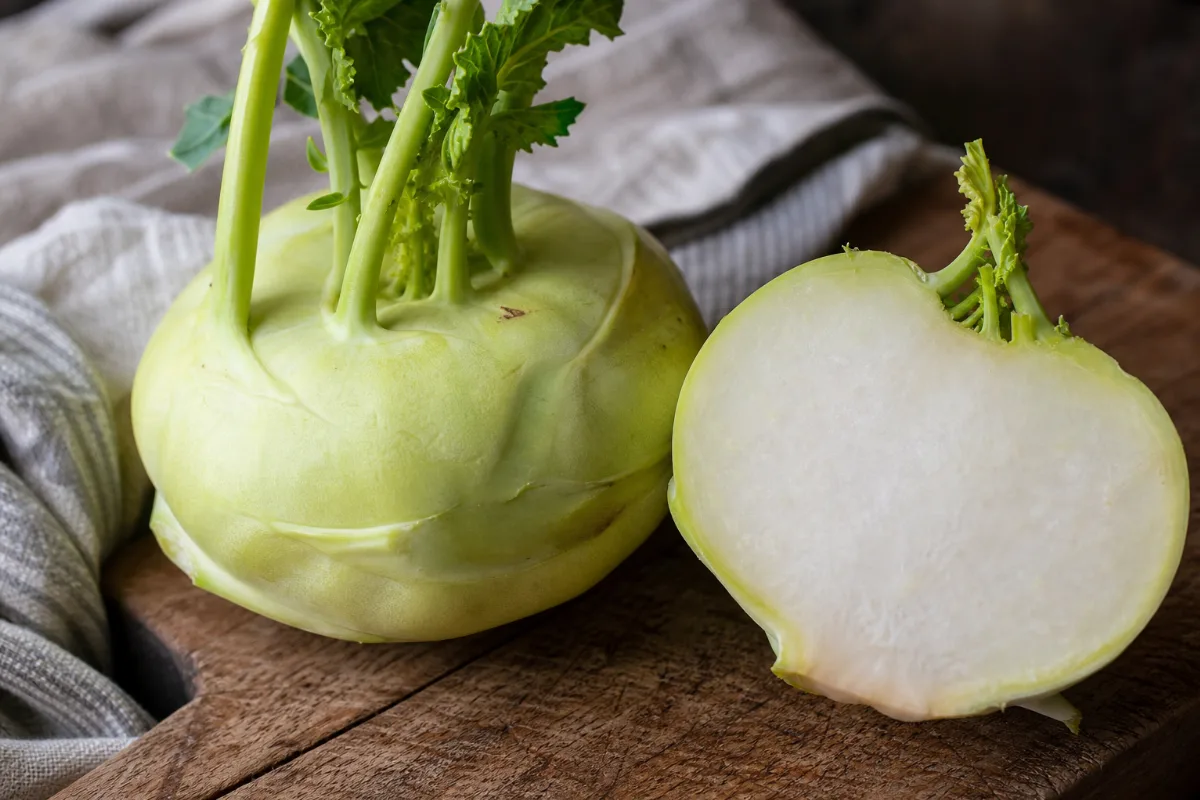
Kohlrabi
Brassica oleracea var. gongylodes · also called German turnip, turnip cabbage, colinabo (Spanish)
Kohlrabi is a cabbage-family vegetable. People eat the round, swollen stem raw or cooked. It is rich in vitamin C and has some fibre and potassium. Eating more fruit and vegetables is linked to less heart disease in observational studies, but no human trial of kohlrabi itself was found. The main cautions are potassium for people with kidney disease and food poisoning from raw produce.
General information, not medical advice. Last substantive update · Not medically reviewed. A named clinician has not signed off on this page. How this page is made
About Kohlrabi
Kohlrabi is a nutritious cabbage-family vegetable, rich in vitamin C and a source of fibre and potassium. It is a healthy food, not a proven remedy: nearly all health claims come from studies of fruit and vegetables or cabbage-family vegetables in general.
What it is
Kohlrabi (Brassica oleracea var. gongylodes) belongs to the cabbage family, the same species as broccoli, cabbage and kale. People eat the round, swollen stem raw or cooked.
USDA data for raw kohlrabi: 27 kcal per 100 g. One cup (135 g) has about 36 kcal, 4.9 g fibre, 84 mg vitamin C, 473 mg potassium, 32 mg calcium and 22 micrograms folate (per-cup figures are our arithmetic from the per-100 g values). It has almost no vitamin K (0.1 micrograms per 100 g). Cooked values were not read.
What the research shows
The firmest fact is about a nutrient: vitamin C prevents scurvy, and kohlrabi is a rich source. That is not a trial of kohlrabi.
Large reviews of observational studies link more vegetables, and cruciferous vegetables as a group, to less heart disease, colon cancer and type 2 diabetes. People who eat more vegetables differ in many ways, and these studies cannot show cause. A 2023 review also found a higher hypertension risk for cruciferous vegetables in a few studies, which the authors call mixed.
The only kohlrabi-specific papers found were a laboratory study of extracts in cells and enzymes and a chemistry paper measuring two isothiocyanates in raw and fermented kohlrabi. Neither tested people.
Food versus extracts
The laboratory study used methanol extracts and the cholesterol trial used a specially bred broccoli. Neither tells us about eating kohlrabi. We found no kohlrabi supplement or juice tested in people.
Amounts
This page gives no amounts to eat. Ask a doctor, pharmacist or dietitian what is right for you, especially if you have kidney problems.
At a glance
Traditional uses history, not proof
- Eaten as a vegetable, raw in salads or cooked
- Long use as food is not proof that it treats any condition
Studied for research
- Vitamin C and scurvy prevention, high certainty for the nutrient, no kohlrabi trial
- Fibre content, insufficient evidence for any health effect
- Heart disease risk (fruit, vegetables and cruciferous vegetables), low certainty, observational
- Blood pressure and LDL cholesterol, insufficient evidence for kohlrabi
- Cancer and type 2 diabetes risk (cruciferous vegetables as a group), low certainty, observational
- Laboratory activity of kohlrabi extracts, insufficient evidence (cell and enzyme tests only)
Main compounds
- Vitamin C
- Glucosinolates
- Erucin and phenethyl isothiocyanate
- Phenolic compounds
- Potassium
- Fibre
Common forms
- Raw kohlrabi as food
- Cooked kohlrabi as food
- Fermented kohlrabi (analysed in one 2026 laboratory paper)
Research links: USDA FoodData Central: Kohlrabi, raw · Linus Pauling Institute: Cruciferous vegetables · MedlinePlus: Potassium in diet · Research Library · Genes & Biomarkers Library
What it is and its history
- Accepted scientific name
- Brassica oleracea var. gongylodes
- Naming authority
- L. (GBIF lists it as a synonym of the accepted species Brassica oleracea L.)
- Common names
- Kohlrabi (English); German turnip (English); Turnip cabbage (English); Colinabo (Spanish)
- Family or group
- Brassicaceae (the cabbage or mustard family), as given by GBIF. The Linus Pauling Institute lists kohlrabi among Brassica vegetables with broccoli, cabbage and kale.
- Classification
- Plantae > Brassicales > Brassicaceae > Brassica > Brassica oleracea
- Native range
- Not verified from a source read.
- Habitat
- Not verified from a source read.
- What it looks like
- Roots: Not verified.; Stems: The swollen lower stem is the part usually eaten (existing nutrient summary; not re-verified from a second source).; Leaves: Not verified.; Flowers: Not verified.; Fruit: Not verified.
- Cultivation
- Not verified from a source read.
- Harvest and processing
- Eaten raw or cooked; a 2026 paper also analysed fermented kohlrabi. Boiling cruciferous vegetables inactivates myrosinase and reduces glucosinolates more than steaming, microwaving or stir-frying (Linus Pauling Institute).
- Look-alikes and adulterants
- Name: Turnip, rutabaga and other roots; Note: Kohlrabi is a swollen stem, not a root, but the names 'German turnip' and 'turnip cabbage' are easily confused with turnips, which have their own pages.; Name: Broccoli, cabbage, kale; Note: Same species, different varieties. Most research on cabbage-family compounds is on broccoli, and results do not automatically apply to kohlrabi.
- Sustainability and conservation
- Not assessed.
Photographs
What is inside, and how it may work
What it contains and how those compounds act in cells and animals. Laboratory and animal mechanisms are not proven effects in people.
Main compounds
| Compound | Family | Where it is concentrated | Activity studied | Level of evidence |
|---|---|---|---|---|
| Vitamin C (ascorbic acid) PubChem 54670067 | vitamin | Swollen stem USDA: 62 mg per 100 g raw | Needed to keep skin, blood vessels, bones and cartilage healthy; lack causes scurvy (NHS). 13 14 | Human data |
| Glucosinolates | sulfur-containing plant compounds | Swollen stem Amounts in kohlrabi were not given in the sources read | Break down to isothiocyanates and other products when the raw vegetable is cut or chewed (Linus Pauling Institute). 10 7 | Lab |
| Erucin PubChem 78160 | isothiocyanate | Kohlrabi (part not stated in the abstract) Measured in raw and fermented kohlrabi; amount not in the abstract | Detected and measured by a laboratory method; no health result reported. 7 | Lab |
| Phenethyl isothiocyanate PubChem 16741 | isothiocyanate | Kohlrabi (part not stated in the abstract) Measured in raw and fermented kohlrabi; amount not in the abstract | Detected and measured by a laboratory method; no health result reported. 7 | Lab |
| Phenolic compounds | polyphenols | Kohlrabi (part not stated in the abstract) Red kohlrabi had about twice the total phenolic content of green kohlrabi in the study | Antioxidant activity in laboratory assays only. 4 | Lab |
| Potassium PubChem 813 | mineral | Swollen stem USDA: 350 mg per 100 g raw | Essential mineral; high blood potassium is a risk with kidney disease and some medicines (MedlinePlus). 11 14 | Human data |
Mechanisms, receptors and pathways
| Target or pathway | Gene or receptor | What was found | Level |
|---|---|---|---|
| Glucosinolate breakdown by myrosinase | Myrosinase (plant enzyme) | When raw cruciferous vegetables are chopped or chewed, glucosinolates are broken down to isothiocyanates and other products. Boiling inactivates myrosinase. This is described for cruciferous vegetables in general, not measured for kohlrabi in the sources read. 10 | Authoritative guidance |
| PTP1B enzyme and nitric oxide production in cells | PTP1B; iNOS and COX-2 proteins | Kohlrabi methanol extracts inhibited PTP1B and reduced nitric oxide in mouse macrophage cells in a dish. Laboratory result only. 4 | Laboratory research |
Absorption, metabolism and elimination
- Absorption
- Not found for kohlrabi. The Linus Pauling Institute describes isothiocyanates from raw crucifers as absorbed in the upper intestine and intact glucosinolates from cooked crucifers as mostly reaching the colon; this is for crucifers in general.
- Distribution
- Not found.
- Metabolism
- Not found for kohlrabi.
- Elimination
- Not found for kohlrabi.
- Bioavailability
- Not established for kohlrabi nutrients in the sources read.
Isolated compounds versus whole extracts
The laboratory study used methanol extracts, and the cholesterol trial used a specially bred broccoli, so neither tells us about eating kohlrabi. Food, juice and extract are different products. No kohlrabi supplement trial in people was found.
Nutritional composition
Nutrition from USDA FoodData Central (Kohlrabi, raw, FDC 168424, last updated 4/1/2019, read 2026-10-26). Per 100 g: 27 kcal, 1.7 g protein, 0.1 g fat, 6.2 g carbohydrate, 3.6 g fibre, 2.6 g total sugars, about 91 g water, 62 mg vitamin C, 350 mg potassium, 24 mg calcium, 0.4 mg iron, 19 mg magnesium, 46 mg phosphorus, 20 mg sodium, 0.15 mg vitamin B6, 16 micrograms folate (DFE), 0.129 mg copper, 0.139 mg manganese, 0.1 micrograms vitamin K. One cup of raw kohlrabi (135 g, the USDA household portion) is about 36 kcal, 2.3 g protein, 4.9 g fibre, 3.5 g sugars, 84 mg vitamin C, 473 mg potassium, 32 mg calcium, 0.5 mg iron, 26 mg magnesium, 0.20 mg vitamin B6 and 22 micrograms folate (per-cup values are our arithmetic from the per-100 g values). One slice is 16 g. Figures vary with variety, ripeness and storage. Cooked values were not read.
1 high certainty3 low certainty3 not enough evidence
What was looked at
The 7 benefits and uses checked for Kohlrabi, each with how strong the evidence is. Tap one to open it.
- Vitamin C and preventing scurvyHigh certainty
- Dietary fibreNot enough evidence
- Heart disease risk (fruit and vegetables, cruciferous vegetables)Low certainty
- Cancer risk (cruciferous vegetables as a group)Low certainty
- Type 2 diabetes risk (cruciferous vegetables as a group)Low certainty
- Antioxidant and anti-inflammatory activity of kohlrabi extracts (laboratory only)Not enough evidence
- Isothiocyanates in kohlrabi (what is in the vegetable)Not enough evidence
Lab markers tracked in the studies
Cardiovascular disease events and deathsRisk of developing high blood pressureLDL cholesterolCancer incidenceNew cases of type 2 diabetes
What is Kohlrabi good for?
The main studied uses and how strong the human evidence is for each. Almost all results are for fruit and vegetables or cabbage-family vegetables as a group, not for kohlrabi.
Benefits, one by one
Each card is a research question, not a promise. Tap a goal to filter. Open a card to see the studies, doses and limits.
Vitamin C and preventing scurvy
High certaintyVitamin C is needed to keep skin, blood vessels, bones and cartilage healthy, and too little causes scurvy. Kohlrabi is a rich source: USDA lists 62 mg per 100 g of raw kohlrabi, about 84 mg in a 1-cup (135 g) portion. The NHS says adults aged 19 to 64 need 40 mg a day. This is a nutrient fact, not a kohlrabi trial.
3 studiesRaw kohlrabi as food. Cooking effects on vitamin C in kohlrabi were n…
Studies, doses and limits
What the trials found
The NHS says vitamin C helps protect cells, maintains healthy skin, blood vessels, bones and cartilage, helps wound healing, and that lack of vitamin C can lead to scurvy. It says adults aged 19 to 64 need 40 mg a day and should be able to get all they need from a varied diet. USDA lists 62.0 mg of vitamin C per 100 g of raw kohlrabi and a household portion of 1 cup = 135 g.
Results
Kohlrabi is a rich source of vitamin C by USDA numbers. No trial of eating kohlrabi for vitamin C status or scurvy was read.
Effect sizes as reported
USDA: 62 mg vitamin C per 100 g raw; about 84 mg per cup (135 g, our arithmetic). NHS: 40 mg a day for adults 19 to 64.
Why this rating
High for the nutrient role and for kohlrabi being a rich source (NHS and USDA data). There is no kohlrabi-specific trial, and the NHS says a varied diet normally supplies enough vitamin C. The NHS page is past its own review date (2023).
Form and dose studied
Raw kohlrabi as food. Cooking effects on vitamin C in kohlrabi were not read from a source.
Who was studied
Everyone. Scurvy comes from too little vitamin C over time.
Limits
Nutrient information, not a trial of kohlrabi. It does not show that extra vitamin C from any source adds benefit in someone who already has enough.
Why researchers looked
Kohlrabi is often named as a vitamin C vegetable, so people ask what that does for the body.
Traditional use
Kohlrabi is eaten as a vegetable, raw or cooked. Long use as food is not proof that it treats any condition.
Proposed mechanism Authoritative guidance
Vitamin C is used in building and maintaining skin, blood vessels, bones and cartilage and in wound healing (NHS). It is not stored in the body, so it is needed regularly (NHS).
A proposed mechanism does not show that the effect happens in people.
The NHS says large supplement amounts (over 1,000 mg a day) can cause stomach pain, diarrhoea and wind. That is about supplements, not vegetables.
Dietary fibre
Not enough evidenceUSDA lists 3.6 g of fibre per 100 g of raw kohlrabi, about 4.9 g in a 1-cup (135 g) portion. We found no trial of kohlrabi for digestion or bowel habit, so we make no health claim.
1 studiesRaw kohlrabi as food.
Studies, doses and limits
What the trials found
USDA lists total dietary fibre 3.6 g and total sugars 2.6 g per 100 g of raw kohlrabi. No source read tested kohlrabi fibre in people.
Results
Fibre content is a measured fact. No effect on digestion, bowel habit, cholesterol or weight from eating kohlrabi was read.
Effect sizes as reported
USDA: fibre 3.6 g per 100 g raw; about 4.9 g per cup (135 g, our arithmetic).
Why this rating
Insufficient for any health effect: only a composition table was read, and no kohlrabi trial or fibre guideline was read for this page.
Form and dose studied
Raw kohlrabi as food.
Who was studied
Not studied.
Limits
Composition only. Cooked values were not read.
Why researchers looked
Kohlrabi is a fibre-containing vegetable, and people ask whether that helps digestion.
Traditional use
Kohlrabi is eaten as a vegetable, raw or cooked. Long use as food is not proof that it treats any condition.
Proposed mechanism Unknown
Not established for kohlrabi in the sources read.
A proposed mechanism does not show that the effect happens in people.
Some people notice wind from cabbage-family vegetables; no source read measures this for kohlrabi, so we make no claim.
Heart disease risk (fruit and vegetables, cruciferous vegetables)
Low certaintyPeople who eat more fruit and vegetables have less heart disease in observational studies, and the large 2017 review says cruciferous vegetables (the cabbage family) showed the same pattern. This cannot prove the vegetables are the cause. Kohlrabi was not analysed on its own.
2 studiesWhole vegetables eaten as food.
Studies, doses and limits
What the trials found
A 2017 meta-analysis of 95 prospective studies found, for fruit and vegetables combined, a relative risk of 0.92 for cardiovascular disease per 200 g a day (95% CI 0.90 to 0.95), and said inverse associations were seen for cruciferous vegetables with cardiovascular disease and all-cause mortality. The Linus Pauling Institute (reviewed 2017) reports mixed findings: a Chinese cohort linked the highest cruciferous intake to 31% lower cardiovascular death, but a pooled analysis of two large US cohorts found no significant link with heart attack and ischemic stroke.
Results
Observational studies lean towards less heart disease with more vegetables, including cruciferous ones, but the evidence for cruciferous vegetables on their own is described as inconsistent.
Effect sizes as reported
Fruit and vegetables combined: CVD RR 0.92 per 200 g/day (0.90-0.95). No kohlrabi-specific figure.
Why this rating
Low, because the evidence is observational: people who eat more vegetables differ from others in many ways, results for cruciferous vegetables alone are inconsistent, and kohlrabi was not analysed separately.
Form and dose studied
Whole vegetables eaten as food.
Who was studied
Adults in prospective cohort studies.
Limits
Cannot show cause. Kohlrabi was not separated from other cruciferous vegetables in the abstracts and page read.
Why researchers looked
Cabbage-family vegetables are rich in vitamins and plant compounds, and population studies ask whether eating them goes with healthier hearts.
Traditional use
Kohlrabi is eaten as a vegetable, raw or cooked. Long use as food is not proof that it treats any condition.
Proposed mechanism Unknown
Not established. The Linus Pauling Institute says isothiocyanates are thought to play a part in possible heart and cancer benefits, but it calls the human heart evidence largely inconsistent.
A proposed mechanism does not show that the effect happens in people.
None specific beyond the potassium note on the Safety tab.
Cancer risk (cruciferous vegetables as a group)
Low certaintyMany observational studies link eating more cabbage-family vegetables to lower cancer risk, but much of the evidence comes from case-control studies, which are prone to bias, and kohlrabi was not studied on its own. A 2025 colon cancer review found an odds ratio of 0.8.
3 studiesCruciferous vegetables eaten as food. Boiling reduces glucosinolates …
Studies, doses and limits
What the trials found
The Linus Pauling Institute (2017) says high cruciferous vegetable intake has been associated with lower risk of several cancers, but that the evidence is largely limited to case-control studies; in its table, bladder cancer cohort-only analyses gave RR 0.86 (0.61-1.11) and 0.97 (0.93-1.01), while case-control-only gave 0.78 (0.67-0.89). A 2025 meta-analysis of 17 studies (7 cohort, 10 case-control; 97,595 patients) found cruciferous vegetable intake inversely linked to colon cancer (OR 0.8, 95% CI 0.72-0.90), and said the findings should be read with caution. The 2017 fruit and vegetable meta-analysis also reported an inverse association between cruciferous vegetables and total cancer.
Results
An association in observational studies, strongest in case-control designs and weaker or absent in cohort-only analyses. No trial of kohlrabi and cancer was found.
Effect sizes as reported
Colon cancer: OR 0.8 (0.72-0.90), cruciferous vegetables as a group.
Why this rating
Low: observational only, mixing case-control and cohort designs, with heterogeneity and residual confounding. Kohlrabi was not analysed separately.
Form and dose studied
Cruciferous vegetables eaten as food. Boiling reduces glucosinolates more than steaming, microwaving or stir-frying (Linus Pauling Institute).
Who was studied
Adults in case-control and cohort studies.
Limits
Cannot show cause. Not about kohlrabi alone. These results are not a reason to use kohlrabi to treat or prevent cancer.
Why researchers looked
Cabbage-family vegetables contain glucosinolates, which break down into isothiocyanates that have been studied in the lab for effects on cancer cells.
Traditional use
Kohlrabi is eaten as a vegetable, raw or cooked. Long use as food is not proof that it treats any condition.
Proposed mechanism In vitro and animal
When raw cruciferous vegetables are chopped or chewed, the enzyme myrosinase breaks glucosinolates into isothiocyanates and other products (Linus Pauling Institute). Most mechanism work is in the lab, in animals or in other crucifers such as broccoli.
A proposed mechanism does not show that the effect happens in people.
None specific.
Type 2 diabetes risk (cruciferous vegetables as a group)
Low certaintyA 2016 review of four cohorts linked the highest cruciferous vegetable intake to about 16% lower risk of type 2 diabetes (SRR 0.84, 95% CI 0.73 to 0.96). It was observational, based on few studies, and not about kohlrabi alone.
1 studiesCruciferous vegetables as food.
Studies, doses and limits
What the trials found
A meta-analysis of prospective studies (306,723 participants, 16,544 cases) found, from four cohorts, SRR 0.84 (95% CI 0.73 to 0.96) for highest versus lowest cruciferous vegetable intake, with significant heterogeneity (I2 54.4%). The authors say larger prospective studies are needed.
Results
A small observational association for cruciferous vegetables as a group.
Effect sizes as reported
SRR 0.84 (0.73-0.96), highest vs lowest.
Why this rating
Low: only four observational cohorts, heterogeneity, searches ended in 2014, and kohlrabi not analysed.
Form and dose studied
Cruciferous vegetables as food.
Who was studied
Adults without diabetes at the start.
Limits
Cannot show cause. Kohlrabi not analysed.
Why researchers looked
Population studies ask whether vegetable subtypes go with a lower chance of developing type 2 diabetes.
Traditional use
Kohlrabi is eaten as a vegetable, raw or cooked. Long use as food is not proof that it treats any condition.
Proposed mechanism Unknown
Not established.
A proposed mechanism does not show that the effect happens in people.
None specific.
Antioxidant and anti-inflammatory activity of kohlrabi extracts (laboratory only)
Not enough evidenceIn a 2014 laboratory study, methanol extracts of red and green kohlrabi blocked certain enzymes and reduced nitric oxide in mouse cells in a dish. Red kohlrabi, which had twice the phenolic content, was stronger. There are no results in people.
1 studiesMethanol extracts, not food.
Studies, doses and limits
Results
Laboratory activity only (PTP1B IC50 207 microg/mL red, 287 microg/mL green).
Effect sizes as reported
Laboratory concentrations only.
Why this rating
Laboratory only: no animal or human outcome. A methanol extract is not the vegetable.
Form and dose studied
Methanol extracts, not food.
Limits
Test-tube result; does not show an effect from eating kohlrabi.
Why researchers looked
Red kohlrabi has more plant pigments and phenolic compounds, so researchers tested extracts in laboratory assays.
Traditional use
Kohlrabi is eaten as a vegetable, raw or cooked. Long use as food is not proof that it treats any condition.
Proposed mechanism Laboratory research
Extracts inhibited the enzyme PTP1B and lowered nitric oxide production in mouse macrophage cells, with less iNOS and COX-2 protein (authors' report).
A proposed mechanism does not show that the effect happens in people.
None.
Isothiocyanates in kohlrabi (what is in the vegetable)
Not enough evidenceA 2026 chemistry paper built a laboratory method to measure two isothiocyanates, erucin and phenethyl isothiocyanate, in raw and fermented kohlrabi. It shows these compounds are there. It reports no health effect in the abstract.
2 studiesRaw and fermented kohlrabi extracts in the paper.
Studies, doses and limits
Results
Composition information only.
Effect sizes as reported
Not given in the abstract.
Why this rating
No health outcome was tested. Most of what is known about these compounds in people comes from broccoli and other crucifers.
Form and dose studied
Raw and fermented kohlrabi extracts in the paper.
Limits
Shows presence, not benefit.
Why researchers looked
Isothiocyanates from cabbage-family vegetables are studied in the lab, mostly using broccoli.
Traditional use
Kohlrabi is eaten as a vegetable, raw or cooked. Long use as food is not proof that it treats any condition.
Proposed mechanism Authoritative guidance
Glucosinolates break down into isothiocyanates when the plant is cut or chewed (Linus Pauling Institute).
A proposed mechanism does not show that the effect happens in people.
None.
Connections to the rest of health
How Kohlrabi connects to the rest of our health knowledge graph. Every link says what kind of connection it is. A safety link (for example to the liver) is a warning, not a benefit. A study that merely mentions a topic never creates a benefit link.
Explore every connection: goals, body systems, organs, symptoms, genes
B. Body systems
| Connected to | Kind of connection | Evidence status | Context | Studies |
|---|---|---|---|---|
| Blood And Immune | Biological association | High certainty | Studied for: Vitamin C and preventing scurvy | 14 13 12 |
| Integumentary System | Biological association | High certainty | Studied for: Vitamin C and preventing scurvy | 14 13 12 |
| Digestive System | Biological association | Not enough evidence | Studied for: Dietary fibre Studied for: Cancer risk (cruciferous vegetables as a group) | 14 5 10 2 |
| Cardiovascular System | Biological association | Low certainty | Studied for: Heart disease risk (fruit and vegetables, cruciferous vegetables) | 2 10 |
| Endocrine System | Biological association | Low certainty | Studied for: Type 2 diabetes risk (cruciferous vegetables as a group) | 3 |
C. Body parts and organs
| Connected to | Kind of connection | Evidence status | Context | Studies |
|---|---|---|---|---|
| Kidneys | Adverse effect or risk | Documented risk | Potassium in food matters for people with kidney disease. Contains potassium; a caution for kidney disease. Preparation or compound: Potassium in kohlrabi as food |
11 14 |
| Thyroid | Drug or supplement interaction | Preliminary | Animal findings at very high intakes; concern is mainly with low iodine. Animal findings at very high cabbage-family intakes; concern mainly with low iodine. Preparation or compound: Glucosinolates in cruciferous vegetables |
10 |
I. Biomarkers
| Connected to | Kind of connection | Evidence status | Context | Studies |
|---|---|---|---|---|
| Cardiovascular disease events and deaths | Biological association | Low certainty | Measured in trials: lowered. A lab change is not the same as a health benefit. | 2 10 |
| Risk of developing high blood pressure | Biological association | Not enough evidence | Measured in trials: mixed. A lab change is not the same as a health benefit. | 6 |
| LDL cholesterol | Biological association | Not enough evidence | Measured in trials: unclear. A lab change is not the same as a health benefit. | 1 10 |
| Cancer incidence | Biological association | Low certainty | Measured in trials: lowered. A lab change is not the same as a health benefit. | 5 10 |
| New cases of type 2 diabetes | Biological association | Low certainty | Measured in trials: lowered. A lab change is not the same as a health benefit. | 3 |
K. Biological pathways
| Connected to | Kind of connection | Evidence status | Context | Studies |
|---|---|---|---|---|
| Vitamin C | Preliminary mechanism | Human | Kohlrabi is a rich vitamin C food; too little vitamin C causes scurvy. | 13 14 |
| Potassium | Preliminary mechanism | Human | Kohlrabi contains potassium; relevant for kidney disease and some blood pressure medicines. | 11 14 |
L. Active compounds
| Connected to | Kind of connection | Evidence status | Context | Studies |
|---|---|---|---|---|
| Vitamin C (ascorbic acid) | Biological association | Human | Needed to keep skin, blood vessels, bones and cartilage healthy; lack causes scurvy (NHS). Preparation or compound: Swollen stem |
13 14 |
| Glucosinolates | Biological association | Lab | Break down to isothiocyanates and other products when the raw vegetable is cut or chewed (Linus Pauling Institute). Preparation or compound: Swollen stem |
10 7 |
| Erucin | Biological association | Lab | Detected and measured by a laboratory method; no health result reported. Preparation or compound: Kohlrabi (part not stated in the abstract) |
7 |
| Phenethyl isothiocyanate | Biological association | Lab | Detected and measured by a laboratory method; no health result reported. Preparation or compound: Kohlrabi (part not stated in the abstract) |
7 |
| Phenolic compounds | Biological association | Lab | Antioxidant activity in laboratory assays only. Preparation or compound: Kohlrabi (part not stated in the abstract) |
4 |
| Potassium | Biological association | Human | Essential mineral; high blood potassium is a risk with kidney disease and some medicines (MedlinePlus). Preparation or compound: Swollen stem |
11 14 |
Each connection is stored with the ingredient, the connected record, the kind of connection, the evidence status, the supporting studies, the preparation or compound involved, and a review date (last reviewed October 26, 2026).
Evidence at a glance: what changed in 4 lab markers
Tap a number to show only those markers. Counts are markers, not people.
The evidence
The research centre for Kohlrabi. Every record here was checked against PubMed or the publisher's page; we never list a study we have not verified.
Evidence by outcome
Bars show how many studies we found for each outcome, not how well it works. People are added up across trials only (reviews are not added, to avoid double counting).
How we rate evidence
High certainty
Several well-run trials or reviews agree; further research is unlikely to change the picture much.
Moderate certainty
Good trials point the same way, but some doubt remains.
Low certainty
Small, short or inconsistent trials. The finding could change with better research.
Very low certainty
Very little or very weak human data. Treat as a possibility only.
Mixed findings
Trials or reviews disagree with each other.
Not enough evidence
Not enough human research to say either way.
Evidence against
Good research found no benefit, or found harm.
We take the reviewers' own risk-of-bias and GRADE statements where they exist, and otherwise judge from study size, design, consistency, directness and whether a product matches what is sold. Many publications do not make evidence high. Method note: We started from our existing kohlrabi summary, re-checked nutrition at USDA FoodData Central, read the health agency and research institute pages (NHS, MedlinePlus, FDA, Linus Pauling Institute) and searched PubMed for reviews, trials and kohlrabi papers. Only abstracts were read for studies. Items we could not verify are flagged in the research gaps.
Study library: every study we checked 14
| Study | Design | People | Product, dose, length | Result |
|---|---|---|---|---|
| Armah 2015 Diet rich in high glucoraphanin broccoli reduces plasma LDL cholesterol: Evidence from randomised controlled trials. Mol Nutr Food Res · PMID 25851421 · DOI |
Controlled trial |
130 130 volunteers in two double-blind randomised parallel studies (37 and 93 people) |
High-glucoraphanin broccoli versus standard broccoli Broccoli florets 400 g a week 12 weeks · vs Standard broccoli |
High-glucoraphanin broccoli lowered LDL cholesterol by 7.1% (study 1) and 5.1% (study 2); standard broccoli changes were not significant (1.8% and 2.5%). Combined, the difference between the two broccolis was significant. This was a specially bred broccoli, not kohlrabi. LDL: study 1 -7.1%, study 2 -5.1% (high-glucoraphanin broccoli) (Study 1 -7.1% (95% CI -1.8 to -12.3, p=0.011); study 2 -5.1% (-2.1 to -8.1, p=0.001); combined difference p=0.031) Methods, limits and fundingOutcomes: Plasma LDL cholesterol Limitations: Broccoli, not kohlrabi; small trials; 12 weeks; funding not stated in the abstract. Funding and conflicts: Not stated in the abstract. Read: abstract |
| Aune 2017 Fruit and vegetable intake and the risk of cardiovascular disease, total cancer and all-cause mortality-a systematic review and dose-response meta-analysis of prospective studies. Int J Epidemiol · PMID 28338764 · DOI |
Systematic review meta analysis |
Adults in 95 prospective studies (142 publications) | Fruit and vegetables as food Fruit and vegetables Per 200 g/day (analysis unit, not advice) Prospective follow-up · vs Lower intake |
For fruits and vegetables combined, each 200 g/day was linked to lower risk of coronary heart disease, stroke, cardiovascular disease, total cancer and death from any cause. The abstract says inverse associations were seen for cruciferous vegetables with cardiovascular disease and all-cause mortality, and for cruciferous vegetables with total cancer. A summary figure for cruciferous vegetables alone is not given in the abstract, and kohlrabi is not named. Combined fruit and vegetables per 200 g/day: CVD RR 0.92; total cancer RR 0.97; all-cause mortality RR 0.90 (CVD RR 0.92 (95% CI 0.90-0.95, I2 31%); total cancer 0.97 (0.95-0.99, I2 49%); all-cause mortality 0.90 (0.87-0.93, I2 83%)) Methods, limits and fundingOutcomes: Coronary heart disease, stroke, cardiovascular disease, total cancer, all-cause mortality Limitations: Prospective observational studies cannot show cause; people who eat more vegetables differ in other ways. The combined figures are not for kohlrabi or for cruciferous vegetables alone. Funding and conflicts: Not stated in the abstract. Read: abstract |
| Jia 2016 Consumption of citrus and cruciferous vegetables with incident type 2 diabetes mellitus based on a meta-analysis of prospective study. Prim Care Diabetes · PMID 26778708 · DOI |
Systematic review meta analysis |
306723 Seven prospective cohorts (5 articles); 306,723 participants, 16,544 new type 2 diabetes cases; follow-up 4.6 to 24 years |
Cruciferous vegetables as food Cruciferous vegetables Highest versus lowest intake 4.6 to 24 years · vs Lowest intake |
Based on four prospective cohorts, the highest versus lowest intake of cruciferous vegetables was linked to lower type 2 diabetes risk, with significant heterogeneity. Citrus fruit showed no link. The authors say larger prospective studies are needed. Kohlrabi is not named. Cruciferous vegetables, highest vs lowest: SRR 0.84 (95% CI 0.73-0.96; I2 54.4%) Methods, limits and fundingOutcomes: Incident type 2 diabetes Limitations: Only four cohorts for cruciferous vegetables; observational; heterogeneity; searches ended December 2014; kohlrabi not analysed. Funding and conflicts: Not stated in the abstract. Read: abstract |
| Jung 2014 Anti-Diabetic and Anti-Inflammatory Effects of Green and Red Kohlrabi Cultivars (Brassica oleracea var. gongylodes). Prev Nutr Food Sci · PMID 25580392 · DOI |
Laboratory research in-vitro |
Laboratory assays: enzymes, rat lens enzyme and mouse macrophage cells (no people, no animals dosed) | Methanol extracts of green and red kohlrabi Kohlrabi (part not stated in the abstract) Laboratory concentrations · vs Assay controls |
Red kohlrabi had about twice the total phenolic content of green. Both methanol extracts inhibited nitric oxide production in mouse macrophage cells and inhibited the enzyme PTP1B (IC50 207 and 287 micrograms per mL for red and green). Red extract was stronger. The authors suggest the extract might be useful; this is a test-tube result only. PTP1B IC50: red kohlrabi 207 microg/mL, green 287 microg/mL (IC50 207 +/- 3.48 and 287 +/- 3.22 microg/mL) Methods, limits and fundingOutcomes: Enzyme inhibition (PTP1B, aldose reductase), nitric oxide production, antioxidant assays, total phenolic content Limitations: Laboratory only; methanol extract is not food; no result in people. Funding and conflicts: Not stated in the abstract. Read: abstract |
| Lai 2025 Cruciferous vegetables intake and risk of colon cancer: a dose-response meta-analysis. BMC Gastroenterol · PMID 40790161 · DOI |
Systematic review meta analysis |
97595 17 studies (7 cohort, 10 case-control), 97,595 patients |
Cruciferous vegetables as food Cruciferous vegetables Varied; non-linear dose-response modelled Varied · vs Lower intake |
Higher cruciferous vegetable intake was linked to lower colon cancer risk, and risk fell progressively as intake rose. The authors say findings should be read with caution because study designs, dietary assessment and residual confounding differ. Kohlrabi is not named. Pooled odds ratio 0.8 (OR 0.8 (95% CI 0.72-0.90)) Methods, limits and fundingOutcomes: Colon cancer risk Limitations: Mixes case-control studies (prone to recall bias) with cohorts; observational; kohlrabi not analysed. The Linus Pauling Institute notes that the cohort-only evidence is weaker. Funding and conflicts: Authors declare no competing interests. Read: abstract |
| Madsen 2023 Fruit and vegetable consumption and the risk of hypertension: a systematic review and meta-analysis of prospective studies. Eur J Nutr · PMID 37106252 · DOI |
Systematic review meta analysis |
Adults in 18 prospective studies (451,291 participants, 145,492 cases) | Fruit and vegetables as food Fruit and vegetables Per 200 g/day (analysis unit, not advice) Prospective follow-up · vs Lower intake |
Fruits and vegetables combined and fruit alone were linked to lower risk of hypertension; vegetables alone were not (RR 1.00). For single types, the abstract reports inverse associations for broccoli, carrots, lettuce and others, and positive associations (higher risk) for cantaloupe, Brussels sprouts, cruciferous vegetables, and total and fried potatoes, each based on only 2 to 5 studies. The authors call results for subtypes mixed and in need of further study. Kohlrabi is not named. Vegetables per 200 g/day: hypertension RR 1.00; fruits and vegetables 0.97 (Vegetables RR 1.00 (95% CI 0.98-1.02, I2 38%); fruits and vegetables 0.97 (0.95-0.99, I2 68%). Confidence interval for cruciferous vegetables not given in the abstract.) Methods, limits and fundingOutcomes: Risk of developing hypertension Limitations: Observational; subtype findings rest on very few studies; cannot show cause; kohlrabi not analysed. Funding and conflicts: Not stated in the abstract. Read: abstract |
| Rizwan 2026 Qualitative and quantitative detection of isothiocyanates; quantification of erucin and phenethyl isothiocyanate in Kohlrabi by a reverse phase HPLC-DAD method. Nat Prod Res · PMID 39907582 · DOI |
Laboratory method n/a |
Raw and fermented kohlrabi samples (chemistry only) | Raw and fermented kohlrabi extracts Kohlrabi (part not stated in the abstract) |
The authors validated a lab method for measuring two isothiocyanates, erucin and phenethyl isothiocyanate, in raw and fermented kohlrabi, and also measured total glucosinolate and total isothiocyanate content. The abstract gives no health result and does not report the amounts found. No health outcome (Not applicable) Methods, limits and fundingOutcomes: Detection and measurement of erucin and phenethyl isothiocyanate; total glucosinolate and isothiocyanate content Limitations: A measurement-method paper. It shows these compounds can be detected in kohlrabi; it says nothing about effects in people. Funding and conflicts: Not stated in the abstract. Read: abstract |
| s-fda-produce FDA: Selecting and Serving Produce Safely · Source |
Health agency n/a |
Methods, limits and fundingRead: full-text | ||
| s-gbif-brassica-oleracea GBIF Backbone: Brassica oleracea L. (usageKey 3042845); variety gongylodes (usageKey 3042850) is a synonym · Source |
Reference database n/a |
Methods, limits and fundingRead: full-text | ||
| s-lpi-crucifers Linus Pauling Institute: Cruciferous Vegetables · Source |
Health agency n/a |
Methods, limits and fundingRead: full-text | ||
| s-medlineplus-potassium MedlinePlus: Potassium in diet · Source |
Health agency n/a |
Methods, limits and fundingRead: full-text | ||
| s-medlineplus-vitamins MedlinePlus: Vitamins · Source |
Health agency n/a |
Methods, limits and fundingRead: full-text | ||
| s-nhs-vitc NHS: Vitamin C · Source |
Health agency n/a |
Methods, limits and fundingRead: full-text | ||
| s-usda-fdc-168424 USDA FoodData Central: Kohlrabi, raw (FDC 168424) · Source |
Reference database n/a |
Methods, limits and fundingRead: full-text |
What we do not know yet
- No trial of eating kohlrabi itself was found for heart disease, blood pressure, cholesterol, diabetes, digestion or cancer.
- Cruciferous vegetable studies pool several vegetables, and a kohlrabi-only result was not in the abstracts read.
- The only kohlrabi-specific papers read were a laboratory extract study and a chemistry-method paper that reported no health result.
- Allergy, pregnancy, breastfeeding, choking risk, bloating and the effect of cooking on vitamin C were not found in a source.
- Pesticide residues, heavy metals, nitrate, oxalate, histamine and FODMAP content were not researched.
How new research is added
New studies are found by a saved PubMed search and placed in a review queue before the page changes.
Lab markers
What changed in blood or saliva tests during trials. A changed number is not the same as feeling or being healthier, and we give no "normal ranges".
Metabolic 1
LDL cholesterol
Unclear in trials
The cholesterol carried in low-density lipoprotein, often called the 'bad' cholesterol.
Not enough evidenceResults and what it means
Why it was measured
Trials of cruciferous vegetables have checked blood fats.
Statistical vs. clinical meaning
A result for one specially bred broccoli does not carry over to kohlrabi. No kohlrabi cholesterol trial was found.
Safety implication
None specific.
| Study | Result | People | Product |
|---|---|---|---|
| 1 | High-glucoraphanin broccoli lowered LDL by 7.1% and 5.1% in two small 12-week studies; ordinary broccoli did not significantly change LDL | 130 volunteers | Specially bred broccoli, 400 g a week (not kohlrabi) |
Other 4
Cardiovascular disease events and deaths
Lowered in trials
How many people in a study develop heart disease or stroke, or die of it.
Low certaintyResults and what it means
Why it was measured
These are the outcomes that matter most to health, so population studies count them.
Statistical vs. clinical meaning
An association in observational studies, not proof that vegetables prevent disease.
Safety implication
None specific.
| Study | Result | People | Product |
|---|---|---|---|
| 2 | Fruit and vegetables combined linked to lower CVD (RR 0.92 per 200 g/day, 95% CI 0.90-0.95); the abstract also reports inverse associations for cruciferous vegetables with CVD and all-cause mortality (no figure given) | Adults in prospective studies | Fruit and vegetables as food (kohlrabi not analysed) |
Risk of developing high blood pressure
Mixed results in trials
Whether people who eat more of a food go on to develop hypertension over the years.
Not enough evidenceResults and what it means
Why it was measured
Reviews check whether vegetable intake is linked to blood pressure.
Statistical vs. clinical meaning
Subtype findings rest on very few studies and may be chance or confounding. They do not show that cruciferous vegetables raise blood pressure.
Safety implication
None established.
| Study | Result | People | Product |
|---|---|---|---|
| 6 | Vegetables as a whole: no link with hypertension (RR 1.00, 95% CI 0.98-1.02 per 200 g/day). Cruciferous vegetables showed a positive association (higher risk) in only 2 to 5 studies; the authors call subtype results mixed | Adults in 18 prospective studies | Vegetables as food (kohlrabi not analysed) |
Cancer incidence
Lowered in trials
How many people in a study are diagnosed with a cancer.
Low certaintyResults and what it means
Why it was measured
Studies compare diagnoses between people who eat more and less of a food.
Statistical vs. clinical meaning
An observational association; the authors urge caution.
Safety implication
None specific.
| Study | Result | People | Product |
|---|---|---|---|
| 5 | Higher cruciferous vegetable intake linked to lower colon cancer risk (OR 0.8, 95% CI 0.72-0.90) | 17 studies, 97,595 patients | Cruciferous vegetables as food (not kohlrabi alone) |
New cases of type 2 diabetes
Lowered in trials
How many people without diabetes at the start of a study develop type 2 diabetes later.
Low certaintyResults and what it means
Why it was measured
Cohort studies follow people for years and count new diagnoses.
Statistical vs. clinical meaning
An observational association from few cohorts.
Safety implication
None specific.
| Study | Result | People | Product |
|---|---|---|---|
| 3 | Highest vs lowest cruciferous vegetable intake: SRR 0.84 (95% CI 0.73-0.96) | Four prospective cohorts | Cruciferous vegetables as food (not kohlrabi alone) |
Safety
What studies and official sources say about side effects, medicines and who should check first. Each point shows what kind of evidence it comes from.
Main points to know 4
- Kidney disease: kohlrabi contains potassium, so ask your care team. USDA lists 350 mg of potassium per 100 g of raw kohlrabi, about 473 mg in a 1-cup (135 g) portion (our arithmetic). MedlinePlus says people with kidney problems, particularly those on dialysis, should not eat too many potassium-rich foods, and that a provider will recommend a restricted diet if needed. It also names ACE inhibitors, ARBs and potassium-sparing diuretics (spironolactone, triamterene, amiloride) among causes of high blood potassium. MedlinePlus does not name kohlrabi. Ask a clinician about potassium in food. Authoritative guidance 11 14
- Thyroid: a concern for very high intakes of cabbage-family vegetables with low iodine, not normal food amounts. The Linus Pauling Institute says very high intakes of cruciferous vegetables such as cabbage and turnips caused underactive thyroid in animals. It says exposure from these vegetables does not appear to raise the risk of underactive thyroid unless iodine is also low, and that one human study of 150 g a day of cooked Brussels sprouts for four weeks found no thyroid effects. Kohlrabi was not tested. If you have a thyroid condition and eat large amounts, ask your clinician. Authoritative guidance 10
- Food poisoning: wash produce, even if you will peel it. The FDA says to wash all produce under running water before cutting or peeling, not to use soap, detergent or commercial produce wash, that washing reduces but does not remove bacteria, and that cooking produce thoroughly kills harmful bacteria. Keep cut produce refrigerated at 40 F (4 C) or below. Authoritative guidance 8
- Allergy: no source read describes kohlrabi allergy. No source we read reports allergy to kohlrabi, so we cannot say how common it is. Any food can in principle cause an allergic reaction (general knowledge, not from a source read). For trouble breathing or swelling of the face or throat, call emergency services. Insufficient
Side effects 3
| Effect | How often | Severity and recovery | Evidence |
|---|---|---|---|
| Stomach pain, diarrhoea and wind from vitamin C supplements over 1,000 mg a day This is about supplements. USDA lists about 84 mg of vitamin C in a cup of raw kohlrabi (our arithmetic), far below that level. | Not established | not stated The NHS says symptoms should disappear once you stop the supplements | Authoritative guidance 13 |
| Allergic reaction to kohlrabi No case report or study of kohlrabi allergy was found in the PubMed search or the pages read. | Not established | not stated Not stated | Insufficient |
| Gas or bloating from cabbage-family vegetables No source read measures this for kohlrabi, so we make no claim. | Not established | not stated Not stated | Insufficient |
Liver
No liver injury from eating kohlrabi was found in the sources read. A liver-safety source (such as LiverTox) was not searched for this food page.
How often. No frequency was found.
Monitoring. No agency monitoring advice was found.
This is a safety connection. It is not evidence that Kohlrabi supports liver health.
Medicines and supplements 3
| With | Why it matters | Importance | Evidence | What to do |
|---|---|---|---|---|
| Medicines that raise blood potassium (ACE inhibitors, ARBs, potassium-sparing diuretics) and kidney disease prescription | These medicines and poor kidney function can raise potassium in the blood (MedlinePlus). Kohlrabi contains potassium (USDA: 350 mg per 100 g raw). | MedlinePlus does not name kohlrabi; the link is our reading of two separate facts. Kohlrabi is not among the foods MedlinePlus lists as richest in potassium. Normal food amounts have not been tested in a trial. | Authoritative guidance Low certainty 11 14 | If you take one of these medicines or have kidney disease, ask a clinician or pharmacist about potassium in food. |
| Warfarin (blood thinner) prescription | Vitamin K affects warfarin. USDA lists only 0.1 micrograms of vitamin K per 100 g of raw kohlrabi, so it is not a vitamin K food like leafy greens. | No source read describes an interaction between kohlrabi and warfarin. This is our reading of the USDA number, not an agency statement. | Reference data Low certainty 14 | Anyone on warfarin should keep their whole diet steady and follow their warfarin clinic's advice. |
| Iodine-poor diet and thyroid medicine food-nutrient | Compounds released from cruciferous glucosinolates can compete with iodine uptake by the thyroid (Linus Pauling Institute). | The Linus Pauling Institute says no increased risk of underactive thyroid is seen unless iodine is also low. No kohlrabi study was read. | Authoritative guidance Low certainty 10 | If you have a thyroid condition or take thyroid medicine and eat very large amounts of raw cabbage-family vegetables, ask your clinician. |
Who should check first 4
| Situation | Advice | Evidence |
|---|---|---|
| Kidney disease, especially on dialysis, or taking ACE inhibitors, ARBs or potassium-sparing diuretics | Ask a clinician about potassium-rich foods; kohlrabi contains potassium. | Authoritative guidance 11 14 |
| Underactive thyroid or low iodine intake | Normal food amounts are not shown to be a problem. Ask a clinician if you eat very large amounts of raw cabbage-family vegetables. | Authoritative guidance 10 |
| Known allergy to kohlrabi or other cabbage-family vegetables | Avoid it and ask an allergist. Call emergency services for trouble breathing or swelling of the face or throat. | Insufficient |
| Pregnancy, young children, older age or weakened immunity (foodborne illness) | The FDA says these groups can be especially vulnerable to foodborne illness. Wash produce and keep cut pieces cold. | Authoritative guidance 8 |
Overdose, product quality and regulators
Summary. No toxicity from kohlrabi as ordinary food was found in the sources read. The cautions are specific to people with certain conditions or medicines.
Animal. The Linus Pauling Institute reports thyroid effects in animals fed very high amounts of cabbage and turnips; kohlrabi was not named.
Human doses studied. No kohlrabi safety trial in people was found.
Overdose response. Not found.
Genotoxicity. Not researched.
Raw produce can carry germs. Pesticide residues, heavy metals, nitrate levels and soil contamination in kohlrabi were not researched.
Food safety handling. The FDA says to wash all produce under running water, including produce you plan to peel, to avoid soap or produce wash, that washing reduces but does not eliminate bacteria, to cut away damaged or bruised areas, to keep produce separate from raw meat, poultry and seafood, and to refrigerate cut or packaged produce at 40 F (4 C) or below. Cooking produce thoroughly kills harmful bacteria. 8
| Body | Action | Date |
|---|---|---|
| FDA (US) (United States) | Selecting and Serving Produce Safely: wash produce under running water, no soap or produce wash, refrigerate cut produce at 40 F or below; some groups are especially vulnerable to foodborne illness source | 2024-03-05 |
| MedlinePlus (US National Library of Medicine) (United States) | Potassium page: people with kidney problems, particularly on dialysis, should not eat too many potassium-rich foods; ACE inhibitors, ARBs and potassium-sparing diuretics are listed among causes of high potassium source | 2026-04-30 |
| NHS (UK) (United Kingdom) | Vitamin C page: lack of vitamin C can lead to scurvy; adults 19 to 64 need 40 mg a day; more than 1,000 mg a day from supplements can cause stomach pain, diarrhoea and wind source | 2020-08-03 |
| Linus Pauling Institute (Oregon State University) (United States) | Cruciferous vegetables: thyroid effects in animals only with very high intakes; no increased risk unless iodine is low; boiling reduces glucosinolates more than other cooking methods source | 2017-04-01 |
When to get medical help
- Trouble breathing, swelling of the lips, face or throat, or widespread hives after eating kohlrabi or another food
- Vomiting, diarrhoea, abdominal pain, fever or body aches after eating raw produce (the FDA lists these as symptoms of foodborne illness; contact your healthcare provider)
- Muscle weakness or a very irregular heartbeat in someone with kidney disease or on potassium-raising medicines (MedlinePlus says high potassium may cause abnormal and dangerous heart rhythms)
Stop using the product and contact a clinician or emergency service. In the US, Poison Control is 1-800-222-1222.
General information only, not medical advice. Ask a clinician or pharmacist before use, especially with medicines, in pregnancy or with a health condition. See the Natural Remedy Safety guide.
Frequently asked questions
What is kohlrabi good for?
How much vitamin C is in kohlrabi?
Is kohlrabi good for the heart?
Observational studies link more fruit and vegetables to less heart disease (RR 0.92 per 200 g/day), and a 2017 review noted inverse links for cruciferous vegetables. The Linus Pauling Institute calls the cruciferous heart evidence largely inconsistent. This cannot show that kohlrabi itself protects the heart.
Does kohlrabi lower blood pressure?
Not shown. A 2023 review found no link between vegetables overall and hypertension, and a possible higher risk for cruciferous vegetables in only 2 to 5 studies. No kohlrabi trial was found.
Does kohlrabi lower cholesterol?
Not shown. Two small trials found lower LDL cholesterol with a specially bred broccoli, but no kohlrabi trial exists in the sources we read.
Does kohlrabi prevent cancer?
Does kohlrabi help with diabetes?
Is kohlrabi safe for people with kidney disease?
Is kohlrabi bad for the thyroid?
Not shown for normal food amounts. The Linus Pauling Institute says very high intakes of cabbage and turnips affected the thyroid in animals, and that cruciferous vegetables do not appear to raise the risk of underactive thyroid unless iodine intake is also low. Kohlrabi was not tested.
Does kohlrabi affect warfarin?
No source we read says so. USDA lists only 0.1 micrograms of vitamin K per 100 g of raw kohlrabi, so it is not a vitamin K food like leafy greens. If you take warfarin, follow your clinic's advice about your overall diet.
How should I wash kohlrabi?
The FDA says to wash produce under running water before cutting or peeling, not to use soap or produce wash, and to keep cut produce refrigerated at 40 F (4 C) or below. Washing reduces but does not remove bacteria.
Can I be allergic to kohlrabi?
Any food could cause an allergic reaction in someone, but no source we read reports kohlrabi allergy, so we cannot say how common it is. For trouble breathing or swelling of the face or throat, call emergency services.
Explore by health goal
Editorial transparency
- Written by
- AlternativeMed editorial team. Research compiled with AI assistance, then checked against the sources listed.
- Medical review
- None. This page has not been reviewed by a physician or pharmacist.
- First published
- 2026-10-26
- Last substantive update
- 2026-10-26
- How we research
- We started from our existing kohlrabi summary, re-checked nutrition at USDA FoodData Central, read the health agency and research institute pages (NHS, MedlinePlus, FDA, Linus Pauling Institute) and searched PubMed for reviews, trials and kohlrabi papers. Only abstracts were read for studies. Items we could not verify are flagged in the research gaps.
- How we rate evidence
- See "How we rate evidence" in the Evidence tab.
- Independence
- No product is promoted on this page. No affiliate links are shown.
Sources 14
Each source was opened and checked. Where we read only the abstract, it says so. The small numbers in the text point here.
- Armah, Derdemezis, Traka, et al.. Diet rich in high glucoraphanin broccoli reduces plasma LDL cholesterol: Evidence from randomised controlled trials.. Mol Nutr Food Res. 2015. PMID 25851421. DOI 10.1002/mnfr.201400863. (abstract)
- Aune, Giovannucci, Boffetta, et al.. Fruit and vegetable intake and the risk of cardiovascular disease, total cancer and all-cause mortality-a systematic review and dose-response meta-analysis of prospective studies.. Int J Epidemiol. 2017. PMID 28338764. DOI 10.1093/ije/dyw319. (abstract)
- Jia, Zhong, Song, Hu, et al.. Consumption of citrus and cruciferous vegetables with incident type 2 diabetes mellitus based on a meta-analysis of prospective study.. Prim Care Diabetes. 2016. PMID 26778708. DOI 10.1016/j.pcd.2015.12.004. (abstract)
- Jung, Karki, Ehom, Yoon, et al.. Anti-Diabetic and Anti-Inflammatory Effects of Green and Red Kohlrabi Cultivars (Brassica oleracea var. gongylodes).. Prev Nutr Food Sci. 2014. PMID 25580392. DOI 10.3746/pnf.2014.19.4.281. (abstract)
- Lai, Li, Li, et al.. Cruciferous vegetables intake and risk of colon cancer: a dose-response meta-analysis.. BMC Gastroenterol. 2025. PMID 40790161. DOI 10.1186/s12876-025-04163-9. (abstract)
- Madsen, Sen, Aune. Fruit and vegetable consumption and the risk of hypertension: a systematic review and meta-analysis of prospective studies.. Eur J Nutr. 2023. PMID 37106252. DOI 10.1007/s00394-023-03145-5. (abstract)
- Rizwan, Masoodi, Dar, et al.. Qualitative and quantitative detection of isothiocyanates; quantification of erucin and phenethyl isothiocyanate in Kohlrabi by a reverse phase HPLC-DAD method.. Nat Prod Res. 2026. PMID 39907582. DOI 10.1080/14786419.2025.2456680. (abstract)
- . FDA: Selecting and Serving Produce Safely. . . (full-text)
- . GBIF Backbone: Brassica oleracea L. (usageKey 3042845); variety gongylodes (usageKey 3042850) is a synonym. . . (full-text)
- . Linus Pauling Institute: Cruciferous Vegetables. . . (full-text)
- . MedlinePlus: Potassium in diet. . . (full-text)
- . MedlinePlus: Vitamins. . . (full-text)
- . NHS: Vitamin C. . . (full-text)
- . USDA FoodData Central: Kohlrabi, raw (FDC 168424). . . (full-text)


