Functional Foods · Fermented food
Sauerkraut
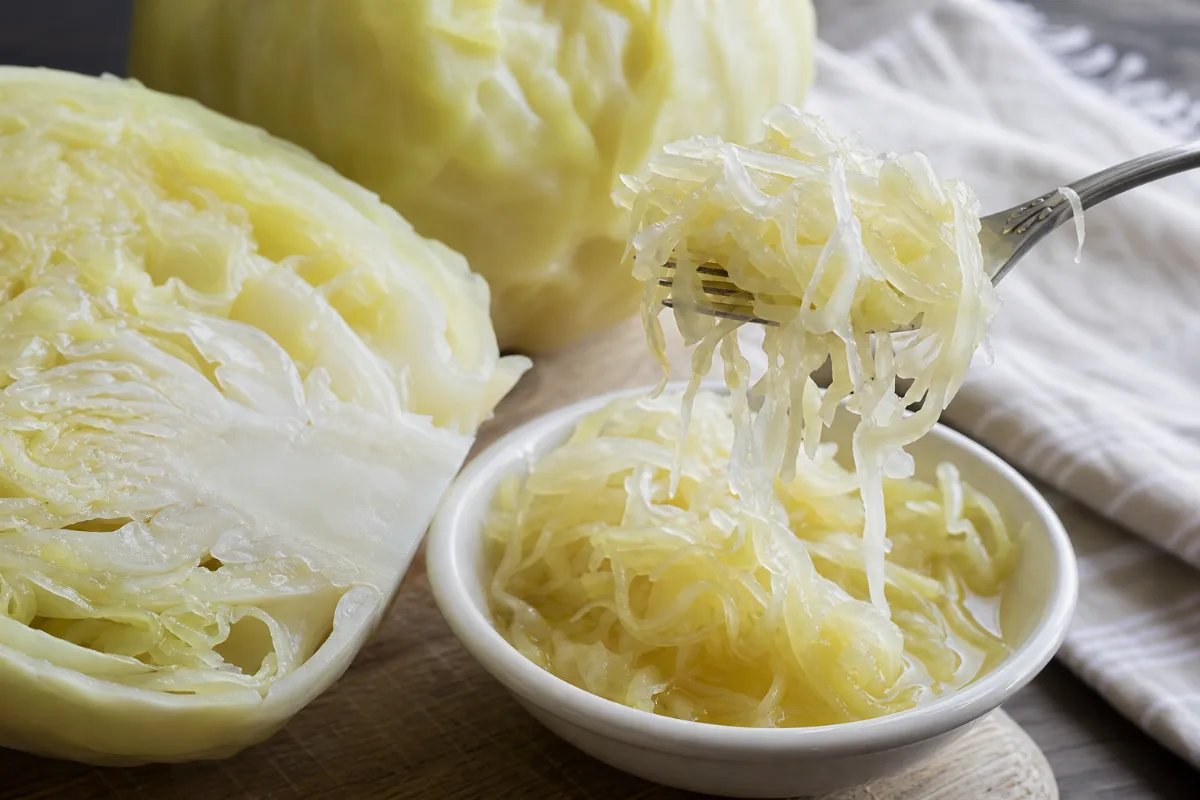
Brassica oleracea (fermented cabbage) · also called Fermented cabbage, sauerkohl, chucrut
Sauerkraut is cabbage fermented in salt. In an 87-person trial, daily sauerkraut changed some gut bacteria and went with a small drop in blood pressure, but the authors found no appreciable health benefit in healthy adults over four weeks. One small pilot trial saw milder irritable bowel symptoms. The main cautions are its high salt, MAOI antidepressants and warfarin.
General information, not medical advice. Last substantive update · Not medically reviewed. A named clinician has not signed off on this page. How this page is made
About Sauerkraut
Sauerkraut is cabbage that has been fermented with salt. It is a food, not a proven remedy: the human studies are small or short, mostly in healthy people, and show changes in markers more than health outcomes.
What it is
Sauerkraut is fermented cabbage (Brassica oleracea). An expert panel of the International Scientific Association for Probiotics and Prebiotics (ISAPP) defines fermented foods as foods made through desired microbial growth and enzymatic conversions of food components.
USDA data for canned sauerkraut (solids and liquids), per 100 g: 19 kcal, 0.91 g protein, 4.28 g carbohydrate, 2.9 g fibre, 661 mg sodium, 14.7 mg vitamin C, 13 micrograms vitamin K, 30 mg calcium and 1.47 mg iron. One cup drained (142 g) has about 27 kcal, 4.1 g fibre and 939 mg sodium. Fresh, jarred and home-made products differ, so check the label.
Fresh or pasteurized: does it matter?
Fresh (unpasteurized) sauerkraut can contain live microbes. Pasteurized sauerkraut is heat-treated, so live microbes are not expected. In the 87-person trial, both types changed some single gut bacteria species and both went with a small fall in systolic blood pressure. Pasteurized sauerkraut changed gut bacteria more, and only it raised blood short-chain fatty acids. In the irritable bowel pilot, both types gave similar symptom changes.
So live microbes were not required for the changes seen. A fermented food is not automatically a probiotic: the ISAPP panel defines a probiotic as live microorganisms that, in adequate amounts, give a health benefit.
What the research shows
The best evidence is a randomised crossover trial in 87 healthy adults who ate fresh and pasteurized sauerkraut daily for four weeks each. Single gut bacterial species changed, more so with pasteurized. The authors conclude that the gut microbiome of healthy people is rather resilient to short-term diet changes. A second report from the trial (100 g a day) saw a small fall in systolic blood pressure, no change in a gut barrier marker, and only modest changes in some inflammation and blood sugar markers in subgroups. The authors concluded that four weeks of daily sauerkraut was not linked to an appreciable systemic health benefit in healthy people.
A pilot trial of 34 adults with irritable bowel syndrome saw symptom scores improve over six weeks in both pasteurized and unpasteurized groups. The authors call it underpowered, and there was no group that ate no sauerkraut.
Two small athlete studies (10 days of daily pasteurized sauerkraut, with no comparison group) gave mixed results: the first saw gut bacteria changes, and the follow-up in 11 men did not repeat them. A case-control study of Polish-born women linked more raw or short-cooked cabbage and sauerkraut foods with lower breast cancer risk, but cabbage and sauerkraut were counted together and this type of study cannot show cause.
At a glance
Traditional uses history, not proof
- Eaten as a fermented cabbage food in many cuisines
- Long use as food is not proof that it treats any condition
Studied for research
- Fibre, vitamin C and vitamin K, high certainty for the nutrient content of the canned product
- Blood pressure, very low certainty (one trial, healthy adults)
- Irritable bowel syndrome symptoms, very low certainty (small pilot, no sauerkraut-free group)
- Gut bacteria, low certainty that they change; not shown to be a benefit
- Short-chain fatty acids in blood, low certainty (pasteurized sauerkraut only)
- Inflammation, gut barrier and blood sugar markers, low certainty of little effect
- Breast cancer risk, very low certainty (observational, cabbage and sauerkraut together)
Main compounds
- Dietary fibre
- Vitamin C
- Vitamin K
- Sodium (salt)
- Lactic acid bacteria (in unpasteurized sauerkraut)
- Biogenic amines such as tyramine and histamine
Common forms
- Canned sauerkraut, solids and liquids (USDA values read)
- Fresh or refrigerated (unpasteurized) and pasteurized sauerkraut, as compared in a 2025 trial
- Home-made, jarred and flavoured sauerkraut (values not read)
- Probiotic supplements are different products and are not covered
Research links: 2025 trial: sauerkraut and the gut microbiome (87 adults) · 2026 report: sauerkraut, blood pressure and inflammation · 2018 pilot trial: sauerkraut in irritable bowel syndrome · Research Library · Genes & Biomarkers Library
What it is and its history
- Accepted scientific name
- Not a single species: a food made by fermenting cabbage (Brassica oleracea) in salt
- Naming authority
- Brassica oleracea L. is the accepted name in GBIF; 'Brassica oleracea var. capitata L.' (the head cabbage variety) is listed there as a synonym.
- Synonyms
- Brassica oleracea var. capitata L. (GBIF synonym)
- Common names
- Sauerkraut (English); Fermented cabbage (English); Sauerkohl (German); Chucrut (Spanish)
- Family or group
- Brassicaceae (the cabbage or mustard family), per GBIF, for the cabbage it is made from.
- Classification
- Plantae > Tracheophyta > Magnoliopsida > Brassicales > Brassicaceae > Brassica > Brassica oleracea
- Native range
- Not verified from a source read.
- What it looks like
- Leaves: Sold as shredded fermented cabbage leaves.; Fruit: USDA's household portions are 1 cup drained (142 g) and 1 cup undrained (236 g).
- Cultivation
- Not verified from a source read.
- Harvest and processing
- Sauerkraut is cabbage fermented with salt. The nutrient summary lists fresh or refrigerated (unpasteurized), pasteurized and canned forms. The 2025 trial compared fresh and pasteurized sauerkraut. Methods, salt levels and times were not read from a source, and this page gives no fermenting instructions.
- Look-alikes and adulterants
- Name: Kimchi; Note: Another fermented cabbage food with different ingredients; it has its own page.; Name: Pickles made with vinegar; Note: Vinegar pickles are not fermented in the same way; see the related pickles page.; Name: Probiotic supplements; Note: The ISAPP panel separates fermented foods from probiotics; a fermented food is not automatically a probiotic.
- Sustainability and conservation
- Not assessed.
Photographs
What is inside, and how it may work
What it contains and how those compounds act in cells and animals. Laboratory and animal mechanisms are not proven effects in people.
Main compounds
| Compound | Family | Where it is concentrated | Activity studied | Level of evidence |
|---|---|---|---|---|
| Dietary fibre | carbohydrate | Cabbage leaf USDA per 100 g (canned): 2.9 g | Fibre may feed gut bacteria. The IBS-trial authors suggest prebiotic content could explain symptom changes, but this was not tested. 15 4 | Human data |
| Vitamin C | vitamin | Cabbage leaf USDA per 100 g (canned): 14.7 mg | A nutrient present in the food; no sauerkraut trial of vitamin C status was read. 15 | Lab |
| Vitamin K (phylloquinone) | vitamin | Cabbage leaf USDA per 100 g (canned): 13 micrograms | Matters for people on warfarin, per MedlinePlus. 15 13 | Human data |
| Sodium (salt) | mineral | Added during making USDA per 100 g (canned): 661 mg | High salt content is the best-documented safety issue; see the Safety tab. 15 11 | Human data |
| Lactic acid bacteria and other microbes | microorganisms | Present in fresh (unpasteurized) sauerkraut; not expected after pasteurization Not found in the abstracts read | Fresh and pasteurized sauerkraut both changed gut markers in the 2025 trial, so live microbes were not required for the changes seen. The IBS pilot also found no difference between the two. 7 4 3 | Human data |
| Biogenic amines (histamine, tyramine) | amines | Made by microbes during fermentation Not found for sauerkraut in the abstracts read | Can raise blood pressure or cause headache in sensitive people or people on MAOIs; amounts vary by product. 6 9 | Lab |
Mechanisms, receptors and pathways
| Target or pathway | Gene or receptor | What was found | Level |
|---|---|---|---|
| Gut microbiome | Not applicable | Daily sauerkraut changed single bacterial species and, with pasteurized sauerkraut only, raised blood short-chain fatty acids. The authors conclude the healthy microbiome is rather resilient. 7 | Human data |
| Blood pressure | Not specified | Both fresh and pasteurized sauerkraut went with a small fall in systolic blood pressure; the authors conclude live bacteria are not essential. How it happens was not shown. 8 | Human data |
| Prebiotic effect (hypothesis) | Not applicable | The IBS-trial authors suggest the symptom improvement may owe more to prebiotic content than to live bacteria. They did not test this. 4 | Hypothesis |
| Amine formation in fermentation | Not applicable | Microbes make biogenic amines from amino acids during fermentation; levels depend on the food. 6 | Lab |
Absorption, metabolism and elimination
- Absorption
- Not found for sauerkraut nutrients or microbes.
- Distribution
- Not found.
- Metabolism
- Not found.
- Elimination
- Not found.
- Bioavailability
- Not established.
Isolated compounds versus whole extracts
Every result here is for sauerkraut eaten as a food, fresh or pasteurized. No supplement or extract was tested. The trial found changes with the heat-treated product too, so live microbes were not required for the changes seen. A fermented food is not automatically a probiotic: the ISAPP panel defines a probiotic as live microorganisms that, in adequate amounts, give a health benefit.
Nutritional composition
Nutrition from USDA FoodData Central, canned sauerkraut, solids and liquids (FDC 169279, SR Legacy, April 2018 release; values read 2026-10-26 from the project's saved copy of the USDA data). Per 100 g: 19 kcal, 0.91 g protein, 0.14 g fat, 4.28 g carbohydrate (1.78 g sugars), 2.9 g fibre, 661 mg sodium, 170 mg potassium, 30 mg calcium, 1.47 mg iron, 13 mg magnesium, 14.7 mg vitamin C, 13 micrograms vitamin K, 0.1 mg copper, 0.15 mg manganese, 24 micrograms folate and 0.13 mg vitamin B6. One typical USDA portion of 1 cup drained (142 g; the 100 g values multiplied by 1.42): about 27 kcal, 1.3 g protein, 4.1 g fibre, 939 mg sodium, 20.9 mg vitamin C and 18.5 micrograms vitamin K. 1 cup undrained is 236 g. This is a canned product; sodium, vitamin C and other values differ in fresh, jarred and home-made sauerkraut, so check the label. For comparison, the 2026 blood-pressure trial used 100 g a day. This page gives no amount to eat.
1 high certainty3 low certainty3 very low certainty
What was looked at
The 7 benefits and uses checked for Sauerkraut, each with how strong the evidence is. Tap one to open it.
- Everyday nutrients: fibre, vitamin C and vitamin K (nutrient content)High certainty
- Blood pressure (healthy adults, small fall)Very low certainty
- Irritable bowel syndrome symptoms (small pilot trial)Very low certainty
- Gut bacteria (changes in single species)Low certainty
- Short-chain fatty acids in the bloodLow certainty
- Inflammation, gut barrier and blood sugar markers (little effect)Low certainty
- Breast cancer risk (observational, cabbage and sauerkraut together)Very low certainty
Lab markers tracked in the studies
Systolic blood pressureIBS Symptom Severity Score (IBS-SSS)Serum short-chain fatty acidsGut barrier ('leaky gut') markers
What is Sauerkraut good for?
The main studied uses and how strong the human evidence is for each. Most results come from one 87-person trial in healthy adults, and they are lab and blood markers, not proof of health benefit.
Benefits, one by one
Each card is a research question, not a promise. Tap a goal to filter. Open a card to see the studies, doses and limits.
Everyday nutrients: fibre, vitamin C and vitamin K (nutrient content)
High certaintyCanned sauerkraut has 2.9 g of fibre, 14.7 mg of vitamin C and 13 micrograms of vitamin K per 100 g, according to USDA. It is also very salty. This is about what is in the food, not a health effect.
2 studiesCanned sauerkraut, solids and liquids (USDA). Fresh, refrigerated, ja…
Studies, doses and limits
What the trials found
No trial was read showing that eating sauerkraut corrects a low vitamin or fibre intake.
Results
Per 100 g of canned sauerkraut (solids and liquids): 19 kcal, 0.91 g protein, 2.9 g fibre, 14.7 mg vitamin C (16% of the Daily Value), 13 micrograms vitamin K (11%), 0.1 mg copper (11%), 1.47 mg iron (8%) and 661 mg sodium (29%).
Effect sizes as reported
USDA values per 100 g, canned sauerkraut, solids and liquids; see the Safety tab for sodium.
Why this rating
High that the canned product contains these nutrients (USDA data). It says nothing about a health effect, and fresh or home-made sauerkraut can differ, especially in salt.
Form and dose studied
Canned sauerkraut, solids and liquids (USDA). Fresh, refrigerated, jarred and home-made products were not read.
Who was studied
General adult diet.
Limits
Nutrient facts, not trials. One canned USDA record; brands differ, and cooking or draining changes the values.
Why researchers looked
Sauerkraut is cabbage, so it brings cabbage's fibre and vitamins to a meal. Salt is used to make it.
Traditional use
Sauerkraut is eaten as a food in many cuisines. Long use as food is not proof that it treats any condition.
Proposed mechanism Nutrient database
These are nutrient amounts in the food, taken from a USDA table.
A proposed mechanism does not show that the effect happens in people.
Sodium is high; see the Safety tab. Vitamin K matters for people on warfarin.
Blood pressure (healthy adults, small fall)
Very low certaintyIn a four-week crossover trial of 87 healthy adults, eating 100 g a day of fresh or pasteurized sauerkraut went with a small drop in the upper blood pressure number (systolic). The study did not clearly include a group eating no sauerkraut, so the cause is not proved.
1 studiesFresh and pasteurized sauerkraut as food, 100 g a day in the trial. T…
Studies, doses and limits
What the trials found
A randomised crossover trial in 87 healthy adults, 100 g a day of fresh and of pasteurized sauerkraut for four weeks each, with a four-week washout before each phase. Both were linked to a small reduction in systolic blood pressure.
Results
A small fall in systolic blood pressure after both types. The abstract gives no size. The authors concluded that four weeks of daily sauerkraut was not linked to an appreciable systemic health benefit in healthy people.
Effect sizes as reported
Small reduction in systolic blood pressure; the abstract gives no number.
Why this rating
Very low. One trial, healthy people, four weeks, no size given in the abstract, and no sauerkraut-free control group described. It does not show that sauerkraut lowers blood pressure in people with high blood pressure.
Form and dose studied
Fresh and pasteurized sauerkraut as food, 100 g a day in the trial. This is a study detail, not advice.
Who was studied
Healthy adults.
Limits
Healthy people with normal pressure; short; comparison was before versus after within each phase; funding and registration not stated in the abstract.
Why researchers looked
Fermented foods have been proposed to affect blood pressure, blood sugar and inflammation, but good evidence is scarce.
Traditional use
Sauerkraut is eaten as a food in many cuisines. Long use as food is not proof that it treats any condition.
Proposed mechanism Authors interpretation
Not shown. The authors say live bacteria are not essential for the blood-pressure change, because it appeared with pasteurized sauerkraut too.
A proposed mechanism does not show that the effect happens in people.
Sauerkraut is high in sodium; see the Safety tab.
Irritable bowel syndrome symptoms (small pilot trial)
Very low certaintyIn a small Norwegian pilot trial of 34 people with irritable bowel syndrome (IBS), symptom scores improved over six weeks of daily sauerkraut. Both pasteurized and unpasteurized sauerkraut did the same. There was no group without sauerkraut, so this is a hint, not proof.
1 studiesPasteurized and unpasteurized lacto-fermented sauerkraut as a food ad…
Studies, doses and limits
What the trials found
A randomised, double-blinded pilot trial in 34 adults with IBS, given either pasteurized (15) or unpasteurized (19) sauerkraut as a daily addition to the diet for 6 weeks. IBS symptom severity scores improved significantly in both groups, with no difference between them.
Results
Mean change in IBS-SSS (symptom severity score) was -38.57 with pasteurized and -56.99 with unpasteurized sauerkraut. Gut bacteria composition changed in both groups.
Effect sizes as reported
IBS-SSS change -38.57 (standard error 17.08, pasteurized) and -56.99 (16.92, unpasteurized); P under 0.04 for improvement within each group.
Why this rating
Very low. A pilot of 34 people that the authors call underpowered, with no group that ate no sauerkraut, so the change could come from other causes. Only one such trial was found.
Form and dose studied
Pasteurized and unpasteurized lacto-fermented sauerkraut as a food addition for 6 weeks. Not advice.
Who was studied
Adults with IBS in Norway.
Limits
Underpowered, no non-sauerkraut group, short, funding and registration not stated in the abstract. A symptom change of this size may be within what a placebo can give.
Why researchers looked
Sauerkraut contains lactic acid bacteria and fibre, and gut symptoms are what many people hope fermented foods will help.
Traditional use
Sauerkraut is eaten as a food in many cuisines. Long use as food is not proof that it treats any condition.
Proposed mechanism Authors interpretation
The authors suggest the effect may owe more to prebiotic content of the sauerkraut than to live bacteria. This is their interpretation, not a shown mechanism.
A proposed mechanism does not show that the effect happens in people.
Gut side effects such as bloating were reported in other small sauerkraut studies; see the Safety tab. People with IBS should ask a clinician.
Gut bacteria (changes in single species)
Low certaintyIn a four-week trial of 87 healthy adults, eating sauerkraut changed some single kinds of gut bacteria, more so with the pasteurized kind. The authors concluded the healthy gut ecosystem is fairly resilient. Two small athlete studies gave mixed results.
3 studiesFresh and pasteurized sauerkraut as food. The athlete studies used pa…
Studies, doses and limits
What the trials found
87 healthy adults ate fresh or pasteurized sauerkraut daily for 4 weeks (crossover). Single bacterial species changed after both, more with pasteurized. In two small athlete studies without a comparison group, one (10 days) saw gut bacteria changes and the follow-up in 11 men did not repeat the short-term findings but saw changes a month later.
Results
Changes in single species, not a change in the whole ecosystem. Because pasteurized sauerkraut (heat-treated, so live microbes are not expected) changed more than fresh, live microbes were not required for the changes seen. Changes in gut bacteria do not by themselves show a health benefit.
Effect sizes as reported
No numbers in the abstracts.
Why this rating
Low for 'sauerkraut changes some gut bacteria in healthy adults' (one randomised crossover trial of 87 people). Very low that this is a benefit: it is a lab marker, the athlete studies were tiny and uncontrolled, and the follow-up did not repeat the first.
Form and dose studied
Fresh and pasteurized sauerkraut as food. The athlete studies used pasteurized organic sauerkraut. No supplement was tested.
Who was studied
Healthy adults; healthy active athletes in the two pilots.
Limits
Healthy people only, short trials, lab markers only, no non-sauerkraut group described in the main trial, funding not stated in the abstracts.
Why researchers looked
Sauerkraut is a fermented food and has been suspected of a good effect on the gut microbiome, but evidence is sparse.
Traditional use
Sauerkraut is eaten as a food in many cuisines. Long use as food is not proof that it treats any condition.
Proposed mechanism Authors interpretation
Not established. Authors of the athlete study say it is unclear whether effects come from the sauerkraut's own microbes or its other parts. The IBS authors suggest prebiotic content.
A proposed mechanism does not show that the effect happens in people.
Gut side effects were reported in the athlete follow-up; see the Safety tab.
Short-chain fatty acids in the blood
Low certaintyOnly pasteurized sauerkraut raised blood short-chain fatty acids in the 87-person trial. These are substances made when gut bacteria digest fibre. Fresh sauerkraut did not.
1 studiesPasteurized sauerkraut as food. Not advice.
Studies, doses and limits
What the trials found
In the 87-person crossover trial, serum short-chain fatty acids rose only after pasteurized sauerkraut.
Results
An increase in blood short-chain fatty acids with pasteurized, not fresh, sauerkraut. It is a marker, not a health outcome.
Effect sizes as reported
No numbers in the abstract.
Why this rating
Low as a lab finding (one randomised crossover trial). It is a biomarker, and whether it means anything for health was not shown.
Form and dose studied
Pasteurized sauerkraut as food. Not advice.
Who was studied
Healthy adults.
Limits
One trial, healthy people, a marker only, size not given in the abstract.
Why researchers looked
Short-chain fatty acids are made by gut bacteria and are often used as a marker of how the gut ecosystem is working.
Traditional use
Sauerkraut is eaten as a food in many cuisines. Long use as food is not proof that it treats any condition.
Proposed mechanism None found
Not shown. The trial measured the blood level but the abstract gives no reason why only pasteurized sauerkraut raised it.
A proposed mechanism does not show that the effect happens in people.
None specific.
Inflammation, gut barrier and blood sugar markers (little effect)
Low certaintyIn a second report on 87 healthy adults, sauerkraut did not change a marker of gut barrier health. Only modest changes in some inflammation and blood sugar markers showed up after splitting people into groups. The authors saw no appreciable health benefit over four weeks.
1 studiesFresh and pasteurized sauerkraut as food. Not advice.
Studies, doses and limits
What the trials found
87 healthy adults ate 100 g a day of fresh and of pasteurized sauerkraut for four weeks each. Gut barrier integrity did not change. Modest changes in some inflammation and glycemic markers appeared in subgroups by age, estimated fibre intake, and to a lesser extent BMI and sex.
Results
Mostly null for the main markers. Subgroup findings are exploratory.
Effect sizes as reported
No numbers in the abstract.
Why this rating
Low that there is no appreciable effect in healthy adults over four weeks (one trial). The subgroup findings are exploratory and not reliable evidence of benefit. Nothing was shown for people with diabetes or inflammatory disease.
Form and dose studied
Fresh and pasteurized sauerkraut as food. Not advice.
Who was studied
Healthy adults.
Limits
Healthy people, one trial, subgroup analyses, effect sizes not given in the abstract.
Why researchers looked
Fermented foods have been proposed to improve blood sugar control and inflammation, possibly by strengthening the gut barrier.
Traditional use
Sauerkraut is eaten as a food in many cuisines. Long use as food is not proof that it treats any condition.
Proposed mechanism Authors interpretation
The idea that fermented foods strengthen the gut barrier was not supported by this trial.
A proposed mechanism does not show that the effect happens in people.
None specific.
Breast cancer risk (observational, cabbage and sauerkraut together)
Very low certaintyIn a small study of Polish-born women in the US, women who ate more raw or short-cooked cabbage and sauerkraut foods, as teens or adults, had lower breast cancer risk. Cabbage and sauerkraut were counted together, and this kind of study cannot show cause.
1 studiesCabbage and sauerkraut foods by servings a week. Not advice.
Studies, doses and limits
What the trials found
A case-control study of 131 women with invasive breast cancer and 284 controls. Higher intake of total and of raw or short-cooked cabbage/sauerkraut foods went with a significantly lower risk. Long-cooked cabbage/sauerkraut was eaten little and was not significantly linked.
Results
High versus low total intake: OR 0.36 (95% CI 0.18 to 0.71) for adolescence, and 0.50 (0.23 to 1.06, not significant) for adulthood. Raw or short-cooked: OR 0.35 (0.16 to 0.72) and 0.37 (0.17 to 0.78). High in both life stages: OR 0.23 (0.07 to 0.65).
Effect sizes as reported
Odds ratios 0.23 to 0.50 for high versus low intake; see results.
Why this rating
Very low. A small case-control study with remembered diet, cabbage and sauerkraut grouped, and one migrant group. It shows a link and cannot show that sauerkraut protects.
Form and dose studied
Cabbage and sauerkraut foods by servings a week. Not advice.
Who was studied
Polish-born women living in Cook County and Detroit, aged 20 to 79.
Limits
Recall bias, small numbers, foods grouped so sauerkraut is not isolated, no trial.
Why researchers looked
Breast cancer is less common in Poland than in the US, and cabbage and sauerkraut are common Polish foods.
Traditional use
Cabbage and sauerkraut are traditional foods in Poland. Long use as food is not proof that it treats any condition.
Proposed mechanism Authors interpretation
Not shown by this study. The authors point to cruciferous vegetables as a possible protective factor.
A proposed mechanism does not show that the effect happens in people.
None specific. This is not a cancer treatment or prevention claim.
Connections to the rest of health
How Sauerkraut connects to the rest of our health knowledge graph. Every link says what kind of connection it is. A safety link (for example to the liver) is a warning, not a benefit. A study that merely mentions a topic never creates a benefit link.
Explore every connection: goals, body systems, organs, symptoms, genes
A. Wellness goals
| Connected to | Kind of connection | Evidence status | Context | Studies |
|---|---|---|---|---|
| Preventive Wellness | High certainty | Everyday nutrients: fibre, vitamin C and vitamin K (nutrient content): Canned sauerkraut has 2.9 g of fibre, 14.7 mg of vitamin C and 13 micrograms of vitamin K per 100 g, according to USDA. It is also very salty. This is about what is in the food, not a health effect. | 15 13 | |
| Gut Digestive Health | High certainty | Everyday nutrients: fibre, vitamin C and vitamin K (nutrient content): Canned sauerkraut has 2.9 g of fibre, 14.7 mg of vitamin C and 13 micrograms of vitamin K per 100 g, according to USDA. It is also very salty. This is about what is in the food, not a health effect. | 15 13 | |
| Heart Health | Very low certainty | Blood pressure (healthy adults, small fall): In a four-week crossover trial of 87 healthy adults, eating 100 g a day of fresh or pasteurized sauerkraut went with a small drop in the upper blood pressure number (systolic). The study did not clearly include a group eating no sauerkraut, so the cause is not proved. | 8 | |
| Gut Digestive Health | Very low certainty | Irritable bowel syndrome symptoms (small pilot trial): In a small Norwegian pilot trial of 34 people with irritable bowel syndrome (IBS), symptom scores improved over six weeks of daily sauerkraut. Both pasteurized and unpasteurized sauerkraut did the same. There was no group without sauerkraut, so this is a hint, not proof. Gut bacteria (changes in single species): In a four-week trial of 87 healthy adults, eating sauerkraut changed some single kinds of gut bacteria, more so with the pasteurized kind. The authors concluded the healthy gut ecosystem is fairly resilient. Two small athlete studies gave mixed results. | 4 7 2 10 | |
| Blood Sugar Balance | Low certainty | Inflammation, gut barrier and blood sugar markers (little effect): In a second report on 87 healthy adults, sauerkraut did not change a marker of gut barrier health. Only modest changes in some inflammation and blood sugar markers showed up after splitting people into groups. The authors saw no appreciable health benefit over four weeks. | 8 | |
| Healthy Aging | Very low certainty | Breast cancer risk (observational, cabbage and sauerkraut together): In a small study of Polish-born women in the US, women who ate more raw or short-cooked cabbage and sauerkraut foods, as teens or adults, had lower breast cancer risk. Cabbage and sauerkraut were counted together, and this kind of study cannot show cause. | 5 |
B. Body systems
| Connected to | Kind of connection | Evidence status | Context | Studies |
|---|---|---|---|---|
| Digestive System | Biological association | High certainty | Studied for: Everyday nutrients: fibre, vitamin C and vitamin K (nutrient content) Studied for: Irritable bowel syndrome symptoms (small pilot trial) | 15 13 4 7 2 10 |
| Cardiovascular System | Biological association | Very low certainty | Studied for: Blood pressure (healthy adults, small fall) | 8 |
| Immune System | Biological association | Low certainty | Studied for: Inflammation, gut barrier and blood sugar markers (little effect) | 8 |
| Endocrine System | Biological association | Low certainty | Studied for: Inflammation, gut barrier and blood sugar markers (little effect) | 8 |
| Reproductive System | Biological association | Very low certainty | Studied for: Breast cancer risk (observational, cabbage and sauerkraut together) | 5 |
C. Body parts and organs
E. Health conditions
| Connected to | Kind of connection | Evidence status | Context | Studies |
|---|---|---|---|---|
| High blood pressure and salt limits | Adverse effect or risk | Documented risk | Canned sauerkraut has 661 mg of sodium per 100 g (29% of the Daily Value). Preparation or compound: Sodium in sauerkraut |
15 11 |
I. Biomarkers
| Connected to | Kind of connection | Evidence status | Context | Studies |
|---|---|---|---|---|
| Systolic blood pressure | Biological association | Very low certainty | Measured in trials: lowered. A lab change is not the same as a health benefit. | 8 |
| IBS Symptom Severity Score (IBS-SSS) | Biological association | Very low certainty | Measured in trials: lowered. A lab change is not the same as a health benefit. | 4 |
| Serum short-chain fatty acids | Biological association | Low certainty | Measured in trials: raised. A lab change is not the same as a health benefit. | 7 |
| Gut barrier ('leaky gut') markers | Biological association | Low certainty | Measured in trials: no-change. A lab change is not the same as a health benefit. | 8 |
K. Biological pathways
| Connected to | Kind of connection | Evidence status | Context | Studies |
|---|---|---|---|---|
| Vitamin K | Preliminary mechanism | Human | Sauerkraut contains vitamin K, which matters for people on warfarin. | 15 13 |
| Sodium | Preliminary mechanism | Human | Canned sauerkraut is high in sodium. | 15 11 |
| Short-chain fatty acids | Preliminary mechanism | Human | Raised in blood only after pasteurized sauerkraut in one trial. | 7 |
L. Active compounds
| Connected to | Kind of connection | Evidence status | Context | Studies |
|---|---|---|---|---|
| Dietary fibre | Biological association | Human | Fibre may feed gut bacteria. The IBS-trial authors suggest prebiotic content could explain symptom changes, but this was not tested. Preparation or compound: Cabbage leaf |
15 4 |
| Vitamin C | Biological association | Lab | A nutrient present in the food; no sauerkraut trial of vitamin C status was read. Preparation or compound: Cabbage leaf |
15 |
| Vitamin K (phylloquinone) | Biological association | Human | Matters for people on warfarin, per MedlinePlus. Preparation or compound: Cabbage leaf |
15 13 |
| Sodium (salt) | Biological association | Human | High salt content is the best-documented safety issue; see the Safety tab. Preparation or compound: Added during making |
15 11 |
| Lactic acid bacteria and other microbes | Biological association | Human | Fresh and pasteurized sauerkraut both changed gut markers in the 2025 trial, so live microbes were not required for the changes seen. The IBS pilot also found no difference between the two. Preparation or compound: Present in fresh (unpasteurized) sauerkraut; not expected after pasteurization |
7 4 3 |
| Biogenic amines (histamine, tyramine) | Biological association | Lab | Can raise blood pressure or cause headache in sensitive people or people on MAOIs; amounts vary by product. Preparation or compound: Made by microbes during fermentation |
6 9 |
Each connection is stored with the ingredient, the connected record, the kind of connection, the evidence status, the supporting studies, the preparation or compound involved, and a review date (last reviewed October 26, 2026).
Evidence at a glance: what changed in 4 lab markers
Tap a number to show only those markers. Counts are markers, not people.
The evidence
The research centre for Sauerkraut. Every record here was checked against PubMed or the publisher's page; we never list a study we have not verified.
Evidence by outcome
Bars show how many studies we found for each outcome, not how well it works. People are added up across trials only (reviews are not added, to avoid double counting).
How we rate evidence
High certainty
Several well-run trials or reviews agree; further research is unlikely to change the picture much.
Moderate certainty
Good trials point the same way, but some doubt remains.
Low certainty
Small, short or inconsistent trials. The finding could change with better research.
Very low certainty
Very little or very weak human data. Treat as a possibility only.
Mixed findings
Trials or reviews disagree with each other.
Not enough evidence
Not enough human research to say either way.
Evidence against
Good research found no benefit, or found harm.
We take the reviewers' own risk-of-bias and GRADE statements where they exist, and otherwise judge from study size, design, consistency, directness and whether a product matches what is sold. Many publications do not make evidence high. Method note: We started from our earlier sauerkraut page, re-checked nutrition against saved USDA FoodData Central data, read the FDA, MedlinePlus and NCCIH pages, and re-read PubMed abstracts for the trials, the case-control study and the reviews. A PubMed title search found two trials the earlier page missed (an irritable bowel pilot and a blood pressure and inflammation report), so the earlier statement that no symptom trial existed has been corrected. Only abstracts were read for studies. Items we could not verify are flagged in the research gaps.
Study library: every study we checked 15
| Study | Design | People | Product, dose, length | Result |
|---|---|---|---|---|
| Hill 2014 Expert consensus document. The International Scientific Association for Probiotics and Prebiotics consensus statement on the scope and appropriate use of the term probiotic. Nat Rev Gastroenterol Hepatol · PMID 24912386 · DOI |
Authoritative guidance n/a |
Expert panel convened in October 2013 | Not applicable |
The panel reinforced the FAO/WHO definition of probiotics as 'live microorganisms which when administered in adequate amounts confer a health benefit on the host' and called for more precise use of the term. Not applicable (Not applicable) Methods, limits and fundingOutcomes: Scope and appropriate use of the term 'probiotic' Limitations: An expert consensus, not a trial. The abstract does not name sauerkraut. Funding and conflicts: Funding is not stated in the abstract. Read: abstract |
| Karačić 2024 Short-Term Supplementation of Sauerkraut Induces Favorable Changes in the Gut Microbiota of Active Athletes: A Proof-of-Concept Study. Nutrients · PMID 39771042 · DOI |
Clinical trial |
Healthy active athletes (the number is not given in the abstract) | Organic pasteurized sauerkraut Whole food Not given in the abstract 10 days |
Significant changes in gut microbiota composition were seen, including more of several genera in the family Lachnospiraceae. The study also saw a rise in the share of lymphocytes, a fall in vitamin B12 levels, and a risk of indigestion in some athletes that resolved after seven days in all. The authors say it is unclear whether the effects come from the sauerkraut's own microbes or its other components. No numbers in the abstract (Not given in the abstract) Methods, limits and fundingOutcomes: Gut bacteria, laboratory values, bowel function Limitations: A small proof-of-concept study with no comparison group. The next study by a related group did not repeat the short-term findings. Funding and conflicts: Funding is not stated in the abstract. Read: abstract |
| Marco 2021 The International Scientific Association for Probiotics and Prebiotics (ISAPP) consensus statement on fermented foods. Nat Rev Gastroenterol Hepatol · PMID 33398112 · DOI |
Authoritative guidance n/a |
Expert panel convened in September 2019 | Not applicable |
The panel defined fermented foods and drinks as 'foods made through desired microbial growth and enzymatic conversions of food components'. It clarified the distinction between fermented foods and probiotics, and reviewed what is known on safety, risks and health benefits. Not applicable (Not applicable) Methods, limits and fundingOutcomes: Definition of fermented foods; how they differ from probiotics; safety, risks and health benefits Limitations: An expert consensus, not a trial. The abstract does not name sauerkraut. Funding and conflicts: Funding is not stated in the abstract. Read: abstract |
| Nielsen 2018 Lacto-fermented sauerkraut improves symptoms in IBS patients independent of product pasteurisation - a pilot study. Food Funct · PMID 30256365 · DOI |
Controlled trial |
34 34 Norwegian adults with irritable bowel syndrome |
Pasteurized (n=15) or unpasteurized (n=19) lacto-fermented sauerkraut, added to the daily diet Whole food Daily; the amount is not given in the abstract 6 weeks (follow-up to week 8) · vs Pasteurized versus unpasteurized sauerkraut; no group without sauerkraut |
The mean change in IBS-SSS was -38.57 with pasteurized and -56.99 with unpasteurized sauerkraut, a significant improvement in both groups (P under 0.04), with no difference between the groups. Gut bacteria composition changed in both groups. The authors say the study was underpowered and that the effect may owe more to prebiotic content than to live bacteria. IBS-SSS change -38.57 (pasteurized) versus -56.99 (unpasteurized) (The abstract gives standard errors (17.08 and 16.92), not confidence intervals) Methods, limits and fundingOutcomes: IBS Symptom Severity Score (IBS-SSS) at baseline and weeks 2, 4, 6 and 8; gut bacteria (16S sequencing) Limitations: A small pilot with no group that ate no sauerkraut, so an improvement could come from other causes, including the placebo effect. The authors call it underpowered. Short follow-up. Funding and conflicts: Funding is not stated in the abstract. Registration is not stated in the abstract. Read: abstract |
| Pathak 2021 Cabbage and Sauerkraut Consumption in Adolescence and Adulthood and Breast Cancer Risk among US-Resident Polish Migrant Women. Int J Environ Res Public Health · PMID 34682540 · DOI |
Observational |
415 Polish-born migrant women in Cook County and Detroit: 131 women with invasive breast cancer and 284 population-based controls, aged 20 to 79 |
Cabbage and sauerkraut foods, grouped together, by food frequency questionnaire Whole foods Servings a week (low, medium, high) Diet in adulthood and at age 12 to 13, by recall · vs Low versus high intake |
Higher total and raw or short-cooked cabbage/sauerkraut intake, in adolescence and in adulthood, went with lower breast cancer risk. Long-cooked cabbage/sauerkraut was eaten little and was not significantly linked to risk. The authors say the findings add to the literature suggesting a protective effect of cruciferous vegetables. High versus low total intake: OR 0.36 in adolescence and 0.50 in adulthood. Raw or short-cooked: OR 0.35 (adolescence) and 0.37 (adulthood). High in both life stages: OR 0.23. (Total, adolescence 0.18 to 0.71; total, adulthood 0.23 to 1.06 (p trend 0.08, not significant); raw or short-cooked, adolescence 0.16 to 0.72; adulthood 0.17 to 0.78; both life stages 0.07 to 0.65) Methods, limits and fundingOutcomes: Breast cancer risk (odds ratio) Limitations: A small case-control study based on remembered diet, so it can show a link but not cause, and recall can be biased. Cabbage and sauerkraut are grouped together, so it does not isolate sauerkraut. One group of migrant women. Funding and conflicts: Tagged as US National Institutes of Health (extramural) and non-US-government research support; the abstract does not give details. Read: abstract |
| Saha Turna 2024 A review of biogenic amines in fermented foods: Occurrence and health effects. Heliyon · PMID 38304783 · DOI |
Narrative review n/a |
Review of biogenic amines in fermented foods | Not applicable |
Biogenic amines form during microbial fermentation. Several fermented foods may contain histamine, tyramine or phenylethylamine at levels above documented toxic doses. High intake is linked with migraines, raised blood pressure and fast heartbeat. Harm may occur at levels a hundred times below suggested toxic doses, depending on a person's sensitivity, alcohol and certain medicines. Not applicable (Not applicable) Methods, limits and fundingOutcomes: Occurrence of histamine, tyramine and other biogenic amines in fermented foods, and their health effects Limitations: A narrative review. The abstract does not name sauerkraut, so it does not tell us how much any sauerkraut contains. Funding and conflicts: Funding is not stated in the abstract. Read: abstract |
| Schropp 2025 The impact of regular sauerkraut consumption on the human gut microbiota: a crossover intervention trial. Microbiome · PMID 39940045 · DOI |
Controlled trial |
87 87 healthy participants |
Fresh or pasteurized sauerkraut (a fermented cabbage food) Whole food Daily; the amount is not given in the abstract 4 weeks per arm · vs The other sauerkraut type (fresh versus pasteurized); no non-sauerkraut control arm is described in the abstract |
Changes in single bacterial species were seen after both fresh and pasteurized sauerkraut, and were more pronounced with pasteurized. Only pasteurized sauerkraut raised serum short-chain fatty acids. The authors conclude that the gut microbiome of healthy people is rather resilient to short-term diet changes, even though single species might be affected. No numbers in the abstract (Not given in the abstract) Methods, limits and fundingOutcomes: Gut microbial composition (shotgun metagenomic sequencing) and the blood metabolome, including serum short-chain fatty acids Limitations: Healthy adults only, four weeks. Changes in gut bacteria and blood fatty acids are lab markers, not health outcomes. The abstract names no control group that ate no sauerkraut. Funding and conflicts: Registered DRKS00027007. The abstract does not state who paid for the trial; it is tagged as non-US-government research support. Registration: DRKS00027007 Read: abstract |
| Schropp 2026 Fermented foods and inflammation: a crossover intervention trial with fresh and pasteurized sauerkraut. Eur J Clin Nutr · PMID 42321414 · DOI |
Controlled trial |
87 87 healthy participants; each had a four-week washout with no fermented foods before each phase |
Fresh and pasteurized sauerkraut Whole food 100 g a day 4 weeks per phase · vs Before-versus-after within each phase (mixed regression models); fresh versus pasteurized |
Both fresh and pasteurized sauerkraut were linked to a small reduction in systolic blood pressure. After splitting people by age, estimated fibre intake and, to a lesser extent, BMI and sex, modest changes appeared in some inflammation and blood-sugar markers. No change in gut barrier integrity was seen. The authors conclude that live bacteria are not essential for the blood-pressure effect and that four weeks of daily sauerkraut was not linked to an appreciable systemic health benefit in healthy people. Small fall in systolic blood pressure; the abstract gives no size (Not given in the abstract) Methods, limits and fundingOutcomes: Blood pressure, 'leaky gut' markers, inflammatory markers, markers of blood-sugar control Limitations: Healthy people, four weeks. The abstract does not describe a control group that ate no sauerkraut, so the blood-pressure change may not be due to sauerkraut. The abstract does not say whether these are the same participants as the 2025 gut report, and it does not give effect sizes. Subgroup changes were modest. Funding and conflicts: Funding is not stated in the abstract. Registration is not stated in the abstract. Read: abstract |
| Van den Eynde 2022 The Prescriber's Guide to the MAOI Diet-Thinking Through Tyramine Troubles. Psychopharmacol Bull · PMID 35721816 · DOI |
Narrative review n/a |
Review of dietary advice for people taking classic MAOIs or high-dose selegiline | Not applicable |
MAOIs change the body's ability to break down tyramine, which causes dose-related rises in blood pressure. Modern food production has greatly lowered tyramine in most foods, so the risk is considerably reduced, but some caution remains. Tyramine levels vary widely within a food type, so tables are imprecise, and people respond very differently. The authors conclude that the MAOI diet is not hard and that minimizing a small number of risky foods is all that is required. Not applicable (Not applicable) Methods, limits and fundingOutcomes: Tyramine, blood pressure and the MAOI diet Limitations: A narrative review. The abstract does not name sauerkraut. Funding and conflicts: Funding is not stated in the abstract. Read: abstract |
| Zonjić 2025 The Short- and Long-Term Effects of a Short Course of Sauerkraut Supplementation on the Gut Microbiota of Active Athletes: A Pilot Follow-Up Study. Nutrients · PMID 40077799 · DOI |
Clinical trial |
11 11 male recreational athletes, average age 30 |
Organic pasteurized sauerkraut Whole food 250 g a day 10 days, with follow-up one month later |
The study did not repeat the earlier study's short-term findings on gut bacteria. It saw longer-term changes after a washout period. It also saw a temporary fall in vitamin B12 levels and a short- and long-term rise in white blood cells (leukocytes). Gut side effects such as bloating, diarrhea, pain, nausea and constipation became more common. The authors suggest a seven-day adaptation period. No numbers in the abstract (Not given in the abstract) Methods, limits and fundingOutcomes: Gut bacteria, laboratory values, bowel function and side effects Limitations: Only 11 men, no comparison group, and the main short-term finding was not repeated. Results cannot be taken to apply to women, older adults or people with gut disease. Funding and conflicts: Funding is not stated in the abstract. Read: abstract |
| s-fda-sodium US FDA: Sodium in Your Diet · Source |
Health agency n/a |
Methods, limits and fundingRead: full-text | ||
| s-gbif-brassica-oleracea GBIF Backbone: Brassica oleracea L. (usageKey 3042845) · Source |
Reference database n/a |
Methods, limits and fundingRead: full-text | ||
| s-medlineplus-vitk MedlinePlus: Vitamin K in diet · Source |
Health agency n/a |
Methods, limits and fundingRead: full-text | ||
| s-nccih-probiotics NCCIH: Probiotics: Usefulness and Safety · Source |
Health agency n/a |
Methods, limits and fundingRead: full-text | ||
| s-usda-fdc-169279 USDA FoodData Central: Sauerkraut, canned, solids and liquids (FDC 169279), SR Legacy April 2018 · Source |
Reference database n/a |
Methods, limits and fundingRead: full-text |
What we do not know yet
- Only one trial each was found for blood pressure and for irritable bowel symptoms, and neither clearly included a group that ate no sauerkraut.
- The long-term effect of daily sauerkraut, including its salt, was not studied; the longest trial read was six weeks.
- The athlete studies are very small, and the follow-up did not repeat the first one's short-term findings.
- Tyramine and histamine levels in sauerkraut itself, pregnancy, breastfeeding, young children, home-fermenting food safety and cabbage allergy were not researched.
- The 2026 report does not say whether its 87 participants are the same people as the 2025 gut trial.
How new research is added
New studies are found by a saved PubMed search and placed in a review queue before the page changes.
Lab markers
What changed in blood or saliva tests during trials. A changed number is not the same as feeling or being healthier, and we give no "normal ranges".
Other 4
Systolic blood pressure
Lowered in trials
The upper number in a blood pressure reading, the pressure when the heart beats.
Very low certaintyResults and what it means
Why it was measured
High blood pressure raises the risk of heart disease and stroke.
Statistical vs. clinical meaning
A small change in healthy people, with no sauerkraut-free control group described in the abstract.
Safety implication
None specific. Sauerkraut is high in sodium.
| Study | Result | People | Product |
|---|---|---|---|
| 8 | Small reduction in systolic blood pressure with both fresh and pasteurized sauerkraut; size not given in the abstract | 87 healthy adults | 100 g a day of sauerkraut, 4 weeks per phase |
IBS Symptom Severity Score (IBS-SSS)
Lowered in trials
A questionnaire score of how bad irritable bowel syndrome symptoms are. A lower score means milder symptoms.
Very low certaintyResults and what it means
Why it was measured
It is the standard way to track IBS symptoms over time.
Statistical vs. clinical meaning
A symptom score change in a small pilot with no sauerkraut-free group.
Safety implication
None specific.
| Study | Result | People | Product |
|---|---|---|---|
| 4 | Mean change -38.57 (pasteurized) and -56.99 (unpasteurized); improvement in both groups, no difference between them | 34 adults with IBS | Pasteurized or unpasteurized sauerkraut daily for 6 weeks |
Serum short-chain fatty acids
Raised in trials
Small fatty acids made when gut bacteria ferment fibre; some enter the blood.
Low certaintyResults and what it means
Why it was measured
They are a marker of what gut bacteria are doing.
Statistical vs. clinical meaning
A lab marker; whether the rise matters for health was not shown.
Safety implication
None specific.
| Study | Result | People | Product |
|---|---|---|---|
| 7 | Raised only after pasteurized sauerkraut; no rise with fresh; size not in the abstract | 87 healthy adults | Fresh or pasteurized sauerkraut daily for 4 weeks |
Gut barrier ('leaky gut') markers
No clear change in trials
Blood markers used to estimate how leaky the gut lining is.
Low certaintyResults and what it means
Why it was measured
Fermented foods are proposed to strengthen the gut barrier.
Statistical vs. clinical meaning
No change in healthy adults; says nothing about people with gut disease.
Safety implication
None specific.
| Study | Result | People | Product |
|---|---|---|---|
| 8 | No change in gut barrier integrity | 87 healthy adults | 100 g a day of fresh and of pasteurized sauerkraut, 4 weeks per phase |
Safety
What studies and official sources say about side effects, medicines and who should check first. Each point shows what kind of evidence it comes from.
Main points to know 4
- Sauerkraut is high in salt. USDA lists 661 mg of sodium per 100 g of canned sauerkraut, 29% of the Daily Value. One cup (142 g) has about 939 mg. The US FDA says the Daily Value for sodium is less than 2,300 mg a day, and that limits for children under 14 are lower. Fresh, jarred and home-made sauerkraut can differ, so check the label. People on a low-sodium plan, or with high blood pressure, heart or kidney disease, should ask a clinician. Authoritative guidance 15 11
- Tyramine and MAOI antidepressants. Some fermented foods contain tyramine. MAOI medicines stop the body breaking tyramine down, which can raise blood pressure. A 2022 review says modern food production has lowered tyramine in most foods, so the risk is considerably reduced, but some caution remains and people differ a lot. The review abstract does not name sauerkraut, and we found no measured tyramine level for it. If you take an MAOI, ask your prescriber or pharmacist about fermented foods. Review 9 6
- Histamine and other amines in fermented foods. A 2024 review says several fermented foods may contain histamine, tyramine or phenylethylamine, at levels that can cause migraine, higher blood pressure or fast heartbeat in sensitive people, and that alcohol and some medicines can make harm more likely. The abstract does not say how much sauerkraut contains. If you get headaches, flushing or a racing heart after fermented foods, ask a clinician. Review 6
- Vitamin K and warfarin. Sauerkraut has vitamin K (13 micrograms per 100 g, USDA). MedlinePlus says that if you take the blood thinner warfarin, sudden changes in vitamin K foods can change how the medicine works, and to ask your health care provider. No study of sauerkraut and warfarin was found. Authoritative guidance 15 13
Side effects 2
| Effect | How often | Severity and recovery | Evidence |
|---|---|---|---|
| Bloating, diarrhea, pain, nausea and constipation when starting sauerkraut daily Two small studies of healthy active athletes without a comparison group (daily pasteurized sauerkraut for 10 days; the follow-up used 250 g a day). The authors suggest a seven-day adaptation period. This is their suggestion, not medical advice. | Not quantified in the abstract. In the 11-man follow-up the incidence of these gut side effects rose; in the first athlete study some athletes had a risk of indigestion that resolved after seven days. | mild to moderate Resolved after about seven days in the first athlete study. | Observational 10 2 |
| Temporary fall in blood vitamin B12 levels and rise in white blood cells Lab values in tiny uncontrolled studies. It is not known whether they matter for health. Ask a clinician if you have a B12 concern. | Seen in both athlete studies; no numbers in the abstracts. | unknown The follow-up describes the B12 fall as transient; the white cell rise was short- and long-term. | Observational 2 10 |
Liver
No liver injury from eating sauerkraut was found in the sources read. No search of LiverTox was done for this food.
How often. No frequency was found.
Monitoring. No agency monitoring advice was found.
This is a safety connection. It is not evidence that Sauerkraut supports liver health.
Medicines and supplements 3
| With | Why it matters | Importance | Evidence | What to do |
|---|---|---|---|---|
| MAOI antidepressants (monoamine oxidase inhibitors) prescription | MAOIs reduce the body's ability to break down tyramine, a substance that can be present in fermented foods; too much can push blood pressure up. | A 2022 review says the risk from food tyramine is considerably reduced by modern food production but caution remains, and tyramine levels vary widely within a food type. Sauerkraut is not named in the abstracts read, so its own risk is not established. | Review Low certainty 9 6 | Ask your prescriber or pharmacist about fermented foods, including sauerkraut. Do not change a medicine on your own. |
| Warfarin (a blood thinner) prescription | Vitamin K in foods can change how well warfarin works. Sauerkraut contains vitamin K. | MedlinePlus says sudden changes in vitamin K intake can change warfarin's effect. No study of sauerkraut itself was found. | Authoritative guidance Low certainty 15 13 | Do not change your medicine yourself. Ask your clinic whether and how to keep your vitamin K foods steady. |
| Low-sodium plans and blood pressure or kidney medicines diet | Sauerkraut is high in salt (sodium). | Sodium amounts come from USDA and the FDA; no interaction study was read. | Authoritative guidance Moderate certainty 15 11 | If you have been told to limit salt, ask a clinician how sauerkraut fits. |
Who should check first 4
| Situation | Advice | Evidence |
|---|---|---|
| Taking an MAOI antidepressant | Ask your prescriber or pharmacist about sauerkraut and other fermented foods before eating them. | Review 9 |
| Told to limit salt (for example high blood pressure, heart or kidney disease) | Check the sodium on the label and ask a clinician how much, if any, suits you. | Authoritative guidance 15 11 |
| Taking warfarin | Ask your clinic about vitamin K foods before changing how much sauerkraut you eat. | Authoritative guidance 13 |
| Severe illness or a weakened immune system | NCCIH says the risk of harm from probiotics is greater in people with severe illness or weakened immune systems. It does not name sauerkraut. Unpasteurized sauerkraut may carry live microbes, so ask your care team. | Authoritative guidance 14 7 |
Overdose, product quality and regulators
Summary. No toxicity from sauerkraut eaten as a food was found in the sources read. The safety questions found are salt, amines and medicine interactions.
Animal. Not reviewed.
High dose or long term signals. The longest trial read was four weeks. Long-term effects of daily sauerkraut, including on blood pressure from its salt, were not studied in the sources read.
Overdose response. Not found.
Genotoxicity. Not researched.
Contamination and food-poisoning risks of commercial and home-made sauerkraut (including whether a ferment is safe to eat) were not researched.
Biogenic amines. Microbes make amines such as histamine and tyramine during fermentation, and levels vary by food and product. 6
| Body | Action | Date |
|---|---|---|
| US FDA (United States) | Sodium in Your Diet: the Daily Value for sodium is less than 2,300 mg a day; the Dietary Guidelines for Americans recommends adults limit sodium to less than 2,300 mg a day; limits for children under 14 are lower. source | 2024-03-05 |
| MedlinePlus (US National Library of Medicine) (United States) | Vitamin K in diet: people taking warfarin may need to keep vitamin K intake steady and should ask their provider. source | 2025-01-21 |
| NCCIH (US National Institutes of Health) (United States) | Probiotics: Usefulness and Safety. Risk of harm from probiotics is greater in people with severe illness or weakened immune systems. General statement about probiotics; sauerkraut is not named. source | 2019-08 |
When to get medical help
- A severe headache, a pounding or racing heartbeat, chest pain or very high blood pressure after eating fermented food while taking an MAOI: get urgent medical help.
- Trouble breathing or swelling of the face, lips or throat after eating: call 911 or your local emergency number.
- Fever, severe stomach pain or vomiting that does not stop after eating sauerkraut that may have spoiled: get medical advice.
Stop using the product and contact a clinician or emergency service. In the US, Poison Control is 1-800-222-1222.
General information only, not medical advice. Ask a clinician or pharmacist before use, especially with medicines, in pregnancy or with a health condition. See the Natural Remedy Safety guide.
Frequently asked questions
What is sauerkraut?
Does sauerkraut improve gut health?
In an 87-person trial in healthy adults, it changed some single gut bacteria species, but the authors concluded the healthy gut microbiome is fairly resilient to short-term diet changes. A change in bacteria is a lab marker, not proof of better health.
Do you need live bacteria for the effects seen?
Is sauerkraut a probiotic?
Does sauerkraut lower blood pressure?
In one trial of 87 healthy adults, both fresh and pasteurized sauerkraut went with a small fall in systolic blood pressure. The abstract gives no size and describes no sauerkraut-free comparison, so it is a hint, not proof, and the trial was in healthy people.
Can sauerkraut help irritable bowel syndrome?
One small pilot of 34 people with irritable bowel syndrome saw milder symptom scores after six weeks, with pasteurized and unpasteurized sauerkraut alike. It was underpowered and had no group without sauerkraut. Ask a clinician about your own symptoms.
Is sauerkraut high in salt?
Can I eat sauerkraut with MAOI antidepressants?
Does sauerkraut interact with warfarin?
Can sauerkraut cause bloating or other gut symptoms?
Is sauerkraut linked to a lower cancer risk?
One small case-control study of Polish-born women in the US linked more raw or short-cooked cabbage and sauerkraut foods with lower breast cancer risk. Cabbage and sauerkraut were counted together, and that type of study cannot show cause.
What does sauerkraut contain?
Per 100 g of canned sauerkraut, USDA lists 19 kcal, 2.9 g fibre, 14.7 mg vitamin C, 13 micrograms vitamin K, 1.47 mg iron and 661 mg sodium. Fresh and home-made sauerkraut can differ.
Explore by health goal
Gut Digestive HealthPreventive WellnessHeart HealthBlood Sugar BalanceHealthy Aging
Editorial transparency
- Written by
- AlternativeMed editorial team. Research compiled with AI assistance, then checked against the sources listed.
- Medical review
- None. This page has not been reviewed by a physician or pharmacist.
- First published
- 2026-10-26
- Last substantive update
- 2026-10-26
- How we research
- We started from our earlier sauerkraut page, re-checked nutrition against saved USDA FoodData Central data, read the FDA, MedlinePlus and NCCIH pages, and re-read PubMed abstracts for the trials, the case-control study and the reviews. A PubMed title search found two trials the earlier page missed (an irritable bowel pilot and a blood pressure and inflammation report), so the earlier statement that no symptom trial existed has been corrected. Only abstracts were read for studies. Items we could not verify are flagged in the research gaps.
- How we rate evidence
- See "How we rate evidence" in the Evidence tab.
- Independence
- No product is promoted on this page. No affiliate links are shown. Funding was not stated in any abstract read, so industry links could not be checked.
Sources 15
Each source was opened and checked. Where we read only the abstract, it says so. The small numbers in the text point here.
- Hill C, et al. (12 authors). Expert consensus document. The International Scientific Association for Probiotics and Prebiotics consensus statement on the scope and appropriate use of the term probiotic.. Nat Rev Gastroenterol Hepatol. 2014. PMID 24912386. DOI 10.1038/nrgastro.2014.66. (abstract)
- Karačić A, et al. (10 authors). Short-Term Supplementation of Sauerkraut Induces Favorable Changes in the Gut Microbiota of Active Athletes: A Proof-of-Concept Study.. Nutrients. 2024. PMID 39771042. DOI 10.3390/nu16244421. (abstract)
- Marco ML, et al. (13 authors). The International Scientific Association for Probiotics and Prebiotics (ISAPP) consensus statement on fermented foods.. Nat Rev Gastroenterol Hepatol. 2021. PMID 33398112. DOI 10.1038/s41575-020-00390-5. (abstract)
- Nielsen ES, et al. (8 authors). Lacto-fermented sauerkraut improves symptoms in IBS patients independent of product pasteurisation - a pilot study.. Food Funct. 2018. PMID 30256365. DOI 10.1039/c8fo00968f. (abstract)
- Pathak DR, et al. (17 authors). Cabbage and Sauerkraut Consumption in Adolescence and Adulthood and Breast Cancer Risk among US-Resident Polish Migrant Women.. Int J Environ Res Public Health. 2021. PMID 34682540. DOI 10.3390/ijerph182010795. (abstract)
- Saha Turna N, et al. (3 authors). A review of biogenic amines in fermented foods: Occurrence and health effects.. Heliyon. 2024. PMID 38304783. DOI 10.1016/j.heliyon.2024.e24501. (abstract)
- Schropp N, et al. (8 authors). The impact of regular sauerkraut consumption on the human gut microbiota: a crossover intervention trial.. Microbiome. 2025. PMID 39940045. DOI 10.1186/s40168-024-02016-3. (abstract)
- Schropp N, et al. (4 authors). Fermented foods and inflammation: a crossover intervention trial with fresh and pasteurized sauerkraut.. Eur J Clin Nutr. 2026. PMID 42321414. DOI 10.1038/s41430-026-01776-5. (abstract)
- Van den Eynde V, et al. (3 authors). The Prescriber's Guide to the MAOI Diet-Thinking Through Tyramine Troubles.. Psychopharmacol Bull. 2022. PMID 35721816. DOI 10.64719/pb.4434. (abstract)
- Zonjić J, et al. (9 authors). The Short- and Long-Term Effects of a Short Course of Sauerkraut Supplementation on the Gut Microbiota of Active Athletes: A Pilot Follow-Up Study.. Nutrients. 2025. PMID 40077799. DOI 10.3390/nu17050929. (abstract)
- . US FDA: Sodium in Your Diet. . . (full-text)
- . GBIF Backbone: Brassica oleracea L. (usageKey 3042845). . . (full-text)
- . MedlinePlus: Vitamin K in diet. . . (full-text)
- . NCCIH: Probiotics: Usefulness and Safety. . . (full-text)
- . USDA FoodData Central: Sauerkraut, canned, solids and liquids (FDC 169279), SR Legacy April 2018. . . (full-text)


