Vegetables · Vegetable
Fennel Bulb
Foeniculum vulgare · also called Florence fennel, finocchio, hinojo (Spanish)
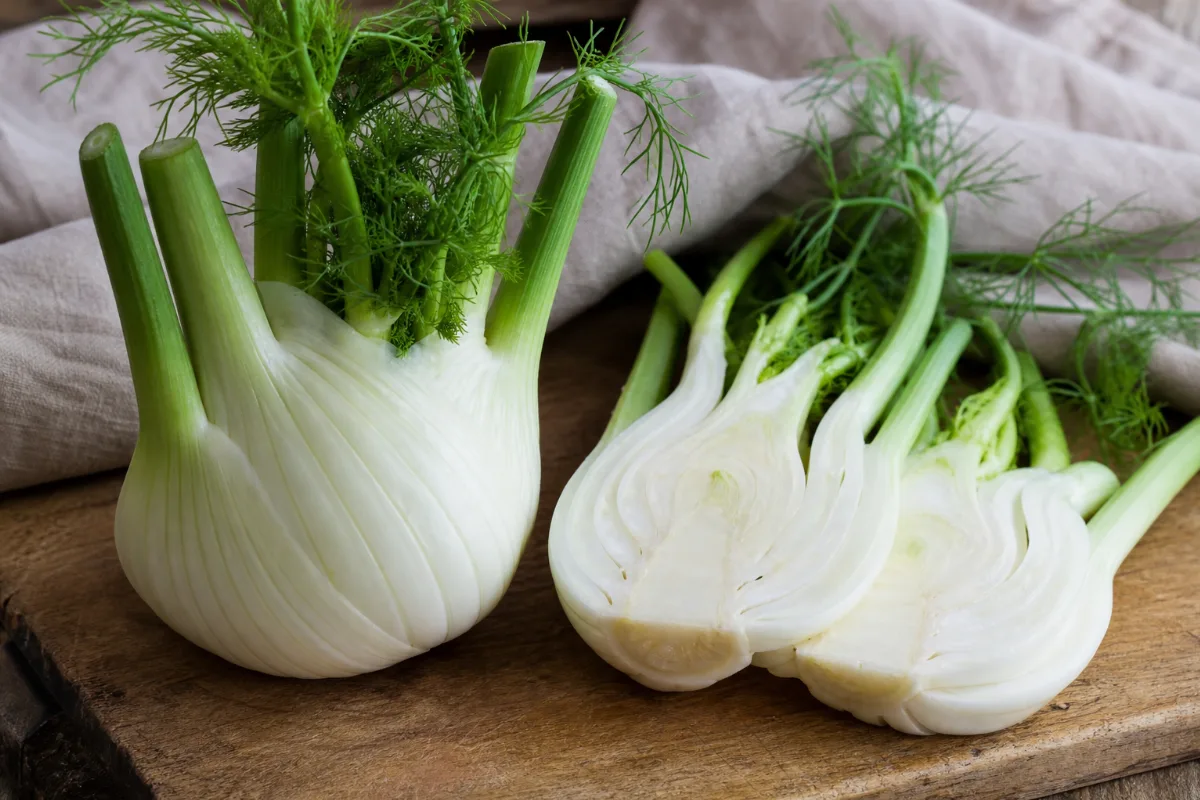
Fennel bulb is the swollen, pale base of the fennel plant, eaten raw or cooked for its mild aniseed flavour. It contains vitamin K, vitamin C, fibre and potassium. We found no human trial of eating the bulb, so health claims rest on nutrient facts and on studies of vegetables as a group. The main cautions are allergy (fennel is related to celery), warfarin (vitamin K) and potassium for people with kidney disease.
General information, not medical advice. Last substantive update · Not medically reviewed. A named clinician has not signed off on this page. How this page is made
About Fennel Bulb
Fennel bulb is a crisp, mildly sweet vegetable with vitamin K, vitamin C, fibre and potassium. It is a healthy food, not a proven remedy: no human trial of the bulb was found, and the health claims come from nutrient facts, vegetables as a group, or capsules.
What it is
Fennel bulb is the swollen base of the fennel plant (Foeniculum vulgare), in the carrot family. People eat it raw or cooked. Fennel seed, fennel tea and fennel oil come from the fruit of the same plant and are different products.
USDA data for raw bulb: 31 kcal per 100 g. One cup of sliced raw bulb (87 g) has about 27 kcal, 2.7 g fibre, 54.6 micrograms vitamin K, 10.4 mg vitamin C, 360 mg potassium and 23.5 micrograms folate (our arithmetic from the per-100 g values). One whole bulb is 234 g. Cooked values were not read.
What the research shows
The firmest facts are about nutrients: vitamin K is needed for blood to clot and vitamin C prevents scurvy. These are not trials of fennel.
Observational studies link more fruit and vegetables combined to less heart disease and longer life, but they cannot prove cause and do not single out fennel. The big eye trial tested lutein capsules, not food, and found no significant benefit.
Our PubMed searches found no human trial of fennel bulb as a food.
Food versus seed, tea, oil and capsules
Fennel seed, tea and oil are separate products. An EFSA opinion on concentrated fennel oils reports estragole up to 6.1% and classes them as suspected of causing genetic defects and cancer. That is about oil. We found no estragole figure for the bulb, so we make no claim about it. The eye trial used capsules, not food; in that trial beta carotene capsules were linked to more lung cancers in former smokers, and that finding is about capsules, not fennel.
Amounts
This page gives no amounts to eat. Ask a doctor, pharmacist or dietitian what is right for you, especially if you take warfarin or have kidney problems.
At a glance
Traditional uses history, not proof
- Eaten as a vegetable, raw in salads or cooked
- Long use as food is not proof that it treats any condition
Studied for research
- Vitamin K for normal blood clotting, high certainty for the nutrient, no fennel trial
- Vitamin C and scurvy, high certainty for the nutrient, the bulb is a modest source
- Fibre and bowel habits, insufficient evidence for the bulb itself
- Heart disease and early death (fruit and vegetables as a group), low certainty, observational
- Eye health, insufficient evidence (lutein capsule trial, not fennel)
- Bloating and other digestive claims, insufficient evidence (no trial of the bulb)
Main compounds
- Vitamin K (phylloquinone)
- Vitamin C
- Fibre
- Potassium
- Lutein and zeaxanthin
- Beta-carotene
Common forms
- Raw bulb, sliced, as food
- Cooked bulb (roasted, braised or sauteed) as food
- Fennel seed, tea and oil are different products and are not covered here
Research links: NHS: Warfarin · 2017 review: fruit and vegetable intake and heart disease, cancer and death · USDA FoodData Central: Fennel, bulb, raw · Research Library · Genes & Biomarkers Library
What it is and its history
- Accepted scientific name
- Foeniculum vulgare
- Naming authority
- Mill. (GBIF accepted)
- Common names
- Fennel bulb (English); Florence fennel (English); Finocchio (Italian); Hinojo (bulbo) (Spanish)
- Family or group
- Apiaceae (the carrot family), as given by GBIF and by the existing nutrient summary.
- Classification
- Plantae > Tracheophyta > Magnoliopsida > Apiales > Apiaceae > Foeniculum > Foeniculum vulgare
- Native range
- Not verified from a source read.
- Habitat
- Not verified from a source read.
- What it looks like
- Roots: Not verified.; Stems: Not verified.; Leaves: Not verified.; Flowers: Not verified.; Fruit: The dried fruit is the seed used as a spice, which has its own page.
- Cultivation
- Not verified from a source read. Which variety is sold as the bulb vegetable was not checked in a source.
- Harvest and processing
- The swollen base of the plant is eaten raw or cooked (existing nutrient summary). USDA gives a household portion of 1 cup sliced as 87 g and 1 bulb as 234 g. Cooking effects on nutrients were not read from a source.
- Look-alikes and adulterants
- Name: Fennel seed, fennel tea and fennel oil; Note: Made from the fruit of the same species; separate products with their own safety questions. Results for them do not carry over to the bulb.; Name: Dill, anise and celery; Note: Other plants in the carrot family with a similar look or flavour. Celery is relevant for allergy cross-reactions.
- Sustainability and conservation
- Not assessed.
Photographs
What is inside, and how it may work
What it contains and how those compounds act in cells and animals. Laboratory and animal mechanisms are not proven effects in people.
Main compounds
| Compound | Family | Where it is concentrated | Activity studied | Level of evidence |
|---|---|---|---|---|
| Vitamin K (phylloquinone) PubChem 5284607 | vitamin | Bulb USDA: 62.8 micrograms per 100 g raw | Needed for blood-clotting proteins (MedlinePlus). Affects warfarin. 16 21 19 | Human data |
| Vitamin C (ascorbic acid) PubChem 54670067 | vitamin | Bulb USDA: 12.0 mg per 100 g raw | Lack of it causes scurvy (NHS). 18 21 | Human data |
| Lutein (with zeaxanthin) PubChem 5281243 | carotenoid | Bulb USDA: 607 micrograms lutein plus zeaxanthin per 100 g raw | Carotenoid plant pigment. The AREDS2 trial of capsules found no significant benefit for advanced macular degeneration. 2 21 | Human data |
| Beta-carotene PubChem 5280489 | carotenoid | Bulb USDA: 578 micrograms per 100 g raw | Orange-yellow pigment. In AREDS2, beta carotene capsules were linked to more lung cancers in former smokers. 21 2 | Human data |
| Dietary fibre | fibre | Bulb USDA: 3.1 g per 100 g raw | Fibre-rich foods help digestion (NHS). 17 21 | Human data |
| Estragole PubChem 8815 | phenylpropene | Fruit and oil (bulb content not found) Up to 6.1% in bitter fennel oil (EFSA); bulb content not found | Concentrated fennel oils are classed as suspected of causing genetic defects and cancer because estragole is above 1% (EFSA). Not stated for the bulb. 8 | Regulatory |
Mechanisms, receptors and pathways
| Target or pathway | Gene or receptor | What was found | Level |
|---|---|---|---|
| Vitamin K and blood clotting | Clotting factors (MedlinePlus) | Vitamin K is used by the liver to make clotting proteins; warfarin works against this, so vitamin K in food affects the medicine. 16 19 | Human data |
| Pollen-food cross-reactivity (mugwort, celery, fennel) | Api g 5-like protein in one fennel patient; defensins Api g 7 and Art v 1 in celeriac and mugwort | In one patient, IgE to a fennel protein highly similar to Api g 5 cross-reacted with mugwort. Reviews link celeriac allergy to a mugwort defensin (Art v 1). Fennel itself is not named in the defensin review abstract. In mice, ragweed pollen sensitisation raised IgE to fennel extract. 3 9 7 6 | Case report and animal |
Absorption, metabolism and elimination
- Absorption
- Not found for fennel bulb. Iron and oxalate figures were not read.
- Distribution
- Not found.
- Metabolism
- Not found.
- Elimination
- Not found.
- Bioavailability
- Not established for fennel bulb nutrients in the sources read.
Isolated compounds versus whole extracts
The lutein trial used capsules, so it does not tell us about eating the bulb. Fennel seed, tea and oil are made from the fruit and are different products. Results for them, and the estragole concerns for concentrated oil, are not assumed for the bulb.
Nutritional composition
Nutrition from USDA FoodData Central (Fennel, bulb, raw, FDC 169385, SR Legacy, last updated 4/1/2019, read 2026-10-26). Per 100 g: 31 kcal, 1.24 g protein, 0.2 g fat, 7.3 g carbohydrate, 3.1 g fibre, 3.93 g total sugars, about 90 g water, 49 mg calcium, 0.73 mg iron, 17 mg magnesium, 414 mg potassium, 52 mg sodium, 12.0 mg vitamin C, 27 micrograms folate (DFE), 48 micrograms vitamin A (RAE), 62.8 micrograms vitamin K, 0.191 mg manganese, 0.066 mg copper, 578 micrograms beta carotene, 607 micrograms lutein plus zeaxanthin. One cup of sliced raw bulb (87 g), our arithmetic: about 27 kcal, 2.7 g fibre, 3.4 g sugars, 360 mg potassium, 10.4 mg vitamin C, 23.5 micrograms folate, 54.6 micrograms vitamin K, 528 micrograms lutein plus zeaxanthin. One whole bulb is 234 g. Values vary with variety, ripeness and storage. Cooked bulb values were not read.
2 high certainty1 low certainty3 not enough evidence
What was looked at
The 6 benefits and uses checked for Fennel Bulb, each with how strong the evidence is. Tap one to open it.
- Vitamin K for normal blood clottingHigh certainty
- Vitamin C and scurvyHigh certainty
- Fibre and regular bowel habitsNot enough evidence
- Heart disease, cancer and early death (vegetables as a group)Low certainty
- Eye health (age-related macular degeneration)Not enough evidence
- Bloating, gas and other digestive claimsNot enough evidence
Lab markers tracked in the studies
Cardiovascular disease events and deathsProgression to advanced macular degeneration
What is Fennel Bulb good for?
The main studied uses and how strong the human evidence is for each. Most results are for vegetables as a group or for capsules, not for eating fennel bulb.
Benefits, one by one
Each card is a research question, not a promise. Tap a goal to filter. Open a card to see the studies, doses and limits.
Vitamin K for normal blood clotting
High certaintyVitamin K is needed for blood to clot. Fennel bulb contains it: USDA lists 62.8 micrograms per 100 g of raw bulb, about 55 micrograms in one cup (87 g) of sliced bulb. This is a nutrient fact, not a fennel trial. If you take warfarin, the same vitamin K matters for a different reason: see the Safety tab.
2 studiesRaw bulb as food. Values vary with variety, ripeness and storage.
Studies, doses and limits
What the trials found
MedlinePlus says vitamin K is needed for normal clotting and that deficiency is very rare. USDA lists 62.8 micrograms of vitamin K (phylloquinone) per 100 g of raw fennel bulb.
Results
The clotting role of vitamin K is well accepted and the bulb contains it. No trial of fennel bulb for clotting was found.
Effect sizes as reported
USDA: 62.8 micrograms vitamin K per 100 g raw bulb; about 54.6 micrograms per cup (87 g), our arithmetic.
Why this rating
High for the nutrient role and for the bulb containing vitamin K (health-agency statement and USDA data). There is no fennel-specific trial, and a varied diet normally supplies vitamin K.
Form and dose studied
Raw bulb as food. Values vary with variety, ripeness and storage.
Who was studied
Anyone eating a varied diet.
Limits
Nutrient fact, not a trial of fennel bulb. Cooked-bulb values were not read.
Why researchers looked
Vegetables are often named as vitamin K foods, so people ask what the bulb supplies.
Traditional use
Fennel bulb is eaten as a vegetable, raw or cooked. Long use as food is not proof that it treats any condition.
Proposed mechanism Authoritative guidance
Vitamin K is used by the liver to make clotting proteins (clotting factors). Without it, blood would not clot (MedlinePlus, which lists green leafy vegetables and other vegetables as sources and does not name fennel).
A proposed mechanism does not show that the effect happens in people.
People taking warfarin should keep vitamin K intake steady and ask their clinic; see the Safety tab.
Vitamin C and scurvy
High certaintyToo little vitamin C over time causes scurvy. The NHS says many fruit and vegetables supply it. Raw fennel bulb has 12 mg per 100 g by USDA, so it is a modest source, not a rich one. This is a nutrient fact, not a fennel trial.
2 studiesRaw bulb as food. The NHS and USDA pages read do not say how cooking …
Studies, doses and limits
What the trials found
The NHS says lack of vitamin C can lead to scurvy and that it is found in a wide variety of fruit and vegetables (it does not name fennel). USDA lists 12.0 mg of vitamin C per 100 g of raw fennel bulb.
Results
The bulb contains some vitamin C. No trial of fennel bulb for vitamin C status was found.
Effect sizes as reported
USDA: 12.0 mg per 100 g raw bulb; about 10.4 mg per cup (87 g), our arithmetic.
Why this rating
High for the nutrient role (NHS) and for the bulb containing it (USDA). The bulb is a modest source, and no fennel-specific study was found.
Form and dose studied
Raw bulb as food. The NHS and USDA pages read do not say how cooking changes vitamin C in fennel.
Who was studied
General adult diet.
Limits
Nutrient information only. The NHS vitamin C page is past its stated review date (reviewed 2020).
Why researchers looked
People ask whether common vegetables help meet vitamin C needs.
Traditional use
Fennel bulb is eaten as a vegetable, raw or cooked. Long use as food is not proof that it treats any condition.
Proposed mechanism Authoritative guidance
Vitamin C helps the body make and repair tissue; the NHS lists protecting cells, keeping skin, blood vessels, bones and cartilage healthy and wound healing.
A proposed mechanism does not show that the effect happens in people.
None specific.
Fibre and regular bowel habits
Not enough evidenceThe NHS says foods with fibre help digestion and prevent constipation. Raw fennel bulb has 3.1 g of fibre per 100 g by USDA. That advice is about fibre in the whole diet. No trial of fennel bulb was found.
2 studiesRaw bulb as food.
Studies, doses and limits
What the trials found
The NHS says choosing foods with fibre can help with digestion and prevent constipation, and that UK guidance is 30 g of fibre a day. USDA lists 3.1 g of dietary fibre per 100 g of raw bulb.
Results
Fibre advice supports eating fibre-containing vegetables in general. No trial of fennel bulb for bowel habits was found.
Effect sizes as reported
USDA: 3.1 g fibre per 100 g raw bulb; about 2.7 g per cup (87 g), our arithmetic.
Why this rating
Insufficient for fennel bulb itself: the advice is general and no trial of the bulb was found. The NHS statement supports fibre foods as a group.
Form and dose studied
Raw bulb as food.
Who was studied
General adult diet.
Limits
General fibre advice does not show that fennel bulb in particular helps. Whether fennel bulb causes gas or bloating in some people was not found in a source.
Why researchers looked
Fennel is often linked with digestion, so people ask whether the bulb helps.
Traditional use
Fennel bulb is eaten as a vegetable, raw or cooked. Long use as food is not proof that it treats any condition.
Proposed mechanism Authoritative guidance
The NHS gives general advice that fibre-rich foods help digestion. Nothing read tests this for fennel bulb.
A proposed mechanism does not show that the effect happens in people.
Persistent bowel changes need a clinician, not a food swap.
Heart disease, cancer and early death (vegetables as a group)
Low certaintyPeople who eat more fruit and vegetables have less heart disease and live longer in large observational studies. A 2017 review of 95 studies found about 8% lower heart disease risk for each extra 200 g a day of fruit and vegetables combined. This cannot prove the vegetables are the cause, and fennel bulb was not singled out.
1 studiesFruits and vegetables as food.
Studies, doses and limits
What the trials found
A 2017 systematic review and meta-analysis of prospective studies (95 studies) found, for fruits and vegetables combined, a summary relative risk per 200 g a day of 0.92 for coronary heart disease (95% CI 0.90 to 0.94), 0.84 for stroke (0.76 to 0.92), 0.92 for cardiovascular disease (0.90 to 0.95), 0.97 for total cancer (0.95 to 0.99) and 0.90 for all-cause mortality (0.87 to 0.93).
Results
More fruit and vegetables was linked to lower risk. The abstract names apples and pears, citrus fruits, green leafy vegetables, cruciferous vegetables and salads for some outcomes; fennel bulb is not named.
Effect sizes as reported
Per 200 g a day of fruit and vegetables combined: cardiovascular disease RR 0.92, stroke 0.84, total cancer 0.97, all-cause mortality 0.90.
Why this rating
Low: observational studies show a link, not cause, and people who eat more vegetables often differ in other ways. The result is for fruits and vegetables combined, not fennel bulb.
Form and dose studied
Fruits and vegetables as food.
Who was studied
Adults in prospective studies.
Limits
Not specific to fennel bulb; heterogeneity was high for some outcomes (I2 83% for all-cause mortality).
Why researchers looked
Population studies ask whether eating more vegetables goes with healthier lives.
Traditional use
Fennel bulb is eaten as a vegetable, raw or cooked. Long use as food is not proof that it treats any condition.
Proposed mechanism Unknown
Not established. Which nutrient or plant compound might matter, if any, is not shown by the abstract read.
A proposed mechanism does not show that the effect happens in people.
None specific.
Eye health (age-related macular degeneration)
Not enough evidenceFennel bulb contains some of the yellow plant pigments lutein and zeaxanthin (607 micrograms per 100 g by USDA). The big AREDS2 trial gave lutein and zeaxanthin as capsules to people at risk of advanced macular degeneration. It did not significantly reduce progression compared with placebo. Fennel bulb was not tested.
2 studiesLutein plus zeaxanthin capsules (not fennel).
Studies, doses and limits
What the trials found
AREDS2 randomised 4,203 people aged 50 to 85 at risk of advanced age-related macular degeneration to lutein 10 mg plus zeaxanthin 2 mg, omega-3 fats, both, or placebo, on top of the AREDS vitamin formula. Over a median of 5 years, 29% progressed to advanced disease with lutein plus zeaxanthin and 31% with placebo, not a significant difference (HR 0.90, 98.7% CI 0.76 to 1.07, P=0.12).
Results
Lutein plus zeaxanthin capsules did not significantly reduce progression to advanced macular degeneration. The trial did not test fennel bulb or any food.
Effect sizes as reported
HR 0.90 (98.7% CI 0.76-1.07), P=0.12; 29% vs 31% progression at 5 years. USDA: 607 micrograms lutein plus zeaxanthin per 100 g raw bulb.
Why this rating
Insufficient for fennel bulb: the only trial read tested capsules, not food, and found no significant benefit. No trial of eating fennel bulb for eye disease was found.
Form and dose studied
Lutein plus zeaxanthin capsules (not fennel).
Who was studied
People aged 50 to 85 already at risk of advanced macular degeneration.
Limits
Capsules in people already at risk are not the same as eating a vegetable in people with healthy eyes.
Why researchers looked
Observational data suggested these carotenoids might lower the risk of advanced macular degeneration (AREDS2 abstract), so foods that contain them draw questions.
Traditional use
Fennel bulb is eaten as a vegetable, raw or cooked. Long use as food is not proof that it treats any condition.
Proposed mechanism Human data
Lutein and zeaxanthin are carotenoid plant pigments. Observational data suggested they might lower the risk of advanced macular degeneration; the AREDS2 trial tested that idea with capsules.
A proposed mechanism does not show that the effect happens in people.
Beta carotene capsules in the same trial were linked to more lung cancers, mostly in former smokers. That finding is about capsules, not fennel bulb.
Bloating, gas and other digestive claims
Not enough evidencePeople often ask whether fennel helps bloating or stomach upset. Those questions are mostly about fennel seed, tea and oil, which are different products with their own page. Our PubMed searches found no human trial of eating the bulb for any digestive problem.
1 studiesNot applicable.
Studies, doses and limits
Results
No human study of fennel bulb for bloating, indigestion or constipation was found.
Effect sizes as reported
No data.
Why this rating
Insufficient: no human study of the bulb was found. Results for fennel seed, tea or oil would not carry over.
Limits
Absence of trials is not proof that the bulb has no effect, only that none was found in our searches.
Why researchers looked
Fennel as a plant is widely linked with digestion, so people ask if the vegetable does the same.
Traditional use
Fennel bulb is eaten as a vegetable, raw or cooked. Long use as food is not proof that it treats any condition.
Proposed mechanism None found
Not established for the bulb. No source read tests how the bulb might act in the gut.
A proposed mechanism does not show that the effect happens in people.
Long-lasting digestive symptoms, weight loss, blood in stool or severe pain need a clinician.
Connections to the rest of health
How Fennel Bulb connects to the rest of our health knowledge graph. Every link says what kind of connection it is. A safety link (for example to the liver) is a warning, not a benefit. A study that merely mentions a topic never creates a benefit link.
Explore every connection: goals, body systems, organs, symptoms, genes
B. Body systems
| Connected to | Kind of connection | Evidence status | Context | Studies |
|---|---|---|---|---|
| Cardiovascular System | Biological association | High certainty | Studied for: Vitamin K for normal blood clotting Studied for: Heart disease, cancer and early death (vegetables as a group) | 16 21 4 |
| Blood And Immune | Biological association | High certainty | Studied for: Vitamin K for normal blood clotting | 16 21 |
| Immune System | Biological association | High certainty | Studied for: Vitamin C and scurvy | 18 21 |
| Integumentary System | Biological association | High certainty | Studied for: Vitamin C and scurvy | 18 21 |
| Digestive System | Biological association | Not enough evidence | Studied for: Fibre and regular bowel habits Studied for: Bloating, gas and other digestive claims | 17 21 20 |
| Whole Body | Biological association | Low certainty | Studied for: Heart disease, cancer and early death (vegetables as a group) | 4 |
| Eyes And Vision | Biological association | Not enough evidence | Studied for: Eye health (age-related macular degeneration) | 2 21 |
C. Body parts and organs
| Connected to | Kind of connection | Evidence status | Context | Studies |
|---|---|---|---|---|
| Kidneys | Adverse effect or risk | Documented risk | Potassium-containing food; a caution for people with kidney disease or some blood pressure medicines. Contains potassium; a caution for kidney disease and some blood pressure medicines. Preparation or compound: Potassium in fennel bulb |
15 21 |
E. Health conditions
| Connected to | Kind of connection | Evidence status | Context | Studies |
|---|---|---|---|---|
| Celery-mugwort-spice allergy | Adverse effect or risk | Reported | Fennel is a relative of celery; some people allergic to mugwort or celery also react to it. Fennel is related to celery; some people allergic to mugwort or celery also react to it. Preparation or compound: Fennel (part not always stated) |
1 11 3 |
I. Biomarkers
| Connected to | Kind of connection | Evidence status | Context | Studies |
|---|---|---|---|---|
| Cardiovascular disease events and deaths | Biological association | Low certainty | Measured in trials: lowered. A lab change is not the same as a health benefit. | 4 |
| Progression to advanced macular degeneration | Biological association | Not enough evidence | Measured in trials: no-change. A lab change is not the same as a health benefit. | 2 |
K. Biological pathways
| Connected to | Kind of connection | Evidence status | Context | Studies |
|---|---|---|---|---|
| Vitamin K | Preliminary mechanism | Human | The bulb contains vitamin K; it is needed for clotting and affects warfarin. | 16 19 |
| Potassium | Preliminary mechanism | Human | The bulb contains potassium; relevant for kidney disease and some blood pressure medicines. | 15 21 |
| Vitamin C | Preliminary mechanism | Human | The bulb is a modest vitamin C source. | 18 21 |
L. Active compounds
| Connected to | Kind of connection | Evidence status | Context | Studies |
|---|---|---|---|---|
| Vitamin K (phylloquinone) | Biological association | Human | Needed for blood-clotting proteins (MedlinePlus). Affects warfarin. Preparation or compound: Bulb |
16 21 19 |
| Vitamin C (ascorbic acid) | Biological association | Human | Lack of it causes scurvy (NHS). Preparation or compound: Bulb |
18 21 |
| Lutein (with zeaxanthin) | Biological association | Human | Carotenoid plant pigment. The AREDS2 trial of capsules found no significant benefit for advanced macular degeneration. Preparation or compound: Bulb |
2 21 |
| Beta-carotene | Biological association | Human | Orange-yellow pigment. In AREDS2, beta carotene capsules were linked to more lung cancers in former smokers. Preparation or compound: Bulb |
21 2 |
| Dietary fibre | Biological association | Human | Fibre-rich foods help digestion (NHS). Preparation or compound: Bulb |
17 21 |
| Estragole | Biological association | Regulatory | Concentrated fennel oils are classed as suspected of causing genetic defects and cancer because estragole is above 1% (EFSA). Not stated for the bulb. Preparation or compound: Fruit and oil (bulb content not found) |
8 |
Each connection is stored with the ingredient, the connected record, the kind of connection, the evidence status, the supporting studies, the preparation or compound involved, and a review date (last reviewed October 26, 2026).
Evidence at a glance: what changed in 2 lab markers
Tap a number to show only those markers. Counts are markers, not people.
The evidence
The research centre for Fennel Bulb. Every record here was checked against PubMed or the publisher's page; we never list a study we have not verified.
Evidence by outcome
Bars show how many studies we found for each outcome, not how well it works. People are added up across trials only (reviews are not added, to avoid double counting).
How we rate evidence
High certainty
Several well-run trials or reviews agree; further research is unlikely to change the picture much.
Moderate certainty
Good trials point the same way, but some doubt remains.
Low certainty
Small, short or inconsistent trials. The finding could change with better research.
Very low certainty
Very little or very weak human data. Treat as a possibility only.
Mixed findings
Trials or reviews disagree with each other.
Not enough evidence
Not enough human research to say either way.
Evidence against
Good research found no benefit, or found harm.
We take the reviewers' own risk-of-bias and GRADE statements where they exist, and otherwise judge from study size, design, consistency, directness and whether a product matches what is sold. Many publications do not make evidence high. Method note: We started from our existing fennel bulb summary, re-checked nutrition at USDA FoodData Central, read the health agency pages (NHS, MedlinePlus, FDA) and searched PubMed for reviews, trials and case reports. Only abstracts were read for studies, and one case report had no abstract. Items we could not verify are flagged in the research gaps.
Study library: every study we checked 21
| Study | Design | People | Product, dose, length | Result |
|---|---|---|---|---|
| p12078423 2002, Allerg Immunol (Paris): Food allergy and IgE sensitization caused by spices (CICBAA data, 589 cases of food allergy) · Source |
Case series |
Methods, limits and fundingRead: abstract | ||
| p23644932 2013, JAMA: Lutein + zeaxanthin and omega-3 fatty acids for age-related macular degeneration (AREDS2 randomized clinical trial) · Source |
Controlled trial |
Methods, limits and fundingRead: abstract | ||
| p24067338 Eur Ann Allergy Clin Immunol 2013: Mugwort-fennel-allergy-syndrome associated with sensitization to an allergen homologous to Api g 5 · Source |
Case report human, one patient |
Methods, limits and fundingRead: abstract | ||
| p28338764 2017, Int J Epidemiol: Fruit and vegetable intake and the risk of cardiovascular disease, total cancer and all-cause mortality (systematic review and dose-response meta-analysis of prospective studies) · Source |
Systematic review human, observational |
Methods, limits and fundingRead: abstract | ||
| p32383193 Contact Dermatitis 2020: English Sunday lunch dermatitis: Allergic contact dermatitis to parsnip, carrot, fennel (and ivy) · Source |
Case report |
Methods, limits and fundingRead: title-only | ||
| p35958602 Front Immunol 2022: Mouse model for oral allergy syndrome: ragweed pollen cross-reacts with fennel and black pepper · Source |
Animal research mouse |
Methods, limits and fundingRead: abstract | ||
| p37178263 Curr Allergy Asthma Rep 2023: The Role of Defensins as Pollen and Food Allergens · Source |
Narrative review |
Methods, limits and fundingRead: abstract | ||
| p37908453 EFSA Journal 2023: Safety and efficacy of feed additives consisting of essential oils from the fruit and stems of Foeniculum vulgare Mill. ssp. vulgare (bitter fennel oil, sweet fennel oil) for animals · Source |
Regulatory opinion n/a |
Methods, limits and fundingRead: abstract | ||
| p40565300 Int J Mol Sci 2025: Current State of Celery Allergy: Is Discovering Api g 7 a Milestone in Diagnosing Celeriac-Allergic Patients? · Source |
Narrative review |
Methods, limits and fundingRead: abstract | ||
| p41306764 Front Allergy 2025: Spices, herbs and allergic reactions in children: myth or reality (narrative review with scoping elements) · Source |
Narrative review |
Methods, limits and fundingRead: abstract | ||
| p6734454 1984, Dtsch Med Wochenschr: Food allergy: the celery-mugwort-spice syndrome (German journal; English abstract read) · Source |
Case series |
Methods, limits and fundingRead: abstract | ||
| s-ema-fennel-fruit-listing EMA: Foeniculi amari fructus (bitter fennel fruit) herbal medicinal product page · Source |
Regulatory listing n/a |
Methods, limits and fundingRead: listing-only | ||
| s-fda-produce FDA: Selecting and Serving Produce Safely · Source |
Health agency n/a |
Methods, limits and fundingRead: full-text | ||
| s-gbif-foeniculum-vulgare GBIF Backbone: Foeniculum vulgare Mill. (usageKey 3034922) · Source |
Reference database n/a |
Methods, limits and fundingRead: full-text | ||
| s-medlineplus-potassium MedlinePlus: Potassium in diet · Source |
Health agency n/a |
Methods, limits and fundingRead: full-text | ||
| s-medlineplus-vitk MedlinePlus: Vitamin K in diet · Source |
Health agency n/a |
Methods, limits and fundingRead: full-text | ||
| s-nhs-fibre NHS: How to get more fibre into your diet · Source |
Health agency n/a |
Methods, limits and fundingRead: full-text | ||
| s-nhs-vitc NHS: Vitamin C · Source |
Health agency n/a |
Methods, limits and fundingRead: full-text | ||
| s-nhs-warfarin NHS: Warfarin · Source |
Health agency n/a |
Methods, limits and fundingRead: full-text | ||
| s-pubmed-search-fennel-bulb Our PubMed searches for trials of fennel bulb as a food (run 2026-10-26) · Source |
Search log n/a |
Methods, limits and fundingRead: search-results | ||
| s-usda-fdc-169385 USDA FoodData Central: Fennel, bulb, raw (FDC 169385) · Source |
Reference database n/a |
Methods, limits and fundingRead: full-text |
What we do not know yet
- No trial of eating fennel bulb was found for any outcome: clotting, vitamin C status, digestion, heart disease or eye health.
- The fruit and vegetable review pools many foods, and a fennel-only result was not in the abstract read.
- Allergy studies mostly concern spices or do not state the fennel part; how often the bulb itself causes reactions was not found, and one case report had no abstract.
- Estragole, pesticide residues, heavy metals, nitrate, FODMAP content and the effect of cooking on the bulb were not found.
- The EMA monograph for fennel fruit was not read, and pregnancy, breastfeeding and child advice specific to the bulb was not found.
How new research is added
New studies are found by a saved PubMed search and placed in a review queue before the page changes.
Lab markers
What changed in blood or saliva tests during trials. A changed number is not the same as feeling or being healthier, and we give no "normal ranges".
Other 2
Cardiovascular disease events and deaths
Lowered in trials
How many people in a study develop heart disease or stroke, or die of it.
Low certaintyResults and what it means
Why it was measured
These are the outcomes that matter most to health, so population studies count them.
Statistical vs. clinical meaning
An association in observational studies, not proof that vegetables prevent disease.
Safety implication
None specific.
| Study | Result | People | Product |
|---|---|---|---|
| 4 | Fruit and vegetables combined, per 200 g a day: cardiovascular disease RR 0.92 (95% CI 0.90-0.95), coronary heart disease RR 0.92 (0.90-0.94), stroke RR 0.84 (0.76-0.92) | Adults in 95 prospective studies | Fruits and vegetables as food (not fennel bulb alone) |
Progression to advanced macular degeneration
No clear change in trials
Whether early age-related macular degeneration (AMD) in an eye worsens to the advanced stage.
Not enough evidenceResults and what it means
Why it was measured
Advanced AMD is the stage that causes serious loss of central vision.
Statistical vs. clinical meaning
No significant difference with capsules. Not a test of fennel bulb.
Safety implication
More lung cancers in the beta carotene group than the no beta carotene group (2.0% vs 0.9%), mostly in former smokers.
| Study | Result | People | Product |
|---|---|---|---|
| 2 | Lutein plus zeaxanthin versus placebo: HR 0.90 (98.7% CI 0.76-1.07), P=0.12; 5-year progression 29% vs 31% | 4,203 people aged 50 to 85 at risk | Lutein 10 mg plus zeaxanthin 2 mg capsules, median 5 years |
Safety
What studies and official sources say about side effects, medicines and who should check first. Each point shows what kind of evidence it comes from.
Main points to know 5
- Allergy: fennel is a relative of celery, and celery and mugwort allergy can overlap. Fennel is in the carrot family, as is celery. Allergy studies describe a celery-mugwort-spice pattern: some people allergic to mugwort pollen or celery also react to spices and vegetables of this family, fennel among them. A 2002 French data bank (589 food allergy cases) found fennel behind 3 of 10 mugwort-celery-spice reactions, in spices as a whole. A 1984 series of 31 celery-allergic people found a clinically relevant reaction to fennel in 13% (fennel part not stated). Symptoms in a 2025 children's review range from itchy mouth to anaphylaxis. None of these studies tested fennel bulb on its own. If you have reacted to celery, mugwort pollen or spices, ask an allergy clinician. For trouble breathing or swelling of the face or throat, call emergency services. Case series 1 11 3 10 9 7
- Warfarin: the bulb contains vitamin K, so keep intake steady and ask your clinic. The NHS says foods high in vitamin K can affect how warfarin works, and that you can still eat them but should ask your warfarin clinic. MedlinePlus says sudden changes in vitamin K intake can change the medicine's effect and that it is important to keep vitamin K constant day to day. Neither page names fennel. USDA lists 62.8 micrograms per 100 g of raw bulb. Do not change a prescribed medicine on your own. Authoritative guidance 19 16 21
- Kidney disease and some blood pressure medicines: the bulb has potassium. USDA lists 414 mg of potassium per 100 g of raw bulb. MedlinePlus says people with kidney problems, particularly those on dialysis, should not eat too many potassium-rich foods, and names ACE inhibitors, ARBs and potassium-sparing diuretics (spironolactone, triamterene, amiloride) among causes of high blood potassium. MedlinePlus does not name fennel. Ask a clinician about potassium-rich foods. Authoritative guidance 15 21
- Fennel seed, tea and oil are different products. Estragole is a natural compound in fennel fruit and oil. An EFSA opinion on fennel essential oils (an animal feed review) reports estragole up to 6.1% in bitter fennel oil and classes the oils as suspected of causing genetic defects and cancer because estragole is above 1%. That is about concentrated oil. We found no estragole measurement for the bulb as a vegetable, so we make no claim about it and we do not apply oil or seed limits to the bulb. Regulatory opinion 8 12
- Food poisoning from fresh produce. The FDA says washing fresh produce reduces germs but does not remove them all, and that children, older adults, pregnant women and people with weakened immune systems can be especially vulnerable to foodborne illness. Rinse under running water (no soap), keep cut produce at 40 F (4 C) or below, and keep it apart from raw meat. Authoritative guidance 13
Side effects 3
| Effect | How often | Severity and recovery | Evidence |
|---|---|---|---|
| Allergic reactions (itchy mouth, hives, swelling, anaphylaxis) in people sensitised to mugwort pollen or celery No source read says how often the bulb itself causes reactions. | Spice allergy 2% of all food allergies in one French data bank (about spices as a whole); fennel not separately counted for the bulb | mild to serious (the 2025 review lists symptoms up to anaphylaxis) Not stated | Case series 1 11 10 |
| Allergic contact dermatitis (skin rash from touching) to parsnip, carrot and fennel in one case report Only the title was read; the fennel part and details are unknown. | Not established | not stated Not stated | Case report 5 |
| More lung cancers in former smokers taking beta carotene capsules Capsules in the AREDS2 trial, not fennel. Fennel bulb contains beta carotene as a food (USDA 578 micrograms per 100 g); the trial does not show that eating fennel does this. | 2.0% (23 people) versus 0.9% (11 people) without beta carotene | serious Not applicable | Controlled trial 2 |
Liver
No liver injury from eating fennel bulb was found. A liver-safety source (such as LiverTox) was not searched for this food page.
How often. No frequency was found.
Monitoring. No agency monitoring advice was found.
This is a safety connection. It is not evidence that Fennel Bulb supports liver health.
Medicines and supplements 2
| With | Why it matters | Importance | Evidence | What to do |
|---|---|---|---|---|
| Warfarin (blood thinner) prescription | Vitamin K helps blood clot, and warfarin works by lowering vitamin K activity. The bulb contains vitamin K (USDA: 62.8 micrograms per 100 g raw). | The NHS says you can still eat foods high in vitamin K but should ask your warfarin clinic; MedlinePlus says sudden changes in vitamin K intake can change the effect. Neither names fennel, and no study of fennel bulb with warfarin was found. | Authoritative guidance Moderate certainty 19 16 21 | Ask your warfarin clinic. Do not change your medicine on your own. The NHS says do not take vitamin K supplements while taking warfarin. |
| Medicines that raise blood potassium (ACE inhibitors, ARBs, potassium-sparing diuretics) prescription | These medicines can raise potassium in the blood (MedlinePlus). The bulb contains potassium (USDA: 414 mg per 100 g raw). | MedlinePlus does not name fennel; the link is our reading of two separate facts. Normal food amounts have not been tested in a trial. | Authoritative guidance Low certainty 15 21 | If you take one of these medicines or have kidney disease, ask a clinician or pharmacist about potassium-rich foods. |
Who should check first 4
| Situation | Advice | Evidence |
|---|---|---|
| Taking warfarin | Keep vitamin K intake steady and follow your warfarin clinic's advice. Do not stop or change medicine on your own. | Authoritative guidance 19 16 |
| Known allergy to fennel, celery, mugwort pollen or spices | Avoid fennel until an allergist has advised you. Call emergency services for trouble breathing or swelling of the face or throat. | Case series 1 11 10 |
| Kidney disease, especially on dialysis, or taking ACE inhibitors, ARBs or potassium-sparing diuretics | Ask a clinician about potassium-rich foods such as fennel bulb. | Authoritative guidance 15 |
| Pregnancy, breastfeeding or young children | No source read singles out fennel bulb as a vegetable for pregnancy, breastfeeding or children. The FDA says pregnant women, children, older adults and people with weakened immunity can be especially vulnerable to foodborne illness, so follow food-safety advice for raw produce. Ask your doctor or midwife about your whole diet. | Authoritative guidance 13 |
Overdose, product quality and regulators
Summary. No toxicity from fennel bulb as ordinary food was found in the sources read. The cautions are specific to people with allergy, certain medicines or kidney disease.
Animal. Not reviewed for the bulb. One animal study (mice) showed ragweed pollen sensitisation could cause oral allergic responses to fennel extract; this is an allergy model, not a toxicity test.
Human doses studied. No human study of fennel bulb as food was found.
Overdose response. Not found.
Genotoxicity. Not researched for the bulb. Concentrated fennel oils: see the EFSA opinion.
Fresh produce can carry germs. Pesticide residues, heavy metals, nitrate and estragole levels in fennel bulb were not researched.
Food safety handling. The FDA says to wash all produce under running water, not to use soap, detergent or commercial produce wash, that washing reduces but does not eliminate bacteria, to store perishable produce at 40 F (4 C) or below, to refrigerate cut or packaged produce, and to keep produce apart from raw meat, poultry and seafood. 13
| Body | Action | Date |
|---|---|---|
| NHS (UK) (United Kingdom) | Warfarin page: foods high in vitamin K such as spinach and other green leafy vegetables can affect how warfarin works; you can still eat them but ask your warfarin clinic. Fennel is not named source | 2026-02-24 |
| MedlinePlus (US National Library of Medicine) (United States) | Vitamin K page: sudden changes in vitamin K intake can change warfarin's effect source | 2025-01-21 |
| MedlinePlus (US National Library of Medicine) (United States) | Potassium page: people with kidney problems, particularly on dialysis, should not eat too many potassium-rich foods; ACE inhibitors, ARBs and potassium-sparing diuretics are listed among causes of high blood potassium source | 2026-04-30 |
| FDA (US Food and Drug Administration) (United States) | Produce safety page: wash under running water, no soap, refrigerate at 40 F or below; some groups especially vulnerable to foodborne illness source | 2024-03-05 |
| EFSA (European Food Safety Authority) (European Union) | Opinion on fennel essential oils as animal feed additives: estragole up to 6.1% in bitter fennel oil; oils classified as suspected of causing genetic defects and cancer. Concentrated oil, not the bulb source | 2023-10 |
When to get medical help
- Trouble breathing, swelling of the lips, face or throat, widespread hives, or faintness after eating fennel (call emergency services)
- Itching or swelling of the mouth or throat after eating raw fennel, celery or related vegetables in someone with hay fever to mugwort or ragweed
- Signs of serious bleeding while taking warfarin, such as blood in urine or stool, unexplained bruising or nosebleeds
- Vomiting, diarrhoea, stomach pain or fever after eating raw produce
Stop using the product and contact a clinician or emergency service. In the US, Poison Control is 1-800-222-1222.
General information only, not medical advice. Ask a clinician or pharmacist before use, especially with medicines, in pregnancy or with a health condition. See the Natural Remedy Safety guide.
Frequently asked questions
What is fennel bulb good for?
Is fennel bulb the same as fennel seed?
No. The bulb is the swollen base of the plant. The seed, tea and oil come from the fruit and have separate safety questions. This page does not apply their results to the bulb.
Is fennel bulb safe with warfarin?
Can I be allergic to fennel?
Yes. Fennel is related to celery, and people allergic to mugwort pollen or celery sometimes react to fennel. Symptoms range from an itchy mouth to anaphylaxis. How often the bulb itself causes this was not found. For trouble breathing or swelling of the face or throat, call emergency services.
What is the celery-mugwort-spice link?
Is fennel bulb good for the heart?
Observational studies link more fruit and vegetables combined to less heart disease (RR 0.92 per 200 g a day). This does not single out fennel and cannot show that vegetables are the cause.
Does fennel bulb help bloating or digestion?
Is fennel bulb high in potassium?
Is fennel bulb safe in pregnancy?
No source read singles out the bulb as a vegetable. The FDA says pregnant women can be especially vulnerable to foodborne illness, so rinse fresh produce and keep it cold. Ask your doctor or midwife about your whole diet.
Does fennel bulb contain estragole?
Estragole is found in fennel fruit and oil. An EFSA opinion reports up to 6.1% in bitter fennel oil. We found no estragole measurement for the bulb as a vegetable, so we make no claim.
Is fennel bulb good for the eyes?
How should I wash and store fennel bulb?
The FDA says to rinse produce under running water without soap, keep cut produce at 40 F (4 C) or below, and use a separate board from raw meat. Washing lowers germs but does not remove them all.
Explore by health goal
Editorial transparency
- Written by
- AlternativeMed editorial team. Research compiled with AI assistance, then checked against the sources listed.
- Medical review
- None. This page has not been reviewed by a physician or pharmacist.
- First published
- 2026-10-26
- Last substantive update
- 2026-10-26
- How we research
- We started from our existing fennel bulb summary, re-checked nutrition at USDA FoodData Central, read the health agency pages (NHS, MedlinePlus, FDA) and searched PubMed for reviews, trials and case reports. Only abstracts were read for studies, and one case report had no abstract. Items we could not verify are flagged in the research gaps.
- How we rate evidence
- See "How we rate evidence" in the Evidence tab.
- Independence
- No product is promoted on this page. No affiliate links are shown.
Sources 21
Each source was opened and checked. Where we read only the abstract, it says so. The small numbers in the text point here.
- . 2002, Allerg Immunol (Paris): Food allergy and IgE sensitization caused by spices (CICBAA data, 589 cases of food allergy). . . (abstract)
- . 2013, JAMA: Lutein + zeaxanthin and omega-3 fatty acids for age-related macular degeneration (AREDS2 randomized clinical trial). . . (abstract)
- . Eur Ann Allergy Clin Immunol 2013: Mugwort-fennel-allergy-syndrome associated with sensitization to an allergen homologous to Api g 5. . . (abstract)
- . 2017, Int J Epidemiol: Fruit and vegetable intake and the risk of cardiovascular disease, total cancer and all-cause mortality (systematic review and dose-response meta-analysis of prospective studies). . . (abstract)
- . Contact Dermatitis 2020: English Sunday lunch dermatitis: Allergic contact dermatitis to parsnip, carrot, fennel (and ivy). . . (title-only)
- . Front Immunol 2022: Mouse model for oral allergy syndrome: ragweed pollen cross-reacts with fennel and black pepper. . . (abstract)
- . Curr Allergy Asthma Rep 2023: The Role of Defensins as Pollen and Food Allergens. . . (abstract)
- . EFSA Journal 2023: Safety and efficacy of feed additives consisting of essential oils from the fruit and stems of Foeniculum vulgare Mill. ssp. vulgare (bitter fennel oil, sweet fennel oil) for animals. . . (abstract)
- . Int J Mol Sci 2025: Current State of Celery Allergy: Is Discovering Api g 7 a Milestone in Diagnosing Celeriac-Allergic Patients?. . . (abstract)
- . Front Allergy 2025: Spices, herbs and allergic reactions in children: myth or reality (narrative review with scoping elements). . . (abstract)
- . 1984, Dtsch Med Wochenschr: Food allergy: the celery-mugwort-spice syndrome (German journal; English abstract read). . . (abstract)
- . EMA: Foeniculi amari fructus (bitter fennel fruit) herbal medicinal product page. . . (listing-only)
- . FDA: Selecting and Serving Produce Safely. . . (full-text)
- . GBIF Backbone: Foeniculum vulgare Mill. (usageKey 3034922). . . (full-text)
- . MedlinePlus: Potassium in diet. . . (full-text)
- . MedlinePlus: Vitamin K in diet. . . (full-text)
- . NHS: How to get more fibre into your diet. . . (full-text)
- . NHS: Vitamin C. . . (full-text)
- . NHS: Warfarin. . . (full-text)
- . Our PubMed searches for trials of fennel bulb as a food (run 2026-10-26). . . (search-results)
- . USDA FoodData Central: Fennel, bulb, raw (FDC 169385). . . (full-text)


