Vegetables · Vegetable
Leeks
Allium ampeloprasum · also called Leek, puerro (Spanish)
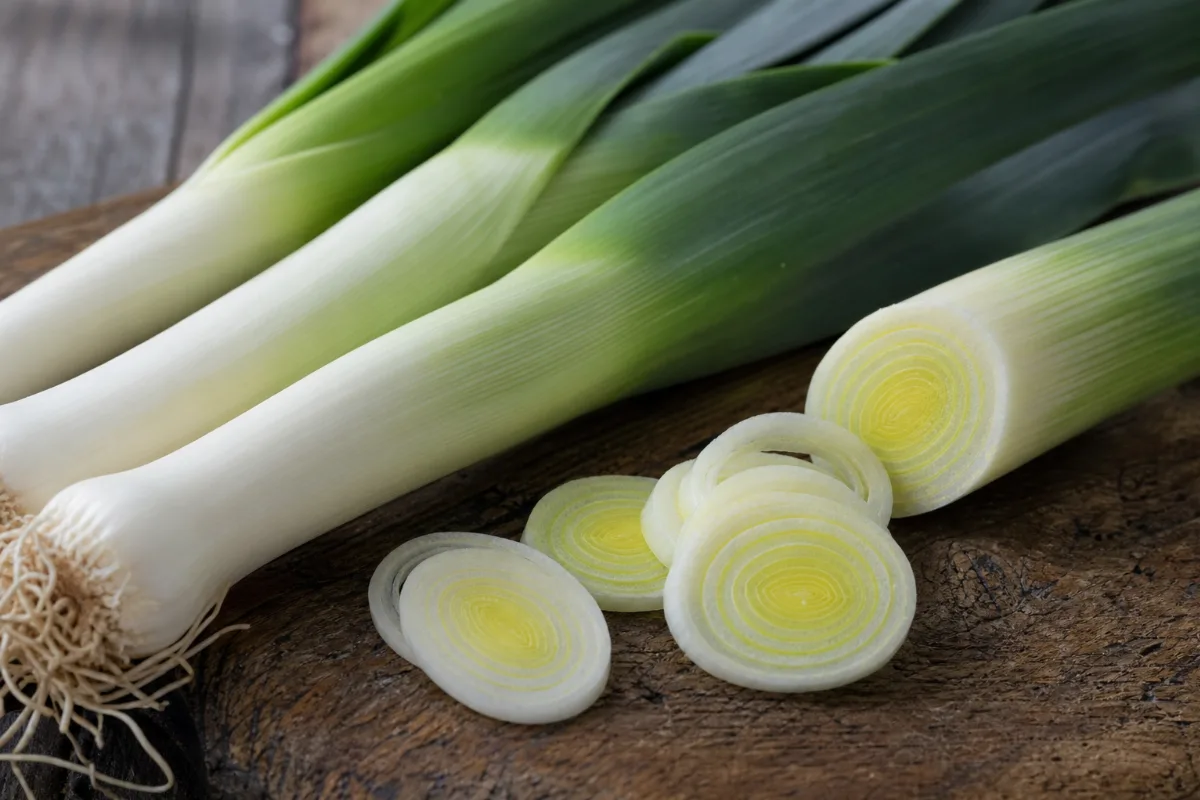
Leeks are a mild onion-family vegetable with a white shaft and pale-green leaves, usually cooked in soups and stews. They contain vitamin K, folate and manganese. No trial of eating leeks was found, and the research that exists is about onion-family vegetables as a group. The main cautions are warfarin (because of vitamin K), irritable bowel syndrome (fructans) and grit.
General information, not medical advice. Last substantive update · Not medically reviewed. A named clinician has not signed off on this page. How this page is made
About Leeks
Leeks are a mild vegetable in the onion family, with vitamin K, folate and manganese. They are a healthy food, not a proven remedy: most health claims come from studies of onion-family vegetables in general.
What it is
Leeks (Allium ampeloprasum) are in the same genus as onions and garlic. People eat the white shaft and the pale-green lower leaves, usually cooked in soups and stews, or sliced raw.
USDA data for raw leeks: 61 kcal per 100 g. One cup (89 g) has about 54 kcal, 1.6 g fibre, 1.3 g protein, 42 micrograms vitamin K, 57 micrograms folate (DFE), 10.7 mg vitamin C, 0.43 mg manganese, 0.21 mg vitamin B6, 160 mg potassium, 1.9 mg iron and 1,691 micrograms lutein plus zeaxanthin. Figures vary with variety and storage, and cooked values were not read.
What the research shows
The firmest facts are about nutrients: vitamin K is needed for blood to clot, and folate is a B vitamin. These are not trials of leeks.
A 2011 meta-analysis of mostly case-control studies linked the highest intake of onion-family vegetables with lower stomach cancer risk. Leeks were not analysed alone in the abstract, and the authors warn about confounding. A 2019 umbrella review found gastric cancer the clearest benefit; its cholesterol and blood pressure findings are about garlic.
Antioxidant effects are from the lab. The only leek-specific human trial was a 20-person pilot of a leek extract cream, not food.
Food versus extracts and supplements
The only leek-specific human trial used a leek extract cream on the skin. Garlic supplement results do not carry over to eating leeks, and lab findings about plant compounds do not show an effect of eating them.
Amounts
This page gives no amounts to eat. Ask a doctor, pharmacist or dietitian what is right for you, especially if you take warfarin or have irritable bowel syndrome.
At a glance
Traditional uses history, not proof
- Eaten cooked in soups and stews, or sliced raw
- Long use as food is not proof that it treats any condition
Studied for research
- Vitamin K for normal blood clotting, high certainty for the nutrient, no leek trial
- Folate and other vitamins, high certainty for the nutrients
- Stomach cancer risk (onion-family vegetables as a group), low certainty, observational
- Overall health outcomes of onion-family vegetables, mixed, mostly garlic
- Plant compounds and antioxidant effects, very low certainty, lab only
- Leek extract cream for haemorrhoids, very low certainty, not food
Main compounds
- Vitamin K (phylloquinone)
- Folate
- Manganese
- Lutein and zeaxanthin
- Beta-carotene
- Flavonols
- Sulfur compounds
- Fructans
Common forms
- Fresh white shaft and lower pale-green leaves as food
- Sliced raw in small amounts
- Dried or powdered as seasoning
- Leek extract cream (the only trial used this, not the vegetable)
Research links: MedlinePlus: Vitamin K in diet · NHS: Warfarin · 2011 meta-analysis: Allium vegetables and gastric cancer · Research Library · Genes & Biomarkers Library
What it is and its history
- Accepted scientific name
- Allium ampeloprasum
- Naming authority
- L. (GBIF accepted)
- Synonyms
- Allium porrum (older name); Allium ampeloprasum var. porrum
- Common names
- Leek (English); Leeks (English); Puerro (Spanish)
- Family or group
- Amaryllidaceae (the amaryllis family), as given by GBIF. It is in the same genus as onion and garlic.
- Classification
- Plantae > Tracheophyta > Liliopsida > Asparagales > Amaryllidaceae > Allium > Allium ampeloprasum
- Native range
- Not verified from a source read.
- Habitat
- Not verified from a source read.
- What it looks like
- Roots: Not verified.; Stems: The white shaft is eaten.; Leaves: The pale-green lower leaf portion is eaten with the shaft; USDA's record is for the bulb and lower leaf portion. Illinois Extension suggests keeping the white and light green parts for recipes and saving the dark green leaves for broth.; Flowers: Not verified.; Fruit: Not verified.
- Cultivation
- Not verified from a source read.
- Harvest and processing
- Eaten cooked in soups and stews, or sliced raw. Illinois Extension notes leeks can be dried and that canning and freezing are not recommended by South Dakota Extension; we did not verify freezing advice further.
- Look-alikes and adulterants
- Name: Onions, garlic, chives and other Allium foods; Note: Same genus with their own pages or entries. Studies of Allium vegetables pool several of them.; Name: Wild leek (ramps); Note: Not covered by the USDA record or the studies used here.
- Sustainability and conservation
- Not assessed.
Photographs
What is inside, and how it may work
What it contains and how those compounds act in cells and animals. Laboratory and animal mechanisms are not proven effects in people.
Main compounds
| Compound | Family | Where it is concentrated | Activity studied | Level of evidence |
|---|---|---|---|---|
| Vitamin K (phylloquinone) PubChem 5284607 | vitamin | Shaft and lower leaf USDA: 47 micrograms per 100 g raw | Needed for blood-clotting proteins (MedlinePlus). Affects warfarin. 14 17 | Human data |
| Folate (vitamin B9) PubChem 135398658 | vitamin | Shaft and lower leaf USDA: 64 micrograms DFE per 100 g raw | B vitamin; leafy greens are a natural source (MedlinePlus). 13 17 | Human data |
| Lutein and zeaxanthin | carotenoid | Leaf portion USDA: 1,900 micrograms per 100 g raw | Plant pigments; no leek health effect was read. 17 | Composition only |
| Beta-carotene | carotenoid | Leaf portion USDA: 1,000 micrograms per 100 g raw | Plant pigment the body can convert to vitamin A; no leek health effect was read. 17 | Composition only |
| Flavonols (quercetin and kaempferol) | flavonoid | Not stated No leek-specific amount found | Discussed in a 2026 laboratory study of onion and leek; lab chemistry only. 4 | Lab |
| Sulfur compounds (S-alk(en)yl-L-cysteine sulfoxides) | organosulfur | Not stated No leek-specific amount found | Reviews describe sulfur compounds in Allium vegetables; the digestion study measured them as stable and fully bioaccessible in a test tube. 1 7 | Lab |
| Fructans | carbohydrate (FODMAP) | Not stated No leek figure in the abstract read (onion 1.97 g per 100 g) | Ferment quickly in the gut; can worsen IBS symptoms. 3 | Lab |
Mechanisms, receptors and pathways
| Target or pathway | Gene or receptor | What was found | Level |
|---|---|---|---|
| Vitamin K and blood clotting | Clotting factors II, VII, IX and X (named by MedlinePlus) | Vitamin K is used by the liver to make clotting proteins; warfarin lowers vitamin K activity, so changes in vitamin K intake can change its effect. 14 16 | Human data |
| Oxidative stress and inflammation (NF-kB, Nrf2) | NF-kB and Nrf2 signalling | A 2025 review says Allium compounds modulate these pathways in mechanistic studies and that clinical validation is limited. 1 | Lab animal |
Absorption, metabolism and elimination
- Absorption
- In a simulated-digestion model, water-soluble leek compounds were fully bioaccessible and fat-soluble ones (vitamin K1, carotenoids) 26 to 81 percent bioaccessible.
- Distribution
- Not found.
- Metabolism
- Not found.
- Elimination
- Not found.
- Bioavailability
- Not established in people for leek nutrients in the sources read.
Isolated compounds versus whole extracts
The only leek-specific human trial found used a leek extract cream on the skin, not food. Results for garlic supplements, extracts and isolated compounds do not carry over to eating leeks.
Nutritional composition
Nutrition from USDA FoodData Central (Leeks, bulb and lower leaf-portion, raw, FDC 169246, SR Legacy, last updated 4/1/2019, read 2026-10-26). Per 100 g: 61 kcal, 1.5 g protein, 0.3 g fat, 14.2 g carbohydrate, 1.8 g fibre, 3.9 g total sugars, about 83 g water, 59 mg calcium, 2.1 mg iron, 28 mg magnesium, 180 mg potassium, 20 mg sodium, 12 mg vitamin C, 64 micrograms folate (DFE), 83 micrograms vitamin A (RAE), 47 micrograms vitamin K, 0.481 mg manganese, 0.233 mg vitamin B6, 0.12 mg copper, 1,000 micrograms beta-carotene, 1,900 micrograms lutein plus zeaxanthin. One cup or one leek (89 g): about 54 kcal, 1.3 g protein, 12.6 g carbohydrate, 1.6 g fibre, 3.5 g sugars, 52 mg calcium, 1.9 mg iron, 160 mg potassium, 10.7 mg vitamin C, 57 micrograms folate, 74 micrograms vitamin A (RAE), 42 micrograms vitamin K, 0.43 mg manganese, 0.21 mg vitamin B6, 1,691 micrograms lutein plus zeaxanthin. Per-cup figures are our arithmetic from the per-100 g values. Figures vary with variety, ripeness and storage. Cooked values were not read.
2 high certainty1 mixed findings1 low certainty3 very low certainty1 not enough evidence
What was looked at
The 8 benefits and uses checked for Leeks, each with how strong the evidence is. Tap one to open it.
- Vitamin K for normal blood clottingHigh certainty
- Folate, vitamin B6, vitamin C and manganese from leeksHigh certainty
- Stomach cancer risk (onion-family vegetables as a group)Low certainty
- Overall health outcomes of onion-family vegetablesMixed findings
- Fibre and gut comfortNot enough evidence
- Plant compounds (sulfur compounds, flavonols, carotenoids): antioxidant effectsVery low certainty
- How well the body can take up leek nutrients (simulated digestion)Very low certainty
- Leek extract cream for haemorrhoids (skin cream, not food)Very low certainty
Lab markers tracked in the studies
Stomach cancer riskDietary vitamin K supplyHaemorrhoid bleeding severity
What is Leeks good for?
The main studied uses and how strong the human evidence is for each. Most results are for onion-family vegetables as a group, for garlic, or for a leek cream, not for eating leeks.
Benefits, one by one
Each card is a research question, not a promise. Tap a goal to filter. Open a card to see the studies, doses and limits.
Vitamin K for normal blood clotting
High certaintyVitamin K is needed for blood to clot. Raw leeks contain 47 micrograms per 100 g by USDA, about 42 micrograms in one cup (89 g). This is a nutrient fact, not a leek trial. If you take warfarin, the same vitamin K matters for a different reason: see the Safety tab.
2 studiesRaw leek (white shaft and lower pale-green leaf) as food. Values vary…
Studies, doses and limits
What the trials found
MedlinePlus says vitamin K is needed to make clotting factors in the liver. It lists green leafy vegetables, Brussels sprouts, broccoli, cauliflower and cabbage as food sources; it does not name leeks. USDA lists 47 micrograms of vitamin K (phylloquinone) per 100 g of raw leeks.
Results
Leeks contain vitamin K, but less than the leafy greens MedlinePlus names (for example USDA lists 483 micrograms per 100 g in raw spinach). No trial of leeks for clotting was read.
Effect sizes as reported
USDA: 47 micrograms per 100 g raw leeks; about 42 micrograms per cup (89 g).
Why this rating
High for the nutrient role and for the amount in raw leeks (health-agency statement and USDA data). There is no leek-specific trial, and a varied diet normally supplies vitamin K. MedlinePlus says deficiency is very rare.
Form and dose studied
Raw leek (white shaft and lower pale-green leaf) as food. Values vary with variety, ripeness and storage.
Who was studied
Anyone eating a varied diet. MedlinePlus links deficiency to problems absorbing the vitamin and to long-term antibiotic treatment.
Limits
Nutrient fact, not a trial of leeks. This page does not show that extra vitamin K from any source adds benefit in someone who already has enough.
Why researchers looked
Leeks are a leafy-stemmed vegetable, so people ask how much vitamin K they supply.
Traditional use
Leeks are eaten cooked in soups and stews, or sliced raw. Long use as food is not proof that it treats any condition.
Proposed mechanism Authoritative guidance
Vitamin K is used by the liver to make clotting proteins (clotting factors II, VII, IX and X). Without it, blood would not clot (MedlinePlus).
A proposed mechanism does not show that the effect happens in people.
People taking warfarin should keep vitamin K intake steady and ask their clinic; see the Safety tab.
Folate, vitamin B6, vitamin C and manganese from leeks
High certaintyUSDA lists raw leeks as a source of folate (64 micrograms DFE per 100 g), vitamin B6 (0.23 mg), vitamin C (12 mg) and manganese (0.48 mg). One cup (89 g) has about 57 micrograms of folate. Low folate can cause some types of anaemia, and MedlinePlus says women planning pregnancy are advised to take folic acid because food alone can make it hard to get enough.
2 studiesRaw leek as food. USDA values are for raw leeks; cooked values were n…
Studies, doses and limits
What the trials found
MedlinePlus says folate occurs naturally in foods such as green leafy vegetables, citrus fruit and beans, that too little folate can lead to certain types of anaemia, and that women thinking about becoming pregnant should take folic acid supplements. It does not name leeks. USDA lists the leek values above.
Results
Leeks supply a modest amount of several vitamins. No trial of leeks and folate status, anaemia or any vitamin level was read.
Effect sizes as reported
USDA per 100 g raw leek: folate 64 micrograms DFE, vitamin B6 0.23 mg, vitamin C 12 mg, manganese 0.48 mg. Per cup (89 g): about 57 micrograms folate, 0.21 mg B6, 10.7 mg vitamin C, 0.43 mg manganese.
Why this rating
High for the nutrient roles and for the USDA values. No leek-specific trial was read, and folate in food is not the same as folic acid in a pill. A simulated-digestion study found vitamin C in processed leek fell by more than 48 percent (see the Evidence tab).
Form and dose studied
Raw leek as food. USDA values are for raw leeks; cooked values were not read.
Who was studied
Everyone; women planning pregnancy are given special advice by MedlinePlus.
Limits
Nutrient information, not a trial of leeks. Cooking effects on these vitamins were not read from a human study.
Why researchers looked
Leeks are a vegetable with several vitamins, so people ask whether they help meet daily needs.
Traditional use
Leeks are eaten cooked in soups and stews, or sliced raw. Long use as food is not proof that it treats any condition.
Proposed mechanism Authoritative guidance
Folate is a water-soluble B vitamin the body uses to make cells. Folic acid is the man-made form used in supplements and fortified foods (MedlinePlus).
A proposed mechanism does not show that the effect happens in people.
Folic acid supplements have their own upper limit and can mask a vitamin B12 shortage; ask a clinician.
Stomach cancer risk (onion-family vegetables as a group)
Low certaintyA 2011 meta-analysis of mostly case-control studies linked eating the most onion-family vegetables (onions, garlic, leeks and relatives together) with lower stomach cancer risk. The authors warn that other factors may explain it. It is not a leek trial, and it does not show that leeks prevent cancer.
2 studiesAllium vegetables as food, highest versus lowest intake groups.
Studies, doses and limits
What the trials found
Zhou 2011 pooled 19 case-control and 2 cohort studies (543,220 people). Highest versus lowest Allium vegetable intake: odds ratio 0.54 (95% CI 0.43-0.65). The abstract says analyses for onion, garlic, leek and others gave similar results, without a separate leek figure. A 2019 umbrella review of 16 meta-analyses found gastric cancer the most favourable cancer outcome (RR 0.78, 95% CI 0.67-0.91).
Results
Eating more onion-family vegetables is linked to lower stomach cancer risk in observational studies. The leek-specific part of that link was not given in the abstracts.
Effect sizes as reported
Highest versus lowest intake OR 0.54 (0.43-0.65); per 20 g/day OR 0.91 (0.88-0.94) in case-control studies; umbrella review RR 0.78 (0.67-0.91).
Why this rating
Low: observational evidence only, mostly case-control studies, with possible confounding named by the authors, and the group is pooled rather than leeks alone.
Form and dose studied
Allium vegetables as food, highest versus lowest intake groups.
Who was studied
Adults in mostly case-control studies.
Limits
Observational; people with different diets differ in other ways; recall bias in case-control studies; leek-only figure not in the abstract; not a trial.
Why researchers looked
Onion-family vegetables contain sulfur compounds and flavonoids, so researchers have asked whether eating them is linked to stomach cancer.
Traditional use
Leeks, onions and garlic are everyday cooking vegetables in many cuisines. Long use as food is not proof of any cancer benefit.
Proposed mechanism Laboratory research
Reviews describe sulfur compounds and flavonoids in Allium vegetables and propose antioxidant and anti-inflammatory actions, but they call clinical proof limited (lab and animal findings).
A proposed mechanism does not show that the effect happens in people.
No safety signal in this evidence. Stomach pain, vomiting blood or black stools need a doctor; diet is not a substitute for care.
Overall health outcomes of onion-family vegetables
Mixed findingsA 2019 umbrella review gathered 16 meta-analyses of onion-family vegetables and garlic. Gastric cancer was the clearest benefit. The cholesterol, blood sugar and blood pressure results it reports are about garlic, not leeks.
2 studiesMostly garlic (food and supplements) and Allium vegetables as a group.
Studies, doses and limits
What the trials found
Wan 2019 included 16 meta-analyses with 50 unique outcomes. The abstract names gastric cancer (RR 0.78) as the most favourable cancer outcome and reports 8 weeks of garlic lowering total cholesterol, and garlic being linked to blood pressure reduction in people with high blood pressure. These are garlic findings.
Results
Mixed and mostly not about leeks. No leek-specific human trial or meta-analysis was found for heart or blood sugar outcomes.
Effect sizes as reported
Gastric cancer RR 0.78 (95% CI 0.67-0.91). Garlic: total cholesterol WMD -17.20 mg/dl (-23.10 to -11.30) after 8 weeks.
Why this rating
Mixed: some outcomes favourable, mostly garlic rather than leeks, and an umbrella review adds no new trial evidence about leeks.
Form and dose studied
Mostly garlic (food and supplements) and Allium vegetables as a group.
Who was studied
Adults; garlic findings include people with high cholesterol, diabetes or high blood pressure.
Limits
Umbrella review; mixes foods and supplements; garlic results cannot be applied to leeks.
Why researchers looked
Researchers wanted one overview of the evidence on eating Allium vegetables.
Traditional use
Leeks, onions and garlic are everyday cooking vegetables. Long use as food is not proof of benefit.
Proposed mechanism Laboratory research
Proposed actions on oxidative stress and inflammation (NF-kB and Nrf2 pathways) are from cell and animal studies, and the 2025 review says clinical validation is limited.
A proposed mechanism does not show that the effect happens in people.
Garlic side effects named in the abstract are odour and stomach and bowel complaints.
Fibre and gut comfort
Not enough evidenceRaw leeks have 1.8 g of fibre per 100 g by USDA, about 1.6 g in a cup (89 g). That is a modest amount. No trial of leeks for digestion was found. For some people with irritable bowel syndrome, onion-family vegetables can be a trigger instead; see the Safety tab.
1 studiesRaw leek as food.
Studies, doses and limits
What the trials found
USDA lists total dietary fibre of 1.8 g per 100 g of raw leeks. No human study of leeks and bowel function, gut bacteria or digestion was found.
Results
Leeks add a little fibre to a meal. No benefit for digestion has been shown.
Effect sizes as reported
USDA: 1.8 g fibre per 100 g raw leeks; about 1.6 g per cup (89 g).
Why this rating
No trial or observational study of leeks and gut health was found; the fibre amount is a composition fact only.
Form and dose studied
Raw leek as food.
Who was studied
General adult diet.
Limits
A food containing fibre is not proof that it improves digestion.
Why researchers looked
Vegetables contribute fibre, so people ask about leeks and digestion.
Traditional use
Leeks are eaten cooked in soups and stews, or sliced raw. Long use as food is not proof that it treats any condition.
Proposed mechanism Authoritative guidance
Fibre is the part of plants the body does not digest; it is a component of the USDA record. No leek-specific mechanism was read.
A proposed mechanism does not show that the effect happens in people.
Fructans in onion-family vegetables can worsen symptoms in some people with IBS; a dietitian can advise.
Plant compounds (sulfur compounds, flavonols, carotenoids): antioxidant effects
Very low certaintyReviews describe sulfur compounds and flavonoids in onion-family vegetables, and USDA lists carotenoids in raw leeks. The antioxidant and anti-inflammatory effects reported are from cell and animal work. A 2025 review says clinical proof is limited.
3 studiesRaw leek as food; extracts and isolated compounds in the lab.
Studies, doses and limits
What the trials found
No human trial of leeks for antioxidant or inflammation outcomes was found. The 2025 review names low bioavailability and limited clinical validation. The 2026 study is food chemistry with no health outcome.
Results
Lab and animal findings only. They do not show an effect of eating leeks.
Effect sizes as reported
USDA per 100 g raw leeks: beta-carotene 1,000 micrograms; lutein plus zeaxanthin 1,900 micrograms.
Why this rating
Very low: laboratory and animal mechanisms, no human trial of leeks.
Form and dose studied
Raw leek as food; extracts and isolated compounds in the lab.
Who was studied
Cells and animals.
Limits
Lab results often do not carry over to people; amounts and absorption in people are not shown.
Why researchers looked
Onion-family vegetables are rich in plant compounds that behave as antioxidants in the lab.
Traditional use
Leeks are cooking vegetables. Long use as food is not proof of any effect.
Proposed mechanism Laboratory research
Allium compounds are reported to affect oxidative stress and inflammation pathways (NF-kB and Nrf2) in cells and animals (2025 review). A 2026 laboratory study found that quercetin and gallic acid generate singlet oxygen in the test tube and that flavonols break down in minced onion and leek.
A proposed mechanism does not show that the effect happens in people.
None identified from these sources.
How well the body can take up leek nutrients (simulated digestion)
Very low certaintyIn a test-tube model of digestion, processed leek kept its water-soluble compounds stable and fully available, while vitamin C fell by more than 48 percent. Fat-soluble compounds such as vitamin K1 and carotenoids were stable but only 26 to 81 percent available. This is not a study in people.
1 studiesProcessed leek (Allium ampeloprasum var. porrum) in a digestion model.
Studies, doses and limits
What the trials found
No human absorption study of leeks was found.
Results
Fat-soluble nutrients such as vitamin K1 were only partly released in the model; this suggests eating leeks with some fat might matter, but no human study tested that.
Effect sizes as reported
Vitamin C fell by more than 48 percent; fat-soluble bioaccessibility 26 to 81 percent (abstract).
Why this rating
Very low: simulated digestion only, leek and Brussels sprouts reported together.
Form and dose studied
Processed leek (Allium ampeloprasum var. porrum) in a digestion model.
Limits
Model, not people; processing details are in the full paper, which was not read.
Why researchers looked
Researchers wanted to know which leek nutrients survive digestion.
Traditional use
Leeks are usually cooked. Long use as food is not proof of any effect.
Proposed mechanism Laboratory research
Static in vitro digestion mimics mouth, stomach and gut conditions in a test tube (2024 study).
A proposed mechanism does not show that the effect happens in people.
None.
Leek extract cream for haemorrhoids (skin cream, not food)
Very low certaintyA small 2015 pilot trial of 20 people compared a leek extract cream (Allium ampeloprasum subsp. iranicum) with a standard haemorrhoid cream for 3 weeks. Bleeding and discomfort improved in both groups, and the two creams did not differ significantly. It is a cream, not eating leeks.
1 studiesTopical extract cream (not food).
Studies, doses and limits
What the trials found
Twenty patients with symptomatic haemorrhoids were randomly assigned to leek extract cream or a standard cream for 3 weeks (Mosavat 2015).
Results
Bleeding severity and defecation discomfort fell in both groups; pain did not change significantly; no significant difference between creams.
Effect sizes as reported
Not given in the abstract.
Why this rating
Very low: 20 people, a pilot, no placebo group, subspecies iranicum, a skin cream.
Form and dose studied
Topical extract cream (not food).
Who was studied
Adults with symptomatic haemorrhoids.
Limits
Tiny pilot; no inactive-cream group; does not apply to eating leeks.
Why researchers looked
Leek has been used traditionally in anti-haemorrhoid creams.
Traditional use
Leek is described in the abstract as traditionally used in topical anti-haemorrhoid herbal formulations.
Proposed mechanism Human trial
Not stated in the abstract.
A proposed mechanism does not show that the effect happens in people.
Haemorrhoid bleeding needs a clinician to rule out other causes.
Connections to the rest of health
How Leeks connects to the rest of our health knowledge graph. Every link says what kind of connection it is. A safety link (for example to the liver) is a warning, not a benefit. A study that merely mentions a topic never creates a benefit link.
Explore every connection: goals, body systems, organs, symptoms, genes
B. Body systems
| Connected to | Kind of connection | Evidence status | Context | Studies |
|---|---|---|---|---|
| Cardiovascular System | Biological association | High certainty | Studied for: Vitamin K for normal blood clotting Studied for: Overall health outcomes of onion-family vegetables | 17 14 8 1 |
| Blood And Immune | Biological association | High certainty | Studied for: Vitamin K for normal blood clotting Studied for: Folate, vitamin B6, vitamin C and manganese from leeks | 17 14 13 |
| Reproductive System | Biological association | High certainty | Studied for: Folate, vitamin B6, vitamin C and manganese from leeks | 17 13 |
| Digestive System | Biological association | Low certainty | Studied for: Stomach cancer risk (onion-family vegetables as a group) Studied for: Overall health outcomes of onion-family vegetables | 9 8 1 17 7 5 |
| Whole Body | Biological association | Very low certainty | Studied for: Plant compounds (sulfur compounds, flavonols, carotenoids): antioxidant effects | 1 4 17 |
E. Health conditions
| Connected to | Kind of connection | Evidence status | Context | Studies |
|---|---|---|---|---|
| Irritable bowel syndrome | Adverse effect or risk | Documented risk | Fructans are a FODMAP that can worsen symptoms in some people; no leek-specific figure was found. Fructans in onion-family vegetables can worsen IBS symptoms in some people. Preparation or compound: Fructans in onion-family vegetables |
3 15 |
I. Biomarkers
| Connected to | Kind of connection | Evidence status | Context | Studies |
|---|---|---|---|---|
| Stomach cancer risk | Biological association | Low certainty | Measured in trials: decrease. A lab change is not the same as a health benefit. | 9 8 |
| Dietary vitamin K supply | Biological association | High certainty | Measured in trials: no-change. A lab change is not the same as a health benefit. | 17 |
| Haemorrhoid bleeding severity | Biological association | Very low certainty | Measured in trials: decrease. A lab change is not the same as a health benefit. | 5 |
K. Biological pathways
L. Active compounds
| Connected to | Kind of connection | Evidence status | Context | Studies |
|---|---|---|---|---|
| Vitamin K (phylloquinone) | Biological association | Human | Needed for blood-clotting proteins (MedlinePlus). Affects warfarin. Preparation or compound: Shaft and lower leaf |
14 17 |
| Folate (vitamin B9) | Biological association | Human | B vitamin; leafy greens are a natural source (MedlinePlus). Preparation or compound: Shaft and lower leaf |
13 17 |
| Lutein and zeaxanthin | Biological association | Composition only | Plant pigments; no leek health effect was read. Preparation or compound: Leaf portion |
17 |
| Beta-carotene | Biological association | Composition only | Plant pigment the body can convert to vitamin A; no leek health effect was read. Preparation or compound: Leaf portion |
17 |
| Flavonols (quercetin and kaempferol) | Biological association | Lab | Discussed in a 2026 laboratory study of onion and leek; lab chemistry only. | 4 |
| Sulfur compounds (S-alk(en)yl-L-cysteine sulfoxides) | Biological association | Lab | Reviews describe sulfur compounds in Allium vegetables; the digestion study measured them as stable and fully bioaccessible in a test tube. | 1 7 |
| Fructans | Biological association | Lab | Ferment quickly in the gut; can worsen IBS symptoms. | 3 |
Each connection is stored with the ingredient, the connected record, the kind of connection, the evidence status, the supporting studies, the preparation or compound involved, and a review date (last reviewed October 26, 2026).
Evidence at a glance: what changed in 1 lab markers
Tap a number to show only those markers. Counts are markers, not people.
The evidence
The research centre for Leeks. Every record here was checked against PubMed or the publisher's page; we never list a study we have not verified.
Evidence by outcome
Bars show how many studies we found for each outcome, not how well it works. People are added up across trials only (reviews are not added, to avoid double counting).
How we rate evidence
High certainty
Several well-run trials or reviews agree; further research is unlikely to change the picture much.
Moderate certainty
Good trials point the same way, but some doubt remains.
Low certainty
Small, short or inconsistent trials. The finding could change with better research.
Very low certainty
Very little or very weak human data. Treat as a possibility only.
Mixed findings
Trials or reviews disagree with each other.
Not enough evidence
Not enough human research to say either way.
Evidence against
Good research found no benefit, or found harm.
We take the reviewers' own risk-of-bias and GRADE statements where they exist, and otherwise judge from study size, design, consistency, directness and whether a product matches what is sold. Many publications do not make evidence high. Method note: We started from our existing leeks summary, re-checked nutrition at USDA FoodData Central, read the health agency pages (NHS, MedlinePlus, FDA, University of Illinois Extension) and searched PubMed for reviews, trials and case reports. Only abstracts were read for studies. Items we could not verify are flagged in the research gaps.
Study library: every study we checked 17
| Study | Design | People | Product, dose, length | Result |
|---|---|---|---|---|
| Ahmed HGMD 2025 Beyond seasoning nutrients bioactive ingredients and healthcare effects of Allium vegetables. Front Nutr · PMID 41425624 · DOI |
Narrative review lab-animal |
Review of Allium vegetables including garlic, onion, leek and chive | Allium vegetables, compounds and extracts Various |
The review describes sulfur compounds, flavonoids and minerals in Allium vegetables and mechanisms in cells and animals. It names low bioavailability, differences between species and limited clinical validation as barriers. Not applicable (Not applicable) Methods, limits and fundingOutcomes: Antioxidant, anti-inflammatory and anticancer effects (mostly mechanisms) Limitations: Narrative review; mostly lab and animal mechanisms; not leek-specific. Funding and conflicts: Not stated in the abstract. Read: abstract |
| AlJuhaimi 2025 The Role of Edible Bulbous Layers on Macro, Micro, and Heavy Metal Contents of Leek (Allium porrum) Plant. Biol Trace Elem Res · PMID 38630342 · DOI |
Laboratory study lab |
Leeks grown in Konya, Turkey | Leek parts and layers Root, bulb part, layers and leaf |
Potassium, phosphorus, calcium, magnesium, iron and zinc were measured in the root, leaf, bulb part and layers. Of the heavy metals measured, the abstract says arsenic and barium were found in the highest amounts in the parts and layers. The abstract gives no safety verdict. Not applicable (Not applicable) Methods, limits and fundingOutcomes: Mineral and heavy metal content Limitations: One growing area in Turkey; mg per kg of plant material; no comparison with safety limits in the abstract. Funding and conflicts: Not stated in the abstract. Read: abstract |
| Ferjančič 2024 Fructan content in most commonly consumed Slovenian foods and estimation of daily fructan consumption. Front Nutr · PMID 39155934 · DOI |
Laboratory study lab |
40 commonly eaten foods in Slovenia | Foods analysed for fructans Various |
Fructan content was relatively low, 0.1 to 1.97 g per 100 g fresh weight. Onion was highest (1.97 g/100 g), followed by wheat flour (0.75 g/100 g). The abstract says short-chain fructans ferment quickly and can worsen symptoms in people with IBS. Leeks are not reported in the abstract. Onion 1.97 g/100 g; range 0.1-1.97 g/100 g (Not given) Methods, limits and fundingOutcomes: Fructan content (a FODMAP) Limitations: Leek figure not in the abstract; food analysis, not a symptom study. Funding and conflicts: Not stated in the abstract. Read: abstract |
| Fokuhl 2026 Singlet Oxygen Generated by Quercetin and Gallic Acid Leads to Oxidative Fragmentation of Flavonols in Onions and Leek. J Agric Food Chem · PMID 41642180 · DOI |
Laboratory study lab |
Test-tube chemistry plus minced onion and leek samples | Flavonols (quercetin, kaempferol) and gallic acid Minced onion and leek |
Quercetin and gallic acid generated singlet oxygen in the test tube, and flavonol breakdown products were detected in minced onion and leek samples. This is food chemistry, not a health result. Not applicable (Not applicable) Methods, limits and fundingOutcomes: Chemical breakdown of flavonols Limitations: Laboratory chemistry only; no health outcome; amounts in leek not given in the abstract. Funding and conflicts: Not stated in the abstract. Read: abstract |
| Mosavat 2015 Topical Allium ampeloprasum subsp Iranicum (Leek) extract cream in patients with symptomatic hemorrhoids: a pilot randomized and controlled clinical trial. J Evid Based Complementary Altern Med · PMID 25608984 · DOI |
Randomised controlled trial |
20 20 patients with symptomatic haemorrhoids |
Leek extract cream applied to the skin (subspecies iranicum), not food Extract (part not stated in the abstract) Not given in the abstract 3 weeks · vs Standard anti-haemorrhoid cream |
Bleeding severity and defecation discomfort fell in both groups; pain did not change significantly. The leek cream and the standard cream did not differ significantly. The authors call it a pilot study. Within-group falls in bleeding grade and discomfort; no difference between creams (Not given in the abstract) Methods, limits and fundingOutcomes: Pain, defecation discomfort, bleeding severity, itching, adverse events Limitations: Only 20 people; pilot design; a skin cream, not food; no placebo group; subspecies iranicum. Funding and conflicts: Not stated in the abstract. Read: abstract |
| Takamatsu 2024 Food-dependent exercise-induced anaphylaxis caused by leek and several allergens of the allium family. J Dermatol · PMID 38345321 · DOI |
Case report |
1 One 18-year-old woman |
Leek eaten, then exercise Leek Not given in the abstract Single case |
The authors report what they say is the first case of leek-dependent exercise-induced anaphylaxis. Skin prick-to-prick testing with leek was 1+, a challenge with heated leek was negative, and a leek-plus-exercise challenge caused anaphylaxis. The authors call leek allergy extremely rare. Not applicable (Not applicable) Methods, limits and fundingOutcomes: Anaphylaxis Limitations: A single case; says nothing about how common leek allergy is. Funding and conflicts: Not stated in the abstract. Read: abstract |
| Vancoillie 2024 Stability and bioaccessibility of micronutrients and phytochemicals present in processed leek and Brussels sprouts during static in vitro digestion. Food Chem · PMID 38354638 · DOI |
Laboratory study lab |
Simulated digestion of processed leek (Allium ampeloprasum var. porrum) and Brussels sprouts | Processed leek as food Leek Simulated digestion |
In the simulated gut, water-soluble compounds (including the sulfur compounds) stayed stable while vitamin C fell by more than 48 percent. All the water-soluble compounds were fully bioaccessible. Fat-soluble compounds (vitamin K1, carotenoids) were stable but only 26 to 81 percent bioaccessible. Vitamin C fell more than 48 percent; fat-soluble bioaccessibility 26-81 percent (Not given in the abstract) Methods, limits and fundingOutcomes: Stability and bioaccessibility of vitamin C, vitamin K1, sulfur compounds and carotenoids Limitations: Test-tube digestion model, not people. Leek and Brussels sprouts are reported together in the abstract. Funding and conflicts: Not stated in the abstract. Read: abstract |
| Wan 2019 Allium vegetable consumption and health: An umbrella review of meta-analyses of multiple health outcomes. Food Sci Nutr · PMID 31428334 · DOI |
Umbrella review |
16 meta-analyses covering 50 unique outcomes | Allium vegetables and garlic as food or supplement (mixed) Bulbs and related parts Not given in the abstract Varied · vs Lower intake or placebo |
The most beneficial cancer-related outcome was gastric cancer. The abstract's cholesterol, blood sugar and blood pressure findings are about garlic, not leeks. Side effects reported across the included meta-analyses were limited, such as garlic odour and stomach and bowel complaints. Gastric cancer RR 0.78 (RR 0.78 (95% CI 0.67-0.91)) Methods, limits and fundingOutcomes: Cancer, cholesterol, blood sugar, blood pressure and other outcomes Limitations: Umbrella review of other reviews; mostly observational for cancer. The abstract does not say how many studies involved leeks. Garlic results should not be applied to leeks. Funding and conflicts: Not stated in the abstract. Read: abstract |
| Zhou 2011 Consumption of large amounts of Allium vegetables reduces risk for gastric cancer in a meta-analysis. Gastroenterology · PMID 21473867 · DOI |
Systematic review meta analysis |
543220 543,220 people in 19 case-control and 2 cohort studies |
Allium vegetables as food (onions, garlic, shallots, leeks, chives and so on) Bulbs, stalks and leaves Highest versus lowest intake groups; 20 g/day increment (analysis unit, not advice) Varied · vs Lowest intake |
The highest intake of Allium vegetables as a group was linked to lower stomach cancer risk. The abstract says analyses for onion, garlic, leek, Chinese chive, scallion, garlic stalk and Welsh onion gave similar results (onion leaf was the exception). No separate figure for leek is given in the abstract. The authors say confounding and exposure misclassification are possible and call for further studies. Highest versus lowest intake: odds ratio 0.54; per 20 g/day (case-control studies): 0.91 (OR 0.54 (95% CI 0.43-0.65); per 20 g/day 0.91 (0.88-0.94)) Methods, limits and fundingOutcomes: Gastric (stomach) cancer risk Limitations: Mostly case-control studies, which are weak for diet (people recall what they ate after the diagnosis). Cannot show cause. Allium vegetables pooled; leek-only figure not in the abstract. Funding and conflicts: Not stated in the abstract. Read: abstract |
| s-fda-produce FDA: Selecting and serving produce safely · Source |
Health agency n/a |
Methods, limits and fundingRead: full-text | ||
| s-gbif-allium-ampeloprasum GBIF Backbone: Allium ampeloprasum L. (usageKey 2856037) · Source |
Reference database n/a |
Methods, limits and fundingRead: full-text | ||
| s-illinois-leeks University of Illinois Extension: Use leeks in your autumn meals (2021) · Source |
Extension service n/a |
Methods, limits and fundingRead: full-text | ||
| s-medlineplus-folate MedlinePlus: Folic acid in the diet · Source |
Health agency n/a |
Methods, limits and fundingRead: full-text | ||
| s-medlineplus-vitk MedlinePlus: Vitamin K in diet · Source |
Health agency n/a |
Methods, limits and fundingRead: full-text | ||
| s-nhs-ibs NHS: Irritable bowel syndrome, further help and support · Source |
Health agency n/a |
Methods, limits and fundingRead: full-text | ||
| s-nhs-warfarin NHS: Warfarin · Source |
Health agency n/a |
Methods, limits and fundingRead: full-text | ||
| s-usda-fdc-169246 USDA FoodData Central: Leeks, (bulb and lower leaf-portion), raw (SR Legacy, FDC 169246) · Source |
Reference database n/a |
Methods, limits and fundingRead: full-text |
What we do not know yet
- No trial of eating leeks (as opposed to onion-family vegetables as a group, garlic, or a leek extract) was found for stomach cancer, heart health, blood sugar or any other outcome.
- The 2011 meta-analysis abstract says leek gave similar results to the group but gives no leek-only figure; the full text was not read.
- No human trial of eating leeks was found for digestion, inflammation or antioxidant status.
- No source read says how common leek allergy is; only a single case report was found.
- The fructan content of leeks, and of the white versus green parts, was not found in a source that could be read.
- A leek-specific fructan figure and flavonol amounts were not found.
How new research is added
New studies are found by a saved PubMed search and placed in a review queue before the page changes.
Lab markers
What changed in blood or saliva tests during trials. A changed number is not the same as feeling or being healthier, and we give no "normal ranges".
Other 3
Stomach cancer risk
Decrease in trials
How likely a person is to be diagnosed with stomach (gastric) cancer, as measured in groups of people.
Low certaintyResults and what it means
Why it was measured
Stomach cancer is a serious disease, so researchers look at what is linked with lower or higher risk.
Statistical vs. clinical meaning
A link in observational studies, not proof of cause, and not specific to leeks.
Safety implication
None identified for the food in these studies.
| Study | Result | People | Product |
|---|---|---|---|
| 9 | Highest versus lowest Allium vegetable intake: OR 0.54 (95% CI 0.43-0.65); per 20 g/day OR 0.91 (0.88-0.94) | 543,220 people in 19 case-control and 2 cohort studies | Allium vegetables as food (onion, garlic, leek and others pooled) |
| 8 | Gastric cancer RR 0.78 (95% CI 0.67-0.91) across meta-analyses | Umbrella review of 16 meta-analyses | Allium vegetables as food and garlic |
Dietary vitamin K supply
No clear change in trials
How much vitamin K a food contributes, from food composition data (not a blood test).
High certaintyResults and what it means
Why it was measured
Vitamin K supports clotting and affects how warfarin works.
Statistical vs. clinical meaning
A composition fact, not a change in anyone's blood level.
Safety implication
Relevant to people taking warfarin; see the Safety tab.
| Study | Result | People | Product |
|---|---|---|---|
| 17 | 47 micrograms per 100 g raw leeks (about 42 micrograms per cup of 89 g) | Food composition record (SR Legacy) | Raw leeks, bulb and lower leaf portion |
Haemorrhoid bleeding severity
Decrease in trials
A clinician-graded score of bleeding from haemorrhoids.
Very low certaintyResults and what it means
Why it was measured
Bleeding is a main symptom people want to improve.
Statistical vs. clinical meaning
Pilot trial with no inactive comparator; a skin cream, not food.
Safety implication
Adverse events were assessed; the abstract does not report any.
| Study | Result | People | Product |
|---|---|---|---|
| 5 | Bleeding grade fell significantly in both groups; no significant difference between leek and standard cream | 20 patients with symptomatic haemorrhoids | Leek (subsp. iranicum) extract cream versus standard cream, 3 weeks |
Safety
What studies and official sources say about side effects, medicines and who should check first. Each point shows what kind of evidence it comes from.
Main points to know 4
- Warfarin: leeks contain vitamin K, so keep intake steady and ask your clinic. Raw leeks contain 47 micrograms of vitamin K per 100 g (USDA). MedlinePlus says vitamin K or foods containing it can affect how warfarin works, and that it is important to keep vitamin K levels constant day to day. The NHS names broccoli, spinach and other green leafy vegetables and says you can still eat them but should talk to your warfarin clinic. Neither agency names leeks, so this is the same rule applied to a food that contains vitamin K. Do not change a prescribed medicine on your own. Authoritative guidance 16 14 17
- Irritable bowel syndrome: onion-family vegetables contain fructans. Fructans are a type of FODMAP that ferment quickly and can worsen symptoms in people with IBS (2024 study). Among 40 Slovenian foods, onion was highest at 1.97 g per 100 g; the abstract does not report leeks. The NHS says a dietitian may recommend a low FODMAP diet that avoids some fruit and vegetables. Leek-specific amounts, and differences between the white and green parts, were not found. Authoritative guidance 3 15
- Grit and germs: rinse leeks well. Leeks pick up soil between their layers as they grow (University of Illinois Extension). The FDA says to wash produce under running water without soap or produce wash, that washing reduces bacteria but does not eliminate them, that cooking thoroughly kills harmful bacteria, and to keep cut produce at 40 F (4 C) or below. Authoritative guidance 12 10
- Allergy is extremely rare but has been reported. A 2024 case report describes an 18-year-old woman whose leek allergy appeared only when she exercised after eating leek. The authors call leek allergy extremely rare. One case does not show how common it is. Case report 6
Side effects 2
| Effect | How often | Severity and recovery | Evidence |
|---|---|---|---|
| Anaphylaxis after leek combined with exercise (food-dependent exercise-induced anaphylaxis) A single case. Heated leek alone did not trigger a reaction in the challenge test. Nothing read says how common this is. | Not established | serious Not stated in the abstract | Case report 6 |
| Worse IBS symptoms from fructans This is a general property of onion-family vegetables; no leek-specific study of symptoms was found. | Not established | not stated Not stated | Authoritative guidance 3 15 |
Liver
No liver injury from eating leeks was found. A liver-safety source (such as LiverTox) was not searched for this food page.
How often. No frequency was found.
Monitoring. No agency monitoring advice was found.
This is a safety connection. It is not evidence that Leeks supports liver health.
Medicines and supplements 3
| With | Why it matters | Importance | Evidence | What to do |
|---|---|---|---|---|
| Warfarin (blood thinner) prescription | Vitamin K helps blood clot, and warfarin works by lowering vitamin K activity. Raw leeks contain 47 micrograms per 100 g (USDA). | MedlinePlus says sudden changes in vitamin K intake can change the effect. Leeks are not named by MedlinePlus or the NHS; leeks have less vitamin K than the leafy greens they name. | Authoritative guidance Moderate certainty 16 14 17 | Ask your warfarin clinic. Do not change your medicine on your own. The NHS says do not take vitamin K supplements while taking warfarin. |
| Vitamin K supplements supplement | Same vitamin as in leeks, in concentrated form. | The NHS says not to take vitamin K supplements while on warfarin. | Authoritative guidance High certainty 16 | Ask a clinician or pharmacist first. |
| Other medicines prescription | No source read describes an interaction between leeks and any other medicine. | Insufficient Not enough evidence | Ask a pharmacist if you are unsure. |
Who should check first 5
| Situation | Advice | Evidence |
|---|---|---|
| Taking warfarin | Keep vitamin K intake steady and follow your warfarin clinic's advice. Do not stop or change medicine on your own. | Authoritative guidance 16 14 |
| Irritable bowel syndrome that reacts to FODMAPs | Onion-family vegetables contain fructans. A dietitian can help work out what you tolerate. | Authoritative guidance 3 15 |
| Known allergy to leeks, onions or other Allium foods | Avoid it and ask an allergist. Call emergency services for trouble breathing or swelling of the face or throat. | Case report 6 |
| Pregnancy, young children, older age or weakened immunity (foodborne illness) | The FDA says these groups can be especially vulnerable to foodborne illness. Rinse well and follow official food-safety advice for produce. | Authoritative guidance 10 |
| Planning a pregnancy (folate) | MedlinePlus says women thinking about becoming pregnant should take folic acid supplements, because folate can be hard to get from food alone. Ask a clinician. | Authoritative guidance 13 |
Overdose, product quality and regulators
Summary. No toxicity from leeks as ordinary food was found in the sources read. The cautions are specific to people on warfarin, with IBS, or with an allergy.
Animal. Not reviewed.
Human doses studied. A 3-week pilot trial of a leek extract cream (20 people) assessed adverse events; none are reported in the abstract. No trial of eating leeks for safety was found.
Overdose response. Not found.
Genotoxicity. Not researched.
Leeks grown in soil can carry grit and, like any raw produce, germs. A Turkish study measured heavy metals in leek parts without giving a safety verdict. Pesticide residues were not researched.
Grit and food-safety handling. Leeks pick up soil between their layers. Illinois Extension says to rinse well. The FDA says to wash all produce under running water, not to use soap, detergent or commercial produce wash, that washing reduces but does not eliminate bacteria, and to keep cut produce at 40 F (4 C) or below. 12 10
Heavy metals in leek parts. A 2025 study of leeks grown in Konya, Turkey, measured minerals and heavy metals in the root, leaf, bulb part and layers. The abstract says arsenic and barium were the heavy metals found in highest amounts and gives no safety verdict. It is one growing area. 2
| Body | Action | Date |
|---|---|---|
| NHS (UK) (United Kingdom) | Warfarin page: foods high in vitamin K such as broccoli, spinach and other green leafy vegetables can affect how warfarin works; you can still eat them but ask your warfarin clinic; do not take vitamin K supplements source | 2026-02-24 |
| MedlinePlus (US National Library of Medicine) (United States) | Vitamin K page: sudden changes in vitamin K intake can change warfarin's effect; keep vitamin K levels constant day to day source | 2025-01-21 |
| NHS (UK) (United Kingdom) | IBS support page: a dietitian may recommend a low FODMAP diet, which avoids some fruit and vegetables source | 2025-03-17 |
| FDA (US Food and Drug Administration) (United States) | Selecting and serving produce safely: wash under running water without soap; washing reduces but does not eliminate bacteria; refrigerate at 40 F or below; children, older adults, pregnant women and people with weakened immunity are especially vulnerable to foodborne illness source |
When to get medical help
- Trouble breathing, swelling of the lips, face or throat, or widespread hives after eating leeks
- Signs of serious bleeding while taking warfarin, such as blood in urine or stool, unexplained bruising or nosebleeds (NHS)
- Vomiting, diarrhoea, stomach pain or fever after eating raw produce (the FDA says foodborne illness usually shows within 1 to 3 days, sometimes from 20 minutes to 6 weeks)
Stop using the product and contact a clinician or emergency service. In the US, Poison Control is 1-800-222-1222.
General information only, not medical advice. Ask a clinician or pharmacist before use, especially with medicines, in pregnancy or with a health condition. See the Natural Remedy Safety guide.
Frequently asked questions
What are leeks good for?
Are leeks safe with warfarin?
Leeks contain vitamin K (47 micrograms per 100 g raw, USDA). MedlinePlus says sudden changes in vitamin K intake can change how warfarin works, so keep intake steady and ask your warfarin clinic. Leeks are not named by the NHS or MedlinePlus, but the same rule applies. Do not change your medicine on your own.
Do leeks have more or less vitamin K than leafy greens?
Do leeks prevent cancer?
Are leeks good for the heart or blood sugar?
No leek trial was found. The heart, cholesterol and blood sugar results in the onion-family reviews are mostly about garlic, not leeks.
Can leeks upset irritable bowel syndrome?
Can I be allergic to leeks?
Very rarely. A 2024 case report describes anaphylaxis from leek combined with exercise, and the authors call leek allergy extremely rare. If you get trouble breathing or swelling of the face or throat, call emergency services.
How do I get the grit out of leeks?
Should I worry about germs on leeks?
As with any raw produce, washing reduces bacteria but does not remove them all, and cooking thoroughly kills harmful bacteria (FDA). Keep cut leeks cold. Pregnant women, children, older adults and people with weakened immunity can be especially vulnerable to foodborne illness.
Are leeks safe in pregnancy?
Is leek extract the same as eating leeks?
No. The only leek-specific human trial found used a leek extract cream on the skin for haemorrhoids in 20 people, and it was a small pilot. It tells us nothing about eating leeks.
Does cooking change leeks?
In a test-tube digestion model of processed leek, vitamin C fell by more than 48 percent and fat-soluble compounds such as vitamin K1 were only partly released. This was not a study in people, and cooked nutrient values were not read.
Explore by health goal
Editorial transparency
- Written by
- AlternativeMed editorial team. Research compiled with AI assistance, then checked against the sources listed.
- Medical review
- None. This page has not been reviewed by a physician or pharmacist.
- First published
- 2026-10-26
- Last substantive update
- 2026-10-26
- How we research
- We started from our existing leeks summary, re-checked nutrition at USDA FoodData Central, read the health agency pages (NHS, MedlinePlus, FDA, University of Illinois Extension) and searched PubMed for reviews, trials and case reports. Only abstracts were read for studies. Items we could not verify are flagged in the research gaps.
- How we rate evidence
- See "How we rate evidence" in the Evidence tab.
- Independence
- No product is promoted on this page. No affiliate links are shown.
Sources 17
Each source was opened and checked. Where we read only the abstract, it says so. The small numbers in the text point here.
- Ahmed HGMD, et al.. Beyond seasoning nutrients bioactive ingredients and healthcare effects of Allium vegetables.. Front Nutr. 2025. PMID 41425624. DOI 10.3389/fnut.2025.1597788. (abstract)
- AlJuhaimi F, et al.. The Role of Edible Bulbous Layers on Macro, Micro, and Heavy Metal Contents of Leek (Allium porrum) Plant.. Biol Trace Elem Res. 2025. PMID 38630342. DOI 10.1007/s12011-024-04181-w. (abstract)
- Ferjančič B, et al.. Fructan content in most commonly consumed Slovenian foods and estimation of daily fructan consumption.. Front Nutr. 2024. PMID 39155934. DOI 10.3389/fnut.2024.1446771. (abstract)
- Fokuhl VK, et al.. Singlet Oxygen Generated by Quercetin and Gallic Acid Leads to Oxidative Fragmentation of Flavonols in Onions and Leek.. J Agric Food Chem. 2026. PMID 41642180. DOI 10.1021/acs.jafc.5c14934. (abstract)
- Mosavat SH, et al.. Topical Allium ampeloprasum subsp Iranicum (Leek) extract cream in patients with symptomatic hemorrhoids: a pilot randomized and controlled clinical trial.. J Evid Based Complementary Altern Med. 2015. PMID 25608984. DOI 10.1177/2156587214567954. (abstract)
- Takamatsu N, et al.. Food-dependent exercise-induced anaphylaxis caused by leek and several allergens of the allium family.. J Dermatol. 2024. PMID 38345321. DOI 10.1111/1346-8138.17141. (abstract)
- Vancoillie F, et al.. Stability and bioaccessibility of micronutrients and phytochemicals present in processed leek and Brussels sprouts during static in vitro digestion.. Food Chem. 2024. PMID 38354638. DOI 10.1016/j.foodchem.2024.138644. (abstract)
- Wan Q, et al.. Allium vegetable consumption and health: An umbrella review of meta-analyses of multiple health outcomes.. Food Sci Nutr. 2019. PMID 31428334. DOI 10.1002/fsn3.1117. (abstract)
- Zhou Y, et al.. Consumption of large amounts of Allium vegetables reduces risk for gastric cancer in a meta-analysis.. Gastroenterology. 2011. PMID 21473867. DOI 10.1053/j.gastro.2011.03.057. (abstract)
- . FDA: Selecting and serving produce safely. . . (full-text)
- . GBIF Backbone: Allium ampeloprasum L. (usageKey 2856037). . . (full-text)
- . University of Illinois Extension: Use leeks in your autumn meals (2021). . . (full-text)
- . MedlinePlus: Folic acid in the diet. . . (full-text)
- . MedlinePlus: Vitamin K in diet. . . (full-text)
- . NHS: Irritable bowel syndrome, further help and support. . . (full-text)
- . NHS: Warfarin. . . (full-text)
- . USDA FoodData Central: Leeks, (bulb and lower leaf-portion), raw (SR Legacy, FDC 169246). . . (full-text)


