Herbs & Botanicals · Herbs · Kitchen bulb also sold as supplements, with moderate evidence for high blood pressure only
Garlic
Allium sativum L. · also called Garlic, cultivated garlic, ajo (Spanish), ail (French), Knoblauch (German), aglio (Italian), alho (Portuguese), 大蒜 dàsuàn (Chinese)
Garlic is the bulb of a plant in the onion family, eaten as a food all over the world and also sold as aged garlic extract, garlic powder, garlic oil and black garlic. Garlic in cooking is normal and is not the question here; this profile is about garlic as a health product. Only one use is rated above low: lowering blood pressure in people who already have high blood pressure is moderate. Blood pressure in people without high pressure, plaque and artery stiffness, inflammation, the common cold, blood sugar, fatty liver, weight and fungal skin infections are low; cholesterol is mixed; cancer, H. pylori, premenstrual symptoms and vaginal yeast infection are very low; and platelets, heart attacks, strokes and deaths, and mind uses are insufficient. Garlic can add to the effect of blood thinners, lowers the HIV drug saquinavir, and burns skin when applied raw.
General information, not medical advice. Last substantive update · Not medically reviewed. A named clinician has not signed off on this page. How this page is made
About Garlic
Garlic (Allium sativum) is the familiar kitchen bulb, also sold as supplements such as aged garlic extract, garlic powder tablets, garlic oil and black garlic. Garlic in cooking is a normal food and is not the concern; this profile is about garlic as a health product. Its best-supported use is a modest drop in blood pressure in people with high blood pressure, rated moderate, the only moderate rating. Blood pressure in people without high pressure, plaque and artery stiffness, inflammation, the common cold, blood sugar, fatty liver, waist size and fungal skin infections are low; cholesterol is mixed; cancer, H. pylori, premenstrual symptoms and vaginal yeast infection are very low; and platelets, heart attacks, strokes and deaths, and memory, mood and sleep are insufficient, because no trial measured them. Garlic can slightly thin the blood, lowers HIV drug saquinavir levels, burns skin when applied raw, and homemade garlic in oil can cause botulism. For amounts, ask a doctor or pharmacist.
What it is
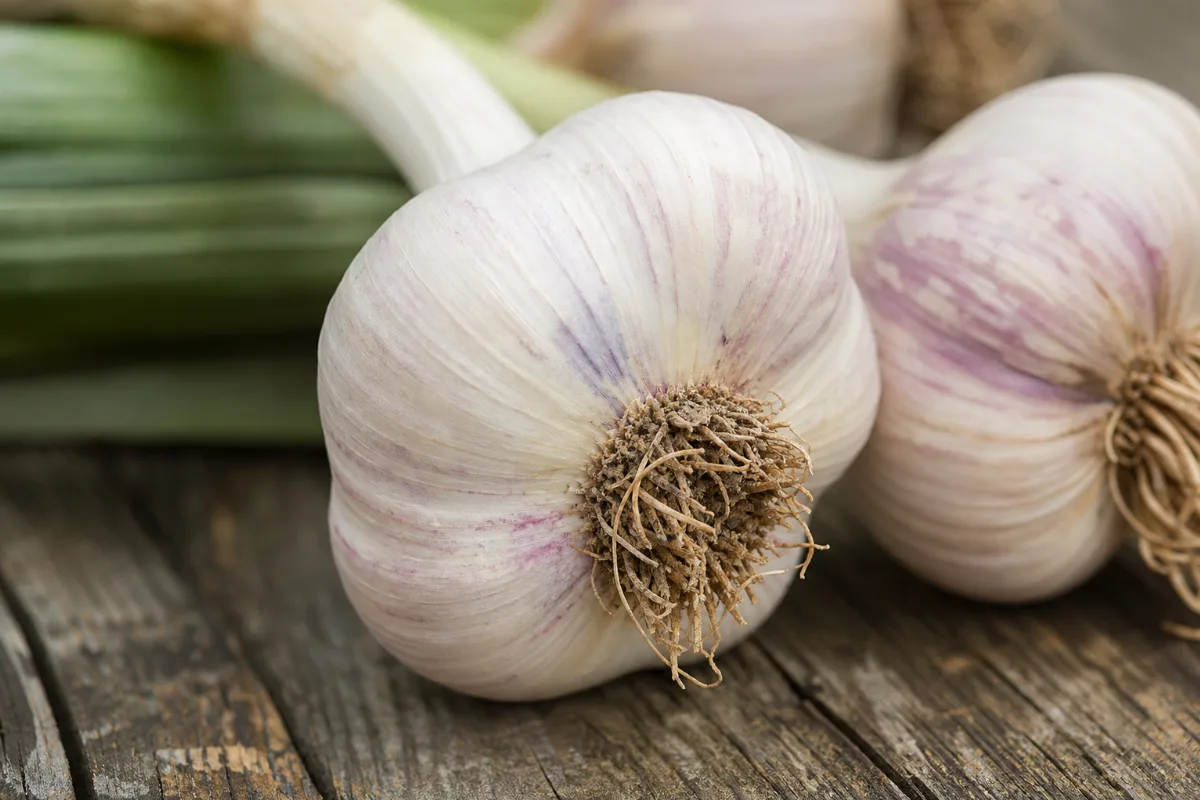
Garlic (Allium sativum) is a bulb crop of the amaryllis family (Amaryllidaceae), related to onions and leeks. The bulb is a head made of cloves in papery skins. Cultivated garlic rarely sets seed and is grown from cloves, so most garlic is a clone of its parent. A 2023 genome study says it originated in the mountains of Central Asia. Wild garlic or ramsons (Allium ursinum), elephant garlic (a type of leek) and other onion-family plants are different species, so garlic research should not be assumed to apply to them.
Garlic is an everyday food, and eating it in cooking is normal. Studies reviewed here mostly test concentrated products: aged garlic extract (such as Kyolic), garlic powder tablets, garlic oil, black garlic extract and the purified compound ajoene. The research does not show that kitchen amounts have the same effects. Per 100 g, raw garlic is rich in vitamin B6 and manganese (USDA), but a clove weighs only a few grams, so food portions supply little.
Traditional and current uses
The EU assessment says garlic has been used for thousands of years for food, medicine and ritual, citing Egyptian and Greek writings; it takes these statements from secondary sources, and they were not checked against the ancient texts. In 2017 the EU herbal committee accepted garlic bulb only as a traditional herbal medicine, as a helper for preventing hardening of the arteries and for relieving common-cold symptoms, not as a well-established one, because cholesterol trials conflicted and long-term data were missing.
Today garlic is mainly taken for blood pressure, cholesterol and heart health, colds and general wellbeing. The World Health Organization monograph (1999), known here only through the EU report, lists mild high blood pressure and high blood fats among supported uses.
What is in it and how it works
An intact clove holds alliin and an enzyme, alliinase, in separate compartments. Crushing or chewing mixes them and makes allicin within seconds; allicin is unstable and gives crushed garlic its sting and smell. Cooking, oil, long ageing and heat all turn the sulfur chemistry into different mixes: ajoene and vinyldithiins in oil, diallyl sulfides in cooked garlic, and mainly S-allylcysteine in aged garlic extract. The EU report notes that no garlic product on the market has detectable allicin.
In the lab, garlic sulfur compounds react with proteins, release hydrogen sulfide, which relaxes blood vessels in animal tissue, block platelets, switch on cell defence genes and affect liver drug-processing enzymes. Almost all of this is cell or animal work, often at concentrations higher than the blood sees after a meal, and no one has shown that any of it explains a human benefit. Some key supplement studies were by researchers linked to garlic companies.
What the research shows
Blood pressure in people with high blood pressure is rated moderate: many pooled analyses of mostly aged garlic extract and garlic powder trials point the same way, with drops of roughly 4 to 9 mmHg, but the trials were short and the effect is smaller than a usual pill. Blood pressure in people with normal or slightly raised pressure is low. Cholesterol is mixed, because reviews and trials disagree. Coronary plaque, artery stiffness and inflammation are low, resting on small trials, several from one group.
Platelets and clotting, and heart attacks, strokes and deaths, are insufficient: no trial measured them. Memory, mood and sleep are insufficient too, with no human trial. The common cold, blood sugar, fatty liver, waist size and fungal skin infections (ajoene gel) are low. Cancer, H. pylori, premenstrual symptoms and vaginal yeast infection are very low; older case-control studies pointed to cancer benefit, but cohort studies and the one large trial showed little or none. Results apply to the named preparation and cannot be assumed for another.
At a glance
Traditional uses history, not proof
- Ancient and medieval medicine: the EU assessment cites Egyptian and Greek writings on garlic for food, medicine and ritual, taken from secondary sources and not checked against the original texts.
- European herbal medicine: accepted in the EU in 2017 as a traditional helper for preventing hardening of the arteries and for relieving common-cold symptoms.
- Modern use: supplements taken for blood pressure, cholesterol and heart health, colds, and general wellbeing.
Studied for research
- Blood pressure in people with high blood pressure, moderate
- Blood pressure with normal pressure, plaque and artery stiffness, inflammation, common cold, blood sugar, fatty liver, weight and fungal skin infections (ajoene gel), low; cholesterol, mixed
- Cancer, H. pylori, premenstrual and endometriosis symptoms, vaginal yeast infection, very low
- Platelets, heart attacks, strokes and deaths, memory, mood and sleep, knee osteoarthritis, warts, pre-eclampsia, insufficient
Main compounds
- Alliin, an odourless sulfur compound in the intact clove that becomes allicin when the clove is crushed
- Allicin, ajoene, diallyl disulfide and trisulfide: sulfur compounds formed from allicin in crushed, cooked or oil-treated garlic
- S-allylcysteine, the main water-soluble compound of aged garlic extract; also saponins and fructans
Common forms
- Raw or cooked garlic as food
- Aged garlic extract (for example Kyolic)
- Garlic powder tablets and capsules
- Garlic oil and black garlic (garlic aged under heat)
Research links: US National Center for Complementary and Integrative Health: Garlic · EU assessment report on Allium sativum bulb (European Medicines Agency) · EU herbal monograph on Allium sativum bulb, draft version (European Medicines Agency) · Garlic for hypertension: meta-analysis of 20 trials (abstract) · Garlic for the common cold: Cochrane review (abstract) · Research Library · Genes & Biomarkers Library
The plant and its history
- Accepted scientific name
- Allium sativum L.
- Naming authority
- L. (Linnaeus), Species Plantarum, page 296 (1753) (GBIF). NCBI Taxonomy lists the species as Allium sativum, taxid 4682.
- Synonyms
- Allium controversum Schrad. ex Willd.; Allium longicuspis Regel; Allium ophioscorodon Link; Allium pekinense Prokh.; Allium arenarium Sadler; Allium sativum subsp. sativum; Allium sativum var. ophioscorodon (Link) Döll (hardneck garlic); Allium sativum var. pekinense (Prokh.) F.Maek.; Allium sativum var. vulgare Döll; Allium scorodoprasum subsp. viviparum (Regel) K.Richt.; Porrum sativum (L.) Rchb.; Porrum ophioscorodon (Link) Rchb.
- Common names
- Garlic (English); Cultivated garlic (English); Garden garlic (English); Ajo (Spanish); Ail; ail cultivé (French); Knoblauch (German); Aglio (Italian); Alho; alho-comum (Portuguese); Knoflook (Dutch); Чеснок (chesnok) (Russian); 大蒜 (dàsuàn) (Chinese); लहसुन (lahsun) (Hindi); ثوم (thoum) (Arabic)
- Botanical family
- Amaryllidaceae (the amaryllis family, order Asparagales). The onion genus Allium used to be placed in its own family, Alliaceae, and in much older books in the lily family, Liliaceae. Current GBIF data place it in Amaryllidaceae, so older papers may use the old family names for the same plant (the older names were not checked paper by paper).
- Classification
- Plantae > Tracheophyta > Liliopsida (monocots) > Asparagales > Amaryllidaceae > Allium > Allium sativum
- Native range
- Garlic is a crop that does not occur truly wild today. A 2023 genome study says it originated in the mountains of Central Asia and was then carried to many regions (p38069099). The EMA report says it is grown commercially in most countries and was cultivated from Mediterranean climates to Siberia (s-ema-ar-allium-sativum-bulbus). A precise wild ancestor and exact origin were not verified here.
- Habitat
- Cultivated in gardens and fields in well-drained, sunny places. Not verified from a flora; general knowledge only.
- What the plant looks like
- Roots: Not a root crop. The part used is the underground bulb, a head made of several small bulbs called cloves, wrapped in papery skins (EMA calls the herbal substance 'bulbus', the bulb). Fine roots grow from the base of the bulb. General botanical description, not checked against a flora here.; Stems: Hardneck types send up a flowering stalk; softneck types usually do not. Described in general terms only; not checked against a flora.; Leaves: Flat, narrow, grass-like leaves that sheathe the stalk. General description, not checked against a flora.; Flowers: When flowers form, they sit in a ball-shaped cluster (an umbel) mixed with small bulbils, and cultivated garlic is usually sterile: it makes few or no seeds, so growers plant cloves instead (p22986686, p38069099).; Fruit: Commercial garlic does not normally produce fruit or seed. Researchers have restored flowering and fertility in some genotypes by changing growing conditions, which shows the loss of fertility is partly environmental (p22986686). A 2023 study of 41 accessions linked the loss of sexual reproduction to many changes in genes controlling the yearly cycle, not to a single gene (p38069099).
- Cultivation
- Grown from cloves, not seed, so most garlic is a clone of its parent plant. That is why many named varieties exist and why their chemistry can differ (p38069099). Growing details such as planting dates were not checked in a source for this file.
- Harvest and processing
- The bulb is dug, dried (cured) and stored. Processing changes the chemistry a lot. Whole cloves contain alliin and an enzyme, alliinase, in separate compartments. Crushing, chewing or fine chopping mixes them and makes allicin within 10 to 60 seconds. Cooking whole cloves destroys the enzyme but leaves alliin. Steam distillation, oil maceration, ethanol extraction and long ageing (aged garlic extract, more than 10 months in water-ethanol) each give a different mix of sulfur compounds (s-ema-ar-allium-sativum-bulbus). Black garlic is made by holding whole garlic at 60 to 90 degrees C and high humidity (p28911544).
- Look-alikes and adulterants
- Name: Wild garlic or ramsons (Allium ursinum); Note: A different species, collected for its leaves in spring and sold as 'wild garlic' (GBIF key 2857601, accepted, Amaryllidaceae). It tastes and smells garlic-like, but it is not Allium sativum, so garlic research should not be assumed to apply to it, and the reverse is also true (p25774103). Its leaves can be mistaken for poisonous lily-of-the-valley (Convallaria majalis) and autumn crocus (Colchicum autumnale) leaves, and confusing them has repeatedly caused serious human and animal poisonings; a 2025 microscope study found leaf-skin differences that separate them (p40805725). Never eat a wild plant you cannot identify with certainty. Ramsons metabolites in urine and milk are similar to those of garlic (allyl methyl sulfide, its sulfoxide and sulfone) (p30255016).; Name: Elephant garlic (Allium ampeloprasum, var. holmense or ampeloprasum); Note: Looks like a very large garlic with huge cloves, but it is a type of leek (GBIF key 2856037, Allium ampeloprasum, accepted). In an Italian comparison it contained lower amounts of the typical garlic compounds alliin and gamma-glutamyl-S-allylcysteine and less fibre, and the authors describe distinct taste-related differences (p32950006). Do not treat it as equal to garlic in research terms.; Name: Other Allium species with garlic-like names (crow garlic A. vineale, sand leek A. scorodoprasum, wild onions, onion A. cepa); Note: All are accepted Allium species in GBIF (A. vineale key 7792960; A. scorodoprasum key 9177060; A. canadense key 2855611; A. cepa key 2857697). GBIF also lists a variety of A. scorodoprasum (viviparum) as a synonym of garlic, which shows how close the group is and how names get mixed up. They share sulfur chemistry but differ in the mix of compounds, and the garlic evidence does not automatically transfer. Toxic look-alikes outside Allium (for example death camas) are commonly warned about for wild onion-type plants; this was not verified in a source read here.; Name: Black garlic (a processed form, not a different plant); Note: Ordinary garlic held at controlled high heat and humidity. It has a sweet, soft taste and little allicin (p28911544). In a breath-test study, black garlic delivered about 5 percent of the allicin-derived product that raw homogenised garlic did (p29937536). It is a separate product, not a substitute for raw crushed garlic in research.
Traditional use and history history, not clinical proof
| Tradition or era | Documented use | Source |
|---|---|---|
| Ancient Egypt, Greece and the Middle Ages (as summarised by the EMA assessment report) | The EMA report says garlic has been used for thousands of years for food, medicine and ritual. It states that garlic's medical and magical powers were described on temple walls and on papyrus dating to about 1500 BC, that cloves were buried in King Tutankhamun's tomb, that the Greek physicians Hippocrates and Galen used it, and that in the Middle Ages it was used against the evil eye and as an aphrodisiac. These are statements the report takes from secondary sources; they were not checked against the ancient texts. | s-ema-ar-allium-sativum-bulbus |
| Early German reference books (1972, 1979), via EMA | Steinegger and Hansel (1972) record use by Egyptians, Indians, Phoenicians, Greeks, Romans and Germans, including for chronic bronchitis, asthma and whooping cough. Madaus (1979) lists use over centuries for asthma, scurvy, pinworm, cholera, typhus, bronchitis, diphtheria, influenza, as an antiseptic and expectorant, and for arteriosclerosis. The EMA report notes that most of these older uses are not suitable for self-treatment without a doctor, and did not accept them as traditional-use indications. | s-ema-ar-allium-sativum-bulbus |
| China and Buddhism | According to the EMA report (citing Kemper, 2000), garlic was forbidden food for Buddhist monks in China because of its reputation as a sexual stimulant. This is a secondary statement and was not verified further. | s-ema-ar-allium-sativum-bulbus |
| Domestication in Central Asia | A 2023 genome study states that garlic originated in the mountains of Central Asia, then spread to many regions with human selection for local climates, a process that gradually cost the plant its ability to make seed (p38069099). A 2020 chromosome-level genome of garlic was the first for any Allium species (p32730994). | p38069099 |
| Pharmacopoeias and WHO (via EMA report) | The EMA report notes a garlic syrup in the British Pharmacopoeia Codex (1949), garlic delayed-release tablets in the United States Pharmacopeia, and a requirement in the European Pharmacopoeia that garlic powder yields at least 0.45 percent allicin. It also summarises the 1999 WHO monograph, which lists clinically supported uses as an extra to diet for high blood fats, prevention of age-related blood vessel changes and mild high blood pressure, and traditional uses for respiratory and urinary infections, ringworm and rheumatic complaints. The WHO monograph itself was not read here. | s-ema-ar-allium-sativum-bulbus |
| EMA/HMPC regulatory position (assessment report dated 18 July 2017; final monograph first published 28 April 2020) | The EU herbal committee (HMPC) accepted garlic bulb only as a traditional herbal medicine, not as a well-established one. It said the trials on cholesterol conflict and long-term data are missing, so no well-established use for high cholesterol could be granted. The traditional use it kept is as a helper for preventing hardening of the arteries (for adolescents over 12, adults and the elderly) and for relieving common-cold symptoms (adults and the elderly only). It required use of at least 30 years including 15 in the EU, and did not support an EU list entry because of too little genotoxicity data. A revision of the monograph was in public consultation from 15 April to 15 July 2025. | s-ema-ar-allium-sativum-bulbus |
| Modern science of the active chemistry | Garlic's biology is unusual: its main active compound, allicin, does not exist in intact garlic but is built in seconds when tissue is damaged, as a defence molecule against attackers (p25153873). The enzyme that makes it, alliinase, has been crystallised and its structure solved (p17174334). | p25153873 |
Traditional use shows how a plant was used. It does not show that a supplement works or is safe today.
What is inside, and how it may work
What the plant contains and how those compounds act in cells and animals. Laboratory and animal mechanisms are not proven effects in people.
Main compounds
| Compound | Family | Where it is concentrated | Activity studied | Level of evidence |
|---|---|---|---|---|
| Alliin PubChem 9576089 | cysteine sulfoxide (sulfur amino acid) | Bulb (intact clove) About 80 percent of the cysteine sulfoxides in garlic, per the EMA report; exact amounts per gram vary with variety and storage and were not taken from a primary paper here. | Odourless, water-soluble starting material. It does nothing until alliinase turns it into allicin when the clove is crushed. Alliin itself showed antioxidant activity in a test-tube radical-trapping system. 141 87 12 | Laboratory research |
| Allicin (diallyl thiosulfinate) PubChem 65036 | thiosulfinate (reactive sulfur species) | Crushed bulb only (not present in intact cloves) Formed within 10 to 60 seconds of crushing (EMA). The EMA report says no garlic product on the market has a detectable amount of allicin (below 0.1 mg per gram), because it is unstable. | Responsible for the typical smell and sting of fresh crushed garlic. Reacts quickly with thiol (SH) groups in glutathione and proteins and crosses cell membranes easily. Most antimicrobial and cell effects in the lab are credited to it. 141 12 87 72 62 | Laboratory research |
| Ajoene PubChem 5386591 | oil-soluble sulfur compound (formed from allicin) | Garlic oil macerates and ethanol extracts (not in raw garlic) Forms when allicin rearranges in oil or organic solvents (EMA). No amount for a given product was taken from a source here. | Blocked blood platelet clumping in test-tube and animal-blood experiments, probably by stopping fibrinogen binding and thromboxane formation. Also attaches to cell proteins (STAT3, COX-2) and disturbs protein folding in cancer cell lines. 141 7 122 34 43 | Laboratory research |
| Diallyl disulfide (DADS) PubChem 16590 | oil-soluble allyl polysulfide | Garlic oil, steam-distilled oil, cooked garlic Breakdown product of allicin; amounts depend on processing (EMA). | Induces cell defence genes through Nrf2 in liver cell lines; releases hydrogen sulfide by reacting with thiols. A source of the garlic-breath gases. 141 18 11 125 | Laboratory research |
| Diallyl trisulfide (DATS) PubChem 16315 | oil-soluble allyl polysulfide | Garlic oil, boiled crushed garlic In boiled crushed garlic the lost thiosulfinates are converted mostly to diallyl trisulfide (EMA). | The most active of the three diallyl sulfides in the Nrf2 test (the third sulfur atom mattered), and the best hydrogen sulfide releaser in red-cell experiments. 141 18 11 | Laboratory research |
| Diallyl sulfide (DAS) PubChem 11617 | oil-soluble allyl sulfide | Garlic oil, steam-distilled oil Breakdown product of allicin; amounts vary with processing. | Competes with and inactivates the liver enzyme CYP2E1 (through its sulfone metabolite) in rat liver preparations. This is a drug-metabolism effect, not proof of any health benefit. 141 14 18 | Laboratory research |
| S-allylcysteine (SAC) PubChem 9793905 | water-soluble sulfur amino acid | Aged garlic extract (mainly); small amounts in raw garlic from gamma-glutamyl precursor Used as the marker compound for standardising aged garlic extract (EMA table). No content figure taken from a primary paper here. | Stable, well absorbed, long-lasting in the body. Studied as an antioxidant in cells and animals. It is thought to form from the gamma-glutamyl peptide during ageing (not confirmed in the sources read). 141 47 79 3 | Insufficient |
| S-allylmercaptocysteine (SAMC) PubChem 9794159 | water-soluble sulfur amino acid | Aged garlic extract Named by EMA as one of the main water-soluble compounds of aged garlic extract; no content figure. | Not detected in rat plasma after eating; it reacts with blood and breaks down to volatile sulfur compounds (review). 141 80 | Animal research |
| Gamma-glutamyl-S-allylcysteine PubChem 11346811 | gamma-glutamyl peptide (storage form) | Intact bulb Present in whole cloves with alliin (EMA). In an Italian comparison it was lower in elephant garlic than in garlic (p32950006). | Storage precursor of S-allylcysteine. In a human breath test, an extract containing it but no alliin or allicin still produced garlic breath gas, which suggests this peptide and SAC are partly converted to allyl methyl sulfide. 52 17 141 | Human data |
| Methiin and isoalliin (other cysteine sulfoxides) PubChem 9578071 | cysteine sulfoxides | Intact bulb (methiin CID 9578071; isoalliin CID 118989467, C6H11NO3S) EMA lists S-methyl, S-allyl and S-trans-1-propenyl (isoalliin) cysteine sulfoxides in whole cloves; relative amounts not given in what was read. | Alliinase turns them into mixed thiosulfinates, which adds to the smell. Biological roles for these two were not found in the sources read. 141 | Insufficient |
| Vinyldithiins (for example 2-vinyl-4H-1,3-dithiin) PubChem 133337 | oil-soluble cyclic sulfur compound | Oil macerates (formed from allicin in oil) EMA names vinyldithiins without giving the isomer; CID shown is for 2-vinyl-4H-1,3-dithiin only. | Detected after liver passage in a rat liver model; role in people not established. 141 | Animal research |
| Allyl methyl sulfide (AMS) PubChem 66282 | volatile sulfur metabolite | Not in garlic itself; made in the body Appears in breath, skin and urine after eating garlic. | Main long-lasting breath gas after garlic. Because it comes from the gut and blood rather than the mouth (p9950816), it lingers after the mouth gases fade. Used as a marker of how much allicin-derived product the body received. 125 52 102 | Human data |
| Allyl mercaptan PubChem 13367 | volatile sulfur metabolite | Not in garlic itself; made in the mouth and body Peaks in the mouth right after eating, then fades. | Early garlic-breath gas of oral origin; also identified as a liver metabolite of allicin via diallyl disulfide in a rat liver model. 125 141 | Human data |
| Allyl methyl sulfone PubChem 140048 | volatile sulfur metabolite (odourless) | Not in garlic itself; urine metabolite Found in urine and milk after eating wild garlic (ramsons), not measured in the garlic study read. | Odourless end product of AMS oxidation; shows heavy metabolism of garlic sulfur compounds. 107 | Human data |
| N-acetyl-S-allylcysteine PubChem 152467 | urinary metabolite of S-allylcysteine | Not in garlic itself; made in the body Main urine metabolite of SAC in rats and dogs. | Marks the body's disposal of the water-soluble garlic amino acids. 79 3 | Animal research |
| Hydrogen sulfide (H2S) PubChem 402 | gas signalling molecule (produced from garlic polysulfides) | Made in tissue from garlic polysulfides Rate of release depended on the compound and the number of sulfur atoms in red-cell experiments. | Relaxes blood vessels in lab preparations; proposed as the link between garlic sulfur compounds and blood vessel effects. 11 20 | Laboratory research |
| Steroidal saponins (voghierosides, agigenin- and gitogenin-based; class) | steroidal saponins | Bulb Ten furostanol saponins and two spirostanol saponins were isolated from one Italian variety (Voghiera) (p22513009). No single PubChem CID exists for the class. | Antifungal in lab tests; earlier work reports effects on blood clotting in vitro and on cholesterol in animals. Little human evidence. 49 67 141 | Laboratory research |
| Adenosine PubChem 60961 | purine nucleoside | Bulb (small amount) EMA notes a small amount; it is released gradually after crushing. | Present as a constituent; whether it matters in people is not known. 141 | Insufficient |
| Fructans (inulin neoseries type) | carbohydrate (storage sugars) | Bulb The garlic genome paper studied the genes behind these fructans; amounts were not taken from a source here. | Digestive effects were not investigated here. 126 | Insufficient |
Mechanisms, receptors and pathways
| Target or pathway | Gene or receptor | What was found | Level |
|---|---|---|---|
| Allicin reacts with thiol groups (glutathione, proteins) | Protein SH groups; glutathione | In a test tube, allicin reacted with the amino acid cysteine to form S-allylmercaptocysteine, and it inactivated three thiol-dependent enzymes (papain and two alcohol dehydrogenases), which could be switched back on with thiol compounds (p9528659). It crosses phospholipid membranes and red-cell membranes freely and reacts with thiols inside at the same speed as in solution without damaging the membrane (p10631291). A review concludes most of allicin's effects depend on this redox reaction (p25153873). In blood vessel lining cells, 10-20 micromolar allicin raised cell glutathione up to 8-fold after 28 hours and switched on protective genes (p19048328). Cell and test-tube concentrations, not shown in people. 87 72 12 36 | Laboratory research |
| Hydrogen sulfide release and blood vessel relaxation | H2S pathway; NO, PGI2, cGMP signalling | Human red blood cells turned garlic polysulfides (diallyl disulfide, diallyl trisulfide) into hydrogen sulfide using glutathione and surface thiols; more sulfur atoms and allyl groups meant more H2S, and the vessel relaxation of rat aorta rings tracked the H2S output (p17951430). Allicin itself (7 and 14 mg per kg for 4 weeks) lowered blood pressure in spontaneously hypertensive rats, and the effect was reduced by blocking H2S production (p32480217). The vessel-relaxing doses in the ring study were millimolar. In people, a meta-analysis of 20 trials (970 people) found systolic pressure about 5.1 mm Hg lower, with a larger fall of 8.7 mm Hg in people who started with high pressure, but trial design problems keep the EMA from calling the effect established (p26764326, EMA report). Whether H2S explains the human effect is a hypothesis. 11 20 96 141 | Animal research |
| Angiotensin-converting enzyme (ACE) | ACE | Injecting a water extract of garlic into rats (intraperitoneally, not by mouth) lowered serum ACE activity in healthy and diabetic rats (p17875387). The EMA report mentions an angiotensin-II lowering and vessel-widening effect from allicin in animal and human cell studies. No human trial measuring ACE after eating garlic was found, and no purified garlic compound was tied to this effect here. 37 141 | Animal research |
| Platelet clumping and clotting | Platelet integrin GPIIb/IIIa (fibrinogen binding); thromboxane A2 synthesis | Ajoene reversibly blocked platelet clumping caused by all agonists tested and blocked thrombus build-up on pig vessel wall under flow, apparently by stopping fibrinogen binding (p1475777); in human platelets it reduced thromboxane A2 and 12-HETE formation (p8415808). Human trials of ordinary garlic products are weaker: a placebo-controlled study in healthy men found no change in platelet aggregation, and the in-vitro effect needed concentrations higher than reachable in the body (p8582091); a crossover trial of 14 people using oil from 9.9 g garlic found only a small 12 percent fall with adrenaline and nothing with collagen or ADP (p17365851). Mixed: strong in vitro, weak and inconsistent in people. 7 122 77 134 | Mixed |
| Pungency receptors TRPA1 and TRPV1 | TRPA1, TRPV1 | Allicin, but not baked garlic, activated these pain-sensing ion channels in cells, which explains the burning and prickling of raw garlic on the tongue (p15916949). 62 | Laboratory research |
| Nrf2 / antioxidant response (cell defence genes) | NFE2L2 (Nrf2), NQO1, HMOX1 | Diallyl sulfide, disulfide and trisulfide switched on Nrf2 and its antioxidant-response element, raising NQO1 and HMOX1 in liver cancer cells; potency rose with the number of sulfur atoms and allyl groups, and thiol antioxidants cancelled the effect (p15477009). Allicin raised thioredoxin reductase, HMOX1 and the glutathione-making gene GCLM in vascular cells (p19048328). Lab cell results only. 18 36 | Laboratory research |
| Drug-metabolising liver enzymes | CYP2E1, CYP2B1 (rat); CYP2C9, 2C19, 3A4, 3A5, 3A7 (human, cDNA-expressed) | Diallyl sulfide and especially its sulfone metabolite inactivate rat CYP2E1 (p1807447). The EMA report adds that extracts of fresh garlic, garlic oil and freeze-dried garlic inhibited several human CYP enzymes (2C9, 2C19, 3A4, 3A5, 3A7) in cDNA-expressed systems, while CYP2D6 was generally unaffected. These are laboratory findings; the clinical weight of any drug interaction is a safety question handled elsewhere. 14 141 | Laboratory research |
| Ajoene and inflammation / protein folding | STAT3, PTGS2 (COX-2), IL1B, IL6, IL10, GRP78 (HSPA5) | In mouse macrophages exposed to a low dose of bacterial toxin, allicin and Z-ajoene lowered IL-1beta, IL-6 and IL-12beta and raised IL-10; Z-ajoene attached to STAT3 (cysteines 108, 367, 687) and to COX-2 and blocked its activity (p33274836). In breast and oesophageal cancer cell lines, tagged ajoene collected in the endoplasmic reticulum, caused misfolded protein build-up and triggered the unfolded-protein response (GRP78 up) (p26207910). Cell-line results only. 34 43 | Laboratory research |
| Cholesterol synthesis (HMG-CoA reductase) | HMGCR | The EMA report cites (through the ESCOP monograph) that allicin and ajoene blocked sterol synthesis in human liver cells (HepG2) at the level of HMG-CoA reductase, with IC50 values of 7 and 9 micromolar. Whether this happens in the body at normal intake is unknown, and human cholesterol trials with garlic are inconsistent (EMA). 141 | Laboratory research |
| Saponin effects | Not identified | Steroidal saponins from garlic were antifungal in lab tests and, in animal studies summarised in a review, lowered cholesterol; they also changed blood clotting measures in vitro (p22513009, p11238805). Not shown in people. 49 67 | Laboratory research |
Absorption, metabolism and elimination
- Absorption
- Allicin is only made when the clove is crushed or chewed, and stomach acid and the enzyme's sensitivity decide how much forms later in the gut. It is so unstable that it is not found in blood or urine after eating raw garlic (EMA report). Allicin that does reach the liver is mostly cleared on first pass (rat liver model, EMA). Water-soluble S-allylcysteine is different: it is absorbed rapidly and completely in rats, mice and dogs (bioavailability 87-103 percent; p8073085, p25681129) and in people was absorbed rapidly from a garlic supplement (p11804540).
- Distribution
- S-allylcysteine goes mainly to plasma, liver and kidney in rats, mice and dogs (p8073085). No tissue-level data in people for allicin or the oil-soluble compounds were found.
- Metabolism
- In stomach-acid models allicin breaks down to allyl sulfides and disulfides, which the body then converts, probably with glutathione and S-adenosylmethionine, to allyl methyl sulfide (p11238798). In a perfused rat liver, diallyl disulfide and allyl mercaptan were metabolites of allicin, and ajoene and vinyldithiins could still be found after liver passage (EMA). In people, allyl methyl sulfide is the main breath metabolite; other breath gases such as allyl mercaptan and allyl methyl disulfide come from the mouth and fade within hours (p9950816). S-allylcysteine is N-acetylated (to N-acetyl-S-allylcysteine) and oxidised in the liver and kidney in rats and dogs (p25681129). The metabolites allyl methyl sulfoxide and sulfone also appear in urine after wild garlic, an odourless sign of the same pathway (p30255016).
- Elimination
- After garlic, allyl methyl sulfide was tracked in breath for 32 hours in one study (p29937536) and appears in urine, milk and skin (p9950816, p30255016). In people eating a garlic supplement with S-allylcysteine, the half-life was more than 10 hours and excretion took more than 30 hours (p11804540); in rats and dogs, extensive kidney reabsorption made the half-life up to 12 hours in dogs (p25681129). In rats S-allylcysteine leaves mainly as the N-acetyl form in urine, while mice excrete both forms (p8073085). SAMC reacts with blood and breaks down to volatile sulfur compounds (p40171136).
- Bioavailability
- Cannot be given as one number because allicin is not measured directly. In a 13-person breath test using allyl methyl sulfide as a stand-in, the allicin-derived product from supplements and foods compared with raw homogenised garlic (100 percent) was 36-104 percent for enteric tablets (lower, 22-57 percent, with a high-protein meal), 80-111 percent for non-enteric tablets, 26-109 percent for garlic powder capsules, and 16, 30, 19 and 66 percent for boiled, roasted, pickled and acid-minced garlic; black garlic gave 5 percent (p29937536). Earlier work found 83 percent of 24 enteric brands released less than 15 percent of their potential allicin under dissolution testing (p11368641). Both studies were by researchers linked to garlic-supplement or testing companies.
141 52 51 102 125 47 79 3 80 107
Isolated compounds versus whole extracts
Garlic is not one substance. In the intact clove the key chemical is alliin, which is odourless; allicin only appears when the clove is damaged. Every common product makes a different mix: crushed raw garlic gives thiosulfinates such as allicin; cooking or steaming gives diallyl sulfides; oil maceration gives ajoene and vinyldithiins; aged garlic extract gives mainly water-soluble S-allylcysteine and little allicin (EMA report). Because allicin is unstable and breaks down, the EMA report notes no garlic product on the market has detectable allicin, and a 2001 test found most enteric tablets released only a small part of their potential allicin (p11368641); a later breath test found large differences between tablets, capsules, cooked foods and black garlic (p29937536). Most mechanism work uses purified allicin, ajoene or diallyl trisulfide at concentrations probably higher than the blood sees after a normal meal, so effects seen with one pure compound cannot be assumed for a clove, supplement or tea. The one product-level bridge is that Kwai garlic powder tablets, used in many human trials, delivered about 80 percent of the allicin-derived breath marker of raw garlic (p29937536). Which compound, if any, is responsible for any human effect is not settled; sulfur chemistry (H2S, thiol reactions) is the leading hypothesis.
Nutritional composition
USDA FoodData Central, 'Garlic, raw' (SR Legacy, FDC ID 169230, NDB 11215, published 2019-04-01), per 100 g raw garlic (a single clove weighs only a few grams, so real servings carry a small fraction of these figures): energy 149 kcal; water 58.6 g; protein 6.36 g; fat 0.5 g; carbohydrate 33.1 g, of which fibre 2.1 g; calcium 181 mg; iron 1.7 mg; magnesium 25 mg; phosphorus 153 mg; potassium 401 mg; sodium 17 mg; zinc 1.16 mg; copper 0.299 mg; manganese 1.67 mg; selenium 14.2 micrograms; vitamin C 31.2 mg; thiamin 0.2 mg; riboflavin 0.11 mg; niacin 0.7 mg; pantothenic acid 0.596 mg; vitamin B6 1.24 mg; total folate 3 micrograms; vitamin K 1.7 micrograms; choline 23.2 mg. Per 100 g raw garlic is rich in vitamin B6 and manganese, but nobody eats 100 g at a time. The sulfur compounds that are studied as garlic's active chemistry are not listed in a standard nutrient table, and the medicinal research uses extracts and powders, not food-sized portions.
1 moderate certainty1 mixed findings11 low certainty4 very low certainty6 not enough evidence
What was looked at
The 23 benefits and uses checked for Garlic, each with how strong the evidence is. Tap one to open it.
- High blood pressure: lowering blood pressureModerate certainty
- Raised or normal blood pressure: preventionLow certainty
- Cholesterol and blood fatsMixed findings
- Hardening and plaque in the heart arteries (atherosclerosis)Low certainty
- Arterial stiffness and blood vessel liningLow certainty
- Blood platelets and clottingNot enough evidence
- Inflammation and other heart risk markersLow certainty
- Fewer heart attacks, strokes and deathsNot enough evidence
- Memory, thinking, mood and sleepNot enough evidence
- Common coldLow certainty
- Immune cell activityLow certainty
- Blood sugar and type 2 diabetesLow certainty
- Cancer risk (eating garlic, taking garlic supplements)Very low certainty
- Helicobacter pylori infection (stomach germ)Very low certainty
- Fungal skin infections (ajoene gel)Low certainty
- Warts and corns (garlic on the skin)Not enough evidence
- Fatty liver and metabolic syndromeLow certainty
- Weight and waist sizeLow certainty
- Inflammation markers and rheumatoid arthritisLow certainty
- Knee osteoarthritisNot enough evidence
- Premenstrual symptoms and endometriosis painVery low certainty
- Preventing pre-eclampsia in pregnancyNot enough evidence
- Vaginal yeast infection (garlic-thyme cream)Very low certainty
Lab markers tracked in the studies
Systolic blood pressure (top number, mmHg)Diastolic blood pressure (bottom number, mmHg)Total cholesterolLDL cholesterol (the 'bad' cholesterol)HDL cholesterol (the 'good' cholesterol)Triglycerides (blood fats)Coronary artery calcium scoreLow-attenuation (soft) coronary plaqueCarotid artery wall thicknessPulse wave velocity (arterial stiffness)Flow-mediated dilation (vessel lining function)C-reactive protein (CRP)HomocysteinePlatelet aggregationFasting blood glucoseHbA1c (three-month blood sugar average)C-reactive protein (CRP)Natural killer (NK) and gamma-delta T cellsLiver enzymes (ALT and AST)Insulin and insulin resistance (HOMA-IR)
What is Garlic good for?
The main proposed uses and how strong the human evidence is for each. "Moderate" means good trials point the same way but some doubt remains, "low" means small or inconsistent studies, "very low" means a single small or unclear study, and "insufficient" means there is not enough to judge. Garlic is a normal food and kitchen use is fine; these results come from specific products such as aged garlic extract or garlic powder, and may not apply to cooking amounts or to other products.
Benefits, one by one
Each card is a research question, not a promise. Tap a goal to filter. Open a card to see the studies, doses and limits.
High blood pressure: lowering blood pressure
Moderate certaintyAcross many pooled analyses, garlic supplements (mainly aged garlic extract and garlic powder) lowered blood pressure by a few points on average, and by more in people whose blood pressure was already high. The size of the effect varies between reviews, from about 4 to 9 mmHg systolic in people with hypertension. Most trials were small and short, and no trial has shown fewer heart attacks or strokes.
16 studiesMostly aged garlic extract (Kyolic; 240 to 2,400 mg a day, often 1.2 …
Studies, doses and limits
What the trials found
Pooled analyses of randomized trials in people with high blood pressure: Ried 2008 (4 trials, systolic -8.4 mmHg), Reinhart 2008 (3 trials, systolic -16.3 mmHg, diastolic -9.3 mmHg), Wang 2015 (systolic -4.4 mmHg in hypertensive subgroup), Rohner 2015 (9 trials, 482 people, systolic -9.1 mmHg, diastolic -3.8 mmHg but quality was moderate and results varied widely; in the better-quality trials the systolic effect was smaller), Xiong 2015 (7 trials, systolic -6.71, diastolic -4.79), Ried 2016 (10 trials, systolic -8.7), Ried 2020 (12 trials, 553 people, systolic -8.3, diastolic -5.5), and Tang 2025 (10 trials in hypertension, systolic -4.21, diastolic -3.13; the authors conclude the overall impact may be limited). A 2012 Cochrane review found only 2 trials (87 people) with usable data and said the evidence was insufficient to judge the true effect. Individual trials of Kyolic aged garlic extract in people with uncontrolled blood pressure on medicines: Ried 2013 (79 people, 12 weeks; 480 mg a day lowered systolic pressure 11.8 mmHg versus placebo, other doses not significant), AGE at Heart (Ried 2016, 88 people, 1.2 g a day, systolic -5.0 mmHg overall, larger in a subgroup who responded), and GarGIC (Ried 2018, 49 people, systolic -10 and diastolic -5.4 mmHg). A trial of optimised aged black garlic extract on top of medicines (Serrano 2023) found only a small extra drop (about 1.8 mmHg systolic, 1.5 mmHg diastolic). The 2025 Phytotherapy Research analysis of aged garlic alone (19 trials) found a smaller systolic fall of 2.49 mmHg and no significant diastolic change. A 2026 analysis of 108 trials of all garlic forms found systolic -3.71 and diastolic -1.97 mmHg.
Results
Typical pooled drops in people with high blood pressure are 4 to 9 mmHg systolic and about 3 to 6 mmHg diastolic. Across all people (not only hypertensive), about 2 to 5 mmHg systolic. Estimates in the two earliest reviews (-16 mmHg) rest on just 3 trials and are likely overstated.
Effect sizes as reported
Systolic about -4 to -9 mmHg in hypertensive adults across reviews; smaller overall (-2.5 to -5 mmHg)
Why this rating
Many pooled analyses point the same way and the direction is consistent, but the trials were small and short, mixed in quality and in what garlic they used, and several reviews describe the evidence as not strong. The effect is about a third to half of a usual blood pressure pill. The Cochrane review found too little data to be certain. Several of the trials of aged garlic extract were run or funded by people with links to the product makers.
Form and dose studied
Mostly aged garlic extract (Kyolic; 240 to 2,400 mg a day, often 1.2 g, standardised for S-allylcysteine) and garlic powder tablets. Some trials used other garlic preparations. Black garlic extract showed a small effect in one trial. Raw garlic cloves were not the main preparation in these trials.
Who was studied
Adults with raised blood pressure, often already taking blood pressure medicines (the aged garlic trials), plus some in prehypertension.
Limits
Office blood pressure readings, short follow-up (8 to 26 weeks), mixed garlic products so the result cannot be given to one product. No trial reported heart attacks, strokes or deaths. Some reviews were written by authors who also ran the trials.
Why researchers looked
High blood pressure is a leading risk factor for heart attack and stroke, and garlic is one of the most popular home remedies for it. This is the best-studied heart use of garlic.
Traditional use
Garlic has been used as a food and a folk medicine for heart and circulation complaints in many cultures. The trials here test supplements, not kitchen use.
Proposed mechanism Preliminary mechanism
Lab and animal work suggests garlic's sulphur compounds (made when a clove is crushed, or present in aged garlic extract as S-allylcysteine) may relax blood vessels, in part by raising nitric oxide and hydrogen sulphide, and may lower the activity of ACE, an enzyme that tightens vessels. One of the human trials here measured higher blood nitric oxide and lower ACE activity, but no study has shown that this explains any drop in blood pressure in people.
A proposed mechanism does not show that the effect happens in people.
Garlic supplements were usually well tolerated in these trials; common side effects are bad breath and stomach upset (see the safety file for the full picture). People on blood pressure medicines should tell their doctor before adding garlic, because blood pressure could fall further.
Raised or normal blood pressure: prevention
Low certaintyIn people whose blood pressure is not high, garlic has shown little or no effect in pooled analyses. One small Iranian trial in prehypertension reported a drop, but the numbers were not given in the abstract.
4 studiesFreeze-dried garlic extract capsules (2 a day); optimised aged black …
Studies, doses and limits
What the trials found
Reinhart 2008 found no reduction in systolic or diastolic pressure in trials where people did not start with raised systolic pressure. Wang 2015 found no significant systolic reduction in normotensive people. A trial of freeze-dried garlic extract capsules (2 a day, 8 weeks) in 96 people aged 30 to 70 with prehypertension reported drops in systolic, diastolic and mean pressure (P < 0.001) but the abstract gave no mmHg values. Valls 2022, a crossover trial in 67 people with moderately high LDL cholesterol, found diastolic pressure 5.85 mmHg lower on a standardised black garlic extract (250 mg a day) for 6 weeks, mainly in men with higher diastolic pressure.
Results
No effect in people with normal starting pressure in two pooled analyses; small trials suggest a possible effect in prehypertension.
Effect sizes as reported
No significant drop in normal blood pressure (Reinhart 2008, Wang 2015); diastolic -5.85 mmHg in one black garlic trial
Why this rating
Pooled analyses see no effect with normal pressure, and the positive prehypertension results come from two small trials, one without effect sizes in the abstract and one whose main finding was in a subgroup.
Form and dose studied
Freeze-dried garlic extract capsules (2 a day); optimised aged black garlic extract (250 mg a day). Garlic powder and other forms in the pooled analyses.
Who was studied
Adults with prehypertension or normal pressure; adults with moderately high LDL.
Limits
Few trials, short follow-up, the positive results come from small trials with possible manufacturer links (the black garlic extract maker employs two authors of Valls 2022).
Why researchers looked
Many people take garlic hoping to keep blood pressure from rising.
Traditional use
Not a traditional use specific to prehypertension.
Proposed mechanism Preliminary mechanism
Lab and animal work suggests garlic's sulphur compounds (made when a clove is crushed, or present in aged garlic extract as S-allylcysteine) may relax blood vessels, in part by raising nitric oxide and hydrogen sulphide, and may lower the activity of ACE, an enzyme that tightens vessels. One of the human trials here measured higher blood nitric oxide and lower ACE activity, but no study has shown that this explains any drop in blood pressure in people.
A proposed mechanism does not show that the effect happens in people.
Not a reason to stop or skip usual lifestyle and medical advice.
Cholesterol and blood fats
Mixed findingsReviews disagree. Some pooled analyses show small drops in total and LDL cholesterol and triglycerides on garlic supplements, especially in people with higher cholesterol who take garlic for two months or more. Others, including two well-run trials of garlic powder tablets, found no change. The drops that were found are modest, around 5 to 17 mg/dL for total cholesterol.
11 studiesGarlic powder tablets (Kwai and others, 600 to 900 mg a day), aged ga…
Studies, doses and limits
What the trials found
Early pooled analysis (Silagy 1994, 16 trials, 952 people) found total cholesterol 0.77 mmol/L lower. Two controlled trials in the 1990s of garlic powder tablets did not confirm it: Neil 1996 (115 adults, 900 mg a day standardised to 1.3 percent allicin, 6 months) and Isaacsohn 1998 (50 adults, Kwai 900 mg a day, 12 weeks) found no change in any lipid. Khoo 2009 (13 trials, 1,056 people) found no effect on total cholesterol, LDL, HDL, triglycerides or apolipoprotein B. Reinhart 2009 (29 trials) found total cholesterol -0.19 mmol/L and triglycerides -0.11 mmol/L, but no LDL or HDL effect. Ried 2013 (39 trials) found total cholesterol -17 mg/dL and LDL -9 mg/dL in people with total cholesterol above 200 mg/dL who took garlic for more than 2 months; HDL improved slightly and triglycerides did not change. Kwak 2014 (garlic powder, 22 trials) found total cholesterol -15.83 mg/dL and LDL -8.11 mg/dL. Du 2024 (21 trials in dyslipidemia) found total cholesterol -0.64, LDL -0.44, triglycerides -0.17 mmol/L, with garlic oil working better than garlic powder. Behrouz 2026 (108 trials) found total cholesterol -10.21 mg/dL, LDL -5.90 mg/dL, HDL +2.18 mg/dL and triglycerides -5.82 mg/dL. Bashiri 2025 (19 trials of aged garlic) found LDL -4.41 mg/dL and total cholesterol -4.74 mg/dL (borderline). An umbrella review (Schwingshackl 2016) found 8 of 9 meta-analyses reported lower total cholesterol and advised a cautious reading.
Results
Mixed. Total cholesterol: from no change to -17 mg/dL; LDL: from no change to -9 mg/dL; triglycerides: from no change to about -9 mg/dL; HDL: little or +2 mg/dL.
Effect sizes as reported
Total cholesterol 0 to -17 mg/dL; LDL 0 to -9 mg/dL (depending on the review)
Why this rating
Pooled analyses reach different conclusions, partly because they include different products and populations, and the two best-known controlled trials of garlic powder showed no change. Where effects are seen they are small and mostly in people with higher starting cholesterol.
Form and dose studied
Garlic powder tablets (Kwai and others, 600 to 900 mg a day), aged garlic extract, garlic oil, and mixed products. The Du 2024 analysis suggested garlic oil outperformed powder, but that comparison is indirect.
Who was studied
Adults with healthy or raised cholesterol; larger effects were reported in those with total cholesterol above 200 mg/dL.
Limits
Cholesterol drops are small compared with statins; many trials were short and the pooled analyses lump together different garlic products. A cholesterol change is a lab marker, not a measured drop in heart disease.
Why researchers looked
High LDL cholesterol is a major cause of artery disease, and garlic powder and aged garlic extract are widely sold for cholesterol.
Traditional use
Garlic has long been taken for heart and circulation health; a cholesterol effect was a main reason it became a popular supplement in Germany and elsewhere.
Proposed mechanism Preliminary mechanism
Lab and animal work suggests garlic compounds may reduce the liver's cholesterol production and bile acid uptake. This is not proven in people.
A proposed mechanism does not show that the effect happens in people.
Garlic is not a replacement for prescribed cholesterol medicines.
Hardening and plaque in the heart arteries (atherosclerosis)
Low certaintyA handful of small randomized trials from one research network used a high dose of aged garlic extract (2,400 mg a day) for a year. Coronary calcium rose less and soft low-attenuation plaque (the kind more likely to cause trouble) shrank compared with placebo. The trials are small, mostly run by the same group, and measure scan results, not heart attacks.
8 studiesMostly aged garlic extract at 2,400 mg a day (a high dose), one trial…
Studies, doses and limits
What the trials found
Budoff 2004 (19 completers on statins, 4 mL aged garlic extract for a year): calcium score rose 7.5 percent on garlic versus 22.2 percent on placebo (P = 0.046). Matsumoto 2016 (55 adults with metabolic syndrome, 2,400 mg aged garlic extract a day): low-attenuation plaque change -1.5 versus +0.2 percent (P = 0.0049); total plaque and calcium did not differ. Shaikh 2020 (80 adults with diabetes, 66 completed, 2,400 mg for a year): low-attenuation plaque regressed versus placebo (P = 0.0415); other plaque types did not differ. Wlosinska 2020 (104 adults with Framingham risk 10 or more, 2,400 mg for a year): calcium progression was more favourable on garlic (OR 2.95; CI 1.05 to 8.27), with lower IL-6 and glucose and a drop in systolic pressure. Mahdavi-Roshan 2013 (56 adults with coronary disease, garlic powder tablets 1,200 micrograms allicin twice daily for 3 months): carotid wall thickness did not change with garlic but rose 0.04 mm on placebo. Zeb 2018 (60 people, aged garlic extract with other supplements): smaller rises in chest fat depots. A 2023 meta-analysis in people with coronary artery disease (Gadidala) pooled calcium score (SMD -1.61, CI -2.66 to -0.57) along with other markers. A population study of 4,329 Chinese adults (Liu 2021) linked eating raw garlic once to three times a week with lower odds of thicker carotid walls, but not four or more times a week.
Results
Calcium score rose 7.5 versus 22.2 percent over a year in a pilot (n=19); low-attenuation plaque change -1.5 versus +0.2 percent (n=55); carotid wall change -0.009 versus +0.04 mm over 3 months (n=56)
Effect sizes as reported
Scan measurements only; no heart attacks or strokes measured
Why this rating
Several small randomized trials point the same direction, but most come from one research group, three had under 100 people, one was registered after the fact, and the Wlosinska trial was funded by the manufacturer of the extract. Scan markers are not the same as fewer heart attacks.
Form and dose studied
Mostly aged garlic extract at 2,400 mg a day (a high dose), one trial of garlic powder tablets, and a population study of raw garlic. Doses and products are not interchangeable.
Who was studied
Adults with metabolic syndrome, diabetes, coronary disease or raised cardiovascular risk; the raw garlic study was in general Chinese adults.
Limits
Small numbers, imaging endpoints, several from the same group, one with a manufacturer grant, the Zeb trial combined garlic with other supplements.
Why researchers looked
Calcium and soft plaque in the heart arteries predict future heart attacks, and several trials asked whether garlic could slow them.
Traditional use
No specific traditional use for arterial plaque.
Proposed mechanism Preliminary mechanism
Lab and animal work suggests aged garlic compounds may lower oxidation of LDL cholesterol and calm inflammation in the artery wall. These findings come from cells and animals and are not shown to explain the scan changes in people.
A proposed mechanism does not show that the effect happens in people.
No safety issue specific to this use; see the safety file for blood-thinning cautions.
Arterial stiffness and blood vessel lining
Low certaintySmall trials suggest aged garlic extract may make arteries less stiff and improve how well the vessel lining relaxes. Findings are short and in small groups.
5 studiesAged garlic extract (Kyolic and others), in one trial combined with c…
Studies, doses and limits
What the trials found
Williams 2005 (15 men with coronary disease on aspirin and a statin, crossover, 2 weeks): flow-mediated dilation was 44 percent higher after aged garlic extract. Larijani 2013 (65 firefighters, 1 year, aged garlic extract plus coenzyme Q10): pulse wave velocity fell by 1.21 m/s and an endothelial index improved versus placebo. Ried 2016 and Ried 2018 found central blood pressure and arterial stiffness tended to improve on Kyolic in people with uncontrolled hypertension (49 to 88 people, 12 weeks). Serrano 2023 found no change in endothelial function with black garlic extract.
Results
Pulse wave velocity -1.21 m/s (garlic with CoQ10); flow-mediated dilation +44 percent from baseline after 2 weeks
Effect sizes as reported
Small improvements in vessel stiffness and lining function measures
Why this rating
Findings come from small trials, one combined garlic with CoQ10, one lasted only 2 weeks, and the black garlic trial was null on endothelial function.
Form and dose studied
Aged garlic extract (Kyolic and others), in one trial combined with coenzyme Q10.
Who was studied
Men with coronary disease; firefighters; adults with uncontrolled hypertension.
Limits
Small, short and with mixed products; surrogate markers.
Why researchers looked
Stiff arteries and a poorly working vessel lining raise heart risk, so researchers tested garlic on both.
Traditional use
Not a traditional use.
Proposed mechanism Preliminary mechanism
Lab work suggests aged garlic compounds may increase nitric oxide in the cells lining blood vessels. In people this is only partly shown: one trial measured higher blood nitric oxide levels.
A proposed mechanism does not show that the effect happens in people.
No special concerns beyond the general safety file.
Blood platelets and clotting
Not enough evidenceIn the laboratory, aged garlic extract made platelets clump less. A review of herb trials in healthy people reported that garlic, among others, reduced platelet clumping, but the abstract gave no garlic-specific numbers. Because of this blood-thinning effect, people on warfarin or about to have surgery should ask a clinician first.
4 studiesAged garlic extract liquid (5 mL twice a day in the warfarin pilot).
Studies, doses and limits
What the trials found
A systematic review of randomized trials of herbs on platelet aggregation in healthy people (Nouruzi 2022; 28 trials, 10 plants) reported that nine plants including garlic reduced platelet aggregation. The abstract gave no garlic-specific numbers. In the AGE at Heart trial, platelet function was a secondary outcome and changes did not reach significance. In a 12-week pilot trial of 48 people on stable warfarin, 10 mL a day of aged garlic extract did not increase bleeding compared with placebo (Macan 2006).
Results
No garlic-specific clinical platelet numbers read
Effect sizes as reported
No quantified effect size available
Why this rating
Only a laboratory study and a review abstract without garlic numbers. The warfarin pilot was small.
Form and dose studied
Aged garlic extract liquid (5 mL twice a day in the warfarin pilot).
Who was studied
Healthy adults (review); people on warfarin (pilot).
Limits
Platelet aggregation is a lab marker; no trial here tied garlic to bleeding or clot outcomes.
Why researchers looked
Platelet clumping starts clots that can cause heart attacks and strokes, so garlic's effect on it matters both as a possible benefit and a safety issue.
Traditional use
Not a traditional use.
Proposed mechanism Laboratory research
In the test tube, aged garlic extract blocked platelet aggregation in a concentration-dependent way and blocked a rise in platelet calcium (Allison 2006). This is lab work on blood cells, not a capsule taken by mouth.
A proposed mechanism does not show that the effect happens in people.
Garlic may slightly thin the blood. See the safety file on warfarin, aspirin and surgery.
Inflammation and other heart risk markers
Low certaintyPooled analyses show small drops in C-reactive protein (CRP) and some inflammation signals on garlic supplements, and a small rise in HDL. These are lab markers of risk, not proof of fewer heart problems.
4 studiesMany different products and doses (12 to 3,600 mg a day).
Studies, doses and limits
What the trials found
Darooghegi Mofrad 2019 (16 trials, doses 12 to 3,600 mg a day): CRP -0.61 mg/L, IL-6 -0.73 ng/L, TNF -0.26 ng/L; adiponectin and leptin unchanged. Behrouz 2026 (108 trials): CRP -1.6 mg/L, TNF-alpha -3.94 pg/mL; IL-6 not changed. Gadidala 2023 (coronary disease): CRP SMD -0.59, homocysteine SMD -0.66, IL-6 borderline. The aged garlic trials of Matsumoto and Wlosinska reported plaque and IL-6 changes; Williams 2005 found no change in CRP or IL-6.
Results
CRP about -0.6 to -1.6 mg/L; IL-6 and TNF small changes
Effect sizes as reported
Small drops in CRP in pooled analyses
Why this rating
Pooled analyses agree on a small CRP drop, but CRP results vary a lot between trials, IL-6 was inconsistent, and small trials found no change.
Form and dose studied
Many different products and doses (12 to 3,600 mg a day).
Who was studied
Adults with obesity, metabolic syndrome, coronary disease and others.
Limits
High variation (CRP I-squared 77 percent), mixed products, marker not outcome.
Why researchers looked
Low-grade inflammation is linked to heart disease, so reviewers pooled garlic trials on CRP and similar markers.
Traditional use
Not a traditional use.
Proposed mechanism Preliminary mechanism
Lab work suggests garlic compounds can calm inflammatory signalling in cells; not proven in people.
A proposed mechanism does not show that the effect happens in people.
None specific.
Fewer heart attacks, strokes and deaths
Not enough evidenceNo trial has tested whether garlic supplements lower the chance of heart attack, stroke or death. The Cochrane review looked for such trials in people with high blood pressure and found none.
2 studiesNot applicable.
Studies, doses and limits
What the trials found
The 2012 Cochrane review (Stabler) found only 2 trials of 87 people with hypertension and neither reported cardiovascular events or deaths; the authors concluded that the evidence was insufficient. The Ried 2020 review states that the size of blood pressure drops seen might correspond to 16 to 40 percent fewer cardiovascular events, but that is a calculation from blood pressure, not a measured result in garlic trials.
Results
No event data
Effect sizes as reported
No measured effect on heart attacks, strokes or deaths
Why this rating
No randomized trial of hard outcomes was found.
Limits
No outcomes trials; the 16 to 40 percent figure is an estimate and should not be read as a result.
Why researchers looked
The real goal of heart treatment is fewer heart attacks and strokes, so this is the question people most want answered.
Proposed mechanism Pharmacological theory
Not applicable.
A proposed mechanism does not show that the effect happens in people.
None specific.
Memory, thinking, mood and sleep
Not enough evidenceNo human trial of garlic for memory, mood, anxiety or sleep was found in the searches. The only reviews found are of animal studies of aged garlic extract in Alzheimer's-type models, which cannot tell us what garlic does for people.
1 studiesAged garlic extract in the animal work.
Studies, doses and limits
What the trials found
A systematic review of 13 animal studies (551 mice and 88 rats; Luo 2021) found garlic extract lowered brain amyloid-beta (Abeta40 SMD -8.62, Abeta42 SMD -11.70) and improved maze crossings (SMD 2.87) in Alzheimer's-type models, with moderate risk of bias. No human randomized trial of cognition, depression, anxiety or sleep was found in the PubMed searches done for this file.
Results
No human data
Why this rating
Animal studies only; no human trials found.
Form and dose studied
Aged garlic extract in the animal work.
Who was studied
Mice and rats.
Limits
Animal results; huge effect sizes in small animal studies are common and do not predict human benefit.
Why researchers looked
Animal work suggested aged garlic extract might protect brain cells, so reviewers checked the animal studies.
Traditional use
No established traditional mind use that was verified in this search.
Proposed mechanism Preliminary mechanism
In animal models, garlic extract lowered brain amyloid and improved maze memory. Animal results often fail to carry over to people.
A proposed mechanism does not show that the effect happens in people.
None specific.
Common cold
Low certaintyThe best-known test of a garlic supplement against colds was one 12-week trial of 146 people: 24 colds with garlic against 65 with placebo. A Cochrane review found it was the only trial good enough to count and called the evidence insufficient. A second trial of aged garlic extract found the same number of colds but milder symptoms.
3 studiesAn allicin-containing garlic supplement, one capsule a day (180 mg al…
Studies, doses and limits
What the trials found
Cochrane review (2014): eight trials found, one met the rules. That trial (Josling 2001) gave an allicin-containing garlic supplement once a day for 12 weeks to 146 volunteers over winter: 24 colds against 65 with placebo (P<0.001); the placebo group had more days of symptoms (reported as 5.01 vs 1.52 days of symptoms). Days to recovery per cold were similar in the Cochrane summary (4.63 vs 5.63). A separate trial (Nantz 2012, 120 healthy adults, aged garlic extract 2.56 g a day for 90 days) found no significant difference in the number of colds and flu, but fewer symptoms (21% fewer), fewer days functioning below par (61% fewer) and fewer missed work or school days (58% fewer).
Results
One small trial found fewer colds; another found no difference in the number of colds but milder illness. Neither has been repeated by independent groups.
Effect sizes as reported
Josling 2001: 24 vs 65 colds (P<0.001). Nantz 2012: colds not significantly different; symptoms 21% fewer, days of reduced function 61% fewer (z-tests of proportions).
Why this rating
One trial counted by the Cochrane review, self-reported diaries, one author linked to a garlic company, and a second trial where the main outcome (number of colds) was not different. Cochrane authors rated the evidence insufficient. The label 'low' here is the compiler's.
Form and dose studied
An allicin-containing garlic supplement, one capsule a day (180 mg allicin content, per Cochrane), for 12 weeks; aged garlic extract 2.56 g a day for 90 days. The two products are different.
Who was studied
Healthy adult volunteers in the UK and USA.
Limits
Self-reported illness; the Cochrane review notes claims of effectiveness rely largely on poor-quality evidence; no data on children; effects on severity and number of colds are not consistent.
Why researchers looked
Garlic has long been eaten for colds and people look for a way to catch fewer of them.
Traditional use
Garlic has been used in many food cultures for coughs and colds. These traditional uses are not the same as trial evidence.
Proposed mechanism Preliminary mechanism
Allicin and other sulfur compounds from crushed garlic kill some germs in the lab. Whether this matters in the body after swallowing a capsule is not shown here.
A proposed mechanism does not show that the effect happens in people.
Garlic is widely eaten and supplements were generally tolerated in the trials above, but breath and body odour, stomach upset and skin reactions occur, and garlic can thin the blood slightly. People taking blood thinners, those facing surgery, and pregnant or breastfeeding women should check with a doctor or pharmacist first. The Cochrane review notes rash and odour as side effects.
Immune cell activity
Low certaintyIn one 120-person trial, aged garlic extract for 45 days made two kinds of infection-fighting white blood cells (natural killer cells and gamma-delta T cells) multiply better than placebo. This is a lab marker; it does not show fewer infections by itself.
2 studiesAged garlic extract 2.56 g a day, 45 days.
Studies, doses and limits
What the trials found
Nantz 2012 (120 healthy adults aged 21-50, aged garlic extract 2.56 g a day vs placebo): after 45 days gamma-delta T cells (p=0.039) and NK cells (p=0.043) proliferated better in the garlic group. The trial author's later review (Percival 2016) of the same trial adds that the cells were more activated and that the immune system seemed to work well with less accompanying inflammation, which is her interpretation.
Results
More cell growth in two cell types after 45 days.
Effect sizes as reported
NK p=0.043; gamma-delta T p=0.039 (no effect size in the abstract).
Why this rating
One trial, healthy people, a lab marker rather than health outcome, and the reviewer is the trial's own author. The label is the compiler's.
Form and dose studied
Aged garlic extract 2.56 g a day, 45 days.
Who was studied
Healthy adults 21-50 years.
Limits
Single trial; no repeat; cell counts not shown to predict fewer infections; only aged garlic extract was tested.
Why researchers looked
Garlic compounds change immune cells in laboratory studies, so researchers measured blood cells in volunteers.
Traditional use
No traditional claim equals this lab measurement.
Proposed mechanism Preliminary mechanism
The authors suggest garlic compounds nudge certain innate immune cells. This is a proposal, not shown to cause the clinical benefit.
A proposed mechanism does not show that the effect happens in people.
Garlic is widely eaten and supplements were generally tolerated in the trials above, but breath and body odour, stomach upset and skin reactions occur, and garlic can thin the blood slightly. People taking blood thinners, those facing surgery, and pregnant or breastfeeding women should check with a doctor or pharmacist first.
Blood sugar and type 2 diabetes
Low certaintySeveral pooled reviews of small trials report that garlic supplements lower fasting blood sugar and HbA1c (the three-month sugar average). The trials are small and differ a lot, so this is early evidence. Garlic is not a replacement for diabetes medicines.
4 studiesGarlic powder tablets, aged garlic extract, raw garlic and others wer…
Studies, doses and limits
What the trials found
Meta-analysis (Zhao 2024): fasting glucose mean difference -7.01 (95% CI -8.53 to -5.49) and HbA1c -0.66 (-0.76 to -0.55; heterogeneity 62.9%). Meta-analysis in people with diabetes (Shabani 2019, 33 studies, 1,273 people): fasting glucose down 10.90 mg/dl (-16.40 to -5.40) and HbA1c down 0.60 (-0.98 to -0.22). Hou 2015 (7 trials, 513 people): fasting glucose SMD -1.67 (-2.80 to -0.55); too few trials to pool HbA1c. A 4-week trial in 60 people with type 2 diabetes (Sobenin 2008, Allicor time-released garlic powder tablets) found lower fasting glucose, fructosamine and triglycerides, numbers not in the abstract.
Results
Lower fasting blood sugar and HbA1c in pooled analyses.
Effect sizes as reported
Fasting glucose -7.01 (-8.53 to -5.49); HbA1c -0.66 (-0.76 to -0.55); in diabetes: -10.90 mg/dl and -0.60.
Why this rating
Many small trials, high heterogeneity, short follow-up, mixed garlic forms, and the 2015 effect size is unusually large, which suggests small-study bias. Reviews did not give GRADE ratings in the abstracts. The label is the compiler's.
Form and dose studied
Garlic powder tablets, aged garlic extract, raw garlic and others were pooled; doses and durations varied (the one single-product trial lasted 4 weeks).
Who was studied
Adults with type 2 diabetes or metabolic problems.
Limits
A drop in a blood test is not proof of fewer complications. Not tested against standard diabetes drugs. Do not stop or change prescribed medicines without medical advice.
Why researchers looked
Type 2 diabetes is common and many people look for foods and supplements that help control sugar.
Traditional use
Garlic is a common food in many diets; blood sugar control is not a documented traditional use I could verify.
Proposed mechanism Preliminary mechanism
Lab and animal work suggests sulfur compounds may affect how the body handles sugar and oxidative stress. In people the route is unproven.
A proposed mechanism does not show that the effect happens in people.
If you take diabetes medicines, tell the prescriber before starting garlic supplements, because blood sugar may fall further.
Cancer risk (eating garlic, taking garlic supplements)
Very low certaintyStudies of what people eat show a pattern: people who eat more garlic have less stomach cancer, and some studies show less bowel cancer. The best-designed studies show little or no link, and the large trials of supplements do not prove garlic prevents cancer. No evidence shows garlic treats cancer.
7 studiesDietary garlic (amounts not standardised); in the trial, garlic extra…
Studies, doses and limits
What the trials found
Stomach cancer: Kodali 2015 (14 case-control, 2 randomised, 1 cohort study) found high intake OR 0.49 (0.38-0.62); Li 2018 (18 studies) found OR 0.51 (0.44-0.57) but OR 0.95 (0.66-1.24) when only prospective studies were used. Bowel cancer: Zhou 2020 (11 studies) RR 0.80 (0.69-0.91) overall but cohort studies RR 0.99 (0.80-1.23); Chiavarini 2016 (14 studies) OR 0.93 (0.82-1.06). Overall cancer: Zhang 2021 found garlic supplements RR 0.97 (0.84-1.12) and allium vegetables RR 0.97 (0.92-1.03). Trial: Li 2019 (BMJ), 3,365 residents of a high-stomach-cancer-risk area in China, garlic extract and oil for 7.3 years, followed to 2017: gastric cancer incidence OR 0.81 (0.57-1.13) and gastric cancer deaths HR 0.66 (0.43-1.00). A small Japanese trial of aged garlic extract in 51 patients with bowel adenomas (Tanaka 2004) found a relative risk of new adenomas of 0.71 with the high dose versus a low dose; only 37 patients could be evaluated.
Results
Mixed. Eating more garlic is linked with less stomach cancer in older studies, but better studies find less or no link. The supplement trial showed no significant drop in cancers and a borderline drop in stomach cancer deaths.
Effect sizes as reported
Gastric cancer OR 0.49 (0.38-0.62) in mostly case-control studies but 0.95 (0.66-1.24) in prospective studies; colorectal cohort RR 0.99 (0.80-1.23); supplement trial deaths HR 0.66 (0.43-1.00).
Why this rating
Observational studies cannot prove cause, case-control studies disagree with cohort studies, and the one big trial was in a very high-risk population with borderline results. The label is the compiler's.
Form and dose studied
Dietary garlic (amounts not standardised); in the trial, garlic extract and oil for 7.3 years; aged garlic extract 2.4 ml a day in the small bowel polyp trial.
Who was studied
Adults in observational studies; high-risk population in China; people with bowel adenomas in Japan.
Limits
Diet recall is unreliable. High-risk population may not apply to others. No trial shows garlic treats existing cancer. Garlic should never replace cancer screening or treatment.
Why researchers looked
Garlic is rich in sulfur compounds and populations eating a lot of it were studied for cancer.
Traditional use
Garlic has been used as food and medicine for centuries; no traditional claim supports preventing cancer.
Proposed mechanism Laboratory research
Lab studies show garlic compounds can affect cancer cells in dishes and animals. The relevance to eating garlic is unproven.
A proposed mechanism does not show that the effect happens in people.
Garlic is widely eaten and supplements were generally tolerated in the trials above, but breath and body odour, stomach upset and skin reactions occur, and garlic can thin the blood slightly. People taking blood thinners, those facing surgery, and pregnant or breastfeeding women should check with a doctor or pharmacist first.
Helicobacter pylori infection (stomach germ)
Very low certaintyA pooled review found that adding allicin (the active compound of crushed garlic) to standard H. pylori drugs raised the clearance rate in small trials, but the authors rated the evidence very low quality. Eating garlic cloves on their own did not reduce the germ in a small test.
3 studiesAllicin added to standard antibiotic therapy; 10 sliced raw cloves in…
Studies, doses and limits
What the trials found
Si 2019 meta-analysis of eight randomised trials (867 people): clearance 93.33% with allicin plus standard therapy vs 83.56% (OR 2.75, 1.74-4.35); ulcer healing OR 2.05 (1.39-3.03); no significant difference in side effects. Authors graded eradication evidence very low and ulcer outcomes low. Graham 1999 crossover test (12 H. pylori infected adults, 10 sliced cloves in one meal): no effect on H. pylori activity (p>0.8) while bismuth did. Li 2018 reviewed 13 observational studies of garlic intake and H. pylori infection (4,889 people): ten found no significant link; most were poor quality.
Results
Allicin may help standard drugs work better; garlic alone did not clear the infection.
Effect sizes as reported
Eradication OR 2.75 (1.74-4.35) for allicin add-on (very-low-quality evidence per authors).
Why this rating
Pooled trials rated very low (eradication) and low (ulcers) by the review's own GRADE ratings; trials were add-on designs; the single test of whole garlic was tiny.
Form and dose studied
Allicin added to standard antibiotic therapy; 10 sliced raw cloves in a single meal (no effect).
Who was studied
Adults with H. pylori infection in China and the USA.
Limits
Add-on only; no trial shows garlic replaces antibiotics; do not treat suspected ulcers on your own.
Why researchers looked
H. pylori causes ulcers and raises stomach cancer risk, and garlic compounds kill it in the lab.
Traditional use
Garlic has been eaten for stomach complaints in several cultures; not a documented treatment for this infection.
Proposed mechanism Laboratory research
Allicin and related compounds kill H. pylori in lab dishes. Whether enough reaches the stomach lining is unclear.
A proposed mechanism does not show that the effect happens in people.
Garlic is widely eaten and supplements were generally tolerated in the trials above, but breath and body odour, stomach upset and skin reactions occur, and garlic can thin the blood slightly. People taking blood thinners, those facing surgery, and pregnant or breastfeeding women should check with a doctor or pharmacist first. Raw garlic can irritate the stomach.
Fungal skin infections (ajoene gel)
Low certaintyAjoene is a purified compound from garlic. In two small trials in Venezuelan soldiers, ajoene gel cleared ringworm and athlete's foot about as well as the antifungal terbinafine. These were not trials of crushed garlic, and garlic cloves on skin can burn.
2 studiesAjoene 0.6% gel or 1% preparation twice daily for short courses; not …
Studies, doses and limits
What the trials found
Ledezma 1999: 60 soldiers with ringworm of the body or groin, ajoene 0.6% gel vs terbinafine 1% cream; healing 77% vs 75% at 30 days, 73% vs 71% at 60 days. Ledezma 2000: 70 soldiers with athlete's foot, 47 evaluated, ajoene 0.6% or 1% or terbinafine 1% for one week; culture cure at 60 days 72% (0.6% ajoene), 100% (1% ajoene), 94% (terbinafine).
Results
Cure rates similar to terbinafine in two small trials.
Effect sizes as reported
Healing 77% vs 75% (30 days); culture cure 100% (1% ajoene) vs 94% (terbinafine).
Why this rating
Two small trials from one research group, military recruits, purified ajoene (not crushed garlic or a store product), and large dropout in the second trial. The label is the compiler's.
Form and dose studied
Ajoene 0.6% gel or 1% preparation twice daily for short courses; not a household garlic remedy.
Who was studied
Adult soldiers in Venezuela.
Limits
No trials of garlic for nail fungus or other fungal conditions were found. Ajoene products are not widely sold.
Why researchers looked
Garlic compounds kill fungi in the lab, and skin fungus is common and often returns.
Traditional use
Garlic has been put on the skin in folk medicine; the trials tested only a purified compound.
Proposed mechanism Laboratory research
Ajoene blocks the building of fungal cell membranes in lab studies.
A proposed mechanism does not show that the effect happens in people.
Raw or crushed garlic on the skin can cause burns and allergic rashes; do not substitute it for the gel studied.
Warts and corns (garlic on the skin)
Not enough evidenceGarlic is a common home remedy for warts and corns. Two small reports exist, but the abstract was not available so the results could not be checked. A case report shows that mashed garlic on warts can irritate skin and spread the warts.
3 studiesFresh garlic cloves, mashed garlic, or garlic extract on the skin; no…
Studies, doses and limits
What the trials found
Dehghani 2005 ('Healing effect of garlic extract on warts and corns') and Silverberg 2002 ('Garlic cloves for verruca vulgaris') exist, but no abstract was available, so the number of people and the results are not reported here. Yu 2023 is a case report of one 20-year-old woman with flat facial warts who developed a beaded rash after fresh mashed garlic; the authors say it may spread the virus into irritated skin and is not for people allergic to garlic.
Results
Not verified from the text. One reported harm.
Why this rating
No abstract or numbers were available for the two small reports, and one case report documents a harm.
Form and dose studied
Fresh garlic cloves, mashed garlic, or garlic extract on the skin; no strengths verified.
Who was studied
Children and adults with warts or corns (details not verified).
Limits
Results of the two reports could not be read; evidence about how well it works is not established.
Why researchers looked
Warts are common and garlic is a cheap folk remedy.
Traditional use
Folk use of garlic cloves or paste for warts is widespread; the case report notes it is described as an alternative therapy.
Proposed mechanism Pharmacological theory
Garlic compounds may irritate skin and have antiviral activity in lab dishes. This is a theory.
A proposed mechanism does not show that the effect happens in people.
Garlic on skin can burn, blister, or cause an allergic rash, and it may spread warts into irritated skin. Do not use on broken skin or the face; ask a doctor or pharmacist first.
Fatty liver and metabolic syndrome
Low certaintyIn a pooled review of four small trials, garlic powder was linked to less fat in the liver and lower liver enzymes. Two Iranian trials of garlic powder (about 1,600 mg a day for 3 months) improved waist size, insulin and other metabolic markers. Evidence is early.
3 studiesGarlic powder tablets, 1,600 mg a day, for 12 weeks to 3 months.
Studies, doses and limits
What the trials found
Rastkar 2022 meta-analysis (4 trials, 186 people with fatty liver): significant differences versus placebo in ALT, AST, cholesterol, triglycerides and fasting sugar; reduction in liver fat RR 2.75 (1.79-4.23). Sangouni 2020 (90 adults, four 400 mg garlic powder tablets a day for 12 weeks): waist, body fat, fasting sugar, insulin and insulin resistance fell versus placebo; liver fat itself was not the outcome. Sangouni 2021 (90 adults with metabolic syndrome, 1,600 mg a day for 3 months): lower triglycerides, waist, insulin and fatty liver index, and higher HDL versus placebo. Blood pressure and cholesterol results are covered elsewhere on this profile.
Results
Better liver enzymes, liver fat and metabolic markers in small trials.
Effect sizes as reported
Liver fat RR 2.75 (1.79-4.23) in the meta-analysis; trial p-values below 0.01 for most outcomes.
Why this rating
Few small trials, mostly from Iran and from one research group, short duration, and surrogate markers. The label is the compiler's.
Form and dose studied
Garlic powder tablets, 1,600 mg a day, for 12 weeks to 3 months.
Who was studied
Adults with fatty liver or metabolic syndrome in Iran.
Limits
Four trials only; no biopsy outcomes; no long-term data. A fatty liver index is an estimate.
Why researchers looked
Fatty liver is common with weight gain and high blood sugar, and garlic is linked with some metabolic markers.
Traditional use
No specific traditional claim identified.
Proposed mechanism Preliminary mechanism
Garlic compounds may reduce oxidative stress and insulin resistance in animals. The path in people is not shown.
A proposed mechanism does not show that the effect happens in people.
Garlic is widely eaten and supplements were generally tolerated in the trials above, but breath and body odour, stomach upset and skin reactions occur, and garlic can thin the blood slightly. People taking blood thinners, those facing surgery, and pregnant or breastfeeding women should check with a doctor or pharmacist first. Liver damage from garlic is not shown in these trials, but high doses have not been tested.
Weight and waist size
Low certaintyPooled trials show garlic supplements shrink waist size slightly (about 1 cm) but do not change body weight or BMI. It is not a weight-loss aid.
2 studiesGarlic supplements of various types, doses and durations.
Studies, doses and limits
What the trials found
Mofrad 2021 meta-analysis of 13 randomised trials (15 arms): waist circumference WMD -1.10 cm (-2.13 to -0.07, P=0.03); body weight -0.17 kg (-0.75 to 0.39) and BMI -0.17 kg/m2 (-0.52 to 0.16), neither significant. BMI fell in trials shorter than 12 weeks (-0.58, -1.08 to -0.08). The two Iranian powder trials above also report lower waist size and appetite scores.
Results
Waist slightly smaller; weight and BMI unchanged.
Effect sizes as reported
Waist -1.10 cm (-2.13 to -0.07); weight -0.17 kg (-0.75 to 0.39).
Why this rating
Pooled estimate with narrow confidence interval touching zero, small trials, searches ended in 2018. The label is the compiler's.
Form and dose studied
Garlic supplements of various types, doses and durations.
Who was studied
Adults, mixed populations.
Limits
One centimetre is a small change; no long-term data.
Why researchers looked
Garlic is often marketed for weight control.
Traditional use
No traditional claim verified.
Proposed mechanism Animal research
Garlic compounds change fat cells in animals; effects in people are unproven.
A proposed mechanism does not show that the effect happens in people.
Garlic is widely eaten and supplements were generally tolerated in the trials above, but breath and body odour, stomach upset and skin reactions occur, and garlic can thin the blood slightly. People taking blood thinners, those facing surgery, and pregnant or breastfeeding women should check with a doctor or pharmacist first.
Inflammation markers and rheumatoid arthritis
Low certaintyA pooled review found garlic supplements lowered the blood inflammation markers CRP, IL-6 and TNF by small amounts. One 8-week trial in 70 women with active rheumatoid arthritis, alongside their usual treatment, found lower inflammation markers, pain and fatigue.
2 studiesGarlic supplements; 1,000 mg a day for 8 weeks in the arthritis trial.
Studies, doses and limits
What the trials found
Mofrad 2019 meta-analysis (16 trials, doses 12 to 3,600 mg a day, 2 to 52 weeks): CRP WMD -0.61 mg/L (-1.12 to -0.11; heterogeneity 76.9%), IL-6 -0.73 ng/L (-1.06 to -0.40), TNF -0.26 ng/L (-0.41 to -0.12); adiponectin and leptin unchanged. Moosavian 2020 (70 women with active rheumatoid arthritis, 1,000 mg garlic a day for 8 weeks): CRP (p=.018) and TNF-alpha (p<.001) fell versus placebo, as did pain, tender joint count, disease activity score (DAS-28) and fatigue (p<.001); ESR did not change.
Results
Small drops in blood inflammation markers; better symptom scores in one small trial.
Effect sizes as reported
CRP -0.61 mg/L (-1.12 to -0.11); IL-6 -0.73 ng/L; TNF -0.26 ng/L.
Why this rating
Mixed doses and people, high heterogeneity for CRP, one small 8-week arthritis trial. The label is the compiler's.
Form and dose studied
Garlic supplements; 1,000 mg a day for 8 weeks in the arthritis trial.
Who was studied
Adults in mixed trials; women with active rheumatoid arthritis (Iran).
Limits
Marker changes may be too small to feel. The arthritis trial was an add-on to usual treatment. Do not stop arthritis medicines.
Why researchers looked
Inflammation drives arthritis and many chronic illnesses, so garlic's anti-inflammatory effect was tested.
Traditional use
No specific traditional claim for rheumatoid arthritis found.
Proposed mechanism Laboratory research
Garlic compounds reduce inflammatory signals in cells and animals.
A proposed mechanism does not show that the effect happens in people.
Garlic can interact with some medicines; people on arthritis drugs should check with a doctor or pharmacist.
Knee osteoarthritis
Not enough evidenceTwo 12-week trials gave garlic tablets to overweight or obese women with knee osteoarthritis. One found slightly lower pain scores than placebo; the other found no difference except for stiffness. Evidence is weak and mixed.
2 studiesOdourless garlic tablets, 1,000 mg a day, 12 weeks.
Studies, doses and limits
What the trials found
Salimzadeh 2018 (76 postmenopausal overweight or obese women, 1,000 mg odourless garlic tablet a day for 12 weeks): stiffness lower than placebo (1.4 vs 2.5, P=.023); WOMAC total score, pain and function changes did not differ from placebo, and pain also fell with placebo. Dehghani 2018 (80 women, 1,000 mg a day for 12 weeks): pain 5.3 vs 6.2 after treatment (P=0.043), resistin fell in the garlic group (P=0.008), TNF-alpha unchanged.
Results
Inconsistent between two small trials.
Effect sizes as reported
Pain scores 5.3 vs 6.2 in one trial; no difference in total WOMAC in the other.
Why this rating
Two small trials from the same group and population gave different results on pain. The label is the compiler's.
Form and dose studied
Odourless garlic tablets, 1,000 mg a day, 12 weeks.
Who was studied
Overweight or obese postmenopausal women (Iran).
Limits
Women only, overweight; placebo response; short.
Why researchers looked
Osteoarthritis is a common cause of pain; garlic's anti-inflammatory effects were tested.
Traditional use
No traditional use verified.
Proposed mechanism Preliminary mechanism
Garlic compounds may lower the signal resistin; the trial authors raise this as an idea.
A proposed mechanism does not show that the effect happens in people.
Garlic is widely eaten and supplements were generally tolerated in the trials above, but breath and body odour, stomach upset and skin reactions occur, and garlic can thin the blood slightly. People taking blood thinners, those facing surgery, and pregnant or breastfeeding women should check with a doctor or pharmacist first.
Premenstrual symptoms and endometriosis pain
Very low certaintyTwo Iranian trials report big improvements in premenstrual symptoms and endometriosis pain with garlic tablets compared with placebo. The size of the effects is unusually large and has not been repeated, so these results need confirmation.
2 studiesGarlic tablets, 400 mg or unspecified strength, daily for 3 cycles to…
Studies, doses and limits
What the trials found
Jafari 2021 (129 women with moderate to severe premenstrual symptoms, one garlic tablet a day for three cycles): severity score fell from 34.09 to 11.21 with garlic and from 33.35 to 24.28 with placebo; difference between changes 13.78 (95% CI 11.23-16.33); no serious side effects. Amirsalari 2021 (60 women with endometriosis pain, 400 mg garlic tablets added to usual care for 3 months): overall pain fell from 6.51 to 1.83 on a 10-point scale with garlic, while placebo stayed at 6.4 to 6.65 (p<0.001 for the difference).
Results
Large symptom drops versus placebo in two small trials.
Effect sizes as reported
PMS score difference 13.78 (11.23-16.33); endometriosis pain 6.51 to 1.83 vs 6.41 to 6.65.
Why this rating
Two small, self-rated trials with unusually large effects that have not been replicated. The label is the compiler's.
Form and dose studied
Garlic tablets, 400 mg or unspecified strength, daily for 3 cycles to 3 months.
Who was studied
Women in Iran.
Limits
Pain and symptom scores are self-rated; not verified by scans; PMS dose not in the abstract.
Why researchers looked
Many women seek herbal options for period-related symptoms and pelvic pain.
Traditional use
No traditional use verified; the premenstrual trial is from a traditional-medicine group.
Proposed mechanism Pharmacological theory
The trial authors cite garlic's anti-inflammatory and antioxidant properties; this is a proposal.
A proposed mechanism does not show that the effect happens in people.
Garlic is widely eaten and supplements were generally tolerated in the trials above, but breath and body odour, stomach upset and skin reactions occur, and garlic can thin the blood slightly. People taking blood thinners, those facing surgery, and pregnant or breastfeeding women should check with a doctor or pharmacist first. Garlic is not established as safe in larger amounts during pregnancy.
Preventing pre-eclampsia in pregnancy
Not enough evidenceThe Cochrane review found only one trial of garlic for preventing pre-eclampsia (100 women) with no clear difference from placebo. Garlic caused more odour. There is not enough evidence to recommend it.
1 studiesDose not stated in the abstract.
Studies, doses and limits
What the trials found
Meher 2006 Cochrane review: one trial (100 women, uncertain quality). Pre-eclampsia RR 0.78 (0.31-1.93); gestational hypertension RR 0.50 (0.25-1.00); odour more common with garlic (RR 8.50, 2.07-34.88). A second trial was excluded because 29% of women were lost to follow-up. Authors found insufficient evidence.
Results
No clear difference.
Effect sizes as reported
Pre-eclampsia RR 0.78 (0.31-1.93).
Why this rating
One small trial of uncertain quality; review is from 2006.
Form and dose studied
Dose not stated in the abstract.
Who was studied
Pregnant women at risk of pre-eclampsia.
Limits
Out of date; no larger trial found.
Why researchers looked
Garlic can lower blood pressure slightly, so it was tried in pregnancy.
Proposed mechanism Pharmacological theory
Hypothesised from blood-pressure and blood-clotting effects; not shown for pre-eclampsia.
A proposed mechanism does not show that the effect happens in people.
Pregnant women should ask a doctor or midwife before taking garlic supplements. Cooking amounts of garlic are generally part of the diet.
Vaginal yeast infection (garlic-thyme cream)
Very low certaintyOne small Iranian trial of 64 women found a vaginal cream containing garlic and thyme improved symptoms about as much as clotrimazole cream. Because two herbs were used and no numbers were given, it is weak evidence. Never put raw garlic in the vagina.
1 studiesCream with garlic and thyme (strength not stated).
Studies, doses and limits
What the trials found
Bahadoran 2010 (64 women with yeast vaginitis, single-blind, garlic-thyme cream vs clotrimazole cream): both groups improved in symptoms, signs, acidity and culture, with no difference between treatments. The abstract does not give numbers, dose or length of treatment.
Results
Similar to clotrimazole in one small trial.
Effect sizes as reported
No numbers in the abstract.
Why this rating
One small single-blind trial with no numbers, two herbs combined.
Form and dose studied
Cream with garlic and thyme (strength not stated).
Who was studied
Women with yeast vaginitis in Iran.
Limits
Cannot separate garlic from thyme; no replication.
Why researchers looked
Yeast infections are common and often recur, so people look for alternatives to antifungal creams.
Traditional use
Folk use of garlic for vaginal infections is reported but not verified here.
Proposed mechanism Laboratory research
Garlic and thyme compounds are antimicrobial in the lab.
A proposed mechanism does not show that the effect happens in people.
Garlic is a strong irritant and can burn delicate skin. Do not insert garlic cloves or home preparations; see a doctor or pharmacist.
Connections to the rest of health
How Garlic connects to the rest of our health knowledge graph. Every link says what kind of connection it is. A safety link (for example to the liver) is a warning, not a benefit. A study that merely mentions a topic never creates a benefit link.
Explore every connection: goals, body systems, organs, symptoms, genes
A. Wellness goals
| Connected to | Kind of connection | Evidence status | Context | Studies |
|---|---|---|---|---|
| Blood sugar balance | Drug or supplement interaction | Low certainty | Small average lowering of glucose; possible added effect with diabetes medicines (not tested). Preparation or compound: Garlic supplements |
2 |
| Blood pressure support | Drug or supplement interaction | Low certainty | Modest average lowering; possible added effect with blood-pressure medicines (not tested). Preparation or compound: Garlic supplements |
96 |
| Blood pressure support | Moderate certainty | Lowering of systolic pressure in people with high blood pressure. Preparation or compound: Aged garlic extract and garlic powder |
96 124 10 | |
| Blood sugar balance | Low certainty | Small average lowering of glucose; possible added effect with diabetes medicines (not tested). Preparation or compound: Garlic supplements |
2 139 | |
| Blood Pressure Support | Demonstrated clinical effect | Moderate certainty | High blood pressure: lowering blood pressure: Across many pooled analyses, garlic supplements (mainly aged garlic extract and garlic powder) lowered blood pressure by a few points on average, and by more in people whose blood pressure was already high. The size of the effect varies between reviews, from about 4 to 9 mmHg systolic in people with hypertension. Most trials were small and short, and no trial has shown fewer heart attacks or strokes. | 96 93 91 131 100 135 99 128 10 9 124 94 97 98 110 109 |
| Heart Health | Demonstrated clinical effect | Moderate certainty | High blood pressure: lowering blood pressure: Across many pooled analyses, garlic supplements (mainly aged garlic extract and garlic powder) lowered blood pressure by a few points on average, and by more in people whose blood pressure was already high. The size of the effect varies between reviews, from about 4 to 9 mmHg systolic in people with hypertension. Most trials were small and short, and no trial has shown fewer heart attacks or strokes. | 96 93 91 131 100 135 99 128 10 9 124 94 97 98 110 109 |
| Blood Pressure Support | Potential benefit | Low certainty | Raised or normal blood pressure: prevention: In people whose blood pressure is not high, garlic has shown little or no effect in pooled analyses. One small Iranian trial in prehypertension reported a drop, but the numbers were not given in the abstract. | 91 131 88 129 |
| Heart Health | Potential benefit | Low certainty | Raised or normal blood pressure: prevention: In people whose blood pressure is not high, garlic has shown little or no effect in pooled analyses. One small Iranian trial in prehypertension reported a drop, but the numbers were not given in the abstract. Hardening and plaque in the heart arteries (atherosclerosis): A handful of small randomized trials from one research network used a high dose of aged garlic extract (2,400 mg a day) for a year. Coronary calcium rose less and soft low-attenuation plaque (the kind more likely to cause trouble) shrank compared with placebo. The trials are small, mostly run by the same group, and measure scan results, not heart attacks. | 91 131 88 129 15 66 113 133 63 137 58 28 132 50 97 98 110 124 99 |
| Cholesterol Balance | Biological association | Mixed findings | Cholesterol and blood fats: Reviews disagree. Some pooled analyses show small drops in total and LDL cholesterol and triglycerides on garlic supplements, especially in people with higher cholesterol who take garlic for two months or more. Others, including two well-run trials of garlic powder tablets, found no change. The drops that were found are modest, around 5 to 17 mg/dL for total cholesterol. | 118 83 39 44 92 95 48 25 10 9 109 |
| Heart Health | Biological association | Mixed findings | Cholesterol and blood fats: Reviews disagree. Some pooled analyses show small drops in total and LDL cholesterol and triglycerides on garlic supplements, especially in people with higher cholesterol who take garlic for two months or more. Others, including two well-run trials of garlic powder tablets, found no change. The drops that were found are modest, around 5 to 17 mg/dL for total cholesterol. Blood platelets and clotting: In the laboratory, aged garlic extract made platelets clump less. A review of herb trials in healthy people reported that garlic, among others, reduced platelet clumping, but the abstract gave no garlic-specific numbers. Because of this blood-thinning effect, people on warfarin or about to have surgery should ask a clinician first. | 118 83 39 44 92 95 48 25 10 9 109 84 1 61 97 21 28 132 |
| Healthy Aging | Potential benefit | Low certainty | Hardening and plaque in the heart arteries (atherosclerosis): A handful of small randomized trials from one research network used a high dose of aged garlic extract (2,400 mg a day) for a year. Coronary calcium rose less and soft low-attenuation plaque (the kind more likely to cause trouble) shrank compared with placebo. The trials are small, mostly run by the same group, and measure scan results, not heart attacks. Arterial stiffness and blood vessel lining: Small trials suggest aged garlic extract may make arteries less stiff and improve how well the vessel lining relaxes. Findings are short and in small groups. | 15 66 113 133 63 137 58 28 132 50 97 98 110 |
| Inflammation Balance | Biological association | Low certainty | Inflammation and other heart risk markers: Pooled analyses show small drops in C-reactive protein (CRP) and some inflammation signals on garlic supplements, and a small rise in HDL. These are lab markers of risk, not proof of fewer heart problems. | 21 10 28 132 |
| Longevity | Potential benefit | Not enough evidence | Fewer heart attacks, strokes and deaths: No trial has tested whether garlic supplements lower the chance of heart attack, stroke or death. The Cochrane review looked for such trials in people with high blood pressure and found none. | 124 99 |
| Memory Support | Preliminary mechanism | Not enough evidence | Memory, thinking, mood and sleep: No human trial of garlic for memory, mood, anxiety or sleep was found in the searches. The only reviews found are of animal studies of aged garlic extract in Alzheimer's-type models, which cannot tell us what garlic does for people. | 59 |
| Brain Health | Preliminary mechanism | Not enough evidence | Memory, thinking, mood and sleep: No human trial of garlic for memory, mood, anxiety or sleep was found in the searches. The only reviews found are of animal studies of aged garlic extract in Alzheimer's-type models, which cannot tell us what garlic does for people. | 59 |
| Mood Balance | Preliminary mechanism | Not enough evidence | Memory, thinking, mood and sleep: No human trial of garlic for memory, mood, anxiety or sleep was found in the searches. The only reviews found are of animal studies of aged garlic extract in Alzheimer's-type models, which cannot tell us what garlic does for people. | 59 |
| Better Sleep | Preliminary mechanism | Not enough evidence | Memory, thinking, mood and sleep: No human trial of garlic for memory, mood, anxiety or sleep was found in the searches. The only reviews found are of animal studies of aged garlic extract in Alzheimer's-type models, which cannot tell us what garlic does for people. | 59 |
| Immune Support | Potential benefit | Low certainty | Common cold: The best-known test of a garlic supplement against colds was one 12-week trial of 146 people: 24 colds with garlic against 65 with placebo. A Cochrane review found it was the only trial good enough to count and called the evidence insufficient. A second trial of aged garlic extract found the same number of colds but milder symptoms. | 57 42 81 |
| Immune Support | Preliminary mechanism | Low certainty | Immune cell activity: In one 120-person trial, aged garlic extract for 45 days made two kinds of infection-fighting white blood cells (natural killer cells and gamma-delta T cells) multiply better than placebo. This is a lab marker; it does not show fewer infections by itself. | 81 85 |
| Blood Sugar Balance | Potential benefit | Low certainty | Blood sugar and type 2 diabetes: Several pooled reviews of small trials report that garlic supplements lower fasting blood sugar and HbA1c (the three-month sugar average). The trials are small and differ a lot, so this is early evidence. Garlic is not a replacement for diabetes medicines. | 139 38 111 120 |
| Metabolic Health | Potential benefit | Low certainty | Blood sugar and type 2 diabetes: Several pooled reviews of small trials report that garlic supplements lower fasting blood sugar and HbA1c (the three-month sugar average). The trials are small and differ a lot, so this is early evidence. Garlic is not a replacement for diabetes medicines. Fatty liver and metabolic syndrome: In a pooled review of four small trials, garlic powder was linked to less fat in the liver and lower liver enzymes. Two Iranian trials of garlic powder (about 1,600 mg a day for 3 months) improved waist size, insulin and other metabolic markers. Evidence is early. | 139 38 111 120 90 104 105 |
| Longevity | Biological association | Very low certainty | Cancer risk (eating garlic, taking garlic supplements): Studies of what people eat show a pattern: people who eat more garlic have less stomach cancer, and some studies show less bowel cancer. The best-designed studies show little or no link, and the large trials of supplements do not prove garlic prevents cancer. No evidence shows garlic treats cancer. | 46 55 140 19 138 56 127 |
| Digestive Support | Biological association | Very low certainty | Cancer risk (eating garlic, taking garlic supplements): Studies of what people eat show a pattern: people who eat more garlic have less stomach cancer, and some studies show less bowel cancer. The best-designed studies show little or no link, and the large trials of supplements do not prove garlic prevents cancer. No evidence shows garlic treats cancer. | 46 55 140 19 138 56 127 |
| Digestive Support | Potential benefit | Very low certainty | Helicobacter pylori infection (stomach germ): A pooled review found that adding allicin (the active compound of crushed garlic) to standard H. pylori drugs raised the clearance rate in small trials, but the authors rated the evidence very low quality. Eating garlic cloves on their own did not reduce the germ in a small test. | 117 31 55 |
| Gut Health | Potential benefit | Very low certainty | Helicobacter pylori infection (stomach germ): A pooled review found that adding allicin (the active compound of crushed garlic) to standard H. pylori drugs raised the clearance rate in small trials, but the authors rated the evidence very low quality. Eating garlic cloves on their own did not reduce the germ in a small test. | 117 31 55 |
| Healthy Skin | Potential benefit | Low certainty | Fungal skin infections (ajoene gel): Ajoene is a purified compound from garlic. In two small trials in Venezuelan soldiers, ajoene gel cleared ringworm and athlete's foot about as well as the antifungal terbinafine. These were not trials of crushed garlic, and garlic cloves on skin can burn. | 53 54 |
| Healthy Skin | Traditional use | Not enough evidence | Warts and corns (garlic on the skin): Garlic is a common home remedy for warts and corns. Two small reports exist, but the abstract was not available so the results could not be checked. A case report shows that mashed garlic on warts can irritate skin and spread the warts. | 22 119 136 |
| Liver Support | Potential benefit | Low certainty | Fatty liver and metabolic syndrome: In a pooled review of four small trials, garlic powder was linked to less fat in the liver and lower liver enzymes. Two Iranian trials of garlic powder (about 1,600 mg a day for 3 months) improved waist size, insulin and other metabolic markers. Evidence is early. | 90 104 105 |
| Weight Management | Potential benefit | Low certainty | Weight and waist size: Pooled trials show garlic supplements shrink waist size slightly (about 1 cm) but do not change body weight or BMI. It is not a weight-loss aid. | 73 105 |
| Inflammation Balance | Potential benefit | Low certainty | Inflammation markers and rheumatoid arthritis: A pooled review found garlic supplements lowered the blood inflammation markers CRP, IL-6 and TNF by small amounts. One 8-week trial in 70 women with active rheumatoid arthritis, alongside their usual treatment, found lower inflammation markers, pain and fatigue. | 21 76 |
| Joint Support | Potential benefit | Low certainty | Inflammation markers and rheumatoid arthritis: A pooled review found garlic supplements lowered the blood inflammation markers CRP, IL-6 and TNF by small amounts. One 8-week trial in 70 women with active rheumatoid arthritis, alongside their usual treatment, found lower inflammation markers, pain and fatigue. Knee osteoarthritis: Two 12-week trials gave garlic tablets to overweight or obese women with knee osteoarthritis. One found slightly lower pain scores than placebo; the other found no difference except for stiffness. Evidence is weak and mixed. | 21 76 103 23 |
| Womens Wellness | Potential benefit | Very low certainty | Premenstrual symptoms and endometriosis pain: Two Iranian trials report big improvements in premenstrual symptoms and endometriosis pain with garlic tablets compared with placebo. The size of the effects is unusually large and has not been repeated, so these results need confirmation. Preventing pre-eclampsia in pregnancy: The Cochrane review found only one trial of garlic for preventing pre-eclampsia (100 women) with no clear difference from placebo. Garlic caused more odour. There is not enough evidence to recommend it. | 41 4 70 8 |
| Hormone Balance | Potential benefit | Very low certainty | Premenstrual symptoms and endometriosis pain: Two Iranian trials report big improvements in premenstrual symptoms and endometriosis pain with garlic tablets compared with placebo. The size of the effects is unusually large and has not been repeated, so these results need confirmation. | 41 4 |
B. Body systems
| Connected to | Kind of connection | Evidence status | Context | Studies |
|---|---|---|---|---|
| Cardiovascular system | Drug or supplement interaction | Mixed findings | Possible added effect with blood thinners and blood-pressure medicines; platelet effects mixed in trials. Possible added effect with blood thinners and blood pressure medicines; platelet effects mixed in trials. Preparation or compound: Garlic supplements |
75 96 26 |
| Immune system | Adverse effect or risk | Low certainty | Allergy ranges from contact dermatitis to rare anaphylaxis. Preparation or compound: Raw or cooked garlic |
60 130 69 |
| Skin | Adverse effect or risk | Moderate certainty | Chemical burns (39 reported patients) and contact dermatitis. Preparation or compound: Raw crushed garlic on skin |
35 82 |
| Digestive system | Adverse effect or risk | Moderate certainty | Heartburn, gas, nausea and belly pain, especially raw or on an empty stomach. Preparation or compound: Garlic by mouth |
26 27 82 |
| Cardiovascular System | Biological association | Moderate certainty | Studied for: High blood pressure: lowering blood pressure Studied for: Raised or normal blood pressure: prevention | 96 93 91 131 100 135 99 128 10 9 124 94 97 98 110 109 88 129 118 83 39 44 92 95 48 25 15 66 113 133 63 137 58 28 132 50 84 1 61 21 70 |
| Metabolism Weight | Biological association | Mixed findings | Studied for: Cholesterol and blood fats Studied for: Blood sugar and type 2 diabetes | 118 83 39 44 92 95 48 25 10 9 109 139 38 111 120 90 104 105 73 |
| Immune System | Biological association | Not enough evidence | Studied for: Blood platelets and clotting Studied for: Inflammation and other heart risk markers | 84 1 61 97 21 10 28 132 57 42 81 85 53 54 76 |
| Nervous System | Biological association | Not enough evidence | Studied for: Memory, thinking, mood and sleep | 59 |
| Respiratory System | Biological association | Low certainty | Studied for: Common cold | 57 42 81 |
| Endocrine System | Biological association | Low certainty | Studied for: Blood sugar and type 2 diabetes | 139 38 111 120 |
| Digestive System | Biological association | Very low certainty | Studied for: Cancer risk (eating garlic, taking garlic supplements) Studied for: Helicobacter pylori infection (stomach germ) | 46 55 140 19 138 56 127 117 31 |
| Integumentary System | Biological association | Low certainty | Studied for: Fungal skin infections (ajoene gel) Studied for: Warts and corns (garlic on the skin) | 53 54 22 119 136 |
| Hepatic System | Biological association | Low certainty | Studied for: Fatty liver and metabolic syndrome | 90 104 105 |
| Musculoskeletal System | Biological association | Low certainty | Studied for: Inflammation markers and rheumatoid arthritis Studied for: Knee osteoarthritis | 21 76 103 23 |
| Reproductive System | Biological association | Very low certainty | Studied for: Premenstrual symptoms and endometriosis pain Studied for: Preventing pre-eclampsia in pregnancy | 41 4 70 8 |
C. Body parts and organs
| Connected to | Kind of connection | Evidence status | Context | Studies |
|---|---|---|---|---|
| Blood vessels | Adverse effect or risk | Low certainty | Bleeding case reports (spinal bleed, after prostate and breast surgery); controlled studies mixed. Preparation or compound: Garlic supplements, heavy intake |
101 30 16 106 |
| Liver | Adverse effect or risk | Very low certainty | One case report; rat liver damage at very high doses. Safety relationship, not a benefit. One case report; rat liver damage at very high doses. Preparation or compound: High-dose garlic supplement |
112 89 |
G. Root causes and contributing factors
| Connected to | Kind of connection | Evidence status | Context | Studies |
|---|---|---|---|---|
| Medication side effects | Drug or supplement interaction | Moderate certainty | Lowers saquinavir levels; may add to blood thinners; may change drugs handled by CYP2E1. Preparation or compound: Garlic supplements |
86 26 32 |
I. Biomarkers
| Connected to | Kind of connection | Evidence status | Context | Studies |
|---|---|---|---|---|
| Blood glucose | Drug or supplement interaction | Low certainty | Fasting glucose fell 2.76 mg/dL on average in a 2026 pooled analysis. Preparation or compound: Garlic supplements |
2 |
| Systolic blood pressure (top number, mmHg) | Biological association | Moderate certainty | Measured in trials: lowered. A lab change is not the same as a health benefit. | 96 100 99 128 10 9 94 97 110 |
| Diastolic blood pressure (bottom number, mmHg) | Biological association | Moderate certainty | Measured in trials: lowered. A lab change is not the same as a health benefit. | 135 99 98 131 10 129 9 |
| Total cholesterol | Biological association | Mixed findings | Measured in trials: mixed. A lab change is not the same as a health benefit. | 44 92 95 48 25 83 39 10 9 |
| LDL cholesterol (the 'bad' cholesterol) | Biological association | Mixed findings | Measured in trials: mixed. A lab change is not the same as a health benefit. | 44 92 95 48 25 10 9 28 |
| HDL cholesterol (the 'good' cholesterol) | Biological association | Low certainty | Measured in trials: raised. A lab change is not the same as a health benefit. | 44 95 10 128 25 |
| Triglycerides (blood fats) | Biological association | Mixed findings | Measured in trials: mixed. A lab change is not the same as a health benefit. | 92 95 44 25 10 |
| Coronary artery calcium score | Biological association | Low certainty | Measured in trials: lowered. A lab change is not the same as a health benefit. | 15 133 28 |
| Low-attenuation (soft) coronary plaque | Biological association | Low certainty | Measured in trials: lowered. A lab change is not the same as a health benefit. | 66 113 |
| Carotid artery wall thickness | Biological association | Low certainty | Measured in trials: lowered. A lab change is not the same as a health benefit. | 63 58 |
| Pulse wave velocity (arterial stiffness) | Biological association | Low certainty | Measured in trials: lowered. A lab change is not the same as a health benefit. | 50 98 |
| Flow-mediated dilation (vessel lining function) | Biological association | Low certainty | Measured in trials: raised. A lab change is not the same as a health benefit. | 132 110 |
| C-reactive protein (CRP) | Biological association | Low certainty | Measured in trials: lowered. A lab change is not the same as a health benefit. | 21 10 28 132 76 |
| Homocysteine | Biological association | Low certainty | Measured in trials: lowered. A lab change is not the same as a health benefit. | 28 15 |
| Platelet aggregation | Biological association | Not enough evidence | Measured in trials: lowered. A lab change is not the same as a health benefit. | 1 84 97 |
| Fasting blood glucose | Biological association | Low certainty | Measured in trials: lowered. A lab change is not the same as a health benefit. | 139 111 38 104 |
| HbA1c (three-month blood sugar average) | Biological association | Low certainty | Measured in trials: lowered. A lab change is not the same as a health benefit. | 139 111 38 |
| Natural killer (NK) and gamma-delta T cells | Biological association | Low certainty | Measured in trials: raised. A lab change is not the same as a health benefit. | 81 85 |
| Liver enzymes (ALT and AST) | Biological association | Low certainty | Measured in trials: lowered. A lab change is not the same as a health benefit. | 90 |
| Insulin and insulin resistance (HOMA-IR) | Biological association | Low certainty | Measured in trials: lowered. A lab change is not the same as a health benefit. | 104 105 |
J. Genes, receptors and enzymes
| Connected to | Kind of connection | Evidence status | Context | Studies |
|---|---|---|---|---|
| NFE2L2 (Nrf2) | Preliminary mechanism | In vitro | Protein accumulated after diallyl sulfide, disulfide or trisulfide in human liver cells | 18 |
| NQO1 and HMOX1 (heme oxygenase-1) | Preliminary mechanism | In vitro | Raised by diallyl sulfides in HepG2 cells; HMOX1 also raised by allicin in vascular cells | 18 36 |
| GCLM (glutamate-cysteine ligase modifier subunit) and glutathione synthesis | Preliminary mechanism | In vitro | Allicin raised GCLM and increased endothelial glutathione up to 8-fold | 36 |
| TXNRD1 and TXNRD2 (thioredoxin reductases) | Preliminary mechanism | In vitro | Raised in vascular endothelial cells exposed to allicin (microarray) | 36 |
| TRPA1 and TRPV1 | Preliminary mechanism | In vitro | Activated by allicin; explains the burning feeling of raw garlic | 62 |
| CYP2E1 | Preliminary mechanism | In vitro | Inactivated by diallyl sulfide's sulfone metabolite in rat liver microsomes | 14 |
| CYP2C9, CYP2C19, CYP3A4, CYP3A5, CYP3A7 | Preliminary mechanism | In vitro | Metabolism inhibited by extracts of fresh garlic, garlic oil and freeze-dried garlic in cDNA-expressed human enzymes (per EMA report); CYP2D6 generally unaffected | 141 |
| HMGCR (HMG-CoA reductase) | Preliminary mechanism | In vitro | Sterol synthesis blocked by allicin and ajoene in HepG2 cells at this step (IC50 7 and 9 micromolar, as cited by EMA) | 141 |
| ACE (angiotensin-converting enzyme) | Preliminary mechanism | Animal | Serum ACE activity fell in rats given garlic extract by injection | 37 |
| STAT3 | Preliminary mechanism | In vitro | Z-ajoene attached to cysteines 108, 367 and 687 and reduced STAT3 phosphorylation and nuclear entry in macrophages | 34 |
| PTGS2 (COX-2) | Preliminary mechanism | In vitro | Z-ajoene inhibited the enzyme in a non-competitive way, likely by S-thiolation at Cys9 and Cys299 | 34 |
| IL1B, IL6, IL12B (down) and IL10 (up) | Preliminary mechanism | In vitro | Lowered or raised in LPS-exposed mouse macrophages by allicin and Z-ajoene | 34 |
| HSPA5 (GRP78) and the unfolded-protein response | Preliminary mechanism | In vitro | Raised by ajoene in cancer cell lines as misfolded proteins built up | 43 |
| ITGA2B / ITGB3 (platelet integrin GPIIb/IIIa) | Preliminary mechanism | In vitro | Ajoene appears to block fibrinogen binding to this receptor; von Willebrand binding needed far more ajoene; GPIb-mediated agglutination unaffected | 7 |
K. Biological pathways
| Connected to | Kind of connection | Evidence status | Context | Studies |
|---|---|---|---|---|
| Keap1-Nrf2-ARE antioxidant response | Preliminary mechanism | In vitro | Garlic diallyl sulfides switched on Nrf2 and antioxidant-response-element activity in HepG2 liver cells (third sulfur atom mattered); calcium signalling, not MAP kinases, was involved in the DATS effect | 18 |
| Thromboxane A2 and 12-lipoxygenase (arachidonic acid metabolism) | Preliminary mechanism | In vitro | Ajoene reduced thromboxane A2 and 12-HETE in human platelets | 122 |
| Hydrogen sulfide / nitric oxide / prostacyclin / cGMP vasorelaxation | Preliminary mechanism | Animal | H2S release from garlic polysulfides; allicin relaxed rat arteries partly through H2S, NO and PGI2 with higher cGMP and cAMP | 11 20 |
| Allicin biosynthesis in the plant (alliinase, ALLIIN LYASE) | Preliminary mechanism | In vitro | The garlic genome (about 16.24 Gb, 57,561 predicted protein-coding genes) was used to study the genes behind allicin and fructan production; alliinase is a PLP-dependent enzyme whose structure has been solved | 126 116 |
| Glutathione and S-adenosylmethionine handling of allyl sulfides to allyl methyl sulfide | Preliminary mechanism | Human | Proposed route from allicin breakdown products to the breath gas allyl methyl sulfide | 102 125 |
L. Active compounds
| Connected to | Kind of connection | Evidence status | Context | Studies |
|---|---|---|---|---|
| Alliin | Biological association | In vitro | Odourless, water-soluble starting material. It does nothing until alliinase turns it into allicin when the clove is crushed. Alliin itself showed antioxidant activity in a test-tube radical-trapping system. Preparation or compound: Bulb (intact clove) |
141 87 12 |
| Allicin (diallyl thiosulfinate) | Biological association | In vitro | Responsible for the typical smell and sting of fresh crushed garlic. Reacts quickly with thiol (SH) groups in glutathione and proteins and crosses cell membranes easily. Most antimicrobial and cell effects in the lab are credited to it. Preparation or compound: Crushed bulb only (not present in intact cloves) |
141 12 87 72 62 |
| Ajoene | Biological association | In vitro | Blocked blood platelet clumping in test-tube and animal-blood experiments, probably by stopping fibrinogen binding and thromboxane formation. Also attaches to cell proteins (STAT3, COX-2) and disturbs protein folding in cancer cell lines. Preparation or compound: Garlic oil macerates and ethanol extracts (not in raw garlic) |
141 7 122 34 43 |
| Diallyl disulfide (DADS) | Biological association | In vitro | Induces cell defence genes through Nrf2 in liver cell lines; releases hydrogen sulfide by reacting with thiols. A source of the garlic-breath gases. Preparation or compound: Garlic oil, steam-distilled oil, cooked garlic |
141 18 11 125 |
| Diallyl trisulfide (DATS) | Biological association | In vitro | The most active of the three diallyl sulfides in the Nrf2 test (the third sulfur atom mattered), and the best hydrogen sulfide releaser in red-cell experiments. Preparation or compound: Garlic oil, boiled crushed garlic |
141 18 11 |
| Diallyl sulfide (DAS) | Biological association | In vitro | Competes with and inactivates the liver enzyme CYP2E1 (through its sulfone metabolite) in rat liver preparations. This is a drug-metabolism effect, not proof of any health benefit. Preparation or compound: Garlic oil, steam-distilled oil |
141 14 18 |
| S-allylcysteine (SAC) | Biological association | Not enough evidence | Stable, well absorbed, long-lasting in the body. Studied as an antioxidant in cells and animals. It is thought to form from the gamma-glutamyl peptide during ageing (not confirmed in the sources read). Preparation or compound: Aged garlic extract (mainly); small amounts in raw garlic from gamma-glutamyl precursor |
141 47 79 3 |
| S-allylmercaptocysteine (SAMC) | Biological association | Animal | Not detected in rat plasma after eating; it reacts with blood and breaks down to volatile sulfur compounds (review). Preparation or compound: Aged garlic extract |
141 80 |
| Gamma-glutamyl-S-allylcysteine | Biological association | Human | Storage precursor of S-allylcysteine. In a human breath test, an extract containing it but no alliin or allicin still produced garlic breath gas, which suggests this peptide and SAC are partly converted to allyl methyl sulfide. Preparation or compound: Intact bulb |
52 17 141 |
| Methiin and isoalliin (other cysteine sulfoxides) | Biological association | Not enough evidence | Alliinase turns them into mixed thiosulfinates, which adds to the smell. Biological roles for these two were not found in the sources read. Preparation or compound: Intact bulb (methiin CID 9578071; isoalliin CID 118989467, C6H11NO3S) |
141 |
| Vinyldithiins (for example 2-vinyl-4H-1,3-dithiin) | Biological association | Animal | Detected after liver passage in a rat liver model; role in people not established. Preparation or compound: Oil macerates (formed from allicin in oil) |
141 |
| Allyl methyl sulfide (AMS) | Biological association | Human | Main long-lasting breath gas after garlic. Because it comes from the gut and blood rather than the mouth (p9950816), it lingers after the mouth gases fade. Used as a marker of how much allicin-derived product the body received. Preparation or compound: Not in garlic itself; made in the body |
125 52 102 |
| Allyl mercaptan | Biological association | Human | Early garlic-breath gas of oral origin; also identified as a liver metabolite of allicin via diallyl disulfide in a rat liver model. Preparation or compound: Not in garlic itself; made in the mouth and body |
125 141 |
| Allyl methyl sulfone | Biological association | Human | Odourless end product of AMS oxidation; shows heavy metabolism of garlic sulfur compounds. Preparation or compound: Not in garlic itself; urine metabolite |
107 |
| N-acetyl-S-allylcysteine | Biological association | Animal | Marks the body's disposal of the water-soluble garlic amino acids. Preparation or compound: Not in garlic itself; made in the body |
79 3 |
| Hydrogen sulfide (H2S) | Biological association | In vitro | Relaxes blood vessels in lab preparations; proposed as the link between garlic sulfur compounds and blood vessel effects. Preparation or compound: Made in tissue from garlic polysulfides |
11 20 |
| Steroidal saponins (voghierosides, agigenin- and gitogenin-based; class) | Biological association | In vitro | Antifungal in lab tests; earlier work reports effects on blood clotting in vitro and on cholesterol in animals. Little human evidence. Preparation or compound: Bulb |
49 67 141 |
| Adenosine | Biological association | Not enough evidence | Present as a constituent; whether it matters in people is not known. Preparation or compound: Bulb (small amount) |
141 |
| Fructans (inulin neoseries type) | Biological association | Not enough evidence | Digestive effects were not investigated here. Preparation or compound: Bulb |
126 |
Each connection is stored with the ingredient, the connected record, the kind of connection, the evidence status, the supporting studies, the preparation or compound involved, and a review date (last reviewed October 25, 2026).
Evidence at a glance: what changed in 20 lab markers
Tap a number to show only those markers. Counts are markers, not people.
The evidence
The research centre for Garlic. Every record here was checked against PubMed or the publisher's page; we never list a study we have not verified.
Evidence by outcome
Bars show how many studies we found for each outcome, not how well it works. People are added up across trials only (reviews are not added, to avoid double counting).
How we rate evidence
High certainty
Several well-run trials or reviews agree; further research is unlikely to change the picture much.
Moderate certainty
Good trials point the same way, but some doubt remains.
Low certainty
Small, short or inconsistent trials. The finding could change with better research.
Very low certainty
Very little or very weak human data. Treat as a possibility only.
Mixed findings
Trials or reviews disagree with each other.
Not enough evidence
Not enough human research to say either way.
Evidence against
Good research found no benefit, or found harm.
We take the reviewers' own risk-of-bias and GRADE statements where they exist, and otherwise judge from study size, design, consistency, directness and whether a product matches what is sold. Many publications do not make evidence high. Method note: We searched PubMed, read the EU assessment report on garlic bulb, the draft EU herbal monograph and the US National Center for Complementary and Integrative Health page on garlic, and checked plant names in GBIF and the NCBI taxonomy, compounds in PubChem and nutrients in USDA FoodData Central. Only abstracts were read for nearly all studies. Some sources were not verified: the final adopted EU monograph (the 2016 draft was read), the LiverTox and LactMed entries (neither page could be opened), the German Commission E monograph, and the World Health Organization and FDA statements, which are known only through the EU assessment report. Certainty ratings are the compiler's own reading, not formal grades. No study is cited that we could not verify.
Study library: every study we checked 145
| Study | Design | People | Product, dose, length | Result |
|---|---|---|---|---|
| Allison 2006 Aged garlic extract and its constituents inhibit platelet aggregation through multiple mechanisms. J Nutr · PMID 16484563 · DOI |
Laboratory research in-vitro |
Human platelets in the laboratory | Aged garlic extract and its constituents bulb 1.56 to 25 percent of volume in lab tests · vs Control |
Aged garlic extract reduced platelet clumping in the test tube in a concentration-dependent way and blocked the rise in platelet calcium. Significant inhibition across 1.56 to 25 percent (volume to volume) (None given) Methods, limits and fundingOutcomes: Platelet aggregation and intraplatelet calcium Limitations: Only the abstract was read. Lab (test tube) work only. It cannot be applied to what happens after swallowing a capsule. Read: abstract |
| Alsanie 2026 Effects of garlic supplementation on glycemic indices in adults: a GRADE-assessed systematic review and dose-response meta-analysis of randomized controlled trials. Diabetes Research and Clinical Practice · PMID 42398591 · DOI |
Meta-analysis |
1619 27 randomised trials, 1,619 adults |
Garlic supplements bulb · vs Placebo or control |
Fasting glucose fell 2.76 mg/dL and HbA1c 0.53 percentage points; insulin and insulin resistance did not change significantly. Hypoglycaemia was not an outcome we saw reported. FBG WMD -2.76 mg/dL; HbA1c WMD -0.53% (FBG 95% CI -5.11 to -0.41; HbA1c -0.86 to -0.20) Methods, limits and fundingOutcomes: Fasting glucose, HbA1c, insulin Limitations: Findings called inconsistent by the authors; safety with diabetes medicines not assessed in the abstract. Funding and conflicts: No conflicts declared Read: abstract |
| Amano 2015 Metabolism, excretion, and pharmacokinetics of S-allyl-L-cysteine in rats and dogs. Drug Metab Dispos · PMID 25681129 · DOI |
Animal pharmacokinetics animal |
Rats (5 mg/kg) and dogs (2 mg/kg) | S-allyl-L-cysteine oral and IV hours · vs IV comparison |
Bioavailability above 90%; four metabolites (NAc-SAC, NAc-SACS, SACS, gamma-glutamyl-SAC); extensive kidney reabsorption gave a half-life up to 12 hours in dogs. Methods, limits and fundingOutcomes: Metabolism and renal handling Limitations: Animal. Read: abstract |
| Amirsalari 2021 The Effect of Garlic Tablets on the Endometriosis-Related Pains: A Randomized Placebo-Controlled Clinical Trial. Evid Based Complement Alternat Med · PMID 34335819 · DOI |
Controlled trial |
60 Women with endometriosis pain, Iran |
Garlic tablets added to usual care bulb 400 mg tablets (daily frequency not stated) 3 months · vs Placebo tablets |
Overall pain fell from 6.51 to 1.83 with garlic and stayed about 6.4 to 6.65 with placebo (p<0.001 for difference). Large pain reduction (partial eta squared 0.572 reported) Methods, limits and fundingOutcomes: Pain on a visual analogue scale (pelvic, back, period pain, pain with sex) Limitations: Small; self-rated pain; very large effect that has not been replicated; convenience sample. Read: abstract |
| Ang-Lee 2001 Herbal medicines and perioperative care. JAMA · PMID 11448284 · DOI |
Systematic review |
Literature review of 8 common herbs around surgery | Garlic and 7 other herbs bulb |
Lists bleeding as a direct effect of garlic, ginkgo and ginseng, and tells doctors to ask every surgical patient about herbal medicine. Methods, limits and fundingOutcomes: Safety around surgery Limitations: A narrative review of literature to December 2000, mostly case reports and lab data. Read: abstract |
| Anjorin 2021 Co-occurrence of mycotoxins, aflatoxin biosynthetic precursors, and Aspergillus metabolites in garlic (Allium sativum L) marketed in Zaria, Nigeria. Food Additives & Contaminants Part B · PMID 33287649 · DOI |
Observational |
72 72 garlic bulb samples from Zaria markets, Nigeria |
Garlic bulbs bulb |
Seven mycotoxins found. Aflatoxin B1 and ochratoxin A were in 1 of 72 samples (1.4%); fumonisins B1 and B2 in 77% and 100%; levels above EU limits for herbal products. Methods, limits and fundingOutcomes: Mould toxins Limitations: One Nigerian market survey; says nothing directly about supplements or other countries. Read: abstract |
| Apitz-Castro 1992 Effect of ajoene, the major antiplatelet compound from garlic, on platelet thrombus formation. Thromb Res · PMID 1475777 · DOI |
In vitro / ex vivo in-vitro |
Citrated human blood in a pig vessel perfusion chamber | Ajoene · vs control |
Ajoene prevented thrombus formation at low and high shear, apparently by blocking fibrinogen binding. Methods, limits and fundingOutcomes: Platelet thrombus formation Limitations: Ex vivo model; concentrations not shown here. Read: abstract |
| Bahadoran 2010 Investigating the therapeutic effect of vaginal cream containing garlic and thyme compared to clotrimazole cream for the treatment of mycotic vaginitis. Iran J Nurs Midwifery Res · PMID 22069409 |
Controlled trial |
64 Women with yeast vaginitis, Isfahan, Iran |
Vaginal cream containing garlic and thyme bulb Dose and duration not stated in abstract · vs Clotrimazole vaginal cream |
Both treatments improved symptoms and signs, with no difference between them. Similar to clotrimazole Methods, limits and fundingOutcomes: Symptoms, signs, acidity and culture Limitations: Single-blind, small, two herbs combined so garlic's part cannot be separated; no numbers in abstract. Read: abstract |
| Bashiri 2025 The Effect of Aged Garlic Supplementation on Blood Pressure and Lipid Profile: A Dose-Response Grade-Assessed Systematic Review and Meta-Analysis of Randomized Controlled Trials. Phytother Res · PMID 40628369 · DOI |
Meta-analysis |
Adults in 19 trials of aged garlic | Aged garlic (various forms) bulb Various (dose-response analysis) Various · vs Control |
Aged garlic lowered systolic pressure and LDL cholesterol. Diastolic pressure and HDL did not change significantly, and total cholesterol was borderline. Systolic pressure and triglycerides fell more in people with cardiovascular disease. Systolic -2.49 mmHg; LDL -4.41 mg/dL; total cholesterol -4.74 mg/dL (borderline) (Systolic -4.02 to -0.95 (I-squared 30%); LDL -8.28 to -0.54 (I-squared 56%); total cholesterol -9.49 to 0.01 (I-squared 75%)) Methods, limits and fundingOutcomes: Blood pressure and blood lipids, with GRADE assessment Limitations: Only the abstract was read. The GRADE rating itself is not in the abstract. Small effects; 'aged garlic' covers different products. Read: abstract |
| Behrouz 2026 Effects of Garlic Supplementation on Cardiovascular Risk Factors in Adults: A Comprehensive Updated Systematic Review and Meta-Analysis of Randomized Controlled Trials. Nutr Rev · PMID 40580481 · DOI |
Meta-analysis |
7137 Adults in 108 randomized trials (7,137 people) |
Garlic supplements and garlic intake (various forms) bulb Various Various · vs Placebo or control |
Garlic improved many risk markers: systolic and diastolic pressure, total cholesterol, LDL, HDL, triglycerides, CRP and TNF-alpha, but not apolipoprotein B, apolipoprotein A-1, IL-6 or body weight. Systolic -3.71 mmHg; diastolic -1.97 mmHg; total cholesterol -10.21 mg/dL; LDL -5.90 mg/dL; HDL +2.18 mg/dL; triglycerides -5.82 mg/dL; CRP -1.6 mg/L; TNF-alpha -3.94 pg/mL (Systolic -5.07 to -2.36; diastolic -2.86 to -1.08; total cholesterol -13.69 to -6.74; LDL -10.51 to -1.29; HDL 1.49 to 2.87; triglycerides -8.16 to -3.49; CRP -2.38 to -0.82) Methods, limits and fundingOutcomes: Blood pressure, lipids, blood sugar, liver enzymes, inflammation, oxidative stress Limitations: Only the abstract was read. Pools many different garlic products and doses. The authors call for larger, longer, more rigorous trials. Risk-factor markers, not heart attacks or strokes. Read: abstract |
| Benavides 2007 Hydrogen sulfide mediates the vasoactivity of garlic. Proc Natl Acad Sci U S A · PMID 17951430 · DOI |
In vitro / ex vivo mechanism in-vitro |
Human red blood cells and rat aorta rings | Garlic organic polysulfides (DADS, DATS etc.) bulb |
Red cells converted polysulfides to H2S in a glutathione-dependent manner; potency rose with sulfur-atom number and allyl groups; vessel relaxation tracked H2S yield. Methods, limits and fundingOutcomes: H2S production and vessel relaxation Limitations: Lab concentrations; no human blood pressure data. Read: abstract |
| Borlinghaus 2014 Allicin: chemistry and biological properties. Molecules · PMID 25153873 · DOI |
Narrative review in-vitro |
Review of allicin chemistry and biology | Allicin unspecified |
States allicin is made from alliin by alliinase on tissue damage, reacts with thiols, and acts on microbes and mammalian cells; most effects thought to be redox-dependent. Methods, limits and fundingOutcomes: Allicin biosynthesis, reactivity, biological activities Limitations: Narrative review of mostly lab work; no systematic search. Read: abstract |
| Borrelli 2007 Garlic (Allium sativum L.): adverse effects and drug interactions in humans. Molecular Nutrition & Food Research · PMID 17918162 · DOI |
Systematic review |
Review of clinical trials and case reports | Garlic bulb |
Garlic breath and body odour are the most common complaints; case reports describe allergic reactions (contact dermatitis, hives, swelling, pemphigus, anaphylaxis, photoallergy), platelet changes with possible bleeding, and burns from fresh garlic on skin. Garlic may enhance anticoagulants and reduce saquinavir. Methods, limits and fundingOutcomes: Adverse effects and interactions Limitations: Narrative review to 2007. Read: abstract |
| Brady 1991 Inhibition of cytochrome P-450 2E1 by diallyl sulfide and its metabolites. Chem Res Toxicol · PMID 1807447 · DOI |
In vitro / animal enzyme study in-vitro |
Rat liver microsomes and purified CYP2E1 | Diallyl sulfide, sulfoxide, sulfone |
Competitive inhibition by DAS and metabolites; the sulfone inactivated CYP2E1 (Ki 188 micromolar). Methods, limits and fundingOutcomes: CYP2E1 inhibition Limitations: Rat liver preparations; not a human trial. Read: abstract |
| Budoff 2004 Inhibiting progression of coronary calcification using Aged Garlic Extract in patients receiving statin therapy: a preliminary study. Prev Med · PMID 15475033 · DOI |
Controlled trial |
23 Adults on statin therapy (19 completed) |
Aged garlic extract (4 mL liquid a day) bulb 4 mL a day 1 year · vs Placebo |
Calcium score rose less on aged garlic extract than on placebo. Cholesterol and CRP did not differ. Calcium score change 7.5 +/- 9.4 percent (garlic, n=9) versus 22.2 +/- 18.5 percent (placebo, n=10), P = 0.046 (None given) Methods, limits and fundingOutcomes: Coronary artery calcium score by electron beam tomography Limitations: Only the abstract was read. A preliminary pilot with 19 completers. Funding and conflicts not stated in the abstract. Read: abstract |
| Burnham BE. 1995 Garlic as a possible risk for postoperative bleeding. Plastic and Reconstructive Surgery · PMID 7809259 · DOI |
Case report |
1 Woman aged 32 after breast augmentation (details per EMA report) |
Heavy garlic intake bulb |
Per the EMA report, she needed a blood clot removed after surgery and her bleeding time was 12.5 minutes before surgery, 6 minutes one week after stopping garlic. Only the title was available on PubMed. Methods, limits and fundingOutcomes: Post-operative bleeding Limitations: Letter-length case report; read only through the EMA assessment report. Read: summary-only |
| Ceccanti 2021 Comparative phytochemical profile of the elephant garlic (Allium ampeloprasum var. holmense) and the common garlic (Allium sativum) from the Val di Chiana area (Tuscany, Italy) before and after in vitro gastrointestinal digestion. Food Chem · PMID 32950006 · DOI |
Chemical comparison in-vitro |
Elephant garlic vs common garlic, Tuscany | Raw bulbs and in-vitro digested bulbs bulb · vs common garlic |
Elephant garlic had less fibre and lower alliin and gamma-glutamyl-S-allylcysteine than common garlic. Methods, limits and fundingOutcomes: Phytochemical profile Limitations: One growing area; metabolomic profiling. Read: abstract |
| Chen 2004 Induction of detoxifying enzymes by garlic organosulfur compounds through transcription factor Nrf2: effect of chemical structure and stress signals. Free Radic Biol Med · PMID 15477009 · DOI |
In vitro mechanism in-vitro |
HepG2 human liver cancer cells | DAS, DADS, DATS · vs propyl analogues |
DATS strongest; third sulfur atom and allyl group raised potency; thiol antioxidants blocked it. Methods, limits and fundingOutcomes: Nrf2/ARE activation, NQO1 and HMOX1 Limitations: Cell line. Read: abstract |
| Chiavarini 2016 Garlic consumption and colorectal cancer risk in man: a systematic review and meta-analysis. Public Health Nutr · PMID 25945653 · DOI |
Meta-analysis |
14 studies (7 cohort, 7 case-control) | Dietary garlic consumption bulb Highest vs lowest category Observational · vs Lowest category |
Pooled OR 0.93 (0.82-1.06), no association; case-control studies OR 0.63 (0.48-0.82); heterogeneity I2 83.6%. No overall association (95% CI 0.82-1.06) Methods, limits and fundingOutcomes: Colorectal cancer risk Limitations: Large disagreement between study types; self-reported diet. Read: abstract |
| Cui 2020 Antihypertensive effects of allicin on spontaneously hypertensive rats via vasorelaxation and hydrogen sulfide mechanisms. Biomed Pharmacother · PMID 32480217 · DOI |
Animal and ex vivo animal |
Spontaneously hypertensive rats and rat mesenteric arteries | Allicin 7 and 14 mg/kg by mouth tube; 2.50-15.77 mM in vessel rings 4 weeks · vs H2S synthase inhibitor PAG |
Allicin lowered blood pressure; effect reduced by PAG; vessel relaxation involved H2S, NO and PGI2 pathways. Methods, limits and fundingOutcomes: Blood pressure, vasorelaxation, H2S Limitations: Rats; very high concentrations in vessel baths. Read: abstract |
| Darooghegi Mofrad 2019 Garlic Supplementation Reduces Circulating C-reactive Protein, Tumor Necrosis Factor, and Interleukin-6 in Adults: A Systematic Review and Meta-analysis of Randomized Controlled Trials. J Nutr · PMID 30949665 · DOI |
Meta-analysis |
Adults in 16 randomized trials | Garlic supplements (12 to 3600 mg a day) bulb 12 to 3,600 mg/day 2 to 52 weeks · vs Control |
Garlic lowered CRP, IL-6 and TNF; adiponectin and leptin did not change significantly. CRP -0.61 mg/L (13 trials); IL-6 -0.73 ng/L (5 trials); TNF -0.26 ng/L (7 trials) (CRP -1.12 to -0.11 (I-squared 77%); IL-6 -1.06 to -0.40; TNF -0.41 to -0.12) Methods, limits and fundingOutcomes: CRP, IL-6, TNF-alpha, adiponectin, leptin Limitations: Only the abstract was read. High variation for CRP. Few trials for IL-6. Blood marker changes are not proof of fewer diseases. Read: abstract |
| Dehghani 2005 Healing effect of garlic extract on warts and corns. Int J Dermatol · PMID 15985039 · DOI |
Patients with warts and corns (details not read) | Garlic extract, applied to the skin bulb |
Methods, limits and fundingOutcomes: Wart and corn healing Limitations: No abstract was available, so design, size and results were not verified from the text. Read: summary-only | |
| Dehghani 2018 The effect of a garlic supplement on the pro-inflammatory adipocytokines, resistin and tumor necrosis factor-alpha, and on pain severity, in overweight or obese women with knee osteoarthritis. Phytomedicine · PMID 30195882 · DOI |
Controlled trial |
80 Postmenopausal overweight or obese women, mild to moderate knee osteoarthritis, Iran |
Garlic tablets bulb 1,000 mg per day (twice daily) 12 weeks · vs Placebo |
Pain 5.3 vs 6.2 after treatment (P=0.043); resistin fell in the garlic group (P=0.008); TNF-alpha unchanged. Slightly lower pain scores Methods, limits and fundingOutcomes: Resistin and TNF-alpha, pain on a 0-10 scale Limitations: Small; borderline p-value; same research group and population as the other knee trial, whose pain result differed. Read: abstract |
| Dhamija 2006 Effect of oral administration of crude aqueous extract of garlic on pharmacokinetic parameters of isoniazid and rifampicin in rabbits. Pharmacology · PMID 16699292 · DOI |
Animal study animal |
16 New Zealand white rabbits |
Crude aqueous garlic extract bulb 14 days · vs Same animals before garlic |
Garlic lowered isoniazid peak (15.4 to 5.4 microg/mL) and AUC (76.7 to 34.3 microg.h/mL); rifampicin was not significantly changed. Isoniazid AUC about -55% Methods, limits and fundingOutcomes: Isoniazid and rifampicin blood levels Limitations: Rabbit study; no human data seen. Read: abstract |
| Du 2024 Garlic consumption can reduce the risk of dyslipidemia: a meta-analysis of randomized controlled trials. J Health Popul Nutr · PMID 39113105 · DOI |
Meta-analysis |
Adults with dyslipidemia in 21 randomized trials | Garlic (powder, oil and others) bulb Various Various · vs Control |
Garlic lowered total cholesterol, LDL and triglycerides in people with dyslipidemia, with a slight HDL rise; garlic oil lowered total and LDL cholesterol more than garlic powder; effects were bigger in people over 50. Total cholesterol -0.64 mmol/L; LDL -0.44 mmol/L; triglycerides -0.17 mmol/L; HDL +0.04 mmol/L (Total cholesterol -0.75 to -0.54; LDL -0.57 to -0.31; triglycerides -0.26 to -0.09; HDL -0.00 to 0.08) Methods, limits and fundingOutcomes: Total, LDL and HDL cholesterol; triglycerides; GRADE certainty Limitations: Only the abstract was read. The abstract says GRADE was used but does not report the ratings. The HDL interval touches zero though a P value below 0.001 is stated, which is inconsistent. Subgroup comparison of oil and powder is indirect. Funding and conflicts: Authors declare no competing interests Read: abstract |
| European Medicines Agency 2016 European Union herbal monograph on Allium sativum L., bulbus (EMA/HMPC/7685/2013), draft released for consultation 12 July 2016 EMA · Source |
Authoritative guidance |
Garlic (Allium sativum) bulb bulb |
Traditional-use monograph: for prevention of atherosclerosis (adjuvant) and relief of cold symptoms. Contraindications: hypersensitivity; saquinavir/ritonavir therapy. Avoid garlic 7 days before surgery. Caution with oral anticoagulants and antiplatelet drugs. Not recommended in pregnancy or lactation for lack of data; children not established. Undesirable effects: breath and body odour, abdominal pain, bloating, flatulence, anorexia, contact dermatitis and other allergy (sometimes severe), headache, dizziness, sweating, bleeding; frequency not known. No overdose reported. Methods, limits and fundingOutcomes: Safety, interactions, regulatory position Limitations: This is the 2016 DRAFT text, which we downloaded and read. The final monograph (adopted, published April 2020) was not read; wording may differ. Read: full-text | |
| European Medicines Agency 2017 Assessment report on Allium sativum L., bulbus (EMA/HMPC/7686/2013), final EMA · Source |
Authoritative guidance |
Garlic (Allium sativum) bulb bulb |
The 90-page final report (dated 18 July 2017, published 2020) was read for its safety sections: adverse events, bleeding case reports, interactions (saquinavir, ritonavir, cyclosporine, warfarin, CYP enzymes), children, pregnancy, and lactation. It quotes WHO and ESCOP monographs and the Natural Medicines database; those are known here only through this report. Methods, limits and fundingOutcomes: Safety, interactions, regulatory position Limitations: Secondary source for WHO, ESCOP, Natural Medicines and FDA statements. Read: full-text | |
| Gadidala 2023 Effect of garlic extract on markers of lipid metabolism and inflammation in coronary artery disease (CAD) patients: A systematic review and meta-analysis. Phytother Res · PMID 36640154 · DOI |
Meta-analysis |
Adults with coronary artery disease in randomized trials | Garlic powder tablets and aged garlic extract bulb Various Various · vs Placebo or control |
LDL, CRP, homocysteine, apolipoprotein A and coronary calcium score were lower or better on garlic; HDL and IL-6 were borderline. LDL SMD -0.27; CRP SMD -0.59; homocysteine SMD -0.66; coronary calcium score SMD -1.61; apolipoprotein A SMD +0.68; HDL SMD +0.18 (borderline); IL-6 SMD -1.08 (borderline) (LDL -0.46 to -0.08; CRP -0.92 to -0.25; homocysteine -1.04 to -0.28; calcium score -2.66 to -0.57; HDL -0.00 to 0.37) Methods, limits and fundingOutcomes: Blood pressure, coronary artery calcification, lipids, CRP, IL-6, homocysteine Limitations: Only the abstract was read. Standardised mean differences are not in clinical units. Number of trials and people not in the abstract. Several of the calcium trials were by the same group. Read: abstract |
| Gallicano 2003 Effect of short-term administration of garlic supplements on single-dose ritonavir pharmacokinetics in healthy volunteers. British Journal of Clinical Pharmacology · PMID 12580992 · DOI |
Pharmacokinetic study |
10 Healthy volunteers |
Odourless garlic extract capsules (allicin not detected per the EMA report) bulb 2 x 5 mg capsules twice daily 4 days · vs Ritonavir alone (crossover) |
Ritonavir AUC fell 17% (not statistically significant) and peak level 1%. AUC -17% (90% CI -31% to 0%) Methods, limits and fundingOutcomes: Ritonavir blood levels Limitations: Single dose of ritonavir only, 4 days of garlic, one low-allicin product; authors say it should not be taken to apply to steady-state use. Read: abstract |
| German 1995 Garlic and the risk of TURP bleeding. British Journal of Urology · PMID 7551902 · DOI |
Case report |
1 Man aged 72 after prostate surgery (details per EMA report) |
Garlic tablets bulb |
Per the EMA report, he bled after transurethral prostate resection and needed a transfusion; platelet function was impaired when tested 3 months after he restarted his usual garlic tablets. Only the title was available on PubMed. Methods, limits and fundingOutcomes: Bleeding after surgery Limitations: Letter-length case report; read only through the EMA assessment report. Read: summary-only |
| Graham 1999 Garlic or jalapeño peppers for treatment of Helicobacter pylori infection. Am J Gastroenterol · PMID 10235193 · DOI |
Controlled trial |
12 Healthy adults infected with H. pylori, Houston, USA |
Fresh garlic cloves, sliced bulb 10 sliced cloves in a single meal Single meal, breath test next morning · vs No additive (and bismuth as positive control) |
Neither garlic nor jalapenos changed H. pylori activity (p>0.8); bismuth markedly reduced it (p<0.001). No effect of a garlic meal on H. pylori Methods, limits and fundingOutcomes: H. pylori activity by urea breath test Limitations: Crossover of 12 people; one meal only; does not test long-term supplements. Read: abstract |
| Gurley 2002 Cytochrome P450 phenotypic ratios for predicting herb-drug interactions in humans. Clinical Pharmacology & Therapeutics · PMID 12235448 · DOI |
Pharmacokinetic study |
12 Healthy adults |
Garlic oil supplement bulb 28 days · vs Before-and-after, same people |
Garlic oil lowered CYP2E1 activity by 39%. The abstract names no effect on the other enzymes for garlic. CYP2E1 -39% (P = 0.030) Methods, limits and fundingOutcomes: CYP enzyme activity (probe drugs) Limitations: Probe-drug ratios, not tests with real medicines; garlic oil only. Read: abstract |
| Gurley 2005 Clinical assessment of effects of botanical supplementation on cytochrome P450 phenotypes in the elderly: St John's wort, garlic oil, Panax ginseng and Ginkgo biloba. Drugs & Aging · PMID 15974642 · DOI |
Pharmacokinetic study |
12 Healthy adults aged 60 to 76 |
Garlic oil supplement bulb 28 days · vs Before-and-after, same people |
Garlic oil lowered CYP2E1 activity by about 22%. The abstract reports no garlic effect on CYP3A4, CYP2D6 or CYP1A2. CYP2E1 about -22% Methods, limits and fundingOutcomes: CYP enzyme activity (probe drugs) Limitations: Small; probe-drug ratios, not real medicines. Read: abstract |
| Hitchcock 2021 The Garlic Compound Z-Ajoene, S-Thiolates COX2 and STAT3 and Dampens the Inflammatory Response in RAW264.7 Macrophages. Mol Nutr Food Res · PMID 33274836 · DOI |
Laboratory research in-vitro |
RAW264.7 mouse macrophages | Allicin and Z-ajoene low dose · vs LPS only |
Lowered IL-1beta, IL-6, IL-12beta and raised IL-10; S-thiolation of STAT3 and COX-2. Methods, limits and fundingOutcomes: Inflammatory cytokines, STAT3, COX-2 Limitations: Mouse cell line. Read: abstract |
| Hitl 2021 Garlic burn injuries- a systematic review of reported cases. American Journal of Emergency Medicine · PMID 33571752 · DOI |
Systematic review |
39 32 articles describing 39 patients |
Raw garlic applied to skin or mucous membrane bulb |
Most cases were second-degree burns, some with dead tissue; legs were the most common site; treatment was mostly symptom relief. Methods, limits and fundingOutcomes: Burns Limitations: Case reports only; cannot give a rate. Funding and conflicts: No conflicts declared Read: abstract |
| Horev-Azaria 2009 Allicin up-regulates cellular glutathione level in vascular endothelial cells. Eur J Nutr · PMID 19048328 · DOI |
In vitro mechanism in-vitro |
Cultured vascular endothelial cells | Allicin bulb 10-20 micromolar up to 28 h · vs control |
Allicin up-regulated 116 and down-regulated 100 genes, including phase II enzymes and a glutathione-making gene; glutathione rose up to 8-fold; derivatives halved tBuOOH toxicity. Methods, limits and fundingOutcomes: Gene expression and glutathione Limitations: Cell culture. Read: abstract |
| Hosseini 2007 Garlic extract reduces serum angiotensin converting enzyme (ACE) activity in nondiabetic and streptozotocin-diabetic rats. Pathophysiology · PMID 17875387 · DOI |
Animal research animal |
Healthy and streptozotocin-diabetic rats | Aqueous garlic extract bulb intraperitoneal · vs untreated |
Serum ACE activity decreased strongly; the rise of ACE in diabetic rats did not occur. Methods, limits and fundingOutcomes: Serum ACE activity Limitations: Injected, not eaten; one extract. Read: abstract |
| Hou 2015 Garlic intake lowers fasting blood glucose: meta-analysis of randomized controlled trials. Asia Pac J Clin Nutr · PMID 26693740 · DOI |
Meta-analysis |
513 Seven randomised trials |
Garlic or garlic extracts bulb Varied Varied · vs Placebo |
Fasting glucose fell: standardised mean difference -1.67 (-2.80 to -0.55), p=0.004. Not enough trials to pool HbA1c (2 studies) or after-meal glucose (1 study). Lower fasting glucose (SMD -1.67, 95% CI -2.80 to -0.55) Methods, limits and fundingOutcomes: Fasting blood glucose Limitations: Only seven trials; a standardised difference of this size is unusually large and suggests heterogeneity or small-study effects (reviewer's comment); no HbA1c pooling. Read: abstract |
| Isaacsohn 1998 Garlic powder and plasma lipids and lipoproteins: a multicenter, randomized, placebo-controlled trial. Arch Intern Med · PMID 9625398 · DOI |
Controlled trial |
50 Adults with hypercholesterolemia (28 garlic, 22 placebo); entry rule was LDL of 4.1 mmol/L (160 mg/dL) or lower |
Garlic powder tablets (Kwai), 300 mg three times a day (900 mg a day, about one clove) bulb 900 mg/day 12 weeks · vs Placebo tablets |
No significant change in any lipid in either group and no difference between them. No significant difference (None given) Methods, limits and fundingOutcomes: Total, LDL, HDL cholesterol; triglycerides Limitations: Only the abstract was read. Small trial, 12 weeks, 2 outpatient clinics. The entry rule as written in the abstract gives an LDL upper limit, so these were not people with very high LDL. Read: abstract |
| Jabbari 2005 Comparison between swallowing and chewing of garlic on levels of serum lipids, cyclosporine, creatinine and lipid peroxidation in renal transplant recipients. Lipids in Health and Disease · PMID 15943877 · DOI |
Crossover trial |
50 Kidney-transplant patients on cyclosporine |
One raw garlic clove (about 1 g), chewed or swallowed whole bulb 1 g clove daily 2 months per route, 1 month washout · vs Crossover between the two ways of taking garlic |
Cyclosporine blood levels did not differ significantly with either method. Blood pressure fell with chewed garlic. Methods, limits and fundingOutcomes: Blood fats, cyclosporine level, creatinine Limitations: No placebo group; food-size dose of raw garlic; EMA report counts 40 patients while PubMed abstract says 50. Read: abstract |
| Jafari 2021 Effect of Garlic (Allium sativum) Supplementation on Premenstrual Disorders: A Randomized, Double-Blind, Placebo-Controlled Trial. Evid Based Complement Alternat Med · PMID 34760020 · DOI |
Controlled trial |
129 Women with moderate-to-severe premenstrual symptoms, Iran |
Garlic tablet bulb One tablet daily (strength not stated in abstract) 3 menstrual cycles · vs Placebo |
Score fell from 34.09 to 11.21 with garlic and from 33.35 to 24.28 with placebo; difference between changes 13.78 (95% CI 11.23-16.33). No serious side effects. Large symptom score drop versus placebo (Difference 13.78, 95% CI 11.23-16.33) Methods, limits and fundingOutcomes: Premenstrual symptom severity score (PSST) Limitations: Self-reported; one centre; unusually large effect that has not been repeated; placebo group also improved. Read: abstract |
| Josling 2001 Preventing the common cold with a garlic supplement: a double-blind, placebo-controlled survey. Adv Ther · PMID 11697022 · DOI |
Controlled trial |
146 Volunteers, UK, November to February |
Allicin-containing garlic supplement (brand not stated in abstract) unspecified 1 capsule daily 12 weeks · vs Placebo |
Fewer colds (24 vs 65, P<.001); fewer days challenged virally (111 vs 366, P<.05); shorter symptom duration (1.52 vs 5.01 days, P<.001). Fewer colds and shorter symptoms than placebo Methods, limits and fundingOutcomes: Number of colds, days of symptoms, recovery Limitations: Single trial, self-reported diary; author is affiliated with a garlic company (Garlic Centre) per the affiliation line; not independently repeated; the Cochrane review that included this trial rated evidence insufficient. Read: abstract |
| Kaschula 2016 The garlic compound ajoene targets protein folding in the endoplasmic reticulum of cancer cells. Mol Carcinog · PMID 26207910 · DOI |
Laboratory research in-vitro |
MDA-MB-231 breast and WHCO1 oesophageal cancer cell lines | Tagged ajoene analogues · vs untagged ajoene |
Ajoene collected in the ER, caused misfolded protein build-up and apoptosis. Methods, limits and fundingOutcomes: Protein folding / unfolded-protein response Limitations: Cancer cell lines; no animals or humans. Read: abstract |
| Khoo 2009 Garlic supplementation and serum cholesterol: a meta-analysis. J Clin Pharm Ther · PMID 19250134 · DOI |
Meta-analysis |
1056 Adults, healthy or with high cholesterol, in 13 randomized trials of 11 to 24 weeks |
Garlic (various) bulb Various 11 to 24 weeks · vs Placebo |
No significant effect on any lipid measure when garlic was compared with placebo. Total cholesterol -0.04 mmol/L; LDL +0.01 mmol/L; triglycerides -0.05 mmol/L; HDL +0.01 mmol/L; apolipoprotein B -0.02 g/L (Total cholesterol -0.15 to 0.07; LDL -0.10 to 0.11; triglycerides -0.17 to 0.06; HDL -0.03 to 0.05; apo B -0.03 to 0.001) Methods, limits and fundingOutcomes: Total, LDL, HDL cholesterol; triglycerides; apolipoprotein B Limitations: Only the abstract was read. Moderate to high heterogeneity. Searches ended March 2008. The authors concluded that no benefit was demonstrated. Read: abstract |
| Kimura 2017 Black garlic: A critical review of its production, bioactivity, and application. J Food Drug Anal · PMID 28911544 · DOI |
Narrative review in-vitro |
Review of black garlic | Black garlic bulb · vs fresh garlic |
Black garlic is made at 60-90 degrees C and 80-90% humidity; it has less allicin and a milder flavour; reported increased bioactivity. Methods, limits and fundingOutcomes: Production, bioactivity, applications Limitations: Narrative review; mostly lab and animal data. Read: abstract |
| Kodali 2015 Meta-analysis: Does garlic intake reduce risk of gastric cancer? Nutr Cancer · PMID 25411831 · DOI |
Meta-analysis |
14 case-control, 2 randomised and 1 cohort study; 8,621 cases and 14,889 controls | Dietary garlic intake bulb High, low or any intake Observational mostly · vs Lowest or no intake |
High intake OR 0.49 (0.38-0.62); low intake OR 0.75 (0.58-0.97); any intake OR 0.77 (0.60-1.00). Lower gastric cancer risk with garlic intake (High intake 95% CI 0.38-0.62) Methods, limits and fundingOutcomes: Gastric cancer risk Limitations: Mostly case-control studies; amounts and reference groups varied widely; authors call for better studies. Read: abstract |
| Kodera 2002 Physical, chemical, and biological properties of s-allylcysteine, an amino acid derived from garlic. J Agric Food Chem · PMID 11804540 · DOI |
Pharmacokinetic study (human and animal) |
Human volunteers (number not given in abstract); mice and rats for toxicity | S-allylcysteine from a garlic supplement bulb hours to days |
SAC was stable, rapidly absorbed, with half-life above 10 hours and excretion over 30 hours in people; very low toxicity in mice and rats (LD50 above 54.7 mM/kg orally). Methods, limits and fundingOutcomes: SAC stability, toxicity and human pharmacokinetics Limitations: Number of volunteers not stated in the abstract; research group associated with an aged-garlic company. Read: abstract |
| Kwak 2014 Garlic powder intake and cardiovascular risk factors: a meta-analysis of randomized controlled clinical trials. Nutr Res Pract · PMID 25489404 · DOI |
Meta-analysis |
Adults in randomized trials of garlic powder (22 for total cholesterol, 17 for LDL, 9 to 10 for blood pressure) | Garlic powder bulb Various Various · vs Placebo |
Garlic powder lowered total cholesterol, LDL, fasting blood sugar and blood pressure. Total cholesterol -15.83 mg/dL; LDL -8.11 mg/dL; systolic -4.34 mmHg; diastolic -2.36 mmHg; fasting glucose -17.30 mg/dL (Total cholesterol -26.64 to -4.63; LDL -15.44 to -1.16; systolic -8.38 to -0.29; diastolic -4.56 to -0.15) Methods, limits and fundingOutcomes: Total, LDL, HDL cholesterol; blood sugar; blood pressure Limitations: Only the abstract was read. Searches ended May 2014. The authors note that manufacturing methods change garlic powder's make-up, so brands may not be interchangeable. Read: abstract |
| Lanzotti 2012 Antifungal saponins from bulbs of garlic, Allium sativum L. var. Voghiera. Phytochemistry · PMID 22513009 · DOI |
Phytochemistry in-vitro |
Garlic variety Voghiera | Polar extract bulb |
Ten furostanol saponins and two spirostanol saponins isolated; two eugenol diglycosides found; antifungal tests on Botrytis and Trichoderma. Methods, limits and fundingOutcomes: Isolation of saponins; antifungal activity Limitations: One cultivar; no human data. Read: abstract |
| Larijani 2013 Beneficial effects of aged garlic extract and coenzyme Q10 on vascular elasticity and endothelial function: the FAITH randomized clinical trial. Nutrition · PMID 22858191 · DOI |
Controlled trial |
65 Los Angeles County firefighters (high job stress) |
Aged garlic extract (4 tablets of 300 mg) plus coenzyme Q10 (30 mg per tablet) bulb 1,200 mg aged garlic extract plus 120 mg CoQ10 a day 1 year · vs Placebo |
Arterial stiffness fell and endothelial function improved with the combination. Pulse wave velocity -1.21 m/s versus placebo (P = 0.005); thermal endothelial index +31.3 (P = 0.01) (None given) Methods, limits and fundingOutcomes: Arterial stiffness (pulse wave velocity) and endothelial function (digital thermal monitoring) Limitations: Only the abstract was read. Garlic was combined with CoQ10, so the effect cannot be given to garlic alone. Firefighters only. Read: abstract |
| Lawson 2001 Low allicin release from garlic supplements: a major problem due to the sensitivities of alliinase activity. J Agric Food Chem · PMID 11368641 · DOI |
In vitro dissolution study in-vitro |
24 brands of enteric garlic tablets | Garlic powder tablets bulb |
83% of brands released under 15% of their potential allicin; low release was due to impaired alliinase activity (excipients) and slow tablet breakup; one brand was high. Methods, limits and fundingOutcomes: Allicin release under simulated gut conditions Limitations: Lab dissolution model validated against breath AMS; study by a garlic-supplement maker's research department. Funding and conflicts: Author affiliated with a supplement manufacturer (Nature's Way) Read: abstract |
| Lawson 2018 Allicin Bioavailability and Bioequivalence from Garlic Supplements and Garlic Foods. Nutrients · PMID 29937536 · DOI |
Human bioassay (crossover comparison) |
13 13 healthy adult subjects |
13 garlic supplements and 9 garlic foods vs raw homogenised garlic bulb 32-hour breath test per product · vs raw homogenised garlic = 100% |
Enteric tablets 36-104% (22-57% with a high-protein meal); non-enteric tablets 80-111%; powder capsules 26-109%; boiled 16%, roasted 30%, pickled 19%, acid-minced 66%; black garlic 5%; Kwai tablets 80%. Methods, limits and fundingOutcomes: Allicin bioavailability/bioequivalence by breath allyl methyl sulfide Limitations: Indirect marker (AMS), small group; some foods gave higher values than expected, mechanism only partly explained; authors from a food-testing and consulting company. Read: abstract |
| Ledezma 1999 Ajoene in the topical short-term treatment of tinea cruris and tinea corporis in humans. Randomized comparative study with terbinafine. Arzneimittelforschung · PMID 10417874 · DOI |
Controlled trial |
60 60 soldiers with ringworm of the body or groin (tinea corporis or cruris), Venezuela |
Ajoene gel 0.6% (a compound made from garlic), applied to the skin isolated compound 0.6% gel Short course; checked 30 and 60 days after · vs Terbinafine 1% cream |
Healing 77% (ajoene) vs 75% (terbinafine) at 30 days; 73% vs 71% at 60 days. Similar cure rates to terbinafine Methods, limits and fundingOutcomes: Clinical and culture-confirmed cure Limitations: Small, one military population, ajoene is a purified compound not crushed garlic; abstract does not say whether patients or doctors were blinded. Read: abstract |
| Ledezma 2000 Efficacy of ajoene in the treatment of tinea pedis: a double-blind and comparative study with terbinafine. J Am Acad Dermatol · PMID 11050588 · DOI |
Controlled trial |
70 Soldiers with athlete's foot (tinea pedis), Venezuela; 47 completed |
Ajoene 0.6% and 1% (a compound made from garlic), applied twice daily isolated compound 0.6% or 1%, twice daily 1 week; cure checked at 60 days · vs Terbinafine 1% |
Cure 72% with 0.6% ajoene, 100% with 1% ajoene, 94% with terbinafine. 1% ajoene comparable to terbinafine Methods, limits and fundingOutcomes: Mycological (culture) cure Limitations: Only 47 of 70 evaluated; very small groups; one population; purified compound. Read: abstract |
| Li 2018 The association of garlic with Helicobacter pylori infection and gastric cancer risk: A systematic review and meta-analysis. Helicobacter · PMID 30155945 · DOI |
Meta-analysis |
142921 18 studies for gastric cancer; 13 studies (4,889 people) for H. pylori infection |
Dietary garlic bulb Highest vs lowest category Observational · vs Lowest category |
Gastric cancer OR 0.51 (0.44-0.57) overall, but OR 0.95 (0.66-1.24) when only prospective studies were used. Ten of 13 H. pylori infection studies found no significant link; most were poor quality. Lower risk overall, not in prospective studies (OR 0.51, 95% CI 0.44-0.57 (all studies)) Methods, limits and fundingOutcomes: Gastric cancer risk; H. pylori infection Limitations: Pooled result comes mainly from case-control studies; H. pylori studies small and at high risk of bias. Read: abstract |
| Li 2019 Effects of Helicobacter pylori treatment and vitamin and garlic supplementation on gastric cancer incidence and mortality: follow-up of a randomized intervention trial. BMJ · PMID 31511230 · DOI |
Controlled trial |
3365 Residents of a high stomach-cancer-risk region (Linqu County, Shandong, China); 2,258 H. pylori positive |
Garlic extract and garlic oil bulb Dose not given in abstract 7.3 years of supplements; follow-up to 2017 (22 years) · vs Placebo (factorial design with H. pylori treatment and vitamins) |
Garlic: cancer incidence OR 0.81 (0.57-1.13), not significant; gastric cancer deaths HR 0.66 (0.43-1.00), borderline. H. pylori treatment and vitamins also tested in the same design. Incidence not significantly lower; deaths borderline lower (Deaths HR 0.66, 95% CI 0.43-1.00; incidence OR 0.81, 0.57-1.13) Methods, limits and fundingOutcomes: Gastric cancer incidence and death Limitations: Population with very high baseline risk; may not apply elsewhere; combined garlic extract and oil; effects of garlic appeared only late; borderline confidence interval; registered NCT00339768. Read: abstract |
| Lissiman 2014 Garlic for the common cold. Cochrane Database Syst Rev · PMID 25386977 · DOI |
Systematic review |
146 Adults; the single included trial recruited volunteers in the UK over winter |
Garlic supplement with allicin (as in the one included trial) unspecified 1 capsule daily (180 mg allicin content) 12 weeks · vs Placebo |
Eight trials found, only one met the criteria. In that trial there were 24 colds with garlic vs 65 with placebo (P<0.001); days to recovery were similar (4.63 vs 5.63). Review authors judged evidence insufficient. Single-trial result; review concludes insufficient evidence Methods, limits and fundingOutcomes: Colds prevented or treated Limitations: Only one trial; self-reported colds; reasonable randomisation. Claims of benefit rest largely on poor-quality evidence (authors' words). Read: abstract |
| Liu 2021 Light-To-Moderate Raw Garlic Consumption Frequency Is Inversely Associated With Thickened Carotid Intima-Media Thickness: A Population-Based Study. Front Nutr · PMID 33869266 · DOI |
Cohort study |
4329 4,329 Chinese adults in the Tianjin cohort (cross-sectional analysis) |
Raw garlic eaten as food (frequency questionnaire) bulb Frequency only: less than 1, 1, 2-3, 4 or more times a week Single time point · vs Eating less than once a week |
Eating raw garlic about once or 2-3 times a week was linked to lower odds of thickened carotid walls, but 4 or more times a week was not. Odds ratios 0.74 (once a week) and 0.71 (2-3 times a week); 0.94 for 4 or more times a week (0.59 to 0.94; 0.55 to 0.92; 0.71 to 1.25) Methods, limits and fundingOutcomes: Thickened carotid artery wall (ultrasound) Limitations: Only the abstract was read. Cross-sectional design cannot show cause and effect. Self-reported diet. The pattern (benefit at moderate intake, none at high) is unusual and unexplained. Funding and conflicts: Authors declare no conflicts. Read: abstract |
| Luo 2021 The effect and underlying mechanisms of garlic extract against cognitive impairment and Alzheimer's disease: A systematic review and meta-analysis of experimental animal studies. J Ethnopharmacol · PMID 34273446 · DOI |
Systematic review animal |
639 13 animal studies (551 mice and 88 rats) in Alzheimer's models |
Garlic extract bulb Various Various · vs Untreated animals |
In Alzheimer's animal models garlic extract lowered brain amyloid and improved maze performance. Amyloid-beta 40 SMD -8.62; amyloid-beta 42 SMD -11.70; maze crossings SMD +2.87 (Abeta40 -11.75 to -5.49; Abeta42 -18.01 to -5.39; maze 1.48 to 4.26) Methods, limits and fundingOutcomes: Amyloid in the brain; maze memory Limitations: Only the abstract was read. Animal studies only, rated moderate risk of bias. Enormous effect sizes are typical of small animal studies. No human memory trial was found in this search. Read: abstract |
| Ma 2012 Anaphylaxis induced by ingestion of raw garlic. Foodborne Pathogens and Disease · PMID 22817136 · DOI |
Case report |
1 One patient with raw-garlic anaphylaxis |
Raw and cooked garlic bulb |
Raw garlic caused life-threatening anaphylaxis; lab tests showed garlic allergen proteins were broken down by heating, so the patient might tolerate cooked garlic. Methods, limits and fundingOutcomes: Allergy Limitations: Single case; the authors' heating idea is a hypothesis. Read: abstract |
| Macan 2006 Aged garlic extract may be safe for patients on warfarin therapy. J Nutr · PMID 16484565 · DOI |
Controlled trial |
48 Patients on stable warfarin (48 completed of 52 randomized) |
Aged garlic extract, 5 mL twice a day bulb 10 mL a day 12 weeks · vs Placebo |
No increase in bleeding was seen with aged garlic extract. Headache, fatigue, colds and dizziness occurred equally often in both groups. No difference in bleeding between groups (None given) Methods, limits and fundingOutcomes: Bleeding and clotting events; side effects Limitations: Only the abstract was read. A small pilot in closely monitored patients, so it cannot rule out rare bleeding. The authors say the risk-benefit balance needs careful thought when warfarin is needed. Read: abstract |
| Macpherson 2005 The pungency of garlic: activation of TRPA1 and TRPV1 in response to allicin. Curr Biol · PMID 15916949 · DOI |
In vitro mechanism in-vitro |
Cells expressing TRPA1/TRPV1 | Allicin; raw vs baked garlic bulb · vs baked garlic |
Raw but not baked garlic activated TRPA1 and TRPV1; allicin identified as responsible for pungency. Methods, limits and fundingOutcomes: Activation of pain-sensing channels Limitations: Cell-based; not a health outcome. Read: abstract |
| Mahdavi-Roshan 2013 Effect of garlic powder tablet on carotid intima-media thickness in patients with coronary artery disease: a preliminary randomized controlled trial. Nutr Health · PMID 25573347 · DOI |
Controlled trial |
56 Adults with coronary artery disease (27 garlic, 29 placebo) |
Garlic powder tablet (1200 micrograms allicin per tablet), twice a day bulb 1200 ug allicin/tablet twice daily 3 months · vs Placebo |
Carotid wall thickness rose in the placebo group (+0.04 mm) but not on garlic (-0.009 mm). Lipids did not differ. CIMT change -0.009 +/- 0.007 mm (garlic) versus +0.04 +/- 0.01 mm (placebo), P < 0.001 (None given) Methods, limits and fundingOutcomes: Carotid intima-media thickness (ultrasound); lipids Limitations: Only the abstract was read. The authors call it preliminary. 3 months is short for wall thickness changes. Read: abstract |
| Markowitz 2003 Effects of garlic (Allium sativum L.) supplementation on cytochrome P450 2D6 and 3A4 activity in healthy volunteers. Clinical Pharmacology & Therapeutics · PMID 12891227 · DOI |
Pharmacokinetic study |
14 Healthy volunteers |
Garlic extract bulb 3 x 600 mg twice daily (as printed in the abstract) 14 days · vs Baseline before garlic |
No significant change in alprazolam levels (AUC 537 vs 548 ng.h/mL) or the dextromethorphan ratio. Methods, limits and fundingOutcomes: Alprazolam (CYP3A4) and dextromethorphan (CYP2D6) handling Limitations: 14 healthy people; one extract; two probe drugs. Read: abstract |
| Mateen 2011 Pharmacodynamic interaction study of Allium sativum (garlic) with cilostazol in patients with type II diabetes mellitus. Indian Journal of Pharmacology · PMID 21713089 · DOI |
Controlled trial |
10 People with type 2 diabetes (14 enrolled, 10 finished) |
Aged garlic extract 600 mg bulb 600 mg 7 days · vs Placebo and cilostazol alone (open-label crossover) |
Garlic alone reduced platelet clumping at 2 hours; garlic plus cilostazol did not reduce it further than each alone. Methods, limits and fundingOutcomes: Platelet aggregation, bleeding time, clotting time Limitations: Only 10 completers; cilostazol is not aspirin, clopidogrel or warfarin; open-label. Funding and conflicts: No conflict declared Read: abstract |
| Matsumoto 2016 Aged Garlic Extract Reduces Low Attenuation Plaque in Coronary Arteries of Patients with Metabolic Syndrome in a Prospective Randomized Double-Blind Study. J Nutr · PMID 26764322 · DOI |
Controlled trial |
55 Adults with metabolic syndrome (27 on aged garlic extract) |
Aged garlic extract, 2400 mg a day bulb 2400 mg/day Not clearly stated in the abstract (scans were 41 days apart) · vs Placebo |
The soft low-attenuation plaque share fell with aged garlic and rose slightly with placebo. Total plaque, non-calcified plaque and dense calcium did not differ significantly. Low-attenuation plaque change -1.5 +/- 2.3 percent versus +0.2 +/- 2.0 percent (P = 0.0049); total plaque 0.3 versus 1.6 percent (P = 0.13) (Regression beta -1.61 (-2.79 to -0.43)) Methods, limits and fundingOutcomes: Coronary plaque volume by CT angiography: low-attenuation (soft) plaque, total, non-calcified and dense calcium plaque Limitations: Only the abstract was read. Small trial; the abstract's phrasing on timing is unclear. Registered NCT01534910. Surrogate imaging result, not events. Research support noted in publication type. Registration: NCT01534910 Read: abstract |
| Matsuura 2001 Saponins in garlic as modifiers of the risk of cardiovascular disease. J Nutr · PMID 11238805 · DOI |
Narrative review in-vitro |
Review of garlic saponins | Garlic and aged garlic saponins bulb |
Reports antifungal, antitumour cytotoxic and blood coagulation effects in vitro and cholesterol lowering in animals. Methods, limits and fundingOutcomes: Isolation and bioactivity Limitations: Narrative review of a supplement-company symposium; mostly lab data. Read: abstract |
| McCrindle 1998 Garlic extract therapy in children with hypercholesterolemia. Archives of Pediatrics & Adolescent Medicine · PMID 9811286 · DOI |
Controlled trial |
30 Children and teens aged 8 to 18 with familial high cholesterol |
Garlic extract (Kwai) bulb 300 mg three times a day 8 weeks · vs Placebo |
No effect on cholesterol; no difference in side effects between garlic and placebo. Total cholesterol +0.6% (95% CI -5.8% to +6.9%) Methods, limits and fundingOutcomes: Blood fats; adverse effects Limitations: Only 30 children for 8 weeks; cannot rule out rare harms. Read: abstract |
| McFadden 1992 Allergic contact dermatitis from garlic. Contact Dermatitis · PMID 1493696 · DOI |
Case report |
Patients seen at a London skin clinic | Garlic bulb |
Title only; no abstract on PubMed. Used to show that garlic contact allergy is described in the skin literature. Methods, limits and fundingOutcomes: Allergic skin reaction Limitations: Only the title was read. Read: summary-only |
| Meher 2006 Garlic for preventing pre-eclampsia and its complications. Cochrane Database Syst Rev · PMID 16856110 · DOI |
Systematic review |
100 Pregnant women at risk of pre-eclampsia |
Garlic bulb · vs Placebo |
One trial of 100 women: pre-eclampsia RR 0.78 (0.31-1.93); gestational hypertension RR 0.50 (0.25-1.00); more odour with garlic (RR 8.50, 2.07-34.88). Authors found insufficient evidence. No clear difference (Pre-eclampsia RR 0.78, 95% CI 0.31-1.93) Methods, limits and fundingOutcomes: Pre-eclampsia and gestational hypertension Limitations: One trial of uncertain quality; a second was excluded for 29% loss to follow-up; review dates from 2006. Read: abstract |
| Mennella 1993 The effects of repeated exposure to garlic-flavored milk on the nursling's behavior. Pediatric Research · PMID 8108198 · DOI |
Controlled trial |
Breastfeeding mother and baby pairs | Garlic capsules taken by the mother bulb 11 days · vs Placebo capsules |
Babies not previously exposed to garlic in milk fed longer after their mothers took garlic than babies who had been exposed before. This shows garlic flavour reaches the milk and babies notice it; the abstract was cut off so the full numbers were not read. Methods, limits and fundingOutcomes: Baby feeding behaviour Limitations: Abstract truncated; a flavour and behaviour study, not a safety study. Read: abstract |
| Miron 2000 The mode of action of allicin: its ready permeability through phospholipid membranes may contribute to its biological activity. Biochim Biophys Acta · PMID 10631291 · DOI |
In vitro mechanism in-vitro |
Phospholipid vesicles and red blood cells | Allicin bulb |
Allicin freely crossed phospholipid bilayers and red cell membranes and reacted with thiols inside; no leakage or fusion. Methods, limits and fundingOutcomes: Membrane permeability Limitations: Model membranes. Read: abstract |
| Mofrad 2021 The effects of garlic supplementation on weight loss: A systematic review and meta-analysis of randomized controlled trials. Int J Vitam Nutr Res · PMID 31357923 · DOI |
Meta-analysis |
13 randomised trials (15 arms) | Garlic supplements bulb Varied Varied · vs Controls |
Waist circumference WMD -1.10 cm (-2.13 to -0.07), P=0.03; body weight -0.17 kg (-0.75 to 0.39) and BMI -0.17 kg/m2 (-0.52 to 0.16), not significant. Small waist reduction, no weight loss (Waist -1.10 cm, 95% CI -2.13 to -0.07) Methods, limits and fundingOutcomes: Weight, BMI, waist circumference Limitations: Waist result barely significant; BMI effect seen only in trials under 12 weeks; searches ended March 2018. Read: abstract |
| Mohammed Abdul 2008 Pharmacodynamic interaction of warfarin with cranberry but not with garlic in healthy subjects. British Journal of Pharmacology · PMID 18516070 · DOI |
Controlled trial |
12 Healthy men with known CYP2C9 and VKORC1 genes |
Garlic supplement (enteric-coated tablets per the EMA report) bulb 2 weeks before a single warfarin dose · vs Warfarin alone (open-label, crossover) |
Garlic did not significantly change how warfarin was handled or its effect (INR, platelets, clotting factors). Both garlic and cranberry showed some gene-dependent (VKORC1) differences that the authors said deserve study. Methods, limits and fundingOutcomes: Warfarin levels, INR, platelet aggregation, clotting factors Limitations: 12 healthy men, single warfarin dose; not patients on long-term warfarin. Read: abstract |
| Mollahosseini 2022 A systematic review of randomized controlled trials related to the effects of garlic supplementation on platelet aggregation. Phytotherapy Research · PMID 36222178 · DOI |
Systematic review |
595 12 randomised trials, 595 participants |
Garlic supplements (various) bulb · vs Placebo or control |
Six of the 12 trials found garlic lowered platelet aggregation. The authors said the small number of trials and differences between them make a firm conclusion impossible. Bleeding events were not the outcome. Methods, limits and fundingOutcomes: Platelet aggregation Limitations: Lab measure of platelets, not bleeding; mixed products and methods. Read: abstract |
| Moosavian 2020 The effects of garlic (Allium sativum) supplementation on inflammatory biomarkers, fatigue, and clinical symptoms in patients with active rheumatoid arthritis: A randomized, double-blind, placebo-controlled trial. Phytother Res · PMID 32478922 · DOI |
Controlled trial |
70 Women with active rheumatoid arthritis, Iran |
Garlic supplement bulb 1,000 mg per day 8 weeks · vs Placebo |
CRP (p=.018) and TNF-alpha (p<.001) fell versus placebo; pain, tender joints, DAS-28 and fatigue improved (p<.001); ESR unchanged. Lower inflammation markers and symptom scores Methods, limits and fundingOutcomes: CRP, TNF-alpha, ESR, disease activity (DAS-28), pain, tender and swollen joints, fatigue Limitations: 70 women, 8 weeks, taken alongside usual treatment (adjunct); no effect sizes in abstract; authors ask for longer trials. Read: abstract |
| Morris 1995 Effects of garlic extract on platelet aggregation: a randomized placebo-controlled double-blind study. Clinical and Experimental Pharmacology and Physiology · PMID 8582091 · DOI |
Controlled trial |
Healthy men | Garlic extract bulb · vs Placebo |
No differences in platelet aggregation or thromboxane between garlic and placebo. In the test tube, platelet clumping fell with more extract, but at levels higher than the body reaches. Stomach and gut side effects stopped the use of higher doses. Methods, limits and fundingOutcomes: Platelet aggregation, thromboxane Limitations: Number of participants not in the abstract we read. Read: abstract |
| Morse 1990 Garlic-in-oil associated botulism: episode leads to product modification. American Journal of Public Health · PMID 2240308 · DOI |
Outbreak report |
3 Three people who ate garlic bread made from a garlic-in-oil product (New York, 1989) |
Commercial garlic-in-oil bulb |
Leftover product had pH 5.7 with high levels of Clostridium botulinum and toxin. Second such episode; the US FDA required acidifying or microbe-inhibiting additives in these products. Methods, limits and fundingOutcomes: Botulism Limitations: Outbreak report. Read: full-text |
| Nagae 1994 Pharmacokinetics of the garlic compound S-allylcysteine. Planta Med · PMID 8073085 · DOI |
Animal pharmacokinetics animal |
Rats, mice, dogs | S-allylcysteine oral hours · vs IV comparison |
Bioavailability 98.2% (rats), 103.0% (mice), 87.2% (dogs); distributed mainly to plasma, liver, kidney; urine mostly as N-acetyl form in rats. Methods, limits and fundingOutcomes: Absorption and excretion Limitations: Animal; single compound. Read: abstract |
| Nakamoto 2025 Pharmacokinetics of sulfur?containing compounds in aged garlic extract: S?Allylcysteine, S?1?propenylcysteine, S?methylcysteine, S?allylmercaptocysteine and others (Review). Exp Ther Med · PMID 40171136 · DOI |
Narrative review animal |
Review of AGE sulfur compounds | SAC, S1PC, SMC, SAMC aged garlic extract |
SAC, S1PC and SMC well absorbed in rats (88.0-95.8%); SAMC not detected in plasma after oral dosing and breaks down to volatile compounds. Methods, limits and fundingOutcomes: Pharmacokinetics of AGE compounds Limitations: Review of mostly rat data. Funding and conflicts: No competing interests declared Read: abstract |
| Nantz 2012 Supplementation with aged garlic extract improves both NK and γδ-T cell function and reduces the severity of cold and flu symptoms: a randomized, double-blind, placebo-controlled nutrition intervention. Clin Nutr · PMID 22280901 · DOI |
Controlled trial |
120 Healthy adults 21-50 years, USA |
Aged garlic extract, encapsulated unspecified 2.56 g per day 90 days (immune cells measured at 45 days) · vs Placebo |
At 45 days gamma-delta T cells (p=0.039) and NK cells (p=0.043) proliferated better than placebo. At 90 days the number of colds and flu was not statistically different; symptom count was 21% lower, days functioning poorly 61% lower, school/work days missed 58% lower (p<0.001 to 0.035, z-test of proportions). Milder illness, same number of illnesses Methods, limits and fundingOutcomes: NK and gamma-delta T cell proliferation; cold and flu symptoms from diaries Limitations: Cold severity was a secondary outcome; z-tests of proportions on diary counts do not account for repeated events per person; self-reported; one extract. Read: abstract |
| National Center for Complementary and Integrative Health NCCIH: Garlic NCCIH · Source |
Authoritative guidance |
Garlic (Allium sativum) bulb bulb |
Safety page read: by mouth garlic can cause bad breath, body odour, belly pain, gas and nausea; some people have allergic reactions; raw garlic on skin can cause severe irritation and chemical burns; supplements may raise bleeding risk, so tell providers before surgery or when taking blood-affecting medicines; amounts above food levels in pregnancy and breastfeeding may not be safe. Methods, limits and fundingOutcomes: Safety, interactions, regulatory position Limitations: Short consumer page; no detail on saquinavir or children. Read: full-text | |
| Neil 1996 Garlic powder in the treatment of moderate hyperlipidaemia: a controlled trial and meta-analysis. J R Coll Physicians Lond · PMID 8875379 |
Controlled trial |
115 Adults with total cholesterol 6.0 to 8.5 mmol/L and LDL 3.5 mmol/L or above after dietary advice |
Dried garlic powder tablets (standardised to 1.3 percent allicin), 300 mg three times a day bulb 900 mg/day 6 months · vs Matching placebo |
No significant differences in any lipid measure between garlic and placebo. A meta-analysis that included this trial still showed an average total cholesterol drop of 0.65 mmol/L, which the authors said may reflect small-trial bias. Meta-analysis including the trial: total cholesterol -0.65 mmol/L (-0.53 to -0.76) Methods, limits and fundingOutcomes: Total cholesterol (main); LDL, HDL, apolipoproteins A1 and B, triglycerides Limitations: Only the abstract was read. Published in 1996. The authors warned that meta-analyses of small trials may overstate effects. Read: abstract |
| Nouruzi 2022 Platelet Aggregation Inhibition: An Evidence-Based Systematic Review on the Role of Herbs for Primary Prevention Based on Randomized Controlled Trials. Iran J Med Sci · PMID 36380973 · DOI |
Systematic review |
Healthy people in 28 randomized trials of 10 plants | Ten herbs and foods including garlic bulb Various Various · vs Placebo or control |
Nine of ten plants, including garlic, reduced platelet aggregation in healthy people. The abstract gives no garlic-specific numbers. Not given for garlic (None given) Methods, limits and fundingOutcomes: Platelet aggregation Limitations: Only the abstract was read. No garlic-only results in the abstract. The authors say these plants do not replace standard care and large trials are needed. Funding and conflicts: Authors declare none. Read: abstract |
| Percival 2016 Aged Garlic Extract Modifies Human Immunity. J Nutr · PMID 26764332 · DOI |
Narrative review |
120 Healthy adults 21-50 years (the same trial as the 2012 report) |
Aged garlic extract unspecified 2.56 g per day 90 days · vs Placebo |
Review by the trial's own author summarising the 120-person trial: better NK and gamma-delta T cell proliferation and activation at 45 days; same number of illnesses but fewer symptoms at 90 days. Registered as NCT01390116. Same as the original trial Methods, limits and fundingOutcomes: Immune cell function; cold and flu severity Limitations: Not independent; a summary of one trial. Read: abstract |
| Piscitelli 2002 The effect of garlic supplements on the pharmacokinetics of saquinavir. Clinical Infectious Diseases · PMID 11740713 · DOI |
Pharmacokinetic study |
10 Healthy volunteers |
Garlic caplets (commercial supplement) bulb Twice daily About 3 weeks (41 doses) between saquinavir courses · vs Saquinavir alone (same people, before and after washout) |
With garlic, saquinavir AUC fell 51%, trough 49% and peak (Cmax) 54%. After a 10-day washout the values returned to only 60-70% of baseline. AUC -51%, Cmax -54% Methods, limits and fundingOutcomes: Saquinavir blood levels Limitations: Ten healthy people, no separate control group, one garlic product; saquinavir given alone as the only protease inhibitor (not boosted with ritonavir). Read: abstract |
| Rabinkov 1998 The mode of action of allicin: trapping of radicals and interaction with thiol containing proteins. Biochim Biophys Acta · PMID 9528659 · DOI |
In vitro mechanism in-vitro |
Chemical and enzyme systems | Allicin and alliin bulb |
Alliin and allicin trapped radicals; allicin and cysteine form S-allylmercaptocysteine; allicin irreversibly inhibited three thiol enzymes, reactivated by thiols. Methods, limits and fundingOutcomes: Antioxidant and thiol reactivity Limitations: Test-tube only. Read: abstract |
| Rahmatinia 2024 Randomized, double-blind clinical trial evaluating the impact of freeze-dried garlic extract capsules on blood pressure, lipid profile, and nitric oxide levels in individuals at risk for hypertension. Horm Mol Biol Clin Investig · PMID 39001718 · DOI |
Controlled trial |
96 Adults aged 30 to 70 with prehypertension (47 garlic, 49 placebo) |
Freeze-dried garlic extract capsules, 2 a day bulb 2 capsules a day (strength not in abstract) 8 weeks · vs Placebo capsules |
Blood pressure, total and LDL cholesterol and triglycerides were lower, and HDL and nitric oxide higher, than with placebo. Differences reported as P < 0.001 for systolic, diastolic and mean arterial pressure; actual mmHg values not in the abstract Methods, limits and fundingOutcomes: Blood pressure, lipids, nitric oxide Limitations: Only the abstract was read. Numerical effects were not given in the abstract. Short, single-centre, prehypertension only. Read: abstract |
| Rana 2006 Garlic hepatotoxicity: safe dose of garlic. Tropical Gastroenterology · PMID 16910057 |
Animal study animal |
Male Wistar rats | Fresh garlic homogenate bulb 1.0, 2.5 and 5.0 g/kg/day; then 0.1, 0.25, 0.5 g/kg/day 28 days · vs Control rats |
High doses worsened liver tests and damaged liver tissue; 0.1 and 0.25 g/kg/day kept normal tissue though some liver tests still rose in the lower-dose group. Methods, limits and fundingOutcomes: Liver tests and liver tissue Limitations: Rats given very large amounts; does not translate to people. Read: abstract |
| Rastkar 2022 Systematic review and meta-analysis of the effect of garlic in patients with non-alcoholic fatty liver disease. Indian J Gastroenterol · PMID 36576698 · DOI |
Meta-analysis |
186 Four trials in people with non-alcoholic fatty liver disease |
Garlic supplements bulb Varied Varied · vs Placebo |
Significant differences versus placebo in ALT, AST, cholesterol, triglycerides and fasting sugar; reduction in liver fat: RR 2.75 (1.79-4.23), p<0.001. Improved liver enzymes and liver fat (RR 2.75, 95% CI 1.79-4.23) Methods, limits and fundingOutcomes: Liver enzymes, hepatic steatosis (fatty liver on imaging), metabolic markers Limitations: Only four trials and 186 people; authors say more high-quality trials are needed; individual enzyme numbers not in the abstract. Read: abstract |
| Reinhart 2008 Effects of garlic on blood pressure in patients with and without systolic hypertension: a meta-analysis. Ann Pharmacother · PMID 19017826 · DOI |
Meta-analysis |
Adults in 10 randomized trials; 3 trials had a mean starting systolic blood pressure above 140 mmHg | Garlic (various preparations) bulb Various Various · vs Placebo |
Large drops in people with raised systolic pressure; no drop in people with lower starting pressure. Raised systolic pressure: systolic -16.3 mmHg, diastolic -9.3 mmHg. No reduction in the other group (numbers not in abstract) (Systolic 6.2 to 26.5; diastolic 5.3 to 13.3 (raised-pressure trials)) Methods, limits and fundingOutcomes: Systolic and diastolic blood pressure, split by starting blood pressure Limitations: Only the abstract was read. The large effect rests on just 3 trials, so the interval is wide and the size is probably overstated compared with later pooled work. English and German papers only. Read: abstract |
| Reinhart 2009 The impact of garlic on lipid parameters: a systematic review and meta-analysis. Nutr Res Rev · PMID 19555517 · DOI |
Meta-analysis |
Adults in 29 randomized, placebo-controlled trials | Garlic (various types and brands) bulb Various Various · vs Placebo |
Small drops in total cholesterol and triglycerides; no significant change in LDL or HDL. The authors say the total cholesterol effect is mostly driven by the triglyceride drop. Total cholesterol -0.19 mmol/L; triglycerides -0.11 mmol/L (Total cholesterol -0.33 to -0.06; triglycerides -0.19 to -0.06) Methods, limits and fundingOutcomes: Total cholesterol, triglycerides, LDL, HDL Limitations: Only the abstract was read. Moderate heterogeneity. Searches ended November 2007. Read: abstract |
| Ried 2008 Effect of garlic on blood pressure: a systematic review and meta-analysis. BMC Cardiovasc Disord · PMID 18554422 · DOI |
Meta-analysis |
Adults in placebo-controlled trials; 11 of 25 studies could be pooled | Garlic-only preparations (various) bulb Various Various · vs Placebo |
Garlic beat placebo on blood pressure, mostly in people with high blood pressure. All trials: systolic -4.6 mmHg (10 trials). Hypertensive subgroup: systolic -8.4 mmHg (4 trials), diastolic -7.3 mmHg (3 trials) (Mean plus or minus standard error: 4.6 +/- 2.8; 8.4 +/- 2.8; 7.3 +/- 1.5) Methods, limits and fundingOutcomes: Systolic and diastolic blood pressure; effect by starting blood pressure, dose and duration Limitations: Only the abstract was read. Very few trials in the high blood pressure subgroup (4 and 3). Searches ended in 2007. Total number of people not stated in the abstract. Read: abstract |
| Ried 2013 Aged garlic extract reduces blood pressure in hypertensives: a dose-response trial. Eur J Clin Nutr · PMID 23169470 · DOI |
Controlled trial |
79 Adults with uncontrolled systolic hypertension in general practice, already on blood pressure medicines |
Aged garlic extract (Kyolic): 1, 2 or 4 capsules daily (240, 480 or 960 mg; 0.6, 1.2 or 2.4 mg S-allylcysteine) bulb 240 to 960 mg a day 12 weeks · vs Placebo |
The 2-capsule group had systolic pressure 11.8 mmHg lower than placebo. The 4-capsule group was borderline at 8 weeks and the 1-capsule group was not significant. Diastolic pressure did not differ. Tolerability was high (93 percent). 2 capsules (480 mg/day): systolic -11.8 +/- 5.4 mmHg versus placebo (P = 0.006); 4 capsules: -7.4 +/- 4.1 mmHg at 8 weeks (P = 0.07) Methods, limits and fundingOutcomes: Systolic and diastolic blood pressure; tolerability Limitations: Only the abstract was read. Small groups, one trial site type. The best result was not in the highest dose, so the dose-response is not simple. Funding not stated in the abstract. Read: abstract |
| Ried 2013 Effect of garlic on serum lipids: an updated meta-analysis. Nutr Rev · PMID 23590705 · DOI |
Meta-analysis |
Adults in 39 primary trials | Garlic preparations (various) bulb Various Longer than 2 months for the main finding · vs Placebo |
In people with total cholesterol above 200 mg/dL taking garlic for more than 2 months, total cholesterol fell and LDL fell. HDL improved only slightly and triglycerides did not change significantly. Total cholesterol -17 +/- 6 mg/dL; LDL -9 +/- 6 mg/dL (in people with total cholesterol over 200 mg/dL) (None given (mean plus or minus standard error)) Methods, limits and fundingOutcomes: Total, LDL and HDL cholesterol; triglycerides Limitations: Only the abstract was read. The conclusion that an 8 percent fall is linked to 38 percent fewer coronary events at age 50 is a model estimate from cholesterol studies, not a result from garlic trials. Preparations were mixed. Read: abstract |
| Ried 2016 Garlic Lowers Blood Pressure in Hypertensive Individuals, Regulates Serum Cholesterol, and Stimulates Immunity: An Updated Meta-analysis and Review. J Nutr · PMID 26764326 · DOI |
Meta-analysis |
970 Adults in 20 placebo-controlled trials on blood pressure (about half in people with high blood pressure); the lipid and immunity parts are narrative reviews |
Garlic supplements (various preparations, including powder and aged garlic extract) bulb Various Various · vs Placebo |
Blood pressure fell more on garlic than placebo. The effect was larger in people whose blood pressure was already high (140/90 or above). The review also summarised an earlier meta-analysis of 39 trials on cholesterol. All trials: systolic -5.1 mmHg, diastolic -2.5 mmHg. Trials in high blood pressure: systolic -8.7 mmHg (10 trials), diastolic -6.1 mmHg (6 trials) (Values given as mean plus or minus standard error (5.1 +/- 2.2 and 2.5 +/- 1.6; 8.7 +/- 2.2 and 6.1 +/- 1.3); no confidence intervals in the abstract) Methods, limits and fundingOutcomes: Systolic and diastolic blood pressure; narrative review of cholesterol and immunity Limitations: Only the abstract was read. Searched Medline only, to December 2013. Preparations were mixed. Part of the paper is a narrative review, not a new analysis. Read: abstract |
| Ried 2016 The effect of aged garlic extract on blood pressure and other cardiovascular risk factors in uncontrolled hypertensives: the AGE at Heart trial. Integr Blood Press Control · PMID 26869811 · DOI |
Controlled trial |
88 Adults with uncontrolled hypertension in general practice and the community |
Aged garlic extract (Kyolic), 1.2 g a day (1.2 mg S-allylcysteine) bulb 1.2 g a day 12 weeks · vs Placebo |
Systolic pressure fell 5.0 mmHg versus placebo. In the 'responders' it fell 11.5 mmHg systolic and 6.3 mmHg diastolic. Central pressure and arterial stiffness tended to improve. Other markers (cholesterol, TNF-alpha) showed trends only. Aged garlic did not raise bleeding risk in people on blood thinners. Systolic -5.0 +/- 2.1 mmHg (P = 0.016); responders -11.5 +/- 1.9 and -6.3 +/- 1.1 mmHg (P < 0.001) Methods, limits and fundingOutcomes: Peripheral and central blood pressure, arterial stiffness, cholesterol, homocysteine, platelet function, inflammation; bleeding Limitations: Only the abstract was read. The responder result is a subgroup chosen after the fact and overstates the average benefit. Secondary markers did not reach significance. Funding not stated in the abstract. Read: abstract |
| Ried 2018 The Effect of Kyolic Aged Garlic Extract on Gut Microbiota, Inflammation, and Cardiovascular Markers in Hypertensives: The GarGIC Trial. Front Nutr · PMID 30619868 · DOI |
Controlled trial |
49 Adults with uncontrolled hypertension (49 completed) |
Aged garlic extract (Kyolic), 1.2 g a day (1.2 mg S-allylcysteine) bulb 1.2 g a day 12 weeks · vs Placebo |
Systolic pressure fell 10 mmHg and diastolic 5.4 mmHg versus placebo. Central blood pressure, pulse pressure and arterial stiffness fell. TNF-alpha and IL-6 trends need confirming. Gut bacteria richness and diversity rose. Systolic -10 +/- 3.6 mmHg; diastolic -5.4 +/- 2.3 mmHg (None given) Methods, limits and fundingOutcomes: Blood pressure, pulse wave velocity, arterial stiffness, inflammation, gut bacteria Limitations: Only the abstract was read. Only 49 people finished. Registered on the Australian New Zealand Clinical Trials Registry. Vitamin B12 status affected response in 17 percent. Funding not stated in the abstract. Registration: ACTRN12616000185460 Read: abstract |
| Ried 2020 Garlic lowers blood pressure in hypertensive subjects, improves arterial stiffness and gut microbiota: A review and meta-analysis. Exp Ther Med · PMID 32010325 · DOI |
Meta-analysis |
553 Adults with hypertension; 12 trials (553 people) for systolic pressure, 8 trials (374 people) for diastolic |
Garlic supplements; plus a summary of trials of Kyolic aged garlic extract bulb Various; Kyolic aged garlic extract in the trials summarised Various; 12 weeks in the Kyolic trials · vs Placebo |
Garlic lowered blood pressure in people with hypertension. Kyolic aged garlic extract also lowered central blood pressure, pulse pressure and arterial stiffness in the author's own trials. Systolic -8.3 mmHg, diastolic -5.5 mmHg (the author says this is similar to standard blood pressure drugs and links it to a 16 to 40 percent lower risk of cardiovascular events; that is an estimate, not a trial result) (Mean plus or minus standard error (8.3 +/- 1.9; 5.5 +/- 1.9); no confidence intervals in the abstract) Methods, limits and fundingOutcomes: Blood pressure; summary of arterial stiffness and gut bacteria results Limitations: Only the abstract was read. The author also led the Kyolic trials being summarised (see the AGE at Heart and GarGIC records), so this is partly her own work. The comparison with drugs and the event-risk figure are indirect, not from head-to-head or event trials. Searches ended December 2018. Read: abstract |
| Rohner 2015 A systematic review and metaanalysis on the effects of garlic preparations on blood pressure in individuals with hypertension. Am J Hypertens · PMID 25239480 · DOI |
Meta-analysis |
482 Adults with hypertension in 9 double-blind trials |
Garlic preparations (various) bulb Various 8 to 26 weeks · vs Placebo |
Garlic lowered blood pressure, but the trials were small, mostly of moderate quality and results varied a lot. Restricting to the better trials gave smaller systolic effects and no variation. Systolic -9.1 mmHg (all trials); diastolic -3.8 mmHg. Smaller systolic effect in higher-quality trials (numbers not in abstract) (Systolic -12.7 to -5.4 (I-squared 71%); diastolic -6.7 to -1.0 (I-squared 80%)) Methods, limits and fundingOutcomes: Office systolic and diastolic blood pressure Limitations: Only the abstract was read. The authors themselves wrote that the evidence is not strong and that a well-conducted, longer, adequately powered trial is needed. Office measurements only. Read: abstract |
| Rose 1990 Spontaneous spinal epidural hematoma with associated platelet dysfunction from excessive garlic ingestion: a case report. Neurosurgery · PMID 2352608 · DOI |
Case report |
1 One man in his nineties (age and details of garlic intake from the EMA report) |
Fresh garlic cloves (about 4 cloves a day, per EMA report) bulb |
Spontaneous bleeding around the spinal cord caused paralysis of the legs, linked by the authors to a platelet disorder from heavy garlic eating; recovery was satisfactory. Per the EMA report, bleeding time was long on admission and normal 3 days after stopping garlic. Methods, limits and fundingOutcomes: Bleeding in the spinal canal, platelet function Limitations: Single case; cannot show garlic was the cause or how common this is. Details beyond the abstract come from the EMA report. Read: abstract |
| Rosen 2001 Determination of allicin, S-allylcysteine and volatile metabolites of garlic in breath, plasma or simulated gastric fluids. J Nutr · PMID 11238798 · DOI |
Pharmacokinetic/analytical study |
Breath, plasma and simulated gastric fluid samples | Garlic and aged garlic extract bulb |
Allicin decomposes in stomach acid to allyl sulfides and disulfides, then to allyl methyl sulfide; SAC is absorbed and measurable in plasma. Methods, limits and fundingOutcomes: Allicin, S-allylcysteine and volatile metabolites Limitations: Short conference-type paper; numbers not extracted from the abstract. Read: abstract |
| Salimzadeh 2018 The effect of 12-week garlic supplementation on symptom relief in overweight or obese women with knee osteoarthritis. Int J Clin Pract · PMID 29790635 · DOI |
Controlled trial |
76 Postmenopausal overweight or obese women with knee osteoarthritis, Iran |
Odourless garlic tablet bulb 1,000 mg per day 12 weeks · vs Placebo |
Stiffness was lower with garlic (1.4 vs 2.5, P=.023). Total score, pain and function changes did not differ from placebo; pain also improved in the placebo group. Mostly no difference from placebo Methods, limits and fundingOutcomes: WOMAC pain, stiffness and function Limitations: Small; one subgroup (overweight women); placebo response; multiple outcomes. Read: abstract |
| Sangouni 2020 Effects of garlic powder supplementation on insulin resistance, oxidative stress, and body composition in patients with non-alcoholic fatty liver disease: A randomized controlled clinical trial. Complement Ther Med · PMID 32507439 · DOI |
Controlled trial |
90 Adults with non-alcoholic fatty liver disease, Iran |
Garlic powder tablets bulb 4 tablets of 400 mg garlic powder daily (1,600 mg) 12 weeks · vs Starch placebo tablets |
Versus placebo: waist circumference (P=0.001), body fat percent (P<0.001), fasting sugar (P=0.01), insulin and insulin resistance index (both P<0.001) fell; muscle mass rose (P=0.002). Liver fat itself was not measured in this report. Better metabolic risk markers Methods, limits and fundingOutcomes: Waist, body fat, fasting glucose, insulin, insulin resistance, oxidative stress markers Limitations: Liver features were not the outcome; 12 weeks; one centre; no effect sizes in the abstract. Registered IRCT20170206032417N4. Read: abstract |
| Sangouni 2021 Effects of garlic powder supplementation on metabolic syndrome components, insulin resistance, fatty liver index, and appetite in subjects with metabolic syndrome: A randomized clinical trial. Phytother Res · PMID 33974725 · DOI |
Controlled trial |
90 Adults with metabolic syndrome, Iran |
Garlic powder bulb 1,600 mg per day 3 months · vs Placebo |
Versus placebo: HDL cholesterol up (4.5 vs -1.8), triglycerides down (-40.0 vs 0.1), waist down (-1.3 vs 0.0), insulin down (-2.9 vs -1.1), fatty liver index down (-5.5 vs 0.1), all p<0.01; hunger and desire to eat fell. Better metabolic markers and appetite scores Methods, limits and fundingOutcomes: Metabolic syndrome components, insulin resistance, fatty liver index, appetite Limitations: Fatty liver index is a formula estimate, not a scan; blood pressure and cholesterol are covered elsewhere; short; one population. Read: abstract |
| Scharbert 2007 Garlic at dietary doses does not impair platelet function. Anesthesia & Analgesia · PMID 17959943 · DOI |
Controlled trial |
18 Healthy volunteers (5 also tested over one week) |
Raw garlic in tsatsiki bulb 4.2 g raw garlic Single dose; 1 week in 5 people · vs Tsatsiki without garlic (crossover) |
Platelet function was not impaired by single or repeated food-level garlic. Methods, limits and fundingOutcomes: Platelet function tests Limitations: Healthy people, food amounts only, no blood-thinning drugs. Read: abstract |
| Scheffler 2018 Identification and Quantification of Volatile Ramson-Derived Metabolites in Humans. Front Chem · PMID 30255016 · DOI |
Human metabolite study |
Volunteers eating ramsons; urine sets (9 x 8 samples) and milk sets (9 x 4) | Wild garlic (Allium ursinum) leaf 24 h urine; 9 h milk · vs before/after samples |
AMS, its sulfoxide and sulfone appeared; only AMS smelled of garlic; milk peak within 3 h; individual differences large. Methods, limits and fundingOutcomes: Volatile metabolites in urine and milk Limitations: Number of volunteers not stated in the abstract; ramsons, not garlic. Read: abstract |
| Scheffler 2019 Quantification of volatile metabolites derived from garlic in human breast milk. Food Chemistry · PMID 30372984 · DOI |
Observational |
18 18 sets of human milk samples |
Garlic eaten by the mother bulb |
Garlic breakdown products (allyl methyl sulfide, sulfoxide and sulfone) appeared in milk, highest 1 to 3.5 hours after eating garlic, and varied between women. Methods, limits and fundingOutcomes: Garlic breakdown products in milk Limitations: Shows transfer, not harm to babies. Read: abstract |
| Schwingshackl 2016 An umbrella review of garlic intake and risk of cardiovascular disease. Phytomedicine · PMID 26656227 · DOI |
Systematic review |
Nine reviews of lipids and eight of blood pressure (umbrella review) | Garlic and garlic supplements bulb Various Various · vs Existing meta-analyses |
Eight of nine meta-analyses found lower total cholesterol; HDL, LDL and triglyceride results were inconsistent. Seven of eight found lower systolic pressure; six of eight found lower diastolic pressure. The authors advise a conservative reading because of the differences between trials. Counts of meta-analyses with significant results as above Methods, limits and fundingOutcomes: Summary of published meta-analyses Limitations: Only the abstract was read. Reviews up to June 2015. An umbrella review inherits the weaknesses of the trials inside it. Read: abstract |
| Serrano 2023 Antihypertensive Effects of an Optimized Aged Garlic Extract in Subjects with Grade I Hypertension and Antihypertensive Drug Therapy: A Randomized, Triple-Blind Controlled Trial. Nutrients · PMID 37686723 · DOI |
Controlled trial |
Adults with grade I hypertension taking blood pressure medicines | Optimised aged black garlic extract, 0.25 mg a day S-allylcysteine bulb 0.25 mg/day S-allylcysteine 12 weeks · vs Placebo |
Small extra drops in blood pressure on top of medicines, with higher nitric oxide and lower uric acid and ACE activity. No change in endothelial function or inflammatory cytokines. Systolic -1.8 mmHg; diastolic -1.5 mmHg (Systolic 0.7 to 4.1 (as reported); diastolic 0.3 to 3.0; nitric oxide +10.3 uM (1.1 to 19.5)) Methods, limits and fundingOutcomes: Blood pressure, nitric oxide, antioxidant capacity, uric acid, ACE activity, endothelial function, inflammation Limitations: Only the abstract was read. The systolic interval as written (0.7 to 4.1) does not match the stated -1.8 and may be a sign convention in the abstract; treat the size of the systolic drop as small and uncertain. Number of participants not in the abstract. Triple-blind. Funding and conflicts: The extract maker (Pharmactive Biotech) funded the study and employs three authors. Read: abstract |
| Shabani 2019 The effect of garlic on lipid profile and glucose parameters in diabetic patients: A systematic review and meta-analysis. Prim Care Diabetes · PMID 30049636 · DOI |
Meta-analysis |
1273 33 studies in people with diabetes |
Garlic, forms pooled bulb Varied Varied · vs Placebo |
Fasting glucose fell 10.90 mg/dl (95% CI -16.40 to -5.40) and HbA1c fell 0.60 (-0.98 to -0.22) versus placebo. Lower fasting glucose and HbA1c in people with diabetes (FBS -10.90 mg/dl, 95% CI -16.40 to -5.40; HbA1c -0.60, 95% CI -0.98 to -0.22) Methods, limits and fundingOutcomes: Fasting glucose, HbA1c, lipids Limitations: Searched mostly regional databases; the abstract gives no quality grading; small trials (mean 39 per study); the authors' conclusion about treating disease goes beyond biomarker change. Read: abstract |
| Shaikh 2017 Good for the lung but bad for the liver? Garlic-induced hepatotoxicity following liver transplantation. Journal of Clinical Pharmacy and Therapeutics · PMID 28543822 · DOI |
Case report |
1 One liver-transplant patient with lung-liver syndrome |
High-dose Garlicin Cardio supplement bulb |
Liver tests rose soon after starting a high-dose garlic supplement and returned to normal after stopping; biopsy showed a mild bile-flow reaction suggesting a drug effect. The authors call it the first description of liver injury from garlic supplements. Methods, limits and fundingOutcomes: Liver tests, liver biopsy Limitations: One case in a complex patient; cause not proven. Read: abstract |
| Shaikh 2020 Aged garlic extract reduces low attenuation plaque in coronary arteries of patients with diabetes: A randomized, double-blind, placebo-controlled study. Exp Ther Med · PMID 32010322 · DOI |
Controlled trial |
80 Adults with diabetes mellitus; 66 completed (37 garlic, 29 placebo) |
Aged garlic extract, 2400 mg a day bulb 2400 mg/day 1 year (scans 365 days apart) · vs Placebo |
Low-attenuation plaque shrank on aged garlic extract compared with placebo; total, fibrous and fibro-fatty plaque did not differ. Median low-attenuation plaque change -0.2 (SD 18.8) versus +2.5 (SD 69.3), P = 0.0415 (None given) Methods, limits and fundingOutcomes: Coronary plaque volumes by CT angiography Limitations: Only the abstract was read. Small, and about 17 percent dropped out. Wide spread in the numbers. Imaging marker, not events. Read: abstract |
| Shemesh Mayer 2013 Male gametogenesis and sterility in garlic (Allium sativum L.): barriers on the way to fertilization and seed production. Planta · PMID 22986686 · DOI |
Plant biology in-vitro |
11 garlic genotypes | Garlic flowers flower |
Found complete fertility in some genotypes and three sterility types; commercial cultivars normally do not flower and make no seed. Methods, limits and fundingOutcomes: Male fertility Limitations: Basic plant biology. Read: abstract |
| Shemesh-Mayer 2023 Deprivation of Sexual Reproduction during Garlic Domestication and Crop Evolution. Int J Mol Sci · PMID 38069099 · DOI |
Genomic study in-vitro |
41 41 garlic accessions from different regions |
Whole-genome resequencing whole plant |
Garlic originated in Central Asian mountains; loss of fertility linked to many changes in vernalization and circadian genes. Methods, limits and fundingOutcomes: Evolution and loss of sexual reproduction Limitations: Plant genomics, not medicine. Read: abstract |
| Shimon 2007 Two structures of alliinase from Alliium sativum L.: apo form and ternary complex with aminoacrylate reaction intermediate covalently bound to the PLP cofactor. J Mol Biol · PMID 17174334 · DOI |
Structural biology in-vitro |
Alliinase enzyme | Alliinase bulb |
Two structures solved at 1.4 and 1.61 angstrom; homodimeric glycoprotein catalysing alliin to allicin, pyruvate and ammonia. Methods, limits and fundingOutcomes: Crystal structure Limitations: Enzyme structure only. Read: abstract |
| Si 2019 Allicin as add-on therapy for Helicobacter pylori infection: A systematic review and meta-analysis. World J Gastroenterol · PMID 31660038 · DOI |
Meta-analysis |
867 Eight randomised trials of people treated for H. pylori (435 allicin, 432 control) |
Allicin (the active compound from crushed garlic) added to standard treatment bulb Dose not given in abstract Not given in abstract · vs Standard H. pylori therapy alone |
Eradication 93.33% (406/435) with allicin vs 83.56% (361/432), OR 2.75 (1.74-4.35). Ulcer healing OR 2.05 (1.39-3.03). No significant difference in side effects. Authors graded eradication evidence as very low quality and ulcer outcomes as low. Higher eradication when allicin added to standard drugs (OR 2.75, 95% CI 1.74-4.35) Methods, limits and fundingOutcomes: H. pylori eradication, ulcer healing, side effects Limitations: Allicin was an add-on to antibiotics, not a replacement; trials at risk of bias; GRADE very low to low (authors' own). Read: abstract |
| Silagy 1994 Garlic as a lipid lowering agent--a meta-analysis. J R Coll Physicians Lond · PMID 8169881 |
Meta-analysis |
952 Adults in 16 trials of at least 4 weeks |
Garlic preparations (various) bulb Various At least 4 weeks · vs Placebo or other agents |
Early meta-analysis found a lower total cholesterol on garlic than on placebo, with many trials of limited quality. Total cholesterol -0.77 mmol/L (-0.65 to -0.89) Methods, limits and fundingOutcomes: Total cholesterol, triglycerides, HDL Limitations: Only the first part of the abstract was read (triglyceride and HDL results not read). The authors noted methodological shortcomings in many trials. From 1994; later and larger reviews found smaller or no effects. Read: abstract |
| Silverberg 2002 Garlic cloves for verruca vulgaris. Pediatr Dermatol · PMID 11994189 · DOI |
Verruca vulgaris (common warts) (details not read) | Garlic cloves, applied to the skin bulb |
Methods, limits and fundingOutcomes: Wart clearance Limitations: No abstract was available; type of article (likely a short report or letter) and results were not verified. Read: summary-only | |
| Sobenin 2008 Metabolic effects of time-released garlic powder tablets in type 2 diabetes mellitus: the results of double-blinded placebo-controlled study. Acta Diabetol · PMID 17823766 · DOI |
Controlled trial |
60 People with type 2 diabetes, Moscow |
Allicor, time-released garlic powder tablet bulb Dose not stated in abstract 4 weeks · vs Placebo |
Garlic lowered fasting blood glucose, serum fructosamine and triglycerides; numbers not given in the abstract. Better short-term metabolic control Methods, limits and fundingOutcomes: Fasting glucose, fructosamine, cholesterol, triglycerides Limitations: Only 4 weeks; no HbA1c; no numbers in abstract; one branded product. Read: abstract |
| Sobolewska 2015 Allium ursinum: botanical, phytochemical and pharmacological overview. Phytochem Rev · PMID 25774103 · DOI |
Narrative review in-vitro |
Review of ramsons (Allium ursinum) | Wild garlic extracts leaf |
Describes wild garlic as a medicinal and food plant with antimicrobial, cytotoxic, antioxidant and cardioprotective effects reported. Methods, limits and fundingOutcomes: Botany, chemistry, pharmacology Limitations: Mini-review; the abstract does not give figures. Read: abstract |
| Srivastava 1993 Effects of a garlic-derived principle (ajoene) on aggregation and arachidonic acid metabolism in human blood platelets. Prostaglandins Leukot Essent Fatty Acids · PMID 8415808 · DOI |
Laboratory research in-vitro |
Human platelets | Ajoene · vs control |
Irreversible inhibition of aggregation by several triggers; less thromboxane A2 and 12-HETE. Methods, limits and fundingOutcomes: Aggregation and arachidonic acid metabolism Limitations: Test tube. Read: abstract |
| St Louis 1988 Botulism from chopped garlic: delayed recognition of a major outbreak. Annals of Internal Medicine · PMID 3341673 · DOI |
Outbreak report |
38 38 cases (2 sisters plus 36 found later) linked to a Vancouver restaurant |
Commercial chopped garlic in soybean oil bulb |
Case-control study linked the outbreak to chopped garlic in soybean oil; illness was mild and slow in many, so it was misdiagnosed as other diseases; 60% of Chinese patients but only 4% of others needed a ventilator. Methods, limits and fundingOutcomes: Botulism Limitations: Old outbreak; modern production rules changed. Read: abstract |
| Stabler 2012 Garlic for the prevention of cardiovascular morbidity and mortality in hypertensive patients. Cochrane Database Syst Rev · PMID 22895963 · DOI |
Systematic review |
87 Adults with hypertension; only 2 trials qualified (87 people) |
Garlic (one trial; powder 200 mg three times daily added to a diuretic in the other) bulb Garlic powder in one trial; not specified in the other abstract · vs Placebo |
Neither trial reported heart attacks, strokes or deaths. In one trial of 47 people, supine blood pressure was lower on garlic. The review says the true effect is hard to judge. Supine systolic -12 mmHg and diastolic -9 mmHg (47 people); the other trial reported 10 to 11 mmHg systolic and 6 to 8 mmHg diastolic reductions over placebo (Systolic 0.56 to 23.44 (P = 0.04); diastolic 2.49 to 15.51 (P = 0.007)) Methods, limits and fundingOutcomes: Death and cardiovascular events; blood pressure Limitations: Only the abstract was read. Searches ended November 2011, so later trials are not included. Intervals were wide and the review said the difference falls within normal variation of blood pressure readings. Funding and conflicts: Conflict of interest: none known Read: abstract |
| Suarez 1999 Differentiation of mouth versus gut as site of origin of odoriferous breath gases after garlic ingestion. Am J Physiol · PMID 9950816 · DOI |
Human physiological study |
5 5 adults |
Garlic bulb 6 g hours (to 3 h+ for AMS) · vs baseline |
Early garlic gases (allyl mercaptan, methanethiol, allyl disulfide) were of mouth origin and faded; allyl methyl sulfide came from the gut and blood and dominated after 3 hours. Methods, limits and fundingOutcomes: Origin of garlic breath gases Limitations: Five people; short. Read: abstract |
| Sun 2020 A Chromosome-Level Genome Assembly of Garlic (Allium sativum) Provides Insights into Genome Evolution and Allicin Biosynthesis. Mol Plant · PMID 32730994 · DOI |
Genome study in-vitro |
Garlic plants | Allium sativum genome whole plant |
16.24 Gb genome, 57,561 predicted protein-coding genes, first Allium genome; transposable element burst; genes for allicin and fructans analysed. Methods, limits and fundingOutcomes: Genome assembly and allicin/fructan genes Limitations: Reference genome of one accession. Read: abstract |
| Tanaka 2004 Effects of aged garlic extract (AGE) on colorectal adenomas: a double-blinded study. Hiroshima J Med Sci · PMID 15726891 |
Controlled trial |
51 Patients with colorectal adenomas (polyps), Hiroshima, Japan |
Aged garlic extract unspecified High dose 2.4 ml per day vs low dose 0.16 ml per day 12 months · vs Low-dose aged garlic extract |
In 37 evaluable patients, 47.4% (9/19) high-dose vs 66.7% (12/18) low-dose had at least one new adenoma (relative risk 0.71). Between 6 and 12 months adenoma size increased in the low-dose group and was held down or fell in the high-dose group (p=0.03 to 0.04). Fewer new adenomas with high dose, small trial (Relative risk 0.71 (no CI in abstract)) Methods, limits and fundingOutcomes: Number and size of adenomas by colonoscopy Limitations: Very small, 14 of 51 not evaluated, comparison is high vs low dose with no true placebo, no cancer outcomes; authors call for larger trials. Read: abstract |
| Tang 2025 Meta-analysis on the safety and efficacy of long-term garlic consumption as an adjunctive treatment for hypertension. Front Nutr · PMID 41393949 · DOI |
Meta-analysis |
People with a hypertension diagnosis in 10 randomized trials | Garlic or garlic products (various) bulb Various Various (8 weeks in the subgroup that showed an effect) · vs Placebo or conventional medicines |
Garlic lowered blood pressure a little more than controls. The authors conclude the overall effect on hypertension may be limited. Stomach discomfort and bad breath were the most common side effects, slightly more often with garlic though the difference was not statistically significant. Systolic -4.21, diastolic -3.13 (units as reported, effect sizes); HDL +0.31; TNF-alpha -0.38 (Systolic -5.74 to -2.69; diastolic -4.42 to -1.84; HDL 0.03 to 0.59; TNF-alpha -0.72 to -0.04) Methods, limits and fundingOutcomes: Blood pressure; HDL; TNF-alpha; adverse events Limitations: Only the abstract was read. Only 10 trials, mixed preparations. Registered in PROSPERO (CRD420251055848). Funding and conflicts: Authors declare no conflicts. Registration: PROSPERO CRD420251055848 Read: abstract |
| Valls 2022 Effects of an Optimized Aged Garlic Extract on Cardiovascular Disease Risk Factors in Moderate Hypercholesterolemic Subjects: A Randomized, Crossover, Double-Blind, Sustainedand Controlled Study. Nutrients · PMID 35276764 · DOI |
Controlled trial |
67 Adults with moderately high LDL cholesterol (115 mg/dL or more) |
Optimised aged black garlic extract, 250 mg a day (1.25 mg S-allylcysteine) bulb 250 mg/day 6 weeks, 3-week washout, crossover · vs Placebo |
Diastolic blood pressure was lower on the garlic extract than on placebo, especially in men with diastolic pressure above 75 mmHg. Diastolic -5.85 mmHg (-10.5 to -1.3) Methods, limits and fundingOutcomes: Blood pressure and other cardiovascular risk markers Limitations: Only the abstract was read. Short crossover trial. The abstract reports only the diastolic result as significant. The extract maker employs two authors (they report no role in results). Funding and conflicts: Two authors work for Pharmactive Biotech Products. Read: abstract |
| Vovolis 2010 Garlic-induced severe anaphylaxis in a nonatopic patient. Journal of Investigational Allergology and Clinical Immunology · PMID 20815318 |
Case report |
1 One patient without a history of allergy |
Garlic bulb |
Title reports severe anaphylaxis from garlic in a person with no allergic background. No abstract on PubMed. Methods, limits and fundingOutcomes: Allergy Limitations: Only the title was read. Read: summary-only |
| Wang 2015 Effect of garlic on blood pressure: a meta-analysis. J Clin Hypertens (Greenwich) · PMID 25557383 · DOI |
Meta-analysis |
Adults in 17 randomized trials | Garlic supplements (various) bulb Various Various · vs Controls (placebo in most trials) |
Garlic lowered blood pressure more than controls, mainly in people with high blood pressure. No effect on systolic pressure in people with normal pressure. All: systolic -3.75 mmHg, diastolic -3.39 mmHg. Hypertensive: systolic -4.4 mmHg; diastolic -2.68 mmHg after a sensitivity analysis (Systolic -5.04 to -2.45; diastolic -4.14 to -2.65; hypertensive systolic -7.37 to -1.42; hypertensive diastolic -4.93 to -0.42) Methods, limits and fundingOutcomes: Systolic and diastolic blood pressure, with hypertensive and normotensive subgroups Limitations: Only the abstract was read. Moderate to high heterogeneity before sensitivity analysis (I-squared 31% for systolic, 67% for diastolic). Number of participants not in the abstract. Read: abstract |
| Williams 2005 Aged garlic extract improves endothelial function in men with coronary artery disease. Phytother Res · PMID 16041725 · DOI |
Controlled trial |
15 Men with coronary artery disease on aspirin and a statin |
Aged garlic extract bulb 2 weeks, crossover with washout · vs Placebo |
Flow-mediated dilation was 44 percent higher after aged garlic extract than at baseline and higher than after placebo; oxidative stress and inflammation markers did not change. FMD +44 percent from baseline (P = 0.04); higher than after placebo (P = 0.03) (None given) Methods, limits and fundingOutcomes: Brachial artery flow-mediated dilation; oxidative stress, CRP, IL-6, VCAM-1 Limitations: Only the abstract was read. Only 15 men; 2-week treatments. Short-term vessel function, not events. Read: abstract |
| Wlosinska 2020 The effect of aged garlic extract on the atherosclerotic process - a randomized double-blind placebo-controlled trial. BMC Complement Med Ther · PMID 32349742 · DOI |
Controlled trial |
104 Adults with a Framingham risk score of 10 or more (46 garlic, 47 placebo analysed) |
Aged garlic extract, 2400 mg a day bulb 2400 mg/day 1 year · vs Placebo |
CAC progression, blood glucose and IL-6 were more favorable on aged garlic extract. Systolic pressure fell from 148 to 140 mmHg in the garlic group. No side effects in either group. CAC progression OR 2.95 (1.05 to 8.27); systolic pressure 148 (SD 19) to 140 (SD 15) mmHg in the garlic group (P = 0.027) (OR 1.05 to 8.27) Methods, limits and fundingOutcomes: Coronary artery calcium (CAC) progression; blood pressure, glucose, lipids, IL-6 Limitations: Only the abstract was read. Registered retrospectively (NCT03860350). The comparison of blood pressure is within the garlic group. The prediction algorithm is exploratory. Funding and conflicts: Research grant from Wakunaga of America (maker of Kyolic). Registration: NCT03860350 (retrospective) Read: abstract |
| Wojcikowski 2007 Effects of garlic oil on platelet aggregation: a double-blind placebo-controlled crossover study. Platelets · PMID 17365851 · DOI |
Randomised crossover trial |
14 14 healthy volunteers |
Solvent-extracted garlic oil (incubated in ethanol) bulb oil from 9.9 g garlic, single dose 4 hours · vs placebo |
Adrenaline-induced aggregation fell 12% (P<0.05); no effect on collagen or ADP aggregation. -12% adrenaline-induced aggregation Methods, limits and fundingOutcomes: Ex vivo platelet aggregation Limitations: Small, single acute dose; one oil type. Read: abstract |
| Xiong 2015 Garlic for hypertension: A systematic review and meta-analysis of randomized controlled trials. Phytomedicine · PMID 25837272 · DOI |
Meta-analysis |
Adults with hypertension in 7 placebo-controlled trials | Garlic (various) bulb Various Various · vs Placebo |
Garlic lowered blood pressure. No serious adverse events were reported in any trial. Systolic -6.71 mmHg, diastolic -4.79 mmHg (Systolic -12.44 to -0.99 (P = 0.02); diastolic -6.60 to -2.99 (P < 0.00001)) Methods, limits and fundingOutcomes: Systolic and diastolic blood pressure; adverse events Limitations: Only the abstract was read. Only 7 trials. The authors ask for better, longer trials with clinical end points. Read: abstract |
| Yu 2023 Topical garlic treatment for verruca plana triggers Koebner phenomenon: A case report. J Cosmet Dermatol · PMID 36374623 · DOI |
Case report |
1 20-year-old woman with flat warts on the face |
Fresh mashed garlic applied to warts bulb |
Developed a beaded rash after garlic treatment (spread of warts into irritated skin, Koebner phenomenon). Authors say garlic should be applied precisely and is prohibited for people allergic to garlic. Adverse reaction Methods, limits and fundingOutcomes: Skin reaction Limitations: Single case; cannot show how common this is. Read: abstract |
| Zeb 2018 Randomized trial evaluating the effect of aged garlic extract with supplements versus placebo on adipose tissue surrogates for coronary atherosclerosis progression. Coron Artery Dis · PMID 29140808 · DOI |
Controlled trial |
60 Asymptomatic adults (60 people) |
Aged garlic extract plus other supplements bulb 12 months · vs Placebo |
Increases in several chest fat depots were smaller on aged garlic extract with supplements than on placebo. Odds ratios of an increase: epicardial 0.63, pericardial 0.72, periaortic 0.81, subcutaneous 0.87 (Epicardial 0.43 to 0.90; pericardial 0.45 to 0.93; periaortic 0.65 to 0.98; subcutaneous 0.52 to 0.98) Methods, limits and fundingOutcomes: Epicardial, pericardial, periaortic and subcutaneous fat volumes measured on calcium scans Limitations: Only the abstract was read. Given with other supplements, so garlic alone is not tested. Fat on scans is an indirect marker. Read: abstract |
| Zhang 2021 Allium Vegetables, Garlic Supplements, and Risk of Cancer: A Systematic Review and Meta-Analysis. Front Nutr · PMID 35402472 · DOI |
Meta-analysis |
Adults in observational studies (22 studies of allium vegetables; 10 studies of garlic supplements) | Allium vegetables and garlic supplements bulb Highest vs lowest intake Observational · vs Lowest intake |
Allium vegetables RR 0.97 (0.92-1.03); garlic supplements RR 0.97 (0.84-1.12). No significant link with cancer risk. No association with overall cancer risk (95% CI 0.84-1.12 (supplements)) Methods, limits and fundingOutcomes: Cancer risk overall Limitations: Observational data; mixes many cancer types; authors say findings need further validation. Read: abstract |
| Zhao 2024 Effects of Garlic on Glucose Parameters and Lipid Profile: A Systematic Review and Meta-Analysis on Randomized Controlled Trials. Nutrients · PMID 38892625 · DOI |
Meta-analysis |
Adults in randomised trials (number of trials not stated in the abstract read) | Garlic and garlic supplements, forms pooled bulb Varied Varied · vs Placebo or control |
Fasting glucose mean difference -7.01 (95% CI -8.53 to -5.49, p<0.001); HbA1c -0.66 (-0.76 to -0.55, I2 62.9%); triglycerides no significant effect. Lower fasting glucose and HbA1c (FBG MD -7.01, 95% CI -8.53 to -5.49 (units not stated in abstract); HbA1c MD -0.66, 95% CI -0.76 to -0.55) Methods, limits and fundingOutcomes: Fasting blood glucose, HbA1c, cholesterol Limitations: Number of trials and units not in the abstract; heterogeneity; mixes populations and garlic forms. Read: abstract |
| Zhou 2020 Garlic intake and the risk of colorectal cancer: A meta-analysis. Medicine (Baltimore) · PMID 31895803 · DOI |
Meta-analysis |
11 observational studies, 12,558 cases | Dietary garlic intake bulb Highest vs lowest intake Observational · vs Lowest intake |
Pooled RR 0.80 (0.69-0.91). Case-control studies RR 0.71 (0.60-0.84); cohort studies RR 0.99 (0.80-1.23). Heterogeneity high (I2 68.3%). Lower risk overall, but only in case-control studies (95% CI 0.69-0.91) Methods, limits and fundingOutcomes: Colorectal cancer risk Limitations: Case-control studies can be biased by recall; the more reliable cohort studies showed no link; high heterogeneity. Authors conclude garlic 'could reduce' risk but the data do not prove it. Read: abstract |
| s-ema-ar-allium-sativum-bulbus Assessment report on Allium sativum L., bulbus (EMA/HMPC/7686/2013), final, 18 July 2017 · Source |
Authoritative guidance n/a |
Methods, limits and fundingRead: full-text | ||
| s-ema-hmpc-allium-sativum-bulbus EMA herbal medicine page: Allii sativi bulbus (final monograph EMA/HMPC/7685/2013, first published 28/04/2020; draft revision EMA/HMPC/329435/2024, consultation 15/04/2025 to 15/07/2025) · Source |
Authoritative guidance n/a |
Methods, limits and fundingRead: summary-only | ||
| s-gbif-allium-sativum GBIF Backbone Taxonomy: Allium sativum L. (usageKey 2856681) · Source |
Reference database n/a |
Methods, limits and fundingRead: full-text | ||
| s-ncbi-taxonomy-allium-sativum NCBI Taxonomy: Allium sativum (taxid 4682) · Source |
Reference database n/a |
Methods, limits and fundingRead: summary-only | ||
| s-usda-fdc-169230 USDA FoodData Central: Garlic, raw (SR Legacy, FDC ID 169230) · Source |
Reference database n/a |
Methods, limits and fundingRead: full-text |
What we do not know yet
- What the evidence supports: blood pressure in people with high blood pressure is moderate. Normal-pressure blood pressure, plaque, artery stiffness, inflammation, the common cold, blood sugar, fatty liver, weight and fungal skin infections are low; cholesterol is mixed; cancer, H. pylori, premenstrual symptoms and vaginal yeast infection are very low; platelets, heart attacks, strokes and deaths, and memory, mood and sleep are insufficient.
- What is uncertain: many trials are small, short and use different garlic products, so results cannot be moved from one preparation to another. Several aged garlic extract trials were run by the same group or have manufacturer ties, and some reviews were written by the trial authors. Reviews disagree on cholesterol.
- What has never been tested: whether garlic prevents heart attacks, strokes or deaths; any human trial of memory, mood, anxiety or sleep; garlic with aspirin or clopidogrel; supplement safety in pregnancy and for babies; garlic with diabetes or blood pressure medicines for low blood sugar or low blood pressure; long-term safety beyond a few months; and genotoxicity and cancer risk of garlic preparations, which the EU says have not been tested adequately.
- What we could not verify: the final EU monograph (the 2016 draft was read), LiverTox and LactMed (neither page could be opened), the Commission E monograph, and the WHO and FDA statements, which are known only through the EU assessment report. Public-health guidance on storing garlic in oil was not read.
- Almost all studies were read as abstracts only, and no study measured allicin in blood, so how much active chemistry reaches the body from any product is estimated indirectly.
How new research is added
New studies are found by a saved PubMed search and are placed in a review queue. A person reads each one before it changes any evidence rating or safety wording. New publications never change ratings automatically.
Lab markers
What changed in blood or saliva tests during trials. A changed number is not the same as feeling or being healthier, and we give no "normal ranges".
Metabolic 7
Total cholesterol
Mixed results in trials
All cholesterol carried in the blood.
Mixed findingsResults and what it means
Why it was measured
Standard cholesterol check.
Statistical vs. clinical meaning
Reviews disagree. Changes of 5 to 17 mg/dL are small; a high-dose statin moves LDL much more.
Safety implication
Garlic is not a replacement for prescribed cholesterol medicines.
| Study | Result | People | Product |
|---|---|---|---|
| 44 | -0.04 mmol/L (CI -0.15 to 0.07): no effect | 13 trials, 1,056 people | Garlic, 11 to 24 weeks |
| 92 | -0.19 mmol/L (CI -0.33 to -0.06) | 29 trials | Garlic, various |
| 95 | -17 +/- 6 mg/dL in people with total cholesterol above 200 mg/dL after more than 2 months | 39 trials | Garlic, various |
| 48 | -15.83 mg/dL (CI -26.64 to -4.63) | 22 trials | Garlic powder |
| 25 | -0.64 mmol/L (CI -0.75 to -0.54) | 21 trials in dyslipidemia | Garlic, powder or oil |
| 83 | No significant change | 115 adults | Garlic powder tablets 900 mg a day, 6 months |
| 39 | No significant change | 50 adults | Kwai garlic powder 900 mg a day, 12 weeks |
| 10 | -10.21 mg/dL (CI -13.69 to -6.74) | 108 trials | Garlic, various |
| 9 | -4.74 mg/dL (CI -9.49 to 0.01, borderline) | 19 trials | Aged garlic |
LDL cholesterol (the 'bad' cholesterol)
Mixed results in trials
LDL carries cholesterol into artery walls; lower is better for heart health.
Mixed findingsResults and what it means
Why it was measured
The main cholesterol target in heart prevention.
Statistical vs. clinical meaning
Effects when found are small; some reviews find none.
Safety implication
None specific.
| Study | Result | People | Product |
|---|---|---|---|
| 44 | +0.01 mmol/L: no effect | 13 trials | Garlic |
| 92 | No significant change | 29 trials | Garlic |
| 95 | -9 +/- 6 mg/dL in people with total cholesterol above 200 mg/dL | 39 trials | Garlic |
| 48 | -8.11 mg/dL (CI -15.44 to -1.16) | 17 trials | Garlic powder |
| 25 | -0.44 mmol/L (CI -0.57 to -0.31) | 21 trials in dyslipidemia | Garlic, powder or oil |
| 10 | -5.90 mg/dL (CI -10.51 to -1.29) | 108 trials | Garlic |
| 9 | -4.41 mg/dL (CI -8.28 to -0.54) | 19 trials | Aged garlic |
| 28 | SMD -0.27 (CI -0.46 to -0.08) | Coronary artery disease | Garlic powder and aged garlic extract |
HDL cholesterol (the 'good' cholesterol)
Raised in trials
HDL carries cholesterol away from arteries.
Low certaintyResults and what it means
Why it was measured
Part of the cholesterol profile.
Statistical vs. clinical meaning
Gains are tiny, around 2 mg/dL; not shown to matter.
Safety implication
None specific.
Triglycerides (blood fats)
Mixed results in trials
A type of fat in the blood; high levels raise heart risk.
Mixed findingsResults and what it means
Why it was measured
Part of the lipid profile.
Statistical vs. clinical meaning
Differences between reviews; the average change is small.
Safety implication
None specific.
Fasting blood glucose
Lowered in trials
Blood sugar measured after not eating overnight.
Low certaintyResults and what it means
Why it was measured
Used to see how well sugar is controlled.
Statistical vs. clinical meaning
Statistically significant in several reviews, but trials are small and varied; a change in a blood test does not by itself mean fewer diabetes complications.
Safety implication
Could add to the effect of diabetes medicines and cause low blood sugar; check with the prescriber.
| Study | Result | People | Product |
|---|---|---|---|
| 139 | Mean difference -7.01 (95% CI -8.53 to -5.49) | Adults in randomised trials | Garlic and garlic supplements |
| 111 | Fell 10.90 mg/dl (95% CI -16.40 to -5.40) | People with diabetes, 33 studies | Garlic, forms pooled |
| 38 | Standardised mean difference -1.67 (95% CI -2.80 to -0.55) | 7 randomised trials, 513 people | Garlic or extracts |
| 104 | Lower than placebo (P=0.01); value not in abstract | 90 adults with fatty liver | Garlic powder 1,600 mg a day, 12 weeks |
HbA1c (three-month blood sugar average)
Lowered in trials
A blood test showing average sugar over about three months.
Low certaintyResults and what it means
Why it was measured
The standard measure of long-term diabetes control.
Statistical vs. clinical meaning
The pooled drops are of a size that would matter if real, but few trials measured HbA1c (Hou 2015 found only two) and reviews are heterogeneous.
Safety implication
Same as fasting glucose; tell the prescriber.
Insulin and insulin resistance (HOMA-IR)
Lowered in trials
Insulin is the hormone that moves sugar into cells; HOMA-IR estimates how well the body responds to it.
Low certaintyResults and what it means
Why it was measured
A marker of metabolic health in fatty liver and metabolic syndrome.
Statistical vs. clinical meaning
Two small trials from the same group; changes in HOMA-IR are small.
Safety implication
None identified.
Inflammatory 2
C-reactive protein (CRP)
Lowered in trials
A blood marker of general inflammation.
Low certaintyResults and what it means
Why it was measured
Common marker of cardiovascular risk.
Statistical vs. clinical meaning
The drops are small and vary widely between trials.
Safety implication
None specific.
| Study | Result | People | Product |
|---|---|---|---|
| 21 | -0.61 mg/L (CI -1.12 to -0.11) | 16 trials | Garlic supplements |
| 10 | -1.6 mg/L (CI -2.38 to -0.82) | 108 trials | Garlic |
| 28 | SMD -0.59 (CI -0.92 to -0.25) | Coronary artery disease | Garlic powder and aged garlic extract |
| 132 | No significant change | 15 men with coronary disease | Aged garlic extract, 2 weeks |
C-reactive protein (CRP)
Lowered in trials
A blood marker that rises with inflammation in the body.
Low certaintyResults and what it means
Why it was measured
Used as a general measure of inflammation.
Statistical vs. clinical meaning
The pooled drop of about 0.6 mg/L is small and heterogeneity is high; it may not be felt by patients.
Safety implication
None identified; CRP is not a safety test for garlic.
Organ function 1
Liver enzymes (ALT and AST)
Lowered in trials
Enzymes that leak into the blood when liver cells are stressed.
Low certaintyResults and what it means
Why it was measured
Used to follow fatty liver disease.
Statistical vs. clinical meaning
Four small trials; the abstract does not give size of change.
Safety implication
Here the enzymes are used as a treatment marker for fatty liver, not as a safety signal.
| Study | Result | People | Product |
|---|---|---|---|
| 90 | Significant differences versus placebo in ALT and AST (values not in the abstract) | 4 trials, 186 people with fatty liver | Garlic supplements |
Other 10
Systolic blood pressure (top number, mmHg)
Lowered in trials
The pressure in the arteries when the heart beats. Normal is below 120; 140 or above is generally called high.
Moderate certaintyResults and what it means
Why it was measured
Main outcome of garlic blood pressure trials.
Statistical vs. clinical meaning
A drop of 4 to 9 mmHg in people with hypertension is statistically clear in several analyses and similar in size to lifestyle changes, but smaller than a standard drug. The few mmHg seen in people without high blood pressure may not matter.
Safety implication
May add to blood pressure medicines; tell the prescriber.
| Study | Result | People | Product |
|---|---|---|---|
| 96 | -5.1 mmHg all trials; -8.7 mmHg in high blood pressure trials (10 trials) | Adults, 20 trials (970 people) | Garlic supplements, various |
| 100 | -9.1 mmHg (CI -12.7 to -5.4); effect smaller in higher-quality trials | Hypertension, 9 trials, 482 people | Garlic preparations, 8 to 26 weeks |
| 99 | -8.3 mmHg | Hypertension, 12 trials, 553 people | Garlic supplements |
| 128 | -4.21 (CI -5.74 to -2.69) | Hypertension, 10 trials | Garlic products |
| 10 | -3.71 mmHg (CI -5.07 to -2.36) | All adults, 108 trials | Garlic, various forms |
| 9 | -2.49 mmHg (CI -4.02 to -0.95) | 19 trials | Aged garlic |
| 94 | -11.8 mmHg versus placebo at 480 mg a day; 960 mg borderline; 240 mg not significant | 79 adults with uncontrolled systolic hypertension on medicines | Aged garlic extract (Kyolic), 12 weeks |
| 97 | -5.0 mmHg overall; -11.5 mmHg in responders (subgroup) | 88 adults with uncontrolled hypertension | Aged garlic extract 1.2 g a day, 12 weeks |
| 110 | about -1.8 mmHg (interval as written in abstract 0.7 to 4.1) | Grade I hypertension on medicines | Optimised aged black garlic extract, 12 weeks |
Diastolic blood pressure (bottom number, mmHg)
Lowered in trials
The pressure in the arteries between heartbeats.
Moderate certaintyResults and what it means
Why it was measured
Second blood pressure outcome in garlic trials.
Statistical vs. clinical meaning
Drops are smaller and less consistent than for systolic pressure.
Safety implication
None specific.
| Study | Result | People | Product |
|---|---|---|---|
| 135 | -4.79 mmHg (CI -6.60 to -2.99) | Hypertension, 7 trials | Garlic |
| 99 | -5.5 mmHg | Hypertension, 8 trials, 374 people | Garlic supplements |
| 98 | -5.4 mmHg versus placebo | 49 adults with uncontrolled hypertension | Aged garlic extract 1.2 g a day, 12 weeks |
| 131 | -3.39 mmHg overall; -2.68 mmHg in hypertensive adults after sensitivity analysis | 17 trials | Garlic supplements |
| 10 | -1.97 mmHg (CI -2.86 to -1.08) | 108 trials | Garlic, various forms |
| 129 | -5.85 mmHg (CI -10.5 to -1.3) | 67 adults with moderately high LDL | Black garlic extract 250 mg a day, 6 weeks crossover |
| 9 | No significant change overall | 19 trials | Aged garlic |
Coronary artery calcium score
Lowered in trials
A CT scan score of calcium in the heart arteries; a higher score means more hardening and higher heart risk.
Low certaintyResults and what it means
Why it was measured
Used to measure how fast artery hardening progresses.
Statistical vs. clinical meaning
A slower rise in the score is a favourable sign but has not been linked to fewer heart attacks in garlic users.
Safety implication
None specific.
| Study | Result | People | Product |
|---|---|---|---|
| 15 | Rise of 7.5 percent on aged garlic versus 22.2 percent on placebo (P = 0.046) | 19 adults on statins | Aged garlic extract 4 mL a day, 1 year |
| 133 | Progression OR 2.95 (CI 1.05 to 8.27) in favor of aged garlic | 104 adults at raised risk | Aged garlic extract 2,400 mg a day, 1 year |
| 28 | SMD -1.61 (CI -2.66 to -0.57) | Coronary artery disease | Garlic powder and aged garlic extract |
Low-attenuation (soft) coronary plaque
Lowered in trials
A kind of soft, fatty plaque seen on a heart CT scan, thought to be more likely to rupture.
Low certaintyResults and what it means
Why it was measured
Marker of unstable plaque.
Statistical vs. clinical meaning
Two small trials from one group; both show a similar change.
Safety implication
None specific.
Carotid artery wall thickness
Lowered in trials
Ultrasound measure of the neck artery wall; thicker walls mean more artery disease.
Low certaintyResults and what it means
Why it was measured
Marker of artery disease.
Statistical vs. clinical meaning
Small trial and an observational study that cannot show cause.
Safety implication
None specific.
| Study | Result | People | Product |
|---|---|---|---|
| 63 | -0.009 mm on garlic versus +0.04 mm on placebo over 3 months (P < 0.001) | 56 adults with coronary artery disease | Garlic powder tablets 1,200 micrograms allicin twice daily |
| 58 | Odds ratio 0.71 to 0.74 for thickened walls with 1 to 3 raw garlic meals a week; none at 4 or more | 4,329 Chinese adults (observational) | Raw garlic as food |
Pulse wave velocity (arterial stiffness)
Lowered in trials
How fast the pulse travels along an artery; faster means stiffer arteries.
Low certaintyResults and what it means
Why it was measured
Measure of artery stiffness.
Statistical vs. clinical meaning
Small trials; the first included coenzyme Q10.
Safety implication
None specific.
| Study | Result | People | Product |
|---|---|---|---|
| 50 | -1.21 m/s versus placebo (P = 0.005) | 65 firefighters | Aged garlic extract 1,200 mg plus CoQ10, 1 year |
| 98 | Central pressure, pulse pressure and arterial stiffness improved (P < 0.05); no numbers in the abstract | 49 adults with uncontrolled hypertension | Aged garlic extract 1.2 g a day, 12 weeks |
Flow-mediated dilation (vessel lining function)
Raised in trials
How well the arm artery widens after a brief blockage; a stronger widening shows a healthier vessel lining.
Low certaintyResults and what it means
Why it was measured
Measure of endothelial function.
Statistical vs. clinical meaning
One tiny trial positive, one trial null.
Safety implication
None specific.
Homocysteine
Lowered in trials
An amino acid in the blood; high levels have been linked to heart disease.
Low certaintyResults and what it means
Why it was measured
Cardiovascular risk marker.
Statistical vs. clinical meaning
One pooled analysis with an unspecified number of trials and a non-significant trend in a pilot.
Safety implication
None specific.
Platelet aggregation
Lowered in trials
How readily blood platelets clump together to start a clot.
Not enough evidenceResults and what it means
Why it was measured
Marker of clotting tendency and bleeding risk.
Statistical vs. clinical meaning
Mostly laboratory and a review without garlic numbers; the human clinical effect is not quantified.
Safety implication
May add to the effect of warfarin, aspirin and other blood thinners; the warfarin pilot found no extra bleeding but was small.
| Study | Result | People | Product |
|---|---|---|---|
| 1 | Aged garlic extract reduced platelet clumping in the test tube, concentration-dependent | Human platelets in the laboratory | Aged garlic extract |
| 84 | Garlic among nine plants reported to reduce platelet aggregation in healthy people; no garlic numbers in the abstract | 28 trials of herbs | Garlic and other herbs |
| 97 | Platelet function was a secondary outcome; changes did not reach significance | 88 adults with uncontrolled hypertension | Aged garlic extract 1.2 g a day |
Natural killer (NK) and gamma-delta T cells
Raised in trials
Two types of white blood cell that help the body fight viruses and abnormal cells.
Low certaintyResults and what it means
Why it was measured
Shows whether a supplement changes how well immune cells multiply and activate.
Statistical vs. clinical meaning
Statistically significant in a single trial; the clinical meaning is uncertain because the number of colds did not differ.
Safety implication
None identified.
| Study | Result | People | Product |
|---|---|---|---|
| 81 | NK cell proliferation higher than placebo (p=0.043); gamma-delta T cell proliferation higher (p=0.039) | 120 healthy adults, 45 days | Aged garlic extract 2.56 g a day |
Safety
What studies and official sources say about side effects, medicines and who should check first. Each point shows what kind of evidence it comes from.
Main points to know 7
- If you take blood thinners or have surgery coming up, tell your doctor about garlic supplements. Garlic can make blood platelets less sticky in some studies, and a few case reports link heavy garlic eating or garlic tablets to serious bleeding: a man in his nineties had bleeding around the spinal cord causing paralysis of the legs, a man of 72 bled after prostate surgery and needed a transfusion, and a woman of 32 needed a blood clot removed after breast surgery (her bleeding time returned to normal a week after stopping garlic). Case reports show something happened, not how often. Controlled studies are mixed: a review of 12 trials (595 people) found 6 showed less platelet clumping and the authors could not draw a firm conclusion; food-level garlic (4.2 g raw) did not impair platelet function in 18 healthy volunteers; and two studies in people on warfarin or in healthy people given warfarin found no extra effect. No study has tested garlic with aspirin or clopidogrel. The EU regulators advise avoiding garlic 7 days before surgery and using caution with blood thinners and antiplatelet drugs. NCCIH says supplements may increase bleeding risk. Authoritative guidance 101 30 16 75 106 74 61 26 27 82
- Garlic supplements and the HIV drug saquinavir should not be combined. In a human study of 10 healthy volunteers, 3 weeks of garlic caplets cut saquinavir blood levels by about half (AUC down 51%, trough down 49%, peak down 54%). The EU monograph lists saquinavir/ritonavir treatment as a contraindication for garlic supplements, and the EMA assessment report says the US FDA approved label changes against using garlic capsules with saquinavir (reported secondhand). A separate study found a single dose of ritonavir was not significantly changed after 4 days of a low-allicin garlic extract (AUC down 17%, not significant), but the authors warned this should not be extended to long-term use, and two HIV patients on long-term garlic developed severe stomach and bowel toxicity when ritonavir was added (the problem went away when one of the two was stopped and returned on re-challenge, per the EMA report). If you take any HIV medicine, ask your HIV clinician before using garlic supplements; ordinary food amounts have not been tested. Controlled trial 86 29 26 27
- Never put raw garlic on your skin. Crushed raw garlic left on skin can cause chemical burns. A review of reported cases found 39 patients, mostly second-degree burns, some with dead tissue, most often on the legs. The EMA report notes burns in children from 3 months to 6 years old after crushed garlic was applied. Dermatitis from handling garlic is also well described. NCCIH warns the same. Systematic review 35 13 27 82
- Garlic is a real allergen, rarely severe. Allergic reactions to garlic include contact dermatitis, runny nose, asthma-like breathing trouble, hives and, in single case reports, anaphylaxis, a life-threatening reaction. In one report, the person reacted to raw garlic but lab tests suggested that cooking breaks down the allergen proteins; that idea has not been tested in a trial. Stop using garlic and seek care for swelling of the face or throat or trouble breathing. Case report 60 130 69 13 26
- Do not store homemade garlic in oil at room temperature. Garlic chopped or whole in oil, made at home or sold, can grow the bacteria that make botulism toxin, because there is little oxygen and the garlic is not acidic enough. Two North American outbreaks are documented: a Vancouver restaurant outbreak reported in 1988 (38 cases recognised) from commercial chopped garlic in oil, and a 1989 New York episode (3 cases). After the second, the US FDA required acidifying or microbe-inhibiting additives in commercial products. This risk comes from storage, not from garlic itself. Public-health guidance on home preparation was not read for this file. Case series 123 78
- Garlic supplements by mouth in pregnancy or breastfeeding: not enough proof of safety. The EU monograph does not recommend garlic preparations in pregnancy or breastfeeding because data are lacking. NCCIH says amounts above food levels may not be safe. The only randomised trial found in pregnancy (100 women, Cochrane review) showed more odour in the garlic group and no other side-effect difference, but was too small to rule out rare harm. Garlic flavour reaches breast milk and babies notice it. Food amounts in cooking are widely eaten; the question for supplements is open. The EMA report says the WHO and ESCOP monographs have no objection in pregnancy and lactation, but we saw those only through the EMA report. Authoritative guidance 70 71 108 26 27 82
- Common effects are breath and body odour and stomach upset. Odour is the usual complaint (the EMA report cites up to 50% in published studies and says it is not considered a harm). Heartburn, gas, bloating, nausea and belly pain are also reported, especially with raw garlic or on an empty stomach. In one trial gut side effects stopped higher doses being used. Systematic review 13 77 70 26 27 82
Side effects 8
| Effect | How often | Severity and recovery | Evidence |
|---|---|---|---|
| Garlic breath and body odour Garlic breakdown products leave through the lungs and skin. The EMA report does not count this as a harm; it may still lead people to stop. | Up to 50% in published studies, per the EMA report; in a pregnancy trial odour was reported much more often than with placebo (RR 8.50, 95% CI 2.07 to 34.88) | mild Goes away after stopping; usually fades within hours to a day | Systematic review 70 13 27 |
| Heartburn, nausea, gas, bloating, belly pain, diarrhoea More often with raw garlic, oils and extracts on an empty stomach (WHO text as quoted by EMA). | Frequency not known (EMA monograph) | mild Usually settles after stopping or taking with food | Authoritative guidance 26 27 82 77 |
| Dizziness, headache, heavy sweating Listed in the EU monograph. In the warfarin trial of aged garlic extract, headache, fatigue and dizziness occurred as often with placebo. | Frequency not known | mild Presumed to go away after stopping | Authoritative guidance 26 27 |
| Bleeding or longer bleeding time Listed as an undesirable effect in the EU monograph. Controlled studies of platelet function are mixed (see interactions). | Frequency not known; a handful of case reports | severe Bleeding time normalised within days after stopping in the reported cases | Case report 101 30 16 26 |
| Contact dermatitis and skin irritation The EMA report says most garlic allergy reports are allergic contact dermatitis, in people handling garlic at work. | Described in many case reports and occupational settings; no rate | moderate Usually settles after stopping contact | Case report 69 13 27 |
| Chemical burns from raw garlic on skin or lips/mouth Linked to leaving crushed raw garlic on skin, including home remedies and under dressings. | 39 patients in published case reports; not a rate | moderate Healing depends on depth; second-degree burns most common, some with dead tissue | Systematic review 35 27 82 |
| Allergic reaction including anaphylaxis Includes asthma, hives and swelling per reviews; the EU monograph says allergic reactions are sometimes severe. | Anaphylaxis is described in single case reports; no rate | severe Needs emergency treatment | Case report 60 130 13 |
| Raised liver tests See liver section. | One case report with a high-dose supplement | moderate Liver tests returned to normal after stopping in the case | Case report 112 |
Liver
We found one published human case of liver injury linked to a garlic supplement: a liver-transplant patient who started a high-dose garlic product, had raised liver tests that returned to normal after stopping, and a biopsy showing a mild bile-flow reaction (the authors called it the first such description). In rats, very large daily amounts of fresh garlic (1.0 g per kg and above) worsened liver tests and damaged liver tissue; at lower amounts (0.1 and 0.25 g per kg) the liver tissue stayed normal although some liver tests still rose. The EMA report names liver and kidney as target organs in animal toxicity studies at high doses. Garlic eaten as food is not known to harm the liver. The NIH LiverTox entry for garlic could not be opened, so its likelihood score is NOT verified. 112 89 27
How often. No frequency of human liver injury was found. One case in a complicated patient does not show garlic caused it or how common it is.
Monitoring. No agency monitoring advice was found. Stop and seek care for yellow skin or eyes, dark urine, pale stools or severe itching.
- .
This is a safety connection. It is not evidence that Garlic supports liver health.
Medicines and supplements 9
| With | Why it matters | Importance | Evidence | What to do |
|---|---|---|---|---|
| Warfarin, aspirin, clopidogrel and other blood thinners or antiplatelet drugs prescription | Garlic constituents can reduce platelet clumping in the lab and in some human studies, so garlic could add to the effect of blood thinners (pharmacological theory). A small effect on how warfarin is cleared is not supported by the human studies. | Human data on warfarin: in 12 healthy men a single warfarin dose with 2 weeks of garlic showed no significant change in warfarin levels, INR or platelet function; in 48 patients on warfarin, aged garlic extract 5 mL twice daily for 12 weeks caused no increase in bleeding. Two older case reports (via the EMA report) described raised INR in people on warfarin using garlic products. With another antiplatelet drug, cilostazol, aged garlic extract did not add to its effect in 10 people with diabetes. No study tested garlic with aspirin or clopidogrel. The EU monograph says to use garlic with caution with oral anticoagulants and antiplatelet drugs. | Controlled trial Low certainty 74 61 65 75 26 27 | Tell the doctor who manages your blood thinner before starting garlic supplements; keep your usual INR checks. Normal cooking amounts are not the concern. |
| Saquinavir (HIV protease inhibitor) prescription | Garlic appeared to lower saquinavir levels; the exact reason is not proven (EMA report suggests enzyme induction, lab work suggests transporter effects). | Human pharmacokinetic study in 10 healthy volunteers: saquinavir AUC fell 51%, trough 49%, peak 54% after 3 weeks of garlic caplets; levels only recovered to 60-70% of baseline 10 days later. The EU monograph lists saquinavir/ritonavir as a contraindication because of lower drug levels, loss of virus control and possible drug resistance. | Pharmacokinetic study Moderate certainty 86 26 27 | Do not use garlic supplements with saquinavir. Talk to your HIV clinician about any garlic supplement. |
| Ritonavir (HIV drug, often used as a booster) prescription | Possible: both garlic and ritonavir act on CYP3A4 and gut transport (EMA report suggests high local gut concentrations). | A single-dose study in 10 healthy people found no significant change after 4 days of a low-allicin extract (AUC down 17%, not significant). Two HIV patients on long-term garlic developed severe stomach and bowel toxicity when ritonavir (400 or 600 mg) was added; the problem disappeared when one was stopped, with a positive re-challenge (case reports as summarised by the EMA, original 1998 report not read). | Case report Very low certainty 29 27 26 | Treat as unsafe to combine until proven otherwise; the EU monograph advises against it. |
| Isoniazid (tuberculosis) prescription | Garlic reduced isoniazid absorption in rabbits; mechanism not known. | Rabbit study only: isoniazid peak fell from 15.4 to 5.4 microg/mL and AUC from 76.7 to 34.3 microg.h/mL after 14 days of garlic extract; rifampicin unchanged. No human study seen. The EMA report quotes the Natural Medicines database as saying not to use garlic with isoniazid, but we did not read that source. | Animal research Very low certainty 24 27 | If you take tuberculosis medicines, ask your clinician before using garlic supplements. |
| Cyclosporine (anti-rejection drug) prescription | Theory only: garlic might change enzymes and gut transporters that handle cyclosporine. | In kidney-transplant patients on cyclosporine, one raw clove daily for 2 months (chewed or swallowed) did not significantly change cyclosporine blood levels. This was a food-size dose without a placebo group. Higher-dose supplements have not been tested. | Controlled trial Low certainty 40 27 | Do not start garlic supplements without your transplant team; blood levels of cyclosporine need monitoring. |
| Drugs broken down by CYP3A4 (many heart, cancer, antifungal and other medicines) prescription | Garlic is processed by CYP3A4; lab studies disagree on whether it blocks or speeds up the enzyme. | Human probe-drug studies: garlic extract (14 days) did not change alprazolam levels; garlic oil (28 days) did not change the CYP3A4 marker. The saquinavir result shows an effect can occur with at least one CYP3A4 substrate. The EMA report expects long garlic use might lower levels of CYP3A4 drugs but notes only saquinavir was formally tested. | Pharmacokinetic study Low certainty 64 32 33 86 27 | Ask a pharmacist before combining garlic supplements with medicines that have narrow safety margins. |
| Drugs cleared by CYP2E1 (for example paracetamol/acetaminophen, alcohol, some anaesthetic gases) prescription | Garlic oil lowered CYP2E1 enzyme activity in healthy people. | Garlic oil for 28 days lowered CYP2E1 activity by 39% in adults and about 22% in adults aged 60 to 76 (probe-drug test with chlorzoxazone). Effect on real drug levels or side effects has not been measured. | Pharmacokinetic study Low certainty 32 33 | No action is known to be needed; mention garlic oil to a pharmacist if you take narrow-range medicines. |
| Diabetes medicines (insulin, metformin, sulfonylureas) prescription | Garlic supplements lower blood sugar slightly in trials. | A 2026 pooled analysis of 27 trials (1,619 adults) found garlic lowered fasting glucose by 2.76 mg/dL (95% CI -5.11 to -0.41) and HbA1c by 0.53 points (95% CI -0.86 to -0.20). No study specifically testing garlic with diabetes medicines, or low blood sugar as an outcome, was read. | Meta-analysis Low certainty 2 | If you take diabetes medicines, check blood sugar more often when starting garlic supplements and tell your doctor. |
| Blood-pressure medicines prescription | Garlic supplements lower blood pressure modestly, so added effect with antihypertensives is possible. | A pooled analysis of 20 trials (970 people) found systolic blood pressure fell 5.1 mmHg and diastolic 2.5 mmHg; in people with high blood pressure 8.7 and 6.1 mmHg. No study tested the combination for fainting or excessive lowering. | Meta-analysis Low certainty 96 | If you take blood-pressure medicines, watch for dizziness on standing and tell your doctor. |
Who should check first 8
| Situation | Advice | Evidence |
|---|---|---|
| Allergy to garlic or other Allium plants, or a past allergic reaction to garlic | Do not use garlic products. The EU monograph lists hypersensitivity as a contraindication; the WHO text quoted by EMA says people sensitive to garlic may also react to onion or tulip. | Authoritative guidance 26 27 |
| Taking saquinavir or ritonavir for HIV | Do not combine with garlic supplements. | Authoritative guidance 26 86 |
| Surgery or dental surgery within the next 7 days | Stop garlic supplements about 7 days before, as the EU monograph advises; tell your surgeon about all herbs. | Authoritative guidance 26 27 5 |
| Taking warfarin, other blood thinners or antiplatelet drugs, or having a bleeding disorder | Use caution and tell your clinician before starting garlic supplements (EU monograph). | Authoritative guidance 26 75 |
| Pregnancy or breastfeeding, supplement doses | The EU monograph does not recommend use for lack of data; ordinary food amounts are not the question here. | Authoritative guidance 26 82 70 |
| Children and teenagers, supplement doses | The EU monograph says use under 18 for prevention of atherosclerosis, and under 12 for colds, is not established. One 8-week trial of 30 children found no extra side effects but also no cholesterol benefit. | Authoritative guidance 26 68 |
| Raw garlic on skin, lips or mucous membranes, especially under a dressing or on children | Do not apply. Burns are well documented. | Systematic review 35 82 |
| Taking transplant drugs such as cyclosporine, isoniazid, or drugs with narrow safety margins | Ask the prescriber before adding garlic supplements. | Pharmacological theory 40 24 |
Overdose, product quality and regulators
Summary. Garlic eaten as food is very widely consumed. The EMA report says no overdose of garlic preparations has been reported, and in healthy volunteers 10 g of raw garlic daily for 2 months caused no adverse events. Several standard toxicity tests for medicines (reproduction, genetic damage, cancer) have not been done for garlic preparations. Animal studies show the liver, kidney and testes can be affected at high doses.
Animal. The EU monograph notes rats given crude garlic for 30 days, or 50 mg of garlic powder for 70 days, had testicular toxicity (poorer sperm production) with lower testosterone; the effects were seen at about twice the maximum human daily dose and no safe level (NOAEL) was set for garlic powder. In rats, fresh garlic homogenate at 1.0 g per kg per day or more for 28 days damaged liver tissue; 0.1 and 0.25 g per kg per day kept normal liver tissue.
Human doses studied. From the EMA report: up to 1.2 g of garlic powder daily in studies with odour the typical complaint; 10 g of raw garlic daily for 2 months in healthy volunteers with no adverse events; garlic oil about 120 mg daily (said to equal 60 g fresh garlic) for 3 months without toxic effects reported. We did not independently verify those original trials.
High dose or long term signals. Heavy garlic intake or tablets were linked in case reports to bleeding problems; one high-dose supplement was linked to raised liver tests in one patient; gut side effects limited higher doses in one trial. No long-term safety data past a few months were read.
Overdose response. No case of overdose has been reported (EU monograph). Large raw amounts can cause heartburn, nausea, vomiting and diarrhoea (WHO text via EMA).
Genotoxicity. The EU monograph states adequate tests of genotoxicity and carcinogenicity have not been done for garlic preparations.
Toxic plant parts. Garlic bulb is the part used. Toxicity of other plant parts was not reviewed. Fresh crushed garlic is a skin irritant.
The best documented contamination problem is botulism from garlic stored in oil, which comes from how garlic is stored, not from the plant. Mould toxins have been found in market garlic in one Nigerian survey. We found no survey of heavy metals, pesticides or adulteration in garlic supplements.
Botulism from garlic in oil. A Vancouver restaurant outbreak (reported 1988) linked 38 recognised cases to commercial chopped garlic in soybean oil; many were mildly ill at first and misdiagnosed. A 1989 New York episode (3 cases) came from garlic bread made with a low-acid garlic-in-oil product holding Clostridium botulinum and toxin at pH 5.7. After this the US FDA required acidifying or microbe-inhibiting additives. 123 78
Mould toxins in market garlic bulbs. In 72 bulbs sold in Zaria markets, Nigeria, aflatoxin B1 and ochratoxin A were each found in 1 sample (1.4%); fumonisins B1 and B2 in 77% and 100%; the authors say levels were above EU limits for herbal products and a public-health concern. 6
Heavy metals. Our PubMed searches did not find a survey of lead, cadmium or arsenic in retail garlic supplements. Not finding one is not proof that none exist.
| Body | Action | Date |
|---|---|---|
| European Medicines Agency, Committee on Herbal Medicinal Products (HMPC) (European Union) | Herbal monograph on Allium sativum L., bulbus (EMA/HMPC/7685/2013): traditional use as an adjuvant for prevention of atherosclerosis and for relief of cold symptoms. Contraindications: hypersensitivity; patients on saquinavir/ritonavir. Garlic should be avoided 7 days before surgery; caution with oral anticoagulants and antiplatelet drugs; pregnancy and lactation not recommended for lack of data; children under 18 (atherosclerosis) or under 12 (colds) not established; no overdose reported. A revision (EMA/HMPC/329435/2024) was in public consultation in 2025. source | 2016-07-12 |
| European Medicines Agency, HMPC assessment report (European Union) | Final assessment report (EMA/HMPC/7686/2013) on garlic bulb: reviews bleeding case reports (three cases), trials of warfarin, saquinavir, ritonavir, cyclosporine and CYP enzymes, garlic burns in children, and concludes garlic should be avoided 7 days before surgery and used cautiously with anticoagulants and antiplatelet drugs. source | 2017-07-18 |
| National Center for Complementary and Integrative Health (NCCIH) (United States) | Garlic page: side effects include bad breath, body odour, belly pain, gas, nausea; allergic reactions; raw garlic on skin can cause severe irritation and chemical burns; may increase bleeding risk (tell providers before surgery); oral amounts above food levels in pregnancy and breastfeeding may not be safe. source |
When to get medical help
- Swelling of the face, lips or throat, trouble breathing, wheezing or widespread hives after garlic: call emergency services now (possible anaphylaxis).
- Sudden back pain with leg weakness, numbness or loss of bladder or bowel control, especially if you take garlic supplements or blood thinners: go to the emergency department now (spinal bleeding has been reported).
- Bleeding that will not stop, black or bloody stools, vomiting blood, severe sudden headache or large unexplained bruises while taking garlic supplements with blood thinners: get emergency help.
- Double vision, drooping eyelids, trouble swallowing or speaking, or growing weakness after eating garlic that was stored in oil: call emergency services now and say it may be botulism.
- A blistering, painful or blackening skin or mouth patch after raw garlic was applied: wash it off and get same-day medical care, especially in a child.
- Severe vomiting, diarrhoea or belly pain after starting garlic with HIV medicine (ritonavir or saquinavir): contact your HIV clinician the same day.
- Yellow skin or eyes, dark urine, pale stools or severe itching: stop the supplement and see a doctor soon.
- Surgery or a dental procedure within 7 days: tell the surgical team about garlic supplements; do not stop prescribed medicines on your own.
Stop the supplement and contact a clinician or emergency service. In the US, Poison Control is 1-800-222-1222.
General information only, not medical advice. Ask a clinician or pharmacist before use, especially with medicines, in pregnancy or with a health condition. See the Natural Remedy Safety guide.
Frequently asked questions
Does garlic lower blood pressure?
Probably a little, in people who already have high blood pressure. This is the only use rated moderate. Pooled trials, mostly of aged garlic extract and garlic powder, found systolic drops of roughly 4 to 9 mmHg, smaller than a usual blood pressure pill, and a 2026 analysis of 108 trials found about a 4-point average drop. In people with normal pressure, pooled analyses found little or no effect. Trials were short, several aged garlic extract trials had manufacturer ties, and no trial measured heart attacks or strokes. If you take blood pressure medicine, tell your doctor before adding garlic supplements.
Does garlic lower cholesterol?
The evidence is mixed. Some pooled analyses found small drops in total and LDL cholesterol, mainly in people with higher cholesterol after two months or more, but other reviews and two controlled trials of garlic powder tablets found no change. Where drops were found they were small compared with a statin. Garlic is not a replacement for cholesterol medicine.
Does garlic help with colds?
Possibly a little, but the evidence is thin. One 12-week trial of an allicin garlic supplement found fewer colds (24 versus 65 with placebo), and the Cochrane review said it was the only trial good enough to count and that the evidence was insufficient. A second trial of aged garlic extract found the same number of colds but milder symptoms and fewer missed work or school days.
Does garlic prevent or treat cancer?
No. Nothing shows garlic treats cancer. Older case-control studies pointed to less stomach and bowel cancer in people who ate more garlic, but cohort studies and the one large trial of garlic extract and oil in China showed little or no benefit (the trial's stomach cancer result was borderline). Many aged garlic extract trials come from the same group or have manufacturer ties. Garlic should never replace cancer screening or treatment.
Is garlic safe with blood thinners such as warfarin, aspirin or clopidogrel?
Ask your doctor first. Garlic can make platelets less sticky in some lab and human studies, and a few case reports link heavy garlic or garlic tablets to serious bleeding, though case reports cannot say how often this happens. Two small studies found no extra effect with warfarin (one dose in 12 healthy men; 48 people on warfarin taking aged garlic extract for 12 weeks). No study has tested garlic with aspirin or clopidogrel. The EU herbal committee advises caution with blood thinners and antiplatelet drugs. Normal cooking amounts are not the concern.
Should I stop garlic before surgery?
The EU herbal committee advises avoiding garlic preparations for 7 days before surgery, and the US National Center for Complementary and Integrative Health says supplements may increase bleeding risk, so tell your surgeon and dentist about all supplements. The bleeding case reports include one man who bled after prostate surgery and a woman who needed a clot removed after breast surgery. Note: the safety review read the 2016 draft of the EU monograph, not the final 2020 version. Do not stop prescribed medicines on your own.
Can I take garlic with HIV medicine?
Not with saquinavir. In a study of 10 healthy volunteers, three weeks of garlic caplets cut saquinavir blood levels by about half, and the EU monograph lists saquinavir and ritonavir as a contraindication. A single-dose study found ritonavir levels not significantly changed, but two HIV patients on long-term garlic developed severe stomach and bowel problems when ritonavir was added. Ask your HIV clinician before using any garlic supplement.
What are the side effects of garlic and why does it cause odour?
The usual ones are garlic breath and body odour (up to half of people in published studies, per the EU assessment) and stomach upset such as heartburn, gas, nausea and belly pain, especially with raw garlic or on an empty stomach. The smell comes from sulfur compounds the body breathes and sweats out. Rarer problems are allergy, skin burns from raw garlic, and bleeding in case reports. One case of raised liver tests was reported with a high-dose supplement.
Is garlic safe in pregnancy and breastfeeding?
Food amounts in cooking are widely eaten. Garlic supplements are a different question: the EU monograph does not recommend them in pregnancy or breastfeeding for lack of data, and the National Center for Complementary and Integrative Health says amounts above food levels may not be safe. The only pregnancy trial (100 women) found more odour in the garlic group and no other difference, but was too small to rule out rare harm. Garlic flavour reaches breast milk. Ask a doctor or midwife first. The LactMed entry could not be read.
Is garlic stored in oil safe?
Not at room temperature. Garlic chopped or whole in oil, homemade or sold, can grow the bacteria that make botulism toxin. Two outbreaks are documented: 38 recognised cases from commercial chopped garlic in oil at a Vancouver restaurant (reported 1988) and 3 cases in New York in 1989. The risk comes from storage, not from garlic itself. Public-health storage guidance was not read for this profile, so follow your local health authority's advice, and throw out garlic in oil that has been left out.
Is raw garlic different from garlic supplements?
Yes. In an intact clove the main chemical is alliin, which is odourless; allicin, the compound behind the sting and smell, forms only when the clove is crushed or chewed. Supplements differ from raw garlic and from each other: aged garlic extract contains mainly a water-soluble compound called S-allylcysteine and little allicin, garlic oil and powders give other mixes, and black garlic delivered about 5% of the allicin product of raw crushed garlic in one breath test. Most trials tested supplements, so results do not automatically apply to food. Garlic as a normal part of cooking is fine for most people; this profile is about garlic as a health product. For amounts, ask a doctor or pharmacist.
Who should avoid garlic supplements?
Avoid them if you are allergic to garlic or other Allium plants (such as onion) and if you take saquinavir or ritonavir for HIV. Ask a doctor first if you take warfarin or other blood thinners, have a bleeding disorder, have surgery or dental surgery within 7 days, take blood pressure, diabetes or transplant medicines (such as cyclosporine) or tuberculosis medicine, or are pregnant, breastfeeding or giving it to a child. Never put raw garlic on skin, and do not use garlic supplements instead of treatment for high blood pressure, cholesterol, diabetes, infection or cancer. For amounts, ask a doctor or pharmacist.
Explore by health goal
Heart HealthWomens WellnessBlood Pressure SupportHealthy AgingInflammation BalanceLongevityImmune SupportMetabolic HealthDigestive SupportHealthy SkinJoint SupportCholesterol BalanceMemory SupportBrain HealthMood BalanceBetter SleepBlood Sugar BalanceGut HealthLiver SupportWeight ManagementHormone Balance
Editorial transparency
- Written by
- AlternativeMed editorial team. Research compiled with AI assistance, then checked against PubMed records.
- Medical review
- None. This page has not been reviewed by a physician or pharmacist.
- First published
- 2026-10-25
- Last substantive update
- 2026-10-25
- How we research
- We searched PubMed, read the EU assessment report on garlic bulb, the draft EU herbal monograph and the US National Center for Complementary and Integrative Health page on garlic, and checked plant names in GBIF and the NCBI taxonomy, compounds in PubChem and nutrients in USDA FoodData Central. Only abstracts were read for nearly all studies. Some sources were not verified: the final adopted EU monograph (the 2016 draft was read), the LiverTox and LactMed entries (neither page could be opened), the German Commission E monograph, and the World Health Organization and FDA statements, which are known only through the EU assessment report. Certainty ratings are the compiler's own reading, not formal grades. No study is cited that we could not verify.
- How we rate evidence
- See "How we rate evidence" in the Evidence tab.
- Independence
- No product is promoted on this page. No affiliate links are shown. If one is added later it will be labelled and kept apart from the evidence.
Sources 145
Each source was opened and checked. Where we read only the abstract, it says so. The small numbers in the text point here.
- Allison GL, Lowe GM, Rahman K. Aged garlic extract and its constituents inhibit platelet aggregation through multiple mechanisms.. J Nutr. 2006. PMID 16484563. DOI 10.1093/jn/136.3.782S. (abstract)
- Alsanie SA, Alblaji M, Almutairi SM, et al.. Effects of garlic supplementation on glycemic indices in adults: a GRADE-assessed systematic review and dose-response meta-analysis of randomized controlled trials.. Diabetes Research and Clinical Practice. 2026. PMID 42398591. DOI 10.1016/j.diabres.2026.113407. (abstract)
- Amano H, Kazamori D, Itoh K et al.. Metabolism, excretion, and pharmacokinetics of S-allyl-L-cysteine in rats and dogs.. Drug Metab Dispos. 2015. PMID 25681129. DOI 10.1124/dmd.115.063230. (abstract)
- Amirsalari S, Behboodi Moghadam Z, Taghizadeh Z, et al.. The Effect of Garlic Tablets on the Endometriosis-Related Pains: A Randomized Placebo-Controlled Clinical Trial.. Evid Based Complement Alternat Med. 2021. PMID 34335819. DOI 10.1155/2021/5547058. (abstract)
- Ang-Lee MK, Moss J, Yuan CS.. Herbal medicines and perioperative care.. JAMA. 2001. PMID 11448284. DOI 10.1001/jama.286.2.208. (abstract)
- Anjorin TS, Ariyo AL, Peter AO, et al.. Co-occurrence of mycotoxins, aflatoxin biosynthetic precursors, and Aspergillus metabolites in garlic (Allium sativum L) marketed in Zaria, Nigeria.. Food Additives & Contaminants Part B. 2021. PMID 33287649. DOI 10.1080/19393210.2020.1852608. (abstract)
- Apitz-Castro R, Badimon JJ, Badimon L. Effect of ajoene, the major antiplatelet compound from garlic, on platelet thrombus formation.. Thromb Res. 1992. PMID 1475777. DOI 10.1016/0049-3848(92)90030-e. (abstract)
- Bahadoran P, Rokni FK, Fahami F. Investigating the therapeutic effect of vaginal cream containing garlic and thyme compared to clotrimazole cream for the treatment of mycotic vaginitis.. Iran J Nurs Midwifery Res. 2010. PMID 22069409. (abstract)
- Bashiri S, TaghipourSheshdeh F, Foshati S, et al.. The Effect of Aged Garlic Supplementation on Blood Pressure and Lipid Profile: A Dose-Response Grade-Assessed Systematic Review and Meta-Analysis of Randomized Controlled Trials.. Phytother Res. 2025. PMID 40628369. DOI 10.1002/ptr.70032. (abstract)
- Behrouz V, Zahroodi M, Clark CCT, et al.. Effects of Garlic Supplementation on Cardiovascular Risk Factors in Adults: A Comprehensive Updated Systematic Review and Meta-Analysis of Randomized Controlled Trials.. Nutr Rev. 2026. PMID 40580481. DOI 10.1093/nutrit/nuaf090. (abstract)
- Benavides GA, Squadrito GL, Mills RW et al.. Hydrogen sulfide mediates the vasoactivity of garlic.. Proc Natl Acad Sci U S A. 2007. PMID 17951430. DOI 10.1073/pnas.0705710104. (abstract)
- Borlinghaus J, Albrecht F, Gruhlke MC et al.. Allicin: chemistry and biological properties.. Molecules. 2014. PMID 25153873. DOI 10.3390/molecules190812591. (abstract)
- Borrelli F, Capasso R, Izzo AA.. Garlic (Allium sativum L.): adverse effects and drug interactions in humans.. Molecular Nutrition & Food Research. 2007. PMID 17918162. DOI 10.1002/mnfr.200700072. (abstract)
- Brady JF, Ishizaki H, Fukuto JM et al.. Inhibition of cytochrome P-450 2E1 by diallyl sulfide and its metabolites.. Chem Res Toxicol. 1991. PMID 1807447. DOI 10.1021/tx00024a008. (abstract)
- Budoff MJ, Takasu J, Flores FR, et al.. Inhibiting progression of coronary calcification using Aged Garlic Extract in patients receiving statin therapy: a preliminary study.. Prev Med. 2004. PMID 15475033. DOI 10.1016/j.ypmed.2004.04.012. (abstract)
- Burnham BE.. Garlic as a possible risk for postoperative bleeding.. Plastic and Reconstructive Surgery. 1995. PMID 7809259. DOI 10.1097/00006534-199501000-00060. (summary-only)
- Ceccanti C, Rocchetti G, Lucini L et al.. Comparative phytochemical profile of the elephant garlic (Allium ampeloprasum var. holmense) and the common garlic (Allium sativum) from the Val di Chiana area (Tuscany, Italy) before and after in vitro gastrointestinal digestion.. Food Chem. 2021. PMID 32950006. DOI 10.1016/j.foodchem.2020.128011. (abstract)
- Chen C, Pung D, Leong V et al.. Induction of detoxifying enzymes by garlic organosulfur compounds through transcription factor Nrf2: effect of chemical structure and stress signals.. Free Radic Biol Med. 2004. PMID 15477009. DOI 10.1016/j.freeradbiomed.2004.07.021. (abstract)
- Chiavarini M, Minelli L, Fabiani R. Garlic consumption and colorectal cancer risk in man: a systematic review and meta-analysis.. Public Health Nutr. 2016. PMID 25945653. DOI 10.1017/S1368980015001263. (abstract)
- Cui T, Liu W, Chen S et al.. Antihypertensive effects of allicin on spontaneously hypertensive rats via vasorelaxation and hydrogen sulfide mechanisms.. Biomed Pharmacother. 2020. PMID 32480217. DOI 10.1016/j.biopha.2020.110240. (abstract)
- Darooghegi Mofrad M, Milajerdi A, Koohdani F, et al.. Garlic Supplementation Reduces Circulating C-reactive Protein, Tumor Necrosis Factor, and Interleukin-6 in Adults: A Systematic Review and Meta-analysis of Randomized Controlled Trials.. J Nutr. 2019. PMID 30949665. DOI 10.1093/jn/nxy310. (abstract)
- Dehghani F, Merat A, Panjehshahin MR, et al.. Healing effect of garlic extract on warts and corns.. Int J Dermatol. 2005. PMID 15985039. DOI 10.1111/j.1365-4632.2004.02348.x. (summary-only)
- Dehghani S, Alipoor E, Salimzadeh A, et al.. The effect of a garlic supplement on the pro-inflammatory adipocytokines, resistin and tumor necrosis factor-alpha, and on pain severity, in overweight or obese women with knee osteoarthritis.. Phytomedicine. 2018. PMID 30195882. DOI 10.1016/j.phymed.2018.04.060. (abstract)
- Dhamija P, Malhotra S, Pandhi P.. Effect of oral administration of crude aqueous extract of garlic on pharmacokinetic parameters of isoniazid and rifampicin in rabbits.. Pharmacology. 2006. PMID 16699292. DOI 10.1159/000093285. (abstract)
- Du Y, Zhou H, Zha W. Garlic consumption can reduce the risk of dyslipidemia: a meta-analysis of randomized controlled trials.. J Health Popul Nutr. 2024. PMID 39113105. DOI 10.1186/s41043-024-00608-1. (abstract)
- European Medicines Agency, HMPC. European Union herbal monograph on Allium sativum L., bulbus (EMA/HMPC/7685/2013), draft released for consultation 12 July 2016. EMA. 2016. (full-text)
- European Medicines Agency, HMPC. Assessment report on Allium sativum L., bulbus (EMA/HMPC/7686/2013), final. EMA. 2017. (full-text)
- Gadidala SK, Johny E, Thomas C, et al.. Effect of garlic extract on markers of lipid metabolism and inflammation in coronary artery disease (CAD) patients: A systematic review and meta-analysis.. Phytother Res. 2023. PMID 36640154. DOI 10.1002/ptr.7729. (abstract)
- Gallicano K, Foster B, Choudhri S.. Effect of short-term administration of garlic supplements on single-dose ritonavir pharmacokinetics in healthy volunteers.. British Journal of Clinical Pharmacology. 2003. PMID 12580992. DOI 10.1046/j.1365-2125.2003.01736.x. (abstract)
- German K, Kumar U, Blackford HN.. Garlic and the risk of TURP bleeding.. British Journal of Urology. 1995. PMID 7551902. DOI 10.1111/j.1464-410x.1995.tb07766.x. (summary-only)
- Graham DY, Anderson SY, Lang T. Garlic or jalapeño peppers for treatment of Helicobacter pylori infection.. Am J Gastroenterol. 1999. PMID 10235193. DOI 10.1111/j.1572-0241.1999.01066.x. (abstract)
- Gurley BJ, Gardner SF, Hubbard MA, et al.. Cytochrome P450 phenotypic ratios for predicting herb-drug interactions in humans.. Clinical Pharmacology & Therapeutics. 2002. PMID 12235448. DOI 10.1067/mcp.2002.126913. (abstract)
- Gurley BJ, Gardner SF, Hubbard MA, et al.. Clinical assessment of effects of botanical supplementation on cytochrome P450 phenotypes in the elderly: St John's wort, garlic oil, Panax ginseng and Ginkgo biloba.. Drugs & Aging. 2005. PMID 15974642. DOI 10.2165/00002512-200522060-00006. (abstract)
- Hitchcock JK, Mkwanazi N, Barnett C et al.. The Garlic Compound Z-Ajoene, S-Thiolates COX2 and STAT3 and Dampens the Inflammatory Response in RAW264.7 Macrophages.. Mol Nutr Food Res. 2021. PMID 33274836. DOI 10.1002/mnfr.202000854. (abstract)
- Hitl M, Kladar N, Gavaric N, et al.. Garlic burn injuries- a systematic review of reported cases.. American Journal of Emergency Medicine. 2021. PMID 33571752. DOI 10.1016/j.ajem.2021.01.039. (abstract)
- Horev-Azaria L, Eliav S, Izigov N et al.. Allicin up-regulates cellular glutathione level in vascular endothelial cells.. Eur J Nutr. 2009. PMID 19048328. DOI 10.1007/s00394-008-0762-3. (abstract)
- Hosseini M, Shafiee SM, Baluchnejadmojarad T. Garlic extract reduces serum angiotensin converting enzyme (ACE) activity in nondiabetic and streptozotocin-diabetic rats.. Pathophysiology. 2007. PMID 17875387. DOI 10.1016/j.pathophys.2007.07.002. (abstract)
- Hou LQ, Liu YH, Zhang YY. Garlic intake lowers fasting blood glucose: meta-analysis of randomized controlled trials.. Asia Pac J Clin Nutr. 2015. PMID 26693740. DOI 10.6133/apjcn.2015.24.4.15. (abstract)
- Isaacsohn JL, Moser M, Stein EA, et al.. Garlic powder and plasma lipids and lipoproteins: a multicenter, randomized, placebo-controlled trial.. Arch Intern Med. 1998. PMID 9625398. DOI 10.1001/archinte.158.11.1189. (abstract)
- Jabbari A, Argani H, Ghorbanihaghjo A, et al.. Comparison between swallowing and chewing of garlic on levels of serum lipids, cyclosporine, creatinine and lipid peroxidation in renal transplant recipients.. Lipids in Health and Disease. 2005. PMID 15943877. DOI 10.1186/1476-511X-4-11. (abstract)
- Jafari F, Tabarrai M, Abbassian A, et al.. Effect of Garlic (Allium sativum) Supplementation on Premenstrual Disorders: A Randomized, Double-Blind, Placebo-Controlled Trial.. Evid Based Complement Alternat Med. 2021. PMID 34760020. DOI 10.1155/2021/9965064. (abstract)
- Josling P. Preventing the common cold with a garlic supplement: a double-blind, placebo-controlled survey.. Adv Ther. 2001. PMID 11697022. DOI 10.1007/BF02850113. (abstract)
- Kaschula CH, Hunter R, Cotton J et al.. The garlic compound ajoene targets protein folding in the endoplasmic reticulum of cancer cells.. Mol Carcinog. 2016. PMID 26207910. DOI 10.1002/mc.22364. (abstract)
- Khoo YS, Aziz Z. Garlic supplementation and serum cholesterol: a meta-analysis.. J Clin Pharm Ther. 2009. PMID 19250134. DOI 10.1111/j.1365-2710.2008.00998.x. (abstract)
- Kimura S, Tung YC, Pan MH et al.. Black garlic: A critical review of its production, bioactivity, and application.. J Food Drug Anal. 2017. PMID 28911544. DOI 10.1016/j.jfda.2016.11.003. (abstract)
- Kodali RT, Eslick GD. Meta-analysis: Does garlic intake reduce risk of gastric cancer?. Nutr Cancer. 2015. PMID 25411831. DOI 10.1080/01635581.2015.967873. (abstract)
- Kodera Y, Suzuki A, Imada O et al.. Physical, chemical, and biological properties of s-allylcysteine, an amino acid derived from garlic.. J Agric Food Chem. 2002. PMID 11804540. DOI 10.1021/jf0106648. (abstract)
- Kwak JS, Kim JY, Paek JE, et al.. Garlic powder intake and cardiovascular risk factors: a meta-analysis of randomized controlled clinical trials.. Nutr Res Pract. 2014. PMID 25489404. DOI 10.4162/nrp.2014.8.6.644. (abstract)
- Lanzotti V, Barile E, Antignani V et al.. Antifungal saponins from bulbs of garlic, Allium sativum L. var. Voghiera.. Phytochemistry. 2012. PMID 22513009. DOI 10.1016/j.phytochem.2012.03.009. (abstract)
- Larijani VN, Ahmadi N, Zeb I, et al.. Beneficial effects of aged garlic extract and coenzyme Q10 on vascular elasticity and endothelial function: the FAITH randomized clinical trial.. Nutrition. 2013. PMID 22858191. DOI 10.1016/j.nut.2012.03.016. (abstract)
- Lawson LD, Wang ZJ. Low allicin release from garlic supplements: a major problem due to the sensitivities of alliinase activity.. J Agric Food Chem. 2001. PMID 11368641. DOI 10.1021/jf001287m. (abstract)
- Lawson LD, Hunsaker SM. Allicin Bioavailability and Bioequivalence from Garlic Supplements and Garlic Foods.. Nutrients. 2018. PMID 29937536. DOI 10.3390/nu10070812. (abstract)
- Ledezma E, López JC, Marin P, et al.. Ajoene in the topical short-term treatment of tinea cruris and tinea corporis in humans. Randomized comparative study with terbinafine.. Arzneimittelforschung. 1999. PMID 10417874. DOI 10.1055/s-0031-1300459. (abstract)
- Ledezma E, Marcano K, Jorquera A, et al.. Efficacy of ajoene in the treatment of tinea pedis: a double-blind and comparative study with terbinafine.. J Am Acad Dermatol. 2000. PMID 11050588. DOI 10.1067/mjd.2000.107243. (abstract)
- Li Z, Ying X, Shan F, et al.. The association of garlic with Helicobacter pylori infection and gastric cancer risk: A systematic review and meta-analysis.. Helicobacter. 2018. PMID 30155945. DOI 10.1111/hel.12532. (abstract)
- Li WQ, Zhang JY, Ma JL, et al.. Effects of Helicobacter pylori treatment and vitamin and garlic supplementation on gastric cancer incidence and mortality: follow-up of a randomized intervention trial.. BMJ. 2019. PMID 31511230. DOI 10.1136/bmj.l5016. (abstract)
- Lissiman E, Bhasale AL, Cohen M. Garlic for the common cold.. Cochrane Database Syst Rev. 2014. PMID 25386977. DOI 10.1002/14651858.CD006206.pub4. (abstract)
- Liu Y, Meng G, Zhang Q, et al.. Light-To-Moderate Raw Garlic Consumption Frequency Is Inversely Associated With Thickened Carotid Intima-Media Thickness: A Population-Based Study.. Front Nutr. 2021. PMID 33869266. DOI 10.3389/fnut.2021.648821. (abstract)
- Luo JF, Dong Y, Chen JY, et al.. The effect and underlying mechanisms of garlic extract against cognitive impairment and Alzheimer's disease: A systematic review and meta-analysis of experimental animal studies.. J Ethnopharmacol. 2021. PMID 34273446. DOI 10.1016/j.jep.2021.114423. (abstract)
- Ma S, Yin J.. Anaphylaxis induced by ingestion of raw garlic.. Foodborne Pathogens and Disease. 2012. PMID 22817136. DOI 10.1089/fpd.2012.1133. (abstract)
- Macan H, Uykimpang R, Alconcel M, et al.. Aged garlic extract may be safe for patients on warfarin therapy.. J Nutr. 2006. PMID 16484565. DOI 10.1093/jn/136.3.793S. (abstract)
- Macpherson LJ, Geierstanger BH, Viswanath V et al.. The pungency of garlic: activation of TRPA1 and TRPV1 in response to allicin.. Curr Biol. 2005. PMID 15916949. DOI 10.1016/j.cub.2005.04.018. (abstract)
- Mahdavi-Roshan M, Zahedmehr A, Mohammad-Zadeh A, et al.. Effect of garlic powder tablet on carotid intima-media thickness in patients with coronary artery disease: a preliminary randomized controlled trial.. Nutr Health. 2013. PMID 25573347. DOI 10.1177/0260106014563446. (abstract)
- Markowitz JS, Devane CL, Chavin KD, et al.. Effects of garlic (Allium sativum L.) supplementation on cytochrome P450 2D6 and 3A4 activity in healthy volunteers.. Clinical Pharmacology & Therapeutics. 2003. PMID 12891227. DOI 10.1016/S0009-9236(03)00148-6. (abstract)
- Mateen AA, Rani PU, Naidu MU, et al.. Pharmacodynamic interaction study of Allium sativum (garlic) with cilostazol in patients with type II diabetes mellitus.. Indian Journal of Pharmacology. 2011. PMID 21713089. DOI 10.4103/0253-7613.81514. (abstract)
- Matsumoto S, Nakanishi R, Li D, et al.. Aged Garlic Extract Reduces Low Attenuation Plaque in Coronary Arteries of Patients with Metabolic Syndrome in a Prospective Randomized Double-Blind Study.. J Nutr. 2016. PMID 26764322. DOI 10.3945/jn.114.202424. (abstract)
- Matsuura H. Saponins in garlic as modifiers of the risk of cardiovascular disease.. J Nutr. 2001. PMID 11238805. DOI 10.1093/jn/131.3.1000S. (abstract)
- McCrindle BW, Helden E, Conner WT.. Garlic extract therapy in children with hypercholesterolemia.. Archives of Pediatrics & Adolescent Medicine. 1998. PMID 9811286. DOI 10.1001/archpedi.152.11.1089. (abstract)
- McFadden JP, White IR, Rycroft RJ.. Allergic contact dermatitis from garlic.. Contact Dermatitis. 1992. PMID 1493696. DOI 10.1111/j.1600-0536.1992.tb03297.x. (summary-only)
- Meher S, Duley L. Garlic for preventing pre-eclampsia and its complications.. Cochrane Database Syst Rev. 2006. PMID 16856110. DOI 10.1002/14651858.CD006065. (abstract)
- Mennella JA, Beauchamp GK.. The effects of repeated exposure to garlic-flavored milk on the nursling's behavior.. Pediatric Research. 1993. PMID 8108198. DOI 10.1203/00006450-199312000-00022. (abstract)
- Miron T, Rabinkov A, Mirelman D et al.. The mode of action of allicin: its ready permeability through phospholipid membranes may contribute to its biological activity.. Biochim Biophys Acta. 2000. PMID 10631291. DOI 10.1016/s0005-2736(99)00174-1. (abstract)
- Mofrad MD, Rahmani J, Varkaneh HK, et al.. The effects of garlic supplementation on weight loss: A systematic review and meta-analysis of randomized controlled trials.. Int J Vitam Nutr Res. 2021. PMID 31357923. DOI 10.1024/0300-9831/a000607. (abstract)
- Mohammed Abdul MI, Jiang X, Williams KM, et al.. Pharmacodynamic interaction of warfarin with cranberry but not with garlic in healthy subjects.. British Journal of Pharmacology. 2008. PMID 18516070. DOI 10.1038/bjp.2008.210. (abstract)
- Mollahosseini M, Hosseini-Marnani E, Panjeshahin A, et al.. A systematic review of randomized controlled trials related to the effects of garlic supplementation on platelet aggregation.. Phytotherapy Research. 2022. PMID 36222178. DOI 10.1002/ptr.7556. (abstract)
- Moosavian SP, Paknahad Z, Habibagahi Z, et al.. The effects of garlic (Allium sativum) supplementation on inflammatory biomarkers, fatigue, and clinical symptoms in patients with active rheumatoid arthritis: A randomized, double-blind, placebo-controlled trial.. Phytother Res. 2020. PMID 32478922. DOI 10.1002/ptr.6723. (abstract)
- Morris J, Burke V, Mori TA, et al.. Effects of garlic extract on platelet aggregation: a randomized placebo-controlled double-blind study.. Clinical and Experimental Pharmacology and Physiology. 1995. PMID 8582091. DOI 10.1111/j.1440-1681.1995.tb02032.x. (abstract)
- Morse DL, Pickard LK, Guzewich JJ, et al.. Garlic-in-oil associated botulism: episode leads to product modification.. American Journal of Public Health. 1990. PMID 2240308. DOI 10.2105/ajph.80.11.1372. (full-text)
- Nagae S, Ushijima M, Hatono S et al.. Pharmacokinetics of the garlic compound S-allylcysteine.. Planta Med. 1994. PMID 8073085. DOI 10.1055/s-2006-959461. (abstract)
- Nakamoto M, Kunimura K, Ohtani M. Pharmacokinetics of sulfur?containing compounds in aged garlic extract: S?Allylcysteine, S?1?propenylcysteine, S?methylcysteine, S?allylmercaptocysteine and others (Review).. Exp Ther Med. 2025. PMID 40171136. DOI 10.3892/etm.2025.12852. (abstract)
- Nantz MP, Rowe CA, Muller CE, et al.. Supplementation with aged garlic extract improves both NK and γδ-T cell function and reduces the severity of cold and flu symptoms: a randomized, double-blind, placebo-controlled nutrition intervention.. Clin Nutr. 2012. PMID 22280901. DOI 10.1016/j.clnu.2011.11.019. (abstract)
- National Center for Complementary and Integrative Health. NCCIH: Garlic. NCCIH. . (full-text)
- Neil HA, Silagy CA, Lancaster T, et al.. Garlic powder in the treatment of moderate hyperlipidaemia: a controlled trial and meta-analysis.. J R Coll Physicians Lond. 1996. PMID 8875379. (abstract)
- Nouruzi S, Vasheghani Farahani A, Rezaeizadeh H, et al.. Platelet Aggregation Inhibition: An Evidence-Based Systematic Review on the Role of Herbs for Primary Prevention Based on Randomized Controlled Trials.. Iran J Med Sci. 2022. PMID 36380973. DOI 10.30476/IJMS.2021.91328.2247. (abstract)
- Percival SS. Aged Garlic Extract Modifies Human Immunity.. J Nutr. 2016. PMID 26764332. DOI 10.3945/jn.115.210427. (abstract)
- Piscitelli SC, Burstein AH, Welden N, et al.. The effect of garlic supplements on the pharmacokinetics of saquinavir.. Clinical Infectious Diseases. 2002. PMID 11740713. DOI 10.1086/324351. (abstract)
- Rabinkov A, Miron T, Konstantinovski L et al.. The mode of action of allicin: trapping of radicals and interaction with thiol containing proteins.. Biochim Biophys Acta. 1998. PMID 9528659. DOI 10.1016/s0304-4165(97)00104-9. (abstract)
- Rahmatinia E, Amidi B, Naderi N, et al.. Randomized, double-blind clinical trial evaluating the impact of freeze-dried garlic extract capsules on blood pressure, lipid profile, and nitric oxide levels in individuals at risk for hypertension.. Horm Mol Biol Clin Investig. 2024. PMID 39001718. DOI 10.1515/hmbci-2024-0019. (abstract)
- Rana SV, Pal R, Vaiphei K, Singh K.. Garlic hepatotoxicity: safe dose of garlic.. Tropical Gastroenterology. 2006. PMID 16910057. (abstract)
- Rastkar M, Nikniaz L, Abbasalizad Farhangi M, et al.. Systematic review and meta-analysis of the effect of garlic in patients with non-alcoholic fatty liver disease.. Indian J Gastroenterol. 2022. PMID 36576698. DOI 10.1007/s12664-022-01287-8. (abstract)
- Reinhart KM, Coleman CI, Teevan C, et al.. Effects of garlic on blood pressure in patients with and without systolic hypertension: a meta-analysis.. Ann Pharmacother. 2008. PMID 19017826. DOI 10.1345/aph.1L319. (abstract)
- Reinhart KM, Talati R, White CM, et al.. The impact of garlic on lipid parameters: a systematic review and meta-analysis.. Nutr Res Rev. 2009. PMID 19555517. DOI 10.1017/S0954422409350003. (abstract)
- Ried K, Frank OR, Stocks NP, et al.. Effect of garlic on blood pressure: a systematic review and meta-analysis.. BMC Cardiovasc Disord. 2008. PMID 18554422. DOI 10.1186/1471-2261-8-13. (abstract)
- Ried K, Frank OR, Stocks NP. Aged garlic extract reduces blood pressure in hypertensives: a dose-response trial.. Eur J Clin Nutr. 2013. PMID 23169470. DOI 10.1038/ejcn.2012.178. (abstract)
- Ried K, Toben C, Fakler P. Effect of garlic on serum lipids: an updated meta-analysis.. Nutr Rev. 2013. PMID 23590705. DOI 10.1111/nure.12012. (abstract)
- Ried K. Garlic Lowers Blood Pressure in Hypertensive Individuals, Regulates Serum Cholesterol, and Stimulates Immunity: An Updated Meta-analysis and Review.. J Nutr. 2016. PMID 26764326. DOI 10.3945/jn.114.202192. (abstract)
- Ried K, Travica N, Sali A. The effect of aged garlic extract on blood pressure and other cardiovascular risk factors in uncontrolled hypertensives: the AGE at Heart trial.. Integr Blood Press Control. 2016. PMID 26869811. DOI 10.2147/IBPC.S93335. (abstract)
- Ried K, Travica N, Sali A. The Effect of Kyolic Aged Garlic Extract on Gut Microbiota, Inflammation, and Cardiovascular Markers in Hypertensives: The GarGIC Trial.. Front Nutr. 2018. PMID 30619868. DOI 10.3389/fnut.2018.00122. (abstract)
- Ried K. Garlic lowers blood pressure in hypertensive subjects, improves arterial stiffness and gut microbiota: A review and meta-analysis.. Exp Ther Med. 2020. PMID 32010325. DOI 10.3892/etm.2019.8374. (abstract)
- Rohner A, Ried K, Sobenin IA, et al.. A systematic review and metaanalysis on the effects of garlic preparations on blood pressure in individuals with hypertension.. Am J Hypertens. 2015. PMID 25239480. DOI 10.1093/ajh/hpu165. (abstract)
- Rose KD, Croissant PD, Parliament CF, et al.. Spontaneous spinal epidural hematoma with associated platelet dysfunction from excessive garlic ingestion: a case report.. Neurosurgery. 1990. PMID 2352608. DOI 10.1097/00006123-199005000-00026. (abstract)
- Rosen RT, Hiserodt RD, Fukuda EK et al.. Determination of allicin, S-allylcysteine and volatile metabolites of garlic in breath, plasma or simulated gastric fluids.. J Nutr. 2001. PMID 11238798. DOI 10.1093/jn/131.3.968S. (abstract)
- Salimzadeh A, Alipoor E, Dehghani S, et al.. The effect of 12-week garlic supplementation on symptom relief in overweight or obese women with knee osteoarthritis.. Int J Clin Pract. 2018. PMID 29790635. DOI 10.1111/ijcp.13208. (abstract)
- Sangouni AA, Mohammad Hosseini Azar MR, Alizadeh M. Effects of garlic powder supplementation on insulin resistance, oxidative stress, and body composition in patients with non-alcoholic fatty liver disease: A randomized controlled clinical trial.. Complement Ther Med. 2020. PMID 32507439. DOI 10.1016/j.ctim.2020.102428. (abstract)
- Sangouni AA, Alizadeh M, Jamalzehi A, et al.. Effects of garlic powder supplementation on metabolic syndrome components, insulin resistance, fatty liver index, and appetite in subjects with metabolic syndrome: A randomized clinical trial.. Phytother Res. 2021. PMID 33974725. DOI 10.1002/ptr.7146. (abstract)
- Scharbert G, Kalb ML, Duris M, et al.. Garlic at dietary doses does not impair platelet function.. Anesthesia & Analgesia. 2007. PMID 17959943. DOI 10.1213/01.ane.0000287253.92211.06. (abstract)
- Scheffler L, Sharapa C, Amar T et al.. Identification and Quantification of Volatile Ramson-Derived Metabolites in Humans.. Front Chem. 2018. PMID 30255016. DOI 10.3389/fchem.2018.00410. (abstract)
- Scheffler L, Sharapa C, Buettner A.. Quantification of volatile metabolites derived from garlic in human breast milk.. Food Chemistry. 2019. PMID 30372984. DOI 10.1016/j.foodchem.2018.09.039. (abstract)
- Schwingshackl L, Missbach B, Hoffmann G. An umbrella review of garlic intake and risk of cardiovascular disease.. Phytomedicine. 2016. PMID 26656227. DOI 10.1016/j.phymed.2015.10.015. (abstract)
- Serrano JCE, Castro-Boqué E, García-Carrasco A, et al.. Antihypertensive Effects of an Optimized Aged Garlic Extract in Subjects with Grade I Hypertension and Antihypertensive Drug Therapy: A Randomized, Triple-Blind Controlled Trial.. Nutrients. 2023. PMID 37686723. DOI 10.3390/nu15173691. (abstract)
- Shabani E, Sayemiri K, Mohammadpour M. The effect of garlic on lipid profile and glucose parameters in diabetic patients: A systematic review and meta-analysis.. Prim Care Diabetes. 2019. PMID 30049636. DOI 10.1016/j.pcd.2018.07.007. (abstract)
- Shaikh SA, Tischer S, Choi EK, et al.. Good for the lung but bad for the liver? Garlic-induced hepatotoxicity following liver transplantation.. Journal of Clinical Pharmacy and Therapeutics. 2017. PMID 28543822. DOI 10.1111/jcpt.12558. (abstract)
- Shaikh K, Kinninger A, Cherukuri L, et al.. Aged garlic extract reduces low attenuation plaque in coronary arteries of patients with diabetes: A randomized, double-blind, placebo-controlled study.. Exp Ther Med. 2020. PMID 32010322. DOI 10.3892/etm.2019.8371. (abstract)
- Shemesh Mayer E, Winiarczyk K, Błaszczyk L et al.. Male gametogenesis and sterility in garlic (Allium sativum L.): barriers on the way to fertilization and seed production.. Planta. 2013. PMID 22986686. DOI 10.1007/s00425-012-1748-1. (abstract)
- Shemesh-Mayer E, Faigenboim A, Sherman A et al.. Deprivation of Sexual Reproduction during Garlic Domestication and Crop Evolution.. Int J Mol Sci. 2023. PMID 38069099. DOI 10.3390/ijms242316777. (abstract)
- Shimon LJ, Rabinkov A, Shin I et al.. Two structures of alliinase from Alliium sativum L.: apo form and ternary complex with aminoacrylate reaction intermediate covalently bound to the PLP cofactor.. J Mol Biol. 2007. PMID 17174334. DOI 10.1016/j.jmb.2006.11.041. (abstract)
- Si XB, Zhang XM, Wang S, et al.. Allicin as add-on therapy for Helicobacter pylori infection: A systematic review and meta-analysis.. World J Gastroenterol. 2019. PMID 31660038. DOI 10.3748/wjg.v25.i39.6025. (abstract)
- Silagy C, Neil A. Garlic as a lipid lowering agent--a meta-analysis.. J R Coll Physicians Lond. 1994. PMID 8169881. (abstract)
- Silverberg NB. Garlic cloves for verruca vulgaris.. Pediatr Dermatol. 2002. PMID 11994189. DOI 10.1046/j.1525-1470.2002.00038.x. (summary-only)
- Sobenin IA, Nedosugova LV, Filatova LV, et al.. Metabolic effects of time-released garlic powder tablets in type 2 diabetes mellitus: the results of double-blinded placebo-controlled study.. Acta Diabetol. 2008. PMID 17823766. DOI 10.1007/s00592-007-0011-x. (abstract)
- Sobolewska D, Podolak I, Makowska-Wąs J. Allium ursinum: botanical, phytochemical and pharmacological overview.. Phytochem Rev. 2015. PMID 25774103. DOI 10.1007/s11101-013-9334-0. (abstract)
- Srivastava KC, Tyagi OD. Effects of a garlic-derived principle (ajoene) on aggregation and arachidonic acid metabolism in human blood platelets.. Prostaglandins Leukot Essent Fatty Acids. 1993. PMID 8415808. DOI 10.1016/0952-3278(93)90165-s. (abstract)
- St Louis ME, Peck SH, Bowering D, et al.. Botulism from chopped garlic: delayed recognition of a major outbreak.. Annals of Internal Medicine. 1988. PMID 3341673. DOI 10.7326/0003-4819-108-3-363. (abstract)
- Stabler SN, Tejani AM, Huynh F, et al.. Garlic for the prevention of cardiovascular morbidity and mortality in hypertensive patients.. Cochrane Database Syst Rev. 2012. PMID 22895963. DOI 10.1002/14651858.CD007653.pub2. (abstract)
- Suarez F, Springfield J, Furne J et al.. Differentiation of mouth versus gut as site of origin of odoriferous breath gases after garlic ingestion.. Am J Physiol. 1999. PMID 9950816. DOI 10.1152/ajpgi.1999.276.2.G425. (abstract)
- Sun X, Zhu S, Li N et al.. A Chromosome-Level Genome Assembly of Garlic (Allium sativum) Provides Insights into Genome Evolution and Allicin Biosynthesis.. Mol Plant. 2020. PMID 32730994. DOI 10.1016/j.molp.2020.07.019. (abstract)
- Tanaka S, Haruma K, Kunihiro M, et al.. Effects of aged garlic extract (AGE) on colorectal adenomas: a double-blinded study.. Hiroshima J Med Sci. 2004. PMID 15726891. (abstract)
- Tang Y, Lei Y, Xu M, et al.. Meta-analysis on the safety and efficacy of long-term garlic consumption as an adjunctive treatment for hypertension.. Front Nutr. 2025. PMID 41393949. DOI 10.3389/fnut.2025.1656809. (abstract)
- Valls RM, Companys J, Calderón-Pérez L, et al.. Effects of an Optimized Aged Garlic Extract on Cardiovascular Disease Risk Factors in Moderate Hypercholesterolemic Subjects: A Randomized, Crossover, Double-Blind, Sustainedand Controlled Study.. Nutrients. 2022. PMID 35276764. DOI 10.3390/nu14030405. (abstract)
- Vovolis V, Kalogiros L, Ivanova D, et al.. Garlic-induced severe anaphylaxis in a nonatopic patient.. Journal of Investigational Allergology and Clinical Immunology. 2010. PMID 20815318. (summary-only)
- Wang HP, Yang J, Qin LQ, et al.. Effect of garlic on blood pressure: a meta-analysis.. J Clin Hypertens (Greenwich). 2015. PMID 25557383. DOI 10.1111/jch.12473. (abstract)
- Williams MJ, Sutherland WH, McCormick MP, et al.. Aged garlic extract improves endothelial function in men with coronary artery disease.. Phytother Res. 2005. PMID 16041725. DOI 10.1002/ptr.1663. (abstract)
- Wlosinska M, Nilsson AC, Hlebowicz J, et al.. The effect of aged garlic extract on the atherosclerotic process - a randomized double-blind placebo-controlled trial.. BMC Complement Med Ther. 2020. PMID 32349742. DOI 10.1186/s12906-020-02932-5. (abstract)
- Wojcikowski K, Myers S, Brooks L. Effects of garlic oil on platelet aggregation: a double-blind placebo-controlled crossover study.. Platelets. 2007. PMID 17365851. DOI 10.1080/09537100600800636. (abstract)
- Xiong XJ, Wang PQ, Li SJ, et al.. Garlic for hypertension: A systematic review and meta-analysis of randomized controlled trials.. Phytomedicine. 2015. PMID 25837272. DOI 10.1016/j.phymed.2014.12.013. (abstract)
- Yu T, Che J, Song J, et al.. Topical garlic treatment for verruca plana triggers Koebner phenomenon: A case report.. J Cosmet Dermatol. 2023. PMID 36374623. DOI 10.1111/jocd.15507. (abstract)
- Zeb I, Ahmadi N, Flores F, et al.. Randomized trial evaluating the effect of aged garlic extract with supplements versus placebo on adipose tissue surrogates for coronary atherosclerosis progression.. Coron Artery Dis. 2018. PMID 29140808. DOI 10.1097/MCA.0000000000000587. (abstract)
- Zhang Q, Zhao Q, Shen Y, et al.. Allium Vegetables, Garlic Supplements, and Risk of Cancer: A Systematic Review and Meta-Analysis.. Front Nutr. 2021. PMID 35402472. DOI 10.3389/fnut.2021.746944. (abstract)
- Zhao X, Cheng T, Xia H, et al.. Effects of Garlic on Glucose Parameters and Lipid Profile: A Systematic Review and Meta-Analysis on Randomized Controlled Trials.. Nutrients. 2024. PMID 38892625. DOI 10.3390/nu16111692. (abstract)
- Zhou X, Qian H, Zhang D, et al.. Garlic intake and the risk of colorectal cancer: A meta-analysis.. Medicine (Baltimore). 2020. PMID 31895803. DOI 10.1097/MD.0000000000018575. (abstract)
- . Assessment report on Allium sativum L., bulbus (EMA/HMPC/7686/2013), final, 18 July 2017. . . (full-text)
- . EMA herbal medicine page: Allii sativi bulbus (final monograph EMA/HMPC/7685/2013, first published 28/04/2020; draft revision EMA/HMPC/329435/2024, consultation 15/04/2025 to 15/07/2025). . . (summary-only)
- . GBIF Backbone Taxonomy: Allium sativum L. (usageKey 2856681). . . (full-text)
- . NCBI Taxonomy: Allium sativum (taxid 4682). . . (summary-only)
- . USDA FoodData Central: Garlic, raw (SR Legacy, FDC ID 169230). . . (full-text)
Where to buy
Check the label first. Whatever you buy, look for these:
- The plant part and the extract type or ratio on the label
- A standardized amount of the active compounds, where relevant
- A third-party testing mark (USP, NSF or ConsumerLab)
- Interactions: ask a pharmacist if you take medicines, are pregnant or have a medical condition
Talk to a pharmacist or doctor before you start any supplement, especially if you take medicines. See the Safety tab for interactions.
Support our free guides: as an Amazon Associate we earn from qualifying purchases. Full disclosure.


