Onions, Garlic and Allium Vegetables as Food
What research found on onions, garlic, leeks and other allium vegetables eaten as food, how food differs from garlic supplements, and the safety points to know.
Content last updated . This page has not been medically reviewed.
Safety first. Natural products can cause side effects and interact with medicines. Read functional food safety before you use anything on this page.
Read this first: food versus supplements
This page is about allium vegetables as food. Garlic supplements and extracts carry different risks. NCCIH says garlic supplements may increase the risk of bleeding, and that anyone taking them should tell their health care providers, especially before surgery or when taking anticoagulants or aspirin. [1] NCCIH also warns that fresh raw garlic may not be safe on the skin, and that some people have allergic reactions to garlic. [1] The details are at Garlic in Herbs & Botanicals and How interactions work.Which plants
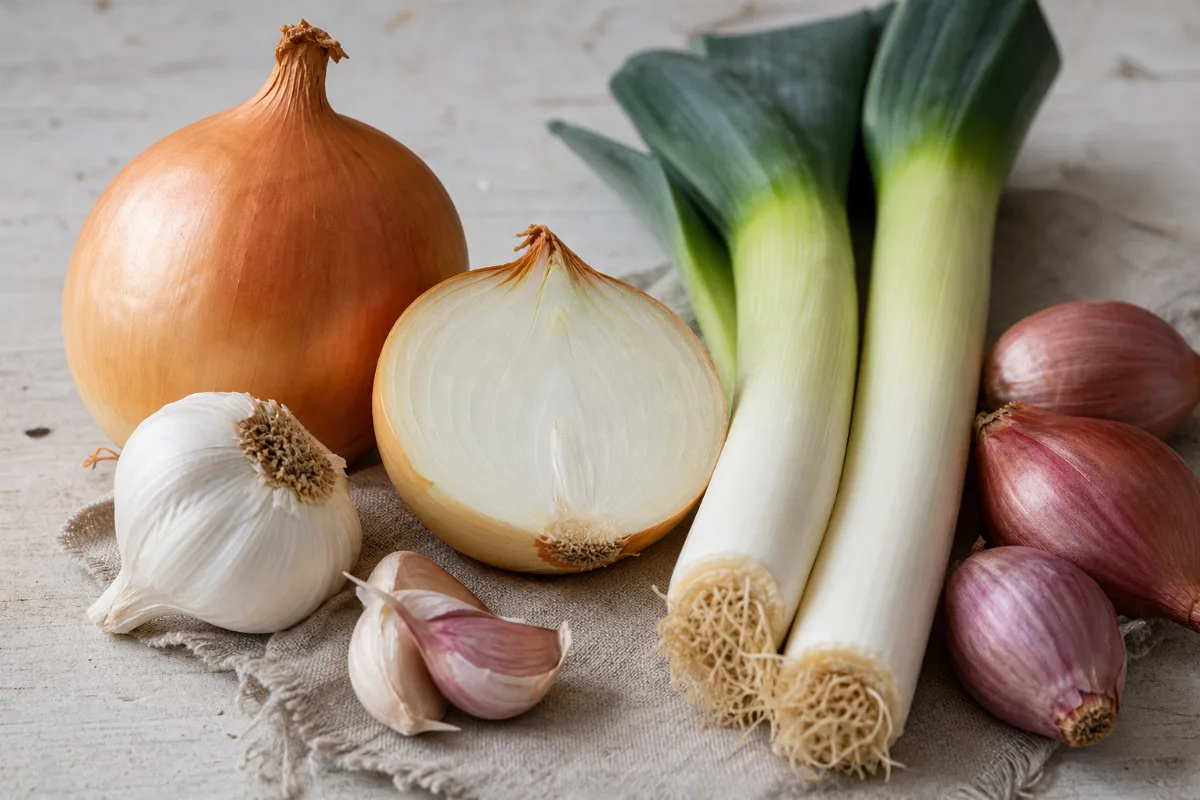
Allium vegetables are the onion family: onion (Allium cepa), garlic (Allium sativum), leek (Allium ampeloprasum), chives (Allium schoenoprasum), shallots and scallions. A gastric cancer meta-analysis lists onions, garlic, shallots, leeks and chives among them. [2] The U.S. Dietary Guidelines place onions in the "other vegetables" group. [3] The bulb, leaf or stem eaten differs by vegetable. No identification or foraging advice is given here; for plant poisoning questions see Plant and mushroom poisoning and Poison Help (1-800-222-1222 in the U.S.).What research shows
| Question | What the source found | Strength of evidence | Form and people studied |
|---|---|---|---|
| Stomach (gastric) cancer risk | People eating the most allium vegetables had lower risk (odds ratio 0.54, 95% CI 0.43 to 0.65). The authors cite confounding and measurement problems and say more studies are needed. [2] | Observational, mixed | 19 case-control and 2 cohort studies, 543,220 people [2] |
| Stomach cancer, garlic | NCCIH says consuming garlic does not seem to reduce the risk of stomach cancer. [1] | Mixed with the row above | Garlic as reviewed by NCCIH [1] |
| Cancer overview | An umbrella review of 16 meta-analyses found the most beneficial cancer result for gastric cancer (RR 0.78, 95% CI 0.67 to 0.91). [4] | Observational, promising but limited | 16 meta-analyses of allium vegetable consumption [4] |
| Colorectal cancer | NCCIH says it is uncertain whether garlic influences risk. [1] | Insufficient evidence | Garlic [1] |
| Cholesterol | Garlic supplements may reduce total and LDL cholesterol a small amount in people with high cholesterol. [1] | Promising but limited (supplements, not cooking) | Supplement trials; not the same as garlic in meals [1] |
| Colds | Cochrane found insufficient trial evidence on garlic for preventing or treating the common cold. Only one trial met the inclusion criteria. [5] | Insufficient evidence | Garlic supplement trial [5] |
| Onions, leeks and chives alone | Little onion-specific evidence. A 2023 meta-analysis of 5 trials in people with obesity found lower weight, BMI, waist size and triglycerides with onion products, but 4 of the 5 trials used onion peel extract and only 1 used onion. [6] We found no onion-specific review for leeks or chives. | Promising but limited (mostly peel extract) | Adults with obesity; mostly onion peel extract [6] |
Health connections for Onions, Garlic & Allium Vegetables (overview)
What research links to eating or drinking this food, and how strong the evidence is. Many studies are observational or use juice, powder, oil or extracts rather than the food as eaten; each card says which.
Allium vegetables and stomach (gastric) cancer risk
Preliminary or mixedPeople who ate the most allium vegetables had lower stomach cancer risk in a meta-analysis (odds ratio 0.54). This is observational; the authors cite confounding and say more studies are needed.
Supplements: Not a supplement result; NCCIH says eating garlic does not seem to reduce stomach cancer risk, so the evidence is mixed.
Cancer overview (umbrella review)
Preliminary or mixedAn umbrella review of 16 meta-analyses found the most beneficial cancer result for gastric cancer (RR 0.78). Observational findings cannot prove cause.
Supplements: Not applicable; this is about eating patterns.
Colorectal cancer risk
Not enough evidenceNCCIH says it is uncertain whether garlic influences colorectal cancer risk. Nothing was found for onions or leeks alone.
Supplements: Unknown.
Cholesterol: supplements versus meals
Preliminary or mixedGarlic supplements may lower total and LDL cholesterol a small amount in people with high cholesterol. This was found for supplements, not for garlic cooked in meals.
Supplements: Small possible effect for supplements only; not proof for food.
Garlic and the common cold
Not enough evidenceCochrane found insufficient trial evidence on garlic for preventing or treating colds; only one trial met the criteria, and it used a garlic supplement.
Supplements: Insufficient evidence.
Onions, leeks and chives alone
Not enough evidenceThe page's PubMed search did not find onion-specific human reviews to report. Proper evidence was not found in the sources we read.
Supplements: Not applicable.
Everyday nutrients in allium vegetables
Established roleUSDA lists modest amounts of fiber, vitamin C, vitamin B6, folate and manganese in raw onions, leeks, garlic and shallots; leeks stand out for vitamin K. Typical servings are small, so they add to, rather than replace, a varied diet.
Supplements: Not applicable; this is normal dietary content.
Connected topics
Open a group to see how each topic connects and how strong the evidence is.
Body systems (1)
- Digestive SystemPreliminary or mixed
The only digestive link with research is the observational gastric cancer finding, which cannot prove cause.
Body parts (1)
- StomachPreliminary or mixed
People with high allium vegetable intake had lower gastric cancer risk in an observational meta-analysis; NCCIH says garlic does not seem to reduce stomach cancer risk, so the evidence is mixed.
Root causes (1)
- Medication Side EffectsDocumented risk
Garlic supplements may raise bleeding risk with anticoagulants or aspirin; this applies to supplements, not to garlic in meals.
Conditions & symptoms (2)
- Food AllergyDocumented risk
Some people react to garlic; call 911 for trouble breathing or swelling of the face or throat.
- Gastric CancerPreliminary or mixed
Observational meta-analysis links high allium vegetable intake to lower stomach cancer risk; NCCIH says garlic does not seem to reduce it. Not proof of cause.
Documented risks and interactions (4)
- Garlic supplements and bleeding risk. NCCIH says garlic supplements may increase bleeding risk; tell health care providers, especially before surgery or when taking anticoagulants or aspirin. The caution applies to supplements, not to garlic in meals.
- Allergy to garlic. Some people have allergic reactions to garlic. For trouble breathing or swelling of the face or throat, call 911.
- Side effects and pregnancy. Garlic eaten or taken by mouth can cause breath and body odor, abdominal pain, gas and nausea. NCCIH says garlic may not be safe by mouth in pregnancy or breastfeeding in amounts above those found in foods.
- Raw garlic on the skin. NCCIH says fresh raw garlic may cause severe skin irritation and chemical burns when used on the skin. We do not give home-remedy methods.
Frequently asked questions
Is garlic good for you?
Garlic is a common food. NCCIH says garlic supplements may lower cholesterol a little, [1] but those results are for supplements. Evidence for garlic as a meal ingredient is mostly observational.
Do onions and garlic lower cancer risk?
A meta-analysis linked high allium intake to lower gastric cancer risk, but it cites confounding and calls for more studies. [2] NCCIH says garlic does not seem to reduce stomach cancer risk. [1] The evidence is mixed.
Does garlic prevent colds?
Cochrane found insufficient evidence. [5]
Can garlic interact with medicines?
NCCIH says garlic supplements may raise bleeding risk, especially with anticoagulants or aspirin, and should be disclosed before surgery. [1] Ask a pharmacist about supplements.
Are raw onions or garlic safe on the skin or as a home remedy?
NCCIH says fresh raw garlic may cause severe skin irritation and chemical burns when used topically. [1] We do not give home-remedy methods.
More details: evidence, limits and cautions
The details behind this page: cautions, limits of the evidence and where sources disagree. Open any note to read it.
Limits and uncertainty
- Eating habits are tangled together. Studies of people who eat more allium vegetables are observational and cannot prove cause. [2]
- Many garlic results come from supplements. The umbrella review also reports cholesterol, blood sugar and blood pressure findings for garlic, [4] and NCCIH describes similar results specifically for garlic supplements. [1] The abstract we read does not say which form of garlic each study used, so these findings should not be read as proof for a clove in a meal.
- Heat, storage and form were not compared in the sources we read, so we make no claim about them.
Safety and who should ask a professional
- Common side effects of garlic eaten or taken by mouth include breath and body odor, abdominal pain, gas and nausea. [1]
- Allergy. Some people react to garlic. [1] See Food allergy basics and emergency signs. Call 911 for trouble breathing or swelling of the face or throat.
- Pregnancy and breastfeeding. NCCIH says garlic may not be safe by mouth in amounts greater than those found in foods. [1]
- Surgery and bleeding. The bleeding caution applies to supplements. [1] Tell the surgical team about any garlic product.
- Gut comfort. Onions and garlic are discussed as prebiotic foods at Prebiotic foods.
References
- NCCIH. Garlic. Read 2026-10-23.
- Zhou Y, et al. Consumption of large amounts of Allium vegetables reduces risk for gastric cancer in a meta-analysis. Gastroenterology. 2011. Read 2026-10-23.
- U.S. Department of Agriculture and U.S. Department of Health and Human Services. Dietary Guidelines for Americans, 2020-2025. Read 2026-10-23.
- Wan Q, et al. Allium vegetable consumption and health: an umbrella review of meta-analyses of multiple health outcomes. Food Sci Nutr. 2019. Read 2026-10-23.
- Lissiman E, et al. Garlic for the common cold. Cochrane Database Syst Rev. 2014. Read 2026-10-23.
- Chung MY, et al. Antiobesity effects of onion (Allium cepa) in subjects with obesity: systematic review and meta-analysis. Food Sci Nutr. 2023. Abstract read 2026-10-24.